EP3778583B1 - Composé hétérocyclique et agent de lutte contre les arthropodes nuisibles le contenant - Google Patents
Composé hétérocyclique et agent de lutte contre les arthropodes nuisibles le contenant Download PDFInfo
- Publication number
- EP3778583B1 EP3778583B1 EP19776019.2A EP19776019A EP3778583B1 EP 3778583 B1 EP3778583 B1 EP 3778583B1 EP 19776019 A EP19776019 A EP 19776019A EP 3778583 B1 EP3778583 B1 EP 3778583B1
- Authority
- EP
- European Patent Office
- Prior art keywords
- group
- compound
- optionally
- halogen atoms
- reaction
- Prior art date
- Legal status (The legal status is an assumption and is not a legal conclusion. Google has not performed a legal analysis and makes no representation as to the accuracy of the status listed.)
- Active
Links
Classifications
-
- A—HUMAN NECESSITIES
- A01—AGRICULTURE; FORESTRY; ANIMAL HUSBANDRY; HUNTING; TRAPPING; FISHING
- A01N—PRESERVATION OF BODIES OF HUMANS OR ANIMALS OR PLANTS OR PARTS THEREOF; BIOCIDES, e.g. AS DISINFECTANTS, AS PESTICIDES OR AS HERBICIDES; PEST REPELLANTS OR ATTRACTANTS; PLANT GROWTH REGULATORS
- A01N43/00—Biocides, pest repellants or attractants, or plant growth regulators containing heterocyclic compounds
- A01N43/34—Biocides, pest repellants or attractants, or plant growth regulators containing heterocyclic compounds having rings with one nitrogen atom as the only ring hetero atom
- A01N43/40—Biocides, pest repellants or attractants, or plant growth regulators containing heterocyclic compounds having rings with one nitrogen atom as the only ring hetero atom six-membered rings
-
- A—HUMAN NECESSITIES
- A01—AGRICULTURE; FORESTRY; ANIMAL HUSBANDRY; HUNTING; TRAPPING; FISHING
- A01N—PRESERVATION OF BODIES OF HUMANS OR ANIMALS OR PLANTS OR PARTS THEREOF; BIOCIDES, e.g. AS DISINFECTANTS, AS PESTICIDES OR AS HERBICIDES; PEST REPELLANTS OR ATTRACTANTS; PLANT GROWTH REGULATORS
- A01N43/00—Biocides, pest repellants or attractants, or plant growth regulators containing heterocyclic compounds
- A01N43/48—Biocides, pest repellants or attractants, or plant growth regulators containing heterocyclic compounds having rings with two nitrogen atoms as the only ring hetero atoms
- A01N43/56—1,2-Diazoles; Hydrogenated 1,2-diazoles
-
- A—HUMAN NECESSITIES
- A01—AGRICULTURE; FORESTRY; ANIMAL HUSBANDRY; HUNTING; TRAPPING; FISHING
- A01N—PRESERVATION OF BODIES OF HUMANS OR ANIMALS OR PLANTS OR PARTS THEREOF; BIOCIDES, e.g. AS DISINFECTANTS, AS PESTICIDES OR AS HERBICIDES; PEST REPELLANTS OR ATTRACTANTS; PLANT GROWTH REGULATORS
- A01N43/00—Biocides, pest repellants or attractants, or plant growth regulators containing heterocyclic compounds
- A01N43/72—Biocides, pest repellants or attractants, or plant growth regulators containing heterocyclic compounds having rings with nitrogen atoms and oxygen or sulfur atoms as ring hetero atoms
- A01N43/74—Biocides, pest repellants or attractants, or plant growth regulators containing heterocyclic compounds having rings with nitrogen atoms and oxygen or sulfur atoms as ring hetero atoms five-membered rings with one nitrogen atom and either one oxygen atom or one sulfur atom in positions 1,3
- A01N43/78—1,3-Thiazoles; Hydrogenated 1,3-thiazoles
-
- A—HUMAN NECESSITIES
- A01—AGRICULTURE; FORESTRY; ANIMAL HUSBANDRY; HUNTING; TRAPPING; FISHING
- A01N—PRESERVATION OF BODIES OF HUMANS OR ANIMALS OR PLANTS OR PARTS THEREOF; BIOCIDES, e.g. AS DISINFECTANTS, AS PESTICIDES OR AS HERBICIDES; PEST REPELLANTS OR ATTRACTANTS; PLANT GROWTH REGULATORS
- A01N43/00—Biocides, pest repellants or attractants, or plant growth regulators containing heterocyclic compounds
- A01N43/72—Biocides, pest repellants or attractants, or plant growth regulators containing heterocyclic compounds having rings with nitrogen atoms and oxygen or sulfur atoms as ring hetero atoms
- A01N43/80—Biocides, pest repellants or attractants, or plant growth regulators containing heterocyclic compounds having rings with nitrogen atoms and oxygen or sulfur atoms as ring hetero atoms five-membered rings with one nitrogen atom and either one oxygen atom or one sulfur atom in positions 1,2
-
- C—CHEMISTRY; METALLURGY
- C07—ORGANIC CHEMISTRY
- C07D—HETEROCYCLIC COMPOUNDS
- C07D277/00—Heterocyclic compounds containing 1,3-thiazole or hydrogenated 1,3-thiazole rings
- C07D277/02—Heterocyclic compounds containing 1,3-thiazole or hydrogenated 1,3-thiazole rings not condensed with other rings
- C07D277/20—Heterocyclic compounds containing 1,3-thiazole or hydrogenated 1,3-thiazole rings not condensed with other rings having two or three double bonds between ring members or between ring members and non-ring members
- C07D277/22—Heterocyclic compounds containing 1,3-thiazole or hydrogenated 1,3-thiazole rings not condensed with other rings having two or three double bonds between ring members or between ring members and non-ring members with only hydrogen atoms, hydrocarbon or substituted hydrocarbon radicals, directly attached to ring carbon atoms
-
- C—CHEMISTRY; METALLURGY
- C07—ORGANIC CHEMISTRY
- C07D—HETEROCYCLIC COMPOUNDS
- C07D401/00—Heterocyclic compounds containing two or more hetero rings, having nitrogen atoms as the only ring hetero atoms, at least one ring being a six-membered ring with only one nitrogen atom
- C07D401/02—Heterocyclic compounds containing two or more hetero rings, having nitrogen atoms as the only ring hetero atoms, at least one ring being a six-membered ring with only one nitrogen atom containing two hetero rings
- C07D401/04—Heterocyclic compounds containing two or more hetero rings, having nitrogen atoms as the only ring hetero atoms, at least one ring being a six-membered ring with only one nitrogen atom containing two hetero rings directly linked by a ring-member-to-ring-member bond
-
- C—CHEMISTRY; METALLURGY
- C07—ORGANIC CHEMISTRY
- C07D—HETEROCYCLIC COMPOUNDS
- C07D409/00—Heterocyclic compounds containing two or more hetero rings, at least one ring having sulfur atoms as the only ring hetero atoms
- C07D409/02—Heterocyclic compounds containing two or more hetero rings, at least one ring having sulfur atoms as the only ring hetero atoms containing two hetero rings
- C07D409/04—Heterocyclic compounds containing two or more hetero rings, at least one ring having sulfur atoms as the only ring hetero atoms containing two hetero rings directly linked by a ring-member-to-ring-member bond
-
- C—CHEMISTRY; METALLURGY
- C07—ORGANIC CHEMISTRY
- C07D—HETEROCYCLIC COMPOUNDS
- C07D413/00—Heterocyclic compounds containing two or more hetero rings, at least one ring having nitrogen and oxygen atoms as the only ring hetero atoms
- C07D413/02—Heterocyclic compounds containing two or more hetero rings, at least one ring having nitrogen and oxygen atoms as the only ring hetero atoms containing two hetero rings
- C07D413/04—Heterocyclic compounds containing two or more hetero rings, at least one ring having nitrogen and oxygen atoms as the only ring hetero atoms containing two hetero rings directly linked by a ring-member-to-ring-member bond
-
- C—CHEMISTRY; METALLURGY
- C07—ORGANIC CHEMISTRY
- C07D—HETEROCYCLIC COMPOUNDS
- C07D417/00—Heterocyclic compounds containing two or more hetero rings, at least one ring having nitrogen and sulfur atoms as the only ring hetero atoms, not provided for by group C07D415/00
- C07D417/02—Heterocyclic compounds containing two or more hetero rings, at least one ring having nitrogen and sulfur atoms as the only ring hetero atoms, not provided for by group C07D415/00 containing two hetero rings
- C07D417/04—Heterocyclic compounds containing two or more hetero rings, at least one ring having nitrogen and sulfur atoms as the only ring hetero atoms, not provided for by group C07D415/00 containing two hetero rings directly linked by a ring-member-to-ring-member bond
Definitions
- the present invention relates to a certain class of heterocyclic compounds and a composition for controlling harmful arthropods comprising the compound, and to a method for controlling a harmful arthropod which comprises applying the compound or the composition.
- An object of the present invention is to provide a compound having an excellent efficacy for controlling harmful arthropods.
- the present invention provides a compound represented by formula (I): wherein Q represents a group represented by formula Q1,
- the present invention provides a composition for use in controlling a harmful arthropod comprising the above inventive compound and an inert carrier.
- the present invention provides a method for controlling a harmful arthropod which comprises applying an effective amount of the above inventive compound to a harmful arthropod or a habitat where a harmful arthropod lives, wherein a method for the treatment of the human or animal body by therapy is excluded.
- the present invention provides a composition comprising one or more ingredients selected from Group (a) and Group (b), and the above inventive compound:
- the present invention provides a method for controlling a harmful arthropod which comprises applying an effective amount of the above inventive composition to a harmful arthropod or a habitat where a harmful arthropod lives, wherein a method for the treatment of the human or animal body by therapy is excluded.
- the present invention provides a seed or vegetative reproductive organ carrying an effective amount of the above inventive compound or an effective amount of the above inventive composition.
- the present invention can control harmful arthropod.
- halogen atom represents fluorine atom, chlorine atom, bromine atom, or iodine atom.
- these halogen atoms may be identical to or different from each other.
- CX-CY represents that the number of carbon atom is from X to Y.
- C1-C6 represents that the number of carbon atom is from 1 to 6.
- chain hydrocarbon group represents an alkyl group, an alkenyl group, or an alkynyl group.
- alkyl group examples include methyl group, ethyl group, propyl group, isopropyl group, 1,1-dimethylpropyl group, 1,2-dimethylpropyl group, 1-ethylpropyl group, butyl group, sec-butyl group, tert-butyl group, pentyl group, hexyl group, heptyl group, octyl group, nonyl group, and decyl group.
- alkenyl group examples include vinyl group, 1-propenyl group, 2-propenyl group, 1-methyl-1-propenyl group, 1-methyl-2-propenyl group, 1,2-dimethyl-1-propenyl group, 1-ethyl-2-propenyl group, 3-butenyl group, 4-pentenyl group, 5-hexenyl group. 6-heptenyl group, 7-octenyl group, nonenyl group, and decenyl group.
- alkynyl group examples include ethynyl group, 1-propynyl group, 2-propynyl group, 1-methyl-2-propynyl group, 1,1-dimethyl-2-propynyl group, 1-ethyl-2-propynyl group, 2-butynyl group, 4-pentynyl group, 5-hexynyl group, 6-heptynyl group, 7-octynyl group, nonynyl group, and decynyl group.
- cycloalkyl group examples include cyclopropyl group, cyclobutyl group, cyclopentyl group, cyclohexyl group, and cycloheptyl group.
- alkoxy group represents a group wherein the alkyl group as defied above is attached to an oxygen atom, and examples thereof include methoxy group, ethoxy group, propoxy group, isopropoxy group, butoxy group, pentyloxy group, and hexyloxy group.
- alkenyloxy group represents a group wherein one hydrogen atom on the alkenyl group as defined above is replaced with an oxygen atom, and examples thereof include vinyloxy group, 1-propenyloxy group, 2-propenyloxy group, isopropenyloxy group, 1-butenyloxy group, 2-butenyloxy group, 3-butenyloxy group, 1-isobutenyloxy group, 2-isobutenyloxy group, 1-pentenyloxy group, 2-pentenyloxy group, 3-pentenyloxy group, and 4-pentenyloxy group.
- alkynyloxy group represents a group wherein one hydrogen atom on the alkynyl group as defined above is replaced with an oxygen atom, and examples thereof include ethynyloxy group, 1-propynyloxy group, 2-propynyloxy group, 1-butynyloxy group, 2-butynyloxy group, 3-butynyloxy group, 1-pentynyloxy group, 2-pentynyloxy group, 3-pentynyloxy group, 4-pentynyloxy group, 1-hexynyloxy group, 2-hexynyloxy group, and 3-hexynyloxy group.
- Examples of "three(3)- to seven(7)- membered nonaromatic heterocyclic group” include aziridine ring, azetidine ring, pyrrolidine ring, imidazoline ring, imidazolidine ring, piperidine ring, tetrahydropyrimidine ring, hexahydropyrimidine ring, piperazine ring, azepane ring, oxazolidine ring, isoxazolidine ring, 1,3-oxazinane ring, morpholine ring, 1,4-oxazepane ring, thiazolidine ring, isothiazolidine ring, 1,3-thiazinane ring, thiomorpholine ring, and 1,4-thiazepane ring.
- Examples of the 3- to 7- membered nonaromatic heterocyclic ring which may optionally have one or more substituents selected from Group E include the below-mentioned group.
- C1-C10 chain hydrocarbon group which may optionally have one or more halogen atoms
- examples of “C1-C10 chain hydrocarbon group which may optionally have one or more halogen atoms” include a C1-C10 chain hydrocarbon group which have one or more halogen atoms in addition to groups as exemplified above as “alkyl group”, “alkenyl group” and “alkynyl group”.
- Specific examples of “C1-C6 chain hydrocarbon group” and “C1-C5 chain hydrocarbon group” are encompassed by the "C1-C10 chain hydrocarbon group”.
- C1-C5 alkyl group having three or more fluorine atoms encompasses a perfluoroalkyl group, and examples thereof include trifluoromethyl group, 1,1,1-trifluoroethyl group, and trifluoroethyl group.
- C1-C6 alkoxy group which may optionally have one or more halogen atoms include a C1-C6 alkoxy group which have one or more halogen atoms, in addition to the groups as exemplified above as "alkoxy group”.
- C3-C7 cycloalkyl group which may optionally have one or more halogen atoms
- examples of “C3-C7 cycloalkyl group which may optionally have one or more halogen atoms” include a C3-C7 cycloalkyl group which have one or more halogen atoms, in addition to the groups as exemplified above as “cycloalkyl group”.
- Specific examples of “C3-C6 cycloalkyl group” are encompassed by the "C3-C7 cycloalkyl group”.
- (C1-C5 alkoxy)C2-C5 alkyl group which have one or more halogen atoms represents a group wherein the (C1-C5 alkoxy) and/or (C2-C5 alkyl) has/have one or more halogen atoms, and examples thereof are a 2-(trifluoromethoxy)ethyl group, 2,2-difluoro-3-methoxypropyl group, 2,2-difluro-3-(2,2,2-trifluoroethoxy)propyl group, and 3-(2-chloroethoxy)propyl group.
- (C1-C5 alkylsulfanyl)C2-C5 alkyl group which have one or more halogen atoms represents a group wherein (C1-C5 alkylsulfanyl group) and/or (C2-C5 alkyl) has/have one or more halogen atoms, and examples thereof include 2,2-difluoro-2-(trifluoromethylthio) ethyl group.
- (C1-C5 alkylsulfinyl group)C2-C5 alkyl group which have one or more halogen atoms represents a group wherein (C1-C5 alkylsulfinyl group) and/or (C2-C5 alkyl) has/have one or more halogen atoms, and examples thereof include 2,2-difluoro-2-(trifluoromethansulfinyl)ethyl group.
- (C1-C5 alkylsulfonyl group)C2-C5 alkyl group which have one or more halogen atoms represents a group wherein (C1-C5 alkylsulfonyl group) and/or (C2-C5 alkyl) has/have one or more halogen atoms, and examples of thereof include 2,2-difluoro-2-(trifluoromethansulfonyl) ethyl group.
- (C3-C7 cycloalkyl)C1-C6 alkyl group which may optionally have one or more halogen atom represents a group wherein (C3-C7 cycloalkyl) and/or (C1-C6 alkyl) may optionally have one or more halogen atoms, and examples thereof include (2,2-difluorocyclopropyl)methyl group, 2-cyclopropyl-1,1,2,2-tetrafluoroethyl group, 2-(2,2-difluorocyclopropyl)-1,1,2,2,-tetrafluoroethyl group, (2,2-difluorocyclopropyl)propyl group, (2,2-difluorocyclopropyl)butyl group, (2,2-difluorocyclopropyl)pentyl group, and (2,2-difluorocyclopropyl)pentyl group.
- (C3-C7 cycloalkyl)C1-C3 alkyl group which may optionally have one or more substituents selected from Group G
- phenyl which may optionally have one or more substituents selected from Group D)C1-C3 alkyl group include benzyl group, 2-fluorobenzyl group, 4-chlorobenzyl group, 4-(trifluoromethyl)benzyl group, and 2-[4-(trifluromethyl)phenyl]ethyl group.
- a five(5)- or six(6)- membered aromatic heterocyclic group represents a five(5) membered aromatic heterocyclic group or a six(6) membered aromatic heterocyclic group
- examples of the five(5) membered aromatic heterocyclic group include pyrrolyl group, furyl group, thienyl group, pyrazolyl group, imidazolyl group, triazolyl group, tetrazolyl group, oxazolyl group, isoxazolyl group, thiazolyl group, isothiazolyl group, oxadiazolyl group, and thiadiazolyl group.
- Examples of the six(6) membered aromatic heterocyclic group include pyridyl group, pyridazinyl group, pyrimidinyl group, pyrazinyl group, triazinyl group, and tetrazinyl group.
- alkylsulfanyl group represents an alkyl group containing a S(O) y moiety, which represents an alkylsulfanyl group, an alkylsulfinyl group, or an alkylsulfonyl group, when y is 0, 1 or 2 respectively.
- alkylsulfanyl group represents a sulfanyl group containing the above-mentioned alkyl group, and examples thereof include a methyl sulfanyl group, an ethyl sulfanyl group, a propyl sulfanyl group, and an isopropyl sulfanyl group.
- alkylsulfinyl group represents a sulfinyl group containing the above-mentioned alkyl group, and examples thereof include a methyl sulfinyl group, an ethyl sulfinyl group, a propyl sulfinyl group, and an isopropyl sulfinyl group.
- alkylsulfonyl group represents a sulfonyl group containing the above-mentioned alkyl group, and examples thereof include a methylsulfonyl group, an ethylsulfonyl group, a propylsulfonyl group, and an isopropylsulfonyl group.
- the compound of the present invention may exist as one or more stereoisomers.
- the stereoisomer include enantiomer, diastereoisomer, and geometric isomer.
- Each stereoisomer, and stereoisomer mixture(s) in an arbitrary ratio thereof are included in the present invention.
- the inventive compound may form acid addition salts.
- the acid to form the acid addition salt include inorganic acids such as hydrogen chloride, phosphoric acid, and sulfuric acid; and organic acids such as acetic acid, trifluoroacetic acid, benzoic acid, and p-toluenesulfonic acid.
- the acid addition salt may be obtained by mixing the compound with an acid.
- a compound represented by formula (A-1a) (hereinafter, referred to as "Compound (A-1a)", a compound represented by formula (A-1b) (hereinafter, referred to as “Compound (A-1b)”, and a compound represented by formula (A-1c) “hereinafter, referred to as “Compound (A-1c)” can be prepared according to the below-mentioned scheme. [wherein X represents a chlorine atom, a bromine atom, or an iodine atom, and the other symbols are the same as those defined above.]
- the compound (A-1a) can be prepared by reacting a compound represented by formula (M-2) (hereinafter, referred to as "Compound (M-2)” with a compound represented by formula (R-1) “hereinafter, referred to as “Compound (R-1)” in the presence of a catalyst and a base.
- M-2 a compound represented by formula (M-2)
- R-1 a compound represented by formula (R-1)
- the reaction is usually carried out in a solvent.
- solvents to be used in the reaction include alcohols (such as methanol and ethanol) (hereinafter, collectively referred to as “alcohols”); nitriles (such as acetonitrile) (hereinafter, collectively referred to as “nitriles”) ; ethers (such as methyl tert-butyl ether (hereinafter, referred to as "MTBE”), tetrahydrofuran “hereinafter, referred to as “THF”) and dimethoxyethane (hereinafter, collectively “ethers”); aromatic hydrocarbons (such as toluene and xylene) (hereinafter, collectively referred to as “aromatic hydrocarbons”); apromatic polar solvents (such as N,N-dimethylformamide (hereinafter, referred to as "DMF”), and N-methylpyrrolidone and dimethylsulfoxide (hereinafter, referred to
- Examples of the catalyst to be used in the reaction include palladium catalysts (such as tetrakis(triphenylphosphine) palladium (0), 1,1'-bis(diphenylphosphino) ferrocene palladium (II) dichloride, tris (dibenzylideneacetone) dipalladium (0), and palladium (II) acetate); nickel catalysts (such as bis(cyclooctadiene) nickel(0) and nickel(II) chloride); and copper catalysts (such as copper (I) iodide and copper (I) chloride).
- palladium catalysts such as tetrakis(triphenylphosphine) palladium (0), 1,1'-bis(diphenylphosphino) ferrocene palladium (II) dichloride, tris (dibenzylideneacetone) dipalladium (0), and palladium (II) acetate
- nickel catalysts
- Examples of the base to be used in the reaction include alkali metal hydrides (such as sodium hydride) (hereinafter, collectively referred to as “alkali metal hydrides”); alkali metal carbonates (such as potassium carbonate and sodium carbonate) (hereinafter, collectively referred to as “alkali metal carbonates”); and organic bases (such as pyridine and triethylamine) (hereinafter, collectively referred to as "organic bases”).
- alkali metal hydrides such as sodium hydride
- alkali metal carbonates such as potassium carbonate and sodium carbonate
- organic bases such as pyridine and triethylamine
- the compound (R-1) is usually used within a range of 1 to 20 molar ratio(s)
- the metal catalyst is usually used within a range of 0.01 to 0.5 molar ratios
- the base is usually used within a range of 0.1 to 5 molar ratio (s), as opposed to 1 mole of the compound (M-2).
- a ligand may be used in the reaction.
- the ligand include triphenylphosphine, Xantphos, 2,2'-bis(diphenylphosphino)-1,1'-binaphthyl, 1,1'-bis(diphenylphosphino)ferrocene, 2-dicyclohexylphosphino-2',4',6'-triisopropylbiphenyl, 2-dicyclohexylphosphino-2',6'-dimethoxybiphenlnyl, 1,2-bis (diphenylphosphino)ethane, 2,2'-bipyridine, 2-aminoethanol, 8-hydroxyqunoline, and 1,10-phenanthroline, and the others.
- the ligand is usually used within a range of 0.01 to 1 molar ratio(s) as opposed to 1 mole of the compound (M-2).
- the reaction temperature in the reaction is usually within a range of -20 to 200°C.
- the reaction period in the reaction is usually within a range of 0.1 to 72 hours.
- the compound (R-1) is a commercially available compound, or can be prepared by using a known method.
- the compound (A-b) can be prepared by reacting the compound (A-1a) with an oxidizing agent.
- the reaction is usually carried out in a solvent.
- solvents to be used in the reaction include halogenated hydrocarbons (such as dichloromethane and chloroform) (hereinafter, collectively referred to as "halogenated hydrocarbons"); nitriles; alcohols; acetic acid; water; and mixed solvents of two or more of these solvents.
- oxidizing agent examples include sodium periodate, m-chloroperoxybenzoic acid (hereinafter, referred to as "mCPBA”) and hydrogen peroxide.
- a base or a catalyst may be used as needed.
- the base examples include sodium carbonate.
- the base is usually used within a range of 0.01 to 1 molar ratio(s), as opposed to 1 mole of the compound (A-1a).
- the catalyst examples include tungstic acid, and sodium tungstate.
- the catalyst is usually used within a range of 0.01 to 0.5 molar ratios as opposed to 1 mole of the compound (A-1a).
- the oxidizing agent is usually used within a range of 1 to 1.2 molar ratio(s), as opposed to 1 mole of the compound (A-1a).
- the reaction temperature in the reaction is usually within a range of -20 to 80°C.
- the reaction period in the reaction is usually within a range of 0.1 to 12 hours.
- reaction mixtures water is added to reaction mixtures, and the mixtures are extracted with organic solvent(s), and if necessary, the organic layers are washed with an aqueous solution of a reducing agent (such as sodium sulfite, and sodium thiosulfate) and an aqueous solution of a base (such as sodium hydrogen carbonate).
- a reducing agent such as sodium sulfite, and sodium thiosulfate
- base such as sodium hydrogen carbonate
- the compound (A-1c) can be prepared by reacting the compound (A-1b) with the oxidizing agent.
- the reaction is usually carried out in a solvent.
- solvents to be used in the reaction include halogenated hydrocarbons, nitriles, alcohols, acetic acid, water, and mixed solvents of two or more of these solvents.
- Examples of the oxidizing agent to be used in the reaction include mCPBA and hydrogen peroxide.
- a base or a catalyst may be used as needed.
- the base examples include sodium carbonate.
- the base is usually used within a range of 0.01 to 1 molar ratio(s) as opposed to 1 mole of the compound (A-1b).
- the catalyst examples include sodium tungstate.
- the catalyst is usually used within a range of 0.01 to 0.5 molar ratios as opposed to 1 mole of the compound (A-1b).
- the oxidizing agent is usually used within a range of 1 to 2 molar ratio(s) as opposed to 1 mole of the compound (A-1b).
- the reaction temperature in the reaction is usually within a range of -20 to 120°C.
- the reaction period in the reaction is usually within a range of 0.1 to 12 hours.
- reaction mixtures water is added to reaction mixtures, and the mixtures are extracted with organic solvent(s), and if necessary, the organic layers are washed with an aqueous solution of a reducing agent (such as sodium sulfite, and sodium thiosulfate) and an aqueous solution of a base (such as sodium hydrogen carbonate).
- a reducing agent such as sodium sulfite, and sodium thiosulfate
- base such as sodium hydrogen carbonate
- the compound (A-1c) can be prepared by reacting the compound (A-1a) with an oxidizing agent in one step (one-spot)
- the reaction can be carried out by using the oxidizing agent in 2 to 5 molar ratios as opposed to 1 mole of the compound (A-1a) according to a similar method to that described in the method for preparing the compound (A-1c) from the compound (A-1b).
- a compound represented by formula (A-2a) (hereinafter, referred to as "Compound (A-2a)”) can be prepared by reacting a compound represented by formula (M-3) (hereinafter, referred to as "Compound (M-3)”) with the compound (R-1) in the presence of a catalyst and a base.
- a compound represented by formula (A-2b) (hereinafter, referred to as “Compound (A-2b)") or a compound represented by formula (A-2c) (hereinafter, referred to as “Compound (A-2c)”
- the compound (A-2c) can be prepared by reacting the compound (A-2b) with an oxidizing agent. [wherein the symbols are the same as those defined above.]
- a compound represented by formula (A-3a) (hereinafter, referred to as "Compound (A-3a)”) can be prepared by reacting a compound represented by formula (M-5) (hereinafter, referred to as “Compound (M-5)”) with the compound (R-1) in the presence of a catalyst and a base.
- a compound represented by formula (A-3b) (hereinafter, referred to as “Compound (A-3b)") or a compound represented by formula (A-3c) (hereinafter, referred to as “Compound (A-3c)”
- the compound (A-3c) can be also prepared by reacting the compound (A-3b) with an oxidizing agent.
- Compound (A-4) A compound represented by formula (A-4) (hereinafter, referred to as "Compound (A-4)”) can be prepared according to the below-mentioned scheme. [wherein X b represents a chlorine atom or a bromine atom, and the other symbols are the same as those defined above.]
- a compound represented by formula (M-6) (hereinafter, referred to as “Compound (M-6)) can be prepared by reacting a compound represented by formula (M-16) (hereinafter, referred to as “Compound (M-16)”) with a compound represented by formula (R-2) (hereinafter, referred to as “Compound (R-2)”) in the presence of a base.
- the reaction is usually carried out in a solvent.
- solvents to be used in the reaction include ethers, aromatic hydrocarbons, nitriles, aprotic polar solvents, and mixed solvents of two or more of these solvents.
- Examples of the bases to be used in the reaction include alkali metal carbonates, and alkali metal hydrides.
- the compound (R-2) is usually used within a range of 1 to 2 molar ratio(s), and the base is usually used within a range of 1 to 10 molar ratio(s), as opposed to 1 mole of the compound (M-16).
- the reaction temperature in the reaction is usually within a range of -20 to 150°C.
- the reaction period in the reaction is usually within a range of 0.5 to 24 hours.
- the compound (M-16) is a known compound, or can be prepared according to a similar method to those described in WO 2016/121969 or WO 2017/065228 and so on.
- the compound (R-2) is a commercially available compound, or can be prepared by using a known method.
- a compound represented by formula (M-7) (hereinafter, referred to as "Compound (M-7)”) can be prepared by reacting the compound (M-6) with an ozone, followed by reacting Lhe resulting ozonide with a reducing agent.
- the reaction between the compound (M-6) and an ozone is usually carried out in a solvent.
- the solvents to be used in the reaction include aromatic hydrocarbons, halogenated hydrocarbons, nitriles, aprotic polar solvents, alcohols, water, and mixed solvents of two or more of these solvents.
- the ozone is usually used within a range of 1 to 100 molar ratio(s) as opposed to 1 mole of the compound (M-6).
- the reaction temperature of the reaction between the compound (M-6) and an ozone is usually within a range of - 78 to 30°C.
- the reaction period in the reaction is usually within a range of 0.1 to 24 hours.
- reaction mixture containing an ozonide are reacted with a reducing agent, and water is added to reaction mixtures, and the mixtures are extracted with organic solvents, and the organic layers are worked up (for example, drying and concentration) to obtain the compound (M-7).
- a reducing agent include zinc and dimethyl sulfide.
- the ozone can be prepared by using a known method.
- a compound represented by formula (A-4) (hereinafter, referred to as “Compound (A-4)) can be prepared by reacting the compound (M-7), a compound represented by formula (R-3) (hereinafter, referred to as “Compound (R-3)”) and a compound represented by formula (R-4) (hereinafter, referred to as “Compound (R-4)").
- the reaction can be usually in a solvent.
- solvents to be used in the reactions include aromatic hydrocarbons, nitriles, and mixed solvents of two or more of these solvents.
- the compound (R-3) is usually used within a range of 1 to 10 molar ratio(s), and the compound (R-4) is usually used within a range of 1 to 10 molar ratio(s), as opposed to 1 mole of the compound (M-7).
- the reaction temperature in the reaction is usually within a range of 0 to 120°C.
- the reaction period in the reaction is usually within a range of 0.1 to 48 hours.
- the compound (R-3) and the compound (R-4) are commercially available compounds or can be prepared by using the known method.
- Compound (A-5) A compound represented by formula (A-5) (hereinafter, referred to as "Compound (A-5)”) can be prepared by reacting the compound (M-7) with an acid. [wherein the symbols are the same as those defined above.]
- the reaction is usually carried out in a solvent.
- solvents to be used in the reaction include ethers, aromatic hydrocarbons, nitriles, aprotic polar solvents, and mixed solvents of two or more of these solvents.
- Examples of the acid to be used in the reaction include polyphosphoric acid, 10-camphorsulfonic acid, and pyridinium p-toluene sulfonate, and the others.
- the acid is usually within a range of 0.1 to 2 molar ratios, as opposed to 1 mole of the compound (M-7).
- the reaction temperature in the reaction is usually within a range of -20 to 150°C.
- the reaction period in the reaction is usually within a range of 0.5 to 24 hours.
- a compound represented by formula (A-6) (hereinafter, referred to as "Compound (A-6)") can be prepared by reacting the compound (M-7) with a sulfurizing agent. [wherein the symbols are the same as those defined above]
- the reaction is usually carried out in a solvent.
- solvents to be used in the reaction include ethers, aromatic hydrocarbons, nitriles, and mixed solvents of two or more of these solvents.
- sulfurizing agents to be used in the reaction examples include 2,4-bis(4-methoxyphenyl)-1,3-dithia-2,4-diphosphetan-2,4-disulfide (hereinafter, referred to as "Lawesson's reagent") and phosphorus pentasulfide.
- the sulfurizing agent is usually used within a range of 1 to 2 molar ratio(s), as opposed to 1 mole of the compound (M-7).
- the reaction temperature in the reaction is usually within a range of -20 to 150°C.
- the reaction period in the reaction is usually within a range of 0.5 to 24 hours.
- Compound (A-7) A compound represented by formula (A-7) (hereinafter, referred to as "Compound (A-7)”) can be prepared according to the below-mentioned scheme. [wherein the symbols are the same as those defined above.]
- a compound represented by formula (M-9) (hereinafter, referred to as “Compound (M-9)) can be prepared by reacting a compound represented by formula (M-4) (hereinafter, referred to as “Compound (M-4)”) with a compound represented by formula (R-5) (hereinafter, referred to as “Compound (R-5)”) in the presence of a base.
- the reaction is usually carried out in a solvent.
- the solvent to be used in the reaction include ethers, aromatic hydrocarbons, nitriles, aprotic polar solvents, and mixed solvents of two or more of these solvents.
- Examples of the base to be used in the reaction include alkali metal carbonates and alkali metal hydrides.
- the Compound (R-5) is usually used wthin a range of 1 to 2 molar ratio(s), and the base is usually within a range of 1 to 10 molar ratio(s), as opposed to 1 mole of the compound (M-4).
- the reaction temperature in the reaction is usually within a range of -20 to 150°C.
- the reaction period in the reaction is usually within a range of 0.5 to 24 hours.
- the compound (R-5) is a commercially available compound, or can be prepared according to a known method.
- the compound (A-7) can be prepared by reacting the compound (M-9) with the compound (R-3) in the presence of an acid.
- the reaction can be carried out by using the compound (M-9) in place of the compound (M-7) according to the Process 5.
- a compound represented by formula (A-8) (hereinafter, referred to as "Compound (A-8)") can be prepared by reacting the compound (M-9) with a halogenating agent. [Wherein the symbols are the same as those defined above]
- the reaction is usually carried out in a solvent.
- solvents to be used in the reaction include ethers, aromatic hydrocarbons, halogenated hydrocarbons, and mixed solvents of two or more of these solvents.
- halogenating agent examples include phosphoryl chloride and phosphoryl bromide, and the others.
- the halogenating agent is usually within a range of 1 to 10 molar ratio(s) as opposed to 1 mole of the compound (M-9).
- the reaction temperature in the reaction is usually within a range of 20 to 150°C.
- the reaction period in the reaction is usually within a range of 0.5 to 24 hours.
- a compound represented by formula (A-9) (hereinafter, referred to as "Compound (A-9)”) can be prepared by reacting the compound (M-9) with a sulfurizing agent. [Wherein the symbols are the same as those defined above]
- the compound (A-9) can be prepared by using the compound (M-9) in place of the compound (M-7) according to a similar method to that for preparing the compound (A-6) from the compound (M-7), said method being described in the process 6.
- a compound represented by formula (A-10) (hereinafter, referred to as “Compound (A-10)") and a compound represented by formula (A-11) (hereinafter, referred to as “Compound (A-11)) can be prepared according to the below-mentioned scheme.
- T X represents a C1-C3 alkyl group
- R 3 represents a C1-C6 chain hydrocarbon group which may optionally have one or more substituents selected from Group B, a C3-C7 cycloalkyl group which may optionally have one or more substituents selected from Group E, a phenyl group which may optionally have one or more substituents selected from Group H, a 5- or 6- membered aromatic heterocyclic group which may optionally have one or more substituents selected from Group H, C(O)R 13 , C(O)R 17 , C(O)NR 15a R 16a , C(O)NR 11 S(O) 2 R 23 , or a hydrogen atom
- R 5 represents a C1-C6 chain hydrocarbon group which may optionally have one or more substituents selected from Group B, a C3-C7 cycloalkyl group which may optionally have one or more substituents selected from Group E, a phenyl group which may optionally have one or
- a compound represented by formula (M-10) (hereinafter, referred to as “Compound (M-10)") can be prepared by reacting the compound (M-16) with a compound represented by formula (R24) (hereinafter, referred to as “Compound (R24)").
- the reaction is usually carried out in a solvent.
- solvents to be used in the reaction include ethers, aromatic hydrocarbons, nitriles, aprotic polar solvents, and mixed solvents of two or more of these solvents.
- the compound (R24) is usually used within a range of 1 to 100 molar ratio(s) as opposed to 1 mole of the compound (M-16).
- the reaction temperature in the reaction is usually within a range of 0 to 150°C.
- the reaction period in the reaction is usually within a range of 0.5 to 24 hours.
- the compound (A-10) and the compound (A-11) can be prepared by reacting the compound (M-10) with a compound represented by formula (R-6) (hereinafter, referred to as "Compound (R-6)").
- the reaction is usually carried out in a solvent.
- solvents to be used in the reaction include ethers, aromatic hydrocarbons, nitriles, aprotic polar solvents, alcohols, and mixed solvents of two or more of these solvents.
- the compound (R-6) is usually used within a range of 1 to 5 molar ratio(s) as opposed to 1 mole of the compound (M-10).
- the reaction temperature in the reaction is usually within a range of -20 to 150°C.
- the reaction period in the reaction is usualy within a range of 0.1 to 24 hours.
- the compound (R-6) is a commercially available compound, or can be prepared by using a known method.
- a compound represented by formula (A-12) (hereinafter, referred to as “Compound (A-12)") and a Compound represented by formula (A-13) (hereinafter, referred to as “Compound (A-13)”) can be prepared by reacting the compound (M-10) with hydroxylamine. [wherein the symbols are the same as those defined above]
- the reaction can be carried out by using hydroxylamine in place of the compound (R-6) according to the Process 10.
- hydroxylamine include anhydrous hydroxylamine, hydroxylamine hydrochloride salt, and hydroxylamine hydrate, and the others.
- a compound represented by formula (A-14) (hereinafter, referred to as "Compound (A-14)"), a compound represented by formula (A-15) (hereinafter, referred to as “Compound (A-15)”), a compound represented by formula (A-16) (hereinafter, referred to as “Compound (A-16)”), and a compound represented by formula (A-17) (hereinafter, referred to as “Compound (A-17)”) can be prepared according the below-mentioned scheme.
- R 3a represents a C1-C6 chain hydrocarbon group which may optionally have one or more substituents selected from Group B, a C3-C7 cycloalkyl group which may optionally have one or more substituents selected from Group E, a phenyl group which may optionally have one or more substituents selected from Group H, a 5- or 6- membered aromatic heterocyclic group which may optionally have one or more substituents selected from Group H, C(O)R 13 , C(O)R 17 , C(O)NR 15a R 16a , or C(O)NR 11 S(O) 2 R 23 , and the other symbols are the same as those defined above.]
- a compound represented by formula (M-29) (hereinafter, referred to as "Compound (M-29)”) can be prepared by reacting a compound represented by formula (M-8) (hereinafter, referred to as "Compound (M-8)"), a palladium catalyst (such as [1, 1'-bis(diphenylphoshino)ferrocene] palladium (II) dichloride), carbon monooxide, and triethyl silane.
- a palladium catalyst such as [1, 1'-bis(diphenylphoshino)ferrocene] palladium (II) dichloride
- a compound represented by formula (M-30) (hereinafter, referred to as "Compound (M-30)”) can be prepared by reacting the compound (M-29), nitromethane and triethylamine. The reaction can be carried out according to a similar method to that described in Journal of Medicinal Chemistry (2014), 57, (10), 4382 .
- a compound represented by formula (M-31) (hereinafter, referred to as "Compound (M-31)”) can be prepared by reacting the compound (M-30), sodium azide, and aluminium chloride. The reaction can be conducted according to a similar method to that described in Advanced Synthesis & Catalysis (2016), 358, (10), 1689 .
- a compound represented by formula (M-32) (hereinafter, referred to as "Compound (M-32)") can be prepared by reacting the compound (M-31) with N-chlorosuccinimide, N-bromosuccinimide, or N-iodosuccinimide. The reaction can be conducted according to a similar method to that described in Organic Letters (2009), 11, (23), 5490 .
- the compound (A-14) can be prepared by using the compound (M-32) in place of the compound (M-3) according to the method for preparing the compound (A-2a) from the compound (M-3) which is described in the process 2.
- the compound (A-15), the compound (A-16), and the compound (A-17) can be prepared by reacting the compound (A-14) with a compound represented by formula (R-7) (hereinafter, referred to as "Compound (R-7)”) in the presence of a base.
- a compound represented by formula (R-7) hereinafter, referred to as "Compound (R-7)
- the reaction is usually carried out in a solvent.
- the solvent to be used in the reaction include ethers, aromatic hydrocarbons, aprotic polar solvents, and mixed solvents of two or more of these solvents.
- Examples of the bases to be used in the reaction include organic bases, alkali metal hydrides, and alkali metal carbonates.
- the compound (R-7) is usually used within a range of 1 to 10 molar ratio(s), and the base is usually used within a range of 0.1 to 5 molar ratios, as opposed to 1 mole of the compound (A-14).
- the reaction temperature in the reaction is usually within a range of -20 to 120°C.
- the reaction period in the reaction is usually within a range of 0.1 to 24 hours.
- the compound (R-7) is a commercially available Compound, or can be prepared by using a known method.
- Compound (A-18) A compound represented by formula (A-18) (hereinafter, referred to as "Compound (A-18)”) can be prepared according to the below-mentioned scheme. [wherein the symbols are the same as those defined above]
- a compound represented by formula (M-33) (hereinafter, referred to as “Compound (M-33)”) can be prepared by reacting a compound represented by formula (M-14) (hereinafter, referred to as “Compound (M-14)”), a compound represented by formula (R8) (hereinafter, referred to as “Compound (R8)”), and a base (such as butyl lithium).
- the reaction can be carried out according to a similar method to that described in Journal of the American Chemical Society (2008), 130, (30), 9942 .
- the compound (R) is a commercially available compound, or can be prepared by using the known method.
- a compound represented by formula (M-34) (hereinafter, referred to as "Compound (M-34)") can be prepared by reacting the compound (M-33) with O-methyl hydroxylamine. The reaction can be carried out according to a similar method to that described in Journal of Organic Chemistry (2007), 72, (25), 9643 .
- a compound represented by formula (M-35) (hereinafter, referred to as "Compound (M-35)”) can be prepared by reacting the compound (M-34) with N-chlorosuccinimide, N-bromosuccinimide, or N-iodosuccinimide. The reaction can be carried out according to a similar method to that described in Journal of Organic Chemistry (2007), 72, (25), 9643 .
- the compound (A-18) can be prepared by using the compound (M-35) in place of the compound (M-3) according to a similar method to that for preparing the Compound (A-2a) from the Compound (M-3), said method being described in the Process 2.
- a compound represented by formula (A-19) (hereinafter, referred to as “Compound (A-19)") and a compound represented by formula (A-20) (hereinafter, referred to as “Compound (A-20)”) can be prepared according to the below-mentioned scheme.
- TIPS represents a triisopropylsilyl group, and the other symbols are the same as those defined above]
- a compound represented by formula (M-36) (hereinafter, referred to as "Compound (M-36)”) can be prepared by reacting a compound represented by formula (M-1) (hereinafter, referred to as "Compound (M-1)”) with hexamethylenetetramine. The reaction is carried out according to a method described in Medicinal Chemistry (2014), 57, (5), 2058 .
- a compound represented by formula (M-37) (hereinafter, referred to as "Compound (M-37)”) can be prepared by reacting the compound (M-36) with the compound (R-8). The reaction can be carried out according to a similar method to that described in Journal of Organic Chemistry (2016), 81, (9), 3688 .
- a compound represented by formula (M-38) (hereinafter, referred to as "Compound (M-38)”) can be prepared by reacting the compound (M-37) with triisopropylsilylchloride. The reaction can be carried out according to a similar method to that described in RSC Advances (2016), 6, (41), 3, 4428 .
- a compound represented by formula (M-39) (hereinafter, referred to as "Compound (M-39)”) can be prepared by reacting the compound (M-38) with N-bromosuccinimide. The reaction can be carried out according to a similar method to that described in WO 2010/135530 .
- a compound represented by formula (M-40) (hereinafter, referred to as "Compound (M-40)") can be prepared by using the compound (M-39) in place of the compound (M-3) according to a similar method that for preparing the compound (A-2a) from the compound (M-3).
- the compound (A-19) can be prepared by reacting the compound (M-40) with tetrabutyl ammonium fluoride.
- the reaction is usually carried out in a solvent.
- solvents to be used in the reaction include ethers, aromatic hydrocarbons, nitriles, aprotic polar solvents, and mixed solvents of two or more of these solvents.
- tetrabutyl ammonium fluoride is usually used within a range of 1 to 2 molar ratio(s) as opposed to 1 mole of the compound (M-40).
- the reaction temperature in the reaction is usually within a range of -20 to 100°C.
- the reaction period in the reaction is usually within a range of 0.1 to 24 hours.
- the compound (A-20) can be prepared by reacting the compound (A-19) with the compound (R-7).
- the reaction can be carried out by using the compound (A-19) in place of the compound (A-14) according to a similar method to that for preparing the compound (A-15) from the compound (A-14), said method being described in the Process 12.
- Compound (A-21) A compound represented by formula (A-21) (hereinafter, referred to as “Compound (A-21)”) can be prepared according to the below-mentioned scheme. [wherein the symbols are the same as those defined above.]
- a compound represented by formula (AM-42) (hereinafter, referred to as “Compound (M-42)) can be prepared by reacting a compound represented by formula (M-41) (hereinafter, referred to as “Compound (M-41)”) with the compound (R-5). The reaction can be carried out according to a similar method to that described in WO 2008/051493 .
- a compound represented by formula (M-43) (hereinafter, referred to as "Compound (M-43)”) can be prepared by reacting the compound (M-42) with lithium bis(trimethylsilyl)amide, and followed by reacting with bromine. The reaction can be carried out according to a similar method to that described in Journal of Organic Chemistry, (2008), 73(8), 3303 .
- the compound (A-21) can be prepared by using the compound (M-43) in place of the compound (M-2) according to a similar method to that for preparing the compound (A-1a) from the compound (M-2), said method being described in the Process 1.
- Compound (A-22) A compound represented by formula (A-22) (hereinafter, referred to as "Compound (A-22)”) can be prepared according to the below-mentioned scheme. [wherein the symbols are the same as those defined above]
- a compound represented by formula (M-45) (hereinafter, referred to as "Compound (M-45)") can be prepared by reacting a compound represented by formula (M-44) (hereinafter, referred to as "Compound (M-44)”) with the compound (R-24). The reaction can be carried out according to a similar method to that described in US Publication No. 2016/0185785 .
- the compound (M-44) is a commercially available compound, or can be prepared by using the known method.
- a compound represented by formula (M-46) (hereinafter, referred to as "Compound (M-46)") can be prepared by reacting the compound (M-45) with the compound (R-6). The reaction can be carried out according to a similar method to that described in WO 2014/160810 .
- Compound (M-47) can be prepared by reacting the compound (M-46) with phosphorus oxybromide. The reaction can be carried out according to a similar method to that described in WO 2002/030907 .
- a compound (A-22) can be prepared by using the compound (M-47) in place of the compound (M-5) according to a similar method to that for preparing the compound (A-3a) from the compound (M-5), said method being described in the Process 3.
- Compound (A-23) A compound represented by formula (A-23) (hereinafter, referred to as "Compound (A-23)”) can be prepared according to the below-mentioned scheme. [wherein the symbols are the same as those defined above]
- a compound represented by formula (M-49) (hereinafter, referred to as "Compound (M-49)") can be prepared by using a compound represented by formula (M-48) (hereinafter, referred to as "Compound (M-48)”) in place of the Compound (A-19) according to a similar method to that for preparing the compound (A-20) from the compound (A-19), said method being described in the Process 14.
- the compound (A-23) can be prepared by using the compound (M-49) in place of the compound (M-3) according to a similar method to that for preparing the compound (A-2a) from the compound (M-3), said method being described in the Process 2.
- Compound (A-24) A compound represented by formula (A-24) (hereinafter, referred to as "Compound (A-24)”) can be prepared according to the below-mentioned scheme.
- M represents a C1-C3 alkoxyboranyl group, a 4,4,5,5-tetramethyl-1,3,2-dioxabororan-2-yl group, a tributylsutannyl group, ZnCl, MgCl, or MgBr, and the other symbols are the same as those defined above.]
- a compound represented by formula (M-52) (hereinafter, referred to "Compound (M-52)") can be prepared by reacting the Compound (M-5) with the compound (M-8) in the presence of a catalyst.
- the catalyst to be used in the reaction examples include palladium catalysts (such as tetrakis(triphenylphosphine) palladium (0), 1,1'-bis(diphenylphosphino)ferrocene palladium (II) dichloride, tris(dibenzylideneacetone) dipalladium (0), and palladium (II) acetate); nickel catalysts (such as bis(cyclooctadiene) nickel (0) and nickel(II) chloride); and copper catalysts (such as copper (I) iodide and copper (I) chloride).
- palladium catalysts such as tetrakis(triphenylphosphine) palladium (0), 1,1'-bis(diphenylphosphino)ferrocene palladium (II) dichloride, tris(dibenzylideneacetone) dipalladium (0), and palladium (II) acetate
- nickel catalysts such as
- a ligand, a base, and/or an alkali metal halide may be used in the reaction as needed.
- the ligand examples include triphenylphosphine, Xantphos, 2,2'-bis(diphenylphosphino)-1,1'-binaphthyl, 1,1'-bis(diphenylphosphino)ferrocene, 2-dicyclohexylphosphino-2',4',6'-triisopropylbiphenyl, 2-dicyclohexylphosphino-2',6'-dimethoxybipheninyl, 1,2-bis (diphenylphosphino)ethane, 2,2'-bipyridine, 2-aminoethanol, 8-hydroxyqunoline, and 1,10-phenanthroline.
- the ligand is used within a range of 0.01 to 1 molar ratio(s) as opposed to 1 mole of the compound (M-51).
- the base examples include alkali metal hydrides, alkali metal carbonates, and organic bases.
- the base is usually used within a range of 0.1 to 4 molar ratios as opposed to 1 mole of the compound (M-51).
- alkali metal halides examples include potassium fluoride, sodium fluoride, lithium chloride, and sodium chloride.
- the alkali metal halide is usualy used within a range of 0.1 to 5 molar ratios as opposed to 1 mole of the compound (M-51).
- the compound (M-8) is usually used within a range of 1 to 10 molar ratio(s), and the catalyst is usually used within a range of 0.01 to 0.5 molar ratios as opposed to 1 mole of the compound (M-51).
- the reaction temperature in the reaction is usually within a range of -20 to 200°C.
- the reaction period in the reaction is usually within a range of 0.1 to 24 hours.
- the compound (A-24) can be prepared by reacting the compound (M-52) in place of the compound (M-2) according to a similar method to that for preparing the compound (A-1a) from the Compound (M-2), said method being described in the Process 1.
- Compound (A-25) A compound represented by formula (A-25) (hereinafter, referred to as “Compound (A-25)”) can be prepared according to the below-mentioned scheme. [wherein the symbols are the same as those defined above]
- a compound represented by formula (M-54) (hereinafter, referred to as "Compound (M-54)") can be prepared by reacting a compound represented by formula (M-53) (hereinafter, referred to as “Compound (M-53)” with a compound represented by formula (M-55) (hereinafter, referred to as “Compound (M-55)”) in the presence of a catalyst.
- the reaction can be carried out by using the compound (M-53) in place of the compound (M-51) and the compound (M-55) in place of the compound (M-8) according to a similar method to that for preparing the compound (M-52) from the compound (M-51).
- the compound (M-53) is a commercially available compound, or can be prepared according to the method described in or Journal of Organic Chemistry, (2015), 80 (4), 2413 .
- the compound (M-55) is a commercially available compound, or can be prepared according to a similar method to those described in Angewandte Chemie, International Edition, 2018, 57 (4), 1108 , European Journal of Inorganic Chemistry, 2017, (34), 4020 , WO 2017/17902 , or Chemical Science, 2017, 8 (11), 7492 .
- the compound (A-25) can be prepared by using the compound (M-54) in place of the compound (M-3) according to a similar method to that for preparing the compound (A-2a) from the Compound (M-3), said method being described in the Process 2.
- Compound (A-26) A compound represented by formula (A-26) (hereinafter, referred to as "Compound (A-26)”) can be prepared according to the below-mentioned scheme. [wherein the symbols are the same as those defined above.]
- a compound represented by formula (M-56) (hereinafter, referred to as "Compound (M-56)) can be prepared by reacting the compound (M-8) with acetonitrile in the presence of a base. The reaction can be carried out according to a similar method to that described in Synlett, 2000, (10), 1488 .
- a compound represented by formula (M-57) (hereinafter, referred to as "Compound (M-57)”) can be prepared by reacting the compound (M-56) with a compound presented by formula (R11) (hereinafter, referred to as “Compound (R11)”) in the presence of a base.
- the reaction can be carried out according to a similar method to that described in Journal of the American Chemical Society (2011), 133, (37), 14785 .
- the compound (R11) is a commercially available compound, or can be prepared by using the known method.
- a compound represented by formula (M-58) (hereinafter, referred to as "Compound (M-58)”) can be prepared by reacting the Compound (M-57) with hydroxylamine in the presence of a base.
- the reaction can be carried out according to a similar method to that described in Bioorganic & Medicinal Chemistry (2017), 25, (6), 1914 .
- a compound represented by formula (M-59) (hereinafter, referred to as "Compound (M-59)”) can be prepared by reacting the compound (M-58), tetrabutylammonium nitrite and trimethylsilyl chloride. The reaction can be carried out according to a similar method to that described in WO 2008/017361 .
- the compound (A-26) can be prepared by using the compound (M-59) in place of the compound (M-5) according to a similar method to that for preparing the compound (A-3a) from the compound (A-5), said method being described in the Process 3.
- Compound (A-27) A compound represented by formula (A-27) (hereinafter, referred to as "Compound (A-27)”) can be prepared according the below-mentioned scheme. [wherein the symbols are the same as those defined above]
- a compound represented by formula (M-60) (hereinafter, referred to as "Compound (M-60)”) can be prepared by reacting the compound (M-8) with propyne in the presence of a catalyst. The reaction can be carried out according to a similar method to that described in Journal of Medicinal Chemistry, 2014, 57 (17), 7412 .
- Compound (M-61) A compound represented by formula (M-61) (hereinafter, referred to as "Compound (M-61)”) can be prepared by reacting the compound (M-60) with butyl lithium. The reaction can be carried out according to the method described in Journal of Organic Chemistry, 1990, 55(2), 695 .
- a compound represented by formula (M-62) (hereinafter, referred to as “Compound (M-62)") can be prepared by reacting the compound (M-61) with a compound represented by formula (R-12) (hereinafter, referred to as “Compound (R-12)”) in the presence of a butyl lithium, followed by reacting with a compound represented by formula (R13) (hereinafter, referred to as “Compound (R13)”).
- the reaction can be carried out according to a similar method to that described in Tetrahedron Letters, 2004, 45, (30), 5881 .
- the compound (R-12) and the compound (R-13) are commercially available compounds, or can be prepared by using a known method.
- the compound (A-27) can be prepared by reacting the compound (M-62) with a catalyst (such as copper bromide).
- a catalyst such as copper bromide.
- the reaction can be carried out according to a similar method to that described in Russian Journal of Organic Chemistry, 2010, 46, (7), 1038 .
- Compound (A-28) A compound represented by formula (A-28) (hereinafter, referred to as "Compound (A-28)”) can be prepared according to the below-mentioned scheme. [wherein the symbols are the same as those defined above]
- a compound represented by formula (A-63) (hereinafter, referred to as “Compound (A-63)”) can be prepared by reacting the compound (M-41) with a compound represented by formula (R14) (hereinafter, referred to as “Compound (R14)”).
- the reaction can be carried out according to a similar method to that described in WO 2009/152025 .
- the compound (R14) is a commercially available compound, or can be prepared by using a known method.
- a compound represented by formula (M-64) (hereinafter, referred to as "Compound (M-64)") can be prepared by reacting the compound (M-63) with formamide in the presence of a base. The reaction can be carried out according to a similar method to that described in WO 2009/152025 .
- a compound represented by formula (M-65) (hereinafter, referred to as "Compound (M-65)” can be prepared by reacting the compound (M-64) with N-chlorosuccinimide, N-bromosuccinimide or N-iodosuccinimide. The reaction can be carried out according to a similar method to that described in ACS Medicinal Chemistry Letters, 2013, 4 (6), 509 .
- the compound (A-28) can be prepared by using the compound (M-65) in place of the compound (M-5) according to a similar method to that for preparing the compound (A-3a) from the compound (M-5), said method being described in the Process 3.
- the compound (M-4) can be prepared by reacting the compound (M-16) with a brominating agent. [wherein the symbols are the same as those defined above]
- the reaction can be conducted according to a similar method to that described in WO 2013/191113 .
- the compound (M-14) and the compound (M-41) can be prepared according to the below-mentioned scheme. [wherein Ra represents a methyl group or an ethyl group, and the other symbols are the same as defied above]
- the compound (M-14) can be prepared by hydrolyzing a compound represented by formula (M-12) (hereinafter, referred to as "Compound (M-12)”), followed by reacting with N,O-dimethyl hydroxyl amine. These reactions can be conducted according to a similar method to that described in Journal of Medicinal Chemistry, 56, 3980 (2013 ).
- a compound represented by formula (M-15) (hereinafter, referred to as "Compound (M-15)”) can be prepared by reacting the compound represented by formula (M-14) with methyl magnesium chloride. The reaction can be carried out according to a similar method to that described in WO 2008/116665 .
- the compound (M-41) can be prepared by reacting the compound (M-15) with a brominating agent.
- the reaction can be prepared according to a similar method to that described in WO 2013/191113 .
- a compound represented by formula (M-12a) (hereinafter, referred to as "Compound (M-12a)”) can be prepared by reacting a compound represented by formula (M-18a) (hereinafter, referred to as “Compound (M-12a)”) with a compound represented by formula (R15) (hereinafter, referred to as “Compound (R15)" in the presence of a base.
- X a represents a fluorine atom or a chlorine atom
- T 2 represents OR 1 , NR 1 R 29 , a group represented by formula T-5, a group represented by formula T-6, a group represented by formula T-7 or a group represented by formula T-8, and the other symbols are the same as those defined above]
- the reaction is usually carried out in a solvent.
- solvents to be used in the reaction include ethers, aromatic hydrocarbons, nitriles, aprotic polar solvents, and mixed solvents of two or more of these solvents.
- Examples of the base to be used in the reaction include alkali metal carbonates, and alkali metal hydrides.
- the compound (R15) is usualy used within a range of 1 to 2 molar ratio (s), and the base is usually used within a range of 1 to 10 molar ratio(s), as opposed to 1 mole of the compound (M-18a).
- the reaction temperature in the reaction is usually within a range of -20 to 150°C.
- the reaction period in the reaction is usually within a range of 0.5 to 24 hours.
- the compound (R15) and the compound (M-18a) are commercially available compounds, or can be prepared by using a known method.
- a compound represented by formula (M-12b) can be prepared by reacting a compound represented by formula (M-18b) (hereinafter, referred to as "Compound (M-18b)”) with a compound represented by formula (R16) (hereinafter, referred to as “Compound (R16)").
- T 3 represents a group represented by the above-mentioned formula T-1, a group represented by the above-mentioned formula T-2, a group represented by the above-mentioned formula T-3, a group represented by the above-mentioned formula T-4, a group represented by the above-mentioned formula T-9, a group represented by the above-mentioned formula T-10, a group represented by the above-mentioned formula T-11 or a group represented by the above-mentioned formula T-12, and the other symbols are the same as those defined above]
- the reaction can be conducted according to a similar method to that for preparing the compound (M-52) from the compound (M-51), said method being described in the Process 19.
- the compound (R16) and the compound (M-18b) are commercially available compounds, or can be prepared by using a known method.
- the compound represented by formula (M-12c) can be prepared by reacting a compound represented by formula (M-18c) (hereinafter, referred to as "Compound (M-18c)”) with a compound represented by formula (R17) (hereinafter, referred to as “Compound (R17)”). [wherein the symbols are the same as those defined above]
- reaction can be conducted according to a similar method to that described in WO 2016/121969 .
- the compound (R17) and the compound (M-18c) are commercially available compounds, or can be prepared according to known method.
- a compound represented by formula (M-12d) (hereinafter, referred to as “Compound (M-12d)”) can be prepared by reacting the compound (M-18b) with a compound represented by formula (R18) (hereinafter, referred to as “Compound (R18)”) in the presence of a copper.
- T 4 represents a C1-C10 chain hydrocarbon group which have one or more halogen atoms, a (C1-C5 alkoxy)C2-C5 alkyl group which have one or more halogen atoms, a (C1-C5 alkylsulfanyl)C2-C5 alkyl group which have one or more halogen atoms, a (C1-C5 alkylsulfinyl group)C2-C5 alkyl group which have one or more halogen atoms, a (C1-C5 alkylsulfonyl group)C2-C5 alkyl group which have one or more halogen atoms, a (C3-C7 cycloalkyl)C1-C3 alkyl group which may optionally have one or more substituents selected from Group G, or a C3-C7 cycloalkyl group which may optionally have one or more substituents selected from Group G, and the other symbols are the same as
- the reaction is usually carried out in a solvent.
- solvents to be used in the reaction include aromatic hydrocarbons, aprotic polar solvents, and mixed solvents of two or more of these solvents.
- the compound (R18) is usually used within a range of 1 to 18 molar ratio(s), and the copper is usually used within a range of 1 to 10 molar ratio(s), as opposed to 1 mole of the compound (M-18b).
- the reaction temperature in the reaction is usually within a range of 40 to 200°C.
- the reaction period in the reaction is usually within a range of 0.1 to 24 hours.
- the compound (R18) is a commercially available compound, or can be prepared by using a known method.
- a compound represented by formula (M-12e) (hereinafter, referred to as “Compound (M-12e)”) can be prepared by reacting a compound represented by formula (M-18d) (hereinafter, referred to as “Compound (M-18d)”) with a compound represented by formula (R19) (hereinafter, referred to as “Compound (R19)”) [wherein the symbols are the same as those defined above]
- the reaction is usually carried out in a solvent.
- the solvent to be used in the reaction include ethers, halogenated hydrocarbons, aromatic hydrocarbons, aprotic polar solvents, and mixed solvents of two or more of these solvents.
- a base may be used in the reaction as needed, and examples of the base include organic bases.
- the base is used in the reaction, the base is used within a range of 0.1 to 10 molar ratios(s) as opposed to 1 mole of the compound (M-18d).
- the compound (R19) is usually carried out within a range of 1 to 10 molar ratio(s), as opposed to 1 mole of the compound (M-18d).
- the reaction temperature in the reaction is usually within a range of -20 to 120°C.
- the reaction period in the reaction include 0.1 to 24 hours.
- the compound (M-18d) and the compound (R19) are commercially available compounds, or can be prepared by using a known method.
- a compound represented by formula (M-12f) (hereinafter referred to as “Compound (M-12f)”) can be prepared by the compound (M-18b) with a compound represented by formula (R-20) (hereinafter, referred to as “Compound (R-20)”) in the presence of a base.
- R 40 represents an ethoxy group, an ethoxy group, a phenoxy group, N(CH 3 )OCH 3 , and the other symbols are the same as those defined above]
- the reaction is usually carried out in a solvent.
- solvents to be used in the reaction include ethers, and aromatic hydrocarbons.
- bases to be used in the reaction examples include butyl lithium, lithium diisopropylamide, lithium tetramethylpiperidide, lithium bis(trimethylsilyl)amide and the others.
- the compound (R-20) is usually used within a range of 1 to 10 molar ratio(s), and the base is usually used within a range of 1.0 to 2.0 molar ratio(s), as opposed to 1 mole of the compound (M-18b).
- the reaction temperature in the reaction is usually within a range of -100 to 60°C.
- the reaction period in the reaction include 0.1 to 24 hours.
- the compound (R-20) is a commercially available compound, or can be prepared by using a known method.
- a compound represented by formula (M-12g) (hereinafter, referred to as “Compound (M-12g)”) can be prepared by reacting a compound represented by formula (M-18e) (hereinafter, referred to as “Compound (M-18e)”) with a compound represented by formula (R21) (hereinafter, referred to as “Compound (R21)”) in the presence of a condensing agent. [wherein the symbols are the same as those defined above]
- the reaction is usually carried out is a solvent.
- the solvents to be used in the reaction include ethers, aliphatic halogenated hydrocarbons, aromatic hydrocarbons, aprotic polar solvents, and mixed solvents of two or more of these solvents.
- Examples of the condensing agents to be used in the reaction include 1-ethyl-3-(3-dimethylaminopropyl) carbodiimide hydrochloride salt.
- a base may be used in the reaction as needed.
- the base include organic bases.
- the base is usually used within a range of 0.1 to 10 molar ratios as opposed to 1 mole of the compound (M-18e).
- the compound (R21) is usualy used within a range of 1 to 10 molar ratio(s), and the condensing agent is usually used within a range of 1 to 5 molar ratio(s), as opposed to 1 mole of the compound (M-18e).
- the reaction temperature in the reaction is usually within a range of -20 to 120°C.
- the reaction period in the reaction include 0.1 to 24 hours.
- the compound (R-21) and the compound (M-18e) are commercially available compounds, or can be prepared by using a known method.
- a compound represented by formula (M-12h) (hereinafter, referred to as “Compound (M-12h)”) can be prepared by reacting a compound represented by formula (M-18f) (hereinafter, referred to as “Compound (M-18f)”) with a compound represented by formula (R-22) (hereinafter, referred to as “Compound (R22)"). [wherein the symbols are the same as those defined above]
- the reaction is usually carried out in a solvent.
- solvents to be used in the reaction include ethers, aliphatic halogenated hydrocarbons, aromatic hydrocarbons, aprotic polar solvents, and mixed solvents of two or more of these solvents.
- An acid may be used in the reaction as needed, and examples of the acid include p-toluenesulfonic acid, and camphor sulfonic acid, and the others.
- the acid is usually used within a range of 0.1 to 10 molar ratios, as opposed to 1 mole of the compound (M-18f).
- the compound (R22) is usually used within a range of 1 to 10 molar ratio(s), as opposed to 1 mole of the compound (M-18f).
- the reaction temperature in the reaction is usually within a range of -20 to 180°C.
- the reaction period in the reaction is usually within a range of 0.1 to 24 hours.
- the compound (R22) and the compound (M-18f) are commercially available compounds, or can be prepared by using a known method.
- a compound represented by formula (M-12i) (hereinafter, referred to as “Compound (M-12i)”) can be prepared by reacting a compound represented by formula (M-18g) (hereinafter, referred to as “Compound (M-18g)”) with a compound represented by formula (R23) (hereinafter, referred to as “Compound (R23)”) in the presence of a base. [wherein the symbols are the same as those defined above]
- the reaction is usually carried out in a solvent.
- solvents to be used in the reaction include ethers, aromatic hydrocarbons, aprotic polar solvents, and mixed solvents of two or more of these solvents.
- Examples of the base to be used in the reaction include organic bases, alkali metal hydrides, and alkali metal carbonates.
- the compound (R23) is usually used within a range of 1 to 10 molar ratio(s), and the base is usually used within a range of 0.1 to 5 molar ratios, as opposed to 1 mole of the compound (M-18g).
- the reaction temperature in the reaction is usually within a range of -20 to 120°C.
- the reaction period in the reaction is usually within a range of 0.1 to 24 hours.
- the compound (R23) and the compound (M-18g) are commercially available compounds, or can be prepared by using a known method.
- a compound represented by formula (M-12j) (hereinafter, referred to as "Compound (M-12j)"), a compound represented by formula (M-12j-1) (hereinafter, referred to as “Compound (M-12j-1)”), and a compound represented by formula (M-12j-2) (hereinafter, referred to as “Compound (M-12j-2)”) can be prepared according to the below-mentioned scheme. [wherein the symbols are the same as those defined above]
- a compound represented by formula (M-20) (hereinafter, referred to as "Compound (M-20)”) can be prepared by reacting the compound (M-18b) with thiobenzoic acid in the presence of a copper catalyst and a base.
- the reaction is usually carried out in a solvent.
- the solvent to be used in the reaction include ethers, aromatic hydrocarbons, aprotic polar solvents, water and mixed solvents of two or more of these solvents.
- Examples of the copper catalysts to be used in the reaction include copper chloride, copper bromide, and copper iodide.
- Examples of the bases to be used in the reaction include alkali metal hydrides, alkali metal carbonates, and organic bases.
- a ligand may be used in the reaction as needed.
- the ligand include 2,2'-bipyridine, 2-aminoethanol, 8-hydroxyqunoline, and 1,10-phenanthroline and the others.
- the ligand When a ligand is used in the reaction, the ligand is used within a range of 0.01 to 1 molar ratio(s) as opposed to 1 mole of the compound (M-18b).
- thiobenzoic acid is usually used within a range of 1 to 10 molar ratio(s)
- the copper catalyst is usually used within a range of 0.01 to 0.5 molar ratios
- the base is usually used within a range of 0.1 to 5 molar ratios, as opposed to 1 mole of the compound (M-18b).
- the reaction temperature in the reaction is usually within a range of -20 to 120°C.
- the reaction period in the reaction is usually within a range of 0.1 to 24 hours.
- Compound (M-21) A compound represented by formula (M-21) (hereinafter, referred to as "Compound (M-21)”) can be prepared by hydrolyzing the compound (M-20). The reaction can be carried out according to a similar method to those described in WO 2011/068171 , or Journal of Organic Chemistry, 1978, 43 (6), 1190-1192 .
- the compound (M-12j) can be prepared by using the compound (M-21) in place of the compound (M-18g) according to the method described in the Reference Process 11.
- the compound (M-12-1) can be prepared by using the compound (M-12j) in place of the compound (A-1a) according to a similar method to that for preparing the compound (A-1b) from the compound (A-1a), said method being described in the Process 1.
- the compound (M-12j-2) can be prepared by using the compound (M-12j-1) in place of the compound (A-1b) according to a similar method to that for preparing the compound (A-1c) from the compound (A-1b), said method being described in the Process 1.
- a compound represented by formula (M-8a) (hereinafter, referred to as “Compound (M-8a)”) can be prepared by reacting a compound represented by formula (M-19a) (hereinafter, referred to as “Compound (M-19a)”) with the compound (R15). [wherein the symbols are the same as those defined above]
- the reaction can be carried out according to the Reference Process 3.
- the compound (M-19a) is a commercially available compound, or can be prepared by using a known method.
- a compound represented by formula (M-8b) can be prepared by reacting a compound represented by formula (M-19b) (hereinafter, referred to as "Compound (M-19b)”) with the compound (R16). [wherein the symbols are the same as those defined above]
- the reaction can be carried out according to the Reference Process 4.
- the compound (M-19b) is a commercially available compound, or prepared by using a known method.
- a compound represented by formula (M-8c) (hereinafter, referred to as “Compound (M-8c)”) can be prepared by reacting a compound represented by formula (M-19c) (hereinafter, referred to as “Compound (M-19c)”) with the compound (R17). [wherein the symbols are the same as those defined above]
- the reaction can be carried out according to the Reference Process 5.
- the compound (M-19c) is a commercially available compound, or can be prepared by using a known method.
- Compound (M-8d) A compound represented by formula (M-8d) (hereinafter, referred to as "Compound (M-8d)”) can be prepared by reacting the compound (M-19b) with the compound (R18). [wherein the symbols are the same as those defined above]
- the reaction can be carried out according to the Reference Process 6.
- a compound represented by formula (M-8e) (hereinafter, referred to as “Compound (M-8e)”) can be prepared by reacting a compound represented by formula (M-19d) (hereinafter, referred to as “Compound (M-19d)”) with the compound (R19). [wherein the symbols are the same as those defined above]
- the reaction can be carried out according to the Reference Process 7.
- the compound (M-19d) is a commercially available compound, or can be prepared by using a known method.
- Compound (M-8f) A compound represented by formula (M-8f) (hereinafter, referred to as "Compound (M-8f)”) can be prepared by reacting the compound (M-19b) with the compound (R-20). [wherein the symbols are the same as those defined above]
- the reaction can be carried out according to the Reference Process 8.
- a compound represented by formula (M-8g) (hereinafter, referred to as “Compound (M-8g)”) can be prepared by reacting a compound represented by formula (M-19e) (hereinafter, referred to as “Compound (M-19e)”) with the compound (R21). [wherein the symbols are the same as those defined above]
- the reaction can be carried out according to the Reference Process 9.
- the compound (M-19e) is a commercially available compound, or can be prepared by using a known method.
- a compound represented by formula (M-8h) (hereinafter, referred to as “Compound (M-8h)”) can be prepared by reacting a compound represented by formula (M-19f) (hereinafter, referred to as “Compound (M-19f)”) with the compound (R22). [wherein the symbols are the same as those defined above]
- the reaction can be carried out according to the Reference Process 10.
- the compound (M-19f) is a commercially available compound, or can be prepared by using a known method.
- a compound represented by formula (M-8i) (hereinafter, referred to as “Compound (M-8i)”) can be prepared by reacting a compound represented by formula (M-19g) (hereinafter, referred to as “Compound (M-19g)”) with the compound (R23). [wherein the symbols are the same as those defined above]
- the reaction can be carried out according to the Reference process 11.
- the compound (M-19g) is a commercially available compound, or can be prepared by a known method.
- a compound represented by formula (M-8j) (hereinafter, referred to as "Compound (M-8j)"), a compound represented by formula (M-8j-1) (hereinafter, referred to as “Compound (M-8j-1)”), and a compound represented by formula (M-8j-2) (hereinafter, referred to as “Compound (M-8j-2)”) can be prepared according to the below-mentioned scheme. [wherein the symbols are the same as those defined above]
- the compound (M-2) can be prepared by reacting the compound (M-8) with a compound represented by formula (M-66) (hereinafter, referred to as "Compound (M-66)”) in the presence of a catalyst. [wherein the symbols are the same as those defined above]
- the reaction can be carried out by using the compound (M-66) in place of the compound (M-51) according to a similar method to that for preparing the compound (M-52) from the compound (M-51), said method being described in the Process 19.
- the compound (M-66) is a commercially available compound, or can be prepared according to a similar method to that described in WO 2016/168914 .
- the compound (M-3) can be prepared by reacting the compound (M-8) with a compound represented by formula (M-67) (hereinafter, referred to as "Compound (M-67)”) in the presence of a catalyst. [wherein the symbols are the same as those defined above]
- the reaction can be carried out by using the compound (M-67) in place of the compound (M-51) according to a similar method to that for preparing the compound (M-52) from the compound (M-51), said method being described in the Process 19.
- the compound (M-67) is a commercially available compound, or can be prepared according to a similar method to that described in WO 2013/052394 .
- the compound (M-5) can be prepared by reacting the compound (M-8) with a compound represented by formula (M-68) (hereinafter, referred to as "Compound (M-68)”) in the presence of a catalyst. [wherein the symbols are the same as those defined above]
- the reaction can be carried out by using the compound (M-68) in place of the compound (M-51) according to a similar method to that for preparing the compound (M-52) from the compound (M-51), said method being described in the Process 19.
- the compound (M-68) is a commercially available compound, or can be prepared according to a similar method to that described in Chemistry - A European Journal, 2015, 21 (25), 9236 .
- the compound (M-2) can be prepared by reacting the compound (M-55) with a compound represented by formula (M-69) (hereinafter, referred to as "Compound (M-69)”) in the presence of a catalyst.
- a compound represented by formula (M-69) hereinafter, referred to as "Compound (M-69)
- X c represents a bromine atom or an iodine atom, and the other symbols are the same as those defined above
- the reaction can be carried out by using the compound (M-55) in place of the compound (M-51) and using the compound (M-69) in place of the compound (M-8) according to a similar method to that for preparing the compound (M-52) from the compound (M-51), said method being described in the Process 19.
- the compound (M-69) is a commercially available compound, or can be prepared by using a known method.
- the compound (M-3) can be prepared by reacting the compound (M-55) with a compound represented by formula (M-70) (hereinafter, referred to as "Compound (M-70)”) in the presence of a catalyst. [wherein the symbols are the same as those defined above]
- the reaction can be carried out by using the compound (M-55) in place of the compound (M-51) and using the compound (M-70) in place of the compound (M-8) according to a similar method to that for preparing the compound (M-52) from the compound (M-51), said method being described in the Process 19.
- the compound (M-70) is a commercially available compound, or can be prepared according to a similar method to those described in Journal of Medicinal Chemistry, 2015, 58 (17), 6766 , WO 2009/123695 , Journal of Organic Chemistry, 1981, 46 (11), 2221 , JP 2011-098956 A , Synlett, 2010, (19), 2875 , Journal of Organic Chemistry, 2015, 80 (4), 2413 .
- the compound (M-5) can be prepared by reacting the compound (M-55) with a compound represented by formula (M-71) (hereinafter, referred to as "Compound (M-71)”) in the presence of a catalyst. [wherein the symbols are the same as those defined above]
- the reaction can be carried out by using the compound (M-55) in place of the compound (M-51) and using the compound (M-71) in place of the compound (M-8) according to a similar method to that for preparing the compound (M-52) from the compound (M-51), said method being described in the Process 19.
- the compound (M-71) is a commercially available compound, or can be prepared according to a similar method to those described in Angewandte Chemie, International Edition, 2018, 57 (4), 1039 , European Journal of Inorganic Chemistry, 2017, (33), 3878 , WO 2017/100819 , WO 2017/087837 , Journal of Agricultural and Food Chemistry, 2017, 65 (26), 5397 , WO 2017/027312 , or Journal of Organic Chemistry, 82 (11), 2017, 5947 and so on.
- a compound represented by formula (M-51Z) (hereinafter, referred to as “Compound (M-51Z)) can be prepared by reacting the compound (M-50) with a compound represented by formula (R9) (hereinafter, referred to as “Compound (R9)”) in the presence of a base.
- R9 a compound represented by formula (R9)
- M z represents a tributylstannyl group, ZnCl, MgCl, or MgBr
- X x represents a halogen atom
- the reaction is usually carried out in a solvent.
- solvents to be used in the reaction include ethers, aromatic hydrocarbons, and mixed solvents of two or more of these solvents.
- Examples of the base to be used in the reaction include lithium diisopropylamide, lithium bis(triethylsilyl)amide, and potassium bis(trimethylsilyl)amide.
- Examples of the compound (R9) include zinc chloride, magnesium bromide, tributyl stannyl chloride.
- the compound (R9) is usually used within a range of 1 to 2 molar ratio (s), and the base is usually used within a range of 1 to 2 molar ratio(s), as opposed to 1 mole of the compound (M-50).
- the reaction temperature in the reaction is usually within a range of -100 to 0°C.
- the reaction period in the reaction is usually within a range of 0.1 to 24 hours.
- reaction mixtures water is added to reaction mixtures, and the reaction mixtures are extracted with organic solvent(s), and the organic layers re worked up (for example, drying and concentration) to obtain the compound (M-51Z).
- organic solvent(s) for example, drying and concentration
- a mixture containing the compound (M-51A) may be used as itself to a next reaction.
- the compound (R9) is a commercially available compound, or can be prepared by using a known method.
- the compound (M-50) is a commercially available compound, or can be prepared by using a known method.
- a compound represented by formula (M-51B) (hereinafter, referred to as “Compound (M-51B)”) can be prepared by reacting the compound (M-50) with a compound represented by formula (R10) (hereinafter, referred to as “Compound (R10)”) in the presence of a base. represents a C1-C3 alkoxy group, and the other symbols are the same as those defined above]
- the reaction can be carried out by using the compound (R10) in place of the compound (R9) according to the Reference process 29.
- the compound (R10) is a commercially available compound, or can be prepared by using a known method.
- the compound can be mixed or combined with one or more ingredients selected from the group consisting of the following Group (a), Group (b), Group (c), Group (d), Group (e), Group (f), Group (g), and Group (h) (hereinafter, referred to as "present ingredient").
- the mixing or combining represents that the compound and the present ingredient are used concurrently, separately, or at an interval.
- the compound and the present ingredient may be incorporated as a separate formulation or one formulation.
- composition A a composition comprising one or more ingredients selected from the group consisting of the Group (a) and the Group (b), and the compound (hereinafter, referred to as "Composition A").
- Composition A a composition comprising one or more ingredients selected from Group (a) and Group (b), and an inventive compound, as defined in the claims.
- the Group (a) represents insecticidal ingredients, miticidal ingredients and nematicidal ingredients that are a group consisting of acetylcholinesterase inhibitors (for example, carbamate insecticides and organophosphate insecticides), GABA-gated chloride ion channel antagonists (for example, phenylpyrazole insecticides), sodium channel modulators (for example, pyrethroid insecticides), nicotinic acetylcholine receptor antagonist modulators (for example, neonicotinoid insecticides), nicotinic acetylcholine receptor allosteric modulators, glutamate-gated chloride ion channel allosteric modulators (for example, macrolide insecticides), juvenile hormone mimics, multisite inhibitors, chordotonal organ TRPV channel modulators, mites growth regulators, mitochondrial ATP synthase inhibitors, uncouplers of oxidative phosphorylation, nicotinic acetyl
- the Group (b) represents fungicidal ingredients that are a group consisting of nucleic acid synthesis inhibitors (for example, phenylamide fungicides and acylamino acid fungicides), cytostatic and cytoskeletal inhibitors (for example, MBC fungicides), respiration inhibitors (for example, QoI fungicides and QiI fungicides), amino-acid synthesis and protein synthesis inhibitors (for example, anilinopyridine fungicides), signal-transduction inhibitors, lipid synthesis and membrane synthesis inhibitors, sterol biosynthesis inhibitors (for example, DMI fungicides such as triazoles), cell wall synthesis inhibitors, melanin synthesis inhibitors, plant defense inducer, multisite fungicides, microbial fungicides, and other fungicidal ingredients. These agents are described in the classification based on the FRAC mode of action.
- nucleic acid synthesis inhibitors for example, phenylamide fungicides and acylamino
- the Group (c) represents a group of plant growth modulating ingredients including mycorrhizal fungus and rhizobia.
- the Group (d) represents a group of phytotoxicity mitigation ingredients.
- the Group (e) represents a group of synergists.
- the Group (f) represents a group of repellent ingredients consisting of bird repellent ingredients, insect repellent ingredients, and animal repellent ingredients.
- the Group (g) represents a group of molluscicide ingredients.
- the Group (h) represents a group of insect pheromones.
- alanycarb + SX indicates a combination of alanycarb and SX.
- SX means any one of the compounds selected from the compound classes SX(number) described in the following.
- any of the present ingredients as described below are a known ingredient, and can be obtained as a commercially available drug or prepared according to a known method.
- the present ingredient represents a microorganism
- the present ingredient can be obtained from a microorganism depositary authority.
- the number in parentheses represents CAS RN (registered trademark).
- Aizawai ABTS-1857 + SX Bacillus thuringiensis subsp. Aizawai AM65-52 + SX, Bacillus thuringiensis subsp. Aizawai GC-91 + SX, Bacillus thuringiensis subsp. Aizawai Serotype H-7 + SX, Bacillus thuringiensis subsp. Kurstaki ABTS351 + SX, Bacillus thuringiensis subsp. Kurstaki BMP123 + SX, Bacillus thuringiensis subsp. Kurstaki EG234 + SX, Bacillus thuringiensis subsp.
- Kurstaki EG7841 + SX Bacillus thuringiensis subsp. Kurstaki EVB113-19 + SX, Bacillus thuringiensis subsp. Kurstaki F810 + SX, Bacillus thuringiensis subsp. Kurstaki HD-1 + SX, Bacillus thuringiensis subsp. Kurstaki PB54 + SX, Bacillus thuringiensis subsp. Kurstaki SA-11 + SX, Bacillus thuringiensis subsp. Kurstaki SA-12 + SX, Bacillus thuringiensis subsp. Tenebriosis NB176 + SX, Bacillus thuringiensis subsp.
- acridum + SX Metarhizium flavoviride + SX, Monacrosporium phymatopagum + SX, Paecilomyces fumosoroseus Apopka97 + SX, Paecilomyces lilacinus 251 + SX, Paecilomyces tenuipes T1 + SX, Paenibacillus popilliae + SX, Pasteuria nishizawae Pn1 + SX, Pasteuria penetrans + SX, Pasteuria usgae + SX, Pasteuria thoynei + SX, Serratia entomophila + SX, Verticillium chlamydosporium + SX, Verticillium lecani NCIM1312 + SX, lenoremycin + SX, concanamycin A + SX, acetoprole) + SX, lotilaner + SX, sarolaner + SX, is
- anthraquinone + SX chloralose + SX, acrep + SX, butopyronoxyl + SX, camphor + SX, d-camphor + SX, carboxide + SX, dibutyl phthalate + SX, deet + SX, dimethyl carbate + SX, dimethyl phthalate + SX, dibutyl succinate + SX, dibutyl adipate + SX, ethohexadiol + SX, hexamide + SX, icaridin + SX, methoquin-butyl + SX, methylneodecanamide + SX, 2-(octylthio)ethanol + SX, butoxypolypropylene glycol + SX, oxamate + SX, quwenzhi + SX, quyingding + SX, zengxiaon + SX
- Examples of a ratio of the compound to the present ingredient include, but are not particularly limited to 1000 : 1 to 1 : 1000, 500 : 1 to 1 : 500, 100 : 1 to 1 : 100, 50 : 1, 20 : 1, 10 : 1, 9 : 1, 8 : 1, 7 : 1, 6 : 1, 5 : 1, 4 : 1, 3 : 1, 2 : 1, 1 : 1, 1 : 2, 1 : 3, 1 : 4, 1 : 5, 1 : 6, 1 : 7, 1 : 8, 1 : 9, 1 : 10, 1 : 20, and 1 : 50 in the weight ratio (the compound X: the present ingredient).
- the compound has control effect on harmful arthropods such as harmful insects and harmful mites, harmful nematodes, and harmful mollusks.
- the claimed invention includes a method for controlling a harmful arthropod, comprising applying an effective amount of the inventive compound to a harmful arthropod or a habitat where a harmful arthropod lives.
- harmful arthropods, harmful nematodes, and harmfullmollusks include the followings.
- the compound may be also applied to harmuful arthropods such as harmful insects and harmful mites, harmful mollusks, and harmful nematodes which have a reduced agent-sensitivity to or a developed agent-resistance to an insecticide or a miticide, a molluscicide or a nematicide.
- harmuful arthropods such as harmful insects and harmful mites, harmful mollusks, and harmful nematodes which have a reduced agent-sensitivity to or a developed agent-resistance to an insecticide or a miticide, a molluscicide or a nematicide.
- the compound may be also used to protect a plant from a plant disease caused by insect-borne viruses or insect-borne bacteria.
- Candidatus Phytoplasma oryzae Candidatus Phytoplasma asteris, Maize bushy stunt phytoplasma, Candidatus Liberbacter asiaticus, Candidatus Liberbacter africanus, Candidatus Liberbacter americanus.
- composition for controlling harmful arthropods of the present invention comprises the inventive compound
- the solid carrier to be used in the formulation examples include fine powders or granules of clays (for example, kaolin clay, diatomaceous earth, bentonite, Fubasami clay, or acid white clay), dry silica, wet silica, hydrated silica, talcs, ceramics, other inorganic minerals (for example, sericite, quartz, sulfur, active carbon, or calcium carbonate) or chemical fertilizers (for example, ammonium sulfate, ammonium phosphate, ammonium nitrate, urea, or ammonium chloride) and the others; as well as synthetic resins (for example, polyester resins such as polypropylene, polyacrylonitrile, polymethyl methacrylate or polyethylene terephthalate; nylon resins (for example, nylon-6, nylon-11, or nylon-66); polyamide resins; polyvinyl chloride, polyvinylidene chloride, vinyl chloride-propylene copolymers, and the others).
- clays for example,
- liquid carriers examples include water; alcohols (for example, methanol, ethanol, isopropyl alcohol, butanol, hexanol, benzyl alcohol, ethylene glycol, propylene glycol, or phenoxy ethanol); ketones (for example, acetone, methyl ethyl ketone, or cyclohexanone); aromatic hydrocarbons (for example, toluene, xylene, ethyl benzene, dodecyl benzene, phenyl xylyl ethane, or methylnaphthalene); aliphatic hydrocarbons (for example, hexane, cyclohexane, kerosene, or light oil); esters (for example, ethyl acetate, butyl acetate, isopropyl myristate, ethyl oleate, diisopropyl adipate, diisobutyl adipate,
- gaseous carrier examples include fluorocarbon, butane gas, LPG (liquefied petroleum gas), dimethyl ether, and carbon dioxide gas.
- surfactants examples include nonionic surfactants such as polyoxyethylenated alkyl ethers, polyoxyethylenated alkyl aryl ethers, and polyethylene glycol fatty acid esters; and anionic surfactants such as alkyl sulfonates, alkylbenzene sulfonates and alkyl sulfates.
- auxiliary agents for formulation examples include a binder, a dispersant, a colorant and a stabilizer.
- Specific examples include casein, gelatin, polysaccharides (for example, starch, gum arabic, cellulose derivatives and alginic acid), lignin derivatives, bentonite, water-soluble synthetic polymers (for example, polyvinyl alcohol, polyvinyl pyrrolidone and polyacrylic acids), acidic isopropyl phosphate, 2,6-di-tert-butyl-4-methylphenol, and a mixture of 2-tert-butyl-4-methoxyphenol and 3-tert-butyl-4-methoxyphenol.
- Examples of a base material of the resin formulation include polyvinyl chloride polymers, polyurethane, and the others, and a plasticizer such as phthalate esters (for example, dimethyl phthalate, and dioctyl phthalate), adipic acid esters and stearic acid may be added to the base material, if necessary.
- the resin formulation can be prepared by kneading the compound in the base material with a conventional kneading machine, and then molding it by injection molding, extrusion molding, or pressure molding and the like.
- the resultant resin formulation can be subjected to further molding or cutting procedure, if necessary, to be processed into shapes such as a plate, film, tape, net and string shape.
- the resin formulation can be processed into animal collars, animal ear tags, sheet products, trap strings, gardening supports, and other products.
- Examples of a base material for the poison bait include bait ingredients such as grain powder, vegetable oil, saccharide and crystalline cellulose, and if necessary, with an addition of antioxidants such as dibutylhydroxytoluene and nordihydroguaiaretic acid, preservatives such as dehydroacetic acid, accidental ingestion inhibitors for children and pets such as a chili powder, and insect attraction fragrances such as cheese flavor, onion flavor and peanut oil.
- bait ingredients such as grain powder, vegetable oil, saccharide and crystalline cellulose, and if necessary, with an addition of antioxidants such as dibutylhydroxytoluene and nordihydroguaiaretic acid, preservatives such as dehydroacetic acid, accidental ingestion inhibitors for children and pets such as a chili powder, and insect attraction fragrances such as cheese flavor, onion flavor and peanut oil.
- the method for controlling harmful arthropods of the present invention is conducted by applying an effective amount of the inventive compound, or the inventive composition, to a harmful arthropod directly and/or a habitat where the harmful arthropod lives (for example, plant bodies, soil, an interior of a house, and animal bodies). Further, the effective amount of the same can be applied to seeds.
- a method for controlling harmful arthropods of the present invention include foliar application, soil application, root application, shower application, smoking application, water-surface application, and seed application.
- examples of the plant include whole plant, stem and leaf, flower, ear, fruit, tree stem, branch, crown, seed, vegetative reproductive organ, and seedling.
- the vegetative reproductive organ represents a part of plant such as root, stem and leaf, which has a growth capacity if the part is cut off from its plant and then placed in the soil.
- Examples of the vegetative reproductive organ include tuberous root, creeping root, bulb, corm or solid bulb, tuber, rhizome, stolon, rhizophore, cane cuttings, propagule, and vine cutting.
- the "stolon” is often referred to as "runner”
- the "propagule” is often referred to as "brood bud", which is divided into broad bud and bulbil.
- the vine cutting represents a shoot (which is a generic name of leaf and stem) of sweet potato ( Ipomoea batatas ) and Japanese yam ( Dioscorea japonica ), etc.
- the bulb, corm or solid bulb, tuber, rhizome, cane cuttings, rhizophore, and tuberous root are also collectively referred to as "bulb”.
- seed potato When the cultivation of potato starts with planting tubers in the soil, the used tuber is generally referred to as "seed potato”.
- Examples of a method for controlling harmful arthropods by applying an effective amount of the inventive compound or the inventive composition to soils include a method of applying an effective amount of the inventive compound or the inventive composition to soils before planting plants or after planting plants, a method of applying an effective amount of the inventive compound or the inventive composition to a root part of a crop to be protected from damage such as ingestion by harmful arthropods, and a method of controlling harmful arthropods that ingest a plant by permeating and transferring an effective amount of the inventive compound or the inventive composition from a root into the interior of the plant body.
- examples of the application method include planting hole treatment (spraying into planting holes, soil mixing after planting hole treatment), plant foot treatment (plant foot spraying, soil mixing after plant foot treatment, irrigation at plant foot, plant foot treatment at a later seeding raising stage), planting furrow treatment (planting furrow spraying, soil mixing after planting furrow treatment), planting row treatment (planting row spraying, soil mixing after planting row treatment, planting row spraying at a growing stage), planting row treatment at the time of sowing (planting row spraying at the time of sowing, soil mixing after planting row treatment at the time of sowing), broadcast treatment (overall soil surface spraying, soil mixing after broadcast treatment), side-article treatment, treatment of water surface (application to water surface, application to water surface after flooding), other soil spraying treatment (spraying of a granular formulation on leaves at a growing stage, spraying under a canopy or around a tree stem, spraying on the soil surface, mixing with surface soil, spraying into seed holes, spraying on the ground surfaces of furrows, spraying between plants), other irrigation treatment (
- an applied dose as an amount of the inventive compound is usually within a range from 1 to 10,000 g per 10,000 m 2 .
- an applied dose as an amount of the inventive compound is usually within a range from 0.001 to 100 g relative to 1 kg of the seeds.
- the inventive composition is usually applied by diluting it with water in such a way that a concentration of the active ingredient of the inventive composition is usually within a range from 0.01 to 10,000 ppm.
- the granular formulation, or the powder formulation etc. is usually applied as itself.
- formulations and diluents of the formulations with water may be directly sprayed to a harmful arthropod or a plant such as a crop to be protected from the harmful arthropod, or applied to a soil in a cultivated area to control the pests that inhabits the soil.
- the resin formulation processed into a sheet shape or string shape may be wrapped around a crop, stretched near a crop, spread on a foot soil of a plant, or the like.
- an applied dose as an amount of the inventive compound is usually within a range from 0.001 to 1,000 mg per 1 m 2 of an area to be treated, in the case of using it on a planar area.
- the applied dose as an amount of the inventive compound is usually within a range from 0.001 to 500 mg per 1 m 3 of the space to be treated.
- composition for controlling harmful arthropod of the present invention When the composition for controlling harmful arthropod of the present invention is formulated into emulsifiable concentrates, wettable powders, flowables or the others, the formulation is usually applied after diluting it with water in such a way that a concentration of the active ingredient is usually within a range from 0.1 to 10,000 ppm, and then sparging it. In the case of being formulated into oil solutions, aerosols, smoking agents, poison baits and the others, the formulation is used as itself.
- the inventive composition can be applied to the animal by a known method in the veterinary field. Specifically, when systemic control is intended, the inventive composition is administered to the animal as a tablet, a mixture with feed or a suppository, or by injection (including intramuscular, subcutaneous, intravenous and intraperitoneal injections).
- the inventive composition is applied to the animal by means of spraying of the oil solution or aqueous solution, pour-on or spot-on treatment, or washing of the animal with a shampoo formulation, or by putting a collar or ear tag made of the resin formulation to the animal.
- the dose of the inventive compound is usually within a range from 0.1 to 1,000 mg per 1 kg of a body weight of the animal.
- inventive compound or the composition can be used as an agent for controlling harmful arthropods in the agricultural land such as field, paddy, lawn and orchard.
- inventive compound can control harmful arthropods in an agricultural land in which the below-mentioned plants are cultivated.
- the above plants also include a plant that can be generated by a natural crossbreeding, a plant that can be generated by mutations, an F1 hybrid plant, and a genetically modified crop.
- the genetically modified crop include a plant modified to have the resistance to HPPD (4-hydroxyphenylpyruvate dioxygenase) inhibitors such as isoxaflutole, ALS (acetolactate synthase) inhibitors such as imazethapyr and thifensulfuron-methyl, EPSP (5-enolpyruvoylshikimate-3-phosphate synthase) inhibitors, glutamine synthetase inhibitors, PPO (protoporphyrinogen oxidase) inhibitors, or herbicides such as bromoxynil and dicamba; a plant modified to synthesize a selective toxin known to be produced in Bacillus such as Bacillus thuringiensis; and a plant modified to have a specific insecticidal activity by synthesizing
- the above-mentioned plants may be genetically modified crops.
- An intermediate compound 3 was obtained by using cyclopropyl boronic acid in place of 4-fluorophenyl boronic acid according to the method described in the Preparation Example 1.
- An intermediate compound 4 was obtained by using the intermediate compound 3 in place of the intermediate compound 1 according to the method described in the Preparation Example 2.
- the compound 4 was obtained by using compound 3 in place of compound 1 according to the method described in the Preparation Example 4.
- the resulting residue was added to a mixture of triethylamine 222 mg, 1-ethyl-3-(3-dimethylaminopropyl)carbodiimide hydrochloride salt 0.38 g, and isobutyl amine 141 mg under ice-cooling.
- the resulting mixture was raised to room temperature, and stirred for 8 hours.
- To the resulting mixture was added water, and the mixture was extracted with ethyl acetate.
- the resulting organic layer was dried over anhydrous sodium sulfate, and concentrated under reduced pressure.
- the resulting residue was subjected to a silica gel column chromatography to obtain the compound 6 represented by the below-mentioned formula 260 mg.
- the inventive compound 11 was obtained by using isopropyl iodide in place of methyl iodide according to the Preparation Example 14.
- Me represents a methyl group
- Et represents an ethyl group
- Pr represents a propyl group
- i-Pr represents an isopropyl group
- c-Pr represents a cyclopropyl group
- Ph represents a phenyl group
- Py2 represents a 2-pyridyl group
- Py3 represents a 3-pyridyl group
- Py4 represents a 4-pyridyl group
- Bn represents a benzyl group.
- 1-CN-c-Pr represents a 1-cyanocyclopropyl group
- 3,4-F 2 -Ph represents a 3,4-difluorophenyl group
- 4-CF 3 -Py2 represents a 4-(trifluoromethyl)-2-pyridyl group
- 5-OCH 2 CF 2 CF 3 -Py2 represents a 5-(2,2,3,3,3-pentafluoropropoxy)-2-pyridyl group.
- Q10 to Q28 represents the following groups respectively (Q18 to Q22 represent above-mentioned formula Q2 and Q23 to Q28 represent above-mentioned formula Q3 and are not within the claims).
- Compound class SX3 any one substituent indicated in [Table 1A] to [Table 6A] (hereinafter, referred to as "Compound class SX3”) (not within the claims).
- the following compounds wherein A 2 , A 3 , or A 4 is a nitrogen atom are not within the claims.
- Compound class SX15 any one substituent indicated in [Table 1A] to [Table 6A]
- Compound class SX27 any one substituent indicated in [Table 1A] to [Table 6A]
- Compound class SX50 any one substituent indicated in [Table 1A] to [Table 6A]
- Compound class SX62 A compound wherein A 2 , A 3 and A 4 represent CH, Q represents a group represented by Q15, R 5b represents a cyclopropyl group, and T represents any one substituent indicated in [Table 1A] to [Table 6A] (hereinafter, referred to as "Compound class SX62”) (not within the claims).
- Compound class SX75 any one substituent indicated in [Table 1A] to [Table 6A] (hereinafter, referred to as "Compound class SX75”) (not within the claims).
- compounds wherein A 2 , A 3 , or A 4 is a nitrogen atom are not within the claims.
- the following compounds wherein A 2 , A 3 , or A 4 is a nitrogen atom are not within the claims.
- the following compounds wherein A 2 , A 3 , or A 4 is a nitrogen atom are not within the claims.
- the following compounds wherein A 2 , A 3 , or A 4 is a nitrogen atom are not within the claims.
- a mixture of 35 parts of polyoxyethylene alkyl ether sulfate ammonium salt and wet process silica (weight ratio of 1:1), 20 parts of any one of the compounds S, and 45 parts of water are enough mixed to obtain each formulation.
- Neothiozole manufactured by Chuo Kasei Co., Ltd.
- 25 parts of dimethyl ether and 25 parts of LPG are filled, followed by shaking and further mounting an actuator to obtain each oily aerosol.
- a mixture of 0.6 parts of any one of the compounds S, 0.01 parts of 2,6-di-tert-butyl-4-methylphenol, 5 parts of xylene, 3.39 parts of kerosene, and 1 part of Rheodol (registered trademark) MO-60, and 50 parts of distilled water are filled into an aerosol container, and a valve part of the container is attached. Then, 40 parts of LPG is filled therein through the valve under pressure to obtain each aqueous aerosol.
- Zero point one (0.1) g of any one of the compounds S is mixed into 2 ml of propylene glycol, and the resulting solution is impregnated into a ceramic plate having a size of 4.0 cm ⁇ 4.0 cm and a thickness of 1.2 cm to obtain each thermal fumigant.
- One-hundred (100) mg of any one of the compounds S, 68.75 mg of lactose, 237.5 mg of corn starch, 43.75 mg of microcrystalline cellulose, 18.75 mg of polyvinylpyrrolidone, 28.75 mg of sodium carboxymethyl starch, and 2.5 mg of magnesium stearate are mixed, and the resulting mixtures are compressed to an appropriate size to obtain each tablet.
- any one of the compounds S 500 mg of fumaric acid, 2000 mg of sodium chloride, 150 mg of methyl paraben, 50 mg of propyl paraben, 25,000 mg of granulated sugar, 13,000 mg of sorbitol (70% solution), 100 mg of Veegum (registered trademark) K (manufactured by Vanderbilt Co.), 35 mg of a perfume, and 500 mg of a coloring agent, distilled water is added so that a final volume is set to be 100 mL, followed by mixing the mixtures
- any one of the compounds S 40 parts of sodium polyoxyethylene lauryl ether sulfate (25% aqueous solution), 5 parts of lauramidopropyl betaine, 5 parts of coconut fatty acid monoethanolamide, 0.5 parts of carboxy vinyl polymer, and 49.4 parts of purified water are added, and the resulting mixture is enough mixed to obtain each shampoo formulation.
- Zero point fifteen (0.15) parts of any one of the compounds S, 95 parts of animal feed, as well as 4.85 parts of a mixture of dibasic calcium phosphate, diatomaceous earth, Aerosil (registered trademark), and carbonate (or chalk) are enough mixed to obtain each premix for animal feed.
- Test compounds are made to a formulation according to a similar method to that described in the Formulation example 5, and thereto is added water containing 0.03 v/v% of Shindain (registered trademark) to prepare a diluted solution containing a prescribed concentration of the test compound.
- the test was conducted according to the Test method 1 by making the prescribed concentration 500 ppm and using the below-mentioned compounds as a test compound, and, as the result of the test, the below-mentioned compounds showed 90% or more as the controlling value.
- Test compounds are made to a formulation according to a similar method to that described in the Formulation example 5, and thereto is added water to prepare a diluted solution containing a prescribed concentration of the test compound.
- Test compounds are made to a formulation according to a similar method to that described in the Formulation example 5, and thereto is added water containing 0.03 v/v% of Shindain (registered trademark) to prepare a diluted solution containing a prescribed concentration of the test compound.
- the test was conducted according to the Test method 3 by making the prescribed concentration 500 ppm and using the below-mentioned compounds as a test compound, and, as the result of the test, the below-mentioned compounds showed 80% or more as the mortality of insects.
- the test was conducted according to the Test method 3 by making the prescribed concentration 200 ppm and using the below-mentioned compounds as a test compound, and, as the result of the test, the below-mentioned compounds showed 80% or more as the mortality of insects.
- Inventive compound No. 11, and non-inventive compound No. 2 were tested according to the Test method 3 by making the prescribed concentration 200 ppm and using the below-mentioned compounds as a test compound, and, as the result of the test, the below-mentioned compounds showed 80% or more as the mortality of insects.
- Test compounds are made to a formulation according to a similar method to that described in the Formulation example 5, and thereto is added water containing 0.03 v/v% of Shindain (registered trademark) to prepare a diluted solution containing a prescribed concentration of the test compound.
- Shindain registered trademark
- Test compounds are made to a formulation according to a similar method to that described in the Formulation example 5, and thereto is added water to prepare a diluted solution containing a prescribed concentration of the test compound.
- a filter paper having a diameter of 5.5 cm in diameter is spread on the bottom of the cup, and then 0.7 ml of the diluted solutions are added dropwise to the filter paper and 30 mg of sucrose is uniformly placed on the filter paper as a bait.
- Ten (10) housefly ( Musca domestica ) female adults are released into the cup, and the cup is then covered with the lid. After 24 hours, the number of the dead insects is counted, and the mortality of insects is calculated by the following equation.
- Mortality (%) (Number of dead insects/Number of tested insects) ⁇ 100
- Test compounds are made to a formulation according to a similar method to that described in the Formulation example 5, and thereto is added water to prepare a diluted solution containing a prescribed concentration of the test compound.
- a filter paper having a diameter of 5.5 cm is spread on the bottom of the cup, and then 0.7 ml of the diluted solutions are added dropwise to the filter paper and 30 mg of sucrose is uniformly placed on the filter paper as a bait.
- the diluted solution A is mixed with the diluted solution B to prepare diluted solution C.
- Leaf discs of Cucumber ( cucumber sativus ) cotyledon are placed in each well of 24-well microplate. Two (2) apterous adults and 8 larvae of cotton aphids ( Aphis gossypii) per one well are released and the diluted solution C is sprayed at 20 ⁇ L per one well.
- the group is defined as "treated group”.
- a well that is sprayed with 20 ⁇ L of water containing 0.02% by volume of a spreader instead of the diluted solution C is defined as "untreated group”.
- the upper microplate After drying the diluted solution C, the upper microplate is covered with a film sheet. After 5 days, the number of the surviving insects in each well is examined.
- Controlling value % 1 ⁇ Tai / Cai ⁇ 100 wherein the symbols in the equation represent the following descriptions.
- the inventive compound shows an excellent control effect against a harmful arthropod.
Landscapes
- Organic Chemistry (AREA)
- Chemical & Material Sciences (AREA)
- Life Sciences & Earth Sciences (AREA)
- Health & Medical Sciences (AREA)
- Environmental Sciences (AREA)
- Engineering & Computer Science (AREA)
- Dentistry (AREA)
- General Health & Medical Sciences (AREA)
- Wood Science & Technology (AREA)
- Zoology (AREA)
- Plant Pathology (AREA)
- Pest Control & Pesticides (AREA)
- Agronomy & Crop Science (AREA)
- Agricultural Chemicals And Associated Chemicals (AREA)
- Catching Or Destruction (AREA)
- Plural Heterocyclic Compounds (AREA)
- Medicines That Contain Protein Lipid Enzymes And Other Medicines (AREA)
- Pharmaceuticals Containing Other Organic And Inorganic Compounds (AREA)
Claims (7)
- Composé représenté par la formule (I) :
 Q représente un groupe représenté par la formule Q1,
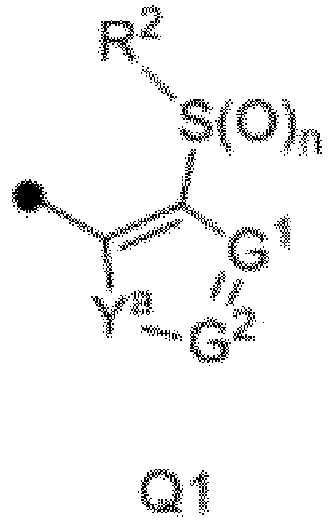 n vaut 0, 1 ou 2,R2 représente un groupe éthyle,Ya représente un atome d'oxygène, un atome de soufre, ou NR3a,G1 représente un atome d'azote ou CR5a,G2 représente un atome d'azote ou CR5b,R3a représente un groupe alkyle en C1 à C6 qui peut éventuellement avoir un ou plusieurs atomes d'halogène, ou un atome d'hydrogène,R5a et R5b sont identiques ou différents l'un de l'autre et représentent chacun un groupe alkyle en C1 à C6 qui peut éventuellement avoir un ou plusieurs atomes d'halogène, OR12, un atome d'halogène, ou un atome d'hydrogène,A2 représente CH,A3 représente CH,A4 représente CH,T représente OR1,R1 représente un groupe alkyle en C1 à C6 qui a un ou plusieurs atomes d'halogène,R12 représente un groupe hydrocarboné à chaîne en C1 à C6 qui peut éventuellement avoir un ou plusieurs atomes d'halogène, un groupe alkyle en C1 à C6 ayant un seul substituant choisi dans le Groupe F, un groupe phényle qui peut éventuellement avoir un ou plusieurs substituants choisis dans le Groupe H, un groupe hétérocyclique aromatique à 5 ou 6 chaînons qui peut éventuellement avoir un ou plusieurs substituants choisis dans le Groupe H, S(O)2R23, ou un atome d'hydrogène,R23 représente un groupe hydrocarboné à chaîne en C1 à C6 qui peut éventuellement avoir un ou plusieurs atomes d'halogène, ou un groupe phényle qui peut éventuellement avoir un ou plusieurs substituants choisis dans le Groupe D,Groupe C : un groupe constitué d'un groupe hydrocarboné à chaîne en C1 à C6 qui peut éventuellement avoir un ou plusieurs atomes d'halogène, un groupe alcoxy en C1 à C6 qui peut éventuellement avoir un ou plusieurs atomes d'halogène, un groupe alcényloxy en C3 à C6 qui peut éventuellement avoir un ou plusieurs atomes d'halogène, un groupe alcynyloxy en C3 à C6 qui peut éventuellement avoir un ou plusieurs atomes d'halogène, et un atome d'halogène,Groupe D : un groupe constitué d'un groupe hydrocarboné à chaîne en C1 à C6 qui peut éventuellement avoir un ou plusieurs atomes d'halogène, un groupe hydroxy, un groupe alcoxy en C1 à C6 qui peut éventuellement avoir un ou plusieurs atomes d'halogène, un groupe alcényloxy en C3 à C6 qui peut éventuellement avoir un ou plusieurs atomes d'halogène, un groupe alcynyloxy en C3 à C6 qui peut éventuellement avoir un ou plusieurs atomes d'halogène, un groupe sulfanyle, un groupe alkylsulfanyle en C1 à C6 qui peut éventuellement avoir un ou plusieurs atomes d'halogène, un groupe alkylsulfinyle en C1 à C6, qui peut éventuellement avoir un ou plusieurs atomes d'halogène, un groupe alkylsulfonyle en C1 à C6 qui peut éventuellement avoir un ou plusieurs atomes d'halogène, un groupe amino, NHR21, NR21R22, C(O)R21, OC(O)R21, C(O)OR21, un groupe cyano, un groupe nitro, et un atome d'halogène,R21 et R22 sont identiques ou différents l'un de l'autre et représentent chacun un groupe alkyle en C1 à C6 qui peut éventuellement avoir un ou plusieurs atomes d'halogène,Groupe F : un groupe constitué d'un groupe alcoxy en C1 à C6 qui peut éventuellement avoir un ou plusieurs atomes d'halogène, un groupe phényle qui peut éventuellement avoir un ou plusieurs substituants choisis dans le Groupe D, un groupe hétérocyclique aromatique à 5 ou 6 chaînons qui peut éventuellement avoir un ou plusieurs substituants choisis dans le Groupe D, un groupe cycloalkyle en C3 à C7 qui peut éventuellement avoir un ou plusieurs atomes d'halogène, un groupe hétérocyclique non aromatique à 3 à 7 chaînons qui peut éventuellement avoir un ou plusieurs substituants choisis dans le Groupe C, un groupe amino, NHR21, NR21R22, et un groupe cyano,Groupe H : un groupe constitué d'un groupe alkyle en C1 à C6 qui peut éventuellement avoir un ou plusieurs atomes d'halogène, OR10, NR9R10, C(O)R10, C(O)NR9R10, OC(O)R9, OC(O)OR9, NR10C(O)R9, NR10C(O)OR9, C(O)OR10, un atome d'halogène, un groupe nitro, un groupe cyano, un groupe amino, et un groupe hétérocyclique aromatique à 5 ou 6 chaînons,R9 représente un groupe alkyle en C1 à C6 qui peut éventuellement avoir un ou plusieurs atomes d'halogène, ou un groupe cycloalkyle en C3 à C6 qui peut éventuellement avoir un ou plusieurs atomes d'halogène, etR10 représente un groupe alkyle en C1 à C6 qui peut éventuellement avoir un ou plusieurs atomes d'halogène, un groupe cycloalkyle en C3 à C6 qui peut éventuellement avoir un ou plusieurs atomes d'halogène, ou un atome d'hydrogène.
 - Composé selon la revendication 1, dans lequel
R1 représente un groupe alkyle en C1 à C5 ayant trois ou plus de trois atomes de fluor. - Composition pour une utilisation dans la lutte contre un arthropode nuisible, comprenant le composé selon la revendication 1 ou 2 et un support inerte.
- Méthode pour lutter contre un arthropode nuisible, qui comprend l'application d'une quantité efficace du composé selon la revendication 1 ou 2 sur un arthropode nuisible ou un habitat où vit un arthropode nuisible, à l'exclusion d'une méthode thérapeutique de traitement du corps humain ou animal.
- Composition comprenant un ou plusieurs ingrédients choisis parmi le Groupe (a) et le Groupe (b), et le composé selon la revendication 1 ou 2 :Groupe (a) : un groupe constitué des ingrédients insecticides, des ingrédients acaricides, et des ingrédients nématicides ; etGroupe (b) : un ingrédient fongicide.
- Méthode pour lutter contre un arthropode nuisible, qui comprend l'application d'une quantité efficace de la composition selon la revendication 5 sur un arthropode nuisible ou un habitat où vit un arthropode nuisible, à l'exclusion d'une méthode thérapeutique de traitement du corps humain ou animal.
- Graine ou organe reproductif végétatif portant une quantité efficace du composé selon la revendication 1 ou 2 ou une quantité efficace de la composition selon la revendication 5.
Applications Claiming Priority (2)
| Application Number | Priority Date | Filing Date | Title |
|---|---|---|---|
| JP2018066971 | 2018-03-30 | ||
| PCT/JP2019/013938 WO2019189731A1 (fr) | 2018-03-30 | 2019-03-29 | Composé hétérocyclique et agent de lutte contre les arthropodes nuisibles le contenant |
Publications (3)
| Publication Number | Publication Date |
|---|---|
| EP3778583A1 EP3778583A1 (fr) | 2021-02-17 |
| EP3778583A4 EP3778583A4 (fr) | 2022-01-05 |
| EP3778583B1 true EP3778583B1 (fr) | 2025-06-18 |
Family
ID=68062007
Family Applications (1)
| Application Number | Title | Priority Date | Filing Date |
|---|---|---|---|
| EP19776019.2A Active EP3778583B1 (fr) | 2018-03-30 | 2019-03-29 | Composé hétérocyclique et agent de lutte contre les arthropodes nuisibles le contenant |
Country Status (5)
| Country | Link |
|---|---|
| US (1) | US11779018B2 (fr) |
| EP (1) | EP3778583B1 (fr) |
| JP (1) | JP7301042B2 (fr) |
| CN (1) | CN111918865B (fr) |
| WO (1) | WO2019189731A1 (fr) |
Families Citing this family (4)
| Publication number | Priority date | Publication date | Assignee | Title |
|---|---|---|---|---|
| TWI906251B (zh) * | 2020-02-04 | 2025-12-01 | 美商科迪華農業科技有限責任公司 | 具有殺有害生物效用之組成物及與其相關之方法 |
| IL322597A (en) * | 2021-12-15 | 2025-10-01 | Adama Agan Ltd | Compounds useful for the preparation of various agrochemicals and their markers |
| EP4603492A1 (fr) | 2022-10-14 | 2025-08-20 | Sumitomo Chemical Company, Limited | Composé de sulfonamide et composition de lutte contre les arthropodes nuisibles le contenant |
| EP4680028A1 (fr) | 2023-03-14 | 2026-01-21 | Syngenta Crop Protection AG | Lutte contre des nuisibles résistants aux insecticides |
Family Cites Families (31)
| Publication number | Priority date | Publication date | Assignee | Title |
|---|---|---|---|---|
| EP0911329A1 (fr) | 1997-10-07 | 1999-04-28 | Rhone-Poulenc Agro | Dérivés 3-substitués d'arylpyrazole |
| WO1999052882A1 (fr) * | 1998-04-13 | 1999-10-21 | Nihon Nohyaku Co., Ltd. | Derive de 1,2,3-thiadiazole ou son sel et agent antiparasitaire, et procede d'utilisation |
| HUP0201475A2 (hu) * | 1999-02-09 | 2003-10-28 | 3-Dimensional Pharmaceuticals, Inc. | Heteroarilamidin-, metilamidin- és guanidinszármazékok, előállításuk és alkalmazásuk, valamint e vegyületeket tartalmazó gyógyászati készítmények |
| AU6116800A (en) | 1999-07-22 | 2001-02-13 | 3-Dimensional Pharmaceuticals, Inc. | 1-aryl-3-thioalkyl pyrazoles, the synthesis thereof and the use thereof as insecticides |
| GB0024795D0 (en) | 2000-10-10 | 2000-11-22 | Hoffmann La Roche | Pyrazole derivatives for the treatment of viral diseases |
| DE102006037478A1 (de) | 2006-08-10 | 2008-02-14 | Merck Patent Gmbh | 2-(Heterocyclylbenzyl)-pyridazinonderivate |
| ATE543819T1 (de) | 2006-10-19 | 2012-02-15 | Signal Pharm Llc | Heteroarylverbindungen, zusammensetzungen daraus und behandlungsverfahren damit |
| EP1974729A1 (fr) | 2007-03-28 | 2008-10-01 | Santhera Pharmaceuticals (Schweiz) AG | Dérivés d'imidazopyridine substitués en tant qu'antagonistes du récepteur de la mélanocortine- 4 |
| KR101652533B1 (ko) | 2008-03-31 | 2016-08-30 | 코닝 인코포레이티드 | 융합 티오펜 화합물, 이들을 제조하는 방법 및 이들의 용도 |
| PE20091953A1 (es) * | 2008-05-08 | 2010-01-09 | Du Pont | Azoles sustituidos como fungicidas |
| CA2727245A1 (fr) | 2008-06-11 | 2009-12-17 | Merck Sharp & Dohme Corp. | Derives imidazole utiles comme inhibiteurs de la faah |
| CA2761335A1 (fr) | 2009-05-20 | 2010-11-25 | Ardea Biosciences, Inc. | Composes, compositions et procedes pour moduler des taux d'acide urique |
| JP2011098956A (ja) | 2009-10-09 | 2011-05-19 | Sumitomo Chemical Co Ltd | イソオキサゾリン化合物及びその用途 |
| WO2011068171A1 (fr) | 2009-12-03 | 2011-06-09 | 第一三共株式会社 | Dérivés hétérocycliques saturés à teneur en azote, bicycliques |
| WO2012117421A1 (fr) | 2011-03-02 | 2012-09-07 | Orchid Research Laboratories Ltd | Inhibiteurs de l'histone désacétylase |
| EP2763976B1 (fr) | 2011-10-05 | 2016-05-18 | Merck Sharp & Dohme Corp. | Inhibiteurs de tyrosine kinase de la rate (syk) contenant un 2-pyridyl carboxamide |
| EP2674414A1 (fr) | 2012-06-15 | 2013-12-18 | Siegfried AG | Appareils dýimpression |
| EP2862853B1 (fr) | 2012-06-18 | 2020-01-22 | Sumitomo Chemical Co., Ltd | Composé hétérocyclique fusionné |
| PT2978752T (pt) | 2013-03-29 | 2018-03-09 | Takeda Pharmaceuticals Co | Derivados de 6-(5-hidroxi-1h-pirazol-1-il)nicotinamida e o seu uso como inibidores de phd |
| AR103297A1 (es) | 2014-12-30 | 2017-05-03 | Forma Therapeutics Inc | Pirrolo y pirazolopirimidinas como inhibidores de la proteasa 7 específica de ubiquitina |
| WO2016113205A1 (fr) * | 2015-01-13 | 2016-07-21 | Bayer Pharma Aktiengesellschaft | Pentafluoréthylpyrimidinones substituées et leur utilisation |
| TW201643154A (zh) | 2015-01-30 | 2016-12-16 | 住友化學股份有限公司 | 聯吡啶化合物及其有害節肢動物防除用途 |
| US20180243298A1 (en) | 2015-04-02 | 2018-08-30 | Abbvie Inc. | Trpv3 modulators |
| CA2982621A1 (fr) | 2015-04-23 | 2016-10-27 | Universite Laval | Procede de fonctionnalisation de carbones sp2-h a l'aide de catalyseurs comprenant une paire de lewis frustree |
| EP3303332A1 (fr) | 2015-06-01 | 2018-04-11 | Bantam Pharmaceutical, LLC | Composés pyrazole et pyrrole substitués et procédés d'utilisation de ces derniers pour l'inhibition de l'initiation de la traduction et le traitement de maladies et de troubles associés à cette dernière |
| WO2017017902A1 (fr) | 2015-07-28 | 2017-02-02 | 株式会社デンソー | Dispositif de détection de collision de véhicule |
| WO2017027312A1 (fr) | 2015-08-12 | 2017-02-16 | Janssen Pharmaceutica Nv | Agonistes de gpr40 pour le traitement du diabète de type 2 |
| JP6756724B2 (ja) | 2015-10-16 | 2020-09-16 | 住友化学株式会社 | ピラジン化合物及びその有害節足動物防除剤 |
| US10189841B2 (en) | 2015-11-20 | 2019-01-29 | Forma Therapeutics, Inc. | Purinones as ubiquitin-specific protease 1 inhibitors |
| WO2017100819A1 (fr) | 2015-12-14 | 2017-06-22 | The Australian National University | Synthèse modulaire d'alcaloïdes de type discoipyrrole et analogues |
| JP6454924B2 (ja) | 2016-10-22 | 2019-01-23 | 佐藤 祐也 | 単語暗記学習ノート |
-
2019
- 2019-03-29 EP EP19776019.2A patent/EP3778583B1/fr active Active
- 2019-03-29 JP JP2020511075A patent/JP7301042B2/ja active Active
- 2019-03-29 US US17/042,641 patent/US11779018B2/en active Active
- 2019-03-29 CN CN201980023330.3A patent/CN111918865B/zh active Active
- 2019-03-29 WO PCT/JP2019/013938 patent/WO2019189731A1/fr not_active Ceased
Also Published As
| Publication number | Publication date |
|---|---|
| US11779018B2 (en) | 2023-10-10 |
| BR112020019804A2 (pt) | 2021-01-05 |
| EP3778583A1 (fr) | 2021-02-17 |
| EP3778583A4 (fr) | 2022-01-05 |
| CN111918865B (zh) | 2023-10-27 |
| JP7301042B2 (ja) | 2023-06-30 |
| CN111918865A (zh) | 2020-11-10 |
| JPWO2019189731A1 (ja) | 2021-04-22 |
| US20210030003A1 (en) | 2021-02-04 |
| WO2019189731A1 (fr) | 2019-10-03 |
Similar Documents
| Publication | Publication Date | Title |
|---|---|---|
| EP3733667B1 (fr) | Composé hétérocyclique, et agent de lutte contre des arthropodes nuisibles comprenant celui-ci | |
| EP3918896B1 (fr) | Composé hétérocyclique et composition de lutte contre les arthropodes nuisibles le contenant | |
| EP3733672B1 (fr) | Composés hétérocycliques, et agent de lutte contre les arthropodes nuisibles les contenant | |
| EP3730494B1 (fr) | Composé hétérocyclique et agent de lutte contre les arthropodes nuisibles le contenant | |
| EP3928607A1 (fr) | Composé hétérocyclique et composition de lutte contre les arthropodes nuisibles le contenant | |
| CA3065751A1 (fr) | Compose heterocyclique et composition le contenant | |
| EP3778583B1 (fr) | Composé hétérocyclique et agent de lutte contre les arthropodes nuisibles le contenant | |
| US12172978B2 (en) | Ether compound and harmful arthropod-controlling composition containing same | |
| EP3689872B1 (fr) | Composé hétérocyclique et agent de lutte contre les arthropodes nuisibles le contenant | |
| EP4603491A1 (fr) | Composé de sulfonamide et composition de lutte contre les arthropodes nuisibles le contenant | |
| EP4596546A1 (fr) | Composé de sulfonamide et composition pour l'extermination d'arthropodes nuisibles le contenant | |
| BR112020019804B1 (pt) | Composto heterocíclico, composição e métodos para controle de um artrópode prejudicial, e semente ou órgão reprodutor vegetativo revestido ou impregnado com o dito composto |
Legal Events
| Date | Code | Title | Description |
|---|---|---|---|
| STAA | Information on the status of an ep patent application or granted ep patent |
Free format text: STATUS: THE INTERNATIONAL PUBLICATION HAS BEEN MADE |
|
| PUAI | Public reference made under article 153(3) epc to a published international application that has entered the european phase |
Free format text: ORIGINAL CODE: 0009012 |
|
| STAA | Information on the status of an ep patent application or granted ep patent |
Free format text: STATUS: REQUEST FOR EXAMINATION WAS MADE |
|
| 17P | Request for examination filed |
Effective date: 20201006 |
|
| AK | Designated contracting states |
Kind code of ref document: A1 Designated state(s): AL AT BE BG CH CY CZ DE DK EE ES FI FR GB GR HR HU IE IS IT LI LT LU LV MC MK MT NL NO PL PT RO RS SE SI SK SM TR |
|
| AX | Request for extension of the european patent |
Extension state: BA ME |
|
| DAV | Request for validation of the european patent (deleted) | ||
| DAX | Request for extension of the european patent (deleted) | ||
| RIN1 | Information on inventor provided before grant (corrected) |
Inventor name: MAEHATA, RYOTA Inventor name: ORIMOTO, KOHEI Inventor name: TANABE, TAKAMASA Inventor name: SAITO, YASUMASA |
|
| A4 | Supplementary search report drawn up and despatched |
Effective date: 20211208 |
|
| RIC1 | Information provided on ipc code assigned before grant |
Ipc: C07D 417/04 20060101ALI20211202BHEP Ipc: C07D 413/04 20060101ALI20211202BHEP Ipc: C07D 409/04 20060101ALI20211202BHEP Ipc: A61P 43/00 20060101ALI20211202BHEP Ipc: A61P 33/14 20060101ALI20211202BHEP Ipc: A61P 31/04 20060101ALI20211202BHEP Ipc: A61K 31/4439 20060101ALI20211202BHEP Ipc: A61K 31/4436 20060101ALI20211202BHEP Ipc: A01P 7/00 20060101ALI20211202BHEP Ipc: A01N 43/80 20060101ALI20211202BHEP Ipc: A01N 43/78 20060101ALI20211202BHEP Ipc: A01N 43/56 20060101ALI20211202BHEP Ipc: A01N 43/36 20060101ALI20211202BHEP Ipc: A01N 43/10 20060101ALI20211202BHEP Ipc: C07D 401/04 20060101AFI20211202BHEP |
|
| STAA | Information on the status of an ep patent application or granted ep patent |
Free format text: STATUS: EXAMINATION IS IN PROGRESS |
|
| 17Q | First examination report despatched |
Effective date: 20230711 |
|
| GRAP | Despatch of communication of intention to grant a patent |
Free format text: ORIGINAL CODE: EPIDOSNIGR1 |
|
| STAA | Information on the status of an ep patent application or granted ep patent |
Free format text: STATUS: GRANT OF PATENT IS INTENDED |
|
| INTG | Intention to grant announced |
Effective date: 20250220 |
|
| RAP3 | Party data changed (applicant data changed or rights of an application transferred) |
Owner name: SUMITOMO CHEMICAL COMPANY, LIMITED |
|
| GRAS | Grant fee paid |
Free format text: ORIGINAL CODE: EPIDOSNIGR3 |
|
| GRAA | (expected) grant |
Free format text: ORIGINAL CODE: 0009210 |
|
| STAA | Information on the status of an ep patent application or granted ep patent |
Free format text: STATUS: THE PATENT HAS BEEN GRANTED |
|
| AK | Designated contracting states |
Kind code of ref document: B1 Designated state(s): AL AT BE BG CH CY CZ DE DK EE ES FI FR GB GR HR HU IE IS IT LI LT LU LV MC MK MT NL NO PL PT RO RS SE SI SK SM TR |
|
| P01 | Opt-out of the competence of the unified patent court (upc) registered |
Free format text: CASE NUMBER: APP_22518/2025 Effective date: 20250513 |
|
| RAP3 | Party data changed (applicant data changed or rights of an application transferred) |
Owner name: SUMITOMO CHEMICAL COMPANY, LIMITED |
|
| REG | Reference to a national code |
Ref country code: GB Ref legal event code: FG4D |
|
| REG | Reference to a national code |
Ref country code: CH Ref legal event code: EP |
|
| REG | Reference to a national code |
Ref country code: DE Ref legal event code: R096 Ref document number: 602019071285 Country of ref document: DE |
|
| REG | Reference to a national code |
Ref country code: CH Ref legal event code: EP |
|
| REG | Reference to a national code |
Ref country code: IE Ref legal event code: FG4D |
|
| PG25 | Lapsed in a contracting state [announced via postgrant information from national office to epo] |
Ref country code: FI Free format text: LAPSE BECAUSE OF FAILURE TO SUBMIT A TRANSLATION OF THE DESCRIPTION OR TO PAY THE FEE WITHIN THE PRESCRIBED TIME-LIMIT Effective date: 20250618 |
|
| REG | Reference to a national code |
Ref country code: LT Ref legal event code: MG9D |
|
| PG25 | Lapsed in a contracting state [announced via postgrant information from national office to epo] |
Ref country code: NO Free format text: LAPSE BECAUSE OF FAILURE TO SUBMIT A TRANSLATION OF THE DESCRIPTION OR TO PAY THE FEE WITHIN THE PRESCRIBED TIME-LIMIT Effective date: 20250918 Ref country code: GR Free format text: LAPSE BECAUSE OF FAILURE TO SUBMIT A TRANSLATION OF THE DESCRIPTION OR TO PAY THE FEE WITHIN THE PRESCRIBED TIME-LIMIT Effective date: 20250919 |
|
| PG25 | Lapsed in a contracting state [announced via postgrant information from national office to epo] |
Ref country code: BG Free format text: LAPSE BECAUSE OF FAILURE TO SUBMIT A TRANSLATION OF THE DESCRIPTION OR TO PAY THE FEE WITHIN THE PRESCRIBED TIME-LIMIT Effective date: 20250618 |
|
| PG25 | Lapsed in a contracting state [announced via postgrant information from national office to epo] |
Ref country code: HR Free format text: LAPSE BECAUSE OF FAILURE TO SUBMIT A TRANSLATION OF THE DESCRIPTION OR TO PAY THE FEE WITHIN THE PRESCRIBED TIME-LIMIT Effective date: 20250618 |
|
| PG25 | Lapsed in a contracting state [announced via postgrant information from national office to epo] |
Ref country code: RS Free format text: LAPSE BECAUSE OF FAILURE TO SUBMIT A TRANSLATION OF THE DESCRIPTION OR TO PAY THE FEE WITHIN THE PRESCRIBED TIME-LIMIT Effective date: 20250918 |
|
| REG | Reference to a national code |
Ref country code: NL Ref legal event code: MP Effective date: 20250618 |
|
| PG25 | Lapsed in a contracting state [announced via postgrant information from national office to epo] |
Ref country code: LV Free format text: LAPSE BECAUSE OF FAILURE TO SUBMIT A TRANSLATION OF THE DESCRIPTION OR TO PAY THE FEE WITHIN THE PRESCRIBED TIME-LIMIT Effective date: 20250618 |
|
| PG25 | Lapsed in a contracting state [announced via postgrant information from national office to epo] |
Ref country code: NL Free format text: LAPSE BECAUSE OF FAILURE TO SUBMIT A TRANSLATION OF THE DESCRIPTION OR TO PAY THE FEE WITHIN THE PRESCRIBED TIME-LIMIT Effective date: 20250618 |
|
| PG25 | Lapsed in a contracting state [announced via postgrant information from national office to epo] |
Ref country code: PT Free format text: LAPSE BECAUSE OF FAILURE TO SUBMIT A TRANSLATION OF THE DESCRIPTION OR TO PAY THE FEE WITHIN THE PRESCRIBED TIME-LIMIT Effective date: 20251020 |
|
| REG | Reference to a national code |
Ref country code: AT Ref legal event code: MK05 Ref document number: 1804095 Country of ref document: AT Kind code of ref document: T Effective date: 20250618 |
|
| PG25 | Lapsed in a contracting state [announced via postgrant information from national office to epo] |
Ref country code: IS Free format text: LAPSE BECAUSE OF FAILURE TO SUBMIT A TRANSLATION OF THE DESCRIPTION OR TO PAY THE FEE WITHIN THE PRESCRIBED TIME-LIMIT Effective date: 20251018 |
|
| PG25 | Lapsed in a contracting state [announced via postgrant information from national office to epo] |
Ref country code: AT Free format text: LAPSE BECAUSE OF FAILURE TO SUBMIT A TRANSLATION OF THE DESCRIPTION OR TO PAY THE FEE WITHIN THE PRESCRIBED TIME-LIMIT Effective date: 20250618 Ref country code: SM Free format text: LAPSE BECAUSE OF FAILURE TO SUBMIT A TRANSLATION OF THE DESCRIPTION OR TO PAY THE FEE WITHIN THE PRESCRIBED TIME-LIMIT Effective date: 20250618 |
|
| PG25 | Lapsed in a contracting state [announced via postgrant information from national office to epo] |
Ref country code: CZ Free format text: LAPSE BECAUSE OF FAILURE TO SUBMIT A TRANSLATION OF THE DESCRIPTION OR TO PAY THE FEE WITHIN THE PRESCRIBED TIME-LIMIT Effective date: 20250618 |
|
| PG25 | Lapsed in a contracting state [announced via postgrant information from national office to epo] |
Ref country code: PL Free format text: LAPSE BECAUSE OF FAILURE TO SUBMIT A TRANSLATION OF THE DESCRIPTION OR TO PAY THE FEE WITHIN THE PRESCRIBED TIME-LIMIT Effective date: 20250618 |
|
| PG25 | Lapsed in a contracting state [announced via postgrant information from national office to epo] |
Ref country code: EE Free format text: LAPSE BECAUSE OF FAILURE TO SUBMIT A TRANSLATION OF THE DESCRIPTION OR TO PAY THE FEE WITHIN THE PRESCRIBED TIME-LIMIT Effective date: 20250618 |
|
| PG25 | Lapsed in a contracting state [announced via postgrant information from national office to epo] |
Ref country code: RO Free format text: LAPSE BECAUSE OF FAILURE TO SUBMIT A TRANSLATION OF THE DESCRIPTION OR TO PAY THE FEE WITHIN THE PRESCRIBED TIME-LIMIT Effective date: 20250618 Ref country code: SK Free format text: LAPSE BECAUSE OF FAILURE TO SUBMIT A TRANSLATION OF THE DESCRIPTION OR TO PAY THE FEE WITHIN THE PRESCRIBED TIME-LIMIT Effective date: 20250618 |
|
| PG25 | Lapsed in a contracting state [announced via postgrant information from national office to epo] |
Ref country code: ES Free format text: LAPSE BECAUSE OF FAILURE TO SUBMIT A TRANSLATION OF THE DESCRIPTION OR TO PAY THE FEE WITHIN THE PRESCRIBED TIME-LIMIT Effective date: 20250618 |
|
| PG25 | Lapsed in a contracting state [announced via postgrant information from national office to epo] |
Ref country code: DK Free format text: LAPSE BECAUSE OF FAILURE TO SUBMIT A TRANSLATION OF THE DESCRIPTION OR TO PAY THE FEE WITHIN THE PRESCRIBED TIME-LIMIT Effective date: 20250618 |
|
| PGFP | Annual fee paid to national office [announced via postgrant information from national office to epo] |
Ref country code: DE Payment date: 20260219 Year of fee payment: 8 |
|
| PG25 | Lapsed in a contracting state [announced via postgrant information from national office to epo] |
Ref country code: IT Free format text: LAPSE BECAUSE OF FAILURE TO SUBMIT A TRANSLATION OF THE DESCRIPTION OR TO PAY THE FEE WITHIN THE PRESCRIBED TIME-LIMIT Effective date: 20250618 |
|
| PLBE | No opposition filed within time limit |
Free format text: ORIGINAL CODE: 0009261 |
|
| STAA | Information on the status of an ep patent application or granted ep patent |
Free format text: STATUS: NO OPPOSITION FILED WITHIN TIME LIMIT |