EP3779421A1 - Bio-capteur - Google Patents
Bio-capteur Download PDFInfo
- Publication number
- EP3779421A1 EP3779421A1 EP19774495.6A EP19774495A EP3779421A1 EP 3779421 A1 EP3779421 A1 EP 3779421A1 EP 19774495 A EP19774495 A EP 19774495A EP 3779421 A1 EP3779421 A1 EP 3779421A1
- Authority
- EP
- European Patent Office
- Prior art keywords
- electrode
- measurement target
- target substance
- sensing
- sensor
- Prior art date
- Legal status (The legal status is an assumption and is not a legal conclusion. Google has not performed a legal analysis and makes no representation as to the accuracy of the status listed.)
- Withdrawn
Links
- 238000005259 measurement Methods 0.000 claims description 163
- 239000013076 target substance Substances 0.000 claims description 121
- 239000000758 substrate Substances 0.000 claims description 24
- 229920001477 hydrophilic polymer Polymers 0.000 claims description 17
- 230000002401 inhibitory effect Effects 0.000 claims description 3
- 239000000126 substance Substances 0.000 abstract description 17
- 239000000243 solution Substances 0.000 description 61
- PCHJSUWPFVWCPO-UHFFFAOYSA-N gold Chemical group [Au] PCHJSUWPFVWCPO-UHFFFAOYSA-N 0.000 description 30
- 229910052737 gold Inorganic materials 0.000 description 30
- 239000010931 gold Substances 0.000 description 30
- 230000008859 change Effects 0.000 description 27
- 235000018102 proteins Nutrition 0.000 description 25
- 102000004169 proteins and genes Human genes 0.000 description 25
- 108090000623 proteins and genes Proteins 0.000 description 25
- 102000009027 Albumins Human genes 0.000 description 23
- 108010088751 Albumins Proteins 0.000 description 23
- 238000006116 polymerization reaction Methods 0.000 description 21
- 238000010586 diagram Methods 0.000 description 14
- 230000000977 initiatory effect Effects 0.000 description 14
- 238000007792 addition Methods 0.000 description 13
- 108010063045 Lactoferrin Proteins 0.000 description 11
- 102000010445 Lactoferrin Human genes 0.000 description 11
- CSSYQJWUGATIHM-IKGCZBKSSA-N l-phenylalanyl-l-lysyl-l-cysteinyl-l-arginyl-l-arginyl-l-tryptophyl-l-glutaminyl-l-tryptophyl-l-arginyl-l-methionyl-l-lysyl-l-lysyl-l-leucylglycyl-l-alanyl-l-prolyl-l-seryl-l-isoleucyl-l-threonyl-l-cysteinyl-l-valyl-l-arginyl-l-arginyl-l-alanyl-l-phenylal Chemical compound C([C@H](N)C(=O)N[C@@H](CCCCN)C(=O)N[C@@H](CS)C(=O)N[C@@H](CCCNC(N)=N)C(=O)N[C@@H](CCCNC(N)=N)C(=O)N[C@@H](CC=1C2=CC=CC=C2NC=1)C(=O)N[C@@H](CCC(N)=O)C(=O)N[C@@H](CC=1C2=CC=CC=C2NC=1)C(=O)N[C@@H](CCCNC(N)=N)C(=O)N[C@@H](CCSC)C(=O)N[C@@H](CCCCN)C(=O)N[C@@H](CCCCN)C(=O)N[C@@H](CC(C)C)C(=O)NCC(=O)N[C@@H](C)C(=O)N1CCC[C@H]1C(=O)N[C@@H](CO)C(=O)N[C@@H]([C@@H](C)CC)C(=O)N[C@@H]([C@@H](C)O)C(=O)N[C@@H](CS)C(=O)N[C@@H](C(C)C)C(=O)N[C@@H](CCCNC(N)=N)C(=O)N[C@@H](CCCNC(N)=N)C(=O)N[C@@H](C)C(=O)N[C@@H](CC=1C=CC=CC=1)C(O)=O)C1=CC=CC=C1 CSSYQJWUGATIHM-IKGCZBKSSA-N 0.000 description 11
- 229940078795 lactoferrin Drugs 0.000 description 11
- 235000021242 lactoferrin Nutrition 0.000 description 11
- 108091006905 Human Serum Albumin Proteins 0.000 description 10
- 102000008100 Human Serum Albumin Human genes 0.000 description 10
- 239000012530 fluid Substances 0.000 description 10
- 238000000034 method Methods 0.000 description 10
- 238000013459 approach Methods 0.000 description 9
- LFQSCWFLJHTTHZ-UHFFFAOYSA-N Ethanol Chemical compound CCO LFQSCWFLJHTTHZ-UHFFFAOYSA-N 0.000 description 8
- 108010074605 gamma-Globulins Proteins 0.000 description 8
- 238000007654 immersion Methods 0.000 description 8
- -1 antibodies Proteins 0.000 description 7
- 230000000052 comparative effect Effects 0.000 description 7
- CIWBSHSKHKDKBQ-JLAZNSOCSA-N Ascorbic acid Chemical compound OC[C@H](O)[C@H]1OC(=O)C(O)=C1O CIWBSHSKHKDKBQ-JLAZNSOCSA-N 0.000 description 6
- KDLHZDBZIXYQEI-UHFFFAOYSA-N Palladium Chemical compound [Pd] KDLHZDBZIXYQEI-UHFFFAOYSA-N 0.000 description 6
- 238000010560 atom transfer radical polymerization reaction Methods 0.000 description 6
- 230000007423 decrease Effects 0.000 description 6
- 238000002847 impedance measurement Methods 0.000 description 6
- 150000002500 ions Chemical class 0.000 description 6
- 238000004519 manufacturing process Methods 0.000 description 5
- 229910052751 metal Inorganic materials 0.000 description 5
- 239000002184 metal Substances 0.000 description 5
- 239000000178 monomer Substances 0.000 description 5
- OKTJSMMVPCPJKN-UHFFFAOYSA-N Carbon Chemical compound [C] OKTJSMMVPCPJKN-UHFFFAOYSA-N 0.000 description 4
- WQZGKKKJIJFFOK-GASJEMHNSA-N Glucose Natural products OC[C@H]1OC(O)[C@H](O)[C@@H](O)[C@@H]1O WQZGKKKJIJFFOK-GASJEMHNSA-N 0.000 description 4
- 102000016943 Muramidase Human genes 0.000 description 4
- 108010014251 Muramidase Proteins 0.000 description 4
- 108010062010 N-Acetylmuramoyl-L-alanine Amidase Proteins 0.000 description 4
- VYPSYNLAJGMNEJ-UHFFFAOYSA-N Silicium dioxide Chemical compound O=[Si]=O VYPSYNLAJGMNEJ-UHFFFAOYSA-N 0.000 description 4
- 210000001124 body fluid Anatomy 0.000 description 4
- 239000010839 body fluid Substances 0.000 description 4
- 125000004432 carbon atom Chemical group C* 0.000 description 4
- 238000006243 chemical reaction Methods 0.000 description 4
- 238000001514 detection method Methods 0.000 description 4
- LOKCTEFSRHRXRJ-UHFFFAOYSA-I dipotassium trisodium dihydrogen phosphate hydrogen phosphate dichloride Chemical compound P(=O)(O)(O)[O-].[K+].P(=O)(O)([O-])[O-].[Na+].[Na+].[Cl-].[K+].[Cl-].[Na+] LOKCTEFSRHRXRJ-UHFFFAOYSA-I 0.000 description 4
- 210000003722 extracellular fluid Anatomy 0.000 description 4
- 239000011521 glass Substances 0.000 description 4
- 239000008103 glucose Substances 0.000 description 4
- 239000004325 lysozyme Substances 0.000 description 4
- 229960000274 lysozyme Drugs 0.000 description 4
- 235000010335 lysozyme Nutrition 0.000 description 4
- 230000007246 mechanism Effects 0.000 description 4
- 229910044991 metal oxide Inorganic materials 0.000 description 4
- 239000002953 phosphate buffered saline Substances 0.000 description 4
- BASFCYQUMIYNBI-UHFFFAOYSA-N platinum Chemical compound [Pt] BASFCYQUMIYNBI-UHFFFAOYSA-N 0.000 description 4
- 238000006479 redox reaction Methods 0.000 description 4
- 150000003573 thiols Chemical group 0.000 description 4
- 101710141544 Allatotropin-related peptide Proteins 0.000 description 3
- WKBOTKDWSSQWDR-UHFFFAOYSA-N Bromine atom Chemical compound [Br] WKBOTKDWSSQWDR-UHFFFAOYSA-N 0.000 description 3
- NLUYOSGKWVEPFF-UHFFFAOYSA-N CCCCCCCCCC(OC(=O)C(C)(C)Br)CSSCC(OC(=O)C(C)(C)Br)CCCCCCCCC Chemical compound CCCCCCCCCC(OC(=O)C(C)(C)Br)CSSCC(OC(=O)C(C)(C)Br)CCCCCCCCC NLUYOSGKWVEPFF-UHFFFAOYSA-N 0.000 description 3
- ZMXDDKWLCZADIW-UHFFFAOYSA-N N,N-Dimethylformamide Chemical compound CN(C)C=O ZMXDDKWLCZADIW-UHFFFAOYSA-N 0.000 description 3
- LEHOTFFKMJEONL-UHFFFAOYSA-N Uric Acid Chemical compound N1C(=O)NC(=O)C2=C1NC(=O)N2 LEHOTFFKMJEONL-UHFFFAOYSA-N 0.000 description 3
- TVWHNULVHGKJHS-UHFFFAOYSA-N Uric acid Natural products N1C(=O)NC(=O)C2NC(=O)NC21 TVWHNULVHGKJHS-UHFFFAOYSA-N 0.000 description 3
- 229960005070 ascorbic acid Drugs 0.000 description 3
- 235000010323 ascorbic acid Nutrition 0.000 description 3
- 239000011668 ascorbic acid Substances 0.000 description 3
- 230000015572 biosynthetic process Effects 0.000 description 3
- GDTBXPJZTBHREO-UHFFFAOYSA-N bromine Substances BrBr GDTBXPJZTBHREO-UHFFFAOYSA-N 0.000 description 3
- 229910052794 bromium Inorganic materials 0.000 description 3
- 108010004903 glycosylated serum albumin Proteins 0.000 description 3
- 229920001519 homopolymer Polymers 0.000 description 3
- 230000005764 inhibitory process Effects 0.000 description 3
- 150000004706 metal oxides Chemical class 0.000 description 3
- 150000002896 organic halogen compounds Chemical class 0.000 description 3
- 229920001282 polysaccharide Polymers 0.000 description 3
- 239000005017 polysaccharide Substances 0.000 description 3
- 150000004804 polysaccharides Chemical class 0.000 description 3
- 238000011002 quantification Methods 0.000 description 3
- 230000002829 reductive effect Effects 0.000 description 3
- 238000004544 sputter deposition Methods 0.000 description 3
- 230000002123 temporal effect Effects 0.000 description 3
- 125000003396 thiol group Chemical group [H]S* 0.000 description 3
- 229940116269 uric acid Drugs 0.000 description 3
- KIUKXJAPPMFGSW-DNGZLQJQSA-N (2S,3S,4S,5R,6R)-6-[(2S,3R,4R,5S,6R)-3-Acetamido-2-[(2S,3S,4R,5R,6R)-6-[(2R,3R,4R,5S,6R)-3-acetamido-2,5-dihydroxy-6-(hydroxymethyl)oxan-4-yl]oxy-2-carboxy-4,5-dihydroxyoxan-3-yl]oxy-5-hydroxy-6-(hydroxymethyl)oxan-4-yl]oxy-3,4,5-trihydroxyoxane-2-carboxylic acid Chemical compound CC(=O)N[C@H]1[C@H](O)O[C@H](CO)[C@@H](O)[C@@H]1O[C@H]1[C@H](O)[C@@H](O)[C@H](O[C@H]2[C@@H]([C@@H](O[C@H]3[C@@H]([C@@H](O)[C@H](O)[C@H](O3)C(O)=O)O)[C@H](O)[C@@H](CO)O2)NC(C)=O)[C@@H](C(O)=O)O1 KIUKXJAPPMFGSW-DNGZLQJQSA-N 0.000 description 2
- RYGMFSIKBFXOCR-UHFFFAOYSA-N Copper Chemical compound [Cu] RYGMFSIKBFXOCR-UHFFFAOYSA-N 0.000 description 2
- 229920002683 Glycosaminoglycan Polymers 0.000 description 2
- 229920000663 Hydroxyethyl cellulose Polymers 0.000 description 2
- 239000004354 Hydroxyethyl cellulose Substances 0.000 description 2
- WOBHKFSMXKNTIM-UHFFFAOYSA-N Hydroxyethyl methacrylate Chemical compound CC(=C)C(=O)OCCO WOBHKFSMXKNTIM-UHFFFAOYSA-N 0.000 description 2
- JOCBASBOOFNAJA-UHFFFAOYSA-N N-tris(hydroxymethyl)methyl-2-aminoethanesulfonic acid Chemical compound OCC(CO)(CO)NCCS(O)(=O)=O JOCBASBOOFNAJA-UHFFFAOYSA-N 0.000 description 2
- PXHVJJICTQNCMI-UHFFFAOYSA-N Nickel Chemical compound [Ni] PXHVJJICTQNCMI-UHFFFAOYSA-N 0.000 description 2
- BQCADISMDOOEFD-UHFFFAOYSA-N Silver Chemical compound [Ag] BQCADISMDOOEFD-UHFFFAOYSA-N 0.000 description 2
- 238000004082 amperometric method Methods 0.000 description 2
- 238000004630 atomic force microscopy Methods 0.000 description 2
- 239000006177 biological buffer Substances 0.000 description 2
- 239000003575 carbonaceous material Substances 0.000 description 2
- 239000011651 chromium Substances 0.000 description 2
- 229910052681 coesite Inorganic materials 0.000 description 2
- 229920001577 copolymer Polymers 0.000 description 2
- 229910052802 copper Inorganic materials 0.000 description 2
- 239000010949 copper Substances 0.000 description 2
- QTMDXZNDVAMKGV-UHFFFAOYSA-L copper(ii) bromide Chemical compound [Cu+2].[Br-].[Br-] QTMDXZNDVAMKGV-UHFFFAOYSA-L 0.000 description 2
- 229910052906 cristobalite Inorganic materials 0.000 description 2
- 230000000694 effects Effects 0.000 description 2
- 229910021389 graphene Inorganic materials 0.000 description 2
- 125000005843 halogen group Chemical group 0.000 description 2
- 229920002674 hyaluronan Polymers 0.000 description 2
- 229960003160 hyaluronic acid Drugs 0.000 description 2
- 230000002209 hydrophobic effect Effects 0.000 description 2
- 235000019447 hydroxyethyl cellulose Nutrition 0.000 description 2
- 239000001866 hydroxypropyl methyl cellulose Substances 0.000 description 2
- 229920003088 hydroxypropyl methyl cellulose Polymers 0.000 description 2
- 235000010979 hydroxypropyl methyl cellulose Nutrition 0.000 description 2
- UFVKGYZPFZQRLF-UHFFFAOYSA-N hydroxypropyl methyl cellulose Chemical compound OC1C(O)C(OC)OC(CO)C1OC1C(O)C(O)C(OC2C(C(O)C(OC3C(C(O)C(O)C(CO)O3)O)C(CO)O2)O)C(CO)O1 UFVKGYZPFZQRLF-UHFFFAOYSA-N 0.000 description 2
- 238000005470 impregnation Methods 0.000 description 2
- XEEYBQQBJWHFJM-UHFFFAOYSA-N iron Substances [Fe] XEEYBQQBJWHFJM-UHFFFAOYSA-N 0.000 description 2
- 229910052742 iron Inorganic materials 0.000 description 2
- 239000000463 material Substances 0.000 description 2
- 229910052763 palladium Inorganic materials 0.000 description 2
- 229910052697 platinum Inorganic materials 0.000 description 2
- 238000010526 radical polymerization reaction Methods 0.000 description 2
- 230000035945 sensitivity Effects 0.000 description 2
- 239000000377 silicon dioxide Substances 0.000 description 2
- 229910052709 silver Inorganic materials 0.000 description 2
- 239000004332 silver Substances 0.000 description 2
- 150000003384 small molecules Chemical class 0.000 description 2
- 239000002904 solvent Substances 0.000 description 2
- 238000001179 sorption measurement Methods 0.000 description 2
- 229910052682 stishovite Inorganic materials 0.000 description 2
- PBCFLUZVCVVTBY-UHFFFAOYSA-N tantalum pentoxide Inorganic materials O=[Ta](=O)O[Ta](=O)=O PBCFLUZVCVVTBY-UHFFFAOYSA-N 0.000 description 2
- 108010019783 tear proteins Proteins 0.000 description 2
- 239000010409 thin film Substances 0.000 description 2
- 238000012546 transfer Methods 0.000 description 2
- 229910052905 tridymite Inorganic materials 0.000 description 2
- 229920002818 (Hydroxyethyl)methacrylate Polymers 0.000 description 1
- VGUWFGWZSVLROP-UHFFFAOYSA-N 1-pyridin-2-yl-n,n-bis(pyridin-2-ylmethyl)methanamine Chemical compound C=1C=CC=NC=1CN(CC=1N=CC=CC=1)CC1=CC=CC=N1 VGUWFGWZSVLROP-UHFFFAOYSA-N 0.000 description 1
- ZSZRUEAFVQITHH-UHFFFAOYSA-N 2-(2-methylprop-2-enoyloxy)ethyl 2-(trimethylazaniumyl)ethyl phosphate Chemical compound CC(=C)C(=O)OCCOP([O-])(=O)OCC[N+](C)(C)C ZSZRUEAFVQITHH-UHFFFAOYSA-N 0.000 description 1
- SQDAZGGFXASXDW-UHFFFAOYSA-N 5-bromo-2-(trifluoromethoxy)pyridine Chemical compound FC(F)(F)OC1=CC=C(Br)C=N1 SQDAZGGFXASXDW-UHFFFAOYSA-N 0.000 description 1
- HRPVXLWXLXDGHG-UHFFFAOYSA-N Acrylamide Chemical compound NC(=O)C=C HRPVXLWXLXDGHG-UHFFFAOYSA-N 0.000 description 1
- 229920000936 Agarose Polymers 0.000 description 1
- 206010003445 Ascites Diseases 0.000 description 1
- 229920002101 Chitin Polymers 0.000 description 1
- 229920001661 Chitosan Polymers 0.000 description 1
- 229920001287 Chondroitin sulfate Polymers 0.000 description 1
- VYZAMTAEIAYCRO-UHFFFAOYSA-N Chromium Chemical compound [Cr] VYZAMTAEIAYCRO-UHFFFAOYSA-N 0.000 description 1
- 102000008186 Collagen Human genes 0.000 description 1
- 108010035532 Collagen Proteins 0.000 description 1
- 229910021590 Copper(II) bromide Inorganic materials 0.000 description 1
- 229920000045 Dermatan sulfate Polymers 0.000 description 1
- 229920002307 Dextran Polymers 0.000 description 1
- 102000004190 Enzymes Human genes 0.000 description 1
- 108090000790 Enzymes Proteins 0.000 description 1
- 108010010803 Gelatin Proteins 0.000 description 1
- 102000006395 Globulins Human genes 0.000 description 1
- 108010044091 Globulins Proteins 0.000 description 1
- 102000017011 Glycated Hemoglobin A Human genes 0.000 description 1
- 229920002971 Heparan sulfate Polymers 0.000 description 1
- HTTJABKRGRZYRN-UHFFFAOYSA-N Heparin Chemical compound OC1C(NC(=O)C)C(O)OC(COS(O)(=O)=O)C1OC1C(OS(O)(=O)=O)C(O)C(OC2C(C(OS(O)(=O)=O)C(OC3C(C(O)C(O)C(O3)C(O)=O)OS(O)(=O)=O)C(CO)O2)NS(O)(=O)=O)C(C(O)=O)O1 HTTJABKRGRZYRN-UHFFFAOYSA-N 0.000 description 1
- 229920000288 Keratan sulfate Polymers 0.000 description 1
- 208000005228 Pericardial Effusion Diseases 0.000 description 1
- 229920003171 Poly (ethylene oxide) Polymers 0.000 description 1
- 229920001218 Pullulan Polymers 0.000 description 1
- 239000004373 Pullulan Substances 0.000 description 1
- 239000006087 Silane Coupling Agent Substances 0.000 description 1
- 229920002125 Sokalan® Polymers 0.000 description 1
- 229920002472 Starch Polymers 0.000 description 1
- DPXJVFZANSGRMM-UHFFFAOYSA-N acetic acid;2,3,4,5,6-pentahydroxyhexanal;sodium Chemical compound [Na].CC(O)=O.OCC(O)C(O)C(O)C(O)C=O DPXJVFZANSGRMM-UHFFFAOYSA-N 0.000 description 1
- 239000002253 acid Substances 0.000 description 1
- 230000009471 action Effects 0.000 description 1
- 239000000783 alginic acid Substances 0.000 description 1
- 229920000615 alginic acid Polymers 0.000 description 1
- 235000010443 alginic acid Nutrition 0.000 description 1
- 229960001126 alginic acid Drugs 0.000 description 1
- 150000004781 alginic acids Chemical class 0.000 description 1
- 239000000956 alloy Substances 0.000 description 1
- 229910045601 alloy Inorganic materials 0.000 description 1
- 210000004381 amniotic fluid Anatomy 0.000 description 1
- 210000001742 aqueous humor Anatomy 0.000 description 1
- 239000012298 atmosphere Substances 0.000 description 1
- 125000004429 atom Chemical group 0.000 description 1
- 210000000941 bile Anatomy 0.000 description 1
- 210000004369 blood Anatomy 0.000 description 1
- 239000008280 blood Substances 0.000 description 1
- 239000000872 buffer Substances 0.000 description 1
- 239000007853 buffer solution Substances 0.000 description 1
- 229910052799 carbon Inorganic materials 0.000 description 1
- 239000001768 carboxy methyl cellulose Substances 0.000 description 1
- 210000004027 cell Anatomy 0.000 description 1
- 229920002678 cellulose Polymers 0.000 description 1
- 239000001913 cellulose Substances 0.000 description 1
- 210000001175 cerebrospinal fluid Anatomy 0.000 description 1
- 229910052729 chemical element Inorganic materials 0.000 description 1
- 229940059329 chondroitin sulfate Drugs 0.000 description 1
- 229910052804 chromium Inorganic materials 0.000 description 1
- 238000004140 cleaning Methods 0.000 description 1
- 229910017052 cobalt Inorganic materials 0.000 description 1
- 239000010941 cobalt Substances 0.000 description 1
- GUTLYIVDDKVIGB-UHFFFAOYSA-N cobalt atom Chemical compound [Co] GUTLYIVDDKVIGB-UHFFFAOYSA-N 0.000 description 1
- 229920001436 collagen Polymers 0.000 description 1
- 150000001875 compounds Chemical class 0.000 description 1
- 239000012141 concentrate Substances 0.000 description 1
- 150000004696 coordination complex Chemical class 0.000 description 1
- 238000004132 cross linking Methods 0.000 description 1
- 238000002484 cyclic voltammetry Methods 0.000 description 1
- XUJNEKJLAYXESH-UHFFFAOYSA-N cysteine Natural products SCC(N)C(O)=O XUJNEKJLAYXESH-UHFFFAOYSA-N 0.000 description 1
- 235000018417 cysteine Nutrition 0.000 description 1
- 230000003247 decreasing effect Effects 0.000 description 1
- AVJBPWGFOQAPRH-FWMKGIEWSA-L dermatan sulfate Chemical compound CC(=O)N[C@H]1[C@H](O)O[C@H](CO)[C@H](OS([O-])(=O)=O)[C@@H]1O[C@H]1[C@H](O)[C@@H](O)[C@H](O)[C@H](C([O-])=O)O1 AVJBPWGFOQAPRH-FWMKGIEWSA-L 0.000 description 1
- 229940051593 dermatan sulfate Drugs 0.000 description 1
- 229960002086 dextran Drugs 0.000 description 1
- 229960000633 dextran sulfate Drugs 0.000 description 1
- 230000001079 digestive effect Effects 0.000 description 1
- 125000002228 disulfide group Chemical group 0.000 description 1
- 150000002019 disulfides Chemical class 0.000 description 1
- 239000003814 drug Substances 0.000 description 1
- 238000007876 drug discovery Methods 0.000 description 1
- 230000005684 electric field Effects 0.000 description 1
- 238000010291 electrical method Methods 0.000 description 1
- 229940088598 enzyme Drugs 0.000 description 1
- 230000007717 exclusion Effects 0.000 description 1
- 230000005669 field effect Effects 0.000 description 1
- 238000001914 filtration Methods 0.000 description 1
- 210000004051 gastric juice Anatomy 0.000 description 1
- 229920000159 gelatin Polymers 0.000 description 1
- 239000008273 gelatin Substances 0.000 description 1
- 235000019322 gelatine Nutrition 0.000 description 1
- 235000011852 gelatine desserts Nutrition 0.000 description 1
- 108091005995 glycated hemoglobin Proteins 0.000 description 1
- 150000002343 gold Chemical class 0.000 description 1
- 229920000669 heparin Polymers 0.000 description 1
- 229960002897 heparin Drugs 0.000 description 1
- 230000006872 improvement Effects 0.000 description 1
- 239000007924 injection Substances 0.000 description 1
- 238000002347 injection Methods 0.000 description 1
- 230000000968 intestinal effect Effects 0.000 description 1
- KXCLCNHUUKTANI-RBIYJLQWSA-N keratan Chemical compound CC(=O)N[C@@H]1[C@@H](O)C[C@@H](COS(O)(=O)=O)O[C@H]1O[C@@H]1[C@@H](O)[C@H](O[C@@H]2[C@H](O[C@@H](O[C@H]3[C@H]([C@@H](COS(O)(=O)=O)O[C@@H](O)[C@@H]3O)O)[C@H](NC(C)=O)[C@H]2O)COS(O)(=O)=O)O[C@H](COS(O)(=O)=O)[C@@H]1O KXCLCNHUUKTANI-RBIYJLQWSA-N 0.000 description 1
- 230000000670 limiting effect Effects 0.000 description 1
- 239000007788 liquid Substances 0.000 description 1
- 210000004880 lymph fluid Anatomy 0.000 description 1
- 150000002739 metals Chemical class 0.000 description 1
- 244000005700 microbiome Species 0.000 description 1
- 235000013336 milk Nutrition 0.000 description 1
- 239000008267 milk Substances 0.000 description 1
- 210000004080 milk Anatomy 0.000 description 1
- 238000012986 modification Methods 0.000 description 1
- 230000004048 modification Effects 0.000 description 1
- 210000003097 mucus Anatomy 0.000 description 1
- 229910052759 nickel Inorganic materials 0.000 description 1
- 229910000510 noble metal Inorganic materials 0.000 description 1
- 239000012811 non-conductive material Substances 0.000 description 1
- 102000039446 nucleic acids Human genes 0.000 description 1
- 108020004707 nucleic acids Proteins 0.000 description 1
- 150000007523 nucleic acids Chemical class 0.000 description 1
- 230000003287 optical effect Effects 0.000 description 1
- 210000001819 pancreatic juice Anatomy 0.000 description 1
- YHHSONZFOIEMCP-UHFFFAOYSA-O phosphocholine Chemical compound C[N+](C)(C)CCOP(O)(O)=O YHHSONZFOIEMCP-UHFFFAOYSA-O 0.000 description 1
- 229950004354 phosphorylcholine Drugs 0.000 description 1
- 210000004910 pleural fluid Anatomy 0.000 description 1
- 239000003505 polymerization initiator Substances 0.000 description 1
- 235000019423 pullulan Nutrition 0.000 description 1
- 210000003296 saliva Anatomy 0.000 description 1
- 238000004574 scanning tunneling microscopy Methods 0.000 description 1
- 210000000582 semen Anatomy 0.000 description 1
- 239000004065 semiconductor Substances 0.000 description 1
- 210000004911 serous fluid Anatomy 0.000 description 1
- 210000002966 serum Anatomy 0.000 description 1
- 235000012239 silicon dioxide Nutrition 0.000 description 1
- 239000011734 sodium Substances 0.000 description 1
- 235000019812 sodium carboxymethyl cellulose Nutrition 0.000 description 1
- 229920001027 sodium carboxymethylcellulose Polymers 0.000 description 1
- 239000008107 starch Substances 0.000 description 1
- 235000019698 starch Nutrition 0.000 description 1
- 210000004243 sweat Anatomy 0.000 description 1
- 210000001179 synovial fluid Anatomy 0.000 description 1
- 210000001519 tissue Anatomy 0.000 description 1
- 229910052723 transition metal Inorganic materials 0.000 description 1
- 150000003624 transition metals Chemical class 0.000 description 1
- 229910021642 ultra pure water Inorganic materials 0.000 description 1
- 239000012498 ultrapure water Substances 0.000 description 1
- 230000002485 urinary effect Effects 0.000 description 1
- 210000002700 urine Anatomy 0.000 description 1
- XLYOFNOQVPJJNP-UHFFFAOYSA-N water Substances O XLYOFNOQVPJJNP-UHFFFAOYSA-N 0.000 description 1
Images



Classifications
-
- G—PHYSICS
- G01—MEASURING; TESTING
- G01N—INVESTIGATING OR ANALYSING MATERIALS BY DETERMINING THEIR CHEMICAL OR PHYSICAL PROPERTIES
- G01N33/00—Investigating or analysing materials by specific methods not covered by groups G01N1/00 - G01N31/00
- G01N33/48—Biological material, e.g. blood, urine; Haemocytometers
- G01N33/50—Chemical analysis of biological material, e.g. blood, urine; Testing involving biospecific ligand binding methods; Immunological testing
- G01N33/53—Immunoassay; Biospecific binding assay; Materials therefor
- G01N33/543—Immunoassay; Biospecific binding assay; Materials therefor with an insoluble carrier for immobilising immunochemicals
- G01N33/54366—Apparatus specially adapted for solid-phase testing
- G01N33/54373—Apparatus specially adapted for solid-phase testing involving physiochemical end-point determination, e.g. wave-guides, FETS, gratings
- G01N33/5438—Electrodes
-
- G—PHYSICS
- G01—MEASURING; TESTING
- G01N—INVESTIGATING OR ANALYSING MATERIALS BY DETERMINING THEIR CHEMICAL OR PHYSICAL PROPERTIES
- G01N27/00—Investigating or analysing materials by the use of electric, electrochemical, or magnetic means
- G01N27/02—Investigating or analysing materials by the use of electric, electrochemical, or magnetic means by investigating impedance
- G01N27/22—Investigating or analysing materials by the use of electric, electrochemical, or magnetic means by investigating impedance by investigating capacitance
- G01N27/227—Sensors changing capacitance upon adsorption or absorption of fluid components, e.g. electrolyte-insulator-semiconductor sensors, MOS capacitors
-
- G—PHYSICS
- G01—MEASURING; TESTING
- G01N—INVESTIGATING OR ANALYSING MATERIALS BY DETERMINING THEIR CHEMICAL OR PHYSICAL PROPERTIES
- G01N27/00—Investigating or analysing materials by the use of electric, electrochemical, or magnetic means
- G01N27/26—Investigating or analysing materials by the use of electric, electrochemical, or magnetic means by investigating electrochemical variables; by using electrolysis or electrophoresis
- G01N27/28—Electrolytic cell components
- G01N27/30—Electrodes, e.g. test electrodes; Half-cells
- G01N27/327—Biochemical electrodes, e.g. electrical or mechanical details for in vitro measurements
-
- G—PHYSICS
- G01—MEASURING; TESTING
- G01N—INVESTIGATING OR ANALYSING MATERIALS BY DETERMINING THEIR CHEMICAL OR PHYSICAL PROPERTIES
- G01N27/00—Investigating or analysing materials by the use of electric, electrochemical, or magnetic means
- G01N27/26—Investigating or analysing materials by the use of electric, electrochemical, or magnetic means by investigating electrochemical variables; by using electrolysis or electrophoresis
- G01N27/28—Electrolytic cell components
- G01N27/30—Electrodes, e.g. test electrodes; Half-cells
- G01N27/327—Biochemical electrodes, e.g. electrical or mechanical details for in vitro measurements
- G01N27/3275—Sensing specific biomolecules, e.g. nucleic acid strands, based on an electrode surface reaction
-
- G—PHYSICS
- G01—MEASURING; TESTING
- G01N—INVESTIGATING OR ANALYSING MATERIALS BY DETERMINING THEIR CHEMICAL OR PHYSICAL PROPERTIES
- G01N33/00—Investigating or analysing materials by specific methods not covered by groups G01N1/00 - G01N31/00
- G01N33/48—Biological material, e.g. blood, urine; Haemocytometers
- G01N33/50—Chemical analysis of biological material, e.g. blood, urine; Testing involving biospecific ligand binding methods; Immunological testing
- G01N33/53—Immunoassay; Biospecific binding assay; Materials therefor
- G01N33/543—Immunoassay; Biospecific binding assay; Materials therefor with an insoluble carrier for immobilising immunochemicals
- G01N33/54393—Improving reaction conditions or stability, e.g. by coating or irradiation of surface, by reduction of non-specific binding, by promotion of specific binding
Definitions
- the present disclosure relates to a biosensor.
- Biosensors utilize the excellent molecular identification ability that organisms have to recognize information (e.g., chemical elements) from the outside world as physical signal, and there are various principles and measurement objects. More specifically, a biosensor is a kind of chemical sensor that measures a chemical substance as a target, and is composed of a molecular identification element that recognizes the measurement target substance, and a signal conversion element that converts the information that a recognition has been done into a physical signal such as an electrical signal. Generally, since biomolecules such as enzymes, antibodies, DNA, cells, microorganisms, and compounds that capture biomolecules or the like are used for the molecular identification element, these sensors are called biosensors.
- a sample other than chemical substances as markers including a liquid derived from a living body such as a body fluid, and this becomes a measurement noise or a false signal, which affects measurement accuracy.
- a liquid derived from a living body such as a body fluid
- substances present in a solution similarly reduce measurement accuracy or inhibit improvement in measurement accuracy.
- a sensor for detecting a measurement target substance contained in a solution comprising a sensing substrate for detecting the measurement target substance, and molecular chains arranged non-closely (not closest packed) on a surface of the sensing substrate and inhibiting the non-substance not to be measured.
- a “solution” may be a body fluid.
- the solution may comprise a mediator.
- the "body fluid” may be lymph fluid, tissue fluid such as interstitial fluid, intercellular fluid, interstitial fluid, and the like, and may be body cavity fluid, serosal fluid, pleural fluid, ascites fluid, pericardial effusion, cerebrospinal fluid, joint fluid (synovial fluid), and aqueous humor of the eye (aqueous).
- the body fluid may be digestive fluid such as saliva, gastric juice, bile, pancreatic juice, intestinal fluid, etc., and may be sweat, tears, nasal mucus, urine, semen, vaginal fluid, amniotic fluid, milk, etc.
- the solution may be a physiological buffer such as phosphate buffered saline (PBS) or N-tris(hydroxymethyl)methyl-2-aminoethanesulfonic acid buffer (TES), containing a measurement target substance.
- PBS phosphate buffered saline
- TES N-tris(hydroxymethyl)methyl-2-aminoethanesulfonic acid buffer
- the solution is not particularly limited as long as the measurement target substance is contained.
- Measurement target substance means a substance such as a molecule or an ion or a measurement target substance that is to be measured.
- Non-measurement target substance means a substance other than the measurement target substance and other than the substance that is an object of measurement.
- the “solution” may include a measurement target substance. When the measurement target substance is not measured, for example, during calibration or cleaning, the measurement target substance may not be included.
- the measurement target substance may be an inorganic molecule, an organic molecule, a biomolecule, or a bound molecule thereof.
- the measurement target substance may be one kind or a plurality of kinds.
- the solution may be tears and the measurement target substance may be glycoalbumin (glycated albumin) contained in the tears.
- the measurement object may be glucose in blood or serum, albumin, glycoalbumin, uric acid, glycated hemoglobin, glucose in interstitial fluid, glucose in tears, albumin, urinary albumin, glucose, etc.
- the measurement target substance may be a nucleic acid.
- the “sensor” may be a biosensor or a biomolecular sensor.
- the sensor may be a protein sensor or an albumin sensor.
- the sensor may be an electrochemical sensor.
- the electrochemical sensor may be a potentiometric sensor, an amperometric sensor, an impedance sensor.
- the sensor may be a plasmon sensor or an optical sensor.
- the sensor may detect the presence of a measurement target substance, may measure, estimate, and determine a parameter, such as the concentration of the measurement target substance, and may measure a time change in the parameter, such as the concentration of the measurement target substance.
- the electrical state changes due to approach, contact, adsorption, bonding, etc. of the measurement substance.
- the electrodes are configured such that a change in the electrical state or an electrical change occurs due to the measurement target substance or the like approaching.
- the change in the electrical state of the electrode may be a change in charge or potential due to the transfer of electrons generated when the measurement target substance binds to the electrode surface.
- a charge generated when a biomolecule such as proteins having a cysteine site, a thiol group or an SH group is bound to an atom of an electrode e.g., a gold atom
- an electrode e.g., a gold atom
- a protein having a thiol (SH) group which is a measurement target substance, adsorbs on the surface of gold, which is an electrode, and Au-S bonding forms.
- an opposite charge that occurs when a charged biomolecule approaches the vicinity of electrode may be detected.
- the solution includes a mediator other than the measurement target substance, and the charge when the mediator undergoes a redox reaction at the electrode may be detected.
- the temporal measurement or the temporal change of the charge may be detected as a current.
- the effective area of the electrode is reduced by adsorption, bonding, or the like of the measurement target substance to the electrode.
- a current flows in a manner corresponding to the amount of the measurement target substance that has come close to the electrode.
- the mediator may be a metal complex or a transition metal complex.
- the mediator may be a divalent or trivalent iron (Fe) ion (Fe 2+ , Fe 3+ ), chromium (Cr) ion (such as Cr 3+ , Cr 4+ ), cobalt (Co) ion (such as Cr 2+ , Cr 3+ ), nickel (such as Ni2 + , Ni3 + ) ion, palladium (Pd) ion (such as Pd 2+ , Pd 4+ ).
- the electrode may comprise a material having electrical conductivity.
- the electrode may be formed of a metal, a noble metal such as gold, silver, platinum, copper, palladium, or an alloy of metals.
- the electrodes may comprise a conductive metallic oxide, such as ITO, IGZO, etc., and may comprise carbon materials, such as graphene.
- the "sensing substrate” may be a sensing portion or a substrate.
- the sensing substrate may be an electrode or a sensing electrode.
- the presence of the measurement target substance or the influence of the non-measurement target substance may be detected electrically or by other methods.
- the sensing substrate may not be an electrode that is electrically conductive.
- the measurement may be performed by an electrical method using a material which is not generally called an electrode.
- the sensing substrate may be composed of or include a semiconductor or a non-conductive material.
- the sensing substrate may comprise an insulating metal oxide (such as a Ta 2 O 5 , SiO 2 ).
- the insulating sensing substrate can be used for impedance measurement, for example.
- Sensing may be performed using plasmons or light, or a combination of a plurality of them, in addition to electrical sensing.
- the sensing substrate may be irradiated with light from, for example, the back surface, to detect a change in the refractive index.
- the refractive index changes depending on the measurement target substance adsorbed on the sensing substrate or the like.
- the "molecular chain” may be an inorganic molecular chain and may be an organic molecular chain.
- the inorganic molecular chain may be a molecular chain formed by crosslinking of polydimethylsiloxoic acid.
- the molecular chain may at least partially have hydrophilicity, and at least one end toward the solution or its vicinity may have hydrophilicity.
- a molecular chain has hydrophilicity, particularly when an end portion of a molecular chain or a vicinity thereof has hydrophilicity, a protein having a charge is elasticated by a site having hydrophilicity, so that it becomes difficult to approach a sensing substrate or an electrode.
- the molecular chain may be a hydrophilic polymer.
- the hydrophilic monomer may be polymerized to prepare a hydrophilic polymer.
- the molecular chain may be a molecular chain in which a polymerization initiating molecule and a hydrophilic polymer are bonded.
- Hydrophilic polymers may, for example, include cellulose derivatives such as 2-methacryloylxyethyl phosphorylcholine (MPC), hydroxyethylmethacrylate, ethylene glycol methacrylate, hydroxypropylmethylcellulose (HPMC), sodium carboxymethylcellulose (CMC-Na), hydroxyethylcellulose (HEC); polysaccharides such as alginic acid, hyaluronic acid, agarose, starch, dextran, and pullulan and their derivatives; homopolymers such as carboxyvinyl polymers, polyethylene oxide, poly(meta)acrylamide, copolymers of such homopolymers with polysaccharides, etc., and copolymers of such homopolymers with other monomers; proteins such as collagen, gelatin, etc.
- MPC 2-methacryloylxyethyl phosphorylcholine
- HPMC hydroxypropylmethylcellulose
- CMC-Na sodium carboxymethylcellulose
- heparin heparin, hyaluronic acid, chondroitin sulfate, dermatan sulfate, dextran sulfate, keratan sulfate, glycosaminoglycans such as heparan sulfate, polysaccharides such as chitin and chitosan, and mucopolysaccharides.
- the organic molecular chain may be formed using a technique such as a radical polymerization method or a living radical polymerization method.
- organic molecular chains may be formed using an atom transfer radical polymerization method (Atom Transfer Radical Polymerization, ATRP).
- ATRP Atom Transfer Radical Polymerization
- an organohalogen compound may first be formed as a polymerization initiator on a metal electrode surface, and a hydrophilic molecular chain of a desired length may be formed on this by ATRP.
- This organohalogen compound may be a molecule having a thiol group or a disulfide group which forms a relatively strong bond with a metal such as gold, silver, platinum, or copper at one end, , and having a halogen atom such as bromine (Br) at the other end, or a thiol derivative or a disulfide derivative.
- thiol groups form S-Au bonds at the gold surface, and molecular chains can stand on the gold surface.
- the length of the molecular chain of an organohalogen compound is defined by the number of carbon atoms. The carbon number may be adjusted. For example, the number of carbon atoms may be 6, 11, 10, 11, 16, or the like.
- the electrodes are made of a conductive metal oxide (ITO, IGZO, or the like), a carbon material such as graphene, or an insulating metal oxide (Ta2O5, SiO2 or the like), a silane coupling agent having a halogen atom at one end may be used.
- a molecular chain does not completely or closely cover an electrode surface in contact with a solution but rather covers a portion of an electrode surface in contact with a solution.
- Molecular chains may be partially disposed on the electrode surface.
- the molecular chains are arranged at a density less than the maximum density (close-packed) that can be arranged on the electrode surface in contact with the solution.
- the molecular chains are arranged on the electrode surface so as to cover the electrode surface at a less dense or non-closest density at the electrode surface in contact with the solution. It is preferable that the density of the molecular chains on the electrode surface is a density which substantially allows the measurement target substance to reach the electrode surface and substantially inhibits the non-measurement target substance from reaching the electrode surface.
- the frequency of arrival of the measurement target to the electrode surface when the molecular chains are disposed may be reduced, as compared with a case where the molecular chains are not disposed on the electrode surface.
- Molecular chains may not be able to inhibit all types of non-measurement target substances.
- molecular chains can substantially inhibit one or more types of non-measurement target substances.
- the space between the molecular chains can allow substances of size equal to or less than them or desired measurement target substances to approach the electrode surface and block or inhibit substances of size equal to or greater or non-measurement target substances from approaching the electrode surface.
- the density of the molecular chains can be controlled by the concentration of the polymerization initiating molecule, the type of solvent, the surface state of the electrode and the production conditions (for example, the conditions of sputtering (sputter deposition) for producing a gold electrode), the conditions of impregnation of the electrode into the solution, for example, the impregnation time, the temperature, and the like.
- the density of molecular chains of Au-S bond can be measured using cyclic voltammetry, which applies a voltage to an electrode and measure the charge released from Au-S as the molecular chain peels off or a current that is the temporal change of the charge.
- the density of the molecular chains can be determined by atomic force microscopy (AFM), scanning tunneling microscopy (STM), etc. Methods for measuring the density of molecular chains are not limited to these, and other methods may be used.
- the filtering characteristics and selectivity of the measurement target substance and the non-measurement target substance can be adjusted by properties such as length, type, hydrophilicity, and charge of the molecular chain.
- “Inhibition” may completely inhibit the reaching of the non-measurement target substance to the electrode surface, or may inhibit a portion thereof. “Inhibition” means suppressing approach, contact, binding, or the like the non-measurement target substance to the electrode, or reducing the probability of reaching the electrode surface. Alternatively, “inhibition” may mean avoiding or reducing the influence of the non-measurement target substance to such an extent that the detection and quantification of the measurement target substance can be sufficiently performed, or to such an extent that the target substance can be sufficiently selectively detected, or the like.
- All of the measurement target substances may reach the electrode without being blocked by the molecular chains, or a portion thereof may reach the electrode.
- albumin in tears it is believed that many of the proteins in tears containing albumin are affected by molecular chains. There may be albumin molecular chains that are repelled by the molecular chains and cannot reach the metal surface.
- the senor may further comprise an electrical circuit (a measuring circuit, a measuring instrument/device, a detector) connected to the electrode or the sensing electrode and detecting a change in electrical condition at the electrode by the measurement target substance.
- the sensor may be configured to be electrically connected to an electrical circuit.
- the sensors may be configured to be removable from each other with respect to another unit that includes electrical circuitry.
- the sensor may be a sensor chip.
- the electrical circuit may be a potential measuring circuit.
- the potential measuring circuit may include a potentiostat.
- the potential measuring circuit may include a field effect transistor (FET).
- FET field effect transistor
- the electrode is connected to the gate of the FET, and the potential at the electrode can control the current between the source and the drain of the transistor.
- the electrical circuit may be a current measuring circuit, an impedance measuring device, or an amperometric measuring device.
- the mediator passes charge to the working electrode by a redox reaction upon contact with the electrode. This is detected or measured as a current by a current measuring circuit.
- the substantial area of the electrode decreases, that is, the surface area of the electrode to which the mediator can reach decreases. Therefore, generally, the amount of the non-measurement target substance reaching the electrode increases with time, the real area of the electrode decreases, and the current value (I) by the mediator drops.
- the concentration of the measurement target substance in the solutions can be obtained from the slope (dl/dt) of the drop of the current value, the drop ( ⁇ I) of the current value (I) up to a certain predetermined time, or the like.
- the measurement target substance in the vicinity of the electrode surface changes the electric double layer or the like to cause a change in the capacitance component of the interface. That is, the impedance of the equivalent circuit at the interface changes. Therefore, by measuring the phase difference of the alternating current, the amount of the measurement target substance in the vicinity of the electrode or the concentration of the measurement target substance in the solution can be obtained by conversion, estimated, and specified.
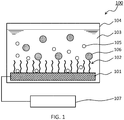
- FIG. 1 is a schematic diagram illustrating a configuration of a biosensor 100 according to an embodiment (first embodiment) of the present disclosure.
- the biosensor 100 shown in FIG. 1 has an electrode 101 and molecular chains 102 non-closely disposed on the electrode 101.
- the biosensor 100 has a container 104 containing a solution 103.
- the electrode 101 and the molecular chains 102 are disposed in the container 104.
- the solution 103 includes measurement target substances 105 and non-measurement target substances 106. Due to the presence of the molecular chains 102, it becomes difficult for the non-measurement target substances 106 to reach or approach the surface of the electrode 101.
- the measurement target substances 105 can substantially reach the surface of the electrode 101.
- a smaller amount of the measurement target substances 105 than the amount that would have reached the surface of the electrode 101 without the molecular chain 102 may reach the surface of the electrode 101.
- a part of the measurement target substances 105 may reach the surface of the electrode 101.
- the non-measurement target substances 106 are substantially inhibited from reaching the surface of the electrode 101 by the molecular chains 102.
- a part of the non-measurement target substances 106 may reach the surface of the electrode 101.
- the sensor 100 shown in FIG. 1 further comprises an electrical circuit or measurement circuit 107 electrically connected to the electrode 101 to detect the electrical condition of the electrode 101.
- the electrical state of the electrode 101 changes due to the approach, contact, and the like of the measurement target substances 105.
- the electrical circuit 107 can detect the electrical change.
- FIG.2 is a schematic diagram illustrating a configuration of a biosensor 200 according to one embodiment of the present disclosure (second embodiment).
- the biosensor 200 shown in FIG. 2 has an electrode 201 and molecular chains 202 disposed on the electrode 201.
- the biosensor 200 has a container 204 containing a solution 203.
- the electrode 201 and the molecular chains 202 are disposed in the container 204.
- the solution 203 includes measurement target substances 205 and non-measurement target substances 206.
- the sensor 200 shown in FIG. 2 further comprises a surface potential measuring device 207 connected to the electrode and a reference electrode 211.
- the surface potential measuring device 207 shown in FIG. 2 is configured to have a first stage of the operational amplifier, a low-pass filter and a second stage of the operational amplifier.
- the surface potential measuring device 207 may further include an A/D converter, or may be connected to an A/D converter.
- the sensor 200 shown in FIG. 2 further includes a reference electrode 211.
- the reference electrode 211 is disposed in the container 203 and is configured to contact solution 203.
- the reference electrode 211 shown in FIG. 2 is connected to a power supply 212 that provides a reference voltage.
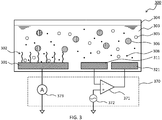
- FIG.3 is a schematic diagram illustrating a configuration of a biosensor 300 according to one embodiment of the present disclosure (third embodiment).
- the biosensor 300 includes a working electrode 301, a reference electrode 311, and a counter electrode 321 in a container 304.
- Molecular chains 302 are disposed on a surface of the working electrode 301 in contact with the solution 303, and is configured so as to inhibit the non-measurement target substances 306 contained in the solution 303 from approaching the working electrode 301 and selectively allowing the measurement target substances 305 to approach the electrode.
- the working electrode 301 is connected to a current measuring circuit 373.
- the reference electrode 311 and the counter electrode 321 shown in FIG. 3 are connected to an operational amplifier 371. More specifically, the reference electrode 311 is connected to the inverting input (-IN) of the operational amplifier 371, and the counter electrode 321 is connected to the output (OUT) of the operational amplifier 371.
- An AC power supply 372 is connected to the non-inverting input (+IN) of the operational amplifier 371.
- the configuration of FIG. 3 may be referred to as a so-called three-electrode measurement system.
- a voltage is applied from the power supply 372
- a feedback loop is formed which returns from the output of the operational amplifier 371, via the counter electrode 321, the solution 303, and the reference electrode 311, and back to the inverting input (- IN) of the operational amplifier 371.
- the voltage applied to the counter electrode 321 is controlled such that the voltage transmitted from the reference electrode 321 to the counter electrode 321 is equal to the reference voltage provided by the power supply 372.
- the operational amplifier 371 is one component of the feedback circuit, other circuit components having similar functions may be used in another embodiment.
- the solution 303 shown in FIG. 3 includes mediators 308 such as iron ions (Fe2+ or Fe3+).
- mediators 308 such as iron ions (Fe2+ or Fe3+).
- the mediator 308 contacts the working electrode 301 the charge is passed to the working electrode 301 by a redox reaction. This is detected or measured as a current by the current measuring circuit 373.
- the measurement target substances 305 reach and are adsorbed or bound on the working electrode 301, a substantial area of the working electrode 301 decreases, that is, the surface area of the working electrode 301 that can be reached by the mediators 308 decreases. Therefore, in general, the amount of the non-measurement target substances 306 that have reached the working electrode 301 increases with time, the substantial area of the working electrode 301 decreases, and the current value (I) by the mediator 308 drops.
- the concentration of the measurement target substance 305 in the solution 303 can be estimated or specified from the slope (dl/dt) of the drop of the current value, the drop amount ( ⁇ I) of the current value (I) up to a certain predetermined time, or the like.
- the measurement target substances 305 in the vicinity of the surface of the electrode 301 change the electric double layer or the like to cause a change in the capacitance component of the interface. That is, the impedance of the equivalent circuit at the interface changes. Therefore, by measuring the phase difference between the current value and the alternating current, the amount of the measurement target substances 305 in the vicinity of the electrode 301 or the concentration of the measurement target substances 305 in the solution 303 can be obtained by conversion.
- the above description of the measurement mechanism is illustrative and other mechanisms and measurement principles may be used.
- a DC power supply may be used instead of the AC power supply 372, to perform amperometry measurements.
- a similar electrode may be further provided as a control electrode without molecular chains arranged.
- the signal from the electrode via the molecular chain with the signal from the electrode without the molecular chain (current value, potential value, etc.) or taking the difference between them, it is possible to remove or reduce the noise due to the influence of low molecular substances, ions, etc. which cannot be inhibited by the non-measurement target substance or the molecular chain in the solution.
- the signal from the electrode via the molecular chain current value, potential value, etc.
- the signal from the electrode without the molecular chain current value, potential value, etc.
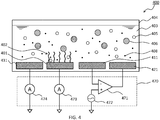
- FIG.4 is a schematic diagram illustrating a configuration of a biosensor 400 according to one embodiment of the present disclosure (fourth embodiment).
- the biosensor 400 includes a sensing working electrode 401, a control working electrode 431, a reference electrode 411, and a counter electrode 421, in a container 404.
- Molecular chains 402 are disposed on a surface of the sensing working electrode 401 in contact with the solution 403 so as to inhibit the non-measurement target substances 406 from approaching the working electrode 401.
- the sensing working electrode 401 and the control working electrode 431 are connected to current measuring circuits 473 and 474, respectively.
- the sensor 400 includes a working electrode that does not have a molecular chain, or a working electrode 431, in addition to the sensing working electrode 401 including the molecular chains 402.
- the difference of the measurements from the current measurement circuits 473, 474 can be taken. The difference may be performed by analog or digital.
- the reference electrode 411 and the counter electrode 421 shown in FIG. 4 are connected to an operational amplifier 471. More specifically, the reference electrode 411 is connected to the inverting input (-IN) of the operational amplifier 471 and the counter electrode 421 is connected to the output (OUT) of the operational amplifier 471. A voltage power supply 472 is connected to the non-inverting input (+IN) of the operational amplifier 471.
- the configuration and function of the feedback circuit is similar to the third embodiment.
- a DC power supply can be arranged instead of the AC to perform amperometry measurements (not shown).
- FIG.5 is a schematic diagram illustrating a configuration of a biosensor 500 according to one embodiment of the present disclosure (fifth embodiment).
- Solution 503 includes measurement target substances 504, non-measurement target substances 505, and mediators 508.
- the biosensor 500 shown in FIG. 5 includes two electrodes (sensing electrodes) 501 and 511 that are paired with each other. On the first electrode 501 and the second electrode 511 disposed in the container 504, the first molecular chains 502 and the second molecular chains 512 are disposed respectively.
- the first electrode 501 and the second electrode 511 are connected to an impedance measuring device (measurement circuit) 507.
- the concentration of the measurement target substances 505 in the solution 503 can be obtained from the phase difference between the current value and the current when an AC electric field is applied.
- the first molecular chains and the second molecular chains are configured to inhibit the non-measurement target substances 506 from binding to the electrodes 501, 511, respectively.
- a plurality of pairs of the first electrodes 501 and the second electrodes 502 may be provided.
- the solution 503 shown in FIG. 5 includes mediators 508 such as iron ions (Fe2+ or Fe3+).
- mediators 508 such as iron ions (Fe2+ or Fe3+).
- the mediator 508 contacts the electrodes 501,511
- the charge is passed to the electrodes 501,511 by a redox reaction.
- This is detected or measured as a current by the current measuring circuit 507.
- the measurement target substances 505 reach and are adsorbed or bound to the electrodes 501 and 511, a substantial area of the electrodes 501 and 511 is decreased, and an electric double layer or the like is changed to cause a change in the capacitance component of the interface. That is, the impedance of the equivalent circuit at the interface changes.
- the amount of the measurement target substances 505 in the vicinity of the electrode 501 or the concentration of the measurement target substances 505 in the solution 503 can be obtained by conversion.
- the above description of the measurement mechanism is illustrative and other mechanisms and measurement principles may be used.
- the two-electrode system operating in conjunction with each other as in FIG. 5 can reduce the effects of drift of measurement parameters during a measurement, variations from measurement to measurement, how the electrodes are arranged, and so on. Furthermore, it can be manufactured relatively easy and compact.
- a similar electrode may be further provided as a control electrode without molecular chains arranged.
- a similar electrode may be further provided as a control electrode without molecular chains arranged.
- FIG.6 is a schematic diagram illustrating a configuration of a biosensor 600 according to one embodiment of the present disclosure (sixth embodiment).
- Solution 603 includes measurement target substances 604, non-measurement target substances 605, and mediators 608. Electrodes without molecular chains are added to the configuration of the fifth embodiment shown in FIG. 5 . That is, in the biosensor 600 shown in FIG. 6 , the sensing electrode pair disposed in the container 604, the first sensing electrode 601 and the second sensing electrode 611 have the first molecular chains 602 and the second molecular chains 612 that are arranged non-closely on the respective electrode surfaces. The first sensing electrode 601 and the second electrode 611 is connected to the impedance measuring device (measuring circuit) 671.
- the 6 further includes a control electrode pair, a first control electrode 621 and a second control electrode 631, which do not have molecular chains.
- the first control electrode 621 and the second control electrode 631 is connected to the impedance measuring device (measuring circuit) 672.
- the impedance measurement device 671 for sensing and the impedance measurement device 672 for control may be collectively referred to as an electrical measurement circuit 670.
- the impedance measuring device has an AC voltage source and a current measuring circuit, and the power measuring circuit may measure a current flowing between the first electrode and the second electrode.
- the AC power supply and the current measuring circuit may be arranged in series.
- the impedance measuring device may have an alternating current source and a voltage measuring circuit.
- the impedance measuring device 671 for sensing and the impedance measuring device 672 for control are disposed as separate impedance measuring devices.
- one impedance measuring device (not shown) may be provided and configured to be alternately or selectively connected to the control electrode pair and the sensing electrode pair via a switch. Thereby, the sensor or the electrical measurement system can be miniaturized.
- a gold thin film having a thickness of 100 nm (nanometers) was formed on a glass substrate in a region having a diameter of 10 mm, by a sputtering method. Then, polymerization initiating molecules were bonded on this gold electrode surface at one end thereof. Then, from the other end of this polymerization-initiated molecule, hydrophilic polymer molecular chains were formed by atom-transfer radical polymerization (ATRP method).
- ATRP method atom-transfer radical polymerization
- the formation of the polymerization initiating molecules on the gold electrode is as follows: First, a glass substrate on which a gold electrode was formed was immersed in a 1 mM bis[2-(2-bromoisobutyryloxy)undecyl]disulfide/ethanol solution to bond polymerization initiating molecules on a gold electrode. Thus, as shown in FIG. 7A , the polymerization initiating molecule was immobilized by forming Au-S bonds with gold atoms of the electrode surface 701 at one end, thereby forming polymerization initiating molecular chains 703 having a length of about 10 carbon atoms having bromine (Br) at the free end which is the other end. This molecular chain is hydrophobic.
- the density of the molecular chains can be controlled by the immersion time in the above-mentioned bis[2-(2-bromoisobutyryloxy)undecyl]disulfide/ethanol solution (polymerization initiating molecular solution).
- polymerization initiating molecular solution bis[2-(2-bromoisobutyryloxy)undecyl]disulfide/ethanol solution (polymerization initiating molecular solution).
- sensors in which the immersion time was 2 hours and 48 hours at room temperature were used. Thereafter, the substrate was removed from the polymerization-initiated molecular solution and washed with ethanol and pure water.
- hydrophilic polymer molecular chains is as follows: First, 16 mmol of 2-methacryloyloxyethyl phosphorylcholine (MPC) and 4 mmol of N-3-(dimethylamino)propylmethacrylamido were dissolved in 112 ml of dimethylformamide and 48ml of ultrapure water. Then 0.16 mmol of cupric bromide and 0.8 mmol of tris(2-pyridylmethyl)amine were added. Next, a solution was prepared in which 0. 8 mmol of ascorbic acid was added. In this solution (monomer solution), a glass substrate comprising a gold electrode to which a polymerization initiating molecule was bonded was immersed.
- MPC 2-methacryloyloxyethyl phosphorylcholine
- N-3-(dimethylamino)propylmethacrylamido were dissolved in 112 ml of dimethylformamide and 48ml of ultrapure water. Then
- a hydrophilic polymer 704 was formed in which about 1000 MPCs were linked.
- the molecular chain 702 is hydrophobic at the portion 703 of the carbon chain on the fixed end side, it can be referred to as a hydrophilic polymer molecular chain. Since this hydrophilic portion is at the tip of the polymerization initiating molecular chain 703, less hydrophilic proteins are repelled, reducing the probability of approaching the electrode 701.
- the gold thin film on which the hydrophilic polymer was formed was electrically connected to a potentiostat, which was a surface potential measuring device, via wiring.
- the gold electrode was prepared in the same manner as in the sensor used in Example 1 and Example 2, but no molecular chain was formed.
- the sensor used in Comparative Example 1 is a sensor having a bare gold electrode, and it can be said that the sensor has a zero immersion time in a polymerization initiating molecular solution.
- the surface of a gold electrode with a hydrophilic polymer made as described above was immersed in biological buffer (Phosphate-buffered saline, pH7 4) for 48 hours. Subsequently, as protein contained in tears, the following proteins were injected into a solution, and each concentrate was injected so that the concentration in the solution would become values as shown below. The injections were was performed in the following order.
- FIG. 8 shows the change in surface potential at the electrode over time with the addition of the tear proteins.
- the vertical axis of FIG. 8 shows the output power from the gold electrode (mV)
- the horizontal axis shows the measurement time (seconds).
- the dotted line (A) shows the measurement result of the case where there is no molecular chain on the gold electrode surface of the measurement result (Comparative Example 1)
- the solid line (B48) shows the measurement result of the case where the molecular chain is provided on the gold electrode surface (Example 1).
- the display of both measurement results in FIG. 8 is adjusted so that the input time of each protein is uniform on the time axis and the readability is improved on the vertical axis.
- Example 1 In Comparative Example 1 (dotted line A), the additions of lysozyme, lactoferrin, and ⁇ -globulin resulted in potential changes of 3 mV, 12 mV, and 13 mV, respectively. In contrast, in Example 1 (solid line B48), the potential changes of 1 mV, 5 mV, and 7 mV were observed by additions of lysozyme, lactoferrin, and ⁇ -globulin, respectively. That is, the potential changes of lysozyme, lactoferrin, and ⁇ -globulin in Example 1 were about 1/2 to 1/3 of those in Comparative Example 1. In Example 1, it was found that due to the presence of molecular chains, these proteins were inhibited from arriving at the electrode surface. The hydrophilicity of the molecular chain is thought to function to repel the proteins.
- hydrophilic polymer molecular chains on a gold electrode were formed at a plurality of densities to evaluate selectivity for a plurality of proteins. That is, the relationship between the density of the molecular chains and the potential change due to the arrival of each protein to the gold electrode was examined.
- a gold electrode was prepared on a glass substrate, and hydrophilic polymer molecular chains were made on the gold electrode.
- a plurality of densities of polymerization initiating molecules were prepared in accordance with the immersion time of a 1 mM bis[2-(2-bromoisobutyryloxy)undecyl]disulfide/ethanol solution. The longer the immersion time, the higher the density of the polymerization initiating molecules.
- sensors of 2 kinds of hydrophilic polymer molecular chains (sensor B02 and sensor B48, respectively) having the immersion time of 2 hours and 48 hours and a gold electrode without the same molecular chain as in Comparative Example 1 (sensor A) were prepared.
- Each electrode-surface was then filled with biological buffer (Phosphate-buffered saline, pH 7.4).
- biological buffer Phosphate-buffered saline, pH 7.4
- proteins were subsequently added to this solution.
- the proteins used for the measurement and the concentration in solution after administration are as follows.
- FIG. 9 shows the time evolution of the surface potential upon addition of each of the above proteins.
- the vertical axis of FIG. 9 shows the output voltage (mV)
- the horizontal axis shows the measurement time (seconds).
- the display of both measurement results in FIG. 8 is adjusted so that the input time of each protein is uniform on the time axis and the readability is improved on the vertical axis.
- the surface potential was detected from the addition of lactoferrin to the addition of the highest concentration of human serum albumin (HSA). It is considered that the change in the surface potential indicates a change in the surface potential due to the transfer of electrons when the Au-S bond is formed with the gold electrode.
- Surface potential change at the electrode were observed from the addition of lactoferrin to the addition of the highest concentration of human serum albumin (HSA) even with a sensor with a polymerization-initiated molecular immersion time of 2 h (sensor B02).
- the senor B48 may be said to have a selective detection sensitivity for albumin compared to lactoferrin, ⁇ -globulin, and the like, among proteins in tear fluid.
- Such sensors can inhibit other proteins (non-measurement target substance) other than albumin, such as lactoferrin and ⁇ -globulin, and can selectively detect albumin (measurement target substance).
- Such sensors can be used as albumin sensors in tears, as an example.
- FIG. 10 is a diagram of plotting the collected concentrations of each albumin added as in FIG. 9 , and the corresponding generated surface potential shift widths. As shown in FIG. 10 , it was found that there is a substantially one-to-one correlation between the concentration of albumin and the amount of surface potential change. Therefore, it has been shown that the concentration of albumin can be quantified even in a pseudo tear solution containing proteins other than albumin using a sensor as shown in this example.
- the present disclosure includes, but is not limited to, the following embodiments:
Landscapes
- Health & Medical Sciences (AREA)
- Life Sciences & Earth Sciences (AREA)
- Immunology (AREA)
- Chemical & Material Sciences (AREA)
- Engineering & Computer Science (AREA)
- Molecular Biology (AREA)
- Physics & Mathematics (AREA)
- Pathology (AREA)
- General Health & Medical Sciences (AREA)
- Biochemistry (AREA)
- Analytical Chemistry (AREA)
- General Physics & Mathematics (AREA)
- Biomedical Technology (AREA)
- Urology & Nephrology (AREA)
- Hematology (AREA)
- Chemical Kinetics & Catalysis (AREA)
- Electrochemistry (AREA)
- Cell Biology (AREA)
- Medicinal Chemistry (AREA)
- Food Science & Technology (AREA)
- Microbiology (AREA)
- Biotechnology (AREA)
- Spectroscopy & Molecular Physics (AREA)
- Power Engineering (AREA)
- Investigating Or Analyzing Materials By The Use Of Electric Means (AREA)
- Investigating Or Analysing Biological Materials (AREA)
Applications Claiming Priority (2)
| Application Number | Priority Date | Filing Date | Title |
|---|---|---|---|
| JP2018066633 | 2018-03-30 | ||
| PCT/JP2019/012359 WO2019188902A1 (fr) | 2018-03-30 | 2019-03-25 | Bio-capteur |
Publications (2)
| Publication Number | Publication Date |
|---|---|
| EP3779421A1 true EP3779421A1 (fr) | 2021-02-17 |
| EP3779421A4 EP3779421A4 (fr) | 2021-12-15 |
Family
ID=68061869
Family Applications (1)
| Application Number | Title | Priority Date | Filing Date |
|---|---|---|---|
| EP19774495.6A Withdrawn EP3779421A4 (fr) | 2018-03-30 | 2019-03-25 | Bio-capteur |
Country Status (4)
| Country | Link |
|---|---|
| US (1) | US20210293799A1 (fr) |
| EP (1) | EP3779421A4 (fr) |
| JP (1) | JPWO2019188902A1 (fr) |
| WO (1) | WO2019188902A1 (fr) |
Cited By (2)
| Publication number | Priority date | Publication date | Assignee | Title |
|---|---|---|---|---|
| EP4571311A1 (fr) * | 2023-12-15 | 2025-06-18 | Imec VZW | Plate-forme de détection commutable |
| EP4375654A4 (fr) * | 2021-07-18 | 2025-07-16 | Univ Tokyo | Procédé et dispositif de détection de biomolécule |
Family Cites Families (7)
| Publication number | Priority date | Publication date | Assignee | Title |
|---|---|---|---|---|
| DE10211358B4 (de) * | 2002-03-14 | 2006-10-26 | Siemens Ag | Vertikal-Impedanz-Sensor-Anordnung und Verfahren zum Herstellen einer Vertikal-Impedanz-Sensor-Anordnung |
| JP4731544B2 (ja) * | 2007-12-17 | 2011-07-27 | 株式会社日立製作所 | 生体分子検出装置及びそれを用いた生体分子検出方法 |
| JP2012202899A (ja) * | 2011-03-28 | 2012-10-22 | Toshiba Corp | 塩基配列判定方法、システムおよびプログラム |
| US20130331676A1 (en) * | 2012-06-08 | 2013-12-12 | Medtronic Minimed, Inc. | Application of electrochemical impedance spectroscopy in sensor systems, devices, and related methods |
| JP5565783B1 (ja) * | 2013-08-08 | 2014-08-06 | 国立大学法人 東京大学 | バイオセンサ |
| JP6591822B2 (ja) * | 2014-08-07 | 2019-10-16 | 国立大学法人 東京大学 | バイオセンサ |
| JP6773406B2 (ja) * | 2014-12-24 | 2020-10-21 | アークレイ株式会社 | 酵素電極 |
-
2019
- 2019-03-25 JP JP2020510032A patent/JPWO2019188902A1/ja active Pending
- 2019-03-25 US US17/044,010 patent/US20210293799A1/en not_active Abandoned
- 2019-03-25 WO PCT/JP2019/012359 patent/WO2019188902A1/fr not_active Ceased
- 2019-03-25 EP EP19774495.6A patent/EP3779421A4/fr not_active Withdrawn
Cited By (3)
| Publication number | Priority date | Publication date | Assignee | Title |
|---|---|---|---|---|
| EP4375654A4 (fr) * | 2021-07-18 | 2025-07-16 | Univ Tokyo | Procédé et dispositif de détection de biomolécule |
| EP4571311A1 (fr) * | 2023-12-15 | 2025-06-18 | Imec VZW | Plate-forme de détection commutable |
| WO2025125115A1 (fr) * | 2023-12-15 | 2025-06-19 | Imec Vzw | Plateforme de détection commutable |
Also Published As
| Publication number | Publication date |
|---|---|
| EP3779421A4 (fr) | 2021-12-15 |
| US20210293799A1 (en) | 2021-09-23 |
| JPWO2019188902A1 (ja) | 2021-07-08 |
| WO2019188902A1 (fr) | 2019-10-03 |
Similar Documents
| Publication | Publication Date | Title |
|---|---|---|
| Choi et al. | Molecularly imprinted polymer-based electrochemical impedimetric sensors on screen-printed carbon electrodes for the detection of trace cytokine IL-1β | |
| Wustoni et al. | An organic electrochemical transistor integrated with a molecularly selective isoporous membrane for amyloid-β detection | |
| CN105651840B (zh) | 一种检测β‑淀粉样蛋白寡聚体的类免疫电化学传感器及其制备方法 | |
| Ding et al. | Electrochemical evaluation of avidin–biotin interaction on self-assembled gold electrodes | |
| TWI453282B (zh) | 連接物、阻抗式生物晶片及使用該晶片在流體樣品中定量偵測目標分析物之方法 | |
| US12292406B2 (en) | Device for detecting analytes in a sample, and methods of use thereof | |
| US10996194B2 (en) | High-sensitivity biosensor and method for producing the same | |
| KR101818368B1 (ko) | 헤모글로빈 및 당화 헤모글로빈의 동시 측정 일회용 전류식 검출방법 | |
| BR112014027489B1 (pt) | Eletrodo e método para detectar uma espécie-alvo | |
| US11156581B2 (en) | Biosensor | |
| Jain et al. | Triple‐nanostructuring‐based noninvasive electro‐immune sensing of CagA toxin for Helicobacter pylori detection | |
| Aydın et al. | Ultrasensitive determination of cadherin-like protein 22 with a label-free electrochemical immunosensor using brush type poly (thiophene-g-glycidylmethacrylate) modified disposable ITO electrode | |
| HK1216441A1 (zh) | 诊断结核病的方法 | |
| Mihailescu et al. | Platform with biomimetic electrochemical sensors for adiponectin and leptin detection in human serum | |
| Ding et al. | Molecularly imprinted sensor based on poly-o-phenylenediamine-hydroquinone polymer for β-amyloid-42 detection | |
| KR102043321B1 (ko) | 빗살형 전극에 나노입자을 증착시켜 TNF-alpha 측정 감도를 높인 나노바이오센서 | |
| Sun et al. | Development of an electrochemical impedance immunosensor for myoglobin determination | |
| Supraja et al. | Label-free, ultrasensitive and rapid detection of FDA-approved TBI specific UCHL1 biomarker in plasma using MWCNT-PPY nanocomposite as bio-electrical transducer: A step closer to point-of-care diagnosis of TBI | |
| Rezaei et al. | Stainless steel modified with an aminosilane layer and gold nanoparticles as a novel disposable substrate for impedimetric immunosensors | |
| US20210293799A1 (en) | Bio-sensor | |
| US20150355133A1 (en) | Nano-well based electrical immunoassays | |
| Khorshed et al. | Development of an impedance-based biosensor for determination of IgG galactosylation levels | |
| WO2014006394A2 (fr) | Électrode et son utilisation | |
| TWI435873B (zh) | 抗體探針電感測晶片之電子傳導分子 | |
| CN112362715B (zh) | 一种高灵敏生物传感器及其制作方法与应用 |
Legal Events
| Date | Code | Title | Description |
|---|---|---|---|
| STAA | Information on the status of an ep patent application or granted ep patent |
Free format text: STATUS: THE INTERNATIONAL PUBLICATION HAS BEEN MADE |
|
| PUAI | Public reference made under article 153(3) epc to a published international application that has entered the european phase |
Free format text: ORIGINAL CODE: 0009012 |
|
| STAA | Information on the status of an ep patent application or granted ep patent |
Free format text: STATUS: REQUEST FOR EXAMINATION WAS MADE |
|
| 17P | Request for examination filed |
Effective date: 20201026 |
|
| AK | Designated contracting states |
Kind code of ref document: A1 Designated state(s): AL AT BE BG CH CY CZ DE DK EE ES FI FR GB GR HR HU IE IS IT LI LT LU LV MC MK MT NL NO PL PT RO RS SE SI SK SM TR |
|
| AX | Request for extension of the european patent |
Extension state: BA ME |
|
| DAV | Request for validation of the european patent (deleted) | ||
| DAX | Request for extension of the european patent (deleted) | ||
| A4 | Supplementary search report drawn up and despatched |
Effective date: 20211112 |
|
| RIC1 | Information provided on ipc code assigned before grant |
Ipc: G01N 33/483 20060101ALI20211108BHEP Ipc: G01N 27/02 20060101AFI20211108BHEP |
|
| STAA | Information on the status of an ep patent application or granted ep patent |
Free format text: STATUS: EXAMINATION IS IN PROGRESS |
|
| 17Q | First examination report despatched |
Effective date: 20230726 |
|
| STAA | Information on the status of an ep patent application or granted ep patent |
Free format text: STATUS: THE APPLICATION IS DEEMED TO BE WITHDRAWN |
|
| 18D | Application deemed to be withdrawn |
Effective date: 20231206 |