EP3781002B1 - Appareil de traitement d'aliments et son procédé de fonctionnement - Google Patents
Appareil de traitement d'aliments et son procédé de fonctionnement Download PDFInfo
- Publication number
- EP3781002B1 EP3781002B1 EP19719779.1A EP19719779A EP3781002B1 EP 3781002 B1 EP3781002 B1 EP 3781002B1 EP 19719779 A EP19719779 A EP 19719779A EP 3781002 B1 EP3781002 B1 EP 3781002B1
- Authority
- EP
- European Patent Office
- Prior art keywords
- user
- control unit
- user interaction
- sensor
- force
- Prior art date
- Legal status (The legal status is an assumption and is not a legal conclusion. Google has not performed a legal analysis and makes no representation as to the accuracy of the status listed.)
- Active
Links
Images


Classifications
-
- A—HUMAN NECESSITIES
- A47—FURNITURE; DOMESTIC ARTICLES OR APPLIANCES; COFFEE MILLS; SPICE MILLS; SUCTION CLEANERS IN GENERAL
- A47J—KITCHEN EQUIPMENT; COFFEE MILLS; SPICE MILLS; APPARATUS FOR MAKING BEVERAGES
- A47J27/00—Cooking-vessels
- A47J27/21—Water-boiling vessels, e.g. kettles
- A47J27/21008—Water-boiling vessels, e.g. kettles electrically heated
- A47J27/21058—Control devices to avoid overheating, i.e. "dry" boiling, or to detect boiling of the water
- A47J27/21083—Control devices to avoid overheating, i.e. "dry" boiling, or to detect boiling of the water with variable operating parameters, e.g. temperature or boiling period
-
- A—HUMAN NECESSITIES
- A47—FURNITURE; DOMESTIC ARTICLES OR APPLIANCES; COFFEE MILLS; SPICE MILLS; SUCTION CLEANERS IN GENERAL
- A47J—KITCHEN EQUIPMENT; COFFEE MILLS; SPICE MILLS; APPARATUS FOR MAKING BEVERAGES
- A47J43/00—Implements for preparing or holding food, not provided for in other groups of this subclass
- A47J43/04—Machines for domestic use not covered elsewhere, e.g. for grinding, mixing, stirring, kneading, emulsifying, whipping or beating foodstuffs, e.g. power-driven
- A47J43/07—Parts or details, e.g. mixing tools, whipping tools
- A47J43/075—Safety devices
- A47J43/0761—Safety devices for machines with tools driven from the lower side
- A47J43/0772—Safety devices for machines with tools driven from the lower side activated by the proper positioning of the cover
-
- A—HUMAN NECESSITIES
- A47—FURNITURE; DOMESTIC ARTICLES OR APPLIANCES; COFFEE MILLS; SPICE MILLS; SUCTION CLEANERS IN GENERAL
- A47J—KITCHEN EQUIPMENT; COFFEE MILLS; SPICE MILLS; APPARATUS FOR MAKING BEVERAGES
- A47J31/00—Apparatus for making beverages
- A47J31/002—Apparatus for making beverages following a specific operational sequence, e.g. for improving the taste of the extraction product
-
- A—HUMAN NECESSITIES
- A47—FURNITURE; DOMESTIC ARTICLES OR APPLIANCES; COFFEE MILLS; SPICE MILLS; SUCTION CLEANERS IN GENERAL
- A47J—KITCHEN EQUIPMENT; COFFEE MILLS; SPICE MILLS; APPARATUS FOR MAKING BEVERAGES
- A47J43/00—Implements for preparing or holding food, not provided for in other groups of this subclass
- A47J43/04—Machines for domestic use not covered elsewhere, e.g. for grinding, mixing, stirring, kneading, emulsifying, whipping or beating foodstuffs, e.g. power-driven
- A47J43/046—Machines for domestic use not covered elsewhere, e.g. for grinding, mixing, stirring, kneading, emulsifying, whipping or beating foodstuffs, e.g. power-driven with tools driven from the bottom side
-
- A—HUMAN NECESSITIES
- A47—FURNITURE; DOMESTIC ARTICLES OR APPLIANCES; COFFEE MILLS; SPICE MILLS; SUCTION CLEANERS IN GENERAL
- A47J—KITCHEN EQUIPMENT; COFFEE MILLS; SPICE MILLS; APPARATUS FOR MAKING BEVERAGES
- A47J43/00—Implements for preparing or holding food, not provided for in other groups of this subclass
- A47J43/04—Machines for domestic use not covered elsewhere, e.g. for grinding, mixing, stirring, kneading, emulsifying, whipping or beating foodstuffs, e.g. power-driven
- A47J43/07—Parts or details, e.g. mixing tools, whipping tools
- A47J43/075—Safety devices
-
- A—HUMAN NECESSITIES
- A47—FURNITURE; DOMESTIC ARTICLES OR APPLIANCES; COFFEE MILLS; SPICE MILLS; SUCTION CLEANERS IN GENERAL
- A47J—KITCHEN EQUIPMENT; COFFEE MILLS; SPICE MILLS; APPARATUS FOR MAKING BEVERAGES
- A47J43/00—Implements for preparing or holding food, not provided for in other groups of this subclass
- A47J43/04—Machines for domestic use not covered elsewhere, e.g. for grinding, mixing, stirring, kneading, emulsifying, whipping or beating foodstuffs, e.g. power-driven
- A47J43/07—Parts or details, e.g. mixing tools, whipping tools
- A47J43/075—Safety devices
- A47J43/0761—Safety devices for machines with tools driven from the lower side
- A47J43/0766—Safety devices for machines with tools driven from the lower side activated by the proper positioning of the mixing bowl
-
- A—HUMAN NECESSITIES
- A47—FURNITURE; DOMESTIC ARTICLES OR APPLIANCES; COFFEE MILLS; SPICE MILLS; SUCTION CLEANERS IN GENERAL
- A47J—KITCHEN EQUIPMENT; COFFEE MILLS; SPICE MILLS; APPARATUS FOR MAKING BEVERAGES
- A47J43/00—Implements for preparing or holding food, not provided for in other groups of this subclass
- A47J43/04—Machines for domestic use not covered elsewhere, e.g. for grinding, mixing, stirring, kneading, emulsifying, whipping or beating foodstuffs, e.g. power-driven
- A47J43/07—Parts or details, e.g. mixing tools, whipping tools
- A47J2043/0733—Weighing means
-
- A—HUMAN NECESSITIES
- A47—FURNITURE; DOMESTIC ARTICLES OR APPLIANCES; COFFEE MILLS; SPICE MILLS; SUCTION CLEANERS IN GENERAL
- A47J—KITCHEN EQUIPMENT; COFFEE MILLS; SPICE MILLS; APPARATUS FOR MAKING BEVERAGES
- A47J43/00—Implements for preparing or holding food, not provided for in other groups of this subclass
- A47J43/04—Machines for domestic use not covered elsewhere, e.g. for grinding, mixing, stirring, kneading, emulsifying, whipping or beating foodstuffs, e.g. power-driven
- A47J43/07—Parts or details, e.g. mixing tools, whipping tools
- A47J43/075—Safety devices
- A47J43/0761—Safety devices for machines with tools driven from the lower side
Definitions
- the invention relates to a food processing apparatus and a method of operating the same.
- the invention relates to an apparatus for processing food stuff that allows intuitive user control and a method of operating the same.
- Many domestic kitchen appliances have user interfaces comprising components such as switches, buttons, displays, knobs, and indication lights.
- a user can power on/off the kitchen appliance, start/stop different cooking processes, and change a setting of the cooking process (e.g. speed, cooking temperature, cooking time).
- the indication lights at the user interface can provide feedback of the status of the kitchen appliance, i.e. power on/off.
- These types of user interface components are often not intuitive to users. In some cases, a user may find it confusing to operate the kitchen appliance when faced with a user interface which includes many different buttons and knobs.
- mechanical user interface elements such as a push buttons and rotary knobs can be easily affected and damaged by dirt, water, or food stuff. The unevenness of the surface of the kitchen appliance due to the presence of these types of mechanical user interface elements can also increase the difficulty to clean the kitchen appliance.
- EP 3 251 567 discloses a food blender with an adaptable blade, so that the food processing results can be adapted.
- a sensor is used to monitor conditions within the food processing chamber.
- a user can provide input by means of a separate user interface.
- an apparatus for processing food stuff comprising:
- a force sensor is present for measuring an operating parameter, by which is meant information about the food stuff or information about the setting or configuration of the apparatus itself.
- This operating parameter is of interest for the control of the apparatus, for example for automatically setting a cooking time or temperature, or for starting or stopping the cooking process.
- the invention makes use of this sensor for additionally monitoring user interaction, in the form of a force applied on the apparatus, for example when the user presses down or against on the apparatus.
- This application of force by the user can be conducted with dirty hands and without touching the apparatus with the fingers. For example, the user may press down on a lid of the apparatus with the back of the hand or with the elbows.
- the user can simply perform one of the interactions with the apparatus, as described above, without having to ensure that his hands are free of dirt, grease or moisture. This interaction is then measured by the sensor and interpreted by the control unit. As the sensor is present in the apparatus anyway, the solution can be implemented without additional hardware costs. It only requires a suitable program and/or recognition algorithm, to enable the control unit to interpret from the measured user interaction if and what user input command has been given. Depending on the available sensor type, different user interactions or interaction patterns may be measurable/ detectable, as described above, thus providing ample design freedom to associate a certain user input command with a suitable user interaction, that is, most suitable and/or intuitive for the given situation.
- the force sensor for example comprises a weight sensor and the operating parameter may then comprise a food weight.
- the term "force sensor” is intended to cover a weight sensor (i.e. a sensor which measures downward force) or a force sensor which may measure a non-downward force such to detect a force exerted laterally against the apparatus.
- the force sensor may comprise a lid closure sensor, and the operating parameter then comprises a lid closure condition.
- processing the received measurements may comprise matching the received measurements with a predetermined user interaction or a predetermined user interaction pattern to identify a user input command corresponding to the predetermined user interaction or predetermined user interaction pattern.
- matching the received measurements with a predetermined user interaction or a predetermined user interaction pattern may comprise determining whether the measurements exceed a predetermined threshold value.
- the user input command may correspond to an operation to be performed by at least one of the control unit, the apparatus, and an external device.
- the operation may comprise at least one of: powering on/off the apparatus; changing an operation parameter of the apparatus such as for instance a time setting, a temperature setting, a speed setting; changing a program of the apparatus; proceeding to a next step in a program of the apparatus or a user cooking guide; pausing or restarting an operation; adding or altering food ingredients, and confirming presence of a user.
- an operation parameter of the apparatus such as for instance a time setting, a temperature setting, a speed setting
- changing a program of the apparatus proceeding to a next step in a program of the apparatus or a user cooking guide
- pausing or restarting an operation adding or altering food ingredients, and confirming presence of a user.
- the apparatus may further comprise a base unit for supporting the container, wherein the sensor may be integrated in the base unit or between the base unit and the container.
- control unit is further configured to process the received measurements to determine a weight of the food stuff in the container.
- an external device comprising a control unit and a communication unit, and the communication unit of the external device is configured to receive the user input command, and the control unit of the external device is arranged to perform an operation at the external device based on the received user input command from the apparatus.
- a method of operating an apparatus for processing food stuff comprising: measuring an interaction with the apparatus by a user using a force sensor in the apparatus that is otherwise used for measuring an operation parameter; receiving, in a control unit of the apparatus, measurements of the user interaction when the user applies a force on the apparatus; processing, in a control unit of the apparatus, the received measurements to determine if a determined user interaction or a predetermined user interaction pattern corresponding to a user input command has been performed by the user; and controlling the food processing unit in dependence on the determined user input command.
- the method may further comprise processing, in the control unit of the apparatus, the received measurements to determine if a predetermined user interaction corresponding to closing of a covering element has been performed by the user.
- the method may further comprise processing, in the control unit of the apparatus, the received measurements to determine a weight of the food stuff in the container.
- processing the received measurements may comprise matching the received measurements with a predetermined user interaction or a predetermined user interaction pattern to identify a user input command corresponding to the predetermined user interaction or predetermined user interaction pattern.
- matching the received measurements with a predetermined user interaction or a predetermined user interaction pattern may comprise determining whether the measurements exceed a predetermined threshold value.
- the method may further comprise measuring a force applied to the apparatus by the user as an interaction.
- a computer program product comprising a computer readable medium having computer readable code embodied therein, the computer readable code being configured such that, on execution by a suitable computer, processor or control unit, the computer, processor or control unit is caused to perform the method according to the third aspect.
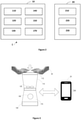
- Figure 1 shows a block diagram of an apparatus 10 according to an embodiment that is used for processing food stuff.
- the apparatus 10 may be a blender, a food processor, a steamer, an airbased fryer, a toaster, a slow cooker, etc. It will be appreciated that the apparatus 10 can be any apparatus that comprises a food processing function, such as cooking, frying, heating, blending, stirring, mixing, grinding, etc.
- the apparatus 10 comprises a container 110 for receiving a food stuff, a food processing unit 120 for processing the food stuff in the container, a sensor 130 for measuring an interaction with the apparatus by a user and a control unit 140 for controlling operation of the apparatus 10.
- the illustrated embodiment further comprises a communication unit 150, a display unit 160, a base unit 170 for supporting the container 110, and a memory unit 180. In some embodiments, one or more of the units 150, 160, 170, 180 may be omitted.
- the container 110 can be made of any material or combination of materials, preferably a transparent material so as to allow a user to observe the food processing operation and a status of the food stuff placed inside the container 110 during use of the apparatus 10.
- the container 110 can comprise another material which is not transparent, such as stainless steel.
- the apparatus 10 can comprise a covering element for covering the container 110 to confine the food stuff within.
- the covering element may be provided in the form of a drawer or a lid that is removable from the container 110 or a hinged lid, or a door.
- a lock mechanism may be provided so as to secure the covering element at the container 110 during use of the apparatus 10.
- the container 110 may be configured to be detachably placed on or mounted onto the base unit 170 such that it is fixed to the base unit 170 during use of the apparatus 10.
- the container 110 may be removable from the base unit 170, e.g. for purposes of entering or removing foodstuff, for exchanging the container for another one, for cleaning purposes, etc.
- the food processing unit 120 may comprise at least one of a cutting element, a stirring element, and a heating element. In some embodiments, the food processing unit 120 may be located inside the container 110 such that food stuff placed inside the container 100 may be processed directly by the food processing unit 120.
- the senor 130 is configured to measure an interaction with the apparatus 10 by the user.
- the sensor measures a force.
- the sensor 130 may for instance comprise a weighing scale which may be integrated in the apparatus 10 or be provided separately from the other components of the apparatus 10.
- the sensor 130 may comprise a switch element that is activated by user interaction with the apparatus, for instance when the user presses on a portion of the apparatus (other than the switch element itself) with a certain force.
- the senor 130 may comprise a combination of a spring element and a switch element, wherein the spring element and the switch element may be configured such that the switch element is only activated when the user interaction with the apparatus meets a certain condition, for instance when a force exerted by the user on the apparatus exceeds a certain threshold value.
- the sensor 130 may be integrated in the base unit 170. In other embodiments, the sensor 130 may be integrated between the container 110 and the base unit 170. In other embodiments, the sensor 130 may be located separate from the base unit 170.
- the sensor 130 may be connected to the control unit 140 wirelessly or via a wired connection.
- the sensor 130 comprises a force sensor for measuring a force applied by the user to the apparatus 10.
- the applied force may be applied by the user on the apparatus as a whole or on a specific component of the apparatus 10.
- the sensor 130 may be configured to measure a force (over time) applied to the covering element.
- the measurements from the sensor 130 may show the measured force over time.
- the control unit 140 is configured to receive from the sensor 130 the measurements of the user interaction and process the measurements in order to determine if a predetermined user interaction or a predetermined user interaction pattern has been performed by the user corresponding to a user input command.
- the control unit 140 can be implemented in numerous ways, with software and/or hardware, to perform the various functions described herein.
- the control unit 140 may comprise one or more microprocessors or digital signal processor (DSPs) that may be programmed using software or computer program code to perform the required functions and/or to control components of the control unit 140 to effect the required functions.
- DSPs digital signal processor
- the control unit 140 may be implemented as a combination of dedicated hardware to perform some functions (e.g. amplifiers, pre-amplifiers, analog-to-digital convertors (ADCs) and/or digital-to-analog convertors (DACs)) and a processor (e.g., one or more programmed microprocessors, controllers, DSPs and associated circuitry) to perform other functions. Examples of components that may be employed in various embodiments of the present disclosure include, but are not limited to, conventional microprocessors, DSPs, application specific integrated circuits (ASICs), and field-programmable gate arrays (FPGAs).
- control unit 140 may be associated with or comprise one or more memory units 180 that comprise any type of memory, such as cache or system memory including volatile and non-volatile computer memory such as random access memory (RAM) static RAM (SRAM), dynamic RAM (DRAM), read-only memory (ROM), programmable ROM (PROM), erasable PROM (EPROM), and electrically erasable PROM (EEPROM).
- RAM random access memory
- SRAM static RAM
- DRAM dynamic RAM
- ROM read-only memory
- PROM programmable ROM
- EPROM erasable PROM
- EEPROM electrically erasable PROM
- the control unit 140 or associated memory unit 180 can also be used for storing program code that can be executed by a processor in the control unit 140 to perform the method described herein.
- the memory unit 180 can store template messages or content for messages that can be used when generating messages according to the method described below.
- control unit 140 may be configured to process the received measurements in order to determine if a predetermined interaction corresponding to closing of the covering element has been performed by the user.
- control unit 140 may be further configured to process the received measurements to determine a weight of the food stuff in the container.
- control unit 140 may be configured to match the received measurements with a predetermined user interaction or a predetermined user interaction pattern to identify a user input command corresponding to the predetermined user interaction or predetermined user interaction pattern.
- matching the received measurements with a predetermined user interaction or a predetermined user interaction pattern may comprise determining whether the measurements exceed a certain threshold value.
- control unit 140 may be configured to process the force measurements in order to determine at least one of: a magnitude of the force, a time duration of the force applied, a number of times a force is applied within a predetermined time, and a time period between an applied force and a consecutive applied force.
- a predetermined user interaction may be a force with a magnitude which exceeds a certain threshold value. In this case, when the force measured by the sensor 130 exceeds this threshold value (i.e. matching the predetermined user interaction), the control unit 140 determines that the predetermined user interaction corresponding to a user input command has been performed by the user.
- determining whether a predetermined user interaction corresponding to a user input command has been performed is provided in the description below relating to Figure 5 .
- a user input command may correspond to an operation to be performed by at least one of: the control unit 140, the apparatus 10, and an external device.
- the predetermined user interaction may be a force with a magnitude which exceeds a certain threshold value, and in these embodiments this predetermined user interaction may correspond to a user input command which in turn may correspond to a specific operation, e.g. to power on/off the apparatus 10.
- the control unit 140 determines that the force applied by the user exceeds the threshold value, it can then determine this as a user input command to power on or off the apparatus 10 and subsequently perform this operation.
- the user input command may relate to changing a status of the apparatus, such as powering on/off the apparatus 10, changing a setting or operation parameter of the apparatus, for instance a time setting, a temperature setting and/or a speed setting of the apparatus 10, changing a program of the apparatus 10, proceeding to a next step in a user cooking guide, pausing/restarting an operation, adding/altering ingredients and/or confirming presence of a user.
- a status of the apparatus such as powering on/off the apparatus 10, changing a setting or operation parameter of the apparatus, for instance a time setting, a temperature setting and/or a speed setting of the apparatus 10, changing a program of the apparatus 10, proceeding to a next step in a user cooking guide, pausing/restarting an operation, adding/altering ingredients and/or confirming presence of a user.
- Two or more of these user input commands may have a respective associated predetermined interaction or predetermined interaction pattern.
- a time setting of the apparatus 10 may be a time duration during which the control unit 140 controls the food processing unit 120 to operate, e.g. perform cutting/blending for 1 minute.
- a time setting of the apparatus 10 may be a time at which the apparatus 10 is powered on/off automatically.
- a temperature setting of the apparatus 10 may be a setting for a temperature within the container 110 of the apparatus 10.
- a speed setting of the apparatus 10 may be a speed at which the control unit 140 controls the food processing unit 120 to operate, e.g. perform cutting/blending at 500 rpm.
- a program of the apparatus 10 may comprise a set of time settings and/or temperature settings and/or speed settings for operating the food processing unit 120.
- user cooking guides comprises a plurality of steps that can be displayed to the user via a display unit (e.g. at the apparatus 10 or at an external device), each step corresponding to a step in a recipe for preparing a food item.
- the apparatus 10 can comprise a display unit 160.
- the display unit 160 may be configured to display a setting and/or status of the apparatus, e.g. a current on/off status of the apparatus 10.
- the display unit 160 may be a touch screen display unit which can receive further user input.
- the display unit 160 may be part of a user interface.
- a plurality of user interactions and/or user interaction patterns along with corresponding user input commands and corresponding operations may be stored in the memory unit 180, such that the control unit 140 can retrieve and compare at least one of the plurality of user interactions or user interaction patterns with a measured user interaction to determine whether the measured interaction corresponds to a user input command.
- a setting and/or status of the apparatus 10 may be stored in the memory unit 180 of the apparatus 10.
- the control unit 140 can be configured to control the memory unit 180 to store at least one of a plurality of time settings of the apparatus 10, a plurality of temperature settings of the apparatus 10, a plurality of speed settings of the apparatus 10, a plurality of programs of the apparatus 10, a plurality of steps in a user cooking guide, and a plurality of user cooking guides for use in the method described herein.
- a setting and/or status of the apparatus may be stored in a memory external to (i.e. separate to or remote from) the apparatus 10, such as a memory of another apparatus or device.
- the memory unit 180 of the apparatus 10 can be configured to store program code that can be executed by the control unit 140 to perform the method described herein.
- the memory unit 180 of the apparatus 10 can be used to store other data (or information) acquired or made by the control unit 140 of the apparatus 10 or acquired from any interfaces, memories or devices that are external to the apparatus 10.
- the control unit 140 of the apparatus 10 may be configured to control the memory unit 180 to store such data (or information).
- the apparatus 10 may comprise a user interface.
- the user interface of the apparatus 10 may be for use in providing a user of the apparatus 10 with information resulting from the method described herein.
- the control unit 140 of the apparatus 10 may be configured to control the user interface to provide the information resulting from the method described herein.
- the user interface as referred to herein may be any user interface that enables the rendering (or output or display) of data (or information) to a user of the apparatus 10.
- the display unit 160 as described above may be a part of the user interface of the apparatus 10 in some embodiments.
- a user interface as referred to herein may be any user interface that enables a user of the apparatus 10 to provide additional user input, interact with and/or control the apparatus 10.
- a user interface as referred to herein can comprise one or more switches, one or more buttons, a keypad, a keyboard, a touch screen or an application (for example, on a tablet or smartphone), one or more microphones or any other audio component, or any other user interface component, or combination of user interface components.
- the communication unit (or circuitry) 150 may be configured to enable the apparatus 10 to communicate with any interfaces, memories and devices that are internal or external to the apparatus 10.
- the communication unit 150 may communicate with any interfaces, memories and devices wirelessly or via a wired connection.
- the communication unit 150 may communicate with the memory unit 180 of the apparatus 10 or any other memory wirelessly or via a wired connection.
- the communication unit 150 may communicate with a user interface (not shown in Figure 1 ) of the apparatus 10 or any other user interface wirelessly or via a wired connection.
- Figure 1 only shows the components required to illustrate this aspect of the apparatus and, in a practical implementation, the apparatus 10 may comprise additional components to those shown.
- the apparatus 10 may comprise a battery or other power supply for powering the apparatus 10 or means for connecting the apparatus 100 to a mains power supply.
- the communication unit 150 may communicate with other devices wirelessly or via a wired connection.
- Figure 2 shows a block diagram of a system 1 including an apparatus 10 for processing food stuff, such as one described in relation to Figure 1 , and an external device 20, in which the communication unit 150 of the apparatus 10 is configured to at least transmit information from the apparatus 10 to the external device 20.
- the external device 20 may be a smart phone, a tablet computer, a laptop, a desktop computer, etc.
- the apparatus 10 comprises a container 110, a food processing unit 120, a sensor 130, a control unit 140 for controlling operation of the apparatus 10, a communication unit 150, and a base unit 170 for supporting the container 110.
- a container 110 for the sake of brevity, explanation relating to the container 110, the food processing unit 120, the sensor 130, the base unit 170, and the control unit 140 is omitted as these components function in the same way as described in relation to the apparatus 10 illustrated in Figure 1 .
- the external device 20 comprises a communication unit 210, a memory 220, and a display unit 230.
- the communication unit 210 of the external device 20 is configured to receive information from the communication unit 150 of the apparatus 10.
- the communication unit 210 of the external device may receive information relating to a setting and/or status of the apparatus 10.
- the display unit 230 of the external device 20 may be configured to display the received information. Therefore, in some embodiments where the apparatus 10 is not equipped with display capabilities (e.g. a display unit 160), information relating to the apparatus 10 and or the food processing operation of the apparatus 10 can be shown to the user through the display unit 230 at the external device 20.
- the communication unit 150 of the apparatus 10 may be further configured to receive information from the external device 20.
- the communication unit 210 of the external device 20 may be configured to transmit information.
- the communication unit 210 of the external device 20 may be configured to transmit a user input command to the communication unit 150 of the apparatus 10 to stop an operation of the food processing unit 120 of the apparatus 10 when a last step of a user cooking guide stored in the memory 220 of the external device 20 is reached.
- the control unit 140 can control the food processing unit 120 to stop its operation.
- Figure 2 only shows the components required to illustrate this aspect of the system and, in a practical implementation, the system 1, the apparatus 10, and/or the external device 20 may comprise additional components to those shown.
- the external device 20 may comprise a battery or other power supply for powering the external device 20 or means for connecting the external device 20 to a mains power supply.
- the apparatus 10 in the system 1 is a blender comprising a container 110 for receiving a food stuff, and the container 110 is provided with a covering element 112 in the form of a detachable or hinged lid.
- the covering element 112 may be attached to the container 110 with a hinge mechanism such that the covering element 112 can be opened to allow the user to put food stuff into the container and closed to secure the food stuff within the container 110, without being completely detached from the container 110.
- the food processing unit 120 is provided in a form of a cutting element that is located inside the container 110, such that food stuff placed inside the container 110 can be processed by the food processing unit 120.
- the container 110 can be configured to be detachably mounted on a base unit 170 of the apparatus 10.
- an actuation element 190 is provided at the base unit 170 in the form of a knob, which allows the user to power on or off the apparatus 10.
- the apparatus 10 further comprises a force sensor 130 provided in a form of a weighing scale located at a bottom of the apparatus 10, specifically integrated at a bottom of the base unit 170, so as to measure a force applied by a user 30 to the apparatus 10.
- the sensor 130 may be separate from the container 110 and/or the base unit 1170 but connected to the control unit wirelessly or via a wired connection.
- the apparatus 10 further comprises a control unit configured to receive force measurements from the sensor 130 and process the received force measurements so as to determine if a predetermined user interaction or a predetermined user interaction pattern corresponding to a user input command has been performed by the user 30. Examples of predetermined user interactions or predetermined user interaction patterns are described in relation to Figures 5 and 6 .
- control unit may be further configured to identify an operation corresponding to the user input command which corresponds to a predetermined user interaction or a predetermined user interaction pattern.
- the predetermined user interaction may be a force magnitude exceeding a certain threshold value, and in these embodiments this predetermined user interaction may correspond to a specific user input command to perform an operation at the apparatus 10, e.g. to toggle or change a time/temperature/speed setting of the apparatus 10.
- the control unit 140 determines that the applied force by the user 30 exceeds the threshold value, it can then identify this as a user input command to toggle or change a time/temperature/speed setting of the apparatus 10.
- the system 1 further comprises an external device 20.
- the external device 20 is a smart phone.
- the external device 20 may be other types of devices such as a tablet or computer.
- the smart phone in this embodiment may be installed with a mobile application for guided cooking.
- the mobile application may include a plurality of user cooking guides each corresponding to a recipe, wherein each of the plurality of user cooking guides comprises a plurality of steps.
- the smart phone comprises a display unit 230 which in this embodiment is a touch display screen.
- the display unit 230 of the external device in the system may be provided in a different form.
- the apparatus 10 comprises a communication unit configured to transmit information to an external device 20.
- the communication unit may be further configured to receive information from the external device 20.
- Detailed explanation of the communication unit of the apparatus 10 is omitted as it will be appreciated that the communication unit operates in a similar manner to that described in relation to Figure 1 .
- a system 1 in which the user 30 can control an operation of the food processing unit 120 of the apparatus 10 by pushing down on the apparatus 10 to apply a force.
- the display unit 230 of the external device allows the user to view a setting and/or a status of the apparatus 10.
- the flow chart in Figure 4 illustrates a method for operating the apparatus 10 according to the invention. This method can be implemented by the control unit 140 of the apparatus 10, and it will be appreciated in some embodiments the apparatus 10 can comprise computer program code for enabling the control unit 140 to perform the method.
- the sensor 130 measures an interaction with the apparatus 10 by a user.
- the user interaction is a force applied by a user to the apparatus 10.
- the method proceeds to the next steps S42 and S43 in which the measurements of the user interaction is received at the control unit 140 and the control unit 140 processes the received measurements so as to determine if a predetermined user interaction or a predetermined user interaction pattern corresponding to a user input command has been performed by the user.
- the control unit 140 may process the measurements and determine at least one of: a magnitude of a force applied by the user, a time duration of a force applied by the user, a number of times a force is applied by the user within a predetermined time period, and a time period between an applied force and a consecutive applied force.
- the processing step at S43 includes matching the received measurements with a predetermined user interaction or a predetermined user interaction pattern to identify a user input command corresponding to the predetermined user interaction or predetermined user interaction pattern.
- matching the received measurements with a predetermined user interaction or a predetermined user interaction pattern may comprise determining whether the measurements exceed a certain threshold value. Examples of how the received measurements are used to determine if a predetermined user interaction or a predetermined user interaction pattern corresponding to a user input command has been performed are provided in the description passages relating to Figures 5 and 6 .
- step S44 an operation based on results of the processing step S43 is performed.
- This operation may be performed by at least one of the control unit 140, the apparatus 10, and an external device.
- performing step S44 may include transmitting the user input command (which for example may correspond to proceeding to a next step in a user cooking guide stored at the external device) by the communication unit 150 of the apparatus 10 to the external device.
- performing step S44 may include operating the food proceeding unit 120, and/or changing a setting and/or status of the apparatus 10. For example, if the user input command corresponds to an operation to change a speed setting of the apparatus 10 and the food processing unit 120 comprises a cutting element, the control unit 140 can be configured to control the cutting element of the food proceeding unit 120 based on the changed speed setting.
- the user can control the operation of the apparatus 10 by performing a user interaction with the apparatus such as applying a force on the apparatus 10 as a whole, without having to handle switches or buttons or other types of user interface components, such as a touch display.
- the user interaction includes a force applied by a user to the apparatus 10.
- the graph in Figure 5 illustrates measurements of force that can be measured by the sensor 130 of the apparatus 10 and subsequently used for determining whether a user input command has been input.
- the y-axis shows force magnitude and the x-axis shows time.
- a first force F1 is measured by the sensor 130
- a second force F2 is measured by the sensor 130
- a third force F3 is measured by the sensor 130.
- the first force F1 has a magnitude of M1
- the second force F2 has a magnitude of M2
- the third force F3 has a magnitude of M3, where M1 ⁇ M t1 ⁇ M2 ⁇ M t2 ⁇ M3, M t1 being a first force threshold and M t2 being a second force threshold.
- the first force threshold M t1 in this embodiment may be a threshold for determining whether a force applied by the user is intentional or accidental
- the second force threshold M t2 may be a threshold for distinguishing between a first user input command and a second user input command.
- the control unit 140 in this embodiment determines that no predetermined user interaction or a predetermined user interaction pattern corresponding to a user input command has been performed by the user.
- Force F1 is regarded as an accidental force which is not to be interpreted as an input.
- the control unit 140 determines that a first predetermined user interaction corresponding to a first user input command has been performed by the user.
- the first predetermined user interaction is a force with a magnitude between the first threshold value M t1 and the second threshold value M t2 .
- the first user input command corresponding to the first predetermined user interaction may be a command to change a time setting of the apparatus 10.
- the control unit 140 determines that a second predetermined user interaction corresponding to a second user input command has been performed by the user.
- the second predetermined user interaction is a force with a magnitude larger than the second threshold value M t2 .
- the second user input command corresponding to the second predetermined user interaction may be a command to change a program of the apparatus 10.
- different types of predetermined threshold(s) may be selected to correspond to other types of user input commands.
- the sensor 130 is configured to measure a time duration of a force applied by the user
- one or more time duration thresholds may be used as predetermined user interactions.
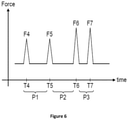
- the graph in Figure 6 illustrates different types of force patterns that can be identified by the control unit 140 of the apparatus 10 and subsequently used for determining whether a predetermined user interaction pattern corresponding to a user input command has been performed by a user, according to the invention.
- the y-axis shows force magnitude and the x-axis shows time.
- the sensor 130 measures at time T4 a fourth force F4, at time T5 a fifth force F5, at time T6 a sixth force F6, and at time T7 a seventh force F7.
- the forces F4, F5, F6, and F7 may be similar in magnitude or differ in magnitude, the latter being illustrated in Figure 6 . It is presumed that the forces F4, F5, F6, and F7 are all intentional forces applied by the user, and this may be determined by the control unit 140 by comparing the magnitude of each of these forces against a predetermined threshold value as described in relation to Figure 5 .
- the senor 130 is configured to measure a time period between an applied force and a consecutive applied force. Therefore, a first time period P1 between T4 and T5, a second time period P2 between T5 and T6, a third time period P3 between T6 and T7 are respectively measured by the sensor 130.
- These measured time periods P1, P2, P3 are each compared against a first time threshold P t by the control unit 140 so as to determine whether a predetermined user interaction pattern corresponding to a user input command has been performed by the user.
- P t is the first time threshold.
- a "single push" is a first predetermined user interaction pattern while a "double push” is a second predetermined user interaction pattern.
- the first predetermined user interaction pattern may correspond to a first user input command while the second predetermined user interaction pattern may correspond to a second user input command.
- the control unit 140 can identify such user interaction as a user input command to change a speed setting to the apparatus 10 and when the user performs a "double push at the apparatus” the control unit 140 can identify such user interaction as a user input command to power on/off the apparatus 10.
- predetermined threshold(s) may be selected to correspond to other types of user input commands.
- the sensor 130 is configured to measure a magnitude of a force applied by the user
- one or more predetermined force thresholds may be used as an alternative to or in addition to time thresholds as predetermined user interaction patterns.
- the invention as described above involves monitoring a force applied.
- This force may be used to detect lid closure, or to provide a weight measurement of the food, as possible operating parameters that are thereby monitored.
- the force measurement is used to monitor a user interaction, when a user applies a force to, e.g. presses on, the apparatus.
- the concept of the invention may be defined more broadly as an apparatus for processing food stuff comprising:
- the sensor has a purpose other than for determining a user interaction.
- the operation parameter measured by the sensor is a force, in particular a downward force.
- This purpose of the sensor, other than for determining a user interaction, may then be to detect lid closure or to preform food weight measurement.
- the operation parameter may comprise any monitoring function which gives information about the operation of the apparatus.
- the sensor instead of a force sensor such as a weight sensor as described above, the sensor may be a temperature sensor, an optical sensor, a capacitive sensor, a speed sensor or an acceleration sensor.
- the sensor may be used for measuring any related operation parameter, for instance a temperature of the food stuff and/or inside the container, a cutting speed of the food processing unit, etc.. This information may be used by the control unit for operating the food processing unit.
- the sensor may further advantageously be used to detect an interaction with the apparatus by a user. This information may then be used by the control unit to identify a user input command from the user.
- the interaction by a user may take on different forms.
- the interaction by the user is a predetermined force or force pattern exerted by the user on a part of the apparatus (other than a user interface), e.g. on a lid or door of the apparatus.
- Said force may have a certain magnitude and/or duration.
- This type of interaction may be detected for instance by a force sensor such as a weight sensor in the apparatus.
- the interaction by a user may be the changing of an orientation of a component of the apparatus, such as for instance the opening or closing of a drawer or a covering element of the container or apparatus, such as a lid or door, to confine the food stuff within.
- This type of interaction may also be detected for instance by a force sensor or weight sensor, in accordance with the invention.
- this orientation change may be detected by a different sensor such as a temperature sensor if the opening or closing of the lid or door causes a measurable temperature change within the container or apparatus.
- it may be detected by an optical sensor, a capacitive sensor, or a motion sensor (speed sensor or acceleration sensor).
- the control unit may be configured to process the received measurements of the respective sensors, to determine if a predetermined user interaction corresponding to opening or closing of the covering element has been performed by the user.
- the interaction by the user may be the changing of the setup of the apparatus, such as for instance the placing of the container in or removal from the apparatus, or the changing of a tool of the food processing unit.
- This type of interaction may respectively be detected by a force sensor such as a weight sensor in accordance with the invention, or an optical sensor, a capacitive sensor, a speed sensor or an acceleration sensor in accordance with the general concept underlying the invention.
- the interaction by the user may be the adding or removing of ingredients in the container.
- This type of interaction may also for instance be detected by a force sensor such as a weight sensor, or also by an optical sensor or a temperature sensor.
- the interaction by the user may include the presence of his hand at or near the apparatus. This type of interaction may for instance be detected by an optical sensor.
- a computer program may be stored/distributed on a suitable medium, such as an optical storage medium or a solid-state medium supplied together with or as part of other hardware, but may also be distributed in other forms, such as via the Internet or other wired or wireless telecommunication systems. Any reference signs in the claims should not be construed as limiting the scope.
Landscapes
- Engineering & Computer Science (AREA)
- Food Science & Technology (AREA)
- Mechanical Engineering (AREA)
- Food-Manufacturing Devices (AREA)
- Cookers (AREA)
- General Preparation And Processing Of Foods (AREA)
Claims (14)
- Appareil de traitement d'aliments comprenant:un récipient (110) pour recevoir un aliment;une unité de traitement des aliments (120) pour traiter les aliments dans le récipient;un capteur de force (130) pour mesurer un paramètre de fonctionnement; etune unité de commande (140) pour faire fonctionner l'unité de traitement des aliments sur la base des mesures reçues du capteur de force,caractérisé en ce que le capteur de force (130) est configuré pour mesurer, en plus du paramètre de fonctionnement:une interaction avec l'appareil par un utilisateur lorsque l'utilisateur applique une force sur l'appareil;où l'unité de commande (140) est configurée pour:recevoir des mesures de l'interaction utilisateur provenant du capteur de force; ettraiter les mesures reçues pour:déterminer si une interaction utilisateur prédéterminée ou un modèle d'interaction utilisateur prédéterminé correspondant à une commande d'entrée utilisateur a été exécuté par l'utilisateur; etcommander l'unité de traitement des aliments en fonction de la commande d'entrée utilisateur déterminée.
- Appareil selon la revendication 1, dans lequel le capteur de force (130) comprend un capteur de poids et le paramètre de fonctionnement comprend le poids des aliments.
- Appareil selon la revendication 1, dans lequel le capteur de force (130) comprend un capteur de fermeture d'un couvercle, et le paramètre de fonctionnement comprend une condition de fermeture d'un couvercle.
- Appareil selon l'une quelconque des revendications 1 à 3, dans lequel le traitement des mesures reçues comprend la mise en correspondance des mesures reçues avec une interaction utilisateur prédéterminée ou un modèle d'interaction utilisateur prédéterminé pour identifier une commande d'entrée utilisateur correspondant à l'interaction utilisateur prédéterminée ou au modèle d'interaction utilisateur prédéterminé.
- Appareil selon la revendication 4, dans lequel la mise en correspondance des mesures reçues avec une interaction utilisateur prédéterminée ou un modèle d'interaction utilisateur prédéterminé consiste à déterminer si les mesures dépassent une valeur de seuil prédéterminée.
- Appareil selon l'une quelconque des revendications 1 à 5, dans lequel la commande d'entrée utilisateur correspond à une opération à effectuer par au moins l'un parmi l'unité de commande, l'appareil, et un dispositif externe.
- Appareil selon la revendication 6, dans lequel l'opération comprend au moins l'un parmi: la mise sous/hors tension de l'appareil; le changement d'un paramètre de fonctionnement de l'appareil comme par exemple un réglage du temps, un réglage de la température, un réglage de la vitesse; le changement d'un programme de l'appareil; le passage à une étape suivante d'un programme ou d'un guide de cuisson utilisateur; la mise en pausa ou le redémarrage d'une opération; l'addition ou l'altération de ingrédients alimentaires, et la confirmation de la présence d'un utilisateur.
- Appareil selon l'une quelconque des revendications 1 à 7, comprenant en outre une unité de base (170) pour supporter le récipient, dans lequel le capteur est intégré dans l'unité de base ou entre l'unité de base et le récipient.
- Appareil selon l'une des revendications 1 à 8, dans lequel l'unité de commande (140) est configurée pour traiter les mesures reçues afin de déterminer le poids des aliments dans le récipient.
- Système comprenant l'appareil selon l'une quelconque des revendications 1 à 9, comprenant en outre un dispositif externe (20), dans lequel le dispositif externe comprend une unité de commande et une unité de communication (210), et l'unité de communication du dispositif externe est configurée pour recevoir la commande d'entrée utilisateur, et l'unité de commande du dispositif externe est agencée pour effectuer une opération sur le dispositif externe sur la base de la commande d'entrée utilisateur reçue de l'appareil.
- Procédé de fonctionnement d'un appareil de traitement d'aliments, l'appareil comprenant une unité de commande, une unité de traitement des aliments et un capteur de force pour mesurer un paramètre de fonctionnement, caractérisé en ce que le procédé consiste à:mesurer (S41) une interaction avec l'appareil par un utilisateur, en utilisant le capteur de force dans l'appareil qui est autrement utilisé pour mesurer un paramètre de fonctionnement;recevoir (S42), dans l'unité de commande de l'appareil, des mesures de l'interaction utilisateur lorsque l'utilisateur applique une force sur l'appareil;traiter (S43), dans l'unité de commande de l'appareil, les mesures reçues pour déterminer si une interaction utilisateur déterminée ou un modèle d'interaction utilisateur prédéterminé correspondant à une commande d'entrée utilisateur a été exécuté par l'utilisateur; etcommander l'unité de traitement des aliments en fonction de la commande d'entrée utilisateur déterminée.
- Procédé selon la revendication 11, dans lequel le traitement des mesures reçues comprend la mise en correspondance, dans l'unité de commande de l'appareil, des mesures reçues avec une interaction utilisateur prédéterminée ou un modèle d'interaction utilisateur prédéterminé pour identifier une commande d'entrée utilisateur correspondant à une interaction utilisateur prédéterminée ou un modèle d'interaction utilisateur prédéterminé.
- Procédé selon la revendication 11 ou 12, dans lequel la commande d'entrée utilisateur correspond à une opération à effectuer par au moins l'un parmi l'unité de commande, l'appareil, et un dispositif externe.
- Produit de programme informatique à utiliser avec un appareil selon la revendication 1, le produit de programme informatique comprenant un support lisible par ordinateur dans lequel est incorporé un code lisible par ordinateur, le code lisible par ordinateur étant configuré de telle sorte que, lors de l'exécution par un ordinateur, un processeur ou une unité de commande approprié, l'ordinateur, le processeur ou l'unité de commande soit amené à exécuter le procédé selon l'une quelconque des revendications 11 à 13.
Applications Claiming Priority (2)
| Application Number | Priority Date | Filing Date | Title |
|---|---|---|---|
| EP18167674.3A EP3556266A1 (fr) | 2018-04-17 | 2018-04-17 | Appareil de traitement d'aliments et son procédé de fonctionnement |
| PCT/EP2019/059407 WO2019201766A1 (fr) | 2018-04-17 | 2019-04-12 | Appareil de transformation des aliments et procédé de fonctionnement d'un tel appareil de transformation des aliments |
Publications (2)
| Publication Number | Publication Date |
|---|---|
| EP3781002A1 EP3781002A1 (fr) | 2021-02-24 |
| EP3781002B1 true EP3781002B1 (fr) | 2022-01-26 |
Family
ID=62017194
Family Applications (2)
| Application Number | Title | Priority Date | Filing Date |
|---|---|---|---|
| EP18167674.3A Withdrawn EP3556266A1 (fr) | 2018-04-17 | 2018-04-17 | Appareil de traitement d'aliments et son procédé de fonctionnement |
| EP19719779.1A Active EP3781002B1 (fr) | 2018-04-17 | 2019-04-12 | Appareil de traitement d'aliments et son procédé de fonctionnement |
Family Applications Before (1)
| Application Number | Title | Priority Date | Filing Date |
|---|---|---|---|
| EP18167674.3A Withdrawn EP3556266A1 (fr) | 2018-04-17 | 2018-04-17 | Appareil de traitement d'aliments et son procédé de fonctionnement |
Country Status (4)
| Country | Link |
|---|---|
| US (1) | US12011115B2 (fr) |
| EP (2) | EP3556266A1 (fr) |
| CN (1) | CN112074212B (fr) |
| WO (1) | WO2019201766A1 (fr) |
Cited By (1)
| Publication number | Priority date | Publication date | Assignee | Title |
|---|---|---|---|---|
| EP4272614A1 (fr) | 2022-05-03 | 2023-11-08 | Vorwerk & Co. Interholding GmbH | Robot de cuisine pourvu d'une balance pour l'interface utilisateur |
Families Citing this family (2)
| Publication number | Priority date | Publication date | Assignee | Title |
|---|---|---|---|---|
| US11696660B2 (en) * | 2019-12-12 | 2023-07-11 | Koninklijke Philips N.V. | Smart food processing apparatus and method |
| TWI883603B (zh) * | 2022-10-24 | 2025-05-11 | 仁寶電腦工業股份有限公司 | 廚房料理互動系統及方法 |
Family Cites Families (18)
| Publication number | Priority date | Publication date | Assignee | Title |
|---|---|---|---|---|
| US5435237A (en) * | 1995-02-03 | 1995-07-25 | Huang; Andrew W. H. | Multipurpose food processor |
| US6756570B2 (en) | 2002-11-22 | 2004-06-29 | Maytag Corporation | Cold start cooking system |
| US6817750B1 (en) | 2003-08-26 | 2004-11-16 | Homeland Housewares, Llc | Individualized blender |
| JP5855092B2 (ja) | 2010-05-21 | 2016-02-09 | ネステク ソシエテ アノニム | 遠隔制御される食品加工器 |
| US20130233952A1 (en) | 2012-03-08 | 2013-09-12 | Hamilton Beach Brands, Inc. | Kitchen Appliance for Processing Foodstuff and Method of Operating Same |
| CN103720385B (zh) | 2012-10-11 | 2018-03-30 | 德昌电机(深圳)有限公司 | 厨房电器、电机组件及控制元件 |
| US20150257586A1 (en) | 2014-03-11 | 2015-09-17 | Starbucks Corporation Dba Starbucks Coffee Company | Single-serve beverage production machine |
| EP3157399B1 (fr) | 2014-06-23 | 2020-05-06 | Ember Technologies, Inc. | Vaisselle et verres pouvant être chauffés ou refroidis |
| WO2015197274A1 (fr) | 2014-06-27 | 2015-12-30 | Koninklijke Philips N.V. | Appareils domestiques à puissance réglable |
| WO2016070232A1 (fr) * | 2014-11-07 | 2016-05-12 | Breville Pty Limited | Enregistrement et exécution d'une séquence de préparation d'aliments et de boissons |
| RU2695393C2 (ru) | 2014-12-19 | 2019-07-23 | Конинклейке Филипс Н.В. | Устройство для обработки паром и измельчения пищевого продукта |
| US10931765B2 (en) * | 2015-02-16 | 2021-02-23 | Vita-Mix Management Corporation | Intelligent blending system |
| CN105395033B (zh) | 2015-10-21 | 2018-11-13 | 杜长江 | 全自动集成化食材加热控制方法 |
| GB2550585B (en) * | 2016-05-23 | 2021-11-03 | Kenwood Ltd | Improvements relating to food blenders |
| CN205782651U (zh) | 2016-07-18 | 2016-12-07 | 长春师范大学 | 一种新闻采访专用补光灯 |
| US20180272300A1 (en) * | 2017-03-23 | 2018-09-27 | Perfect Company | Blender including an integrated scale |
| US11478766B2 (en) * | 2017-06-30 | 2022-10-25 | Vita-Mix Management Corporation | Intelligent blending system |
| US11259497B2 (en) * | 2017-12-19 | 2022-03-01 | Glen Andrew Feder | Countertop cooking appliance |
-
2018
- 2018-04-17 EP EP18167674.3A patent/EP3556266A1/fr not_active Withdrawn
-
2019
- 2019-04-12 EP EP19719779.1A patent/EP3781002B1/fr active Active
- 2019-04-12 CN CN201980029754.0A patent/CN112074212B/zh active Active
- 2019-04-12 US US17/044,927 patent/US12011115B2/en active Active
- 2019-04-12 WO PCT/EP2019/059407 patent/WO2019201766A1/fr not_active Ceased
Cited By (1)
| Publication number | Priority date | Publication date | Assignee | Title |
|---|---|---|---|---|
| EP4272614A1 (fr) | 2022-05-03 | 2023-11-08 | Vorwerk & Co. Interholding GmbH | Robot de cuisine pourvu d'une balance pour l'interface utilisateur |
Also Published As
| Publication number | Publication date |
|---|---|
| CN112074212B (zh) | 2022-05-06 |
| WO2019201766A1 (fr) | 2019-10-24 |
| CN112074212A (zh) | 2020-12-11 |
| EP3781002A1 (fr) | 2021-02-24 |
| US12011115B2 (en) | 2024-06-18 |
| EP3556266A1 (fr) | 2019-10-23 |
| US20210153693A1 (en) | 2021-05-27 |
Similar Documents
| Publication | Publication Date | Title |
|---|---|---|
| US10682016B2 (en) | Food processor | |
| TWI590794B (zh) | 電動廚房用具 | |
| TWI590793B (zh) | 電動廚房用具 | |
| CN109195491B (zh) | 用于运行电动厨房多用机的方法 | |
| US12011115B2 (en) | Food processing apparatus and a method of operating the same | |
| KR20180018548A (ko) | 레시피 시스템 | |
| CN104523133A (zh) | 智能程控多用煲及其控制方法 | |
| TW201617014A (zh) | 使用電子式廚房設備之依據預定食譜資料之食物處理 | |
| US11287941B2 (en) | Method for operating a household appliance and household appliance | |
| CN204670897U (zh) | 智能程控多用煲 | |
| CN116998928A (zh) | 用于用户界面的具有秤的厨房用具 | |
| CN106659335A (zh) | 电动厨用机器 | |
| AU2015279307A1 (en) | Kitchen appliance | |
| RU2789901C2 (ru) | Устройство для обработки пищевого продукта и способ его эксплуатации | |
| CN112869547B (zh) | 烹饪器具及其控制方法 | |
| JP7316831B2 (ja) | 支援装置及び支援プログラム | |
| CN114431696B (zh) | 具有食物处理机的系统以及方法 | |
| CN107205589A (zh) | 可电气驱动的厨用设备 | |
| EP3593684B1 (fr) | Appareil de cuisine et son procédé de commande | |
| CN110731693B (zh) | 烹饪菜单的显示方法、装置和烹饪器具 | |
| KR20250049165A (ko) | 조리기기 및 조리기기의 제어방법 | |
| CN114609937A (zh) | 一种烹饪器具的控制方法、烹饪器具及计算机存储介质 | |
| CN114208393A (zh) | 烹饪设备 |
Legal Events
| Date | Code | Title | Description |
|---|---|---|---|
| STAA | Information on the status of an ep patent application or granted ep patent |
Free format text: STATUS: UNKNOWN |
|
| STAA | Information on the status of an ep patent application or granted ep patent |
Free format text: STATUS: THE INTERNATIONAL PUBLICATION HAS BEEN MADE |
|
| PUAI | Public reference made under article 153(3) epc to a published international application that has entered the european phase |
Free format text: ORIGINAL CODE: 0009012 |
|
| STAA | Information on the status of an ep patent application or granted ep patent |
Free format text: STATUS: REQUEST FOR EXAMINATION WAS MADE |
|
| 17P | Request for examination filed |
Effective date: 20201117 |
|
| AK | Designated contracting states |
Kind code of ref document: A1 Designated state(s): AL AT BE BG CH CY CZ DE DK EE ES FI FR GB GR HR HU IE IS IT LI LT LU LV MC MK MT NL NO PL PT RO RS SE SI SK SM TR |
|
| AX | Request for extension of the european patent |
Extension state: BA ME |
|
| GRAP | Despatch of communication of intention to grant a patent |
Free format text: ORIGINAL CODE: EPIDOSNIGR1 |
|
| STAA | Information on the status of an ep patent application or granted ep patent |
Free format text: STATUS: GRANT OF PATENT IS INTENDED |
|
| DAV | Request for validation of the european patent (deleted) | ||
| DAX | Request for extension of the european patent (deleted) | ||
| INTG | Intention to grant announced |
Effective date: 20210616 |
|
| GRAJ | Information related to disapproval of communication of intention to grant by the applicant or resumption of examination proceedings by the epo deleted |
Free format text: ORIGINAL CODE: EPIDOSDIGR1 |
|
| STAA | Information on the status of an ep patent application or granted ep patent |
Free format text: STATUS: REQUEST FOR EXAMINATION WAS MADE |
|
| GRAP | Despatch of communication of intention to grant a patent |
Free format text: ORIGINAL CODE: EPIDOSNIGR1 |
|
| STAA | Information on the status of an ep patent application or granted ep patent |
Free format text: STATUS: GRANT OF PATENT IS INTENDED |
|
| INTC | Intention to grant announced (deleted) | ||
| INTG | Intention to grant announced |
Effective date: 20210818 |
|
| GRAS | Grant fee paid |
Free format text: ORIGINAL CODE: EPIDOSNIGR3 |
|
| GRAA | (expected) grant |
Free format text: ORIGINAL CODE: 0009210 |
|
| STAA | Information on the status of an ep patent application or granted ep patent |
Free format text: STATUS: THE PATENT HAS BEEN GRANTED |
|
| AK | Designated contracting states |
Kind code of ref document: B1 Designated state(s): AL AT BE BG CH CY CZ DE DK EE ES FI FR GB GR HR HU IE IS IT LI LT LU LV MC MK MT NL NO PL PT RO RS SE SI SK SM TR |
|
| REG | Reference to a national code |
Ref country code: GB Ref legal event code: FG4D |
|
| REG | Reference to a national code |
Ref country code: CH Ref legal event code: EP |
|
| REG | Reference to a national code |
Ref country code: AT Ref legal event code: REF Ref document number: 1464593 Country of ref document: AT Kind code of ref document: T Effective date: 20220215 |
|
| REG | Reference to a national code |
Ref country code: IE Ref legal event code: FG4D |
|
| REG | Reference to a national code |
Ref country code: DE Ref legal event code: R096 Ref document number: 602019011262 Country of ref document: DE |
|
| REG | Reference to a national code |
Ref country code: NL Ref legal event code: FP |
|
| REG | Reference to a national code |
Ref country code: LT Ref legal event code: MG9D |
|
| REG | Reference to a national code |
Ref country code: AT Ref legal event code: MK05 Ref document number: 1464593 Country of ref document: AT Kind code of ref document: T Effective date: 20220126 |
|
| PG25 | Lapsed in a contracting state [announced via postgrant information from national office to epo] |
Ref country code: SE Free format text: LAPSE BECAUSE OF FAILURE TO SUBMIT A TRANSLATION OF THE DESCRIPTION OR TO PAY THE FEE WITHIN THE PRESCRIBED TIME-LIMIT Effective date: 20220126 Ref country code: RS Free format text: LAPSE BECAUSE OF FAILURE TO SUBMIT A TRANSLATION OF THE DESCRIPTION OR TO PAY THE FEE WITHIN THE PRESCRIBED TIME-LIMIT Effective date: 20220126 Ref country code: PT Free format text: LAPSE BECAUSE OF FAILURE TO SUBMIT A TRANSLATION OF THE DESCRIPTION OR TO PAY THE FEE WITHIN THE PRESCRIBED TIME-LIMIT Effective date: 20220526 Ref country code: NO Free format text: LAPSE BECAUSE OF FAILURE TO SUBMIT A TRANSLATION OF THE DESCRIPTION OR TO PAY THE FEE WITHIN THE PRESCRIBED TIME-LIMIT Effective date: 20220426 Ref country code: LT Free format text: LAPSE BECAUSE OF FAILURE TO SUBMIT A TRANSLATION OF THE DESCRIPTION OR TO PAY THE FEE WITHIN THE PRESCRIBED TIME-LIMIT Effective date: 20220126 Ref country code: HR Free format text: LAPSE BECAUSE OF FAILURE TO SUBMIT A TRANSLATION OF THE DESCRIPTION OR TO PAY THE FEE WITHIN THE PRESCRIBED TIME-LIMIT Effective date: 20220126 Ref country code: ES Free format text: LAPSE BECAUSE OF FAILURE TO SUBMIT A TRANSLATION OF THE DESCRIPTION OR TO PAY THE FEE WITHIN THE PRESCRIBED TIME-LIMIT Effective date: 20220126 Ref country code: BG Free format text: LAPSE BECAUSE OF FAILURE TO SUBMIT A TRANSLATION OF THE DESCRIPTION OR TO PAY THE FEE WITHIN THE PRESCRIBED TIME-LIMIT Effective date: 20220426 |
|
| PG25 | Lapsed in a contracting state [announced via postgrant information from national office to epo] |
Ref country code: PL Free format text: LAPSE BECAUSE OF FAILURE TO SUBMIT A TRANSLATION OF THE DESCRIPTION OR TO PAY THE FEE WITHIN THE PRESCRIBED TIME-LIMIT Effective date: 20220126 Ref country code: LV Free format text: LAPSE BECAUSE OF FAILURE TO SUBMIT A TRANSLATION OF THE DESCRIPTION OR TO PAY THE FEE WITHIN THE PRESCRIBED TIME-LIMIT Effective date: 20220126 Ref country code: GR Free format text: LAPSE BECAUSE OF FAILURE TO SUBMIT A TRANSLATION OF THE DESCRIPTION OR TO PAY THE FEE WITHIN THE PRESCRIBED TIME-LIMIT Effective date: 20220427 Ref country code: FI Free format text: LAPSE BECAUSE OF FAILURE TO SUBMIT A TRANSLATION OF THE DESCRIPTION OR TO PAY THE FEE WITHIN THE PRESCRIBED TIME-LIMIT Effective date: 20220126 Ref country code: AT Free format text: LAPSE BECAUSE OF FAILURE TO SUBMIT A TRANSLATION OF THE DESCRIPTION OR TO PAY THE FEE WITHIN THE PRESCRIBED TIME-LIMIT Effective date: 20220126 |
|
| PG25 | Lapsed in a contracting state [announced via postgrant information from national office to epo] |
Ref country code: IS Free format text: LAPSE BECAUSE OF FAILURE TO SUBMIT A TRANSLATION OF THE DESCRIPTION OR TO PAY THE FEE WITHIN THE PRESCRIBED TIME-LIMIT Effective date: 20220526 |
|
| REG | Reference to a national code |
Ref country code: DE Ref legal event code: R097 Ref document number: 602019011262 Country of ref document: DE |
|
| PG25 | Lapsed in a contracting state [announced via postgrant information from national office to epo] |
Ref country code: SM Free format text: LAPSE BECAUSE OF FAILURE TO SUBMIT A TRANSLATION OF THE DESCRIPTION OR TO PAY THE FEE WITHIN THE PRESCRIBED TIME-LIMIT Effective date: 20220126 Ref country code: SK Free format text: LAPSE BECAUSE OF FAILURE TO SUBMIT A TRANSLATION OF THE DESCRIPTION OR TO PAY THE FEE WITHIN THE PRESCRIBED TIME-LIMIT Effective date: 20220126 Ref country code: RO Free format text: LAPSE BECAUSE OF FAILURE TO SUBMIT A TRANSLATION OF THE DESCRIPTION OR TO PAY THE FEE WITHIN THE PRESCRIBED TIME-LIMIT Effective date: 20220126 Ref country code: EE Free format text: LAPSE BECAUSE OF FAILURE TO SUBMIT A TRANSLATION OF THE DESCRIPTION OR TO PAY THE FEE WITHIN THE PRESCRIBED TIME-LIMIT Effective date: 20220126 Ref country code: DK Free format text: LAPSE BECAUSE OF FAILURE TO SUBMIT A TRANSLATION OF THE DESCRIPTION OR TO PAY THE FEE WITHIN THE PRESCRIBED TIME-LIMIT Effective date: 20220126 Ref country code: CZ Free format text: LAPSE BECAUSE OF FAILURE TO SUBMIT A TRANSLATION OF THE DESCRIPTION OR TO PAY THE FEE WITHIN THE PRESCRIBED TIME-LIMIT Effective date: 20220126 |
|
| PG25 | Lapsed in a contracting state [announced via postgrant information from national office to epo] |
Ref country code: AL Free format text: LAPSE BECAUSE OF FAILURE TO SUBMIT A TRANSLATION OF THE DESCRIPTION OR TO PAY THE FEE WITHIN THE PRESCRIBED TIME-LIMIT Effective date: 20220126 |
|
| REG | Reference to a national code |
Ref country code: CH Ref legal event code: PL |
|
| PLBE | No opposition filed within time limit |
Free format text: ORIGINAL CODE: 0009261 |
|
| STAA | Information on the status of an ep patent application or granted ep patent |
Free format text: STATUS: NO OPPOSITION FILED WITHIN TIME LIMIT |
|
| 26N | No opposition filed |
Effective date: 20221027 |
|
| PG25 | Lapsed in a contracting state [announced via postgrant information from national office to epo] |
Ref country code: MC Free format text: LAPSE BECAUSE OF FAILURE TO SUBMIT A TRANSLATION OF THE DESCRIPTION OR TO PAY THE FEE WITHIN THE PRESCRIBED TIME-LIMIT Effective date: 20220126 Ref country code: LU Free format text: LAPSE BECAUSE OF NON-PAYMENT OF DUE FEES Effective date: 20220412 Ref country code: LI Free format text: LAPSE BECAUSE OF NON-PAYMENT OF DUE FEES Effective date: 20220430 Ref country code: CH Free format text: LAPSE BECAUSE OF NON-PAYMENT OF DUE FEES Effective date: 20220430 |
|
| PG25 | Lapsed in a contracting state [announced via postgrant information from national office to epo] |
Ref country code: SI Free format text: LAPSE BECAUSE OF FAILURE TO SUBMIT A TRANSLATION OF THE DESCRIPTION OR TO PAY THE FEE WITHIN THE PRESCRIBED TIME-LIMIT Effective date: 20220126 |
|
| PG25 | Lapsed in a contracting state [announced via postgrant information from national office to epo] |
Ref country code: IE Free format text: LAPSE BECAUSE OF NON-PAYMENT OF DUE FEES Effective date: 20220412 |
|
| P01 | Opt-out of the competence of the unified patent court (upc) registered |
Effective date: 20230531 |
|
| PG25 | Lapsed in a contracting state [announced via postgrant information from national office to epo] |
Ref country code: IT Free format text: LAPSE BECAUSE OF FAILURE TO SUBMIT A TRANSLATION OF THE DESCRIPTION OR TO PAY THE FEE WITHIN THE PRESCRIBED TIME-LIMIT Effective date: 20220126 |
|
| REG | Reference to a national code |
Ref country code: NL Ref legal event code: PD Owner name: VERSUNI HOLDING B.V.; NL Free format text: DETAILS ASSIGNMENT: CHANGE OF OWNER(S), ASSIGNMENT; FORMER OWNER NAME: KONINKLIJKE PHILIPS N.V. Effective date: 20231108 |
|
| REG | Reference to a national code |
Ref country code: DE Ref legal event code: R081 Ref document number: 602019011262 Country of ref document: DE Owner name: VERSUNI HOLDING B.V., NL Free format text: FORMER OWNER: KONINKLIJKE PHILIPS N.V., EINDHOVEN, NL |
|
| REG | Reference to a national code |
Ref country code: GB Ref legal event code: 732E Free format text: REGISTERED BETWEEN 20231214 AND 20231220 |
|
| REG | Reference to a national code |
Ref country code: BE Ref legal event code: PD Owner name: VERSUNI HOLDING B.V.; NL Free format text: DETAILS ASSIGNMENT: CHANGE OF OWNER(S), ASSIGNMENT; FORMER OWNER NAME: KONINKLIJKE PHILIPS N.V. Effective date: 20231130 |
|
| PG25 | Lapsed in a contracting state [announced via postgrant information from national office to epo] |
Ref country code: MK Free format text: LAPSE BECAUSE OF FAILURE TO SUBMIT A TRANSLATION OF THE DESCRIPTION OR TO PAY THE FEE WITHIN THE PRESCRIBED TIME-LIMIT Effective date: 20220126 Ref country code: CY Free format text: LAPSE BECAUSE OF FAILURE TO SUBMIT A TRANSLATION OF THE DESCRIPTION OR TO PAY THE FEE WITHIN THE PRESCRIBED TIME-LIMIT Effective date: 20220126 |
|
| PG25 | Lapsed in a contracting state [announced via postgrant information from national office to epo] |
Ref country code: HU Free format text: LAPSE BECAUSE OF FAILURE TO SUBMIT A TRANSLATION OF THE DESCRIPTION OR TO PAY THE FEE WITHIN THE PRESCRIBED TIME-LIMIT; INVALID AB INITIO Effective date: 20190412 |
|
| PG25 | Lapsed in a contracting state [announced via postgrant information from national office to epo] |
Ref country code: MT Free format text: LAPSE BECAUSE OF FAILURE TO SUBMIT A TRANSLATION OF THE DESCRIPTION OR TO PAY THE FEE WITHIN THE PRESCRIBED TIME-LIMIT Effective date: 20220126 |
|
| PGFP | Annual fee paid to national office [announced via postgrant information from national office to epo] |
Ref country code: NL Payment date: 20250424 Year of fee payment: 7 |
|
| PGFP | Annual fee paid to national office [announced via postgrant information from national office to epo] |
Ref country code: DE Payment date: 20250428 Year of fee payment: 7 |
|
| PGFP | Annual fee paid to national office [announced via postgrant information from national office to epo] |
Ref country code: GB Payment date: 20250422 Year of fee payment: 7 |
|
| PGFP | Annual fee paid to national office [announced via postgrant information from national office to epo] |
Ref country code: BE Payment date: 20250424 Year of fee payment: 7 |
|
| PGFP | Annual fee paid to national office [announced via postgrant information from national office to epo] |
Ref country code: FR Payment date: 20250424 Year of fee payment: 7 |
|
| PGFP | Annual fee paid to national office [announced via postgrant information from national office to epo] |
Ref country code: TR Payment date: 20260331 Year of fee payment: 8 |