EP3782995B1 - Dérivés d'imidazoline-2,4-dione spiro en tant qu'inhibiteurs d'histone acétyltransférase pour le traitement des maladies de cancer - Google Patents
Dérivés d'imidazoline-2,4-dione spiro en tant qu'inhibiteurs d'histone acétyltransférase pour le traitement des maladies de cancer Download PDFInfo
- Publication number
- EP3782995B1 EP3782995B1 EP19788657.5A EP19788657A EP3782995B1 EP 3782995 B1 EP3782995 B1 EP 3782995B1 EP 19788657 A EP19788657 A EP 19788657A EP 3782995 B1 EP3782995 B1 EP 3782995B1
- Authority
- EP
- European Patent Office
- Prior art keywords
- alkylene
- alkyl
- independently
- nhc
- cycloalkyl
- Prior art date
- Legal status (The legal status is an assumption and is not a legal conclusion. Google has not performed a legal analysis and makes no representation as to the accuracy of the status listed.)
- Active
Links
Classifications
-
- C—CHEMISTRY; METALLURGY
- C07—ORGANIC CHEMISTRY
- C07D—HETEROCYCLIC COMPOUNDS
- C07D413/00—Heterocyclic compounds containing two or more hetero rings, at least one ring having nitrogen and oxygen atoms as the only ring hetero atoms
- C07D413/02—Heterocyclic compounds containing two or more hetero rings, at least one ring having nitrogen and oxygen atoms as the only ring hetero atoms containing two hetero rings
- C07D413/06—Heterocyclic compounds containing two or more hetero rings, at least one ring having nitrogen and oxygen atoms as the only ring hetero atoms containing two hetero rings linked by a carbon chain containing only aliphatic carbon atoms
-
- A—HUMAN NECESSITIES
- A61—MEDICAL OR VETERINARY SCIENCE; HYGIENE
- A61P—SPECIFIC THERAPEUTIC ACTIVITY OF CHEMICAL COMPOUNDS OR MEDICINAL PREPARATIONS
- A61P3/00—Drugs for disorders of the metabolism
-
- C—CHEMISTRY; METALLURGY
- C07—ORGANIC CHEMISTRY
- C07D—HETEROCYCLIC COMPOUNDS
- C07D471/00—Heterocyclic compounds containing nitrogen atoms as the only ring hetero atoms in the condensed system, at least one ring being a six-membered ring with one nitrogen atom, not provided for by groups C07D451/00 - C07D463/00
- C07D471/02—Heterocyclic compounds containing nitrogen atoms as the only ring hetero atoms in the condensed system, at least one ring being a six-membered ring with one nitrogen atom, not provided for by groups C07D451/00 - C07D463/00 in which the condensed system contains two hetero rings
- C07D471/10—Spiro-condensed systems
-
- A—HUMAN NECESSITIES
- A61—MEDICAL OR VETERINARY SCIENCE; HYGIENE
- A61K—PREPARATIONS FOR MEDICAL, DENTAL OR TOILETRY PURPOSES
- A61K31/00—Medicinal preparations containing organic active ingredients
- A61K31/33—Heterocyclic compounds
- A61K31/395—Heterocyclic compounds having nitrogen as a ring hetero atom, e.g. guanethidine or rifamycins
- A61K31/435—Heterocyclic compounds having nitrogen as a ring hetero atom, e.g. guanethidine or rifamycins having six-membered rings with one nitrogen as the only ring hetero atom
- A61K31/47—Quinolines; Isoquinolines
- A61K31/472—Non-condensed isoquinolines, e.g. papaverine
- A61K31/4725—Non-condensed isoquinolines, e.g. papaverine containing further heterocyclic rings
-
- A—HUMAN NECESSITIES
- A61—MEDICAL OR VETERINARY SCIENCE; HYGIENE
- A61K—PREPARATIONS FOR MEDICAL, DENTAL OR TOILETRY PURPOSES
- A61K31/00—Medicinal preparations containing organic active ingredients
- A61K31/33—Heterocyclic compounds
- A61K31/395—Heterocyclic compounds having nitrogen as a ring hetero atom, e.g. guanethidine or rifamycins
- A61K31/55—Heterocyclic compounds having nitrogen as a ring hetero atom, e.g. guanethidine or rifamycins having seven-membered rings, e.g. azelastine, pentylenetetrazole
-
- A—HUMAN NECESSITIES
- A61—MEDICAL OR VETERINARY SCIENCE; HYGIENE
- A61K—PREPARATIONS FOR MEDICAL, DENTAL OR TOILETRY PURPOSES
- A61K31/00—Medicinal preparations containing organic active ingredients
- A61K31/33—Heterocyclic compounds
- A61K31/395—Heterocyclic compounds having nitrogen as a ring hetero atom, e.g. guanethidine or rifamycins
- A61K31/55—Heterocyclic compounds having nitrogen as a ring hetero atom, e.g. guanethidine or rifamycins having seven-membered rings, e.g. azelastine, pentylenetetrazole
- A61K31/551—Heterocyclic compounds having nitrogen as a ring hetero atom, e.g. guanethidine or rifamycins having seven-membered rings, e.g. azelastine, pentylenetetrazole having two nitrogen atoms, e.g. dilazep
- A61K31/5513—1,4-Benzodiazepines, e.g. diazepam or clozapine
-
- A—HUMAN NECESSITIES
- A61—MEDICAL OR VETERINARY SCIENCE; HYGIENE
- A61K—PREPARATIONS FOR MEDICAL, DENTAL OR TOILETRY PURPOSES
- A61K31/00—Medicinal preparations containing organic active ingredients
- A61K31/33—Heterocyclic compounds
- A61K31/395—Heterocyclic compounds having nitrogen as a ring hetero atom, e.g. guanethidine or rifamycins
- A61K31/55—Heterocyclic compounds having nitrogen as a ring hetero atom, e.g. guanethidine or rifamycins having seven-membered rings, e.g. azelastine, pentylenetetrazole
- A61K31/553—Heterocyclic compounds having nitrogen as a ring hetero atom, e.g. guanethidine or rifamycins having seven-membered rings, e.g. azelastine, pentylenetetrazole having at least one nitrogen and one oxygen as ring hetero atoms, e.g. loxapine, staurosporine
-
- A—HUMAN NECESSITIES
- A61—MEDICAL OR VETERINARY SCIENCE; HYGIENE
- A61K—PREPARATIONS FOR MEDICAL, DENTAL OR TOILETRY PURPOSES
- A61K31/00—Medicinal preparations containing organic active ingredients
- A61K31/33—Heterocyclic compounds
- A61K31/395—Heterocyclic compounds having nitrogen as a ring hetero atom, e.g. guanethidine or rifamycins
- A61K31/55—Heterocyclic compounds having nitrogen as a ring hetero atom, e.g. guanethidine or rifamycins having seven-membered rings, e.g. azelastine, pentylenetetrazole
- A61K31/554—Heterocyclic compounds having nitrogen as a ring hetero atom, e.g. guanethidine or rifamycins having seven-membered rings, e.g. azelastine, pentylenetetrazole having at least one nitrogen and one sulfur as ring hetero atoms, e.g. clothiapine, diltiazem
-
- A—HUMAN NECESSITIES
- A61—MEDICAL OR VETERINARY SCIENCE; HYGIENE
- A61K—PREPARATIONS FOR MEDICAL, DENTAL OR TOILETRY PURPOSES
- A61K45/00—Medicinal preparations containing active ingredients not provided for in groups A61K31/00 - A61K41/00
- A61K45/06—Mixtures of active ingredients without chemical characterisation, e.g. antiphlogistics and cardiaca
-
- A—HUMAN NECESSITIES
- A61—MEDICAL OR VETERINARY SCIENCE; HYGIENE
- A61P—SPECIFIC THERAPEUTIC ACTIVITY OF CHEMICAL COMPOUNDS OR MEDICINAL PREPARATIONS
- A61P25/00—Drugs for disorders of the nervous system
- A61P25/28—Drugs for disorders of the nervous system for treating neurodegenerative disorders of the central nervous system, e.g. nootropic agents, cognition enhancers, drugs for treating Alzheimer's disease or other forms of dementia
-
- A—HUMAN NECESSITIES
- A61—MEDICAL OR VETERINARY SCIENCE; HYGIENE
- A61P—SPECIFIC THERAPEUTIC ACTIVITY OF CHEMICAL COMPOUNDS OR MEDICINAL PREPARATIONS
- A61P29/00—Non-central analgesic, antipyretic or antiinflammatory agents, e.g. antirheumatic agents; Non-steroidal antiinflammatory drugs [NSAID]
-
- A—HUMAN NECESSITIES
- A61—MEDICAL OR VETERINARY SCIENCE; HYGIENE
- A61P—SPECIFIC THERAPEUTIC ACTIVITY OF CHEMICAL COMPOUNDS OR MEDICINAL PREPARATIONS
- A61P35/00—Antineoplastic agents
-
- A—HUMAN NECESSITIES
- A61—MEDICAL OR VETERINARY SCIENCE; HYGIENE
- A61P—SPECIFIC THERAPEUTIC ACTIVITY OF CHEMICAL COMPOUNDS OR MEDICINAL PREPARATIONS
- A61P35/00—Antineoplastic agents
- A61P35/02—Antineoplastic agents specific for leukemia
-
- C—CHEMISTRY; METALLURGY
- C07—ORGANIC CHEMISTRY
- C07D—HETEROCYCLIC COMPOUNDS
- C07D401/00—Heterocyclic compounds containing two or more hetero rings, having nitrogen atoms as the only ring hetero atoms, at least one ring being a six-membered ring with only one nitrogen atom
- C07D401/14—Heterocyclic compounds containing two or more hetero rings, having nitrogen atoms as the only ring hetero atoms, at least one ring being a six-membered ring with only one nitrogen atom containing three or more hetero rings
-
- C—CHEMISTRY; METALLURGY
- C07—ORGANIC CHEMISTRY
- C07D—HETEROCYCLIC COMPOUNDS
- C07D403/00—Heterocyclic compounds containing two or more hetero rings, having nitrogen atoms as the only ring hetero atoms, not provided for by group C07D401/00
- C07D403/02—Heterocyclic compounds containing two or more hetero rings, having nitrogen atoms as the only ring hetero atoms, not provided for by group C07D401/00 containing two hetero rings
- C07D403/06—Heterocyclic compounds containing two or more hetero rings, having nitrogen atoms as the only ring hetero atoms, not provided for by group C07D401/00 containing two hetero rings linked by a carbon chain containing only aliphatic carbon atoms
-
- C—CHEMISTRY; METALLURGY
- C07—ORGANIC CHEMISTRY
- C07D—HETEROCYCLIC COMPOUNDS
- C07D403/00—Heterocyclic compounds containing two or more hetero rings, having nitrogen atoms as the only ring hetero atoms, not provided for by group C07D401/00
- C07D403/14—Heterocyclic compounds containing two or more hetero rings, having nitrogen atoms as the only ring hetero atoms, not provided for by group C07D401/00 containing three or more hetero rings
-
- C—CHEMISTRY; METALLURGY
- C07—ORGANIC CHEMISTRY
- C07D—HETEROCYCLIC COMPOUNDS
- C07D413/00—Heterocyclic compounds containing two or more hetero rings, at least one ring having nitrogen and oxygen atoms as the only ring hetero atoms
- C07D413/14—Heterocyclic compounds containing two or more hetero rings, at least one ring having nitrogen and oxygen atoms as the only ring hetero atoms containing three or more hetero rings
-
- C—CHEMISTRY; METALLURGY
- C07—ORGANIC CHEMISTRY
- C07D—HETEROCYCLIC COMPOUNDS
- C07D417/00—Heterocyclic compounds containing two or more hetero rings, at least one ring having nitrogen and sulfur atoms as the only ring hetero atoms, not provided for by group C07D415/00
- C07D417/02—Heterocyclic compounds containing two or more hetero rings, at least one ring having nitrogen and sulfur atoms as the only ring hetero atoms, not provided for by group C07D415/00 containing two hetero rings
- C07D417/06—Heterocyclic compounds containing two or more hetero rings, at least one ring having nitrogen and sulfur atoms as the only ring hetero atoms, not provided for by group C07D415/00 containing two hetero rings linked by a carbon chain containing only aliphatic carbon atoms
-
- C—CHEMISTRY; METALLURGY
- C07—ORGANIC CHEMISTRY
- C07D—HETEROCYCLIC COMPOUNDS
- C07D471/00—Heterocyclic compounds containing nitrogen atoms as the only ring hetero atoms in the condensed system, at least one ring being a six-membered ring with one nitrogen atom, not provided for by groups C07D451/00 - C07D463/00
- C07D471/02—Heterocyclic compounds containing nitrogen atoms as the only ring hetero atoms in the condensed system, at least one ring being a six-membered ring with one nitrogen atom, not provided for by groups C07D451/00 - C07D463/00 in which the condensed system contains two hetero rings
- C07D471/04—Ortho-condensed systems
-
- C—CHEMISTRY; METALLURGY
- C07—ORGANIC CHEMISTRY
- C07D—HETEROCYCLIC COMPOUNDS
- C07D491/00—Heterocyclic compounds containing in the condensed ring system both one or more rings having oxygen atoms as the only ring hetero atoms and one or more rings having nitrogen atoms as the only ring hetero atoms, not provided for by groups C07D451/00 - C07D459/00, C07D463/00, C07D477/00 or C07D489/00
- C07D491/02—Heterocyclic compounds containing in the condensed ring system both one or more rings having oxygen atoms as the only ring hetero atoms and one or more rings having nitrogen atoms as the only ring hetero atoms, not provided for by groups C07D451/00 - C07D459/00, C07D463/00, C07D477/00 or C07D489/00 in which the condensed system contains two hetero rings
- C07D491/10—Spiro-condensed systems
- C07D491/107—Spiro-condensed systems with only one oxygen atom as ring hetero atom in the oxygen-containing ring
-
- C—CHEMISTRY; METALLURGY
- C07—ORGANIC CHEMISTRY
- C07D—HETEROCYCLIC COMPOUNDS
- C07D495/00—Heterocyclic compounds containing in the condensed system at least one hetero ring having sulfur atoms as the only ring hetero atoms
- C07D495/02—Heterocyclic compounds containing in the condensed system at least one hetero ring having sulfur atoms as the only ring hetero atoms in which the condensed system contains two hetero rings
- C07D495/04—Ortho-condensed systems
-
- C—CHEMISTRY; METALLURGY
- C07—ORGANIC CHEMISTRY
- C07D—HETEROCYCLIC COMPOUNDS
- C07D495/00—Heterocyclic compounds containing in the condensed system at least one hetero ring having sulfur atoms as the only ring hetero atoms
- C07D495/02—Heterocyclic compounds containing in the condensed system at least one hetero ring having sulfur atoms as the only ring hetero atoms in which the condensed system contains two hetero rings
- C07D495/10—Spiro-condensed systems
-
- C—CHEMISTRY; METALLURGY
- C07—ORGANIC CHEMISTRY
- C07D—HETEROCYCLIC COMPOUNDS
- C07D498/00—Heterocyclic compounds containing in the condensed system at least one hetero ring having nitrogen and oxygen atoms as the only ring hetero atoms
- C07D498/02—Heterocyclic compounds containing in the condensed system at least one hetero ring having nitrogen and oxygen atoms as the only ring hetero atoms in which the condensed system contains two hetero rings
- C07D498/04—Ortho-condensed systems
-
- C—CHEMISTRY; METALLURGY
- C07—ORGANIC CHEMISTRY
- C07D—HETEROCYCLIC COMPOUNDS
- C07D498/00—Heterocyclic compounds containing in the condensed system at least one hetero ring having nitrogen and oxygen atoms as the only ring hetero atoms
- C07D498/02—Heterocyclic compounds containing in the condensed system at least one hetero ring having nitrogen and oxygen atoms as the only ring hetero atoms in which the condensed system contains two hetero rings
- C07D498/10—Spiro-condensed systems
-
- C—CHEMISTRY; METALLURGY
- C07—ORGANIC CHEMISTRY
- C07D—HETEROCYCLIC COMPOUNDS
- C07D513/00—Heterocyclic compounds containing in the condensed system at least one hetero ring having nitrogen and sulfur atoms as the only ring hetero atoms, not provided for in groups C07D463/00, C07D477/00 or C07D499/00 - C07D507/00
- C07D513/02—Heterocyclic compounds containing in the condensed system at least one hetero ring having nitrogen and sulfur atoms as the only ring hetero atoms, not provided for in groups C07D463/00, C07D477/00 or C07D499/00 - C07D507/00 in which the condensed system contains two hetero rings
- C07D513/04—Ortho-condensed systems
-
- C—CHEMISTRY; METALLURGY
- C07—ORGANIC CHEMISTRY
- C07B—GENERAL METHODS OF ORGANIC CHEMISTRY; APPARATUS THEREFOR
- C07B2200/00—Indexing scheme relating to specific properties of organic compounds
- C07B2200/07—Optical isomers
Definitions
- the present invention relates to a histone acetyltransferase (HAT) inhibitor, and provides a compound represented by formula I, a pharmaceutically acceptable salt, stereoisomer, enantiomer, diastereomer, atropisomer, racemate, polymorphs, solvate or isotopically labeled compound (including deuterium substituted compound) thereof, a preparation method thereof, a pharmaceutical composition containing the same, and their use in treatment of various HAT-related diseases or disorders.
- HAT histone acetyltransferase
- the DNA in the nucleus is wound and bound to histones in most of the time, and stored in the highly compressed chromatin at an inactive state. If the cell needs to activate some genes, the related genes (DNA fragments) are dissociated from histones with the aid of transcription factors.
- HATs histone acetyltransferases
- p300/CBP is one of the important macromolecular proteins in histone acetyltransferases.
- p300/CBP has a high degree of homology. Although p300/CBP is encoded by different genes, they have similar amino acid sequences and functions, belonging to the same class of proteins and are therefore considered to have the same function ( Sadoul et al., Biochimie, 2008 ).
- p300/CBP interacts with a specific sequence activator and is absorbed into a promoter site, thereby participating in activation of many transcription factors ( Chan et al., journal of cell science, 2001 ; Cook et al., Journal of Molecular Biology, 2011 ).
- p300/CBP itself also has acetyltransferase activity and can acetylate a variety of core histones and a variety of transcription factors.
- p300/CBP mutation is closely related to a variety of human diseases, including diabetes, inflammation, and cardiac diseases ( Karukurichi, et al., Bioorganic Chemistry, 2011 ).
- many malignant tumors discovered so far are accompanied with p300/CBP gene mutations to varying degrees ( Gayther, et al., Nature Genetics, 2000 ). Therefore, p300/CBP has become an important potential medicinal target and has a high research and development enthusiasm in the industry, and many large domestic and foreign pharmaceutical companies have successively carried out research and development of new drugs targeting p300/CBP.
- AbbVie Pharmaceuticals has developed a class of chiral spiro compounds (a representing compound thereof is A-485), which can compete with acetyl-CoA for binding to the catalytic active site of p300 and selectively inhibit proliferation of cell line-specific tumor cells such as castration resistant prostate cancer, showing excellent p300/CBP- targeting activity both in vivo and in vitro (References: Abbvie Inc., WO2016044770 ; Nature, 2017 ; ACS Med. Chem. Lett., 2018 ), this fully demonstrates the feasibility and great potential of p300/CBP target in drug development.
- An object of the present invention is to provide a histone acetyltransferase (HAT) inhibitor compound, a pharmaceutically acceptable salt, stereoisomer, enantiomer, diastereomer, atropisomer, racemate, polymorphs, solvate or isotopically labeled compound thereof.
- HAT histone acetyltransferase
- Another object of the present invention is to provide a method of preparing the inhibitor compound.
- Still another object of the present invention is to provide a pharmaceutical composition containing the inhibitor compound.
- Still another object of the present invention is to provide use of the inhibitor compound in preparation of a medicament.
- a compound represented by formula I a pharmaceutically acceptable salt, stereoisomer, enantiomer, diastereomer, atropisomer, racemate, polymorphs, solvate or isotopically labeled compound thereof:
- the compound of formula I is selected from the group consisting of the compounds represented by formulae Ia and Ib:
- the compound of formula I is selected from the group consisting of the compounds of formulae Ic, Id, Ie, and If:
- the compound of formula I is selected from the group consisting of the compounds represented by formulae Ig and Ih:
- the compound of formula I is selected from the group consisting of the compounds represented by formulae Ii and Ij:
- the compound of formula I is selected from the group consisting of the compounds represented by formulae Ik and Il:
- the compound of formula I is selected from the group consisting of the compounds of the formulae Im, In, Io, and Ip:
- the compound of formula I is selected from the group consisting of
- composition as defined in claim 10.
- the pharmaceutical composition further comprises at least one other therapeutic agent.
- the at least one other therapeutic agent comprised in the pharmaceutical composition is selected from the group consisting of other anticancer agents, immunomodulators, antiallergic agents, antiemetics, pain relievers, cytoprotective agents, and combinations thereof.
- the disease, disorder or condition is selected from the group consisting of acoustic neuroma, acute leukemia, acute lymphocytic leukemia, acute myeloid leukemia (monocytic, myeloblastic, adenocarcinoma, angiosarcoma, astrocytoma, myelomonocytic and promyelocytic), acute T-cell leukemia, basal cell carcinoma, cholangiocarcinoma, bladder cancer, brain cancer, breast cancer, bronchial cancer, Burkitt's lymphoma, cervical cancer, chondrosarcoma, chordoma, choriocarcinoma, chronic leukemia, chronic lymphocytic leukemia, chronic myeloid (granulocyte) leukemia, chronic myelogenous leukemia, colon cancer, colorectal cancer, craniopharyngioma, cystadenocarcinoma, diffuse large B-cell lymphoma, undesirable proliferative changes
- the base examples include, but are not limited to, potassium carbonate, sodium carbonate, cesium carbonate, sodium hydroxide, potassium hydroxide, potassium tert-butoxide, sodium tert-butoxide, sodium hydrogen (NaH), triethylamine, diisopropylethylamine, pyridine, 1,5-diazabicyclo[5.4.0]undec-5-ene, 4-dimethylaminopyridine (DMAP), preferably potassium carbonate;
- the organic solvent includes, such as, but is not limited to, N,N-dimethylformamide (DMF), tetrahydrofuran (THF), acetonitrile, dioxane, dichloromethane (DCM), dichloroethane (DCE), chloroform, preferably N,N-dimethylformamide (DMF).
- a method of preparing the ⁇ -haloamide compound of formula I-2 from the amine compound of formula II-1 is shown in the above scheme. That is, an amine compound of formula II-1 and a substituted halogenated acetylhalide of formula II-2 are reacted in an organic solvent, the organic solvent includes, such as, but is not limited to, dichloromethane (DCM), dichloroethane (DCE), chloroform, tetrahydrofuran (THF), acetonitrile, dioxane, preferably dichloromethane (DCM).
- DCM dichloromethane
- DCE dichloroethane
- THF tetrahydrofuran
- DCM dichloromethane
- X is halogen (Br, Cl, I, F).
- the amine compound of formula II-1 may be prepared by referring to known literatures or according to a conventional method well known in the art.
- the definitions of R 11 to R 17 , R 21 , X 2 , W, n3, and n4 are the same as the previous text.
- the compound of formula III-4 may be prepared using the general process shown in Scheme 2. That is, an aryl halide is treated with an aryl boronic acid containing a R 20 group or a derivative (for example, borate) thereof under Suzuki coupling condition.
- a compound of formula III-1a wherein the halogen may be Br, Cl, or I
- B III may be a boric acid or a derivative (for example, a borate) thereof to provide a compound of formula III-3
- a compound of formula III-1b, wherein the halogen may be Br, Cl, or I is coupled with a compound of formula III-2, wherein B III is a boric acid or a derivative (for example, a borate) thereof to provide a compound of formula III-4.
- the coupling reaction is carried out in the presence of a palladium catalyst and a base, and optionally a ligand, in a suitable solvent at an elevated temperature (for example, about 80°C to 150°C).
- the reaction can be promoted by microwave radiation.
- the palladium catalyst include, but are not limited to, tetrakistriphenylphosphine palladium(0), tris(dibenzylideneacetone)dipalladium(0), chlorinated allylpalladium(II) dimer, [1,1'-bis(diphenylphosphino)ferrocene]palladium dichloride ((dppf)PdCl 2 ) and palladium(II) acetate.
- Examples of the base suitable for use include, but are not limited to, carbonate or phosphate of sodium, potassium, and cesium, and cesium fluoride.
- Examples of the suitable ligand include, but are not limited to, 2-dicyclohexylphosphino-2,4,6-triisopropylbiphenyl (X-phos), 1,3,5,7-tetramethyl-6-phenyl-2,4,8-trioxa-6-phosphaadamantane, sodium 2'-dicyclohexylphosphino-2,6-dimethoxy-1,1'-biphenyl-3-sulfonate hydrate and 1,1'-bis(diphenylphosphoryl)ferrocene.
- Nonlimiting examples of the suitable solvent include methanol, acetonitrile, dimethoxyethane, N,N-dimethylformamide, dimethyl sulfoxide, dioxane, tetrahydrofuran, ethylene glycol dimethyl ether, toluene, water, or mixtures thereof.
- the compound of formula III-3 may be prepared by the general process shown in Scheme 1 into the compound of formula III-4.
- the optimal reaction conditions and time of each individual step can be varied according to the specific reactants used and the substituents present in all reactants.
- the solvent, temperature, and other reaction conditions can be easily selected by a person skilled in the art.
- the specific steps are provided in the Section for Synthetic Example.
- the reaction mixture can be further processed in a conventional manner, for example, by removing the solvent from the residue and further purifying according to a method generally known in the art, including, such as, but not limited to, crystallization, distillation, extraction, grinding and chromatography.
- starting materials and reactants are commercially available or can be prepared by a person skilled in the art from commercially available materials using methods described in chemical literatures.
- a starting material is not commercial available, it may be prepared by steps selected from the following: standard organic chemistry techniques, techniques similar to the synthesis of known structural analogs, or techniques similar to the steps described in the above Scheme or Section for Synthetic Example.
- an optically active form of the compound of the present invention it can be obtained by performing one of the steps described herein using an optically active starting material (for example, asymmetrically induced preparation by appropriate reaction steps), or by resolving a stereoisomer mixture of the compound or intermediate by using a standard procedure such as chromatographic separation, recrystallization or enzymatic resolution.
- a pure geometric isomer of the compound of the present invention when required, it can be obtained by performing one of the above steps using a pure geometric isomer as a starting material, or it can be obtained by resolving a geometric isomer mixture of the compound or intermediate by using a standard procedure such as chromatographic separation.
- Methyl thiosalicylate ( 3-1, 1.0 g) was dissolved in anhydrous DMF (10 mL), and added slowly with NaH (60%, 480 mg) under an ice bath. After stirred for 10min, the reaction mixture was added with the azide 3-1a (1.11 g), warmed to room temperature and stirred for 0.5h. TLC showed that the reaction was complete. The reaction mixture was quenched by slowly adding water under an ice-water bath, and extracted with ethyl acetate. The combined organic phase was washed with water and saturated brine, dried over anhydrous sodium sulfate, and concentrated to obtain 3-2 (700 mg) as an oil, which was used directly in the next step.
- the racemate AN-6 was subjected to chiral resolution to obtain chiral amides AN-6-1 and AN-6-2.
- Chiral resolution conditions semi-preparative column was CHIRALPAK@OD-H, filler particle size (5 ⁇ m), inner diameter (30 mm), length (250 mm), flow rate: 20 mL/min, mobile phase: 90% n-hexane +10 % ethanol, isogradient elution, wavelength: 220 nm, total time: 30min; peak time is 21.8min for peak 1, and 23.9min for peak 2.
- the racemate AN-8 was subjected to chiral resolution to obtain chiral amides AN-8-1 and AN-8-2.
- Chiral resolution conditions semi-preparative column was CHIRALPAK@OD-H, filler particle size (5 ⁇ m), inner diameter (30 mm), length (250 mm), flow rate: 20 mL/min, mobile phase: 90% n-hexane +10 % ethanol, isogradient elution, wavelength: 220 nm, total time: 30min; peak time is 21.4min for peak 1, and 25.9min for peak 2.
- the racemate AN-12 was subjected to chiral resolution to obtain chiral amides AN-12-1 and AN-12-2.
- Chiral resolution conditions semi-preparative column was CHIRALPAK@OD-H, filler particle size (5 ⁇ m), inner diameter (30 mm), length (250 mm), flow rate: 20 mL/min, mobile phase: 95% n-hexane +5% ethanol, isogradient elution, wavelength: 254 nm, total time: 40min; peak time is 21.6min for peak 1, and 24.9min for peak 2.
- the racemate AN-9 was subjected to chiral resolution to obtain chiral amides AN-9-1 and AN-9-2.
- Chiral resolution conditions semi-preparative column was CHIRALPAK@OD-H, filler particle size (5 ⁇ m), inner diameter (30 mm), length (250 mm), flow rate: 20 mL/min, mobile phase: 90% n-hexane +10 % isopropanol, isogradient elution, wavelength: 220 nm, total time: 35min; peak time is 21.7min for peak 1, and 25.5min for peak 2.
- the racemate AN-10 was subjected to chiral resolution to obtain chiral amides AN-10-1 and AN-10-2.
- Chiral resolution conditions semi-preparative column was CHIRALPAK@OD-H, filler particle size (5 ⁇ m), inner diameter (30 mm), length (250 mm), flow rate: 20 mL/min, mobile phase: 90% n-hexane +10 % ethanol, isogradient elution, wavelength: 220 nm, total time: 30min; peak time is 18.8min for peak 1, and 20.5min for peak 2.
- the racemate AN-11 was subjected to chiral resolution to obtain chiral amides AN-11-1 and AN-11-2.
- Chiral resolution conditions semi-preparative column was CHIRALPAK@OD-H, filler particle size (5 ⁇ m), inner diameter (30 mm), length (250 mm), flow rate: 20 mL/min, mobile phase: 95% n-hexane +5% ethanol, isogradient elution, wavelength: 220 nm, total time: 30min; peak time is 23.4min for peak 1, and 26.3min for peak 2.
- the organic phase was washed with water and saturated brine, dried over anhydrous sodium sulfate, and concentrated.
- the crude was purified by silica gel column chromatography to obtain an intermediate (14.0 g).
- the crude was dissolved in tetrahydrofuran (30 mL), added with 4M HCl (30 mL) at room temperature, and stirred at 30°C for 3h. TLC showed that the reaction was complete.
- the resultant was quenched with water, and extracted with ethyl acetate.
- the organic phase was washed with water and saturated brine, dried over anhydrous sodium sulfate, and concentrated.
- the crude was purified by silica gel column chromatography to obtain 12-3 (6.5 g).
- the methanol solution of 12-4 was added with acetic acid (1 mL) and sodium cyanoborohydride (1.89 g) at room temperature, and stirred at room temperature for 1h. TLC showed that the reaction was complete.
- the reaction solution was poured into ice water, adjusted pH to 1 ⁇ 2 with a 2N dilute hydrochloric acid, and extracted with ethyl acetate.
- the aqueous phase was alkalized with a 2N NaOH aqueous solution, and extracted with dichloromethane.
- the organic phase was washed with water and saturated brine, dried over anhydrous sodium sulfate, and concentrated to obtain a crude 12-5, which was used directly in the next step.
- the racemate AN-13 was subjected to chiral resolution to obtain chiral amides AN-13-1 and AN-13-2.
- Chiral resolution conditions semi-preparative column was CHIRALPAK@OD-H, filler particle size (5 ⁇ m), inner diameter (30 mm), length (250 mm), flow rate: 20 mL/min, mobile phase: 90% n-hexane +10 % ethanol, isogradient elution, wavelength: 220 nm, total time: 30min; peak time is 15. 1 min for peak 1, and 18.2min for peak 2.
- the reaction solution was poured into ice water, and extracted with ethyl acetate.
- the organic phase was washed with water and saturated brine, dried over anhydrous sodium sulfate, and concentrated.
- the crude was purified by silica gel column chromatography to obtain an intermediate (3.0 g).
- the crude was dissolved in tetrahydrofuran (20 mL), added with a TFA aqueous solution (50%) (30 mL) at room temperature, and stirred at 30°C for 3h. TLC showed that the reaction was complete.
- the resultant was quenched with water, and extracted with ethyl acetate.
- the organic phase was washed with water and saturated brine, dried over anhydrous sodium sulfate, and concentrated.
- the crude was purified by silica gel column chromatography to obtain 13-3 (2.21 g).
- the methanol solution of 13-4 was added with acetic acid (0.5 mL) and sodium cyanoborohydride (0.96 g) at room temperature, and stirred at room temperature for 1h. TLC showed that the reaction was complete.
- the reaction solution was poured into ice water, adjusted pH to 1 ⁇ 2 with a 2N diluted hydrochloric acid, and extracted with ethyl acetate.
- the aqueous phase was alkalized with a 2N NaOH aqueous solution, and extracted with dichloromethane.
- the organic phase was washed with water and saturated brine, dried over anhydrous sodium sulfate, and concentrated to obtain a crude 13-5 (330 mg), which was used directly in the next step.
- the racemate AN-14 was subjected to chiral resolution to obtain chiral amides AN-14-1 and AN-14-2.
- Chiral resolution conditions semi-preparative column was CHIRALPAK@OD-H, filler particle size (5 ⁇ m), inner diameter (30 mm), length (250 mm), flow rate: 20 mL/min, mobile phase: 97% n-hexane +3% ethanol, isogradient elution, wavelength 220 nm, total time: 30min; peak time is 25.1min for peak 1, and 29.3min for peak 2.
- the racemate AN-15 was subjected to chiral resolution to obtain chiral amides AN-15-1 and AN-15-2.
- Chiral resolution conditions semi-preparative column was CHIRALPAK@OD-H, filler particle size (5 ⁇ m), inner diameter (30 mm), length (250 mm), flow rate: 20 mL/min, mobile phase: 96% n-hexane +4% ethanol, isogradient elution, wavelength 254 nm, total time: 60min; peak time is 28.6min for peak 1, and 42.6min for peak 2.
- the crude 15-4 was dissolved in anhydrous tetrahydrofuran (100 mL), added slowly and dropwise with triethylamine (18.52 g) at 0 °C, added dropwise with triphosgene (5.97 g) dissolved in tetrahydrofuran (50 mL), stirred at 0 °C for 1b, added with 1N HCl (20 mL) and stirred further for 0.5h. TLC showed that the reaction was complete. The reaction solution was poured into ice water and extracted with ethyl acetate. The organic phase was washed with saturated sodium bicarbonate.
- aqueous phase was extracted with a small amount of ethyl acetate, adjusted pH to about 3 ⁇ 4 with 1N HCl, and extracted with ethyl acetate.
- the organic phase was washed with water and brine, dried over anhydrous sodium sulfate, and concentrated to obtain a crude 15-5 (6.81 g).
- the racemate spiro ring SP-1 was subjected to chiral resolution to obtain chiral spiro rings SP-1-1 and SP-1-2.
- Chiral resolution conditions semi-preparative column was CHIRALPAK@AD-H, filler particle size (5 ⁇ m), inner diameter (20 mm), length (250 mm), flow rate: 15 mL/min, mobile phase: 80% n-hexane +20% isopropanol, isogradient elution, wavelength 220 nm, total time 30min; peak time is 13.6min for peak 1, and 18.4min for peak 2.
- racemate spiro ring SP-4-Boc was subjected to chiral resolution to obtain chiral spiro rings SP-4-Boc-1 and SP-4-Boc-2.
- Chiral resolution conditions semi-preparative column was CHIRALPAK@AD-H, filler particle size (5 ⁇ m), inner diameter (20 mm), length (250 mm), flow rate: 12 mL/min, mobile phase: 65% n-hexane +35% isopropanol, isogradient elution, wavelength 254 nm, total time: 20min; peak time is 8.7min for peak 1, and 13.7min for peak 2.
- Boc-1-aminocyclobutanecarboxylic acid ( 19-1a , 740 mg) and triethylamine (405 mg) were dissolved in dry DMF (30 mL), added with HATU (1.31 g) at room temperature, stirred for 2h, added with 15-6 (550 mg, 2.52 mmol), and stirred further at room temperature for 48h. TLC showed that the reaction was complete.
- the reaction solution was poured into water and extracted with ethyl acetate. The organic phase was washed with water and saturated brine, dried over anhydrous sodium sulfate, and concentrated.
- the crude was purified by silica gel column chromatography to obtain SP-5-Boc (820 mg) as a yellowish solid.
- racemate spiro ring SP-5-Boc was subjected to chiral resolution to obtain chiral spiro rings SP-5-Boc-1 and SP-5-Boc-2.
- Chiral resolution conditions semi-preparative column was CHIRALPAK@AD-H, filler particle size (5 ⁇ m), inner diameter (20 mm), length (250 mm), flow rate: 30 mL/min, mobile phase: 65% n-hexane +35% isopropanol, isogradient elution, wavelength 254 nm, total time: 25min; peak time is 17.6min for peak 1, and 19.4min for peak 2.
- reaction mixture was supplemented with the same amount of the substances as above, and stirred at 65°C for 8h. TLC showed that the reaction was basically complete.
- the reaction solution was cooled to room temperature, added with water (200 mL), and extracted with ethyl acetate. The combined organic phase was dried over sodium sulfate and rotary evaporated to dryness. The residue was purified by column chromatography to obtain 850 mg of SP-8 as a yellow solid.
- LC-MS: [M+H] + 340.1.
- reaction mixture was further supplemented with the same amount of the substances as above and stirred at 65°C for 8h. TLC showed that the reaction was basically complete.
- the reaction solution was cooled to room temperature, added with water and extracted with ethyl acetate. The combined organic phase was dried and rotary evaporated to dryness. The residue was purified by column chromatography to obtain SP-9 as a solid.
- LC-MS: [M+H] + 354.1.
- the crude 25-3 was dissolved in anhydrous tetrahydrofuran (20 mL), slowly added dropwise with triethylamine at 0 °C, and then added dropwise with triphosgene (5.1 g) dissolved in THF (10 mL), stirred at 0 °C for 1h, added with 1N HCl (20 mL) and stirred for 0.5h. TLC showed that the reaction was complete.
- the reaction solution was poured into ice water and extracted with ethyl acetate. The organic phase was washed with saturated sodium bicarbonate.
- the aqueous phase was extracted with a small amount of ethyl acetate, adjusted pH to about 3 ⁇ 4 with 1N HCl, and extracted again with ethyl acetate.
- the organic phase was washed with water and brine, dried over anhydrous sodium sulfate, and concentrated to obtain a crude 25-4.
- the organic phase was washed with saturated sodium bicarbonate solution to precipitate a large amount of solid.
- the solid was filtered off and dried to obtain 5.1 g of a solid.
- SYY-B003 was prepared using the same method as that in Example 30, except that the amide fragment AN-6 was used instead of AN-7 .
- SYY-B009 was prepared using the same method as that in Example 30, except that the amide fragment AN-5 was used instead of AN-7 .
- SYY-B010 was prepared using the same method as that in Example 30, except that the amide fragment AN-4 was used instead of AN-7 .
- SYY-B012 was prepared using the same method as that in Example 30, except that the amide fragment AN-3 was used instead of AN-7 .
- the SYY-B012 was subjected to chiral resolution to obtain chiral products SYY-B012-1 and SYY-B012-2.
- Chiral resolution conditions semi-preparative column was CHIRALPAK@OD-H, filler particle size (5 ⁇ m), inner diameter (30 mm), length (250 mm), flow rate: 20 mL/min, mobile phase: 75% n-hexane +25% ethanol, isogradient elution, wavelength 254 nm, total time: 60min; peak time is 36min for peak 1, and 45min for peak 2.
- SYY-B013 was prepared using the same method as that in Example 30, except that the amide fragment AN-2 was used instead of AN-7 .
- SYY-B014 was prepared using the same method as that in Example 30, except that the amide fragment AN-1 was used instead of AN-7.
- the SYY-B014 was subjected to chiral resolution to obtain chiral products SYY-B014-1 and SYY-B014-2.
- Chiral resolution conditions semi-preparative column was CHIRALPAK@AY-H, filler particle size (5 ⁇ m), inner diameter (20 mm), length (250 mm), flow rate: 12 mL/min, mobile phase: 85% n-hexane +15% ethanol, isogradient elution, wavelength 254 nm, total time: 50min; peak time is 18.5min for peak 1, and 30min for peak 2.
- SYY-B015-1 was prepared using the same method as that in Example 30, except that the spiro ring fragment SP-1-1 was used instead of SP-1 and the amide fragment AN-6-1 was used instead of AN-7.
- SYY-B015-2 was prepared using the same method as that in Example 30, except that the spiro ring fragment SP-1-2 was used instead of SP-1 and the amide fragment AN-6-1 was used instead of AN-7 .
- SYY-B016-1 was prepared using the same method as that in Example 30, except that the spiro ring fragment SP-1-1 was used instead of SP-1 and the amide fragment AN-6-2 was used instead of AN-7.
- SYY-B016-2 was prepared using the same method as that in Example 30, except that the spiro ring fragment SP-1-2 was used instead of SP-1 and the amide fragment AN-6-2 was used instead of AN-7.
- SYY-B017-1 was prepared using the same method as that in Example 30, except that the spiro ring fragment SP-1-1 was used instead of SP-1 and the amide fragment AN-8-1 was used instead of AN-7 .
- SYY-B017-2 was prepared using the same method as that in Example 30, except that the spiro ring fragment SP-1-2 was used instead of SP-1 and the amide fragment AN-8-1 was used instead of AN-7.
- SYY-B018-1 was prepared using the same method as that in Example 30, except that the spiro ring fragment SP-1-1 was used instead of SP-1 and the amide fragment AN-8-2 was used instead of AN-7.
- SYY-B018-2 was prepared using the same method as that in Example 30, except that the spiro ring fragment SP-1-2 was used instead of SP-1 and the amide fragment AN-8-2 was used instead of AN-7.
- SYY-B019-1 was prepared using the same method as that in Example 30, except that the spiro ring fragment SP-1-1 was used instead of SP-1 and the amide fragment AN-9-1 was used instead of AN-7.
- SYY-B019-2 was prepared using the same method as that in Example 30, except that the spiro ring fragment SP-1-2 was used instead of SP-1 and the amide fragment AN-9-1 was used instead of AN-7.
- SYY-B020-1 was prepared using the same method as that in Example 30, except that the spiro ring fragment SP-1-1 was used instead of SP-1 and the amide fragment AN-9-2 was used instead of AN-7.
- SYY-B020-2 was prepared using the same method as that in Example 30, except that the spiro ring fragment SP-1-2 was used instead of SP-1 and the amide fragment AN-9-2 was used instead of AN-7.
- SYY-B021-1 was prepared using the same method as that in Example 30, except that the spiro ring fragment SP-1-1 was used instead of SP-1 and the amide fragment AN-10-1 was used instead of AN-7.
- SYY-B021-2 was prepared using the same method as that in Example 30, except that the spiro ring fragment SP-1-2 was used instead of SP-1 and the amide fragment AN-10-1 was used instead of AN-7.
- SYY-B022-1 was prepared using the same method as that in Example 30, except that the spiro ring fragment SP-1-1 was used instead of SP-1 and the amide fragment AN-10-2 was used instead of AN-7.
- SYY-B022-2 was prepared using the same method as that in Example 30, except that the spiro ring fragment SP-1-2 was used instead of SP-1 and the amide fragment AN-10-2 was used instead of AN-7.
- SYY-B023-1 was prepared using the same method as that in Example 30, except that the spiro ring fragment SP-1-1 was used instead of SP-1 and the amide fragment AN-12-1 was used instead of AN-7.
- SYY-B023-2 was prepared using the same method as that in Example 30, except that the spiro ring fragment SP-1-2 was used instead of SP-1 and the amide fragment AN-12-1 was used instead of AN-7.
- SYY-B024-1 was prepared using the same method as that in Example 30, except that the spiro ring fragment SP-1-1 was used instead of SP-1 and the amide fragment AN-12-2 was used instead of AN-7.
- SYY-B024-2 was prepared using the same method as that in Example 30, except that the spiro ring fragment SP-1-2 was used instead of SP-1 and the amide fragment AN-12-2 was used instead of AN-7.
- SYY-B025-1 was prepared using the same method as that in Example 30, except that the spiro ring fragment SP-1-1 was used instead of SP-1 and the amide fragment AN-11-1 was used instead of AN-7.
- SYY-B025-2 was prepared using the same method as that in Example 30, except that the spiro ring fragment SP-1-2 was used instead of SP-1 and the amide fragment AN-11-1 was used instead of AN-7.
- SYY-B026-1 was prepared using the same method as that in Example 30, except that the spiro ring fragment SP-1-1 was used instead of SP-1 and the amide fragment AN-11-2 was used instead of AN-7.
- SYY-B026-2 was prepared using the same method as that in Example 30, except that the spiro ring fragment SP-1-2 was used instead of SP-1 and the amide fragment AN-11-2 was used instead of AN-7.
- SYY-B027-1 was prepared using the same method as that in Example 30, except that the spiro ring fragment SP-1-1 was used instead of SP-1 and the amide fragment AN-13-1 was used instead of AN-7.
- SYY-B027-2 was prepared using the same method as that in Example 30, except that the spiro ring fragment SP-1-2 was used instead of SP-1 and the amide fragment AN-13-1 was used instead of AN-7.
- SYY-B028-1 was prepared using the same method as that in Example 30, except that the spiro ring fragment SP-1-1 was used instead of SP-1 and the amide fragment AN-13-2 was used instead of AN-7.
- SYY-B028-2 was prepared using the same method as that in Example 30, except that the spiro ring fragment SP-1-2 was used instead of SP-1 and the amide fragment AN-13-2 was used instead of AN-7.
- SYY-B029-1 was prepared using the same method as that in Example 30, except that the spiro ring fragment SP-1-1 was used instead of SP-1 and the amide fragment AN-15-1 was used instead of AN-7.
- SYY-B029-2 was prepared using the same method as that in Example 30, except that the spiro ring fragment SP-1-2 was used instead of SP-1 and the amide fragment AN-15-1 was used instead of AN-7.
- SYY-B030-1 was prepared using the same method as that in Example 30, except that the spiro ring fragment SP-1-1 was used instead of SP-1 and the amide fragment AN-15-2 was used instead of AN-7.
- SYY-B030-2 was prepared using the same method as that in Example 30, except that the spiro ring fragment SP-1-2 was used instead of SP-1 and the amide fragment AN-15-2 was used instead of AN-7.
- SYY-B031-1 was prepared using the same method as that in Example 30, except that the spiro ring fragment SP-1-1 was used instead of SP-1 and the amide fragment AN-14-1 was used instead of AN-7.
- SYY-B031-2 was prepared using the same method as that in Example 30, except that the spiro ring fragment SP-1-2 was used instead of SP-1 and the amide fragment AN-14-1 was used instead of AN-7.
- SYY-B032-1 was prepared using the same method as that in Example 30, except that the spiro ring fragment SP-1-1 was used instead of SP-1 and the amide fragment AN-14-2 was used instead of AN-7.
- SYY-B032-2 was prepared using the same method as that in Example 30, except that the spiro ring fragment SP-1-2 was used instead of SP-1 and the amide fragment AN-14-2 was used instead of AN-7.
- SYY-B033 was prepared using the same method as that in Example 30, except that the spiro ring fragment SP-2 was used instead of SP-1 and the amide fragment AN-11-1 was used instead of AN-7.
- the SYY-B033 was subjected to chiral resolution to obtain chiral products SYY-B033-1 and SYY-B033-2.
- Chiral resolution conditions semi-preparative column was CHIRALPAK@AD-H, filler particle size (5 ⁇ m), inner diameter (20 mm), length (250 mm), flow rate: 12 mL/min, mobile phase: 60% n-hexane + 40% isopropanol, isogradient elution, wavelength 254 nm, total time: 60min; peak time is 15.2min for peak 1, and 20.5min for peak 2.
- SYY-B034 was prepared using the same method as that in Example 30, except that the spiro ring fragment SP-2 was used instead of SP-1 and the amide fragment AN-11-2 was used instead of AN-7.
- the SYY-B034 was subjected to chiral resolution to obtain chiral products SYY-B034-1 and SYY-B034-2.
- Chiral resolution conditions semi-preparative column was CHIRALPAK@OD-H, filler particle size (5 ⁇ m), inner diameter (30 mm), length (250 mm), flow rate: 20 mL/min, mobile phase: 70% n-hexane +30% ethanol, isogradient elution, wavelength 254 nm, total time: 60min; peak time is 41.6min for peak 1, and 51.4min for peak 2.
- SYY-B035 was prepared using the same method as that in Example 30, except that the spiro ring fragment SP-3 was used instead of SP-1 and the amide fragment AN-11-1 was used instead of AN-7.
- the SYY-B035 was subjected to chiral resolution to obtain chiral products SYY-B035-Boc-1 and SYY-B035-Boc-2.
- Chiral resolution conditions semi-preparative column was CHIRALPAK@AD-H, filler particle size (5 ⁇ m), inner diameter (30 mm), length (250 mm), flow rate: 20 mL/min, mobile phase: 70% n-hexane +30% ethanol, isogradient elution, wavelength 254 nm, total time: 65min; peak time is 43.7min for peak 1, and 55.2min for peak 2.
- SYY-B035-Boc-1 was dissolved in a solution of TFA (5 mL) in dichloromethane (10 mL) and stirred at room temperature for 2h. TLC showed that the reaction was complete. The reaction solution was rotary evaporated to dryness to obtain SYY-B035-1 as a trifluoroacetate.
- SYY-B035-Boc-2 was dissolved in a solution of TFA (5 mL) in dichloromethane (10 mL) and stirred at room temperature for 2h. TLC showed that the reaction was complete. The reaction solution was rotary evaporated to dryness to obtain SYY-B035-2 as a trifluoroacetate.
- SYY-B036 was prepared using the same method as that in Example 30, except that the spiro ring fragment SP-3 was used instead of SP-1 and the amide fragment AN-11-2 was used instead of AN-7.
- the SYY-B036 was subjected to chiral resolution to obtain chiral products SYY-B036-Boc-1 and SYY-B036-Boc-2.
- Chiral resolution conditions semi-preparative column was CHIRALPAK@AD-H, filler particle size (5 ⁇ m), inner diameter (30 mm), length (250 mm), flow rate: 40 mL/min, mobile phase: 65% n-hexane +35% ethanol, isogradient elution, wavelength 254 nm, total time: 35min; peak time is 21.3min for peak 1, and 28.7min for peak 2.
- SYY-B036-Boc-1 was dissolved in a solution of TFA (5 mL) in dichloromethane (10 mL) and stirred at room temperature for 2h. TLC showed that the reaction was complete. The reaction solution was rotary evaporated to dryness to obtain SYY-B036-1 as a trifluoroacetate.
- SYY-B036-Boc-2 was dissolved in a solution of TFA (5 mL) in dichloromethane (10 mL) and stirred at room temperature for 2h. TLC showed that the reaction was complete. The reaction solution was rotary evaporated to dryness to obtain SYY-B036-2 as a trifluoroacetate.
- SYY-B037-Boc-1 was prepared using the same method as that in Example 30, except that the spiro ring fragment SP-4-Boc-1 was used instead of SP-1 and the amide fragment AN-11-1 was used instead of AN-7.
- SYY-B037-Boc-1 was dissolved in a solution of TFA (5 mL) in dichloromethane (10 mL) and stirred at room temperature for 2h. TLC showed that the reaction was complete. The reaction solution was rotary evaporated to dryness to obtain SYY-B037-1 as a trifluoroacetate.
- SYY-B037-Boc-2 was prepared using the same method as that in Example 30, except that the spiro ring fragment SP-4-Boc-1 was used instead of SP-1 and the amide fragment AN-11-2 was used instead of AN-7.
- SYY-B037-Boc-2 was dissolved in a solution of TFA (5 mL) in dichloromethane (10 mL) and stirred at room temperature for 2h. TLC showed that the reaction was complete. The reaction solution was rotary evaporated to dryness to obtain SYY-B037-2 as a trifluoroacetate.
- SYY-B038-Boc-1 was prepared using the same method as that in Example 30, except that the spiro ring fragment SP-4-Boc-2 was used instead of SP-1 and the amide fragment AN-11-1 was used instead of AN-7 .
- SYY-B038-Boc-1 was dissolved in a solution of TFA (5 mL) in dichloromethane (10 mL) and stirred at room temperature for 2h. TLC showed that the reaction was complete. The reaction solution was rotary evaporated to dryness to obtain SYY-B038-1 as a trifluoroacetate.
- SYY-B038-Boc-2 was prepared using the same method as that in Example 30, except that the spiro ring fragment SP-4-Boc-2 was used instead of SP-1 and the amide fragment AN-11-2 was used instead of AN-7 .
- SYY-B038-Boc-2 was dissolved in a solution of TFA (5 mL) in dichloromethane (10 mL) and stirred at room temperature for 2h. TLC showed that the reaction was complete. The reaction solution was rotary evaporated to dryness to obtain SYY-B038-2 as a trifluoroacetate.
- SYY-B039-Boc-1 was prepared using the same method as that in Example 30, except that the spiro ring fragment SP-5-Boc-1 was used instead of SP-1 and the amide fragment AN-11-1 was used instead of AN-7.
- SYY-B039-Boc-1 was dissolved in a solution of TFA (5 mL) in dichloromethane (10 mL) and stirred at room temperature for 2h. TLC showed that the reaction was complete. The reaction solution was rotary evaporated to dryness to obtain SYY-B039-1 as a trifluoroacetate.
- SYY-B039-Boc-2 was prepared using the same method as that in Example 30, except that the spiro ring fragment SP-5-Boc-2 was used instead of SP-1 and the amide fragment AN-11-1 was used instead of AN-7.
- SYY-B039-Boc-2 was dissolved in a solution of TFA (5 mL) in dichloromethane (10 mL) and stirred at room temperature for 2h. TLC showed that the reaction was complete. The reaction solution was rotary evaporated to dryness to obtain SYY-B039-2 as a trifluoroacetate.
- SYY-B040-Boc-1 was prepared using the same method as that in Example 30, except that the spiro ring fragment SP-5-Boc-1 was used instead of SP-1 and the amide fragment AN-11-2 was used instead of AN-7.
- SYY-B040-Boc-1 was dissolved in a solution of TFA (5 mL) in dichloromethane (10 mL) and stirred at room temperature for 2h. TLC showed that the reaction was complete. The reaction solution was rotary evaporated to dryness to obtain SYY-B040-1 as a trifluoroacetate.
- SYY-B040-Boc-2 was prepared using the same method as that in Example 30, except that the spiro ring fragment SP-5-Boc-2 was used instead of SP-1 and the amide fragment AN-11-2 was used instead of AN-7.
- SYY-B040-Boc-2 was dissolved in a solution of TFA (5 mL) in dichloromethane (10 mL) and stirred at room temperature for 2h. TLC showed that the reaction was complete. The reaction solution was rotary evaporated to dryness to obtain SYY-B040-2 as a trifluoroacetate.
- SYY-B041 was prepared using the same method as that in Example 30, except that the spiro ring fragment SP-6 was used instead of SP-1 and the amide fragment AN-11-1 was used instead of AN-7.
- the SYY-B041 was subjected to chiral resolution to obtain chiral products SYY-B041-1 and SYY-B041-2.
- Chiral resolution conditions semi-preparative column was CHIRALPAK@AD-H, filler particle size (5 ⁇ m), inner diameter (30 mm), length (250 mm), flow rate: 30 mL/min, mobile phase: 60% n-hexane + 40% isopropanol, isogradient elution, wavelength 254 nm, total time: 60min; peak time is 37.0min for peak 1, and 41.7min for peak 2.
- SYY-B042 was prepared using the same method as that in Example 30, except that the spiro ring fragment SP-6 was used instead of SP-1 and the amide fragment AN-11-2 was used instead of AN-7.
- the SYY-B042 was subjected to chiral resolution to obtain chiral products SYY-B042-1 and SYY-B042-2.
- Chiral resolution conditions semi-preparative column was CHIRALPAK@AS-H, filler particle size (10 ⁇ m), inner diameter (30 mm), length (250 mm), flow rate: 35 mL/min, mobile phase: 70% n-hexane +30% ethanol, isogradient elution, wavelength 254 nm, total time: 65min; peak time is 52.4min for peak 1, and 58.2min for peak 2.
- SYY-B043 was prepared using the same method as that in Example 30, except that the spiro ring fragment SP-7 was used instead of SP-1 and the amide fragment AN-11-1 was used instead of AN-7 :
- 1 H NMR 400 MHz, DMSO- d 6 ) ⁇ 8.70 (m, 1H), 8.10 (m, 1H), 7.83 (m, 1H), 7.47-6.92 (m, 6H), 4.73-4.14 (m, 3H), 3.87-3.45 (m, 5H), 2.98 (m, 3H), 2.68 (m, 2H), 2.15-1.90 (m, 3H), 1.35 (m, 1H), 0.55-0.27 (m, 4H).
- the SYY-B043 was subjected to chiral resolution to obtain chiral products SYY-B043-1 and SYY-B043-2.
- Chiral resolution conditions analytical column was CHIRALPAK@AD-H, filler particle size (5 ⁇ m), inner diameter (4.6 mm), length (250 mm), flow rate: 1 mL/min, mobile phase: 60% n-hexane + 40% isopropanol, isogradient elution, wavelength 254 nm, total time: 20min; peak time is 10.45min for peak 1, and 12.08min for peak 2.
- SYY-B044 was prepared using the same method as that in Example 30, except that the spiro ring fragment SP-7 was used instead of SP-1 and the amide fragment AN-11-2 was used instead of AN-7 :
- 1 H NMR 400 MHz, DMSO- d 6 ) ⁇ 8.72 (m, 1H), 8.13 (m, 1H), 7.85 (m, 1H), 7.49-6.90 (m, 6H), 4.85-4.15 (m, 3H), 3.87-3.45 (m, 5H), 3.18-2.98 (m, 3H), 2.76-2.53 (m, 2H), 2.21-1.94 (m, 3H), 1.34 (m, 1H), 0.55-0.23 (m, 4H).
- the SYY-B044 was subjected to chiral resolution to obtain chiral products SYY-B044-1 and SYY-B044-2.
- Chiral resolution conditions semi-preparative column was CHIRALPAK@AS-H, filler particle size (10 ⁇ m), inner diameter (30 mm), length (250 mm), flow rate: 30 mL/min, mobile phase: 70% n-hexane +30% ethanol, isogradient elution, wavelength 254 nm, total time: 65min; peak time is 12.1min for peak 1, and 30.6min for peak 2.
- the SYY-B045 was subjected to chiral resolution to obtain chiral products SYY-B045-1 and SYY-B045-2.
- Chiral resolution conditions analytical column was CHIRALPAK@ OD-H, filler particle size (5 ⁇ m), inner diameter (4.6 mm), length (250 mm), flow rate: 1.0 mL/min, mobile phase: 60% n-hexane + 40% ethanol, isogradient elution, wavelength 210 nm, total time: 30min; peak time is 10.23min for peak 1, and 16.08min for peak 2.
- the SYY-B046 was subjected to chiral resolution to obtain chiral products SYY-B046-1 and SYY-B046-2.
- Chiral resolution conditions analytical column was CHIRALPAK@ AS-H, filler particle size (5 ⁇ m), inner diameter (4.6 mm), length (250 mm), flow rate: 1 mL/min, mobile phase: 60% n-hexane + 40% ethanol, isogradient elution, wavelength 210 nm, total time: 30min; peak time is 6.44min for peak 1, and 11.33min for peak 2.
- ZB-P-05 was prepared using the same method as that in Example 30, except that the spiro ring fragment SP-13 was used instead of SP-1 and the amide fragment AN-11-1 was used instead of AN-7 :
- 1 H NMR 400 MHz, DMSO-d 6 ) ⁇ 8.20 (m, 1H), 8.04 (m, 1H), 7.94 (m, 1H), 7.61-7.54 (m, 2H), 7.43-7.26 (m, 2H), 7.10-6.91 (m, 2H), 4.96-3.47 (m, 7H), 3.20-2.98 (m, 3H), 2.79-2.51 (m, 6H), 2.07-1.99 (m, 2H), 1.49-1.23 (m, 1H), 0.59-0.27 (m, 4H).
- ZB-P-09-Boc was prepared using the same method as that in Example 30, except that the spiro ring fragment SP-3 was used instead of SP-1 and the amide fragment AN-14-1 was used instead of AN-7.
- ZB-P-10-Boc was prepared using the same method as that in Example 30, except that the spiro ring fragment SP-4-Boc was used instead of SP-1 and the amide fragment AN-14-1 was used instead of AN-7.
- ZB-P-10-Boc was dissolved in dichloromethane (3 mL), added with TFA (1 mL), and stirred at room temperature for 2h. TLC showed that the reaction was complete. The reaction solution was rotary evaporated to dryness to obtain ZB-P-10.
- LC-MS: [M+H] + 577.2.
- ZB-P-11-Boc was prepared using the same method as that in Example 30, except that the spiro ring fragment SP-5-Boc was used instead of SP-1 and the amide fragment AN-14-1 was used instead of AN-7.
- ZB-P-11-Boc was dissolved in dichloromethane (3 mL), added with TFA (1 mL), and stirred at room temperature for 2h. TLC showed that the reaction was complete. The reaction solution was rotary evaporated to dryness to obtain ZB-P-11.
- LC-MS: [M+H] + 589.2.
- ZB-P-12 was prepared using the same method as that in Example 30, except that the spiro ring fragment SP-6 was used instead of SP-1 and the amide fragment AN-14-1 was used instead of AN-7 :
- 1 H NMR 400 MHz, DMSO- d 6 ) ⁇ 8.19 (m, 1H), 7.91 (m, 1H), 7.60-7.51 (m, 2H), 7.41-7.27 (m, 2H), 7.11-6.98 (m, 2H), 5.23-4.31 (m, 5H), 3.86 (s, 3H), 3.15-3.06 (m, 3H), 2.75-2.52 (m, 2H), 2.47-2.28 (m, 3H).
- the ZB-P-12 was subjected to chiral resolution to obtain chiral products ZB-P-12-1 and ZB-P-12-2.
- Chiral resolution conditions analytical column was NANOMICRO OD-5H, filler particle size (5 ⁇ m), inner diameter (4.6 mm), length (250 mm), flow rate: 1 mL/min, mobile phase: 70% n-hexane + 30% isopropanol, isogradient elution, wavelength 254 nm, total time 60min; peak time is 29.12min for peak 1, and 33.97min for peak 2.
- ZB-P-14 was prepared using the same method as that in Example 30, except that the spiro ring fragment SP-8 was used instead of SP-1 and the amide fragment AN-14-1 was used instead of AN-7 :
- 1 H NMR 400 MHz, DMSO-d 6 ) ⁇ 8.80 (m, 1H), 8.14 (m, 1H), 8.04 (m, 1H), 7.90 (m, 1H), 7.52-7.46 (m, 2H), 7.36-7.19 (m, 2H), 7.10-7.02 (m, 2H), 5.22-3.67 (m, 7H), 3.02-2.98 (m, 3H), 2.75-2.52 (m, 4H), 2.42-2.15 (m, 4H).
- the ZB-P-14 was subjected to chiral resolution to obtain chiral products ZB-P-14-1 and ZB-P-14-2 .
- Chiral resolution conditions analytical column was CHIRALPAK@ OD-H, filler particle size (5 ⁇ m), inner diameter (4.6 mm), length (250 mm), flow rate: 1 mL/min, mobile phase: 60% n-hexane + 40% ethanol, isogradient elution, wavelength 210 nm, total time: 30min; peak time is 7.98min for peak 1, and 10.69min for peak 2.
- ZB-P-15 was prepared using the same method as that in Example 30, except that the spiro ring fragment SP-13 was used instead of SP-1 and the amide fragment AN-14-1 was used instead of AN-7 :
- 1 H NMR 400 MHz, DMSO- d 6 ) ⁇ 8.20 (m, 1H), 8.04 (m, 1H), 7.94 (m, 1H), 7.62-7.53 (m, 2H), 7.43-7.26 (m, 2H), 7.13-6.92 (m, 2H), 5.26-3.78 (m, 7H), 3.21-3.01 (m, 3H), 2.78-2.52 (m, 6H), 2.45-2.27 (m, 2H).
- ZB-P-21 was prepared using the same method as that in Example 30, except that the spiro ring fragment SP-2 was used instead of SP-1 and the amide fragment AN-15-1 was used instead of AN-7 :
- 1 H NMR 400 MHz, DMSO- d 6 ) ⁇ 8.70 (m, 1H), 8.55 (m, 1H), 7.41 (m, 1H), 7.24-6.88 (m, 5H), 6.01 (m, 1H), 5.01-3.70 (m, 7H), 2.93 (m, 2H), 2.62 (m, 3H), 2.44 (m, 1H), 2.14 (m, 1H), 1.33 (m, 1H), 0.55-0.30 (m, 4H).
- ZB-P-28 was prepared using the same method as that in Example 30, except that the spiro ring fragment SP-7 was used instead of SP-1 and the amide fragment AN-15-1 was used instead of AN-7 :
- 1 H NMR 400 MHz, DMSO- d 6 ) ⁇ 8.76 (m, 1H), 8.13 (m, 1H), 7.86 (m, 1H), 7.46 (m, 2H), 7.25-6.90 (m, 4H), 5.02-3.73 (m, 10H), 3.01 (m, 2H), 2.53 (m, 1H), 2.22-1.98 (m, 1H), 1.33-1.18 (m, 1H), 0.60-0.35 (m, 4H).
- ZB-P-29 was prepared using the same method as that in Example 30, except that the spiro ring fragment SP-6 was used instead of SP-1 and the amide fragment AN-15-1 was used instead of AN-7 :
- 1 H NMR 400 MHz, DMSO- d 6 ) ⁇ 8.19 (m, 1H), 7.91 (m, 1H), 7.59-7.50 (m, 2H), 7.41 (m, 1H), 7.24-6.92 (m, 3H), 5.07-4.06 (m, 6H), 3.85 (m, 4H), 3.21-2.96 (m, 2H), 2.70-2.53 (m, 2H), 1.33-1.18 (m, 1H), 0.60-0.35 (m, 4H).
- Triethylamine (33.2 mL) was slowly added to formic acid (22.4 mL) at 0°C, stirred for 15min, and slowly added into a solution of 3-bromo-4-fluorobenzaldehyde ( 124-1 , 40.0 g) and cyclicisopropylidene malonate (28.4 g) in DMF (200 mL).
- the reaction solution was slowly heated to 100°C and stirred for 24h. TCL showed disappearance of the raw material.
- the reaction solution was cooled to room temperature, alkalized with a 1N NaOH aqueous solution under an ice-water bath, and extracted with ethyl acetate.
- 125-3 was dissolved in anhydrous THF (50 mL), slowly added dropwise with TEA (1.5 g) at 0 °C, added dropwise with triphosgene (8.90 g) dissolved in THF (50 mL), stirred at 0 °C for 1h, added with 1N HCl (20 mL) and stirred further for 0.5h. TLC showed that the reaction was complete. The reaction solution was poured into ice water and extracted with ethyl acetate. The organic phase was washed with saturated sodium bicarbonate 2 times.
- aqueous phase was extracted with a small amount of ethyl acetate 2 times, adjusted pH to about 3-4 with 1N HCl, and extracted with ethyl acetate 3 times.
- the organic phase was washed with water and brine, dried over anhydrous sodium sulfate, and concentrated to obtain a crude 125-4 (1.11 g).
- LC-MS: [M+H] + 279.1.
- the crude 125-5 was dissolved in anhydrous THF (30 mL), added with phenyl p-nitrochloroformate (0.92 g, 4.1 mmol), and stirred at room temperature for 0.5h to be ready for use.
- Methylamine hydrochloride (0.52 g) was dissolved in methanol (50 mL), added with TEA (0.70 g), stirred for 10min, added with the above reaction solution, and stirred further at room temperature for 1h. TLC showed that the reaction was complete.
- the reaction solution was poured into ice water, adjusted pH to 3-4 with 1N HCl, and extracted with ethyl acetate.
- ZB-P-30 was prepared using the same method as that in Example 30, except that the spiro ring fragment SP-16 was used instead of SP-1 and the amide fragment AN-11-1 was used instead of AN-7 :
- 1 H NMR 400 MHz, DMSO- d 6 ) ⁇ 8.74 (m, 1H), 8.32 (m, 1H), 8.05 (m, 1H), 7.39-6.88 (m, 4H), 6.50-4.14 (m, 3H), 4.92-3.41 (m, 5H), 3.10 (m, 3H), 2.68 (m, 2H), 2.15-1.90 (m, 3H), 1.30 (m, 1H), 0.60-0.24 (m, 4H).
- ZB-P-31 was prepared using the same method as that in Example 30, except that the spiro ring fragment SP-17 was used instead of SP-1 and the amide fragment AN-11-1 was used instead of AN-7 :
- 1 H NMR 400 MHz, DMSO- d 6 ) ⁇ 8.46 (m, 1H), 8.18 (m, 1H), 7.38-6.90 (m, 4H), 6.58 (m, 1H), 4.95-3.48 (m, 5H), 3.10-1.98 (m, 11H), 1.30 (m, 1H), 0.60-0.24 (m, 4H).
- LC-MS: [M+H] + 539.2.
- ZB-P-32 was prepared using the same method as that in Example 30, except that the spiro ring fragment SP-18 was used instead of SP-1 and the amide fragment AN-11-1 was used instead of AN-7 :
- 1 H NMR 400 MHz, DMSO- d 6 ) ⁇ 9.36 (m, 1H), 8.80 (m, 1H), 7.55 (m, 1H), 7.38-7.23 (m, 2H), 7.08-6.90 (m, 2H), 4.85-3.45 (m, 8H), 3.20-2.93 (m, 3H), 2.74-2.51 (m, 2H), 2.21-1.96 (m, 3H), 1.48-1.31 (m, 1H), 0.63-0.22 (m, 4H).
- the ZB-P-32 was subjected to chiral resolution to obtain chiral products ZB-P-32-1 and ZB-P-32-2.
- Chiral resolution conditions analytical column was NANOMICRO OD-5H, filler particle size (5 ⁇ m), inner diameter (4.6 mm), length (250 mm), flow rate: 1 mL/min, mobile phase: 60% n-hexane + 40% isopropanol, isogradient elution, wavelength 254 nm, total time: 40min; peak time is 7.54min for peak 1, and 14.94min for peak 2.
- 141-9 was dissolved in dichloromethane (20 mL), added with sodium cyanoborohydride (204 mg), and stirred for 30min at room temperature. TLC showed that the reaction was complete. The reaction solution was poured into ice water, and extracted with dichloromethane. The organic phase was washed with saturated brine, dried over anhydrous sodium sulfate, and concentrated. The crude was purified by silica gel column chromatography to obtain 141-10 (440 mg). LC-MS: 236.1 [M+H] + .
- Step ten
- AN-16 was subjected to chiral resolution to obtain chiral products AN-16-1 and AN-16-2.
- the crude 142-3 was dissolved in anhydrous tetrahydrofuran (10 mL), added with triethylamine (5.79 g, 57.2 mmol), and then with Triphosgene (2.27 g, 7.64 mmol) under an ice bath, and stirred for 10min. TLC showed that the reaction was complete. The reaction mixture was adjusted pH to 5 ⁇ 6 with concentrated hydrochloric acid and stirred for 30min. TLC showed that the reaction was complete. The reaction solution was poured into ice water, and extracted with ethyl acetate twice. The organic phase was stirred with 4N NaOH for 10min.
- 6-Amino-1,2,3,4-tetrahydro-1-naphthone ( 143-1 , 10.0 g, 62.0 mmol) was dissolved in 48% aqueous hydrobromic acid solution (120 mL), slowly added dropwise with a solution of NaNO 2 (4.70 g, 68.2 mmol) in H 2 O (50 mL) at -5 to 5°C, and reacted at the temperature for 30min.
- the reaction solution was slowly added into a mixture of CuBr (19.5 g, 136.4 mmol)/HBr (20 mL), and stirred at room temperature for 30min. TLC showed that the reaction was complete.
- the resultant was extracted with ethyl acetate.
- 144-1 (12.0 g, 52.8 mmol) was dissolved in a mixed solvent of toluene (100 mL) and acetonitrile (100 mL), added with TMSCN (5.7 g, 58.1 mmol) and zinc iodide (0.8 g, 2.6 mmol), and reacted at 75°C for 3h.
- the reaction solution was concentrated and the residue was purified by silica gel column chromatography to obtain 144-2 (7.4 g).
- 144-2 (7.4 g, 22.7 mmol) was dissolved in absolute ethanol (150 mL), introduced with dry HCl gas at 0°C to react for 5h, and concentrated at 38°C to obtain a crude 144-3 as a white solid.
- 144-3 was dissolved in tetrahydrofuran (20 mL), treated ultrasonically for 5min, and filtered. The filter cake was dissolved in tetrahydrofuran (50 mL), added with triphosgene (6.7 g, 22.7 mmol) and triethylamine (6.8 g, 68.3 mmol) under ice bath.
- reaction mixture was adjusted to be weakly acidic with a diluted HCl to become clear, stirred at room temperature for 30min, and concentrated.
- the residue was added with water and extracted with ethyl acetate.
- the organic phase was washed with aqueous sodium hydroxide solution, and the aqueous phase was extracted again with ethyl acetate.
- the aqueous phase was remained, acidized with dilute hydrochloric acid, and extracted with ethyl acetate.
- the organic phase was remained, washed with water and saturated brine, dried, and concentrated to obtain 144-4 (890 mg) as a white solid.
- LC-MS 296.0 [M+H] + .
- 145-4 (3.0 g, 13.2 mol) was dissolved in 1,4-dioxane (150 mL), added with N-methylurea (1.90 g, 26.4 mol), Cs 2 CO 3 (8.6 g, 26.4 mmol), Xantphos (153 mg, 0.264 mmol) and Pd 2 (dba) 3 (120 mg, 0.132 mmol), and reacted at 100 °C for 3h under nitrogen. TLC detected that the raw material was completely reacted. The reaction mixture was diluted with ethyl acetate and filtered. The filtrate was concentrated and the residue was purified by silica gel column chromatography to obtain 1.22 g of 145-5 as a yellowish solid.
- the crude 146-7 (1.81 g) was dissolved in methanol (50 mL), added with sodium borohydride (378 mg, 10 mmol) at 0 °C, and stirred for 0.5h. TLC detected that the reaction was complete.
- the reaction solution was poured into 1N aqueous hydrochloric acid solution, and extracted with dichloromethane. The combined organic phase was washed with water and saturated brine, dried over anhydrous sodium sulfate, and concentrated.
- the crude was purified by column chromatography to obtain 146-8 (1.31g).
- the 146-8 (700 mg, 3.58 mmol) was dissolved in dichloromethane (35 mL), added with TEA (543 mg, 5.37 mmol), cooled to 0 °C under nitrogen, added dropwise with a solution of bromoacetyl bromide (867 mg, 4.3 mmol) in dichloromethane, and reacted for 1h at 0 °C. TLC detected that the reaction was basically complete. The reaction solution was quenched with ice water, and extracted with dichloromethane. The organic phase was washed with water and brine, dried over anhydrous sodium sulfate, and concentrated. The crude was purified by column chromatography to obtain the amide AN-17 (610 mg). LC-MS: 316.0 [M+H] + .
- the amide AN-17 was subjected to chiral resolution. Resolution conditions: Preparative column was NANOMICRO OD-5H, filler particle size (5 ⁇ m), inner diameter (30 mm), length (250 mm), flow rate: 30 mL/min, mobile phase: 95% n-hexane + 5% ethanol, isogradient elution, wavelength 254 nm, peak time is 20.19min for peak 1, and 24.60min for peak 2.
- SYY-B057-1 was prepared using the same method as that in Example 30, except that the spiro ring fragment SP-1-1 was used instead of SP-1 and the amide fragment AN-16-1 was used instead of AN-7:
- 1 H NMR 400 MHz, DMSO- d 6 ) ⁇ 8.70 (m, 1H), 7.54 (m, 1H), 7.23-6.97 (m, 5H), 6.08 (m, 1H), 5.58 (m, 1H), 5.16-3.91 (m, 6H), 3.13-2.90 (m, 2H), 2.64-2.56 (m, 4H), 2.49-2.43 (m, 1H).
- LC-MS: [M+H] + 551.1.
- SYY-B057-2 was prepared using the same method as that in Example 30, except that the spiro ring fragment SP-1-2 was used instead of SP-1 and the amide fragment AN-16-1 was used instead of AN-7:
- 1 H NMR 400 MHz, DMSO- d 6 ) ⁇ 8.75 (m, 1H), 7.53 (m, 1H), 7.26-6.96 (m, 5H), 6.11 (m, 1H), 5.59 (m, 1H), 5.13-3.93 (m, 6H), 3.14-2.90 (m, 2H), 2.65-2.56 (m, 4H), 2.49-2.43 (m, 1H).
- LC-MS: [M+H] + 551.2.
- SYY-B074 was prepared using the same method as that in Example 30, except that the spiro ring fragment SP-22 was used instead of SP-1 and the amide fragment AN-11-1 was used instead of AN-7:
- 1 H NMR 400 MHz, DMSO- d 6 ) ⁇ 8.86 (m, 1H), 8.54 (m, 1H), 7.40-6.79 (m, 6H), 6.01 (m, 1H), 4.84-4.68 (m, 2H), 4.40-3.43 (m, 5H), 3.17-3.05 (m, 1H), 2.73-2.56 (m, 4H), 2.44-2.00 (m, 4H), 1.40-1.33 (m, 1H), 0.60-0.24 (m, 4H).
- SYY-B077 was prepared using the same method as that in Example 30, except that the spiro ring fragment SP-21 was used instead of SP-1 and the amide fragment AN-11-1 was used instead of AN-7:
- 1 H NMR 400 MHz, DMSO- d 6 ) ⁇ 8.68 (m, 1H), 7.38-6.83 (m, 6H), 6.09 (m, 1H), 4.92-4.78 (m, 2H), 4.47-3.43 (m, 5H), 3.18-3.05 (m, 1H), 2.78-2.54 (m, 4H), 2.39-2.29 (m, 2H), 2.08-1.96 (m, 2H), 1.40-1.33 (m, 1H), 0.64-0.26 (m, 4H).
- SYY-B083 was prepared using the same method as that in Example 30, except that the spiro ring fragment SP-2 was used instead of SP-1 and the amide fragment AN-16-1 was used instead of AN-7:
- 1 H NMR 400 MHz, DMSO- d 6 ) ⁇ 8.75 (m, 1H), 8.55 (m, 1H), 7.42 (m, 1H), 7.24-6.94 (m, 5H), 6.01 (m, 1H), 5.55 (m, 1H), 5.10-4.48 (m, 5H), 3.78 (m, 1H), 2.97-2.91 (m, 2H), 2.62 (m, 3H), 2.49-2.43 (m, 1H), 2.15 (m, 1H).
- SYY-B084 was prepared using the same method as that in Example 30, except that the spiro ring fragment SP-6 was used instead of SP-1 and the amide fragment AN-16-1 was used instead of AN-7:
- 1 H NMR 400 MHz, DMSO- d 6 ) ⁇ 8.18 (m, 1H), 7.90 (m, 1H), 7.60-7.54 (m, 2H), 7.38 (m, 1H), 7.21 (m, 1H), 6.99 (m, 2H), 5.59 (m, 1H), 5.10-3.86 (m, 9H), 3.21-3.01 (m, 2H), 2.68-2.50 (m, 2H).
- LC-MS: [M+H] + 559.2.
- SYY-B085 was prepared using the same method as that in Example 30, except that the spiro ring fragment SP-7 was used instead of SP-1 and the amide fragment AN-16-1 was used instead of AN-7:
- 1 H NMR 400 MHz, DMSO- d 6 ) ⁇ 8.82 (m, 1H), 8.13 (m, 1H), 7.86 (m, 1H), 7.47 (m, 2H), 7.20 (m, 2H), 7.10-6.92 (m, 2H), 5.55 (m, 1H), 5.12-3.80 (m, 9H), 3.02 (m, 2H), 2.55 (m, 1H), 2.22 (m, 1H).
- SYY-B092 was prepared using the same method as that in Example 30, except that the spiro ring fragment SP-15 was used instead of SP-1 and the amide fragment AN-15-1 was used instead of AN-7:
- 1 H NMR 400 MHz, DMSO- d 6 ) ⁇ 8.79 (m, 1H), 8.47 (m, 1H), 7.25-6.88 (m, 6H), 6.00 (m, 1H), 5.02-4.92 (m, 1H), 4.76-4.68 (m, 2H), 4.45-3.71 (m, 4H), 2.68-2.61 (m, 5H), 2.02 (m, 2H), 1.85 (m, 2H), 1.40-1.33 (m, 1H), 0.58-0.24 (m, 4H).
- SYY-B093 was prepared using the same method as that in Example 30, except that the spiro ring fragment SP-20 was used instead of SP-1 and the amide fragment AN-15-1 was used instead of AN-7:
- 1 H NMR 400 MHz, DMSO- d 6 ) ⁇ 8.87 (m, 1H), 8.12 (m, 1H), 7.84 (m, 1H), 7.39-6.88 (m, 6H), 5.02-4.02 (m, 6H), 3.84-3.73 (m, 4H), 2.77 (m, 2H), 2.05 (m, 2H), 1.91 (m, 2H), 1.33 (m, 1H), 0.62-0.31 (m, 4H).
- SYY-B100-1 was prepared using the same method as that in Example 30, except that the spiro ring fragment SP-1-1 was used instead of SP-1 and the amide fragment AN-17-1 was used instead of AN-7:
- 1 H NMR 400 MHz, DMSO- d 6 ) ⁇ 8.79 (m, 1H), 7.53 (m, 1H), 7.27-7.21 (m, 3H), 6.66 (m, 1H), 6.16 (m, 1H), 5.12-3.90 (m, 7H), 3.14-2.93 (m, 2H), 2.65-2.56 (m, 4H), 2.49-2.43 (m, 1H), 1.10 (m, 1H), 0.63-0.32 (m, 4H).
- SYY-B100-2 was prepared using the same method as that in Example 30, except that the spiro ring fragment SP-1-2 was used instead of SP-1 and the amide fragment AN-17-1 was used instead of AN-7:
- 1 H NMR 400 MHz, DMSO- d 6 ) ⁇ 8.81 (m, 1H), 7.53 (m, 1H), 7.26-7.21 (m, 3H), 6.66 (m, 1H), 6.15 (m, 1H), 5.13-3.93 (m, 7H), 3.14-2.93 (m, 2H), 2.65-2.56 (m, 4H), 2.49-2.43 (m, 1H), 1.08 (m, 1H), 0.63-0.32 (m, 4H).
- 161-3 (3.2g, crude) was dissolved in tetrahydrofuran (30 mL), cooled to about -70 °C under nitrogen, and added dropwise with a n-butyl lithium solution (6.1 mL, 15.3 mmol), stirred at -70 °C for 1h, added with a THF solution of DMF (5.1 g, 69.55 mmol), and continually stirred for 1h.
- TLC detected that the reaction was basically complete.
- the reaction solution was quenched with saturated aqueous ammonium chloride solution, and extracted. The organic phase was washed, dried and concentrated.
- the crude was purified by column chromatography to obtain 161-4 (512 mg) as a yellow oil.
- 161-5 (350 mg, 1.43 mmol) was dissolved in methanol (10 mL), and added with Pd/C (100 mg). After atmosphere was replaced with hydrogen three times, the reaction mixture was stirred at room temperature for 2h. LC-MS detected that the reaction was complete. The resultant was filtered and concentrated to obtain 161-6 (300 mg) as a yellowish oil.
- 161-7 (390 mg, 1.57 mmol) was heated to 60 °C in concentrated hydrochloric acid (10 mL) to react for 2h. TLC detected that the reaction was complete. The reaction solution was concentrated to a small amount, neutralized with sodium carbonate, and extracted with dichloromethane and isopropanol twice. The organic phase was washed with saturated brine, dried over anhydrous sodium sulfate, and concentrated to obtain 161-8 (190 mg) as a yellow oil. LC-MS: 187.2 [M+1] + .
- 162-2 (28.2 g) was dissolved in dichloromethane (300 mL), added with manganese dioxide (110 g, 1.27 mol) at room temperature, and reacted for 16h at room temperature. TLC detected that the reaction was complete. The reaction solution was filtered through celite. The filter cake was washed with dichloromethane. The filtrate was dried and concentrated to obtain 162-3 (27.6 g) as a white solid.
- 1 H-NMR(400 MHz, CDCl 3 ): ⁇ 10.24(d, J 3.2 Hz, 1H), 7.81-7.76 (m, 1H), 7.55-7.51 (m, 1H).
- 162-3 (27.6 g, crude) was dissolved in toluene (200 mL), added with ethylene glycol (200 mL) and p-toluenesulfonic acid (1.0 g, 5.8 mmol) at room temperature, and heated to 100 °C to react for 24h. TLC detected that the reaction was complete. The reaction solution was cooled to room temperature, and extracted with ethyl acetate. The combined organic phase was washed with water and saturated brine, dried and concentrated. The crude was purified by silica gel column chromatography to obtain 162-4 (18.1 g) as a yellow oil.
- 162-6 was dissolved in tetrahydrofuran (150 mL), added with the phosphorus ylide (12.3 g, 35.9 mmol) at room temperature, and heated to 80 °C to reflux for 2h. TLC detected that the reaction was complete. The reaction solution was concentrated, and the residue was purified by silica gel column chromatography to obtain 162-7 (5.1 g) as a yellow solid.
- the filtrate containing 162-8 obtained in the previous step was added with Raney nickel (800 mg) and TEA (2 mL, 14.4 mmol) at room temperature. After atmosphere was replaced with hydrogen 3 times, the reaction was performed at room temperature for 16h. TLC detected that the reaction was complete. The reaction solution was filtered. The filter cake was washed with methanol, and the filtrate containing 162-9 was directly used in the next step. LCMS: [M+1]+ 240.1.
- Chiral resolution was performed to obtain AN-19-1 and AN-19-2.
- 163-3 (18.2 g) and the phosphorus ylide (27.0 g, 80 mmol) were dissolved in tetrahydrofuran (200 mL), and heated to 70°C to stir for 1h. TLC detected that the reaction was complete. The reaction solution was cooled to room temperature and concentrated directly. The crude was purified by silica gel column chromatography to obtain 163-4 (10.63 g).
- 163-4 (10.0 g, 40 mmol) was dissolved in ethyl acetate (250 mL), and added with 10 % Pd/C (1.7 g). After atmosphere was replaced with hydrogen, the reaction mixture was stirred under hydrogen (1atm) at room temperature for 2h. TLC detected that the reaction was complete. The reaction solution was filtered through celite, and the filter cake was washed with ethyl acetate. The combined organic phase was dried, and concentrated to obtain 163-5 (9.65 g), which was used for the next product directly.
- the crude 163-5 (9.65 g) was dissolved in methanol (150 mL), added with ammonium acetate (31 g, 400 mmol) and sodium cyanoborohydride (12 g, 200 mmol), and reacted at room temperature for 16h. TLC detected that the raw material was completely reacted. The reaction solution was quenched with water and extracted with EtOAc. The combined organic phase was washed with water and saturated brine, dried over anhydrous sodium sulfate, and concentrated. The crude was purified by silica gel column chromatography to obtain 163-6 (4.12 g). LCMS: 249.2 [M+1] + .
- 164-2 (26.7 g) was dissolved in anhydrous THF (400 mL) under nitrogen, added dropwise with n-BuLi (51 ml, 0.12 mol) at -65°C, stirred for 1h, added with dry DMF (42.4 g, 0.58 mol), stirred for 30min, slowly warmed to room temperature, and stirred for another 30min.
- the reaction solution was quenched with water, and the aqueous phase was extracted with EtOAc.
- the combined organic phase was washed with water and saturated brine, dried over anhydrous sodium sulfate, and concentrated.
- the crude was purified by silica gel column chromatography to obtain 164-3 (8 g).
- 164-3 (10.8 g, 60.33 mmol) and the phosphorus ylide (23 g, 66.36 mmol) were dissolved in anhydrous THF (200 mL) under nitrogen, and stirred at 75°C for 1.5h. TLC showed that the raw material was completely reacted. The reaction solution was cooled to room temperature and concentrated directly. The crude was purified by silica gel column chromatography to obtain 164-4 (9.5 g) as a yellowish oil. LC-MS: 246.2 [M+1] + .
- 164-5 (9.4g, crude) was dissolved in methanol (150 mL), added with ammonium acetate (31 g, 400 mmol) and sodium cyanoborohydride (12 g, 200 mmol), and reacted at room temperature for 16h. TLC detected that the raw material was completely reacted. The reaction solution was quenched with water and extracted with EtOAc. The combined organic phase was washed with water and saturated brine, dried over anhydrous sodium sulfate, and concentrated. The crude was purified by silica gel column chromatography to obtain 164-6 (1.61 g). LC-MS: 249.2[M+1] + .
- 164-6 (1.61 g, 6.45 mmol) was dissolved in 20 mL concentrated hydrochloric acid and reacted at 60°C for 2h. TLC showed that the reaction was complete. The resultant was concentrated. The crude was poured into water, alkalized with saturated sodium carbonate, and extracted. The organic phase was washed with brine, dried over anhydrous sodium sulfate, and concentrated to dryness to obtain 164-7 (1.05g, crude), which was used directly in the next step.
- SP-1-1 (130 mg, 0.472 mmol) was dissolved in DMF (4 mL), added with benzyl 2-bromoacetate (162 mg, 0.698 mmol) and potassium carbonate (130 mg, 0.942 mmol) at room temperature, and reacted at room temperature for 1h. TLC detected that the reaction was complete. The resultant was added with water and extracted with ethyl acetate. The organic phase was washed with saturated brine, dried over anhydrous sodium sulfate, and concentrated. The crude was purified by silica gel column chromatography to obtain 165-2 (300 mg).
Landscapes
- Chemical & Material Sciences (AREA)
- Organic Chemistry (AREA)
- Health & Medical Sciences (AREA)
- Veterinary Medicine (AREA)
- Medicinal Chemistry (AREA)
- Pharmacology & Pharmacy (AREA)
- Life Sciences & Earth Sciences (AREA)
- Animal Behavior & Ethology (AREA)
- General Health & Medical Sciences (AREA)
- Public Health (AREA)
- Nuclear Medicine, Radiotherapy & Molecular Imaging (AREA)
- Chemical Kinetics & Catalysis (AREA)
- General Chemical & Material Sciences (AREA)
- Epidemiology (AREA)
- Engineering & Computer Science (AREA)
- Bioinformatics & Cheminformatics (AREA)
- Hematology (AREA)
- Neurosurgery (AREA)
- Biomedical Technology (AREA)
- Neurology (AREA)
- Pain & Pain Management (AREA)
- Hospice & Palliative Care (AREA)
- Rheumatology (AREA)
- Oncology (AREA)
- Psychiatry (AREA)
- Diabetes (AREA)
- Obesity (AREA)
- Pharmaceuticals Containing Other Organic And Inorganic Compounds (AREA)
- Plural Heterocyclic Compounds (AREA)
- Nitrogen Condensed Heterocyclic Rings (AREA)
- Heterocyclic Carbon Compounds Containing A Hetero Ring Having Oxygen Or Sulfur (AREA)
- Nitrogen And Oxygen Or Sulfur-Condensed Heterocyclic Ring Systems (AREA)
- Medicines That Contain Protein Lipid Enzymes And Other Medicines (AREA)
- Organic Low-Molecular-Weight Compounds And Preparation Thereof (AREA)
- Pyridine Compounds (AREA)
Claims (13)
- Composé représenté par la formule I, un sel, un stéréoisomère, un énantiomère, un diastéréoisomère, un atropisomère, un racémate, des polymorphes, un solvate ou un composé marqué isotopiquement pharmaceutiquement acceptables de celui-ci :
 X1 est indépendamment -O-, -NR1- ou -S- ;R1 est indépendamment un hydrogène, un alkyle en C1 à C6 ou un cycloalkyle en C3 à C6,X2 est indépendamment -C(R2)(R3)-, -O-, -N(R4)- ou -S(O)n1- ;R2 et R3 sont chacun indépendamment un hydrogène, un deutérium, un alkyle en C1 à C6, un halogénoalkyle en C1 à C6 ou un cycloalkyle en C3 à C6 ;R4 est indépendamment un hydrogène, un alkyle en C1 à C6, un cycloalkyle en C3 à C6, un -C(=O)(alkyle en C1 à C6), un -S(O)2(alkyle en C1 à C6), un -C(=O)(cycloalkyle en C3 à C6) ou un -S(O)2(cycloalkyle en C3 à C6) ;X3 est indépendamment un O ou un NH ;- - - - - - est une liaison simple ou une double liaison, à condition que, lorsque - - - - - - est une liaison simple, X4 soit indépendamment -C(R5)(R6)-, -O-, -C(=O)-, -NR7- ou - S(O)n1- ; X5 soit indépendamment -C(R8)(R9)-, -O-, -C(=O)-, -NR10-, -S(O)n1-, ou non présent ; et lorsque - - - - - - est une double liaison : X4 soit indépendamment -C(R5)- ; X5 soit indépendamment -C(R8)- ;R5 et R6 sont chacun indépendamment un hydrogène, un OH, un halogène, un CN, un alkyle en C1 à C6, un halogénoalkyle en C1 à C6, un cycloalkyle en C3 à C6 ou un alcoxy en C1 à C6 ;R8 et R9 sont chacun indépendamment un hydrogène, un OH, un halogène ou un alkyle en C1 à C6 ;R7 est indépendamment un hydrogène, un alkyle en C1 à C6 ou un cycloalkyle en C3 à C6 ;R10 est indépendamment un hydrogène, un alkyle en C1 à C6 ou un cycloalkyle en C3 à Ce ;Y est indépendamment un noyau aromatique en C6 à C10, un noyau hétéroaromatique en C5 à C10, et Y est indépendamment non substitué ou substitué par 1 ou 2 R20 ;R11 et R12 sont chacun indépendamment un hydrogène, un deutérium, un alkyle en C1 à C6, un halogénoalkyle en C1 à C6 ou un cycloalkyle en C3 à C6 ;R13 et R14 sont chacun indépendamment un hydrogène, un deutérium, un alkyle en C1 à C6, un halogénoalkyle en C1 à C6 ou un cycloalkyle en C3 à C6 ;R16 et R17 sont chacun indépendamment un hydrogène, un deutérium, un alkyle en C1 à C6, un halogénoalkyle en C1 à C6 ou un cycloalkyle en C3 à C6 ;R18 et R19 sont chacun indépendamment un hydrogène, un halogène ou un alkyle en C1 à C6 ;R15 est indépendamment un hydrogène, un alkyle en C1 à C6 substitué par 0 à 2 Ra, un halogénoalkyle en C1 à C6, ou Ma ;dans lequel, Ra est indépendamment un alkyle en C1 à C6, un alcényle en C2 à C6, un alcynyle en C2 à C6, un halogène, un halogénoalkyle en C1 à C6, un halogénoalcoxy en C1 à C6, -CN, un hydroxyle, -OMe, -SMe, -S(O)2Me, -C(O)NMfMg, -NMfMg, - N(Me)C(O)Mh, -N(Me)S(O)2Mh, -N(Me)C(O)OMh, -N(Me)C(O)NMfMg ou Mb à chaque occurrence ;R20 est indépendamment un hydrogène, un halogène, -OH, -CN, -COOH, un alkyle en C1 à C6, un alcoxy en C1 à C6, un halogénoalcoxy en C1 à C6, un alcoxyalkyle en C2 à C10, un alcoxyalkylalcynyle en C4 à C20, un halogénoalcoxyalkyle en C2 à C10, un hydroxyalkyle en C1 à C6, un hydroxyalkylalcynyle en C3 à C10, un hydroxyalcynyle en C2 à C10, -B(Rb)(Rd), -S(O)n1Rc, -N(Rc)2, -C(=O)N(Rc)2, -NHC(=O)Rc, -NHC(=O)ORc, - NHC(=O)C(=O)N(Rc)2, -NHC(=O)C(=O)ORc, -NHC(=O)N(Rc)2, - NHC(=O)NRcC(=O)N(Rc)2, -NHC(=O)NRcS(O)2ORc, -NHC(=O)NRcS(O)2N(Rc)2, - NHC(=S)N(Rc)2 -NHC(=NC=N)NRc, -NHC(=NC=N)SRc, -NHS(O)n1Rc, Mc, un - (alkylène en C1 à C6)-B(Rb)(Rd), un -(alkylène en C1 à C6)-S(O)n1Rc, un -(alkylène en C1 à C6)-N(Rc)2, un -(alkylène en C1 à C6)-C(=O)N(Rc)2, un -(alkylène en C1 à C6)-NHC(=O)Rc, un -(alkylène en C1 à C6)-NHC(=O)ORc, un -(alkylène en C1 à C6)-NHC(=O)C(=O)N(Rc)2, un -(alkylène en C1 à C6)-NHC(=O)N(Rc)2, un -(alkylène en C1 à C6)-NHC(=O)NRcC(=O)N(Rc)2, un -(alkylène en C1 à C6)-NHC(=O)NRcS(O)2ORc, un -(alkylène en C1 à C6)-NHC(=O)NRcS(O)2N(Rc)2, un -(alkylène en C1 à C6)-NHC(=S)N(Rc)2, un -(alkylène en C1 à C6)-NHC(=N-C=N)NRc, un -(alkylène en C1 à C6)-NHC(=N-C=N)SRc, un -(alkylène en C1 à C6)-NHS(O)n1Rc, un -(alkylène en C1 à C6)-Mc, un -CH≡CH-(alkyle en C1 à C6), -CH≡CH-Mc, -OMc, -SMc ou -N(Rc)MC à chaque occurrence ;Rb et Rd sont chacun indépendamment un hydrogène, un hydroxyle ou un alkyle en C1 à Ce ;Rc est indépendamment un hydrogène, un alkyle en C1 à C6, un aryle en C6 à C10, un hétéroaryle de 5 à 10 chaînons, un groupe hétérocyclique non aromatique de 3 à 10 chaînons, un cycloalkyle en C3 à C10 ou un cycloalcényle en C5 à C10, qui sont chacun indépendamment non substitués ou substitués par 1 ou 2 groupes d'amino, hydroxyle, méthoxy, alkyle en C1 à C6, cycloalkyle en C3 à C10 ou CN ;Ma, Mb et Mc sont chacun indépendamment un aryle en C6 à C10, un hétéroaryle en C5 à C10, un groupe hétérocyclique non aromatique en C3 à C10, un cycloalkyle en C3 à C10 ou un cycloalcényle en C3 à C10, qui sont chacun indépendamment non substitués ou substitués par 1 à 2 Md ;Md est indépendamment un alkyle en C1 à C6, un alcényle en C2 à C6, un alcynyle en C2 à C6, un halogène, un halogénoalkyle en C1 à C6, -CN, un oxo, -OMe, -OC(O)Mh, - OC(O)NMfMg, -SMe, -S(O)2Me, -S(O)2NMfMg, -C(O)Me, un -C(O)-noyau hétérocyclique monocyclique de 5 à 10 chaînons, un -C(O)-hétéroaryle monocyclique de 5 à 10 chaînons, -C(O)OMe, -C(O)NMfMg, -NMfMg, -N(Me)C(O)Mh, -N(Me)S(O)2Mh, - N(Me)C(O)OMh, -N(Me)C(O)NMfMg, un -(alkylène en C1 à C6)-OMe, un -(alkylène en C1 à C6)-OC(O)Mh, un -(alkylène en C1 à C6)-OC(O)NMfMg, un -(alkylène en C1 à C6)-S(O)2Me, un -(alkylène en C1 à C6)-S(O)2NMfMg, un -(alkylène en C1 à C6)-C(O)Me, un -(alkylène en C1 à C6)-C(O)OMe, un -(alkylène en C1 à C6)-C(O)NMfMg, un -(alkylène en C1 à C6)-NMfM9, un -(alkylène en C1 à C6)-N(Me)C(O)Mh, un -(alkylène en C1 à C6)-N(Me)S(O)2Mh, un -(alkylène en C1 à C6)-N(Me)C(O)OMh, un -(alkylène en C1 à C6)-N(Me)C(O)NMfMg ou un -(alkylène en C1 à C6)-CN à chaque occurrence ;West indépendamment un noyau aromatique en C6 à C10, un noyau hétéroaromatique en C5 à C10, et W est indépendamment non substitué ou substitué par 1, 2 ou 3 R21 ; R21 est chacun indépendamment un alkyle en C1 à C6, un halogène, un halogénoalkyle en C1 à C6, un halogénoalcoxy en C1 à C6, un cycloalkyle en C3 à C6, -OMe, -OC(O)Mh, -OC(O)NMfMg, -SMe, -S(O)2Me, -S(O)2NMfMg, -C(O)Me, -C(O)OMe, -C(O)NMfMg, - NMfMg, -N(Me)C(O)Mh, -N(Me)S(O)2Mh, -N(Me)C(O)OMh et -N(Me)C(O)NMfMg à chaque occurrence ;Me, Mf et Mg sont indépendamment un hydrogène, un alkyle en C1 à C6, un halogénoalkyle en C1 à C6 ou un cycloalkyle en C3 à C6 à chaque occurrence ; et Mh est indépendamment un alkyle en C1 à C6, un halogénoalkyle en C1 à C6 ou un cycloalkyle en C3 à C6 à chaque occurrence ;n1 et n2 sont indépendamment 0, 1 ou 2 à chaque occurrence ;n3 et n4 sont indépendamment 0, 1, 2 ou 3 à chaque occurrence,sous condition que les composés suivants soient exclus :
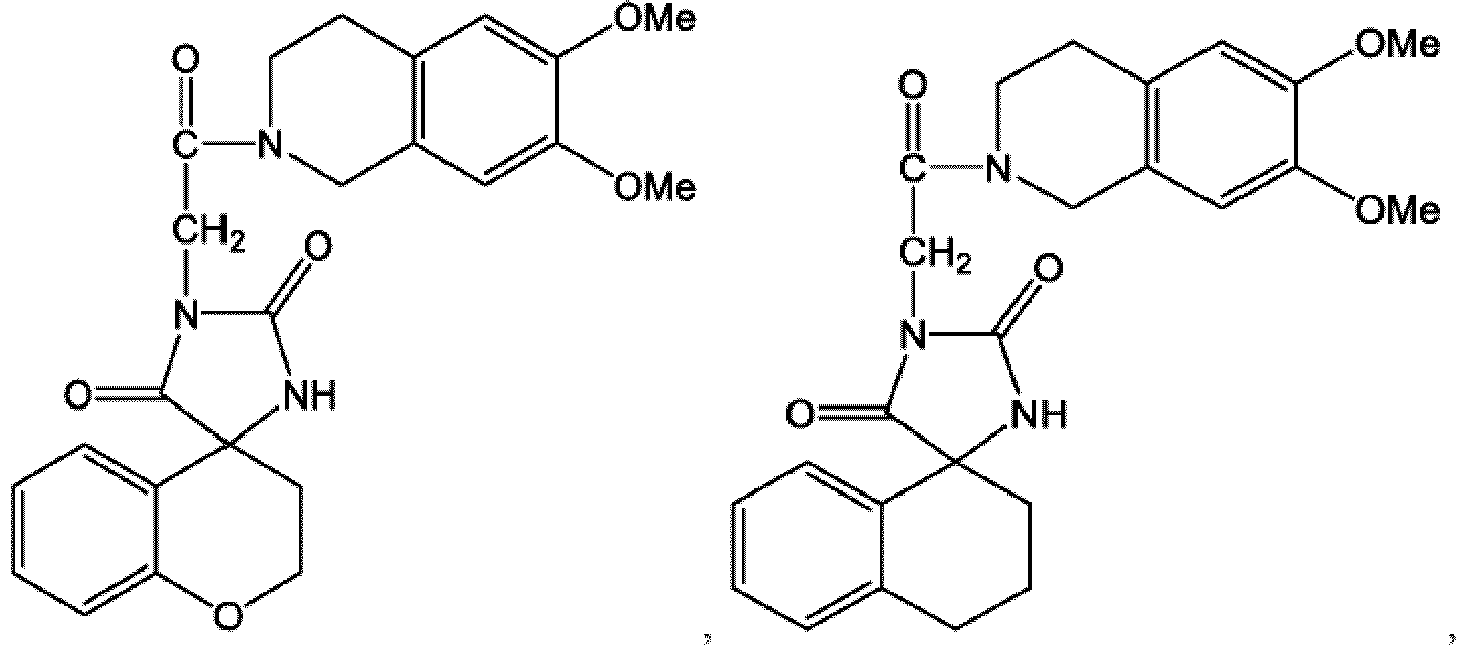

- Composé selon la revendication 1, ou un sel, un stéréoisomère, un énantiomère, un diastéréoisomère, un atropisomère, un racémate, des polymorphes, un solvate ou un composé marqué isotopiquement pharmaceutiquement acceptables de celui-ci, dans lequel, le composé de formule I est choisi dans le groupe constitué des composés représentés par les formules la et Ib :
 - - - - - est une liaison simple ou une double liaison ;R11 à R21, X2, Y, W, X4, X5, n1 à n4 sont tels que définis dans la formule I de la revendication 1.
 - Composé selon la revendication 1, ou un sel, un stéréoisomère, un énantiomère, un diastéréoisomère, un atropisomère, un racémate, des polymorphes, un solvate ou un composé marqué isotopiquement pharmaceutiquement acceptables de celui-ci, dans lequel, le composé de formule I est choisi dans le groupe constitué des composés de formules Ic, Id, Ie et If :

 - - - - - est une liaison simple ou une double liaison ;R11 à R21, X2, X4, X5, n1 à n4 sont tels que définis dans la formule I de la revendication 1.
 - Composé selon la revendication 1, ou un sel, un stéréoisomère, un énantiomère, un diastéréoisomère, un atropisomère, un racémate, des polymorphes, un solvate ou un composé marqué isotopiquement pharmaceutiquement acceptables de celui-ci, dans lequel, le composé de formule I est choisi dans le groupe constitué des composés représentés par les formules Ig et Ih :
 R5 est un hydrogène, un halogène ou un alkyle en C1 à C6 ;R13 à R17, R20, R21, X2 et n3 sont tels que définis dans la formule I de la revendication 1.
 - Composé selon la revendication 1, ou un sel, un stéréoisomère, un énantiomère, un diastéréoisomère, un atropisomère, un racémate, des polymorphes, un solvate ou un composé marqué isotopiquement pharmaceutiquement acceptables de celui-ci, dans lequel, le composé de formule I est choisi dans le groupe constitué des composés représentés par les formules Ii et Ij :
 R13 est un hydrogène, un alkyle en C1 à C6 ou un cycloalkyle en C3 à C6 ;X2 est un CH2, un O, -S(O)n1- ou -N(R4)- ;R15, R20, R21, R4, n1 et n3 sont tels que définis dans la formule I de la revendication 1.
 - Composé selon la revendication 1, ou un sel, un stéréoisomère, un énantiomère, un diastéréoisomère, un atropisomère, un racémate, des polymorphes, un solvate ou un composé marqué isotopiquement pharmaceutiquement acceptables de celui-ci selon la revendication 1, dans lequel, le composé de formule I est choisi dans le groupe constitué des composés représentés par les formules Ik et Il :
 X2 est un CH2, un O, un S ou -N(Me)- ;R21 est un alkyle en C1 à C6, un halogène, un halogénoalkyle en C1 à C6, un halogénoalcoxy en C1 à C6, un alcoxy en C1 à C6, un cycloalkyle en C3 à C6;n3 vaut 0, 1 ou 2 ;R15 est un alkyle en C1 à C6, un cycloalkyle en C3 à C6 ou un halogénoalkyle en C1 à C6;R20 est tel que défini dans la formule I de la revendication 1.
 - Composé selon la revendication 6, ou un sel, un stéréoisomère, un énantiomère, un diastéréoisomère, un atropisomère, un racémate, des polymorphes, un solvate ou un composé marqué isotopiquement pharmaceutiquement acceptables de celui-ci, dans lequel,X2 est un CH2, un O, un S ou -N(Me)- ;R21 est un halogène ;n3 vaut 0, 1 ou 2 ;R15 est un cyclopropyle, un méthyle, un éthyle, un propyle, un isopropyle ou un CF3 ;R20 est


- Composé selon la revendication 1, ou un sel, un stéréoisomère, un énantiomère, un diastéréoisomère, un atropisomère, un racémate, des polymorphes, un solvate ou un composé marqué isotopiquement pharmaceutiquement acceptables de celui-ci, dans lequel, le composé de formule I est choisi dans le groupe constitué des composés des formules Im, In, Io et Ip :

 X2 est un CH2, un O, -S(O)n1- ou -N(R4)-;R15, R20, R21, R4, n1 et n3 sont tels que définis dans la formule I de la revendication 1 ; W est un noyau benzène ou un noyau hétéroaromatique en C5 à C6.
 - Composé selon la revendication 1, ou un sel, un stéréoisomère, un énantiomère, un diastéréoisomère, un atropisomère, un racémate, des polymorphes, un solvate ou un composé marqué isotopiquement pharmaceutiquement acceptables de celui-ci, dans lequel, le composé de formule I est choisi dans le groupe constitué de


- Composition pharmaceutique comprenant une quantité thérapeutiquement efficace d'un composé représenté par la formule (I), ou d'un sel, d'un stéréoisomère, d'un énantiomère, d'un diastéréomère, d'un atropisomère, d'un racémate, de polymorphes, d'un solvate ou d'un composé marqué isotopiquement pharmaceutiquement acceptables de celui-ci :
 X1 est indépendamment -O-, -NR1- ou -S- ;R1 est indépendamment un hydrogène, un alkyle en C1 à C6 ou un cycloalkyle en C3 à C6,X2 est indépendamment -C(R2)(R3)-, -O-, -N(R4)- ou -S(O)n1-;R2 et R3 sont chacun indépendamment un hydrogène, un deutérium, un alkyle en C1 à C6, un halogénoalkyle en C1 à C6 ou un cycloalkyle en C3 à C6 ;R4 est indépendamment un hydrogène, un alkyle en C1 à C6, un cycloalkyle en C3 à C6, un -C(=O)(alkyle en C1 à C6), un -S(O)2(alkyle en C1 à C6), un -C(=O)(cycloalkyle en C3 à C6) ou un -S(O)2(cycloalkyle en C3 à C6);X3 est indépendamment un O ou un NH ;- - - - - est une liaison simple ou une double liaison, à condition que, lorsque - - - - - est une liaison simple, X4 soit indépendamment -C(R5)(R6)-, -O-, -C(=O)-, -NR7- ou - S(O)n1- ; X5 soit indépendamment -C(R8)(R9)-, -O-, -C(=O)-, -NR10-, -S(O)n1-, ou non présent ; et lorsque - - - - - est une double liaison: X4 soit indépendamment -C(R5)-; X5 soit indépendamment -C(R8)-;R5 et R6 sont chacun indépendamment un hydrogène, un OH, un halogène, un CN, un alkyle en C1 à C6, un halogénoalkyle en C1 à C6, un cycloalkyle en C3 à C6 ou un alcoxy en C1 à C6;R8 et R9 sont chacun indépendamment un hydrogène, un OH, un halogène ou un alkyle en C1 à C6;R7 est indépendamment un hydrogène, un alkyle en C1 à C6 ou un cycloalkyle en C3 à C6,R10 est indépendamment un hydrogène, un alkyle en C1 à C6 ou un cycloalkyle en C3 à Ce ;Y est indépendamment un noyau aromatique en C6 à C10, un noyau hétéroaromatique en C5 à C10, et Y est indépendamment non substitué ou substitué par 1 ou 2 R20;R11 et R12 sont chacun indépendamment un hydrogène, un deutérium, un alkyle en C1 à C6, un halogénoalkyle en C1 à C6 ou un cycloalkyle en C3 à C6;R13 et R14 sont chacun indépendamment un hydrogène, un deutérium, un alkyle en C1 à C6, un halogénoalkyle en C1 à C6 ou un cycloalkyle en C3 à C6;R16 et R17 sont chacun indépendamment un hydrogène, un deutérium, un alkyle en C1 à C6, un halogénoalkyle en C1 à C6 ou un cycloalkyle en C3 à C6;R18 et R19 sont chacun indépendamment un hydrogène, un halogène ou un alkyle en C1 à C6;R15 est indépendamment un hydrogène, un alkyle en C1 à C6 substitué par 0 à 2 Ra, un halogénoalkyle en C1 à C6, ou Ma ;dans I, Ra est indépendamment un alkyle en C1 à C6, un alcényle en C2 à C6, un alcynyle en C2 à C6, un halogène, un halogénoalkyle en C1 à C6, un halogénoalcoxy en C1 à C6, -CN, un hydroxyle, -OMe, -SMe, -S(O)2Me, -C(O)NMfMg, -NMfM9, - N(Me)C(O)Mh, -N(Me)S(O)2Mh, -N(Me)C(O)OMh, -N(Me)C(O)NMfMg ou Mb à chaque occurrence ;R20 est indépendamment un hydrogène, un halogène, -OH, -CN, -COOH, un alkyle en C1 à C6, un alcoxy en C1 à C6, un halogénoalcoxy en C1 à C6, un alcoxyalkyle en C2 à C10, un alcoxyalkylalcynyle en C4 à C20, un halogénoalcoxyalkyle en C2 à C10, un hydroxyalkyle en C1 à C6, un hydroxyalkylalcynyle en C3 à C10, un hydroxyalcynyle en C2 à C10, -B(Rb)(Rd), -S(O)n1Rc, -N(RC)2, -C(=O)N(Rc)2, -NHC(=O)Rc, -NHC(=O)ORc, - NHC(=O)C(=O)N(Rc)2, -NHC(=O)C(=O)ORc, -NHC(=O)N(Rc)2, - NHC(=O)NRcC(=O)N(Rc)2, -NHC(=O)NRcS(O)2ORc, -NHC(=O)NRcS(O)2N(Rc)2, - NHC(=S)N(Rc)2 -NHC(=NC=N)NRc, -NHC(=NC=N)SRc, -NHS(O)n1Rc, Mc, un - (alkylène en C1 à C6)-B(Rb)(Rd), un -(alkylène en C1 à C6)-S(O)n1Rc, un -(alkylène en C1 à C6)-N(Rc)2, un -(alkylène en C1 à C6)-C(=O)N(Rc)2, un -(alkylène en C1 à C6)-NHC(=O)Rc, un -(alkylène en C1 à C6)-NHC(=O)ORc, un -(alkylène en C1 à C6)-NHC(=O)C(=O)N(Rc)2, un -(alkylène en C1 à C6)-NHC(=O)N(Rc)2, un -(alkylène en C1 à C6)-NHC(=O)NRcC(=O)N(Rc)2, un -(alkylène en C1 à C6)-NHC(=O)NRcS(O)2ORc, un -(alkylène en C1 à C6)-NHC(=O)NRcS(O)2N(Rc)2, un -(alkylène en C1 à C6)-NHC(=S)N(Rc)2, un -(alkylène en C1 à C6)-NHC(=N-C≡N)NRc, un -(alkylène en C1 à C6)-NHC(=N-C≡N)SRc, un -(alkylène en C1 à C6)-NHS(O)n1Rc, un -(alkylène en C1 à C6)-Mc, un -CH≡CH-(alkyle en C1 à C6), -CH≡CH-Mc, -OMc, -SMc ou -N(Rc)Mc à chaque occurrence ;Rb et Rd sont chacun indépendamment un hydrogène, un hydroxyle ou un alkyle en C1 à Ce ;Rc est indépendamment un hydrogène, un alkyle en C1 à C6, un aryle en C6 à C10, un hétéroaryle de 5 à 10 chaînons, un groupe hétérocyclique non aromatique de 3 à 10 chaînons, un cycloalkyle en C3 à C10 ou un cycloalcényle en C5 à C10, qui sont chacun indépendamment non substitués ou substitués par 1 ou 2 groupes d'amino, hydroxyle, méthoxy, alkyle en C1 à C6, cycloalkyle en C3 à C10 ou CN ;Ma, Mb et Mc sont chacun indépendamment un aryle en C6 à C10, un hétéroaryle en C5 à C10, un groupe hétérocyclique non aromatique en C3 à C10, un cycloalkyle en C3 à C10 ou un cycloalcényle en C3 à C10, qui sont chacun indépendamment non substitués ou substitués par 1 à 2 Md;Mdest indépendamment un alkyle en C1 à C6, un alcényle en C2 à C6, un alcynyle en C2 à C6, un halogène, un halogénoalkyle en C1 à C6, -CN, un oxo, -OMe, -OC(O)Mh, - OC(O)NMfMg, -SMe, -S(O)2Me, -S(O)2NMfM9, -C(O)Me, un -C(O)-noyau hétérocyclique monocyclique de 5 à 10 chaînons, un -C(O)-hétéroaryle monocyclique de 5 à 10 chaînons, -C(O)OMe, -C(O)NMfMg, -NMfM9, -N(Me)C(O)Mh, -N(Me)S(O)2M h, - N(Me)C(O)OMh, -N(Me)C(O)NMfMg, un -(alkylène en C1 à C6)-OMe, un -(alkylène en C1 à C6)-OC(O)Mh, un -(alkylène en C1 à C6)-OC(O)NMfMg, un -(alkylène en C1 à C6)-S(O)2Me, un -(alkylène en C1 à C6)-S(O)2NMfM9, un -(alkylène en C1 à C6)-C(O)Me, un -(alkylène en C1 à C6)-C(O)OMe, un -(alkylène en C1 à C6)-C(O)NMfM9, un -(alkylène en C1 à C6)-NMfM9, un -(alkylène en C1 à C6)-N(Me)C(O)Mh, un -(alkylène en C1 à C6)-N(Me)S(O)2Mh, un -(alkylène en C1 à C6)-N(Me)C(O)OMh, un -(alkylène en C1 à C6)-N(Me)C(O)NMfMg ou un -(alkylène en C1 à C6)-CN à chaque occurrence ;W est indépendamment un noyau aromatique en C6 à C10, un noyau hétéroaromatique en C5 à C10, et W est indépendamment non substitué ou substitué par 1, 2 ou 3 R21 ; R21 est chacun indépendamment un alkyle en C1 à C6, un halogène, un halogénoalkyle en C1 à C6, un halogénoalcoxy en C1 à C6, un cycloalkyle en C3 à C6, -OMe, -OC(O)Mh, -OC(O)NMfMg, -SMe, -S(O)2Me, -S(O)2NMfMg, -C(O)Me, -C(O)OMe, -C(O)NMfMg, - NMfMg, -N(Me)C(O)Mh, -N(Me)S(O)2Mh, -N(Me)C(O)OMh et -N(Me)C(O)NMfMg à chaque occurrence ;Me, Mf et Mg sont indépendamment un hydrogène, un alkyle en C1 à C6, un halogénoalkyle en C1 à C6 ou un cycloalkyle en C3 à C6 à chaque occurrence ; et Mh est indépendamment un alkyle en C1 à C6, un halogénoalkyle en C1 à C6 ou un cycloalkyle en C3 à C6 à chaque occurrence ;n1 et n2 sont indépendamment 0, 1 ou 2 à chaque occurrence ;n3 et n4 sont indépendamment 0, 1, 2 ou 3 à chaque occurrence,et un vecteur, diluant ou excipient pharmaceutiquement acceptable.
 - Composition pharmaceutique selon la revendication 10, dans laquelle la composition pharmaceutique comprend en outre au moins un autre agent thérapeutique, de préférence, l'au moins un autre agent thérapeutique compris dans la composition pharmaceutique est choisi dans le groupe constitué d'autres agents anticancéreux, immunomodulateurs, agents antiallergiques, antiémétiques, analgésiques, agents cytoprotecteurs, et de combinaisons de ceux-ci.
- Composé représenté par la formule I, ou un sel, un stéréoisomère, un énantiomère, un diastéréoisomère, un atropisomère, un racémate, des polymorphes, un solvate ou un composé marqué isotopiquement pharmaceutiquement acceptables de celui-ci :
 X1 est indépendamment -O-, -NR1- ou -S- ;R1 est indépendamment un hydrogène, un alkyle en C1 à C6 ou un cycloalkyle en C3 à C6,X2 est indépendamment -C(R2)(R3)-, -O-, -N(R4)- ou -S(O)n1-;R2 et R3 sont chacun indépendamment un hydrogène, un deutérium, un alkyle en C1 à C6, un halogénoalkyle en C1 à C6 ou un cycloalkyle en C3 à C6 ;R4 est indépendamment un hydrogène, un alkyle en C1 à C6, un cycloalkyle en C3 à C6, un -C(=O)(alkyle en C1 à C6), un -S(O)2(alkyle en C1 à C6), un -C(=O)(cycloalkyle en C3 à C6) ou un -S(O)2(cycloalkyle en C3 à C6) ;X3 est indépendamment un O ou un NH ;- - - - - est une liaison simple ou une double liaison, à condition que, lorsque — est une liaison simple, X4 soit indépendamment -C(R5)(R6)-, -O-, -C(=O)-, -NR7- ou - S(O)n1-; X5 soit indépendamment -C(R8)(R9)-, -O-, -C(=O)-, -NR10-, -S(O)n1-, ou non présent ; et lorsque - - - - - est une double liaison : X4 soit indépendamment -C(R5)-; X5 soit indépendamment -C(R8)-;R5 et R6 sont chacun indépendamment un hydrogène, un OH, un halogène, un CN, un alkyle en C1 à C6, un halogénoalkyle en C1 à C6, un cycloalkyle en C3 à C6 ou un alcoxy en C1 à C6 ;R8 et R9 sont chacun indépendamment un hydrogène, un OH, un halogène ou un alkyle en C1 à C6 ;R7 est indépendamment un hydrogène, un alkyle en C1 à C6 ou un cycloalkyle en C3 à C6,R10 est indépendamment un hydrogène, un alkyle en C1 à C6 ou un cycloalkyle en C3 à Ce ;Y est indépendamment un noyau aromatique en C6 à C10, un noyau hétéroaromatique en C5 à C10, et Y est indépendamment non substitué ou substitué par 1 ou 2 R20 ;R11 et R12 sont chacun indépendamment un hydrogène, un deutérium, un alkyle en C1 à C6, un halogénoalkyle en C1 à C6 ou un cycloalkyle en C3 à C6 ;R13 et R14 sont chacun indépendamment un hydrogène, un deutérium, un alkyle en C1 à C6, un halogénoalkyle en C1 à C6 ou un cycloalkyle en C3 à C6 ;R16 et R17 sont chacun indépendamment un hydrogène, un deutérium, un alkyle en C1 à C6, un halogénoalkyle en C1 à C6 ou un cycloalkyle en C3 à C6 ;R18 et R19 sont chacun indépendamment un hydrogène, un halogène ou un alkyle en C1 à C6 ;R15 est indépendamment un hydrogène, un alkyle en C1 à C6 substitué par 0 à 2 Ra, un halogénoalkyle en C1 à C6, ou Ma ;dans lequel, Ra est indépendamment un alkyle en C1 à C6, un alcényle en C2 à C6, un alcynyle en C2 à C6, un halogène, un halogénoalkyle en C1 à C6, un halogénoalcoxy en C1 à C6, -CN, un hydroxyle, -OMe, -SMe, -S(O)2Me, -C(O)NMfMg, -NMfM9, - N(Me)C(O)Mh, -N(Me)S(O)2Mh, -N(Me)C(O)OMh, -N(Me)C(O)NMfMg ou Mb à chaque occurrence ;R20 est indépendamment un hydrogène, un halogène, -OH, -CN, -COOH, un alkyle en C1 à C6, un alcoxy en C1 à C6, un halogénoalcoxy en C1 à C6, un alcoxyalkyle en C2 à C10, un alcoxyalkylalcynyle en C4 à C20, un halogénoalcoxyalkyle en C2 à C10, un hydroxyalkyle en C1 à C6, un hydroxyalkylalcynyle en C3 à C10, un hydroxyalcynyle en C2 à C10, -B(Rb)(Rd), -S(O)n1Rc, -N(Rc)2, -C(=O)N(Rc)2, -NHC(=O)Rc, -NHC(=O)ORc, - NHC(=O)C(=O)N(Rc)2, -NHC(=O)C(=O)ORc, -NHC(=O)N(Rc)2, - NHC(=O)NRcC(=O)N(Rc)2, -NHC(=O)NRcS(O)2ORc, -NHC(=O)NRcS(O)2N(Rc)2, - NHC(=S)N(Rc)2 -NHC(=NC=N)NRc, -NHC(=NC=N)SRc, -NHS(O)n1Rc, Mc, un - (alkylène en C1 à C6)-B(Rb)(Rd), un -(alkylène en C1 à C6)-S(O)n1Rc, un -(alkylène en C1 à C6)-N(Rc)2, un -(alkylène en C1 à C6)-C(=O)N(Rc)2, un -(alkylène en C1 à C6)-NHC(=O)Rc, un -(alkylène en C1 à C6)-NHC(=O)ORc, un -(alkylène en C1 à C6)-NHC(=O)C(=O)N(Rc)2, un -(alkylène en C1 à C6)-NHC(=O)N(Rc)2, un -(alkylène en C1 à C6)-NHC(=O)NRcC(=O)N(Rc)2, un -(alkylène en C1 à C6)-NHC(=O)NRcS(O)2ORc, un -(alkylène en C1 à C6)-NHC(=O)NRcS(O)2N(Rc)2, un -(alkylène en C1 à C6)-NHC(=S)N(Rc)2, un -(alkylène en C1 à C6)-NHC(=N-C=N)NRc, un -(alkylène en C1 à C6)-NHC(=N-C≡N)SRc, un -(alkylène en C1 à C6)-NHS(O)n1Rc, un -(alkylène en C1 à C6)-Mc, un -CH≡CH-(alkyle en C1 à C6), -CH≡CH-Mc, -OMc, -SMc ou -N(Rc)Mc à chaque occurrence ;Rb et Rd sont chacun indépendamment un hydrogène, un hydroxyle ou un alkyle en C1 à Ce ;Rc est indépendamment un hydrogène, un alkyle en C1 à C6, un aryle en C6 à C10, un hétéroaryle de 5 à 10 chaînons, un groupe hétérocyclique non aromatique de 3 à 10 chaînons, un cycloalkyle en C3 à C10 ou un cycloalcényle en C5 à C10, qui sont chacun indépendamment non substitués ou substitués par 1 ou 2 groupes d'amino, hydroxyle, méthoxy, alkyle en C1 à C6, cycloalkyle en C3 à C10 ou CN ;Ma, Mb et Mc sont chacun indépendamment un aryle en C6 à C10, un hétéroaryle en C5 à C10, un groupe hétérocyclique non aromatique en C3 à C10, un cycloalkyle en C3 à C10 ou un cycloalcényle en C3 à C10, qui sont chacun indépendamment non substitués ou substitués par 1 à 2 Md ;Md est indépendamment un alkyle en C1 à C6, un alcényle en C2 à C6, un alcynyle en C2 à C6, un halogène, un halogénoalkyle en C1 à C6, -CN, un oxo, -OMe, -OC(O)Mh, - OC(O)NMfMg, -SMe, -S(O)2Me, -S(O)2NMfMg, -C(O)Me, un -C(O)-noyau hétérocyclique monocyclique de 5 à 10 chaînons, un -C(O)-hétéroaryle monocyclique de 5 à 10 chaînons, -C(O)OMe, -C(O)NMfMg, -NMfM9, -N(Me)C(O)Mh, -N(Me)S(O)2Mh, - N(Me)C(O)OMh, -N(Me)C(O)NMfMg, un -(alkylène en C1 à C6)-OMe, un -(alkylène en C1 à C6)-OC(O)Mh, un -(alkylène en C1 à C6)-OC(O)NMfMg, un -(alkylène en C1 à C6)-S(O)2Me, un -(alkylène en C1 à C6)-S(O)2NMfMg, un -(alkylène en C1 à C6)-C(O)Me, un -(alkylène en C1 à C6)-C(O)OMe, un -(alkylène en C1 à C6)-C(O)NMfMg, un -(alkylène en C1 à C6)-NMfM9, un -(alkylène en C1 à C6)-N(Me)C(O)Mh, un -(alkylène en C1 à C6)-N(Me)S(O)2Mh, un -(alkylène en C1 à C6)-N(Me)C(O)OMh, un -(alkylène en C1 à C6)-N(Me)C(O)NMfMg ou un -(alkylène en C1 à C6)-CN à chaque occurrence ;West indépendamment un noyau aromatique en C6 à C10, un noyau hétéroaromatique en C5 à C10, et W est indépendamment non substitué ou substitué par 1, 2 ou 3 R21 ; R21 est chacun indépendamment un alkyle en C1 à C6, un halogène, un halogénoalkyle en C1 à C6, un halogénoalcoxy en C1 à C6, un cycloalkyle en C3 à C6, -OMe, -OC(O)Mh, -OC(O)NMfMg, -SMe, -S(O)2Me, -S(O)2NMfMg, -C(O)Me, -C(O)OMe, -C(O)NMfMg, - NMfMg, -N(Me)C(O)Mh, -N(Me)S(O)2Mh, -N(Me)C(O)OMh et -N(Me)C(O)NMfMg à chaque occurrence ;Me, Mf et Mg sont indépendamment un hydrogène, un alkyle en C1 à C6, un halogénoalkyle en C1 à C6 ou un cycloalkyle en C3 à C6 à chaque occurrence ; et Mh est indépendamment un alkyle en C1 à C6, un halogénoalkyle en C1 à C6 ou un cycloalkyle en C3 à C6 à chaque occurrence ;n1 et n2 sont indépendamment 0, 1 ou 2 à chaque occurrence ;n3 et n4 sont indépendamment 0, 1, 2 ou 3 à chaque occurrence,ou composition pharmaceutique selon la revendication 10 pour une utilisation en tant que médicament pour le traitement d'une maladie, d'un trouble ou d'une affection chez un sujet.
 - Composé ou sel, stéréoisomère, énantiomère, diastéréoisomère, atropisomère, racémate, polymorphes, solvate ou composé marqué isotopiquement pharmaceutiquement acceptables de celui-ci pour une utilisation selon la revendication 12, ou composition pharmaceutique pour une utilisation selon la revendication 12, dans lequel (laquelle) la maladie, le trouble ou l'affection est choisi(e) dans le groupe constitué du névrome acoustique, de la leucémie aiguë, de la leucémie lymphocytaire aiguë, de la leucémie myéloïde aiguë (monocytaire, myéloblastique, adénocarcinome, angiosarcome, astrocytome, myélomonocytaire et promyélocytaire), de la leucémie à cellules T aiguë, du carcinome à cellules basales, du cholangiocarcinome, du cancer de la vessie, du cancer du cerveau, du cancer du sein, du cancer bronchique, du lymphome de Burkitt, du cancer du col de l'utérus, du chondrosarcome, du chordome, du choriocarcinome, de la leucémie chronique, de la leucémie lymphocytaire chronique, de la leucémie myéloïde chronique (granulocytes), de la leucémie myéloïde chronique, du cancer du côlon, du cancer colorectal, du craniopharyngiome, du cystadénocarcinome, du lymphome diffus à grandes cellules B, des changements prolifératifs indésirables (dysplasie et métaplasie), du cancer embryonnaire, du cancer de l'endomètre, du cancer épithélial, de l'érythroleucémie, du cancer de l'œsophage, du cancer du sein positif aux récepteurs des oestrogènes, de la thrombocytémie essentielle, du sarcome d'Ewing, du fibrosarcome, du lymphome folliculaire, du cancer testiculaire des cellules germinales, du gliome, du glioblastome, du gliosarcome, de la maladie des chaînes lourdes, de l'hémangioblastome, du cancer du foie, du carcinome hépatocellulaire, du cancer de la prostate insensible aux hormones, du léiomyosarcome, de la leucémie, du liposarcome, du cancer du poumon, du sarcome endothélial lymphatique, du lymphangiosarcome, de la leucémie lymphoblastique, du lymphome (hodgkinien et non hodgkinien), des malignités et des troubles hyperprolifératifs de la vessie, du sein, du côlon, du poumon, de l'ovaire, du pancréas, de la prostate, de la peau et de l'utérus, des malignités lymphoïdes dérivées des lymphocytes B ou des lymphocytes B, de la leucémie, du lymphome, du carcinome médullaire, du médulloblastome, du mélanome, du méningiome, du mésothéliome, du myélome multiple, de la leucémie myélogène, du myélome, du myxosarcome, du neuroblastome, du carcinome de la ligne médiane NUT (NMC), du cancer du poumon non à petites cellules, de l'oligodendrogliome, du cancer buccal, du sarcome ostéogénique, du cancer de l'ovaire, du cancer du pancréas, de l'adénocarcinome papillaire, du cancer papillaire, de la tumeur de glande pinéale, de l'érythrémie, du cancer de la prostate, du cancer rectal, du carcinome à cellules rénales, du rétinoblastome, du rhabdomyosarcome, du sarcome, du carcinome sébacé, du séminome, du cancer de la peau, du cancer du poumon à petites cellules, des tumeurs solides (carcinome et sarcome), du cancer du poumon à petites cellules, du cancer de l'estomac, du carcinome à cellules squameuses, de la tumeur synoviale, du spiroma, du cancer de la thyroïde, de la macroglobulinémie primaire, de la tumeur testiculaire, du cancer de l'utérus et du néphroblastome,
alternativement, la maladie, le trouble ou l'affection est choisi(e) dans le groupe constitué d'une maladie métabolique, d'une maladie neurodégénérative ou d'une inflammation.
Applications Claiming Priority (3)
| Application Number | Priority Date | Filing Date | Title |
|---|---|---|---|
| CN201810360078 | 2018-04-20 | ||
| CN201811012724 | 2018-08-31 | ||
| PCT/CN2019/083190 WO2019201291A1 (fr) | 2018-04-20 | 2019-04-18 | Inhibiteur d'histone acétyltransférase (hat) et utilisation associée |
Publications (3)
| Publication Number | Publication Date |
|---|---|
| EP3782995A1 EP3782995A1 (fr) | 2021-02-24 |
| EP3782995A4 EP3782995A4 (fr) | 2021-06-02 |
| EP3782995B1 true EP3782995B1 (fr) | 2023-11-22 |
Family
ID=68239944
Family Applications (1)
| Application Number | Title | Priority Date | Filing Date |
|---|---|---|---|
| EP19788657.5A Active EP3782995B1 (fr) | 2018-04-20 | 2019-04-18 | Dérivés d'imidazoline-2,4-dione spiro en tant qu'inhibiteurs d'histone acétyltransférase pour le traitement des maladies de cancer |
Country Status (5)
| Country | Link |
|---|---|
| US (1) | US12172989B2 (fr) |
| EP (1) | EP3782995B1 (fr) |
| JP (1) | JP7197075B2 (fr) |
| CN (1) | CN110386927B (fr) |
| WO (1) | WO2019201291A1 (fr) |
Families Citing this family (7)
| Publication number | Priority date | Publication date | Assignee | Title |
|---|---|---|---|---|
| CN111217802B (zh) * | 2018-11-27 | 2021-10-08 | 海创药业股份有限公司 | 一类组蛋白乙酰化酶p300抑制剂及其用途 |
| CN111499574A (zh) * | 2020-06-05 | 2020-08-07 | 苏州健雄职业技术学院 | 2-甲氧基-6,7-二氢-5H-环戊并[b]吡啶-5-酮的制备方法 |
| US20240122941A1 (en) * | 2020-12-25 | 2024-04-18 | National Cancer Center | Therapy based on synthetic lethality in swi/snf complex-dysfunction cancer |
| CN116724021A (zh) * | 2021-01-20 | 2023-09-08 | 巴斯夫欧洲公司 | 多氟化芳基和杂芳基羧酰胺的合成 |
| JP2025137900A (ja) * | 2022-08-10 | 2025-09-25 | 住友ファーマ株式会社 | 第4級炭素で置換された3級アミド誘導体 |
| CN117865910A (zh) * | 2023-12-15 | 2024-04-12 | 山东盛安贝新材料有限公司南京分公司 | 一种齐瑞索韦中间体的合成方法 |
| WO2026005533A1 (fr) | 2024-06-27 | 2026-01-02 | 한미약품 주식회사 | Nouveaux agents de dégradation de protéines hétérobifonctionnels et leur utilisation |
Family Cites Families (7)
| Publication number | Priority date | Publication date | Assignee | Title |
|---|---|---|---|---|
| WO2009086303A2 (fr) | 2007-12-21 | 2009-07-09 | University Of Rochester | Procédé permettant de modifier la durée de vie d'organismes eucaryotes |
| CN104059068B (zh) * | 2013-03-20 | 2017-02-08 | 中国科学院上海药物研究所 | β‑氨基羰基类化合物、其制备方法、药物组合物及其用途 |
| JP6759514B2 (ja) * | 2014-08-01 | 2020-09-23 | ヌエヴォリューション・アクティーゼルスカブNuevolution A/S | ブロモドメインに対して活性な化合物 |
| US20160235716A1 (en) * | 2014-09-18 | 2016-08-18 | Abbvie Inc. | Spirocyclic hat inhibitors and methods for their use |
| CN107108613B (zh) | 2014-11-10 | 2020-02-25 | 基因泰克公司 | 布罗莫结构域抑制剂及其用途 |
| EP3464270B1 (fr) | 2016-05-24 | 2022-02-23 | Genentech, Inc. | Inhibiteurs hétérocycliques de cbp/ep300 et leur utilisation dans le traitement du cancer |
| CN111217802B (zh) * | 2018-11-27 | 2021-10-08 | 海创药业股份有限公司 | 一类组蛋白乙酰化酶p300抑制剂及其用途 |
-
2019
- 2019-04-18 JP JP2021506032A patent/JP7197075B2/ja active Active
- 2019-04-18 WO PCT/CN2019/083190 patent/WO2019201291A1/fr not_active Ceased
- 2019-04-18 EP EP19788657.5A patent/EP3782995B1/fr active Active
- 2019-04-18 CN CN201910312170.6A patent/CN110386927B/zh active Active
-
2020
- 2020-10-20 US US17/075,206 patent/US12172989B2/en active Active
Also Published As
| Publication number | Publication date |
|---|---|
| CN110386927B (zh) | 2022-09-23 |
| JP2021522317A (ja) | 2021-08-30 |
| EP3782995A4 (fr) | 2021-06-02 |
| US12172989B2 (en) | 2024-12-24 |
| JP7197075B2 (ja) | 2022-12-27 |
| US20210101891A1 (en) | 2021-04-08 |
| US20220002278A9 (en) | 2022-01-06 |
| CN110386927A (zh) | 2019-10-29 |
| EP3782995A1 (fr) | 2021-02-24 |
| WO2019201291A1 (fr) | 2019-10-24 |
Similar Documents
| Publication | Publication Date | Title |
|---|---|---|
| EP3782995B1 (fr) | Dérivés d'imidazoline-2,4-dione spiro en tant qu'inhibiteurs d'histone acétyltransférase pour le traitement des maladies de cancer | |
| EP3885340B1 (fr) | Composés de modulation du récepteur d'androgènes | |
| EP3706749B1 (fr) | Composés macrocycliques en tant qu'inhibiteurs de kinase trk et leurs utilisations | |
| EP3057586B1 (fr) | Inhibiteurs de bromodomaine | |
| EP3068784B1 (fr) | Dérivés de 4,5,6,7-tétrahydropyrazolo[1,5-a]pyrazine substitués en tant qu'inhibiteurs de caséine kinase 1 d/e | |
| EP3575285A1 (fr) | Inhibiteur de lsd1, son procédé de préparation et son application | |
| GB2449293A (en) | Compounds having Hsp90 inhibitory activity | |
| EP2103613A1 (fr) | Dérivé de quinoxaline | |
| EP4110781B1 (fr) | Composés dérivés de 1,3,4-oxadiazole utilisés comme inhibiteurs d'histone désacétylase 6, et composition pharmaceutique les comprenant | |
| CN117143093B (zh) | 一种蛋白降解剂及其制备方法和用途 | |
| CN111196790B (zh) | 新型紫杉烷类衍生物及其药物组合物和用途 | |
| EP4365170A1 (fr) | Composé amide et son utilisation | |
| EP4324825A1 (fr) | Régulateur du fxr, son procédé de préparation, composition pharmaceutique de celui-ci et son utilisation | |
| EP4242213A1 (fr) | Composé d'acide borique | |
| EP4596539A1 (fr) | Composé cyclique fusionné et produit pharmaceutique le contenant | |
| Vishnuvardhan et al. | An efficient microwave assisted synthesis and antimicrobial activity of novel p‐Tolyloxyquinoline‐Triazole hybrid derivatives | |
| JP2020535193A (ja) | 結晶のリナグリプチン中間体およびリナグリプチンの調製のためのプロセス | |
| EP4692094A1 (fr) | Composé sulfonamide, composition pharmaceutique de celui-ci et utilisation associée | |
| Andreeva et al. | Synthesis and antiproliferative activity of thiazole-fused anthraquinones | |
| CN111606888B (zh) | 吡咯类衍生物及其制备方法与应用 | |
| Madhivadhani et al. | Synthesis, molecular docking, and In-vitro cytotoxic evaluation of Thiadiazolo-acridines analogues as anti-cancer agents | |
| Guihéneuf et al. | Microwave Assisted Organic Synthesis (MAOS) of new Dispacamide A derivatives bearing a thiazolinone platform, biological assays on inhibition of protein kinases and cell effects | |
| CN105175326B (zh) | 5‑甲基‑2(1h)吡啶酮衍生物及其制备方法和用途 | |
| EP4215525A1 (fr) | Dérivé de pipérazine, son procédé de préparation et son utilisation | |
| EP3388425A1 (fr) | Dérivé d'aminoazole |
Legal Events
| Date | Code | Title | Description |
|---|---|---|---|
| STAA | Information on the status of an ep patent application or granted ep patent |
Free format text: STATUS: THE INTERNATIONAL PUBLICATION HAS BEEN MADE |
|
| PUAI | Public reference made under article 153(3) epc to a published international application that has entered the european phase |
Free format text: ORIGINAL CODE: 0009012 |
|
| STAA | Information on the status of an ep patent application or granted ep patent |
Free format text: STATUS: REQUEST FOR EXAMINATION WAS MADE |
|
| 17P | Request for examination filed |
Effective date: 20201120 |
|
| AK | Designated contracting states |
Kind code of ref document: A1 Designated state(s): AL AT BE BG CH CY CZ DE DK EE ES FI FR GB GR HR HU IE IS IT LI LT LU LV MC MK MT NL NO PL PT RO RS SE SI SK SM TR |
|
| AX | Request for extension of the european patent |
Extension state: BA ME |
|
| A4 | Supplementary search report drawn up and despatched |
Effective date: 20210430 |
|
| RIC1 | Information provided on ipc code assigned before grant |
Ipc: C07D 413/06 20060101AFI20210423BHEP Ipc: C07D 417/06 20060101ALI20210423BHEP Ipc: C07D 413/14 20060101ALI20210423BHEP Ipc: A61K 31/4725 20060101ALI20210423BHEP Ipc: A61K 31/55 20060101ALI20210423BHEP Ipc: A61K 31/553 20060101ALI20210423BHEP Ipc: A61K 31/554 20060101ALI20210423BHEP Ipc: A61K 31/5513 20060101ALI20210423BHEP Ipc: A61P 35/00 20060101ALI20210423BHEP Ipc: A61P 35/02 20060101ALI20210423BHEP Ipc: A61P 3/00 20060101ALI20210423BHEP Ipc: A61P 25/28 20060101ALI20210423BHEP Ipc: A61P 29/00 20060101ALI20210423BHEP |
|
| DAV | Request for validation of the european patent (deleted) | ||
| DAX | Request for extension of the european patent (deleted) | ||
| STAA | Information on the status of an ep patent application or granted ep patent |
Free format text: STATUS: EXAMINATION IS IN PROGRESS |
|
| 17Q | First examination report despatched |
Effective date: 20220902 |
|
| REG | Reference to a national code |
Ref country code: DE Ref legal event code: R079 Free format text: PREVIOUS MAIN CLASS: C07D0413060000 Ipc: C07D0403060000 Ref document number: 602019041960 Country of ref document: DE |
|
| GRAP | Despatch of communication of intention to grant a patent |
Free format text: ORIGINAL CODE: EPIDOSNIGR1 |
|
| STAA | Information on the status of an ep patent application or granted ep patent |
Free format text: STATUS: GRANT OF PATENT IS INTENDED |
|
| RIC1 | Information provided on ipc code assigned before grant |
Ipc: A61P 35/00 20060101ALI20230512BHEP Ipc: A61P 29/00 20060101ALI20230512BHEP Ipc: A61P 25/28 20060101ALI20230512BHEP Ipc: A61P 3/00 20060101ALI20230512BHEP Ipc: A61K 31/554 20060101ALI20230512BHEP Ipc: A61K 31/553 20060101ALI20230512BHEP Ipc: A61K 31/5513 20060101ALI20230512BHEP Ipc: A61K 31/55 20060101ALI20230512BHEP Ipc: A61K 31/4725 20060101ALI20230512BHEP Ipc: C07D 498/10 20060101ALI20230512BHEP Ipc: C07D 498/04 20060101ALI20230512BHEP Ipc: C07D 491/107 20060101ALI20230512BHEP Ipc: C07D 495/10 20060101ALI20230512BHEP Ipc: C07D 495/04 20060101ALI20230512BHEP Ipc: C07D 471/10 20060101ALI20230512BHEP Ipc: C07D 471/04 20060101ALI20230512BHEP Ipc: C07D 417/06 20060101ALI20230512BHEP Ipc: C07D 413/14 20060101ALI20230512BHEP Ipc: C07D 413/06 20060101ALI20230512BHEP Ipc: C07D 403/14 20060101ALI20230512BHEP Ipc: C07D 403/06 20060101AFI20230512BHEP |
|
| INTG | Intention to grant announced |
Effective date: 20230607 |
|
| GRAS | Grant fee paid |
Free format text: ORIGINAL CODE: EPIDOSNIGR3 |
|
| GRAA | (expected) grant |
Free format text: ORIGINAL CODE: 0009210 |
|
| STAA | Information on the status of an ep patent application or granted ep patent |
Free format text: STATUS: THE PATENT HAS BEEN GRANTED |
|
| P01 | Opt-out of the competence of the unified patent court (upc) registered |
Effective date: 20230921 |
|
| RAP3 | Party data changed (applicant data changed or rights of an application transferred) |
Owner name: SUZHOU INSTITUTE OF MATERIA MEDICA Owner name: SHANGHAI INSTITUTE OF MATERIA MEDICA, CHINESE ACADEMY OF SCIENCES |
|
| AK | Designated contracting states |
Kind code of ref document: B1 Designated state(s): AL AT BE BG CH CY CZ DE DK EE ES FI FR GB GR HR HU IE IS IT LI LT LU LV MC MK MT NL NO PL PT RO RS SE SI SK SM TR |
|
| REG | Reference to a national code |
Ref country code: GB Ref legal event code: FG4D |
|
| REG | Reference to a national code |
Ref country code: CH Ref legal event code: EP Ref country code: DE Ref legal event code: R096 Ref document number: 602019041960 Country of ref document: DE |
|
| REG | Reference to a national code |
Ref country code: DE Ref legal event code: R081 Ref document number: 602019041960 Country of ref document: DE Owner name: SUZHOU INSTITUTE OF MATERIA MEDICA, SUZHOU, CN Free format text: FORMER OWNER: SHANGHAI INSTITUTE OF MATERIA MEDICA, CHINESE ACADEMY OF SCIENCES, SHANGHAI, CN Ref country code: DE Ref legal event code: R081 Ref document number: 602019041960 Country of ref document: DE Owner name: SHANGHAI INSTITUTE OF MATERIA MEDICA, CHINESE , CN Free format text: FORMER OWNER: SHANGHAI INSTITUTE OF MATERIA MEDICA, CHINESE ACADEMY OF SCIENCES, SHANGHAI, CN |
|
| REG | Reference to a national code |
Ref country code: IE Ref legal event code: FG4D |
|
| REG | Reference to a national code |
Ref country code: LT Ref legal event code: MG9D |
|
| REG | Reference to a national code |
Ref country code: NL Ref legal event code: MP Effective date: 20231122 |
|
| PG25 | Lapsed in a contracting state [announced via postgrant information from national office to epo] |
Ref country code: GR Free format text: LAPSE BECAUSE OF FAILURE TO SUBMIT A TRANSLATION OF THE DESCRIPTION OR TO PAY THE FEE WITHIN THE PRESCRIBED TIME-LIMIT Effective date: 20240223 |
|
| PG25 | Lapsed in a contracting state [announced via postgrant information from national office to epo] |
Ref country code: IS Free format text: LAPSE BECAUSE OF FAILURE TO SUBMIT A TRANSLATION OF THE DESCRIPTION OR TO PAY THE FEE WITHIN THE PRESCRIBED TIME-LIMIT Effective date: 20240322 |
|
| PG25 | Lapsed in a contracting state [announced via postgrant information from national office to epo] |
Ref country code: LT Free format text: LAPSE BECAUSE OF FAILURE TO SUBMIT A TRANSLATION OF THE DESCRIPTION OR TO PAY THE FEE WITHIN THE PRESCRIBED TIME-LIMIT Effective date: 20231122 |
|
| REG | Reference to a national code |
Ref country code: AT Ref legal event code: MK05 Ref document number: 1633742 Country of ref document: AT Kind code of ref document: T Effective date: 20231122 |
|
| PG25 | Lapsed in a contracting state [announced via postgrant information from national office to epo] |
Ref country code: NL Free format text: LAPSE BECAUSE OF FAILURE TO SUBMIT A TRANSLATION OF THE DESCRIPTION OR TO PAY THE FEE WITHIN THE PRESCRIBED TIME-LIMIT Effective date: 20231122 |
|
| PG25 | Lapsed in a contracting state [announced via postgrant information from national office to epo] |
Ref country code: AT Free format text: LAPSE BECAUSE OF FAILURE TO SUBMIT A TRANSLATION OF THE DESCRIPTION OR TO PAY THE FEE WITHIN THE PRESCRIBED TIME-LIMIT Effective date: 20231122 |
|
| PG25 | Lapsed in a contracting state [announced via postgrant information from national office to epo] |
Ref country code: ES Free format text: LAPSE BECAUSE OF FAILURE TO SUBMIT A TRANSLATION OF THE DESCRIPTION OR TO PAY THE FEE WITHIN THE PRESCRIBED TIME-LIMIT Effective date: 20231122 |
|
| PG25 | Lapsed in a contracting state [announced via postgrant information from national office to epo] |
Ref country code: NL Free format text: LAPSE BECAUSE OF FAILURE TO SUBMIT A TRANSLATION OF THE DESCRIPTION OR TO PAY THE FEE WITHIN THE PRESCRIBED TIME-LIMIT Effective date: 20231122 Ref country code: LT Free format text: LAPSE BECAUSE OF FAILURE TO SUBMIT A TRANSLATION OF THE DESCRIPTION OR TO PAY THE FEE WITHIN THE PRESCRIBED TIME-LIMIT Effective date: 20231122 Ref country code: IS Free format text: LAPSE BECAUSE OF FAILURE TO SUBMIT A TRANSLATION OF THE DESCRIPTION OR TO PAY THE FEE WITHIN THE PRESCRIBED TIME-LIMIT Effective date: 20240322 Ref country code: GR Free format text: LAPSE BECAUSE OF FAILURE TO SUBMIT A TRANSLATION OF THE DESCRIPTION OR TO PAY THE FEE WITHIN THE PRESCRIBED TIME-LIMIT Effective date: 20240223 Ref country code: ES Free format text: LAPSE BECAUSE OF FAILURE TO SUBMIT A TRANSLATION OF THE DESCRIPTION OR TO PAY THE FEE WITHIN THE PRESCRIBED TIME-LIMIT Effective date: 20231122 Ref country code: BG Free format text: LAPSE BECAUSE OF FAILURE TO SUBMIT A TRANSLATION OF THE DESCRIPTION OR TO PAY THE FEE WITHIN THE PRESCRIBED TIME-LIMIT Effective date: 20240222 Ref country code: AT Free format text: LAPSE BECAUSE OF FAILURE TO SUBMIT A TRANSLATION OF THE DESCRIPTION OR TO PAY THE FEE WITHIN THE PRESCRIBED TIME-LIMIT Effective date: 20231122 Ref country code: PT Free format text: LAPSE BECAUSE OF FAILURE TO SUBMIT A TRANSLATION OF THE DESCRIPTION OR TO PAY THE FEE WITHIN THE PRESCRIBED TIME-LIMIT Effective date: 20240322 |
|
| PG25 | Lapsed in a contracting state [announced via postgrant information from national office to epo] |
Ref country code: SE Free format text: LAPSE BECAUSE OF FAILURE TO SUBMIT A TRANSLATION OF THE DESCRIPTION OR TO PAY THE FEE WITHIN THE PRESCRIBED TIME-LIMIT Effective date: 20231122 Ref country code: RS Free format text: LAPSE BECAUSE OF FAILURE TO SUBMIT A TRANSLATION OF THE DESCRIPTION OR TO PAY THE FEE WITHIN THE PRESCRIBED TIME-LIMIT Effective date: 20231122 Ref country code: PL Free format text: LAPSE BECAUSE OF FAILURE TO SUBMIT A TRANSLATION OF THE DESCRIPTION OR TO PAY THE FEE WITHIN THE PRESCRIBED TIME-LIMIT Effective date: 20231122 Ref country code: NO Free format text: LAPSE BECAUSE OF FAILURE TO SUBMIT A TRANSLATION OF THE DESCRIPTION OR TO PAY THE FEE WITHIN THE PRESCRIBED TIME-LIMIT Effective date: 20240222 Ref country code: LV Free format text: LAPSE BECAUSE OF FAILURE TO SUBMIT A TRANSLATION OF THE DESCRIPTION OR TO PAY THE FEE WITHIN THE PRESCRIBED TIME-LIMIT Effective date: 20231122 Ref country code: HR Free format text: LAPSE BECAUSE OF FAILURE TO SUBMIT A TRANSLATION OF THE DESCRIPTION OR TO PAY THE FEE WITHIN THE PRESCRIBED TIME-LIMIT Effective date: 20231122 |
|
| PG25 | Lapsed in a contracting state [announced via postgrant information from national office to epo] |
Ref country code: DK Free format text: LAPSE BECAUSE OF FAILURE TO SUBMIT A TRANSLATION OF THE DESCRIPTION OR TO PAY THE FEE WITHIN THE PRESCRIBED TIME-LIMIT Effective date: 20231122 |
|
| PG25 | Lapsed in a contracting state [announced via postgrant information from national office to epo] |
Ref country code: CZ Free format text: LAPSE BECAUSE OF FAILURE TO SUBMIT A TRANSLATION OF THE DESCRIPTION OR TO PAY THE FEE WITHIN THE PRESCRIBED TIME-LIMIT Effective date: 20231122 |
|
| PG25 | Lapsed in a contracting state [announced via postgrant information from national office to epo] |
Ref country code: SK Free format text: LAPSE BECAUSE OF FAILURE TO SUBMIT A TRANSLATION OF THE DESCRIPTION OR TO PAY THE FEE WITHIN THE PRESCRIBED TIME-LIMIT Effective date: 20231122 |
|
| PG25 | Lapsed in a contracting state [announced via postgrant information from national office to epo] |
Ref country code: SM Free format text: LAPSE BECAUSE OF FAILURE TO SUBMIT A TRANSLATION OF THE DESCRIPTION OR TO PAY THE FEE WITHIN THE PRESCRIBED TIME-LIMIT Effective date: 20231122 Ref country code: SK Free format text: LAPSE BECAUSE OF FAILURE TO SUBMIT A TRANSLATION OF THE DESCRIPTION OR TO PAY THE FEE WITHIN THE PRESCRIBED TIME-LIMIT Effective date: 20231122 Ref country code: RO Free format text: LAPSE BECAUSE OF FAILURE TO SUBMIT A TRANSLATION OF THE DESCRIPTION OR TO PAY THE FEE WITHIN THE PRESCRIBED TIME-LIMIT Effective date: 20231122 Ref country code: IT Free format text: LAPSE BECAUSE OF FAILURE TO SUBMIT A TRANSLATION OF THE DESCRIPTION OR TO PAY THE FEE WITHIN THE PRESCRIBED TIME-LIMIT Effective date: 20231122 Ref country code: EE Free format text: LAPSE BECAUSE OF FAILURE TO SUBMIT A TRANSLATION OF THE DESCRIPTION OR TO PAY THE FEE WITHIN THE PRESCRIBED TIME-LIMIT Effective date: 20231122 Ref country code: DK Free format text: LAPSE BECAUSE OF FAILURE TO SUBMIT A TRANSLATION OF THE DESCRIPTION OR TO PAY THE FEE WITHIN THE PRESCRIBED TIME-LIMIT Effective date: 20231122 Ref country code: CZ Free format text: LAPSE BECAUSE OF FAILURE TO SUBMIT A TRANSLATION OF THE DESCRIPTION OR TO PAY THE FEE WITHIN THE PRESCRIBED TIME-LIMIT Effective date: 20231122 |
|
| REG | Reference to a national code |
Ref country code: DE Ref legal event code: R097 Ref document number: 602019041960 Country of ref document: DE |
|
| PLBE | No opposition filed within time limit |
Free format text: ORIGINAL CODE: 0009261 |
|
| STAA | Information on the status of an ep patent application or granted ep patent |
Free format text: STATUS: NO OPPOSITION FILED WITHIN TIME LIMIT |
|
| PG25 | Lapsed in a contracting state [announced via postgrant information from national office to epo] |
Ref country code: SI Free format text: LAPSE BECAUSE OF FAILURE TO SUBMIT A TRANSLATION OF THE DESCRIPTION OR TO PAY THE FEE WITHIN THE PRESCRIBED TIME-LIMIT Effective date: 20231122 |
|
| 26N | No opposition filed |
Effective date: 20240823 |
|
| PG25 | Lapsed in a contracting state [announced via postgrant information from national office to epo] |
Ref country code: SI Free format text: LAPSE BECAUSE OF FAILURE TO SUBMIT A TRANSLATION OF THE DESCRIPTION OR TO PAY THE FEE WITHIN THE PRESCRIBED TIME-LIMIT Effective date: 20231122 |
|
| PG25 | Lapsed in a contracting state [announced via postgrant information from national office to epo] |
Ref country code: MC Free format text: LAPSE BECAUSE OF FAILURE TO SUBMIT A TRANSLATION OF THE DESCRIPTION OR TO PAY THE FEE WITHIN THE PRESCRIBED TIME-LIMIT Effective date: 20231122 |
|
| PG25 | Lapsed in a contracting state [announced via postgrant information from national office to epo] |
Ref country code: MC Free format text: LAPSE BECAUSE OF FAILURE TO SUBMIT A TRANSLATION OF THE DESCRIPTION OR TO PAY THE FEE WITHIN THE PRESCRIBED TIME-LIMIT Effective date: 20231122 |
|
| REG | Reference to a national code |
Ref country code: CH Ref legal event code: PL |
|
| PG25 | Lapsed in a contracting state [announced via postgrant information from national office to epo] |
Ref country code: LU Free format text: LAPSE BECAUSE OF NON-PAYMENT OF DUE FEES Effective date: 20240418 |
|
| REG | Reference to a national code |
Ref country code: BE Ref legal event code: MM Effective date: 20240430 |
|
| PG25 | Lapsed in a contracting state [announced via postgrant information from national office to epo] |
Ref country code: LU Free format text: LAPSE BECAUSE OF NON-PAYMENT OF DUE FEES Effective date: 20240418 |
|
| PG25 | Lapsed in a contracting state [announced via postgrant information from national office to epo] |
Ref country code: BE Free format text: LAPSE BECAUSE OF NON-PAYMENT OF DUE FEES Effective date: 20240430 |
|
| PG25 | Lapsed in a contracting state [announced via postgrant information from national office to epo] |
Ref country code: BE Free format text: LAPSE BECAUSE OF NON-PAYMENT OF DUE FEES Effective date: 20240430 Ref country code: CH Free format text: LAPSE BECAUSE OF NON-PAYMENT OF DUE FEES Effective date: 20240430 |
|
| PG25 | Lapsed in a contracting state [announced via postgrant information from national office to epo] |
Ref country code: IE Free format text: LAPSE BECAUSE OF NON-PAYMENT OF DUE FEES Effective date: 20240418 |
|
| PGFP | Annual fee paid to national office [announced via postgrant information from national office to epo] |
Ref country code: DE Payment date: 20250422 Year of fee payment: 7 |
|
| PGFP | Annual fee paid to national office [announced via postgrant information from national office to epo] |
Ref country code: GB Payment date: 20250423 Year of fee payment: 7 |
|
| PGFP | Annual fee paid to national office [announced via postgrant information from national office to epo] |
Ref country code: FR Payment date: 20250425 Year of fee payment: 7 |
|
| PG25 | Lapsed in a contracting state [announced via postgrant information from national office to epo] |
Ref country code: CY Free format text: LAPSE BECAUSE OF FAILURE TO SUBMIT A TRANSLATION OF THE DESCRIPTION OR TO PAY THE FEE WITHIN THE PRESCRIBED TIME-LIMIT; INVALID AB INITIO Effective date: 20190418 |
|
| PG25 | Lapsed in a contracting state [announced via postgrant information from national office to epo] |
Ref country code: HU Free format text: LAPSE BECAUSE OF FAILURE TO SUBMIT A TRANSLATION OF THE DESCRIPTION OR TO PAY THE FEE WITHIN THE PRESCRIBED TIME-LIMIT; INVALID AB INITIO Effective date: 20190418 |
|
| PG25 | Lapsed in a contracting state [announced via postgrant information from national office to epo] |
Ref country code: FI Free format text: LAPSE BECAUSE OF FAILURE TO SUBMIT A TRANSLATION OF THE DESCRIPTION OR TO PAY THE FEE WITHIN THE PRESCRIBED TIME-LIMIT Effective date: 20231122 |