EP3783072B1 - Composition d'encre, produit imprimé et procédé de détermination d'authenticité - Google Patents
Composition d'encre, produit imprimé et procédé de détermination d'authenticité Download PDFInfo
- Publication number
- EP3783072B1 EP3783072B1 EP18855472.9A EP18855472A EP3783072B1 EP 3783072 B1 EP3783072 B1 EP 3783072B1 EP 18855472 A EP18855472 A EP 18855472A EP 3783072 B1 EP3783072 B1 EP 3783072B1
- Authority
- EP
- European Patent Office
- Prior art keywords
- group
- rare
- ligand
- earth
- general formula
- Prior art date
- Legal status (The legal status is an assumption and is not a legal conclusion. Google has not performed a legal analysis and makes no representation as to the accuracy of the status listed.)
- Active
Links
Images



Classifications
-
- C—CHEMISTRY; METALLURGY
- C09—DYES; PAINTS; POLISHES; NATURAL RESINS; ADHESIVES; COMPOSITIONS NOT OTHERWISE PROVIDED FOR; APPLICATIONS OF MATERIALS NOT OTHERWISE PROVIDED FOR
- C09D—COATING COMPOSITIONS, e.g. PAINTS, VARNISHES OR LACQUERS; FILLING PASTES; CHEMICAL PAINT OR INK REMOVERS; INKS; CORRECTING FLUIDS; WOODSTAINS; PASTES OR SOLIDS FOR COLOURING OR PRINTING; USE OF MATERIALS THEREFOR
- C09D11/00—Inks
- C09D11/50—Sympathetic, colour changing or similar inks
-
- B—PERFORMING OPERATIONS; TRANSPORTING
- B42—BOOKBINDING; ALBUMS; FILES; SPECIAL PRINTED MATTER
- B42D—BOOKS; BOOK COVERS; LOOSE LEAVES; PRINTED MATTER CHARACTERISED BY IDENTIFICATION OR SECURITY FEATURES; PRINTED MATTER OF SPECIAL FORMAT OR STYLE NOT OTHERWISE PROVIDED FOR; DEVICES FOR USE THEREWITH AND NOT OTHERWISE PROVIDED FOR; MOVABLE-STRIP WRITING OR READING APPARATUS
- B42D25/00—Information-bearing cards or sheet-like structures characterised by identification or security features; Manufacture thereof
- B42D25/30—Identification or security features, e.g. for preventing forgery
- B42D25/36—Identification or security features, e.g. for preventing forgery comprising special materials
- B42D25/378—Special inks
-
- B—PERFORMING OPERATIONS; TRANSPORTING
- B42—BOOKBINDING; ALBUMS; FILES; SPECIAL PRINTED MATTER
- B42D—BOOKS; BOOK COVERS; LOOSE LEAVES; PRINTED MATTER CHARACTERISED BY IDENTIFICATION OR SECURITY FEATURES; PRINTED MATTER OF SPECIAL FORMAT OR STYLE NOT OTHERWISE PROVIDED FOR; DEVICES FOR USE THEREWITH AND NOT OTHERWISE PROVIDED FOR; MOVABLE-STRIP WRITING OR READING APPARATUS
- B42D25/00—Information-bearing cards or sheet-like structures characterised by identification or security features; Manufacture thereof
- B42D25/30—Identification or security features, e.g. for preventing forgery
- B42D25/36—Identification or security features, e.g. for preventing forgery comprising special materials
- B42D25/378—Special inks
- B42D25/387—Special inks absorbing or reflecting ultraviolet light
-
- C—CHEMISTRY; METALLURGY
- C09—DYES; PAINTS; POLISHES; NATURAL RESINS; ADHESIVES; COMPOSITIONS NOT OTHERWISE PROVIDED FOR; APPLICATIONS OF MATERIALS NOT OTHERWISE PROVIDED FOR
- C09D—COATING COMPOSITIONS, e.g. PAINTS, VARNISHES OR LACQUERS; FILLING PASTES; CHEMICAL PAINT OR INK REMOVERS; INKS; CORRECTING FLUIDS; WOODSTAINS; PASTES OR SOLIDS FOR COLOURING OR PRINTING; USE OF MATERIALS THEREFOR
- C09D11/00—Inks
- C09D11/02—Printing inks
- C09D11/03—Printing inks characterised by features other than the chemical nature of the binder
- C09D11/037—Printing inks characterised by features other than the chemical nature of the binder characterised by the pigment
-
- C—CHEMISTRY; METALLURGY
- C09—DYES; PAINTS; POLISHES; NATURAL RESINS; ADHESIVES; COMPOSITIONS NOT OTHERWISE PROVIDED FOR; APPLICATIONS OF MATERIALS NOT OTHERWISE PROVIDED FOR
- C09D—COATING COMPOSITIONS, e.g. PAINTS, VARNISHES OR LACQUERS; FILLING PASTES; CHEMICAL PAINT OR INK REMOVERS; INKS; CORRECTING FLUIDS; WOODSTAINS; PASTES OR SOLIDS FOR COLOURING OR PRINTING; USE OF MATERIALS THEREFOR
- C09D11/00—Inks
- C09D11/02—Printing inks
- C09D11/10—Printing inks based on artificial resins
- C09D11/101—Inks specially adapted for printing processes involving curing by wave energy or particle radiation, e.g. with UV-curing following the printing
-
- C—CHEMISTRY; METALLURGY
- C09—DYES; PAINTS; POLISHES; NATURAL RESINS; ADHESIVES; COMPOSITIONS NOT OTHERWISE PROVIDED FOR; APPLICATIONS OF MATERIALS NOT OTHERWISE PROVIDED FOR
- C09K—MATERIALS FOR MISCELLANEOUS APPLICATIONS, NOT PROVIDED FOR ELSEWHERE
- C09K11/00—Luminescent materials, e.g. electroluminescent or chemiluminescent
- C09K11/06—Luminescent materials, e.g. electroluminescent or chemiluminescent containing organic luminescent materials
Definitions
- the disclosure relates to an authenticity determination method.
- Authenticity determination and anti-counterfeit features are needed to be imparted to printed products requiring security, such as banknotes, marketable securities, passports, ID cards, stamps, coupons and various kinds of tickets, in order to prevent counterfeiting and tampering and to identify whether they are counterfeit products or authentic products.
- Patent Document 1 discloses a printed product using hologram. However, this technique is high in production cost and unsuitable for use in printed products with low unit costs.
- Patent Document 2 discloses a product printed with a fluorescent ink which is invisible in a visible light region and emits fluorescence by constant wavelength light other than visible light.
- Patent Document 3 printing with a temperature-sensitive color changing ink is carried out as an anti-counterfeit technique.
- Security marking by fluorescence which is, like Patent Document 2, invisible in a visible light region and emits fluorescence by constant wavelength light other than visible light, is preferred from the viewpoint of giving no damage to the appearance and design of products and items.
- the temperature-sensitive color changing ink of Patent Document 3 is an ink configured to be transparent when the temperature is high, and configured to cause coloring when the temperature is low.
- the disclosed embodiments is to provide an ink composition configured to emit fluorescence by irradiation of constant wavelength light other than visible light and configured to cause a change in emitted light color by heat, and a printed product using it, an authenticity determination method.
- an authenticity determination method wherein authenticity determination is carried out by a change in emitted light color caused by frictional heat generated by rubbing an ink layer containing a solidified product of an ink composition comprising one or two or more kinds of rare-earth complexes containing trivalent rare-earth ions and at least one organic ligand selected from a ⁇ -diketone ligand, a carboxylic acid ligand, a phosphine oxide ligand and a nitrogen-containing aromatic heterocyclic ligand, wherein at least one selected from the following group A and at least one selected from the following group B are contained as the trivalent rare-earth ions contained in the one or two or more kinds of rare-earth complexes:
- the rare-earth complex or complexes contain a phosphine oxide ligand represented by the following general formula (1) as the organic ligand:
- the rare-earth complex or complexes contain a phosphine oxide bidentate ligand and a crosslinked structure formed by coordinating the phosphine oxide bidentate ligand to the at least one rare-earth ion selected from the group A and the at least one rare-earth ion selected from the group B.
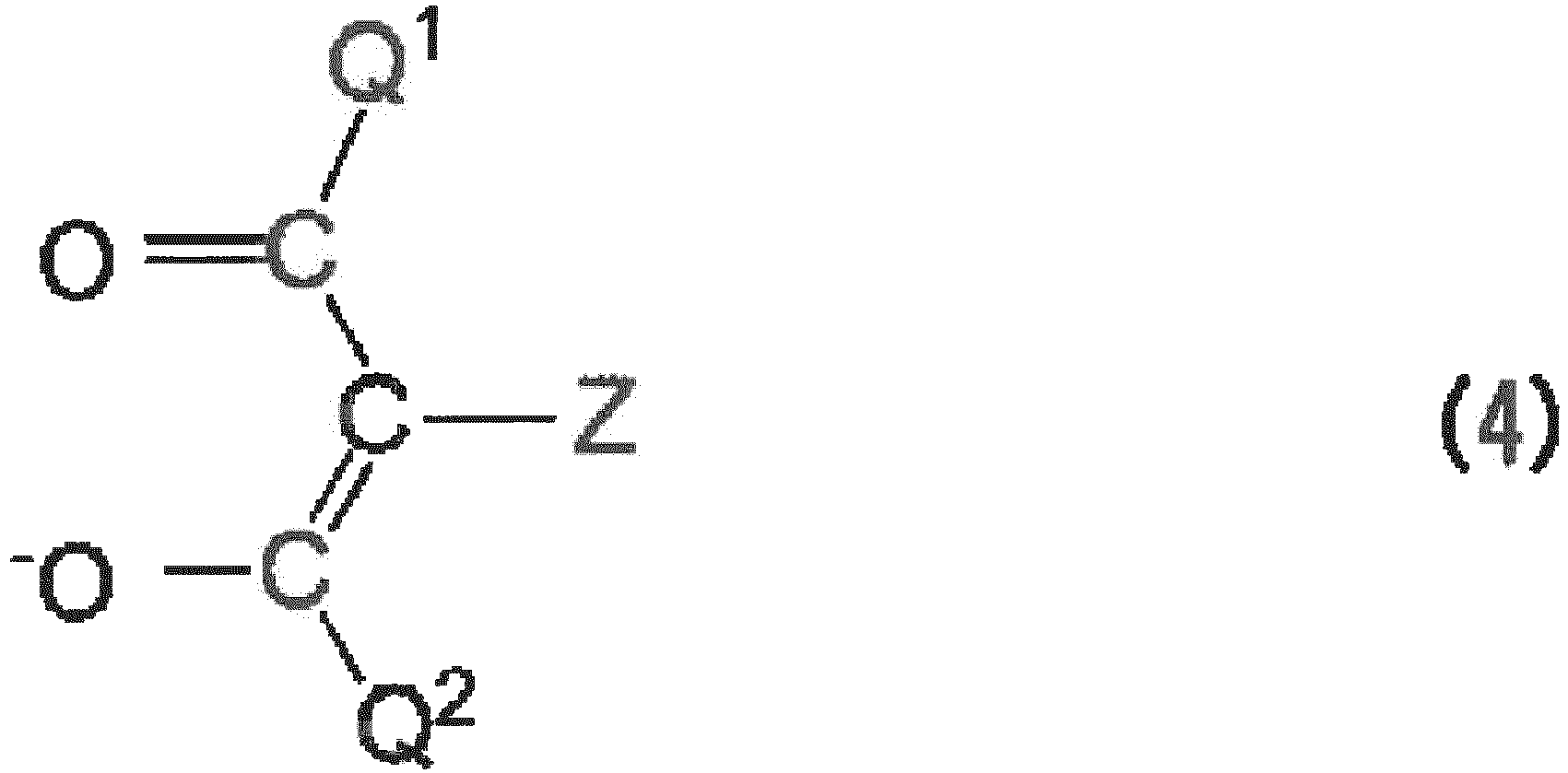
- an authenticity determination method wherein the rare-earth complex or complexes contain a ⁇ -diketone ligand represented by the following general formula (4) as the organic ligand: in the general formula (4), Q 1 and Q 2 are each independently a hydrocarbon group optionally containing a substituent group or an aromatic heterocyclic group optionally containing a substituent group, and Z is a hydrogen atom or a deuterium atom.
- an authenticity determination method wherein the rare-earth complex or complexes contain Eu 3+ and Tb 3+ as the trivalent rare-earth ions.
- the rare-earth complex or complexes contain, as the trivalent rare-earth ions, 1 mol or more and 300 mol or less of Tb 3+ with respect to 1 mol of Eu 3+ .
- an authenticity determination method using an ink composition configured to emit fluorescence by irradiation of constant wavelength light other than visible light and configured to cause a change in emitted light color by heat is provided.
- the ink composition of the disclosed embodiments is an ink composition comprising one or two or more kinds of rare-earth complexes containing trivalent rare-earth ions and at least one organic ligand selected from a ⁇ -diketone ligand, a carboxylic acid ligand, a phosphine oxide ligand and a nitrogen-containing aromatic heterocyclic ligand, wherein at least one selected from the following group A and at least one selected from the following group B are contained as the trivalent rare-earth ions contained in the one or two or more kinds of rare-earth complexes:
- the ink composition of the disclosed embodiments is an ink composition configured to emit fluorescence by irradiation of constant wavelength light other than visible light and configured to cause a change in emitted light color by heat. The reason is not entirely clear; however, it is estimated as follows.
- the ink composition of the disclosed embodiments contains one or two or more kinds of rare-earth complexes containing the above-specified organic ligand, and as the trivalent rare-earth ions contained in the one or two or more kinds of rare-earth complexes, it contains at least one selected from the above-specified group A and at least one selected from the above-specified group B.
- a rare-earth complex is invisible under visible light and emits fluorescence by irradiation of constant wavelength light other than visible light.
- a rare-earth complex causes thermal deactivation processes such as thermal vibration deactivation and inverse energy transfer to the ligand, depending on temperature. These thermal deactivation processes differ in behavior depending on the trivalent rare-earth ions or on the ligand used. Accordingly, by selecting the trivalent rare-earth ions to include at least one selected from the above-specified group A and at least one selected from the above-specified group B and combining them, the one or two or more kinds of rare-earth complexes emit light in different wavelength regions.
- the rare-earth complex or complexes containing the combination of the rare-earth ions emitting light in different wavelength regions a difference is made in the level of change in each light emission intensity with respect to temperature.
- the difference between the changes in the light emission intensity when heat is applied can be recognized as a change in the emitted light color.
- a difference can be made in the light emission intensity by activating energy transfer between the different metals via the ligand by temperature.
- the trivalent rare-earth ions one or two or more kinds of rare-earth complexes including at least one selected from the above-specified group A, at least one selected from the above-specified group B, and the above-specified organic ligand, they become the ink composition configured to cause a change in emitted light color by heat.
- the ink layer containing a solidified product of the ink composition that causes a change in emitted light color by heat causes a change in emitted light color by heating the ink layer or frictional heat generated by rubbing the ink layer. Accordingly, due to the unique light emission behavior, the ink composition is high in authenticity determination properties, anticounterfeiting properties, and it is widely applicable for imparting security marking.
- "cause a change in emitted light color by heat” may indicate that the difference between the light emission intensities in the different wavelength regions is controllable by heat.
- the wavelength of the emitted light color is not always necessary to be a wavelength in the visible light region, and it may be a wavelength corresponding to the near infrared region or the near ultraviolet region.
- a detector that can detect light in the wavelength region can be appropriately used.
- a fluorescent substance using the above-specified one or two or more kinds of rare-earth complexes Due to the organic ligand, a fluorescent substance using the above-specified one or two or more kinds of rare-earth complexes has high excitation light absorption efficiency, can efficiently utilize excitation light, and has high light emission intensity compared to inorganic fluorescent substances.
- the fluorescent substance using the above-specified one or two or more kinds of rare-earth complexes is excellent in solubility in organic solvent, dispersibility in medium, and compatibility with resin, there are the following advantages: the ease of preparation of a desired ink composition, the ease of formation of a desired ink layer, and the ease of application to various kinds of security marking.
- examples include electromagnetic waves other than visible light, such as ultraviolet light and infrared light.
- the ink composition of the disclosed embodiment contains the above-specified one or two or more kinds of rare-earth complexes. As needed, the ink composition may further contain other components, as long as the effects of the disclosed embodiments are not impaired.
- the one or two or more kinds of rare-earth complexes used in the ink composition of the disclosed embodiments contain at least one selected from the following group A and at least one selected from the following group B as the trivalent rare-earth ions:
- the absolute value of the difference between the wavelength ( ⁇ 1) at which the light emission intensity of the rare-earth complex or complexes containing the rare-earth ion of the group A is maximum and the wavelength ( ⁇ 2) at which the light emission intensity of the rare-earth complex or complexes containing the rare-earth ion of the group B is maximum, is 50 nm or more.
- the difference between the changes in the light emission intensity when heated can be recognized as the change in the emitted light color.
- the wavelength of the emitted light color include a wavelength corresponding to a region other than the visible light region, such as the near infrared region or the near ultraviolet region
- the change in the emitted light color can be recognized by, as described above, appropriately using the detector that can detect light in the wavelength region.
- the emitted light color before and after heating can be controlled by appropriately changing the ratio of the rare-earth ion of the group A to the rare-earth ion of the group B.
- the ratio of the rare-earth ion of the group A to the rare-earth ion of the group B For example, with respect to 1 mol of the rare-earth ion of the group A, 1 mol or more and 300 mol or less of the rare-earth ion of the group B may be contained.
- the rare-earth complex or complexes preferably contain Eu 3+ and Tb 3+ as the trivalent rare-earth ions, from the point of view that the difference between the changes in the light emission intensity when heated, is large, and the visibility of the change in the emitted light color is high. Since the metal-ligand inverse energy transfer property of Tb 3+ is remarkable, the visibility of the change in the emitted light color easily becomes high when Tb 3+ is contained.
- the rare-earth complex or complexes when the rare-earth complex or complexes contain Eu 3+ and Tb 3+ as the trivalent rare-earth ions, the rare-earth complex or complexes preferably contain 1 mol or more and 300 mol or less of Tb 3+ with respect to 1 mol of Eu 3+ , from the point of view that the visibility of the change in the emitted light color is increased.
- the excitation light absorbed by the rare-earth complex or complexes is passed from the ligand to the rare-earth ion and converted into light-emitting light energy. Since the rare-earth complex or complexes contain the above-described organic ligand, the light energy of the excitation light absorbed by the rare-earth complex or complexes can be efficiently supplied to the rare-earth ion, and in the rare-earth ion, the energy of the supplied light can be converted into the light-emitting light energy with high efficiency.
- a ligand different from at least one organic ligand selected from a ⁇ -diketone ligand, a carboxylic acid ligand, a phosphine oxide ligand and a nitrogen-containing aromatic heterocyclic ligand may be contained as long as the effects of the disclosed embodiments are not impaired.
- the organic ligand preferably contains an anionic ligand, and it more preferably contains at least one of a ⁇ -diketone ligand and a carboxylic acid ligand.
- a ⁇ -diketone ligand is preferred since, due to its high absorption coefficient, the energy of the excitation light can be efficiently supplied to the coordinated rare-earth ion, and the light emission intensity is increased.
- the carbon atom substituted with a halogen atom such as a C-X bond (where X is a halogen atom; F, Cl, Br and I), contains a low-vibration framework (a C-X bond). Accordingly, as with the above, the light emission efficiency is increased, and the light emission intensity is increased.
- a halogen atom such as a C-X bond
- examples include a perhalogenated alkyl group such as a trifluoromethyl group.
- the organic ligand at least one anionic ligand of a ⁇ -diketone ligand and a carboxylic acid ligand, and at least one of a phosphine oxide ligand and a nitrogen-containing aromatic heterocyclic ligand are contained.
- at least one anionic ligand of a ⁇ -diketone ligand and at least one of a phosphine oxide ligand and a nitrogen-containing aromatic heterocyclic ligand are contained.
- the carbon atom substituted with a halogen atom is further contained in the organic ligand of these combinations.
- examples include a ⁇ -diketone ligand represented by the following general formula (4): in the general formula (4), Q 1 and Q 2 are each independently a hydrocarbon group optionally containing a substituent group or an aromatic heterocyclic group optionally containing a substituent group, and Z is a hydrogen atom or a deuterium atom.
- examples include an aromatic hydrocarbon group, an aliphatic hydrocarbon group and a combination thereof.
- examples include a saturated or unsaturated, straight, branched or cyclic aliphatic hydrocarbon group.
- aromatic hydrocarbon group examples include, but are not limited to, an aromatic hydrocarbon group containing 6 to 22 carbon atoms, and further an aromatic hydrocarbon group containing 6 to 14 carbon atoms, such as a phenyl group, a naphthyl group, a biphenyl group, a phenanthryl group and a dibenzo[c,g]phenanthryl group.
- aliphatic hydrocarbon group is a saturated linear, branched or cyclic aliphatic hydrocarbon group
- examples include a saturated linear, branched or cyclic aliphatic hydrocarbon group containing 1 to 20 carbon atoms, and further a saturated linear, branched or cyclic aliphatic hydrocarbon group containing 1 to 10 carbon atoms.
- saturated linear, branched or cyclic aliphatic hydrocarbon groups examples include, but are not limited to, alkyl and cycloalkyl groups such as a methyl group, an ethyl group, a propyl group, a butyl group, a pentyl group, a hexyl group, an octyl group, an isopropyl group, a tert-butyl group, a 2-ethylhexyl group, a cyclopentyl group, a cyclohexyl group and a cyclooctyl group.
- alkyl and cycloalkyl groups such as a methyl group, an ethyl group, a propyl group, a butyl group, a pentyl group, a hexyl group, an octyl group, an isopropyl group, a tert-butyl group, a 2-ethylhe
- aliphatic hydrocarbon group is an unsaturated linear, branched or cyclic aliphatic hydrocarbon group
- examples include an unsaturated linear, branched or cyclic aliphatic hydrocarbon group containing 2 to 20 carbon atoms, and further an unsaturated linear, branched or cyclic aliphatic hydrocarbon group containing 2 to 10 carbon atoms.
- examples include, but are not limited to, alkenyl, cycloalkenyl and alkynyl groups such as a vinyl group, an allyl group, a butenyl group, a pentenyl group, a hexenyl group, an octenyl group, a decenyl group, an isopropenyl group, an isobutenyl group, an isopentenyl group, a 2-ethylhexenyl group, a cyclopentenyl group, a cyclohexenyl group, an ethynyl group, a propynyl group and a butynyl group.
- alkenyl, cycloalkenyl and alkynyl groups such as a vinyl group, an allyl group, a butenyl group, a pentenyl group, a hexenyl group, an octenyl group, a decenyl group, an
- aromatic and aliphatic hydrocarbon groups examples include, but are not limited to, aralkyl groups such as a benzyl group, a phenethyl group, a naphthylmethyl group and a biphenylmethyl group.
- aromatic heterocyclic group examples include, but are not limited to, an aromatic heterocyclic group containing 2 to 20 carbon atoms forming a ring and containing at least one heteroatom selected from O (an oxygen atom), S (a sulfur atom), N (a nitrogen atom), further an aromatic heterocyclic group containing 2 to 10 carbon atoms forming a ring, and further a 4- to 7-membered, aromatic heterocyclic group.
- aromatic heterocyclic groups examples include, but are not limited to, a pyridyl group, a thienyl group, a furyl group, a pyrazolyl group, an imidazolyl group, a benzofuranyl group, and a quinolyl group.
- the hydrocarbon group and the aromatic heterocyclic group may contain a substituent group such as a deuterium atom, a halogen atom (F, Cl, Br and I), a hydroxyl group, a nitro group, an amino group, a sulfonyl group, a cyano group, a silyl group, a phosphonic acid group, a diazo group and a mercapto group.
- a substituent group such as a deuterium atom, a halogen atom (F, Cl, Br and I), a hydroxyl group, a nitro group, an amino group, a sulfonyl group, a cyano group, a silyl group, a phosphonic acid group, a diazo group and a mercapto group.
- the hydrocarbon group and the aromatic heterocyclic group may contain a substituent group such as an alkoxy group containing 1 to 10 carbon atoms, an alkoxycarbonyl group containing 1 to 10 carbon atoms, an alkylcarbonyl group containing 1 to 10 carbon atoms, and an alkylcarbonyloxy group containing 1 to 10 carbon atoms.
- aromatic hydrocarbon group and the aromatic heterocyclic group may be substituted with an alkyl group containing to 10 carbon atoms, an alkyl halide group containing 1 to 10 carbon atoms.
- a halogen atom is contained as a substituent group and a C-X bond (where X is a halogen atom; F, Cl, Br and I) is contained, a low-vibration framework is obtained. Accordingly, it is preferable to contain the structure from the point of view that it functions to prevent the vibrational deactivation of the energy received by the rare-earth metal, increase light emission efficiency and increase light emission intensity.
- Q 1 and Q 2 are each independently preferably one or more selected from the group consisting of an aliphatic hydrocarbon group containing 1 to 20 carbon atoms, a perhalogenated aliphatic hydrocarbon group containing 1 to 20 carbon atoms, an aromatic hydrocarbon group containing 6 to 22 carbon atoms, a perhalogenated aromatic hydrocarbon group containing 6 to 22 carbon atoms, an aromatic heterocyclic group containing 2 to 10 carbon atoms forming a ring, and a perhalogenated aromatic heterocyclic group containing 2 to 10 carbon atoms forming a ring, and more preferably one or more selected from the group consisting of an aliphatic hydrocarbon group containing 3 to 6 carbon atoms, a perhalogenated aliphatic hydrocarbon group containing 1 to 20 carbon atoms, an aromatic hydrocarbon group containing 6 to 22 carbon atoms, and an aromatic heterocyclic group containing 2 to 10 carbon atoms forming a ring.
- Z in the general formula (4) may be a hydrogen atom H or a deuterium atom D.
- Z is preferably a hydrogen atom H.
- a deuterium substitution reaction is caused by the action of a deuterating agent on the rare-earth metal complex in which Z is H, thereby obtaining a deuterated complex (a complex in which Z is a deuterium atom D).
- the deuterating agent contains, for example, a deuterium-containing protic compound, more specifically, deuterated water; deuterated alcohol such as deuterated methanol and deuterated ethanol; deuterated chloride; and deuterated alkali.
- a base agent such as trimethylamine and triethylamine and additives may be added.
- ⁇ -diketone ligand examples include, but are not limited to, a ligand derived from ⁇ -diketone such as hexafluoroacetylacetone, dibenzoylmethane, 2,2,6,6-tetramethyl-3,5-heptanedione, 4,4,4-trifluoro-1-(2-thienyl)-1,3-butanedione, 4,4,4-trifluoro-1-(2-furanyl)-1,3-butanedione, 4,4,4-trifluoro-1-(3-pyridyl)-1,3-butanedione, 4,4,4-trifluoro-1-phenyl-1,3-butanedione, 4,4,4-trifluoro-1- ⁇ 5-(2-methylthienyl) ⁇ -1,3-butanedione, 4,4,4-trifluoro-1-(2-naphthyl)-1,3-butanedione, and 2,
- carboxylic acid ligand examples include, but are not limited to, a ligand containing a carboxylate group (-COO - ), such as a formic acid (formate) ligand, an acetic acid (acetate) ligand, a propionic acid (propionate) ligand, a citric acid ligand, a salicylic acid ligand, a terephthalic acid ligand, an isophthalic acid ligand, a 2-hydroxyterephthalic acid ligand, a 1,4-naphthalenedicarboxylic acid ligand, a trimesic acid ligand, a 1,3,5-tris(4-carboxyphenyl)benzene ligand and a biphenyl-3,3',5,5'-tetracarboxylic acid ligand.
- a ligand containing a carboxylate group such as a formic acid (formate) ligand, an acetic acid (acetate
- examples include a phosphine oxide ligand represented by the following general formula (5): in the general formula (5), Q 11 and Q 12 are each independently a hydrocarbon group optionally containing a substituent group or an aromatic heterocyclic group optionally containing a substituent group; Q 13 is a divalent organic group; and n' is an integer of from 1 to 20.
- E' is a hydrogen atom or a phosphine oxide group represented by the following general formula (6): in the general formula (6), Q 14 and Q 15 are each independently a hydrocarbon group optionally containing a substituent group or an aromatic heterocyclic group optionally containing a substituent group.
- Q 11 and Q 12 in the general formula (5) and Q 14 and Q 15 in the general formula (6) are each independently a hydrocarbon group optionally containing a substituent group or an aromatic heterocyclic group optionally containing a substituent group.
- the hydrocarbon group optionally containing a substituent group or the aromatic heterocyclic group optionally containing a substituent group may be the same as the hydrocarbon group optionally containing a substituent group or the aromatic heterocyclic group optionally containing a substituent group as Q 1 and Q 2 represented in the general formula (4).
- Q 11 and Q 12 , and Q 14 and Q 15 are each independently preferably at least one selected from the group consisting of an aliphatic hydrocarbon group containing 1 to 20 carbon atoms, a perhalogenated aliphatic hydrocarbon group containing 1 to 20 carbon atoms, an aromatic hydrocarbon group, a perhalogenated aromatic hydrocarbon group, an aromatic heterocyclic group and a perhalogenated aromatic heterocyclic group, and preferably at least one selected from the group consisting of an aliphatic hydrocarbon group containing 1 to 6 carbon atoms, a perhalogenated aliphatic hydrocarbon group containing 1 to 6 carbon atoms, an aromatic hydrocarbon group containing 6 to 22 carbon atoms, and an aromatic heterocyclic group containing 2 to 10 carbon atoms forming a ring.
- Q 13 in the general formula (5) is a divalent organic group.
- the divalent organic group is a group containing at least a carbon atom, is not particularly limited, and may be a group in which a plurality of groups are bound to each other.
- examples include, but are not limited to, a divalent unsaturated group, a divalent aromatic group, an oxyalkylene group and combinations thereof, and another group may be further bound to these groups.
- Q 13 may be a group composed of a plurality of these divalent groups bound to each other, or a group having a polymer structure.
- the divalent organic group in Q 13 in the general formula (5) is preferably a group containing at least one aromatic ring, from the viewpoint of excellent heat resistance, and more preferably a group containing a plurality of aromatic rings.
- Q 13 in the general formula (5) is preferably a divalent group represented by the following general formula (2a), (2b) or (2c) described below, from the viewpoint of excellent heat resistance.
- examples include an alkenylene group such as a vinylene group.
- examples include a divalent aromatic hydrocarbon group and a divalent aromatic heterocyclic group.
- examples include a group having two bonds obtained by removing one hydrogen atom further from a monovalent aromatic hydrocarbon group and a monovalent aromatic heterocyclic group in Q 1 and Q 2 represented in the general formula (4).
- the aromatic ring contained in the divalent aromatic group a benzene ring, a thiophene ring, a pyridine ring, a carbazole ring or the like is preferably used.
- examples include, but are not limited to, an oxymethylene group.
- examples include, but are not limited to, a group in which two or more aromatic rings are bound to each other, and a group composed of polyethylene dioxythiophene (PEDOT) bound to a phosphorus atom at both terminals thereof.
- PEDOT polyethylene dioxythiophene
- substituent group that Q 11 , Q 12 and Q 13 in the general formula (5) and Q 14 and Q 15 in the general formula (6) optionally contain, examples include, but are not limited to, a hydrocarbon group containing 1 to 20 carbon atoms, a hydroxyl group, a nitro group, an amino group, a sulfonyl group, a cyano group, a silyl group, a phosphonic acid group, a diazo group and a mercapto group.
- the hydrocarbon group containing 1 to 20 carbon atoms as the substituent group is preferably an aliphatic hydrocarbon group, and more preferably an aliphatic hydrocarbon group containing 1 to 10 carbon atoms.
- E' in the general formula (5) is the phosphine oxide group represented by the general formula (6)
- the phosphine oxide ligand represented by the general formula (5) becomes a bidentate ligand, and a rare-earth complex containing a crosslinked structure formed by coordinating the phosphine oxide ligand to the two rare-earth ions, can be formed.
- the rare-earth complex containing the crosslinked structure may be referred to as "complex polymer".
- the two rare-earth ions to which the phosphine oxide bidentate ligand is coordinated may be the same or different, may be two of at least one rare-earth ion selected from the group A, may be two of at least one rare-earth ion selected from the group B, may be one of at least one rare-earth ion selected from the group A and one of at least one rare-earth ion selected from the group B.
- the phosphine oxide ligand is preferably a phosphine oxide ligand represented by the following general formula (1), among the phosphine oxide ligands represented by the general formula (5):
- Ar 1 and Ar 2 in the general formula (1) and Ar 4 and Ar 5 in the general formula (3) are each independently a monovalent aromatic group optionally containing a substituent group.
- examples include an aromatic hydrocarbon group and an aromatic heterocyclic group.
- the aromatic hydrocarbon group and the aromatic heterocyclic group may be the same as the aromatic hydrocarbon group and the aromatic heterocyclic group in Q 1 and Q 2 represented in the general formula (4).
- aromatic group of Ar 1 and Ar 2 in the general formula (1) and Ar 4 and Ar 5 in the general formula (3) examples include, but are not limited to, a phenyl group, a naphthyl group, a biphenyl group, a phenanthryl group, a dibenzo[c,g]phenanthryl group, a pyridyl group and a thienyl group.
- aromatic group of Ar 1 and Ar 2 in the general formula (1) and Ar 4 and Ar 5 in the general formula (3) a phenyl group, a pyridyl group or a thienyl group is preferred, and a phenyl group is particularly preferred.
- substituent group that Ar 1 and Ar 2 in the general formula (1) and Ar 4 and Ar 5 in the general formula (3) optionally contain, and as the monovalent substituent group as R 1 , examples include, but are not limited to, a hydrocarbon group containing 1 to 20 carbon atoms, a hydroxyl group, a nitro group, an amino group, a sulfonyl group, a cyano group, a silyl group, a phosphonic acid group, a diazo group, and a mercapto group.
- R 2 in the general formula (1) is a hydrogen atom or a hydrocarbon group.
- the hydrocarbon group examples include an aliphatic hydrocarbon group and an aromatic hydrocarbon group. These hydrocarbon groups may be the same as the hydrocarbon group in Q 1 and Q 2 in the general formula (4).
- the hydrocarbon group of R 2 in the general formula (1) is preferably at least one selected from the group consisting of a phenyl group and an aliphatic hydrocarbon group containing 1 to 10 carbon atoms.
- m is an integer of from 0 to a number of substitutable sites of a ring to which R 1 is bound.
- m is preferably an integer of from 0 to 2, and more preferably 0.
- n is 1 or 2.
- Ar 3 is a divalent group represented by the general formula (2c)
- n is preferably 1.
- E is a hydrogen atom or a phosphine oxide group represented by the general formula (3).
- the phosphine oxide ligand represented by the general formula (1) becomes a bidentate ligand, and a rare-earth complex containing a crosslinked structure formed by coordinating the phosphine oxide bidentate ligand to the two rare-earth ions, can be formed.
- a nitrogen-containing aromatic heterocyclic compound constituting the nitrogen-containing aromatic heterocyclic ligand a ring assembly compound, a condensed ring compound are included besides a monocyclic compound.
- the number of atoms constituting the aromatic ring is generally from 5 to 30, and preferably from 5 to 18. From the viewpoint of availability and excellent performance, one containing 6 to 10 atoms is particularly preferred.
- nitrogen-containing aromatic heterocyclic compound examples include, but are not limited to, pyridine, 2-methylpyridine, 2,4,6-trimethylpyridine, 4-dimethylaminopyridine, 2,6-lutidine, pyrimidine, pyridazine, pyrazine, oxazole, isooxazole, thiazole, isothiazole, imidazole, 1,2-dimethylimidazole, 3-(dimethylamino)propylimidazole, pyrazole, furazan, pyrazine, quinoline, isoquinoline, purine, 1H-indazole, quinazoline, cinnoline, quinoxaline, phthalazine, pteridine, phenanthridine, 2,6-di-t-butylpyridine, 2,2'-bipyridine, 4,4'-dimethyl-2,2'-bipyridyl, 4,4'-dimethyl-2,2'--d
- phenanthrolines and pyridines that become the bidentate ligand are preferably used, such as 1,10-phenanthroline, 2-2'-bipyridyl, 2-2'-6,2"-terpyridyl, 2,7-dimethyl-1,10-phenanthroline, 5,6-dimethyl-1,10-phenanthroline, 4,7-diphenyl-1,10-phenanthroline, and 2-(2-pyridyl)benzimidazole.
- the rare-earth complex or complexes preferably contain a phosphine oxide bidentate ligand and a crosslinked structure formed by coordinating the phosphine oxide bidentate ligand to the at least one rare-earth ion selected from the group A and the at least one rare-earth ion selected from the group B.
- a crosslinked structure is contained, the light emission intensity is increased, and the energy transfer between the metals via the bidentate ligand is activated by temperature, whereby a difference in the light emission intensity is likely to be made, and a color difference in the emitted light color is likely to be remarkable.
- the rare-earth complex or complexes contain a phosphine oxide bidentate ligand and the phosphine oxide bidentate ligand is a phosphine oxide bidentate ligand represented by the general formula (1) where E is the phosphine oxide group represented by the general formula (3), is more preferred from the viewpoint of excellent light resistance and excellent solvent resistance. Since conventional rare-earth complexes with high light emission intensity are soluble in solvents, they have problems in that poor solvent resistance is obtained when they are formed into an ink composition or printed product, and they are not suitable for the purpose of security of medical management labels, etc., which are used in scenes such as a medical setting where alcohols and organic solvents are used.
- the rare-earth complex or complexes containing the phosphine oxide bidentate ligand represented by the general formula (1) where E is the phosphine oxide group represented by the general formula (3) are insoluble in alcohols such as methanol and ethanol and organic solvents such as acetone, ethyl acetate, hexane and dichloromethane, the ink composition that contains the rare-earth complex or complexes containing the bidentate phosphine oxide ligand, obtains high solvent resistance when it is formed into a printed product; it is usable for the purpose of security in scenes where organic solvents are used; and it prevents counterfeiting using solvents.
- examples include at least one of a rare-earth complex containing a repeating unit represented by the following general formula (7) and a rare-earth complex represented by the following general formula (8).
- a rare-earth complex containing a repeating unit represented by the following general formula (7) when the rare-earth complex containing a repeating unit represented by the following general formula (7) is contained, a printed product with excellent heat resistance, light resistance and solvent resistance can be produced.
- Ln 3+ is a trivalent rare-earth ion and is at least one selected from the group A and the group B;
- Ar 1 , Ar 2 and Ar 3 are the same as the general formula (1);
- Ar 4 and Ar 5 are the same as the general formula (3);
- Q 1 , Q 2 and Z are the same as the general formula (4);
- a plurality of Ar 1 , Ar 2 , Ar 3 , Ar 4 and Ar 5 , and Ln 3+ , Q 1 , Q 2 and Z may be the same or different.
- Ln 3+ of the general formula (7) contains at least one rare-earth ion selected from the group A and at least one rare-earth ion selected from the group B, it contains a crosslinked structure formed by coordinating the phosphine oxide bidentate ligand in the general formula (7) to the at least one rare-earth ion selected from the group A and the at least one rare-earth ion selected from the group B.
- This is preferred from the point of view that a difference in the light emission intensity is likely to be made, and the color change of the emitted light color is likely to be remarkable.
- Ln 3+ is a trivalent rare-earth ion and is one kind selected from the group A and the group B; Ar 1 , Ar 2 and Ar 3 are the same as the general formula (1); Q 1 , Q 2 and Z are the same as the general formula (4): n1 is an integer of from 1 to 5; and n2 is an integer of from 1 to 4.
- n1 is preferably 1 or 2
- n2 is preferably 2, 3 or 4. It is particularly preferable that n1 is 2 and n2 is 3.
- the rare-earth complex or complexes can be synthesized by the following method, for example: a rare-earth metal compound, which is a raw material for the rare-earth ion, and a compound to be formed into the ligand are mixed in a solvent capable of dissolving or dispersing them, in the presence of a catalyst, as needed, thereby synthesizing the rare-earth complex.
- a solvent a mixture of solvents that are suitable for the rare-earth metal compound and for the compound to be formed into the ligand, may be used.
- a mixed solvent of dichloromethane and methanol may be used.
- the catalyst for example, trimethylamine, lithium hydroxide, etc., may be added as needed.
- the ink composition may further contain other components, without impairing the effects of the disclosed embodiments.
- examples include, but are not limited to, a vehicle, known assistant agents used in ink and printing, such as a dispersant, a crosslinking agent, a drying promoter, a polymerization inhibitor, a wax, an extender pigment, a colorant, a drying inhibitor, an antioxidant, a smoothing aid, an anti-offset agent, a defoaming agent or a surfactant.
- a dispersant such as a crosslinking agent, a drying promoter, a polymerization inhibitor, a wax, an extender pigment, a colorant, a drying inhibitor, an antioxidant, a smoothing aid, an anti-offset agent, a defoaming agent or a surfactant.
- a vehicle is a medium capable of forming a coating film when the rare-earth complex or complexes are dispersed and used for coating or printing.
- the vehicle used in the disclosed embodiments may contain known vehicle components used in ink, such as a resin, a solvent and a photocurable component.
- the resin contained in the vehicle may be appropriately selected from known resins and used.
- a known resin used in ink may be used, or a resin contained in an oil-based ink or UV ink may be used.
- the resin may be a natural resin or a synthetic resin, and it may be a homopolymer or a copolymer.
- the resin is preferably a solid.
- the natural resin examples include, but are not limited to, rosin, amber, shellac and gilsonite.
- synthetic resin examples include, but are not limited to, rosin, a phenolic resin, a modified alkyd resin, a polyester resin, a petroleum resin, a maleic acid resin (e.g., a rosin-modified maleic acid resin), a cyclized rubber, an acrylic resin, a one-component urethane resin, a two-component urethane resin, and other synthetic resins.
- rosin e.g., a rosin-modified maleic acid resin
- a cyclized rubber e.g., an acrylic resin, a one-component urethane resin, a two-component urethane resin, and other synthetic resins.
- a water-based ink for example, a watersoluble resin, a colloidal dispersion resin, an emulsion resin or the like may be contained.
- the above-mentioned resins may be used solely or in combination of two or more kinds.
- the solvent contained in the vehicle may be appropriately selected from known solvents and used.
- solvent examples include, but are not limited to, an organic solvent, a drying oil, a semidrying oil, a mineral oil and water.
- the photocurable component contained in the vehicle may be appropriately selected from known photocurable components and used.
- the photocurable component contains a monomer, an oligomer, a photopolymerization initiator, etc.
- examples include a compound containing an ethylenically unsaturated bond, which has been used for photopolymerization.
- the oligomer can be obtained by oligomerizing a compound containing an ethylenically unsaturated bond.
- examples include, but are not limited to, a (meth)acrylic acid-based compound; a maleic acid-based compound; and a compound containing an ethylenically unsaturated double bond modified with a urethane-, epoxy-, polyester-, polyol- or vegetable oil-based compound.
- the photopolymerization initiator is a compound capable of producing a radical (e.g., active oxygen) by UV irradiation, for example.
- the photopolymerization initiator may be appropriately selected from known photopolymerization initiators used for printing and then may be incorporated.
- the total content ratio of the rare-earth complex or complexes with respect to the total solid content of the ink composition is preferably 1% by mass or more, more preferably 3% by mass or more, and even more preferably 5% by mass or more, from the viewpoint of light emission intensity.
- the total content ratio of the rare-earth complex or complexes is preferably 60% by mass or less, more preferably 50% by mass or less, and even more preferably 40% by mass or less.
- the "solid content" means components other than the solvent.
- the ratio of the solid content derived from the above-mentioned other components with respect to the total solid content of the ink composition is preferably 99% by mass or less, more preferably 97% by mass or less, and even more preferably 95% by mass or less, from the viewpoint of light emission intensity.
- the ratio of the solvent with respect to the total amount of the ink composition containing the solvent is appropriately controlled depending on a printing method, and is not particularly limited. From the viewpoint of printing properties, it is preferably 5% by mass or more and 80% by mass or less, and more preferably 10% by mass or more and 60% by mass or less.
- the method for producing the ink composition of the disclosed embodiments is not particularly limited, as long as it is a method by which the above-described ink composition of the disclosed embodiments is obtained.
- the ink composition can be produced by mixing the rare-earth complex or complexes and the other components such as the vehicle in a desired order and dispersing them.
- the mixing and dispersion of the components may be carried out by, for example, a mixer such as a uniaxial mixer and a biaxial mixer, or an ink mill such as a three-roller mill, a beads mill, a ball mill, a sand grinder and an attritor.
- the ink composition of the disclosed embodiments is invisible in visible light, emits fluorescence by irradiation with excitation light other than visible light, and causes a change in emitted light color by heat. Accordingly, due to its unique light emission characteristics, it is preferably used for authenticity determination purposes, anti-counterfeiting purposes, and various kinds of security purposes.
- the printed product of the disclosed embodiments is a printed product comprising an ink layer containing a solidified product of the ink composition of the disclosed embodiments.
- FIG. 1 is a schematic sectional view of an example of the printed product of the disclosed embodiments.
- a printed product 1 comprises an ink layer 11 on one surface of a substrate 10.
- the ink layer 11 is a layer containing a solidified product of the ink composition of the disclosed embodiments, and it is formed by use of the ink composition of the disclosed embodiments.
- the printed product 1 of the disclosed embodiments may comprise one or more ink layers 11.
- the compositions of the ink compositions forming the ink layers may be the same or different.
- the ink layer 11 may have a desired pattern.
- the printed product of the disclosed embodiments comprises at least the ink layer. As needed, it may further comprise a substrate for supporting the ink layer, and other layers, as long as the effect of the disclosed embodiments are not impaired.
- the ink layer of the printed product of the disclosed embodiments is the ink layer containing the solidified product of the ink composition of the disclosed embodiments. That is, it is the ink layer formed with the ink composition of the disclosed embodiments.
- the "solidified product” means a product solidified through or not through a chemical reaction.
- the solidified product examples include, but are not limited to, a cured product cured by a curing reaction, a product solidified by drying, and a product solidified by cooling a thermoplastic resin.
- the ink layer can be formed by applying the ink composition of the disclosed embodiments on a substrate serving as a support and solidifying the applied ink composition.
- the ink composition can be applied by a known applying method such as, but not limited to, flexographic printing, letterpress printing, offset printing, intaglio printing, gravure printing, screen printing or inkjet printing, or by a common coating method such as spin coating, casting, microgravure coating, gravure coating, bar coating, roll coating, wire bar coating, dip coating or spray coating.
- a known applying method such as, but not limited to, flexographic printing, letterpress printing, offset printing, intaglio printing, gravure printing, screen printing or inkjet printing, or by a common coating method such as spin coating, casting, microgravure coating, gravure coating, bar coating, roll coating, wire bar coating, dip coating or spray coating.
- the method for solidifying the ink composition is appropriately selected depending on the components contained in the ink composition and is not particularly limited.
- the solidifying method examples include, but are not limited to, the following methods: when the ink composition contains a solvent, the method of removing the solvent by drying; when the ink composition contains a photocurable component, the method of curing the photocurable component by light irradiation; when the ink composition contains a heat-curable component, the method of drying the heat-curable component by heating; when the ink composition contains a thermosetting resin, the method of dissolving the thermosetting resin in a solvent and then removing the solvent, or the method of melting the thermosetting resin and solidifying the melted resin by cooling; and combinations thereof.
- the ink layer may be formed on one entire surface or both entire surfaces of the substrate, and it may be formed in a pattern.
- the ink layer contains the solidified product of the ink composition of the disclosed embodiments, can be confirmed by taking a sample material from the ink layer and analyzing the sample material.
- examples include mass spectrometry (e.g., ESI-Mass), NMR, IR, inductively coupled plasma atomic emission spectroscopy, atomic absorption spectrometry, X-ray fluorescence spectrometry, X-ray absorption fine structure (XAFS) analysis, and combinations thereof.
- the analysis of the rare-earth metal can be carried out by use of multi-element inductively coupled plasma atomic emission spectrometer ICPE-9000 manufactured by Shimadzu Corporation, for example.
- examples include, but are not limited to, papers such as a wood free paper, an art paper, a coated paper, a cast-coated paper, a synthetic resin- or emulsion-impregnated paper, a synthetic rubber latex-impregnated paper, a synthetic resin-added paper and a cellulose fiber paper; plastic sheets of various kinds of synthesis resins such as polyolefin (e.g., polyethylene, polypropylene, etc.), polystyrene, polycarbonate, polyethylene terephthalate, polyvinyl chloride and polymethacrylate; and white non-transparent films formed by adding a white pigment or a filler to these synthesis resins and forming the resins in the form of a film, or a film composed of a substrate containing microvoids therein (a so-called synthetic paper).
- the substrate is not needed to be in a film or sheet form, and it may be a molded resin product having a three-dimensional structure, for example.
- the ink layer emits fluorescence by UV or the like, and a change in the emitted light color is caused by heating. Accordingly, various kinds of information can be managed by, while the ink layer is irradiated with excitation light by an excitation light source, appropriately heating and reading a change in the emitted light color by visual observation or by a detector or the like.
- the printed product 1 of the disclosed embodiments Due to the unique light emission property of the ink layer, the printed product 1 of the disclosed embodiments has high authenticity determination properties and anticounterfeiting properties.
- examples include, but are not limited to, bills, checks, stock certificates, debenture stocks, marketable securities (e.g., various kinds of securities), banknotes, gift certificates, transportation tickets, admission tickets for paid facilities and events, lottery tickets, winning betting tickets for public sports, stamps, cards (e.g., credit cards), passports, ID cards, various kinds of commercial printed products and posters.
- the authenticity determination method of the disclosed embodiments is an authenticity determination method wherein authenticity determination is carried out by a change in emitted light color caused by frictional heat generated by rubbing an ink layer containing a solidified product of the ink composition of the disclosed embodiments.
- FIGS. 2 and 3 are views showing examples of the authenticity determination method of the disclosed embodiments.
- FIG. 2 shows that the ink layer 11 is rubbed by a rubbing tool 14 including a rubbing section 13, while excitation light irradiation 12 is carried out by an excitation light source on the ink layer 11 containing a solidified product of the ink composition of the disclosed embodiments.
- excitation light irradiation 12 is carried out by an excitation light source on the ink layer 11 containing a solidified product of the ink composition of the disclosed embodiments.
- FIG. 3 shows that only a rubbed section 15 causes a change in emitted light color by frictional heat generated by rubbing. Due to the unique light emission property of the ink layer, the authenticity determination method of the disclosed embodiments has high authenticity determination properties.
- a rubbing tool including a rubbing section in which frictional heat is generated by rubbing, may be used.
- the rubbing section examples include a section made of a low-wearing, elastic material.
- a rubbing section such as a rubber section of a commercially-available thermochromic writing material, may be used.
- a difference between light emission intensities in different wavelength ranges controlled by heat may be detected by various kinds of detectors depending on the wavelengths.
- thermochromic light-emitting material of the disclosed embodiments contains trivalent rare-earth ions and a phosphine oxide bidentate ligand represented by the following general formula (1') and coordinated to the rare-earth ions, and it contains a crosslinked structure formed by coordinating the phosphine oxide bidentate ligand to at least one rare-earth ion selected from the following group A and at least one rare-earth ion selected from the following group B.
- Ar 1 , Ar 2 and Ar 3 in the general formula (1') may be the same as Ar 1 , Ar 2 and Ar 3 in the general formula (1).
- Ar 4 and Ar 5 in the general formula (3) will not be described here, since they are described above.
- thermochromic light-emitting material of the disclosed embodiments contains the phosphine oxide bidentate ligand and a crosslinked structure formed by coordinating the phosphine oxide bidentate ligand to the at least one rare-earth ion selected from the group A and the at least one rare-earth ion selected from the group B.
- thermochromic light-emitting material of the disclosed embodiments is likely to cause a change in the light emission intensities of the different rare-earth ions, since the energy transfer between the different rare-earth ions via the phosphine oxide bidentate ligand is activated by temperature. Accordingly, before and after heating, the thermochromic light-emitting material of the disclosed embodiments causes a difference between the light emission intensity in the wavelength region by the at least one rare-earth ion selected from the group A and the light emission intensity by the at least one rare-earth ion selected from the group B, thereby causing a color change.
- thermochromic light-emitting material of the disclosed embodiments contains the phosphine oxide bidentate ligand and a crosslinked structure formed by coordinating the phosphine oxide bidentate ligand to the at least one rare-earth ion selected from the group A and the at least one rare-earth ion selected from the group B. Accordingly, it is a composite complex polymer containing two or more kinds of rare-earth ions, and it is excellent in heat resistance and excellent in light resistance and solvent resistance.
- thermochromic light-emitting material of the disclosed embodiments contains at least the phosphine oxide bidentate ligand. From the viewpoint of increasing the light emission intensity, it preferably further contains the above-described ⁇ -diketone ligand.
- thermochromic light-emitting material of the disclosed embodiments is the case where, among the rare-earth complexes containing the repeating unit represented by the general formula (7), Ln 3+ of the general formula (7) contains at least one rare-earth ion selected from the group A and at least one rare-earth ion selected from the group B.
- thermochromic light-emitting material of the disclosed embodiments preferably contains Eu 3+ and Tb 3+ as the trivalent rare-earth ions, from the point of view that the difference between the changes in the light emission intensity when heated, is large, and the visibility of the change in the emitted light color is high.
- thermochromic light-emitting material of the disclosed embodiments contains Eu 3+ and Tb 3+ as the trivalent rare-earth ions, it contains 1 mol or more and 300 mol or less of Tb 3+ with respect to 1 mol of Eu 3+ .
- FT/IR-4600 manufactured by Nikon Corporation.
- a 100 mL three-neck flask was frame-dried to replace the inside with argon gas.
- 1.9 g (6.0 mmol) of 4,4'-dibromobiphenyl and 30 mL of tetrahydrofuran (THF) were added and cooled to about -80°C with liquid nitrogen/ethanol.
- 9.3 mL (15 mmol) of a 1.6 M n-butyllithium hexane solution was slowly added with a syringe. This addition was carried out for about 15 minutes. During the addition, a yellow precipitate was produced.
- This solution was stirred at -10°C for 3 hours. Next, the solution was cooled again to -80°C.
- the white powder and about 40 mL of dichloromethane were put in a flask.
- the resulting solution was cooled to 0°C, and a 30% hydrogen peroxide solution (about 5 mL) was added thereto.
- the mixture was stirred for two hours.
- the resulting product was extracted with dichloromethane.
- the extract was washed three times with saturated brine and dried with anhydrous magnesium sulfate.
- the solvent was evaporated with an evaporator, thereby obtaining a white powder.
- the white powder was recrystallized with dichloromethane to obtain a white crystal of 1,4-bis(diphenylphosphoryl)biphenyl.
- Europium acetate which is a raw material for Eu(III) ion, and 1,1,1,5,5-hexafluoro-2,4-pentanedione were mixed to synthesis tris(hexafluoroacetylacetonato(hfa))europium(III) dihydrate.
- terbium acetate which is a raw material for Tb(III) ion, and 1,1,1,5,5-hexafluoro-2,4-pentanedione were mixed to synthesis tris(hexafluoroacetylacetonato)terbium(III) dihydrate.
- the Tb/Eu composite complex polymer contains trivalent rare-earth ions and a phosphine oxide bidentate ligand represented by the general formula (1') and coordinated to the rare-earth ions, and it contains a crosslinked structure formed by coordinating the phosphine oxide bidentate ligand to Eu 3+ , which is at least one rare-earth ion selected from the group A, and Tb 3+ , which is at least one rare-earth ion selected from the group B.
- Tb/Eu composite complex polymers (compounds 2 to 4) in each of which the molar ratio of Tb to Eu (Tb/Eu) is the value shown in Table 1, were synthesized in the same manner as Synthesis Example 1, except that the molar ratio of the tris(hexafluoroacetylacetonato)terbium(III)dihydrate to the tris(hexafluoroacetylacetonato)europium(III) dihydrate was changed to be the Tb/Eu ratio shown in Table 1.
- Tb complex polymer represented by the following chemical formula (a compound 5) was synthesized in the same manner as Synthesis Example 2, except that the raw material complex used was 1 equivalent of the tris(hexafluoroacetylacetonato)terbium(III) dihydrate only.
- TPPO triphenylphosphine oxide
- the powder was purified by recrystallization using a mixed solvent of toluene and hexane, thereby synthesizing a Tb complex [Tb(hfa) 3 (TPPO) 2 ] (a compound 7) represented by the following chemical formula.
- TPPO triphenylphosphine oxide
- the powder was purified by recrystallization using a mixed solvent of toluene and hexane, thereby synthesizing an Eu complex [Eu(hfa) 3 (TPPO) 2 ] (a compound 8) represented by the following chemical formula.
- UV curable vehicle product name: UV BF SG A MEDIUM, manufactured by: DIC Graphics Corporation
- the thus-obtained ink composition was applied to a printing paper with a bar coater. Then, the applied ink composition was photo-cured by UV irradiation, thereby obtaining the printed product of Example 1, which contained an ink layer containing a solidified product of the ink composition.
- Ink compositions were obtained in the same manner as Example 1, except that the compounds 2 to 4 were each used as the light-emitting material, in place of the compound 1.
- An ink composition was obtained in the same manner as Example 1, except that as the light-emitting material, a mixture of 10 parts by weight of the compound 5 and 1 part by weight of the compound 6 was used in place of the compound 1.
- Example 1 Using the obtained ink composition, a printed product was obtained in the same manner as Example 1.
- An ink composition was obtained in the same manner as Example 1, except that as the light-emitting material, a mixture of 10 parts by weight of the compound 7 and 1 part by weight of the compound 8 was used in place of the compound 1.
- Example 1 Using the obtained ink composition, a printed product was obtained in the same manner as Example 1.
- Example 2 An ink composition was obtained in the same manner as Example 1, except that as the light-emitting material, a mixture of 290 parts by weight of the compound 7 and 1 part by weight of a compound 9 represented by the following chemical formula (Eu(TTA)Phen manufactured by Tokyo Chemical Industry Co., Ltd.) was used in place of the compound 1.
- a compound 9 represented by the following chemical formula (Eu(TTA)Phen manufactured by Tokyo Chemical Industry Co., Ltd.) was used in place of the compound 1.
- Example 1 Using the obtained ink composition, a printed product was obtained in the same manner as Example 1.
- An ink composition was obtained in the same manner as Example 1, except that as the light-emitting material, the compound 5 was used in place of the compound 1.
- Example 1 Using the obtained ink composition, a printed product was obtained in the same manner as Example 1.
- Example 1 Using the obtained ink composition, a printed product was obtained in the same manner as Example 1.
- An ink composition was obtained in the same manner as Example 1, except that as the light-emitting material, a mixture of 70 parts by weight of a red light-emitting inorganic oxide (D1124 manufactured by Nemoto Lumi-Materials Co., Ltd., Y 2 O 2 S:Eu) and 30 parts by weight of a green phosphorescent material (GLL-300FF manufactured by Nemoto Lumi-Materials Co., Ltd., SrAl 2 O 4 :Eu,Dy) was used in place of the compound 1.
- a red light-emitting inorganic oxide D1124 manufactured by Nemoto Lumi-Materials Co., Ltd., Y 2 O 2 S:Eu
- GLL-300FF manufactured by Nemoto Lumi-Materials Co., Ltd., SrAl 2 O 4 :Eu,Dy
- Example 1 Using the obtained ink composition, a printed product was obtained in the same manner as Example 1.
- the ink layer of the obtained printed product 1 of each of the examples and the comparative examples was placed on a hot plate 25; while irradiating it by use of a UV (excitation light) irradiation lamp 24 (HANDY UV LAMP SLUV-6 manufactured by AS ONE Corporation), light emission spectra excited at a wavelength of 365 nm at 25°C, 60°C and 90°C were obtained by use of a miniature fiber optic spectrometer 22 (USB2000+ manufactured by Ocean Optics, Inc.); and the emitted light color was checked by visual observation.
- the ink layers of the printed products obtained in Examples 1 to 7 and Comparative Examples 1 to 3 the light emission spectra at 25°C, 60°C and 90°C are shown in FIGS. 5 to 14 .
- Table 2 Emitted light color by temperature and Color change Color change by rubbing 25°C 60°C 90°C Color change
- Example 1 Orange Red Red A
- Example 2 Yellow-orange Orange Red A
- Example 3 Yellow Yellow-orange Orange A
- Example 4 Yellow-green Yellow Yellow-orange A
- Example 5 Yellow-green Yellow Yellow-orange A
- Example 6 Yellow-green Orange Red A
- Example 7 Yellow Yellow-orange Yellow-orange A
Landscapes
- Chemical & Material Sciences (AREA)
- Engineering & Computer Science (AREA)
- Materials Engineering (AREA)
- Organic Chemistry (AREA)
- Life Sciences & Earth Sciences (AREA)
- Wood Science & Technology (AREA)
- Chemical Kinetics & Catalysis (AREA)
- General Chemical & Material Sciences (AREA)
- Inks, Pencil-Leads, Or Crayons (AREA)
Claims (6)
- Procédé de détermination d'authenticité, dans lequel la détermination d'authenticité est effectuée par un changement de couleur lumineuse émise provoqué par de la chaleur frictionnelle générée en frottant une couche d'encre contenant un produit solidifié d'une composition d'encre comprenant un ou deux types ou plus de complexes de terres rares contenant des ions de terres rares trivalents et au moins un ligand organique sélectionné parmi un ligand de β-dicétone, un ligand d'acide carboxylique, un ligand d'oxyde de phosphine et un ligand hétérocyclique aromatique contenant de l'azote,
dans lequel au moins un sélectionné parmi le groupe suivant A et au moins un sélectionné parmi le groupe suivant B sont contenus en tant qu'ions de terres rares trivalents contenus dans le ou les deux types ou plus de complexes de terres rares :Groupe A : Eu3+, Sm3+, Pr3+ et Ho3+Groupe B : Tb3+, Er3+, Tm3+, Dy3+, Yb3+, Nd3+, Ce3+ et Gd3+. - Procédé de détermination d'authenticité selon la revendication 1, dans lequel le complexe ou les complexes de terres rares contiennent un ligand d'oxyde de phosphine représenté par la formule générale suivante (1) en tant que ligand organique :
 dans la formule générale (1), Ar1 et Ar2 sont chacun indépendamment un groupe aromatique monovalent contenant en option un groupe substituant ; Ar3 est un groupe divalent représenté par la formule générale suivante (2a), (2b) ou (2c) ; et n est 1 ou 2 :

 dans les formules générales (2a) à (2c), R1 est chacun indépendamment un groupe substituant monovalent ; X est un atome de soufre ou un atome d'oxygène ; R2 est un atome d'hydrogène ou un groupe hydrocarbure ; m est un entier allant de 0 à un nombre de sites pouvant être substitués d'un anneau auquel R1 est lié ; et lorsqu'il y a une pluralité de R1, ils sont en option identiques ou différents, etdans la formule générale (1), E est un atome d'hydrogène ou un groupe d'oxyde de phosphine représenté par la formule générale suivante (3) :
 dans la formule générale (3), Ar4 et Ar5 sont chacun indépendamment un groupe aromatique monovalent contenant en option un groupe substituant.
 - Procédé de détermination d'authenticité selon la revendication 1 ou 2,
dans lequel le complexe ou les complexes de terres rares contiennent un ligand bidenté d'oxyde de phosphine et une structure réticulée formée en coordonnant le ligand bidenté d'oxyde de phosphine à l'au moins un ion de terres rares sélectionné parmi le groupe A et l'au moins un ion de terres rares sélectionné parmi le groupe B. - Procédé de détermination d'authenticité selon l'une quelconque des revendications 1 à 3, dans lequel le complexe ou les complexes de terres rares contiennent un ligand de β-dicétone représenté par la formule générale suivante (4) en tant que ligand organique :
- Procédé de détermination d'authenticité selon l'une quelconque des revendications 1 à 4, dans lequel le complexe ou les complexes de terres rares contiennent Eu3+ et Tb3+ en tant qu'ions de terres rares trivalents.
- Procédé de détermination d'authenticité selon l'une quelconque des revendications 1 à 5, dans lequel le complexe ou les complexes de terres rares contiennent, en tant qu'ions de terres rares trivalents, 1 mole ou plus et 300 mole ou moins de Tb3+ par rapport à 1 mole de Eu3+.
Applications Claiming Priority (2)
| Application Number | Priority Date | Filing Date | Title |
|---|---|---|---|
| JP2017178248 | 2017-09-15 | ||
| PCT/JP2018/021241 WO2019053963A1 (fr) | 2017-09-15 | 2018-06-01 | Composition d'encre, matière imprimée et procédé de détermination d'authenticité |
Publications (3)
| Publication Number | Publication Date |
|---|---|
| EP3783072A1 EP3783072A1 (fr) | 2021-02-24 |
| EP3783072A4 EP3783072A4 (fr) | 2022-03-23 |
| EP3783072B1 true EP3783072B1 (fr) | 2023-04-12 |
Family
ID=65722594
Family Applications (1)
| Application Number | Title | Priority Date | Filing Date |
|---|---|---|---|
| EP18855472.9A Active EP3783072B1 (fr) | 2017-09-15 | 2018-06-01 | Composition d'encre, produit imprimé et procédé de détermination d'authenticité |
Country Status (5)
| Country | Link |
|---|---|
| US (1) | US20200377748A1 (fr) |
| EP (1) | EP3783072B1 (fr) |
| JP (1) | JP7081603B2 (fr) |
| CN (1) | CN111344361A (fr) |
| WO (1) | WO2019053963A1 (fr) |
Families Citing this family (7)
| Publication number | Priority date | Publication date | Assignee | Title |
|---|---|---|---|---|
| JP6950115B2 (ja) * | 2019-09-19 | 2021-10-13 | 株式会社Dnpファインケミカル | 分散液、インク組成物、及び印刷物 |
| EP3974483B1 (fr) * | 2020-09-29 | 2025-06-25 | Gleitsmann Security Inks GmbH | Encre de sécurité et article de sécurité, tel qu'un billet de banque, présentant un effet tri-luminescent |
| WO2023167278A1 (fr) * | 2022-03-04 | 2023-09-07 | 国立大学法人北海道大学 | Matériau électroluminescent, capteur d'oxygène et matériau de revêtement |
| US20230407121A1 (en) * | 2022-06-17 | 2023-12-21 | The Boeing Company | Phosphor-containing inks for disinfection and improving photostability of synthetic polymers |
| CN115505132B (zh) * | 2022-09-20 | 2023-06-30 | 浙江师范大学 | 一种镝稀土-有机框架材料及其制备方法和应用 |
| CN116396492B (zh) * | 2023-04-12 | 2024-05-28 | 重庆师范大学 | 含不对称结构单元镉基杂化材料及其制法与在制备补光器件中的应用 |
| CN117777787B (zh) * | 2023-12-06 | 2025-09-16 | 河北科技大学 | 一种稀土聚合物发光簇防伪标签的制备方法 |
Family Cites Families (18)
| Publication number | Priority date | Publication date | Assignee | Title |
|---|---|---|---|---|
| JPH06278396A (ja) | 1993-03-26 | 1994-10-04 | Dainippon Printing Co Ltd | 偽造防止印刷物、転写シート、転写シートを用いた偽造防止印刷物の製造方法および偽造防止方法 |
| JPH06297888A (ja) | 1993-04-20 | 1994-10-25 | Dainippon Printing Co Ltd | 偽造防止証書 |
| KR0137342B1 (ko) * | 1994-01-28 | 1998-04-24 | 황원오 | 열감응성 형광물질 및 그 제조방법 |
| JP4185032B2 (ja) * | 2004-09-13 | 2008-11-19 | 株式会社東芝 | 蛍光画像形成物及び蛍光発光インク |
| US8367580B2 (en) * | 2006-03-07 | 2013-02-05 | Ncr Corporation | Dual-sided thermal security features |
| JP4203833B2 (ja) * | 2007-02-07 | 2009-01-07 | 国立大学法人お茶の水女子大学 | 偽造防止印刷用インキ及び偽造防止印刷物 |
| JP5067029B2 (ja) | 2007-06-13 | 2012-11-07 | 大日本印刷株式会社 | 蛍光物質を混入した感温変色インキ及び印刷物 |
| JP5207492B2 (ja) * | 2008-03-04 | 2013-06-12 | 国立大学法人 奈良先端科学技術大学院大学 | 近赤外強発光性希土類錯体 |
| JP2010095514A (ja) * | 2008-09-19 | 2010-04-30 | Nitto Kasei Co Ltd | 鎖状テトラホスフィンテトラオキシド、該鎖状テトラホスフィンテトラオキシドを配位子とする希土類金属錯体、及びその用途 |
| WO2010032395A1 (fr) | 2008-09-19 | 2010-03-25 | 国立大学法人奈良先端科学技術大学院大学 | Nanocristaux de complexe de terre rare et leurs applications |
| JP5713360B2 (ja) * | 2010-03-09 | 2015-05-07 | 国立大学法人 奈良先端科学技術大学院大学 | 円偏光発光性希土類錯体 |
| WO2012150712A1 (fr) * | 2011-05-02 | 2012-11-08 | 国立大学法人北海道大学 | Polymère complexe de terre rare et produit moulé en plastique |
| ES2598053T3 (es) * | 2012-09-28 | 2017-01-25 | Sicpa Holding Sa | Complejo luminiscente de lantánido y artículos y tintas que contienen el complejo luminiscente |
| WO2015002282A1 (fr) * | 2013-07-05 | 2015-01-08 | 国立大学法人北海道大学 | Ligand et complexe de terre rare |
| JP6378010B2 (ja) * | 2013-09-04 | 2018-08-22 | 国立大学法人北海道大学 | 希土類錯体ポリマーとその製造方法、及びプラスチック成形体 |
| JP2016166140A (ja) * | 2015-03-09 | 2016-09-15 | 株式会社レーザーシステム | 希土類錯体及びその製造方法、並びにプラスチック成形体 |
| JP2017137415A (ja) * | 2016-02-03 | 2017-08-10 | 東ソー株式会社 | キラル型希土類錯体ポリマーおよびそれを用いた光学機能材料 |
| CN106978013B (zh) * | 2017-04-06 | 2020-09-15 | 上海云谟信息技术有限公司 | 在不同温度下产生不同荧光的油墨、其制备方法及应用 |
-
2018
- 2018-06-01 JP JP2019541648A patent/JP7081603B2/ja active Active
- 2018-06-01 CN CN201880073241.5A patent/CN111344361A/zh active Pending
- 2018-06-01 WO PCT/JP2018/021241 patent/WO2019053963A1/fr not_active Ceased
- 2018-06-01 US US16/646,312 patent/US20200377748A1/en not_active Abandoned
- 2018-06-01 EP EP18855472.9A patent/EP3783072B1/fr active Active
Also Published As
| Publication number | Publication date |
|---|---|
| JPWO2019053963A1 (ja) | 2020-10-15 |
| WO2019053963A1 (fr) | 2019-03-21 |
| US20200377748A1 (en) | 2020-12-03 |
| CN111344361A (zh) | 2020-06-26 |
| EP3783072A1 (fr) | 2021-02-24 |
| JP7081603B2 (ja) | 2022-06-07 |
| EP3783072A4 (fr) | 2022-03-23 |
Similar Documents
| Publication | Publication Date | Title |
|---|---|---|
| EP3783072B1 (fr) | Composition d'encre, produit imprimé et procédé de détermination d'authenticité | |
| US8481146B2 (en) | Inkjettable polymerizable liquid crystalline mixture | |
| RU2759568C2 (ru) | Применение 4-бора-3a,4a-диаза-s-индаценов для обеспечения безопасности | |
| EP3722379B1 (fr) | Composition d'encre et imprimé | |
| TW201502257A (zh) | 包括可印碼與手性液晶聚合物層的標記 | |
| JP2015516899A (ja) | 高レベルのコーディングを行う多層フレーク | |
| JP7081073B2 (ja) | フォトルミネッセント鉄ドープスズ酸バリウム材料、セキュリティインク組成物及びそれらのセキュリティ特徴 | |
| WO2021074275A1 (fr) | Photo-modulation efficace de la luminescence des ions lanthanide (iii) dans le visible ou le proche infrarouge | |
| TW201501961A (zh) | 防僞疊層 | |
| JP7156289B2 (ja) | インキ組成物及び印刷物 | |
| Correia et al. | Luminescent Poly (vinylidene fluoride)‐Based Inks for Anticounterfeiting Applications | |
| JP6367192B2 (ja) | 配位子及び希土類錯体 | |
| JP6296398B2 (ja) | インクセット及び印刷物並びに印刷方法 | |
| JP7147596B2 (ja) | インキ組成物、印刷物、及び、真贋判定方法 | |
| US10399999B2 (en) | Polymer complex and production process therefor | |
| Luo et al. | Fluorescence-color-tunable and UV shielding waterborne rare earth complexes-polyurethane systems: Chemical bonding or physical mixing? | |
| JP2025156083A (ja) | 発光材料、塗料、印刷物、及び樹脂成形体 | |
| Wang et al. | Regulating aggregation and optical properties of rigid-flexible ligand via metal coordination for multifunctional applications | |
| CN119816501A (zh) | 新型基于蒽醌的nir吸收剂 | |
| HK1209684A1 (en) | Irreversibly magnetically induced images or patterns | |
| HK1209684B (en) | Irreversibly magnetically induced images or patterns |
Legal Events
| Date | Code | Title | Description |
|---|---|---|---|
| STAA | Information on the status of an ep patent application or granted ep patent |
Free format text: STATUS: THE INTERNATIONAL PUBLICATION HAS BEEN MADE |
|
| PUAI | Public reference made under article 153(3) epc to a published international application that has entered the european phase |
Free format text: ORIGINAL CODE: 0009012 |
|
| STAA | Information on the status of an ep patent application or granted ep patent |
Free format text: STATUS: REQUEST FOR EXAMINATION WAS MADE |
|
| 17P | Request for examination filed |
Effective date: 20200319 |
|
| AK | Designated contracting states |
Kind code of ref document: A1 Designated state(s): AL AT BE BG CH CY CZ DE DK EE ES FI FR GB GR HR HU IE IS IT LI LT LU LV MC MK MT NL NO PL PT RO RS SE SI SK SM TR |
|
| A4 | Supplementary search report drawn up and despatched |
Effective date: 20220218 |
|
| RIC1 | Information provided on ipc code assigned before grant |
Ipc: C09D 11/50 20140101ALI20220215BHEP Ipc: B42D 25/387 20140101ALI20220215BHEP Ipc: C09K 11/06 20060101ALI20220215BHEP Ipc: C09D 11/322 20140101ALI20220215BHEP Ipc: C09D 11/037 20140101AFI20220215BHEP |
|
| RIC1 | Information provided on ipc code assigned before grant |
Ipc: C09D 11/50 20140101ALI20220929BHEP Ipc: B42D 25/387 20140101ALI20220929BHEP Ipc: C09K 11/06 20060101ALI20220929BHEP Ipc: C09D 11/322 20140101ALI20220929BHEP Ipc: C09D 11/037 20140101AFI20220929BHEP |
|
| GRAP | Despatch of communication of intention to grant a patent |
Free format text: ORIGINAL CODE: EPIDOSNIGR1 |
|
| STAA | Information on the status of an ep patent application or granted ep patent |
Free format text: STATUS: GRANT OF PATENT IS INTENDED |
|
| INTG | Intention to grant announced |
Effective date: 20221110 |
|
| GRAS | Grant fee paid |
Free format text: ORIGINAL CODE: EPIDOSNIGR3 |
|
| GRAA | (expected) grant |
Free format text: ORIGINAL CODE: 0009210 |
|
| STAA | Information on the status of an ep patent application or granted ep patent |
Free format text: STATUS: THE PATENT HAS BEEN GRANTED |
|
| AK | Designated contracting states |
Kind code of ref document: B1 Designated state(s): AL AT BE BG CH CY CZ DE DK EE ES FI FR GB GR HR HU IE IS IT LI LT LU LV MC MK MT NL NO PL PT RO RS SE SI SK SM TR |
|
| REG | Reference to a national code |
Ref country code: GB Ref legal event code: FG4D |
|
| REG | Reference to a national code |
Ref country code: CH Ref legal event code: EP |
|
| REG | Reference to a national code |
Ref country code: DE Ref legal event code: R096 Ref document number: 602018048411 Country of ref document: DE |
|
| REG | Reference to a national code |
Ref country code: IE Ref legal event code: FG4D |
|
| REG | Reference to a national code |
Ref country code: AT Ref legal event code: REF Ref document number: 1559783 Country of ref document: AT Kind code of ref document: T Effective date: 20230515 |
|
| REG | Reference to a national code |
Ref country code: LT Ref legal event code: MG9D |
|
| REG | Reference to a national code |
Ref country code: NL Ref legal event code: MP Effective date: 20230412 |
|
| REG | Reference to a national code |
Ref country code: AT Ref legal event code: MK05 Ref document number: 1559783 Country of ref document: AT Kind code of ref document: T Effective date: 20230412 |
|
| PG25 | Lapsed in a contracting state [announced via postgrant information from national office to epo] |
Ref country code: NL Free format text: LAPSE BECAUSE OF FAILURE TO SUBMIT A TRANSLATION OF THE DESCRIPTION OR TO PAY THE FEE WITHIN THE PRESCRIBED TIME-LIMIT Effective date: 20230412 |
|
| PG25 | Lapsed in a contracting state [announced via postgrant information from national office to epo] |
Ref country code: SE Free format text: LAPSE BECAUSE OF FAILURE TO SUBMIT A TRANSLATION OF THE DESCRIPTION OR TO PAY THE FEE WITHIN THE PRESCRIBED TIME-LIMIT Effective date: 20230412 Ref country code: PT Free format text: LAPSE BECAUSE OF FAILURE TO SUBMIT A TRANSLATION OF THE DESCRIPTION OR TO PAY THE FEE WITHIN THE PRESCRIBED TIME-LIMIT Effective date: 20230814 Ref country code: NO Free format text: LAPSE BECAUSE OF FAILURE TO SUBMIT A TRANSLATION OF THE DESCRIPTION OR TO PAY THE FEE WITHIN THE PRESCRIBED TIME-LIMIT Effective date: 20230712 Ref country code: ES Free format text: LAPSE BECAUSE OF FAILURE TO SUBMIT A TRANSLATION OF THE DESCRIPTION OR TO PAY THE FEE WITHIN THE PRESCRIBED TIME-LIMIT Effective date: 20230412 Ref country code: AT Free format text: LAPSE BECAUSE OF FAILURE TO SUBMIT A TRANSLATION OF THE DESCRIPTION OR TO PAY THE FEE WITHIN THE PRESCRIBED TIME-LIMIT Effective date: 20230412 |
|
| PG25 | Lapsed in a contracting state [announced via postgrant information from national office to epo] |
Ref country code: RS Free format text: LAPSE BECAUSE OF FAILURE TO SUBMIT A TRANSLATION OF THE DESCRIPTION OR TO PAY THE FEE WITHIN THE PRESCRIBED TIME-LIMIT Effective date: 20230412 Ref country code: PL Free format text: LAPSE BECAUSE OF FAILURE TO SUBMIT A TRANSLATION OF THE DESCRIPTION OR TO PAY THE FEE WITHIN THE PRESCRIBED TIME-LIMIT Effective date: 20230412 Ref country code: LV Free format text: LAPSE BECAUSE OF FAILURE TO SUBMIT A TRANSLATION OF THE DESCRIPTION OR TO PAY THE FEE WITHIN THE PRESCRIBED TIME-LIMIT Effective date: 20230412 Ref country code: LT Free format text: LAPSE BECAUSE OF FAILURE TO SUBMIT A TRANSLATION OF THE DESCRIPTION OR TO PAY THE FEE WITHIN THE PRESCRIBED TIME-LIMIT Effective date: 20230412 Ref country code: IS Free format text: LAPSE BECAUSE OF FAILURE TO SUBMIT A TRANSLATION OF THE DESCRIPTION OR TO PAY THE FEE WITHIN THE PRESCRIBED TIME-LIMIT Effective date: 20230812 Ref country code: HR Free format text: LAPSE BECAUSE OF FAILURE TO SUBMIT A TRANSLATION OF THE DESCRIPTION OR TO PAY THE FEE WITHIN THE PRESCRIBED TIME-LIMIT Effective date: 20230412 Ref country code: GR Free format text: LAPSE BECAUSE OF FAILURE TO SUBMIT A TRANSLATION OF THE DESCRIPTION OR TO PAY THE FEE WITHIN THE PRESCRIBED TIME-LIMIT Effective date: 20230713 Ref country code: AL Free format text: LAPSE BECAUSE OF FAILURE TO SUBMIT A TRANSLATION OF THE DESCRIPTION OR TO PAY THE FEE WITHIN THE PRESCRIBED TIME-LIMIT Effective date: 20230412 |
|
| PG25 | Lapsed in a contracting state [announced via postgrant information from national office to epo] |
Ref country code: FI Free format text: LAPSE BECAUSE OF FAILURE TO SUBMIT A TRANSLATION OF THE DESCRIPTION OR TO PAY THE FEE WITHIN THE PRESCRIBED TIME-LIMIT Effective date: 20230412 |
|
| REG | Reference to a national code |
Ref country code: DE Ref legal event code: R097 Ref document number: 602018048411 Country of ref document: DE |
|
| PG25 | Lapsed in a contracting state [announced via postgrant information from national office to epo] |
Ref country code: SK Free format text: LAPSE BECAUSE OF FAILURE TO SUBMIT A TRANSLATION OF THE DESCRIPTION OR TO PAY THE FEE WITHIN THE PRESCRIBED TIME-LIMIT Effective date: 20230412 |
|
| PG25 | Lapsed in a contracting state [announced via postgrant information from national office to epo] |
Ref country code: MC Free format text: LAPSE BECAUSE OF FAILURE TO SUBMIT A TRANSLATION OF THE DESCRIPTION OR TO PAY THE FEE WITHIN THE PRESCRIBED TIME-LIMIT Effective date: 20230412 |
|
| PG25 | Lapsed in a contracting state [announced via postgrant information from national office to epo] |
Ref country code: SM Free format text: LAPSE BECAUSE OF FAILURE TO SUBMIT A TRANSLATION OF THE DESCRIPTION OR TO PAY THE FEE WITHIN THE PRESCRIBED TIME-LIMIT Effective date: 20230412 Ref country code: SK Free format text: LAPSE BECAUSE OF FAILURE TO SUBMIT A TRANSLATION OF THE DESCRIPTION OR TO PAY THE FEE WITHIN THE PRESCRIBED TIME-LIMIT Effective date: 20230412 Ref country code: RO Free format text: LAPSE BECAUSE OF FAILURE TO SUBMIT A TRANSLATION OF THE DESCRIPTION OR TO PAY THE FEE WITHIN THE PRESCRIBED TIME-LIMIT Effective date: 20230412 Ref country code: MC Free format text: LAPSE BECAUSE OF FAILURE TO SUBMIT A TRANSLATION OF THE DESCRIPTION OR TO PAY THE FEE WITHIN THE PRESCRIBED TIME-LIMIT Effective date: 20230412 Ref country code: EE Free format text: LAPSE BECAUSE OF FAILURE TO SUBMIT A TRANSLATION OF THE DESCRIPTION OR TO PAY THE FEE WITHIN THE PRESCRIBED TIME-LIMIT Effective date: 20230412 Ref country code: DK Free format text: LAPSE BECAUSE OF FAILURE TO SUBMIT A TRANSLATION OF THE DESCRIPTION OR TO PAY THE FEE WITHIN THE PRESCRIBED TIME-LIMIT Effective date: 20230412 Ref country code: CZ Free format text: LAPSE BECAUSE OF FAILURE TO SUBMIT A TRANSLATION OF THE DESCRIPTION OR TO PAY THE FEE WITHIN THE PRESCRIBED TIME-LIMIT Effective date: 20230412 |
|
| REG | Reference to a national code |
Ref country code: CH Ref legal event code: PL |
|
| PLBE | No opposition filed within time limit |
Free format text: ORIGINAL CODE: 0009261 |
|
| STAA | Information on the status of an ep patent application or granted ep patent |
Free format text: STATUS: NO OPPOSITION FILED WITHIN TIME LIMIT |
|
| REG | Reference to a national code |
Ref country code: BE Ref legal event code: MM Effective date: 20230630 |
|
| PG25 | Lapsed in a contracting state [announced via postgrant information from national office to epo] |
Ref country code: LU Free format text: LAPSE BECAUSE OF NON-PAYMENT OF DUE FEES Effective date: 20230601 |
|
| 26N | No opposition filed |
Effective date: 20240115 |
|
| REG | Reference to a national code |
Ref country code: IE Ref legal event code: MM4A |
|
| PG25 | Lapsed in a contracting state [announced via postgrant information from national office to epo] |
Ref country code: LU Free format text: LAPSE BECAUSE OF NON-PAYMENT OF DUE FEES Effective date: 20230601 |
|
| PG25 | Lapsed in a contracting state [announced via postgrant information from national office to epo] |
Ref country code: IE Free format text: LAPSE BECAUSE OF NON-PAYMENT OF DUE FEES Effective date: 20230601 |
|
| PG25 | Lapsed in a contracting state [announced via postgrant information from national office to epo] |
Ref country code: IE Free format text: LAPSE BECAUSE OF NON-PAYMENT OF DUE FEES Effective date: 20230601 Ref country code: CH Free format text: LAPSE BECAUSE OF NON-PAYMENT OF DUE FEES Effective date: 20230630 |
|
| PG25 | Lapsed in a contracting state [announced via postgrant information from national office to epo] |
Ref country code: SI Free format text: LAPSE BECAUSE OF FAILURE TO SUBMIT A TRANSLATION OF THE DESCRIPTION OR TO PAY THE FEE WITHIN THE PRESCRIBED TIME-LIMIT Effective date: 20230412 |
|
| PG25 | Lapsed in a contracting state [announced via postgrant information from national office to epo] |
Ref country code: SI Free format text: LAPSE BECAUSE OF FAILURE TO SUBMIT A TRANSLATION OF THE DESCRIPTION OR TO PAY THE FEE WITHIN THE PRESCRIBED TIME-LIMIT Effective date: 20230412 Ref country code: IT Free format text: LAPSE BECAUSE OF FAILURE TO SUBMIT A TRANSLATION OF THE DESCRIPTION OR TO PAY THE FEE WITHIN THE PRESCRIBED TIME-LIMIT Effective date: 20230412 Ref country code: BE Free format text: LAPSE BECAUSE OF NON-PAYMENT OF DUE FEES Effective date: 20230630 |
|
| PG25 | Lapsed in a contracting state [announced via postgrant information from national office to epo] |
Ref country code: BG Free format text: LAPSE BECAUSE OF FAILURE TO SUBMIT A TRANSLATION OF THE DESCRIPTION OR TO PAY THE FEE WITHIN THE PRESCRIBED TIME-LIMIT Effective date: 20230412 |
|
| PG25 | Lapsed in a contracting state [announced via postgrant information from national office to epo] |
Ref country code: BG Free format text: LAPSE BECAUSE OF FAILURE TO SUBMIT A TRANSLATION OF THE DESCRIPTION OR TO PAY THE FEE WITHIN THE PRESCRIBED TIME-LIMIT Effective date: 20230412 |
|
| PGFP | Annual fee paid to national office [announced via postgrant information from national office to epo] |
Ref country code: DE Payment date: 20250618 Year of fee payment: 8 |
|
| PGFP | Annual fee paid to national office [announced via postgrant information from national office to epo] |
Ref country code: GB Payment date: 20250618 Year of fee payment: 8 |
|
| PGFP | Annual fee paid to national office [announced via postgrant information from national office to epo] |
Ref country code: FR Payment date: 20250626 Year of fee payment: 8 |
|
| PG25 | Lapsed in a contracting state [announced via postgrant information from national office to epo] |
Ref country code: CY Free format text: LAPSE BECAUSE OF FAILURE TO SUBMIT A TRANSLATION OF THE DESCRIPTION OR TO PAY THE FEE WITHIN THE PRESCRIBED TIME-LIMIT; INVALID AB INITIO Effective date: 20180601 |
|
| PG25 | Lapsed in a contracting state [announced via postgrant information from national office to epo] |
Ref country code: HU Free format text: LAPSE BECAUSE OF FAILURE TO SUBMIT A TRANSLATION OF THE DESCRIPTION OR TO PAY THE FEE WITHIN THE PRESCRIBED TIME-LIMIT; INVALID AB INITIO Effective date: 20180601 |
|
| PG25 | Lapsed in a contracting state [announced via postgrant information from national office to epo] |
Ref country code: TR Free format text: LAPSE BECAUSE OF FAILURE TO SUBMIT A TRANSLATION OF THE DESCRIPTION OR TO PAY THE FEE WITHIN THE PRESCRIBED TIME-LIMIT Effective date: 20230412 |