EP3783115A1 - Production de jus de betterave à sucre et traitement - Google Patents
Production de jus de betterave à sucre et traitement Download PDFInfo
- Publication number
- EP3783115A1 EP3783115A1 EP20192029.5A EP20192029A EP3783115A1 EP 3783115 A1 EP3783115 A1 EP 3783115A1 EP 20192029 A EP20192029 A EP 20192029A EP 3783115 A1 EP3783115 A1 EP 3783115A1
- Authority
- EP
- European Patent Office
- Prior art keywords
- sugar beet
- sugar
- juice
- free
- less
- Prior art date
- Legal status (The legal status is an assumption and is not a legal conclusion. Google has not performed a legal analysis and makes no representation as to the accuracy of the status listed.)
- Pending
Links
- 241000219310 Beta vulgaris subsp. vulgaris Species 0.000 title claims abstract description 321
- 235000021536 Sugar beet Nutrition 0.000 title claims abstract description 321
- 235000011389 fruit/vegetable juice Nutrition 0.000 title claims abstract description 165
- 238000004519 manufacturing process Methods 0.000 title description 20
- 238000000034 method Methods 0.000 claims abstract description 131
- 235000020357 syrup Nutrition 0.000 claims abstract description 95
- 239000006188 syrup Substances 0.000 claims abstract description 95
- 235000013379 molasses Nutrition 0.000 claims abstract description 63
- 235000000346 sugar Nutrition 0.000 claims abstract description 54
- 239000000463 material Substances 0.000 claims abstract description 36
- 229910019142 PO4 Inorganic materials 0.000 claims abstract description 21
- NBIIXXVUZAFLBC-UHFFFAOYSA-K phosphate Chemical compound [O-]P([O-])([O-])=O NBIIXXVUZAFLBC-UHFFFAOYSA-K 0.000 claims abstract description 20
- 239000010452 phosphate Substances 0.000 claims abstract description 20
- 238000002360 preparation method Methods 0.000 claims abstract description 16
- FEOYLBRDNMCIHQ-UHFFFAOYSA-N carbonic acid;pyrrolidin-2-one Chemical compound OC(O)=O.O=C1CCCN1 FEOYLBRDNMCIHQ-UHFFFAOYSA-N 0.000 claims abstract description 13
- 239000003795 chemical substances by application Substances 0.000 claims abstract description 8
- 239000007787 solid Substances 0.000 claims description 49
- 238000003825 pressing Methods 0.000 claims description 45
- LCZUOKDVTBMCMX-UHFFFAOYSA-N 2,5-Dimethylpyrazine Chemical compound CC1=CN=C(C)C=N1 LCZUOKDVTBMCMX-UHFFFAOYSA-N 0.000 claims description 42
- 238000011282 treatment Methods 0.000 claims description 42
- LNIMMWYNSBZESE-UHFFFAOYSA-N 2-Ethyl-3-methylpyrazine, 9CI Chemical compound CCC1=NC=CN=C1C LNIMMWYNSBZESE-UHFFFAOYSA-N 0.000 claims description 40
- IAEGWXHKWJGQAZ-UHFFFAOYSA-N trimethylpyrazine Chemical compound CC1=CN=C(C)C(C)=N1 IAEGWXHKWJGQAZ-UHFFFAOYSA-N 0.000 claims description 40
- 238000000746 purification Methods 0.000 claims description 37
- 238000001914 filtration Methods 0.000 claims description 28
- 230000005684 electric field Effects 0.000 claims description 26
- 238000003801 milling Methods 0.000 claims description 26
- 238000000926 separation method Methods 0.000 claims description 26
- 239000011148 porous material Substances 0.000 claims description 25
- 238000002791 soaking Methods 0.000 claims description 23
- 239000001934 2,5-dimethylpyrazine Substances 0.000 claims description 21
- 238000000605 extraction Methods 0.000 claims description 18
- 235000013305 food Nutrition 0.000 claims description 18
- 239000012528 membrane Substances 0.000 claims description 18
- 229930006000 Sucrose Natural products 0.000 claims description 17
- CZMRCDWAGMRECN-UGDNZRGBSA-N Sucrose Chemical compound O[C@H]1[C@H](O)[C@@H](CO)O[C@@]1(CO)O[C@@H]1[C@H](O)[C@@H](O)[C@H](O)[C@@H](CO)O1 CZMRCDWAGMRECN-UGDNZRGBSA-N 0.000 claims description 17
- 239000005720 sucrose Substances 0.000 claims description 17
- 238000000855 fermentation Methods 0.000 claims description 16
- 230000004151 fermentation Effects 0.000 claims description 16
- 238000005188 flotation Methods 0.000 claims description 15
- MUBZPKHOEPUJKR-UHFFFAOYSA-N Oxalic acid Chemical compound OC(=O)C(O)=O MUBZPKHOEPUJKR-UHFFFAOYSA-N 0.000 claims description 13
- 230000020477 pH reduction Effects 0.000 claims description 12
- 238000000108 ultra-filtration Methods 0.000 claims description 12
- QAOWNCQODCNURD-UHFFFAOYSA-L Sulfate Chemical compound [O-]S([O-])(=O)=O QAOWNCQODCNURD-UHFFFAOYSA-L 0.000 claims description 11
- ZDXPYRJPNDTMRX-UHFFFAOYSA-N glutamine Natural products OC(=O)C(N)CCC(N)=O ZDXPYRJPNDTMRX-UHFFFAOYSA-N 0.000 claims description 11
- HNDVDQJCIGZPNO-UHFFFAOYSA-N histidine Natural products OC(=O)C(N)CC1=CN=CN1 HNDVDQJCIGZPNO-UHFFFAOYSA-N 0.000 claims description 11
- 239000000126 substance Substances 0.000 claims description 11
- ZDXPYRJPNDTMRX-VKHMYHEASA-N L-glutamine Chemical compound OC(=O)[C@@H](N)CCC(N)=O ZDXPYRJPNDTMRX-VKHMYHEASA-N 0.000 claims description 10
- HNDVDQJCIGZPNO-YFKPBYRVSA-N L-histidine Chemical compound OC(=O)[C@@H](N)CC1=CN=CN1 HNDVDQJCIGZPNO-YFKPBYRVSA-N 0.000 claims description 10
- 230000008014 freezing Effects 0.000 claims description 8
- 238000007710 freezing Methods 0.000 claims description 8
- 238000005374 membrane filtration Methods 0.000 claims description 8
- 238000010257 thawing Methods 0.000 claims description 8
- 238000003621 hammer milling Methods 0.000 claims description 7
- FGUUSXIOTUKUDN-IBGZPJMESA-N C1(=CC=CC=C1)N1C2=C(NC([C@H](C1)NC=1OC(=NN=1)C1=CC=CC=C1)=O)C=CC=C2 Chemical compound C1(=CC=CC=C1)N1C2=C(NC([C@H](C1)NC=1OC(=NN=1)C1=CC=CC=C1)=O)C=CC=C2 FGUUSXIOTUKUDN-IBGZPJMESA-N 0.000 claims description 6
- 238000001704 evaporation Methods 0.000 claims description 6
- 230000008020 evaporation Effects 0.000 claims description 6
- 235000003599 food sweetener Nutrition 0.000 claims description 6
- 238000001471 micro-filtration Methods 0.000 claims description 6
- 238000012216 screening Methods 0.000 claims description 6
- 230000003068 static effect Effects 0.000 claims description 6
- 239000003765 sweetening agent Substances 0.000 claims description 6
- 238000001728 nano-filtration Methods 0.000 claims description 5
- 238000001223 reverse osmosis Methods 0.000 claims description 5
- 235000006200 Glycyrrhiza glabra Nutrition 0.000 claims description 4
- 244000303040 Glycyrrhiza glabra Species 0.000 claims description 4
- 235000015173 baked goods and baking mixes Nutrition 0.000 claims description 4
- 235000012182 cereal bars Nutrition 0.000 claims description 4
- LPLVUJXQOOQHMX-QWBHMCJMSA-N glycyrrhizinic acid Chemical compound O([C@@H]1[C@@H](O)[C@H](O)[C@H](O[C@@H]1O[C@@H]1C([C@H]2[C@]([C@@H]3[C@@]([C@@]4(CC[C@@]5(C)CC[C@@](C)(C[C@H]5C4=CC3=O)C(O)=O)C)(C)CC2)(C)CC1)(C)C)C(O)=O)[C@@H]1O[C@H](C(O)=O)[C@@H](O)[C@H](O)[C@H]1O LPLVUJXQOOQHMX-QWBHMCJMSA-N 0.000 claims description 4
- 235000011477 liquorice Nutrition 0.000 claims description 4
- 238000005115 demineralization Methods 0.000 claims description 2
- 230000002328 demineralizing effect Effects 0.000 claims description 2
- 230000008569 process Effects 0.000 abstract description 32
- 239000012535 impurity Substances 0.000 abstract description 9
- 150000003216 pyrazines Chemical class 0.000 abstract description 8
- 235000015191 beet juice Nutrition 0.000 description 86
- 235000016068 Berberis vulgaris Nutrition 0.000 description 30
- 241000335053 Beta vulgaris Species 0.000 description 30
- XLYOFNOQVPJJNP-UHFFFAOYSA-N water Substances O XLYOFNOQVPJJNP-UHFFFAOYSA-N 0.000 description 20
- 238000002425 crystallisation Methods 0.000 description 17
- 230000008025 crystallization Effects 0.000 description 17
- 235000021317 phosphate Nutrition 0.000 description 16
- 239000000047 product Substances 0.000 description 12
- 238000004458 analytical method Methods 0.000 description 10
- QTBSBXVTEAMEQO-UHFFFAOYSA-N Acetic acid Chemical compound CC(O)=O QTBSBXVTEAMEQO-UHFFFAOYSA-N 0.000 description 9
- 239000002253 acid Substances 0.000 description 9
- 239000004576 sand Substances 0.000 description 9
- HNSDLXPSAYFUHK-UHFFFAOYSA-N 1,4-bis(2-ethylhexyl) sulfosuccinate Chemical compound CCCCC(CC)COC(=O)CC(S(O)(=O)=O)C(=O)OCC(CC)CCCC HNSDLXPSAYFUHK-UHFFFAOYSA-N 0.000 description 8
- 239000000706 filtrate Substances 0.000 description 8
- 239000004615 ingredient Substances 0.000 description 8
- 238000010790 dilution Methods 0.000 description 7
- 239000012895 dilution Substances 0.000 description 7
- 230000002829 reductive effect Effects 0.000 description 7
- 239000010409 thin film Substances 0.000 description 7
- PKAUICCNAWQPAU-UHFFFAOYSA-N 2-(4-chloro-2-methylphenoxy)acetic acid;n-methylmethanamine Chemical compound CNC.CC1=CC(Cl)=CC=C1OCC(O)=O PKAUICCNAWQPAU-UHFFFAOYSA-N 0.000 description 6
- CURLTUGMZLYLDI-UHFFFAOYSA-N Carbon dioxide Chemical compound O=C=O CURLTUGMZLYLDI-UHFFFAOYSA-N 0.000 description 6
- KRKNYBCHXYNGOX-UHFFFAOYSA-N citric acid Chemical compound OC(=O)CC(O)(C(O)=O)CC(O)=O KRKNYBCHXYNGOX-UHFFFAOYSA-N 0.000 description 6
- 239000013078 crystal Substances 0.000 description 6
- 235000021551 crystal sugar Nutrition 0.000 description 6
- 238000001514 detection method Methods 0.000 description 6
- JVTAAEKCZFNVCJ-UHFFFAOYSA-N lactic acid Chemical compound CC(O)C(O)=O JVTAAEKCZFNVCJ-UHFFFAOYSA-N 0.000 description 6
- 239000007864 aqueous solution Substances 0.000 description 5
- 150000001875 compounds Chemical class 0.000 description 5
- 230000003247 decreasing effect Effects 0.000 description 5
- 238000004128 high performance liquid chromatography Methods 0.000 description 5
- 235000018102 proteins Nutrition 0.000 description 5
- 102000004169 proteins and genes Human genes 0.000 description 5
- 108090000623 proteins and genes Proteins 0.000 description 5
- 235000008733 Citrus aurantifolia Nutrition 0.000 description 4
- VEXZGXHMUGYJMC-UHFFFAOYSA-N Hydrochloric acid Chemical compound Cl VEXZGXHMUGYJMC-UHFFFAOYSA-N 0.000 description 4
- QAOWNCQODCNURD-UHFFFAOYSA-N Sulfuric acid Chemical compound OS(O)(=O)=O QAOWNCQODCNURD-UHFFFAOYSA-N 0.000 description 4
- 235000011941 Tilia x europaea Nutrition 0.000 description 4
- 238000000862 absorption spectrum Methods 0.000 description 4
- 230000007613 environmental effect Effects 0.000 description 4
- 238000010438 heat treatment Methods 0.000 description 4
- 239000002054 inoculum Substances 0.000 description 4
- 150000002500 ions Chemical class 0.000 description 4
- 239000004571 lime Substances 0.000 description 4
- BDAGIHXWWSANSR-UHFFFAOYSA-N methanoic acid Natural products OC=O BDAGIHXWWSANSR-UHFFFAOYSA-N 0.000 description 4
- QMMFVYPAHWMCMS-UHFFFAOYSA-N Dimethyl sulfide Chemical compound CSC QMMFVYPAHWMCMS-UHFFFAOYSA-N 0.000 description 3
- LFQSCWFLJHTTHZ-UHFFFAOYSA-N Ethanol Chemical compound CCO LFQSCWFLJHTTHZ-UHFFFAOYSA-N 0.000 description 3
- OKKJLVBELUTLKV-UHFFFAOYSA-N Methanol Chemical compound OC OKKJLVBELUTLKV-UHFFFAOYSA-N 0.000 description 3
- 235000011054 acetic acid Nutrition 0.000 description 3
- BJEPYKJPYRNKOW-UHFFFAOYSA-N alpha-hydroxysuccinic acid Natural products OC(=O)C(O)CC(O)=O BJEPYKJPYRNKOW-UHFFFAOYSA-N 0.000 description 3
- 235000001014 amino acid Nutrition 0.000 description 3
- 229940024606 amino acid Drugs 0.000 description 3
- 150000001413 amino acids Chemical class 0.000 description 3
- 239000001569 carbon dioxide Substances 0.000 description 3
- 229910002092 carbon dioxide Inorganic materials 0.000 description 3
- 238000001816 cooling Methods 0.000 description 3
- 239000004310 lactic acid Substances 0.000 description 3
- 235000014655 lactic acid Nutrition 0.000 description 3
- 230000000670 limiting effect Effects 0.000 description 3
- 230000003252 repetitive effect Effects 0.000 description 3
- BJEPYKJPYRNKOW-REOHCLBHSA-N (S)-malic acid Chemical compound OC(=O)[C@@H](O)CC(O)=O BJEPYKJPYRNKOW-REOHCLBHSA-N 0.000 description 2
- HZAXFHJVJLSVMW-UHFFFAOYSA-N 2-Aminoethan-1-ol Chemical compound NCCO HZAXFHJVJLSVMW-UHFFFAOYSA-N 0.000 description 2
- OSWFIVFLDKOXQC-UHFFFAOYSA-N 4-(3-methoxyphenyl)aniline Chemical compound COC1=CC=CC(C=2C=CC(N)=CC=2)=C1 OSWFIVFLDKOXQC-UHFFFAOYSA-N 0.000 description 2
- IJGRMHOSHXDMSA-UHFFFAOYSA-N Atomic nitrogen Chemical compound N#N IJGRMHOSHXDMSA-UHFFFAOYSA-N 0.000 description 2
- FERIUCNNQQJTOY-UHFFFAOYSA-N Butyric acid Chemical compound CCCC(O)=O FERIUCNNQQJTOY-UHFFFAOYSA-N 0.000 description 2
- VTYYLEPIZMXCLO-UHFFFAOYSA-L Calcium carbonate Chemical compound [Ca+2].[O-]C([O-])=O VTYYLEPIZMXCLO-UHFFFAOYSA-L 0.000 description 2
- RGHNJXZEOKUKBD-SQOUGZDYSA-N D-gluconic acid Chemical compound OC[C@@H](O)[C@@H](O)[C@H](O)[C@@H](O)C(O)=O RGHNJXZEOKUKBD-SQOUGZDYSA-N 0.000 description 2
- VZCYOOQTPOCHFL-OWOJBTEDSA-N Fumaric acid Chemical compound OC(=O)\C=C\C(O)=O VZCYOOQTPOCHFL-OWOJBTEDSA-N 0.000 description 2
- DHMQDGOQFOQNFH-UHFFFAOYSA-N Glycine Chemical compound NCC(O)=O DHMQDGOQFOQNFH-UHFFFAOYSA-N 0.000 description 2
- GRYLNZFGIOXLOG-UHFFFAOYSA-N Nitric acid Chemical compound O[N+]([O-])=O GRYLNZFGIOXLOG-UHFFFAOYSA-N 0.000 description 2
- NBIIXXVUZAFLBC-UHFFFAOYSA-N Phosphoric acid Chemical compound OP(O)(O)=O NBIIXXVUZAFLBC-UHFFFAOYSA-N 0.000 description 2
- FAPWRFPIFSIZLT-UHFFFAOYSA-M Sodium chloride Chemical compound [Na+].[Cl-] FAPWRFPIFSIZLT-UHFFFAOYSA-M 0.000 description 2
- WNLRTRBMVRJNCN-UHFFFAOYSA-N adipic acid Chemical compound OC(=O)CCCCC(O)=O WNLRTRBMVRJNCN-UHFFFAOYSA-N 0.000 description 2
- HUMNYLRZRPPJDN-UHFFFAOYSA-N benzaldehyde Chemical compound O=CC1=CC=CC=C1 HUMNYLRZRPPJDN-UHFFFAOYSA-N 0.000 description 2
- 239000000920 calcium hydroxide Substances 0.000 description 2
- 235000011116 calcium hydroxide Nutrition 0.000 description 2
- 210000004027 cell Anatomy 0.000 description 2
- 239000000919 ceramic Substances 0.000 description 2
- 238000006243 chemical reaction Methods 0.000 description 2
- 235000015165 citric acid Nutrition 0.000 description 2
- 238000009833 condensation Methods 0.000 description 2
- 230000005494 condensation Effects 0.000 description 2
- 235000009508 confectionery Nutrition 0.000 description 2
- 238000010924 continuous production Methods 0.000 description 2
- 235000018417 cysteine Nutrition 0.000 description 2
- XUJNEKJLAYXESH-UHFFFAOYSA-N cysteine Natural products SCC(N)C(O)=O XUJNEKJLAYXESH-UHFFFAOYSA-N 0.000 description 2
- WQOXQRCZOLPYPM-UHFFFAOYSA-N dimethyl disulfide Chemical compound CSSC WQOXQRCZOLPYPM-UHFFFAOYSA-N 0.000 description 2
- XBDQKXXYIPTUBI-UHFFFAOYSA-N dimethylselenoniopropionate Natural products CCC(O)=O XBDQKXXYIPTUBI-UHFFFAOYSA-N 0.000 description 2
- OVBPIULPVIDEAO-LBPRGKRZSA-N folic acid Chemical compound C=1N=C2NC(N)=NC(=O)C2=NC=1CNC1=CC=C(C(=O)N[C@@H](CCC(O)=O)C(O)=O)C=C1 OVBPIULPVIDEAO-LBPRGKRZSA-N 0.000 description 2
- 235000019253 formic acid Nutrition 0.000 description 2
- LNTHITQWFMADLM-UHFFFAOYSA-N gallic acid Chemical compound OC(=O)C1=CC(O)=C(O)C(O)=C1 LNTHITQWFMADLM-UHFFFAOYSA-N 0.000 description 2
- BTCSSZJGUNDROE-UHFFFAOYSA-N gamma-aminobutyric acid Chemical compound NCCCC(O)=O BTCSSZJGUNDROE-UHFFFAOYSA-N 0.000 description 2
- 239000007789 gas Substances 0.000 description 2
- 238000002290 gas chromatography-mass spectrometry Methods 0.000 description 2
- PHTQWCKDNZKARW-UHFFFAOYSA-N isoamylol Chemical compound CC(C)CCO PHTQWCKDNZKARW-UHFFFAOYSA-N 0.000 description 2
- 239000007788 liquid Substances 0.000 description 2
- 239000001630 malic acid Substances 0.000 description 2
- 235000011090 malic acid Nutrition 0.000 description 2
- 238000004949 mass spectrometry Methods 0.000 description 2
- 229910017604 nitric acid Inorganic materials 0.000 description 2
- 235000015097 nutrients Nutrition 0.000 description 2
- 239000002245 particle Substances 0.000 description 2
- 239000013618 particulate matter Substances 0.000 description 2
- 235000010987 pectin Nutrition 0.000 description 2
- 239000001814 pectin Substances 0.000 description 2
- 229920001277 pectin Polymers 0.000 description 2
- 239000012466 permeate Substances 0.000 description 2
- 239000012071 phase Substances 0.000 description 2
- 238000002203 pretreatment Methods 0.000 description 2
- 230000001953 sensory effect Effects 0.000 description 2
- 238000005549 size reduction Methods 0.000 description 2
- 239000008399 tap water Substances 0.000 description 2
- 235000020679 tap water Nutrition 0.000 description 2
- 238000007669 thermal treatment Methods 0.000 description 2
- 235000013311 vegetables Nutrition 0.000 description 2
- 239000003643 water by type Substances 0.000 description 2
- 238000005303 weighing Methods 0.000 description 2
- OGNSCSPNOLGXSM-UHFFFAOYSA-N (+/-)-DABA Natural products NCCC(N)C(O)=O OGNSCSPNOLGXSM-UHFFFAOYSA-N 0.000 description 1
- LCQPFOZNYVLABG-UHFFFAOYSA-N 1-Isobutanol Chemical compound C1=CC(CNC(=O)OC)=CC=C1OC1C(OC(C)=O)C(OC(C)=O)C(OC(C)=O)C(C)O1 LCQPFOZNYVLABG-UHFFFAOYSA-N 0.000 description 1
- LUTLAXLNPLZCOF-UHFFFAOYSA-N 1-Methylhistidine Natural products OC(=O)C(N)(C)CC1=NC=CN1 LUTLAXLNPLZCOF-UHFFFAOYSA-N 0.000 description 1
- BTXXTMOWISPQSJ-UHFFFAOYSA-N 4,4,4-trifluorobutan-2-one Chemical compound CC(=O)CC(F)(F)F BTXXTMOWISPQSJ-UHFFFAOYSA-N 0.000 description 1
- BQACOLQNOUYJCE-FYZZASKESA-N Abietic acid Natural products CC(C)C1=CC2=CC[C@]3(C)[C@](C)(CCC[C@@]3(C)C(=O)O)[C@H]2CC1 BQACOLQNOUYJCE-FYZZASKESA-N 0.000 description 1
- RSWGJHLUYNHPMX-UHFFFAOYSA-N Abietic-Saeure Natural products C12CCC(C(C)C)=CC2=CCC2C1(C)CCCC2(C)C(O)=O RSWGJHLUYNHPMX-UHFFFAOYSA-N 0.000 description 1
- CSCPPACGZOOCGX-UHFFFAOYSA-N Acetone Chemical compound CC(C)=O CSCPPACGZOOCGX-UHFFFAOYSA-N 0.000 description 1
- 239000004475 Arginine Substances 0.000 description 1
- DCXYFEDJOCDNAF-UHFFFAOYSA-N Asparagine Natural products OC(=O)C(N)CC(N)=O DCXYFEDJOCDNAF-UHFFFAOYSA-N 0.000 description 1
- CPELXLSAUQHCOX-UHFFFAOYSA-M Bromide Chemical compound [Br-] CPELXLSAUQHCOX-UHFFFAOYSA-M 0.000 description 1
- OKTJSMMVPCPJKN-UHFFFAOYSA-N Carbon Chemical compound [C] OKTJSMMVPCPJKN-UHFFFAOYSA-N 0.000 description 1
- VEXZGXHMUGYJMC-UHFFFAOYSA-M Chloride anion Chemical compound [Cl-] VEXZGXHMUGYJMC-UHFFFAOYSA-M 0.000 description 1
- RGHNJXZEOKUKBD-UHFFFAOYSA-N D-gluconic acid Natural products OCC(O)C(O)C(O)C(O)C(O)=O RGHNJXZEOKUKBD-UHFFFAOYSA-N 0.000 description 1
- PHOQVHQSTUBQQK-SQOUGZDYSA-N D-glucono-1,5-lactone Chemical compound OC[C@H]1OC(=O)[C@H](O)[C@@H](O)[C@@H]1O PHOQVHQSTUBQQK-SQOUGZDYSA-N 0.000 description 1
- FEWJPZIEWOKRBE-JCYAYHJZSA-N Dextrotartaric acid Chemical compound OC(=O)[C@H](O)[C@@H](O)C(O)=O FEWJPZIEWOKRBE-JCYAYHJZSA-N 0.000 description 1
- QSJXEFYPDANLFS-UHFFFAOYSA-N Diacetyl Chemical group CC(=O)C(C)=O QSJXEFYPDANLFS-UHFFFAOYSA-N 0.000 description 1
- XEKOWRVHYACXOJ-UHFFFAOYSA-N Ethyl acetate Chemical compound CCOC(C)=O XEKOWRVHYACXOJ-UHFFFAOYSA-N 0.000 description 1
- WQZGKKKJIJFFOK-GASJEMHNSA-N Glucose Natural products OC[C@H]1OC(O)[C@H](O)[C@@H](O)[C@@H]1O WQZGKKKJIJFFOK-GASJEMHNSA-N 0.000 description 1
- WHUUTDBJXJRKMK-UHFFFAOYSA-N Glutamic acid Natural products OC(=O)C(N)CCC(O)=O WHUUTDBJXJRKMK-UHFFFAOYSA-N 0.000 description 1
- 239000004471 Glycine Substances 0.000 description 1
- QNAYBMKLOCPYGJ-REOHCLBHSA-N L-alanine Chemical compound C[C@H](N)C(O)=O QNAYBMKLOCPYGJ-REOHCLBHSA-N 0.000 description 1
- DCXYFEDJOCDNAF-REOHCLBHSA-N L-asparagine Chemical compound OC(=O)[C@@H](N)CC(N)=O DCXYFEDJOCDNAF-REOHCLBHSA-N 0.000 description 1
- CKLJMWTZIZZHCS-REOHCLBHSA-N L-aspartic acid Chemical compound OC(=O)[C@@H](N)CC(O)=O CKLJMWTZIZZHCS-REOHCLBHSA-N 0.000 description 1
- AGPKZVBTJJNPAG-WHFBIAKZSA-N L-isoleucine Chemical compound CC[C@H](C)[C@H](N)C(O)=O AGPKZVBTJJNPAG-WHFBIAKZSA-N 0.000 description 1
- ROHFNLRQFUQHCH-YFKPBYRVSA-N L-leucine Chemical compound CC(C)C[C@H](N)C(O)=O ROHFNLRQFUQHCH-YFKPBYRVSA-N 0.000 description 1
- FFEARJCKVFRZRR-BYPYZUCNSA-N L-methionine Chemical compound CSCC[C@H](N)C(O)=O FFEARJCKVFRZRR-BYPYZUCNSA-N 0.000 description 1
- COLNVLDHVKWLRT-QMMMGPOBSA-N L-phenylalanine Chemical compound OC(=O)[C@@H](N)CC1=CC=CC=C1 COLNVLDHVKWLRT-QMMMGPOBSA-N 0.000 description 1
- OUYCCCASQSFEME-QMMMGPOBSA-N L-tyrosine Chemical compound OC(=O)[C@@H](N)CC1=CC=C(O)C=C1 OUYCCCASQSFEME-QMMMGPOBSA-N 0.000 description 1
- KZSNJWFQEVHDMF-BYPYZUCNSA-N L-valine Chemical compound CC(C)[C@H](N)C(O)=O KZSNJWFQEVHDMF-BYPYZUCNSA-N 0.000 description 1
- ROHFNLRQFUQHCH-UHFFFAOYSA-N Leucine Natural products CC(C)CC(N)C(O)=O ROHFNLRQFUQHCH-UHFFFAOYSA-N 0.000 description 1
- KDXKERNSBIXSRK-UHFFFAOYSA-N Lysine Natural products NCCCCC(N)C(O)=O KDXKERNSBIXSRK-UHFFFAOYSA-N 0.000 description 1
- 239000004472 Lysine Substances 0.000 description 1
- BRMWTNUJHUMWMS-LURJTMIESA-N N(tele)-methyl-L-histidine Chemical compound CN1C=NC(C[C@H](N)C(O)=O)=C1 BRMWTNUJHUMWMS-LURJTMIESA-N 0.000 description 1
- OVBPIULPVIDEAO-UHFFFAOYSA-N N-Pteroyl-L-glutaminsaeure Natural products C=1N=C2NC(N)=NC(=O)C2=NC=1CNC1=CC=C(C(=O)NC(CCC(O)=O)C(O)=O)C=C1 OVBPIULPVIDEAO-UHFFFAOYSA-N 0.000 description 1
- 229910002651 NO3 Inorganic materials 0.000 description 1
- NHNBFGGVMKEFGY-UHFFFAOYSA-N Nitrate Chemical compound [O-][N+]([O-])=O NHNBFGGVMKEFGY-UHFFFAOYSA-N 0.000 description 1
- IOVCWXUNBOPUCH-UHFFFAOYSA-M Nitrite anion Chemical compound [O-]N=O IOVCWXUNBOPUCH-UHFFFAOYSA-M 0.000 description 1
- ONIBWKKTOPOVIA-UHFFFAOYSA-N Proline Natural products OC(=O)C1CCCN1 ONIBWKKTOPOVIA-UHFFFAOYSA-N 0.000 description 1
- CZMRCDWAGMRECN-UHFFFAOYSA-N Rohrzucker Natural products OCC1OC(CO)(OC2OC(CO)C(O)C(O)C2O)C(O)C1O CZMRCDWAGMRECN-UHFFFAOYSA-N 0.000 description 1
- MTCFGRXMJLQNBG-UHFFFAOYSA-N Serine Natural products OCC(N)C(O)=O MTCFGRXMJLQNBG-UHFFFAOYSA-N 0.000 description 1
- FEWJPZIEWOKRBE-UHFFFAOYSA-N Tartaric acid Natural products [H+].[H+].[O-]C(=O)C(O)C(O)C([O-])=O FEWJPZIEWOKRBE-UHFFFAOYSA-N 0.000 description 1
- AYFVYJQAPQTCCC-UHFFFAOYSA-N Threonine Natural products CC(O)C(N)C(O)=O AYFVYJQAPQTCCC-UHFFFAOYSA-N 0.000 description 1
- 239000004473 Threonine Substances 0.000 description 1
- KZSNJWFQEVHDMF-UHFFFAOYSA-N Valine Natural products CC(C)C(N)C(O)=O KZSNJWFQEVHDMF-UHFFFAOYSA-N 0.000 description 1
- 239000001361 adipic acid Substances 0.000 description 1
- 235000011037 adipic acid Nutrition 0.000 description 1
- 229960000250 adipic acid Drugs 0.000 description 1
- 235000004279 alanine Nutrition 0.000 description 1
- 229910000147 aluminium phosphate Inorganic materials 0.000 description 1
- ODKSFYDXXFIFQN-UHFFFAOYSA-N arginine Natural products OC(=O)C(N)CCCNC(N)=N ODKSFYDXXFIFQN-UHFFFAOYSA-N 0.000 description 1
- 235000009582 asparagine Nutrition 0.000 description 1
- 229960001230 asparagine Drugs 0.000 description 1
- 235000003704 aspartic acid Nutrition 0.000 description 1
- 230000008901 benefit Effects 0.000 description 1
- WQZGKKKJIJFFOK-VFUOTHLCSA-N beta-D-glucose Chemical compound OC[C@H]1O[C@@H](O)[C@H](O)[C@@H](O)[C@@H]1O WQZGKKKJIJFFOK-VFUOTHLCSA-N 0.000 description 1
- OQFSQFPPLPISGP-UHFFFAOYSA-N beta-carboxyaspartic acid Natural products OC(=O)C(N)C(C(O)=O)C(O)=O OQFSQFPPLPISGP-UHFFFAOYSA-N 0.000 description 1
- 230000015572 biosynthetic process Effects 0.000 description 1
- 229910000019 calcium carbonate Inorganic materials 0.000 description 1
- AXCZMVOFGPJBDE-UHFFFAOYSA-L calcium dihydroxide Chemical compound [OH-].[OH-].[Ca+2] AXCZMVOFGPJBDE-UHFFFAOYSA-L 0.000 description 1
- 229910001861 calcium hydroxide Inorganic materials 0.000 description 1
- BRPQOXSCLDDYGP-UHFFFAOYSA-N calcium oxide Chemical compound [O-2].[Ca+2] BRPQOXSCLDDYGP-UHFFFAOYSA-N 0.000 description 1
- 159000000007 calcium salts Chemical class 0.000 description 1
- 235000013736 caramel Nutrition 0.000 description 1
- 229910052799 carbon Inorganic materials 0.000 description 1
- 150000001728 carbonyl compounds Chemical class 0.000 description 1
- 210000002421 cell wall Anatomy 0.000 description 1
- 239000007795 chemical reaction product Substances 0.000 description 1
- 150000001860 citric acid derivatives Chemical class 0.000 description 1
- 239000000084 colloidal system Substances 0.000 description 1
- 239000003086 colorant Substances 0.000 description 1
- 230000002301 combined effect Effects 0.000 description 1
- 230000006835 compression Effects 0.000 description 1
- 238000007906 compression Methods 0.000 description 1
- 230000021615 conjugation Effects 0.000 description 1
- 238000007796 conventional method Methods 0.000 description 1
- 235000014510 cooky Nutrition 0.000 description 1
- 238000012937 correction Methods 0.000 description 1
- 235000013365 dairy product Nutrition 0.000 description 1
- 238000004925 denaturation Methods 0.000 description 1
- 230000036425 denaturation Effects 0.000 description 1
- 230000008021 deposition Effects 0.000 description 1
- 238000001212 derivatisation Methods 0.000 description 1
- 238000011161 development Methods 0.000 description 1
- 238000009792 diffusion process Methods 0.000 description 1
- 239000004205 dimethyl polysiloxane Substances 0.000 description 1
- 235000013870 dimethyl polysiloxane Nutrition 0.000 description 1
- 230000008030 elimination Effects 0.000 description 1
- 238000003379 elimination reaction Methods 0.000 description 1
- 238000006911 enzymatic reaction Methods 0.000 description 1
- 239000011552 falling film Substances 0.000 description 1
- 239000000835 fiber Substances 0.000 description 1
- 238000001917 fluorescence detection Methods 0.000 description 1
- 235000019152 folic acid Nutrition 0.000 description 1
- 239000011724 folic acid Substances 0.000 description 1
- 229960000304 folic acid Drugs 0.000 description 1
- 229940013688 formic acid Drugs 0.000 description 1
- 239000001530 fumaric acid Substances 0.000 description 1
- 235000011087 fumaric acid Nutrition 0.000 description 1
- 235000004515 gallic acid Nutrition 0.000 description 1
- 229940074391 gallic acid Drugs 0.000 description 1
- 229960003692 gamma aminobutyric acid Drugs 0.000 description 1
- 239000000174 gluconic acid Substances 0.000 description 1
- 235000012208 gluconic acid Nutrition 0.000 description 1
- 229950006191 gluconic acid Drugs 0.000 description 1
- 235000012209 glucono delta-lactone Nutrition 0.000 description 1
- 239000000182 glucono-delta-lactone Substances 0.000 description 1
- 229960003681 gluconolactone Drugs 0.000 description 1
- 239000008103 glucose Substances 0.000 description 1
- 235000013922 glutamic acid Nutrition 0.000 description 1
- 239000004220 glutamic acid Substances 0.000 description 1
- 238000000227 grinding Methods 0.000 description 1
- 235000004280 healthy diet Nutrition 0.000 description 1
- 235000015243 ice cream Nutrition 0.000 description 1
- 230000006698 induction Effects 0.000 description 1
- 238000002347 injection Methods 0.000 description 1
- 239000007924 injection Substances 0.000 description 1
- AGPKZVBTJJNPAG-UHFFFAOYSA-N isoleucine Natural products CCC(C)C(N)C(O)=O AGPKZVBTJJNPAG-UHFFFAOYSA-N 0.000 description 1
- 229960000310 isoleucine Drugs 0.000 description 1
- 230000031700 light absorption Effects 0.000 description 1
- 229940049920 malate Drugs 0.000 description 1
- 229930182817 methionine Natural products 0.000 description 1
- 244000005700 microbiome Species 0.000 description 1
- 239000011859 microparticle Substances 0.000 description 1
- 150000007522 mineralic acids Chemical class 0.000 description 1
- 239000000203 mixture Substances 0.000 description 1
- 238000012986 modification Methods 0.000 description 1
- 230000004048 modification Effects 0.000 description 1
- 235000012459 muffins Nutrition 0.000 description 1
- 239000002105 nanoparticle Substances 0.000 description 1
- 238000006386 neutralization reaction Methods 0.000 description 1
- 229910052757 nitrogen Inorganic materials 0.000 description 1
- 235000016709 nutrition Nutrition 0.000 description 1
- CXQXSVUQTKDNFP-UHFFFAOYSA-N octamethyltrisiloxane Chemical compound C[Si](C)(C)O[Si](C)(C)O[Si](C)(C)C CXQXSVUQTKDNFP-UHFFFAOYSA-N 0.000 description 1
- 150000007524 organic acids Chemical class 0.000 description 1
- 150000003891 oxalate salts Chemical class 0.000 description 1
- QNGNSVIICDLXHT-UHFFFAOYSA-N para-ethylbenzaldehyde Natural products CCC1=CC=C(C=O)C=C1 QNGNSVIICDLXHT-UHFFFAOYSA-N 0.000 description 1
- 239000011236 particulate material Substances 0.000 description 1
- COLNVLDHVKWLRT-UHFFFAOYSA-N phenylalanine Natural products OC(=O)C(N)CC1=CC=CC=C1 COLNVLDHVKWLRT-UHFFFAOYSA-N 0.000 description 1
- 150000003013 phosphoric acid derivatives Chemical class 0.000 description 1
- 238000004987 plasma desorption mass spectroscopy Methods 0.000 description 1
- 229920000435 poly(dimethylsiloxane) Polymers 0.000 description 1
- 230000002035 prolonged effect Effects 0.000 description 1
- 235000019260 propionic acid Nutrition 0.000 description 1
- IUVKMZGDUIUOCP-BTNSXGMBSA-N quinbolone Chemical compound O([C@H]1CC[C@H]2[C@H]3[C@@H]([C@]4(C=CC(=O)C=C4CC3)C)CC[C@@]21C)C1=CCCC1 IUVKMZGDUIUOCP-BTNSXGMBSA-N 0.000 description 1
- 230000009257 reactivity Effects 0.000 description 1
- 235000021067 refined food Nutrition 0.000 description 1
- 238000005070 sampling Methods 0.000 description 1
- 235000015067 sauces Nutrition 0.000 description 1
- 239000011780 sodium chloride Substances 0.000 description 1
- 235000014214 soft drink Nutrition 0.000 description 1
- 239000002689 soil Substances 0.000 description 1
- 238000002470 solid-phase micro-extraction Methods 0.000 description 1
- 150000008163 sugars Chemical class 0.000 description 1
- 150000003467 sulfuric acid derivatives Chemical class 0.000 description 1
- 239000011975 tartaric acid Substances 0.000 description 1
- 235000002906 tartaric acid Nutrition 0.000 description 1
- 238000012360 testing method Methods 0.000 description 1
- 238000009997 thermal pre-treatment Methods 0.000 description 1
- VZCYOOQTPOCHFL-UHFFFAOYSA-N trans-butenedioic acid Natural products OC(=O)C=CC(O)=O VZCYOOQTPOCHFL-UHFFFAOYSA-N 0.000 description 1
- OUYCCCASQSFEME-UHFFFAOYSA-N tyrosine Natural products OC(=O)C(N)CC1=CC=C(O)C=C1 OUYCCCASQSFEME-UHFFFAOYSA-N 0.000 description 1
- 238000002371 ultraviolet--visible spectrum Methods 0.000 description 1
- 239000004474 valine Substances 0.000 description 1
- 238000005406 washing Methods 0.000 description 1
Images



Classifications
-
- C—CHEMISTRY; METALLURGY
- C13—SUGAR INDUSTRY
- C13B—PRODUCTION OF SUCROSE; APPARATUS SPECIALLY ADAPTED THEREFOR
- C13B10/00—Production of sugar juices
- C13B10/08—Extraction of sugar from sugar beet with water
- C13B10/083—Treatment of sugar beet before extraction
Definitions
- the present invention relates to an improved method for the preparation of filtered sugar beet juice, clarified sugar beet juice, sugar beet syrup, crystalline sugar and sugar beet molasses from raw sugar beet material and to the filtered sugar beet juice, clarified sugar beet juice, sugar beet syrup, crystalline sugar and sugar beet molasses obtainable by such improved method.
- the present invention further relates to the use of the sugar beet syrup or sugar beet molasses as a food product for human consumption or as a sweetener in food products for human consumption.
- the production of crystallized sugar and related products (such as syrups) from sugar beets conventionally comprises performing a pre-treatment step, consisting of thermal cell disintegration, on washed and sliced fresh sugar beets.
- Sucrose is extracted from the thermally treated sugar beets by a warm aqueous diffusion process, by pressing, or by combinations of these techniques to obtain so-called 'raw juice'.
- Such techniques require prolonged exposure of the material to elevated temperatures (above 70 °C).
- the thermal treatment results in the denaturation of the cell wall structure, which in turn leads to a high content of colloidal impurities in the raw juice and the induction of chemical and enzymatic reactions, eventually leading to the presence of undesirable products and coloration of the raw juice.
- the raw juice thus needs to be subjected to one or more purification steps to yield a purified juice, so-called 'thin juice'.
- High-temperature (120°C or more) evaporation of the thin juice results in so-called 'thick juice'.
- Crystallization of sucrose from thick juice finally yields sucrose crystals and molasses.
- Impurities resulting from the thermal treatment include proteins, pectins, pyrazines, coagulated proteins and/or non-proteins (colloids), colorants such as melanins, melanoidins, caramels and HADP, which deteriorate the juice purity and complicate subsequent process steps.
- purification of some of these impurities (mostly large molecular weight impurities) in large-scale manufacturing is generally done by one or more liming steps and carbonation. In a liming step the raw juice is alkalinized by the addition of milk of lime.
- pyrazines are formed in alkaline conditions in the presence of glucose and amino acids, which have great chemical reactivity with respect to carbonyl compounds, presumably through Maillard type reactions.
- the compound 2,5-dimethyl pyrazine has been identified as one of the major contributors to the characteristic off-odour of beet sugar.
- Purification of raw juice can easily result in highly refined products in the sense that nutrients that are considered impurities in the production of crystallized sugar and sugar beet syrup but are nevertheless valuable to consumers, such as proteins, are removed. Consumers increasingly associate highly refined food products with less healthy diets.
- WO99/64634A1 concerns pulsed electric field treatment of sugar beet cossettes followed by low-temperature extraction and pressing.
- US2013/0202751A1 concerns a method for the treatment of vegetable tissues with pulsed electric field in order to extract therefrom a vegetable substance such as a juice. It is described that in case of beet juice, it is generally necessary to employ a subsequent phase of lime and carbon dioxide purification.
- a method for the preparation of sugar beet syrup from whole sugar beet comprising the distinct steps of:
- the methods do not comprise membrane filtration using a membrane with a pore size of 0.1 ⁇ m or smaller, and do not comprise membrane filtration using a membrane having a cut off of 102 kDa or smaller.
- the methods do not comprise ultrafiltration, nanofiltration and reverse osmosis.
- the methods do not comprise ultrafiltration.
- the methods provided herein have the advantage that the use of a step wherein juice is released from the sugar beet material at reduced temperature provides significant energy efficiency while they do not require the use of additional chemicals, such as lime, making the methods according to the invention green alternatives to conventional processes.
- additional chemicals such as lime
- the inventors have unexpectedly found that costly membrane purification steps using membranes with a pore size of 0.1 ⁇ m or smaller or membranes having a cut off of 102 kDa or smaller, such as ultrafiltration, nanofiltration and reverse osmosis, can be dispensed with, whereas nutritionally enriched products with still good organoleptic properties can be obtained.
- the invention concerns the sugar beet syrup obtainable by this method.
- the method further comprises subjecting the sugar beet syrup of step e) to a further concentration step f) resulting in crystallized sugar and sugar beet molasses.
- the invention concerns the crystallized sugar and sugar beet molasses obtainable by this method.
- the inventors surprisingly found that, as compared to conventional processes for the preparation of thin juice, thick juice, crystalline sugar and molasses from sugar beet using high temperature extraction and liming at alkaline conditions, the methods of the invention result in filtered sugar beet juice, clarified sugar beet juice, sugar beet syrup, crystalline sugar and sugar beet molasses having advantageous compositions in terms of low concentrations of certain unwanted ingredients and increased concentrations of certain valuable ingredients.
- refraining from alkalization, such as liming, during purification results in a filtered sugar beet juice, clarified sugar beet juice and sugar beet syrup having a decreased concentration of pyrrolidone carbonic acid and an increased concentration of oxalate and phosphate, based on total dissolved dry solids weight as compared to a conventional process for producing thin juice and thick juice from sugar beet raw juice.
- sugar beet syrup is provided, characterized by between 500 and 7000 mg/kg, preferably between 800 and 5000 mg/kg, more preferably between 1000 and 3500 mg/kg of phosphate, and one or more of the following properties, wherein the concentrations are based on total dissolved dry solids weight:
- the sugar beet syrup is characterized by between 500 and 7000 mg/kg, preferably between 800 and 5000 mg/kg, more preferably between 1000 and 3500 mg/kg of phosphate, and:
- sugar beet molasses is provided, characterized by between 100 and 50000 mg/kg, preferably between 1000 and 40000 mg/kg, more preferably between 5000 and 30000 mg/kg, still more preferably between 10000 and 25000 mg/kg of phosphate, and one or more of the following properties, wherein the concentrations are based on total dissolved dry solids weight:
- the sugar beet molasses is characterized by between 100 and 50000 mg/kg, preferably between 1000 and 40000 mg/kg, more preferably between 5000 and 30000 mg/kg, still more preferably between 10000 and 25000 mg/kg of phosphate, and:
- crystallized sugar characterized by the following properties, wherein the concentrations are based on total dry solids weight, is provided:
- a seventh aspect of the invention concerns the use of the sugar beet syrup or sugar beet molasses as defined herein or the sugar beet syrup or sugar beet molasses obtainable by the processes as defined herein as a food product for human consumption or as a sweetener in food products for human consumption, such as in liquorice, cereal bars and bakery products.
- a first aspect of the invention concerns a method for the preparation of filtered sugar beet juice or clarified sugar beet juice from whole sugar beet, said method comprising the distinct steps of:
- the method does not comprise membrane filtration using a membrane with a pore size of 0.1 ⁇ m or smaller, and does not comprise membrane filtration using a membrane having a cut off of 102 kDa or smaller.
- the method does not comprise ultrafiltration, nanofiltration and reverse osmosis.
- the method does not comprise ultrafiltration.
- the method to produce filtered sugar beet juice or clarified sugar beet juice as defined herein is a continuous process.
- the whole sugar beets provided in step a) are washed sugar beets from which adhering dirt and soil is removed.
- whole sugar beet may refer to sugar beet inclusive of stem and leaves or sugar beet devoid of stem and/or leaves.
- Slicing the whole sugar beet may be performed by any suitable means known to the person skilled in the art, such as a drum slicer, a disc slicer, chopper or cutter.
- slicing the sugar beet results in an average product thickness of 0.5 - 10 mm, preferably 1 - 5 mm.
- Shredding the whole sugar beet may be performed by any suitable means known to the person skilled in the art, such as crushing, grinding, lump breaking, chipping and grating. In embodiments, shredding the whole sugar beet results in shreds with an average size of 1 - 40 mm, preferably 2 - 8 mm.
- Milling the whole sugar beet may be performed by any suitable means known to the person skilled in the art, such as hammer milling, pin milling, rolll milling and crushing or pulverising using a disintegrator, preferably hammer milling.
- milling the whole sugar beet results in particulate material with an average particle size of 1 - 5 mm, preferably 1 - 3 mm.
- step b) a size reduction is followed by a treatment selected from the group consisting of pulsed electric field treatment, fermentation, acidification, freezing and thawing, and combinations thereof
- further size reduction may be performed after said treatment selected from the group consisting of pulsed electric field treatment, fermentation, acidification, freezing and thawing, and combinations thereof.
- the whole sugar beets may also be sliced into chunks prior to said pulsed electric field treatment.
- the wording 'comprising the distinct steps of is to be construed in the non-limiting sense, meaning that the method can comprise further steps. It is however to be understood that the temperature of the sugar beet material in any steps before step (a) and in between steps (a) to (d) does not exceed 60°C, preferably does not exceed 50°C, more preferably does not exceed 40°C, even more preferably does not exceed 30°C. Likewise, it is to be understood that the sugar beet material in any steps before step (a) and in between steps (a) to (d) is not in contact with alkalization agent.
- the word 'distinct in 'comprising the distinct steps of means that the process steps are different.
- the coarse physical separation step cannot be identical to the fine physical purification step. If the coarse physical separation step comprises more than one process, none of them is identical to the fine physical purification step.
- the method further comprises subjecting the filtered sugar beet juice of step c) or the clarified sugar beet juice of step d) to a concentration step resulting in sugar beet syrup.
- a preferred embodiment of the first aspect concerns a method for the preparation of sugar beet syrup from whole sugar beet, said method comprising the distinct steps of:
- the method to produce sugar beet syrup as defined herein is a continuous process.
- step b) comprises or consist of a pulsed electric field treatment.
- the parameters for the PEF treatment are not particularly limited and any PEF treatment resulting in sufficient cell permeation to enhance sucrose extraction may be used in step b).
- Preferred PEF treatments utilize an electric field intensity of 10 - 5000 V/cm, preferably 100 - 2500 V/cm, preferably 800 - 2000 V/cm, most preferably 1400 - 1800 V/cm; a total time of pulses of 1 ⁇ s - 200 ms, preferably 0.1 ms - 100 ms, most preferably 5 - 10 ms, a pulse frequency of 0.1 - 10000 s -1 , preferably 1 - 5000 s -1 , preferably 10 - 1000 s -1 , most preferably 100 - 300 s -1 , a pulse time of 1 - 300 ⁇ s, preferably 2 - 200 ⁇ s, preferably 5 - 150 ⁇ s, most preferably 10 -
- the PEF treatment comprises the use of an aqueous treatment medium, i.e. a liquid which is added to the (optionally shredded, sliced or milled) sugar beet to establish contact and/or enhance conductivity, wherein the conductivity of the aqueous treatment medium is 50 - 2000 ⁇ S/cm, preferably 100 - 1900 ⁇ S/cm, preferably 200 - 1800 ⁇ S/cm, preferably 300 - 1700 ⁇ S/cm.
- an aqueous treatment medium i.e. a liquid which is added to the (optionally shredded, sliced or milled) sugar beet to establish contact and/or enhance conductivity
- the conductivity of the aqueous treatment medium is 50 - 2000 ⁇ S/cm, preferably 100 - 1900 ⁇ S/cm, preferably 200 - 1800 ⁇ S/cm, preferably 300 - 1700 ⁇ S/cm.
- the PEF treatment does not comprise the use of an aqueous treatment medium (so-called dry-PEF).
- dry-PEF aqueous treatment medium
- a small amount of water present on the sugar beet material as a result of a washing step is not considered an aqueous treatment medium.
- step b) comprises or consist of acidification, e.g. acidification of the shredded, sliced or milled sugar beets by employing an acid selected from the group consisting of sulfuric acid, phosphoric acid, hydrochloric acid, nitric acid, citric acid, acetic acid, tartaric acid, malic acid, folic acid, fumaric acid, lactic acid, abietic acid, adipic acid, gluconic acid, formic acid, gallic acid, glucono delta-lactone, and combinations thereof, preferably an acid selected from the group consisting of sulfuric acid, hydrochloric acid, nitric acid, lactic acid and combinations thereof.
- an acid selected from the group consisting of sulfuric acid, hydrochloric acid, nitric acid, lactic acid and combinations thereof.
- step b) comprises contacting the shredded, sliced or milled sugar beets with an aqueous solution comprising an acid as described herein. In embodiments, step b) comprises contacting the shredded, sliced or milled sugar beets with an aqueous solution comprising an acid as described herein wherein the pH of the aqueous solution is lower than 6.5, preferably lower than 5, preferably lower than 4, most preferably lower than 3.5. In embodiments the pH of the aqueous solution is higher than 0.5, higher than 1, higher than 2, higher than 2.5.
- step b) comprises contacting the shredded, sliced or milled sugar beets with an aqueous solution comprising an acid as described herein for more than 1 hour, preferably more than 2 hours, preferably more than 5 hours, preferably more than 8 hours.
- the method as defined herein does not involve the addition of any chemicals at all, with the exception of the acid used in the acidification treatment of step b).
- step b) comprises or consist of fermentation.
- step b) comprises fermenting the shredded, sliced or milled sugar beets for at least 1 hour, preferably at least 3 hours, preferably at least 20 hours.
- the fermentation is continued until the pH is in the range of 2 - 6, preferably 3 - 5.
- fermentation comprises the addition of an inoculum, such as a fermentation inoculum made from naturally acidified sugar beet juice. Hence, acidification and fermentation can be combined.
- step b) comprises acidification and fermentation as defined herein earlier.
- the shredded, sliced or milled sugar beets may be acidified through the combined effect of acid addition and fermentation.
- step b) comprises or consist of freezing and thawing.
- step b) comprises freezing the shredded, sliced or milled sugar beets at a temperature of less than - 4°C, preferably less than - 10°C, preferably less than - 18°C, for at least 1 hour, preferably at least 1 day, preferably at least 1 week, prior to thawing.
- the shredded, sliced or milled sugar beets are subjected in step b) to two or more, such as two, three or four freeze-thaw cycles.
- step b) comprises or consists of milling, preferably hammer milling.
- hammer milling the whole sugar beets are milled to a mush at for example 3000 rpm using a screen with openings between typically 2 and 8 mm, such as 3 mm circular shaped openings.
- the coarse physical separation in step c) concerns the macroscopic separation of pulp or mush on the one hand and released juice on the other hand.
- the coarse physical separation typically does not remove micro- or nanoparticles from the released juice.
- the coarse physical separation at least comprises passing the sugar beet juice over a solid filter medium with mesh openings between above 10 ⁇ m and 2000 ⁇ m and preferably comprises one or more pressing cycles with optional soaking prior to applying said solid filter medium.
- the solid filter medium in step c) as defined herein preferably has mesh openings between 80 and 1000 ⁇ m, more preferably between 100 and 750 ⁇ m, even more preferably between 150 and 500 ⁇ m, still more preferably between 200 and 300 ⁇ m, such as 250 ⁇ m. This filtering step removes particles, including pebbles, that may be harmful to subsequent process steps.
- step c) preferably comprises one or more pressing cycles with optional soaking prior to applying said solid filter medium.
- Pressing may be performed using any process suitable to separate sugar beet juice from pulp or mush, such as by employing a screw press or basket press equipped with a screen with suitable mesh size, such as 100 ⁇ m - 10 mm, preferably 500 ⁇ m - 5 mm, more preferably 1 - 2 mm.
- pressing may be combined with soaking (rehydrating or imbibing) in one or more cycles, such as in 2, 3, 4, 5, or 6 cycles.
- step c) can comprise further coarse physical separation steps.
- Preferred coarse physical separation steps that can be applied in step c) further comprise one or more selected from cocurrent or countercurrent extraction, static settling, dynamic settling, spiral plate centrifuging, disk stack centrifuging, decanting, screw pressing, plunger pressing, belt pressing, precoat filtration, flotation, shaker screening, hydraulic cyclone separation and hydraulic upflow classification.
- step c) consists of passing the sugar beet juice over a solid filter medium with mesh openings between above 10 ⁇ m and 2000 ⁇ m.
- step c) consists of one or more pressing cycles with optional soaking followed by passing the sugar beet juice over a solid filter medium with mesh openings between above 10 ⁇ m and 2000 ⁇ m.
- step c) consists of passing the sugar beet juice over a solid filter medium with mesh openings between above 10 ⁇ m and 2000 ⁇ m, and subsequently employing one or more selected from cocurrent or countercurrent extraction, static settling, dynamic settling, spiral plate centrifuging, disk stack centrifuging, decanting, screw pressing, plunger pressing, belt pressing, precoat filtration, flotation, shaker screening, hydraulic cyclone separation and hydraulic upflow classification, preferably disc stack centrifuging.
- step c) consists of one or more pressing cycles with optional soaking followed by passing the sugar beet juice over a solid filter medium with mesh openings between above 10 ⁇ m and 2000 ⁇ m, and subsequently employing one or more selected from cocurrent or countercurrent extraction, static settling, dynamic settling, spiral plate centrifuging, disk stack centrifuging, decanting, screw pressing, plunger pressing, belt pressing, precoat filtration, flotation, shaker screening, hydraulic cyclone separation and hydraulic upflow classification, preferably disc stack centrifuging.
- step c) does not comprise passing the sugar beet juice over a solid filter medium with mesh openings equal to or smaller than 10 ⁇ m.
- Concentration of the filtered sugar beet juice of step c) or the clarified sugar beet juice of step d) in step e) can conveniently be performed by evaporation in, for example, a thin film evaporator.
- the inventors have found that without additional purification steps, such as liming, carbonation and softening, the sugar beet juice of step c) or the clarified sugar beet juice of step d) can be directly concentrated in a falling film evaporator without substantial deposition of impurities on the heat exchanging elements.
- the juice temperature in step e) preferably does not exceed 130°C, more preferably does not exceed 112°C, even more preferably does not exceed 105°C.
- the maximum temperatures in the distinct process steps may differ.
- the temperature of the sugar beets, sugar beet material, treated sugar beet material, sugar beet juice and filtered sugar beet juice in steps a) to c) does not exceed 50°C, preferably does not exceed 40°C, more preferably does not exceed 35°C, even more preferably does not exceed 30°C.
- step d) is mandatory and the temperature of the sugar beets, sugar beet material, treated sugar beet material, sugar beet juice and filtered sugar beet juice in steps a) to c) does not exceed 50°C, preferably does not exceed 40°C, even more preferably does not exceed 30°C and the temperature of the clarified sugar beet juice in step d) is between 50 and 70°C. This may require heating the filtered sugar beet juice obtained in step c) in a heat exchanger before applying step d).
- the temperature during steps a) to c) does not exceed 60°C, preferably does not exceed 50°C, more preferably does not exceed 40°C, even more preferably does not exceed 30°C, and the temperature during step d) does not exceed 70°C, preferably does not exceed 60°C, more preferably does not exceed 50°C, even more preferably does not exceed 40°C.
- the temperature during steps a) to c) does not exceed 50°C, preferably does not exceed 40°C, more preferably does not exceed 35°C, even more preferably does not exceed 30°C.
- step d) is mandatory and the temperature during steps a) to c) does not exceed 50°C, preferably does not exceed 40°C, even more preferably does not exceed 30°C and the temperature during step d) is between 50 and 70°C. This may require heating the filtered sugar beet juice obtained in step c) in a heat exchanger before applying step d).
- step b) comprises or consist of shredding, slicing or milling followed by pulsed electric field treatment
- step c) comprises or consists of one or more pressing cycles with optional soaking followed by filtration over a solid filter medium with mesh openings between above 10 ⁇ m and 2000 ⁇ m, preferably between 80 and 1000 ⁇ m, more preferably between 100 and 750 ⁇ m, even more preferably between 150 and 500 ⁇ m, still more preferably between 200 and 300 ⁇ m
- step d) is preferably not performed.
- step b) comprises or consists of shredding, slicing or milling followed by pulsed electric field treatment
- step c) comprises or consists of one or more pressing cycles with optional soaking followed by filtration over a solid filter medium with mesh openings between above 10 ⁇ m and 2000 ⁇ m, preferably between 80 and 1000 ⁇ m, more preferably between 100 and 750 ⁇ m, even more preferably between 150 and 500 ⁇ m, still more preferably between 200 and 300 ⁇ m, followed by one or more selected from cocurrent or countercurrent extraction, static settling, dynamic settling, spiral plate centrifuging, disk stack centrifuging, decanting, screw pressing, plunger pressing, belt pressing, precoat filtration, flotation, shaker screening, hydraulic cyclone separation and hydraulic upflow classification, preferably disc stack centrifuging, and step d) is preferably not performed.
- step b) consists of milling, preferably hammer milling
- step c) comprises or consists of one or more pressing cycles with optional soaking followed by filtration over a solid filter medium with mesh openings between above 10 ⁇ m and 2000 ⁇ m, preferably between 80 and 1000 ⁇ m, more preferably between 100 and 750 ⁇ m, even more preferably between 150 and 500 ⁇ m, still more preferably between 200 and 300 ⁇ m
- step d) is preferably not performed.
- step d) is mandatory and the fine physical purification in step d) comprises or consists of microfiltration using a membrane with a pore size of between more than 0.1 and 10 ⁇ m, preferably with a pore size of between 0.105 and 5 ⁇ m, more preferably with a pore size of between 0.11 and 2.5 ⁇ m, even more preferably with a pore size of between 0.12 and 1 ⁇ m, still more preferably with a pore size of between 0.15 - 0.4 ⁇ m.
- microfiltration when microfiltration is used as the fine physical purification step, the clarified sugar beet juice is the permeate.
- Microfiltration as the fine physical purification step can advantageously be applied to remove microorganisms from the filtered sugar beet juice obtained in step c) (without removing for example valuable nutrients).
- step b) comprises or consists of shredding, slicing or milling followed by pulsed electric field treatment
- step c) comprises or consists of one or more pressing cycles with optional soaking followed by filtration over a solid filter medium with mesh openings between above 10 ⁇ m and 2000 ⁇ m, preferably between 80 and 1000 ⁇ m, more preferably between 100 and 750 ⁇ m, even more preferably between 150 and 500 ⁇ m, still more preferably between 200 and 300 ⁇ m
- step d) is mandatory and comprises or consists of microfiltration using a membrane with a pore size of between more than 0.1 and 10 ⁇ m, preferably with a pore size of between 0.105 and 5 ⁇ m, more preferably with a pore size of between 0.11 and 2.5 ⁇ m, even more preferably with a pore size of between 0.12 and 1 ⁇ m, still more preferably with a pore size of between 0.15 - 0.4 ⁇ m.
- the method as defined herein is a method for the preparation of a filtered sugar beet juice, clarified sugar beet juice or sugar beet syrup characterized by between 500 and 7000 mg/kg, preferably between 800 and 5000 mg/kg, more preferably between 1000 and 3500 mg/kg of phosphate, and one or more of the following properties, wherein the concentrations are based on total dissolved dry solids weight:
- the method as defined herein is a method for the preparation of a filtered sugar beet juice, clarified sugar beet juice or sugar beet syrup characterized by between 500 and 7000 mg/kg, preferably between 800 and 5000 mg/kg, more preferably between 1000 and 3500 mg/kg of phosphate, and:
- substantially free' relating to liquids or juices in the context of the current invention preferably means 'present' (such as qualitatively detectable) but in a concentration less than 100 ⁇ g/kg, preferably less than 10 ⁇ g/kg, more preferably less than 1 ⁇ g/kg, even more preferably less than 0.1 ⁇ g/kg, based on total dissolved dry solids weight.
- the invention concerns the filtered sugar beet juice, clarified sugar beet juice and sugar beet syrup obtainable by the methods as defined herein, preferably the sugar beet syrup obtainable by the methods as defined herein.
- the method as defined herein further comprises subjecting the filtered sugar beet juice of step c), the clarified sugar beet juice of step d) or the sugar beet syrup obtained in step e) to a further concentration step f) resulting in crystallized sugar and sugar beet molasses.
- the method as defined herein comprises subjecting the sugar beet syrup obtained in step e) to a further concentration step f) resulting in crystallized sugar and sugar beet molasses.
- concentration step f), resulting in supersaturation and crystallization encompass (I) evaporative crystallization, wherein supersaturation and crystallization are realized by evaporation of water, (II) direct cooling crystallization, wherein supersaturation and crystallization are realized by cooling the sugar beet syrup using heat exchangers, (III) flash cooling crystallization, wherein the sugar beet syrup is subjected to a pressure drop resulting in evaporation of water and a corresponding temperature drop of the sugar beet syrup causing supersaturation and crystallization, and (IV) combinations thereof. Crystallization may be facilitated by adding sugar seed crystals to the concentrated sugar beet syrup.
- the temperature in step f) is preferably between 40 and 130 °C, more preferably between 45 and 112 °C, even more preferably between 50 and 105 °C.
- Crystallized sugar and sugar beet molasses can be separated using, for example, a centrifuge.
- no alkalization agent is employed in step (f).
- the pH in steps (a) to (e) in the process as defined herein is in the range of 0.5 - 7, preferably in the range of 3.5 - 7, more preferably in the range of 4.5 - 7.
- the process as defined herein does not encompass a demineralization or softening step.
- the process as defined herein does not comprise a chemical purification step.
- a chemical purification step in the context of the present invention is a purification step wherein chemicals that are capable of reacting or interacting with the sugar beet material are added. As will be appreciated by those skilled in the art, this does not encompass water, such as plain tap water or condensation water.
- the method as defined herein is a method for the preparation of a crystallized sugar and sugar beet molasses, wherein the sugar beet molasses is characterized by between 100 and 50000 mg/kg, preferably between 1000 and 40000 mg/kg, more preferably between 5000 and 30000 mg/kg, still more preferably between 10000 and 25000 mg/kg of phosphate, and one or more of the following properties, wherein the concentrations are based on total dissolved dry solids weight:
- the method as defined herein is a method for the preparation of a crystallized sugar and sugar beet molasses, wherein the sugar beet molasses is characterized by between 100 and 50000 mg/kg, preferably between 1000 and 40000 mg/kg, more preferably between 5000 and 30000 mg/kg, still more preferably between 10000 and 25000 mg/kg of phosphate, and:
- the method as defined herein is a method for the preparation of a crystallized sugar and sugar beet molasses characterized by the following crystallized sugar properties, wherein the concentrations are based on total dry solids weight:
- substantially free' relating to crystallized sugar in the context of the current invention preferably means 'present' (such as qualitatively detectable) but in a concentration less than 100 ⁇ g/kg, preferably less than 10 ⁇ g/kg, more preferably less than 1 ⁇ g/kg, even more preferably less than 0.1 ⁇ g/kg, based on total dry solids weight.
- the invention concerns the crystallized sugar and sugar beet molasses obtainable by the methods as defined herein.
- a fourth aspect of the invention concerns filtered sugar beet juice, clarified sugar beet juice or sugar beet syrup characterized by between 500 and 7000 mg/kg, preferably between 800 and 5000 mg/kg, more preferably between 1000 and 3500 mg/kg of phosphate, and one or more of the following properties, wherein the concentrations are based on total dissolved dry solids weight:
- the filtered sugar beet juice, clarified sugar beet juice or sugar beet syrup is characterized by between 500 and 7000 mg/kg, preferably between 800 and 5000 mg/kg, more preferably between 1000 and 3500 mg/kg of phosphate, and:
- the filtered beet juice, the clarified beet juice and the beet syrup according to the invention or obtainable by the methods according to the invention are less colored when compared to the equivalent products (so-called thin juice and thick juice) obtained through a conventional method comprising extraction at a temperature of about 72-74°C and raw juice purification steps comprising liming, carbonation, filtration and softening.
- sugar beet molasses is provided, characterized by between 100 and 50000 mg/kg, preferably between 1000 and 40000 mg/kg, more preferably between 5000 and 30000 mg/kg, still more preferably between 10000 and 25000 mg/kg of phosphate, and one or more of the following properties, wherein the concentrations are based on total dissolved dry solids weight:
- the sugar beet molasses is characterized by between 100 and 50000 mg/kg, preferably between 1000 and 40000 mg/kg, more preferably between 5000 and 30000 mg/kg, still more preferably between 10000 and 25000 mg/kg of phosphate, and:
- crystallized sugar characterized by the following properties, wherein the concentrations are based on total dry solids weight, is provided:
- Preferred embodiments concern food products for human consumption comprising the sugar beet syrup, sugar beet molasses or crystallized sugar as defined herein or obtainable by the methods as defined herein.
- Non-limiting examples of said food products are cereal bars, soft drink, sauces, confectionery, such as gums, liquorice, hard candy, bakery products, such as muffins and cookies, and dairy products such as ice cream.
- Another embodiment concerns feed or pet food comprising the sugar beet syrup, sugar beet molasses or crystallized sugar as defined herein or obtainable by the methods as defined herein.
- Another embodiment concerns the use of sugar beet syrup or sugar beet molasses as defined herein or obtainable by the methods as defined herein in fermentation processes for producing non-food or food products.
- sugar beet syrup and sugar beet molasses as defined herein or obtainable by the methods as defined herein can also be used as such for human consumption or as feed or pet food.
- a seventh aspect of the invention concerns the use of the sugar beet syrup or sugar beet molasses as defined herein or the sugar beet syrup or sugar beet molasses obtainable by the processes as defined herein as a food product for human consumption or as a sweetener in food products for human consumption, such as in liquorice, cereal bars and bakery products.
- crystallized sugar as defined herein or obtainable by the methods as defined herein can also be used as a food product for human consumption or as a sweetener in food products for human consumption.
- Example 1 production of PEF-raw beet juice
- sugar beets 1000 kg were obtained from Suiker Unie (Dinteloord, NL) and washed in a flotation washer to remove sand and pebbles.
- the sugar beets were sliced into cossettes of about 3.5 mm thickness using a cossette slicer with standard AB knife blocks.
- the cossettes were exposed to a pulsed electric field using a Dil, Elcrack HVP 30, treatment bath TB 140 device, with the following parameters: field strength 1,4 kV/cm, pulse time 20 ⁇ s, frequency 200 Hz, temperature 25 °C, and conductivity of treatment medium 400 ⁇ S/cm.
- Raw beet juice herein referred to as PEF-raw beet juice was recovered from the PEF treated cossettes by performing 5 cycles of repetitive pressing and soaking using a Babbini twin screw pulp press B20B, equipped with a 1 mm mesh and using a 1:1 ratio of press juice:water for soaking.
- Example 2 production of acid-raw beet juice
- sugar beets were obtained from Suiker Unie (Dinteloord, NL) and washed in a flotation washer to remove sand and pebbles.
- the sugar beets were sliced into cossettes of about 5 mm thickness using a vegetable slicer (FAM ILC.2).
- the cossettes were acidified using a fermentation inoculum, made from naturally acidified sugar beet juice.
- Cossettes were mixed with water of 25 °C and inoculum in a ratio 1:0.75:0.25 and held for 20 hours.
- Raw beet juice having pH 4.0 herein referred to as acid-raw beet juice was recovered from the acid treated cossettes by performing 2 cycles of repetitive pressing and soaking using a Babbini twin screw pulp press B20B, equipped with a 1-2 mm mesh and using a 1:2 ratio of press pulp:water for soaking during 30 minutes.
- Example 3 production of freeze-thaw-treated-raw beet juice
- sugar beets 700 kg were obtained from Suiker Unie (Dinteloord, NL) and washed in a flotation washer to remove sand and pebbles.
- the sugar beets were stored frozen at -20°C for 1 week and thawed under ambient conditions prior to slicing into cossettes of about 5 mm thickness using a vegetable slicer (FAM ILC.2).
- Raw beet juice herein referred to as freeze-thaw-treated-raw beet juice 1 was recovered from the freeze-thaw treated beets by performing 2 cycles of repetitive pressing and soaking using a screw press equipped with an 1 mm mesh and using a 1:2 ratio of press pulp:water for soaking during 30 minutes.
- raw beet juice herein referred to as freeze-thaw-treated-raw beet juice 2 was recovered from the freeze-thaw treated beets by performing a single pressing step using a Babbini twin screw pulp press B20B, equipped with a 1 mm mesh.
- Example 4 production of milled-raw beet juice
- sugar beets 10.000 kg were obtained from Suiker Unie (Dinteloord, NL) and washed in a flotation washer to remove sand and pebbles.
- the sugar beets were milled into a mush using a hammer mill (Engl SM60), rotating at 3000 rpm and equipped with a screen with 3 mm mesh size.
- Raw beet juice herein referred to as milled-raw beet juice was recovered from the mush using a disc bowl decanter (Pieralisi BABY 2; 3450 rpm, 40% torque).
- Example 5 production of milled-pressed-raw beet juice
- sugar beets 150 kg were obtained from Suiker Unie (Dinteloord, NL) and washed in a flotation washer to remove sand and pebbles.
- the sugar beets were milled into a mush using a hammer mill (Engl, SM60), rotating at 3000 rpm and equipped with a screen with 3 mm mesh size.
- Raw beet juice herein referred to as milled-pressed-raw beet juice was recovered from the mush using a basket press (Hafico, HP2H hydraulic press), operating at 16 bar with a residence time of 10 minutes. Identical results were obtained when the basket press was replaced by a screw compression filter (Smicon MAS; 5 bar, 150 ⁇ m screen).
- Example 6a production of beet syrup
- PEF-raw beet juice from Example 1 was passed through a 250 micron mesh screen (Reko, sieve bend 500 TS) and the filtrate was collected.
- Example 6b production of beet syrup
- the PEF-raw beet juice from Example 1 was passed through a 250 micron mesh screen (Reko, sieve bend 500 TS) and the filtrate was collected.
- PEF-clarified beet juice was evaporated in a Buchi thin film evaporator, R 220 SE, operated at 70 °C and 200 mbar to yield and PEF-beet syrup 2.
- Example 7a production of crystallized sugar and molasses
- Crystallized sugar and molasses were produced from PEF-beet syrup 1 by performing evaporative crystallization to yield PEF-crystal sugar 1 and PEF-molasses 1.
- the evaporative crystallizer used is of the type described in K. Schlumbach et al., Sugar Industry, 140(8) (2015), pp 500-507 .
- Example 7b production of crystallized sugar and molasses
- Crystallized sugar and molasses were produced from PEF-beet syrup 2 by performing evaporative crystallization to yield PEF-crystal sugar 2 and PEF-molasses 2.
- the evaporative crystallizer used is of the type described in K. Schlumbach et al., Sugar Industry, 140(8) (2015), pp 500-507 .
- Example 8 Analysis of the products of Example 6b
- the PEF-clarified beet juice and PEF-beet syrup 2 obtained in Example 6b were analysed and compared to analysis results of their equivalent products produced using a conventional extraction/purification process for sugar beets.
- the conventional extraction/purification process comprising extraction at a temperature of about 72-74°C and raw juice purification steps comprising liming, carbonation, filtration and softening is depicted in Figure 7 , wherein (7a) represents conventional raw beet juice, (7b) conventional thin beet juice, (3c) conventional thick beet juice, (7d) conventional crystal sugar and (7e) conventional molasses.
- Example 9 production of beet syrup using PEF and ultrafiltration as fine physical purification step
- Sugar beets were obtained from Suiker Unie, Dinteloord, Netherlands. The sugar beets were washed in a flotation washer to remove sand and pebbles and were reduced in size by shredding (Smicon, MD8). The resulting cossettes were exposed to a pulsed electric field using a Dil, Elcrack HVP 30, treatment bath TB 140 device, with the following parameters: field strength 1 kV/cm, conductivity treatment water 1700 ⁇ S/cm water, temperature treatment water 25 °C, and 0.04 m/s belt speed.
- Raw beet juice 3 was recovered from the PEF treated shreds by performing pressing using a Babbini twin screw pulp press B20B, equipped with an 1 mm mesh, operating at a screw speed of 0.8 rpm.
- the raw beet juice 3 was passed through a 250 micron mesh screen (Reko, sieve bend 500 TS) and the filtrate was collected.
- the resulting filtered beet juice 3 was subjected to ultrafiltration (Tami 15 kDa, ceramic membrane, 23 channels, hydraulic diameter 3.5 mm, length 1178 mm, surface 0.35 m 2 ) and the filtrate was collected to yield clarified beet juice 3.
- Clarified beet juice 3 was evaporated in a Buchi thin film evaporator, R 220 SE, operated at a temperature of 65 °C and a vacuum of 34 mbar, to obtain beet syrup 3 .
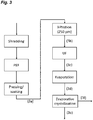
- Example 9 The process of Example 9 is depicted in Figure 3 , wherein (3a) represents raw beet juice 3, (3b) filtered beet juice 3, (3c) clarified beet juice 3, and (3d) beet syrup 3.
- Beet syrup 3 can be subjected to crystallization, by for example evaporate concentration, to result in (3e) molasses 3 and (3f) crystal sugar 3.
- Example 10 production of beet syrup using PEF without a fine physical purification step
- Sugar beets were obtained from Suiker Unie, Dinteloord, Netherlands. The sugar beets were washed in a flotation washer to remove sand and pebbles and were reduced in size by shredding (Smicon, MD8). The resulting shreds were exposed to a pulsed electric field using a Dil, Elcrack HVP 30, treatment bath TB 140 device, with the following parameters: field strength 1 kV/cm, conductivity treatment water 1700 ⁇ S/cm water, temperature treatment water 25 °C, and 0.04 m/s belt speed.
- Raw beet juice 4 was recovered from the PEF treated cossettes by performing pressing using a Babbini twin screw pulp press B20B, equipped with an 1 mm mesh, operating at a screw speed of 0.8 rpm.
- the raw beet juice 4 was passed through a 250 micron mesh screen (Reko, sieve bend 500 TS) and the filtrate was collected to obtain filtered beet juice 4.
- the filtered beet juice 4 was evaporated in a Buchi thin film evaporator, R 220 SE, operated at a temperature of 65 °C and a vacuum of 34 mbar, to obtain beet syrup 4.
- Example 10 The process of Example 10 is depicted in Figure 4 , wherein (4a) represents raw beet juice 4, (4b) filtered beet juice 4, and (4c) beet syrup 4. Beet syrup 4 can be subjected to crystallization, by for example evaporate concentration, to result in (4d) molasses 4 and (4e) crystal sugar 4.
- Example 11 production of beet syrup using PEF without a fine physical purification step
- Sugar beets were obtained from Suiker Unie, Dinteloord, Netherlands. The sugar beets were washed in a flotation washer to remove sand and pebbles and were reduced in size by shredding (Smicon, MD8). The resulting cossettes were exposed to a pulsed electric field using a Dil, Elcrack HVP 30, bath TB 140 device, with the following parameters: field strength 1 kV/cm, conductivity treatment water 1700 ⁇ S/cm water, temperature treatment water 25 °C, and 0.04 m/s belt speed.
- Raw beet juice 5 was recovered from the PEF treated cossettes by performing pressing using a Babbini twin screw pulp press B20B, equipped with an 1 mm mesh, operating at a screw speed of 0.8 rpm.
- the raw beet juice 5 was passed through a 250 micron mesh screen (Reko, sieve bend 500 TS) and the filtrate was collected.
- the resulting filtered beet juice was subjected to disc stack centrifuging in an Alfa Laval, Clara 20 centrifuge, operating at 250 l/h, 10500 g, 9010 rpm, 24 °C, counter pressure 2 bar, and the filtrate was collected to yield filtered beet juice 5.
- Filtered beet juice 5 was evaporated in a Buchi thin film evaporator, R 220 SE, operated at a temperature of 65 °C and a vacuum of 34 mbar, to obtain beet syrup 5.
- Example 11 The process of Example 11 is depicted in Figure 5 , wherein (5a) represents raw beet juice 5, (5b) filtered beet juice 5, and (5c) beet syrup 5.
- Beet syrup 5 can be subjected to crystallization, by for example evaporate concentration, to result in (5d) molasses 5 and (5e) crystal sugar 5.
- Example 12 production of beet syrup using hammer milling without a fine physical purification step
- Sugar beets were obtained from Suiker Unie, Dinteloord, Netherlands. The sugar beets were washed in a flotation washer to remove sand and pebbles and were milled into a mush using a hammer mill (Engl, SM60), rotating at 3000 rpm and equipped with a screen with 3 mm mesh size.
- a hammer mill Engl, SM60
- Raw beet juice 6 was recovered from the mush using a basket press (Hafico, HP2H hydraulic press), operating at 16 bar with a residence time of 10 minutes.
- the raw beet juice 6 was passed through a 250 micron mesh screen (Reko, sieve bend 500 TS) and the filtrate was collected to obtain filtered beet juice 6.
- the filtered beet juice 6 was evaporated in a Buchi thin film evaporator, R 220 SE, operated at a temperature of 65 °C and a vacuum of 34 mbar, to obtain beet syrup 6.
- Example 12 The process of Example 12 is depicted in Figure 6 , wherein (6a) represents raw beet juice 6, (6b) filtered beet juice 6, and (6c) beet syrup 6.
- Beet syrup 6 can be subjected to crystallization by for example evaporate concentration to result in (6d) molasses 6 and (6e) crystal sugar 6.
- Example 13 Analysis of the products of Examples 9-12
- the conventional extraction/purification process comprising extraction at a temperature of about 72-74°C and raw juice purification steps comprising liming, carbonation, filtration and softening is depicted in Figure 7 , wherein (7a) represents conventional raw beet juice, (7b) conventional thin beet juice, (3c) conventional thick beet juice, (7d) conventional crystal sugar and (7e) conventional molasses.
- Conventional thin beet juice was obtained from Suiker Unie (Netherlands, 2018-2019 campaign). Traditional thick juice was obtained from Suiker Unie (Netherlands 2018-2019 campaign).
- the amount of the ingredients is expressed in terms of mg per kg of dissolved dry matter.
- Raw juice for example, comprises dissolved compounds, such as sucrose and amino acids, and small amounts of non-dissolved particulate matter resulting after extraction of sugar beets.
- the amount of the ingredients is expressed in only based on the dry matter that is dissolved in the juice.
- Total dissolved solids was determined using dilution and, where necessary, filtration of the sample followed by high performance liquid chromatography (HPLC, Thermo Scientific, Dionex Ultimate 3000) using an Aminex HPX-87N column (Aminex (art.nr. 125-0143) 7.8 x 300 mm) and RI detector (ERC, art.nr. 5060.0050).
- the analysis methods (1) to (6) are as follows.
- beet syrup (produced with a process) according to the invention was found to be more palatable than conventional thick juice, making the beet syrup according to the invention suitable for direct human consumption or as a sweetener in food applications for human consumption.
- the same results are expected for a comparison between molasses produced using a conventional process and molasses (produced with a process) according to the invention.
- the same results are expected for a comparison between thin juice produced using a conventional process and filtered sugar beet juice/clarified sugar beet juice (produced with a process) according to the invention.
Landscapes
- Chemical & Material Sciences (AREA)
- Life Sciences & Earth Sciences (AREA)
- Biochemistry (AREA)
- Organic Chemistry (AREA)
- Coloring Foods And Improving Nutritive Qualities (AREA)
Applications Claiming Priority (1)
| Application Number | Priority Date | Filing Date | Title |
|---|---|---|---|
| EP19193393 | 2019-08-23 |
Publications (1)
| Publication Number | Publication Date |
|---|---|
| EP3783115A1 true EP3783115A1 (fr) | 2021-02-24 |
Family
ID=67809222
Family Applications (1)
| Application Number | Title | Priority Date | Filing Date |
|---|---|---|---|
| EP20192029.5A Pending EP3783115A1 (fr) | 2019-08-23 | 2020-08-20 | Production de jus de betterave à sucre et traitement |
Country Status (1)
| Country | Link |
|---|---|
| EP (1) | EP3783115A1 (fr) |
Cited By (1)
| Publication number | Priority date | Publication date | Assignee | Title |
|---|---|---|---|---|
| DE102020207580A1 (de) | 2020-06-18 | 2021-12-23 | Südzucker AG | Geruchsmaskierung von Rübenzucker |
Citations (2)
| Publication number | Priority date | Publication date | Assignee | Title |
|---|---|---|---|---|
| WO1999064634A1 (fr) | 1998-06-11 | 1999-12-16 | Eridania Beghin-Say | Procede de traitement des betteraves sucrieres |
| US20130202751A1 (en) | 2010-05-03 | 2013-08-08 | Maguin Sas | Method and Apparatus for Treating Vegetable Tissues in order to Extract therefrom a Vegetable Substance, in particular a Juice |
-
2020
- 2020-08-20 EP EP20192029.5A patent/EP3783115A1/fr active Pending
Patent Citations (2)
| Publication number | Priority date | Publication date | Assignee | Title |
|---|---|---|---|---|
| WO1999064634A1 (fr) | 1998-06-11 | 1999-12-16 | Eridania Beghin-Say | Procede de traitement des betteraves sucrieres |
| US20130202751A1 (en) | 2010-05-03 | 2013-08-08 | Maguin Sas | Method and Apparatus for Treating Vegetable Tissues in order to Extract therefrom a Vegetable Substance, in particular a Juice |
Non-Patent Citations (7)
| Title |
|---|
| A.B. JEMAI ET AL., J. FOOD ENG., vol. 59, 2003, pages 405 - 412 |
| A.B. JEMAI, E. VOROBIEV: "Enhanced leaching from sugar beet cossettes by pulsed electric field - ScienceDirect", JOURNAL OF FOOD ENGINEERING, vol. 59, 2003, pages 405 - 412, XP055654517, Retrieved from the Internet <URL:https://www.sciencedirect.com/science/article/pii/S0260877402004995> [retrieved on 20191220] * |
| H. MHEMDI ET AL., J. FOOD ENG., vol. 168, 2016, pages 166 - 172 |
| K.G. LOGINOVA ET AL., J. FOOD ENG., vol. 106, 2011, pages 144 - 151 |
| LOGINOVA K ET AL: "Quality and filtration characteristics of sugar beet juice obtained by cold extraction assisted by pulsed electric field", JOURNAL OF FOOD ENGINEERING, BARKING, ESSEX, GB, vol. 106, no. 2, 18 April 2011 (2011-04-18), pages 144 - 151, XP028222287, ISSN: 0260-8774, [retrieved on 20110427], DOI: 10.1016/J.JFOODENG.2011.04.017 * |
| LOGINOVA K V ET AL: "Pilot study of countercurrent cold and mild heat extraction of sugar from sugar beets, assisted by pulsed electric fields", JOURNAL OF FOOD ENGINEERING, BARKING, ESSEX, GB, vol. 102, no. 4, 1 February 2011 (2011-02-01), pages 340 - 347, XP027449443, ISSN: 0260-8774, [retrieved on 20100925], DOI: 10.1016/J.JFOODENG.2010.09.010 * |
| SCHLUMBACH ET AL., SUGAR INDUSTRY, vol. 140, no. 8, 2015, pages 500 - 507 |
Cited By (1)
| Publication number | Priority date | Publication date | Assignee | Title |
|---|---|---|---|---|
| DE102020207580A1 (de) | 2020-06-18 | 2021-12-23 | Südzucker AG | Geruchsmaskierung von Rübenzucker |
Similar Documents
| Publication | Publication Date | Title |
|---|---|---|
| RU2421524C2 (ru) | Способ выделения пищевого коричневого сахара из раствора свекловичного сахара | |
| EP2219475B1 (fr) | Produit de tomate et son procédé de fabrication | |
| EP1419278B1 (fr) | Procede de preparation de sucre blanc et roux a partir de betteraves sucrieres | |
| RU2114177C1 (ru) | Способ производства сахарного сиропа из сахаросодержащего сырья | |
| DD283921A5 (de) | Verfahren zur herstellung eines fruchtkonzentratsuessstoffes | |
| CN114292307B (zh) | 一种用无法自然成熟的罗汉果制备无苦涩味罗汉果甜苷的方法 | |
| EP2600739B1 (fr) | Compositions d'électrolyte à base de plante | |
| EA015938B1 (ru) | Композиция для профилактики или лечения диабета 2 типа, сердечно-сосудистой недостаточности, коронарной болезни сердца, ожирения или гиперлипидемии, содержащая углеводы средиземноморских фруктов, и способ ее получения | |
| Wang et al. | Electrodialysis-based separation technologies in the food industry | |
| JPS5912278B2 (ja) | 甘庶汁から栄養糖を製造する方法 | |
| US5451262A (en) | Syrup of natural carob sugars and a process for its production | |
| US20040255934A1 (en) | Process for the production of invert liquid sugar | |
| HUP0204353A2 (en) | Sugar beet membrane filtration process | |
| EP3783115A1 (fr) | Production de jus de betterave à sucre et traitement | |
| JP4530342B2 (ja) | 含蜜糖の製造方法及び製造装置 | |
| JP2006020521A5 (fr) | ||
| CN113080357B (zh) | 一种低热量复配甜味剂及其生产工艺 | |
| CN101720904A (zh) | 一种复合甜菊糖代糖及其制备方法 | |
| JP4728284B2 (ja) | サトウキビのチップ及び粉末とその製造法並びにサトウキビチップ及び粉末よりの製糖方法 | |
| JPH04341200A (ja) | ラフィノースを含有する粉末含蜜糖、その製造方法及びその乾燥装置 | |
| JP2022015693A (ja) | 甘味組成物とその製造方法 | |
| SK501162014U1 (sk) | Spôsob spracovania cukrovej repy Beta vulgaris L. na potravinársky využiteľný cukorno-vlákninový produkt a cukorno-vlákninový produkt získaný týmto spôsobom | |
| MXNL01000011A (es) | Proceso para la produccion de azucar liquido. | |
| JP4146297B2 (ja) | サトウキビ汁濃縮物入りもろみ酢 | |
| WO2010145930A1 (fr) | Procede de preparation d'un produit alimentaire |
Legal Events
| Date | Code | Title | Description |
|---|---|---|---|
| PUAI | Public reference made under article 153(3) epc to a published international application that has entered the european phase |
Free format text: ORIGINAL CODE: 0009012 |
|
| STAA | Information on the status of an ep patent application or granted ep patent |
Free format text: STATUS: THE APPLICATION HAS BEEN PUBLISHED |
|
| AK | Designated contracting states |
Kind code of ref document: A1 Designated state(s): AL AT BE BG CH CY CZ DE DK EE ES FI FR GB GR HR HU IE IS IT LI LT LU LV MC MK MT NL NO PL PT RO RS SE SI SK SM TR |
|
| AX | Request for extension of the european patent |
Extension state: BA ME |
|
| STAA | Information on the status of an ep patent application or granted ep patent |
Free format text: STATUS: REQUEST FOR EXAMINATION WAS MADE |
|
| 17P | Request for examination filed |
Effective date: 20210729 |
|
| RBV | Designated contracting states (corrected) |
Designated state(s): AL AT BE BG CH CY CZ DE DK EE ES FI FR GB GR HR HU IE IS IT LI LT LU LV MC MK MT NL NO PL PT RO RS SE SI SK SM TR |
|
| P01 | Opt-out of the competence of the unified patent court (upc) registered |
Effective date: 20230513 |
|
| STAA | Information on the status of an ep patent application or granted ep patent |
Free format text: STATUS: EXAMINATION IS IN PROGRESS |
|
| 17Q | First examination report despatched |
Effective date: 20250217 |