EP3783251B1 - Joint de tuyau sismique - Google Patents
Joint de tuyau sismique Download PDFInfo
- Publication number
- EP3783251B1 EP3783251B1 EP20189802.0A EP20189802A EP3783251B1 EP 3783251 B1 EP3783251 B1 EP 3783251B1 EP 20189802 A EP20189802 A EP 20189802A EP 3783251 B1 EP3783251 B1 EP 3783251B1
- Authority
- EP
- European Patent Office
- Prior art keywords
- pipe
- deformation
- buckle
- pipe joint
- joint arrangement
- Prior art date
- Legal status (The legal status is an assumption and is not a legal conclusion. Google has not performed a legal analysis and makes no representation as to the accuracy of the status listed.)
- Active
Links
Images







Classifications
-
- F—MECHANICAL ENGINEERING; LIGHTING; HEATING; WEAPONS; BLASTING
- F16—ENGINEERING ELEMENTS AND UNITS; GENERAL MEASURES FOR PRODUCING AND MAINTAINING EFFECTIVE FUNCTIONING OF MACHINES OR INSTALLATIONS; THERMAL INSULATION IN GENERAL
- F16L—PIPES; JOINTS OR FITTINGS FOR PIPES; SUPPORTS FOR PIPES, CABLES OR PROTECTIVE TUBING; MEANS FOR THERMAL INSULATION IN GENERAL
- F16L13/00—Non-disconnectable pipe joints, e.g. soldered, adhesive, or caulked joints
- F16L13/02—Welded joints
- F16L13/0209—Male-female welded joints
-
- F—MECHANICAL ENGINEERING; LIGHTING; HEATING; WEAPONS; BLASTING
- F16—ENGINEERING ELEMENTS AND UNITS; GENERAL MEASURES FOR PRODUCING AND MAINTAINING EFFECTIVE FUNCTIONING OF MACHINES OR INSTALLATIONS; THERMAL INSULATION IN GENERAL
- F16L—PIPES; JOINTS OR FITTINGS FOR PIPES; SUPPORTS FOR PIPES, CABLES OR PROTECTIVE TUBING; MEANS FOR THERMAL INSULATION IN GENERAL
- F16L13/00—Non-disconnectable pipe joints, e.g. soldered, adhesive, or caulked joints
- F16L13/02—Welded joints
- F16L13/0218—Welded joints having an inner or outer ring
- F16L13/0236—Welded joints having an inner or outer ring having an outer ring
-
- F—MECHANICAL ENGINEERING; LIGHTING; HEATING; WEAPONS; BLASTING
- F16—ENGINEERING ELEMENTS AND UNITS; GENERAL MEASURES FOR PRODUCING AND MAINTAINING EFFECTIVE FUNCTIONING OF MACHINES OR INSTALLATIONS; THERMAL INSULATION IN GENERAL
- F16L—PIPES; JOINTS OR FITTINGS FOR PIPES; SUPPORTS FOR PIPES, CABLES OR PROTECTIVE TUBING; MEANS FOR THERMAL INSULATION IN GENERAL
- F16L57/00—Protection of pipes or objects of similar shape against external or internal damage or wear
- F16L57/02—Protection of pipes or objects of similar shape against external or internal damage or wear against cracking or buckling
-
- F—MECHANICAL ENGINEERING; LIGHTING; HEATING; WEAPONS; BLASTING
- F16—ENGINEERING ELEMENTS AND UNITS; GENERAL MEASURES FOR PRODUCING AND MAINTAINING EFFECTIVE FUNCTIONING OF MACHINES OR INSTALLATIONS; THERMAL INSULATION IN GENERAL
- F16L—PIPES; JOINTS OR FITTINGS FOR PIPES; SUPPORTS FOR PIPES, CABLES OR PROTECTIVE TUBING; MEANS FOR THERMAL INSULATION IN GENERAL
- F16L2201/00—Special arrangements for pipe couplings
- F16L2201/20—Safety or protective couplings
Definitions
- the present disclosure concerns embodiments of pipes including features configured to induce buckling of the pipes at locations spaced apart from pipe joints between the pipes during geohazard events such as seismic events or other stress-inducing events.
- a pipe joint arrangement comprises a first pipe comprising a main body having a first diameter, an end portion and a first pipe wall thickness, and a second pipe comprising an end portion. The end portion of the first pipe is welded to the end portion of the second pipe to form a pipe joint and to seal the pipe joint between the first pipe and the second pipe.
- the first pipe comprises an outwardly-extending, buckle-inducing deformation that is spaced apart from the pipe joint in an upstream direction, and a crest height of the buckle-inducing deformation is 50% to 500% of the first pipe wall thickness, wherein a contour of the buckle-inducing deformation is symmetric about a longitudinal axis of the first pipe, convex or sine-shaped, and curved from a crest of the buckle-inducing deformation to a regular exterior surface of the main body of the first pipe having the first diameter, and wherein the buckle-inducing deformation is configured to ensure that buckling occur at the preselected location of the buckle-inducing deformation of the first pipe when the pipe joint arrangement is subjected to a geohazard event.
- the buckle-inducing deformation comprises an annular bulge formed in an exterior surface of the first pipe and an annular recess formed in an interior surface of the first pipe at the location of the annular bulge.
- the first pipe has the longitudinal axis and the buckle-inducing deformation is symmetric about the longitudinal axis.
- the first pipe has the longitudinal axis, and the buckle-inducing deformation is axially spaced from the pipe joint by 5.08 cm (2 inches) to 91.44 cm (36 inches) along the first pipe.
- the buckle-inducing deformation is axially spaced from the pipe joint by 5.08 cm (2 inches) to 25.4 cm (10 inches) along the first pipe.
- the crest height of the buckle-inducing deformation is from 50% to 300% of the first pipe wall thickness.
- the end portion of the first pipe is configured as a pipe spigot
- the second pipe comprises a main body having the first diameter
- the end portion of the second pipe is configured as a pipe bell comprising a second diameter greater than the first diameter.
- the pipe spigot is inserted into the pipe bell and welded to the pipe bell.
- the crest height is from 70% to 100% of the first pipe wall thickness.
- the first pipe wall thickness is 3.4 mm (0.135 inch) and the crest height is 80% to 90% of the first pipe wall thickness, or the first pipe wall thickness is 6.35 mm (0.25 inch) and the crest height is 70% to 80% of the first pipe wall thickness.
- the crest of the buckle-inducing deformation does not extend beyond a height of an exterior surface of the second pipe.
- the pipe joint is a butt-welded pipe joint.
- the butt-welded pipe joint further comprises a reinforcing member disposed around the end portion of the first pipe and around the end portion of the second pipe, the reinforcing member being welded to the first pipe and to the second pipe.
- the second pipe comprises a buckle-inducing deformation formed in the end portion of the second pipe on the opposite side of the butt-welded pipe joint from the buckle-inducing deformation of the first pipe.
- the buckle-inducing deformation of the first pipe is one of a plurality of buckle-inducing deformations formed in the first pipe and spaced apart from each other along the longitudinal axis of the first pipe.
- a method comprises welding the first pipe to the second pipe to form the pipe joint arrangement of any of the disclosed embodiments.
- the buckle-inducing deformation is formed by positioning the first pipe over a plurality of dies of an expander apparatus, the first pipe being at ambient temperature, and each of the plurality of dies comprising a flange and a curved rod member coupled to a radially outward surface of the flange.
- the dies are moved radially outwardly from a central axis of the expander apparatus such that the rod members of the dies are pressed into an interior surface of the first pipe to form the buckle-inducing deformation in the first pipe.
- the buckle-inducing deformation is formed by positioning the first pipe between a first die and a second die of a grooving machine, the first pipe being at ambient temperature, the first die comprising a groove and the second die comprising a forming member. The first pipe is pressed between the first die and the second die, and the first pipe is rotated such that the forming member forms the buckle-inducing deformation in the first pipe.
- a pipeline comprises the pipe joint arrangement of the present invention.
- the buckle-inducing deformation is spaced from an end of the first pipe by 5.08 cm (2 inches) to 91.44 cm (36 inches) along the first pipe.
- the end portion of the first pipe is configured as a pipe spigot
- the second pipe comprises a main body having the first diameter
- the end portion of the second pipe is configured as a pipe bell comprising a second diameter greater than the first diameter.
- the buckle-inducing deformation is spaced apart from the pipe spigot such that when the pipe spigot of the first pipe is received in the pipe bell of the second pipe, the buckle-inducing deformation is offset from the pipe bell of the second pipe.
- a crest height of the buckle-inducing deformation is from 50% to 300% of the first pipe wall thickness.
- the crest height of the buckle-inducing deformation is from 80% to 100% of the first pipe wall thickness.
- the first pipe wall thickness is 3.4 mm (0.135 inch) and the crest height of the buckle-inducing deformation is 80% to 90% of the first pipe wall thickness, or the first pipe wall thickness is 6.35 mm (0.25 inch) and the crest height of the buckle-inducing deformation is 70% to 80% of the first pipe wall thickness.
- a pipe joint arrangement comprises a first pipe comprising an end portion configured as a pipe spigot, and a second pipe comprising an end portion configured as a pipe bell.
- the pipe spigot is inserted into the pipe bell and welded to the pipe bell to seal the pipe joint between the pipe spigot and the pipe bell, and the first pipe comprises an outwardly-extending, buckle-inducing deformation that is spaced apart from the pipe bell of the second pipe.
- a pipe joint can be configured as a welded lap pipe joint between a first pipe comprising a spigot end and a second pipe comprising a bell, hub, or other increased diameter end portion configured to receive the spigot end of the first pipe.
- the bell/hub and spigot of the respective pipes can be welded together.
- the first pipe and the second pipe can be butt-welded together.
- first pipe and/or the second pipe can comprise an annular, buckle-inducing feature, referred to herein as a deformation, formed in the pipe and extending circumferentially around the pipe.
- the deformation is spaced apart axially from the pipe joint, and in particular from the welds of the pipe joint.
- the shape, height, and location of the deformations can be configured to provide strength in axial loading and bending during normal operation, reduce manufacturing complexity, and ensure that the pipe will buckle at the preselected location of the deformation well away from the welds of the pipe joint when subjected to a geohazard event such as an earthquake.
- FIG. 1 illustrates a pipe joint arrangement 10 between a first pipe 12 and a second pipe 14 in a pipeline.
- the pipe joint arrangement 10 is configured as a welded lap pipe joint arrangement in which a first end 16 of the first pipe 12 is received in a first end 18 of the second pipe 14.
- the first end 16 of the first pipe 12 can be configured as a pipe spigot.
- the first end 18 of the second pipe 14 can comprise a hub or bell having a diameter D 1 greater than the diameter D 2 of the main body or main portion of the second pipe 14 (and of the first pipe 12), and can be configured to receive the first end 16 of the first pipe 12.
- the pipe joint arrangement 10 can comprise one or a series of welds indicated at 20 to join the pipes 12 and 14 together to form a pipe joint and seal the pipe joint.
- the pipe joint arrangement 10 can comprise an internal fillet weld 20a joining the spigot end of the first pipe 12 to the interior surface of the bell of the second pipe 14, and an external fillet weld 20b joining the bell end of the second pipe 14 to the exterior surface of the first pipe.
- the pipe joint arrangement can include one of the fillet welds 20a or 20b, or more than two welds, depending upon the particular characteristics desired.
- the first pipe 12 can comprise an increased diameter, buckle-inducing feature configured as a rib, bulge, raceway, ring, recess, concavity, or deformation 22 formed in the first pipe and projecting or extending outwardly from the first pipe.
- the deformation 22 is spaced apart from the pipe joint in an upstream direction.
- the deformation 22 can comprise an annular bulge or recess formed such that the outer diameter D 3 of the deformation is greater than the outer diameter D 2 of the first pipe, and such that the inner diameter D 4 of the deformation 22 is greater than the inner diameter D 5 of the first pipe.
- the deformation 22 can comprise a convex surface on the exterior of the pipe 12.
- the buckle-inducing deformation 22 is symmetric about the first pipe longitudinal axis 26.
- the deformation 22 can be curved, and can have a constant or substantially constant radius (e.g., as measured relative to the longitudinal axis 26).
- the deformation 22 can comprise a wave-shaped cross-section.
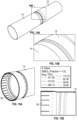
- FIG. 12A illustrates the contour of a representative embodiment of a deformation 22 from the apex or crest 23 of the deformation to the regular exterior surface of the pipe on one side (e.g., upstream of the crest).
- FIG. 12A illustrates the contour of a representative embodiment of a deformation 22 from the apex or crest 23 of the deformation to the regular exterior surface of the pipe on one side (e.g., upstream of the crest).
- the deformation 22 can be symmetric about the y-axis, and can have a contour shaped like a sine wave (e.g., on both the interior and exterior surfaces of the pipe).
- the contour of the deformation 22 can be curved or round (e.g., can have a substantially constant radius).
- FIG. 12B is a magnified partial cross-section showing one edge of a pipe 12 and an exemplary shape of another buckle-inducing deformation 22 formed therein.
- the radius, crest height, and/or the shape of the deformation can vary around the circumference of the pipe 12.
- the deformation can extend around only a portion of the circumference of the pipe 12, for example, 25%, 50%, or 75% of the circumference of the pipe.
- the deformation can comprise a compound curve shape, and can include multiple crests or apices of the same or different heights spaced apart by curved portions along the pipe axis.
- the deformation 22 can be axially spaced from the bell 18, and can be located at any location along the pipe axis between the ends of the pipe. In certain embodiments, the deformation 22 can be located close to the bell or hub of the second pipe, without interfering with the pipe joint or installation of the pipes.
- the crest 23 of the deformation can be axially spaced from the bell 18 (e.g., as measured from the edge of the bell portion 18) by a distance L ( FIG. 1 ).
- the distance L can be, for example, 5.08 cm (2 inches) to 91.44 cm (36 inches) along the first pipe as measured from the edge of the second pipe 14 (or the weld 22b).
- the crest 23 of the deformation 22 can be axially spaced apart from the hub by 5.08 cm (2 inches) to 25.4 cm (10 inches), such as by 7.62 cm (3 inches) to 20.32 cm (8 inches), 7.62 cm (3 inches) to 15.24 cm (6 inches), at least 5.08 cm (2 inches), at least 7.62 cm (3 inches), or at least 10.16 cm (4 inches), depending upon the particular characteristics desired and the equipment used to form the deformation.
- the crest 23 of the deformation 22 can be from 5.08 cm (2 inches) to 91.44 cm (36 inches), 5.08 cm (2 inches) to 25.4 cm (10 inches), 7.62 cm (3 inches) to 20.32 cm (8 inches), at least 5.08 cm (2 inches), at least 7.62 cm (3 inches), or at least 10.16 cm (4 inches) from the outflow end 24 of the first pipe 12.
- first and second pipes 12 and 14 each have a respective pipe wall
- the pipe walls of the first and second pipes can have a common thickness t in a direction perpendicular to the longitudinal axes of the first and second pipes, although in other embodiments the walls of the two pipes may have different thicknesses.
- the deformation 22 is symmetric about the longitudinal axis of the first pipe, and extends or projects outwardly from an outer surface of the first pipe by a projection distance or crest height x that is from 50% to 500% of the thickness of the pipe walls.
- the projection distance x is 50% to 400%, 50% to 300%, 50% to 200%, 50% to 100%, 60% to 100%, 70% to 100%, 80% to 100%, 70% to 90%, 70% to 80%, or 80% to 90% of the thickness of the pipe walls.
- the projection distance x is 0.5 times to 5.0 times the thickness t of the first pipe wall.
- the crest of the deformation 22 can be disposed or offset radially inwardly from the exterior surface of the second pipe 14 toward the axis 26.
- the deformation 22 does not extend beyond the height of the exterior surface of the second pipe 14, although the deformation may extend beyond the exterior surface of the second pipe in other embodiments.
- the thickness t of the pipe walls can be 3.4 mm (0.135 inch) and the projection distance or crest height x can be 80% to 90% of the thickness of the pipe walls, such as 80% to 85%, or 83% of the thickness of the pipe walls (or of the thickness of the first pipe at the location of the deformation).
- this combination of pipe wall thickness and crest height/projection distance can result in the axial strains induced at the spigot of the first pipe due to formation of the deformation being lower than the axial residual strains at the bell of the second pipe.
- the thickness t of the pipe walls can be 6.35 mm (0.25 inch) and the projection distance or crest height x can be 70% to 80% of the thickness of the pipe walls, such as 70% to 75% or 72% of the thickness of the pipe walls (or of the thickness of the first pipe at the location of the deformation).
- This combination of pipe wall thickness and crest height or projection distance can also result in the axial strains induced at the spigot of the first pipe due to formation of the deformation being lower than the axial residual strains at the bell of the second pipe.
- the deformation 22 can be configured as an inwardly extending projection or rib (e.g., such that there is a recess created on the exterior diameter of the pipe).
- the pipe can comprise more than one deformation, such as two deformations, three deformations, etc., (see FIG. 8 ).
- the deformation 22 can be formed by placing a mandrel or expander apparatus inside the first end portion or spigot of the first pipe 12.
- the expander can comprise a push ring or other expansion device including an annular ring, rod, wire, cable, etc., disposed around the push ring.
- the annular ring can be pressed against the inner surface of the first pipe 12 (e.g., by expansion or radially outward movement of the push ring) such that the ring forms an impression or recess in the first pipe to form the deformation.
- FIGS. 2 and 3 illustrate a representative embodiment of an expander apparatus 100 comprising a plurality of dies 102 arranged circumferentially around a spreader member or cone 104.
- the diameter of the cone 104 can increase along its length in a direction away from the dies 102. Accordingly, by moving the dies 102 longitudinally along the cone 104, the increasing diameter of the cone can move or urge the dies radially outwardly from the central axis of the expander.
- the dies 102 can comprise extension portions or flanges 106 configured to contact the interior surface of a pipe disposed over the dies.
- the flanges 106 can comprise a length L and a free end portion 108.
- Each die 102 can comprise a forming member or stamping member 110 configured as a curved rod, wire, cable, or other generally cylindrical member coupled (e.g., welded) to the free end portion 108 of the flange 106.
- the forming members 110 can be arranged end-to-end in a generally circular shape.
- the length of the flange 106 and the position of the forming members 110 along the flange can be varied to vary the location of a deformation formed in a pipe.
- a pipe 112 (e.g., corresponding to the pipe 12 of FIG. 1 ) can be positioned over the flanges 106 of the dies 102.
- the cone 104 can then be moved for example, to the left in FIG. 3 , to advance the dies radially outwardly, thereby bringing the forming members 110 into contact with the inside surface of the pipe to form the deformation.
- the forming can be performed cold (e.g., at ambient temperature, without heating the steel), or with the pipe at elevated temperature, depending on the particular characteristics desired.
- the pipe 112 can also be subject to heat treatment following formation of the deformation.
- FIG. 5 illustrates another embodiment of a system configured as a roll grooving machine 300 that can be used to form the deformation in the pipe.
- the roll grooving machine 300 can comprise a first rotatable die member 302 and a second rotatable die member 304 generally parallel to and vertically offset from the first die 302.
- the second die 304 can comprise a rod or forming member 306 disposed circumferentially around a distal end portion 308 of the second die.
- the first die 302 can comprise a circumferential recess or groove 310 sized and shaped to receive the pipe wall as it is deformed by the forming member 306.
- a pipe 312 can be disposed such that the first die 302 is located outside the pipe and the second die 304 is disposed inside the pipe.
- a hydraulic press of the system 300 can move the second die 304 downwardly such that the wall of the pipe 312 is pressed between the dies 302 and 304, and such that the second die 304 and/or the forming member 306 engage the inside surface of the pipe.
- the first die 302, which can be driven by a motor, can then be rotated. Rotation of the first die 302 can cause corresponding contra-rotation of the pipe 312 and of the die 304.
- the forming member 306 can form the deformation by deforming the wall of the pipe 312 into the groove 310 of the first die 302.
- FIG. 6 illustrates a representative embodiment of a pipeline 200 including a plurality of pipes or pipe sections 202 joined together at butt joints, such as welded butt joints 204.
- the pipe sections 202 can each comprise an outwardly-extending, buckle-inducing deformation 206 at a location along the length of the pipe section.
- the deformations 206 can be spaced apart from the welded butt joints 204 at any position along the pipe axis.
- the deformations 206 can be configured to induce buckling of the pipeline at location(s) spaced apart from the joints 204, as described above.
- the deformations 206 can be spaced apart from the end portions 208 of the pipe sections (and/or from the edges of the joints 204) by a distance D , which can be 2.54 cm (1 inch) to 91.44 cm (36 inches), 5.08 cm (2 inches) to 76.2 cm (30 inches), 10.16 cm (4 inches) to 60.96 cm (24 inches), 10.16 cm (4 inches) to 45.72 cm (18 inches), 5.08 cm (2 inches) to 25.4 cm (10 inches), at least 5.08 cm (2 inches), at least 7.62 cm (3 inches), at least 10.16 cm (4 inches), etc.
- the deformations have a crest height x that is 50% to 500% of the wall thickness t of the pipe sections 202, and preferably such as 50% to 400%, 50% to 300%, 50% to 200%, or 50% to 100% of the wall thickness t of the pipe sections 202, or any of the other crest height ranges described herein.
- the deformations 206 can be located near the ends of the pipe sections, but may be located anywhere along the length of the pipe sections.
- the deformations 206 are proximate one end of the pipe sections 202 such that the deformations are closer to the weld at that end of the pipe section than the weld at the opposite end of the pipe section.
- the deformations 206 can have a length dimension y measured along the axis of the pipeline 200.
- the length dimension y can be from 2.54 cm (1 inch) to 91.44 cm (36 inches), such as 5.08 cm (2 inches) to 76.2 cm (30 inches), 7.62 cm (3 inches) to 60.96 cm (24 inches), 10.16 cm (4 inches) to 45.72 cm (18 inches), etc.
- the lengthy can be 11.94 cm (4.7 inches).
- the deformations 206 are spaced apart by a distance L .
- the distance L can correspond to the length of the pipe sections 202, such as 24.38 m (80 feet), 18.28 m (60 feet), 12.19 m (40 feet), 9.14 m (30 feet), 6.09 m (20 feet), 3.04 m (10 feet), etc.
- the deformations 206 can be spaced apart from each other at regular intervals, and/or at varying distances along the length of the pipeline depending upon the particular conditions and characteristics sought.
- the pipe sections can comprise more than one deformation 206, such as two, three, or more deformations, which can be evenly spaced from each other or at any interval.
- not every pipe section 202 need comprise a deformation 206.
- every other or every second pipe section 202 can comprise a deformation.
- a pipeline can comprise one or more relatively short pipe sections disposed between longer pipe sections.
- the short pipe section can comprise one or multiple buckle-inducing deformations, which can be in relatively close proximity to the deformations at the end portions of the longer pipe sections.
- the overall effect can be to provide a plurality of buckle-inducing deformations in a relatively short distance.
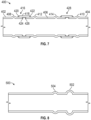
- FIG. 7 illustrates a pipeline 400 including a first pipe 402, a second pipe 404, and a third pipe 406 disposed between the first and second pipes, and which is shorter than the first pipe and the second pipe (e.g., 10%, 20%, 30%, etc., of the length of the first pipe and/or the second pipe).
- the first pipe 402 can comprise a buckle-inducing deformation 408 at the end portion adjacent the third pipe 406, and the second pipe 404 can comprise a buckle-inducing deformation 410 at the end portion that is adjacent the third pipe 406.
- the third pipe 406 can also comprise one or a plurality of deformations.
- the third pipe 406 comprises a deformation 412 and a deformation 414, although in other embodiments the third pipe can include more deformations (e.g., three or more deformations) or fewer deformations (e.g., one deformation or no deformations) depending upon the particular application.
- the first pipe 402 and the third pipe 406 can be welded together at a first pipe joint 416 configured as a butt joint. More particularly, the ends of the first pipe 402 and the third pipe 406 can be welded (e.g., fillet welded) to a reinforcing member 418 configured as a butt strap extending between the first pipe and the third pipe, and encircling or enclosing the interface between the first pipe and the third pipe.
- One circumferential edge of the reinforcing member 418 can be welded to the exterior surface of the first pipe 402 at a fillet weld 420, and the other circumferential edge of the reinforcing member can be welded to the exterior surface of the third pipe 406 at a fillet weld 422.
- Fillet welds 424 and 426 can join the ends of the first pipe 402 and the third pipe 406, respectively, to the interior surface of the reinforcing member 418.
- the ends of the first pipe and the third pipe are spaced apart within the reinforcing member, although in other embodiments the ends of the pipes may contact each other.
- the opposite end of the third pipe 406 can be coupled to the second pipe 404 at a second pipe joint 428, which can be configured similarly to the first joint 416.
- the overall effect of the pipeline 400 can be to locate a plurality of buckle-inducing deformations within a short distance of each other along the pipe axis. This can allow the pipeline 400 to bend or flex about one or more of the deformations in the same direction, or in different directions.
- Such a pipeline can be particularly advantageous, for example, in applications where significant displacement of portions of a pipeline may occur, such as at the location where a pipe exits a building (due to settling), or areas prone to significant seismic activity or soil subsidence.
- the deformations of the first pipe, the second pipe, and the third pipe can be configured according to any of the deformation embodiments described herein. Any of the deformations can be configured similarly or differently from each other, depending upon the particular characteristics desired.
- one or more of the deformations can have different heights, lengths, curvatures, etc.
- butt-welded pipe joints such as illustrated in FIG. 7 need not include reinforcing members, depending upon the particular requirements of the system.
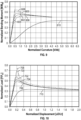
- FIG. 8 illustrates a representative example of a pipe 500 comprising two deformations 502 and 504 formed in one end portion.
- the height of the deformation 502 is greater than the height of the deformation 504, although in other embodiments the opposite may be true.
- the deformations 502 and 504 can also have the same height.
- the number of deformations is not limited to two, and the pipes described herein may include three, four, five, or more deformations, and the deformations can be of any size and can have any spacing.
- buckle-inducing deformations having dimensions within the ranges given herein can provide strength advantages and manufacturing advantages over existing systems, such as those designed around buckling wavelength(s) of the pipe.
- recesses formed in pipelines in certain existing systems are sized according to buckling wavelengths or half wavelengths of the pipe.
- the height of these features tend to be many multiples of the pipe wall thickness (e.g., eight times the wall thickness to as much as 15 times the wall thickness). This means that the recesses must be formed in the pipe at high temperature, which is laborious and requires specialized equipment.
- buckle-inducing deformations configured as described herein can be integrally formed in the pipe sections of a pipeline at ambient temperature, significantly reducing cost and complexity.
- pipe joint arrangements including buckle-inducing deformations as described herein can balance the ability to control the location at which the pipe buckles (e.g., during a seismic event) with the need to provide axial and bending strength.
- embodiments of welded lap joints and butt joints where the pipes include deformations as described herein can withstand bending or buckling of more than 40° away from the pipe axis without loss of pressure containment.
- the joints can exhibit ultimate bending strength and ultimate axial strength of more than 80% of the strength of comparable joints between plain pipe without a buckle-inducing feature.
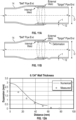
- FIGS. 9 and 10 illustrate the simulated performance of a series of exemplary welded lap pipe joint arrangements configured according to the embodiment of FIG. 1 .
- Each of the simulated pipes had a diameter of 65.4 cm (25.75 inches), a pipe wall thickness of 3.4 mm (0.135 inch), and was pressurized to 40% of the yield pressure P y .
- the simulated pipe joint arrangement had buckle-inducing deformations of varying height.
- the pipe joint arrangement represented by curve 600 in FIG. 9 had a deformation height of 0.83 times the pipe wall thickness t (2.8 mm) (0.112 inch).
- the pipe joint arrangement represented by the curve 602 had a deformation height of two times the pipe wall thickness
- the pipe joint arrangement represented by the curve 604 had a deformation height of three times the pipe wall thickness
- the pipe joint arrangement represented by the curve 606 had a deformation height of four times the pipe wall thickness.
- the curve 608 is representative of a welded lap pipe joint arrangement with no deformation.
- the curve 610 is configured according to an existing system with a deformation height of 5.56 cm (2.19 inches) (approximately 16 times the wall thickness t) based on a buckling wavelength of 11.48 cm (4.52 inches), which is significantly larger than the deformations of the present disclosure.
- FIG. 9 illustrates the normalized bending moment of the pipe joint arrangements versus the normalized curvature of the pipe joint arrangements.
- the pipe joint arrangement with a buckle-inducing deformation of 0.83t represented by curve 600 withstood nearly the same maximum bending moment as the pipe joint arrangement without a deformation represented by curve 608, reaching a peak of approximately 0.63 M/Mp at a curvature of 0.5 k/kb before buckling (e.g., at the buckle-inducing deformation.
- FIG. 10 illustrates simulations of the same pipe joint arrangements as FIG. 9 in compression loading.
- the curve 700 represents the pipe joint arrangement with a deformation height of 0.83 t
- the curve 702 represents the pipe joint arrangement with a deformation height of 2 t
- the curve 704 represents the pipe joint arrangement with a deformation height of 3 t
- the curve 706 represents the pipe joint arrangement with a deformation height of 4 t
- the curve 708 represents the welded lap pipe joint arrangement without a deformation
- the curve 710 represents the pipe joint arrangement configured according to the existing buckling wavelength system with the deformation height of 5.56 cm (2.19 inches) and the buckling wavelength of 11.48 cm (4.52 inches).
- the existing buckling wavelength system with the deformation height of 5.56 cm (2.19 inches) and the buckling wavelength of 11.48 cm (4.52 inches).
- the pipe joint arrangement represented by the curve 700 withstood nearly 70% of the yield force F y before buckling, only slightly below the pipe joint arrangement 708 without a deformation.
- the existing pipe joint arrangement represented by the curve 710 being configured to buckle when subjected to loading corresponding to ground waves of a specified wavelength, buckles at a substantially lower axial force of only approximately 33% of the yield force F y .
- the pipe joint arrangements described herein can provide surprisingly superior bending and axial strength advantages over known systems, while allowing the location of a buckle in the pipe to be preselected in the event of a geohazard incident. Accordingly, the pipe joint arrangements described herein can withstand significant deformation or buckling at the deformation feature without rupture, and without compromising the welds at the pipe joint or the seal between the pipes, allowing pipes such as municipal water pipes to continue to deliver water without loss of pressure containment.
- the height of the crest of the deformation can also be configured to provide for a selected amount of lengthening of the pipe if the pipe is placed in tension (e.g., due to ground shifting).
- the pipe embodiments described herein can be constructed from any of a variety of metallic materials, such as various steel alloys including, without limitation, ASTM A1011 SS GR36, ASTM A1018 SS GR40, ASTM A516, ASTM A572, ASTM A36, ASTM A283, and/or others listed in the American Water Works Association (AWWA) C200 Steel Water Pipe standard.
- Steel pipes having the diameter and thickness ranges described herein can advantageously be cold worked at ambient temperature to form buckle-inducing deformations having the dimensions and properties described herein, as well as bell end portions in the case of bell-and-spigot joints.
- Such forming processes can be carried out as described above at existing pipe mills, without the need for heating large sections of pipe. This can also provide improved strength because strength properties imparted to the steel pipes during rolling at the mill will be retained when the buckle-inducing deformation is formed at ambient temperature, and not lost during heating or annealing.
- the pipes, pipe joint arrangements, and deformation embodiments described herein can be used for piping water, oil or gas, or other pressurized liquids or fluids. Such pipes can also be used for non-pressurized applications, such as conduits for carrying electrical conductors, fiber optic cables, etc.
- the "seismic lap welded pipe joint arrangement" embodiments disclosed herein are aimed at improving the mechanical response of welded lap pipe joint arrangements, introducing a small initial imperfection/deformation at the spigot side of the weld, referred to as, for example, a "spigot imperfection,” “seismic imperfection,” or buckle-inducing deformation, in order to cause the buckle to occur at the spigot and prevent the formation of the buckle at the bell.
- this "seismic imperfection" or deformation can be: (a) large enough to ensure that buckling will occur at the "spigot" pipe, while (b) small enough so that the structural strength of the pipe joint arrangement is not significantly reduced, compared to a lap pipe joint arrangement without an imperfection/deformation.
- the present numerical results show that there can be an optimum size of this imperfection/deformation which can help to ensure that buckling occurs at the spigot and the structural performance of the lap pipe joint arrangement is not affected.
- the optimum size of this imperfection/deformation can range between 70-100% of the pipe wall thickness, such as 80-100%.
- this imperfection/deformation can be imposed through a special wire around the expansion mandrel, and its size (amplitude or crest height) can be approximately equal to the pipe wall thickness.
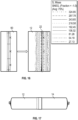
- a welded lap pipe joint arrangement can comprise a "bell" cold-formed at the end of each pipe segment, using an expanded mandrel so that the end of the adjacent pipe segment, often referred to as "spigot”, can be inserted and welded to the bell through a single or double full-circumferential fillet weld, as shown in FIG. 11A .
- FIG. 11B An initial imperfection/deformation at the spigot is imposed as shown in FIG. 11B , which is similar to the deformation illustrated in FIG. 1 .
- One purpose of this analysis was to examine if the existence of the imperfection/deformation is capable of enforcing a buckling pattern with a local buckle at the spigot (preventing any buckle at the bell), while not affecting the structural strength of the welded lap pipe joint arrangement.
- the present study evaluates the effect of the imposed "imperfection" or deformation at spigot side, in the structural performance of welded lap pipe joint arrangements both in bending and axial loading, for two levels of internal pressure (zero pressure and 40% of yield pressure p y ).
- Two different pipes are analyzed, the first pipe has 65.41 cm (25.75 inch) diameter, and a thickness equal to 3.4 mm (0.135 inch).
- the second pipe has the same diameter but with thickness equal to 6.35 mm (0.25 inch).
- the steel grade of the pipes is ASTM A1011 SS GR36 and ASTM A1018 SS GR40, respectively.
- the main target of the present analysis is the definition and evaluation of imperfection/deformation location, size, etc., as described in section 2 above. Towards this purpose, the following issues were evaluated: the location of the imperfection/deformation, the shape of the imperfection/deformation, and the size (height) of the imperfection/deformation.
- the location of the imperfection/deformation can be at the spigot, and its position can be chosen close to the pipe joint, according to the capabilities of the plant equipment.
- the pipe can be inserted 20.32 cm (8 inches), which is 15.24 cm (6 inches) from the outside weld.
- the position of the imperfection/deformation namely 12.70 cm (5 inches) from the outer cross section of the spigot pipe (7.62 cm (3 inches) from the outside weld).
- a numerical (finite element) model has been developed in ABAQUS ® /standard to simulate the joint behaviour, including this "seismic" imperfection/deformation.
- the model comprises four (4) main parts, a pipe with a bell configuration, a pipe with an imperfection/deformation at a specific distance from the end cross section (spigot), the outside weld and the inside weld, as shown in FIGS. 13A and 13B .
- the model employs four-node, reduced-integration shell finite elements, referred to as S4R, for the pipes and 8-node solid "brick" elements for the fillet welds.
- the mesh is shown in FIGS. 14A and 14B .
- the total length of the model is 304.80 cm (120 inches).
- the gap size between the bell and the spigot is constant around the pipe and is equal to 1.27 mm (0.05 inch), which is within the AWWA C200 requirements.
- the bell configuration was achieved by expanding the pipe end, using an appropriate mandrel (rigid body) 50 that moves outwards at the radial direction, as shown in FIGS. 15A and 15B . Subsequently, the imperfection/deformation of deformation at the spigot side was imposed. The imperfection/deformation at spigot was achieved by expanding the pipe at a specified location using an appropriate mandrel (rigid body) 60 that moved outwards in the radial direction as shown in FIG. 16 , as performed in the plant.
- kinematic constraints were employed as follows; a “tie” was used to connect the spigot and the welds, and a “rough contact” with “no separation” was employed to connect the bell with the welds.
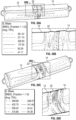
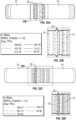
- FIGS. 15A-16 , 20A-20F , 22A-22D , 24A-24F , 26A-26D , 28A-28B , 30A-30B , and 32A-32D illustrate the results of finite element models of pipes and pipe joints including buckle-inducing deformations as described herein. Approximate stress values (MPa) at different locations of the pipes are represented by various dashed lines. The approximate stress values associated with the various dashed line types are given in legends accompanying the figures. In general, in axial loading and bending, the stress in the pipe walls increases in a direction toward the crests of the buckle-inducing deformations, and/or towards the bells of the pipes 14.
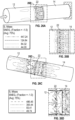
- FIGS. 19 and 20A-20F present the results from a pure bending analysis in the presence of internal pressure equal to 40% of the yield pressure and the corresponding buckling mode.
- Three cases are examined, assuming an "imperfection" or deformation at 7.62 cm (3 inches) from the outside weld, 15.24 cm (6 inches) from the outside weld and a lap pipe joint arrangement without an imperfection or deformation at the spigot, in a pipe with a thickness of 3.4 mm (0.135 inch).
- FIGS. 20A and 20B illustrate the pipe joint arrangement in bending with the deformation 7.62 cm (3 inches) from the outside weld.
- FIGS. 20C and 20D illustrate the pipe joint arrangement in bending with the deformation 15.24 cm (6 inches) from the outside weld
- FIGS. 20E and 20F illustrate a comparable pipe joint arrangement with no deformation. As can be seen in FIGS. 20E and 20F , without a deformation 22 formed in the first pipe 12, the second pipe 14 buckles at the bell.
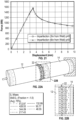
- FIGS. 21 and 22A-22D present the results from axial compression analysis in the presence of internal pressure equal to 40% of the yield pressure and the corresponding buckling modes. Two cases are examined, with imperfections/deformations at 7.62 cm (3 inches) and 15.24 cm (6 inches) from the outside weld, respectively.
- FIGS. 22A and 22B illustrate the pipe joint in axial compression with the deformation 7.62 cm (3 inches) from the outside weld
- FIGS. 22C and 22D illustrate the pipe joint with the deformation 15.24 cm (6 inches) from the outside weld.
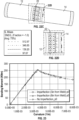
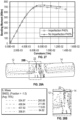
- FIGS. 23 and 24A-24F present results from a pure bending analysis without internal pressure and the corresponding buckling modes for a pipe having a thickness of 0.135 in.
- the position of the "spigot" imperfection/deformation is the same as in the case of bending in presence of internal pressure.
- FIGS. 24A and 24B illustrate the results with the deformation 22 7.62 cm (three inches) from the outside weld.
- FIGS. 24C and 24D illustrate the results with the deformation 22 15.24 cm (six inches) from the outside weld
- FIGS. 24E and 24F illustrate the results where the pipe 12 has no deformation. As shown in FIGS. 24E and 24F , without a deformation in the first pipe 12, the second pipe 14 buckles at the bell.
- FIGS. 25 and 26A-26D show results from axial compression analysis without internal pressure and the corresponding buckling modes for a pipe with a thickness of 0.135 in. Two cases are consideed for the position of the imperfection/deformation at the spigot pipe. The position of the imperfection/deformation is at 7.62 cm (three inches) ( FIGS. 26A and 26B ) and 15.24 cm (six inches) ( FIGS. 26C and 26D ) from the outside weld.
- FIGS. 27 and 28A-28B present numerical simulation results for pure bending of a 6.35 mm (0.25 inch) thickness pipe with a deformation and without a deformation at an internal pressure of 40% of the yield pressure.
- the deformation 22 is located 7.62 cm (three inches) from the outside weld.
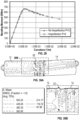
- FIGS. 29 and 30A-30B present numerical simulation results for pure bending of a 6.35 mm (0.25 inch) thickness pipe with and without an initial deformation at the spigot, and without internal pressure.
- the deformation 22 is 7.62 cm (three inches) from the outside weld.
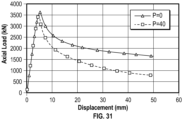
- FIGS. 31 and 32A-32D present numerical simulation results for axial compression loading of a 6.35 mm (0.25 inch) thickness pipe with and without an internal pressure, and a deformation 7.62 cm (three inches) from the outside weld.
- the internal pressure is 40% of the yield pressure
- FIGS. 32C and 32D there is no internal pressure in the pipes.
- the size range of this imperfection/deformation can be between 80-100% of the pipe wall thickness.
- this imperfection/deformation can be imposed through a special wire around an expansion mandrel, and its size can be close to the pipe wall thickness.
- the singular forms “a,” “an,” and “the” include the plural forms unless the context clearly dictates otherwise. Additionally, the term “includes” means “comprises.” Further, the terms “coupled” and “associated” generally mean electrically, electromagnetically, and/or physically ( e.g ., mechanically or chemically) coupled or linked and does not exclude the presence of intermediate elements between the coupled or associated items absent specific contrary language.
- values, procedures, or apparatus may be referred to as "lowest,” “best,” “minimum,” or the like. It will be appreciated that such descriptions are intended to indicate that a selection among many alternatives can be made, and such selections need not be better, smaller, or otherwise preferable to other selections.
Landscapes
- Engineering & Computer Science (AREA)
- General Engineering & Computer Science (AREA)
- Mechanical Engineering (AREA)
- Rigid Pipes And Flexible Pipes (AREA)
- Butt Welding And Welding Of Specific Article (AREA)
- Joints With Sleeves (AREA)
Claims (15)
- Agencement de joint de tuyau (10), comprenant :un premier tuyau (12) comprenant un corps principal ayant un premier diamètre (D2), une portion d'extrémité (16) et une épaisseur de paroi de premier tuyau (t) ;un second tuyau (14) comprenant une portion d'extrémité (18) ;la portion d'extrémité (16) du premier tuyau (12) étant soudée à la portion d'extrémité (18) du second tuyau (14) pour former un joint de tuyau et pour sceller le joint de tuyau entre le premier tuyau (12) et le second tuyau (14) ;le premier tuyau (12) comprenant une déformation induisant une ondulation du centre, s'étendant vers l'extérieur (22) qui est espacée du joint de tuyau dans une direction amont ;dans lequel une hauteur de crête (X) de la déformation induisant une ondulation du centre (22) est de 50 % à 500 % de l'épaisseur de paroi de premier tuyau (t) ;dans lequel un contour de la déformation induisant une ondulation du centre (22) est symétrique autour d'un axe longitudinal (26) du premier tuyau (12), convexe ou sinusoïdal, et incurvé d'une crête (23) de la déformation induisant une ondulation du centre (22) à une surface extérieure régulière du corps principal du premier tuyau (12) ayant le premier diamètre (D2) ; etdans lequel la déformation induisant une ondulation du centre (22) est configurée pour garantir que l'ondulation du centre se produit à l'emplacement présélectionné de la déformation induisant une ondulation du centre (22) du premier tuyau (12) lorsque l'agencement de joint de tuyau (10) est soumis à un événement de risque géologique.
- Agencement de joint de tuyau (10) selon la revendication 1, dans lequel la déformation induisant une ondulation du centre (22) comprend un bourrelet annulaire formé dans une surface extérieure du premier tuyau (12) et un retrait annulaire formé dans une surface intérieure du premier tuyau (12) à l'emplacement du bourrelet annulaire.
- Agencement de joint de tuyau (10) selon la revendication 1 ou revendication 2, dans lequel :le premier tuyau (12) a l'axe longitudinal (26) ; etla déformation induisant une ondulation du centre (22) est espacée axialement du joint de tuyau de 5,08 cm à 91,44 cm le long du premier tuyau (12).
- Agencement de joint de tuyau (10) selon l'une quelconque des revendications 1 à 3, dans lequel la hauteur de crête (X) de la déformation induisant une ondulation du centre (22) va de 50 % à 300 % de l'épaisseur de paroi de premier tuyau (t).
- Agencement de joint de tuyau (10) selon l'une quelconque des revendications 1 à 4, dans lequel :la portion d'extrémité (16) du premier tuyau (12) est configurée en tant que cordon de tuyau ;le second tuyau (14) comprend un corps principal ayant le premier diamètre (D2), etla portion d'extrémité (18) du second tuyau (14) est configurée en tant qu'emboîtement de tuyau comprenant un second diamètre (D1) supérieur au premier diamètre (D2) ; etle cordon de tuyau est inséré dans l'emboîtement de tuyau et soudé à l'emboîtement de tuyau.
- Agencement de joint de tuyau (10) selon la revendication 5, dans lequel la hauteur de crête (X) va de 70 % à 100 % de l'épaisseur de paroi de premier tuyau (t).
- Agencement de joint de tuyau (10) selon la revendication 5 ou revendication 6, dans lequel :l'épaisseur de paroi de premier tuyau (t) est de 3,4 mm et la hauteur de crête (X) est de 80 % à 90 % de l'épaisseur de paroi de premier tuyau (t) ; oul'épaisseur de paroi de premier tuyau (t) est de 6,35 mm et la hauteur de crête (X) est de 70 % à 80 % de l'épaisseur de paroi de premier tuyau (t).
- Agencement de joint de tuyau (10) selon l'une quelconque des revendications 5 à 7, dans lequel la crête (23) de la déformation induisant une ondulation du centre (22) ne s'étend pas au-delà d'une hauteur d'une surface extérieure du second tuyau (14).
- Agencement de joint de tuyau (10) selon l'une quelconque des revendications 1 à 4, dans lequel le joint de tuyau est un joint de tuyau soudé bout à bout.
- Agencement de joint de tuyau (10) selon la revendication 9, dans lequel :le joint de tuyau soudé bout à bout comprend en outre un élément de renforcement (418) disposé autour de la portion d'extrémité (16) du premier tuyau (12, 202, 402) et autour de la portion d'extrémité (18) du second tuyau (14, 202, 406), l'élément de renforcement (418) étant soudé au premier tuyau (12, 202, 402) et au second tuyau (14, 202, 406) ; etle second tuyau (14, 202, 406) comprend une déformation induisant une ondulation du centre (412) formée dans la portion d'extrémité (18) du second tuyau (14, 202, 406) sur le côté opposé du joint de tuyau soudé bout à bout depuis la déformation induisant une ondulation du centre (22, 206, 408) du premier tuyau (12, 202, 402).
- Agencement de joint de tuyau (10) selon l'une quelconque des revendications 1 à 10, dans lequel la déformation induisant une ondulation du centre (22, 206, 408) du premier tuyau (12, 202, 402) est une d'une pluralité de déformations induisant une ondulation du centre (22, 206, 408, 502, 504) formées dans le premier tuyau (12, 202, 402) et espacées l'une de l'autre le long de l'axe longitudinal (26) du premier tuyau (12, 202, 402).
- Procédé de formation de l'agencement de joint de tuyau (10) selon l'une quelconque des revendications 1 à 11, comprenant souder le premier tuyau (12, 202, 402) au second tuyau (14, 202, 406).
- Procédé selon la revendication 12, dans lequel la déformation induisant une ondulation du centre (22, 206, 408) est formée en :positionnant le premier tuyau (12, 112, 202, 402) sur une pluralité de filières (102) d'un appareil de mandrin (100), le premier tuyau (12, 112, 202, 402) étant à température ambiante, chacune de la pluralité de filières (102) comprenant une bride (106) et un élément de tige incurvé (110) couplé à une surface radialement externe de la bride (106) ; etdéplaçant les filières (102) radialement vers l'extérieur depuis un axe central de l'appareil de mandrin (100) de sorte que les éléments de tige (110) des filières (102) sont pressés dans une surface intérieure du premier tuyau (12, 112, 202, 402) pour former la déformation induisant une ondulation du centre (22, 206, 408) dans le premier tuyau (12, 112, 202, 402).
- Procédé selon la revendication 12, dans lequel la déformation induisant une ondulation du centre (22, 206, 408) est formée en :positionnant le premier tuyau (12, 202, 312, 402) entre une première filière (302) et une seconde filière (304) d'une machine à rainer (300), le premier tuyau (12, 202, 312, 402) étant à température ambiante, la première filière (302) comprenant une rainure (310) et la seconde filière (304) comprenant un élément de formage (306) ;pressant le premier tuyau (12, 202, 312, 402) entre la première filière (302) et la seconde filière (304) ; etfaisant tourner le premier tuyau (12, 202, 312, 402) de sorte que l'élément de formage (306) forme la déformation induisant une ondulation du centre (22, 206, 408) dans le premier tuyau (12, 202, 312, 402).
- Conduite (200, 400), comprenant l'agencement de joint de tuyau (10) selon la revendication 1.
Applications Claiming Priority (2)
| Application Number | Priority Date | Filing Date | Title |
|---|---|---|---|
| US201962884638P | 2019-08-08 | 2019-08-08 | |
| US16/865,228 US12215817B2 (en) | 2019-08-08 | 2020-05-01 | Seismic pipe joint |
Publications (3)
| Publication Number | Publication Date |
|---|---|
| EP3783251A1 EP3783251A1 (fr) | 2021-02-24 |
| EP3783251C0 EP3783251C0 (fr) | 2025-05-07 |
| EP3783251B1 true EP3783251B1 (fr) | 2025-05-07 |
Family
ID=71994356
Family Applications (1)
| Application Number | Title | Priority Date | Filing Date |
|---|---|---|---|
| EP20189802.0A Active EP3783251B1 (fr) | 2019-08-08 | 2020-08-06 | Joint de tuyau sismique |
Country Status (6)
| Country | Link |
|---|---|
| US (2) | US12215817B2 (fr) |
| EP (1) | EP3783251B1 (fr) |
| AU (1) | AU2020205343B2 (fr) |
| CA (1) | CA3087383A1 (fr) |
| ES (1) | ES3037280T3 (fr) |
| MX (2) | MX2020007813A (fr) |
Families Citing this family (2)
| Publication number | Priority date | Publication date | Assignee | Title |
|---|---|---|---|---|
| CN113294606B (zh) * | 2021-06-27 | 2022-06-21 | 李学田 | 一种用于石油管道连接处使用寿命长的防护装置 |
| TWI903594B (zh) * | 2024-06-26 | 2025-11-01 | 大將作工業股份有限公司 | 耐震鋼管製造方法 |
Citations (1)
| Publication number | Priority date | Publication date | Assignee | Title |
|---|---|---|---|---|
| KR20180086747A (ko) * | 2017-01-23 | 2018-08-01 | 엘지전자 주식회사 | 공기 조화기 시스템 |
Family Cites Families (28)
| Publication number | Priority date | Publication date | Assignee | Title |
|---|---|---|---|---|
| DE645586C (de) * | 1937-05-31 | Eugen Wolf Dr | Schweissmuffenverbindung | |
| DE436872C (de) * | 1926-11-11 | Der Maschinenfabriken Escher A | Schweissnahtverbindung an Rohrstuecken | |
| GB252692A (en) | 1925-05-27 | 1926-09-09 | Firm Mannesmannrohren Werke | Improvements in welded spigot and socket pipe joints |
| US1670023A (en) * | 1926-03-08 | 1928-05-15 | Logan R Crouch | Expansion joint |
| GB284865A (en) | 1927-02-14 | 1928-02-09 | Mannesmann Ag | Improvements in or relating to connecting means for tubes |
| US1872271A (en) * | 1928-07-16 | 1932-08-16 | Smith Corp A O | Pipe joint |
| GB330182A (en) | 1929-02-23 | 1930-06-05 | Mannesmann Ag | Improvements in pipe joints |
| FR692900A (fr) * | 1929-03-30 | 1930-11-12 | Ver Stahlwerke Ag | Joint de tuyaux à emboîtement ou à manchon avec soudure |
| US1837103A (en) * | 1929-04-17 | 1931-12-15 | Betz Wilhelm | Welded spigot-and-socket joint |
| GB337463A (fr) * | 1929-05-27 | 1930-11-03 | Mannesmannroehren-Werke | |
| DE553388C (de) * | 1930-01-28 | 1932-06-25 | Mannesmann Ag | Entlastete Schweissmuffenverbindung mit aus Wulsten im Rohrende und in der Muffe gebildetem Hohlraum |
| DE608015C (de) * | 1930-07-09 | 1935-01-14 | Eugen Wolf Dr | Schweissmuffenverbindung fuer Rohre |
| FR771542A (fr) * | 1933-07-07 | 1934-10-10 | Pont A Mousson Fond | Perfectionnement aux tubes destinés à être soudés sur place à d'autres tubes |
| FR48205E (fr) * | 1936-06-29 | 1937-11-23 | Pont A Mousson Fond | Perfectionnement aux tubes destinés à être soudés sur place à d'autres tubes |
| US3222441A (en) * | 1961-02-20 | 1965-12-07 | Fanner Mfg Co | Method for making a plastic bellows elbow with spigot and socket ends |
| US3342512A (en) * | 1962-02-05 | 1967-09-19 | Calumet & Hecla | Conduit bend |
| US3847186A (en) * | 1968-12-17 | 1974-11-12 | W Bauer | Corrugated conduit |
| US4257155A (en) * | 1976-07-26 | 1981-03-24 | Hunter John J | Method of making pipe coupling joint |
| KR930009932B1 (ko) * | 1987-12-09 | 1993-10-13 | 후지 꾸라 덴센 가부시끼가이샤 | 히트파이프 및 그의 제조방법 |
| US6409226B1 (en) * | 1999-05-05 | 2002-06-25 | Noetic Engineering Inc. | “Corrugated thick-walled pipe for use in wellbores” |
| FR2805187B1 (fr) | 2000-02-21 | 2002-07-26 | Itp | Dispositif de renforcement des soudures circonferentielles |
| NO20025536D0 (no) * | 2002-11-18 | 2002-11-18 | Norsk Hydro As | Fleksibel röranordning, f.eks. en rörbelg |
| DE102004001109B4 (de) * | 2004-01-05 | 2006-11-16 | Ffa Management Und Consulting Ag | Fluidleitung für Fahrzeuge |
| US10352484B2 (en) * | 2004-08-05 | 2019-07-16 | Faurecia Emissions Control Technologies Germany Gmbh | Exhaust system |
| CA2855787C (fr) | 2011-11-15 | 2020-01-14 | Tiense Suikerraffinaderij N.V. | Procede pour la recuperation de betaine a partir de melasse |
| CN104203443B (zh) | 2012-04-02 | 2016-03-16 | 杰富意钢铁株式会社 | Uoe钢管及构造物 |
| WO2016185523A1 (fr) | 2015-05-15 | 2016-11-24 | Jfeエンジニアリング株式会社 | Tuyau en acier de forme d'onde de flambage |
| US10267440B2 (en) | 2015-08-26 | 2019-04-23 | Hdr, Inc. | Apparatus and method for strengthening welded-lap joints for steel pipeline |
-
2020
- 2020-05-01 US US16/865,228 patent/US12215817B2/en active Active
- 2020-07-17 AU AU2020205343A patent/AU2020205343B2/en active Active
- 2020-07-20 CA CA3087383A patent/CA3087383A1/fr active Pending
- 2020-07-23 MX MX2020007813A patent/MX2020007813A/es unknown
- 2020-07-23 MX MX2025002530A patent/MX2025002530A/es unknown
- 2020-08-06 ES ES20189802T patent/ES3037280T3/es active Active
- 2020-08-06 EP EP20189802.0A patent/EP3783251B1/fr active Active
-
2024
- 2024-12-30 US US19/005,326 patent/US20250129879A1/en active Pending
Patent Citations (1)
| Publication number | Priority date | Publication date | Assignee | Title |
|---|---|---|---|---|
| KR20180086747A (ko) * | 2017-01-23 | 2018-08-01 | 엘지전자 주식회사 | 공기 조화기 시스템 |
Also Published As
| Publication number | Publication date |
|---|---|
| US20250129879A1 (en) | 2025-04-24 |
| EP3783251A1 (fr) | 2021-02-24 |
| AU2020205343A1 (en) | 2021-02-25 |
| US20210041053A1 (en) | 2021-02-11 |
| EP3783251C0 (fr) | 2025-05-07 |
| CA3087383A1 (fr) | 2021-02-08 |
| MX2025002530A (es) | 2025-04-02 |
| ES3037280T3 (en) | 2025-09-30 |
| US12215817B2 (en) | 2025-02-04 |
| AU2020205343B2 (en) | 2025-08-28 |
| MX2020007813A (es) | 2021-02-09 |
Similar Documents
| Publication | Publication Date | Title |
|---|---|---|
| US20250129879A1 (en) | Seismic pipe joint | |
| EP0871832B1 (fr) | Procede de raccord de tuyaux chemises | |
| US5372391A (en) | Internal pipe attachment mechanism | |
| US20070245792A1 (en) | Integrally formed flanged metal pipe and method of manufacturing thereof | |
| KR102613899B1 (ko) | 금속관의 제조 방법 | |
| RU2572940C1 (ru) | Сварная стальная труба большого диаметра, производимая с помощью процесса uoe, и её структура | |
| US6715799B2 (en) | Corrugated pipe coupling having six degrees of freedom | |
| RU2617465C1 (ru) | Способ производства стальной трубы | |
| CN119353498A (zh) | 一种承插口包覆的复合管及其制造方法 | |
| EP3237790B1 (fr) | Amélioration du comportement de flexion d'un tuyau rigide mécaniquement revêtu | |
| Kim et al. | Limit state assessment for bending deformation of multi-ply bellows systems | |
| US10975990B2 (en) | Apparatus and method for strengthening welded-lap joints for steel pipeline | |
| US9689513B2 (en) | Tubular bodies and methods of forming same | |
| CN112555550A (zh) | 一体化波纹结构外护管抗管道轴向应力的预制保温弯头 | |
| RU2198051C2 (ru) | Способ комбинированного закрепления труб в трубных решетках | |
| CA3126382C (fr) | Tube metallique et procede de fabrication de tube metallique | |
| WO2018063090A1 (fr) | Revêtement ondulé pour un tuyau chemisé mécaniquement qui peut être installé par le procédé de pose de bobine | |
| RU220719U1 (ru) | Линзовый компенсатор | |
| RU2169631C2 (ru) | Способ закрепления труб в трубных решетках | |
| Deegan et al. | Materials, fabrication, installation, and applied mechanics considerations in the catastrophic failure of a flex hose bellows | |
| AU2006246465A1 (en) | Pipe forming apparatus and method | |
| Sriskandarajah et al. | Integral buckle arrestors for deepwater rigid pipelines installed by reeling method | |
| RU2202429C2 (ru) | Способ комбинированного закрепления труб в трубных решетках | |
| EP2392418A1 (fr) | Tuyau métallique pour transporter un substrat, agencement de tuyau et procédé de fabrication d'un tuyau métallique | |
| Zandberg et al. | Evaluation of welding stresses in the root weld of circular joints in transmission pipelines |
Legal Events
| Date | Code | Title | Description |
|---|---|---|---|
| PUAI | Public reference made under article 153(3) epc to a published international application that has entered the european phase |
Free format text: ORIGINAL CODE: 0009012 |
|
| STAA | Information on the status of an ep patent application or granted ep patent |
Free format text: STATUS: THE APPLICATION HAS BEEN PUBLISHED |
|
| AK | Designated contracting states |
Kind code of ref document: A1 Designated state(s): AL AT BE BG CH CY CZ DE DK EE ES FI FR GB GR HR HU IE IS IT LI LT LU LV MC MK MT NL NO PL PT RO RS SE SI SK SM TR |
|
| AX | Request for extension of the european patent |
Extension state: BA ME |
|
| STAA | Information on the status of an ep patent application or granted ep patent |
Free format text: STATUS: REQUEST FOR EXAMINATION WAS MADE |
|
| 17P | Request for examination filed |
Effective date: 20210824 |
|
| RBV | Designated contracting states (corrected) |
Designated state(s): AL AT BE BG CH CY CZ DE DK EE ES FI FR GB GR HR HU IE IS IT LI LT LU LV MC MK MT NL NO PL PT RO RS SE SI SK SM TR |
|
| STAA | Information on the status of an ep patent application or granted ep patent |
Free format text: STATUS: EXAMINATION IS IN PROGRESS |
|
| 17Q | First examination report despatched |
Effective date: 20220914 |
|
| P01 | Opt-out of the competence of the unified patent court (upc) registered |
Effective date: 20230517 |
|
| GRAP | Despatch of communication of intention to grant a patent |
Free format text: ORIGINAL CODE: EPIDOSNIGR1 |
|
| STAA | Information on the status of an ep patent application or granted ep patent |
Free format text: STATUS: GRANT OF PATENT IS INTENDED |
|
| INTG | Intention to grant announced |
Effective date: 20241129 |
|
| GRAS | Grant fee paid |
Free format text: ORIGINAL CODE: EPIDOSNIGR3 |
|
| GRAA | (expected) grant |
Free format text: ORIGINAL CODE: 0009210 |
|
| STAA | Information on the status of an ep patent application or granted ep patent |
Free format text: STATUS: THE PATENT HAS BEEN GRANTED |
|
| AK | Designated contracting states |
Kind code of ref document: B1 Designated state(s): AL AT BE BG CH CY CZ DE DK EE ES FI FR GB GR HR HU IE IS IT LI LT LU LV MC MK MT NL NO PL PT RO RS SE SI SK SM TR |
|
| REG | Reference to a national code |
Ref country code: GB Ref legal event code: FG4D |
|
| REG | Reference to a national code |
Ref country code: CH Ref legal event code: EP |
|
| REG | Reference to a national code |
Ref country code: DE Ref legal event code: R096 Ref document number: 602020050731 Country of ref document: DE |
|
| REG | Reference to a national code |
Ref country code: IE Ref legal event code: FG4D |
|
| U01 | Request for unitary effect filed |
Effective date: 20250603 |
|
| U07 | Unitary effect registered |
Designated state(s): AT BE BG DE DK EE FI FR IT LT LU LV MT NL PT RO SE SI Effective date: 20250611 |
|
| P04 | Withdrawal of opt-out of the competence of the unified patent court (upc) registered |
Free format text: CASE NUMBER: APP_26969/2025 Effective date: 20250606 |
|
| RAP4 | Party data changed (patent owner data changed or rights of a patent transferred) |
Owner name: NWPX INFRASTRUCTURE, INC. |
|
| U1H | Name or address of the proprietor changed after the registration of the unitary effect |
Owner name: NWPX INFRASTRUCTURE, INC.; US |
|
| U20 | Renewal fee for the european patent with unitary effect paid |
Year of fee payment: 6 Effective date: 20250821 |
|
| REG | Reference to a national code |
Ref country code: ES Ref legal event code: FG2A Ref document number: 3037280 Country of ref document: ES Kind code of ref document: T3 Effective date: 20250930 |
|
| PGFP | Annual fee paid to national office [announced via postgrant information from national office to epo] |
Ref country code: ES Payment date: 20250909 Year of fee payment: 6 |
|
| PG25 | Lapsed in a contracting state [announced via postgrant information from national office to epo] |
Ref country code: NO Free format text: LAPSE BECAUSE OF FAILURE TO SUBMIT A TRANSLATION OF THE DESCRIPTION OR TO PAY THE FEE WITHIN THE PRESCRIBED TIME-LIMIT Effective date: 20250807 |
|
| PGFP | Annual fee paid to national office [announced via postgrant information from national office to epo] |
Ref country code: GR Payment date: 20250818 Year of fee payment: 6 |
|
| PG25 | Lapsed in a contracting state [announced via postgrant information from national office to epo] |
Ref country code: PL Free format text: LAPSE BECAUSE OF FAILURE TO SUBMIT A TRANSLATION OF THE DESCRIPTION OR TO PAY THE FEE WITHIN THE PRESCRIBED TIME-LIMIT Effective date: 20250507 |
|
| PGFP | Annual fee paid to national office [announced via postgrant information from national office to epo] |
Ref country code: TR Payment date: 20250806 Year of fee payment: 6 |
|
| PGFP | Annual fee paid to national office [announced via postgrant information from national office to epo] |
Ref country code: GB Payment date: 20250807 Year of fee payment: 6 |
|
| PG25 | Lapsed in a contracting state [announced via postgrant information from national office to epo] |
Ref country code: HR Free format text: LAPSE BECAUSE OF FAILURE TO SUBMIT A TRANSLATION OF THE DESCRIPTION OR TO PAY THE FEE WITHIN THE PRESCRIBED TIME-LIMIT Effective date: 20250507 |
|
| PG25 | Lapsed in a contracting state [announced via postgrant information from national office to epo] |
Ref country code: RS Free format text: LAPSE BECAUSE OF FAILURE TO SUBMIT A TRANSLATION OF THE DESCRIPTION OR TO PAY THE FEE WITHIN THE PRESCRIBED TIME-LIMIT Effective date: 20250807 |
|
| PG25 | Lapsed in a contracting state [announced via postgrant information from national office to epo] |
Ref country code: IS Free format text: LAPSE BECAUSE OF FAILURE TO SUBMIT A TRANSLATION OF THE DESCRIPTION OR TO PAY THE FEE WITHIN THE PRESCRIBED TIME-LIMIT Effective date: 20250907 |
|
| REG | Reference to a national code |
Ref country code: GR Ref legal event code: EP Ref document number: 20250401557 Country of ref document: GR Effective date: 20251009 |
|
| PG25 | Lapsed in a contracting state [announced via postgrant information from national office to epo] |
Ref country code: SM Free format text: LAPSE BECAUSE OF FAILURE TO SUBMIT A TRANSLATION OF THE DESCRIPTION OR TO PAY THE FEE WITHIN THE PRESCRIBED TIME-LIMIT Effective date: 20250507 |
|
| PG25 | Lapsed in a contracting state [announced via postgrant information from national office to epo] |
Ref country code: CZ Free format text: LAPSE BECAUSE OF FAILURE TO SUBMIT A TRANSLATION OF THE DESCRIPTION OR TO PAY THE FEE WITHIN THE PRESCRIBED TIME-LIMIT Effective date: 20250507 |
|
| PG25 | Lapsed in a contracting state [announced via postgrant information from national office to epo] |
Ref country code: SK Free format text: LAPSE BECAUSE OF FAILURE TO SUBMIT A TRANSLATION OF THE DESCRIPTION OR TO PAY THE FEE WITHIN THE PRESCRIBED TIME-LIMIT Effective date: 20250507 |
|
| PLBE | No opposition filed within time limit |
Free format text: ORIGINAL CODE: 0009261 |
|
| STAA | Information on the status of an ep patent application or granted ep patent |
Free format text: STATUS: NO OPPOSITION FILED WITHIN TIME LIMIT |
|
| REG | Reference to a national code |
Ref country code: CH Ref legal event code: L10 Free format text: ST27 STATUS EVENT CODE: U-0-0-L10-L00 (AS PROVIDED BY THE NATIONAL OFFICE) Effective date: 20260318 |
|
| REG | Reference to a national code |
Ref country code: CH Ref legal event code: H13 Free format text: ST27 STATUS EVENT CODE: U-0-0-H10-H13 (AS PROVIDED BY THE NATIONAL OFFICE) Effective date: 20260324 |
|
| PG25 | Lapsed in a contracting state [announced via postgrant information from national office to epo] |
Ref country code: MC Free format text: LAPSE BECAUSE OF FAILURE TO SUBMIT A TRANSLATION OF THE DESCRIPTION OR TO PAY THE FEE WITHIN THE PRESCRIBED TIME-LIMIT Effective date: 20250507 |
|
| 26N | No opposition filed |
Effective date: 20260210 |