EP3783633A1 - Supercondensateurs comprenant des structures organométalliques de phosphonate et d'arsonate en tant que matériaux actifs d'électrode - Google Patents
Supercondensateurs comprenant des structures organométalliques de phosphonate et d'arsonate en tant que matériaux actifs d'électrode Download PDFInfo
- Publication number
- EP3783633A1 EP3783633A1 EP19193222.7A EP19193222A EP3783633A1 EP 3783633 A1 EP3783633 A1 EP 3783633A1 EP 19193222 A EP19193222 A EP 19193222A EP 3783633 A1 EP3783633 A1 EP 3783633A1
- Authority
- EP
- European Patent Office
- Prior art keywords
- group
- organic
- mofs
- linkers
- acid
- Prior art date
- Legal status (The legal status is an assumption and is not a legal conclusion. Google has not performed a legal analysis and makes no representation as to the accuracy of the status listed.)
- Withdrawn
Links
- 0 *c(c(P(O)(O)=O)c(*)c(P(O)(O)=O)c1*)c1P(O)(O)=O Chemical compound *c(c(P(O)(O)=O)c(*)c(P(O)(O)=O)c1*)c1P(O)(O)=O 0.000 description 4
Images







Classifications
-
- H—ELECTRICITY
- H01—ELECTRIC ELEMENTS
- H01G—CAPACITORS; CAPACITORS, RECTIFIERS, DETECTORS, SWITCHING DEVICES, LIGHT-SENSITIVE OR TEMPERATURE-SENSITIVE DEVICES OF THE ELECTROLYTIC TYPE
- H01G11/00—Hybrid capacitors, i.e. capacitors having different positive and negative electrodes; Electric double-layer [EDL] capacitors; Processes for the manufacture thereof or of parts thereof
- H01G11/22—Electrodes
- H01G11/30—Electrodes characterised by their material
- H01G11/48—Conductive polymers
-
- H—ELECTRICITY
- H01—ELECTRIC ELEMENTS
- H01G—CAPACITORS; CAPACITORS, RECTIFIERS, DETECTORS, SWITCHING DEVICES, LIGHT-SENSITIVE OR TEMPERATURE-SENSITIVE DEVICES OF THE ELECTROLYTIC TYPE
- H01G11/00—Hybrid capacitors, i.e. capacitors having different positive and negative electrodes; Electric double-layer [EDL] capacitors; Processes for the manufacture thereof or of parts thereof
- H01G11/22—Electrodes
- H01G11/24—Electrodes characterised by structural features of the materials making up or comprised in the electrodes, e.g. form, surface area or porosity; characterised by the structural features of powders or particles used therefor
-
- H—ELECTRICITY
- H01—ELECTRIC ELEMENTS
- H01G—CAPACITORS; CAPACITORS, RECTIFIERS, DETECTORS, SWITCHING DEVICES, LIGHT-SENSITIVE OR TEMPERATURE-SENSITIVE DEVICES OF THE ELECTROLYTIC TYPE
- H01G11/00—Hybrid capacitors, i.e. capacitors having different positive and negative electrodes; Electric double-layer [EDL] capacitors; Processes for the manufacture thereof or of parts thereof
- H01G11/22—Electrodes
- H01G11/26—Electrodes characterised by their structure, e.g. multi-layered, porosity or surface features
-
- H—ELECTRICITY
- H01—ELECTRIC ELEMENTS
- H01G—CAPACITORS; CAPACITORS, RECTIFIERS, DETECTORS, SWITCHING DEVICES, LIGHT-SENSITIVE OR TEMPERATURE-SENSITIVE DEVICES OF THE ELECTROLYTIC TYPE
- H01G11/00—Hybrid capacitors, i.e. capacitors having different positive and negative electrodes; Electric double-layer [EDL] capacitors; Processes for the manufacture thereof or of parts thereof
- H01G11/22—Electrodes
- H01G11/30—Electrodes characterised by their material
-
- H—ELECTRICITY
- H01—ELECTRIC ELEMENTS
- H01G—CAPACITORS; CAPACITORS, RECTIFIERS, DETECTORS, SWITCHING DEVICES, LIGHT-SENSITIVE OR TEMPERATURE-SENSITIVE DEVICES OF THE ELECTROLYTIC TYPE
- H01G9/00—Electrolytic capacitors, rectifiers, detectors, switching devices, light-sensitive or temperature-sensitive devices; Processes of their manufacture
- H01G9/20—Light-sensitive devices
- H01G9/2004—Light-sensitive devices characterised by the electrolyte, e.g. comprising an organic electrolyte
-
- H—ELECTRICITY
- H01—ELECTRIC ELEMENTS
- H01G—CAPACITORS; CAPACITORS, RECTIFIERS, DETECTORS, SWITCHING DEVICES, LIGHT-SENSITIVE OR TEMPERATURE-SENSITIVE DEVICES OF THE ELECTROLYTIC TYPE
- H01G9/00—Electrolytic capacitors, rectifiers, detectors, switching devices, light-sensitive or temperature-sensitive devices; Processes of their manufacture
- H01G9/20—Light-sensitive devices
- H01G9/2059—Light-sensitive devices comprising an organic dye as the active light absorbing material, e.g. adsorbed on an electrode or dissolved in solution
-
- H—ELECTRICITY
- H10—SEMICONDUCTOR DEVICES; ELECTRIC SOLID-STATE DEVICES NOT OTHERWISE PROVIDED FOR
- H10F—INORGANIC SEMICONDUCTOR DEVICES SENSITIVE TO INFRARED RADIATION, LIGHT, ELECTROMAGNETIC RADIATION OF SHORTER WAVELENGTH OR CORPUSCULAR RADIATION
- H10F77/00—Constructional details of devices covered by this subclass
- H10F77/20—Electrodes
- H10F77/206—Electrodes for devices having potential barriers
- H10F77/211—Electrodes for devices having potential barriers for photovoltaic cells
-
- C—CHEMISTRY; METALLURGY
- C07—ORGANIC CHEMISTRY
- C07F—ACYCLIC, CARBOCYCLIC OR HETEROCYCLIC COMPOUNDS CONTAINING ELEMENTS OTHER THAN CARBON, HYDROGEN, HALOGEN, OXYGEN, NITROGEN, SULFUR, SELENIUM OR TELLURIUM
- C07F9/00—Compounds containing elements of Groups 5 or 15 of the Periodic Table
- C07F9/02—Phosphorus compounds
- C07F9/28—Phosphorus compounds with one or more P—C bonds
- C07F9/38—Phosphonic acids [RP(=O)(OH)2]; Thiophosphonic acids ; [RP(=X1)(X2H)2(X1, X2 are each independently O, S or Se)]
- C07F9/3804—Phosphonic acids [RP(=O)(OH)2]; Thiophosphonic acids ; [RP(=X1)(X2H)2(X1, X2 are each independently O, S or Se)] not used, see subgroups
- C07F9/3839—Polyphosphonic acids
-
- H—ELECTRICITY
- H01—ELECTRIC ELEMENTS
- H01G—CAPACITORS; CAPACITORS, RECTIFIERS, DETECTORS, SWITCHING DEVICES, LIGHT-SENSITIVE OR TEMPERATURE-SENSITIVE DEVICES OF THE ELECTROLYTIC TYPE
- H01G11/00—Hybrid capacitors, i.e. capacitors having different positive and negative electrodes; Electric double-layer [EDL] capacitors; Processes for the manufacture thereof or of parts thereof
- H01G11/22—Electrodes
- H01G11/30—Electrodes characterised by their material
- H01G11/46—Metal oxides
-
- H—ELECTRICITY
- H01—ELECTRIC ELEMENTS
- H01M—PROCESSES OR MEANS, e.g. BATTERIES, FOR THE DIRECT CONVERSION OF CHEMICAL ENERGY INTO ELECTRICAL ENERGY
- H01M4/00—Electrodes
- H01M4/02—Electrodes composed of, or comprising, active material
- H01M4/36—Selection of substances as active materials, active masses, active liquids
- H01M4/60—Selection of substances as active materials, active masses, active liquids of organic compounds
-
- H—ELECTRICITY
- H10—SEMICONDUCTOR DEVICES; ELECTRIC SOLID-STATE DEVICES NOT OTHERWISE PROVIDED FOR
- H10K—ORGANIC ELECTRIC SOLID-STATE DEVICES
- H10K30/00—Organic devices sensitive to infrared radiation, light, electromagnetic radiation of shorter wavelength or corpuscular radiation
- H10K30/30—Organic devices sensitive to infrared radiation, light, electromagnetic radiation of shorter wavelength or corpuscular radiation comprising bulk heterojunctions, e.g. interpenetrating networks of donor and acceptor material domains
-
- H—ELECTRICITY
- H10—SEMICONDUCTOR DEVICES; ELECTRIC SOLID-STATE DEVICES NOT OTHERWISE PROVIDED FOR
- H10K—ORGANIC ELECTRIC SOLID-STATE DEVICES
- H10K85/00—Organic materials used in the body or electrodes of devices covered by this subclass
- H10K85/30—Coordination compounds
- H10K85/331—Metal complexes comprising an iron-series metal, e.g. Fe, Co, Ni
-
- H—ELECTRICITY
- H10—SEMICONDUCTOR DEVICES; ELECTRIC SOLID-STATE DEVICES NOT OTHERWISE PROVIDED FOR
- H10K—ORGANIC ELECTRIC SOLID-STATE DEVICES
- H10K85/00—Organic materials used in the body or electrodes of devices covered by this subclass
- H10K85/60—Organic compounds having low molecular weight
-
- H—ELECTRICITY
- H10—SEMICONDUCTOR DEVICES; ELECTRIC SOLID-STATE DEVICES NOT OTHERWISE PROVIDED FOR
- H10K—ORGANIC ELECTRIC SOLID-STATE DEVICES
- H10K85/00—Organic materials used in the body or electrodes of devices covered by this subclass
- H10K85/60—Organic compounds having low molecular weight
- H10K85/649—Aromatic compounds comprising a hetero atom
- H10K85/657—Polycyclic condensed heteroaromatic hydrocarbons
- H10K85/6572—Polycyclic condensed heteroaromatic hydrocarbons comprising only nitrogen in the heteroaromatic polycondensed ring system, e.g. phenanthroline or carbazole
-
- Y—GENERAL TAGGING OF NEW TECHNOLOGICAL DEVELOPMENTS; GENERAL TAGGING OF CROSS-SECTIONAL TECHNOLOGIES SPANNING OVER SEVERAL SECTIONS OF THE IPC; TECHNICAL SUBJECTS COVERED BY FORMER USPC CROSS-REFERENCE ART COLLECTIONS [XRACs] AND DIGESTS
- Y02—TECHNOLOGIES OR APPLICATIONS FOR MITIGATION OR ADAPTATION AGAINST CLIMATE CHANGE
- Y02B—CLIMATE CHANGE MITIGATION TECHNOLOGIES RELATED TO BUILDINGS, e.g. HOUSING, HOUSE APPLIANCES OR RELATED END-USER APPLICATIONS
- Y02B10/00—Integration of renewable energy sources in buildings
- Y02B10/10—Photovoltaic [PV]
-
- Y—GENERAL TAGGING OF NEW TECHNOLOGICAL DEVELOPMENTS; GENERAL TAGGING OF CROSS-SECTIONAL TECHNOLOGIES SPANNING OVER SEVERAL SECTIONS OF THE IPC; TECHNICAL SUBJECTS COVERED BY FORMER USPC CROSS-REFERENCE ART COLLECTIONS [XRACs] AND DIGESTS
- Y02—TECHNOLOGIES OR APPLICATIONS FOR MITIGATION OR ADAPTATION AGAINST CLIMATE CHANGE
- Y02E—REDUCTION OF GREENHOUSE GAS [GHG] EMISSIONS, RELATED TO ENERGY GENERATION, TRANSMISSION OR DISTRIBUTION
- Y02E10/00—Energy generation through renewable energy sources
- Y02E10/50—Photovoltaic [PV] energy
- Y02E10/542—Dye sensitized solar cells
-
- Y—GENERAL TAGGING OF NEW TECHNOLOGICAL DEVELOPMENTS; GENERAL TAGGING OF CROSS-SECTIONAL TECHNOLOGIES SPANNING OVER SEVERAL SECTIONS OF THE IPC; TECHNICAL SUBJECTS COVERED BY FORMER USPC CROSS-REFERENCE ART COLLECTIONS [XRACs] AND DIGESTS
- Y02—TECHNOLOGIES OR APPLICATIONS FOR MITIGATION OR ADAPTATION AGAINST CLIMATE CHANGE
- Y02E—REDUCTION OF GREENHOUSE GAS [GHG] EMISSIONS, RELATED TO ENERGY GENERATION, TRANSMISSION OR DISTRIBUTION
- Y02E60/00—Enabling technologies; Technologies with a potential or indirect contribution to GHG emissions mitigation
- Y02E60/10—Energy storage using batteries
-
- Y—GENERAL TAGGING OF NEW TECHNOLOGICAL DEVELOPMENTS; GENERAL TAGGING OF CROSS-SECTIONAL TECHNOLOGIES SPANNING OVER SEVERAL SECTIONS OF THE IPC; TECHNICAL SUBJECTS COVERED BY FORMER USPC CROSS-REFERENCE ART COLLECTIONS [XRACs] AND DIGESTS
- Y02—TECHNOLOGIES OR APPLICATIONS FOR MITIGATION OR ADAPTATION AGAINST CLIMATE CHANGE
- Y02E—REDUCTION OF GREENHOUSE GAS [GHG] EMISSIONS, RELATED TO ENERGY GENERATION, TRANSMISSION OR DISTRIBUTION
- Y02E60/00—Enabling technologies; Technologies with a potential or indirect contribution to GHG emissions mitigation
- Y02E60/13—Energy storage using capacitors
Definitions
- the invention relates to an electrode suitable for constructing an electrochemical double layer capacitor and/or supercapacitor and comprising as an electrode material a metal organic framework (MOF), wherein the MOF comprises an inorganic building unit comprising metal atoms selected from group 1 to group 12 elements, and functional groups of organic linkers comprising oxygen (O) and one or more atoms selected from the group comprising phosphorus (P), arsenic (As), antimony (Sb), silicon (Si), selenium (Se) and bismuth (Bi).
- MOF metal organic framework
- the functional groups of the organic linkers are selected from the group comprising phosphonate, arsonate, phosphonic acid, phosphinic acid, arsonic acids and/or arsinic acids, monoester and/or diester forms thereof.
- the metal atoms may be selected from the group comprising zinc (Zn), cadmium (Cd), copper (Cu), cobalt (Co), nickel (Ni), gold (Au) and silver (Ag).
- the invention further relates to an electrochemical double layer capacitor and a supercapacitor comprising an electrode of the invention.
- Electrochemical double layer capacitors provide high power density and they have been emerging as electrical energy storage units. EDLCs can be used in electrical devices, power units and in memory backup devices. They have expected applications for example in optimizing the batteries of electricity powered vehicles. [1] In order to reach the most optimum EDLCs, the electrode should provide good conductivity, long-term thermal and chemical stability, resistance against corrosion and should exhibit high surface areas per unit volume and mass. [2]
- Activated carbon electrodes are majorly used in the construction of electrochemical double layer capacitors (EDLCs). However, activated carbon provides limited surface areas between 500 to 1500 m 2 /g, which restrains the further development of their supercapacitor applications. Alternative electrode materials with tunable porosities should be explored to construct the new generation of supercapacitors. [3,4,5,6]
- Carboxylate MOFs provided high surface area to mass ratios above 7000 m 2 /g. Despite their high surface areas, the tested carboxylate MOFs were not able to provide the desired conductivity for the supercapacitor applications and they exhibit lower resistance against high temperatures and corrosion. [7] Furthermore, carboxylate MOFs display comparably low chemical stability in presence of for example electrolytes, humidity, acidic medium and water.
- MOFs constructed using ortho-diimine linkers are generally composed of two-dimensional crystal structures.
- two-dimensional MOFs constructed with ortho-diimine functionalized linkers constitute one of the relatively less stable MOF families.
- Electrodes for the electrically additional means for construction of electrochemical double layer capacitors and/or supercapacitors that comprise a material with a high porosity and surface area to mass ratios that also provides the high conductivity required supercapacitor applications.
- this material of the electrodes should be highly stable and exhibit high resistance against high temperatures and corrosion.
- the technical problem underlying the present invention is to provide an alternative and/or improved electrode suitable for constructing an electrochemical double layer capacitor and/or supercapacitor.
- the invention therefore relates to an electrode suitable for constructing an electrochemical double layer capacitor and/or supercapacitor and comprising as an electrode material a metal organic framework (MOF), wherein the MOF comprises an inorganic building unit (IBU) comprising (a.) metal atoms selected from group 1 to group 12 elements, and (b.) functional groups of organic linkers comprising oxygen (O) and one or more atoms selected from the group comprising phosphorus (P), arsenic (As), antimony (Sb), silicon (Si), selenium (Se) and bismuth (Bi).
- IBU inorganic building unit
- IBU inorganic building unit
- Al arsenic
- Sb antimony
- Si silicon
- Se selenium
- Bi bismuth
- the inorganic building units which may also be called metal-based inorganic groups of the MOF or secondary building units, are molecular, one-dimension, two-dimensional or three-dimensional.
- MOFs comprising inorganic building units as described by the present invention are conductive and have low band gap values that enables them to be used as electrode material, for example in an electrochemical double layer capacitor and/or supercapacitor. This is particularly the case for MOFs comprising as a metal atom of the inorganic building unit Zn, Cu or Co and as a functional group of the organic linker phosphonate, arsonate, phosphonic acid, phosphinic acid, arsonic acids and/or arsinic acids, monoester and/or diester forms thereof. It was thought at the time of the present invention that such MOFs have insufficient conductive properties for such applications and were therefore not considered as electrode material.
- MOFs as claimed by the present invention have the low band gap values and display excellent electrical conductivity, which makes them an advantageous electrode material. Furthermore, the MOFs of the invention are extremely stable, in particular in the presence of electrolytes, humidity, acidic medium and water.
- MOFs comprising phosphonic acid derivatives is a recently developing research area and there are only a few porous phosphonate-MOFs currently reported in the literature. Therefore, many properties of porous phosphonate-MOFs are still unknown. Therefore, conductive properties of phosphonate-MOFs have not been studied until now and there is no reported conductivity study concerning the MOFs of the present invention and in particular phosphonate-MOFs and porous arsonate-MOFs. Accordingly, there has been no reliable information concerning the conductivity of the MOFs of the present invention and in particular phosphonate-MOFs and porous arsonate-MOFs.
- Phosphonate-MOFs are distinct family of MOFs, in which the metal coordination is achieved via phosphonate metal binding functional group. Phosphonate-MOFs are unique with respect to their exceptional chemical and thermal stabilities, and structural richness due to their rich metal binding modes.
- the resulting phosphonate-MOFs can produce even lower band gap values, more metallic behavior and better conductivities. Therefore, combination inorganic building units with aromatic phosphonic acid linkers could produce advantageous conductive behavior. In addition, the delocalization of fully and mono-deprotonated phosphonate electrons could also lead conductive properties in the presence of d orbitals.
- Phosphonate-MOFs differ from traditional MOFs with their exceptional thermal/chemical stabilities. They are also stable in the presence of acids. A recent report about zirconium arylphosphonates claim that they are even chemically stable in aqua regia. Phosphonate-MOFs are usually thermally stable above 400 °C, while conventional MOFs constructed using carboxylate and ortho-diimine metal binding functional groups usually totally decompose between ca. 400 and 500 °C. Therefore, supercapacitors constructed using the phosphonate and arsonate metal binding groups and phosphorus containing inorganic building units are much more stable and enable longer usage time of electrodes of the invention compared to the conventional MOFs constructed using carboxylate and ortho-diimine metal binding functional groups.
- phosphonate and arsonate groups When fully deprotonated, phosphonate and arsonate groups possess strong electron delocalization and -2 negative charge. Such properties at the metal binding functional group contribute to the electrical conductivity and the stability of the porous MOF structure. Therefore, MOFs comprising phosphonates, arsonates, phosphinates etc. are more advantageous compared to the conventional MOFs constructed using carboxylates, ortho-diimine functional groups etc. Such properties of porous phosphonate-MOFs have not been reported.
- P and As are conductive elements while metal binding functional groups of traditional MOFs comprising C and N are not conductive elements and their conductivity is relied on the delocalization of electrons in the organic linkers.
- P and As have d orbitals and they are electron rich compared to the C and N containing metal binding functional groups.
- the presence and identity of metal ions and organic linkers in phosphonate-MOFs can be used as a tool to optimize or engineer the band gap modulations and conductivity.
- MOFs are metal organic solids or coordination polymers composed of molecular, one-dimensional or two-dimensional inorganic building units, which are also called metal-based inorganic groups or secondary building units of the MOF, which are connected by the geometrical cores (also called organic cores) or the organic linkers to form the metal organic framework.
- Organic linkers are also referred as organic ligands or bridging ligands or struts. Organic linkers are attached or bound to the metal atoms through functional groups of the organic linkers.
- the inorganic building units can be molecular, one-dimensional, two-dimensional, or three-dimensional building blocks composed of the metal ions and elements of the metal binding functional group of the organic linker (strut),
- an inorganic building unit of a phosphonate MOF includes a metal atom, preferably an ion, P and O.
- the MOFs can be constructed using auxiliary linkers (also called auxiliary ligands), which are linking several inorganic building units through interaction with the metal atoms. Interaction of the auxiliary linkers and the metal atoms of the inorganic building unit can occur via a functional group of the auxiliary linker, which can preferably comprise a nitrogen (N) atom.
- the MOF comprises an auxiliary linker comprising N, preferably the auxiliary linker is preferably the auxiliary linker is a pyridine or a bipyridine such as a 1,4-pyridine, or a 4,4'-bipyridine or a, 4,4'-(1,4-phenylene)bispyridine.
- the metal atoms and the functional groups of the organic linkers can be bound to each other through covalent bonding, coordinate covalent bonding and/or an ionic bonding.
- both coordinate bonds and ionic bonds can occur at the same time or separately and together as well. This behaviour is also the same for conventional carboxylate-MOFs.
- the advantage of phosphonate or arsonate-MOFs or the present invention in comparison to organic linkers comprising carboxylates or single nitrogen donating functional groups is that they have -2 net charge (R-PO 3 ) 2- and (R-AsO 3 ) 2- when they are fully deprotonated, which indicates that they form stronger ionic bonds with metals compared to the conventional carboxylate-MOFs, which has -1 net charge when it is deprotonated.
- the MOFs of the invention can be porous or non-porous, preferably the MOFs are porous. It is an important advantage of the electrodes of the invention that they can comprise as an electrode material porous MOFs as described herein, since porous MOFs provide the high surface to mass ratios as well as excellent conductivity, which makes them a preferred electrode material for use in supercapacitor applications. Preferably, the MOFs are an active electrode material.
- the MOFs have the surface to mass ratio of more than 7000 m 2 /g. However, due to their good conductivity the MOFs or the present invention are also suitable with lower surface to mass ratios. In embodiments of the invention, the MOFs have the surface to mass ratio of more than 50, 75, 100, 125, 150, 175, 200, 225, 250, 275, 300, 325, 350, 375, 400, 425, 450, 475, 500, 550, 600, 650, 700, 750, 800, 850, 900, 950, 1000, 1100, 1200, 1300, 1400, 1500, 1600, 1700, 1800, 1900, 2000, 2100, 2200, 2300, 2400, 2500, 2600, 2700, 2800, 2900, 3000, 3100, 3200, 3300, 3400, 3500, 3600, 3700, 3800, 3900, 4000, 4100, 4200, 4300, 4400, 4500, 4600, 4700, 4
- MOFs with smaller surface areas can be advantageous, since they often display increased stability and durability while still providing good conductivity and capacitance.
- the present invention is based on the entirely surprising development that it is possible to synthesize porous MOFs as described herein, which have the required properties to serve as an electrode material which displays good conductivity.
- the required functional groups of the organic linkers that form for example porous arsonates can be synthesized using precursor p-dimethylarsonato-phenylboronic acid.
- organic arsonate-linkers can be synthesized using the methods described by Bart and Scheller. Suzuki Cross Coupling reaction could also be used to produce extended tether lengths of the arylphosphonic acid and arylarsonic acid linkers.
- MOFs have conductive properties either through conducting inorganic building units and highly conjugated aromatic linkers such as with naphthalene, anthracene, pyrene cores or with aromatic organic cores.
- no conductive properties have been reporter for MOFs comprising for example molybdenum, silver, rubidium, iridium, copper, nickel, cobalt, iron, zinc, cadmium, vanadium, manganese, a lanthanide or strontium oxides etc.
- the present invention comprising as an electrode material MOFs constructed using organic linkers possessing, for example, phosphonate and/or arsonate functional groups, or functional groups possessing P and/or As elements, or bases having P, As, Sb, Si and/or Bi in their backbones, or their monoesters and/or diesters in combination with metal ions capable of forming coordination bonds with Lewis bases, represent an entirely unexpected innovation in light of the prior art.
- the MOF comprises a plurality of metal atoms or metal ions each coordinated with at least one ligand/organic linker. In embodiments of the invention, the MOF comprises one metal ions or metal atom coordinated with at least one ligand/organic linker. In embodiments, the MOF comprises a plurality of inorganic building units. In embodiments, the MOF comprises one inorganic building unit. In some embodiments, a portion of the metal ions or metal atom are associated with one, two, three, or four ligands. Such ligands can be functional groups of organic linkers and/or auxiliary linkers. Each of these ligands can be individually associated with one, two, three, or four metal ions or metal atoms.
- a portion of the metal ions or atoms is associated with two ligands, and each of those ligands is individually associated with two metal ions or atoms. In some embodiments, a portion of the metal ions or atoms are associated with three ligands, and each of those ligands is individually associated with three metal ions or atoms. In some embodiments, a portion of the metal ions or atoms are associated with two ligands, and each of those ligands is individually associated with three metal ions or atoms. In some embodiments, a ligand is charged.
- a ligand has a charge of (-1), (-2), (-3), (-4), (-5), (-6), (-7), (-8), (-9), (-10), (-11) or (-12). In some embodiments, a ligand has a charge of (-4). In some embodiments, a ligand doesn't have a charge.
- the MOFs of the invention can comprise auxiliary linkers, wherein the auxiliary linkers preferably comprise organoimine groups or a Lewis base comprising a group 15 element.
- the auxiliary linkers can comprise 1,4-pyridine, 4,4'-bipyridine or a, 4,4'-(1,4-phenylene)bis-pyridine or longer versions (tethers).
- the position of the nitrogen in such auxiliary linkers can be also meso and ortho.
- Auxiliary linkers could be secondary organophosphonic acids or organoarsonic acids as well.
- the functional groups of the organic linkers comprise one or more atoms selected from selected from group 14, 15 and 16 elements. In embodiments, functional groups of the organic linkers comprise one or more atoms selected from selected from group 14, 15 and 16 elements.
- the functional groups of the organic linkers comprise oxygen (O) and one or more atoms selected from the group comprising phosphorus (P), arsenic (As), antimony (Sb), silicon (Si), selenium (Se) and bismuth (Bi).
- the organic linkers comprise one or more atoms selected from the group comprising phosphorus (P), arsenic (As), antimony (Sb), silicon (Si) and bismuth (Bi), and nitrogen (N).
- functional groups of the organic linkers comprise atoms selected from the group comprising phosphorus (P), arsenic (As), antimony (Sb), silicon (Si) and bismuth (Bi), and nitrogen (N).
- the functional groups of the organic linkers comprise phosphorus and arsenic.
- the functional groups of the organic linkers comprise one or more atoms selected from the group comprising phosphorus (P), arsenic (As), antimony (Sb), silicon (Si) and bismuth (Bi), and nitrogen (N).
- the functional groups of the organic linkers comprise phosphorus and arsenic.
- phosphonate MOFs and arsonate MOFs provide lots of space for optimization of conductivity via engineering their metal binding modes of the phosphonate and arsonate linkers.
- Phosphonate-MOFs is a recently emerging family of MOFs and many properties of phosphonate-MOFs such electrical conductance are not known.
- the functional groups of the organic linkers are selected from the group comprising phosphonate, arsonate, phosphonic acid, phosphinic acid, arsonic acids and/or arsinic acids, monoester and/or diester forms thereof, preferably phosphonate and/or arsonate and/or monoester and/or diester forms thereof.
- the organic linkers comprise aromatic phosphonic acids and aromatic arsonic acids, as shown in the following Tables 1 and 2.
- R' can be H, F, Cl, Br, I, NO 2 or alkyl groups.
- R' of a structural formula listed in Tables 1 or 2 are H. Table 1 .
- R' can be H, F, Cl, Br, I, NO 2 and / or alkyl.
- Structural formula of aromatic phosphonic acid Formula No. Formula No. 1 1,4-benzenediphosphonic acid Formula No. 2 1,3,5-benzenetriphosphonic acid Formula No. 3 1,3-benzenediphosphonic acid Formula No. 4 1,2,4,5-benzenetetraphosphonic acid Formula No. 5 1,4-naphthalenediphosphonic acid Formula No. 6 1,5-naphthalenediphosphonic acid Formula No.
- aromatic arsonic acids that can be comprised by the organic linkers of the MOFs of the invention.
- R' can be H, F, Cl, Br, I, NO 2 and / or alkyl.
- a single fully deprotonated phosphonate and arsonate metal binding unit provides -2 negative charge. Therefore, they form stronger ionic bonds with the metal ions compared to carboxylates or ortho-diimine functional groups.
- a P-C bond requires high energy to break down. Therefore, phosphonate and arsonate MOFs could be more stable compared to the conventional carboxylate and ortho-diimine MOFs.
- Lower electronegativities of P and As elements make the electrons on phosphonate and arsonate oxygens more readily available to make coordinate covalent bonds and ionic bonds.
- Phosphonates and arsonates have extremely rich metal binding modes creating distinct and richer properties. The delocalization of phosphonate and arsonate electrons and presence of d orbitals could provide superior conductivity.
- the functional groups of the organic linkers comprise arsonate and are synthetized using p-dimethylarsenato-phenylboronic acid, m-dimethylarsenato-phenylboronic acid and/or o-dimethylarsenato-phenylboronic acid. They can be also synthesized using Pd and Ni catalyzed Arbuzov reactions and conventional Arbuzov reactions.
- the organic linkers of the MOFs comprise geometrical cores that can be any of linear shaped, V-shaped, L-shaped, T-shaped, X-shaped, Y-shaped, tetragonal or hexagonal.
- Linkers can comprise aromatic structures, such as benzene, biphenyl, triphenyl, naphthalene, anthracene, pyrene, phthalocyanine, porphyrin cores.
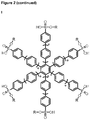
- Linkers can also comprise methane, silane and adamantine etc. Examples of such linkers are displayed in Figures 2 and 3 .
- Preferred examples include, without limitation, 1,4-benzenediphosphonic acid, 1,4-naphthalenediphosphonic acid, 1,5-naphthalenediphosphonic acid, 1,4-phenyldiphosphonic acid, methane tetra-p-phenylphosphonic acid, silane tetra-p-phenylphosphonic acid, 5,10,15,20-Tetrakis[p-phenylphosphonic acid] porphyrin, methane tetra-m-phenylphosphonic acid, silane tetra-m-phenylphosphonic acid, 5,10,15,20-Tetrakis[m-phenylphosphonic acid] porphyrin, 1,2,4,5-tetrakis(pphosphonatophenyl)benzene, tetrabiphenylsilane tetrakis-4-phosphonic acid, 1,3,6,8-tetrakis(p-phosphonatophenyl)pyrene, 4,4'-bis(p-phospho
- more than one type of organic linkers may be employed, for example, a first type of organic linker and a second type of organic linker.
- the two or more types of organic linkers may be provided in any suitable ratio.
- the two or more types of organic linkers may be provided in any suitable ratio.
- the metal atoms selected from group 1 to group 12 elements. In preferred embodiments, the metal atoms are selected from group 3 to group 12 elements. These metal atoms have high conductance and high phosphonate and arsonate binding affinities.
- the inorganic building units are composed of metal atoms or ions and functional groups of the organic linkers, which comprise oxygen and one or more atoms selected from the group comprising phosphorus (P), arsenic (As), antimony (Sb), silicon (Si), selenium (Se) and bismuth (Bi), preferably P or As.
- the inorganic building units form one-dimensional chains or two-dimensional sheets.
- Molecular or cluster type inorganic building units are discrete and can be connected by organic linkers in the MOF structure, therefore the conductance may be mainly dependent on conjugated organic linkers. The dependence on the organic linkers could reduce the conductivity.
- One-dimensional and two-dimensional inorganic building units can also provide conjugation, electron delocalization and higher conductivity due to the presence of conductive As, P, Sb elements compared to the MOFs composed of molecular or cluster type inorganic building units.
- the one- and two-dimensional inorganic building units may be composed of one or more metal atoms, phosphorus, oxygens and optionally nitrogens, which can be provided by functional groups of auxiliary linkers.
- the presence of one and two-dimensional inorganic building units increases the metallic character and is expected to have a positive impact on the conductivity of the resulting MOF.
- the inorganic building units comprise transition metal ions of group 3 to group 12 elements.
- inorganic building units comprise alkali metals and alkaline earth metals (group 1 and group 2 elements).
- metal atoms comprise Zn, Cu and/or Co and the functional groups comprise phosphonate and/or arsonate.
- the MOF is [ ⁇ Cu 2 (4,4'-bpy) 0.5 ⁇ (1,4-naphthalenediphosphonate (NDPA))], [Co 2 (H 4 -MTPPA)] ⁇ 3NMP ⁇ H 2 O, [ ⁇ Cu(H 2 O) ⁇ (2,6-NDPA) 0.5 ], or [Zn ⁇ N(CH 3 ) 2 ⁇ (6-bromonapthalene-2-yl)phosphonate].
- the MOF is [ ⁇ Cu 2 (4,4'-bpy) 0.5 ⁇ (1,4-naphthalenediphosphonate (NDPA))], or [Co 2 (H 4 -MTPPA)] ⁇ 3NMP ⁇ H 2 O.
- the MOF is [ ⁇ Cu 2 (4,4'-bipyridine) 0.5 ⁇ (1,4-naphthalenediphosphonate (NDPA))] and its unique one-dimensional inorganic building unit is composed of copper dimer chains, which is connected by fully deprotonated (1,4-naphthalenediphosphonate) 2- and 4,4'-bipyridine linkers to create rectangular void channels.
- the inorganic building unit of [ ⁇ Cu 2 (4,4'-bipyridine) 0.5 ⁇ (1,4-naphthalenediphosphonate (NDPA))] can be retained by changing the identity of the organic linkers.
- the use of other metal ions or atoms than Cu disclosed herein is also possible.
- the MOF is [Co 2 (H 4 -MTPPA)] ⁇ 3NMP ⁇ H 2 O, where H 8 -MTPPA is methane tetra-p-phenylphosphonic acid (see Figure 2G ), NMP is N-methyl-2-pyrrolidone, which is the removable solvent molecule.
- the inorganic building unit of [Co 2 (H 4 -MTPPA)] ⁇ 3NMP ⁇ H 2 O is composed of tetrahedral Co atoms forming corner shared 8 membered Co-O-P-O-Co-O-P-O rings. (H 4 -MTPPA) -4 indicates that is lost four protons.
- [Co 2 (H 4 -MTPPA)] ⁇ 3NMP ⁇ H 2 O of the invention is prepared solvothermically from the tetrahedral linker tetraphenylmethane tetrakis-4-phosphonic acid (H 8 -MTPPA) and CoSO 4 ⁇ 7H 2 O in N-methyl-2-pyrrolidone (NMP).
- Phosphonate and arsonate MOFs can be prepared hydrothermally, solvothermallay and mechanochemically.
- cobalt salts or metal salts can also be used to synthesize this MOF of the present invention.
- the synthesis can be carried under hydrothermal conditions as well.
- Another method of preparing would be using mechanochemistry methods without the presence of N-methyl-2-pyrrrolidone in the structure holes.
- NMP and water is only present as solvent molecules in the structure of [Co 2 (H 4 -MTPPA)] ⁇ 3NMP ⁇ H 2 O. they are weakly associated to the original structure of the MOF.
- [Co 2 (H 4 -MTPPA)] ⁇ 3NMP ⁇ H 2 O can be activated and be available in solvent free forms as well.
- the band gap of the MOF of the electrodes of the invention may be varied, e.g., by changing the substituents about the linker/ligand core or extending the tether lengths of the linkers.
- the band gap of a MOF is between about ⁇ 0 eV and about ⁇ 2.5 eV. Other ranges are possible.
- the band gap of [ ⁇ Cu 2 (4,4'-bpy) 0.5 ⁇ (1,4-naphthalenediphosphonate (NDPA))] has been determined to be 1.4 eV using the UV spectroscopy.
- the IBU could be further used to create conductive MOFs with the conjugated arylphosphonic acid and arylarsonic acid linkers as well.
- the different metal ions can be also used to produce one-dimensional building units with conductive properties.
- the MOFs described herein have variable electrical conductivity that can be tuned to be suitable for one or more of the applications described herein.
- the electrical conductivity of an MOF may be measured in polycrystalline pellet form and/or in polycrystalline film form.
- a pellet of an MOF may be compressed between two steel rods and subjected to a two-probe direct current measurement.
- the MOFs of the invention have a high conductivity.
- the MOFs to be used as electrode material in the context of the invention have conductivity of at least 1 S/cm.
- a MOF of the invention can also have a conductivity of less than 1 S/cm. Other conductivity ranges are possible.
- the conductivity of a MOF is at least about 0.1 S/cm, or at least about 0.2 S/cm, or at least about 0.3 S/cm, or at least about 0.4 S/cm, or at least about 0.5 S/cm, or at least about 0.6 S/cm, or at least about 0.8 S/cm, or at least about 1.0 S/cm, or at least about 1.2 S/cm, or at least about 1.5 S/cm, or at least about 1.8 S/cm, or at least about 2 S/cm, or at least about 2.5 S/cm, or at least about 5 S/cm, or at least about 7.5 S/cm, or at least about 10 S/cm, or at least about 12.5 S/cm, or at least about 15 S/cm, or at least about 17.5 S/cm, or at least about 20 S/cm, or
- the invention also relates to an electrochemical double layer capacitor comprising an electrode of the invention.
- the invention comprises a supercapacitor comprising an electrode as described herein.
- MOFs described herein relate to the MOFs as such as well as to the MOFs in the context of an electrode suitable for constructing an electrochemical double layer capacitor and/or supercapacitor or the MOFs of an electrochemical double layer capacitor comprising an electrode of the invention or the MOFs of a supercapacitor comprising an electrode as described herein.
- the present invention is directed to an electrode suitable for constructing an electrochemical double layer capacitor and/or supercapacitor and comprising as an electrode material a metal organic framework (MOF), wherein the MOF comprises an inorganic building unit comprising metal atoms selected from group 1 to group 12 elements, and functional groups of organic linkers comprising oxygen (O) and one or more atoms selected from the group comprising phosphorus (P), arsenic (As), antimony (Sb), silicon (Si), selenium (Se) and bismuth (Bi).
- MOF metal organic framework
- a supercapacitor also called a supercap, ultracapacitor or Goldcap
- a supercapacitor is a high-capacity capacitor with capacitance values much higher than other capacitors (but lower voltage limits) that bridge the gap between electrolytic capacitors and rechargeable batteries. They typically store 10 to 100 times more energy per unit volume or mass than electrolytic capacitors, can accept and deliver charge much faster than batteries, and tolerate many more charge and discharge cycles than rechargeable batteries.
- Supercapacitors are used in applications requiring many rapid charge/discharge cycles rather than long term compact energy storage: within cars, buses, trains, cranes and elevators, where they are used for regenerative braking, short-term energy storage or burst-mode power delivery.
- Electrochemical or electrostatic double-layer capacitors usually use carbon electrodes or derivatives with much higher electrostatic double-layer capacitance than electrochemical pseudocapacitance, achieving separation of charge in a Helmholtz double layer at the interface between the surface of a conductive electrode and an electrolyte.
- the separation of charge is of the order of a few ⁇ ngströms (0.3-0.8 nm), much smaller than in a conventional capacitor.
- Electrochemical pseudocapacitors usually use metal oxide or conducting polymer electrodes with a high amount of electrochemical pseudocapacitance additional to the double-layer capacitance. Pseudocapacitance is achieved by Faradaic electron charge-transfer with redox reactions, intercalation or electrosorption.
- Hybrid capacitors such as the lithium-ion capacitor, use electrodes with differing characteristics: one exhibiting mostly electrostatic capacitance and the other mostly electrochemical capacitance.
- the electrolyte forms an ionic conductive connection between the two electrodes which distinguishes them from conventional electrolytic capacitors where a dielectric layer always exists, and the so-called electrolyte (e.g., MnO2 or conducting polymer) is in fact part of the second electrode (the cathode, or more correctly the positive electrode).
- electrolyte e.g., MnO2 or conducting polymer
- supercapacitors are polarized by design with asymmetric electrodes, or, for symmetric electrodes, by a potential applied during manufacture.
- Supercapacitors consist of two electrodes separated by an ion-permeable membrane (separator), and an electrolyte ionically connecting both electrodes.
- ions in the electrolyte form electric double layers of opposite polarity to the electrode's polarity.
- positively polarized electrodes will have a layer of negative ions at the electrode/electrolyte interface along with a charge-balancing layer of positive ions adsorbing onto the negative layer.
- the negatively polarized electrode depending on electrode material and surface shape, some ions may permeate the double layer becoming specifically adsorbed ions and contribute with pseudocapacitance to the total capacitance of the supercapacitor.
- Supercapacitors use the double-layer effect to store electric energy; however, this double-layer has no conventional solid dielectric to separate the charges.
- the main drawback of carbon electrodes of double-layer SCs is small values of quantum capacitance which act in series with capacitance of ionic space charge. Therefore, further increase of density of capacitance in SCs can be connected with increasing of quantum capacitance of carbon electrode nanostructures.
- the amount of charge stored per unit voltage in an electrochemical capacitor is primarily a function of the electrode size, which can be enlarged by using highly porous electrode material or active electrode material.
- the electrostatic storage of energy in the double-layers is linear with respect to the stored charge, and correspond to the concentration of the adsorbed ions. Also, while charge in conventional capacitors is transferred via electrons, capacitance in double-layer capacitors is related to the limited moving speed of ions in the electrolyte and the resistive porous structure of the electrodes.
- Supercapacitor electrodes are generally thin coatings applied and electrically connected to a conductive, metallic current collector.
- the electrodes comprise as a material or an active material which contributes to or represents the this coatings a MOF of the invention.
- Supercapacitor or ELC electrodes must preferably have good conductivity, high temperature stability, long-term chemical stability (inertness), high corrosion resistance and high surface areas per unit volume and mass, which is provided by the MOFs described herein. Other requirements include environmental friendliness and low cost.
- the amount of double-layer as well as pseudocapacitance stored per unit voltage in a supercapacitor is predominantly a function of the electrode surface area.
- supercapacitor electrodes are typically made of porous, spongy material with an extraordinarily high specific surface area, such as activated carbon. Additionally, the ability of the electrode material to perform faradaic charge transfers enhances the total capacitance. Generally the smaller the electrode's pores, the greater the capacitance and specific energy. However, smaller pores increase equivalent series resistance (ESR) and decrease specific power. Applications with high peak currents require larger pores and low internal losses, while applications requiring high specific energy need small pores.
- ESR equivalent series resistance
- the most commonly used electrode material for EDLC supercapacitors is carbon in various manifestations such as activated carbon (AC), carbon fibre-cloth (AFC), carbide-derived carbon (CDC), carbon aerogel, graphite (graphene), graphane and carbon nanotubes (CNTs).
- AC activated carbon
- AFC carbon fibre-cloth
- CDC carbide-derived carbon
- CNTs carbon nanotubes
- metal organic framework refers to a molecular, one-, two- or three-dimensional coordination polymer including metal ions and ligands which function as organic structural units and are also referred to as "organic linkers” or “organic ligands”, wherein a portion of the metal ions are each chemically bonded to at least one bi-, tri-, tetra- or poly-dentate organic linker.
- the metal ions in addition to being coordinated with at least one organic linker, may also be bound to one or more auxiliary ligands, as described in more detail herein.
- Metal organic frameworks also known as porous coordination polymers, are crystalline coordination networks comprising inorganic building units, which may also be called metal ion clusters, or metal-based inorganic groups, such as one dimensional and two dimensional inorganic building units.
- the inorganic building units are mostly formed by metal atoms or ions and the functional groups of the organic linkers.
- MOFs are made by linking metal atoms or ions with organic building units which comprise organic linkers and optionally auxiliary linkers, through chemical bonds such as coordination bonds, covalent bonds or ionic bonds.
- the inorganic building units can be, without limitation, one-dimensional chains or two-dimensional sheets or three dimensional structures.
- the inorganic building units can also be referred to as secondary building units (SBUs).
- SBUs secondary building units
- the organic linkers of MOFs can be, without limitation, carboxylates, or other organic anions, such as phosphonate, sulfonate, and heterocyclic compounds.
- MOFs are composed of two major components: a metal ion or cluster of metal ions or molecular or one-dimensional inorganic building units or two-dimensional inorganic building units which are present in the inorganic building units and an organic molecule called organic linker or organic ligand or ligand or organic strut.
- the metal-based inorganic groups/inorganic building units are composed of the metal ions/atoms and the functional groups of the organic linkers comprising O and one or more atoms selected from the group comprising phosphorus (P), arsenic (As), antimony (Sb), silicon (Si), selenium (Se) and bismuth (Bi).
- the organic linkers comprise an organic core or geometrical (organic) core, forming at least a part of the organic structure of a MOF.
- the materials are often referred to as hybrid organic-inorganic materials.
- the organic units are typically mono-, di-, tri-, or tetravalent, hexavalent ligands and the choice of metal and linker dictates the structure and hence properties of the MOF.
- the metal's coordination preference influences the size and shape of pores by dictating how many ligands can bind to the metal and in which orientation.
- MOFs may comprise auxiliary linkers (also called auxiliary ligands), which are mostly organic molecules with a functional group that can also interact with the metal of the inorganic building unit through a covalent, coordinate and/or ionic bond.
- auxiliary linkers also called auxiliary ligands
- the organic part of the auxiliary linker can also form part of the organic unit of the MOF.
- the inorganic building units also called secondary building units (SBUs) or metal-based inorganic groups
- SBUs secondary building units
- MOF-5 for example, has a pcu net.
- the database of net structures can be found at the Reticular Chemistry Structure Resource ( Tranchemontagne DJ, Mendoza-Cortés JL, O'Keeffe M, Yaghi OM (May 2009). "Secondary building units, nets and bonding in the chemistry of metal-organic frameworks” (PDF). Chemical Society Reviews.
- bridging ligands Attached to the SBUs are bridging ligands.
- typical bridging ligands are di- and tricarboxylic acids. These ligands typically have rigid backbones. Examples are benzene-1 ,4-dicarboxylic acid (BDC or teraphthalic acid, biphenyl-4,4'-dicarboxylic acid (BPDC), and the tricarboxylic acid trimesic acid.
- MOFs are often porous, and the porosity can be modified and directed by using post-synthetic modifications.
- the MOFs are porous and have a high surface to mass ratio, which is a common measure for measuring porosity.
- Porosity or void fraction
- Porosity is a measure of the void (i.e. "empty") spaces in a material, and is a fraction of the volume of voids over the total volume, between 0 and 1, or as a percentage between 0% and 100%.
- Porosity can be influenced by modifying the organic unit of the MOF, including the organic core of the organic linker or the organic part of the auxiliary linker.
- the organic core of the organic linker can be of any geometrical shape suitable for use in the context of a MOF, as known to the person skilled in the art, such as for example V-shaped, L-shaped, T-shaped, X-shaped, Y-shaped, or hexagonal. Examples of suitable structures are displayed in Figures 2 and 3 disclosed herein.
- the tether lengths of the organic linkers can be shorter or longer.
- the n factor in Figure 2 describes the number of possible phenyl groups to extend the tether length of the organic linker.
- the angle between the tethers of the organic linker could be between 0 to 180 degrees. Commonly observed angles include, without limitation, about 90 degrees for porphyrine and phthalocyanine core, about 120 degrees for Y-shaped geometrical core, ca. 108 degrees for tetrahedral core (tetrahedral core angle could be flexible due to the presence of sigma bonds), about 180 degrees for linear geometries.
- Planar Y- and X-shaped core geometries in general form hexagonal or rectangular void channels with one-dimensional inorganic building units.
- Tetrahedral methane and silane cores usually form MOFs with molecular and one-dimensional building units.
- T-shaped linkers are not known in the MOF literature yet. Once their MOFs are synthesized, they could form rectangular or cubic void spaces.
- V-shaped and linear linkers are more flexible and they can form different forms of void spaces with molecular, one-dimensional and two-dimensional inorganic building units. As the phosphonates and arsonates prove extremely rich metal binding modes, different combinations and formation of void spaces in different geometries are possible.
- functional groups of the organic linkers of the MOFs of the invention comprise oxygen (O) and one or more atoms selected from the group comprising phosphorus (P), arsenic (As), antimony (Sb), silicon (Si), selenium (Se) and bismuth (Bi).
- the functional groups of the organic linkers of the MOFs of the invention comprise phosphonate, arsonate, phosphonic acid, phosphinic acid, phosphinate, phosphates, arsonic acids, and/or as arsenic acid.
- monoesters and/or diesters of these can be comprised by the functional groups.
- the organic linkers can comprise or consist of organophosphorus compounds.
- Organophosphorus compounds are organic compounds containing phosphorus.
- Organophosphorus chemistry is the corresponding science of the properties and reactivity of organophosphorus compounds.
- Phosphorus, like nitrogen, is in group 15 of the periodic table, and thus phosphorus compounds and nitrogen compounds have many similar properties.
- an organophosphorus compound need contain only an organic substituent, but need not have a direct phosphorus-carbon (P-C) bond.
- P-C direct phosphorus-carbon
- Hypophosphorous acid or phosphinic acid
- HPA Hypophosphorous acid
- phosphinic acid is a phosphorus oxyacid and a powerful reducing agent with molecular formula H 3 PO 2 .
- the formula for this acid is generally written H3PO2, but a more descriptive presentation is HOP(O)H 2 , which highlights its monoprotic character. Salts derived from this acid are called hypophosphites.
- Organophosphinic acids have the formula R 2 PO 2 H. The two hydrogen atoms directly bound to phosphorus in phosphinic acid are replaced by organic groups. For example, formaldehyde and H3PO2 react to give (HOCH2)2PO2H.
- phosphinic acid adds to Michael acceptors, for example with acrylamide it gives H(HO)P(O)CH 2 CH 2 C(O)NH 2 .
- the Cyanex family of dialkylphosphinic acids are used in hydrometallurgy to extract metals from ores.
- Phosphinates or hypophosphites are a class of phosphorus compounds conceptually based on the structure of hypophosphorous acid. IUPAC prefers the term phosphinate in all cases, however in practice hypophosphite is usually used to describe inorganic species (e.g. sodium hypophosphite), while phosphinate as used herein also refers to organophosphorus species.
- Organophosphinates are organophosphorus compounds with the formula OP(OR)R 2 , with the simplest example being methylphosphinic acid. Phosphinites P(OR)R 2 can be oxidized into phosphinates.
- Dialkylphosphinic acids are organophosphorus compounds with the formula R 2 PO 2 H, where R is any alkyl group.
- Arsonic acids are a subset of organoarsenic compounds defined as oxyacids where a pentavalent arsenic atom is bonded to two hydroxyl groups, a third oxygen atom (this one with a double bond), and an organic substituent.
- the salts/conjugate bases of arsonic acids are called arsonates.
- Arsonic acid refers to H 3 AsO 3 , the case where the substituent is a single hydrogen atom.
- the other arsonic acids can simply be viewed as hydrocarbyl derivatives of this base case.
- Arsenic acid results when the substituent is a hydroxyl group.
- Methylarsonic acid results when the substituent is a methyl group.
- Phenylarsonic acid results when the substituent is a phenyl group.
- Arsenic acid is the chemical compound with the formula H s AsO 4 . More descriptively written as AsO(OH) 3 , this colorless acid is the arsenic analogue of phosphoric acid. Arsenate and phosphate salts behave very similarly. Arsenic acid as such has not been isolated, but is only found in solution, where it is largely ionized. Its hemihydrate form (H 3 AsO 4 ⁇ 1 ⁇ 2H 2 O) does form stable crystals.
- the organic linkers of the invention can comprise auxiliary organo-imine groups forming coordinate, covalent or ionic bonds with metal atoms.
- Auxiliary linker preferably include 1,4-pyridine, 4,4'-bipyridine, 4,4'-(1,4-phenylene)bispyridine, and longer versions.
- Auxiliary linkers can be charged or in a neutral state. Different positioning of nitrogen atom is also possible such as 2,2'-bipyridine, 3,3'-bipyridine, and others.
- Metal-binding solvent molecules such as water, ethanol, DMF, DMSO, THF, or any polar protic and polar aprotic solvents can also be considered as auxiliary linkers.
- Conjugate bases from salts of metals such as sulfates, nitrates, carbonates etc and halogens F, CI, Br, I are also considered as auxiliary ligands.
- Auxiliary ligands can be any Lewis base.
- a Lewis base is any species that has a filled orbital containing an electron pair which is not involved in bonding but may form a dative bond with a Lewis acid to form a Lewis adduct.
- NH3 is a Lewis base, because it can donate its lone pair of electrons.
- a Lewis acid is a chemical species that contains an empty orbital which is capable of accepting an electron pair from a Lewis base to form a Lewis adduct.
- Trimethylborane (Me 3 B) is a Lewis acid as it is capable of accepting a lone pair. In a Lewis adduct, the Lewis acid and base share an electron pair furnished by the Lewis base, forming a dative bond.
- a Lewis base is an atomic or molecular species where the highest occupied molecular orbital (HOMO) is highly localized.
- Typical Lewis bases are conventional amines such as ammonia and alkyl amines.
- Other common Lewis bases include pyridine and its derivatives.
- the most common Lewis bases are anions.
- Lewis bases based on the general definition of electron pair donor include: simple anions, such as H - and F - ; other lone-pair-containing species, such as H 2 O, NH 3 , HO - , and CH 3 - ; complex anions, such as sulfate; electron rich ⁇ -system Lewis bases, such as ethyne, ethene, and benzene.
- an imine is a functional group or chemical compound containing a carbon-nitrogen double bond.
- the nitrogen atom can be attached to a hydrogen (H) or an organic group (R). If this group is not a hydrogen atom, then the compound can sometimes be referred to as a Schiff base.
- the carbon atom has two additional single bonds.
- Imines in which R is one or more organic groups are called organoimine.
- imine refers to the aza analogue of an epoxide.
- ethyleneimine is the three-membered ring species C 2 H 4 NH.
- Imines are related to ketones and aldehydes by replacement of the oxygen with an NR group.
- R H
- the compound when R is hydrocarbyl, the compound is a secondary imine.
- Imines exhibit diverse reactivity and are commonly encountered throughout chemistry.
- R 3 is OH
- the imine is called an oxime
- R 3 is NH 2
- the imine is called a hydrazone.
- a primary imine in which C is attached to both a hydrocarbyl and a H is called a primary aldimine; a secondary imine with such groups is called a secondary aldimine (R 3 is attached to a hydrocabyl).
- a primary imine in which C is attached to two hydrocarbyls is called a primary ketimine; a secondary imine with such groups is called a secondary ketimine.
- a metal-based inorganic group of a MOF can be a metal ion or a or a cluster of metal ions capable of bonding with the organic linkers.
- the term "capable of bonding” refers to the formation of a chemical bond, preferably an ionic bond or a coordinate covalent bond, which is formed between the metal-based inorganic group and the organic linker of the MOF.
- a chemical bond is a lasting attraction between atoms, ions or molecules that enables the formation of chemical compounds. The bond may result from the electrostatic force of attraction between oppositely charged ions as in ionic bonds or through the sharing of electrons as in covalent bonds.
- the strength of chemical bonds varies considerably; there are “strong bonds” or “primary bonds” such as covalent, ionic and metallic bonds, and “weak bonds” or “secondary bonds” such as dipole-dipole interactions, the London dispersion force and hydrogen bonding.
- Ionic bonding is a type of electrostatic interaction between atoms that have a large electronegativity difference. There is no precise value that distinguishes ionic from covalent bonding, but an electronegativity difference of over 1.7 is likely to be ionic while a difference of less than 1.7 is likely to be covalent. Ionic bonding leads to separate positive and negative ions. Ionic charges are commonly between -3e to +3e. Ionic bonding commonly occurs in metal salts such as sodium chloride. A typical feature of ionic bonds is that the species form into ionic crystals, in which no ion is specifically paired with any single other ion in a specific directional bond.
- each species of ion is surrounded by ions of the opposite charge, and the spacing between it and each of the oppositely charged ions near it is the same for all surrounding atoms of the same type. It is thus no longer possible to associate an ion with any specific other single ionized atom near it. This is a situation unlike that in covalent crystals, where covalent bonds between specific atoms are still discernible from the shorter distances between them, as measured via such techniques as X-ray diffraction.
- Covalent bonding is a common type of bonding in which two or more atoms share valence electrons more or less equally.
- the simplest and most common type is a single bond in which two atoms share two electrons.
- Other types include the double bond, the triple bond, one- and three-electron bonds, the three-center two-electron bond and three-center four-electron bond.
- the electronegativity difference between the bonded atoms is small, typically 0 to 0.3. Bonds within most organic compounds are described as covalent. In CH 4 /methane each hydrogen forms a covalent bond with the carbon.
- Molecules that are formed primarily from non-polar covalent bonds are often immiscible in water or other polar solvents, but much more soluble in non-polar solvents such as hexane.
- a polar covalent bond is a covalent bond with a significant ionic character. This means that the two shared electrons are closer to one of the atoms than the other, creating an imbalance of charge. Such bonds occur between two atoms with moderately different electronegativities and give rise to dipole-dipole interactions. The electronegativity difference between the two atoms in these bonds is 0.3 to 1.7.
- the metal-based inorganic groups of the invention preferably comprise a metal from the groups 1-12 of the periodic table, comprising alkali metal (group 1), alkali earth metals (group 2) and transition metals (group 3-12).
- the alkali metals are the series of elements in Group 1 of the periodic table (excluding hydrogen).
- the series comprises the elements lithium (Li), sodium (Na), potassium (K), rubidium (Rb), caesium (Cs), and francium (Fr).
- the alkaline earth metals are the series of elements in Group 2 of the periodic table.
- the series comprises the elements beryllium (Be), magnesium (Mg), calcium (Ca), strontium (Sr), barium (Ba) and radium (Ra).
- Transition metals are the elements located in Groups 3 - 12 of the Periodic Table. All the transition metals have two electrons in their outermost shell, and all but zinc, cadmium, and mercury have an incompletely filled inner shell. Terms including multiple valences (because of their incomplete inner shells), high melting points, colored compounds, and the ability to form stable complex ions and alloys describe some of the properties of transition metals.
- the elements classed as transition metals generally have the following properties in common: Good conductors of heat and electricity; easily hammered or bent into shape; usually hard and tough; high densities; high melting points - but mercury is a liquid at room temperature; form coloured compounds.
- Transition Metals comprise scandium (Sc), titanium (Ti), vanadium (V), chromium (Cr), manganese (Mn), iron (Fe), cobalt (Co), nickel (Ni), copper (Cu), and zinc (Zn), yttrium (Y), zirconium (Zr), niobium (Nb), molybdenum (Mo), technetium (Tc), ruthenium (Ru), rhodium (Rh), palladium (Pd), silver (Ag), and cadmium (Cd), lanthanum (La), hafnium (Hf), tantalum (Ta), tungsten (W), rhenium (Re), osmium (Os), iridium (Ir), platinum (Pt), gold (Au), and mercury (Hg), actinium (Ac), rutherfordium (Rf), dubnium (Db), seaborgium (Sg), bohrium (Bh), hassium (Hs), me
- the metal atoms or ions of the invention are selected form the group comprising zinc (Zn), cadmium (Cd), copper (Cu), cobalt (Co), nickel (Ni), gold (Au) and silver (Ag), preferably Zn, Co, Cu and Ni, most preferably Zn and Cu.
- Preferred inorganic building units are in the form of one-dimensional chains or two-dimensional sheets.
- Molecular/cluster type of inorganic building units are well separated in MOF structure, which makes the conductance mainly dependent on organic linkers.
- a molecular/cluster, or one-dimensional, or two-dimensional inorganic building unit of a phosphonate-MOF includes the elements Metal ion (M), P and O, when they are constructed using pyridine auxiliary linkers inorganic building unit includes the elements Metal ion (M), P and O and N, when the N of the functional group of the auxiliary linker is considered to be connected part of the inorganic building unit.
- arsonate-MOFs For arsonate-MOFs, it includes the elements Metal ion (M), As and O; when they are constructed using pyridine auxiliary linkers inorganic building unit includes the elements Metal ion (M), As and O and N.
- the MOF can be comprise more than one kind of metal atom, and can therefore be for example bimetallic, trimetallic can comprise even more different metals.
- the band gap also called an energy gap or band gap
- the band gap is an energy range in a solid where no electron states can exist.
- the band gap generally refers to the energy difference (in electron volts) between the top of the valence band and the bottom of the conduction band in insulators and semiconductors. It is the energy required to promote a valence electron bound to an atom to become a conduction electron, which is free to move within the crystal lattice and serve as a charge carrier to conduct electric current.
- the band gap is a major factor determining the electrical conductivity of a solid.
- Substances with large band gaps are generally insulators, those with smaller band gaps are semiconductors, while conductors either have very small band gaps or none, because the valence and conduction bands overlap.
- electrical conductivity or specific conductance represents a material's ability to conduct electric current. It is commonly signified by the Greek letter ⁇ (sigma), but ⁇ (kappa) (especially in electrical engineering) and ⁇ (gamma) are sometimes used.
- the SI unit of electrical conductivity is siemens per metre (S/m).
- aliphatic includes both saturated and unsaturated, nonaromatic, straight chain (i.e., unbranched), branched, acyclic, and cyclic (i.e., carbocyclic) hydrocarbons, which are optionally substituted with one or more functional groups.
- aliphatic is intended herein to include, but is not limited to, alkyl, alkenyl, alkynyl, cycloalkyl, cycloalkenyl, and cycloalkynyl moieties.
- alkyl includes straight, branched and cyclic alkyl groups.
- alkenyl alkynyl
- alkynyl alkenyl
- alkynyl alkynyl
- aliphatic is used to indicate those aliphatic groups (cyclic, acyclic, substituted, unsubstituted, branched or unbranched) having 1-20 carbon atoms or more.
- Aliphatic group substituents include, but are not limited to, any of the substituents described herein, that result in the formation of a stable moiety (e.g., aliphatic, alkyl, alkenyl, alkynyl, heteroaliphatic, heterocyclic, aryl, heteroaryl, acyl, oxo, imino, thiooxo, cyano, isocyano, amino, azido, nitro, hydroxyl, thiol, halo, aliphaticamino, heteroaliphaticamino, alkylamino, heteroalkylamino, arylamino, heteroarylamino, alkylaryl, arylalkyl, aliphaticoxy, heteroaliphaticoxy, alkyloxy, heteroalkyloxy, aryloxy, heteroaryloxy, aliphaticthioxy, heteroaliphaticthioxy, alkylthioxy, heteroalkylthioxy, arylthioxy, heteroarylthioxy,
- alkyl is given its ordinary meaning in the art and refers to the radical of saturated aliphatic groups, including straight-chain alkyl groups, branched-chain alkyl groups, cycloalkyl (alicyclic) groups, alkyl substituted cycloalkyl groups, and cycloalkyl substituted alkyl groups.
- the alkyl group may be a lower alkyl group, i.e., an alkyl group having 1 to 10 carbon atoms (e.g., methyl, ethyl, propyl, butyl, pentyl, hexyl, heptyl, octyl, nonyl, or decyl).
- a straight chain or branched chain alkyl may have 30 or fewer carbon atoms in its backbone, and, in some cases, 20 or fewer. In some embodiments, a straight chain or branched chain alkyl may have 12 or fewer carbon atoms in its backbone (e.g., C1-C12 for straight chain, C3-C12 for branched chain), 6 or fewer, or 4 or fewer. Likewise, cycloalkyls may have from 3-10 carbon atoms in their ring structure, or 5, 6 or 7 carbons in the ring structure.
- alkyl groups include, but are not limited to, methyl, ethyl, propyl, isopropyl, cyclopropyl, butyl, isobutyl, t-butyl, cyclobutyl, hexyl, and cyclochexyl.
- alkylene refers to a bivalent alkyl group.
- An "alkylene” group is a polymethylene group, i.e., -(CH2)z-, wherein z is a positive integer, e.g., from 1 to 20, from 1 to 10, from 1 to 6, from 1 to 4, from 1 to 3, from 1 to 2, or from 2 to 3.
- a substituted alkylene chain is a polymethylene group in which one or more methylene hydrogen atoms are replaced with a substituent. Suitable substituents include those described herein for a substituted aliphatic group.
- a bivalent carbocycle is “carbocyclylene”
- a bivalent aryl ring is “arylene”
- a bivalent benzene ring is “phenylene”
- a bivalent heterocycle is "heterocyclylene”
- a bivalent heteroaryl ring is “heteroarylene”
- a bivalent alkyl chain is “alkylene”
- a bivalent alkenyl chain is “alkenylene”
- a bivalent alkynyl chain is “alkynylene”
- a bivalent heteroalkyl chain is "heteroalkylene”
- a bivalent heteroalkenyl chain is "heteroalkenylene”
- a bivalent heteroalkynyl chain is “heteroalkynylene”
- alkenyl and alkynyl are given their ordinary meaning in the art and refer to unsaturated aliphatic groups analogous in length and possible substitution to the alkyls described above, but that contain at least one double or triple bond respectively.
- the alkyl, alkenyl and alkynyl groups employed in the invention contain 1-20 aliphatic carbon atoms. In certain other embodiments, the alkyl, alkenyl, and alkynyl groups employed in the invention contain 1-10 aliphatic carbon atoms. In yet other embodiments, the alkyl, alkenyl, and alkynyl groups employed in the invention contain 1-8 aliphatic carbon atoms. In still other embodiments, the alkyl, alkenyl, and alkynyl groups employed in the invention contain 1-6 aliphatic carbon atoms. In yet other embodiments, the alkyl, alkenyl, and alkynyl groups employed in the invention contain 1-4 carbon atoms.
- Illustrative aliphatic groups thus include, but are not limited to, for example, methyl, ethyl, n-propyl, isopropyl, allyl, n-butyl, sec-butyl, isobutyl, t-butyl, n-pentyl, sec-pentyl, isopentyl, t-pentyl, n-hexyl, sec-hexyl, moieties and the like, which again, may bear one or more substituents.
- Alkenyl groups include, but are not limited to, for example, ethenyl, propenyl, butenyl, 1-methyl-2-buten-1-yl, and the like.
- Representative alkynyl groups include, but are not limited to, ethynyl, 2-propynyl (propargyl), 1-propynyl and the like.
- cycloalkyl refers specifically to groups having three to ten, preferably three to seven carbon atoms. Suitable cycloalkyls include, but are not limited to cyclopropyl, cyclobutyl, cyclopentyl, cyclohexyl, cycloheptyl and the like, which, as in the case of other aliphatic, heteroaliphatic, or hetercyclic moieties, may optionally be substituted with substituents including, but not limited to aliphatic; heteroaliphatic; aryl; heteroaryl; arylalkyl; heteroarylalkyl; alkoxy; aryloxy; heteroalkoxy; heteroaryloxy; alkylthio; arylthio; heteroalkylthio; heteroarylthio;-F; -Cl; -Br; -I; -OH; -NO2; -CN; -CF3; -CH2CF3; -
- heteroaliphatic refers to an aliphatic moiety, as defined herein, which includes both saturated and unsaturated, nonaromatic, straight chain (i.e., unbranched), branched, acyclic, cyclic (i.e., heterocyclic), or polycyclic hydrocarbons, which are optionally substituted with one or more functional groups, and that contain one or more oxygen, sulfur, nitrogen, phosphorus, or silicon atoms, e.g., in place of carbon atoms.
- heteroaliphatic moieties are substituted by independent replacement of one or more of the hydrogen atoms thereon with one or more substituents.
- heteroaliphatic is intended herein to include, but is not limited to, heteroalkyl, heteroalkenyl, heteroalkynyl, heterocycloalkyl, heterocycloalkenyl, and heterocycloalkynyl moieties.
- heteroaliphatic includes the terms “heteroalkyl,” “heteroalkenyl”, “heteroalkynyl”, and the like.
- heteroalkyl encompass both substituted and unsubstituted groups.
- heteroaliphatic is used to indicate those heteroaliphatic groups (cyclic, acyclic, substituted, unsubstituted, branched or unbranched) having 1-20 carbon atoms.
- Heteroaliphatic group substituents include, but are not limited to, any of the substituents described herein, that result in the formation of a stable moiety (e.g., aliphatic, alkyl, alkenyl, alkynyl, heteroaliphatic, heterocyclic, aryl, heteroaryl, acyl, sulfinyl, sulfonyl, oxo, imino, thiooxo, cyano, isocyano, amino, azido, nitro, hydroxyl, thiol, halo, aliphaticamino, heteroaliphaticamino, alkylamino, heteroalkylamino, arylamino, heteroarylamino, alkylaryl
- heteroalkyl is given its ordinary meaning in the art and refers to an alkyl group as described herein in which one or more carbon atoms is replaced by a heteroatom. Suitable heteroatoms include oxygen, sulfur, nitrogen, phosphorus, and the like. Examples of heteroalkyl groups include, but are not limited to, alkoxy, alkoxyalkyl, amino, thioester, poly(ethylene glycol), and alkyl-substituted amino.
- heteroalkenyl and “heteroalkynyl” are given their ordinary meaning in the art and refer to unsaturated aliphatic groups analogous in length and possible substitution to the heteroalkyls described above, but that contain at least one double or triple bond respectively.
- substituents of the above-described aliphatic (and other) moieties of compounds of the invention include, but are not limited to aliphatic; heteroaliphatic; aryl; heteroaryl; alkylaryl; alkylheteroaryl; alkoxy; aryloxy; heteroalkoxy; heteroaryloxy; alkylthio; arylthio; heteroalkylthio; heteroarylthio; F; Cl; Br; I; -OH; -NO2; -CN; -CF3; -CHF2;-CH2F; -CH2CF3; -CHCl2; -CH2OH; -CH2CH2OH; -CH2NH2; -CH2SO2CH3; -C(O)Rx; -CO2(Rx); -CON(Rx)2; -OC(O)Rx; -OCO2Rx; -OCON(Rx)2; -N(Rx)2;
- aryl is given its ordinary meaning in the art and refers to aromatic carbocyclic groups, optionally substituted, having a single ring (e.g., phenyl), multiple rings (e.g., biphenyl), or multiple fused rings in which at least one is aromatic (e.g., 1,2,3,4-tetrahydronaphthyl, naphthyl, anthryl, or phenanthryl). That is, at least one ring may have a conjugated pi electron system, while other, adjoining rings can be cycloalkyls, cycloalkenyls, cycloalkynyls, aryls and/or heterocyclyls.
- the aryl group may be optionally substituted, as described herein.
- Substituents include, but are not limited to, any of the previously mentioned substituents, i.e., the substituents recited for aliphatic moieties, or for other moieties as disclosed herein, resulting in the formation of a stable compound.
- an aryl group is a stable mono- or polycyclic unsaturated moiety having preferably 3-14 carbon atoms, each of which may be substituted or unsubstituted.
- Carbocyclic aryl groups refer to aryl groups wherein the ring atoms on the aromatic ring are carbon atoms. Carbocyclic aryl groups include monocyclic carbocyclic aryl groups and polycyclic or fused compounds (e.g., two or more adjacent ring atoms are common to two adjoining rings) such as naphthyl groups.
- heteroaryl is given its ordinary meaning in the art and refers to aryl groups comprising at least one heteroatom as a ring atom.
- a “heteroaryl” is a stable heterocyclic or polyheterocyclic unsaturated moiety having preferably 3-14 carbon atoms, each of which may be substituted or unsubstituted. Substituents include, but are not limited to, any of the previously mentioned substituents, i.e., the substitutes recited for aliphatic moieties, or for other moieties as disclosed herein, resulting in the formation of a stable compound.
- a heteroaryl is a cyclic aromatic radical having from five to ten ring atoms of which one ring atom is selected from S, O, and N; zero, one, or two ring atoms are additional heteroatoms independently selected from S, O, and N; and the remaining ring atoms are carbon, the radical being joined to the rest of the molecule via any of the ring atoms, such as, for example, pyridyl, pyrazinyl, pyrimidinyl, pyrrolyl, pyrazolyl, imidazolyl, thiazolyl, oxazolyl, isooxazolyl, thiadiazolyl, oxadiazolyl, thiophenyl, furanyl, quinolinyl, isoquinolinyl, and the like.
- aryl and heteroaryl moieties may be attached via an alkyl or heteroalkyl moiety and thus also include -(alkyl)aryl, -(heteroalkyl)aryl, - (heteroalkyl)heteroaryl, and -(heteroalkyl)heteroaryl moieties.
- aryl or heteroaryl moieties and “aryl, heteroaryl, -(alkyl)aryl, -(heteroalkyl)aryl, - (heteroalkyl)heteroaryl, and -(heteroalkyl)heteroaryl" are interchangeable.
- Substituents include, but are not limited to, any of the previously mentioned substituents, i.e., the substituents recited for aliphatic moieties, or for other moieties as disclosed herein, resulting in the formation of a stable compound.
- aryl and heteroaryl groups can be unsubstituted or substituted, wherein substitution includes replacement of one or more of the hydrogen atoms thereon independently with any one or more of the following moieties including, but not limited to: aliphatic; alicyclic; heteroaliphatic; heterocyclic; aromatic; heteroaromatic; aryl; heteroaryl; alkylaryl; heteroalkylaryl; alkylheteroaryl; heteroalkylheteroaryl; alkoxy; aryloxy; heteroalkoxy; heteroaryloxy; alkylthio; arylthio; heteroalkylthio; heteroarylthio; F; Cl; Br; I; -OH; -NO2; -CN; -CF3; -CH2F; -CHF2; -CH2CF3; -CHCl2; -CH2OH; -CH2CH2OH;-CH2NH2; -CH2
- any two adjacent groups taken together may represent a 4, 5, 6, or 7-membered substituted or unsubstituted alicyclic or heterocyclic moiety. Additional examples of generally applicable substituents are illustrated by the specific embodiments described herein.
- any of the above groups may be optionally substituted.
- substituted is contemplated to include all permissible substituents of organic compounds, "permissible” being in the context of the chemical rules of valence known to those of ordinary skill in the art.
- substituted whether preceded by the term “optionally” or not, and substituents contained in formulas of this invention, refer to the replacement of hydrogen radicals in a given structure with the radical of a specified substituent.
- substituent When more than one position in any given structure may be substituted with more than one substituent selected from a specified group, the substituent may be either the same or different at every position. It will be understood that “substituted” also includes that the substitution results in a stable compound, e.g., which does not spontaneously undergo transformation such as by rearrangement, cyclization, elimination, etc. In some cases, “substituted” may generally refer to replacement of a hydrogen with a substituent as described herein. However, “substituted,” as used herein, does not encompass replacement and/or alteration of a key functional group by which a molecule is identified, e.g., such that the "substituted" functional group becomes, through substitution, a different functional group.
- a "substituted phenyl group” must still comprise the phenyl moiety and cannot be modified by substitution, in this definition, to become, e.g., a pyridine ring.
- the permissible substituents include acyclic and cyclic, branched and unbranched, carbocyclic and heterocyclic, aromatic and nonaromatic substituents of organic compounds.
- Illustrative substituents include, for example, those described herein.
- the permissible substituents can be one or more and the same or different for appropriate organic compounds.
- the heteroatoms such as nitrogen may have hydrogen substituents and/or any permissible substituents of organic compounds described herein which satisfy the valencies of the heteroatoms.
- this invention is not intended to be limited in any manner by the permissible substituents of organic compounds.
- stable preferably refers to compounds which possess stability sufficient to allow manufacture and which maintain the integrity of the compound for a sufficient period of time to be detected and preferably for a sufficient period of time to be useful for the purposes detailed herein.
- substituents include, but are not limited to, halogen, azide, alkyl, aralkyl, alkenyl, alkynyl, cycloalkyl, hydroxyl, alkoxyl, amino, nitro, sulfhydryl, imino, amido, phosphonate, phosphinate, carbonyl, carboxyl, silyl, ether, alkylthio, sulfonyl, sulfonamido, ketone, aldehyde, ester, heterocyclyl, aromatic or heteroaromatic moieties, -CF3, -CN, aryl, aryloxy, perhaloalkoxy, aralkoxy, heteroaryl, heteroaryloxy, heteroarylalkyl, heteroaralkoxy, azido, amino, halide, alkylthio, oxo, acylalkyl, carboxy esters, -carboxamido, acyloxy, aminoalky
- the MOFs can be synthesized using the arylphosphonic acid or arylarsonic acid linkers presented in Figure 2 and Tables 1 and 2 and their monoester forms. Such MOFs could be synthesized using hydrothermal, solvothermal reactions, conventional MOF reactions and also mechanochemistry could be used to synthesize such MOFs. Extended tether lengths of the linkers could be used to optimize the pore sizes. Using extended tethers could create MOFs with surface areas larger than 2000 m 2 /g. Using different metal ions could optimize the conductivity of the MOF while retaining the same framework structure.
- the organic linkers presented in Figures 2 and Tables 1 and 2 can be synthesized via Suzuki Cross Coupling Method [ Synthesis of Some Di- and Tetraphosphonic Acids by Suzuki Cross-Coupling, A. Schütrumph, A. Duthie, E. Lork, G. Yücesan and J. Beckmann, Z. Allgem. Anorg. Chem., 2018, 644 (19), 1134-1142 ].
- the conventional, Pd and Ni catalyzed Arbuzov reactions can also be used to synthesize organophosphonic acid linkers.
- Arsonic acid analogues can also be synthesized using the same Suzuki Cross Coupline methodology and also using Bart Scheller Methods [ Substituted phenylarsonic acids; structures and spectroscopy, N. C. Lloyd, H. W. Morgan, B. K. Nicholson, R. S. Ronimus, Journal of Organometallic Chemistry, 2008, 693, 2443-2450 ; The Preparation of Aromatic Arsonic and Arsinic Acids by the Bart, Bechamp, and Rosenmund Reactions, C. S. Hamilton, J. F. Morgan, In Organic Reactions; John Wiley & Sons, Inc., 2004; pages 415-454 (DOI:10.1002/0471264180.or002.10 )].
- Conductive phosphonate-MOFs and arsonate-MOFs can be constructed around the organic molecules having at least one phosphonic acid or arsonic acid units in any geometrical orientation on the aromatic organic linker core.
- the conductive MOFs can be also constructed using any organic linker having at least one phosphonic acid monoester or arsonic acid monoester in any geometrical orientation around the organic scaffolds.
- the conductive phosphonate and arsonate-MOFs can be thermally stable up to 620 °C.
- the conductive MOFs can be synthesized using non limiting monovalent metal ions, Na + , Li + , Cs + , Cu + , Au + and Ag + , divalent Zn 2+ , Cu 2+ , Mg 2+ , Ba 2+ , Ca 2+ , Co 2+ , Ni 2+ , Cd 2+ or trivalent Co 3+ , Al 3+ Fe 3+ , Ti 3+ or tetravalent Ti 4+ , Zr 4+ , V 4+ , Hf 4+ with the organic linkers bearing phosphonic acid and arsonic acid metal binding groups.
- Non-metal binding organic functional groups or elements such as halogens with different electronegativities can be covalently attached to the linker scaffold and such elements F, CI, Br, I, or non-metal binding functional groups OH, NO 2 , or non-metal binding alkyl groups can be influential in optimizing the conductive behavior of the MOF.
- Mechanochemistry can be used to synthesize the phosphonate and arsonate-MOFs in larger quantities.
- TUB75 that has experimental band-gap value of 1.4 eV.
- the crystal structure of TUB75 shows the presence of copper dimer chains which were connected by fully deprotonated 1,4-naphthalenediphosphonic acid and 4,4'-bipyridine to give rectangular void channels.
- TUB75 has a calculated BET surface area of 132.1 m 2 /g.
- Band gap values of MOF crystals are obtained via Tauc Plotting of the UV spectra.
- the solid-state diffuse reflectance Ultraviolet-Visible (UV-vis) spectra of the synthesized MOF crystals of TUB75 have been collected on Varian Cary 300 UV-Vis Spectrophotometer. Tauc Plotting has indicated that TUB75 has band gap value of 1.4 eV. See Figure 3 .
- 1,4-napthalenediphosphonic acid follows the similar synthetic route for 2,6-naphthalenediphosphonic acid.
- the starting materials were purchased from Aldrich, TCI, ABCR and Alfa Aesar companies, and used as received.
- Naphthalene-1,4-diyl-bis(phosphonic diisopropyl ester) was obtained using a [Pd(PPh 3 ) 4 ]-catalyzed Michaelis-Arbuzov reaction by conventional heating methods.
- Naphthalene-1,4-diylbis(phosphonic diisopropyl ester) (2.5 mmol) and 20 mL of HCl (37 %) were added in a 50 mL flask and heated to 80 °C on a sand bath to synthesize 1,4-naphthalenediphosphonic acid. After 8 h, a white paste was obtained and this paste was treated with methanol to remove excess hydrochloric acid and isopropylchloride which is generated during acid-catalyzed hydrolysis. This methanol crude product mixture was evaporated under high vacuum and the solid final product was obtained as a white solid.
- the hydrothermal reactions have been performed in 23 ml Teflon lined Parr Acid Digestion Vessels.
- the initial pH of the reaction mixture was recorded to be 2. 1,4-naphthalenediphosphonic acid (0.100 g, 0.35 mmol), CuSO 4 .5H 2 O (0.150 g, 0.60 mmol), 4,4'-bipyridine (0.040 g, 0.256 mmol) and water (10.084 g, 560 mmol) were mixed and this solution was maintained in closed 23 ml Teflon lined Parr Acid Digestion Vessel for 4 days at 200°C under autogeneous pressure. After cooling to room temperature, the needle-shaped green crystals were filtered, washed with acetone, and air-dried.
- TUB75 The crystal structure of TUB75 is shown in Figure 1a and 1b .
- the solid-state structures of compound TUB75 was confirmed by X-ray diffraction analysis. The data was obtained with Bruker APEX II QUAZAR three-circle diffractometer. Indexing was performed using APEX2. Data integration and reduction were carried out with SAINT. TWINABS was used for absorption correction of TUB75. The structure was solved using Olex2, SHELXT and refined with the ShelXL refinement package using Least Squares minimization. CrystalMaker software was used to visualize the CIF file.
- GCMC Grand canonical Monte Carlo
- Arylphosphonic acid linkers could have intrinsic low band gap values. Once arylphosphonic acid linkers are connected with inorganic building units, they could form conductive MOFs.
- the following examples demonstrate the general formulation of phosphonate-MOFs constructed with one dimensional inorganic building unit composed of continuous corner shared 8 membered M-O-P-O-M-O-P-O rings.
- a one dimensional IBU could be composed of tetrahedral Co atoms giving the one dimensional inorganic building unit as seen in Figure 1c with Co-O-P-O-CoO-P-O pattern.
- Changing the metal ion or organic linker identity could change the conformation of the one-dimensional IBU. Upon this conformational change, the surface area could change dramatically.
- this working example includes the MOFs synthesized with one-dimensional inorganic building units composed of corner sharing 8 membered M-O-P-O-M-O-P-O rings, where M represents a metal ion.
- TGA analysis of [ ⁇ Cu(4, 4'-bpy) 0.5 (1,4-NDPA-H 2 )] is performed using, TA instruments SDT Q600 series. Thermal decomposition of [ ⁇ Cu(4, 4'-bpy) 0.5 (1,4-NDPA-H 2 )] starts at ca. 375°C and decomposition continues until ca. 700°C.
- Tetraphenylmethane(phosphonic tetraisopropyl ester) (1.11 g, 1.14 mmol) was treated with 20 mL HCI (37 %) on a sand bath at 80°C for 24 h. Upon cooling, a colorless precipitate formed that was filtered and washed with methanol (10 mL). Drying afforded a colorless solid of 5a (Yield; 720 mg, 1.12 mmol, 98%).
- 1 H NMR 500 MHz, CDCl 3 ) ⁇ 7.76 (d, 8H), ⁇ 7.29 (d, 8H), 4.96 (m, 8H).
- Methane tetra-p-phenylphosphonic acid (MTPPA) (0.100 g, 0.35 mmol), CoSO 4 ⁇ 7 H 2 O (0.150 g, 0.60 mmol), and N-Methyl-2-pyrrolidone (NMP) (9ml) were mixed and this solution was maintained in closed 23 ml teflon lined Parr acid digestion vessel for 24 hour at 165°C under autogenous pressure. After cooling to room temperature, the dark blue block-shaped crystals were filtered, purified by hand picking under the microscope, washed with acetone, and air-dried.
- MMPA Methane tetra-p-phenylphosphonic acid
- NMP N-Methyl-2-pyrrolidone
- TGA of Co 2 (H 4 -MTPPA)] ⁇ 3 NMP ⁇ H 2 O indicate that organic components from MTPPA linker start decomposing at ca. 525 C indicating exceptional thermal stability.
- the total weight loss of MTPPA continues until 700 C.
- the initial ca. 20% (calculated 27%) of weight loss in the TGA curve corresponds to the solvent molecules of NMP and H 2 O.
- the BET surface area of Co 2 (H 4 -MTPPA)] ⁇ 3 NMP ⁇ H 2 O was derived from its simulated N 2 adsorption isotherm at 77 K obtained by grand canonical Monte Carlo simulations. Such calculations have been widely used for characterizing the surface area of MOF materials.
- the calculated BET surface area for Co 2 (H 4 -MTPPA)] ⁇ 3 NMP ⁇ H 2 O is 1034 m 2 /g, which is 107m 2 /g higher than its isostructural zinc compound Zn 2 H 4 -MTPPA.
- BET surface area of Zn 2 H 4 -MTPPA was measured to be 927 m 2 /g.
- the solvent molecules of NMP were omitted during the simulations.
- Zn 2 H 4 MTPPA is isostructural with Co 2 H 4 MTPPA with different bond lengths and angles in the inorganic building units.
- BET surface area of 927 m 2 /g was derived from N 2 adsorption isotherms at 77 K which were obtained by Monte Carlo simulations in the grand canonical ensemble.
- the following working example describes the synthesis of another phosphonate-MOF synthesized using 2,6-naphthalenediphosphonic acid (2,6-NDPA) as the linker.
- the band gap values of [ ⁇ Cu(H 2 O) ⁇ (2,6-NDPA) 0.5 ] have been measured to be 1.4 eV using the tauc Plot derived from the UV data. See Figure 6 .
- the MOF [ ⁇ Cu(H 2 O) ⁇ (2,6-NDPA) 0.5 ] is composed of a two dimensional inorganic building unit comprising copper dimers, which were connected to give the three dimensional structure of [ ⁇ Cu(H 2 O) ⁇ (2,6-NDPA) 0.5 ]. See Figure 7 .
- Napthalene-2,6-dylbis(phosphonic diisopropyl ester) was obtained with [Pd(PPh 3 ) 4 ] catalyzed Michaelis-Arbuzov reaction by conventional heating method.
- a mixture of 2,6-dibromonapthalene (1.0 g, 3.5 mmol), triisopropylphosphite (13.5 mL, 55 mmol) and [Pd(PPh 3 ) 4 ] (38 mg, 0.016 mmol) was added on a 50 mL flask and heated to 200 °C under argon atmosphere (14 mL/min). After 1 h, reflux was started and temperature was kept at 200 °C for 4 h.
- TGA analysis is performed using, TA instruments SDT Q600 series. Thermal decomposition of [ ⁇ Cu(H 2 O) ⁇ (2,6-NDPA) 0.5 ] starts at ca. 400°C and decomposition continues until ca. 850°C.
- This example is a two dimensional phosphonate-MOF [Zn ⁇ N(CH 3 ) 2 ⁇ (6-bromonapthalene-2-yl)phosphonate].
- [Zn ⁇ N(CH 3 ) 2 ⁇ (6-bromonapthalene-2-yl)phosphonate] has a two dimensional inorganic building unit.
- [N(CH 3 ) 2 ] 1- is the auxiliary ligand.
- the band gap measurements from Tauc Plot curve has indicated that [Zn ⁇ N(CH 3 ) 2 ⁇ (6-bromonapthalene-2-yl)phosphonate] has a 0.8 eV band gap value. See Figure 8 .
- 6-bromonapthalene-2-yl)phosphonic acid was synthesized following similar procedure to synthesize 2,6-napthalenediphosphonic acid via reducing the reaction time by half.
- [Zn ⁇ N(CH 3 ) 2 ⁇ (6-bromonapthalene-2-yl)phosphonate] was synthesized after the solvothermal reaction of A solution of ZnSO 4 ⁇ 7H 2 O (200 mg, 0.69 mmol), 6-bromonapthalene-2-yl)phosphonic acid (100 mg, 0.41 mmol) in dimethylformamide (10.0 mL, 129.7 mmol).
- White crystals of [Zn ⁇ N(CH 3 ) 2 ⁇ (6-bromonapthalene-2-yl)phosphonate] was washed with acetone and air dried.
- X-ray diffraction data was obtained with Bruker APEX II QUAZAR three-circle diffractometer. Indexing was performed using APEX2. Data integration and reduction were carried out with SAINT.Absorption correction was performed by multi-scan method implemented in SADABS. The structure was solved using SHELXT and then refined by full-matrix least-squares refinements on F 2 using the SHELX in OLEX All non-hydrogen atoms were refined anisotropically using all reflections with I > 2 ⁇ (l). Aromatic and aliphatic C-bound H atoms were positioned geometrically and refined using a riding mode. The P-OH hydrogen atoms were idealized and refined using rigid group (AFIX 147 option of the SHELXL program).
Landscapes
- Engineering & Computer Science (AREA)
- Power Engineering (AREA)
- Microelectronics & Electronic Packaging (AREA)
- Chemical & Material Sciences (AREA)
- Materials Engineering (AREA)
- Chemical Kinetics & Catalysis (AREA)
- Electrochemistry (AREA)
- Electric Double-Layer Capacitors Or The Like (AREA)
Priority Applications (5)
| Application Number | Priority Date | Filing Date | Title |
|---|---|---|---|
| EP19193222.7A EP3783633A1 (fr) | 2019-08-23 | 2019-08-23 | Supercondensateurs comprenant des structures organométalliques de phosphonate et d'arsonate en tant que matériaux actifs d'électrode |
| EP20735635.3A EP4018465B1 (fr) | 2019-08-23 | 2020-07-08 | Supercondensateurs comprenant des structures organométalliques de phosphonate et d'arsonate en tant que matériaux actifs d'électrode |
| CN202080059511.4A CN114424311A (zh) | 2019-08-23 | 2020-07-08 | 包括膦酸和胂酸金属有机骨架(mof)作为活性电极材料的超级电容器 |
| US17/637,508 US12170168B2 (en) | 2019-08-23 | 2020-07-08 | Supercapacitors comprising phosphonate and arsonate metal organic frameworks (MOFs) as active electrode materials |
| PCT/EP2020/069245 WO2021037428A1 (fr) | 2019-08-23 | 2020-07-08 | Supercondensateurs comprenant des réseaux organométalliques de phosphonate et d'arsonate (mof) en tant que matériaux d'électrode active |
Applications Claiming Priority (1)
| Application Number | Priority Date | Filing Date | Title |
|---|---|---|---|
| EP19193222.7A EP3783633A1 (fr) | 2019-08-23 | 2019-08-23 | Supercondensateurs comprenant des structures organométalliques de phosphonate et d'arsonate en tant que matériaux actifs d'électrode |
Publications (1)
| Publication Number | Publication Date |
|---|---|
| EP3783633A1 true EP3783633A1 (fr) | 2021-02-24 |
Family
ID=67742172
Family Applications (2)
| Application Number | Title | Priority Date | Filing Date |
|---|---|---|---|
| EP19193222.7A Withdrawn EP3783633A1 (fr) | 2019-08-23 | 2019-08-23 | Supercondensateurs comprenant des structures organométalliques de phosphonate et d'arsonate en tant que matériaux actifs d'électrode |
| EP20735635.3A Active EP4018465B1 (fr) | 2019-08-23 | 2020-07-08 | Supercondensateurs comprenant des structures organométalliques de phosphonate et d'arsonate en tant que matériaux actifs d'électrode |
Family Applications After (1)
| Application Number | Title | Priority Date | Filing Date |
|---|---|---|---|
| EP20735635.3A Active EP4018465B1 (fr) | 2019-08-23 | 2020-07-08 | Supercondensateurs comprenant des structures organométalliques de phosphonate et d'arsonate en tant que matériaux actifs d'électrode |
Country Status (4)
| Country | Link |
|---|---|
| US (1) | US12170168B2 (fr) |
| EP (2) | EP3783633A1 (fr) |
| CN (1) | CN114424311A (fr) |
| WO (1) | WO2021037428A1 (fr) |
Cited By (4)
| Publication number | Priority date | Publication date | Assignee | Title |
|---|---|---|---|---|
| CN113943423A (zh) * | 2021-09-11 | 2022-01-18 | 南京理工大学 | 一种铀酰地质储放材料的制备方法 |
| CN114479286A (zh) * | 2021-12-28 | 2022-05-13 | 武汉金发科技有限公司 | 一种低烟无卤阻燃聚丙烯组合物及其制备方法与应用 |
| CN116589692A (zh) * | 2023-04-27 | 2023-08-15 | 中原工学院 | 镉金属有机框架材料、复合膜材料及其制备方法和应用 |
| CN120625098A (zh) * | 2025-06-18 | 2025-09-12 | 南京理工大学 | 一种用于二氧化碳还原的电催化材料Cu-MOF@C70NT的制备方法 |
Families Citing this family (14)
| Publication number | Priority date | Publication date | Assignee | Title |
|---|---|---|---|---|
| EP3783633A1 (fr) * | 2019-08-23 | 2021-02-24 | Technische Universität Berlin | Supercondensateurs comprenant des structures organométalliques de phosphonate et d'arsonate en tant que matériaux actifs d'électrode |
| CN113097467B (zh) * | 2021-04-06 | 2022-08-09 | 深圳中芯能科技有限公司 | 一种双层壳结构的锂离子电池复合材料的制备方法 |
| WO2022221308A1 (fr) * | 2021-04-14 | 2022-10-20 | Trustees Of Dartmouth College | Réseau de coordination conducteur sensible aux stimuli lié à du bismuth |
| CN113363436B (zh) * | 2021-05-14 | 2022-02-18 | 宁波梅山保税港区锂泰企业管理合伙企业(有限合伙) | 一种高能量密度和高循环性能的锂离子电池 |
| CN113380557A (zh) * | 2021-06-01 | 2021-09-10 | 华东师范大学 | 一种聚苯胺复合三金属电极材料和制备方法及其应用 |
| JP2024534209A (ja) | 2021-08-31 | 2024-09-18 | ザ ユニバーシティ オブ クィーンズランド | 金属ハロゲン化物ペロブスカイトを含む金属有機構造体(mof)ガラス複合体 |
| CN113845663B (zh) * | 2021-09-11 | 2023-05-05 | 南京理工大学 | 一种有机膦酸铀酰晶态多孔荧光材料及其制备方法与应用 |
| CN113816375B (zh) * | 2021-10-20 | 2023-03-21 | 温州大学 | 一种含p三吡啶类配体衍生碳材料及其应用 |
| WO2023232666A1 (fr) * | 2022-05-30 | 2023-12-07 | Yuecesan Guendog | Sorbants solides pour capturer du co 2 |
| CN115181286B (zh) * | 2022-07-20 | 2023-05-05 | 陕西科技大学 | 一种胍基磷酸盐氢键有机框架材料及其制备方法和应用 |
| CN116706092A (zh) * | 2023-02-14 | 2023-09-05 | 浙江红蜻蜓鞋业股份有限公司 | 一种植物栲胶改性生物质碳电极材料的制备方法 |
| CN116641088A (zh) * | 2023-06-07 | 2023-08-25 | 安阳师范学院 | 一种通过调控有机官能团优化mof催化剂的方法 |
| CN118231667B (zh) * | 2024-05-20 | 2024-08-30 | 深圳先进技术研究院 | 一种金属有机框架玻璃基材料及其制备方法与应用 |
| CN120622449B (zh) * | 2025-08-12 | 2025-12-05 | 天能电池集团股份有限公司 | 一种磷酸铁锂正极材料及其制备方法、锂离子电池 |
Citations (9)
| Publication number | Priority date | Publication date | Assignee | Title |
|---|---|---|---|---|
| US8124660B2 (en) * | 2005-11-25 | 2012-02-28 | Gkss-Forshungszentrum Geesthacht Gmbh | Polymer electrolyte membrane comprising coordination polymer |
| US20150175518A1 (en) * | 2012-07-20 | 2015-06-25 | The University Of Nottingham | Metal-organic frameworks |
| US9114348B2 (en) * | 2008-04-29 | 2015-08-25 | Universitetet I Oslo | Metal organic framework compounds |
| WO2017050936A1 (fr) * | 2015-09-22 | 2017-03-30 | Universitetet I Oslo | Procédé |
| EP3254755A1 (fr) * | 2016-06-10 | 2017-12-13 | Centre National de la Recherche Scientifique - CNRS - | Matériau solide hybride inorganique-organique à base de titane à degré élevé de condensation, son procédé de préparation et ses utilisations |
| CN108084452A (zh) * | 2018-01-09 | 2018-05-29 | 武汉理工大学 | 一种高温、低湿条件下适用的金属-有机骨架型质子导体材料及其制备方法 |
| FR3063180A1 (fr) * | 2017-02-21 | 2018-08-24 | Commissariat Energie Atomique | Utilisation d'un compose hybride a matrice mixte organique-inorganique, dit mof, comme materiau actif d'electrode. |
| CN108492999A (zh) * | 2018-02-01 | 2018-09-04 | 四川大学 | 一种基于泡沫镍原位制备三维结构Co-MOF/NF超级电容器电极材料的方法 |
| US20190211043A1 (en) * | 2014-05-06 | 2019-07-11 | Massachusetts Institute Of Technology | Compositions and methods comprising conductive metal organic frameworks and uses thereof |
Family Cites Families (8)
| Publication number | Priority date | Publication date | Assignee | Title |
|---|---|---|---|---|
| EP3001495B1 (fr) * | 2014-08-29 | 2018-06-06 | Samsung Electronics Co., Ltd. | Composite, son procédé de préparation, électrolyte et batterie secondaire au lithium comprenant l'électrolyte |
| KR101829446B1 (ko) * | 2016-01-19 | 2018-02-19 | 한국과학기술원 | 비공유 전자쌍을 갖는 원소가 담지된 금속유기골격체를 이용한 에너지 저장체용 전극재료, 이를 포함하는 에너지 저장체 및 분석방법 |
| US10903019B2 (en) * | 2016-12-30 | 2021-01-26 | King Abdullah University Of Science And Technology | Compositions and methods of making metal-organic frameworks with redox-active centers |
| KR101986247B1 (ko) * | 2017-12-14 | 2019-06-07 | 한국과학기술연구원 | 질소가 도핑된 탄소층이 코팅된 다공성 금속 산화물을 포함하는 음극 활물질의 제조방법 및 이를 이용한 이차전지 |
| KR102587062B1 (ko) * | 2017-12-18 | 2023-10-11 | 삼성전자주식회사 | 금속전지용 음극, 이를 포함하는 금속전지, 및 상기 금속전지용 음극의 제조방법 |
| EP3783633A1 (fr) * | 2019-08-23 | 2021-02-24 | Technische Universität Berlin | Supercondensateurs comprenant des structures organométalliques de phosphonate et d'arsonate en tant que matériaux actifs d'électrode |
| US11424083B2 (en) * | 2019-09-30 | 2022-08-23 | Massachusetts Institute Of Technology | Metal-organic frameworks for supercapacitor electrodes |
| KR102344175B1 (ko) * | 2020-03-12 | 2021-12-29 | 한국과학기술원 | 고밀도 탄소결함구조를 함유하는 이차전지용 전극 및 이의 제조방법 |
-
2019
- 2019-08-23 EP EP19193222.7A patent/EP3783633A1/fr not_active Withdrawn
-
2020
- 2020-07-08 CN CN202080059511.4A patent/CN114424311A/zh active Pending
- 2020-07-08 WO PCT/EP2020/069245 patent/WO2021037428A1/fr not_active Ceased
- 2020-07-08 EP EP20735635.3A patent/EP4018465B1/fr active Active
- 2020-07-08 US US17/637,508 patent/US12170168B2/en active Active
Patent Citations (9)
| Publication number | Priority date | Publication date | Assignee | Title |
|---|---|---|---|---|
| US8124660B2 (en) * | 2005-11-25 | 2012-02-28 | Gkss-Forshungszentrum Geesthacht Gmbh | Polymer electrolyte membrane comprising coordination polymer |
| US9114348B2 (en) * | 2008-04-29 | 2015-08-25 | Universitetet I Oslo | Metal organic framework compounds |
| US20150175518A1 (en) * | 2012-07-20 | 2015-06-25 | The University Of Nottingham | Metal-organic frameworks |
| US20190211043A1 (en) * | 2014-05-06 | 2019-07-11 | Massachusetts Institute Of Technology | Compositions and methods comprising conductive metal organic frameworks and uses thereof |
| WO2017050936A1 (fr) * | 2015-09-22 | 2017-03-30 | Universitetet I Oslo | Procédé |
| EP3254755A1 (fr) * | 2016-06-10 | 2017-12-13 | Centre National de la Recherche Scientifique - CNRS - | Matériau solide hybride inorganique-organique à base de titane à degré élevé de condensation, son procédé de préparation et ses utilisations |
| FR3063180A1 (fr) * | 2017-02-21 | 2018-08-24 | Commissariat Energie Atomique | Utilisation d'un compose hybride a matrice mixte organique-inorganique, dit mof, comme materiau actif d'electrode. |
| CN108084452A (zh) * | 2018-01-09 | 2018-05-29 | 武汉理工大学 | 一种高温、低湿条件下适用的金属-有机骨架型质子导体材料及其制备方法 |
| CN108492999A (zh) * | 2018-02-01 | 2018-09-04 | 四川大学 | 一种基于泡沫镍原位制备三维结构Co-MOF/NF超级电容器电极材料的方法 |
Non-Patent Citations (19)
| Title |
|---|
| A. SCHUTRUMPHA. DUTHIEE. LORKG. YIJCESANJ. BECKMANN: "Synthesis of Some Di- and Tetraphosphonic Acids by Suzuki Cross-Coupling", Z. ALLGEM. ANORG. CHEM., vol. 644, no. 19, 2018, pages 1134 - 1142 |
| BOGUIN, F.PRESSER, V.BALDUCCI, A.FRACKOWIAK, E.: "Carbons and electrolytes for advanced supercapacitors", ADV MATER, vol. 26, 2014, pages 2219 - 2251 |
| C. GAOJ. AIH. TIAND. WUBZ. SUN: "An ultrastable zirconium-phosphonate framework as bifunctional catalyst for highly active C0 chemical transformation", CHEMICAL COMMUNICATIONS, vol. 53, 2017, pages 1293 - 1296 |
| C. S. HAMILTONJ. F. MORGAN: "Organic Reactions", 2004, JOHN WILEY & SONS, INC., article "The Preparation of Aromatic Arsonic and Arsinic Acids by the Bart, Bechamp, and Rosenmund Reactions", pages: 415 - 454 |
| CHOI, K. M.JEONG, H. M.PARK, J. H.ZHANG, Y.-B.KANG, J. K.YAGHI, 0. M.: "Supercapacitors of Nanocrystalline Metal-Organic Frameworks", ACS NANO, vol. 8, 2014, pages 7451 - 7457 |
| FENG, D.LEI, T.LUKATSKAYA, M. R.PARK, J.HUANG, Z.LEE, M.SHAW, L.CHEN, S.YAKOVENKO, A. A.KULKARNI, A.: "Robust and conductive two-dimensional metal-organic frameworks with exceptionally high volumetric and areal capacitance", NAT ENERGY, vol. 3, 2018, pages 30 - 36, XP036429307, doi:10.1038/s41560-017-0044-5 |
| FURUKAWA, H.CORDOVA, K. E.O'KEEFFE, M.YAGHI, 0. M.: "The Chemistry and Applications of Metal-Organic Frameworks", SCIENCE, vol. 341, 2013, pages 974 |
| G. YUCESANY. ZORLUM. STRICKERJ. BECKMANN: "Metal-organic solids derived from arylphosphonic acids", COORDINATION CHEMISTRY REVIEWS, vol. 369, 2018, pages 105 - 122 |
| GU, W.YUSHIN, G.: "Review of nanostructured carbon materials for electrochemical capacitor applications: advantages and limitations of activated carbon, carbide-derived carbon, zeolite-templated carbon, carbon aerogels, carbon nanotubes, onion-like carbon, and graphene", WIRES ENERGY ENVIRON, vol. 3, 2014, pages 424 - 473, XP055151432, doi:10.1002/wene.102 |
| HU XIAOSHI ET AL: "Cobalt-based metal organic framework with superior lithium anodic performance", JOURNAL OF SOLID STATE CHEMISTRY, ORLANDO, FL, US, vol. 242, 20 July 2016 (2016-07-20), pages 71 - 76, XP029699841, ISSN: 0022-4596, DOI: 10.1016/J.JSSC.2016.07.021 * |
| J. AM. CHEM. SOC., vol. 139, 2017, pages 13608 - 13611 |
| N. C. LLOYDH. W. MORGANB. K. NICHOLSONR. S. RONIMUS: "Substituted phenylarsonic acids, structures and spectroscopy", JOURNAL OF ORGANOMETALLIC CHEMISTRY, vol. 693, 2008, pages 2443 - 2450, XP022733240, doi:10.1016/j.jorganchem.2008.04.033 |
| N. C. LLOYDH. W. MORGANB. K. NICHOLSONR. S. RONIMUS: "Substituted phenylarsonic acids; structures and spectroscopy", JOURNAL OF ORGANOMETALLIC CHEMISTRY, vol. 693, 2008, pages 2443 - 2450, XP022733240, doi:10.1016/j.jorganchem.2008.04.033 |
| SEVILLA, M.MOKAYA, R.: "Energy storage applications of activated carbons: supercapacitors and hydrogen storage", ENERGY ENVIRON SCI, vol. 7, 2014, pages 1250 - 1280 |
| SHEBERLA,D.BACHMAN, J. C.ELIAS, J. S.SUN, C.-J.SHAO-HORN, Y.DINCA, M.: "Conductive MOF electrodes for stable supercapacitors with high areal capacitance", NAT MATER, vol. 16, 2017, pages 220 |
| SIMON, P.GOGOTSI, Y.: "Materials for electrochemical capacitors", NAT MATER, vol. 7, 2008, pages 845 - 854, XP055150351, doi:10.1038/nmat2297 |
| THOMAS SORRELL: "Electrochemical Supercapacitors: Scientific Fundamentals and Technological Applications", 1999, UNIVERSITY SCIENCE BOOKS |
| TRANCHEMONTAGNE DJMENDOZA-CORTES JLO'KEEFFE MYAGHI OM: "Secondary building units, nets and bonding in the chemistry of metal-organic frameworks", CHEMICAL SOCIETY REVIEWS, vol. 38, no. 5, May 2009 (2009-05-01), pages 1257 - 83 |
| YUCESAN, G.ZORLU, Y.STRICKER, M.BECKMANN, J.: "Metal-organic solids derived from arylphosphonic acids", COORDIN CHEM REV, vol. 369, 2018, pages 105 - 122 |
Cited By (5)
| Publication number | Priority date | Publication date | Assignee | Title |
|---|---|---|---|---|
| CN113943423A (zh) * | 2021-09-11 | 2022-01-18 | 南京理工大学 | 一种铀酰地质储放材料的制备方法 |
| CN114479286A (zh) * | 2021-12-28 | 2022-05-13 | 武汉金发科技有限公司 | 一种低烟无卤阻燃聚丙烯组合物及其制备方法与应用 |
| CN114479286B (zh) * | 2021-12-28 | 2023-05-09 | 武汉金发科技有限公司 | 一种低烟无卤阻燃聚丙烯组合物及其制备方法与应用 |
| CN116589692A (zh) * | 2023-04-27 | 2023-08-15 | 中原工学院 | 镉金属有机框架材料、复合膜材料及其制备方法和应用 |
| CN120625098A (zh) * | 2025-06-18 | 2025-09-12 | 南京理工大学 | 一种用于二氧化碳还原的电催化材料Cu-MOF@C70NT的制备方法 |
Also Published As
| Publication number | Publication date |
|---|---|
| CN114424311A (zh) | 2022-04-29 |
| US20220293350A1 (en) | 2022-09-15 |
| US12170168B2 (en) | 2024-12-17 |
| EP4018465A1 (fr) | 2022-06-29 |
| WO2021037428A1 (fr) | 2021-03-04 |
| EP4018465B1 (fr) | 2025-12-17 |
Similar Documents
| Publication | Publication Date | Title |
|---|---|---|
| EP3783633A1 (fr) | Supercondensateurs comprenant des structures organométalliques de phosphonate et d'arsonate en tant que matériaux actifs d'électrode | |
| CN115243788B (zh) | 半导电和质子导电的多孔氢键骨架 | |
| US11608350B2 (en) | Compositions and methods comprising conductive metal organic frameworks and uses thereof | |
| Bhanja et al. | Novel porous metal phosphonates as efficient electrocatalysts for the oxygen evolution reaction | |
| Xue et al. | Quest for 9-connected robust metal–organic framework platforms based on [M 3 (O/OH)(COO) 6 (pyridine) 3] clusters as excellent gas separation and asymmetric supercapacitor materials | |
| Li et al. | Ligand substitution induced single-crystal-to-single-crystal transformations in two Ni (II) coordination compounds displaying consequential changes in proton conductivity | |
| Gong et al. | Two novel Co (ii) coordination polymers based on 1, 4-bis (3-pyridylaminomethyl) benzene as electrocatalysts for oxygen evolution from water | |
| Shi et al. | Thiacalix [4] arene-supported tetradecanuclear cobalt nanocage cluster as precursor to synthesize CoO/Co 9 S 8@ CN composite for supercapacitor application | |
| Humphrey et al. | Metal–organophosphine and metal–organophosphonium frameworks with layered honeycomb-like structures | |
| Chen et al. | Thiacalixarene-supported irregular Co26 and Ni28 high-nuclearity clusters with pyridyl-diphosphonates: strategies to create active metal sites and fabricate multicomponent materials | |
| Hang et al. | Thiacalixarene-based {Co/Fe} 16 coordination clusters: bimetallic synergistic effect for an enhanced oxygen evolution reaction | |
| Bazaga-García et al. | Synthesis and electrochemical properties of metal (II)-carboxyethylphenylphosphinates | |
| Rom et al. | Superior Electrochemical Water Splitting and Energy-Storage Performances of In Situ Fabricated Charge-Separated Metal Organophosphonate Single Crystals | |
| Liu et al. | N-Heterocyclic carbene copper (I), mercury (II) and silver (I) complexes containing durene linker: synthesis and structural studies | |
| Srivastava et al. | Unravelling the role of–OCH 3 positional isomerism and dihedral angle in Ni (ii)-dppe dithiolates for enhanced heterogeneous electrocatalytic oxygen evolution reaction (OER) | |
| Mrkvová et al. | Synthesis, properties and crystal structures of R [MIII (bdt) 2] complexes (M= Ni, Co, Cu) | |
| Rosario et al. | Organophosphorus decorated lithium borate and phosphate salts with extended π-conjugated backbone | |
| Ugandhar et al. | Assembling Homometallic Sb6 and Heterometallic Ti4Sb2 Oxo Clusters | |
| Hoefler et al. | Adsorption of solid phosphines on silica and implications for catalysts on oxide surfaces | |
| Cotton et al. | New di-and trinuclear complexes of ruthenium with octahedra joined on faces or edges. 4. Compounds containing [(R3P) 3RuCl3RuCl3Ru (PR3) 3]+ ions: structures, EPR spectroscopy, and electrochemistry | |
| Singh et al. | Tetragonal symmetric-shaped {V IV4 O 8} cubane-encasing vanado-phosphate derivative: prototype liquid-configured device-grade supercapacitor with enhanced performance | |
| Lefebvre et al. | Syntheses, structural characterisation and magnetic properties of Fe (II) and Mn (II) compounds with the pentacyanopropenido ligand; structural characterisation of a substituted pyrazolo [1, 5-a] pyrimidine | |
| Pham | Macrocyclic Ligand-Driven Unprecedented Porosity in Electrically Conductive MOFs | |
| Luan et al. | Solvent-free synthesis of open-framework manganese phosphate-oxalates with 4-connected topologies | |
| Costantino et al. | Hybrid multifunctional materials based on phosphonates, phosphinates and auxiliary ligands |
Legal Events
| Date | Code | Title | Description |
|---|---|---|---|
| PUAI | Public reference made under article 153(3) epc to a published international application that has entered the european phase |
Free format text: ORIGINAL CODE: 0009012 |
|
| STAA | Information on the status of an ep patent application or granted ep patent |
Free format text: STATUS: THE APPLICATION HAS BEEN PUBLISHED |
|
| AK | Designated contracting states |
Kind code of ref document: A1 Designated state(s): AL AT BE BG CH CY CZ DE DK EE ES FI FR GB GR HR HU IE IS IT LI LT LU LV MC MK MT NL NO PL PT RO RS SE SI SK SM TR |
|
| AX | Request for extension of the european patent |
Extension state: BA ME |
|
| STAA | Information on the status of an ep patent application or granted ep patent |
Free format text: STATUS: THE APPLICATION IS DEEMED TO BE WITHDRAWN |
|
| 18D | Application deemed to be withdrawn |
Effective date: 20210825 |