EP3784751B1 - Mélange de cristaux liquides et unité d'affichage à cristaux liquides - Google Patents
Mélange de cristaux liquides et unité d'affichage à cristaux liquides Download PDFInfo
- Publication number
- EP3784751B1 EP3784751B1 EP19717923.7A EP19717923A EP3784751B1 EP 3784751 B1 EP3784751 B1 EP 3784751B1 EP 19717923 A EP19717923 A EP 19717923A EP 3784751 B1 EP3784751 B1 EP 3784751B1
- Authority
- EP
- European Patent Office
- Prior art keywords
- compounds
- atoms
- denotes
- liquid crystal
- denote
- Prior art date
- Legal status (The legal status is an assumption and is not a legal conclusion. Google has not performed a legal analysis and makes no representation as to the accuracy of the status listed.)
- Active
Links
Classifications
-
- C—CHEMISTRY; METALLURGY
- C09—DYES; PAINTS; POLISHES; NATURAL RESINS; ADHESIVES; COMPOSITIONS NOT OTHERWISE PROVIDED FOR; APPLICATIONS OF MATERIALS NOT OTHERWISE PROVIDED FOR
- C09K—MATERIALS FOR MISCELLANEOUS APPLICATIONS, NOT PROVIDED FOR ELSEWHERE
- C09K19/00—Liquid crystal materials
- C09K19/04—Liquid crystal materials characterised by the chemical structure of the liquid crystal components, e.g. by a specific unit
- C09K19/06—Non-steroidal liquid crystal compounds
- C09K19/08—Non-steroidal liquid crystal compounds containing at least two non-condensed rings
- C09K19/10—Non-steroidal liquid crystal compounds containing at least two non-condensed rings containing at least two benzene rings
- C09K19/20—Non-steroidal liquid crystal compounds containing at least two non-condensed rings containing at least two benzene rings linked by a chain containing carbon and oxygen atoms as chain links, e.g. esters or ethers
- C09K19/2007—Non-steroidal liquid crystal compounds containing at least two non-condensed rings containing at least two benzene rings linked by a chain containing carbon and oxygen atoms as chain links, e.g. esters or ethers the chain containing -COO- or -OCO- groups
- C09K19/2014—Non-steroidal liquid crystal compounds containing at least two non-condensed rings containing at least two benzene rings linked by a chain containing carbon and oxygen atoms as chain links, e.g. esters or ethers the chain containing -COO- or -OCO- groups containing additionally a linking group other than -COO- or -OCO-, e.g. -CH2-CH2-, -CH=CH-, -C=C-; containing at least one additional carbon atom in the chain containing -COO- or -OCO- groups, e.g. -(CH2)m-COO-(CH2)n-
-
- C—CHEMISTRY; METALLURGY
- C09—DYES; PAINTS; POLISHES; NATURAL RESINS; ADHESIVES; COMPOSITIONS NOT OTHERWISE PROVIDED FOR; APPLICATIONS OF MATERIALS NOT OTHERWISE PROVIDED FOR
- C09K—MATERIALS FOR MISCELLANEOUS APPLICATIONS, NOT PROVIDED FOR ELSEWHERE
- C09K19/00—Liquid crystal materials
- C09K19/04—Liquid crystal materials characterised by the chemical structure of the liquid crystal components, e.g. by a specific unit
- C09K19/06—Non-steroidal liquid crystal compounds
- C09K19/08—Non-steroidal liquid crystal compounds containing at least two non-condensed rings
- C09K19/30—Non-steroidal liquid crystal compounds containing at least two non-condensed rings containing saturated or unsaturated non-aromatic rings, e.g. cyclohexane rings
- C09K19/3001—Cyclohexane rings
-
- C—CHEMISTRY; METALLURGY
- C09—DYES; PAINTS; POLISHES; NATURAL RESINS; ADHESIVES; COMPOSITIONS NOT OTHERWISE PROVIDED FOR; APPLICATIONS OF MATERIALS NOT OTHERWISE PROVIDED FOR
- C09K—MATERIALS FOR MISCELLANEOUS APPLICATIONS, NOT PROVIDED FOR ELSEWHERE
- C09K19/00—Liquid crystal materials
- C09K19/04—Liquid crystal materials characterised by the chemical structure of the liquid crystal components, e.g. by a specific unit
- C09K19/06—Non-steroidal liquid crystal compounds
- C09K19/08—Non-steroidal liquid crystal compounds containing at least two non-condensed rings
- C09K19/30—Non-steroidal liquid crystal compounds containing at least two non-condensed rings containing saturated or unsaturated non-aromatic rings, e.g. cyclohexane rings
- C09K19/3001—Cyclohexane rings
- C09K19/3066—Cyclohexane rings in which the rings are linked by a chain containing carbon and oxygen atoms, e.g. esters or ethers
- C09K19/3068—Cyclohexane rings in which the rings are linked by a chain containing carbon and oxygen atoms, e.g. esters or ethers chain containing -COO- or -OCO- groups
-
- C—CHEMISTRY; METALLURGY
- C09—DYES; PAINTS; POLISHES; NATURAL RESINS; ADHESIVES; COMPOSITIONS NOT OTHERWISE PROVIDED FOR; APPLICATIONS OF MATERIALS NOT OTHERWISE PROVIDED FOR
- C09K—MATERIALS FOR MISCELLANEOUS APPLICATIONS, NOT PROVIDED FOR ELSEWHERE
- C09K19/00—Liquid crystal materials
- C09K19/04—Liquid crystal materials characterised by the chemical structure of the liquid crystal components, e.g. by a specific unit
- C09K19/06—Non-steroidal liquid crystal compounds
- C09K19/08—Non-steroidal liquid crystal compounds containing at least two non-condensed rings
- C09K19/30—Non-steroidal liquid crystal compounds containing at least two non-condensed rings containing saturated or unsaturated non-aromatic rings, e.g. cyclohexane rings
- C09K19/3098—Unsaturated non-aromatic rings, e.g. cyclohexene rings
-
- C—CHEMISTRY; METALLURGY
- C09—DYES; PAINTS; POLISHES; NATURAL RESINS; ADHESIVES; COMPOSITIONS NOT OTHERWISE PROVIDED FOR; APPLICATIONS OF MATERIALS NOT OTHERWISE PROVIDED FOR
- C09K—MATERIALS FOR MISCELLANEOUS APPLICATIONS, NOT PROVIDED FOR ELSEWHERE
- C09K19/00—Liquid crystal materials
- C09K19/04—Liquid crystal materials characterised by the chemical structure of the liquid crystal components, e.g. by a specific unit
- C09K19/06—Non-steroidal liquid crystal compounds
- C09K19/32—Non-steroidal liquid crystal compounds containing condensed ring systems, i.e. fused, bridged or spiro ring systems
- C09K19/322—Compounds containing a naphthalene ring or a completely or partially hydrogenated naphthalene ring
-
- C—CHEMISTRY; METALLURGY
- C09—DYES; PAINTS; POLISHES; NATURAL RESINS; ADHESIVES; COMPOSITIONS NOT OTHERWISE PROVIDED FOR; APPLICATIONS OF MATERIALS NOT OTHERWISE PROVIDED FOR
- C09K—MATERIALS FOR MISCELLANEOUS APPLICATIONS, NOT PROVIDED FOR ELSEWHERE
- C09K19/00—Liquid crystal materials
- C09K19/04—Liquid crystal materials characterised by the chemical structure of the liquid crystal components, e.g. by a specific unit
- C09K19/38—Polymers
- C09K19/3804—Polymers with mesogenic groups in the main chain
- C09K19/3809—Polyesters; Polyester derivatives, e.g. polyamides
-
- C—CHEMISTRY; METALLURGY
- C09—DYES; PAINTS; POLISHES; NATURAL RESINS; ADHESIVES; COMPOSITIONS NOT OTHERWISE PROVIDED FOR; APPLICATIONS OF MATERIALS NOT OTHERWISE PROVIDED FOR
- C09K—MATERIALS FOR MISCELLANEOUS APPLICATIONS, NOT PROVIDED FOR ELSEWHERE
- C09K19/00—Liquid crystal materials
- C09K19/04—Liquid crystal materials characterised by the chemical structure of the liquid crystal components, e.g. by a specific unit
- C09K2019/0444—Liquid crystal materials characterised by the chemical structure of the liquid crystal components, e.g. by a specific unit characterized by a linking chain between rings or ring systems, a bridging chain between extensive mesogenic moieties or an end chain group
- C09K2019/0448—Liquid crystal materials characterised by the chemical structure of the liquid crystal components, e.g. by a specific unit characterized by a linking chain between rings or ring systems, a bridging chain between extensive mesogenic moieties or an end chain group the end chain group being a polymerizable end group, e.g. -Sp-P or acrylate
-
- C—CHEMISTRY; METALLURGY
- C09—DYES; PAINTS; POLISHES; NATURAL RESINS; ADHESIVES; COMPOSITIONS NOT OTHERWISE PROVIDED FOR; APPLICATIONS OF MATERIALS NOT OTHERWISE PROVIDED FOR
- C09K—MATERIALS FOR MISCELLANEOUS APPLICATIONS, NOT PROVIDED FOR ELSEWHERE
- C09K19/00—Liquid crystal materials
- C09K19/04—Liquid crystal materials characterised by the chemical structure of the liquid crystal components, e.g. by a specific unit
- C09K2019/0444—Liquid crystal materials characterised by the chemical structure of the liquid crystal components, e.g. by a specific unit characterized by a linking chain between rings or ring systems, a bridging chain between extensive mesogenic moieties or an end chain group
- C09K2019/0466—Liquid crystal materials characterised by the chemical structure of the liquid crystal components, e.g. by a specific unit characterized by a linking chain between rings or ring systems, a bridging chain between extensive mesogenic moieties or an end chain group the linking chain being a -CF2O- chain
-
- C—CHEMISTRY; METALLURGY
- C09—DYES; PAINTS; POLISHES; NATURAL RESINS; ADHESIVES; COMPOSITIONS NOT OTHERWISE PROVIDED FOR; APPLICATIONS OF MATERIALS NOT OTHERWISE PROVIDED FOR
- C09K—MATERIALS FOR MISCELLANEOUS APPLICATIONS, NOT PROVIDED FOR ELSEWHERE
- C09K19/00—Liquid crystal materials
- C09K19/04—Liquid crystal materials characterised by the chemical structure of the liquid crystal components, e.g. by a specific unit
- C09K19/06—Non-steroidal liquid crystal compounds
- C09K19/08—Non-steroidal liquid crystal compounds containing at least two non-condensed rings
- C09K19/10—Non-steroidal liquid crystal compounds containing at least two non-condensed rings containing at least two benzene rings
- C09K19/12—Non-steroidal liquid crystal compounds containing at least two non-condensed rings containing at least two benzene rings at least two benzene rings directly linked, e.g. biphenyls
- C09K2019/121—Compounds containing phenylene-1,4-diyl (-Ph-)
- C09K2019/122—Ph-Ph
-
- C—CHEMISTRY; METALLURGY
- C09—DYES; PAINTS; POLISHES; NATURAL RESINS; ADHESIVES; COMPOSITIONS NOT OTHERWISE PROVIDED FOR; APPLICATIONS OF MATERIALS NOT OTHERWISE PROVIDED FOR
- C09K—MATERIALS FOR MISCELLANEOUS APPLICATIONS, NOT PROVIDED FOR ELSEWHERE
- C09K19/00—Liquid crystal materials
- C09K19/04—Liquid crystal materials characterised by the chemical structure of the liquid crystal components, e.g. by a specific unit
- C09K19/06—Non-steroidal liquid crystal compounds
- C09K19/08—Non-steroidal liquid crystal compounds containing at least two non-condensed rings
- C09K19/10—Non-steroidal liquid crystal compounds containing at least two non-condensed rings containing at least two benzene rings
- C09K19/12—Non-steroidal liquid crystal compounds containing at least two non-condensed rings containing at least two benzene rings at least two benzene rings directly linked, e.g. biphenyls
- C09K2019/121—Compounds containing phenylene-1,4-diyl (-Ph-)
- C09K2019/123—Ph-Ph-Ph
-
- C—CHEMISTRY; METALLURGY
- C09—DYES; PAINTS; POLISHES; NATURAL RESINS; ADHESIVES; COMPOSITIONS NOT OTHERWISE PROVIDED FOR; APPLICATIONS OF MATERIALS NOT OTHERWISE PROVIDED FOR
- C09K—MATERIALS FOR MISCELLANEOUS APPLICATIONS, NOT PROVIDED FOR ELSEWHERE
- C09K19/00—Liquid crystal materials
- C09K19/04—Liquid crystal materials characterised by the chemical structure of the liquid crystal components, e.g. by a specific unit
- C09K19/06—Non-steroidal liquid crystal compounds
- C09K19/08—Non-steroidal liquid crystal compounds containing at least two non-condensed rings
- C09K19/30—Non-steroidal liquid crystal compounds containing at least two non-condensed rings containing saturated or unsaturated non-aromatic rings, e.g. cyclohexane rings
- C09K19/3001—Cyclohexane rings
- C09K19/3003—Compounds containing at least two rings in which the different rings are directly linked (covalent bond)
- C09K2019/3004—Cy-Cy
-
- C—CHEMISTRY; METALLURGY
- C09—DYES; PAINTS; POLISHES; NATURAL RESINS; ADHESIVES; COMPOSITIONS NOT OTHERWISE PROVIDED FOR; APPLICATIONS OF MATERIALS NOT OTHERWISE PROVIDED FOR
- C09K—MATERIALS FOR MISCELLANEOUS APPLICATIONS, NOT PROVIDED FOR ELSEWHERE
- C09K19/00—Liquid crystal materials
- C09K19/04—Liquid crystal materials characterised by the chemical structure of the liquid crystal components, e.g. by a specific unit
- C09K19/06—Non-steroidal liquid crystal compounds
- C09K19/08—Non-steroidal liquid crystal compounds containing at least two non-condensed rings
- C09K19/30—Non-steroidal liquid crystal compounds containing at least two non-condensed rings containing saturated or unsaturated non-aromatic rings, e.g. cyclohexane rings
- C09K19/3001—Cyclohexane rings
- C09K19/3003—Compounds containing at least two rings in which the different rings are directly linked (covalent bond)
- C09K2019/3009—Cy-Ph
-
- C—CHEMISTRY; METALLURGY
- C09—DYES; PAINTS; POLISHES; NATURAL RESINS; ADHESIVES; COMPOSITIONS NOT OTHERWISE PROVIDED FOR; APPLICATIONS OF MATERIALS NOT OTHERWISE PROVIDED FOR
- C09K—MATERIALS FOR MISCELLANEOUS APPLICATIONS, NOT PROVIDED FOR ELSEWHERE
- C09K19/00—Liquid crystal materials
- C09K19/04—Liquid crystal materials characterised by the chemical structure of the liquid crystal components, e.g. by a specific unit
- C09K19/06—Non-steroidal liquid crystal compounds
- C09K19/08—Non-steroidal liquid crystal compounds containing at least two non-condensed rings
- C09K19/30—Non-steroidal liquid crystal compounds containing at least two non-condensed rings containing saturated or unsaturated non-aromatic rings, e.g. cyclohexane rings
- C09K19/3001—Cyclohexane rings
- C09K19/3003—Compounds containing at least two rings in which the different rings are directly linked (covalent bond)
- C09K2019/301—Cy-Cy-Ph
-
- C—CHEMISTRY; METALLURGY
- C09—DYES; PAINTS; POLISHES; NATURAL RESINS; ADHESIVES; COMPOSITIONS NOT OTHERWISE PROVIDED FOR; APPLICATIONS OF MATERIALS NOT OTHERWISE PROVIDED FOR
- C09K—MATERIALS FOR MISCELLANEOUS APPLICATIONS, NOT PROVIDED FOR ELSEWHERE
- C09K19/00—Liquid crystal materials
- C09K19/04—Liquid crystal materials characterised by the chemical structure of the liquid crystal components, e.g. by a specific unit
- C09K19/06—Non-steroidal liquid crystal compounds
- C09K19/08—Non-steroidal liquid crystal compounds containing at least two non-condensed rings
- C09K19/30—Non-steroidal liquid crystal compounds containing at least two non-condensed rings containing saturated or unsaturated non-aromatic rings, e.g. cyclohexane rings
- C09K19/3001—Cyclohexane rings
- C09K19/3003—Compounds containing at least two rings in which the different rings are directly linked (covalent bond)
- C09K2019/3016—Cy-Ph-Ph
-
- C—CHEMISTRY; METALLURGY
- C09—DYES; PAINTS; POLISHES; NATURAL RESINS; ADHESIVES; COMPOSITIONS NOT OTHERWISE PROVIDED FOR; APPLICATIONS OF MATERIALS NOT OTHERWISE PROVIDED FOR
- C09K—MATERIALS FOR MISCELLANEOUS APPLICATIONS, NOT PROVIDED FOR ELSEWHERE
- C09K19/00—Liquid crystal materials
- C09K19/04—Liquid crystal materials characterised by the chemical structure of the liquid crystal components, e.g. by a specific unit
- C09K19/06—Non-steroidal liquid crystal compounds
- C09K19/08—Non-steroidal liquid crystal compounds containing at least two non-condensed rings
- C09K19/30—Non-steroidal liquid crystal compounds containing at least two non-condensed rings containing saturated or unsaturated non-aromatic rings, e.g. cyclohexane rings
- C09K19/3001—Cyclohexane rings
- C09K19/3003—Compounds containing at least two rings in which the different rings are directly linked (covalent bond)
- C09K2019/3027—Compounds comprising 1,4-cyclohexylene and 2,3-difluoro-1,4-phenylene
-
- C—CHEMISTRY; METALLURGY
- C09—DYES; PAINTS; POLISHES; NATURAL RESINS; ADHESIVES; COMPOSITIONS NOT OTHERWISE PROVIDED FOR; APPLICATIONS OF MATERIALS NOT OTHERWISE PROVIDED FOR
- C09K—MATERIALS FOR MISCELLANEOUS APPLICATIONS, NOT PROVIDED FOR ELSEWHERE
- C09K19/00—Liquid crystal materials
- C09K19/04—Liquid crystal materials characterised by the chemical structure of the liquid crystal components, e.g. by a specific unit
- C09K19/06—Non-steroidal liquid crystal compounds
- C09K19/34—Non-steroidal liquid crystal compounds containing at least one heterocyclic ring
- C09K19/3402—Non-steroidal liquid crystal compounds containing at least one heterocyclic ring having oxygen as hetero atom
- C09K19/3405—Non-steroidal liquid crystal compounds containing at least one heterocyclic ring having oxygen as hetero atom the heterocyclic ring being a five-membered ring
- C09K2019/3408—Five-membered ring with oxygen(s) in fused, bridged or spiro ring systems
-
- C—CHEMISTRY; METALLURGY
- C09—DYES; PAINTS; POLISHES; NATURAL RESINS; ADHESIVES; COMPOSITIONS NOT OTHERWISE PROVIDED FOR; APPLICATIONS OF MATERIALS NOT OTHERWISE PROVIDED FOR
- C09K—MATERIALS FOR MISCELLANEOUS APPLICATIONS, NOT PROVIDED FOR ELSEWHERE
- C09K19/00—Liquid crystal materials
- C09K19/04—Liquid crystal materials characterised by the chemical structure of the liquid crystal components, e.g. by a specific unit
- C09K19/06—Non-steroidal liquid crystal compounds
- C09K19/34—Non-steroidal liquid crystal compounds containing at least one heterocyclic ring
- C09K19/3402—Non-steroidal liquid crystal compounds containing at least one heterocyclic ring having oxygen as hetero atom
- C09K2019/3422—Non-steroidal liquid crystal compounds containing at least one heterocyclic ring having oxygen as hetero atom the heterocyclic ring being a six-membered ring
Definitions
- the invention relates to compounds of formula I, wherein R 11 , R 21 , A 11 , A, Z, X 11 , X 21 , Y 11 , Y 12 , Sp 11 , Sp 21 , o and p have one of the meanings as given in claim 1.
- the invention further relates to a method of production of said compounds, to the use of said compounds in LC media and to LC media comprising one or more compounds of formula I. Further, the invention relates to a method of production of such LC media, to the use of such media in LC devices, and to a LC device comprising a LC medium according to the present invention.
- the present invention further relates to a process for the fabrication such liquid crystal display and to the use of the liquid crystal mixtures according to the invention for the fabrication of such liquid crystal display.
- Liquid-crystalline media have been used for decades in electro-optical displays for information display.
- the liquid crystal displays used at present are usually those of the TN ("twisted nematic") type.
- TN twisted nematic
- these have the disadvantage of a strong viewing-angle dependence of the contrast.
- VA vertical aligned
- IPS in plane switching
- FFS farnesose-field switching
- FFS displays have a low viewing-angle dependence of the contrast.
- FFS displays usually contain an LC medium with positive dielectric anisotropy, and an alignment layer, usually of polyimide, which provides planar alignment to the molecules of the LC medium.
- FFS displays have been disclosed (see S.H. Lee et al., Appl. Phys. Lett. 73(20), 1998, 2882-2883 and S.H. Lee et al., Liquid Crystals 39(9), 2012, 1141-1148 ), which have similar electrode design and layer thickness as FFS displays, but comprise a layer of an LC medium with negative dielectric anisotropy instead of an LC medium with positive dielectric anisotropy.
- the LC medium with negative dielectric anisotropy shows a more favorable director orientation that has less tilt and more twist orientation compared to the LC medium with positive dielectric anisotropy, as a result of which these displays have a higher transmission.
- PS polymer sustained
- PSA polymer sustained alignment
- a small amount for example 0.3% by weight, typically ⁇ 1% by weight
- one or more polymerizable compound(s) is added to the LC medium and, after introduction into the LC cell, is polymerised or crosslinked in situ, usually by UV photopolymerization, between the electrodes with or without an applied electrical voltage.
- the addition of polymerizable mesogenic or liquid-crystalline compounds, also known as reactive mesogens or "RMs", to the LC mixture has proven particularly suitable.
- PSA technology has hitherto been employed principally for LC media having negative dielectric anisotropy.
- PSA PSA
- PSA-VA, PSA-OCB, PSA-IPS, PSA-FFS and PSA-TN displays are known.
- the polymerisation of the polymerizable compound(s) preferably takes place with an applied electrical voltage in the case of PSA-VA and PSA-OCB displays, and with or without an applied electrical voltage in the case of PSA-IPS displays.
- the PS(A) method results in a 'pretilt' in the cell.
- the bend structure In the case of PSA-OCB displays, for example, it is possible for the bend structure to be stabilised so that an offset voltage is unnecessary or can be reduced.
- the pretilt has a positive effect on the response times.
- a standard MVA or PVA pixel and electrode layout can be used for PSA-VA displays.
- PSA-VA displays are described, for example, in JP 10-036847 A , EP 1 170 626 A2 , US 6,861,107 , US 7,169,449 , US 2004/0191428 A1 , US 2006/0066793 A1 and US 2006/0103804 A1 .
- PSA-OCB displays are described, for example, in T.-J- Chen et al., Jpn. J. Appl. Phys. 45, 2006, 2702-2704 and S. H. Kim, L.-C- Chien, Jpn. J. Appl. Phys. 43, 2004, 7643-7647 .
- PSA-IPS displays are described, for example, in US 6,177,972 and Appl. Phys. Lett. 1999, 75(21), 3264 .
- PSA-TN displays are described, for example, in Optics Express 2004, 12(7), 1221 .
- PSA-VA-IPS displays are disclosed, for example, in WO 2010/0890
- PSA displays can be operated as active-matrix or passive-matrix displays.
- active-matrix displays individual pixels are usually addressed by integrated, non-linear active elements, such as, for example, transistors (for example thin-film transistors or "TFTs"), while in the case of passive-matrix displays, individual pixels are usually addressed by the multiplex method, both methods being known from the prior art.
- transistors for example thin-film transistors or "TFTs
- polymerizable compounds of the following formula are used for PSA-VA: in which P denotes a polymerizable group, usually an acrylate or methacrylate group, as described, for example, in US 7,169,449 .
- an orientation layer - usually a polyimide - provides the initial alignment of the liquid crystal regardless of the polymer stabilisation step of the production process.
- Photoalignment is a technology for achieving liquid crystal (LC) alignment that avoids rubbing by replacing it with a light-induced orientational ordering of the alignment surface. This can be achieved through the mechanisms of photodecomposition, photodimerization, and photo isomerization ( N.A. Clark et al. Langmuir 2010, 26(22), 17482-17488 , and literature cited therein) by means of polarised light. However, still a suitably derivatised polyimide layer is required that comprises the photoreactive group. A further improvement would be to avoid the use of polyimide at all. For VA displays this was achieved by adding a self-alignment agent to the LC that induces homeotropic alignment in situ by a self-assembling mechanism as disclosed in WO 2012/104008 and WO 2012/038026 .
- N.A. Clark et al. Langmuir 2010, 26(22), 17482-17488 have shown that it is possible to self-assemble a compound of the following structure onto a substrate to give a monolayer that is able to be photoaligned to induce homogeneous alignment of a liquid crystal.
- a separate step of self-assembly before manufacture of the LC cell is required and the nature of the azo-group causes reversibility of the alignment when exposed to light.
- Photocrosslinkable cinnamates are known from the prior art, e.g. of the following structure as disclosed in EP0763552 . From such compounds, polymers can be obtained, for example the following
- orientation layers obtained by this process are those that they give lower voltage holding ratios (VHR) than polyimides.
- polymerizable direactive mesogenic cinnamates are disclosed for the use in polymerizable LC mixtures for e.g. optical retarders.
- a structurally related compound of the following formula comprising two cinnamic acid moieties is disclosed in GB 2 306 470 A for the use as component in liquid crystalline polymer films. This type of compound has not been used or proposed for the use as photoalignment agent.
- WO 2017/102068 A1 discloses the same structure for the purpose of a polyimide-free homogeneous photoalignment method.
- the corresponding photoreactive mesogen should provide, preferably at the same time, a liquid crystal display having favourable high dark state and a favourable high voltage holding ratio. Furthermore, the amount of photoreactive mesogens in the nematic LC medium should be a low as possible and the process for the production should be obtainable from a process that is compatible with common mass production processes, e.g. in terms of favourable short processing times.
- a photoreactive group according to the present invention is a functional group of a molecule that causes a change of the geometry of the molecule either by bond rotation, skeletal rearrangement or atom- or group- transfer, or by dimerization, upon irradiation with light of a suitable wavelength that can be absorbed by the molecule.
- mesogenic group as used herein is known to the person skilled in the art and described in the literature, and means a group which, due to the anisotropy of its attracting and repelling interactions, essentially contributes to causing a liquid-crystal (LC) phase in low-molecular-weight or polymeric substances.
- Compounds containing mesogenic groups do not necessarily have to have an LC phase themselves. It is also possible for mesogenic compounds to exhibit LC phase behaviour only after mixing with other compounds and/or after polymerisation. Typical mesogenic groups are, for example, rigid rod- or disc-shaped units.
- a photoreactive mesogen according to the present invention is a mesogenic compound comprising one or more photoreactive groups.
- Examples of molecular structures and sub-structures comprising such photoreactive groups are stilbene, (1,2-difluoro-2-phenyl-vinyl)-benzene, cinnamate, 4-phenylbut-3-en-2-one, chalcone, coumarin, chromone, pentalenone and azobenzene.
- linearly polarised light means light, which is at least partially linearly polarized.
- the aligning light is linearly polarized with a degree of polarization of more than 5:1.
- Wavelengths, intensity and energy of the linearly polarised light are chosen depending on the photosensitivity of the photoalignable material.
- the wavelengths are in the UV-A, UV-B and/or UV-C range or in the visible range.
- the linearly polarised light comprises light of wavelengths less than 450 nm, more preferably less than 420 nm at the same time the linearly polarised light preferably comprises light of wavelengths longer than 280nm, preferably more than 320nm, more preferably over 350nm.
- organic group denotes a carbon or hydrocarbon group.
- carbon group denotes a mono- or polyvalent organic group containing at least one carbon atom, where this either contains no further atoms (such as, for example, -C ⁇ C-) or optionally contains one or more further atoms, such as, for example, N, O, S, P, Si, Se, As, Te or Ge (for example carbonyl, etc.).
- hydrocarbon group denotes a carbon group which additionally contains one or more H atoms and optionally one or more heteroatoms, such as, for example, N, O, S, P, Si, Se, As, Te or Ge.
- Halogen denotes F, Cl, Br or I.
- a carbon or hydrocarbon group can be a saturated or unsaturated group. Unsaturated groups are, for example, aryl, alkenyl or alkynyl groups.
- a carbon or hydrocarbon radical having 3 or more atoms can be straight-chain, branched and/or cyclic and may also contain spiro links or condensed rings.
- alkyl also encompass polyvalent groups, for example alkylene, arylene, heteroarylene, etc.
- aryl denotes an aromatic carbon group or a group derived therefrom.
- heteroaryl denotes “aryl” as defined above, containing one or more heteroatoms.
- Preferred carbon and hydrocarbon groups are optionally substituted alkyl, alkenyl, alkynyl, alkoxy, alkylcarbonyl, alkoxycarbonyl, alkylcarbonyloxy and alkoxycarbonyloxy having 1 to 40, preferably 1 to 25, particularly preferably 1 to 18, C atoms, optionally substituted aryl or aryloxy having 6 to 40, preferably 6 to 25, C atoms, or optionally substituted alkylaryl, arylalkyl, alkylaryloxy, arylalkyloxy, arylcarbonyl, aryloxycarbonyl, aryl-carbonyloxy and aryloxycarbonyloxy having 6 to 40, preferably 6 to 25, C atoms.
- carbon and hydrocarbon groups are C 1 -C 40 alkyl, C 2 -C 40 alkenyl, C 2 -C 40 alkynyl, C 3 -C 40 allyl, C 4 -C 40 alkyldienyl, C 4 -C 40 polyenyl, C 6 -C 40 aryl, C 6 -C 40 alkylaryl, C 6 -C 40 arylalkyl, C 6 -C 40 alkylaryloxy, C 6 -C 40 arylalkyloxy, C 2 -C 40 heteroaryl, C 4 -C 40 cycloalkyl, C 4 -C 40 cycloalkenyl, etc.
- C 1 -C 22 alkyl Particular preference is given to C 1 -C 22 alkyl, C 2 -C 22 alkenyl, C 2 -C 22 alkynyl, C 3 -C 22 allyl, C 4 -C 22 alkyldienyl, C 6 -C 12 aryl, C 6 -C 20 arylalkyl and C 2 -C 20 heteroaryl.
- R z preferably denotes H, halogen, a straight-chain, branched or cyclic alkyl chain having 1 to 25 C atoms, in which, in addition, one or more non-adjacent C atoms may be replaced by -O-, -S-, -CO-, -CO-O-, -O-CO- or -O-CO-O- and in which one or more H atoms may be replaced by fluorine, an optionally substituted aryl or aryloxy group having 6 to 40 C atoms, or an optionally substituted heteroaryl or heteroaryloxy group having 2 to 40 C atoms.
- Preferred alkyl groups are, for example, methyl, ethyl, n-propyl, isopropyl, n-butyl, isobutyl, s-butyl, t-butyl, 2-methylbutyl, n-pentyl, s-pentyl, cyclopentyl, n-hexyl, cyclohexyl, 2-ethylhexyl, n-heptyl, cycloheptyl, n-octyl, cyclooctyl, n-nonyl, n-decyl, n-undecyl, n-dodecyl, trifluoromethyl, perfluoro-n-butyl, 2,2,2-trifluoroethyl, perfluorooctyl and perfluorohexyl.
- Preferred alkenyl groups are, for example, ethenyl, propenyl, butenyl, pentenyl, cyclopentenyl, hexenyl, cyclohexenyl, heptenyl, cycloheptenyl, octenyl and cyclooctenyl.
- Preferred alkynyl groups are, for example, ethynyl, propynyl, butynyl, pentynyl, hexynyl and octynyl.
- Preferred alkoxy groups are, for example, methoxy, ethoxy, 2-methoxy-ethoxy, n-propoxy, i-propoxy, n-butoxy, i-butoxy, s-butoxy, t-butoxy, 2-methylbutoxy, n-pentoxy, n-hexoxy, n-heptoxy, n-octoxy, n-nonoxy, n-decoxy, n-undecoxy and n-dodecoxy.
- Preferred amino groups are, for example, dimethylamino, methylamino, methylphenylamino and phenylamino.
- Aryl and heteroaryl groups can be monocyclic or polycyclic, i.e. they can contain one ring (such as, for example, phenyl) or two or more rings, which may also be fused (such as, for example, naphthyl) or covalently bonded (such as, for example, biphenyl), or contain a combination of fused and linked rings.
- Heteroaryl groups contain one or more heteroatoms, preferably selected from O, N, S and Se.
- a ring system of this type may also contain individual non-conjugated units, as is the case, for example, in the fluorene basic structure.
- aryl groups having 6 to 25 C atoms and mono-, bi- or tricyclic heteroaryl groups having 2 to 25 C atoms, which optionally contain fused rings and are optionally substituted.
- Preferred aryl groups are derived, for example, from the parent structures benzene, biphenyl, terphenyl, [1,1':3',1"]terphenyl, naphthalene, anthracene, binaphthyl, phenanthrene, pyrene, dihydropyrene, chrysene, perylene, tetracene, pentacene, benzopyrene, fluorene, indene, indenofluorene, spirobifluorene, etc.
- Preferred heteroaryl groups are, for example, 5-membered rings, such as pyrrole, pyrazole, imidazole, 1,2,3-triazole, 1,2,4-triazole, tetrazole, furan, thiophene, selenophene, oxazole, isoxazole, 1,2-thiazole, 1,3-thiazole, 1,2,3-oxadiazole, 1,2,4-oxadiazole, 1,2,5-oxadiazole, 1,3,4-oxadiazole, 1,2,3-thiadiazole, 1,2,4-thiadiazole, 1,2,5-thiadiazole, 1,3,4-thiadiazole, 6-membered rings, such as pyridine, pyridazine, pyrimidine, pyrazine, 1,3,5-triazine, 1,2,4-triazine, 1,2,3-triazine, 1,2,4,5-tetrazine, 1,2,3,4-tetrazine, 1,
- the (non-aromatic) alicyclic and heterocyclic groups encompass both saturated rings, i.e. those containing exclusively single bonds, and also partially unsaturated rings, i.e. those which may also contain multiple bonds.
- Heterocyclic rings contain one or more heteroatoms, preferably selected from Si, O, N, S and Se.
- the (non-aromatic) alicyclic and heterocyclic groups can be monocyclic, i.e. contain only one ring (such as, for example, cyclohexane), or polycyclic, i.e. contain a plurality of rings (such as, for example, decahydronaphthalene or bicyclooctane). Particular preference is given to saturated groups. Preference is furthermore given to mono-, bi- or tricyclic groups having 3 to 25 C atoms, which optionally contain fused rings and are optionally substituted.
- Preferred alicyclic and heterocyclic groups are, for example, 5-membered groups, such as cyclopentane, tetrahydrofuran, tetrahydrothiofuran, pyrrolidine, 6-membered groups, such as cyclohexane, silinane, cyclohexene, tetrahydropyran, tetrahydrothiopyran, 1,3-dioxane, 1,3-dithiane, piperidine, 7-membered groups, such as cycloheptane, and fused groups, such as tetrahydronaphthalene, decahydronaphthalene, indane, bicyclo[1.1.1]pentane-1,3-diyl, bicyclo[2.2.2]octane-1,4-diyl, spiro[3.3]heptane-2,6-diyl, octahydro-4,7-methanoindane-2
- the aryl, heteroaryl, carbon and hydrocarbon radicals optionally have one or more substituents, which are preferably selected from the group comprising silyl, sulfo, sulfonyl, formyl, amine, imine, nitrile, mercapto, nitro, halogen, C 1-12 alkyl, C 6-12 aryl, C 1-12 alkoxy, hydroxyl, or combinations of these groups.
- Preferred substituents are, for example, solubility-promoting groups, such as alkyl or alkoxy, and electron-withdrawing groups, such as fluorine, nitro or nitrile.
- Substituted silyl or aryl preferably means substituted by halogen, -CN, R y1 , -OR y1 , -CO-R y1 , -CO-O-R y1 , -O-CO-R y1 or -O-CO-O-R y1 , in which R y1 has the meaning indicated above.
- substituents L are, for example, F, Cl, CN, CH 3 , C 2 H 5 , -CH(CH 3 ) 2 , OCH 3 , OC 2 H 5 , CF 3 , OCF 3 , OCHF 2 , OC 2 F 5 , furthermore phenyl.
- halogen denotes F, Cl, Br or I.
- alkyl also encompass polyvalent groups, for example alkylene, arylene, heteroarylene, etc.
- director is known in prior art and means the preferred orientation direction of the long molecular axes (in case of calamitic compounds) or short molecular axes (in case of discotic compounds) of the liquid-crystalline molecules. In case of uniaxial ordering of such anisotropic molecules, the director is the axis of anisotropy.
- alignment or "orientation” relates to alignment (orientation ordering) of anisotropic units of material such as small molecules or fragments of big molecules in a common direction named "alignment direction".
- alignment direction In an aligned layer of liquid-crystalline material, the liquid-crystalline director coincides with the alignment direction so that the alignment direction corresponds to the direction of the anisotropy axis of the material.
- planar orientation/alignment for example in a layer of an liquid-crystalline material, means that the long molecular axes (in case of calamitic compounds) or the short molecular axes (in case of discotic compounds) of a proportion of the liquid-crystalline molecules are oriented substantially parallel (about 180°) to the plane of the layer.
- homeotropic orientation/alignment for example in a layer of a liquid-crystalline material, means that the long molecular axes (in case of calamitic compounds) or the short molecular axes (in case of discotic compounds) of a proportion of the liquid-crystalline molecules are oriented at an angle ⁇ ("tilt angle") between about 80° to 90° relative to the plane of the layer.
- uniform orientation or “uniform alignment” of an liquid-crystalline material, for example in a layer of the material, mean that the long molecular axes (in case of calamitic compounds) or the short molecular axes (in case of discotic compounds) of the liquid-crystalline molecules are oriented substantially in the same direction. In other words, the lines of liquid-crystalline director are parallel.
- the wavelength of light generally referred to in this application is 550 nm, unless explicitly specified otherwise.
- n av . 2 n o 2 + n e 2 / 3 1 / 2
- the extraordinary refractive index n e and the ordinary refractive index n o can be measured using an Abbe refractometer.
- dielectrically positive is used for compounds or components with ⁇ > 3.0, "dielectrically neutral” with -1.5 ⁇ ⁇ ⁇ 3.0 and “dielectrically negative” with ⁇ ⁇ -1.5.
- ⁇ is determined at a frequency of 1 kHz and at 20°C.
- the dielectric anisotropy of the respective compound is determined from the results of a solution of 10 % of the respective individual compound in a nematic host mixture. In case the solubility of the respective compound in the host medium is less than 10 % its concentration is reduced by a factor of 2 until the resultant medium is stable enough at least to allow the determination of its properties.
- the concentration is kept at least at 5 %, however, to keep the significance of the results as high as possible.
- the capacitance of the test mixtures are determined both in a cell with homeotropic and with homogeneous alignment.
- the cell gap of both types of cells is approximately 20 ⁇ m.
- the voltage applied is a rectangular wave with a frequency of 1 kHz and a root mean square value typically of 0.5 V to 1.0 V; however, it is always selected to be below the capacitive threshold of the respective test mixture.
- ⁇ is defined as ( ⁇ - ⁇ ⁇ ), whereas ⁇ av . is ( ⁇ + 2 ⁇ ⁇ ) / 3.
- the dielectric permittivity of the compounds is determined from the change of the respective values of a host medium upon addition of the compounds of interest. The values are extrapolated to a concentration of the compounds of interest of 100 %.
- a typical host medium is ZLI-4792 or ZLI-2857 both commercially available from Merck, Darmstadt.
- trans-1,4-cyclohexylene denote 1,4-phenylene.
- the present invention relates to photoreactive mesogens of formulae I-3-1a-1 to I-3-1a-8 or I-3-1b-1 to I-3-1b-4 as in claim 1 and defined below.
- the polymerizable groups P are groups that are suitable for a polymerisation reaction, such as, for example, free-radical or ionic chain polymerisation, polyaddition or polycondensation, or for a polymer-analogous reaction, for example addition or condensation onto a main polymer chain.
- Very particularly preferred groups P and P a,b are selected from the group consisting of acrylate, methacrylate, fluoroacrylate, furthermore vinyloxy, chloroacrylate, oxetane and epoxide groups, and of these preferably an acrylate or methacrylate group.
- the polymerizable group P denotes the radical wherein
- the compounds of formula I are preferably selected from compounds of the sub-formulae I-1 to I-9. wherein R 11 , R 21 , A 11 , X 11 , X 12 , Y 11 , Y 12 , Sp 11 , and Sp 12 have one of the meanings as given above in formula I, A 12 to A 23 have one of the meanings for A, and Z 11 to Z 22 have one of the meanings for Z as given above under formula I.
- Preferred compounds of formula I-1 to I-3 are selected from compounds of formulae I-1a to I-3a: wherein R 11 , R 21 , X 11 , X 21 , Sp 11 and Sp 21 have one of the meanings as given above in formula I, Z 11 and Z 21 have one of the meanings for Z as given above under formula I, and A 12 , A 21 and A 22 have one of the meanings for A, preferably A 12 , A 21 and A 22 denote each and independently a group consisting of 1,4-phenylene wherein one or two CH groups may be replaced by N and wherein, in addition, one or more H atoms may be replaced by L as given above under formula I, or a group consisting of trans-1,4-cyclohexylene, 1,4-cyclohexenylene, wherein, in addition, one or more non-adjacent CH 2 groups may be replaced by -O- and/or -S- and wherein, in addition, one or more H atoms may be replaced by F.
- X 11 and X 21 denote each and independently a single bond, -O-, -CO-O- or -O-CO-, more preferably -O- or a single bond.
- R 11 and R 21 denote each and independently acrylate, methacrylate or a group wherein
- Sp 21 has one of the meanings as given above in formula I and L denotes F, Cl, OCH 3 and COCH 3 or alkylene having 1 to 6 C Atoms, preferably methyl, ethyl, propyl, butyl, pentyl, hexyl, cyclopropyl, cylobutyl, cyclopentyl, or cyclohexyl.
- Sp 21 has one of the meanings as given above in formula I and L denotes F, Cl, OCH 3 and COCH 3 or alkylene having 1 to 6 C Atoms, preferably methyl, ethyl, propyl, butyl, pentyl, hexyl, cyclopropyl, cylobutyl, cyclopentyl, or cyclohexyl and s denotes an integer from 1 to 8.
- the compounds of formula I and subformulae thereof are preferably synthesised according to or in analogy to the procedures described in WO 2017/102068 and JP 2006-6232809 .
- the compounds of formula I and subformulae thereof can be preferably utilized in a mixture comprising one or more mesogenic or liquid-crystalline compounds.
- the present invention relates to the use compounds of formula I and subformulae thereof in a liquid crystal mixture.
- liquid crystal mixtures comprising a photoalignment component A) comprising one or more photoreactive mesogens of formula I, and a liquid-crystalline component B), hereinafter also referred to as "LC host mixture”, comprising one or more mesogenic or liquid-crystalline compounds.
- the media according to the invention preferably comprise from 0.01 to 10%, particularly preferably from 0.05 to 5% and most preferably from 0.1 to 3% of component A) comprising compounds of formula I according to the invention.
- the media preferably comprise one, two or three, more preferably one or two and most preferably one compound of the formula I according to the invention.
- component A) consists of compounds of formula I.
- the LC-host mixture (component B) comprises one or more, preferably two or more, low-molecular-weight (i.e. monomeric or unpolymerized) compounds.
- the latter are stable or unreactive with respect to a polymerisation reaction or photoalignment under the conditions used for the polymerisation of the polymerizable compounds or photoalignment of the photoreactive mesogen of formula I.
- a suitable host mixture is any dielectrically negative or positive LC mixture which is suitable for use in conventional VA, IPS or FFS displays.
- Suitable LC mixtures are known to the person skilled in the art and are described in the literature.
- LC media for VA displays having negative dielectric anisotropy are described in for example EP 1 378 557 A1 .
- Suitable LC mixtures having positive dielectric anisotropy which are suitable for LCDs and especially for IPS displays are known, for example, from JP 07-181 439 (A ), EP 0 667 555 , EP 0 673 986 , DE 195 09 410 , DE 195 28 106 , DE 195 28 107 , WO 96/23 851 , WO 96/28 521 and WO2012/079676 .
- the LC host mixture is preferably a nematic LC mixture, and preferably does not have a chiral LC phase.
- the LC medium contains an LC host mixture with negative dielectric anisotropy.
- Preferred embodiments of such an LC medium, and the corresponding LC host mixture, are those of sections a)-z) below:
- both L 1 and L 2 denote F or one of L 1 and L 2 denotes F and the other denotes C!
- both L 3 and L 4 denote F or one of L 3 and L 4 denotes F and the other denotes Cl.
- the compounds of the formula CY are preferably selected from the group consisting of the following sub-formulae: wherein a denotes 1 or 2, alkyl and alkyl* each, independently of one another, denote a straight-chain alkyl radical having 1-6 C atoms, and alkenyl denotes a straight-chain alkenyl radical having 2-6 C atoms, and (O) denotes an oxygen atom or a single bond.
- the compounds of the formula PY are preferably selected from the group consisting of the following sub-formulae: wherein alkyl and alkyl* each, independently of one another, denote a straight-chain alkyl radical having 1-6 C atoms, and alkenyl denotes a straight-chain alkenyl radical having 2-6 C atoms, and (O) denotes an oxygen atom or a single bond.
- LC medium which additionally comprises one or more compounds of the following formula: in which the individual radicals have the following meanings: denotes
- the compounds of the formula ZK are preferably selected from the group consisting of the following sub-formulae: in which alkyl and alkyl* each, independently of one another, denote a straight-chain alkyl radical having 1-6 C atoms, and alkenyl denotes a straight-chain alkenyl radical having 2-6 C atoms.
- Particularly preferred compounds of formula ZK are selected from the following sub-formulae: wherein the propyl, butyl and pentyl groups are straight-chain groups.
- LC medium which additionally comprises one or more compounds of the following formula: in which the individual radicals on each occurrence, identically or differently, have the following meanings:
- the compounds of the formula DK are preferably selected from the group consisting of the following sub-formulae: in which alkyl and alkyl* each, independently of one another, denote a straight-chain alkyl radical having 1-6 C atoms, and alkenyl denotes a straight-chain alkenyl radical having 2-6 C atoms.
- LC medium which additionally comprises one or more compounds of the following formula: in which the individual radicals have the following meanings: denotes with at least one ring F being different from cyclohexylene,
- both radicals L 1 and L 2 denote F or one of the radicals L 1 and L 2 denotes F and the other denotes Cl.
- the compounds of the formula LY are preferably selected from the group consisting of the following sub-formulae: in which R 1 has the meaning indicated above, alkyl denotes a straight-chain alkyl radical having 1-6 C atoms, (O) denotes an oxygen atom or a single bond, and v denotes an integer from 1 to 6.
- the proportion of the biphenyls of the formulae B1 to B3 in the LC mixture is preferably at least 3% by weight, in particular ⁇ 5% by weight.
- the compounds of the formula B2 are particularly preferred.
- the compounds of the formulae B1 to B3 are preferably selected from the group consisting of the following sub-formulae: in which alkyl* denotes an alkyl radical having 1-6 C atoms.
- the medium according to the invention particularly preferably comprises one or more compounds of the formulae B1a and/or B2e.
- LC medium which additionally comprises one or more terphenyl compounds of the following formula: in which R 5 and R 6 each, independently of one another, have one of the meanings indicated above, and each, independently of one another, denote in which L 5 denotes F or Cl, preferably F, and L 6 denotes F, Cl, OCF 3 , CF 3 , CH 3 , CH 2 F or CHF 2 , preferably F.
- the compounds of the formula T are preferably selected from the group consisting of the following sub-formulae: in which R denotes a straight-chain alkyl or alkoxy radical having 1-7 C atoms, R* denotes a straight-chain alkenyl radical having 2-7 C atoms, (O) denotes an oxygen atom or a single bond, and m denotes an integer from 1 to 6.
- R preferably denotes methyl, ethyl, propyl, butyl, pentyl, hexyl, methoxy, ethoxy, propoxy, butoxy or pentoxy.
- the LC medium according to the invention preferably comprises the terphenyls of the formula T and the preferred sub-formulae thereof in an amount of 0.5-30% by weight, in particular 1-20% by weight.
- R preferably denotes alkyl, furthermore alkoxy, each having 1-5 C atoms.
- the terphenyls are preferably employed in mixtures according to the invention if the ⁇ n value of the mixture is to be ⁇ 0.1.
- Preferred mixtures comprise 2-20% by weight of one or more terphenyl compounds of the formula T, preferably selected from the group of compounds T1 to T22.
- LC medium which additionally comprises one or more compounds selected from the group consisting of the following formulae: in which R 1 and R 2 have the meanings indicated above and preferably each, independently of one another, denote straight-chain alkyl having 1 to 6 C atoms or straight-chain alkenyl having 2 to 6 C atoms.
- Preferred media comprise one or more compounds selected from the formulae 01, 03 and O4.
- k) LC medium which additionally comprises one or more compounds of the following formula: in which denotes
- R 9 denotes H, CH 3 , C 2 H 5 or n-C 3 H 7
- (F) denotes an optional fluorine substituent
- q denotes 1, 2 or 3
- R 7 has one of the meanings indicated for R 1 , preferably in amounts of > 3% by weight, in particular ⁇ 5% by weight and very particularly preferably 5-30% by weight.
- Particularly preferred compounds of the formula FI are selected from the group consisting of the following sub-formulae: in which R 7 preferably denotes straight-chain alkyl, and R 9 denotes CH 3 , C 2 H 5 or n-C 3 H 7 . Particular preference is given to the compounds of the formulae FI1, FI2 and FI3.
- Particularly preferred compounds of the formulae BC, CR and RC are selected from the group consisting of the following sub-formulae: in which alkyl and alkyl* each, independently of one another, denote a straight-chain alkyl radical having 1-6 C atoms, (O) denotes an oxygen atom or a single bond, c is 1 or 2, and alkenyl and alkenyl* each, independently of one another, denote a straight-chain alkenyl radical having 2-6 C atoms.
- LC medium which additionally comprises one or more fluorinated phenanthrenes and/or dibenzofurans of the following formulae: in which R 11 and R 12 each, independently of one another, have one of the meanings indicated above for R 11 under formula N1, b denotes 0 or 1, L denotes F, and r denotes 1, 2 or 3.
- Particularly preferred compounds of the formulae PH and BF are selected from the group consisting of the following sub-formulae: in which R and R' each, independently of one another, denote a straight-chain alkyl or alkoxy radical having 1-7 C atoms.
- LC medium which additionally comprises one or more monocyclic compounds of the following formula wherein
- both L 1 and L 2 denote F or one of L 1 and L 2 denotes F and the other denotes Cl,
- the compounds of the formula Y are preferably selected from the group consisting of the following sub-formulae: in which, Alkyl and Alkyl* each, independently of one another, denote a straight-chain alkyl radical having 1-6 C atoms, Alkoxy denotes a straight-chain alkoxy radical having 1-6 C atoms, Alkenyl and Alkenyl* each, independently of one another, denote a straight-chain alkenyl radical having 2-6 C atoms, and O denotes an oxygen atom or a single bond.
- Particularly preferred compounds of the formula Y are selected from the group consisting of the following sub-formulae: wherein Alkoxy preferably denotes straight-chain alkoxy with 3, 4, or 5 C atoms.
- the LC medium contains an LC host mixture with positive dielectric anisotropy.
- Preferred embodiments of such an LC medium, and the corresponding LC host mixture, are those of sections aa) - mmm) below:
- the compounds of the formula II are preferably selected from the following formulae: wherein R 20 and X 20 have the meanings indicated above.
- R 20 preferably denotes alkyl having 1 to 6 C atoms.
- X 20 preferably denotes F.
- Particular preference is given to compounds of the formulae IIa and IIb, in particular compounds of the formulae IIa and IIb wherein X denotes F.
- the compounds of the formula III are preferably selected from the following formulae: wherein R 20 and X 20 have the meanings indicated above.
- R 20 preferably denotes alkyl having 1 to 6 C atoms.
- X 20 preferably denotes F.
- Particular preference is given to compounds of the formulae IIIa and IIIe, in particular compounds of the formula IIIa;
- the compounds of the formulae XI and XII are preferably selected from the following formulae: wherein R 20 and X 20 have the meaning indicated above and preferably R 20 denotes alkyl having 1 to 6 C atoms and X 20 denotes F.
- the mixture according to the invention particularly preferably comprises at least one compound of the formula XIIa and/or XIIe.
- the medium comprises one or more compounds of formula T given above, preferably selected from the group of compounds of the formulae T21 toT23 and T25 to T27.
- the mixture according to the invention particularly preferably comprises one or more compounds of the formula XVIII-a, wherein R 20 has the meanings indicated above.
- R 20 preferably denotes straight-chain alkyl, in particular ethyl, n-propyl, n-butyl and n-pentyl and very particularly preferably n-propyl.
- the compound(s) of the formula XVIII, in particular of the formula XVIII-a is (are) preferably employed in the mixtures according to the invention in amounts of 0.5-20% by weight, particularly preferably 1-15% by weight.
- the medium additionally comprises one or more compounds of the formula XIX, wherein R 20 , X 20 and Y 20-25 have the meanings indicated in formula I, s denotes 0 or 1, and
- X 20 may also denote an alkyl radical having 1-6 C atoms or an alkoxy radical having 1-6 C atoms.
- the alkyl or alkoxy radical is preferably straight-chain.
- R 20 preferably denotes alkyl having 1 to 6 C atoms.
- X 20 preferably denotes F;
- the liquid crystal mixture according to the present invention further comprises a polymerizable component C) comprising one or more polymerizable compounds.
- the polymerizable compounds can be selected from isotropic or mesogenic polymerizable compounds known to the skilled person in the art.
- the polymerizable component C) comprises one or more polymerizable compounds of formula P, P a -(Sp a ) s1 -A 2 -(Z a -A 1 ) n2 -(Sp b ) s2 -P b P wherein the individual radicals have the following meanings:
- Preferred spacer groups Sp a,b are selected from the formula Sp"-X", so that the radicals P-Sp- and P a/b -Sp a/b - conforms to the formulae P-Sp"-X"- and P a/b -Sp"-X"-, respectively, wherein
- Typical spacer groups Sp are, for
- Particularly preferred groups -Sp"-X"- are -(CH 2 ) p1 -, -(CH 2 ) p1 -O-, -(CH 2 ) p1 -O-CO-, -(CH 2 ) p1 -O-CO-O-, wherein p1 and q1 have the meanings indicated above.
- Particularly preferred groups Sp are, for example, in each case straight-chain ethylene, propylene, butylene, pentylene, hexylene, heptylene, octylene, nonylene, decylene, undecylene, dodecylene, octadecylene, ethyl-eneoxyethylene, methyleneoxybutylene, ethylenethioethylene, ethylene-N-methyliminoethylene, 1-methylalkylene, ethenylene, propenylene and butenylene.
- the LC mixture, or component C comprises one or more compounds of formula P10-1. wherein the parameters are defined as described above and P 1 and P 2 preferably denote acrylate or methacrylate.
- Particularly preferred compounds of formula P10-1 are selected from the group of the following subformulae wherein each n4 denote independently of each other an integer between 2 and 10, preferably 3,4,5 or 6.
- the polymerizable compounds of formulae I and P are also suitable for polymerisation without an initiator, which is associated with considerable advantages, such as, for example, lower material costs and, in particular, reduced contamination of the LC medium by possible residual amounts of the initiator or degradation products thereof.
- the polymerisation can thus also be carried out without addition of an initiator.
- the LC medium thus, in a preferred embodiment, comprises no polymerisation initiator.
- the polymerizable component C) or the LC medium as a whole may also comprise one or more stabilisers in order to prevent undesired spontaneous polymerisation of the RMs, for example during storage or transport.
- Suitable types and amounts of stabilisers are known to the person skilled in the art and are described in the literature. Particularly suitable are, for example, the commercially available stabilisers from the Irganox ® series (BASF SE), such as, for example, Irganox ® 1076. If stabilisers are employed, their proportion, based on the total amount of the RMs or the polymerizable component, is preferably 10 - 10,000 ppm, particularly preferably 50 - 1000 ppm.
- the media according to the invention preferably comprise from 0.01 to 10%, particularly preferably from 0.05 to 7.5% and most preferably from 0.1 to 5% of the compounds of component C) comprising compounds of formula P according to the invention.
- the media preferably comprise one, two or three, more preferably one or two and most preferably one compound of the formula P according to the invention.
- the liquid-crystalline phases of the present invention can be modified in such a way that they can be used in all types of liquid-crystal display element that have been disclosed hitherto.
- Additives of this type are known to the person skilled in the art and are described in detail in the literature ( H. Kelker/ R. Hatz, Handbook of Liquid Crystals, Verlag Chemie, Weinheim, 1980 ).
- pleochroic dyes can be added for the production of coloured guest-host systems or substances can be added in order to modify the dielectric anisotropy, the viscosity and/or the alignment of the nematic phases.
- the media according to the invention are prepared in a manner conventional per se.
- the components are dissolved in one another, preferably at elevated temperature.
- the present invention relates further to method for the production of an LC medium according to the present invention, comprising the step of mixing one or more compounds of formula I with a liquid-crystalline component B) comprising one or more mesogenic or liquid-crystalline compounds as described above.
- the present invention further relates to a process for the fabrication of liquid crystal displays comprising at least the steps of:
- the present invention further relates to the use of the liquid crystal mixtures according to the invention for the fabrication of a liquid crystal display.
- the present invention further relates to liquid crystal displays fabricated by the process described above.
- the first substrate includes a pixel electrode and a common electrode for generating an electric field substantially parallel to a surface of the first substrate in the pixel region.
- Various kinds of displays having at least two electrodes on one substrate are known to the skilled person wherein the most significant difference is that either both the pixel electrode and the common electrode are structured, as it is typical for IPS displays, or only the pixel electrode is structured and the common electrode is unstructured, which is the case for FFS displays.
- the present invention refers to any kind of electrode configurations suitable for generating an electric field substantially parallel to a surface of the first substrate in the pixel region; mentioned above, i.e. IPS as well as FFS displays.
- the process according to the present invention is independent of the kind of substrate or material of the surface which is in contact with the liquid crystal mixture according to the invention, during and after this process.
- materials used for the substrates or surfaces are organic polymers including polyimide, indium tin oxide (ITO), indium zinc oxide (IZO), silicon nitride (SiN x ) and silicon dioxide(SiO 2 ).
- the process is especially suitable for the use in displays containing substrates that do not have a polyimide layer on one or more of the surfaces that are in contact with the liquid crystal.
- the polyimide can be rubbed or not rubbed, preferably not rubbed.
- the invention relates to a display produced by the process according to the invention in which the substrates contain a rubbed or unrubbed polyimide layer, preferably an unrubbed polyimide layer.
- the invention further relates to a display produced by the process according to the invention in which none or only one of the top and bottom substrates contains a polyimide layer.
- the liquid crystal composition is injected between the first and second substrates or is filled into the cell by capillary force after combining the first and second substrates.
- the liquid crystal composition may be interposed between the first and second substrates by combining the second substrate to the first substrate after loading the liquid crystal composition on the first substrate.
- the liquid crystal is dispensed dropwise onto a first substrate in a process known as " o ne d rop f illing" (ODF) process, as disclosed in for example JPS63-179323 and JPH10-239694, or using the Ink Jet Printing (IJP) method.
- ODF o ne d rop f illing
- the process according to the invention contains a process step where the liquid crystal inside the display panel is allowed to rest for a period of time in order to evenly redistribute the liquid crystal medium inside the panel (herein referred to as "annealing").
- the annealing step is combined with a previous step, such as edge sealant pre-curing. In which case a 'separate' annealing step may not be necessary at all.
- the photoreactive mesogen of formula I is preferably allowed to redistribute in the panel.
- the display panel is annealed for a time between 1 min and 3h, preferably between 2 min and 1h and most preferably between 5 min and 30 min. The annealing is preferably performed at room temperature.
- the annealing is performed at elevated temperature, preferably at above 20°C and below 140°C, more preferably above 40°C and below 100°C and most preferably above 50°C and below 80°C.
- one or more of the process steps of filling the display, annealing, photoalignment and curing of the polymerizable compound is performed at a temperature above the clearing point of the liquid crystal host mixture.
- anisotropy is induced by exposing the display or the liquid crystal layer to linearly polarised light.
- the photoreactive component A) comprising one or more compounds of formula I, is photoaligned in a first step using linearly polarised light and in a second step further cured using linearly polarized or unpolarised UV light.
- the optional component C) is also further cured.
- the linearly polarised light applied according to the inventive process is ultraviolet light which enables simultaneous photoalignment and photocuring of the photoreactive component A) comprising one or more compounds of formula I, and, if present, photocuring of the polymerizable component C).
- Photoalignment of the photoreactive compounds of formula I and curing of the polymerizable groups of compounds of formula I and the curing of the optional polymerizable compounds of formula P can be performed simultaneously or stepwise. In case the process is split into different steps, the individual steps can be performed at the same temperature or at different temperatures.
- a so-called "post-curing" step can optionally be performed by irradiation with UV-light and/or visible light (both either linearly or unpolarised) at reduced temperature in order to remove unreacted polymerizable compounds.
- the post-curing is preferably performed at above 0°C and below the clearing point of the utilized LC mixture, preferably 20°C and below 60°C°C, and most preferably above 20°C and below 40°C.
- the polymerizable compounds are optionally polymerised or crosslinked (if a polymerizable compound contains two or more polymerizable groups) with the application of an electrical field.
- the polymerisation can be carried out in one or more steps.
- Suitable and preferred polymerisation methods for component C) are, for example, thermal or photopolymerization, preferably photopolymerization, in particular UV photopolymerization.
- One or more initiators can optionally also be added here.
- Suitable conditions for the polymerisation and suitable types and amounts of initiators are known to the person skilled in the art and are described in the literature.
- Suitable for free-radical polymerisation are, for example, the commercially available photoinitiators Irgacure651 ® , Irgacure184 ® , Irgacure907 ® , Irgacure369 ® or Darocure1 1730 (BASF SE). If an initiator is employed, its proportion is preferably 0.001 to 5% by weight, particularly preferably 0.001 to 1% by weight.
- the present invention also relates to electro-optical liquid-crystal display elements containing a liquid-crystalline medium according to the invention, which is preferably homogeneously aligned.
- the liquid crystal display is of the IPS or FFS mode.
- C crystalline phase
- N nematic phase
- Sm smectic phase
- I isotropic phase. The numbers between these symbols show the transition temperatures of the substance concerned.
- ⁇ n denotes the optical anisotropy (589 nm, 20°C) and ⁇ denotes the dielectric anisotropy (1 kHz, 20°C).
- the dielectric anisotropy ⁇ is determined at 20°C and 1 kHz.
- the optical anisotropy ⁇ n is determined at 20°C and a wavelength of 589.3 nm.
- ⁇ and ⁇ n values and the rotational viscosity ( ⁇ 1 ) of the compounds according to the invention are obtained by linear extrapolation from liquid-crystalline mixtures consisting of 5 to 10% of the respective compound according to the invention and 90-95% of the commercially available liquid-crystal mixture ZLI-2857 (for ⁇ ) or ZLI-4792 (for ⁇ n, ⁇ 1 ) (mixtures, Merck KGaA, Darmstadt).
- the compounds used in the present invention are prepared by methods known per se, as described in the literature (for example in the standard works, such as Houben-Weyl, Methoden der organischen Chemie [Methods of Organic Chemistry], Georg-Thieme-Verlag, Stuttgart), to be precise under reaction conditions which are known and suitable for the said reactions. Use can also be made here of variants known per se, which are not mentioned here in greater detail.
- Table C gives the meanings of the codes for the left-hand or right-hand end groups.
- the acronyms are composed of the codes for the ring elements with optional linking groups, followed by a first hyphen and the codes for the left-hand end group, and a second hyphen and the codes for the right-hand end group.
- Table D shows illustrative structures of compounds together with their respective abbreviations.
- Table E shows illustrative compounds which can be used as additional stabilisers in the mesogenic media according to the present invention.
- Table E shows possible stabilisers which can be added to the LC media according to the invention. (n here denotes an integer from 1 to 12, preferably 1, 2, 3, 4, 5, 6, 7 or 8, terminal methyl groups are not shown).
- the LC media preferably comprise 0 to 10% by weight, in particular 1 ppm to 5% by weight, particularly preferably 1 ppm to 1% by weight, of stabilisers.
- Table F below shows illustrative compounds which can preferably be used as chiral dopants in the mesogenic media according to the present invention.
- the mesogenic media comprise one or more compounds selected from the group of the compounds from Table F.
- the mesogenic media according to the present application preferably comprise two or more, preferably four or more, compounds selected from the group consisting of the compounds from the above tables.
- liquid-crystal media preferably comprise
- a solution of 20.5 g (33 mmol) 6 in 100 ml THF and 16 ml methanol is treated with 34 ml 2N sodium hydroxide and stirred at 30°C overnight.
- the mixture is added to 1.5 l aqueous saturated ammonia hydrochloride solution and acidified with 1N hydrochloric acid (pH 5).
- the aqueous layer is extracted with MTB ether.
- the organic layer is dried with sodium sulfate.
- the solvent is evaporated. The residue is dried under low pressure.
- a solution of 116 g (296 mmol) 11 in ethanol is hydrogenated with Pd-C-5% (51.4% water) at room temperature.
- the reaction mixture is diluted with MTB ether.
- Silica gel and celite ® are added.
- the obtained mixture is filtrated through silica gel/celite ® (MTB ether).
- the solvent of the product containing fraction is evaporated.
- the residue is crystallized from n-heptane (6°C).
- the nematic LC host mixture are prepared as indicated in the following tables: Mixture N-1: Composition [%-w/w] Physical properties CC-3-V 36.00 CC-3-V1 5.00 Clearing Point [°C]: 78 CCP-V-1 8.00 n e [589 nm, 20°C]: 1.5907 PGP-2-2V 3.00 ⁇ n [589 nm, 20°C]: 0.1095 CCQU-3-F 9.5 ⁇ ⁇ [1 kHz, 20°C]: 16.6 PUQU-3-F 8.5 ⁇ ⁇ [1 kHz, 20°C]: 3.7 APUQU-2-F 5.00 ⁇ ⁇ [1 kHz, 20°C]: 12.9 APUQU-3-F 8.00 K 1 [pN, 20°C]: 12.1 PGUQU-3-F 4.00 K 3 [pN, 20°C]: 13.4 PGUQU-4-F 8.00 K 3 /K 1 [pN, 20°C]: 1.11 PGU
- the display cells are made with Corning AF glass of 0.7mm thickness using 6.4 ⁇ m spacer beads and XN-1500T sealant.
- PI-free IPS cells are made of substrates commercially available from SD-tech and constructed into cells using ITO electrodes having 5 ⁇ m electrode spacing and a 3 ⁇ m electrode width.
- the cells are assembled by hand and then cured using a Omnicure 2000 Mercury lamp with with 35 mW/cm 2 the irradiation power is thereby measured by an Opsytec UV pad-e spectroradiometer.
- Nematic LC mixtures M-1 to M-24 according to the invention are prepared from the nematic host mixtures N-1 to N-9 listed above and photoalignment additives of formula I, according to the compositions given in the following table.
- CM-1 to CM-6 to the invention are prepared from the nematic host mixtures N-1 listed above and photoalignment additives according to the prior art.
- the compositions are given in the following table. Comparative Mixture example Host Mixture c [%] of Host Mixture Photoalignment additive Compound c [%] CM-1 N-1 99.70 CRM-1 0.30 CM-2 N-1 99.50 CRM-1 0.50 CM-3 N-1 99.00 CRM-1 1.00 CM-4 N-1 99.70 CRM-2 0.30 CM-5 N-1 99.50 CRM-2 0.50 CM-6 N-1 99.00 CRM-2 1.00
- the selected LC mixtures are capillary filled using capillary action at room temp., annealed for 1 h at 100°C and then irradiated at the same temperature with linearly polarised UV light (35 mW/cm 2 ) for the given time . The cells are then cooled to room temperature. Next, the alignment quality is studied between crossed polarisers on a light box.
- the selected LC mixtures are capillary filled using capillary action at room temp., annealed for 1 h at 100°C and then irradiated at the same temperature with linearly polarised UV light (35 mW/cm2) from an Omnicure S2000 mercury lamp with a built in 320-500nm filter either utilizing an additional 360 nm long pass filter (cuts off shorter wavelengths from 320-360nm) or without such filter.
- the cells are then cooled to room temperature.
- the VHR is studied using Toyo LCM-1 LC Material Characteristics Measurement System. Unless described otherwise, the measurement of the VHR is carried out as described in T. Jacob, U. Finkenzeller in "Merck Liquid Crystals - Physical Properties of Liquid Crystals", 1997 .
- VHR measured at 100°C, 60 Hz and 1 V after curing without 360 nm cut off filter Example Host mixture Photoalignment compound VHR [%] [%] [%] M-1 N-1 99.70 RM-1 0.30 18.5 M-4 N-1 99.50 RM-2 0.50 23.5
- the VHR of test cells in accordance with the present invention can be significantly improved by utilizing a 360 nm cut off filter while irradiating the test cells.
- the test cells utilizing the comparative mixtures CM-1 to CM-6 do not show any uniform alignment after curing utilizing a 360 nm cut off filter.
Landscapes
- Chemical & Material Sciences (AREA)
- Crystallography & Structural Chemistry (AREA)
- Engineering & Computer Science (AREA)
- Materials Engineering (AREA)
- Organic Chemistry (AREA)
- Liquid Crystal Substances (AREA)
- Organic Low-Molecular-Weight Compounds And Preparation Thereof (AREA)
- Liquid Crystal (AREA)
Claims (22)
- Composé de formule I-3-1a-1 à I-3-1a-8,


 Sp21 désigne une liaison simple ou un groupement espaceur comprenant de 1 à 20 atomes de C, où un ou plusieurs groupements CH2 non adjacents et non terminaux peuvent également être remplacés par -O-, -S-, -NH-, -N(CHs)-, -CO-, -O-CO-, -S-CO-, -O-COO-, -CO-S-, -CO-O-, -CF2-, -CF2O-, -OCF2-, -C(OH)-, -CH(alkyl)-, -CH(alcényl)-, -CH(alcoxyl)-, -CH(oxaalkyl)-, -CH=CH- ou -C≡C-, cependant d'une façon telle que deux atomes de O ne soient pas adjacents l'un avec l'autre et que deux groupements choisis parmi -O-CO-, -S-CO-, -O-COO-, -CO-S-, -CO-O- et -CH=CH- ne soient pas adjacents l'un avec l'autre, etL désigne F, Cl, OCH3 et COCH3 ou alkylène ayant de 1 à 6 atomes de C.
 - Utilisation de composés selon la revendication 1, dans un mélange de cristaux liquides.
- Mélange de cristaux liquides, caractérisé en ce qu'il comprend un composant A) comprenant un ou plusieurs composés selon la revendication 1, et un composant à cristaux liquides B), comprenant un ou plusieurs composés mésogènes ou à cristaux liquides.
- Mélange de cristaux liquides selon la revendication 3, caractérisé en ce que la concentration totale en composés selon la revendication 1 dans le mélange se trouve dans la plage allant de 0,01 à 10% en poids.
- Mélange de cristaux liquides selon l'une ou plusieurs parmi les revendications 3 ou 4, caractérisé en ce qu'il comprend en outre un composant polymérisable C) comprenant un ou plusieurs composés mésogènes polymérisables ou isotropes polymérisables.
- Mélange de cristaux liquides selon la revendication 5, caractérisé en ce que la concentration en composés mésogènes polymérisables ou isotropes polymérisables se trouve dans la plage allant de 0,01 à 10% en poids.
- Mélange de cristaux liquides selon la revendication 5 ou 6, caractérisé en ce qu'il comprend un ou plusieurs composés de formule P
Pa-(Spa)s1-A2-(Z1-A1)n2-(Spb)s2-Pb P
dans laquellePa, Pb chacun, indépendamment l'un de l'autre, désignent un groupement polymérisable,Spa, Spb à chaque occurrence, de manière identique ou différente, désignent un groupement espaceur,s1, s2 chacun, indépendamment l'un de l'autre, valent 0 ou 1,A1, A2 désignent chacun, indépendamment l'un de l'autre, un radical choisi parmi les groupements suivants :a) le groupement constitué par trans-1,4-cyclohexylène, 1,4-cyclohexénylène et 4,4'-bicyclohexylène, où, de plus, un ou plusieurs groupements CH2 non adjacents peuvent être remplacés par -O- et/ou -S- et où, de plus, un ou plusieurs atomes de H peuvent être remplacés par F,b) le groupement constitué par 1,4-phénylène et 1,3-phénylène, où, de plus, un ou deux groupements CH peuvent être remplacés par N et où, de plus, un ou plusieurs atomes de H peuvent être remplacés par L,c) le groupement constitué par tétrahydropyran-2,5-diyle, 1,3-dioxane-2,5-diyle, tétrahydrofuran-2,5-diyle, cyclobutane-1,3-diyle, pipéridine-1,4-diyle, thiophène-2,5-diyle et sélénophène-2,5-diyle, chacun d'entre eux pouvant également être mono- ou polysubstitué par L,d) le groupement constitué par des radicaux polycycliques saturés, partiellement insaturés ou totalement insaturés, et éventuellement substitués, ayant de 5 à 20 atomes de C cycliques, un ou plusieurs d'entre eux pouvant, en outre, être remplacés par des hétéroatomes, qui sont choisis parmi :


 n2 vaut 0, 1, 2 ou 3,Z1 dans chaque cas, indépendamment les uns des autres, désigne -CO-O-, -O-CO-, -CH2O-, -OCH2-, -CF2O-, -OCF2-, ou -(CH2)n-, où n vaut 2, 3 ou 4, -O-, -CO-, -C(R0R00)-, -CH2CF2-, -CF2CF2- ou une liaison simple,L à chaque occurrence, de manière identique ou différente, désigne F, Cl, CN, SCN, SFs ou alkyle, alcoxy, alkylcarbonyle, alcoxycarbonyle, alkylcarbonyloxy ou alcoxycarbonyloxy à chaîne linéaire ou ramifiée, dans chaque cas éventuellement fluoré, ayant jusqu'à 12 atomes de C,R0, R00 chacun, indépendamment l'un de l'autre, désignent H, F ou alkyle à chaîne linéaire ou ramifiée ayant de 1 à 12 atomes de C, où, de plus, un ou plusieurs atomes de H peuvent être remplacés par F,M désigne -O-, -S-, -CH2-, -CHY1- ou -CY1Y2-, etY1 et Y2 revêtent chacun, indépendamment l'un de l'autre, l'une des significations indiquées ci-dessus pour R0 ou désignent Cl ou CN.
 - Mélange de cristaux liquides selon l'une ou plusieurs parmi les revendications 3 à 7, caractérisé en ce que le mélange hôte de LC présente une anisotropie diélectrique négative.
- Mélange de cristaux liquides selon la revendication 8, caractérisé en ce que le mélange hôte de LC comprend un ou plusieurs composés choisis parmi les formules suivantes :

 a vaut 1 ou 2,b vaut 0 ou 1,
 R1 et R2 désignent chacun, indépendamment l'un de l'autre, alkyle ayant de 1 à 12 atomes de C, où, de plus, un ou deux groupements CH2 non adjacents peuvent être remplacés par -O-, -CH=CH-, -CO-, -O-CO- ou -CO-O- de telle façon que les atomes de O ne soient pas liés directement l'un à l'autre,Zx désigne -CH=CH-, -CH2O-, -OCH2-, -CF2O- , -OCF2-, -O-, -CH2-, -CH2CH2- ou une liaison simple,L1-4 chacun, indépendamment les uns des autres, désignent F, Cl, OCF3, CF3, CH3, CH2F, CHF2.
 - Mélange de cristaux liquides selon l'une ou plusieurs parmi les revendications 3 à 7, caractérisé en ce que le mélange hôte de LC présente une anisotropie diélectrique positive.
- Mélange de cristaux liquides selon la revendication 10, caractérisé en ce que le mélange hôte de LC comprend un ou plusieurs composés choisis dans le groupe constitué par les composés de formules II et III,

 R20 désignent chacun, de manière identique ou différente, un radical alkyle ou alcoxy halogéné ou non substitué ayant de 1 à 15 atomes de C, où, de plus, un ou plusieurs groupements CH2 dans ces radicaux peuvent chacun être remplacés, indépendamment les uns des autres, par -C≡C-, -CF2O-, -CH=CH-,
 X20 désignent chacun, de manière identique ou différente, F, Cl, CN, SFs, SCN, NCS, un radical alkyle halogéné, un radical alcényle halogéné, un radical alcoxy halogéné ou un radical alcényloxy halogéné, chacun ayant jusqu'à 6 atomes de C, etY20-24 désignent chacun, de manière identique ou différente, H ou F,W désigne H ou méthyle,


- Mélange de cristaux liquides selon la revendication 10 ou 11, caractérisé en ce qu'il comprend un ou plusieurs composés choisis dans le groupe constitué par les composés de formules XI et XII


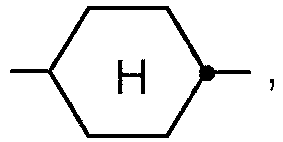


- Mélange de cristaux liquides selon l'une ou plusieurs parmi les revendications 3 à 12, caractérisé en ce que le mélange hôte de LC comprend un ou plusieurs composés de formule suivante :


 R3 et R4 désignent chacun, indépendamment l'un de l'autre, alkyle ayant de 1 à 12 atomes de C, où, de plus, un ou deux groupements CH2 non adjacents peuvent être remplacés par -O-, -CH=CH-, -CO-, -O-CO- ou -CO-O-de telle façon que les atomes de O ne soient pas liés directement l'un à l'autre,Zy désigne -CH2CH2-, -CH=CH-, -CF2O-, -OCF2-, -CH2O-, -OCH2-, -CO-O-, -O-CO-, -C2F4-, -CF=CF-, -CH=CH-CH2O- ou une liaison simple.
 - Mélange de cristaux liquides selon l'une ou plusieurs parmi les revendications 3 à 13, caractérisé en ce que le mélange hôte de LC comprend un ou plusieurs composés de formules suivante


- Mélange de cristaux liquides selon l'une ou plusieurs parmi les revendications 3 à 14, caractérisé en ce que le mélange hôte de LC comprend un ou plusieurs composés choisis parmi les formules suivantes :



- Mélange de cristaux liquides selon l'une ou plusieurs parmi les revendications 3 à 15, caractérisé en ce que le mélange hôte de LC comprend un ou plusieurs composés choisis parmi les formules suivantes :




- Utilisation du mélange de cristaux liquides selon l'une ou plusieurs parmi les revendications 3 à 16, pour la fabrication d'un affichage à cristaux liquides.
- Procédé de fabrication d'un affichage à cristaux liquides, comprenant au moins les étapes :• de mise à disposition d'un premier substrat qui comporte une électrode de pixel et une électrode commune pour la génération d'un champ électrique sensiblement parallèle à une surface du premier substrat dans la région de pixel ;• de mise à disposition d'un deuxième substrat, le deuxième substrat étant disposé à l'opposé du premier substrat ;• d'interposition d'un mélange de cristaux liquides selon l'une ou plusieurs parmi les revendications 3 à 16 ;• d'irradiation du mélange de cristaux liquides par une lumière polarisée linéairement, conduisant au photo-alignement du cristal liquide ;• de durcissement des composés polymérisables du mélange de cristaux liquides par irradiation par de la lumière ultraviolette ou de la lumière visible ayant une longueur d'onde de 450 nm ou moins.
- Procédé selon la revendication 18, caractérisé en ce que la lumière polarisée linéairement est une lumière ultraviolette ou une lumière visible ayant une longueur d'onde de 450 nm ou moins.
- Affichage, pouvant être obtenu par un procédé selon la revendication 18 ou 19.
- Affichage selon la revendication 20, dans lequel le mélange hôte de LC est aligné de manière homogène sans l'application d'un champ électrique.
- Affichage selon la revendication 20 ou 21, l'affichage étant un affichage IPS ou FFS.
Applications Claiming Priority (2)
| Application Number | Priority Date | Filing Date | Title |
|---|---|---|---|
| EP18168776 | 2018-04-23 | ||
| PCT/EP2019/060044 WO2019206789A1 (fr) | 2018-04-23 | 2019-04-18 | Mélange de cristaux liquides et unité d'affichage à cristaux liquides |
Publications (2)
| Publication Number | Publication Date |
|---|---|
| EP3784751A1 EP3784751A1 (fr) | 2021-03-03 |
| EP3784751B1 true EP3784751B1 (fr) | 2024-08-07 |
Family
ID=62046759
Family Applications (1)
| Application Number | Title | Priority Date | Filing Date |
|---|---|---|---|
| EP19717923.7A Active EP3784751B1 (fr) | 2018-04-23 | 2019-04-18 | Mélange de cristaux liquides et unité d'affichage à cristaux liquides |
Country Status (6)
| Country | Link |
|---|---|
| US (1) | US11312907B2 (fr) |
| EP (1) | EP3784751B1 (fr) |
| KR (1) | KR20210002579A (fr) |
| CN (1) | CN112004914B (fr) |
| TW (1) | TW201943840A (fr) |
| WO (1) | WO2019206789A1 (fr) |
Families Citing this family (10)
| Publication number | Priority date | Publication date | Assignee | Title |
|---|---|---|---|---|
| EP3784755B1 (fr) * | 2018-04-23 | 2022-06-15 | Merck Patent GmbH | Mélange de cristaux liquides et unité d'affichage à cristaux liquides |
| CN111989383B (zh) * | 2018-04-23 | 2024-12-13 | 默克专利股份有限公司 | 液晶混合物及液晶显示器 |
| CN112004913B (zh) * | 2018-04-23 | 2024-07-09 | 默克专利股份有限公司 | 液晶混合物及液晶显示器 |
| US20220380673A1 (en) * | 2018-08-22 | 2022-12-01 | Merck Patent Gmbh | Liquid crystal mixture and liquid crystal display |
| EP3841183A1 (fr) * | 2018-08-22 | 2021-06-30 | Merck Patent GmbH | Mélange de cristaux liquides et affichage à cristaux liquides |
| CN112812012B (zh) * | 2019-11-15 | 2023-08-29 | 石家庄诚志永华显示材料有限公司 | 化合物、液晶组合物、液晶显示元件、液晶显示器 |
| CN112920811B (zh) * | 2019-12-30 | 2023-04-07 | 石家庄诚志永华显示材料有限公司 | 液晶组合物、液晶显示元件、液晶显示器 |
| WO2021151846A1 (fr) * | 2020-01-29 | 2021-08-05 | Merck Patent Gmbh | Procédé de réglage de l'alignement de cristaux liquides |
| CN116568777A (zh) * | 2020-12-11 | 2023-08-08 | 默克专利股份有限公司 | 液晶混合物和液晶显示器 |
| CN113773856B (zh) * | 2021-09-14 | 2023-02-21 | 浙江汽车仪表有限公司 | 低旋转粘度高弹性常数的负性液晶介质 |
Family Cites Families (35)
| Publication number | Priority date | Publication date | Assignee | Title |
|---|---|---|---|---|
| JPH07181439A (ja) | 1993-12-24 | 1995-07-21 | Hitachi Ltd | アクティブマトリクス型液晶表示装置 |
| JP3543351B2 (ja) | 1994-02-14 | 2004-07-14 | 株式会社日立製作所 | アクティブマトリクス型液晶表示装置 |
| TW262553B (fr) | 1994-03-17 | 1995-11-11 | Hitachi Seisakusyo Kk | |
| DE19528106A1 (de) | 1995-02-03 | 1996-08-08 | Merck Patent Gmbh | Elektrooptische Flüssigkristallanzeige |
| CN1125158C (zh) | 1995-02-03 | 2003-10-22 | 默克专利股份有限公司 | 电光液晶显示器 |
| DE19528107B4 (de) | 1995-03-17 | 2010-01-21 | Merck Patent Gmbh | Flüssigkristallines Medium und seine Verwendung in einer elektrooptischen Flüssigkristallanzeige |
| DE19509410A1 (de) | 1995-03-15 | 1996-09-19 | Merck Patent Gmbh | Elektrooptische Flüssigkristallanzeige |
| US6107427A (en) | 1995-09-15 | 2000-08-22 | Rolic Ag | Cross-linkable, photoactive polymer materials |
| GB2306470B (en) | 1995-10-05 | 1999-11-03 | Merck Patent Gmbh | Reactive liquid crystalline compound |
| JPH1036847A (ja) | 1996-07-25 | 1998-02-10 | Seiko Epson Corp | 液晶表示素子およびその製造方法 |
| WO1999049360A1 (fr) | 1998-03-20 | 1999-09-30 | Rolic Ag | Couche d'orientation de cristaux liquides |
| US6613245B1 (en) | 1998-07-24 | 2003-09-02 | Rolic Ag | Crosslinkable liquid crystalline compounds |
| US6177972B1 (en) | 1999-02-04 | 2001-01-23 | International Business Machines Corporation | Polymer stabilized in-plane switched LCD |
| JP2002023199A (ja) | 2000-07-07 | 2002-01-23 | Fujitsu Ltd | 液晶表示装置およびその製造方法 |
| JP4175826B2 (ja) | 2002-04-16 | 2008-11-05 | シャープ株式会社 | 液晶表示装置 |
| ATE354623T1 (de) | 2002-07-06 | 2007-03-15 | Merck Patent Gmbh | Flüssigkristallines medium |
| JP2004294605A (ja) | 2003-03-26 | 2004-10-21 | Fujitsu Display Technologies Corp | 液晶パネル |
| JP4387276B2 (ja) | 2004-09-24 | 2009-12-16 | シャープ株式会社 | 液晶表示装置 |
| JP2006139047A (ja) | 2004-11-12 | 2006-06-01 | Sharp Corp | 液晶表示装置およびその製造方法 |
| JP5055757B2 (ja) | 2005-01-28 | 2012-10-24 | Jnc株式会社 | 液晶性多官能アクリレート誘導体およびその重合体 |
| DE102010006691A1 (de) | 2009-02-06 | 2010-10-28 | Merck Patent Gmbh | Flüssigkristallines Medium und Flüssigkristallanzeige |
| JP5545519B2 (ja) * | 2009-10-27 | 2014-07-09 | Dic株式会社 | 重合性化合物 |
| KR101643207B1 (ko) * | 2009-12-14 | 2016-07-27 | 디아이씨 가부시끼가이샤 | 중합성 화합물 함유 액정 조성물 및 그를 사용한 액정 표시 소자 |
| DE102011108708A1 (de) | 2010-09-25 | 2012-03-29 | Merck Patent Gmbh | Flüssigkristallanzeigen und flüssigkristalline Medien mit homöotroper Ausrichtung |
| JP5751466B2 (ja) * | 2010-10-13 | 2015-07-22 | Dic株式会社 | 重合性化合物含有液晶組成物及びそれを使用した液晶表示素子 |
| DE102011118786A1 (de) | 2010-12-17 | 2012-06-21 | Merck Patent Gmbh | Flüssigkristallines Medium |
| US9249355B2 (en) | 2011-02-05 | 2016-02-02 | Merck Patent Gmbh | Liquid-crystal displays having homeotropic alignment |
| TWI635164B (zh) | 2012-04-24 | 2018-09-11 | 迪愛生股份有限公司 | Liquid crystal composition containing polymerizable compound and liquid crystal display element using same |
| JP5978938B2 (ja) * | 2012-11-13 | 2016-08-24 | Jnc株式会社 | 重合性化合物、重合性組成物および液晶表示素子 |
| TWI721283B (zh) | 2013-02-06 | 2021-03-11 | 日商迪愛生股份有限公司 | 液晶顯示元件及其製造方法 |
| JP6102423B2 (ja) * | 2013-03-29 | 2017-03-29 | Dic株式会社 | 重合性化合物及び光学素子 |
| WO2015122457A1 (fr) | 2014-02-14 | 2015-08-20 | Dic株式会社 | Dispositif lcd |
| CN114702965A (zh) | 2015-12-17 | 2022-07-05 | 默克专利股份有限公司 | 液晶混合物及液晶显示器 |
| WO2018181350A1 (fr) * | 2017-03-27 | 2018-10-04 | 日産化学株式会社 | Composition filmogène durcie, matériau d'alignement et matériau à différence de phase |
| EP3784755B1 (fr) * | 2018-04-23 | 2022-06-15 | Merck Patent GmbH | Mélange de cristaux liquides et unité d'affichage à cristaux liquides |
-
2019
- 2019-04-18 KR KR1020207033351A patent/KR20210002579A/ko active Pending
- 2019-04-18 WO PCT/EP2019/060044 patent/WO2019206789A1/fr not_active Ceased
- 2019-04-18 EP EP19717923.7A patent/EP3784751B1/fr active Active
- 2019-04-18 US US17/050,017 patent/US11312907B2/en active Active
- 2019-04-18 CN CN201980027700.0A patent/CN112004914B/zh active Active
- 2019-04-22 TW TW108113957A patent/TW201943840A/zh unknown
Also Published As
| Publication number | Publication date |
|---|---|
| US20210071081A1 (en) | 2021-03-11 |
| CN112004914B (zh) | 2025-01-21 |
| EP3784751A1 (fr) | 2021-03-03 |
| TW201943840A (zh) | 2019-11-16 |
| WO2019206789A1 (fr) | 2019-10-31 |
| KR20210002579A (ko) | 2021-01-08 |
| CN112004914A (zh) | 2020-11-27 |
| US11312907B2 (en) | 2022-04-26 |
Similar Documents
| Publication | Publication Date | Title |
|---|---|---|
| EP3784751B1 (fr) | Mélange de cristaux liquides et unité d'affichage à cristaux liquides | |
| EP3390570B1 (fr) | Mélange à cristaux liquides et affichage à cristaux liquides | |
| EP3784750B1 (fr) | Mélange de cristaux liquides et affichage à cristaux liquides | |
| EP3784752B1 (fr) | Mélange de cristaux liquides et unité d'affichage à cristaux liquides | |
| EP3784755B1 (fr) | Mélange de cristaux liquides et unité d'affichage à cristaux liquides | |
| EP3980510B1 (fr) | Mélange de cristaux liquides et dispositif d'affichage à cristaux liquides | |
| WO2020074440A1 (fr) | Mélange de cristaux liquides et dispositif d'affichage à cristaux liquides | |
| WO2020038861A1 (fr) | Mélange de cristaux liquides et affichage à cristaux liquides | |
| WO2020038859A1 (fr) | Mélange de cristaux liquides et affichage à cristaux liquides | |
| EP4259748B1 (fr) | Mélange de cristaux liquides et écran à cristaux liquides | |
| EP3792334B1 (fr) | Mélange de cristaux liquides et affichage à cristaux liquides | |
| WO2020120371A2 (fr) | Mélange de cristaux liquides et affichage à cristaux liquides |
Legal Events
| Date | Code | Title | Description |
|---|---|---|---|
| STAA | Information on the status of an ep patent application or granted ep patent |
Free format text: STATUS: UNKNOWN |
|
| STAA | Information on the status of an ep patent application or granted ep patent |
Free format text: STATUS: THE INTERNATIONAL PUBLICATION HAS BEEN MADE |
|
| PUAI | Public reference made under article 153(3) epc to a published international application that has entered the european phase |
Free format text: ORIGINAL CODE: 0009012 |
|
| STAA | Information on the status of an ep patent application or granted ep patent |
Free format text: STATUS: REQUEST FOR EXAMINATION WAS MADE |
|
| 17P | Request for examination filed |
Effective date: 20201020 |
|
| AK | Designated contracting states |
Kind code of ref document: A1 Designated state(s): AL AT BE BG CH CY CZ DE DK EE ES FI FR GB GR HR HU IE IS IT LI LT LU LV MC MK MT NL NO PL PT RO RS SE SI SK SM TR |
|
| AX | Request for extension of the european patent |
Extension state: BA ME |
|
| RIN1 | Information on inventor provided before grant (corrected) |
Inventor name: SAITO, IZUMI Inventor name: SIEMIANOWSKI, SIMON Inventor name: LIETZAU, LARS |
|
| DAV | Request for validation of the european patent (deleted) | ||
| DAX | Request for extension of the european patent (deleted) | ||
| STAA | Information on the status of an ep patent application or granted ep patent |
Free format text: STATUS: EXAMINATION IS IN PROGRESS |
|
| 17Q | First examination report despatched |
Effective date: 20230425 |
|
| P01 | Opt-out of the competence of the unified patent court (upc) registered |
Effective date: 20230519 |
|
| GRAP | Despatch of communication of intention to grant a patent |
Free format text: ORIGINAL CODE: EPIDOSNIGR1 |
|
| STAA | Information on the status of an ep patent application or granted ep patent |
Free format text: STATUS: GRANT OF PATENT IS INTENDED |
|
| INTG | Intention to grant announced |
Effective date: 20240312 |
|
| GRAS | Grant fee paid |
Free format text: ORIGINAL CODE: EPIDOSNIGR3 |
|
| GRAA | (expected) grant |
Free format text: ORIGINAL CODE: 0009210 |
|
| STAA | Information on the status of an ep patent application or granted ep patent |
Free format text: STATUS: THE PATENT HAS BEEN GRANTED |
|
| AK | Designated contracting states |
Kind code of ref document: B1 Designated state(s): AL AT BE BG CH CY CZ DE DK EE ES FI FR GB GR HR HU IE IS IT LI LT LU LV MC MK MT NL NO PL PT RO RS SE SI SK SM TR |
|
| REG | Reference to a national code |
Ref country code: GB Ref legal event code: FG4D |
|
| REG | Reference to a national code |
Ref country code: CH Ref legal event code: EP |
|
| REG | Reference to a national code |
Ref country code: DE Ref legal event code: R096 Ref document number: 602019056527 Country of ref document: DE |
|
| REG | Reference to a national code |
Ref country code: IE Ref legal event code: FG4D |
|
| REG | Reference to a national code |
Ref country code: LT Ref legal event code: MG9D |
|
| REG | Reference to a national code |
Ref country code: NL Ref legal event code: MP Effective date: 20240807 |
|
| PG25 | Lapsed in a contracting state [announced via postgrant information from national office to epo] |
Ref country code: NO Free format text: LAPSE BECAUSE OF FAILURE TO SUBMIT A TRANSLATION OF THE DESCRIPTION OR TO PAY THE FEE WITHIN THE PRESCRIBED TIME-LIMIT Effective date: 20241107 |
|
| REG | Reference to a national code |
Ref country code: AT Ref legal event code: MK05 Ref document number: 1710935 Country of ref document: AT Kind code of ref document: T Effective date: 20240807 |
|
| PG25 | Lapsed in a contracting state [announced via postgrant information from national office to epo] |
Ref country code: NL Free format text: LAPSE BECAUSE OF FAILURE TO SUBMIT A TRANSLATION OF THE DESCRIPTION OR TO PAY THE FEE WITHIN THE PRESCRIBED TIME-LIMIT Effective date: 20240807 Ref country code: FI Free format text: LAPSE BECAUSE OF FAILURE TO SUBMIT A TRANSLATION OF THE DESCRIPTION OR TO PAY THE FEE WITHIN THE PRESCRIBED TIME-LIMIT Effective date: 20240807 Ref country code: PL Free format text: LAPSE BECAUSE OF FAILURE TO SUBMIT A TRANSLATION OF THE DESCRIPTION OR TO PAY THE FEE WITHIN THE PRESCRIBED TIME-LIMIT Effective date: 20240807 Ref country code: GR Free format text: LAPSE BECAUSE OF FAILURE TO SUBMIT A TRANSLATION OF THE DESCRIPTION OR TO PAY THE FEE WITHIN THE PRESCRIBED TIME-LIMIT Effective date: 20241108 Ref country code: PT Free format text: LAPSE BECAUSE OF FAILURE TO SUBMIT A TRANSLATION OF THE DESCRIPTION OR TO PAY THE FEE WITHIN THE PRESCRIBED TIME-LIMIT Effective date: 20241209 |
|
| PG25 | Lapsed in a contracting state [announced via postgrant information from national office to epo] |
Ref country code: BG Free format text: LAPSE BECAUSE OF FAILURE TO SUBMIT A TRANSLATION OF THE DESCRIPTION OR TO PAY THE FEE WITHIN THE PRESCRIBED TIME-LIMIT Effective date: 20240807 |
|
| PG25 | Lapsed in a contracting state [announced via postgrant information from national office to epo] |
Ref country code: LV Free format text: LAPSE BECAUSE OF FAILURE TO SUBMIT A TRANSLATION OF THE DESCRIPTION OR TO PAY THE FEE WITHIN THE PRESCRIBED TIME-LIMIT Effective date: 20240807 |
|
| PG25 | Lapsed in a contracting state [announced via postgrant information from national office to epo] |
Ref country code: AT Free format text: LAPSE BECAUSE OF FAILURE TO SUBMIT A TRANSLATION OF THE DESCRIPTION OR TO PAY THE FEE WITHIN THE PRESCRIBED TIME-LIMIT Effective date: 20240807 Ref country code: IS Free format text: LAPSE BECAUSE OF FAILURE TO SUBMIT A TRANSLATION OF THE DESCRIPTION OR TO PAY THE FEE WITHIN THE PRESCRIBED TIME-LIMIT Effective date: 20241207 |
|
| PG25 | Lapsed in a contracting state [announced via postgrant information from national office to epo] |
Ref country code: HR Free format text: LAPSE BECAUSE OF FAILURE TO SUBMIT A TRANSLATION OF THE DESCRIPTION OR TO PAY THE FEE WITHIN THE PRESCRIBED TIME-LIMIT Effective date: 20240807 |
|
| PG25 | Lapsed in a contracting state [announced via postgrant information from national office to epo] |
Ref country code: RS Free format text: LAPSE BECAUSE OF FAILURE TO SUBMIT A TRANSLATION OF THE DESCRIPTION OR TO PAY THE FEE WITHIN THE PRESCRIBED TIME-LIMIT Effective date: 20241107 Ref country code: ES Free format text: LAPSE BECAUSE OF FAILURE TO SUBMIT A TRANSLATION OF THE DESCRIPTION OR TO PAY THE FEE WITHIN THE PRESCRIBED TIME-LIMIT Effective date: 20240807 |
|
| PG25 | Lapsed in a contracting state [announced via postgrant information from national office to epo] |
Ref country code: RS Free format text: LAPSE BECAUSE OF FAILURE TO SUBMIT A TRANSLATION OF THE DESCRIPTION OR TO PAY THE FEE WITHIN THE PRESCRIBED TIME-LIMIT Effective date: 20241107 Ref country code: PT Free format text: LAPSE BECAUSE OF FAILURE TO SUBMIT A TRANSLATION OF THE DESCRIPTION OR TO PAY THE FEE WITHIN THE PRESCRIBED TIME-LIMIT Effective date: 20241209 Ref country code: PL Free format text: LAPSE BECAUSE OF FAILURE TO SUBMIT A TRANSLATION OF THE DESCRIPTION OR TO PAY THE FEE WITHIN THE PRESCRIBED TIME-LIMIT Effective date: 20240807 Ref country code: NO Free format text: LAPSE BECAUSE OF FAILURE TO SUBMIT A TRANSLATION OF THE DESCRIPTION OR TO PAY THE FEE WITHIN THE PRESCRIBED TIME-LIMIT Effective date: 20241107 Ref country code: NL Free format text: LAPSE BECAUSE OF FAILURE TO SUBMIT A TRANSLATION OF THE DESCRIPTION OR TO PAY THE FEE WITHIN THE PRESCRIBED TIME-LIMIT Effective date: 20240807 Ref country code: LV Free format text: LAPSE BECAUSE OF FAILURE TO SUBMIT A TRANSLATION OF THE DESCRIPTION OR TO PAY THE FEE WITHIN THE PRESCRIBED TIME-LIMIT Effective date: 20240807 Ref country code: IS Free format text: LAPSE BECAUSE OF FAILURE TO SUBMIT A TRANSLATION OF THE DESCRIPTION OR TO PAY THE FEE WITHIN THE PRESCRIBED TIME-LIMIT Effective date: 20241207 Ref country code: HR Free format text: LAPSE BECAUSE OF FAILURE TO SUBMIT A TRANSLATION OF THE DESCRIPTION OR TO PAY THE FEE WITHIN THE PRESCRIBED TIME-LIMIT Effective date: 20240807 Ref country code: GR Free format text: LAPSE BECAUSE OF FAILURE TO SUBMIT A TRANSLATION OF THE DESCRIPTION OR TO PAY THE FEE WITHIN THE PRESCRIBED TIME-LIMIT Effective date: 20241108 Ref country code: FI Free format text: LAPSE BECAUSE OF FAILURE TO SUBMIT A TRANSLATION OF THE DESCRIPTION OR TO PAY THE FEE WITHIN THE PRESCRIBED TIME-LIMIT Effective date: 20240807 Ref country code: ES Free format text: LAPSE BECAUSE OF FAILURE TO SUBMIT A TRANSLATION OF THE DESCRIPTION OR TO PAY THE FEE WITHIN THE PRESCRIBED TIME-LIMIT Effective date: 20240807 Ref country code: BG Free format text: LAPSE BECAUSE OF FAILURE TO SUBMIT A TRANSLATION OF THE DESCRIPTION OR TO PAY THE FEE WITHIN THE PRESCRIBED TIME-LIMIT Effective date: 20240807 Ref country code: AT Free format text: LAPSE BECAUSE OF FAILURE TO SUBMIT A TRANSLATION OF THE DESCRIPTION OR TO PAY THE FEE WITHIN THE PRESCRIBED TIME-LIMIT Effective date: 20240807 |
|
| PG25 | Lapsed in a contracting state [announced via postgrant information from national office to epo] |
Ref country code: DK Free format text: LAPSE BECAUSE OF FAILURE TO SUBMIT A TRANSLATION OF THE DESCRIPTION OR TO PAY THE FEE WITHIN THE PRESCRIBED TIME-LIMIT Effective date: 20240807 Ref country code: SM Free format text: LAPSE BECAUSE OF FAILURE TO SUBMIT A TRANSLATION OF THE DESCRIPTION OR TO PAY THE FEE WITHIN THE PRESCRIBED TIME-LIMIT Effective date: 20240807 Ref country code: RO Free format text: LAPSE BECAUSE OF FAILURE TO SUBMIT A TRANSLATION OF THE DESCRIPTION OR TO PAY THE FEE WITHIN THE PRESCRIBED TIME-LIMIT Effective date: 20240807 |
|
| PG25 | Lapsed in a contracting state [announced via postgrant information from national office to epo] |
Ref country code: EE Free format text: LAPSE BECAUSE OF FAILURE TO SUBMIT A TRANSLATION OF THE DESCRIPTION OR TO PAY THE FEE WITHIN THE PRESCRIBED TIME-LIMIT Effective date: 20240807 |
|
| PG25 | Lapsed in a contracting state [announced via postgrant information from national office to epo] |
Ref country code: CZ Free format text: LAPSE BECAUSE OF FAILURE TO SUBMIT A TRANSLATION OF THE DESCRIPTION OR TO PAY THE FEE WITHIN THE PRESCRIBED TIME-LIMIT Effective date: 20240807 |
|
| PG25 | Lapsed in a contracting state [announced via postgrant information from national office to epo] |
Ref country code: SK Free format text: LAPSE BECAUSE OF FAILURE TO SUBMIT A TRANSLATION OF THE DESCRIPTION OR TO PAY THE FEE WITHIN THE PRESCRIBED TIME-LIMIT Effective date: 20240807 |
|
| REG | Reference to a national code |
Ref country code: DE Ref legal event code: R097 Ref document number: 602019056527 Country of ref document: DE |
|
| PLBE | No opposition filed within time limit |
Free format text: ORIGINAL CODE: 0009261 |
|
| STAA | Information on the status of an ep patent application or granted ep patent |
Free format text: STATUS: NO OPPOSITION FILED WITHIN TIME LIMIT |
|
| 26N | No opposition filed |
Effective date: 20250508 |
|
| PG25 | Lapsed in a contracting state [announced via postgrant information from national office to epo] |
Ref country code: SE Free format text: LAPSE BECAUSE OF FAILURE TO SUBMIT A TRANSLATION OF THE DESCRIPTION OR TO PAY THE FEE WITHIN THE PRESCRIBED TIME-LIMIT Effective date: 20240807 |
|
| REG | Reference to a national code |
Ref country code: DE Ref legal event code: R119 Ref document number: 602019056527 Country of ref document: DE |
|
| REG | Reference to a national code |
Ref country code: CH Ref legal event code: H13 Free format text: ST27 STATUS EVENT CODE: U-0-0-H10-H13 (AS PROVIDED BY THE NATIONAL OFFICE) Effective date: 20251125 |
|
| PG25 | Lapsed in a contracting state [announced via postgrant information from national office to epo] |
Ref country code: LU Free format text: LAPSE BECAUSE OF NON-PAYMENT OF DUE FEES Effective date: 20250418 |
|
| PG25 | Lapsed in a contracting state [announced via postgrant information from national office to epo] |
Ref country code: MC Free format text: LAPSE BECAUSE OF FAILURE TO SUBMIT A TRANSLATION OF THE DESCRIPTION OR TO PAY THE FEE WITHIN THE PRESCRIBED TIME-LIMIT Effective date: 20240807 |
|
| GBPC | Gb: european patent ceased through non-payment of renewal fee |
Effective date: 20250418 |
|
| REG | Reference to a national code |
Ref country code: BE Ref legal event code: MM Effective date: 20250430 |
|
| PG25 | Lapsed in a contracting state [announced via postgrant information from national office to epo] |
Ref country code: DE Free format text: LAPSE BECAUSE OF NON-PAYMENT OF DUE FEES Effective date: 20251104 |
|
| PG25 | Lapsed in a contracting state [announced via postgrant information from national office to epo] |
Ref country code: GB Free format text: LAPSE BECAUSE OF NON-PAYMENT OF DUE FEES Effective date: 20250418 |
|
| PG25 | Lapsed in a contracting state [announced via postgrant information from national office to epo] |
Ref country code: FR Free format text: LAPSE BECAUSE OF NON-PAYMENT OF DUE FEES Effective date: 20250430 |
|
| PG25 | Lapsed in a contracting state [announced via postgrant information from national office to epo] |
Ref country code: BE Free format text: LAPSE BECAUSE OF NON-PAYMENT OF DUE FEES Effective date: 20250430 |
|
| PG25 | Lapsed in a contracting state [announced via postgrant information from national office to epo] |
Ref country code: CH Free format text: LAPSE BECAUSE OF NON-PAYMENT OF DUE FEES Effective date: 20250430 |
|
| PG25 | Lapsed in a contracting state [announced via postgrant information from national office to epo] |
Ref country code: IT Free format text: LAPSE BECAUSE OF FAILURE TO SUBMIT A TRANSLATION OF THE DESCRIPTION OR TO PAY THE FEE WITHIN THE PRESCRIBED TIME-LIMIT Effective date: 20240807 |
|
| PG25 | Lapsed in a contracting state [announced via postgrant information from national office to epo] |
Ref country code: IE Free format text: LAPSE BECAUSE OF NON-PAYMENT OF DUE FEES Effective date: 20250418 |