EP3785643A1 - Medizinische vorrichtung und verfahren zum verschliessen einer öffnung in einem gewebe - Google Patents
Medizinische vorrichtung und verfahren zum verschliessen einer öffnung in einem gewebe Download PDFInfo
- Publication number
- EP3785643A1 EP3785643A1 EP19193644.2A EP19193644A EP3785643A1 EP 3785643 A1 EP3785643 A1 EP 3785643A1 EP 19193644 A EP19193644 A EP 19193644A EP 3785643 A1 EP3785643 A1 EP 3785643A1
- Authority
- EP
- European Patent Office
- Prior art keywords
- aperture
- closing
- retracting
- closing device
- medical apparatus
- Prior art date
- Legal status (The legal status is an assumption and is not a legal conclusion. Google has not performed a legal analysis and makes no representation as to the accuracy of the status listed.)
- Pending
Links
- 238000000034 method Methods 0.000 title claims description 40
- 210000004204 blood vessel Anatomy 0.000 claims abstract description 17
- 230000008859 change Effects 0.000 claims abstract description 11
- 230000007480 spreading Effects 0.000 claims abstract description 10
- 238000003892 spreading Methods 0.000 claims abstract description 10
- 238000004891 communication Methods 0.000 claims abstract description 6
- 230000007246 mechanism Effects 0.000 claims description 24
- 238000005452 bending Methods 0.000 claims description 19
- 125000006850 spacer group Chemical group 0.000 claims description 3
- 239000000463 material Substances 0.000 description 34
- 229910001000 nickel titanium Inorganic materials 0.000 description 15
- HLXZNVUGXRDIFK-UHFFFAOYSA-N nickel titanium Chemical compound [Ti].[Ti].[Ti].[Ti].[Ti].[Ti].[Ti].[Ti].[Ti].[Ti].[Ti].[Ni].[Ni].[Ni].[Ni].[Ni].[Ni].[Ni].[Ni].[Ni].[Ni].[Ni].[Ni].[Ni].[Ni] HLXZNVUGXRDIFK-UHFFFAOYSA-N 0.000 description 15
- 230000002792 vascular Effects 0.000 description 10
- 210000000056 organ Anatomy 0.000 description 9
- 229910052751 metal Inorganic materials 0.000 description 8
- 239000004033 plastic Substances 0.000 description 8
- 229920003023 plastic Polymers 0.000 description 8
- 208000032843 Hemorrhage Diseases 0.000 description 7
- 208000034158 bleeding Diseases 0.000 description 7
- 230000000740 bleeding effect Effects 0.000 description 7
- 238000013461 design Methods 0.000 description 7
- 239000002184 metal Substances 0.000 description 7
- 229910001285 shape-memory alloy Inorganic materials 0.000 description 7
- 238000003466 welding Methods 0.000 description 7
- 230000003446 memory effect Effects 0.000 description 6
- 230000000149 penetrating effect Effects 0.000 description 6
- 229910001069 Ti alloy Inorganic materials 0.000 description 5
- 239000000919 ceramic Substances 0.000 description 5
- -1 for example Substances 0.000 description 5
- 229910001220 stainless steel Inorganic materials 0.000 description 5
- 239000010935 stainless steel Substances 0.000 description 5
- 229910052719 titanium Inorganic materials 0.000 description 5
- 239000010936 titanium Substances 0.000 description 5
- 210000003709 heart valve Anatomy 0.000 description 4
- 238000013152 interventional procedure Methods 0.000 description 4
- 239000000203 mixture Substances 0.000 description 4
- 230000008439 repair process Effects 0.000 description 4
- 210000003462 vein Anatomy 0.000 description 4
- 208000031481 Pathologic Constriction Diseases 0.000 description 3
- 238000002513 implantation Methods 0.000 description 3
- 238000007373 indentation Methods 0.000 description 3
- 238000007789 sealing Methods 0.000 description 3
- 230000036262 stenosis Effects 0.000 description 3
- 208000037804 stenosis Diseases 0.000 description 3
- RTAQQCXQSZGOHL-UHFFFAOYSA-N Titanium Chemical compound [Ti] RTAQQCXQSZGOHL-UHFFFAOYSA-N 0.000 description 2
- 208000027418 Wounds and injury Diseases 0.000 description 2
- 230000003190 augmentative effect Effects 0.000 description 2
- 239000008280 blood Substances 0.000 description 2
- 210000004369 blood Anatomy 0.000 description 2
- 230000023555 blood coagulation Effects 0.000 description 2
- 239000002131 composite material Substances 0.000 description 2
- 230000006835 compression Effects 0.000 description 2
- 238000007906 compression Methods 0.000 description 2
- 238000011161 development Methods 0.000 description 2
- 230000018109 developmental process Effects 0.000 description 2
- 230000000694 effects Effects 0.000 description 2
- 238000002674 endoscopic surgery Methods 0.000 description 2
- 238000001125 extrusion Methods 0.000 description 2
- 210000003191 femoral vein Anatomy 0.000 description 2
- 239000012530 fluid Substances 0.000 description 2
- 239000003365 glass fiber Substances 0.000 description 2
- 230000023597 hemostasis Effects 0.000 description 2
- 230000002439 hemostatic effect Effects 0.000 description 2
- 238000002357 laparoscopic surgery Methods 0.000 description 2
- 238000012986 modification Methods 0.000 description 2
- 230000004048 modification Effects 0.000 description 2
- 238000002360 preparation method Methods 0.000 description 2
- 239000011347 resin Substances 0.000 description 2
- 229920005989 resin Polymers 0.000 description 2
- 239000012781 shape memory material Substances 0.000 description 2
- 238000001356 surgical procedure Methods 0.000 description 2
- 230000001960 triggered effect Effects 0.000 description 2
- 239000011800 void material Substances 0.000 description 2
- 239000002023 wood Substances 0.000 description 2
- 206010003402 Arthropod sting Diseases 0.000 description 1
- 206010053567 Coagulopathies Diseases 0.000 description 1
- 102000008186 Collagen Human genes 0.000 description 1
- 108010035532 Collagen Proteins 0.000 description 1
- 206010018852 Haematoma Diseases 0.000 description 1
- 206010020772 Hypertension Diseases 0.000 description 1
- 206010061218 Inflammation Diseases 0.000 description 1
- 208000008589 Obesity Diseases 0.000 description 1
- 208000007536 Thrombosis Diseases 0.000 description 1
- 206010057469 Vascular stenosis Diseases 0.000 description 1
- 206010068149 Vessel perforation Diseases 0.000 description 1
- 230000004913 activation Effects 0.000 description 1
- 238000004026 adhesive bonding Methods 0.000 description 1
- 230000010100 anticoagulation Effects 0.000 description 1
- 230000015572 biosynthetic process Effects 0.000 description 1
- 230000017531 blood circulation Effects 0.000 description 1
- 238000013131 cardiovascular procedure Methods 0.000 description 1
- 230000004087 circulation Effects 0.000 description 1
- 230000035602 clotting Effects 0.000 description 1
- 229920001436 collagen Polymers 0.000 description 1
- 238000007887 coronary angioplasty Methods 0.000 description 1
- 230000007797 corrosion Effects 0.000 description 1
- 238000005260 corrosion Methods 0.000 description 1
- 238000000354 decomposition reaction Methods 0.000 description 1
- 230000001419 dependent effect Effects 0.000 description 1
- 230000003292 diminished effect Effects 0.000 description 1
- 229940079593 drug Drugs 0.000 description 1
- 239000003814 drug Substances 0.000 description 1
- 210000001105 femoral artery Anatomy 0.000 description 1
- 230000006870 function Effects 0.000 description 1
- 230000014509 gene expression Effects 0.000 description 1
- 210000002216 heart Anatomy 0.000 description 1
- 208000031169 hemorrhagic disease Diseases 0.000 description 1
- 230000004054 inflammatory process Effects 0.000 description 1
- 238000003780 insertion Methods 0.000 description 1
- 230000037431 insertion Effects 0.000 description 1
- 238000004519 manufacturing process Methods 0.000 description 1
- 238000002483 medication Methods 0.000 description 1
- 229910001092 metal group alloy Inorganic materials 0.000 description 1
- 239000007769 metal material Substances 0.000 description 1
- 210000004115 mitral valve Anatomy 0.000 description 1
- 235000020824 obesity Nutrition 0.000 description 1
- 230000008520 organization Effects 0.000 description 1
- 238000007888 peripheral angioplasty Methods 0.000 description 1
- 230000003836 peripheral circulation Effects 0.000 description 1
- 229920000642 polymer Polymers 0.000 description 1
- 238000003825 pressing Methods 0.000 description 1
- 230000008569 process Effects 0.000 description 1
- 239000011253 protective coating Substances 0.000 description 1
- 230000004044 response Effects 0.000 description 1
- 230000000717 retained effect Effects 0.000 description 1
- 238000000926 separation method Methods 0.000 description 1
- 238000005476 soldering Methods 0.000 description 1
- 239000003381 stabilizer Substances 0.000 description 1
- 230000017423 tissue regeneration Effects 0.000 description 1
- 238000013519 translation Methods 0.000 description 1
- 210000000591 tricuspid valve Anatomy 0.000 description 1
Images

















Classifications
-
- A—HUMAN NECESSITIES
- A61—MEDICAL OR VETERINARY SCIENCE; HYGIENE
- A61B—DIAGNOSIS; SURGERY; IDENTIFICATION
- A61B17/00—Surgical instruments, devices or methods
- A61B17/0057—Implements for plugging an opening in the wall of a hollow or tubular organ, e.g. for sealing a vessel puncture or closing a cardiac septal defect
-
- A—HUMAN NECESSITIES
- A61—MEDICAL OR VETERINARY SCIENCE; HYGIENE
- A61B—DIAGNOSIS; SURGERY; IDENTIFICATION
- A61B17/00—Surgical instruments, devices or methods
- A61B17/068—Surgical staplers, e.g. containing multiple staples or clamps
- A61B17/0682—Surgical staplers, e.g. containing multiple staples or clamps for applying U-shaped staples or clamps, e.g. without a forming anvil
-
- A—HUMAN NECESSITIES
- A61—MEDICAL OR VETERINARY SCIENCE; HYGIENE
- A61B—DIAGNOSIS; SURGERY; IDENTIFICATION
- A61B17/00—Surgical instruments, devices or methods
- A61B17/068—Surgical staplers, e.g. containing multiple staples or clamps
- A61B17/072—Surgical staplers, e.g. containing multiple staples or clamps for applying a row of staples in a single action, e.g. the staples being applied simultaneously
-
- A—HUMAN NECESSITIES
- A61—MEDICAL OR VETERINARY SCIENCE; HYGIENE
- A61B—DIAGNOSIS; SURGERY; IDENTIFICATION
- A61B17/00—Surgical instruments, devices or methods
- A61B17/08—Wound clamps or clips, i.e. not or only partly penetrating the tissue ; Devices for bringing together the edges of a wound
-
- A—HUMAN NECESSITIES
- A61—MEDICAL OR VETERINARY SCIENCE; HYGIENE
- A61B—DIAGNOSIS; SURGERY; IDENTIFICATION
- A61B17/00—Surgical instruments, devices or methods
- A61B2017/00367—Details of actuation of instruments, e.g. relations between pushing buttons, or the like, and activation of the tool, working tip, or the like
-
- A—HUMAN NECESSITIES
- A61—MEDICAL OR VETERINARY SCIENCE; HYGIENE
- A61B—DIAGNOSIS; SURGERY; IDENTIFICATION
- A61B17/00—Surgical instruments, devices or methods
- A61B17/0057—Implements for plugging an opening in the wall of a hollow or tubular organ, e.g. for sealing a vessel puncture or closing a cardiac septal defect
- A61B2017/00646—Type of implements
- A61B2017/00668—Type of implements the implement being a tack or a staple
-
- A—HUMAN NECESSITIES
- A61—MEDICAL OR VETERINARY SCIENCE; HYGIENE
- A61B—DIAGNOSIS; SURGERY; IDENTIFICATION
- A61B17/00—Surgical instruments, devices or methods
- A61B17/0057—Implements for plugging an opening in the wall of a hollow or tubular organ, e.g. for sealing a vessel puncture or closing a cardiac septal defect
- A61B2017/00672—Locating means therefor, e.g. bleed back lumen
-
- A—HUMAN NECESSITIES
- A61—MEDICAL OR VETERINARY SCIENCE; HYGIENE
- A61B—DIAGNOSIS; SURGERY; IDENTIFICATION
- A61B17/00—Surgical instruments, devices or methods
- A61B2017/00831—Material properties
- A61B2017/00867—Material properties shape memory effect
-
- A—HUMAN NECESSITIES
- A61—MEDICAL OR VETERINARY SCIENCE; HYGIENE
- A61B—DIAGNOSIS; SURGERY; IDENTIFICATION
- A61B17/00—Surgical instruments, devices or methods
- A61B17/064—Surgical staples, i.e. penetrating the tissue
- A61B2017/0645—Surgical staples, i.e. penetrating the tissue being elastically deformed for insertion
-
- A—HUMAN NECESSITIES
- A61—MEDICAL OR VETERINARY SCIENCE; HYGIENE
- A61B—DIAGNOSIS; SURGERY; IDENTIFICATION
- A61B17/00—Surgical instruments, devices or methods
- A61B17/064—Surgical staples, i.e. penetrating the tissue
- A61B2017/0649—Coils or spirals
-
- A—HUMAN NECESSITIES
- A61—MEDICAL OR VETERINARY SCIENCE; HYGIENE
- A61B—DIAGNOSIS; SURGERY; IDENTIFICATION
- A61B17/00—Surgical instruments, devices or methods
- A61B17/08—Wound clamps or clips, i.e. not or only partly penetrating the tissue ; Devices for bringing together the edges of a wound
- A61B2017/081—Tissue approximator
-
- A—HUMAN NECESSITIES
- A61—MEDICAL OR VETERINARY SCIENCE; HYGIENE
- A61B—DIAGNOSIS; SURGERY; IDENTIFICATION
- A61B90/00—Instruments, implements or accessories specially adapted for surgery or diagnosis and not covered by any of the groups A61B1/00 - A61B50/00, e.g. for luxation treatment or for protecting wound edges
- A61B90/08—Accessories or related features not otherwise provided for
- A61B2090/0807—Indication means
- A61B2090/0811—Indication means for the position of a particular part of an instrument with respect to the rest of the instrument, e.g. position of the anvil of a stapling instrument
Definitions
- the present invention relates to a medical apparatus for closing an aperture according to the preamble of claim 1 and a method for closing an aperture according to the preamble of claim 27.
- the present invention relates generally to a medical apparatus (in short: apparatus) and methods for engaging tissue and/or closing openings through tissue, and more particular for closing apertures in a blood vessel or other body lumen, which is an alternative to suturing; and, more particularly, relates to a closure apparatus having applications for closure of openings in body organs or blood vessel walls, in particular after invasive procedures in a patient's system, and corresponding methods of use.
- a guide wire may then be advanced through the needle lumen into the patient's blood vessel or other organs.
- the guide-wire may be advanced through the needle and the needle may be removed and an introducer casing may be advanced over the guide wire into the vessel or other body organ (Seldinger technique).
- Such casings are generally flexible tubes having thin walls and diameters matching the needs of the utilized treatment system in the range of up to about 30F or more.
- the proximal end of the casing is retained outside of the skin of the patient, commonly utilized with a hemostatic valve to prevent blood flow from the blood vessel through the casing.
- a catheter or other device may then be advanced through a lumen of the introducer casing and over the guide-wire into a position for performing a medical procedure.
- the punctures are utilized for a number of reasons including, but not limited to, diagnostic cardio-vascular procedures, coronary and peripheral angioplasties or stenting, heart valve prosthesis implantation and heart valve repair, thoracoscopic, laparoscopic or endoscopic surgery, and the like. These procedures all require making a puncture in body organs or in the wall of a blood vessel to be used in the treatment of the patient's system.
- the size of the puncture will vary depending on the procedure and the inserted system. Depending on the procedure, commonly the femoral artery or the femoral vein is utilized as point of entry into the patient's system.
- Typical punctures can range from 2 mm to more than 10 mm in diameter, or from 6 French (Fr) to more than 30 French (Fr) for interventional procedures.
- trocars for insertion.
- Typical trocar punctures can range from 2 mm to more than 15 mm in diameter, or from 6 French (Fr) to more than 45 French (Fr). Closure of such openings is typically accomplished using multiple levels of surgical sutures.
- the devices and introducer casing may be removed, leaving a puncture site in the vessel wall or in the body organ.
- Such perforations can be closed and sutured tight with common open surgical methods utilizing a single knot or running surgical sutures.
- a common way to stop the bleeding is by applying pressure to the location of the perforation and waiting for the natural blood clotting and self-healing characteristics of the patient to seal the vessel opening.
- Such pressure may be required for relatively long time, such as 30 minutes to up to an hour, followed by the patient being bedridden during this time, essentially immobilized and with a heavy sandbag placed on the punctuation site to provide compression for several hours until the bleeding has stopped. Additional risk of hematoma exists from bleeding before complete hemostasis and sealing occur. This procedure may be time consuming with related downsides.
- Various percutaneous suturing systems have been developed having closure systems that provide a plurality of needles that are joined by a suture. After the needles have passed through the vascular wall surrounding an opening, they are captured, drawn outward, tied and the knot pushed back through the tract to complete the closure.
- the placement of the suture needles requires an adequate engagement of tissue such that the placed sutures can hold and close the hole, which limits the system to the closure of rather smaller vascular perforations.
- perforations of body cavities and organs like thoracoscopic, laparoscopic or endoscopic surgeries, it is common to make an entry to the patient's body with a trocar of suitable size, large enough to insert the applicable system. Closure of such large bore perforations is commonly done by open surgical suturing.
- An object of the present invention may be to propose a further medical apparatus for closing an aperture and a method thereto.
- the above-mentioned object is achieved by the medical apparatus for closing an aperture, e. g., having the features of claim 1. It is further achieved by the method for closing an aperture having the features of claim 27.
- the present invention thus proposes a medical apparatus for closing an aperture, an incision, a puncture, a passage through tissue and/or a communication with a blood vessel or other body lumen (in short: aperture) of a tissue of a patient.
- the medical apparatus comprises a closing device holder for releasably receiving and/or holding one or more closing devices.
- the medical apparatus further comprises a retracting unit.
- the retracting unit may be designed or arranged to come, during use of the medical apparatus, into contact with, preferably opposite sides of the tissue of the aperture in order to retract them or the tissue and/or in order to spread the aperture, optionally causing it to change its shape into a slit or a slit-like or a more slit-like aperture.
- the retracting unit may be suitably configured.
- this retracting or this change may be achieved by widening a gap or distance between parts of the retracting unit (e. g. between retracting devices or their arms (if provided) or tips thereof) which in turn may result in spreading or augmenting the dimension or diameter of the aperture in at least one or in exactly one dimension of the aperture.
- the method encompasses firstly the step of providing a medical apparatus according to the present invention and secondly the step of closing the aperture by using the medical apparatus.
- Embodiments according to the present invention may comprise one or several of the features mentioned supra and/or in the following in any combination which is technically possible.
- the retracting unit of the medical apparatus comprises at least one retracting device holder and at least one retracting device.
- the latter may preferably be at least partially received in the retracting device holder.
- the retracting device may optionally be at least partially received in the retracting device holder, preferably in a releasable manner, and is preferably arranged there in a moveable or slidable manner with respect to the retracting device holder.
- the retracting device holder may have both a distal end, preferably configured to be advanced or extended through or into the aperture to be closed, and a proximal end.
- the retracting unit of the medical apparatus comprises at least one engaging device connected to said retracting device in order to releasably engage with the tissue.
- the engaging device may have a closed section having a through-opening.
- the closed section may have the shape of a rectangle, a square, a circle, an ellipse, or combinations thereof.
- the engaging device may comprise a wire or consist of a wire.
- the engaging device may be formed from a single wire.
- the engaging device may have or cover a convex or concave shape. In other embodiments it is flat or substantially plane.
- the engaging device of the medical apparatus according to the present invention is configured to be foldable and/or to be comprised or captured at least partially within the retracting device holder.
- a mechanism for moving the engaging device and/or the retracting device into or out of the retracting device holder may be provided.
- the engaging device may be connected to the above-mentioned retracting device such that they are configured for engaging with the tissue surrounding the aperture from within or from below the aperture opening.
- At least two retracting devices and/or at least two engaging devices of the medical apparatus according to the present invention are captured within the retracting device holder in a releasable manner.
- they are captured such that they are arranged to be at least partly released from the retracting device holder by manipulating the retracting device holder or the engaging device or a mechanism configured to do so when required, in particular in order to be positioned below the opening level of the aperture to be closed.
- the retracting device holder and/or the retracting device and/or said engaging device of the medical apparatus according to the present invention are configured to retract the opposite sides of the aperture, in particular such that the aperture changes its shape. For example, the aperture may change from a rather round shape to a slit aperture.
- Transverse may refer to a direction perpendicular to the longitudinal direction of the vessel.
- the longitudinal diameter may run in the direction of the longitudinal axis of the vessel.
- the retracting unit of the medical apparatus comprises at least a retracting device having at least one of the following:
- the retracting unit or any other component may have a mechanism for moving the first side apart or away from the second side, the first arm apart or away from the second arm, the first retracting device apart or away from the second retracting device, the first retracting device holder apart or away from the second retracting device holder and/or the first engaging device apart or away from the second engaging device.
- the above-mentioned mechanism comprises or consists of a shape memory characteristic.
- the mechanism may comprise or consist of a mechanical means comprising, e. g., gears, rods, an actuating means, a control means such as a knob or handle, and the like.
- an optional knob and/or a handle member or handle member casing (or at least or part thereof, respectively) of the medical apparatus is made from resin, plastic, glass fiber, wood, metal or composite materials or combinations of the materials mentioned here.
- the optional knob and/or the handle member or handle member casing (or at least or part thereof, respectively) of the medical apparatus is not made from resin, or not from plastic, or not from glass fiber, or not from wood, or not from metal or not from composite materials or not from combinations of the materials mentioned here.
- the handle member or its casing comprises at least one slider, e. g., for the user. In others, it does not comprise any slider.
- the handle member or its casing comprises at least one rotational element, e. g., for the user, that translates rotation into translation. In others, it does not comprise such a rotational element.
- the mechanism may comprise or consist of a vacuum device configured to amend the shape of the retracting device, the retracting unit or any other component such that the first side or the first arm, and so on, is moved apart or away from the second side or the second arm, and so on.
- the vacuum device may be arranged to suck a fluid (e. g., air) from an inner, preferably closed, lumen of, e.g., the retracting unit such that the cross section of that component, e.g. the retracting unit, is changed: by attempting to achieve a vacuum inside the lumen, the cross section of, e.g., the retracting unit will increase in a first dimension but decrease in a second dimension perpendicular to the first one. That way, opposite first and second sides of, e.g., the retracting unit will move away from each other while the circumference of the retracting unit is kept constant.
- a fluid e. g., air
- the preferably closed lumen which is in fluid communication with the vacuum device may in at least one state (having applied vacuum or not) have a cross section that is longer in a first direction thereof than in a second direction perpendicular to the first one.
- the retracting unit or the retracting device has a curve or a step or it bends on its front side or on its rear side that might be used as a stop or give the surgeon tactile feedback while partly withdrawing the medical apparatus from the vessel lumen.
- the curve, step or the like may indicate that the tip of the medical apparatus, or its retracting unit, retracting device or the like has come to rest at the rim of the vessel or the aperture. This, in turn, indicates that the medical apparatus is in a suitable position for deploying the closing device.
- the curve, step or the like is arranged under a pre-determined distance from, e. g., the free end of the medical apparatus or the retracting device.
- the curve, step or position at which it is bent may serve as protection against pulling the medical apparatus too far out from the vessel lumen before releasing the closing device.
- the medical apparatus does not comprise vacuum device or source and/or is not connected to one.
- the medical apparatus is not a pressure stabilizer.
- parts of the retracting device e. g., the tips of their arms, if provided deviate or part from each other when released or in the unstressed state and/or when used for retracting issue.
- parts of the retracting device deviate or part from each other when released or in the unstressed state and/or when used for retracting issue in common plane.
- the longitudinal axis of the handle member may be part of this plane or have an angle of less than 10°, 15° or 20° to this plane.
- the retracting device and the closing members, or parts thereof, respectively may exit, at least in part, from the same handle member.
- the retracting unit is designed to come into contact with, e.g., opposite sides, of the aperture or the tissue surrounding the aperture and for retracting them and/or for spreading the aperture causing it to change its shape into a slit or a slit-like or a more slit-like aperture or to spread or to augment the dimension or diameter of the aperture in at least one or in exactly one dimension of the aperture by opening a space or gap between parts of the retracting device, e. e., by moving arms or tips of these arms, if provided, of the retracting device apart from each other, respectively.
- the medical apparatus according to the present invention comprises at least one closing device comprised in the closing device holder.
- the closing device of the medical apparatus according to the present invention is at least partially comprised within the closing device holder in a stressed state of the closing device. In particular, it is comprised within the distal end of the closing device holder, in particular when the closing device is in an undeployed state.
- the closing device has preferably two or more ends and a junction connecting with the two or more ends, e. g., via two or more arms.
- the closing device of the medical apparatus is comprised within the closing device holder such that when the closing device is manipulated to exit the distal end of the closing device holder during the use of the medical apparatus, the closing device releases its stress, or part of it, e.g., by bending the two or more arms outside of the closing device holder. Thereby, the two or more ends are arranged to perforate the inner wall of the tissue surrounding the aperture.
- At least part of the closing device, the retracting device, the retracting device holder and/or the engaging device of the medical apparatus according to the present invention is made of a deformable shape memory alloy and/or has a self-expanding shape memory section or a wire body.
- At least part of the closing device, the retracting device, the retracting device holder and/or the engaging device of the medical apparatus according to the present invention is made of Nitinol.
- At least part of the closing device, the retracting device, the retracting device holder and/or the engaging device of the medical apparatus according to the present invention is made of biocompatible and/or bio-absorbable material.
- the biocompatible and/or bio-absorbable material is at least one material selected from the group consisting of Ti, Ti alloys, Nitinol, stainless steel, polymeric materials, and ceramic.
- the closing device or parts thereof curl into a closed form (having, e.g., a through-opening surrounded by arm, struts or the like of the closing device) when in a stress-free state.
- the closing device or parts thereof curl into a loop- or ring- or circle-like shape when in a stress-free state.
- the closing device after deployment has a cross-sectional dimension ranging from 10 micrometers to 1 centimeter, preferably from 40 micrometers to 200 micrometers, more preferably from 50 micrometers to 100 micrometers.
- the closing device has two arms.
- At least one of the arms has a or one first bending direction and a or one second bending direction.
- a or one first section of the arm is bent in the first bending direction whereas a or one second section of this arm is bent in the second bending direction, wherein the first bending direction and the second bending direction are at least one of not identical to each other, opposite to each other and facing away from each other, or the like.
- the end or tip of a first one of the arms points away from a second one of the arms, whereas the end or tip of the second arm points away from the first arm.
- the medical apparatus comprises or consists of a handle member (or handle or handle device).
- the handle member in order to activate or advance the retracting device, may have a first slider and optionally also a second slider arranged to be moved by the user, preferably in a longitudinal direction of the handle member.
- the first slider in its end position, or in another position, may be locked in place.
- a suitable mechanism may be provided, e. g., in the handle member.
- all or some of the closing device holders are parallel to each other, fully or only in parts thereof.
- the casing of the handle member comprises an opening in which a switch can be moved by the user to advance the closing device holders relative to the casing of the handle member.
- the closing device holders are arranged to remain parallel to each other throughout the closing of the vessel aperture. In other embodiments, they are arranged to part or deviate from each other when being advanced towards the vessel aperture.
- the closing device holders are not parallel to each other, or only parts of them (e. g. their proximal parts) are parallel, but, for example, not their distal parts (their tips, e. g.).
- the proximal parts are parallel to each other.
- the distal parts are under an - optionally constant - angle with regard to each other.
- the distance between the tips or distal ends of some of the closing device holders - for example when having been advanced towards the vessel aperture for closure - is larger than the diameter of the opening of the medical apparatus or the handle member from which the closing device holders exit for closing the vessel aperture.
- the distance between the tips or distal ends or between any other corresponding parts of the closing device holders is equidistant between neighboring closing device holders in their unstressed or fully deployed state and/or when advanced for closing the vessel aperture.
- the distance between the tips or distal ends of some of the retracting devices or of their arms - for example when having been advanced towards the vessel aperture for closure or in their unstressed or fully deployed stated - is larger than the distance between the tips or distal ends of some of the closing device holders mentioned supra.
- a delivery support for assuring that the closing device holders deviate or part from each other when being advanced towards the vessel aperture is provided.
- the delivery support comprises a wire, a wire net or structure, or consist thereof, respectively.
- the delivery support is a foldable and/or unfoldable element.
- the closing device holders or of the delivery support bumpers are arranged.
- the handle member comprises a sleeve or another, preferably rotatable element or cylindric, element with a - optionally U- or V-shaped - guide slot (guidance groove).
- the guide slot can be part of the sleeve's outer surface or added to the latter.
- the guide slot comprises a first slot section and a second slot section each being connected with each other by another slot section, called a turning point.
- the handle member, the knob or the sleeve itself comprises an elastic element, a spring or the like arranged to also guide the pin through the turning point of the guide slot.
- the retracting device comprises a multitude (here: two) of arms.
- an arm of the retracting device comprises two legs, called an outer leg and an inner leg.
- the outer leg and the inner leg may be welded to each other in or by a welding section.
- the outer leg and the inner leg surround or circumscribe one or two middle openings which may be trough-openings, or form the latter between them.
- the inner leg is straight or substantially straight.
- the outer leg is bent such that it has or forms an indentation, a bulge or a dent.
- the arms of the retracting device each exits through separate openings of the retracting unit. In other embodiments, some or all of the arms exit through a common opening of the retracting unit.
- At least one of the openings of the retracting unit through which the arms exit in use has a width that is smaller than its length.
- At least one of the openings of the retracting unit through which at least one arm exits has an oval opening area.
- the medical apparatus according to the present invention further comprises a pushing device, preferably extending through the proximal end of the closing device holder, for the manipulation of the closing device.
- the pushing device may be configured not to deform the closing device by acting on it, e.g., by pushing it.
- the pushing device is or comprises a rod or a piston.
- the medical apparatus further comprises a holding or withdrawing device extending through the proximal end of the closing device holder for the manipulation of the closing device.
- said holding device is, in particular releasably, attached to the closing device or connected therewith.
- the holding device of the medical apparatus according to the present invention is a string or a suture.
- the closing device holder of the medical apparatus has one or more grooves on the inner wall of the closing device holder and/or one or more grooves on the pushing device for guiding the holding device along the longitudinal direction of the closing device holder, preferably through or along the groove(s).
- the distal end of the closing device holder has two or more channels on the wall of the closing device holder. These channels allow one or more ends of the closing device to exit the closing device holder upon manipulation of the medical apparatus or when required by the user. The ends may exit from one side or both sides of the closing device holder.
- the channels may be slit-like. The channels or the proximal ends thereof may be exceeded in a distal direction of the closing device holder by the distal end.
- the distal end of the closing device holder has at least one channel or two channels arranged opposite to each other on the wall, in particular in the circumference of the closing device holder, of the closing device holder.
- the retracting device holder is or comprises an elongated tube. This elongated tube comprises or consists of, e.g., metal or plastic and is preferably configured to capture a retracting device.
- the closing device holder may have a distal end for being advanced or extended through or into the aperture of the tissue, and a proximal end in particular suitable for providing access for manipulating a closing device when and if received in the closing device holder.
- At least one of the closing device holder and the retracting unit is at least one of slidably and moveably arranged within the medical apparatus with respect to each other, to other elements of the medical apparatus, and/or to a casing or an outer sheath of the medical apparatus.
- the medical apparatus comprises an outer housing, sheath or casing that comprises some or all elements (except for the housing or casing and the like, of course) of the medical apparatus, in particular the closing device holder and/or the retracting unit.
- the medical apparatus comprises a lumen for guiding and/or encompassing a guide wire.
- the lumen may be open to both the distal end and the proximal end of the medical apparatus or to just one of those.
- the medical apparatus comprises several lumen or openings. One of them may house a first closing device holder, another one may house a second closing device holder, a retracting device holder and/or any other element of the medical apparatus, for example.
- Any lumen of the medical apparatus may be a through-opening of the medical apparatus, preferably extending in a longitudinal direction of the medical apparatus.
- the medical apparatus has an outer housing or unit that is, along its entire length or along only parts of it, not flexible and/or flexible.
- the method comprises the following further steps:
- the step of retracting opposite sides of the aperture and/or spreading the aperture causes the aperture to change its shape, e.g., into a slit or a slit-like or a more slit-like aperture. This change may result in spreading or augmenting the dimension or diameter of the aperture in at least one or in exactly one dimension of the aperture.
- At least one of the closing device holder and the retracting device holder is a partly hollow tube.
- At least one of the closing device holder and the retracting device holder are arranged within a common casing or housing, preferably slidable or moveable with respect to that casing.
- the closing member is identical to the closing device holder.
- the retracting unit is identical to the retracting device holder.
- the retracting unit and the closing member are embodied by one device only.
- the device has no guide wire. It may, however, have a lumen for running a guide wire through the length of the device and/or in the direction of its length.
- the closing device is a staple or a clip, a wire structure, or the like.
- the closing device holder is not configured to eject or to release the closing devices, in particular staples or clips, in a first direction wherein a component of the device or of the closing device holder configured to eject the closing device or to assist in ejecting them, is arranged to be moveable at best (or ideally only) in the first direction or at best substantially in the first direction.
- that component is not configured or arranged to be moveable in a second direction which is substantially perpendicular to the first direction.
- At least one of the closing device holder and the device has no devices configured for plastically deforming the closing devices, in particular not for plastically deforming them while there are rejected or released. Also, there is preferably no devices provided for closing a closing device.
- the closing device holder is configured to simultaneously eject or release two or more closing device.
- the closing device may be ejected from one common opening of the holder through which they leave side by side.
- the configuration may be such that two or more closing device may leave the closing device holder or the device through separate openings but at the same time.
- the closing device holder is configured such that the closing device can only be ejected or released in the longitudinal direction of the closing device holder.
- the closing device holder is configured such that the closing device can only be ejected or released at the same position with respect to the length or the longitudinal direction of the closing device holder.
- the retracting unit comprises at least two elements that move apart from each other while retracting the aperture, for example, two sides, two arms, two retracting devices or two retracting device holders.
- the retracting unit and the closing device holder are separate from each other, and, in particular, may move separately from each other. In other embodiments, they are interconnected to each other or embodied by the same unit such that they cannot move independently from each other.
- the retracting unit and the closing device holder are spaced apart from each other such that the closing device holder is configured to eject or release the closing device or devices into the tissue in order to have them close the rim or seam of the long sides of aperture in retracted state of the aperture, that is while the aperture is being retracted or spread by the retracting unit.
- At least one of the components of the retracting unit configured to retract the opposite sides of the aperture by directly touching them is an elongated or oblong section. At least one of them may have the shape of a pole, a tube or the like, and they are, preferably, straight.
- At least one of the components of the retracting unit configured to retract opposite sides of the aperture by directly touching them does not comprise one or more hinges, articulations, joints or sections where it bends, in particular not in a middle section thereof, more particular not facing to opposite directions from each other.
- the components of the retracting unit configured to retract the opposite sides of the aperture by directly touching them have a free distal end.
- some or all of the components of the retracting unit configured to retract opposite sides of the aperture by directly touching them are configured to move with respect to each other in a first common plane while retracting the aperture.
- the at least one closing device extends (e. g., in a deployed state of the closing device, e. g., when being released or ejected) entirely or substantially in a second plane.
- the closing device may optionally close in the second plane.
- the closing device may comprise arms or tines that move towards each other upon closing or deploying. That movement can also take place in substantially one plane, namely the second plane.
- the first plane and the second plane may intersect each other. They may be substantially perpendicular to each other.
- some or all of the components of the retracting unit configured to retract opposite sides of the aperture by directly touching them are configured to move with respect to each other in a first direction while retracting the aperture.
- the device is configured to eject or to release the at least one closing device in a second direction.
- the first direction and the second direction may be different from each other. In fact, they may be perpendicular or substantially perpendicular to each other.
- the direction of retracting may be perpendicular or substantially perpendicular to the direction in which the closing device is ejected or released and/or in which the closing device closes when the device is used by the surgeon.
- first and the second retracting devices are connected to each other by just one hinge or joint or hinge or joint section.
- That hinge or joint or section may be arranged to move - preferably exclusively - inside the retracting device holder and/or along the longitudinal axis of the medical device or the of the retracting device holder.
- that hinge or joint or section may be arranged to move - preferably exclusively - in the second direction, not, however, in the first direction.
- the hinge or joint or section may optionally not move in the direction in which the opposite sides of the aperture are retracted or spread.
- a medical apparatus for closing an aperture of a tissue comprising
- a method for closing an aperture of a tissue is also suggested, the method encompassing the steps:
- At least part of the closing device is made of a deformable shape memory alloy. In some embodiments according to the present invention, at least part of the closing device is made of Nitinol.
- At least part of the closing device is made of biocompatible and/or bio-absorbable material.
- the biocompatible and/or bio-absorbable material is at least one material selected from the group consisting of Ti, Ti alloys, Nitinol, stainless steel, polymeric materials, and ceramic.
- the closing device curls into a closed form when in a stress-free state.
- the closing device curls into a loop- or ring- or circle-like shape when in a stress-free state.
- the closing device after deployment of the medical apparatus has a cross-sectional dimension ranging from 10 micrometers to 1 centimeter, preferable from 40 micrometers to 200 micrometers, more preferably from 50 micrometers to 100 micrometers.
- the medical apparatus comprises a pushing device extending through the proximal end of the closing device holder for the manipulation of the closing device.
- the pushing device is a rod or piston.
- the medical apparatus comprises a holding device extending through the proximal end of the closing device holder for the manipulation of the closing device, wherein said holding device is attached with the closing device.
- the holding device is a string or suture.
- the closing device holder has one or more grooves on the inner wall of the closing device holder and/or one or more grooves on the pushing device for guiding the holding device along the longitudinal direction of the closing device holder.
- the distal end of the closing device holder has two or more channels on the wall of the closing device holder, allowing the one or more ends of the closing device to exit the closing device holder when deploying the closing device.
- the distal end of the closing device holder has two channels arranged opposite to each other on the wall of the closing device holder.
- the present invention may advantageously provide a more effective method and a medical apparatus for sealing large bore punctures up to 30 French (Fr) and larger in veins and other passages through tissues.
- the present invention allows to connect tissue segments together or to close and/or seal opening through tissue, such as very large bore vascular perforations in the venous system in particular the Vena femoralis.
- Such large vascular access and perforations are required for more complex interventional procedures like transseptal mitral and tricuspid valve repair and prosthesis implantation.
- the femoral vein has a diameter of approximately 8 mm or 24 French (Fr), and more, allowing introduction of systems with a similar diameter. It is very challenging to close such large bore perforations of the vein with a percutaneous system utilizing plugs, sutures or clips. When closing such large bore perforations in a circular or longitude way, the risk of a vascular stenosis is high.
- a particular technique is advantageously used to stretch the perforation in a direction orthogonal to the vessel long axis and to suture the perforation close along this stretch. In this way narrowing of the vessel lumen is avoided.
- the present invention allows closing a large bore vascular perforation in particular in veins by stretching the perforation in an orthogonal direction to the vessel long axis and placing single clips along the stretch that close the perforation along the stretched line.
- the medical apparatus may include a handle member and a tube set coupled to the handle member on one side (not shown) and on the other side, retracting units and closing members that are deployed subsequently or simultaneously in a tissue aperture.
- the handle member may also include any number of mechanisms (not shown) necessary to deploy a retractor and closing members.
- the retracting units and closing members are deployed through a casing that allows these units and members to be disposed at least partially in the aperture or lumen of a vessel in a controlled manner, in particular along a guiding structure, like a guide-wire or other rail (not shown) that is commonly placed in a vessel for performing interventional procedures.
- the retracting units optionally include two retracting device holders with distal ends configured for extending through the aperture and to be positioned at the opposing inner side of the aperture to be closed.
- the retracting devices or their holders may have engaging devices mounted at, e.g., the distal end thereof.
- the engaging devices may be arranged for engaging the opposing end of the aperture and of the inner vessel wall, e. g. by contacting, pushing and/or abutting them.
- the engaging devices are configured to move apart, retracting the opposing sides of the aperture and stretching the aperture which approximates the opposing sides of the aperture between the retracting devices, such that the aperture becomes straight with one extended long diameter and an orthogonal retracted short diameter.
- the closing member optionally includes one or more closing device holders with a distal end extending through the aperture to be closed, the closing device holders having closing devices mounted at, e.g., the distal end.
- the closing devices are arranged for engaging the tissue wall as the closing device holders are withdrawn.
- the closing devices are preferably pointed needles that penetrate the tissue wall surrounding the aperture when the closing device holders are withdrawn. When the closing devices are engaged with the tissue wall it can be detected as a firm resistance to further withdrawal.
- the closing devices are then deployed, bend further into a circular structure and draw the ends of the transversely retracted aperture together in a manner such that it closes the aperture in a straight line.
- the closing devices optionally comprise a plurality of round needles of size, orientation and form such that when the closing devices are moved outwardly from inside of the aperture, the closing devices bend in an anchor like manner according to the preset memory shape of the closing devices, perforate the tissue wall and also grab tissue that is in close proximity to the wall causing the tissue surrounding the perforation to be drawn into close proximity of the closed aperture, such that the aperture can be closed and the drawn-in surrounding tissue will additionally seal the tissue closure.
- the closing device or the plurality of closing devices, can optionally be disengaged from the closing device holders and delivery mechanism, and left in place.
- the closing devices may be constructed of metal, plastic or bio-absorbable material preferably having a memory material effect.
- a medical apparatus for use in closing an aperture, incision, puncture, or other passage through tissue, communication with a blood vessel or other body lumen, a medical apparatus is suggested comprising one or more retracting units.
- the retracting units have, e.g., two retracting device holders with a distal end for extending through the aperture to be closed and with a proximal end for selectively providing manipulation.
- Engaging devices are captured in the retracting device holders, to be released by manipulation and positioned below the aperture to be closed. Said manipulation of said retracting device holders causes retraction of opposite sides of the aperture, causing the aperture to change the shape from a rather round aperture to a slit aperture whose extended transverse diameter (which is the longer diameter of the aperture after having retracted it) is at least double the length of the retracted longitudinal diameter (which is the shorter one) of the aperture.
- a medical apparatus for use in closing an aperture in a tissue, comprising closing members, the closing members having closing device holders with a distal end for extending through the aperture to be closed and having a proximal end for selectively providing manipulation; and having closing devices captured at the distal end of the said closing device holders to be deployed and whereby said manipulation of said closing device holders and deployment of closing devices causes the aperture to be closed.
- the medical apparatus comprises a set of retracting units.
- the medical apparatus comprises an indication for the user indicating the orientation or direction of the retracting units of the medical apparatus, e.g. being embodied as a sign, an arrow, or the like.
- the medical apparatus further includes delivery devices for delivering said closing device holder, engaging device and closing device to an operative proximity with the aperture, said delivery device being slidably connected, e.g., to said closing device holder.
- the retracting device holder comprises an elongated tube made of metal or plastic capable to capture a retracting device.
- the retracting units can be moved apart to retract an aperture.
- the retracting device holder comprises an elongated tube made of metal, plastic or other material capable to capture a retracting device.
- the closing device holder has a lateral channel at the end of the said elongated tube through which the closing device will leave the closing device holder, avoiding contact of the closing device with a structure opposite to the end of the elongated tube.
- the closing member can be manipulated to evenly distribute closing devices along the line to be closed.
- the closing devices are made of a perforating material, preferably a needle, selected from a class of material including metal, metal alloys, Nitinol, plastics, preferably having memory effect characteristics, and having a permanent or bio absorbable protective coating and being bio-absorbable.
- the closing devices have a predetermined cross section, a proximal end and two arms each with a pointed end; both arms are the bending portion of the closing device, to expand between a first position when compressed and captured in the said closing device holder.
- the closing device is substantially linear and can be moved along the axis inside of the closing device holder in both directions in a compressed or strained state and can be released at the end of the closing device holder, returning the arms to the expanded second position with the arms having a bent shape, forming a ring with two hemi-circles or semi-circles.
- the closing devices have a preset form that allows connecting the closing devices with said closing device holder.
- the invention relates to a method for closing an aperture in a wall, incision, puncture, or other passage through tissue, communication with a blood vessel or other body lumen, in particularly, but not exclusively, the wall of a blood vessel, wherein the blood vessel has a lumen carrying blood.
- the step of closing includes suturing, clamping or similar mechanical approximation of the engaged aperture wall.
- the retracting unit comprises an engaging device connected to said retracting device for releasably engaging with the tissue.
- the engaging device is configured to be foldable and/or to be comprised or captured at least partially within the retracting device holder.
- At least two retracting devices and/or at least two engaging devices are captured within the retracting device holder in a releasable manner, in particular such that they are arranged to be at least partly released from the retracting device holder by manipulating the retracting device holder or the engaging device, in particular to be positioned below the opening level of the aperture which is to be closed.
- the retracting device holder and/or the retracting device and/or said engaging device are configured to retract the opposite sides of the aperture, in particular such that the aperture changes its shape, e. g. from a rather round aperture, to a slit aperture, preferably such that the extended transverse diameter is at least double the length of the retracted longitudinal diameter of the aperture.
- the mechanism comprises or consists of a shape memory characteristic.
- the closing device is at least partially comprised within the closing device holder in a stressed state, in particular within the distal end of the closing device holder, in particular when the medical apparatus is in an undeployed state; wherein the closing device has preferably two or more ends and a junction connecting with the two or more ends, e. g., via two or more arms.
- the closing device is comprised within the closing device holder such that when the closing device is manipulated to exit the distal end of the closing device holder during the use of the medical apparatus, the closing device releases its stress or part of its stress by bending the two or more arms outside of the closing device holder, whereby the two or more ends are arranged to perforate the inner wall of the tissue surrounding the aperture.
- At least part of the closing device, of the retracting device, of the retracting device holder and/or of the engaging device is made of a deformable shape memory alloy and/or has a self-expanding shape memory section or wire body.
- At least part of the closing device, the retracting device, the retracting device holder and/or the engaging device is made of Nitinol.
- At least part of the closing device, of the retracting device, of the retracting device holder and/or of the engaging device is made of biocompatible and/or bio-absorbable material.
- the biocompatible and/or bio-absorbable material is at least one material selected from the group consisting of Ti, Ti alloys, Nitinol, stainless steel, polymeric materials, and ceramic.
- the closing device or parts thereof curl into a closed form when in a stress-free state.
- the closing device or parts thereof curl into a loop- or ring- or circle-like shape when in a stress-free state.
- the closing device after deployment has a cross-sectional dimension ranging from 10 micrometers to 1 centimeter, preferably from 40 micrometers to 200 micrometers, more preferably from 50 micrometers to 100 micrometers.
- the medical further comprises a pushing device, preferably extending through the proximal end of the closing device holder, for the manipulation of the closing device.
- the pushing device is a rod or piston.
- the medical apparatus further comprises a holding device extending through the proximal end of the closing device holder for the manipulation of the closing device, wherein said holding device is attached to the closing device.
- the holding device is a string or suture.
- the closing device holder has one or more grooves on the inner wall of the closing device holder and/or one or more grooves on the pushing device for guiding the holding device along the longitudinal direction of the closing device holder.
- the distal end of the closing device holder has two or more channels on the wall of the closing device holder, allowing the one or more ends of the closing device to exit the closing device holder upon manipulation of the medical apparatus or when required by the user.
- the distal end of the closing device holder has at least one channel or two channels arranged opposite to each other on the wall of the closing device holder.
- the retracting device holder comprises an elongated tube, e.g., comprising or consisting of metal or plastic, preferably configured to capture a retracting device).
- the method further comprises the steps:
- the step of retracting opposite sides of the aperture and/or spreading the aperture causes the aperture to change its shape into a slit or a slit-like or a more slit-like aperture or to spread or to augment the dimension or diameter of the aperture in at least one or in exactly one dimension of the aperture.
- the medical apparatus for closing an aperture comprises features as disclosed herein, in any arbitrary combination unless not considered technically impossible by the skilled one.
- Specific embodiments of the present disclosure are directed to a vascular closing apparatus and a method for closing an aperture in a tissue such as a vascular closing device comprising a tissue retracting unit and an aperture closing member.
- a retracting unit is provided to retract two opposing sites of a tissue aperture. After the two arms, sides or the like are deployed at opposite sides in the aperture to close, the distance between the arms, sides and so on is increased in order to retract the opposing sides, changing the shape of the tissue opening (aperture) to a slit, in which the two long straight sides of the aperture are approximated in preparation for the closure.
- the closure of the vessel as described herein follows the principle of surgical vascular closure techniques to prevent a narrowing or stenosis of the vessel to be treated.
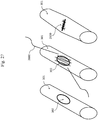
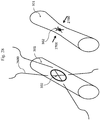
- the retracting device is preparing the aperture in the tissue to become a transverse slit orthogonal to the vessel's long axis, comparable with an open surgical transverse suture-line. A circular retraction of the aperture, like in an open surgical cross-stich procedure or a longitudinal suture-line is prevented to avoid stenosis of the vessel to be treated, see FIG. 27 .
- the closing device of the medical apparatus can be formed of any biocompatible and/or bio-absorbable material, including, for example, Titanium (and Titanium alloys), Nitinol, stainless steel, polymeric materials (synthetic and/or natural), ceramic, etc. It will also be apparent from the description that the closing device has preferably the shape of a needle in the form of a loop or circle formed of a deformable shape memory alloy, e.g., Nitinol.
- the closing device of the present invention undergoes two positions of deformation: a first position in a compressed, straight configuration in which the closing device is captured in a closing device holder and deployed in the aperture and a second expanded round configuration in which the closing device approximates the aperture ends and closes the perforation in the tissue.
- the two long sides of the slit are connected by the closing device to close the tissue opening.
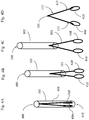
- FIG.1 is a side view of the retracting unit 100 of this invention.
- the retracting unit 100 has optionally a longitudinal hollow retracting device holder 102 with a distal tip 110.
- a retracting device 101 is folded and is captured in the tubular retracting device holder 102.
- the retracting device 101 has a or one proximal end 111 and two distal ends 112.
- the retracting device 101 is optionally made of material with memory effect and has the ability to spread the two distal ends 112 apart like a spring.
- the retracting device 101 may be formed from a shape memory alloy, e.g., Nitinol, formed in the expanded stage or state as a triangular shape, that can be compressed in order to be captured in the retracting device holder 102.
- the retracting device 101 is stepwise released and the distal ends 112 gradually spread due to the memory effect of the retracting device 101.
- FIG. 2 is a side view of an alternative embodiment of the retracting unit 100 as shown in FIG. 1 .
- the retracting unit 100 has a longitudinal hollow retracting device holder 102 with a distal tip 110.
- the retracting device 101 is folded and is captured in the tubular retracting device holder 102.
- the retracting device holder 102 in cross-section has grooves 207 in which the arms of the retracting device 101 are captured and guided, when the retracting device 101 is moved in a longitudinal direction, in particular in the direction of the distal end of the retracting device holder 102.
- the retracting device 101 is pushed towards the distal end 110 of the retracting device holder 102 by, e.g., a piston 203 optionally captured in the retracting device holder 102.
- the retracting device 101 is looped by an optional suture 202, which tethers the retracting device 101.
- the piston 203 in a cross-section has grooves 204 in which the suture 202 is captured.
- the retracting device 101 is stepwise released ( FIG. 2C to FIG. 2F ) and the distal ends 112 gradually spread due to the memory effect of the retracting device 101.
- the retracting device 101 remains connected to the piston 203 by the tethering suture 202 or a similar acting component.
- the retracting device holder 102 including the piston 203 may be removed, leaving the retracting device 101 still tethered by the suture 202. Later, the retracting device 101 can be removed from its position (aperture) by pulling on both ends of the suture 202.
- FIG. 3 is a schematic, partially sectioned view of a retracting unit 100 deployed within a vessel aperture 302.
- the retracting unit 100 is developed such that it can be deployed through the wound in the patient's body through a casing which characteristically will extend from outside the patient's body with its distal end within the lumen of the vessel 301 through the aperture 302 to be closed.
- the retracting unit 100 and the retracting device 101 vary in dimension according to the size of the aperture 302 and size of a vessel 301 or other body organ in a patient that is to be closed and upon the material composition of the units and devices.
- the retracting unit 100 having a retracting device holder 102 and capturing a retracting device 101 is inserted in the aperture 302 of the vessel 301.
- the retracting device holder 102 is stepwise retracted in a direction away from the vessel aperture 302 (from FIG. 3A to FIG. 3D ) and the retracting device 101 is released. Due to the memory properties of the retracting device 101 the aperture 302 is gradually spread from FIG. 3B to FIG. 3D in a direction orthogonal to the vessel long axis and becomes a slit opening 302 in FIG. 3D in the vessel wall 301.
- FIG. 4 is a side view of an alternative embodiment of retracting unit 100 as shown in FIG. 1 .
- the retracting unit 100 has a longitudinal hollow retracting device holder 102 with a distal tip 110.
- the retracting device 101 is folded and is captured in the tubular retracting device holder 102.
- the retracting device 101 has a proximal end 111 and two distal ends 112 with an optional engaging device 410 at each of the two distal ends 112.
- the engaging device 410 is preferably a looped element, preferably a wire loop, that is formed initially in an expanded state and can be folded and captured in the retracting device holder 102.
- the retracting device 101 is optionally made of material with memory effect like memory alloy, e.g., Nitinol and has the ability to spread the two distal ends 112 and unfold the wire loop 410.
- memory alloy e.g., Nitinol
- the retracting device 101 is stepwise released and the two arms 112 of the retracting device 101 spread and the distal engaging members 410 unfold due to the memory effect of the retracting device 101.
- FIG. 5 is a schematic, partially sectioned side view of the retracting unit 100 deployed within the aperture 302 of a vessel 301.
- the retracting unit 100 is developed such that it can be deployed through the wound in the patient's body through a casing which characteristically will extend from outside the patient's body with its distal end within the lumen of the vessel 301 through the aperture 302 to be closed.
- the retracting unit 100 and the retracting device 101 vary in dimension according to the size of the aperture 302 and size of a vessel 301 or other body organ in a patient that is to be closed and upon the material composition of the units and devices.
- the retracting unit 100 having a retracting device holder 102 and capturing a retracting device 101 is inserted in the aperture 302 of a vessel 301.
- the retracting device 101 has a proximal end 111 and two distal ends 112 with an engaging member 410 at each of the two ends 112.
- the engaging member 410 is preferably a wire loop that can be folded and captured in the retracting device holder 102.
- FIG. 5D a slit opening 302 ( FIG. 5D ) in the vessel wall 301.
- the unfolded engaging devices 410 prevent a retraction of the engaging devices 410 out of the vessel aperture 302 when in a slit shape.
- FIG. 6 is a face view of a closing device 600 of this invention in a preferred form of a round needle.
- the closing device 600 has a proximal end 602 and first and second arms 604 with each optionally having a pointed distal end 603. Both arms 604 are the bending portions of the closing device 600.
- the closing device 600 has an expanded substantially closed position ( FIG. 6A ) with both arms 604 forming each a hemi-circle or semi-circle in optionally or substantially one plane allowing both arms 604 to cross each other and a compressed substantially closed position ( FIG. 6B ) whereas the arms 604 are substantially linear allowing the closing device 600 to be captured in a retracting device holder 102 ( FIG. 5 ) or closing member 800.
- the closing device 600 can be made of various preset memory shape materials, with the material selection depending upon the particular need.
- the closing device 600 may be formed of any biocompatible including, for example, Titanium (and Titanium alloys), Nitinol, stainless steel, polymeric materials (synthetic and/or natural), ceramic, etc. and/or may bio-absorbable material, for example, galvanic corrosion may be utilized.
- the decomposition rate may be adjusted by way of the composition not forming any macroscopic gas bubbles.
- the closing device 600 is preferably made of shape memory alloy, e.g., Nitinol and has the ability to form a loop like structure.
- the size of the closing device 600 depends upon the material composition of the needle and the required size for use. Depending on the application, the closing device 600 can have dimensions and cross-sectional dimensions ranging from 10 micro-millimeters to 10 centimeters. The size will depend on the target closure size and the size of the aperture 302 to be closed.
- the expanded looped closing device 600 may be resiliently compressed into its compressed state ( FIG. 6B ), e.g., by constraining it with the closing member 800 as shown in FIG. 8 .
- the closing device 600 may be deployed from a contracted state ( FIG. 6B ) to an expanded state as shown in FIG. 6A .
- the closing device 600 can be used like an anchor to locate its position by withdrawing the partially expanded closing device 600 in the aperture 302 to be closed until the hook like formed closing device 600 perforate the wall, and further withdrawing can be detected as an increasing resistance to further withdrawal (as shown in FIG. 13 F) .
- the closing device 600 has pointed ends 603 that will engage one side of the aperture wall surrounding the opening 302, penetrate the wall of the aperture 302 and the anchor like bent arms 604 will approximate the perforated tissue wall as shown in FIG. 7 .
- a groove 602 in the expanded closing device 600 (see FIG. 6A ) that represents the proximal end 602 of the closing device 600 in FIG. 6B allows for locking the closing device 600 to the closing member 800 as shown infra in FIG. 13 .
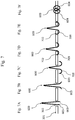
- FIG. 7 is a side view of a closing device 600 as shown in FIG. 6 deployed in the aperture 302, penetrating the tissue 301 and connecting the free edges of the aperture 302.
- FIG. 7 shows the subsequent deployment of the closing device 600 from FIG. 6 in an aperture 302 to be closed.
- FIG. 7A the closing device 600 (as shown FIG. 6 ), is in a compressed straight configuration and advanced in the aperture 302 of the tissue 301.
- FIG. 7B the closing device 600 is partially deployed, the tip of the closing device 603 is bent due to the memo-material effect.
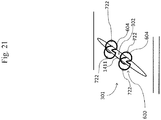
- the closing device 600 is then withdrawn, and the pointed ends 722 of the anchor like formed closing device 708 perforate the tissue 301. Further deployment of the closing device 600 will cause the closing device 600 to complete each of both bend arms hemi-circle or semi-circle, approximating the tissue aperture ends and closing the aperture 302.
- closing device 600 optionally requires a closing device holder 802 as shown in the subsequent FIG. 8 to FIG. 12 . It should be understood, that more closing devices 600 could be utilized depending upon the embodiment and organization of the closing devices 600.
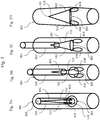
- FIG. 8 is a schematic, sectioned side view of the closing member 800 in longitudinal direction 801 comprising of a longitudinal hollow closing device holder 802 with a distal end 804.
- the closing device holder 802 contains the straight compressed closing device 600.
- the closing device holder 802 has optionally a lateral channel 803 for the deployment of the closing device 600.
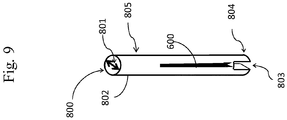
- FIG. 9 is a schematic, sectioned perspective side view indicated by the arrow 801 of the closing device holder 802 as shown in FIG. 8 , containing the straight folded closing device 600.
- the closing device holder 802 has optionally a lateral channel 803 for the deployment of the closing device 600.
- the channel 803 allows the closing device 600 to exit the closing device holder 802 in a bent way, as shown in FIG. 12B to FIG. 12D in the form of an anchor 708 (in FIG. 12C ), but preventing the closing device 600 from engaging structures and tissue that might be positioned opposite to the end 804 of the closing device holder 802 like an opposite vessel wall.
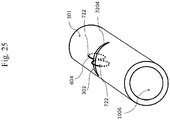
- FIG. 10 is a schematic, partially sectioned perspective view indicated by the arrow 801 of a vessel 301 and the closing device holder 802, as shown in FIG. 8 and FIG. 9 , containing the straight folded closing device 600 and being advanced into a vessel lumen 1006 through the aperture 302 in the vessel wall 301.
- the channel 803 in the distal closing device holder 802 allows the closing device 600 to exit the closing device holder 102 in a bent way as shown in FIG. 12B to FIG. 12D in form of an anchor 708 (in FIG. 12C ) preventing the closing device from engaging an opposite vessel wall 301.
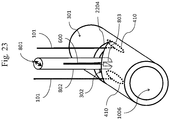
- FIG. 11 is a schematic, partially sectioned perspective view indicated by the arrow 801 of a longitudinal transection of a vessel 301 and the closing device holder 802 as shown in FIG. 8 , FIG. 9 and FIG. 10 containing the straight compressed closing device 600 and being deployed in a vessel lumen 1006 through the aperture 302 in the vessel wall 301.
- the channel 803 in the distal closing device holder 802 allows for the closing device 600 to exit the closing device holder 102 in a bent way as shown in FIG. 12B to FIG. 12D , e.g., in the form of an anchor 708 (in FIG. 12C ) preventing the closing device from engaging the opposite vessel wall 301.
- FIG. 12 is a schematic, partially sectioned longitudinal cross-section view as indicated by the arrow 801 of the closing device holder 802 from FIG. 8 and FIG. 9 in the sequence from FIG. 12A to FIG. 12E showing the closing device holder 802 from FIG. 8 deployed in the aperture FIG. 12A .
- FIG. 12B the closing device 600 is pushed outward in the direction of the end 804 of the closing device holder 802 and the tips of the closing device 603 bend and leave the closing device holder 802 in the channel 803.
- the closing device 600 is pushed further in direction of the end 804 of the closing device holder 802, further leaving the closing device holder 802 through the channel 803 and optionally forming an anchor 708.
- the tips 603 of the closing device 600 are engaging the vessel wall 301.
- FIG. 12D the closing device holder 802 is further withdrawn out of the aperture 302.
- the anchor 603 hat pointed ends perforating 722 the vessel wall 301. Further withdrawing can be detected as a firm resistance to yet further withdrawal.
- the closing device holder 802 is then further retracted out of the vessel aperture 302 and the closing device 600 is released.
- the arms 604 of the closing device 600 bend inward, pulling the ends of the aperture 302 together, closing the aperture 302 and forming a ring structure as shown in FIG. 6 .
- FIG. 13 is a schematic, partially sectioned longitudinal cross-section view of an alternative closing member 800 deployed in the aperture 302 in the wall of a vessel 301.
- FIG. 13 shows the sequence FIG. 13C to FIG. 13H of the deployment of the closing device 600 and the closure of the aperture 302 achieved by the closing device 600.
- the closing member 800 captures a piston 203.
- FIG. 13A shows the piston 203 in cross-section, having grooves 204 in which a holding device 202, preferably a suture, is guided.
- the holding device 202 is tethering the closing device 600 to connect piston 203 with the closing device 600.
- FIG. 13B shows the closing device holder 802 as shown in FIG. 8 in cross-section, having grooves 207 in which the arms of the closing device 600 are captured and guided, when the closing device 600 is moved in longitudinal direction, in particular in the direction to the distal end 804 of the closing device holder 802.
- the closing device 600 is pushed towards the end 804 of the closing device holder 802 by the piston 203 as shown in the sequence FIG. 13C to FIG. 13H .
- FIG. 13C the end of the closing member 800 is deployed in the aperture 302 in the wall of the vessel 301.
- the closing member 800 and the closing device 600 are oriented in the longitudinal direction of the vessel 301 as shown in FIG. 8 by the arrow 801.
- FIG. 13D the piston 203 is pushed towards the distal end 804 of the closing device holder 802 and the tips of the closing device 600 exit from the closing device holder 802 through the channel 803 and bend outwards.
- the holding device 202 follows the forward movement to the end 804 of the closing device holder 802 while keeping the closing device 600 and the piston 203 tightly connected.
- the closing device 600 is pushed further by the piston 203 in direction of the distal end 804 of the closing device holder 802, further leaving the closing device holder 802 through the channel 804 and forming an anchor 708.
- the tips 603 of the closing device 600 engage the vessel wall 301 and penetrate the vessel wall 301.
- FIG. 13F the closing device holder 802 together with the closing device 600 are withdrawn, and the pointed ends 603 of the partially released closing device 600, formed like an anchor 708, perforate (see: 722) the vessel wall 301. Further withdrawing of the anchor-like shaped closing device 600 can be detected as a firm resistance to yet further withdrawal.
- the closing device holder 802 including the piston 203 is removed, leaving the unfolded closing device 600 still tethered by the holding device 202.
- the holding device 202 could then be utilized for localizing or even retracting the closing device 600 if needed.
- the holding device 202 is removed, e.g., by pulling one arm of the holding device 202.
- FIG. 14 to FIG. 21 shows the closure of an aperture 302 with two closing members 800.
- FIG. 14 is a schematic, partially sectioned perspective view of an alternative embodiment of a retracting unit 100 as shown in FIG. 5 .
- the retracting unit 100 has two retracting device holders 102 each of them capturing one retracting device 101 having distally connected an engaging device 410.
- the engaging device 410 is preferably a wire loop that can be folded and captured in the retracting device holder 102.
- the distal ends 110 of two retracting device holders 102 are deployed in opposite sides of the aperture 302 in a tissue 301.
- FIG. 15 is a schematic, partially sectioned perspective view of two retracting device 101 in the aperture opening 302 with the ends 110 positioned on opposite sides of the aperture 302 below the aperture wall 1411.
- the retracting device 101 were pushed forward to the distal ends 110.
- the engaging devices 410 have left the opening at the distal ends 110 of the retracting device holders 102 and the engagement devices 410 have unfolded into a loop.
- FIG. 16 is a schematic, partially sectioned perspective view of two retracting units 100 in the aperture opening 302 with the distal ends 110 positioned on opposite sides of the aperture 302 below the aperture wall 1411.
- the two retracting device holders 102 with the engaging devices 410 are moved in opposite direction as indicated by the arrows 1420.
- FIG. 17 is a schematic, partially sectioned perspective view of two retracting devices 101, deployed in the aperture opening 302 with the distal ends 110 positioned on opposite sides of the aperture 302, below the aperture wall 1411.
- the two retracting devices 101 are moved in opposite direction, as indicated by the arrows 1420, causing the aperture 302 to form a slit.
- the opposite movement of the retracting devices 101 will come to a stop when the opening of the aperture 302 forms a straight slit, e.g., with the length of the slit being equal to half of the circumference of the aperture 302 as shown in FIG. 15 .
- the engaging devices 410 form a loop with a diameter that is larger than the short axis of the slit opening of the aperture 302 in an angle 1422 of 90deg to the slit opening.
- the engagement means 410 would lock an accidental upwards movement 1421 of the retracting units as indicated by the arrows 1420.
- the upward movement 1421 of the retracting devices 101 is stopped when the engagement device 410 comes into contact and cannot pass through the slit opening of the aperture 302.
- FIG. 18 is a schematic, partially sectioned perspective view of two retracting devices 101 and two engaging devices 410 deployed in the aperture opening 302 as shown in FIG. 16 having transformed the aperture into a slit form with simultaneous or sequential deployment of the closing member 800, with the two closing device holders 802 between the aperture shoulders, with the ends 804 and the channels 803 positioned below the opening of the aperture 302.
- the closing devices 600 are captured and compressed in the closing device holders 802 and orientated in an angle of 90deg to the aperture opening 302 as indicated by the protractor 1722 and the arrow 801.
- FIG. 19 is a schematic, partially sectioned perspective view of two retracting devices 101 with the engaging devices 410 and closing device holders 802 deployed in the aperture opening 302 as shown in FIG. 18 .
- the closing devices 600 are stepwise released in the direction to the closing device holder ends 804 and have left the closing device holders 802 in the channels 803, forming anchors 708 that have engaged the wall of the tissue 301, surrounding the opening 302 and the tips 603 of the closing device 600, and perforated the wall of the tissue 301 as shown at the perforations 722. Further withdrawing can be detected as a firm resistance to further withdrawal.
- the closing device holders 802 are then further retracted out of the vessel aperture 302, and the closing devices 600 are released.
- FIG. 20 is a schematic, partially sectioned perspective view of two retracting device holders 102, partially retracted out of the aperture 302, while the engaging devices 410 are still deployed in the aperture 302.
- the closing device holders 802 as shown in FIG. 19 are removed.
- the closing devices 600 as shown in FIG. 19 are fully unfolded forming the structure as shown in FIG. 6A .
- the closing devices 600 do approximate and close the aperture's 302 free edges 1411.
- FIG. 21 is a schematic perspective view of the tissue 301 having a closed aperture 302.
- the aperture's 302 sides are approximated and closed by the closing device 600 that perforate the tissue as indicated by the perforations 722.
- the following descriptions combine the retracting unit 100 and the closing member 800 in one set or medical apparatus, deployed simultaneously in a vessel 301.
- the sequence from FIG. 22 to FIG. 25 shows the closure of an aperture 302 in a tissue with one closing device 600.
- FIG. 22 is a schematic, partially sectioned perspective view of two retracting devices 101, with the engaging devices 410 and one closing device holder 802 deployed in the aperture 302 in the wall 2204 of a vessel 302 within the vessel lumen 1006.
- the engaging devices 410 are positioned inside of the vessel lumen 1006 oriented in longitudinal direction of the vessel 301, as indicated by the arrow 801.
- the closing device holder 802 is deployed between the retracting devices 101, with the opening of the channel 803 below the aperture wall 2204 inside of the vessel lumen 1006, oriented in longitudinal direction of the vessel 301 as indicated by the arrow 801.
- FIG. 23 is a schematic, partially sectioned perspective view of two retracting devices 101 with the engaging devices 410 and one closing device holder 802 deployed in the aperture 302 in the wall 2204 of a vessel 302.
- the engaging devices 410 and the channel 803 of the retracting device holder 102 are positioned below the aperture wall 2204 inside of the vessel lumen 1006.
- the retracting devices 101 and the engaging devices 410 are moved apart in a transverse direction which is orthogonal to the vessel's long axis.
- the engaging devices 410 press against the inner wall of the vessel 301 in opposite direction. This will retract the opposing sides of the aperture 302 and spread the aperture 302 of the vessel 301 in a direction orthogonal to the long axis of the vessel 301, at the same time approximating the opposing expanded long sides of the aperture 302.
- FIG. 24 is a schematic, partially sectioned perspective view of two retracting devices 101 with the engaging devices 410 and one closing device holder 802 deployed in the aperture 302 in the wall 2204 of a vessel 301.
- the engaging devices 410 and the channel 803 of the retracting devices 101 are positioned below the aperture wall 2204, inside of the vessel lumen 1006.
- the retracting devices 101 and the engaging devices 410 have retracted the aperture 302 in a direction orthogonal to the long axis of the vessel 301, causing approximation of the opposing long extended sides of aperture 302.
- the closing device 600 is partially deployed, has left the closing device holder 802 via the channel 803 and has formed an anchor 708 that has sufficiently grasped the vessel wall 2204 and penetrated the vessel wall 2204 as indicated by the perforation 722. Further withdrawing can be detected as a firm resistance to further withdrawal.
- the closing device holder 802 is then further retracted out of the vessel aperture 302 and the closing device 600 is released, forming the complete round structure, pulling the aperture wall 2204 and approximating the aperture opposing long extended sides 2204 further together.
- the closing device holder 802 is withdrawn and removed and the retracting devices 101 are removed by pulling the engaging devices 410 out of the closed aperture 302, while the flexible loop of the engaging devices 410 collapse and slip through the shoulders of the already closed aperture 302.
- FIG. 25 is a schematic, partially sectioned perspective view of a vessel 301 having an aperture 302 that was closed in a straight line, orthogonal to the vessel's long axis by the closing device 600 with perforations 722 of the aperture wall 2204.
- FIG. 26 is a schematic, partially sectioned view from the operator's perspective showing the closure of an aperture 302 in a patient vessel.
- FIG. 26B the retracting unit 100 with two arms and the closing member 800 with three closing device holders 802 are deployed in an aperture 302 of a patient's vessel.
- the engaging devices 410 are moved apart in transverse direction orthogonal to the long axis of the vessel at the opposite sides of the aperture 302, retracting the sides of the aperture 302, which results in an approximation of the upper and lower end of the aperture 302 and in forming a slit opening with two long sides, distal and proximal, and two short sides at the lateral side of the vessel.
- the closing device holders 802 are moved apart, to be equally distributed along the spread aperture 302.
- FIG. 26D the closing devices 600 are deployed and form an anchor each.
- FIG. 26E the closing device holders 802 are retracted and the closing devices 600 engage, and, upon further retracting the closing device holders 802, perforate the wall of the vessel 301 surrounding the opening 302.
- closing device holders 802 are then further retracted out of the vessel aperture 302 and the closing devices 600 are released.
- FIG. 26F the closing devices 600 are deployed forming round needles that are closing the aperture 302.
- FIG. 26G the engaging devices 410 are retracted.
- the closing devices 600 close the transverse seam of the aperture 302.
- FIG. 27 is a surgeon view of the aperture 302 of a patient's vessel 301, showing the open surgical closure of the aperture 302 with a suture.
- the aperture 302 in the patient's vessel 301 is closed in a straight line orthogonal to the vessel's long axis, with a running or interrupted suture 2600 to avoid a stenosis of the patient's vessel.
- This principle of closing an aperture in a patient vessel is of particular importance and is realized in this invention as shown in FIG. 10 - FIG. 12 and FIG. 22 - FIG. 26 which illustrate an exemplary method of operating the medical apparatus.
- FIG. 28 is a surgeon view of the aperture 302 of a patient's vessel 301 showing the open surgical closure of the aperture 302 with a suture 2600.
- the aperture 302 in a patient's vessel 301 is closed with a cross-suture or equally a purse-string suture (not shown) that approximates the lateral sides of the aperture 302.
- the approximation of the lateral sides of the aperture 302 is causing narrowing of the vessel lumen as indicated by the arrows 2700.
- FIG. 29 is a surgeon view of the aperture 302 of a patient's vessel 301 showing the open surgical closure of the aperture 302 with a suture 2600.
- the aperture 302 in a patient's vessel 301 is closed with a longitudinal suture.
- the approximation of the lateral sides of the aperture 302, is causing narrowing of the vessel lumen, as indicated by the arrows 2700.
- FIG. 30 shows a closing device 600 in an embodiment in a perspective view. It comprises two arms 604, each of which carries an optionally pointed end 603. The arms originate from a curled or curved section 605.
- FIG. 30A shows the closing device 600 of FIG. 30 in a front view.
- FIG. 31 shows a closing device 600 in yet an embodiment in a front view. It comprises two arms 604, each of which carries an optionally pointed end 603. No curled or curved section is provided.
- FIG. 31A shows the closing device 600 of FIG. 31 in a perspective view.
- FIG. 32 shows a closing device 600 in an embodiment in a front view. It comprises two arms 604, each of which carries an optionally pointed end 603. In contrast to the embodiment of FIG. 30 , the curled or curved section 605 is not closed, meaning that there is no spiral section.
- FIG. 32A shows the closing device 600 of FIG. 32 in a perspective view.
- FIG. 33 shows parts of the medical apparatus according to the present invention in a perspective view.
- a guide wire 1000 is introduced into the lumen 1006 of the vessel 301.
- the guide wire 1000 is run through a central opening of the medical apparatus running denoted as guide wire lumen 115.
- Two engaging devices 410 retract the aperture 302 into a slit.
- FIG. 33 No retracting unit is shown in FIG. 33 . If a retracting unit were shown, it could be arranged such that it can be advanced through the guide wire lumen 115, as is shown in FIG. 35 with respect to another embodiment of the medical apparatus.
- the medical apparatus and, in particular, the engaging device 410 or the retracting device 101 may comprise a section that hinders the guide wire 1000 to interfere with the closing device.
- the section may be a wire construct guiding the guide wire out or range of the closing device 600.
- FIG. 33A shows the medical apparatus of FIG. 33 from its front.
- FIG. 34 shows in a perspective view parts of another embodiment of the medical apparatus.
- the engaging device 410 is built from a single wire.
- the retracting device 101, or any other part of the medical apparatus that is inserted into the vessel lumen in use may in any embodiment comprise a step or a curve 420 that may interact with the wall of the aperture 302 or the vessel 301 such that it gives tactile feedback to the surgeon upon pulling the medical apparatus again out of the vessel 301. If and when the surgeon feels the tactile feedback, he or she knows that the medical apparatus is ideally placed with respect to the aperture 302 in order to close it by releasing closing devices 600.
- FIG. 35 shows parts of yet another embodiment of the medical apparatus from its side.
- FIG.35 shows substantially what is also revealed in FIG. 33 or FIG. 33A . However, it also shows in a highly schematic manner two closing devices 600 closing the aperture 302. The engaging devices 410 have still to be folded again and withdrawn from the vessel lumen 1006.
- FIG. 36 shows a highly simplified view onto the front-end surface of the medical apparatus having a longitudinal axis L and a casing 117, in yet another embodiment.
- the end of the medical apparatus has several openings.
- the number of openings, retracting devices 101 and closing devices 600 is not limit to the number shown in FIG. 36 .
- the guide wire 1000 may run through an opening used exclusively for the guide wire 1000. However, it could also share its opening with the retracting device or devices 101 and/or the closing devices 600.
- FIG. 37A-F show two additional exemplary embodiments of closing devices 600 in different views.
- FIG. 37A-C show one of these additional embodiments in different views.
- FIG. 37A shows a perspective view
- FIG. 37B a front view
- FIG. 37C a side view.
- Two arms 604 of the wire-shaped closing device 600 are optionally fitted together in an optionally non-curved section 607.
- the fitting can be realized by soldering, gluing, friction welding or in another way.
- the two arms 607 are integral with each other, i. e., not joined to each other.
- non-curved section 607 (non-curved in a fully employed state of the closing device 600) is part of some embodiments only and, hence, not binding.
- the curved sections 605 are almost ring-shaped when eyed from the front ( FIG. 37B ) and show no turning point, in contrast to the curved sections 605 of the embodiment of FIG. 37D-F as will be discussed with more detail infra.
- the left arm 604 always turns, or is always bent, to the left (see FIG. 37B ), the right arm 604 always turns or bends to the right.
- end profiles or sections of the arms 604 of the embodiment of FIG. 37A-C are optionally chamfered as pointed ends 603, so that they can easily penetrate the walls of the vessel.
- the closing device 600 is preferably manufactured from a memory material like Nitinol.
- the ring-shape is autonomously assumed or taken by the closing device 600 once released or when it is located in the vessel, starting from an originally more or less straight shape the closing device 600 assumes or takes when it is positioned inside the closing device holder 802.
- FIGs. 37D-F yet another embodiment of a closing device 600 is shown in different views analog to the views of Fig 37A-C .
- a first section of each of the arms 604 that is close or next to the straight or non-curved section 607 of the arms 604 are bent away from the non-curved section 607 or from the other arm 604 in a first bending direction.
- the bending angle may be between 60° and 120°, preferably between 80° and 100°, most preferably 90° (degrees) in a first bending direction.
- a second section following the first section may be bent by optionally almost 360 degrees. It may be bent into a second bending direction, the second direction being opposite to the first direction (first to the left, then to the right, or vice versa).
- the end profiles may be cut straight or almost straight as shown in FIG. 37D to 37F . Alternatively, they may be chamfered as in FIG. 37A-C .
- the non-curved section 607 is part of some embodiments only.
- both arms 604 may each have a first (or just one first) bending to the left and a second (or just one second) bending to the right.
- the design of the closing device 600 of this embodiment allows the left arm 604 to capture tissue of the left side of the access site. It may pull that tissue towards the right arm 604.
- the right arm 604 is arranged to capture tissue of the right side of the access site. It may pull that tissue towards the left arm 604.
- This design has shown to provide a closer and, hence, more reliable closure of the vessel aperture 302. It appears that due to the tighter closure achieved one may advantageously achieve the set goal of closing the vessel aperture 302 by a smaller number of closing devices 600 and/or by using smaller closing devices 600.
- the straight or non-curved section 607 which is optional, may sever for holding and/or pushing the closing device 600 until it is finally released. Also, the section 607 may be used for interconnecting the two arms 604 with each other, e. g., in a welding process.
- the arms 604 may start pulling the tissue of the opposing sides of the vessel aperture 302 once unsheathed.
- FIG. 38 shows a handle member 900 of the medical apparatus and a guide wire 1000 advanced into a blood vessel 301 (e. g., a vein) through an aperture 302 of the blood vessel 301.
- a blood vessel 301 e. g., a vein
- FIG. 38 shows a handle member 900 of the medical apparatus and a guide wire 1000 advanced into a blood vessel 301 (e. g., a vein) through an aperture 302 of the blood vessel 301.
- the design and use of the handle member 900 and at least some of its mechanisms for pushing and advancing components such as the guide wire 1000, the retracting device 101 and more are described below.
- FIG. 39 shows an embodiment of the retracting device 101 and engaging device 410 which is activated by the handle member 900.
- an optional first slider 902 is pushed by the user in the direction marked by the corresponding arrow (towards the vessel 301).
- an optional second slider 904 is also moved by the user as also denoted by another corresponding arrow (again towards the vessel 301).
- the function of the second slider 904 is explained below.
- the first slider 902 may optionally be locked in place.
- the retracting device 101 is not yet expanded within the vessel 301, and it is not yet engaged with the access site. However, the tips of the retracting device 101 have parted from each other.
- the handle member 900 is pulled back by the user as indicated by the arrow shown next to the handle member 900 and pointing away from the vessel 301 until the user can feel that the retracting device 101 is completely engaged with its engaging device 410 at the access site.
- the opposing edges of the slit opening 302 lie close together due to the arms of the retracting device 101.
- FIG. 40 shows (optionally three) closing device holders 802 pushed towards the aperture 302 by a mechanism comprised by the handle member 900.
- the closing device holders 802 may be parallel to each other, fully or only in parts thereof..
- Pushing the closing device holders 802 out of the closing member 800 and/or the handle member 900 may be activated by an optional switch 906 or another feature of the handle member 900.
- the switch 906 is arranged to be movable within an opening 908 of the casing of the handle member 900.
- the switch 906 is optionally pushed to a first stop that can be provided by the left end of the opening 908 (see the position the switch 906 has taken in FIG. 40 ).
- the closing device holders 802 are spread to full width which means that they are located - optionally more or less equidistantly - along the aperture 302. In FIG. 40 this is indicated by the three small arrows between the closing device holders 802 and the single lumen or multilumen extrusion or opening 910. The closing devices 600 are still inside the closing device holders 802.
- closing device holders 802 can remain parallel throughout the closure of the vessel aperture 302, or they can be arranged to deviate from each other. For example, they may be arranged such that neighboring closing device holders 802 may move away from each other, at least in part, when they are deployed. For example, they may be arranged such that the gaps, spaces or distances between their tips become wider when advanced towards the vessel aperture 302.
- FIG. 40A shows an optional delivery support 806 for the three or more parallel closing device holders 802.
- the closing device holders 802 are separated by small distances from each other. Their separation may be triggered by the design of the delivery support 806.
- the delivery support 806 may comprise a wire net or structure or consist thereof.
- the delivery support 806 may be a foldable and/or unfoldable element.
- bumpers 807 may optionally be comprised. These bumpers 807 are spacers as shown in FIG. 40B in an expanded or unfolded state of the delivery support 806.
- FIG. 40B shows the delivery support 806 of FIG. 40A in an expanded or unfolded state.
- the delivery support 806 has been unfolded by pushing it downwards as indicated by the arrows at the top of the pusher tubes 808.
- the activation spreads the closing device holders 802 and distributes them along the slit opening 302.
- the bumpers 807 may act as spacers and maintain this small distance during closure of the vessel aperture 302.
- FIG. 40C shows a sleeve 914 with a - optionally U- or V-shaped - guide slot 916 (guidance groove).
- the sleeve 914 is part of the handle member 900.
- a pin or another protrusion of the knob 912 that is preferably arranged at the rear of the handle member 900 (see FIG. 41 ), or another element connected to the knob 912 can be moved, e.g., as it is known from so-called tongue-and-groove systems.
- the guide slot 916 comprises a first slot section 916a and a second slot section 916b each being connected with each other by another section, called a turning point 916c.
- a pin when being moved along the guide slot 916 from the first slot section 916a thereof to the second slot section 916b thereof, or vice versa, is first moved in the clockwise direction along the guide slot 916 and around the longitudinal axis of the sleeve 914 and, once having reached the turning point 916c, anti-clockwise, or vice versa.
- the pin can be part of the knob 912 while the guide slot 916 is part of the sleeve 914, or vice versa.
- the pin when turning the knob 912 in a first direction (clockwise, for example), the pin will move along the first slot section 916a and eventually enter the turning point 916c of the guide slot 916 where the knob 912 will stop turning.
- the turning point 916c can, hence, be understood as a stop.
- the knob 912 For further advancing the sleeve 914 relative to the knob 912 (or vice versa), the knob 912 has to be turned in the second direction (anti-clockwise, for example).
- An elastic element, a spring or the like can make sure that the pin will enter smoothly into the second slot section 916b once it has reached the turning point 916c and is about to leave the latter.
- Providing a guide slot 916 as discussed supra may allow the user (surgeon) to have tactile feedback indicating that a predetermined feed of the sleeve or the pin has been achieved, in particular if the guide slot 916 is U- or V-shaped. Further feed can only be achieved by reversing the direction in which the knob is turned. This feature is, hence, a safety measure. Also, it may enhance precision upon advancing elements such as the closing devices 600.
- FIG. 41 shows three closing devices 600 pushed forward within the closing device holder 802 by a mechanism of the handle member 900.
- this mechanism is activated or operated by turning the knob 912 at the rear end of the handle member 900 in order to advance and to at least partly release the closing devices 600 for closing the aperture 302. It is referred to in the above discussion of the optional V-shaped guiding slot 912.
- FIG. 42 shows how the three closing device holders 802 are pulled back by a mechanism of the handle member 900.
- turning the switch 906 in the opposite direction than discussed with respect to FIG. 40 will pull the closing device holders 802 backwards as indicated by the arrowing directing to the rear end of the handle member 900.
- the closing devices 600 have closed the aperture 302 by piercing the edges of the aperture 302 upon taking on their final shape.
- the final shape of the closing devices 600 can be predetermined upon manufacture of the closing devices 600, e. g., by using a shape memory material like Nitinol.
- FIG. 43 shows the release of the retracting device 101 from the tissue of the aperture 302 due to a mechanism of the handle member 900.
- This mechanism is optionally activated or triggered by pulling back the second slider 904. This step makes it possible to decouple the two parts of the retracting device 101 in order to pull them back and out of the vessel 301.
- FIG. 44 shows a mechanism of the handle member 900 for fully removing the retracting device 101.
- the first slider 902 is pulled back to the rear side of the handle member 900.
- the complete handle member 900 system can be removed.
- FIG. 45 shows the optional design of the retracting device 101 and the engaging device 410 shown in, e. g., Fig 39 , in an enlarged illustration. Also, a cut along I-I is shown in FIG. 45 .
- the retracting device 101 of the retracting unit 100 comprises a multitude (here: two) of arms, here arm 101a and arm 101b.
- Arm 101a of the engaging device 101 comprises two legs 121 and 123.
- Leg 121 is called the outer leg
- leg 123 is called the inner leg, as in the retracting position of the retracing device 101 leg 121 is more lateral than the more medial leg 123 (see FIG. 45 ).
- Legs 121 and 123 may be welded to each other in or by a welding section 125.
- the legs 121, 123 may part from each other so that they surround or circumscribe one or two middle openings 127 which may be trough-openings.
- the inner leg 121 may be straight or substantially straight.
- the outer leg 123 may be bent such that to its outer side (lateral, see FIG. 45 ) an indentation, a bulge or a dent is provided.
- the indentation, bulge or dent forms the engaging device 410 already described supra. It may be used for releasably engaging with the tissue.
- the engaging device 410 may provide a tactile feedback to the surgeon upon withdrawing the medical apparatus slightly from the vessel aperture 302 in order to position it appropriately with regard to the vessel 301 or its aperture 302.
- the arm 101a Due to the particular shape of the engaging device 410, the arm 101a has the shape of a splint.
- the arms 101a and 101b exit through separate openings 131 and 133, respectively, from the retracting unit 100, although the arms 101a and 101b could exit through a common opening as well.
- At least one of the openings 131 is designed to have a width that is smaller than the length of a cross section of the arms 101a and 101b (e. g., in a cross section through the welding section 125).
- the particular shape of the opening 131 or its opening area, or of a void inside the retracting unit 100 following the opening 131 and ending at the opening 131 is longer (in an up-down direction in FIG. 45 ) than broad (in a left-right direction in FIG. 45 ).
- Such a shape can, for example, be achieved by choosing an oval shape for the opening 131 (or such a cross section of the void behind it comprising the retracting device 101 or parts thereof before they are released during use), e. g. like the one shown in FIG. 45 .
- Such a shape may prevent an undesired twisting or turning (along its longitudinal axis) of the arms 101a, 101b during use and in particular when pulling back the entire medical apparatus for bringing it into the desired position for releasing the closing devices 600. Preventing the arms 101a, 101b from twisting or turning may contribute to maximally retracting the vessel aperture 302.
- any other solution that may avoid twisting may additionally, or alternatively, be provided.
- a pin, a protrusion or the like arranged to prevent twisting or turning may be arranged.
Landscapes
- Health & Medical Sciences (AREA)
- Life Sciences & Earth Sciences (AREA)
- Surgery (AREA)
- Heart & Thoracic Surgery (AREA)
- Engineering & Computer Science (AREA)
- Biomedical Technology (AREA)
- Nuclear Medicine, Radiotherapy & Molecular Imaging (AREA)
- Medical Informatics (AREA)
- Molecular Biology (AREA)
- Animal Behavior & Ethology (AREA)
- General Health & Medical Sciences (AREA)
- Public Health (AREA)
- Veterinary Medicine (AREA)
- Cardiology (AREA)
- Surgical Instruments (AREA)
Priority Applications (7)
| Application Number | Priority Date | Filing Date | Title |
|---|---|---|---|
| EP19193644.2A EP3785643A1 (de) | 2019-08-26 | 2019-08-26 | Medizinische vorrichtung und verfahren zum verschliessen einer öffnung in einem gewebe |
| CN202080060386.9A CN114302686B (zh) | 2019-08-26 | 2020-08-26 | 医疗设备与用于闭合组织中的开孔的方法 |
| CA3149473A CA3149473A1 (en) | 2019-08-26 | 2020-08-26 | Medical apparatus and method for closing an aperture in a tissue |
| PCT/EP2020/073907 WO2021037943A1 (en) | 2019-08-26 | 2020-08-26 | Medical apparatus and method for closing an aperture in a tissue |
| JP2022512753A JP7620620B2 (ja) | 2019-08-26 | 2020-08-26 | 組織の穴を閉鎖するための医療装置及び方法 |
| US17/638,171 US20220296223A1 (en) | 2019-08-26 | 2020-08-26 | Medical apparatus and method for closing an aperture in a tissue |
| EP20758260.2A EP4021310A1 (de) | 2019-08-26 | 2020-08-26 | Medizinische vorrichtung und verfahren zum schliessen einer öffnung in einem gewebe |
Applications Claiming Priority (1)
| Application Number | Priority Date | Filing Date | Title |
|---|---|---|---|
| EP19193644.2A EP3785643A1 (de) | 2019-08-26 | 2019-08-26 | Medizinische vorrichtung und verfahren zum verschliessen einer öffnung in einem gewebe |
Publications (1)
| Publication Number | Publication Date |
|---|---|
| EP3785643A1 true EP3785643A1 (de) | 2021-03-03 |
Family
ID=67766107
Family Applications (1)
| Application Number | Title | Priority Date | Filing Date |
|---|---|---|---|
| EP19193644.2A Pending EP3785643A1 (de) | 2019-08-26 | 2019-08-26 | Medizinische vorrichtung und verfahren zum verschliessen einer öffnung in einem gewebe |
Country Status (1)
| Country | Link |
|---|---|
| EP (1) | EP3785643A1 (de) |
Citations (10)
| Publication number | Priority date | Publication date | Assignee | Title |
|---|---|---|---|---|
| US4217902A (en) | 1977-05-02 | 1980-08-19 | March Alfred L | Hemostatic clip |
| US5275616A (en) | 1990-10-01 | 1994-01-04 | Quinton Instrument Company | Insertion assembly and method of inserting a vessel plug into the body of a patient |
| DE29923269U1 (de) * | 1999-03-18 | 2000-08-03 | Forschungszentrum Karlsruhe GmbH, 76133 Karlsruhe | Endoskopisch einsetzbarer Druckstabilisator |
| US20010053922A1 (en) * | 1995-12-07 | 2001-12-20 | Zhu Yong Hua | Tissue opening locator and everter and method |
| US20020133193A1 (en) * | 2000-01-05 | 2002-09-19 | Ginn Richard S. | Integrated vascular device with puncture site closure component and sealant and methods of use |
| US20060282118A1 (en) * | 2005-06-10 | 2006-12-14 | Wilson-Cook Medical Inc. | Medical stapler |
| US20080272173A1 (en) | 2000-09-08 | 2008-11-06 | Abbott Vascular Inc. | Surgical stapler |
| US20150066055A1 (en) * | 2005-08-24 | 2015-03-05 | Abbott Vascular Inc. | Redundant tissue closure methods and apparatuses |
| WO2019135236A1 (en) * | 2018-01-04 | 2019-07-11 | Seger Surgical Solutions Ltd. | Tissue alignment for surgical closure |
| WO2019166573A1 (en) * | 2018-02-28 | 2019-09-06 | Venock Medical Gmbh | Medical apparatus for closing an opening in a tissue |
-
2019
- 2019-08-26 EP EP19193644.2A patent/EP3785643A1/de active Pending
Patent Citations (11)
| Publication number | Priority date | Publication date | Assignee | Title |
|---|---|---|---|---|
| US4217902A (en) | 1977-05-02 | 1980-08-19 | March Alfred L | Hemostatic clip |
| US5275616A (en) | 1990-10-01 | 1994-01-04 | Quinton Instrument Company | Insertion assembly and method of inserting a vessel plug into the body of a patient |
| US5275616B1 (en) | 1990-10-01 | 1996-01-23 | Quinton Instr | Insertion assembly and method of inserting a vessel plug into the body of a patient |
| US20010053922A1 (en) * | 1995-12-07 | 2001-12-20 | Zhu Yong Hua | Tissue opening locator and everter and method |
| DE29923269U1 (de) * | 1999-03-18 | 2000-08-03 | Forschungszentrum Karlsruhe GmbH, 76133 Karlsruhe | Endoskopisch einsetzbarer Druckstabilisator |
| US20020133193A1 (en) * | 2000-01-05 | 2002-09-19 | Ginn Richard S. | Integrated vascular device with puncture site closure component and sealant and methods of use |
| US20080272173A1 (en) | 2000-09-08 | 2008-11-06 | Abbott Vascular Inc. | Surgical stapler |
| US20060282118A1 (en) * | 2005-06-10 | 2006-12-14 | Wilson-Cook Medical Inc. | Medical stapler |
| US20150066055A1 (en) * | 2005-08-24 | 2015-03-05 | Abbott Vascular Inc. | Redundant tissue closure methods and apparatuses |
| WO2019135236A1 (en) * | 2018-01-04 | 2019-07-11 | Seger Surgical Solutions Ltd. | Tissue alignment for surgical closure |
| WO2019166573A1 (en) * | 2018-02-28 | 2019-09-06 | Venock Medical Gmbh | Medical apparatus for closing an opening in a tissue |
Similar Documents
| Publication | Publication Date | Title |
|---|---|---|
| JP7395627B2 (ja) | 縫合糸送達デバイス | |
| US11759199B2 (en) | Closure devices and methods | |
| EP1357840B1 (de) | Gerät und verfahren zur einführung einer schliessvorrichtung | |
| US6719777B2 (en) | Closure device and methods for making and using them | |
| US20230329688A1 (en) | Vascular closure device | |
| JP4508866B2 (ja) | 血管閉鎖クリップ及び送出装置 | |
| US7182769B2 (en) | Sealing clip, delivery systems, and methods | |
| EP1933720B1 (de) | Vaskuläre öffnungsrandumkehrgeräte | |
| JP3440099B2 (ja) | 縫合装置 | |
| US12035899B2 (en) | Medical apparatus and method for closing an opening in a tissue | |
| EP3400881B1 (de) | Nahtvorrichtung zum verschliessen einer öffnung in einem blutgefäss oder einer anderen biologischen struktur | |
| US20220296223A1 (en) | Medical apparatus and method for closing an aperture in a tissue | |
| EP3785643A1 (de) | Medizinische vorrichtung und verfahren zum verschliessen einer öffnung in einem gewebe | |
| JP2025528551A (ja) | 組織の穴を閉鎖するための医療装置及び方法 | |
| CA2977072C (en) | Suture delivery device |
Legal Events
| Date | Code | Title | Description |
|---|---|---|---|
| PUAI | Public reference made under article 153(3) epc to a published international application that has entered the european phase |
Free format text: ORIGINAL CODE: 0009012 |
|
| STAA | Information on the status of an ep patent application or granted ep patent |
Free format text: STATUS: THE APPLICATION HAS BEEN PUBLISHED |
|
| AK | Designated contracting states |
Kind code of ref document: A1 Designated state(s): AL AT BE BG CH CY CZ DE DK EE ES FI FR GB GR HR HU IE IS IT LI LT LU LV MC MK MT NL NO PL PT RO RS SE SI SK SM TR |
|
| AX | Request for extension of the european patent |
Extension state: BA ME |
|
| STAA | Information on the status of an ep patent application or granted ep patent |
Free format text: STATUS: REQUEST FOR EXAMINATION WAS MADE |
|
| 17P | Request for examination filed |
Effective date: 20210903 |
|
| RBV | Designated contracting states (corrected) |
Designated state(s): AL AT BE BG CH CY CZ DE DK EE ES FI FR GB GR HR HU IE IS IT LI LT LU LV MC MK MT NL NO PL PT RO RS SE SI SK SM TR |
|
| STAA | Information on the status of an ep patent application or granted ep patent |
Free format text: STATUS: EXAMINATION IS IN PROGRESS |
|
| 17Q | First examination report despatched |
Effective date: 20240911 |