EP3788533B1 - Protection de renseignements permettant d'identifier une personne (pii) à l'aide d'un marquage et d'une persistance de pii - Google Patents
Protection de renseignements permettant d'identifier une personne (pii) à l'aide d'un marquage et d'une persistance de pii Download PDFInfo
- Publication number
- EP3788533B1 EP3788533B1 EP19731098.0A EP19731098A EP3788533B1 EP 3788533 B1 EP3788533 B1 EP 3788533B1 EP 19731098 A EP19731098 A EP 19731098A EP 3788533 B1 EP3788533 B1 EP 3788533B1
- Authority
- EP
- European Patent Office
- Prior art keywords
- personally identifiable
- identifiable information
- document
- client
- client database
- Prior art date
- Legal status (The legal status is an assumption and is not a legal conclusion. Google has not performed a legal analysis and makes no representation as to the accuracy of the status listed.)
- Active
Links
Images





Classifications
-
- G—PHYSICS
- G06—COMPUTING OR CALCULATING; COUNTING
- G06F—ELECTRIC DIGITAL DATA PROCESSING
- G06F21/00—Security arrangements for protecting computers, components thereof, programs or data against unauthorised activity
- G06F21/60—Protecting data
- G06F21/62—Protecting access to data via a platform, e.g. using keys or access control rules
- G06F21/6218—Protecting access to data via a platform, e.g. using keys or access control rules to a system of files or objects, e.g. local or distributed file system or database
- G06F21/6245—Protecting personal data, e.g. for financial or medical purposes
-
- G—PHYSICS
- G06—COMPUTING OR CALCULATING; COUNTING
- G06F—ELECTRIC DIGITAL DATA PROCESSING
- G06F21/00—Security arrangements for protecting computers, components thereof, programs or data against unauthorised activity
- G06F21/60—Protecting data
- G06F21/62—Protecting access to data via a platform, e.g. using keys or access control rules
- G06F21/6218—Protecting access to data via a platform, e.g. using keys or access control rules to a system of files or objects, e.g. local or distributed file system or database
- G06F21/6245—Protecting personal data, e.g. for financial or medical purposes
- G06F21/6254—Protecting personal data, e.g. for financial or medical purposes by anonymising data, e.g. decorrelating personal data from the owner's identification
-
- G—PHYSICS
- G06—COMPUTING OR CALCULATING; COUNTING
- G06F—ELECTRIC DIGITAL DATA PROCESSING
- G06F40/00—Handling natural language data
- G06F40/20—Natural language analysis
- G06F40/205—Parsing
-
- H—ELECTRICITY
- H04—ELECTRIC COMMUNICATION TECHNIQUE
- H04L—TRANSMISSION OF DIGITAL INFORMATION, e.g. TELEGRAPHIC COMMUNICATION
- H04L9/00—Cryptographic mechanisms or cryptographic arrangements for secret or secure communications; Network security protocols
- H04L9/08—Key distribution or management, e.g. generation, sharing or updating, of cryptographic keys or passwords
- H04L9/0894—Escrow, recovery or storing of secret information, e.g. secret key escrow or cryptographic key storage
-
- G—PHYSICS
- G06—COMPUTING OR CALCULATING; COUNTING
- G06F—ELECTRIC DIGITAL DATA PROCESSING
- G06F16/00—Information retrieval; Database structures therefor; File system structures therefor
- G06F16/90—Details of database functions independent of the retrieved data types
- G06F16/93—Document management systems
-
- G—PHYSICS
- G06—COMPUTING OR CALCULATING; COUNTING
- G06F—ELECTRIC DIGITAL DATA PROCESSING
- G06F2221/00—Indexing scheme relating to security arrangements for protecting computers, components thereof, programs or data against unauthorised activity
- G06F2221/21—Indexing scheme relating to G06F21/00 and subgroups addressing additional information or applications relating to security arrangements for protecting computers, components thereof, programs or data against unauthorised activity
- G06F2221/2113—Multi-level security, e.g. mandatory access control
-
- H—ELECTRICITY
- H04—ELECTRIC COMMUNICATION TECHNIQUE
- H04L—TRANSMISSION OF DIGITAL INFORMATION, e.g. TELEGRAPHIC COMMUNICATION
- H04L67/00—Network arrangements or protocols for supporting network services or applications
- H04L67/01—Protocols
- H04L67/10—Protocols in which an application is distributed across nodes in the network
Definitions
- Embodiments described herein relate to protecting personally identifiable information associated with digital content.
- GDPR General Data Protection Regulation
- organizations need to be able to effectively retrieve and (upon request) delete content and documents containing personally identifiable information.
- Existing ways of handling personally identifiable information include performing an internal audit, where a client submits to an organization a request associated with the client's personally identifiable information.
- an individual working for the organization performs a bulk query against all client documents and then performs an analysis of each document to determine whether the document includes personally identifiable information. Redaction of personally identifiable information is performed manually. The entire process could take days, weeks, or months.
- Embodiments described herein include, among other things, a software application (for example, it can be either a local standalone application, or a server-based client application), which enables users within an organization to create, save, and share documents.
- the expression "documents” is used to mean database records, word documents, spreadsheets, presentations, portable document format (PDF), sound files, image files, videos etc.
- Embodiments described herein protect personally identifiable information by leveraging the organization's software service that allow for the creation and storing of data by creating an account or subscription with the organization, using the organization's email service or productive suite (for example, a document storage suite such as Sharepoint) or at the operating system level (for example, using a cloud based user directory with access control information such as Azure Active Directory).
- the systems and methods discussed herein enable, among other things, instantaneous tagging of named individuals while a document is being authored, and thus enable faster, and in certain instances, almost instantaneous retrieval of all documents relating to that individual.
- Systems and methods discussed also enable deletion requests by a client to result in the original document being redacted rather than deleted. This ensures that when a document is shared, only authorized recipients may see personally identifiable information associated with the client. Additionally, any document that is sent outside of a trust boundary may be automatically deleted or have the PII automatically deleted.
- An example embodiment includes a computer system for protecting information associated with concepts (for example, topics such as discussion on a space or defense program, etc.) and/or entities including individuals, groups, organizations, etc.
- the computer system includes an electronic processor configured to store records in one or more client databases, wherein the records include information (for example, personally identifiable information) associated with entities such as but not limited to individuals, groups, organizations, objects, concepts, etc. and a client identifier reference is associated with a particular characteristic associated with each entity (for example, name, date of birth, place of birth, email address, phone number, fax number, particular content, social networking credential, biometric information, financial account number, organization issued identification, government issued identification, etc.).
- the personally identifiable information is accessible based on an authorization level associated with a user.
- the electronic processor is also configured to receive a document containing both non-personally identifiable information and personally identifiable information, and parse the document to determine the presence of personally identifiable information in the document.
- the electronic processor is also configured to match the personally identifiable information included in the document with records stored in the one or more client databases, substitute the personally identifiable information included in the document with the corresponding client identifier reference stored in the client database, and generate a human-legible view of the document containing the corresponding client identifier reference.
- the system may use machine learning to reword client identifier references to fit into the sentence structure. For example, the German language has specific words to refer to a female person versus a male person. Saying "eine [client identifier reference]" immediately identifies the person as being female. The system 100 may instead automatically redact "eine” from the document in order to not disclose the gender of the person.
- the computer system includes an electronic processor configured to store a cryptographic key associated with a user having access to personally identifiable information within the document.
- the electronic processor is also configured to receive the document containing unencrypted non-personally identifiable information and encrypted personally identifiable information.
- the electronic processor is also configured to parse the document to determine the presence of personally identifiable information and detect an encrypted portion in the document.
- the electronic processor is also configured to retrieve the personally identifiable information based on decrypting the encrypted portion using the cryptographic key.
- the electronic processor is also configured to display a human-legible view of the document.
- Another example embodiment includes a method for protecting personally identifiable information of individuals.
- the method includes storing records in a client database.
- the records include personally identifiable information associated with individuals and a client identifier reference associated with each of the individuals.
- the personally identifiable information is accessible based on an authorization level associated with a user or a group to which a particular user belongs.
- the method also includes receiving a document containing both non-personally identifiable information and personally identifiable information of one or more individuals, and parsing the document to determine the presence of personally identifiable information included in the document.
- the method also includes matching the personally identifiable information included in the document with records stored in the client database.
- the method also further includes substituting the personally identifiable information included in the document with the corresponding client identifier reference stored in the client database, and generating a human-legible view of the document containing the corresponding client identifier reference.
- Another example embodiment includes a non-transitory computer-readable medium containing instructions that when executed by one or more electronic processors cause the one or more electronic processors to perform the set of actions including storing records in a client database, wherein the records include personally identifiable information associated with individuals and a client identifier reference associated with each of the individuals, and the personally identifiable information is accessible based on an authorization level associated with a user, receiving a document containing both non-personally identifiable information and personally identifiable information, parsing the document to determine the presence of personally identifiable information in the document, matching the personally identifiable information included in the document with records stored in the client database, substituting the personally identifiable information included in the document with the corresponding client identifier reference stored in the client database, and generating a human-legible view of the document containing the corresponding client identifier reference.
- one or more devices can be configured to, among other things, conserve resources with respect to power resources, memory resources, communications bandwidth resources, processing resources, and/or other resources while providing mechanisms for controlling and deleting personally identifiable information in a document.
- Technical effects other than those mentioned herein can also be realized from an implementation of the technologies disclosed herein.
- Embodiments of systems and methods for protecting personally identifiable information are described herein.
- the personally identifiable information protecting system is configured to detect and remove personally identifiable information within documents based on authorization level based rules provided to the system.
- personally identifiable information includes anything that particularly identifies a particular entity (for example, a user, organization or content, etc.). This can mean any data collected about the users or provided by them unless they have explicitly authorized the organization to share that information.
- PII personally identifiable information
- name name
- date of birth biometric information
- government issued identification number for example, social security number (SSN), driver's license number, etc.
- financial account information for example, bank account number, credit card number, etc.
- personal phone number for example, postal address
- Other data that may be considered PII includes Internet protocol (IP) address, company name, and location information.
- IP Internet protocol
- PII may also be incorporated in free form data, for example document names, email headers, or any other data taken in aggregate that can be used to determine details about an entity (for example, a user, organization, or particular content).
- the system is configured to leave some PII data in the document initially but then be able to remove all the PII data once a threshold of number of items is passed.
- Each of the items may have different weightings associated with them. For example, when just a first name is used and no other information is used - the first name may be retained in a document. However, when a date of birth associated with the first name is provided in the document making it easier for a reader to determine the identity of the individual, the system will remove all the data related to the PII of the individual.
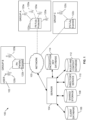
- FIG. 1 illustrates an example of a personally identifiable information protecting system 100.
- the system 100 includes client devices 120a, 120b, 120c that accesses a server 104 via a network 103.
- the server 104 is connected to a client database 106, shared storage 108, directory service 110 (for example, a database or an application that provides documents along with an associated level of authorization to view personally identifiable information in the documents), rules and context database 112, and an encryption key database 114.
- the directory services 110 provides a data structure to manage several categories of users 102 including management of access credentials for the individual users 102 to view personally identifiable information.
- the system 100 may operate locally or in a distributed environment, such as in client-server or cloud services architectures. Any distributed components of the system 100 may communicate with each other or be accessed over at least one computer network, such as, but not limited to, the Internet, an intranet, a local area network, or a wide area network.
- a user can include an individual user 102 or a group of multiple users (for example, User Group A, User Group B or User Group C shown in FIG. 1 ).
- User Group A may include a group of users who may access, view, or create documents where the personally identifiable information is fully protected.
- User Group B may include a group of users who may access, view, or create documents where some of the personally identifiable information is protected and other personally identifiable information may be exposed.
- User Group C may include a group of users who may access, view or create documents where the personally identifiable information is fully exposed.
- the client computing devices 120 can be implemented as any number of computing devices, including, without limitation, a personal computer, a laptop computer, a desktop computer, a portable communication device (for example, a mobile phone or a tablet), or other electronic device that can transmit and/or receive data over a network 103.
- the network(s) 103 is representative of many different types of networks, and includes wired and/or wireless networks that enable communications between the various entities in the system100.
- the network(s) 103 can include the Internet, local area networks (LANs), wide area networks (WANs), a mobile telephone networks (MTNs), and other types of networks, possibly used in conjunction with one another, to facilitate communication between the server 104 and the client devices 120.
- LANs local area networks
- WANs wide area networks
- MTNs mobile telephone networks
- Some configurations are described in the context of a web-based system, other types of client/server-based communications and associated application logic could be used.
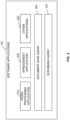
- FIG. 2 is an example block diagram of a computing device 120 shown in FIG. 1 .
- the computing device 120 includes a microphone 121, a speaker 122, a display 123, a communication interface 124, a user interface 125, an electronic processor 126, and a memory 128 coupled to a data bus 129.
- the communication interface 124 provides the computing device 120 a communication gateway with an external network (for example, a wireless network, the Internet, etc.).
- the communication interface 124 may include, for example, an Ethernet card or adapter or a wireless local area network (WLAN) card or adapter (for example, IEEE standard 802.11a/b/g/n).
- the communication interface 124 may include address, control, and/or data connections to enable appropriate communications on the external network.
- the user interface 125 provides an input mechanism such as a keyboard that may be a physical keyboard or a "soft" keyboard generated on a touch screen display.
- the user interface 125 is configured to receive user input to access and interact with one or more software applications stored in memory 128.
- the electronic processor 126 may include at least one processor or microprocessor that interprets and executes a set of instructions stored in the memory 128.
- the memory 128 includes an operating system 130 and software applications 132.
- the operating system 130 includes a graphical user interface generator 131 that creates a graphical user interface on the display 123.
- the software programs 132 are configured to, among other things, implement the methods described herein.
- the memory 128 includes volatile memory elements (for example, random access memory (RAM)), nonvolatile memory elements (for example, ROM), and combinations thereof.
- the memory 128 has a distributed architecture, where various components are situated remotely from one another, but may be accessed by the electronic processor 126.
- the data bus 129 permits communication among the components of the computing device 120.
- the data bus 129 may have additional elements, which are omitted for simplicity, such as controllers, buffers (for example, caches), drivers, repeaters and receivers, or other similar components, to enable communications.
- the data bus 129 may also include address, control, data connections, or a combination of the foregoing to enable appropriate communications among the aforementioned components.
- the electronic processor 126 is configured to encrypt data associated with PII and store the encrypted data in memory 128.
- FIG. 3 is a block diagram showing several software applications 132 stored in memory of computing device shown in FIG. 2 , in accordance with some embodiments.
- software applications 132 include as word processing application 310, a spreadsheet application 320, and other applications 330.
- the software applications further include a saving agent 340 and a scrubbing agent 350.
- the document save agent 340 and the scrubbing agent 350 are executed using the electronic processor 126 in the computing device 120.
- the document save agent 310 is responsible for providing a client access and ability to save documents using the system 100.
- the document save agent 310 also saves logs associated with client's successful (or failed) events while accessing documents.
- the directory service 110 is responsible for providing a client with appropriate access to components of system 100.
- the document save agent 310 processes data that contain personally identifiable information collected from users 102 as part of the data routinely logged for business purposes. Examples of types of data that may be saved include, but are not limited to, collection of words, formatting, any embedded imagery, charts within a document, security related events (for example, login attempts and authorization of users), input/output events (for example, network or file system transactions including viewing, editing and saving files), etc.
- the scrubbing agent 350 processes the saved data based on rules stored in the rules database 112.
- the scrubbing agent 350 may be a standalone application or an integral component of another application. Although illustrated and described as being executed in a single computing device, the document save agent 310 and the scrubbing agent 350 may be distributed and/or executed across many computing devices.
- the scrubbing agent 350 and/or the scrubbing application 320 includes different engines that perform different types of actions on documents.
- the scrubbing agent 350 and/or the scrubbing application 320 includes a parsing engine (for example, to identify possible PII), and a processing engine (for example, to use rules from the data base 112 to convert plain text stored PII into a reference).
- the parsing engine performs processing actions responsible for tasks such as, but not limited to, parsing fields within a document containing personally identifiable information or forwarding the identified field to a child parser which can break the field into smaller components (for example, subfields or name/value pairs).
- a filtering engine is provided that performs filtering actions that determine whether a field within a document needs to be processed (for example, to determine whether an audio or video component in a document needs to be processed).
- the word processing application 330 provides a platform for the user 102 to compose, edit, format, and print documents, including documents that contain personally identifiable information.
- the word processing application 330 includes an extension or a feature that allows the word processing application 330 to access the client database 106 to retrieve client identifier references associated with personally identifiable information within documents accessed by user 102.
- the system 100 is designed to identify likely PII (for example, identifying common names of an individual or organization).
- the personally identifiable information in a document may be encrypted and saved along with the document instead of storing the encrypted personally identifiable information in a centralized client database.
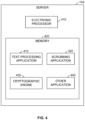
- FIG. 4 is a block diagram of the server 104 shown in FIG. 1 , in accordance with some embodiments.
- the server 104 includes an electronic processor 410 and a memory 420 including one or more software application(s).
- the computing device 120 accesses software application(s) in memory 420 of server 104 through the network 103.
- the software application(s) can include, without limitation, an image and video processing application 430, an audio processing application 440, a text processing application 450, a scrubbing application 420, and other programs 470.
- the image and video processing application 430 includes software programs capable of processing still or video images and determining whether images that include personally identifiable information associated with a client are present in a document.
- the text processing application 450 includes software programs capable of processing textual data and determining whether any textual information that includes personally identifiable information associated with a client is present within a document.
- the scrubbing application 420 locates and replaces personally identifiable information in documents using the rules and context information stored in rules and context database 112.
- the scrubbing application 420 is a distinct application in itself capable of opening a document file and enabling a user to work through the document contents to scrub information (for example, PII) within the document by locating and replacing particular text.
- a post-processing operation to prepare the message for storage in a data store (for example, shared storage 108) is performed.
- the post-processing operation includes an annotation operation that annotates the document with additional information that is needed to properly interpret the data in the document when the document is added to a data store (for example, in the case of documents that have not been scrubbed before).
- the application uses the previous annotation (for example, stored in a database/memory) and applies it to these documents.
- the client identifier includes a plurality of segments to indicate several pieces of information. For example, a first segment may be associated with an individual and a second segment that may be associated with an organization. A third segment that may be associated with a group or company (having some sort of hierarchy), or a forth segment that may be associated with a client database lookup system (for example, checking passport numbers).
- a protected record storage operation is performed that sends the scrubbed document with the PII in a protected format to a data repository (for example, shared storage 108). Once in the data repository, the scrubbed documents are available for use by various consumers of the data
- FIG. 5 is a block diagram of a distributed computing system in which embodiments provided herein may be practiced.
- Content developed, interacted with, or edited in association with the software applications 132 may be stored and retrieved from different servers, communication channels, or other storage types.
- various documents may be stored using a directory service 110, a web portal 510, a mailbox service 520, or a social networking service 530.
- the software applications 132 may use any of these types of systems or the like for enabling data utilization, as described herein.
- the server 104 may also provide software applications 132 over the web to clients through the network 103.
- the client computing device may be implemented as the computing device 120 and embodied in a personal computing device 120-1, a tablet computer 120-2, and/or a mobile computing device (for example, a smart phone) 120-3. Any of these embodiments of the client device may obtain content from the shared storage 108.
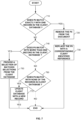
- FIG. 6 and FIG. 7 are flow charts illustrating a method for protecting personally identifiable information, in accordance with some embodiments.
- the electronic processor 410 in server 104 stores records (for example, personally identifiable information associated with individuals and client identifiers) in the client database 106.
- Each record in the client database 106 contains a name or other information (for example that identifies an entity (for example, an individual, a group or an organization, etc.), but may also contain one or more of client's title, first, middle and last names as well as nicknames/abbreviations. Additional information may be stored to help the system and the organization disambiguate that individual versus others.
- This may include email address, home address, phone numbers, names of organizations they own or are employed by, individuals in the organization they worked with (for example, particular teachers, doctors), names of children.
- the scenarios are provided here only as examples and can vary depending on the nature of the organization that stores data about clients.
- the electronic processor 410 receives, from a shared storage 108, a document containing both non-personally identifiable information and personally identifiable information of one or more individuals.
- the electronic processor 410 parses the document to determine the presence of personally identifiable information included in the document.
- parsing the document includes analyzing strings of text in the document and converting the text into logical syntactic components that may be used to determine the presence of personally identifiable information.
- the electronic processor 410 matches the personally identifiable information with records stored in the client database 106.
- the electronic processor 410 compares various portions of the document (for example, words, sentences, lines, etc.) with entries in the client database 106 to verify whether those portions include any personally identifiable information.
- the electronic processor 410 determines whether personally identifiable information in the document matches exactly with one record (at block 710). When the personally identifiable information matches exactly with one record, the personally identifiable information is removed (at block 720) from the document and replaced (at block 730) with a corresponding client identifier. In some embodiments, the electronic processor 410 determines (at block 740) whether the personally identifiable information matches with more than one record in the client database 106.
- the system 100 prompts (at block 750) the user 102 with a prioritized list of potential candidates. In this instance, the user 102 chooses the most appropriate match based on reviewing the matched selections from the client database 106 displayed to the user 102.
- the system 100 uses collocated information (for example, a date of birth) to automatically infer the user. In other embodiments, the system 100 makes a best guess if it doesn't need to be strictly accurate.
- the electronic processor 410 determines whether the personally identifiable information matches with none of the records in the client database 106. In this case, the client database 106 is updated using the personally identifiable information that did not previously have a corresponding match.
- a new way of personally identifying an individual or entity may also be added to the client's database 106.
- the author may be prompted to provide more information about that individual or entity to confirm what type of PII has been discovered.
- the electronic processor 410 substitutes the personally identifiable information included in the document with the corresponding client identifier stored in the client database 106.
- the electronic processor 410 generates a human-legible view of the document containing the corresponding client identifier.
- a user 102 when a user 102 (for example, John Smith having an email identifier as "john.smith@contoso.com") uses an organization's email service and/or productivity tools to retrieve or delete information stored about them, various software tools associated with the email service and/or the productivity tools may be used to retrieve all records having a user identifier as " john.smith@contoso.com” .
- various software tools associated with the email service and/or the productivity tools may be used to retrieve all records having a user identifier as " john.smith@contoso.com” .
- information is stored in a harder to retrieve manner. For example, if an employee of a governmental institution (for example, healthcare, law enforcement, or education) is writing about a particular person, then the author of the document is not the same as that referenced person.
- the document may mention multiple people, for example, a commercial institution such as a bank may cite various individual customers' actions and/or histories as a need to change internal policy, or a sales teams may have marketing documents with "customer evidence" citing various customers.
- the document includes nicknames (for example, Dave/David), or uses only the first names etc. and this may lead to confusion because multiple individuals may have the same name.
- nicknames for example, Dave/David
- characteristics associated with the document for example, the time when the document was created, edited or deleted
- Some embodiments provided herein use the client database 106 to enumerate a full list of clients (for example, users, individuals, customers, businesses, etc.), which may be referenced in documents.
- Each record refers to an individual client.
- the record may facilitate online interaction and thus contain a username (which may be an email address) and some form of password (for example, typed characters, phone-based authentication, fingerprint, etc.).
- Other implementations may target scenarios where a client meets an agent of the organization (for example, a clerk at a bank counter) and thus the clerk can present physical proof (for example, government ID) for their identity to be confirmed to the agent.
- an author of a document desires to mention a client, they may use an explicit "client selector" to pull up the client's name from the database and insert into the document. More frequently, however, the user 102 may simply type the client's name into the document in a sentence. With this implicit entry of a client's name, the software would use a background process to detect that someone's name has been entered. This can be achieved by looking for every word the user 102 types in a client database. In the case of Latin alphabets, capitalization is a compelling reason that a proper noun has been entered into the document.
- the electronic processor 410 is configured to provide implicit client recognition by prompting the user 102 to confirm the identity with that name or other identifying information in the document (for example, an address). In some instances, this may not be true. For such cases, the author is provided with a prompt to explicitly select from a set of potential matches as to which individual is being envisioned by the author. In some embodiments, the potential matches are ranked based on relevance to the user. In other instances, all potential matches of individuals may be stored and not be displayed to the user if, for instance, it is determined that the author has a low level of access rights. Additionally, when the document is being deleted, one would have to ask for each potential match as to whether the user referred was the actual user in those cases.
- the system 100 is configured to decide on the identity of the individual based on information in the document.
- the time of deletion of documents may be used to determine the identity of the individual envisioned by the user.
- the system can determine the identity of the individual based on this information.
- the author may not immediately have access to see the named individuals. For example, the author may type “Mary Brown” and they actually mean “Mary Jane Brown.” However, there may be two records (“Mary Jane Brown” and "Mary Hanna Brown”) in the client database. Thus, when the author wants to refer to the existence of "Mary Jane Brown” they may have to ask approval (for example, from a manager or an internal governance body) to write documents about "Mary Jane Brown” before their document may be saved, shared, published (for example, staging environments to test functionality, generating newspaper articles and then sending to a production/publishing environment where others can see the information), captured (for example, using a screen shot), printed, or emailed etc.
- approval for example, from a manager or an internal governance body
- the author may be writing about a client who is not yet recorded in the client database and thus may need to create this record. This could also trigger other workflows such as approval that a new client may be created, or a notification to the client, etc.
- a document is tagged as containing potential names. Documents so tagged may be subject to further manual or automated review. For example, the word "Sam” could refer to a named individual or Samantha or the Singapore Art Museum. Since many name analysis techniques have algorithms which assign a probabilistic likelihood to a given entity being a name or not, those skilled in the art will recognize that the list of documents for reviews will be given assigned ranks. Other techniques can be employed to detect that a particular document template when completed will always contain a reference to a client, but no client is yet identified in the document. Additionally, very often in documents, a full reference to an entity is given initially, and subsequent references to the entity are made using a more abbreviated reference, for example, just the title along with the last name (for example, Ms.
- the scrubbing application 420 can use knowledge about the grammar of a user-specified language, or inferred from the document content, to parse a sentence and determine the entity (for example, an individual, a topic, a group, an organization, etc.).
- the software executed by the electronic processor 410 determines that the document contains certain named clients at certain points in the document. Once the author is ready to save or share the document, the software executed by the electronic processor 410 allows the author to review client references.
- a document template contains metadata to indicate that for a document type the author must perform a review (whereas for other document types, the review may not be mandatory).
- the electronic processor 410 when documents having a client name stored as text are saved, the electronic processor 410 augments the client name using a tag.
- the document is stripped of all personally identifiable information and only references are left.
- the electronic processor 410 performs further processing to render the document. It can call to retrieve the fields of "first name” and "last name” for that client. To achieve this, authentication and authorization is used.
- the electronic identity of the employee is confirmed using a directory service (for example, Microsoft Azure Active Directory).
- a directory service for example, Microsoft Azure Active Directory
- an intermediary service for example, the PII retrieval service
- all employees in an organization may access all clients' personally identifiable information. In other instances, access may be more granular and different view/edits rights may be assigned (or blocked) even within the organization.
- the PII retrieval service may confirm that Bob has view privileges to Mary's data, and thus "Mary" and/or "Brown" are retrieved by the software depending on whether the user has access to first name only, last name only or both first name and last name.
- the electronic processor 410 converts the tags back into text to enable it to render "The patient Mary Brown presented herself to me.”
- Joe Schmidt tries to view the same document, he may see the same document but with blacked out (redacted) portions.
- an author of an original document indicates that a portion of text include personally identifiable information (for example, a text such as "Since the client I am representing lives in a house neighboring FabrikamSoft's managing director and ... ") but of a type that is not part of the regular fields in the client database
- an additional data store may be used or the this new data may be written into the client's database as part of a new field.
- the identifier could be the document ID and a personally identifiable information instance ID, etc.
- the client may use a cryptographic key associated with the client, and all of the text encrypted and stored within the document itself rather than being stored in a centralized data store.
- the user's client application for managing PII embedded in documents
- it detects that there is no key stored locally and sends a request to the encryption key database 114 for local encryption keys.
- the server 104 sends back all keys the client is entitled to use, according to the user's authorization level.
- the same process is performed once the client detects that a key has expired (although in this case only a single key would need to be fetched), determined using metadata stored as part of the key, by querying the encryption key database 114 for the expiry date and recording these details locally, or by similar methods.
- the user's client application may also have initial keys embedded in the application. This allows a user to start the application without having a network for requesting the keys.
- the server delivering the client application prepares the application for a specific user, in which case the user would receive the keys to which they are entitled.
- the client application can use the retained encryption key for encrypting and decrypting metadata in documents.
- the metadata may contain information about the keys required for decryption, either directly in the document or via metadata provided by an online service comprising a table mapping identifiers to encryption keys. In either case, when the user does not have a required key, the information will appear redacted to the user.
- the client application may continue to use the retained keys, or it can request new keys from the encryption key database 114. Performance gains can be realized by using the retained keys, and new keys can be asynchronously requested as a background task to ensure keys stay up to date. In some embodiments, it is also possible to revert to performing decryption on the server 104 (or some other endpoint) while operating in the online mode.
- the client application When the encryption keys are leaked (deliberately or inadvertently), it will cause a security incident as PII can be decrypted.
- the client application would be delivered new keys to replace the old affected keys when it next connects to the database. These would be marked as a priority, so that the client application would immediately use the old keys to decrypt all documents containing PII encrypted with those old keys before then using the new keys to re-encrypt the data. At this point, the old keys would be deleted. This task would also be performed during a normal, scheduled key rotation, which could be performed in case a key was leaked but this was not detected.
- the client may retain old invalidated keys for a fixed period of, say, 30 days.
- a policy of requiring clients to connect to the database at regular, defined intervals may be established to ensure new keys are retrieved at regular intervals. This allows compromised keys to be quickly rotated out of all client applications.
- the expiry date of keys may be set to a shorter duration than is typical so that keys are changed regularly and the impact of any unknown leaks are mitigated. This alleviates the problems associated with distributing keys to multiple entities that may not be as easy to keep secure as a centralized system (or one distributed to only a small number of endpoints).
- the document may be viewed by other software applications, which may have limited compatibility with the personally identifiable information retrieval service. Such applications may render only the document's plain text but may not be able to call the personally identifiable information retrieval service and thus unable to show or decrypt the personally identifiable information.
- the receiving attorney when a document is sent outside of the organizational boundary (for example, from one attorney's office to another attorney's office), the receiving attorney may not have sign-in access to be able to access the clients database used to create the reference. As such, they see the redacted text.
- the receiving attorney may be able to request access from the sending attorney. In some embodiments, this may be granted by creating a new user identity in the directory service and associating the relevant client records with that user identify and sharing the new user identity with the receiving attorney.
- FIG. 8 shows an example of text in an original document that is scrubbed to remove PII, in accordance with some embodiments.
- the document is sent by John Wash (attorney) to Hilda Higgins (attorney).
- the original document includes the following text (shown in block 802): ⁇ BODY> I spoke to Tom Smith about the case yesterday. Tom (and his daughter Maria Smith) were surprised by the announcement. ⁇ BODY>
- the above text is part of an original document that is scrubbed using the scrubbing application 420.
- the output scrubbed document includes the following text (shown in block 804):
- FIG. 8 also shows the portion of text seen by various users based on their user access rights. For example, John Wash (an attorney) can see the following (as shown in block 806): "I spoke to Tom Smith about the case yesterday. Tom (and his daughter Maria Smith) were annoyed by the announcement.”
- Hilda Higgins (attorney) who receives the document from John Wash sees the following (as shown in block 808): I spoke to ⁇ about the case yesterday. ⁇ and his daughter ⁇ were surprised by the announcement.
- the above described example may be implemented by leveraging search services, which scan the various data repositories used by each of the organizations associated with John Wash and Hilda Higgins. For example, a user may sign in using their electronic identity for authentication. Since this electronic identity is tied to (or is the same as) their client identifier, the search retrieves all documents that contain their client identifier. The user may then view all documents that contain references to them. In the event the document they read also contains references to other clients, the personally identifiable information relating to the other clients may be redacted.
- the user 102 may not see all these on the display 123 immediately since further workflows may be triggered, which may include dynamically verifying that a given document is allowed by policy (for example, according to a rules provided in a rules database) or law to be released back to the customer, or is not subject to a lawsuit.
- the workflow may include a final manual review of the information retrieved by the personally identifiable information retrieval service.
- the system 100 provided herein stores all documents containing a particular client identifier. This facilitates supplying all data associated with a user when it is requested by the user.
- a user 102 may work with a client in-person to give them printouts of all documents related to the client with all PII of other clients redacted from the document.
- the client may request deletion of PII information of the client in all documents associated with an organization or institution. In such cases, the personally identifiable information protecting system ensures that the rest of the document remains intact while the PII is simply redacted from each document.
- Further annotation can determine if the full document is deleted or is simply redacted. Additionally, at the client database level or through an operating system group policy the settings for protecting PII in documents can be pushed into one or more author's application (for example, a word processing application).
- FIG. 9 is a flow chart illustrating a method for protecting personally identifiable information using encryption, in accordance with some embodiments.
- the electronic processor 126 is configured to store a cryptographic key associated with a user having access to personally identifiable information within a document.
- the electronic processor 126 is further configured to receive the document containing unencrypted non-personally identifiable information and encrypted personally identifiable information.
- the electronic processor 126 is further configured to parse the document to determine the presence of personally identifiable information and detect an encrypted portion within the document.
- the electronic processor 126 is further configured to retrieve the personally identifiable information based on decrypting the encrypted portion using the cryptographic key.
- the electronic processor 126 is configured to display a human-legible view of the document.
- a component described as performing particular functionality may also perform additional functionality not described herein.
- a device or structure that is "configured" in a certain way is configured in at least that way, but may also be configured in ways that are not listed.
- some embodiments described herein may include one or more electronic processors configured to perform the described functionality by executing instructions stored in non-transitory, computer-readable medium.
- embodiments described herein may be implemented as non-transitory, computer-readable medium storing instructions executable by one or more electronic processors to perform the described functionality.
- non-transitory computer-readable medium comprises all computer-readable media but does not consist of a transitory, propagating signal.
- non-transitory computer-readable medium may include, for example, a hard disk, a CD-ROM, an optical storage device, a magnetic storage device, a ROM (Read Only Memory), a RAM (Random Access Memory), register memory, a processor cache, or any combination thereof.
Landscapes
- Engineering & Computer Science (AREA)
- Theoretical Computer Science (AREA)
- General Health & Medical Sciences (AREA)
- Health & Medical Sciences (AREA)
- Bioethics (AREA)
- Computer Security & Cryptography (AREA)
- General Physics & Mathematics (AREA)
- General Engineering & Computer Science (AREA)
- Physics & Mathematics (AREA)
- Computer Hardware Design (AREA)
- Software Systems (AREA)
- Medical Informatics (AREA)
- Databases & Information Systems (AREA)
- Computer Networks & Wireless Communication (AREA)
- Signal Processing (AREA)
- Artificial Intelligence (AREA)
- Audiology, Speech & Language Pathology (AREA)
- Computational Linguistics (AREA)
- Storage Device Security (AREA)
- Information Retrieval, Db Structures And Fs Structures Therefor (AREA)
Claims (10)
- Système informatique (100) pour protéger des informations associées à des entités, le système informatique comprenant :
un processeur électronique (126) configuré pourstocker des enregistrements dans une base de données de clients (106), les enregistrements incluant des informations personnelles identifiables associées à des entités et une référence d'identifiant de client associée à chacune des entités pour identifier l'entité, les informations personnelles identifiables étant accessibles sur la base d'un niveau d'autorisation associé à un utilisateur ;recevoir un document (122) contenant à la fois des informations personnelles non identifiables et des informations personnelles identifiables ;analyser le document pour déterminer la présence d'informations personnelles identifiables dans le document (122) ;faire coïncider les informations personnelles identifiables incluses dans le document (122) avec des enregistrements stockés dans la base de données de clients (106) ;substituer, aux informations personnelles identifiables incluses dans le document (122), la référence d'identifiant de client correspondante stockée dans la base de données de clients (106) ; et générer une vue lisible par un humain du document (122) contenant la référence d'identifiant de client correspondante, dans lequel le processeur électronique est en outre configuré pour :en réponse à une première information personnelle identifiable coïncidant avec un seul enregistrement dans la base de données de clients, supprimer la première information personnelle identifiable du document et remplacer la première information personnelle identifiable par une première référence d'identifiant de client ;en réponse à une première information personnelle identifiable coïncidant avec plus d'un enregistrement dans la base de données de clients, fournir une sélection d'enregistrements qui coïncident provenant de la base de données de clients ; eten réponse à une première information personnelle identifiable ne coïncidant avec aucun des enregistrements dans la base de données de clients, mettre à jour la base de données de clients avec un nouvel enregistrement et générer une nouvelle référence d'identifiant de client associée à la première information personnelle identifiable. - Système informatique selon la revendication 1, dans lequel l'entité est un élément sélectionné dans le groupe consistant en un individu, un groupe, une organisation et un contenu.
- Système informatique selon la revendication 1, dans lequel le processeur électronique est en outre configuré pour
stocker une clé cryptographique associée à l'utilisateur présentant un accès à des informations personnelles identifiables dans le document. - Système informatique selon la revendication 1, dans lequel le processeur électronique est en outre configuré pour
générer la vue lisible par un humain du document présentant des parties du document rédigées sur la base des droits d'accès aux informations personnelles identifiables d'entités incluses dans le document. - Système informatique selon la revendication 1, dans lequel les informations personnelles identifiables incluent un élément sélectionné dans le groupe consistant en nom, date de naissance, lieu de naissance, adresse de courrier électronique, numéro de téléphone, numéro de fax, contenu particulier, accréditation de réseaux sociaux, informations biométriques, numéro de compte financier, identification émise par une organisation et identification émise par un gouvernement.
- Système informatique selon la revendication 1, dans lequel le processeur électronique est en outre configuré pour
effacer tous les documents contenant des informations personnelles identifiables associées à un individu. - Procédé de protection d'informations personnelles identifiables d'entités, le procédé comprenant :un stockage d'enregistrements dans une base de données de clients, les enregistrements incluant des informations personnelles identifiables associées à des entités et une référence d'identifiant de client associée à chacune des entités, les informations personnelles identifiables étant accessibles sur la base d'un niveau d'autorisation associé à un utilisateur ;une réception d'un document contenant à la fois des informations personnelles non identifiables et des informations personnelles identifiables d'une ou plusieurs entités ;une analyse du document pour déterminer la présence d'informations personnelles identifiables incluses dans le document ;le fait de faire coïncider les informations personnelles identifiables incluses dans le document avec des enregistrements stockés dans la base de données de clients ;une substitution, aux informations personnelles identifiables incluses dans le document, de la référence d'identifiant de client correspondante stockée dans la base de données de clients ;une génération d'une vue lisible par un humain du document contenant la référence d'identifiant de client correspondante ;en réponse à une première information personnelle identifiable coïncidant avec un seul enregistrement dans la base de données de clients, une suppression de la première information personnelle identifiable du document et un remplacement de la première information personnelle identifiable par une première référence d'identifiant de client ;en réponse à la première information personnelle identifiable coïncidant avec plus d'un enregistrement dans la base de données de clients, fournir une sélection d'enregistrements qui coïncident provenant de la base de données de clients ; eten réponse à la première information personnelle identifiable ne coïncidant avec aucun des enregistrements dans la base de données de clients, une mise à jour de la base de données de clients avec un nouvel enregistrement et une génération d'une nouvelle référence d'identifiant de client associée à la première information personnelle identifiable.
- Procédé selon la revendication 7, comprenant en outre :
une récupération de tous les documents contenant des informations personnelles identifiables associées à un individu. - Procédé selon la revendication 7, comprenant en outre :
un effacement de tous les documents contenant des informations personnelles identifiables associées à l'individu. - Procédé selon la revendication 7, comprenant en outre :
un stockage d'une clé cryptographique associée à l'utilisateur présentant un accès à des informations personnelles identifiables dans le document.
Applications Claiming Priority (2)
| Application Number | Priority Date | Filing Date | Title |
|---|---|---|---|
| US16/003,739 US10885225B2 (en) | 2018-06-08 | 2018-06-08 | Protecting personally identifiable information (PII) using tagging and persistence of PII |
| PCT/US2019/034774 WO2019236389A1 (fr) | 2018-06-08 | 2019-05-31 | Protection de renseignements permettant d'identifier une personne (pii) à l'aide d'un marquage et d'une persistance de pii |
Publications (2)
| Publication Number | Publication Date |
|---|---|
| EP3788533A1 EP3788533A1 (fr) | 2021-03-10 |
| EP3788533B1 true EP3788533B1 (fr) | 2023-05-03 |
Family
ID=66867857
Family Applications (1)
| Application Number | Title | Priority Date | Filing Date |
|---|---|---|---|
| EP19731098.0A Active EP3788533B1 (fr) | 2018-06-08 | 2019-05-31 | Protection de renseignements permettant d'identifier une personne (pii) à l'aide d'un marquage et d'une persistance de pii |
Country Status (4)
| Country | Link |
|---|---|
| US (1) | US10885225B2 (fr) |
| EP (1) | EP3788533B1 (fr) |
| CN (1) | CN112262388B (fr) |
| WO (1) | WO2019236389A1 (fr) |
Families Citing this family (26)
| Publication number | Priority date | Publication date | Assignee | Title |
|---|---|---|---|---|
| US10320716B2 (en) * | 2016-07-19 | 2019-06-11 | American Innovative Applications Corporation | Multi-functional integrated communications system application |
| US10839104B2 (en) * | 2018-06-08 | 2020-11-17 | Microsoft Technology Licensing, Llc | Obfuscating information related to personally identifiable information (PII) |
| US10885225B2 (en) * | 2018-06-08 | 2021-01-05 | Microsoft Technology Licensing, Llc | Protecting personally identifiable information (PII) using tagging and persistence of PII |
| CN109561066B (zh) * | 2018-10-15 | 2022-02-01 | 达闼机器人有限公司 | 数据处理方法、装置、终端及接入点计算机 |
| US11030349B2 (en) * | 2018-10-26 | 2021-06-08 | International Business Machines Corporation | Secure data display |
| US11113409B2 (en) * | 2018-10-26 | 2021-09-07 | Pure Storage, Inc. | Efficient rekey in a transparent decrypting storage array |
| US20200175094A1 (en) * | 2018-12-03 | 2020-06-04 | Bank Of America Corporation | Document visualization and distribution layering system |
| US10824894B2 (en) | 2018-12-03 | 2020-11-03 | Bank Of America Corporation | Document content identification utilizing the font |
| US11340863B2 (en) * | 2019-03-29 | 2022-05-24 | Tata Consultancy Services Limited | Systems and methods for muting audio information in multimedia files and retrieval thereof |
| EP3726412B1 (fr) * | 2019-04-18 | 2022-04-06 | Sap Se | Vérification sélective de données personnelles |
| US11089092B1 (en) * | 2020-03-31 | 2021-08-10 | EMC IP Holding Company LLC | N-tier workload and data placement and orchestration |
| US11636078B2 (en) * | 2020-04-24 | 2023-04-25 | Servicenow, Inc. | Personally identifiable information storage detection by searching a metadata source |
| US12314666B2 (en) * | 2020-05-01 | 2025-05-27 | Salesforce, Inc. | Stable identification of entity mentions |
| US11755848B1 (en) | 2020-05-14 | 2023-09-12 | Wells Fargo Bank, N.A. | Processing structured and unstructured text to identify sensitive information |
| US11496446B1 (en) * | 2020-05-21 | 2022-11-08 | NortonLifeLock Inc. | Protecting personally identifiable information submitted through a browser |
| US20210409204A1 (en) * | 2020-06-30 | 2021-12-30 | Bank Of America Corporation | Encryption of protected data for transmission over a web interface |
| EP4040319B1 (fr) * | 2021-02-09 | 2022-12-14 | Axis AB | Dispositifs et procédés de stockage sécurisé de supports contenant des données personnelles et d'effacement de données personnelles stockées |
| US11870757B1 (en) | 2021-04-14 | 2024-01-09 | Wells Fargo Bank, N.A. | Protecting customer personal information in application pipeline |
| JP7599387B2 (ja) * | 2021-07-29 | 2024-12-13 | 株式会社日立製作所 | データ流通仲介装置およびデータ流通仲介方法 |
| WO2023076910A1 (fr) | 2021-10-25 | 2023-05-04 | Data Safeguard, Inc. | Moteur de calcul connaissable pour prise de décision automatique sur des données sensibles, confidentielles et personnelles |
| US11921898B2 (en) * | 2022-04-29 | 2024-03-05 | Snowflake Inc. | Identity resolution and data enrichment framework |
| US12192187B2 (en) * | 2022-05-03 | 2025-01-07 | Capital One Services, Llc | Aggregating permissions across multiple platforms with co-signers |
| US12169583B2 (en) | 2022-05-03 | 2024-12-17 | Capital One Services, Llc | Aggregating permissions across multiple platforms |
| KR20230159087A (ko) * | 2022-05-13 | 2023-11-21 | 주식회사 헤세그 | 조합된 정보가 저장된 블록체인 상의 토큰 이용 방법 및 그 시스템 |
| US12367250B2 (en) | 2023-05-31 | 2025-07-22 | Microsoft Technology Licensing, Llc. | Detection and removal of predefined sensitive information types from electronic documents |
| GB2641088A (en) * | 2024-05-16 | 2025-11-19 | Ibm | Method and system for failure remedy in computing systems using action pattern database |
Family Cites Families (30)
| Publication number | Priority date | Publication date | Assignee | Title |
|---|---|---|---|---|
| US10326798B2 (en) * | 1998-07-16 | 2019-06-18 | Grid7, LLC | System and method for secure data transmission and storage |
| US6275824B1 (en) | 1998-10-02 | 2001-08-14 | Ncr Corporation | System and method for managing data privacy in a database management system |
| US6397224B1 (en) | 1999-12-10 | 2002-05-28 | Gordon W. Romney | Anonymously linking a plurality of data records |
| US8176563B2 (en) | 2000-11-13 | 2012-05-08 | DigitalDoors, Inc. | Data security system and method with editor |
| US7162640B2 (en) * | 2003-03-11 | 2007-01-09 | Microsoft Corporation | System and method for protecting identity information |
| CA2532715A1 (fr) | 2003-07-15 | 2005-02-03 | Ims Health Incorporated | Systemes et procedes de gestion de donnees conformes aux reglements sur la protection de renseignements personnels |
| US7302569B2 (en) | 2003-08-19 | 2007-11-27 | International Business Machines Corporation | Implementation and use of a PII data access control facility employing personally identifying information labels and purpose serving functions sets |
| US7822988B2 (en) * | 2003-10-23 | 2010-10-26 | Microsoft Corporation | Method and system for identity recognition |
| US20060143459A1 (en) | 2004-12-23 | 2006-06-29 | Microsoft Corporation | Method and system for managing personally identifiable information and sensitive information in an application-independent manner |
| US9355273B2 (en) | 2006-12-18 | 2016-05-31 | Bank Of America, N.A., As Collateral Agent | System and method for the protection and de-identification of health care data |
| US7904471B2 (en) | 2007-08-09 | 2011-03-08 | International Business Machines Corporation | Method, apparatus and computer program product for preserving privacy in data mining |
| US7711749B2 (en) | 2007-08-20 | 2010-05-04 | International Business Machines Corporation | Privacy ontology for identifying and classifying personally identifiable information and a related GUI |
| US20110239113A1 (en) | 2010-03-25 | 2011-09-29 | Colin Hung | Systems and methods for redacting sensitive data entries |
| GB2485783A (en) | 2010-11-23 | 2012-05-30 | Kube Partners Ltd | Method for anonymising personal information |
| CN104040480A (zh) * | 2011-03-28 | 2014-09-10 | 安比恩特兹公司 | 利用声学语境进行搜索的方法和系统 |
| US20130266127A1 (en) | 2012-04-10 | 2013-10-10 | Raytheon Bbn Technologies Corp | System and method for removing sensitive data from a recording |
| US10771247B2 (en) * | 2013-03-15 | 2020-09-08 | Commerce Signals, Inc. | Key pair platform and system to manage federated trust networks in distributed advertising |
| WO2015105994A1 (fr) | 2014-01-08 | 2015-07-16 | Callminer, Inc. | Installation d'analyse de conversation en temps réel |
| US9582680B2 (en) | 2014-01-30 | 2017-02-28 | Microsoft Technology Licensing, Llc | Scrubbe to remove personally identifiable information |
| US9754120B2 (en) | 2015-02-13 | 2017-09-05 | Konica Minolta Laboratory U.S.A., Inc. | Document redaction with data retention |
| US20160283473A1 (en) * | 2015-03-26 | 2016-09-29 | Gnoetics, Inc. | Method and Computer Program Product for Implementing an Identity Control System |
| US9684798B2 (en) | 2015-05-01 | 2017-06-20 | International Business Machines Corporation | Audience-based sensitive information handling for shared collaborative documents |
| US11616825B2 (en) * | 2015-12-18 | 2023-03-28 | Aetna Inc. | System and method of aggregating and interpreting data from connected devices |
| US9886584B2 (en) | 2016-02-25 | 2018-02-06 | International Business Machines Corporation | Optimized redaction system |
| US11019101B2 (en) * | 2016-03-11 | 2021-05-25 | Netskope, Inc. | Middle ware security layer for cloud computing services |
| US10242282B2 (en) * | 2017-03-20 | 2019-03-26 | Conduent Business Services, Llc | Video redaction method and system |
| US11153331B2 (en) * | 2017-04-24 | 2021-10-19 | HeFei HoloNet Security Technology Co.. Ltd. | Detection of an ongoing data breach based on relationships among multiple network elements |
| US10929561B2 (en) * | 2017-11-06 | 2021-02-23 | Microsoft Technology Licensing, Llc | Removing personally identifiable data before transmission from a device |
| US10839104B2 (en) | 2018-06-08 | 2020-11-17 | Microsoft Technology Licensing, Llc | Obfuscating information related to personally identifiable information (PII) |
| US10885225B2 (en) * | 2018-06-08 | 2021-01-05 | Microsoft Technology Licensing, Llc | Protecting personally identifiable information (PII) using tagging and persistence of PII |
-
2018
- 2018-06-08 US US16/003,739 patent/US10885225B2/en active Active
-
2019
- 2019-05-31 CN CN201980039002.2A patent/CN112262388B/zh active Active
- 2019-05-31 EP EP19731098.0A patent/EP3788533B1/fr active Active
- 2019-05-31 WO PCT/US2019/034774 patent/WO2019236389A1/fr not_active Ceased
Also Published As
| Publication number | Publication date |
|---|---|
| CN112262388B (zh) | 2024-11-08 |
| EP3788533A1 (fr) | 2021-03-10 |
| US20190377900A1 (en) | 2019-12-12 |
| WO2019236389A1 (fr) | 2019-12-12 |
| CN112262388A (zh) | 2021-01-22 |
| US10885225B2 (en) | 2021-01-05 |
Similar Documents
| Publication | Publication Date | Title |
|---|---|---|
| EP3788533B1 (fr) | Protection de renseignements permettant d'identifier une personne (pii) à l'aide d'un marquage et d'une persistance de pii | |
| EP3803668B1 (fr) | Dissimulation d'informations relatives à des informations personnellement identifiables (pii) | |
| US12278844B2 (en) | Protecting contents and accounts using scan operation | |
| McGregor et al. | Investigating the computer security practices and needs of journalists | |
| US11256825B2 (en) | Systems and methods for securing data in electronic communications | |
| US10061937B1 (en) | Protecting confidential information | |
| US20200082111A1 (en) | Security Application for Data Security Formatting, Tagging and Control | |
| US8127149B1 (en) | Method and apparatus for content based encryption | |
| KR20190029509A (ko) | 사용자 프로필에 사용자 정보를 안전하게 저장하기 위한 시스템 및 방법 | |
| US20230129705A1 (en) | System and method for certified data storage and retrieval | |
| US12400032B2 (en) | One-shot challenge to search and access unredacted vaulted electronic communications | |
| US11507686B2 (en) | System and method for encrypting electronic documents containing confidential information | |
| JP3727819B2 (ja) | データベース共有化システム | |
| JP4742010B2 (ja) | 個人情報ファイルの監視システム | |
| US20130073685A1 (en) | Systems and methods for receiver-controlled data distribution | |
| US20210357410A1 (en) | Method for managing data of digital documents | |
| JP2005141483A (ja) | 文書提供サーバ装置 | |
| Calloway | The Risks of Technology Incompetence | |
| KR100737646B1 (ko) | 전자 메일의 주소장 공유 시스템 및 그 방법 | |
| WO2020074438A1 (fr) | Procédé de gestion de données de documents numériques |
Legal Events
| Date | Code | Title | Description |
|---|---|---|---|
| STAA | Information on the status of an ep patent application or granted ep patent |
Free format text: STATUS: UNKNOWN |
|
| STAA | Information on the status of an ep patent application or granted ep patent |
Free format text: STATUS: THE INTERNATIONAL PUBLICATION HAS BEEN MADE |
|
| PUAI | Public reference made under article 153(3) epc to a published international application that has entered the european phase |
Free format text: ORIGINAL CODE: 0009012 |
|
| STAA | Information on the status of an ep patent application or granted ep patent |
Free format text: STATUS: REQUEST FOR EXAMINATION WAS MADE |
|
| 17P | Request for examination filed |
Effective date: 20201130 |
|
| AK | Designated contracting states |
Kind code of ref document: A1 Designated state(s): AL AT BE BG CH CY CZ DE DK EE ES FI FR GB GR HR HU IE IS IT LI LT LU LV MC MK MT NL NO PL PT RO RS SE SI SK SM TR |
|
| AX | Request for extension of the european patent |
Extension state: BA ME |
|
| DAV | Request for validation of the european patent (deleted) | ||
| DAX | Request for extension of the european patent (deleted) | ||
| RAP3 | Party data changed (applicant data changed or rights of an application transferred) |
Owner name: MICROSOFT TECHNOLOGY LICENSING, LLC |
|
| GRAP | Despatch of communication of intention to grant a patent |
Free format text: ORIGINAL CODE: EPIDOSNIGR1 |
|
| STAA | Information on the status of an ep patent application or granted ep patent |
Free format text: STATUS: GRANT OF PATENT IS INTENDED |
|
| INTG | Intention to grant announced |
Effective date: 20230102 |
|
| GRAS | Grant fee paid |
Free format text: ORIGINAL CODE: EPIDOSNIGR3 |
|
| GRAA | (expected) grant |
Free format text: ORIGINAL CODE: 0009210 |
|
| STAA | Information on the status of an ep patent application or granted ep patent |
Free format text: STATUS: THE PATENT HAS BEEN GRANTED |
|
| AK | Designated contracting states |
Kind code of ref document: B1 Designated state(s): AL AT BE BG CH CY CZ DE DK EE ES FI FR GB GR HR HU IE IS IT LI LT LU LV MC MK MT NL NO PL PT RO RS SE SI SK SM TR |
|
| REG | Reference to a national code |
Ref country code: GB Ref legal event code: FG4D |
|
| REG | Reference to a national code |
Ref country code: AT Ref legal event code: REF Ref document number: 1565272 Country of ref document: AT Kind code of ref document: T Effective date: 20230515 Ref country code: CH Ref legal event code: EP |
|
| REG | Reference to a national code |
Ref country code: DE Ref legal event code: R096 Ref document number: 602019028391 Country of ref document: DE |
|
| REG | Reference to a national code |
Ref country code: IE Ref legal event code: FG4D |
|
| P01 | Opt-out of the competence of the unified patent court (upc) registered |
Effective date: 20230523 |
|
| REG | Reference to a national code |
Ref country code: LT Ref legal event code: MG9D |
|
| REG | Reference to a national code |
Ref country code: NL Ref legal event code: MP Effective date: 20230503 |
|
| REG | Reference to a national code |
Ref country code: AT Ref legal event code: MK05 Ref document number: 1565272 Country of ref document: AT Kind code of ref document: T Effective date: 20230503 |
|
| PG25 | Lapsed in a contracting state [announced via postgrant information from national office to epo] |
Ref country code: SE Free format text: LAPSE BECAUSE OF FAILURE TO SUBMIT A TRANSLATION OF THE DESCRIPTION OR TO PAY THE FEE WITHIN THE PRESCRIBED TIME-LIMIT Effective date: 20230503 Ref country code: PT Free format text: LAPSE BECAUSE OF FAILURE TO SUBMIT A TRANSLATION OF THE DESCRIPTION OR TO PAY THE FEE WITHIN THE PRESCRIBED TIME-LIMIT Effective date: 20230904 Ref country code: NO Free format text: LAPSE BECAUSE OF FAILURE TO SUBMIT A TRANSLATION OF THE DESCRIPTION OR TO PAY THE FEE WITHIN THE PRESCRIBED TIME-LIMIT Effective date: 20230803 Ref country code: NL Free format text: LAPSE BECAUSE OF FAILURE TO SUBMIT A TRANSLATION OF THE DESCRIPTION OR TO PAY THE FEE WITHIN THE PRESCRIBED TIME-LIMIT Effective date: 20230503 Ref country code: ES Free format text: LAPSE BECAUSE OF FAILURE TO SUBMIT A TRANSLATION OF THE DESCRIPTION OR TO PAY THE FEE WITHIN THE PRESCRIBED TIME-LIMIT Effective date: 20230503 Ref country code: AT Free format text: LAPSE BECAUSE OF FAILURE TO SUBMIT A TRANSLATION OF THE DESCRIPTION OR TO PAY THE FEE WITHIN THE PRESCRIBED TIME-LIMIT Effective date: 20230503 |
|
| PG25 | Lapsed in a contracting state [announced via postgrant information from national office to epo] |
Ref country code: RS Free format text: LAPSE BECAUSE OF FAILURE TO SUBMIT A TRANSLATION OF THE DESCRIPTION OR TO PAY THE FEE WITHIN THE PRESCRIBED TIME-LIMIT Effective date: 20230503 Ref country code: PL Free format text: LAPSE BECAUSE OF FAILURE TO SUBMIT A TRANSLATION OF THE DESCRIPTION OR TO PAY THE FEE WITHIN THE PRESCRIBED TIME-LIMIT Effective date: 20230503 Ref country code: LV Free format text: LAPSE BECAUSE OF FAILURE TO SUBMIT A TRANSLATION OF THE DESCRIPTION OR TO PAY THE FEE WITHIN THE PRESCRIBED TIME-LIMIT Effective date: 20230503 Ref country code: LT Free format text: LAPSE BECAUSE OF FAILURE TO SUBMIT A TRANSLATION OF THE DESCRIPTION OR TO PAY THE FEE WITHIN THE PRESCRIBED TIME-LIMIT Effective date: 20230503 Ref country code: IS Free format text: LAPSE BECAUSE OF FAILURE TO SUBMIT A TRANSLATION OF THE DESCRIPTION OR TO PAY THE FEE WITHIN THE PRESCRIBED TIME-LIMIT Effective date: 20230903 Ref country code: HR Free format text: LAPSE BECAUSE OF FAILURE TO SUBMIT A TRANSLATION OF THE DESCRIPTION OR TO PAY THE FEE WITHIN THE PRESCRIBED TIME-LIMIT Effective date: 20230503 Ref country code: GR Free format text: LAPSE BECAUSE OF FAILURE TO SUBMIT A TRANSLATION OF THE DESCRIPTION OR TO PAY THE FEE WITHIN THE PRESCRIBED TIME-LIMIT Effective date: 20230804 |
|
| PG25 | Lapsed in a contracting state [announced via postgrant information from national office to epo] |
Ref country code: FI Free format text: LAPSE BECAUSE OF FAILURE TO SUBMIT A TRANSLATION OF THE DESCRIPTION OR TO PAY THE FEE WITHIN THE PRESCRIBED TIME-LIMIT Effective date: 20230503 |
|
| REG | Reference to a national code |
Ref country code: CH Ref legal event code: PL |
|
| PG25 | Lapsed in a contracting state [announced via postgrant information from national office to epo] |
Ref country code: SK Free format text: LAPSE BECAUSE OF FAILURE TO SUBMIT A TRANSLATION OF THE DESCRIPTION OR TO PAY THE FEE WITHIN THE PRESCRIBED TIME-LIMIT Effective date: 20230503 |
|
| REG | Reference to a national code |
Ref country code: BE Ref legal event code: MM Effective date: 20230531 |
|
| PG25 | Lapsed in a contracting state [announced via postgrant information from national office to epo] |
Ref country code: SM Free format text: LAPSE BECAUSE OF FAILURE TO SUBMIT A TRANSLATION OF THE DESCRIPTION OR TO PAY THE FEE WITHIN THE PRESCRIBED TIME-LIMIT Effective date: 20230503 Ref country code: SK Free format text: LAPSE BECAUSE OF FAILURE TO SUBMIT A TRANSLATION OF THE DESCRIPTION OR TO PAY THE FEE WITHIN THE PRESCRIBED TIME-LIMIT Effective date: 20230503 Ref country code: RO Free format text: LAPSE BECAUSE OF FAILURE TO SUBMIT A TRANSLATION OF THE DESCRIPTION OR TO PAY THE FEE WITHIN THE PRESCRIBED TIME-LIMIT Effective date: 20230503 Ref country code: LU Free format text: LAPSE BECAUSE OF NON-PAYMENT OF DUE FEES Effective date: 20230531 Ref country code: LI Free format text: LAPSE BECAUSE OF NON-PAYMENT OF DUE FEES Effective date: 20230531 Ref country code: EE Free format text: LAPSE BECAUSE OF FAILURE TO SUBMIT A TRANSLATION OF THE DESCRIPTION OR TO PAY THE FEE WITHIN THE PRESCRIBED TIME-LIMIT Effective date: 20230503 Ref country code: DK Free format text: LAPSE BECAUSE OF FAILURE TO SUBMIT A TRANSLATION OF THE DESCRIPTION OR TO PAY THE FEE WITHIN THE PRESCRIBED TIME-LIMIT Effective date: 20230503 Ref country code: CZ Free format text: LAPSE BECAUSE OF FAILURE TO SUBMIT A TRANSLATION OF THE DESCRIPTION OR TO PAY THE FEE WITHIN THE PRESCRIBED TIME-LIMIT Effective date: 20230503 Ref country code: CH Free format text: LAPSE BECAUSE OF NON-PAYMENT OF DUE FEES Effective date: 20230531 |
|
| REG | Reference to a national code |
Ref country code: DE Ref legal event code: R097 Ref document number: 602019028391 Country of ref document: DE |
|
| PG25 | Lapsed in a contracting state [announced via postgrant information from national office to epo] |
Ref country code: MC Free format text: LAPSE BECAUSE OF FAILURE TO SUBMIT A TRANSLATION OF THE DESCRIPTION OR TO PAY THE FEE WITHIN THE PRESCRIBED TIME-LIMIT Effective date: 20230503 |
|
| REG | Reference to a national code |
Ref country code: IE Ref legal event code: MM4A |
|
| PG25 | Lapsed in a contracting state [announced via postgrant information from national office to epo] |
Ref country code: MC Free format text: LAPSE BECAUSE OF FAILURE TO SUBMIT A TRANSLATION OF THE DESCRIPTION OR TO PAY THE FEE WITHIN THE PRESCRIBED TIME-LIMIT Effective date: 20230503 |
|
| PLBE | No opposition filed within time limit |
Free format text: ORIGINAL CODE: 0009261 |
|
| STAA | Information on the status of an ep patent application or granted ep patent |
Free format text: STATUS: NO OPPOSITION FILED WITHIN TIME LIMIT |
|
| 26N | No opposition filed |
Effective date: 20240206 |
|
| PG25 | Lapsed in a contracting state [announced via postgrant information from national office to epo] |
Ref country code: IE Free format text: LAPSE BECAUSE OF NON-PAYMENT OF DUE FEES Effective date: 20230531 |
|
| PG25 | Lapsed in a contracting state [announced via postgrant information from national office to epo] |
Ref country code: IE Free format text: LAPSE BECAUSE OF NON-PAYMENT OF DUE FEES Effective date: 20230531 |
|
| PG25 | Lapsed in a contracting state [announced via postgrant information from national office to epo] |
Ref country code: SI Free format text: LAPSE BECAUSE OF FAILURE TO SUBMIT A TRANSLATION OF THE DESCRIPTION OR TO PAY THE FEE WITHIN THE PRESCRIBED TIME-LIMIT Effective date: 20230503 |
|
| PG25 | Lapsed in a contracting state [announced via postgrant information from national office to epo] |
Ref country code: SI Free format text: LAPSE BECAUSE OF FAILURE TO SUBMIT A TRANSLATION OF THE DESCRIPTION OR TO PAY THE FEE WITHIN THE PRESCRIBED TIME-LIMIT Effective date: 20230503 Ref country code: IT Free format text: LAPSE BECAUSE OF FAILURE TO SUBMIT A TRANSLATION OF THE DESCRIPTION OR TO PAY THE FEE WITHIN THE PRESCRIBED TIME-LIMIT Effective date: 20230503 Ref country code: BE Free format text: LAPSE BECAUSE OF NON-PAYMENT OF DUE FEES Effective date: 20230531 |
|
| PGFP | Annual fee paid to national office [announced via postgrant information from national office to epo] |
Ref country code: FR Payment date: 20240418 Year of fee payment: 6 |
|
| PG25 | Lapsed in a contracting state [announced via postgrant information from national office to epo] |
Ref country code: BG Free format text: LAPSE BECAUSE OF FAILURE TO SUBMIT A TRANSLATION OF THE DESCRIPTION OR TO PAY THE FEE WITHIN THE PRESCRIBED TIME-LIMIT Effective date: 20230503 |
|
| PG25 | Lapsed in a contracting state [announced via postgrant information from national office to epo] |
Ref country code: BG Free format text: LAPSE BECAUSE OF FAILURE TO SUBMIT A TRANSLATION OF THE DESCRIPTION OR TO PAY THE FEE WITHIN THE PRESCRIBED TIME-LIMIT Effective date: 20230503 |
|
| PGFP | Annual fee paid to national office [announced via postgrant information from national office to epo] |
Ref country code: DE Payment date: 20250423 Year of fee payment: 7 |
|
| PGFP | Annual fee paid to national office [announced via postgrant information from national office to epo] |
Ref country code: GB Payment date: 20250423 Year of fee payment: 7 |
|
| PG25 | Lapsed in a contracting state [announced via postgrant information from national office to epo] |
Ref country code: CY Free format text: LAPSE BECAUSE OF FAILURE TO SUBMIT A TRANSLATION OF THE DESCRIPTION OR TO PAY THE FEE WITHIN THE PRESCRIBED TIME-LIMIT; INVALID AB INITIO Effective date: 20190531 |
|
| PG25 | Lapsed in a contracting state [announced via postgrant information from national office to epo] |
Ref country code: HU Free format text: LAPSE BECAUSE OF FAILURE TO SUBMIT A TRANSLATION OF THE DESCRIPTION OR TO PAY THE FEE WITHIN THE PRESCRIBED TIME-LIMIT; INVALID AB INITIO Effective date: 20190531 |
|
| PG25 | Lapsed in a contracting state [announced via postgrant information from national office to epo] |
Ref country code: TR Free format text: LAPSE BECAUSE OF FAILURE TO SUBMIT A TRANSLATION OF THE DESCRIPTION OR TO PAY THE FEE WITHIN THE PRESCRIBED TIME-LIMIT Effective date: 20230503 |
|
| PG25 | Lapsed in a contracting state [announced via postgrant information from national office to epo] |
Ref country code: FR Free format text: LAPSE BECAUSE OF NON-PAYMENT OF DUE FEES Effective date: 20250531 |