EP3788637B1 - Verfahren zur verarbeitung eines beschleunigungssignals - Google Patents
Verfahren zur verarbeitung eines beschleunigungssignals Download PDFInfo
- Publication number
- EP3788637B1 EP3788637B1 EP19729339.2A EP19729339A EP3788637B1 EP 3788637 B1 EP3788637 B1 EP 3788637B1 EP 19729339 A EP19729339 A EP 19729339A EP 3788637 B1 EP3788637 B1 EP 3788637B1
- Authority
- EP
- European Patent Office
- Prior art keywords
- accelerometer
- signal
- final vector
- computing
- data
- Prior art date
- Legal status (The legal status is an assumption and is not a legal conclusion. Google has not performed a legal analysis and makes no representation as to the accuracy of the status listed.)
- Active
Links
Images


Classifications
-
- G—PHYSICS
- G16—INFORMATION AND COMMUNICATION TECHNOLOGY [ICT] SPECIALLY ADAPTED FOR SPECIFIC APPLICATION FIELDS
- G16H—HEALTHCARE INFORMATICS, i.e. INFORMATION AND COMMUNICATION TECHNOLOGY [ICT] SPECIALLY ADAPTED FOR THE HANDLING OR PROCESSING OF MEDICAL OR HEALTHCARE DATA
- G16H40/00—ICT specially adapted for the management or administration of healthcare resources or facilities; ICT specially adapted for the management or operation of medical equipment or devices
- G16H40/60—ICT specially adapted for the management or administration of healthcare resources or facilities; ICT specially adapted for the management or operation of medical equipment or devices for the operation of medical equipment or devices
- G16H40/63—ICT specially adapted for the management or administration of healthcare resources or facilities; ICT specially adapted for the management or operation of medical equipment or devices for the operation of medical equipment or devices for local operation
-
- A—HUMAN NECESSITIES
- A61—MEDICAL OR VETERINARY SCIENCE; HYGIENE
- A61B—DIAGNOSIS; SURGERY; IDENTIFICATION
- A61B5/00—Measuring for diagnostic purposes; Identification of persons
- A61B5/103—Measuring devices for testing the shape, pattern, colour, size or movement of the body or parts thereof, for diagnostic purposes
- A61B5/11—Measuring movement of the entire body or parts thereof, e.g. head or hand tremor or mobility of a limb
- A61B5/113—Measuring movement of the entire body or parts thereof, e.g. head or hand tremor or mobility of a limb occurring during breathing
- A61B5/1135—Measuring movement of the entire body or parts thereof, e.g. head or hand tremor or mobility of a limb occurring during breathing by monitoring thoracic expansion
-
- A—HUMAN NECESSITIES
- A61—MEDICAL OR VETERINARY SCIENCE; HYGIENE
- A61B—DIAGNOSIS; SURGERY; IDENTIFICATION
- A61B5/00—Measuring for diagnostic purposes; Identification of persons
- A61B5/103—Measuring devices for testing the shape, pattern, colour, size or movement of the body or parts thereof, for diagnostic purposes
- A61B5/11—Measuring movement of the entire body or parts thereof, e.g. head or hand tremor or mobility of a limb
- A61B5/1116—Determining posture transitions
-
- A—HUMAN NECESSITIES
- A61—MEDICAL OR VETERINARY SCIENCE; HYGIENE
- A61B—DIAGNOSIS; SURGERY; IDENTIFICATION
- A61B5/00—Measuring for diagnostic purposes; Identification of persons
- A61B5/68—Arrangements of detecting, measuring or recording means, e.g. sensors, in relation to patient
- A61B5/6801—Arrangements of detecting, measuring or recording means, e.g. sensors, in relation to patient specially adapted to be attached to or worn on the body surface
- A61B5/6813—Specially adapted to be attached to a specific body part
- A61B5/6823—Trunk, e.g., chest, back, abdomen, hip
-
- A—HUMAN NECESSITIES
- A61—MEDICAL OR VETERINARY SCIENCE; HYGIENE
- A61B—DIAGNOSIS; SURGERY; IDENTIFICATION
- A61B5/00—Measuring for diagnostic purposes; Identification of persons
- A61B5/72—Signal processing specially adapted for physiological signals or for diagnostic purposes
- A61B5/7221—Determining signal validity, reliability or quality
-
- A—HUMAN NECESSITIES
- A61—MEDICAL OR VETERINARY SCIENCE; HYGIENE
- A61B—DIAGNOSIS; SURGERY; IDENTIFICATION
- A61B5/00—Measuring for diagnostic purposes; Identification of persons
- A61B5/72—Signal processing specially adapted for physiological signals or for diagnostic purposes
- A61B5/7235—Details of waveform analysis
- A61B5/725—Details of waveform analysis using specific filters therefor, e.g. Kalman or adaptive filters
-
- G—PHYSICS
- G01—MEASURING; TESTING
- G01P—MEASURING LINEAR OR ANGULAR SPEED, ACCELERATION, DECELERATION, OR SHOCK; INDICATING PRESENCE, ABSENCE, OR DIRECTION, OF MOVEMENT
- G01P15/00—Measuring acceleration; Measuring deceleration; Measuring shock, i.e. sudden change of acceleration
- G01P15/18—Measuring acceleration; Measuring deceleration; Measuring shock, i.e. sudden change of acceleration in two or more dimensions
-
- G—PHYSICS
- G16—INFORMATION AND COMMUNICATION TECHNOLOGY [ICT] SPECIALLY ADAPTED FOR SPECIFIC APPLICATION FIELDS
- G16H—HEALTHCARE INFORMATICS, i.e. INFORMATION AND COMMUNICATION TECHNOLOGY [ICT] SPECIALLY ADAPTED FOR THE HANDLING OR PROCESSING OF MEDICAL OR HEALTHCARE DATA
- G16H40/00—ICT specially adapted for the management or administration of healthcare resources or facilities; ICT specially adapted for the management or operation of medical equipment or devices
- G16H40/60—ICT specially adapted for the management or administration of healthcare resources or facilities; ICT specially adapted for the management or operation of medical equipment or devices for the operation of medical equipment or devices
- G16H40/67—ICT specially adapted for the management or administration of healthcare resources or facilities; ICT specially adapted for the management or operation of medical equipment or devices for the operation of medical equipment or devices for remote operation
-
- G—PHYSICS
- G16—INFORMATION AND COMMUNICATION TECHNOLOGY [ICT] SPECIALLY ADAPTED FOR SPECIFIC APPLICATION FIELDS
- G16H—HEALTHCARE INFORMATICS, i.e. INFORMATION AND COMMUNICATION TECHNOLOGY [ICT] SPECIALLY ADAPTED FOR THE HANDLING OR PROCESSING OF MEDICAL OR HEALTHCARE DATA
- G16H50/00—ICT specially adapted for medical diagnosis, medical simulation or medical data mining; ICT specially adapted for detecting, monitoring or modelling epidemics or pandemics
- G16H50/20—ICT specially adapted for medical diagnosis, medical simulation or medical data mining; ICT specially adapted for detecting, monitoring or modelling epidemics or pandemics for computer-aided diagnosis, e.g. based on medical expert systems
-
- G—PHYSICS
- G16—INFORMATION AND COMMUNICATION TECHNOLOGY [ICT] SPECIALLY ADAPTED FOR SPECIFIC APPLICATION FIELDS
- G16H—HEALTHCARE INFORMATICS, i.e. INFORMATION AND COMMUNICATION TECHNOLOGY [ICT] SPECIALLY ADAPTED FOR THE HANDLING OR PROCESSING OF MEDICAL OR HEALTHCARE DATA
- G16H50/00—ICT specially adapted for medical diagnosis, medical simulation or medical data mining; ICT specially adapted for detecting, monitoring or modelling epidemics or pandemics
- G16H50/30—ICT specially adapted for medical diagnosis, medical simulation or medical data mining; ICT specially adapted for detecting, monitoring or modelling epidemics or pandemics for calculating health indices; for individual health risk assessment
-
- A—HUMAN NECESSITIES
- A61—MEDICAL OR VETERINARY SCIENCE; HYGIENE
- A61B—DIAGNOSIS; SURGERY; IDENTIFICATION
- A61B2562/00—Details of sensors; Constructional details of sensor housings or probes; Accessories for sensors
- A61B2562/02—Details of sensors specially adapted for in-vivo measurements
- A61B2562/0219—Inertial sensors, e.g. accelerometers, gyroscopes, tilt switches
Definitions
- the present invention relates to the field of respiratory monitoring (without distinction ventilatory) of an individual.
- the present invention allows the collection of data relating to the breathing of an individual.
- the subsequent analysis of this data can be useful, for example, for the characterization of ventilation dynamics or a medical diagnosis.
- respiratory plethysmography bands are available that attach to an individual's trunk.
- such bands are impractical to use because they can move and/or deteriorate during use, rendering their data unusable, and their inherent fragility makes their use difficult.
- the invention relates to a signal processing method, according to the characteristics of claim 1.
- Other advantageous implementations are found in the dependent claims.
- the pair of accelerometers alone makes it possible to reconstruct the equivalent of an Inductance Respiratory Plethysmography (PRI).
- PRI Respiratory Plethysmography
- the invention can be considered as a virtual respiratory plethysmograph because it is composed of at least two accelerometers, one placed on the subject's thorax and the other on the subject's abdomen.
- the invention is particularly interesting in the miniaturization of the measurement system, which is less complex, less expensive, non-intrusive and less invasive than the reference systems in hospitals, and in its ability to provide reliable, robust and rapid measurement.
- a single, compact measuring device comprising at least two accelerometers configured to measure acceleration along three axes.
- a first set of at least one first accelerometer is provided, intended to be placed in the thoracic position of the individual, preferably in the xiphoid position.
- a second set of at least one accelerometer is also provided, intended to be placed in the abdominal position of said individual.
- Each set of at least one accelerometer may comprise a plurality of accelerometers, for example for reasons of redundancy and robustness.
- the first set of at least one accelerometer is referred to as the first accelerometer 110
- the second set of at least one accelerometer is referred to as the second accelerometer 120.
- a single accelerometer per set may be sufficient, i.e. a single first accelerometer placed in the thoracic position and a single second accelerometer in the abdominal position.
- Each accelerometer emits a respective signal comprising a set of data and called the “initial signal”, which corresponds to the evolution of accelerations (in g) as a function of time.
- the "initial signal” corresponds to the evolution of accelerations (in g) as a function of time.
- the measuring device comprises means for activating/deactivating the accelerometers, for example in the form of an activation control switch, analog or digital, possibly wireless.
- first accelerometer and the second accelerometer are integral with a single support 100 ( Figure 8A ).
- first accelerometer and the second accelerometer are integral with a respective support 200, 210 ( Figure 8B ).
- each support comprises an upper face and a lower face.
- the upper face supports at least one accelerometer and the lower face, intended to be in contact with the individual, is typically coated with adhesive (glue), preferably repositionable.
- glue preferably repositionable.
- the advantage of the repositionable aspect is that the individual can remove the measuring device upon waking, after a shower, etc. and reuse the same measuring device thereafter, and this over several consecutive days.
- the device is for example powered by a battery.
- the first accelerometer and the second accelerometer may be identical.
- the first accelerometer and the second accelerometer are standard three-axis accelerometers.
- the data from each sensor is recorded in a computer memory and sent either wired or wirelessly.
- the memory is in wired computer connection with the first and second accelerometers.
- the memory can for example be arranged on the single support or any of the supports of the accelerometers.
- the memory is provided to be in computer connection with an input/output (I/O) communication port, for example a USB port, which makes it possible to export the recorded data to a data processing device comprising data processing software, typically any communicating object, i.e. an electronic device comprising wired or wireless communication means, a processor and preferably a display screen, for example a personal computer, a smartphone, a touch pad etc.
- I/O input/output
- the memory is removable, for example in the form of a data medium of the memory card type with USB connection, connectable to the first accelerometer and to the second accelerometer for recording the data from them, and then connectable to a computer equipped with filtering software making it possible to filter said data.
- the memory is remote, i.e. without a wired connection between said memory and the sensors.
- the memory is remote in the data processing device.
- the measuring device comprises means of communication with said data processing device, whether wired or wireless communication.
- the memory can therefore be embedded or remote, on a server, in particular a cloud computing system.
- the accelerometers are advantageously mounted on an electronic card, comprising a battery, a processor (microcontroller) and a storage unit capable of storing the data for on-board processing.
- each accelerometer is mounted on an independent electronic card, each having a power supply battery, a processor and a storage unit. It is expected that the optional sensors are integral with the electronic card of the first set of at least one accelerometer The synchronization of the signals is done by construction by the microcontroller.
- means for processing the signals from the sensors are also provided.
- the signal processing means comprise filtering means, configured to filter the initial signal from the first accelerometer, and configured to filter the initial signal from the second accelerometer.
- the filtering means can be integrated into the measuring device, or transferred to the data processing device or even to a server in communication with the data processing device.
- the measuring device comprises means of communication with said signal processing means, whether wired or wireless communication.
- Each three-dimensional accelerometer has 3 orthonormal channels (or axes) called respectively X, Y and Z, whose angular position relative to gravity must be determined.
- the X1, Y1 and Z1 axes are not necessarily respectively confused with the X2, Y2 and Z2 axes.
- the individual's breathing generates movements of his rib cage and/or abdomen.
- the first accelerometer and the second accelerometer allow, as described later, to reconstruct these movements, in particular by calculating their respective angular speed.
- the accelerometers when an individual breathes, the accelerometers (thoracic or abdominal) undergo a rotation relative to gravity.
- the gravity vector also rotates in the X1Y1Z1 frame of reference of the first accelerometer and in the X2Y2Z2 frame of reference of the second accelerometer.
- the present invention aims to follow this pivoting, and to calculate the evolution of the orientation of the gravity vector in the X1Y1Z1 or X2Y2Z2 frame of reference over time.
- the individual is considered to be generally static during the recording of data from the accelerometers, so as to obtain stationarity of the signals, which makes it possible to prevent the movement of the individual from disturbing the measurements of the accelerometers.
- the principle of the invention consists of measuring the variations in inclination of the accelerometers relative to gravity as a function of a reference axis at each change in stationarity of the signal, then processing these signals to reconstruct the individual's ventilation.
- a pre-processing step is planned consisting of sub-sampling the signals from each channel of the accelerometers.
- the signals from the first accelerometer and the signals from the second accelerometer are sampled at the same sampling frequency Fe.
- the sampling frequency Fe is provided to be lower than a predetermined threshold value, so as to undersample said signals.
- Fe 256 Hz.
- the sampling frequency Fe is also provided to be greater than another predetermined threshold value.
- the Nyquist Frequency Fe/2 is provided to be greater than the high cut-off frequency multiplied by a reference value, in this case 10, so as to obtain a Nyquist frequency at least equal to 8 Hz.
- a signal filtering step is planned.
- a band-pass filtering is planned.
- a bandpass true impulse response (FIR) filter with a low cut-off frequency of 0.05 Hz and a high cut-off frequency of 0.8 Hz is provided.
- a step is planned for reconstructing the respiratory efforts, i.e. the movements at the origin of the signals from the first accelerometer (thoracic) and the signals from the second accelerometer (abdominal), according to at least one of the two variants below.
- each of the two variants below is implemented after each detection of a change in the position of the individual.
- PCA principal component analysis
- a principal component analysis of this data is a projection into a new space, that is to say a linear combination of each initial variable, into a new space which describes the maximum variance in the XYZ frame of said accelerometer.
- the PCA makes it possible to determine the X1, Y1 or Z1 axis of the first accelerometer and the X2, Y2 or Z2 axis of the second accelerometer which describes the maximum variance (at least 80%) and which pivots relative to the gravity axis.
- PCA consists of transforming the starting matrix into an arrival vector of which each coefficient is a respective linear combination of the row of the corresponding starting matrix, therefore of the 3 axes of the starting matrix.
- PCA consists of measuring the eigenvalues and eigenvectors of the variance-covariance matrix of the starting matrix.
- the eigenvector with the highest eigenvalue is considered the principal component and will serve as vector for projection into a new space where each coordinate is a linear combination of each axis (X, Y and Z starting).
- Each final vector is a reconstruction: the first final vector is a reconstruction of the respiratory effort of the thoracic compartment and the second final vector is a reconstruction of the respiratory effort of the abdominal compartment.
- PCA is a method that is sensitive to noise.
- the filtering according to the invention described above makes it possible to reduce noise.
- a thresholding step is then provided consisting of comparing the energy of the signal from the first and/or second accelerometer to a predetermined threshold value, for each time window, and if the energy of the signal is greater than the predetermined threshold value, then the data from this time window are not taken into account in the PCA. (ie to the extent of the eigenvector serving as a basis for the projection into the new space).
- the final filtering is the same as the bandpass filtering described previously.
- the acceleration vector a is approximately equal to the acceleration due to gravity g.
- the gravity vector When an accelerometer rotates, the gravity vector also rotates in the intrinsic frame of reference of the accelerometer. Such rotation is due to breathing and therefore varies over time. Therefore, the angular movement of the accelerometer can be considered to take place along a single axis of rotation r.
- H(n) a Hamming window.
- Other windows can be used, for example a rectangular window, a triangular window, a Hann window, a Blackman window, a Kaiser window, etc.
- ⁇ t sin ⁇ 1 a ⁇ t ⁇ r ⁇ t ⁇ a t
- At least the values of ⁇ t the rotation angle are recorded as a final vector.
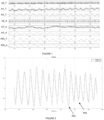
- Thoracic PRI (PRI_T) and abdominal PRI (PRI_A) illustrated in Figure 1 are variations in section surface and serve as a reference.
- the sum of the thoracic PRI (PRI_T) and the abdominal PRI (PRI_A) is a PRI signal which gives an image of the tidal ventilated volume.
- FIG. 2 illustrates the normalized overlap between -1 and +1 values for an experimental PHI signal and a reference PRI signal.
- the reference PRI signal is the sum of the raw PRI_T and PRI_A data from the Figure 1 .
- the PHI signal is calculated, in this case using the angular method, from the raw data AX_T, AY_T and AZ_T from the first accelerometer and the raw data AX_A, AY_A and AZ_A from the second accelerometer.
- the first accelerometer and the second accelerometer operate as a sensor network. Their respective measurements are synchronized and correspond to the acceleration of the thoracic compartment and the abdominal compartment, respectively.
- the Figure 5 synchronously illustrates an sPHI signal, which is the sum of the PHI signals in this case of the Figure 1 , and an sPRI signal, which is the sum of the PRI signals in this case of the Figure 1 .
- the present invention makes it possible to reconstruct a “volume image” of the respiratory compartments and to monitor respiratory events of interest. It presents algorithmic and physiological robustness.
- the first variant (ACP) and the second variant (angular) can be combined.
- the first variant ACP
- the second variant angular
- a linear combination of the first final vector and the second final vector is calculated.
- unit coefficients are provided in the linear combination.
- instabilities, or abnormal events for example non-stationary, which may for example correspond to a change in the position of the individual and/or bodily movement, which may be the case even at night.
- each signal from the first accelerometer and the second accelerometer includes stability time windows and possibly a set of at least one instability time window.
- the calculations described above are planned to be implemented within a stability window.
- the PHI_T signal has a periodicity defect, this defect being circled in dotted lines on the figures 6 And 7 (also observable on the FLOW reference).
- a return to normal, i.e. a PHI_T signal becoming periodic again, is also detected using the method according to the invention, as illustrated by the falling edge of the INDEX_T signal on the Figure 6 .
Landscapes
- Health & Medical Sciences (AREA)
- Engineering & Computer Science (AREA)
- Life Sciences & Earth Sciences (AREA)
- Biomedical Technology (AREA)
- Public Health (AREA)
- Medical Informatics (AREA)
- General Health & Medical Sciences (AREA)
- Pathology (AREA)
- Physics & Mathematics (AREA)
- Biophysics (AREA)
- Heart & Thoracic Surgery (AREA)
- Veterinary Medicine (AREA)
- Animal Behavior & Ethology (AREA)
- Surgery (AREA)
- Molecular Biology (AREA)
- Physiology (AREA)
- Primary Health Care (AREA)
- Epidemiology (AREA)
- Artificial Intelligence (AREA)
- Signal Processing (AREA)
- Psychiatry (AREA)
- Computer Vision & Pattern Recognition (AREA)
- Dentistry (AREA)
- Oral & Maxillofacial Surgery (AREA)
- General Business, Economics & Management (AREA)
- Business, Economics & Management (AREA)
- Data Mining & Analysis (AREA)
- Databases & Information Systems (AREA)
- General Physics & Mathematics (AREA)
- Measurement Of The Respiration, Hearing Ability, Form, And Blood Characteristics Of Living Organisms (AREA)
- Recording Measured Values (AREA)
Claims (11)
- Signalverarbeitungsverfahren, umfassend die folgenden Schritte:- vorheriges Aufzeichnen eines ersten Anfangssignals, das aus einem ersten Satz von mindestens einem dreidimensionalen Beschleunigungsmesser (110) stammt, der in der Thoraxposition einer Person positioniert ist, in einem Speicher,- vorheriges Aufzeichnen eines zweiten Anfangssignals, das aus einem zweiten Satz von mindestens einem dreidimensionalen Beschleunigungsmesser (120) stammt, der in der Abdomenposition der Person positioniert ist, in einem Speicher, wobei das zweite Signal mit dem ersten Signal synchronisiert ist,- Verarbeiten der Daten des ersten Anfangssignals, um einen ersten Endvektor zu berechnen, der eine Rekonstruktion der Atembewegung des Thoraxraums ist und repräsentativ für die Thoraxbewegungen ist, die von dem ersten Satz von mindestens einem dreidimensionalen Beschleunigungsmesser erfahren werden,- Verarbeiten der Daten des zweiten Anfangssignals, um einen zweiten Endvektor zu berechnen, der eine Rekonstruktion der Atembewegung des Abdominalraums ist und repräsentativ für die Abdomenbewegungen ist, die von dem zweiten Satz von mindestens einem dreidimensionalen Beschleunigungsmesser erfahren werden,dadurch gekennzeichnet, dass es ferner umfasst:- Rekonstruieren der Atembewegungen in Abhängigkeit des ersten Endvektors und des zweiten Endvektors durch:o eine Winkelberechnung, die die Messung der Winkelbewegung der Rotationsachse (r) jedes Beschleunigungsmessers umfasst, und die Berechnung▪ des ersten Endvektors, der die Werte (Φt ) des Rotationswinkels des ersten Satzes von mindestens einem Beschleunigungsmesser (110) in einem Zeitfenster umfasst,▪ des zweiten Endvektors, der die Werte (Φt ) des Drehwinkels des zweiten Satzes von mindestens einem Beschleunigungsmesser (120) in einem Zeitfenster umfasst.
- Verfahren nach Anspruch 1, bei dem die Rekonstruktion der Atembewegungen in Abhängigkeit von dem ersten Endvektor und von dem zweiten Endvektor außerdem eine Berechnung zur Analyse der Hauptkomponenten umfasst, umfassend:- einen ersten Endvektor, der eine Rekonstruktion der Atembewegung des Thoraxraums ist, die sich aus einer Analyse der Hauptkomponenten einer ersten Ausgangsmatrix ergibt, die den Daten entspricht, die aus dem ersten Beschleunigungsmesser stammen, und- einen zweiten Endvektor, der eine Rekonstruktion der Atembewegung des Abdominalraums ist, und die sich aus einer Analyse der Hauptkomponenten einer zweiten Ausgangsmatrix ergibt, die den Daten entspricht, die aus dem zweiten Beschleunigungsmesser stammen.
- Verfahren nach einem der vorhergehenden Ansprüche, umfassend einen Schritt, der darin besteht, die Art der Beatmung der Person zu beurteilen,o entweder durch Berechnung einer linearen Kombination des ersten Endvektors und des zweiten Endvektors,∘ oder durch Berechnung mindestens eines der Deskriptoren aus:∘ einer normierten Kreuzkorrelation auf mindestens einem der Endvektoren, um die Periodizität der Atembewegung zu charakterisieren, indem die Periodizität mindestens eines der Signale entweder des ersten Signals, das aus dem ersten Beschleunigungsmesser stammt, oder des zweiten Signals, das aus dem zweiten Beschleunigungsmesser stammt, charakterisiert wird; und∘ der Differenz zwischen dem ersten Endvektor und dem zweiten Endvektor, um mindestens eines von Folgendem zu berechnen:• die Phasenverschiebung und die mögliche Kopplung zwischen dem ersten Signal, das aus dem ersten Beschleunigungsmesser stammt, und dem zweiten Signal, das aus dem zweiten Beschleunigungsmesser stammt, durch Kreuzkorrelation oder gegenseitige Kreuzinformation,• einen Index der thorakoabdominalen Desynchronisation,o und um somit die Kohärenz des Thorax- und des Abdominalraums zu beurteilen,o durch eine Quantifizierung des Beitrags jedes Raums zu der Gesamtbeatmung.
- Verfahren nach einem der vorhergehenden Ansprüche, bei dem der Schritt der Verarbeitung der Daten des ersten Anfangssignals oder des zweiten Anfangssignals einen Schritt der Erfassung eines Fensters zeitlicher Instabilität des ersten Anfangssignals oder des zweiten Anfangssignals umfasst und das Verfahren im Falle der Erfassung eines Fensters zeitlicher Instabilität dann außerdem einen Schritt der vorübergehenden Hemmung der Berechnung des ersten Endvektors oder des zweiten Endvektors umfasst, vorzugsweise bis ein Fenster zeitlicher Stabilität wiedererlangt wird.
- Verfahren nach einem der vorhergehenden Ansprüche, bei dem die Daten des ersten Anfangssignals oder des zweiten Signals in Form einer ersten Matrix oder einer zweiten Matrix aufgezeichnet werden;Und bei dem mindestens einer der folgenden Schritte:- Verarbeiten der Daten des ersten Anfangssignals und- Verarbeiten der Daten des zweiten Anfangssignals,einen Schritt der Analyse der Hauptkomponenten der ersten Matrix oder der zweiten Matrix umfasst, um den ersten Endvektor oder den zweiten Endvektor zu erhalten;wobei das Verfahren optional außerdem einen Schritt des Filterns des ersten Endvektors umfasst.
- Verfahren nach einem der vorhergehenden Ansprüche, das außerdem einen Schritt umfasst, der darin besteht, bei jeder Messzeit den Drehwinkel in Bezug auf die Schwerkraft des ersten Satzes von mindestens einem dreidimensionalen Beschleunigungsmesser oder des zweiten Satzes von mindestens einem dreidimensionalen Beschleunigungsmesser zu berechnen, um den ersten Endvektor oder den zweiten Endvektor zu erhalten.
- Verfahren nach einem der vorhergehenden Ansprüche, umfassend einen Bandpassfilterungsschritt von mindestens einem des ersten Signals und des zweiten Signals, vorzugsweise mit einer unteren Grenzfrequenz von 0,05 Hz und einer oberen Grenzfrequenz von 0,8 Hz; und optional mit einem Filter mit realer Impulsantwort.
- Verfahren nach einem der vorhergehenden Ansprüche, bei dem der Winkelmethodenschritt darin besteht:- den Rotationswinkel jedes Beschleunigungsmessers in Bezug auf die Schwerkraft bei jedem Messzeitpunkt zu berechnen; und für jeden Beschleunigungsmesser:- den Beschleunigungsvektor (a) zu messen und zu normieren,- die Winkelbewegung der Rotationsachse (r) des Beschleunigungsmessers zu messen,- den Rotationswinkel (θt) und die Rotationsachse (rt) des Beschleunigungsvektors (a) zwischen zwei aufeinanderfolgenden Messungen zu der Zeit t-1 und zu der Zeit t durch das Skalarprodukt und das

 - die Richtung der Rotationsachse (r) in einer vorbestimmten Hemisphäre durch Vergleich mit einer Referenzachse (rref) zu normieren und den Wert zu berechnen von:
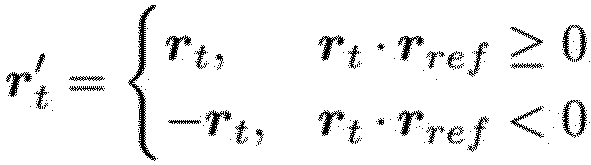 - Berechnen von
r t, der normierten, über ein Zeitfenster der Dauer (W) gemittelten Rotationsachse (r), wie folgt: wobei H(n) ein vorbestimmtes Fenster ist;und in ähnlicher Weise,- Bestimmen von
a t , der gemittelten normierten Beschleunigung in dem gleichen Zeitfenster der Dauer (W), wie folgt - Berechnen von Φt , dem Rotationswinkel des Beschleunigungsmessers, wie
 - falls erforderlich, Berechnen der Winkelgeschwindigkeit ωt, wie folgt- Aufzeichnen der Werte von Φt in Form eines Endvektors.
 - Verfahren nach Anspruch 8, umfassend die Schritte, die aus Folgendem bestehen:- Berechnen eines Index (INDEX_T), der ein Binärsignal ist, bei dem der Wert 1 einem periodischen Signal (PHI_T) und der Wert 2 einem nicht periodischen Signal (PHI_T) entspricht, das durch Vergleich des Werts des Signals (CROSS) mit einem vorbestimmten Schwellenwert erhalten wird und das die Beurteilung der Periodizität der rekonstruierten Thoraxbeatmungsbewegung (PHI_T) ist,wobei:- das Signal (PHI_T) das nach der Winkelmethode aus den Rohdaten des ersten Beschleunigungsmessers berechnete Signal (PHI) ist,- das Signal (PHI) nach der Winkelmethode aus den Rohdaten, die aus dem ersten Beschleunigungsmesser stammen, und den Rohdaten, die aus dem zweiten Beschleunigungsmesser stammen, berechnet wird;- das Signal (CROSS) die normierte Kreuzkorrelation des Signals (PHI_T) ist.
- Verfahren nach einem der Ansprüche 8 bis 9, umfassend einen Schritt, der darin besteht, mindestens einen der Deskriptoren zu berechnen aus:- der etwaigen Phasenverschiebung zwischen dem Signal, das aus dem ersten Satz von mindestens einem Beschleunigungsmesser stammt, und dem Signal, das aus dem zweiten Satz von mindestens einem Beschleunigungsmesser stammt,- der Kopplung zwischen dem Signal, das aus dem ersten Satz von mindestens einem Beschleunigungsmesser stammt, und dem Signal, das aus dem zweiten Satz von mindestens einem Beschleunigungsmesser stammt, durch Kreuzkorrelation oder gegenseitige Kreuzinformation, und- einem Index der thorakoabdominalen Desynchronisation.
- Verfahren nach einem der vorhergehenden Ansprüche, das außerdem einen Schritt zur Erfassung einer Positionsänderung der Person umfasst.
Applications Claiming Priority (2)
| Application Number | Priority Date | Filing Date | Title |
|---|---|---|---|
| FR1853796A FR3080929B1 (fr) | 2018-05-02 | 2018-05-02 | Procede de traitement d'un signal accelerometrique. |
| PCT/FR2019/051010 WO2019211561A1 (fr) | 2018-05-02 | 2019-04-30 | Procédé de traitement d'un signal accélérométrique |
Publications (2)
| Publication Number | Publication Date |
|---|---|
| EP3788637A1 EP3788637A1 (de) | 2021-03-10 |
| EP3788637B1 true EP3788637B1 (de) | 2025-06-04 |
Family
ID=63490558
Family Applications (1)
| Application Number | Title | Priority Date | Filing Date |
|---|---|---|---|
| EP19729339.2A Active EP3788637B1 (de) | 2018-05-02 | 2019-04-30 | Verfahren zur verarbeitung eines beschleunigungssignals |
Country Status (4)
| Country | Link |
|---|---|
| US (1) | US20210169378A1 (de) |
| EP (1) | EP3788637B1 (de) |
| FR (1) | FR3080929B1 (de) |
| WO (1) | WO2019211561A1 (de) |
Families Citing this family (5)
| Publication number | Priority date | Publication date | Assignee | Title |
|---|---|---|---|---|
| US11324950B2 (en) | 2016-04-19 | 2022-05-10 | Inspire Medical Systems, Inc. | Accelerometer-based sensing for sleep disordered breathing (SDB) care |
| AU2020315918B2 (en) | 2019-07-25 | 2025-09-18 | Inspire Medical Systems, Inc. | Systems and methods for operating an implantable medical device based upon sensed posture information |
| EP4003163A1 (de) * | 2019-07-25 | 2022-06-01 | Inspire Medical Systems, Inc. | Atmungserkennung |
| IL293622B1 (en) * | 2019-12-05 | 2026-05-01 | Disati Medical Inc | Systems and methods for determining the degree of respiratory effort exerted by a patient during breathing |
| WO2021257366A1 (en) | 2020-06-19 | 2021-12-23 | Inspire Medical Systems, Inc. | Sense amplifer for a physiological sensor and/or other sensors |
Citations (2)
| Publication number | Priority date | Publication date | Assignee | Title |
|---|---|---|---|---|
| WO2018033889A1 (en) * | 2016-08-19 | 2018-02-22 | Nox Medical | Method, apparatus, and system for measuring respiratory effort of a subject |
| WO2018178569A1 (fr) * | 2017-03-30 | 2018-10-04 | Fivefive | Systeme de determination d'un ensemble d'au moins un descripteur cardio-respiratoire d'un individu pendant son sommeil |
Family Cites Families (7)
| Publication number | Priority date | Publication date | Assignee | Title |
|---|---|---|---|---|
| EP2263532A1 (de) * | 2009-06-05 | 2010-12-22 | Koninklijke Philips Electronics N.V. | Bewegungsbestimmungsvorrichtung |
| US12121364B2 (en) * | 2009-09-14 | 2024-10-22 | Sotera Wireless, Inc. | Body-worn monitor for measuring respiration rate |
| US8740807B2 (en) * | 2009-09-14 | 2014-06-03 | Sotera Wireless, Inc. | Body-worn monitor for measuring respiration rate |
| US11253169B2 (en) * | 2009-09-14 | 2022-02-22 | Sotera Wireless, Inc. | Body-worn monitor for measuring respiration rate |
| CN102753095B (zh) * | 2010-02-11 | 2016-02-03 | 皇家飞利浦电子股份有限公司 | 用于确定呼吸信号的方法和设备 |
| US9833171B2 (en) * | 2010-08-04 | 2017-12-05 | Koninklijke Philips N.V. | Monitoring of vital body signals during movement |
| EP2974648A1 (de) * | 2013-12-18 | 2016-01-20 | Analog Devices Global | System und Verfahren zur Messung der Atmung mit Beschleunigungsmessern |
-
2018
- 2018-05-02 FR FR1853796A patent/FR3080929B1/fr active Active
-
2019
- 2019-04-30 US US17/052,480 patent/US20210169378A1/en not_active Abandoned
- 2019-04-30 WO PCT/FR2019/051010 patent/WO2019211561A1/fr not_active Ceased
- 2019-04-30 EP EP19729339.2A patent/EP3788637B1/de active Active
Patent Citations (2)
| Publication number | Priority date | Publication date | Assignee | Title |
|---|---|---|---|---|
| WO2018033889A1 (en) * | 2016-08-19 | 2018-02-22 | Nox Medical | Method, apparatus, and system for measuring respiratory effort of a subject |
| WO2018178569A1 (fr) * | 2017-03-30 | 2018-10-04 | Fivefive | Systeme de determination d'un ensemble d'au moins un descripteur cardio-respiratoire d'un individu pendant son sommeil |
Also Published As
| Publication number | Publication date |
|---|---|
| WO2019211561A1 (fr) | 2019-11-07 |
| US20210169378A1 (en) | 2021-06-10 |
| FR3080929B1 (fr) | 2021-04-30 |
| EP3788637A1 (de) | 2021-03-10 |
| FR3080929A1 (fr) | 2019-11-08 |
Similar Documents
| Publication | Publication Date | Title |
|---|---|---|
| EP3788637A1 (de) | Verfahren zur verarbeitung eines beschleunigungsmetrischen signals | |
| US10052048B2 (en) | Respiratory monitors and monitoring methods | |
| CN109937002B (zh) | 用于基于相机的心率跟踪的系统和方法 | |
| Oung et al. | Technologies for assessment of motor disorders in Parkinson’s disease: a review | |
| EP2124736B1 (de) | Elektrophysiologisches analysensystem | |
| EP3600010B1 (de) | System zur bestimmung eines satzes aus mindestens einem kardiorespiratorischen deskriptor einer person während des schlafens | |
| WO2010122174A1 (fr) | Systeme et procede de determination de la posture d'une personne | |
| EP3568074B1 (de) | Lokogramm-software werkzeug zur analyse von gehübungen | |
| JP2012000228A (ja) | 筋活動診断装置および方法、並びにプログラム | |
| Perez-Macias et al. | Comparative assessment of sleep quality estimates using home monitoring technology | |
| EP3408612B1 (de) | Verfahren zur kalkulation der physischen aktivität einer oberen gliedmasse | |
| WO2010122172A1 (fr) | Systeme et procede de determination de l'activite d'un element mobile | |
| Hausamann et al. | Ecological momentary assessment of head motion: toward normative data of head stabilization | |
| EP3107444A1 (de) | Verfahren und system zur überwachung des autonomen nervensystems einer person | |
| CN111714101B (zh) | 信号处理方法及装置 | |
| Guenterberg et al. | An automatic segmentation technique in body sensor networks based on signal energy | |
| WO2023112384A1 (ja) | 計算機システム及び情動推定方法 | |
| EP0681447B1 (de) | Vorrichtung zur bestimmung von physiologischen daten sowie verwendung der vorrichtung | |
| WO2013106700A1 (en) | Systems and methods for determining mental and physical health using multi-scale metrics | |
| EP2467061B1 (de) | System und verfahren zur erkennung eines epileptischen anfalls bei einer zu epilepsie neigenden person | |
| EP3552545A1 (de) | Verfahren und vorrichtung zur korrektur eines magnetfelds in echtzeit | |
| CA2758227A1 (fr) | Systeme et procede de traitement de signaux pour la detection d'une activite fonctionnelle cyclique en temps reel | |
| Zhan et al. | Earbuds Orientation Alignment Based on Markov Chain Monte Carlo Sampling | |
| Zhang | Smart Health Technologies Towards Parkinson’s Disease Management | |
| FR3142246A1 (fr) | Procédé d’estimation de l’évolution d’une vitesse d’un point de mesure |
Legal Events
| Date | Code | Title | Description |
|---|---|---|---|
| STAA | Information on the status of an ep patent application or granted ep patent |
Free format text: STATUS: UNKNOWN |
|
| STAA | Information on the status of an ep patent application or granted ep patent |
Free format text: STATUS: THE INTERNATIONAL PUBLICATION HAS BEEN MADE |
|
| PUAI | Public reference made under article 153(3) epc to a published international application that has entered the european phase |
Free format text: ORIGINAL CODE: 0009012 |
|
| STAA | Information on the status of an ep patent application or granted ep patent |
Free format text: STATUS: REQUEST FOR EXAMINATION WAS MADE |
|
| 17P | Request for examination filed |
Effective date: 20201030 |
|
| AK | Designated contracting states |
Kind code of ref document: A1 Designated state(s): AL AT BE BG CH CY CZ DE DK EE ES FI FR GB GR HR HU IE IS IT LI LT LU LV MC MK MT NL NO PL PT RO RS SE SI SK SM TR |
|
| AX | Request for extension of the european patent |
Extension state: BA ME |
|
| DAV | Request for validation of the european patent (deleted) | ||
| DAX | Request for extension of the european patent (deleted) | ||
| STAA | Information on the status of an ep patent application or granted ep patent |
Free format text: STATUS: EXAMINATION IS IN PROGRESS |
|
| 17Q | First examination report despatched |
Effective date: 20230613 |
|
| GRAP | Despatch of communication of intention to grant a patent |
Free format text: ORIGINAL CODE: EPIDOSNIGR1 |
|
| STAA | Information on the status of an ep patent application or granted ep patent |
Free format text: STATUS: GRANT OF PATENT IS INTENDED |
|
| INTG | Intention to grant announced |
Effective date: 20241206 |
|
| GRAS | Grant fee paid |
Free format text: ORIGINAL CODE: EPIDOSNIGR3 |
|
| GRAA | (expected) grant |
Free format text: ORIGINAL CODE: 0009210 |
|
| STAA | Information on the status of an ep patent application or granted ep patent |
Free format text: STATUS: THE PATENT HAS BEEN GRANTED |
|
| AK | Designated contracting states |
Kind code of ref document: B1 Designated state(s): AL AT BE BG CH CY CZ DE DK EE ES FI FR GB GR HR HU IE IS IT LI LT LU LV MC MK MT NL NO PL PT RO RS SE SI SK SM TR |
|
| REG | Reference to a national code |
Ref country code: GB Ref legal event code: FG4D Free format text: NOT ENGLISH |
|
| REG | Reference to a national code |
Ref country code: CH Ref legal event code: EP |
|
| REG | Reference to a national code |
Ref country code: DE Ref legal event code: R096 Ref document number: 602019070742 Country of ref document: DE |
|
| REG | Reference to a national code |
Ref country code: IE Ref legal event code: FG4D Free format text: LANGUAGE OF EP DOCUMENT: FRENCH |
|
| REG | Reference to a national code |
Ref country code: NL Ref legal event code: MP Effective date: 20250604 |
|
| PG25 | Lapsed in a contracting state [announced via postgrant information from national office to epo] |
Ref country code: FI Free format text: LAPSE BECAUSE OF FAILURE TO SUBMIT A TRANSLATION OF THE DESCRIPTION OR TO PAY THE FEE WITHIN THE PRESCRIBED TIME-LIMIT Effective date: 20250604 Ref country code: ES Free format text: LAPSE BECAUSE OF FAILURE TO SUBMIT A TRANSLATION OF THE DESCRIPTION OR TO PAY THE FEE WITHIN THE PRESCRIBED TIME-LIMIT Effective date: 20250604 |
|
| REG | Reference to a national code |
Ref country code: LT Ref legal event code: MG9D |
|
| PG25 | Lapsed in a contracting state [announced via postgrant information from national office to epo] |
Ref country code: GR Free format text: LAPSE BECAUSE OF FAILURE TO SUBMIT A TRANSLATION OF THE DESCRIPTION OR TO PAY THE FEE WITHIN THE PRESCRIBED TIME-LIMIT Effective date: 20250905 Ref country code: NO Free format text: LAPSE BECAUSE OF FAILURE TO SUBMIT A TRANSLATION OF THE DESCRIPTION OR TO PAY THE FEE WITHIN THE PRESCRIBED TIME-LIMIT Effective date: 20250904 |
|
| PG25 | Lapsed in a contracting state [announced via postgrant information from national office to epo] |
Ref country code: PL Free format text: LAPSE BECAUSE OF FAILURE TO SUBMIT A TRANSLATION OF THE DESCRIPTION OR TO PAY THE FEE WITHIN THE PRESCRIBED TIME-LIMIT Effective date: 20250604 |
|
| PG25 | Lapsed in a contracting state [announced via postgrant information from national office to epo] |
Ref country code: BG Free format text: LAPSE BECAUSE OF FAILURE TO SUBMIT A TRANSLATION OF THE DESCRIPTION OR TO PAY THE FEE WITHIN THE PRESCRIBED TIME-LIMIT Effective date: 20250604 |
|
| PG25 | Lapsed in a contracting state [announced via postgrant information from national office to epo] |
Ref country code: HR Free format text: LAPSE BECAUSE OF FAILURE TO SUBMIT A TRANSLATION OF THE DESCRIPTION OR TO PAY THE FEE WITHIN THE PRESCRIBED TIME-LIMIT Effective date: 20250604 |
|
| PG25 | Lapsed in a contracting state [announced via postgrant information from national office to epo] |
Ref country code: RS Free format text: LAPSE BECAUSE OF FAILURE TO SUBMIT A TRANSLATION OF THE DESCRIPTION OR TO PAY THE FEE WITHIN THE PRESCRIBED TIME-LIMIT Effective date: 20250904 |
|
| PG25 | Lapsed in a contracting state [announced via postgrant information from national office to epo] |
Ref country code: LV Free format text: LAPSE BECAUSE OF FAILURE TO SUBMIT A TRANSLATION OF THE DESCRIPTION OR TO PAY THE FEE WITHIN THE PRESCRIBED TIME-LIMIT Effective date: 20250604 |
|
| PG25 | Lapsed in a contracting state [announced via postgrant information from national office to epo] |
Ref country code: NL Free format text: LAPSE BECAUSE OF FAILURE TO SUBMIT A TRANSLATION OF THE DESCRIPTION OR TO PAY THE FEE WITHIN THE PRESCRIBED TIME-LIMIT Effective date: 20250604 |
|
| PG25 | Lapsed in a contracting state [announced via postgrant information from national office to epo] |
Ref country code: PT Free format text: LAPSE BECAUSE OF FAILURE TO SUBMIT A TRANSLATION OF THE DESCRIPTION OR TO PAY THE FEE WITHIN THE PRESCRIBED TIME-LIMIT Effective date: 20251006 |
|
| REG | Reference to a national code |
Ref country code: AT Ref legal event code: MK05 Ref document number: 1801201 Country of ref document: AT Kind code of ref document: T Effective date: 20250604 |
|
| PG25 | Lapsed in a contracting state [announced via postgrant information from national office to epo] |
Ref country code: IS Free format text: LAPSE BECAUSE OF FAILURE TO SUBMIT A TRANSLATION OF THE DESCRIPTION OR TO PAY THE FEE WITHIN THE PRESCRIBED TIME-LIMIT Effective date: 20251004 |
|
| PG25 | Lapsed in a contracting state [announced via postgrant information from national office to epo] |
Ref country code: AT Free format text: LAPSE BECAUSE OF FAILURE TO SUBMIT A TRANSLATION OF THE DESCRIPTION OR TO PAY THE FEE WITHIN THE PRESCRIBED TIME-LIMIT Effective date: 20250604 Ref country code: SM Free format text: LAPSE BECAUSE OF FAILURE TO SUBMIT A TRANSLATION OF THE DESCRIPTION OR TO PAY THE FEE WITHIN THE PRESCRIBED TIME-LIMIT Effective date: 20250604 |
|
| PG25 | Lapsed in a contracting state [announced via postgrant information from national office to epo] |
Ref country code: CZ Free format text: LAPSE BECAUSE OF FAILURE TO SUBMIT A TRANSLATION OF THE DESCRIPTION OR TO PAY THE FEE WITHIN THE PRESCRIBED TIME-LIMIT Effective date: 20250604 |
|
| PG25 | Lapsed in a contracting state [announced via postgrant information from national office to epo] |
Ref country code: EE Free format text: LAPSE BECAUSE OF FAILURE TO SUBMIT A TRANSLATION OF THE DESCRIPTION OR TO PAY THE FEE WITHIN THE PRESCRIBED TIME-LIMIT Effective date: 20250604 |
|
| PG25 | Lapsed in a contracting state [announced via postgrant information from national office to epo] |
Ref country code: RO Free format text: LAPSE BECAUSE OF FAILURE TO SUBMIT A TRANSLATION OF THE DESCRIPTION OR TO PAY THE FEE WITHIN THE PRESCRIBED TIME-LIMIT Effective date: 20250604 Ref country code: SK Free format text: LAPSE BECAUSE OF FAILURE TO SUBMIT A TRANSLATION OF THE DESCRIPTION OR TO PAY THE FEE WITHIN THE PRESCRIBED TIME-LIMIT Effective date: 20250604 |
|
| PG25 | Lapsed in a contracting state [announced via postgrant information from national office to epo] |
Ref country code: IT Free format text: LAPSE BECAUSE OF FAILURE TO SUBMIT A TRANSLATION OF THE DESCRIPTION OR TO PAY THE FEE WITHIN THE PRESCRIBED TIME-LIMIT Effective date: 20250604 |
|
| REG | Reference to a national code |
Ref country code: DE Ref legal event code: R097 Ref document number: 602019070742 Country of ref document: DE |
|
| PGFP | Annual fee paid to national office [announced via postgrant information from national office to epo] |
Ref country code: GB Payment date: 20260331 Year of fee payment: 8 |
|
| PLBE | No opposition filed within time limit |
Free format text: ORIGINAL CODE: 0009261 |
|
| STAA | Information on the status of an ep patent application or granted ep patent |
Free format text: STATUS: NO OPPOSITION FILED WITHIN TIME LIMIT |
|
| PG25 | Lapsed in a contracting state [announced via postgrant information from national office to epo] |
Ref country code: DK Free format text: LAPSE BECAUSE OF FAILURE TO SUBMIT A TRANSLATION OF THE DESCRIPTION OR TO PAY THE FEE WITHIN THE PRESCRIBED TIME-LIMIT Effective date: 20250604 |
|
| REG | Reference to a national code |
Ref country code: CH Ref legal event code: L10 Free format text: ST27 STATUS EVENT CODE: U-0-0-L10-L00 (AS PROVIDED BY THE NATIONAL OFFICE) Effective date: 20260416 |
|
| 26N | No opposition filed |
Effective date: 20260305 |