EP3792138A1 - Procédé et dispositif de fourniture d'informations d'entretien sur un système de porte pour un véhicule et système de porte pour un véhicule - Google Patents
Procédé et dispositif de fourniture d'informations d'entretien sur un système de porte pour un véhicule et système de porte pour un véhicule Download PDFInfo
- Publication number
- EP3792138A1 EP3792138A1 EP19197156.3A EP19197156A EP3792138A1 EP 3792138 A1 EP3792138 A1 EP 3792138A1 EP 19197156 A EP19197156 A EP 19197156A EP 3792138 A1 EP3792138 A1 EP 3792138A1
- Authority
- EP
- European Patent Office
- Prior art keywords
- door
- movement
- vehicle
- door system
- characteristic curve
- Prior art date
- Legal status (The legal status is an assumption and is not a legal conclusion. Google has not performed a legal analysis and makes no representation as to the accuracy of the status listed.)
- Withdrawn
Links
Images

Classifications
-
- G—PHYSICS
- G07—CHECKING-DEVICES
- G07C—TIME OR ATTENDANCE REGISTERS; REGISTERING OR INDICATING THE WORKING OF MACHINES; GENERATING RANDOM NUMBERS; VOTING OR LOTTERY APPARATUS; ARRANGEMENTS, SYSTEMS OR APPARATUS FOR CHECKING NOT PROVIDED FOR ELSEWHERE
- G07C5/00—Registering or indicating the working of vehicles
- G07C5/006—Indicating maintenance
-
- B—PERFORMING OPERATIONS; TRANSPORTING
- B61—RAILWAYS
- B61L—GUIDING RAILWAY TRAFFIC; ENSURING THE SAFETY OF RAILWAY TRAFFIC
- B61L15/00—Indicators provided on the vehicle or train for signalling purposes
- B61L15/0081—On-board diagnosis or maintenance
-
- B—PERFORMING OPERATIONS; TRANSPORTING
- B61—RAILWAYS
- B61D—BODY DETAILS OR KINDS OF RAILWAY VEHICLES
- B61D19/00—Door arrangements specially adapted for rail vehicles
- B61D19/02—Door arrangements specially adapted for rail vehicles for carriages
-
- B—PERFORMING OPERATIONS; TRANSPORTING
- B61—RAILWAYS
- B61L—GUIDING RAILWAY TRAFFIC; ENSURING THE SAFETY OF RAILWAY TRAFFIC
- B61L27/00—Central railway traffic control systems; Trackside control; Communication systems specially adapted therefor
- B61L27/50—Trackside diagnosis or maintenance, e.g. software upgrades
- B61L27/57—Trackside diagnosis or maintenance, e.g. software upgrades for vehicles or trains, e.g. trackside supervision of train conditions
-
- E—FIXED CONSTRUCTIONS
- E05—LOCKS; KEYS; WINDOW OR DOOR FITTINGS; SAFES
- E05F—DEVICES FOR MOVING WINGS INTO OPEN OR CLOSED POSITION; CHECKS FOR WINGS; WING FITTINGS NOT OTHERWISE PROVIDED FOR, CONCERNED WITH THE FUNCTIONING OF THE WING
- E05F15/00—Power-operated mechanisms for wings
- E05F15/60—Power-operated mechanisms for wings using electrical actuators
-
- G—PHYSICS
- G06—COMPUTING OR CALCULATING; COUNTING
- G06Q—INFORMATION AND COMMUNICATION TECHNOLOGY [ICT] SPECIALLY ADAPTED FOR ADMINISTRATIVE, COMMERCIAL, FINANCIAL, MANAGERIAL OR SUPERVISORY PURPOSES; SYSTEMS OR METHODS SPECIALLY ADAPTED FOR ADMINISTRATIVE, COMMERCIAL, FINANCIAL, MANAGERIAL OR SUPERVISORY PURPOSES, NOT OTHERWISE PROVIDED FOR
- G06Q10/00—Administration; Management
- G06Q10/20—Administration of product repair or maintenance
-
- G—PHYSICS
- G07—CHECKING-DEVICES
- G07C—TIME OR ATTENDANCE REGISTERS; REGISTERING OR INDICATING THE WORKING OF MACHINES; GENERATING RANDOM NUMBERS; VOTING OR LOTTERY APPARATUS; ARRANGEMENTS, SYSTEMS OR APPARATUS FOR CHECKING NOT PROVIDED FOR ELSEWHERE
- G07C5/00—Registering or indicating the working of vehicles
- G07C5/08—Registering or indicating performance data other than driving, working, idle, or waiting time, with or without registering driving, working, idle or waiting time
- G07C5/0841—Registering performance data
- G07C5/0875—Registering performance data using magnetic data carriers
-
- E—FIXED CONSTRUCTIONS
- E05—LOCKS; KEYS; WINDOW OR DOOR FITTINGS; SAFES
- E05Y—INDEXING SCHEME ASSOCIATED WITH SUBCLASSES E05D AND E05F, RELATING TO CONSTRUCTION ELEMENTS, ELECTRIC CONTROL, POWER SUPPLY, POWER SIGNAL OR TRANSMISSION, USER INTERFACES, MOUNTING OR COUPLING, DETAILS, ACCESSORIES, AUXILIARY OPERATIONS NOT OTHERWISE PROVIDED FOR, APPLICATION THEREOF
- E05Y2201/00—Constructional elements; Accessories therefor
- E05Y2201/40—Motors; Magnets; Springs; Weights; Accessories therefor
- E05Y2201/43—Motors
- E05Y2201/434—Electromotors; Details thereof
-
- E—FIXED CONSTRUCTIONS
- E05—LOCKS; KEYS; WINDOW OR DOOR FITTINGS; SAFES
- E05Y—INDEXING SCHEME ASSOCIATED WITH SUBCLASSES E05D AND E05F, RELATING TO CONSTRUCTION ELEMENTS, ELECTRIC CONTROL, POWER SUPPLY, POWER SIGNAL OR TRANSMISSION, USER INTERFACES, MOUNTING OR COUPLING, DETAILS, ACCESSORIES, AUXILIARY OPERATIONS NOT OTHERWISE PROVIDED FOR, APPLICATION THEREOF
- E05Y2400/00—Electronic control; Electrical power; Power supply; Power or signal transmission; User interfaces
- E05Y2400/10—Electronic control
- E05Y2400/44—Sensors not directly associated with the wing movement
-
- E—FIXED CONSTRUCTIONS
- E05—LOCKS; KEYS; WINDOW OR DOOR FITTINGS; SAFES
- E05Y—INDEXING SCHEME ASSOCIATED WITH SUBCLASSES E05D AND E05F, RELATING TO CONSTRUCTION ELEMENTS, ELECTRIC CONTROL, POWER SUPPLY, POWER SIGNAL OR TRANSMISSION, USER INTERFACES, MOUNTING OR COUPLING, DETAILS, ACCESSORIES, AUXILIARY OPERATIONS NOT OTHERWISE PROVIDED FOR, APPLICATION THEREOF
- E05Y2400/00—Electronic control; Electrical power; Power supply; Power or signal transmission; User interfaces
- E05Y2400/10—Electronic control
- E05Y2400/50—Fault detection
- E05Y2400/502—Fault detection of components
-
- E—FIXED CONSTRUCTIONS
- E05—LOCKS; KEYS; WINDOW OR DOOR FITTINGS; SAFES
- E05Y—INDEXING SCHEME ASSOCIATED WITH SUBCLASSES E05D AND E05F, RELATING TO CONSTRUCTION ELEMENTS, ELECTRIC CONTROL, POWER SUPPLY, POWER SIGNAL OR TRANSMISSION, USER INTERFACES, MOUNTING OR COUPLING, DETAILS, ACCESSORIES, AUXILIARY OPERATIONS NOT OTHERWISE PROVIDED FOR, APPLICATION THEREOF
- E05Y2800/00—Details, accessories and auxiliary operations not otherwise provided for
- E05Y2800/40—Physical or chemical protection
- E05Y2800/404—Physical or chemical protection against component faults or failure
-
- E—FIXED CONSTRUCTIONS
- E05—LOCKS; KEYS; WINDOW OR DOOR FITTINGS; SAFES
- E05Y—INDEXING SCHEME ASSOCIATED WITH SUBCLASSES E05D AND E05F, RELATING TO CONSTRUCTION ELEMENTS, ELECTRIC CONTROL, POWER SUPPLY, POWER SIGNAL OR TRANSMISSION, USER INTERFACES, MOUNTING OR COUPLING, DETAILS, ACCESSORIES, AUXILIARY OPERATIONS NOT OTHERWISE PROVIDED FOR, APPLICATION THEREOF
- E05Y2900/00—Application of doors, windows, wings or fittings thereof
- E05Y2900/50—Application of doors, windows, wings or fittings thereof for vehicles
- E05Y2900/51—Application of doors, windows, wings or fittings thereof for vehicles for railway cars or mass transit vehicles
-
- E—FIXED CONSTRUCTIONS
- E05—LOCKS; KEYS; WINDOW OR DOOR FITTINGS; SAFES
- E05Y—INDEXING SCHEME ASSOCIATED WITH SUBCLASSES E05D AND E05F, RELATING TO CONSTRUCTION ELEMENTS, ELECTRIC CONTROL, POWER SUPPLY, POWER SIGNAL OR TRANSMISSION, USER INTERFACES, MOUNTING OR COUPLING, DETAILS, ACCESSORIES, AUXILIARY OPERATIONS NOT OTHERWISE PROVIDED FOR, APPLICATION THEREOF
- E05Y2900/00—Application of doors, windows, wings or fittings thereof
- E05Y2900/50—Application of doors, windows, wings or fittings thereof for vehicles
- E05Y2900/53—Type of wing
- E05Y2900/531—Doors
Definitions
- the present invention relates to a method for providing maintenance information about a door system for a vehicle, to a corresponding device and to a door system for a vehicle, in particular for a rail vehicle.
- the object of the present invention to provide an improved method for providing maintenance information about a door system for a vehicle, an improved device for providing maintenance information about a door system for a vehicle and an improved door system for a vehicle.
- This object is achieved by a method for providing maintenance information about a door system for a vehicle, by a corresponding device and by a corresponding computer program and by a door system for a vehicle according to the main claims.
- a door run in particular for the purposes of maintaining a door system of a vehicle, in particular a rail vehicle, a door run can be segmented according to kinematic elements or with regard to elements of the door system involved in different movement phases.
- those elements of the door system can be taken into account that are shown in of the respective movement phase actually contribute to a movement behavior of the door.
- a state of a system or a component can be predicted, for example in the sense of state-dependent maintenance or predictive maintenance.
- an assignment of anomalies recognized by means of algorithms to specific error patterns can be improved, even if the drive systems used sometimes behave very differently within individual movement phases.
- By segmenting the door run according to movement phases it is possible, in particular, to assign recognized anomalies to specific error images based on the respective movement phase of the door run.
- a plausibility check of collected sensor information of a door system or entry system can also be made possible by assigning it to the individual kinematic sub-areas or sections of the door run. In this way, the informative value and benefits of applied algorithms for condition-dependent maintenance or predictive maintenance can be improved.
- movement phases with the elements involved can be compared with the movement phases and elements involved.
- individual error images can be excluded as the cause of an anomaly, since they are not involved at all in the kinematic phase of the door movement in question.
- a more specific statement can be made with regard to the underlying error pattern.
- anomalies are no longer assessed across the board across the entire door run, but are specifically considered for individual kinematic elements. In particular, this can enable a more precise assignment to a real fault pattern.
- the focused approach enables a higher forecast quality to be achieved.
- a plausibility check or a combination of collected process data and additionally or alternatively environmental data can be implemented on the basis of the movement phase of the door movement of the respective entry system. This allows a forecast quality of algorithms for condition-based maintenance and predictive maintenance.
- This method or the steps of the method can be implemented, for example, in software or hardware or in a mixed form of software and hardware, for example in a device or a control device.
- the method can also be carried out in a stationary device (server for data evaluation), with the sensor data being recorded by a device on the train and transmitted via one or more systems.
- the vehicle can be a vehicle for transporting people, for example a rail vehicle.
- the movement process of the door can be an opening process, a closing process or a door cycle including an opening process and a closing process of the door.
- the movement process is divided into a sequence of phases.
- the phases can represent, for example, unlocking, pivoting out, linear movement, pivoting in and locking.
- different movement elements can be involved in the movement of the door. Two successive phases can differ in the movement elements involved.
- each phase can be assigned at least one movement element that is mainly involved in the movement process within this phase.
- Moving elements involved can be at least one locking device, at least one pivoting device and at least one guide device.
- the door passes through a sequence of positions.
- the door can assume the positions during the movement process relative to a door frame or a vehicle chassis.
- the sequence of positions is known as the position history.
- the position profile is divided into a plurality of sub-areas, it being possible for a sub-area of the position profile to be assigned to each phase of the movement process.
- the process data can represent data recorded by a recording device of the vehicle or the door system during the movement process.
- the detection device can comprise at least one sensor which is coupled to the door or to at least one door element.
- the detection device can be designed to detect a current flow through a drive for performing the movement process.
- the process data can thus represent a sequence of measured values acquired using the acquisition device during the movement process.
- the process data can be read in in the form of an electrical input signal via an interface, for example to the detection device.
- step des Correlating each position can be assigned, for example, a measured value that was recorded at the point in time at which the door was in the corresponding position.
- the steps of reading in and correlating can be carried out successively in time. Alternatively, the steps of reading in and correlating can be carried out at the same time, for example by recording a measured value for each position of the position profile.
- the reference characteristic curve can be predetermined and read in, for example, via an interface to a storage device.
- the characteristic curve and the reference characteristic curve can be compared with a suitable method, for example in the time domain and / or in the frequency domain.
- the deviation can represent a difference between the characteristic curve and the reference characteristic curve which fulfills a predetermined criterion.
- the maintenance information can thus include an indication of the movement element by which the deviation was caused.
- the maintenance information can have quantitative and additionally or alternatively qualitative information with regard to the deviation, the position, the sub-area and additionally or alternatively at least one movement element.
- the maintenance information can be provided in the form of an electrical output signal.
- the maintenance information can be used to control a warning device, stored in a fault memory, or further processed by a suitable device.
- the method can have a step of subdividing the position profile into the plurality of partial areas depending on the participation of the different movement elements of the door system in the different phases of the movement process of the door.
- the phases of the movement process or door travel can be determined by measurement at the entry of the vehicle series to be monitored, a phase model is created and, additionally or alternatively, the phase model is provided in a suitable form.
- a suitable phase model can be used as a basis for every type of door system.
- first maintenance information can also be determined if the deviation is assigned to a first sub-area of the movement process in which a first subset of the movement elements is involved.
- a second maintenance information item that differs from the first maintenance information item can be determined if the deviation is assigned to a second sub-area of the movement process in which a second subset of the movement elements is involved.
- the second subset can differ at least partially from the first subset.
- the process data can be read in in response to a door opening signal and additionally or alternatively in response to a door closing signal.
- a door opening signal and additionally or alternatively in response to a door closing signal.
- process data can be read in in the reading-in step which represent a current consumption of the at least one drive element.
- a sensor signal can be read in that represents the positions of the door during the movement process.
- the at least one drive element can be an electric motor or another actuator.
- the method can have a step of outputting the specific maintenance information to an interface to a device for executing an algorithm for condition-dependent maintenance and additionally or alternatively an algorithm for predictive maintenance.
- the maintenance information can be used as an input variable for algorithms for condition-based maintenance and, additionally or alternatively, for predictive maintenance.
- At least one of the steps of the method can be carried out partially or entirely outside the vehicle.
- the method can thus be carried out completely or partially not on the vehicle but in a device arranged separately from the vehicle for determining the maintenance status.
- the approach presented here also creates a device for providing maintenance information about a door system for a vehicle, which is designed to carry out, control or implement the steps of a variant of a method presented here in corresponding devices.
- This embodiment variant of the approach in the form of a device can also solve the problem on which the approach is based quickly and efficiently.
- the device can represent a door control or can be integrated into a door control device.
- the device can have at least one processing unit for processing signals or data, at least one memory unit for storing signals or data, at least one interface to a sensor or an actuator for reading in sensor signals from the sensor or for outputting data or control signals to the Have actuator and / or at least one communication interface for reading in or outputting data, which are embedded in a communication protocol.
- the computing unit can be, for example, a signal processor, a microcontroller or the like, wherein the storage unit can be a flash memory, an EPROM or a magnetic storage unit.
- Communication interface can be designed to read in or output data wirelessly and / or wired, a communication interface that can read in or output wired data, for example, can read this data electrically or optically from a corresponding data transmission line or output it into a corresponding data transmission line.
- a device can be understood to mean an electrical device that processes sensor signals and outputs control and / or data signals as a function thereof.
- the device can have an interface which can be designed in terms of hardware and / or software.
- the interfaces can, for example, be part of a so-called system ASIC, which contains a wide variety of functions of the device.
- the interfaces are separate, integrated circuits or at least partially consist of discrete components.
- the interfaces can be software modules that are present, for example, on a microcontroller in addition to other software modules.
- a data evaluation can be carried out, for example, in a fixed server.
- an embodiment of the above-mentioned device can advantageously be used or used in order to provide maintenance information about the door system.
- the door system can also have at least one acquisition device for acquiring the process data.
- the device can be connected to the at least one detection device in a manner capable of signal transmission.
- the door system can also have a device for executing an algorithm for condition-dependent maintenance and additionally or alternatively an algorithm for predictive maintenance.
- the device for executing can be connected to the device in a manner capable of signal transmission or can be designed in combination with the device.
- a computer program product or computer program with program code which can be stored on a machine-readable carrier or storage medium such as a semiconductor memory, a hard disk memory or an optical memory, and for carrying out, implementing and / or controlling the steps of the method according to one of the embodiments described above is also advantageous is used, especially when the program product or program is executed on a computer or device.
- Fig. 1 shows a schematic illustration of a vehicle 100 with a door system 110 according to an exemplary embodiment.
- the vehicle 100 is for example a rail vehicle.
- the vehicle 100 has the door system 110.
- the door system 110 comprises a door 111, merely by way of example three movement elements 112, 113 and 114, at least one drive element 116 and a provision device 120 or device 120 for providing maintenance information 129 about the door system 110 a detection device 118.
- the detection device 118 can also be provided separately from the door system 110 or integrated in the control, which is implemented in the device 120, for example.
- the door 111 is arranged to be movable relative to a chassis of the vehicle 100. During a movement process of the door 111, during an opening process, an unlocking takes place, followed by a pivoting out and finally a linear movement and, during a closing process, initially a linear movement, followed by a pivoting in and finally a locking.
- the at least one drive element 116 is designed to bring about the movement of the door 111. In the case of the drive element 116, which is shown in Fig. 1 is shown, it is for example an electric motor or the like. Moving elements 112, 113 and 114 are involved in the movement of the door 111. In particular, this involves at least one locking device 112, at least one pivot device 113 and at least one guide device 140.
- the drive element 116 is connected to the detection device 118 such that it can transmit signals.
- the detection device 118 is connected to the device 120 such that it can transmit signals. There is thus a signal-transmitting connection between the drive element 116 and the device 120.
- the acquisition device 118 is designed to acquire process data 119 with regard to the drive element 116 and thus with regard to the movement process and to provide the apparatus 120.
- the detection device 118 or the functionality implemented by the detection device 118 is included in the device 120.
- the acquired process data 119 represent or characterize, for example, a current consumption of the drive element 116.
- the acquisition device 118 is designed to capture the To detect the power consumption of the drive element 116 and to provide it as the recorded process data 119.
- the process data 119 are thus provided, for example, in the form of an electrical signal indicating a time-dependent or path-dependent profile of the power consumption.
- the device 120 or provision device 120 has a reading device 122, a correlation device 124, a comparison device 126 and an assignment device 128.
- the device 120 is designed to provide the maintenance information 129 via the door system 110. In other words, the device 120 is designed to determine the maintenance information 129 using the process data 119.
- the tasks of the device 120 can also be carried out wayside on a server.
- Device 120 or parts of device 120 are thus implemented external to vehicle 100 according to an exemplary embodiment.
- a data transmission between the device 120 and the vehicle 100 can take place wirelessly, for example.
- the reading device 122 of the device 120 is designed to read in the acquired process data 119 with regard to the movement process of the door 111, more precisely to read in via an interface to the acquisition device 118.
- a current behavior of the drive element 116 during the movement process can be read from the process data 119.
- the read-in device 122 is also designed to forward the read-in process data 119 to the correlation device 124 of the device 120, for example in the form of a further electrical signal.
- the correlation device 124 is designed to correlate the process data 119 with a position profile of positions of the door 111 during the movement process in order to generate a characteristic curve of the current behavior of the at least one drive element 116 at the positions of the door 111 assumed in the course of the movement process.
- the correlation device 124 is also designed to forward the generated characteristic curve to the comparison device 126.
- the comparison device 126 is designed to match the characteristic curve generated by the correlation device 124 with a reference characteristic curve compare in order to determine a deviation of the characteristic curve from the reference characteristic curve.
- the reference characteristic curve represents a target behavior of the drive element 116 at the positions of the door 111 during the movement process.
- the comparison device 126 is designed to compare a time profile of the generated characteristic curve with the reference characteristic curve in order to determine the deviation.
- the comparison device 126 is also designed to forward the determined deviation to the assignment device 128.
- the assignment device 128 is designed to assign the determined deviation to a sub-area of the position profile in order to determine the maintenance information 129.
- the course of the position is subdivided into a plurality of partial areas depending on the participation of different movement elements 112, 113 and 114 of the door system 110 in different phases of the movement process of the door 111.
- the reading device 122 is designed in particular to read in the process data 119 in response to a door opening signal and / or a door closing signal of the door system 110.
- the device 120 can be connected to an actuating device for actuating the door 111 in a manner capable of signal transmission.
- the read-in device 122 is also designed to read in a sensor signal which indicates or represents the positions of the door 111 during the movement process.
- the assignment device 128 is designed to determine first maintenance information 129 when the deviation is assigned to a first sub-area of the movement process in which a first subset of the movement elements is involved, for example the at least one locking device 112 designed here to determine a second maintenance information 129 different from the first maintenance information 129 if the deviation is assigned to a second sub-area of the movement process in which a second subset of the movement elements is involved, for example the at least one pivoting device 113 and / or the at least a guide device 114.
- the device 120 is also designed to output the specific maintenance information 129 to an interface 130 to a device 140 for executing an algorithm for condition-dependent maintenance and / or an algorithm for predictive maintenance.
- the device 120 can have an output device.
- the device 120 is also designed to subdivide the course of the position into the plurality of subregions depending on the participation of the different movement elements 112, 113 and 114 in the different phases of the movement process of the door 111.
- the device 120 can have a subdivision device. The subdivision can be carried out once for the door system 110.
- Fig. 2 shows a schematic diagram of a reference characteristic curve 225 and of subregions 201, 202, 203, 204, 205 and 206 of a position profile according to an exemplary embodiment.
- the reference characteristic curve 225 and the sub-areas 201, 202, 203, 204, 205 and 206 are selected by the device for providing maintenance information Fig. 1 or a similar device is used.
- the diagram of FIG Fig. 2 a current curve over positions of the door during the movement process.
- the position profile of positions is plotted on an abscissa axis of diagram 200, for example in pulses of a sensor signal from a position sensor or a displacement sensor.
- a current or a current consumption of the drive element of the door system is off on an ordinate axis of diagram 200 Fig. 1 or a similar door system, for example, applied in milliamps.
- the position progression or door travel of the door system is divided or subdivided into kinematic elements, here for example six phases or sub-areas 201, 202, 203, 204, 205 and 206 per door cycle.
- a first sub-area 201 of the position profile represents an unlocking of the door of the door system.
- a second sub-area 202 of the position profile represents a pivoting out of the door.
- a third sub-area 203 represents a linear opening of the door.
- the sub-areas 201, 202 and 203 represent an opening process of the door.
- a fourth sub-area 204 represents a linear closing of the door.
- a fifth sub-area 205 represents a pivoting in of the door.
- a sixth sub-area 206 represents a locking of the door.
- the at least one locking device of the door system is involved in the movement process
- the at least one pivoting device of the door system is involved in the movement process
- the at least one guide device of the door system is involved in the movement process.
- the boundaries between phases or sub-areas according to the exemplary embodiment shown here are approx. 10% pulses as the boundary between the first sub-area 201 and the second sub-area 202 or the fifth sub-area 205 and the sixth sub-area 206 and approx. 30% Pulses as the border between the second sub-area 202 and the third sub-area 203 or the fourth sub-area 204 and the fifth sub-area 205, in each case viewed from a rest position of the door in the closed state.
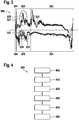
- FIG. 3 shows a schematic comparison diagram 300 of a characteristic curve 323 and a reference characteristic curve 225 according to an exemplary embodiment.
- the reference characteristic curve 225 is the reference characteristic curve Fig. 2 .
- the characteristic curve 323 is off by the device Fig. 1 or a similar device generated.
- the comparison diagram 300 corresponds to the diagram from FIG Fig. 2 with the exception of the fact that the characteristic curve 323 is superimposed on the reference characteristic curve 225.
- Fig. 3 For example, there is a deviation 327 between the reference characteristic curve 225 and the characteristic curve 323 in the second sub-area 202 and a deviation 327 between the reference characteristic curve 225 and the characteristic curve 323 in the fifth sub-area 205.
- State of the door system off Fig. 1 or a similar door system and the characteristic curve 323 results here, for example, from an angular play in the door system.
- the deviations 327 which are symbolically illustrated by ellipses, identify areas in the comparison diagram 300 in which differences between the two curves, reference characteristic line 225 and characteristic line 323, can be recognized. These are in the swivel-out phase and in the swivel-in phase.
- the amplitudes of the reference characteristic curve 225 and of the characteristic curve 323 differ in the fifth sub-range. If an absolute difference in the amplitudes exceeds a threshold value, there is a deviation 327 according to one exemplary embodiment.
- the deviations 327 are determined by analyzing the characteristic curves 323 in the time domain / path range, in which the time / path-dependent courses of the characteristic curves 323 are compared with time / path-dependent courses of the reference characteristic curves 225. Additionally or alternatively, the deviations 327 are determined according to an exemplary embodiment by analyzing the characteristic curves 323, e.g. in the frequency range, in which the spectra of the characteristic curves 323 are compared with spectra of the reference characteristic curves 225.
- the subdivision of the position profile into the sub-areas 201, 202, 203, 204, 205 and 206 enables anomalies of a kinematic phase recognized in the process data, e.g. B. the pivoting to assign.
- a kinematic phase recognized in the process data e.g. B. the pivoting to assign.
- causes of errors which z. B. relate to the linear guide or guide device, are technically completely excluded. Due to the dismantling and assembly of rotating columns in the course of exchanging gearwheels, for example, settings of the door system may have been changed, which could have caused additional changes in the current course and thus the deviations 327.
- FIG. 4 shows a flowchart of a method 400 for providing according to an exemplary embodiment.
- the method 400 can be carried out to provide maintenance information about a door system for a vehicle.
- the method 400 is for providing by means of or using the device from one of the figures described above or a similar device executable.
- the method 400 is carried out when a movement process of a door of a door system takes place.
- the method 400 can be carried out when a control device for controlling the movement process indicates a start of the movement process, for example using a control signal.
- the method 400 can be carried out completely or partially either inside the vehicle or outside the vehicle.
- a reading-in step 410 recorded process data are read in with regard to the movement process of the door of the door system.
- the process data represent the current behavior of at least one drive element of the door system during the movement process.
- the process data are corrected with a position profile of positions of the door during the movement process in order to generate a characteristic curve of the current behavior of the at least one drive element at the positions of the door.
- the characteristic curve is compared with a reference characteristic curve, which represents a target behavior of the at least one drive element at the positions of the door, in order to determine a deviation of the characteristic curve from the reference characteristic curve.
- the deviation is assigned to a sub-area of the position curve, which is subdivided into a plurality of sub-areas depending on the participation of different movement elements of the door system in different phases of the movement process of the door, in order to determine the maintenance information.
- the method 400 for providing has a step 405 of subdividing.
- step 405 of the subdivision the position profile is subdivided into the plurality of subregions depending on the participation of the different movement elements of the door system in the different phases of the movement process of the door.
- the movement process, which is subdivided into the sub-areas, is used in step 440 of the assignment.
- the method 400 for providing has a step 450 of the Spending on.
- the maintenance information determined in assignment step 440 is output to an interface to a device for executing an algorithm for condition-dependent maintenance and / or an algorithm for predictive maintenance.
Landscapes
- Engineering & Computer Science (AREA)
- Mechanical Engineering (AREA)
- Health & Medical Sciences (AREA)
- Biomedical Technology (AREA)
- General Health & Medical Sciences (AREA)
- Physics & Mathematics (AREA)
- General Physics & Mathematics (AREA)
- Business, Economics & Management (AREA)
- Human Resources & Organizations (AREA)
- Economics (AREA)
- Entrepreneurship & Innovation (AREA)
- Marketing (AREA)
- Operations Research (AREA)
- Quality & Reliability (AREA)
- Strategic Management (AREA)
- Tourism & Hospitality (AREA)
- General Business, Economics & Management (AREA)
- Theoretical Computer Science (AREA)
- Power-Operated Mechanisms For Wings (AREA)
Priority Applications (4)
| Application Number | Priority Date | Filing Date | Title |
|---|---|---|---|
| EP19197156.3A EP3792138A1 (fr) | 2019-09-13 | 2019-09-13 | Procédé et dispositif de fourniture d'informations d'entretien sur un système de porte pour un véhicule et système de porte pour un véhicule |
| US17/642,876 US20220319242A1 (en) | 2019-09-13 | 2020-09-10 | Method and device for providing maintenance information on a door system for a vehicle, and door system for a vehicle |
| CN202080063744.1A CN114375272A (zh) | 2019-09-13 | 2020-09-10 | 用于提供关于车辆门系统的维护信息的方法和设备以及用于车辆的门系统 |
| PCT/EP2020/075285 WO2021048255A1 (fr) | 2019-09-13 | 2020-09-10 | Procédé et dispositif pour fournir des informations de maintenance sur un système de porte pour un véhicule, et système de porte pour un véhicule |
Applications Claiming Priority (1)
| Application Number | Priority Date | Filing Date | Title |
|---|---|---|---|
| EP19197156.3A EP3792138A1 (fr) | 2019-09-13 | 2019-09-13 | Procédé et dispositif de fourniture d'informations d'entretien sur un système de porte pour un véhicule et système de porte pour un véhicule |
Publications (1)
| Publication Number | Publication Date |
|---|---|
| EP3792138A1 true EP3792138A1 (fr) | 2021-03-17 |
Family
ID=67956492
Family Applications (1)
| Application Number | Title | Priority Date | Filing Date |
|---|---|---|---|
| EP19197156.3A Withdrawn EP3792138A1 (fr) | 2019-09-13 | 2019-09-13 | Procédé et dispositif de fourniture d'informations d'entretien sur un système de porte pour un véhicule et système de porte pour un véhicule |
Country Status (4)
| Country | Link |
|---|---|
| US (1) | US20220319242A1 (fr) |
| EP (1) | EP3792138A1 (fr) |
| CN (1) | CN114375272A (fr) |
| WO (1) | WO2021048255A1 (fr) |
Cited By (1)
| Publication number | Priority date | Publication date | Assignee | Title |
|---|---|---|---|---|
| CN115977496A (zh) * | 2023-02-24 | 2023-04-18 | 重庆长安汽车股份有限公司 | 一种车门控制方法、系统、设备及介质 |
Citations (4)
| Publication number | Priority date | Publication date | Assignee | Title |
|---|---|---|---|---|
| WO2001034446A1 (fr) * | 1999-11-05 | 2001-05-17 | Bombardier Transportation Gmbh | Vehicule leger sur rail equipe d'un systeme de diagnostic predictif pour portes automatiques motorisees |
| DE102013201494A1 (de) * | 2012-09-18 | 2014-03-20 | Siemens Aktiengesellschaft | Diagnoseverfahren für Schienenfahrzeuge |
| DE102017215341A1 (de) * | 2017-09-01 | 2019-03-07 | Siemens Mobility GmbH | Verfahren zur Untersuchung eines Funktionsverhaltens einer Komponente einer technischen Anlage, Computerprogramm und computerlesbares Speichermedium |
| EP3473794A1 (fr) * | 2017-10-18 | 2019-04-24 | ALSTOM Transport Technologies | Procédé et système de diagnostic de fonctionnement d'un dispositif automatique ou semi-automatique d'accès à un véhicule de transport |
Family Cites Families (7)
| Publication number | Priority date | Publication date | Assignee | Title |
|---|---|---|---|---|
| FI20002390A0 (fi) * | 2000-10-30 | 2000-10-30 | Kone Corp | Menetelmä hissin automaatioven kunnon valvomiseksi |
| DE10242648A1 (de) * | 2002-09-13 | 2004-04-01 | Solarnet Gmbh | Verfahren zur Betriebsüberwachung einer Photovoltaik-Anlage |
| DE102008028264B3 (de) * | 2008-06-13 | 2009-12-17 | Knorr-Bremse Systeme für Schienenfahrzeuge GmbH | Verfahren zur Überwachung wenigstens eines das Betriebsverhalten von Fahrzeugen oder Fahrzeugzügen beeinflussenden Systemparameters |
| US9984513B2 (en) * | 2014-12-23 | 2018-05-29 | Palo Alto Resarch Center Incorporated | System and method for determining vehicle component conditions |
| DE102016109497A1 (de) * | 2016-05-24 | 2017-11-30 | Knorr-Bremse Systeme für Schienenfahrzeuge GmbH | Verfahren und Vorrichtung zum Ermitteln des Verschleißzustandes von Komponenten eines Schienenfahrzeugs |
| CN106406295B (zh) * | 2016-12-02 | 2019-02-26 | 南京康尼机电股份有限公司 | 基于多工况的轨道交通车辆门系统故障诊断及预警方法 |
| US10956876B2 (en) * | 2017-03-07 | 2021-03-23 | Assa Abloy Entrance Systems Ab | Connected entrance system |
-
2019
- 2019-09-13 EP EP19197156.3A patent/EP3792138A1/fr not_active Withdrawn
-
2020
- 2020-09-10 US US17/642,876 patent/US20220319242A1/en not_active Abandoned
- 2020-09-10 CN CN202080063744.1A patent/CN114375272A/zh active Pending
- 2020-09-10 WO PCT/EP2020/075285 patent/WO2021048255A1/fr not_active Ceased
Patent Citations (4)
| Publication number | Priority date | Publication date | Assignee | Title |
|---|---|---|---|---|
| WO2001034446A1 (fr) * | 1999-11-05 | 2001-05-17 | Bombardier Transportation Gmbh | Vehicule leger sur rail equipe d'un systeme de diagnostic predictif pour portes automatiques motorisees |
| DE102013201494A1 (de) * | 2012-09-18 | 2014-03-20 | Siemens Aktiengesellschaft | Diagnoseverfahren für Schienenfahrzeuge |
| DE102017215341A1 (de) * | 2017-09-01 | 2019-03-07 | Siemens Mobility GmbH | Verfahren zur Untersuchung eines Funktionsverhaltens einer Komponente einer technischen Anlage, Computerprogramm und computerlesbares Speichermedium |
| EP3473794A1 (fr) * | 2017-10-18 | 2019-04-24 | ALSTOM Transport Technologies | Procédé et système de diagnostic de fonctionnement d'un dispositif automatique ou semi-automatique d'accès à un véhicule de transport |
Non-Patent Citations (1)
| Title |
|---|
| CYRIL VERDUN: "Le train connecté et intelligent", REVUE GÉNÉRALE DES CHEMINS DE FER : RCGF, HC ÉDITIONS, FR, vol. mars 2016, no. 258, 1 March 2016 (2016-03-01), pages 26 - 38, XP001526832, ISSN: 0035-3183 * |
Cited By (1)
| Publication number | Priority date | Publication date | Assignee | Title |
|---|---|---|---|---|
| CN115977496A (zh) * | 2023-02-24 | 2023-04-18 | 重庆长安汽车股份有限公司 | 一种车门控制方法、系统、设备及介质 |
Also Published As
| Publication number | Publication date |
|---|---|
| WO2021048255A1 (fr) | 2021-03-18 |
| US20220319242A1 (en) | 2022-10-06 |
| CN114375272A (zh) | 2022-04-19 |
Similar Documents
| Publication | Publication Date | Title |
|---|---|---|
| DE60010655T2 (de) | Verfahren und vorrichtung in einem fahrzeugüberwachungssystem und fehlerdiagnosesystem in einem fahrzeug | |
| EP2604478B2 (fr) | Procédé de détection d'erreurs de fonctionnement d'un dispositif multicapteurs | |
| DE10007308A1 (de) | Verfahren und Vorrichtung zur Ermittlung der verbleibenden Betriebsdauer eines Produktes | |
| EP3553616A1 (fr) | Détermination de la cause d'une anomalie | |
| EP3077878A1 (fr) | Procédé informatisé et système de surveillance et détermination d'état automatiques de sections entières d'une unité de processus | |
| DE102021110536A1 (de) | Verfahren zur Überwachung einer Förderanlage mit Förderelementen, Computerprogramm sowie elektronisch lesbarer Datenträger | |
| WO2020259933A1 (fr) | Procédé, programme d'ordinateur et dispositif pour traiter des données acquises par un véhicule à moteur | |
| EP3546314A1 (fr) | Procédé et dispositif d'identification de défaillances pour un système technique | |
| EP4600669B1 (fr) | Système et procédé d'identification d'une cause d'une perturbation électromagnétique | |
| WO2021048255A1 (fr) | Procédé et dispositif pour fournir des informations de maintenance sur un système de porte pour un véhicule, et système de porte pour un véhicule | |
| DE102023101527A1 (de) | Verfahren zur Zustandsüberwachung einer technischen Einrichtung | |
| EP3576013A1 (fr) | Évaluation d'un parcours d'une voie ferroviaire | |
| DE102020207449B4 (de) | Verfahren, Computerprogramm und Vorrichtung zum Verarbeiten von Signalen | |
| DE102020109858A1 (de) | Verfahren zum Betreiben eines Systems | |
| DE102019214941A1 (de) | Verfahren und Ermittlungseinrichtung zum Ermitteln einer Zustandsgröße eines Magnetaktors zu einem bestimmten Zeitpunkt | |
| DE102019125873B4 (de) | Verfahren sowie sensor- und auswerteinrichtung zur dezentralen ermittlung von diagnoseinformationen über elektrische verbraucher einer maschinenanlage | |
| DE102018212801A1 (de) | Diagnose komplexer Systeme | |
| EP3792139B1 (fr) | Procédé et appareil de commande destinés au fonctionnement d'un système d'entrée pour un véhicule et système d'entrée pour un véhicule | |
| DE102020207921A1 (de) | Verfahren zum Einrichten eines Fahrzeugsimulationsmodells | |
| WO2021073995A1 (fr) | Procédé et dispositif de commande pour la sélection automatique d'ensembles de données destinés à un procédé d'apprentissage automatique | |
| DE102021200927A1 (de) | Verfahren und Vorrichtung zur Analyse eines insbesondere in einen zumindest teilautonomen Roboter oder Fahrzeug eingebetteten Systems | |
| DE102019131456A1 (de) | Verfahren zum Bestimmen einer Eigenschaft einer Maschine, insbesondere einer Werkzeugmaschine, ohne messtechnisches Erfassen der Eigenschaft | |
| DE102021209296B4 (de) | Verfahren zum Bestimmen der Bewegung eines mit wenigstens einer Videokamera zur Bilderfassung ausgestatteten Objekts | |
| DE202023107062U1 (de) | System zum Unterstützen einer zustandsbasierten Instandhaltung einer Zugangsanordnung eines Fahrzeugs sowie entsprechende Zugangsanordnung | |
| WO2025242481A1 (fr) | Procédé et dispositif de détection d'une anomalie dans un signal d'entrée périodique |
Legal Events
| Date | Code | Title | Description |
|---|---|---|---|
| PUAI | Public reference made under article 153(3) epc to a published international application that has entered the european phase |
Free format text: ORIGINAL CODE: 0009012 |
|
| STAA | Information on the status of an ep patent application or granted ep patent |
Free format text: STATUS: THE APPLICATION HAS BEEN PUBLISHED |
|
| AK | Designated contracting states |
Kind code of ref document: A1 Designated state(s): AL AT BE BG CH CY CZ DE DK EE ES FI FR GB GR HR HU IE IS IT LI LT LU LV MC MK MT NL NO PL PT RO RS SE SI SK SM TR |
|
| AX | Request for extension of the european patent |
Extension state: BA ME |
|
| STAA | Information on the status of an ep patent application or granted ep patent |
Free format text: STATUS: REQUEST FOR EXAMINATION WAS MADE |
|
| 17P | Request for examination filed |
Effective date: 20210705 |
|
| RBV | Designated contracting states (corrected) |
Designated state(s): AL AT BE BG CH CY CZ DE DK EE ES FI FR GB GR HR HU IE IS IT LI LT LU LV MC MK MT NL NO PL PT RO RS SE SI SK SM TR |
|
| STAA | Information on the status of an ep patent application or granted ep patent |
Free format text: STATUS: EXAMINATION IS IN PROGRESS |
|
| 17Q | First examination report despatched |
Effective date: 20230403 |
|
| STAA | Information on the status of an ep patent application or granted ep patent |
Free format text: STATUS: THE APPLICATION IS DEEMED TO BE WITHDRAWN |
|
| 18D | Application deemed to be withdrawn |
Effective date: 20250401 |