EP3794666B9 - Cellule de batterie rechargeable - Google Patents
Cellule de batterie rechargeable Download PDFInfo
- Publication number
- EP3794666B9 EP3794666B9 EP20746667.3A EP20746667A EP3794666B9 EP 3794666 B9 EP3794666 B9 EP 3794666B9 EP 20746667 A EP20746667 A EP 20746667A EP 3794666 B9 EP3794666 B9 EP 3794666B9
- Authority
- EP
- European Patent Office
- Prior art keywords
- battery cell
- rechargeable battery
- lithium
- electrolyte
- metal
- Prior art date
- Legal status (The legal status is an assumption and is not a legal conclusion. Google has not performed a legal analysis and makes no representation as to the accuracy of the status listed.)
- Active
Links
Images









Classifications
-
- C—CHEMISTRY; METALLURGY
- C07—ORGANIC CHEMISTRY
- C07F—ACYCLIC, CARBOCYCLIC OR HETEROCYCLIC COMPOUNDS CONTAINING ELEMENTS OTHER THAN CARBON, HYDROGEN, HALOGEN, OXYGEN, NITROGEN, SULFUR, SELENIUM OR TELLURIUM
- C07F5/00—Compounds containing elements of Groups 3 or 13 of the Periodic Table
- C07F5/02—Boron compounds
- C07F5/04—Esters of boric acids
-
- H—ELECTRICITY
- H01—ELECTRIC ELEMENTS
- H01M—PROCESSES OR MEANS, e.g. BATTERIES, FOR THE DIRECT CONVERSION OF CHEMICAL ENERGY INTO ELECTRICAL ENERGY
- H01M4/00—Electrodes
- H01M4/02—Electrodes composed of, or comprising, active material
- H01M4/36—Selection of substances as active materials, active masses, active liquids
- H01M4/362—Composites
-
- H—ELECTRICITY
- H01—ELECTRIC ELEMENTS
- H01M—PROCESSES OR MEANS, e.g. BATTERIES, FOR THE DIRECT CONVERSION OF CHEMICAL ENERGY INTO ELECTRICAL ENERGY
- H01M10/00—Secondary cells; Manufacture thereof
- H01M10/05—Accumulators with non-aqueous electrolyte
- H01M10/056—Accumulators with non-aqueous electrolyte characterised by the materials used as electrolytes, e.g. mixed inorganic/organic electrolytes
- H01M10/0561—Accumulators with non-aqueous electrolyte characterised by the materials used as electrolytes, e.g. mixed inorganic/organic electrolytes the electrolyte being constituted of inorganic materials only
- H01M10/0563—Liquid materials, e.g. for Li-SOCl2 cells
-
- C—CHEMISTRY; METALLURGY
- C01—INORGANIC CHEMISTRY
- C01G—COMPOUNDS CONTAINING METALS NOT COVERED BY SUBCLASSES C01D OR C01F
- C01G49/00—Compounds of iron
- C01G49/009—Compounds containing iron, with or without oxygen or hydrogen, and containing two or more other elements
-
- C—CHEMISTRY; METALLURGY
- C01—INORGANIC CHEMISTRY
- C01G—COMPOUNDS CONTAINING METALS NOT COVERED BY SUBCLASSES C01D OR C01F
- C01G51/00—Compounds of cobalt
- C01G51/40—Complex oxides containing cobalt and at least one other metal element
- C01G51/42—Complex oxides containing cobalt and at least one other metal element containing alkali metals, e.g. LiCoO2
-
- C—CHEMISTRY; METALLURGY
- C01—INORGANIC CHEMISTRY
- C01G—COMPOUNDS CONTAINING METALS NOT COVERED BY SUBCLASSES C01D OR C01F
- C01G53/00—Compounds of nickel
- C01G53/40—Complex oxides containing nickel and at least one other metal element
- C01G53/42—Complex oxides containing nickel and at least one other metal element containing alkali metals, e.g. LiNiO2
- C01G53/44—Complex oxides containing nickel and at least one other metal element containing alkali metals, e.g. LiNiO2 containing manganese
- C01G53/50—Complex oxides containing nickel and at least one other metal element containing alkali metals, e.g. LiNiO2 containing manganese of the type (MnO2)n-, e.g. Li(NixMn1-x)O2 or Li(MyNixMn1-x-y)O2
-
- C—CHEMISTRY; METALLURGY
- C01—INORGANIC CHEMISTRY
- C01G—COMPOUNDS CONTAINING METALS NOT COVERED BY SUBCLASSES C01D OR C01F
- C01G53/00—Compounds of nickel
- C01G53/40—Complex oxides containing nickel and at least one other metal element
- C01G53/42—Complex oxides containing nickel and at least one other metal element containing alkali metals, e.g. LiNiO2
- C01G53/44—Complex oxides containing nickel and at least one other metal element containing alkali metals, e.g. LiNiO2 containing manganese
- C01G53/54—Complex oxides containing nickel and at least one other metal element containing alkali metals, e.g. LiNiO2 containing manganese of the type (Mn2O4)-, e.g. Li(NixMn2-x)O4 or Li(MyNixMn2-x-y)O4
-
- C—CHEMISTRY; METALLURGY
- C07—ORGANIC CHEMISTRY
- C07F—ACYCLIC, CARBOCYCLIC OR HETEROCYCLIC COMPOUNDS CONTAINING ELEMENTS OTHER THAN CARBON, HYDROGEN, HALOGEN, OXYGEN, NITROGEN, SULFUR, SELENIUM OR TELLURIUM
- C07F5/00—Compounds containing elements of Groups 3 or 13 of the Periodic Table
- C07F5/06—Aluminium compounds
- C07F5/069—Aluminium compounds without C-aluminium linkages
-
- H—ELECTRICITY
- H01—ELECTRIC ELEMENTS
- H01M—PROCESSES OR MEANS, e.g. BATTERIES, FOR THE DIRECT CONVERSION OF CHEMICAL ENERGY INTO ELECTRICAL ENERGY
- H01M10/00—Secondary cells; Manufacture thereof
- H01M10/05—Accumulators with non-aqueous electrolyte
- H01M10/052—Li-accumulators
-
- H—ELECTRICITY
- H01—ELECTRIC ELEMENTS
- H01M—PROCESSES OR MEANS, e.g. BATTERIES, FOR THE DIRECT CONVERSION OF CHEMICAL ENERGY INTO ELECTRICAL ENERGY
- H01M10/00—Secondary cells; Manufacture thereof
- H01M10/05—Accumulators with non-aqueous electrolyte
- H01M10/052—Li-accumulators
- H01M10/0525—Rocking-chair batteries, i.e. batteries with lithium insertion or intercalation in both electrodes; Lithium-ion batteries
-
- H—ELECTRICITY
- H01—ELECTRIC ELEMENTS
- H01M—PROCESSES OR MEANS, e.g. BATTERIES, FOR THE DIRECT CONVERSION OF CHEMICAL ENERGY INTO ELECTRICAL ENERGY
- H01M10/00—Secondary cells; Manufacture thereof
- H01M10/05—Accumulators with non-aqueous electrolyte
- H01M10/054—Accumulators with insertion or intercalation of metals other than lithium, e.g. with magnesium or aluminium
-
- H—ELECTRICITY
- H01—ELECTRIC ELEMENTS
- H01M—PROCESSES OR MEANS, e.g. BATTERIES, FOR THE DIRECT CONVERSION OF CHEMICAL ENERGY INTO ELECTRICAL ENERGY
- H01M10/00—Secondary cells; Manufacture thereof
- H01M10/05—Accumulators with non-aqueous electrolyte
- H01M10/056—Accumulators with non-aqueous electrolyte characterised by the materials used as electrolytes, e.g. mixed inorganic/organic electrolytes
-
- H—ELECTRICITY
- H01—ELECTRIC ELEMENTS
- H01M—PROCESSES OR MEANS, e.g. BATTERIES, FOR THE DIRECT CONVERSION OF CHEMICAL ENERGY INTO ELECTRICAL ENERGY
- H01M10/00—Secondary cells; Manufacture thereof
- H01M10/05—Accumulators with non-aqueous electrolyte
- H01M10/056—Accumulators with non-aqueous electrolyte characterised by the materials used as electrolytes, e.g. mixed inorganic/organic electrolytes
- H01M10/0561—Accumulators with non-aqueous electrolyte characterised by the materials used as electrolytes, e.g. mixed inorganic/organic electrolytes the electrolyte being constituted of inorganic materials only
- H01M10/0562—Solid materials
-
- H—ELECTRICITY
- H01—ELECTRIC ELEMENTS
- H01M—PROCESSES OR MEANS, e.g. BATTERIES, FOR THE DIRECT CONVERSION OF CHEMICAL ENERGY INTO ELECTRICAL ENERGY
- H01M10/00—Secondary cells; Manufacture thereof
- H01M10/05—Accumulators with non-aqueous electrolyte
- H01M10/056—Accumulators with non-aqueous electrolyte characterised by the materials used as electrolytes, e.g. mixed inorganic/organic electrolytes
- H01M10/0564—Accumulators with non-aqueous electrolyte characterised by the materials used as electrolytes, e.g. mixed inorganic/organic electrolytes the electrolyte being constituted of organic materials only
- H01M10/0566—Liquid materials
- H01M10/0567—Liquid materials characterised by the additives
-
- H—ELECTRICITY
- H01—ELECTRIC ELEMENTS
- H01M—PROCESSES OR MEANS, e.g. BATTERIES, FOR THE DIRECT CONVERSION OF CHEMICAL ENERGY INTO ELECTRICAL ENERGY
- H01M10/00—Secondary cells; Manufacture thereof
- H01M10/05—Accumulators with non-aqueous electrolyte
- H01M10/056—Accumulators with non-aqueous electrolyte characterised by the materials used as electrolytes, e.g. mixed inorganic/organic electrolytes
- H01M10/0564—Accumulators with non-aqueous electrolyte characterised by the materials used as electrolytes, e.g. mixed inorganic/organic electrolytes the electrolyte being constituted of organic materials only
- H01M10/0566—Liquid materials
- H01M10/0568—Liquid materials characterised by the solutes
-
- H—ELECTRICITY
- H01—ELECTRIC ELEMENTS
- H01M—PROCESSES OR MEANS, e.g. BATTERIES, FOR THE DIRECT CONVERSION OF CHEMICAL ENERGY INTO ELECTRICAL ENERGY
- H01M10/00—Secondary cells; Manufacture thereof
- H01M10/42—Methods or arrangements for servicing or maintenance of secondary cells or secondary half-cells
- H01M10/4235—Safety or regulating additives or arrangements in electrodes, separators or electrolyte
-
- H—ELECTRICITY
- H01—ELECTRIC ELEMENTS
- H01M—PROCESSES OR MEANS, e.g. BATTERIES, FOR THE DIRECT CONVERSION OF CHEMICAL ENERGY INTO ELECTRICAL ENERGY
- H01M4/00—Electrodes
- H01M4/02—Electrodes composed of, or comprising, active material
- H01M4/13—Electrodes for accumulators with non-aqueous electrolyte, e.g. for lithium-accumulators; Processes of manufacture thereof
- H01M4/131—Electrodes based on mixed oxides or hydroxides, or on mixtures of oxides or hydroxides, e.g. LiCoOx
-
- H—ELECTRICITY
- H01—ELECTRIC ELEMENTS
- H01M—PROCESSES OR MEANS, e.g. BATTERIES, FOR THE DIRECT CONVERSION OF CHEMICAL ENERGY INTO ELECTRICAL ENERGY
- H01M4/00—Electrodes
- H01M4/02—Electrodes composed of, or comprising, active material
- H01M4/13—Electrodes for accumulators with non-aqueous electrolyte, e.g. for lithium-accumulators; Processes of manufacture thereof
- H01M4/133—Electrodes based on carbonaceous material, e.g. graphite-intercalation compounds or CFx
-
- H—ELECTRICITY
- H01—ELECTRIC ELEMENTS
- H01M—PROCESSES OR MEANS, e.g. BATTERIES, FOR THE DIRECT CONVERSION OF CHEMICAL ENERGY INTO ELECTRICAL ENERGY
- H01M4/00—Electrodes
- H01M4/02—Electrodes composed of, or comprising, active material
- H01M4/13—Electrodes for accumulators with non-aqueous electrolyte, e.g. for lithium-accumulators; Processes of manufacture thereof
- H01M4/134—Electrodes based on metals, Si or alloys
-
- H—ELECTRICITY
- H01—ELECTRIC ELEMENTS
- H01M—PROCESSES OR MEANS, e.g. BATTERIES, FOR THE DIRECT CONVERSION OF CHEMICAL ENERGY INTO ELECTRICAL ENERGY
- H01M4/00—Electrodes
- H01M4/02—Electrodes composed of, or comprising, active material
- H01M4/13—Electrodes for accumulators with non-aqueous electrolyte, e.g. for lithium-accumulators; Processes of manufacture thereof
- H01M4/136—Electrodes based on inorganic compounds other than oxides or hydroxides, e.g. sulfides, selenides, tellurides, halogenides or LiCoFy
-
- H—ELECTRICITY
- H01—ELECTRIC ELEMENTS
- H01M—PROCESSES OR MEANS, e.g. BATTERIES, FOR THE DIRECT CONVERSION OF CHEMICAL ENERGY INTO ELECTRICAL ENERGY
- H01M4/00—Electrodes
- H01M4/02—Electrodes composed of, or comprising, active material
- H01M4/36—Selection of substances as active materials, active masses, active liquids
- H01M4/362—Composites
- H01M4/364—Composites as mixtures
-
- H—ELECTRICITY
- H01—ELECTRIC ELEMENTS
- H01M—PROCESSES OR MEANS, e.g. BATTERIES, FOR THE DIRECT CONVERSION OF CHEMICAL ENERGY INTO ELECTRICAL ENERGY
- H01M4/00—Electrodes
- H01M4/02—Electrodes composed of, or comprising, active material
- H01M4/36—Selection of substances as active materials, active masses, active liquids
- H01M4/38—Selection of substances as active materials, active masses, active liquids of elements or alloys
-
- H—ELECTRICITY
- H01—ELECTRIC ELEMENTS
- H01M—PROCESSES OR MEANS, e.g. BATTERIES, FOR THE DIRECT CONVERSION OF CHEMICAL ENERGY INTO ELECTRICAL ENERGY
- H01M4/00—Electrodes
- H01M4/02—Electrodes composed of, or comprising, active material
- H01M4/36—Selection of substances as active materials, active masses, active liquids
- H01M4/38—Selection of substances as active materials, active masses, active liquids of elements or alloys
- H01M4/381—Alkaline or alkaline earth metals elements
- H01M4/382—Lithium
-
- H—ELECTRICITY
- H01—ELECTRIC ELEMENTS
- H01M—PROCESSES OR MEANS, e.g. BATTERIES, FOR THE DIRECT CONVERSION OF CHEMICAL ENERGY INTO ELECTRICAL ENERGY
- H01M4/00—Electrodes
- H01M4/02—Electrodes composed of, or comprising, active material
- H01M4/36—Selection of substances as active materials, active masses, active liquids
- H01M4/38—Selection of substances as active materials, active masses, active liquids of elements or alloys
- H01M4/386—Silicon or alloys based on silicon
-
- H—ELECTRICITY
- H01—ELECTRIC ELEMENTS
- H01M—PROCESSES OR MEANS, e.g. BATTERIES, FOR THE DIRECT CONVERSION OF CHEMICAL ENERGY INTO ELECTRICAL ENERGY
- H01M4/00—Electrodes
- H01M4/02—Electrodes composed of, or comprising, active material
- H01M4/36—Selection of substances as active materials, active masses, active liquids
- H01M4/38—Selection of substances as active materials, active masses, active liquids of elements or alloys
- H01M4/387—Tin or alloys based on tin
-
- H—ELECTRICITY
- H01—ELECTRIC ELEMENTS
- H01M—PROCESSES OR MEANS, e.g. BATTERIES, FOR THE DIRECT CONVERSION OF CHEMICAL ENERGY INTO ELECTRICAL ENERGY
- H01M4/00—Electrodes
- H01M4/02—Electrodes composed of, or comprising, active material
- H01M4/36—Selection of substances as active materials, active masses, active liquids
- H01M4/48—Selection of substances as active materials, active masses, active liquids of inorganic oxides or hydroxides
- H01M4/483—Selection of substances as active materials, active masses, active liquids of inorganic oxides or hydroxides for non-aqueous cells
-
- H—ELECTRICITY
- H01—ELECTRIC ELEMENTS
- H01M—PROCESSES OR MEANS, e.g. BATTERIES, FOR THE DIRECT CONVERSION OF CHEMICAL ENERGY INTO ELECTRICAL ENERGY
- H01M4/00—Electrodes
- H01M4/02—Electrodes composed of, or comprising, active material
- H01M4/36—Selection of substances as active materials, active masses, active liquids
- H01M4/48—Selection of substances as active materials, active masses, active liquids of inorganic oxides or hydroxides
- H01M4/485—Selection of substances as active materials, active masses, active liquids of inorganic oxides or hydroxides of mixed oxides or hydroxides for inserting or intercalating light metals, e.g. LiTi2O4 or LiTi2OxFy
-
- H—ELECTRICITY
- H01—ELECTRIC ELEMENTS
- H01M—PROCESSES OR MEANS, e.g. BATTERIES, FOR THE DIRECT CONVERSION OF CHEMICAL ENERGY INTO ELECTRICAL ENERGY
- H01M4/00—Electrodes
- H01M4/02—Electrodes composed of, or comprising, active material
- H01M4/36—Selection of substances as active materials, active masses, active liquids
- H01M4/48—Selection of substances as active materials, active masses, active liquids of inorganic oxides or hydroxides
- H01M4/50—Selection of substances as active materials, active masses, active liquids of inorganic oxides or hydroxides of manganese
- H01M4/502—Selection of substances as active materials, active masses, active liquids of inorganic oxides or hydroxides of manganese for non-aqueous cells
-
- H—ELECTRICITY
- H01—ELECTRIC ELEMENTS
- H01M—PROCESSES OR MEANS, e.g. BATTERIES, FOR THE DIRECT CONVERSION OF CHEMICAL ENERGY INTO ELECTRICAL ENERGY
- H01M4/00—Electrodes
- H01M4/02—Electrodes composed of, or comprising, active material
- H01M4/36—Selection of substances as active materials, active masses, active liquids
- H01M4/48—Selection of substances as active materials, active masses, active liquids of inorganic oxides or hydroxides
- H01M4/50—Selection of substances as active materials, active masses, active liquids of inorganic oxides or hydroxides of manganese
- H01M4/505—Selection of substances as active materials, active masses, active liquids of inorganic oxides or hydroxides of manganese of mixed oxides or hydroxides containing manganese for inserting or intercalating light metals, e.g. LiMn2O4 or LiMn2OxFy
-
- H—ELECTRICITY
- H01—ELECTRIC ELEMENTS
- H01M—PROCESSES OR MEANS, e.g. BATTERIES, FOR THE DIRECT CONVERSION OF CHEMICAL ENERGY INTO ELECTRICAL ENERGY
- H01M4/00—Electrodes
- H01M4/02—Electrodes composed of, or comprising, active material
- H01M4/36—Selection of substances as active materials, active masses, active liquids
- H01M4/48—Selection of substances as active materials, active masses, active liquids of inorganic oxides or hydroxides
- H01M4/52—Selection of substances as active materials, active masses, active liquids of inorganic oxides or hydroxides of nickel, cobalt or iron
- H01M4/523—Selection of substances as active materials, active masses, active liquids of inorganic oxides or hydroxides of nickel, cobalt or iron for non-aqueous cells
-
- H—ELECTRICITY
- H01—ELECTRIC ELEMENTS
- H01M—PROCESSES OR MEANS, e.g. BATTERIES, FOR THE DIRECT CONVERSION OF CHEMICAL ENERGY INTO ELECTRICAL ENERGY
- H01M4/00—Electrodes
- H01M4/02—Electrodes composed of, or comprising, active material
- H01M4/36—Selection of substances as active materials, active masses, active liquids
- H01M4/48—Selection of substances as active materials, active masses, active liquids of inorganic oxides or hydroxides
- H01M4/52—Selection of substances as active materials, active masses, active liquids of inorganic oxides or hydroxides of nickel, cobalt or iron
- H01M4/525—Selection of substances as active materials, active masses, active liquids of inorganic oxides or hydroxides of nickel, cobalt or iron of mixed oxides or hydroxides containing iron, cobalt or nickel for inserting or intercalating light metals, e.g. LiNiO2, LiCoO2 or LiCoOxFy
-
- H—ELECTRICITY
- H01—ELECTRIC ELEMENTS
- H01M—PROCESSES OR MEANS, e.g. BATTERIES, FOR THE DIRECT CONVERSION OF CHEMICAL ENERGY INTO ELECTRICAL ENERGY
- H01M4/00—Electrodes
- H01M4/02—Electrodes composed of, or comprising, active material
- H01M4/36—Selection of substances as active materials, active masses, active liquids
- H01M4/58—Selection of substances as active materials, active masses, active liquids of inorganic compounds other than oxides or hydroxides, e.g. sulfides, selenides, tellurides, halogenides or LiCoFy; of polyanionic structures, e.g. phosphates, silicates or borates
- H01M4/5805—Phosphides
-
- H—ELECTRICITY
- H01—ELECTRIC ELEMENTS
- H01M—PROCESSES OR MEANS, e.g. BATTERIES, FOR THE DIRECT CONVERSION OF CHEMICAL ENERGY INTO ELECTRICAL ENERGY
- H01M4/00—Electrodes
- H01M4/02—Electrodes composed of, or comprising, active material
- H01M4/36—Selection of substances as active materials, active masses, active liquids
- H01M4/58—Selection of substances as active materials, active masses, active liquids of inorganic compounds other than oxides or hydroxides, e.g. sulfides, selenides, tellurides, halogenides or LiCoFy; of polyanionic structures, e.g. phosphates, silicates or borates
- H01M4/5825—Oxygenated metallic salts or polyanionic structures, e.g. borates, phosphates, silicates, olivines
-
- H—ELECTRICITY
- H01—ELECTRIC ELEMENTS
- H01M—PROCESSES OR MEANS, e.g. BATTERIES, FOR THE DIRECT CONVERSION OF CHEMICAL ENERGY INTO ELECTRICAL ENERGY
- H01M4/00—Electrodes
- H01M4/02—Electrodes composed of, or comprising, active material
- H01M4/36—Selection of substances as active materials, active masses, active liquids
- H01M4/58—Selection of substances as active materials, active masses, active liquids of inorganic compounds other than oxides or hydroxides, e.g. sulfides, selenides, tellurides, halogenides or LiCoFy; of polyanionic structures, e.g. phosphates, silicates or borates
- H01M4/583—Carbonaceous material, e.g. graphite-intercalation compounds or CFx
-
- H—ELECTRICITY
- H01—ELECTRIC ELEMENTS
- H01M—PROCESSES OR MEANS, e.g. BATTERIES, FOR THE DIRECT CONVERSION OF CHEMICAL ENERGY INTO ELECTRICAL ENERGY
- H01M4/00—Electrodes
- H01M4/02—Electrodes composed of, or comprising, active material
- H01M4/36—Selection of substances as active materials, active masses, active liquids
- H01M4/58—Selection of substances as active materials, active masses, active liquids of inorganic compounds other than oxides or hydroxides, e.g. sulfides, selenides, tellurides, halogenides or LiCoFy; of polyanionic structures, e.g. phosphates, silicates or borates
- H01M4/583—Carbonaceous material, e.g. graphite-intercalation compounds or CFx
- H01M4/587—Carbonaceous material, e.g. graphite-intercalation compounds or CFx for inserting or intercalating light metals
-
- H—ELECTRICITY
- H01—ELECTRIC ELEMENTS
- H01M—PROCESSES OR MEANS, e.g. BATTERIES, FOR THE DIRECT CONVERSION OF CHEMICAL ENERGY INTO ELECTRICAL ENERGY
- H01M4/00—Electrodes
- H01M4/02—Electrodes composed of, or comprising, active material
- H01M2004/026—Electrodes composed of, or comprising, active material characterised by the polarity
- H01M2004/027—Negative electrodes
-
- H—ELECTRICITY
- H01—ELECTRIC ELEMENTS
- H01M—PROCESSES OR MEANS, e.g. BATTERIES, FOR THE DIRECT CONVERSION OF CHEMICAL ENERGY INTO ELECTRICAL ENERGY
- H01M4/00—Electrodes
- H01M4/02—Electrodes composed of, or comprising, active material
- H01M2004/026—Electrodes composed of, or comprising, active material characterised by the polarity
- H01M2004/028—Positive electrodes
-
- H—ELECTRICITY
- H01—ELECTRIC ELEMENTS
- H01M—PROCESSES OR MEANS, e.g. BATTERIES, FOR THE DIRECT CONVERSION OF CHEMICAL ENERGY INTO ELECTRICAL ENERGY
- H01M2300/00—Electrolytes
- H01M2300/0017—Non-aqueous electrolytes
- H01M2300/002—Inorganic electrolyte
-
- H—ELECTRICITY
- H01—ELECTRIC ELEMENTS
- H01M—PROCESSES OR MEANS, e.g. BATTERIES, FOR THE DIRECT CONVERSION OF CHEMICAL ENERGY INTO ELECTRICAL ENERGY
- H01M2300/00—Electrolytes
- H01M2300/0017—Non-aqueous electrolytes
- H01M2300/0025—Organic electrolyte
-
- H—ELECTRICITY
- H01—ELECTRIC ELEMENTS
- H01M—PROCESSES OR MEANS, e.g. BATTERIES, FOR THE DIRECT CONVERSION OF CHEMICAL ENERGY INTO ELECTRICAL ENERGY
- H01M2300/00—Electrolytes
- H01M2300/0017—Non-aqueous electrolytes
- H01M2300/0065—Solid electrolytes
- H01M2300/0068—Solid electrolytes inorganic
- H01M2300/0071—Oxides
-
- H—ELECTRICITY
- H01—ELECTRIC ELEMENTS
- H01M—PROCESSES OR MEANS, e.g. BATTERIES, FOR THE DIRECT CONVERSION OF CHEMICAL ENERGY INTO ELECTRICAL ENERGY
- H01M2300/00—Electrolytes
- H01M2300/0088—Composites
- H01M2300/0091—Composites in the form of mixtures
-
- H—ELECTRICITY
- H01—ELECTRIC ELEMENTS
- H01M—PROCESSES OR MEANS, e.g. BATTERIES, FOR THE DIRECT CONVERSION OF CHEMICAL ENERGY INTO ELECTRICAL ENERGY
- H01M4/00—Electrodes
- H01M4/02—Electrodes composed of, or comprising, active material
- H01M4/62—Selection of inactive substances as ingredients for active masses, e.g. binders, fillers
- H01M4/621—Binders
- H01M4/622—Binders being polymers
-
- H—ELECTRICITY
- H01—ELECTRIC ELEMENTS
- H01M—PROCESSES OR MEANS, e.g. BATTERIES, FOR THE DIRECT CONVERSION OF CHEMICAL ENERGY INTO ELECTRICAL ENERGY
- H01M4/00—Electrodes
- H01M4/02—Electrodes composed of, or comprising, active material
- H01M4/62—Selection of inactive substances as ingredients for active masses, e.g. binders, fillers
- H01M4/621—Binders
- H01M4/622—Binders being polymers
- H01M4/623—Binders being polymers fluorinated polymers
-
- H—ELECTRICITY
- H01—ELECTRIC ELEMENTS
- H01M—PROCESSES OR MEANS, e.g. BATTERIES, FOR THE DIRECT CONVERSION OF CHEMICAL ENERGY INTO ELECTRICAL ENERGY
- H01M4/00—Electrodes
- H01M4/02—Electrodes composed of, or comprising, active material
- H01M4/64—Carriers or collectors
- H01M4/66—Selection of materials
- H01M4/661—Metal or alloys, e.g. alloy coatings
-
- H—ELECTRICITY
- H01—ELECTRIC ELEMENTS
- H01M—PROCESSES OR MEANS, e.g. BATTERIES, FOR THE DIRECT CONVERSION OF CHEMICAL ENERGY INTO ELECTRICAL ENERGY
- H01M4/00—Electrodes
- H01M4/02—Electrodes composed of, or comprising, active material
- H01M4/64—Carriers or collectors
- H01M4/70—Carriers or collectors characterised by shape or form
- H01M4/72—Grids
- H01M4/74—Meshes or woven material; Expanded metal
- H01M4/745—Expanded metal
-
- H—ELECTRICITY
- H01—ELECTRIC ELEMENTS
- H01M—PROCESSES OR MEANS, e.g. BATTERIES, FOR THE DIRECT CONVERSION OF CHEMICAL ENERGY INTO ELECTRICAL ENERGY
- H01M4/00—Electrodes
- H01M4/02—Electrodes composed of, or comprising, active material
- H01M4/64—Carriers or collectors
- H01M4/70—Carriers or collectors characterised by shape or form
- H01M4/80—Porous plates, e.g. sintered carriers
- H01M4/808—Foamed, spongy materials
-
- Y—GENERAL TAGGING OF NEW TECHNOLOGICAL DEVELOPMENTS; GENERAL TAGGING OF CROSS-SECTIONAL TECHNOLOGIES SPANNING OVER SEVERAL SECTIONS OF THE IPC; TECHNICAL SUBJECTS COVERED BY FORMER USPC CROSS-REFERENCE ART COLLECTIONS [XRACs] AND DIGESTS
- Y02—TECHNOLOGIES OR APPLICATIONS FOR MITIGATION OR ADAPTATION AGAINST CLIMATE CHANGE
- Y02E—REDUCTION OF GREENHOUSE GAS [GHG] EMISSIONS, RELATED TO ENERGY GENERATION, TRANSMISSION OR DISTRIBUTION
- Y02E60/00—Enabling technologies; Technologies with a potential or indirect contribution to GHG emissions mitigation
- Y02E60/10—Energy storage using batteries
Definitions
- the invention relates to a rechargeable battery cell with an SO 2 -based electrolyte.
- Rechargeable battery cells are of great importance in many technical fields. They are often used for applications where only small, rechargeable battery cells with relatively low currents are required, such as when operating mobile phones. In addition, however, there is also a great need for larger, rechargeable battery cells for high-energy applications, with mass storage of energy in the form of battery cells for the electric drive of vehicles being of particular importance.
- Lithium has proven to be particularly advantageous as the active metal for this purpose. Lithium is the metal with the lowest atomic number and thus has the highest theoretical specific capacity of 3.884 mAh/g. It is the most electronegative metal (-3.10 V vs. standard hydrogen electrode, abbr.: SHE), producing the highest possible cell voltage against a given positive electrode. It is also the lightest metal (0.54 g/cm 3 ), which contributes to the highest possible gravimetric energy density (Wh/Kg) or specific energy density (Wh/L).
- the active metal of a rechargeable battery cell is the metal whose ions within the electrolyte migrate to the negative or positive electrode when charging or discharging the cell and take part in electrochemical processes there. These electrochemical processes lead directly or indirectly to the release of electrons into the external circuit or the acceptance of electrons from the external circuit.
- Rechargeable battery cells containing metallic lithium as the negative electrode active material are also referred to as lithium cells.
- the positive electrodes of lithium cells are designed as insertion electrodes.
- insertion electrode in the context of the present invention is understood as meaning electrodes which have a crystal structure into which ions of the active material can be stored and removed during operation of the lithium cell. It means that the electrode processes can take place not only on the surface of the electrode, but also within the crystal structure.
- the positive electrode consists of, for example, lithium cobalt oxide (LiCoO 2 ).
- LiCoO 2 lithium cobalt oxide
- the electrolyte is also an important functional element of every rechargeable battery cell. It usually contains a solvent or a mixture of solvents and at least one conductive salt. Solid electrolytes or ionic liquids, for example, do not contain any solvent, only the conductive salt.
- the electrolyte is in contact with the positive and negative electrodes of the battery cell. At least one ion of the conductive salt (anion or cation) is mobile in the electrolyte in such a way that ion conduction allows a charge transport between the electrodes, which is necessary for the function of the rechargeable battery cell, to take place. Above a certain upper cell voltage of the rechargeable battery cell, the electrolyte is electrochemically decomposed by oxidation.
- Reductive processes can also decompose the electrolyte above a certain lower cell voltage.
- the positive and negative electrodes are selected in such a way that the cell voltage is below or above the decomposition voltage of the electrolyte. The electrolyte thus determines the voltage window in which a rechargeable battery cell can be operated reversibly, i.e. (i.e.) repeatedly charged and discharged.
- the lithium cells known from the prior art contain an electrolyte which consists of a conducting salt dissolved in an organic solvent or solvent mixture and a conducting salt dissolved therein.
- the conductive salt is a lithium salt such as lithium hexafluorophosphate (LiPF 6 ).
- the solvent mixture can contain ethylene carbonate, for example.
- Electrolyte LP57 which has the composition 1M LiPF 6 in EC (ethylene carbonate) :EMC (ethyl methyl carbonate) 3:7, is an example of such an electrolyte. Because of the organic solvent or solvent mixture, such lithium cells are also referred to as organic lithium cells.
- the irreversible loss of capacitance depends on the electrolyte formulation and electrodes used.
- the electrolyte decomposition and formation of layers containing lithium ions often continues during the further operation of the lithium cell and is responsible for the loss of capacity and thus for a shorter lifetime of the cell. Capacity losses can also occur during storage of charged lithium cells. This so-called self-discharge can be based on irreversible processes (electrolyte decomposition) as well as reversible processes in which the lithium stored in the negative electrode is transferred to the electrolyte solution and is available again the next time the battery is charged.
- organic lithium cells are problematic in terms of their stability and long-term operational reliability. Safety risks are also caused in particular by the flammability of the organic solvent or solvent mixture. If an organic lithium cell catches fire or even explodes, the metallic lithium forms a highly reactive substance and the organic solvent of the electrolyte forms a combustible material. In order to avoid such security risks, additional measures must be taken.
- a further development known from the prior art provides for the use of an electrolyte based on sulfur dioxide (SO 2 ) instead of an organic electrolyte for rechargeable battery cells.
- Rechargeable battery cells which contain an SO 2 -based electrolyte have, among other things, a high ionic conductivity.
- SO 2 -based electrolyte means an electrolyte that not only contains SO 2 as an additive in a low concentration, but in which the mobility of the ions of the conducting salt that is contained in the electrolyte and causes the charge transport is at least partially, largely or even fully guaranteed by SO 2 .
- the SO 2 thus serves as a solvent for the conductive salt.
- the conducting salt can form a liquid solvate complex with the gaseous SO 2 , with the SO 2 being bound and the vapor pressure being noticeably reduced compared to pure SO 2 .
- Electrolytes with a low vapor pressure are formed.
- Such electrolytes based on SO 2 have the advantage of non-combustibility compared to the organic electrolytes described above. Safety risks, which exist due to the flammability of the electrolyte, can thus be ruled out.
- metallic lithium as the negative electrode active material in rechargeable cells involves various problems. Lithium does not separate out uniformly during charging, but in the form of dendrites. The uncontrollable lithium dendrite growth leads to an accumulation of a highly reactive metal with a large surface area and can lead to safety-critical conditions. The thermodynamic instability of metallic lithium causes irreversible and continuous reactions between this lithium and the electrolyte. As a result, unintentionally thick passivation layers (SEI) develop on the lithium-metal surface, which consume lithium and electrolyte components. This increases the internal resistance and shortens the service life of the lithium cell. With repeated charging and discharging, large volumetric and morphological changes can occur in the lithium metal anode. The above SEI films are too unstable to completely suppress such significant changes.
- SEI passivation layers
- a disadvantage that also occurs with these SO 2 -based electrolytes is that any hydrolysis products formed in the presence of residual amounts of water react with the cell components of the rechargeable battery cell and thus lead to the formation of undesirable by-products. Because of this, when producing such rechargeable battery cells with an SO 2 -based electrolyte, care must be taken to minimize the residual water content contained in the electrolyte and the cell components.
- SO 2 is a poor solvent for many conductive salts, such as lithium fluoride (LiF), lithium bromide (LiBr), lithium sulfate (Li 2 SO 4 ), lithium bis(o-xalato)borate (LiBOB), lithium hexafluoroarsenate (LiAsF 6 ) , lithium tetrafluoroborate (LiBF 4 ), trilithium hexafluoroaluminate (Li 3 AlF 6 ), lithium hexafluoroantimonate (LiSbF 6 ), lithium difluoro(oxalato)borate (LiBF 2 C 2 O 4 ), lithium bis(trifluoromethanesulfonyl)imide (LiTFSI), lithium metaborate (LiBO 2 ), lithium aluminate
- LiF lithium fluoride
- LiBr lithium bromide
- Li 2 SO 4 lithium bis(o-xalato)borate
- Such rechargeable battery cells should in particular also have very good electrical energy and performance data, high operational reliability and service life, in particular a large number of usable charging and discharging cycles, without the electrolyte decomposing during operation of the rechargeable battery cell.
- a rechargeable battery cell comprises an active metal, at least one positive electrode with a discharge element, at least one negative electrode with a discharge element, a housing and an electrolyte. At least in the charged state of the rechargeable battery cell, the negative electrode contains metallic lithium as an active material.
- the electrolyte is based on SO 2 and contains at least a first conductive salt.
- This first conductive salt has the formula (I) on.
- M is a metal selected from the group formed by alkali metals, alkaline earth metals, metals from group 12 of the periodic table of elements and aluminum.
- x is an integer from 1 to 3.
- the substituents R 1 , R 2 , R 3 and R 4 are independently selected from the group formed by C 1 -C 10 alkyl, C 2 -C 10 alkenyl, C C 2 -C 10 alkynyl, C 3 -C 10 cycloalkyl, C 6 -C 14 aryl and C 5 -C 14 heteroaryl.
- the central atom Z is either aluminum or boron.
- the SO 2 -based electrolyte used in the rechargeable battery cell according to the invention contains SO 2 not only as an additive in low concentrations, but in concentrations at which the mobility of the ions of the first conducting salt, the is contained in the electrolyte and causes the charge transport, at least partially, largely or even fully guaranteed by the SO 2 .
- the first conductive salt is dissolved in the electrolyte and shows very good solubility therein. It can form a liquid solvate complex with the gaseous SO 2 in which the SO 2 is bound. In this case, the vapor pressure of the liquid solvate complex drops significantly compared to pure SO 2 and electrolytes with a low vapor pressure are formed.
- the electrolyte according to the invention is produced at low temperature or under pressure.
- the electrolyte can also contain several conductive salts of the formula (I) which differ from one another in their chemical structure.
- C 1 -C 10 alkyl includes linear or branched saturated hydrocarbon groups having one to ten carbon atoms. These include, in particular, methyl, ethyl, n-propyl, isopropyl, n-butyl, sec-butyl, isobutyl, tert-butyl, n-pentyl, isopentyl, 2,2-dimethylpropyl, n-hexyl, isohexyl , 2-ethylhexyl, n-heptyl, iso-heptyl, n-octyl, iso-octyl, n-nonyl, n-decyl and the like.
- C 2 -C 10 alkenyl encompasses unsaturated linear or branched hydrocarbon groups having two to ten carbon atoms, the hydrocarbon groups having at least one CC double bond. These include in particular ethenyl, 1-propenyl, 2-propenyl, 1-n-butenyl, 2-n-butenyl, isobutenyl, 1-pentenyl, 1-hexenyl, 1-heptenyl, 1-octenyl, 1-nonenyl, 1 - Decenyl and the like.
- C 2 -C 10 alkynyl includes unsaturated linear or branched hydrocarbon groups having two to ten carbon atoms, the hydrocarbon groups having at least one CC triple bond. These include in particular ethynyl, 1-propynyl, 2-propynyl, 1-n-butynyl, 2-n-butynyl, isobutynyl, 1-pentynyl, 1-hexynyl, 1-heptynyl, 1-octynyl, 1-nonynyl, 1 - Decinyl and the like.
- C 3 -C 10 cycloalkyl encompasses cyclic, saturated hydrocarbon groups having three to ten carbon atoms. These include, in particular, cyclopropyl, cyclobutyl, cyclopentyl, cyclohexyl, cycloheptyl, cyclohexyl, cyclononyl and cyclodecanyl.
- C 6 -C 14 aryl encompasses aromatic hydrocarbon groups having six to fourteen carbon atoms in the ring. below fall in particular phenyl (C 6 H 5 group), naphthyl (C 10 H 7 group) and anthracyl (C 14 H 9 group).
- C 5 -C 14 heteroaryl includes aromatic hydrocarbon groups having five to fourteen ring hydrocarbon atoms in which at least one hydrocarbon atom is replaced or exchanged by a nitrogen, oxygen or sulfur atom.
- aromatic hydrocarbon groups having five to fourteen ring hydrocarbon atoms in which at least one hydrocarbon atom is replaced or exchanged by a nitrogen, oxygen or sulfur atom.
- These include in particular pyrrolyl, furanyl, thiophenyl, pyrridinyl, pyranyl, thiopyranyl and the like. All of the aforementioned hydrocarbon groups are bonded to the central atom of the formula (I) via the oxygen atom.
- a rechargeable battery cell with such an electrolyte has the advantage over rechargeable battery cells with electrolytes known from the prior art that the first conductive salt contained therein has a higher oxidation stability and consequently shows essentially no decomposition at higher cell voltages.
- This electrolyte is stable to oxidation, preferably at least up to an upper potential of 4.0 volts, more preferably at least up to an upper potential of 4.2 volts, more preferably at least up to an upper potential of 4.4 volts, more preferably at least up to an upper potential of 4.6 volts, more preferably at least to an upper potential of 4.8 volts and most preferably at least to an upper potential of 5.0 volts.
- the service life of the rechargeable battery cell containing this electrolyte is significantly longer than rechargeable battery cells containing electrolytes known from the prior art.
- a rechargeable battery cell with such an electrolyte is also resistant to low temperatures. At a temperature of eg -40°C, 61% of the charged capacity can still be discharged. The conductivity of the electrolyte at low temperatures is sufficient to operate a battery cell.
- a rechargeable battery cell with such an electrolyte has increased stability with respect to residual amounts of water. If there are still small residual amounts of water in the electrolyte (in the ppm range), the electrolyte or the first conductive salt forms hydrolysis products with the water in comparison to the SO 2 -based electrolytes known from the prior art, which clearly are less aggressive towards the cell components. Because of this, freedom from water in the electrolyte plays a less important role in comparison to the SO 2 -based electrolytes known from the prior art.
- the negative electrode active material is metallic lithium. This means that lithium is also the active metal of the rechargeable battery. This is deposited on the discharge element of the negative electrode when the rechargeable battery cell is charged. This means that in addition to the metallic lithium as the active material, the negative electrode also includes a discharge element. This diverting element serves to enable the necessary electronically conductive connection of the active material of the negative electrode. For this purpose, the diverting element is in contact with the active material involved in the electrode reaction of the negative electrode. When the rechargeable battery cell is discharged, the metallic lithium is converted into lithium ions, with the lithium ions migrating from the negative electrode to the positive electrode. If the positive electrode is designed as an intercalation electrode, the lithium ions are at least partly in a host matrix of the active material of the positive intercalation electrode when the battery cell is not charged.
- the electronically conductive discharge element of the negative electrode comprises metallic lithium even before the rechargeable battery cell is charged for the first time.
- more metallic lithium is deposited on the electronically conductive discharge element.
- the metallic lithium is completely or only partially dissolved and enters the host matrix of the positive electrode active material in the form of ions.
- the metallic lithium which is already on the discharge element, can be applied to the discharge element before assembly of the battery cell and installed together with it in the battery cell.
- the metallic lithium can be deposited on the discharge element of the negative electrode before the battery cell is operated, i.e. before the first charging and discharging by means of a preceding initialization charging process.
- a further advantageous development of the battery cell according to the invention provides that the electronically conductive discharge element of the negative electrode is free of metallic lithium before the battery cell is charged for the first time.
- metallic lithium is deposited on the electronically conductive discharge element.
- the discharge element of the negative electrode is at least partially made of a lithium-storing material.
- part of the lithium resulting from the electrode reaction is initially stored in the electronically conductive discharge element made of the lithium-storing material.
- metallic lithium is then deposited on the electronically conductive discharge element.
- the metallic lithium is completely or only partially dissolved and enters the host matrix of the positive electrode active material in the form of ions.
- the lithium-storing material can be, for example, the insertion material carbon, in particular in the graphite modification. It can also be a material forming an alloy with lithium, such as lithium-storing metals and metal alloys (e.g. Si, Ge, Sn, SnCo x C y , SnSi x and the like, preferably silicon) or oxides of the lithium-storing metals and metal alloys (e.g SnO x , SiO x , oxidic glasses of Sn, Si and the like) or a lithium intercalation material which does not contain carbon, such as lithium titanates, in particular Li 4 Ti 5 O 12 . Conversion materials such as transition metal oxides can also be used as lithium-storing materials.
- lithium-storing metals and metal alloys e.g. Si, Ge, Sn, SnCo x C y , SnSi x and the like, preferably silicon
- oxides of the lithium-storing metals and metal alloys e.g SnO x , SiO
- the diverting element of the negative electrode is a planar diverting element in the form of a thin metal sheet or a thin metal foil.
- the thin metal foil preferably has a perforated or net-like structure.
- the planar diverting element can also consist of a metal-coated plastic film. These metal coatings have a thickness in the range from 0.1 ⁇ m to 20 ⁇ m.
- the negative electrode active material is preferably coated on the surface of the thin metal sheet, thin metal foil or metal-coated plastic film. The active material can be applied to the front and/or the back of the planar diverting element.
- Such planar discharge elements have a thickness in the range from 5 ⁇ m to 50 ⁇ m.
- a thickness of the planar diverting element in the range from 10 ⁇ m to 30 ⁇ m is preferred.
- the negative electrode can have a total thickness of at least 20 ⁇ m, preferably at least 40 ⁇ m and particularly preferably at least 60 ⁇ m.
- the maximum thickness is at most 200 ⁇ m, preferably at most 150 ⁇ m and particularly preferably at most 100 ⁇ m.
- the area-specific capacity of the negative electrode, based on the coating on one side, is preferably at least 0.5 mAh/cm 2 when using a planar discharge element in the charged state of the battery cell, with the following values being more preferred in this order: 1 mAh/cm 2 , 3 mAh/cm 2 , 5 mAh/cm 2 , 10 mAh/cm 2 , 15 mAh/cm 2 , 20 mAh/cm 2 , 25 mAh/cm 2 .
- the discharge element of the negative electrode can be designed three-dimensionally in the form of a porous metal structure, in particular in the form of a metal foam.
- the term "three-dimensional porous metal structure” refers to any structure made of metal that is not just like the thin metal sheet or the metal foil extends over the length and width of the flat electrode, but also over its thickness dimension.
- the three-dimensional porous metal structure is so porous that the active material of the negative electrode, i.e. metallic lithium, can be deposited in the pores of the metal structure. The amount of deposited active material is the loading of the negative electrode.
- the negative electrode preferably has a thickness of at least 0.2 mm, preferably at least 0.3 mm, more preferably at least 0.4 mm, more preferably at least 0.5 mm and particularly preferably at least 0.6 mm.
- the thickness of the electrodes is significantly greater compared to negative electrodes, which are used in organic lithium cells.
- a further advantageous embodiment provides that the area-specific capacity of the negative electrode in the charged state of the battery cell when using a three-dimensional discharge element, in particular in the form of a metal foam, is preferably at least 2.5 mAh/cm 2 , with the following values in this order being more preferred are: 5 mAh/cm 2 , 15 mAh/cm 2 , 25 mAh/cm 2 , 35 mAh/cm 2 , 45 mAh/cm 2 .
- the negative electrode has a binding agent.
- This binder is preferably a fluorinated binder, in particular a polyvinylidene fluoride and/or a terpolymer formed from tetrafluoroethylene, hexafluoropropylene and vinylidene fluoride.
- it can also be a binder which consists of a polymer which is built up from monomeric structural units of a conjugated carboxylic acid or from the alkali metal, alkaline earth metal or ammonium salt of this conjugated carboxylic acid or from a combination thereof.
- the binder can also consist of a polymer based on monomeric styrene and butadiene structural units.
- the binder can also be a binder from the group of carboxymethyl celluloses.
- the binder is in the negative electrode preferably in a concentration of at most 20% by weight, more preferably at most 15% by weight, more preferably at most 10% by weight, more preferably at most 7% by weight, more preferably at most 5% by weight and particularly preferably at most 2% by weight % based on the total weight of the negative electrode.
- C 1 -C 6 alkyl includes linear or branched saturated hydrocarbon groups with one to six hydrocarbon groups, in particular methyl, ethyl, n-propyl, isopropyl, n-butyl, sec -butyl, iso-butyl, tert-butyl, n-pentyl, isopentyl, 2,2-dimethylpropyl, n-hexyl and iso-hexyl.
- the C 2 -C 4 alkyls 2-propyl, methyl and ethyl are particularly preferred.
- C 2 -C 6 alkenyl includes unsaturated linear or branched hydrocarbon groups with two to six carbon atoms, the hydrocarbon groups having at least one CC double bond. These include, in particular, ethenyl, 1-propenyl, 2-propenyl, 1-n-butenyl, 2-n-butenyl, isobutenyl, 1-pentenyl and 1-hexenyl, preference being given to C 2 -C 4 alkenyls. Ethenyl and 1-propenyl are particularly preferred.
- C 2 -C 6 -alkynyl includes unsaturated linear or branched hydrocarbon groups with two to six carbon atoms, the hydrocarbon groups having at least one CC triple bond. These include, in particular, ethynyl, 1-propynyl, 2-propynyl, 1-n-butynyl, 2-n-butynyl, isobutynyl, 1-pentynyl and 1-hexynyl. Among these, preference is given to C2-C4-alkynyls.
- C 3 -C 6 cycloalkyl includes cyclic saturated hydrocarbon groups with three to six carbon atoms. These include in particular cyclopropyl, cyclobutyl, cyclopentyl and cyclohexyl.
- C 5 -C 7 heteroaryl includes phenyl and naphthyl.
- the substituents R 1 , R 2 , R 3 and R 4 are substituted by at least one fluorine atom and/or by at least one chemical group in a further advantageous embodiment of the rechargeable battery cell , wherein the chemical group is selected from the group formed by C 1 -C 4 alkyl, C 2 -C 4 alkenyl, C 2 -C 4 alkynyl, phenyl and benzyl.
- the chemical groups C 1 -C 4 -alkyl, C 2 -C 4 -alkenyl, C 2 -C 4 -alkynyl, phenyl and benzyl have the same properties or chemical structures as the hydrocarbon groups described above.
- substituted means that individual atoms or groups of atoms of the substituents R 1 , R 2 , R 3 and R 4 are replaced by the fluorine atom and/or by the chemical group.
- a particularly high solubility of the first conducting salt in the SO 2 -based electrolyte can be achieved if at least one of the substituents R 1 , R 2 , R 3 and R 4 is a CF 3 group or an OSO 2 CF 3 group .
- the first conductive salt is selected from the group formed by
- the electrolyte has at least one second conductive salt which differs from the first conductive salt according to formula (I).
- the electrolyte can contain one or more second conductive salts which differ from the first conductive salt in terms of their chemical composition and their chemical structure.
- the second conducting salt is an alkali metal compound, in particular a lithium compound.
- the alkali metal compound or the lithium compound is selected from the group formed by an aluminate, a halide, an oxalate, a borate, a phosphate, an arsenate and a gallate.
- the second conducting salt is preferably a lithium tetrahalogenoaluminate, in particular LiAlCl 4 .
- the electrolyte contains at least one additive.
- This additive is preferably selected from the group formed by vinylene carbonate and its derivatives, vinyl ethylene carbonate and its derivatives, methyl ethylene carbonate and its derivatives, lithium (bisoxalato)borate, lithium difluoro(oxalato)borate, lithium tetrafluoro(oxalato)phosphate, lithium oxalate, 2- Vinylpyridine, 4-vinylpyridine, cyclic exomethylene carbonates, sultones, cyclic and acyclic sulfonates, acyclic sulfites, cyclic and acyclic sulfinates, organic esters of inorganic acids, acyclic and cyclic alkanes, which acyclic and cyclic alkanes have a boiling point of at least 36 °C at 1 bar , aromatic compounds, halogenated cyclic and
- the electrolyte can contain not only a first conductive salt according to formula (I) and a second conductive salt, but also a plurality of first conductive salts according to formula (I) and a plurality of second conductive salts. In the latter case, the aforementioned percentages also include several first conductive salts and several second conductive salts.
- the molar concentration of the first conductive salt is in the range from 0.01 mol/l to 10 mol/l, preferably from 0.05 mol/l to 10 mol/l, more preferably from 0.1 mol/l to 6 mol/l and particularly preferably from 0.2 mol/l to 3.5 mol/l based on the total volume of the electrolyte.
- the electrolyte contains at least 0.1 mol SO 2 , preferably at least 1 mol SO 2 , more preferably at least 5 mol SO 2 , more preferably at least 10 mol SO 2 and particularly preferably at least 20 mol SO contains 2 per mole of conductive salt.
- the electrolyte can also contain very high molar proportions of SO 2 , the preferred upper limit being 2600 moles of SO 2 per mole of conductive salt and upper limits of 1500, 1000, 500 and 100 moles of SO 2 per mole of conductive salt in this order being more preferred are.
- the term "per mole of conductive salt" refers to all conductive salts contained in the electrolyte.
- SO 2 -based electrolytes with such a concentration ratio between SO 2 and the conductive salt have the advantage that they can dissolve a larger amount of conductive salt compared to the electrolytes known from the prior art, which are based, for example, on an organic solvent mixture.
- an electrolyte with a relatively low concentration of conducting salt is advantageous despite the associated higher vapor pressure, in particular with regard to its stability over many years Charging and discharging cycles of the rechargeable battery cell.
- the concentration of SO 2 in the electrolyte affects its conductivity.
- the conductivity of the electrolyte can be adapted to the planned use of a rechargeable battery cell operated with this electrolyte.
- the total content of SO 2 and the first conducting salt can be greater than 50 weight percent (wt%) of the weight of the electrolyte, preferably greater than 60 wt%, more preferably greater than 70 wt%, more preferably greater than 80 wt%, more preferably greater than 85% by weight, more preferably greater than 90% by weight, more preferably greater than 95% by weight or more preferably greater than 99% by weight.
- the electrolyte can contain at least 5% by weight SO 2 based on the total amount of the electrolyte contained in the rechargeable battery cell, with values of 20% by weight SO 2 , 40% by weight SO 2 and 60% by weight SO 2 being more preferred.
- the electrolyte can also contain up to 95% by weight SO 2 , with maximum values of 80% by weight SO 2 and 90% by weight SO 2 in this order being preferred.
- the electrolyte preferably has only a small percentage or even no percentage of at least one organic solvent.
- the proportion of organic solvents in the electrolyte can preferably be at most 50% by weight of the weight of the electrolyte. Lower proportions of at most 40% by weight, at most 30% by weight, at most 20% by weight, at most 15% by weight, at most 10% by weight, at most 5% by weight or at most 1% by weight of the weight of the electrolyte are particularly preferred . More preferably, the electrolyte is free from organic solvents.
- the electrolyte Due to the low proportion of organic solvents or even their complete absence, the electrolyte is either hardly or not at all flammable. This increases the operational reliability of a rechargeable battery cell operated with such an SO 2 -based electrolyte. Most preferably, the SO 2 -based electrolyte is essentially free of organic solvents.
- An advantageous development of the rechargeable battery cell according to the invention provides that the positive electrode is at least up to an upper potential of 4.0 volts, preferably up to a potential of 4.4 volts, more preferably at least a potential of 4.8 volts can be charged at least up to a potential of 5.2 volts, more preferably at least up to a potential of 5.6 volts and particularly preferably at least up to a potential of 6.0 volts.
- the positive electrode contains at least one active material. This can store ions of the active metal and release and absorb the ions of the active metal during operation of the battery cell.
- the positive electrode contains at least one intercalation compound.
- intercalation compound is to be understood as meaning a subcategory of the insertion materials described above.
- This intercalation compound acts as a host matrix that has vacancies that are interconnected. The ions of the active metal can diffuse into these vacancies during the discharge process of the rechargeable battery cell and be stored there. Little or no structural changes occur in the host matrix as a result of this intercalation of the active metal ions.
- the positive electrode contains at least one conversion compound as active material.
- conversion compounds means materials that form other materials during electrochemical activity; ie during the charging and discharging of the battery cell, chemical bonds are broken and re-formed. During recording or When the active metal ions are released, structural changes occur in the matrix of the conversion compound.
- the indices y and z in the composition Li x M' y M" z O a refer to all of the metals and elements represented by M' and M" respectively.
- M' comprises two metals M' 1 and M' 2
- y1 and y2 represent the indices of the metals M' 1 and M' 2 .
- the indices x, y, z and a must be chosen in such a way that there is charge neutrality within the composition.
- the indices x, y, z and a must be chosen such that there is charge neutrality within the composition.
- composition M" may comprise two non-metals, for example fluorine as M" 1 and sulfur as M" 2 .
- fluorine as M" 1
- sulfur as M" 2 .
- M' consists of the metals nickel and manganese and M" is cobalt.
- NMC Li x Ni y1 Mn y2 Co z O 2
- M Lithium nickel manganese cobalt oxides having the structure of layered oxides
- lithium nickel manganese cobalt oxide active materials are LiNi 1/3 Mn 1/3 Co 1/3 O 2 (NMC111), LiNi 0.6 Mn 0.2 CO 0.2 O 2 (NMC622) and LiNi 0.8 Mn 0.1 Co 0.1 O 2 (NMC811)
- Further compounds of lithium nickel manganese cobalt oxide can have the composition LiNi 0.5 Mn 0.3 Co 0.2 O 2 , LiNi 0.5 Mn 0.25 Co 0.25 O 2 , LiNi 0.52 Mn 0.32 Co 0.16 O 2 , LiNi 0.55 Mn 0.30 Co 0.15 O 2 , LiNi 0.58 Mn 0.14 Co 0.28 O 2 , LiNi 0.5 Mn 0.3 Co 0.2 O 2 , LiNi 0.5 M
- the active material is a metal oxide which is rich in lithium and manganese (lithium and manganese-rich oxide material).
- lithium and manganese-rich oxide material lithium and manganese-rich oxide material.
- M' of the formula Li x M' y M" z O a described above thus represents the metal manganese (Mn).
- the subscript x is here greater than or equal to 1, the index y is greater than the index z or greater than the sum of the indices z1+z2+z3 etc..
- M" includes two metals M" 1 and M" 2 with the indices z1 and z2 (e.g.
- Metal oxides which are rich in lithium and manganese can also be represented by the formula mLi 2 MnO 3 .(1-m)LiM'O 2 with 0 ⁇ m ⁇ 1 Examples of such compounds are Li 1.2 Mn 0.525 Ni 0.175 Co 0.1 O 2 , Li 1.2 Mn 0.6 Ni 0.2 O 2 or Li 1.2 Ni 0.13 Co 0.13 Mn 0.54 O2 .
- the composition has the formula Li x M′y M′′ z O 4 .
- M′ can be cobalt and M′′ manganese .
- the active material is lithium cobalt manganese oxide (LiCoMnO 4 ).
- LiCoMnO 4 can be used to produce positive electrodes for rechargeable battery cells with a cell voltage of over 4.6 volts.
- This Li-CoMnO 4 is preferably Mn 3+ free.
- M' can be nickel and M" be manganese.
- the active material is lithium nickel manganese oxide (LiNiMnO 4 ).
- the molar proportions of the two metals M′ and M′′ can vary.
- Lithium nickel manganese oxide for example, can have the composition LiNi 0.5 Mn 1.5 O 4 .
- the positive electrode contains at least one active material, which represents a conversion compound, as the active material.
- Conversion compounds undergo a solid-state redox reaction during the uptake of the active metal, eg lithium or sodium, in which the crystal structure of the material changes. This occurs with the breaking and recombination of chemical bonds.
- Completely reversible reactions of conversion compounds can be, for example, as follows: Type A: MX z + yLi ⁇ M + zLi( y/z )X Type B: X + y Li ⁇ Li y X
- conversion compounds are FeF 2 , FeF 3 , CoF 2 , CuF 2 , NiF 2 , BiF 3 , FeCl 3 , FeCl2, CoCl 2 , NiCl 2 , CuCl 2 , AgCl, LiCl, S, Li 2 S, Se, Li 2 Se, Te, I and Lil.
- the compound has the composition Li x M'y M" 1 z1 M" 2 z2 O4 , where M" 1 is at least one element selected from the group formed by the elements of groups 2, 3, 4, 5, 6, 7, 8, 9, 10, 11, 12, 13, 14, 15 and 16 of the periodic table of the elements, M" 2 is phosphorus, z1 is a number greater than or equal to is 0 and z2 is 1.
- the compound with the composition Li x M' y M'' 1 z1 M'' 2 z 2 O 4 is a lithium metal phosphate.
- the compound has the composition Li x Fe y -Mn z 1 P z 2 O 4 .
- lithium metal phosphates examples include lithium iron phosphate (LiFePO 4 ) or lithium iron manganese phosphates (Li(Fe y Mn z )PO 4 ).
- An example of a lithium iron manganese phosphate is the phosphate of the composition Li(Fe 0.3 Mn 0.7 )PO 4 .
- Lithium metal phosphates of other compositions can also be used for the battery cell according to the invention.
- the positive electrode contains at least one metal compound.
- This metal compound is selected from the group formed by a metal oxide, a metal halide and a metal phosphate.
- the metal is this metal compound is a transition metal with atomic numbers 22 to 28 of the periodic table of the elements, in particular cobalt, nickel, manganese or iron.
- the positive electrode contains at least one metal compound which has the chemical structure of a spinel, a layered oxide, a conversion compound or a polyanionic compound.
- the positive electrode contains at least one of the described compounds or a combination of the compounds as active material.
- a combination of the compounds means a positive electrode that contains at least two of the materials described.
- the positive electrode has a discharge element.
- the positive electrode also includes a discharge element in addition to the active material.
- This diverting element serves to enable the required electronically conductive connection of the active material of the positive electrode.
- the diverting element is in contact with the active material involved in the electrode reaction of the positive electrode.
- This diverting element can have a planar design in the form of a thin metal sheet or a thin metal foil.
- the thin metal foil preferably has a perforated or net-like structure.
- the planar diverting element can also consist of a metal-coated plastic film. These metal coatings have a thickness in the range from 0.1 ⁇ m to 20 ⁇ m.
- the positive electrode active material is preferably coated on the surface of the thin metal sheet, thin metal foil or metal-coated plastic film. The active material can be applied to the front and/or the back of the planar diverting element.
- Such planar discharge elements have a thickness in the range from 5 ⁇ m to 50 ⁇ m. A thickness of the planar diverting element in the range from 10 ⁇ m to 30 ⁇ m is preferred.
- the positive electrode can have a total thickness of at least 20 ⁇ m, preferably at least 40 ⁇ m and particularly preferably at least 60 ⁇ m.
- the maximum thickness is at most 200 ⁇ m, preferably at most 150 ⁇ m and particularly preferably at most 100 ⁇ m.
- the area-specific capacity of the positive electrode, based on the coating on one side, is preferably at least 0.5 mAh/cm 2 when using a planar discharge element, where the following values are more preferred in this order: 1 mAh/cm 2 , 3 mAh/cm 2 , 5 mAh/cm 2 , 10 mAh/cm 2 , 15 mAh/cm 2 , 20 mAh/cm 2
- the discharge element of the positive electrode is designed three-dimensionally in the form of a porous metal structure, in particular in the form of a metal foam.
- the three-dimensional porous metal structure is so porous that the positive electrode active material can be incorporated into the pores of the metal structure.
- the amount of active material incorporated or applied is the loading of the positive electrode.
- the positive electrode preferably has a thickness of at least 0.2 mm, preferably at least 0.3 mm, more preferably at least 0.4 mm, more preferably at least 0.5 mm and particularly preferably at least 0.6 mm.
- a further advantageous embodiment provides that the area-specific capacity of the positive electrode when using a three-dimensional discharge element, in particular in the form of a metal foam, is preferably at least 2.5 mAh/cm 2 , the following values being more preferred in this order: 5 mAh/cm 2 cm 2 , 15 mAh/cm 2 , 25 mAh/cm 2 , 35 mAh/cm 2 , 45 mAh/cm 2 , 55 mAh/cm 2 , 65 mAh/cm 2 , 75 mAh/cm 2 .
- the amount of active material of the positive electrode ie the loading of the electrode, based on its area, is at least 10 mg/cm 2 , preferably at least 20 mg /cm 2 , more preferably at least 40 mg/cm 2 , more preferably at least 60 mg/cm 2 , more preferably at least 80 mg/cm 2 and most preferably at least 100 mg/cm 2 .
- This charging of the positive electrode has a positive effect on the charging process and the discharging process of the rechargeable battery cell.
- the positive electrode has at least one binding agent.
- This binder is preferably a fluorinated binder, in particular a polyvinylidene fluoride and/or a terpolymer formed from tetrafluoroethylene, hexafluoropropylene and vinylidene fluoride.
- a binder which consists of a polymer which is built up from monomeric structural units of a conjugated carboxylic acid or from the alkali metal, alkaline earth metal or ammonium salt of this conjugated carboxylic acid or from a combination thereof.
- the binder can also consist of a polymer monomeric styrene and butadiene structural units based.
- the binder can also be a binder from the group of carboxymethyl celluloses.
- the binder is in the positive electrode preferably in a concentration of at most 20% by weight, more preferably at most 15% by weight, more preferably at most 10% by weight, more preferably at most 7% by weight, more preferably at most 5% by weight and particularly preferably at most 2% by weight % based on the total weight of the positive electrode.
- the rechargeable battery cell comprises a plurality of negative electrodes and a plurality of positive electrodes which are stacked alternately in the housing.
- the positive electrodes and the negative electrodes are preferably each electrically separated from one another by separators.
- the separator can be formed from a fleece, a membrane, a woven fabric, a knitted fabric, an organic material, an inorganic material or a combination thereof.
- Organic separators can consist of unsubstituted polyolefins (eg polypropylene or polyethylene), partially to fully halogen-substituted polyolefins (eg partially to fully fluorine-substituted, in particular PVDF, ETFE, PTFE), polyesters, polyamides or polysulfones.
- Separators containing a combination of organic and inorganic materials are, for example, glass fiber fabrics in which the glass fibers are provided with a suitable polymeric coating.
- the coating preferably contains a fluorine-containing polymer such as polytetrafluoroethylene (PTFE), ethylene tetrafluoroethylene (ETFE), perfluoroethylene propylene (FEP), THV (terpolymer of tetrafluoroethylene, hexafluoroethylene and vinylidene fluoride), a perfluoroalkoxy polymer (PFA), aminosilane, polypropylene or polyethylene (PE).
- PTFE polytetrafluoroethylene
- ETFE ethylene tetrafluoroethylene
- FEP perfluoroethylene propylene
- THV terpolymer of tetrafluoroethylene, hexafluoroethylene and vinylidene fluoride
- PFA perfluoroalkoxy polymer
- aminosilane polypropylene or polyethylene (PE).
- PE polyethylene
- the separator can also be folded in the housing of the rechargeable battery cell, for example in the form of
- the separator prefferably in the form of an envelope, with each positive electrode or each negative electrode being enveloped by the envelope.
- the cover can be formed from a fleece, a membrane, a woven fabric, a knitted fabric, an organic material, an inorganic material or a combination thereof.
- Coating the positive electrode results in more even ion migration and ion distribution in the rechargeable battery cell.
- the more uniform the ion distribution, in particular in the negative electrode the higher the possible loading of the negative electrode with active material and consequently the usable capacity of the rechargeable battery cell.
- risks associated with uneven loading and the resulting deposition of the active metal are avoided.
- the surface dimensions of the electrodes and the covering can preferably be matched to one another in such a way that the outer dimensions of the covering of the electrodes and the outer dimensions of the uncovered electrodes match at least in one dimension.
- the surface area of the sheath can preferably be greater than the surface area of the electrode. In this case, the sheath extends beyond a boundary of the electrode. Two layers of the casing covering the electrode on both sides can therefore be connected to one another at the edge of the positive electrode by an edge connection.
- the negative electrodes have a cover, while the positive electrodes have no cover.
- FIG 1 shows a first exemplary embodiment of a rechargeable battery cell 2 according to the invention in a cross-sectional view.
- This rechargeable battery cell 2 is designed as a prismatic cell and has a housing 1, among other things.
- This housing 1 encloses an electrode arrangement 3 which comprises three positive electrodes 4 and four negative electrodes 5 .
- the positive electrodes 4 and the negative electrodes 5 are alternately stacked in the electrode assembly 3 .
- the housing 1 can also accommodate more positive electrodes 4 and/or negative electrodes 5 . It is generally preferred if the number of negative electrodes 5 is greater than the number of positive electrodes 4 by one. The consequence of this is that the outer end faces of the electrode stack are formed by the electrode surfaces of the negative electrodes 5 .
- the electrodes 4 , 5 are connected to corresponding connection contacts 9 , 10 of the rechargeable battery cell 2 via electrode connections 6 , 7 .
- the rechargeable battery cell 2 is filled with an SO 2 -based electrolyte in such a way that the electrolyte penetrates as completely as possible into all pores or cavities, in particular within the electrodes 4, 5.
- the electrolyte is in figure 1 not visible.
- the positive electrodes 4 contain an intercalation compound as an active material. This intercalation compound is LiCoMnO 4 .
- the electrodes 4, 5 are flat, i.e. as layers with a smaller thickness in relation to their surface area. They are each separated from one another by separators 11 .
- the housing 1 of the rechargeable battery cell 2 is essentially cuboid, with the electrodes 4, 5 and the walls of the housing 1 shown in a sectional view extending perpendicularly to the plane of the drawing and being shaped essentially straight and flat.
- the rechargeable battery cell 2 can also be designed as a wound cell, in which the electrodes consist of thin layers that are wound up together with a separator material.
- the separators 11 on the one hand separate the positive electrode 4 and the negative electrode 5 spatially and electrically and on the other hand are permeable, inter alia, to the ions of the active metal. In this way, large electrochemically active surfaces are created, which enable a correspondingly high current yield.
- the electrodes 4, 5 also have a discharge element, which serves to enable the required electronically conductive connection of the active material of the respective electrode.
- This diverting element is in contact with the active material involved in the electrode reaction of the respective electrode 4, 5 (in figure 1 not shown).
- the diverting element is in the form of a porous metal foam 18 .
- the metal foam 18 extends over the thickness dimension of the electrodes 4, 5.
- the active material of the positive electrodes 4 and the negative electrodes 5 is incorporated into the pores of this metal foam 18 so that it evenly fills the pores over the entire thickness of the metal structure.
- the positive electrodes 4 contain a binder. This binder is a fluoropolymer.
- the negative electrodes 5 contain lithium as an active material. figure 2 FIG.
- FIG. 12 shows an electron micrograph of the three-dimensional porous structure of the metal foam 18 of the first exemplary embodiment figure 1 .
- the scale indicated shows that the pores P have an average diameter of more than 100 ⁇ m, that is to say they are relatively large.
- This metal foam is a metal foam made of nickel.
- FIG 3 shows a second embodiment of a rechargeable battery cell 20 according to the invention in a cross-sectional view.
- the electrode arrangement comprises a positive electrode 23 and two negative electrodes 22. They are each separated from one another by separators 21 and surrounded by a housing 28 .
- the positive electrode 23 has a discharge element 26 in the form of a planar metal foil, to which the active material 24 of the positive electrode 23 is applied on both sides.
- the negative electrodes 22 also include a discharge element 27 in the form of a planar metal foil, to which the active material 25 of the negative electrode 22 is applied on both sides.
- the planar conductor elements of the edge electrodes can be coated with active material on only one side.
- the non-coated side faces the housing wall.
- the electrodes 22 , 23 are connected to corresponding connection contacts 31 , 32 of the rechargeable battery cell 20 via electrode connections 29 , 30 .
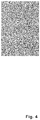
- figure 4 shows the planar metal foil, which in each case as a conductor element 26, 27 for the positive electrodes 23 and the negative electrodes 22 in the second embodiment figure 3 serves.
- This metal foil has a perforated or net-like structure with a thickness of 20 ⁇ m.
- FIG 5 shows a third embodiment of a rechargeable battery cell 40 according to the invention in an exploded view.
- This third exemplary embodiment differs from the two exemplary embodiments explained above in that the positive electrode 44 is encased by a covering 13 .
- a surface area of the casing 13 is greater than a surface area of the positive electrode 44, whose boundary 14 in figure 5 is drawn as a dashed line.
- Two layers 15, 16 of the casing 13, covering the positive electrode 44 on both sides, are connected to one another by an edge connection 17 at the peripheral edge of the positive electrode 44.
- the two negative electrodes 45 are not covered.
- the electrodes 44 and 45 can be contacted via the electrode connections 46 and 47.
- a reference electrolyte used for the examples described below was made according to that described in the patent EP 2 954 588 B1 (hereinafter referred to as [V8]) described methods.
- lithium chloride (LiCl) was treated under vacuum dried at 120 °C for three days.
- Aluminum (Al) particles were dried under vacuum at 450°C for two days.
- LiCl, aluminum chloride (AlCl 3 ) and Al were mixed together in a molar ratio AlCl 3 :LiCl:Al of 1:1.06:0.35 in a glass bottle with an opening allowing gas to escape. Thereafter, this mixture was heat-treated in stages to prepare a molten salt.
- the reference electrolyte formed in this way had the composition LiAlCl 4 * ⁇ SO 2 , where x is dependent on the amount of SO 2 supplied.
- first conductive salts according to formula (I) are referred to below as compounds 1, 2, 3 and 4. They come from the family of polyfluoroalkoxyaluminates and were prepared in hexane according to the following reaction equation starting from LiAlH 4 and the corresponding alcohol R-OH with R 1 ⁇ R 2 ⁇ R 3 ⁇ R 4 .
- the respective concentration of the compounds 1, 2, 3 and 4 in the electrolytes 1, 2, 3 and 4 was 0.6 mol/l (molar concentration based on 1 liter of the electrolyte), unless otherwise stated in the experiment description.
- the experiments described below were carried out with the electrolytes 1, 2, 3 and 4 and the reference electrolyte.
- the full test cells used in the experiments described below are rechargeable battery cells with two negative electrodes and one positive electrode, each separated by a separator.
- the positive electrodes comprised an active material, a conductivity mediator, and a binder.
- the active material of the positive electrode is named in each experiment.
- the negative electrodes contained metallic lithium as the active material, which was deposited or was already present on the discharge element of the negative electrode.
- the discharge element of the positive and the negative electrode consisted of nickel.
- the test full cells were each filled with the electrolyte required for the experiments, i. H. filled either with the reference electrolyte or with electrolytes 1, 2, 3 or 4.
- test full cells For each experiment, several, i.e. two to four, identical test full cells were produced.
- the results presented in the experiments are in each case mean values from the measured values obtained for the identical test-test full cells.
- Top Layer Capacity The capacity consumed in the first cycle for the formation of a cover layer on the negative electrode is an important criterion for the quality of a battery cell. This covering layer is formed on the negative electrode when the test full cell is first charged. Lithium ions are irreversibly consumed for this top layer formation (top layer capacity), so that the test full cell has less cycleable capacity for the subsequent cycles.
- Q lad describes the amount of charge specified in the respective experiment in mAh
- Q ent describes the amount of charge in mAh that was obtained when the full test cell was subsequently discharged.
- the discharge capacity is determined via the number of cycles. To do this, the test full cells are charged with a specific charging current up to a specific upper potential. The corresponding upper potential is maintained until the charging current has dropped to a specific value. Thereafter, the discharge takes place with a specific discharge current intensity up to a specific discharge potential.
- This charging method is referred to as an I/U charge. This process is repeated depending on the desired number of cycles.
- the upper potentials or the discharge potential and the respective charging or discharging currents are named in the experiments.
- the value to which the charging current must have dropped is also described in the experiments.
- upper potential is used synonymously with the terms “charging potential”, “charging voltage”, “end of charge voltage” and “upper potential limit”. The terms describe the voltage/potential up to which a cell or battery is charged using a battery charger.
- the battery is preferably charged at a current rate of C/2 and at a temperature of 22°C. With a charging or discharging rate of 1C, the nominal capacity of a cell is by definition charged or discharged in one hour. A charge rate of C/2 therefore means a charge time of 2 hours.
- discharge potential is used synonymously with the term “lower cell voltage”. This is the voltage/potential to which a cell or battery is discharged using a battery charger.
- the battery is discharged at a current rate of C/2 and at a temperature of 22°C.
- the discharge capacity is obtained from the discharge current and the time until the discharge termination criteria are met.
- Figures show mean values for the discharge capacities as a function of the number of cycles. These mean values of the discharge capacities are each expressed as a percentage of the nominal capacity.
- the charging capacity is specified by the charging parameters. As described above, the discharge capacity is determined for each cycle.
- Example 3 With metallic lithium as the negative electrode active material, three different experiments were carried out in full test cells according to Example 3.
- the three full test cells were filled with the electrolyte 1 described in Example 2.
- the positive electrodes had lithium nickel manganese cobalt oxide as an active material.
- Two charge-discharge cycles were carried out and the discharge capacities were determined.
- Two charge/discharge cycles were carried out directly with the first test full cell.
- An initialization cycle was carried out with the second test full cell before the two charge/discharge cycles.
- metallic lithium was deposited for 3 minutes at 12 mA and continued until charging was complete at 0.1 mA/cm 2 . A discharge then took place. Then the two charge/discharge cycles started.
- the influence of external pressure was examined with the third test full cell.
- the housing of the full test cell was pressed together from the outside with a pressure of approx. 50 N/cm 2 .
- An initialization cycle was then carried out, as described for the second test full cell, followed by two charge/discharge cycles.
- the full test cells were charged with a current of 0.1 mA/cm 2 up to a potential of 4.4 volts and until a charging capacity of 8 mAh/cm 2 was reached. This was followed by discharging with a current of 0.1 mA/cm 2 until a potential of 2.9 volts was reached.
- the figures 6 , 7 and 8th each show the potential in volts of the three test full cells during charging and discharging as a function of the charge in %, which is related to the maximum charge.
- the figures also show the cycle efficiencies of the two cycles shown for each full test cell.
- the figures 10 and 11 each show the potential in volts of the two test full cells during charging and discharging as a function of the charge in %, which is related to the maximum charge.
- the cycle efficiencies of the two cycles shown are also shown for each test full cell. Both test full cells show a similar potential course in cycle 1 and cycle 2. The cycle efficiencies are over 97% for both test full cells and are slightly better for the test full cell, which was operated with a current of 1 mA/cm 2 . Further cycles were carried out with this test full cell (1 mA/cm 2 ). accomplished.
- figure 12 shows the cycle efficiency in % as a function of the number of cycles. The cycle efficiency is stable and in cycle 21 approx. 95% is still achieved.
- test full cells with reference electrolyte were first produced.
- the test full cells included lithium iron phosphate as the positive electrode active material and metallic lithium as the negative electrode active material.
- the full test cell contained a reference electrolyte with the composition LiAlCl 4 ⁇ 6SO 2 .
- figure 13 shows the cycle efficiencies in % as a function of the number of cycles of the first four charge/discharge cycles of the test full cell with a charge/discharge current of 0.1mA/cm 2 , the first seven charge/discharge cycles of the test full cell with a charge/discharge Discharge current of 1mA/cm 2 and the first seven charge/discharge cycles of the test full cell with the reference electrolyte.
- the cycle efficiencies of the test full cells with electrolyte 1 show a very stable course.
- the first test full cell achieves a cycle efficiency of 98% after four cycles, the second test full cell a cycle efficiency of 92% after seven cycles.
- the test full cell with reference electrolyte shows a significantly poorer performance. In cycle 7, it achieves a cycle efficiency of only approx. 68%.
- Electrolytes 1, 3 and 4 were prepared with different concentrations of compounds 1, 3 and 4 to determine the conductivity. For each concentration of the different compounds, the conductivities of the electrolytes were determined using a conductive measurement method. After tempering, a two-electrode sensor was held touchingly in the solution and measured in a measuring range of 0 - 50 mS/cm. During the measurements it was taken into account that the sensor can react with the SO 2 -containing electrolyte solution.
- figure 14 shows the conductivity of the electrolyte 1 as a function of the concentration of the compound 1.
- a maximum of the conductivity can be seen at a concentration of the compound 1 of 0.6 mol/L-0.7 mol/L with a value of approx. 37.9 mS/cm.
- the organic electrolytes known from the state of the art such as LP30 (1 M LiPF6 / EC-DMC (1:1 weight)) have a conductivity of only approx. 10 mS/cm.
- Electrolyte 3 and 16 show the conductivity values determined for the different concentrations of electrolyte 3 and electrolyte 4.
- electrolyte 4 With electrolyte 4, a maximum of 18 mS/cm is achieved at a conductive salt concentration of 1 mol/L.
- Electrolyte 3 shows its highest conductivity of 0.5 mS/cm at a conductive salt concentration of 0.6 mol/L. Although electrolyte 3 shows a lower conductivity, as in experiment 4, charging or discharging a test full cell is quite possible.
Landscapes
- Chemical & Material Sciences (AREA)
- Chemical Kinetics & Catalysis (AREA)
- Electrochemistry (AREA)
- General Chemical & Material Sciences (AREA)
- Engineering & Computer Science (AREA)
- Inorganic Chemistry (AREA)
- Manufacturing & Machinery (AREA)
- Materials Engineering (AREA)
- Organic Chemistry (AREA)
- Condensed Matter Physics & Semiconductors (AREA)
- General Physics & Mathematics (AREA)
- Physics & Mathematics (AREA)
- Composite Materials (AREA)
- Crystallography & Structural Chemistry (AREA)
- Secondary Cells (AREA)
- Battery Electrode And Active Subsutance (AREA)
- Cell Electrode Carriers And Collectors (AREA)
- Primary Cells (AREA)
Claims (29)
- Cellule de batterie rechargeable (2, 20, 40), contenant un métal actif, au moins une électrode positive (4, 23, 44) avec un élément de décharge (26), au moins une électrode négative (5, 22, 45) avec un élément de décharge (27), un boîtier (1, 28) et un électrolyte,dans laquelle l'électrode négative (5, 22, 45) contient du lithium métallique comme matériau actif au moins dans l'état chargé de la cellule de batterie rechargeableet dans laquelle l'électrolyte est à base de SO2 et contient au moins un premier sel conducteur qui présente la formule (I)
 dans laquelle- M est un métal choisi dans le groupe formé par les métaux alcalins, les métaux alcalino-terreux, les métaux du groupe 12 du tableau périodique des éléments et l'aluminium ;- x est un nombre entier de 1 à 3 ;- les substituants R1, R2, R3 et R4 sont choisis, indépendamment les uns des autres, dans le groupe formé par les groupes alkyle en C1-C10, alcényle en C2-C10, alcynyle en C2-C10, cycloalkyle en C3-C10, aryle en C6-C14 et hétéroaryle en C5-C14 ; et- dans laquelle Z est l'aluminium ou le bore.
 - Cellule de batterie rechargeable (2, 20, 40) selon la revendication 1,
dans laquelle le lithium métallique peut être déposé sur l'élément de décharge (27) de l'électrode négative (5, 22, 45) lors de la charge de la cellule de batterie rechargeable. - Cellule de batterie rechargeable (2, 20, 40) selon la revendication 1 ou 2, dans laquelle le lithium métallique se trouve sur l'élément de décharge (27) de l'électrode négative (5, 22, 45) à l'état chargé de la cellule de batterie rechargeable.
- Cellule de batterie rechargeable (2, 20, 40) selon l'une des revendications 1 à 3,
dans laquelle le lithium métallique est déjà présent sur l'élément de décharge (27) de l'électrode négative (5, 22, 45) avant la première charge de la cellule de batterie rechargeable. - Cellule de batterie rechargeable (2, 20, 40) selon l'une des revendications précédentes,
dans laquelle (5, 22, 45) l'élément de décharge (27) de l'électrode négative (5, 22, 45) est réalisé de manière- plane sous la forme d'une tôle métallique ou d'une feuille métallique, ou- tridimensionnelle sous la forme d'une structure métallique poreuse, en particulier sous la forme d'une mousse métallique (18). - Cellule de batterie rechargeable (2, 20, 40) selon l'une des revendications précédentes,
dans laquelle l'élément de décharge (27) de l'électrode négative (5, 22, 45) est formé au moins partiellement d'un matériau stockant le lithium choisi dans le groupe formé par- le carbone, en particulier dans la modification graphite,- un matériau de formation d'alliage de lithium,- un matériau d'intercalation de lithium qui ne contient pas de carbone, en particulier le titanate de lithium (par exemple Li4Ti5O12), et- un matériau de conversion, en particulier un oxyde de métal de transition. - Cellule de batterie rechargeable (2, 20, 40) selon la revendication 6,
dans laquelle le matériau de formation d'alliage de lithium est choisi- dans le groupe formé par les métaux et alliages métalliques stockant le lithium, de préférence Si, Ge, Sn, SnCoxCy ou SnSix, ou- dans le groupe formé par les oxydes de métaux et d'alliages métalliques stockant le lithium, de préférence SnOx, SiOx, les verres d'oxydes de Sn et Si. - Cellule de batterie rechargeable (2, 20, 40) selon l'une des revendications précédentes,
dans laquelle l'électrode positive (4, 23, 44) contient comme matériau actif au moins un composé qui présente de préférence la composition LixM'yM"zOa, dans laquelle- M' est au moins un métal choisi dans le groupe formé par les éléments Ti, V, Cr, Mn, Fe, Co, Ni, Cu et Zn ;- M" est au moins un élément choisi dans le groupe formé par les éléments 2, 3, 4, 5, 6, 7, 8, 9, 10, 11, 12, 13, 14, 15 et 16 du tableau périodique des éléments ;- x et y sont, indépendamment l'un de l'autre, des nombres supérieurs à 0 ;- z est un nombre supérieur ou égal à 0 ; et- a est un nombre supérieur à 0. - Cellule de batterie rechargeable (2, 20, 40) selon la revendication 8,dans laquelle le composé présente la composition LixM'yM"zOa, dans laquelle M' est le manganèse et M" est le cobalt, etdans laquelle, de préférence, x, y et z sont égaux à 1 et a est égal à 4.
- Cellule de batterie rechargeable (2, 20, 40) selon la revendication 8 ou 9, dans laquelle le composé présente la composition LixM'yM"zOa, dans laquelle M' comprend le nickel et le manganèse et M" est le cobalt, et présente la formule LixNiy1Mny2CoOa, dans laquelle y1 et y2 sont, indépendamment l'un de l'autre, des nombres supérieurs à 0.
- Cellule de batterie rechargeable (2, 20, 40) selon la revendication 8,
dans laquelle le composé présente la composition LixM'yMn"1 z1M"2 z2O4, dans laquelle M"1 est au moins un élément choisi dans le groupe formé par les éléments des groupes 2, 3, 4, 5, 6, 7, 8, 9, 10, 11, 12, 13, 14, 15 et 16 du tableau périodique des éléments, M"2 est le phosphore, z1 est un nombre supérieur ou égal à 0 et z2 a la valeur 1. - Cellule de batterie rechargeable (2, 20, 40) selon la revendication 11,dans laquelle le composé présente la composition LixM'yMn"1 z1PO4, dans laquelle M' est le fer et M"1 est le manganèse,le composé présentant de préférence la composition Li(Fe0,3Mn0,7)PO4.
- Cellule de batterie rechargeable (2, 20, 40) selon l'une des revendications précédentes,
dans laquelle les substituants R1, R2, R3 et R4 du premier sel conducteur sont choisis, indépendamment les uns des autres, dans le groupe formé par les groupes :- alkyle en C1-C6 ; de préférence alkyle en C2-C4 ; de manière particulièrement préférée les groupes alkyle 2-propyle, méthyle et éthyle ;- alcényle en C2-C6 ; de préférence alcényle en C2-C4, de manière particulièrement préférée les groupes alcényle éthényle et propényle ;- alcynyle en C2-C6 ; de préférence alcynyle en C2-C4 ;- cycloalkyle en C3-C6 ;- phényle ; et- hétéroaryle en C5-C7. - Cellule de batterie rechargeable (2, 20, 40) selon l'une des revendications précédentes,
dans laquelle au moins l'un des substituants R1, R2, R3 et R4 du premier sel conducteur est substitué par au moins un atome de fluor et/ou par au moins un groupe chimique, ledit groupe chimique étant choisi dans le groupe formé par les groupes alkyle en C1-C4, alcényle en C2-C4, alcynyle en C2-C4, phényle et benzyle. - Cellule de batterie rechargeable (2, 20, 40) selon l'une des revendications précédentes,
dans laquelle au moins l'un des substituants R1, R2, R3 et R4 du premier sel conducteur est un groupe CF3 ou un groupe OSO2CF3. - Cellule de batterie rechargeable (2, 20, 40) selon l'une des revendications précédentes,
dans laquelle le premier sel conducteur est choisi dans le groupe formé par :
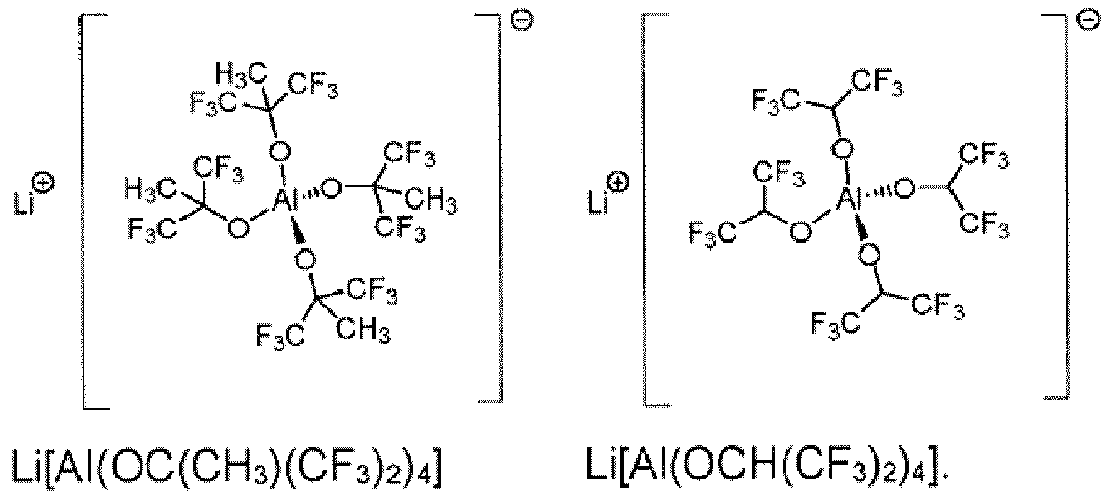
- Cellule de batterie rechargeable (2, 20, 40) selon l'une des revendications précédentes,
dans laquelle l'électrolyte contient au moins un deuxième sel conducteur différent du premier sel conducteur selon la formule (I). - Cellule de batterie rechargeable (2, 20, 40) selon la revendication 17,
dans laquelle le deuxième sel conducteur de l'électrolyte est un composé de métal alcalin, en particulier un composé de lithium, choisi dans le groupe formé par un aluminate, un halogénure, un oxalate, un borate, un phosphate, un arséniate et un gallate. - Cellule de batterie rechargeable (2, 20, 40) selon la revendication 17 ou 18, dans laquelle le deuxième sel conducteur de l'électrolyte est un tétrahalogénoaluminate de lithium, en particulier le tétrachloroaluminate de lithium.
- Cellule de batterie rechargeable (2, 20, 40) selon l'une des revendications précédentes,
dans laquelle l'électrolyte contient au moins un additif. - Cellule de batterie rechargeable (2, 20, 40) selon la revendication 20,
dans laquelle l'additif de l'électrolyte est choisi dans le groupe formé par le carbonate de vinylène et ses dérivés, le carbonate de vinyléthylène et ses dérivés, le carbonate de méthyléthylène et ses dérivés, le (bisoxalato)borate de lithium, le difluoro(oxalato)borate de lithium, le tétrafluoro(oxalato)phosphate de lithium, l'oxalate de lithium, le 2-vinylpyridine, le 4-vinylpyridine, les carbonates d'exométhylène cycliques, les sultones, les sulfonates cycliques et acycliques, les sulfites acycliques, les sulfinates cycliques et acycliques, les esters organiques d'acides inorganiques, les alcanes acycliques et cycliques, lesquels alcanes acycliques et cycliques présentent un point d'ébullition à 1 bar d'au moins 36 °C, les composés aromatiques, les sulfonylimides cycliques et acycliques halogénés, les esters de phosphate cycliques et acycliques halogénés, les phosphines cycliques et acycliques halogénées, les phosphites cycliques et acycliques halogénés, les phosphazènes cycliques et acycliques halogénés, les silylamines cycliques et acycliques halogénées, les esters cycliques et acycliques halogénés, les amides cycliques et acycliques halogénés, les anhydrides cycliques et acycliques halogénés et les hétérocycles organiques halogénés. - Cellule de batterie rechargeable (2, 20, 40) selon l'une des revendications précédentes,
dans laquelle l'électrolyte présente la composition suivante :(i) 5 à 99,4 % en poids de dioxyde de soufre,(ii) 0,6 à 95 % en poids du premier sel conducteur,(iii) 0 à 25 % en poids du deuxième sel conducteur et(iv) 0 à 10 % en poids de l'additif,par rapport au poids total de la composition de l'électrolyte. - Cellule de batterie rechargeable (2, 20, 40) selon l'une des revendications précédentes,
dans laquelle la concentration molaire du premier sel conducteur se situe dans la plage de 0,01 mol/l à 10 mol/l, de préférence de 0,05 mol/l à 10 mol/l, plus préférentiellement de 0,1 mol/l à 6 mol/l et de manière particulièrement préférée de 0,2 mol/l à 3,5 mol/l, par rapport au volume total de l'électrolyte. - Cellule de batterie rechargeable (2, 20, 40) selon l'une des revendications précédentes,
dans laquelle l'électrolyte contient au moins 0,1 mole de SO2, de préférence au moins 1 mole de SO2, plus préférentiellement au moins 5 moles de SO2, encore plus préférentiellement au moins 10 moles de SO2 et de manière particulièrement préférée au moins 20 moles de SO2 par mole de sel conducteur. - Cellule de batterie rechargeable (2, 20, 40) selon l'une des revendications précédentes,
dans laquelle l'électrode positive (4, 23, 44) contient au moins un composé métallique choisi dans le groupe formé par un oxyde métallique, un halogénure métallique et un phosphate métallique, le métal du composé métallique étant de préférence un métal de transition des numéros atomiques 22 à 28 du tableau périodique des éléments, en particulier le cobalt, le nickel, le manganèse ou le fer. - Cellule de batterie rechargeable (2, 20, 40) selon l'une des revendications précédentes,
dans laquelle l'électrode positive (4, 23, 44) contient au moins un composé métallique qui possède la structure chimique d'un spinelle, d'un oxyde stratifié, d'un composé de conversion ou d'un composé polyanionique. - Cellule de batterie rechargeable (2, 20, 40) selon l'une des revendications précédentes,
dans laquelle l'électrode positive (4, 23, 44) présente un élément de décharge (34) qui est de préférence réalisé de manière- plane sous la forme d'une tôle métallique ou d'une feuille métallique, ou- tridimensionnelle sous la forme d'une structure métallique poreuse, en particulier sous la forme d'une mousse métallique (18). - Cellule de batterie rechargeable (2, 20, 40) selon l'une des revendications précédentes,dans laquelle l'électrode positive (4, 23, 44) et/ou l'électrode négative (5) contient au moins un liant, de préférence un liant fluoré, en particulier un polyfluorure de vinylidène et/ou un terpolymère composé de tétrafluoroéthylène, d'hexafluoropropylène et de fluorure de vinylidène, ouun liant constitué d'un polymère composé d'unités structurales monomères d'un acide carboxylique conjugué ou du sel de métal alcalin, de métal alcalino-terreux ou d'ammonium de cet acide carboxylique conjugué ou d'une combinaison de ceux-ci, ouun liant constitué d'un polymère qui est basé sur des unités structurales monomères de styrène et de butadiène, ou qui contient un liant du groupe des carboxyméthylcelluloses,le liant étant de préférence présent à une concentration d'au plus 20 % en poids, plus préférentiellement d'au plus 15 % en poids, plus préférentiellement d'au plus 10 % en poids, plus préférentiellement d'au plus 7 % en poids, plus préférentiellement d'au plus 5 % en poids et de manière particulièrement préférée d'au plus 2 % en poids par rapport au poids total de l'électrode positive.
- Cellule de batterie rechargeable (2, 20, 40) selon l'une des revendications précédentes,
lequel comprend plusieurs électrodes négatives (5, 22, 45) et plusieurs électrodes positives (4, 23, 44) qui sont disposées alternativement empilées dans le boîtier (1, 28), les électrodes positives et les électrodes négatives (5, 22, 45) étant de préférence chaque fois séparées électriquement les unes des autres par des séparateurs (11, 13, 21).
Priority Applications (1)
| Application Number | Priority Date | Filing Date | Title |
|---|---|---|---|
| PL20746667T PL3794666T3 (pl) | 2019-07-31 | 2020-07-30 | Umożliwiające wielokrotne ładowanie ogniwo akumulatorowe |
Applications Claiming Priority (2)
| Application Number | Priority Date | Filing Date | Title |
|---|---|---|---|
| EP19189435.1A EP3772129B1 (fr) | 2019-07-31 | 2019-07-31 | Électrolyte à base de so2 pour un élément de batterie rechargeable et élément de batterie rechargeable le comprenant |
| PCT/EP2020/071579 WO2021019047A1 (fr) | 2019-07-31 | 2020-07-30 | Pile rechargeable |
Publications (3)
| Publication Number | Publication Date |
|---|---|
| EP3794666A1 EP3794666A1 (fr) | 2021-03-24 |
| EP3794666B1 EP3794666B1 (fr) | 2021-12-29 |
| EP3794666B9 true EP3794666B9 (fr) | 2022-05-11 |
Family
ID=67514423
Family Applications (6)
| Application Number | Title | Priority Date | Filing Date |
|---|---|---|---|
| EP19189435.1A Active EP3772129B1 (fr) | 2019-07-31 | 2019-07-31 | Électrolyte à base de so2 pour un élément de batterie rechargeable et élément de batterie rechargeable le comprenant |
| EP20746661.6A Active EP3791437B1 (fr) | 2019-07-31 | 2020-07-30 | Cellule de batterie rechargeable |
| EP20746662.4A Active EP3794664B1 (fr) | 2019-07-31 | 2020-07-30 | Cellule de batterie rechargeable |
| EP20746667.3A Active EP3794666B9 (fr) | 2019-07-31 | 2020-07-30 | Cellule de batterie rechargeable |
| EP20746666.5A Active EP3794665B1 (fr) | 2019-07-31 | 2020-07-30 | Cellule de batterie rechargeable |
| EP20746660.8A Active EP3794663B9 (fr) | 2019-07-31 | 2020-07-30 | Cellule de batterie rechargeable |
Family Applications Before (3)
| Application Number | Title | Priority Date | Filing Date |
|---|---|---|---|
| EP19189435.1A Active EP3772129B1 (fr) | 2019-07-31 | 2019-07-31 | Électrolyte à base de so2 pour un élément de batterie rechargeable et élément de batterie rechargeable le comprenant |
| EP20746661.6A Active EP3791437B1 (fr) | 2019-07-31 | 2020-07-30 | Cellule de batterie rechargeable |
| EP20746662.4A Active EP3794664B1 (fr) | 2019-07-31 | 2020-07-30 | Cellule de batterie rechargeable |
Family Applications After (2)
| Application Number | Title | Priority Date | Filing Date |
|---|---|---|---|
| EP20746666.5A Active EP3794665B1 (fr) | 2019-07-31 | 2020-07-30 | Cellule de batterie rechargeable |
| EP20746660.8A Active EP3794663B9 (fr) | 2019-07-31 | 2020-07-30 | Cellule de batterie rechargeable |
Country Status (14)
| Country | Link |
|---|---|
| US (6) | US11710849B2 (fr) |
| EP (6) | EP3772129B1 (fr) |
| JP (6) | JP7232357B2 (fr) |
| KR (6) | KR102470114B1 (fr) |
| CN (11) | CN120280465A (fr) |
| AU (6) | AU2020319847B2 (fr) |
| BR (1) | BR112021022989A2 (fr) |
| CA (6) | CA3139798C (fr) |
| DK (2) | DK3772129T3 (fr) |
| ES (6) | ES2884936T3 (fr) |
| HU (6) | HUE055324T2 (fr) |
| IL (6) | IL288109B2 (fr) |
| PL (6) | PL3772129T3 (fr) |
| WO (6) | WO2021019045A1 (fr) |
Families Citing this family (36)
| Publication number | Priority date | Publication date | Assignee | Title |
|---|---|---|---|---|
| DE102013016560A1 (de) * | 2013-09-27 | 2015-04-02 | Heide Biollaz | Wiederaufladbare elektrochemische Batteriezelle |
| DK3772129T3 (da) | 2019-07-31 | 2021-07-26 | Innolith Tech Ag | So2-baseret elektrolyt til en genopladelig battericelle og genopladelig battericelle omfattende denne |
| EP4037051B1 (fr) * | 2021-01-29 | 2026-03-25 | Innolith Technology AG | Élément de batterie rechargeable |
| JP2024519014A (ja) * | 2021-05-19 | 2024-05-08 | 住友化学株式会社 | 化合物 |
| GB2606746A (en) * | 2021-05-19 | 2022-11-23 | Sumitomo Chemical Co | Compound |
| DE102021118811A1 (de) | 2021-07-21 | 2023-01-26 | Bayerische Motoren Werke Aktiengesellschaft | Flüssige Elektrolytzusammensetzung sowie eine elektrochemische Zelle mit der Elektrolytzusammensetzung |
| DE102021131511A1 (de) | 2021-12-01 | 2023-06-01 | Bayerische Motoren Werke Aktiengesellschaft | Kathode mit einem fluorhaltigen Polymer sowie eine Festkörperbatterie mit der Kathode |
| DE102021132745A1 (de) | 2021-12-10 | 2023-06-15 | Bayerische Motoren Werke Aktiengesellschaft | Batteriespeicher mit einer Sicherheitsvorrichtung sowie Verfahren zum Auslösen der Sicherheitsvorrichtung |
| DE102021132742A1 (de) | 2021-12-10 | 2023-06-15 | Bayerische Motoren Werke Aktiengesellschaft | Batteriespeicher mit einer Sicherheitsvorrichtung sowie Verfahren zum Auslösen der Sicherheitsvorrichtung |
| DE102021132739A1 (de) | 2021-12-10 | 2023-06-15 | Bayerische Motoren Werke Aktiengesellschaft | Batteriespeicher mit einer Sicherheitsvorrichtung und ein Verfahren zum Auslösen der Sicherheitsvorrichtung |
| DE102021132740A1 (de) | 2021-12-10 | 2023-06-15 | Bayerische Motoren Werke Aktiengesellschaft | Batteriespeicher mit einer Filtervorrichtung |
| DE102021132747A1 (de) | 2021-12-10 | 2023-06-15 | Bayerische Motoren Werke Aktiengesellschaft | Batteriezelle sowie Batteriespeicher mit der Batteriezelle |
| DE102021132746A1 (de) | 2021-12-10 | 2023-06-15 | Bayerische Motoren Werke Aktiengesellschaft | Batteriespeicher mit einer Sicherheitsvorrichtung sowie Verfahren zum Auslösen der Sicherheitsvorrichtung |
| EP4199150A1 (fr) | 2021-12-17 | 2023-06-21 | Innolith Technology AG | Cellule de batterie rechargeable |
| EP4199149B1 (fr) | 2021-12-17 | 2024-07-17 | Innolith Technology AG | Cellule de batterie rechargeable |
| CN117096447A (zh) * | 2022-05-12 | 2023-11-21 | 珠海冠宇电池股份有限公司 | 一种电池 |
| US20250201926A1 (en) | 2022-07-13 | 2025-06-19 | Bayerische Motoren Werke Aktiengesellschaft | Liquid Electrolyte Composition Comprising a Salt, Electrochemical Cell Comprising the Electrolyte Composition, Salt, and Use of the Salt in the Electrochemical Cell |
| WO2024012973A1 (fr) | 2022-07-13 | 2024-01-18 | Bayerische Motoren Werke Aktiengesellschaft | Composition d'électrolyte liquide comprenant un sel, cellule électrochimique comprenant la composition d'électrolyte, sel et utilisation du sel dans la cellule électrochimique |
| CN117623260B (zh) * | 2022-08-10 | 2024-12-10 | 比亚迪股份有限公司 | 一种电池材料及其制备方法、应用 |
| CN115367816B (zh) * | 2022-10-27 | 2023-02-03 | 宜宾锂宝新材料有限公司 | 一种镍锰酸锂正极材料、其制备方法及锂离子电池 |
| CN115799637B (zh) * | 2022-12-06 | 2026-04-14 | 珠海冠宇电池股份有限公司 | 一种电解液及包括该电解液的电池 |
| DE102023102564A1 (de) | 2023-02-02 | 2024-08-08 | Bayerische Motoren Werke Aktiengesellschaft | Elektrode für eine Lithiumionenbatterie umfassend einen Hybridelektrolyten und Lithiumionenbatterie |
| GB2628420A (en) * | 2023-03-24 | 2024-09-25 | Sumitomo Chemical Co | Compound |
| CN116053591B (zh) * | 2023-03-30 | 2023-06-27 | 宁德新能源科技有限公司 | 一种二次电池的电解液、二次电池及电子装置 |
| GB2628617A (en) | 2023-03-30 | 2024-10-02 | Sumitomo Chemical Co | Compound |
| DE102023114688A1 (de) * | 2023-06-05 | 2024-12-05 | Bayerische Motoren Werke Aktiengesellschaft | Verfahren zum Erzeugen eines porösen Ableiters und Lithiumionenbatterie |
| CN116404238A (zh) * | 2023-06-08 | 2023-07-07 | 广州天赐高新材料股份有限公司 | 一种含有含硫无机成分的电解液和包括该电解液的锂离子电池 |
| DE102023120084A1 (de) | 2023-07-28 | 2025-01-30 | Bayerische Motoren Werke Aktiengesellschaft | Flüssige Elektrolytzusammensetzung mit einem Salz, elektrochemische Zelle mit der Elektrolytzusammensetzung, Salz sowie Verwendung des Salzes in der elektrochemischen Zelle |
| EP4531159A1 (fr) * | 2023-09-26 | 2025-04-02 | Centre National de la Recherche Scientifique | Additif à base d'aluminium pour batteries |
| DE102023004075A1 (de) | 2023-10-11 | 2025-01-09 | Mercedes-Benz Group AG | Zellgehäuse und Batteriezelle |
| KR20250079619A (ko) | 2023-11-27 | 2025-06-04 | 정진웅 | 맞춤형 여행 콘텐츠를 제공하는 서버 |
| KR20250087969A (ko) | 2023-12-08 | 2025-06-17 | 주식회사 이앤지테크 | 팝업댓글 플랫폼을 활용한 소상공인 업소안내 증강현실 시스템 및 그 구동방법 |
| CN117586294B (zh) * | 2024-01-18 | 2024-05-28 | 山东海化集团有限公司 | 一种四(六氟异丙氧基)硼酸钠的制备方法及其在钠电中的应用 |
| KR20250113805A (ko) * | 2024-01-19 | 2025-07-28 | 쿨롱 주식회사 | 배터리 셀 |
| DE102024121311A1 (de) * | 2024-07-26 | 2026-01-29 | Bayerische Motoren Werke Aktiengesellschaft | Elektrochemische Zelle und ein Fahrzeug aufweisend die elektrochemische Zelle |
| WO2026044639A1 (fr) * | 2024-08-30 | 2026-03-05 | 宁德新能源科技有限公司 | Batterie secondaire et dispositif électronique |
Family Cites Families (44)
| Publication number | Priority date | Publication date | Assignee | Title |
|---|---|---|---|---|
| US4891281A (en) * | 1982-08-09 | 1990-01-02 | Duracell Inc. | Electrochemical cells having low vapor pressure complexed SO2 electrolytes |
| CA1210056A (fr) * | 1982-08-09 | 1986-08-19 | Donald L. Foster | Piles electrochimiques a electrolytes complexes de so.sub.2 a basse pression de vapeur |
| US4510220A (en) * | 1983-06-30 | 1985-04-09 | Duracell Inc. | Cell with PbCl2 cathode |
| JP4306858B2 (ja) * | 1999-02-22 | 2009-08-05 | 三洋電機株式会社 | 非水電解質電池用溶質及び非水電解質電池 |
| PT1201004E (pt) | 1999-06-18 | 2005-03-31 | Hambitzer Gunther | Celula electroquimica recarregavel |
| JP3463926B2 (ja) * | 1999-11-15 | 2003-11-05 | セントラル硝子株式会社 | 電気化学ディバイス用電解液 |
| JP4020557B2 (ja) | 2000-01-26 | 2007-12-12 | セントラル硝子株式会社 | 電気化学ディバイス用電解液 |
| DE10054233A1 (de) | 2000-05-19 | 2002-05-08 | Univ Stuttgart Lehrstuhl Und I | Kovalent vernetzte Kompositmembranen |
| DE10027995A1 (de) | 2000-06-09 | 2001-12-13 | Merck Patent Gmbh | Ionische Flüssigkeiten II |
| JP4990441B2 (ja) | 2001-04-06 | 2012-08-01 | トータル ワイヤレス ソリューショオンズ リミテッド | シート状リチウム二次電池 |
| JP2003157896A (ja) | 2001-11-21 | 2003-05-30 | Matsushita Electric Ind Co Ltd | 非水電解質二次電池 |
| DE10201936A1 (de) | 2002-01-19 | 2003-07-31 | Fortu Bat Batterien Gmbh | Wiederaufladbare elektrochemische Batteriezelle |
| US20030157409A1 (en) | 2002-02-21 | 2003-08-21 | Sui-Yang Huang | Polymer lithium battery with ionic electrolyte |
| RU2248071C2 (ru) | 2003-04-17 | 2005-03-10 | ООО Инженерная фирма "Орион ХИТ" | СПОСОБ ПРИГОТОВЛЕНИЯ РАСТВОРА ЭЛЕКТРОЛИТА ДЛЯ Li/SO2 АККУМУЛЯТОРА |
| CN1898833B (zh) | 2003-09-23 | 2010-04-14 | 冈瑟·汉比特泽 | 电化学电池 |
| WO2005117195A1 (fr) | 2004-05-28 | 2005-12-08 | Lg Chem, Ltd. | Accumulateur au lithium presentant des tensions de coupure de charge superieures a 4,35 |
| JP4349321B2 (ja) * | 2004-12-10 | 2009-10-21 | ソニー株式会社 | 電池 |
| EP1923934A1 (fr) | 2006-11-14 | 2008-05-21 | Fortu Intellectual Property AG | pile électrochimique rechargeable |
| JP2008277001A (ja) | 2007-04-26 | 2008-11-13 | Mitsubishi Chemicals Corp | 非水系電解液及び非水系電解液電池 |
| US8313866B2 (en) | 2007-05-22 | 2012-11-20 | Tiax Llc | Non-aqueous electrolytes and electrochemical devices including the same |
| EP2065887A1 (fr) * | 2007-11-30 | 2009-06-03 | Hitachi Global Storage Technologies Netherlands B.V. | Procédé de fabrication d'unité de disque magnétique |
| US20130040188A1 (en) | 2011-08-12 | 2013-02-14 | Fortu Intellectual Property Ag | Rechargeable electrochemical battery cell |
| EP2360772A1 (fr) | 2010-02-12 | 2011-08-24 | Fortu Intellectual Property AG | Cellule électrochimique rechargeable |
| US9209458B2 (en) * | 2010-02-10 | 2015-12-08 | Alevo Research Ag | Rechargeable electrochemical battery cell |
| ES2599646T3 (es) * | 2010-02-23 | 2017-02-02 | Toda Kogyo Corporation | Polvo de partículas precursoras de sustancia activa para un electrodo activo, polvo en partículas de sustancia activa para un electrodo positivo y batería secundaria de electrolito no acuoso |
| US20120082872A1 (en) | 2010-09-30 | 2012-04-05 | Basf Se | Additive for electrolytes |
| US9437370B2 (en) * | 2012-02-27 | 2016-09-06 | Nanotek Instruments, Inc. | Lithium-ion cell having a high-capacity anode and a high-capacity cathode |
| RU2629556C2 (ru) | 2013-02-07 | 2017-08-30 | Алево Интернешнл С.А. | Электролит для электрохимического элемента аккумуляторной батареи и содержащий электролит элемент аккумуляторной батареи |
| EP2827430A1 (fr) * | 2013-07-19 | 2015-01-21 | Basf Se | Utilisation d'alkoxyborates de lithium et alkoxyaluminates de lithium comme sels conducteurs dans des électrolytes de batteries au lithium-ion |
| WO2015007586A1 (fr) * | 2013-07-19 | 2015-01-22 | Basf Se | Utilisation d'alcoxyborates de lithium et d'alcoxyaluminates de lithium en tant que sels conducteurs dans des électrolytes de piles au lithium-soufre |
| DE102013016560A1 (de) | 2013-09-27 | 2015-04-02 | Heide Biollaz | Wiederaufladbare elektrochemische Batteriezelle |
| KR101542880B1 (ko) | 2013-10-08 | 2015-08-07 | 전자부품연구원 | 나트륨-금속염화물계 이차 전지 및 그의 제조 방법 |
| EP3069401B1 (fr) | 2013-11-15 | 2018-11-07 | The Regents of the University of California | Dispositifs électrochimiques comprenant des électrolytes à base de solvant de type gaz comprimé |
| KR101586194B1 (ko) * | 2014-09-16 | 2016-01-20 | 전자부품연구원 | 금속염화물과 알칼리금속염화물을 함유하는 양극 및 그를 포함하는 알칼리금속이온 이차 전지 |
| DE102015210402A1 (de) | 2015-06-05 | 2016-12-08 | Robert Bosch Gmbh | Kathodenmaterial für Lithium-Schwefel-Zelle |
| KR101693576B1 (ko) * | 2015-09-09 | 2017-01-11 | 전자부품연구원 | 이산화황 기반 무기 전해액 및 그를 이용한 이산화황 기반의 레독스 흐름 이차전지 |
| US20180254516A1 (en) | 2015-10-02 | 2018-09-06 | Sion Power Corporation | Non-aqueous electrolytes for high energy lithium-ion batteries |
| US10734642B2 (en) | 2016-03-30 | 2020-08-04 | Global Graphene Group, Inc. | Elastomer-encapsulated particles of high-capacity anode active materials for lithium batteries |
| DE102016106947A1 (de) | 2016-04-14 | 2017-10-19 | Fortu New Battery Technology Gmbh | Elektrolyt für wiederaufladbare elektrochemische Batteriezellen |
| FR3053843B1 (fr) | 2016-07-05 | 2021-12-10 | Renault Sas | Cellule comprenant un electrolyte comprenant un sel metallique particulier |
| KR102227302B1 (ko) | 2016-07-29 | 2021-03-15 | 주식회사 엘지화학 | 이차전지용 양극활물질 조성물 및 이를 포함하는 이차전지 |
| DE102016125177A1 (de) | 2016-12-21 | 2018-06-21 | Fortu New Battery Technology Gmbh | Elektrode-Separator-Element mit einer keramischen Separatorschicht |
| JP6288338B1 (ja) | 2017-03-24 | 2018-03-07 | 住友大阪セメント株式会社 | リチウムイオン二次電池用正極材料、リチウムイオン二次電池用正極、リチウムイオン二次電池 |
| DK3772129T3 (da) | 2019-07-31 | 2021-07-26 | Innolith Tech Ag | So2-baseret elektrolyt til en genopladelig battericelle og genopladelig battericelle omfattende denne |
-
2019
- 2019-07-31 DK DK19189435.1T patent/DK3772129T3/da active
- 2019-07-31 ES ES19189435T patent/ES2884936T3/es active Active
- 2019-07-31 EP EP19189435.1A patent/EP3772129B1/fr active Active
- 2019-07-31 PL PL19189435T patent/PL3772129T3/pl unknown
- 2019-07-31 HU HUE19189435A patent/HUE055324T2/hu unknown
-
2020
- 2020-06-10 US US16/897,440 patent/US11710849B2/en active Active
- 2020-07-30 EP EP20746661.6A patent/EP3791437B1/fr active Active
- 2020-07-30 WO PCT/EP2020/071577 patent/WO2021019045A1/fr not_active Ceased
- 2020-07-30 AU AU2020319847A patent/AU2020319847B2/en active Active
- 2020-07-30 ES ES20746666T patent/ES2902452T3/es active Active
- 2020-07-30 IL IL288109A patent/IL288109B2/en unknown
- 2020-07-30 ES ES20746667T patent/ES2906730T3/es active Active
- 2020-07-30 KR KR1020217039074A patent/KR102470114B1/ko active Active
- 2020-07-30 EP EP20746662.4A patent/EP3794664B1/fr active Active
- 2020-07-30 WO PCT/EP2020/071563 patent/WO2021019041A1/fr not_active Ceased
- 2020-07-30 ES ES20746662T patent/ES2902219T3/es active Active
- 2020-07-30 JP JP2021566341A patent/JP7232357B2/ja active Active
- 2020-07-30 HU HUE20746662A patent/HUE057612T2/hu unknown
- 2020-07-30 CN CN202510131608.6A patent/CN120280465A/zh active Pending
- 2020-07-30 PL PL20746660T patent/PL3794663T3/pl unknown
- 2020-07-30 BR BR112021022989A patent/BR112021022989A2/pt active IP Right Grant
- 2020-07-30 WO PCT/EP2020/071566 patent/WO2021019043A1/fr not_active Ceased
- 2020-07-30 AU AU2020322166A patent/AU2020322166B2/en active Active
- 2020-07-30 CN CN202080007147.7A patent/CN113196541B/zh active Active
- 2020-07-30 PL PL20746661T patent/PL3791437T3/pl unknown
- 2020-07-30 CN CN202080007172.5A patent/CN113348579A/zh active Pending
- 2020-07-30 AU AU2020319679A patent/AU2020319679B2/en active Active
- 2020-07-30 KR KR1020217039067A patent/KR102470110B1/ko active Active
- 2020-07-30 CA CA3139798A patent/CA3139798C/fr active Active
- 2020-07-30 AU AU2020321601A patent/AU2020321601B2/en active Active
- 2020-07-30 CN CN202080007160.2A patent/CN113196543A/zh active Pending
- 2020-07-30 IL IL288766A patent/IL288766B2/en unknown
- 2020-07-30 DK DK20746667.3T patent/DK3794666T3/da active
- 2020-07-30 CN CN202410361278.5A patent/CN118099532A/zh active Pending
- 2020-07-30 IL IL288108A patent/IL288108B2/en unknown
- 2020-07-30 IL IL288765A patent/IL288765B2/en unknown
- 2020-07-30 CN CN202080007159.XA patent/CN113196542A/zh active Pending
- 2020-07-30 KR KR1020217040350A patent/KR102470149B1/ko active Active
- 2020-07-30 CA CA3139807A patent/CA3139807C/fr active Active
- 2020-07-30 PL PL20746667T patent/PL3794666T3/pl unknown
- 2020-07-30 CN CN202410511651.0A patent/CN118867363A/zh active Pending
- 2020-07-30 WO PCT/EP2020/071573 patent/WO2021019044A1/fr not_active Ceased
- 2020-07-30 CA CA3139800A patent/CA3139800C/fr active Active
- 2020-07-30 AU AU2020323712A patent/AU2020323712B2/en active Active
- 2020-07-30 CN CN202080007173.XA patent/CN113273000A/zh active Pending
- 2020-07-30 KR KR1020217039096A patent/KR102470119B1/ko active Active
- 2020-07-30 IL IL288762A patent/IL288762B2/en unknown
- 2020-07-30 HU HUE20746661A patent/HUE057151T2/hu unknown
- 2020-07-30 CN CN202510363564.XA patent/CN120221763A/zh active Pending
- 2020-07-30 EP EP20746667.3A patent/EP3794666B9/fr active Active
- 2020-07-30 EP EP20746666.5A patent/EP3794665B1/fr active Active
- 2020-07-30 ES ES20746661T patent/ES2902968T3/es active Active
- 2020-07-30 PL PL20746666T patent/PL3794665T3/pl unknown
- 2020-07-30 JP JP2021566340A patent/JP7232356B2/ja active Active
- 2020-07-30 HU HUE20746660A patent/HUE058122T2/hu unknown
- 2020-07-30 AU AU2020320033A patent/AU2020320033B2/en active Active
- 2020-07-30 WO PCT/EP2020/071565 patent/WO2021019042A1/fr not_active Ceased
- 2020-07-30 JP JP2021566339A patent/JP7232355B2/ja active Active
- 2020-07-30 CA CA3141137A patent/CA3141137C/fr active Active
- 2020-07-30 CN CN202410357789.XA patent/CN118017010A/zh active Pending
- 2020-07-30 CA CA3139803A patent/CA3139803C/fr active Active
- 2020-07-30 JP JP2021566337A patent/JP7232353B2/ja active Active
- 2020-07-30 HU HUE20746666A patent/HUE057443T2/hu unknown
- 2020-07-30 IL IL288186A patent/IL288186B2/en unknown
- 2020-07-30 CA CA3139843A patent/CA3139843C/fr active Active
- 2020-07-30 WO PCT/EP2020/071579 patent/WO2021019047A1/fr not_active Ceased
- 2020-07-30 EP EP20746660.8A patent/EP3794663B9/fr active Active
- 2020-07-30 PL PL20746662T patent/PL3794664T3/pl unknown
- 2020-07-30 HU HUE20746667A patent/HUE058100T2/hu unknown
- 2020-07-30 JP JP2021568388A patent/JP7232359B2/ja active Active
- 2020-07-30 JP JP2021566338A patent/JP7232354B2/ja active Active
- 2020-07-30 KR KR1020217039086A patent/KR102470115B1/ko active Active
- 2020-07-30 KR KR1020217039093A patent/KR102470117B1/ko active Active
- 2020-07-30 CN CN202080007148.1A patent/CN113348578A/zh active Pending
- 2020-07-30 ES ES20746660T patent/ES2908086T3/es active Active
-
2021
- 2021-11-15 US US17/526,487 patent/US12407018B2/en active Active
- 2021-11-16 US US17/527,690 patent/US11942594B2/en active Active
- 2021-11-17 US US17/528,944 patent/US11876170B2/en active Active
- 2021-11-17 US US17/528,860 patent/US12308431B2/en active Active
- 2021-11-18 US US17/529,934 patent/US11901504B2/en active Active
Also Published As
Similar Documents
| Publication | Publication Date | Title |
|---|---|---|
| EP3794666B9 (fr) | Cellule de batterie rechargeable | |
| DE102021113933A1 (de) | Elektrolyte und separatoren für lithiummetall-batterien | |
| DE102019109226A1 (de) | Separator für Batterien auf Lithium-Metallbasis | |
| DE102015119522A1 (de) | Verfahren zur Herstellung einer Festelektrolytgrenzflächenschicht auf einer Oberfläche einer Elektrode | |
| EP4037056B1 (fr) | Électrolyte à base de so2 pour un élément de batterie rechargeable et élément de batterie rechargeable | |
| DE102020127849A1 (de) | Keramikbeschichtung für lithium- oder natrium-metallelektroden | |
| EP3771011A2 (fr) | Électrolyte à base de so2 pour une batterie rechargeable et batterie rechargeable l'utilisant | |
| DE112017007080T5 (de) | Verfahren zum stabilisieren von lithiumtitanatoxid (lto) durch oberflächenbeschichtung | |
| DE102022117456A1 (de) | Gel-polymer-elektrolyt für elektrochemische zellen | |
| EP4037036B1 (fr) | Élément de batterie rechargeable | |
| EP4037051B1 (fr) | Élément de batterie rechargeable | |
| DE102022118606A1 (de) | Gelelektrolyte mit polymermischung | |
| DE102021111233A1 (de) | Elektroaktive teilchen mit elektronisch letfähigen beschichtungen | |
| WO2023111070A1 (fr) | Cellule de batterie rechargeable | |
| DE102022119829A1 (de) | Verfahren zur herstellung von elektroaktiven materialien aus vorlithiiertem siliziumoxid, die silizide und silikate umfassen | |
| WO2023111072A1 (fr) | Cellule de batterie rechargeable | |
| DE102016217709A1 (de) | Hybridsuperkondensator mit SEI-Additiven | |
| WO2018215124A1 (fr) | Super-condensateur hybride convenant à des applications à haute température | |
| DE112024000469T5 (de) | Sekundärbatterie | |
| DE102023120834A1 (de) | Verfahren zum lithiieren elektroaktiver materialien | |
| DE102023136016A1 (de) | Elektrolytmembranen für batterien, die lithium-ionen zyklisieren, und verfahren zu deren herstellung |
Legal Events
| Date | Code | Title | Description |
|---|---|---|---|
| STAA | Information on the status of an ep patent application or granted ep patent |
Free format text: STATUS: UNKNOWN |
|
| STAA | Information on the status of an ep patent application or granted ep patent |
Free format text: STATUS: THE INTERNATIONAL PUBLICATION HAS BEEN MADE |
|
| PUAI | Public reference made under article 153(3) epc to a published international application that has entered the european phase |
Free format text: ORIGINAL CODE: 0009012 |
|
| STAA | Information on the status of an ep patent application or granted ep patent |
Free format text: STATUS: REQUEST FOR EXAMINATION WAS MADE |
|
| 17P | Request for examination filed |
Effective date: 20201218 |
|
| AK | Designated contracting states |
Kind code of ref document: A1 Designated state(s): AL AT BE BG CH CY CZ DE DK EE ES FI FR GB GR HR HU IE IS IT LI LT LU LV MC MK MT NL NO PL PT RO RS SE SI SK SM TR |
|
| AX | Request for extension of the european patent |
Extension state: BA ME |
|
| RIC1 | Information provided on ipc code assigned before grant |
Ipc: H01M 10/0563 20100101AFI20210602BHEP Ipc: H01M 10/0568 20100101ALI20210602BHEP Ipc: H01M 10/052 20100101ALI20210602BHEP Ipc: H01M 4/38 20060101ALI20210602BHEP Ipc: H01M 4/505 20100101ALN20210602BHEP Ipc: H01M 4/525 20100101ALN20210602BHEP Ipc: H01M 4/58 20100101ALN20210602BHEP Ipc: H01M 4/62 20060101ALN20210602BHEP Ipc: H01M 4/74 20060101ALN20210602BHEP Ipc: H01M 4/80 20060101ALN20210602BHEP Ipc: H01M 10/054 20100101ALN20210602BHEP Ipc: H01M 10/0567 20100101ALN20210602BHEP |
|
| GRAP | Despatch of communication of intention to grant a patent |
Free format text: ORIGINAL CODE: EPIDOSNIGR1 |
|
| STAA | Information on the status of an ep patent application or granted ep patent |
Free format text: STATUS: GRANT OF PATENT IS INTENDED |
|
| INTG | Intention to grant announced |
Effective date: 20210818 |
|
| RIC1 | Information provided on ipc code assigned before grant |
Ipc: H01M 10/0567 20100101ALN20210806BHEP Ipc: H01M 10/054 20100101ALN20210806BHEP Ipc: H01M 4/80 20060101ALN20210806BHEP Ipc: H01M 4/74 20060101ALN20210806BHEP Ipc: H01M 4/62 20060101ALN20210806BHEP Ipc: H01M 4/58 20100101ALN20210806BHEP Ipc: H01M 4/525 20100101ALN20210806BHEP Ipc: H01M 4/505 20100101ALN20210806BHEP Ipc: H01M 4/38 20060101ALI20210806BHEP Ipc: H01M 10/052 20100101ALI20210806BHEP Ipc: H01M 10/0568 20100101ALI20210806BHEP Ipc: H01M 10/0563 20100101AFI20210806BHEP |
|
| GRAS | Grant fee paid |
Free format text: ORIGINAL CODE: EPIDOSNIGR3 |
|
| GRAA | (expected) grant |
Free format text: ORIGINAL CODE: 0009210 |
|
| STAA | Information on the status of an ep patent application or granted ep patent |
Free format text: STATUS: THE PATENT HAS BEEN GRANTED |
|
| AK | Designated contracting states |
Kind code of ref document: B1 Designated state(s): AL AT BE BG CH CY CZ DE DK EE ES FI FR GB GR HR HU IE IS IT LI LT LU LV MC MK MT NL NO PL PT RO RS SE SI SK SM TR |
|
| DAV | Request for validation of the european patent (deleted) | ||
| DAX | Request for extension of the european patent (deleted) | ||
| REG | Reference to a national code |
Ref country code: GB Ref legal event code: FG4D Free format text: NOT ENGLISH |
|
| REG | Reference to a national code |
Ref country code: CH Ref legal event code: EP |
|
| REG | Reference to a national code |
Ref country code: AT Ref legal event code: REF Ref document number: 1459351 Country of ref document: AT Kind code of ref document: T Effective date: 20220115 |
|
| REG | Reference to a national code |
Ref country code: IE Ref legal event code: FG4D Free format text: LANGUAGE OF EP DOCUMENT: GERMAN |
|
| REG | Reference to a national code |
Ref country code: DE Ref legal event code: R096 Ref document number: 502020000500 Country of ref document: DE |
|
| REG | Reference to a national code |
Ref country code: DK Ref legal event code: T3 Effective date: 20220224 |
|
| REG | Reference to a national code |
Ref country code: SE Ref legal event code: TRGR |
|
| REG | Reference to a national code |
Ref country code: NL Ref legal event code: FP |
|
| REG | Reference to a national code |
Ref country code: GR Ref legal event code: EP Ref document number: 20220400394 Country of ref document: GR Effective date: 20220309 |
|
| REG | Reference to a national code |
Ref country code: NO Ref legal event code: T2 Effective date: 20211229 Ref country code: LT Ref legal event code: MG9D |
|
| REG | Reference to a national code |
Ref country code: CH Ref legal event code: PK Free format text: BERICHTIGUNG B9 |
|
| REG | Reference to a national code |
Ref country code: ES Ref legal event code: FG2A Ref document number: 2906730 Country of ref document: ES Kind code of ref document: T3 Effective date: 20220420 |
|
| PG25 | Lapsed in a contracting state [announced via postgrant information from national office to epo] |
Ref country code: RS Free format text: LAPSE BECAUSE OF FAILURE TO SUBMIT A TRANSLATION OF THE DESCRIPTION OR TO PAY THE FEE WITHIN THE PRESCRIBED TIME-LIMIT Effective date: 20211229 Ref country code: LT Free format text: LAPSE BECAUSE OF FAILURE TO SUBMIT A TRANSLATION OF THE DESCRIPTION OR TO PAY THE FEE WITHIN THE PRESCRIBED TIME-LIMIT Effective date: 20211229 Ref country code: FI Free format text: LAPSE BECAUSE OF FAILURE TO SUBMIT A TRANSLATION OF THE DESCRIPTION OR TO PAY THE FEE WITHIN THE PRESCRIBED TIME-LIMIT Effective date: 20211229 Ref country code: BG Free format text: LAPSE BECAUSE OF FAILURE TO SUBMIT A TRANSLATION OF THE DESCRIPTION OR TO PAY THE FEE WITHIN THE PRESCRIBED TIME-LIMIT Effective date: 20220329 |
|
| PG25 | Lapsed in a contracting state [announced via postgrant information from national office to epo] |
Ref country code: LV Free format text: LAPSE BECAUSE OF FAILURE TO SUBMIT A TRANSLATION OF THE DESCRIPTION OR TO PAY THE FEE WITHIN THE PRESCRIBED TIME-LIMIT Effective date: 20211229 Ref country code: HR Free format text: LAPSE BECAUSE OF FAILURE TO SUBMIT A TRANSLATION OF THE DESCRIPTION OR TO PAY THE FEE WITHIN THE PRESCRIBED TIME-LIMIT Effective date: 20211229 |
|
| REG | Reference to a national code |
Ref country code: NO Ref legal event code: MMEP |
|
| REG | Reference to a national code |
Ref country code: HU Ref legal event code: AG4A Ref document number: E058100 Country of ref document: HU |
|
| PG25 | Lapsed in a contracting state [announced via postgrant information from national office to epo] |
Ref country code: SM Free format text: LAPSE BECAUSE OF FAILURE TO SUBMIT A TRANSLATION OF THE DESCRIPTION OR TO PAY THE FEE WITHIN THE PRESCRIBED TIME-LIMIT Effective date: 20211229 Ref country code: SK Free format text: LAPSE BECAUSE OF FAILURE TO SUBMIT A TRANSLATION OF THE DESCRIPTION OR TO PAY THE FEE WITHIN THE PRESCRIBED TIME-LIMIT Effective date: 20211229 Ref country code: RO Free format text: LAPSE BECAUSE OF FAILURE TO SUBMIT A TRANSLATION OF THE DESCRIPTION OR TO PAY THE FEE WITHIN THE PRESCRIBED TIME-LIMIT Effective date: 20211229 Ref country code: PT Free format text: LAPSE BECAUSE OF FAILURE TO SUBMIT A TRANSLATION OF THE DESCRIPTION OR TO PAY THE FEE WITHIN THE PRESCRIBED TIME-LIMIT Effective date: 20220429 Ref country code: EE Free format text: LAPSE BECAUSE OF FAILURE TO SUBMIT A TRANSLATION OF THE DESCRIPTION OR TO PAY THE FEE WITHIN THE PRESCRIBED TIME-LIMIT Effective date: 20211229 Ref country code: CZ Free format text: LAPSE BECAUSE OF FAILURE TO SUBMIT A TRANSLATION OF THE DESCRIPTION OR TO PAY THE FEE WITHIN THE PRESCRIBED TIME-LIMIT Effective date: 20211229 |
|
| PG25 | Lapsed in a contracting state [announced via postgrant information from national office to epo] |
Ref country code: IS Free format text: LAPSE BECAUSE OF FAILURE TO SUBMIT A TRANSLATION OF THE DESCRIPTION OR TO PAY THE FEE WITHIN THE PRESCRIBED TIME-LIMIT Effective date: 20220429 |
|
| REG | Reference to a national code |
Ref country code: DE Ref legal event code: R097 Ref document number: 502020000500 Country of ref document: DE |
|
| PG25 | Lapsed in a contracting state [announced via postgrant information from national office to epo] |
Ref country code: AL Free format text: LAPSE BECAUSE OF FAILURE TO SUBMIT A TRANSLATION OF THE DESCRIPTION OR TO PAY THE FEE WITHIN THE PRESCRIBED TIME-LIMIT Effective date: 20211229 |
|
| PLBE | No opposition filed within time limit |
Free format text: ORIGINAL CODE: 0009261 |
|
| STAA | Information on the status of an ep patent application or granted ep patent |
Free format text: STATUS: NO OPPOSITION FILED WITHIN TIME LIMIT |
|
| 26N | No opposition filed |
Effective date: 20220930 |
|
| PG25 | Lapsed in a contracting state [announced via postgrant information from national office to epo] |
Ref country code: SI Free format text: LAPSE BECAUSE OF FAILURE TO SUBMIT A TRANSLATION OF THE DESCRIPTION OR TO PAY THE FEE WITHIN THE PRESCRIBED TIME-LIMIT Effective date: 20211229 Ref country code: MC Free format text: LAPSE BECAUSE OF FAILURE TO SUBMIT A TRANSLATION OF THE DESCRIPTION OR TO PAY THE FEE WITHIN THE PRESCRIBED TIME-LIMIT Effective date: 20211229 |
|
| REG | Reference to a national code |
Ref country code: BE Ref legal event code: MM Effective date: 20220731 |
|
| PG25 | Lapsed in a contracting state [announced via postgrant information from national office to epo] |
Ref country code: LU Free format text: LAPSE BECAUSE OF NON-PAYMENT OF DUE FEES Effective date: 20220730 |
|
| PG25 | Lapsed in a contracting state [announced via postgrant information from national office to epo] |
Ref country code: BE Free format text: LAPSE BECAUSE OF NON-PAYMENT OF DUE FEES Effective date: 20220731 |
|
| P01 | Opt-out of the competence of the unified patent court (upc) registered |
Effective date: 20230516 |
|
| PG25 | Lapsed in a contracting state [announced via postgrant information from national office to epo] |
Ref country code: MK Free format text: LAPSE BECAUSE OF FAILURE TO SUBMIT A TRANSLATION OF THE DESCRIPTION OR TO PAY THE FEE WITHIN THE PRESCRIBED TIME-LIMIT Effective date: 20211229 Ref country code: CY Free format text: LAPSE BECAUSE OF FAILURE TO SUBMIT A TRANSLATION OF THE DESCRIPTION OR TO PAY THE FEE WITHIN THE PRESCRIBED TIME-LIMIT Effective date: 20211229 |
|
| PG25 | Lapsed in a contracting state [announced via postgrant information from national office to epo] |
Ref country code: MT Free format text: LAPSE BECAUSE OF FAILURE TO SUBMIT A TRANSLATION OF THE DESCRIPTION OR TO PAY THE FEE WITHIN THE PRESCRIBED TIME-LIMIT Effective date: 20211229 |
|
| PGFP | Annual fee paid to national office [announced via postgrant information from national office to epo] |
Ref country code: NL Payment date: 20250723 Year of fee payment: 6 |
|
| PGFP | Annual fee paid to national office [announced via postgrant information from national office to epo] |
Ref country code: HU Payment date: 20250728 Year of fee payment: 6 |
|
| PGFP | Annual fee paid to national office [announced via postgrant information from national office to epo] |
Ref country code: ES Payment date: 20250819 Year of fee payment: 6 |
|
| PGFP | Annual fee paid to national office [announced via postgrant information from national office to epo] |
Ref country code: DE Payment date: 20250714 Year of fee payment: 6 Ref country code: DK Payment date: 20250723 Year of fee payment: 6 |
|
| PGFP | Annual fee paid to national office [announced via postgrant information from national office to epo] |
Ref country code: GR Payment date: 20250721 Year of fee payment: 6 Ref country code: NO Payment date: 20250722 Year of fee payment: 6 |
|
| PGFP | Annual fee paid to national office [announced via postgrant information from national office to epo] |
Ref country code: TR Payment date: 20250725 Year of fee payment: 6 Ref country code: PL Payment date: 20250723 Year of fee payment: 6 Ref country code: IT Payment date: 20250731 Year of fee payment: 6 |
|
| PGFP | Annual fee paid to national office [announced via postgrant information from national office to epo] |
Ref country code: GB Payment date: 20250724 Year of fee payment: 6 |
|
| PGFP | Annual fee paid to national office [announced via postgrant information from national office to epo] |
Ref country code: AT Payment date: 20251020 Year of fee payment: 5 Ref country code: FR Payment date: 20250723 Year of fee payment: 6 |
|
| PGFP | Annual fee paid to national office [announced via postgrant information from national office to epo] |
Ref country code: SE Payment date: 20250723 Year of fee payment: 6 Ref country code: CH Payment date: 20250724 Year of fee payment: 6 |
|
| PGFP | Annual fee paid to national office [announced via postgrant information from national office to epo] |
Ref country code: IE Payment date: 20250724 Year of fee payment: 6 |