EP3797129B1 - Polyesters antisalissures non ioniques et leur utilisation - Google Patents
Polyesters antisalissures non ioniques et leur utilisation Download PDFInfo
- Publication number
- EP3797129B1 EP3797129B1 EP19739379.6A EP19739379A EP3797129B1 EP 3797129 B1 EP3797129 B1 EP 3797129B1 EP 19739379 A EP19739379 A EP 19739379A EP 3797129 B1 EP3797129 B1 EP 3797129B1
- Authority
- EP
- European Patent Office
- Prior art keywords
- aromatic polyesters
- polyesters according
- nonionic aromatic
- nonionic
- mol
- Prior art date
- Legal status (The legal status is an assumption and is not a legal conclusion. Google has not performed a legal analysis and makes no representation as to the accuracy of the status listed.)
- Active
Links
Classifications
-
- C—CHEMISTRY; METALLURGY
- C08—ORGANIC MACROMOLECULAR COMPOUNDS; THEIR PREPARATION OR CHEMICAL WORKING-UP; COMPOSITIONS BASED THEREON
- C08G—MACROMOLECULAR COMPOUNDS OBTAINED OTHERWISE THAN BY REACTIONS ONLY INVOLVING UNSATURATED CARBON-TO-CARBON BONDS
- C08G63/00—Macromolecular compounds obtained by reactions forming a carboxylic ester link in the main chain of the macromolecule
- C08G63/66—Polyesters containing oxygen in the form of ether groups
- C08G63/668—Polyesters containing oxygen in the form of ether groups derived from polycarboxylic acids and polyhydroxy compounds
Definitions
- the invention relates to nonionic aromatic polyesters containing structural units derived from isosorbide, granules, solid and liquid compositions and dispersions containing these polyesters, and their uses.
- polyesters in detergents to improve the removal of dirt from textiles, to reduce re-soiling, to protect the fibres against mechanical stress and to provide the fabrics with an anti-crease effect, but also to modify hydrophobic surfaces in paper production, is well known.
- EP 2 885 335 A1 describes the use of polyesters to modify hydrophobic surfaces, particularly in paper and cardboard manufacturing processes, especially in paper and cardboard recycling processes, as well as in the textile, pulp and printing industries.
- the polyesters are characterized in that the polyesters are obtainable by polycondensation of a) one or more sulfo-free, aromatic dicarboxylic acids and/or their salts and/or their anhydrides and/or their esters, b) ethylene glycol, c) 1,2-propylene glycol, d) one or more polyalkylene glycols and e) one or more compounds of the formula R 1 O(CHR 2 CHR 3 O) n H, where R 1 is a linear or branched, saturated or unsaturated alkyl group having 1 to 22 C atoms, preferably methyl, R 2 and R 3 independently of one another are hydrogen or an alkyl group having 1 to 4 carbon atoms, preferably hydrogen and/or methyl, and n is a number from 1 to 50.
- EP 0 964 015 A1 praises an improved soil release property of oligoesters which are obtained by polycondensation of dicarboxylic acids, polyhydric alcohols, ethylene and/or 1,2-propylene glycol and polyalkylene glycols and which are end-capped by alkyl polyethylene glycols and/or aryl polyethylene glycols.
- EP 1 805 270 A1 discloses aqueous pigment dispersions containing nonionic oligoesters of terephthalate, ethylene oxide, 1,2-propylene oxide and poly(C 1 -C 4 alkylene) glycol units, which are optionally end-capped.
- Polyester condensates of polyvalent aromatic carboxylic acids with divalent alcohols and C 1 -C 4 polyethers sealed on one side are known, which promote the removal of dirt from polyester fabrics. These polyester condensates are often not completely soluble in water or in liquid detergent formulations, but only dispersible.
- Detergent formulations containing such polyesters often show a greying of the laundry in the presence of mineral oil/pigment soiling.
- EP 2 431 456 A1 describes non-ionic and anionic polyesters which contain a structural element derived from hydrogenated and doubly dehydrated aldo- and ketohexoses, in particular from isosorbide.
- the example shows that when a non-ionic polyester is added to a liquid detergent immediately at the start of the machine washing process, a good primary washing performance is achieved at a washing temperature of 30 °C.
- the solubility behavior, in particular in highly concentrated liquid detergent formulations, the compatibility with detergent ingredients, and the hydrolysis behavior in liquid detergents containing these polyesters are not described.
- polyesters which, compared to the state of the art, bring about an increased modification of hydrophobic surfaces, such as polyester fabrics, while at the same time being sufficiently stable against hydrolysis, preferably also in alkaline medium, and being water-soluble at temperatures preferably below 30 °C.
- the polyesters should be able to be formulated into liquid and solid compositions as well as into dispersions.
- the present invention is therefore based on the object of providing these sought-after polyesters and of specifying uses of these sought-after polyesters.
- the terephthalate unit is followed by a structural unit derived from isosorbide.
- These nonionic aromatic polyesters according to the invention then contain no further structural elements derived from ethylene glycol or 1,2-propylene glycol.
- nonionic aromatic polyesters containing 4 to 9 structural units of the terephthalate according to formula (I), at least one structural unit derived from isosorbide, and nonionic end groups derived from alkylpolyalkylene glycol have a significantly stronger effect on solid surfaces compared to the prior art, advantageously change the properties of surfaces for various applications and are stable in aqueous compositions.
- nonionic aromatic polyesters according to the invention are prepared by processes known per se as in EP 0 964 015 A1 described by polycondensation, by esterification or by transesterification of terephthalic acid ester, isosorbide, alkylpolyalkylene glycol and optionally further monomers and optionally a crosslinking agent as colorless to yellowish beige liquids or plasticizable solids or non-deformable solids.
- a non-deformable solid is characterized in that it is in the solid state at 25 °C and 1013 mbar.
- the present invention has the advantage that the nonionic aromatic polyesters according to the invention are not hygroscopic and are hydrolysis-stable in the presence of water and are therefore stable in aqueous compositions. They are readily water-soluble, even at temperatures below 30 °C, and show a pronounced tendency to adsorb on surfaces of materials with pronounced hydrophobic behavior, such as polyester fabrics, felts, screens and rollers, and thus reduce the interfacial tension between the surface and water, so that the surfaces become more hydrophilic.
- the nonionic aromatic polyesters according to the invention can be combined with surfactants, preferably with linear alkylbenzenesulfonates (LAS), secondary alkanesulfonates (SAS), ether sulfates, oxyalkylates, in particular fatty alcohol alkoxylates, and quaternary ammonium compounds, preferably esterquats, and display excellent primary washing performance and a good soil release effect when washing textiles with compositions containing these polyesters according to the invention.
- surfactants preferably with linear alkylbenzenesulfonates (LAS), secondary alkanesulfonates (SAS), ether sulfates, oxyalkylates, in particular fatty alcohol alkoxylates, and quaternary ammonium compounds, preferably esterquats
- primary washing performance means a high washing effect against greasy, oily soiling.
- soil release is used in the present invention to refer to an easier removal of dirt or its easier washability.
- the nonionic aromatic polyesters according to the invention are readily adsorbed from an aqueous solution or a washing liquor and form a hydrophilic film on the hydrophobic fabric. This reduces the affinity of the fabric to hydrophobic oil and grease stains. At the same time, the wettability of the polyester fabric with the aqueous washing liquor is improved. Both of these lead to easier removal of oily or greasy stains, which are normally very difficult to remove from polyester fabric. In addition, moisture transport (water absorption and absorbency) in the treated hydrophobic fabrics, such as polyester or polyester/cotton blended fabrics, is significantly improved, which has a positive effect on the wear properties.
- the nonionic aromatic polyesters according to the invention reduce the hydrophobic behavior, in particular of polyester surfaces, and have the effect of preventing adhesion of hydrophobic material, for example adhesive residues in the paper recycling process, to machine parts, for example on felt cover press rollers.
- the nonionic aromatic polyesters according to the invention can be presented as granules, preferably together with further components, preferably from the group of surfactants, fillers and polycarboxylates and polysaccharides.
- Preferred surfactants are fatty alcohol alkoxylates, preferably with a high degree of ethoxylation with more than 10 EO units, fatty acid alkoxylates, linear alkylbenzenesulfonates (LAS), secondary alkanesulfonates (SAS), ether sulfates and quaternary ammonium compounds, such as esterquats.
- Preferred fillers are Na 2 SO 4 .
- Preferred builders are polycarboxylates, in particular poly(meth)acrylic acid, for example Sokalan ® CP5 or Sokalan ® CP45, or polysaccharides, in particular carboxymethylcellulose, methylcellulose, ethylcellulose, hydroxyethylcellulose, hydroxypropylcellulose, methylethylcellulose, hydroxyethylmethylcellulose, hydroxypropylmethylcellulose, ethylhydroxycellulose and carboxypropylmethylcellulose.
- polycarboxylates in particular poly(meth)acrylic acid, for example Sokalan ® CP5 or Sokalan ® CP45
- polysaccharides in particular carboxymethylcellulose, methylcellulose, ethylcellulose, hydroxyethylcellulose, hydroxypropylcellulose, methylethylcellulose, hydroxyethylmethylcellulose, hydroxypropylmethylcellulose, ethylhydroxycellulose and carboxypropylmethylcellulose.
- the granules according to the invention have an average granule diameter X 50.3 of 0.05 mm to 3 mm, preferably 0.08 mm to 2.0 mm, particularly preferably 0.1 mm to 1.5 mm.
- These granules have a solid state of aggregation at 20 °C and thus retain their volume and shape and are further characterized by the fact that they are not sticky and do not agglomerate, for example as a result of electrostatic charging due to friction with solid components.
- a liquid preparation containing the nonionic aromatic polyesters according to the invention by a solid preparation containing the nonionic aromatic polyesters according to the invention, and the use of the nonionic aromatic polyesters according to the invention for producing a liquid washing and cleaning agent, the use of the nonionic aromatic polyesters according to the invention for producing a solid washing and cleaning agent, the use of the nonionic aromatic polyesters according to the invention for producing a washing and cleaning agent in multi-chamber systems which can be liquid/liquid, solid/liquid and solid/solid in the form of pouches or tablets, as well as the use of the nonionic aromatic polyesters according to the invention for producing a pigment dispersion, the use of the nonionic aromatic polyesters according to the invention for paper production processes and the use of the nonionic aromatic polyesters according to the invention for improving the printing behavior of oil-based printing inks on hydrophobic surfaces.
- the group of the structural unit of the formula (I) shown in square brackets means structural elements which are derived from ethylene glycol and/or 1,2-propylene glycol. These structural elements, derived from ethylene glycol and 1,2-propylene glycol, can be randomly distributed or arranged in blocks.
- the nonionic, aromatic polyesters according to the invention have a pronounced tendency to adsorb onto hydrophobic surfaces, making them more hydrophilic.
- the hydrophilization of solid surfaces can be used for various applications.
- Textiles made of polyester or polyester blends show an improved dirt-repellent effect after treatment with the nonionic, aromatic polyester according to the invention.
- the nonionic, aromatic polyesters according to the invention show an improved primary washing effect, particularly against oily soiling, and prevent deposits of solid, particularly hydrophobic particles on surfaces that have been treated with the nonionic aromatic polyesters according to the invention.
- the nonionic aromatic polyesters according to the invention exhibit pronounced dispersing power. They are water-soluble, non-hygroscopic and stable to hydrolysis.
- a preferred embodiment of the invention relates to nonionic aromatic polyesters in which the molar ratio of i) to iii) is 30:1 to 1:10, preferably 20:1 to 1:5, particularly preferably 15:1 to 1:3.
- nonionic aromatic polyesters according to the invention show advantageous adsorption behavior on solid hydrophobic surfaces, reduce deposits of hydrophobic substances and have an extraordinarily strong soil release effect and primary washing performance.
- a further preferred embodiment of the invention relates to nonionic aromatic polyesters containing at least one structural unit of the formula (I) in which R 1 , R 2 each represents hydrogen and a represents a number from 1 to 20, preferably 1 to 10, particularly preferably 1 to 5.
- the group of the structural unit of formula (I) shown in square brackets means structural elements which are derived from ethylene glycol.
- nonionic aromatic polyesters according to the invention are characterized by good granulability.
- a further embodiment of the invention are nonionic aromatic polyesters containing at least one structural unit of the formula (I), wherein R 1 is hydrogen and R 2 is a methyl group or R 2 is hydrogen and R 1 is a methyl group and a is a number from 1 to 20, preferably 1 to 10, particularly preferably 2 to 6.
- the group of the structural unit of formula (I) shown in square brackets means structural elements which are derived from 1,2-propylene glycol.
- nonionic aromatic polyesters according to the invention are characterized by good water solubility even at temperatures below 30 °C and good soil release capacity.
- a further preferred embodiment of the invention are nonionic aromatic polyesters containing at least one structural unit of the formula (I), in which R 1 , R 2 independently of one another each represent hydrogen or a methyl group, where the structural unit must contain at least one methyl group and a stands for a number from 1 to 20.
- the group of the structural unit of the formula (I) shown in square brackets means structural elements which are derived from ethylene glycol and from 1,2-propylene glycol, which can be randomly distributed or arranged in blocks.
- nonionic aromatic polyesters according to the invention show good water solubility, good soil release capacity and good primary washing performance as well as good granulability.
- a particularly preferred embodiment of the invention are nonionic aromatic polyesters containing the structural unit of the formula (I), where the group of the structural unit of the formula (I) shown in square brackets in this embodiment denotes structural elements which are derived from ethylene glycol (EO) and which are derived from 1,2-propylene glycol (PO), where the ratio of EO to PO can be 1:19 to 19:1, preferably 1:10 to 10:1, particularly preferably 1:5 to 5:1.
- EO ethylene glycol
- PO 1,2-propylene glycol
- nonionic aromatic polyesters according to the invention are characterized by a low tendency towards crystallinity and good soil release effect with sufficient water solubility and are also stable to hydrolysis in the pH range from 6 to 9, preferably 7 to 8.
- Another preferred embodiment of the invention relates to nonionic aromatic polyesters in which in the formula (IIa) and the formula (IIb) R 3 is hydrogen and R 4 and R 5 are methyl, the index b is a number from 3 to 60, preferably 4 to 50, and the index c is a number from 0 to 10, preferably 2 to 8.
- nonionic aromatic polyesters according to the invention show an excellent soil release effect, a very good hydrolysis stability in aqueous compositions in the pH range of 7 to 8.5 and an extraordinary primary washing performance.
- a further particularly preferred embodiment of the invention relates to nonionic aromatic polyesters in which in the formula (IIa) and the formula (IIb) R 3 is hydrogen and R 4 and R 5 are methyl, the index b is a number from 10 to 55, preferably 12 to 45, and the index c is a number from 1 to 10, preferably 3 to 8, particularly preferably 4 to 7.
- nonionic aromatic polyesters according to the invention are characterized by good compatibility with surfactants and by very good primary washing performance.
- the nonionic aromatic polyesters according to the invention achieve the same washing power with a reduced surfactant content.
- a further preferred embodiment of the invention relates to nonionic aromatic polyesters in which ii) exclusively represents the formula IIa, where R 3 and R 4 represent hydrogen and R 5 represents methyl and the index b represents a number from 3 to 45, preferably 4 to 35 and particularly preferably 5 to 18.
- nonionic aromatic polyesters according to the invention are characterized by excellent adsorption behavior on hydrophobic surfaces, for example on polyester fabric.
- the hydrophobic properties of the surfaces treated with the nonionic aromatic polyesters according to the invention are changed in such a way that they become more hydrophilic and adhesion of hydrophobic materials, for example adhesives, is reduced.
- the nonionic aromatic polyesters according to the invention consist of i), ii) and iii).
- nonionic aromatic polyesters according to the invention are characterized by good solubility in water. During the production of these polyesters, gelling of the reaction melt can be prevented.
- the molecular weights of the nonionic aromatic polyesters according to the invention are in a narrow range.
- a further equally preferred embodiment of the invention relates to nonionic aromatic polyesters containing, in addition to i), ii) and iii), further structural units of other diols, preferably n-butylene glycol, i-butylene glycol or t-butylene glycol.
- non-ionic aromatic polyesters are characterized by good plasticizability.
- Another equally preferred embodiment of the invention relates to nonionic aromatic polyesters further containing structural units of isophthalic acid.
- nonionic aromatic polyesters according to the invention are characterized by a strong tendency to adsorb onto hydrophobic surfaces, preferably onto polyester fabrics or polyester blends.
- nonionic aromatic polyesters further comprising structural units of polyfunctional Units which were used in the preparation of the nonionic aromatic polyesters according to the invention by polycondensation of i), ii) and iii) and optionally further components, for example 1,4-cyclohexanedicarboxylic acid as a crosslinker.
- crosslinking agents examples include glycerine, pentaerythritol, 1,2,3-hexanetriol, sorbitol or mannitol.
- polyvalent aromatic carboxylic acids preferably benzene-1,2,3-tricarboxylic acid (hemimellitic acid), benzene-1,2,4-tricarboxylic acid (trimellitic acid) and benzene-1,3,5-tricarboxylic acid (trimesithic acid).
- nonionic aromatic polyesters according to the invention are characterized by the fact that they are not sticky.
- a particularly preferred embodiment of the invention relates to nonionic aromatic polyesters in which the number-average molecular weight of the one nonionic aromatic polyester is 1,500 g/mol to 12,000 g/mol, preferably 1,800 g/mol to 10,000 g/mol, particularly preferably 2,000 g/mol to 6,000 g/mol, extremely preferably 2,500 g/mol to 5,000 g/mol.
- the number-average molecular weight is determined by size exclusion chromatography in aqueous solution using calibration with the aid of narrowly distributed polyacrylic acid Na salt standards.
- nonionic aromatic polyesters according to the invention are characterized by excellent primary wash performance and a good soil release effect even at wash temperatures below 40 °C, preferably at 30 °C and below 30 °C, particularly preferably at 25 °C and below 25 °C, compared to nonionic, aromatic polyesters with number-average molecular weights above 12,000 g/mol.
- a further preferred embodiment of the invention relates to nonionic aromatic polyesters which further contain structural units derived from one or more polyalkylene glycols.
- nonionic aromatic polyesters according to the invention are characterized by a high dispersing power.
- a further particularly preferred embodiment of the invention relates to nonionic aromatic polyesters, further comprising structural units derived from one or more polyethylene glycols (PEG) with number-average molecular weights of approximately 200 g/mol to 8,000 g/mol and/or from one or more polypropylene glycols with number-average molecular weights of approximately 200 g/mol to 8,000 g/mol and/or from one or more polypropylene ethylene glycols with number-average molecular weights of approximately 200 g/mol to 8,000 g/mol.
- PEG polyethylene glycols
- nonionic aromatic polyesters according to the invention are characterized by a high dispersibility and adsorb easily onto hydrophobic surfaces.
- these nonionic aromatic polyesters according to the invention improve the antistatic and sliding properties of polyester fabrics and polyester blends.
- a further extremely preferred embodiment of the invention relates to nonionic aromatic polyesters which further contain structural units derived from one or more polyethylene glycols (PEGs), preferably with number-average molecular weights of 120 g/mol to 3,000 g/mol, in particular structural elements derived from PEG 200, PEG 300, PEG 400, PEG 600, PEG 800, PEG 1500, PEG 3000, extremely preferably from PEG 1500.
- PEG polyethylene glycols
- the numerical value following the abbreviation PEG indicates the average relative molecular mass of the PEG.
- nonionic aromatic polyesters according to the invention are characterized in that they significantly increase the surface tension of hydrophobic surfaces, for example polyester fabric, cardboard and paper, but also felts, screens and rollers, and the surfaces become more hydrophilic.
- these nonionic aromatic polyesters according to the invention are very water-soluble and can also be incorporated into aqueous compositions in high concentrations, preferably in amounts by weight of 10% to 70% based on the finished composition.
- Another very particularly preferred embodiment of the invention relates to nonionic aromatic polyesters which explicitly do not contain any structural units derived from one or more polyethylene glycols (PEG) with number-average molecular weights below 1,000 g/mol.
- PEG polyethylene glycols
- nonionic aromatic polyesters according to the invention are characterized by favorable toxicological and ecotoxicological behavior.
- the nonionic aromatic polyesters according to the invention can be presented, preferably together with other components, as granules with an average granule diameter X 50.3 of 0.05 mm to 2 mm, preferably 0.08 mm to 1.8 mm, particularly preferably 0.1 mm to 1.5 mm.
- These granules have a solid state of aggregation at 20 °C and thus retain their volume and shape and are further characterized by the fact that they are not sticky and do not agglomerate, for example as a result of electrostatic charging due to friction with solid components.
- One aspect of the present invention relates to granules having an average granule diameter X 50.3 of 0.05 mm to 2 mm, preferably 0.08 mm to 1.8 mm, particularly preferably 0.1 mm to 1.5 mm, containing one or more of the nonionic aromatic polyesters according to the invention.
- the mean particle diameter X 50.3 is the volume average of the particles, measured after storing the solid particles in a climate chamber for 24 hours at 30 °C and 50% relative humidity.
- the particle sizes were determined by laser diffraction using the ISO13320 (2009) standard. Laser diffraction is based on the effect that particles passing through a laser beam scatter light at an angle that is directly related to their size. As the particle size decreases, the observed scattering angle increases logarithmically. The intensity of the light scattering is also dependent on the particle size; it decreases with the particle volume. Large particles therefore scatter light with high intensity at narrower angles, while small particles scatter light at wider angles but with lower intensity.
- the particle size distribution is calculated by comparing the scattering pattern of a sample with an optical model.
- a preferred embodiment of the invention are granules having bulk densities of 200 g/l to 800 g/l.
- the granules according to the invention have a beige to yellowish colour and can be coloured for aesthetic reasons, either by mixing the nonionic aromatic polyesters according to the invention with pigments or dyes or by adding a pigment or dye during the synthesis of the polyester, as in EP 2 552 994 A1 described.
- a preferred embodiment of the invention are granules which, based on the weight of the granules, contain a total amount of 5 wt.% to 100 wt.%, preferably 20 wt.% to 99.99 wt.%, particularly preferably 40 wt.% to 99.90 wt.% of the at least one nonionic aromatic polyester according to the invention.
- These granules according to the invention are characterized by the fact that they do not contain any significant fine dust and can be homogeneously incorporated into solid and liquid preparations.
- a preferred embodiment of the invention are granules containing the nonionic aromatic polyesters according to the invention, which are incorporated in a polymer matrix.
- the polymer matrix can comprise one or more polymers selected from an anionic, aromatic polyester and/or a polymer selected from cellulose, in particular methylcellulose, carboxymethylcellulose or hydroxyethylcellulose, polyethylene glycols, for example PEG 6000, (meth)arylic acid polymers and copolymers, polymers and copolymers of 2-acrylamido-2-methylpropanesulfonic acid, alginates, agar, carrageenan, pectin, gelatin and gellan guar.
- These granules according to the invention are characterized by good abrasion resistance and can be present in liquid compositions as stable suspensions.
- the weight ratio of the one or more nonionic aromatic polyesters according to the invention to the polymer matrix is 99:1 to 10:90, preferably 95:1 to 20:80, particularly preferably 90:1 to 30:70, based on the dry mass of the nonionic aromatic polyester and the polymer matrix.
- This preferred embodiment of the granules according to the invention is characterized by good dispersing power, especially in highly concentrated aqueous surfactant compositions.
- the polymer matrix comprises one or more anionic aromatic polyesters, preferably anionic aromatic polyesters as in EP 1 966 273 A1 , EP 0 322 647 A1 , US$4,702,857 and WO 2011/063944 A1 described, particularly preferably an anionic aromatic polyester which, in addition to the structural units i), ii) and iii), contains the structural unit derived from 5-sulfoisophthalic acid.
- anionic aromatic polyesters preferably anionic aromatic polyesters as in EP 1 966 273 A1 , EP 0 322 647 A1 , US$4,702,857 and WO 2011/063944 A1 described, particularly preferably an anionic aromatic polyester which, in addition to the structural units i), ii) and iii), contains the structural unit derived from 5-sulfoisophthalic acid.
- These granules according to the invention are characterized by the fact that they have an excellent soil release capacity and an excellent primary washing performance and counteract the graying of laundry, preferably of polyester fabrics and polyester blends.
- the granules according to the invention can also contain ingredients selected from one or more of plasticizing aid, enzyme, enzyme stabilizer, bleach, bleach activator, bleach catalyst, complexing agent for heavy metals, graying inhibitor, color transfer inhibitor, foam inhibitor, optical brightener, fragrance and anionic salt.
- the granules according to the invention preferably contain 0.1% by weight to 95.0% by weight and particularly preferably 1.0% by weight to 80% by weight of one or more of the ingredients described above, based on the total weight of the granules according to the invention.
- the granules according to the invention contain at least one plasticizing aid selected from triethyl citrate, triacetin, 1,2-propylene glycol, glycerin, 2-methyl-1,3-propylene glycol, water or mixtures thereof.
- These granules according to the invention are characterized by particularly good abrasion resistance.
- the granules according to the invention preferably contain 0.1% by weight to 50.0% by weight and particularly preferably 1.0% by weight to 30% by weight of one or more of the ingredients described above, based on the total weight of the granules according to the invention.
- the granules according to the invention contain a bleach catalyst, preferably a [bis (N, N'N" - trimethyl-1,4,7-triazacyclononane)-trioxo-di-manganese-(IV)] salt, of a salt of N, N'N" - trimethyl-1,4,7-triazacyclononane, for example N, N'N" - trimethyl-1,4,7-triazacyclononyl chloride, preferably in the weight amounts of 0.1 wt.% to 50.0 wt.% and particularly preferably 1.0 wt.% to 30 wt.% based on the total weight of the granules according to the invention.
- a bleach catalyst preferably a [bis (N, N'N" - trimethyl-1,4,7-triazacyclononane)-trioxo-di-manganese-(IV)] salt, of a salt of N, N'N" - trimethyl-1,
- the granules according to the invention preferably contain a bleach catalyst in the form of very small particles, as in EP 3 181 677 A1 described, preferably the bleach catalyst [bis (N, N'N" - trimethyl-1,4,7-triazacyclononane)-trioxo-di-manganese-(IV)] PF 6 , which is volume average particle size D97 in the range of 8 ⁇ m to 35 ⁇ m.
- These granules according to the invention are characterized by good storage stability, better dosability, more uniform distribution of the catalyst in the final formulation, and improved effect of the bleach catalyst.
- the granules according to the invention contain a bleach catalyst and/or one or more enzymes, as in EP 3 180 429 A1
- the granules according to the invention particularly preferably contain the bleach catalyst [bis (N,N'N" - trimethyl-1,4,7-triazacyclononane)-trioxo-di-manganese-(IV)] PF 6 and one or more enzymes selected from protease, lipase, amylase, cellulase and mannanase.
- These granules according to the invention are characterized by an improved cleaning effect even with very low dosages of the bleach catalyst and/or the enzymes and show no color and fiber damage to the cleaned textiles and hard surfaces. These granules according to the invention are also characterized by an improved bleaching effect due to a synergistic effect of the bleach catalyst and one or more of the nonionic aromatic polyesters according to the invention.
- granules according to the invention are suitable for incorporation into liquid, structured surfactant-containing compositions which preferably have yield points at 25°C in the range of 0.01 Pa to 10 Pa, particularly preferably 0.3 Pa to 3 Pa.
- the yield point is understood to be the shear stress (Pascal) below which a composition deforms elastically and above which an irreversible, time-dependent, plastic deformation, i.e. flow, takes place.
- Aqueous suspensions containing the granules according to the invention are characterized in that these granules are homogeneously distributed in the suspension and neither sink nor float during storage.
- a further aspect of the present invention relates to aqueous compositions containing one or more of the nonionic aromatic polyesters according to the invention.
- the nonionic aromatic polyesters according to the invention are characterized by very good water solubility and hydrolysis stability and can be easily incorporated into aqueous compositions.
- the nonionic aromatic polyesters according to the invention are also characterized by very good They are characterized by water solubility and high dispersing power and are particularly suitable for the production of aqueous pigment dispersions.
- nonionic aromatic polyesters according to the invention are soluble in water even in high concentrations and no phase separation occurs.
- a further preferred embodiment of the invention are aqueous compositions containing 10% by weight to 70% by weight of the nonionic aromatic polyesters according to the invention, based on the aqueous composition.
- nonionic aromatic polyesters according to the invention are also storage-stable in surfactant-containing aqueous-liquid compositions.
- a further advantage is that by using the nonionic aromatic polyesters according to the invention, the content of surfactants can be reduced in both solid and liquid washing and cleaning agents without having to accept a deterioration in the washing and cleaning results.
- a further preferred embodiment of the invention are aqueous compositions containing, in addition to the nonionic aromatic polyesters according to the invention, one or more surfactants.
- the nonionic aromatic polyesters according to the invention are further characterized in that they are stable as such in liquid compositions with high surfactant concentrations > 25 wt.% based on the liquid composition and a water content of ⁇ 50 wt.%, preferably ⁇ 40 wt.%, particularly preferably ⁇ 25 wt.%, based on the weight fraction of the liquid composition and are present in the liquid composition or as a homogeneous suspension in the liquid composition for several weeks.
- a further aspect of the present invention are washing and cleaning agents containing one or more of the nonionic aromatic polyesters according to the invention, wherein the washing and cleaning agents are solid and/or liquid.
- washing and cleaning agents according to the invention can be presented in particular in liquid form, in solid form in the form of powders, granules or tablets or also as pouches or multi-chamber systems.
- nonionic aromatic polyesters according to the invention can preferably be used with further components to produce solid compositions or dispersions, preferably suspensions.
- the nonionic aromatic polyesters according to the invention can preferably be pressed with other components in tablet form.
- nonionic aromatic polyesters according to the invention are suitable for the production of solid and liquid washing and cleaning agents which are presented in liquid, solid form in the form of powders, granules or tablets or also as pouches or multi-chamber systems.
- a further aspect of the invention relates to washing and cleaning agents containing the nonionic aromatic polyesters according to the invention.
- the solid and liquid washing and cleaning agents, as well as washing and cleaning agents in multi-chamber systems and pouches, containing the nonionic aromatic polyesters according to the invention preferably contain at least 0.01% by weight, preferably between 0.1% by weight and 10% by weight and particularly preferably 0.2% by weight to 3% by weight, extremely preferably 1.0 to 2.0% by weight of one or more of the nonionic aromatic polyesters described above, based on the total weight of the washing and cleaning agent.
- the anti-redeposition effect can be increased and re-soiling reduced.
- the content of surfactants can be reduced by 2 wt.% to 10 wt.%, based on the detergent and cleaning agent.
- a further aspect of the invention is the use of the nonionic aromatic polyesters according to the invention for the production of washing and cleaning agents.
- Examples of these are heavy-duty detergents, delicate detergents, color detergents, wool detergents, curtain detergents, modular detergents, washing tablets, so-called “bar soaps” (classic soap bars), stain removers, laundry starches and laundry stiffeners and ironing aids.
- nonionic aromatic polyesters according to the invention can also be incorporated into household cleaning agents, for example in all-purpose cleaners, or in dishwashing detergents, in carpet cleaning agents and impregnating agents, in cleaning and care agents for floors and other hard surfaces, e.g. made of plastic, ceramic, glass or surfaces coated with nanotechnology.
- the nonionic aromatic polyesters according to the invention act as good anti-spotting agents, especially on glass surfaces, and produce a good shine, especially on metal surfaces.
- surface cleaners especially surface cleaners for cleaning plastic or ceramic surfaces, containing the anionic aromatic polyesters according to the invention, show a significantly reduced re-soiling effect. Surfaces cleaned with these surface cleaners are easier to clean and limescale deposits are reduced.
- the nonionic aromatic polyesters according to the invention can make the hydrophobic surfaces of sticky contaminants present in the so-called pulp in the paper recycling process more hydrophilic and reduce the deposition tendencies of the sticky particles on hydrophobic surfaces, for example screens, felts and rollers.
- a further aspect of the present invention is the use of the nonionic aromatic polyesters according to the invention in processes for paper production or in processes for paper recycling.
- nonionic aromatic polyesters according to the invention can be carried out in such a way that these processes for paper production or in processes for paper recycling are added to the paper fiber mass in amounts of preferably 200 g to 1,000 g per ton of dry paper fiber and are distributed homogeneously there and come into effect.
- the nonionic aromatic polyesters according to the invention are added in the form of an aqueous dispersion, preferably as a 20% aqueous dispersion. The amount stated refers to 100% polyester.
- nonionic aromatic polyesters according to the invention can also be carried out in such a way that during the papermaking process or the paper recycling process, surfaces, for example of rollers or felts, are sprayed with aqueous solutions containing the nonionic aromatic polyesters according to the invention.
- aqueous solutions contain the polyesters according to the invention, preferably in amounts by weight of 0.01% to 0.05%, based on the spray solution.
- a further aspect of the invention relates to the use of the nonionic aromatic polyesters according to the invention for the preparation of pigment dispersions.
- the nonionic aromatic polyesters according to the invention are suitable for the production of pigment dispersions which are pumpable and phase-stable even in high concentrations of solid pigment components.
- the production can be carried out in the EP 1 805 270 A1 described manner.
- a further aspect of the invention relates to pigment dispersions containing the nonionic aromatic polyesters according to the invention.
- a further aspect of the present invention relates to the use of the nonionic aromatic polyesters according to the invention for improving the printing behavior of oil-based printing inks on hydrophobic surfaces.
- the nonionic aromatic polyesters according to the invention can reduce the interfacial tension between printing ink and fountain water and improve the printing behavior of oil-based printing inks on hydrophobic surfaces.
- the synthesis of the nonionic aromatic polyesters according to the invention was carried out by processes known per se, in which the components under i) to iii) and optionally any other components were first heated at normal pressure to temperatures of 160 °C to about 220 °C using an inert atmosphere with the addition of a catalyst. The required molecular weights were then built up in a vacuum at temperatures of 160 °C to about 220 °C by distilling off superstoichiometric amounts of the glycols used.
- esterification and transesterification catalysts of the prior art are suitable for the reaction, such as titanium tetraisopropylate, dibutyltin oxide, alkali or alkaline earth metal alcoholates or antimony trioxide/calcium acetate.
- the reaction mixture was then heated to an internal temperature of 60 °C under a blanket of N2 (5 l/h) while stirring at a stirring speed of 50 rpm to 100 rpm. After closing the N2 blanket, 0.2 g (0.0007 mol) of titanium tetraisopropylate was added. The stirring speed was then increased to 300 rpm and the mixture was heated to an internal temperature of 150 °C within 2 hours and to an internal temperature of 200 °C in a further 2 hours. When the internal temperature reached 170 °C, the N2 blanket was opened again. The reaction mixture was heated at 200 °C for 2 hours and the resulting methanol was distilled off and condensed in a receiver cooled with ice.
- the reaction mixture was then cooled to room temperature and 328.7 g (0.219 mol) of polyethylene glycol 1500 and 137.8 g (0.11 mol) of polyethylene glycol monomethyl ester 1250 were added.
- the mixture was heated to an internal temperature of 215 °C under a blanket of N2 (5 l/h) while stirring at a stirring speed of 300 rpm, the N2 line was closed and the pressure was reduced to 150 mbar within 2 hours and to 10 mbar within a further 2 hours, while glycol was distilled off. It was post-condensed for 2 hours at 215 °C and 10 mbar and then cooled to 140 °C to 150 °C. The mixture was then ventilated with N2 and the hot melt was discharged. A solidified, beige polymer melt was obtained.
- nonionic aromatic polyesters according to the invention can be prepared using the following starting materials:
- the flask was again rendered inert and heated to 200 °C to 220 °C, then the pressure was reduced to 1 mbar to 5 mbar over the course of about 1 hour and condensed at 220 °C to 240 °C for a further 2 to 5 hours, during which a mixture of ethylene glycol and 1,2-propylene glycol distilled off. After the condensation was complete, the mixture was ventilated with nitrogen and cooled.
Landscapes
- Chemical & Material Sciences (AREA)
- Health & Medical Sciences (AREA)
- Chemical Kinetics & Catalysis (AREA)
- Medicinal Chemistry (AREA)
- Polymers & Plastics (AREA)
- Organic Chemistry (AREA)
- Polyesters Or Polycarbonates (AREA)
- Detergent Compositions (AREA)
Claims (10)
- Polyester aromatique non ionique contenanti) au moins un motif de la formule (I)
 R1, R2 désignent indépendamment l'un de l'autre respectivement de l'hydrogène ou un groupe alkyle en C1-C4,a désigne un nombre de 0 à 20,ii) au moins un motif de la formule (Ila) et/ou (IIb)
-(-CH2-CH2-O-)b-(-CHR3-CHR4-O)c-R5 (IIa)
-(-CHR3-CHR4-O-)c-(-CH2-CH2-O)b-R5 (IIb)
dans laquelleR3, R4 désignent indépendamment l'un de l'autre respectivement de l'hydrogène ou un groupe alkyle en C1-C4,R5 désigne un groupe n-alkyle en C1-C22 ou un groupe iso-alkyle en C3-C22,b, c désignent indépendamment l'un de l'autre un nombre de 1 à 60,dans lequel les groupes des formules (Ila) et/ou (IIb) peuvent être disposés de manière répartie statistiquement ou par blocs,iii) au moins un motif dérivé de l'isosorbide de la formule (III)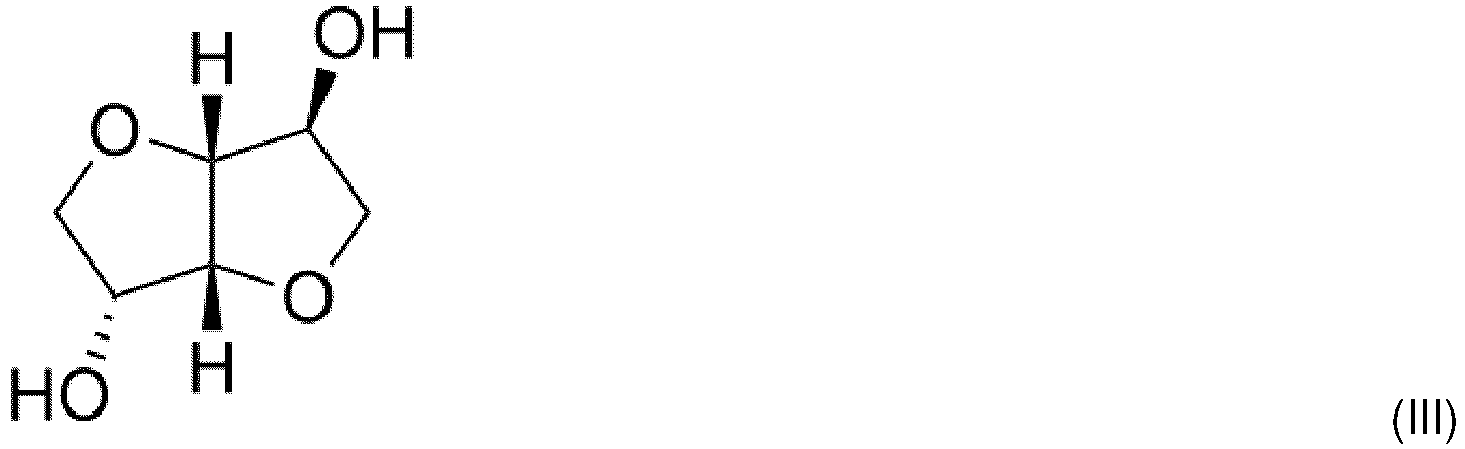
- Polyester aromatique non ionique selon la revendication 1, dans lequel le rapport molaire de i) par rapport à iii) va de 30 : 1 à 1 : 10, de manière préférée de 20 : 1 à 1 : 5, de manière particulièrement préférée de 15 : 1 à 1 : 3.
- Polyester aromatique non ionique selon la revendication 1 ou 2, contenant en outre des motifs dérivés d'un ou de plusieurs glycols de polyéthylène avec des poids moléculaires moyens en nombre d'environ 200 g/mol à 8000 g/mol et/ou d'un ou de plusieurs glycols de polypropylène avec des poids moléculaires moyens en nombre d'environ 200 g/mol à 8000 g/mol et/ou d'un ou de plusieurs glycols de polyéthylène-polypropylène avec des poids moléculaires moyens en nombre d'environ 200 g/mol à 8000 g/mol.
- Granulés contenant un ou plusieurs des polyesters aromatiques non ioniques selon l'une quelconque des revendications 1 à 3, dans lesquels les granulés présentent un diamètre moyen X50,3 de 0,05 mm à 2 mm, de manière préférée de 0,08 mm à 1,8 mm, de manière particulièrement préférée de 0,1 mm à 1,5 mm, dans lesquels le diamètre moyen X50,3 est défini au moyen du procédé indiqué dans la description.
- Compositions aqueuses contenant un ou plusieurs des polyesters aromatiques non ioniques selon l'une quelconque des revendications 1 à 3.
- Produits de lavage ou de nettoyage contenant un ou plusieurs des polyesters aromatiques non ioniques selon l'une quelconque des revendications 1 à 3, dans lesquels les produits de lavage et de nettoyage sont solides et/ou liquides.
- Utilisation des polyesters aromatiques non ioniques selon l'une quelconque des revendications 1 à 3 pour fabriquer des produits de lavage et de nettoyage.
- Utilisation des polyesters aromatiques non ioniques selon l'une quelconque des revendications 1 à 3 dans des procédés de fabrication de papier ou dans des procédés de recyclage de papier.
- Utilisation des polyesters aromatiques non ioniques selon l'une quelconque des revendications 1 à 3 pour fabriquer des dispersions de pigments.
- Utilisation des polyesters aromatiques non ioniques selon l'une quelconque des revendications 1 à 3 pour améliorer le comportement d'impression d'encres d'impression à base d'huile sur des surfaces hydrophobes.
Applications Claiming Priority (2)
| Application Number | Priority Date | Filing Date | Title |
|---|---|---|---|
| DE102018004071.3A DE102018004071A1 (de) | 2018-05-22 | 2018-05-22 | Nichtionische Soil Release Polyester und deren Verwendung |
| PCT/IB2019/054178 WO2019224708A1 (fr) | 2018-05-22 | 2019-05-21 | Polyesters antisalissures non ioniques et leur utilisation |
Publications (3)
| Publication Number | Publication Date |
|---|---|
| EP3797129A1 EP3797129A1 (fr) | 2021-03-31 |
| EP3797129B1 true EP3797129B1 (fr) | 2024-07-17 |
| EP3797129C0 EP3797129C0 (fr) | 2024-07-17 |
Family
ID=67253933
Family Applications (1)
| Application Number | Title | Priority Date | Filing Date |
|---|---|---|---|
| EP19739379.6A Active EP3797129B1 (fr) | 2018-05-22 | 2019-05-21 | Polyesters antisalissures non ioniques et leur utilisation |
Country Status (3)
| Country | Link |
|---|---|
| EP (1) | EP3797129B1 (fr) |
| DE (1) | DE102018004071A1 (fr) |
| WO (1) | WO2019224708A1 (fr) |
Family Cites Families (15)
| Publication number | Priority date | Publication date | Assignee | Title |
|---|---|---|---|---|
| US4702857A (en) | 1984-12-21 | 1987-10-27 | The Procter & Gamble Company | Block polyesters and like compounds useful as soil release agents in detergent compositions |
| ATE73150T1 (de) | 1984-12-21 | 1992-03-15 | Procter & Gamble | Blockpolyester und aehnliche verbindungen, verwendbar als verschmutzungsentferner in waschmittelzusammensetzungen. |
| US4711730A (en) | 1986-04-15 | 1987-12-08 | The Procter & Gamble Company | Capped 1,2-propylene terephthalate-polyoxyethylene terephthalate polyesters useful as soil release agents |
| US4713194A (en) | 1986-04-15 | 1987-12-15 | The Procter & Gamble Company | Block polyester and like compounds having branched hydrophilic capping groups useful as soil release agents in detergent compositions |
| GB8629936D0 (en) | 1986-12-15 | 1987-01-28 | Procter & Gamble | Laundry compositions |
| DE3744001C1 (de) | 1987-12-24 | 1989-06-08 | Bayer Ag | Verfahren zur kontinuierlichen Herstellung von Mono- oder Polyisocyanaten |
| DE19826356A1 (de) | 1998-06-12 | 1999-12-16 | Clariant Gmbh | Schmutzablösevermögende Oligoester |
| DE102004051455A1 (de) | 2004-10-22 | 2006-04-27 | Clariant Gmbh | Wasserbasierende Pigmentpräparationen auf Oligoesterbasis, ihre Herstellung und Verwendung |
| DE102005061058A1 (de) | 2005-12-21 | 2007-07-05 | Clariant Produkte (Deutschland) Gmbh | Anionische Soil Release Polymere |
| JP5678084B2 (ja) | 2009-11-27 | 2015-02-25 | クラリアント・ファイナンス・(ビーブイアイ)・リミテッド | 灰色化防止(vergrauungsinhibierender)効果および高い溶液安定性を有するソイルリリースポリマー |
| WO2011120653A1 (fr) | 2010-03-27 | 2011-10-06 | Clariant International Ltd | Polyesters colorés |
| DE102010045778A1 (de) | 2010-09-17 | 2012-03-22 | Polyprec Gmbh | Neue amphiphile Polykondensate und ihre Verwendung in Kombination mit Polyester oder polyesterhaltigen Oberflächen |
| DE102012016461A1 (de) | 2012-08-18 | 2014-02-20 | Clariant International Ltd. | Polyester für die Papierindustrie |
| US20170218315A1 (en) | 2014-08-11 | 2017-08-03 | Novozymes A/S | Detergents and Compositions with Enzymatic Polymer Particles |
| DE102015016402A1 (de) | 2015-12-18 | 2017-06-22 | Weylchem Wiesbaden Gmbh | Feinteilige Bleichkatalysatoren, Verfahren zu deren Herstellung und deren Verwendung |
-
2018
- 2018-05-22 DE DE102018004071.3A patent/DE102018004071A1/de not_active Withdrawn
-
2019
- 2019-05-21 WO PCT/IB2019/054178 patent/WO2019224708A1/fr not_active Ceased
- 2019-05-21 EP EP19739379.6A patent/EP3797129B1/fr active Active
Also Published As
| Publication number | Publication date |
|---|---|
| WO2019224708A1 (fr) | 2019-11-28 |
| EP3797129A1 (fr) | 2021-03-31 |
| DE102018004071A1 (de) | 2019-11-28 |
| EP3797129C0 (fr) | 2024-07-17 |
Similar Documents
| Publication | Publication Date | Title |
|---|---|---|
| EP3548594B1 (fr) | Polyester de libération de souillures anioniques et son utilisation | |
| EP4244324A1 (fr) | Compositions aqueuses de polyester, détergents et agents de nettoyage les contenant et leur utilisation | |
| EP2504379B1 (fr) | Utilisation de concentrés de polyester ayant une grande stabilité de solution et un effet antiredéposition dans des compositions detergentes | |
| EP3810742B1 (fr) | Carbamates de xylose utilisés comme agents antisalissures | |
| EP3222647B1 (fr) | Polyester, son procédé de fabrication et d'utilisation | |
| EP3049508B1 (fr) | Carbamates de cellulose utilisés comme principes actifs ayant la capacité de dissoudre les saletés | |
| EP1313787B1 (fr) | Oligoesters non ioniques, amphiphiles et a ecoulement libre | |
| EP2721089B1 (fr) | Polyesters ramifiés contenant des groupes sulfonate | |
| EP2504380B1 (fr) | Polymères facilitant le lavage ayant un effet antiredéposition et une grande stabilité en solution | |
| EP2885335A1 (fr) | Polyester pour l'industrie du papier | |
| EP2885390A1 (fr) | Utilisation de polyesters dans des produits de lavage et de nettoyage | |
| DE102022002248A1 (de) | Polyester, Wasch- und Reinigungsmittel enthaltend diese und deren Verwendung | |
| DE102005026522B4 (de) | Verstärkung der Reinigungsleistung von Waschmitteln durch Polymer | |
| EP1592766A2 (fr) | Procede pour renforcer la puissance de nettoyage de produits de lavage au moyen d'une combinaison de derives de cellulose | |
| DE102004056785A1 (de) | Fließfähige, amphiphile und nichtionische Oligoester | |
| EP3797129B1 (fr) | Polyesters antisalissures non ioniques et leur utilisation | |
| WO2001007551A1 (fr) | Utilisation d'alcools polyvinyliques comme additifs de detergent capables de detacher les salissures | |
| EP0808357B1 (fr) | Detergent fortement alcalin contenant un polymere detachant | |
| DE102023109600A1 (de) | Anionische Soil Release Polyester und deren Verwendung | |
| DE102022200882A1 (de) | Polymere schmutzablösevermögende Wirkstoffe | |
| EP2917319B1 (fr) | Polymères comportant des groupes polaires, servant de substances actives à pouvoir détachant | |
| EP2046931B1 (fr) | Agent de nettoyage ou de lavage sous forme de particules | |
| WO2014086682A1 (fr) | Élimination de salissures grasses | |
| DE10351320A1 (de) | Erhöhung der Wasseraufnahmefähigkeit von Textilien | |
| DE102015003483A1 (de) | Polymere Ester aromatischer Dicarbonsäuren als schmutzablösevermögende Wirkstoffe |
Legal Events
| Date | Code | Title | Description |
|---|---|---|---|
| STAA | Information on the status of an ep patent application or granted ep patent |
Free format text: STATUS: UNKNOWN |
|
| STAA | Information on the status of an ep patent application or granted ep patent |
Free format text: STATUS: THE INTERNATIONAL PUBLICATION HAS BEEN MADE |
|
| PUAI | Public reference made under article 153(3) epc to a published international application that has entered the european phase |
Free format text: ORIGINAL CODE: 0009012 |
|
| STAA | Information on the status of an ep patent application or granted ep patent |
Free format text: STATUS: REQUEST FOR EXAMINATION WAS MADE |
|
| 17P | Request for examination filed |
Effective date: 20201221 |
|
| AK | Designated contracting states |
Kind code of ref document: A1 Designated state(s): AL AT BE BG CH CY CZ DE DK EE ES FI FR GB GR HR HU IE IS IT LI LT LU LV MC MK MT NL NO PL PT RO RS SE SI SK SM TR |
|
| AX | Request for extension of the european patent |
Extension state: BA ME |
|
| DAX | Request for extension of the european patent (deleted) | ||
| GRAP | Despatch of communication of intention to grant a patent |
Free format text: ORIGINAL CODE: EPIDOSNIGR1 |
|
| STAA | Information on the status of an ep patent application or granted ep patent |
Free format text: STATUS: GRANT OF PATENT IS INTENDED |
|
| INTG | Intention to grant announced |
Effective date: 20240207 |
|
| GRAS | Grant fee paid |
Free format text: ORIGINAL CODE: EPIDOSNIGR3 |
|
| GRAA | (expected) grant |
Free format text: ORIGINAL CODE: 0009210 |
|
| STAA | Information on the status of an ep patent application or granted ep patent |
Free format text: STATUS: THE PATENT HAS BEEN GRANTED |
|
| AK | Designated contracting states |
Kind code of ref document: B1 Designated state(s): AL AT BE BG CH CY CZ DE DK EE ES FI FR GB GR HR HU IE IS IT LI LT LU LV MC MK MT NL NO PL PT RO RS SE SI SK SM TR |
|
| REG | Reference to a national code |
Ref country code: CH Ref legal event code: EP |
|
| REG | Reference to a national code |
Ref country code: DE Ref legal event code: R096 Ref document number: 502019011711 Country of ref document: DE |
|
| REG | Reference to a national code |
Ref country code: IE Ref legal event code: FG4D Free format text: LANGUAGE OF EP DOCUMENT: GERMAN |
|
| U01 | Request for unitary effect filed |
Effective date: 20240801 |
|
| U07 | Unitary effect registered |
Designated state(s): AT BE BG DE DK EE FI FR IT LT LU LV MT NL PT SE SI Effective date: 20240822 |
|
| PG25 | Lapsed in a contracting state [announced via postgrant information from national office to epo] |
Ref country code: NO Free format text: LAPSE BECAUSE OF FAILURE TO SUBMIT A TRANSLATION OF THE DESCRIPTION OR TO PAY THE FEE WITHIN THE PRESCRIBED TIME-LIMIT Effective date: 20241017 |
|
| PG25 | Lapsed in a contracting state [announced via postgrant information from national office to epo] |
Ref country code: GR Free format text: LAPSE BECAUSE OF FAILURE TO SUBMIT A TRANSLATION OF THE DESCRIPTION OR TO PAY THE FEE WITHIN THE PRESCRIBED TIME-LIMIT Effective date: 20241018 Ref country code: PL Free format text: LAPSE BECAUSE OF FAILURE TO SUBMIT A TRANSLATION OF THE DESCRIPTION OR TO PAY THE FEE WITHIN THE PRESCRIBED TIME-LIMIT Effective date: 20240717 |
|
| PG25 | Lapsed in a contracting state [announced via postgrant information from national office to epo] |
Ref country code: IS Free format text: LAPSE BECAUSE OF FAILURE TO SUBMIT A TRANSLATION OF THE DESCRIPTION OR TO PAY THE FEE WITHIN THE PRESCRIBED TIME-LIMIT Effective date: 20241117 |
|
| PG25 | Lapsed in a contracting state [announced via postgrant information from national office to epo] |
Ref country code: HR Free format text: LAPSE BECAUSE OF FAILURE TO SUBMIT A TRANSLATION OF THE DESCRIPTION OR TO PAY THE FEE WITHIN THE PRESCRIBED TIME-LIMIT Effective date: 20240717 |
|
| PG25 | Lapsed in a contracting state [announced via postgrant information from national office to epo] |
Ref country code: ES Free format text: LAPSE BECAUSE OF FAILURE TO SUBMIT A TRANSLATION OF THE DESCRIPTION OR TO PAY THE FEE WITHIN THE PRESCRIBED TIME-LIMIT Effective date: 20240717 Ref country code: RS Free format text: LAPSE BECAUSE OF FAILURE TO SUBMIT A TRANSLATION OF THE DESCRIPTION OR TO PAY THE FEE WITHIN THE PRESCRIBED TIME-LIMIT Effective date: 20241017 |
|
| PG25 | Lapsed in a contracting state [announced via postgrant information from national office to epo] |
Ref country code: RS Free format text: LAPSE BECAUSE OF FAILURE TO SUBMIT A TRANSLATION OF THE DESCRIPTION OR TO PAY THE FEE WITHIN THE PRESCRIBED TIME-LIMIT Effective date: 20241017 Ref country code: PL Free format text: LAPSE BECAUSE OF FAILURE TO SUBMIT A TRANSLATION OF THE DESCRIPTION OR TO PAY THE FEE WITHIN THE PRESCRIBED TIME-LIMIT Effective date: 20240717 Ref country code: NO Free format text: LAPSE BECAUSE OF FAILURE TO SUBMIT A TRANSLATION OF THE DESCRIPTION OR TO PAY THE FEE WITHIN THE PRESCRIBED TIME-LIMIT Effective date: 20241017 Ref country code: IS Free format text: LAPSE BECAUSE OF FAILURE TO SUBMIT A TRANSLATION OF THE DESCRIPTION OR TO PAY THE FEE WITHIN THE PRESCRIBED TIME-LIMIT Effective date: 20241117 Ref country code: HR Free format text: LAPSE BECAUSE OF FAILURE TO SUBMIT A TRANSLATION OF THE DESCRIPTION OR TO PAY THE FEE WITHIN THE PRESCRIBED TIME-LIMIT Effective date: 20240717 Ref country code: GR Free format text: LAPSE BECAUSE OF FAILURE TO SUBMIT A TRANSLATION OF THE DESCRIPTION OR TO PAY THE FEE WITHIN THE PRESCRIBED TIME-LIMIT Effective date: 20241018 Ref country code: ES Free format text: LAPSE BECAUSE OF FAILURE TO SUBMIT A TRANSLATION OF THE DESCRIPTION OR TO PAY THE FEE WITHIN THE PRESCRIBED TIME-LIMIT Effective date: 20240717 |
|
| PG25 | Lapsed in a contracting state [announced via postgrant information from national office to epo] |
Ref country code: SM Free format text: LAPSE BECAUSE OF FAILURE TO SUBMIT A TRANSLATION OF THE DESCRIPTION OR TO PAY THE FEE WITHIN THE PRESCRIBED TIME-LIMIT Effective date: 20240717 |
|
| PG25 | Lapsed in a contracting state [announced via postgrant information from national office to epo] |
Ref country code: CZ Free format text: LAPSE BECAUSE OF FAILURE TO SUBMIT A TRANSLATION OF THE DESCRIPTION OR TO PAY THE FEE WITHIN THE PRESCRIBED TIME-LIMIT Effective date: 20240717 |
|
| PG25 | Lapsed in a contracting state [announced via postgrant information from national office to epo] |
Ref country code: SK Free format text: LAPSE BECAUSE OF FAILURE TO SUBMIT A TRANSLATION OF THE DESCRIPTION OR TO PAY THE FEE WITHIN THE PRESCRIBED TIME-LIMIT Effective date: 20240717 |
|
| PLBE | No opposition filed within time limit |
Free format text: ORIGINAL CODE: 0009261 |
|
| STAA | Information on the status of an ep patent application or granted ep patent |
Free format text: STATUS: NO OPPOSITION FILED WITHIN TIME LIMIT |
|
| 26N | No opposition filed |
Effective date: 20250422 |
|
| U20 | Renewal fee for the european patent with unitary effect paid |
Year of fee payment: 7 Effective date: 20250516 |
|
| PGFP | Annual fee paid to national office [announced via postgrant information from national office to epo] |
Ref country code: GB Payment date: 20250522 Year of fee payment: 7 |
|
| REG | Reference to a national code |
Ref country code: CH Ref legal event code: H13 Free format text: ST27 STATUS EVENT CODE: U-0-0-H10-H13 (AS PROVIDED BY THE NATIONAL OFFICE) Effective date: 20251223 |
|
| PG25 | Lapsed in a contracting state [announced via postgrant information from national office to epo] |
Ref country code: CH Free format text: LAPSE BECAUSE OF NON-PAYMENT OF DUE FEES Effective date: 20250531 |
|
| PG25 | Lapsed in a contracting state [announced via postgrant information from national office to epo] |
Ref country code: MC Free format text: LAPSE BECAUSE OF FAILURE TO SUBMIT A TRANSLATION OF THE DESCRIPTION OR TO PAY THE FEE WITHIN THE PRESCRIBED TIME-LIMIT Effective date: 20240717 |
|
| PG25 | Lapsed in a contracting state [announced via postgrant information from national office to epo] |
Ref country code: IE Free format text: LAPSE BECAUSE OF NON-PAYMENT OF DUE FEES Effective date: 20250521 |
|
| PG25 | Lapsed in a contracting state [announced via postgrant information from national office to epo] |
Ref country code: RO Free format text: LAPSE BECAUSE OF FAILURE TO SUBMIT A TRANSLATION OF THE DESCRIPTION OR TO PAY THE FEE WITHIN THE PRESCRIBED TIME-LIMIT Effective date: 20240717 |