EP3798628B1 - Verfahren zur herstellung eines elektrochemischen sensors - Google Patents
Verfahren zur herstellung eines elektrochemischen sensors Download PDFInfo
- Publication number
- EP3798628B1 EP3798628B1 EP19200065.1A EP19200065A EP3798628B1 EP 3798628 B1 EP3798628 B1 EP 3798628B1 EP 19200065 A EP19200065 A EP 19200065A EP 3798628 B1 EP3798628 B1 EP 3798628B1
- Authority
- EP
- European Patent Office
- Prior art keywords
- wire
- printer
- ink
- polymer coating
- printing
- Prior art date
- Legal status (The legal status is an assumption and is not a legal conclusion. Google has not performed a legal analysis and makes no representation as to the accuracy of the status listed.)
- Active
Links
Images

Classifications
-
- G—PHYSICS
- G01—MEASURING; TESTING
- G01N—INVESTIGATING OR ANALYSING MATERIALS BY DETERMINING THEIR CHEMICAL OR PHYSICAL PROPERTIES
- G01N33/00—Investigating or analysing materials by specific methods not covered by groups G01N1/00 - G01N31/00
- G01N33/48—Biological material, e.g. blood, urine; Haemocytometers
- G01N33/50—Chemical analysis of biological material, e.g. blood, urine; Testing involving biospecific ligand binding methods; Immunological testing
- G01N33/66—Chemical analysis of biological material, e.g. blood, urine; Testing involving biospecific ligand binding methods; Immunological testing involving blood sugars, e.g. galactose
-
- C—CHEMISTRY; METALLURGY
- C12—BIOCHEMISTRY; BEER; SPIRITS; WINE; VINEGAR; MICROBIOLOGY; ENZYMOLOGY; MUTATION OR GENETIC ENGINEERING
- C12Q—MEASURING OR TESTING PROCESSES INVOLVING ENZYMES, NUCLEIC ACIDS OR MICROORGANISMS; COMPOSITIONS OR TEST PAPERS THEREFOR; PROCESSES OF PREPARING SUCH COMPOSITIONS; CONDITION-RESPONSIVE CONTROL IN MICROBIOLOGICAL OR ENZYMOLOGICAL PROCESSES
- C12Q1/00—Measuring or testing processes involving enzymes, nucleic acids or microorganisms; Compositions therefor; Processes of preparing such compositions
- C12Q1/001—Enzyme electrodes
- C12Q1/005—Enzyme electrodes involving specific analytes or enzymes
- C12Q1/006—Enzyme electrodes involving specific analytes or enzymes for glucose
-
- A—HUMAN NECESSITIES
- A61—MEDICAL OR VETERINARY SCIENCE; HYGIENE
- A61B—DIAGNOSIS; SURGERY; IDENTIFICATION
- A61B5/00—Measuring for diagnostic purposes; Identification of persons
- A61B5/145—Measuring characteristics of blood in vivo, e.g. gas concentration or pH-value ; Measuring characteristics of body fluids or tissues, e.g. interstitial fluid or cerebral tissue
- A61B5/14532—Measuring characteristics of blood in vivo, e.g. gas concentration or pH-value ; Measuring characteristics of body fluids or tissues, e.g. interstitial fluid or cerebral tissue for measuring glucose, e.g. by tissue impedance measurement
-
- A—HUMAN NECESSITIES
- A61—MEDICAL OR VETERINARY SCIENCE; HYGIENE
- A61B—DIAGNOSIS; SURGERY; IDENTIFICATION
- A61B5/00—Measuring for diagnostic purposes; Identification of persons
- A61B5/145—Measuring characteristics of blood in vivo, e.g. gas concentration or pH-value ; Measuring characteristics of body fluids or tissues, e.g. interstitial fluid or cerebral tissue
- A61B5/1468—Measuring characteristics of blood in vivo, e.g. gas concentration or pH-value ; Measuring characteristics of body fluids or tissues, e.g. interstitial fluid or cerebral tissue using chemical or electrochemical methods, e.g. by polarographic means
-
- A—HUMAN NECESSITIES
- A61—MEDICAL OR VETERINARY SCIENCE; HYGIENE
- A61B—DIAGNOSIS; SURGERY; IDENTIFICATION
- A61B5/00—Measuring for diagnostic purposes; Identification of persons
- A61B5/145—Measuring characteristics of blood in vivo, e.g. gas concentration or pH-value ; Measuring characteristics of body fluids or tissues, e.g. interstitial fluid or cerebral tissue
- A61B5/1468—Measuring characteristics of blood in vivo, e.g. gas concentration or pH-value ; Measuring characteristics of body fluids or tissues, e.g. interstitial fluid or cerebral tissue using chemical or electrochemical methods, e.g. by polarographic means
- A61B5/1473—Measuring characteristics of blood in vivo, e.g. gas concentration or pH-value ; Measuring characteristics of body fluids or tissues, e.g. interstitial fluid or cerebral tissue using chemical or electrochemical methods, e.g. by polarographic means invasive, e.g. introduced into the body by a catheter
- A61B5/14735—Measuring characteristics of blood in vivo, e.g. gas concentration or pH-value ; Measuring characteristics of body fluids or tissues, e.g. interstitial fluid or cerebral tissue using chemical or electrochemical methods, e.g. by polarographic means invasive, e.g. introduced into the body by a catheter comprising an immobilised reagent
-
- B—PERFORMING OPERATIONS; TRANSPORTING
- B41—PRINTING; LINING MACHINES; TYPEWRITERS; STAMPS
- B41M—PRINTING, DUPLICATING, MARKING, OR COPYING PROCESSES; COLOUR PRINTING
- B41M1/00—Inking and printing with a printer's forme
- B41M1/22—Metallic printing; Printing with powdered inks
-
- C—CHEMISTRY; METALLURGY
- C09—DYES; PAINTS; POLISHES; NATURAL RESINS; ADHESIVES; COMPOSITIONS NOT OTHERWISE PROVIDED FOR; APPLICATIONS OF MATERIALS NOT OTHERWISE PROVIDED FOR
- C09D—COATING COMPOSITIONS, e.g. PAINTS, VARNISHES OR LACQUERS; FILLING PASTES; CHEMICAL PAINT OR INK REMOVERS; INKS; CORRECTING FLUIDS; WOODSTAINS; PASTES OR SOLIDS FOR COLOURING OR PRINTING; USE OF MATERIALS THEREFOR
- C09D11/00—Inks
- C09D11/52—Electrically conductive inks
-
- G—PHYSICS
- G01—MEASURING; TESTING
- G01N—INVESTIGATING OR ANALYSING MATERIALS BY DETERMINING THEIR CHEMICAL OR PHYSICAL PROPERTIES
- G01N27/00—Investigating or analysing materials by the use of electric, electrochemical, or magnetic means
- G01N27/26—Investigating or analysing materials by the use of electric, electrochemical, or magnetic means by investigating electrochemical variables; by using electrolysis or electrophoresis
- G01N27/28—Electrolytic cell components
- G01N27/30—Electrodes, e.g. test electrodes; Half-cells
- G01N27/327—Biochemical electrodes, e.g. electrical or mechanical details for in vitro measurements
- G01N27/3271—Amperometric enzyme electrodes for analytes in body fluids, e.g. glucose in blood
-
- A—HUMAN NECESSITIES
- A61—MEDICAL OR VETERINARY SCIENCE; HYGIENE
- A61B—DIAGNOSIS; SURGERY; IDENTIFICATION
- A61B2562/00—Details of sensors; Constructional details of sensor housings or probes; Accessories for sensors
- A61B2562/12—Manufacturing methods specially adapted for producing sensors for in-vivo measurements
- A61B2562/125—Manufacturing methods specially adapted for producing sensors for in-vivo measurements characterised by the manufacture of electrodes
-
- A—HUMAN NECESSITIES
- A61—MEDICAL OR VETERINARY SCIENCE; HYGIENE
- A61B—DIAGNOSIS; SURGERY; IDENTIFICATION
- A61B5/00—Measuring for diagnostic purposes; Identification of persons
- A61B5/145—Measuring characteristics of blood in vivo, e.g. gas concentration or pH-value ; Measuring characteristics of body fluids or tissues, e.g. interstitial fluid or cerebral tissue
- A61B5/14539—Measuring characteristics of blood in vivo, e.g. gas concentration or pH-value ; Measuring characteristics of body fluids or tissues, e.g. interstitial fluid or cerebral tissue for measuring pH
-
- A—HUMAN NECESSITIES
- A61—MEDICAL OR VETERINARY SCIENCE; HYGIENE
- A61B—DIAGNOSIS; SURGERY; IDENTIFICATION
- A61B5/00—Measuring for diagnostic purposes; Identification of persons
- A61B5/145—Measuring characteristics of blood in vivo, e.g. gas concentration or pH-value ; Measuring characteristics of body fluids or tissues, e.g. interstitial fluid or cerebral tissue
- A61B5/14542—Measuring characteristics of blood in vivo, e.g. gas concentration or pH-value ; Measuring characteristics of body fluids or tissues, e.g. interstitial fluid or cerebral tissue for measuring blood gases
-
- A—HUMAN NECESSITIES
- A61—MEDICAL OR VETERINARY SCIENCE; HYGIENE
- A61B—DIAGNOSIS; SURGERY; IDENTIFICATION
- A61B5/00—Measuring for diagnostic purposes; Identification of persons
- A61B5/145—Measuring characteristics of blood in vivo, e.g. gas concentration or pH-value ; Measuring characteristics of body fluids or tissues, e.g. interstitial fluid or cerebral tissue
- A61B5/14546—Measuring characteristics of blood in vivo, e.g. gas concentration or pH-value ; Measuring characteristics of body fluids or tissues, e.g. interstitial fluid or cerebral tissue for measuring analytes not otherwise provided for, e.g. ions, cytochromes
-
- A—HUMAN NECESSITIES
- A61—MEDICAL OR VETERINARY SCIENCE; HYGIENE
- A61B—DIAGNOSIS; SURGERY; IDENTIFICATION
- A61B5/00—Measuring for diagnostic purposes; Identification of persons
- A61B5/145—Measuring characteristics of blood in vivo, e.g. gas concentration or pH-value ; Measuring characteristics of body fluids or tissues, e.g. interstitial fluid or cerebral tissue
- A61B5/1468—Measuring characteristics of blood in vivo, e.g. gas concentration or pH-value ; Measuring characteristics of body fluids or tissues, e.g. interstitial fluid or cerebral tissue using chemical or electrochemical methods, e.g. by polarographic means
- A61B5/1486—Measuring characteristics of blood in vivo, e.g. gas concentration or pH-value ; Measuring characteristics of body fluids or tissues, e.g. interstitial fluid or cerebral tissue using chemical or electrochemical methods, e.g. by polarographic means using enzyme electrodes, e.g. with immobilised oxidase
Definitions
- the present invention relates to a method for manufacturing an electrochemical sensor (e.g. a glucose sensor).
- an electrochemical sensor e.g. a glucose sensor
- Electrochemical sensors can be used for measuring the concentration of specific analytes (such as glucose) which might be related to specific disorders (e.g. a metabolic disorder such as diabetes). Electrochemical sensors comprise two or more electrodes (working electrode, reference electrode, counter electrode). In a two-electrode set-up, the second electrode represents both the reference and the counter electrode. Measuring accuracy can be improved if a three-electrode set-up (i.e. separate reference and counter electrodes) is used. In the presence of the analyte to be detected, an electrochemical reaction takes place at the working electrode. The measurable response is either an electrical current due to the redox reaction (amperometric sensor) or the change in electrode potential (potentiometric sensor).
- oxidase enzymes such as glucose oxidase
- the enzyme may convert the analyte to gluconolactone and hydrogen peroxide (H 2 O 2 ), and H 2 O 2 can be oxidized at the working electrode.
- the enzyme is typically present in a polymer matrix which is applied on the working electrode.
- Electrochemical glucose sensors are reviewed by A. Heller and B. Feldman, “Electrochemical Glucose Sensors and Their Applications in Diabetes Management", Chem. Rev., 2008, 108, pp. 2482-2505 ; and E.W. Nery et al., “Electrochemical Glucose Sensing: Is There Still Room For Improvement?”, Analyt. Chem., 2016, 88, pp. 11271-11282 .
- One type of glucose sensor which is used for continuous glucose monitoring is a wire-based sensor.
- a metal wire e.g. a noble metal wire
- an electrically insulating polymer coating which in turn is coated with an electrically conductive layer (e.g. a layer containing Ag/AgCl) acting as the reference/counter electrode.
- an electrically conductive layer e.g. a layer containing Ag/AgCl
- Both the insulating polymer coating and the conductive layer are typically applied by conventional coating methods such as die coating or immersion coating. For each coating step, several runs are needed until the desired coating thickness is achieved.
- the insulating polymer coating and the conductive Ag/AgCl-containing layer are removed in pre-defined areas via laser ablation, thereby exposing a pre-defined area of the metal wire and making the metal wire accessible to the analyte to be detected.
- this results in a loss of silver-containing material and is therefore adversely affecting process efficiency.
- a polymer membrane is typically provided and an enzyme might be immobilized therein.
- the wire-based sensor obtained by said method has a two-electrode-configuration (the exposed area of the metal wire representing the working electrode and the "non-structured" single-piece Ag/AgCl-containing layer representing both the reference and counter electrode).
- a structuring treatment e.g. by laser ablation.
- this additional treatment step would make the manufacturing process even more complex and time consuming and may result in a further loss of silver-containing material.
- WO 2011/003039 A2 describes a continuous analyte sensor, comprising an elongated core comprising a working electrode; an insulating layer covering at least a portion of the elongated core; a conductive layer comprising a reference electrode or a counter electrode, wherein the conductive layer covers at least a portion of the insulating layer; and a membrane covering at least a portion the working electrode.
- the cliché might be a flat plate with etched wells.
- both the cliché and the pad are cylindrical and rotate in opposite directions.
- the pad roll picks up the ink and transfers it to the object to be printed.
- the ink is provided in circular arranged wells. While one of the pads of the circular pad holder picks up ink from one of the ink-containing wells, another pad is printing the ink onto the substrate. During one revolution of the circular pad holder, each of the pads picks up ink from the ink reservoir and prints the ink onto the substrate.
- the process of the present invention is a reel-to-reel process.
- a wire is moved from the wire feed unit to the wire pick-up unit and a plurality of discrete arrays of electrically conductive material are printed onto the moving wire, a high manufacturing rate is achieved. Cutting of the printed wire into individual sensor elements is carried out at a later stage. Furthermore, as the discrete printed arrays of conductive material correspond to the final electrode pattern, removal of said conductive material at a later stage can be avoided.
- a variety of different electrode set-ups can be provided on the wire by the process of the present invention.
- non-metal-based alloy means that the metal of highest concentration, in at%, which is present in the alloy is a noble metal. The same applies to the other alloys. So, just as an example, the metal of highest concentration, in at%, which is present in a Ti-based alloy is Ti.
- the noble metal is preferably platinum, palladium, iridium, gold or silver or an alloy of at least one of these metals.
- a preferred noble metal alloy is a platinum-based alloy which contains up to 35 wt% Ir (e.g. 90 wt% Pt and 10 wt% Ir).
- the metal wire comprises a metal core which is at least partially surrounded by a metal coating.
- a metal core and a metal coating are the following ones: Tantalum or a Ta-based alloy as a core which is coated with platinum; tantalum or a Ta-based alloy as a core which is coated with a platinum-based alloy (e.g. a platinum-iridium alloy); a nickel- or cobalt-based alloy (e.g. MP35N ® ) as a core which is coated with platinum; a nickel- or cobalt-based alloy (e.g. MP35N ® ) as a core which is coated with a platinum-based alloy (e.g.
- platinum-iridium alloy a platinum-iridium alloy
- stainless steel as a core which is coated with platinum or a platinum-based alloy (e.g. a platinum-iridium alloy); titanium or a Ti-based alloy as a core which is coated with platinum; titanium or a Ti-based alloy as a core which is coated with a platinum-based alloy (e.g. a platinum-iridium alloy); iridium or an Ir-based alloy as a core which is coated with platinum; iridium or an Ir-based alloy as a core which is coated with a platinum-based alloy (e.g. a platinum-iridium alloy).
- the metal wire may have a diameter of up to 250 ⁇ m, e.g. 50 ⁇ m to 250 ⁇ m, more preferably 50 ⁇ m to 180 ⁇ m, even more preferably 90 ⁇ m to 110 ⁇ m.
- the metal wires which can be used in the present invention for manufacturing the electrochemical sensor are commercially available or can be obtained by commonly known manufacturing methods.
- the metal wire may act as a working electrode. However, it is also possible that the metal wire acts as a reference or a counter electrode.
- the metal wire and the one or more printed electrodes need to be separated from each other by one or more electrically insulating materials
- the metal wire is at least partially coated with an electrically insulating polymer coating at the latest when the wire reaches the printer P cond for applying the conductive ink.
- An electrically insulating polymer coating might already be present on the metal wire being released from the wire feed unit or might be applied onto the metal wire before reaching the printer P cond . It is also possible that the metal wire which is released from the wire feed unit already comprises a first electrically insulating polymer coating and a second electrically insulating polymer coating is applied before the wire reaches the conductive ink printer P cond .
- the electrically insulating polymer coating can be applied onto the metal wire by commonly known coating methods, such as die coating, dip coating, or felt coating.
- the electrically insulating polymer coating might be applied to the metal wire by printing, such as pad printing or nozzle printing.
- the insulating polymer coating is applied by nozzle printing (i.e. by a printer which ejects the ink via one or more printing nozzles), this might be an inkjet printing, an aerosol jet printing, an aerosol deposition method, a spray coating, or a micro-pen method.
- the inkjet printing might be a continuous inkjet printing (i.e. printing by a continuous inkjet printer) or a drop-on-demand (DOD) inkjet printing (such as thermal inkjet printing and piezoelectric inkjet printing
- the electrically insulating polymer coating might have a thickness of up to 75 ⁇ m, e.g. 5 ⁇ m to 75 ⁇ m, more preferably 10 ⁇ m to 30 ⁇ m.
- At least one coating unit in particular at least one printer P ins (e.g. a pad printer or a nozzle-containing printer such as an inkjet printer), might be located between the wire feed unit and the printer P cond which prints the conductive ink onto the electrically insulating polymer coating.
- the printer P ins might be located upstream of the conductive ink printer P cond (and downstream the wire feed unit).
- the electrically insulating polymer coating is applied by printing in a separate reel-to-reel unit (i.e. the printer P ins is located at a separate reel-to-reel unit) and the wire being coated with the insulating polymer coating is subsequently transferred to the reel-to-reel unit where the one or more printers P cond are located.
- the metal wire which reaches the printer P cond might be completely coated with the insulating polymer coating or might contain one or more areas on which no insulating polymer coating is present (these non-coated areas being accessible to the analyte in the final sensor). If completely coated by the insulating polymer coating, an ablation treatment (e.g. laser ablation) is carried out at a later stage so as to expose the metal wire in one or more defined areas and thereby making the metal wire accessible to an analyte in these exposed areas.
- the ablation treatment is carried out in an ablation unit which is located downstream the conductive ink printer P cond .
- the ablation unit comprises a laser.
- discrete electrically conductive solid coatings are formed on the electrically insulating polymer coating.
- these discrete solid coatings represent the electrodes (e.g. the reference electrode and the counter electrode).
- just one printer P cond might be located between the wire feed and pick-up units. However, it might be preferred that at least two printers P cond are located between the wire feed and pick-up units. If two or more printers P cond are present, more complex electrode set-ups might be printed in a single pass.
- a first printer P cond might print the conductive ink onto the upper half of the polymer-coated wire
- a second printer P cond prints the conductive ink onto the lower half of the polymer-coated wire, thereby obtaining a sensor having a multiple-electrode (e.g. three-electrode) set-up (i.e. the metal wire as a first electrode and two printed electrodes on opposing sides of the polymer-coated wire).
- the printer P cond which prints the conductive ink onto discrete arrays of the electrically insulating polymer coating might be a pad printer PP cond which comprises one or more flexible pads; or a nozzle printer NP cond which comprises at least one printing nozzle.
- the pad printer PP cond comprises at least one flexible pad which repeatedly picks up the ink containing electrically conductive particles and prints the ink onto discrete arrays of the electrically insulating polymer coating which is present on the metal wire.
- the pad-printing step and a subsequent thermal treatment step discrete electrically conductive solid coating are formed at pre-defined intervals on the electrically insulating polymer coating.
- the pad might be a stamp or a brush.
- the pad might comprise a silicone rubber.
- other flexible materials e.g. elastomers other than silicone rubber
- the ink to be picked up by the pad might be provided in depressions of a plate (also known as cliché).
- the flexible pad is brought into contact with the ink and transfers the ink from the depressions to the electrically insulating polymer coating.
- the ink to be picked up by the flexible pad might be printed (e.g. screen-printed) onto a depression-free area of a flat plate where it is picked up by the pad and transferred to the electrically insulating polymer coating.
- the flexible pad is a roll which picks up ink from an engraved roll.
- both rolls are rotating in opposite directions during the pad printing step.
- two more flexible pads are positioned in a rotatable pad holder (e.g. a circular pad holder).
- a rotatable pad holder e.g. a circular pad holder.
- the pad holder rotates.
- each of the pads positioned in the pad holder picks up ink and prints the ink onto the electrically insulating polymer coating.
- the ink to be picked up by the pads might be provided in wells of an ink-delivering roll (e.g. ink-delivering engraved roll).
- the pad holder and the ink-delivering roll rotate in opposite directions.
- each pad that has picked up ink from the counter-rotating ink-delivering roll comes into contact with a defined area of the electrically insulating polymer coating and transfers the ink to said area.
- the rotating pad holder may comprise a cam.
- a cam is a rotating or sliding part which is used for transforming rotary motion into linear motion.
- the cam can be a part of a rotating wheel (e.g. an eccentric wheel) or shaft (e.g. a camshaft). Due to the interaction between the cam and the pads, a back-and-forth motion of each of the pads is achieved.
- the pads might be spring-loaded pads.
- the pad may pick up ink from the ink-delivering roll or may transfer the picked-up ink to the electrically insulating polymer coating. If a pad just being in contact with the insulating polymer coating on the metal wire moves back, the ink transfer from the pad to the polymer coating is interrupted but will be repeated during the next revolution of the rotating pad holder.
- a nip roll might be used to improve wire guidance and provide a counter force to the force applied by the pad to the wire.
- the nip roll is typically positioned such that the pad in its printing position (i.e. when printing the ink onto the insulating polymer coating) and the nip roll are located on opposing sides of the wire.
- the nozzle-containing printer can be an inkjet printer, an aerosol jet printer, a printer for spray coating, a printer for aerosol deposition, or a printer for micro-pen printing. These nozzle printing methods are known to the skilled person.
- the inkjet printer can be a continuous inkjet printer ("CIJ printing") or a drop-on-demand inkjet printer (“DOD” inkjet printing).
- CIJ printing continuous inkjet printer
- DOD drop-on-demand inkjet printer
- ink droplets are constantly generated, controlled by a high-pressure pump vibrating the nozzle with a piezoelectric crystal.
- the generated ink droplets are selectively charged by signals from the printer.
- Charged droplets are deflected into a gutter for recirculation, while the uncharged droplets are ejected onto the substrate to form an image.
- a drop-on-demand (DOD) inkjet printer ejects the ink only when it is required.
- DOD inkjet printers are e.g. thermal inkjet printers and piezoelectric inkjet printers.
- a thermal inkjet printer the ink in the ink chamber is rapidly heated up to a vaporization temperature. Due to vaporisation, a bubble is promptly generated at the surface of a heating element, causing a pressure pulse to eject the ink droplets through the nozzle.
- a piezo-ceramic material is used for generating ink droplets. In response to an electric impulse, the piezo-ceramic material deforms, thereby generating a pressure wave by which the ink is ejected through the printing nozzle.
- aerodynamic focusing is used to accurately deposit the ink on a substrate.
- the ink is placed into an atomizer which creates a dense mist of droplets.
- the aerosol mist is then delivered to the deposition head where it is focused by a sheath gas, which surrounds the aerosol.
- a sheath gas which surrounds the aerosol.
- the size of the discrete arrays onto which the conductive ink is printed might be adjusted by parameters which are known to the skilled person, e.g. by the dimensions of the printing nozzle or the size of the printing pad.
- Each of the discrete printed arrays may have a size of e.g. 100 ⁇ m 2 to 10000 ⁇ m 2 .
- each of the discrete printed arrays may or may not extend over the whole circumference of the electrically insulating polymer coating.
- each of the discrete printed arrays has an extension in circumferential direction of the insulating polymer coating which is less than 50%, e.g. 5% to 45%, more preferably 10% to 40%, of the circumference of the electrically insulating polymer coating.
- the metal wire on which the insulating polymer coating is present is divided by an imaginary plane along the longitudinal axis of the wire into an upper half and a lower half, a first set of discrete printed arrays might be present on the upper half while a second set of discrete nozzle-printed arrays might be present on the lower half.
- the first set of discrete printed arrays might be printed with a first printer P cond
- the second set of discrete printed arrays might be printed with a second printer P cond .
- sensors having a multiple-electrode (e.g. three-electrode) configuration can be efficiently prepared. Furthermore, such a configuration with electrodes on opposing halves of the wire may facilitate the formation of an electrical connection between the electrodes and the sensor electronics (such as a potentiostat).
- the ink which is printed on the discrete arrays of the electrically insulating polymer coating comprises electrically conductive particles.
- Conductive inks for preparing electrodes of electrochemical sensors are known to the skilled person and are commercially available or can be prepared by commonly known methods.
- the electrically conductive particles might be metal particles, carbon-based particles such as nanotubes or graphene, or other any combination thereof.
- Exemplary metal particles are noble-metal-containing particles, e.g. silver-containing particles, Pt-containing particles, and Au-containing particles.
- the ink comprises metallic silver (Ag) particles and silver chloride (AgCl) particles (i.e. a Ag/AgCl-containing ink).
- the ink may have a solids content of 40-90 wt%, more preferably 55-85 wt%.
- the ink may have a viscosity, 25°C, Brookfield #14 spindle, 10 rpm, of 150,000 cps or less, more preferably 120,000 cps or less.
- the weight ratio of Ag to AgCl is from 50/50 to 95/5, more preferably 65/35 to 90/10.
- the ink may additionally comprise a binder.
- binders for conductive inks such as Ag/AgCl-containing inks
- the binder might be a polymer or a precursor thereof (e.g. oligomers which may react to a polymer) that can be cured by thermal treatment or radiation treatment (e.g. UV treatment) to a thermoset.
- the binder is a polymer or a precursor of a polymer which is also present in the electrically insulating polymer coating.
- the binder being present in the ink is also a polyurethane or a precursor of a polyurethane.
- the binder of the conductive ink may comprise one or more of the following polymers or precursors thereof: a polyurethane, a fluoropolymer (such as a tetrafluoroethylene homopolymer (PTFE) or a copolymer thereof such as an ethylene-tetrafluoroethylene copolymer (ETFE)), a polyimide, a polyethylene, or a polypropylene, or a blend of two or more of these polymers.
- PTFE tetrafluoroethylene homopolymer
- ETFE ethylene-tetrafluoroethylene copolymer
- the ink might be a solvent-based ink.
- Appropriate organic solvents for printing inks are known to the skilled person.
- the ink has a water content of less than 15 vol%; more preferably, the ink is water-free.
- the ink which has been printed onto discrete arrays of the insulating polymer coating is subjected to a thermal treatment so that remaining solvent evaporates and, if present, curing of the binder is accomplished.
- thermal treatment may assist in sintering the electrically conductive particles, thereby improving conductivity.
- Thermal treatment might be carried out at a temperature of 350°C or less, e.g. in a thermal treatment unit such as an oven which is located downstream the conductive ink printer P cond .
- each of the discrete electrically conductive solid coatings may have a thickness of 3 ⁇ m to 50 ⁇ m, more preferably 5 ⁇ m to 20 ⁇ m.
- the discrete electrically conductive solid coatings may act as electrodes (e.g. as a reference electrode and a counter electrode).
- the process of the present invention may comprise an ablation treatment step wherein the electrically insulating polymer coating is removed in one or more pre-defined areas, thereby exposing the metal wire in said one or more pre-defined areas (and making the metal wire accessible to an analyte in these exposed areas).
- the ablation treatment can be a physical ablation, in particular laser ablation, or a chemical ablation.
- the ablation treatment can be carried out in an ablation treatment unit.
- the ablation treatment unit comprises a laser for selectively removing the electrically insulating polymer coating in one or more pre-defined areas.
- the ablation treatment unit might be positioned downstream or upstream of the printer P cond (i.e. the printer which prints the conductive ink onto discrete arrays of the the electrically insulating polymer coating).
- both the insulating polymer coating and the conductive ink are applied by printing.
- an ablation treatment might be avoided or its extent might at least be significantly reduced.
- the wire is cut into individual pieces such that each piece of wire comprises the desired number of discrete electrically conductive solid coatings on the electrically insulating polymer coating.
- the wire cutting unit is downstream of the wire pick-up unit. In between the wire feed and pick-up units, no wire cutting unit is present (i.e. no wire cutting takes place in between the wire feed and pick-up units).
- the conductive ink is printed by pad printing.
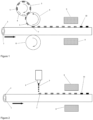
- a metal wire 1 on which an electrically insulating polymer coating 2 has already been applied is unwound from a wire feed roll (not shown in Figure 1 ) and is moved towards a wire pick-up roll (not shown in Figure 1 ).
- the arrows in Figure 1 indicate the moving direction of the wire 1 and the rotation directions of the rolls.
- An ink-delivering roll 3 comprises wells 4, some of these wells 4 being filled with an ink 5.
- the ink 5 comprises electrically conductive particles.
- the ink 5 may contain Ag particles and AgCl particles.
- the ink-delivering roll 3 and a circular pad holder 6 containing several flexible pads are rotating in opposite directions.
- the flexible pads which are positioned in the pad holder 6 are not shown in Figure 1 . If one of the pads of the rotating pad holder 6 comes into contact with one of the ink-filled wells 4 of ink-delivery roll 3, the pad picks up the ink 5.
- the pad which has picked up ink 5 comes into contact with the electrically insulation polymer coating 2.
- the picked up ink 5 is transferred from the pad to a discrete array 7 of the electrically insulation polymer coating 2.
- each pad picks up ink 5 and prints it on a discrete array 7 of the insulating polymer coating 2.
- a nip roll 8 improves guidance of the wire 1 and provides a counter force to the pad holder 6.
- the wire 1 moves towards the wire pick-up unit, it passes an oven 9 where the ink 5 which has been pad-printed onto the discrete arrays 7 of the polymer coating 2 are subjected to a thermal treatment and transformed into discrete solid electrically conductive coatings 10 which may act as electrodes in the final electrochemical sensor.
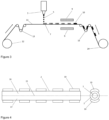
- FIG. 2 An exemplary embodiment wherein the conductive ink is printed onto the discrete arrays of the insulating polymer coating via nozzle printing is shown in Figure 2 .
- a metal wire 1 on which an electrically insulating polymer coating 2 has already been applied is unwound from a wire feed roll (not shown in Figure 1 ) and is moved towards a wire pick-up roll (not shown in Figure 1 ).
- the arrow in Figure 2 indicates the moving direction of the wire 1.
- the wire passes a printer which comprises at least one printing nozzle 3 by which an ink 5 comprising electrically conductive particles is printed onto discrete arrays 7 of the insulating polymer coating 2.
- the discrete arays 7 on which the ink 5 has been printed are located at pre-defined intervals in longitudinal direction of the wire.
- the wire 1 is moved through a thermal treatment unit 9 (e.g. an oven), thereby obtaining discrete electrically conductive solid coatings 10 which may act as electrodes in the final electrochemical sensor.
- Figure 3 illustrates the exemplary embodiment which uses nozzle printing, but additionally shows the wire feed and wire pick-up units.
- An elongated body 11 which is made of the metal wire 1 and the insulating polymer coating 2 is released from a wire feed unit 12.
- the arrows in Figure 2 indicate the moving direction of the elongated body 11.
- Tension of the elongated body 11 can be adjusted by guide or tension rolls 13.
- the elongated body 11 passes a printer which comprises at least one printing nozzle 3 by which an ink 5 comprising electrically conductive particles is printed onto discrete arrays 7 of the insulating polymer coating 2.
- the discrete arays 7 on which the ink 5 has been printed are located at pre-defined intervals in longitudinal direction of the elongated body 11.
- the elongated body 11 is moved through a thermal treatment unit 9 (e.g. an oven), thereby obtaining discrete electrically conductive solid coatings 10 which may act as electrodes in the final electrochemical sensor.
- a thermal treatment unit 9 e.g. an oven
- discrete electrically conductive solid coatings 10 which may act as electrodes in the final electrochemical sensor.
- the wire pick up unit 14 the elongated body is rewound.
- Figure 4 shows an insulating polymer coating 2 (being present on a metal wire 1) on which discrete electrically condictive solid coatings 10 have been formed by printing and subsequent thermal treatment (right half of Figure 2 : view in longitudinal direction of the wire; left half of Figure 2 : view in cross-section of the wire). If the wire 1 having applied thereon an insulating polymer coating 2 is divided by an imaginary plane 15 along its longitudinal axis into an upper half 16 and a lower half 17, a first set of discrete electrically conductive solid coatings 10 is exclusively present on the upper half 16 while a second set of discrete electrically conductive solid coatings 10 is exclusively present on the lower half 17.
- Each of the discrete solid coatings 10 has an extension in circumferential direction of the insulating polymer coating 2 which is less than half of the circumference of the insulating polymer coating 2.
- Each of the discrete solid coatings 10 on the upper half 16 of the wire is directly opposed by a discrete solid coating 10 on the lower half 17 of the wire.
- Figure 5 shows an insulating polymer coating 2 (being present on a metal wire 1) on which discrete electrically condictive solid coatings 10 have been formed by printing and subsequent thermal treatment (right half of Figure 2 : view in longitudinal direction of the wire; left half of Figure 2 : view in cross-section of the wire). If the wire 1 having applied thereon an insulating polymer coating 2 is divided by an imaginary plane 15 along its longitudinal axis into an upper half 16 and a lower half 17, a first set of discrete solid coatings 10 is exclusively present on the upper half 16 while a second set of discrete solid coatings is exclusively present on the lower half 17.
- the sets of discrete solid coatings 10 on the upper half 16 and lower half 17 are shifted relative to each other such that a discrete solid coating 10 on the upper half 16 is not directly opposed by a discrete solid coating 10 on the lower half 17.
- An electrochemical sensor obtainable by the manufacturing process of the present invention comprises
- one of the discrete electrodes is exclusively located on the upper half of the elongated body (and does therefore not extend to the lower half of the elongated body), while the other discrete electrode is exclusively located on the lower half of the elongated body (and does therefore not extend to the upper half of the elongated body).
- the elongated body is divided by an imaginary plane along its longitudinal axis into an upper half and a lower half, one of the discrete electrodes is exclusively present on the upper half while the other discrete electrode is exclusively present on the lower half.
- each of the two or more discrete electrodes has an extension in circumferential direction of the elongated body which is 5% to 45%, more preferably 10% to 40%, of the circumference of the electrically insulating polymer coating
- One of the discrete electrodes may act as a reference electrode, while the other discrete electrode may act as a counter electrode.
- the metal wire may act as the working electrode.
- the metal wire is only partially coated by the electrically insulating polymer coating.
- the one or more areas of the metal wire which are not coated by the insulating polymer coating are therefore accessible by an analyte.
- an enzyme e.g. an oxidase enzyme such as glucose oxidase
- a polymer membrane comprising said enzyme
- an enzyme e.g. an oxidase enzyme such as glucose oxidase
- a polymer membrane comprising said enzyme
- a non-enzymatic material which may promote a redox reaction with an analyte is applied onto the one or more areas of the metal wire which are not coated by the insulating polymer coating.
- the metal wire may comprise a noble metal (either in elementary form or as a noble-metal-based alloy); stainless steel, tantalum (either in elementary form or as a Ta-based alloy), titanium (either in elementary form or as a Ti-based alloy), a nickel- or cobalt-based alloy (such as the alloy which contains 33-37 wt% Co, 33-37 wt% Ni, 19-21 wt% Cr and 9-11 wt% Mo and is commercialized under the trade name MP35N ® ).
- the metal wire may have a diameter of up to 250 ⁇ m, e.g. 50 ⁇ m to 250 ⁇ m, more preferably 50 ⁇ m to 180 ⁇ m, even more preferably 90 ⁇ m to 110 ⁇ m.
- the electrically insulating polymer coating may comprise a polyurethane, a fluoropolymer (such as a tetrafluoroethylene homopolymer (PTFE) or a copolymer thereof such as an ethylene-tetrafluoroethylene copolymer (ETFE)), a polyimide, a polyethylene, or a polypropylene, or a blend of two or more of these polymers.
- PTFE tetrafluoroethylene homopolymer
- ETFE ethylene-tetrafluoroethylene copolymer
- the electrically insulating polymer coating might have a thickness of up to 75 ⁇ m, e.g. 5 ⁇ m to 75 ⁇ m, more preferably 10 ⁇ m to 30 ⁇ m.
- Each of the at least two discrete electrodes on the insulating polymer coating may contain electrically conductive particles.
- the electrically conductive particles might be metal particles, carbon-based particles such as nanotubes or graphene, or any combination thereof.
- Exemplary metal particles are noble-metal-containing particles, e.g. silver-containing particles, Pt-containing particles, and Au-containing particles.
- the discrete electrodes comprise metallic silver (Ag) particles and silver chloride (AgCl) particles.
- the discrete electrodes may comprise one or more of the following polymers: a polyurethane, a fluoropolymer (such as a tetrafluoroethylene polymer), a polyimide, a polyethylene, a polypropylene.
- a polyurethane such as a tetrafluoroethylene polymer
- a polyimide such as a polyethylene, a polypropylene.
- the polymer being present in the discrete electrodes is the polymer which is present in the electrically insulating polymer coating.
- the electrically insulating polymer coating comprises a polyurethane
- the polymer being present in the discrete electrodes is a polyurethane as well. If a polymer is present in the electrodes, a sufficiently high concentration of electrically conductive particles is selected so that the composite of conductive particles and polymer is still conductive.
- each of the at least two discrete electrodes may have a thickness of 3 ⁇ m to 50 ⁇ m, more preferably 5 ⁇ m to 20 ⁇ m. Furthermore, each of the two discrete electrodes may have a size of 100 ⁇ m 2 to 10000 ⁇ m 2 .
Landscapes
- Health & Medical Sciences (AREA)
- Life Sciences & Earth Sciences (AREA)
- Chemical & Material Sciences (AREA)
- Engineering & Computer Science (AREA)
- Physics & Mathematics (AREA)
- Molecular Biology (AREA)
- General Health & Medical Sciences (AREA)
- Biomedical Technology (AREA)
- Pathology (AREA)
- Hematology (AREA)
- Immunology (AREA)
- Organic Chemistry (AREA)
- Biophysics (AREA)
- Public Health (AREA)
- Surgery (AREA)
- Veterinary Medicine (AREA)
- Biochemistry (AREA)
- Analytical Chemistry (AREA)
- Animal Behavior & Ethology (AREA)
- Wood Science & Technology (AREA)
- Medical Informatics (AREA)
- Chemical Kinetics & Catalysis (AREA)
- Heart & Thoracic Surgery (AREA)
- Optics & Photonics (AREA)
- Urology & Nephrology (AREA)
- Biotechnology (AREA)
- General Chemical & Material Sciences (AREA)
- Microbiology (AREA)
- General Physics & Mathematics (AREA)
- Proteomics, Peptides & Aminoacids (AREA)
- Emergency Medicine (AREA)
- Zoology (AREA)
- Materials Engineering (AREA)
- Diabetes (AREA)
- Cell Biology (AREA)
- Food Science & Technology (AREA)
- Medicinal Chemistry (AREA)
- Bioinformatics & Cheminformatics (AREA)
- Electrochemistry (AREA)
- General Engineering & Computer Science (AREA)
Claims (8)
- Verfahren zum Herstellen eines elektrochemischen Sensors, wobei das Verfahren ein Rolle-zu-Rolle-Verfahren ist, das umfasst- Bewegen eines Metalldrahtes (1) von einer Drahtzufuhreinheit (12) zu einer Drahtaufnahmeeinheit (14), wobei die Drahtzufuhreinheit (12) eine Rolle umfasst, die den Draht (1) abwickelt, während die Drahtaufnahmeeinheit (14) eine Rolle umfasst, die den Draht (1) aufwickelt, wobei der sich bewegende Draht (1) mindestens einen Drucker Pcond (3) passiert, der zwischen der Drahtzufuhr- und der Drahtaufnahmeeinheit (12, 14) gelegen ist, wobei der Metalldraht (1), der den Drucker Pcond (3) erreicht, eine oder mehrere Flächen aufweist, auf denen keine elektrisch isolierende Polymerbeschichtung (2) vorhanden ist, oder der Metalldraht (1), der den Drucker Pcond (3) erreicht, mit der elektrisch isolierenden Polymerbeschichtung (2) vollständig beschichtet ist und eine Ablationsbehandlung in einer Ablationseinheit ausgeführt wird, die dem leitfähigen Tintendrucker Pcond (3) nachgelagert gelegen ist, um den Metalldraht (1) in einer oder mehreren definierten Flächen freizulegen,- Drucken einer Tinte (5), die elektrisch leitfähige Partikel umfasst, mit dem Drucker Pcond (3) auf diskrete Bereiche (7) der elektrisch isolierenden Polymerbeschichtung (2), die auf dem Metalldraht (1) vorliegt, so dass diskrete Bereiche elektrisch leitfähigen Materials erhalten werden,- Wärmebehandlung der auf die diskreten Bereiche (7) gedruckten Tinte (5), wodurch diskrete elektrisch leitfähige Feststoffbeschichtungen (10) erhalten werden, die die elektrisch leitfähigen Partikel umfassen, wobei der Metalldraht (1) und die diskreten elektrisch leitfähigen Feststoffbeschichtungen (10) als Elektroden wirken,- Schneiden des Drahtes (1) in einer Drahtschneideeinheit in einzelne Stücke, jedes Stück umfassend mindestens zwei Elektroden, wobei die Drahtschneideeinheit der Drahtaufnahmeeinheit (14) nachgelagert ist und zwischen der Drahtzufuhr- und der Drahtaufnahmeeinheit (12, 14) kein Drahtschneiden stattfindet.
- Verfahren nach Anspruch 1, wobei der Drucker Pcond (3) ein Tampondrucker PPcond ist, der einen oder mehrere flexible Tampons umfasst; oder ein Düsendrucker NPcond ist, der mindestens eine Druckdüse umfasst.
- Verfahren nach Anspruch 1 oder 2, wobei der Metalldraht (1) mit einer Geschwindigkeit von 1 m/min bis 200 m/min bewegt wird.
- Verfahren nach einem der vorstehenden Ansprüche, wobei die elektrisch isolierende Polymerbeschichtung (2) bereits auf dem Metalldraht (1) vorhanden ist, der aus der Drahtzufuhreinheit (12) freigegeben wird; oder die elektrisch isolierende Polymerbeschichtung (2) an einer Beschichtungs- oder Druckeinheit aufgebracht wird, die der Drahtzufuhreinheit (12) nachgelagert gelegen ist und dem Drucker Pcond (3) vorgelagert ist.
- Verfahren nach einem der vorstehenden Ansprüche, wobei die elektrisch isolierende Polymerbeschichtung (2) durch Drucken, vorzugsweise Tampondrucken oder Düsendrucken, aufgebracht wird.
- Verfahren nach einem der Ansprüche 2 bis 5, wobei der eine oder die mehreren flexiblen Tampons des Tampondruckers PPcond wiederholt die Tinte (5), die die elektrisch leitfähigen Partikel enthält, aufnehmen und die Tinte (5) auf die diskreten Bereiche (7) der elektrisch leitfähigen Polymerbeschichtung (2) drucken.
- Verfahren nach einem der Ansprüche 2 bis 5, wobei der Düsendrucker NPcond ein Tintenstrahldrucker, ein Aerosolstrahldrucker, ein Drucker für Sprühbeschichtung, ein Drucker für Aerosolabscheidung oder ein Drucker für Mikrostiftdruck ist.
- Verfahren nach einem der vorstehenden Ansprüche, wobei, falls der mit der elektrisch isolierenden Polymerbeschichtung (2) beschichtete Metalldraht (1) durch eine imaginäre Ebene (15) entlang seiner Längsachse in eine untere Hälfte (17) und eine obere Hälfte (16) geteilt wird, ein erster Satz der diskreten Bereiche (7), auf die die Tinte (5) gedruckt wurde, auf der oberen Hälfte (16) vorhanden ist, während ein zweiter Satz diskreter Bereiche (7), auf die die Tinte (5) gedruckt wurde, auf der unteren Hälfte (17) vorhanden ist.
Priority Applications (2)
| Application Number | Priority Date | Filing Date | Title |
|---|---|---|---|
| EP19200065.1A EP3798628B1 (de) | 2019-09-27 | 2019-09-27 | Verfahren zur herstellung eines elektrochemischen sensors |
| US17/030,555 US12339287B2 (en) | 2019-09-27 | 2020-09-24 | Method for manufacturing an electrochemical sensor |
Applications Claiming Priority (1)
| Application Number | Priority Date | Filing Date | Title |
|---|---|---|---|
| EP19200065.1A EP3798628B1 (de) | 2019-09-27 | 2019-09-27 | Verfahren zur herstellung eines elektrochemischen sensors |
Publications (2)
| Publication Number | Publication Date |
|---|---|
| EP3798628A1 EP3798628A1 (de) | 2021-03-31 |
| EP3798628B1 true EP3798628B1 (de) | 2025-04-16 |
Family
ID=68072246
Family Applications (1)
| Application Number | Title | Priority Date | Filing Date |
|---|---|---|---|
| EP19200065.1A Active EP3798628B1 (de) | 2019-09-27 | 2019-09-27 | Verfahren zur herstellung eines elektrochemischen sensors |
Country Status (2)
| Country | Link |
|---|---|
| US (1) | US12339287B2 (de) |
| EP (1) | EP3798628B1 (de) |
Citations (2)
| Publication number | Priority date | Publication date | Assignee | Title |
|---|---|---|---|---|
| US20120088993A1 (en) * | 2010-10-08 | 2012-04-12 | Harvey Buck | Electrochemical sensor having symmetrically distributed analyte sensitive areas |
| US20180199873A1 (en) * | 2017-01-19 | 2018-07-19 | Dexcom, Inc. | Flexible analyte sensors |
Family Cites Families (11)
| Publication number | Priority date | Publication date | Assignee | Title |
|---|---|---|---|---|
| US6103033A (en) * | 1998-03-04 | 2000-08-15 | Therasense, Inc. | Process for producing an electrochemical biosensor |
| MXPA05004644A (es) * | 2002-10-30 | 2005-06-08 | Inverness Medical Ltd | Composicion de tinta para uso en un procedimiento de banda continua para la fabricacion de sensores electroquimicos. |
| US11633133B2 (en) * | 2003-12-05 | 2023-04-25 | Dexcom, Inc. | Dual electrode system for a continuous analyte sensor |
| EP1782051A2 (de) * | 2004-08-20 | 2007-05-09 | Novo Nordisk A/S | Herstellungsverfahren zur herstellung von schmalsensoren |
| US7922883B2 (en) * | 2005-06-08 | 2011-04-12 | Abbott Laboratories | Biosensors and methods of using the same |
| US9237864B2 (en) | 2009-07-02 | 2016-01-19 | Dexcom, Inc. | Analyte sensors and methods of manufacturing same |
| US9351677B2 (en) * | 2009-07-02 | 2016-05-31 | Dexcom, Inc. | Analyte sensor with increased reference capacity |
| US10448872B2 (en) * | 2010-03-16 | 2019-10-22 | Medtronic Minimed, Inc. | Analyte sensor apparatuses having improved electrode configurations and methods for making and using them |
| US9737250B2 (en) * | 2013-03-15 | 2017-08-22 | Dexcom, Inc. | Membrane for continuous analyte sensors |
| US20150289788A1 (en) | 2014-04-10 | 2015-10-15 | Dexcom, Inc. | Sensors for continuous analyte monitoring, and related methods |
| EP3999655A4 (de) * | 2019-07-16 | 2023-06-14 | Dexcom, Inc. | Elektrodenanordnungen für analytsensoren |
-
2019
- 2019-09-27 EP EP19200065.1A patent/EP3798628B1/de active Active
-
2020
- 2020-09-24 US US17/030,555 patent/US12339287B2/en active Active
Patent Citations (2)
| Publication number | Priority date | Publication date | Assignee | Title |
|---|---|---|---|---|
| US20120088993A1 (en) * | 2010-10-08 | 2012-04-12 | Harvey Buck | Electrochemical sensor having symmetrically distributed analyte sensitive areas |
| US20180199873A1 (en) * | 2017-01-19 | 2018-07-19 | Dexcom, Inc. | Flexible analyte sensors |
Also Published As
| Publication number | Publication date |
|---|---|
| US12339287B2 (en) | 2025-06-24 |
| EP3798628A1 (de) | 2021-03-31 |
| US20210096136A1 (en) | 2021-04-01 |
Similar Documents
| Publication | Publication Date | Title |
|---|---|---|
| US8793865B2 (en) | Biosensor test member and method for making the same | |
| CN101849303B (zh) | 印刷电极沿至少两个维度的特性控制 | |
| EP1712364B1 (de) | Flüssigkeitsabweisende Einheit, Düsenplatte und damit ausgestatteter Flüssigkeitsstrahlkopf und Flüssigkeitsstrahlvorrichtung | |
| US20120092424A1 (en) | Inkjet Printers | |
| EP2465680A1 (de) | Druckverfahren und -vorrichtung mit energiehärtbaren tinten für flexographiedrucker | |
| WO2016065190A1 (en) | Electrodes having at least one sensing structure and methods for making and using the same | |
| EP3798628B1 (de) | Verfahren zur herstellung eines elektrochemischen sensors | |
| JP3106136B2 (ja) | マイクロインジェクティングデバイスのノズルプレート装置製造方法 | |
| EP2271497A1 (de) | Schutzüberzug für zufuhrschlitze | |
| Zea et al. | All Inkjet Printing Sensor Device on Paper: for Immunosensors Applications | |
| US11261473B2 (en) | Method and apparatus for generation of microparticles containing immobilized enzyme | |
| JP2698799B2 (ja) | インクジェットヘッド | |
| KR101809364B1 (ko) | 화학반응용 미세유체 칩 및 화학반응용 미세유체 칩 제조방법 | |
| Khan et al. | Sensors on Nonconventional Substrates Developed through Printing Technologies | |
| AU2023246960B2 (en) | Coating or surface treatment method, substrate and apparatus | |
| JP4430454B2 (ja) | 記録装置 | |
| Amreen et al. | based Electrodes for Detection of Neurotransmitters | |
| JPH05330035A (ja) | インクジェット記録装置 | |
| JP2003205610A (ja) | インクジェットヘッド用ノズル板及びその製造方法並びに該ノズル板を用いたインクジェットヘッド及びインクジェット式記録装置 | |
| JP2008045876A (ja) | バイオセンサ及びバイオセンサの製造方法 | |
| JP2006159664A (ja) | 画像形成装置 | |
| Moya et al. | 4.4 Application of inkjet-printed sensors for Organ-On-a-Chip moni-toring | |
| HK1184199B (en) | Biosensor test member and method for making the same | |
| HK1117194A (en) | Surface treatment of carbon composite material to improve electrochemical properties |
Legal Events
| Date | Code | Title | Description |
|---|---|---|---|
| PUAI | Public reference made under article 153(3) epc to a published international application that has entered the european phase |
Free format text: ORIGINAL CODE: 0009012 |
|
| STAA | Information on the status of an ep patent application or granted ep patent |
Free format text: STATUS: THE APPLICATION HAS BEEN PUBLISHED |
|
| AK | Designated contracting states |
Kind code of ref document: A1 Designated state(s): AL AT BE BG CH CY CZ DE DK EE ES FI FR GB GR HR HU IE IS IT LI LT LU LV MC MK MT NL NO PL PT RO RS SE SI SK SM TR |
|
| AX | Request for extension of the european patent |
Extension state: BA ME |
|
| STAA | Information on the status of an ep patent application or granted ep patent |
Free format text: STATUS: REQUEST FOR EXAMINATION WAS MADE |
|
| 17P | Request for examination filed |
Effective date: 20210930 |
|
| RBV | Designated contracting states (corrected) |
Designated state(s): AL AT BE BG CH CY CZ DE DK EE ES FI FR GB GR HR HU IE IS IT LI LT LU LV MC MK MT NL NO PL PT RO RS SE SI SK SM TR |
|
| RAP3 | Party data changed (applicant data changed or rights of an application transferred) |
Owner name: HERAEUS DEUTSCHLAND GMBH & CO. KG |
|
| STAA | Information on the status of an ep patent application or granted ep patent |
Free format text: STATUS: EXAMINATION IS IN PROGRESS |
|
| 17Q | First examination report despatched |
Effective date: 20220927 |
|
| RAP1 | Party data changed (applicant data changed or rights of an application transferred) |
Owner name: HERAEUS MEDEVIO GMBH & CO. KG |
|
| REG | Reference to a national code |
Free format text: PREVIOUS MAIN CLASS: G01N0027327000 Ipc: A61B0005146800 Ref country code: DE Ref legal event code: R079 Ref document number: 602019068635 Country of ref document: DE Free format text: PREVIOUS MAIN CLASS: G01N0027327000 Ipc: A61B0005146800 |
|
| GRAP | Despatch of communication of intention to grant a patent |
Free format text: ORIGINAL CODE: EPIDOSNIGR1 |
|
| STAA | Information on the status of an ep patent application or granted ep patent |
Free format text: STATUS: GRANT OF PATENT IS INTENDED |
|
| RIC1 | Information provided on ipc code assigned before grant |
Ipc: A61B 5/1486 20060101ALI20241220BHEP Ipc: A61B 5/145 20060101ALI20241220BHEP Ipc: C12Q 1/00 20060101ALI20241220BHEP Ipc: G01N 27/327 20060101ALI20241220BHEP Ipc: A61B 5/1468 20060101AFI20241220BHEP |
|
| INTG | Intention to grant announced |
Effective date: 20250114 |
|
| GRAS | Grant fee paid |
Free format text: ORIGINAL CODE: EPIDOSNIGR3 |
|
| GRAA | (expected) grant |
Free format text: ORIGINAL CODE: 0009210 |
|
| STAA | Information on the status of an ep patent application or granted ep patent |
Free format text: STATUS: THE PATENT HAS BEEN GRANTED |
|
| AK | Designated contracting states |
Kind code of ref document: B1 Designated state(s): AL AT BE BG CH CY CZ DE DK EE ES FI FR GB GR HR HU IE IS IT LI LT LU LV MC MK MT NL NO PL PT RO RS SE SI SK SM TR |
|
| REG | Reference to a national code |
Ref country code: GB Ref legal event code: FG4D |
|
| REG | Reference to a national code |
Ref country code: CH Ref legal event code: EP |
|
| REG | Reference to a national code |
Ref country code: IE Ref legal event code: FG4D |
|
| REG | Reference to a national code |
Ref country code: DE Ref legal event code: R096 Ref document number: 602019068635 Country of ref document: DE |
|
| P01 | Opt-out of the competence of the unified patent court (upc) registered |
Free format text: CASE NUMBER: APP_21496/2025 Effective date: 20250506 |
|
| REG | Reference to a national code |
Ref country code: NL Ref legal event code: MP Effective date: 20250416 |
|
| PG25 | Lapsed in a contracting state [announced via postgrant information from national office to epo] |
Ref country code: NL Free format text: LAPSE BECAUSE OF FAILURE TO SUBMIT A TRANSLATION OF THE DESCRIPTION OR TO PAY THE FEE WITHIN THE PRESCRIBED TIME-LIMIT Effective date: 20250416 |
|
| REG | Reference to a national code |
Ref country code: AT Ref legal event code: MK05 Ref document number: 1784958 Country of ref document: AT Kind code of ref document: T Effective date: 20250416 |
|
| PG25 | Lapsed in a contracting state [announced via postgrant information from national office to epo] |
Ref country code: FI Free format text: LAPSE BECAUSE OF FAILURE TO SUBMIT A TRANSLATION OF THE DESCRIPTION OR TO PAY THE FEE WITHIN THE PRESCRIBED TIME-LIMIT Effective date: 20250416 Ref country code: PT Free format text: LAPSE BECAUSE OF FAILURE TO SUBMIT A TRANSLATION OF THE DESCRIPTION OR TO PAY THE FEE WITHIN THE PRESCRIBED TIME-LIMIT Effective date: 20250818 Ref country code: ES Free format text: LAPSE BECAUSE OF FAILURE TO SUBMIT A TRANSLATION OF THE DESCRIPTION OR TO PAY THE FEE WITHIN THE PRESCRIBED TIME-LIMIT Effective date: 20250416 |
|
| PGFP | Annual fee paid to national office [announced via postgrant information from national office to epo] |
Ref country code: DE Payment date: 20250919 Year of fee payment: 7 |
|
| REG | Reference to a national code |
Ref country code: LT Ref legal event code: MG9D |
|
| PG25 | Lapsed in a contracting state [announced via postgrant information from national office to epo] |
Ref country code: GR Free format text: LAPSE BECAUSE OF FAILURE TO SUBMIT A TRANSLATION OF THE DESCRIPTION OR TO PAY THE FEE WITHIN THE PRESCRIBED TIME-LIMIT Effective date: 20250717 Ref country code: NO Free format text: LAPSE BECAUSE OF FAILURE TO SUBMIT A TRANSLATION OF THE DESCRIPTION OR TO PAY THE FEE WITHIN THE PRESCRIBED TIME-LIMIT Effective date: 20250716 |
|
| PG25 | Lapsed in a contracting state [announced via postgrant information from national office to epo] |
Ref country code: PL Free format text: LAPSE BECAUSE OF FAILURE TO SUBMIT A TRANSLATION OF THE DESCRIPTION OR TO PAY THE FEE WITHIN THE PRESCRIBED TIME-LIMIT Effective date: 20250416 |
|
| PG25 | Lapsed in a contracting state [announced via postgrant information from national office to epo] |
Ref country code: BG Free format text: LAPSE BECAUSE OF FAILURE TO SUBMIT A TRANSLATION OF THE DESCRIPTION OR TO PAY THE FEE WITHIN THE PRESCRIBED TIME-LIMIT Effective date: 20250416 |
|
| PG25 | Lapsed in a contracting state [announced via postgrant information from national office to epo] |
Ref country code: HR Free format text: LAPSE BECAUSE OF FAILURE TO SUBMIT A TRANSLATION OF THE DESCRIPTION OR TO PAY THE FEE WITHIN THE PRESCRIBED TIME-LIMIT Effective date: 20250416 |
|
| PG25 | Lapsed in a contracting state [announced via postgrant information from national office to epo] |
Ref country code: AT Free format text: LAPSE BECAUSE OF FAILURE TO SUBMIT A TRANSLATION OF THE DESCRIPTION OR TO PAY THE FEE WITHIN THE PRESCRIBED TIME-LIMIT Effective date: 20250416 |
|
| PG25 | Lapsed in a contracting state [announced via postgrant information from national office to epo] |
Ref country code: RS Free format text: LAPSE BECAUSE OF FAILURE TO SUBMIT A TRANSLATION OF THE DESCRIPTION OR TO PAY THE FEE WITHIN THE PRESCRIBED TIME-LIMIT Effective date: 20250716 |
|
| PG25 | Lapsed in a contracting state [announced via postgrant information from national office to epo] |
Ref country code: IS Free format text: LAPSE BECAUSE OF FAILURE TO SUBMIT A TRANSLATION OF THE DESCRIPTION OR TO PAY THE FEE WITHIN THE PRESCRIBED TIME-LIMIT Effective date: 20250816 |
|
| PG25 | Lapsed in a contracting state [announced via postgrant information from national office to epo] |
Ref country code: LV Free format text: LAPSE BECAUSE OF FAILURE TO SUBMIT A TRANSLATION OF THE DESCRIPTION OR TO PAY THE FEE WITHIN THE PRESCRIBED TIME-LIMIT Effective date: 20250416 |
|
| PG25 | Lapsed in a contracting state [announced via postgrant information from national office to epo] |
Ref country code: SM Free format text: LAPSE BECAUSE OF FAILURE TO SUBMIT A TRANSLATION OF THE DESCRIPTION OR TO PAY THE FEE WITHIN THE PRESCRIBED TIME-LIMIT Effective date: 20250416 Ref country code: DK Free format text: LAPSE BECAUSE OF FAILURE TO SUBMIT A TRANSLATION OF THE DESCRIPTION OR TO PAY THE FEE WITHIN THE PRESCRIBED TIME-LIMIT Effective date: 20250416 |
|
| REG | Reference to a national code |
Ref country code: DE Ref legal event code: R097 Ref document number: 602019068635 Country of ref document: DE |
|
| PG25 | Lapsed in a contracting state [announced via postgrant information from national office to epo] |
Ref country code: CZ Free format text: LAPSE BECAUSE OF FAILURE TO SUBMIT A TRANSLATION OF THE DESCRIPTION OR TO PAY THE FEE WITHIN THE PRESCRIBED TIME-LIMIT Effective date: 20250416 |
|
| PG25 | Lapsed in a contracting state [announced via postgrant information from national office to epo] |
Ref country code: EE Free format text: LAPSE BECAUSE OF FAILURE TO SUBMIT A TRANSLATION OF THE DESCRIPTION OR TO PAY THE FEE WITHIN THE PRESCRIBED TIME-LIMIT Effective date: 20250416 |
|
| PG25 | Lapsed in a contracting state [announced via postgrant information from national office to epo] |
Ref country code: SK Free format text: LAPSE BECAUSE OF FAILURE TO SUBMIT A TRANSLATION OF THE DESCRIPTION OR TO PAY THE FEE WITHIN THE PRESCRIBED TIME-LIMIT Effective date: 20250416 Ref country code: RO Free format text: LAPSE BECAUSE OF FAILURE TO SUBMIT A TRANSLATION OF THE DESCRIPTION OR TO PAY THE FEE WITHIN THE PRESCRIBED TIME-LIMIT Effective date: 20250416 |
|
| PG25 | Lapsed in a contracting state [announced via postgrant information from national office to epo] |
Ref country code: IT Free format text: LAPSE BECAUSE OF FAILURE TO SUBMIT A TRANSLATION OF THE DESCRIPTION OR TO PAY THE FEE WITHIN THE PRESCRIBED TIME-LIMIT Effective date: 20250416 |
|
| PLBE | No opposition filed within time limit |
Free format text: ORIGINAL CODE: 0009261 |
|
| STAA | Information on the status of an ep patent application or granted ep patent |
Free format text: STATUS: NO OPPOSITION FILED WITHIN TIME LIMIT |
|
| REG | Reference to a national code |
Ref country code: CH Ref legal event code: L10 Free format text: ST27 STATUS EVENT CODE: U-0-0-L10-L00 (AS PROVIDED BY THE NATIONAL OFFICE) Effective date: 20260225 |
|
| 26N | No opposition filed |
Effective date: 20260119 |