EP3799104A1 - Source d'ions interne pour cyclotrons à faible érosion - Google Patents
Source d'ions interne pour cyclotrons à faible érosion Download PDFInfo
- Publication number
- EP3799104A1 EP3799104A1 EP19834900.3A EP19834900A EP3799104A1 EP 3799104 A1 EP3799104 A1 EP 3799104A1 EP 19834900 A EP19834900 A EP 19834900A EP 3799104 A1 EP3799104 A1 EP 3799104A1
- Authority
- EP
- European Patent Office
- Prior art keywords
- cavity
- ion source
- coaxial
- source according
- conductive
- Prior art date
- Legal status (The legal status is an assumption and is not a legal conclusion. Google has not performed a legal analysis and makes no representation as to the accuracy of the status listed.)
- Granted
Links
Images









Classifications
-
- H—ELECTRICITY
- H01—ELECTRIC ELEMENTS
- H01J—ELECTRIC DISCHARGE TUBES OR DISCHARGE LAMPS
- H01J27/00—Ion beam tubes
- H01J27/02—Ion sources; Ion guns
- H01J27/16—Ion sources; Ion guns using high-frequency excitation, e.g. microwave excitation
- H01J27/18—Ion sources; Ion guns using high-frequency excitation, e.g. microwave excitation with an applied axial magnetic field
-
- H—ELECTRICITY
- H05—ELECTRIC TECHNIQUES NOT OTHERWISE PROVIDED FOR
- H05H—PLASMA TECHNIQUE; PRODUCTION OF ACCELERATED ELECTRICALLY-CHARGED PARTICLES OR OF NEUTRONS; PRODUCTION OR ACCELERATION OF NEUTRAL MOLECULAR OR ATOMIC BEAMS
- H05H7/00—Details of devices of the types covered by groups H05H9/00, H05H11/00, H05H13/00
- H05H7/14—Vacuum chambers
- H05H7/18—Cavities; Resonators
-
- H—ELECTRICITY
- H05—ELECTRIC TECHNIQUES NOT OTHERWISE PROVIDED FOR
- H05H—PLASMA TECHNIQUE; PRODUCTION OF ACCELERATED ELECTRICALLY-CHARGED PARTICLES OR OF NEUTRONS; PRODUCTION OR ACCELERATION OF NEUTRAL MOLECULAR OR ATOMIC BEAMS
- H05H7/00—Details of devices of the types covered by groups H05H9/00, H05H11/00, H05H13/00
- H05H7/08—Arrangements for injecting particles into orbits
-
- H—ELECTRICITY
- H05—ELECTRIC TECHNIQUES NOT OTHERWISE PROVIDED FOR
- H05H—PLASMA TECHNIQUE; PRODUCTION OF ACCELERATED ELECTRICALLY-CHARGED PARTICLES OR OF NEUTRONS; PRODUCTION OR ACCELERATION OF NEUTRAL MOLECULAR OR ATOMIC BEAMS
- H05H13/00—Magnetic resonance accelerators; Cyclotrons
- H05H13/005—Cyclotrons
-
- H—ELECTRICITY
- H05—ELECTRIC TECHNIQUES NOT OTHERWISE PROVIDED FOR
- H05H—PLASMA TECHNIQUE; PRODUCTION OF ACCELERATED ELECTRICALLY-CHARGED PARTICLES OR OF NEUTRONS; PRODUCTION OR ACCELERATION OF NEUTRAL MOLECULAR OR ATOMIC BEAMS
- H05H7/00—Details of devices of the types covered by groups H05H9/00, H05H11/00, H05H13/00
- H05H7/08—Arrangements for injecting particles into orbits
- H05H2007/081—Sources
- H05H2007/082—Ion sources, e.g. ECR, duoplasmatron, PIG, laser sources
Definitions
- the present invention falls within the field of ion sources for particle accelerators.
- An ion source is the component of particle accelerators where the gas is ionised, transforming into plasma, and from which the charged particles are then extracted to be accelerated.
- Ion sources are mainly used as internal sources in cyclotrons to produce lightweight positive ions and negative hydrogen. These types of machines have been traditionally used in the world of research as multipurpose beam machines for use in multiple fields. They have recently been used for radioisotope synthesis in radiopharmaceutical applications, as well as in proton/hadron therapy machines for the treatment of tumours.
- Ion sources have traditionally been very present in the world of research in different fields, including their use in particle accelerators, and in the study of materials or the structure of matter.
- To generate ions one starts with the material to be ionised (generally a gas) and electrons are removed or added to the atoms by means of one or more of the following processes: electron impact (direct ionisation and/or charge exchange), photoionisation and surface ionisation.
- an ion source is made up of a main chamber where the process takes place, material to ionise (introduced previously or continuously), an energy source for ionisation and an extraction system. According to the process followed, a general classification of the different types of ion sources can be made:
- Penning ion sources have two cathodes placed at the vertical ends and a hollow tube parallel to the magnetic field that surrounds them. Said cathodes can be externally heated or remain initially cool and then heated with ion bombardment from the discharge.
- the electrons Due to the symmetrical configuration of the cathodes and the magnetic field, the electrons are emitted and accelerated, moving in helical paths that increase ionisation, and when reaching the opposite end they are reflected due to the electric field.
- the collisions of fast electrons with the injected gas results in the creation of a plasma from which both positive ions and negative ions can be extracted.
- Penning ion sources have the drawback of the sputtering of cathodes which, despite being commonly made of materials with high resistance and high electron emission (such as tantalum), are subjected to excessive wear that makes frequent replacement necessary.
- Penning ion sources are very simple and compact, using DC discharge.
- the use of an external source adds greater complexity to the system although it allows other methods to be used to generate the plasma, such that manufacturers do not usually include them in their commercial cyclotrons.
- the problem with all sources that use DC discharges is that this type of discharge erodes the cathodes while the plasma is active, meaning that they must be changed periodically and in these machines that are used for medical applications, it is generally desirable to have it running for as long as possible without interruptions.
- the high-energy electrons from the DC discharge are the particles that contribute the most to the destruction of H - , so that the drawn current is reduced.
- the present invention relates to a low-erosion radio frequency ion source, especially useful for use as an internal ion source for cyclotrons.
- the ion source comprises:
- the ion source comprises a movable part partially introduced radially into the cavity through an opening made in the body to finely adjust the frequency of the resonant cavity.
- the moving part is preferably made of conductive material or dielectric material.
- the radio-frequency energy supply is provided through a capacitive coupling or inductive coupling.
- Capacitive coupling is performed by means of a coaxial waveguide whose inner conductor is partially introduced into the cavity through the power supply input.
- Inductive coupling is performed by means of a loop that short-circuits an interior wall of the body with an inner conductor of a coaxial waveguide introduced through the power supply input.
- a first end of the coaxial conductor is in contact with a circular interior wall of the body, the second end of the coaxial conductor being free.
- the conductive protuberance is preferably disposed at the second end of the coaxial conductor.
- the expansion chamber is preferably cylindrical and is arranged so that the longitudinal axis thereof is perpendicular to the longitudinal axis of the cavity. Alternatively, the expansion chamber can be arranged so that the longitudinal axis thereof is parallel to the longitudinal axis of the cavity.
- the two ends of the coaxial conductor are respectively in contact with the two circular interior walls of the body.
- the conductive protuberance is preferably disposed in the central portion of the coaxial conductor.
- the ion source can have a double cavity, comprising a second body and a second conductor that form a second coaxial resonant cavity.
- the cavities of both bodies are connected to each other through a common expansion chamber.
- the ion source of the present invention enables solving the drawbacks of the Penning internal ion sources used in cyclotrons, in which the plasma is generated causing erosion on the conductive materials. Erosion occurs because the plasma is positively charged, so the electrons are attracted to the plasma, while the positive ions are rejected and accelerated by the potential difference between the plasma and the wall. Thus, if the energy of the ions at the time of collision with the wall is high enough (>> 1 eV), atoms are removed from the material when the ion collides with the conductive material. The number of atoms removed depends on the conductive material.
- the plasma is generated without producing erosion on the conductive materials (i.e., the electrodes) used in the ion source, such that the maintenance and interruptions produced when the source is operating are much less than in the case of a Penning source.
- the radio frequency energy supply is used by means of capacitive discharge, working at a sufficiently high frequency (for example, 2.45 GHz)
- no erosion occurs on the source materials.
- Plasma discharge can operate in two different modes: the alpha mode, where the discharge is maintained thanks to the secondary electrons emitted by the cathode (or the portion that functioned as the cathode at that time), and the gamma mode, where the mechanism for heating the plasma is collisionless heating.
- the alpha mode occurs in DC discharges and in RF at low frequencies, and the transition to the gamma mode occurs starting at a certain frequency that depends on the characteristics of the plasma.
- a resonator or coaxial resonant chamber makes it possible to increase the electric field and facilitate ignition, so that the ion source of the present invention further achieves much lower energy consumption.
- the ion source of the present invention it is also not necessary to have hot cathodes at temperatures of the order of 2000 K; therefore, instead of using conductive materials with high resistance and high electron emission, such as tantalum, other less expensive materials such as copper can be used. Due to the collision of the ions with the cathodes, the kinetic energy thereof is converted into thermal energy which increases the temperature of the cathodes, which emit electrons by thermionic effect, which are necessary to maintain the DC discharge in Penning sources. As in the present invention, collisions with cathodes are much less energetic, the heating of the cathodes is much lower, and less thermally restrictive conductive materials can be used (i.e., with lower melting temperature and higher conductivity), such as copper.
- the drawn current is significantly increased.
- the cross section for producing H- is the highest at low energy (1-10 eV); at higher energies the cross section for production decreases significantly, while the cross section for producing the destruction of H-increases notably, as explained in detail in H. Tawara, "Cross Sections and Related Data for Electron Collisions with Hydrogen Molecules and Molecular Ions".
- the present invention relates to an ion source designed mainly for use as an internal source in cyclotrons.
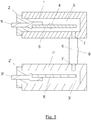
- Penning ion sources are used as an internal source for cyclotrons, such as for example the one represented in Figure 1 (longitudinal cross-sectional front view) and in Figure 2 (longitudinal cross-sectional perspective view), which corresponds to a double-cavity ion source.
- the double-cavity Penning ion source comprises two hollow bodies, each one made up of two parts, a conductive part (1, 1') and an insulating part (2, 2'), which fit together so that the interior walls thereof delimit a cylindrical cavity (3, 3').
- At least one of the conductive parts 1 has a gas supply inlet 4 through which a plasma-forming gas is introduced into the respective cavity 3 thereof.
- a coaxial conductor (5, 5') disposed in the cavity (3, 3') of the body (1, 1'), arranged parallel to the longitudinal axis of the cylindrical cavity (3, 3').
- Both cavities (3, 3') are interconnected by means of a common cylindrical expansion chamber (6) through respective holes (7, 7') made in the walls of the conductive parts (1, 1').
- a conductive element (9, 9') is introduced into each cavity (3, 3'), penetrating through the insulating part (2, 2'), and in electrical contact with the coaxial conductor (5, 5') of the cavity.
- the conductive element (9, 9') is excited with DC voltages of around 3000 V.
- To start the discharge it is necessary to open the gas flow and apply a potential difference of several thousand volts between anode and cathode (i.e., the conductive part 1/1' and the coaxial conductor 5/5').
- the power supply stabilises it by maintaining a potential difference between 500-1000V with a current of several hundred milliamps.
- the discharge that is established is of the DC type, requiring the emission of secondary electrons from the conductive material (such that they must be at a high temperature and be a material with high electron emissivity) and the ions that are expelled from the plasma are accelerated at high energy, causing erosion of the cathodes.
- Figure 3 shows a vertical cross section of an embodiment of the device object of the present invention, ion source 10, according to a cut plane perpendicular to the X-axis, wherein the external magnetic field B (normally generated by an electromagnet or a permanent magnet when the ion source is installed and running) is aligned with the vertical Z-axis of the reference system.
- the external magnetic field B normally generated by an electromagnet or a permanent magnet when the ion source is installed and running
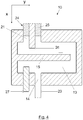
- FIG. 4 shows a cross section of the ion source 10 according to the XY horizontal plane passing through the axis of the resonant cavity.
- the interior walls (11a, 11b, 11c) of a hollow body 11 are electrically conductive and define a cylindrical cavity 13.
- the entire body 11 is conductive, preferably made of copper.
- the body 11 has three interior walls: a first interior wall 11a, of circular geometry, a second interior wall 11b, also circular and opposite the first interior wall 11a, and a third interior wall 11c, of cylindrical geometry, which connects both circular interior walls (11a, 11b).
- a coaxial conductor 15 is disposed in the cavity 13 of the body 11, arranged parallel to the longitudinal axis of the cylindrical cavity 13. At least one of the ends (15a, 15b) of the coaxial conductor 15 is in contact with one of the circular interior walls (11a, 11b) of the body 11, forming a coaxial resonant cavity.
- the coaxial conductor 15 can short-circuit both interior walls (11a, 11b) to obtain a ⁇ /2 coaxial resonant cavity, obtaining the maximum electric field in the centre, or it short-circuits a single interior wall to obtain a ⁇ /4 coaxial resonant cavity (with the maximum electric field at the opposite end of the conductor).
- the body 11 has a gas supply port or inlet 14 (i.e., a hole or opening made in one of the walls thereof) through which a plasma-forming gas is introduced into the cavity 13.
- a gas supply port or inlet 14 i.e., a hole or opening made in one of the walls thereof
- Figure 4 shows a tube 20, hermetically coupled to the gas supply inlet 14, through which the gas is introduced into the cavity 13.
- the body 11 also has a power supply inlet 21 through which radio frequency energy is injected into the cavity 13.
- An expansion chamber 16 is connected to the cavity 13 through a plasma outlet hole 17 made in one of the walls of the body 11.
- An ion-extraction aperture 18 is disposed in one of the walls of the expansion chamber 16.
- the ion source 10 is introduced under vacuum into the chamber of a cyclotron, and the gas that is injected is partially transformed into plasma and the rest escapes through the ion-extraction aperture 18.
- the coaxial conductor 15 has a conductive protuberance 22 that extends radially into the cavity 13 with respect to the axis of the cylindrical cavity (i.e., perpendicular to said axis), said conductive protuberance 22 being opposite the plasma outlet hole 17 of the body 11 that connects the cavity 13 to the expansion chamber 16 (i.e., the conductive protuberance 22 is opposite the expansion chamber 16).
- the conductive protuberance 22 does not come into contact with the interior wall of the body 11, although it remains very close, usually less than 5 millimetres; this separation distance will largely depend on the dimensions of the resonant cavity.
- the ignition voltage, injected power in the case of RF will depend in turn on this separation distance and the density of the injected gas.
- the body 11 is short-circuited by the internal coaxial conductor 15 at one end 15a or at both ends (15a, 15b).
- the coaxial conductor 15 is an inner conductor that functions like an electrode opposite the outer conductor, the interior walls of the body 11, in such a way that when power is injected, the cavity 13 enters into resonance and the electric field that is established in the gap between the two conductors (11, 15) changes sign.
- a portion of the free end of the coaxial conductor 15, second end 15b is modified by means of a conductive protuberance or protrusion 22 directed towards the expansion chamber 16, in order to produce a concentration and an increase of the electric field in the area where the plasma is to be produced (plasma production area).
- the plasma produced escapes from the cavity 13 through the plasma outlet hole 17 towards the expansion chamber 16, forming a plasma column 23 aligned with the magnetic field B, from which the ions are extracted using the ion-extraction aperture 18.
- the expansion chamber 16 is a cavity, also preferably of cylindrical geometry, which performs the function of an expansion chamber for the plasma column 23.
- the expansion chamber 16 is a cylindrical cavity with a small radius so that after extracting the particles through the ion-extraction aperture 18 and accelerating them in the first turn, they do not collide with the source and are lost.
- the expansion chamber 16 also acts as a mechanical support, keeping the two symmetrical portions of the ion source separate, when they are a double-cavity ion source (as shown in Figures 1 and 2 ).
- a coaxial waveguide 24 which transports radio frequency/microwave energy is coupled through the power supply access, port or inlet 21, the coupling possibly being of the electrical (capacitive) or magnetic (inductive) type.
- Figure 4 shows a typical capacitive coupling, wherein the dielectric 25 that surrounds the inner conductor 26 of the coaxial waveguide 24 enables the hermetic sealing of the power supply inlet 21 (so that portion of the injected gas does not escapes through said inlet), and wherein the inner conductor 26 of the coaxial waveguide 24 protrudes from the dielectric 25, partially entering into the cavity 13.
- a typical inductive coupling uses a loop that short-circuits the interior of the coaxial waveguide with the resonant cavity.
- the frequency of the resonant cavity can be adjusted by means of an insert or moving part 27 that is partially introduced into the cavity 13.
- the moving part 27 can be displaced radially at the moment of the initial configuration of the ion source 10 (i.e., perpendicular to the axis of the cylindrical cavity 13), thus allowing the resonance frequency to be finely adjusted based on the volume of the movable part 27 that is introduced into the cavity 13.
- the moving part 27 is an optional element, not strictly necessary for the operation of the ion source, although it improves the operation by making it easier to adjust the resonance frequency.
- the moving part 27 can be made of conductive material (preferably copper) or of dielectric material (such as alumina), depending on the behaviour and the variation in frequency to be achieved.
- Figures 5 and 6 show two additional views of the ion source 10, according to one possible embodiment.
- Figure 5 illustrates a front view of the ion source 10, wherein the portion above the axis of the cavity 13 is shown in mid-section.
- Figure 6 shows a three-dimensional view of an ion source 10.
- the gas supply inlet 14 cannot be seen in Figure 6 as it is disposed at the rear of the body 11 in this view.
- the projection 70 shown in Figure 6 is an element with the same function as the movable part 27 of Figure 4 , an element by means of which the frequency of the resonant cavity is finely adjusted. In this case, the projection 70 is integrated into the body of the ion source, but it could be designed as a separate body.
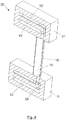
- Figures 7 and 8 show, respectively and according to another embodiment, a front cross section and a perspective cross section of a double-cavity ion source 30, with a plane of symmetry 31 in the central portion of the ion-extraction aperture 18, both cavities (13, 13') being connected by a common expansion chamber 16, which allows the expansion of the plasma column 23 produced in each cavity (13, 13').
- the elements of the ion source 30 for each of the two cavities (13, 13') are the same as those shown in Figures 3 to 6 for the ion source 10 having a single cavity (first body 11 and second body 11', first coaxial conductor 15 and second coaxial conductor 15', first conductive protuberance 22 and second conductive protuberance 22', first plasma outlet hole 17 and second plasma outlet hole 17', etc.), with the particularity in this case that both cavities (13, 13') are opposite each other and share the expansion chamber 16.
- Double-cavity ion sources 30 are used to obtain plasma more easily and increase the production of particles, such that at both ends there are two plasma jets that converge at the height of the plane of symmetry 31, forming a single plasma column 23 in the central portion, wherein the ion-extraction aperture 18 is located to remove the desired particles, whether they are positive or negative ions.
- the length of the resonant cavity will be of the order of or less than ⁇ /2.
- the transverse dimensions, as well as those of the conductive protuberance 22 for concentrating the electric field, are determined by the specific parameters of the resonant cavity to be obtained, mainly the quality factor Q and characteristic impedance R/Q, and they will also have an effect on the resonant frequency of the cavity.
- the interior walls of the body 11 are made of a conductive material with low electrical resistivity and high thermal conductivity, generally copper or copper deposited on another metal, since there is a desire for the Q factor to be high and the power deposited on the walls to be rapidly dissipated.
- a generator which can be solid state, electron tube (magnetron, TWT, gyrotron, klystron, etc.) or a coil and capacitor resonant circuit, depending on the frequency, power and required working mode.
- Said power travels through a waveguide, generally coaxial or hollow (e.g., rectangular), to the cavity, wherein the power is transferred to the resonant cavity through a coupling (electrical, inductive or through-hole), minimising reflections and power losses.
- the value of the electric field increases in magnitude in such a way that it reaches a point when the plasma ignites (Paschen curve for oscillating electromagnetic fields).
- the resonant frequency of the cavity shifts, such that if the frequency of the electromagnetic field supplied to the cavity remains constant, power begins to be reflected due to the difference in impedances, reaching a point when all the power except that which is necessary to maintain the discharge and compensate for losses in the walls of the cavity will be reflected, stabilising the system in the steady state.
- a specific design of the present invention uses a ⁇ /4 coaxial resonant cavity, approximately 3 cm long for a frequency of 2.45 GHz, with one end short-circuited and the other open, and made of copper.
- a conductive protuberance 22 protruding in the same direction as the magnetic field (in the vertical direction Z) which is opposite the plasma outlet hole 17 and which allows increasing the electric field in that area to achieve plasma formation with less power.
- the plasma leaves through the plasma outlet hole 17 and enters the expansion chamber 16, where it spreads mainly in the direction of the magnetic field lines (parallel to the Z-axis) forming a plasma column 23, and passes close to the ion-extraction aperture 18, wherein the ions are extracted by means of an electric field.
- the gas supply inlet 14 is implemented by means of a simple hole connected to a tube 20, while the coupling of the radio frequency system is carried out with electrical coupling by means of a protruding cylinder (dielectric 25) connected to the inner conductor 26 of a coaxial waveguide 24.
- a protruding cylinder dielectric 25
- Other alternatives for introducing power are a magnetic coupling through a loop or a hole made in a waveguide.
- the resonant frequency of the cavity is adjusted by the moving part 27.
- Figure 9 illustrates an ion source 40 according to another possible embodiment, wherein the location of the plasma outlet hole 17 (in this case it is located in the circular second interior wall 11b) and the orientation of the expansion chamber 16 changes with respect to the cavity 13. Furthermore, the conductive protuberance 22 of the ion source 40 for this embodiment preferably has a circular cross section, to thereby maintain internal symmetry in the cavity 13 (the conductive protuberance 22 of Figure 9 protrudes on each side, top and bottom, of the coaxial conductor 15).
- the conductive protuberance 22 of Figure 3 can have different types of cross sections, depending on the geometry and dimensions of the cavity, the coaxial conductor and the plasma outlet hole (the cross section can be optimised by means of simulation to obtain a greater concentration of the electric field opposite of the plasma outlet hole 17 that favours the formation and stability of the plasma), so that the conductive protuberance 22 only protrudes on one side, at the top.
- the upper circle illustrated in Figure 9 represents the resonator 12 (i.e., the coaxial resonant cavity) that forms when ion source 40 is in operation.
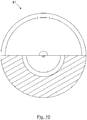
- FIGS 10 and 11 show, respectively, a front and perspective view (partially sectioned) of a cyclotron 41 (in the figure of the cyclotron, components such as the magnet coils, the radio frequency-acceleration system, the extraction system and the vacuum and opening system of the iron have been omitted) with axial configuration for introducing an ion source.
- the ion source is introduced with the axial configuration of Figure 9 , wherein the electromagnetic and mechanical design of the ion sources is simpler.
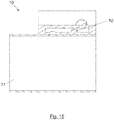
- Figures 12 and 13 show a cyclotron 46 with radial configuration for introducing the ion source, wherein the design of the ion sources is more complicated (it corresponds to the ion sources represented in Figures 3 to 6 ).
- Figures 10 , 11 , 12 and 13 the following references are used:
- a coaxial waveguide 24 which transports radio frequency/microwave energy is coupled through the power supply input 21.
- the coupling can be electrical/capacitive or magnetic/inductive.
- Figure 14 shows an embodiment like the one shown in Figure 6 but replacing the capacitive coupling with a magnetic coupling, wherein a loop 49 short-circuits the inner conductor 26 of the coaxial waveguide 24 with the interior wall of the body 11.
- Figures 15 and 16 show another type of coupling, coupling by rectangular waveguide 71, in two different views (top view and perspective view, with a partial cross section). In this case, the coupling is performed by means of a hole 72 that joins the cavity 13 to the vacuum of the rectangular waveguide 71.
- the ion source 10 has larger dimensions due to the rectangular waveguide 71, which must also be under vacuum.
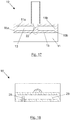
- Figures 17, 18 , 19 and 20 show different views in partial section (in particular, a front view, a top view, a front perspective view and a rear perspective view, respectively) of an embodiment of the ion source 10 wherein the two ends (15a, 15b) of the coaxial conductor 15 are respectively in contact with the two circular interior walls (11a, 11b) of the body 11, thus obtaining a ⁇ /2 coaxial resonant chamber.
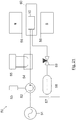
- FIG 21 shows, by way of example, a complete radio frequency system 50 in which the ion source (10; 30; 40) of the present invention can be used.
- the radio frequency system comprises a generator 51 of sufficient power and adjustable parameters to achieve the ignition of the plasma, a circulator 52 with a load 53 to absorb the reflected power and a directional coupler 54 with a power meter 55 to monitor the incident and reflected power.
- the ion source (10; 30; 40) is placed immersed in a magnetic field generated by an electromagnet or by a permanent magnet 56, wherein the direction of the field lines is not important, only their movement.
- the ion source (10; 30; 40) is joined through the gas supply inlet 14 to a gas injection system 57, which comprises a gas reservoir or tank 58 and is dosed by means of a regulation system 59.
- the ion source (10; 30; 40) is disposed in a chamber 60 with sufficient vacuum so that the ions are not neutralised by the residual gas and can be accelerated for later use.
- the necessary radio frequency power is provided by the generator 51, and the transmitted power is measured with the power meter 55 connected to the directional coupler 54.
- the generator 51 is protected with the circulator 52 which diverts the power reflected by the ion source (10; 30; 40) to the load 53.
Landscapes
- Engineering & Computer Science (AREA)
- Physics & Mathematics (AREA)
- Plasma & Fusion (AREA)
- Spectroscopy & Molecular Physics (AREA)
- Chemical & Material Sciences (AREA)
- Combustion & Propulsion (AREA)
- Electron Sources, Ion Sources (AREA)
Applications Claiming Priority (2)
| Application Number | Priority Date | Filing Date | Title |
|---|---|---|---|
| ES201830684A ES2696227B2 (es) | 2018-07-10 | 2018-07-10 | Fuente de iones interna para ciclotrones de baja erosion |
| PCT/ES2019/070461 WO2020012047A1 (fr) | 2018-07-10 | 2019-07-01 | Source d'ions interne pour cyclotrons à faible érosion |
Publications (4)
| Publication Number | Publication Date |
|---|---|
| EP3799104A1 true EP3799104A1 (fr) | 2021-03-31 |
| EP3799104A4 EP3799104A4 (fr) | 2021-07-28 |
| EP3799104B1 EP3799104B1 (fr) | 2024-12-11 |
| EP3799104C0 EP3799104C0 (fr) | 2024-12-11 |
Family
ID=64949490
Family Applications (1)
| Application Number | Title | Priority Date | Filing Date |
|---|---|---|---|
| EP19834900.3A Active EP3799104B1 (fr) | 2018-07-10 | 2019-07-01 | Source d'ions interne pour cyclotrons à faible érosion |
Country Status (7)
| Country | Link |
|---|---|
| US (1) | US11497111B2 (fr) |
| EP (1) | EP3799104B1 (fr) |
| JP (1) | JP7361092B2 (fr) |
| CN (1) | CN112424901B (fr) |
| CA (1) | CA3105590A1 (fr) |
| ES (2) | ES2696227B2 (fr) |
| WO (1) | WO2020012047A1 (fr) |
Families Citing this family (4)
| Publication number | Priority date | Publication date | Assignee | Title |
|---|---|---|---|---|
| ES2696227B2 (es) * | 2018-07-10 | 2019-06-12 | Centro De Investig Energeticas Medioambientales Y Tecnologicas Ciemat | Fuente de iones interna para ciclotrones de baja erosion |
| CN113488364B (zh) * | 2021-07-13 | 2024-05-14 | 迈胜医疗设备有限公司 | 一种多粒子热阴极潘宁离子源及回旋加速器 |
| CN118102569B (zh) * | 2023-10-20 | 2024-08-06 | 国电投核力同创(北京)科技有限公司 | 一种三段式潘宁离子源阳极腔 |
| JP7850506B1 (ja) | 2026-02-04 | 2026-04-23 | 株式会社京都メディカルテクノロジー | 高電圧・高密度pigイオン源及びイオン引出方法 |
Family Cites Families (64)
| Publication number | Priority date | Publication date | Assignee | Title |
|---|---|---|---|---|
| FR2147497A5 (fr) * | 1971-07-29 | 1973-03-09 | Commissariat Energie Atomique | |
| JPS59154736A (ja) * | 1983-02-21 | 1984-09-03 | Hitachi Ltd | 低圧水銀蒸気放電灯 |
| US4585668A (en) * | 1983-02-28 | 1986-04-29 | Michigan State University | Method for treating a surface with a microwave or UHF plasma and improved apparatus |
| US4691662A (en) * | 1983-02-28 | 1987-09-08 | Michigan State University | Dual plasma microwave apparatus and method for treating a surface |
| US4507588A (en) * | 1983-02-28 | 1985-03-26 | Board Of Trustees Operating Michigan State University | Ion generating apparatus and method for the use thereof |
| FR2556498B1 (fr) * | 1983-12-07 | 1986-09-05 | Commissariat Energie Atomique | Source d'ions multicharges a plusieurs zones de resonance cyclotronique electronique |
| US4710283A (en) * | 1984-01-30 | 1987-12-01 | Denton Vacuum Inc. | Cold cathode ion beam source |
| JPH0616384B2 (ja) * | 1984-06-11 | 1994-03-02 | 日本電信電話株式会社 | マイクロ波イオン源 |
| US4727293A (en) * | 1984-08-16 | 1988-02-23 | Board Of Trustees Operating Michigan State University | Plasma generating apparatus using magnets and method |
| US4630566A (en) * | 1984-08-16 | 1986-12-23 | Board Of Trustees Operating Michigan State University | Microwave or UHF plasma improved apparatus |
| FR2572847B1 (fr) * | 1984-11-06 | 1986-12-26 | Commissariat Energie Atomique | Procede et dispositif d'allumage d'une source d'ions hyperfrequence |
| US4642523A (en) * | 1985-02-11 | 1987-02-10 | The United States Of America As Represented By The Administrator Of The National Aeronautics And Space Administration | Precision tunable resonant microwave cavity |
| US4673456A (en) * | 1985-09-17 | 1987-06-16 | Machine Technology, Inc. | Microwave apparatus for generating plasma afterglows |
| DE3601632A1 (de) * | 1986-01-21 | 1987-07-23 | Leybold Heraeus Gmbh & Co Kg | Verfahren zum herstellen von extraktionsgittern fuer ionenquellen und durch das verfahren hergestellte extraktionsgitter |
| FR2595868B1 (fr) * | 1986-03-13 | 1988-05-13 | Commissariat Energie Atomique | Source d'ions a resonance cyclotronique electronique a injection coaxiale d'ondes electromagnetiques |
| US4777336A (en) * | 1987-04-22 | 1988-10-11 | Michigan State University | Method for treating a material using radiofrequency waves |
| DE3738352A1 (de) * | 1987-11-11 | 1989-05-24 | Technics Plasma Gmbh | Filamentloses magnetron-ionenstrahlsystem |
| JPH01198478A (ja) * | 1988-02-01 | 1989-08-10 | Canon Inc | マイクロ波プラズマcvd装置 |
| DE3803355A1 (de) * | 1988-02-05 | 1989-08-17 | Leybold Ag | Teilchenquelle fuer eine reaktive ionenstrahlaetz- oder plasmadepositionsanlage |
| US5053678A (en) * | 1988-03-16 | 1991-10-01 | Hitachi, Ltd. | Microwave ion source |
| GB8905073D0 (en) * | 1989-03-06 | 1989-04-19 | Nordiko Ltd | Ion gun |
| US4943345A (en) * | 1989-03-23 | 1990-07-24 | Board Of Trustees Operating Michigan State University | Plasma reactor apparatus and method for treating a substrate |
| US4902870A (en) * | 1989-03-31 | 1990-02-20 | General Electric Company | Apparatus and method for transfer arc cleaning of a substrate in an RF plasma system |
| US4906900A (en) * | 1989-04-03 | 1990-03-06 | Board Of Trustees Operating Michigan State University | Coaxial cavity type, radiofrequency wave, plasma generating apparatus |
| US5081398A (en) * | 1989-10-20 | 1992-01-14 | Board Of Trustees Operating Michigan State University | Resonant radio frequency wave coupler apparatus using higher modes |
| US5008506A (en) * | 1989-10-30 | 1991-04-16 | Board Of Trustees Operating Michigan State University | Radiofrequency wave treatment of a material using a selected sequence of modes |
| DE69026337T2 (de) * | 1989-10-31 | 1996-08-14 | Nippon Electric Co | Ionenantrieb für Weltraumflüge |
| US5142198A (en) * | 1989-12-21 | 1992-08-25 | Applied Science And Technology, Inc. | Microwave reactive gas discharge device |
| US5191182A (en) * | 1990-07-11 | 1993-03-02 | International Business Machines Corporation | Tuneable apparatus for microwave processing |
| US5241040A (en) * | 1990-07-11 | 1993-08-31 | International Business Machines Corporation | Microwave processing |
| US5111111A (en) * | 1990-09-27 | 1992-05-05 | Consortium For Surface Processing, Inc. | Method and apparatus for coupling a microwave source in an electron cyclotron resonance system |
| US5204144A (en) * | 1991-05-10 | 1993-04-20 | Celestech, Inc. | Method for plasma deposition on apertured substrates |
| US5213248A (en) * | 1992-01-10 | 1993-05-25 | Norton Company | Bonding tool and its fabrication |
| US5216330A (en) * | 1992-01-14 | 1993-06-01 | Honeywell Inc. | Ion beam gun |
| US5225740A (en) * | 1992-03-26 | 1993-07-06 | General Atomics | Method and apparatus for producing high density plasma using whistler mode excitation |
| US5182496A (en) * | 1992-04-07 | 1993-01-26 | The United States Of America As Represented By The Secretary Of The Navy | Method and apparatus for forming an agile plasma mirror effective as a microwave reflector |
| AU4705593A (en) * | 1992-08-08 | 1994-03-03 | Jurgen Andra | Process and device for generating beams of any highly charged ions having low kinetic energy |
| DE4413234A1 (de) * | 1994-04-15 | 1995-10-19 | Siemens Ag | Koaxiale Anordnung mit einem virtuellen Kurzschluß |
| JPH0955170A (ja) * | 1995-08-10 | 1997-02-25 | Nissin Electric Co Ltd | イオン源 |
| US5707452A (en) * | 1996-07-08 | 1998-01-13 | Applied Microwave Plasma Concepts, Inc. | Coaxial microwave applicator for an electron cyclotron resonance plasma source |
| DE19757852C2 (de) * | 1997-12-24 | 2001-06-28 | Karlsruhe Forschzent | Vorrichtung und Verfahren zur Dotierung von Gefäßstützen mit radiaktiven und nicht radioaktiven Atomen |
| DE19814812C2 (de) * | 1998-04-02 | 2000-05-11 | Mut Mikrowellen Umwelt Technol | Plasmabrenner mit einem Mikrowellensender |
| JP4067640B2 (ja) * | 1998-04-28 | 2008-03-26 | 株式会社ルネサステクノロジ | 荷電粒子源および荷電粒子ビーム装置並びに不良解析方法および半導体デバイスの製造方法 |
| JP3970497B2 (ja) * | 2000-03-30 | 2007-09-05 | 株式会社神戸製鋼所 | イオン源を用いたイオンビーム発生方法,イオン源 |
| US7510664B2 (en) * | 2001-01-30 | 2009-03-31 | Rapt Industries, Inc. | Apparatus and method for atmospheric pressure reactive atom plasma processing for shaping of damage free surfaces |
| US7378673B2 (en) * | 2005-02-25 | 2008-05-27 | Cymer, Inc. | Source material dispenser for EUV light source |
| US7439530B2 (en) * | 2005-06-29 | 2008-10-21 | Cymer, Inc. | LPP EUV light source drive laser system |
| FR2826542B1 (fr) * | 2001-06-22 | 2003-09-26 | Pantechnik | Dispositif pour la production d'ions de charges positives variables et a resonnance cyclotronique |
| US6664548B2 (en) * | 2002-05-01 | 2003-12-16 | Axcelis Technologies, Inc. | Ion source and coaxial inductive coupler for ion implantation system |
| US7465362B2 (en) * | 2002-05-08 | 2008-12-16 | Btu International, Inc. | Plasma-assisted nitrogen surface-treatment |
| US7494904B2 (en) * | 2002-05-08 | 2009-02-24 | Btu International, Inc. | Plasma-assisted doping |
| US7497922B2 (en) * | 2002-05-08 | 2009-03-03 | Btu International, Inc. | Plasma-assisted gas production |
| US7498066B2 (en) * | 2002-05-08 | 2009-03-03 | Btu International Inc. | Plasma-assisted enhanced coating |
| US7371992B2 (en) * | 2003-03-07 | 2008-05-13 | Rapt Industries, Inc. | Method for non-contact cleaning of a surface |
| CN1303246C (zh) * | 2004-07-06 | 2007-03-07 | 西安交通大学 | 一种金属离子源 |
| KR100553716B1 (ko) * | 2004-08-02 | 2006-02-24 | 삼성전자주식회사 | 이온 주입 설비의 이온 소스부 |
| US7482609B2 (en) * | 2005-02-28 | 2009-01-27 | Cymer, Inc. | LPP EUV light source drive laser system |
| US8748785B2 (en) * | 2007-01-18 | 2014-06-10 | Amastan Llc | Microwave plasma apparatus and method for materials processing |
| RU2366124C1 (ru) * | 2008-01-09 | 2009-08-27 | Федеральное государственное унитарное предприятие "Государственный научный центр Российской Федерации Институт теоретической и экспериментальной физики им. А.И. Алиханова" | Индукционный ускоритель дейтронов - нейтронный генератор |
| US9171702B2 (en) * | 2010-06-30 | 2015-10-27 | Lam Research Corporation | Consumable isolation ring for movable substrate support assembly of a plasma processing chamber |
| FR2985292B1 (fr) * | 2011-12-29 | 2014-01-24 | Onera (Off Nat Aerospatiale) | Propulseur plasmique et procede de generation d'une poussee propulsive plasmique |
| KR20160145070A (ko) * | 2014-04-08 | 2016-12-19 | 플라스마 이그나이터, 엘엘씨 | 이중 신호 동축 공동 공진기 플라스마 발생 |
| CN107087339B (zh) * | 2017-07-03 | 2024-11-26 | 李容毅 | 一种双腔激励的增强型微波等离子体炬发生装置 |
| ES2696227B2 (es) * | 2018-07-10 | 2019-06-12 | Centro De Investig Energeticas Medioambientales Y Tecnologicas Ciemat | Fuente de iones interna para ciclotrones de baja erosion |
-
2018
- 2018-07-10 ES ES201830684A patent/ES2696227B2/es not_active Expired - Fee Related
-
2019
- 2019-07-01 ES ES19834900T patent/ES3014992T3/es active Active
- 2019-07-01 US US17/258,641 patent/US11497111B2/en active Active
- 2019-07-01 CN CN201980045922.5A patent/CN112424901B/zh active Active
- 2019-07-01 EP EP19834900.3A patent/EP3799104B1/fr active Active
- 2019-07-01 WO PCT/ES2019/070461 patent/WO2020012047A1/fr not_active Ceased
- 2019-07-01 CA CA3105590A patent/CA3105590A1/fr active Pending
- 2019-07-01 JP JP2021500717A patent/JP7361092B2/ja active Active
Also Published As
| Publication number | Publication date |
|---|---|
| US11497111B2 (en) | 2022-11-08 |
| ES2696227B2 (es) | 2019-06-12 |
| EP3799104B1 (fr) | 2024-12-11 |
| ES2696227A1 (es) | 2019-01-14 |
| CN112424901A (zh) | 2021-02-26 |
| EP3799104C0 (fr) | 2024-12-11 |
| US20210274632A1 (en) | 2021-09-02 |
| CN112424901B (zh) | 2024-02-13 |
| ES3014992T3 (en) | 2025-04-28 |
| JP2021530839A (ja) | 2021-11-11 |
| WO2020012047A1 (fr) | 2020-01-16 |
| CA3105590A1 (fr) | 2020-01-16 |
| EP3799104A4 (fr) | 2021-07-28 |
| JP7361092B2 (ja) | 2023-10-13 |
Similar Documents
| Publication | Publication Date | Title |
|---|---|---|
| USRE48317E1 (en) | Interrupted particle source | |
| EP3799104B1 (fr) | Source d'ions interne pour cyclotrons à faible érosion | |
| US5361016A (en) | High density plasma formation using whistler mode excitation in a reduced cross-sectional area formation tube | |
| JPS6276137A (ja) | イオン源 | |
| Xie et al. | Study of a 0.35 THz extended interaction oscillator driven by a pseudospark-sourced sheet electron beam | |
| ITFI940194A1 (it) | Sorgente di plasma a radiofrequenza | |
| KR100876052B1 (ko) | 뉴트럴라이저 형태의 고주파 전자 소스 | |
| Zhang et al. | Simulations of the self-focused pseudospark-sourced electron beam in a background ion channel | |
| RU2151438C1 (ru) | Плазменный источник ионов с ленточным пучком (варианты) | |
| Mozjetchkov et al. | Microwave plasma source for the negative hydrogen ion production | |
| RU2838397C1 (ru) | Устройство поджигания плазмы в высокочастотном источнике плазмы | |
| Skalyga et al. | Status of new developments in the field of high-current gasdynamic ECR ion sources at the IAP RAS | |
| RU2306685C1 (ru) | Ускоритель заряженных частиц | |
| Christensen et al. | Performance of Intense Pulsed Ion Source | |
| Frolov et al. | Nanovircator: Promising THz electromagnetic radiation source | |
| Glyavin et al. | Project of 700 GHz/300 kW/10 ms Pulsed Gyrotron for Initiating and Studying Localized Gas Discharges | |
| Dougar‐Jabon et al. | Influence of an electron‐beam injection on ion charge state distribution in an ECR source at 2.45 GHz | |
| Vintizenko et al. | Microwave radiation characteristics of relativistic magnetron with coupled cavities | |
| Yoshida et al. | The use of magnetic fields in a partial-coaxial microwave cavity holey-plate ion source | |
| Takagi et al. | Plasma sputter multicusp negative/positive ion source with ECR discharge | |
| Nikolaev et al. | Generation of the High Charge State Metal Ion Beams by Gyrotron Microwave Heating of Vacuum Arc Plasma1 | |
| Wada et al. | Extraction of Hydrogen Negative Ions from a 14 GHz Microwave Ion Source | |
| Bulychev et al. | Generation on broadband radio pulses by a new type reflex triode with a virtual cathode | |
| Kondrat'ev et al. | A Universal Ion Source with a Cold Cathode | |
| JPH01159937A (ja) | 負イオン源 |
Legal Events
| Date | Code | Title | Description |
|---|---|---|---|
| STAA | Information on the status of an ep patent application or granted ep patent |
Free format text: STATUS: THE INTERNATIONAL PUBLICATION HAS BEEN MADE |
|
| PUAI | Public reference made under article 153(3) epc to a published international application that has entered the european phase |
Free format text: ORIGINAL CODE: 0009012 |
|
| STAA | Information on the status of an ep patent application or granted ep patent |
Free format text: STATUS: REQUEST FOR EXAMINATION WAS MADE |
|
| 17P | Request for examination filed |
Effective date: 20201224 |
|
| AK | Designated contracting states |
Kind code of ref document: A1 Designated state(s): AL AT BE BG CH CY CZ DE DK EE ES FI FR GB GR HR HU IE IS IT LI LT LU LV MC MK MT NL NO PL PT RO RS SE SI SK SM TR |
|
| AX | Request for extension of the european patent |
Extension state: BA ME |
|
| REG | Reference to a national code |
Ref country code: DE Free format text: PREVIOUS MAIN CLASS: H01J0027040000 Ref country code: DE Ref legal event code: R079 Ref document number: 602019063469 Country of ref document: DE Free format text: PREVIOUS MAIN CLASS: H01J0027040000 Ipc: H01J0027180000 |
|
| A4 | Supplementary search report drawn up and despatched |
Effective date: 20210624 |
|
| RIC1 | Information provided on ipc code assigned before grant |
Ipc: H01J 27/18 20060101AFI20210618BHEP Ipc: H05H 7/08 20060101ALI20210618BHEP Ipc: H05H 13/00 20060101ALI20210618BHEP |
|
| DAV | Request for validation of the european patent (deleted) | ||
| DAX | Request for extension of the european patent (deleted) | ||
| GRAP | Despatch of communication of intention to grant a patent |
Free format text: ORIGINAL CODE: EPIDOSNIGR1 |
|
| STAA | Information on the status of an ep patent application or granted ep patent |
Free format text: STATUS: GRANT OF PATENT IS INTENDED |
|
| INTG | Intention to grant announced |
Effective date: 20240708 |
|
| GRAS | Grant fee paid |
Free format text: ORIGINAL CODE: EPIDOSNIGR3 |
|
| GRAA | (expected) grant |
Free format text: ORIGINAL CODE: 0009210 |
|
| STAA | Information on the status of an ep patent application or granted ep patent |
Free format text: STATUS: THE PATENT HAS BEEN GRANTED |
|
| AK | Designated contracting states |
Kind code of ref document: B1 Designated state(s): AL AT BE BG CH CY CZ DE DK EE ES FI FR GB GR HR HU IE IS IT LI LT LU LV MC MK MT NL NO PL PT RO RS SE SI SK SM TR |
|
| REG | Reference to a national code |
Ref country code: GB Ref legal event code: FG4D |
|
| REG | Reference to a national code |
Ref country code: CH Ref legal event code: EP |
|
| REG | Reference to a national code |
Ref country code: IE Ref legal event code: FG4D |
|
| REG | Reference to a national code |
Ref country code: DE Ref legal event code: R096 Ref document number: 602019063469 Country of ref document: DE |
|
| U01 | Request for unitary effect filed |
Effective date: 20241211 |
|
| U07 | Unitary effect registered |
Designated state(s): AT BE BG DE DK EE FI FR IT LT LU LV MT NL PT RO SE SI Effective date: 20241223 |
|
| PG25 | Lapsed in a contracting state [announced via postgrant information from national office to epo] |
Ref country code: HR Free format text: LAPSE BECAUSE OF FAILURE TO SUBMIT A TRANSLATION OF THE DESCRIPTION OR TO PAY THE FEE WITHIN THE PRESCRIBED TIME-LIMIT Effective date: 20241211 |
|
| PG25 | Lapsed in a contracting state [announced via postgrant information from national office to epo] |
Ref country code: NO Free format text: LAPSE BECAUSE OF FAILURE TO SUBMIT A TRANSLATION OF THE DESCRIPTION OR TO PAY THE FEE WITHIN THE PRESCRIBED TIME-LIMIT Effective date: 20250311 |
|
| PG25 | Lapsed in a contracting state [announced via postgrant information from national office to epo] |
Ref country code: GR Free format text: LAPSE BECAUSE OF FAILURE TO SUBMIT A TRANSLATION OF THE DESCRIPTION OR TO PAY THE FEE WITHIN THE PRESCRIBED TIME-LIMIT Effective date: 20250312 |
|
| PG25 | Lapsed in a contracting state [announced via postgrant information from national office to epo] |
Ref country code: RS Free format text: LAPSE BECAUSE OF FAILURE TO SUBMIT A TRANSLATION OF THE DESCRIPTION OR TO PAY THE FEE WITHIN THE PRESCRIBED TIME-LIMIT Effective date: 20250311 |
|
| PG25 | Lapsed in a contracting state [announced via postgrant information from national office to epo] |
Ref country code: SM Free format text: LAPSE BECAUSE OF FAILURE TO SUBMIT A TRANSLATION OF THE DESCRIPTION OR TO PAY THE FEE WITHIN THE PRESCRIBED TIME-LIMIT Effective date: 20241211 |
|
| PG25 | Lapsed in a contracting state [announced via postgrant information from national office to epo] |
Ref country code: PL Free format text: LAPSE BECAUSE OF FAILURE TO SUBMIT A TRANSLATION OF THE DESCRIPTION OR TO PAY THE FEE WITHIN THE PRESCRIBED TIME-LIMIT Effective date: 20241211 |
|
| PG25 | Lapsed in a contracting state [announced via postgrant information from national office to epo] |
Ref country code: IS Free format text: LAPSE BECAUSE OF FAILURE TO SUBMIT A TRANSLATION OF THE DESCRIPTION OR TO PAY THE FEE WITHIN THE PRESCRIBED TIME-LIMIT Effective date: 20250411 |
|
| PG25 | Lapsed in a contracting state [announced via postgrant information from national office to epo] |
Ref country code: SK Free format text: LAPSE BECAUSE OF FAILURE TO SUBMIT A TRANSLATION OF THE DESCRIPTION OR TO PAY THE FEE WITHIN THE PRESCRIBED TIME-LIMIT Effective date: 20241211 |
|
| PG25 | Lapsed in a contracting state [announced via postgrant information from national office to epo] |
Ref country code: CZ Free format text: LAPSE BECAUSE OF FAILURE TO SUBMIT A TRANSLATION OF THE DESCRIPTION OR TO PAY THE FEE WITHIN THE PRESCRIBED TIME-LIMIT Effective date: 20241211 |
|
| PGFP | Annual fee paid to national office [announced via postgrant information from national office to epo] |
Ref country code: ES Payment date: 20250924 Year of fee payment: 7 |
|
| PLBE | No opposition filed within time limit |
Free format text: ORIGINAL CODE: 0009261 |
|
| STAA | Information on the status of an ep patent application or granted ep patent |
Free format text: STATUS: NO OPPOSITION FILED WITHIN TIME LIMIT |
|
| REG | Reference to a national code |
Ref country code: CH Ref legal event code: L10 Free format text: ST27 STATUS EVENT CODE: U-0-0-L10-L00 (AS PROVIDED BY THE NATIONAL OFFICE) Effective date: 20251022 |
|
| U21 | Renewal fee for the european patent with unitary effect paid with additional fee |
Year of fee payment: 7 Effective date: 20251002 |
|
| 26N | No opposition filed |
Effective date: 20250912 |
|
| REG | Reference to a national code |
Ref country code: CH Ref legal event code: H13 Free format text: ST27 STATUS EVENT CODE: U-0-0-H10-H13 (AS PROVIDED BY THE NATIONAL OFFICE) Effective date: 20260224 |
|
| GBPC | Gb: european patent ceased through non-payment of renewal fee |
Effective date: 20250701 |
|
| PG25 | Lapsed in a contracting state [announced via postgrant information from national office to epo] |
Ref country code: GB Free format text: LAPSE BECAUSE OF NON-PAYMENT OF DUE FEES Effective date: 20250701 |
|
| PG25 | Lapsed in a contracting state [announced via postgrant information from national office to epo] |
Ref country code: CH Free format text: LAPSE BECAUSE OF NON-PAYMENT OF DUE FEES Effective date: 20250731 |