EP3799355B1 - Procédé de traitement de service, appareil et système - Google Patents
Procédé de traitement de service, appareil et système Download PDFInfo
- Publication number
- EP3799355B1 EP3799355B1 EP20191155.9A EP20191155A EP3799355B1 EP 3799355 B1 EP3799355 B1 EP 3799355B1 EP 20191155 A EP20191155 A EP 20191155A EP 3799355 B1 EP3799355 B1 EP 3799355B1
- Authority
- EP
- European Patent Office
- Prior art keywords
- processing
- function entity
- packet
- policy
- processing function
- Prior art date
- Legal status (The legal status is an assumption and is not a legal conclusion. Google has not performed a legal analysis and makes no representation as to the accuracy of the status listed.)
- Active
Links
Images








Classifications
-
- H—ELECTRICITY
- H04—ELECTRIC COMMUNICATION TECHNIQUE
- H04L—TRANSMISSION OF DIGITAL INFORMATION, e.g. TELEGRAPHIC COMMUNICATION
- H04L41/00—Arrangements for maintenance, administration or management of data switching networks, e.g. of packet switching networks
- H04L41/50—Network service management, e.g. ensuring proper service fulfilment according to agreements
- H04L41/5077—Network service management, e.g. ensuring proper service fulfilment according to agreements wherein the managed service relates to simple transport services, i.e. providing only network infrastructure
-
- H—ELECTRICITY
- H04—ELECTRIC COMMUNICATION TECHNIQUE
- H04L—TRANSMISSION OF DIGITAL INFORMATION, e.g. TELEGRAPHIC COMMUNICATION
- H04L47/00—Traffic control in data switching networks
- H04L47/10—Flow control; Congestion control
- H04L47/20—Traffic policing
-
- H—ELECTRICITY
- H04—ELECTRIC COMMUNICATION TECHNIQUE
- H04L—TRANSMISSION OF DIGITAL INFORMATION, e.g. TELEGRAPHIC COMMUNICATION
- H04L41/00—Arrangements for maintenance, administration or management of data switching networks, e.g. of packet switching networks
- H04L41/40—Arrangements for maintenance, administration or management of data switching networks, e.g. of packet switching networks using virtualisation of network functions or resources, e.g. SDN or NFV entities
-
- H—ELECTRICITY
- H04—ELECTRIC COMMUNICATION TECHNIQUE
- H04L—TRANSMISSION OF DIGITAL INFORMATION, e.g. TELEGRAPHIC COMMUNICATION
- H04L41/00—Arrangements for maintenance, administration or management of data switching networks, e.g. of packet switching networks
- H04L41/50—Network service management, e.g. ensuring proper service fulfilment according to agreements
- H04L41/5041—Network service management, e.g. ensuring proper service fulfilment according to agreements characterised by the time relationship between creation and deployment of a service
- H04L41/5051—Service on demand, e.g. definition and deployment of services in real time
-
- H—ELECTRICITY
- H04—ELECTRIC COMMUNICATION TECHNIQUE
- H04L—TRANSMISSION OF DIGITAL INFORMATION, e.g. TELEGRAPHIC COMMUNICATION
- H04L45/00—Routing or path finding of packets in data switching networks
- H04L45/38—Flow based routing
-
- H—ELECTRICITY
- H04—ELECTRIC COMMUNICATION TECHNIQUE
- H04L—TRANSMISSION OF DIGITAL INFORMATION, e.g. TELEGRAPHIC COMMUNICATION
- H04L47/00—Traffic control in data switching networks
- H04L47/10—Flow control; Congestion control
- H04L47/24—Traffic characterised by specific attributes, e.g. priority or QoS
- H04L47/2483—Traffic characterised by specific attributes, e.g. priority or QoS involving identification of individual flows
-
- H—ELECTRICITY
- H04—ELECTRIC COMMUNICATION TECHNIQUE
- H04W—WIRELESS COMMUNICATION NETWORKS
- H04W40/00—Communication routing or communication path finding
- H04W40/02—Communication route or path selection, e.g. power-based or shortest path routing
-
- H—ELECTRICITY
- H04—ELECTRIC COMMUNICATION TECHNIQUE
- H04L—TRANSMISSION OF DIGITAL INFORMATION, e.g. TELEGRAPHIC COMMUNICATION
- H04L41/00—Arrangements for maintenance, administration or management of data switching networks, e.g. of packet switching networks
- H04L41/50—Network service management, e.g. ensuring proper service fulfilment according to agreements
- H04L41/508—Network service management, e.g. ensuring proper service fulfilment according to agreements based on type of value added network service under agreement
- H04L41/5087—Network service management, e.g. ensuring proper service fulfilment according to agreements based on type of value added network service under agreement wherein the managed service relates to voice services
-
- H—ELECTRICITY
- H04—ELECTRIC COMMUNICATION TECHNIQUE
- H04L—TRANSMISSION OF DIGITAL INFORMATION, e.g. TELEGRAPHIC COMMUNICATION
- H04L45/00—Routing or path finding of packets in data switching networks
- H04L45/74—Address processing for routing
Definitions
- the present invention relates to the field of communications technologies, and in particular, to a service processing method, an apparatus, and a system.
- Document WO 2015/113281 A1 discloses a user data processing method and device and a network system.
- the method comprises: an SNC determining, according to obtained control plane information, processing path information of a data path for processing user data of a UE and processing policy information of nodes on the data path, wherein the processing path information comprises information of the nodes on the data path and forwarding policy information of the nodes on the data path, and the processing policy information comprises processing methods and processing parameters of processing the user data by the nodes on the data path; and the SNC sending the processing path information and the processing policy information to an entry point and sending the processing policy information to an function node on the data path, so that the entry point marks the user data according to the processing path information and the processing policy information after receiving the user data, and the function node on the data path processes, according to the received processing policy information, the user data marked by the entry point after receiving the user data marked by the entry point.
- Document WO 2015/100530 A1 discloses a service routing method comprising: analyzing a received data message, and obtaining the service type of the data message; obtaining a service data route tag according to the correspondence between the service type and the service data route tag; wherein, the service data route tag is used to identify a route path for describing the network path routing the data message to a service enabler; appending the data route tag to the data message; and sending the data message to a switch, so that the switch controls, according to the service data route tag appended to the data message, the data message to route according to the route path.
- Document WO 2015/135216 A1 discloses a method and apparatus for controlling a service chain of a service flow.
- the method comprises: receiving a service processing customization request message sent by a content provider server/service provider server; generating service chain information of a service flow corresponding to the content provider server/service provider server according to a service processing customization condition carried in the service processing customization request message; and constructing service chain control information corresponding to a service chain according to the service chain information, so that a controller obtains the service chain control information and sends, according to the service chain control information, flow forwarding policy information corresponding to the service chain to a switch, and the switch processes the received service flow according to the flow forwarding policy information.
- FIG. 1 is a schematic diagram of a network architecture in which a control function and a forwarding function of a mobile gateway are separated in an EPC network.
- a control plane 101 of a mobile gateway may determine a data processing rule related to a packet sent by a UE (User Equipment, user equipment), and delivers the data processing rule to a forwarding plane 102 by using an interface between the control plane 101 and the forwarding plane 102.
- the forwarding plane 102 processes, according to the data processing rule, a packet sent by a base station 103 (an external network 104), and then sends a processed packet to the external network 104 (the base station 103).
- the forwarding plane integrates a point anchoring function of a user IP (Internet Protocol) address and multiple service processing functions. Therefore, the forwarding plane has an address resource and includes a computing resource.
- the address resource that the forwarding plane has determines a quantity of users who can be served by the forwarding plane, and the computing resource included in the forwarding plane determines a quantity of packets that can be processed by the forwarding plane at a same moment.
- the computing resource in the forwarding plane usually remains unchanged after delivery of a device.
- the address resource in the forwarding plane is allocated to a forwarding plane device by means of configuration. Address resource configuration update relates to routing information update of a peripheral network element, and usually cannot be implemented in real time.
- a quantity of users in the EPC network and a quantity of packets sent by all users at a same moment do not remain unchanged. Therefore, when the forwarding plane has insufficient address resources or computing resources, a forwarding plane needs to be added. However, when the quantity of users in the EPC network increases, and the quantity of packets sent by all the users at a same moment remains unchanged, addition of a forwarding plane causes waste of the computing resource; when the quantity of users in the EPC network remains unchanged, and the quantity of packets sent by all the users at a same moment increases, addition of a forwarding plane causes waste of the address resource. Even if the quantity of users increases, and the quantity of packets sent by all the users at a same moment also increases, the address resource or the computing resource may be wasted.
- the character "/" in this specification generally indicates an “or” relationship between the associated objects.
- the “multiple” in this specification means two or more than two.
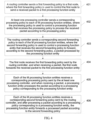
- This embodiment of the present invention provides a service processing method. As shown in FIG. 2 , the method includes the following steps:
- a controller controls a first node to send a received packet to a processing network.
- the controller controls the processing network to process the packet and then send a processed packet to a second node.
- the first node is a base station or a network element connected to the base station, and the second node is a routing function entity; or the first node is the routing function entity, and the second node is the base station or a network element connected to the base station.
- the routing function entity is an anchor point of a user IP address.
- the method provided in this embodiment of the present invention may be applied to at least an EPS (Evolved Packet System, evolved packet system) network (all networks in the following specification are the network, and all schematic architectural diagrams of network systems are schematic architectural diagrams of a system of the network).
- the EPS network includes an E-UTRAN (Evolved Universal Terrestrial Radio Access Network, evolved universal terrestrial radio access network) and an EPC network.
- the routing function entity is an anchor point of an IP address.
- the routing function entity is responsible for providing an IP routing capability for an IP address allocated to UE by the routing function entity. That is, the routing function entity is responsible for receiving a downlink packet (a packet sent to the UE from an external network) whose destination IP is the IP address, and sending, to the external network, an uplink packet (a packet sent to the external network from the UE) whose source IP is the IP address.
- the routing function entity When the UE moves within an area, the routing function entity is unchanged, so as to shield impact of UE movement on the external network, and anchor the IP address. In this case, the routing function entity has an address resource.
- the external network in this embodiment of the present invention is a PDN (Packet Data Network, packet data network).
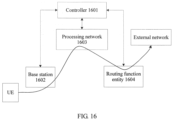
- the method may be based on an architecture of a network system shown in FIG. 16 in the following specification.
- a base station the routing function entity
- the processing network processes the packet and then sends a processed packet to the routing function entity (the base station).
- the routing function entity the base station
- FIG. 16 shows, by using a solid line, an example of a path of a packet when the first node is a base station.
- the network element connected to the base station in this embodiment of the present invention has a function same as the base station in this embodiment of the present invention. Therefore, only the base station is used as an example for description in this embodiment of the present invention.
- the UE in this embodiment of the present invention includes but is not limited to a mobile phone, a network access terminal device, an Internet of Things terminal device, and the like.
- the base station is a device that provides wireless access for the UE, and includes but is not limited to an eNodeB (evolved NodeB, evolved NodeB), a WiFi AP (Wireless Fidelity Access Point, Wireless Fidelity access point), a WiMAX BS (Worldwide Interoperability for Microwave Access Base Station, Worldwide Interoperability for Microwave Access base station), and the like.
- eNodeB evolved NodeB
- WiFi AP Wireless Fidelity Access Point
- WiMAX BS Worldwide Interoperability for Microwave Access Base Station
- the processing network in this embodiment of the present invention is a network entity that includes at least one network node and that is used to process a packet.
- a forwarding plane is divided into a processing network and a routing function entity.
- the processing network is configured to process a packet, and therefore, the processing network includes a computing resource.
- the routing function entity serves as an anchor point of a user IP address, and has an address resource.
- a routing function entity may be added.
- a processing network may be added. Therefore, compared with the prior art, according to the method provided in this embodiment of the present invention, waste of an address resource or a computing resource can be reduced.
- the processing network includes at least one processing function entity.
- the processing network includes at least one processing function entity.
- FIG. 17 or FIG 18 for an architecture of a network system, refer to FIG. 17 or FIG 18 in the following specification.
- the processing function entity is configured to process a received packet, and processing performed on the packet includes but is not limited to execution of QoS (Quality of Service, quality of service) control, online/offline charging, DPI (Deep Packet Inspection, deep packet inspection), lawful interception, TCP (Transmission Control Protocol) acceleration, HTTP (HyperText Transfer Protocol, Hypertext Transfer Protocol) header enrichment, and the like.
- QoS Quality of Service
- DPI Deep Packet Inspection
- TCP Transmission Control Protocol
- HTTP HyperText Transfer Protocol
- Hypertext Transfer Protocol Hypertext Transfer Protocol
- each processing function entity has only one processing function
- complex functions such as QoS control, online/offline charging, and DPI may be flexibly migrated.
- a network system has a relatively large demand for a processing function entity that has a processing function
- only the processing function entity may be added without adding a processing network, so that each processing function entity can be flexibly migrated.
- An example in which one processing function entity includes one packet processing function is used for description in the following specification.
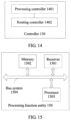
- a controller in a network system may further include a routing controller and at least one processing controller.
- a routing control function and a processing control function of a control plane are separated, so that deployment and coordination capabilities of the control plane are improved.
- the network system may further include a forwarder.
- the method includes multiple specific implementations, and the specific implementations are separately described below.
- all mentioned traffic flow identifiers are a same traffic flow identifier
- all mentioned packets are packets that carries the traffic flow identifier
- all mentioned processing polices, first forwarding policies, and second forwarding policies are processing policies and forwarding policies (processing polices, first forwarding policies, and second forwarding policies that are generated for different traffic flow identifiers may be different) that are generated for the traffic flow identifier.
- the traffic flow identifier may be an IP address of UE, IP quintuplets of a traffic flow, or the like.
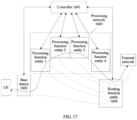
- FIG. 17 A schematic architectural diagram of a network system shown in FIG. 17 includes a controller, a base station, a routing function entity, and a processing network.
- the processing network includes at least one processing function entity ( FIG. 17 is drawn by using an example in which the processing network includes four processing function entities).
- FIG. 17 is drawn by using an example in which the processing network includes four processing function entities).
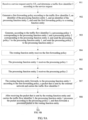
- FIG. 3 a specific implementation process of the foregoing method includes the following steps.
- the controller sends a first forwarding policy to a first node, where the first forwarding policy is used to control the first node to send a received packet to a first processing function entity.
- the first processing function entity is the first one in the at least one processing function entity that processes a packet.
- the first forwarding policy may be generated according to an identifier of the first processing function entity and a traffic flow identifier.
- the traffic flow identifier may be an IP address of UE, IP quintuplets of a traffic flow, or the like.
- the IP address of the UE may be allocated and sent to the controller by the routing function entity, or may be allocated by the controller according to a preconfigured IP address segment corresponding to the routing function entity.
- the IP address of the UE may be an IPv4 (Internet Protocol Version 4, Internet Protocol version 4) address, an IPv6 (Internet Protocol Version 6, Internet Protocol version 6) address, or the like.
- the controller may determine the traffic flow identifier according to the IP address of the UE, a destination IP address in an access request that is sent by the UE and is used to request to access the network, or a service request sent by the UE.
- the controller may determine, according to the traffic flow identifier, processing logic corresponding to a packet that carries the traffic flow identifier, that is, a processing function entity that the packet passes through.
- An identifier of a processing function entity may be an IP address, a MAC (Media Access Control) address, a connection port number, a tunnel identifier, or the like of the processing function entity.
- the controller sends a corresponding processing policy to one or more: processing function entities in the processing network, where the processing policy is used to control a processing function entity that receives the processing policy to process the received packet according to the processing policy.
- the one or more processing function entities are all processing function entities for processing a packet.
- all processing function entities included in the processing network are marked as N processing function entities, and all the processing function entities for processing a packet are marked as M processing function entities.
- the M processing function entities include the first processing function entity, 1 ⁇ M ⁇ N, and M is an integer.
- the network system includes the N processing function entities, but when a packet is to be processed, only one or more of the N processing function entities may process the packet.
- the controller may generate, according to the traffic flow identifier, a processing policy corresponding to each processing function entity.
- One processing function entity is corresponding to one processing policy.
- the controller sends a corresponding second forwarding policy to the M processing function entities, where the second forwarding policy is used to control a processing function entity that receives the second forwarding policy to forward, according to the second forwarding policy, a packet processed by the processing function entity.
- the controller sends a corresponding second forwarding policy and processing policy to each of the M processing function entities.
- M when QoS control processing and then DPI processing need to be performed on a packet, M may be equal to 2, and the M processing function entities may be a QoS processing entity and a DPI processing entity.
- Second forwarding policies corresponding to the M processing function entities may be the same or may be different.
- the second forwarding policy may be a general forwarding policy generated according to the traffic flow identifier, identifiers of the M processing function entities, and an identifier of a second node.
- a second forwarding policy corresponding to a processing function entity may be generated according to the traffic flow identifier and an identifier of a next node corresponding to the processing function entity.
- a next node corresponding to a processing function entity is a target node to which the processing function entity needs to send a packet obtained after the processing function entity processes a received packet.
- the first node is the base station
- the second node is the routing function entity (it is assumed that an identifier of the routing function entity is B) is used. It is assumed that a sequence of the four processing function entities for processing a packet is: a processing function entity 1 whose identifier is 1-a processing function entity 2 whose identifier is 2-a processing function entity 3 whose identifier is 3-a processing function entity 4 whose identifier is 4. In this case, the processing function entity 1 is the first processing function entity.
- the packet After the packet passes through the base station, the packet is processed by the four processing function entities, and then a processed packet is forwarded to the routing function entity.
- the routing function entity forwards the received packet to an external network. A path of the packet is indicated by using a solid line in FIG. 17 .
- a form of the second forwarding policy specific to the traffic flow identifier may be 1-2-3-4-B.
- each processing function entity can determine, according to an identifier of the processing function entity and the second forwarding policy, a next node corresponding to the processing function entity.
- the processing function entity 1 is used as an example, and a second forwarding policy corresponding to the processing function entity 1 may include the traffic flow identifier and the identifier 2.
- the processing function entity 1 can determine, according to the second forwarding policy, to process the packet and then forward a processed packet to a node (that is, the processing function entity 2) whose identifier is 2.
- the processing function entity 4 is used as an example, and a second forwarding policy corresponding to the processing function entity 4 may include the traffic flow identifier and the identifier B.
- the processing function entity 4 can determine, according to the second forwarding policy, to process the packet and then forward a processed packet to a node (that is, the routing function -entity) whose identifier is B.
- Each processing function entity can determine, according to a second forwarding policy corresponding to the processing function entity, a next node corresponding to the processing function entity.
- a sequence for performing step 301, step 302, and step 303 is not specifically limited in this embodiment of the present invention.
- the first node receives the first forwarding policy sent by the controller, and when receiving a packet, the first node forwards the received packet to the first processing function entity according to the first forwarding policy.
- the first forwarding policy is generated according to the identifier of the first processing function entity and the traffic flow identifier. Therefore, when the first node receives a packet, if the packet carries the traffic flow identifier, the first node determines, according to the first forwarding policy, to forward the packet to the first processing function entity.
- the base station when receiving a packet, forwards the received packet to the processing function entity 1 according to the first forwarding policy.
- Each of the M processing function entities receives a corresponding processing policy sent by the controller, and when receiving a packet, a processing function entity processes the packet according to a processing policy corresponding to the processing function entity.
- the processing policy is generated according to the traffic flow identifier. Therefore, when the processing function entity receives a packet, if the packet carries the traffic flow identifier, the processing function entity processes the packet according to the processing policy.
- Each of the M processing function entities receives a corresponding second forwarding policy sent by the controller, and after processing a packet according to a processing policy corresponding to a processing function entity, the processing function entity forwards a processed packet according to the second forwarding policy.
- the base station forwards the packet to the processing function entity 1 according to the first forwarding policy.
- the processing function entity 1 processes the packet according to a received processing policy, and then forwards a processed packet to the processing function entity 2 according to a received second forwarding policy.
- the processing function entity 2 processes the packet according to a received processing policy, and then forwards a processed packet to the processing function entity 3 according to a received second forwarding policy.
- Actions: performed by the processing function entity 3 and the processing function entity 4 are similar to those performed by the processing function entity 1 and the processing function entity 2. Therefore, the packet can reach the routing function entity after the packet is processed and forwarded by the processing function entity 1, the processing function entity 2, the processing function entity 3, and the processing function entity 4.
- the controller may add the second forwarding policy to the processing policy.
- step 303 and step 306 may be omitted.
- the processing function entity may directly process and forward a packet according to the processing policy.
- the controller may include the second forwarding policy and the processing policy in a same message, and send the message to the processing function entity.
- the first forwarding policy and the second forwarding policy may be the same.
- the first forwarding policy and the second forwarding policy may be a forwarding policy generated according to identifiers of nodes on an entire path on which a packet is forwarded.
- the base station forwards the packet to the UE.
- the routing function entity after receiving a packet sent by the last processing function entity in the M processing function entities that processes a packet, the routing function entity forwards the packet to the external network.
- a schematic architectural diagram of a network system shown in FIG. 19 includes a routing controller, at least one processing controller ( FIG. 19 is drawn by using an example of one processing controller), a base station, a routing function entity, and a processing network.
- the processing network includes N processing function entities ( FIG. 19 is drawn by using an example of four processing function entities).
- the routing controller sends a first forwarding policy to a first node, where the first forwarding policy is used to control the first node to send a received packet to a first processing function entity.
- the first forwarding policy may be generated according to an identifier of the first processing function entity and a traffic flow identifier.
- the traffic flow identifier may be an IP address of UE, IP quintuplets of a traffic flow, or the like.
- the IP address of the UE may be allocated and sent to the routing controller by the routing function entity or sent to the routing controller and the at least one processing controller by the routing function entity, or may be allocated by the routing controller according to a preconfigured IP address segment corresponding to the routing function entity.
- the routing controller and the at least one processing controller may determine the traffic flow identifier in the following several manners:
- Manner 1 When a user initiates an access request to a network by using the base station, the at least one processing controller and the routing controller receive the access request, and generate the traffic flow identifier according to a destination IP address included in the access request and a first preconfiguration policy; or the at least one processing controller and the routing controller generate the traffic flow identifier according to the IP address of the UE and a second preconfiguraion policy.
- the routing controller determines the traffic flow identifier, and separately sends the traffic flow identifier to the at least one processing controller. Each of the at least one processing controller receives the traffic flow identifier sent by the routing controller.
- a method for determining the traffic flow identifier by the routing controller may be as follows: When a user initiates an access request to a network by using the base station, the routing controller receives the access request, and generates the traffic flow identifier according to a destination IP address included in the access request and a first preconfiguration policy; or the routing controller generates the traffic flow identifier according to the IP address of the UE and a second preconfiguration policy.
- the at least one processing controller and the routing controller receive the service request. Because the service request includes the traffic flow identifier, the at least one processing controller and the routing controller may determine the traffic flow identifier according to the service request.
- the at least one processing controller sends a corresponding processing policy to each of M processing function entities, where the processing policy is used to control a processing function entity that receives the processing policy to process the received packet according to the processing policy.
- step 402 includes: The processing controller sends a corresponding processing policy to each of the M processing function entities in N processing function entities.
- step 402 includes: M processing controllers in the N processing controllers send a corresponding processing policy to each of the M processing function entities in the corresponding N processing function entities.
- One processing controller is corresponding to one processing function entity, and one processing function entity is corresponding to one processing policy.
- the processing controller may generate, according to the traffic flow identifier, a processing policy corresponding to each processing function entity.
- M processing controllers in the N processing controllers respectively generate processing policies corresponding to the M processing function entities.
- the routing controller sends a corresponding second forwarding policy to each of the M processing function entities, where the second forwarding policy is used to control a processing function entity that receives the second forwarding policy to forward, according to the second forwarding policy, a packet processed by the processing function entity.
- M when QoS control processing and then DPI processing need to be performed on a packet, M may be equal to 2, and the M processing function entities may be a QoS processing entity and a DPI processing entity.
- Second forwarding policies corresponding to the M processing function entities may be the same or may be different. For details, refer to description in Implementation 1.
- the first node is the base station
- a second node is the routing function :entity (it is assumed that an identifier of the routing function entity is B) is used. It is assumed that a sequence of the four processing function entities for processing a packet is: a processing function -entity 1 whose identifier is 1-a. processing function entity 2 whose identifier is 2-a processing function entity 3 whose identifier is 3-a processing function entity 4 whose identifier is 4. In this case, the processing function entity 1 is the first processing function entity.
- the packet After the packet passes through the base station, the packet is processed by the four processing function entities, and then a processed packet is forwarded to the routing function entity.
- the routing function entity forwards the received packet to an external network. A path of the packet is indicated by using a solid line in FIG. 19 .
- a form of the second forwarding policy specific to the traffic flow identifier may be 1-2-3-4-B.
- each processing function entity can determine, according to an identifier of the processing function entity and the second forwarding policy, a next node corresponding to the processing function entity.
- the processing function entity 1 is used as an example, and a second forwarding policy corresponding to the processing function entity 1 may include the traffic flow identifier and the identifier 2.
- the processing function entity 1 can determine, according to the second forwarding policy, to process the packet and then forward a processed packet to a node (that is, the processing function entity 2) whose identifier is 2.
- the processing function entity 4 is used as an example, and a second forwarding policy corresponding to the processing function entity 4 may include the traffic flow identifier and the identifier B.
- the processing function entity 4 can determine, according to the second forwarding policy, to process the packet and then forward a processed packet to a node (that is, the routing function entity) whose identifier is B.
- Each processing function entity can determine, according to a second forwarding policy corresponding to the processing function entity, a next node corresponding to the processing function entity.
- a sequence for performing step 401, step 402, and step 403 is not specifically limited in this embodiment of the present invention.
- the first node receives the first forwarding policy sent by the routing controller, and when receiving a packet, the first node forwards the received packet to the first processing function entity.
- the first forwarding policy is generated according to the identifier of the first processing function entity and the - traffic flow identifier. Therefore, when the first node receives a packet, if the packet carries the traffic flow identifier, the first node determines, according to the first forwarding policy, to forward the packet to the first processing function entity.
- the first node when receiving a packet, forwards the received packet to the processing function entity 1 according to the first forwarding policy.
- Each of the M processing function entities receives a corresponding processing policy sent by the at least one processing controller, and when receiving a packet, a processing function entity processes the packet according to a processing policy corresponding to the processing function entity.
- the processing policy is generated according to the traffic flow identifier. Therefore, when the processing function entity receives a packet, if the packet carries the traffic flow identifier, the processing function entity processes the packet according to the processing policy.
- Each of the M processing function entities receives a corresponding second forwarding policy sent by the routing controller, and after processing a packet according to a processing policy corresponding to a processing function entity, the processing function entity forwards a processed packet according to the second forwarding policy.
- the base station forwards the packet to the processing function entity 1 according to the first forwarding policy.
- the processing function entity 1 processes the packet according to a received processing policy, and then forwards a processed packet to the processing function entity 2 according to a received second forwarding policy.
- the processing function entity 2 processes the packet according to a received processing policy, and then forwards a processed packet to the processing function entity 3 according to a received second forwarding policy.
- Actions performed by the processing function entity 3 and the processing function entity 4 are similar to those performed by the processing function entity 1 and the processing function entity 2. Therefore, the packet can reach the routing function entity after the packet is processed and forwarded by the processing function entity 1, the processing function entity 2, the processing function entity 3, and the processing function entity 4.
- the base station forwards the packet to the UE.
- the routing function entity after receiving a packet sent by the last processing function entity in the M processing function entities that processes a packet, the routing function entity forwards the packet to the external network.
- the at least one processing controller may add the second forwarding policy to the processing policy.
- the second forwarding policy may be generated by the at least one processing controller, step 403 and step 406 may be omitted.
- Step 402 includes: The at least one processing controller sends a corresponding processing policy to each of M processing function entities in N processing function entities.
- the processing policy includes the second forwarding policy.
- the at least one processing controller may include the second forwarding policy and the processing policy in a same message, and send the message to the processing function entity.
- the first forwarding policy and the second forwarding policy may be the same.
- the first forwarding policy and the second forwarding policy may be a forwarding policy generated according to identifiers of nodes on an entire path on which a packet is forwarded.
- the routing controller delivers only the first forwarding policy. Therefore, the routing controller may not have a function of determining, according to each traffic flow identifier, processing logic corresponding to the traffic flow identifier, and the routing controller needs to obtain the identifier of the first processing function entity, to generate the first forwarding policy.
- a specific obtaining manner includes: The at least one processing controller determines the first processing function entity, and a target processing controller sends the identifier of the first processing function entity to the routing controller.
- the target processing controller is any one of the at least one processing controller.
- the routing controller is further configured to receive the identifier of the first processing function entity that is sent by the target processing controller.
- the first processing function entity may be preconfigured. For example, QoS control processing can be first performed on each packet.
- the first processing function entity is a QoS processing entity.
- the first processing function entity may be determined by means of negotiation by the at least one processing controller.
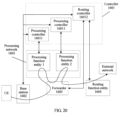
- a schematic architectural diagram of a network system shown in FIG. 18 further includes a forwarder ( FIG. 18 is drawn by using an example of two processing function entities).
- FIG. 19 a schematic architectural diagram of a network system shown in FIG. 20 further includes a forwarder ( FIG. 20 is drawn by using an example of two processing function entities and two processing controllers).
- the implementation may be based on an architecture of the network system shown in FIG. 18 or FIG. 20 .
- the network system includes a controller, and step 501 to step 503 are all performed by the controller.
- the network system includes a routing controller and at least one processing controller, both step 501 and step 503 are performed by the routing controller, and step 502 is performed by the at least one processing controller.
- the foregoing method includes the following steps.
- the first forwarding policy is used to control the first node to forward a received packet to the forwarder.
- the first forwarding policy may be generated according to an identifier of the forwarder and a traffic flow identifier. For specific description of the traffic flow identifier, refer to Implementation 1.
- the identifier of the forwarder may be an IP address, a MAC address, a connection port number, a tunnel identifier, or the like of the forwarder.
- the controller may determine, according to the traffic flow identifier, processing logic corresponding to a packet that carries the traffic flow identifier, that is, a processing function entity that the packet passes through.
- a processing policy corresponding to each processing function entity may be generated according to the traffic flow identifier, and one processing function entity is corresponding to one processing policy.
- a processing policy sent to a processing function entity is used by the processing function entity to process a received packet according to the processing policy.
- the second forwarding policy may be generated according to the traffic flow identifier, identifiers of the M processing function entities, and an identifier of a second node.
- the first node is a base station
- the second node is a routing function entity (it is assumed that an identifier of the routing function entity is B) is used.
- a sequence of the two processing function entities for processing a packet is: a processing function entity 1 whose identifier is 1-a processing function entity 2 whose identifier is 2.
- a form of the second forwarding policy specific to the traffic flow identifier may be 1-2-B.
- the forwarder After the forwarder receives the second forwarding policy, when receiving a packet from the processing function entity 1, the forwarder can determine, according to the second forwarding policy, that a next node to which the packet is to be forwarded is a node (that is, the processing function entity 2) whose identifier is 2. A path of the packet is indicated by using a solid line in FIG. 18 and FIG. 20 .
- a form of the second forwarding policy specific to the traffic flow identifier may be further 1-C-2-C-B.
- a sequence for performing step 501, step 502, and step 503 is not specifically limited in this embodiment of the present invention.
- the first node receives the first forwarding policy, and when receiving a packet, the first node forwards the received packet to the forwarder according to the first-forwarding policy.
- the first forwarding policy is generated according to the identifier of the forwarder and the traffic flow identifier. Therefore, when receiving a packet, the first node can determine, according to the first forwarding policy, that a next node to which the packet needs to be forwarded is the forwarder.
- the base station when receiving a packet, forwards the received packet to the forwarder according to the first forwarding policy.
- Each of the M processing function entities receives a corresponding processing policy, and when receiving a packet sent by the forwarder, a processing function entity processes the received packet according to a processing policy corresponding to the processing function entity and then sends a processed packet to the forwarder.
- a next node corresponding to each processing function entity may be preconfigured as the forwarder, or the identifier of the forwarder may be added to the processing policy corresponding to each processing function entity. The added identifier is used to notify the processing function entity of a corresponding next node.
- the forwarder receives the second forwarding policy, and forwards a received packet according to the second forwarding policy, so that the packet reaches a second node after the packet is sequentially processed by the M processing function entities.
- the forwarder may perform the following action according to the second forwarding policy:
- the forwarder forwards the packet to a fourth node.
- the third node is the first node
- the fourth node is a first processing function entity.
- the third node is an M th processing function entity
- the fourth node is the second node.
- M ⁇ 2 and the third node is an m th processing function entity
- the fourth node is an (m+1) th processing function entity.
- a sequence of the M processing function entities for processing a packet is from the first processing function entity to the M th processing function entity, 1 ⁇ m ⁇ M-1, M ⁇ N, and both m and M are integers.
- the base station forwards the packet to the forwarder according to the first forwarding policy.
- the forwarder determines, according to the second forwarding policy, that nodes that the packet passes through are sequentially: a node (that is, the processing function entity 1) whose identifier is 1-a node (that is, the processing function entity 2) whose identifier is 2-a node (that is, the routing function entity) whose identifier is B. Therefore, the forwarder forwards, to the processing function entity 1 according to the second forwarding policy, the received packet sent by the base station.
- the processing function entity 1 processes, according to a corresponding processing policy, the received packet sent by the forwarder, and then forwards a processed packet to the forwarder. After receiving the packet sent by the processing function entity 1, the forwarder forwards the packet to the processing function entity 2 according to the second forwarding policy.
- the processing function entity 2 processes, according to a corresponding processing policy, the received packet sent by the forwarder, and then forwards a processed packet to the forwarder. After receiving the packet sent by the processing function entity 2, the forwarder forwards the packet to the routing function entity according to the second forwarding policy.
- the base station forwards the packet to UE.
- the routing function entity forwards the packet to an external network.
- step 502 includes: The processing controller sends a corresponding processing policy to each of the M processing function entities in N processing function entities.
- step 502 includes: M processing controllers in the N processing controllers send a corresponding processing policy to each of the M processing function entities in the corresponding N processing function entities.
- One processing controller is corresponding to one processing function entity.
- the first forwarding policy and the second forwarding policy are generated by the routing controller, and the processing policy is generated by the at least one processing controller.
- the first forwarding policy and the second forwarding policy may be the same.
- the first forwarding policy and the second forwarding policy may be a forwarding policy generated according to identifiers of nodes on an entire path on which a packet is forwarded.
- the forwarder is added in the network system. Compared with Implementation 1, the controller or the routing controller does not need to send the second forwarding policy to each processing function entity any longer. Therefore, a quantity of pieces of control signaling may be decreased.
- the base station may include multiple first forwarding policies corresponding to multiple traffic flow identifiers.
- One traffic flow identifier is corresponding to one first forwarding policy.
- the base station When receiving a packet, the base station first determines, according to a traffic flow identifier carried in the packet, a first forwarding policy corresponding to the traffic flow identifier, and then forwards the packet according to the first forwarding policy. Actions performed by the processing function entity, the forwarder, and the routing function entity are similar to those performed by the base station. Therefore, the first forwarding policy, the second forwarding policy, and the processing policy all include a traffic flow identifier.
- the implementation may be based on the architecture of the network system shown in FIG. 17 or FIG. 19 .
- the network system includes a controller, and step 601 to step 603 are all performed by the controller.
- the network system includes a routing controller and at least one processing controller, step 601 is performed by the at least one processing controller, and step 602 and step 603 are performed by the routing controller.
- the foregoing method includes the following steps.
- a processing policy corresponding to each processing function entity may be generated according to a traffic flow identifier, and one processing function entity is corresponding to one processing policy.
- a processing policy sent to a processing function entity is used by the processing function entity to process a received packet according to the processing policy.
- the first forwarding policy may be generated according to the traffic flow identifier and identifiers of the M processing function entities.
- the first forwarding policy may be generated according to the traffic flow identifier, the identifiers of the M processing function entities, and an identifier of a second node.
- the architecture of the network system shown in FIG. 17 or FIG. 19 an example in which the first node is the routing function entity, and the second node is the base station (it is assumed that an identifier of the base station is A) is used.
- a sequence of two processing function entities for processing a packet is: a processing function entity 2 whose identifier is 2-a processing function entity 1 whose identifier is 1.
- a form of the first forwarding policy specific to the traffic flow identifier may be 2-1-A.
- a path of the packet is indicated by using a dashed line in FIG. 17 and FIG. 19 .
- the second forwarding policy may be generated according to an identifier of the routing function entity and the traffic flow identifier.
- the identifier of the routing function entity may be an IP address, a MAC address, a connection port number, a tunnel identifier, or the like of the routing function entity.
- the controller may determine, according to the traffic flow identifier, processing logic corresponding to a packet that carries the traffic flow identifier, that is, a processing function entity that the packet passes through.
- a sequence for performing step 601, step 602, and step 603 is not specifically limited in this embodiment of the present invention.
- the first node receives the second forwarding policy, and when receiving a packet, the first node forwards the packet to the routing function entity according to the second forwarding policy.
- Each of the M processing function entities receives a corresponding processing policy, and when receiving a packet sent by the routing function entity, a processing function entity processes, according to a processing policy corresponding to the processing function entity, the received packet sent by the routing function entity, and then forwards a processed packet to the routing function entity.
- a next node corresponding to each processing function entity may be preconfigured as the routing function entity, or the identifier of the routing function entity may be added to the processing policy corresponding to each processing function entity. The added identifier is used to notify the processing function entity of a corresponding next node.
- the routing function entity receives the first forwarding policy, and forwards the received packet according to the first forwarding policy, so that the packet reaches a second node after the packet is sequentially processed by the M processing function entities.
- the routing function entity performs the following action according to the first forwarding policy:
- the routing function entity forwards the packet to a fourth node.
- the third node is the base station
- the fourth node is a first processing function entity.
- M ⁇ 2 and the third node is an m th processing function entity
- the fourth node is an (m+1) th processing function entity.
- the third node is an external network
- the fourth node is a first processing function entity.
- M ⁇ 2 and the third node is an m th processing function entity
- the fourth node is an (m+1) th processing function entity.
- the third node is an M th processing function entity
- the fourth node is the base station.
- a sequence of the M processing function entities for processing a packet is sequentially from the first processing function entity to the M th processing function entity, 1 ⁇ m ⁇ M-1, M ⁇ N, and both m and M are integers.
- the base station needs to forward a packet to the routing function entity, so that the routing function entity forwards the packet according to the first forwarding policy. Therefore, the routing controller needs to send the second forwarding policy to the base station.
- the routing function entity can directly forward the packet according to the first forwarding policy. Therefore, when the first node is the routing function entity, step 603 and step 604 may be omitted.
- the routing functionentity determines, according to the first forwarding policy, that nodes that the packet passes through are sequentially: a node (that is, the processing function entity 2) whose identifier is 2-a node (that is, the processing function entity 1) whose identifier is 1-a node (that is, the base station) whose identifier is A. Therefore, the routing function entity forwards the packet to the processing function entity 2 according to the first forwarding policy.
- the processing function entity 2 processes, according to a corresponding processing policy, the received packet sent by the routing function entity, and then sends a processed packet to the routing function entity.
- the routing function entity After receiving the packet sent by the processing function entity 2, the routing function entity forwards the packet to the processing function entity 1 according to the first forwarding policy.
- the processing function entity 1 processes, according to a corresponding processing policy, the received packet sent by the routing function entity, and then sends a processed packet to the routing function entity.
- the routing function entity After receiving the packet sent by the processing function entity 1, the routing function entity forwards the packet to the base station.
- the base station forwards the packet to UE.
- the routing function entity forwards the packet to the external network.
- the first forwarding policy, the second forwarding policy, and the processing policy are all generated by the controller.
- step 601 includes: The processing controller sends a corresponding processing policy to each of the M processing function entities in N processing function entities.
- step 601 includes: . M processing controllers in the N processing controllers send a corresponding processing policy to each of the M processing function entities in the corresponding N. processing function entities.
- One processing controller is corresponding to one processing function entity.
- the first forwarding policy and the second forwarding policy are generated by the routing controller, and processing policies corresponding to the N processing function entities are generated by the at least one processing controller.
- the first forwarding policy and the second forwarding policy may be the same.
- the first forwarding policy and the second forwarding policy may be a forwarding policy generated according to identifiers of nodes on an entire path on which a packet is forwarded.
- the routing function entity may include multiple first forwarding policies corresponding to multiple traffic flow identifiers.
- One traffic flow identifier is corresponding to one first forwarding policy.
- the routing function entity When receiving a packet, the routing function entity first determines, according to a traffic flow identifier carried in the packet, a first forwarding policy corresponding to the traffic flow identifier, and then forwards the packet according to the first forwarding policy. Actions performed by the processing function entity and the base station are similar to those performed by the routing function entity. Therefore, the first forwarding policy, the second forwarding policy, and the processing policy all include a traffic flow identifier.
- a forwarding policy and a processing policy may be generated for the downlink packet according to a downlink preconfiguration policy
- a forwarding policy and a processing policy may be generated for the uplink packet according to an uplink preconfiguration policy, and these policies are delivered to a corresponding device.
- an example in which a packet (that is, an uplink packet) sent by UE needs to be processed by a processing function entity 1 and a processing function entity 2, and the UE sends a service request before sending the packet is used for describing Implementation 1 and Implementation 2.
- a packet that is, an uplink packet
- a processing function entity 1 and a processing function entity 2 For related explanation in this embodiment, refer to description in Implementation 1 and Implementation 2.
- a method provided in this embodiment may be applied to the architecture of the network system shown in FIG. 17 or FIG. 19 .
- step 701 to step 704 are all performed by a controller.
- step 701 is performed by a routing controller and a processing controller (an example in which the network system includes a processing controller and a routing controller is used in this embodiment)
- step 702 and step 703 are performed by the routing controller
- step 704 is performed by the processing controller.
- the foregoing method includes the following steps.
- the service request includes the traffic flow identifier 1.
- the traffic flow identifier 1 may be an IP address of the UE, IP quintuplets of a traffic flow, or the like.
- An identifier of a processing function entity may be an IP address, a MAC address, a connection port number, a tunnel identifier, or the like of the processing function entity.
- the processing function entity 1 is the first one that processes a packet carrying the traffic flow identifier 1.
- the second forwarding policy 1 includes the traffic flow identifier 1 and the identifier 2
- the second forwarding policy 2 includes the traffic flow identifier 1 and the identifier B.
- first forwarding policy, the second forwarding policy, and the processing policy generated in Embodiment 1 are all specific to the traffic flow identifier 1.
- generated first forwarding policies, second forwarding policies, and processing policies may also be different.
- a sequence of performing step 702, step 703, and step 704 is not limited.
- the base station receives the first forwarding policy.
- the processing function entity 1 receives the processing policy 1 and the second forwarding policy 1.
- the processing function entity 2 receives the processing policy 2 and the second forwarding policy 2.
- a sequence of performing step 705, step 706, and step 707 is not limited.
- a procedure for processing and forwarding the packet is as follows.
- the base station forwards, to the processing function entity 1 according to the first forwarding policy, a packet that is sent by the UE and carries the traffic flow identifier 1.
- the processing function entity 1 After receiving the packet that is sent by the base station and carries the traffic flow identifier 1, the processing function entity 1 processes the packet according to the processing policy 1, and forwards, to the processing function entity 2 according to the second forwarding policy 1, a processed packet that carries the traffic flow identifier 1,
- the processing function entity 2 After receiving the packet that is sent by the processing function entity 1 and carries the traffic flow identifier 1, the processing function entity 2 processes, according to the processing policy 2, the packet that carries the traffic flow identifier 1, and forwards, to the routing function entity according to the second forwarding policy 2, a processed packet that carries the traffic flow identifier 1.
- the routing function entity After receiving the packet that is sent by the processing function entity 2 and carries the traffic flow identifier 1, the routing function entity forwards the packet to an external network.
- a forwarding plane is divided into a processing network (including N processing function entities) and a routing function entity.
- the processing network is configured to process a packet, and therefore, the processing network includes a computing resource.
- the routing function entity serves as an anchor point of an IP address, and has an address resource.
- a routing function entity may be added.
- a processing network may be added. Therefore, compared with the prior art, according to the method provided in this embodiment of the present invention, waste of an address resource or a computing resource can be reduced.
- a method provided in this embodiment may be applied to the architecture of the network system shown in FIG. 18 or FIG. 20 .
- step 801 to step 804 are all performed by a controller.
- step 801 is performed by a routing controller and a processing controller (an example in which the network system includes a processing controller and a routing controller is used in this embodiment)
- step 802 and step 803 are performed by the routing controller
- step 804 is performed by the processing controller.
- the foregoing method includes the following steps.
- the service request includes the traffic flow identifier 2.
- the traffic flow identifier 2 may be an IP address of the UE, IP quintuplets of a traffic flow, or the like.
- the identifier of the forwarder may be an IP address, a MAC address, a connection port number, a tunnel identifier, or the like of the forwarder.
- a form of the second forwarding policy specific to the traffic flow identifier 2 may be 1-2-B.
- the first forwarding policy, the second forwarding policy, and the processing policy generated in Embodiment 2 are all specific to the traffic flow identifier 2.
- a sequence of performing step 802, step 803, and step 804 is not limited.
- the base station receives the first forwarding policy.
- the forwarder receives the second forwarding policy.
- the processing function entity 1 receives the processing policy 1.
- the processing function entity 2 receives the processing policy 2.
- step 805, step 806, step 807, and step 808 is not limited.
- a procedure for processing and forwarding the packet is as follows.
- the base station forwards, to the forwarder according to the first forwarding policy, a packet that is sent by the UE and carries the traffic flow identifier 2.
- the forwarder forwards, to the processing function entity 1 according to the second forwarding policy, the packet that is sent by the base station and carries the traffic flow identifier 2.
- the processing function entity 1 After receiving the packet that is sent by the forwarder and carries the traffic flow identifier 2, the processing function entity 1 processes the packet according to the processing policy 1, and then forwards a processed packet to the forwarder.
- a next node corresponding to each processing function entity may be preconfigured as the forwarder.
- the forwarder forwards, to the processing function entity 2 according to the second forwarding policy, the packet that is sent by the processing function entity 1 and carries the traffic flow identifier 2.
- the processing function entity 2 After receiving the packet that is sent by the forwarder and carries the traffic flow identifier 2, the processing function entity 2 processes the packet according to the processing policy 2, and then forwards a processed packet to the forwarder.
- the forwarder forwards, to the routing function entity according to the second forwarding policy, the packet that is sent by the processing function entity 2 and carries the traffic flow identifier 2.
- the routing function entity After receiving the packet that is sent by the forwarder and carries the traffic flow identifier 2, the routing function entity forwards the packet to an external network.
- the base station may include multiple first forwarding policies corresponding to multiple traffic flow identifiers.
- One traffic flow identifier is corresponding to one first forwarding policy.
- the base station When receiving a. packet, the base station first determines, according to a traffic flow identifier carried in the packet, a first forwarding policy corresponding to the traffic flow identifier, and then forwards the packet according to the first forwarding policy. Actions performed by the processing function entity, the forwarder, and the routing function entity are similar to those performed by the base station. Therefore, the first forwarding policy, the second forwarding policy, and the processing policy all include a traffic flow identifier.
- a forwarding plane is divided into a processing network (including N processing function entities) and a routing function entity.
- the processing network is configured to process a packet, and therefore, the processing network includes a computing resource.
- the routing function entity serves as an anchor point of an IP address, and has an address resource.
- a routing function entity may be added.
- a processing network may be added. Therefore, compared with the prior art, according to the method provided in this embodiment of the present invention, waste of an address resource or a computing resource can be reduced.
- a method provided in this embodiment may be applied to the architecture of the network system shown in FIG. 17 or FIG. 19 .
- step 901 to step 903 are all performed by a controller.
- step 901 is performed by a routing controller and a processing controller (an example in which the network system includes a processing controller and a routing controller is used in this embodiment)
- step 902 is performed by the routing controller
- step 903 is performed by the processing controller.
- the foregoing method includes the following steps.
- the service request includes the traffic flow identifier 3.
- the traffic flow identifier 3 may be an IP address of the UE, IP quintuplets of a traffic flow, or the like.
- a form of the first forwarding policy specific to the traffic flow identifier 3 may be 1-2-A.
- a sequence of performing step 901, step 902, and step 903 is not limited.
- the routing function entity receives the first forwarding policy.
- the processing function entity 1 receives the processing policy 1.
- the processing function entity 2 receives the processing policy 2.
- a sequence of performing step 904, step 905, and step 906 is not limited.
- a procedure for processing and forwarding the packet is as follows.
- the routing function entity forwards, to the processing function entity 1 according to the first forwarding policy, a packet that is sent by the external network and carries the traffic flow identifier 3.
- the processing function entity 1 After receiving the packet that is sent by the routing function entity and carries the traffic flow identifier 3, the processing function entity 1 processes the packet according to the processing policy 1, and then forwards a processed packet to the routing function entity.
- a next node corresponding to each processing function entity may be preconfigured as the routing function entity.
- the routing function entity forwards, to the processing function entity 2 according to the first forwarding policy, the packet that is sent by the processing function entity 1 and carries the traffic flow identifier 3.
- the processing function entity 2 After.receiving the packet that is sent by the routing function entity and carries the traffic flow identifier 3, the processing function entity 2 processes the packet according to the processing policy 2, and then forwards a processed packet to the routing function entity.
- the routing function entity forwards, to the base station according to the first forwarding policy, the packet that is sent by the processing function entity 2 and carries the traffic flow identifier 3.
- the base station After receiving the packet that is sent by the routing function entity and carries the traffic flow identifier 3, the base station forwards the packet to the UE.
- the routing function entity may include multiple first forwarding policies corresponding to multiple traffic flow identifiers.
- One traffic flow identifier is corresponding to one first forwarding policy.
- the routing function entity When receiving a packet, the routing function entity first determines, according to a traffic flow identifier carried in the packet, a first forwarding policy corresponding to the traffic flow identifier, and then forwards the packet according to the first forwarding policy. Actions performed by the processing function entity are similar to those performed by the routing function entity. Therefore, the first forwarding policy and the processing policy both include a traffic flow identifier.
- a forwarding plane is divided into a processing network (including N processing function entities) and a routing function entity.
- the processing network is configured to process a packet, and therefore, the processing network includes a computing resource.
- the routing function entity serves as an anchor point of an IP address, and has an address resource.
- a routing function entity may be added.
- a processing network may be added. Therefore, compared with the prior art, according to the method provided in this embodiment of the present invention, waste of an address resource or a computing resource can be reduced.
- the controller 100 includes: a control unit 1001, configured to: control a first node to send a received packet to a processing network, and control the processing network to process the packet and then send a processed packet to a second node.
- the first node is a base station or a network element connected to the base station, and the second node is a routing function entity; or the first node is the routing function entity, and the second node is the base station or a network element connected to the base station.
- the routing function entity is an anchor point of an Internet Protocol IP address of a user.
- the processing network includes at least one processing function entity.
- the controller 100 further includes: a sending unit 1002, configured to send a first forwarding policy to the first node.
- the first forwarding policy is used to control the first node to send the received packet to a first processing function entity
- the first processing function entity is a processing function entity in the processing network
- the first forwarding policy is generated according to an identifier of the first processing function entity and a traffic flow identifier
- the packet carries the traffic flow identifier.
- the sending unit 1002 is further configured to send a corresponding processing policy and a second forwarding policy to one or more processing function entities in the processing network.
- the processing policy is used to control a processing function entity that receives the processing policy to process the received packet according to the processing policy
- the second forwarding policy is used to control a processing function entity that receives the second forwarding policy to forward, according to the second forwarding policy, the packet processed by the processing function entity
- the one or more processing function entities include the first processing function entity
- the processing policy is generated according to the traffic flow identifier.
- the controller 100 further includes: a sending unit 1002, configured to send a first forwarding policy to the first node.
- the first forwarding policy is used to control the first node to forward the received packet to a forwarder, so that the forwarder forwards the packet to a first processing function entity.
- the first processing function entity is a processing function entity in the processing network.
- the sending unit 1002 is further configured to send a corresponding processing policy to one or more processing function entities in the processing network.
- the processing policy is used to control a processing function entity that receives the processing policy to process, according to the processing policy, the received packet sent by the forwarder, and then send the processed packet to the forwarder.
- the sending unit 1002 is further configured to send a second forwarding policy to the forwarder.
- the second forwarding policy is used to control the forwarder to forward the received packet according to the second forwarding policy, so that the packet reaches the second node after the packet is sequentially processed by the one or more processing function entities.
- the controller 100 further includes: a sending unit 1002, configured to send a corresponding processing policy to one or more processing function entities in the processing network.
- the processing policy is used to control a processing function entity that receives the processing policy to process, according to the processing policy, the received packet sent by the routing function entity, and then send the processed packet to the routing function entity.
- the sending unit 1002 is further configured to send a first forwarding policy to the routing function entity.
- the first forwarding policy is used to control the routing function entity to forward the received packet according to the first forwarding policy, so that the packet reaches the second node after the packet is sequentially processed by the one or more processing function entities.
- the sending unit 1002 is further configured to send a second forwarding policy to the first node.
- the second forwarding policy is used to control the first node to forward the received packet to the routing function entity, so that the routing function entity forwards the packet to a first processing function entity according to the first forwarding policy.
- the first processing function entity is a processing function entity in the processing network.
- the controller 100 includes at least one processing unit 1101 and a routing unit 1102.
- the routing unit 1102 is configured to send the first forwarding policy and the second forwarding policy.
- the at least one processing unit 1101 is configured to send the processing policy.
- the controller 100 includes at least one processing unit 1101 and a routing unit 1102.
- the routing unit 1102 is configured to: send the first forwarding policy to the first node, and send the corresponding second forwarding policy to the one or more processing function entities.
- the at least one processing unit 1101 is configured to send the corresponding processing policy to the one or more processing function entities.
- the routing unit 1102 is further configured to determine the traffic flow identifier, and send the traffic flow identifier to the at least one processing unit 1101.
- the at least one processing unit 1101 is further configured to: receive the traffic flow identifier sent by the routing unit 1102, and generate, according to the traffic flow identifier, the processing policy corresponding to the one or more processing function entities.
- the at least one processing unit 1101 is further configured to determine the first processing function entity, and a target processing unit 1101 sends the identifier of the first processing function entity to the routing unit 1102.
- the target processing unit 1101 is any one of the at least one processing unit 1101.
- the routing unit 1102 is further configured to: receive the identifier of the first processing function entity that is sent by the target processing unit 1101, and generate the first forwarding policy according to the identifier of the first processing function entity and the traffic flow identifier.
- the controller 100 includes at least one processing unit 1101 and a routing unit 1102.
- the routing unit 1102 is configured to send the first forwarding policy to the first node.
- the at least one processing unit 1101 is configured to send the corresponding processing policy to the one or more processing function entities in the processing network.
- the processing policy includes the second forwarding policy.
- FIG. 11 is drawn by using an example in which the controller includes one processing unit.
- This embodiment of the present invention provides a processing function entity 120, configured to perform the method shown in FIG. 3 , FIG. 4 , or FIG. 5 .
- the processing function entity 120 includes:
- the receiving unit 1201 is further configured to receive a second forwarding policy.
- the forwarding unit 1203 is specifically configured to forward the processed packet according to the second forwarding policy.
- the controller controls the processing function entity and the routing function entity in the processing network to process and forward a packet.
- the processing network is configured to process the packet.
- the processing network includes a computing resource.
- the routing function entity serves as an anchor point of a user IP address, and has an address resource.
- a routing function entity may be added.
- a processing network may be added. Therefore, compared with the prior art, according to the method provided in this embodiment of the present invention, waste of an address resource or a computing resource can be reduced.
- units in the controller in Embodiment 2 may be built in or independent of a processor of the controller in a hardware form, or may be stored in a memory of the controller in a software form, so that the processor invokes and performs operations corresponding to the units.
- the processor may be a central processing unit (CPU), a microprocessor, a single-chip microcomputer, or the like.
- this embodiment of the present invention provides another controller 130, configured to perform the method shown in FIG. 1 .
- the controller 130 includes a memory 1301, a processor 1302, and a bus system 1303.
- the memory 1301 and the processor 1302 are coupled together by using the bus system 1303.
- the memory 1301 may include a random access memory; and may also include a non-volatile memory, such as at least one disk memory.
- the bus system 1303 may be an ISA bus, a PCI bus, an EISA bus, or the like.
- the bus system 1303 may be categorized into an address bus, a data bus, a control bus, and the like. For ease of representation, the bus system 1303 is represented by using only one thick line in FIG. 13 . However, it does not mean that there is only one bus or only one type of bus.
- the memory 1301 stores a group of code, and the code is used to control the processor 1302 to perform the following actions: controlling a first node to send a received packet to a processing network, and controlling the processing network to process the packet and then send a processed packet to a second node.
- the first node is a base station or a network element connected to the base station, and the second node is a routing function entity; or the first node is the routing function entity, and the second node is the base station or a network element connected to the base station.
- the routing function entity is an anchor point of an Internet Protocol IP address of a user.
- the processing network includes at least one processing function entity.
- the controller 130 further includes a transmitter 1304.
- the transmitter 1304 is configured to send a first forwarding policy to the first node.
- the first forwarding policy is used to control the first node to send the received packet to a first processing function entity, the first processing function entity is a processing function entity in the processing network, the first forwarding policy is generated according to an identifier of the first processing function entity and a traffic flow identifier, and the packet carries the traffic flow identifier.
- the transmitter 1304 is further configured to send a corresponding processing policy and a second forwarding policy to one or more processing function entities in the processing network.
- the processing policy is used to control a processing function entity that receives the processing policy to process the received packet according to the processing policy
- the second forwarding policy is used to control a processing function entity that receives the second forwarding policy to forward, according to the second forwarding policy, the packet processed by the processing function entity
- the one or more processing function entities include the first processing function entity
- the processing policy is generated according to the traffic flow identifier.
- the controller 130 further includes a transmitter 1304.
- the transmitter 1304 is configured to send a first forwarding policy to the first node.
- the first forwarding policy is used to control the first node to forward the received packet to a forwarder, so that the forwarder forwards the packet to a first processing function entity.
- the first processing function entity is a processing function entity in the processing network.
- the transmitter 1304 is further configured to send a corresponding processing policy to one or more processing function entities in the processing network.
- the processing policy is used to control a processing function entity that receives the processing policy to process, according to the processing policy, the received packet sent by the forwarder, and then send the processed packet to the forwarder.
- the transmitter 1304 is further configured to send a second forwarding policy to the forwarder.
- the second forwarding policy is used to control the forwarder to forward the received packet according to the second forwarding policy, so that the packet reaches the second node after the packet is sequentially processed by the one or more processing function entities.
- the controller 130 further includes a transmitter 1304.
- the transmitter 1304 is configured to send a corresponding processing policy to one or more processing function entities in the processing network.
- the processing policy is used to control a processing function entity that receives the processing policy to process, according to the processing policy, the received packet sent by the routing function entity, and then send the processed packet to the routing function entity.
- the transmitter 1304 is further configured to send a first forwarding policy to the routing function entity.
- the first forwarding policy is used to control the routing function entity to forward the received packet according to the first forwarding policy, so that the packet reaches the second node after the packet is sequentially processed by the one or more processing function entities.
- the transmitter 1304 is further configured to send a second forwarding policy to the first node.
- the second forwarding policy is used to control the first node to forward the received packet to the routing function entity, so that the routing function entity forwards the packet to a first processing function entity according to the first forwarding policy.
- the first processing function entity is a processing function entity in the processing network.
- the controller 130 includes at least one processing controller 1401 and a routing controller 1402.
- the routing controller 1402 is configured to send the first forwarding policy and the second forwarding policy.
- the at least one processing controller 1401 is configured to send the processing policy.
- the controller 130 includes at least one processing controller 1401 and a routing controller 1402.
- the routing controller 1402 is configured to: send the first forwarding policy to the first node, and send the corresponding second forwarding policy to the one or more processing function entities.
- the at least one processing controller 1401 is configured to send the corresponding processing policy to the one or more processing function entities.
- the routing controller 1402 is further configured to: determine the traffic flow identifier, and send the traffic flow identifier to the at least one processing controller 1401.
- the at least one processing controller 1401 is further configured to: receive the traffic flow identifier sent by the routing controller 1402, and generate, according to the traffic flow identifier, the processing policy corresponding to the one or more processing function entities.
- the at least one processing controller 1401 is further configured to determine the first processing function entity, and a target processing controller 1401 sends the identifier of the first processing function entity to the routing controller 1402.
- the target processing controller 1401 is any one of the at least one processing controller 1401.
- the routing controller 1402 is further configured-to: receive the identifier of the first processing function entity that is sent by the target processing controller 1401, and generate the first forwarding policy according to the identifier of the first processing function entity and the traffic flow identifier.
- the controller 130 includes at least one processing controller 1401 and a routing controller 1402.
- the routing controller 1402 is configured to send the first forwarding policy to the first node.
- the at least one processing controller 1401 is configured to send the corresponding processing policy to the one or more processing function entities in the processing network.
- the processing policy includes the second forwarding policy.
- FIG. 14 is drawn by using an example in which the controller includes one processing controller 1401.
- units in the processing function entity in Embodiment 2 may be built in or independent of a processor of the processing function entity in a hardware form, or may be stored in a memory of the processing function entity in a software form, so that the processor invokes and performs operations corresponding to the units.
- the processor may be a central processing unit (CPU), a microprocessor, a single-chip microcomputer, or the like.
- this embodiment of the present invention provides another processing function entity 150, configured to perform the method shown in FIG. 3 , FIG. 4 , or FIG. 5 .
- the processing function entity 150 includes a receiver 1501, a memory 1502, a processor 1503, and a bus system 1504.
- the receiver 1501, the memory 1502, and the processor 1503 are coupled together by using the bus system 1504.
- the memory 1502 may include a random access memory, and may also include a non-volatile memory, such as at least one disk memory.
- the bus system 1504 may be an ISA bus, a PCI bus, an EISA bus, or the like.
- the bus system 1504 may be categorized into an address bus, a data bus, a control bus, and the like. For ease of representation, the bus system 1504 is represented by using only one thick line in FIG. 15 . However, it does not mean that there is only one bus or only one type of bus.
- the receiver 1501 is configured to receive a processing policy.
- the memory 1502 stores a group of code, and the code is used to control the processor 1503 to perform the following actions: processing a received packet according to the processing policy, and forwarding a processed packet.
- the receiver 1501 is further configured to receive a second forwarding policy.
- the processor 1503 is specifically configured to forward the processed packet according to the second forwarding policy.
- the controller controls the processing function entity and the routing function entity in the processing network to process and forward a packet.
- the processing network is configured to process the packet.
- the processing network includes a computing resource.
- the routing function entity serves as an anchor point of a user IP address, and has an address resource.
- a routing function entity may be added.
- a processing network may be added. Therefore, compared with the prior art, according to the method provided in this embodiment of the present invention, waste of an address resource or a computing resource can be reduced.
- the network system 160 includes a controller 1601, and a first node 1602, a processing network 1603, and a second node 1604 that are connected to the controller 1601.
- the controller 1601 is configured to: control the first node 1602 to send a received packet to the processing network 1603, and control the processing network 1603 to process the packet and then send a processed packet to the second node 1604.
- the processing network 1603 is configured to: receive the packet sent by the first node 1602; and process, under control of the controller 1601, the packet and then send the processed packet to the second node 1604.
- the first node 1602 is configured to: receive the packet, and send, under control of the controller 1601, the packet to the processing network 1603.
- the second node 1604 is configured to receive the packet sent by the processing network 1603.
- the first node 1602 is a base station or a network element connected to the base station, and the second node 1604 is a routing function entity; or the first node 1602 is the routing function entity, and the second node 1604 is the base station or a network element connected to the base station.
- the routing function entity is an anchor point-of an Internet Protocol IP address of a user.
- FIG. 16 to FIG. 20 are drawn by using an example in which the first node is a base station and the second node is a processing function entity.
- the processing network 1603 includes at least one processing function entity 16031, and each of the at least one processing function entity 16031 is connected to the controller 1601.
- FIG. 17 is drawn by using an example in which the processing network 1603 includes four processing function entities 16031.
- the four processing function entities 16031 are respectively drawn as processing function entities 1, 2, 3, and 4.
- the controller 1601 is specifically configured to send a first forwarding policy to the first node 1602.
- the first forwarding policy is used to control the first node 1602 to send the received packet to a first processing function entity 16031, the first processing function entity 16031 is a processing function entity 16031 in the processing network 1603, the first forwarding policy is generated according to an identifier of the first processing function entity 16031 and a traffic flow identifier, and the packet carries the traffic flow identifier.
- the first node 1602 is specifically configured to: receive the first forwarding policy sent by the controller 1601, and forward the received packet to the first processing function entity 16031 according to the first forwarding policy.
- the controller 1601 is specifically configured to send a corresponding processing policy and a second forwarding policy to one or more processing function entities 16031 in the processing network 1603.
- the processing policy is used to control a processing function entity 16031 that receives the processing policy to process the received packet according to the processing policy
- the second forwarding policy is used to control a processing function entity 16031 that receives the second forwarding policy to forward, according to the second forwarding policy, the packet processed by the processing function entity 16031
- the one or more processing function entities 16031 include the first processing function entity 16031
- the processing policy is generated according to the traffic flow identifier.
- Each of the one or more processing function, entities 16031 is specifically configured to: receive a processing policy and a -second forwarding policy that are corresponding to the processing function entity 16031 and are sent by the controller. 1601, process the received packet according to the processing policy, and forward, according to the second forwarding policy, the packet processed by the processing function entity 16031.
- the system further includes a forwarder 1605 connected to the controller 1601.
- the controller 1601 is specifically configured to send a first forwarding policy to the first node 1602.
- the first forwarding policy is used to control the first node 1602 to forward the received packet to the forwarder 1605.
- the first node 1602 is specifically configured to: receive the first forwarding policy sent by the controller 1601, and forward the received packet to the forwarder 1605 according to the first forwarding policy.
- the forwarder 1605 is configured to: receive the packet sent by the first node 1602, and forward the packet to a first processing function entity 16031.
- the first processing function entity 16031 is a processing function entity 16031 in the processing network 1603.
- FIG. 18 is drawn by using an example in which the processing network 1603 includes two processing function entities 16031.
- the two processing function entities 16031 are respectively drawn as processing function entities 1 and 2.
- the controller 1601 is further configured to send a corresponding processing policy to one or more processing function entities 16031 in the processing network 1603.
- the processing policy is used to control a processing function entity 16031 that receives the processing policy to process, according to the processing policy, the received packet sent by the forwarder 1605, and then send the processed packet to the forwarder 1605.
- the controller 1601 is further configured to send a second forwarding policy to the forwarder 1605.
- the second forwarding policy is used to control the forwarder 1605 to forward the received packet according to the second forwarding policy.
- the forwarder 1605 is specifically configured to: receive the second forwarding policy sent by the controller 1601, and forward the received packet according to the second forwarding policy, so that the packet reaches the second node 1604 after the packet is sequentially processed by the one or more processing function entities 16031.
- Each of the one or more processing function entities 16031 is specifically configured to: receive a processing policy that is corresponding to the processing function entity 16031 and is sent by the controller 1601; and process, according to the processing policy, the received packet sent by the forwarder 1605, and then send the processed packet to the forwarder 1605.
- the controller 1601 is further configured to send a corresponding processing policy to one or more processing function entities 16031 in the processing network 1603.
- the processing policy is used to control a processing function entity 16031 that receives the processing policy to process, according to the processing policy, the received packet sent by the routing function entity, and then send the processed packet to the routing function entity.
- the controller 1601 is further configured to send a first forwarding policy to the routing function entity.
- the first forwarding policy is used to control the routing function entity to forward the received packet according to the first forwarding policy.
- the routing function entity is specifically configured to: receive the first forwarding policy sent by the controller 1601, and forward the received packet according to the first forwarding policy, so that the packet reaches the second node 1604 after the packet is sequentially processed by the one or more processing function entities 16031.
- Each of the one or more processing function entities 16031 is specifically configured to: receive a processing policy that is corresponding to the processing function entity 16031 and is sent by the controller 1601; and process, according to the processing policy, the received packet sent by the routing function entity, and then send the processed packet to the routing function entity.
- the first node 1602 is the base station or the network element connected to the base station
- the controller 1601 includes at least one processing controller 16011 and a routing controller 16012.
- the routing controller 16012 is connected to the first node 1602, the second node 1604, and the one or more processing function entities 16031, and each of the one or more processing function entities 16031 is connected to at least one of the processing controller 16011.
- the routing controller 16012 is specifically configured to: send the first forwarding policy to the first node 1602, and send the corresponding second forwarding policy to the one or more processing function entities 16031.
- the at least one processing controller 16011 is specifically configured to send the corresponding processing policy to the one or more processing function entities 16031.
- FIG. 19 is drawn by using an example in which the controller includes one processing function entity 16011 and the processing network 1603 includes four processing function entities 16031.
- the four processing function entities 16031 are respectively drawn as processing function entities 1, 2, 3, and 4.
- the routing controller 16012 is connected to each of the at least one processing controller 16011.
- the routing controller 16012 is further configured to: determine the traffic flow identifier, and send the traffic flow identifier to the at least one processing controller 16011.
- the at least one processing controller 16011 is further configured to: receive the traffic flow identifier sent by the routing controller 16012, and generate, according to the traffic flow identifier, the processing policy corresponding to the one or more processing function entities 16031.
- the at least one processing controller 16011 is further configured to determine the first processing function entity 16031, and a target processing controller 16011 sends the identifier of the first processing function entity 16031 to the routing controller 16012.
- the target processing controller 16011 is any one of the at least one processing controller 16011.
- the routing controller 16012 is further configured to: receive the identifier of -the first processing function entity 16031 that is sent by the target processing controller 16011, and generate the first forwarding policy according to the identifier of the first processing function entity 16031 and the traffic flow identifier.
- the controller 1601 includes at least one processing controller 16011 and a routing controller 16012.
- the routing controller 16012 is connected to the first node 1602 and the second node 1604, and each of the one or more processing function entities 16031 is connected to at least one of the processing controller 16011.
- the routing controller 16012 is configured to send the first forwarding policy to the first node 1602.
- the at least one processing controller 16011 is configured to send the corresponding processing policy to the one or more processing function entities 16031.
- the processing policy includes the second forwarding policy.
- the controller 1601 includes at least one processing controller 16011 and a routing controller 16012.
- the routing controller 16012 is connected to the first node 1602, the second node 1604, and the forwarder 1605, and each of the one or more processing function entities 16031 is connected to at least one of the processing controller 16011.
- the routing controller 16012 is specifically configured to: send the first forwarding policy to the first node 1602, and send the second forwarding policy to the forwarder 1605.
- the at least one processing controller 16011 is specifically configured to send the corresponding processing policy to the one or more processing function entities 16031.
- the controller 1601 includes at least one processing controller 16011 and a routing controller 16012.
- the routing controller 16012 is connected to the first node 1602 and the second node 1604, and each of the N processing function entities 16031 is connected to at least one of the processing controller 16011.
- the routing controller 16012 is specifically configured to: send the first forwarding policy to the routing function entity, and send the second forwarding policy to the first node 1602.
- the at least one processing controller 16011 is specifically configured to send the corresponding processing policy to the one or more processing function entities 16031.
- a forwarding plane is divided into a processing network and a routing function entity.
- the processing network is configured to process a packet, and therefore, the processing network includes a computing resource.
- the routing function entity serves as an anchor point of an IP address, and has an address resource.
- a routing function entity may be added.
- a processing network may be added. Therefore, compared with the prior art, according to the method provided in this embodiment of the present invention, waste of an address resource or a computing resource can be reduced.
- a packet transmitted between any two nodes in the network system can be forwarded by a forwarding device (for example, a router).
- a forwarding device for example, a router
- forwarding policies also need to be adjusted.
- the disclosed apparatus and method may be implemented in other manners.
- the described apparatus embodiment is merely an example.
- the module division is merely logical function division and may be other division in actual implementation.
- multiple modules or components may be combined or integrated into another system, or some features may be ignored or not performed.
- the displayed or discussed mutual couplings or direct couplings or communication connections may be implemented through some interfaces, or the indirect couplings or communication connections between the apparatuses or units.
- function modules in the embodiments in this application may be integrated into one processing module, or each of the modules may exist alone physically, or two or more modules are integrated into one module.
- the integrated module may be implemented in a form of hardware, or may be implemented in a form of a software function module.
Landscapes
- Engineering & Computer Science (AREA)
- Computer Networks & Wireless Communication (AREA)
- Signal Processing (AREA)
- Data Exchanges In Wide-Area Networks (AREA)
- Mobile Radio Communication Systems (AREA)
Claims (13)
- Procédé de traitement de service, comprenant :la commande (201), par un dispositif de commande (100), à une entité de fonction de routage d'envoyer un paquet reçu à une entité de fonction de traitement (120) dans un réseau de traitement, dans lequel l'entité de fonction de routage est un point d'ancrage d'une adresse de protocole Internet, IP, d'un équipement utilisateur, UE ; etla commande (202), par le dispositif de commande (100), à l'entité de fonction de traitement (120) de traiter le paquet puis d'envoyer un paquet traité à une station de base ;dans lequel la commande (201), par un dispositif de commande (100), à une entité de fonction de routage d'envoyer un paquet reçu à une entité de fonction de traitement (120) dans un réseau de traitement comprend :l'envoi (301), par le dispositif de commande (100), d'une première politique de transfert à l'entité de fonction de routage, dans lequel la première politique de transfert est utilisée pour commander à l'entité de fonction de routage d'envoyer le paquet reçu à l'entité de fonction de traitement ; etdans lequel la commande (202), par le dispositif de commande (100), à l'entité de fonction de traitement (120) de traiter le paquet puis d'envoyer un paquet traité à une station de base comprend :l'envoi (302, 303), par le dispositif de commande (100), d'une politique de traitement correspondante et d'une seconde politique de transfert à l'entité de fonction de traitement (120), dans lequel la politique de traitement est utilisée pour commander à l'entité de fonction de traitement de traiter le paquet reçu conformément à la politique de traitement, la seconde politique de transfert est utilisée pour commander à l'entité de fonction de traitement (120) de transmettre, conformément à la seconde politique de transfert, le paquet traité par l'entité de fonction de traitement (120) ;dans lequel la première politique de transfert comprend un identifiant de l'entité de fonction de traitement et un identifiant d'un flux de trafic, le paquet transporte l'identifiant du flux de trafic, et la politique de traitement comprend l'identifiant du flux de trafic ;dans lequel l'entité de fonction de routage fournit une capacité de routage IP pour une adresse IP attribuée à l'UE ; etdans lequel, lorsque l'UE se déplace à l'intérieur d'une zone, l'entité de fonction de routage reste inchangée.
- Procédé selon la revendication 1, dans lequel l'identifiant du flux de trafic comprend l'adresse IP attribuée à l'UE, ou des quintuplés IP du flux de trafic.
- Procédé selon la revendication 1 ou 2, dans lequel l'identifiant de l'entité de fonction de traitement comprend un identifiant de tunnel de l'entité fonction de traitement.
- Procédé selon l'une quelconque des revendications 1 à 3, dans lequel le traitement effectué sur le paquet comprend au moins l'une d'une opération de contrôle de la qualité de service, QoS, de chargement en ligne/hors ligne, d'inspection approfondie de paquets, DPI, d'interception légale, d'accélération du protocole de contrôle de transmission, TCP, d'enrichissement d'en-tête du protocole de transfert hypertexte, HTTP.
- Procédé de traitement de service, comprenant :la réception (305), par une entité de fonction de traitement (120), d'une politique de traitement en provenance d'un dispositif de commande (100) ;la réception (305), par l'entité de fonction de traitement (120), d'un paquet en provenance d'une entité de fonction de routage, dans lequel l'entité de fonction de routage est un point d'ancrage d'une adresse de protocole Internet, IP, d'un équipement utilisateur, UE ;le traitement (305), par l'entité de fonction de traitement (120), du paquet conformément à la politique de traitement ;la transmission, par l'entité de fonction de traitement (120), d'un paquet traité à une station de base ;dans lequel la politique de traitement comprend un identifiant du flux de trafic, et le paquet transporte l'identifiant du flux de trafic ;dans lequel l'entité de fonction de routage fournit une capacité de routage IP pour une adresse IP attribuée à l'UE ; etdans lequel, lorsque l'UE se déplace à l'intérieur d'une zone, l'entité de fonction de routage reste inchangée.
- Procédé selon la revendication 5, dans lequel le procédé comprend également :
la réception (306), par l'entité de fonction de traitement (120), d'une seconde politique de transfert ; et la transmission, par l'entité de fonction de traitement (120), d'un paquet traité comprend :
la transmission, par l'entité de fonction de traitement (120), du paquet traité conformément à la seconde politique de transfert. - Procédé selon la revendication 5 ou 6, dans lequel l'identifiant du flux de trafic comprend l'adresse IP attribuée à l'UE, ou des quintuplés IP du flux de trafic.
- Procédé selon l'une quelconque des revendications 5 à 7, dans lequel le traitement (305), par l'entité fonction de traitement (120), du paquet conformément à la politique de traitement comprend :
la réalisation, par l'entité de fonction de traitement (120), d'au moins l'une d'une opération de contrôle de qualité de service, QoS, de chargement en ligne/hors ligne, d'inspection approfondie de paquets, DPI, d'interception légale, d'accélération du protocole de contrôle de transmission, TCP, d'enrichissement d'entête du protocole de transfert hypertexte, HTTP, sur le paquet conformément à la politique de traitement. - Appareil (100) comprenant des moyens (1001, 1002, 1101, 1102) conçus pour mettre en œuvre le procédé selon l'un quelconque des revendications 1 à 4.
- Appareil (120) comprenant des moyens (1201, 1202, 1203) conçus pour mettre en œuvre le procédé selon l'une quelconque des revendications 5 à 8.
- Système comprenant l'appareil (100) selon la revendication 9, et l'appareil (120) selon la revendication 10.
- Support de stockage lisible par ordinateur comprenant des instructions qui, lorsqu'elles sont exécutées par un ordinateur, amènent l'ordinateur à réaliser les étapes du procédé selon l'une quelconque des revendications 1 à 8.
- Procédé de traitement de service, comprenant :la commande (201), par un dispositif de commande (100), à une entité de fonction de routage d'envoyer un paquet reçu à une entité de fonction de traitement (120) dans un réseau de traitement, dans lequel l'entité de fonction de routage est un point d'ancrage d'une adresse de protocole Internet, IP, d'un équipement utilisateur, UE ; etla commande (202), par le dispositif de commande (100), à l'entité de fonction de traitement (120) de traiter le paquet puis d'envoyer un paquet traité à une station de base ;dans lequel la commande (201), par un dispositif de commande (100), à une entité de fonction de routage d'envoyer un paquet reçu à une entité de fonction de traitement (120) dans un réseau de traitement comprend :l'envoi (301), par le dispositif de commande (100), d'une première politique de transfert à l'entité de fonction de routage, dans lequel la première politique de transfert est utilisée pour commander à l'entité de fonction de routage d'envoyer le paquet reçu à l'entité de fonction de traitement ; etdans lequel la commande (202), par le dispositif de commande (100), à la fonction de traitement de traiter le paquet puis d'envoyer un paquet traité à une station de base comprend :l'envoi (302, 303), par le dispositif de commande (100), d'une politique de traitement correspondante et d'une seconde politique de transfert à l'entité de fonction de traitement (120), dans lequel la politique de traitement est utilisée pour commander à l'entité de fonction de traitement de traiter le paquet reçu conformément à la politique de traitement, la seconde politique de transfert est utilisée pour commander à l'entité de fonction de traitement (120) de transmettre, conformément à la seconde politique de transfert, le paquet traité par l'entité de fonction de traitement (120) ;dans lequel la première politique de transfert comprend un identifiant de l'entité de fonction de traitement et un identifiant d'un flux de trafic, le paquet transporte l'identifiant du flux de trafic, et la politique de traitement comprend l'identifiant du flux de trafic ; etdans lequel le procédé comprend également :la réception (304), par l'entité de fonction de routage, de la première politique de transfert envoyée par le dispositif de commande (100) ;lors de la réception du paquet, la transmission (304), par l'entité de fonction de routage, du paquet reçu à l'entité de fonction de traitement (120) conformément à la première politique de transfert ;la réception (305), par l'entité de fonction de traitement (120), de la politique de traitement en provenance du dispositif de commande (100) ;la réception (305), par l'entité de fonction de traitement (120), du paquet en provenance de l'entité de fonction de routage ;le traitement (305), par l'entité de fonction de traitement (120), du paquet conformément à la politique de traitement ; et la transmission, par l'entité de fonction de traitement (120), du paquet traité à la station de base ;dans lequel l'entité de fonction de routage fournit une capacité de routage IP pour une adresse IP attribuée à l'UE ; etdans lequel, lorsque l'UE se déplace à l'intérieur d'une zone, l'entité de fonction de routage reste inchangée.
Priority Applications (1)
| Application Number | Priority Date | Filing Date | Title |
|---|---|---|---|
| EP20191155.9A EP3799355B1 (fr) | 2015-10-22 | 2015-10-22 | Procédé de traitement de service, appareil et système |
Applications Claiming Priority (3)
| Application Number | Priority Date | Filing Date | Title |
|---|---|---|---|
| EP15906465.8A EP3340532B1 (fr) | 2015-10-22 | 2015-10-22 | Procédé, dispositif, et système de traitement de service |
| PCT/CN2015/092491 WO2017066947A1 (fr) | 2015-10-22 | 2015-10-22 | Procédé, dispositif, et système de traitement de service |
| EP20191155.9A EP3799355B1 (fr) | 2015-10-22 | 2015-10-22 | Procédé de traitement de service, appareil et système |
Related Parent Applications (1)
| Application Number | Title | Priority Date | Filing Date |
|---|---|---|---|
| EP15906465.8A Division EP3340532B1 (fr) | 2015-10-22 | 2015-10-22 | Procédé, dispositif, et système de traitement de service |
Publications (3)
| Publication Number | Publication Date |
|---|---|
| EP3799355A1 EP3799355A1 (fr) | 2021-03-31 |
| EP3799355C0 EP3799355C0 (fr) | 2025-04-23 |
| EP3799355B1 true EP3799355B1 (fr) | 2025-04-23 |
Family
ID=58556557
Family Applications (2)
| Application Number | Title | Priority Date | Filing Date |
|---|---|---|---|
| EP20191155.9A Active EP3799355B1 (fr) | 2015-10-22 | 2015-10-22 | Procédé de traitement de service, appareil et système |
| EP15906465.8A Active EP3340532B1 (fr) | 2015-10-22 | 2015-10-22 | Procédé, dispositif, et système de traitement de service |
Family Applications After (1)
| Application Number | Title | Priority Date | Filing Date |
|---|---|---|---|
| EP15906465.8A Active EP3340532B1 (fr) | 2015-10-22 | 2015-10-22 | Procédé, dispositif, et système de traitement de service |
Country Status (5)
| Country | Link |
|---|---|
| US (2) | US10693794B2 (fr) |
| EP (2) | EP3799355B1 (fr) |
| KR (1) | KR102035047B1 (fr) |
| CN (2) | CN111555977B (fr) |
| WO (1) | WO2017066947A1 (fr) |
Family Cites Families (34)
| Publication number | Priority date | Publication date | Assignee | Title |
|---|---|---|---|---|
| US7792113B1 (en) * | 2002-10-21 | 2010-09-07 | Cisco Technology, Inc. | Method and system for policy-based forwarding |
| CN100388809C (zh) * | 2004-12-27 | 2008-05-14 | 华为技术有限公司 | 一种在ip承载网中转发业务流的方法 |
| CN101123549B (zh) * | 2006-08-11 | 2010-05-12 | 华为技术有限公司 | 控制与承载分离的接入网系统及其实现通信的方法 |
| US7688725B2 (en) * | 2007-02-07 | 2010-03-30 | King Fahd University Of Petroleum & Minerals | Content-aware congestion control system |
| CN100581177C (zh) * | 2007-03-23 | 2010-01-13 | 华为技术有限公司 | 获得互联网协议地址及建立操作维护链路的方法和系统 |
| CN101594640A (zh) * | 2009-06-30 | 2009-12-02 | 中兴通讯股份有限公司 | 用户面数据转发系统及方法 |
| CN101997826A (zh) * | 2009-08-28 | 2011-03-30 | 中兴通讯股份有限公司 | 一种控制网元、转发网元及因特网协议网络的路由方法 |
| CN102365845B (zh) * | 2010-04-23 | 2014-12-03 | 华为技术有限公司 | 本地路由实现方法及系统、网络设备 |
| CN102404192B (zh) * | 2010-09-17 | 2014-12-24 | 华为终端有限公司 | 报文传输方法和网络设备 |
| CN102158409B (zh) * | 2011-04-02 | 2014-09-10 | 杭州华三通信技术有限公司 | 一种ip报文转发控制方法及其设备 |
| WO2011144123A2 (fr) * | 2011-05-30 | 2011-11-24 | 华为技术有限公司 | Procédé, passerelle et système de traitement de service d'abonnement |
| WO2011157124A2 (fr) * | 2011-05-31 | 2011-12-22 | 华为技术有限公司 | Procédé et dispositif de traitement de routage local et système de communication |
| US8792353B1 (en) * | 2011-06-14 | 2014-07-29 | Cisco Technology, Inc. | Preserving sequencing during selective packet acceleration in a network environment |
| US20130044582A1 (en) * | 2011-08-19 | 2013-02-21 | Faheem Ahmed | Control of end-to-end delay for delay sensitive ip traffics using feedback controlled adaptive priority scheme |
| US9179354B2 (en) * | 2012-06-13 | 2015-11-03 | All Purpose Networks LLC | Efficient delivery of real-time synchronous services over a wireless network |
| CN103716881B (zh) * | 2012-10-08 | 2018-08-14 | 华为技术有限公司 | 空口信息处理系统、方法及设备 |
| CN103906131A (zh) * | 2012-12-25 | 2014-07-02 | 华为技术有限公司 | 一种数据传输系统、设备及方法 |
| KR101502542B1 (ko) * | 2013-02-04 | 2015-03-13 | 주식회사 케이티 | Lte 통신 서비스 제어 방법 및 이를 위한 통신 시스템 |
| US9769074B2 (en) * | 2013-03-15 | 2017-09-19 | International Business Machines Corporation | Network per-flow rate limiting |
| KR102088721B1 (ko) * | 2013-06-25 | 2020-03-13 | 삼성전자주식회사 | SDN 기반 LTE Network 구조 및 동작 방안 |
| US9461967B2 (en) * | 2013-07-18 | 2016-10-04 | Palo Alto Networks, Inc. | Packet classification for network routing |
| US9544337B2 (en) * | 2013-09-05 | 2017-01-10 | Mitel Mobility Inc | Converged media packet gateway for a novel LTE data and voice core network architecture |
| CN103561124B (zh) * | 2013-10-29 | 2017-05-24 | 华为技术有限公司 | 一种基站数据的配置方法及装置 |
| CN104660507B (zh) * | 2013-11-22 | 2018-11-16 | 华为技术有限公司 | 数据流转发路由的控制方法及装置 |
| CN106063200B (zh) * | 2013-12-09 | 2019-11-01 | 华为技术有限公司 | 一种用于内容缓存的装置、方法 |
| CN104982013B (zh) * | 2013-12-30 | 2018-09-21 | 华为技术有限公司 | 一种业务路由的方法、设备及系统 |
| WO2015113281A1 (fr) * | 2014-01-29 | 2015-08-06 | 华为技术有限公司 | Procédé et dispositif de traitement de données d'utilisateur ainsi que système de réseau |
| CN105122741B (zh) * | 2014-03-14 | 2019-01-25 | 华为技术有限公司 | 业务流的业务链控制方法和装置 |
| RU2658181C2 (ru) * | 2014-03-31 | 2018-06-19 | Телефонактиеболагет Лм Эрикссон (Пабл) | Обработка потоков трафика в коммуникационной системе |
| CN104219144B (zh) * | 2014-09-09 | 2018-09-21 | 华为技术有限公司 | 确定业务流的转发路径的系统 |
| CN104601467B (zh) * | 2014-12-31 | 2018-03-13 | 华为技术有限公司 | 一种发送报文的方法和装置 |
| CN106465230B (zh) * | 2015-02-13 | 2019-07-23 | 华为技术有限公司 | 控制接入的装置、系统和方法 |
| US10122622B2 (en) * | 2015-05-29 | 2018-11-06 | Futurewei Technologies, Inc. | Exchanging application metadata for application context aware service insertion in service function chain |
| US9800551B2 (en) * | 2015-08-20 | 2017-10-24 | Cisco Technology, Inc. | AVC Bi-directional correlation using an overlay fabric header |
-
2015
- 2015-10-22 WO PCT/CN2015/092491 patent/WO2017066947A1/fr not_active Ceased
- 2015-10-22 CN CN202010231698.3A patent/CN111555977B/zh active Active
- 2015-10-22 CN CN201580026105.7A patent/CN107005425B/zh active Active
- 2015-10-22 KR KR1020187011031A patent/KR102035047B1/ko active Active
- 2015-10-22 EP EP20191155.9A patent/EP3799355B1/fr active Active
- 2015-10-22 EP EP15906465.8A patent/EP3340532B1/fr active Active
-
2018
- 2018-04-20 US US15/958,313 patent/US10693794B2/en active Active
-
2020
- 2020-04-24 US US16/857,598 patent/US11388095B2/en active Active
Non-Patent Citations (1)
| Title |
|---|
| ONF: "OpenFlow Switch Specification - Version 1.5.1 (Protocol version 0x06)", 26 March 2015 (2015-03-26), XP055317414, Retrieved from the Internet <URL:https://www.opennetworking.org/images/stories/downloads/sdn-resources/onf-specifications/openflow/openflow-switch-v1.5.1.pdf> [retrieved on 20161108] * |
Also Published As
| Publication number | Publication date |
|---|---|
| EP3340532A4 (fr) | 2018-07-25 |
| CN107005425B (zh) | 2020-04-14 |
| US20180241682A1 (en) | 2018-08-23 |
| EP3340532B1 (fr) | 2020-09-16 |
| CN107005425A (zh) | 2017-08-01 |
| KR20180054787A (ko) | 2018-05-24 |
| KR102035047B1 (ko) | 2019-10-22 |
| US20200252341A1 (en) | 2020-08-06 |
| US10693794B2 (en) | 2020-06-23 |
| WO2017066947A1 (fr) | 2017-04-27 |
| EP3799355A1 (fr) | 2021-03-31 |
| CN111555977B (zh) | 2022-01-18 |
| CN111555977A (zh) | 2020-08-18 |
| EP3799355C0 (fr) | 2025-04-23 |
| EP3340532A1 (fr) | 2018-06-27 |
| US11388095B2 (en) | 2022-07-12 |
Similar Documents
| Publication | Publication Date | Title |
|---|---|---|
| EP3461186B1 (fr) | Procédé et dispositif de traitement de message | |
| US10581747B2 (en) | System and method for low-overhead interoperability between 4G and 5G networks | |
| US20220248479A1 (en) | Data Transmission Method and Apparatus | |
| US20220377043A1 (en) | Enabling nat for user plane traffic | |
| EP3249863A1 (fr) | Appareil, système et procédé de contrôle d'accès | |
| KR20200108036A (ko) | 서비스 성능 모니터링 및 보고 | |
| CN110505714B (zh) | 多链接通信方法、设备和终端 | |
| KR20210024160A (ko) | 통신 방법 및 장치 | |
| EP3571815A1 (fr) | Système et procédé pour faciliter des opérations de passerelle de desserte sans état dans un environnement de réseau | |
| EP3729748A1 (fr) | Règles de commande de transfert de paquets conditionnelles | |
| CN110769500A (zh) | 一种通信方法及装置 | |
| EP3070891B1 (fr) | Procédé et dispositif de traitement de paquet | |
| WO2025066063A1 (fr) | Procédé, appareil et système de communication pour session de mission | |
| EP3799355B1 (fr) | Procédé de traitement de service, appareil et système | |
| WO2025107180A1 (fr) | Appareil, procédé et programme informatique | |
| CN107925919B (zh) | 一种业务数据流报文的传输方法及装置、系统 | |
| WO2025066062A1 (fr) | Procédé, appareil, et système de communication pour session de mission | |
| WO2025066066A1 (fr) | Procédé, appareil et système de communication pour session de mission | |
| WO2025066065A1 (fr) | Procédé, appareil et système de communication pour session de mission | |
| WO2025066067A1 (fr) | Procédé, appareil et système de communication pour session de mission | |
| KR20220047316A (ko) | 개선된 패킷 검출 규칙 프로비전에 대한 방법 및 장치 | |
| US20200304965A1 (en) | Method, Apparatus and Core Network Nodes for Policy and Charging Control |
Legal Events
| Date | Code | Title | Description |
|---|---|---|---|
| PUAI | Public reference made under article 153(3) epc to a published international application that has entered the european phase |
Free format text: ORIGINAL CODE: 0009012 |
|
| STAA | Information on the status of an ep patent application or granted ep patent |
Free format text: STATUS: THE APPLICATION HAS BEEN PUBLISHED |
|
| AC | Divisional application: reference to earlier application |
Ref document number: 3340532 Country of ref document: EP Kind code of ref document: P |
|
| AK | Designated contracting states |
Kind code of ref document: A1 Designated state(s): AL AT BE BG CH CY CZ DE DK EE ES FI FR GB GR HR HU IE IS IT LI LT LU LV MC MK MT NL NO PL PT RO RS SE SI SK SM TR |
|
| STAA | Information on the status of an ep patent application or granted ep patent |
Free format text: STATUS: REQUEST FOR EXAMINATION WAS MADE |
|
| 17P | Request for examination filed |
Effective date: 20210727 |
|
| RBV | Designated contracting states (corrected) |
Designated state(s): AL AT BE BG CH CY CZ DE DK EE ES FI FR GB GR HR HU IE IS IT LI LT LU LV MC MK MT NL NO PL PT RO RS SE SI SK SM TR |
|
| STAA | Information on the status of an ep patent application or granted ep patent |
Free format text: STATUS: EXAMINATION IS IN PROGRESS |
|
| 17Q | First examination report despatched |
Effective date: 20220523 |
|
| REG | Reference to a national code |
Ref country code: DE Ref legal event code: R079 Free format text: PREVIOUS MAIN CLASS: H04L0012240000 Ipc: H04L0041505100 Ref country code: DE Ref legal event code: R079 Ref document number: 602015091520 Country of ref document: DE Free format text: PREVIOUS MAIN CLASS: H04L0012240000 Ipc: H04L0041505100 |
|
| RIC1 | Information provided on ipc code assigned before grant |
Ipc: H04L 41/40 20220101ALI20240617BHEP Ipc: H04L 41/5051 20220101AFI20240617BHEP |
|
| GRAP | Despatch of communication of intention to grant a patent |
Free format text: ORIGINAL CODE: EPIDOSNIGR1 |
|
| STAA | Information on the status of an ep patent application or granted ep patent |
Free format text: STATUS: GRANT OF PATENT IS INTENDED |
|
| INTG | Intention to grant announced |
Effective date: 20240726 |
|
| GRAJ | Information related to disapproval of communication of intention to grant by the applicant or resumption of examination proceedings by the epo deleted |
Free format text: ORIGINAL CODE: EPIDOSDIGR1 |
|
| STAA | Information on the status of an ep patent application or granted ep patent |
Free format text: STATUS: EXAMINATION IS IN PROGRESS |
|
| GRAP | Despatch of communication of intention to grant a patent |
Free format text: ORIGINAL CODE: EPIDOSNIGR1 |
|
| STAA | Information on the status of an ep patent application or granted ep patent |
Free format text: STATUS: GRANT OF PATENT IS INTENDED |
|
| INTC | Intention to grant announced (deleted) | ||
| INTG | Intention to grant announced |
Effective date: 20241212 |
|
| GRAS | Grant fee paid |
Free format text: ORIGINAL CODE: EPIDOSNIGR3 |
|
| GRAA | (expected) grant |
Free format text: ORIGINAL CODE: 0009210 |
|
| STAA | Information on the status of an ep patent application or granted ep patent |
Free format text: STATUS: THE PATENT HAS BEEN GRANTED |
|
| AC | Divisional application: reference to earlier application |
Ref document number: 3340532 Country of ref document: EP Kind code of ref document: P |
|
| AK | Designated contracting states |
Kind code of ref document: B1 Designated state(s): AL AT BE BG CH CY CZ DE DK EE ES FI FR GB GR HR HU IE IS IT LI LT LU LV MC MK MT NL NO PL PT RO RS SE SI SK SM TR |
|
| REG | Reference to a national code |
Ref country code: GB Ref legal event code: FG4D |
|
| REG | Reference to a national code |
Ref country code: CH Ref legal event code: EP |
|
| REG | Reference to a national code |
Ref country code: IE Ref legal event code: FG4D |
|
| U01 | Request for unitary effect filed |
Effective date: 20250423 |
|
| U07 | Unitary effect registered |
Designated state(s): AT BE BG DE DK EE FI FR IT LT LU LV MT NL PT RO SE SI Effective date: 20250429 |
|
| PG25 | Lapsed in a contracting state [announced via postgrant information from national office to epo] |
Ref country code: ES Free format text: LAPSE BECAUSE OF FAILURE TO SUBMIT A TRANSLATION OF THE DESCRIPTION OR TO PAY THE FEE WITHIN THE PRESCRIBED TIME-LIMIT Effective date: 20250423 |
|
| PG25 | Lapsed in a contracting state [announced via postgrant information from national office to epo] |
Ref country code: GR Free format text: LAPSE BECAUSE OF FAILURE TO SUBMIT A TRANSLATION OF THE DESCRIPTION OR TO PAY THE FEE WITHIN THE PRESCRIBED TIME-LIMIT Effective date: 20250724 Ref country code: NO Free format text: LAPSE BECAUSE OF FAILURE TO SUBMIT A TRANSLATION OF THE DESCRIPTION OR TO PAY THE FEE WITHIN THE PRESCRIBED TIME-LIMIT Effective date: 20250723 |
|
| PG25 | Lapsed in a contracting state [announced via postgrant information from national office to epo] |
Ref country code: PL Free format text: LAPSE BECAUSE OF FAILURE TO SUBMIT A TRANSLATION OF THE DESCRIPTION OR TO PAY THE FEE WITHIN THE PRESCRIBED TIME-LIMIT Effective date: 20250423 |
|
| PG25 | Lapsed in a contracting state [announced via postgrant information from national office to epo] |
Ref country code: HR Free format text: LAPSE BECAUSE OF FAILURE TO SUBMIT A TRANSLATION OF THE DESCRIPTION OR TO PAY THE FEE WITHIN THE PRESCRIBED TIME-LIMIT Effective date: 20250423 |
|
| PG25 | Lapsed in a contracting state [announced via postgrant information from national office to epo] |
Ref country code: RS Free format text: LAPSE BECAUSE OF FAILURE TO SUBMIT A TRANSLATION OF THE DESCRIPTION OR TO PAY THE FEE WITHIN THE PRESCRIBED TIME-LIMIT Effective date: 20250723 |
|
| PG25 | Lapsed in a contracting state [announced via postgrant information from national office to epo] |
Ref country code: IS Free format text: LAPSE BECAUSE OF FAILURE TO SUBMIT A TRANSLATION OF THE DESCRIPTION OR TO PAY THE FEE WITHIN THE PRESCRIBED TIME-LIMIT Effective date: 20250823 |
|
| U20 | Renewal fee for the european patent with unitary effect paid |
Year of fee payment: 11 Effective date: 20251031 |
|
| PG25 | Lapsed in a contracting state [announced via postgrant information from national office to epo] |
Ref country code: SM Free format text: LAPSE BECAUSE OF FAILURE TO SUBMIT A TRANSLATION OF THE DESCRIPTION OR TO PAY THE FEE WITHIN THE PRESCRIBED TIME-LIMIT Effective date: 20250423 |
|
| PG25 | Lapsed in a contracting state [announced via postgrant information from national office to epo] |
Ref country code: CZ Free format text: LAPSE BECAUSE OF FAILURE TO SUBMIT A TRANSLATION OF THE DESCRIPTION OR TO PAY THE FEE WITHIN THE PRESCRIBED TIME-LIMIT Effective date: 20250423 |
|
| PG25 | Lapsed in a contracting state [announced via postgrant information from national office to epo] |
Ref country code: SK Free format text: LAPSE BECAUSE OF FAILURE TO SUBMIT A TRANSLATION OF THE DESCRIPTION OR TO PAY THE FEE WITHIN THE PRESCRIBED TIME-LIMIT Effective date: 20250423 |
|
| PLBE | No opposition filed within time limit |
Free format text: ORIGINAL CODE: 0009261 |
|
| STAA | Information on the status of an ep patent application or granted ep patent |
Free format text: STATUS: NO OPPOSITION FILED WITHIN TIME LIMIT |
|
| REG | Reference to a national code |
Ref country code: CH Ref legal event code: L10 Free format text: ST27 STATUS EVENT CODE: U-0-0-L10-L00 (AS PROVIDED BY THE NATIONAL OFFICE) Effective date: 20260304 |
|
| 26N | No opposition filed |
Effective date: 20260126 |