EP3800538A1 - Verfahren und vorrichtung zur datenübertragung - Google Patents
Verfahren und vorrichtung zur datenübertragung Download PDFInfo
- Publication number
- EP3800538A1 EP3800538A1 EP19833427.8A EP19833427A EP3800538A1 EP 3800538 A1 EP3800538 A1 EP 3800538A1 EP 19833427 A EP19833427 A EP 19833427A EP 3800538 A1 EP3800538 A1 EP 3800538A1
- Authority
- EP
- European Patent Office
- Prior art keywords
- storage system
- data
- bucket
- access request
- request
- Prior art date
- Legal status (The legal status is an assumption and is not a legal conclusion. Google has not performed a legal analysis and makes no representation as to the accuracy of the status listed.)
- Granted
Links
Images


Classifications
-
- G—PHYSICS
- G06—COMPUTING OR CALCULATING; COUNTING
- G06F—ELECTRIC DIGITAL DATA PROCESSING
- G06F3/00—Input arrangements for transferring data to be processed into a form capable of being handled by the computer; Output arrangements for transferring data from processing unit to output unit, e.g. interface arrangements
- G06F3/06—Digital input from, or digital output to, record carriers, e.g. RAID, emulated record carriers or networked record carriers
- G06F3/0601—Interfaces specially adapted for storage systems
- G06F3/0602—Interfaces specially adapted for storage systems specifically adapted to achieve a particular effect
- G06F3/0608—Saving storage space on storage systems
-
- G—PHYSICS
- G06—COMPUTING OR CALCULATING; COUNTING
- G06F—ELECTRIC DIGITAL DATA PROCESSING
- G06F3/00—Input arrangements for transferring data to be processed into a form capable of being handled by the computer; Output arrangements for transferring data from processing unit to output unit, e.g. interface arrangements
- G06F3/06—Digital input from, or digital output to, record carriers, e.g. RAID, emulated record carriers or networked record carriers
- G06F3/0601—Interfaces specially adapted for storage systems
- G06F3/0628—Interfaces specially adapted for storage systems making use of a particular technique
- G06F3/0646—Horizontal data movement in storage systems, i.e. moving data in between storage devices or systems
- G06F3/0647—Migration mechanisms
-
- G—PHYSICS
- G06—COMPUTING OR CALCULATING; COUNTING
- G06F—ELECTRIC DIGITAL DATA PROCESSING
- G06F3/00—Input arrangements for transferring data to be processed into a form capable of being handled by the computer; Output arrangements for transferring data from processing unit to output unit, e.g. interface arrangements
- G06F3/06—Digital input from, or digital output to, record carriers, e.g. RAID, emulated record carriers or networked record carriers
- G06F3/0601—Interfaces specially adapted for storage systems
- G06F3/0602—Interfaces specially adapted for storage systems specifically adapted to achieve a particular effect
- G06F3/0604—Improving or facilitating administration, e.g. storage management
-
- G—PHYSICS
- G06—COMPUTING OR CALCULATING; COUNTING
- G06F—ELECTRIC DIGITAL DATA PROCESSING
- G06F3/00—Input arrangements for transferring data to be processed into a form capable of being handled by the computer; Output arrangements for transferring data from processing unit to output unit, e.g. interface arrangements
- G06F3/06—Digital input from, or digital output to, record carriers, e.g. RAID, emulated record carriers or networked record carriers
- G06F3/0601—Interfaces specially adapted for storage systems
- G06F3/0602—Interfaces specially adapted for storage systems specifically adapted to achieve a particular effect
- G06F3/0604—Improving or facilitating administration, e.g. storage management
- G06F3/0607—Improving or facilitating administration, e.g. storage management by facilitating the process of upgrading existing storage systems, e.g. for improving compatibility between host and storage device
-
- G—PHYSICS
- G06—COMPUTING OR CALCULATING; COUNTING
- G06F—ELECTRIC DIGITAL DATA PROCESSING
- G06F3/00—Input arrangements for transferring data to be processed into a form capable of being handled by the computer; Output arrangements for transferring data from processing unit to output unit, e.g. interface arrangements
- G06F3/06—Digital input from, or digital output to, record carriers, e.g. RAID, emulated record carriers or networked record carriers
- G06F3/0601—Interfaces specially adapted for storage systems
- G06F3/0628—Interfaces specially adapted for storage systems making use of a particular technique
- G06F3/0629—Configuration or reconfiguration of storage systems
- G06F3/0635—Configuration or reconfiguration of storage systems by changing the path, e.g. traffic rerouting, path reconfiguration
-
- G—PHYSICS
- G06—COMPUTING OR CALCULATING; COUNTING
- G06F—ELECTRIC DIGITAL DATA PROCESSING
- G06F3/00—Input arrangements for transferring data to be processed into a form capable of being handled by the computer; Output arrangements for transferring data from processing unit to output unit, e.g. interface arrangements
- G06F3/06—Digital input from, or digital output to, record carriers, e.g. RAID, emulated record carriers or networked record carriers
- G06F3/0601—Interfaces specially adapted for storage systems
- G06F3/0628—Interfaces specially adapted for storage systems making use of a particular technique
- G06F3/0638—Organizing or formatting or addressing of data
-
- G—PHYSICS
- G06—COMPUTING OR CALCULATING; COUNTING
- G06F—ELECTRIC DIGITAL DATA PROCESSING
- G06F3/00—Input arrangements for transferring data to be processed into a form capable of being handled by the computer; Output arrangements for transferring data from processing unit to output unit, e.g. interface arrangements
- G06F3/06—Digital input from, or digital output to, record carriers, e.g. RAID, emulated record carriers or networked record carriers
- G06F3/0601—Interfaces specially adapted for storage systems
- G06F3/0668—Interfaces specially adapted for storage systems adopting a particular infrastructure
- G06F3/067—Distributed or networked storage systems, e.g. storage area networks [SAN], network attached storage [NAS]
-
- G—PHYSICS
- G06—COMPUTING OR CALCULATING; COUNTING
- G06F—ELECTRIC DIGITAL DATA PROCESSING
- G06F3/00—Input arrangements for transferring data to be processed into a form capable of being handled by the computer; Output arrangements for transferring data from processing unit to output unit, e.g. interface arrangements
- G06F3/06—Digital input from, or digital output to, record carriers, e.g. RAID, emulated record carriers or networked record carriers
- G06F3/0601—Interfaces specially adapted for storage systems
- G06F3/0668—Interfaces specially adapted for storage systems adopting a particular infrastructure
- G06F3/0671—In-line storage system
Definitions
- This application relates to the field of storage technologies, and in particular, to a data migration method and an apparatus.
- an object storage service is upgraded or replaced, from a customer's perspective, the customer wants to use a new storage system with higher performance and a more reasonable price.
- an enterprise wants to use the new storage system to replace an old storage system, and to bring the old storage system offline to reduce management costs for maintaining the system. Therefore, data migration between the old system and the new systems is inevitable during development of the object storage service.
- a principle of the solution is as follows.
- a user creates a target bucket in a target region, and synchronizes inventory data or incremental data in a source bucket to the target bucket through configuration.
- This cross-region replication technology is a replication technology between buckets. Two buckets are required to be distributed in different regions, and this incurs extra storage costs.
- data synchronization between the two buckets is a data replication technology instead of data migration. The customer can access data in the target bucket after data replication is completed, and the customer needs to determine whether to access the source bucket or the target bucket.
- Another solution is migrating third-party data.
- This solution includes two technologies: importing the inventory data and retrieving the incremental data.
- the two technologies need to be used in combination to complete the migration.
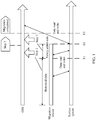
- a migration solution of Osslmport + mirror retrieval as shown in FIG. 1 , in a step 1, historical data before T1 first needs to be fully migrated. in a step 2, open an object storage service (Object Storage Service, OSS) system to perform a mirror retrieval, and switch read and write to the OSS, and no data is newly added to a migration source.
- OSS object storage service
- no data is newly added to a migration source.
- the operation steps are relatively complex and demanding, and can be only implemented with high skill requirements.
- the data migration is also between the two buckets.
- API Application Programming Interface
- This application provides a data migration method and an apparatus, to resolve a problem that a customer's normal service is affected during data migration.
- a data migration method including: sending, by a first storage system, a location update request to a location server, where the location update request is used to indicate the location server to update location information of a first bucket from being located in a second storage system to being located in the first storage system; migrating data in the first bucket from the second storage system, and storing the data in a second bucket in the first storage system, where an identifier of the second bucket is the same as an identifier of the first bucket; receiving a data access request, where the data access request is used to access the data in the first bucket; and determining, by the first storage system based on a type of the data access request and a migration status of the data, that the first storage system or the second storage system processes the data access request.
- the data access request is directed to the first storage system for processing. If the first storage system may process the request based on the migrated data, the first storage system directly processes the request. If the data accessed by the data access request has not been migrated to the first storage system, the first storage system may obtain the data from the second storage system and feed back the data to a customer. For the customer, the identifier of the bucket remains unchanged, and an API remains unchanged. In a migration process, a customer's service is not damaged, the customer is unaware of a data migration, and customer's storage costs are not increased. Therefore, a problem that the customer's service is affected during data migration can be resolved.
- the migrating, by the first storage system, data in the first bucket from the second storage system includes: first migrating, by the first storage system, metadata of an object in the first bucket, and then migrating remaining data other than the metadata in the first bucket.
- first migrating, by the first storage system, metadata of an object in the first bucket is irrelevant to a size of the object, and is basically of a fixed size
- migrating remaining data other than the metadata in the first bucket is fast.
- some data access requests may be directly processed in the second bucket in the first storage system, and the data access requests do not need to be forwarded to the second storage system.
- the data access request is used to list objects in the bucket, calculate a quantity of objects, manage life cycles of the objects, or the like.
- the receiving, by a first storage system, a data access request includes: receiving, by the first storage system from the second storage system, the data access request, or receiving, by the first storage system, the data access request sent by a virtual host, where the data access request includes the identifier of the first bucket. If the first storage system receives the data access request from the second storage system, it may be understood that a client first sends the data access request to the migrated second storage system in a fixed IP access manner, and the data access request sent to the second storage system carries an IP address of the second storage system and the identifier of the first bucket.
- the second storage system learns, from the location server, that the location information of the first bucket points to the first storage system, and then the second storage system sends the data access request to the first storage system. If the customer sends the data access request by using the virtual host, the data access request is directly sent to the first storage system. In this way, regardless of an access manner in the two manners, the data access request is first sent to the first storage system for processing, so that the first storage system may directly process or store the uploaded data locally based on the migrated data.
- the determining, by the first storage system based on a type of the data access request and a migration status of the data, that the first storage system or the second storage system processes the data access request includes: when the type of the data access request is a download request, determining, by the first storage system, whether data requested by the download request has been migrated to the second bucket; when the data requested by the download request has been migrated to the second bucket, obtaining, by the first storage system from the second bucket, the data requested by the download request; when the data requested by the download request has not been migrated to the second bucket, and the data requested by the download request is not the metadata, obtaining, by the first storage system from the first bucket, the data requested by the download request, and sending the data to the client; and when the data requested by the download request has not been migrated to the second bucket, and the data requested by the download request is the metadata, migrating, by the first storage system, the metadata from the first bucket to the second bucket for storage, and sending the metadata to the client.
- the migrated second storage system and the destination first storage system are online at the same time to provide services externally, and the data access request during this period is first sent to the first storage system for processing.
- the identifier of the bucket and the API remain unchanged, the customer is unaware of the data migration, and the customer's storage costs are not increased.
- the determining, by the first storage system based on a type of the data access request and a migration status of the data, that the first storage system or the second storage system processes the data access request includes: when the type of the data access request is an upload request, storing, by the first storage system, data uploaded by the upload request in the second bucket.
- a storage system configured to serve as a first storage system, including: a communications module, configured to send a location update request to a location server, where the location update request is used to indicate the location server to update location information of a first bucket from being located in a second storage system to being located in the first storage system; the communications module, further configured to: migrate data in the first bucket from the second storage system, and store the data in a second bucket in the first storage system, where an identifier of the second bucket is the same as an identifier of the first bucket; the communications module, further configured to receive a data access request, where the data access request is used to access the data in the first bucket; and a processing module, configured to determine, based on a type of the data access request and a migration status of the data, that the first storage system or the second storage system processes the data access request.
- a communications module configured to send a location update request to a location server, where the location update request is used to indicate the location server to update location information of a first bucket from being located in a
- the communications module is configured to: first migrate metadata of an object in the first bucket, and then migrate remaining data other than the metadata in the first bucket.
- the communications module is configured to: receive, from the second storage system, the data access request, or receive, from the first storage system, the data access request sent by a virtual host, where the data access request includes the identifier of the first bucket.
- the processing module is configured to: when the type of the data access request is a download request, determine whether data requested by the download request has been migrated to the second bucket; when the data requested by the download request has been migrated to the second bucket, obtain, from the second bucket, the data requested by the download request; when the data requested by the download request has not been migrated to the second bucket, and the data requested by the download request is not the metadata, obtain, from the first bucket, the data requested by the download request, and send the data to a client; and when the data requested by the download request has not been migrated to the second bucket, and the data requested by the download request is the metadata, migrate the metadata from the first bucket to the second bucket for storage, and send the metadata to the client.
- the processing module is configured to: when the type of the data access request is an upload request, store, in the second bucket, data uploaded by the upload request.
- an embodiment of this application provides a computer storage medium that is configured to store a computer software instruction used by the foregoing first storage system, and the computer software instruction includes a program designed for performing the foregoing first aspect.
- an embodiment of this application provides a computer program product including an instruction.
- the computer program product runs on a computer, the computer is enabled to perform the method in the foregoing first aspect.
- Embodiments of this application provide the data migration method and the apparatus that may be applied to the first storage system.
- the first storage system sends the location update request to the location server, where the location update request is used to indicate the location server to update the location information of the first bucket from being located in the second storage system to being located in the first storage system; migrates the data in the first bucket from the second storage system, and stores the data in the second bucket in the first storage system, where the identifier of the second bucket is the same as the identifier of the first bucket; and receives the data access request, where the data access request is used to access data in the first bucket.
- the first storage system determines, based on the type of the data access request and the migration status of the data, that the first storage system or the second storage system processes the data access request.
- the data access request is directed to the first storage system for processing. If the first storage system may process the request based on the migrated data, the first storage sys tem directly processes the request. If the data accessed by the data access request has not been migrated to the first storage system, the first storage system may obtain the data from the second storage system and feed back the data to a customer. For the customer, the identifier of the bucket remains unchanged, and the API remains unchanged. In the migration process, the customer's service is not damaged, the customer is unaware of the data migration, and the customer's storage costs are not increased. Therefore, the problem that the customer's service is affected during data migration can be resolved.
- a data migration method provided in the embodiments of this application may be applied to a scenario in which intra-bucket data of a same cloud service provider is migrated between different locations or systems. Before and after the migration, a client does not need to be changed. After the migration starts, the intra-bucket data may be immediately accessed in a new location or a new storage system, and newly added data is also directly stored in the new location or the new storage system.
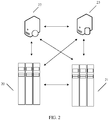
- a network architecture of this application may include a first storage system 20, a second storage system 21, a domain name system (Domain Name System, DNS) 22, and a location server (location server) 23.
- the first storage system is a storage system after a data migration
- the second storage system is a storage system before the data migration.
- the domain name system is used for domain name resolution
- the location server is configured to query a location in which data is stored, for example, configured to query a location of a bucket in which the data is stored is the first storage system or the second storage system.
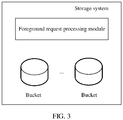
- a storage system includes a foreground request processing module and a plurality of storage regions, and each storage region may be referred to as a bucket.
- each bucket stores at least one object and metadata corresponding to each object.
- the storage system may be the first storage system 20 or the second storage system 21.
- This application is used to resolve an intra-bucket data migration problem in the field of object storage, including migrations of inventory data and newly added data.
- migrations When the migrations are completed, only location information of the bucket and location information of the intra-bucket data change.
- an identifier of the bucket or a bucket name
- an API remains unchanged.
- a customer's service is not damaged, the customer is unaware of a data migration, and customer's storage costs are not increased. This reduces skill requirements on the customer.
- the customer may specify a plurality of buckets for a concurrent migration.
- a basic principle of this application may be as follows.
- the data migration is performed based on a bucket level.
- a new service of a migrated bucket is first isolated, so that the new service accesses a destination bucket.
- the data in the migrated bucket is stable, then the data in the migrated bucket is gradually migrated to the destination bucket.
- the data in the migrated bucket is automatically reclaimed without extra charges. No adaptation is required before, after, and during bucket migration.
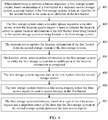
- An embodiment of this application provides a data migration method. As shown in FIG. 4 , the method includes the following steps.
- a first storage system When determining to perform a bucket migration, a first storage system creates, based on metadata of a first bucket in a migrated second storage system, a second bucket in the first storage system, where an identifier of the second bucket is the same as an identifier of the first bucket.
- the first storage system may first obtain metadata of a bucket in the second storage system from the second storage system, to create a corresponding new bucket in a new region of the first storage system based on the metadata of the bucket in the second storage system.
- the second storage system also learns that the data is to be migrated from the current system to the first storage system.
- a first bucket of the at least one bucket is used as an example for description.
- the first storage system when the migrated bucket in the second storage system includes the first bucket, and when the first storage system obtains metadata of the first bucket from the second storage system, the first storage system creates, based on the metadata of the first bucket, the second bucket in the first storage system, and the metadata of the first bucket may include a creation time of the first bucket, the identifier of the first bucket, a user, and the like.
- the metadata of the second bucket is the same as the metadata of the first bucket, and certainly the identifier of the second bucket is also the same as the identifier of the first bucket.
- the first storage system sends a location update request to a location server, where the location update request is used to indicate the location server to update location information of the first bucket from being located in the second storage system to being located in the first storage system.
- the first storage system may indicate the location server to modify location information of the bucket in the second storage system.
- the location update request may include the identifier of the migrated second storage system and the identifier of the destination first storage system, to indicate the location server to update the location information of the bucket in the second storage system from the second storage system to the first storage system.
- the location server updates the location information of the first bucket from the second storage system to the first storage system.
- the location server may modify, in the location server based on the identifier of the migrated second storage system and the identifier of the destination first storage system that are in the location update request, a value of a location information field of the bucket in the second storage system from the identifier of the second storage system to the identifier of the first storage system.
- a location information field of the first bucket in the second storage system is indicated by bkt2
- a value of the field before modification is an identifier cluster1 of the second storage system, indicating that the location information of the first bucket is the second storage system
- the value of the field after modification is an identifier cluster2 of the first storage system
- the location server sends response information to the first storage system to notify the first storage system that the modification of the location information is completed.
- the first storage system migrates data in the first bucket from the second storage system.
- the first storage system may begin to obtain data in the bucket in the second storage system from the second storage system.
- the first storage system obtains the data in the first bucket from the second storage system by using a REST interface of object storage.
- the REST interface is used for the data migration herein, and an internal architecture and a storage model that are of a system may be transparent.
- a moment at which the second storage system starts to migrate the data to the first storage system may be that when the second storage system receives an instruction for the first storage system obtaining the metadata of the bucket. If the second storage system has a data access request that is being processed but has not been processed completely, the second storage system does not first start to migrate the data to the first storage system. After the second storage system completes processing the data access request that is being processed, the second storage system starts to migrate the data to the first storage system. For example, the first storage system starts to receive the data migrated from the first bucket in the second storage system, and writes the data into the second bucket that is corresponding to the first bucket and that is in the first storage system. If a conflict occurs during data merging, the first storage system uses its own system. After the second storage system receives the instruction for obtaining the metadata of the bucket, the received data access request is first sent to the first storage system for processing, which is specifically described in step 406 below.
- the first storage system may first migrate metadata of objects in all buckets from the second storage system, and then migrate remaining data in all buckets other than the metadata of the objects. For example, the first storage system first migrates metadata of an object in the first bucket, stores the metadata of the object in the second bucket, then migrates remaining data other than the metadata in the first bucket of the object, and stores the remaining data in the second bucket.
- the metadata of the object in the bucket is irrelevant to a size of the object, the metadata of the object is basically of a fixed size, and a migration speed is fast, after the migration of the object is completed, some data access requests for accessing the metadata of the object may be directly processed in the first storage system, and the data access requests do not need to be forwarded to the second storage system.
- the data access request is used to list the objects in the bucket, calculate a quantity of objects, or manage a lifecycle of the object.
- the first storage system receives the data access request, where the data access request is used to access the data in the first bucket.
- the data access request accesses the data in a fixed Internet Protocol (Internet Protocol, IP) manner.
- IP Internet Protocol
- the data access request is sent by using a virtual host.
- the data access request carries an IP address of the migrated second storage system, an identifier of a to-be-accessed bucket, and an identifier of a to-be-accessed object, that is, the customer still accesses the data by using an original IP address.
- a bucket name remains unchanged, an API remains unchanged, and the customer is unaware of the data migration.
- the data access request is first sent to the second storage system, and the second storage system requests, from the location server, to learn location information of the to-be-accessed bucket.
- the location server has updated the location information of the bucket to the first storage system
- the second storage system learns that the location information of the bucket is the first storage system and obtains an IP address of the first storage system
- the second storage system sends the data access request to the first storage system based on the IP address of the first storage system.
- the data access request includes the IP address of the first storage system, the identifier of the to-be-accessed bucket, and the identifier of the to-be-accessed object.
- the second storage system may also cache updated location information of the bucket when accessing the bucket for the first time, and directly send the data access request to the first storage system when the cache does not expire, to obtain to-be-accessed data from the first storage system.
- a first data access request that is received by a second storage system cluster1 and that is sent by the customer is accessed in the fixed IP manner, and a uniform resource locator (Uniform Resource Locator, URL) corresponding to the first data access request is http://8.40.229.12/bkt2/obj1.
- 8.40.229.12 is the fixed IP address of the second storage system
- bkt2 is an identifier of a first bucket
- obj 1 is an identifier of an object.
- the second storage system When receiving the first data access request, the second storage system queries location information of the first bucket from a location server, if the location server has fields bkt1:cluster1, and bkt2:cluster2, the second storage system learns that the location information of the first bucket bkt2 points to a first storage system cluster2, and a fixed IP address 8.40.229.32 of the first storage system cluster2 is obtained. Therefore, the second storage system sends a second data access request to the first storage system, and the second data access request is the data access request in step 405, and carries the fixed IP address of the first storage system, the identifier bkt2 of the first bucket, and the identifier obj 1 of the object.
- the data access request is sent to a DNS.
- a URL corresponding to the data access request carries the identifier of the to-be-accessed bucket and the identifier of the to-be-accessed object, and the DNS stores identifiers of all storage systems and corresponding IP addresses.
- the DNS After parsing the URL to obtain the identifier of the bucket, the DNS requests, from the location server, to obtain the location information of the bucket; after obtaining, based on the identifier of the bucket, the identifier of the first storage system corresponding to the bucket, the location server feeds back the identifier of the first storage system to the DNS; then the DNS obtains, based on the identifier of the first storage system, an IP address corresponding to the first storage system, and feeds back the IP address to the customer; and the customer sends, based on the IP address corresponding to the first storage system, the data access request to the first storage system.
- the data access request includes the identifier of the to-be-accessed bucket and the identifier of the to-be-accessed object.
- the second storage system is a migrated system
- the first storage system is a system after the data migration.
- a URL corresponding to the object obj1 is http:// bkt2.hwsclouds.com/obj1, and the URL is first sent to the DNS.
- the DNS stores the identifier clusterl of the second storage system and the corresponding IP address 8.40.229.12 of the second storage system, and the identifier cluster2 of the first storage system and the corresponding IP address 8.40.229.32 of the first storage system.
- the DNS parses the URL to obtain the identifier bkt2 of the to-be-accessed first bucket, and requests, from the location server, to obtain the location information of the first bucket based on the identifier bkt2 of the first bucket. If the location information of the first bucket points to the first storage system after a location is updated, the DNS locally obtains the IP address corresponding to the identifier cluster2 of the first storage system and feeds back the IP address to the customer. The customer sends the data access request to the first storage system based on the fixed IP address 8.40.229.32 of the first storage system cluster2, and the data access request includes the identifier bkt2 of the to-be-accessed first bucket and the identifier obj1 of the object.
- the migration starts, if the customer accesses the bucket in a virtual host manner, the access request is directly located to the bucket after data migration. If the customer accesses the migrated bucket by using the fixed IP, the migrated bucket also forwards the access request to the bucket after data migration.
- the first storage system determines, based on a type of the data access request and a migration status of the data, that the first storage system or the second storage system processes the data access request.
- the data access request is finally first sent to the first storage system for processing. Because the first storage system is still in a data migration process, that is, when the data migration is not completed, the first storage system cannot process an access request for data that is not migrated, the first storage system needs the second storage system to assist in processing. In this way, in the data migration process, when processing the data access request, the first storage system needs to determine, based on the type of the data access request and the migration status of the data, whether the first storage system processes the data access request or the second storage system assists in processing the data access request. Specifically, an example in which the customer accesses the data in the first bucket is used.
- the first storage system determines whether data requested by the download request has been migrated to the second bucket in the first storage system; when the data requested by the download request has been migrated to the second bucket, the first storage system obtains, from the second bucket, the data requested by the download request; when the data requested by the download request has not been migrated to the second bucket, and the data requested by the download request is not the metadata, the first storage system obtains, from the first bucket, the data requested by the download request, sends the data to a client, and then stores the data requested by the download request in the second bucket.
- the first storage system may obtain the requested data from the second bucket in the second storage system, store the requested data in a memory of the first storage system, and feed back the requested data to the client; and then background migrates the data stored in the memory to the first bucket. In this way, for the client, when requesting the data, the client obtains a comparatively short delay of a feedback.
- the first storage system migrates the metadata from the first bucket, stores the metadata in the second bucket, and sends the metadata to the client; and then the background migrates data other than the metadata from the first bucket to the second bucket. Because the metadata of the object in the bucket is irrelevant to the size of the object, and is basically of the fixed size, and the migration speed is fast, when the client requests the metadata, the metadata may be first migrated to the second bucket before feeding the metadata back to the client.
- the first storage system stores data uploaded by the upload request in the second bucket.
- step 406 With reference to different access manners in step 406 and different types of the data access request in step 407, if the client accesses the data in the fixed IP manner, transfer of the data access request between the two storage systems may be shown in FIG. 5 , and if the client accesses the data by using the virtual host, transfer of the data access request between the two storage systems may be shown in FIG. 6 .
- the first bucket in the second storage system and the second bucket in the first storage system are online at the same time to provide services externally. After the migration is completed, the first bucket goes offline and no longer provides the services. Therefore, in the data migration method in this application, even if data is still in a migration process, a data access request is first transmitted to a new storage system for processing. If the new storage system can process the data access request, the data access request is directly processed, for example, accessing migrated data or uploading new data. If the new storage system cannot process the data, the new storage system obtains data from an old storage system and sends the data to a client. Before and after the data migration, the client does not need to be changed, customer's storage costs are not increased, and this reduces skill requirements on a customer. Therefore, a problem that a customer's service is affected during data migration can be resolved.
- each network element such as the first storage system, includes a corresponding hardware structure and/or a software module for implementing each function.
- each network element such as the first storage system
- each network element includes a corresponding hardware structure and/or a software module for implementing each function.
- a person of ordinary skill in the art should easily be aware that, in combination with the examples described in the embodiments disclosed in this specification, units, algorithms steps may be implemented by hardware or a combination of hardware and computer software. Whether a function is performed by hardware or hardware driven by computer software depends on particular applications and design constraints of the technical solutions. A person skilled in the art may use different methods to implement the described functions for each particular application, but it should not be considered that the implementation goes beyond the scope of this application.
- function module division may be performed on the first storage system based on the foregoing method example.
- each function module may be obtained by division based on a corresponding function, or two or more functions may be integrated in one processing module.
- the integrated module may be implemented in a form of hardware, or may be implemented in a form of a software functional module.
- module division is exemplary, and is merely a logical function division. In an actual implementation, another division manner may be used.
- FIG. 7 is a possible schematic structural diagram of the storage system involved in the foregoing embodiments.
- the storage system is used as the foregoing first storage system, and the storage system 70 includes a sending unit 7001, a receiving unit 7002, and a processing unit 7003.
- the processing unit 7003 is configured to support the first storage system 70 in performing the process 401 in FIG. 4
- the sending unit 7001 is configured to support the first storage system in performing the process 402 in FIG. 4
- the receiving unit 7002 is configured to perform the processes 405 and 406 in FIG. 4 . All related content of the steps in the foregoing method embodiment may be all cited in function descriptions of corresponding function modules. Details are not described herein again.
- FIG. 8 is a possible schematic structural diagram of the storage system involved in the foregoing embodiments.
- the storage system is used as the foregoing first storage system.
- the storage system 80 includes a processing module 8002 and a communications module 8003.
- the processing module 8002 is configured to control and manage an action of the first storage system.
- the communications module 8003 is configured to send a location update request to a location server, where the location update request is used to indicate the location server to update location information of a first bucket from being located in a second storage system to being located in the first storage system.
- the communications module 8003 is further configured to migrate data in the first bucket from the second storage system, and store the data in a second bucket in the first storage system, where an identifier of the second bucket is the same as an identifier of the first bucket.
- the communications module 8003 is further configured to receive a data access request, where the data access request is used to access the data in the first bucket.
- the processing module 8002 is configured to determine, based on a type of the data access request and a migration status of the data, that the first storage system or the second storage system processes the data access request.
- the communications module 8003 may be configured to: first migrate metadata of an object in the first bucket, and then migrate remaining data other than the metadata in the first bucket.
- the communications module 8003 may be configured to: receive, from the second storage system, the data access request, or receive, from the first storage system, the data access request sent by a virtual host, where the data access request includes the identifier of the first bucket.
- the processing module 8002 may be configured to: when the type of the data access request is a download request, determine whether data requested by the download request has been migrated to the second bucket; when the data requested by the download request has been migrated to the second bucket, obtain, from the second bucket, the data requested by the download request; when the data requested by the download request has not been migrated to the second bucket, and the data requested by the download request is not the metadata, obtain, from the first bucket, the data requested by the download request, and send the data to a client; and when the data requested by the download request has not been migrated to the second bucket, and the data requested by the download request is the metadata, migrate the metadata from the first bucket to the second bucket for storage, and send the metadata to the client.
- the processing module 8002 may be configured to: when the type of the data access request is an upload request, store, in the second bucket, data uploaded by the upload request.
- the processing module 8002 is configured to support the first storage system in performing the processes 401 and 407 in FIG. 4 , and/or is configured to perform another process of the technology described in this specification.
- the communications module 8003 is configured to support the first storage system in communicating with another network entity, for example, communicating with the function module or the network entity shown in FIG. 2 .
- the communications module 8003 may be configured to support the first storage system in performing processes 402, 405, and 406 in FIG. 4 .
- the first storage system may further include a storage module 8001 configured to store program code and data that are of the first storage system.
- the processing module 8002 may be a processor or a controller, such as a central processing unit (Central Processing Unit, CPU), a general-purpose processor, a digital signal processor (Digital Signal Processor, DSP), an application-specific integrated circuit (Application Specific Integrated Circuit, ASIC), a field programmable gate array (Field-Programmable Gate Array, FPGA), or another programmable logic device, a transistor logic device, a hardware component, or any combination thereof.
- the processor may implement or execute various example logic blocks, modules, and circuits described with reference to content disclosed in this application.
- the processor may be a combination implementing a computing function, for example, a combination including one or more microprocessors, or a combination of the DSP and the microprocessor.
- the communications module 8003 may be a transceiver, a transceiver circuit, a communications interface, or the like.
- the storage module 8001 may be a memory.
- the processing module 8002 is the processor
- the communications module 8003 is the communications interface
- the storage module 8001 is the memory
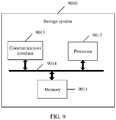
- the first storage system involved in this embodiment of this application may be a storage system shown in FIG. 9 .
- the storage system 9010 includes a processor 9012, a communications interface 9013, a memory 9011, and a bus 9014.
- the communications interface 9013, the processor 9012, and the memory 9011 are mutually connected by using the bus 9014.
- the bus 9014 may be a peripheral component interconnect (Peripheral Component Interconnect, PCI) bus, an extended industry standard architecture (Extended Industry Standard Architecture, EISA) bus, or the like.
- PCI peripheral component interconnect
- EISA Extended Industry Standard Architecture
- the bus may be classified into an address bus, a data bus, a control bus, and the like. For ease of representation, only one thick line is used to represent the bus in FIG. 9 , but this does not mean that there is only one bus or only one type of bus.
- the software instruction may include a corresponding software module.
- the software module may be stored in a random access memory (Random Access Memory, RAM), a flash memory, a read-only memory (Read Only Memory, ROM), an erasable programmable read-only memory (Erasable Programmable ROM, EPROM), an electrically erasable programmable read-only memory (Electrically EPROM, EEPROM), a register, a hard disk, a removable hard disk, a compact disc read-only memory (CD-ROM), or any other form of storage medium well-known in the art.
- RAM Random Access Memory
- ROM read-only memory
- EPROM erasable programmable read-only memory
- Electrically erasable programmable read-only memory Electrically erasable programmable read-only memory
- CD-ROM compact disc read-only memory
- a storage medium is coupled to a processor, so that the processor can read information from the storage medium and write information into the storage medium.
- the storage medium may be a component of the processor.
- the processor and the storage medium may be located in an ASIC.
- the ASIC may be located in a core network interface device.
- the processor and the storage medium may exist in the core network interface device as discrete components.
- the functions described in this application may be implemented by hardware, software, firmware, or any combination thereof.
- the foregoing functions may be stored in a computer-readable medium or transmitted as one or more instructions or code in the computer-readable medium.
- the computer-readable medium includes a computer storage medium and a communications medium, and the communications medium includes any medium that enables a computer program to be transmitted from one place to another.
- the storage medium may be any available medium accessible to a general-purpose or dedicated computer.
Landscapes
- Engineering & Computer Science (AREA)
- Theoretical Computer Science (AREA)
- Human Computer Interaction (AREA)
- Physics & Mathematics (AREA)
- General Engineering & Computer Science (AREA)
- General Physics & Mathematics (AREA)
- Computer Networks & Wireless Communication (AREA)
- Information Retrieval, Db Structures And Fs Structures Therefor (AREA)
Applications Claiming Priority (2)
| Application Number | Priority Date | Filing Date | Title |
|---|---|---|---|
| CN201810748632.4A CN109189324B (zh) | 2018-07-09 | 2018-07-09 | 一种数据迁移方法及装置 |
| PCT/CN2019/094110 WO2020011038A1 (zh) | 2018-07-09 | 2019-07-01 | 一种数据迁移方法及装置 |
Publications (3)
| Publication Number | Publication Date |
|---|---|
| EP3800538A1 true EP3800538A1 (de) | 2021-04-07 |
| EP3800538A4 EP3800538A4 (de) | 2021-08-04 |
| EP3800538B1 EP3800538B1 (de) | 2024-06-12 |
Family
ID=64936332
Family Applications (1)
| Application Number | Title | Priority Date | Filing Date |
|---|---|---|---|
| EP19833427.8A Active EP3800538B1 (de) | 2018-07-09 | 2019-07-01 | Verfahren und vorrichtung zur datenübertragung |
Country Status (4)
| Country | Link |
|---|---|
| US (1) | US11914881B2 (de) |
| EP (1) | EP3800538B1 (de) |
| CN (1) | CN109189324B (de) |
| WO (1) | WO2020011038A1 (de) |
Families Citing this family (16)
| Publication number | Priority date | Publication date | Assignee | Title |
|---|---|---|---|---|
| CN109189324B (zh) * | 2018-07-09 | 2021-01-08 | 华为技术有限公司 | 一种数据迁移方法及装置 |
| US11567840B2 (en) * | 2020-03-09 | 2023-01-31 | Rubrik, Inc. | Node level recovery for clustered databases |
| CN111800497A (zh) * | 2020-06-30 | 2020-10-20 | 北京金山云网络技术有限公司 | 请求响应方法、热迁移系统及装置 |
| CN112131128B (zh) * | 2020-09-29 | 2023-08-22 | 网易(杭州)网络有限公司 | 数据测试方法、装置、存储介质和电子装置 |
| CN112511634A (zh) * | 2020-12-02 | 2021-03-16 | 北京邮电大学 | 一种数据获取方法、装置、电子设备及存储介质 |
| CN117729217B (zh) * | 2020-12-14 | 2024-08-27 | 华为云计算技术有限公司 | 云平台及其提供的对象存储服务的桶管理方法 |
| CN113312147B (zh) * | 2021-06-11 | 2022-12-30 | 中国科学技术大学 | 一种对象存储跨集群海量数据迁移方法及系统 |
| CN116266839A (zh) * | 2021-12-16 | 2023-06-20 | 华为云计算技术有限公司 | 一种对象存储桶的数据访问方法以及云管理平台 |
| CN115346050A (zh) * | 2022-06-27 | 2022-11-15 | 武汉光庭信息技术股份有限公司 | 一种基于oss数据集在线预处理方法及系统 |
| CN115473815B (zh) * | 2022-08-23 | 2024-01-19 | 浪潮通信信息系统有限公司 | 基于设备变更的业务迁移系统及方法 |
| CN117749813A (zh) * | 2022-09-13 | 2024-03-22 | 华为云计算技术有限公司 | 基于云计算技术的数据迁移方法及云管理平台 |
| CN115543967A (zh) * | 2022-11-02 | 2022-12-30 | 中国建设银行股份有限公司 | 一种数据迁移方法、装置、电子设备及计算机可读介质 |
| CN118733526A (zh) * | 2023-03-31 | 2024-10-01 | 华为技术有限公司 | 一种存储访问方法及系统 |
| US20240394231A1 (en) * | 2023-05-26 | 2024-11-28 | Pure Storage, Inc. | Migrating data from disparate object storage environments |
| US20250123966A1 (en) * | 2023-10-15 | 2025-04-17 | Nvidia Corporation | Application programming interface to update information |
| CN118118728B (zh) * | 2024-04-30 | 2024-07-05 | 四川天邑康和通信股份有限公司 | Iptv机顶盒的数据处理方法和装置、机顶盒及介质 |
Family Cites Families (23)
| Publication number | Priority date | Publication date | Assignee | Title |
|---|---|---|---|---|
| JP3410010B2 (ja) * | 1997-12-24 | 2003-05-26 | 株式会社日立製作所 | サブシステムの移行方法および情報処理システム |
| KR100662290B1 (ko) * | 2000-12-27 | 2007-01-02 | 엘지전자 주식회사 | 광 기록매체 상의 데이터 복사 및 이동 방법 |
| US7707186B2 (en) * | 2004-06-18 | 2010-04-27 | Emc Corporation | Method and apparatus for data set migration |
| JP4387261B2 (ja) * | 2004-07-15 | 2009-12-16 | 株式会社日立製作所 | 計算機システム、および、記憶装置システムの移行方法 |
| JP2006146476A (ja) * | 2004-11-18 | 2006-06-08 | Hitachi Ltd | ストレージシステム及びストレージシステムのデータ移行方法 |
| US8504521B2 (en) * | 2005-07-28 | 2013-08-06 | Gopivotal, Inc. | Distributed data management system |
| JP4900784B2 (ja) * | 2006-04-13 | 2012-03-21 | 株式会社日立製作所 | ストレージシステム及びストレージシステムのデータ移行方法 |
| CN100538617C (zh) * | 2006-07-11 | 2009-09-09 | 任永坚 | 存储介质处理方法及系统 |
| US8407436B2 (en) * | 2009-02-11 | 2013-03-26 | Hitachi, Ltd. | Methods and apparatus for migrating thin provisioning volumes between storage systems |
| US8122213B2 (en) * | 2009-05-05 | 2012-02-21 | Dell Products L.P. | System and method for migration of data |
| CN103067433B (zh) * | 2011-10-24 | 2016-04-20 | 阿里巴巴集团控股有限公司 | 一种分布式存储系统的数据迁移方法、设备和系统 |
| US8965847B1 (en) * | 2011-10-28 | 2015-02-24 | Oxygen Cloud, Inc. | Independent synchronization of file data and file metadata |
| US20140108475A1 (en) * | 2012-10-11 | 2014-04-17 | Hitachi, Ltd. | Migration-destination file server and file system migration method |
| US8904133B1 (en) * | 2012-12-03 | 2014-12-02 | Hitachi, Ltd. | Storage apparatus and storage apparatus migration method |
| US10860529B2 (en) * | 2014-08-11 | 2020-12-08 | Netapp Inc. | System and method for planning and configuring a file system migration |
| CN104778179B (zh) * | 2014-01-14 | 2019-05-28 | 阿里巴巴集团控股有限公司 | 一种数据迁移测试方法和系统 |
| US20150355862A1 (en) * | 2014-06-04 | 2015-12-10 | Pure Storage, Inc. | Transparent array migration |
| CN106294387B (zh) * | 2015-05-19 | 2020-06-02 | 深圳市腾讯计算机系统有限公司 | 数据迁移方法和装置 |
| CN105549904B (zh) * | 2015-12-08 | 2019-01-08 | 华为技术有限公司 | 一种应用于存储系统中的数据迁移方法及存储设备 |
| CN107577425A (zh) * | 2017-08-23 | 2018-01-12 | 杭州宏杉科技股份有限公司 | 一种数据迁移方法及装置 |
| CN107704206B (zh) * | 2017-10-09 | 2020-09-18 | 苏州浪潮智能科技有限公司 | 在线迁移异构系统数据的方法、装置、设备和存储介质 |
| CN107656705B (zh) * | 2017-10-25 | 2020-10-23 | 苏州浪潮智能科技有限公司 | 一种计算机存储介质和一种数据迁移方法、装置及系统 |
| CN109189324B (zh) * | 2018-07-09 | 2021-01-08 | 华为技术有限公司 | 一种数据迁移方法及装置 |
-
2018
- 2018-07-09 CN CN201810748632.4A patent/CN109189324B/zh active Active
-
2019
- 2019-07-01 EP EP19833427.8A patent/EP3800538B1/de active Active
- 2019-07-01 WO PCT/CN2019/094110 patent/WO2020011038A1/zh not_active Ceased
-
2021
- 2021-01-08 US US17/144,999 patent/US11914881B2/en active Active
Also Published As
| Publication number | Publication date |
|---|---|
| CN109189324A (zh) | 2019-01-11 |
| US20210132849A1 (en) | 2021-05-06 |
| EP3800538B1 (de) | 2024-06-12 |
| WO2020011038A1 (zh) | 2020-01-16 |
| US11914881B2 (en) | 2024-02-27 |
| EP3800538A4 (de) | 2021-08-04 |
| CN109189324B (zh) | 2021-01-08 |
Similar Documents
| Publication | Publication Date | Title |
|---|---|---|
| US11914881B2 (en) | Data migration method and apparatus | |
| US10579364B2 (en) | Upgrading bundled applications in a distributed computing system | |
| CN108701048B (zh) | 数据加载方法及装置 | |
| CA3070006C (en) | Method for reading data stored in a non-volatile cache using rdma | |
| US20110197032A1 (en) | Cache coordination between data sources and data recipients | |
| CN105205143B (zh) | 一种文件存储及处理方法、设备和系统 | |
| US11029932B2 (en) | Hydration of applications | |
| US10620871B1 (en) | Storage scheme for a distributed storage system | |
| US20100088448A1 (en) | Virtual computing accelerator and program downloading method for server-based virtual computing | |
| CN105765526A (zh) | 通过网络从远程磁盘镜像进行引导 | |
| KR102098415B1 (ko) | 캐시 관리 기법 | |
| CN109933585A (zh) | 数据查询方法和数据查询系统 | |
| WO2018113571A1 (zh) | 一种虚拟化网元的管理方法和装置及计算机存储介质 | |
| CN105446794A (zh) | 一种基于虚拟机的磁盘操作方法、装置及系统 | |
| EP3384384A1 (de) | Verfahren und vorrichtungen zur datenerfassung mit einer virtuellen maschine und einem host-rechner | |
| CN107870802A (zh) | 一种虚拟机迁移方法和装置 | |
| CN116708583A (zh) | 业务执行方法、存储介质、设备及分布式系统 | |
| CN110347656A (zh) | 文件存储系统中请求的管理方法和装置 | |
| CN115269530A (zh) | 数据同步方法、电子设备及计算机可读存储介质 | |
| US11782882B2 (en) | Methods for automated artifact storage management and devices thereof | |
| CN114546976B (zh) | 用户态分布式文件系统访问方法、装置和设备 | |
| CN110768834A (zh) | 虚拟机配置升级结果的通知方法、系统、设备及介质 | |
| CN113014683B (zh) | 请求处理方法、装置、电子设备及存储介质 | |
| US10776036B2 (en) | System and method for efficient restore | |
| CN107807816A (zh) | 服务端程序和数据库的升级方法、装置和设备 |
Legal Events
| Date | Code | Title | Description |
|---|---|---|---|
| STAA | Information on the status of an ep patent application or granted ep patent |
Free format text: STATUS: THE INTERNATIONAL PUBLICATION HAS BEEN MADE |
|
| PUAI | Public reference made under article 153(3) epc to a published international application that has entered the european phase |
Free format text: ORIGINAL CODE: 0009012 |
|
| STAA | Information on the status of an ep patent application or granted ep patent |
Free format text: STATUS: REQUEST FOR EXAMINATION WAS MADE |
|
| 17P | Request for examination filed |
Effective date: 20201228 |
|
| AK | Designated contracting states |
Kind code of ref document: A1 Designated state(s): AL AT BE BG CH CY CZ DE DK EE ES FI FR GB GR HR HU IE IS IT LI LT LU LV MC MK MT NL NO PL PT RO RS SE SI SK SM TR |
|
| AX | Request for extension of the european patent |
Extension state: BA ME |
|
| A4 | Supplementary search report drawn up and despatched |
Effective date: 20210701 |
|
| RIC1 | Information provided on ipc code assigned before grant |
Ipc: G06F 3/06 20060101AFI20210625BHEP |
|
| DAV | Request for validation of the european patent (deleted) | ||
| DAX | Request for extension of the european patent (deleted) | ||
| RAP1 | Party data changed (applicant data changed or rights of an application transferred) |
Owner name: HUAWEI CLOUD COMPUTING TECHNOLOGIES CO., LTD. |
|
| STAA | Information on the status of an ep patent application or granted ep patent |
Free format text: STATUS: EXAMINATION IS IN PROGRESS |
|
| 17Q | First examination report despatched |
Effective date: 20220704 |
|
| GRAP | Despatch of communication of intention to grant a patent |
Free format text: ORIGINAL CODE: EPIDOSNIGR1 |
|
| STAA | Information on the status of an ep patent application or granted ep patent |
Free format text: STATUS: GRANT OF PATENT IS INTENDED |
|
| INTG | Intention to grant announced |
Effective date: 20240212 |
|
| GRAS | Grant fee paid |
Free format text: ORIGINAL CODE: EPIDOSNIGR3 |
|
| GRAA | (expected) grant |
Free format text: ORIGINAL CODE: 0009210 |
|
| STAA | Information on the status of an ep patent application or granted ep patent |
Free format text: STATUS: THE PATENT HAS BEEN GRANTED |
|
| AK | Designated contracting states |
Kind code of ref document: B1 Designated state(s): AL AT BE BG CH CY CZ DE DK EE ES FI FR GB GR HR HU IE IS IT LI LT LU LV MC MK MT NL NO PL PT RO RS SE SI SK SM TR |
|
| REG | Reference to a national code |
Ref country code: GB Ref legal event code: FG4D |
|
| REG | Reference to a national code |
Ref country code: CH Ref legal event code: EP |
|
| REG | Reference to a national code |
Ref country code: DE Ref legal event code: R096 Ref document number: 602019053672 Country of ref document: DE |
|
| REG | Reference to a national code |
Ref country code: IE Ref legal event code: FG4D |
|
| PG25 | Lapsed in a contracting state [announced via postgrant information from national office to epo] |
Ref country code: BG Free format text: LAPSE BECAUSE OF FAILURE TO SUBMIT A TRANSLATION OF THE DESCRIPTION OR TO PAY THE FEE WITHIN THE PRESCRIBED TIME-LIMIT Effective date: 20240612 |
|
| PG25 | Lapsed in a contracting state [announced via postgrant information from national office to epo] |
Ref country code: HR Free format text: LAPSE BECAUSE OF FAILURE TO SUBMIT A TRANSLATION OF THE DESCRIPTION OR TO PAY THE FEE WITHIN THE PRESCRIBED TIME-LIMIT Effective date: 20240612 Ref country code: FI Free format text: LAPSE BECAUSE OF FAILURE TO SUBMIT A TRANSLATION OF THE DESCRIPTION OR TO PAY THE FEE WITHIN THE PRESCRIBED TIME-LIMIT Effective date: 20240612 |
|
| REG | Reference to a national code |
Ref country code: LT Ref legal event code: MG9D |
|
| PG25 | Lapsed in a contracting state [announced via postgrant information from national office to epo] |
Ref country code: GR Free format text: LAPSE BECAUSE OF FAILURE TO SUBMIT A TRANSLATION OF THE DESCRIPTION OR TO PAY THE FEE WITHIN THE PRESCRIBED TIME-LIMIT Effective date: 20240913 |
|
| REG | Reference to a national code |
Ref country code: NL Ref legal event code: MP Effective date: 20240612 |
|
| PG25 | Lapsed in a contracting state [announced via postgrant information from national office to epo] |
Ref country code: ES Free format text: LAPSE BECAUSE OF FAILURE TO SUBMIT A TRANSLATION OF THE DESCRIPTION OR TO PAY THE FEE WITHIN THE PRESCRIBED TIME-LIMIT Effective date: 20240612 |
|
| PG25 | Lapsed in a contracting state [announced via postgrant information from national office to epo] |
Ref country code: LV Free format text: LAPSE BECAUSE OF FAILURE TO SUBMIT A TRANSLATION OF THE DESCRIPTION OR TO PAY THE FEE WITHIN THE PRESCRIBED TIME-LIMIT Effective date: 20240612 |
|
| PG25 | Lapsed in a contracting state [announced via postgrant information from national office to epo] |
Ref country code: NO Free format text: LAPSE BECAUSE OF FAILURE TO SUBMIT A TRANSLATION OF THE DESCRIPTION OR TO PAY THE FEE WITHIN THE PRESCRIBED TIME-LIMIT Effective date: 20240912 Ref country code: LV Free format text: LAPSE BECAUSE OF FAILURE TO SUBMIT A TRANSLATION OF THE DESCRIPTION OR TO PAY THE FEE WITHIN THE PRESCRIBED TIME-LIMIT Effective date: 20240612 Ref country code: HR Free format text: LAPSE BECAUSE OF FAILURE TO SUBMIT A TRANSLATION OF THE DESCRIPTION OR TO PAY THE FEE WITHIN THE PRESCRIBED TIME-LIMIT Effective date: 20240612 Ref country code: GR Free format text: LAPSE BECAUSE OF FAILURE TO SUBMIT A TRANSLATION OF THE DESCRIPTION OR TO PAY THE FEE WITHIN THE PRESCRIBED TIME-LIMIT Effective date: 20240913 Ref country code: FI Free format text: LAPSE BECAUSE OF FAILURE TO SUBMIT A TRANSLATION OF THE DESCRIPTION OR TO PAY THE FEE WITHIN THE PRESCRIBED TIME-LIMIT Effective date: 20240612 Ref country code: ES Free format text: LAPSE BECAUSE OF FAILURE TO SUBMIT A TRANSLATION OF THE DESCRIPTION OR TO PAY THE FEE WITHIN THE PRESCRIBED TIME-LIMIT Effective date: 20240612 Ref country code: BG Free format text: LAPSE BECAUSE OF FAILURE TO SUBMIT A TRANSLATION OF THE DESCRIPTION OR TO PAY THE FEE WITHIN THE PRESCRIBED TIME-LIMIT Effective date: 20240612 Ref country code: RS Free format text: LAPSE BECAUSE OF FAILURE TO SUBMIT A TRANSLATION OF THE DESCRIPTION OR TO PAY THE FEE WITHIN THE PRESCRIBED TIME-LIMIT Effective date: 20240912 |
|
| PG25 | Lapsed in a contracting state [announced via postgrant information from national office to epo] |
Ref country code: NL Free format text: LAPSE BECAUSE OF FAILURE TO SUBMIT A TRANSLATION OF THE DESCRIPTION OR TO PAY THE FEE WITHIN THE PRESCRIBED TIME-LIMIT Effective date: 20240612 |
|
| REG | Reference to a national code |
Ref country code: AT Ref legal event code: MK05 Ref document number: 1694797 Country of ref document: AT Kind code of ref document: T Effective date: 20240612 |
|
| PG25 | Lapsed in a contracting state [announced via postgrant information from national office to epo] |
Ref country code: NL Free format text: LAPSE BECAUSE OF FAILURE TO SUBMIT A TRANSLATION OF THE DESCRIPTION OR TO PAY THE FEE WITHIN THE PRESCRIBED TIME-LIMIT Effective date: 20240612 |
|
| PG25 | Lapsed in a contracting state [announced via postgrant information from national office to epo] |
Ref country code: PT Free format text: LAPSE BECAUSE OF FAILURE TO SUBMIT A TRANSLATION OF THE DESCRIPTION OR TO PAY THE FEE WITHIN THE PRESCRIBED TIME-LIMIT Effective date: 20241014 |
|
| PG25 | Lapsed in a contracting state [announced via postgrant information from national office to epo] |
Ref country code: PT Free format text: LAPSE BECAUSE OF FAILURE TO SUBMIT A TRANSLATION OF THE DESCRIPTION OR TO PAY THE FEE WITHIN THE PRESCRIBED TIME-LIMIT Effective date: 20241014 |
|
| PG25 | Lapsed in a contracting state [announced via postgrant information from national office to epo] |
Ref country code: PL Free format text: LAPSE BECAUSE OF FAILURE TO SUBMIT A TRANSLATION OF THE DESCRIPTION OR TO PAY THE FEE WITHIN THE PRESCRIBED TIME-LIMIT Effective date: 20240612 |
|
| PG25 | Lapsed in a contracting state [announced via postgrant information from national office to epo] |
Ref country code: EE Free format text: LAPSE BECAUSE OF FAILURE TO SUBMIT A TRANSLATION OF THE DESCRIPTION OR TO PAY THE FEE WITHIN THE PRESCRIBED TIME-LIMIT Effective date: 20240612 |
|
| PG25 | Lapsed in a contracting state [announced via postgrant information from national office to epo] |
Ref country code: AT Free format text: LAPSE BECAUSE OF FAILURE TO SUBMIT A TRANSLATION OF THE DESCRIPTION OR TO PAY THE FEE WITHIN THE PRESCRIBED TIME-LIMIT Effective date: 20240612 Ref country code: IS Free format text: LAPSE BECAUSE OF FAILURE TO SUBMIT A TRANSLATION OF THE DESCRIPTION OR TO PAY THE FEE WITHIN THE PRESCRIBED TIME-LIMIT Effective date: 20241012 |
|
| PG25 | Lapsed in a contracting state [announced via postgrant information from national office to epo] |
Ref country code: CZ Free format text: LAPSE BECAUSE OF FAILURE TO SUBMIT A TRANSLATION OF THE DESCRIPTION OR TO PAY THE FEE WITHIN THE PRESCRIBED TIME-LIMIT Effective date: 20240612 |
|
| PG25 | Lapsed in a contracting state [announced via postgrant information from national office to epo] |
Ref country code: SK Free format text: LAPSE BECAUSE OF FAILURE TO SUBMIT A TRANSLATION OF THE DESCRIPTION OR TO PAY THE FEE WITHIN THE PRESCRIBED TIME-LIMIT Effective date: 20240612 Ref country code: RO Free format text: LAPSE BECAUSE OF FAILURE TO SUBMIT A TRANSLATION OF THE DESCRIPTION OR TO PAY THE FEE WITHIN THE PRESCRIBED TIME-LIMIT Effective date: 20240612 |
|
| PG25 | Lapsed in a contracting state [announced via postgrant information from national office to epo] |
Ref country code: SM Free format text: LAPSE BECAUSE OF FAILURE TO SUBMIT A TRANSLATION OF THE DESCRIPTION OR TO PAY THE FEE WITHIN THE PRESCRIBED TIME-LIMIT Effective date: 20240612 |
|
| PG25 | Lapsed in a contracting state [announced via postgrant information from national office to epo] |
Ref country code: SM Free format text: LAPSE BECAUSE OF FAILURE TO SUBMIT A TRANSLATION OF THE DESCRIPTION OR TO PAY THE FEE WITHIN THE PRESCRIBED TIME-LIMIT Effective date: 20240612 Ref country code: SK Free format text: LAPSE BECAUSE OF FAILURE TO SUBMIT A TRANSLATION OF THE DESCRIPTION OR TO PAY THE FEE WITHIN THE PRESCRIBED TIME-LIMIT Effective date: 20240612 Ref country code: RO Free format text: LAPSE BECAUSE OF FAILURE TO SUBMIT A TRANSLATION OF THE DESCRIPTION OR TO PAY THE FEE WITHIN THE PRESCRIBED TIME-LIMIT Effective date: 20240612 Ref country code: PL Free format text: LAPSE BECAUSE OF FAILURE TO SUBMIT A TRANSLATION OF THE DESCRIPTION OR TO PAY THE FEE WITHIN THE PRESCRIBED TIME-LIMIT Effective date: 20240612 Ref country code: IS Free format text: LAPSE BECAUSE OF FAILURE TO SUBMIT A TRANSLATION OF THE DESCRIPTION OR TO PAY THE FEE WITHIN THE PRESCRIBED TIME-LIMIT Effective date: 20241012 Ref country code: EE Free format text: LAPSE BECAUSE OF FAILURE TO SUBMIT A TRANSLATION OF THE DESCRIPTION OR TO PAY THE FEE WITHIN THE PRESCRIBED TIME-LIMIT Effective date: 20240612 Ref country code: CZ Free format text: LAPSE BECAUSE OF FAILURE TO SUBMIT A TRANSLATION OF THE DESCRIPTION OR TO PAY THE FEE WITHIN THE PRESCRIBED TIME-LIMIT Effective date: 20240612 Ref country code: AT Free format text: LAPSE BECAUSE OF FAILURE TO SUBMIT A TRANSLATION OF THE DESCRIPTION OR TO PAY THE FEE WITHIN THE PRESCRIBED TIME-LIMIT Effective date: 20240612 |
|
| PG25 | Lapsed in a contracting state [announced via postgrant information from national office to epo] |
Ref country code: IT Free format text: LAPSE BECAUSE OF FAILURE TO SUBMIT A TRANSLATION OF THE DESCRIPTION OR TO PAY THE FEE WITHIN THE PRESCRIBED TIME-LIMIT Effective date: 20240612 |
|
| REG | Reference to a national code |
Ref country code: CH Ref legal event code: PL |
|
| REG | Reference to a national code |
Ref country code: DE Ref legal event code: R097 Ref document number: 602019053672 Country of ref document: DE |
|
| PG25 | Lapsed in a contracting state [announced via postgrant information from national office to epo] |
Ref country code: LU Free format text: LAPSE BECAUSE OF NON-PAYMENT OF DUE FEES Effective date: 20240701 |
|
| PG25 | Lapsed in a contracting state [announced via postgrant information from national office to epo] |
Ref country code: MC Free format text: LAPSE BECAUSE OF FAILURE TO SUBMIT A TRANSLATION OF THE DESCRIPTION OR TO PAY THE FEE WITHIN THE PRESCRIBED TIME-LIMIT Effective date: 20240612 |
|
| PG25 | Lapsed in a contracting state [announced via postgrant information from national office to epo] |
Ref country code: MC Free format text: LAPSE BECAUSE OF FAILURE TO SUBMIT A TRANSLATION OF THE DESCRIPTION OR TO PAY THE FEE WITHIN THE PRESCRIBED TIME-LIMIT Effective date: 20240612 Ref country code: LU Free format text: LAPSE BECAUSE OF NON-PAYMENT OF DUE FEES Effective date: 20240701 |
|
| PG25 | Lapsed in a contracting state [announced via postgrant information from national office to epo] |
Ref country code: DK Free format text: LAPSE BECAUSE OF FAILURE TO SUBMIT A TRANSLATION OF THE DESCRIPTION OR TO PAY THE FEE WITHIN THE PRESCRIBED TIME-LIMIT Effective date: 20240612 |
|
| PLBE | No opposition filed within time limit |
Free format text: ORIGINAL CODE: 0009261 |
|
| STAA | Information on the status of an ep patent application or granted ep patent |
Free format text: STATUS: NO OPPOSITION FILED WITHIN TIME LIMIT |
|
| PG25 | Lapsed in a contracting state [announced via postgrant information from national office to epo] |
Ref country code: BE Free format text: LAPSE BECAUSE OF NON-PAYMENT OF DUE FEES Effective date: 20240731 Ref country code: CH Free format text: LAPSE BECAUSE OF NON-PAYMENT OF DUE FEES Effective date: 20240731 |
|
| 26N | No opposition filed |
Effective date: 20250313 |
|
| GBPC | Gb: european patent ceased through non-payment of renewal fee |
Effective date: 20240912 |
|
| REG | Reference to a national code |
Ref country code: BE Ref legal event code: MM Effective date: 20240731 |
|
| PG25 | Lapsed in a contracting state [announced via postgrant information from national office to epo] |
Ref country code: GB Free format text: LAPSE BECAUSE OF NON-PAYMENT OF DUE FEES Effective date: 20240912 |
|
| PGFP | Annual fee paid to national office [announced via postgrant information from national office to epo] |
Ref country code: FR Payment date: 20250610 Year of fee payment: 7 |
|
| PGFP | Annual fee paid to national office [announced via postgrant information from national office to epo] |
Ref country code: IE Payment date: 20250610 Year of fee payment: 7 |
|
| PG25 | Lapsed in a contracting state [announced via postgrant information from national office to epo] |
Ref country code: SE Free format text: LAPSE BECAUSE OF FAILURE TO SUBMIT A TRANSLATION OF THE DESCRIPTION OR TO PAY THE FEE WITHIN THE PRESCRIBED TIME-LIMIT Effective date: 20240612 |
|
| PGFP | Annual fee paid to national office [announced via postgrant information from national office to epo] |
Ref country code: DE Payment date: 20250604 Year of fee payment: 7 |
|
| PG25 | Lapsed in a contracting state [announced via postgrant information from national office to epo] |
Ref country code: CY Free format text: LAPSE BECAUSE OF FAILURE TO SUBMIT A TRANSLATION OF THE DESCRIPTION OR TO PAY THE FEE WITHIN THE PRESCRIBED TIME-LIMIT; INVALID AB INITIO Effective date: 20190701 |
|
| PG25 | Lapsed in a contracting state [announced via postgrant information from national office to epo] |
Ref country code: HU Free format text: LAPSE BECAUSE OF FAILURE TO SUBMIT A TRANSLATION OF THE DESCRIPTION OR TO PAY THE FEE WITHIN THE PRESCRIBED TIME-LIMIT; INVALID AB INITIO Effective date: 20190701 |