EP3800843A1 - Procédé et système d'optimisation de réseau et dispositif de réseau - Google Patents
Procédé et système d'optimisation de réseau et dispositif de réseau Download PDFInfo
- Publication number
- EP3800843A1 EP3800843A1 EP19825401.3A EP19825401A EP3800843A1 EP 3800843 A1 EP3800843 A1 EP 3800843A1 EP 19825401 A EP19825401 A EP 19825401A EP 3800843 A1 EP3800843 A1 EP 3800843A1
- Authority
- EP
- European Patent Office
- Prior art keywords
- metric
- network device
- data flow
- information
- sub
- Prior art date
- Legal status (The legal status is an assumption and is not a legal conclusion. Google has not performed a legal analysis and makes no representation as to the accuracy of the status listed.)
- Granted
Links
Images


Classifications
-
- H—ELECTRICITY
- H04—ELECTRIC COMMUNICATION TECHNIQUE
- H04L—TRANSMISSION OF DIGITAL INFORMATION, e.g. TELEGRAPHIC COMMUNICATION
- H04L45/00—Routing or path finding of packets in data switching networks
- H04L45/38—Flow based routing
-
- H—ELECTRICITY
- H04—ELECTRIC COMMUNICATION TECHNIQUE
- H04L—TRANSMISSION OF DIGITAL INFORMATION, e.g. TELEGRAPHIC COMMUNICATION
- H04L45/00—Routing or path finding of packets in data switching networks
- H04L45/12—Shortest path evaluation
- H04L45/124—Shortest path evaluation using a combination of metrics
-
- H—ELECTRICITY
- H04—ELECTRIC COMMUNICATION TECHNIQUE
- H04L—TRANSMISSION OF DIGITAL INFORMATION, e.g. TELEGRAPHIC COMMUNICATION
- H04L41/00—Arrangements for maintenance, administration or management of data switching networks, e.g. of packet switching networks
- H04L41/08—Configuration management of networks or network elements
- H04L41/0803—Configuration setting
- H04L41/0823—Configuration setting characterised by the purposes of a change of settings, e.g. optimising configuration for enhancing reliability
-
- H—ELECTRICITY
- H04—ELECTRIC COMMUNICATION TECHNIQUE
- H04L—TRANSMISSION OF DIGITAL INFORMATION, e.g. TELEGRAPHIC COMMUNICATION
- H04L41/00—Arrangements for maintenance, administration or management of data switching networks, e.g. of packet switching networks
- H04L41/50—Network service management, e.g. ensuring proper service fulfilment according to agreements
- H04L41/5003—Managing SLA; Interaction between SLA and QoS
- H04L41/5009—Determining service level performance parameters or violations of service level contracts, e.g. violations of agreed response time or mean time between failures [MTBF]
-
- H—ELECTRICITY
- H04—ELECTRIC COMMUNICATION TECHNIQUE
- H04L—TRANSMISSION OF DIGITAL INFORMATION, e.g. TELEGRAPHIC COMMUNICATION
- H04L41/00—Arrangements for maintenance, administration or management of data switching networks, e.g. of packet switching networks
- H04L41/50—Network service management, e.g. ensuring proper service fulfilment according to agreements
- H04L41/5003—Managing SLA; Interaction between SLA and QoS
- H04L41/5019—Ensuring fulfilment of SLA
- H04L41/5022—Ensuring fulfilment of SLA by giving priorities, e.g. assigning classes of service
-
- H—ELECTRICITY
- H04—ELECTRIC COMMUNICATION TECHNIQUE
- H04L—TRANSMISSION OF DIGITAL INFORMATION, e.g. TELEGRAPHIC COMMUNICATION
- H04L47/00—Traffic control in data switching networks
- H04L47/10—Flow control; Congestion control
- H04L47/12—Avoiding congestion; Recovering from congestion
-
- H—ELECTRICITY
- H04—ELECTRIC COMMUNICATION TECHNIQUE
- H04L—TRANSMISSION OF DIGITAL INFORMATION, e.g. TELEGRAPHIC COMMUNICATION
- H04L9/00—Cryptographic mechanisms or cryptographic arrangements for secret or secure communications; Network security protocols
- H04L9/40—Network security protocols
-
- H—ELECTRICITY
- H04—ELECTRIC COMMUNICATION TECHNIQUE
- H04L—TRANSMISSION OF DIGITAL INFORMATION, e.g. TELEGRAPHIC COMMUNICATION
- H04L45/00—Routing or path finding of packets in data switching networks
- H04L45/12—Shortest path evaluation
- H04L45/125—Shortest path evaluation based on throughput or bandwidth
-
- Y—GENERAL TAGGING OF NEW TECHNOLOGICAL DEVELOPMENTS; GENERAL TAGGING OF CROSS-SECTIONAL TECHNOLOGIES SPANNING OVER SEVERAL SECTIONS OF THE IPC; TECHNICAL SUBJECTS COVERED BY FORMER USPC CROSS-REFERENCE ART COLLECTIONS [XRACs] AND DIGESTS
- Y02—TECHNOLOGIES OR APPLICATIONS FOR MITIGATION OR ADAPTATION AGAINST CLIMATE CHANGE
- Y02D—CLIMATE CHANGE MITIGATION TECHNOLOGIES IN INFORMATION AND COMMUNICATION TECHNOLOGIES [ICT], I.E. INFORMATION AND COMMUNICATION TECHNOLOGIES AIMING AT THE REDUCTION OF THEIR OWN ENERGY USE
- Y02D30/00—Reducing energy consumption in communication networks
- Y02D30/50—Reducing energy consumption in communication networks in wire-line communication networks, e.g. low power modes or reduced link rate
Definitions
- Embodiments of this application relate to the communications field, and in particular, to a network optimization method, a network optimization system, and a network device.
- a transmission path is selected for a data flow mainly based on an interior gateway protocol (Interior Gateway Protocol, IGP).
- IGP Interior Gateway Protocol
- a shortest path is selected by calculating an IGP metric of each transmission path, to transmit the data flow.
- an existing distributed traffic engineering technology has the following problems because a shortest path algorithm is used.
- the data flow (a data flow being transmitted or a data flow newly delivered) on the shortest path is still transmitted on the path according to the shortest path algorithm. This increases link load, and affects data flow transmission quality.
- This application provides a network optimization method, a network optimization system, and a network device, to accurately detect network congestion, timely adjust a transmission path of a data flow, and effectively improve flexibility of network optimization.
- a network optimization method may include: If a first network device detects that a communications link between the first network device and a second network device is in an abnormal state, the first network device adjusts a metric of at least one data flow received, where the metric is used to select a transmission path for the data flow corresponding to the metric. The first network device selects the transmission path for the at least one data flow based on the adjusted metric. The first network device transmits the at least one data flow to the selected transmission path.
- a network device can obtain a running state of a communications link in real time by monitoring the communications link between the network device and a device that are in communication connection, to detect in time whether the communications link is abnormal.
- the network device adjusts a metric of at least one data flow on the communications link, and adjusts the data flow to another path for transmission, to reduce load on the abnormal link.
- the method may further include: dividing an internal gateway protocol IGP metric of the communications link, to obtain the metric of the at least one data flow.
- mapping between a data flow and an IGP metric is implemented, in other words, each data flow corresponds to a metric obtained by dividing the IGP metric, so that a specified data flow is adjusted to the another transmission path by adjusting a metric corresponding to the data flow.
- the dividing, by the first network device, an IGP metric specifically includes: obtaining data information of the at least one data flow, where the data information includes at least service level agreement SLA information and priority information; dividing the IGP metric into a plurality of metric subsets based on SLA types indicated by the SLA information of the at least one data flow, where each metric subset corresponds to one SLA type; dividing each metric subset into a plurality of sub-metrics based on priority information of a data flow corresponding to each SLA type, where each sub-metric is a metric of the corresponding data flow; and recording the plurality of sub-metrics and attribute information of the plurality of sub-metrics, where the attribute information is used to indicate an SLA type and priority information of the data flow corresponding to each of the plurality of sub-metrics.
- the IGP metric of the communications link is statically divided based on the SLA types and the priority information of the data flow, so that each data flow transmitted on the communications link corresponds to a respective metric, and the metric corresponding to each data flow may be adjusted to adjust the transmission path of the data flow. In this way, the transmission path of the data flow is adjusted.
- the method may further include: matching the data information of the at least one data flow with the attribute information of the plurality of sub-metrics; and correspondingly recording, in the database, identification information of the at least one data flow and identification information of a plurality of sub-metrics that successfully match the at least one data flow, where the identification information of the data flow is used to uniquely identify the data flow, and the identification information of the metric is used to uniquely identify the metric.
- the first network device adjusts a metric specifically includes: obtaining abnormal state information of the communications link, where the abnormal state information includes at least an abnormal state type of the communications link; matching the abnormal state information with the SLA types; obtaining a target metric subset corresponding to a successfully matched SLA type; and adjusting at least one sub-metric in the target metric subset based on priority information of data flows corresponding to all sub-metrics in the target metric subset.
- the transmission path of the at least one data flow on the communications link in the abnormal state is dynamically adjusted, to reduce pressure on the communications link.
- that the first network device adjusts a metric of a data flow specifically includes: obtaining a data flow with a lowest priority in the data flows corresponding to all the sub-metrics in the target metric subset; and adjusting a sub-metric corresponding to the data flow with the lowest priority to a specified value.
- the data flow with the low priority is adjusted to another path, to reduce pressure on the communications link, and increase a transmission rate of another data flow with a relatively high priority.
- that the first network device adjusts a metric of a data flow may further include: if the data flows corresponding to all the sub-metrics in the target metric subset have the same priority information, requesting, from a control device, to modify the priority information of the data flows corresponding to all the sub-metrics in the target metric subset; and adjusting, by the first network device, sub-metrics in the target metric subset based on modified priority information.
- the method further includes: obtaining, by the first network device, parameter information of the communications link; determining whether the parameter information is continuously lower than a recovery threshold within predetermined duration; and if the parameter information is continuously lower than the recovery threshold within the predetermined duration, adjusting, by the first network device, a last adjusted sub-metric to an initial value.
- the method further includes: if the selected transmission path is still the communications link, adjusting, by the first network device, based on priority information of data flows corresponding to other unadjusted sub-metrics in the target metric subset, at least one sub-metric in the other unadjusted sub-metrics.
- the method further includes: if the transmission path reselected by the first network device for the data flow is in the abnormal state, adjusting an adjusted sub-metric to an initial value; and generating, by the first network device, alarm information, to notify the first network device that a system to which the first network device belongs is in an abnormal state.
- a manner in which the first network device determines whether the communications link between the first network device and the second network device is in the abnormal state includes: obtaining, by the first network device, the parameter information of the communications link; determining whether the parameter information continuously exceeds a threshold-crossing value within the predetermined duration; and if the parameter information continuously exceeds the threshold-crossing value within the predetermined duration, determining that the communications link is in the abnormal state.
- the first network device can accurately locate the abnormal state of the communications link in time.
- the network device may include:
- the network device further includes: a division module, configured to divide an internal gateway protocol IGP metric of the communications link, to obtain the metric of the at least one data flow.
- a division module configured to divide an internal gateway protocol IGP metric of the communications link, to obtain the metric of the at least one data flow.
- the division module is further configured to:
- the network device may further include:
- the adjustment module is further configured to: obtain abnormal state information of the communications link, where the abnormal state information includes at least an abnormal state type of the communications link; match the abnormal state information with the SLA types; obtain a target metric subset corresponding to a successfully matched SLA type; and adjust at least one sub-metric in the target metric subset based on priority information of data flows corresponding to all sub-metrics in the target metric subset.
- the adjustment module is further configured to: obtain a data flow with a lowest priority in the data flows corresponding to all the sub-metrics in the target metric subset; and adjust a sub-metric corresponding to the data flow with the lowest priority to a specified value.
- the adjustment module is further configured to: if the data flows corresponding to all the sub-metrics in the target metric subset have the same priority information, request, from a control device, to modify the priority information of the data flows corresponding to all the sub-metrics in the target metric subset; and adjust the sub-metrics in the target metric subset based on modified priority information.
- the network device further includes: a first state monitoring module, configured to obtain parameter information of the communications link; the first state monitoring module is further configured to determine whether the parameter information is continuously lower than a recovery threshold within predetermined duration; and if the determining module determines that the parameter information is continuously lower than a recovery threshold within predetermined duration, the adjustment module adjusts a last adjusted sub-metric to an initial value.
- the adjustment module is further configured to: if the selected transmission path is still the communications link, adjust, based on priority information of data flows corresponding to other unadjusted sub-metrics in the target metric subset, at least one sub-metric in the other unadjusted sub-metrics.
- the adjustment module is further configured to: if the selected transmission path is in the abnormal state, adjust an adjusted sub-metric to an initial value; and the network device further includes an alarm module, configured to generate alarm information, to notify the first network device that a system to which the first network device belongs is in an abnormal state.
- the network device further includes a second state monitoring module, configured to: obtain the parameter information of the communications link; determine whether the parameter information continuously exceeds a threshold-crossing value within the predetermined duration; and if the parameter information continuously exceeds the threshold-crossing value within the predetermined duration, determine that the communications link is in the abnormal state.
- a second state monitoring module configured to: obtain the parameter information of the communications link; determine whether the parameter information continuously exceeds a threshold-crossing value within the predetermined duration; and if the parameter information continuously exceeds the threshold-crossing value within the predetermined duration, determine that the communications link is in the abnormal state.
- a network optimization system includes a first network device and a second network device, where the first network device is configured to: if it is detected that a communications link between the first network device and the second network device is in an abnormal state, adjust a metric of at least one data flow received by the first network device, where the metric is used to select a transmission path for the data flow corresponding to the metric; the first network device is further configured to select the transmission path for the at least one data flow based on the adjusted metric; and the first network device is further configured to transmit the at least one data flow to the selected transmission path.
- the system may further include a control device.
- the device is configured to receive a request message sent by the first network device, where the request message is used to request, from the control device, to adjust priority information of the at least one data flow.
- the control device is further configured to send a request response message to the first network device based on a user instruction, where the request response message carries adjusted priority information of the at least one data flow.
- a control device may be configured to receive a request message sent by a first network device, where the request message is used to request, from the control device, to adjust priority information of at least one data flow.
- the control device is further configured to send a request response message to the first network device, where the request response message carries adjusted priority information of the at least one data flow.
- a computer-readable storage medium stores a computer program, the computer program includes at least one segment of code, and the at least one segment of code may be executed by a network device, to control the network device to execute the program designed in the first aspect.
- a computer program When being executed by a network device, the computer program is used to execute the program designed in the first aspect.
- the program may be all or partially stored in a storage medium that is encapsulated with the processor, or may be all or partially stored in a memory that is not encapsulated with the processor.
- a network device including a memory and a processor.
- the memory is coupled to the processor.
- the processor is configured to execute the program designed in the first aspect.
- a processor includes at least one circuit, configured to: if it is detected that a communications link between a first network device and a second network device is in an abnormal state, adjust a metric of at least one data flow received by the first network device, where the metric is used to select a transmission path for the data flow corresponding to the metric; select the transmission path for the at least one data flow based on an adjusted metric; and transmit the at least one data flow to the selected transmission path.
- the processor may be a chip.
- a control device includes a memory and a processor.
- the memory stores a computer program.
- the processor is configured to: receive a request message sent by a first network device, where the request message is used to request, from a control device, to adjust priority information of at least one data flow; and return a response message based on the request message, where the request response message carries adjusted priority information of the at least one data flow, the priority information of the at least one data flow is used by the first network device to adjust a metric of the at least one data flow, and the metric is used to select a transmission path for the data flow corresponding to the metric.
- control device adjusts the priority information of the at least one data flow based on a user instruction, or adjusts the priority information of the at least one data flow based on a priority adjustment requirement carried in the request message sent by the first network device.
- a and/or B may represent the following three cases: Only A exists, both A and B exist, and only B exists.
- first the terms “first”, “second”, and so on are intended to distinguish between different objects but do not indicate a particular order of the objects.
- first target object, the second target object, and the like are used to distinguish between different target objects, but are not used to describe a specific order of the target objects.
- the word “exemplary” or “for example” is used to represent giving an example, an illustration, or a description. Any embodiment or design scheme described as an “exemplary” or “for example” in the embodiments of this application should not be explained as being more preferred or having more advantages than another embodiment or design scheme. Exactly, use of the word “exemplary” or “example” or the like is intended to present a relative concept in a specific manner.
- a plurality of means two or more than two.
- the plurality of processing units refer to two or more processing units.
- a plurality of systems refers to two or more systems.
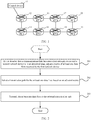
- FIG. 1 is a schematic diagram of an application scenario according to an embodiment of this application.
- a control device 11 there are a control device 11, provider edge (Provider Edge, PE) devices 1 to 4 which are respectively numbered 12 to 15, and routers (Router, RT) A to D which are numbered 16 to 19.
- PE Provider Edge
- Router, RT routers
- a quantity of devices in the application scenario shown in FIG. 1 is merely an example. This is not limited in this application.
- FIG. 2 is a flowchart of a network optimization method according to an embodiment of this application. The method shown in FIG. 2 includes the following steps.
- a first network device adjusts a metric of at least one data flow received by the first network device.
- the network optimization method may be applied to any device that can implement a routing function on a network.
- the following uses an example in which an RT A in FIG. 1 is used as the first network device in this embodiment of this application for detailed description.
- a network manager may divide, based on data information of data flows delivered by a control device or an ingress device (in this embodiment, a PE is the ingress device), an IGP metric of the communications link between the first device (the RT A) and the second device (in this embodiment, an RT B is used as the second device for detailed description).
- the IGP metric of the communications link between routing devices is divided based on service level agreement (Service Level Agreement, SLA) types of the data flows and a quantity and priority information of the data flows of each SLA type.
- SLA Service Level Agreement
- each data flow in the at least one data flow transmitted between the RT A and the RT B corresponds to a metric, and when each data flow is transmitted on a network, the RT A calculates a next-hop path based on the metric corresponding to the data flow.
- a manner in which the RT A obtains the SLA types and priorities of the data flows is as follows:
- the data flows carry parameters used to indicate the SLA types and the priorities, and the RT A may obtain, by reading the parameters, the SLA types and the priority information that correspond to the data flows.
- the SLA types and the priority information indicated in the parameter are set by the network manager when the data flows are generated.
- the communications link between the routing devices on the network has a corresponding IGP metric.
- each routing device calculates, based on the IGP metric between the routing device and a routing device that is connected to the routing device, a shortest path for transmitting each data flow, to minimize a cost of transmitting the data flow.
- an IGP metric of a communications link is a cost required for transmitting a data flow on the communications link. Still referring to FIG.
- the RT A calculates a link cost by using the IGP metric of each link.
- a transmission path 1 that may be used is RT A-RT B-PE 2
- a transmission path 2 is RT A-RT C-RT D-RT B-PE 2.
- a link cost of the transmission path 2 is calculated, in other words, a total IGP metric is 40. Therefore, the RT A selects the transmission path 1 as the shortest path, and transmits the data flow on the path. It is clear that in the prior art, all data sent from the PE 1 to the PE 2 pass through the path. When data traffic is relatively heavy, path load is excessively heavy, transmission rates of all data flows are affected, and user experience is reduced.
- the data flow is associated with the metric by extending the IGP metric, and a transmission path of the data flow is adjusted by adjusting the metric.
- FIG. 3 is a flowchart of IGP metric division steps according to an embodiment of this application. Specifically, in this embodiment of this application, before an ingress node delivers a data flow, a network manager plans an IGP metric of each routing device on a network. A communications link between an RT A and an RT B is still used as an example.
- a first network device divides an IGP metric into a plurality of metric subsets based on SLA information types of at least one data flow.
- the IGP metric between the RT A and the RT B is 10 (the value is merely an example, and is not limited in this application).
- the SLA types of the at least one data flow sent by a PE 1 to a PE 2 include a bandwidth service level (which indicates a bandwidth requirement of the data flow) and a delay service level (which indicates a delay requirement of the data flow), only the foregoing two SLA types are used as an example in this embodiment of this application.
- the data flow may include a plurality of SLA types. This is not limited in this application.
- the RT A divides the IGP metric into the plurality of metric subsets based on the SLA types of the data flows that are to be received (in other words, the plurality of data flows that the PE 1 delivers to the RT A).
- Each metric subset corresponds to one SLA type.
- the RT A divides each metric subset into a plurality of sub-metrics based on priority information of a data flow corresponding to each SLA type.
- SLA types and priorities of the five data flows are as follows: SLA types of data flows 1 to 3 are the bandwidth service level, and priorities of the data flows 1 to 3 are respectively priorities 1 to 3 (where 1 is the highest priority); and SLA types of data flows 4 and 5 are the delay service levels, and priorities of the data flows 4 and 5 are priority 1 and priority 2, respectively. Therefore, when dividing the IGP metric, the RT A divides the IGP metric into two metric subsets, which are respectively a bandwidth metric subset and a delay metric subset.
- the first network device divides each metric subset into the plurality of sub-metrics based on the priority information of the data flows corresponding to each SLA information type.
- the bandwidth value subset is used as an example.
- the RT A performs attribute division on the metric based on the priority information of the data flows of the bandwidth service level. For example, if there are four data flows of the bandwidth service level, and priorities corresponding to the data flows 1 to 4 from high to low are respectively priorities 1 to 4 (the priority value is only used to intuitively reflect priorities, and in other embodiments, priorities may be identified in other manners).
- the RT A divides the bandwidth metric subset into four metrics, which are respectively a metric 1 to a metric 4, and attribute information of the four metrics is respectively a priority 1 to a priority 4.
- the metric 1 corresponds to the highest priority 1, and so on.
- the RT A records the attribute information of each metric obtained after the division.
- the attribute information includes an SLA type and priority information of a corresponding data flow.
- the RT A records, in a system database, identification information and the attribute information corresponding to each metric, so that in a subsequent use process, a required correspondence is searched by invoking data in the database.
- the RT A may record the metric and the related attribute information based on a sequence of the priority information of the data flow corresponding to the metric.
- the priorities corresponding to the metrics 1 to 4 are 1 to 4, respectively, and the sequence recorded in the database is the metric 1 and the related content thereof, then the metric 2 and the related content thereof, and so on. Therefore, in a process of adjusting a metric, the RT A can directly determine that a metric in the last entry recorded in the database is a metric corresponding to a data flow with a lowest priority.
- all routing devices on the network may perform operations in the embodiments of this application. Herein, only the RT A is used as an example for description.
- the RT A is still used as an example.
- the RT A receives the data flows, and detects an SLA type of each data flow.
- the foregoing parameters are still used as an example for description.
- the RT A detects the data flows 1 to 4 belonging to the bandwidth service level, continues to detect the priority levels of the data flows 1 to 4, and obtains the priority levels, which are respectively 1 to 4. Therefore, the RT A detects the corresponding metric subset, namely, the bandwidth metric subset, in the plurality of metric subsets of the locally divided IGP metric.
- the RT A obtains the attribute information of each metric in the bandwidth metric subset, in other words, the attribute information corresponding to the metrics 1 to 4 is the priorities 1 to 4, respectively. Subsequently, the RT A matches the data flows with the corresponding metrics based on the priority information of the data flows 1 to 4 and the recorded attribute information of the metrics. For example, the priority of the data flow 1 is 1, and a correspondence is established between the data flow 1 and the metric 1 whose priority is 1. Then, the RT A records the correspondence between the data flow and the metric into the database.
- the following table lists a data table in the database.
- the data flow identification information is used to uniquely identify the data flow
- the metric identification information is used to uniquely identify the metric.
- the data flow 4 is a data flow with a lowest priority in the plurality of data flows, and an entry to which the data flow 4 belongs is located at an end of the data table. Therefore, when adjusting the metric, the RT A directly obtains the last entry in the data table, that is, the metric corresponding to the data flow with the lowest priority.
- the foregoing table is only a data table corresponding to the bandwidth service level metric subset. In this embodiment of this application, each service level metric subset may correspond to one data table.
- all data flows and related information of corresponding metrics may also be written into the same data table.
- the RT A when querying the metric corresponding to the data flow with the lowest priority, the RT A may determine that the last entry of a same SLA type is the metric corresponding to the data flow with the lowest priority.
- the priority information may also be represented by information such as bandwidth usage or delay.
- a data flow occupying the least bandwidth has the lowest priority.
- the RT A may associate the data flow with the metric based on the priority information.
- the SLA types of the metrics 1 to 4 are the bandwidth service level
- the priority information of the metrics 1 to 4 are the priorities 1 to 4.
- the priorities 1 to 4 indicate bandwidth usage of the corresponding data flows in descending order. A specific association process is similar to that in the priority embodiment. Details are not described herein again.
- the RT A calculates, based on the metric of the data flow, a shortest path corresponding to the data flow, and transmits the data flow on the calculated shortest path.
- the RT A monitors in real time a state of the communications link between the RT A and the RT B, including a state such as bandwidth usage or a delay.
- the RT A if the bandwidth usage of the communications link between the RT A and the RT B exceeds a threshold-crossing value V1 (the threshold-crossing value may be set by the network manager based on an actual requirement, for example, the threshold-crossing value may be set to 80% of the bandwidth usage), the RT A continues to monitor the communications link. If the bandwidth usage of the communications link continuously exceeds V1 within predetermined duration T1, the RT A determines that the communications link is abnormal, and an exception type is a bandwidth exception. In another embodiment, the abnormal state type of the communications link between the RT A and the RT B may also be a delay exception or the like. In this application, only the bandwidth exception type is used as an example. A processing manner of another abnormal state is similar to a processing manner of the bandwidth exception type. Details are not described herein again.
- the RT A matches the abnormal state type of the communications link between the RT A and the RT B with the local metric subset, to obtain the bandwidth metric subset. Then, the RT A adjusts the metric of the data flow with the lowest priority in the data flows corresponding to the metrics in the bandwidth metric subset.
- the RT A obtains the metric of the data flow with the lowest priority in the data flows corresponding to the metrics in the bandwidth metric subset.
- the RT A may obtain, by querying the data table in the database, that the priority indicated in the attribute information of the metric 4 is the priority 4, and may determine that the data flow corresponding to the metric 4 is the data flow with the lowest priority. Therefore, when the RT A determines that the data flow 4 corresponding to the metric 4 is the data flow with the lowest priority, the RT A may adjust the metric 4.
- the priority information is represented by information such as bandwidth usage or a delay, for example, a data flow that occupies the minimum bandwidth has the lowest priority.
- the RT A adjusts, to a specified value, the metric of the data flow that occupies the minimum bandwidth and that is in the at least one data flow.
- An adjustment manner of other types of priority information is similar to that of the priority information. Examples are not described one by one in this application.
- the RT A adjusts the metric 4 to the specified value.
- the specified value may be a maximum value, for example, 10000.
- the specified value is greater than a maximum path cost on the network. For example, if the path cost on the network, that is, an IGP metric corresponding to the maximum path on which the data flow is transmitted from the RT A to the PE 1, is 30, the specified value is any integer value greater than 30.
- the first network device selects the transmission path for the at least one data flow based on an adjusted metric.
- the RT A recalculates the transmission path of the data flow 4 based on the adjusted metric (namely, the specified value) of the data flow 4, to calculate that the shortest transmission path of the data flow 4 is RT A-RT C-RT D-RT B-PE 2, and the link cost, namely, the IGP metric, is 40. Therefore, the RT A selects the path as the forwarding path of the data flow 4, to adjust transmission paths of some data flows on the abnormal-state communications link, to alleviate load of the abnormal-state communications link.
- the adjusted metric namely, the specified value
- the RT A after adjusting the metric of the data flow 4, the RT A continues to monitor the communications link between the RT A and the RT B. If the communications link is still in the abnormal state, the RT A continues to adjust a metric corresponding to a data flow with the lowest priority in current data flows until the communications link recovers to a normal state.
- the RT A adjusts the metric of the data flow 4 to an initial value, and adjusts the metric of the data flow with the lowest priority in the data flows except the data flow 4, that is, the metric of the data flow 3.
- the RT A restores the metric of the adjusted data flow to the initial value, namely, the IGP metric, and then the RT A sends alarm information to notify the administrator that the communications link on the current network is overloaded and the network needs to be expanded.
- S203 The first network device transmits the at least one data flow to the selected transmission path.
- the IGP metric is statically divided, and the data flow received by the first network device is associated with the divided metric, to calculate the transmission path of the corresponding data flow based on the associated metric.
- the transmission path of the at least one data flow that has been transmitted or is to be transmitted on the congested link may be dynamically adjusted by adjusting the metric corresponding to the data flow, to alleviate load of the congested link and restore the congested link.
- the S201 in FIG. 2 may further include the following steps.
- a first network device requests, from a control device, to modify the priority information of the data flows corresponding to all the sub-metrics in the target metric subset.
- An RT A is still used as an example. If the RT A detects, in a metric adjustment process, that all data flows have same metric information, in other words, all data flows correspond to a same metric, the first network device requests, from the control device to modify the priority information of the plurality of data flows.
- the IGP metric when the IGP metric is divided, a static division form is used, in other words, the IGP metric is divided based on SLA types and priorities of the existing data flows. Therefore, in an embodiment, an SLA type and a priority of a data flow newly received by the RT A may be the same as those of the data flow for which static configuration is completed. In this case, data flows with the same SLA type and priority are matched to a same metric. In another embodiment, when the IGP metric is statically divided, all data flows delivered by the PE 1 may have a same priority.
- an operator may still divide the IGP metric into a plurality of subsets corresponding to different SLA types, where each subset of the SLA type may include a plurality of metrics corresponding to data flows of different priorities.
- the RT A matches the data flows to a same metric. Therefore, in an embodiment of this application, if the same metric may correspond to the plurality of data flows with the same priority, when the metric is adjusted, the plurality of data flows corresponding to the metric are simultaneously adjusted to another transmission path.
- a backup path namely, the reselected transmission path
- the RT A may request, from the control device, to adjust the priorities of the plurality of data flows corresponding to the metric.
- a manager may preset a threshold.
- the RT A detects that the communications link is abnormal, if the RT A detects that there are a plurality of data flows with a lowest priority, and a quantity of the data flows with the lowest priority exceeds the preset threshold, the RT A requests, from the control device, to adjust the priorities of the data flows. Specifically, the RT A obtains data information of the data flows corresponding to the metric, and sends the data information to the control device. After receiving the data information, the control device may adjust the priorities of the data flows according to an instruction triggered by the manager. The manager may set, based on an actual requirement, the priorities of the data flows in the request sent by the RT A. Then, the control device sends the set data flows and the priority information corresponding to the data flows to the PE 1, namely, an ingress device. The PE 1 broadcasts the set data flow and priority information.
- the first network device adjusts the metrics of the data flows based on the modified priority information. Specifically, in this embodiment of this application, after receiving the message broadcast by the PE 1, the RT A correspondingly updates the priority information of the data flows. After updating the priority information of the data flows, the RT A may re-establish a correspondence between the data flows and the metrics, and adjust the metrics of the data flows according to the method described in a scenario 1. It should be noted that, in an embodiment, if one metric corresponds to the plurality of data flows, but a quantity of the data flows corresponding to the metric does not exceed the preset threshold, when the metric is adjusted, the plurality of data flows may be adjusted to the another transmission path at the same time.
- the RT A needs to request, from the control device, to modify the priority information of the six data flows.
- FIG. 5 is a flowchart of a network optimization method according to an embodiment of this application.
- a first network device divides an IGP metric of a communications link between a first network device and a second network device.
- the first network device selects a transmission path for the at least one data flow based on an adjusted metric.
- the first network device transmits the at least one data flow to the selected transmission path.
- the first network device adjusts a last adjusted sub-metric to an initial value. Specifically, in this embodiment of this application, after adjusting the metric for a plurality of times and restoring the communications link between the first network device and the second network device to a normal state, the first network device continues to monitor the state of the communications link and obtain the parameter information of the communications link.
- the parameter information includes parameters such as bandwidth usage and a delay.
- the first network device may determine that lode of the current communications link is excessively low, and may restore the last adjusted metric to the initial value, namely, the IGP metric, so that the data flow corresponding to the metric is transmitted again on the communications link between the first network device and the second network device.
- the foregoing operation may be repeated for a plurality of times.
- the last adjusted metric is restored to the initial value, until the state of the communications link is restored to normal, in other words, the parameter information is higher than the recovery threshold V2.
- the network device includes a corresponding hardware structure and/or software module for implementing each function.
- a person of ordinary skill in the art should easily be aware that, in combination with the examples described in the embodiments disclosed in this specification, units, algorithms, and steps may be implemented by hardware or a combination of hardware and computer software. Whether a function is performed by hardware or hardware driven by computer software depends on particular applications and design constraints of the technical solutions. A person skilled in the art may use different methods to implement the described functions for each particular application, but it should not be considered that the implementation goes beyond the scope of this application.
- functional modules of the network device may be obtained according to the foregoing method embodiment.
- the functional modules may be obtained through division corresponding to functions, or two or more functions may be integrated into one processing module.
- the integrated module may be implemented in a form of hardware, or may be implemented in a form of a software functional module.
- module division is exemplary, and is merely a logical function division. In actual implementation, another division manner may be used.
- FIG. 6 is a possible schematic structural diagram of the network device in the foregoing embodiment.
- the network device may include an adjustment module 21, a selection module 22, and a transmission module 23.
- the adjustment module 21 may be configured to: if it is detected that the communications link between the first network device and the second network device is in the abnormal state, adjust the metric of the at least one data flow received by the first network device, where the metric is used to select the transmission path for the data flow corresponding to the metric.
- the adjustment module 21 may be further configured to support the network device in performing the S201, the S402, the S403, the S502, and the S505 in the foregoing method embodiments.
- the selection module 22 may be configured to select the transmission path for the at least one data flow based on the adjusted metric.
- the selection module 22 may be further configured to support the network device in performing the S202, the S404, and the S503 in the foregoing method embodiment.
- the transmission module 23 may be configured to transmit the at least one data flow to the selected transmission path.
- the transmission module 23 may be further configured to perform the S203, the S405, and the S504 in the foregoing method embodiment.
- the network device may further include a division module 24, a matching module 25, a recording module 26, a first state monitoring module 27, and a second state monitoring module 28.
- the division module 24 may be configured to support the network device in performing the S301 to the S302, the S401, and the S501 in the foregoing embodiment, that is, "dividing an IGP metric".
- the matching module 25 is configured to support the network device in performing "matching the data flows with the corresponding metrics" in the foregoing embodiment.
- the recording module 26 is configured to support the network device in performing "recording the correspondence between the data flow and the metric into the database" in the foregoing embodiment.
- the first state detection module 27 and the second state monitoring module 28 are configured to support the network device in performing "monitoring the state of the communications link" in the foregoing embodiments. All related content of the steps in the foregoing method embodiments may be cited in function descriptions of corresponding functional modules. Details are not described herein again.
- an embodiment of this application further provides a network optimization apparatus, to implement the foregoing method embodiment.
- an embodiment of this application further provides a computer-readable storage medium.
- the computer-readable storage medium stores a computer program, the computer program includes at least one segment of code, and the at least one segment of code may be executed by a network device, to control the network device to implement the foregoing method embodiments.
- an embodiment of this application further provides a computer program.
- the computer program When the computer program is executed by a network device, the computer program is used to implement the foregoing method embodiment.
- the program may be all or partially stored in a storage medium that is encapsulated with the processor, or may be all or partially stored in a memory that is not encapsulated with the processor.
- an embodiment of this application further provides a processor.
- the processor is configured to implement the foregoing method embodiment.
- the processor may be a chip.
- FIG. 7 is a structural block diagram of a network device according to an embodiment of this application.
- the network device includes at least one processor 31, a memory 32, at least one network interface 34, and a user interface 33. All the components in the network device are coupled together by using a bus system 35. It may be understood that the bus system 35 is configured to implement a connection and communication between these components.
- the bus system 35 may further include a power bus, a control bus, a state signal bus, and the like, in addition to a data bus. However, for clear description, various types of buses in FIG. 7 are marked as the bus system 35.
- the memory 32 stores a computer program, and after the program is executed by the processor 31, the network device can perform the steps in FIG. 2 to FIG. 5 .
- the software instruction may include a corresponding software module.
- the software module may be stored in a random access memory (Random Access Memory, RAM for short), a flash memory, a read-only memory (Read Only Memory, ROM), an erasable programmable read only memory (Erasable Programmable ROM, EPROM), an electrically erasable programmable read only memory (Electrically EPROM, EEPROM), a register, a hard disk, a mobile hard disk, a compact disc read-only memory (CD-ROM), or any other form of storage medium well-known in the art.
- RAM Random Access Memory
- ROM read-only memory
- EPROM erasable programmable read only memory
- Electrically erasable programmable read only memory Electrically erasable programmable read only memory
- EEPROM electrically erasable programmable read only memory
- a storage medium is coupled to a processor, so that the processor can read information from the storage medium or write information into the storage medium.
- the storage medium may be a component of the processor.
- the processor and the storage medium may be located in the ASIC.
- the ASIC may be located in network equipment.
- the processor and the storage medium may exist in network equipment as discrete components.
- the computer-readable medium includes a computer storage medium and a communications medium, where the communications medium includes any medium that enables a computer program to be transmitted from one place to another.
- the storage medium may be any available medium accessible to a general-purpose or dedicated computer.
Landscapes
- Engineering & Computer Science (AREA)
- Computer Networks & Wireless Communication (AREA)
- Signal Processing (AREA)
- Computer Security & Cryptography (AREA)
- Data Exchanges In Wide-Area Networks (AREA)
Applications Claiming Priority (2)
| Application Number | Priority Date | Filing Date | Title |
|---|---|---|---|
| CN201810711910.9A CN110661708B (zh) | 2018-06-29 | 2018-06-29 | 网络优化方法、系统及网络设备 |
| PCT/CN2019/091507 WO2020001308A1 (fr) | 2018-06-29 | 2019-06-17 | Procédé et système d'optimisation de réseau et dispositif de réseau |
Publications (3)
| Publication Number | Publication Date |
|---|---|
| EP3800843A1 true EP3800843A1 (fr) | 2021-04-07 |
| EP3800843A4 EP3800843A4 (fr) | 2021-07-28 |
| EP3800843B1 EP3800843B1 (fr) | 2025-02-19 |
Family
ID=68985794
Family Applications (1)
| Application Number | Title | Priority Date | Filing Date |
|---|---|---|---|
| EP19825401.3A Active EP3800843B1 (fr) | 2018-06-29 | 2019-06-17 | Procédé et système d'optimisation de réseau et dispositif de réseau |
Country Status (4)
| Country | Link |
|---|---|
| US (1) | US11546215B2 (fr) |
| EP (1) | EP3800843B1 (fr) |
| CN (2) | CN113612685B (fr) |
| WO (1) | WO2020001308A1 (fr) |
Families Citing this family (10)
| Publication number | Priority date | Publication date | Assignee | Title |
|---|---|---|---|---|
| JP6939718B2 (ja) * | 2018-06-26 | 2021-09-22 | 日本電信電話株式会社 | ネットワーク機器及びネットワーク機器の設定方法 |
| CN113328940B (zh) * | 2020-02-28 | 2022-06-03 | 中国电信股份有限公司 | 路径选择方法和装置、接入网关和通信系统 |
| CN113472661B (zh) * | 2021-06-17 | 2023-07-25 | 中盈优创资讯科技有限公司 | 一种网络路由cost值自动优化方法及装置 |
| CN113452609B (zh) * | 2021-06-22 | 2022-08-12 | 中国联合网络通信集团有限公司 | 一种业务路径选择方法及装置 |
| CN114172787B (zh) * | 2021-11-10 | 2023-08-25 | 中盈优创资讯科技有限公司 | 一种IGP链路异常Metric实时监测处置方法及装置 |
| CN120021221A (zh) * | 2023-11-17 | 2025-05-20 | 华为技术有限公司 | 链路拥塞处理方法、通信系统及相关装置 |
| US20250267101A1 (en) * | 2024-02-20 | 2025-08-21 | Ordr Inc. | Selecting Periods Of Time For Payload Transmission Based On Detected Attributes |
| CN119363657B (zh) * | 2024-10-12 | 2025-10-10 | 新华三技术有限公司 | 通信方法及装置 |
| CN119402416B (zh) * | 2024-10-22 | 2025-10-03 | 新华三技术有限公司 | 通信方法及装置 |
| CN119583473B (zh) * | 2025-01-24 | 2026-03-24 | 鹏城实验室 | 面向c2f场景下的工业报文处理方法、装置以及存储介质 |
Family Cites Families (34)
| Publication number | Priority date | Publication date | Assignee | Title |
|---|---|---|---|---|
| US7269157B2 (en) * | 2001-04-10 | 2007-09-11 | Internap Network Services Corporation | System and method to assure network service levels with intelligent routing |
| US7133365B2 (en) * | 2001-11-02 | 2006-11-07 | Internap Network Services Corporation | System and method to provide routing control of information over networks |
| CN100556029C (zh) * | 2004-12-20 | 2009-10-28 | 上海贝尔阿尔卡特股份有限公司 | IPv6无状态地址配置中主机的DNS更新方法和装置 |
| CN101218794B (zh) * | 2005-06-22 | 2013-03-27 | 艾利森电话股份有限公司 | 采用链路交互的路由成本确定和选择的方法及装置 |
| US8094555B2 (en) * | 2006-11-27 | 2012-01-10 | Cisco Technology, Inc. | Dynamic weighted-fair load-balancing |
| CN101175064B (zh) * | 2006-12-18 | 2012-01-11 | 中兴通讯股份有限公司 | 基于服务质量的前向链路调度方法 |
| CN101001203A (zh) * | 2006-12-31 | 2007-07-18 | 华为技术有限公司 | 一种路径选择方法及装置 |
| US8442030B2 (en) * | 2007-03-01 | 2013-05-14 | Extreme Networks, Inc. | Software control plane for switches and routers |
| CN101345697B (zh) * | 2007-07-09 | 2013-04-17 | 华为技术有限公司 | 控制通道的选择方法、系统及装置 |
| CN101521601A (zh) * | 2008-02-29 | 2009-09-02 | 华为技术有限公司 | 一种通告相邻网络域ds-te信息的方法和系统及设备 |
| US8259584B2 (en) * | 2008-03-18 | 2012-09-04 | Cisco Technology, Inc. | Dynamic reroute of network traffic |
| CN101447929B (zh) * | 2008-12-26 | 2011-06-08 | 华为技术有限公司 | 一种流量选路方法、路由器和通信系统 |
| US8243587B2 (en) * | 2009-10-22 | 2012-08-14 | Verizon Business Global Llc | Label distribution protocol synchronization in multi-protocol label switching environments |
| CN102088451B (zh) * | 2009-12-03 | 2015-01-14 | 中国电信股份有限公司 | 一种ip网络流量调整方法及系统 |
| CN102075444B (zh) * | 2011-02-28 | 2013-10-02 | 北京邮电大学 | 一种保障多类型业务服务质量的网络系统及方法 |
| US8750110B2 (en) * | 2011-06-17 | 2014-06-10 | Qualcomm Incorporated | Automatic path selection for hybrid communication networks |
| JP5974665B2 (ja) * | 2012-06-22 | 2016-08-23 | 富士通株式会社 | 情報処理システム、中継装置、情報処理装置および情報処理方法 |
| US20140269691A1 (en) * | 2013-03-14 | 2014-09-18 | Qualcomm Incorporated | Distributed path selection in hybrid networks |
| US9124506B2 (en) * | 2013-06-07 | 2015-09-01 | Brocade Communications Systems, Inc. | Techniques for end-to-end network bandwidth optimization using software defined networking |
| US9391903B2 (en) * | 2013-07-15 | 2016-07-12 | Calix, Inc. | Methods and apparatuses for distributed packet flow control |
| US9864620B2 (en) * | 2013-07-30 | 2018-01-09 | International Business Machines Corporation | Bandwidth control in multi-tenant virtual networks |
| CN104426855A (zh) * | 2013-08-23 | 2015-03-18 | 华为技术有限公司 | 一种流量切换的方法、设备及系统 |
| US9319940B2 (en) * | 2013-08-29 | 2016-04-19 | Sprint Spectrum L.P. | Method of reducing active cellular connections in a wireless network |
| CN103559089B (zh) * | 2013-10-30 | 2016-06-08 | 南京邮电大学 | 一种基于服务等级协议约束的虚拟机需求预测实现方法 |
| CN104753812B (zh) * | 2013-12-30 | 2019-12-10 | 台湾积体电路制造股份有限公司 | 通信系统中的应用质量管理 |
| CN105519055B (zh) * | 2014-07-29 | 2019-03-01 | 华为技术有限公司 | 一种I/O通道QoS动态均衡方法及装置 |
| US10021025B2 (en) * | 2014-11-10 | 2018-07-10 | Maged E. Beshai | Distributed determination of routes in a vast communication network |
| US10356227B2 (en) * | 2015-03-31 | 2019-07-16 | Telefonaktiebolaget Lm Ericsson (Publ) | Method of packet marking for flow analytics |
| US10374965B2 (en) * | 2015-06-01 | 2019-08-06 | Huawei Technologies Co., Ltd. | Systems and methods for managing network traffic with a network operator |
| US10057174B2 (en) * | 2015-08-14 | 2018-08-21 | Avago Technologies General Ip (Singapore) Pte. Ltd. | Dynamic group multipathing |
| US10972525B2 (en) * | 2016-08-15 | 2021-04-06 | Comcast Cable Communications, Llc | Targeted buffer priority management |
| CN106452958B (zh) * | 2016-09-30 | 2020-04-07 | 中国联合网络通信集团有限公司 | 一种流量控制方法、系统及集中控制器 |
| US10491528B2 (en) * | 2016-10-27 | 2019-11-26 | Hewlett Packard Enterprise Development Lp | Selectively monitoring a network of network function chains based on probability of service level agreement violation |
| US10644978B2 (en) * | 2017-11-22 | 2020-05-05 | Hughes Network Systems, Llc | Latency increase estimated rate limiter adjustment |
-
2018
- 2018-06-29 CN CN202110038774.3A patent/CN113612685B/zh active Active
- 2018-06-29 CN CN201810711910.9A patent/CN110661708B/zh active Active
-
2019
- 2019-06-17 WO PCT/CN2019/091507 patent/WO2020001308A1/fr not_active Ceased
- 2019-06-17 EP EP19825401.3A patent/EP3800843B1/fr active Active
-
2020
- 2020-12-28 US US17/134,992 patent/US11546215B2/en active Active
Also Published As
| Publication number | Publication date |
|---|---|
| CN110661708A (zh) | 2020-01-07 |
| CN113612685A (zh) | 2021-11-05 |
| EP3800843B1 (fr) | 2025-02-19 |
| US11546215B2 (en) | 2023-01-03 |
| US20210119870A1 (en) | 2021-04-22 |
| EP3800843A4 (fr) | 2021-07-28 |
| CN113612685B (zh) | 2023-03-28 |
| CN110661708B (zh) | 2021-01-15 |
| WO2020001308A1 (fr) | 2020-01-02 |
Similar Documents
| Publication | Publication Date | Title |
|---|---|---|
| US11546215B2 (en) | Method, system, and device for data flow metric adjustment based on communication link state | |
| US11546644B2 (en) | Bandwidth control method and apparatus, and device | |
| EP3745678B1 (fr) | Système de stockage, et procédé et appareil d'attribution de ressources de stockage | |
| US8559322B2 (en) | Link state detection method and system | |
| US20210377799A1 (en) | Data Packet Distribution Method, Sender Device, Receiver Device and Storage Medium | |
| US11394683B2 (en) | Domain name resolution method and apparatus based on a plurality of availability zones AZ | |
| US11252078B2 (en) | Data transmission method and apparatus | |
| US8817604B2 (en) | Systems, methods and computer readable media for utilizing spare capacity of links within a network | |
| US10476746B2 (en) | Network management method, device, and system | |
| WO2021083196A1 (fr) | Procédé et appareil de migration de trafic de réseau | |
| US10951732B2 (en) | Service processing method and device | |
| JP2017506847A (ja) | マルチネットワークルータにおけるフェイルオーバーとフェイルバックを提供する方法とシステム | |
| WO2023155550A1 (fr) | Procédés d'envoi de message, appareil d'envoi de message et support de stockage | |
| CN117354086A (zh) | 基于数据中心的数据传输方法、装置、介质及电子设备 | |
| CN110191055B (zh) | 一种标签分配方法及装置 | |
| EP4148549A1 (fr) | Système de stockage distribué, procédé de traitement d'anomalie associé et dispositif associé | |
| US10469388B2 (en) | Flow entry delivering method, flow entry storage method, related apparatus, and related system | |
| WO2015167372A1 (fr) | Identification de points de service de réseau appropriés | |
| CN107682271A (zh) | 一种路由线路的生成方法及装置 | |
| CN113596109A (zh) | 业务请求运行方法、系统、装置、设备和存储介质 | |
| WO2021000647A1 (fr) | Procédé de protection de service, dispositif de réseau, système de traitement de service distribué et support d'informations | |
| US11720387B2 (en) | Managing communication rates between applications in a tiered application computing environment | |
| CN115277397B (zh) | 内容分发网络中内容服务器的控制方法、设备及存储介质 | |
| CN106603402A (zh) | 一种宽带远程接入服务器业务下发方法及装置 | |
| KR20170045893A (ko) | 로드밸런싱관리장치 및 그 동작 방법 |
Legal Events
| Date | Code | Title | Description |
|---|---|---|---|
| STAA | Information on the status of an ep patent application or granted ep patent |
Free format text: STATUS: THE INTERNATIONAL PUBLICATION HAS BEEN MADE |
|
| PUAI | Public reference made under article 153(3) epc to a published international application that has entered the european phase |
Free format text: ORIGINAL CODE: 0009012 |
|
| STAA | Information on the status of an ep patent application or granted ep patent |
Free format text: STATUS: REQUEST FOR EXAMINATION WAS MADE |
|
| 17P | Request for examination filed |
Effective date: 20201229 |
|
| AK | Designated contracting states |
Kind code of ref document: A1 Designated state(s): AL AT BE BG CH CY CZ DE DK EE ES FI FR GB GR HR HU IE IS IT LI LT LU LV MC MK MT NL NO PL PT RO RS SE SI SK SM TR |
|
| AX | Request for extension of the european patent |
Extension state: BA ME |
|
| A4 | Supplementary search report drawn up and despatched |
Effective date: 20210624 |
|
| RIC1 | Information provided on ipc code assigned before grant |
Ipc: H04L 12/801 20130101AFI20210618BHEP Ipc: H04L 29/06 20060101ALI20210618BHEP Ipc: H04L 12/721 20130101ALI20210618BHEP Ipc: H04L 12/729 20130101ALI20210618BHEP Ipc: H04L 12/707 20130101ALI20210618BHEP |
|
| DAV | Request for validation of the european patent (deleted) | ||
| DAX | Request for extension of the european patent (deleted) | ||
| STAA | Information on the status of an ep patent application or granted ep patent |
Free format text: STATUS: EXAMINATION IS IN PROGRESS |
|
| 17Q | First examination report despatched |
Effective date: 20231106 |
|
| REG | Reference to a national code |
Ref country code: DE Ref legal event code: R079 Free format text: PREVIOUS MAIN CLASS: H04L0012801000 Ipc: H04L0045120000 Ref document number: 602019066254 Country of ref document: DE |
|
| GRAP | Despatch of communication of intention to grant a patent |
Free format text: ORIGINAL CODE: EPIDOSNIGR1 |
|
| STAA | Information on the status of an ep patent application or granted ep patent |
Free format text: STATUS: GRANT OF PATENT IS INTENDED |
|
| RIC1 | Information provided on ipc code assigned before grant |
Ipc: H04L 9/40 20220101ALI20241009BHEP Ipc: H04L 47/12 20220101ALI20241009BHEP Ipc: H04L 45/125 20220101ALI20241009BHEP Ipc: H04L 45/12 20220101AFI20241009BHEP |
|
| INTG | Intention to grant announced |
Effective date: 20241018 |
|
| GRAS | Grant fee paid |
Free format text: ORIGINAL CODE: EPIDOSNIGR3 |
|
| GRAA | (expected) grant |
Free format text: ORIGINAL CODE: 0009210 |
|
| STAA | Information on the status of an ep patent application or granted ep patent |
Free format text: STATUS: THE PATENT HAS BEEN GRANTED |
|
| AK | Designated contracting states |
Kind code of ref document: B1 Designated state(s): AL AT BE BG CH CY CZ DE DK EE ES FI FR GB GR HR HU IE IS IT LI LT LU LV MC MK MT NL NO PL PT RO RS SE SI SK SM TR |
|
| REG | Reference to a national code |
Ref country code: GB Ref legal event code: FG4D |
|
| REG | Reference to a national code |
Ref country code: CH Ref legal event code: EP |
|
| REG | Reference to a national code |
Ref country code: IE Ref legal event code: FG4D |
|
| REG | Reference to a national code |
Ref country code: DE Ref legal event code: R096 Ref document number: 602019066254 Country of ref document: DE |
|
| REG | Reference to a national code |
Ref country code: NL Ref legal event code: MP Effective date: 20250219 |
|
| PG25 | Lapsed in a contracting state [announced via postgrant information from national office to epo] |
Ref country code: RS Free format text: LAPSE BECAUSE OF FAILURE TO SUBMIT A TRANSLATION OF THE DESCRIPTION OR TO PAY THE FEE WITHIN THE PRESCRIBED TIME-LIMIT Effective date: 20250519 |
|
| PG25 | Lapsed in a contracting state [announced via postgrant information from national office to epo] |
Ref country code: FI Free format text: LAPSE BECAUSE OF FAILURE TO SUBMIT A TRANSLATION OF THE DESCRIPTION OR TO PAY THE FEE WITHIN THE PRESCRIBED TIME-LIMIT Effective date: 20250219 |
|
| PG25 | Lapsed in a contracting state [announced via postgrant information from national office to epo] |
Ref country code: PL Free format text: LAPSE BECAUSE OF FAILURE TO SUBMIT A TRANSLATION OF THE DESCRIPTION OR TO PAY THE FEE WITHIN THE PRESCRIBED TIME-LIMIT Effective date: 20250219 |
|
| PGFP | Annual fee paid to national office [announced via postgrant information from national office to epo] |
Ref country code: DE Payment date: 20250429 Year of fee payment: 7 |
|
| PG25 | Lapsed in a contracting state [announced via postgrant information from national office to epo] |
Ref country code: ES Free format text: LAPSE BECAUSE OF FAILURE TO SUBMIT A TRANSLATION OF THE DESCRIPTION OR TO PAY THE FEE WITHIN THE PRESCRIBED TIME-LIMIT Effective date: 20250219 |
|
| REG | Reference to a national code |
Ref country code: LT Ref legal event code: MG9D |
|
| PG25 | Lapsed in a contracting state [announced via postgrant information from national office to epo] |
Ref country code: NO Free format text: LAPSE BECAUSE OF FAILURE TO SUBMIT A TRANSLATION OF THE DESCRIPTION OR TO PAY THE FEE WITHIN THE PRESCRIBED TIME-LIMIT Effective date: 20250519 Ref country code: IS Free format text: LAPSE BECAUSE OF FAILURE TO SUBMIT A TRANSLATION OF THE DESCRIPTION OR TO PAY THE FEE WITHIN THE PRESCRIBED TIME-LIMIT Effective date: 20250619 |
|
| PG25 | Lapsed in a contracting state [announced via postgrant information from national office to epo] |
Ref country code: NL Free format text: LAPSE BECAUSE OF FAILURE TO SUBMIT A TRANSLATION OF THE DESCRIPTION OR TO PAY THE FEE WITHIN THE PRESCRIBED TIME-LIMIT Effective date: 20250219 |
|
| PG25 | Lapsed in a contracting state [announced via postgrant information from national office to epo] |
Ref country code: HR Free format text: LAPSE BECAUSE OF FAILURE TO SUBMIT A TRANSLATION OF THE DESCRIPTION OR TO PAY THE FEE WITHIN THE PRESCRIBED TIME-LIMIT Effective date: 20250219 |
|
| PG25 | Lapsed in a contracting state [announced via postgrant information from national office to epo] |
Ref country code: PT Free format text: LAPSE BECAUSE OF FAILURE TO SUBMIT A TRANSLATION OF THE DESCRIPTION OR TO PAY THE FEE WITHIN THE PRESCRIBED TIME-LIMIT Effective date: 20250620 Ref country code: LV Free format text: LAPSE BECAUSE OF FAILURE TO SUBMIT A TRANSLATION OF THE DESCRIPTION OR TO PAY THE FEE WITHIN THE PRESCRIBED TIME-LIMIT Effective date: 20250219 |
|
| PG25 | Lapsed in a contracting state [announced via postgrant information from national office to epo] |
Ref country code: GR Free format text: LAPSE BECAUSE OF FAILURE TO SUBMIT A TRANSLATION OF THE DESCRIPTION OR TO PAY THE FEE WITHIN THE PRESCRIBED TIME-LIMIT Effective date: 20250520 Ref country code: BG Free format text: LAPSE BECAUSE OF FAILURE TO SUBMIT A TRANSLATION OF THE DESCRIPTION OR TO PAY THE FEE WITHIN THE PRESCRIBED TIME-LIMIT Effective date: 20250219 |
|
| REG | Reference to a national code |
Ref country code: AT Ref legal event code: MK05 Ref document number: 1769425 Country of ref document: AT Kind code of ref document: T Effective date: 20250219 |
|
| PG25 | Lapsed in a contracting state [announced via postgrant information from national office to epo] |
Ref country code: SE Free format text: LAPSE BECAUSE OF FAILURE TO SUBMIT A TRANSLATION OF THE DESCRIPTION OR TO PAY THE FEE WITHIN THE PRESCRIBED TIME-LIMIT Effective date: 20250219 |
|
| PG25 | Lapsed in a contracting state [announced via postgrant information from national office to epo] |
Ref country code: SM Free format text: LAPSE BECAUSE OF FAILURE TO SUBMIT A TRANSLATION OF THE DESCRIPTION OR TO PAY THE FEE WITHIN THE PRESCRIBED TIME-LIMIT Effective date: 20250219 |
|
| PG25 | Lapsed in a contracting state [announced via postgrant information from national office to epo] |
Ref country code: DK Free format text: LAPSE BECAUSE OF FAILURE TO SUBMIT A TRANSLATION OF THE DESCRIPTION OR TO PAY THE FEE WITHIN THE PRESCRIBED TIME-LIMIT Effective date: 20250219 |
|
| PG25 | Lapsed in a contracting state [announced via postgrant information from national office to epo] |
Ref country code: IT Free format text: LAPSE BECAUSE OF FAILURE TO SUBMIT A TRANSLATION OF THE DESCRIPTION OR TO PAY THE FEE WITHIN THE PRESCRIBED TIME-LIMIT Effective date: 20250219 |
|
| PG25 | Lapsed in a contracting state [announced via postgrant information from national office to epo] |
Ref country code: AT Free format text: LAPSE BECAUSE OF FAILURE TO SUBMIT A TRANSLATION OF THE DESCRIPTION OR TO PAY THE FEE WITHIN THE PRESCRIBED TIME-LIMIT Effective date: 20250219 |
|
| PG25 | Lapsed in a contracting state [announced via postgrant information from national office to epo] |
Ref country code: CZ Free format text: LAPSE BECAUSE OF FAILURE TO SUBMIT A TRANSLATION OF THE DESCRIPTION OR TO PAY THE FEE WITHIN THE PRESCRIBED TIME-LIMIT Effective date: 20250219 Ref country code: EE Free format text: LAPSE BECAUSE OF FAILURE TO SUBMIT A TRANSLATION OF THE DESCRIPTION OR TO PAY THE FEE WITHIN THE PRESCRIBED TIME-LIMIT Effective date: 20250219 |
|
| PG25 | Lapsed in a contracting state [announced via postgrant information from national office to epo] |
Ref country code: RO Free format text: LAPSE BECAUSE OF FAILURE TO SUBMIT A TRANSLATION OF THE DESCRIPTION OR TO PAY THE FEE WITHIN THE PRESCRIBED TIME-LIMIT Effective date: 20250219 |
|
| PG25 | Lapsed in a contracting state [announced via postgrant information from national office to epo] |
Ref country code: SK Free format text: LAPSE BECAUSE OF FAILURE TO SUBMIT A TRANSLATION OF THE DESCRIPTION OR TO PAY THE FEE WITHIN THE PRESCRIBED TIME-LIMIT Effective date: 20250219 |
|
| REG | Reference to a national code |
Ref country code: DE Ref legal event code: R097 Ref document number: 602019066254 Country of ref document: DE |
|
| PLBE | No opposition filed within time limit |
Free format text: ORIGINAL CODE: 0009261 |
|
| STAA | Information on the status of an ep patent application or granted ep patent |
Free format text: STATUS: NO OPPOSITION FILED WITHIN TIME LIMIT |
|
| REG | Reference to a national code |
Ref country code: CH Ref legal event code: L10 Free format text: ST27 STATUS EVENT CODE: U-0-0-L10-L00 (AS PROVIDED BY THE NATIONAL OFFICE) Effective date: 20251231 |
|
| REG | Reference to a national code |
Ref country code: CH Ref legal event code: H13 Free format text: ST27 STATUS EVENT CODE: U-0-0-H10-H13 (AS PROVIDED BY THE NATIONAL OFFICE) Effective date: 20260127 |
|
| 26N | No opposition filed |
Effective date: 20251120 |
|
| PG25 | Lapsed in a contracting state [announced via postgrant information from national office to epo] |
Ref country code: MC Free format text: LAPSE BECAUSE OF FAILURE TO SUBMIT A TRANSLATION OF THE DESCRIPTION OR TO PAY THE FEE WITHIN THE PRESCRIBED TIME-LIMIT Effective date: 20250219 |
|
| PG25 | Lapsed in a contracting state [announced via postgrant information from national office to epo] |
Ref country code: LU Free format text: LAPSE BECAUSE OF NON-PAYMENT OF DUE FEES Effective date: 20250617 |
|
| GBPC | Gb: european patent ceased through non-payment of renewal fee |
Effective date: 20250617 |
|
| REG | Reference to a national code |
Ref country code: BE Ref legal event code: MM Effective date: 20250630 |
|
| PG25 | Lapsed in a contracting state [announced via postgrant information from national office to epo] |
Ref country code: GB Free format text: LAPSE BECAUSE OF NON-PAYMENT OF DUE FEES Effective date: 20250617 |
|
| PG25 | Lapsed in a contracting state [announced via postgrant information from national office to epo] |
Ref country code: IE Free format text: LAPSE BECAUSE OF NON-PAYMENT OF DUE FEES Effective date: 20250617 |
|
| PG25 | Lapsed in a contracting state [announced via postgrant information from national office to epo] |
Ref country code: BE Free format text: LAPSE BECAUSE OF NON-PAYMENT OF DUE FEES Effective date: 20250630 |
|
| PG25 | Lapsed in a contracting state [announced via postgrant information from national office to epo] |
Ref country code: FR Free format text: LAPSE BECAUSE OF NON-PAYMENT OF DUE FEES Effective date: 20250630 |
|
| PG25 | Lapsed in a contracting state [announced via postgrant information from national office to epo] |
Ref country code: CH Free format text: LAPSE BECAUSE OF NON-PAYMENT OF DUE FEES Effective date: 20250630 |