EP3801424B1 - Stratifié à couche de siccité pour articles absorbants - Google Patents
Stratifié à couche de siccité pour articles absorbants Download PDFInfo
- Publication number
- EP3801424B1 EP3801424B1 EP19731439.6A EP19731439A EP3801424B1 EP 3801424 B1 EP3801424 B1 EP 3801424B1 EP 19731439 A EP19731439 A EP 19731439A EP 3801424 B1 EP3801424 B1 EP 3801424B1
- Authority
- EP
- European Patent Office
- Prior art keywords
- absorbent
- laminate
- strips
- garment
- nonwoven
- Prior art date
- Legal status (The legal status is an assumption and is not a legal conclusion. Google has not performed a legal analysis and makes no representation as to the accuracy of the status listed.)
- Active
Links
Images




Classifications
-
- A—HUMAN NECESSITIES
- A61—MEDICAL OR VETERINARY SCIENCE; HYGIENE
- A61F—FILTERS IMPLANTABLE INTO BLOOD VESSELS; PROSTHESES; DEVICES PROVIDING PATENCY TO, OR PREVENTING COLLAPSING OF, TUBULAR STRUCTURES OF THE BODY, e.g. STENTS; ORTHOPAEDIC, NURSING OR CONTRACEPTIVE DEVICES; FOMENTATION; TREATMENT OR PROTECTION OF EYES OR EARS; BANDAGES, DRESSINGS OR ABSORBENT PADS; FIRST-AID KITS
- A61F13/00—Bandages or dressings; Absorbent pads
- A61F13/15—Absorbent pads, e.g. sanitary towels, swabs or tampons for external or internal application to the body; Supporting or fastening means therefor; Tampon applicators
- A61F13/53—Absorbent pads, e.g. sanitary towels, swabs or tampons for external or internal application to the body; Supporting or fastening means therefor; Tampon applicators characterised by the absorbing medium
- A61F13/534—Absorbent pads, e.g. sanitary towels, swabs or tampons for external or internal application to the body; Supporting or fastening means therefor; Tampon applicators characterised by the absorbing medium having an inhomogeneous composition through the thickness of the pad
- A61F13/537—Absorbent pads, e.g. sanitary towels, swabs or tampons for external or internal application to the body; Supporting or fastening means therefor; Tampon applicators characterised by the absorbing medium having an inhomogeneous composition through the thickness of the pad characterised by a layer facilitating or inhibiting flow in one direction or plane, e.g. a wicking layer
- A61F13/53704—Absorbent pads, e.g. sanitary towels, swabs or tampons for external or internal application to the body; Supporting or fastening means therefor; Tampon applicators characterised by the absorbing medium having an inhomogeneous composition through the thickness of the pad characterised by a layer facilitating or inhibiting flow in one direction or plane, e.g. a wicking layer the layer having an inhibiting function on liquid propagation
-
- A—HUMAN NECESSITIES
- A61—MEDICAL OR VETERINARY SCIENCE; HYGIENE
- A61F—FILTERS IMPLANTABLE INTO BLOOD VESSELS; PROSTHESES; DEVICES PROVIDING PATENCY TO, OR PREVENTING COLLAPSING OF, TUBULAR STRUCTURES OF THE BODY, e.g. STENTS; ORTHOPAEDIC, NURSING OR CONTRACEPTIVE DEVICES; FOMENTATION; TREATMENT OR PROTECTION OF EYES OR EARS; BANDAGES, DRESSINGS OR ABSORBENT PADS; FIRST-AID KITS
- A61F13/00—Bandages or dressings; Absorbent pads
- A61F13/15—Absorbent pads, e.g. sanitary towels, swabs or tampons for external or internal application to the body; Supporting or fastening means therefor; Tampon applicators
- A61F13/53—Absorbent pads, e.g. sanitary towels, swabs or tampons for external or internal application to the body; Supporting or fastening means therefor; Tampon applicators characterised by the absorbing medium
- A61F13/534—Absorbent pads, e.g. sanitary towels, swabs or tampons for external or internal application to the body; Supporting or fastening means therefor; Tampon applicators characterised by the absorbing medium having an inhomogeneous composition through the thickness of the pad
- A61F13/537—Absorbent pads, e.g. sanitary towels, swabs or tampons for external or internal application to the body; Supporting or fastening means therefor; Tampon applicators characterised by the absorbing medium having an inhomogeneous composition through the thickness of the pad characterised by a layer facilitating or inhibiting flow in one direction or plane, e.g. a wicking layer
- A61F13/53743—Absorbent pads, e.g. sanitary towels, swabs or tampons for external or internal application to the body; Supporting or fastening means therefor; Tampon applicators characterised by the absorbing medium having an inhomogeneous composition through the thickness of the pad characterised by a layer facilitating or inhibiting flow in one direction or plane, e.g. a wicking layer characterised by the position of the layer relative to the other layers
- A61F13/53747—Absorbent pads, e.g. sanitary towels, swabs or tampons for external or internal application to the body; Supporting or fastening means therefor; Tampon applicators characterised by the absorbing medium having an inhomogeneous composition through the thickness of the pad characterised by a layer facilitating or inhibiting flow in one direction or plane, e.g. a wicking layer characterised by the position of the layer relative to the other layers the layer is facing the topsheet
-
- A—HUMAN NECESSITIES
- A61—MEDICAL OR VETERINARY SCIENCE; HYGIENE
- A61F—FILTERS IMPLANTABLE INTO BLOOD VESSELS; PROSTHESES; DEVICES PROVIDING PATENCY TO, OR PREVENTING COLLAPSING OF, TUBULAR STRUCTURES OF THE BODY, e.g. STENTS; ORTHOPAEDIC, NURSING OR CONTRACEPTIVE DEVICES; FOMENTATION; TREATMENT OR PROTECTION OF EYES OR EARS; BANDAGES, DRESSINGS OR ABSORBENT PADS; FIRST-AID KITS
- A61F13/00—Bandages or dressings; Absorbent pads
- A61F13/15—Absorbent pads, e.g. sanitary towels, swabs or tampons for external or internal application to the body; Supporting or fastening means therefor; Tampon applicators
- A61F13/45—Absorbent pads, e.g. sanitary towels, swabs or tampons for external or internal application to the body; Supporting or fastening means therefor; Tampon applicators characterised by the shape
- A61F13/49—Absorbent pads, e.g. sanitary towels, swabs or tampons for external or internal application to the body; Supporting or fastening means therefor; Tampon applicators characterised by the shape specially adapted to be worn around the waist, e.g. diapers or nappies
- A61F13/494—Absorbent pads, e.g. sanitary towels, swabs or tampons for external or internal application to the body; Supporting or fastening means therefor; Tampon applicators characterised by the shape specially adapted to be worn around the waist, e.g. diapers or nappies characterised by edge leakage prevention means
- A61F13/49406—Absorbent pads, e.g. sanitary towels, swabs or tampons for external or internal application to the body; Supporting or fastening means therefor; Tampon applicators characterised by the shape specially adapted to be worn around the waist, e.g. diapers or nappies characterised by edge leakage prevention means the edge leakage prevention means being at the crotch region
- A61F13/4946—Absorbent pads, e.g. sanitary towels, swabs or tampons for external or internal application to the body; Supporting or fastening means therefor; Tampon applicators characterised by the shape specially adapted to be worn around the waist, e.g. diapers or nappies characterised by edge leakage prevention means the edge leakage prevention means being at the crotch region the edge leakage prevention means being an absorbent medium
-
- A—HUMAN NECESSITIES
- A61—MEDICAL OR VETERINARY SCIENCE; HYGIENE
- A61F—FILTERS IMPLANTABLE INTO BLOOD VESSELS; PROSTHESES; DEVICES PROVIDING PATENCY TO, OR PREVENTING COLLAPSING OF, TUBULAR STRUCTURES OF THE BODY, e.g. STENTS; ORTHOPAEDIC, NURSING OR CONTRACEPTIVE DEVICES; FOMENTATION; TREATMENT OR PROTECTION OF EYES OR EARS; BANDAGES, DRESSINGS OR ABSORBENT PADS; FIRST-AID KITS
- A61F13/00—Bandages or dressings; Absorbent pads
- A61F13/15—Absorbent pads, e.g. sanitary towels, swabs or tampons for external or internal application to the body; Supporting or fastening means therefor; Tampon applicators
- A61F13/53—Absorbent pads, e.g. sanitary towels, swabs or tampons for external or internal application to the body; Supporting or fastening means therefor; Tampon applicators characterised by the absorbing medium
- A61F13/534—Absorbent pads, e.g. sanitary towels, swabs or tampons for external or internal application to the body; Supporting or fastening means therefor; Tampon applicators characterised by the absorbing medium having an inhomogeneous composition through the thickness of the pad
- A61F13/53409—Absorbent pads, e.g. sanitary towels, swabs or tampons for external or internal application to the body; Supporting or fastening means therefor; Tampon applicators characterised by the absorbing medium having an inhomogeneous composition through the thickness of the pad having a folded core
- A61F13/53418—Absorbent pads, e.g. sanitary towels, swabs or tampons for external or internal application to the body; Supporting or fastening means therefor; Tampon applicators characterised by the absorbing medium having an inhomogeneous composition through the thickness of the pad having a folded core having a C-folded cross-section
-
- A—HUMAN NECESSITIES
- A61—MEDICAL OR VETERINARY SCIENCE; HYGIENE
- A61F—FILTERS IMPLANTABLE INTO BLOOD VESSELS; PROSTHESES; DEVICES PROVIDING PATENCY TO, OR PREVENTING COLLAPSING OF, TUBULAR STRUCTURES OF THE BODY, e.g. STENTS; ORTHOPAEDIC, NURSING OR CONTRACEPTIVE DEVICES; FOMENTATION; TREATMENT OR PROTECTION OF EYES OR EARS; BANDAGES, DRESSINGS OR ABSORBENT PADS; FIRST-AID KITS
- A61F13/00—Bandages or dressings; Absorbent pads
- A61F13/15—Absorbent pads, e.g. sanitary towels, swabs or tampons for external or internal application to the body; Supporting or fastening means therefor; Tampon applicators
- A61F13/53—Absorbent pads, e.g. sanitary towels, swabs or tampons for external or internal application to the body; Supporting or fastening means therefor; Tampon applicators characterised by the absorbing medium
- A61F13/534—Absorbent pads, e.g. sanitary towels, swabs or tampons for external or internal application to the body; Supporting or fastening means therefor; Tampon applicators characterised by the absorbing medium having an inhomogeneous composition through the thickness of the pad
- A61F13/537—Absorbent pads, e.g. sanitary towels, swabs or tampons for external or internal application to the body; Supporting or fastening means therefor; Tampon applicators characterised by the absorbing medium having an inhomogeneous composition through the thickness of the pad characterised by a layer facilitating or inhibiting flow in one direction or plane, e.g. a wicking layer
- A61F13/5376—Absorbent pads, e.g. sanitary towels, swabs or tampons for external or internal application to the body; Supporting or fastening means therefor; Tampon applicators characterised by the absorbing medium having an inhomogeneous composition through the thickness of the pad characterised by a layer facilitating or inhibiting flow in one direction or plane, e.g. a wicking layer characterised by the performance of the layer, e.g. acquisition rate, distribution time, transfer time
-
- A—HUMAN NECESSITIES
- A61—MEDICAL OR VETERINARY SCIENCE; HYGIENE
- A61F—FILTERS IMPLANTABLE INTO BLOOD VESSELS; PROSTHESES; DEVICES PROVIDING PATENCY TO, OR PREVENTING COLLAPSING OF, TUBULAR STRUCTURES OF THE BODY, e.g. STENTS; ORTHOPAEDIC, NURSING OR CONTRACEPTIVE DEVICES; FOMENTATION; TREATMENT OR PROTECTION OF EYES OR EARS; BANDAGES, DRESSINGS OR ABSORBENT PADS; FIRST-AID KITS
- A61F13/00—Bandages or dressings; Absorbent pads
- A61F13/15—Absorbent pads, e.g. sanitary towels, swabs or tampons for external or internal application to the body; Supporting or fastening means therefor; Tampon applicators
- A61F13/15577—Apparatus or processes for manufacturing
- A61F2013/15821—Apparatus or processes for manufacturing characterized by the apparatus for manufacturing
- A61F2013/15861—Apparatus or processes for manufacturing characterized by the apparatus for manufacturing for bonding
-
- A—HUMAN NECESSITIES
- A61—MEDICAL OR VETERINARY SCIENCE; HYGIENE
- A61F—FILTERS IMPLANTABLE INTO BLOOD VESSELS; PROSTHESES; DEVICES PROVIDING PATENCY TO, OR PREVENTING COLLAPSING OF, TUBULAR STRUCTURES OF THE BODY, e.g. STENTS; ORTHOPAEDIC, NURSING OR CONTRACEPTIVE DEVICES; FOMENTATION; TREATMENT OR PROTECTION OF EYES OR EARS; BANDAGES, DRESSINGS OR ABSORBENT PADS; FIRST-AID KITS
- A61F13/00—Bandages or dressings; Absorbent pads
- A61F13/15—Absorbent pads, e.g. sanitary towels, swabs or tampons for external or internal application to the body; Supporting or fastening means therefor; Tampon applicators
- A61F13/53—Absorbent pads, e.g. sanitary towels, swabs or tampons for external or internal application to the body; Supporting or fastening means therefor; Tampon applicators characterised by the absorbing medium
- A61F2013/530868—Absorbent pads, e.g. sanitary towels, swabs or tampons for external or internal application to the body; Supporting or fastening means therefor; Tampon applicators characterised by the absorbing medium characterized by the liquid distribution or transport means other than wicking layer
- A61F2013/530927—Absorbent pads, e.g. sanitary towels, swabs or tampons for external or internal application to the body; Supporting or fastening means therefor; Tampon applicators characterised by the absorbing medium characterized by the liquid distribution or transport means other than wicking layer having longitudinal barriers
- A61F2013/530956—Absorbent pads, e.g. sanitary towels, swabs or tampons for external or internal application to the body; Supporting or fastening means therefor; Tampon applicators characterised by the absorbing medium characterized by the liquid distribution or transport means other than wicking layer having longitudinal barriers being only in particular parts or specially arranged
- A61F2013/530985—Absorbent pads, e.g. sanitary towels, swabs or tampons for external or internal application to the body; Supporting or fastening means therefor; Tampon applicators characterised by the absorbing medium characterized by the liquid distribution or transport means other than wicking layer having longitudinal barriers being only in particular parts or specially arranged being along the side edges
-
- A—HUMAN NECESSITIES
- A61—MEDICAL OR VETERINARY SCIENCE; HYGIENE
- A61F—FILTERS IMPLANTABLE INTO BLOOD VESSELS; PROSTHESES; DEVICES PROVIDING PATENCY TO, OR PREVENTING COLLAPSING OF, TUBULAR STRUCTURES OF THE BODY, e.g. STENTS; ORTHOPAEDIC, NURSING OR CONTRACEPTIVE DEVICES; FOMENTATION; TREATMENT OR PROTECTION OF EYES OR EARS; BANDAGES, DRESSINGS OR ABSORBENT PADS; FIRST-AID KITS
- A61F13/00—Bandages or dressings; Absorbent pads
- A61F13/15—Absorbent pads, e.g. sanitary towels, swabs or tampons for external or internal application to the body; Supporting or fastening means therefor; Tampon applicators
- A61F13/53—Absorbent pads, e.g. sanitary towels, swabs or tampons for external or internal application to the body; Supporting or fastening means therefor; Tampon applicators characterised by the absorbing medium
- A61F13/534—Absorbent pads, e.g. sanitary towels, swabs or tampons for external or internal application to the body; Supporting or fastening means therefor; Tampon applicators characterised by the absorbing medium having an inhomogeneous composition through the thickness of the pad
- A61F2013/53445—Absorbent pads, e.g. sanitary towels, swabs or tampons for external or internal application to the body; Supporting or fastening means therefor; Tampon applicators characterised by the absorbing medium having an inhomogeneous composition through the thickness of the pad from several sheets
-
- A—HUMAN NECESSITIES
- A61—MEDICAL OR VETERINARY SCIENCE; HYGIENE
- A61F—FILTERS IMPLANTABLE INTO BLOOD VESSELS; PROSTHESES; DEVICES PROVIDING PATENCY TO, OR PREVENTING COLLAPSING OF, TUBULAR STRUCTURES OF THE BODY, e.g. STENTS; ORTHOPAEDIC, NURSING OR CONTRACEPTIVE DEVICES; FOMENTATION; TREATMENT OR PROTECTION OF EYES OR EARS; BANDAGES, DRESSINGS OR ABSORBENT PADS; FIRST-AID KITS
- A61F13/00—Bandages or dressings; Absorbent pads
- A61F13/15—Absorbent pads, e.g. sanitary towels, swabs or tampons for external or internal application to the body; Supporting or fastening means therefor; Tampon applicators
- A61F13/53—Absorbent pads, e.g. sanitary towels, swabs or tampons for external or internal application to the body; Supporting or fastening means therefor; Tampon applicators characterised by the absorbing medium
- A61F13/534—Absorbent pads, e.g. sanitary towels, swabs or tampons for external or internal application to the body; Supporting or fastening means therefor; Tampon applicators characterised by the absorbing medium having an inhomogeneous composition through the thickness of the pad
- A61F2013/53454—Absorbent pads, e.g. sanitary towels, swabs or tampons for external or internal application to the body; Supporting or fastening means therefor; Tampon applicators characterised by the absorbing medium having an inhomogeneous composition through the thickness of the pad with mirror-like structure
-
- A—HUMAN NECESSITIES
- A61—MEDICAL OR VETERINARY SCIENCE; HYGIENE
- A61F—FILTERS IMPLANTABLE INTO BLOOD VESSELS; PROSTHESES; DEVICES PROVIDING PATENCY TO, OR PREVENTING COLLAPSING OF, TUBULAR STRUCTURES OF THE BODY, e.g. STENTS; ORTHOPAEDIC, NURSING OR CONTRACEPTIVE DEVICES; FOMENTATION; TREATMENT OR PROTECTION OF EYES OR EARS; BANDAGES, DRESSINGS OR ABSORBENT PADS; FIRST-AID KITS
- A61F13/00—Bandages or dressings; Absorbent pads
- A61F13/15—Absorbent pads, e.g. sanitary towels, swabs or tampons for external or internal application to the body; Supporting or fastening means therefor; Tampon applicators
- A61F13/53—Absorbent pads, e.g. sanitary towels, swabs or tampons for external or internal application to the body; Supporting or fastening means therefor; Tampon applicators characterised by the absorbing medium
- A61F13/534—Absorbent pads, e.g. sanitary towels, swabs or tampons for external or internal application to the body; Supporting or fastening means therefor; Tampon applicators characterised by the absorbing medium having an inhomogeneous composition through the thickness of the pad
- A61F13/537—Absorbent pads, e.g. sanitary towels, swabs or tampons for external or internal application to the body; Supporting or fastening means therefor; Tampon applicators characterised by the absorbing medium having an inhomogeneous composition through the thickness of the pad characterised by a layer facilitating or inhibiting flow in one direction or plane, e.g. a wicking layer
- A61F13/53708—Absorbent pads, e.g. sanitary towels, swabs or tampons for external or internal application to the body; Supporting or fastening means therefor; Tampon applicators characterised by the absorbing medium having an inhomogeneous composition through the thickness of the pad characterised by a layer facilitating or inhibiting flow in one direction or plane, e.g. a wicking layer the layer having a promotional function on liquid propagation in at least one direction
- A61F2013/53721—Absorbent pads, e.g. sanitary towels, swabs or tampons for external or internal application to the body; Supporting or fastening means therefor; Tampon applicators characterised by the absorbing medium having an inhomogeneous composition through the thickness of the pad characterised by a layer facilitating or inhibiting flow in one direction or plane, e.g. a wicking layer the layer having a promotional function on liquid propagation in at least one direction with capillary means
Definitions
- the present invention relates generally to absorbent garments and, more particularly, to absorbent garments having a dryness layer to facilitate liquid acquisition and retention.
- Disposable absorbent products such as baby diapers, training pants, and adult incontinence briefs and underwear, all of which may be made in disposable forms.
- Disposable absorbent products have met with widespread acceptance in the marketplace for a variety of applications, including infant and adult incontinence care, in view of the manner in which such products can provide effective and convenient liquid absorption and retention while maintaining the comfort of the wearer.
- Such disposable absorbent articles often include a topsheet that is configured to be closest to the wearer during use, a liquid-impermeable backsheet or outer cover, and an absorbent core between the topsheet and the backsheet.
- such disposable absorbent articles also include an acquisition-distribution layer (ADL) disposed between the topsheet and the absorbent core.
- ADL acquisition-distribution layer
- Elasticated standing leg cuffs and leg gathers are also often used in such articles to provide improved fit and reduced leakage around a wearer's legs, relative to articles without such cuffs or gathers.
- U.S. Patent No. 4,670,011 discloses certain prior art examples of diapers
- U.S. Patents No. 6,976,978 and No. 4,940,464 disclose certain prior art examples of disposable incontinence garments or training pants.
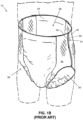
- underwear 10 further includes a pair of front elastic side panels 38 and a pair of rear elastic side panels 42 configured to couple rear waist portion 22 to front waist portion 18 in a well-known configuration in which a left side 46 of the chassis defines a first leg opening 50 for a wearer's left leg, and in which a right side 54 of the chassis defines a second leg opening 58 for the wearer's right leg.
- each of side panels 38, 42 includes a connection portion 62 configured to be coupled to a connection portion 62 of another of side panels 38, 42.
- connection portion 62 of the left one of front side panels 38 is configure to be coupled to connection portion 62 of the left one of rear side panels 42
- connection portion 62 of the right one of front side panels 38 is configure to be coupled to connection portion 62 of the right one of rear side panels 42, such that the waist portions 18, 22 and side panels, 38, 42 cooperate to define a waist opening 66 as shown in FIG. 1B
- Connection portions 62 of the respective side panels can be permanently coupled together to define a tear-able side seam 70, such as, for example, via adhesive, ultrasonic, or thermal bonds. Such tear-able side seams generally cannot be refastened, and thereby render an article unusable once opened.
- connection portions 62 of the respective side panels can be removably coupled to define a refastenable or adjustable side seam, such as, for example, via hook-and-loop fasteners.
- Hook and loop fasteners are mechanical fasteners that include hooks, such as in a hook fastener portion, that are configured to engage loops in a loop fastener portion or in fibers of a sheet of fabric; for example, a nonwoven or woven fabric with fibers that define open or loop-like regions into which the hooks can extend and engage. Examples of such hook and loop fasteners may be referred to as VELCRO.
- underwear 10 can include one or more elastic elements coupled to the chassis such that the one or more elastic elements resist expansion of a circumference of the first leg opening and resist expansion of a circumference of the second leg opening.
- the depicted embodiment of the chassis (14) includes a first elastic region 74 along right side 46, and a second elastic region 78 along left side 54.
- elastic regions 74, 78 can each be defined by one or more elastic strands, which may be referred to in the art as "leg elastics," coupled to the chassis, for example laminated between the topsheet or an additional leg cuff layer and the backsheet.
- elastic regions 74, 78 can each be defined by an elastic film coupled to the chassis, for example laminated between the topsheet and the backsheet.
- the regions can be defined by separate pieces of elastic film or by separate regions of a single piece of elastic film.
- elastic regions 74, 78 may be parallel to and/or extend along a majority of a length of each of sides 46 and 54, provided that the elastic regions are configured to provide a biasing force that resists expansion of the leg openings when the chassis is in its closed configuration and tends to contract the leg opening around a wearer's leg, as shown in FIG. 1B . Contraction of the leg opening to conform to the wearer's leg is desired for good containment of urine and feces in an absorbent product.
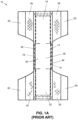
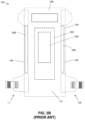
- FIGs. 2A and 2B depict lower plan views of an adult incontinence brief 100.
- Brief 100 includes a chassis 104 having a front waist portion 108, an opposing rear waist portion 112, and a crotch portion 116 extending longitudinally between front and rear waist portions 108, 112.
- Chassis 104 further includes an outer surface 128 configured to face away from a wearer during use of the diaper, and an opposing body facing surface 132 configured to face a wearer during use of the diaper.
- a dashed leader extends from the body facing surface to reference numeral 132 because body facing surface 132 is opposite outer surface 128 and therefore not visible in the view of FIG. 2A .
- brief 100 further includes a pair of closure members 136 configured to couple rear waist portion 112 to front waist portion 108 in a well-known configuration in which a left side 140 of the chassis defines a first leg opening for a wearer's left leg, and in which a right side 144 of the chassis defines a second leg opening for the wearer's right leg, similar in some respects to what is shown in FIG. 1B for training pant 10.
- the closure members include a pair of back ears or back ear panels 148 each having a first end 152 bonded to rear waist portion 112 of chassis 104, and a second end 156 shown extending away from rear waist portion 112.
- “Bonded” refers to the joining, adhering, connecting, attaching, or the like, of two elements via adhesive(s), ultrasonic bond(s), and/or thermal bond(s). Two elements will be considered to be bonded together when they are bonded directly to one another or indirectly to one another, such as when each is directly bonded to intermediate elements.
- Each closure member 136 further includes a fastener tab 160 with a first end 164 bonded to back ear 148, a second end 168 shown extending laterally outward from back ear 148, and a fastener portion 172 coupled to the fastener tab.
- Back ears 148 are each formed of a stretchable elastic material, such as a nonwoven laminate, that permits adjustments in the width and tension of back ears 148 to vary the form and fit of brief 100 when worn by a user.
- Fastener tabs 160 are formed of an inelastic nonwoven material and carry fastener portions 172.
- Fastener portions 172 include strips of hook material configured to interact with a corresponding loop material in the well-known hook-and-loop fastener arrangement.
- Connection of closure members 136 to front waist portion 108 is facilitated by a landing zone 176 configured to be engaged by fastener portions 172.
- landing zone 176 is defined by an anchoring member that includes a strip of loop material bonded to front waist portion 108 of chassis 104, for example, to the backsheet, and configured to be engaged by the hook material of fastener portions 172.
- brief 100 also includes a pair of front ears 180 extending from opposite sides 140, 144 of chassis 104 with each of front ears 180 each having a first end 184 bonded to front waist portion 108 of chassis 104, and a second end 188 shown extending away from a respective side of front waist portion 108.
- Front ears 180 are each formed of a relatively soft nonwoven material and are each configured to be overlapped by the corresponding fastener tab 160 and/or back ear 148 to prevent the edges of fastener tab 160 from pinching, rubbing, or otherwise irritating a user's skin in use when fastening portions 172 are engaged with landing zone 176 to couple rear waist portion 112 to front waist portion 108.
- front ears 180 include loop fastener portions or a fabric that is configured to be engaged by hook fastener portions such that fastener portions 172a can engage front ears 180.
- Outer surface 128 is defined by a liquid-impermeable backsheet or cover 192 that defines outer surface 128, and a liquid-permeable topsheet 196 that defines body facing surface 132 and is configured to be closest to the wearer during use.
- Liquid impermeable when used in describing a layer or multi-layer laminate, means that a liquid, such as urine, will not pass through the layer or laminate, under ordinary use conditions, in a direction generally perpendicular to the plane of the layer or laminate at the point of liquid contact.
- “Lamination” is the technique of manufacturing a material in multiple layers, so that the composite material has benefits of all the combined layers, such as, for example, improved mechanical strength or durability, improved stability, lower permeability to water, and/or other properties.
- a laminate includes two or more layers of material(s) that are permanently assembled by heat, pressure, ultrasonic welding, or adhesives.
- the depicted embodiment include an absorbent core 200 disposed between topsheet 196 and backsheet 192.
- An "absorbent core” is a structure typically disposed between a topsheet and backsheet of an absorbent article and containing materials like SAP and/or cellulosic fibers that are configured to absorb liquid in the absorbent article.
- brief 100 also includes an acquisition-distribution layer (ADL) 204 disposed between the topsheet and the absorbent core.
- ADL acquisition-distribution layer
- “Layer” when used in the singular can be a single element or a plurality of elements.
- a plurality of sheets may together define a single layer, such as, for example, a layer with a particular function to which the sheets of the layer contribute.
- brief 100 can include one or more elastic elements coupled to the chassis such that the one or more elastic elements resist expansion of a circumference of the first leg opening and resist expansion of a circumference of the second leg opening.
- the depicted configuration of the chassis (104) includes a first elastic region 208 along first side 140, and a second elastic region 208 along second side 140.
- elastic regions 208 can each be defined by one or more elastic strands, which may be referred to in the art as "leg elastics," coupled to the chassis, for example laminated between the topsheet (or an additional leg cuff layer) and the backsheet.
- elastic regions 208 can each be defined by an elastic film coupled to the chassis, for example laminated between the topsheet (or an additional leg cuff layer) and the backsheet.
- the regions can be defined by separate pieces of elastic film or by separate regions of a single piece of elastic film.
- elastic regions 208 may be parallel to and/or extend along a majority of a length of each of sides 140 and 144, provided that the elastic regions are configured to provide a biasing force that resists expansion of the leg openings when the chassis is in its closed configuration.
- chassis 104 has an overall relaxed length 212.
- Brief 100 of FIGs. 2A and 2B is typically packaged and sold in a folded, and unfastened configuration in which chassis 104 is folded in half such that rear waist portion 108 overlaps front waist portion 104, but fastener portions 172 do not engage landing zone 176. While brief 100 is described as an adult incontinence brief, brief 100 can also comprise a baby diaper or training pant.
- Prior designs e.g., underwear 10 and brief 100 that use a conventional absorbent core, such as a core comprising fluff and SAP, can exhibit long acquisition times. Poor liquid acquisition can cause leakage.
- Conventional ADLs designed to improve liquid acquisition times can cause free liquid to spread over the surface of the ADL, which also promotes leakage from the side and/or front of the core.
- absorbed liquid can migrate from the core to the wearer-facing surface of the garment, causing discomfort for the wearer. Accordingly, there is a need in the art for absorbent garments that can better acquire and retain liquid to promote comfort for the wearer.
- US2008/0312622 A1 discloses disposable absorbent article with a chassis including a topsheet and a backsheet, with a substantially cellulose free absorbent core located between the topsheet and the backsheet and having a wearer facing side oriented toward a wearer when the article is being worn and an opposed garment facing side.
- a liquid acquisition system is disposed between the liquid permeable topsheet and the wearer facing side of the absorbent core.
- US2015/0245958 A1 relates to an absorbent core comprising a longitudinally folded absorbent laminate.
- the absorbent laminate comprised an upper laminate layer, a lower laminate layer and an absorbent layer positioned between the upper laminate layer and the lower laminate layer.
- the absorbent layer consists of more than 90 percent by weight super absorbent polymer (SAP).
- US2017/065466A1 suggests an absorbent core for an absorbent article with liquid permeable nonwoven topsheet and a liquid impermeable backsheet, wherein a cavity is formed between the topsheet and the backsheet.
- the absorbent core comprises an acquisition layer positioned in the cavity adjacent the topsheet and extending along the entire length and width of the cavity, a tissue layer positioned adjacent the acquisition layer, a plurality of SAP particles positioned on and extending over the entire surface of the tissue layer that is spaced apart from the acquisition layer, a layer of fluff is positioned adjacent the tissue layer, a layer of SAP particles positioned in the interior of the layer of fluff and a laminate having two layers of tissue with a multitude of SAP particles positioned between the two layers of tissue. The laminate is positioned between the layer of fluff and the backsheet.
- the present invention is defined by the appended claims.
- the claimed absorbent garments provide improved liquid acquisition and retention with a dryness layer.
- the dryness layers include laminate(s) having absorbent lamina(e) that comprise superabsorbent polymer and substrate lamina(e) that comprise a nonwoven and/or tissue. Such laminates can facilitate liquid acquisition and retention within the absorbent lamina(e) and/or an absorbent core.
- the dryness layers have one or more channels configured to receive liquid to promote the distribution and retention thereof. Channel(s) are defined between separate strips of laminate. The channel(s) can, in addition, be defined between folded layers of a laminate.
- the present absorbent garments comprise a chassis having opposing front and rear waist portions and a crotch portion extending longitudinally between the front and rear waist portions.
- the garments have an absorbent core coupled to the crotch portion, which optionally comprises fluff and superabsorbent polymer (SAP).
- SAP superabsorbent polymer
- the garments have a dryness layer extending longitudinally along the absorbent core.
- the chassis of the present garments comprises a backsheet and a topsheet, wherein, the absorbent core and the dryness layer are disposed between the backsheet and the topsheet.
- the absorbent core and the dryness layer each have a lateral width and a longitudinal length, wherein the width of the absorbent core at least 10% larger than the width of the dryness layer and/or the length of the absorbent core is at least 10% larger than the length of the dryness layer.
- the lateral width of some of the present dryness layers is between 65 and 85 millimeters (mm), and the longitudinal length of some of the present dryness layers is between 185 and 270 mm.
- the present dryness layers comprise a laminate that includes an absorbent lamina disposed between first and second substrate laminae.
- the absorbent lamina comprises SAP.
- the SAP of the absorbent lamina in some garments, has a basis weight between 60 and 120 grams per square meter (gsm).
- the SAP of the absorbent lamina comprises particles, and ones of the particles having a diameter that is greater than or equal to 500 micrometers ( ⁇ m) account for less than 10% of the mass of the particles.
- the first substrate lamina comprises tissue and, in some of those garments, the tissue can be creped.
- the tissue of the first substrate lamina in some garments, can have a basis weight between 14 and 20 gsm.
- the second substrate lamina comprises a nonwoven which, for some of those garments, comprises a resin-bonded polymer fiber nonwoven.
- the nonwoven of the second substrate lamina has a bass weight between 40 and 50 gsm.
- the laminate is longitudinally folded such that the dryness layer includes a base layer of the laminate and, within each of first and second longitudinally-extending edge regions, a folded layer of the laminate disposed on the base layer.
- the base layer in some garments, spans a lateral width of the dryness layer.
- each of the edge regions spans less than 50% of the width such that a longitudinally-extending channel is defined between the folded layers.
- the channel has a lateral width between 8 and 20 mm, optionally between 8 and 12 mm.
- the laminate is coupled to the absorbent core such that, for the base layer, the first substrate lamina is disposed closer to the absorbent core than is the second substrate lamina and, optionally, for each of the folded layers, the first substrate lamina is disposed further from the absorbent core than is the second substrate lamina.
- the first substrate lamina is disposed closer to a wearer than is the second substrate lamina when the garment is worn.
- the topsheet is disposed on the folded layers.
- the laminate is a first laminate
- the channel is a main channel
- the garment comprises a second laminate disposed on the base layer and within the main channel.
- a longitudinally-extending side channel is defined between the second laminate and each of the folded layers.
- the second laminate in some garments, has an absorbent lamina and a first substrate lamina.
- the absorbent lamina of the second lamina comprises SAP and, optionally, the first substrate lamina comprises tissue.
- the second laminate comprises a second substrate lamina wherein, optionally, the absorbent lamina is disposed between the first and second substrate laminae.
- the second substrate lamina comprises a nonwoven.
- the nonwoven of the second substrate lamina of the first laminate has a first basis weight
- the nonwoven of the second substrate lamina of the second laminate has a second basis weight
- the first basis weight is at least 10% more than the second basis weight
- the first laminate has a thickness at least 10% larger than a thickness of the second laminate such that the second laminate is recessed within the main channel relative to the folded layers.
- the dryness layer comprises a nonwoven sheet.
- the nonwoven sheet comprises a through-air bonded polymer nonwoven.
- the nonwoven sheet has a basis weight between 60 and 80 gsm.
- the nonwoven sheet spans a lateral width of the dryness layer.
- the dryness layer includes two or more longitudinally-extending strips coupled to the nonwoven sheet.
- the strips are disposed between the absorbent core and the nonwoven sheet such that the nonwoven sheet is disposed closer to a wearer than are the strips when the garment is worn.
- each of the strips includes an absorbent lamina disposed between first and second substrate laminae.
- the absorbent lamina of each of the strips comprises SAP.
- the SAP of the absorbent lamina for some garments, has a basis weight between 180 and 220 gsm.
- the first and/or second substrate laminae of each of the strips comprise a nonwoven or tissue (which tissue is, in some of those garments, creped).
- the tissue of each of the first and second substrate laminae has a basis weight between 14 and 20 gsm.
- the two or more strips include three or more strips that are spaced laterally apart along a width of the dryness layer such that a longitudinally-extending channel is defined between a first one of the strips and each of a second one of the strips and a third one of the strips.
- the three or more strips in some garments, comprise four or more strips such that a longitudinally-extending channel is defined between the third strip and a fourth one of the strips.
- each of the strips has a lateral width, the width of the first strip at least 10% larger, optionally between 90% and 110% larger, than the width of each of the second and third strips.
- the lateral width of each of the second and third strips is between 10 and 15 mm.
- the lateral width of the first strip is between 20 and 30 mm. In some garments, each of the channels has a lateral width that is within 10% of each of the second and third strips. The lateral width of each of the channels, in some garments, is between 10 and 15 mm.
- each of the two strips has a lateral width that is equal to a lateral width of the other one of the two strips.
- the lateral width of each of the two strips is between 15 and 30 mm, for example between 15 and 25 mm, between 17 and 23 mm (e.g., equal to 20 mm), and/or between 20 and 25 mm (e.g., equal to 22 mm).
- the dryness layer and/or the nonwoven sheet has a width of between 50 and 100 mm, between 60 and 90 mm, and/or between 70 and 80 mm (e.g., equal to 75 mm).
- the two strips of laminate are spaced apart by a lateral distance that is greater than a width of either of the two strips; for example, a lateral distance of between 25 and 50 mm, between 30 and 45 mm, between 30 and 40 mm (e.g., equal to 35 mm), and/or between 30 and 35 mm (e.g., 31 mm).
- the present garments comprise: a chassis, an absorbent core, and a dryness layer.
- the chassis has opposing front and rear waist portions, a crotch portion extending longitudinally between the front and rear waist portions, a topsheet, and a backsheet.
- the absorbent core is coupled to the crotch portion.
- the dryness layer extends longitudinally along the absorbent core and comprises: a nonwoven sheet; and two or more longitudinally-extending laminate strips coupled to the nonwoven sheet, each including an absorbent lamina disposed between first and second substrate laminae, the absorbent lamina comprising superabsorbent polymer (SAP) and the first and second substrate laminae each comprising tissue or nonwoven.
- SAP superabsorbent polymer
- the strips are spaced apart laterally along a width of the dryness layer such that a longitudinally-extending channel is defined between a first one of the strips and a second one of the strips.
- the absorbent core and the dryness layer are disposed between the topsheet and the backsheet.
- the two or more strips includes first and second strips of equal lateral widths.
- the channel has a lateral width that equal to or greater than a width of each of the first and second strips.
- a lateral width of the channel is between 10 and 40 millimeters (mm).
- a lateral width of each of the first and second strips is between 12 and 24 millimeters (mm).
- the two or more strips includes a third strip with a lateral width that is at least 10% larger than the width of each of the first and second strips.
- a lateral width of the third strip is between 20 and 30 millimeters (mm).
- the width of the dryness layer is between 65 and 85 millimeters (mm). In some garments, the dryness layer has a longitudinal length between 185 and 270 millimeters (mm). In some garments, the absorbent core has a lateral width at least 10% larger than the width of the dryness layer; and/or the absorbent core and the dryness layer each have a longitudinal length, the length of the absorbent core at least 10% larger than the length of the dryness layer.
- the SAP of the absorbent lamina has a basis weight between 40 and 220 grams per square meter (gsm).
- tissue or nonwoven of each of the first and second substrate laminae has a basis weight between 10 and 20 gsm and, optionally, the tissue is creped.
- the nonwoven sheet has a basis weight between 40 and 80 grams per square meter (gsm).
- the nonwoven sheet comprises a through-air bonded polymer nonwoven.
- the strips are disposed between the absorbent core and the nonwoven sheet such that the nonwoven sheet is disposed closer to a wearer than are the strips when the garment is worn.
- Coupled is defined as connected, although not necessarily directly, and not necessarily mechanically; two items that are “coupled” may be unitary with each other.
- the terms “a” and “an” are defined as one or more unless this disclosure explicitly requires otherwise.
- the term “substantially” is defined as largely but not necessarily wholly what is specified - and includes what is specified; e.g., substantially 90 degrees includes 90 degrees and substantially parallel includes parallel - as understood by a person of ordinary skill in the art. In any disclosed embodiment, the term “substantially” may be substituted with "within [a percentage] of" what is specified, where the percentage includes 0.1, 1, 5, and 10 percent.
- any of the apparatuses, systems, and methods can consist of or consist essentially of - rather than comprise/include/have - any of the described steps, elements, and/or features.
- a device or system that is configured in a certain way is configured in at least that way, but it can also be configured in other ways than those specifically described.
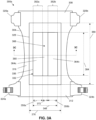
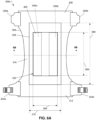
- Garment 300a can be a baby diaper, training pant, adult incontinence brief or underwear, bladder control pad, feminine hygiene pad, or the like, and comprises a chassis 304.
- Chassis 304 has a crotch portion 316 that extends longitudinally between a front waist portion 308 and a rear waist portion 312.
- Front waist portion 308 and rear waist portion 312 can each include ears and/or fasteners such that the front waist portion has first and second ends 320a and 320b configured to be coupled to first and second ends 324a and 324b, respectively, of the rear waist portion.
- garment 300a can define a closed configuration in which the garment is wearable.
- front and rear waist portions 308 and 312 can cooperate to encircle and define a waist opening
- a left side of chassis 304 can define a first leg opening
- a second side of the chassis can define a second leg opening.
- Garment 300a can include an absorbent core 328 coupled to crotch portion 316.
- Core 328 can comprise any material or combination of materials suitable for absorbing liquids, such as, for example, a mixture of conventional fluff and superabsorbent polymer (SAP) particles.
- SAP superabsorbent polymer
- Superabsorbent or “superabsorbent material” or “SAP” refers to a water-swellable, water-insoluble organic or inorganic material capable, under the most favorable conditions, of absorbing at least about 15 times its weight in an aqueous solution containing 0.9 weight percent sodium chloride and, more desirably, at least about 30 times its weight in an aqueous solution containing 0.9 weight percent sodium chloride and, even more desirably, at least about 50 times its weight in an aqueous solution containing 0.9 weight percent sodium chloride.
- Garment 300a includes a dryness layer 332 coupled to and extending longitudinally along core 328.
- Dryness layer 332 can have a structure configured to facilitate liquid acquisition and retention, thereby promoting comfort for a wearer.
- dryness layer 332 can comprise a laminate 336 having an absorbent lamina 344 disposed between first and second substrate laminae 340a and 340b.
- the materials used for substrate lamina(e) (e.g., 340a and 340b) and absorbent lamina(e) (e.g., 344) can promote dryness at the wearer-facing surface of garment 300a by retaining liquid and/or transferring liquid to absorbent core 328.
- Absorbent lamina 344 can comprise SAP particles and, in some embodiments, the SAP particles can be disposed within a matrix of adhesive material.
- absorbent lamina 344 can comprise at least 90% (e.g., greater than 96% or 97%), by weight, SAP and less than or equal to 10% (e.g., less than 3% or 4%), by weight, adhesive.
- Suitable adhesive material can include, for example, a thermoplastic hot-melt adhesive composition or a pressure-sensitive thermoplastic adhesive composition.
- SAP due to its absorbency, can retain liquid and thereby prevent the liquid from migrating to the wearer-facing surface of garment 300a. SAP swells when it absorbs liquid, which can impede liquid distribution and/or delivery to core 328 (referred to as "gel blocking").
- SAP suitable for absorbent lamina 344 can have a basis weight between 40 and 140 grams per square meter (gsm), such as, for example, a basis weight greater than or equal to, or between any two of, 40, 60, 80, 100, 120, 140, or more gsm (e.g., between 60 and 120 gsm).
- substantially all of the SAP particles of absorbent lamina 344 have a diameter less than or equal to 500 micrometers ( ⁇ m) to reduce the roughness of the absorbent lamina.
- ones of the SAP particles in absorbent lamina 344 having a diameter greater than or equal to 500 ⁇ m can account for less than 10% (e.g., less than 3% or less than 0.2%) of the mass of the SAP particles.
- An illustrative SAP suitable for absorbent lamina 344 is HP500E from Sumitomo Seika Chemicals Co., Ltd. in Osaka, Japan.
- particle diameter refers to the equivalent diameter of the particle if the particle is modelled as a sphere.
- laminate 336 can be calendered to flatten the SAP of absorbent lamina 344.
- SAP particles may be spherical, spherical-like or irregularly shaped particles, such as sausage shaped particles, or ellipsoid shaped particles of the kind typically obtained from inverse phase suspension polymerizations.
- SAP particles can also be optionally agglomerated at least to some extent to form larger irregular particles.
- the SAP particles can also have a surface modification, such as a partial or full surface coating, for example to increase the hydrophilicity of the SAP particles.
- the SAP materials can be natural, synthetic and modified natural polymers and materials.
- the SAP materials can be or include organic compounds such as cross linked polymers.
- Cross linked polymers “Cross-linked” is a commonly understood term and refers to any approach for effectively rendering normally water-soluble materials substantially water insoluble, but swellable.
- Such polymers can include, for example, carboxymethylcellulose, alkali metal salts of polyacrylic acids, polyacrylamides, polyvinyl ethers, hydroxypropyl cellulose, polyvinyl morpholinone, polymers and copolymers of vinyl sulfonic acid, polyacrylates, polyacrylamides, polyvinyl pyridine and the like.
- Organic high-absorbency materials can include natural materials, such as agar, pectin, guar gum and peat moss.
- superabsorbent materials may also include inorganic materials, such as absorbent clays and silica gels.
- Suitable examples of SAP include T9030, T9600, T9900, and Saviva polymers from BASF Corporation in Charlotte, North Carolina; and W211, W112A, W125, S125D, QX-W1482, QX-W 1486, QX-W1504, and QX-W1505 from Nippon Shokubai Co. Ltd, N.A.I.I. in Houston, Texas; and AQUA KEEP SA50 II, SA55SX II, SA60N II, SA65s, HP500, HP600, and HP 700E from Sumitomo Seika Chemicals Co., Ltd. in Osaka, Japan.
- the SAP can have a centrifuge retention capacity of 20-60 grams per gram (g/g), for example 30-50 g/g, and/or a particle size distribution (PSD) with most or substantially all particles having a diameter between 150 ⁇ m and 850 ⁇ m. In some embodiments, the SAP can have a centrifuge retention capacity between 33 and 38 g/g, or alternatively between 44 and 48 g/g.
- first and second substrate laminae 340a and 340b can be constructed from a nonwoven material and/or tissue to promote liquid acquisition and distribution to absorbent lamina 344 and absorbent core 328, thereby mitigating gel blocking.
- "Nonwoven” fabrics are broadly defined as sheet or web structures bonded together by entangling fiber or filaments, and by perforating films, mechanically, thermally, or chemically. They are flat, porous sheets that are made directly from separate fibers or from molten plastic or plastic film. They are not made by weaving or knitting and do not require converting the fibers to yarn. The basis weight of nonwoven fabrics is usually expressed as gsm or grams per square meter.
- Suitable nonwoven materials can include, for example, spunbond, spunlace, or carded webs of one or more polymers, including polypropylene, polyethylene, nylon, polyester, and blends of these materials.
- a substrate lamina can have a basis weight of at least 30 gsm, such as, for example, a basis weight greater than or equal to, or between any two of, 30, 40, 50, 60, 70, 80, 90, 100, 110, 120, 130, or more gsm (e.g., between 40 and 50 gsm, or 45 gsm).
- Suitable tissues can include, for example, porous tissues, creped tissues, and standard tissues.
- a substrate lamina When constructed from tissue, a substrate lamina can have a basis weight of at least 10 gsm, such as, for example, a basis weight greater than or equal to, or between any two of, 10, 12, 14, 16, 18, 20, 22, 24, 26, 28, 30, or more gsm (e.g., between 14 and 20 gsm, or 17 gsm).
- first substrate lamina 340a comprises a dry-creped tissue having a basis weight between 14 and 20 gsm (e.g., 17 gsm), and second substrate lamina 340b comprises a resin-bonded polyester fiber nonwoven having a basis weight between 40 and 50 gsm (e.g., 45 gsm).
- First substrate lamina 340a can thereby provide a capillary network through which liquid is spread throughout laminate 336 to absorbent lamina 344 and/or absorbent core 328.
- Second substrate lamina 340b due at least in part to its nonwoven construction, can absorb and distribute rapid insults of liquid to further promote liquid distribution and acquisition such that leakage is reduced.
- An illustrative tissue suitable for first substrate lamina 340a is a 17-gsm 3995 Machine Creped tissue from Dunn paper.
- An illustrative nonwoven suitable for second substrate lamina 340b is Fitesa Carded Resin Bond, available from Fitesa in Simpsonville, SC.
- laminate 336 can have any suitable number of substrate and absorbent laminae arranged in any suitable order, such as, for example, greater than or equal to or between any two of 1, 2, 3, 4, 5, 6, 7, 8, or more substrate laminae (e.g., 340a and 340b) and greater than or equal to or between any two of 1, 2, 3, 4, 5, 6, 7, 8, or more absorbent laminae (e.g., 344).
- substrate laminae e.g., 340a and 340b
- absorbent laminae e.g., 344
- any two adjacent laminae in laminate 336 can be the same type of laminae (e.g., both can be substrate laminae or absorbent laminae) or laminae of different types (e.g., one can be one of the substrate lamina(e) and one can be one of the absorbent lamina(e)).
- Providing additional laminae can improve the liquid retention capacity of laminate 336.
- laminate 336 can have a thickness 412 that is at least 0.2 mm, such as, for example, a thickness that is greater than or equal to, or between any two of, 0.20, 0.25, 0.30, 0.35, 0.40, 0.45, 0.50, 0.55, 0.60, 0.65, 0.70, or more millimeters (e.g., between 0.4 and 0.5 mm).
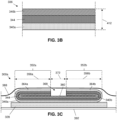
- Laminate 336 can be folded one or more times such that dryness layer 332 includes multiple laminate layers, including a base layer 360 and folded layers 364a and 364b disposed within longitudinally-extending edge regions 352a and 352b, respectively.
- Folded layers 364a and 364b can be layered on base layer 360, which can span a lateral width 348 of dryness layer 332.
- Folded layers 364a and 364b can each span less than half of width 348 such that a longitudinally-extending channel 368 is defined between the folded layers.
- each of edge regions 352a and 352b can have a width (e.g., 356a and 356b, respectively) that spans less than or equal to, or between any two of, 50%, 40%, 30%, 20%, or 10% (e.g., between 35% and 45%) of width 348.
- channel 368 can have a lateral width 372 that spans less than or equal to, or between any two of, 80%, 70%, 60%, 50%, 40%, 30%, 20%, or 10% (e.g., between 10% and 30%) of width 348.
- width 372 can be greater than or equal to, or between any two of, 8, 12, 16, 20, 24, 28, or more millimeters (mm) (e.g., between 8 and 20 mm, between 8 and 12 mm, or 10 mm).
- the folded construction of laminate 336 can promote comfort by improving liquid acquisition and retention.
- Folded layers 364a and 364b at least by providing additional SAP within edge regions 352a and 352b, can contain liquid and thus better prevent liquid from migrating to the wearer-facing surface of garment 300a.
- First and second substrate laminae 340a and 340b can facilitate liquid transfer between the SAP of base layer 360 and the SAP of each of folded layers 364a and 364b.
- dryness layer 332, at least by having channel 368, can provide adequate volume for the rapid acquisition and distribution of liquid to absorbent core 328.
- dryness layer 332 can include any suitable number of folded layers (e.g., 364a and 364b) within each of edge regions 352a and 352b, such as, for example, greater than or equal to or between any two of 1, 2, 3, 4, 5, 6, 7, 8, or more folded layers. Providing multiple folded layers in each of edge regions 352a and 352b can enhance liquid containment within the edge regions.
- folded layers e.g., 364a and 364b
- dryness layer 332 can be disposed on top of absorbent core 328.
- base layer 360 can be coupled to absorbent core 328 such that folded layers 364a and 364b are each disposed closer to a wearer than is the base layer when garment 300a is worn.
- first substrate lamina 340a is configured to be disposed closer to a wearer than is second substrate lamina 340b within each of folded layers 364a and 364b, while the second substrate lamina is configured to be disposed closer to the wearer than is first substrate layer within base layer 360.
- Liquid can thereby readily pass through channel 368 for distribution to absorbent core 328 and retention within absorbent lamina 344.
- first substrate lamina 340a When first substrate lamina 340a is constructed from tissue, the capillary action of the tissue can distribute liquid to absorbent core 328 when liquid is first received within edge portions 352a and 352b, whereas second substrate lamina 340b, when constructed from a nonwoven, can rapidly acquire liquid within channel 368 and transfer liquid from each of folded layers 364a and 364b to base layer 360.
- dryness layer 332 can be disposed below absorbent core 328 such that the dryness layer can receive liquid from the absorbent core.
- each of the folded layers 364a and 364b can be coupled to the bottom surface of absorbent core 328 such that the folded layers are configured to be disposed closer to a wearer than is base layer 360.
- liquid can readily pass from absorbent core 328 to channel 368 and first substrate lamina 340a within folded layers 364a and 364b.
- the dryness layer can be coupled to the absorbent core such that base layer 360 is disposed closer to a wearer than are folded layers 364a and 364b when garment 300a is worn.
- Chassis 304 can include a topsheet 388 configured to face a wearer during use of garment 300a (not shown in FIG. 3A , for clarity) and a backsheet 392.
- Absorbent core 328 and dryness layer 332 can be disposed between topsheet 388 and backsheet 392 such that, for example, the topsheet is disposed on folded layers 364a and 364b.
- Topsheet 388 can, but need not, follow the contour of channel 368 (e.g., the topsheet can be disposed on base layer 360 within the channel).
- Topsheet 388 can be liquid permeable
- backsheet 392 can be liquid-impermeable and can include, for example, an inner liquid-impermeable film and an outer nonwoven backsheet that can be a nonwoven fabric.
- a “film” is a membrane-like layer of material formed of one or more polymers, which does not have a form consisting predominately of a web-like structure of fibers and/or other fibers.
- Backsheet 392 can be breathable, for example, an inner liquid-impermeable film of backsheet 392 can comprise a breathable film.
- the terms "breathable,” “breathable film,” “breathable laminate” or “breathable outer cover material” or “breathable backsheet” refers to a film, laminate, or outer cover material having a water vapor transmission rate ("WVTR") of at least about 300 grams/m 2 /24 hours. Breathable materials typically rely on molecular diffusion of vapor, and are substantially liquid impermeable.
- “Nonwoven backsheet” is a backing substrate layer in the outer cover; a nonwoven backsheet is most often a nonwoven layer facing away from the wearer.
- Dryness layer 332 can be smaller than absorbent core 328.
- absorbent core 328 can have a lateral width 376 that is at least 10% larger than width 348 of dryness layer 332, such as, for example, a lateral width that is at least or between any two of 10%, 20%, 30%, 40%, 50%, 60%, 70%, 80%, 90%, or 100% larger than width 348.
- absorbent core 328 can have a longitudinal length 380 that is at least 10% larger than length 384 of dryness layer 332, such as, for example, a longitudinal length that is at least or between any two of 10%, 20%, 30%, 40%, 50%, 60%, 70%, 90%, or 100% larger than length 384.
- a larger absorbent core 328 provides additional absorption capacity for garment 300a, while permitting dryness layer 332 to be appropriately sized and positioned for liquid acquisition at or near the liquid insult point when the garment is worn.
- Dryness layer 332 can have, for example, a width 348 that is at least 50 mm, such as, for example, a width greater than or equal to or between any two of 50, 55, 60, 65, 70, 75, 80, 85, 90, 95, 100, or more millimeters (e.g., between 65 and 85 mm, or 75 mm), and a length 384 that is at least 170 mm, such as, for example, a length greater than or equal to or between any two of 170, 180, 190, 200, 210, 220, 230, 240, 250, 260, 270, 280, or more millimeters (e.g., between 185 and 270 mm).
- dryness layer 332 can span substantially the same area as absorbent core 328 such that width 376 of the absorbent core is within 10% of width 348 and/or length 380 of the absorbent core is within 10% of length 384. In some embodiments, dryness layer 332 can be disposed closer to front waist portion 308 than to rear waist portion 312.
- Garment 300b can be substantially similar to garment 300a, with the primary exception being that garment 300b includes a middle laminate 396.
- Middle laminate 396 can be layered on base layer 360 within channel 368.
- Longitudinally-extending side channels 408a and 408b can be defined between middle laminate 396 and folded layers 364a and 364b, respectively. By defining multiple side channels 408a and 408b, dryness layer 332 can improve liquid acquisition.
- dryness layer 332 can include multiple middle laminates (e.g., 396) layered on base layer 360 such that the dryness layer defines three or more side channels between the middle laminates and folded layers, such as, for example, greater than or equal to, or between any two of, 3, 4, 5, 6, 7, 8, or more side channels.
- middle laminates e.g., 396
- Middle laminate 396 can have a thickness 416 smaller than a thickness 412 of laminate 336 such that the middle laminate is recessed within channel 368 relative to folded layers 364a and 364b.
- thickness 412 can be at least 10% larger than thickness 416, such as, for example, at least or between any two of 10%, 20%, 30%, 40%, 50%, 60%, 70%, or 80% larger than thickness 416.
- Topsheet 388 can, but need not, conform to the depression defined by middle laminate 396 (e.g., topsheet 388 can be disposed on the upper surface of the middle laminate). Providing a recessed middle laminate 396 can promote fluid containment within folded layers 364a and 364b by directing fluid towards edge portions 352a and 352b.
- Middle laminate 396 can include an absorbent lamina 404 comprising SAP disposed between first and second substrate laminae 400a and 400b, each comprising tissue and/or a nonwoven. As shown, first substrate lamina 400a can be configured to be disposed closer to a wearer than are absorbent lamina 404 and second substrate lamina 400b. First substrate lamina 400a and absorbent lamina 404 can, but need not, be substantially similar to, respectively, first substrate lamina 340a and absorbent lamina 344 of laminate 336. Middle laminate 396 can achieve a thickness 416 smaller than thickness 412 by having a second substrate lamina 400b different from second substrate lamina 340b of laminate 336.
- second substrate lamina 340b can comprise a nonwoven that has a basis weight at least 10% higher, such as, for example, at least or between any two of 10%, 20%, 30%, 40%, 50%, 60%, 70%, or 80% higher than the basis weight of a nonwoven of second substrate lamina 400b.
- middle laminate 396 can omit second substrate lamina 400b such that the middle laminate comprises at least one fewer lamina than laminate 336.
- second substrate lamina 400b can be substantially similar to second substrate lamina 340b.
- Garment 300c can be substantially similar to garment 300a, the primary exception being the construction of dryness layer 332.
- Dryness layer 332 can comprise two or more longitudinally-extending laminate strips, for example each having a construction similar to laminate 336 of garment 300a.
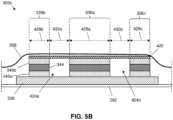
- dryness layer 332 comprises three longitudinally-extending laminate strips 336a-336c, each having a construction similar to laminate 336 of garment 300a.
- each of strips 336a-336c has first and second substrate laminae 340a and 340b that each comprise tissue or nonwoven.
- first and second substrate laminae 340a and 340b can each comprise a dry-creped tissue having a basis weight between 14 and 20 gsm (e.g., 17 gsm).
- first and second substrate laminae 340a and 340b can each comprise a nonwoven.
- one of first and second substrate laminae 340a and 340b can comprise a nonwoven and the other of first and second substrate laminae 340a and 340b can comprise tissue (e.g., creped tissue, such as 17 gsm dry-creped tissue). Because strips 336a-336c are not folded, SAP suitable for the strips can have a higher basis weight than that used in laminate 336 of garment 300a.
- each of strips 336a-336c can have an absorbent lamina 344 comprising SAP that has a basis weight of at least 150 grams per square meter, such as, for example, a basis weight greater than or equal to, or between any two of, 150, 170, 190, 210, 230, 250, or more gsm (e.g., between 180 and 220 gsm).
- SAP that has a basis weight of at least 150 grams per square meter, such as, for example, a basis weight greater than or equal to, or between any two of, 150, 170, 190, 210, 230, 250, or more gsm (e.g., between 180 and 220 gsm).
- An illustrative SAP suitable for use in strips 336a-336c is T9900 from BASF Corporation in Charlotte, North Carolina.
- Dryness layer 332 can comprise a nonwoven sheet 420 coupled to strips 336a-336c. As shown, sheet 420 is disposed on strips 336a-336c such that the sheet is closer to a wearer than are the strips when garment 300c is worn. Sheet 420 can span width 348 of dryness layer 332, and can comprise a through-air bonded polymer (e.g., polyester) nonwoven having a basis weight of at least 50 gsm, such as, for example, a basis weight greater than or equal to, or between any two of, 50, 60, 70, 80, 90 or more gsm (e.g., between 60 and 80 gsm, or 70 gsm). Nonwoven sheet 420 can absorb and transfer rapid insults of liquid to strips 336a-336c and/or core 328 to reduce leakage.
- a through-air bonded polymer e.g., polyester
- First, second, and third strips 336a, 336b, and 336c are each spaced laterally along width 348 of dryness layer 332.
- first strip 336a can be disposed between second and third strips 336b and 336c.
- First strip 336a can have a width 428a that is larger than the widths of second and third strips 336b and 336c (e.g., 428b and 428c, respectively).
- width 428a can be at least 10% larger than each of widths 428b and 428c, such as, for example, a width that is at least or between any two of 10%, 30%, 50%, 70%, 90%, 110%, or 130% larger (e.g., between 90% and 110% larger, or 100% larger) than each of widths 428b and 428c.
- second and third strips 336b and 336c can be substantially the same size (e.g., width 428b can be within 10% of width 428c).
- first strip 336a can have a width 428a greater than or equal to, or between any two of, 16, 18, 20, 22, 24, 26, 28, 30, 32, 34, or more millimeters (e.g., between 20 and 30 mm, or 25 mm).
- each of second and third strips 336b and 336c can have a width (e.g., 428b and 428c, respectively) greater than or equal to, or between any two of, 6, 8, 10, 12, 14, 16, 18, or more millimeters (e.g., between 10 and 15 mm, or 12.5 mm).
- width 428a can be substantially the same as widths 428b and 428c.
- Channels 424a and 424b can be defined between first strip 336a and each of second and third strips 336b and 336c, respectively.
- Channels 424a and 424b can be appropriately sized to facilitate liquid acquisition.
- widths 432a and 432b of channels 424a and 424b, respectively can be substantially the same as (e.g., within 10% of) the widths of second and third strips 336b and 336c (e.g., 428b and 428c, respectively).
- widths 432a and 432b can each be greater than or equal to, or between any two of, 6, 8, 10, 12, 14, 16, 18, or more millimeters (e.g., between 10 and 15 mm or 12.5 mm).
- Strips 336a-336c and channels 424a and 424b are sized such that dryness layer 332 comprises sufficient laminate material to retain and transfer insults of liquids to absorbent core 328 while providing adequate volume (e.g., via the channels) to promote improved liquid acquisition and reduce leakage.
- dryness layer 332 can comprise two or more laminate strips, such as, for example, greater than or equal to, or between any two of, 2, 3, 4, 5, 6, 7, 8, 9, 10, or more laminate strips, to define one or more channels between the strips, such as, for example, greater than or equal to, or between any two of, 1, 2, 3, 4, 5, 6, 7, 8, 9, or more channels.
- dryness layer 332 can comprise a fourth laminate strip such that a channel is defined between the third and fourth strips.
- the dryness layer can be coupled to the absorbent core such that strips 336a-336c are configured to be disposed closer to a wearer than is nonwoven sheet 420.
- Garment 300c-1 can be substantially similar to garment 300c, the primary exception being the construction of dryness layer 332.
- dryness layer 332 comprises two longitudinally-extending laminate strips 336a and 336b, each having a construction similar to laminate 336 of garment 300a.
- each of strips 336a and 336b has first and second substrate laminae 340a and 340b that each comprise tissue or nonwoven.
- first and second substrate laminae 340a and 340b can each comprise a dry-creped tissue having a basis weight between 14 and 20 gsm (e.g., 17 gsm).
- first and second substrate laminae 340a and 340b can each comprise a nonwoven.
- one of first and second substrate laminae 340a and 340b can comprise a nonwoven and the other of first and second substrate laminae 340a and 340b can comprise tissue (e.g., creped tissue, such as 17 gsm dry-creped tissue).
- strips 336a and 336b are spaced laterally apart along a width of the dryness layer such that a longitudinally-extending channel 424 is defined between strip 336a and strip 336b.
- each of the two strips has a lateral width that is equal to a lateral width of the other one of the two strips.
- the lateral width of each of the two strips is between 15 and 30 mm, for example between 15 and 25 mm, between 17 and 23 mm (e.g., equal to 20 mm), and/or between 20 and 25 mm (e.g., equal to 22 mm).
- the dryness layer and/or the nonwoven sheet has a width of between 50 and 100 mm, between 60 and 90 mm, and/or between 70 and 80 mm (e.g., equal to 75 mm).
- the two strips of laminate are spaced apart by a lateral distance that is greater than a width of either of the two strips; for example, a lateral distance of between 25 and 50 mm, between 30 and 45 mm, between 30 and 40 mm (e.g., equal to 35 mm), and/or between 30 and 35 mm (e.g., 31 mm).
- the dryness layer has an overall width of 75 mm
- strip 336a has a width of 20 mm
- strip 336b has a width of 20 mm
- channel or distance 432 is equal to 35 mm.
- FIGs. 3B, 3C , 4 , 5B , and 6B are exaggerated to better understand the overall structure of the present garments (e.g., 300a-300c), laminates (e.g., 336), and dryness layers (e.g., 332) and, as such, are for illustrative purposes and are not necessarily to scale.
- the figures illustrate the relative positions and relationships between elements of the present garments, including, for example, the position of laminae in a laminate (e.g., 336, 336a-336c), the general folded structure of a laminate (e.g., 336), and the manner by which dryness layer channel(s) (e.g., 368, 408a-408b, 424a-424b) can be defined, and should not be interpreted to limit the invention.
- a laminate e.g., 336, 336a-336c
- the general folded structure of a laminate e.g., 336
- dryness layer channel(s) e.g., 368, 408a-408b, 424a-424b
- Model 1 comprised a laminate having an absorbent lamina comprising 60 gsm HP500E SAP from Sumitomo Seika Chemicals Co., Ltd. in Osaka, Japan disposed between a first substrate lamina comprising 17 gsm 3995 tissue from Dunn Paper in East Hartford, Conn. and a second substrate lamina comprising a 50 gsm, 50% PET/50% VS spunlace nonwoven. Model 1's laminate was not folded.
- Model 2 comprised the same laminate as Model 1, but was folded as described in reference to garment 300a.
- the channel defined between the folded layers of Model 2 was 15 mm wide.
- Model 3 comprised a laminate having an absorbent lamina comprising 60 gsm HP500E SAP from Sumitomo Seika Chemicals Co., Ltd. in Osaka, Japan disposed between a first substrate lamina comprising 17 gsm dry-creped tissue from Dunn Paper in East Hartford, Conn. and a second substrate lamina comprising a 45 gsm resin-bonded polyester fiber nonwoven from Fitesa in Simpsonville, SC.
- Model 3 was folded as described in reference to garment 300b.
- the channel defined between the folded layers of Model 3 was 15 mm wide and a middle laminate was disposed on the base layer within the channel.
- Model 2 exhibited less runoff compared to Model 1, indicating improved liquid acquisition.
- the improved liquid acquisition may be due to the folded laminate structure of Model 2, whose channel would facilitate liquid acquisition and distribution to the absorbent core and SAP in the laminate.
- Model 3 exhibited less runoff than Model 1 and Model 2.
- Model 3's superior liquid acquisition may be due to the different substrates used in the laminate and/or the multiple side channels defined between the middle laminate and the folded layers in Model 3.
- Model 4 comprised a laminate having an absorbent lamina comprising 50 gsm SAP between a first substrate lamina comprising 17 gsm 3995 Tissue from Dunn Paper in East Hartford, Conn. and a second substrate lamina comprising an 11 gsm blue-colored spunbond nonwoven from Fitesa. Rather than being folded, Model 4 was arranged with two strips of the laminate as in garment 300c-1 but with the first substrate lamina adhered to a 75 mm wide strip of 70 gsm through-air-bonded (TAB) nonwoven.
- TAB through-air-bonded
- the two strips of the laminate were 22 mm wide, and were spaced apart by a lateral distance of 31 mm.
- the colored nonwoven is arranged to be visible through the topsheet when wet and, in other configurations, the second lamina could be adhered to the TAB nonwoven.
- Model 5 comprised a laminate having an absorbent lamina comprising 50 gsm SAP between a first substrate lamina comprising 17 gsm 3995 Tissue from Dunn Paper in East Hartford, Conn. and a second substrate lamina comprising an 11 gsm blue-colored spunbond nonwoven from Fitesa. Rather than being folded, Model 4 was arranged with three strips of the laminate as in garment 300c but with the first substrate lamina adhered to a 75 mm wide strip of 50 gsm through-air-bonded (TAB) nonwoven.
- TAB through-air-bonded
- the first strip of the laminate was 25 mm wide, and the second and third strips of the laminate were 12.5 mm wide arranged on opposite sides of the first strip, and were each spaced apart from the first strip by a lateral distance of 12.5 mm.
- the colored nonwoven is arranged to be visible through the topsheet when wet and, in other configurations, the second lamina could be adhered to the TAB nonwoven.
- Model 6 The sixth model was similar to Model 5, with the exception that the TAB nonwoven had a basis weight of 70 gsm.
- RUL Retention Under Load
- AAP Absorbency against Pressure
- Core Efficiency The Retention Under Load
- Urine Run Off Acquisition Time
- Surface Conductivity and Rewet were also measured.
- Tables 6-8 show measurements for doses 1-3, respectively, with each dose being 75 milliliters (mL) of 0.9% saline at a temperature of 40 °C delivered at a rate of 300 mL per minute (mL/min.), with 12 minutes between doses.
- the mean values of Urine Run-Off are listed in grams (g). Groupings were determined using the Tukey Method and 80% Confidence. TABLE 6: URINE RUN-OFF - DOSE 1 Model No.
- Liquid Acquisition is the time in seconds required to absorb a given volume of liquid.
- REWET the amount of liquid that can be expressed from an absorbent core under pressure
- REWET increases abruptly once the absorbent capacity of the core is exceeded.
- REWET can be improved by increasing the absorbent capacity of the absorbent core and/or by isolating the diaper topsheet from the absorbent core with a high-loft nonwoven ADL.
- neither of these approaches reduces urine that can become trapped in the nonwoven topsheet of the product during the early stages of use.
- Surface Conductivity is a measure of the dryness of the diaper samples-i.e., of the topsheet of the respective diaper.
- Surface Conductivity provides a measure of very small amounts of urine that can remain trapped in the topsheet of an absorbent product during use. When this moisture becomes isolated from (not directed toward the absorbent core), the moisture in the topsheet is eventually absorbed by the skin, and can reduce the natural barrier properties of the skin and make the skin more susceptible to any irritant that may be present.
- the present configurations of dryness layers can improve the dryness (reduce the surface conductivity) of an absorbent product by reducing the amount of urine trapped in the topsheet-while keeping the REWET of the product low. This is important because about 65% of baby diapers end up containing only 150 mL or less of urine.
- a pump was calibrated to deliver the specified doses of 0.9% saline solution at the specified flow rate.
- a first end of pump tubing was connected to the pump and a second end of the pump tubing was connected to a metal nozzle having an aperture with a 0.094 inch internal diameter such that the pump could deliver a dose through the nozzle.
- the sample was placed on a plastic plate resting on a stand such that the plate was disposed at a 20-degree angle from the horizontal, with the sample's topsheet facing upward.
- the center of the dryness layer was marked and the tubing and metal nozzle were positioned such that the pump was configured to deliver doses to the marked center.
- a scale was tared to the weight of a tray and the tray was positioned such that, after a dose was applied to the sample, any resulting runoff could fall from the plastic plate and collect in the tray.
- the saline solution was preheated to a temperature of 40 °C.
- Each of the doses was applied by operating the pump to deliver the specified dose volume at the specified flow rate.
- flow was stopped and any runoff was allowed to collect into the tray over a period of 5 minutes.
- the tray with any collected runoff was weighed and the amount of runoff for that dose was recorded as the change in tray weight. The tray was dried after being weighed and the process was repeated for subsequent doses.
- a glass frit was soaked in a 0.9% saline solution. The soaked frit was placed into a dish, the dish was filled with additional saline solution until the saline level reached the top of the frit, and a 90 mm diameter filter paper was placed on the frit.
- a cylinder assembly having an outer cylinder with a mesh filter on a lower end thereof and an inner plastic cylinder disposed in the outer cylinder was weighed.
- the sample was thereafter placed in the cylinder assembly at the lower end thereof such that pressure could be applied to the sample and the sample-containing assembly was weighed-that weight was recorded as "Sample Wt.”
- AAP Wt The sample's AAP was calculated by subtracting the Sample Wt. from the AAP Wt. and dividing the difference by the area of the sample.
- RUL Wt The cylinder assembly with the wet sample (and without the 1 kg cylinder weight) was weighed-that weight was recorded as "RUL Wt.”
- RUL was calculated by subtracting Sample Wt. from the RUL Wt. and dividing the difference by the area of the sample.
- Core Efficiency was calculated by determining the sample's AAP and RUL in units of grams per gram (g/g) of SAP in the sample and, in terms of those units, dividing AAP by RUL.
- the sample was secured on top of a foam pad-which was covered in a hydrophobic plastic-using tape.
- a 30.5 cm x 15 cm x 1.2 cm plastic block with a 5.4 cm diameter hole was placed on the sample such that the hole was oriented above the dryness layer of the sample at the center of the foam pad.
- a cylindrical dosing head was placed in the hole on top of the sample and a weight was placed on top of the dosing head.
- a timer was started and a first 75 mL dose was poured into the dosing head, and thus onto the sample, over 5 seconds. The timer was stopped once all the liquid was absorbed into the sample, which was recorded as the acquisition time.
- a second 75 ml dose was applied in this manner, a timer was set for 30 minutes, and at the end of the 30 minutes a third 75 ml dose was applied in the same manner as well.
- the timer was set for 30 minutes again and at the end of the 30 minutes a stopwatch was started and the plastic block was removed from the sample.
- a stopwatch reached 30 seconds, a 3.5 g stack of filter paper and a 1.5 kg weight were placed on the center of the sample, the weight was removed after the stopwatch reached 2 minutes 25 seconds, and the wet mass of the stack of filter paper was measured. Rewet was calculated by subtracting the dry mass of the stack of filter paper from the wet mass thereof.
- the sample was equilibrated in a lab at 22 °C and 50% relative humidity for 24 hours before testing. Elastics were removed from the sample and the sample was placed over a foam rubber pad with the ends of the sample secured to a bench top with tape such that the sample could lay flat over the pad. A polycarbonate plate with a hole was placed over the sample such that the hole was oriented over the dryness layer of the sample. A cylindrical dosing head was placed in the hole on top of the sample and a weight was placed on top of the dosing head. The sample was dosed with 130 mL of a 0.9% saline solution preheated to 40 °C at a rate of 20 mL/s.
- a timer was started and the dosing head was removed.
- Six surface conductivity measurements were taken over time: one at 2 minutes, one at 4 minutes, one at 8 minutes, one at 12 minutes, one at 16 minutes, and one at 30 minutes.
- the measurement was taken by placing a surface conductivity probe on the surface of the product through the plate's hole at the "12 o'clock position" thereof such that the probe stood freely under its own weight, holding the probe for 3 seconds until a test value appeared, repositioning the probe and repeating that measurement at the 6 o'clock, 9 o'clock, and 3 o'clock positions, and averaging the measurements at each position to yield the surface conductivity at that point in time.
Landscapes
- Health & Medical Sciences (AREA)
- Life Sciences & Earth Sciences (AREA)
- Engineering & Computer Science (AREA)
- Biomedical Technology (AREA)
- Heart & Thoracic Surgery (AREA)
- Vascular Medicine (AREA)
- Epidemiology (AREA)
- Animal Behavior & Ethology (AREA)
- General Health & Medical Sciences (AREA)
- Public Health (AREA)
- Veterinary Medicine (AREA)
- Absorbent Articles And Supports Therefor (AREA)
- Orthopedics, Nursing, And Contraception (AREA)
- Laminated Bodies (AREA)
Claims (15)
- Vêtement absorbant (300a, 300b, 300c, 300c-1) comprenant :un châssis (304) ayant des portions de taille avant (308) et arrière (312) opposées, une portion d'entrejambe (316) s'étendant longitudinalement entre les portions de taille avant et arrière (308, 312), une feuille supérieure (388), et une feuille arrière (392) ;une âme absorbante (328) couplée à la portion d'entrejambe (316) ; etune couche de siccité (332) s'étendant longitudinalement le long de l'âme absorbante (328) et comprenant une feuille non tissée (420)dans lequel l'âme absorbante (328) et la couche de siccité (332) sont disposés entre la feuille supérieure (388) et la feuille arrière (392),caractérisé en ce quela couche de siccité (332) comprend en outre deux bandes ou plus stratifiées (336a à 336c) s'étendant longitudinalement couplées à la feuille non tissée (420), chacune incluant un feuillet absorbant (344, 404) disposé entre des premier et second feuillets de substrat (340a à 340b, 400a à 400b), le feuillet absorbant (344, 404) comprenant un polymère superabsorbant (SAP) et les premier et second feuillets de substrat (340a à 340b, 400a à 400b) comprenant chacun un tissu ou un non-tissé ;dans lequel les bandes stratifiées (336a à 336c) sont espacées latéralement sur une largeur de la couche de siccité (332) de sorte qu'un canal s'étendant longitudinalement (368, 408a à 408b, 424, 424a à 424b) est défini entre une première des bandes stratifiées (336a à 336c) et une deuxième des bandes stratifiées (336a à 336c).
- Vêtement absorbant (300a, 300b, 300c, 300c-1) selon la revendication 1, caractérisé en ce que les deux bandes stratifiées (336a à 336c) ou plus incluent des première et deuxième bandes stratifiées (336a à 336b) de largeurs latérales égales.
- Vêtement absorbant (300a, 300b, 300c, 300c-1) selon l'une quelconque des revendications 1 et 2, caractérisé en ce que le canal (368, 408a à 408b, 424, 424a à 424b) a une largeur latérale qui est égale ou supérieure à une largeur de chacune des première et deuxième bandes stratifiées (336a à 336b).
- Vêtement absorbant (300a, 300b, 300c, 300c-1) selon la revendication 2, caractérisé en ce qu'une largeur latérale du canal (368, 408a à 408b, 424, 424a à 424b) est entre 10 et 40 millimètres (mm).
- Vêtement absorbant (300a, 300b, 300c, 300c-1) selon la revendication 2, caractérisé en ce qu'une largeur latérale de chacune des première et deuxième bandes stratifiées (336a à 336b) est entre 12 et 24 millimètres (mm).
- Vêtement absorbant (300a, 300b, 300c, 300c-1) selon l'une quelconque des revendications 1 et 2 et 5, caractérisé en ce que les deux bandes stratifiées (336a à 336c) ou plus incluent une troisième bande stratifiée (336c) avec une largeur latérale qui est au moins 10 % plus grande que la largeur de chacune des première et deuxième bandes stratifiées (336a à 336b).
- Vêtement absorbant (300a, 300b, 300c, 300c-1) selon la revendication 6, caractérisé en ce qu'une largeur latérale de la troisième bande stratifiée (336c) est entre 20 et 30 millimètres (mm).
- Vêtement absorbant (300a, 300b, 300c, 300c-1) selon l'une quelconque des revendications 1 à 7, caractérisé en ce que la largeur de la couche de siccité (332) est entre 65 et 85 millimètres (mm).
- Vêtement absorbant (300a, 300b, 300c, 300c-1) selon l'une quelconque des revendications 1 à 8, caractérisé en ce que la couche de siccité (332) a une longueur longitudinale entre 185 et 270 millimètres (mm).
- Vêtement absorbant (300a, 300b, 300c, 300c-1) selon l'une quelconque des revendications 1 et 2, 5, caractérisé en ce que :l'âme absorbante (328) a une largeur latérale au moins 10 % plus grande que la largeur de la couche de siccité (332) ; et/oul'âme absorbante (328) et la couche de siccité (332) ont chacune une longueur longitudinale, la longueur de l'âme absorbante (328) étant au moins 10 % plus grande que la longueur de la couche de siccité (332).
- Vêtement absorbant (300a, 300b, 300c, 300c-1) selon l'une quelconque des revendications 1 à 10, caractérisé en ce que pour chacune des bandes stratifiées (336a à 336c), le SAP du feuillet absorbant (344, 404) a un poids de base entre 40 et 220 grammes par mètre carré (g/m2).
- Vêtement absorbant (300a, 300b, 300c, 300c-1) selon l'une quelconque des revendications 1 à 11, caractérisé en ce que, pour chacune des bandes stratifiées (336a à 336c), le tissu ou le non-tissé de chacun des premier et second feuillets de substrat (340a à 340b, 400a à 400b) a un poids de base entre 10 et 20 g/m2 et, facultativement, le tissu est crêpé.
- Vêtement absorbant (300a, 300b, 300c, 300c-1) selon l'une quelconque des revendications 1 à 12, caractérisé en ce que la feuille non tissée (420) a un poids de base entre 40 et 80 grammes par mètre carré (g/m2).
- Vêtement absorbant (300a, 300b, 300c, 300c-1) selon les revendications 1 à 13, caractérisé en ce que la feuille non tissée (420) comprend un non-tissé polymère lié à air traversant.
- Vêtement absorbant (300a, 300b, 300c, 300c-1) selon l'une quelconque des revendications 1 à 14, caractérisé en ce que les bandes stratifiées (336a à 336c) sont disposées entre l'âme absorbante (328) et la feuille non tissée (420) de sorte que la feuille non tissée (420) est disposée plus près d'un porteur que ne le sont les bandes stratifiées (336a à 336c) lorsque le vêtement est porté.
Applications Claiming Priority (2)
| Application Number | Priority Date | Filing Date | Title |
|---|---|---|---|
| US201862677168P | 2018-05-28 | 2018-05-28 | |
| PCT/US2019/034201 WO2019231926A1 (fr) | 2018-05-28 | 2019-05-28 | Stratifié à couche de siccité pour articles absorbants |
Publications (2)
| Publication Number | Publication Date |
|---|---|
| EP3801424A1 EP3801424A1 (fr) | 2021-04-14 |
| EP3801424B1 true EP3801424B1 (fr) | 2025-01-22 |
Family
ID=66912974
Family Applications (1)
| Application Number | Title | Priority Date | Filing Date |
|---|---|---|---|
| EP19731439.6A Active EP3801424B1 (fr) | 2018-05-28 | 2019-05-28 | Stratifié à couche de siccité pour articles absorbants |
Country Status (7)
| Country | Link |
|---|---|
| US (1) | US11744748B2 (fr) |
| EP (1) | EP3801424B1 (fr) |
| CA (1) | CA3101920A1 (fr) |
| ES (1) | ES3019585T3 (fr) |
| MX (1) | MX2020012801A (fr) |
| PL (1) | PL3801424T3 (fr) |
| WO (1) | WO2019231926A1 (fr) |
Families Citing this family (7)
| Publication number | Priority date | Publication date | Assignee | Title |
|---|---|---|---|---|
| US12390376B2 (en) | 2018-02-28 | 2025-08-19 | Kimberly-Clark Worldwide, Inc. | Multi-layer absorbent cores and methods of manufacture |
| EP3834791A1 (fr) * | 2019-12-11 | 2021-06-16 | The Procter & Gamble Company | Article absorbant comprenant un système d'acquisition et de distribution inférieur |
| US12239514B2 (en) | 2020-05-08 | 2025-03-04 | Irving Consumer Products Limited | Absorbent article with improved fluid containment and comfort |
| JP7554635B2 (ja) * | 2020-10-30 | 2024-09-20 | 日本製紙クレシア株式会社 | 吸収性物品 |
| US12263069B2 (en) * | 2020-11-18 | 2025-04-01 | Irving Consumer Products Limited | Absorbent article with improved fluid containment and comfort |
| CN116963705A (zh) | 2021-03-30 | 2023-10-27 | 金伯利-克拉克环球有限公司 | 多层吸收芯及其制造方法 |
| CN223081859U (zh) * | 2024-05-17 | 2025-07-11 | 集体宝贝有限公司 | 吸收性系统及包括其的吸收性制品 |
Family Cites Families (117)
| Publication number | Priority date | Publication date | Assignee | Title |
|---|---|---|---|---|
| US3563243A (en) | 1968-01-19 | 1971-02-16 | Johnson & Johnson | Absorbent pad |
| US4100324A (en) | 1974-03-26 | 1978-07-11 | Kimberly-Clark Corporation | Nonwoven fabric and method of producing same |
| US4114621A (en) | 1976-12-07 | 1978-09-19 | Mims Jr Carl C | Combination incontinent garment and liner |
| US4443512A (en) | 1981-09-22 | 1984-04-17 | Colgate-Palmolive Company | Absorbent article with densified areas |
| US4670011A (en) | 1983-12-01 | 1987-06-02 | Personal Products Company | Disposable diaper with folded absorbent batt |
| US4573986A (en) | 1984-09-17 | 1986-03-04 | The Procter & Gamble Company | Disposable waste-containment garment |
| US4743246A (en) | 1985-10-11 | 1988-05-10 | The Procter & Gamble Company | Absorbent article having dual waist cuffs |
| US4808177A (en) | 1987-10-02 | 1989-02-28 | The Procter & Gamble Company | Absorbent article having floating inner cuffs |
| US4940464A (en) | 1987-12-16 | 1990-07-10 | Kimberly-Clark Corporation | Disposable incontinence garment or training pant |
| US5021051A (en) | 1989-04-06 | 1991-06-04 | The Procter & Gamble Company | Disposable absorbent article having improved barrier leg cuffs |
| CA2026326A1 (fr) | 1989-10-04 | 1991-04-05 | James Arthur Davis | Couche jetable a garnitures permeable, impermeable et de separation |
| GR910100012A (el) | 1990-01-16 | 1992-06-25 | Chicopee | Απορροφητική ινώδης κατασκευή. |
| US5486167A (en) | 1991-01-03 | 1996-01-23 | The Procter & Gamble Company | Absorbent article having blended multi-layer absorbent structure with improved integrity |
| US5252374A (en) | 1992-02-18 | 1993-10-12 | Paper-Pak Products, Inc. | Underpad for incontinent patients |
| CA2116953C (fr) | 1993-10-29 | 2003-08-19 | Kimberly-Clark Worldwide, Inc. | Article absorbant comprenant un materiau superabsorbant loge dans des pochettes separees de forme allongee decrivant un motif determine |
| SE9303746L (sv) | 1993-11-15 | 1995-05-16 | Moelnlycke Ab | Engångsblöja fördsedd med elasticerade benmanschetter |
| ATE332683T1 (de) | 1993-11-16 | 2006-08-15 | Procter & Gamble | Absorbierender artikel mit vermischter mehrschichtiger absorbierender struktur mit verbesserter integrität |
| US5462538A (en) | 1993-12-16 | 1995-10-31 | Mcneil-Ppc, Inc. | Molten adhesive fibers and products made therefrom |
| SE508399C2 (sv) | 1993-12-29 | 1998-10-05 | Sca Hygiene Prod Ab | Absorptionskropp i ett absorberande alster |
| IT1261155B (it) | 1993-12-31 | 1996-05-09 | P & G Spa | Struttura assorbente stratificata, articolo assorbente comprendente tale struttura e metodo per la sua realizzazione. |
| US5558655A (en) | 1994-05-03 | 1996-09-24 | Confab, Inc. | Absorbent article with dry surface composite construction |
| US5520673A (en) | 1994-05-24 | 1996-05-28 | Kimberly-Clark Corporation | Absorbent article incorporating high porosity tissue with superabsorbent containment capabilities |
| US5458592A (en) | 1994-06-30 | 1995-10-17 | Kimberly-Clark Corporation | Thermoplastic fibrous nonwoven webs for use as core wraps in absorbent articles |
| US5494622A (en) | 1994-07-12 | 1996-02-27 | Kimberly-Clark Corporation | Apparatus and method for the zoned placement of superabsorbent material |
| EP0776188A1 (fr) | 1994-08-19 | 1997-06-04 | The Procter & Gamble Company | Serviette higyenique composite de forme anatomique |
| US5552012A (en) | 1994-09-09 | 1996-09-03 | Kimberly-Clark Corporation | Placement of electric-field-responsive material onto a substrate |
| US6436234B1 (en) | 1994-09-21 | 2002-08-20 | Kimberly-Clark Worldwide, Inc. | Wet-resilient webs and disposable articles made therewith |
| US5643243A (en) | 1994-09-26 | 1997-07-01 | Drypers Corporation | Disposable diaper with cuff |
| US6372953B1 (en) | 1995-01-10 | 2002-04-16 | The Procter & Gamble Company | Absorbent members comprising a high surface area material for absorbing body liquids |
| JP3339979B2 (ja) | 1995-01-31 | 2002-10-28 | ユニ・チャーム株式会社 | 使い捨ておむつ |
| US5562645A (en) | 1995-05-31 | 1996-10-08 | Kimberly-Clark Corporation | Article with soft absorbent pulp sheet |
| US5646180A (en) | 1995-12-05 | 1997-07-08 | Vertex Pharmaceuticals Incorporated | Treatment of the CNS effects of HIV |
| CA2166008A1 (fr) | 1995-12-18 | 1997-06-19 | Daniel Richard Laux | Article absorbant avec bords elastiques et moyen de retention ameliores |
| US5624426A (en) | 1996-05-03 | 1997-04-29 | The Procter & Gamble Company | Diaper having an improved leg cuff |
| WO1997046185A1 (fr) | 1996-06-04 | 1997-12-11 | Kao Corporation | Article absorbant |
| US6191340B1 (en) | 1996-07-01 | 2001-02-20 | The Procter & Gamble Company | Disposable absorbent article having a decoupled, randomly arranged absorbent structure |
| AU5528298A (en) | 1996-12-06 | 1998-06-29 | Weyerhaeuser Company | Air-laid unitary absorbent layer |
| US6734335B1 (en) | 1996-12-06 | 2004-05-11 | Weyerhaeuser Company | Unitary absorbent system |
| WO1998037149A1 (fr) | 1997-02-19 | 1998-08-27 | The Procter & Gamble Company | Compositions polymeres formant un hydrogel a systeme echange d'ions et a lits melanges et elements absorbants ayant des concentrations relativement elevees de ces compositions |
| JP3449523B2 (ja) | 1997-08-29 | 2003-09-22 | 花王株式会社 | 吸収性物品 |
| JP3385188B2 (ja) | 1997-09-30 | 2003-03-10 | ユニ・チャーム株式会社 | 使い捨ておむつ |
| JP3587677B2 (ja) | 1998-03-26 | 2004-11-10 | ユニ・チャーム株式会社 | 体液吸収性物品の透液性表面シート |
| US6068620A (en) | 1998-03-30 | 2000-05-30 | Paragon Trade Brands | Absorbent laminate |
| US6479415B1 (en) | 1998-06-08 | 2002-11-12 | Bki Holding Corporation | Absorbent structures having fluid acquisition and distribution layer |
| US6667424B1 (en) | 1998-10-02 | 2003-12-23 | Kimberly-Clark Worldwide, Inc. | Absorbent articles with nits and free-flowing particles |
| US6675702B1 (en) | 1998-11-16 | 2004-01-13 | Alexander Maksimow | Method and device for producing a strip of cellulose fiber material for use in hygiene articles |
| SE517795C2 (sv) | 1998-11-20 | 2002-07-16 | Sca Hygiene Prod Ab | Absorberande alster med bågformade långsidor på änddel |
| US6610903B1 (en) | 1998-12-18 | 2003-08-26 | Kimberly-Clark Worldwide, Inc. | Materials for fluid management in personal care products |
| BR9916560A (pt) | 1998-12-24 | 2001-10-09 | Kimberly Clark Co | Estrutura absorvente composta, método para formar a mesma, e produto absorvente descartável |
| CA2291504A1 (fr) | 1999-02-10 | 2000-08-10 | First Quality Products, Inc. | Couches et culottes jetables a enfiler pour incontinents |
| AU6218900A (en) | 1999-07-16 | 2001-02-05 | Drypers Corporation | Disposable absorbent article employing an absorbent composite, and method of making the same |
| US6746976B1 (en) | 1999-09-24 | 2004-06-08 | The Procter & Gamble Company | Thin until wet structures for acquiring aqueous fluids |
| US6455114B1 (en) | 1999-10-13 | 2002-09-24 | Isaac Goldhirsch | Composite absorbent structure and method |
| US6554812B2 (en) | 2000-04-13 | 2003-04-29 | Sca Hygiene Products Ab | Sanitary napkin |
| DE60122717T2 (de) | 2000-05-23 | 2007-08-16 | Toyo Eizai K.K., Kawanoe | Absorbierende ultradünnschicht, absorbierender artikel mit einer absorbierenden ultradünnschicht und vorrichtung zur herstellung |
| US20030208175A1 (en) | 2000-06-12 | 2003-11-06 | Gross James R. | Absorbent products with improved vertical wicking and rewet capability |
| RU2250096C2 (ru) | 2000-09-21 | 2005-04-20 | Дзе Проктер Энд Гэмбл Компани | Абсорбирующее изделие со съемными абсорбирующими телами |
| JP3927360B2 (ja) | 2000-09-21 | 2007-06-06 | 王子製紙株式会社 | おむつ |
| US6824535B2 (en) | 2000-12-07 | 2004-11-30 | Sca Hygiene Products Ab | Absorbent article |
| US6976978B2 (en) | 2001-02-22 | 2005-12-20 | Kimberly-Clark Worldwide, Inc. | Refastenable pull-on training pant with diagonal seams |
| US6821383B2 (en) | 2001-03-28 | 2004-11-23 | National Starch And Chemical Investment Holding Corporation | Preparation of modified fluff pulp, fluff pulp products and use thereof |
| US20020143315A1 (en) | 2001-03-30 | 2002-10-03 | Garrad Christopher T. | Absorbent article with removable wings |
| US6764478B2 (en) | 2001-06-29 | 2004-07-20 | The Procter & Gamble Company | Disposable absorbent garment having highly extensible leg openings |
| JP4246413B2 (ja) | 2001-07-23 | 2009-04-02 | 王子製紙株式会社 | シート状吸収体及びこれを用いた吸収体製品 |
| US20030105442A1 (en) | 2001-11-30 | 2003-06-05 | Johnston Lee W. | Convection of absorbent cores providing enhanced thermal transmittance |
| US6923926B2 (en) | 2002-01-16 | 2005-08-02 | Paragon Trade Brands, Inc. | Method and apparatus for forming tow-based absorbent structures with a single casing sheet |
| US20030135178A1 (en) | 2002-01-17 | 2003-07-17 | Hansen Ebba A. | Absorbent laminate |
| US20030225384A1 (en) | 2002-05-23 | 2003-12-04 | Kimberly-Clark Worldwide, Inc. | Absorbent article having a multi-layer absorbent structure |
| US20040024375A1 (en) | 2002-08-02 | 2004-02-05 | John Litvay | Multi-functional tissue for absorbent articles |
| SE0202630L (sv) | 2002-09-06 | 2004-03-07 | Sca Hygiene Prod Ab | Sensoring absorbing article |
| US20040054343A1 (en) | 2002-09-18 | 2004-03-18 | Barnett Larry N. | Horizontal density gradient absorbent system for personal care products |
| US20040102747A1 (en) | 2002-11-27 | 2004-05-27 | Kimberly-Clark Worldwide, Inc. | Liner for use in combination with thong, g-string, tanga or t-back underwear |
| KR100740976B1 (ko) | 2003-03-12 | 2007-07-19 | 가부시키가이샤 리브도 코포레이션 | 일회용 흡수성 물품 |
| US8314286B2 (en) | 2003-05-23 | 2012-11-20 | Mcneil-Ppc, Inc. | Flexible liquid absorbing structure |
| US20050118916A1 (en) | 2003-10-21 | 2005-06-02 | Rayonier Products And Financial Services Company. | Composite absorbent structures with nonwoven substrates with improved lamination integrity |
| US20050113790A1 (en) | 2003-11-21 | 2005-05-26 | Minako Suzuki | Absorbent article with elasticized barrier cuffs |
| US8002760B2 (en) | 2005-08-02 | 2011-08-23 | The Procter & Gamble Company | Barrier cuff for a unitary disposable absorbent article having intermediate bond for sustained fit |
| AU2005339307B2 (en) | 2005-12-21 | 2012-03-22 | Essity Hygiene And Health Aktiebolag | Absorbent article comprising a liquid-permeable material layer |
| DE102006001884A1 (de) | 2006-01-13 | 2007-07-19 | Siemens Ag | Verfahren zur bildlichen Unterstützung einer Führung eines in einen Hohlraum eines Untersuchungsobjekts mindestens teilweise eingeführten medizinischen Instruments |
| US7910797B2 (en) | 2006-09-18 | 2011-03-22 | The Procter & Gamble Company | Absorbent articles having a sensation aspect |
| RU64902U1 (ru) | 2006-11-03 | 2007-07-27 | Общество с ограниченной ответственностью "Дельта" | Гигиенические непромокаемые многоразовые трусы (варианты) |
| US8283516B2 (en) | 2009-04-01 | 2012-10-09 | Litvay John D | Absorbent product with low dryness index |
| US20100318047A1 (en) | 2009-06-16 | 2010-12-16 | Ducker Paul M | Absorbent, nonwoven material exhibiting z-direction density gradient |
| WO2011022382A2 (fr) | 2009-08-18 | 2011-02-24 | Lydall, Inc. | Milieu filtrant composite plissable |
| US20110162989A1 (en) | 2010-01-06 | 2011-07-07 | Ducker Paul M | Ultra thin laminate with particulates in dense packages |
| US20110208145A1 (en) | 2010-02-22 | 2011-08-25 | Le Zhang | Fluid Management System |
| CA3098080A1 (fr) | 2010-04-23 | 2011-10-27 | Arrowhead Research Corporation | Compositions organiques pour traiter des maladies associees a beta-enac |
| EP2565031A4 (fr) | 2010-04-30 | 2013-09-25 | Sumitomo Seika Chemicals | Structure de feuilles absorbant l'eau |
| JPWO2011158838A1 (ja) | 2010-06-15 | 2013-08-19 | 旭化成ケミカルズ株式会社 | 吸収シート及びその製造方法 |
| EP2588054B1 (fr) | 2010-06-29 | 2020-12-23 | The Procter and Gamble Company | Article absorbant avec amelioration du bourrelet entourant la jambe |
| JP2012010972A (ja) | 2010-06-30 | 2012-01-19 | Unicharm Corp | 薄型吸収性物品 |
| US9962459B2 (en) | 2010-07-02 | 2018-05-08 | Basf Se | Ultrathin fluid-absorbent cores |
| US8791321B2 (en) | 2010-08-26 | 2014-07-29 | Medline Industries, Inc. | Disposable absorbent lift device |
| US10993849B2 (en) | 2010-09-16 | 2021-05-04 | Dsg Technology Holdings Ltd. | Article with chassis having an elastic distribution, absorbent core and system and method for making same |
| US8658852B2 (en) | 2011-03-14 | 2014-02-25 | The Procter & Gamble Company | Disposable absorbent articles with an embossed topsheet |
| RU112038U1 (ru) | 2011-09-12 | 2012-01-10 | Общество с ограниченной ответственностью "Холдинг Беби Групп" | Подгузник |
| US10272001B2 (en) | 2011-09-20 | 2019-04-30 | Johnson & Johnson Consumer Inc. | Absorbent article including resilient absorbent composite material |
| ITTO20120698A1 (it) | 2012-08-03 | 2012-11-02 | Fameccanica Data Spa | Articolo sanitario assorbente pre-chiuso e richiudibile del tipo a mutandina e procedimento per la sua produzione |
| US9724250B2 (en) | 2012-11-30 | 2017-08-08 | Kimberly-Clark Worldwide, Inc. | Unitary fluid intake system for absorbent products and methods of making same |
| ES2826124T3 (es) | 2013-03-15 | 2021-05-17 | Attends Healthcare Products Inc | Estructura absorbente con células de adquisición discretas |
| RU2626229C2 (ru) | 2013-04-08 | 2017-07-24 | Дзе Проктер Энд Гэмбл Компани | Абсорбирующие изделия с барьерными ножными манжетами |
| US10470942B2 (en) | 2013-09-30 | 2019-11-12 | Daio Paper Corporation | Absorbent article and production method thereof |
| CN105828764B (zh) | 2013-12-20 | 2019-09-10 | 宝洁公司 | 包括吸收容量不同的区域的吸收垫 |
| CN105828769A (zh) | 2013-12-20 | 2016-08-03 | 宝洁公司 | 具有改善的箍和贴合性的尿布 |
| JP6359292B2 (ja) | 2014-02-28 | 2018-07-18 | 花王株式会社 | 吸収体の製造方法 |
| CN106232073B (zh) | 2014-02-28 | 2020-11-03 | 阿坦斯医疗保健产品公司 | 具有多层折叠吸收芯的吸收性用品 |
| ES2809452T3 (es) | 2014-05-09 | 2021-03-04 | Eam Corp | Estructura absorbente en capas con efecto de absorción |
| CN107249526B (zh) | 2015-02-03 | 2021-05-04 | Eam 公司 | 具有多个基底的吸收层合件 |
| JP6495765B2 (ja) | 2015-06-30 | 2019-04-03 | ユニ・チャーム株式会社 | 使い捨ておむつ |
| US20170065466A1 (en) * | 2015-09-08 | 2017-03-09 | Principle Business Enterprises, Inc. | Absorbent Core For An Absorbent Article |
| EP3352718B1 (fr) | 2015-09-22 | 2021-03-03 | The Procter and Gamble Company | Articles absorbants dotés de canaux incurvés |
| MY176762A (en) | 2015-12-31 | 2020-08-21 | Sj Circle Sdn Bhd | Diaper core with triple leak guard |
| US20170258651A1 (en) * | 2016-03-09 | 2017-09-14 | The Procter & Gamble Company | Absorbent Articles |
| BR112018076010A2 (pt) | 2016-08-26 | 2019-03-26 | Ontex Bvba | artigo de higiene absorvente e seu método de fabricação, barreira contra vazamento e seu método de fabricação, aparelho para fabricar uma barreira contra vazamento |
| MX2019007004A (es) | 2016-12-14 | 2019-08-22 | Attends Healthcare Products Inc | Laminados absorbentes, nucleos absorbentes y articulos desechables que utilizan los laminados y metodos relacionados. |
| WO2018217591A1 (fr) | 2017-05-24 | 2018-11-29 | The Procter & Gamble Company | Article absorbant avec feuille supérieure relevable |
| EP3560466B2 (fr) | 2018-04-27 | 2026-07-08 | The Procter & Gamble Company | Articles absorbants ayant une couche d'acquisition multi-pièces |
-
2019
- 2019-05-28 EP EP19731439.6A patent/EP3801424B1/fr active Active
- 2019-05-28 CA CA3101920A patent/CA3101920A1/fr active Pending
- 2019-05-28 ES ES19731439T patent/ES3019585T3/es active Active
- 2019-05-28 MX MX2020012801A patent/MX2020012801A/es unknown
- 2019-05-28 US US16/424,192 patent/US11744748B2/en active Active
- 2019-05-28 PL PL19731439.6T patent/PL3801424T3/pl unknown
- 2019-05-28 WO PCT/US2019/034201 patent/WO2019231926A1/fr not_active Ceased
Also Published As
| Publication number | Publication date |
|---|---|
| CA3101920A1 (fr) | 2019-12-05 |
| US20190358097A1 (en) | 2019-11-28 |
| WO2019231926A1 (fr) | 2019-12-05 |
| PL3801424T3 (pl) | 2025-06-09 |
| MX2020012801A (es) | 2021-03-25 |
| US11744748B2 (en) | 2023-09-05 |
| ES3019585T3 (en) | 2025-05-20 |
| EP3801424A1 (fr) | 2021-04-14 |
Similar Documents
| Publication | Publication Date | Title |
|---|---|---|
| US11744748B2 (en) | Dryness layer laminate for absorbent articles | |
| AU682086B2 (en) | Absorbent article having an improved surge management | |
| JP6490590B2 (ja) | 高い吸収性材料含量を有する吸収性物品 | |
| KR100393870B1 (ko) | 브리지부재에 의해 결합되는 탄성화된 측면패널을 갖는 흡수제품 | |
| RU2643601C2 (ru) | Абсорбирующее изделие и абсорбирующая сердцевина, формирующая каналы при намокании | |
| EP1173128B2 (fr) | Couche jetable | |
| EP3473223B1 (fr) | Articles absorbants avec différents types de canaux | |
| CN102065815B (zh) | 用于更好地容纳液体流出物的具有弹性收缩箍的一次性吸收制品 | |
| JP2018508268A (ja) | 吸収性物品のための吸収性コア | |
| AU766197B2 (en) | Side elastic panel for wrapping a diaper for disposal | |
| WO2020251438A1 (fr) | Article absorbant | |
| WO2021030531A1 (fr) | Articles absorbants ayant un noyau absorbant plié définissant un ou plusieurs canaux | |
| US20040220539A1 (en) | Absorbent article with improved absorbency performance | |
| US20220023110A1 (en) | Absorbent articles having absorbent leg cuffs | |
| US20250228716A1 (en) | Absorbent article comprising a channel with varying bond strength | |
| US20250195298A1 (en) | Absorbent article | |
| EP4616832A1 (fr) | Article absorbant avec zones absorbantes latérales profilées | |
| US20250186273A1 (en) | Absorbent cores and absorbent articles incorporating these | |
| US20250228717A1 (en) | Absorbent article with a channel and irregular auxiliary glue stripes | |
| GB2320899A (en) | Absorbent article having an improved surge management | |
| HK1014487A (en) | Absorbent article having an improved surge management |
Legal Events
| Date | Code | Title | Description |
|---|---|---|---|
| STAA | Information on the status of an ep patent application or granted ep patent |
Free format text: STATUS: UNKNOWN |
|
| STAA | Information on the status of an ep patent application or granted ep patent |
Free format text: STATUS: THE INTERNATIONAL PUBLICATION HAS BEEN MADE |
|
| PUAI | Public reference made under article 153(3) epc to a published international application that has entered the european phase |
Free format text: ORIGINAL CODE: 0009012 |
|
| STAA | Information on the status of an ep patent application or granted ep patent |
Free format text: STATUS: REQUEST FOR EXAMINATION WAS MADE |
|
| 17P | Request for examination filed |
Effective date: 20201208 |
|
| AK | Designated contracting states |
Kind code of ref document: A1 Designated state(s): AL AT BE BG CH CY CZ DE DK EE ES FI FR GB GR HR HU IE IS IT LI LT LU LV MC MK MT NL NO PL PT RO RS SE SI SK SM TR |
|
| AX | Request for extension of the european patent |
Extension state: BA ME |
|
| DAV | Request for validation of the european patent (deleted) | ||
| DAX | Request for extension of the european patent (deleted) | ||
| STAA | Information on the status of an ep patent application or granted ep patent |
Free format text: STATUS: EXAMINATION IS IN PROGRESS |
|
| 17Q | First examination report despatched |
Effective date: 20230522 |
|
| GRAP | Despatch of communication of intention to grant a patent |
Free format text: ORIGINAL CODE: EPIDOSNIGR1 |
|
| STAA | Information on the status of an ep patent application or granted ep patent |
Free format text: STATUS: GRANT OF PATENT IS INTENDED |
|
| INTG | Intention to grant announced |
Effective date: 20240812 |
|
| GRAS | Grant fee paid |
Free format text: ORIGINAL CODE: EPIDOSNIGR3 |
|
| GRAA | (expected) grant |
Free format text: ORIGINAL CODE: 0009210 |
|
| STAA | Information on the status of an ep patent application or granted ep patent |
Free format text: STATUS: THE PATENT HAS BEEN GRANTED |
|
| AK | Designated contracting states |
Kind code of ref document: B1 Designated state(s): AL AT BE BG CH CY CZ DE DK EE ES FI FR GB GR HR HU IE IS IT LI LT LU LV MC MK MT NL NO PL PT RO RS SE SI SK SM TR |
|
| REG | Reference to a national code |
Ref country code: GB Ref legal event code: FG4D |
|
| REG | Reference to a national code |
Ref country code: CH Ref legal event code: EP |
|
| REG | Reference to a national code |
Ref country code: IE Ref legal event code: FG4D |
|
| REG | Reference to a national code |
Ref country code: DE Ref legal event code: R096 Ref document number: 602019065081 Country of ref document: DE |
|
| REG | Reference to a national code |
Ref country code: ES Ref legal event code: FG2A Ref document number: 3019585 Country of ref document: ES Kind code of ref document: T3 Effective date: 20250520 |
|
| REG | Reference to a national code |
Ref country code: NL Ref legal event code: MP Effective date: 20250122 |
|
| PG25 | Lapsed in a contracting state [announced via postgrant information from national office to epo] |
Ref country code: NL Free format text: LAPSE BECAUSE OF FAILURE TO SUBMIT A TRANSLATION OF THE DESCRIPTION OR TO PAY THE FEE WITHIN THE PRESCRIBED TIME-LIMIT Effective date: 20250122 |
|
| PG25 | Lapsed in a contracting state [announced via postgrant information from national office to epo] |
Ref country code: RS Free format text: LAPSE BECAUSE OF FAILURE TO SUBMIT A TRANSLATION OF THE DESCRIPTION OR TO PAY THE FEE WITHIN THE PRESCRIBED TIME-LIMIT Effective date: 20250422 |
|
| PG25 | Lapsed in a contracting state [announced via postgrant information from national office to epo] |
Ref country code: FI Free format text: LAPSE BECAUSE OF FAILURE TO SUBMIT A TRANSLATION OF THE DESCRIPTION OR TO PAY THE FEE WITHIN THE PRESCRIBED TIME-LIMIT Effective date: 20250122 |
|
| REG | Reference to a national code |
Ref country code: LT Ref legal event code: MG9D |
|
| PG25 | Lapsed in a contracting state [announced via postgrant information from national office to epo] |
Ref country code: NO Free format text: LAPSE BECAUSE OF FAILURE TO SUBMIT A TRANSLATION OF THE DESCRIPTION OR TO PAY THE FEE WITHIN THE PRESCRIBED TIME-LIMIT Effective date: 20250422 Ref country code: IS Free format text: LAPSE BECAUSE OF FAILURE TO SUBMIT A TRANSLATION OF THE DESCRIPTION OR TO PAY THE FEE WITHIN THE PRESCRIBED TIME-LIMIT Effective date: 20250522 |
|
| REG | Reference to a national code |
Ref country code: AT Ref legal event code: MK05 Ref document number: 1760936 Country of ref document: AT Kind code of ref document: T Effective date: 20250122 |
|
| PG25 | Lapsed in a contracting state [announced via postgrant information from national office to epo] |
Ref country code: HR Free format text: LAPSE BECAUSE OF FAILURE TO SUBMIT A TRANSLATION OF THE DESCRIPTION OR TO PAY THE FEE WITHIN THE PRESCRIBED TIME-LIMIT Effective date: 20250122 |
|
| PG25 | Lapsed in a contracting state [announced via postgrant information from national office to epo] |
Ref country code: PT Free format text: LAPSE BECAUSE OF FAILURE TO SUBMIT A TRANSLATION OF THE DESCRIPTION OR TO PAY THE FEE WITHIN THE PRESCRIBED TIME-LIMIT Effective date: 20250522 Ref country code: LV Free format text: LAPSE BECAUSE OF FAILURE TO SUBMIT A TRANSLATION OF THE DESCRIPTION OR TO PAY THE FEE WITHIN THE PRESCRIBED TIME-LIMIT Effective date: 20250122 |
|
| PG25 | Lapsed in a contracting state [announced via postgrant information from national office to epo] |
Ref country code: GR Free format text: LAPSE BECAUSE OF FAILURE TO SUBMIT A TRANSLATION OF THE DESCRIPTION OR TO PAY THE FEE WITHIN THE PRESCRIBED TIME-LIMIT Effective date: 20250423 Ref country code: BG Free format text: LAPSE BECAUSE OF FAILURE TO SUBMIT A TRANSLATION OF THE DESCRIPTION OR TO PAY THE FEE WITHIN THE PRESCRIBED TIME-LIMIT Effective date: 20250122 |
|
| PG25 | Lapsed in a contracting state [announced via postgrant information from national office to epo] |
Ref country code: AT Free format text: LAPSE BECAUSE OF FAILURE TO SUBMIT A TRANSLATION OF THE DESCRIPTION OR TO PAY THE FEE WITHIN THE PRESCRIBED TIME-LIMIT Effective date: 20250122 |
|
| PG25 | Lapsed in a contracting state [announced via postgrant information from national office to epo] |
Ref country code: SE Free format text: LAPSE BECAUSE OF FAILURE TO SUBMIT A TRANSLATION OF THE DESCRIPTION OR TO PAY THE FEE WITHIN THE PRESCRIBED TIME-LIMIT Effective date: 20250122 |
|
| PG25 | Lapsed in a contracting state [announced via postgrant information from national office to epo] |
Ref country code: SM Free format text: LAPSE BECAUSE OF FAILURE TO SUBMIT A TRANSLATION OF THE DESCRIPTION OR TO PAY THE FEE WITHIN THE PRESCRIBED TIME-LIMIT Effective date: 20250122 |
|
| PG25 | Lapsed in a contracting state [announced via postgrant information from national office to epo] |
Ref country code: DK Free format text: LAPSE BECAUSE OF FAILURE TO SUBMIT A TRANSLATION OF THE DESCRIPTION OR TO PAY THE FEE WITHIN THE PRESCRIBED TIME-LIMIT Effective date: 20250122 |
|
| PG25 | Lapsed in a contracting state [announced via postgrant information from national office to epo] |
Ref country code: EE Free format text: LAPSE BECAUSE OF FAILURE TO SUBMIT A TRANSLATION OF THE DESCRIPTION OR TO PAY THE FEE WITHIN THE PRESCRIBED TIME-LIMIT Effective date: 20250122 Ref country code: CZ Free format text: LAPSE BECAUSE OF FAILURE TO SUBMIT A TRANSLATION OF THE DESCRIPTION OR TO PAY THE FEE WITHIN THE PRESCRIBED TIME-LIMIT Effective date: 20250122 |
|
| REG | Reference to a national code |
Ref country code: DE Ref legal event code: R097 Ref document number: 602019065081 Country of ref document: DE |
|
| PG25 | Lapsed in a contracting state [announced via postgrant information from national office to epo] |
Ref country code: SK Free format text: LAPSE BECAUSE OF FAILURE TO SUBMIT A TRANSLATION OF THE DESCRIPTION OR TO PAY THE FEE WITHIN THE PRESCRIBED TIME-LIMIT Effective date: 20250122 |
|
| PLBE | No opposition filed within time limit |
Free format text: ORIGINAL CODE: 0009261 |
|
| STAA | Information on the status of an ep patent application or granted ep patent |
Free format text: STATUS: NO OPPOSITION FILED WITHIN TIME LIMIT |
|
| REG | Reference to a national code |
Ref country code: CH Ref legal event code: L10 Free format text: ST27 STATUS EVENT CODE: U-0-0-L10-L00 (AS PROVIDED BY THE NATIONAL OFFICE) Effective date: 20251203 |
|
| REG | Reference to a national code |
Ref country code: CH Ref legal event code: H13 Free format text: ST27 STATUS EVENT CODE: U-0-0-H10-H13 (AS PROVIDED BY THE NATIONAL OFFICE) Effective date: 20251223 |
|
| 26N | No opposition filed |
Effective date: 20251023 |
|
| PG25 | Lapsed in a contracting state [announced via postgrant information from national office to epo] |
Ref country code: LU Free format text: LAPSE BECAUSE OF NON-PAYMENT OF DUE FEES Effective date: 20250528 |
|
| PG25 | Lapsed in a contracting state [announced via postgrant information from national office to epo] |
Ref country code: CH Free format text: LAPSE BECAUSE OF NON-PAYMENT OF DUE FEES Effective date: 20250531 |
|
| REG | Reference to a national code |
Ref country code: BE Ref legal event code: MM Effective date: 20250531 |
|
| PG25 | Lapsed in a contracting state [announced via postgrant information from national office to epo] |
Ref country code: MC Free format text: LAPSE BECAUSE OF FAILURE TO SUBMIT A TRANSLATION OF THE DESCRIPTION OR TO PAY THE FEE WITHIN THE PRESCRIBED TIME-LIMIT Effective date: 20250122 |
|
| PGFP | Annual fee paid to national office [announced via postgrant information from national office to epo] |
Ref country code: GB Payment date: 20260312 Year of fee payment: 8 |
|
| PG25 | Lapsed in a contracting state [announced via postgrant information from national office to epo] |
Ref country code: IE Free format text: LAPSE BECAUSE OF NON-PAYMENT OF DUE FEES Effective date: 20250528 |
|
| PG25 | Lapsed in a contracting state [announced via postgrant information from national office to epo] |
Ref country code: BE Free format text: LAPSE BECAUSE OF NON-PAYMENT OF DUE FEES Effective date: 20250531 |
|
| PGFP | Annual fee paid to national office [announced via postgrant information from national office to epo] |
Ref country code: PL Payment date: 20260317 Year of fee payment: 8 |
|
| PG25 | Lapsed in a contracting state [announced via postgrant information from national office to epo] |
Ref country code: LT Free format text: LAPSE BECAUSE OF FAILURE TO SUBMIT A TRANSLATION OF THE DESCRIPTION OR TO PAY THE FEE WITHIN THE PRESCRIBED TIME-LIMIT Effective date: 20250122 |
|
| PGFP | Annual fee paid to national office [announced via postgrant information from national office to epo] |
Ref country code: ES Payment date: 20260609 Year of fee payment: 8 |
|
| PGFP | Annual fee paid to national office [announced via postgrant information from national office to epo] |
Ref country code: IT Payment date: 20260422 Year of fee payment: 8 |
|
| PGFP | Annual fee paid to national office [announced via postgrant information from national office to epo] |
Ref country code: DE Payment date: 20260331 Year of fee payment: 8 |
|
| PGFP | Annual fee paid to national office [announced via postgrant information from national office to epo] |
Ref country code: RO Payment date: 20260427 Year of fee payment: 8 |
|
| PGFP | Annual fee paid to national office [announced via postgrant information from national office to epo] |
Ref country code: TR Payment date: 20260520 Year of fee payment: 8 |
|
| PGFP | Annual fee paid to national office [announced via postgrant information from national office to epo] |
Ref country code: FR Payment date: 20260401 Year of fee payment: 8 |
|
| PG25 | Lapsed in a contracting state [announced via postgrant information from national office to epo] |
Ref country code: CY Free format text: LAPSE BECAUSE OF FAILURE TO SUBMIT A TRANSLATION OF THE DESCRIPTION OR TO PAY THE FEE WITHIN THE PRESCRIBED TIME-LIMIT Effective date: 20250122 |