EP3802062B1 - Methods for 3d printing of poly-4-hydroxybutyrate - Google Patents
Methods for 3d printing of poly-4-hydroxybutyrate Download PDFInfo
- Publication number
- EP3802062B1 EP3802062B1 EP19734993.9A EP19734993A EP3802062B1 EP 3802062 B1 EP3802062 B1 EP 3802062B1 EP 19734993 A EP19734993 A EP 19734993A EP 3802062 B1 EP3802062 B1 EP 3802062B1
- Authority
- EP
- European Patent Office
- Prior art keywords
- p4hb
- poly
- salt
- sodium salt
- hydrochloride
- Prior art date
- Legal status (The legal status is an assumption and is not a legal conclusion. Google has not performed a legal analysis and makes no representation as to the accuracy of the status listed.)
- Active
Links
Images


Classifications
-
- B—PERFORMING OPERATIONS; TRANSPORTING
- B29—WORKING OF PLASTICS; WORKING OF SUBSTANCES IN A PLASTIC STATE IN GENERAL
- B29C—SHAPING OR JOINING OF PLASTICS; SHAPING OF MATERIAL IN A PLASTIC STATE, NOT OTHERWISE PROVIDED FOR; AFTER-TREATMENT OF THE SHAPED PRODUCTS, e.g. REPAIRING
- B29C64/00—Additive manufacturing, i.e. manufacturing of three-dimensional [3D] objects by additive deposition, additive agglomeration or additive layering, e.g. by 3D printing, stereolithography or selective laser sintering
- B29C64/10—Processes of additive manufacturing
- B29C64/106—Processes of additive manufacturing using only liquids or viscous materials, e.g. depositing a continuous bead of viscous material
- B29C64/112—Processes of additive manufacturing using only liquids or viscous materials, e.g. depositing a continuous bead of viscous material using individual droplets, e.g. from jetting heads
-
- A—HUMAN NECESSITIES
- A61—MEDICAL OR VETERINARY SCIENCE; HYGIENE
- A61L—METHODS OR APPARATUS FOR STERILISING MATERIALS OR OBJECTS IN GENERAL; DISINFECTION, STERILISATION OR DEODORISATION OF AIR; CHEMICAL ASPECTS OF BANDAGES, DRESSINGS, ABSORBENT PADS OR SURGICAL ARTICLES; MATERIALS FOR BANDAGES, DRESSINGS, ABSORBENT PADS OR SURGICAL ARTICLES
- A61L27/00—Materials for grafts or prostheses or for coating grafts or prostheses
- A61L27/14—Macromolecular materials
-
- A—HUMAN NECESSITIES
- A61—MEDICAL OR VETERINARY SCIENCE; HYGIENE
- A61L—METHODS OR APPARATUS FOR STERILISING MATERIALS OR OBJECTS IN GENERAL; DISINFECTION, STERILISATION OR DEODORISATION OF AIR; CHEMICAL ASPECTS OF BANDAGES, DRESSINGS, ABSORBENT PADS OR SURGICAL ARTICLES; MATERIALS FOR BANDAGES, DRESSINGS, ABSORBENT PADS OR SURGICAL ARTICLES
- A61L27/00—Materials for grafts or prostheses or for coating grafts or prostheses
- A61L27/14—Macromolecular materials
- A61L27/18—Macromolecular materials obtained otherwise than by reactions only involving carbon-to-carbon unsaturated bonds
-
- A—HUMAN NECESSITIES
- A61—MEDICAL OR VETERINARY SCIENCE; HYGIENE
- A61L—METHODS OR APPARATUS FOR STERILISING MATERIALS OR OBJECTS IN GENERAL; DISINFECTION, STERILISATION OR DEODORISATION OF AIR; CHEMICAL ASPECTS OF BANDAGES, DRESSINGS, ABSORBENT PADS OR SURGICAL ARTICLES; MATERIALS FOR BANDAGES, DRESSINGS, ABSORBENT PADS OR SURGICAL ARTICLES
- A61L27/00—Materials for grafts or prostheses or for coating grafts or prostheses
- A61L27/50—Materials characterised by their function or physical properties, e.g. injectable or lubricating compositions, shape-memory materials, surface modified materials
- A61L27/54—Biologically active materials, e.g. therapeutic substances
-
- A—HUMAN NECESSITIES
- A61—MEDICAL OR VETERINARY SCIENCE; HYGIENE
- A61L—METHODS OR APPARATUS FOR STERILISING MATERIALS OR OBJECTS IN GENERAL; DISINFECTION, STERILISATION OR DEODORISATION OF AIR; CHEMICAL ASPECTS OF BANDAGES, DRESSINGS, ABSORBENT PADS OR SURGICAL ARTICLES; MATERIALS FOR BANDAGES, DRESSINGS, ABSORBENT PADS OR SURGICAL ARTICLES
- A61L29/00—Materials for catheters, medical tubing, cannulae, or endoscopes or for coating catheters
- A61L29/04—Macromolecular materials
- A61L29/06—Macromolecular materials obtained otherwise than by reactions only involving carbon-to-carbon unsaturated bonds
-
- A—HUMAN NECESSITIES
- A61—MEDICAL OR VETERINARY SCIENCE; HYGIENE
- A61L—METHODS OR APPARATUS FOR STERILISING MATERIALS OR OBJECTS IN GENERAL; DISINFECTION, STERILISATION OR DEODORISATION OF AIR; CHEMICAL ASPECTS OF BANDAGES, DRESSINGS, ABSORBENT PADS OR SURGICAL ARTICLES; MATERIALS FOR BANDAGES, DRESSINGS, ABSORBENT PADS OR SURGICAL ARTICLES
- A61L29/00—Materials for catheters, medical tubing, cannulae, or endoscopes or for coating catheters
- A61L29/14—Materials characterised by their function or physical properties, e.g. lubricating compositions
- A61L29/16—Biologically active materials, e.g. therapeutic substances
-
- A—HUMAN NECESSITIES
- A61—MEDICAL OR VETERINARY SCIENCE; HYGIENE
- A61L—METHODS OR APPARATUS FOR STERILISING MATERIALS OR OBJECTS IN GENERAL; DISINFECTION, STERILISATION OR DEODORISATION OF AIR; CHEMICAL ASPECTS OF BANDAGES, DRESSINGS, ABSORBENT PADS OR SURGICAL ARTICLES; MATERIALS FOR BANDAGES, DRESSINGS, ABSORBENT PADS OR SURGICAL ARTICLES
- A61L31/00—Materials for other surgical articles, e.g. stents, stent-grafts, shunts, surgical drapes, guide wires, materials for adhesion prevention, occluding devices, surgical gloves, tissue fixation devices
- A61L31/04—Macromolecular materials
- A61L31/06—Macromolecular materials obtained otherwise than by reactions only involving carbon-to-carbon unsaturated bonds
-
- A—HUMAN NECESSITIES
- A61—MEDICAL OR VETERINARY SCIENCE; HYGIENE
- A61L—METHODS OR APPARATUS FOR STERILISING MATERIALS OR OBJECTS IN GENERAL; DISINFECTION, STERILISATION OR DEODORISATION OF AIR; CHEMICAL ASPECTS OF BANDAGES, DRESSINGS, ABSORBENT PADS OR SURGICAL ARTICLES; MATERIALS FOR BANDAGES, DRESSINGS, ABSORBENT PADS OR SURGICAL ARTICLES
- A61L31/00—Materials for other surgical articles, e.g. stents, stent-grafts, shunts, surgical drapes, guide wires, materials for adhesion prevention, occluding devices, surgical gloves, tissue fixation devices
- A61L31/14—Materials characterised by their function or physical properties, e.g. injectable or lubricating compositions, shape-memory materials, surface modified materials
- A61L31/16—Biologically active materials, e.g. therapeutic substances
-
- B—PERFORMING OPERATIONS; TRANSPORTING
- B29—WORKING OF PLASTICS; WORKING OF SUBSTANCES IN A PLASTIC STATE IN GENERAL
- B29C—SHAPING OR JOINING OF PLASTICS; SHAPING OF MATERIAL IN A PLASTIC STATE, NOT OTHERWISE PROVIDED FOR; AFTER-TREATMENT OF THE SHAPED PRODUCTS, e.g. REPAIRING
- B29C64/00—Additive manufacturing, i.e. manufacturing of three-dimensional [3D] objects by additive deposition, additive agglomeration or additive layering, e.g. by 3D printing, stereolithography or selective laser sintering
- B29C64/10—Processes of additive manufacturing
- B29C64/106—Processes of additive manufacturing using only liquids or viscous materials, e.g. depositing a continuous bead of viscous material
-
- B—PERFORMING OPERATIONS; TRANSPORTING
- B29—WORKING OF PLASTICS; WORKING OF SUBSTANCES IN A PLASTIC STATE IN GENERAL
- B29C—SHAPING OR JOINING OF PLASTICS; SHAPING OF MATERIAL IN A PLASTIC STATE, NOT OTHERWISE PROVIDED FOR; AFTER-TREATMENT OF THE SHAPED PRODUCTS, e.g. REPAIRING
- B29C64/00—Additive manufacturing, i.e. manufacturing of three-dimensional [3D] objects by additive deposition, additive agglomeration or additive layering, e.g. by 3D printing, stereolithography or selective laser sintering
- B29C64/10—Processes of additive manufacturing
- B29C64/106—Processes of additive manufacturing using only liquids or viscous materials, e.g. depositing a continuous bead of viscous material
- B29C64/118—Processes of additive manufacturing using only liquids or viscous materials, e.g. depositing a continuous bead of viscous material using filamentary material being melted, e.g. fused deposition modelling [FDM]
-
- B—PERFORMING OPERATIONS; TRANSPORTING
- B29—WORKING OF PLASTICS; WORKING OF SUBSTANCES IN A PLASTIC STATE IN GENERAL
- B29C—SHAPING OR JOINING OF PLASTICS; SHAPING OF MATERIAL IN A PLASTIC STATE, NOT OTHERWISE PROVIDED FOR; AFTER-TREATMENT OF THE SHAPED PRODUCTS, e.g. REPAIRING
- B29C64/00—Additive manufacturing, i.e. manufacturing of three-dimensional [3D] objects by additive deposition, additive agglomeration or additive layering, e.g. by 3D printing, stereolithography or selective laser sintering
- B29C64/10—Processes of additive manufacturing
- B29C64/141—Processes of additive manufacturing using only solid materials
- B29C64/153—Processes of additive manufacturing using only solid materials using layers of powder being selectively joined, e.g. by selective laser sintering or melting
-
- B—PERFORMING OPERATIONS; TRANSPORTING
- B29—WORKING OF PLASTICS; WORKING OF SUBSTANCES IN A PLASTIC STATE IN GENERAL
- B29C—SHAPING OR JOINING OF PLASTICS; SHAPING OF MATERIAL IN A PLASTIC STATE, NOT OTHERWISE PROVIDED FOR; AFTER-TREATMENT OF THE SHAPED PRODUCTS, e.g. REPAIRING
- B29C64/00—Additive manufacturing, i.e. manufacturing of three-dimensional [3D] objects by additive deposition, additive agglomeration or additive layering, e.g. by 3D printing, stereolithography or selective laser sintering
- B29C64/10—Processes of additive manufacturing
- B29C64/165—Processes of additive manufacturing using a combination of solid and fluid materials, e.g. a powder selectively bound by a liquid binder, catalyst, inhibitor or energy absorber
-
- B—PERFORMING OPERATIONS; TRANSPORTING
- B29—WORKING OF PLASTICS; WORKING OF SUBSTANCES IN A PLASTIC STATE IN GENERAL
- B29C—SHAPING OR JOINING OF PLASTICS; SHAPING OF MATERIAL IN A PLASTIC STATE, NOT OTHERWISE PROVIDED FOR; AFTER-TREATMENT OF THE SHAPED PRODUCTS, e.g. REPAIRING
- B29C64/00—Additive manufacturing, i.e. manufacturing of three-dimensional [3D] objects by additive deposition, additive agglomeration or additive layering, e.g. by 3D printing, stereolithography or selective laser sintering
- B29C64/20—Apparatus for additive manufacturing; Details thereof or accessories therefor
- B29C64/205—Means for applying layers
- B29C64/209—Heads; Nozzles
-
- B—PERFORMING OPERATIONS; TRANSPORTING
- B29—WORKING OF PLASTICS; WORKING OF SUBSTANCES IN A PLASTIC STATE IN GENERAL
- B29C—SHAPING OR JOINING OF PLASTICS; SHAPING OF MATERIAL IN A PLASTIC STATE, NOT OTHERWISE PROVIDED FOR; AFTER-TREATMENT OF THE SHAPED PRODUCTS, e.g. REPAIRING
- B29C64/00—Additive manufacturing, i.e. manufacturing of three-dimensional [3D] objects by additive deposition, additive agglomeration or additive layering, e.g. by 3D printing, stereolithography or selective laser sintering
- B29C64/20—Apparatus for additive manufacturing; Details thereof or accessories therefor
- B29C64/227—Driving means
-
- B—PERFORMING OPERATIONS; TRANSPORTING
- B29—WORKING OF PLASTICS; WORKING OF SUBSTANCES IN A PLASTIC STATE IN GENERAL
- B29C—SHAPING OR JOINING OF PLASTICS; SHAPING OF MATERIAL IN A PLASTIC STATE, NOT OTHERWISE PROVIDED FOR; AFTER-TREATMENT OF THE SHAPED PRODUCTS, e.g. REPAIRING
- B29C64/00—Additive manufacturing, i.e. manufacturing of three-dimensional [3D] objects by additive deposition, additive agglomeration or additive layering, e.g. by 3D printing, stereolithography or selective laser sintering
- B29C64/20—Apparatus for additive manufacturing; Details thereof or accessories therefor
- B29C64/255—Enclosures for the building material, e.g. powder containers
-
- B—PERFORMING OPERATIONS; TRANSPORTING
- B29—WORKING OF PLASTICS; WORKING OF SUBSTANCES IN A PLASTIC STATE IN GENERAL
- B29C—SHAPING OR JOINING OF PLASTICS; SHAPING OF MATERIAL IN A PLASTIC STATE, NOT OTHERWISE PROVIDED FOR; AFTER-TREATMENT OF THE SHAPED PRODUCTS, e.g. REPAIRING
- B29C64/00—Additive manufacturing, i.e. manufacturing of three-dimensional [3D] objects by additive deposition, additive agglomeration or additive layering, e.g. by 3D printing, stereolithography or selective laser sintering
- B29C64/20—Apparatus for additive manufacturing; Details thereof or accessories therefor
- B29C64/264—Arrangements for irradiation
- B29C64/268—Arrangements for irradiation using laser beams; using electron beams [EB]
-
- B—PERFORMING OPERATIONS; TRANSPORTING
- B29—WORKING OF PLASTICS; WORKING OF SUBSTANCES IN A PLASTIC STATE IN GENERAL
- B29C—SHAPING OR JOINING OF PLASTICS; SHAPING OF MATERIAL IN A PLASTIC STATE, NOT OTHERWISE PROVIDED FOR; AFTER-TREATMENT OF THE SHAPED PRODUCTS, e.g. REPAIRING
- B29C64/00—Additive manufacturing, i.e. manufacturing of three-dimensional [3D] objects by additive deposition, additive agglomeration or additive layering, e.g. by 3D printing, stereolithography or selective laser sintering
- B29C64/20—Apparatus for additive manufacturing; Details thereof or accessories therefor
- B29C64/295—Heating elements
-
- B—PERFORMING OPERATIONS; TRANSPORTING
- B29—WORKING OF PLASTICS; WORKING OF SUBSTANCES IN A PLASTIC STATE IN GENERAL
- B29C—SHAPING OR JOINING OF PLASTICS; SHAPING OF MATERIAL IN A PLASTIC STATE, NOT OTHERWISE PROVIDED FOR; AFTER-TREATMENT OF THE SHAPED PRODUCTS, e.g. REPAIRING
- B29C64/00—Additive manufacturing, i.e. manufacturing of three-dimensional [3D] objects by additive deposition, additive agglomeration or additive layering, e.g. by 3D printing, stereolithography or selective laser sintering
- B29C64/30—Auxiliary operations or equipment
- B29C64/307—Handling of material to be used in additive manufacturing
- B29C64/321—Feeding
-
- B—PERFORMING OPERATIONS; TRANSPORTING
- B29—WORKING OF PLASTICS; WORKING OF SUBSTANCES IN A PLASTIC STATE IN GENERAL
- B29C—SHAPING OR JOINING OF PLASTICS; SHAPING OF MATERIAL IN A PLASTIC STATE, NOT OTHERWISE PROVIDED FOR; AFTER-TREATMENT OF THE SHAPED PRODUCTS, e.g. REPAIRING
- B29C64/00—Additive manufacturing, i.e. manufacturing of three-dimensional [3D] objects by additive deposition, additive agglomeration or additive layering, e.g. by 3D printing, stereolithography or selective laser sintering
- B29C64/30—Auxiliary operations or equipment
- B29C64/386—Data acquisition or data processing for additive manufacturing
- B29C64/393—Data acquisition or data processing for additive manufacturing for controlling or regulating additive manufacturing processes
-
- B—PERFORMING OPERATIONS; TRANSPORTING
- B33—ADDITIVE MANUFACTURING TECHNOLOGY
- B33Y—ADDITIVE MANUFACTURING, i.e. MANUFACTURING OF THREE-DIMENSIONAL [3D] OBJECTS BY ADDITIVE DEPOSITION, ADDITIVE AGGLOMERATION OR ADDITIVE LAYERING, e.g. BY 3D PRINTING, STEREOLITHOGRAPHY OR SELECTIVE LASER SINTERING
- B33Y70/00—Materials specially adapted for additive manufacturing
-
- B—PERFORMING OPERATIONS; TRANSPORTING
- B33—ADDITIVE MANUFACTURING TECHNOLOGY
- B33Y—ADDITIVE MANUFACTURING, i.e. MANUFACTURING OF THREE-DIMENSIONAL [3D] OBJECTS BY ADDITIVE DEPOSITION, ADDITIVE AGGLOMERATION OR ADDITIVE LAYERING, e.g. BY 3D PRINTING, STEREOLITHOGRAPHY OR SELECTIVE LASER SINTERING
- B33Y70/00—Materials specially adapted for additive manufacturing
- B33Y70/10—Composites of different types of material, e.g. mixtures of ceramics and polymers or mixtures of metals and biomaterials
-
- B—PERFORMING OPERATIONS; TRANSPORTING
- B33—ADDITIVE MANUFACTURING TECHNOLOGY
- B33Y—ADDITIVE MANUFACTURING, i.e. MANUFACTURING OF THREE-DIMENSIONAL [3D] OBJECTS BY ADDITIVE DEPOSITION, ADDITIVE AGGLOMERATION OR ADDITIVE LAYERING, e.g. BY 3D PRINTING, STEREOLITHOGRAPHY OR SELECTIVE LASER SINTERING
- B33Y80/00—Products made by additive manufacturing
-
- C—CHEMISTRY; METALLURGY
- C08—ORGANIC MACROMOLECULAR COMPOUNDS; THEIR PREPARATION OR CHEMICAL WORKING-UP; COMPOSITIONS BASED THEREON
- C08L—COMPOSITIONS OF MACROMOLECULAR COMPOUNDS
- C08L67/00—Compositions of polyesters obtained by reactions forming a carboxylic ester link in the main chain; Compositions of derivatives of such polymers
- C08L67/04—Polyesters derived from hydroxycarboxylic acids, e.g. lactones
-
- A—HUMAN NECESSITIES
- A61—MEDICAL OR VETERINARY SCIENCE; HYGIENE
- A61L—METHODS OR APPARATUS FOR STERILISING MATERIALS OR OBJECTS IN GENERAL; DISINFECTION, STERILISATION OR DEODORISATION OF AIR; CHEMICAL ASPECTS OF BANDAGES, DRESSINGS, ABSORBENT PADS OR SURGICAL ARTICLES; MATERIALS FOR BANDAGES, DRESSINGS, ABSORBENT PADS OR SURGICAL ARTICLES
- A61L2300/00—Biologically active materials used in bandages, wound dressings, absorbent pads or medical devices
- A61L2300/40—Biologically active materials used in bandages, wound dressings, absorbent pads or medical devices characterised by a specific therapeutic activity or mode of action
- A61L2300/404—Biocides, antimicrobial agents, antiseptic agents
-
- B—PERFORMING OPERATIONS; TRANSPORTING
- B29—WORKING OF PLASTICS; WORKING OF SUBSTANCES IN A PLASTIC STATE IN GENERAL
- B29K—INDEXING SCHEME ASSOCIATED WITH SUBCLASSES B29B, B29C OR B29D, RELATING TO MOULDING MATERIALS OR TO MATERIALS FOR MOULDS, REINFORCEMENTS, FILLERS OR PREFORMED PARTS, e.g. INSERTS
- B29K2067/00—Use of polyesters or derivatives thereof, as moulding material
- B29K2067/04—Polyesters derived from hydroxycarboxylic acids
-
- B—PERFORMING OPERATIONS; TRANSPORTING
- B33—ADDITIVE MANUFACTURING TECHNOLOGY
- B33Y—ADDITIVE MANUFACTURING, i.e. MANUFACTURING OF THREE-DIMENSIONAL [3D] OBJECTS BY ADDITIVE DEPOSITION, ADDITIVE AGGLOMERATION OR ADDITIVE LAYERING, e.g. BY 3D PRINTING, STEREOLITHOGRAPHY OR SELECTIVE LASER SINTERING
- B33Y10/00—Processes of additive manufacturing
-
- B—PERFORMING OPERATIONS; TRANSPORTING
- B33—ADDITIVE MANUFACTURING TECHNOLOGY
- B33Y—ADDITIVE MANUFACTURING, i.e. MANUFACTURING OF THREE-DIMENSIONAL [3D] OBJECTS BY ADDITIVE DEPOSITION, ADDITIVE AGGLOMERATION OR ADDITIVE LAYERING, e.g. BY 3D PRINTING, STEREOLITHOGRAPHY OR SELECTIVE LASER SINTERING
- B33Y30/00—Apparatus for additive manufacturing; Details thereof or accessories therefor
-
- B—PERFORMING OPERATIONS; TRANSPORTING
- B33—ADDITIVE MANUFACTURING TECHNOLOGY
- B33Y—ADDITIVE MANUFACTURING, i.e. MANUFACTURING OF THREE-DIMENSIONAL [3D] OBJECTS BY ADDITIVE DEPOSITION, ADDITIVE AGGLOMERATION OR ADDITIVE LAYERING, e.g. BY 3D PRINTING, STEREOLITHOGRAPHY OR SELECTIVE LASER SINTERING
- B33Y50/00—Data acquisition or data processing for additive manufacturing
- B33Y50/02—Data acquisition or data processing for additive manufacturing for controlling or regulating additive manufacturing processes
Definitions
- the present invention generally relates to methods for fabricating objects by 3D printing of poly-4-hydroxybutyrate (P4HB), and blends thereof, equipment and conditions that allow continuous printing of these objects, and the use of these methods to produce medical implants for uses that include plastic and reconstructive surgery including mastopexy and breast reconstruction, general surgery including hernia repairs and anti-adhesion devices, tissue engineering, drug delivery, pelvic floor reconstruction, treatment of stress urinary incontinence, nerve repair, periodontal surgery, oral surgery, orthopedic surgery, stenting, vascular and cardiovascular surgery.
- plastic and reconstructive surgery including mastopexy and breast reconstruction, general surgery including hernia repairs and anti-adhesion devices, tissue engineering, drug delivery, pelvic floor reconstruction, treatment of stress urinary incontinence, nerve repair, periodontal surgery, oral surgery, orthopedic surgery, stenting, vascular and cardiovascular surgery.
- WO 2016/058097A1 describes a process for manufacturing a biodegradable polymer filament product, the process comprising: a) isolating polyhydroxyalkanoate from a bacterial culture; b) optionally bleaching the polyhydroxyalkanoate; c) dispersing the polyhydroxyalkanoate in a surfactant solution to form a dispersion; d) drying the dispersion to obtain dried polyhydroxyalkanoate particles; e) mixing the polyhydroxyalkanoate with a plurality of components including a toughening agent, a plasticizer, a nucleating agent, an antioxidant and an adhesive; f) extruding the mixture as a filament; and g) winding the filament onto a spool.
- US 2018/049858A1 discloses a method for fabricating a hernia mesh to be implanted in the human body made from a P4HB copolymer, wherein the object is fabricated by a computer aided additive manufacturing approach, in a fused pellet deposition-type process
- a plastic preferably a thermoplastic, in the form of a filament
- a heating block to melt the plastic
- thin threads are extruded through a movable nozzle onto the surface of a stage in a predetermined pattern to form a 3D object.
- the threads typically have a thickness of 50 ⁇ m to 1 mm, and adhere to one another with the underlying layer hardening as the plastic cools and binding to the new layer that is added on top. Layers of the extruded plastic are built up to form the three-dimensional object as the nozzle is moved by a computer.
- the object may be formed on a movable stage controlled by a computer with the nozzle remaining in the same position, or in a further variant, the object may be formed with both the positions of the nozzle and the stage controlled by a computer.
- a standard equipment set up for FFF of a thermoplastic polymer comprises a feeder mechanism for the filament.
- the feeder mechanism grips the filament and feeds it at a controlled rate into an extruder comprising a heater block and nozzle.
- a stage is positioned under the nozzle, and the object is printed on the stage either by moving the nozzle, the stage or both, under the control of a computer, in three dimensions.
- the part of the equipment that is responsible for feeding the filament is often referred to as the cold end. This typically comprises gears and rollers that grip the filament, and feed it with torque provided by a drive motor into the extruder.
- the feeder mechanism controls the rate at which the filament is delivered to the extruder.
- the heater block and the nozzle are called the hot end.
- the filament In the hot end, the filament is melted and exits the nozzle forming a thin thread that is deposited on the stage to form the 3D printed object.
- the speed of the process is controlled so that there is sufficient time for the polymer under the nozzle to have solidified before additional extrudate from the nozzle is applied on top of it.
- WO2016/019049 to Church et al discloses equipment for FFF that includes a heat sink and fan to dissipate heat.
- Church also does not disclose equipment suitable for FFF of a thermoplastic like P4HB that must be heated to at least twice its melt temperature in order for the polymer to flow, that has a low softening temperature, and that solidifies slowly from the melt.
- Church et al. do not disclose equipment for FFF comprising a shroud fixed to the print head, a heat shield, an insulator to prevent contact of the heat shield and hot end, and a cooled flat print stage.
- the polymers also have substantially different glass transition temperatures and mechanical properties.
- P4HB has a glass transition temperature of -55 °C whereas P3HB has a glass transition temperature of 0°C.
- PHB is a relatively hard brittle polymer with an extension to break of just a few percent, whereas P4HB is a strong extensible polymer with an extension to break of about 1000%.
- P4HB has strikingly different uses from P3HB, as well as significantly different processing requirements. For example, P3HB can be melt processed at just a few degrees above its melt temperature, whereas P4HB needs to be melt processed typically at temperatures over 150 °C due to its high melt viscosity despite having a melting point of only 60°C.
- a method of fabricating a three-dimensional object made from poly-4-hydroxybutyrate wherein the object is fabricated by a computer aided additive manufacturing approach and wherein the object is by a method selected from the group comprising: (i) fused pellet deposition (FPD), (ii) melt extrusion deposition (MED), (iii) selective laser melting (SLM), (iv) printing of slurries and solutions using a coagulation bath, and (v) printing using a binding solution and granules of powder.
- FPD fused pellet deposition
- MED melt extrusion deposition
- SLM selective laser melting
- the new methods make it possible for objects of P4HB thereof to be printed with print lines, wherein the dimensions of the print lines are within 25% of the expected dimensions of the print lines, and more preferably within of the expected dimensions of the print lines.
- compositions and methods do not include a foaming/blowing agent.
- the new equipment and methods described herein make it possible to continuously print P4HB and copolymers thereof, and provide significant improvements in print quality, structural integrity (which is a function of the continuity of the printed line, layer to layer adhesion, and optionally adhesion of the first layer to the stage), and print speed.
- the new methods utilize new equipment that makes it possible to print polymers such as P4HB that: (i) are extremely viscous in the melt and require very high processing temperatures, and (ii) solidify very slowly from the melt.
- FPD fused pellet deposition
- MED melt extrusion deposition
- SLM selective laser melting
- the new 3D printers and methods disclosed herein may be used to produce 3D printed objects comprising P4HB.
- the new 3D printers and methods disclosed herein may be used to produce 3D printed objects comprising P4HB and copolymers thereof that may be used to produce medical implants for uses that include plastic and reconstructive surgery including mastopexy and breast reconstruction, general surgery including hernia repairs and anti-adhesion devices, tissue engineering, drug delivery, pelvic floor reconstruction, treatment of stress urinary incontinence, nerve repair, periodontal surgery, oral surgery, orthopedic surgery, stenting, vascular and cardiovascular surgery.
- the new 3D printers make it possible to produce three-dimensional medical devices comprising P4HB that cannot be produced by other fabrication methods.
- the devices may further comprise bioactive agents, including antibiotics, and other additives.
- the method of making 3D objects and the resulting 3D printed objects do not include a blowing/foaming agent.
- a blowing/foaming agent may be a substance having a gas volume of 100 to 350 mL / g, which decomposes at a temperature higher than the decomposition temperature thereof, for example, at a printer nozzle temperature to release gas.
- the foaming agent examples include azodicarbonamide, modified azodicarbonamide, p-toluenesulfonyl semicarbazide, p-toluenesulfonyl hydrazide, but are not limited to, hydrazide, p-toluenesulfonyl acetone hydrazide, 5-phenyltetrazole, sodium bicarbonate, or combinations thereof .
- the foaming agent may be a substance that decomposes at 130 to 250 ° C to generate gas.
- Three-dimensional objects comprising P4HB and copolymers thereof.
- the objects can be used in vivo for soft or hard tissue repair, regeneration and remodeling applications.
- the objects are medical devices or may be converted into medical devices through further processing.
- Poly-4-hydroxybutyrate (P4HB) and copolymers thereof can be produced using transgenic fermentation methods, see, for example, U.S. Patent No. 6,548,569 to Williams et al. , and are produced commercially, for example, by Tepha, Inc. (Lexington, MA).
- Poly-4-hydroxybutyrate (P4HB, TephaFLEX ® biomaterial) is a strong, pliable absorbable thermoplastic polyester.
- the P4HB polymer belongs to a larger class of materials called polyhydroxyalkanoates (PHAs) that are produced by numerous microorganisms (see, for example, Steinbüchel A., et al. Diversity of Bacterial Polyhydroxyalkanoic Acids, FEMS Microbial. Lett. 128:219-228 (1995 )).
- PHAs polyhydroxyalkanoates
- these polyesters are produced as storage granules inside cells, and serve to regulate energy metabolism. They are also of commercial interest because of their thermoplastic properties, biodegradability and relative ease of production.
- U.S. Patent Nos 6,245,537, 6,623,748, 7,244,442, 8,231,889, 9,290,612, and 9,480,780 describe methods of making PHAs with little to no endotoxin, which are suitable for medical applications.
- U.S. Patent Nos. 6,548,569, 6,838,493, 6,867,247, 7,268,205, 7,179,883, 7,268,205, 7,553,923, 7,618,448 and 7,641,825 and 9,162,010 describe use of PHAs to make medical devices.
- Copolymers of P4HB include 4-hydroxybutyrate copolymerized with 3-hydroxybutyrate or glycolic acid ( U.S. patent 8,039,237 to Martin and Skraly , U.S.
- Patent No. 6,316,262 to Huisman et al. and U.S. Patent No. 6,323,010 to Skraly et al. ) .
- Methods to control molecular weight of PHA polymers have been disclosed by U.S. Patent No. 5,811,272 to Snell et al.
- P4HB poly-4-hydroxybutyrate
- P4HB homopolymer can be obtained from Tepha, Inc. of Lexington, MA, USA.
- the P4HB homopolymer can have a weight average molecular weight, Mw, within the range of 50 kDa to 1,200 kDa (by GPC relative to polystyrene) and more preferably from 100 kDa to 1,000 kDa and even more preferably from 100 kDa to 500 kDa.
- the polymer may include the P4HB homopolymer blended with other absorbable polymers, additives, or bioactive agents, including cells.
- P4HB can be blended with other absorbable polymers, including, but not limited to: poly(lactides); poly(glycolides); poly(lactide-co-glycolides); poly(lactic acid); poly(glycolic acid); poly(lactic acid-co-glycolic acids); polycaprolactones; poly(orthoesters); polyanhydrides; poly(phosphazenes); polyhydroxyalkanoates (including P3HB and poly-3-hydroxybutyrate-co-3-hydroxyvalerate, PHBV); synthetically or biologically prepared polyesters (including polyesters with one or more of the following monomeric units: glycolic, lactic; trimethylene carbonate, p -dioxanone, or ⁇ -caprolactone); poly(lactide-co-caprolactones); polycarbonates; tyrosine polycarbonates; polyamides (including synthetic and natural polyamides, polypeptid
- additives may be incorporated into the compositions comprising P4HB prior to 3D printing of the compositions.
- the additives are biocompatible, and even more preferably the additives are both biocompatible and resorbable.
- the additives may be nucleating agents and/or plasticizers. These additives may be added in sufficient quantity to produce the desired result. In general, these additives may be added in amounts of up to 20% by weight. Nucleating agents may be incorporated to increase the rate of crystallization of the compositions comprising P4HB. Such agents may be used to improve the printing of the objects and the mechanical properties of the objects.
- Preferred nucleating agents include, but are not limited to, salts of organic acids such as calcium citrate, polymers or oligomers of PHA polymers and copolymers, high melting polymers such as PGA, talc, micronized mica, calcium carbonate, ammonium chloride, and aromatic amino acids such as tyrosine and phenylalanine.
- Plasticizers that may be incorporated include, but are not limited to, di-n-butyl maleate, methyl laureate, dibutyl fumarate, di(2-ethylhexyl) (dioctyl) maleate, paraffin, dodecanol, olive oil, soybean oil, polytetramethylene glycols, methyl oleate, n-propyl oleate, tetrahydofurfuryl oleate, epoxidized linseed oil, 2-ethyl hexyl epoxytallate, glycerol triacetate, methyl linoleate, dibutyl fumarate, methyl acetyl ricinoleate, acetyl tri(n-butyl) citrate, acetyl triethyl citrate, tri(n-butyl) citrate, triethyl citrate, bis(2-hydroxyethyl) dimerate, butyl
- the additives are contrast agents, radiopaque markers or radioactive substances.
- the additives are ceramics, more preferably bioceramics, and even more preferably resorbable bioceramics.
- resorbable bioceramics that can be incorporated into the compositions of P4HB prior to printing include tricalcium phosphate ( ⁇ and ⁇ forms of tricalcium phosphate (TCP) - with a nominal composition of Ca 3 (PO 4 ) 2 ), biphasic calcium phosphate (BCP), hydroxylapatite, calcium sulfate, calcium carbonate, and other calcium phosphate salt-based bioceramics.
- Bio-active glasses may also be incorporated. Bioactive glasses include bioactive glasses composed of SiO 2 , NazO, CaO and P 2 O 5 in specific proportions.
- the P4HB blends comprise resorbable bioceramics with a size distribution ranging from nanoparticles to microparticles.
- the ceramics have particle sizes of less than 100 microns.
- the additives may be cross-linking agents.
- the disclosed compositions and methods do not include a foaming/blowing agent.
- a blowing/foaming agent may be a substance having a gas volume of 100 to 350 mL / g, which decomposes at a temperature higher than the decomposition temperature thereof, for example, at a printer nozzle temperature to release gas.
- the foaming agent examples include azodicarbonamide, modified azodicarbonamide, p-toluenesulfonyl semicarbazide, p-toluenesulfonyl hydrazide, but are not limited to, hydrazide, p-toluenesulfonyl acetone hydrazide, 5-phenyltetrazole, sodium bicarbonate, or combinations thereof .
- the foaming agent may be a substance that decomposes at 130 to 250 ° C to generate gas.
- compositions of P4HB may incorporate bioactive agents. These agents may be added prior to printing of the compositions into objects or after the objects have been formed.
- the bioactive agents and the composition comprising P4HB of may be dissolved in a solvent or solvent system in order to disperse the bioactive agent in the polymer, and the solvent may then be removed by evaporation.
- solvents include methylene chloride, chloroform, tetrahydrofuran, acetone, dimethylformamide, and 1,4-dioxane.
- bioactive agents that can be incorporated into the compositions of P4HB, include, but are not limited to, physiologically or pharmacologically active substances that act locally or systemically in the body.
- Bioactive agents include biologically, physiologically, or pharmacologically active substances that act locally or systemically in the human or animal body.
- Examples can include, but are not limited to, small-molecule drugs, anti-inflammatory agents, immunomodulatory agents, molecules that promote cell migration, molecules that promote or retard cell division, molecules that promote or retard cell proliferation and differentiation, molecules that stimulate phenotypic modification of cells, molecules that promote or retard angiogenesis, molecules that promote or retard vascularization, molecules that promote or retard extracellular matrix disposition, signaling ligands, platelet rich plasma, peptides, proteins, glycoproteins, anesthetics, hormones, antibodies, growth factors, fibronectin, laminin, vitronectin, integrins, antimicrobials, steroids, hydroxyapatite, silver particles, vitamins, non-steroidal anti-inflammatory drugs, chitosan and derivatives thereof, alginate and derivatives thereof, collagen, sugars, polysaccharides, nucleotides, oligonucleotides, lipids, lipoproteins, hyaluronic acid and derivatives thereof, allograft material, xenograft material, ceramics
- Antimicrobial agents that may be incorporated into the compositions of P4HB, or coated on those compositions, include, but are not limited to, antibacterial drugs, antiviral agents, antifungal agents, and antiparisitic drugs. Antimicrobial agents include substances that kill or inhibit the growth of microbes such as microbicidal and microbiostatic agents.
- Antimicrobial agents that may be incorporated into the compositions of P4HB, include, but are not limited to: rifampin; minocycline and its hydrochloride, sulfate, or phosphate salt; triclosan; chlorhexidine; vancomycin and its hydrochloride, sulfate, or phosphate salt; tetracycline and its hydrochloride, sulfate, or phosphate salt, and derivatives; gentamycin; cephalosporin antimicrobials; aztreonam; cefotetan and its disodium salt; loracarbef; cefoxitin and its sodium salt; cefazolin and its sodium salt; cefaclor; ceftibuten and its sodium salt; ceftizoxime; ceftizoxime sodium salt; cefoperazone and its sodium salt; cefuroxime and its sodium salt; cefuroxime axetil; cefprozil; ceftazidime; cef
- the antimicrobial agents incorporated into the compositions of P4HB or coated on those compositions are (i) rifampin and (ii) minocycline and its hydrochloride, sulfate, or phosphate salt.
- compositions of P4HB may incorporate cells, including, cells of epithelial, connective, muscular and nervous tissues.
- Such compositions may be printed to form bioprinted objects, including tissue engineering scaffolds. The latter may be used, for example, in the repair, regeneration or replacement of tissue structures and organs, including skeletal defects and bone regeneration.
- FPD Fused Pellet Deposition
- Figure 1A is a diagram showing an equipment set up suitable for 3D printing of P4HB by FPD.
- the equipment comprises a reservoir for polymer pellets that can be pressurized and is surrounded with a heating jacket, a cap fitting on one end of the reservoir with a compressed gas line that can be used to increase the pressure in the reservoir, and a nozzle located at the other end of the reservoir through which polymer can be printed onto a moving stage located underneath the nozzle.
- a computer programmed with 3D CAD data for the object to be printed is used to control the position of the stage and print head during printing.
- the diameter of the orifice of the nozzle is preferably 0.1 to 1.0 mm, and more preferably 0.15 to 0.4 mm.
- the P4HB is dried prior to printing by FPD.
- P4HB can be FPD printed by charging the reservoir with polymer pellets, sealing the reservoir with the cap and pressurizing the reservoir using compressed gas, preferably compressed air, and heating the reservoir.
- the reservoir and pellets are heated to 85 to 180 °C, more preferably 100 to 180 °C, and even more preferably 120 to 150 °C.
- the reservoir is pressurized using dry compressed gas, preferably dry compressed air or nitrogen, to a pressure of 6.5-50 bars (650-5,000 kPa), and more preferably 9-20 bars (900-2,000 kPa). These conditions allow continuous 3D printing of P4HB by FPD.
- Figure 1B (right picture) shows an object made from P4HB with good resolution by FPD using a processing temperature of 120°C.
- Figure 1B (left and middle pictures) show a failed attempt to produce P4HB objects with good resolution at temperatures over 180 °C.
- the methods for FPD described herein allow the printing of objects of P4HB with a good print quality wherein the print dimensions are within 10% of the expected value. That is, each dimension of the object is within ⁇ 10% of the target value.
- FIG. 2A is a diagram showing an equipment set up that can be used for 3D printing of P4HB by MED.
- the equipment set up comprises a horizontal single screw heated barrel with a hopper for the polymer that is designed to protect the polymer from moisture.
- the hopper is designed to exclude moisture from the polymer in the hopper in order to prevent loss of polymer molecular weight during printing.
- the hopper is fitted with a dry gas purge, preferably a nitrogen purge to keep the polymer dry.
- the horizontal extruder is connected to a vertical extruder fitted with a plunger so that polymer can be moved through the horizontal extruder into the vertical extruder.
- the vertical extruder is fitted with a plunger that is used to eject the polymer as small droplets through a nozzle orifice.
- the plunger creates the small droplets of molten polymer with a hammer-like action.
- the plunger is piezoelectrically driven to create the droplets of polymer.
- the droplets are collected on a moving stage, and fuse upon contact to form a polymer print line. That is, the print line is formed by the ejection of a series of drops which fuse together to form the print line as shown in Figure 2A .
- a computer programmed with 3D CAD data for the object to be printed is used to control the position of the stage during printing.
- pellets of P4HB suitable for MED printing are prepared with diameters of 0.05-3 mm, and more preferably 1-3 mm.
- the polymer thereof is dried prior to MED printing so that the water content of the polymer is less than 1,000 ppm, more preferably less than 500 ppm, and even more preferably 10-300 ppm.
- the temperature profile of the MED's horizontal extruder is set: between 20 and 60 °C in the build chamber and more preferably between 25 and 40 °C; between 60 and 150 °C in the heating zones, and more preferably between 90 and 140 °C; and between 150 °C and 250 °C in the extrusion zone, and more preferably between 190 °C and 230 °C.
- the back pressure applied to the molten polymer ranges from 5 to 100 bars (0.5-10 MPa), and more preferably between 20 and 70 bars (2-7 MPa), and even more preferably between 40 and 60 bars (4-6 MPa).
- the residence time of the polymer in the MED's horizontal extruder is preferably 0.1 to 10 sec/mm 3 , and more preferably 1 sec/cm 3 to 7 sec/mm 3 .
- the diameter of the nozzle orifice of the vertical extruder for producing a good print quality is from 0.08 to 0.4 mm, more preferably 0.15 to 0.2 mm.
- the methods for MED described herein allow the printing of objects of P4HB with a good print quality wherein the print dimensions are within 10% of the expected value. That is, each dimension of the object is within ⁇ 10% of the target value.
- FIG. 3 is a diagram showing an equipment set up that is designed for 3D printing of P4HB by SLM.
- the equipment set up comprises a moving powder bed, a polymer powder reservoir and powder sweeper, and a laser source and moving lens that can be used to focus a laser on the polymer in the powder bed.
- the lens is able to move in the X and Y directions.
- a computer programmed with 3D CAD data for the object to be printed is used to control the positions of the powder bed and laser beam, and the movement of the powder sweeper.
- P4HB can be 3D printed by using the laser to selectively fuse the powder, and an object is printed by scanning the laser across the surface of the powder in X and Y directions in a pattern controlled by the computer.
- the laser is a high-powered CO 2 laser.
- the equipment set up allows objects comprising P4HB to be built one layer at a time into a 3D object. After a layer is printed, the polymer bed is lowered (in the Z direction shown in Figure 3 ), fresh polymer powder is spread across the print surface, and the surface is then swept with the powder sweeper to produce a uniform thickness of polymer powder ready for printing the next layer.
- objects comprising P4HB are printed by SLM from granules with average particle sizes ranging from 0.5 to 200 ⁇ m, more preferably 5 to 120 ⁇ m, and even more preferably 20 to 50 ⁇ m.
- the granules comprising P4HB have particle sizes that are no more than 25% larger or smaller than the average particle sizes, and more preferably have particle sizes that are no more than 10% larger or smaller than the average particle sizes.
- the granules of P4HB should not be larger than 250 ⁇ m and not smaller than 0.375 ⁇ m, are more preferably sized between 3.75 ⁇ m and 150 ⁇ m, and even more preferably are sized between 15 ⁇ m and 62.5 ⁇ m.
- the granules of P4HB used for SLM printing are prepared by cryo-milling. This method is preferred because of the ductility of, which makes processes such as ball milling unsuitable for preparing the granules for SLM. Cryo-milling of P4HB is preferably performed by cooling the polymer to a temperature below its glass transition temperature, preferably with liquid nitrogen, and then grinding to form granules.
- the granules are sieved to provide the desired particle sizes described herein.
- Granules of P4HB with weight average molecular weights from 80 to 1,000 kDa have been found to be particularly suitable for 3D printing by SLM.
- Objects made from P4HB with Mw of 80-200 kDa are particularly suitable for preparing absorbable implants where it is desirable for the implant to degrade in 4-12 weeks, while objects made from P4HB with Mw of 201-800 kDa are suitable for preparing absorbable implants where it is desirable for the implant to degrade in 3-12 months.
- objects comprising P4HB are printed by SLM by spreading and sweeping the powder on the moving bed prior to printing each layer so that the thickness of the powder ranges from 5 to 250 ⁇ m. More preferably the thickness of the powder spread on the moving bed prior to printing matches the focal length of the collimating lens of the laser.
- the laser beam is moved in the X and Y directions to melt and fuse the polymer, and form a layer of the object.
- the laser power for SLM of P4HB and copolymers thereof is preferably from 0.06 to 60 Watts. At lower laser power, SLM of P4HB results in poor adherence of the powder particles, and the formation of crumbles of polymer as shown in Figure 4B .
- the speed of movement of the laser beam on the powder bed is preferably from 0.1 to 40 cm/s. This range of speed in combination with the preferred range of laser power allows proper melting of the polymer and fusion of the P4HB particles to form objects with good print quality.
- the selection of the power and speed should be such that the ratio of the power to speed times width of the printed line (ranging typically between 100 and 200 microns) ranges between 0.5 to 10 J/cm 2 , preferably between 0.8 and 5 J/cm 2 , and even more preferable between 0.9 and 1.5 J/cm 2 .
- the methods for SLM described herein allow the printing of objects of P4HB with a good print quality wherein the print dimensions are within 25% of the expected value. That is, each dimension of the objected is within ⁇ 25% of the target value.
- FIG. 5 is a diagram showing an equipment set up that is designed for 3D solution printing of P4HB using a coagulation bath.
- the equipment set up comprises a pressurized dispenser containing a solution or slurry of P4HB with a dispensing needle, and a movable coagulation bath.
- the dispenser can be pressurized and heated, and is designed to dispense a polymer solution into the coagulation bath to form a 3D printed object.
- a computer programmed with 3D CAD data for the object to be printed is used to control the positions of the dispensing needle and the coagulation bath.
- the computer can move the dispensing needle in the X and Y directions, and the coagulation bath in the Z direction (i.e. upward or downward), or alternatively, the computer can move the dispensing needle in all directions (i.e. X, Y and Z).
- the coagulation bath is filled with a coagulation solution.
- the solution or slurry of P4HB is dissolved or suspended in a solvent, preferably acetone.
- the P4HB is dissolved or suspended in acetone at a concentration of 0.05 to 6% w/v.
- the P4HB thereof may be dissolved or suspended in chloroform, dioxane or tetrahydrofuran.
- concentration of P4HB in: (i) chloroform is preferably 0.05 to 10% w/v
- dioxane is preferably 0.05 to 8%w/v
- tetrahydrofuran is preferably 0.05 to 10% w/v.
- the solution or slurry of P4HB may be heated prior to printing.
- the solution or slurry of P4HB in acetone is heated to a temperature from 40 to 50 °C, and more preferably from 42 °C to 49 °C.
- the inner diameter of the dispensing needle is preferably 15 ⁇ m to 1.2 mm.
- the back pressure from the pressurized dispenser is preferably between 1.5 to 8 bars (150 to 800 kPa).
- coagulation solvent in the coagulation bath is critical for successful printing of P4HB.
- the coagulation solvent must be miscible with the solvent used to prepare the polymer solution or slurry, and it must be able to cause phase separation. That is, contact of the coagulation solvent with the solvent used to prepare the solution or slurry of P4HB must result in diffusion of the latter solvent away from the polymer in the coagulation bath, and coagulation to form the 3D printed object.
- the solvent in the coagulation bath is stirred in order to obtain good mixing of the polymer solvent and the coagulation solvent.
- Preferred combinations of solvents used for 3D solution printing of P4HB, including preferred concentrations, are shown in Table 1.
- solvents may also be used in combination.
- mixtures of methanol and ethanol, methanol and water, ethanol and water, or methanol, ethanol and water may be used as the coagulation solvent.
- TABLE 1 Solvent combinations for 3D solution printing of P4HB and Copolymers Thereof Solvent used in slurry Concentration of polymer/copolymer in slurry Coagulation solvent Range (w / v) Preferred (w / v) Chloroform 0.05 - 10% 5-8% Methanol, Ethanol Acetone 0.05 - 6% 2-5% Water, Ethanol, Methanol Dioxane 0.05 - 8% 3-6% Water, Ethanol, Methanol Tetrahydrofuran (THF) 0.05 - 10% 5-8% Water, Ethanol, Methanol
- FIG. 6 is a diagram showing an equipment set up that is designed for 3D printing of P4HB.
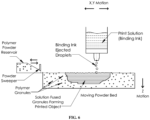
- the equipment set up comprises a reservoir for a binding ink that can eject droplets of the ink onto a moving powder bed fitted with a polymer powder reservoir and a powder sweeper.
- a computer programmed with 3D CAD data for the object to be printed is used to control the positions of the ejected droplets of ink, and the moving powder bed.
- the computer can move the former in the X and Y directions, and the latter in the Z direction (as shown in Figure 6 ).
- the computer can move the droplet ejector in all directions (i.e. X, Y and Z directions).
- P4HB and copolymers thereof can be 3D printed by using the binding ink to fuse the polymer powder.
- An object comprising P4HB is printed by depositing the droplets of binding ink across the surface of a layer of powder in X and Y directions in a pattern controlled by the computer.
- the printing ink causes the powder comprising P4HB to fuse.
- the polymer bed is lowered (in the Z direction shown in Figure 6 ), fresh polymer powder is spread across the print surface, and the surface is then swept with the powder sweeper to produce a uniform thickness of polymer powder ready for printing the next layer.
- 3D objects of P4HB are formed by printing from granules of powder with average sizes ranging from 0.5 to 250 ⁇ m, more preferably 1 to 100 ⁇ m, and even more preferably 5 to 50 ⁇ m.
- the granules comprising P4HB have particle sizes that are no more than 25% larger or smaller than the average particle sizes, and more preferably have particle sizes that are no more than 10% larger or smaller than the average particle sizes.
- the granules of P4HB for 3D printing should not be larger than 312.5 ⁇ m and not smaller than 0.375 ⁇ m, are more preferably sized between 0.75 ⁇ m and 125 ⁇ m, and even more preferably are sized between 3.75 ⁇ m and 62.5 ⁇ m.
- the granules of P4HB for 3D printing are prepared by cryo-milling as described herein.
- the granules are sieved to provide the desired particle sizes described herein.
- Granules of P4HB with weight average molecular weights from 80 to 500 kDa are particularly suitable for 3D printing with binding inks.
- Objects made from P4HB with Mw of 80-200 kDa are particularly suitable for preparing absorbable implants where it is desirable for the implant to degrade in 4-12 weeks, while objects made from P4HB with Mw of 201-800 kDa are suitable for preparing absorbable implants where it is desirable for the implant to degrade in 3-12 months.
- 3D objects comprising P4HB are printed with the binding inks by spreading the powder on the moving bed prior to printing each layer so that the thickness of the powder ranges from 50 to 250 ⁇ m. After spreading the powder, ejected droplets of binder ink are moved in the X and Y directions to fuse adjacent granules of P4HB.
- Preferred binding inks for preparing 3D printed objects of P4HB include chloroform, acetone, tetrahydrofuran and dioxane.
- drop-on-demand (DOD) inkjet printers piezo or bubble jet with solvent resistant cartridges, heaters and piezo-elements can be used to 3D print P4HB using binding inks and granules of polymer as described herein.
- 3D print compositions comprising P4HB makes it possible to rapidly fabricate objects that can be used as implants, implant prototypes, or parts of implants, without preparing expensive custom molds.
- the new methods also make it possible to commercially produce objects that can be used as implants that are difficult to produce by alternative processing methods, or are more expensive to produce by alternative processing methods.
- an implant may have geometries that are difficult or impossible to produce by standard machining, but that can be readily produced by 3D printing.
- An example is an implant with multilevel fluidic channels.
- Objects made from P4HB with Mw of 80-200 kDa are particularly suitable for preparing absorbable implants where it is desirable for the implant to degrade in 4-12 weeks, while objects made from P4HB with Mw of 201-800 kDa are suitable for preparing absorbable implants where it is desirable for the implant to degrade in 3-12 months.
- Implants, and components of implants, made by 3D printing of compositions comprising P4HB may be used for soft and hard tissue repair, regeneration, and replacement.
- the methods described herein may be used to produce implants comprising P4HB, including the following types of implants: mesh, mesh suture, tube, catheter, monofilament mesh, multifilament mesh, wound healing device, bandage, wound dressing, burn dressing, ulcer dressing, skin substitute, hemostat, tracheal reconstruction device, organ salvage device, dura substitute, dura patch, nerve guide, nerve regeneration or repair device, hernia repair device, including hernia mesh, hernia plug, and devices for repair of ventral, inguinal, femoral, umbilical, incisional, epigastric and hiatal hernias, device for temporary wound or tissue support, tissue engineering scaffold, guided tissue repair/regeneration device, anti-adhesion membrane, adhesion barrier, tissue separation membrane, retention membrane, sling, device for pelvic floor reconstruction, urethral suspension device, device for treatment of
- the implants made by 3D printing of P4HB may be sterilized using ethylene oxide gas, and even more preferably using an ethylene oxide cold cycle.
- the implants may be sterilized with electron-beam irradiation or gamma-irradiation.
- the implants may be sterilized using alcohol.
- the sterility of the implants may be maintained by packaging of the implants in packages designed to protect the implants from contamination and maintain sterility.
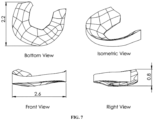
- FIG. 7 An attempt was made to print a meniscal implant shown in Figure 7 with P4HB filament using a commercial LulzBot Taz 6 3D printer.
- the dimensions of the desired meniscal implant were approximately 2.6 cm wide by 2.2 cm long and 0.8 cm high with a square fill pattern having a square pore size of 0.5 mm x 0.5 mm.
- the printer was equipped with a standard 3mm filament feeder, 0.25 mm nozzle, a 20 cfm micro-blower, and a heated printing stage.
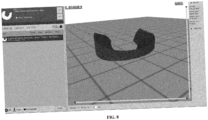
- An STL (stereolithography) file was created for the meniscal implant, and rendered into a 3D printing profile (Matter Control) consisting of 42 slices (layers) with a height of 0.2 mm each (see Figure 8 ).
- the P4HB filament used for printing had a Mw of 340 kDa and an average diameter of 2.95 mm.
- a filament feed rate of 0.22 mm/s was used.
- the temperature in the hot end was set to 220°C, and the print speed set at 6.5 mm/s.
- the temperature of the printing stage was set to 30°C.
- the temperature during printing at the top of the transition zone was 60°C and the temperature at the top of the heat sink was 56.5°C.
- the print head was offset by 0.15 mm.
- the layer (slice) thickness was set to 0.2 mm to allow for the subsequent build and proper fusion of the stacked layers.
- a P4HB object was printed by FPD using the equipment set up shown in Figure 1A comprising a reservoir with a heated jacket and a pressure line and cap, a nozzle located at the bottom of the reservoir, and a moving stage.
- the reservoir was charged with P4HB pellets (Mw 150 kDa), pressurized with compressed air to a pressure of 9 bars (900 kPa), and the pellets were heated to 120 °C. Under these conditions, it was possible to print good quality objects comprising P4HB when the diameter of the orifice in the printer nozzle was 0.2 mm ( Figure 1B ; right). When the temperature exceeded 180 °C, the printed structure warped and had poor resolution ( Figure 1B ; middle and left).
- a P4HB object was printed by MED using the equipment set up shown in Figure 2A comprising a horizontal extruder feeding into a vertical extruder fitted with a vertical plunger, and a movable stage.
- the extruder hopper was charged with P4HB pellets (480 kDa) with a diameter of 3.3 mm and moisture content of 18 ppm.
- the pellets were kept dry in the hopper using a purge of air dried through a silica bed.
- the temperature profile of the horizontal extruder was set to 30 °C in the build chamber; 100 °C in the transition zone 1, 130 °C in zone 2; and 230 °C in the extrusion zone.
- the residence time of the polymer in the MED horizontal extruder was 22 min/cm 3 .
- the back pressure was set to 50 bars (5 MPa).
- the diameter of the nozzle orifice of the vertical extruder was 0.2 mm and the drop printing frequency was 50 drops/sec at the edge of the printed construct and 240 drops/sec for the in-fill. Under these conditions, it was possible to print objects comprising P4HB with good print quality as shown in Figure 2B .
- a P4HB object was printed by SLM using the equipment set up shown in Figure 3 comprising a moving powder bed equipped with a reservoir for P4HB polymer granules and a powder sweeper, and a laser source that can direct a laser beam on the powder bed.
- the position of both the moving powder bed and laser beam were controlled by a computer that had been programmed with 3D CAD data to produce a lattice structure of P4HB.
- the focal distance, the distance between the lens and surface of the powder, shown in Figure 3 was 50.8 mm.
- the granules were placed in the powder reservoir, and a first layer of powder was spread on the moving bed using the powder sweeper.
- the thickness of the powder layer and subsequent layers was 150 ⁇ m.
- the power of the laser was set to 0.3 Watts, and the speed of the laser beam was set at 20 cm/s. Under these conditions, the energy per unit area used was about 1 J/cm 2 and the lattice shown in Figure 4A was printed.
- a P4HB object was printed by 3D solution printing using the equipment set up shown in Figure 5 comprising a syringe with a dispensing needle containing a slurry of P4HB, and a movable coagulation bath containing a 70:30 mixture of water and ethanol.
- the positions of the needle and the coagulation bath could be controlled by a computer that had been programmed with 3D CAD data necessary to print the 3D object.
- the computer could move the needle in the X and Y directions, and the coagulation bath in the Z direction (where Z is the direction shown in Figure 5 ) but keeping the needle tip in the coagulation solvent of the coagulation bath.
- the diameter of the needle was 100 ⁇ m.
- the slurry was formed by mixing the P4HB polymer at a concentration of 6% w/v with acetone, and was kept at a temperature of 45 °C in the syringe.
- the 3D P4HB object was printed by applying pressure to the polymer slurry (1800 kPa) so that it exited the moving dispensing needle into the coagulation solvent in the coagulation bath in a continuous manner.
- the slurry was allowed to precipitate one layer at a time as shown in Figure 5 .
- Layer upon layer of P4HB was printed in the coagulation bath to form the 3D object at a speed of 15 mm/sec.
- Example 5 3D Printing of P4HB using a Binding Ink and Granules of P4HB polymer
- a P4HB object was printed using the equipment shown in Figure 6 comprising a reservoir that can deliver droplets of a binding ink onto a moving powder bed with a reservoir for the P4HB polymer and a powder sweeper.
- the position of the ejected droplets of binding ink and the position of the moving bed were controlled by a computer loaded with 3D CAD data for the object.
- the binding inks for fusing the P4HB polymer were acetone, chloroform, dioxane, and tetrahydrofuran.
Landscapes
- Chemical & Material Sciences (AREA)
- Engineering & Computer Science (AREA)
- Materials Engineering (AREA)
- Health & Medical Sciences (AREA)
- Manufacturing & Machinery (AREA)
- Physics & Mathematics (AREA)
- Optics & Photonics (AREA)
- Mechanical Engineering (AREA)
- Life Sciences & Earth Sciences (AREA)
- Veterinary Medicine (AREA)
- Epidemiology (AREA)
- Animal Behavior & Ethology (AREA)
- General Health & Medical Sciences (AREA)
- Public Health (AREA)
- Medicinal Chemistry (AREA)
- Chemical Kinetics & Catalysis (AREA)
- Transplantation (AREA)
- Dermatology (AREA)
- Oral & Maxillofacial Surgery (AREA)
- Molecular Biology (AREA)
- Biomedical Technology (AREA)
- Heart & Thoracic Surgery (AREA)
- Surgery (AREA)
- Vascular Medicine (AREA)
- Toxicology (AREA)
- Plasma & Fusion (AREA)
- Civil Engineering (AREA)
- Composite Materials (AREA)
- Structural Engineering (AREA)
- Ceramic Engineering (AREA)
- Polymers & Plastics (AREA)
- Organic Chemistry (AREA)
- Materials For Medical Uses (AREA)
Description
- The present invention generally relates to methods for fabricating objects by 3D printing of poly-4-hydroxybutyrate (P4HB), and blends thereof, equipment and conditions that allow continuous printing of these objects, and the use of these methods to produce medical implants for uses that include plastic and reconstructive surgery including mastopexy and breast reconstruction, general surgery including hernia repairs and anti-adhesion devices, tissue engineering, drug delivery, pelvic floor reconstruction, treatment of stress urinary incontinence, nerve repair, periodontal surgery, oral surgery, orthopedic surgery, stenting, vascular and cardiovascular surgery.
- 3D Printing is a computer controlled process whereby a three-dimensional object can be fabricated from a 3D CAM (Computer Aided Design) model using an additive manufacturing approach. Objects may be fabricated by depositing, joining, or solidifying material, typically a metal or plastic material.
-
WO 2016/058097A1 describes a process for manufacturing a biodegradable polymer filament product, the process comprising: a) isolating polyhydroxyalkanoate from a bacterial culture; b) optionally bleaching the polyhydroxyalkanoate; c) dispersing the polyhydroxyalkanoate in a surfactant solution to form a dispersion; d) drying the dispersion to obtain dried polyhydroxyalkanoate particles; e) mixing the polyhydroxyalkanoate with a plurality of components including a toughening agent, a plasticizer, a nucleating agent, an antioxidant and an adhesive; f) extruding the mixture as a filament; and g) winding the filament onto a spool. -
US 2018/049858A1 discloses a method for fabricating a hernia mesh to be implanted in the human body made from a P4HB copolymer, wherein the object is fabricated by a computer aided additive manufacturing approach, in a fused pellet deposition-type process - In fused filament fabrication (FFF), a plastic, preferably a thermoplastic, in the form of a filament, is fed into a heating block to melt the plastic, and thin threads are extruded through a movable nozzle onto the surface of a stage in a predetermined pattern to form a 3D object. The threads typically have a thickness of 50 µm to 1 mm, and adhere to one another with the underlying layer hardening as the plastic cools and binding to the new layer that is added on top. Layers of the extruded plastic are built up to form the three-dimensional object as the nozzle is moved by a computer. In a variation of the technique, the object may be formed on a movable stage controlled by a computer with the nozzle remaining in the same position, or in a further variant, the object may be formed with both the positions of the nozzle and the stage controlled by a computer.
- A standard equipment set up for FFF of a thermoplastic polymer, comprises a feeder mechanism for the filament. The feeder mechanism grips the filament and feeds it at a controlled rate into an extruder comprising a heater block and nozzle. A stage is positioned under the nozzle, and the object is printed on the stage either by moving the nozzle, the stage or both, under the control of a computer, in three dimensions. The part of the equipment that is responsible for feeding the filament is often referred to as the cold end. This typically comprises gears and rollers that grip the filament, and feed it with torque provided by a drive motor into the extruder. The feeder mechanism controls the rate at which the filament is delivered to the extruder. The heater block and the nozzle are called the hot end. In the hot end, the filament is melted and exits the nozzle forming a thin thread that is deposited on the stage to form the 3D printed object. The speed of the process is controlled so that there is sufficient time for the polymer under the nozzle to have solidified before additional extrudate from the nozzle is applied on top of it.
- There is a need for a method and new equipment to process polymers by 3D printing using FFF, such as P4HB and copolymers thereof, that are not printable at a temperature just above their melt temperature, but instead require significantly elevated temperatures in order for the polymer's melt viscosity to be low enough to allow printing. At the same time, the process must ensure that the temperature in the cold end does not exceed the softening temperature of the polymer, and is preferably lower than the softening temperature. The process also needs to be designed to ensure that polymers that do not rapidly solidify at elevated temperatures, such as P4HB and copolymers thereof, solidify after printing in order to produce products with good print quality.
-
US Patent No. 5,121,329 to Crump discloses equipment suitable for FFF of material that (i) can be melted at a temperature slightly above its melting temperature, preferably just one degree above its melting temperature, and (ii) has a solidification temperature that permits the material to solidify substantially instantaneously at room temperature. Crump does not disclose equipment suitable for FFF of a thermoplastic, such as P4HB, that must be heated to more than twice its melt temperature in order for the polymer to flow, that has a low softening temperature, and that solidifies slowly from the melt. -
WO2016/019049 to Church et al . discloses equipment for FFF that includes a heat sink and fan to dissipate heat. Church also does not disclose equipment suitable for FFF of a thermoplastic like P4HB that must be heated to at least twice its melt temperature in order for the polymer to flow, that has a low softening temperature, and that solidifies slowly from the melt. Church et al. do not disclose equipment for FFF comprising a shroud fixed to the print head, a heat shield, an insulator to prevent contact of the heat shield and hot end, and a cooled flat print stage. - There is also a need for methods to process P4HB and copolymers thereof by 3D printing using fused pellet deposition (FPD), melt extrusion deposition (MED), selective laser melting (SLM), printing of slurries and solutions using a coagulation bath, and printing using a binding solution and granules of powder.
- Chiulan et al. Recent advances in 3D printing of aliphatic polyesters, discloses fused deposition modeling of poly-3-hydroxybutyrate (P3HB), and poly-3-hydroxybutyrate-co-3-hydroxyvalerate (PHBV) with maleic anhydride and palm fibers, wood flower, and carbon nanotubes in order to enhance the properties of the fibers. It should be noted, however, that poly-4-hydroxybutyrate (P4HB) has entirely different properties compared to P3HB ("PHB") despite their similar names. For example, P3HB has a melting point of 180 °C versus a melting point of about 60 °C for P4HB. The polymers also have substantially different glass transition temperatures and mechanical properties. P4HB has a glass transition temperature of -55 °C whereas P3HB has a glass transition temperature of 0°C. PHB is a relatively hard brittle polymer with an extension to break of just a few percent, whereas P4HB is a strong extensible polymer with an extension to break of about 1000%. P4HB has strikingly different uses from P3HB, as well as significantly different processing requirements. For example, P3HB can be melt processed at just a few degrees above its melt temperature, whereas P4HB needs to be melt processed typically at temperatures over 150 °C due to its high melt viscosity despite having a melting point of only 60°C.
- Derakhshanfar et al. 3D bioprinting for biomedical devices and tissue engineering: a review of recent trends and advances, Bioactive Materials, 3:144-156 (2018) reviews 3D printing methods and discloses that "not all biomaterials are printable and those which are printable may not be printable in a wide range of processing parameters."
- Thus, there is currently no disclosure of how P4HB and copolymers thereof can be processed by 3D printing including the equipment and conditions necessary for continuous printing of high quality objects. There is also no disclosure of how to prevent significant drops in the molecular weight of P4HB and copolymers thereof during printing.
- It is therefore an object of the present invention to provide new 3D printers suitable for 3D printing of P4HB.
- It is another object of the present invention to provide multiple means of 3D printing P4HB.
- It is a further object of the present invention to provide objects of P4HB thereof produced by 3D printing characterized by specific physical properties.
- It is still another object of the present invention to provide objects of P4HB thereof with controlled degradation profiles that can be used in medical applications as implants.
- Methods to fabricate objects by 3D printing of poly-4-hydroxybutyrate have been developed. In accordance with the present invention, there is provided a method of fabricating a three-dimensional object made from poly-4-hydroxybutyrate, wherein the object is fabricated by a computer aided additive manufacturing approach and wherein the object is by a method selected from the group comprising: (i) fused pellet deposition (FPD), (ii) melt extrusion deposition (MED), (iii) selective laser melting (SLM), (iv) printing of slurries and solutions using a coagulation bath, and (v) printing using a binding solution and granules of powder.
- The new methods make it possible for objects of P4HB thereof to be printed with print lines, wherein the dimensions of the print lines are within 25% of the expected dimensions of the print lines, and more preferably within of the expected dimensions of the print lines.
- In some particularly preferred embodiments, the disclosed compositions and methods do not include a foaming/blowing agent.
-
-
Figure 1A is a diagram showing an equipment configuration for fused pellet deposition of P4HB and copolymers thereof. -
Figure 1B is a picture showing products produced by fused pellet deposition of P4HB. The products shown on the left and in the middle position were warped and had poor print quality, and were produced with a processing temperature of 180 °C. The product shown on the right had good resolution and print quality, and was printed with a processing temperature of 120°C. -
Figure 2A is a diagram showing a suitable equipment set up for melt extrusion deposition (MED) of P4HB and copolymers thereof. -
Figure 2B is an example of a P4HB product printed by melt extrusion deposition (MED) with good print quality. -
Figure 3 is a diagram showing a suitable equipment set up to 3D print objects from P4HB and copolymers thereof by selective laser melting (SLM). -
Figure 4A is a picture of a P4HB lattice printed by SLM. -
Figure 4B is a picture showing the result of a failed attempt to print a P4HB lattice by SLM. -
Figure 5 is a diagram showing a suitable equipment set up to print objects from solutions or slurries of P4HB and copolymers thereof by 3D printing using a coagulation bath. -
Figure 6 is a diagram showing a suitable equipment set up to print objects from P4HB and copolymers thereof using a binding solution and granules of polymer or copolymer on a moving bed. -
Figure 7 is a diagram showing the bottom view, front view, isometric view and right view of a meniscal implant with dimensions of 2.6 cm width, 2.2 cm length, and 0.8 cm height. -
Figure 8 is a 3D printing profile for the meniscal implant shown inFigure 3 consisting of 42 slices (layers) with a height of 0.2 mm each. -
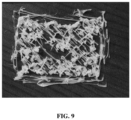
Figure 9 is a picture showing the failed result of an attempt to print the meniscal implant with the 3D printing profile shown inFigure 4 with P4HB filament using a standard commercial FFF 3D printer. - It would be desirable to identify conditions and equipment that are suitable for preparing objects comprising poly-4-hydroxybutyrate or copolymers thereof by 3D printing. It would be particularly desirable to identify methods to 3D print objects from P4HB and copolymers thereof that provide good quality objects, and processes that can run continuously without interruption of the print job.
- The new equipment and methods described herein make it possible to continuously print P4HB and copolymers thereof, and provide significant improvements in print quality, structural integrity (which is a function of the continuity of the printed line, layer to layer adhesion, and optionally adhesion of the first layer to the stage), and print speed. In one embodiment, the new methods utilize new equipment that makes it possible to print polymers such as P4HB that: (i) are extremely viscous in the melt and require very high processing temperatures, and (ii) solidify very slowly from the melt.
- Methods have been developed to 3D print P4HB by fused pellet deposition (FPD), melt extrusion deposition (MED), selective laser melting (SLM), printing of slurries and solutions using a coagulation bath, and printing using a binding solution and granules of powder.
- In a preferred embodiment, the new 3D printers and methods disclosed herein may be used to produce 3D printed objects comprising P4HB. In a particularly preferred embodiment, the new 3D printers and methods disclosed herein may be used to produce 3D printed objects comprising P4HB and copolymers thereof that may be used to produce medical implants for uses that include plastic and reconstructive surgery including mastopexy and breast reconstruction, general surgery including hernia repairs and anti-adhesion devices, tissue engineering, drug delivery, pelvic floor reconstruction, treatment of stress urinary incontinence, nerve repair, periodontal surgery, oral surgery, orthopedic surgery, stenting, vascular and cardiovascular surgery. The new 3D printers make it possible to produce three-dimensional medical devices comprising P4HB that cannot be produced by other fabrication methods. Optionally, the devices may further comprise bioactive agents, including antibiotics, and other additives. In particularly preferred embodiment, the method of making 3D objects and the resulting 3D printed objects do not include a blowing/foaming agent. For example, a blowing/foaming agent may be a substance having a gas volume of 100 to 350 mL / g, which decomposes at a temperature higher than the decomposition temperature thereof, for example, at a printer nozzle temperature to release gas. Examples of the foaming agent include azodicarbonamide, modified azodicarbonamide, p-toluenesulfonyl semicarbazide, p-toluenesulfonyl hydrazide, but are not limited to, hydrazide, p-toluenesulfonyl acetone hydrazide, 5-phenyltetrazole, sodium bicarbonate, or combinations thereof . For example, the foaming agent may be a substance that decomposes at 130 to 250 ° C to generate gas.
-
- "3D Printing" as generally used herein means a computer controlled process whereby a three-dimensional object can be fabricated from a 3D CAM model using additive manufacturing.
- "Additive manufacturing" as generally used herein means a process by which an object is formed by depositing layer upon layer of material.
- "Bioactive agent" is used herein to refer to therapeutic, prophylactic or diagnostic agents, such as agents that promote healing and the regeneration of host tissue and therapeutic agents that prevent, inhibit or eliminate a disease or disorder.
- "Bioceramic" means a ceramic suitable for use or replacement in the human body.
- "Biocompatible" as generally used herein means the biological response to the material or device being appropriate for the device's intended application in vivo. Any metabolites of these materials should also be biocompatible.
- "Blend" as generally used herein means a physical combination of different polymers, as opposed to a copolymer formed of two or more different monomers.
- "Ceramic" means an inorganic, nonmetallic solid prepared by the action of heat and subsequent cooling.
- "Cold end" as generally used herein means the part of the equipment for FFF that is responsible for feeding the filament into the extruder.
- "Copolymers of poly-4-hydroxybutyrate" as generally used herein means any polymer including 4-hydroxybutyrate with one or more different hydroxy acid units.
- "DOD" as used herein means drop-on-demand printing.
- "Feed rate" as generally used herein in FFF means the speed at which the filament is fed or loaded into the heat sink.
- "FFF" as used herein means fused filament fabrication.
- "FPD" as used herein means fused pellet deposition.
- "Heat sink" as generally used herein refers to a heat exchanger that transfers and dissipates heat generated by the hot end in FFF.
- "Hot end" as generally used herein means the part of the equipment for FFF that is responsible for heating the filament, namely the heater block and nozzle.
- "Implant" as generally used herein include medical devices that are used in vivo as well as those that contact the surface of the body or are inserted into any orifice of the body.
- "MED" as used herein means melt extrusion deposition.
- "Molecular weight" as used herein, unless otherwise specified, refers to the weight average molecular weight (Mw), not the number average molecular weight (Mn), and is measured by GPC relative to polystyrene.
- "Poly-4-hydroxybutyrate" as generally used herein means a homopolymer including 4-hydroxybutyrate units. It may be referred to herein as P4HB or TephaFLEX® biomaterial (manufactured by Tepha, Inc., Lexington, MA).
- "Print quality" as generally used herein refers to the resolution of the print in the X, Y and Z directions of a Cartesian coordinate system (wherein the Z direction is the height of a printed layer). An object printed with good print quality has print dimensions that are within 10% of the expected value. For example, an object printed with a resolution of 100 microns in the X and Y directions, and 50 microns in the Z direction has good print quality if the line width in the X and Y directions is between 90 and 110 microns, and between 45 and 55 microns in the Z direction.
- "Print speed" as generally used herein in FFF means the linear speed of the moving print stage, the linear speed of the moving nozzle, or the linear speed that results from the combination of the linear speed of the print stage and linear speed of the moving nozzle.
- "Residence time" as generally used herein refers to the average time in seconds that a one cubic millimeter volume of molten polymer spends in the hot end in FFF, and is typically expressed as s/mm3, or the average time that the polymer spends in the horizontal extruder in MED and is typically expressed as s/cm3 or min/cm3.
- "Resorbable" as generally used herein means the material is broken down in the body and eventually eliminated from the body. The terms "resorbable", "degradable", "erodible", and "absorbable" are used somewhat interchangeably in the literature in the field, with or without the prefix "bio". Herein, these terms will be used interchangeably to describe material broken down and gradually absorbed or eliminated by the body, whether degradation is due mainly to hydrolysis or mediated by metabolic processes.
- "SLM" as used herein means selective laser melting.
- Methods and improved 3D printers have been developed to prepare three-dimensional objects comprising P4HB and copolymers thereof. The objects can be used in vivo for soft or hard tissue repair, regeneration and remodeling applications. In a preferred embodiment, the objects are medical devices or may be converted into medical devices through further processing.
- Poly-4-hydroxybutyrate (P4HB) and copolymers thereof can be produced using transgenic fermentation methods, see, for example,
U.S. Patent No. 6,548,569 to Williams et al. , and are produced commercially, for example, by Tepha, Inc. (Lexington, MA). Poly-4-hydroxybutyrate (P4HB, TephaFLEX® biomaterial) is a strong, pliable absorbable thermoplastic polyester. - The P4HB polymer belongs to a larger class of materials called polyhydroxyalkanoates (PHAs) that are produced by numerous microorganisms (see, for example, Steinbüchel A., et al. Diversity of Bacterial Polyhydroxyalkanoic Acids, FEMS Microbial. Lett. 128:219-228 (1995)). In nature, these polyesters are produced as storage granules inside cells, and serve to regulate energy metabolism. They are also of commercial interest because of their thermoplastic properties, biodegradability and relative ease of production.
- Chemical synthesis of P4HB has been attempted, but it has been impossible to produce the polymer with a sufficiently high molecular weight that is necessary for most applications, including melt processing (see Hori, Y., et al., Polymer 36:4703-4705 (1995); Houk, K.N., et al., J. Org. Chem., 2008, 73 (7), 2674-2678; and Moore, T., et al., Biomaterials 26:3771-3782 (2005)). In fact, it has been calculated to be thermodynamically impossible to chemically synthesize a high molecular weight homopolymer under normal conditions (Moore, T., et al., Biomaterials 26:3771-3782 (2005)). Chemical synthesis of P4HB instead yields short chain oily oligomers that lack the desirable thermoplastic properties of the high molecular weight P4HB polymers produced by biosynthetic methods.
-
U.S. Patent Nos 6,245,537, 6,623,748, 7,244,442, 8,231,889, 9,290,612, 9,480,780 U.S. Patent Nos. 6,548,569, 6,838,493, 6,867,247, 7,268,205, 7,179,883, 7,268,205, 7,553,923, 7,618,448 and7,641,825 and9,162,010 U.S. patent 8,039,237 to Martin and Skraly ,U.S. Patent No. 6,316,262 to Huisman et al. , andU.S. Patent No. 6,323,010 to Skraly et al. ). Methods to control molecular weight of PHA polymers have been disclosed byU.S. Patent No. 5,811,272 to Snell et al. - PHAs with controlled degradation and degradation in vivo of less than one year are disclosed by
U.S. Patent No. 6,548,569, 6,610,764, 6,828,357, 6,867,248, and6,878,758 to Williams et al. andWO 99/32536 to Martin et al. US Patent No. 6,548,569 to Williams et al. Several patents includingU.S. Patent Nos. 6,555,123, 6,585,994, 7,025,980, 9,532,867 9,277,986 US Patent Nos. 8,034,270, 8,016,883, 8,287,909, 8,747,468 , 9,511,169, 9,457,127 9,555,155 - Sodian et al. Application of stereolithography for scaffold fabrication for tissue engineered heart valves, ASAIO Journal 48:12-16 (2002) discloses the fabrication of molds to make tissue engineered heart valves comprising P4HB using 3D printing, but does not disclose 3D printing of P4HB and copolymers thereof or 3D printed objects comprising P4HB and copolymers thereof.
- The processes described herein are used with poly-4-hydroxybutyrate (P4HB). P4HB homopolymer can be obtained from Tepha, Inc. of Lexington, MA, USA. The P4HB homopolymer can have a weight average molecular weight, Mw, within the range of 50 kDa to 1,200 kDa (by GPC relative to polystyrene) and more preferably from 100 kDa to 1,000 kDa and even more preferably from 100 kDa to 500 kDa. The polymer may include the P4HB homopolymer blended with other absorbable polymers, additives, or bioactive agents, including cells.
- Objects comprising blends of P4HB may be printed using the methods and equipment disclosed herein. In one embodiment, P4HB can be blended with other absorbable polymers, including, but not limited to: poly(lactides); poly(glycolides); poly(lactide-co-glycolides); poly(lactic acid); poly(glycolic acid); poly(lactic acid-co-glycolic acids); polycaprolactones; poly(orthoesters); polyanhydrides; poly(phosphazenes); polyhydroxyalkanoates (including P3HB and poly-3-hydroxybutyrate-co-3-hydroxyvalerate, PHBV); synthetically or biologically prepared polyesters (including polyesters with one or more of the following monomeric units: glycolic, lactic; trimethylene carbonate, p-dioxanone, or ε-caprolactone); poly(lactide-co-caprolactones); polycarbonates; tyrosine polycarbonates; polyamides (including synthetic and natural polyamides, polypeptides, and poly(amino acids)); polyesteramides; poly(dioxanones); poly(alkylene alkylates); polyethers (such as polyethylene glycol, PEG, and polypropylene oxide, PPO) or other hydrophilic or water soluble polymers such as polyvinyl pyrrolidones (PVP); polyurethanes; polyetheresters; polyacetals; polycyanoacrylates; poly(oxyethylene)/poly(oxypropylene) copolymers; polyacetals, polyketals; polyphosphates; (phosphorous-containing) polymers; polyphosphoesters; polyalkylene oxalates; polyalkylene succinates; poly(maleic acids); chitin; chitosan; modified chitosan; biocompatible polysaccharides; biocompatible copolymers (including block copolymers or random copolymers); with blocks of other biocompatible or biodegradable polymers, for example, poly(lactide), poly(lactide-co-glycolide, or polycaprolactone or combinations thereof. Other polymers and materials that can be printed with P4HB and copolymers thereof include alginate, silk, glycerol, gelatin, hyaluronic acid and derivatives thereof, collagen, polyvinyl alcohol, and hydrogels.
- Certain additives may be incorporated into the compositions comprising P4HB prior to 3D printing of the compositions. In a preferred embodiment, the additives are biocompatible, and even more preferably the additives are both biocompatible and resorbable.
- In one embodiment, the additives may be nucleating agents and/or plasticizers. These additives may be added in sufficient quantity to produce the desired result. In general, these additives may be added in amounts of up to 20% by weight. Nucleating agents may be incorporated to increase the rate of crystallization of the compositions comprising P4HB. Such agents may be used to improve the printing of the objects and the mechanical properties of the objects. Preferred nucleating agents include, but are not limited to, salts of organic acids such as calcium citrate, polymers or oligomers of PHA polymers and copolymers, high melting polymers such as PGA, talc, micronized mica, calcium carbonate, ammonium chloride, and aromatic amino acids such as tyrosine and phenylalanine. Plasticizers that may be incorporated include, but are not limited to, di-n-butyl maleate, methyl laureate, dibutyl fumarate, di(2-ethylhexyl) (dioctyl) maleate, paraffin, dodecanol, olive oil, soybean oil, polytetramethylene glycols, methyl oleate, n-propyl oleate, tetrahydofurfuryl oleate, epoxidized linseed oil, 2-ethyl hexyl epoxytallate, glycerol triacetate, methyl linoleate, dibutyl fumarate, methyl acetyl ricinoleate, acetyl tri(n-butyl) citrate, acetyl triethyl citrate, tri(n-butyl) citrate, triethyl citrate, bis(2-hydroxyethyl) dimerate, butyl ricinoleate, glyceryl tri-(acetyl ricinoleate), methyl ricinoleate, n-butyl acetyl rincinoleate, propylene glycol ricinoleate, diethyl succinate, diisobutyl adipate, dimethyl azelate, di(n-hexyl) azelate, tri-butyl phosphate, and mixtures thereof. Particularly preferred plasticizers are citrate esters.
- In another embodiment, the additives are contrast agents, radiopaque markers or radioactive substances.
- In yet another embodiment, the additives are ceramics, more preferably bioceramics, and even more preferably resorbable bioceramics. Examples of resorbable bioceramics that can be incorporated into the compositions of P4HB prior to printing include tricalcium phosphate (α and β forms of tricalcium phosphate (TCP) - with a nominal composition of Ca3(PO4)2), biphasic calcium phosphate (BCP), hydroxylapatite, calcium sulfate, calcium carbonate, and other calcium phosphate salt-based bioceramics. Bio-active glasses may also be incorporated. Bioactive glasses include bioactive glasses composed of SiO2, NazO, CaO and P2O5 in specific proportions. In an embodiment, the P4HB blends comprise resorbable bioceramics with a size distribution ranging from nanoparticles to microparticles. In a preferred embodiment, the ceramics have particle sizes of less than 100 microns.
- In a still further embodiment, the additives may be cross-linking agents.
- In some particularly preferred embodiments, the disclosed compositions and methods do not include a foaming/blowing agent. For example, a blowing/foaming agent may be a substance having a gas volume of 100 to 350 mL / g, which decomposes at a temperature higher than the decomposition temperature thereof, for example, at a printer nozzle temperature to release gas. Examples of the foaming agent include azodicarbonamide, modified azodicarbonamide, p-toluenesulfonyl semicarbazide, p-toluenesulfonyl hydrazide, but are not limited to, hydrazide, p-toluenesulfonyl acetone hydrazide, 5-phenyltetrazole, sodium bicarbonate, or combinations thereof . For example, the foaming agent may be a substance that decomposes at 130 to 250 ° C to generate gas.
- If desired, the compositions of P4HB may incorporate bioactive agents. These agents may be added prior to printing of the compositions into objects or after the objects have been formed.
- In one embodiment, the bioactive agents and the composition comprising P4HB of, may be dissolved in a solvent or solvent system in order to disperse the bioactive agent in the polymer, and the solvent may then be removed by evaporation. Preferred solvents include methylene chloride, chloroform, tetrahydrofuran, acetone, dimethylformamide, and 1,4-dioxane.
- Examples of bioactive agents that can be incorporated into the compositions of P4HB, include, but are not limited to, physiologically or pharmacologically active substances that act locally or systemically in the body. Bioactive agents include biologically, physiologically, or pharmacologically active substances that act locally or systemically in the human or animal body. Examples can include, but are not limited to, small-molecule drugs, anti-inflammatory agents, immunomodulatory agents, molecules that promote cell migration, molecules that promote or retard cell division, molecules that promote or retard cell proliferation and differentiation, molecules that stimulate phenotypic modification of cells, molecules that promote or retard angiogenesis, molecules that promote or retard vascularization, molecules that promote or retard extracellular matrix disposition, signaling ligands, platelet rich plasma, peptides, proteins, glycoproteins, anesthetics, hormones, antibodies, growth factors, fibronectin, laminin, vitronectin, integrins, antimicrobials, steroids, hydroxyapatite, silver particles, vitamins, non-steroidal anti-inflammatory drugs, chitosan and derivatives thereof, alginate and derivatives thereof, collagen, sugars, polysaccharides, nucleotides, oligonucleotides, lipids, lipoproteins, hyaluronic acid and derivatives thereof, allograft material, xenograft material, ceramics, nucleic acid molecules, antisense molecules, aptamers, siRNA, nucleic acids, and combinations thereof.
- Antimicrobial agents that may be incorporated into the compositions of P4HB, or coated on those compositions, include, but are not limited to, antibacterial drugs, antiviral agents, antifungal agents, and antiparisitic drugs. Antimicrobial agents include substances that kill or inhibit the growth of microbes such as microbicidal and microbiostatic agents. Antimicrobial agents that may be incorporated into the compositions of P4HB, include, but are not limited to: rifampin; minocycline and its hydrochloride, sulfate, or phosphate salt; triclosan; chlorhexidine; vancomycin and its hydrochloride, sulfate, or phosphate salt; tetracycline and its hydrochloride, sulfate, or phosphate salt, and derivatives; gentamycin; cephalosporin antimicrobials; aztreonam; cefotetan and its disodium salt; loracarbef; cefoxitin and its sodium salt; cefazolin and its sodium salt; cefaclor; ceftibuten and its sodium salt; ceftizoxime; ceftizoxime sodium salt; cefoperazone and its sodium salt; cefuroxime and its sodium salt; cefuroxime axetil; cefprozil; ceftazidime; cefotaxime and its sodium salt; cefadroxil; ceftazidime and its sodium salt; cephalexin; cefamandole nafate; cefepime and its hydrochloride, sulfate, and phosphate salt; cefdinir and its sodium salt; ceftriaxone and its sodium salt; cefixime and its sodium salt; cefpodoxime proxetil; meropenem and its sodium salt; imipenem and its sodium salt; cilastatin and its sodium salt; azithromycin; clarithromycin; dirithromycin; erythromycin and hydrochloride, sulfate, or phosphate salts, ethylsuccinate, and stearate forms thereof, clindamycin; clindamycin hydrochloride, sulfate, or phosphate salt; lincomycin and hydrochloride, sulfate, or phosphate salt thereof, tobramycin and its hydrochloride, sulfate, or phosphate salt; streptomycin and its hydrochloride, sulfate, or phosphate salt; neomycin and its hydrochloride, sulfate, or phosphate salt; acetyl sulfisoxazole; colistimethate and its sodium salt; quinupristin; dalfopristin; amoxicillin; ampicillin and its sodium salt; clavulanic acid and its sodium or potassium salt; penicillin G; penicillin G benzathine, or procaine salt; penicillin G sodium or potassium salt; carbenicillin and its disodium or indanyl disodium salt; piperacillin and its sodium salt; ticarcillin and its disodium salt; sulbactam and its sodium salt; moxifloxacin; ciprofloxacin; ofloxacin; levofloxacins; norfloxacin; gatifloxacin; trovafloxacin mesylate; alatrofloxacin mesylate; trimethoprim; sulfamethoxazole; demeclocycline and its hydrochloride, sulfate, or phosphate salt; doxycycline and its hydrochloride, sulfate, or phosphate salt; oxytetracycline and its hydrochloride, sulfate, or phosphate salt; chlortetracycline and its hydrochloride, sulfate, or phosphate salt; metronidazole; dapsone; atovaquone; rifabutin; linezolide; polymyxin B and its hydrochloride, sulfate, or phosphate salt; sulfacetamide and its sodium salt; clarithromycin; and silver ions, salts, and complexes. In a preferred embodiment, the antimicrobial agents incorporated into the compositions of P4HB or coated on those compositions are (i) rifampin and (ii) minocycline and its hydrochloride, sulfate, or phosphate salt.
- If desired, the compositions of P4HB may incorporate cells, including, cells of epithelial, connective, muscular and nervous tissues. Such compositions may be printed to form bioprinted objects, including tissue engineering scaffolds. The latter may be used, for example, in the repair, regeneration or replacement of tissue structures and organs, including skeletal defects and bone regeneration.
-
Figure 1A is a diagram showing an equipment set up suitable for 3D printing of P4HB by FPD. The equipment comprises a reservoir for polymer pellets that can be pressurized and is surrounded with a heating jacket, a cap fitting on one end of the reservoir with a compressed gas line that can be used to increase the pressure in the reservoir, and a nozzle located at the other end of the reservoir through which polymer can be printed onto a moving stage located underneath the nozzle. A computer programmed with 3D CAD data for the object to be printed is used to control the position of the stage and print head during printing. The diameter of the orifice of the nozzle is preferably 0.1 to 1.0 mm, and more preferably 0.15 to 0.4 mm. In a preferred embodiment, the P4HB is dried prior to printing by FPD. P4HB can be FPD printed by charging the reservoir with polymer pellets, sealing the reservoir with the cap and pressurizing the reservoir using compressed gas, preferably compressed air, and heating the reservoir. In an embodiment, the reservoir and pellets are heated to 85 to 180 °C, more preferably 100 to 180 °C, and even more preferably 120 to 150 °C. In another embodiment, the reservoir is pressurized using dry compressed gas, preferably dry compressed air or nitrogen, to a pressure of 6.5-50 bars (650-5,000 kPa), and more preferably 9-20 bars (900-2,000 kPa). These conditions allow continuous 3D printing of P4HB by FPD.Figure 1B (right picture) shows an object made from P4HB with good resolution by FPD using a processing temperature of 120°C.Figure 1B (left and middle pictures) show a failed attempt to produce P4HB objects with good resolution at temperatures over 180 °C. - In a particularly preferred embodiment, the methods for FPD described herein allow the printing of objects of P4HB with a good print quality wherein the print dimensions are within 10% of the expected value. That is, each dimension of the object is within ±10% of the target value.
-
Figure 2A is a diagram showing an equipment set up that can be used for 3D printing of P4HB by MED. The equipment set up comprises a horizontal single screw heated barrel with a hopper for the polymer that is designed to protect the polymer from moisture. The hopper is designed to exclude moisture from the polymer in the hopper in order to prevent loss of polymer molecular weight during printing. The hopper is fitted with a dry gas purge, preferably a nitrogen purge to keep the polymer dry. The horizontal extruder is connected to a vertical extruder fitted with a plunger so that polymer can be moved through the horizontal extruder into the vertical extruder. The vertical extruder is fitted with a plunger that is used to eject the polymer as small droplets through a nozzle orifice. The plunger creates the small droplets of molten polymer with a hammer-like action. Preferably the plunger is piezoelectrically driven to create the droplets of polymer. The droplets are collected on a moving stage, and fuse upon contact to form a polymer print line. That is, the print line is formed by the ejection of a series of drops which fuse together to form the print line as shown inFigure 2A . A computer programmed with 3D CAD data for the object to be printed is used to control the position of the stage during printing. - In a preferred embodiment, pellets of P4HB suitable for MED printing are prepared with diameters of 0.05-3 mm, and more preferably 1-3 mm. In order to avoid a significant loss in molecular weight of the polymer during processing, it is important that the polymer thereof is dried prior to MED printing so that the water content of the polymer is less than 1,000 ppm, more preferably less than 500 ppm, and even more preferably 10-300 ppm. In a preferred embodiment, the temperature profile of the MED's horizontal extruder is set: between 20 and 60 °C in the build chamber and more preferably between 25 and 40 °C; between 60 and 150 °C in the heating zones, and more preferably between 90 and 140 °C; and between 150 °C and 250 °C in the extrusion zone, and more preferably between 190 °C and 230 °C. The back pressure applied to the molten polymer ranges from 5 to 100 bars (0.5-10 MPa), and more preferably between 20 and 70 bars (2-7 MPa), and even more preferably between 40 and 60 bars (4-6 MPa). The residence time of the polymer in the MED's horizontal extruder is preferably 0.1 to 10 sec/mm3, and more preferably 1 sec/cm3 to 7 sec/mm3. And, preferably the diameter of the nozzle orifice of the vertical extruder for producing a good print quality is from 0.08 to 0.4 mm, more preferably 0.15 to 0.2 mm. These conditions allow objects with good print quality to be produced by MED from P4HB.
- In a particularly preferred embodiment, the methods for MED described herein allow the printing of objects of P4HB with a good print quality wherein the print dimensions are within 10% of the expected value. That is, each dimension of the object is within ±10% of the target value.
-
Figure 3 is a diagram showing an equipment set up that is designed for 3D printing of P4HB by SLM. The equipment set up comprises a moving powder bed, a polymer powder reservoir and powder sweeper, and a laser source and moving lens that can be used to focus a laser on the polymer in the powder bed. The lens is able to move in the X and Y directions. A computer programmed with 3D CAD data for the object to be printed is used to control the positions of the powder bed and laser beam, and the movement of the powder sweeper. P4HB can be 3D printed by using the laser to selectively fuse the powder, and an object is printed by scanning the laser across the surface of the powder in X and Y directions in a pattern controlled by the computer. Preferably, the laser is a high-powered CO2 laser. The equipment set up allows objects comprising P4HB to be built one layer at a time into a 3D object. After a layer is printed, the polymer bed is lowered (in the Z direction shown inFigure 3 ), fresh polymer powder is spread across the print surface, and the surface is then swept with the powder sweeper to produce a uniform thickness of polymer powder ready for printing the next layer. - Several parameters critical to successful printing of P4HB by SLM have been discovered. These are the laser power, the speed of movement of the laser across the powder bed, the particle size of the powder, and the thickness of the layer of powder. In a preferred embodiment, objects comprising P4HB are printed by SLM from granules with average particle sizes ranging from 0.5 to 200 µm, more preferably 5 to 120 µm, and even more preferably 20 to 50 µm. In a particularly preferred embodiment, the granules comprising P4HB have particle sizes that are no more than 25% larger or smaller than the average particle sizes, and more preferably have particle sizes that are no more than 10% larger or smaller than the average particle sizes. Thus, the granules of P4HB should not be larger than 250 µm and not smaller than 0.375 µm, are more preferably sized between 3.75 µm and 150 µm, and even more preferably are sized between 15 µm and 62.5 µm. In a particularly preferred embodiment, the granules of P4HB used for SLM printing are prepared by cryo-milling. This method is preferred because of the ductility of, which makes processes such as ball milling unsuitable for preparing the granules for SLM. Cryo-milling of P4HB is preferably performed by cooling the polymer to a temperature below its glass transition temperature, preferably with liquid nitrogen, and then grinding to form granules. In another preferred embodiment, the granules are sieved to provide the desired particle sizes described herein. Granules of P4HB with weight average molecular weights from 80 to 1,000 kDa have been found to be particularly suitable for 3D printing by SLM. Objects made from P4HB with Mw of 80-200 kDa are particularly suitable for preparing absorbable implants where it is desirable for the implant to degrade in 4-12 weeks, while objects made from P4HB with Mw of 201-800 kDa are suitable for preparing absorbable implants where it is desirable for the implant to degrade in 3-12 months.
- In an embodiment, objects comprising P4HB are printed by SLM by spreading and sweeping the powder on the moving bed prior to printing each layer so that the thickness of the powder ranges from 5 to 250 µm. More preferably the thickness of the powder spread on the moving bed prior to printing matches the focal length of the collimating lens of the laser. After spreading the powder, the laser beam is moved in the X and Y directions to melt and fuse the polymer, and form a layer of the object. In an embodiment, the laser power for SLM of P4HB and copolymers thereof is preferably from 0.06 to 60 Watts. At lower laser power, SLM of P4HB results in poor adherence of the powder particles, and the formation of crumbles of polymer as shown in
Figure 4B . At laser power higher than 60 Watts, SLM of P4HB results in excess melting of the polymer, decreased weight average molecular weight, and very poor print resolution with adjacent print lines even fusing to one another. In another embodiment, the speed of movement of the laser beam on the powder bed is preferably from 0.1 to 40 cm/s. This range of speed in combination with the preferred range of laser power allows proper melting of the polymer and fusion of the P4HB particles to form objects with good print quality. The selection of the power and speed should be such that the ratio of the power to speed times width of the printed line (ranging typically between 100 and 200 microns) ranges between 0.5 to 10 J/cm2, preferably between 0.8 and 5 J/cm2, and even more preferable between 0.9 and 1.5 J/cm2. - In a particularly preferred embodiment, the methods for SLM described herein allow the printing of objects of P4HB with a good print quality wherein the print dimensions are within 25% of the expected value. That is, each dimension of the objected is within ±25% of the target value.
-
Figure 5 is a diagram showing an equipment set up that is designed for 3D solution printing of P4HB using a coagulation bath. The equipment set up comprises a pressurized dispenser containing a solution or slurry of P4HB with a dispensing needle, and a movable coagulation bath. The dispenser can be pressurized and heated, and is designed to dispense a polymer solution into the coagulation bath to form a 3D printed object. A computer programmed with 3D CAD data for the object to be printed is used to control the positions of the dispensing needle and the coagulation bath. The computer can move the dispensing needle in the X and Y directions, and the coagulation bath in the Z direction (i.e. upward or downward), or alternatively, the computer can move the dispensing needle in all directions (i.e. X, Y and Z). The coagulation bath is filled with a coagulation solution. - In a preferred embodiment, the solution or slurry of P4HB is dissolved or suspended in a solvent, preferably acetone. In a particularly preferred embodiment, the P4HB is dissolved or suspended in acetone at a concentration of 0.05 to 6% w/v. In alternative embodiments, the P4HB thereof may be dissolved or suspended in chloroform, dioxane or tetrahydrofuran. The concentration of P4HB in: (i) chloroform is preferably 0.05 to 10% w/v, (ii) dioxane is preferably 0.05 to 8%w/v, and (iii) tetrahydrofuran is preferably 0.05 to 10% w/v. The solution or slurry of P4HB may be heated prior to printing. Preferably the solution or slurry of P4HB in acetone is heated to a temperature from 40 to 50 °C, and more preferably from 42 °C to 49 °C. To obtain good print quality, the inner diameter of the dispensing needle is preferably 15 µm to 1.2 mm. The back pressure from the pressurized dispenser is preferably between 1.5 to 8 bars (150 to 800 kPa).
- It has been discovered that the choice of coagulation solvent in the coagulation bath is critical for successful printing of P4HB. The coagulation solvent must be miscible with the solvent used to prepare the polymer solution or slurry, and it must be able to cause phase separation. That is, contact of the coagulation solvent with the solvent used to prepare the solution or slurry of P4HB must result in diffusion of the latter solvent away from the polymer in the coagulation bath, and coagulation to form the 3D printed object. In a preferred embodiment, the solvent in the coagulation bath is stirred in order to obtain good mixing of the polymer solvent and the coagulation solvent. Preferred combinations of solvents used for 3D solution printing of P4HB, including preferred concentrations, are shown in Table 1. The listed solvents may also be used in combination. For example, mixtures of methanol and ethanol, methanol and water, ethanol and water, or methanol, ethanol and water, may be used as the coagulation solvent.
TABLE 1 Solvent combinations for 3D solution printing of P4HB and Copolymers Thereof Solvent used in slurry Concentration of polymer/copolymer in slurry Coagulation solvent Range (w/v) Preferred (w/v) Chloroform 0.05 - 10% 5-8% Methanol, Ethanol Acetone 0.05 - 6% 2-5% Water, Ethanol, Methanol Dioxane 0.05 - 8% 3-6% Water, Ethanol, Methanol Tetrahydrofuran (THF) 0.05 - 10% 5-8% Water, Ethanol, Methanol -
Figure 6 is a diagram showing an equipment set up that is designed for 3D printing of P4HB. The equipment set up comprises a reservoir for a binding ink that can eject droplets of the ink onto a moving powder bed fitted with a polymer powder reservoir and a powder sweeper. A computer programmed with 3D CAD data for the object to be printed is used to control the positions of the ejected droplets of ink, and the moving powder bed. Preferably, the computer can move the former in the X and Y directions, and the latter in the Z direction (as shown inFigure 6 ). Alternatively, the computer can move the droplet ejector in all directions (i.e. X, Y and Z directions). P4HB and copolymers thereof can be 3D printed by using the binding ink to fuse the polymer powder. An object comprising P4HB is printed by depositing the droplets of binding ink across the surface of a layer of powder in X and Y directions in a pattern controlled by the computer. The printing ink causes the powder comprising P4HB to fuse. After a layer is printed, the polymer bed is lowered (in the Z direction shown inFigure 6 ), fresh polymer powder is spread across the print surface, and the surface is then swept with the powder sweeper to produce a uniform thickness of polymer powder ready for printing the next layer. - In a preferred embodiment, 3D objects of P4HB are formed by printing from granules of powder with average sizes ranging from 0.5 to 250 µm, more preferably 1 to 100 µm, and even more preferably 5 to 50 µm. In a particularly preferred embodiment, the granules comprising P4HB have particle sizes that are no more than 25% larger or smaller than the average particle sizes, and more preferably have particle sizes that are no more than 10% larger or smaller than the average particle sizes. Thus, the granules of P4HB for 3D printing should not be larger than 312.5 µm and not smaller than 0.375 µm, are more preferably sized between 0.75 µm and 125 µm, and even more preferably are sized between 3.75 µm and 62.5 µm. In a particularly preferred embodiment, the granules of P4HB for 3D printing are prepared by cryo-milling as described herein. In another preferred embodiment, the granules are sieved to provide the desired particle sizes described herein. Granules of P4HB with weight average molecular weights from 80 to 500 kDa are particularly suitable for 3D printing with binding inks. Objects made from P4HB with Mw of 80-200 kDa are particularly suitable for preparing absorbable implants where it is desirable for the implant to degrade in 4-12 weeks, while objects made from P4HB with Mw of 201-800 kDa are suitable for preparing absorbable implants where it is desirable for the implant to degrade in 3-12 months.
- In an embodiment, 3D objects comprising P4HB are printed with the binding inks by spreading the powder on the moving bed prior to printing each layer so that the thickness of the powder ranges from 50 to 250 µm. After spreading the powder, ejected droplets of binder ink are moved in the X and Y directions to fuse adjacent granules of P4HB. Preferred binding inks for preparing 3D printed objects of P4HB include chloroform, acetone, tetrahydrofuran and dioxane.
- In an embodiment, drop-on-demand (DOD) inkjet printers (piezo or bubble jet) with solvent resistant cartridges, heaters and piezo-elements can be used to 3D print P4HB using binding inks and granules of polymer as described herein.
- The ability to 3D print compositions comprising P4HB , in accordance with the present invention, makes it possible to rapidly fabricate objects that can be used as implants, implant prototypes, or parts of implants, without preparing expensive custom molds. The new methods also make it possible to commercially produce objects that can be used as implants that are difficult to produce by alternative processing methods, or are more expensive to produce by alternative processing methods. For example, an implant may have geometries that are difficult or impossible to produce by standard machining, but that can be readily produced by 3D printing. An example is an implant with multilevel fluidic channels.
- Objects made from P4HB with Mw of 80-200 kDa are particularly suitable for preparing absorbable implants where it is desirable for the implant to degrade in 4-12 weeks, while objects made from P4HB with Mw of 201-800 kDa are suitable for preparing absorbable implants where it is desirable for the implant to degrade in 3-12 months.
- Implants, and components of implants, made by 3D printing of compositions comprising P4HB may be used for soft and hard tissue repair, regeneration, and replacement. The methods described herein may be used to produce implants comprising P4HB, including the following types of implants: mesh, mesh suture, tube, catheter, monofilament mesh, multifilament mesh, wound healing device, bandage, wound dressing, burn dressing, ulcer dressing, skin substitute, hemostat, tracheal reconstruction device, organ salvage device, dura substitute, dura patch, nerve guide, nerve regeneration or repair device, hernia repair device, including hernia mesh, hernia plug, and devices for repair of ventral, inguinal, femoral, umbilical, incisional, epigastric and hiatal hernias, device for temporary wound or tissue support, tissue engineering scaffold, guided tissue repair/regeneration device, anti-adhesion membrane, adhesion barrier, tissue separation membrane, retention membrane, sling, device for pelvic floor reconstruction, urethral suspension device, device for treatment of urinary incontinence, including stress urinary incontinence, device for treatment of vesicoureteral reflux, bladder repair device, sphincter muscle repair device, bulking or filling device, bone marrow scaffold, clip, clamp, screw, pin, nail, medullary cavity nail, bone plate, interference screw, tack, fastener, rivet, staple, fixation device for an implant, bone graft substitute, bone void filler, suture anchor, bone anchor, ligament repair device, ligament augmentation device, ligament graft, anterior cruciate ligament repair device, tendon repair device, tendon graft, tendon augmentation device, rotator cuff repair device, meniscus repair device, meniscus regeneration device, articular cartilage repair device, osteochondral repair device, spinal fusion device, mandibular device, cranial bone void device, maxilla implant device, craniomaxillofacial device, device for treatment of osteoarthritis, viscosupplement, stent, including coronary, cardiovascular, peripheral, ureteric, urethral, urology, gastroenterology, nasal, ocular, or neurology stents and stent coatings, stent graft, cardiovascular patch, catheter balloon, vascular closure device, intracardiac septal defect repair device, including but not limited to atrial septal defect repair devices and PFO (patent foramen ovale) closure devices, left atrial appendage (LAA) closure device, pericardial patch, vein valve, heart valve, vascular graft, myocardial regeneration device, periodontal mesh, guided tissue regeneration membrane for periodontal tissue, dental bone void filler, ocular cell implant, imaging device, cochlear implant, embolization device, anastomosis device, cell seeded device, cell encapsulation device, controlled release device, drug delivery device, plastic surgery device, breast lift device, mastopexy device, breast reconstruction device, breast augmentation device (including devices for use with breast implants), breast reduction device (including devices for removal, reshaping and reorienting breast tissue), devices for breast reconstruction following mastectomy with or without breast implants, facial reconstructive device, forehead lift device, brow lift device, eyelid lift device, face lift device, tummy tuck device, arm lift device, rhytidectomy device, rhinoplasty device, device for malar augmentation, otoplasty device, neck lift device, mentoplasty device, cosmetic repair device, device for facial scar revision, and enclosure, pouch, holder, cover, and clamshell casings to hold implantable medical devices, including pacemakers. The implants may further comprise nucleants, plasticizers, ceramics, bioceramics, bioactive agents including antibiotics, contrast agent, radiopaque and/or radioactive substances.
- The implants described herein have substantially improved properties for many medical applications. In particular, these implants can be produced with lower levels of organic impurities, inorganic impurities, and residual solvents that can react with the body upon implantation. The low levels of these impurities will reduce or minimize undesirable reactions such as inflammation, cytotoxicity, irritation, pyrogenicity, subchronic and chronic toxicity. Devices made from or including P4HB may be prepared with endotoxin contents of less than 20 endotoxin units per device.
- The implants made by 3D printing of P4HB may be sterilized using ethylene oxide gas, and even more preferably using an ethylene oxide cold cycle. In another embodiment, the implants may be sterilized with electron-beam irradiation or gamma-irradiation. In yet another embodiment, the implants may be sterilized using alcohol. The sterility of the implants may be maintained by packaging of the implants in packages designed to protect the implants from contamination and maintain sterility.
- The present invention will be further understood by reference to the following non-limiting examples.
- An attempt was made to print a meniscal implant shown in
Figure 7 with P4HB filament using a commercial LulzBot Taz 6 3D printer. The dimensions of the desired meniscal implant were approximately 2.6 cm wide by 2.2 cm long and 0.8 cm high with a square fill pattern having a square pore size of 0.5 mm x 0.5 mm. The printer was equipped with a standard 3mm filament feeder, 0.25 mm nozzle, a 20 cfm micro-blower, and a heated printing stage. An STL (stereolithography) file was created for the meniscal implant, and rendered into a 3D printing profile (Matter Control) consisting of 42 slices (layers) with a height of 0.2 mm each (seeFigure 8 ). The P4HB filament used for printing had a Mw of 340 kDa and an average diameter of 2.95 mm. A filament feed rate of 0.22 mm/s was used. The temperature in the hot end was set to 220°C, and the print speed set at 6.5 mm/s. The temperature of the printing stage was set to 30°C. The temperature during printing at the top of the transition zone was 60°C and the temperature at the top of the heat sink was 56.5°C. To allow fusion of the first printed layer to the print stage, the print head was offset by 0.15 mm. The layer (slice) thickness was set to 0.2 mm to allow for the subsequent build and proper fusion of the stacked layers. Based on these conditions, it was estimated that printing of the meniscal implant would require 1 hour and 15 mins. However, printing failed within 10-15 mins due to failure of filament feeding. A picture of the object produced during this time is shown inFigure 9 . Additionally, the weight average molecular weight of the printed P4HB structure shown inFigure 9 was determined, and found to be only 200 kDa indicating a massive drop (140 kDa) in the weight average molecular weight of the polymer during printing. - A P4HB object was printed by FPD using the equipment set up shown in
Figure 1A comprising a reservoir with a heated jacket and a pressure line and cap, a nozzle located at the bottom of the reservoir, and a moving stage. The reservoir was charged with P4HB pellets (Mw 150 kDa), pressurized with compressed air to a pressure of 9 bars (900 kPa), and the pellets were heated to 120 °C. Under these conditions, it was possible to print good quality objects comprising P4HB when the diameter of the orifice in the printer nozzle was 0.2 mm (Figure 1B ; right). When the temperature exceeded 180 °C, the printed structure warped and had poor resolution (Figure 1B ; middle and left). - An attempt was made to 3D print objects from P4HB (Mw 150 kDa) using the equipment set up shown in
Figure 1A using a pressure of 9 bars (900 kPa), and heating the pellets to temperatures above 180 °C. At these higher temperatures, it was not possible to print good quality objects comprising P4HB. Printing at these higher temperatures resulted in objects with poor resolution and significant warping as shown inFigure 1B ; middle and left pictures. - A P4HB object was printed by MED using the equipment set up shown in
Figure 2A comprising a horizontal extruder feeding into a vertical extruder fitted with a vertical plunger, and a movable stage. The extruder hopper was charged with P4HB pellets (480 kDa) with a diameter of 3.3 mm and moisture content of 18 ppm. The pellets were kept dry in the hopper using a purge of air dried through a silica bed. The temperature profile of the horizontal extruder was set to 30 °C in the build chamber; 100 °C in thetransition zone 1, 130 °C inzone 2; and 230 °C in the extrusion zone. The residence time of the polymer in the MED horizontal extruder was 22 min/cm3. The back pressure was set to 50 bars (5 MPa). The diameter of the nozzle orifice of the vertical extruder was 0.2 mm and the drop printing frequency was 50 drops/sec at the edge of the printed construct and 240 drops/sec for the in-fill. Under these conditions, it was possible to print objects comprising P4HB with good print quality as shown inFigure 2B . - A P4HB object was printed by SLM using the equipment set up shown in
Figure 3 comprising a moving powder bed equipped with a reservoir for P4HB polymer granules and a powder sweeper, and a laser source that can direct a laser beam on the powder bed. The position of both the moving powder bed and laser beam were controlled by a computer that had been programmed with 3D CAD data to produce a lattice structure of P4HB. The focal distance, the distance between the lens and surface of the powder, shown inFigure 3 , was 50.8 mm. P4HB with Mw = 320 kDa, was cryo-milled using liquid nitrogen, and sieved to produce granules with average sizes of 40 to 120 µm. The granules were placed in the powder reservoir, and a first layer of powder was spread on the moving bed using the powder sweeper. The thickness of the powder layer and subsequent layers was 150 µm. The power of the laser was set to 0.3 Watts, and the speed of the laser beam was set at 20 cm/s. Under these conditions, the energy per unit area used was about 1 J/cm2 and the lattice shown inFigure 4A was printed. - An attempt was made to 3D print P4HB by SLM using the equipment set up shown in
Figure 3 comprising a moving powder bed equipped with a reservoir for P4HB polymer granules and a powder sweeper, and a laser source that can direct a laser beam on the powder bed. The conditions used were identical to those described in Example 3, except the average P4HB particle sizes were larger than 250 µm and the laser energy applied per unit area was 0.5 J/cm2. Printing under these conditions failed.Figure 4B shows the material that resulted under these conditions. - A P4HB object was printed by 3D solution printing using the equipment set up shown in
Figure 5 comprising a syringe with a dispensing needle containing a slurry of P4HB, and a movable coagulation bath containing a 70:30 mixture of water and ethanol. The positions of the needle and the coagulation bath could be controlled by a computer that had been programmed with 3D CAD data necessary to print the 3D object. The computer could move the needle in the X and Y directions, and the coagulation bath in the Z direction (where Z is the direction shown inFigure 5 ) but keeping the needle tip in the coagulation solvent of the coagulation bath. The diameter of the needle was 100 µm. The slurry was formed by mixing the P4HB polymer at a concentration of 6% w/v with acetone, and was kept at a temperature of 45 °C in the syringe. The 3D P4HB object was printed by applying pressure to the polymer slurry (1800 kPa) so that it exited the moving dispensing needle into the coagulation solvent in the coagulation bath in a continuous manner. The slurry was allowed to precipitate one layer at a time as shown inFigure 5 . Layer upon layer of P4HB was printed in the coagulation bath to form the 3D object at a speed of 15 mm/sec. - A P4HB object was printed using the equipment shown in
Figure 6 comprising a reservoir that can deliver droplets of a binding ink onto a moving powder bed with a reservoir for the P4HB polymer and a powder sweeper. The position of the ejected droplets of binding ink and the position of the moving bed were controlled by a computer loaded with 3D CAD data for the object. The binding inks for fusing the P4HB polymer were acetone, chloroform, dioxane, and tetrahydrofuran. The object was printed by: (i) forming a first layer of P4HB powder granules across the surface of the moving powder bed, and adjusting the thickness of the layer using the powder sweeper to 160 µm, (ii) depositing droplets of binding ink onto the surface of the layer of granules of P4HB powder (Mw = 320 kDa) causing the granules to fuse together, (iii) lowering the level of the powder bed (in the Z direction shown inFigure 6 ), spreading a new layer of P4HB powder on the moving bed, adjusting the thickness of the powder layer with the powder sweeper, and depositing droplets of binding ink onto the new layer of granules of P4HB powder causing fusion of the granules, and (iv) repeating step (iii) until the object was formed.
Claims (13)
- A method of fabricating a three-dimensional object made from poly-4-hydroxybutyrate, wherein the object is fabricated by a computer aided additive manufacturing approach and wherein the object is fabricated by a method selected from the group comprising: (i) fused pellet deposition, (ii) melt extrusion deposition, (iii) selective laser melting, (iv) printing of slurries and solutions using a coagulation bath, and (v) printing using a binding solution and granules of powder.
- The method of claim 1, wherein the object is printed with print lines, wherein the dimensions of the print lines are within 25% of the expected dimensions of the print lines, and more preferably within 10% of the expected dimensions of the print lines.
- The method of claim 1, wherein the object is printed continuously without interruption of the printing process.
- The method of claim 1, wherein cells are incorporated into the object during or after printing.
- The method of claim 1, wherein the object is fabricated from pellets of poly-4-hydroxybutyrate polymer or a blend thereof, the method comprising using an apparatus for fused pellet deposition comprising (a) a heated pressurized reservoir for polymer pellets fitted at one end with a gas line, (b) a nozzle located at the opposite end of the reservoir to the gas line inlet, (c) a movable stage located underneath the nozzle, and (d) a computer programmed with 3D CAD data for the object that can control the position of the nozzle and stage, wherein, dried pellets of polymer, or blend thereof are placed in the reservoir, melted, and the molten polymer is conveyed through the nozzle to form the printed object on the stage, and wherein the diameter of the nozzle is 0.1 to 1.0 mm, the pellets are heated to a temperature of 100 to 150 °C, and the reservoir is pressurized to a pressure of 650 to 2,000 kPa.
- The method of any one of claims 1-5, wherein the poly-4-hydroxybutyrate is blended with one or more of the following: poly(lactide); poly(glycolide); poly(lactide-co-glycolide); poly(lactic acid); poly(glycolic acid); poly(lactic acid-co-glycolic acid); polycaprolactone; poly(orthoester); polyanhydride; poly(phosphazene); polyhydroxyalkanoate; synthetically or biologically prepared polyester, polyester with one or more of the following monomeric units: glycolic, lactic, trimethylene carbonate, p-dioxanone, or ε-caprolactone); poly(lactide-co-caprolactone); polycarbonate; tyrosine polycarbonate; polyamide; polypeptide; polyesteramide; poly(dioxanone); poly(alkylene alkylate); polyether, polyethylene glycol, polyvinyl pyrrolidone; polyurethane; polyetherester; polyacetal; polycyanoacrylate; poly(oxyethylene)/poly(oxypropylene) copolymer; polyacetal, polyketal; polyphosphate; phosphorous-containing polymer; polyphosphoester; polyalkylene oxalate; polyalkylene succinate; poly(maleic acid); chitin; chitosan; modified chitosan; polysaccharides; alginate; silk; glycerol; gelatin; hyaluronic acid and derivatives thereof; collagen; polyvinyl alcohol; and hydrogels.
- The method of any one of claims 1-6, wherein the object further comprises one or more of the following: nucleant, plasticizer, ceramic, contrast agent, radiopaque and/or radioactive substance.
- A medical implant formed by the methods of any one of claims 1-7.
- The implant of claim 8, wherein the implant further comprises a bioactive agent or imaging agent.
- The implant of claim 9, wherein the bioactive agent is selected from the group comprising: small-molecule drugs, anti-inflammatory agents, immunomodulatory agents, molecules that promote cell migration, molecules that promote or retard cell division, molecules that promote or retard cell proliferation and differentiation, molecules that stimulate phenotypic modification of cells, molecules that promote or retard angiogenesis, molecules that promote or retard vascularization, molecules that promote or retard extracellular matrix disposition, signaling ligands, platelet rich plasma, peptides, proteins, glycoproteins, anesthetics, hormones, antibodies, growth factors, fibronectin, laminin, vitronectin, integrins, antimicrobials, antibacterial drugs, antiviral agents, antifungal agents, anti-parasitic drugs, steroids, hydroxyapatite, silver particles, vitamins, non-steroidal anti-inflammatory drugs, chitosan and derivatives thereof, alginate and derivatives thereof, collagen, sugars, polysaccharides, nucleotides, oligonucleotides, lipids, lipoproteins, hyaluronic acid and derivatives thereof, allograft material, xenograft material, ceramics, nucleic acid molecules, antisense molecules, aptamers, siRNA, and nucleic acids.
- The implant of claim 10, wherein the antimicrobial agent is selected from the group comprising: rifampin; minocycline and its hydrochloride, sulfate, or phosphate salt; triclosan; chlorhexidine; vancomycin and its hydrochloride, sulfate, or phosphate salt; tetracycline and its hydrochloride, sulfate, or phosphate salt, and derivatives; gentamycin; cephalosporin antimicrobials; aztreonam; cefotetan and its disodium salt; loracarbef; cefoxitin and its sodium salt; cefazolin and its sodium salt; cefaclor; ceftibuten and its sodium salt; ceftizoxime; ceftizoxime sodium salt; cefoperazone and its sodium salt; cefuroxime and its sodium salt; cefuroxime axetil; cefprozil; ceftazidime; cefotaxime and its sodium salt; cefadroxil; ceftazidime and its sodium salt; cephalexin; cefamandole nafate; cefepime and its hydrochloride, sulfate, and phosphate salt; cefdinir and its sodium salt; ceftriaxone and its sodium salt; cefixime and its sodium salt; cefpodoxime proxetil; meropenem and its sodium salt; imipenem and its sodium salt; cilastatin and its sodium salt; azithromycin; clarithromycin; dirithromycin; erythromycin and hydrochloride, sulfate, or phosphate salts, ethylsuccinate, and stearate forms thereof, clindamycin; clindamycin hydrochloride, sulfate, or phosphate salt; lincomycin and hydrochloride, sulfate, or phosphate salt thereof, tobramycin and its hydrochloride, sulfate, or phosphate salt; streptomycin and its hydrochloride, sulfate, or phosphate salt; neomycin and its hydrochloride, sulfate, or phosphate salt; acetyl sulfisoxazole; colistimethate and its sodium salt; quinupristin; dalfopristin; amoxicillin; ampicillin and its sodium salt; clavulanic acid and its sodium or potassium salt; penicillin G; penicillin G benzathine, or procaine salt; penicillin G sodium or potassium salt; carbenicillin and its disodium or indanyl disodium salt; piperacillin and its sodium salt; ticarcillin and its disodium salt; sulbactam and its sodium salt; moxifloxacin; ciprofloxacin; ofloxacin; levofloxacins; norfloxacin; gatifloxacin; trovafloxacin mesylate; alatrofloxacin mesylate; trimethoprim; sulfamethoxazole; demeclocycline and its hydrochloride, sulfate, or phosphate salt; doxycycline and its hydrochloride, sulfate, or phosphate salt; oxytetracycline and its hydrochloride, sulfate, or phosphate salt; chlortetracycline and its hydrochloride, sulfate, or phosphate salt; metronidazole; dapsone; atovaquone; rifabutin; linezolide; polymyxin B and its hydrochloride, sulfate, or phosphate salt; sulfacetamide and its sodium salt; clarithromycin; and silver ions, salts, and complexes.
- The implant of claim 8, wherein the implant is selected from the group consisting of mesh, tube, catheter, monofilament mesh, multifilament mesh, wound healing device, hemostat, nerve regeneration or repair device, hernia repair device, device for temporary wound or tissue support, tissue engineering scaffold, guided tissue repair/regeneration device, anti-adhesion membrane, adhesion barrier, tissue separation membrane, retention membrane, device for treatment of urinary incontinence, fastener, fixation device, bone graft substitute, bone void filler, ligament repair device, tendon repair device, rotator cuff repair device, meniscus repair device, meniscus regeneration device, osteochondral repair device, spinal fusion device, mandibular device, maxilla implant device, craniomaxillofacial device, device for treatment of osteoarthritis, viscosupplement, stent, cardiovascular patch, catheter balloon, imaging device, cochlear implant, embolization device, anastomosis device, plastic surgery device, breast reconstruction device, facial reconstructive device, cosmetic repair device, pouch, holder, cover, and clamshell casings to hold implantable medical devices, including pacemakers.
- An implant according to any of claims 8-12 for use in a method for treatment of the human or animal body by surgery or therapy and diagnostic method practiced on the human or animal body.
Priority Applications (1)
| Application Number | Priority Date | Filing Date | Title |
|---|---|---|---|
| EP24195739.8A EP4442767A3 (en) | 2018-06-11 | 2019-06-11 | Methods for 3d printing of poly-4-hydroxybutyrate |
Applications Claiming Priority (2)
| Application Number | Priority Date | Filing Date | Title |
|---|---|---|---|
| US201862683407P | 2018-06-11 | 2018-06-11 | |
| PCT/US2019/036522 WO2019241227A2 (en) | 2018-06-11 | 2019-06-11 | Methods for 3d printing of poly-4-hydroxybutyrate and copolymers |
Related Child Applications (1)
| Application Number | Title | Priority Date | Filing Date |
|---|---|---|---|
| EP24195739.8A Division EP4442767A3 (en) | 2018-06-11 | 2019-06-11 | Methods for 3d printing of poly-4-hydroxybutyrate |
Publications (2)
| Publication Number | Publication Date |
|---|---|
| EP3802062A2 EP3802062A2 (en) | 2021-04-14 |
| EP3802062B1 true EP3802062B1 (en) | 2024-09-18 |
Family
ID=67138060
Family Applications (2)
| Application Number | Title | Priority Date | Filing Date |
|---|---|---|---|
| EP19734993.9A Active EP3802062B1 (en) | 2018-06-11 | 2019-06-11 | Methods for 3d printing of poly-4-hydroxybutyrate |
| EP24195739.8A Pending EP4442767A3 (en) | 2018-06-11 | 2019-06-11 | Methods for 3d printing of poly-4-hydroxybutyrate |
Family Applications After (1)
| Application Number | Title | Priority Date | Filing Date |
|---|---|---|---|
| EP24195739.8A Pending EP4442767A3 (en) | 2018-06-11 | 2019-06-11 | Methods for 3d printing of poly-4-hydroxybutyrate |
Country Status (4)
| Country | Link |
|---|---|
| US (5) | US11407168B2 (en) |
| EP (2) | EP3802062B1 (en) |
| CA (1) | CA3102277C (en) |
| WO (1) | WO2019241227A2 (en) |
Families Citing this family (50)
| Publication number | Priority date | Publication date | Assignee | Title |
|---|---|---|---|---|
| JP6491467B2 (en) * | 2014-10-14 | 2019-03-27 | 花王株式会社 | Soluble material for 3D modeling |
| JP5972335B2 (en) | 2014-10-14 | 2016-08-17 | 花王株式会社 | Soluble material for 3D modeling |
| US10864602B2 (en) * | 2018-02-06 | 2020-12-15 | Warsaw Orthopedic, Inc. | System and method of manufacture for spinal implant |
| EP3802062B1 (en) | 2018-06-11 | 2024-09-18 | Tepha, Inc. | Methods for 3d printing of poly-4-hydroxybutyrate |
| WO2020041381A1 (en) * | 2018-08-20 | 2020-02-27 | Trustees Of Tufts College | Systems and methods for 3d printing of proteins |
| WO2020081616A1 (en) * | 2018-10-15 | 2020-04-23 | Massachusetts Institute Of Technology | Systems, devices, and methods for direct-write printing of elongated nanostructures |
| US11426945B2 (en) | 2018-12-21 | 2022-08-30 | University Of Florida Research Foundation, Incorporated | Three-dimensional printing of hydrophobic materials in fumed silica suspension |
| US11090412B2 (en) | 2018-12-21 | 2021-08-17 | Zavation Medical Products Llc | Bone repair composition and kit |
| AU2020292274B2 (en) | 2019-06-13 | 2024-05-23 | Hollister Incorporated | Reusable urinary catheter products |
| CA3140908A1 (en) | 2019-06-25 | 2020-12-30 | Hollister Incorporated | Reusable urinary catheter products |
| FR3100003B1 (en) * | 2019-08-22 | 2021-09-03 | Safran Aircraft Engines | METAL LASER DEPOSIT SYSTEM |
| US11701828B2 (en) * | 2019-10-28 | 2023-07-18 | Medtronic, Inc. | Additive manufacturing for medical devices |
| WO2021113452A1 (en) * | 2019-12-03 | 2021-06-10 | Board Of Regents, The University Of Texas System | High-speed three-dimensional printing device |
| CN110978512A (en) * | 2019-12-23 | 2020-04-10 | 安徽省春谷3D打印智能装备产业技术研究院有限公司 | 3D is shower nozzle anti-blocking mechanism for printer |
| US11759999B2 (en) * | 2020-02-04 | 2023-09-19 | University Of Florida Research Foundation, Incorporated | Methods and apparatuses for solvent-assisted polymer direct printing in air |
| CN111671967A (en) * | 2020-04-18 | 2020-09-18 | 山东朱氏药业集团有限公司 | Preparation method of degradable tissue glue based on polylactic acid and polycaprolactone copolymer |
| CN111467570A (en) * | 2020-04-27 | 2020-07-31 | 华南理工大学 | A kind of microRNA-loaded tissue engineering scaffold and preparation method thereof |
| US20210387401A1 (en) * | 2020-06-16 | 2021-12-16 | Orion Additive Manufacturing GmbH | Methods and Systems for Additive Manufacturing |
| CN113941029B (en) * | 2020-07-17 | 2022-11-18 | 四川大学华西医院 | 3D printing nerve conduit and application thereof |
| US11766538B2 (en) | 2020-07-31 | 2023-09-26 | Medtronic, Inc. | Systems and methods for manufacturing 3D printed medical devices |
| EP4188678A1 (en) | 2020-07-31 | 2023-06-07 | Medtronic, Inc. | Systems and methods for manufacturing 3d printed medical devices |
| US11718018B2 (en) | 2020-07-31 | 2023-08-08 | Medtronic, Inc. | 3D printed medical devices including internal shaping |
| KR102474673B1 (en) | 2020-10-15 | 2022-12-08 | 한국재료연구원 | Method of manufacturing free-standing ceramic 3D printing structure |
| CN112157907B (en) * | 2020-10-23 | 2022-08-26 | 湖北屹安医疗器械有限公司 | Multi-nozzle high-speed 3D printing system |
| CN112477130B (en) * | 2020-12-10 | 2022-06-03 | 湖北创想三维科技有限公司 | Quick-release type nozzle structure of 3D printer |
| DE102020216545B3 (en) * | 2020-12-23 | 2022-05-12 | Friedrich-Alexander-Universität Erlangen-Nürnberg | Method and measuring arrangement for determining a flow property of a fluid |
| CN112679926B (en) * | 2020-12-24 | 2022-04-29 | 海南赛诺实业有限公司 | A kind of highly crystalline modified PGA material and preparation method thereof |
| CN113150515A (en) * | 2020-12-25 | 2021-07-23 | 青岛科技大学 | A kind of degradable poly(4-hydroxybutyrate) low temperature 3D printing wire and preparation method thereof |
| CN114833048B (en) * | 2021-02-02 | 2024-05-28 | 芝浦机械电子装置株式会社 | Heating treatment device |
| CN112720779B (en) * | 2021-02-18 | 2022-02-15 | 金陵科技学院 | Inorganic bone cement 3D prints and uses piezoelectric nozzle |
| WO2022181634A1 (en) * | 2021-02-25 | 2022-09-01 | 東レ株式会社 | Method for manufacturing three-dimensionally shaped article using resin granular material, three-dimensionally shaped article, and resin granular material |
| JP2024510182A (en) | 2021-03-11 | 2024-03-06 | テファ, インコーポレイテッド | breast reconstruction implant |
| CN112972780B (en) * | 2021-04-26 | 2021-07-20 | 中南大学湘雅医院 | Biliary tract stent surface nano coating and preparation method thereof |
| WO2022258689A1 (en) | 2021-06-11 | 2022-12-15 | Covestro (Netherlands) B.V. | Methods of making biodegradable and/or compostable biobased powders for additive manufacturing |
| EP4352137A1 (en) | 2021-06-11 | 2024-04-17 | Stratasys, Inc. | Biodegradable and/or compostable biobased powders for additive manufacturing, and methods for the use thereof |
| EP4166612A1 (en) * | 2021-10-18 | 2023-04-19 | Polymaris Biotechnology | Polyhydroxyalkanoate compositions for making 3d printing filaments, formulations including same, method of making same and consumable filament for 3d printing |
| FR3128222A1 (en) * | 2021-10-18 | 2023-04-21 | Polymaris Biotechnology | Compositions based on polyhydroxyalkanoate(s) for producing 3D printing filaments, process for preparing said composition and corresponding consumable filament for 3D printing. |
| US11789181B1 (en) | 2022-02-03 | 2023-10-17 | Atheneum Optical Sciences, Llc | Polymeric additive manufacturing and ophthalmic lenses formed thereby |
| US20250296277A1 (en) * | 2022-02-11 | 2025-09-25 | The Regents Of The University Of California | Printing of conducting polymers without toxic solvents |
| CA3161970A1 (en) * | 2022-06-07 | 2023-12-07 | Coalia | Printhead and additive manufacturing methods |
| CN115256922A (en) * | 2022-07-08 | 2022-11-01 | 南京屹特博医学科技发展有限公司 | 3D printing method for 3D printing of digital artificial bone |
| CN115463256B (en) * | 2022-09-13 | 2024-05-10 | 湖北世丰新材料有限公司 | Medical degradable polyurethane bone cement and preparation method thereof |
| CN115464882B (en) * | 2022-10-09 | 2025-04-25 | 上海交通大学医学院附属新华医院 | A method for preparing a 3D printed sliding buckle infant bioabsorbable vascular stent |
| CN115890143A (en) * | 2022-11-11 | 2023-04-04 | 重庆大学 | Performance-accuracy integrated arc addition and subtraction material intelligent composite manufacturing method |
| EP4386038A1 (en) | 2022-12-12 | 2024-06-19 | Stratasys, Inc. | Powder composition for powder bed fusion additive manufacturing |
| CN121487707A (en) * | 2023-05-23 | 2026-02-06 | 默克专利股份公司 | A novel drug dosage form 3D printing concept using selective laser sintering. |
| KR20240172478A (en) * | 2023-06-01 | 2024-12-10 | 주식회사 티앤알바이오팹 | 3d printing method for constant line width |
| CN119320490A (en) * | 2023-07-17 | 2025-01-17 | 中国石油天然气股份有限公司 | Polyglycolic acid catalyst and preparation method thereof |
| WO2025064585A1 (en) * | 2023-09-19 | 2025-03-27 | Atheneum Optical Sciences, Llc | Polymeric lenses with inserted components and methods of manufacture |
| CN120114649B (en) * | 2025-03-12 | 2025-11-28 | 兰州大学 | 3D printed bionic piezoelectric bracket with multifunctional gradient, preparation method and application |
Family Cites Families (49)
| Publication number | Priority date | Publication date | Assignee | Title |
|---|---|---|---|---|
| US5121329A (en) | 1989-10-30 | 1992-06-09 | Stratasys, Inc. | Apparatus and method for creating three-dimensional objects |
| US5811272A (en) | 1996-07-26 | 1998-09-22 | Massachusetts Institute Of Technology | Method for controlling molecular weight of polyhydroxyalkanoates |
| US6610764B1 (en) | 1997-05-12 | 2003-08-26 | Metabolix, Inc. | Polyhydroxyalkanoate compositions having controlled degradation rates |
| US6867248B1 (en) | 1997-05-12 | 2005-03-15 | Metabolix, Inc. | Polyhydroxyalkanoate compositions having controlled degradation rates |
| ATE354600T1 (en) | 1997-05-12 | 2007-03-15 | Metabolix Inc | POLYHYDROXYALKANOATES FOR IN VIVO APPLICATIONS |
| US6828357B1 (en) | 1997-07-31 | 2004-12-07 | Metabolix, Inc. | Polyhydroxyalkanoate compositions having controlled degradation rates |
| US6309659B1 (en) | 1997-09-02 | 2001-10-30 | Gensci Orthobiologics, Inc. | Reverse phase connective tissue repair composition |
| JP2001516574A (en) | 1997-09-19 | 2001-10-02 | メタボリックス,インコーポレイテッド | Biological system for producing polyhydroxyalkanoate polymers containing 4-hydroxy acids |
| ATE345359T1 (en) * | 1997-12-22 | 2006-12-15 | Metabolix Inc | POLYHYDROXYALKANOTE COMPOSITIONS WITH CONTROLLED DEGRADATION RATES |
| WO1999061624A2 (en) | 1998-05-22 | 1999-12-02 | Metabolix, Inc. | Polyhydroxyalkanoate biopolymer compositions |
| PT1163019E (en) | 1999-03-25 | 2007-12-06 | Metabolix Inc | Medical devices and applications of polyhydroxyalkanoate polymers |
| US7025980B1 (en) | 1999-09-14 | 2006-04-11 | Tepha, Inc. | Polyhydroxyalkanoate compositions for soft tissue repair, augmentation, and viscosupplementation |
| ES2741964T3 (en) | 2002-05-10 | 2020-02-12 | Tepha Inc | Bioabsorbable polymer containing 2-hydroxy acid monomers |
| PT1638615E (en) | 2003-05-08 | 2015-02-04 | Tepha Inc | Polyhydroxyalkanoate medical textiles and fibers |
| WO2005089778A1 (en) * | 2004-03-24 | 2005-09-29 | Commonwealth Scientific And Industrial Research Organisation | Biodegradable polyurethane and polyurethane ureas |
| PT1778305E (en) | 2004-08-03 | 2010-07-27 | Tepha Inc | Non-curling polyhydroxyalkanoate sutures |
| ES2395112T3 (en) | 2006-02-07 | 2013-02-08 | Tepha, Inc. | Cured polylactic acid polymers and copolymers |
| EP1981557B1 (en) | 2006-02-07 | 2017-03-29 | Tepha, Inc. | Methods and devices for rotator cuff repair |
| US8287909B2 (en) | 2007-12-19 | 2012-10-16 | Tepha, Inc. | Medical devices containing melt-blown non-wovens of poly-4-hydroxybutyrate and copolymers thereof |
| DK2558133T3 (en) | 2010-03-26 | 2020-04-06 | Tepha Inc | COATINGS FOR THE PREPARATION AND APPLICATION OF POLYHYDROXYALKANOATE PHARMACEUTICAL DEVICES |
| US9511169B2 (en) | 2010-06-15 | 2016-12-06 | Tepha, Inc. | Medical devices containing dry spun non-wovens of poly-4-hydroxybutyrate and copolymers with anisotropic properties |
| WO2012064526A1 (en) | 2010-11-09 | 2012-05-18 | Tepha, Inc. | Drug eluting cochlear implants |
| PL3199126T3 (en) | 2011-03-09 | 2020-05-18 | Tepha, Inc. | Systems for mastopexy |
| US9089412B2 (en) * | 2012-04-02 | 2015-07-28 | Abbott Cardiovascular Systems Inc. | Multilayer bioabsorbable scaffolds and methods of fabricating |
| US20130309275A1 (en) * | 2012-05-21 | 2013-11-21 | Tepha, Inc. | Resorbable Bioceramic Compositions of Poly-4-Hydroxybutyrate and Copolymers |
| US9290612B2 (en) | 2013-03-13 | 2016-03-22 | Tepha, Inc. | Compositions and devices of poly-4-hydroxybutyrate |
| EP3622972A1 (en) | 2013-07-11 | 2020-03-18 | Tepha, Inc. | Absorbable implants for plastic surgery |
| CA2928731A1 (en) | 2013-11-05 | 2015-05-14 | Tepha, Inc. | Compositions and devices of poly-4-hydroxybutyrate |
| EP3119930B1 (en) | 2014-03-18 | 2018-06-13 | Tepha, Inc. | Micro-fiber webs of poly-4-hydroxybutyrate and copolymers thereof produced by centrifugal spinning |
| US10064745B2 (en) * | 2014-03-18 | 2018-09-04 | Abbott Cardiovascular Systems Inc. | Tapered scaffolds |
| WO2016019049A1 (en) | 2014-07-29 | 2016-02-04 | Nscrypt, Inc. | Method and apparatus for 3d fabrication |
| WO2016058097A1 (en) * | 2014-10-15 | 2016-04-21 | Terraverdae Bioworks Inc. | Biodegradable polymer filament |
| CN105578805A (en) | 2014-10-17 | 2016-05-11 | 中兴通讯股份有限公司 | Communication system and cabinet thereof |
| US9555155B2 (en) | 2014-12-11 | 2017-01-31 | Tepha, Inc. | Methods of orienting multifilament yarn and monofilaments of poly-4-hydroxybutyrate and copolymers thereof |
| KR102318230B1 (en) | 2014-12-11 | 2021-10-27 | 엘지이노텍 주식회사 | Inductor |
| EP3285684B1 (en) * | 2015-04-23 | 2025-05-28 | Tepha, Inc. | Absorbable implants for plastic surgery |
| DE102015107926A1 (en) | 2015-05-20 | 2016-11-24 | Volkswagen Aktiengesellschaft | Internal combustion engine and motor vehicle |
| JP6643044B2 (en) * | 2015-10-30 | 2020-02-12 | キヤノン株式会社 | Information processing apparatus, control method, and program |
| CN205112420U (en) * | 2015-11-21 | 2016-03-30 | 邓旭东 | Shower nozzle for three -dimensional inkjet printer |
| CN107756781B (en) * | 2016-08-22 | 2020-03-10 | 香港纺织及成衣研发中心有限公司 | A kind of hernia patch and preparation method thereof |
| KR20180049745A (en) * | 2016-11-03 | 2018-05-11 | 포항공과대학교 산학협력단 | Novel use of isotonic solution |
| WO2018095967A1 (en) * | 2016-11-25 | 2018-05-31 | Covestro Deutschland Ag | Method for producing an at least partially coated object |
| US11014297B2 (en) * | 2017-02-11 | 2021-05-25 | Jared Robert | Printing assembly for three-dimensional prototyping |
| US10064726B1 (en) | 2017-04-18 | 2018-09-04 | Warsaw Orthopedic, Inc. | 3D printing of mesh implants for bone delivery |
| JP7295093B2 (en) * | 2017-09-01 | 2023-06-20 | ポリ-メド インコーポレイテッド | Polymers for Additive Manufacturing |
| ES2922536T3 (en) * | 2018-03-13 | 2022-09-16 | Cara Nello | Mesh or membrane coating for prostheses made of biological or biosynthetic material, which constitutes a system for fixing the prosthesis and corresponding manufacturing method |
| WO2019195256A1 (en) * | 2018-04-04 | 2019-10-10 | Board Of Regents, The University Of Texas System | Biodegradable elastic hydrogels for bioprinting |
| FR3080626B1 (en) | 2018-04-27 | 2020-05-15 | Icci Sea | COMPOSITION COMPRISING A RIGID (CO) POLYESTER AND A FLEXIBLE (CO) POLYESTER, METHOD OF PREPARATION AND USE IN GEOTEXTILE AND FOR FISHING GEAR |
| EP3802062B1 (en) | 2018-06-11 | 2024-09-18 | Tepha, Inc. | Methods for 3d printing of poly-4-hydroxybutyrate |
-
2019
- 2019-06-11 EP EP19734993.9A patent/EP3802062B1/en active Active
- 2019-06-11 EP EP24195739.8A patent/EP4442767A3/en active Pending
- 2019-06-11 CA CA3102277A patent/CA3102277C/en active Active
- 2019-06-11 WO PCT/US2019/036522 patent/WO2019241227A2/en not_active Ceased
- 2019-06-11 US US16/437,704 patent/US11407168B2/en active Active
-
2022
- 2022-06-28 US US17/852,127 patent/US11639024B2/en active Active
-
2023
- 2023-03-21 US US18/187,452 patent/US11904529B2/en active Active
-
2024
- 2024-01-16 US US18/414,218 patent/US12325181B2/en active Active
-
2025
- 2025-05-14 US US19/207,433 patent/US20250269585A1/en active Pending
Also Published As
| Publication number | Publication date |
|---|---|
| WO2019241227A3 (en) | 2020-02-20 |
| US11904529B2 (en) | 2024-02-20 |
| US20250269585A1 (en) | 2025-08-28 |
| CA3102277C (en) | 2024-11-12 |
| US11407168B2 (en) | 2022-08-09 |
| EP4442767A2 (en) | 2024-10-09 |
| US12325181B2 (en) | 2025-06-10 |
| US11639024B2 (en) | 2023-05-02 |
| US20240149523A1 (en) | 2024-05-09 |
| US20220324162A1 (en) | 2022-10-13 |
| EP4442767A3 (en) | 2025-01-22 |
| CA3102277A1 (en) | 2019-12-19 |
| US20230226749A1 (en) | 2023-07-20 |
| US20190375149A1 (en) | 2019-12-12 |
| WO2019241227A2 (en) | 2019-12-19 |
| EP3802062A2 (en) | 2021-04-14 |
Similar Documents
| Publication | Publication Date | Title |
|---|---|---|
| EP3802062B1 (en) | Methods for 3d printing of poly-4-hydroxybutyrate | |
| US11292885B1 (en) | Closed cell foams including poly-4-hydroxybutyrate and copolymers thereof | |
| EP1967219A2 (en) | Tissue growth devices | |
| US6916483B2 (en) | Bioabsorbable plugs containing drugs | |
| US7824699B2 (en) | Implantable prosthetic devices containing timed release therapeutic agents | |
| US10874771B2 (en) | Oriented P4HB implants containing antimicrobial agents | |
| CN111601624A (en) | Device with microstructure-mediated absorption profile | |
| EP3086820B1 (en) | Medical implants including laminates of poly-4-hydroxybutyrate and copolymers thereof | |
| EP3678715B1 (en) | Calendered surgical meshes comprising polyhydroxyalkanoates | |
| KR102219852B1 (en) | Biocompatible structure comprising a hollow cage and method for manufacturing the same | |
| US12508347B2 (en) | Non-breaking filament for shaping bone and dental substitutes | |
| Chen et al. | Fabrication, Properties, and Applications of Scaffolds for Bone Tissue Regeneration | |
| HK40036188A (en) | Device with microstructure mediated absorption profile |
Legal Events
| Date | Code | Title | Description |
|---|---|---|---|
| STAA | Information on the status of an ep patent application or granted ep patent |
Free format text: STATUS: UNKNOWN |
|
| STAA | Information on the status of an ep patent application or granted ep patent |
Free format text: STATUS: THE INTERNATIONAL PUBLICATION HAS BEEN MADE |
|
| PUAI | Public reference made under article 153(3) epc to a published international application that has entered the european phase |
Free format text: ORIGINAL CODE: 0009012 |
|
| STAA | Information on the status of an ep patent application or granted ep patent |
Free format text: STATUS: REQUEST FOR EXAMINATION WAS MADE |
|
| 17P | Request for examination filed |
Effective date: 20210106 |
|
| AK | Designated contracting states |
Kind code of ref document: A2 Designated state(s): AL AT BE BG CH CY CZ DE DK EE ES FI FR GB GR HR HU IE IS IT LI LT LU LV MC MK MT NL NO PL PT RO RS SE SI SK SM TR |
|
| AX | Request for extension of the european patent |
Extension state: BA ME |
|
| DAV | Request for validation of the european patent (deleted) | ||
| DAX | Request for extension of the european patent (deleted) | ||
| STAA | Information on the status of an ep patent application or granted ep patent |
Free format text: STATUS: EXAMINATION IS IN PROGRESS |
|
| 17Q | First examination report despatched |
Effective date: 20221103 |
|
| GRAP | Despatch of communication of intention to grant a patent |
Free format text: ORIGINAL CODE: EPIDOSNIGR1 |
|
| STAA | Information on the status of an ep patent application or granted ep patent |
Free format text: STATUS: GRANT OF PATENT IS INTENDED |
|
| INTG | Intention to grant announced |
Effective date: 20240411 |
|
| GRAS | Grant fee paid |
Free format text: ORIGINAL CODE: EPIDOSNIGR3 |
|
| GRAA | (expected) grant |
Free format text: ORIGINAL CODE: 0009210 |
|
| STAA | Information on the status of an ep patent application or granted ep patent |
Free format text: STATUS: THE PATENT HAS BEEN GRANTED |
|
| AK | Designated contracting states |
Kind code of ref document: B1 Designated state(s): AL AT BE BG CH CY CZ DE DK EE ES FI FR GB GR HR HU IE IS IT LI LT LU LV MC MK MT NL NO PL PT RO RS SE SI SK SM TR |
|
| REG | Reference to a national code |
Ref country code: GB Ref legal event code: FG4D |
|
| REG | Reference to a national code |
Ref country code: CH Ref legal event code: EP |
|
| P01 | Opt-out of the competence of the unified patent court (upc) registered |
Free format text: CASE NUMBER: APP_50246/2024 Effective date: 20240904 |
|
| REG | Reference to a national code |
Ref country code: IE Ref legal event code: FG4D |
|
| REG | Reference to a national code |
Ref country code: DE Ref legal event code: R096 Ref document number: 602019059078 Country of ref document: DE |
|
| REG | Reference to a national code |
Ref country code: LT Ref legal event code: MG9D |
|
| PG25 | Lapsed in a contracting state [announced via postgrant information from national office to epo] |
Ref country code: NO Free format text: LAPSE BECAUSE OF FAILURE TO SUBMIT A TRANSLATION OF THE DESCRIPTION OR TO PAY THE FEE WITHIN THE PRESCRIBED TIME-LIMIT Effective date: 20241218 |
|
| PG25 | Lapsed in a contracting state [announced via postgrant information from national office to epo] |
Ref country code: GR Free format text: LAPSE BECAUSE OF FAILURE TO SUBMIT A TRANSLATION OF THE DESCRIPTION OR TO PAY THE FEE WITHIN THE PRESCRIBED TIME-LIMIT Effective date: 20241219 Ref country code: FI Free format text: LAPSE BECAUSE OF FAILURE TO SUBMIT A TRANSLATION OF THE DESCRIPTION OR TO PAY THE FEE WITHIN THE PRESCRIBED TIME-LIMIT Effective date: 20240918 |
|
| PG25 | Lapsed in a contracting state [announced via postgrant information from national office to epo] |
Ref country code: BG Free format text: LAPSE BECAUSE OF FAILURE TO SUBMIT A TRANSLATION OF THE DESCRIPTION OR TO PAY THE FEE WITHIN THE PRESCRIBED TIME-LIMIT Effective date: 20240918 |
|
| PG25 | Lapsed in a contracting state [announced via postgrant information from national office to epo] |
Ref country code: LV Free format text: LAPSE BECAUSE OF FAILURE TO SUBMIT A TRANSLATION OF THE DESCRIPTION OR TO PAY THE FEE WITHIN THE PRESCRIBED TIME-LIMIT Effective date: 20240918 |
|
| PG25 | Lapsed in a contracting state [announced via postgrant information from national office to epo] |
Ref country code: HR Free format text: LAPSE BECAUSE OF FAILURE TO SUBMIT A TRANSLATION OF THE DESCRIPTION OR TO PAY THE FEE WITHIN THE PRESCRIBED TIME-LIMIT Effective date: 20240918 |
|
| REG | Reference to a national code |
Ref country code: NL Ref legal event code: MP Effective date: 20240918 |
|
| PG25 | Lapsed in a contracting state [announced via postgrant information from national office to epo] |
Ref country code: RS Free format text: LAPSE BECAUSE OF FAILURE TO SUBMIT A TRANSLATION OF THE DESCRIPTION OR TO PAY THE FEE WITHIN THE PRESCRIBED TIME-LIMIT Effective date: 20241218 |
|
| PG25 | Lapsed in a contracting state [announced via postgrant information from national office to epo] |
Ref country code: RS Free format text: LAPSE BECAUSE OF FAILURE TO SUBMIT A TRANSLATION OF THE DESCRIPTION OR TO PAY THE FEE WITHIN THE PRESCRIBED TIME-LIMIT Effective date: 20241218 Ref country code: NO Free format text: LAPSE BECAUSE OF FAILURE TO SUBMIT A TRANSLATION OF THE DESCRIPTION OR TO PAY THE FEE WITHIN THE PRESCRIBED TIME-LIMIT Effective date: 20241218 Ref country code: LV Free format text: LAPSE BECAUSE OF FAILURE TO SUBMIT A TRANSLATION OF THE DESCRIPTION OR TO PAY THE FEE WITHIN THE PRESCRIBED TIME-LIMIT Effective date: 20240918 Ref country code: HR Free format text: LAPSE BECAUSE OF FAILURE TO SUBMIT A TRANSLATION OF THE DESCRIPTION OR TO PAY THE FEE WITHIN THE PRESCRIBED TIME-LIMIT Effective date: 20240918 Ref country code: GR Free format text: LAPSE BECAUSE OF FAILURE TO SUBMIT A TRANSLATION OF THE DESCRIPTION OR TO PAY THE FEE WITHIN THE PRESCRIBED TIME-LIMIT Effective date: 20241219 Ref country code: FI Free format text: LAPSE BECAUSE OF FAILURE TO SUBMIT A TRANSLATION OF THE DESCRIPTION OR TO PAY THE FEE WITHIN THE PRESCRIBED TIME-LIMIT Effective date: 20240918 Ref country code: BG Free format text: LAPSE BECAUSE OF FAILURE TO SUBMIT A TRANSLATION OF THE DESCRIPTION OR TO PAY THE FEE WITHIN THE PRESCRIBED TIME-LIMIT Effective date: 20240918 |
|
| REG | Reference to a national code |
Ref country code: AT Ref legal event code: MK05 Ref document number: 1724335 Country of ref document: AT Kind code of ref document: T Effective date: 20240918 |
|
| PG25 | Lapsed in a contracting state [announced via postgrant information from national office to epo] |
Ref country code: NL Free format text: LAPSE BECAUSE OF FAILURE TO SUBMIT A TRANSLATION OF THE DESCRIPTION OR TO PAY THE FEE WITHIN THE PRESCRIBED TIME-LIMIT Effective date: 20240918 |
|
| PG25 | Lapsed in a contracting state [announced via postgrant information from national office to epo] |
Ref country code: IS Free format text: LAPSE BECAUSE OF FAILURE TO SUBMIT A TRANSLATION OF THE DESCRIPTION OR TO PAY THE FEE WITHIN THE PRESCRIBED TIME-LIMIT Effective date: 20250118 Ref country code: PT Free format text: LAPSE BECAUSE OF FAILURE TO SUBMIT A TRANSLATION OF THE DESCRIPTION OR TO PAY THE FEE WITHIN THE PRESCRIBED TIME-LIMIT Effective date: 20250120 |
|
| PG25 | Lapsed in a contracting state [announced via postgrant information from national office to epo] |
Ref country code: RO Free format text: LAPSE BECAUSE OF FAILURE TO SUBMIT A TRANSLATION OF THE DESCRIPTION OR TO PAY THE FEE WITHIN THE PRESCRIBED TIME-LIMIT Effective date: 20240918 Ref country code: SM Free format text: LAPSE BECAUSE OF FAILURE TO SUBMIT A TRANSLATION OF THE DESCRIPTION OR TO PAY THE FEE WITHIN THE PRESCRIBED TIME-LIMIT Effective date: 20240918 |
|
| PG25 | Lapsed in a contracting state [announced via postgrant information from national office to epo] |
Ref country code: ES Free format text: LAPSE BECAUSE OF FAILURE TO SUBMIT A TRANSLATION OF THE DESCRIPTION OR TO PAY THE FEE WITHIN THE PRESCRIBED TIME-LIMIT Effective date: 20240918 |
|
| PG25 | Lapsed in a contracting state [announced via postgrant information from national office to epo] |
Ref country code: EE Free format text: LAPSE BECAUSE OF FAILURE TO SUBMIT A TRANSLATION OF THE DESCRIPTION OR TO PAY THE FEE WITHIN THE PRESCRIBED TIME-LIMIT Effective date: 20240918 Ref country code: AT Free format text: LAPSE BECAUSE OF FAILURE TO SUBMIT A TRANSLATION OF THE DESCRIPTION OR TO PAY THE FEE WITHIN THE PRESCRIBED TIME-LIMIT Effective date: 20240918 |
|
| PG25 | Lapsed in a contracting state [announced via postgrant information from national office to epo] |
Ref country code: CZ Free format text: LAPSE BECAUSE OF FAILURE TO SUBMIT A TRANSLATION OF THE DESCRIPTION OR TO PAY THE FEE WITHIN THE PRESCRIBED TIME-LIMIT Effective date: 20240918 Ref country code: PL Free format text: LAPSE BECAUSE OF FAILURE TO SUBMIT A TRANSLATION OF THE DESCRIPTION OR TO PAY THE FEE WITHIN THE PRESCRIBED TIME-LIMIT Effective date: 20240918 |
|
| PG25 | Lapsed in a contracting state [announced via postgrant information from national office to epo] |
Ref country code: SK Free format text: LAPSE BECAUSE OF FAILURE TO SUBMIT A TRANSLATION OF THE DESCRIPTION OR TO PAY THE FEE WITHIN THE PRESCRIBED TIME-LIMIT Effective date: 20240918 |
|
| REG | Reference to a national code |
Ref country code: DE Ref legal event code: R097 Ref document number: 602019059078 Country of ref document: DE |
|
| PGFP | Annual fee paid to national office [announced via postgrant information from national office to epo] |
Ref country code: DE Payment date: 20250520 Year of fee payment: 7 |
|
| PG25 | Lapsed in a contracting state [announced via postgrant information from national office to epo] |
Ref country code: DK Free format text: LAPSE BECAUSE OF FAILURE TO SUBMIT A TRANSLATION OF THE DESCRIPTION OR TO PAY THE FEE WITHIN THE PRESCRIBED TIME-LIMIT Effective date: 20240918 |
|
| PGFP | Annual fee paid to national office [announced via postgrant information from national office to epo] |
Ref country code: GB Payment date: 20250520 Year of fee payment: 7 |
|
| PGFP | Annual fee paid to national office [announced via postgrant information from national office to epo] |
Ref country code: IT Payment date: 20250520 Year of fee payment: 7 |
|
| PGFP | Annual fee paid to national office [announced via postgrant information from national office to epo] |
Ref country code: FR Payment date: 20250520 Year of fee payment: 7 |
|
| PLBE | No opposition filed within time limit |
Free format text: ORIGINAL CODE: 0009261 |
|
| STAA | Information on the status of an ep patent application or granted ep patent |
Free format text: STATUS: NO OPPOSITION FILED WITHIN TIME LIMIT |
|
| 26N | No opposition filed |
Effective date: 20250619 |
|
| PG25 | Lapsed in a contracting state [announced via postgrant information from national office to epo] |
Ref country code: SE Free format text: LAPSE BECAUSE OF FAILURE TO SUBMIT A TRANSLATION OF THE DESCRIPTION OR TO PAY THE FEE WITHIN THE PRESCRIBED TIME-LIMIT Effective date: 20240918 |
|
| REG | Reference to a national code |
Ref country code: CH Ref legal event code: H13 Free format text: ST27 STATUS EVENT CODE: U-0-0-H10-H13 (AS PROVIDED BY THE NATIONAL OFFICE) Effective date: 20260127 |
|
| PG25 | Lapsed in a contracting state [announced via postgrant information from national office to epo] |
Ref country code: MC Free format text: LAPSE BECAUSE OF FAILURE TO SUBMIT A TRANSLATION OF THE DESCRIPTION OR TO PAY THE FEE WITHIN THE PRESCRIBED TIME-LIMIT Effective date: 20240918 |
|
| PG25 | Lapsed in a contracting state [announced via postgrant information from national office to epo] |
Ref country code: LU Free format text: LAPSE BECAUSE OF NON-PAYMENT OF DUE FEES Effective date: 20250611 |
|
| REG | Reference to a national code |
Ref country code: BE Ref legal event code: MM Effective date: 20250630 |