EP3804157B1 - Précodage doppler-delay et feedback csi basés sur un livre de codes pour systèmes de communications sans fil - Google Patents
Précodage doppler-delay et feedback csi basés sur un livre de codes pour systèmes de communications sans fil Download PDFInfo
- Publication number
- EP3804157B1 EP3804157B1 EP19726446.8A EP19726446A EP3804157B1 EP 3804157 B1 EP3804157 B1 EP 3804157B1 EP 19726446 A EP19726446 A EP 19726446A EP 3804157 B1 EP3804157 B1 EP 3804157B1
- Authority
- EP
- European Patent Office
- Prior art keywords
- delay
- doppler
- precoder
- csi
- communication device
- Prior art date
- Legal status (The legal status is an assumption and is not a legal conclusion. Google has not performed a legal analysis and makes no representation as to the accuracy of the status listed.)
- Active
Links
Images


Classifications
-
- H—ELECTRICITY
- H04—ELECTRIC COMMUNICATION TECHNIQUE
- H04B—TRANSMISSION
- H04B7/00—Radio transmission systems, i.e. using radiation field
- H04B7/02—Diversity systems; Multi-antenna system, i.e. transmission or reception using multiple antennas
- H04B7/04—Diversity systems; Multi-antenna system, i.e. transmission or reception using multiple antennas using two or more spaced independent antennas
- H04B7/06—Diversity systems; Multi-antenna system, i.e. transmission or reception using multiple antennas using two or more spaced independent antennas at the transmitting station
- H04B7/0613—Diversity systems; Multi-antenna system, i.e. transmission or reception using multiple antennas using two or more spaced independent antennas at the transmitting station using simultaneous transmission
- H04B7/0615—Diversity systems; Multi-antenna system, i.e. transmission or reception using multiple antennas using two or more spaced independent antennas at the transmitting station using simultaneous transmission of weighted versions of same signal
- H04B7/0619—Diversity systems; Multi-antenna system, i.e. transmission or reception using multiple antennas using two or more spaced independent antennas at the transmitting station using simultaneous transmission of weighted versions of same signal using feedback from receiving side
- H04B7/0621—Feedback content
- H04B7/0626—Channel coefficients, e.g. channel state information [CSI]
-
- H—ELECTRICITY
- H04—ELECTRIC COMMUNICATION TECHNIQUE
- H04B—TRANSMISSION
- H04B17/00—Monitoring; Testing
- H04B17/30—Monitoring; Testing of propagation channels
- H04B17/373—Predicting channel quality or other radio frequency [RF] parameters
-
- H—ELECTRICITY
- H04—ELECTRIC COMMUNICATION TECHNIQUE
- H04B—TRANSMISSION
- H04B7/00—Radio transmission systems, i.e. using radiation field
- H04B7/02—Diversity systems; Multi-antenna system, i.e. transmission or reception using multiple antennas
- H04B7/04—Diversity systems; Multi-antenna system, i.e. transmission or reception using multiple antennas using two or more spaced independent antennas
- H04B7/0413—MIMO systems
- H04B7/0456—Selection of precoding matrices or codebooks, e.g. using matrices antenna weighting
- H04B7/0478—Special codebook structures directed to feedback optimisation
-
- H—ELECTRICITY
- H04—ELECTRIC COMMUNICATION TECHNIQUE
- H04B—TRANSMISSION
- H04B7/00—Radio transmission systems, i.e. using radiation field
- H04B7/02—Diversity systems; Multi-antenna system, i.e. transmission or reception using multiple antennas
- H04B7/04—Diversity systems; Multi-antenna system, i.e. transmission or reception using multiple antennas using two or more spaced independent antennas
- H04B7/0413—MIMO systems
- H04B7/0456—Selection of precoding matrices or codebooks, e.g. using matrices antenna weighting
- H04B7/0482—Adaptive codebooks
-
- H—ELECTRICITY
- H04—ELECTRIC COMMUNICATION TECHNIQUE
- H04B—TRANSMISSION
- H04B7/00—Radio transmission systems, i.e. using radiation field
- H04B7/02—Diversity systems; Multi-antenna system, i.e. transmission or reception using multiple antennas
- H04B7/04—Diversity systems; Multi-antenna system, i.e. transmission or reception using multiple antennas using two or more spaced independent antennas
- H04B7/0413—MIMO systems
- H04B7/0456—Selection of precoding matrices or codebooks, e.g. using matrices antenna weighting
- H04B7/0486—Selection of precoding matrices or codebooks, e.g. using matrices antenna weighting taking channel rank into account
-
- H—ELECTRICITY
- H04—ELECTRIC COMMUNICATION TECHNIQUE
- H04B—TRANSMISSION
- H04B7/00—Radio transmission systems, i.e. using radiation field
- H04B7/02—Diversity systems; Multi-antenna system, i.e. transmission or reception using multiple antennas
- H04B7/04—Diversity systems; Multi-antenna system, i.e. transmission or reception using multiple antennas using two or more spaced independent antennas
- H04B7/06—Diversity systems; Multi-antenna system, i.e. transmission or reception using multiple antennas using two or more spaced independent antennas at the transmitting station
- H04B7/0613—Diversity systems; Multi-antenna system, i.e. transmission or reception using multiple antennas using two or more spaced independent antennas at the transmitting station using simultaneous transmission
- H04B7/0615—Diversity systems; Multi-antenna system, i.e. transmission or reception using multiple antennas using two or more spaced independent antennas at the transmitting station using simultaneous transmission of weighted versions of same signal
- H04B7/0617—Diversity systems; Multi-antenna system, i.e. transmission or reception using multiple antennas using two or more spaced independent antennas at the transmitting station using simultaneous transmission of weighted versions of same signal for beam forming
-
- H—ELECTRICITY
- H04—ELECTRIC COMMUNICATION TECHNIQUE
- H04B—TRANSMISSION
- H04B7/00—Radio transmission systems, i.e. using radiation field
- H04B7/02—Diversity systems; Multi-antenna system, i.e. transmission or reception using multiple antennas
- H04B7/04—Diversity systems; Multi-antenna system, i.e. transmission or reception using multiple antennas using two or more spaced independent antennas
- H04B7/06—Diversity systems; Multi-antenna system, i.e. transmission or reception using multiple antennas using two or more spaced independent antennas at the transmitting station
- H04B7/0613—Diversity systems; Multi-antenna system, i.e. transmission or reception using multiple antennas using two or more spaced independent antennas at the transmitting station using simultaneous transmission
- H04B7/0615—Diversity systems; Multi-antenna system, i.e. transmission or reception using multiple antennas using two or more spaced independent antennas at the transmitting station using simultaneous transmission of weighted versions of same signal
- H04B7/0619—Diversity systems; Multi-antenna system, i.e. transmission or reception using multiple antennas using two or more spaced independent antennas at the transmitting station using simultaneous transmission of weighted versions of same signal using feedback from receiving side
- H04B7/0621—Feedback content
- H04B7/063—Parameters other than those covered in groups H04B7/0623 - H04B7/0634, e.g. channel matrix rank or transmit mode selection
-
- H—ELECTRICITY
- H04—ELECTRIC COMMUNICATION TECHNIQUE
- H04B—TRANSMISSION
- H04B7/00—Radio transmission systems, i.e. using radiation field
- H04B7/02—Diversity systems; Multi-antenna system, i.e. transmission or reception using multiple antennas
- H04B7/04—Diversity systems; Multi-antenna system, i.e. transmission or reception using multiple antennas using two or more spaced independent antennas
- H04B7/06—Diversity systems; Multi-antenna system, i.e. transmission or reception using multiple antennas using two or more spaced independent antennas at the transmitting station
- H04B7/0613—Diversity systems; Multi-antenna system, i.e. transmission or reception using multiple antennas using two or more spaced independent antennas at the transmitting station using simultaneous transmission
- H04B7/0615—Diversity systems; Multi-antenna system, i.e. transmission or reception using multiple antennas using two or more spaced independent antennas at the transmitting station using simultaneous transmission of weighted versions of same signal
- H04B7/0619—Diversity systems; Multi-antenna system, i.e. transmission or reception using multiple antennas using two or more spaced independent antennas at the transmitting station using simultaneous transmission of weighted versions of same signal using feedback from receiving side
- H04B7/0621—Feedback content
- H04B7/0632—Channel quality parameters, e.g. channel quality indicator [CQI]
-
- H—ELECTRICITY
- H04—ELECTRIC COMMUNICATION TECHNIQUE
- H04B—TRANSMISSION
- H04B7/00—Radio transmission systems, i.e. using radiation field
- H04B7/02—Diversity systems; Multi-antenna system, i.e. transmission or reception using multiple antennas
- H04B7/04—Diversity systems; Multi-antenna system, i.e. transmission or reception using multiple antennas using two or more spaced independent antennas
- H04B7/06—Diversity systems; Multi-antenna system, i.e. transmission or reception using multiple antennas using two or more spaced independent antennas at the transmitting station
- H04B7/0613—Diversity systems; Multi-antenna system, i.e. transmission or reception using multiple antennas using two or more spaced independent antennas at the transmitting station using simultaneous transmission
- H04B7/0615—Diversity systems; Multi-antenna system, i.e. transmission or reception using multiple antennas using two or more spaced independent antennas at the transmitting station using simultaneous transmission of weighted versions of same signal
- H04B7/0619—Diversity systems; Multi-antenna system, i.e. transmission or reception using multiple antennas using two or more spaced independent antennas at the transmitting station using simultaneous transmission of weighted versions of same signal using feedback from receiving side
- H04B7/0621—Feedback content
- H04B7/0634—Antenna weights or vector/matrix coefficients
-
- H—ELECTRICITY
- H04—ELECTRIC COMMUNICATION TECHNIQUE
- H04B—TRANSMISSION
- H04B7/00—Radio transmission systems, i.e. using radiation field
- H04B7/02—Diversity systems; Multi-antenna system, i.e. transmission or reception using multiple antennas
- H04B7/04—Diversity systems; Multi-antenna system, i.e. transmission or reception using multiple antennas using two or more spaced independent antennas
- H04B7/06—Diversity systems; Multi-antenna system, i.e. transmission or reception using multiple antennas using two or more spaced independent antennas at the transmitting station
- H04B7/0613—Diversity systems; Multi-antenna system, i.e. transmission or reception using multiple antennas using two or more spaced independent antennas at the transmitting station using simultaneous transmission
- H04B7/0615—Diversity systems; Multi-antenna system, i.e. transmission or reception using multiple antennas using two or more spaced independent antennas at the transmitting station using simultaneous transmission of weighted versions of same signal
- H04B7/0619—Diversity systems; Multi-antenna system, i.e. transmission or reception using multiple antennas using two or more spaced independent antennas at the transmitting station using simultaneous transmission of weighted versions of same signal using feedback from receiving side
- H04B7/0636—Feedback format
- H04B7/0639—Using selective indices, e.g. of a codebook, e.g. pre-distortion matrix index [PMI] or for beam selection
-
- H—ELECTRICITY
- H04—ELECTRIC COMMUNICATION TECHNIQUE
- H04B—TRANSMISSION
- H04B7/00—Radio transmission systems, i.e. using radiation field
- H04B7/02—Diversity systems; Multi-antenna system, i.e. transmission or reception using multiple antennas
- H04B7/04—Diversity systems; Multi-antenna system, i.e. transmission or reception using multiple antennas using two or more spaced independent antennas
- H04B7/06—Diversity systems; Multi-antenna system, i.e. transmission or reception using multiple antennas using two or more spaced independent antennas at the transmitting station
- H04B7/0613—Diversity systems; Multi-antenna system, i.e. transmission or reception using multiple antennas using two or more spaced independent antennas at the transmitting station using simultaneous transmission
- H04B7/0615—Diversity systems; Multi-antenna system, i.e. transmission or reception using multiple antennas using two or more spaced independent antennas at the transmitting station using simultaneous transmission of weighted versions of same signal
- H04B7/0619—Diversity systems; Multi-antenna system, i.e. transmission or reception using multiple antennas using two or more spaced independent antennas at the transmitting station using simultaneous transmission of weighted versions of same signal using feedback from receiving side
- H04B7/0658—Feedback reduction
- H04B7/0663—Feedback reduction using vector or matrix manipulations
-
- H—ELECTRICITY
- H04—ELECTRIC COMMUNICATION TECHNIQUE
- H04L—TRANSMISSION OF DIGITAL INFORMATION, e.g. TELEGRAPHIC COMMUNICATION
- H04L25/00—Baseband systems
- H04L25/02—Details ; arrangements for supplying electrical power along data transmission lines
- H04L25/0202—Channel estimation
-
- H—ELECTRICITY
- H04—ELECTRIC COMMUNICATION TECHNIQUE
- H04L—TRANSMISSION OF DIGITAL INFORMATION, e.g. TELEGRAPHIC COMMUNICATION
- H04L27/00—Modulated-carrier systems
- H04L27/18—Phase-modulated carrier systems, i.e. using phase-shift keying
-
- H—ELECTRICITY
- H04—ELECTRIC COMMUNICATION TECHNIQUE
- H04L—TRANSMISSION OF DIGITAL INFORMATION, e.g. TELEGRAPHIC COMMUNICATION
- H04L5/00—Arrangements affording multiple use of the transmission path
- H04L5/003—Arrangements for allocating sub-channels of the transmission path
- H04L5/0048—Allocation of pilot signals, i.e. of signals known to the receiver
-
- H—ELECTRICITY
- H04—ELECTRIC COMMUNICATION TECHNIQUE
- H04W—WIRELESS COMMUNICATION NETWORKS
- H04W24/00—Supervisory, monitoring or testing arrangements
- H04W24/08—Testing, supervising or monitoring using real traffic
-
- H—ELECTRICITY
- H04—ELECTRIC COMMUNICATION TECHNIQUE
- H04W—WIRELESS COMMUNICATION NETWORKS
- H04W72/00—Local resource management
- H04W72/04—Wireless resource allocation
-
- H—ELECTRICITY
- H04—ELECTRIC COMMUNICATION TECHNIQUE
- H04W—WIRELESS COMMUNICATION NETWORKS
- H04W76/00—Connection management
- H04W76/20—Manipulation of established connections
- H04W76/27—Transitions between radio resource control [RRC] states
Definitions
- the present application concerns the field of wireless communications, more specifically to wireless communication systems employing precoding using Doppler-delay codebook-based precoding and channel state information, CSI, reporting.
- Fig. 1 is a schematic representation of an example of a terrestrial wireless network 100 including a core network 102 and a radio access network 104.
- the radio access network 104 may include a plurality of base stations gNB, to gNB 5 , each serving a specific area surrounding the base station schematically represented by respective cells 106 1 to 106 5 .
- the base stations are provided to serve users within a cell.
- the term base station, BS refers to as gNB in 5G networks, eNB in UMTS/LTE/LTE-A/ LTE-A Pro, or just BS in other mobile communication standards.
- a user may be a stationary device or a mobile device.
- the wireless communication system may be accessed by mobile or stationary loT devices which connect to a base station or to a user.
- the mobile devices or the loT devices may include physical devices, ground based vehicles, such as robots or cars, aerial vehicles, such as manned or unmanned aerial vehicles (UAVs), the latter also referred to as drones, buildings and other items or devices having embedded therein electronics, software, sensors, actuators, or the like as well as network connectivity that enable these devices to collect and exchange data across an existing network infrastructure.
- Fig. 1 shows an exemplary view of only five cells, however, the wireless communication system may include more such cells.
- FIG. 1 shows two users UE 1 and UE 2 , also referred to as user equipment, UE, that are in cell 106 2 and that are served by base station gNB 2 .
- Another user UE 3 is shown in cell 106 4 which is served by base station gNB 4 .
- the arrows 108 1 , 108 2 and 108 3 schematically represent uplink/downlink connections for transmitting data from a user UE 1 , UE 2 and UEs to the base stations gNB 2 , gNB 4 or for transmitting data from the base stations gNB 2 , gNB 4 to the users UE 1 , UE 2 , UE 3 . Further, Fig.
- the loT device 110 1 accesses the wireless communication system via the base station gNB 4 to receive and transmit data as schematically represented by arrow 112 1 .
- the loT device 110 2 accesses the wireless communication system via the user UEs as is schematically represented by arrow 112 2 .
- the respective base station gNB 1 to gNB 5 may be connected to the core network 102, e.g. via the S1 interface, via respective backhaul links 114 1 to 114 5 , which are schematically represented in Fig. 1 by the arrows pointing to "core".
- the core network 102 may be connected to one or more external networks.
- the respective base station gNB 1 to gNB 5 may connected, e.g. via the S1 or X2 interface or XN interface in NR, with each other via respective backhaul links 116 1 to 116 5 , which are schematically represented in Fig. 1 by the arrows pointing to "gNBs".
- the wireless network or communication system depicted in Fig. 1 may by an heterogeneous network having two distinct overlaid networks, a network of macro cells with each macro cell including a macro base station, like base station gNB 1 to gNB 5 , and a network of small cell base stations (not shown in Fig. 1 ), like femto or pico base stations.
- the physical resource grid may comprise a set of resource elements to which various physical channels and physical signals are mapped.
- the physical channels may include the physical downlink and uplink shared channels (PDSCH, PUSCH) carrying user specific data, also referred to as downlink and uplink payload data, the physical broadcast channel (PBCH) carrying for example a master information block (MIB) and a system information block (SIB), the physical downlink and uplink control channels (PDCCH, PUCCH) carrying for example the downlink control information (DCI), etc.
- PBCH physical downlink and uplink shared channels
- MIB master information block
- SIB system information block
- PDCCH, PUCCH physical downlink control channels carrying for example the downlink control information (DCI), etc.
- DCI downlink control information
- the physical channels may further include the physical random access channel (PRACH or RACH) used by UEs for accessing the network once a UE synchronized and obtained the MIB and SIB.
- the physical signals may comprise reference signals or symbols (RS), synchronization signals and the like.
- the resource grid may comprise a frame or radio frame having a certain duration, like 10 milliseconds, in the time domain and having a given bandwidth in the frequency domain.
- the frame may have a certain number of subframes of a predefined length, e.g., 2 subframes with a length of 1 millisecond. Each subframe may include two slots of 6 or 7 OFDM symbols depending on the cyclic prefix (CP) length.
- a frame may also consist of a smaller number of OFDM symbols, e.g. when utilizing shortened transmission time intervals (sTTI) or a mini-slot/non-slot-based frame structure comprising just a few OFDM symbols.
- sTTI shortened transmission time intervals
- the wireless communication system may be any single-tone or multicarrier system using frequency-division multiplexing, like the orthogonal frequency-division multiplexing (OFDM) system, the orthogonal frequency-division multiple access (OFDMA) system, or any other IFFT-based signal with or without CP, e.g. DFT-s-OFDM.
- Other waveforms like non-orthogonal waveforms for multiple access, e.g. filter-bank multicarrier (FBMC), generalized frequency division multiplexing (GFDM) or universal filtered multi carrier (UFMC), may be used.
- FBMC filter-bank multicarrier
- GFDM generalized frequency division multiplexing
- UFMC universal filtered multi carrier
- the wireless communication system may operate, e.g., in accordance with the LTE-Advanced pro standard or the 5G or NR, New Radio, standard.
- the radio access network 104 may be a heterogeneous network including a network of primary cells, each including a primary base station, also referred to as a macro base station. Further, a plurality of secondary base stations, also referred to as small cell base stations, may be provided for each of the macro cells.
- non-terrestrial wireless communication networks exist including spaceborne transceivers, like satellites, and/or airborne transceivers, like unmanned aircraft systems.
- the non-terrestrial wireless communication network or system may operate in a similar way as the terrestrial system described above with reference to Fig. 1 , for example in accordance with the LTE-advanced pro standard or the 5G or NR, new radio, standard.
- multi-antenna techniques may be used, e.g., in accordance with LTE or NR, to improve user data rates, link reliability, cell coverage and network capacity.
- linear precoding is used in the physical layer of the communication system. Linear precoding is performed by a precoder matrix which maps layers of data to antenna ports.
- the precoding may be seen as a generalization of beamforming, which is a technique to spatially direct/focus data transmission towards an intended receiver.
- the precoder matrix to be used at the gNB to map the data to the transmit antenna ports is decided using channel state information, CSI.
- downlink signals convey data signals, control signals containing down link, DL, control information (DCI), and a number of reference signals or symbols (RS) used for different purposes.
- a gNodeB (or gNB or base station) transmits data and control information (DCI) through the so-called physical downlink shared channel (PDSCH) and physical downlink control channel (PDCCH) or enhanced PDCCH (ePDCCH), respectively.
- PDSCH physical downlink shared channel
- PDCCH physical downlink control channel
- ePDCCH enhanced PDCCH
- the downlink signal(s) of the gNB may contain one or multiple types of RSs including a common RS (CRS) in LTE, a channel state information RS (CSI-RS), a demodulation RS (DM-RS), and a phase tracking RS (PT-RS).
- CRS is transmitted over a DL system bandwidth part, and used at the user equipment (UE) to obtain a channel estimate to demodulate the data or control information.
- the CSI-RS is transmitted with a reduced density in the time and frequency domain compared to CRS, and used at the UE for channel estimation/ channel state information (CSI) acquisition.
- the DM-RS is transmitted only in a bandwidth part of the respective PDSCH and used by the UE for data demodulation.
- non-precoded CSI-RS For signal precoding at the gNB, several CSI-RS reporting mechanism were introduced such as non-precoded CSI-RS and beamformed CSI-RS reporting (see reference [1]).
- CSI-RS For a non-precoded CSI-RS, a one-to-one mapping between a CSI-RS port and a transceiver unit, TXRU, of the antenna array at the gNB is utilized. Therefore, non-precoded CSI-RS provides a cell-wide coverage where the different CSI-RS ports have the same beam-direction and beam-width.
- beamformed/precoded UE-specific or non-UE-specific CSI-RS a beam-forming operation is applied over a single- or multiple antenna ports to have several narrow beams with high gain in different directions and therefore, no cell-wide coverage.
- CSI channel state information
- gNB base station
- FDD frequency division duplexing
- the channel has to be estimated at the UE and feed back to the gNB.
- Fig. 2 shows a block-based model of a MIMO DL transmission using codebook-based-precoding in accordance with LTE release 8.
- Fig. 2 shows schematically the base station 200, gNB, the user equipment, UE, 202 and the channel 204, like a radio channel for a wireless data communication between the base station 200 and the user equipment 202.
- the base station includes an antenna array ANT T having a plurality of antennas or antenna elements, and a precoder 206 receiving a data vector 208 and a precoder matrix F from a codebook 210.
- the channel 204 may be described by the channel tensor/matrix 212.
- the user equipment 202 receives the data vector 214 via an antenna or an antenna array ANT R having a plurality of antennas or antenna elements.
- a feedback channel 216 between the user equipment 202 and the base station 200 is provided for transmitting feedback information.
- the previous releases of 3GPP up to Rel.15 support the use of several downlink reference symbols (such as CSI-RS) for CSI estimation at the UE. In FDD systems (up to Rel.
- the estimated channel at the UE is reported to the gNB implicitly where the CSI transmitted by the UE over the feedback channel includes the rank index (RI), the precoding matrix index (PMI) and the channel quality index (CQI) (and the CRI from Rel. 13) allowing, at the gNB, deciding the precoding matrix, and the modulation order and coding scheme (MCS) of the symbols to be transmitted.
- the PMI and the Rl are used to determine the precoding matrix from a predefined set of matrices ⁇ called 'codebook'.
- the codebook may be a look-up table with matrices in each entry of the table, and the PMI and RI from the UE decide from which row and column of the table the precoder matrix to be used is obtained.
- the ULA allows controlling the radio wave in the horizontal (azimuth) direction only, so that azimuth-only beamforming at the gNB is possible, whereas the UPA supports transmit beamforming on both vertical (elevation) and horizontal (azimuth) directions, which is also referred to as full-dimension (FD) MIMO.
- the codebook e.g., in the case of massive antenna arrays such as FD-MIMO, may be a set of beamforming weights that forms spatially separated electromagnetic transmit/receive beams using the array response vectors of the array.
- the beamforming weights (also referred to as the 'array steering vectors') of the array are amplitude gains and phase adjustments that are applied to the signal fed to the antennas (or the signal received from the antennas) to transmit (or obtain) a radiation towards (or from) a particular direction.
- the components of the precoder matrix are obtained from the codebook, and the PMI and the RI are used to 'read' the codebook and obtain the precoder.
- the array steering vectors may be described by the columns of a 2D Discrete Fourier Transform (DFT) matrix when ULAs or UPAs are used for signal transmission.
- DFT Discrete Fourier Transform
- the matrix F 2 ( s ), is a selection/combining/co-phasing matrix that selects/combines/co-phases the beams defined in F 1 for the s -th configured sub-band.
- F 2 ( s ) is given for a dual-polarized antenna array by [2]
- e u selects the u -th vector for each polarization of the antenna array, and combines them across both polarizations.
- ⁇ 1 is a quantized phase adjustment for the second polarization of the antenna array.
- F 2 ( s ) is given for dual-polarized antenna arrays by [2]
- F 2 s e j ⁇ 1 p 1 e j ⁇ 2 U p 2 U ⁇ C U ⁇ 2 ⁇ 1
- F 2 ( s ) contains R vectors, where the entries of each vector are chosen to combine single or multiple beams within each polarization and/or combining them across both polarizations.
- the selection of the matrices F 1 and F 2 ( s ) is performed by the UE based on the knowledge of the current channel conditions.
- the selected matrices are contained in the CSI report in the form of a RI and a PMI and used at the gNB to update the multi-user precoder for the next transmission time interval.
- the CSI reporting rate is related to the channel coherence time which defines the time duration over which the channel is considered to be not varying. This means, in quasi-static channel scenarios, where the UE does not move or moves slowly, the channel coherence time is large and the CSI needs to be less frequently updated. However, if the channel conditions change fast, for example due to a high movement of the UE in a multi-path channel environment, the channel coherence time is short and the transmit signals experience severe fading caused by a Doppler-frequency spread. For such channel conditions, the CSI needs to be updated frequently which causes a high feedback overhead. Especially, for future NR systems (Rel. 16) that are likely to be more multi-user centric, the multiple CSI reports from users in highly-dynamic channel scenarios will drastically reduce the overall efficiency of the communication system.
- explicit CSI refers to reporting of explicit channel coefficients from the UE to the gNB without a codebook for the precoder selection at the UE.
- Those schemes have in common estimating the parameters of the dominant channel taps of the multipath propagation channel as well as their time-evolution at the UE. For example, in [3] each channel tap is modelled as a sum of sub-channel taps where each sub-tap is parameterized with a Doppler-frequency shift and path gain.
- the estimated parameters for each channel tap are fed back to the base station, where they are used with a channel model for time-domain based channel prediction before downlink precoding.
- the availability of explicit CSI comes at an increased overhead for the feedback channel compared to implicit-based channel feedback, especially for slow-varying channels, which is not desired.
- WO 2018/052255 A1 relates to explicit CSI acquisition to represent the channel in wireless communication systems using the principle component analysis (PCA), which is applied on the frequency-domain channel matrix, covariance matrix, or eigenvector of the channel matrix.
- PCA principle component analysis
- a codebook approach for downlink signal precoding at the base station equipped with a two-dimensional array and CSI reporting configuration is proposed.
- an inherent drawback of the proposed CSI reporting scheme is that the CSI report from a user contains only information about the selected CQI, PMI and RI with respect to the current MIMO channel state/realization and does not take into account channel variations over time caused by small-scale channel fading.
- the proposed CSI reporting scheme is restricted to one beam per layer PMI feedback which leads to a limited CSI accuracy and turns out to be insufficient for CSI acquisition in multi-user MIMO.
- CSI-RS resource set(s) which may refer to NZP-CSI-RS, CSI-IM or CSI-SSB resource set(s) [2] is performed using the following higher layer parameters (see reference [4]):
- the CSI-RS design may be used to acquire CSI for a link adaptation (modulation and coding scheme - MCS), and for selecting a precoding matrix from a specific channel realization/snapshot, it cannot track channel evolution in time to estimate Doppler-frequency components of a MIMO channel.
- JUNGNICKEL VOLKER ET AL "Backhaul requirements for inter-site cooperation in heterogeneous LTE-Advanced networks", 2013 IEEE INTERNATIONAL CONFERENCE ON COMMUNICATIONS WORKSHOPS (ICC), IEEE, (20130609), doi:10.1109/ICCW.2013.6649363, pages 905 - 910 , describe mobile networks featuring inter-site cooperation.
- impairment effects due to a delay may be reduced by feedback compression, shorter delays in the air interface and Doppler-delay based channel prediction.
- Embodiments of the present invention may be implemented in a wireless communication system or network as depicted in Fig. 1 or Fig. 2 including transmitters or transceivers, like base stations, and communication devices (receivers) or users, like mobile or stationary terminals or loT devices, as mentioned above.
- Fig. 3 is a schematic representation of a wireless communication system for communicating information between a transmitter 200, like a base station, and a plurality of communication devices 202, to 202 n , like UEs, which are served by the base station 200.
- the base station 200 and the UEs 202 communicate via a wireless communication link or channel 204, like a radio link.
- the base station 200 includes one or more antennas ANT T or an antenna array having a plurality of antenna elements, and a signal processor 200a.
- the UEs 202 include one or more antennas ANT R or an antenna array having a plurality of antennas, a signal processor 202a 1 , 202a n , and a transceiver 202b 1 , 202b n .
- the base station 200 and the respective UEs 202 operate in accordance with the inventive teachings described herein.
- the present disclosure refers to a not claimed communication device 202 for providing a channel state information, CSI, feedback in a wireless communication system, the communication device 202 comprising:
- the present invention provides a communication device 202 for providing a channel state information, CSI, feedback in a wireless communication system.
- the communication device 202 receives a reference signal resource configuration, e.g., a CSI-RS resource configuration, including a parameter, like a higher layer (e.g., RRC) parameter, e.g., referred to as CSI-RS-BurstDuration, the parameter indicating a time-domain-repetition of the downlink reference signals, e.g., in terms of a number of consecutive slots the downlink reference signals are repeated in.
- the communication device determines the CSI feedback based on the repeated downlink reference signals and reports the determined CSI feedback, e.g., to a transmitter providing the reference signals.
- the Doppler-delay-beam three-stage precoder is based on three separate codebooks, and wherein the three separate codebooks include
- w 2 l ⁇ 1 , 0 , 0,0 l ⁇ ⁇ 1 , u , d , v l ⁇ ⁇ 1 , U l ⁇ 1 , D u l ⁇ 1 , F d , u l ⁇ 1 l ⁇ 2 , 0 , 0,0 l ⁇ ⁇ 2 , u , d , v l ⁇ ⁇ 2 , U l ⁇ 1 , D u l ⁇ 1 , F d , u l ⁇ 1 l ⁇ 2 , 0 , 0,0 l ⁇ ⁇ 2 , u , d , v l ⁇ ⁇ 2 , U l ⁇ 1 , D u l ⁇ 1 , F d , u l ⁇ 1 l ⁇ 2 , 0 , 0,0 l ⁇ ⁇ 2 , u , d , v l ⁇ ⁇
- the communication device is configured to report to the transmitter the CSI feedback according to a CSI reporting configuration received from the transmitter, the CSI reporting configuration including, for example, the parameter ReportQuantity, which includes at least one the following values:
- the communication device is configured to receive the following values from the transmitter using Radio Resource Control (RRC) layer or physical layer (L1) parameters:
- RRC Radio Resource Control
- L1 physical layer
- the spatial beam components are configured as follows:
- the delay components are configured as follows:
- the Doppler-frequency components are configured as follows:
- the processor is configured to select a Doppler-delay precoder matrix ( W ) based on a performance metric for e.g., the mutual-information I W H , which is a function of the Doppler-delay precoder matrix W and a multi-dimensional channel tensor .
- the processor is configured to select a wideband CQI that optimizes the average block error rate block _ error _ rate H
- the processor is configured to
- the processor is configured to
- the communication device is configured to receive a CSI reporting configuration comprising a parameter CQI-PredictionTime assigned with the value K which is used by the communication device for CQI prediction.
- the processor is configured to report at least a two-component PMI
- the processor is configured to
- the communication device is configured to receive a CSI-RS resource configuration including a higher layer (e.g., RRC) parameter, e.g., referred to as CSI-RS-BurstDuration, indicating a time-domain-repetition of the downlink reference signals, e.g., in terms of a number of consecutive slots the downlink reference signals are repeated in.
- a higher layer e.g., RRC
- CSI-RS-BurstDuration e.g., referred to as CSI-RS-BurstDuration
- the present invention provides a transmitter 200 in a wireless communication system including a communication device 202, the transmitter comprising:
- the present invention provides a base wireless communication network, comprising at least one of the inventive UEs, and at least one of the inventive base stations.
- the communication device and the transmitter comprises one or more of: a mobile terminal, or stationary terminal, or cellular IoT-UE, or an IoT device, or a ground based vehicle, or an aerial vehicle, or a drone, or a moving base station, or road side unit, or a building, or a macro cell base station, or a small cell base station, or a road side unit, or a UE, or a remote radio head, or an AMF, or an SMF, or a core network entity, or a network slice as in the NR or 5G core context, or any transmission/reception point (TRP) enabling an item or a device to communicate using the wireless communication network, the item or device being provided with network connectivity to communicate using the wireless communication network.
- TRP transmission/reception point
- the present invention provides a method according to claim 15.
- the present invention provides a method according to claim 16.
- the present invention provides a computer program product comprising instructions which, when the program is executed by a computer, causes the computer to carry out one or more methods in accordance with the present invention.
- embodiments of the present invention provides for an extension of the existing CSI-RS to track the channel time-evolution, e.g., for a channel having channel conditions which change fast, for example due to a high movement of the UE in a multi-path channel environment, and having a short channel coherence time.
- the present invention is advantageous as by tracking the channel time-evolution, even for channels with varying channel conditions, the CSI needs not to be updated less frequently, e.g., with a rate similar for channels with a long channel coherence time, thereby reducing or avoiding a feedback overhead.
- the large-scale channel parameters such as path loss and shadow fading may not change quickly over time, even in a channel having a short channel coherence time, so that the channel variations are mainly related to small scale channel fading.
- the MIMO channel parameters of the impulse response such as path components and channel delays do not change over a longer time period, and channel variations caused by movement of the UE lead only to phase fluctuations of the MIMO channel path components.
- the spatial beams, the precoder Doppler-frequency DFT-vectors, the delay DFT-vectors as well as the Doppler-delay coefficients of the Doppler-delay-beam three-stage precoder remain identical or substantially identical for a long time period, and need to be less frequently updated.
- embodiments of the present invention provide a CSI-RS design allowing track time-evolution of CSI or a new implicit CSI reporting scheme that takes into account the channel time-evolution and provides information about current and future RI, PMI and CQI in a compressed form to reduce the feedback rate.
- Fig. 4 is a flow diagram illustrating the configuration of CSI parameters, the CSI measurement, the composite precoder matrix calculation and the CSI reporting in accordance with an embodiment of the present invention.
- the UE may be configured with a CSI-RS resource configuration via a higher layer (such as RRC) containing information about the number of assigned CSI-RS ports used for the transmission to the UE.
- the UE is configured with a CSI reporting configuration via a higher layer and/or a physical layer (via DCI) that also contains information for an evaluation of the CSI feedback parameters, such as CQI, RI and PMI, at the UE.
- the base station or gNB signals via a higher layer or a physical layer at least five integer values for ( N 1 ,N 2 , P), S, and T, where ( N 1 , N 2 , P ) are used to configure a first codebook, and S and T are used to configure a second codebook and a third codebook, respectively, for the PMI decomposition/calculation at the UE.
- the CQI, RI and PMI selection is performed at the UE according to the subsequently described embodiments.
- the gNB or base station sends a CSI-RS configuration and CSI report configuration to the UE.
- the CSI-RS configuration may include a CSI-RS resource(s) configuration with respect to sub-clause 7.4.1.5 in TS 38.211 [1] and with sub-clause 6.3.2 in TS.38.331 [4].
- an additional higher layer parameter configuration referred to as CSI-RS-BurstDuration is included.
- the CSI-RS-BurstDuration is included to provide a CSI-RS design allowing to track the time-evolution of the channel.
- a UE is configured with a CSI-RS resource set(s) configuration with the higher layer parameter CSI-RS-BurstDuration, in addition to the configurations from clause 7.4.1.5 in TS 38.211 [2] and clause 6.3.2 in TS.38.331 [4] mentioned above, to track the time-evolution of CSI.
- the time-domain-repetition of the CSI-RS in terms of the number of consecutive slots the CSI-RS is repeated in, is provided by the higher layer parameter CSI-RS-BurstDuration.
- the possible values of CSI-RS-BurstDuration for the NR numerology ⁇ are 2 ⁇ ⁇ X B slots, where X B ⁇ ⁇ 0,1,2, ..., maxNumBurstSlots - 1 ⁇ .
- the NR numerology ⁇ 0,1,2,3,4... defines, e.g., a subcarrier spacing of 2 ⁇ ⁇ 15 kHz in accordance with the NR standard.
- CSI-RS-BurstDuration 4
- the information element of the new RRC parameter CSI-RS-BurstDuration is as follows: the value next to the text burstSlots indicates the value of X B , which for a given New Radio numerology ⁇ (see [1]) provides the burst duration 2 ⁇ ⁇ X B of the CSI-RS, i.e., the number of consecutive slots of CSI-RS repetition.
- the burst-CSI-RS across multiple consecutive slots enables the extraction of time-evolution information of the CSI and for reporting of the precoder matrix, e.g. as a part of the PMI, in a way as described in more detail below.
- the UE may calculate the CQI, RI and PMI according to the embodiments described below with a repetition of the CSI-RS resource(s) over multiple consecutive slots, and report them accordingly.
- the CSI report configuration provided by the eNB may further include one or more of at least the following parameters:
- the CQI value, predicted CQI value, etc. (if configured) as mentioned in the reporting quantity may be calculated as explained in subsequently described embodiments over multiple time slots.
- the values of the CQI reported are identical as mentioned in TS 38.214 [2].
- the following parameters may be signaled by the eNB to the user equipment via physical layer or higher layer (RRC) parameters:
- the gNB reconstructs the Doppler-delay-beam composite three-stage precoder matrix (PMI report) to facilitate multi-user precoding matrix calculation and precoder matrix prediction for future time instants.
- PMI report the Doppler-delay-beam composite three-stage precoder matrix
- inventions of the inventive approach operating on the basis of repeated downlink reference signals may use other techniques to determine the CSI feedback based on the repeated downlink reference signals and to report the CSI feedback.
- the UE estimates an un-quantized explicit CSI using measurements on the downlink CSI-RS on PRBs, where the CSI-RS is configured over T consecutive time instants/slots in the frequency domain (see step 252 in Fig. 4 ).
- the first, second and third dimension of the channel tensor represent the space, frequency, and time component of the time-variant frequency-selective MIMO channel, respectively.
- the first and second dimension of represent the receive-side and transmit-side space components of the time-variant frequency-selective MIMO channel, respectively.
- the third and fourth dimension of represent the frequency and time component of the MIMO channel, respectively.
- the UE calculates a CQI using the explicit CSI in the form of the channel tensor and a composite Doppler-delay-beam three-stage precoder constructed using three separate codebooks:
- the above mentioned beam, delay and Doppler-frequency components may be included into a single or common codebook, or two of the above mentioned beam, delay and Doppler-frequency components are included in one codebook, and the remaining component is included in another codebook.
- FIG. 8 A structure of the Doppler-delay-beam composite precoder matrix is shown in Fig. 8 , which illustrates the composite Doppler-delay-beam precoder matrix of size N t ⁇ T ⁇ S.
- the values for the number of beams, delays, and Doppler-frequency components are configured via a higher layer (e.g., RRC, or MAC) signaling or as a part of the DCI (physical layer signaling) in the downlink grant from the gNB to the UE.
- the UE reports the preferred values of ( U l , D u l , F d , u l ) as a part of the CSI report.
- the values of ( U l , D u l , F d , u l ) are known a-priori by the UE.
- the delay components are configured in different ways, as will now be described.
- the delay components configuration as explained above may be configured via a higher layer (e.g., RRC, or MAC) signaling or may be configured as a part of DCI (physical layer signaling) in the downlink grant from the gNB to the UE.
- the delay configuration may be a-priori known by the UE.
- the Doppler-frequency components are configured in different ways, as will now be described.
- the Doppler-frequency components configuration as explained above may be configured via a higher layer (e.g., RRC, or MAC) signaling or may be configured as a part of DCI (physical layer signaling) in the downlink grant from the gNB to the UE.
- the Doppler-frequency configuration may be a-priori known by the UE.
- the vectors (spatial beams) b u l are selected from an oversampled DFT-codebook matrix ⁇ 1 of size N 1 N 2 ⁇ O 1 , 1 N 1 O 1 , 2 N 2 .
- the DFT-codebook matrix is parameterized by the two oversampling factors O 1,1 ⁇ ⁇ 1,2,3,.. ⁇ and O 1,2 ⁇ ⁇ 1,2,3,.. ⁇ .
- Each entry in the codebook matrix is associated with a specific delay.
- Each entry in the codebook matrix is associated with a specific Doppler-frequency.
- the oversampled factors O 1,1 , O 1,2 , O 2 , O 3 of the DFT-codebook matrices may be configured via a higher layer (e.g., RRC, or MAC) signaling or may be configured as a part of the DCI (physical layer signaling) in the downlink grant from the gNB to the UE.
- the oversampled factors O 1,1 , O 1,2 , O 2 , O 3 of the DFT-codebook matrices may be known by the UE.
- the UE selects a preferred Doppler-delay precoder matrix W based on a performance metric (see step 256 in Fig. 4 ).
- the UE selects the precoder matrix W that optimizes the mutual-information I W H , which is a function of the Doppler-delay precoder matrix W and the multi-dimensional channel tensor , for each configured SB, PRB, or subcarrier.
- the UE calculates the beam-formed channel tensor H ⁇ of dimension 2UN r ⁇ S ⁇ T with the U spatial beams b ⁇ 1 1 , ... , b ⁇ U 1 .
- the UE selects three-tuples of Doppler-frequency DFT-vectors, delay DFT-vectors and Doppler-delay-beam combining coefficients, where the Doppler-frequency and delay DFT-vectors are selected from the codebooks ⁇ 3 and ⁇ 2 , respectively, such that the mutual information I H ⁇ ; W
- the UE may select the rank indicator, RI, for reporting (see step 258 in Fig. 4 ).
- RI reporting is configured at the UE
- the UE reports a rank indicator (total number of layers) for the transmission.
- the UE may select the channel quality indicator, CQI, for reporting (see step 258 in Fig. 4 ).
- CQI reporting is configured at the UE, the UE reports a preferred CQI based on a specific performance metric such as signal-to-interference and noise ratio (SINR), average bit error rate, average throughput, etc.
- SINR signal-to-interference and noise ratio
- the UE may select the CQI that optimizes the average block error rate block _ error _ rate H
- the CQI value represents an "average" CQI supported by the Doppler-delay-beam precoded time-variant frequency-selective MIMO channel.
- the UE selects the precoder matrix indicator, PMI, for reporting (see step 258 in Fig. 4 ).
- the UE reports at least a two-component PMI.
- the first PMI component may correspond to the selected vectors b u l , d p , u , d l and f p , u , d , v l , and may be represented in the form of three-tuple' sets, where each three-tuple (u, d, v ) is associated with a selected spatial beam vector b u l , a selected delay vector d p , u , d l , and a selected Doppler-frequency vector f p , u , d , v l .
- i 1,1 contains ⁇ l U ( l ) indices of selected DFT-vectors for the spatial beams
- i 1,2 contains 2 ⁇ u , l D u l indices of selected delay-vectors
- i 1,3 contains 2 ⁇ u , d , l F d , u l indices of selected Doppler-frequency-vectors.
- Fig. 9 shows an example for i 1 for a layer-1 transmission.
- the subset i 1,1 of i 1 represents the beam indices selected from the codebook ⁇ 1 and are denoted by a u , ⁇ u .
- the subset i 1,2 of i 1 represents the delay indices selected from the codebook ⁇ 2 and are denoted by c d,u , ⁇ d, u.
- the subset i 1,3 of i 1 represents the selected Doppler-frequency indices from the codebook ⁇ 3 and are denoted by e v,d,u , ⁇ v, d,
- the UE may quantize the coefficients using a codebook approach.
- the quantized combining coefficients are represented by i 2 , the second PMI.
- the two PMIs are reported to the gNB.
- the large-scale channel parameters such as path loss and shadow fading do not change quickly over time, and the channel variations are mainly related to small scale channel fading.
- the precoder matrix information is used to calculate a multi-user precoding matrix which is applied to the transmission signals to adapt the transmission parameters to the current multiuser channel conditions.
- the above Doppler-delay composite Kronecker-based precoder matrix definition also facilitates the prediction of precoder matrices for future time instances. In this way, the number of CSI reports may be drastically reduced and feedback overhead is saved.
- the Doppler-frequency DFT-vectors f p , u , d , v l may be cyclically extended to length-QT vectors t p , u , d , v l .
- the predicted precoding matrices may be used in predictive multi-user scheduling algorithms that attempt to optimize, for example, the throughput for all users by using the knowledge of current and future precoder matrices of the users.
- the UE may be configured to quantize the complex Doppler-delay coefficients ⁇ p , u , d , v l with a codebook approach.
- the UE may be configured to predict a CQI value for time-instant/slot " n + K ", where n denotes the current time-instant/slot, and K denotes the relative time difference with respect to the current time-instant/slot n .
- the UE uses in a first step a high resolution parameter estimation algorithm, such as RIMAX (see reference [5]), to estimate parameters of a channel model directly from the multi-dimensional channel tensor .
- a high resolution parameter estimation algorithm such as RIMAX (see reference [5])
- the time-variant MIMO channel model impulse response may be defined by a number of channel taps, where each channel tap is parameterized with a channel gain, Doppler-frequency shift and a delay.
- the coefficients of H ( t, w ) may also be calculated directly in a non-parameterized form from the MIMO channel tensor by using a linear block-filtering approach such as least squares or minimum-mean-squared-error (MMSE) filtering (see references [6] and [7]).
- MMSE minimum-mean-squared-error
- the channel predictor is formed by a weighted sum of the MIMO channel tensor .
- the UE uses the parameterized precoded MIMO channel model response to calculate a CQI value for a future time instant n + K, i.e., the CQI( n + K ) is expressed as a function of H prec ( n + K, w ) .
- the K predicted CQI values may be used to calculate differential predicted CQI values by reducing the K predicted CQI values by the "average" CQI value.
- the predicted single CQI value, or predicted K CQI values, or predicted K differential CQI values is/are reported to the gNB.
- a communication device for providing a channel state information, CSI, feedback in a wireless communication system, wherein the communication device receives a CSI-RS resource configuration including a higher layer (e.g., RRC) parameter, e.g., referred to as CSI-RS-BurstDuration, indicating a time-domain-repetition of the downlink reference signals, e.g., in terms of a number of consecutive slots the downlink reference signals are repeated in.
- the communication device determines the CSI feedback based on the repeated downlink reference signals and reports the determined CSI feedback.
- the UE may be configured with a CSI-RS reporting configuration via a higher layer for reporting a CQI, RI and PMI (if configured) for beam-formed CSI-RS.
- the corresponding PDSCH signals [ y ( t, 3000) ( i ) ... y ( t, 3000+ P -1) ( i )] transmitted on antenna ports [3000,3000 + P - 1] have a ratio of, energy per resource element, EPRE, to CSI-RS EPRE equal to the ratio given in Subclause 4.1 of TS 38.214 [2].
- the precoder matrix is kept constant over time until it is updated by a reported PMI.
- the approach in accordance with embodiments takes into account the channel variations by updating the precoder matrix continuously over time without instantaneous PMI reporting.
- the wireless communication system may include a terrestrial network, or a non-terrestrial network, or networks or segments of networks using as a receiver an airborne vehicle or a spaceborne vehicle, or a combination thereof.
- the UE may comprise one or more of a mobile or stationary terminal, an loT device, a ground based vehicle, an aerial vehicle, a drone, a building, or any other item or device provided with network connectivity enabling the item/device to communicate using the wireless communication system, like a sensor or actuator.
- the base station may comprise one or more of a macro cell base station, or a small cell base station, or a spaceborne vehicle, like a satellite or a space, or an airborne vehicle, like a unmanned aircraft system (UAS), e.g., a tethered UAS, a lighter than air UAS (LTA), a heavier than air UAS (HTA) and a high altitude UAS platforms (HAPs), or any transmission/reception point (TRP) enabling an item or a device provided with network connectivity to communicate using the wireless communication system.
- UAS unmanned aircraft system
- LTA lighter than air UAS
- HTA heavier than air UAS
- HAPs high altitude UAS platforms
- TRP transmission/reception point
- the embodiments of the present invention have been described above with reference to a communication system employing a rank 1 or layer 1 communication. However, the present invention is not limited to such embodiments and may also be implemented in a communication system employing a higher rank or layer communication.
- the feedback includes the delays per layer and the complex precoder coefficients per layer.
- the embodiments of the present invention have been described above with reference to a communication system in which the transmitter is a base station serving a user equipment, and the communication device or receiver is the user equipment served by the base station.
- the present invention is not limited to such embodiments and may also be implemented in a communication system in which the transmitter is a user equipment station, and the communication device or receiver is the base station serving the user equipment.
- the communication device and the transmitter may both be UEs communicating via directly, e.g., via a sidelink interface.
- aspects of the described concept have been described in the context of an apparatus, it is clear that these aspects also represent a description of the corresponding method, where a block or a device corresponds to a method step or a feature of a method step. Analogously, aspects described in the context of a method step also represent a description of a corresponding block or item or feature of a corresponding apparatus.
- Various elements and features of the present invention may be implemented in hardware using analog and/or digital circuits, in software, through the execution of instructions by one or more general purpose or special-purpose processors, or as a combination of hardware and software.
- embodiments of the present invention may be implemented in the environment of a computer system or another processing system.
- Fig. 11 illustrates an example of a computer system 350.
- the units or modules as well as the steps of the methods performed by these units may execute on one or more computer systems 350.
- the computer system 350 includes one or more processors 352, like a special purpose or a general purpose digital signal processor.
- the processor 352 is connected to a communication infrastructure 354, like a bus or a network.
- the computer system 350 includes a main memory 356, e.g., a random access memory (RAM), and a secondary memory 358, e.g., a hard disk drive and/or a removable storage drive.
- the secondary memory 358 may allow computer programs or other instructions to be loaded into the computer system 350.
- the computer system 350 may further include a communications interface 360 to allow software and data to be transferred between computer system 350 and external devices.
- the communication may be in the from electronic, electromagnetic, optical, or other signals capable of being handled by a communications interface.
- the communication may use a wire or a cable, fiber optics, a phone line, a cellular phone link, an RF link and other communications channels 362.
- computer program medium and “computer readable medium” are used to generally refer to tangible storage media such as removable storage units or a hard disk installed in a hard disk drive.
- These computer program products are means for providing software to the computer system 350.
- the computer programs also referred to as computer control logic, are stored in main memory 356 and/or secondary memory 358. Computer programs may also be received via the communications interface 360.
- the computer program when executed, enables the computer system 350 to implement the present invention.
- the computer program when executed, enables processor 352 to implement the processes of the present invention, such as any of the methods described herein. Accordingly, such a computer program may represent a controller of the computer system 350.
- the software may be stored in a computer program product and loaded into computer system 350 using a removable storage drive, an interface, like communications interface 360.
- the implementation in hardware or in software may be performed using a digital storage medium, for example cloud storage, a floppy disk, a DVD, a Blue-Ray, a CD, a ROM, a PROM, an EPROM, an EEPROM or a FLASH memory, having electronically readable control signals stored thereon, which cooperate (or are capable of cooperating) with a programmable computer system such that the respective method is performed. Therefore, the digital storage medium may be computer readable.
- a digital storage medium for example cloud storage, a floppy disk, a DVD, a Blue-Ray, a CD, a ROM, a PROM, an EPROM, an EEPROM or a FLASH memory, having electronically readable control signals stored thereon, which cooperate (or are capable of cooperating) with a programmable computer system such that the respective method is performed. Therefore, the digital storage medium may be computer readable.
- Some embodiments according to the invention comprise a data carrier having electronically readable control signals, which are capable of cooperating with a programmable computer system, such that one of the methods described herein is performed.
- embodiments of the present invention may be implemented as a computer program product with a program code, the program code being operative for performing one of the methods when the computer program product runs on a computer.
- the program code may for example be stored on a machine readable carrier.
- inventions comprise the computer program for performing one of the methods described herein, stored on a machine readable carrier.
- an embodiment of the inventive method is, therefore, a computer program having a program code for performing one of the methods described herein, when the computer program runs on a computer.
- a further embodiment of the inventive methods is, therefore, a data carrier (or a digital storage medium, or a computer-readable medium) comprising, recorded thereon, the computer program for performing one of the methods described herein.
- a further embodiment of the inventive method is, therefore, a data stream or a sequence of signals representing the computer program for performing one of the methods described herein. The data stream or the sequence of signals may for example be configured to be transferred via a data communication connection, for example via the Internet.
- a further embodiment comprises a processing means, for example a computer, or a programmable logic device, configured to or adapted to perform one of the methods described herein.
- a further embodiment comprises a computer having installed thereon the computer program for performing one of the methods described herein.
- a programmable logic device for example a field programmable gate array
- a field programmable gate array may cooperate with a microprocessor in order to perform one of the methods described herein.
- the methods are preferably performed by any hardware apparatus.
Landscapes
- Engineering & Computer Science (AREA)
- Signal Processing (AREA)
- Computer Networks & Wireless Communication (AREA)
- Physics & Mathematics (AREA)
- Mathematical Physics (AREA)
- Power Engineering (AREA)
- Quality & Reliability (AREA)
- Electromagnetism (AREA)
- Mobile Radio Communication Systems (AREA)
- Radio Transmission System (AREA)
Claims (17)
- Dispositif de communication pour fournir une rétroaction d'information d'état de canal, CSI, dans un système de communication sans fil, le dispositif de communication comprenant:un émetteur-récepteur configuré pour recevoir, d'un émetteur, un signal radio à travers un canal MIMO, le signal radio comportant des signaux de référence de liaison vers le bas selon une configuration de signal de référence comprenant un nombre d'orifices d'antenne, et les signaux de liaison vers le bas comprenant la configuration de signal de référence; etun processeur configuré pour- estimer une CSI explicite à l'aide de mesures sur les signaux de référence vers le bas sur le canal radio, les signaux de référence vers le bas étant fournis pendant un certain temps d'observation, caractérisé par le fait quele processeur est configuré pour- sélectionner, sur base d'une métrique de performance, une matrice de pré-codeur à retard de Doppler ( W ) pour un pré-codeur composite à trois étages à faisceau à retard de Doppler, le pré-codeur à trois étages à faisceau à retard de Doppler étant basé sur un ou plusieurs livres de codes, les un ou plusieurs livres de codes comportant∘ une ou plusieurs composantes de faisceau spatial du côté de l'émission du pré-codeur composite à trois étages à faisceau à retard de Doppler,∘ une ou plusieurs composantes de retard du pré-codeur composite à trois étages à faisceau à retard de Doppler, et∘ une ou plusieurs composantes de fréquence de Doppler du pré-codeur composite à trois étages à faisceau à retard de Doppler,- déterminer un indicateur de matrice de pré-codeur, PMI, à l'aide du pré-codeur composite à trois étages à faisceau à retard de Doppler par la matrice de pré-codeur à faisceau à retard de Doppler sélectionnée ( W ), et- rapporter à l'émetteur la rétroaction de CSI comportant le PMI, où le PMI est utilisé pour indiquer la matrice de pré-codeur composite à trois étages à faisceau à retard de Doppler pour les orifices d'antenne configurés.
- Dispositif de communication selon la revendication 1, dans lequel le pré-codeur à trois étages à faisceau à retard de Doppler est basé sur trois livres de codes séparés, et dans lequel les trois livres de codes séparés comportent- un premier livre de codes (Ω 1) pour les une ou plusieurs composantes de faisceau spatial du côté de l'émission du pré-codeur composite à trois étages à faisceau à retard de Doppler,- un deuxième livre de codes (Ω 2) pour les une ou plusieurs composantes du retard du pré-codeur composite à trois étages à faisceau à retard de Doppler, et- un troisième livre de codes (n3) pour les une ou plusieurs composantes de fréquence de Doppler du pré-codeur composite à trois étages à faisceau à retard de Doppler.
- Dispositif de communication selon la revendication 1 ou 2, dans lequel la matrice de pré-codeur à retard de Doppler ( W ) est représentée par
 - U (l) est le nombre de faisceaux par polarisation pour la l-ième couche,-
 -
- -
- -
-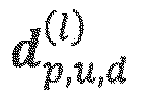 -
- -
- - P (l) est un facteur de normalisation scalaire destiné à garantir que la puissance de transmission totale moyenne sur toutes les couches de pré-codeur soit de 1.
 - Dispositif de communication selon l'une quelconque des revendication précédentes, dans lequel- le premier livre de codes (Ω 1) comprend une première matrice de livre de codes DFT sur-échantillonnée de grandeur N 1 N 2 × O 1,1 N 1 O 1,2 N 2 de laquelle sont sélectionnés les vecteurs
 - le deuxième livre de codes (Ω 2) comprend une deuxième matrice de livre de codes DFT sur-échantillonnée de grandeur S × SO 2 de laquelle sont sélectionnés les vecteurs de retard
 - le troisième livre de codes (Ω 3) comprend une troisième matrice de livre de codes DFT sur-échantillonnée de grandeur T × TO 3 de laquelle sont sélectionnés les vecteurs de fréquence de Doppler
- Dispositif de communication selon l'une quelconque des revendications précédentes, dans lequel le dispositif de communication est configuré pour recevoir les valeurs suivantes de l'émetteur à l'aide des paramètres de la couche de Commande de Ressources Radio (RRC) ou de la couche physique (L1):l es valeurs de S pour la configuration du livre de codes des composantes de retard (Ω 2), etl es paramètres N 1 , N 2 pour la configuration du premier livre de codes (Ω 1),
- Dispositif de communication selon l'une quelconque des revendications 1 à 4, dans lequel le dispositif de communication est configuré pour recevoir les valeurs suivantes de l'émetteur à l'aide des paramètres de la couche de Commande de Ressources Radio (RRC) ou de la couche physique (L1):- les valeurs de S et T pour la configuration des livres de code des composantes de retard et de fréquence de Doppler (Ω 2, Ω 3), et- les paramètres N 1 , N 2 et les facteurs de sur-échantillonnage O 1,1 et O 1,2 pour la configuration du premier livre de codes (Ω 1).
- Dispositif de communication selon l'une quelconque des revendications précédentes, dans lequel le processeur est configuré pour- prédire et rapporter une valeur de CQI pour un moment/un intervalle n + K, où n désigne le moment/l'intervalle actuel, et K désigne la différence de temps relative par rapport au moment/l'intervalle n actuel, et- utiliser les K valeurs de CQI prédites pour calculer les valeurs de CQI prédites différentielles en réduisant les K valeurs de CQI prédites par la valeur de CQI moyenne.
- Dispositif de communication selon l'une quelconque des revendications précédentes, dans lequel, au cas où la rétroaction de CSI comporte le PMI, le processeur est configuré pour rapporter au moins un PMI à deux composantes,- où le premier PMI indique les vecteurs sélectionnés

 - où le deuxième PMI indique les coefficients de combinaison de faisceau, du dispositif de communication à l'émetteur.
 - Dispositif de communication selon l'une quelconque des revendications précédentes, dans lequel, au cas où la rétroaction de CSI comporte le PMI, le processeur est configuré pour rapporter au moins un PMI à deux composantes,- où le premier PMI indique les vecteurs sélectionnés

 - où le deuxième PMI indique les coefficients de combinaison, du dispositif de communication à l'émetteur.
 - Dispositif de communication selon l'une quelconque des revendications précédentes, dans lequel, pour quantifier les coefficients de retard de Doppler complexes

 -
- -
- dans lequel chaque coefficient est représenté par sa partie réelle et sa partie imaginaire comme
 où
où

- Dispositif de communication selon l'une quelconque des revendications précédentes, dans lequel le dispositif de communication est configuré pour recevoir une configuration de ressources de CSI-RS comportant un paramètre de couche supérieure, indiquant une répétition dans le domaine temporel des signaux de référence de liaison vers le bas.
- Dispositif de communication selon l'une quelconque des revendications précédentes, dans lequel le premier livre de codes (Ω 1) représente un livre de codes de sélection d'orifice et chaque vecteur du premier livre de codes contient un seul 1 et des zéros ailleurs.
- Dispositif de communication selon l'une quelconque des revendications précédentes, dans lequel la matrice de pré-codeur à retard de Doppler ( W ) est basée sur un premier livre de codes pour les une ou plusieurs composantes de faisceau spatial du côté de l'émission et un deuxième livre de codes pour les une ou plusieurs composantes de retard de la matrice de pré-codeur à retard de Doppler.
- Emetteur dans un système de communication sans fil comportant un dispositif de communication, l'émetteur comprenant:un réseau d'antennes présentant une pluralité d'antennes pour une communication sans fil avec un ou plusieurs dispositifs de communication pour fournir une rétroaction d'information d'état de canal, CSI, à l'émetteur; etun pré-codeur connecté au réseau d'antennes, le pré-codeur étant destiné à appliquer un ensemble de poids de formation de faisceau à une ou plusieurs antennes du réseau d'antennes pour former, par le réseau d'antennes, un ou plusieurs faisceaux d'émission ou un ou plusieurs faisceaux de réception,un émetteur-récepteur configuré pour- transmettre, au dispositif de communication, des signaux de référence de liaison vers le bas selon une configuration de signaux de référence de liaison vers le bas comprenant un nombre d'orifices d'antenne de signaux de référence de liaison vers le bas et un paramètre indiquant une répétition dans le domaine temporel des signaux de référence de liaison vers le bas, et les signaux de liaison vers le bas comprenant la configuration des signaux de référence de liaison vers le bas; et- recevoir des signaux de liaison vers le haut comprenant une pluralité de rapports de CSI du dispositif de communication; etun processeur configuré pour:- extraire au moins deux identificateurs de matrice de pré-codeur de composantes de la pluralité de rapports de CSI; et- construire une matrice de pré-codeur à faisceau à retard de Doppler appliquée aux orifices d'antenne à l'aide d'une première composante et d'une deuxième composante du PMI, et déterminer les poids de formation de faisceau en réponse à la matrice de pré-codeur construite,dans lequel les rapports de CSI sont transmis par le dispositif de communication :- en estimant une CSI explicite à l'aide de mesures sur les signaux de référence vers le bas, les signaux de référence vers le bas étant fournis pendant un certain temps d'observation,- en sélectionnant, sur base d'une métrique de performance, une matrice de pré-codeur à retard de Doppler pour un pré-codeur composite à trois étages à faisceau à retard de Doppler, le pré-codeur à trois étages à faisceau à retard de Doppler étant basé sur un ou plusieurs livres de codes, les un ou plusieurs livres de codes comportant- une ou plusieurs composantes de faisceau spatial du côté de l'émission du pré-codeur composite à trois étages à faisceau à retard de Doppler,- une ou plusieurs composantes de retard du pré-codeur composite à trois étages à faisceau à retard de Doppler, et- une ou plusieurs composantes de fréquence de Doppler du pré-codeur composite à trois étages à faisceau à retard de Doppler,- en déterminant un indicateur de matrice de pré-codeur, PMI, à l'aide du pré-codeur composite à trois étages à faisceau à retard de Doppler par la matrice de pré-codeur à faisceau à retard de Doppler sélectionnée, et- en rapportant à l'émetteur la rétroaction de CSI comportant le PMI, où le PMI est utilisé pour indiquer la matrice de pré-codeur composite à trois étages à faisceau à retard de Doppler pour les orifices d'antenne configurés.
- Procédé pour fournir une rétroaction d'information d'état de canal, CSI, dans un système de communication sans fil, le procédé comprenant le fait de:recevoir, d'un émetteur, un signal radio à travers un canal MIMO, le signal radio comportant des signaux de référence de liaison vers le bas selon une configuration de signal de référence comprenant un nombre d'orifices d'antenne, et les signaux de liaison vers le bas comprenant la configuration de signal de référence; etestimer, au niveau du dispositif de communication, une CSI explicite à l'aide de mesures sur les signaux de référence vers le bas sur le canal radio, les signaux de référence vers le bas étant fournis pendant un certain temps d'observation,caractérisé par le fait desur base d'une métrique de performance, sélectionner, au niveau du dispositif de communication, une matrice de pré-codeur à retard de Doppler ( W ) pour un pré-codeur composite à trois étages à faisceau à retard de Doppler, le pré-codeur à trois étages à faisceau à retard de Doppler étant basé sur un ou plusieurs livres de codes, les un ou plusieurs livres de codes comportant∘ une ou plusieurs composantes de faisceau spatial du côté de l'émission du pré-codeur composite à trois étages à faisceau à retard de Doppler,∘ une ou plusieurs composantes de retard du pré-codeur composite à trois étages à faisceau à retard de Doppler, et∘ une ou plusieurs composantes de fréquence de Doppler du pré-codeur composite à trois étages à faisceau à retard de Doppler,déterminer, au niveau du dispositif de communication, un indicateur de matrice de pré-codeur, PMI, à l'aide du pré-codeur composite à trois étages à faisceau à retard de Doppler par la matrice de pré-codeur à faisceau à retard de Doppler sélectionnée ( W ), etrapporter du dispositif de communication à l'émetteur la rétroaction de CSI comportant le PMI, où le PMI est utilisé pour indiquer la matrice de pré-codeur composite à trois étages à faisceau à retard de Doppler pour les orifices d'antenne configurés.
- Procédé pour faire fonctionner un émetteur dans un système de communication sans fil comprenant un dispositif de communication, le procédé comprenant le fait de:transmettre, au dispositif de communication, des signaux de référence de liaison vers le bas selon une configuration de signaux de référence de liaison vers le bas comprenant un nombre d'orifices d'antenne de signaux de référence de liaison vers le bas et un paramètre indiquant une répétition dans le domaine temporel des signaux de référence de liaison vers le bas, et les signaux de liaison vers le bas comprenant la configuration des signaux de référence de liaison vers le bas;recevoir, au niveau de l'émetteur, une rétroaction des informations d'état de canal, CSI, du dispositif de communication comme une pluralité de rapports de CSI;utiliser un pré-codeur pour appliquer un ensemble de poids de formation de faisceau à une ou plusieurs antennes d'un réseau d'antennes de l'émetteur pour former, par le réseau d'antennes, un ou plusieurs faisceaux d'émission ou un ou plusieurs faisceaux de réception:- en extrayant au moins deux identificateurs de matrice de pré-codeur de composantes de la pluralité de rapports de CSI; et- en construisant une matrice de pré-codeur à faisceau à retard de Doppler appliquée aux orifices d'antenne à l'aide d'une première composante et d'une deuxième composante du PMI, et- en déterminant les poids de formation de faisceau en réponse à la matrice de pré-codeur construite,dans lequel les rapports de CSI sont transmis par le dispositif de communication :- en estimant une CSI explicite à l'aide de mesures sur les signaux de référence vers le bas, les signaux de référence vers le bas étant fournis pendant un certain temps d'observation,- en sélectionnant, sur base d'une métrique de performance, une matrice de pré-codeur à retard de Doppler pour un pré-codeur composite à trois étages à faisceau à retard de Doppler, le pré-codeur à trois étages à faisceau à retard de Doppler étant basé sur un ou plusieurs livres de codes, les un ou plusieurs livres de codes comportant- une ou plusieurs composantes de faisceau spatial du côté de l'émission du pré-codeur composite à trois étages à faisceau à retard de Doppler,- une ou plusieurs composantes de retard du pré-codeur composite à trois étages à faisceau à retard de Doppler, et- une ou plusieurs composantes de fréquence de Doppler du pré-codeur composite à trois étages à faisceau à retard de Doppler,- en déterminant un indicateur de matrice de pré-codeur, PMI, à l'aide du pré-codeur composite à trois étages à faisceau à retard de Doppler par la matrice de pré-codeur à faisceau à retard de Doppler sélectionnée, et- en rapportant à l'émetteur la rétroaction de CSI comportant le PMI, où le PMI est utilisé pour indiquer la matrice de pré-codeur composite à trois étages à faisceau à retard de Doppler pour les orifices d'antenne configurés.
- Produit de programme d'ordinateur non transitoire comprenant un support lisible par ordinateur mémorisant des instructions qui, lorsqu'elles sont exécutées sur un ordinateur, réalisent le procédé selon l'une quelconque des revendications 15 ou 16.
Priority Applications (1)
| Application Number | Priority Date | Filing Date | Title |
|---|---|---|---|
| EP23180567.2A EP4250583A3 (fr) | 2018-05-30 | 2019-05-29 | Précodage basé sur un livre de codes à retard doppler et rapport de csi pour systèmes de communication sans fil |
Applications Claiming Priority (2)
| Application Number | Priority Date | Filing Date | Title |
|---|---|---|---|
| EP18175247.8A EP3576312A1 (fr) | 2018-05-30 | 2018-05-30 | Précodage doppler-delay et feedback csi basés sur un livre de codes pour systèmes de communications sans fil |
| PCT/EP2019/064024 WO2019229152A1 (fr) | 2018-05-30 | 2019-05-29 | Précodage à base de livre de codes à retard doppler et rapport de csi pour systèmes de communication sans fil |
Related Child Applications (2)
| Application Number | Title | Priority Date | Filing Date |
|---|---|---|---|
| EP23180567.2A Division-Into EP4250583A3 (fr) | 2018-05-30 | 2019-05-29 | Précodage basé sur un livre de codes à retard doppler et rapport de csi pour systèmes de communication sans fil |
| EP23180567.2A Division EP4250583A3 (fr) | 2018-05-30 | 2019-05-29 | Précodage basé sur un livre de codes à retard doppler et rapport de csi pour systèmes de communication sans fil |
Publications (2)
| Publication Number | Publication Date |
|---|---|
| EP3804157A1 EP3804157A1 (fr) | 2021-04-14 |
| EP3804157B1 true EP3804157B1 (fr) | 2023-09-20 |
Family
ID=62492538
Family Applications (3)
| Application Number | Title | Priority Date | Filing Date |
|---|---|---|---|
| EP18175247.8A Withdrawn EP3576312A1 (fr) | 2018-05-30 | 2018-05-30 | Précodage doppler-delay et feedback csi basés sur un livre de codes pour systèmes de communications sans fil |
| EP19726446.8A Active EP3804157B1 (fr) | 2018-05-30 | 2019-05-29 | Précodage doppler-delay et feedback csi basés sur un livre de codes pour systèmes de communications sans fil |
| EP23180567.2A Pending EP4250583A3 (fr) | 2018-05-30 | 2019-05-29 | Précodage basé sur un livre de codes à retard doppler et rapport de csi pour systèmes de communication sans fil |
Family Applications Before (1)
| Application Number | Title | Priority Date | Filing Date |
|---|---|---|---|
| EP18175247.8A Withdrawn EP3576312A1 (fr) | 2018-05-30 | 2018-05-30 | Précodage doppler-delay et feedback csi basés sur un livre de codes pour systèmes de communications sans fil |
Family Applications After (1)
| Application Number | Title | Priority Date | Filing Date |
|---|---|---|---|
| EP23180567.2A Pending EP4250583A3 (fr) | 2018-05-30 | 2019-05-29 | Précodage basé sur un livre de codes à retard doppler et rapport de csi pour systèmes de communication sans fil |
Country Status (7)
| Country | Link |
|---|---|
| US (3) | US11616551B2 (fr) |
| EP (3) | EP3576312A1 (fr) |
| JP (1) | JP7246414B2 (fr) |
| KR (1) | KR102539873B1 (fr) |
| CN (1) | CN112514276B (fr) |
| ES (1) | ES2962518T3 (fr) |
| WO (1) | WO2019229152A1 (fr) |
Families Citing this family (80)
| Publication number | Priority date | Publication date | Assignee | Title |
|---|---|---|---|---|
| WO2018195548A1 (fr) * | 2017-04-21 | 2018-10-25 | Cohere Technologies | Techniques de communication utilisant des propriétés quasi-statiques de canaux sans fil |
| EP3576312A1 (fr) | 2018-05-30 | 2019-12-04 | FRAUNHOFER-GESELLSCHAFT zur Förderung der angewandten Forschung e.V. | Précodage doppler-delay et feedback csi basés sur un livre de codes pour systèmes de communications sans fil |
| US11870524B2 (en) * | 2018-09-05 | 2024-01-09 | Lg Electronics Inc. | Method for reporting channel state information in order for performing antenna array-based beamforming in wireless communication system, and device therefor |
| KR102607030B1 (ko) | 2018-09-11 | 2023-11-29 | 프라운 호퍼 게젤샤프트 쭈르 푀르데룽 데어 안겐반텐 포르슝 에. 베. | 무선 통신 시스템을 위한 도플러 코드북-기반 프리코딩 및 csi 보고 |
| CN113364503B (zh) * | 2019-02-26 | 2022-12-27 | Oppo广东移动通信有限公司 | 反馈码本的方法、终端设备和网络设备 |
| US11824637B2 (en) | 2019-05-22 | 2023-11-21 | At&T Intellectual Property I, L.P. | Generating wireless reference signals in a different domain for transmission |
| US10886991B2 (en) * | 2019-05-22 | 2021-01-05 | At&T Intellectual Property I, L.P. | Facilitating sparsity adaptive feedback in the delay doppler domain in advanced networks |
| US10979151B2 (en) * | 2019-05-22 | 2021-04-13 | At&T Intellectual Property I, L.P. | Multidimensional grid sampling for radio frequency power feedback |
| US11050530B2 (en) | 2019-06-27 | 2021-06-29 | At&T Intellectual Property I, L.P. | Generating wireless reference signals in a different domain for transmission with a collapsed time-frequency grid |
| WO2021033292A1 (fr) * | 2019-08-21 | 2021-02-25 | 日本電信電話株式会社 | Système de communication sans fil, procédé de communication sans fil, dispositif de station de transmission et dispositif de station de réception |
| US11601169B2 (en) * | 2019-09-09 | 2023-03-07 | Samsung Electronics Co., Ltd. | Method and apparatus for port selection in wireless communication systems |
| CN112751592B (zh) * | 2019-10-29 | 2021-11-19 | 华为技术有限公司 | 上报信道状态信息的方法和通信装置 |
| WO2021128026A1 (fr) * | 2019-12-24 | 2021-07-01 | 华为技术有限公司 | Procédé d'envoi d'informations, procédé de réception d'informations et appareil |
| WO2021134731A1 (fr) | 2019-12-31 | 2021-07-08 | 华为技术有限公司 | Procédé de rétroaction d'informations de canal et appareil de communication |
| US11337095B2 (en) * | 2020-01-03 | 2022-05-17 | Qualcomm Incorporated | Forward-looking channel state information prediction and reporting |
| CN113258974B (zh) | 2020-02-10 | 2022-12-30 | 大唐移动通信设备有限公司 | 信道状态信息反馈方法、装置、终端、网络侧和存储介质 |
| EP4115534A1 (fr) * | 2020-03-06 | 2023-01-11 | Nokia Technologies Oy | Amélioration du précodage |
| CN115298967B (zh) * | 2020-04-03 | 2025-08-15 | 瑞典爱立信有限公司 | 一种在与无线装置通信的网络节点的无线电设备中实现的方法以及无线电设备 |
| US11310021B2 (en) * | 2020-05-18 | 2022-04-19 | Qualcomm Incorporated | Uplink doppler metric estimation based on a downlink reference signal |
| US11483112B2 (en) | 2020-05-18 | 2022-10-25 | Qualcomm Incorporated | Uplink doppler metric estimation based on an uplink reference signal |
| CN113810318B (zh) * | 2020-06-17 | 2024-04-12 | 上海朗帛通信技术有限公司 | 一种被用于无线通信的用户设备、基站中的方法和装置 |
| EP4165893A1 (fr) * | 2020-06-10 | 2023-04-19 | Lenovo (Singapore) Pte. Ltd. | Gestion d'interférence prédictive basée sur un modèle |
| US11902002B2 (en) * | 2020-07-31 | 2024-02-13 | Qualcomm Incorporated | Beam measurement reporting |
| WO2022032424A1 (fr) * | 2020-08-10 | 2022-02-17 | Qualcomm Incorporated | Procédures pour un livre de codes de sélection de port à l'aide de signaux de référence précodés à sélectivité de fréquence |
| US12407379B2 (en) | 2020-09-11 | 2025-09-02 | Qualcomm Incorporated | Observed environmental vector feedback for wireless communication |
| US12088378B2 (en) * | 2020-09-18 | 2024-09-10 | Qualcomm Incorporated | Low overhead and high accuracy channel state feedback using neural networks |
| EP4211956A4 (fr) * | 2020-10-15 | 2023-11-15 | ZTE Corporation | Configuration de signaux de référence d'information d'état de canal pour des systèmes de communication sans fil |
| CN116325614B (zh) | 2020-10-16 | 2025-10-14 | 上海诺基亚贝尔股份有限公司 | 频域分量的指示 |
| US11483203B2 (en) | 2020-10-28 | 2022-10-25 | Charter Communications Operating, Llc | Methods and apparatus for enhancing scheduler fairness in small-cell wireless systems |
| US12273909B2 (en) | 2020-10-29 | 2025-04-08 | Charter Communications Operating, Llc | Methods and apparatus for data traffic prioritization in small-cell wireless systems |
| US11569931B2 (en) * | 2020-10-30 | 2023-01-31 | Charter Communications Operating, Llc | Methods and apparatus for enhancing wireless link throughput in small-cell wireless systems |
| US11563608B2 (en) | 2020-12-08 | 2023-01-24 | Electronics And Telecommunications Research Institute | Method and apparatus for signal modulation and demodulation in wireless communication system |
| US11576188B2 (en) * | 2020-12-17 | 2023-02-07 | T-Mobile Usa, Inc. | External interference radar |
| CN116762283A (zh) * | 2021-02-03 | 2023-09-15 | 华为技术有限公司 | 一种进行预编码的方法和装置 |
| CN115133965B (zh) * | 2021-03-24 | 2023-09-15 | 维沃移动通信有限公司 | 信息发送方法和设备 |
| US20220329303A1 (en) * | 2021-03-25 | 2022-10-13 | Samsung Electronics Co., Ltd. | Method and apparatus for configuring csi reporting granularity |
| CN115989641A (zh) * | 2021-05-07 | 2023-04-18 | 苹果公司 | 具有预补偿的多普勒频移估计报告 |
| US12267137B2 (en) * | 2021-05-11 | 2025-04-01 | Nokia Technologies Oy | Reporting channel state information (CSI) precoding matrix indicator (PMI) |
| CN115378767B (zh) * | 2021-05-21 | 2024-01-09 | 维沃移动通信有限公司 | 延迟多普勒域信道信息反馈方法、装置及电子设备 |
| US11832251B2 (en) | 2021-06-01 | 2023-11-28 | Nokia Technologies Oy | Apparatus for CSI prediction control |
| CN115442007A (zh) * | 2021-06-04 | 2022-12-06 | 维沃移动通信有限公司 | 一种信号传输方法、装置、设备及系统 |
| US11916633B2 (en) * | 2021-06-04 | 2024-02-27 | Qualcomm Incorporated | Non-codebook based precoding for sidelink communications |
| CN115483950A (zh) * | 2021-06-16 | 2022-12-16 | 华为技术有限公司 | 一种信道状态信息的反馈方法及装置 |
| US12418817B2 (en) | 2021-06-18 | 2025-09-16 | Samsung Electronics Co., Ltd. | Method and apparatus for CSI reporting |
| US11665541B2 (en) * | 2021-06-23 | 2023-05-30 | EMC IP Holding Company LLC | 5G zero client monitor |
| CN115550987B (zh) * | 2021-06-29 | 2025-11-07 | 北京紫光展锐通信技术有限公司 | 信道状态信息报告的优先级确定方法与装置、相关设备 |
| WO2023277482A1 (fr) * | 2021-07-01 | 2023-01-05 | 엘지전자 주식회사 | Procédé et dispositif pour transmettre et recevoir des informations d'état de canal sur la base d'un livre de codes dans un système de communication sans fil |
| CN116076027B (zh) * | 2021-09-03 | 2026-04-28 | 苹果公司 | 用于高多普勒情况的码本设计 |
| WO2023040618A1 (fr) * | 2021-09-15 | 2023-03-23 | Mediatek Singapore Pte. Ltd. | Procédé et appareil de rétroaction de csi pour mimo |
| CN116095739A (zh) * | 2021-10-29 | 2023-05-09 | 维沃移动通信有限公司 | 信道信息的上报方法、终端及网络侧设备 |
| EP4430761A1 (fr) * | 2021-11-09 | 2024-09-18 | Telefonaktiebolaget LM Ericsson (publ) | Procédé et systèmes pour améliorer la création d'un rapport de csi pour une prédiction de pmi de type ii |
| US20230163907A1 (en) * | 2021-11-23 | 2023-05-25 | Qualcomm Incorporated | Channel compression for channel feedback reporting |
| CN113949401B (zh) * | 2021-11-30 | 2022-12-09 | Oppo广东移动通信有限公司 | 射频系统及通信设备 |
| US20230180153A1 (en) * | 2021-12-03 | 2023-06-08 | Qualcomm Incorporated | Adaptive doppler feedback |
| US20230208493A1 (en) * | 2021-12-28 | 2023-06-29 | Samsung Electronics Co., Ltd. | Method and apparatus for reporting doppler information of time-varying channel in wireless communication systems |
| CN114586312B (zh) * | 2022-01-11 | 2025-02-11 | 北京小米移动软件有限公司 | 信息上报、信息接收方法、装置、设备及存储介质 |
| WO2023140581A1 (fr) * | 2022-01-19 | 2023-07-27 | 엘지전자 주식회사 | Procédé et dispositif d'émission/réception d'informations d'état de canal dans un système de communication sans fil |
| CN114448758B (zh) * | 2022-01-21 | 2024-07-16 | 华中科技大学 | Fdd大规模mimo系统中基于信道部分互易性的信道估计方法 |
| WO2023148704A1 (fr) * | 2022-02-07 | 2023-08-10 | Telefonaktiebolaget Lm Ericsson (Publ) | Réception de csi-ris pour une mobilité élevée |
| US20250055505A1 (en) * | 2022-02-17 | 2025-02-13 | Qualcomm Incorporated | Systems and methods utilizing doppler frequency values for wireless communication |
| CN114786240B (zh) * | 2022-03-02 | 2024-06-07 | 厦门大学 | 5g下行信号间断性跟踪方法 |
| KR102731200B1 (ko) * | 2022-03-11 | 2024-11-18 | 전북대학교산학협력단 | 차세대 이동 통신 시스템의 무선통신 다중접속 구역에서의 타임 오프셋 비 직교 다중 액세스 방법 |
| US12580712B2 (en) * | 2022-03-30 | 2026-03-17 | Samsung Electronics Co., Ltd. | Method and apparatus for configuring semi-persistent CSI-RS resources |
| WO2023184469A1 (fr) * | 2022-04-01 | 2023-10-05 | Qualcomm Incorporated | Configuration de précodage de domaine temporel pour communications sans fil |
| CN116961856A (zh) * | 2022-04-25 | 2023-10-27 | 展讯通信(上海)有限公司 | 一种数据处理方法、芯片和电子设备 |
| WO2023206171A1 (fr) * | 2022-04-27 | 2023-11-02 | 北京小米移动软件有限公司 | Procédé et appareil de rapport de csi, procédé et appareil de détermination de matrice de précodage, et dispositif |
| WO2023206170A1 (fr) * | 2022-04-27 | 2023-11-02 | 北京小米移动软件有限公司 | Procédé et appareil de rapport de csi, procédé et appareil de détermination de matrice de précodage, et dispositif |
| EP4515765A4 (fr) * | 2022-04-28 | 2025-06-18 | NEC Corporation | Procédés, dispositifs, et support lisible par ordinateur pour des communications |
| US20250330285A1 (en) * | 2022-06-08 | 2025-10-23 | Apple Inc. | Method and Procedure for AI based CSI Feedback with CSI Prediction |
| US20230403060A1 (en) * | 2022-06-10 | 2023-12-14 | Samsung Electronics Co., Ltd. | Method and apparatus for csi reference resource and reporting window |
| KR20250022866A (ko) * | 2022-06-30 | 2025-02-17 | 베이징 시아오미 모바일 소프트웨어 컴퍼니 리미티드 | 채널 상태 정보 피드백 방법 및 장치 |
| CN115913833B (zh) * | 2022-08-01 | 2025-08-15 | 华为技术有限公司 | 一种通信方法及装置 |
| WO2024026649A1 (fr) * | 2022-08-01 | 2024-02-08 | Nec Corporation | Procédés, dispositifs, et support de communication |
| CN115514436B (zh) * | 2022-08-05 | 2023-04-14 | 郑州大学 | 一种面向Massive MIMO LEO通信的星间链路信道预测方法 |
| US20240267766A1 (en) * | 2023-02-08 | 2024-08-08 | Qualcomm Incorporated | Techniques for channel quality information reporting |
| US20240323730A1 (en) * | 2023-03-22 | 2024-09-26 | Qualcomm Incorporated | Channel state feedback using sensing reference signals |
| WO2025025192A1 (fr) * | 2023-08-03 | 2025-02-06 | Google Llc | Livre de codes de combinaison de faisceaux pour forme d'onde basée sur un faible rapport de puissance crête/moyenne |
| WO2025065639A1 (fr) * | 2023-09-28 | 2025-04-03 | 富士通株式会社 | Procédé et appareil d'indication pour configuration de rapport d'informations d'état de canal |
| WO2025147996A1 (fr) * | 2024-01-12 | 2025-07-17 | Google Llc | Rétroaction d'informations d'état de canal multiple pour appariement à entrées multiples sorties multiples multi-utilisateurs |
| US20250251488A1 (en) * | 2024-02-07 | 2025-08-07 | Samsung Electronics Company, Ltd. | Precoding Design for Integrated Sensing and Communication Systems |
Family Cites Families (43)
| Publication number | Priority date | Publication date | Assignee | Title |
|---|---|---|---|---|
| US7702029B2 (en) | 2006-10-02 | 2010-04-20 | Freescale Semiconductor, Inc. | MIMO precoding enabling spatial multiplexing, power allocation and adaptive modulation and coding |
| US20110250919A1 (en) | 2010-04-13 | 2011-10-13 | Qualcomm Incorporated | Cqi estimation in a wireless communication network |
| CN104521155B (zh) | 2012-07-31 | 2018-11-30 | 三星电子株式会社 | 在无线通信系统中使用波束成形的通信方法和设备 |
| US8976884B2 (en) | 2012-12-20 | 2015-03-10 | Google Technology Holdings LLC | Method and apparatus for antenna array channel feedback |
| US8942302B2 (en) * | 2012-12-20 | 2015-01-27 | Google Technology Holdings LLC | Method and apparatus for antenna array channel feedback |
| WO2014168323A1 (fr) | 2013-04-10 | 2014-10-16 | Lg Electronics Inc. | Procédé et appareil d'alignement de couches pour formation de faisceaux tridimensionnelle multi-couches dans un système de communication sans fil |
| US9853704B2 (en) | 2013-05-07 | 2017-12-26 | Lg Electronics Inc. | Method for reporting channel state information for three dimensional beamforming in wireless communication system and apparatus for same |
| KR102168637B1 (ko) | 2013-12-03 | 2020-10-21 | 주식회사 아이티엘 | 다중 안테나 시스템에서 csi 피드백 방법 및 장치 |
| US10050756B2 (en) | 2014-04-09 | 2018-08-14 | Lg Electronics Inc. | Method for tranceiving signal in wireless communication system and apparatus therefor |
| CN106464319B (zh) | 2014-05-15 | 2019-09-24 | Lg电子株式会社 | 在无线通信系统中针对3d mimo计算反馈信息的方法和设备 |
| WO2016022064A2 (fr) | 2014-08-07 | 2016-02-11 | Telefonaktiebolaget L M Ericsson (Publ) | Alignement d'écarts de mesurage et de signaux de découverte |
| JP2016063497A (ja) | 2014-09-19 | 2016-04-25 | 日本電気株式会社 | 無線端末装置並びにその制御方法及びプログラム |
| US9825742B2 (en) | 2014-10-03 | 2017-11-21 | Samsung Electronics Co., Ltd. | Codebook design and structure for advanced wireless communication systems |
| KR102398220B1 (ko) | 2014-10-31 | 2022-05-16 | 삼성전자주식회사 | 개선된 무선 통신 시스템을 위한 코드북 디자인 및 구조 |
| EP3235154B1 (fr) | 2014-12-16 | 2018-12-05 | Telefonaktiebolaget LM Ericsson (publ) | Procédés et agencements pour une prédiction d'informations d'état de canal (csi) |
| WO2016122387A1 (fr) | 2015-01-29 | 2016-08-04 | Telefonaktiebolaget Lm Ericsson (Publ) | Rétroaction d'état de canal pour une liaison sans fil comprenant des canaux à relaxation de phase |
| EP3327944A4 (fr) | 2015-07-23 | 2019-03-20 | LG Electronics Inc. | Procédé d'émission et de réception d'un signal basé sur un livre de codes dans un système de communication sans fil à antennes multiples et appareil associé |
| WO2017014612A1 (fr) | 2015-07-23 | 2017-01-26 | 엘지전자(주) | Procédé de transmission/réception de signal basé sur un livre de codes dans un système de communications sans fil multi-antenne, et dispositif associé |
| CN108605238A (zh) | 2016-02-04 | 2018-09-28 | 株式会社Ntt都科摩 | 基站、用户装置、功率比应用方法及信道状态信息发送方法 |
| CN107181509A (zh) | 2016-03-11 | 2017-09-19 | 电信科学技术研究院 | 一种数据传输方法和装置 |
| CN109075889B (zh) | 2016-03-16 | 2021-06-22 | 华为技术有限公司 | 信号传输方法和装置 |
| US10056956B2 (en) | 2016-03-24 | 2018-08-21 | Samsung Electronics Co., Ltd. | Precoder codebook for CSI reporting in advanced wireless communication systems |
| WO2017168349A1 (fr) | 2016-03-31 | 2017-10-05 | Telefonaktiebolaget Lm Ericsson (Publ) | Procédés et dispositifs pour déterminer des paramètres de précodeur dans un réseau de communication sans fil |
| CN110034797B (zh) | 2016-04-01 | 2020-06-26 | 华为技术有限公司 | 一种预编码矩阵指示的反馈方法及装置 |
| US10659118B2 (en) | 2016-04-19 | 2020-05-19 | Samsung Electronics Co., Ltd. | Method and apparatus for explicit CSI reporting in advanced wireless communication systems |
| WO2018045028A1 (fr) * | 2016-08-31 | 2018-03-08 | Intel Corporation | Techniques d'estimation de canal et d'affinement de faisceau basées sur un csi (informations d'état de canal)-rs (signal de référence) |
| US10103798B2 (en) | 2016-09-14 | 2018-10-16 | Samsung Electronics Co., Ltd. | Method and apparatus to enable channel compression in advanced wireless communication systems |
| JP2020500449A (ja) * | 2016-09-30 | 2020-01-09 | テレフオンアクチーボラゲット エルエム エリクソン(パブル) | 無線デバイス、ネットワークノード、およびそこにおいて実行される方法 |
| US10440693B2 (en) | 2016-11-04 | 2019-10-08 | At&T Intellectual Property I, L.P. | Asynchronous multi-point transmission schemes |
| CN115174318B (zh) * | 2016-11-22 | 2024-02-06 | 三星电子株式会社 | 无线通信系统中的终端和基站及其方法 |
| KR102338306B1 (ko) | 2017-03-23 | 2021-12-10 | 엘지전자 주식회사 | 무선 통신 시스템에서 채널 상태 정보 송수신 방법 및 이를 위한 장치 |
| JP6423475B2 (ja) | 2017-03-30 | 2018-11-14 | 華為技術有限公司Huawei Technologies Co.,Ltd. | プリコーディング行列インジケータを決定するための方法および装置、ユーザ機器、ならびに基地局 |
| WO2018227614A1 (fr) | 2017-06-16 | 2018-12-20 | Qualcomm Incorporated | Rétroaction d'informations d'état de canal pour signalisation de commande de liaison montante flexible |
| CN109152054A (zh) | 2017-06-16 | 2019-01-04 | 华硕电脑股份有限公司 | 无线通信系统中用于非授权频谱的波束管理的方法和设备 |
| ES2790275T3 (es) | 2017-09-20 | 2020-10-27 | Asustek Comp Inc | Procedimiento y aparato para la detección de haces en un sistema de comunicaciones inalámbricas |
| US10505646B2 (en) | 2017-12-15 | 2019-12-10 | Keysight Technologies, Inc. | Systems and methods for testing a wireless device having a beamforming circuit |
| WO2019122972A1 (fr) | 2017-12-20 | 2019-06-27 | Telefonaktiebolaget Lm Ericsson (Publ) | Procédé et nœud de réseau permettant de générer et de sélectionner un livre de codes dans un réseau de communication mimo |
| CN110446269B (zh) | 2018-05-04 | 2022-12-06 | 华硕电脑股份有限公司 | 无线通信系统中下行链路控制信息内容处理的方法和设备 |
| CN112106400A (zh) | 2018-05-17 | 2020-12-18 | 瑞典爱立信有限公司 | 无线电接入网络的测量报告 |
| EP3576312A1 (fr) | 2018-05-30 | 2019-12-04 | FRAUNHOFER-GESELLSCHAFT zur Förderung der angewandten Forschung e.V. | Précodage doppler-delay et feedback csi basés sur un livre de codes pour systèmes de communications sans fil |
| CN111083942B (zh) | 2018-08-22 | 2022-04-01 | Lg 电子株式会社 | 无线通信系统中执行上行链路传输的方法及装置 |
| KR102607030B1 (ko) | 2018-09-11 | 2023-11-29 | 프라운 호퍼 게젤샤프트 쭈르 푀르데룽 데어 안겐반텐 포르슝 에. 베. | 무선 통신 시스템을 위한 도플러 코드북-기반 프리코딩 및 csi 보고 |
| US12191943B2 (en) | 2018-11-02 | 2025-01-07 | Lg Electronics Inc. | Method for reporting channel state information in wireless communication system, and device for same |
-
2018
- 2018-05-30 EP EP18175247.8A patent/EP3576312A1/fr not_active Withdrawn
-
2019
- 2019-05-29 EP EP19726446.8A patent/EP3804157B1/fr active Active
- 2019-05-29 ES ES19726446T patent/ES2962518T3/es active Active
- 2019-05-29 CN CN201980050859.4A patent/CN112514276B/zh active Active
- 2019-05-29 JP JP2020567013A patent/JP7246414B2/ja active Active
- 2019-05-29 EP EP23180567.2A patent/EP4250583A3/fr active Pending
- 2019-05-29 WO PCT/EP2019/064024 patent/WO2019229152A1/fr not_active Ceased
- 2019-05-29 KR KR1020207037939A patent/KR102539873B1/ko active Active
-
2020
- 2020-11-16 US US17/098,592 patent/US11616551B2/en active Active
-
2023
- 2023-02-21 US US18/171,777 patent/US12047148B2/en active Active
-
2024
- 2024-06-10 US US18/738,590 patent/US12494827B2/en active Active
Also Published As
| Publication number | Publication date |
|---|---|
| US12494827B2 (en) | 2025-12-09 |
| KR102539873B1 (ko) | 2023-06-05 |
| US12047148B2 (en) | 2024-07-23 |
| US11616551B2 (en) | 2023-03-28 |
| CN112514276A (zh) | 2021-03-16 |
| EP3804157A1 (fr) | 2021-04-14 |
| EP3576312A1 (fr) | 2019-12-04 |
| JP2021525988A (ja) | 2021-09-27 |
| CN112514276B (zh) | 2023-09-22 |
| EP4250583A2 (fr) | 2023-09-27 |
| US20210143885A1 (en) | 2021-05-13 |
| WO2019229152A1 (fr) | 2019-12-05 |
| ES2962518T3 (es) | 2024-03-19 |
| EP4250583A3 (fr) | 2023-12-06 |
| US20230208494A1 (en) | 2023-06-29 |
| JP7246414B2 (ja) | 2023-03-27 |
| US20240340062A1 (en) | 2024-10-10 |
| KR20210014698A (ko) | 2021-02-09 |
Similar Documents
| Publication | Publication Date | Title |
|---|---|---|
| US12494827B2 (en) | Doppler-delay codebook-based precoding and CSI reporting for wireless communications systems | |
| US12355517B2 (en) | Doppler codebook-based precoding and CSI reporting for wireless communications systems | |
| US11595089B2 (en) | CSI reporting and codebook structure for doppler-delay codebook-based precoding in a wireless communications system | |
| US20240154672A1 (en) | Explicit channel information feedback based on high-order pca decomposition or pca composition | |
| EP3780410A1 (fr) | Rapport csi et structure de livre de codes pour un précodage à base de livre de codes doppler dans un système de communication sans fil | |
| US20220385344A1 (en) | Csi reporting based on linear combination port-selection codebook | |
| EP3780411A1 (fr) | Indication de matrice de précodeur et structure de livre de codes pour un précodage de canaux mimo sélectifs en fréquence | |
| EP3855635A1 (fr) | Rapports csi basés sur un livre de codes de sélection de ports de combinaison linéaire | |
| US20260128769A1 (en) | Doppler-delay codebook-based precoding and csi reporting for wireless communications systems | |
| HK40042070A (en) | Communication device and method for providing csi feedback, transmitter and method for transmitting, and medium | |
| HK40042070B (zh) | 提供csi反馈的通信设备和方法、发送器和进行发送的方法及介质 |
Legal Events
| Date | Code | Title | Description |
|---|---|---|---|
| STAA | Information on the status of an ep patent application or granted ep patent |
Free format text: STATUS: UNKNOWN |
|
| STAA | Information on the status of an ep patent application or granted ep patent |
Free format text: STATUS: THE INTERNATIONAL PUBLICATION HAS BEEN MADE |
|
| PUAI | Public reference made under article 153(3) epc to a published international application that has entered the european phase |
Free format text: ORIGINAL CODE: 0009012 |
|
| STAA | Information on the status of an ep patent application or granted ep patent |
Free format text: STATUS: REQUEST FOR EXAMINATION WAS MADE |
|
| 17P | Request for examination filed |
Effective date: 20201113 |
|
| AK | Designated contracting states |
Kind code of ref document: A1 Designated state(s): AL AT BE BG CH CY CZ DE DK EE ES FI FR GB GR HR HU IE IS IT LI LT LU LV MC MK MT NL NO PL PT RO RS SE SI SK SM TR |
|
| AX | Request for extension of the european patent |
Extension state: BA ME |
|
| DAV | Request for validation of the european patent (deleted) | ||
| DAX | Request for extension of the european patent (deleted) | ||
| RAP3 | Party data changed (applicant data changed or rights of an application transferred) |
Owner name: FRAUNHOFER-GESELLSCHAFT ZUR FOERDERUNG DER ANGEWANDTEN FORSCHUNG E.V. |
|
| STAA | Information on the status of an ep patent application or granted ep patent |
Free format text: STATUS: EXAMINATION IS IN PROGRESS |
|
| 17Q | First examination report despatched |
Effective date: 20221215 |
|
| GRAP | Despatch of communication of intention to grant a patent |
Free format text: ORIGINAL CODE: EPIDOSNIGR1 |
|
| STAA | Information on the status of an ep patent application or granted ep patent |
Free format text: STATUS: GRANT OF PATENT IS INTENDED |
|
| INTG | Intention to grant announced |
Effective date: 20230405 |
|
| GRAS | Grant fee paid |
Free format text: ORIGINAL CODE: EPIDOSNIGR3 |
|
| GRAA | (expected) grant |
Free format text: ORIGINAL CODE: 0009210 |
|
| STAA | Information on the status of an ep patent application or granted ep patent |
Free format text: STATUS: THE PATENT HAS BEEN GRANTED |
|
| AK | Designated contracting states |
Kind code of ref document: B1 Designated state(s): AL AT BE BG CH CY CZ DE DK EE ES FI FR GB GR HR HU IE IS IT LI LT LU LV MC MK MT NL NO PL PT RO RS SE SI SK SM TR |
|
| P01 | Opt-out of the competence of the unified patent court (upc) registered |
Effective date: 20230810 |
|
| REG | Reference to a national code |
Ref country code: GB Ref legal event code: FG4D |
|
| REG | Reference to a national code |
Ref country code: CH Ref legal event code: EP |
|
| REG | Reference to a national code |
Ref country code: IE Ref legal event code: FG4D |
|
| REG | Reference to a national code |
Ref country code: DE Ref legal event code: R096 Ref document number: 602019037804 Country of ref document: DE |
|
| REG | Reference to a national code |
Ref country code: NL Ref legal event code: FP |
|
| REG | Reference to a national code |
Ref country code: LT Ref legal event code: MG9D |
|
| PG25 | Lapsed in a contracting state [announced via postgrant information from national office to epo] |
Ref country code: GR Free format text: LAPSE BECAUSE OF FAILURE TO SUBMIT A TRANSLATION OF THE DESCRIPTION OR TO PAY THE FEE WITHIN THE PRESCRIBED TIME-LIMIT Effective date: 20231221 |
|
| PG25 | Lapsed in a contracting state [announced via postgrant information from national office to epo] |
Ref country code: SE Free format text: LAPSE BECAUSE OF FAILURE TO SUBMIT A TRANSLATION OF THE DESCRIPTION OR TO PAY THE FEE WITHIN THE PRESCRIBED TIME-LIMIT Effective date: 20230920 Ref country code: RS Free format text: LAPSE BECAUSE OF FAILURE TO SUBMIT A TRANSLATION OF THE DESCRIPTION OR TO PAY THE FEE WITHIN THE PRESCRIBED TIME-LIMIT Effective date: 20230920 Ref country code: NO Free format text: LAPSE BECAUSE OF FAILURE TO SUBMIT A TRANSLATION OF THE DESCRIPTION OR TO PAY THE FEE WITHIN THE PRESCRIBED TIME-LIMIT Effective date: 20231220 Ref country code: LV Free format text: LAPSE BECAUSE OF FAILURE TO SUBMIT A TRANSLATION OF THE DESCRIPTION OR TO PAY THE FEE WITHIN THE PRESCRIBED TIME-LIMIT Effective date: 20230920 Ref country code: LT Free format text: LAPSE BECAUSE OF FAILURE TO SUBMIT A TRANSLATION OF THE DESCRIPTION OR TO PAY THE FEE WITHIN THE PRESCRIBED TIME-LIMIT Effective date: 20230920 Ref country code: HR Free format text: LAPSE BECAUSE OF FAILURE TO SUBMIT A TRANSLATION OF THE DESCRIPTION OR TO PAY THE FEE WITHIN THE PRESCRIBED TIME-LIMIT Effective date: 20230920 Ref country code: GR Free format text: LAPSE BECAUSE OF FAILURE TO SUBMIT A TRANSLATION OF THE DESCRIPTION OR TO PAY THE FEE WITHIN THE PRESCRIBED TIME-LIMIT Effective date: 20231221 Ref country code: FI Free format text: LAPSE BECAUSE OF FAILURE TO SUBMIT A TRANSLATION OF THE DESCRIPTION OR TO PAY THE FEE WITHIN THE PRESCRIBED TIME-LIMIT Effective date: 20230920 |
|
| REG | Reference to a national code |
Ref country code: AT Ref legal event code: MK05 Ref document number: 1614207 Country of ref document: AT Kind code of ref document: T Effective date: 20230920 |
|
| REG | Reference to a national code |
Ref country code: ES Ref legal event code: FG2A Ref document number: 2962518 Country of ref document: ES Kind code of ref document: T3 Effective date: 20240319 |
|
| PG25 | Lapsed in a contracting state [announced via postgrant information from national office to epo] |
Ref country code: IS Free format text: LAPSE BECAUSE OF FAILURE TO SUBMIT A TRANSLATION OF THE DESCRIPTION OR TO PAY THE FEE WITHIN THE PRESCRIBED TIME-LIMIT Effective date: 20240120 |
|
| PG25 | Lapsed in a contracting state [announced via postgrant information from national office to epo] |
Ref country code: AT Free format text: LAPSE BECAUSE OF FAILURE TO SUBMIT A TRANSLATION OF THE DESCRIPTION OR TO PAY THE FEE WITHIN THE PRESCRIBED TIME-LIMIT Effective date: 20230920 |
|
| PG25 | Lapsed in a contracting state [announced via postgrant information from national office to epo] |
Ref country code: SM Free format text: LAPSE BECAUSE OF FAILURE TO SUBMIT A TRANSLATION OF THE DESCRIPTION OR TO PAY THE FEE WITHIN THE PRESCRIBED TIME-LIMIT Effective date: 20230920 Ref country code: RO Free format text: LAPSE BECAUSE OF FAILURE TO SUBMIT A TRANSLATION OF THE DESCRIPTION OR TO PAY THE FEE WITHIN THE PRESCRIBED TIME-LIMIT Effective date: 20230920 Ref country code: IS Free format text: LAPSE BECAUSE OF FAILURE TO SUBMIT A TRANSLATION OF THE DESCRIPTION OR TO PAY THE FEE WITHIN THE PRESCRIBED TIME-LIMIT Effective date: 20240120 Ref country code: EE Free format text: LAPSE BECAUSE OF FAILURE TO SUBMIT A TRANSLATION OF THE DESCRIPTION OR TO PAY THE FEE WITHIN THE PRESCRIBED TIME-LIMIT Effective date: 20230920 Ref country code: CZ Free format text: LAPSE BECAUSE OF FAILURE TO SUBMIT A TRANSLATION OF THE DESCRIPTION OR TO PAY THE FEE WITHIN THE PRESCRIBED TIME-LIMIT Effective date: 20230920 Ref country code: AT Free format text: LAPSE BECAUSE OF FAILURE TO SUBMIT A TRANSLATION OF THE DESCRIPTION OR TO PAY THE FEE WITHIN THE PRESCRIBED TIME-LIMIT Effective date: 20230920 Ref country code: PT Free format text: LAPSE BECAUSE OF FAILURE TO SUBMIT A TRANSLATION OF THE DESCRIPTION OR TO PAY THE FEE WITHIN THE PRESCRIBED TIME-LIMIT Effective date: 20240122 Ref country code: SK Free format text: LAPSE BECAUSE OF FAILURE TO SUBMIT A TRANSLATION OF THE DESCRIPTION OR TO PAY THE FEE WITHIN THE PRESCRIBED TIME-LIMIT Effective date: 20230920 |
|
| PG25 | Lapsed in a contracting state [announced via postgrant information from national office to epo] |
Ref country code: PL Free format text: LAPSE BECAUSE OF FAILURE TO SUBMIT A TRANSLATION OF THE DESCRIPTION OR TO PAY THE FEE WITHIN THE PRESCRIBED TIME-LIMIT Effective date: 20230920 |
|
| REG | Reference to a national code |
Ref country code: DE Ref legal event code: R097 Ref document number: 602019037804 Country of ref document: DE |
|
| PG25 | Lapsed in a contracting state [announced via postgrant information from national office to epo] |
Ref country code: DK Free format text: LAPSE BECAUSE OF FAILURE TO SUBMIT A TRANSLATION OF THE DESCRIPTION OR TO PAY THE FEE WITHIN THE PRESCRIBED TIME-LIMIT Effective date: 20230920 |
|
| PLBE | No opposition filed within time limit |
Free format text: ORIGINAL CODE: 0009261 |
|
| STAA | Information on the status of an ep patent application or granted ep patent |
Free format text: STATUS: NO OPPOSITION FILED WITHIN TIME LIMIT |
|
| PG25 | Lapsed in a contracting state [announced via postgrant information from national office to epo] |
Ref country code: DK Free format text: LAPSE BECAUSE OF FAILURE TO SUBMIT A TRANSLATION OF THE DESCRIPTION OR TO PAY THE FEE WITHIN THE PRESCRIBED TIME-LIMIT Effective date: 20230920 |
|
| 26N | No opposition filed |
Effective date: 20240621 |
|
| PG25 | Lapsed in a contracting state [announced via postgrant information from national office to epo] |
Ref country code: SI Free format text: LAPSE BECAUSE OF FAILURE TO SUBMIT A TRANSLATION OF THE DESCRIPTION OR TO PAY THE FEE WITHIN THE PRESCRIBED TIME-LIMIT Effective date: 20230920 |
|
| PG25 | Lapsed in a contracting state [announced via postgrant information from national office to epo] |
Ref country code: SI Free format text: LAPSE BECAUSE OF FAILURE TO SUBMIT A TRANSLATION OF THE DESCRIPTION OR TO PAY THE FEE WITHIN THE PRESCRIBED TIME-LIMIT Effective date: 20230920 |
|
| PG25 | Lapsed in a contracting state [announced via postgrant information from national office to epo] |
Ref country code: BG Free format text: LAPSE BECAUSE OF FAILURE TO SUBMIT A TRANSLATION OF THE DESCRIPTION OR TO PAY THE FEE WITHIN THE PRESCRIBED TIME-LIMIT Effective date: 20230920 |
|
| PG25 | Lapsed in a contracting state [announced via postgrant information from national office to epo] |
Ref country code: BG Free format text: LAPSE BECAUSE OF FAILURE TO SUBMIT A TRANSLATION OF THE DESCRIPTION OR TO PAY THE FEE WITHIN THE PRESCRIBED TIME-LIMIT Effective date: 20230920 |
|
| REG | Reference to a national code |
Ref country code: CH Ref legal event code: PL |
|
| PG25 | Lapsed in a contracting state [announced via postgrant information from national office to epo] |
Ref country code: MC Free format text: LAPSE BECAUSE OF FAILURE TO SUBMIT A TRANSLATION OF THE DESCRIPTION OR TO PAY THE FEE WITHIN THE PRESCRIBED TIME-LIMIT Effective date: 20230920 |
|
| PG25 | Lapsed in a contracting state [announced via postgrant information from national office to epo] |
Ref country code: LU Free format text: LAPSE BECAUSE OF NON-PAYMENT OF DUE FEES Effective date: 20240529 |
|
| PG25 | Lapsed in a contracting state [announced via postgrant information from national office to epo] |
Ref country code: MC Free format text: LAPSE BECAUSE OF FAILURE TO SUBMIT A TRANSLATION OF THE DESCRIPTION OR TO PAY THE FEE WITHIN THE PRESCRIBED TIME-LIMIT Effective date: 20230920 Ref country code: LU Free format text: LAPSE BECAUSE OF NON-PAYMENT OF DUE FEES Effective date: 20240529 Ref country code: CH Free format text: LAPSE BECAUSE OF NON-PAYMENT OF DUE FEES Effective date: 20240531 |
|
| REG | Reference to a national code |
Ref country code: BE Ref legal event code: MM Effective date: 20240531 |
|
| PG25 | Lapsed in a contracting state [announced via postgrant information from national office to epo] |
Ref country code: IE Free format text: LAPSE BECAUSE OF NON-PAYMENT OF DUE FEES Effective date: 20240529 |
|
| PG25 | Lapsed in a contracting state [announced via postgrant information from national office to epo] |
Ref country code: BE Free format text: LAPSE BECAUSE OF NON-PAYMENT OF DUE FEES Effective date: 20240531 |
|
| PGFP | Annual fee paid to national office [announced via postgrant information from national office to epo] |
Ref country code: NL Payment date: 20250522 Year of fee payment: 7 |
|
| PGFP | Annual fee paid to national office [announced via postgrant information from national office to epo] |
Ref country code: DE Payment date: 20250519 Year of fee payment: 7 |
|
| PGFP | Annual fee paid to national office [announced via postgrant information from national office to epo] |
Ref country code: GB Payment date: 20250522 Year of fee payment: 7 Ref country code: ES Payment date: 20250616 Year of fee payment: 7 |
|
| PGFP | Annual fee paid to national office [announced via postgrant information from national office to epo] |
Ref country code: IT Payment date: 20250530 Year of fee payment: 7 |
|
| PGFP | Annual fee paid to national office [announced via postgrant information from national office to epo] |
Ref country code: FR Payment date: 20250523 Year of fee payment: 7 |
|
| PG25 | Lapsed in a contracting state [announced via postgrant information from national office to epo] |
Ref country code: CY Free format text: LAPSE BECAUSE OF FAILURE TO SUBMIT A TRANSLATION OF THE DESCRIPTION OR TO PAY THE FEE WITHIN THE PRESCRIBED TIME-LIMIT; INVALID AB INITIO Effective date: 20190529 |
|
| PG25 | Lapsed in a contracting state [announced via postgrant information from national office to epo] |
Ref country code: HU Free format text: LAPSE BECAUSE OF FAILURE TO SUBMIT A TRANSLATION OF THE DESCRIPTION OR TO PAY THE FEE WITHIN THE PRESCRIBED TIME-LIMIT; INVALID AB INITIO Effective date: 20190529 |