EP3806204B1 - Matériau actif d'électrode positive pour batterie secondaire à électrolyte non aqueux et batterie secondaire à électrolyte non aqueux - Google Patents
Matériau actif d'électrode positive pour batterie secondaire à électrolyte non aqueux et batterie secondaire à électrolyte non aqueux Download PDFInfo
- Publication number
- EP3806204B1 EP3806204B1 EP19810995.1A EP19810995A EP3806204B1 EP 3806204 B1 EP3806204 B1 EP 3806204B1 EP 19810995 A EP19810995 A EP 19810995A EP 3806204 B1 EP3806204 B1 EP 3806204B1
- Authority
- EP
- European Patent Office
- Prior art keywords
- positive electrode
- lithium
- active material
- electrode active
- tungsten
- Prior art date
- Legal status (The legal status is an assumption and is not a legal conclusion. Google has not performed a legal analysis and makes no representation as to the accuracy of the status listed.)
- Active
Links
Images

Classifications
-
- H—ELECTRICITY
- H01—ELECTRIC ELEMENTS
- H01M—PROCESSES OR MEANS, e.g. BATTERIES, FOR THE DIRECT CONVERSION OF CHEMICAL ENERGY INTO ELECTRICAL ENERGY
- H01M4/00—Electrodes
- H01M4/02—Electrodes composed of, or comprising, active material
- H01M4/36—Selection of substances as active materials, active masses, active liquids
- H01M4/48—Selection of substances as active materials, active masses, active liquids of inorganic oxides or hydroxides
- H01M4/52—Selection of substances as active materials, active masses, active liquids of inorganic oxides or hydroxides of nickel, cobalt or iron
- H01M4/525—Selection of substances as active materials, active masses, active liquids of inorganic oxides or hydroxides of nickel, cobalt or iron of mixed oxides or hydroxides containing iron, cobalt or nickel for inserting or intercalating light metals, e.g. LiNiO2, LiCoO2 or LiCoOxFy
-
- H—ELECTRICITY
- H01—ELECTRIC ELEMENTS
- H01M—PROCESSES OR MEANS, e.g. BATTERIES, FOR THE DIRECT CONVERSION OF CHEMICAL ENERGY INTO ELECTRICAL ENERGY
- H01M10/00—Secondary cells; Manufacture thereof
- H01M10/42—Methods or arrangements for servicing or maintenance of secondary cells or secondary half-cells
- H01M10/4235—Safety or regulating additives or arrangements in electrodes, separators or electrolyte
-
- H—ELECTRICITY
- H01—ELECTRIC ELEMENTS
- H01M—PROCESSES OR MEANS, e.g. BATTERIES, FOR THE DIRECT CONVERSION OF CHEMICAL ENERGY INTO ELECTRICAL ENERGY
- H01M4/00—Electrodes
- H01M4/02—Electrodes composed of, or comprising, active material
- H01M4/36—Selection of substances as active materials, active masses, active liquids
- H01M4/362—Composites
- H01M4/366—Composites as layered products
-
- H—ELECTRICITY
- H01—ELECTRIC ELEMENTS
- H01M—PROCESSES OR MEANS, e.g. BATTERIES, FOR THE DIRECT CONVERSION OF CHEMICAL ENERGY INTO ELECTRICAL ENERGY
- H01M4/00—Electrodes
- H01M4/02—Electrodes composed of, or comprising, active material
- H01M4/36—Selection of substances as active materials, active masses, active liquids
- H01M4/48—Selection of substances as active materials, active masses, active liquids of inorganic oxides or hydroxides
- H01M4/50—Selection of substances as active materials, active masses, active liquids of inorganic oxides or hydroxides of manganese
- H01M4/505—Selection of substances as active materials, active masses, active liquids of inorganic oxides or hydroxides of manganese of mixed oxides or hydroxides containing manganese for inserting or intercalating light metals, e.g. LiMn2O4 or LiMn2OxFy
-
- H—ELECTRICITY
- H01—ELECTRIC ELEMENTS
- H01M—PROCESSES OR MEANS, e.g. BATTERIES, FOR THE DIRECT CONVERSION OF CHEMICAL ENERGY INTO ELECTRICAL ENERGY
- H01M4/00—Electrodes
- H01M4/02—Electrodes composed of, or comprising, active material
- H01M4/62—Selection of inactive substances as ingredients for active masses, e.g. binders, fillers
-
- H—ELECTRICITY
- H01—ELECTRIC ELEMENTS
- H01M—PROCESSES OR MEANS, e.g. BATTERIES, FOR THE DIRECT CONVERSION OF CHEMICAL ENERGY INTO ELECTRICAL ENERGY
- H01M10/00—Secondary cells; Manufacture thereof
- H01M10/05—Accumulators with non-aqueous electrolyte
- H01M10/052—Li-accumulators
-
- H—ELECTRICITY
- H01—ELECTRIC ELEMENTS
- H01M—PROCESSES OR MEANS, e.g. BATTERIES, FOR THE DIRECT CONVERSION OF CHEMICAL ENERGY INTO ELECTRICAL ENERGY
- H01M4/00—Electrodes
- H01M4/02—Electrodes composed of, or comprising, active material
- H01M2004/026—Electrodes composed of, or comprising, active material characterised by the polarity
- H01M2004/028—Positive electrodes
-
- H—ELECTRICITY
- H01—ELECTRIC ELEMENTS
- H01M—PROCESSES OR MEANS, e.g. BATTERIES, FOR THE DIRECT CONVERSION OF CHEMICAL ENERGY INTO ELECTRICAL ENERGY
- H01M4/00—Electrodes
- H01M4/02—Electrodes composed of, or comprising, active material
- H01M4/13—Electrodes for accumulators with non-aqueous electrolyte, e.g. for lithium-accumulators; Processes of manufacture thereof
- H01M4/139—Processes of manufacture
- H01M4/1391—Processes of manufacture of electrodes based on mixed oxides or hydroxides, or on mixtures of oxides or hydroxides, e.g. LiCoOx
-
- H—ELECTRICITY
- H01—ELECTRIC ELEMENTS
- H01M—PROCESSES OR MEANS, e.g. BATTERIES, FOR THE DIRECT CONVERSION OF CHEMICAL ENERGY INTO ELECTRICAL ENERGY
- H01M4/00—Electrodes
- H01M4/02—Electrodes composed of, or comprising, active material
- H01M4/36—Selection of substances as active materials, active masses, active liquids
- H01M4/58—Selection of substances as active materials, active masses, active liquids of inorganic compounds other than oxides or hydroxides, e.g. sulfides, selenides, tellurides, halogenides or LiCoFy; of polyanionic structures, e.g. phosphates, silicates or borates
-
- Y—GENERAL TAGGING OF NEW TECHNOLOGICAL DEVELOPMENTS; GENERAL TAGGING OF CROSS-SECTIONAL TECHNOLOGIES SPANNING OVER SEVERAL SECTIONS OF THE IPC; TECHNICAL SUBJECTS COVERED BY FORMER USPC CROSS-REFERENCE ART COLLECTIONS [XRACs] AND DIGESTS
- Y02—TECHNOLOGIES OR APPLICATIONS FOR MITIGATION OR ADAPTATION AGAINST CLIMATE CHANGE
- Y02E—REDUCTION OF GREENHOUSE GAS [GHG] EMISSIONS, RELATED TO ENERGY GENERATION, TRANSMISSION OR DISTRIBUTION
- Y02E60/00—Enabling technologies; Technologies with a potential or indirect contribution to GHG emissions mitigation
- Y02E60/10—Energy storage using batteries
Definitions
- the present invention relates to a positive electrode active material for a non-aqueous electrolyte secondary battery and a non-aqueous electrolyte secondary battery.
- Lithium ion secondary batteries have been proposed as secondary batteries that satisfy such requirements.
- a lithium ion secondary battery is configured by, for example, a negative electrode, a positive electrode and an electrolyte, or the like. Active materials of the negative electrode and the positive electrode are materials that can intercalate and deintercalate lithium ions.
- lithium ion secondary batteries are currently being extensively researched and developed.
- lithium ion secondary batteries that use layered or spinel-type lithium metal composite oxide as a positive electrode material are capable of obtaining high voltages of 4V class, and thus have being practically used in progress as batteries with high energy density.
- Examples of the positive electrode materials include a lithium-cobalt composite oxide (LiCoO 2 ) which is relatively easy to synthesize, a lithium-nickel composite oxide (LiNiO 2 ) which uses nickel that is less expensive than cobalt, a lithium-nickel-cobalt-manganese composite oxide (LiNi 1/3 Co 1/3 Mn 1/3 O 2 ), a lithium-manganese composite oxide (LiMn 2 O 4 ) which uses manganese, and the like.
- LiCoO 2 lithium-cobalt composite oxide
- LiNiO 2 lithium-nickel composite oxide
- LiMn 2 O 4 lithium-manganese composite oxide
- lithium-nickel composite oxides and lithium-nickel-cobalt-manganese composite oxides have attracted attention as positive electrode materials that can obtain high capacity.
- further improvement of performance is demanded, and in particular, improvement of the resistance to short-circuit that affects thermal runaway during short-circuit and reduction of resistance required for high output are strongly required.
- the positive electrode active material in the present embodiment contains a lithium-nickel composite oxide, and the lithium-nickel composite oxide preferably has a layered structure of hexagonal system. It is also preferable that the lithium-nickel composite oxide has primary particles and secondary particles, in which the secondary particles are formed by aggregation of the primary particles.
- the crystalline phase of the lithium tungstate coating in the positive electrode active material of the present embodiment is not particularly limited, but is preferably at least one selected from, for example, 7Li 2 WO 4 ⁇ 4H 2 O, Li 2 WO 4 , and Li 4 WO 5 .
- the above-described compound can be preferably used as the crystalline phase of lithium tungstate, which is the coating, so that the short-circuit resistance and output characteristics can be particularly enhanced.
- the lithium-nickel composite oxide subjected to the raw material mixture preparation process preferably has a layered structure of hexagonal system, and has primary particles and secondary particles, in which the secondary particles are formed by aggregation of primary particles.
- lithium compound is not particularly limited, for example, one or more kinds selected from lithium carbonate, lithium hydroxide, or the like may be used.
- the number of tungsten atoms with respect to the total number of atoms of nickel, cobalt, and element M contained in the lithium-nickel composite oxide is preferably 3.0% by atomic weight or less, so that the proportion of lithium-nickel composite oxide in the positive electrode active material can be sufficiently increased and the charge-discharge capacity can be increased.
- lithium is also eluted and supplied from a lithium-nickel composite oxide.
- an alkali containing lithium is used, and the ratio of Li/W in the alkaline solution containing tungsten is set to the above-described range.
- a particularly sufficient amount of lithium to form lithium tungstate can be supplied.
- the solvent is uniformly permeated throughout the particles of the lithium-nickel composite oxide in order to suppress unevenness in concentration and uniformly disperse the tungsten throughout the particles.
- a solvent such as a highly volatile alcohol
- the solvent may evaporate to prevent the tungsten from dispersing uniformly throughout the particles before the alkaline solution containing tungsten permeates the entire particle. Therefore, water is preferably used as the solvent, and the alkaline solution containing tungsten is preferably used as an aqueous solution.
- the pH of the alkaline solution containing tungsten may be any pH at which the tungsten compound dissolves.
- the pH is not particularly limited, but is preferably 8 to 12. This is because, by adjusting the pH of the alkaline solution containing tungsten to 8 or higher, the amount of lithium elution from the lithium-nickel composite oxide can be suppressed, and the battery characteristics can be improved.
- the amount of the alkaline solution containing tungsten with respect to 100 g of the lithium-nickel composite oxide is adjusted to 150 mL or less, the amount of the alkaline solution containing tungsten can be prevented from being excessively large, and the mixed solution can be prevented from becoming a slurry. Accordingly, an elution of lithium contained in a layered lattice of the lithium-nickel composite oxide can be prevented and battery characteristics are improved.
- the amount of alkaline solution containing tungsten with respect to 100 g of lithium-nickel composite oxide to 0.5 mL or more and 150 mL or less, the variation in the amount of tungsten in the raw material mixture due to solid-liquid separation can be suppressed, and the resulting positive electrode active material can be used as the desired composition.
- an elution of lithium contained in a layered lattice of the lithium-nickel composite oxide can be suppressed, and tungsten can be uniformly dispersed on the surface of the secondary particles of lithium-nickel composite oxide.
- the concentration of tungsten in the alkaline solution containing tungsten can be sufficiently high by adjusting the concentration to 0.3 mol/L or more, and it is possible to prevent the amount of the alkaline solution containing tungsten, to be mixed with the lithium-nickel composite oxide, from becoming excessively high, and an elution of lithium due to slurryfication described above can be suppressed.
- the concentration of tungsten in the alkaline solution containing tungsten to 2 mol/L or less, it is possible to prevent the amount of the alkaline solution containing tungsten, to be mixed with the lithium-nickel composite oxide, from becoming excessively low, and the tungsten can be uniformly dispersed on the surface of the secondary particles of the lithium-nickel composite oxide.
- an alkaline solution containing tungsten may be added to and mixed with a lithium-nickel compound oxide.
- the resulting mixture can be separated into solid and liquid.
- the method of solid-liquid separation is not particularly limited, and conventional methods can be adopted.
- One or more types of methods for example, a filter press, a centrifuge, a suction filter such as a Nutsche (a Buchner funnel), or the like, can be used for a solid-liquid separation.
- the water content of the raw material mixture which is a cake obtained after the solid-liquid separation, is preferably 5% or more and 15% or less based on mass ratio. If the water content is in the range described above, the alkaline solution containing tungsten can sufficiently permeate throughout the particle during drying, so that a tungsten coating film can be formed uniformly and at a high concentration on the surface of the secondary particles of lithium-nickel composite oxide. By reducing the water content to 15% or less, it is capable of suppressing the elution of excess lithium from the lithium-nickel composite oxide, thereby the battery capacity and output can be increased.
- the water content is 5% or more, a sufficient tungsten coating film is formed on the surface of the lithium-nickel composite oxide, and the short-circuits resistance can be particularly enhanced.
- the drying process is the process of drying the raw material mixture prepared in the preparation process of raw material mixture.
- a lithium tungstate is formed by tungsten obtained from the tungsten compound in the alkaline solution containing tungsten and lithium solved in the water content included in the raw material mixture. Then, a positive electrode active material having a compound containing tungsten and lithium, such as a lithium tungstate, on the surface of the secondary particles of the lithium-nickel composite oxide can be obtained.
- the drying method is not particularly limited, but it is preferable that drying is performed without vibration in order to concentrate the tungsten component on the surface of the secondary particles of the lithium-nickel composite oxide. This is because the tungsten component permeates into the particles of lithium-nickel composite oxide when drying while vibrating with a vibration dryer or the like, and the tungsten concentration on the surface of the secondary particles may be reduced.
- the drying is preferably performed by heat treatment under an oxygen atmosphere or a vacuum atmosphere at a temperature of 100°C to 250°C.
- drying temperature 250°C or less enables use of a compact dryer, and the drying temperature is suitable for use on an industrial scale.
- the atmosphere during drying is preferably a vacuum atmosphere or an oxidizing atmosphere such as an oxygen atmosphere in order to avoid the reaction between water content or carbonic acid in the atmosphere with the resulting positive electrode active material.
- the drying time is preferably 0.5 hours or more at the maximum reaching temperature during drying in order to sufficiently evaporate water content of the raw material mixture to form sufficient lithium tungstate on the surface of the secondary particles of the lithium-nickel composite oxide.
- drying time is preferably 48 hours or less from the viewpoint of productivity.
- the secondary battery in the present embodiment includes, for example, a positive electrode, a negative electrode, and a non-aqueous electrolyte, and is configured by the same components as a general lithium-ion secondary battery.
- a positive electrode for example
- a negative electrode for example
- a non-aqueous electrolyte for example
- the non-aqueous electrolyte secondary battery of the present embodiment can be implemented in various modified and improved forms based on the knowledge of a person skilled in the art, including the following embodiments.
- the secondary battery is not particularly limited with respect to uses thereof.
- the positive electrode of the secondary battery in the present embodiment can include the positive electrode active material described above.
- the aforementioned positive electrode active material (in powder form), a conductive material, and a binding agent (binder) can be mixed to form a positive electrode mixture.
- a binding agent binder
- activated carbon or a solvent for the purpose of adjustment of viscosity can be added to the positive electrode mixture, and followed by kneading to prepare a positive electrode mixture paste.
- the mixing ratio of each material in the positive electrode mixture is a determinant of the performance of the lithium secondary battery. Therefore, the mixing ratio can be adjusted depending on the application.
- the mixing ratio of the materials may be the same as that of a known lithium secondary battery.
- the positive electrode active material may contain 60% by mass or more and 95% by mass or less
- the conductive material may contain 1% by mass or more and 20% by mass or less
- the binder may contain 1% by mass or more and 20% by mass or less.
- the resulting positive electrode mixture paste is coated, for example, to a surface of an aluminum foil current collector, dried to evaporate solvent, and a sheet-like positive electrode is prepared. If necessary, pressure may be applied by roll press or the like to increase electrode density.
- the sheet-like positive electrode obtained in this way can be cut to a suitable size depending on a desired battery to be used. Accordingly, the sheet-like positive electrode can be used for producing a battery.
- the conductive material for example, graphite (natural graphite, artificial graphite, expanded graphite, and the like) or carbon black-based material such as acetylene black or Ketchen Black (trademark), or the like can be used.
- the binder serves to anchor the active material particles.
- binder include polyvinylidene fluoride (PVDF), polytetrafluoroethylene (PTFE), fluorine rubber, ethylene propylene diene rubber, styrene butadiene, cellulose-based resins, polyacrylic acid, or the like.
- a solvent dispersed the positive electrode active material, the conductive material, and the activated carbon and dissolved the binding agent is added to the positive electrode mixture.
- an organic solvent such as N-methyl-2-pyrrolidone may be used as the solvent.
- An activated carbon can also be added to the positive electrode mixture to increase the electrical double layer capacity.
- the method of manufacturing positive electrode is not limited to the example described above, but the positive electrode may be manufactured by other methods.
- the positive electrode mixture may be press molded and then dried under vacuum.
- a negative electrode may be a lithium metal, a lithium alloy, or the like.
- the negative electrode may be formed by mixing a negative electrode active material capable of intercalating and de-intercalating lithium ions with a binder agent, and further adding an appropriate solvent to the mixture so as to form a paste-like negative electrode mixture, then, the paste-like negative electrode mixture is coated to the surface of a metal foil current collector such as copper, and the resultant is subjected to be dried.
- the negative electrode may be compressed to increase the electrode density as needed.
- the negative electrode active material for example, an organic compound fired body such as natural graphite, artificial graphite and phenolic resins and the like, and powders of carbon materials such as coke can be used.
- a fluorine-containing resin such as PVDF may be used as the negative electrode binder in the same manner as the positive electrode.
- An organic solvent such as N-methyl-2-pyrrolidone may be used as the solvent for dispersing the active material and the binding agent.
- a separator can be sandwiched between the positive and negative electrodes as needed.
- the separator separates the positive electrode from the negative electrode and retains the electrolyte.
- the separator is a thin film which is well known in the art, such as polyethylene or polypropylene and has a number of microscopic pores.
- non-aqueous electrolyte examples include a non-aqueous electrolytic solution.
- non-aqueous electrolytic solution for example, the solution in which a lithium salt as a supporting salt is dissolved in an organic solvent, may be used.
- the non-aqueous electrolytic solution the solution in which a lithium salt is dissolved in an ionic liquid, may be used.
- the ionic liquid is a salt that includes cations and anions other than lithium ions and is the liquid even at room temperature.
- organic solvent one selected from a group consisting of cyclic carbonates such as ethylene carbonate, propylene carbonate, butylene carbonate, and trifluoropropylene carbonate; a chain-like carbonate such as diethyl carbonate, dimethyl carbonate, ethyl methyl carbonate, and dipropyl carbonate; an ether compound such as tetrahydrofuran, 2-methyl tetrahydrofuran, and dimethoxyethane; a sulfur compound such as ethyl methyl sulfone and butane sultone; a phosphorus compound such as triethyl phosphate and trioctyl phosphate; and the like may be used alone.
- the organic solvent may be used by mixing two or more kinds.
- LiPF 6 LiBF 4 , LiClO 4 , LiAsF 6 , LiN(CF 3 SO 2 ) 2 , and their composite salts may be used.
- the non-aqueous electrolytic solution may contain radical scavengers, surfactants, flame retardants, and the like.
- a solid electrolyte may be used as the non-aqueous electrolyte.
- Solid electrolytes have the property to withstand high voltages.
- examples of the solid electrolyte include inorganic solid electrolyte and organic solid electrolyte.
- Examples of the inorganic solid electrolyte include an oxide-based solid electrolyte and a sulfide-based solid electrolyte.
- the oxide-based solid electrolyte is not particularly limited.
- the oxide-based solid electrolyte may preferably contain oxygen (O) and may preferably exhibit a lithium ion conductivity and an electron insulating property.
- the oxide-based solid electrolyte include lithium phosphate (Li 3 PO 4 ), Li 3 PO 4 N x , LiBO 2 N x , LiNbO 3 , LiTaO 3 , Li 2 SiO 3 , Li 4 SiO 4 -Li 3 PO 4 , Li 4 SiO 4 -Li 3 VO 4 , Li 2 O-B 2 O 3- P 2 O 3 , Li 2 O-SiO 2 , Li 2 O-B 2 O 3 -ZnO, Li 1+x Al x Ti 2-x (PO 4 ) 3 (0 ⁇ X ⁇ 1), Li 1+x Al x Ge 2-x (PO 4 ) 3 (0 ⁇ X ⁇ 1), LiTi 2 (PO 4 ) 3 , Li 3x La 2/3-x TiO 3 (0 ⁇ X ⁇
- the sulfide-based solid electrolyte is not particularly limited.
- the sulfide-based solid electrolyte may preferably contain sulfur (S) and may preferably exhibit a lithium ion conductivity and an electron insulating property.
- the sulfide-based solid electrolyte include Li 2 S-P 2 S 5 , Li 2 S-SiS 2 , LiI-Li 2 S-SiS 2 , LiI-Li 2 S-P 2 S 5 , LiI-Li 2 S-B 2 S 3 , Li 3 PO 4 -Li 2 S-Si 2 S, Li 3 PO 4 -Li 2 S-SiS 2 , LiPO 4 -Li 2 S-SiS, LiI-Li 2 S-P 2 O 5 , and LiI-Li 3 PO 4 -P 2 S 5 , and the like.
- An inorganic solid electrolyte other than the above may be used.
- Li 3 N, LiI, Li 3 N-LiI-LiOH, or the like may be used.
- the organic solid electrolyte is not particularly limited in the case of a polymer compound exhibiting ionic conductivity.
- a polymer compound exhibiting ionic conductivity for example, polyethylene oxide, polypropylene oxide, copolymers thereof, and the like may be used.
- the organic solid electrolyte may also contain a supporting salt (lithium salt).
- the non-aqueous electrolyte secondary battery of the present embodiment described above can be in a variety of shapes, such as cylindrical or laminated shape.
- the secondary battery according to the present embodiment uses a non-aqueous electrolytic solution as the non-aqueous electrolyte
- the positive electrode and the negative electrode can be laminated via a separator to form an electrode body.
- the obtained electrode body is impregnated with the non-aqueous electrolytic solution.
- between the positive electrode collector and the positive electrode terminal leading to the outside and between the negative electrode collector and the negative electrode terminal leading to the outside is connected with a collector lead or the like, and sealed in a battery case.
- the secondary battery according to the present embodiment is not limited to an embodiment using a non-aqueous electrolytic solution as a non-aqueous electrolyte.
- the secondary batter of the present embodiment may be, for example, a secondary battery using a solid non-aqueous electrolyte, that is, an all-solid-state battery.
- all-solid-state battery the configuration other than the positive electrode active material can be changed as necessary.
- the secondary battery of the present embodiment is suitable for power supply for compact portable electronic devices (such as notebook personal computers and mobile phone terminals) that require high capacity at all times, and for power supply for electric vehicles that require high output.
- compact portable electronic devices such as notebook personal computers and mobile phone terminals
- the secondary battery according to the present embodiment has excellent short-circuit resistance, and the secondary battery can be miniaturized and has high output. Therefore, the secondary battery according to the present embodiment is suitable as a power supply for an electric vehicle that is constrained by the mounting space.
- the secondary battery according to the present embodiment can be used not only as a power supply for an electric vehicle driven by purely electrical energy, but also as a power supply for a so-called hybrid vehicle combined with a combustion engine such as a gasoline engine or a diesel engine.
- Table 1 illustrates the "ratio of tungsten concentration”.
- the positive electrode active material obtained in each of the following Examples and Comparison Examples was compressed to 3.2 g/cc, and the volume resistivity was measured by a powder resistivity measurement device (manufactured by former Mitsubishi Chemical Analytech Co., Ltd., Loresta).
- the electrode 13 consists of a positive electrode 13a, a separator 13c, and a negative electrode 13b and is laminated in this order.
- the electrode 13 is housed in the case 12 so that the positive electrode 13a contacts the inner surface of the positive electrode can 12a via a current collector 14 and the negative electrode 13b contacts the inner surface of the negative electrode can 12b via a current collector 14.
- the current collector 14 is also disposed between the positive electrode 13a and the separator 13c.
- the case 12 includes a gasket 12c through which the relative movement is fixed so that the positive electrode can 12a and the negative electrode can 12b remain noncontacting.
- the gasket 12c also has a function of sealing the gap between the positive electrode can 12a and the negative electrode can 12b and air-tightly and liquid-tightly seals the inside and outside of the case 12.
- the coin-type battery 11 illustrated in FIG. 1 was prepared as follows.
- the positive electrode 13a, the negative electrode 13b, the separator 13c, and an electrolyte solution were used to prepare the coin-type battery 11 described above in a glove box in an Ar atmosphere in which the dew point was controlled at -80°C.
- the coin-type battery 11 was left for about 24 hours after the coin-type batter 11 was manufactured. After an open-circuit voltage (OCV) was stabilized, a current density relative to the positive electrode was set to 0.1 mA/cm 2 , and the battery was charged to be a cut-off voltage of 4.3 V. After a pause of one hour, the battery was discharged to be the cut-off voltage of 3.0 V, and the discharged capacity was considered as the initial discharge capacity.
- OCV open-circuit voltage
- composition of the resulting positive electrode active material was analyzed by an ICP method, and it was confirmed that a molar ratio of Li:Ni:Co:Mn was 1.01:0.80:0.10:0.10, and a tungsten content was 1.0% by atomic weight relative to the total amount of substance in Ni, Co, and Mn.
- a compressive volume resistivity which was a volume resistivity when the resulting positive electrode active material was compressed to 3.2 g/cc, was measured using a powder resistivity measurement device (manufactured by Mitsubishi Chemical Analytech Co., Ltd., Loresta) and was 6.7 ⁇ 10 3 ⁇ cm.
- a positive electrode active material was obtained and evaluated in the same manner as Example 1 except that the composition of the base material was changed to Li 1.01 Ni 0.82 Co 0.15 Al 0.03 O 2 . Evaluation results are shown in Table 1.
- lithium-nickel composite oxide contained in the resulting positive electrode active material had a layered structure of hexagonal system.
- the positive electrode active material was obtained and evaluated in the same manner as Example 4, except that the alkaline solution containing tungsten was not used and pure water was used instead for washing. Evaluation results are shown in Table 1.
- lithium-nickel composite oxide contained in the resulting positive electrode active material had a layered structure of hexagonal system.
- the positive electrode active material was obtained and evaluated in the same manner as Example 4 except that the tungsten concentration of the alkaline solution containing tungsten was 0.28 mol/L. Evaluation results are shown in Table 1.
- composition of the resulting positive electrode active material was analyzed by the ICP method, and it was confirmed that the molar ratio of Li:Ni:Co:Al was 1.00:0.88:0.09:0.03, and the tungsten content was 0.3% by atomic weight relative to the total amount of substance in Ni, Co, and Al.
- Li:Ni:Co:Al:W 1.00:0.88:0.09:0.03:0.003.
- the lithium-nickel composite oxide in the positive electrode active material included the secondary particles formed by aggregation of the primary particles.
- lithium-nickel composite oxide contained in the resulting positive electrode active material had a layered structure of hexagonal system.
- the positive electrode active material of Examples 1 to 4 has a high-volume resistivity at powder resistivity and a low positive electrode resistance. Therefore, when the resulting positive electrode active materials in Examples 1 to 4 were used for a secondary battery, the battery was compatible with both the short-circuit resistance and the output characteristics.
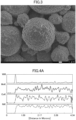
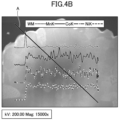
- FIGs. 4A and 4B an example of the STEM-EDX results of the resulting positive electrode active material obtained in Example 1 is shown in FIGs. 4A and 4B .
- a line segment A is a line analyzed by STEM-EDX, and the intensity distribution of tungsten (W), manganese (Mn), cobalt (Co), and nickel (Ni) analyzed along the line segment A is shown.
- the coordinates of the x-axis in the left and right directions in the figure are shown so that the line segment A and the intensity distribution of each element are consistent.
- the intensity distribution of "WM” is shown with tungsten
- MnK is shown with manganese
- CoK is shown with cobalt
- NiK nickel
- FIG. 4A indicates only the intensity distribution of each element shown in FIG. 4B separately for each element.
- the peak of tungsten can be observed on the particle surface of the positive electrode active material, indicating that tungsten is concentrated on the surface of the secondary particles (surface layer) of the lithium-nickel composite oxide.
- a coating film containing tungsten was formed on the surface of the secondary particles of the lithium-nickel composite oxide.
- a lithium tungstate coating film was formed.
- the coating film of lithium tungstate was not formed on the surface of the secondary particles, so that the volume resistivity during powder compression was significantly low and the positive electrode resistance was also high. Therefore, it was confirmed that it is difficult to meet the requirements for high short-circuit resistance and high output characteristics.
- the positive electrode active material obtained in Comparative Example 2 had a low tungsten content and an insufficient coating film of lithium tungstate on the surface of the secondary particles of lithium-nickel composite oxide. Therefore, it was confirmed that the volume resistivity at powder compression was low and insufficient to meet the requirement of the short-circuit resistance.
- the positive electrode active material obtained in Comparative Example 3 had an excessively high content of tungsten and an excessive formation of compounds containing lithium, tungsten, and lithium tungstate on the surface of the secondary particles of the lithium-nickel composite oxide. Therefore, the positive electrode resistance was high and the discharge capacity was low. Therefore, it was confirmed that the short-circuit resistance was excellent, but the output characteristics were inferior. Therefore, the positive electrode active material of Comparative Example 3 did not meet the requirements for high capacity and high output characteristics.
Landscapes
- Chemical & Material Sciences (AREA)
- Chemical Kinetics & Catalysis (AREA)
- Electrochemistry (AREA)
- General Chemical & Material Sciences (AREA)
- Composite Materials (AREA)
- Inorganic Chemistry (AREA)
- Engineering & Computer Science (AREA)
- Manufacturing & Machinery (AREA)
- Battery Electrode And Active Subsutance (AREA)
Claims (6)
- Matériau actif d'électrode positive pour batterie secondaire à électrolyte non aqueux, comprenant :des particules d'oxyde composite de lithium-nickel présentant une structure de système hexagonal en couches ; etun film de revêtement de tungstate de lithium disposé sur une surface de particules secondaires des particules d'oxyde composite de lithium-nickel,dans lequel le matériau actif d'électrode positive pour batterie secondaire à électrolyte non aqueux comprend, en tant qu'éléments métalliques, du lithium (Li), du nickel (Ni), du cobalt (Co), un élément M (M) qui est au moins un élément choisi parmi Mn, V, Mg, Mo, Nb, Ti, Ca, Cr, Zr, Ta et Al, et du tungstène (W),dans lequel un rapport de quantité de substance dans les éléments métalliques contenus est Li:Ni:Co:M:W = a:1-x-y:x:y:z,dans lequel 0,97 ≤ a ≤ 1,25, 0 ≤ x≤ 0,35, 0 ≤ y ≤ 0,35 et 0,005 ≤ z ≤ 0,030, etdans lequel un rapport d'une concentration maximale de tungstène sur une concentration moyenne de tungstène est égal ou supérieur à 5 et est égal ou inférieur à 25 lorsqu'une analyse de ligne est effectuée par STEM-EDX sur une section transversale de particule du matériau actif d'électrode positive pour batterie secondaire à électrolyte non aqueux.
- Matériau actif d'électrode positive pour batterie secondaire à électrolyte non aqueux selon la revendication 1,
dans lequel une phase cristalline du tungstate de lithium sur la surface des particules secondaires est au moins une choisie parmi 7Li2WO4•4H2O, Li2WO4 et Li4WO5. - Matériau actif d'électrode positive pour batterie secondaire à électrolyte non aqueux selon la revendication 1 ou 2,
dans lequel une aire de surface spécifique telle que mesurée par un procédé BET est égale ou supérieure à 0,2 m2/g et est égale ou inférieure à 0,8 m2/g. - Matériau actif d'électrode positive pour batterie secondaire à électrolyte non aqueux selon l'une quelconque des revendications 1 à 3,
dans lequel une résistivité volumique, lors d'une compression à 3,2 g/cc telle que déterminée par une mesure de résistivité de poudre, est égale ou supérieure à 1,0 × 10² Ω cm et est égale ou inférieure à 1,0 × 10⁴ Ω cm. - Matériau actif d'électrode positive pour batterie secondaire à électrolyte non aqueux selon l'une quelconque des revendications 1 à 4,
dans lequel une taille de particule moyenne en volume Mv est égale ou supérieure à 5 µm et est égale ou inférieure à 20 µm, dans lequel la taille de particule moyenne en volume Mv est déterminée par un distributeur de taille de particule par diffraction de lumière laser. - Batterie secondaire à électrolyte non aqueux selon l'invention, comprenant :
le matériau actif d'électrode positive pour batterie secondaire à électrolyte non aqueux selon l'une quelconque des revendications 1 à 5.
Applications Claiming Priority (2)
| Application Number | Priority Date | Filing Date | Title |
|---|---|---|---|
| JP2018105615A JP7028073B2 (ja) | 2018-05-31 | 2018-05-31 | 非水系電解質二次電池用正極活物質、非水系電解質二次電池 |
| PCT/JP2019/021361 WO2019230829A1 (fr) | 2018-05-31 | 2019-05-29 | Matériau actif d'électrode positive pour batterie secondaire à électrolyte non aqueux et batterie secondaire à électrolyte non aqueux |
Publications (3)
| Publication Number | Publication Date |
|---|---|
| EP3806204A1 EP3806204A1 (fr) | 2021-04-14 |
| EP3806204A4 EP3806204A4 (fr) | 2021-08-11 |
| EP3806204B1 true EP3806204B1 (fr) | 2024-07-10 |
Family
ID=68698254
Family Applications (1)
| Application Number | Title | Priority Date | Filing Date |
|---|---|---|---|
| EP19810995.1A Active EP3806204B1 (fr) | 2018-05-31 | 2019-05-29 | Matériau actif d'électrode positive pour batterie secondaire à électrolyte non aqueux et batterie secondaire à électrolyte non aqueux |
Country Status (5)
| Country | Link |
|---|---|
| US (1) | US11967713B2 (fr) |
| EP (1) | EP3806204B1 (fr) |
| JP (1) | JP7028073B2 (fr) |
| CN (1) | CN112219298B (fr) |
| WO (1) | WO2019230829A1 (fr) |
Families Citing this family (8)
| Publication number | Priority date | Publication date | Assignee | Title |
|---|---|---|---|---|
| CN112447951B (zh) * | 2019-09-02 | 2022-11-08 | 宁德时代新能源科技股份有限公司 | 正极活性材料、其制备方法、正极极片及锂离子二次电池 |
| CN115004407B (zh) * | 2020-01-31 | 2024-10-25 | 松下新能源株式会社 | 非水电解质二次电池用正极活性物质、及非水电解质二次电池 |
| KR102808790B1 (ko) * | 2020-05-28 | 2025-05-16 | 아사히 가세이 가부시키가이샤 | 비수계 이차 전지 및 비수계 전해액 |
| CN114388783B (zh) * | 2022-01-04 | 2024-06-25 | 万华化学集团股份有限公司 | 一种高镍正极材料、其制备方法及其应用 |
| JP7336055B1 (ja) * | 2022-03-24 | 2023-08-30 | Jx金属株式会社 | リチウムイオン電池用正極活物質、リチウムイオン電池用正極、リチウムイオン電池、全固体リチウムイオン電池用正極活物質、全固体リチウムイオン電池用正極、全固体リチウムイオン電池、リチウムイオン電池用正極活物質の製造方法及び全固体リチウムイオン電池用正極活物質の製造方法 |
| JP7756678B2 (ja) * | 2023-04-17 | 2025-10-20 | プライムプラネットエナジー&ソリューションズ株式会社 | 正極活物質、正極板、非水電解質二次電池および正極活物質の製造方法 |
| CN118043990B (zh) * | 2023-08-31 | 2025-12-12 | 宁德新能源科技有限公司 | 电化学装置和应用所述电化学装置的电子装置 |
| KR20250062305A (ko) * | 2023-10-30 | 2025-05-08 | 주식회사 에코프로비엠 | 이차전지용 양극활물질 |
Family Cites Families (14)
| Publication number | Priority date | Publication date | Assignee | Title |
|---|---|---|---|---|
| JP2005251716A (ja) | 2004-02-05 | 2005-09-15 | Nichia Chem Ind Ltd | 非水電解質二次電池用正極活物質、非水電解質二次電池用正極合剤および非水電解質二次電池 |
| JP2010040383A (ja) | 2008-08-06 | 2010-02-18 | Sony Corp | 正極活物質の製造方法および正極活物質 |
| HUE044117T2 (hu) | 2010-09-17 | 2019-10-28 | Schott Ag | Fém-rögzítõanyag átvezetés és eljárás annak az elõállítására |
| JP5035712B2 (ja) | 2010-09-30 | 2012-09-26 | 住友金属鉱山株式会社 | 非水系電解質二次電池用正極活物質とその製造方法、および該正極活物質を用いた非水系電解質二次電池 |
| WO2012164752A1 (fr) | 2011-05-30 | 2012-12-06 | 住友金属鉱山株式会社 | Matériau actif d'électrode positive pour des batteries secondaires non aqueuses, son procédé de fabrication, et batterie secondaire à électrolyte non aqueux l'utilisant |
| JP5822708B2 (ja) | 2011-12-16 | 2015-11-24 | 住友金属鉱山株式会社 | 非水系電解質二次電池用正極活物質とその製造方法、および該正極活物質を用いた非水系電解質二次電池 |
| JP5772626B2 (ja) | 2012-01-25 | 2015-09-02 | 住友金属鉱山株式会社 | 非水系電解質二次電池用正極活物質とその製造方法、および該正極活物質を用いた非水系電解質二次電池 |
| JP5999208B2 (ja) * | 2014-04-25 | 2016-09-28 | 住友金属鉱山株式会社 | 非水系電解質二次電池用正極活物質とその製造方法、および該正極活物質を用いた非水系電解質二次電池 |
| WO2016084930A1 (fr) * | 2014-11-28 | 2016-06-02 | 住友金属鉱山株式会社 | Matériau actif d'électrode positive pour batterie rechargeable à électrolyte non aqueux et son procédé de fabrication, et batterie rechargeable à électrolyte non aqueux utilisant ledit matériau actif d'électrode positive |
| JP6090608B2 (ja) * | 2014-11-28 | 2017-03-08 | 住友金属鉱山株式会社 | 非水系電解質二次電池用正極活物質とその製造方法、および該正極活物質を用いた非水系電解質二次電池 |
| JP6090609B2 (ja) | 2014-11-28 | 2017-03-08 | 住友金属鉱山株式会社 | 非水系電解質二次電池用正極活物質とその製造方法、および該正極活物質を用いた非水系電解質二次電池 |
| JP6978182B2 (ja) * | 2015-04-24 | 2021-12-08 | 住友金属鉱山株式会社 | 非水系電解質二次電池用正極活物質とその製造方法、および該正極活物質を用いた非水系電解質二次電池 |
| JP6753050B2 (ja) * | 2015-10-26 | 2020-09-09 | 住友金属鉱山株式会社 | 非水系電解質二次電池用正極活物質、および該正極活物質を用いた非水系電解質二次電池 |
| JP6651789B2 (ja) * | 2015-10-28 | 2020-02-19 | 住友金属鉱山株式会社 | 非水系電解質二次電池用正極活物質とその製造方法、及び非水系電解質二次電池 |
-
2018
- 2018-05-31 JP JP2018105615A patent/JP7028073B2/ja active Active
-
2019
- 2019-05-29 EP EP19810995.1A patent/EP3806204B1/fr active Active
- 2019-05-29 US US17/059,306 patent/US11967713B2/en active Active
- 2019-05-29 CN CN201980035779.1A patent/CN112219298B/zh active Active
- 2019-05-29 WO PCT/JP2019/021361 patent/WO2019230829A1/fr not_active Ceased
Also Published As
| Publication number | Publication date |
|---|---|
| JP2019212400A (ja) | 2019-12-12 |
| EP3806204A1 (fr) | 2021-04-14 |
| WO2019230829A1 (fr) | 2019-12-05 |
| JP7028073B2 (ja) | 2022-03-02 |
| EP3806204A4 (fr) | 2021-08-11 |
| CN112219298B (zh) | 2024-06-18 |
| US11967713B2 (en) | 2024-04-23 |
| US20210167378A1 (en) | 2021-06-03 |
| CN112219298A (zh) | 2021-01-12 |
Similar Documents
| Publication | Publication Date | Title |
|---|---|---|
| EP3806204B1 (fr) | Matériau actif d'électrode positive pour batterie secondaire à électrolyte non aqueux et batterie secondaire à électrolyte non aqueux | |
| EP3267517A1 (fr) | Substance active d'électrode positive pour batterie secondaire à électrolyte non aqueux, et son procédé de production | |
| KR20130051012A (ko) | 비수계 전해질 2차 전지용 정극 활물질과 그의 제조 방법, 및 상기 정극 활물질을 이용한 비수계 전해질 2차 전지 | |
| CN114521300A (zh) | 锂离子二次电池用正极活性物质以及锂离子二次电池 | |
| EP3832762B1 (fr) | Matériau actif d'électrode positive pour batterie secondaire au lithium-ion, procédé de production de matériau actif d'électrode positive pour batterie secondaire au lithium-ion et batterie secondaire au lithium-ion | |
| US11735728B2 (en) | Cathode active material for non-aqueous electrolyte secondary battery and method of manufacturing cathode active material for non-aqueous electrolyte secondary battery | |
| JP7354611B2 (ja) | リチウムイオン二次電池用正極活物質とその製造方法、及び、リチウムイオン二次電池 | |
| JP7276323B2 (ja) | 非水系電解質二次電池用正極活物質 | |
| EP3832761A1 (fr) | Matériau actif d'électrode négative pour batterie secondaire au lithium-ion, procédé de fabrication de matériau actif d'électrode négative pour batterie secondaire au lithium-ion et batterie secondaire au lithium-ion | |
| US20250145491A1 (en) | Positive electrode active material for lithium ion secondary battery and lithium ion secondary battery | |
| US12170368B2 (en) | Method of manufacturing positive electrode active material for lithium ion secondary battery | |
| US12113196B2 (en) | Method of manufacturing positive electrode active material for lithium ion secondary battery, positive electrode active material for lithium ion secondary battery, and lithium ion secondary battery | |
| EP4528854B1 (fr) | Matériau actif d'électrode positive pour batteries secondaires au lithium-ion et batterie secondaire au lithium-ion | |
| JP2024109445A (ja) | リチウムニッケルマンガン複合酸化物粒子、リチウムイオン二次電池 | |
| JP2023152003A (ja) | リチウムイオン二次電池用正極活物質、リチウムイオン二次電池用正極活物質の製造方法 | |
| WO2024095981A1 (fr) | Procédé de fabrication de matière active d'électrode positive pour batterie secondaire au lithium-ion |
Legal Events
| Date | Code | Title | Description |
|---|---|---|---|
| STAA | Information on the status of an ep patent application or granted ep patent |
Free format text: STATUS: THE INTERNATIONAL PUBLICATION HAS BEEN MADE |
|
| PUAI | Public reference made under article 153(3) epc to a published international application that has entered the european phase |
Free format text: ORIGINAL CODE: 0009012 |
|
| STAA | Information on the status of an ep patent application or granted ep patent |
Free format text: STATUS: REQUEST FOR EXAMINATION WAS MADE |
|
| 17P | Request for examination filed |
Effective date: 20201130 |
|
| AK | Designated contracting states |
Kind code of ref document: A1 Designated state(s): AL AT BE BG CH CY CZ DE DK EE ES FI FR GB GR HR HU IE IS IT LI LT LU LV MC MK MT NL NO PL PT RO RS SE SI SK SM TR |
|
| AX | Request for extension of the european patent |
Extension state: BA ME |
|
| A4 | Supplementary search report drawn up and despatched |
Effective date: 20210714 |
|
| RIC1 | Information provided on ipc code assigned before grant |
Ipc: H01M 4/36 20060101AFI20210708BHEP Ipc: H01M 4/525 20100101ALI20210708BHEP Ipc: H01M 4/505 20100101ALI20210708BHEP Ipc: H01M 10/42 20060101ALI20210708BHEP Ipc: H01M 4/62 20060101ALI20210708BHEP |
|
| DAV | Request for validation of the european patent (deleted) | ||
| DAX | Request for extension of the european patent (deleted) | ||
| REG | Reference to a national code |
Ref country code: DE Ref legal event code: R079 Free format text: PREVIOUS MAIN CLASS: H01M0004525000 Ref document number: 602019055063 Country of ref document: DE Ipc: H01M0004139100 |
|
| GRAP | Despatch of communication of intention to grant a patent |
Free format text: ORIGINAL CODE: EPIDOSNIGR1 |
|
| STAA | Information on the status of an ep patent application or granted ep patent |
Free format text: STATUS: GRANT OF PATENT IS INTENDED |
|
| RIC1 | Information provided on ipc code assigned before grant |
Ipc: H01M 10/42 20060101ALI20240305BHEP Ipc: H01M 4/62 20060101ALI20240305BHEP Ipc: H01M 4/525 20100101ALI20240305BHEP Ipc: H01M 4/36 20060101ALI20240305BHEP Ipc: H01M 10/052 20100101ALI20240305BHEP Ipc: H01M 4/1391 20100101AFI20240305BHEP |
|
| INTG | Intention to grant announced |
Effective date: 20240404 |
|
| GRAS | Grant fee paid |
Free format text: ORIGINAL CODE: EPIDOSNIGR3 |
|
| GRAA | (expected) grant |
Free format text: ORIGINAL CODE: 0009210 |
|
| STAA | Information on the status of an ep patent application or granted ep patent |
Free format text: STATUS: THE PATENT HAS BEEN GRANTED |
|
| P01 | Opt-out of the competence of the unified patent court (upc) registered |
Effective date: 20240529 |
|
| AK | Designated contracting states |
Kind code of ref document: B1 Designated state(s): AL AT BE BG CH CY CZ DE DK EE ES FI FR GB GR HR HU IE IS IT LI LT LU LV MC MK MT NL NO PL PT RO RS SE SI SK SM TR |
|
| REG | Reference to a national code |
Ref country code: CH Ref legal event code: EP |
|
| REG | Reference to a national code |
Ref country code: DE Ref legal event code: R096 Ref document number: 602019055063 Country of ref document: DE |
|
| REG | Reference to a national code |
Ref country code: LT Ref legal event code: MG9D |
|
| REG | Reference to a national code |
Ref country code: NL Ref legal event code: MP Effective date: 20240710 |
|
| PG25 | Lapsed in a contracting state [announced via postgrant information from national office to epo] |
Ref country code: PT Free format text: LAPSE BECAUSE OF FAILURE TO SUBMIT A TRANSLATION OF THE DESCRIPTION OR TO PAY THE FEE WITHIN THE PRESCRIBED TIME-LIMIT Effective date: 20241111 |
|
| REG | Reference to a national code |
Ref country code: AT Ref legal event code: MK05 Ref document number: 1702834 Country of ref document: AT Kind code of ref document: T Effective date: 20240710 |
|
| PG25 | Lapsed in a contracting state [announced via postgrant information from national office to epo] |
Ref country code: NL Free format text: LAPSE BECAUSE OF FAILURE TO SUBMIT A TRANSLATION OF THE DESCRIPTION OR TO PAY THE FEE WITHIN THE PRESCRIBED TIME-LIMIT Effective date: 20240710 |
|
| PG25 | Lapsed in a contracting state [announced via postgrant information from national office to epo] |
Ref country code: PT Free format text: LAPSE BECAUSE OF FAILURE TO SUBMIT A TRANSLATION OF THE DESCRIPTION OR TO PAY THE FEE WITHIN THE PRESCRIBED TIME-LIMIT Effective date: 20241111 Ref country code: NL Free format text: LAPSE BECAUSE OF FAILURE TO SUBMIT A TRANSLATION OF THE DESCRIPTION OR TO PAY THE FEE WITHIN THE PRESCRIBED TIME-LIMIT Effective date: 20240710 |
|
| PG25 | Lapsed in a contracting state [announced via postgrant information from national office to epo] |
Ref country code: NO Free format text: LAPSE BECAUSE OF FAILURE TO SUBMIT A TRANSLATION OF THE DESCRIPTION OR TO PAY THE FEE WITHIN THE PRESCRIBED TIME-LIMIT Effective date: 20241010 |
|
| PG25 | Lapsed in a contracting state [announced via postgrant information from national office to epo] |
Ref country code: GR Free format text: LAPSE BECAUSE OF FAILURE TO SUBMIT A TRANSLATION OF THE DESCRIPTION OR TO PAY THE FEE WITHIN THE PRESCRIBED TIME-LIMIT Effective date: 20241011 Ref country code: FI Free format text: LAPSE BECAUSE OF FAILURE TO SUBMIT A TRANSLATION OF THE DESCRIPTION OR TO PAY THE FEE WITHIN THE PRESCRIBED TIME-LIMIT Effective date: 20240710 Ref country code: PL Free format text: LAPSE BECAUSE OF FAILURE TO SUBMIT A TRANSLATION OF THE DESCRIPTION OR TO PAY THE FEE WITHIN THE PRESCRIBED TIME-LIMIT Effective date: 20240710 |
|
| PG25 | Lapsed in a contracting state [announced via postgrant information from national office to epo] |
Ref country code: BG Free format text: LAPSE BECAUSE OF FAILURE TO SUBMIT A TRANSLATION OF THE DESCRIPTION OR TO PAY THE FEE WITHIN THE PRESCRIBED TIME-LIMIT Effective date: 20240710 |
|
| PG25 | Lapsed in a contracting state [announced via postgrant information from national office to epo] |
Ref country code: LV Free format text: LAPSE BECAUSE OF FAILURE TO SUBMIT A TRANSLATION OF THE DESCRIPTION OR TO PAY THE FEE WITHIN THE PRESCRIBED TIME-LIMIT Effective date: 20240710 |
|
| PG25 | Lapsed in a contracting state [announced via postgrant information from national office to epo] |
Ref country code: AT Free format text: LAPSE BECAUSE OF FAILURE TO SUBMIT A TRANSLATION OF THE DESCRIPTION OR TO PAY THE FEE WITHIN THE PRESCRIBED TIME-LIMIT Effective date: 20240710 Ref country code: IS Free format text: LAPSE BECAUSE OF FAILURE TO SUBMIT A TRANSLATION OF THE DESCRIPTION OR TO PAY THE FEE WITHIN THE PRESCRIBED TIME-LIMIT Effective date: 20241110 |
|
| PG25 | Lapsed in a contracting state [announced via postgrant information from national office to epo] |
Ref country code: HR Free format text: LAPSE BECAUSE OF FAILURE TO SUBMIT A TRANSLATION OF THE DESCRIPTION OR TO PAY THE FEE WITHIN THE PRESCRIBED TIME-LIMIT Effective date: 20240710 |
|
| PG25 | Lapsed in a contracting state [announced via postgrant information from national office to epo] |
Ref country code: ES Free format text: LAPSE BECAUSE OF FAILURE TO SUBMIT A TRANSLATION OF THE DESCRIPTION OR TO PAY THE FEE WITHIN THE PRESCRIBED TIME-LIMIT Effective date: 20240710 Ref country code: RS Free format text: LAPSE BECAUSE OF FAILURE TO SUBMIT A TRANSLATION OF THE DESCRIPTION OR TO PAY THE FEE WITHIN THE PRESCRIBED TIME-LIMIT Effective date: 20241010 |
|
| PG25 | Lapsed in a contracting state [announced via postgrant information from national office to epo] |
Ref country code: RS Free format text: LAPSE BECAUSE OF FAILURE TO SUBMIT A TRANSLATION OF THE DESCRIPTION OR TO PAY THE FEE WITHIN THE PRESCRIBED TIME-LIMIT Effective date: 20241010 Ref country code: PL Free format text: LAPSE BECAUSE OF FAILURE TO SUBMIT A TRANSLATION OF THE DESCRIPTION OR TO PAY THE FEE WITHIN THE PRESCRIBED TIME-LIMIT Effective date: 20240710 Ref country code: NO Free format text: LAPSE BECAUSE OF FAILURE TO SUBMIT A TRANSLATION OF THE DESCRIPTION OR TO PAY THE FEE WITHIN THE PRESCRIBED TIME-LIMIT Effective date: 20241010 Ref country code: LV Free format text: LAPSE BECAUSE OF FAILURE TO SUBMIT A TRANSLATION OF THE DESCRIPTION OR TO PAY THE FEE WITHIN THE PRESCRIBED TIME-LIMIT Effective date: 20240710 Ref country code: IS Free format text: LAPSE BECAUSE OF FAILURE TO SUBMIT A TRANSLATION OF THE DESCRIPTION OR TO PAY THE FEE WITHIN THE PRESCRIBED TIME-LIMIT Effective date: 20241110 Ref country code: HR Free format text: LAPSE BECAUSE OF FAILURE TO SUBMIT A TRANSLATION OF THE DESCRIPTION OR TO PAY THE FEE WITHIN THE PRESCRIBED TIME-LIMIT Effective date: 20240710 Ref country code: GR Free format text: LAPSE BECAUSE OF FAILURE TO SUBMIT A TRANSLATION OF THE DESCRIPTION OR TO PAY THE FEE WITHIN THE PRESCRIBED TIME-LIMIT Effective date: 20241011 Ref country code: FI Free format text: LAPSE BECAUSE OF FAILURE TO SUBMIT A TRANSLATION OF THE DESCRIPTION OR TO PAY THE FEE WITHIN THE PRESCRIBED TIME-LIMIT Effective date: 20240710 Ref country code: ES Free format text: LAPSE BECAUSE OF FAILURE TO SUBMIT A TRANSLATION OF THE DESCRIPTION OR TO PAY THE FEE WITHIN THE PRESCRIBED TIME-LIMIT Effective date: 20240710 Ref country code: BG Free format text: LAPSE BECAUSE OF FAILURE TO SUBMIT A TRANSLATION OF THE DESCRIPTION OR TO PAY THE FEE WITHIN THE PRESCRIBED TIME-LIMIT Effective date: 20240710 Ref country code: AT Free format text: LAPSE BECAUSE OF FAILURE TO SUBMIT A TRANSLATION OF THE DESCRIPTION OR TO PAY THE FEE WITHIN THE PRESCRIBED TIME-LIMIT Effective date: 20240710 |
|
| REG | Reference to a national code |
Ref country code: DE Ref legal event code: R097 Ref document number: 602019055063 Country of ref document: DE |
|
| PG25 | Lapsed in a contracting state [announced via postgrant information from national office to epo] |
Ref country code: SM Free format text: LAPSE BECAUSE OF FAILURE TO SUBMIT A TRANSLATION OF THE DESCRIPTION OR TO PAY THE FEE WITHIN THE PRESCRIBED TIME-LIMIT Effective date: 20240710 Ref country code: RO Free format text: LAPSE BECAUSE OF FAILURE TO SUBMIT A TRANSLATION OF THE DESCRIPTION OR TO PAY THE FEE WITHIN THE PRESCRIBED TIME-LIMIT Effective date: 20240710 Ref country code: DK Free format text: LAPSE BECAUSE OF FAILURE TO SUBMIT A TRANSLATION OF THE DESCRIPTION OR TO PAY THE FEE WITHIN THE PRESCRIBED TIME-LIMIT Effective date: 20240710 |
|
| PG25 | Lapsed in a contracting state [announced via postgrant information from national office to epo] |
Ref country code: EE Free format text: LAPSE BECAUSE OF FAILURE TO SUBMIT A TRANSLATION OF THE DESCRIPTION OR TO PAY THE FEE WITHIN THE PRESCRIBED TIME-LIMIT Effective date: 20240710 |
|
| PG25 | Lapsed in a contracting state [announced via postgrant information from national office to epo] |
Ref country code: CZ Free format text: LAPSE BECAUSE OF FAILURE TO SUBMIT A TRANSLATION OF THE DESCRIPTION OR TO PAY THE FEE WITHIN THE PRESCRIBED TIME-LIMIT Effective date: 20240710 |
|
| PG25 | Lapsed in a contracting state [announced via postgrant information from national office to epo] |
Ref country code: IT Free format text: LAPSE BECAUSE OF FAILURE TO SUBMIT A TRANSLATION OF THE DESCRIPTION OR TO PAY THE FEE WITHIN THE PRESCRIBED TIME-LIMIT Effective date: 20240710 Ref country code: SK Free format text: LAPSE BECAUSE OF FAILURE TO SUBMIT A TRANSLATION OF THE DESCRIPTION OR TO PAY THE FEE WITHIN THE PRESCRIBED TIME-LIMIT Effective date: 20240710 |
|
| PLBE | No opposition filed within time limit |
Free format text: ORIGINAL CODE: 0009261 |
|
| STAA | Information on the status of an ep patent application or granted ep patent |
Free format text: STATUS: NO OPPOSITION FILED WITHIN TIME LIMIT |
|
| 26N | No opposition filed |
Effective date: 20250411 |
|
| PGFP | Annual fee paid to national office [announced via postgrant information from national office to epo] |
Ref country code: DE Payment date: 20250521 Year of fee payment: 7 |
|
| PGFP | Annual fee paid to national office [announced via postgrant information from national office to epo] |
Ref country code: FR Payment date: 20250528 Year of fee payment: 7 |
|
| PG25 | Lapsed in a contracting state [announced via postgrant information from national office to epo] |
Ref country code: SE Free format text: LAPSE BECAUSE OF FAILURE TO SUBMIT A TRANSLATION OF THE DESCRIPTION OR TO PAY THE FEE WITHIN THE PRESCRIBED TIME-LIMIT Effective date: 20240710 |
|
| REG | Reference to a national code |
Ref country code: CH Ref legal event code: H13 Free format text: ST27 STATUS EVENT CODE: U-0-0-H10-H13 (AS PROVIDED BY THE NATIONAL OFFICE) Effective date: 20251223 |
|
| PG25 | Lapsed in a contracting state [announced via postgrant information from national office to epo] |
Ref country code: LU Free format text: LAPSE BECAUSE OF NON-PAYMENT OF DUE FEES Effective date: 20250529 |
|
| PG25 | Lapsed in a contracting state [announced via postgrant information from national office to epo] |
Ref country code: CH Free format text: LAPSE BECAUSE OF NON-PAYMENT OF DUE FEES Effective date: 20250531 |
|
| REG | Reference to a national code |
Ref country code: BE Ref legal event code: MM Effective date: 20250531 |
|
| PG25 | Lapsed in a contracting state [announced via postgrant information from national office to epo] |
Ref country code: MC Free format text: LAPSE BECAUSE OF FAILURE TO SUBMIT A TRANSLATION OF THE DESCRIPTION OR TO PAY THE FEE WITHIN THE PRESCRIBED TIME-LIMIT Effective date: 20240710 |
|
| PGFP | Annual fee paid to national office [announced via postgrant information from national office to epo] |
Ref country code: GB Payment date: 20260323 Year of fee payment: 8 |
|
| PG25 | Lapsed in a contracting state [announced via postgrant information from national office to epo] |
Ref country code: IE Free format text: LAPSE BECAUSE OF NON-PAYMENT OF DUE FEES Effective date: 20250529 |
|
| PG25 | Lapsed in a contracting state [announced via postgrant information from national office to epo] |
Ref country code: BE Free format text: LAPSE BECAUSE OF NON-PAYMENT OF DUE FEES Effective date: 20250531 |