EP3806511A1 - Datenübertragungsverfahren, vorrichtung, basisstation, endgerät und lesbares speichermedium - Google Patents
Datenübertragungsverfahren, vorrichtung, basisstation, endgerät und lesbares speichermedium Download PDFInfo
- Publication number
- EP3806511A1 EP3806511A1 EP19808085.5A EP19808085A EP3806511A1 EP 3806511 A1 EP3806511 A1 EP 3806511A1 EP 19808085 A EP19808085 A EP 19808085A EP 3806511 A1 EP3806511 A1 EP 3806511A1
- Authority
- EP
- European Patent Office
- Prior art keywords
- terminal
- rnti
- downlink
- paging message
- data transmission
- Prior art date
- Legal status (The legal status is an assumption and is not a legal conclusion. Google has not performed a legal analysis and makes no representation as to the accuracy of the status listed.)
- Pending
Links
Images



Classifications
-
- H—ELECTRICITY
- H04—ELECTRIC COMMUNICATION TECHNIQUE
- H04W—WIRELESS COMMUNICATION NETWORKS
- H04W68/00—User notification, e.g. alerting and paging, for incoming communication, change of service or the like
- H04W68/02—Arrangements for increasing efficiency of notification or paging channel
-
- H—ELECTRICITY
- H04—ELECTRIC COMMUNICATION TECHNIQUE
- H04W—WIRELESS COMMUNICATION NETWORKS
- H04W8/00—Network data management
- H04W8/26—Network addressing or numbering for mobility support
- H04W8/28—Number portability ; Network address portability
-
- H—ELECTRICITY
- H04—ELECTRIC COMMUNICATION TECHNIQUE
- H04W—WIRELESS COMMUNICATION NETWORKS
- H04W56/00—Synchronisation arrangements
- H04W56/0005—Synchronisation arrangements synchronizing of arrival of multiple uplinks
-
- H—ELECTRICITY
- H04—ELECTRIC COMMUNICATION TECHNIQUE
- H04W—WIRELESS COMMUNICATION NETWORKS
- H04W56/00—Synchronisation arrangements
- H04W56/004—Synchronisation arrangements compensating for timing error of reception due to propagation delay
- H04W56/0045—Synchronisation arrangements compensating for timing error of reception due to propagation delay compensating for timing error by altering transmission time
-
- H—ELECTRICITY
- H04—ELECTRIC COMMUNICATION TECHNIQUE
- H04W—WIRELESS COMMUNICATION NETWORKS
- H04W68/00—User notification, e.g. alerting and paging, for incoming communication, change of service or the like
- H04W68/005—Transmission of information for alerting of incoming communication
-
- H—ELECTRICITY
- H04—ELECTRIC COMMUNICATION TECHNIQUE
- H04W—WIRELESS COMMUNICATION NETWORKS
- H04W72/00—Local resource management
- H04W72/12—Wireless traffic scheduling
- H04W72/1263—Mapping of traffic onto schedule, e.g. scheduled allocation or multiplexing of flows
- H04W72/1273—Mapping of traffic onto schedule, e.g. scheduled allocation or multiplexing of flows of downlink data flows
-
- H—ELECTRICITY
- H04—ELECTRIC COMMUNICATION TECHNIQUE
- H04W—WIRELESS COMMUNICATION NETWORKS
- H04W72/00—Local resource management
- H04W72/20—Control channels or signalling for resource management
- H04W72/21—Control channels or signalling for resource management in the uplink direction of a wireless link, i.e. towards the network
-
- H—ELECTRICITY
- H04—ELECTRIC COMMUNICATION TECHNIQUE
- H04W—WIRELESS COMMUNICATION NETWORKS
- H04W72/00—Local resource management
- H04W72/20—Control channels or signalling for resource management
- H04W72/23—Control channels or signalling for resource management in the downlink direction of a wireless link, i.e. towards a terminal
-
- H—ELECTRICITY
- H04—ELECTRIC COMMUNICATION TECHNIQUE
- H04W—WIRELESS COMMUNICATION NETWORKS
- H04W72/00—Local resource management
- H04W72/20—Control channels or signalling for resource management
- H04W72/23—Control channels or signalling for resource management in the downlink direction of a wireless link, i.e. towards a terminal
- H04W72/232—Control channels or signalling for resource management in the downlink direction of a wireless link, i.e. towards a terminal the control data signalling from the physical layer, e.g. DCI signalling
-
- H—ELECTRICITY
- H04—ELECTRIC COMMUNICATION TECHNIQUE
- H04W—WIRELESS COMMUNICATION NETWORKS
- H04W74/00—Wireless channel access
- H04W74/08—Non-scheduled access, e.g. ALOHA
- H04W74/0833—Random access procedures, e.g. with 4-step access
-
- H—ELECTRICITY
- H04—ELECTRIC COMMUNICATION TECHNIQUE
- H04W—WIRELESS COMMUNICATION NETWORKS
- H04W74/00—Wireless channel access
- H04W74/08—Non-scheduled access, e.g. ALOHA
- H04W74/0833—Random access procedures, e.g. with 4-step access
- H04W74/0838—Random access procedures, e.g. with 4-step access using contention-free random access [CFRA]
-
- H—ELECTRICITY
- H04—ELECTRIC COMMUNICATION TECHNIQUE
- H04W—WIRELESS COMMUNICATION NETWORKS
- H04W8/00—Network data management
- H04W8/26—Network addressing or numbering for mobility support
-
- H—ELECTRICITY
- H04—ELECTRIC COMMUNICATION TECHNIQUE
- H04W—WIRELESS COMMUNICATION NETWORKS
- H04W76/00—Connection management
- H04W76/10—Connection setup
- H04W76/11—Allocation or use of connection identifiers
-
- Y—GENERAL TAGGING OF NEW TECHNOLOGICAL DEVELOPMENTS; GENERAL TAGGING OF CROSS-SECTIONAL TECHNOLOGIES SPANNING OVER SEVERAL SECTIONS OF THE IPC; TECHNICAL SUBJECTS COVERED BY FORMER USPC CROSS-REFERENCE ART COLLECTIONS [XRACs] AND DIGESTS
- Y02—TECHNOLOGIES OR APPLICATIONS FOR MITIGATION OR ADAPTATION AGAINST CLIMATE CHANGE
- Y02D—CLIMATE CHANGE MITIGATION TECHNOLOGIES IN INFORMATION AND COMMUNICATION TECHNOLOGIES [ICT], I.E. INFORMATION AND COMMUNICATION TECHNOLOGIES AIMING AT THE REDUCTION OF THEIR OWN ENERGY USE
- Y02D30/00—Reducing energy consumption in communication networks
- Y02D30/70—Reducing energy consumption in communication networks in wireless communication networks
Definitions
- Embodiments of the present disclosure relate to the field of communications and, in particular, to a data transmission method and device, a base station, a terminal and a readable storage medium.
- a mobility management entity MME
- MME mobility management entity
- the paging message carries a UE (e.g. a terminal) paging identity (e.g. IMSI/S-TMSI) and a tracking area identity (TAI), and is sent to the base station through an S1 interface.
- the base station calculates a paging occasion (PO) according to the UE paging identity carried in the paging message, and sends the paging message on the corresponding PO. After the UE successfully monitors and receives the paging message, an initial random access process is initiated.
- PO paging occasion
- the UE may receive the downlink data.
- the UE For downlink data traffic, especially the downlink small packet data traffic, the UE is required to establish a connection and enter a connection state each time when the packet data is received. This not only causes wastes of radio resources, but also increases the power consumption of the terminal. It is an urgent problem to be solved that how the terminal can efficiently receive the downlink data.
- Embodiments of the present disclosure provide a data transmission method and device, a base station, a terminal and a readable storage medium, so as to solve the problem that the process of sending and receiving downlink data is complicated in the related art.
- an embodiment of the present disclosure provides a data transmission method.
- the method includes the steps described below.
- a second channel characteristic hypothesis of a control channel resource set configured by a second communication node is received.
- the control channel resource set is formed by a first type of search space and/or a second type of search space.
- the second channel characteristic hypothesis is used for configuring a control channel resource in the second type of search space.
- a control channel resource sent by the second communication node is received according to the second channel characteristic hypothesis.
- An embodiment of the present disclosure further provides a data transmission method.
- the method includes the steps described below.
- a paging message is sent to a terminal.
- the paging message carries a cell radio network temporary identifier (C-RNTI).
- C-RNTI cell radio network temporary identifier
- Downlink data is transmitted according to the C-RNTI.
- An embodiment of the present disclosure further provides a data transmission method.
- the method includes the steps described below.
- a paging message sent by a base station is received.
- the paging message carries a cell radio network temporary identifier (C-RNTI).
- C-RNTI cell radio network temporary identifier
- Downlink data sent by the base station is received according to the C-RNTI.
- An embodiment of the present disclosure further provides a data transmission device.
- the device includes a paging sending module and a downlink sending module.
- the paging sending module is configured to carry a C-RNTI in a paging message sent to a terminal.
- the downlink sending module is configured to transmit downlink data according to the C-RNTI.
- An embodiment of the present disclosure further provides a data transmission device.
- the device includes a paging receiving module and a downlink receiving module.
- the paging receiving module is configured to receive a paging message sent by a base station.
- the paging message carries a cell radio network temporary identifier (C-RNTI).
- C-RNTI cell radio network temporary identifier
- the downlink receiving module is configured to receive, according to the C-RNTI, downlink data sent by the base station.
- An embodiment of the present disclosure further provides a base station.
- the base station includes a first processor, a first memory and a first communication bus.
- the first communication bus is configured to implement connection and communication between the first processor and the first memory.
- the first processor is configured to execute a computer program stored in the first memory, so as to perform the steps of the data transmission methods above.
- An embodiment of the present disclosure further provides a terminal.
- the terminal includes a second processor, a second memory and a second communication bus.
- the second communication bus is configured to implement connection and communication between the second processor and the second memory.
- the second processor is configured to execute a computer program stored in the second memory, so as to perform the steps of the data transmission methods above.
- An embodiment of the present disclosure further provides a computer readable storage medium.
- the computer readable storage medium stores at least one program executable by at least one processor to implement the steps of the data transmission methods above.
- the embodiments of the present disclosure provide a data transmission method and device, a base station, a terminal and a readable storage medium.
- a paging message is sent to a terminal, where the paging message carries a cell radio network temporary identifier (C-RNTI).
- C-RNTI cell radio network temporary identifier
- downlink data is transmitted according to the C-RNTI.
- the transmission of the downlink data is indicated by directly carrying the C-RNTI in the paging message.
- this solution significantly improves the efficiency, implements the efficient transmission of the downlink data, and also reduces the power consumption of the terminal and the occupancy rate of radio resources.
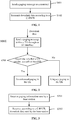
- FIG. 1 is a flowchart of a data transmission method according to embodiment one of the present disclosure. The method includes the steps described below.
- step S101 a paging message is sent to a terminal.
- the paging message carries a cell radio network temporary identifier (C-RNTI).
- C-RNTI cell radio network temporary identifier
- step S102 downlink data is transmitted according to the C-RNTI.
- the C-RNTI is a dynamic identifier allocated to the UE by the base station, and uniquely identifies the UE over an air interface of a cell. Information interaction between the base station and the terminal may be implemented according to this identifier.
- an MME is involved.
- the MME is a key control node of an LTE access network in the 3GPP protocol, and is in charge of positioning and paging a UE that is in an idle mode, including a relay function. Simply speaking, the MME is in charge of signaling processing.
- the MME sends a paging message to the base station through an S1 interface.
- the S1 interface is a communication interface between an LTE eNodeB (e.g.
- the step of sending the paging message to the terminal is performed by the base station after the MME sends the paging message to the base station through the S1 interface.
- the method may further include sending downlink scheduling information DL-grant to the terminal.
- the downlink scheduling information may be used to indicate the sending situation of the downlink data.
- the downlink scheduling information may indicate a corresponding physical downlink shared channel (PDSCH) resource.
- the step of transmitting the downlink data according to the C-RNTI may include sending the downlink data on the physical downlink shared channel resource corresponding to the downlink scheduling information.
- the step of transmitting the downlink data according to the C-RNTI may include sending message MSG4 on a resource corresponding to the downlink scheduling information, completing the random access process according to message MSG4, and transmitting the downlink data.
- the downlink scheduling information sent to the terminal may indicate not only the sending of the downlink data, but also the sending of message MSG4 for establishing the random access process.
- MSG4 is message 4, which is a message in an establishment process of a physical random access channel (PRACH). After message 4 is sent through the downlink scheduling information, the establishment process of the random access process is completed, so that the downlink data may be sent to the terminal.
- PRACH physical random access channel
- the base station may further determine whether the enhanced paging method in this embodiment of the present disclosure is applicable to the UE, that is, whether the corresponding paging message sent by the base station in the data transmission method in this embodiment of the present disclosure is applicable to the UE. If the enhanced paging method is applicable to the UE, the transmission may be performed by using the mode of sending the paging message according to the data transmission method in this embodiment of the present disclosure. However, if the enhanced paging method is applicable to the UE, the transmission is still performed by using a legacy paging method. Referring to FIG.
- the MME may send paging messages to all base stations within a tracking area (TA) through the S 1 interface.
- TA tracking area
- the eNB performs the enhanced paging process. Otherwise, if the base station determines the terminal does not reside in the cell, the legacy paging, that is, the legacy paging process, is performed.
- the step of sending the downlink scheduling information to the terminal may include carrying the downlink scheduling information DL-grant in the paging message. That is, the base station pages the UE through the allocated C-RNTI and the DL-grant carried in the paging message.
- the resource for transmitting the downlink data is configured by the DL-grant, and the base station sends the downlink data on the PDSCH resource corresponding to the DL-grant; after the UE receives the paging message carrying the C-RNTI and the DL-grant, the downlink data is received on the PDSCH resource corresponding to the DL-grant by using the C-RNTI.
- the resource for sending MSG4 in the establishment process of the PRACH is configured by the DL-grant, and the base station sends MSG4 on the resource corresponding to the DL-grant; after the UE receives the paging message carrying the C-RNTI and the DL-grant, MSG4 is received on the resource corresponding to the DL-grant by using the C-RNTI, the random access process is completed, and then, the downlink data is transmitted.
- the step of sending the downlink scheduling information to the terminal may include sending the downlink scheduling information through a physical downlink control channel. That is, the base station pages the UE through the allocated C-RNTI carried in the paging message, while the downlink scheduling information is sent in other modes.
- the base station sends, through the PDCCH, the downlink scheduling information DL-grant of the PDSCH for transmitting the downlink data, and then, the downlink data is sent on the PDSCH resource indicated by the DL-grant; after the UE receives the paging message carrying the C-RNTI, the DL-grant on the PDCCH is monitored, and the downlink data is received in the indicated PDSCH resource position.
- the base station sends, through the PDCCH, the downlink scheduling information DL-grant for transmitting MSG4 and then sends MSG4; after the UE receives the paging message carrying the C-RNTI, the PDCCH is monitored and MSG4 is received in the indicated resource position, so that the random access process is completed, and then, the downlink data is received.
- MSG4 is a fourth message of the random access process.
- the step of transmitting the downlink data according to the C-RNTI may further include directly carrying the downlink data in the paging message.
- the downlink data may be directly added into the paging message and then sent to the terminal, thus further eliminating the establishment process of the random access.
- the method may further include carrying uplink scheduling information in the paging message; and receiving at least one of feedback information of the downlink data, uplink data, a buffer status report (BSR) request or message MSG3 sent by the terminal according to a resource position configured in the uplink scheduling information.
- the terminal may feed back for the downlink data by using the uplink scheduling information, or the terminal directly sends the uplink data by using the uplink scheduling information, or the terminal sends the buffer status report (BSR) request by using the uplink scheduling information, or the terminal sends message MSG3 by using the uplink scheduling information, and then, the subsequent random access process is completed.
- the method may further include carrying timing advance information (e.g. time synchronization information) in the paging message.
- the step of transmitting the downlink data according to the C-RNTI may further include transmitting the downlink data according to the C-RNTI and the timing advance information.
- the downlink data may be transmitted by using the above data transmission method without the TA value.
- the timing advance information may be, for example, in the case where the terminal is in a terminal scenario of aggregated geographical positions, timing advance information corresponding to any terminal in the terminal scenario.
- the base station acquires and saves the value of time synchronization information TA with respect to the UE. Since geographical positions of these terminals are aggregated together, TA values between these terminals may be regarded as the same.
- the base station After receiving the paging message through the S1 interface, the base station determines whether a corresponding TA value of a UE is stored. If there is the corresponding TA value of the UE, the eNB pages the UE through the allocated C-RNTI, the corresponding DL-grant and the TA carried in the paging message.
- the resource for transmitting the downlink data is configured by the DL-grant, and the base station sends the downlink data on the PDSCH resource corresponding to the DL-grant; after the UE receives the paging message carrying the C-RNTI and the DL-grant, the downlink data is received on the PDSCH resource corresponding to the DL-grant by using the C-RNTI.
- the resource for sending MSG4 in the establishment process of the PRACH is configured by the DL-grant, and the base station sends MSG4 on the resource corresponding to the DL-grant; after the UE receives the paging message carrying the C-RNTI and the DL-grant, MSG4 is received on the resource corresponding to the DL-grant by using the C-RNTI, the random access process is completed, and then, the downlink data is received.
- the base station may further page the UE through the allocated C-RNTI and the TA value carried in the paging message. For example, in one way, the base station sends, through the PDCCH, the downlink scheduling information DL-grant of the PDSCH for transmitting the downlink data, and then, the downlink data is sent on the PDSCH resource; after the UE receives the paging message carrying the C-RNTI, the PDCCH is monitored, and then, the downlink data is received in the indicated PDSCH resource position.
- the base station sends, through the PDCCH, the downlink scheduling information DL-grant for transmitting MSG4 and sends MSG4; after the UE receives the paging message carrying the C-RNTI, the PDCCH is monitored and MSG4 is received in the indicated resource position, so that the random access process is completed, and then, the downlink data is received.
- the base station may further page the UE through the allocated C-RNTI, the corresponding uplink scheduling information UL-grant and the TA carried in the paging message.
- the eNB may use the paging message to carry the DL data.
- the corresponding C-RNTI is used to send an acknowledge/negative acknowledge (ACK/NACK) in the resource position configured in the corresponding UL-grant, so as to complete a feedback for downlink data reception; in another way, if there is uplink small packet data traffic at this time, the sending of the uplink data may be directly completed by using the corresponding UL-grant; in another way, if there is uplink data to be sent at this time, the BSR request may be sent by using the corresponding UL-grant; and in another way, the UE sends message MSG3 by using the UL-grant, and then, the subsequent PRACH process is completed.
- ACK/NACK acknowledge/negative acknowledge
- the method may further include determining sharing status of the timing advance information in each terminal, that is, the TA management in the terminal scenario of aggregated geographical positions.
- the step of determining the sharing status of the timing advance information may include triggering the positioning of the terminal; acquiring position information of the terminal; and determining, according to position information of each terminal, a terminal sharing the timing advance information.
- the object that triggers the positioning of the terminal may be the terminal, or an equipment at a network side, such as the base station or the MME.
- the network side may acquire the position information of the terminal mainly through the MME, and then, the MME may inform the eNB of the position information of the UE, and the eNB manages the position information of each UE and determines a group of UEs that may share the TA value.
- the eNB determines which UEs may share the TAin the next paging process, that is, the TA value is brought to users in the group through paging00..
- the MME manages the position information of the UE.
- the MME sends the paging message to the base station through the S1 interface
- the position information of the UE may be brought to the eNB at the same time, and the eNB determines which UEs may share the TA in the next paging process, that is, the TA value is brought to the users in the group through paging.
- This embodiment provides a data transmission method.
- a paging message is sent to a terminal, where the paging message carries a cell radio network temporary identifier (C-RNTI).
- C-RNTI cell radio network temporary identifier
- downlink data is transmitted according to the C-RNTI.
- the transmission of the downlink data is indicated by directly carrying the C-RNTI in the paging message.
- this solution significantly improves the efficiency, implements the efficient transmission of the downlink data, and also reduces the power consumption of the terminal and the occupancy rate of radio resources.
- FIG. 3 is a flowchart of a data transmission method according to embodiment two of the present disclosure. The method includes the steps described below.
- step S301 a paging message sent by a base station is received.
- the paging message carries a cell radio network temporary identifier (C-RNTI).
- C-RNTI cell radio network temporary identifier
- step S302 downlink data sent by the base station is received according to the C-RNTI.
- the method may further include receiving downlink scheduling information sent by the base station.
- the step of receiving, according to the C-RNTI, the downlink data sent by the base station includes the step described below.
- the downlink data is received on a physical downlink shared channel resource corresponding to the downlink scheduling information.
- message MSG4 is received on a resource corresponding to the downlink scheduling information, a random access process is completed according to message MSG4, and the downlink data is transmitted.
- the step of transmitting the downlink data according to the C-RNTI may further include the step described below.
- the downlink data is directly carried in the paging message.
- the method may further include the steps described below.
- Uplink scheduling information is carried in the paging message.
- Feedback information of the downlink data is sent according to a resource position configured in the uplink scheduling information.
- uplink data is sent according to a resource position configured in the uplink scheduling information.
- a BSR request is sent according to a resource position configured in the uplink scheduling information.
- message MSG3 is sent according to a resource position configured in the uplink scheduling information, and a random access process is completed according to message MSG3.
- the method may further include the step described below.
- Timing advance information is carried in the paging message.
- the step of transmitting the downlink data according to the C-RNTI may further include the step described below.
- the downlink data sent by the base station is received according to the C-RNTI and the timing advance information.
- the timing advance information may be, for example, in the case where the terminal is in a terminal scenario of aggregated geographical positions, timing advance information corresponding to any terminal in the terminal scenario.
- the method may further include the step described below.
- Sharing status of the timing advance information in each terminal is determined.
- This embodiment provides a data transmission method.
- a paging message sent by a base station is received, where the paging message carries a cell radio network temporary identifier (C-RNTI).
- C-RNTI cell radio network temporary identifier
- downlink data is transmitted according to the C-RNTI.
- the transmission of the downlink data is indicated by directly carrying the C-RNTI in the paging message.
- this solution significantly improves the efficiency, implements the efficient transmission of the downlink data, and also reduces the power consumption of the terminal and the occupancy rate of radio resources.
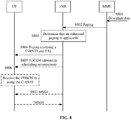
- FIG. 4 is a flowchart of a data transmission method according to embodiment three of the present disclosure.
- a paging message may carry a C-RNTI and a DL-grant to complete the transmission of downlink data.
- step S401 downlink data sent by a base station reaches an MME.
- step S402 the MME initiates a paging message to the base station through an S1 interface.
- step S403 after receiving the paging message through the S1 interface, the base station determines whether an enhanced paging method is applicable to a UE.
- step S404 if the enhanced paging method is applicable to the UE, the eNB pages the UE through an allocated C-RNTI and a DL-grant carried in a paging message.
- a resource for transmitting the downlink data is configured by the DL-grant, and the base station sends the downlink data on the PDSCH resource corresponding to the DL-grant.
- step S406 after the UE receives the paging message carrying the C-RNTI and the DL-grant, the downlink data is received on the PDSCH resource corresponding to the DL-grant by using the C-RNTI.
- a resource for sending MSG4 in a PRACH process is configured by the DL-grant, and the base station sends MSG4 on the resource corresponding to the DL-grant; after the UE receives the paging message carrying the C-RNTI and the DL-grant, MSG4 is received on the resource corresponding to the DL-grant by using the C-RNTI, a random access process is completed, and then, the downlink data is received.
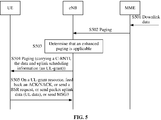
- FIG. 5 is a diagram showing a signal flow of a data transmission method according to embodiment four of the present disclosure.
- a paging message may carry a C-RNTI, data and an UL-grant to complete the transmission of downlink data.
- step S501 downlink data sent by a base station reaches an MME.
- step S502 the MME initiates a paging message to the base station through an S1 interface.
- a base station determines whether an enhanced paging method is applicable to a UE.
- step S504 if the enhanced paging method is applicable to the UE, the eNB pages the UE through an allocated C-RNTI and a UL-grant carried in a paging message.
- the eNB may use the paging message to carry the DL data at the same time.
- step S505 after the UE receives the paging message carrying the C-RNTI, the UL-grant and the DL data, in one way, the C-RNTI is used to send an ACK/NACK in a resource position configured in the UL-grant, so as to complete a feedback for downlink data reception; in another way, if there is uplink small packet data traffic at this time, the uplink data may be directly sent by using the UL-grant; in another way, if there is uplink data to be sent at this time, a BSR request may be sent by using the UL-grant; and in another way, the UE sends message MSG3 by using the UL-grant, so as to complete a subsequent PRACH process.
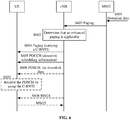
- FIG. 6 is a flowchart of a data transmission method according to embodiment five of the present disclosure.
- a paging message may carry a C-RNTI to complete the transmission of downlink data.
- step S601 downlink data sent by a base station reaches an MME.
- step S602 the MME initiates a paging message to the base station through an S1 interface.
- step S603 after receiving the paging message through the S1 interface, the base station determines whether an enhanced paging method is applicable to a UE.
- step S604 if the enhanced paging method is applicable to the UE, the eNB pages the UE through an allocated C-RNTI carried in the paging message.
- the base station sends, through a PDCCH, downlink scheduling information (a DL-grant) of a PDSCH for transmitting the downlink data.
- step S606 the downlink data is then sent on the PDSCH resource.
- step S607 after the UE receives the paging message carrying the C-RNTI, the PDCCH is monitored, and then, the downlink data is received in the indicated PDSCH resource position.
- step S608 in another way, the base station sends, through a PDCCH, downlink scheduling information DL-grant for transmitting MSG4 and MSG4 is sent.
- the PDCCH is monitored and MSG4 is received in the indicated resource position, so that a random access process is completed, and then, the downlink data is received.
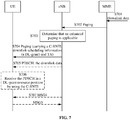
- FIG. 7 is a diagram showing a signal flow of a data transmission method according to embodiment six of the present disclosure.
- a paging message may carry a corresponding C-RNTI, a corresponding DL-grant and timing advance (TA) to complete the transmission of downlink data.
- TA timing advance
- step S701 downlink data sent by a base station reaches an MME.
- step S702 the MME initiates a paging message to the base station through an S1 interface.
- step S703 after receiving the paging message through the S1 interface, the base station determines whether an enhanced paging method is applicable to a UE.
- the base station acquires and saves the value of time synchronization information TA with respect to the UE. Since geographical positions of terminals are aggregated together, TA values between these terminals may be regarded as the same.
- the base station After receiving the paging message through the S1 interface, the base station determines whether the TA value of the UE has been stored.
- step S704 if the enhanced paging method is applicable to the UE and the base station has stored the TA value of the UE, the eNB pages the UE through an allocated C-RNTI, a corresponding DL-grant and the TA carried in a paging message.
- a resource for transmitting the downlink data is configured by the DL-grant, and the base station sends the downlink data on the PDSCH resource corresponding to the DL-grant.
- step S706 after the UE receives the paging message carrying the C-RNTI and the DL-grant, the downlink data is received on the PDSCH resource corresponding to the DL-grant by using the C-RNTI.
- a resource for sending MSG4 in an establishment process of a PRACH is configured by the DL-grant, and the base station sends MSG4 on the resource corresponding to the DL-grant; after the UE receives the paging message carrying the C-RNTI and the DL-grant, MSG4 is received on the resource corresponding to the DL-grant by using the C-RNTI, a random access process is completed, and then, the downlink data is received.
- FIG. 8 is a diagram showing a signal flow of a data transmission method according to embodiment seven of the present disclosure.
- a paging message may carry a corresponding C-RNTI and timing advance (TA) to complete the transmission of downlink data.
- TA timing advance
- step S801 downlink data sent by a base station reaches an MME.
- step S802 the MME initiates a paging message to the base station through an S1 interface.
- step S803 after receiving the paging message through the S1 interface, the base station determines whether an enhanced paging method is applicable to a UE.
- the base station acquires and saves the value of time synchronization information TA with respect to the UE. Since address positions of terminals are aggregated together, TA values between these terminals may be regarded as the same.
- the base station After receiving the paging message through the S1 interface, the base station determines whether the TA value of the UE has been stored.
- step S804 if the enhanced paging method is applicable to the UE and the base station has stored the TA value of the UE, the eNB pages the UE through the TA, and an allocated C-RNTI carried in a paging message.
- step S805 in one way, the base station sends, through a PDCCH, a downlink scheduling information DL-grant of a PDSCH for transmitting the downlink data, and then, the downlink data is sent on the PDSCH resource.
- step S806 after the UE receives the paging message carrying the C-RNTI, the PDCCH is monitored, and the downlink data is received in the indicated PDSCH resource position.
- step S807 in another way, the base station sends, through a PDCCH, downlink scheduling information DL-grant for transmitting MSG4 and MSG4 is sent.
- the PDCCH is monitored and MSG4 is received in the indicated resource position, a random access process is completed, and then, the downlink data is received.
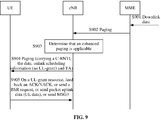
- FIG. 9 is a diagram showing a signal flow of a data transmission method according to embodiment eight of the present disclosure.
- a paging message may carry a corresponding C-RNTI, a corresponding UL-grant and timing advance (TA) to complete the transmission of downlink data.
- TA timing advance
- step S901 downlink data sent by a base station reaches an MME.
- step S902 the MME initiates a paging message to the base station through an S1 interface.
- step S903 after receiving the paging message through the S1 interface, the base station determines whether an enhanced paging method is applicable to a UE.
- the base station acquires and saves the value of time synchronization information TA with respect to the UE. Since geographical positions of terminals are aggregated together, TA values between these terminals may be regarded as the same.
- the base station After receiving the paging message through the S1 interface, the base station determines whether the TA value of the UE has been stored.
- step S904 if the enhanced paging method is applicable to the UE and the base station has stored the TA value of the UE, the eNB pages the UE through the TA, an allocated C-RNTI and a corresponding UL-grant carried in a paging message.
- the eNB may use the paging message to carry the DL data at the same time.
- step S905 after the UE receives the paging message carrying the allocated C-RNTI, the corresponding UL-grant and the corresponding DL data, in one way, the corresponding C-RNTI is used to send an ACK/NACK in a resource position configured in the corresponding UL-grant, so as to complete a feedback for downlink data reception; in another way, if there is uplink small packet data traffic at this time, the uplink data may be directly sent by using the corresponding UL-grant; in another way, if there is uplink data to be sent at this time, a BSR request may be sent by using the UL-grant; and in another way, the UE uses the UL-grant to send message MSG3, so as to complete a subsequent PRACH process.
- FIG. 10 is a diagram showing a signal flow of a timing advance (TA) management method in a terminal scenario of aggregated geographical positions according to embodiment nine of the present disclosure.
- TA timing advance
- step S1001 a network side triggers the positioning or a UE triggers the positioning, and an MME acquires position information of the UE.
- step S1002 the MME manages the position information of the UE.
- step S1003 downlink data sent by a base station reaches the MME.
- step S1004 the MME initiates a paging message to a base station through an S1 interface, and when the MME sends the paging message through the S1 interface, the position information of the UE is also brought to the eNB.
- step S1005 the eNB determines which UEs may share the TA in the next paging process, that is, the TA value is brought to users in a group through pagings.
- step S1006 the eNB determines, according to the acquired position information of the UE, whether to send a paging carrying the TA, or directly send a legacy paging message.
- FIG. 11 is a diagram showing a signal flow of a timing advance (TA) management method in a terminal scenario of aggregated geographical positions according to embodiment ten of the present disclosure.
- TA timing advance
- step S1101 a network side triggers the positioning or a UE triggers the positioning, and an MME acquires position information of the UE.
- step S1102 the MME informs an eNB of the position information of the UE, and the eNB manages position information of each UE.
- step S1103 downlink data sent by a base station reaches the MME
- step S1104 the MME initiates a paging message to the base station through an S1 interface.
- step S1005 the eNB determines which UEs may share the TA in the next paging process, that is, the TA value is brought to users in a group through paging.
- step S1106 the eNB determines, according to the acquired position information of the UE, whether to send a paging carrying the TA, or directly send a legacy paging message.
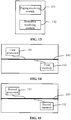
- FIG. 12 is a structural diagram of a data transmission device according to this embodiment.
- the device includes a paging sending module 121 and a downlink sending module 122.
- the paging sending module 121 is configured to carry a C-RNTI in a paging message sent to a terminal.
- the downlink sending module 122 is configured to transmit downlink data according to the C-RNTI.
- the device may be further configured to send downlink scheduling information DL-grant to the terminal.
- the step of sending the downlink scheduling information to the terminal may include carrying the downlink scheduling information DL-grant in the paging message. That is, the base station pages the UE through the DL-grant and the allocated C-RNTI carried in the paging message.
- the step of sending the downlink scheduling information to the terminal may include sending the downlink scheduling information through a physical downlink control channel.
- the step of transmitting the downlink data according to the C-RNTI may further include directly carrying the downlink data in the paging message.
- the device may be further configured to carry uplink scheduling information in the paging message; and receive at least one of feedback information of the downlink data, uplink data, a buffer status report (BSR) request or message MSG3 sent by the terminal according to a resource position configured in the uplink scheduling information.
- BSR buffer status report
- the device may be further configured to carry timing advance information (e.g. time synchronization information) in the paging message.
- the step of transmitting the downlink data according to the C-RNTI may further include transmitting the downlink data according to the C-RNTI and the timing advance information.
- the device before the step of carrying the time advance information in the paging message, the device may be further configured to determine sharing status of the timing advance information in each terminal, that is, the TA management in a terminal scenario of aggregated geographical positions.
- the step of determining the sharing status of the timing advance information may include triggering the positioning of the terminal; acquiring position information of the terminal; and determining, according to position information of each terminal, a terminal sharing the timing advance information.
- FIG. 13 is a structural diagram of a data transmission device according to this embodiment.
- the device includes a paging receiving module 131 and a downlink receiving module 132.
- the paging receiving module 131 is configured to receive a paging message sent by a base station.
- the paging message carries a cell radio network temporary identifier (C-RNTI).
- C-RNTI cell radio network temporary identifier
- the downlink receiving module 132 is configured to receive, according to the C-RNTI, downlink data sent by the base station.
- the device may be further configured to receive downlink scheduling information sent by the base station.
- the step of receiving, according to the C-RNTI, the downlink data sent by the base station includes the step described below.
- the downlink data is received on a physical downlink shared channel resource corresponding to the downlink scheduling information.
- message MSG4 is received on a resource corresponding to the downlink scheduling information, a random access process is completed according to message MSG4, and the downlink data is transmitted.
- the step of receiving, according to the C-RNTI, the downlink data sent by the base station may further include the step described below.
- the downlink data is directly carried in the paging message.
- the device may be further configured to perform the step described below.
- Uplink scheduling information is carried in the paging message.
- Feedback information of the downlink data is sent according to a resource position configured in the uplink scheduling information.
- uplink data is sent according to a resource position configured in the uplink scheduling information.
- a BSR request is sent according to a resource position configured in the uplink scheduling information.
- message MSG3 is sent according to a resource position configured in the uplink scheduling information, and the random access process is completed according to message MSG3.
- the device may be further configured to perform the step described below.
- Timing advance information is carried in the paging message.
- the step of transmitting the downlink data according to the C-RNTI may further include the step described below.
- the downlink data sent by the base station is received according to the C-RNTI and the timing advance information.
- the timing advance information may be, in the case where the terminal is in a terminal scenario of aggregated geographical positions, timing advance information corresponding to any terminal in the terminal scenario.
- the device before the step of carrying the timing advance information in the paging message, the device may be further configured to perform the step described below.
- Sharing status of the timing advance information in each terminal is determined.
- FIG. 14 is a structural diagram of a base station according to this embodiment.
- the base station includes a first processor 141, a first memory 142 and a first communication bus 143.
- the first communication bus 143 is configured to implement connection and communication between the first processor 141 and the first memory 142.
- the first processor 141 is configured to execute a computer program stored in the first memory 142, so as to perform the data transmission methods in various embodiments of the present disclosure, which are not repeated here.
- FIG. 15 is a structural diagram of a terminal according to this embodiment.
- the terminal includes a second processor 151, a second memory 152 and a second communication bus 153.
- the second communication bus 153 is configured to implement connection and communication between the second processor 151 and the second memory 152.
- the second processor 151 is configured to execute a computer program stored in the second memory 152, so as to perform the data transmission methods in various embodiments of the present disclosure, which are not repeated here.
- This embodiment provides a computer readable storage medium.
- the computer readable storage medium is configured to store one or more computer programs executable by one or more processors to implement the data transmission methods in various embodiments above, which are not repeated here.
- each of the modules or the steps in the present disclosure above may be implemented by a general-purpose computing device.
- the modules or the steps may be concentrated on a single computing device or distributed on a network composed of multiple computing devices.
- the modules or the steps may be implemented by program codes executable by the computing devices, so that the modules or the steps may be stored in a storage medium (such as a read-only memory (ROM)/random access memory (RAM), a magnetic disk or an optical disk) and executed by the computing devices.
- ROM read-only memory
- RAM random access memory
- the illustrated or described steps may be executed in sequences different from those described herein, or the modules or steps may be made into various integrated circuit modules separately, or multiple modules or steps therein may be made into a single integrated circuit module for implementation. Therefore, the present disclosure is not limited to any specific combination of hardware and software.
Landscapes
- Engineering & Computer Science (AREA)
- Computer Networks & Wireless Communication (AREA)
- Signal Processing (AREA)
- Databases & Information Systems (AREA)
- Mobile Radio Communication Systems (AREA)
Applications Claiming Priority (2)
| Application Number | Priority Date | Filing Date | Title |
|---|---|---|---|
| CN201810516124.3A CN110536286A (zh) | 2018-05-25 | 2018-05-25 | 数据传输方法、装置、基站、终端和可读存储介质 |
| PCT/CN2019/088382 WO2019223792A1 (zh) | 2018-05-25 | 2019-05-24 | 数据传输方法、装置、基站、终端和可读存储介质 |
Publications (2)
| Publication Number | Publication Date |
|---|---|
| EP3806511A1 true EP3806511A1 (de) | 2021-04-14 |
| EP3806511A4 EP3806511A4 (de) | 2022-03-16 |
Family
ID=68615691
Family Applications (1)
| Application Number | Title | Priority Date | Filing Date |
|---|---|---|---|
| EP19808085.5A Pending EP3806511A4 (de) | 2018-05-25 | 2019-05-24 | Datenübertragungsverfahren, vorrichtung, basisstation, endgerät und lesbares speichermedium |
Country Status (5)
| Country | Link |
|---|---|
| US (2) | US11470576B2 (de) |
| EP (1) | EP3806511A4 (de) |
| KR (1) | KR102385765B1 (de) |
| CN (1) | CN110536286A (de) |
| WO (1) | WO2019223792A1 (de) |
Cited By (1)
| Publication number | Priority date | Publication date | Assignee | Title |
|---|---|---|---|---|
| WO2023208741A1 (en) * | 2022-04-27 | 2023-11-02 | Continental Automotive Technologies GmbH | Handling small data transmission |
Families Citing this family (6)
| Publication number | Priority date | Publication date | Assignee | Title |
|---|---|---|---|---|
| WO2020030709A1 (en) * | 2018-08-09 | 2020-02-13 | Sony Corporation | Methods, communications device and infrastructure equipment |
| WO2021018531A1 (en) * | 2019-08-01 | 2021-02-04 | Telefonaktiebolaget Lm Ericsson (Publ) | User equipment (ue) grouping criteria and mechanisms for false paging reduction |
| EP4169340B1 (de) * | 2020-08-06 | 2025-04-16 | Nokia Technologies Oy | Verbessertes paging-verfahren für direktzugriff oder kleine datenübertragung |
| CN114071670B (zh) * | 2020-08-07 | 2024-05-31 | 大唐移动通信设备有限公司 | 上行定位方法、装置及存储介质 |
| CN112867139B (zh) * | 2021-03-25 | 2023-05-02 | 江苏亨鑫科技有限公司 | 寻呼场景下的快速随机接入的方法、设备、系统及介质 |
| CN113573404B (zh) * | 2021-08-25 | 2024-08-16 | RealMe重庆移动通信有限公司 | 上行同步方法、终端和存储介质 |
Family Cites Families (20)
| Publication number | Priority date | Publication date | Assignee | Title |
|---|---|---|---|---|
| EP1515575A1 (de) * | 2003-09-15 | 2005-03-16 | Motorola, Inc. | Netzwerk, Benutzergerät und Methode in einem zellularen Kommunikationssystem der 3ten Generation zur Übertragung von Benachrichtigungs-Signalisierungsnachrichten |
| CN100518391C (zh) | 2004-07-29 | 2009-07-22 | 北京三星通信技术研究有限公司 | 控制数据发送的方法 |
| CN101400026B (zh) * | 2007-09-24 | 2011-04-20 | 中兴通讯股份有限公司 | 一种小区寻呼状态下的数据传输方法 |
| CN101883428B (zh) * | 2009-05-08 | 2012-05-23 | 大唐移动通信设备有限公司 | 一种寻呼方法、装置、系统及移动终端 |
| CN102300331B (zh) | 2011-08-19 | 2013-11-27 | 电信科学技术研究院 | 数据传输方法和设备 |
| CN103024924B (zh) * | 2011-09-28 | 2017-04-12 | 华为技术有限公司 | D2d终端的连接建立方法、装置及系统 |
| CN103200533B (zh) * | 2012-01-10 | 2016-12-14 | 普天信息技术有限公司 | 一种集群短消息业务的实现方法 |
| WO2013169073A1 (en) | 2012-05-10 | 2013-11-14 | Samsung Electronics Co., Ltd. | Method and system for connectionless transmission during uplink and downlink of data packets |
| WO2015065041A1 (en) * | 2013-11-01 | 2015-05-07 | Lg Electronics Inc. | Method and apparatus for transmitting paging message in wireless communication system |
| US9648582B2 (en) * | 2014-11-06 | 2017-05-09 | Intel IP Corporation | RAN paging mechanism to enable enhanced coverage mode |
| WO2016145630A1 (zh) * | 2015-03-18 | 2016-09-22 | 华为技术有限公司 | 一种下行数据包的处理方法及相关设备 |
| CN106686744B (zh) * | 2015-11-06 | 2019-06-21 | 电信科学技术研究院 | 一种下行数据的传输方法和设备 |
| CN107295638B (zh) * | 2016-04-01 | 2019-08-02 | 电信科学技术研究院 | 下行数据的传输方法、基站及终端 |
| US10034269B2 (en) * | 2016-04-18 | 2018-07-24 | Qualcomm Incorporated | Enhanced discontinuous reception design for a shared frequency band |
| CN107666708B (zh) * | 2016-07-27 | 2019-12-20 | 电信科学技术研究院 | 一种下行数据传输方法及装置 |
| US10405342B2 (en) | 2016-11-01 | 2019-09-03 | Qualcomm Incorporated | Two step random access procedure |
| EP3560251B1 (de) * | 2016-12-23 | 2021-04-21 | Sony Corporation | Telekommunikationsgeräte und verfahren zur abrufen eines mobilgerätes |
| WO2018143415A1 (ja) * | 2017-02-03 | 2018-08-09 | 京セラ株式会社 | 無線端末、基地局、及び方法 |
| EP4344325A3 (de) * | 2017-05-04 | 2024-12-11 | Koninklijke Philips N.V. | Intragruppenkommunikation |
| CN110493870B (zh) * | 2017-09-27 | 2020-08-21 | 华为技术有限公司 | 一种通信方法、装置和计算机可读存储介质 |
-
2018
- 2018-05-25 CN CN201810516124.3A patent/CN110536286A/zh active Pending
-
2019
- 2019-05-24 EP EP19808085.5A patent/EP3806511A4/de active Pending
- 2019-05-24 KR KR1020207036793A patent/KR102385765B1/ko active Active
- 2019-05-24 WO PCT/CN2019/088382 patent/WO2019223792A1/zh not_active Ceased
- 2019-05-24 US US17/056,629 patent/US11470576B2/en active Active
-
2022
- 2022-09-02 US US17/902,181 patent/US11765688B2/en active Active
Cited By (1)
| Publication number | Priority date | Publication date | Assignee | Title |
|---|---|---|---|---|
| WO2023208741A1 (en) * | 2022-04-27 | 2023-11-02 | Continental Automotive Technologies GmbH | Handling small data transmission |
Also Published As
| Publication number | Publication date |
|---|---|
| EP3806511A4 (de) | 2022-03-16 |
| KR20210009382A (ko) | 2021-01-26 |
| KR102385765B1 (ko) | 2022-04-12 |
| CN110536286A (zh) | 2019-12-03 |
| US20210212020A1 (en) | 2021-07-08 |
| WO2019223792A1 (zh) | 2019-11-28 |
| US11765688B2 (en) | 2023-09-19 |
| US11470576B2 (en) | 2022-10-11 |
| US20220417902A1 (en) | 2022-12-29 |
Similar Documents
| Publication | Publication Date | Title |
|---|---|---|
| EP3806511A1 (de) | Datenübertragungsverfahren, vorrichtung, basisstation, endgerät und lesbares speichermedium | |
| US10420009B2 (en) | Methods and devices for determining and using Device-to-Device relay node | |
| EP3490276B1 (de) | Verfahren zur übertragung von systeminformationen, benutzerendgerät, netzwerkseitige vorrichtung, system und speichermedium | |
| US20200163097A1 (en) | Communication method, network device, and relay device | |
| EP3637804B1 (de) | Verfahren und vorrichtung zur festlegung einer benutzergeräte-kollaborationsgruppe | |
| CN111935821B (zh) | 一种寻呼方法、设备及系统 | |
| CN111034270A (zh) | 支持多带宽部分的载波的系统信息发送和接收的设备和方法 | |
| CN109565785B (zh) | 一种寻呼方法和寻呼设备 | |
| EP3849270A1 (de) | Signalübertragungsverfahren und kommunikationsvorrichtung | |
| CN106471852B (zh) | 一种数据传输方法、装置及系统 | |
| JP2019504518A (ja) | 接続確立方法及び装置 | |
| CN113875312A (zh) | 对用户设备对早期数据传输的回复的指示 | |
| CN102237956A (zh) | 一种终端发送上行数据的方法及装置 | |
| US10917871B2 (en) | Method and device for determining carrier for bearing paging message and sending paging message | |
| WO2021003596A1 (en) | Reducing unsuccessful paging | |
| CN110999517B (zh) | 用于设备到设备(d2d)通信的方法和设备 | |
| US20140141827A1 (en) | Method and apparatus for idle mode operation for m2m communication | |
| CN112312583B (zh) | 一种信息接收、发送方法、终端及网络设备 | |
| US20220132598A1 (en) | Method and apparatus for random access procedure | |
| EP3979743B1 (de) | Sidelink-implementierungsverfahren und -vorrichtung | |
| US9106393B2 (en) | Method and device for position update for M2M wireless communication | |
| WO2021203842A1 (zh) | 通信方法及设备 | |
| US12568531B2 (en) | Sending and configuring messaging in a random access procedure | |
| CN109391910B (zh) | 一种osi的传输方法、基站及用户设备 | |
| CN120659165A (zh) | 通信方法及装置、计算机可读存储介质 |
Legal Events
| Date | Code | Title | Description |
|---|---|---|---|
| STAA | Information on the status of an ep patent application or granted ep patent |
Free format text: STATUS: THE INTERNATIONAL PUBLICATION HAS BEEN MADE |
|
| PUAI | Public reference made under article 153(3) epc to a published international application that has entered the european phase |
Free format text: ORIGINAL CODE: 0009012 |
|
| STAA | Information on the status of an ep patent application or granted ep patent |
Free format text: STATUS: REQUEST FOR EXAMINATION WAS MADE |
|
| 17P | Request for examination filed |
Effective date: 20201224 |
|
| AK | Designated contracting states |
Kind code of ref document: A1 Designated state(s): AL AT BE BG CH CY CZ DE DK EE ES FI FR GB GR HR HU IE IS IT LI LT LU LV MC MK MT NL NO PL PT RO RS SE SI SK SM TR |
|
| AX | Request for extension of the european patent |
Extension state: BA ME |
|
| DAV | Request for validation of the european patent (deleted) | ||
| DAX | Request for extension of the european patent (deleted) | ||
| REG | Reference to a national code |
Ref country code: DE Ref legal event code: R079 Free format text: PREVIOUS MAIN CLASS: H04W0008280000 Ipc: H04W0008260000 |
|
| A4 | Supplementary search report drawn up and despatched |
Effective date: 20220216 |
|
| RIC1 | Information provided on ipc code assigned before grant |
Ipc: H04W 76/11 20180101ALN20220210BHEP Ipc: H04W 74/08 20090101ALN20220210BHEP Ipc: H04W 72/12 20090101ALI20220210BHEP Ipc: H04W 68/02 20090101ALI20220210BHEP Ipc: H04W 56/00 20090101ALI20220210BHEP Ipc: H04W 8/26 20090101AFI20220210BHEP |
|
| STAA | Information on the status of an ep patent application or granted ep patent |
Free format text: STATUS: EXAMINATION IS IN PROGRESS |
|
| 17Q | First examination report despatched |
Effective date: 20241113 |