EP3808043B1 - Gestion de téléchargements avec atténuation d'encombrement pour distribution de contenu par radio à des véhicules - Google Patents
Gestion de téléchargements avec atténuation d'encombrement pour distribution de contenu par radio à des véhicules Download PDFInfo
- Publication number
- EP3808043B1 EP3808043B1 EP19823180.5A EP19823180A EP3808043B1 EP 3808043 B1 EP3808043 B1 EP 3808043B1 EP 19823180 A EP19823180 A EP 19823180A EP 3808043 B1 EP3808043 B1 EP 3808043B1
- Authority
- EP
- European Patent Office
- Prior art keywords
- message
- vehicles
- class
- congestion
- campaign
- Prior art date
- Legal status (The legal status is an assumption and is not a legal conclusion. Google has not performed a legal analysis and makes no representation as to the accuracy of the status listed.)
- Active
Links
Images



Classifications
-
- G—PHYSICS
- G06—COMPUTING OR CALCULATING; COUNTING
- G06F—ELECTRIC DIGITAL DATA PROCESSING
- G06F8/00—Arrangements for software engineering
- G06F8/60—Software deployment
- G06F8/65—Updates
-
- H—ELECTRICITY
- H04—ELECTRIC COMMUNICATION TECHNIQUE
- H04L—TRANSMISSION OF DIGITAL INFORMATION, e.g. TELEGRAPHIC COMMUNICATION
- H04L47/00—Traffic control in data switching networks
- H04L47/10—Flow control; Congestion control
- H04L47/26—Flow control; Congestion control using explicit feedback to the source, e.g. choke packets
- H04L47/266—Stopping or restarting the source, e.g. X-on or X-off
-
- H—ELECTRICITY
- H04—ELECTRIC COMMUNICATION TECHNIQUE
- H04W—WIRELESS COMMUNICATION NETWORKS
- H04W28/00—Network traffic management; Network resource management
- H04W28/02—Traffic management, e.g. flow control or congestion control
- H04W28/0284—Traffic management, e.g. flow control or congestion control detecting congestion or overload during communication
-
- H—ELECTRICITY
- H04—ELECTRIC COMMUNICATION TECHNIQUE
- H04L—TRANSMISSION OF DIGITAL INFORMATION, e.g. TELEGRAPHIC COMMUNICATION
- H04L47/00—Traffic control in data switching networks
- H04L47/10—Flow control; Congestion control
- H04L47/25—Flow control; Congestion control with rate being modified by the source upon detecting a change of network conditions
Definitions
- This application relates generally to systems, devices, and methods for wireless content delivery to vehicles and more particularly to systems, devices and methods for content delivery to running vehicles over cellular radio networks.
- the so-called "Internet of Things” creates an opportunity to provide content delivery services to millions of connected items, not least of which is a connected vehicle.
- vehicle manufacturers are incorporating computer technology into their vehicles.
- Many manufacturers desire to receive diagnostic data from vehicles and to deliver data files to the vehicles, such as head unit updates (e.g., patches to correct safety issues, fix bugs, add features), navigation/map data, music libraries, messages for vehicle owners, or the like.
- head unit updates e.g., patches to correct safety issues, fix bugs, add features
- navigation/map data e.g., music libraries, messages for vehicle owners, or the like.
- this data is typically delivered to vehicles over wide area cellular networks, and it is transmitted while the vehicle is running, so that adequate electrical power is available.
- WO 2016/007563 A1 (Symphony Teleca Corp [US]) 14 January 2016 (2016-01-14) discloses managing download of over-the-air updates to a vehicle considering the status of its connection to the network.
- CDNs typically comprise a distributed set of servers that deliver content on behalf of a cooperating content provider (in this case, the vehicle manufacturers).
- a cooperating content provider in this case, the vehicle manufacturers.
- files from a vehicle manufacturer's origin server can be distributed to vehicles on the road.
- the teachings hereof address this technical need, providing improved computer methods, systems, and apparatus for delivering data more quickly and efficiently in face of potential last-mile network congestion. Those skilled in the art will understand these and other improvements from the teachings hereof.
- this document describes systems, devices, and methods for wireless content delivery to vehicles and in particular to vehicles in cellular radio environments.
- the teachings hereof can be used to deliver a vehicle manufacturer's head unit updates, firmware, configurations, and other data to a vehicle.
- downloads are managed at the control plane and/or data plane. Download management can include mitigating either current or anticipated wireless congestion at cell towers, enforcing campaign priority for firmware updates, accommodating occupant-originated data flows to and from the vehicle, and/or accounting for contractual data arrangements between vehicles makers and cellular providers, among other things.
- a method for managing the delivery on an update to a vehicle is the first aspect of the present invention and is provided in claim 1, wherein a determination is based at least in part on anticipated congestion status of one or more cell towers based on historical data and on path data from a particular one of a class of vehicles.
- a system for managing the delivery of an update to a vehicle is the second aspect of the present invention and is provided in claim 7, wherein a determination is based at least in part on anticipated congestion status of one or more cell towers based on historical data and on path data from a particular one of a class of vehicles.
- server is used herein to refer to hardware (a computer configured as a server, also referred to as a “server machine”) with server software running on such hardware (e.g., a web server).
- server machine a computer configured as a server, also referred to as a "server machine”
- server software running on such hardware (e.g., a web server).
- origin server a computer configured as a server
- client device a device that refers to hardware in combination with software (e.g., a browser or player application). While context may indicate the hardware or the software exclusively, should such distinction be appropriate, the teachings hereof can be implemented in any combination of hardware and software.
- web page or "page” is meant to refer to a browser or other user-agent presentation defined by an HTML or other markup language document.
- a vehicle's head unit can make a request to determine if there are any firmware patches, or other patches, that are due.
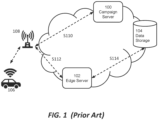
- the update process can then proceed, in general, as shown in FIG. 1 (Prior Art), which is described below:
- the head unit of the vehicle 106 will contact a campaign server 100, which is typically operated and/or controlled by an automaker.
- a campaign server 100 which is typically operated and/or controlled by an automaker.
- the dashed line should be interpreted to represent the flow of one or more messages (e.g., a message exchange) over a communication channel, such as an HTTP session over a TLS-secured TCP/IP connection, or any other suitable networking stack.
- a communication channel such as an HTTP session over a TLS-secured TCP/IP connection, or any other suitable networking stack.
- the individual arrows are a logical representation; the TCP/IP connection may be split into multiple segments, while the TLS-secured HTTP session extends from vehicle 106 to campaign server 100.
- the head unit of the vehicle 106 sends a message up to the campaign server 100 (via cell tower 108) to determine if a download is warranted.
- the upstream message includes information about the vehicle, make and model, currently installed firmware, and the like.
- the campaign server determines whether the particular vehicle requires an update; that determination can be based for example on the make/model and other vehicle information.
- the head unit in the vehicle 106 receives a response message from the campaign server 100 indicating what particular action should take place, such as:
- the head unit will download the patch and apply it.
- the campaign server 100 could serve the actual content of the update to the vehicle 106.
- the vehicle manufacturer can use a CDN to deliver the data.
- the edge server 102 fetches the requested data from the data storage 104, if not in local cache already.
- the data storage can be operated by the vehicle manufacturer or by the CDN provider for the vehicle manufacturer's use.
- the edge server 102 then delivers the data to the vehicle 106 (back at S 112).
- the head unit of the vehicle 106 requests a patch from the edge server 102 via cell tower 108 and the edge server 102 either delivers the requested data from local cache or pulls the data the vehicle manufacturer.
- edge server 102 and data storage 104 may be provided by a content delivery network (CDN) service provider as a service to the vehicle manufacturer. More detail about CDN infrastructure will be provided later in this document.
- CDN content delivery network
- the system shown and described with respect to FIG. 1 provides scalability and offload for the vehicle manufacturer during the download of the actual update data due to the use of the CDN. This is purely a data plane improvement that accelerates the delivery of the update file itself. But, it does not take into account potential cellular congestion or other cellular traffic management considerations. As noted above, bandwidth requirements for delivering updates are growing dramatically and automakers increasingly need to push patches out in short time windows and in complex, noisy cellular environments.
- the system shown in FIG. 1 can be modified and augmented to provide a mechanism to monitor congestion and mitigate it, and otherwise to control and optimize a range of download management factors. Adding such control can relax or even remove the need for the cellular providers to set limits for cellular downloads. Also it can enable automakers to utilize available bandwidth efficiently and in cooperation with their cellular providers.
- Such a cellular congestion monitoring and mitigation subsystem can be provided by the CDN, although this is not necessary. But assuming the CDN (or other multi-tenant service provider entity) provides services to multiple vehicle manufacturers, it can collect cellular data from across vehicle manufacturers, presenting a more accurate and comprehensive picture of congestion, which is envisioned by the teachings hereof.
- a service is implemented in a control plane to manage the download process, including in particular the timing and data rate at which downloads occur.
- the cellular congestion and download management entity (CCMM 200) collects information about congestion in the mobile network. Congestion information could be collected directly from cellular operators, or via other congestion monitoring mechanisms, which will be described in detail below. In addition, congestion information gathered from vehicle head units can be collected and aggregated into a data feed to the CCMM service 200, as will also be described in further detail below.
- the CCMM 200 service can determine areas of congestion (e.g., on a cell tower by tower basis) and consult policies that determine how to handle a particular slice of traffic.
- the policies typically provide conditions and more generally the logic and settings to determine whether to invoke congestion mitigation, and if so, what actions to take.
- the policies will be configured by a vehicle manufacturer to reflect their own traffic management rules and preferences as well as their traffic constraints, which can be based on their contractual arrangement with their cellular carrier (e.g., usage caps, time of day restrictions).
- the CCMM 200 can be configured to accept a policy directly from a cellular network carrier -- and/or even to accept from that carrier real-time traffic control directives, e.g., to stop or limit traffic -- in addition to a vehicle manufacturer's policy.
- the CCMM 200 can interact with the campaign server 100 and/or a vehicle 106 to suspend/prioritize lower priority campaigns.
- a system administrator e.g., a user working for the CDN or vehicle manufacturer
- who is monitoring the congestion can do the same thing on a user interface provided by the CCMM 100, referred to as the CCMM dashboard (202).
- Mitigation directives can be transmitted from the CCMM 200 down to the head unit of the vehicle, within responses to vehicle queries, or when connecting to the network to download a patch. This causes the head unit to temporarily delay or suspend the download, or to throttle it.
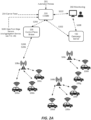
- FIG. 2A provides an illustration of a system in accord with this first embodiment.
- FIG. 2A focuses on the control plane elements;
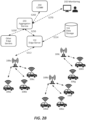
- FIG. 2B adds the data plane elements.
- vehicles 106a-h represent vehicles that may need an update and that connect to campaign server 100 and to the control plane broker 206, both connections being via cell towers 108a-c.
- FIG. 2A does not depict all messaging flows in the system, in order to avoid cluttering the diagram. Rather, an exemplary set of messaging with respect to cell tower 108a and vehicle 106a is shown and described, but the reader should assume that other cell towers and vehicles are operating similarly and contemporaneously.
- the control plane broker 206 is managed by the CCMM 200 to control the download activity of the vehicles 106a-h.
- the control plane broker 206 is implemented as an MQTT server (MQ Telemetry Transport server) that publishes messages on a range of topics to which the vehicles 106a-h can subscribe.
- MQTT server MQ Telemetry Transport server
- the control plane broker 206 may publish messages on topics corresponding to a particular campaign, a particular cell tower, to a particular vehicle make and/or model, and even to a particular vehicle vehicle itself (e.g., a particular vehicle identification number or VIN). Any topic is possible.
- the CCMM 200 takes in congestion data from the carrier feed 204, from a data feed 260 created by aggregating data collected from vehicles 106a-h (shown in FIG. 2B ) and/or any other source
- the CCMM 200 can provide this information to a monitoring center 202 for visualization.
- the CCMM 200 When the CCMM 200 detects or predicts congestion, it applies one or more policies of the corresponding vehicle manufacturer and determines an appropriate action, e.g., by sending congestion mitigation or other directives to the vehicles 106a-h via the broker 206.
- the CCMM 200 also manages the downloads in other ways.
- the CCMM 200 can enforce cellular usage limits for the vehicle manufacturer, such as on a per-tower or per-network (aggregated) basis.
- the CCMM 200 receiving progress updates from the vehicles 106a-h, can monitor the status of campaigns for a given vehicle or in the aggregate across all vehicles subject to the campaign. If a particular vehicle and/or campaign were falling behind schedule (assume for example deadline for a particularly important safety update), the CCMM 200 can address this situation by de-prioritizing other in-progress campaigns of lower priority.
- the CCMM 200 can monitor and manage virtually any aspect of a download to a vehicle.
- the head unit of a given vehicle e.g., vehicle 106a
- vehicle 106a the head unit of a given vehicle
- the broker 206 subscribes to topics corresponding to its head unit version and to its make and model.
- the head unit will thereafter receive messages on those topics in accord with, preferably, the MQTT protocol, at S206.
- the campaign server 100 contacts the CCMM 200 and requests that the initiation of a new campaign.
- the campaign server 100 can provide metadata about the campaign, such as a campaign identifier, URL for the update file, the make/model and/or head unit versions of vehicles to which the campaign applies, a priority level.
- a safety patch for example, typically would have a higher priority than an update to an entertainment interface.
- the metadata can also include a manifest file with multiple URLs, each pointing for example to a segment of the overall update.
- the CCMM 200 ingests this information and begins the campaign by publishing (via broker 206) a ⁇ campaign start' message and the URL for the update file on the topic or topics for the relevant make/model and/or head unit versions.
- the message would typically include a campaign identifier, too.
- the broker 206 flags the directive to 'start download' as an MQTT retained message. This means that when newly subscribing vehicles join the topic after the campaign start, the broker will send them the ⁇ campaign start' message so they can begin the download. Thereafter, they are following the topic and will receive later directives applicable to the campaign.
- the CCMM 200 may publish a 'contact campaign server 100' directive to certain makes/models of vehicles or head unit versions. This means that the receiving vehicles should contact the campaign server 100 to find out if they truly need an update. The campaign server 100 can then respond to those vehicles with a message indicating that (i) they do not need an update or that (ii) they do need an update providing the URL for the update file.
- This approach is particularly suited to more complex campaigns, for example a braking system or other component update that applies to some vehicles of a particular make and model, but not all vehicles of that make and model have that component or component version installed.
- the CCCM 200 can send directives after the campaign has begun. Assume that vehicles 106a to 106e have begun downloading an update.
- the CCMM 200 can send a directive to throttle (data rate control), pause, cancel/retry a download for a particular campaign identifier.
- the CCMM would publish the directive on a topic for a particular campaign, i.e., by campaign identifier.
- the throttling directive could be sent on a topic for specific cell tower, in effect informing all vehicles currently attached to that cell tower to change their download behavior.
- directives could be published to specific topics specific to particular make/model and/or head unit version; however, such specific messages are not preferably used for congestion mitigation or traffic management, but rather to inform vehicles of a particular make/model to contact the campaign manager to see if they need an update, or for other "housekeeping" functions. In this way, all vehicles that are part of a given campaign generally start, stop, and pause, etc., together, in an orchestrated manner. Of course, this is not limiting and only one example. As another example, the broker 206 the CCMM 200 via the broker 206 could send a directive regarding a particular cell tower, i.e., to the topic for cell tower 108a.
- this directive would instruct all vehicles connected to that cell tower to throttle, pause, or cancel/retry, thereby addressing localized cellular congestion or other issues.
- a vehicle moves to a new tower, it would listen to a new topic for that cell tower, and follow the throttling (or absence of throttling) associated with the new tower automatically.
- the CCMM 200 could even instruct a single vehicle, via its individual topic, to change its download behavior.
- the CCMM 200 can manage downloads on the basis of the priority of campaigns. For example, assume the campaign server 100 communicates to the CCMM 200 a request to initiate a high-priority campaign. The CCMM 200 could react by throttling or pausing lower priority campaigns to allow the higher-priority campaign to proceed expeditiously.
- the CCMM 200 can manage the downloads in a fine-grained manner by campaign, cell tower, individual vehicle, makes/models of vehicles, or on the basis of any other attribute that can correspond to a pub/sub topic.
- MQTT is merely exemplary, any publish/subscribe protocol providing the functionality described herein can be used.
- the CCMM 200 is continually receiving cellular congestion information from carriers 204 as well as cellular data rate/congestion measurements from in-progress downloads. It also receives policy information from a vehicle manufacturer. The CCMM 200 uses this information determine how to manage the downloads to the vehicles 106.
- FIG. 2B illustrates the data plane for the system shown in FIG. 2A .
- a vehicle e.g., vehicle 106a
- a vehicle will make a request to the campaign URL it received from the campaign server 100 (or, in some embodiments, from the broker 206).
- the hostname of the campaign URL is resolved (e.g., via DNS) to an edge server 102 in a CDN, typically a CDN request routing system would be applied to select the closest edge server (in network distance terms) that can server the request.
- the vehicle 106a After the DNS resolution process, the vehicle 106a makes a content request, such as a HTTP 'GET' or 'POST' request, to the edge server 102 for the content under the URL (S212).
- a content request such as a HTTP 'GET' or 'POST' request
- the edge server 102 may apply configuration metadata for the URL to understand how to handle the request. (See e.g., US Patent No. 7,240,100 and 9,667,747 and 9,654,579 .
- the edge server 102 checks its local cache to see if it has the requested content.) If it does, the update can be served to the vehicle 106a. If not, the edge server 102 can fetch the content from the data storage 104 (S214).
- the system will be set up so that an update is segmented into a number of individually requestable chunks (either with individual URLs or via HTTP range requests). If so, the request and response operation is repeated for each segment.
- the vehicle 106 may throttle the download, pause, or take other action.
- the edge server 102 simply responds appropriately to the vehicle 106 in a normal way.
- the edge server 102 may be adapted, though, to monitor the throughput or other metric indicative of network congestion to a vehicle during downloads.
- the edge server 102 can also monitor the status of a given download to a vehicle (e.g., via the client acknowledgements it receives).
- the edge server 102 can then publishes suchstatistics (e.g., via MQTT or otherwise), including therein such information as the vehicle, campaign, carrier, cell tower, and the like, for which they were observed.
- This data can be sent to an aggregation service 250.
- the aggregation service 250 receives and aggregates this kind of data from other edge servers across the platform, as shown in FIG. 2B at S250'.
- the aggregated information can be delivered at S270 to Monitoring 202 and at S260 to the CCMM 200 to inform decision-making in supplement to, or in place of carrier feeds 204 in FIG. 2A .
- the data published upstream at S260 differs from log data in that it is real-time.
- the edge servers 102 can generate log data and download receipts also (e.g., for billing purposes or later offline analysis).
- the CCMM 200 relies on an ability to determine the current congestion state and/or levels. If the CCMM 200 can detect a high level of congestion at a tower or in an area or in a network, it can try to mitigate it. There are variety of techniques that the CCMM can leverage to calculate congestion; below are a few examples.
- the CCMM 200 can receive information directly from the systems of cellular providers.
- Cellular providers have ways -- as known in the art -- to determine if their network and more specifically particular cell towers are becoming congested. This information can be accessed via an API call or by receiving push notifications of certain events (e.g., congestion reaching a particular threshold for a given cell tower). See US Patent Publication Nos. 2015/0019746 and 2011/0173108 .
- congestion information is provided in a standardized format or the CCMM 200 provides a translation layer to translate provider specific information into a generic format/version so that any processing done on this information can be standardized.
- software in a client can determine congestion by having one of them periodically send a packet train to the other and measuring the bottleneck bandwidth/congestion on the link by examining the magnitude to which the packets disperse as they travel through the network. If the available bandwidth is below a threshold, the link can be considered congested. Further, the congestion algorithm can be run on a selected samples of clients and the results extrapolated to larger pools of clients to infer congestion at a given cell tower.
- congestion can be calculated by monitoring the progress of downloads (of the campaign updates) by the edge server 102 and the reporting described with respect to FIG. 2B , at S250, S250', S260.
- the download performance can be tracked by the edge server 102. This can be done, e.g., by tracking received acknowledgments in an MQTT or similar protocol.
- Such download management and tracking software would track how long it took to download a particular chunk of data, say 1K.
- Based the network e.g., 3G or 4G or 5G
- signal strength, etc. a calculation can determine how the download processed compared to a non-congested (expected/optimal) download.
- a congestion flag can be set in the upstream logs.
- a threshold amount e.g., a percentage, excluding discontinuities caused by cell tower handoffs
- the system can use actual download times on a reasonable sized object to not necessarily to determine a specific congestion value, but whether it is getting better or worse.
- Congestion information from various sources is aggregated, as mentioned with respect to FIG. 2B , at 250 Data Aggregation Service.
- the 250 Data Aggregation Service will aggregate the data to average out the congestion for each cell tower for a particular unit of time . Additionally, if desired, alerts can be triggered to show status and trend/changes in congestion either per tower, or per region. FIG. 3 shows this process.
- the Aggregation Service 250 is receiving multiple congestion updates from edge servers. It is important to note that the congestion information could also be received from carrier feeds 204; in other words, the Aggregation Service could fetch and process carrier feeds 204 from FIG. 2A on behalf of the CCMM 200. Any combination of congestion information from any source can be aggregated and used.
- the Aggregation Service 250 has aggregated the information down to two rows of averaged information by cell tower id (Cell ID).
- Cell ID cell tower id
- the data shown in FIG. 3 is merely for illustration; clearly there will be much more data in a running system. Note that one can provide additional layers of aggregation to further aggregate and reduce updates.
- the Aggregation Service 250 may be implemented in a distributed system using a hierarchical approach (that is, a second level congestion data processor responsible for "several first line" congestion data processors).
- a congestion monitoring user interface at monitoring element 202, can be provided so that vehicle manufacturers have a view of the progress of campaigns, of data throughput, and congestion status.
- Such a system-administrator style interface can be built as a service, with plug-in modules to be loaded in customer's own information technology infrastructure.
- the CCMM 200 could offer APIs for the vehicle manufacturer to use to fetch congestion data.
- an manufacturer's campaign manager 100 can be integrated via APIs so that, the monitoring information will include the campaign information such as completion rates or other information specific to the vehicle manufacturer.
- congestion information gathered from across vehicle manufacturers is aggregated in the system. Therefore, in the aggregate the cellular congestion information (e.g., of the type shown in FIG. 3 ) would include data from all of the automakers participating in the service, providing a more robust data set with higher accuracy and larger coverage.
- the system is preferably agnostic as to any particular use case or strategy for determining when to mitigate congestion.
- Future congestion in some cases, congestion may not be present at a given time but the system is able to predict future congestion based on historical network traffic patterns and/or vehicular traffic patterns. For example, during a morning commute in a metropolitan area, as vehicles from suburbs converge to a downtown area, the cell towers serving the downtown area may become congested. Knowing this pattern, the CCMM 200 can invoke mitigation via the broker 206 for some proportion of vehicles attached to suburban cell towers (the originating zone) where such vehicles are likely to end up attached to cell towers in the downtown area (the predicted congestion zone). These patterns can be determined based on historical network traffic patterns and/or based on geography/cell tower placements, and/or based on in-car navigation system routes that a driver has selected.
- congestion mitigation is based on the history for a particular vehicle.
- the system can anticipate based on historical data for the day/time that the vehicle is likely to soon be traveling to a particular area (e.g., commute to the city) and attach to a particular cell tower along the way or at the destination. It can also be anticipated that the destination cell towers (or "along the path" cell towers) are likely to be congested. Based on that data the CCMM 200 can invoke mitigation. The reverse may also be true -- if the vehicle is likely to be traveling to a less congested cell tower, then the system can re-evaluate at that time based on congestion information for the new cell tower.
- the system can monitor cellular data usage for compliance with service level agreements. For example, a vehicle manufacturer may make a deal with their cellular provider that gives them a certain price for staying under a certain usage limit and/or bandwidth limit.
- the CCMM 200 can monitor data downloaded via the download manager in the head unit of the vehicle. The vehicle manufacturer can agree with its cellular provider to limit downloads by volume, transfer rate, or transfer rate per cellular tower. In fact, this can even be tiered to say, certain cell towers during these times have one rate, and so on.
- CCMM 200 can apply policies at various times to determine how and whether to apply mitigation, based on congestion, campaign priorities (as the CCMM 200 can retrieve priority levels for campaigns from the campaign server 100) and usage agreements with the cellular providers, and other information.
- the limits on cell usage can be expressed (for example as shown above) as a percentage of cell tower total bandwidth, or alternatively as an amount of data (e.g., in Mbps).
- a list of cell tower types with varying limits could be included.
- Default Campaign Priority in the above policy is shown as a ranking.
- campaign priorities could be expressed as percentages, e.g., a campaign defaults to using NN percentage of the available bandwidth at a cell tower, and then the policy lists high priority campaigns that should get a desired minimum percentage, with the assumption that default campaigns can be throttled to accommodate a campaign with a specified priority.
- FIGS. 4A-4B illustrate another embodiment which differs from the embodiment described with respect to FIGS. 2A-2B in that the data plane is used to manage download traffic to mitigate congestion and for other purposes. In effect, a control plane function is incorporated into the data plane.
- FIG. 4A illustrates the role of the control plane elements in this embodiment.
- a given vehicle for example, vehicle 106a
- vehicle 106a starts (engine ignition)
- the campaign server 100 contacts the campaign server 100 (S410).
- the vehicle can send a message that identifies the individual vehicle, the make/model, and the head unit update status (e.g., current firmware version, etc.), as well as the cell tower ID for the cell tower of a cell network to which the vehicle is currently attached, among other things.
- the vehicle can send a message that identifies the individual vehicle, the make/model, and the head unit update status (e.g., current firmware version, etc.), as well as the cell tower ID for the cell tower of a cell network to which the vehicle is currently attached, among other things.
- the head unit update status e.g., current firmware version, etc.
- the campaign server 100 When the campaign server 100 receives a message from a vehicle, it determines whether there are any active campaigns that need to be downloaded to the head unit of the vehicle. Still at S410, the campaign server 100 responds to the vehicle. The campaign server 100 could respond with a message that indicates any of:
- the response preferably includes an identifier for the campaign with a URL for the patch to be downloaded.
- the campaign server 100 then updates the CCMM 200 about the open campaign, see S402, and also can provide the information to the Monitoring 202 function at S408.
- each vehicle manufacturer may create a policy for each make or model of its vehicles, or for each head unit version, or otherwise.
- FIG. 4B illustrates an example of data plane operation.
- the head unit of vehicle 106a makes an HTTP 'GET' request for the update file using the URL it obtained from the campaign server 100 in FIG. 4A at S410.
- the hostname of the URL resolves to the IP address of an edge server 102, so the head unit directs its request there.
- the edge server 102 consults and applies the corresponding policy for the download to determine whether to allow the download to proceed given current conditions (including in particular congestion in the cellular network) and how to manage the download rate and other things.
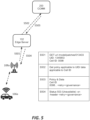
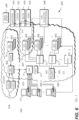
- FIG. 5 illustrates the details of the download process.
- the edge server 102 receives a request for the update file from the vehicle 106a.
- the request is illustrated as an HTTP 'GET' request but this is merely an example; it should be understood that any suitable protocol could be used.
- the request includes headers identifying the head unit, vehicle make and model, as well as the cell tower identifier for the cell tower to which the vehicle is currently connected.
- the intended route of the vehicle could be sent (e.g., the data being extracted from the vehicle navigation system), which can be used in predicting congestion at cell towers along the route.
- the edge server 102 selects and applies the appropriate policy for the download at hand. Assume, for example, that there is a policy for each vehicle manufacturer (e.g., in FIG. 5 , the UID is intended to illustrated a unique identifier for an automaker).
- the edge server 102 identifiers the vehicle manufacturer for vehicle 106a and then pulls that policy from the CCMM 200, as shown at S502.
- the policy is returned at S503.
- the edge server 102 preferably caches this policy for a time period and reuses it to handle subsequent requests when it applies.
- FIG. 5 shows that the edge server 102 also fetches congestion information for the relevant cellular tower ("Cell ID: 0098"). This information can also be a cached for some time at the edge server 102, preferably with a TTL value.
- the edge server 102 responds to the vehicle 106a.
- the edge server 102 might respond that the data is unavailable (HTTP Status 503) and that the vehicle 106a and the vehicle 106a should try again at some later time, which delay or time could be specified. If the download can proceed, then the edge server 102 can begin to provide the content.
- the edge server could respond with a governance value (e.g. in a header).
- a governance value means a directive that instructs the vehicle 106a to limit the rate at which it downloads until further directive is received.
- a given update file is broken into segments, such that a vehicle's head unit can request each portion of a file independently.
- the same process that was outlined above in connection with the start of a downoad ( FIG. 5 and accompanying description) also can be applied to the start of the download of any segment in the file. This means that, for each segment, a head unit can reconnect or sends a request to the edge server 102 for such segment, and the edge server 102 can check congestion and the policy and decide whether mitigation is needed, before issuing a response.
- Segmentation may be accomplished by having independent files that make up a patch and that are specified on a manifest which is delivered to the vehicle, or having byte offsets into a single file that the client can request (e.g., using HTTP range requests or similar mechanism).
- a new determination preferably is made when a connection is interrupted (e.g., due to radio interference, congestion, or ignition off, etc.). Upon such a circumstance, the vehicle head unit can try to reconnect and download the remainder of the patch file. The mitigation process outlined above for FIG. 5 would apply again.
- the download manager can reconnect and/or request each one independently, the download manager can control the rate at which the series of chunks are downloaded. To this end, the download manager can pause between segment requests, and/or pace the requests to achieve an instructed governance value.
- a vehicle head unit connects (at S501) to the edge server via the HTTP/2 protocol, which enables a single connection to be reused for the message exchange (request and response) for multiple segments. Further, using HTTP/2 server push, the vehicle's head unit could simply wait for the edge server 102, which would push segments at desired pace (e.g., by sending HTTP/2 PUSH_PROMISE frames and then the data).
- the vehicles' head unit could pace the download by reading from its network buffer in small chunks and taking breaks (e.g., read X bytes, wait Y milliseconds) to achieve the desired data rate.
- the transport layer of the connection would slow the transfer of data between the edge server 102 and vehicle head unit.
- the TCP/IP layer wouldn't be as efficient and the transfer windows and acknowledgements (ACKs) would not be optimal, this would accomplish the desired pacing.
- the edge server 102 reports on data rates and/or congestion on its connections to vehicles (S450). Meanwhile, other edge servers will report likewise (S450') to the Aggregation Service 250.
- the Aggregation Service 250 preferably operates as already described with respect to FIG. 3 , thus providing aggregated congestion data to the CCMM 200 at S460.
- the CCMM 200 uses this to update the cell tower congestion data that was described in FIG. 5 (S502/S503).
- a head unit update file (referred to as a patch) has been used for illustrative purposes throughout this document, the teachings hereof can be used with and apply equally to the delivery of any type of file, and indeed any data, to a vehicle.
- Congestion mitigation is only one reason to reject a download. Another reason to reject a download is if the patch in question has somehow been corrupted. This could be corruption that occurs when loading the patch onto the data storage 104 or when fetching it. This could also be the case of the wrong file being downloaded. Either way, the system could be set to tell all downloaders that the file is temporarily unavailable and then when they do try to download it. A flag can be sent back in either a header and/or payload that indicates that the download should start from the beginning. This is because here is no point completing a download to find that it needs to be deleted and re-downloaded.
- edge server 102 in FIGS. 1-5 is a server that is part of a CDN.
- a description of a conventional CDN is now provided.
- a CDN is a distributed computer system and it can be (but does not have to be) operated and managed by a service provider.
- a "distributed system” of this type typically refers to a collection of autonomous computers linked by a network or networks, together with the software, systems, protocols and techniques designed to facilitate various services, such as content delivery or the support of site infrastructure.
- the infrastructure can be shared by multiple tenants, typically referred to as the content providers.
- the infrastructure is generally used for the storage, caching, or transmission of content - such as web pages, streaming media and applications -- on behalf of such content providers or other tenants.
- the platform may also provide ancillary technologies used therewith including, without limitation, DNS query handling, provisioning, data monitoring and reporting, content targeting, personalization, and business intelligence.
- the CDN processes may be located at nodes that are publicly-routable on the Internet, within or adjacent to nodes that are located in mobile networks, in or adjacent to enterprise-based private networks, or in any combination thereof.
- a distributed computer system 600 is configured as a content delivery network (CDN) and is assumed to have a set of machines 602 distributed around the Internet.
- the machines 602 are servers and can correspond to the edge server 102 in FIGS. 1-5 .
- Most of the machines are configured as servers and located near the edge of the Internet, i.e., at or adjacent end user access networks.
- a network operations command center (NOCC) 604 may be used to administer and manage operations of the various machines in the system.
- Third party sites affiliated with content providers such as web site 606, offload delivery of content (e.g., HTML or other markup language files, embedded page objects, streaming media, software downloads, and the like) to the distributed computer system 600 and, in particular, to the servers 602 (which are sometimes referred to as content servers, or sometimes as "edge” servers in light of the possibility that they are near an "edge” of the Internet).
- content e.g., HTML or other markup language files, embedded page objects, streaming media, software downloads, and the like
- Such servers may be grouped together into a point of presence (POP) 607.
- POP point of presence
- content providers offload their content delivery by aliasing (e.g., by a DNS CNAME) given content provider domains or sub-domains to domains that are managed by the service provider's authoritative domain name service.
- End user client machines 622 that desire such content may be directed to the distributed computer system to obtain that content more reliably and efficiently.
- the CDN servers respond to the client requests, for example by obtaining requested content from a local cache, from another CDN server, from the origin server 106, or other source.
- the distributed computer system may also include other infrastructure, such as a distributed data collection system 608 that collects usage and other data from the CDN servers, aggregates that data across a region or set of regions, and passes that data to other back-end systems 610, 612, 614 and 616 to facilitate monitoring, logging, alerts, billing, management and other operational and administrative functions.
- Distributed network agents 618 monitor the network as well as the server loads and provide network, traffic and load data to a DNS query handling mechanism 615, which is authoritative for content domains being managed by the CDN.
- a distributed data transport mechanism 620 may be used to distribute control information (e.g., metadata to manage content, to facilitate load balancing, and the like) to the CDN servers.
- a given machine in the CDN comprises commodity hardware (e.g., a microprocessor) running an operating system kernel (such as Linux ® or variant) that supports one or more applications.
- an operating system kernel such as Linux ® or variant
- given machines typically run a set of applications, such as an HTTP proxy, a name server, a local monitoring process, a distributed data collection process, and the like.
- the HTTP proxy (sometimes referred to herein as a global host or "ghost”) typically includes a manager process for managing a cache and delivery of content from the machine.
- the machine typically includes one or more media servers, as required by the supported media formats.
- a given CDN server 602 may be configured to provide one or more extended content delivery features, preferably on a domain-specific, content-provider -specific basis, preferably using configuration files that are distributed to the CDN servers using a configuration system.
- a given configuration file preferably includes a set of content handling rules and directives that facilitate one or more advanced content handling features.
- the configuration file may be delivered to the CDN server via the data transport mechanism.
- U.S. Patent Nos. 7,240,100 describe a useful infrastructure for delivering and managing CDN server content control information and this and other control information (sometimes referred to as "metadata") can be provisioned by the CDN service provider itself, or (via an extranet or the like) the content provider customer who operates the origin server.
- U.S. Patent Nos. 7,111,057 describes an architecture for purging content from the CDN.
- a content provider identifies a content provider domain or sub-domain that it desires to have served by the CDN.
- the CDN service provider associates (e.g., via a canonical name, or CNAME, or other aliasing technique) the content provider domain with a CDN hostname, and the CDN provider then provides that CDN hostname to the content provider.
- a DNS query to the content provider domain or sub-domain is received at the content provider's domain name servers, those servers respond by returning the CDN hostname. That network hostname points to the CDN, and that hostname is then resolved through the CDN name service. To that end, the CDN name service returns one or more IP addresses.
- the requesting client application (e.g., browser) then makes a content request (e.g., via HTTP or HTTPS) to a CDN server associated with the IP address.
- the request includes a Host header that includes the original content provider domain or sub-domain.
- the CDN server Upon receipt of the request with the Host header, the CDN server checks its configuration file to determine whether the content domain or sub-domain requested is actually being handled by the CDN. If so, the CDN server applies its content handling rules and directives for that domain or sub-domain as specified in the configuration. These content handling rules and directives may be located within an XML-based "metadata" configuration file, as described previously. Thus, the domain name or subdomain name in the request is bound to (associated with) a particular configuration file, which contains the rules, settings, etc., that the CDN server should use for that request.
- the CDN resources may be used to facilitate wide area network (WAN) acceleration services between enterprise data centers (which may be privately managed) and to/from third party software-as-a-service (SaaS) providers.
- WAN wide area network
- SaaS software-as-a-service
- CDN customers may subscribe to a "behind the firewall" managed service product to accelerate Intranet web applications that are hosted behind the customer's enterprise firewall, as well as to accelerate web applications that bridge between their users behind the firewall to an application hosted in the internet cloud (e.g., from a SaaS provider).
- CDN software may execute on machines (potentially in virtual machines running on customer hardware) hosted in one or more customer data centers, and on machines hosted in remote "branch offices.”
- the CDN software executing in the customer data center typically provides service configuration, service management, service reporting, remote management access, customer SSL certificate management, as well as other functions for configured web applications.
- the software executing in the branch offices provides last mile web acceleration for users located there.
- the CDN itself typically provides CDN hardware hosted in CDN data centers to provide a gateway between the nodes running behind the customer firewall and the CDN service provider's other infrastructure (e.g., network and operations facilities).
- This type of managed solution provides an enterprise with the opportunity to take advantage of CDN technologies with respect to their company's intranet, providing a wide-area-network optimization solution.
- This kind of solution extends acceleration for the enterprise to applications served anywhere on the Internet.
- the CDN may have a variety of other features and adjunct components.
- the CDN may include a network storage subsystem (sometimes referred to herein as "NetStorage") which may be located in a network datacenter accessible to the CDN servers, such as described in U.S. Patent No. 7,472,178 .
- the CDN may operate a server cache hierarchy to provide intermediate caching of customer content; one such cache hierarchy subsystem is described in U.S. Patent No. 7,376,716 .
- Communications between CDN servers and/or across the overlay may be enhanced or improved using techniques such as described in U.S. Patent Nos. 6,820,133 , 7,274,658 , 7.660.296 .
- the CDN may include a live delivery subsystem, such as described in U.S. Patent No. 7,296,082 , and U.S. Publication No. 2011/0173345 .
- teachings hereof may be implemented using conventional computer systems, but modified by the teachings hereof, with the functional characteristics described above realized in special-purpose hardware, general-purpose hardware configured by software stored therein for special purposes, or a combination thereof.
- Software may include one or several discrete programs. Any given function may comprise part of any given module, process, execution thread, or other such programming construct. Generalizing, each function described above may be implemented as computer code, namely, as a set of computer instructions, executable in one or more microprocessors to provide a special purpose machine. The code may be executed using an apparatus - such as a microprocessor in a computer, digital data processing device, or other computing apparatus - as modified by the teachings hereof. In one embodiment, such software may be implemented in a programming language that runs in conjunction with a proxy on a standard Intel hardware platform running an operating system such as Linux. The functionality may be built into the proxy code, or it may be executed as an adjunct to that code.
- FIG. 7 is a block diagram that illustrates hardware in a computer system 700 upon which such software may run in order to implement embodiments of the invention.
- the computer system 700 may be embodied in a client device, server, personal computer, workstation, tablet computer, mobile or wireless device such as a smartphone, network device, router, hub, gateway, or other device.
- Representative machines on which the subject matter herein is provided may be Intel Pentium-based computers running a Linux or Linux-variant operating system and one or more applications to carry out the described functionality.
- Computer system 700 includes a microprocessor 704 coupled to bus 701. In some systems, multiple processor and/or processor cores may be employed. Computer system 700 further includes a main memory 710, such as a random access memory (RAM) or other storage device, coupled to the bus 701 for storing information and instructions to be executed by processor 704. A read only memory (ROM) 708 is coupled to the bus 701 for storing information and instructions for processor 704. A non-volatile storage device 706, such as a magnetic disk, solid state memory (e.g., flash memory), or optical disk, is provided and coupled to bus 701 for storing information and instructions. Other application-specific integrated circuits (ASICs), field programmable gate arrays (FPGAs) or circuitry may be included in the computer system 700 to perform functions described herein.
- ASICs application-specific integrated circuits
- FPGAs field programmable gate arrays
- a peripheral interface 712 communicatively couples computer system 700 to a user display 714 that displays the output of software executing on the computer system, and an input device 715 (e.g., a keyboard, mouse, trackpad, touchscreen) that communicates user input and instructions to the computer system 700.
- the peripheral interface 712 may include interface circuitry, control and/or level-shifting logic for local buses such as Universal Serial Bus (USB), IEEE 1394, or other communication links.
- USB Universal Serial Bus
- Computer system 700 is coupled to a communication interface 716 that provides a link (e.g., at a physical layer, data link layer,) between the system bus 701 and an external communication link.
- the communication interface 716 provides a network link 718.
- the communication interface 716 may represent a Ethernet or other network interface card (NIC), a wireless interface, modem, an optical interface, or other kind of input/output interface.
- NIC network interface card
- Network link 718 provides data communication through one or more networks to other devices. Such devices include other computer systems that are part of a local area network (LAN) 726. Furthermore, the network link 718 provides a link, via an internet service provider (ISP) 720, to the Internet 722. In turn, the Internet 722 may provide a link to other computing systems such as a remote server 730 and/or a remote client 731. Network link 718 and such networks may transmit data using packet-switched, circuit-switched, or other data-transmission approaches.
- ISP internet service provider
- the computer system 700 may implement the functionality described herein as a result of the processor executing code.
- code may be read from or stored on a non-transitory computer-readable medium, such as memory 710, ROM 708, or storage device 706.
- a non-transitory computer-readable medium such as memory 710, ROM 708, or storage device 706.
- Other forms of non-transitory computer-readable media include disks, tapes, magnetic media, CD-ROMs, optical media, RAM, PROM, EPROM, and EEPROM. Any other non-transitory computer-readable medium may be employed.
- Executing code may also be read from network link 718 (e.g., following storage in an interface buffer, local memory, or other circuitry).
Landscapes
- Engineering & Computer Science (AREA)
- Computer Networks & Wireless Communication (AREA)
- Signal Processing (AREA)
- Software Systems (AREA)
- General Engineering & Computer Science (AREA)
- Theoretical Computer Science (AREA)
- Computer Security & Cryptography (AREA)
- Physics & Mathematics (AREA)
- General Physics & Mathematics (AREA)
- Information Transfer Between Computers (AREA)
- Mobile Radio Communication Systems (AREA)
Claims (14)
- Un procédé pour gérer la distribution d'une mise à jour à un véhicule, le procédé comprenant le fait :A. de débuter la distribution d'une campagne en envoyant un premier message à une classe de véhicules qui, tous, sont en circulation et connectés à des tours cellulaires et présentent des unités multimédias (head unit), la classe de véhicules étant définie par un ou plusieurs éléments parmi : la marque, le modèle, et la version de l'unité multimédia,B. dans lequel le premier message comprend n'importe quel message parmi :a. un message de début de campagne comprenant au moins une URL destinée à être utilisée dans le téléchargement d'une mise à jour, etb. un message « contacter serveur de campagne » comprenant une directive incitant à contacter un serveur de campagne pour obtenir une instruction sur le téléchargement de la mise à jour ;C. de décider d'envoyer un deuxième message à un véhicule particulier de la classe de véhicules, le deuxième message comprenant une directive incitant à entreprendre une action concernant le téléchargement de la mise à jour, l'action étant n'importe quelle action parmi : mettre en pause, différer, restreindre, et annuler ;D. dans lequel ladite décision est basée au moins en partie sur un statut d'encombrement anticipé d'une ou de plusieurs tours cellulaires basé sur des données historiques et des données de trajet provenant du véhicule particulier de la classe de véhicules.
- Le procédé de la revendication 1, dans lequel la mise à jour comprend un micrologiciel pour une unité multimédia dans un véhicule.
- Le procédé de la revendication 1, comprenant en sus le fait :de recevoir une demande provenant de véhicules dans la classe de s'abonner à une rubrique correspondant à la classe ;dans lequel le fait d'envoyer le premier message comprend le fait de publier le premier message dans la rubrique pour la classe.
- Le procédé de la revendication 1, comprenant en sus le fait d'envoyer le deuxième message (a) à tous les véhicules dans la classe ; ou (b) au véhicule particulier de la classe de véhicules dans la classe sur la base d'un encombrement détecté au niveau d'une tour cellulaire à laquelle le véhicule particulier des véhicules est connecté.
- Le procédé de la revendication 1, comprenant en sus le fait de recevoir des données d'encombrement (a) provenant d'un opérateur cellulaire ; ou (b) générées par un ou plusieurs serveurs edge disponibles pour déployer la mise à jour auprès de véhicules dans la classe.
- Le procédé de la revendication 1, comprenant en sus le fait, avant d'envoyer le premier message, de recevoir un troisième message provenant du serveur de campagne avec une instruction incitant à débuter la campagne, et en réponse à celui-ci, d'envoyer le premier message.
- Un système pour gérer la distribution d'une mise à jour à un véhicule, le système comprenant :A. une entité de gestion d'encombrement cellulaire et de téléchargement comprenant un ou plusieurs ordinateurs présentant une circuiterie formant au moins un processeur et au moins un dispositif de mémoire stockant des instructions pour exécution sur l'au moins un processeur, les instructions amenant, lorsqu'elles sont exécutées, les un ou plusieurs ordinateurs à :a. lancer la distribution d'une campagne en envoyant un premier message à une classe de véhicules qui, tous, sont en circulation et connectés à des tours cellulaires et présentent des unités multimédias, la classe de véhicules étant définie par un ou plusieurs éléments parmi : la marque, le modèle, et la version de l'unité multimédia,b. dans lequel le premier message comprend n'importe quel message parmi :i. un message de début de campagne comprenant au moins une URL destinée à être utilisée dans le téléchargement d'une mise à jour, etii. un message « contacter serveur de campagne » comprenant une directive incitant à contacter un serveur de campagne distinct de l'entité de gestion d'encombrement cellulaire et de téléchargement pour obtenir une instruction sur le téléchargement de la mise à jour ;c. décider d'envoyer un deuxième message à un véhicule particulier de la classe de véhicules, le deuxième message comprenant une directive incitant à entreprendre une action concernant le téléchargement de la mise à jour, l'action étant n'importe quelle action parmi : mettre en pause, différer, restreindre, et annuler ;d. dans lequel ladite décision est basée au moins en partie sur un statut d'encombrement anticipé d'une ou de plusieurs tours cellulaires basé sur des données historiques et des données de trajet provenant du véhicule particulier de la classe de véhicules.
- Le système de la revendication 7, dans lequel la mise à jour comprend un micrologiciel pour une unité multimédia dans un véhicule.
- Le système de la revendication 7, les instructions amenant en sus, lorsqu'elles sont exécutées, les un ou plusieurs ordinateurs à :recevoir une demande provenant de véhicules dans la classe de s'abonner à une rubrique correspondant à la classe ;dans lequel le fait d'envoyer le premier message comprend le fait de publier le premier message dans la rubrique pour la classe.
- Le système de la revendication 7, les instructions amenant en sus, lorsqu'elles sont exécutées, les un ou plusieurs ordinateurs à : (a) envoyer le deuxième message à tous les véhicules dans la classe ; ou (b) envoyer le deuxième message au véhicule particulier des véhicules dans la classe sur la base d'un encombrement détecté au niveau d'une tour cellulaire à laquelle le véhicule particulier des véhicules dans la classe est connecté.
- Le système de la revendication 7, les instructions amenant en sus, lorsqu'elles sont exécutées, les un ou plusieurs ordinateurs à : (a) recevoir des données d'encombrement provenant d'un opérateur cellulaire ; ou (b) recevoir des données d'encombrement générées par un ou plusieurs serveurs edge disponibles pour déployer la mise à jour auprès de véhicules dans la classe.
- Le système de la revendication 7, les instructions amenant en sus, lorsqu'elles sont exécutées, les un ou plusieurs ordinateurs à : avant d'envoyer le premier message, recevoir un troisième message provenant du serveur de campagne avec une instruction incitant à débuter la campagne, et en réponse à celui-ci, envoyer le premier message.
- Le procédé de la revendication 1, dans lequel le premier message comprend un message de protocole MQTT (MQ Telemetry Transport).
- Le système de la revendication 7, dans lequel le premier message comprend un message de protocole MQTT (MQ Telemetry Transport).
Applications Claiming Priority (3)
| Application Number | Priority Date | Filing Date | Title |
|---|---|---|---|
| US16/010,604 US11012362B2 (en) | 2018-06-18 | 2018-06-18 | Download management with congestion mitigation for over the air content delivery to vehicles |
| US16/010,602 US10667172B2 (en) | 2018-06-18 | 2018-06-18 | Download management with congestion mitigation for over the air content delivery to vehicles |
| PCT/US2019/036772 WO2019245821A1 (fr) | 2018-06-18 | 2019-06-12 | Gestion de téléchargements avec atténuation d'encombrement pour distribution de contenu par radio à des véhicules |
Publications (3)
| Publication Number | Publication Date |
|---|---|
| EP3808043A1 EP3808043A1 (fr) | 2021-04-21 |
| EP3808043A4 EP3808043A4 (fr) | 2021-09-15 |
| EP3808043B1 true EP3808043B1 (fr) | 2024-10-23 |
Family
ID=68983412
Family Applications (1)
| Application Number | Title | Priority Date | Filing Date |
|---|---|---|---|
| EP19823180.5A Active EP3808043B1 (fr) | 2018-06-18 | 2019-06-12 | Gestion de téléchargements avec atténuation d'encombrement pour distribution de contenu par radio à des véhicules |
Country Status (2)
| Country | Link |
|---|---|
| EP (1) | EP3808043B1 (fr) |
| WO (1) | WO2019245821A1 (fr) |
Family Cites Families (16)
| Publication number | Priority date | Publication date | Assignee | Title |
|---|---|---|---|---|
| US6665726B1 (en) | 2000-01-06 | 2003-12-16 | Akamai Technologies, Inc. | Method and system for fault tolerant media streaming over the internet |
| US6820133B1 (en) | 2000-02-07 | 2004-11-16 | Netli, Inc. | System and method for high-performance delivery of web content using high-performance communications protocol between the first and second specialized intermediate nodes to optimize a measure of communications performance between the source and the destination |
| US7240100B1 (en) | 2000-04-14 | 2007-07-03 | Akamai Technologies, Inc. | Content delivery network (CDN) content server request handling mechanism with metadata framework support |
| US7111057B1 (en) | 2000-10-31 | 2006-09-19 | Akamai Technologies, Inc. | Method and system for purging content from a content delivery network |
| US7274658B2 (en) | 2001-03-01 | 2007-09-25 | Akamai Technologies, Inc. | Optimal route selection in a content delivery network |
| US7340505B2 (en) | 2001-04-02 | 2008-03-04 | Akamai Technologies, Inc. | Content storage and replication in a managed internet content storage environment |
| US7133905B2 (en) | 2002-04-09 | 2006-11-07 | Akamai Technologies, Inc. | Method and system for tiered distribution in a content delivery network |
| US7660296B2 (en) | 2005-12-30 | 2010-02-09 | Akamai Technologies, Inc. | Reliable, high-throughput, high-performance transport and routing mechanism for arbitrary data flows |
| CN102792291B (zh) | 2009-08-17 | 2015-11-25 | 阿卡麦科技公司 | 基于http的流分发的方法和系统 |
| US20110173108A1 (en) | 2010-01-13 | 2011-07-14 | Oracle International Corporation | Gateway for enabling cloud-based service exposure |
| US9509804B2 (en) | 2012-12-21 | 2016-11-29 | Akami Technologies, Inc. | Scalable content delivery network request handling mechanism to support a request processing layer |
| US9654579B2 (en) | 2012-12-21 | 2017-05-16 | Akamai Technologies, Inc. | Scalable content delivery network request handling mechanism |
| US9270709B2 (en) | 2013-07-05 | 2016-02-23 | Cisco Technology, Inc. | Integrated signaling between mobile data networks and enterprise networks |
| US9747096B2 (en) * | 2014-07-07 | 2017-08-29 | Harman Connected Services, Inc. | Remote embedded device update platform apparatuses, methods and systems |
| US9807010B2 (en) | 2015-06-05 | 2017-10-31 | Akamai Technologies, Inc. | Congestion detection in mobile networks and delivery of content in non-congested conditions |
| US9720680B2 (en) * | 2015-07-23 | 2017-08-01 | Honda Motor Co., Ltd. | Methods and apparatus for wirelessly updating vehicle systems |
-
2019
- 2019-06-12 EP EP19823180.5A patent/EP3808043B1/fr active Active
- 2019-06-12 WO PCT/US2019/036772 patent/WO2019245821A1/fr not_active Ceased
Also Published As
| Publication number | Publication date |
|---|---|
| EP3808043A4 (fr) | 2021-09-15 |
| EP3808043A1 (fr) | 2021-04-21 |
| WO2019245821A1 (fr) | 2019-12-26 |
Similar Documents
| Publication | Publication Date | Title |
|---|---|---|
| US11533261B2 (en) | Download management with congestion mitigation for over the air content delivery to vehicles | |
| US10667172B2 (en) | Download management with congestion mitigation for over the air content delivery to vehicles | |
| US20260025307A1 (en) | System providing faster and more efficient data communication | |
| US11082334B2 (en) | Distributed quality-of-service (QoS) in an overlay network using capacity enforcement | |
| EP3593502B1 (fr) | Trajets multiples collaboratifs | |
| US10200251B2 (en) | Methods and apparatus for accessing selectable application processing of data packets in an adaptive private network | |
| EP2782318A1 (fr) | Attribution de ressources entre des n'uds de réseau pour fournir une fonction de n'ud de réseau | |
| EP3296870B1 (fr) | Système de gestion de contenu basée sur un cdn | |
| KR101473317B1 (ko) | 클라우드 컴퓨팅 시스템 및 클라우드 컴퓨팅 시스템에서의 트래픽 분산 방법 및 제어 방법 | |
| US20140222967A1 (en) | Transparent media delivery and proxy | |
| EP2853074B1 (fr) | Procédés destinés à optimiser un service de demandes de contenu, et dispositifs associés | |
| JP2018156606A (ja) | 通信制御装置、通信制御方法およびコンピュータプログラム | |
| US10070348B2 (en) | Hypertext transfer protocol support over hybrid access | |
| KR20090097034A (ko) | 피어 투 피어 통신에서의 피어 선정 방법 및 그 시스템 | |
| US10764402B2 (en) | Leveraging time-windows generated by web browser pre-connections | |
| Giannone et al. | Orchestrating heterogeneous MEC-based applications for connected vehicles | |
| US20180091631A1 (en) | Systems and methods for writing prioritized http/2 data to a socket buffer | |
| EP4578176B1 (fr) | Système et procédé de calcul de plate-forme de périphérie à la demande | |
| EP3808043B1 (fr) | Gestion de téléchargements avec atténuation d'encombrement pour distribution de contenu par radio à des véhicules | |
| CN112311826A (zh) | 内容分发系统中访问请求的处理方法、装置及系统 | |
| WO2015100283A1 (fr) | Systèmes et procédés pour distribuer du contenu à des clients qui sont mappés d'une manière sous-optimale | |
| Kalan et al. | vDANE: Using virtualization for improving video quality with Server and Network Assisted DASH | |
| Scheuble | Secure over-the-air updates for connected vehicles | |
| CN114500545B (zh) | 适用于容器的网络负载均衡方法、装置及电子设备 | |
| US20250117266A1 (en) | Service platform with configurable electricity usage characteristics |
Legal Events
| Date | Code | Title | Description |
|---|---|---|---|
| STAA | Information on the status of an ep patent application or granted ep patent |
Free format text: STATUS: THE INTERNATIONAL PUBLICATION HAS BEEN MADE |
|
| PUAI | Public reference made under article 153(3) epc to a published international application that has entered the european phase |
Free format text: ORIGINAL CODE: 0009012 |
|
| STAA | Information on the status of an ep patent application or granted ep patent |
Free format text: STATUS: REQUEST FOR EXAMINATION WAS MADE |
|
| 17P | Request for examination filed |
Effective date: 20210111 |
|
| AK | Designated contracting states |
Kind code of ref document: A1 Designated state(s): AL AT BE BG CH CY CZ DE DK EE ES FI FR GB GR HR HU IE IS IT LI LT LU LV MC MK MT NL NO PL PT RO RS SE SI SK SM TR |
|
| AX | Request for extension of the european patent |
Extension state: BA ME |
|
| RAP3 | Party data changed (applicant data changed or rights of an application transferred) |
Owner name: AKAMAI TECHNOLOGIES, INC. |
|
| REG | Reference to a national code |
Ref country code: DE Ref legal event code: R079 Free format text: PREVIOUS MAIN CLASS: H04L0012801000 Ipc: G06F0008650000 Ref country code: DE Ref legal event code: R079 Ref document number: 602019060871 Country of ref document: DE Free format text: PREVIOUS MAIN CLASS: H04L0012801000 Ipc: G06F0008650000 |
|
| A4 | Supplementary search report drawn up and despatched |
Effective date: 20210818 |
|
| RIC1 | Information provided on ipc code assigned before grant |
Ipc: H04L 12/801 20130101ALI20210812BHEP Ipc: G06F 8/65 20180101AFI20210812BHEP |
|
| DAV | Request for validation of the european patent (deleted) | ||
| DAX | Request for extension of the european patent (deleted) | ||
| STAA | Information on the status of an ep patent application or granted ep patent |
Free format text: STATUS: EXAMINATION IS IN PROGRESS |
|
| 17Q | First examination report despatched |
Effective date: 20230315 |
|
| P01 | Opt-out of the competence of the unified patent court (upc) registered |
Effective date: 20230505 |
|
| GRAP | Despatch of communication of intention to grant a patent |
Free format text: ORIGINAL CODE: EPIDOSNIGR1 |
|
| STAA | Information on the status of an ep patent application or granted ep patent |
Free format text: STATUS: GRANT OF PATENT IS INTENDED |
|
| RIC1 | Information provided on ipc code assigned before grant |
Ipc: H04L 47/25 20220101ALN20240430BHEP Ipc: H04L 47/26 20220101ALI20240430BHEP Ipc: G06F 8/65 20180101AFI20240430BHEP |
|
| INTG | Intention to grant announced |
Effective date: 20240527 |
|
| GRAS | Grant fee paid |
Free format text: ORIGINAL CODE: EPIDOSNIGR3 |
|
| GRAA | (expected) grant |
Free format text: ORIGINAL CODE: 0009210 |
|
| STAA | Information on the status of an ep patent application or granted ep patent |
Free format text: STATUS: THE PATENT HAS BEEN GRANTED |
|
| AK | Designated contracting states |
Kind code of ref document: B1 Designated state(s): AL AT BE BG CH CY CZ DE DK EE ES FI FR GB GR HR HU IE IS IT LI LT LU LV MC MK MT NL NO PL PT RO RS SE SI SK SM TR |
|
| REG | Reference to a national code |
Ref country code: GB Ref legal event code: FG4D |
|
| REG | Reference to a national code |
Ref country code: CH Ref legal event code: EP |
|
| REG | Reference to a national code |
Ref country code: DE Ref legal event code: R096 Ref document number: 602019060871 Country of ref document: DE |
|
| REG | Reference to a national code |
Ref country code: IE Ref legal event code: FG4D |
|
| REG | Reference to a national code |
Ref country code: LT Ref legal event code: MG9D |
|
| REG | Reference to a national code |
Ref country code: NL Ref legal event code: MP Effective date: 20241023 |
|
| REG | Reference to a national code |
Ref country code: AT Ref legal event code: MK05 Ref document number: 1735391 Country of ref document: AT Kind code of ref document: T Effective date: 20241023 |
|
| PG25 | Lapsed in a contracting state [announced via postgrant information from national office to epo] |
Ref country code: NL Free format text: LAPSE BECAUSE OF FAILURE TO SUBMIT A TRANSLATION OF THE DESCRIPTION OR TO PAY THE FEE WITHIN THE PRESCRIBED TIME-LIMIT Effective date: 20241023 |
|
| PG25 | Lapsed in a contracting state [announced via postgrant information from national office to epo] |
Ref country code: NL Free format text: LAPSE BECAUSE OF FAILURE TO SUBMIT A TRANSLATION OF THE DESCRIPTION OR TO PAY THE FEE WITHIN THE PRESCRIBED TIME-LIMIT Effective date: 20241023 |
|
| PG25 | Lapsed in a contracting state [announced via postgrant information from national office to epo] |
Ref country code: IS Free format text: LAPSE BECAUSE OF FAILURE TO SUBMIT A TRANSLATION OF THE DESCRIPTION OR TO PAY THE FEE WITHIN THE PRESCRIBED TIME-LIMIT Effective date: 20250223 Ref country code: HR Free format text: LAPSE BECAUSE OF FAILURE TO SUBMIT A TRANSLATION OF THE DESCRIPTION OR TO PAY THE FEE WITHIN THE PRESCRIBED TIME-LIMIT Effective date: 20241023 Ref country code: PT Free format text: LAPSE BECAUSE OF FAILURE TO SUBMIT A TRANSLATION OF THE DESCRIPTION OR TO PAY THE FEE WITHIN THE PRESCRIBED TIME-LIMIT Effective date: 20250224 |
|
| PG25 | Lapsed in a contracting state [announced via postgrant information from national office to epo] |
Ref country code: FI Free format text: LAPSE BECAUSE OF FAILURE TO SUBMIT A TRANSLATION OF THE DESCRIPTION OR TO PAY THE FEE WITHIN THE PRESCRIBED TIME-LIMIT Effective date: 20241023 |
|
| PG25 | Lapsed in a contracting state [announced via postgrant information from national office to epo] |
Ref country code: BG Free format text: LAPSE BECAUSE OF FAILURE TO SUBMIT A TRANSLATION OF THE DESCRIPTION OR TO PAY THE FEE WITHIN THE PRESCRIBED TIME-LIMIT Effective date: 20241023 |
|
| PG25 | Lapsed in a contracting state [announced via postgrant information from national office to epo] |
Ref country code: ES Free format text: LAPSE BECAUSE OF FAILURE TO SUBMIT A TRANSLATION OF THE DESCRIPTION OR TO PAY THE FEE WITHIN THE PRESCRIBED TIME-LIMIT Effective date: 20241023 |
|
| PG25 | Lapsed in a contracting state [announced via postgrant information from national office to epo] |
Ref country code: NO Free format text: LAPSE BECAUSE OF FAILURE TO SUBMIT A TRANSLATION OF THE DESCRIPTION OR TO PAY THE FEE WITHIN THE PRESCRIBED TIME-LIMIT Effective date: 20250123 |
|
| PG25 | Lapsed in a contracting state [announced via postgrant information from national office to epo] |
Ref country code: LV Free format text: LAPSE BECAUSE OF FAILURE TO SUBMIT A TRANSLATION OF THE DESCRIPTION OR TO PAY THE FEE WITHIN THE PRESCRIBED TIME-LIMIT Effective date: 20241023 Ref country code: AT Free format text: LAPSE BECAUSE OF FAILURE TO SUBMIT A TRANSLATION OF THE DESCRIPTION OR TO PAY THE FEE WITHIN THE PRESCRIBED TIME-LIMIT Effective date: 20241023 Ref country code: GR Free format text: LAPSE BECAUSE OF FAILURE TO SUBMIT A TRANSLATION OF THE DESCRIPTION OR TO PAY THE FEE WITHIN THE PRESCRIBED TIME-LIMIT Effective date: 20250124 |
|
| PG25 | Lapsed in a contracting state [announced via postgrant information from national office to epo] |
Ref country code: PL Free format text: LAPSE BECAUSE OF FAILURE TO SUBMIT A TRANSLATION OF THE DESCRIPTION OR TO PAY THE FEE WITHIN THE PRESCRIBED TIME-LIMIT Effective date: 20241023 |
|
| PG25 | Lapsed in a contracting state [announced via postgrant information from national office to epo] |
Ref country code: RS Free format text: LAPSE BECAUSE OF FAILURE TO SUBMIT A TRANSLATION OF THE DESCRIPTION OR TO PAY THE FEE WITHIN THE PRESCRIBED TIME-LIMIT Effective date: 20250123 |
|
| PG25 | Lapsed in a contracting state [announced via postgrant information from national office to epo] |
Ref country code: SM Free format text: LAPSE BECAUSE OF FAILURE TO SUBMIT A TRANSLATION OF THE DESCRIPTION OR TO PAY THE FEE WITHIN THE PRESCRIBED TIME-LIMIT Effective date: 20241023 |
|
| PGFP | Annual fee paid to national office [announced via postgrant information from national office to epo] |
Ref country code: DE Payment date: 20250402 Year of fee payment: 7 |
|
| PG25 | Lapsed in a contracting state [announced via postgrant information from national office to epo] |
Ref country code: DK Free format text: LAPSE BECAUSE OF FAILURE TO SUBMIT A TRANSLATION OF THE DESCRIPTION OR TO PAY THE FEE WITHIN THE PRESCRIBED TIME-LIMIT Effective date: 20241023 |
|
| PGFP | Annual fee paid to national office [announced via postgrant information from national office to epo] |
Ref country code: GB Payment date: 20250401 Year of fee payment: 7 |
|
| PG25 | Lapsed in a contracting state [announced via postgrant information from national office to epo] |
Ref country code: EE Free format text: LAPSE BECAUSE OF FAILURE TO SUBMIT A TRANSLATION OF THE DESCRIPTION OR TO PAY THE FEE WITHIN THE PRESCRIBED TIME-LIMIT Effective date: 20241023 |
|
| PGFP | Annual fee paid to national office [announced via postgrant information from national office to epo] |
Ref country code: FR Payment date: 20250401 Year of fee payment: 7 |
|
| PG25 | Lapsed in a contracting state [announced via postgrant information from national office to epo] |
Ref country code: RO Free format text: LAPSE BECAUSE OF FAILURE TO SUBMIT A TRANSLATION OF THE DESCRIPTION OR TO PAY THE FEE WITHIN THE PRESCRIBED TIME-LIMIT Effective date: 20241023 |
|
| REG | Reference to a national code |
Ref country code: DE Ref legal event code: R097 Ref document number: 602019060871 Country of ref document: DE |
|
| PG25 | Lapsed in a contracting state [announced via postgrant information from national office to epo] |
Ref country code: SK Free format text: LAPSE BECAUSE OF FAILURE TO SUBMIT A TRANSLATION OF THE DESCRIPTION OR TO PAY THE FEE WITHIN THE PRESCRIBED TIME-LIMIT Effective date: 20241023 |
|
| PG25 | Lapsed in a contracting state [announced via postgrant information from national office to epo] |
Ref country code: CZ Free format text: LAPSE BECAUSE OF FAILURE TO SUBMIT A TRANSLATION OF THE DESCRIPTION OR TO PAY THE FEE WITHIN THE PRESCRIBED TIME-LIMIT Effective date: 20241023 |
|
| PG25 | Lapsed in a contracting state [announced via postgrant information from national office to epo] |
Ref country code: IT Free format text: LAPSE BECAUSE OF FAILURE TO SUBMIT A TRANSLATION OF THE DESCRIPTION OR TO PAY THE FEE WITHIN THE PRESCRIBED TIME-LIMIT Effective date: 20241023 |
|
| PLBE | No opposition filed within time limit |
Free format text: ORIGINAL CODE: 0009261 |
|
| STAA | Information on the status of an ep patent application or granted ep patent |
Free format text: STATUS: NO OPPOSITION FILED WITHIN TIME LIMIT |
|
| PG25 | Lapsed in a contracting state [announced via postgrant information from national office to epo] |
Ref country code: SE Free format text: LAPSE BECAUSE OF FAILURE TO SUBMIT A TRANSLATION OF THE DESCRIPTION OR TO PAY THE FEE WITHIN THE PRESCRIBED TIME-LIMIT Effective date: 20241023 |
|
| 26N | No opposition filed |
Effective date: 20250724 |
|
| REG | Reference to a national code |
Ref country code: CH Ref legal event code: H13 Free format text: ST27 STATUS EVENT CODE: U-0-0-H10-H13 (AS PROVIDED BY THE NATIONAL OFFICE) Effective date: 20260127 |
|
| PG25 | Lapsed in a contracting state [announced via postgrant information from national office to epo] |
Ref country code: MC Free format text: LAPSE BECAUSE OF FAILURE TO SUBMIT A TRANSLATION OF THE DESCRIPTION OR TO PAY THE FEE WITHIN THE PRESCRIBED TIME-LIMIT Effective date: 20241023 |
|
| PG25 | Lapsed in a contracting state [announced via postgrant information from national office to epo] |
Ref country code: LU Free format text: LAPSE BECAUSE OF NON-PAYMENT OF DUE FEES Effective date: 20250612 |
|
| REG | Reference to a national code |
Ref country code: BE Ref legal event code: MM Effective date: 20250630 |
|
| PG25 | Lapsed in a contracting state [announced via postgrant information from national office to epo] |
Ref country code: IE Free format text: LAPSE BECAUSE OF NON-PAYMENT OF DUE FEES Effective date: 20250612 |
|
| PG25 | Lapsed in a contracting state [announced via postgrant information from national office to epo] |
Ref country code: BE Free format text: LAPSE BECAUSE OF NON-PAYMENT OF DUE FEES Effective date: 20250630 |
|
| PG25 | Lapsed in a contracting state [announced via postgrant information from national office to epo] |
Ref country code: CH Free format text: LAPSE BECAUSE OF NON-PAYMENT OF DUE FEES Effective date: 20250630 |