EP3810407B1 - Milieu de support pour impression 3d de biomatériaux - Google Patents
Milieu de support pour impression 3d de biomatériaux Download PDFInfo
- Publication number
- EP3810407B1 EP3810407B1 EP19814062.6A EP19814062A EP3810407B1 EP 3810407 B1 EP3810407 B1 EP 3810407B1 EP 19814062 A EP19814062 A EP 19814062A EP 3810407 B1 EP3810407 B1 EP 3810407B1
- Authority
- EP
- European Patent Office
- Prior art keywords
- hydrogel
- xanthan gum
- support medium
- printing
- alginate
- Prior art date
- Legal status (The legal status is an assumption and is not a legal conclusion. Google has not performed a legal analysis and makes no representation as to the accuracy of the status listed.)
- Active
Links
Images




Classifications
-
- C—CHEMISTRY; METALLURGY
- C12—BIOCHEMISTRY; BEER; SPIRITS; WINE; VINEGAR; MICROBIOLOGY; ENZYMOLOGY; MUTATION OR GENETIC ENGINEERING
- C12N—MICROORGANISMS OR ENZYMES; COMPOSITIONS THEREOF; PROPAGATING, PRESERVING, OR MAINTAINING MICROORGANISMS; MUTATION OR GENETIC ENGINEERING; CULTURE MEDIA
- C12N5/00—Undifferentiated human, animal or plant cells, e.g. cell lines; Tissues; Cultivation or maintenance thereof; Culture media therefor
- C12N5/0068—General culture methods using substrates
- C12N5/0075—General culture methods using substrates using microcarriers
-
- C—CHEMISTRY; METALLURGY
- C12—BIOCHEMISTRY; BEER; SPIRITS; WINE; VINEGAR; MICROBIOLOGY; ENZYMOLOGY; MUTATION OR GENETIC ENGINEERING
- C12N—MICROORGANISMS OR ENZYMES; COMPOSITIONS THEREOF; PROPAGATING, PRESERVING, OR MAINTAINING MICROORGANISMS; MUTATION OR GENETIC ENGINEERING; CULTURE MEDIA
- C12N5/00—Undifferentiated human, animal or plant cells, e.g. cell lines; Tissues; Cultivation or maintenance thereof; Culture media therefor
- C12N5/0062—General methods for three-dimensional culture
-
- A—HUMAN NECESSITIES
- A61—MEDICAL OR VETERINARY SCIENCE; HYGIENE
- A61L—METHODS OR APPARATUS FOR STERILISING MATERIALS OR OBJECTS IN GENERAL; DISINFECTION, STERILISATION OR DEODORISATION OF AIR; CHEMICAL ASPECTS OF BANDAGES, DRESSINGS, ABSORBENT PADS OR SURGICAL ARTICLES; MATERIALS FOR BANDAGES, DRESSINGS, ABSORBENT PADS OR SURGICAL ARTICLES
- A61L27/00—Materials for grafts or prostheses or for coating grafts or prostheses
- A61L27/14—Macromolecular materials
- A61L27/26—Mixtures of macromolecular compounds
-
- A—HUMAN NECESSITIES
- A61—MEDICAL OR VETERINARY SCIENCE; HYGIENE
- A61L—METHODS OR APPARATUS FOR STERILISING MATERIALS OR OBJECTS IN GENERAL; DISINFECTION, STERILISATION OR DEODORISATION OF AIR; CHEMICAL ASPECTS OF BANDAGES, DRESSINGS, ABSORBENT PADS OR SURGICAL ARTICLES; MATERIALS FOR BANDAGES, DRESSINGS, ABSORBENT PADS OR SURGICAL ARTICLES
- A61L27/00—Materials for grafts or prostheses or for coating grafts or prostheses
- A61L27/36—Materials for grafts or prostheses or for coating grafts or prostheses containing ingredients of undetermined constitution or reaction products thereof, e.g. transplant tissue, natural bone, extracellular matrix
- A61L27/3637—Materials for grafts or prostheses or for coating grafts or prostheses containing ingredients of undetermined constitution or reaction products thereof, e.g. transplant tissue, natural bone, extracellular matrix characterised by the origin of the biological material other than human or animal, e.g. plant extracts, algae
-
- A—HUMAN NECESSITIES
- A61—MEDICAL OR VETERINARY SCIENCE; HYGIENE
- A61L—METHODS OR APPARATUS FOR STERILISING MATERIALS OR OBJECTS IN GENERAL; DISINFECTION, STERILISATION OR DEODORISATION OF AIR; CHEMICAL ASPECTS OF BANDAGES, DRESSINGS, ABSORBENT PADS OR SURGICAL ARTICLES; MATERIALS FOR BANDAGES, DRESSINGS, ABSORBENT PADS OR SURGICAL ARTICLES
- A61L27/00—Materials for grafts or prostheses or for coating grafts or prostheses
- A61L27/36—Materials for grafts or prostheses or for coating grafts or prostheses containing ingredients of undetermined constitution or reaction products thereof, e.g. transplant tissue, natural bone, extracellular matrix
- A61L27/38—Materials for grafts or prostheses or for coating grafts or prostheses containing ingredients of undetermined constitution or reaction products thereof, e.g. transplant tissue, natural bone, extracellular matrix containing added animal cells
-
- A—HUMAN NECESSITIES
- A61—MEDICAL OR VETERINARY SCIENCE; HYGIENE
- A61L—METHODS OR APPARATUS FOR STERILISING MATERIALS OR OBJECTS IN GENERAL; DISINFECTION, STERILISATION OR DEODORISATION OF AIR; CHEMICAL ASPECTS OF BANDAGES, DRESSINGS, ABSORBENT PADS OR SURGICAL ARTICLES; MATERIALS FOR BANDAGES, DRESSINGS, ABSORBENT PADS OR SURGICAL ARTICLES
- A61L27/00—Materials for grafts or prostheses or for coating grafts or prostheses
- A61L27/50—Materials characterised by their function or physical properties, e.g. injectable or lubricating compositions, shape-memory materials, surface modified materials
-
- A—HUMAN NECESSITIES
- A61—MEDICAL OR VETERINARY SCIENCE; HYGIENE
- A61L—METHODS OR APPARATUS FOR STERILISING MATERIALS OR OBJECTS IN GENERAL; DISINFECTION, STERILISATION OR DEODORISATION OF AIR; CHEMICAL ASPECTS OF BANDAGES, DRESSINGS, ABSORBENT PADS OR SURGICAL ARTICLES; MATERIALS FOR BANDAGES, DRESSINGS, ABSORBENT PADS OR SURGICAL ARTICLES
- A61L27/00—Materials for grafts or prostheses or for coating grafts or prostheses
- A61L27/50—Materials characterised by their function or physical properties, e.g. injectable or lubricating compositions, shape-memory materials, surface modified materials
- A61L27/52—Hydrogels or hydrocolloids
-
- B—PERFORMING OPERATIONS; TRANSPORTING
- B29—WORKING OF PLASTICS; WORKING OF SUBSTANCES IN A PLASTIC STATE IN GENERAL
- B29C—SHAPING OR JOINING OF PLASTICS; SHAPING OF MATERIAL IN A PLASTIC STATE, NOT OTHERWISE PROVIDED FOR; AFTER-TREATMENT OF THE SHAPED PRODUCTS, e.g. REPAIRING
- B29C64/00—Additive manufacturing, i.e. manufacturing of three-dimensional [3D] objects by additive deposition, additive agglomeration or additive layering, e.g. by 3D printing, stereolithography or selective laser sintering
- B29C64/40—Structures for supporting 3D objects during manufacture and intended to be sacrificed after completion thereof
-
- B—PERFORMING OPERATIONS; TRANSPORTING
- B33—ADDITIVE MANUFACTURING TECHNOLOGY
- B33Y—ADDITIVE MANUFACTURING, i.e. MANUFACTURING OF THREE-DIMENSIONAL [3D] OBJECTS BY ADDITIVE DEPOSITION, ADDITIVE AGGLOMERATION OR ADDITIVE LAYERING, e.g. BY 3D PRINTING, STEREOLITHOGRAPHY OR SELECTIVE LASER SINTERING
- B33Y70/00—Materials specially adapted for additive manufacturing
-
- B—PERFORMING OPERATIONS; TRANSPORTING
- B33—ADDITIVE MANUFACTURING TECHNOLOGY
- B33Y—ADDITIVE MANUFACTURING, i.e. MANUFACTURING OF THREE-DIMENSIONAL [3D] OBJECTS BY ADDITIVE DEPOSITION, ADDITIVE AGGLOMERATION OR ADDITIVE LAYERING, e.g. BY 3D PRINTING, STEREOLITHOGRAPHY OR SELECTIVE LASER SINTERING
- B33Y70/00—Materials specially adapted for additive manufacturing
- B33Y70/10—Composites of different types of material, e.g. mixtures of ceramics and polymers or mixtures of metals and biomaterials
-
- B—PERFORMING OPERATIONS; TRANSPORTING
- B33—ADDITIVE MANUFACTURING TECHNOLOGY
- B33Y—ADDITIVE MANUFACTURING, i.e. MANUFACTURING OF THREE-DIMENSIONAL [3D] OBJECTS BY ADDITIVE DEPOSITION, ADDITIVE AGGLOMERATION OR ADDITIVE LAYERING, e.g. BY 3D PRINTING, STEREOLITHOGRAPHY OR SELECTIVE LASER SINTERING
- B33Y80/00—Products made by additive manufacturing
-
- C—CHEMISTRY; METALLURGY
- C12—BIOCHEMISTRY; BEER; SPIRITS; WINE; VINEGAR; MICROBIOLOGY; ENZYMOLOGY; MUTATION OR GENETIC ENGINEERING
- C12N—MICROORGANISMS OR ENZYMES; COMPOSITIONS THEREOF; PROPAGATING, PRESERVING, OR MAINTAINING MICROORGANISMS; MUTATION OR GENETIC ENGINEERING; CULTURE MEDIA
- C12N5/00—Undifferentiated human, animal or plant cells, e.g. cell lines; Tissues; Cultivation or maintenance thereof; Culture media therefor
- C12N5/0068—General culture methods using substrates
-
- C—CHEMISTRY; METALLURGY
- C12—BIOCHEMISTRY; BEER; SPIRITS; WINE; VINEGAR; MICROBIOLOGY; ENZYMOLOGY; MUTATION OR GENETIC ENGINEERING
- C12N—MICROORGANISMS OR ENZYMES; COMPOSITIONS THEREOF; PROPAGATING, PRESERVING, OR MAINTAINING MICROORGANISMS; MUTATION OR GENETIC ENGINEERING; CULTURE MEDIA
- C12N2513/00—3D culture
-
- C—CHEMISTRY; METALLURGY
- C12—BIOCHEMISTRY; BEER; SPIRITS; WINE; VINEGAR; MICROBIOLOGY; ENZYMOLOGY; MUTATION OR GENETIC ENGINEERING
- C12N—MICROORGANISMS OR ENZYMES; COMPOSITIONS THEREOF; PROPAGATING, PRESERVING, OR MAINTAINING MICROORGANISMS; MUTATION OR GENETIC ENGINEERING; CULTURE MEDIA
- C12N2533/00—Supports or coatings for cell culture, characterised by material
- C12N2533/70—Polysaccharides
-
- C—CHEMISTRY; METALLURGY
- C12—BIOCHEMISTRY; BEER; SPIRITS; WINE; VINEGAR; MICROBIOLOGY; ENZYMOLOGY; MUTATION OR GENETIC ENGINEERING
- C12N—MICROORGANISMS OR ENZYMES; COMPOSITIONS THEREOF; PROPAGATING, PRESERVING, OR MAINTAINING MICROORGANISMS; MUTATION OR GENETIC ENGINEERING; CULTURE MEDIA
- C12N2533/00—Supports or coatings for cell culture, characterised by material
- C12N2533/70—Polysaccharides
- C12N2533/74—Alginate
Definitions
- the present invention in some embodiments thereof, relates to 3D printing of biomaterials, and more particularly, but not exclusively, to a support medium for printing biomaterials based on biocompatible hydrogel particles.
- Tissue engineering is a field of science that integrates knowledge from biology, materials sciences, engineering and medicine to develop artificial, functional tissue constructs to replace or support defected tissues. Rather than simply introducing cells into the diseased area to repopulate the injured tissue and restore function, tissue engineering involves the seeding of cells in or onto 3-dimensional (3D) biomaterials prior to transplantation. These materials serve as temporary scaffolds supporting the cells and promoting their reorganization to a functional tissue. Following implantation and full integration in the host, the scaffold degrades, leaving a functional tissue patch on the defected organ.
- 3D scaffold that precisely mimic the biochemical, structural and mechanical properties of the natural tissue's extracellular matrix (ECM).
- modules namely microscale tissue building blocks that incorporate a complex artificial micro and nano architecture that resemble to that of a native tissue.
- the modules can be fabricated by using various methods such as cell printing, self-assembled cell aggregates, generation of cell sheets and fabrication of cell-laden hydrogels. These building blocks are than assembled to form a large tissue construct using methods like random packing, stacking of layers and 3D bioprinting.
- Three-dimensional (3D) printing is a technology that allows bottom-up construction of complex structures.
- the boundaries of the printed model are defined by a computer-aided design (CAD) software and accordingly the printer deposits the material in a layer by layer manner.
- CAD computer-aided design
- Recent advances in the field have enabled utilization of various printing technologies for delivering living cells with materials.
- one of the promising technologies to print tissues is by microextrusion.
- extrusion printers use robotically controlled extrusion heads to deposit continues strands of materials in which cells can be incorporated. Up to date such printers have been used to print aortic valves and branched vascular trees.
- WO 2015/017421 discloses structure material that comprises a fluid that transitions to a solid or semi-solid state after deposition of the structure material, wherein the support material comprises material comprises a gel material, a hydrogel material, ⁇ m-sized particulates and/or a thermo- reversible material.
- WO 2015/017421 appears to disclose a method for fabricating a structure such as a biological tissue or a tissue engineering scaffold using 3D printing, where the printing method comprises a support bath within which the tissue scaffold is fabricated and which provides divalent cations for crosslinking the printed material.
- DE102012100859A discloses a method for producing and printing a 3D structure containing living cells, which may comprise of printing in a high density liquid.
- WO 2016/040095 discloses support matrix for 3D printing, comprising a graphene aerogel or a gelled ionic liquid, wherein the gelled ionic liquid comprises an ionic liquid gelled with fumed silica, precipitated silica, chalk, carbon black, paraffin composition, silicone oil, or any combination thereof.
- U.S. Patent Application Publication No. 20180057682 discloses an organic microgel system as support material for 3D printing of soft materials such as silicone and methods for manufacturing and using the organic microgel system.
- the organic microgel system comprises a plurality of microgel particles formed by blending a di-block copolymer and a tri-block copolymer in an organic solvent, thereby forming an organic microgel system for high precision 3D printing of silicone objects with complex shapes.
- Additional background art includes WO 2017/081040 , WO 2014/194180 , WO 2014/194180 , US2015057786 , EP 1517778 and DE 102012100859 , and Aarstad et al., Polymers, 2017 ; Bhattacharjee et al., Sci. Adv., 2015 ; He et al., Sci. Reports., 2016 ; Hinton et al., ACS Biomater. Sci. Eng., 2016 ; Hinton et al., Sci. Adv., 2015 ; Kuo et al., Biomaterials, 2001 ; and O'Bryan et al., Sci. Adv., 2017 .
- Hinton, T.J. et al. [Sci. Adv., 2015, 1:e1500758; DOI: 10.1126/sciadv.1500758 ] teaches aspects of additive manufacturing of complex three-dimensional (3D) biological structures that are challenging or impossible to create using traditional fabrication approaches, using soft protein and polysaccharide hydrogel s in the form of gelatin microparticles, as granular support media for the printing process.
- the present invention provides the means to achieve personalized engineered cardiac patches.
- the method provided herein involves a biopsy of omental tissue that is taken from a patient, where after the cellular and a-cellular materials are separated. While the cells are reprogrammed to become pluripotent stem cells, the ECM is processed into a personalized, temperature-sensitive hydrogel that can be used as a "bioink” for 3D printing. Following mixture of the cells and the hydrogel to generate cellularized bioinks, the printed cells efficiently differentiate to cardiac cells to create patient-specific, immunocompatible cardiac patches.
- a unique microparticulate support medium that fits the printing of the personalized hydrogel.
- the prior art teaches a semi-transparent support medium composed of gelatin microparticles, which allowed to print embryonic heart structure that did not contained cells.
- Such strategy could support free-form printing of structures composed of a variety of bioinks; however, as the extraction procedure of the support is based on quick melting of the gelatin microparticles at 37 °C, such strategy would not allow long-term support until the personalized hydrogel is fully cured.
- Other strategies include the use of synthetic, transparent granular support for printing cellular structures; however, in this case the integrity of delicate structures and viability of sensitive cells can be jeopardized by the mechanical removal of the support medium.
- the support medium presented herein provides a unique combination of features, all of which are essential for efficient and accurate 3D printing with omentum-derived hydrogels, in particular, and with ECM-derived bioinks, in general.
- the support media is both transparent, biocompatible (and made of non-animal origin materials), cell-friendly, allows free-form printing and curing in a wide range of temperatures, and extraction by a controllable, non-mechanical delicate process.
- a hydrogel-based particulate support medium comprising a plurality of calcium alginate hydrogel particles have an average size that ranges from 0.1 ⁇ M to 5 ⁇ M.
- the plurality of calcium alginate hydrogel particles is substantially transparent to visible light.
- the support medium presented herein is characterized by a particle size distribution of less than 20 % RSD.
- the support medium further includes a soluble polymer (namely the support medium is a hybrid hydrogel).
- the soluble polymer is xanthan gum.
- the concentration of the xanthan gum ranges 0.05 %-0.5 % w/w or w/v.
- the support medium provided herein is in a form of an aqueous slurry.
- a selling unit which includes the support medium presented herein.
- the support medium is sterile and/or detoxified.
- the support medium is ready for use without further dilution.
- the support medium is in the form of a drained slurry.
- the selling unit is packaged in a packaging material and identified in print on or in the packaging material, for use as a support medium in 3D printing process and/or printer.
- the process further includes, prior to the pulverizing step, co-jellifying calcium alginate and xanthan gum using a source of calcium ions, thereby obtaining the hybrid hydrogel.
- the process further includes, prior to the pulverizing step, jellifying alginate using a source of calcium ions to thereby obtain an alginate hydrogel, and thereafter contacting the alginate hydrogel with xanthan gum, thereby obtaining the hybrid hydrogel.
- the process further includes jellifying alginate using a source of calcium ions to thereby obtain an alginate hydrogel, and thereafter pulverizing the alginate hydrogel in the presence of xanthan gum, thereby obtaining hybrid hydrogel particles.
- the source of calcium ions is a substantially water-insoluble calcium salt.
- the jellifying is effected in the presence of an acidifying agent.
- the acidifying agent is glucono delta-lactone (GDL).
- the process further includes, subsequent to the washing step, adding xanthan gum to the hybrid hydrogel particles.
- adding xanthan gum is effected by contacting the hybrid hydrogel particles with an aqueous solution of xanthan gum at a final concentration of 0.05 %-0.5 % w/w or w/v.
- the process further includes, after contacting the hybrid hydrogel particles with an aqueous solution of xanthan gum, incubating the hybrid hydrogel particles in the aqueous solution of xanthan gum followed for a time period of a least 1 minute.
- the contacting and/or incubating further includes mixing, and preferably vigorous mixing.
- a 3D printing process effected in xanthan gum solution having a concentration that ranges from 0.5 to 5 % w/v.
- the xanthan gum is sterilized and/or detoxified.
- an article of manufacturing prepared by 3D printing in the support medium presented herein, namely the hydrogel-based particulate support medium according to embodiments of the present invention.
- the present invention in some embodiments thereof, relates to 3D printing of biomaterials, and more particularly, but not exclusively, to a support medium for printing biomaterials based on biocompatible hydrogel particles.
- the present invention provides a unique support medium that allows stable 3D printing of complex, multilayered structures composed, inter alia, of biomaterials, such as processed ECM and/or ECM derived substances at high resolution, using a fabrication method based on fused-deposition modeling within the unique support medium.
- a hybrid hydrogel composed of calcium alginate (the structural component of the hydrogel) and xanthan gum (a washable additive used to destabilize the calcium alginate gel, making it amenable for further processing such as crushing and grinding, as well as to facilitate and preserve the homogeneity of the grinded material).
- a soluble polymer in the support medium such as xanthan gum
- the role of additives such as xanthan gum, being "washable” has been extended by reintroduction to the medium after the washing steps, so as to become a component in the "final” support medium.
- it is optional to preserve the formulation as a "hybrid hydrogel” e.g., calcium-crosslinked alginate particles supplemented with xanthan gum
- the hydrogel is processed into a transparent, ⁇ m-sized calcium-alginate uniform and granular support media in which the structure is printed.
- This granular support media supports the printed biomaterial and preserve its shape during the fabrication process and the following curing phase.
- the transparent biocompatible, biodegradable, heat stable, non-animal origin support medium can be degraded, releasing a stable, self-supported structure.
- this support medium can also be used for printing other curable extruded material, not only biomaterials. Its excellent transparency is especially beneficial in cases when the user needs to inspect the printed construct while fabricated and modify printing parameters accordingly without interrupting the procedure.
- gelatin also prevent its use as a preheated granulated support media in which the curing of the printed material takes place during the fabrication process.
- gelatin derived from collagen a major component of the ECM, it can interact adversely with it during fibrillogenesis (when using processed ECM and/or ECM derived substances as printing materials), thus "contaminating" the final structure with the support material.
- gelatin is of an animal source, a fact that may rise safety concerns in medical applications.
- the presently disclosed support medium is composed of transparent calcium-alginate hydrogel which is heat-stable, inert (do not interact with materials such as processed ECM and/or ECM derived substances) and is of a non-animal origin.
- the support media provided herein is characterized by advantageous heat and mechanical stability, as well as advantageous see-through transparency. While transparent calcium alginate hydrogels are known in the art, it is the novel combination of alginate and an additional water soluble and biocompatible polymer, such has xanthan gum, at specific range of ratios, which has been found to afford the novel fine particulate hydrogel support medium for 3D printing.
- hybrid hydrogel refers to a hydrogel or a processed hydrogel preparation that comprises at least two types of polymers (at least one of them can form a hydrogel), either by co-jellification or by pre- or in-(pulverizing/grinding) processing introduction or by post-washing introduction/re-introduction a second (or more) polymer into the formed hydrogel network and/or to its surroundings.
- the soluble polymer interacts with the crosslinked polymeric network in the hybrid hydrogel in more than one way, regardless of the process by which the two entities are brought in contact and processed. For example, regardless whether the hybrid hydrogel is formed by co-jellification, washing, reintroduction and grinding; or the soluble polymer is introduced into the pre-formed and washed crosslinked polymeric network before, during or after grinding; or a combination of any of the aforementioned or the hydrogel is preformed and only after it formation it is brought in contact with the soluble polymer prior to grinding, the soluble polymer may infiltrate the crosslinked polymeric network, and/or coat the crosslinked polymeric network on accessible surfaces thereof.
- hybrid hydrogel allows for finer and more uniform grinding of the crosslinked polymeric network, and inhibits the formation of aggregates thereof.
- the simplistic hypothetic model of how the soluble polymer affects the crosslinked polymeric network (hydrogel) is by integrating inside the hydrogel network and changing the properties of the bulk material. In fact, this is the most intuitive concept of "hybrid hydrogel".
- the effect of the soluble polymer may also be mediated by other forms of molecular behavior. For example, few studies showed that when mixing xanthan gum and alginate molecules, phase separation may occur.
- the xanthan gum molecules do not interact directly the alginate molecules, in which case the beneficial effect of the xanthan gum in the instant embodiments may be mediated by a phenomenon in which the xanthan gum and alginate molecules repel each other, thus weakening the bulk hydrogel structure when co-jellified with alginate, and/or envelop the generated alginate particles following pulverization, with or without penetrating the hydrogel network.
- This may prevent the alginate particles from aggregation and also may act like a lubricant to allow the particles to move freely and smoothly over each other, thus achieving superb printing-supporting capability.
- hybrid hydrogel is meant to encompass all forms of possible interactions between the soluble polymer molecules (e.g., xanthan gum) and the crosslinked polymeric network (e.g., calcium alginate hydrogel), be it entangled or mechanically bound/entrapped otherwise, infiltrated therein as a leachable, or as an external coating.
- soluble polymer molecules e.g., xanthan gum
- crosslinked polymeric network e.g., calcium alginate hydrogel
- a process of producing the hydrogel-based particulate support medium includes pulverizing a hybrid hydrogel, which includes a crosslinked polymer, calcium ions and an additional soluble polymer, to thereby obtain hybrid hydrogel particles, and washing the resulting hybrid hydrogel particles in order to substantially remove the remnants of the additional soluble polymer, which is not part of the crosslinked polymeric network, and any leachables and unreacted starting materials, calcium ions and the like.
- a soluble polymer such as xanthan gum
- xanthan gum is optionally (re)introduced into the hydrogel-based particulate support medium in order to enhance the optical clarity of the support medium and improve printing accuracy and precision.
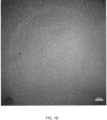
- the hybrid hydrogel is prepared by co-jellifying calcium ions, alginate and xanthan gum, essentially as described in the Examples section that follows below. Without being bound by any particular theory, it is assumed that the addition of an additional soluble polymer, such as xanthan gum, weakens the structure of the calcium alginate hydrogel, as well as facilitating and preserving the homogeneity of the particulate material following pulverizing; hence, while pulverization and homogenization of a calcium alginate hydrogel typically results in large, bulky and irregular flakes and/or aggregates that constitute an inferior support medium, the calcium alginate-xanthan gum hybrid hydrogel can be processed to afford fine, homogenous calcium alginate hydrogel particles (see, FIGs. 1A-B ).
- Hybrid hydrogel particles may be generated by means other than pulverizing a pre-formed, co-jellified hybrid hydrogel. That is to say, they may also be generated by grinding/pulverizing pre-jellified pristine calcium alginate hydrogel (the crosslinked polymeric network) in a solution that contains the soluble polymer, thereby introducing the soluble polymer into the pre-formed calcium alginate network and/or to its surroundings to afford a hybrid hydrogel. Alternatively, the crosslinked polymeric network may be exposed to the soluble polymer before or after the grinding/pulverizing step.
- the co-jellified hybrid hydrogels were found to be easier to pulverize, enabling to shorten the time needed to complete the process and avoid the presence of large, non-homogenous particles and aggregates, especially when processing stiff alginate gels.
- xanthan gum is a preferred biopolymer for serving as the additional soluble polymer, which gave the best results in terms of particle size, stability, processability of the homogenate and ease of extraction from the particles after pulverization and before use. As discussed hereinabove, xanthan gum is beneficial in the final preparation of the support medium; however, extraction of alginate and xanthan is essential to eventually release the printed structure form the support medium.
- calcium alginate hydrogel prepared without xanthan gum breaks into large non-homogeneous flakes and aggregates
- the hybrid hydrogel prepared with xanthan gum can be pulverized and homogenized into a fine and homogeneous particulate.
- the jellification process is slowed down. Slowing the jellification process can be achieved, inter alia, by using a substantially water-insoluble source of calcium ions, and further using an acidifying agent that slowly releases calcium ions from the water-insoluble source thereof.
- the hybrid hydrogel is prepared using calcium carbonate, which is substantially water-insoluble, with the addition of the acidifying agent glucono delta-lactone (GDL).
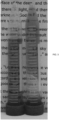
- FIG. 2 presents photographs of two samples of pulverized calcium alginate hydrogel support media, showing the transparency of the support media prepared as described herein (left) compared to a preparation of calcium alginate hydrogel composed of microparticles generated by sonication of calcium-alginate in CaCl 2 solution (right).
- the hydrogel particles prepared with an insoluble calcium ion source and an acidifying agent are transparent, while the calcium alginate hydrogel particles made with calcium chloride are opaque.
- the suspended hydrogel particles are incubated and washed repeatedly until all remnants of free calcium ions and the additional soluble polymer are washed away.
- the washed calcium alginate particles are thereafter collected, i.e., by centrifugation, and re-suspended in water or another aqueous solution for use as support medium for 3D printing.
- xanthan gum may be added (or reintroduced) to the support medium for enhancing the optical clarity of the support medium and improving printing accuracy and precision.
- the washed pellet is supplemented with 1 % w/v xanthan gum solution, to afford a final concentration of 0.05-0.5 % w/w or w/v (0.05-0.5 grams of xanthan gum, in a total weight of 100 gr or 100 ml support medium).
- the mixture is then vigorously mixed and incubated at room temperature or at 4 °C for several (1-5) days before use. If needed, the viscosity of the support media can be reduced by addition of aqueous solutions containing the same final concentration of xanthan gum as abovementioned.
- Hydrogel-based particulate support media
- a transparent, stable, safe and (bio)degradable hydrogel-based particulate support medium for 3D printing comprising a plurality of essentially non-aggregated and substantially discrete calcium alginate hydrogel particles having an average size that ranges from 0.1 ⁇ M to 5 ⁇ M, and a substantially narrow size distribution.
- the chemical composition of the hydrogel is mostly, or substantially alginate hydrogel crosslinked network, however, some amounts of the soluble polymer may be present in minute amounts, left after repetitive washes, or present in the hydrogel in amounts/concentration that can be controlled by the process of manufacturing the same.
- the presence of xanthan gum in the hydrogel-based particulate support medium may range from essentially none (minute amounts) to any concentration used in the process of making the hydrogel-based particulate support medium.
- the plurality of calcium alginate hydrogel particles is referred to as being essentially or substantially devoid of dissociable elements, namely chains and molecules that are not bound to the hydrogel network by direct, indirect or mechanical association.
- the calcium alginate hydrogel particles comprises non-leachable (network-bound) chains of the soluble polymer which is xanthan gum, and regarded as hybrid hydrogel particles; and in some embodiments that the calcium alginate hydrogel particles comprises chains of the soluble polymer introduced or re-introduced into the hydrogel network and/or to its surroundings by soaking after formation of the network (post-jellification), and are also regarded as hybrid hydrogel particles.
- the plurality of calcium alginate hydrogel particles are characterized by being essentially discrete (non-aggregated) and having a relatively narrow size distribution, or a lower coefficient of variation (CV).
- CV is also known as relative standard deviation (RSD), which is a standardized measure of dispersion of a probability distribution or frequency distribution, and is often expressed in percent. SRD is defined as the ratio of the standard deviation (sigma, ⁇ ) to the mean ⁇
- the plurality of calcium alginate hydrogel particles is characterized by a particle size distribution of less than 5 %, less than 10 %, or less than 20 % RSD.
- the fine and homogeneous particles of the support medium can easily flow throw very fine needles, and can therefore also serve as a sacrificial material in 3D printing of hollow structures.
- the high see-through transparency of the support medium to visible light allows the printing process to be monitored at real time: the user can inspect the printed construct while fabricated and modify printing parameters accordingly without interrupting the procedure.
- the high see-through transparency of the media may also allow automatic calibration and monitoring of the printing process by 3D printers equipped with compatible optical sensors. This enables the user to calibrate and tune the printer conveniently and accurately, what results in a refined printout.
- the transparency of the support media may enable curing of light-curable printed materials by external illumination.
- the plurality of calcium alginate hydrogel particles is substantially transparent to visible light.
- FIG. 3 presents a photograph of two sample vials, comparing the see-through transparency of the support medium provided herein (right), compared to that of a pure cell media (left).
- the see-through transparency of both almost identical, demonstrating that the alginate particles of the support medium provided herein, according to embodiments of the present invention, have little effect on the overall clarity of the suspension.
- the hydrogel-based particulate support medium provided herein is generally a plurality of hydrogel particles hydrated by an aqueous solution in the form of a slurry or a suspension.
- the amount of the aqueous solution may vary from essentially no excess thereof (a drained slurry) up to a diluted suspension of the particles at a ratio that allows the printed object to be supported and formed adequately.
- the preferable amount of dilution is within the routine experimental procedures of a person skilled in the art.
- the slurry is sterile and free of any toxins or other factors that may adversely affect an article of manufacturing being formed therewithin.
- a selling unit of the support medium :
- a selling unit comprising the support medium provided herein.
- the selling unit can be in a form of a sealed and oxygen-proof container that contains an amount of the support medium suitable for a specific printing machine or a specific printing bath size.
- the selling unit contains a drained support medium, wherein the user is instructed to add an aqueous solution thereto in order to arrive at an adequate dilution of the support medium.
- the selling unit includes a packaging material, and identified in print, or on said packaging material, for use as a support medium in a 3D printing machine and process.
- Xanthan gum as support medium Xanthan gum as support medium:
- Xanthan gum pose no risk of toxicity and is generally accepted as safe for human consumption (GRAS). It is fully biocompatible and its water solubility enables simple extraction from the fabricated 3D structure post-printing. Interestingly, the present inventors have surprisingly found that even a pure, non-particulate xanthan gum solution (successfully demonstrated below with 1 % w/v solution in cell media) can serve as a support medium for 3D printing, resulting in adequate accuracy and printing resolution.
- Xanthan gum aqueous solutions can be used as a transparent, easy to prepare, low-cost, temperature insensitive, non-animal support media for 3D printing of biological and other materials.
- the support medium includes an aqueous solution of xanthan gum at a concentration that ranges from 0.5 to 5 % w/v, preferably from 0.8 to 2 % w/v, or 1 % w/v.
- the xanthan gum used as a support medium is sterile, and free of any toxins or otherwise any factors that may adversely affect the printing process or the printed article-of-manufacturing being formed thereby.
- High-resolution complex 3D printed objects made of biologic or biocompatible printable materials can be produced using the hydrogel-based particulate support medium provided herein.
- the end-users of such technology are patients that will benefit from transplantation of engineered cellular or acellular tissues, organs and/or other types of grafts, as well as the pharma industry that may use the printed structures/tissues/organs for drug screening and testing.
- the end-user of such 3D printed objects is any artisan that benefits from rapid-prototyping/3D printing services and/or products.
- an article of manufacturing afforded by 3D printing the article inside the hydrogel-based particulate support medium described herein.
- hydrogel-based particulate support medium described herein is useful in high-resolution manufacturing of complex cellular or acellular scaffold articles composed of biomaterials, such as processed ECM or ECM-derived substances, developed for tissue engineering and regenerative medicine, as well as for the purpose of drug screening and testing.
- hydrogel-based particulate support medium described herein is useful in high-resolution manufacturing of complex cellular or acellular scaffold articles composed of biomaterials such as processed ECM or ECM-derived substances for tissue engineering and regenerative medicine research, as well as for pharmaceutical research, like screening and testing of drugs.
- the hydrogel-based particulate support medium is useful in the development of new biomaterials with desirable features, which behavior can be directly monitored during printing by virtue of the high see-through transparency of the support media.
- hydrogel-based particulate support media It is expected that during the life of a patent maturing from this application many relevant hydrogel-based particulate support media will be developed and the scope of the term hydrogel-based particulate support media is intended to include all such new technologies a priori.
- compositions, method or structure may include additional ingredients, steps and/or parts, but only if the additional ingredients, steps and/or parts do not materially alter the basic and novel characteristics of the claimed composition, method or structure.
- the phrases “substantially devoid of” and/or “essentially devoid of” in the context of a certain substance refer to a composition that is totally devoid of this substance or includes less than about 5, 1, 0.5 or 0.1 percent of the substance by total weight or volume of the composition.
- the phrases "substantially devoid of” and/or “essentially devoid of” in the context of a process, a method, a property or a characteristic refer to a process, a composition, a structure or an article that is totally devoid of a certain process/method step, or a certain property or a certain characteristic, or a process/method wherein the certain process/method step is effected at less than about 5, 1, 0.5 or 0.1 percent compared to a given standard process/method, or property or a characteristic characterized by less than about 5, 1, 0.5 or 0.1 percent of the property or characteristic, compared to a given standard.
- exemplary is used herein to mean “serving as an example, instance or illustration”. Any embodiment described as “exemplary” is not necessarily to be construed as preferred or advantageous over other embodiments and/or to exclude the incorporation of features from other embodiments.
- a compound or “at least one compound” may include a plurality of compounds, including mixtures thereof.
- range format is merely for convenience and brevity and should not be construed as an inflexible limitation on the scope of the invention. Accordingly, the description of a range should be considered to have specifically disclosed all the possible subranges as well as individual numerical values within that range. For example, description of a range such as from 1 to 6 should be considered to have specifically disclosed subranges such as from 1 to 3, from 1 to 4, from 1 to 5, from 2 to 4, from 2 to 6, from 3 to 6 etc., as well as individual numbers within that range, for example, 1, 2, 3, 4, 5, and 6. This applies regardless of the breadth of the range.
- process and “method” refer to manners, means, techniques and procedures for accomplishing a given task including, but not limited to, those manners, means, techniques and procedures either known to, or readily developed from known manners, means, techniques and procedures by practitioners of the chemical, material, mechanical, computational and digital arts.
- a proof of concept of some embodiments of the present invention was carried out by forming a hybrid calcium alginate and xanthan gum hydrogel.
- a hybrid hydrogel composed of 0.25-0.5 % (w/v) sodium alginate (tested with PROTANAL LF 10/60 FT and PROTANAL LF200 FTS, FMC BioPolymer, or KIMIKA ALGIN I-3G by KIMICA corporation), 0.125-0.5 % (w/v) xanthan gum (tested with Xantural 180, CP Kelco, Sigma G1253, xanthan gum from Xanthomonas campestris), 7.5-15 mM calcium carbonate and 15-30 mM D-(+)-Gluconic acid ⁇ -lactone (GDL) was made by mixing the following ingredients:
- xanthan up to 0.5%) may be required if using an alginate batch that form stronger gels.
- the mixture was vigorously stirred for 3 minutes, after which the stirring speed was lowered to generate a fine turbulence that bends the surface of the liquid. When the bend was no longer visible due to the increase in the viscosity of the reaction mixture, the stirring was stopped and the mixture was incubated uninterrupted, at room temperature, for 24 hours.
- the resulting hydrogel was manually broken into chunks to which sterile deionized water at a volume of 4 times the volume of the hydrogel was added to a total volume of 5 times the volume of the hydrogel.
- the water-suspended hydrogel chunks were thereafter homogenized into fine particles using an electric homogenizer, and the homogenate was incubated over-night at 4 °C to allow dissolution of remaining traces of CaCO 3 .
- the suspension was centrifuged at 15,777 G for 5-20 minutes (depending on the stability of the pellet) at room temperature. Thereafter the pellet was washed 2-5 times with sterile deionized water, added at a volume equal to the discarded supernatant, by repeated centrifugation at 15,777 G for 5-20 minutes at room temperature and re-suspension by vigorous mixing. Lastly, the pellet was washed 1-2 times with cell media, added at a volume equal to the discarded supernatant, by repeated centrifugation at 15,777 G for 5-20 minutes at room temperature and re-suspension by vigorous mixing. Excess calcium ions and xanthan gum are washed away during these washing steps, leaving transparent granular media composed of calcium-alginate particles in the form of a pudding-like pellet.
- a soluble polymer such as xanthan gum
- xanthan gum was added to the pudding-like pellets in order to enhance the optical clarity of the support medium and improve printing accuracy and precision.
- a soluble polymer xanthan gum
- the procedure further included: After washing, the washed pellet was supplemented with 1 % w/v xanthan gum solution to reach a final concentration of 0.05-0.5% (w/w or w/v; 0.05-0.5 gr xanthan gum in a total weight of 100 gr or 100 ml support medium), vigorously mixed, and incubated at room temperature or at 4 centigrade for 1-5 days before use.
- the pudding-like pellet was then transferred to a chamber large enough to contain the printed structure, and manually stirred using a spatula for about 10 seconds.
- the pellet can be homogenized using an electric homogenizer and/or vortexed before use.
- the printing chamber was incubated at 37 °C in order to cure (solidify) the printed structure, considering that incubation at 37 °C is most suitable for processed ECM or ECM-derived substances that incorporate mammalian cells. It is noted herein that incubation at temperatures higher or lower than 37 °C may be used for other ink materials.
- the support media was then supplemented with a solution containing a chelating agent, such as citrate and/or EDTA and/or EGTA, and/or depolymerizing enzyme, such as alginate lyase, in order to degrade the alginate particles and release the printed construct.
- a chelating agent such as citrate and/or EDTA and/or EGTA
- depolymerizing enzyme such as alginate lyase
- the support medium which is composed of specially prepared alginate particles in cell growth medium, may optionally be supplemented after washing with concentrated xanthan gum solution (e.g., 1 % w/v in aqueous cell growth medium) to reach a final xanthan gum concentration of 0.05 %-0.5 % (w/v or w/w) in the support media.
- concentrated xanthan gum solution e.g., 1 % w/v in aqueous cell growth medium
- xanthan gum solution e.g., 1 % w/v in aqueous cell growth medium
- FIGs. 4A-B present microscopic images of alginate particles in a drop of supporting medium without xanthan gum ( FIG. 4A ) and the same supplemented with final concentration of 0.5 % (w/v) xanthan gum after the washing steps ( FIG. 4B ).
- FIGs. 5A-D demonstrate the difference in accuracy of printing in a non-supplemented particulate support medium or in support medium supplemented with final concentration of 0.05 % (w/v) xanthan gum following the washing steps, wherein FIG. 5A shows a 3D element printed 3 minutes after vortexing a support medium without xanthan gum, FIG. 5B shows a 3D element printed 3 minutes after vortexing a support medium supplemented with xanthan gum, FIG. 5C shows a 3D element printed 3 hours after vortexing a support medium not supplemented with xanthan gum, and FIG. 5D shows a 3D element printed 3 hours after vortexing a support medium supplemented with xanthan gum.
- the presence of xanthan gum in the support medium greatly improved and maintained printing accuracy and precision, especially as time passes following vortexing/stirring/homogenizing of the support medium.
- FIGs. 6A-B present microscopic images of alginate particles in a smear of a five-fold diluted supporting medium without xanthan gum ( FIG. 6A ) or supplemented with final concentration of 0.05 % w/v xanthan gum ( FIG. 6B ), wherein the images were taken 30 minutes after vortexing.
- a pure xanthan gum solution e.g., 1 % w/v solution in cell media
- Xanthan gum at a concentration of about 1 % or higher can be used as a transparent, easy to prepare, low-cost, temperature insensitive, non-animal-originate support media for 3D printing of biological and other materials.
- xanthan gum is a polysaccharide derived from fermentation of simple sugars by the gram-negative bacteria (Xanthomonas campestris), commercially available xanthan gum preparations may contain endotoxins that are known to elicit in-vivo immunogenic/pyrogenic reaction. In order to eliminate this possible adverse effect, a method for destruction of endotoxins in xanthan gum preparations has been developed without damaging the xantan's beneficial properties. To this end, concentrated xanthan gum solution was treated with sodium hydroxide (NaOH) that eliminate the pyrogenicity and adverse immunogenic activity of the endotoxins. The NaOH was then extracted from the xanthan by washing with ethanol:water solutions.
- NaOH sodium hydroxide
- xanthan gum was solubilized in 150 mM NaCl aqueous solution to reach a final concentration of 4 % w/v.
- the resulting viscous solution was then sterilized by autoclaving. Thereafter, 5 M NaOH solution is added (at 1:4 v/v ratio) and mixed with the xanthan gum solution to reach a final concentration of 1 M NaOH in the mixture. After 24 hours, the mixture was transferred into a 50 % (v/v, in water) ethanol solution that was 10 times larger in volume.
- the xanthan gum gel remains stable (as an alcoholic gel- "alcogel”); but the solutes (NaOH and NaCl) diffuse and solubilized in the 50 % ethanol solution that was exchanged every 24 hours.
- the xanthan gum was washed twice with 70 % ethanol (v/v, in water), and twice with pure ethanol, with exchange every 24 hours.
- the insoluble xanthan was separated from the ethanol. Ethanol residues were then evaporated under a jet of a sterile, dry air, followed by vacuum drying at room temperature.
- the resulting sterile, depyrogenated pellets were stored dry for future use, or solubilized in aqueous media to be used in the preparation of particulate alginate-based printing support medium as described above, or as a "pure", non-particulate, xanthan-based support medium.
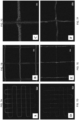
- FIGs. 7A-F present microscopic images of a simple crisscross 2-layered pattern printed in two types of support media, wherein FIGs. 7A-C show the pattern as printed in a particulate alginate support medium supplemented with 0.05 % w/v xanthan gum, and FIGs. 7D-F show a similar pattern printed into a support medium consisting of 1 % (w/v) xanthan gum in cell growth medium.
Landscapes
- Health & Medical Sciences (AREA)
- Chemical & Material Sciences (AREA)
- Life Sciences & Earth Sciences (AREA)
- Engineering & Computer Science (AREA)
- Biomedical Technology (AREA)
- General Health & Medical Sciences (AREA)
- Medicinal Chemistry (AREA)
- Epidemiology (AREA)
- Transplantation (AREA)
- Animal Behavior & Ethology (AREA)
- Oral & Maxillofacial Surgery (AREA)
- Public Health (AREA)
- Veterinary Medicine (AREA)
- Dermatology (AREA)
- Biotechnology (AREA)
- Zoology (AREA)
- Genetics & Genomics (AREA)
- Organic Chemistry (AREA)
- Wood Science & Technology (AREA)
- Bioinformatics & Cheminformatics (AREA)
- Materials Engineering (AREA)
- Manufacturing & Machinery (AREA)
- Cell Biology (AREA)
- Botany (AREA)
- General Engineering & Computer Science (AREA)
- Biochemistry (AREA)
- Microbiology (AREA)
- Dispersion Chemistry (AREA)
- Chemical Kinetics & Catalysis (AREA)
- Civil Engineering (AREA)
- Composite Materials (AREA)
- Ceramic Engineering (AREA)
- Structural Engineering (AREA)
- Molecular Biology (AREA)
- Physics & Mathematics (AREA)
- Mechanical Engineering (AREA)
- Optics & Photonics (AREA)
- Materials For Medical Uses (AREA)
Claims (15)
- Pluralité de particules d'hydrogel utilisées comme milieu de support en impression 3D, dans laquelle :ledit hydrogel comprend de l'alginate de calcium et de la gomme xanthane, etune quantité de ladite gomme xanthane se situe dans la plage de 0,05 à 0,5 % (p/p ou p/v) ;la pluralité de particules d'hydrogel est caractérisée par une taille moyenne de particule comprise dans la plage de 0,1 µm à 5 µm, et une homogénéité caractérisée par une distribution granulométrique inférieure à un écart type relatif (ETR) de 20 %.
- Pluralité de particules d'hydrogel de la revendication 1, qui est dégradable par chélation de calcium et/ou traitement enzymatique.
- Pluralité de particules d'hydrogel de la revendication 1, qui est stable à une température élevée d'au moins 37 °C.
- Pluralité de particules d'hydrogel de la revendication 1, qui est sensiblement transparente à une lumière visible.
- Pluralité de particules d'hydrogel de l'une quelconque des revendications 1 à 4, sous la forme d'une boue aqueuse.
- Unité de vente comprenant la pluralité de particules d'hydrogel de l'une quelconque des revendications 1 à 5.
- Unité de vente de la revendication 6, dans laquelle la pluralité de particules d'hydrogel se présente sous la forme d'une boue égouttée.
- Unité de vente de l'une quelconque des revendications 6 à 7, conditionnée dans un matériau d'emballage et identifiée par impression sur ou dans ledit matériau d'emballage, destinée à être utilisée comme milieu de support lors d'un procédé d'impression 3D et/ou dans une imprimante.
- Procédé de préparation de la pluralité de particules d'hydrogel de l'une quelconque des revendications 1 à 5, comprenant :la pulvérisation d'un hydrogel hybride pour obtenir ainsi des particules d'hydrogel hybride ; etle lavage desdites particules d'hydrogel hybride, obtenant ainsi la pluralité de particules d'hydrogel,dans lequel ledit hydrogel hybride comprend ledit alginate de calcium et ladite gomme xanthane, et dans lequel ladite gomme xanthane atteint une concentration finale dans la plage de 0,05 à 0,5 % (p/v).
- Procédé de la revendication 9, comprenant en outre, avant ladite pulvérisation, la co-gélification dudit alginate et de ladite gomme xanthane en utilisant une source desdits ions calcium, obtenant ainsi ledit hydrogel hybride.
- Procédé de la revendication 9, comprenant en outre, avant ladite pulvérisation, la gélification de l'alginate en utilisant une source d'ions calcium pour obtenir ainsi un hydrogel d'alginate, puis la mise en contact, avant, pendant et/ou après ladite pulvérisation, dudit hydrogel d'alginate avec ladite gomme xanthane, obtenant ainsi lesdites particules d'hydrogel hybride.
- Procédé de l'une quelconque des revendications 10 à 11, dans lequel ladite source d'ions calcium est un sel de calcium sensiblement insoluble dans l'eau.
- Procédé de l'une quelconque des revendications 9 à 12, comprenant en outre, après ledit lavage, l'ajout de gomme xanthane audit milieu de support particulaire à base d'hydrogel.
- Procédé de la revendication 13, dans lequel une quantité de ladite gomme xanthane est comprise dans la plage de 0,05 à 0,5 % (p/v).
- Procédé d'impression 3D, effectué dans le milieu de support particulaire à base d'hydrogel de l'une quelconque des revendications 1 à 5.
Priority Applications (1)
| Application Number | Priority Date | Filing Date | Title |
|---|---|---|---|
| EP24180910.2A EP4403625A3 (fr) | 2018-06-04 | 2019-06-04 | Support pour l'impression 3d de biomateriaux |
Applications Claiming Priority (2)
| Application Number | Priority Date | Filing Date | Title |
|---|---|---|---|
| US201862679996P | 2018-06-04 | 2018-06-04 | |
| PCT/IL2019/050635 WO2019234738A1 (fr) | 2018-06-04 | 2019-06-04 | Milieu de support pour impression 3d de biomatériaux |
Related Child Applications (2)
| Application Number | Title | Priority Date | Filing Date |
|---|---|---|---|
| EP24180910.2A Division EP4403625A3 (fr) | 2018-06-04 | 2019-06-04 | Support pour l'impression 3d de biomateriaux |
| EP24180910.2A Division-Into EP4403625A3 (fr) | 2018-06-04 | 2019-06-04 | Support pour l'impression 3d de biomateriaux |
Publications (3)
| Publication Number | Publication Date |
|---|---|
| EP3810407A1 EP3810407A1 (fr) | 2021-04-28 |
| EP3810407A4 EP3810407A4 (fr) | 2022-03-23 |
| EP3810407B1 true EP3810407B1 (fr) | 2025-01-08 |
Family
ID=68769790
Family Applications (2)
| Application Number | Title | Priority Date | Filing Date |
|---|---|---|---|
| EP24180910.2A Pending EP4403625A3 (fr) | 2018-06-04 | 2019-06-04 | Support pour l'impression 3d de biomateriaux |
| EP19814062.6A Active EP3810407B1 (fr) | 2018-06-04 | 2019-06-04 | Milieu de support pour impression 3d de biomatériaux |
Family Applications Before (1)
| Application Number | Title | Priority Date | Filing Date |
|---|---|---|---|
| EP24180910.2A Pending EP4403625A3 (fr) | 2018-06-04 | 2019-06-04 | Support pour l'impression 3d de biomateriaux |
Country Status (3)
| Country | Link |
|---|---|
| US (2) | US12221621B2 (fr) |
| EP (2) | EP4403625A3 (fr) |
| WO (1) | WO2019234738A1 (fr) |
Families Citing this family (7)
| Publication number | Priority date | Publication date | Assignee | Title |
|---|---|---|---|---|
| EP4403625A3 (fr) | 2018-06-04 | 2024-10-16 | Ramot at Tel-Aviv University Ltd. | Support pour l'impression 3d de biomateriaux |
| JPWO2023074838A1 (fr) * | 2021-11-01 | 2023-05-04 | ||
| CN114133469B (zh) * | 2021-11-16 | 2025-01-10 | 西湖大学 | 3d打印水凝胶电子器件的制造方法与导电材料 |
| CN114711326B (zh) * | 2021-12-31 | 2023-09-22 | 上海食未生物科技有限公司 | 一种基于悬浮3d打印的食品打印材料、其制备方法和在人造肉中的应用 |
| WO2024069629A1 (fr) * | 2022-09-27 | 2024-04-04 | Ramot At Tel-Aviv University Ltd. | Milieu de support transparent pour impression 3d |
| KR20240111470A (ko) | 2023-01-10 | 2024-07-17 | 서울과학기술대학교 산학협력단 | 3d 바이오프린팅을 위한 바이오글라스 강화 알지네이트-아가로오스 하이드로겔 및 이의 제조방법 |
| WO2024171181A1 (fr) * | 2023-02-19 | 2024-08-22 | Ramot At Tel-Aviv University Ltd. | Procédé de renforcement de constructions rétiniennes cellularisées |
Family Cites Families (17)
| Publication number | Priority date | Publication date | Assignee | Title |
|---|---|---|---|---|
| AU1726400A (en) * | 1998-11-13 | 2000-06-05 | Cp Kelco U.S., Inc. | Biopolymer salts with low endotoxin levels, biopolymer compositions thereof and methods of making the same |
| DE10252564A1 (de) | 2002-06-28 | 2004-01-22 | Polymaterials Ag | Kombination aus Baumaterial und Badflüssigkeit zur Verwendung in Rapid-Prototyping-Verfahren |
| DK2347775T3 (da) * | 2005-12-13 | 2020-07-13 | Harvard College | Skabeloner til celletransplantation |
| WO2007147014A2 (fr) | 2006-06-13 | 2007-12-21 | Fmc Biopolymer As | Procédé et systèmes d'utilisation de billes et d'hydrogels à base de biopolymères |
| US20110177590A1 (en) | 2009-12-11 | 2011-07-21 | Drexel University | Bioprinted Nanoparticles and Methods of Use |
| EP2629975B1 (fr) | 2010-10-21 | 2022-03-09 | Organovo, Inc. | Dispositifs pour la fabrication de tissu |
| RO128708B1 (ro) | 2011-11-29 | 2016-03-30 | Institutul Naţional De Cercetare-Dezvoltare Pentru Chimie Şi Petrochimie - Icechim | Compoziţie şi procedeu pentru obţinerea unor hidrogeluri destinate regenerării ţesutului adipos |
| DE102012100859B4 (de) | 2012-02-02 | 2015-12-17 | Rwth Aachen | Verfahren zum Herstellen dreidimensionaler Strukturen und solche Strukturen |
| WO2014194180A1 (fr) | 2013-05-30 | 2014-12-04 | The University Of Akron | Bio-imprimante de cellules et de tissus automatique |
| US10150258B2 (en) | 2013-07-29 | 2018-12-11 | Carnegie Mellon University | Additive manufacturing of embedded materials |
| US10005235B2 (en) | 2014-09-08 | 2018-06-26 | Empire Technology Development Llc | Methods and systems for making a three-dimensional object |
| US10383825B2 (en) * | 2015-08-13 | 2019-08-20 | Temple University—Of the Commonwealth System of Higher Education | Calcium alginate dosage formulations, and methods of making and using thereof |
| GB201519730D0 (en) | 2015-11-09 | 2015-12-23 | Univ Dublin | A method, system and device for three dimensional additive manufacturing in a liquid phase |
| CN109310632A (zh) * | 2016-04-12 | 2019-02-05 | 封装技术私人有限公司 | 用于递送生物活性剂的可注射组合物 |
| US11124644B2 (en) | 2016-09-01 | 2021-09-21 | University Of Florida Research Foundation, Inc. | Organic microgel system for 3D printing of silicone structures |
| EP4403625A3 (fr) | 2018-06-04 | 2024-10-16 | Ramot at Tel-Aviv University Ltd. | Support pour l'impression 3d de biomateriaux |
| WO2024069629A1 (fr) | 2022-09-27 | 2024-04-04 | Ramot At Tel-Aviv University Ltd. | Milieu de support transparent pour impression 3d |
-
2019
- 2019-06-04 EP EP24180910.2A patent/EP4403625A3/fr active Pending
- 2019-06-04 WO PCT/IL2019/050635 patent/WO2019234738A1/fr not_active Ceased
- 2019-06-04 US US17/059,236 patent/US12221621B2/en active Active
- 2019-06-04 EP EP19814062.6A patent/EP3810407B1/fr active Active
-
2025
- 2025-01-03 US US19/008,670 patent/US20250145942A1/en active Pending
Also Published As
| Publication number | Publication date |
|---|---|
| EP4403625A2 (fr) | 2024-07-24 |
| US20250145942A1 (en) | 2025-05-08 |
| US20210207083A1 (en) | 2021-07-08 |
| EP4403625A3 (fr) | 2024-10-16 |
| WO2019234738A1 (fr) | 2019-12-12 |
| US12221621B2 (en) | 2025-02-11 |
| EP3810407A1 (fr) | 2021-04-28 |
| EP3810407A4 (fr) | 2022-03-23 |
Similar Documents
| Publication | Publication Date | Title |
|---|---|---|
| US20250145942A1 (en) | Support medium for 3d printing of biomaterials | |
| Kalirajan et al. | A critical review on polymeric biomaterials for biomedical applications | |
| Rahman et al. | Sources, extractions, and applications of alginate: a review | |
| Fang et al. | Hydrogels for 3D bioprinting in tissue engineering and regenerative medicine: Current progress and challenges | |
| Lin et al. | Marine‐derived hydrogels for biomedical applications | |
| Shapira et al. | Transparent support media for high resolution 3D printing of volumetric cell-containing ECM structures | |
| Sahranavard et al. | A critical review on three dimensional-printed chitosan hydrogels for development of tissue engineering | |
| Zhang et al. | Biomaterials based on marine resources for 3D bioprinting applications | |
| Bendtsen et al. | Development of a novel alginate‐polyvinyl alcohol‐hydroxyapatite hydrogel for 3D bioprinting bone tissue engineered scaffolds | |
| Tamo et al. | 3D printing of cellulase-laden cellulose nanofiber/chitosan hydrogel composites: towards tissue engineering functional biomaterials with enzyme-mediated biodegradation | |
| Hou et al. | Three-dimensional bioprinting of artificial blood vessel: Process, bioinks, and challenges | |
| Barcena et al. | Current biomedical applications of 3D-printed hydrogels | |
| Aftab et al. | Recent trends and future directions in 3D printing of biocompatible polymers | |
| US10150258B2 (en) | Additive manufacturing of embedded materials | |
| KR20180049712A (ko) | 탈세포화 세포외 기질을 사용한 습식 3차원 세포 프린팅 | |
| Wang et al. | Electrosprayed soft capsules of millimeter size for specifically delivering fish oil/nutrients to the stomach and intestines | |
| Carvalho et al. | Hydrogel bioinks of alginate and curcumin-loaded cellulose ester-based particles for the biofabrication of drug-releasing living tissue analogs | |
| Patrocinio et al. | Biopolymers for tissue engineering: crosslinking, printing techniques, and applications | |
| Bonani et al. | Alginate hydrogels: a tool for 3D cell encapsulation, tissue engineering, and biofabrication | |
| Li et al. | 3D-printed microstructured alginate scaffolds for neural tissue engineering | |
| Tamay et al. | Bioinks—materials used in printing cells in designed 3D forms | |
| Wu et al. | Investigation of 3D-printed PNIPAM-based constructs for tissue engineering applications: A review | |
| Hua et al. | 3D printing‐based full‐scale human brain for diverse applications | |
| Armentano et al. | Nanostructured biopolymer-based materials for regenerative medicine applications | |
| KR102494197B1 (ko) | 연골 성분 기반 바이오 잉크를 이용한 소이증 치료 목적 구조체 제작용 조성물 및 그 제조방법 |
Legal Events
| Date | Code | Title | Description |
|---|---|---|---|
| STAA | Information on the status of an ep patent application or granted ep patent |
Free format text: STATUS: THE INTERNATIONAL PUBLICATION HAS BEEN MADE |
|
| PUAI | Public reference made under article 153(3) epc to a published international application that has entered the european phase |
Free format text: ORIGINAL CODE: 0009012 |
|
| STAA | Information on the status of an ep patent application or granted ep patent |
Free format text: STATUS: REQUEST FOR EXAMINATION WAS MADE |
|
| 17P | Request for examination filed |
Effective date: 20201210 |
|
| AK | Designated contracting states |
Kind code of ref document: A1 Designated state(s): AL AT BE BG CH CY CZ DE DK EE ES FI FR GB GR HR HU IE IS IT LI LT LU LV MC MK MT NL NO PL PT RO RS SE SI SK SM TR |
|
| AX | Request for extension of the european patent |
Extension state: BA ME |
|
| DAV | Request for validation of the european patent (deleted) | ||
| DAX | Request for extension of the european patent (deleted) | ||
| A4 | Supplementary search report drawn up and despatched |
Effective date: 20220217 |
|
| RIC1 | Information provided on ipc code assigned before grant |
Ipc: C12N 5/00 20060101ALI20220211BHEP Ipc: A61L 27/50 20060101ALI20220211BHEP Ipc: A61L 27/38 20060101ALI20220211BHEP Ipc: A61L 27/26 20060101ALI20220211BHEP Ipc: B33Y 70/00 20200101ALI20220211BHEP Ipc: B29C 64/106 20170101ALI20220211BHEP Ipc: A61L 27/52 20060101ALI20220211BHEP Ipc: B29C 64/40 20170101AFI20220211BHEP |
|
| STAA | Information on the status of an ep patent application or granted ep patent |
Free format text: STATUS: EXAMINATION IS IN PROGRESS |
|
| 17Q | First examination report despatched |
Effective date: 20230221 |
|
| GRAP | Despatch of communication of intention to grant a patent |
Free format text: ORIGINAL CODE: EPIDOSNIGR1 |
|
| STAA | Information on the status of an ep patent application or granted ep patent |
Free format text: STATUS: GRANT OF PATENT IS INTENDED |
|
| RIN1 | Information on inventor provided before grant (corrected) |
Inventor name: SHAPIRA, ASSAF Inventor name: DVIR, TAL |
|
| INTG | Intention to grant announced |
Effective date: 20240910 |
|
| GRAS | Grant fee paid |
Free format text: ORIGINAL CODE: EPIDOSNIGR3 |
|
| GRAA | (expected) grant |
Free format text: ORIGINAL CODE: 0009210 |
|
| STAA | Information on the status of an ep patent application or granted ep patent |
Free format text: STATUS: THE PATENT HAS BEEN GRANTED |
|
| AK | Designated contracting states |
Kind code of ref document: B1 Designated state(s): AL AT BE BG CH CY CZ DE DK EE ES FI FR GB GR HR HU IE IS IT LI LT LU LV MC MK MT NL NO PL PT RO RS SE SI SK SM TR |
|
| REG | Reference to a national code |
Ref country code: GB Ref legal event code: FG4D |
|
| REG | Reference to a national code |
Ref country code: CH Ref legal event code: EP |
|
| REG | Reference to a national code |
Ref country code: DE Ref legal event code: R096 Ref document number: 602019064675 Country of ref document: DE |
|
| REG | Reference to a national code |
Ref country code: IE Ref legal event code: FG4D |
|
| REG | Reference to a national code |
Ref country code: LT Ref legal event code: MG9D |
|
| REG | Reference to a national code |
Ref country code: NL Ref legal event code: MP Effective date: 20250108 |
|
| REG | Reference to a national code |
Ref country code: AT Ref legal event code: MK05 Ref document number: 1758059 Country of ref document: AT Kind code of ref document: T Effective date: 20250108 |
|
| PG25 | Lapsed in a contracting state [announced via postgrant information from national office to epo] |
Ref country code: NL Free format text: LAPSE BECAUSE OF FAILURE TO SUBMIT A TRANSLATION OF THE DESCRIPTION OR TO PAY THE FEE WITHIN THE PRESCRIBED TIME-LIMIT Effective date: 20250108 |
|
| PG25 | Lapsed in a contracting state [announced via postgrant information from national office to epo] |
Ref country code: RS Free format text: LAPSE BECAUSE OF FAILURE TO SUBMIT A TRANSLATION OF THE DESCRIPTION OR TO PAY THE FEE WITHIN THE PRESCRIBED TIME-LIMIT Effective date: 20250408 |
|
| PG25 | Lapsed in a contracting state [announced via postgrant information from national office to epo] |
Ref country code: FI Free format text: LAPSE BECAUSE OF FAILURE TO SUBMIT A TRANSLATION OF THE DESCRIPTION OR TO PAY THE FEE WITHIN THE PRESCRIBED TIME-LIMIT Effective date: 20250108 |
|
| PG25 | Lapsed in a contracting state [announced via postgrant information from national office to epo] |
Ref country code: PL Free format text: LAPSE BECAUSE OF FAILURE TO SUBMIT A TRANSLATION OF THE DESCRIPTION OR TO PAY THE FEE WITHIN THE PRESCRIBED TIME-LIMIT Effective date: 20250108 |
|
| PGFP | Annual fee paid to national office [announced via postgrant information from national office to epo] |
Ref country code: DE Payment date: 20250618 Year of fee payment: 7 |
|
| PG25 | Lapsed in a contracting state [announced via postgrant information from national office to epo] |
Ref country code: ES Free format text: LAPSE BECAUSE OF FAILURE TO SUBMIT A TRANSLATION OF THE DESCRIPTION OR TO PAY THE FEE WITHIN THE PRESCRIBED TIME-LIMIT Effective date: 20250108 |
|
| PGFP | Annual fee paid to national office [announced via postgrant information from national office to epo] |
Ref country code: GB Payment date: 20250618 Year of fee payment: 7 |
|
| PG25 | Lapsed in a contracting state [announced via postgrant information from national office to epo] |
Ref country code: IS Free format text: LAPSE BECAUSE OF FAILURE TO SUBMIT A TRANSLATION OF THE DESCRIPTION OR TO PAY THE FEE WITHIN THE PRESCRIBED TIME-LIMIT Effective date: 20250508 Ref country code: NO Free format text: LAPSE BECAUSE OF FAILURE TO SUBMIT A TRANSLATION OF THE DESCRIPTION OR TO PAY THE FEE WITHIN THE PRESCRIBED TIME-LIMIT Effective date: 20250408 |
|
| PG25 | Lapsed in a contracting state [announced via postgrant information from national office to epo] |
Ref country code: HR Free format text: LAPSE BECAUSE OF FAILURE TO SUBMIT A TRANSLATION OF THE DESCRIPTION OR TO PAY THE FEE WITHIN THE PRESCRIBED TIME-LIMIT Effective date: 20250108 |
|
| PG25 | Lapsed in a contracting state [announced via postgrant information from national office to epo] |
Ref country code: LV Free format text: LAPSE BECAUSE OF FAILURE TO SUBMIT A TRANSLATION OF THE DESCRIPTION OR TO PAY THE FEE WITHIN THE PRESCRIBED TIME-LIMIT Effective date: 20250108 Ref country code: PT Free format text: LAPSE BECAUSE OF FAILURE TO SUBMIT A TRANSLATION OF THE DESCRIPTION OR TO PAY THE FEE WITHIN THE PRESCRIBED TIME-LIMIT Effective date: 20250508 |
|
| PGFP | Annual fee paid to national office [announced via postgrant information from national office to epo] |
Ref country code: FR Payment date: 20250627 Year of fee payment: 7 |
|
| PG25 | Lapsed in a contracting state [announced via postgrant information from national office to epo] |
Ref country code: BG Free format text: LAPSE BECAUSE OF FAILURE TO SUBMIT A TRANSLATION OF THE DESCRIPTION OR TO PAY THE FEE WITHIN THE PRESCRIBED TIME-LIMIT Effective date: 20250108 Ref country code: GR Free format text: LAPSE BECAUSE OF FAILURE TO SUBMIT A TRANSLATION OF THE DESCRIPTION OR TO PAY THE FEE WITHIN THE PRESCRIBED TIME-LIMIT Effective date: 20250409 |
|
| PG25 | Lapsed in a contracting state [announced via postgrant information from national office to epo] |
Ref country code: AT Free format text: LAPSE BECAUSE OF FAILURE TO SUBMIT A TRANSLATION OF THE DESCRIPTION OR TO PAY THE FEE WITHIN THE PRESCRIBED TIME-LIMIT Effective date: 20250108 |
|
| PG25 | Lapsed in a contracting state [announced via postgrant information from national office to epo] |
Ref country code: SE Free format text: LAPSE BECAUSE OF FAILURE TO SUBMIT A TRANSLATION OF THE DESCRIPTION OR TO PAY THE FEE WITHIN THE PRESCRIBED TIME-LIMIT Effective date: 20250108 |
|
| PG25 | Lapsed in a contracting state [announced via postgrant information from national office to epo] |
Ref country code: SM Free format text: LAPSE BECAUSE OF FAILURE TO SUBMIT A TRANSLATION OF THE DESCRIPTION OR TO PAY THE FEE WITHIN THE PRESCRIBED TIME-LIMIT Effective date: 20250108 |
|
| REG | Reference to a national code |
Ref country code: DE Ref legal event code: R097 Ref document number: 602019064675 Country of ref document: DE |
|
| PG25 | Lapsed in a contracting state [announced via postgrant information from national office to epo] |
Ref country code: DK Free format text: LAPSE BECAUSE OF FAILURE TO SUBMIT A TRANSLATION OF THE DESCRIPTION OR TO PAY THE FEE WITHIN THE PRESCRIBED TIME-LIMIT Effective date: 20250108 |
|
| PG25 | Lapsed in a contracting state [announced via postgrant information from national office to epo] |
Ref country code: EE Free format text: LAPSE BECAUSE OF FAILURE TO SUBMIT A TRANSLATION OF THE DESCRIPTION OR TO PAY THE FEE WITHIN THE PRESCRIBED TIME-LIMIT Effective date: 20250108 Ref country code: CZ Free format text: LAPSE BECAUSE OF FAILURE TO SUBMIT A TRANSLATION OF THE DESCRIPTION OR TO PAY THE FEE WITHIN THE PRESCRIBED TIME-LIMIT Effective date: 20250108 |
|
| PG25 | Lapsed in a contracting state [announced via postgrant information from national office to epo] |
Ref country code: RO Free format text: LAPSE BECAUSE OF FAILURE TO SUBMIT A TRANSLATION OF THE DESCRIPTION OR TO PAY THE FEE WITHIN THE PRESCRIBED TIME-LIMIT Effective date: 20250108 |
|
| PG25 | Lapsed in a contracting state [announced via postgrant information from national office to epo] |
Ref country code: SK Free format text: LAPSE BECAUSE OF FAILURE TO SUBMIT A TRANSLATION OF THE DESCRIPTION OR TO PAY THE FEE WITHIN THE PRESCRIBED TIME-LIMIT Effective date: 20250108 |
|
| PLBE | No opposition filed within time limit |
Free format text: ORIGINAL CODE: 0009261 |
|
| STAA | Information on the status of an ep patent application or granted ep patent |
Free format text: STATUS: NO OPPOSITION FILED WITHIN TIME LIMIT |
|
| REG | Reference to a national code |
Ref country code: CH Ref legal event code: L10 Free format text: ST27 STATUS EVENT CODE: U-0-0-L10-L00 (AS PROVIDED BY THE NATIONAL OFFICE) Effective date: 20251119 |
|
| 26N | No opposition filed |
Effective date: 20251009 |
|
| REG | Reference to a national code |
Ref country code: CH Ref legal event code: H13 Free format text: ST27 STATUS EVENT CODE: U-0-0-H10-H13 (AS PROVIDED BY THE NATIONAL OFFICE) Effective date: 20260127 |
|
| PG25 | Lapsed in a contracting state [announced via postgrant information from national office to epo] |
Ref country code: IT Free format text: LAPSE BECAUSE OF FAILURE TO SUBMIT A TRANSLATION OF THE DESCRIPTION OR TO PAY THE FEE WITHIN THE PRESCRIBED TIME-LIMIT Effective date: 20250108 |
|
| PG25 | Lapsed in a contracting state [announced via postgrant information from national office to epo] |
Ref country code: MC Free format text: LAPSE BECAUSE OF FAILURE TO SUBMIT A TRANSLATION OF THE DESCRIPTION OR TO PAY THE FEE WITHIN THE PRESCRIBED TIME-LIMIT Effective date: 20250108 |
|
| PG25 | Lapsed in a contracting state [announced via postgrant information from national office to epo] |
Ref country code: LU Free format text: LAPSE BECAUSE OF NON-PAYMENT OF DUE FEES Effective date: 20250604 |
|
| REG | Reference to a national code |
Ref country code: BE Ref legal event code: MM Effective date: 20250630 |
|
| PG25 | Lapsed in a contracting state [announced via postgrant information from national office to epo] |
Ref country code: IE Free format text: LAPSE BECAUSE OF NON-PAYMENT OF DUE FEES Effective date: 20250604 |
|
| PG25 | Lapsed in a contracting state [announced via postgrant information from national office to epo] |
Ref country code: BE Free format text: LAPSE BECAUSE OF NON-PAYMENT OF DUE FEES Effective date: 20250630 |
|
| PG25 | Lapsed in a contracting state [announced via postgrant information from national office to epo] |
Ref country code: CH Free format text: LAPSE BECAUSE OF NON-PAYMENT OF DUE FEES Effective date: 20250630 |