EP3810680B1 - Revêtements copolymères à fonction acide pour substrats polymères - Google Patents
Revêtements copolymères à fonction acide pour substrats polymères Download PDFInfo
- Publication number
- EP3810680B1 EP3810680B1 EP19742262.9A EP19742262A EP3810680B1 EP 3810680 B1 EP3810680 B1 EP 3810680B1 EP 19742262 A EP19742262 A EP 19742262A EP 3810680 B1 EP3810680 B1 EP 3810680B1
- Authority
- EP
- European Patent Office
- Prior art keywords
- coated film
- film structure
- acid
- layer
- overcoat
- Prior art date
- Legal status (The legal status is an assumption and is not a legal conclusion. Google has not performed a legal analysis and makes no representation as to the accuracy of the status listed.)
- Active
Links
Images


Classifications
-
- C—CHEMISTRY; METALLURGY
- C08—ORGANIC MACROMOLECULAR COMPOUNDS; THEIR PREPARATION OR CHEMICAL WORKING-UP; COMPOSITIONS BASED THEREON
- C08J—WORKING-UP; GENERAL PROCESSES OF COMPOUNDING; AFTER-TREATMENT NOT COVERED BY SUBCLASSES C08B, C08C, C08F, C08G or C08H
- C08J7/00—Chemical treatment or coating of shaped articles made of macromolecular substances
- C08J7/04—Coating
- C08J7/042—Coating with two or more layers, where at least one layer of a composition contains a polymer binder
- C08J7/0423—Coating with two or more layers, where at least one layer of a composition contains a polymer binder with at least one layer of inorganic material and at least one layer of a composition containing a polymer binder
-
- C—CHEMISTRY; METALLURGY
- C08—ORGANIC MACROMOLECULAR COMPOUNDS; THEIR PREPARATION OR CHEMICAL WORKING-UP; COMPOSITIONS BASED THEREON
- C08J—WORKING-UP; GENERAL PROCESSES OF COMPOUNDING; AFTER-TREATMENT NOT COVERED BY SUBCLASSES C08B, C08C, C08F, C08G or C08H
- C08J7/00—Chemical treatment or coating of shaped articles made of macromolecular substances
- C08J7/04—Coating
- C08J7/048—Forming gas barrier coatings
-
- C—CHEMISTRY; METALLURGY
- C09—DYES; PAINTS; POLISHES; NATURAL RESINS; ADHESIVES; COMPOSITIONS NOT OTHERWISE PROVIDED FOR; APPLICATIONS OF MATERIALS NOT OTHERWISE PROVIDED FOR
- C09D—COATING COMPOSITIONS, e.g. PAINTS, VARNISHES OR LACQUERS; FILLING PASTES; CHEMICAL PAINT OR INK REMOVERS; INKS; CORRECTING FLUIDS; WOODSTAINS; PASTES OR SOLIDS FOR COLOURING OR PRINTING; USE OF MATERIALS THEREFOR
- C09D125/00—Coating compositions based on homopolymers or copolymers of compounds having one or more unsaturated aliphatic radicals, each having only one carbon-to-carbon double bond, and at least one being terminated by an aromatic carbocyclic ring; Coating compositions based on derivatives of such polymers
- C09D125/02—Homopolymers or copolymers of hydrocarbons
- C09D125/04—Homopolymers or copolymers of styrene
- C09D125/08—Copolymers of styrene
- C09D125/14—Copolymers of styrene with unsaturated esters
-
- C—CHEMISTRY; METALLURGY
- C08—ORGANIC MACROMOLECULAR COMPOUNDS; THEIR PREPARATION OR CHEMICAL WORKING-UP; COMPOSITIONS BASED THEREON
- C08J—WORKING-UP; GENERAL PROCESSES OF COMPOUNDING; AFTER-TREATMENT NOT COVERED BY SUBCLASSES C08B, C08C, C08F, C08G or C08H
- C08J2367/00—Characterised by the use of polyesters obtained by reactions forming a carboxylic ester link in the main chain; Derivatives of such polymers
- C08J2367/02—Polyesters derived from dicarboxylic acids and dihydroxy compounds
-
- C—CHEMISTRY; METALLURGY
- C08—ORGANIC MACROMOLECULAR COMPOUNDS; THEIR PREPARATION OR CHEMICAL WORKING-UP; COMPOSITIONS BASED THEREON
- C08J—WORKING-UP; GENERAL PROCESSES OF COMPOUNDING; AFTER-TREATMENT NOT COVERED BY SUBCLASSES C08B, C08C, C08F, C08G or C08H
- C08J2425/00—Characterised by the use of homopolymers or copolymers of compounds having one or more unsaturated aliphatic radicals, each having only one carbon-to-carbon double bond, and at least one being terminated by an aromatic carbocyclic ring; Derivatives of such polymers
- C08J2425/02—Homopolymers or copolymers of hydrocarbons
- C08J2425/04—Homopolymers or copolymers of styrene
- C08J2425/06—Polystyrene
Definitions
- Embodiments of the present disclosure are generally related to coatings for use on film substrates. More specifically, embodiments of the present disclosure are related to coated film structures including a layer comprising aluminum oxide and a layer comprising a styrene copolymer, which have improved oxygen and water vapor barrier properties.
- Polymeric film substrates may be coated with various materials to impart various desired properties to the substrates. These properties include, but are not limited to, sealability, water and grease resistance, adhesion, and tear or puncture resistance.
- the coating materials may incorporate metals or metal oxides. These types of coatings are particularly important in the flexible packaging industry, which may utilize polymeric film substrates. Packaging items such as pouches and bags used for storing food may involve polymeric film substrates. In these items, barrier properties may be desired in the polymeric film substrates to improve durability of the package and quality and shelf life of the package contents.
- Metal and metal oxide coatings are used to improve the barrier of plastic films used in packaging.
- the performance of these coatings tends to diminish during processing of the film.
- the film is kept under tension when it is wound and unwound during printing and lamination processes. The tension can cause cracking of the coatings deposited on the film.
- the surface of the film is also in contact with rollers and guides that can abrade and scratch the coatings. These damages to the coating can affect the barrier properties of the coated polymeric films with regards to water vapor and oxygen transmission rates.
- US 2017/183467 A1 discloses barrier films comprising: (i) a substrate comprising at least first and second coatings on the substrate; (ii) the first coating comprising an inorganic oxide, metal oxide or metallic coating; and (iii) the second coating capable of adhering to the substrates, wherein the second coating is polymeric.
- US 2010/062117 A1 discloses coating composition
- a silylated polyvinyl alcohol, a colloidal silica and a water-dispersible or water-soluble aminoplast resin in an aqueous vehicle may be coated on a substrate with a layer of an inorganic compound to form a gas barrier lamella.
- Embodiments of the present disclosure provide a coated film structure including a substrate layer, an overcoat layer, and at least one intermediate layer disposed between the substrate layer and the overcoat layer.
- the substrate layer includes a polymer film substrate
- the overcoat layer includes at least one acid-functional copolymer
- at least one intermediate layer includes aluminum oxide.
- the coated film structure has an oxygen transmission rate of less than about 3.00 cm 3 /m 2 /day at 50% relative humidity and 23 °C as measured in accordance with ASTM D3985. Further, the coated film structure has a water vapor transmission rate of less than 2.50 g/m 2 /day at 90% relative humidity and 37.8 °C as measured in accordance with ASTM E-398.
- the coated film structure has an oxygen transmission rate of less than about 1.00 cm 3 /m 2 /day at 50% relative humidity and 23 °C as measured in accordance with ASTM D3985 and a water vapor transmission rate of less than 1.00 g/m 2 /day at 90% relative humidity and 37.8 °C as measured in accordance with ASTM E-398.
- the acid-functional copolymer is a hydrophobic styrene copolymer selected from the group of styrene-acrylic copolymers stabilized with alkali-soluble resins (ASR), acid-functional styrene-acrylic copolymers, alkali-soluble acrylic copolymers, and carboxylated styrene-butadiene rubber (SBR) dispersions.
- ASR alkali-soluble resins
- SBR carboxylated styrene-butadiene rubber
- the components of the coated film structure include a first substrate layer including at least one polymer film, an intermediate layer including aluminum oxide, and an overcoat layer including an acid-functional copolymer.
- the coated film structures of various embodiments may exhibit increased barrier performance to moisture vapor and oxygen.
- the substrate layer includes at least one polymer film substrate.
- the polymer film substrate may be a polyester, a polyamide, or a polyolefin.
- the substrate may include at least one polyethylene or polypropylene, a polyester substrate, or combinations thereof.
- the polymer film may comprise polyethylene, polypropylene, biaxially oriented polyethylene terephthalate (BOPET), biaxially oriented polypropylene (BOPP), polylactic acid (PLA), polyhydroxyalkanoate (PHA), polypropylene, biaxially oriented polyamide, nylon, or polyvinyl chloride.
- the polymer substrate includes polyester, such as BOPET.
- the polymer substrate includes a polypropylene. Suitable polypropylenes include, but are not limited to, BOPP.
- the substrate layer has a thickness from 1 ⁇ m to 120 ⁇ m. In other embodiments, the substrate layer has a thickness from 1 ⁇ m to 100 ⁇ m, from 1 ⁇ m to 80 ⁇ m, from 1 ⁇ m to 60 ⁇ m, from 1 ⁇ m to 50 ⁇ m, from 5 ⁇ m to 120 ⁇ m, from 5 ⁇ m to 100 ⁇ m, from 5 ⁇ m to 80 ⁇ m, from 5 ⁇ m to 60 ⁇ m, from 5 ⁇ m to 50 ⁇ m, from 10 ⁇ m to 120 ⁇ m, from 10 ⁇ m to 100 ⁇ m, from 10 ⁇ m to 80 ⁇ m, from 10 ⁇ m to 50 ⁇ m, or from 10 ⁇ m to 30 ⁇ m. Coated film structures that have too thin of a substrate layer may be more susceptible to punctures or tears. Coated film structures that have too thick of a substrate layer may have inadequate flexibility and the coatings may be less durable to deformation.
- One or both of the surfaces of the polymer film substrate may be surface-treated.
- Surface treatments may, for example, improve receptivity of the polymer film substrate to metallization, coatings, printing inks, lamination, or combinations thereof.
- one or both surfaces of the polymer film substrate may be subjected to one or more of a corona discharge treatment, a flame treatment, a plasma treatment, a chemical treatment, or the like.
- Chemical treatments include chemical etching with acids, bases, or oxidizing agents.
- the chemical treatment used for chemical etching may include nitric acid, potassium chromate, trichloric acid, or combinations thereof.
- the coated film structure of various embodiments includes at least one overcoat layer including an acid-functional copolymer.
- the term "acid-functional copolymer” refers to a copolymer that includes at least one comonomer including one or more acid-functional groups.
- the acid-functional copolymer is an alkali-soluble stabilizing resin used to prepare a styrene-acrylic copolymer.
- monomers including one or more acid-functional groups include, but are not limited to, acrylic acid, methacrylic acid, ⁇ -carboxyethyl acrylate, fumaric acid, maleic acid, and monoalkyl esters of dibasic acid/anhydrides.
- the acid-functional copolymer includes an acrylic acid comonomer.
- barrier functionality for resistance to water can be measured by the Cobb Sizing Test, as defined in ASTM D-3285 (TAPPI T-441).
- the coated substrate exhibits a Cobb Value (30 minute exposure) less than or equal to about 30, less than or equal to about 20, or less than or equal to about 10 after a Cobb test of 30 minutes duration.
- the acid-functional copolymer can be, by way of example and not limitation, a carboxylated styrene-butadiene rubber (SBR), an acid-functional styrene-acrylic copolymer, an alkali-soluble acrylic copolymer, or a styrene (meth)acrylic polymer stabilized with alkali-soluble resins, such as those described in U.S. Patent No. 4,954,558 entitled "Resin-fortified emulsion polymers and method of preparing the same," issued September 4, 1990 .
- the acid-functional copolymer may be prepared in accordance with the teachings of U.S. Patent No.
- the acid-functional copolymer is a copolymer including an acrylic comonomer and a styrene comonomer.
- the acid-functional copolymer can include, for example, from about 10 wt% to about 99 wt% styrene, from about 10 wt% to about 30 wt% styrene, from about 10 wt% to about 20 wt% styrene, from about 20 wt% to about 30 wt% styrene, from about 30 wt% to about 50 wt% styrene, from about 40 wt% to about 60 wt% styrene, or about from about 80 wt% to about 99 wt% styrene.
- the acid-functional copolymer can include, for example, from about 1 wt% to about 90 wt% acrylic comonomer, from about 1 wt% to about 20 wt% acrylic comonomer, from about 50 wt% to about 60 wt% acrylic comonomer, from about 70 wt% to about 90 wt% acrylic comonomer, or from about 40 wt% to about 60 wt% acrylic comonomer.
- Other amounts of styrene and acrylic comonomers are contemplated, depending on the particular embodiment.
- the amount of styrene in particular can impact the glass transition temperature (Tg) of the acid-functional copolymer.
- Tg glass transition temperature
- the acid-functional copolymer has a Tg of from about -25 °C to about 130 °C, from about -25 °C to about 110 °C, from about 0 °C to about 130 °C, from about 0 °C to about 120 °C, from about -20 °C to about 90 °C, from about -10 °C to about 50 °C, or even from about -5 °C to about 20 °C.
- the acid-functional copolymer has an acid value of about 2 mgKOH/g to about 240 mgKOH/g, from about 2 mgKOH/g to about 76 mgKOH/g, from about 4 mgKOH/g to about 50 mgKOH/g, or from about 30 mgKOH/g to about 45 mgKOH/g.
- the acid value may be from about 50 mgKOH/g to about 240 mgKOH/g.
- the acid-functional copolymer has a molecular weight (MW) of greater than about 100,000 g/mol, greater than about 150,000 g/mol, or even greater than about 200,000 g/mol. In still other embodiments, such as embodiments in which the acid-functional copolymer is an alkali soluble acrylic copolymer, the molecular weight may be from about 2,000 g/mol to about 17,000 g/mol.
- the overcoat layer further includes a crosslinker.
- the crosslinker may comprise a multivalent metal salt.
- the crosslinker may be a transition metal ion.
- the crosslinker may, in some embodiments, comprise a metal oxide, such as zirconium oxide, zinc oxide, iron oxide, aluminum oxide, copper oxide, and complexes thereof.
- the amount of crosslinker can vary depending on the acid functionality of the acid-functional copolymer.
- a ratio of moles of crosslinker to acid functionality of the acid-functional copolymer is less than about 1:1.
- the ratio of moles of crosslinker to acid functionality of the acid-functional copolymer can be from about 0.1:10 to about 7:10, from about 0.5:10 to about 7:10, or from about 3:10 to about 7:10.
- the overcoat layer may also optionally include one or more other additives, including, but not limited to, biocides, thickeners (also referred to herein as rheology modifiers), defoamers, plasticizers, and/or co-solvents, including but not limited to alcohols.
- biocides may include, by way of example and not limitation, those commercially available under the trade name PROXEL ® , including PROXEL ® GXL 5%, available from Lonza Group (Basel, Switzerland).
- the overcoat layer includes a thickener selected from the group consisting of water swellable polymers.
- the particular amount of thickeners included in the overcoat layer can vary depending on the particular embodiment, and can depend on, among other factors, the type of thickener used as well as the desired viscosity of the overcoat layer.
- Water swellable polymers can be selected from the group consisting of natural, semisynthetic or synthetic water swellable polymers, such as polyacrylates, polymethacrylates, polyacrylamides, polymethacrylamides, polyurethanes and co-polymers thereof, polysaccharides, cellulose ethers, gums, and mixtures thereof.
- the thickener may be selected from the group consisting of inorganic clays, cellulosic polysaccharides, synthetic hydrocarbon polymers, biopolymer polysaccharides, acrylic copolymers, polyacrylate ammonium salts, polyether carboxylate polymers, non-associative thickeners and associative thickeners, and base-neutralized ethylene acrylic acid copolymers.
- the overcoat layer has a dry coat weight of from about 0.05 g/m 2 to about 2.0 g/m 2 . In other embodiments, the overcoat layer has a dry coat weight of from about 0.05 g/m 2 to about 1.5 g/m 2 ; from about 0.1 g/m 2 to about 1.0 g/m 2 ; or from about 0.2 g/m 2 to about 0.5 g/m 2 . In further embodiments, the overcoat layer may comprise at least 50% by dry coat weight of acid-functional copolymer, or at least 60 by dry coat weight of acid-functional copolymer. Said another way, in other embodiments, the overcoat layer may comprise from 60 to 100% by dry coat weight of acid-functional copolymer.
- a coated film structure 100 comprises at least one intermediate layer 104 disposed between the substrate layer 102 and the overcoat layer 106.
- the intermediate layer 104 may be, for example, disposed on the substrate layer 102.
- the intermediate layer 104 may be in contact with the substrate layer 102, the overcoat layer 106, or both.
- the intermediate layer 104 may include metals, metal oxides, or both. In at least one embodiment, the intermediate layer 104 comprises aluminum oxide.
- the intermediate layer 104 may have a thickness of from about 5 nm to about 30 nm, from about 5 nm to about 25 nm, from about 5 nm to about 15 nm, or from about 5 nm to about 10 nm.
- the coated film structure may further comprise at least one coating layer 108.
- at least one coating layer 108 is located between the polymer film substrate and the intermediate layer 104.
- at least one additional coating layer 108 may be applied to the overcoat layer 106 in such a way that the additional coating layer 108 does not contact the substrate or intermediate layer 104.
- two or more additional coating layers 108 may be included in the coated film structure.
- the additional coating layer 108 may be, for example, one of the overcoat formulations described above and applied between the polymer film substrate and the intermediate layer 104.
- the additional coating layer 108 may include, for example, a polyvinyl alcohol, a polyurethane, a polyolefin or mixtures thereof.
- the additional coating layer 108 may optionally include one or more additives, such as biocides, adhesion enhancers, crosslinking agents, or the like.
- additives such as biocides, adhesion enhancers, crosslinking agents, or the like.
- the additional coating layer 108 and the overcoat layer 106 may have the same formulation, or may have different formulations.
- a coated film structure 200 comprises a substrate layer 102, a coating layer 108, an intermediate layer 104, and an overcoat layer 106.
- the coating layer 108 is disposed between the intermediate layer 104 and the substrate layer 102 such that it does not contact the overcoat layer 106. Still referring to FIG. 2 , the intermediate layer 104 is not in contact with the substrate layer 102 because of the placement of the intervening coating layer 108.
- the at least one coating layer 108 has a dry coat weight of from about 0.05 g/m 2 to about 1.5 g/m 2 . In other embodiments, the at least one coating layer 108 has a dry coat weight of from about 0.05 g/m 2 to about 1.0 g/m 2 ; from about 0.1 g/m 2 to about 0.5 g/m 2 ; or from about 0.3 g/m 2 to about 0.7 g/m 2 .
- the combined coat weights of all coating layers 108 are less than or equal to about 4.5 g/m 2 , less than or equal to about 3.0 g/m 2 , or even less than or equal to about 2.0 g/m 2 .
- the coated film structure further includes at least one layer including a laminate adhesive.
- the coated film structure further comprises a second substrate layer.
- the laminate adhesive may be located in the overcoat layer 106 or in an additional coating layer 108.
- the laminate adhesive may be located in a layer between the first substrate layer 102 and the second substrate layer.
- Laminate adhesives include polyurethane based adhesives that can be either single component or two component adhesives where the degree of crosslinking is determined for a particular end use.
- Suitable adhesives include, as a non-limiting example, those commercially available under the tradename Loctite LIOFOL ® (including, for example, Loctite LIOFOL ® LA 2760 / LA 5028), available from Henkel AG & Company (Düsseldorf, Germany). Suitable adhesives also include, by way of example and not limitation, those with bond strengths between 2.5 Newtons per inch (N/inch) to 10 N/inch.
- the coated film structure exhibits improved barrier properties to oxygen and water vapor as compared to structures including metalized barrier layers alone.
- various embodiments of the coated film structure exhibit oxygen transmission rates of less than about 3.00 cm 3 /m 2 /day at 50% relative humidity and 23 °C as measured in accordance with ASTM D3985.
- the coated film structure may exhibit oxygen transmission rates of less than about 2.00 cm 3 /m 2 /day at 50% relative humidity and 23 °C, of less than about 1.75 cm 3 /m 2 /day at 50% relative humidity and 23 °C, of less than about 1.60 cm 3 /m 2 /day at 50% relative humidity and 23 °C, of less than about 1.50 cm 3 /m 2 /day at 50% relative humidity and 23 °C, or of less than about 1.00 cm 3 /m 2 /day at 50% relative humidity and 23 °C as measured in accordance with ASTM D3985.
- the coated film structure may exhibit oxygen transmission rates of from about 0.1 cm 3 /m 2 /day to about 3.00 cm 3 /m 2 /day at 50% relative humidity and 23 °C, from about 0.40 cm 3 /m 2 /day to about 2.00 cm 3 /m 2 /day at 50% relative humidity and 23 °C, or from about 0.60 cm 3 /m 2 /day to about 1.80 cm 3 /m 2 /day at 50% relative humidity and 23 °C as measured in accordance with ASTM D3985.
- the coated film structure has a water vapor transmission rate of less than 2.50 g/m 2 /day at 90% relative humidity and 37.8 °C as measured in accordance with ASTM E-398. In other embodiments, the coated film structure has a water vapor transmission rate of less than 1.75 g/m 2 /day, less than 1.50 g/m 2 /day, less than 1.25 g/m 2 /day, or even less than 1.00 g/m 2 /day at 90% relative humidity and 37.8 °C as measured in accordance with ASTM E-398.
- the improved barrier properties of embodiment coated film structures of the present disclosure may continue over the lifetime of the coated film structure.
- Gelbo flex testing (ASTM F392) measures the flex durability of flexible packaging materials. The flex durability can be quantified as the resistance of the barrier material against repetitive strain. In some embodiments, the oxygen barrier remains unchanged after 5 flexes.
- the overcoat layer 106 or additional coating layers 108 may be prepared as a solution in organic solvents, inorganic solvents, or combinations thereof. Alternatively, each overcoat layer 106 or additional coating layer 108 may be prepared as an aqueous emulsion.
- the layer compositions, in solution or emulsion form, may be applied to the substrate or other layers of the coated film structure. In still other embodiments, the layer composition may be vaporized on applied to the coated film structure via vapor deposition.
- the intermediate layer 104 may be deposited on the substrate layer 102 in any suitable way.
- the intermediate layer 104 may be deposited on the polymer film substrate using chemical vapor deposition ("CVD"), physical vapor deposition (“PVD”), vacuum vapor deposition, or atomic layer deposition (“ALD”).
- CVD chemical vapor deposition
- PVD physical vapor deposition
- ALD atomic layer deposition
- the intermediate layer 104 is deposited on the polymer film substrate by PVD.
- the overcoat layer 106 may be prepared by adding the constituent components to a mixing vessel and mixing at ambient temperatures until all of the components are uniform.
- other methods for preparing the overcoat layer 106 may be employed, including methods of mixing the components at increased temperature, increased pressures, in the presence of solubilizing agents, or combinations thereof.
- solubilizing agents include rheology modifiers, pH buffering agents, counter salts, or other compound that aid in the mixing of a uniform overcoat layer 106 composition.
- the overcoat layer 106 can be applied using a gravure coating, flexographic coating, or other application methods.
- a reverse gravure kiss coating geometry may be used to minimize damage to the intermediate layer 104 or other layers.
- the coated film structure may be cured before its barrier properties are tested.
- the curing may occur ambiently or actively. Ambient curing involves leaving the coated film structure to rest at atmospheric conditions. Active curing may involve the application of heat, a vacuum, or electromagnetic radiation.
- Example 1 Improved Oxygen Barrier, Moisture Barrier, and Water Resistance Properties of Coated Film Structures
- Comparative Example A is a BOPET polymer film substrate with an AlOx coating and no overcoat.
- Comparative Example B is a BOPET polymer film substrate with an aluminum oxide (AlOx) intermediate layer and an amorphous polyvinyl alcohol (PVOH) overcoat including 87.6 wt% deionized water, 8.6 wt% Nippon Goshsei G-POLYMER TM AZF8035Q, 1.8 wt% CYMEL ® 385 (Allnex), 0.95 wt% PEI LOXANOL ® MI6730 (BASF), 0.70 wt% orthophosphoric acid 85%, 0.19 wt% formaldehyde 37%, and 0.16 wt% PROXEL ® GXL 5%.
- AlOx aluminum oxide
- PVOH amorphous polyvinyl alcohol
- the examples have an intermediate layer comprising AlOx disposed between the PET film substrate layer and the overcoat layer comprising styrene acrylic copolymer.
- the AlOx was applied by physical vapor deposition via thermal evaporation and reactive oxidation at a thickness of about 10 nm. All substrate films used were commercial grade packaging films with a thickness of 12 ⁇ m.
- the Tg and acid values of the styrene acrylic copolymer used in the styrene acrylic overcoats are summarized in Table 1.
- the overcoat formulations were prepared by mixing the components in a paddle mixer at room temperature until uniform.
- the liquid overcoat formulations were applied to the examples using a Klox proofer with a EPDM shore 50 rubber roller and a TR34 engraved roll from RK Printcoat Instruments.
- the oxygen transmission rates of the coated film structure including an intermediate layer and an overcoat layer at 50% relative humidity (RH) 23 °C were measured in accordance with ASTM D3985. Humidity was applied directly to the coated side of the substrate; the other side of the substrate was maintained at 0% RH. The water vapor transmission rates were measured at 37.8°C and 90% relative humidity in accordance with ASTM E-398. Water resistance was measured by placing a drop of water on the film and removing the drop after five (5) minutes. The film was then rated from 1 to 5, where 1 corresponds to the film being dissolved in the water and 5 corresponds to the film being unchanged by the presence of water.
- the oxygen transmission rates, water vapor transmission rates, and water resistance of the examples are summarized in Table 2.
- Example 2 Improved Oxygen Barrier, Moisture Barrier, and Water Resistance Properties of Coated Film Structures
- Various example coated film structures comprising a PET polymer film substrate were prepared with an aluminum oxide (AlOx) intermediate layer and a styrene acrylic overcoat including a ZnO crosslinker (ZINPLEX 15 TM ) in the overcoat formulation. Next, oxygen transmission rates, moisture vapor transmission rates, and water resistance were measured.
- AlOx was applied by physical vapor deposition via thermal evaporation and reactive oxidation at a thickness of about 10 nm. All substrate films used were commercial grade packaging films with a thickness of 12 ⁇ m.
- Table 3 The formulations for the styrene acrylic overcoats are summarized in Table 3, with amounts reported in weight percent.
- overcoat formulations were prepared as described above with respect to Examples 1-4.
- the oxygen transmission rates, water vapor transmission rates, and water resistance were measured as described above and are summarized in Table 4.
- Table 4 Experimental Data for Examples 5-8 Oxygen Transmission Rate at 50% RH and 23 °C (cm 3 /m 2 /day) Water Vapor Transmission Rate at 90% RH and 37.8 °C (cm 3 /m 2 /day) Water Resistance Example 5 1.42 1.00 5
- Example 6 1.56 1.52 5
- Example 7 2.4 2.13 5
- Various example coated film structures comprising a PET polymer film substrate were prepared with an aluminum oxide (AlOx) intermediate layer and a styrene acrylic overcoat optionally include a ZnO crosslinker (ZINPLEX 15 TM ) in the overcoat formulation.
- AlOx aluminum oxide
- ZINPLEX 15 TM ZnO crosslinker
- Example 9 The overcoat formulations were prepared as described above with respect to Examples 1-4.
- the oxygen transmission rates, water vapor transmission rates, and water resistance were measured as described above and are summarized in Table 6.
- Table 6 Experimental Data for Examples 9-24 Oxygen Transmission Rate at 50% RH and 23 °C (cm 3 /m 2 /day) Water Vapor Transmission Rate at 90% RH and 37.8 °C (cm 3 /m 2 /day) Example 9 1.56 3.13
- Example 10 1.3 2.75
- Example 11 0.96 1.83
- Example 12 1.22 2.2
- Example 13 0.7 2.48
- Example 14 1.24 1.3
- Example 15 1.68 3.07
- Example 16 1.56 1.52
- Example 17 0.44 0.91
- Example 19 2.32 2.23
- Example 20 2.4 2.13
- Example 21 1.88 1.47
- Example 22 1.42 1
- Example 23 2.28 0.89
- Example 24 1.62 0.69
- This example illustrates that zinc crosslinking can be useful in improving OTR and/or WVTR when used in styrene acrylic overcoat formulations.
- Various example coated film structures comprising a BOPET polymer film substrate were prepared with an aluminum oxide (AlOx) intermediate layer and a styrene acrylic overcoat optionally include a ZnO crosslinker (ZINPLEX 15 TM ) in the overcoat formulation.
- AlOx aluminum oxide
- ZINPLEX 15 TM ZnO crosslinker
- Various example coated film structures comprising a BOPET polymer film substrate were prepared with an aluminum oxide (AlOx) intermediate layer and an alkali-soluble resin overcoat optionally include a ZnO crosslinker (ZINPLEX 15 TM ) in the overcoat formulation.
- AlOx aluminum oxide
- ZINPLEX 15 TM ZnO crosslinker
- Table 8 Alkali-Soluble Resin Overcoat Formulations and Experimental Data for Examples 48-55
- Various example coated film structures comprising a BOPET polymer film substrate were prepared with an aluminum oxide (AlOx) intermediate layer and a carboxylated styrene-butadiene rubber overcoat optionally include a ZnO crosslinker (ZINPLEX 15 TM ) in the overcoat formulation.
- AlOx aluminum oxide
- ZINPLEX 15 TM ZnO crosslinker
- This example illustrates that the inclusion of ZnO crosslinkers in carboxylated styrene-butadiene rubber overcoat formulations can improve OTR and WVTR.
- FIG. 3 is a plot of the change in OTR and WVTR (with zinc value minus without zinc value) as a function of the T g of the polymer in the overcoat formulation. Delta values that are negative indicate an improvement in OTR or WVTR.
- the solid line is the fit to OTR, and the dashed like is the fit to WVTR.
- the polymer in the overcoat formulation has a Tg of -20°C to 100°C, more preferably -10°C to 50°C, and most preferably -10°C to 35°C.
- Table 10 Cobb Values of polymers applied at 60 micron wet coating weight onto Kraft liner paper (250 micron) Polymer Tg Cobb value (gsm) SACE1 7°C 13.0 SACE2 ⁇ 3°C 20.5 SACE3 9°C 8.5 JONCRY TM 90 110°C 172.0 JONCRY TM 1674 -24°C 13.5 MICHEM ® Coat 95 8°C 11.5 JONCRY TM 77 35°C 16.1
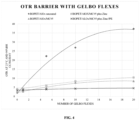
- Gelbo flex testing (ASTM F392-11(2015)) measures the flex durability of flexible packaging materials.
- the flex durability can be quantified as the resistance of the barrier material against repetitive strain.
- the major drawback of AlOx coatings is how easily they are damaged by such flexing.
- Several of the examples on BOPET coated AlOx were subjected to 1, 5, 10, and 20 flexes. Then, the oxygen transmission rate was measured after flexing. Compared to the uncoated AlOx coated films all the examples showed an improvement in maintaining barrier with flexing, Table 11.
- Table 11 Oxygen transmission rate deterioration with number of Gelbo flexes Example coating applied to BOPET/AlOx Gelbo flexes OTR cc/m 2 /day at 90%RH and 23°C None 0 2.06 1 3.16 5 22.24 10 26.96 20 37.30 MICHEM ® Coat 95 0 2.36 1 2.76 5 4.66 10 7.62 20 8.50
- Example 22 0 4.10 1 4.30 5 5.96 10 8.44 20 10.50
Landscapes
- Chemical & Material Sciences (AREA)
- Organic Chemistry (AREA)
- Polymers & Plastics (AREA)
- Health & Medical Sciences (AREA)
- Chemical Kinetics & Catalysis (AREA)
- Medicinal Chemistry (AREA)
- Inorganic Chemistry (AREA)
- Materials Engineering (AREA)
- Wood Science & Technology (AREA)
- Engineering & Computer Science (AREA)
- Life Sciences & Earth Sciences (AREA)
- Laminated Bodies (AREA)
- Wrappers (AREA)
Claims (10)
- Structure de film enduit comprenant :une couche de substrat comprenant un substrat de film polymère ;une couche de finition comprenant au moins un copolymère de styrène hydrophobe et un agent de réticulation, dans laquelle l'au moins un copolymère de styrène hydrophobe est choisi dans le groupe constitué de copolymères styrène-acrylique stabilisés avec des résines solubles dans les alcalis (ASR), copolymères acryliques solubles dans les alcalis, copolymères styrène-acrylique à fonctionnalité acide et dispersions de caoutchouc styrène-butadiène (SBR) carboxylées, et dans laquelle l'agent de réticulation est choisi dans le groupe constitué de : un sel métallique multivalent et un oxyde métallique ; etau moins une couche intermédiaire disposée entre la couche de substrat et la couche de finition, la couche intermédiaire comprenant de l'oxyde d'aluminium.
- Structure de film enduit selon la revendication 1, dans laquelle le substrat de film polymère comprend un polymère choisi dans le groupe constitué d'un polyester, d'un polyamide, et d'une polyoléfine.
- Structure de film enduit selon la revendication 2, dans laquelle le polymère est choisi dans le groupe constitué de l'acide polylactique (PLA), du polyéthylène téréphtalate (PET), du polyéthylène téréphtalate orienté biaxialement (BOPET), du polypropylène orienté (OPP), du polypropylène orienté biaxialement (BOPP), du polypropylène moulé (CPP), du polyéthylène (PE), et du polyamide orienté biaxialement.
- Structure de film enduit selon l'une quelconque revendication précédente, dans laquelle la structure de film enduit a un taux de transmission d'oxygène inférieur à 3,00 cm3/m2/jour à 50 % d'humidité relative à 23 °C, mesuré conformément à la norme ASTM D3985.
- Structure de film enduit selon les revendications 1 à 3, dans laquelle la structure de film enduit a un taux de transmission d'oxygène inférieur à 2,00 cm3/m2/jour à une humidité relative de 50 % à 23 °C, mesuré conformément à la norme ASTM D3985.
- Structure de film enduit selon l'une quelconque revendication précédente, dans laquelle la structure de film enduit a un taux de transmission de la vapeur d'eau inférieur à 2,50 g/m2/jour à 90 % d'humidité relative et 37,8 °C, mesuré conformément à la norme ASTM E-398
- Structure de film enduit selon l'une quelconque revendication précédente, dans laquelle l'agent de réticulation est un sel métallique multivalent.
- Structure de film enduit selon la revendication 7, dans laquelle le sel métallique multivalent comprend un ion de métal de transition.
- Structure de film enduit selon la revendication 8, dans laquelle l'ion de métal de transition est choisi dans le groupe constitué d'ions de zinc, de zirconium, de fer, et de cuivre.
- Structure de film enduit selon la revendication 9, dans laquelle l'ion de métal de transition est présent entre 0,1:10 et 7:10, en termes de rapport molaire de l'ion de métal de transition à la fonctionnalité acide du copolymère.
Applications Claiming Priority (2)
| Application Number | Priority Date | Filing Date | Title |
|---|---|---|---|
| US201862684368P | 2018-06-13 | 2018-06-13 | |
| PCT/US2019/036822 WO2019241421A1 (fr) | 2018-06-13 | 2019-06-12 | Revêtements copolymères à fonction acide pour substrats polymères |
Publications (2)
| Publication Number | Publication Date |
|---|---|
| EP3810680A1 EP3810680A1 (fr) | 2021-04-28 |
| EP3810680B1 true EP3810680B1 (fr) | 2024-11-27 |
Family
ID=67384306
Family Applications (1)
| Application Number | Title | Priority Date | Filing Date |
|---|---|---|---|
| EP19742262.9A Active EP3810680B1 (fr) | 2018-06-13 | 2019-06-12 | Revêtements copolymères à fonction acide pour substrats polymères |
Country Status (6)
| Country | Link |
|---|---|
| US (1) | US11802188B2 (fr) |
| EP (1) | EP3810680B1 (fr) |
| JP (1) | JP7290342B2 (fr) |
| ES (1) | ES3006609T3 (fr) |
| PL (1) | PL3810680T3 (fr) |
| WO (1) | WO2019241421A1 (fr) |
Family Cites Families (12)
| Publication number | Priority date | Publication date | Assignee | Title |
|---|---|---|---|---|
| US4414370A (en) | 1981-01-09 | 1983-11-08 | S. C. Johnson & Son, Inc. | Process for continuous bulk copolymerization of vinyl monomers |
| US4529787A (en) | 1982-06-15 | 1985-07-16 | S. C. Johnson & Son, Inc. | Bulk polymerization process for preparing high solids and uniform copolymers |
| US4546160A (en) | 1984-02-29 | 1985-10-08 | S. C. Johnson & Son, Inc. | Bulk polymerization process for preparing high solids and uniform copolymers |
| US4954558A (en) | 1986-08-22 | 1990-09-04 | S. C. Johnson & Son, Inc. | Resin-fortified emulsion polymers and methods of preparing the same |
| JP4260907B2 (ja) * | 1995-12-12 | 2009-04-30 | 東洋紡績株式会社 | フィルム積層体 |
| MXPA03009151A (es) * | 2001-04-09 | 2004-02-12 | Toppan Printing Co Ltd | Cuerpo laminado. |
| JP4367108B2 (ja) * | 2003-11-26 | 2009-11-18 | 凸版印刷株式会社 | レトルト適性を有する透明ガスバリアフィルム積層体及びその製造方法 |
| GB2431660A (en) | 2005-10-28 | 2007-05-02 | Sun Chemical Ltd | Thermally resistant gas barrier lamella |
| JP4941072B2 (ja) * | 2007-04-25 | 2012-05-30 | 凸版印刷株式会社 | ガスバリア性積層体 |
| JP5831025B2 (ja) * | 2010-08-09 | 2015-12-09 | 東レ株式会社 | ガスバリア性フィルム |
| JP2017513746A (ja) | 2014-04-10 | 2017-06-01 | ナノパック、インク. | 蒸着コーティングと高分子コーティングを併用した強化バリアフィルム |
| MX2019006246A (es) | 2016-12-09 | 2019-08-21 | Jindal Films Americas Llc | Peliculas de oxido de metal, de barrera alta. |
-
2019
- 2019-06-12 WO PCT/US2019/036822 patent/WO2019241421A1/fr not_active Ceased
- 2019-06-12 PL PL19742262.9T patent/PL3810680T3/pl unknown
- 2019-06-12 ES ES19742262T patent/ES3006609T3/es active Active
- 2019-06-12 EP EP19742262.9A patent/EP3810680B1/fr active Active
- 2019-06-12 JP JP2020569204A patent/JP7290342B2/ja active Active
- 2019-06-12 US US17/251,031 patent/US11802188B2/en active Active
Also Published As
| Publication number | Publication date |
|---|---|
| JP7290342B2 (ja) | 2023-06-13 |
| ES3006609T3 (en) | 2025-03-18 |
| PL3810680T3 (pl) | 2025-03-31 |
| US11802188B2 (en) | 2023-10-31 |
| WO2019241421A1 (fr) | 2019-12-19 |
| US20210246277A1 (en) | 2021-08-12 |
| JP2021527581A (ja) | 2021-10-14 |
| EP3810680A1 (fr) | 2021-04-28 |
Similar Documents
| Publication | Publication Date | Title |
|---|---|---|
| JP7639342B2 (ja) | ガスバリア性フィルム | |
| KR102497953B1 (ko) | 가스배리어성 필름 | |
| EP2480619B1 (fr) | Adhesif a base d'eau pour laminage de polymeres en substrats metalliques | |
| US10005918B2 (en) | Primer coating for metallized gas barrier films | |
| JP6160208B2 (ja) | ガスバリア性包装材料 | |
| CN108883604A (zh) | 阻气膜 | |
| WO2021230319A1 (fr) | Film barrière aux gaz | |
| WO2015157593A1 (fr) | Films améliorés formant barrière combinant des revêtements déposés en phase vapeur et des revêtements à base de polymère | |
| EP3562870B1 (fr) | Structures de film revêtues comprenant une couche intermédiaire d'oxyde d'aluminium | |
| EP3064348A1 (fr) | Film stratifié barrière contre les gaz | |
| EP3810680B1 (fr) | Revêtements copolymères à fonction acide pour substrats polymères | |
| KR102432490B1 (ko) | 투명증착 나일론을 이용한 즉석밥용 포장재 제조방법 | |
| JP2021133645A (ja) | 積層フィルムおよびその製造方法 | |
| JPWO2009081715A1 (ja) | ガスバリア性フィルム、ガスバリア性積層フィルム及びそれらを用いた包装材料 | |
| EP1905582B1 (fr) | Feuille stratifiée formable par étirage et récipient formé par étirage l'utilisant. | |
| JP2023086487A (ja) | ガスバリア性フィルム、積層体、および包装材料 | |
| KR20230109139A (ko) | 에폭시 수지 조성물, 가스배리어성 적층체 및 포장재 | |
| JP7010023B2 (ja) | ガスバリアフィルム | |
| JPWO2016133038A1 (ja) | 透明バリアフィルム | |
| JP2023049126A (ja) | ガスバリア性フィルム、積層体、および包装材料 | |
| JP2024099177A (ja) | 積層フィルム及び包装体 | |
| JP2022107930A (ja) | ガスバリア性フィルム、積層体、および包装材料 | |
| JP6750285B2 (ja) | ガスバリア性積層体 | |
| EP4688925A1 (fr) | Film barrière | |
| WO2016093150A1 (fr) | Film multicouche de barrière contre des gaz et son procédé de fabrication |
Legal Events
| Date | Code | Title | Description |
|---|---|---|---|
| STAA | Information on the status of an ep patent application or granted ep patent |
Free format text: STATUS: UNKNOWN |
|
| STAA | Information on the status of an ep patent application or granted ep patent |
Free format text: STATUS: THE INTERNATIONAL PUBLICATION HAS BEEN MADE |
|
| PUAI | Public reference made under article 153(3) epc to a published international application that has entered the european phase |
Free format text: ORIGINAL CODE: 0009012 |
|
| STAA | Information on the status of an ep patent application or granted ep patent |
Free format text: STATUS: REQUEST FOR EXAMINATION WAS MADE |
|
| 17P | Request for examination filed |
Effective date: 20201210 |
|
| AK | Designated contracting states |
Kind code of ref document: A1 Designated state(s): AL AT BE BG CH CY CZ DE DK EE ES FI FR GB GR HR HU IE IS IT LI LT LU LV MC MK MT NL NO PL PT RO RS SE SI SK SM TR |
|
| AX | Request for extension of the european patent |
Extension state: BA ME |
|
| DAV | Request for validation of the european patent (deleted) | ||
| DAX | Request for extension of the european patent (deleted) | ||
| STAA | Information on the status of an ep patent application or granted ep patent |
Free format text: STATUS: EXAMINATION IS IN PROGRESS |
|
| 17Q | First examination report despatched |
Effective date: 20211203 |
|
| GRAP | Despatch of communication of intention to grant a patent |
Free format text: ORIGINAL CODE: EPIDOSNIGR1 |
|
| STAA | Information on the status of an ep patent application or granted ep patent |
Free format text: STATUS: GRANT OF PATENT IS INTENDED |
|
| RIC1 | Information provided on ipc code assigned before grant |
Ipc: C08J 7/048 20200101ALI20240524BHEP Ipc: C08J 7/04 20060101AFI20240524BHEP |
|
| INTG | Intention to grant announced |
Effective date: 20240620 |
|
| RAP3 | Party data changed (applicant data changed or rights of an application transferred) |
Owner name: MICHELMAN, INC. |
|
| GRAS | Grant fee paid |
Free format text: ORIGINAL CODE: EPIDOSNIGR3 |
|
| GRAA | (expected) grant |
Free format text: ORIGINAL CODE: 0009210 |
|
| STAA | Information on the status of an ep patent application or granted ep patent |
Free format text: STATUS: THE PATENT HAS BEEN GRANTED |
|
| AK | Designated contracting states |
Kind code of ref document: B1 Designated state(s): AL AT BE BG CH CY CZ DE DK EE ES FI FR GB GR HR HU IE IS IT LI LT LU LV MC MK MT NL NO PL PT RO RS SE SI SK SM TR |
|
| REG | Reference to a national code |
Ref country code: GB Ref legal event code: FG4D |
|
| REG | Reference to a national code |
Ref country code: CH Ref legal event code: EP |
|
| REG | Reference to a national code |
Ref country code: IE Ref legal event code: FG4D |
|
| REG | Reference to a national code |
Ref country code: DE Ref legal event code: R096 Ref document number: 602019062582 Country of ref document: DE |
|
| P01 | Opt-out of the competence of the unified patent court (upc) registered |
Free format text: CASE NUMBER: APP_64619/2024 Effective date: 20241206 |
|
| REG | Reference to a national code |
Ref country code: ES Ref legal event code: FG2A Ref document number: 3006609 Country of ref document: ES Kind code of ref document: T3 Effective date: 20250318 |
|
| REG | Reference to a national code |
Ref country code: LT Ref legal event code: MG9D |
|
| REG | Reference to a national code |
Ref country code: NL Ref legal event code: MP Effective date: 20241127 |
|
| PG25 | Lapsed in a contracting state [announced via postgrant information from national office to epo] |
Ref country code: IS Free format text: LAPSE BECAUSE OF FAILURE TO SUBMIT A TRANSLATION OF THE DESCRIPTION OR TO PAY THE FEE WITHIN THE PRESCRIBED TIME-LIMIT Effective date: 20250327 Ref country code: HR Free format text: LAPSE BECAUSE OF FAILURE TO SUBMIT A TRANSLATION OF THE DESCRIPTION OR TO PAY THE FEE WITHIN THE PRESCRIBED TIME-LIMIT Effective date: 20241127 Ref country code: PT Free format text: LAPSE BECAUSE OF FAILURE TO SUBMIT A TRANSLATION OF THE DESCRIPTION OR TO PAY THE FEE WITHIN THE PRESCRIBED TIME-LIMIT Effective date: 20250327 |
|
| PG25 | Lapsed in a contracting state [announced via postgrant information from national office to epo] |
Ref country code: FI Free format text: LAPSE BECAUSE OF FAILURE TO SUBMIT A TRANSLATION OF THE DESCRIPTION OR TO PAY THE FEE WITHIN THE PRESCRIBED TIME-LIMIT Effective date: 20241127 Ref country code: NL Free format text: LAPSE BECAUSE OF FAILURE TO SUBMIT A TRANSLATION OF THE DESCRIPTION OR TO PAY THE FEE WITHIN THE PRESCRIBED TIME-LIMIT Effective date: 20241127 |
|
| REG | Reference to a national code |
Ref country code: AT Ref legal event code: MK05 Ref document number: 1745680 Country of ref document: AT Kind code of ref document: T Effective date: 20241127 |
|
| PG25 | Lapsed in a contracting state [announced via postgrant information from national office to epo] |
Ref country code: BG Free format text: LAPSE BECAUSE OF FAILURE TO SUBMIT A TRANSLATION OF THE DESCRIPTION OR TO PAY THE FEE WITHIN THE PRESCRIBED TIME-LIMIT Effective date: 20241127 |
|
| PG25 | Lapsed in a contracting state [announced via postgrant information from national office to epo] |
Ref country code: NO Free format text: LAPSE BECAUSE OF FAILURE TO SUBMIT A TRANSLATION OF THE DESCRIPTION OR TO PAY THE FEE WITHIN THE PRESCRIBED TIME-LIMIT Effective date: 20250227 |
|
| PG25 | Lapsed in a contracting state [announced via postgrant information from national office to epo] |
Ref country code: GR Free format text: LAPSE BECAUSE OF FAILURE TO SUBMIT A TRANSLATION OF THE DESCRIPTION OR TO PAY THE FEE WITHIN THE PRESCRIBED TIME-LIMIT Effective date: 20250228 Ref country code: LV Free format text: LAPSE BECAUSE OF FAILURE TO SUBMIT A TRANSLATION OF THE DESCRIPTION OR TO PAY THE FEE WITHIN THE PRESCRIBED TIME-LIMIT Effective date: 20241127 Ref country code: AT Free format text: LAPSE BECAUSE OF FAILURE TO SUBMIT A TRANSLATION OF THE DESCRIPTION OR TO PAY THE FEE WITHIN THE PRESCRIBED TIME-LIMIT Effective date: 20241127 |
|
| PG25 | Lapsed in a contracting state [announced via postgrant information from national office to epo] |
Ref country code: RS Free format text: LAPSE BECAUSE OF FAILURE TO SUBMIT A TRANSLATION OF THE DESCRIPTION OR TO PAY THE FEE WITHIN THE PRESCRIBED TIME-LIMIT Effective date: 20250227 |
|
| PG25 | Lapsed in a contracting state [announced via postgrant information from national office to epo] |
Ref country code: SM Free format text: LAPSE BECAUSE OF FAILURE TO SUBMIT A TRANSLATION OF THE DESCRIPTION OR TO PAY THE FEE WITHIN THE PRESCRIBED TIME-LIMIT Effective date: 20241127 |
|
| PGFP | Annual fee paid to national office [announced via postgrant information from national office to epo] |
Ref country code: PL Payment date: 20250422 Year of fee payment: 7 Ref country code: DE Payment date: 20250603 Year of fee payment: 7 |
|
| PG25 | Lapsed in a contracting state [announced via postgrant information from national office to epo] |
Ref country code: DK Free format text: LAPSE BECAUSE OF FAILURE TO SUBMIT A TRANSLATION OF THE DESCRIPTION OR TO PAY THE FEE WITHIN THE PRESCRIBED TIME-LIMIT Effective date: 20241127 |
|
| PGFP | Annual fee paid to national office [announced via postgrant information from national office to epo] |
Ref country code: GB Payment date: 20250606 Year of fee payment: 7 |
|
| PGFP | Annual fee paid to national office [announced via postgrant information from national office to epo] |
Ref country code: LU Payment date: 20250620 Year of fee payment: 7 |
|
| PG25 | Lapsed in a contracting state [announced via postgrant information from national office to epo] |
Ref country code: EE Free format text: LAPSE BECAUSE OF FAILURE TO SUBMIT A TRANSLATION OF THE DESCRIPTION OR TO PAY THE FEE WITHIN THE PRESCRIBED TIME-LIMIT Effective date: 20241127 |
|
| PGFP | Annual fee paid to national office [announced via postgrant information from national office to epo] |
Ref country code: FR Payment date: 20250605 Year of fee payment: 7 |
|
| PG25 | Lapsed in a contracting state [announced via postgrant information from national office to epo] |
Ref country code: RO Free format text: LAPSE BECAUSE OF FAILURE TO SUBMIT A TRANSLATION OF THE DESCRIPTION OR TO PAY THE FEE WITHIN THE PRESCRIBED TIME-LIMIT Effective date: 20241127 |
|
| PG25 | Lapsed in a contracting state [announced via postgrant information from national office to epo] |
Ref country code: SK Free format text: LAPSE BECAUSE OF FAILURE TO SUBMIT A TRANSLATION OF THE DESCRIPTION OR TO PAY THE FEE WITHIN THE PRESCRIBED TIME-LIMIT Effective date: 20241127 |
|
| PG25 | Lapsed in a contracting state [announced via postgrant information from national office to epo] |
Ref country code: CZ Free format text: LAPSE BECAUSE OF FAILURE TO SUBMIT A TRANSLATION OF THE DESCRIPTION OR TO PAY THE FEE WITHIN THE PRESCRIBED TIME-LIMIT Effective date: 20241127 |
|
| REG | Reference to a national code |
Ref country code: DE Ref legal event code: R097 Ref document number: 602019062582 Country of ref document: DE |
|
| PG25 | Lapsed in a contracting state [announced via postgrant information from national office to epo] |
Ref country code: SE Free format text: LAPSE BECAUSE OF FAILURE TO SUBMIT A TRANSLATION OF THE DESCRIPTION OR TO PAY THE FEE WITHIN THE PRESCRIBED TIME-LIMIT Effective date: 20241127 |
|
| PLBE | No opposition filed within time limit |
Free format text: ORIGINAL CODE: 0009261 |
|
| STAA | Information on the status of an ep patent application or granted ep patent |
Free format text: STATUS: NO OPPOSITION FILED WITHIN TIME LIMIT |
|
| REG | Reference to a national code |
Ref country code: CH Ref legal event code: L10 Free format text: ST27 STATUS EVENT CODE: U-0-0-L10-L00 (AS PROVIDED BY THE NATIONAL OFFICE) Effective date: 20251008 |
|
| PGFP | Annual fee paid to national office [announced via postgrant information from national office to epo] |
Ref country code: ES Payment date: 20250702 Year of fee payment: 7 |
|
| PGFP | Annual fee paid to national office [announced via postgrant information from national office to epo] |
Ref country code: IT Payment date: 20250617 Year of fee payment: 7 |
|
| 26N | No opposition filed |
Effective date: 20250828 |
|
| REG | Reference to a national code |
Ref country code: CH Ref legal event code: H13 Free format text: ST27 STATUS EVENT CODE: U-0-0-H10-H13 (AS PROVIDED BY THE NATIONAL OFFICE) Effective date: 20260127 |
|
| PG25 | Lapsed in a contracting state [announced via postgrant information from national office to epo] |
Ref country code: MC Free format text: LAPSE BECAUSE OF FAILURE TO SUBMIT A TRANSLATION OF THE DESCRIPTION OR TO PAY THE FEE WITHIN THE PRESCRIBED TIME-LIMIT Effective date: 20241127 |
|
| REG | Reference to a national code |
Ref country code: BE Ref legal event code: MM Effective date: 20250630 |
|
| PG25 | Lapsed in a contracting state [announced via postgrant information from national office to epo] |
Ref country code: IE Free format text: LAPSE BECAUSE OF NON-PAYMENT OF DUE FEES Effective date: 20250612 |
|
| PG25 | Lapsed in a contracting state [announced via postgrant information from national office to epo] |
Ref country code: BE Free format text: LAPSE BECAUSE OF NON-PAYMENT OF DUE FEES Effective date: 20250630 |
|
| PG25 | Lapsed in a contracting state [announced via postgrant information from national office to epo] |
Ref country code: CH Free format text: LAPSE BECAUSE OF NON-PAYMENT OF DUE FEES Effective date: 20250630 |