EP3812349A1 - Aktivkohle - Google Patents
Aktivkohle Download PDFInfo
- Publication number
- EP3812349A1 EP3812349A1 EP19823076.5A EP19823076A EP3812349A1 EP 3812349 A1 EP3812349 A1 EP 3812349A1 EP 19823076 A EP19823076 A EP 19823076A EP 3812349 A1 EP3812349 A1 EP 3812349A1
- Authority
- EP
- European Patent Office
- Prior art keywords
- activated carbon
- pore volume
- pores
- size
- less
- Prior art date
- Legal status (The legal status is an assumption and is not a legal conclusion. Google has not performed a legal analysis and makes no representation as to the accuracy of the status listed.)
- Pending
Links
Images


Classifications
-
- C—CHEMISTRY; METALLURGY
- C02—TREATMENT OF WATER, WASTE WATER, SEWAGE, OR SLUDGE
- C02F—TREATMENT OF WATER, WASTE WATER, SEWAGE, OR SLUDGE
- C02F1/00—Treatment of water, waste water, or sewage
- C02F1/28—Treatment of water, waste water, or sewage by sorption
- C02F1/283—Treatment of water, waste water, or sewage by sorption using coal, charred products, or inorganic mixtures containing them
-
- B—PERFORMING OPERATIONS; TRANSPORTING
- B01—PHYSICAL OR CHEMICAL PROCESSES OR APPARATUS IN GENERAL
- B01J—CHEMICAL OR PHYSICAL PROCESSES, e.g. CATALYSIS OR COLLOID CHEMISTRY; THEIR RELEVANT APPARATUS
- B01J20/00—Solid sorbent compositions or filter aid compositions; Sorbents for chromatography; Processes for preparing, regenerating or reactivating thereof
- B01J20/02—Solid sorbent compositions or filter aid compositions; Sorbents for chromatography; Processes for preparing, regenerating or reactivating thereof comprising inorganic material
- B01J20/0203—Solid sorbent compositions or filter aid compositions; Sorbents for chromatography; Processes for preparing, regenerating or reactivating thereof comprising inorganic material comprising compounds of metals not provided for in B01J20/04
- B01J20/0214—Compounds of V, Nb, Ta
-
- B—PERFORMING OPERATIONS; TRANSPORTING
- B01—PHYSICAL OR CHEMICAL PROCESSES OR APPARATUS IN GENERAL
- B01J—CHEMICAL OR PHYSICAL PROCESSES, e.g. CATALYSIS OR COLLOID CHEMISTRY; THEIR RELEVANT APPARATUS
- B01J20/00—Solid sorbent compositions or filter aid compositions; Sorbents for chromatography; Processes for preparing, regenerating or reactivating thereof
- B01J20/02—Solid sorbent compositions or filter aid compositions; Sorbents for chromatography; Processes for preparing, regenerating or reactivating thereof comprising inorganic material
- B01J20/20—Solid sorbent compositions or filter aid compositions; Sorbents for chromatography; Processes for preparing, regenerating or reactivating thereof comprising inorganic material comprising free carbon; comprising carbon obtained by carbonising processes
-
- B—PERFORMING OPERATIONS; TRANSPORTING
- B01—PHYSICAL OR CHEMICAL PROCESSES OR APPARATUS IN GENERAL
- B01J—CHEMICAL OR PHYSICAL PROCESSES, e.g. CATALYSIS OR COLLOID CHEMISTRY; THEIR RELEVANT APPARATUS
- B01J20/00—Solid sorbent compositions or filter aid compositions; Sorbents for chromatography; Processes for preparing, regenerating or reactivating thereof
- B01J20/28—Solid sorbent compositions or filter aid compositions; Sorbents for chromatography; Processes for preparing, regenerating or reactivating thereof characterised by their form or physical properties
- B01J20/28002—Solid sorbent compositions or filter aid compositions; Sorbents for chromatography; Processes for preparing, regenerating or reactivating thereof characterised by their form or physical properties characterised by their physical properties
- B01J20/28004—Sorbent size or size distribution, e.g. particle size
-
- B—PERFORMING OPERATIONS; TRANSPORTING
- B01—PHYSICAL OR CHEMICAL PROCESSES OR APPARATUS IN GENERAL
- B01J—CHEMICAL OR PHYSICAL PROCESSES, e.g. CATALYSIS OR COLLOID CHEMISTRY; THEIR RELEVANT APPARATUS
- B01J20/00—Solid sorbent compositions or filter aid compositions; Sorbents for chromatography; Processes for preparing, regenerating or reactivating thereof
- B01J20/28—Solid sorbent compositions or filter aid compositions; Sorbents for chromatography; Processes for preparing, regenerating or reactivating thereof characterised by their form or physical properties
- B01J20/28014—Solid sorbent compositions or filter aid compositions; Sorbents for chromatography; Processes for preparing, regenerating or reactivating thereof characterised by their form or physical properties characterised by their form
- B01J20/28023—Fibres or filaments
-
- B—PERFORMING OPERATIONS; TRANSPORTING
- B01—PHYSICAL OR CHEMICAL PROCESSES OR APPARATUS IN GENERAL
- B01J—CHEMICAL OR PHYSICAL PROCESSES, e.g. CATALYSIS OR COLLOID CHEMISTRY; THEIR RELEVANT APPARATUS
- B01J20/00—Solid sorbent compositions or filter aid compositions; Sorbents for chromatography; Processes for preparing, regenerating or reactivating thereof
- B01J20/28—Solid sorbent compositions or filter aid compositions; Sorbents for chromatography; Processes for preparing, regenerating or reactivating thereof characterised by their form or physical properties
- B01J20/28054—Solid sorbent compositions or filter aid compositions; Sorbents for chromatography; Processes for preparing, regenerating or reactivating thereof characterised by their form or physical properties characterised by their surface properties or porosity
- B01J20/28069—Pore volume, e.g. total pore volume, mesopore volume, micropore volume
- B01J20/28071—Pore volume, e.g. total pore volume, mesopore volume, micropore volume being less than 0.5 ml/g
-
- B—PERFORMING OPERATIONS; TRANSPORTING
- B01—PHYSICAL OR CHEMICAL PROCESSES OR APPARATUS IN GENERAL
- B01J—CHEMICAL OR PHYSICAL PROCESSES, e.g. CATALYSIS OR COLLOID CHEMISTRY; THEIR RELEVANT APPARATUS
- B01J20/00—Solid sorbent compositions or filter aid compositions; Sorbents for chromatography; Processes for preparing, regenerating or reactivating thereof
- B01J20/28—Solid sorbent compositions or filter aid compositions; Sorbents for chromatography; Processes for preparing, regenerating or reactivating thereof characterised by their form or physical properties
- B01J20/28054—Solid sorbent compositions or filter aid compositions; Sorbents for chromatography; Processes for preparing, regenerating or reactivating thereof characterised by their form or physical properties characterised by their surface properties or porosity
- B01J20/28069—Pore volume, e.g. total pore volume, mesopore volume, micropore volume
- B01J20/28073—Pore volume, e.g. total pore volume, mesopore volume, micropore volume being in the range 0.5-1.0 ml/g
-
- B—PERFORMING OPERATIONS; TRANSPORTING
- B01—PHYSICAL OR CHEMICAL PROCESSES OR APPARATUS IN GENERAL
- B01J—CHEMICAL OR PHYSICAL PROCESSES, e.g. CATALYSIS OR COLLOID CHEMISTRY; THEIR RELEVANT APPARATUS
- B01J20/00—Solid sorbent compositions or filter aid compositions; Sorbents for chromatography; Processes for preparing, regenerating or reactivating thereof
- B01J20/28—Solid sorbent compositions or filter aid compositions; Sorbents for chromatography; Processes for preparing, regenerating or reactivating thereof characterised by their form or physical properties
- B01J20/28054—Solid sorbent compositions or filter aid compositions; Sorbents for chromatography; Processes for preparing, regenerating or reactivating thereof characterised by their form or physical properties characterised by their surface properties or porosity
- B01J20/28078—Pore diameter
- B01J20/2808—Pore diameter being less than 2 nm, i.e. micropores or nanopores
-
- B—PERFORMING OPERATIONS; TRANSPORTING
- B01—PHYSICAL OR CHEMICAL PROCESSES OR APPARATUS IN GENERAL
- B01J—CHEMICAL OR PHYSICAL PROCESSES, e.g. CATALYSIS OR COLLOID CHEMISTRY; THEIR RELEVANT APPARATUS
- B01J20/00—Solid sorbent compositions or filter aid compositions; Sorbents for chromatography; Processes for preparing, regenerating or reactivating thereof
- B01J20/28—Solid sorbent compositions or filter aid compositions; Sorbents for chromatography; Processes for preparing, regenerating or reactivating thereof characterised by their form or physical properties
- B01J20/28054—Solid sorbent compositions or filter aid compositions; Sorbents for chromatography; Processes for preparing, regenerating or reactivating thereof characterised by their form or physical properties characterised by their surface properties or porosity
- B01J20/28088—Pore-size distribution
- B01J20/28092—Bimodal, polymodal, different types of pores or different pore size distributions in different parts of the sorbent
-
- B—PERFORMING OPERATIONS; TRANSPORTING
- B01—PHYSICAL OR CHEMICAL PROCESSES OR APPARATUS IN GENERAL
- B01J—CHEMICAL OR PHYSICAL PROCESSES, e.g. CATALYSIS OR COLLOID CHEMISTRY; THEIR RELEVANT APPARATUS
- B01J20/00—Solid sorbent compositions or filter aid compositions; Sorbents for chromatography; Processes for preparing, regenerating or reactivating thereof
- B01J20/30—Processes for preparing, regenerating, or reactivating
-
- B—PERFORMING OPERATIONS; TRANSPORTING
- B01—PHYSICAL OR CHEMICAL PROCESSES OR APPARATUS IN GENERAL
- B01J—CHEMICAL OR PHYSICAL PROCESSES, e.g. CATALYSIS OR COLLOID CHEMISTRY; THEIR RELEVANT APPARATUS
- B01J20/00—Solid sorbent compositions or filter aid compositions; Sorbents for chromatography; Processes for preparing, regenerating or reactivating thereof
- B01J20/30—Processes for preparing, regenerating, or reactivating
- B01J20/3071—Washing or leaching
-
- B—PERFORMING OPERATIONS; TRANSPORTING
- B01—PHYSICAL OR CHEMICAL PROCESSES OR APPARATUS IN GENERAL
- B01J—CHEMICAL OR PHYSICAL PROCESSES, e.g. CATALYSIS OR COLLOID CHEMISTRY; THEIR RELEVANT APPARATUS
- B01J20/00—Solid sorbent compositions or filter aid compositions; Sorbents for chromatography; Processes for preparing, regenerating or reactivating thereof
- B01J20/30—Processes for preparing, regenerating, or reactivating
- B01J20/3078—Thermal treatment, e.g. calcining or pyrolizing
-
- C—CHEMISTRY; METALLURGY
- C01—INORGANIC CHEMISTRY
- C01B—NON-METALLIC ELEMENTS; COMPOUNDS THEREOF; METALLOIDS OR COMPOUNDS THEREOF NOT COVERED BY SUBCLASS C01C
- C01B32/00—Carbon; Compounds thereof
- C01B32/30—Active carbon
- C01B32/306—Active carbon with molecular sieve properties
-
- C—CHEMISTRY; METALLURGY
- C01—INORGANIC CHEMISTRY
- C01B—NON-METALLIC ELEMENTS; COMPOUNDS THEREOF; METALLOIDS OR COMPOUNDS THEREOF NOT COVERED BY SUBCLASS C01C
- C01B32/00—Carbon; Compounds thereof
- C01B32/30—Active carbon
- C01B32/312—Preparation
- C01B32/336—Preparation characterised by gaseous activating agents
-
- D—TEXTILES; PAPER
- D01—NATURAL OR MAN-MADE THREADS OR FIBRES; SPINNING
- D01F—CHEMICAL FEATURES IN THE MANUFACTURE OF ARTIFICIAL FILAMENTS, THREADS, FIBRES, BRISTLES OR RIBBONS; APPARATUS SPECIALLY ADAPTED FOR THE MANUFACTURE OF CARBON FILAMENTS
- D01F9/00—Artificial filaments or the like of other substances; Manufacture thereof; Apparatus specially adapted for the manufacture of carbon filaments
- D01F9/08—Artificial filaments or the like of other substances; Manufacture thereof; Apparatus specially adapted for the manufacture of carbon filaments of inorganic material
- D01F9/12—Carbon filaments; Apparatus specially adapted for the manufacture thereof
- D01F9/14—Carbon filaments; Apparatus specially adapted for the manufacture thereof by decomposition of organic filaments
- D01F9/145—Carbon filaments; Apparatus specially adapted for the manufacture thereof by decomposition of organic filaments from pitch or distillation residues
- D01F9/15—Carbon filaments; Apparatus specially adapted for the manufacture thereof by decomposition of organic filaments from pitch or distillation residues from coal pitch
-
- B—PERFORMING OPERATIONS; TRANSPORTING
- B01—PHYSICAL OR CHEMICAL PROCESSES OR APPARATUS IN GENERAL
- B01J—CHEMICAL OR PHYSICAL PROCESSES, e.g. CATALYSIS OR COLLOID CHEMISTRY; THEIR RELEVANT APPARATUS
- B01J2220/00—Aspects relating to sorbent materials
- B01J2220/40—Aspects relating to the composition of sorbent or filter aid materials
- B01J2220/42—Materials comprising a mixture of inorganic materials
-
- C—CHEMISTRY; METALLURGY
- C01—INORGANIC CHEMISTRY
- C01P—INDEXING SCHEME RELATING TO STRUCTURAL AND PHYSICAL ASPECTS OF SOLID INORGANIC COMPOUNDS
- C01P2006/00—Physical properties of inorganic compounds
- C01P2006/14—Pore volume
-
- C—CHEMISTRY; METALLURGY
- C02—TREATMENT OF WATER, WASTE WATER, SEWAGE, OR SLUDGE
- C02F—TREATMENT OF WATER, WASTE WATER, SEWAGE, OR SLUDGE
- C02F2101/00—Nature of the contaminant
- C02F2101/30—Organic compounds
- C02F2101/36—Organic compounds containing halogen
-
- C—CHEMISTRY; METALLURGY
- C02—TREATMENT OF WATER, WASTE WATER, SEWAGE, OR SLUDGE
- C02F—TREATMENT OF WATER, WASTE WATER, SEWAGE, OR SLUDGE
- C02F2303/00—Specific treatment goals
- C02F2303/18—Removal of treatment agents after treatment
- C02F2303/185—The treatment agent being halogen or a halogenated compound
-
- C—CHEMISTRY; METALLURGY
- C02—TREATMENT OF WATER, WASTE WATER, SEWAGE, OR SLUDGE
- C02F—TREATMENT OF WATER, WASTE WATER, SEWAGE, OR SLUDGE
- C02F2307/00—Location of water treatment or water treatment device
- C02F2307/06—Mounted on or being part of a faucet, shower handle or showerhead
Definitions
- the present invention relates to an activated carbon, and particularly to an activated carbon having an excellent filtration capacity for trihalomethanes at a high superficial velocity.
- tap water and the like for drinking purposes contain chlorine added for disinfection.
- chlorine contained in tap water reacts with organic substances contained in the tap water to produce organic halogen compounds.
- organic halogen compounds For example, it is known that humic substances, which are natural organic substances, produce carcinogenic trihalomethanes upon reaction with chlorine in tap water. Therefore, activated carbons have been proposed which have an excellent filtration capacity for these organic halogen compounds contained in tap water.
- an adsorbent which comprises a porous carbon in which a pore volume ratio of pores with a size of 20 to 100 ⁇ (2 to 10 nm) is 5 to 50%, and a pore volume ratio of pores with a size of 10 ⁇ (1 nm) or less is 45% or more, relative to a pore volume of pores with a size of 100 ⁇ (10 nm) or less (see, for example, Patent Literature 1).
- Patent Literature 1 discloses that, in the adsorbent, the pore volume ratio of pores with a size of 20 to 100 ⁇ is set to 5 to 50% relative to the pore volume of pores with a size of 100 ⁇ or less, in order to increase the proportion of relatively large pores to improve the dynamic adsorption capacity; on the other hand, because it is also necessary to increase the equilibrium adsorption amount, i.e., static adsorption capacity, of the adsorbent, the pore volume ratio of pores with a size of 10 ⁇ or less, which are effective for increasing the static equilibrium adsorption amount, is set to 45% or more.
- Patent Literature 1 discloses that, because of this structure, the adsorbent is excellent in both static adsorption capacity and dynamic adsorption capacity.
- an activated carbon in which, in a pore size distribution determined by the BJH method based on a nitrogen adsorption isotherm at 77.4 K, a pore volume of mesopores with a diameter of 30 ⁇ or more and less than 50 ⁇ is 0.02 to 0.40 cc/g, and a proportion of the pore volume of the mesopores in the above-defined range relative to a total pore volume is 5 to 45% (see, for example, Patent Literature 2).
- Patent Literature 2 discloses that the activated carbon obtained by controlling the pore volume of the mesopores (pores with a diameter of 2 to 50 nm) and the proportion thereof to fall in the above-defined ranges can be used as a material suitable for adsorbing various substances (particularly trihalomethanes).
- Water filters containing such activated carbons have recently been required to provide a high total trihalomethane filtration capacity.
- water filters have been demanded to provide a large total amount of filtrate from which total trihalomethanes have been filtered (amount of filtrate until the removal rate for total trihalomethanes decreases to 80%) based on "Test of Filtration Capacity for Volatile Organic Compounds" as specified in JIS S3201. The larger the total amount of filtrate, the longer the period during which the water filter is usable (replacement period).
- the water filter when a water filter is used for a faucet-integrated water purifier, the water filter needs to be reduced in size.
- the superficial velocity (SV) increases, which makes it difficult for the water filter to maintain a high total trihalomethane filtration capacity.
- SV superficial velocity
- Patent Literatures 1 and 2 the prior art considers increasing mesopores to improve the dynamic adsorption capacity, in order to improve the adsorption capacity for total trihalomethanes.
- the activation is performed using, as the activation gas, steam, which allows the activation to proceed relatively easily.
- the prior art considers incorporating a metal compound into an activated carbon precursor, and activating the activated carbon precursor using steam as the activation gas, in order to allow the activation of mesopores to proceed. That is, in the prior art, the metal compound incorporated into the activated carbon precursor is used to develop mesopores.
- the metal compound incorporated into an activated carbon precursor has been used to develop mesopores; however, it has been revealed that when a vanadium compound is used as the metal compound to be incorporated into an activated carbon precursor, and the activated carbon precursor is activated using CO 2 , the vanadium compound surprisingly has a significant effect on the development of pores with a size of 1.0 nm or less, which are smaller than mesopores, and a behavior that is completely different from the behaviors when, for example, other metal compounds are used, is exhibited in terms of the development of the pores with a size of 1.0 nm or less.
- the present invention was completed as a result of further research based on these findings.
- the present invention provides the following aspects of the invention:
- the present invention can provide an activated carbon having a high total trihalomethane filtration capacity, even in water treatment by passing water at a high superficial velocity (SV).
- SV superficial velocity
- a pore volume A (cc/g) of pores with a size of 1.0 nm or less, of pore volumes calculated by the QSDFT method is 0.300 cc/g or more, and elemental vanadium and/or a vanadium compound is contained.
- the elemental vanadium and/or the vanadium compound contained in the activated carbon of the present invention is derived from the vanadium compound contained in an activated carbon precursor before activation.
- at least a portion of the elemental vanadium and/or the vanadium compound contained in the activated carbon may be removed by washing.
- the pore volume refers to the pore volume calculated by the QSDFT (Quenched Solid Density Functional Theory) method.
- the QSDFT method is an analytical technique for analyzing pore sizes of geometrically and chemically disordered microporous and mesoporous carbons. This technique can calculate pore size distributions from about 0.5 nm up to about 40 nm.
- the QSDFT method provides a significant improvement in the accuracy of pore size distribution analysis, by explicitly taking into account the effects of pore surface roughness and heterogeneity.
- nitrogen adsorption isotherm measurement is performed using "AUTOSORB-1-MP" available from Quantachrome, and pore size distribution analysis is performed using the QSDFT method.
- the pore volume of pores with a specific range of sizes can be calculated by calculating a pore size distribution by applying the calculation model, N 2 at 77K on carbon [slit pore, QSDFT equilibrium model], to a nitrogen desorption isotherm measured at a temperature of 77 K.
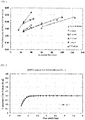
- Fig. 1 is a graph showing the relationship between the activation time and the pore volume of pores with a size of 1.0 nm or less when an activated carbon precursor containing a vanadium compound is activated using CO 2 as the activation gas.
- the following describes the fact that when a vanadium compound is used as the metal compound to be incorporated into an activated carbon precursor, and the activated carbon precursor is activated using CO 2 , the vanadium compound has a significant effect on the development of pores with a size of 1.0 nm or less, and a behavior that is completely different from the behaviors when, for example, other metal compounds are used, is exhibited in terms of the development of the pores with a size of 1.0 nm or less.
- a mixture obtained by mixing 100 parts by mass of granular coal pitch having a softening point of 280°C as an organic material with 0.6 part by mass of bis(2,4-pentanedionato)vanadium(IV) oxide (CAS NO: 3153-26-2 ) was fed into a melt extruder, where it was melted and mixed at a melting temperature of 320°C, and spun at a discharge rate of 16 g/min to obtain a pitch fiber.
- the pitch fiber was subjected to an infusibilization treatment by heating for 54 minutes, to 354°C from ambient temperature in the air at a rate of 1 to 30°C/minute, to obtain an infusibilized pitch fiber as an activated carbon precursor.
- the vanadium content was 0.094% by mass.
- 10 g of the activated carbon precursor was placed in an activation furnace (volume: 0.044 m 3 ), and a gas having a CO 2 concentration of 100% by volume and a temperature of about 20°C was introduced into the activation furnace at a flow rate of about 15 L/min (calculated at 0°C and 1 atmosphere).
- the activated carbon precursor was activated by conducting a heat treatment for 15 minutes at an atmospheric temperature of 950°C in the activation furnace. As a result, an activated carbon of condition 1-1 was obtained.
- the pore volume A of pores with a size of 1.0 nm or less was 0.280 cc/g.
- An activated carbon of condition 1-2 was obtained as in condition 1-1, except that the activation time was 25 minutes.
- the pore volume A of pores with a size of 1.0 nm or less was 0.401 cc/g.
- An activated carbon of condition 1-3 was obtained as in condition 1-1, except that the activation time was 40 minutes.
- the pore volume A of pores with a size of 1.0 nm or less was 0.500 cc/g.
- the pitch fiber was subjected to an infusibilization treatment by heating for 54 minutes, to 354°C from ambient temperature in the air at a rate of 1 to 30°C/minute, to obtain an infusibilized pitch fiber as an activated carbon precursor.
- the activated carbon precursor the vanadium content was 0.09% by mass, and the yttrium content was 0.011% by mass.
- 10 g of the activated carbon precursor was placed in an activation furnace (volume: 0.044 m 3 ), and a gas having a CO 2 concentration of 100% by volume and a temperature of about 20°C was introduced into the activation furnace at a flow rate of about 15 L/min (calculated at 0°C and 1 atmosphere).
- the activated carbon precursor was activated by conducting a heat treatment for 25 minutes at an atmospheric temperature of 950°C in the activation furnace. As a result, an activated carbon of condition 2-1 was obtained.
- the pore volume A of pores with a size of 1.0 nm or less was 0.378 cc/g.
- An activated carbon of condition 2-2 was obtained as in condition 2-1, except that the activation time was 38 minutes.
- the pore volume A of pores with a size of 1.0 nm or less was 0.427 cc/g.
- An activated carbon of condition 2-3 was obtained as in condition 2-1, except that the activation time was 44 minutes.
- the pore volume A of pores with a size of 1.0 nm or less was 0.442 cc/g.
- a mixture obtained by mixing 1.3 parts by mass of zinc caprylate (CAS NO: 557-09-5 ) as a metal component into 100 parts by mass of granular coal pitch having a softening point of 280°C as an organic material was fed into a melt extruder, where it was melted and mixed at a melting temperature of 320°C, and spun at a discharge rate of 16 g/min to obtain a pitch fiber.
- the pitch fiber was subjected to an infusibilization treatment by heating for 54 minutes, to 354°C from ambient temperature in the air at a rate of 1 to 30°C/minute, to obtain an infusibilized pitch fiber as an activated carbon precursor.
- the zinc content was 0.19% by mass.
- the activated carbon precursor 10 g was placed in an activation furnace (volume: 0.044 m 3 ), and a gas having a CO 2 concentration of 100% by volume and a temperature of about 20°C was introduced into the activation furnace at a flow rate of about 15 L/min (calculated at 0°C and 1 atmosphere).
- the activated carbon precursor was activated by conducting a heat treatment for 25 minutes at an atmospheric temperature of 950°C in the activation furnace. As a result, an activated carbon of condition 3-1 was obtained.
- the pore volume A of pores with a size of 1.0 nm or less was 0.258 cc/g.
- An activated carbon of condition 3-2 was obtained as in condition 3-1, except that the activation time was 60 minutes.
- the pore volume A of pores with a size of 1.0 nm or less was 0.383 cc/g.
- An activated carbon of condition 3-3 was obtained as in condition 3-1, except that the activation time was 100 minutes.
- the pore volume A of pores with a size of 1.0 nm or less was 0.467 cc/g.
- a mixture obtained by mixing 100 parts by mass of granular coal pitch having a softening point of 280°C as an organic material with 0.8 part by mass of zirconium acetylacetonate (CAS NO: 17501-44-9 ) was fed into a melt extruder, where it was melted and mixed at a melting temperature of 320°C, and spun at a discharge rate of 16 g/min to obtain a pitch fiber.
- the pitch fiber was subjected to an infusibilization treatment by heating for 54 minutes, to 354°C from ambient temperature in the air at a rate of 1 to 30°C/minute, to obtain an infusibilized pitch fiber as an activated carbon precursor.
- the zirconium content was 0.19% by mass.
- the activated carbon precursor 10 g was placed in an activation furnace (volume: 0.044 m 3 ), and a gas having a CO 2 concentration of 100% by volume and a temperature of about 20°C was introduced into the activation furnace at a flow rate of about 15 L/min (calculated at 0°C and 1 atmosphere).
- the activated carbon precursor was activated by conducting a heat treatment for 25 minutes at an atmospheric temperature of 950°C in the activation furnace. As a result, an activated carbon of condition 4-1 was obtained.
- the pore volume A of pores with a size of 1.0 nm or less was 0.259 cc/g.
- An activated carbon of condition 4-2 was obtained as in condition 4-1, except that the activation time was 40 minutes.
- the pore volume A of pores with a size of 1.0 nm or less was 0.315 cc/g.
- An activated carbon of condition 4-3 was obtained as in condition 4-1, except that the activation time was 60 minutes.
- the pore volume A of pores with a size of 1.0 nm or less was 0.367 cc/g.
- a mixture obtained by mixing 1.0 part by mass of tris(acetylacetonato)yttrium (CAS NO: 15554-47-9 ) as a metal component into 100 parts by mass of granular coal pitch having a softening point of 280°C as an organic material was fed into a melt extruder, where it was melted and mixed at a melting temperature of 320°C, and spun at a discharge rate of 16 g/min to obtain a pitch fiber.
- the pitch fiber was subjected to an infusibilization treatment by heating for 54 minutes, to 354°C from ambient temperature in the air at a rate of 1 to 30°C/minute, to obtain an infusibilized pitch fiber as an activated carbon precursor.
- the yttrium content was 0.16% by mass.
- 10 g of the activated carbon precursor was placed in an activation furnace (volume: 0.044 m 3 ), and a gas having a CO 2 concentration of 100% by volume and a temperature of about 20°C was introduced into the activation furnace at a flow rate of about 15 L/min (calculated at 0°C and 1 atmosphere).
- the activated carbon precursor was activated by conducting a heat treatment for 25 minutes at an atmospheric temperature of 950°C in the activation furnace. As a result, an activated carbon of condition 5-1 was obtained.
- the pore volume A of pores with a size of 1.0 nm or less was 0.278 cc/g.
- An activated carbon of condition 5-2 was obtained as in condition 5-1, except that the activation time was 32 minutes.
- the pore volume A of pores with a size of 1.0 nm or less was 0.302 cc/g.
- An activated carbon of condition 5-3 was obtained as in condition 5-1, except that the activation time was 40 minutes.
- the pore volume A of pores with a size of 1.0 nm or less was 0.352 cc/g.
- Granular coal pitch having a softening point of 280°C as an organic material was fed into a melt extruder, where it was melted and mixed at a melting temperature of 320°C, and spun at a discharge rate of 20 g/min, to obtain a pitch fiber.
- the pitch fiber was subjected to an infusibilization treatment by heating for 54 minutes, to 354°C from ambient temperature in the air at a rate of 1 to 30°C/minute, to obtain an infusibilized pitch fiber as an activated carbon precursor. Because no metal component was added, the metal content in the activated carbon precursor was 0% by mass.
- the activated carbon precursor 10 g was placed in an activation furnace (volume: 0.044 m 3 ), and a gas having a CO 2 concentration of 100% by volume and a temperature of about 20°C was introduced into the activation furnace at a flow rate of about 15 L/min (calculated at 0°C and 1 atmosphere).
- the activated carbon precursor was activated by conducting a heat treatment for 60 minutes at an atmospheric temperature of 950°C in the activation furnace. As a result, an activated carbon of condition 6-1 was obtained.
- the pore volume A of pores with a size of 1.0 nm or less was 0.311 cc/g.
- An activated carbon of condition 6-2 was obtained as in condition 6-1, except that the activation time was 90 minutes.
- the pore volume A of pores with a size of 1.0 nm or less was 0.428 cc/g.
- An activated carbon of condition 6-3 was obtained as in condition 6-1, except that the activation time was 125 minutes.
- the pore volume A of pores with a size of 1.0 nm or less was 0.462 cc/g.
- the vanadium compound when a vanadium compound is used as the metal compound to be incorporated into an activated carbon precursor, and the activated carbon precursor is activated using CO 2 , the vanadium compound has a significant effect on the development of pores with a size of 1.0 nm or less, and a behavior that is completely different from the behaviors when, for example, other metal compounds are used, is exhibited in terms of the development of the pores with a size of 1.0 nm or less.
- the activated carbon of the present invention has a high total trihalomethane filtration capacity even in water treatment by passing water at a high superficial velocity (SV) is not necessarily clear, because a completely different behavior is exhibited in terms of the development of the pores with a size of 1.0 nm or less, as described above, the shape, the pore volume, the structure, and the like of these pores are assumed to be completely different from those of the conventional pores, and it is believed that as a result of this, the activated carbon of the present invention has a high total trihalomethane filtration capacity, even in water treatment by passing water at a high superficial velocity (SV).
- SV superficial velocity
- a large number of the pores with a size of 1.0 nm or less present in the product of the present invention are considered to make an effective contribution as adsorption sites for total trihalomethane molecules.
- the pore volume A of pores with a size of 1.0 nm or less, of pore volumes calculated by the QSDFT method is 0.3 cc/g or more.
- the pore volume A is preferably 0.35 cc/g or more.
- the upper limit of the pore volume A is, for example, 0.8 cc/g, and preferably 0.6 cc/g, but is not limited thereto.
- a pore volume of pores with a size of 0.65 nm or less, of pore volumes calculated by the QSDFT method is preferably 0.10 cc/g or more and 0.40 cc/g or less, more preferably 0.18 cc/g or more and 0.40 cc/g or less, still more preferably 0.15 cc/g or more and 0.23 cc/g or less, and particularly preferably 0.18 cc/g or more and 0.23 cc/g or less.
- a pore volume of pores with a size of 0.8 nm or less, of pore volumes calculated by the QSDFT method is preferably 0.20 cc/g or more and 0.55 cc/g or less, more preferably 0.25 cc/g or more and 0.55 cc/g or less, and still more preferably 0.28 cc/g or more and 0.35 cc/g or less.
- a pore volume B of pores with a size of 1.5 nm or less, of pore volumes calculated by the QSDFT method is preferably 0.25 cc/g or more, more preferably 0.38 cc/g or more, and still more preferably 0.38 cc/g or more and 0.60 cc/g or less.
- a pore volume C of pores with a size of 2.0 nm or less, of pore volumes calculated by the QSDFT method is preferably 0.25 cc/g or more, and more preferably 0.38 cc/g or more and 0.60 cc/g or less.
- a pore volume of pores with a size of 2.0 nm or more, of pore volumes calculated by the QSDFT method is preferably 0.02 cc/g or less, more preferably 0.01 cc/g or less, and still more preferably 0.005 cc/g or less.
- the lower limit of the pore volume is, for example, 0.001 cc/g, but is not limited thereto.
- a pore volume of pores with a size of 1.0 nm or more and 1.5 nm or less, of pore volumes calculated by the QSDFT method is preferably 0.01 cc/g or more and 0.12 cc/g or less.
- the pore volume of pores with a size of 1.0 nm or more and 1.5 nm or less is preferably 0.01 cc/g or more and 0.06 cc/g or less.
- a pore volume of pores with a size of 1.0 nm or more and 2.0 nm or less, of pore volumes calculated by the QSDFT method is preferably 0.015 cc/g or more and 0.14 cc/g or less.
- the pore volume of pores with a size of 1.0 nm or more and 2.0 nm or less is preferably 0.015 cc/g or more and 0.08 cc/g or less.
- a pore volume of pores with a size of 0.65 nm or more and 0.8 nm or less, of pore volumes calculated by the QSDFT method is preferably 0.08 cc/g or more and 0.15 cc/g or less, and more preferably 0.100 cc/g or more and 0.130 cc/g or less.
- the pore volume of pores with a size of 0.65 nm or more and 0.8 nm or less is preferably 0.100 cc/g or more and 0.125 cc/g or less.
- a pore volume of pores with a size of 0.65 nm or more and 1.0 nm or less, of pore volumes calculated by the QSDFT method is preferably 0.060 cc/g or more and 0.250 cc/g or less, and more preferably 0.100 cc/g or more and 0.250 cc/g or less.
- a pore volume of pores with a size of 0.8 nm or more and 1.5 nm or less, of pore volumes calculated by the QSDFT method is preferably 0.01 cc/g or more and 0.22 cc/g or less.
- a pore volume D of pores with a size of 1.5 nm or more and 2.0 nm or less, of pore volumes calculated by the QSDFT method is preferably 0.000 cc/g or more and 0.04 cc/g or less, and more preferably 0.001 cc/g or more and 0.04 cc/g or less.
- the pore volume D of pores with a size of 1.5 nm or more and 2.0 nm or less is preferably 0.001 cc/g or more and 0.01 cc/g or less.
- the activated carbon of the present invention has a specific surface area (value measured by the BET method (single-point method) using nitrogen as the adsorbate) of, for example, about 500 to 3000 m 2 /g, preferably about 700 to 3000 m 2 /g, more preferably about 700 to 1700 m 2 /g, still more preferably about 800 to 1300 m 2 /g, and particularly preferably about 900 to 1300 m 2 /g.
- a total pore volume of the activated carbon calculated by the QSDFT method is, for example, about 0.20 to 0.80 cc/g, preferably about 0.35 to 0.80 cc/g, more preferably about 0.350 to 0.600 cc/g, still more preferably about 0.380 to 0.600 cc/g, and particularly preferably about 0.380 to 0.520 cc/g.
- a ratio of the pore volume A to the pore volume B is, for example, 0.75 to 1.00, and preferably 0.80 to 0.95.
- a ratio of the pore volume A to the pore volume C is, for example, 0.75 to 1.00, and preferably 0.75 to 0.95. The ratio may also be 0.75 to 0.89.
- a ratio of the pore volume D to the pore volume A is, for example, 0.00 to 0.07, and preferably 0.01 to 0.07.
- a proportion of the pore volume A relative to the total pore volume is, for example, 0.75 to 1.00, and preferably 0.75 to 0.95.
- a proportion of the pore volume B relative to the total pore volume is, for example, 0.95 to 1.00, and preferably 0.95 to 0.99.
- a proportion of the pore volume C relative to the total pore volume is, for example, 0.98 to 1.00.
- a proportion of the pore volume D relative to the total pore volume is, for example, 0.05 or less.
- a proportion of the pore volume of pores with a size of 0.65 nm or less, of pore volumes calculated by the QSDFT method, relative to the total pore volume (pore volume of pores with a size of 0.65 nm or less/total pore volume) is, for example, 0.3 to 0.8, and preferably 0.3 to 0.52.
- the proportion is preferably 0.42 to 0.52.
- a proportion of the pore volume of pores with a size of 0.8 nm or less, of pore volumes calculated by the QSDFT method, relative to the total pore volume (pore volume of pores with a size of 0.8 nm or less/total pore volume) is, for example, 0.5 to 0.98, and preferably 0.5 to 0.78.
- the proportion is preferably 0.68 to 0.78.
- the activated carbon of the present invention contains elemental vanadium and/or a vanadium compound.
- the elemental vanadium and/or the vanadium compound is derived from the yttrium compound contained in an activated carbon precursor before activation.
- a (total) mass proportion of the elemental vanadium and the vanadium compound contained in the activated carbon, relative to the total mass of the activated carbon of the present invention, is, for example, 0.01 to 1.0% by mass, and preferably 0.01 to 0.3% by mass.
- the proportion represents the proportion in terms of elemental vanadium (i.e., vanadium content) measured using an ICP emission spectrometer (model number: 715-ES available from Varian Inc.).
- ICP emission spectrometer model number: 715-ES available from Varian Inc.
- at least a portion of the elemental vanadium and/or the vanadium compound contained in the activated carbon may be removed by washing.
- a (total) mass proportion of the elemental vanadium and the vanadium compound may be 0.00% by mass.
- the activated carbon of the present invention may contain a metal element other than vanadium and/or a metal compound other than vanadium, as long as the effects of the present invention are not impaired.
- the metal element other than vanadium and/or the metal compound other than vanadium include at least one metal element selected from the group consisting of, for example, Y (yttrium), Mg (magnesium), Mn (manganese), La (lanthanum), Zr (zirconium), Ce (cerium), Ti (titanium), Co (cobalt), and Fe (iron), and compounds containing such metal elements as constitutional metal elements.
- the metal element other than vanadium and/or the metal compound other than vanadium are/is derived from those/that contained in the activated carbon precursor before activation, as with the elemental vanadium and/or the vanadium compound contained in the activated carbon of the present invention.
- the metal element other than vanadium and/or the metal compound other than vanadium be elemental yttrium and/or an yttrium compound.
- Vanadium is effective in maintaining an increased volume of micropores with a size of 1.0 nm or less, while yttrium is effective in allowing relatively large pores to be appropriately distributed. These relatively large pores help an adsorbate diffuse into pores, which is advantageous in water treatment by passing water at a high superficial velocity (SV).
- SV superficial velocity
- a (total) mass proportion of the metal element other than vanadium and the metal compound other than vanadium, relative to the total mass of the activated carbon is, for example, 0.001 to 0.05% by mass.
- the proportion represents the proportion in terms of the metal element (i.e., the metal content) measured using an ICP emission spectrometer (model number: 715-ES available from Varian Inc.).
- a ratio of the (total) mass proportion of the elemental vanadium and the vanadium compound contained in the activated carbon, relative to the total mass of the activated carbon of the present invention, with respect to the (total) mass proportion of the metal element other than vanadium and the metal compound other than vanadium contained in the activated carbon, relative to the total mass of the activated carbon of the present invention ((total) mass proportion of elemental vanadium and vanadium compound/(total) mass proportion of metal element other than vanadium and metal compound other than vanadium) is preferably 5 to 12, in order to easily impart a higher total trihalomethane filtration capacity, even in water treatment by passing water at a high superficial velocity (SV).
- Examples of forms of the activated carbon of the present invention include, but are not limited to, a granular activated carbon, a powdered activated carbon, and a fibrous activated carbon.
- a fibrous activated carbon is preferred because of the processability for processing for use as a filter and the rate of adsorption for use as a water purifier.
- the fibrous activated carbon preferably has an average fiber diameter of 30 ⁇ m or less, and more preferably about 5 to 20 ⁇ m.
- the average fiber diameter of the fibrous activated carbon of the present invention represents the value measured using an image processing fiber diameter measurement apparatus (in accordance with JIS K 1477).
- the particle diameter of the granular activated carbon or the powdered activated carbon may be such that the cumulative volume percentage D 50 measured by the laser diffraction/scattering method is 0.01 to 5 mm, for example.
- the activated carbon of the present invention in which the pore volume A of pores with a size of 1.0 nm or less, of pore volumes calculated by the QSDFT method, is 0.3 cc/g or more, and elemental vanadium and/or a vanadium compound is contained, has a high total trihalomethane filtration capacity, even in water treatment by passing water at a high superficial velocity (SV).
- the total trihalomethane filtration capacity of the activated carbon of the present invention, in water treatment by passing water at a high superficial velocity (SV), is, for example, 50 to 90 L/g, and preferably 60 to 80 L/g, at an SV of 3000 h -1 , for example.
- the total trihalomethane filtration capacity (L/g) is measured using the following method: The activated carbon is dried in a dryer at 105°C for 2 hours or more, and then 3.0 g of the activated carbon is taken as a sample and beaten in a mixer. Thereafter, the activated carbon is packed into a glass column. The glass column is 25 mm in diameter, and packed to a height of 41 mm.
- concentrations in the sample water and filtrate are measured using a non-radiation source-type electron capture detector (GC7000EN available from J-SCIENCE LAB Co., Ltd.), using the headspace method.
- GC7000EN non-radiation source-type electron capture detector
- the sample water is continuously passed until the total trihalomethane removal rate for the filtrate decreases below 80%, and the amount of passed water (L/g) at a removal rate of 80% is determined as the total trihalomethane adsorption capacity of the activated carbon.
- the chloroform filtration capacity of the activated carbon of the present invention, in water treatment by passing water at a high superficial velocity (SV), is, for example, 45 to 90 L/g, and preferably 50 to 70 L/g, at an SV of 3000 h -1 , for example.
- the chloroform filtration capacity (L/g) is measured using the following method: The activated carbon is dried in a dryer at 105°C for 2 hours or more, and then 3.0 g of the activated carbon is taken as a sample and beaten in a mixer. Thereafter, the activated carbon is packed into a glass column. The glass column is 25 mm in diameter, and packed to a height of 41 mm. Based on "Testing methods for household water purifiers" as specified in JIS-S-3201, sample water having a chloroform concentration of 60 ⁇ 12 ppb is prepared, and the sample water is controlled to a water temperature of 20 ⁇ 1 °C, and passed through the activated carbon column at a superficial velocity of 3000 h -1 .
- the concentrations in the sample water and filtrate are measured using a non-radiation source-type electron capture detector (GC7000EN available from J-SCIENCE LAB Co., Ltd.), using the headspace method.
- GC7000EN non-radiation source-type electron capture detector
- the sample water is continuously passed until the chloroform removal rate for the filtrate decreases below 80%, and the amount of passed water (L/g) at a removal rate of 80% is determined as the chloroform adsorption capacity of the activated carbon.
- the method for producing the activated carbon of the present invention preferably comprises the step of activating an activated carbon precursor comprising 0.05 to 1.5% by mass of vanadium at a temperature of 900 to 1000°C in an atmosphere having a CO 2 concentration of 90% by volume or more. That is, the activated carbon of the present invention may be an activated carbon obtained by the method comprising the step of activating an activated carbon precursor comprising 0.05 to 1.5% by mass of vanadium at a temperature of 900 to 1000°C in an atmosphere having a CO 2 concentration of 90% by volume or more.
- the activated carbon of the present invention may be an activated carbon obtained by a method comprising, after the step of activating, the step of washing for removal of at least a portion of elemental vanadium and/or a vanadium compound contained in the activated carbon.
- activated carbons for water purification applications are typically produced using a method in which activated carbon precursors are activated in an atmosphere with a high steam content.
- Patent Literature 2 also discloses a method in which an activated carbon precursor containing at least one metal component from Mg, Mn, Fe, Y, Pt, and Gd is activated in an atmosphere containing nitrogen and saturated steam, in order for the volume of pores with a diameter of 30 ⁇ or more and less than 50 ⁇ to fall in a specific range.
- increasing the volume of mesopores reduces the pore volume of pores with a size of 1.0 nm or less, and the resulting activated carbons cannot exhibit a sufficient filtration capacity for total trihalomethanes at a high superficial velocity.
- the activated carbon precursor comprising 0.05 to 1.5% by mass of vanadium is activated using an activation gas containing 90% by volume or more of CO 2 , which reacts with the activated carbon precursor more slowly than steam.
- the main raw material of the activated carbon precursor is not limited.
- examples include infusibilized or carbonized organic materials and infusible resins such as phenolic resins.
- the organic materials include polyacrylonitrile, pitch, polyvinyl alcohol, and cellulose. Pitch, particularly coal pitch, is preferred in terms of the theoretical carbonization yield during carbonization.
- the vanadium content in the activated carbon precursor is preferably 0.08 to 1.0% by mass.
- Vanadium can be incorporated by mixing elemental vanadium or a vanadium compound into the main raw material of the activated carbon precursor.
- the vanadium compound to be mixed into the main raw material of the activated carbon precursor include compounds containing vanadium as a constitutional metal element, for example, inorganic metal compounds such as a metal oxide, a metal hydroxide, a metal halide, and a metal sulfate; metal salts of organic acids such as acetic acid; and organometallic compounds.
- organometallic compounds include a metal acetylacetonate and an aromatic metal compound.
- an organometallic compound is preferred among the above, and a metal complex having a ⁇ -diketone-type compound as a ligand is preferred as the organometallic compound.
- ⁇ -diketone-type compounds include those having the structures represented by formulae (1) to (3) shown below, and specific examples include acetylacetone.
- elemental vanadium or the vanadium compound and elemental yttrium and/or the yttrium compound may be mixed into the main raw material of the activated carbon precursor.
- the yttrium compound to be mixed into the main raw material of the activated carbon precursor include compounds containing yttrium as a constitutional metal element, for example, inorganic metal compounds such as a metal oxide, a metal hydroxide, a metal halide, and a metal sulfate; metal salts of organic acids such as acetic acid; and organometallic compounds.
- organometallic compounds include a metal acetylacetonate and an aromatic metal compound.
- an organometallic compound is preferred among the above, and a metal complex having a ⁇ -diketone-type compound as a ligand is preferred as the organometallic compound.
- ⁇ -diketone-type compounds include those having the structures represented by formulae (1) to (3) shown below, and specific examples include acetyl acetone.
- the atmosphere for activation has a CO 2 concentration of 90% by volume or more, preferably 95% by volume or more, and more preferably 99% by volume or more.
- the reaction proceeds slowly using CO 2 as the activation gas, and therefore, the pore size distribution is more easily adjusted as the CO 2 concentration is increased, allowing the activated carbon of the present invention to be more easily obtained.
- components other than CO 2 in the atmosphere for activation include N 2 , O 2 , H 2 , H 2 O, and CO.
- the atmospheric temperature for activation is typically about 900 to 1000°C, and preferably about 900 to 980°C.
- the activation time may be adjusted to give a predetermined pore size distribution, according to the main raw material of the activated carbon precursor, the metal compound content, the CO 2 concentration in the activation gas, and the like.
- the activation may be carried out at an atmospheric temperature for activation of 900 to 1000°C, for an activation time of 20 to 70 minutes.
- Vanadium Content and Yttrium Content (% by mass) in Activated Carbon Precursor (Infusibilized Pitch Fiber)
- the pitch fiber was subjected to an ashing treatment, the ash was dissolved in an acid, and the proportions in terms of elemental vanadium and elemental yttrium as measured using an ICP emission spectrometer (model number: 715-ES available from Varian Inc.) were determined as the vanadium content and the yttrium content, respectively.
- the fibrous activated carbon was subjected to an ashing treatment, the ash was dissolved in an acid, and the proportions in terms of elemental vanadium and elemental yttrium as measured using an ICP emission spectrometer (model number: 715-ES available from Varian Inc.) were determined as the vanadium content and the yttrium content, respectively.
- the physical property values of pores were measured based on a nitrogen adsorption isotherm at 77 K, using "AUTOSORB-1-MP" available from Quantachrome.
- the specific surface area was calculated by the BET method, from the measurement point at a relative pressure of 0.1.
- the total pore volume and the pore volume of pores with each range of sizes shown in Table 1 were analyzed by calculating a pore size distribution by applying the calculation model, N 2 at 77K on carbon [slit pore, QSDFT equilibrium model], to the measured nitrogen desorption isotherm.
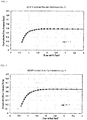
- the pore volume of pores with each range of sizes shown in Table 1 represents the reading from the graph showing the pore size distribution shown in each of Figs. 1 to 11 , or the value calculated based on the reading.
- the pore volume of pores with a size of 0.65 nm or less represents the reading of Cumulative Pore Volume (cc/g) at a Pore Width of 0.65 nm along the horizontal axis on the pore size distribution diagram.
- the pore volume of pores with a size of 0.8 nm or less, the pore volume A of pores with a size of 1.0 nm or less, the pore volume B of pores with a size of 1.5 nm or less, and the pore volume C of pores with a size of 2.0 nm or less were determined.
- the pore volume of pores with a size of 2.0 nm or more was calculated by subtracting the pore volume C of pores with a size of 2.0 nm or less from the total pore volume determined by the QSDFT method.
- the pore volume of pores with a size of 1.0 nm or more and 1.5 nm or less was calculated by subtracting the pore volume A of pores with a size of 1.0 nm or less from the pore volume B of pores with a size of 1.5 nm or less.
- the pore volume of pores with a size of 1.0 nm or more and 2.0 nm or less was calculated by subtracting the pore volume A of pores with a size of 1.0 nm or less from the pore volume C of pores with a size of 2.0 nm or less.
- the pore volume of pores with a size of 0.65 nm or more and 0.8 nm or less was calculated by subtracting the pore volume of pores with a size of 0.65 nm or less from the pore volume of pores with a size of 0.8 nm or less.
- the pore volume of pores with a size of 0.65 nm or more and 1.0 nm or less was calculated by subtracting the pore volume of pores with a size of 0.65 nm or less from the pore volume A of pores with a size of 1.0 nm or less.
- the pore volume of pores with a size of 0.8 nm or more and 1.5 nm or less was calculated by subtracting the pore volume of pores with a size of 0.8 nm or less from the pore volume B of pores with a size of 1.5 nm or less.
- the pore volume of pores with a size of 1.5 nm or more and 2.0 nm or less was calculated by subtracting the pore volume B of pores with a size of 1.5 nm or less from the pore volume C of pores with a size of 2.0 nm or less.
- the measurement was performed using an image processing fiber diameter measurement apparatus (in accordance with JIS K 1477).
- the fibrous activated carbon was dried in a dryer at 105°C for 2 hours or more, and then 3.0 g of the activated carbon was taken as a sample and beaten in a mixer. Thereafter, the activated carbon was packed into a glass column.
- the glass column was 25 mm in diameter, and packed to a height of 41 mm.
- concentrations in the sample water and filtrate were measured using a non-radiation source-type electron capture detector (GC7000EN available from J-SCIENCE LAB Co., Ltd.), using the headspace method.
- GC7000EN non-radiation source-type electron capture detector
- the sample water was continuously passed until the total trihalomethane removal rate for the filtrate decreased below 80%, and the amount of passed water (L/g) at a removal rate of 80% was determined as the total trihalomethane adsorption capacity of the activated carbon.
- the fibrous activated carbon was dried in a dryer at 105°C for 2 hours or more, and then 3.0 g of the activated carbon was taken as a sample and beaten in a mixer. Thereafter, the activated carbon was packed into a glass column. The glass column was 25 mm in diameter, and packed to a height of 41 mm. Based on "Testing methods for household water purifiers" as specified in JIS-S-3201, sample water having a chloroform concentration of 60 ⁇ 12 ppb was prepared, and the sample water was controlled to a water temperature of 20 ⁇ 1 °C, and passed through the activated carbon column at a superficial velocity of 3000 h -1 .
- the concentrations in the sample water and filtrate were measured using a non-radiation source-type electron capture detector (GC7000EN available from J-SCIENCE LAB Co., Ltd.), using the headspace method.
- GC7000EN non-radiation source-type electron capture detector
- the sample water was continuously passed until the chloroform removal rate for the filtrate decreased below 80%, and the amount of passed water (L/g) at a removal rate of 80% was determined as the chloroform adsorption capacity of the activated carbon.
- the pitch fiber was subjected to an infusibilization treatment by heating for 54 minutes, to 354°C from ambient temperature in the air at a rate of 1 to 30°C/minute, to obtain an infusibilized pitch fiber as an activated carbon precursor.
- the activated carbon precursor the vanadium content was 0.09% by mass, and the yttrium content was 0.011% by mass.
- the activated carbon precursor was activated by conducting a heat treatment at an atmospheric temperature of 950°C for 25 minutes, while continuously introducing a gas having a CO 2 concentration of 100% by volume into an activation furnace, to obtain an activated carbon of Example 1.
- the pore volume A of pores with a size of 1.0 nm or less, of pore volumes calculated by the QSDFT method was 0.378 cc/g
- the vanadium content was 0.16% by mass
- the yttrium content was 0.02% by mass
- the average fiber diameter was 13.6 ⁇ m.
- Example 2 An activated carbon of Example 2 was obtained as in Example 1, except that the activation time was 38 minutes.
- Example 3 An activated carbon of Example 3 was obtained as in Example 1, except that the activation time was 44 minutes.
- a mixture obtained by mixing 100 parts by mass of granular coal pitch having a softening point of 280°C as an organic material with 0.6 part by mass of bis(2,4-pentanedionato)vanadium(IV) oxide (CAS NO: 3153-26-2 ) was fed into a melt extruder, where it was melted and mixed at a melting temperature of 320°C, and spun at a discharge rate of 16 g/min to obtain a pitch fiber.
- the pitch fiber was subjected to an infusibilization treatment by heating for 54 minutes, to 354°C from ambient temperature in the air at a rate of 1 to 30°C/minute, to obtain an infusibilized pitch fiber as an activated carbon precursor.
- the vanadium content was 0.09% by mass.
- the activated carbon precursor was activated by conducting a heat treatment at an atmospheric temperature of 950°C for 25 minutes, while continuously introducing a gas having a CO 2 concentration of 100% by volume into an activation furnace, to obtain an activated carbon of Example 4.
- the pore volume A of pores with a size of 1.0 nm or less, of pore volumes calculated by the QSDFT method was 0.401 cc/g
- the vanadium content was 0.17% by mass
- the average fiber diameter was 13.9 ⁇ m.
- Example 5 An activated carbon of Example 5 was obtained as in Example 4, except that the activation time was 44 minutes.
- a mixture obtained by mixing 100 parts by mass of granular coal pitch having a softening point of 280°C as an organic material with 0.6 part by mass of bis(2,4-pentanedionato)vanadium(IV) oxide (CAS NO: 3153-26-2 ) was fed into a melt extruder, where it was melted and mixed at a melting temperature of 325°C, and spun at a discharge rate of 16 g/min to obtain a pitch fiber.
- the pitch fiber was subjected to an infusibilization treatment by gradually heating to 364°C in the air, and holding for a total of 87 minutes, to obtain an infusibilized pitch fiber as an activated carbon precursor.
- the vanadium content was 0.10% by mass.
- the activated carbon precursor was activated by conducting a heat treatment at an atmospheric temperature of 950°C for 50 minutes, while continuously introducing a gas having a CO 2 concentration of 100% by volume into an activation furnace, to obtain an activated carbon of Example 6.
- the pore volume A of pores with a size of 1.0 nm or less, of pore volumes calculated by the QSDFT method was 0.381 cc/g, the vanadium content was 0.29% by mass, and the average fiber diameter was 13.6 ⁇ m.
- a mixture obtained by mixing 100 parts by mass of granular coal pitch having a softening point of 280°C as an organic material with 0.6 part by mass of bis(2,4-pentanedionato)vanadium(IV) oxide (CAS NO: 3153-26-2 ) was fed into a melt extruder, where it was melted and mixed at a melting temperature of 325°C, and spun at a discharge rate of 16 g/min to obtain a pitch fiber.
- the pitch fiber was subjected to an infusibilization treatment by gradually heating to 335°C in the air, and holding for a total of 87 minutes, to obtain an infusibilized pitch fiber as an activated carbon precursor.
- the vanadium content was 0.08% by mass.
- the activated carbon precursor was activated by conducting a heat treatment at an atmospheric temperature of 950°C for 50 minutes, while continuously introducing a gas having a CO 2 concentration of 100% by volume into an activation furnace, to obtain an activated carbon of Example 7.
- the pore volume A of pores with a size of 1.0 nm or less, of pore volumes calculated by the QSDFT method was 0.393 cc/g
- the vanadium content was 0.21% by mass
- the average fiber diameter was 13.7 ⁇ m.
- a test simulating Example 5 of Patent Literature 2 was conducted. Specifically, a mixture obtained by mixing 100 parts by mass of granular coal pitch having a softening point of 280°C as an organic material with 1.3 parts by mass of tris(acetylacetonato)yttrium ( CAS NO: 15554-47-9 ) was fed into a melt extruder, where it was melted and mixed at a melting temperature of 320°C, and spun at a discharge rate of 20 g/min to obtain a pitch fiber.
- the pitch fiber was subjected to an infusibilization treatment by heating for 54 minutes, to 354°C from ambient temperature in the air at a rate of 1 to 30°C/minute, to obtain an infusibilized pitch fiber as an activated carbon precursor.
- the activated carbon precursor the vanadium content was 0.00% by mass.
- the activated carbon precursor was activated by conducting a heat treatment at an atmospheric temperature of 900°C for 20 minutes, while continuously introducing a gas having an H 2 O concentration of 100% by volume into an activation furnace, to obtain an activated carbon of Comparative Example 1.
- the pore volume A of pores with a size of 1.0 nm or less, of pore volumes calculated by the QSDFT method was 0.241 cc/g
- the vanadium content was 0.00% by mass
- the average fiber diameter was 16.5 ⁇ m.
- Granular coal pitch having a softening point of 280°C as an organic material was fed into a melt extruder, where it was melted and mixed at a melting temperature of 320°C, and spun at a discharge rate of 20 g/min, to obtain a pitch fiber.
- the pitch fiber was subjected to an infusibilization treatment by heating for 54 minutes, to 354°C from ambient temperature in the air at a rate of 1 to 30°C/minute, to obtain an infusibilized pitch fiber as an activated carbon precursor.
- the activated carbon precursor the vanadium content was 0.00% by mass.
- the activated carbon precursor was activated by conducting a heat treatment at an atmospheric temperature of 875°C for 40 minutes, while continuously introducing a gas having an H 2 O concentration of 100% by volume into an activation furnace, to obtain an activated carbon of Comparative Example 2.
- the pore volume A of pores with a size of 1.0 nm or less was 0.401 cc/g
- the vanadium content was 0.00% by mass
- the average fiber diameter was 16.7 ⁇ m.
- Granular coal pitch having a softening point of 280°C as an organic material was fed into a melt extruder, where it was melted and mixed at a melting temperature of 320°C, and spun at a discharge rate of 20 g/min, to obtain a pitch fiber.
- the pitch fiber was subjected to an infusibilization treatment by heating for 54 minutes, to 354°C from ambient temperature in the air at a rate of 1 to 30°C/minute, to obtain an infusibilized pitch fiber as an activated carbon precursor.
- the activated carbon precursor the vanadium content was 0.00% by mass.
- the activated carbon precursor was activated by conducting a heat treatment at an atmospheric temperature of 950°C for 60 minutes, while continuously introducing a gas having a CO 2 concentration of 100% by volume into an activation furnace, to obtain an activated carbon of Comparative Example 3.
- the pore volume A of pores with a size of 1.0 nm or less was 0.311 cc/g
- the vanadium content was 0.00% by mass
- the average fiber diameter was 18.5 ⁇ m.
- a mixture obtained by mixing 100 parts by mass of granular coal pitch having a softening point of 280°C as an organic material with 0.3 part by mass of tris(acetylacetonato)yttrium (CAS NO: 3153-26-2 ) was fed into a melt extruder, where it was melted and mixed at a melting temperature of 320°C, and spun at a discharge rate of 20 g/min to obtain a pitch fiber.
- the pitch fiber was subjected to an infusibilization treatment by heating for 54 minutes, to 354°C from ambient temperature in the air at a rate of 1 to 30°C/minute, to obtain an infusibilized pitch fiber as an activated carbon precursor.
- the activated carbon precursor the vanadium content was 0.00% by mass.
- the activated carbon precursor was activated by conducting a heat treatment at an atmospheric temperature of 950°C for 67 minutes, while continuously introducing a gas having a CO 2 concentration of 100% by volume into an activation furnace, to obtain an activated carbon of Comparative Example 4.
- the pore volume A of pores with a size of 1.0 nm or less was 0.418 cc/g
- the vanadium content was 0.00% by mass
- the average fiber diameter was 16.8 ⁇ m.
- a mixture obtained by mixing 100 parts by mass of granular coal pitch having a softening point of 280°C as an organic material with 0.3 part by mass of tris(acetylacetonato)yttrium (CAS NO: 3153-26-2 ) was fed into a melt extruder, where it was melted and mixed at a melting temperature of 320°C, and spun at a discharge rate of 20 g/min to obtain a pitch fiber.
- the pitch fiber was subjected to an infusibilization treatment by heating for 54 minutes, to 354°C from ambient temperature in the air at a rate of 1 to 30°C/minute, to obtain an infusibilized pitch fiber as an activated carbon precursor.
- the activated carbon precursor the vanadium content was 0.00% by mass.
- the activated carbon precursor was activated by conducting a heat treatment at an atmospheric temperature of 950°C for 70 minutes, while continuously introducing a gas having a CO 2 concentration of 100% by volume into an activation furnace, to obtain an activated carbon of Comparative Example 5.
- the pore volume A of pores with a size of 1.0 nm or less was 0.431 cc/g
- the vanadium content was 0.00% by mass
- the average fiber diameter was 16.8 ⁇ m.
- a mixture obtained by mixing 100 parts by mass of granular coal pitch having a softening point of 280°C as an organic material with 0.3 part by mass of tris(acetylacetonato)yttrium (CAS NO: 3153-26-2 ) was fed into a melt extruder, where it was melted and mixed at a melting temperature of 320°C, and spun at a discharge rate of 20 g/min to obtain a pitch fiber.
- the pitch fiber was subjected to an infusibilization treatment by heating for 54 minutes, to 354°C from ambient temperature in the air at a rate of 1 to 30°C/minute, to obtain an infusibilized pitch fiber as an activated carbon precursor.
- the activated carbon precursor the vanadium content was 0.00% by mass.
- the activated carbon precursor was activated by conducting a heat treatment at an atmospheric temperature of 950°C for 60 minutes, while continuously introducing a gas having a CO 2 concentration of 100% by volume into an activation furnace, to obtain an activated carbon of Comparative Example 6.
- the pore volume A of pores with a size of 1.0 nm or less was 0.429 cc/g
- the vanadium content was 0.00% by mass
- the fiber diameter was 18.2 ⁇ m.
- a mixture obtained by mixing 100 parts by mass of granular coal pitch having a softening point of 280°C as an organic material with 1.0 part by mass of tris(acetylacetonato)yttrium (CAS NO: 3153-26-2 ) was fed into a melt extruder, where it was melted and mixed at a melting temperature of 320°C, and spun at a discharge rate of 19 g/min to obtain a pitch fiber.
- the pitch fiber was subjected to an infusibilization treatment by heating for 54 minutes, to 354°C from ambient temperature in the air at a rate of 1 to 30°C/minute, to obtain an infusibilized pitch fiber as an activated carbon precursor.
- the activated carbon precursor the vanadium content was 0.00% by mass.
- the activated carbon precursor was activated by conducting a heat treatment at an atmospheric temperature of 950°C for 20 minutes, while continuously introducing a gas having a CO 2 concentration of 50% by volume and an H 2 O concentration of 50% by volume into an activation furnace, to obtain an activated carbon of Comparative Example 7.
- the pore volume A of pores with a size of 1.0 nm or less was 0.255 cc/g
- the vanadium content was 0.00% by mass
- the average fiber diameter was 14.6 ⁇ m.
- the pore volume A (cc/g) of pores with a size of 1.0 nm or less, of pore volumes calculated by the QSDFT method was 0.300 cc/g or more, and elemental vanadium and/or a vanadium compound was contained, and therefore, these activated carbons had high total trihalomethane filtration capacities, even in water treatment by passing water at a high superficial velocity (SV).
- SV superficial velocity
Landscapes
- Chemical & Material Sciences (AREA)
- Organic Chemistry (AREA)
- Chemical Kinetics & Catalysis (AREA)
- Analytical Chemistry (AREA)
- Inorganic Chemistry (AREA)
- Engineering & Computer Science (AREA)
- Hydrology & Water Resources (AREA)
- Water Supply & Treatment (AREA)
- Environmental & Geological Engineering (AREA)
- Life Sciences & Earth Sciences (AREA)
- Physics & Mathematics (AREA)
- Thermal Sciences (AREA)
- Nanotechnology (AREA)
- General Chemical & Material Sciences (AREA)
- Textile Engineering (AREA)
- Carbon And Carbon Compounds (AREA)
- Solid-Sorbent Or Filter-Aiding Compositions (AREA)
- Water Treatment By Sorption (AREA)
- Inorganic Fibers (AREA)
Applications Claiming Priority (2)
| Application Number | Priority Date | Filing Date | Title |
|---|---|---|---|
| JP2018116190 | 2018-06-19 | ||
| PCT/JP2019/024171 WO2019244905A1 (ja) | 2018-06-19 | 2019-06-18 | 活性炭 |
Publications (2)
| Publication Number | Publication Date |
|---|---|
| EP3812349A1 true EP3812349A1 (de) | 2021-04-28 |
| EP3812349A4 EP3812349A4 (de) | 2022-02-09 |
Family
ID=68984089
Family Applications (1)
| Application Number | Title | Priority Date | Filing Date |
|---|---|---|---|
| EP19823076.5A Pending EP3812349A4 (de) | 2018-06-19 | 2019-06-18 | Aktivkohle |
Country Status (4)
| Country | Link |
|---|---|
| US (1) | US12258284B2 (de) |
| EP (1) | EP3812349A4 (de) |
| JP (2) | JP6719709B2 (de) |
| WO (1) | WO2019244905A1 (de) |
Cited By (1)
| Publication number | Priority date | Publication date | Assignee | Title |
|---|---|---|---|---|
| EP4400478A4 (de) * | 2021-09-06 | 2025-10-08 | Adall Co Ltd | Aktivkohle |
Families Citing this family (1)
| Publication number | Priority date | Publication date | Assignee | Title |
|---|---|---|---|---|
| EP4656600A1 (de) * | 2023-01-25 | 2025-12-03 | Unitika Ltd. | Filter |
Family Cites Families (16)
| Publication number | Priority date | Publication date | Assignee | Title |
|---|---|---|---|---|
| JP3446771B2 (ja) | 1993-12-09 | 2003-09-16 | 三菱瓦斯化学株式会社 | 高比表面積炭素材料の製造方法 |
| JP3810521B2 (ja) * | 1997-05-30 | 2006-08-16 | 株式会社アドール | 窒素酸化物除去用素材およびその製造方法 |
| JP3390649B2 (ja) | 1997-06-02 | 2003-03-24 | カネボウ株式会社 | 球状炭素材及びその製造方法 |
| JPH11240707A (ja) | 1998-02-27 | 1999-09-07 | Adooru:Kk | 活性炭 |
| JPWO2003026792A1 (ja) | 2001-09-26 | 2005-01-06 | 株式会社アドール | 活性炭素繊維及びその製造方法 |
| JP2004182511A (ja) | 2002-12-02 | 2004-07-02 | Ad'all Co Ltd | 活性炭及びその製造方法 |
| JP2005001968A (ja) * | 2003-06-13 | 2005-01-06 | Nippon Steel Chem Co Ltd | 多孔質炭素の製造方法 |
| JP2006247527A (ja) | 2005-03-10 | 2006-09-21 | Kansai Coke & Chem Co Ltd | 吸着剤 |
| US20130211158A1 (en) * | 2006-11-08 | 2013-08-15 | The Curators Of The University Of Missouri | High surface area carbon and process for its production |
| US20150352767A1 (en) * | 2011-11-29 | 2015-12-10 | Vibha Kalra | Fabrication of Porous Carbon Nanofibers with Large Power Handling Capability |
| WO2015152391A1 (ja) * | 2014-04-03 | 2015-10-08 | 関西熱化学株式会社 | 浄水器用活性炭 |
| JP2015225876A (ja) * | 2014-05-26 | 2015-12-14 | 旭化成株式会社 | 非水系リチウム型蓄電素子用正極活物質及びそれを用いた非水系リチウム型蓄電素子 |
| JP6677553B2 (ja) * | 2016-03-28 | 2020-04-08 | 株式会社アドール | 炭素材料の製造方法 |
| JP6749117B2 (ja) * | 2016-03-28 | 2020-09-02 | 株式会社アドール | 金属単体及び金属化合物の少なくとも一方を含有する活性炭の製造方法 |
| WO2017213057A1 (ja) * | 2016-06-06 | 2017-12-14 | 住友電気工業株式会社 | 電気二重層キャパシタ電極用の多孔質炭素材料、その製造方法および電気二重層キャパシタ電極 |
| JP6960622B2 (ja) | 2016-09-05 | 2021-11-05 | 旭化成株式会社 | 多孔質炭素材料及びその製造方法、複合体及びその製造方法、並びにリチウム硫黄電池用の正極材料 |
-
2019
- 2019-06-18 JP JP2019563310A patent/JP6719709B2/ja active Active
- 2019-06-18 WO PCT/JP2019/024171 patent/WO2019244905A1/ja not_active Ceased
- 2019-06-18 US US17/253,163 patent/US12258284B2/en active Active
- 2019-06-18 EP EP19823076.5A patent/EP3812349A4/de active Pending
-
2020
- 2020-05-18 JP JP2020086419A patent/JP2020124714A/ja not_active Withdrawn
Cited By (1)
| Publication number | Priority date | Publication date | Assignee | Title |
|---|---|---|---|---|
| EP4400478A4 (de) * | 2021-09-06 | 2025-10-08 | Adall Co Ltd | Aktivkohle |
Also Published As
| Publication number | Publication date |
|---|---|
| US12258284B2 (en) | 2025-03-25 |
| JP2020124714A (ja) | 2020-08-20 |
| US20210261442A1 (en) | 2021-08-26 |
| JPWO2019244905A1 (ja) | 2020-06-25 |
| JP6719709B2 (ja) | 2020-07-08 |
| EP3812349A4 (de) | 2022-02-09 |
| WO2019244905A1 (ja) | 2019-12-26 |
Similar Documents
| Publication | Publication Date | Title |
|---|---|---|
| US11873235B2 (en) | Activated carbon | |
| JP6379325B1 (ja) | 活性炭及びその製造方法 | |
| US10105680B2 (en) | Activated carbon with excellent adsorption performance and process for producing same | |
| JP6379324B1 (ja) | 活性炭及びその製造方法 | |
| JP2022132348A (ja) | 活性炭及びその製造方法 | |
| JP7441296B2 (ja) | 活性炭の製造方法 | |
| EP3812349A1 (de) | Aktivkohle | |
| JP2025087660A (ja) | 炭素質材料及びその製造方法、吸着フィルター、浄水器カートリッジ、浄水器、並びに水浄化設備 | |
| EP4400478A1 (de) | Aktivkohle | |
| JP6683969B1 (ja) | 活性炭 | |
| CN111247097B (zh) | 活性炭及该活性炭的制备方法 | |
| JP7300124B2 (ja) | トリハロメタン除去用活性炭およびその製造方法 | |
| EP3422363A1 (de) | Verfahren zur verarbeitung einer radioaktiven iodhaltigen flüssigkeit | |
| KR20260059600A (ko) | 탄소질 재료 및 그 제조 방법, 흡착 필터, 정수기 카트리지, 정수기, 그리고 물 정화 설비 | |
| KR20260061422A (ko) | 탄소질 재료 및 그 제조 방법, 흡착 필터, 정수기 카트리지, 정수기, 그리고 물 정화 설비 | |
| CN122003294A (zh) | 碳质材料及其制造方法、吸附过滤器、净水器滤芯、净水器及净水设备 | |
| JP2020049451A (ja) | 活性炭、及び該活性炭の製造方法 |
Legal Events
| Date | Code | Title | Description |
|---|---|---|---|
| STAA | Information on the status of an ep patent application or granted ep patent |
Free format text: STATUS: THE INTERNATIONAL PUBLICATION HAS BEEN MADE |
|
| PUAI | Public reference made under article 153(3) epc to a published international application that has entered the european phase |
Free format text: ORIGINAL CODE: 0009012 |
|
| STAA | Information on the status of an ep patent application or granted ep patent |
Free format text: STATUS: REQUEST FOR EXAMINATION WAS MADE |
|
| 17P | Request for examination filed |
Effective date: 20210114 |
|
| AK | Designated contracting states |
Kind code of ref document: A1 Designated state(s): AL AT BE BG CH CY CZ DE DK EE ES FI FR GB GR HR HU IE IS IT LI LT LU LV MC MK MT NL NO PL PT RO RS SE SI SK SM TR |
|
| AX | Request for extension of the european patent |
Extension state: BA ME |
|
| DAV | Request for validation of the european patent (deleted) | ||
| DAX | Request for extension of the european patent (deleted) | ||
| REG | Reference to a national code |
Ref country code: DE Ref legal event code: R079 Free format text: PREVIOUS MAIN CLASS: C01B0032336000 Ipc: B01J0020020000 |
|
| A4 | Supplementary search report drawn up and despatched |
Effective date: 20220112 |
|
| RIC1 | Information provided on ipc code assigned before grant |
Ipc: D01F 9/15 20060101ALI20220105BHEP Ipc: C02F 1/28 20060101ALI20220105BHEP Ipc: C01B 32/336 20170101ALI20220105BHEP Ipc: C01B 32/306 20170101ALI20220105BHEP Ipc: B01J 20/30 20060101ALI20220105BHEP Ipc: B01J 20/28 20060101ALI20220105BHEP Ipc: B01J 20/20 20060101ALI20220105BHEP Ipc: B01J 20/02 20060101AFI20220105BHEP |
|
| STAA | Information on the status of an ep patent application or granted ep patent |
Free format text: STATUS: EXAMINATION IS IN PROGRESS |
|
| 17Q | First examination report despatched |
Effective date: 20250217 |