EP3816565A1 - Dispositif de transfert de chaleur et son procédé de fabrication - Google Patents
Dispositif de transfert de chaleur et son procédé de fabrication Download PDFInfo
- Publication number
- EP3816565A1 EP3816565A1 EP18923866.0A EP18923866A EP3816565A1 EP 3816565 A1 EP3816565 A1 EP 3816565A1 EP 18923866 A EP18923866 A EP 18923866A EP 3816565 A1 EP3816565 A1 EP 3816565A1
- Authority
- EP
- European Patent Office
- Prior art keywords
- flat plate
- plate
- flow passage
- flow passages
- sets
- Prior art date
- Legal status (The legal status is an assumption and is not a legal conclusion. Google has not performed a legal analysis and makes no representation as to the accuracy of the status listed.)
- Granted
Links
Images






Classifications
-
- F—MECHANICAL ENGINEERING; LIGHTING; HEATING; WEAPONS; BLASTING
- F28—HEAT EXCHANGE IN GENERAL
- F28D—HEAT-EXCHANGE APPARATUS, NOT PROVIDED FOR IN ANOTHER SUBCLASS, IN WHICH THE HEAT-EXCHANGE MEDIA DO NOT COME INTO DIRECT CONTACT
- F28D9/00—Heat-exchange apparatus having stationary plate-like or laminated conduit assemblies for both heat-exchange media, the media being in contact with different sides of a conduit wall
- F28D9/0031—Heat-exchange apparatus having stationary plate-like or laminated conduit assemblies for both heat-exchange media, the media being in contact with different sides of a conduit wall the conduits for one heat-exchange medium being formed by paired plates touching each other
- F28D9/0037—Heat-exchange apparatus having stationary plate-like or laminated conduit assemblies for both heat-exchange media, the media being in contact with different sides of a conduit wall the conduits for one heat-exchange medium being formed by paired plates touching each other the conduits for the other heat-exchange medium also being formed by paired plates touching each other
-
- F—MECHANICAL ENGINEERING; LIGHTING; HEATING; WEAPONS; BLASTING
- F28—HEAT EXCHANGE IN GENERAL
- F28D—HEAT-EXCHANGE APPARATUS, NOT PROVIDED FOR IN ANOTHER SUBCLASS, IN WHICH THE HEAT-EXCHANGE MEDIA DO NOT COME INTO DIRECT CONTACT
- F28D7/00—Heat-exchange apparatus having stationary tubular conduit assemblies for both heat-exchange media, the media being in contact with different sides of a conduit wall
- F28D7/16—Heat-exchange apparatus having stationary tubular conduit assemblies for both heat-exchange media, the media being in contact with different sides of a conduit wall the conduits being arranged in parallel spaced relation
- F28D7/1615—Heat-exchange apparatus having stationary tubular conduit assemblies for both heat-exchange media, the media being in contact with different sides of a conduit wall the conduits being arranged in parallel spaced relation the conduits being inside a casing and extending at an angle to the longitudinal axis of the casing; the conduits crossing the conduit for the other heat exchange medium
-
- B—PERFORMING OPERATIONS; TRANSPORTING
- B23—MACHINE TOOLS; METAL-WORKING NOT OTHERWISE PROVIDED FOR
- B23P—METAL-WORKING NOT OTHERWISE PROVIDED FOR; COMBINED OPERATIONS; UNIVERSAL MACHINE TOOLS
- B23P15/00—Making specific metal objects by operations not covered by a single other subclass or a group in this subclass
- B23P15/26—Making specific metal objects by operations not covered by a single other subclass or a group in this subclass heat exchangers or the like
-
- F—MECHANICAL ENGINEERING; LIGHTING; HEATING; WEAPONS; BLASTING
- F28—HEAT EXCHANGE IN GENERAL
- F28D—HEAT-EXCHANGE APPARATUS, NOT PROVIDED FOR IN ANOTHER SUBCLASS, IN WHICH THE HEAT-EXCHANGE MEDIA DO NOT COME INTO DIRECT CONTACT
- F28D9/00—Heat-exchange apparatus having stationary plate-like or laminated conduit assemblies for both heat-exchange media, the media being in contact with different sides of a conduit wall
- F28D9/04—Heat-exchange apparatus having stationary plate-like or laminated conduit assemblies for both heat-exchange media, the media being in contact with different sides of a conduit wall the conduits being formed by spirally-wound plates or laminae
-
- F—MECHANICAL ENGINEERING; LIGHTING; HEATING; WEAPONS; BLASTING
- F28—HEAT EXCHANGE IN GENERAL
- F28F—DETAILS OF HEAT-EXCHANGE AND HEAT-TRANSFER APPARATUS, OF GENERAL APPLICATION
- F28F3/00—Plate-like or laminated elements; Assemblies of plate-like or laminated elements
- F28F3/08—Elements constructed for building-up into stacks, e.g. capable of being taken apart for cleaning
- F28F3/086—Elements constructed for building-up into stacks, e.g. capable of being taken apart for cleaning having one or more openings therein forming tubular heat-exchange passages
-
- F—MECHANICAL ENGINEERING; LIGHTING; HEATING; WEAPONS; BLASTING
- F28—HEAT EXCHANGE IN GENERAL
- F28F—DETAILS OF HEAT-EXCHANGE AND HEAT-TRANSFER APPARATUS, OF GENERAL APPLICATION
- F28F7/00—Elements not covered by group F28F1/00, F28F3/00 or F28F5/00
- F28F7/02—Blocks traversed by passages for heat-exchange media
Definitions
- the present invention relates to a heat transport device and a method for manufacturing the same.
- Exemplary heat transport devices that function through heat exchange between two fluids include heat exchangers, evaporators, condensers, air conditioner outdoor/indoor units, radiators, reactors, fuel cell-related parts, and parts for use in inkjet printing.
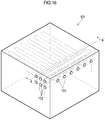
- FIG. 16 is a schematic perspective view of a conventional heat exchanger.
- a heat exchanger 101 shown in FIG. 16 is formed by diffusion bonding.
- the heat exchanger is formed by stacking on top of each other plates each having a first set of fluid passages 102 formed in one main surface and plates each having a second set of fluid passages 104 formed in one main surface in a direction perpendicular to the first set of fluid passages 102 (the plates circulating two different kinds of refrigerants to be heat-exchanged), and integrally joining the plates together through application of pressure and heat in a vacuum.
- the thus formed heat exchanger 101 is configured to perform heat exchange between a first refrigerant flowing through the first sets of fluid passages 102 and a second refrigerant flowing through the second sets of fluid passages 104 in the vertically stacked respective plates.
- the sets of fluid passages 102 and 104 for the refrigerants flowing within the heat exchanger 101 are alternately combined in their stacking direction, as shown in FIG. 16 .
- PATENT DOCUMENT 1 JP 2003-506306 A
- the inventors of the present application have examined a method of increasing the heat transmission coefficient between two fluids.
- FIG. 17 schematically shows a part of a cross-section taken along line a-a' in FIG. 16 .
- the point ⁇ and a point ⁇ in a fluid passage 102 of the first set which are at the positions nearest to and farthest from their corresponding flow passage 104 in the second set, respectively, are compared to each other, the point ⁇ has a higher heat transmission coefficient, whereas the point ⁇ has a lower heat transmission coefficient.
- the distance between the point ⁇ and its corresponding fluid passage 104 has a lower limit value in order to keep the strength of the heat exchanger.
- the inventors of the present application assumed that the heat transmission coefficient of the whole of the heat exchanger can be increased by reducing the distance between the point ⁇ in the fluid passage 102 and its corresponding fluid passage 104 while keeping the distance between the point ⁇ in the fluid passage 102 and its corresponding fluid passage 104.
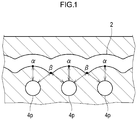
- the inventors of the present application thus assumed that this can be realized by replacing the first sets of fluid passages having a linear shape as shown FIG. 17 by meandering fluid passages as shown in FIG. 1 .
- An object of the present invention is to solve the problem as described above.
- an object of the present invention is to provide a heat transport device in which one set of flow passages meander and the distance between two sets of flow passages is smaller and is kept at an approximately constant value, and the heat transmission coefficient is therefore increased, thus resulting in downsizing, and reduction in weight and thickness.
- Another object of the present invention is to provide a method of manufacturing the heat transport device as described above having a high strength at low costs.
- the present invention provides the following (1) to (7).
- the present invention can provide a heat transport device in which one set of flow passages meander and the distance between two sets of flow passages is smaller and is kept at an approximately constant value, and the heat transmission coefficient is therefore increased, thus resulting in downsizing, and reduction in weight and thickness.
- the present invention can also provide a method of manufacturing the heat transport device as described above having a high strength at low costs.
- the present invention is directed to a heat transport device including first sets of flow passages for flowing a first fluid and second sets of flow passages for flowing a second fluid.
- the heat transport device is capable of obtaining a cross-section A satisfying [Requirement 1] to [Requirement 3] described below.
- the heat transport device as described above is hereinafter referred to also as “device of the invention.”
- the present invention is also directed to a method of manufacturing a heat transport device, the method comprising: a flat plate working process including removing at least a part of a main surface of a flat plate P to form recesses at the main surface, thereby obtaining a processed flat plate Q including in its main surface a processed portion which is a portion having the recesses formed therein; a first joining process including bringing a main surface of a flat plate R for upper surface and the main surface of the processed flat plate Q into close contact with each other so as to form, between the flat plate R for upper surface and the processed flat plate Q, a first set of flow passages for flowing a first fluid that are formed at the processed portion, and joining together the main surfaces of the flat plate R for upper surface and the processed flat plate Q, thereby obtaining a first flow passage plate; a plastic working process including subjecting at least a part of a main surface of the first flow passage plate to plastic working so as to deform the first set of flow passages to form recesses at the main surface, thereby
- first manufacturing method of the invention The method of manufacturing the heat transport device as described above is hereinafter referred to also as "first manufacturing method of the invention.”
- the present invention is further directed to a method of manufacturing a heat transport device, the method comprising: a flat plate working process including subjecting at least a part of a main surface of a flat plate P to plastic working to form recesses at the main surface, thereby obtaining a processed flat plate Q including in its main surface a processed portion which is a portion having the recesses formed therein; a first joining process including preparing a flat plate-like spacer X which is processed so as not to have a portion in contact with the processed portion even after a main surface of the spacer is brought into close contact with the main surface of the processed flat plate Q, bringing the main surfaces of the processed flat plate Q and the spacer X into contact with each other, sandwiching the spacer X and the processed flat plate Q between a flat plate R for upper surface and a flat plate S for lower surface, and then joining together main surfaces of the flat plate R for upper surface, the processed flat plate Q, the spacer X, and the flat plate S for lower surface so that there is no space between the flat
- the method of manufacturing the heat transport device as described above is hereinafter referred to also as "second manufacturing method of the invention.”
- the device of the invention can be preferably manufactured by the manufacturing method of the invention.
- the device of the invention is first described.
- the device of the invention is a heat transport device including first sets of flow passages for flowing a first fluid and second sets of flow passages for flowing a second fluid, and can be preferably used as a heat exchanger included, for example, in refrigerating equipment and air-conditioning equipment.
- the device can also be used as a cooling device that may be used to cool electronic equipment such as computers.
- the first fluid and the second fluid are not particularly limited, and, for example, a conventionally known refrigerant can be used. Specifically, water (pure water and the like), alcohols (ethanol and the like), chlorofluorocarbons (CFCs) and CFC substitutes can be used.
- these sets of flow passages may have a substantially circular cross-sectional shape and a diameter (Heywood diameter) of 0.05 to 5 mm.
- the diameter is preferably 0.2 to 2 mm.
- the first sets of flow passages and the second sets of flow passages preferably have a smaller shortest distance therebetween because the heat transmission coefficient can be increased.
- the first sets of flow passages and the second sets of flow passages preferably have a larger shortest distance therebetween because the strength of the device of the invention can be increased.
- An optimal value can be selected for the distance between the first sets of flow passages and the second sets of flow passages depending on the performance required for the device of the invention.
- the first sets of flow passages and the second sets of flow passages may have therebetween a shortest distance of 0.05 to 1 mm, and preferably have therebetween a shortest distance of 0.1 to 0.3 mm.
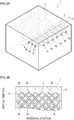
- FIG. 2A shows a schematic perspective view of the device of the invention
- FIG. 2B shows a cross-sectional view taken along line b-b' in FIG. 2A .
- first sets of flow passages 2 for flowing a first fluid are approximately perpendicular to second sets of flow passages 4 for flowing a second fluid.
- the first sets of flow passages 2 for flowing the first fluid may not be perpendicular to the second sets of flow passages 4 for flowing the second fluid.
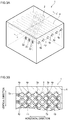
- first sets of flow passages 2 may be formed in a direction non-perpendicular to the second sets of flow passages 4 as in the device of the invention illustrated in FIGS. 3 .
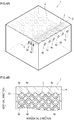
- the second sets of flow passages 4 may have a zigzag shape as in the device of the invention illustrated in FIGS. 4 .
- the device of the invention is a heat transport device that is capable of obtaining a cross-section A satisfying [Requirement 1] to [Requirement 3] described below.
- the cross-sections A as illustrated in FIG. 2B , FIG. 3B , and FIG. 4B can be obtained by cutting the devices of the invention in a direction perpendicular to the second sets of flow passages.
- the cross-section A may not be a cross-section in a direction perpendicular to all the second sets of flow passages in the device of the invention.
- a cross-section perpendicular to all the second sets of flow passages may not be obtained.
- a cross-section in a direction perpendicular to some flow passages of each second set in the device of the invention is taken as the cross-section A in the device of the invention.
- the second sets of flow passages 4 are linearly formed and therefore a cross-section in a direction perpendicular to the sets of flow passages, namely a cross-section taken along line b-b' in FIG. 2A is the cross-section A and is shown in FIG. 2B .
- the second sets of flow passages 4 are linearly formed and therefore a cross-section in a direction perpendicular to the sets of flow passages, namely a cross-section taken along line c-c' in FIG. 3A is the cross-section A and is shown in FIG. 3B .
- the cross-section A may have a plurality of holes 2p in the first sets of flow passages as shown in FIG. 3B .
- positions of the first sets of flow passages 2 are shown in dotted lines in FIG. 3B , but in the case of FIG. 3B , only the holes 2p of the first sets of flow passages 2 should actually appear on FIG. 3B .
- the second sets of flow passages 4 are not linearly formed. It is, however, possible to obtain a cross-section in a direction perpendicular to the sets of flow passages. Namely, a cross-section taken along line d-d' in FIG. 4A is the cross-section A and is shown in FIG. 4B .
- the device of the invention is cut at points (curved points) of the second sets of flow passages where the direction is changed but can also be cut at other points.
- first sets of flow passages and the second sets of flow passages in FIGS. 2 to FIGS. 4 illustrate flow passages having extremely simple configurations, respectively.
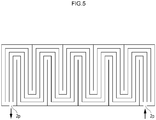
- the device may also have flow passages as shown in FIG. 5 .
- the device may also have flow passages as shown in FIG. 6 .
- the first sets of flow passages and the second sets of flow passages may have other shapes such as a corrugated pattern (parallel wave pattern) shape, a herringbone pattern (herring-bone pattern) shape, and a double herringbone pattern shape.
- FIG. 7 is used to describe Requirement 2.
- the cross-section A shown in FIG. 7 is similar to that in FIG. 2B .
- the holes of the second sets of flow passages are denoted by “4p” in FIG. 2B but are denoted by “P mk " (m and k are integers of 1 or more, respectively) in FIG. 7 .
- holes (P mk ) of the second sets of flow passages are arranged in line in the horizontal direction, and hole rows are arranged to form layers in a vertical direction.
- the holes (P mk ) are horizontally arranged in line and three hole layers each forming a hole row are present in the vertical direction.
- the hole layers each forming a hole row are expressed, from below to above, by first layer, second layer, and third layer, respectively, and holes in the first layer, second layer and third layer are denoted by P 1k , P 2k , and P 3k , respectively.
- m denotes the layer number.
- the holes are expressed, from left to right, by P m1 , P m2 , P m3 , ... P mk , respectively.
- k is a hole (serial) number in a single layer.
- the hole P 3k in the third layer should be present just above the hole P 1k present in the first layer.
- the hole P 33 in the third layer should be present just above the hole P 13 present in the first layer.
- the hole P 2k in the second layer should be present at the upper left of the hole P 1k present in the first layer.
- the hole P 23 in the second layer should be present at the upper left of the hole P 13 present in the first layer.
- the cross-section A is obtained by cutting the device of the invention in the direction perpendicular to the second sets of flow passages, and accordingly, in the case where the first sets of flow passages 2 are formed in the oblique direction with respect to the second sets of flow passages 4 as in FIG. 3B , from a three-dimensional point of view, the cross-section A is not parallel to the direction in which the first fluid flows in the serpentine manner.
- the direction on the assumption that the first fluid is projected onto the cross-section A is deemed to be the direction in which the first fluid flows in the serpentine manner, and the direction is taken as the horizontal direction.
- the first and second layers, and the second and third layers form the hole row layers vertically adjacent to each other, respectively, and in the first and second layers adjacent to each other, the holes of the second sets of flow passages are not located at the same positions in the horizontal direction.
- the center of each hole in the second layer is not present just above the center of each hole in the first layer.
- Each hole in the second layer is present between two holes in the first layer.
- the holes of the second sets of flow passages are not located at the same positions in the horizontal direction.
- the center of each hole in the third layer is not present just above the center of each hole in the second layer.
- Each hole in the third layer is present between two holes in the second layer.
- the first sets of flow passages 2 are present between the vertically adjacent hole row layers, respectively.
- the first sets of flow passages 2 are not connected to the second sets of flow passages 4.
- the first sets of flow passages 2 vertically meander so as to avoid the holes (4p, P mk ) of the second sets of flow passages in the hole row layers sandwiching the first sets of flow passages therebetween in the vertical direction.
- a first set of flow passages 2 are present between a first layer having holes (Pn, P 12 , P 13 , P 14 ) of one second set of flow passages and a second layer having holes (P 21 , P 22 , P 23 , P 24 , P 25 ) of another second set of flow passages, and the first set of flow passages vertically meander so as to avoid the holes (P 11 , P 12 , P 13 , P 14 ) of the first layer and the holes (P 21 , P 22 , P 23 , P 24 , P 25 ) of the second layer.
- a band portion that forms a boundary between the first and second layers meanders vertically, and the corresponding first set of flow passages meander along the shape of the band portion.
- the device of the invention achieves a high heat transmission coefficient, thus resulting in downsizing, and reduction in weight and thickness.
- the device of the invention may have a plate-like shape.
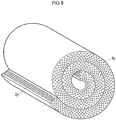
- the shape of the device of the invention having a plate-like shape may also be changed to have, for example, a cylindrical shape as shown in FIG. 8 .
- the device of the invention as described above can be preferably manufactured by the manufacturing method of the invention.
- the manufacturing method of the invention includes a flat plate working process, a first joining process, a plastic working process, and a second joining process.
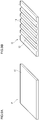
- a flat plate P is first prepared ( FIG. 9A , FIG. 10A ).
- the flat plate P is preferably a metallic flat plate, and more preferably a flat plate made of stainless steel, aluminum, iron, steel, copper, titanium, Inconel or Hastelloy.
- the size and the thickness are not particularly limited and the flat plate preferably has a thickness of about 0.05 to 5 mm, and more preferably about 0.2 to 2 mm.
- At least a part of a main surface 10 of the flat plate P is processed to form recesses 12 at the main surface 10.
- a processed flat plate Q that includes, in the main surface 10, a processed portion 14 which is a portion having the recesses formed therein is thus obtained.
- At least a part of the main surface of the flat plate P is removed to form recesses at the main surface.
- Removal processing refers to removing at least a part of the main surface of the flat plate P and is not particularly limited as long as the process used is capable of forming recesses at the main surface. Etching processing or cutting machining is preferably used for removal processing.
- the recesses 12 shown in FIG. 9B indicate recesses in the case of removal processing.
- At least a part of the main surface of the flat plate P is subjected to plastic working to form recesses at the main surface.
- Plastic working refers to plastically deforming at least a part of the main surface of the flat plate P and is not particularly limited as long as the process used is capable of forming recesses at the main surface.
- Press working or processing using gear rolls is preferably used for plastic working.
- the processing using gear rolls refers to a process in which a metallic plate or band is inserted between two gear rolls and processed, and exemplary methods are illustrated in JP 11-147149 A and JP 2004-025257 A .
- the recesses 12 shown in FIG. 10B indicate recesses in the case of plastic working.
- a flat plate R for upper surface is first prepared ( FIG. 11A ).
- the material, the size, the thickness and the like of the flat plate R for upper surface are not particularly limited and are preferably the same as those in the above-mentioned flat plate P.
- first flow passage plate 20 having, between the flat plate R for upper surface and the processed flat plate Q, a first set of flow passages 2 formed at the processed portion 14 can be obtained ( FIG. 11C ).
- a flat plate R for upper surface and a flat plate S for lower surface are first prepared ( FIG. 12A ).
- the material, the size, the thickness and the like of the flat plate R for upper surface and the flat plate S for lower surface are not particularly limited and are preferably the same as those in the above-mentioned flat plate P.
- a flat plate-like spacer X which is processed so as not to have a portion in contact with the processed portion 14 even after main surfaces of the spacer and a processed flat plate Q are brought into close contact with each other is prepared ( FIG. 12A ).
- the spacer X can be obtained by preparing a plate which is made of the same material as that of the flat plate R for upper surface and has a slightly larger size than that of the flat plate R for upper surface, and punching the prepared plate.
- the processed portion 14 of the processed flat plate Q is formed by plastic working such as press working, and therefore recesses (recesses 12) are formed at one main surface of the processed flat plate Q and protrusions ⁇ are formed at the other main surface of the processed flat plate Q.
- the thickness of the spacer X is adjusted depending on the size of the protrusions ⁇ of the processed flat plate Q. More specifically, the thickness of the processed flat plate Q is preferably adjusted so that the tops of the protrusions ⁇ come into contact with a main surface of the flat plate S for lower surface in the state of FIG. 12B to be described later.
- the tops of the protrusions ⁇ and the main surface of the flat plate S for lower surface are joined together to obtain a heat transport device having a higher strength, which is preferable.
- the main surface of the processed flat plate Q is brought into contact with the main surface of the spacer X.
- the main surface of the processed flat plate Q on the side of the protrusions ⁇ at the processed portion 14 is brought into contact with the main surface of the spacer X.
- FIG. 12B shows a drawing in the state obtained by cutting in a direction which is parallel to the longitudinal direction (horizontal direction in the drawing) of the flat plate R for upper surface and the flat plate S for lower surface and is perpendicular to the main surfaces.
- the flat plate R for upper surface and the flat plate S for lower surface preferably have no space therebetween in the portion where the processed portion 14 is not present but the spacer X is only present between the flat plate R for upper surface and the flat plate S for lower surface (portion indicated by ⁇ in FIG. 12B ). Then, when the main surfaces of the flat plate R for upper surface, the processed flat plate Q, the spacer X, and the flat plate S for lower surface are joined together, a first flow passage plate 20 can be obtained which includes first sets of flow passages 2 for flowing a first fluid between the flat plate R for upper surface and the flat plate S for lower surface in the portion (portion indicated by ⁇ in FIG. 12B ) where the processed portion is present but the spacer X is not present between the flat plate R for upper surface and the flat plate S for lower surface ( FIG. 12C ).
- the main surfaces of at least two selected from the group consisting of the flat plate R for upper surface, the processed flat plate Q, the flat plate S for lower surface, and the spacer X can be joined together by brazing or the like but are preferably joined together by diffusion bonding.
- the main surfaces of the flat plate R for upper surface and the processed flat surface Q can be joined together by brazing or the like but are preferably joined together by diffusion bonding.
- the main surfaces of at least two selected from the group consisting of the flat plate R for upper surface, the processed flat plate Q, the flat plate S for lower surface, and the spacer X can be joined together by brazing or the like but are preferably joined together by diffusion bonding.
- the main surfaces of the flat plate R for upper surface, the processed flat plate Q, the flat plate S for lower surface, and the spacer X are more preferably joined together by diffusion bonding.
- the obtained heat transport device has thus a higher strength.
- a first flow passage plate is prepared. Although the first flow passage plate 20 shown in FIG. 12C is illustrated, the first flow passage plate 20 shown in FIG. 11C may be used.
- a second flow passage plate 30 including the plastically deformed portion 34 in the main surface can be thus obtained.
- a plurality of second flow passage plates 30 are stacked on top of each other and joined together to bring main surfaces of the plurality of second flow passage plates into contact with each other, thus forming, between one second flow passage plate 30 and another second flow passage plate 30, a second set of flow passages 4 which are not parallel to the first set of flow passages 2 and where a second fluid flows.
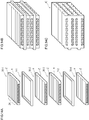
- FIGS. 14 show a preferred embodiment of the second joining process.
- the second joining process in the manufacturing method of the invention is not limited to the preferred embodiment to be described with reference to FIGS. 14 .
- flat plate-like spacers Y each of which is processed so as not to have a portion in contact with the plastically deformed portion 34 even after main surfaces of the flat plate-like spacer and its corresponding second flow passage plate 30 are brought into close contact with each other are first prepared.
- each spacer Y can be obtained by preparing a plate which is made of the same material as that of the flat plate R for upper surface and has a slightly larger size than that of the flat plate R for upper surface, and punching the prepared plate.
- each second flow passage plate 30 is formed by plastic working, and therefore recesses (recesses ⁇ ) are formed at one main surface of the second flow passage plate 30 and protrusions ⁇ are formed at the other main surface of the second flow passage plate 30.
- the thickness of each spacer Y is adjusted depending on the size of the protrusions ⁇ of its corresponding second flow passage plates 30. More specifically, in the state of FIG. 14B to be described later, the thickness of each spacer Y is preferably adjusted so that the tops of the protrusions ⁇ come into contact with the tops of the protrusions ⁇ in another second flow passage plate. The protrusions are joined together to obtain a heat transport device having a higher strength, which is preferable.
- a plurality of plates serving as the second flow passage plates 30 are stacked on top of each other. More specifically, as shown in FIG. 14A and FIG. 14B , a first plate 30-1 serving as the second flow passage plate, a first spacer Y-1, a second plate 30-2 serving as the second flow passage plate, a third plate 30-3 serving as the second flow passage plate, a second spacer Y-2, and a fourth plate 30-4 serving as the second flow passage plate are stacked on top of each other in this order.
- the first plate 30-1 serving as the second flow passage plate and the second plate 30-2 serving as the second flow passage plate are preferably stacked on top of each other so that the protrusions ⁇ in the respective plastically deformed portions 34 come into contact with each other, the first spacer Y being sandwiched therebetween.
- the third plate 30-3 serving as the second flow passage plate and the fourth plate 30-4 serving as the second flow passage plate are preferably stacked on top of each other so that the protrusions ⁇ in the respective plastically deformed portions 34 come into contact with each other, the second spacer Y being sandwiched therebetween. In this case, a heat transport device having a higher strength is obtained, which is preferable.
- a right side surface is a cross-section.
- FIGS. 15 Another preferred embodiment of the second joining process is described with reference to FIGS. 15 .
- the second joining process in the manufacturing method of the invention is not limited to the preferred embodiment to be described with reference to FIGS. 15 .
- flat plates T are prepared in addition to the spacers Y described above.
- the flat plates T are not particularly limited and, for example, plates of the same type as the flat plate P described above may be used.
- a plurality of plates serving as the second flow passage plates 30 are stacked on top of each other. More specifically, as shown in FIG. 15A and FIG. 15B , a first plate 30'-1 serving as the second flow passage plate, a first spacer Y-1, a first flat plate T-1, a second plate 30'-2 serving as the second flow passage plate, a second spacer Y-2, and a second flat plate T-2 are stacked on top of each other in this order.
- the first plate 30'-1 serving as the second flow passage plate and the first flat plat T-1 are preferably stacked on top of each other so that the protrusions ⁇ in the plastically deformed portion 34 come into contact with a main surface of the flat plate T-1, the first spacer Y being sandwiched therebetween.
- the second plate 30-2 serving as the second flow passage plate and the second flat plat T-2 are preferably stacked on top of each other so that the protrusions ⁇ in the plastically deformed portion 34 come into contact with a main surface of the flat plate T-2, the second spacer Y being sandwiched therebetween. In this case, a heat transport device having a higher strength is obtained, which is preferable.
- a right side surface is a cross-section.
- main surfaces of at least one selected from the group consisting of one second flow passage plate and another second flow passage plate; a second flow passage plate and a spacer Y; a second flow passage plate and a flat plate T; and a spacer Y and a flat plate T are preferably joined together by diffusion bonding.
- the obtained heat transport device has thus a higher strength.
Landscapes
- Engineering & Computer Science (AREA)
- Mechanical Engineering (AREA)
- Physics & Mathematics (AREA)
- Thermal Sciences (AREA)
- General Engineering & Computer Science (AREA)
- Heat-Exchange Devices With Radiators And Conduit Assemblies (AREA)
- Pressure Welding/Diffusion-Bonding (AREA)
- Cooling Or The Like Of Semiconductors Or Solid State Devices (AREA)
Applications Claiming Priority (1)
| Application Number | Priority Date | Filing Date | Title |
|---|---|---|---|
| PCT/JP2018/024383 WO2020003411A1 (fr) | 2018-06-27 | 2018-06-27 | Dispositif de transfert de chaleur et son procédé de fabrication |
Publications (4)
| Publication Number | Publication Date |
|---|---|
| EP3816565A1 true EP3816565A1 (fr) | 2021-05-05 |
| EP3816565A4 EP3816565A4 (fr) | 2021-06-16 |
| EP3816565C0 EP3816565C0 (fr) | 2026-01-21 |
| EP3816565B1 EP3816565B1 (fr) | 2026-01-21 |
Family
ID=68986708
Family Applications (1)
| Application Number | Title | Priority Date | Filing Date |
|---|---|---|---|
| EP18923866.0A Active EP3816565B1 (fr) | 2018-06-27 | 2018-06-27 | Dispositif de transfert de chaleur et son procédé de fabrication |
Country Status (5)
| Country | Link |
|---|---|
| US (3) | US12061053B2 (fr) |
| EP (1) | EP3816565B1 (fr) |
| JP (2) | JP7207763B2 (fr) |
| CN (1) | CN112384745B (fr) |
| WO (1) | WO2020003411A1 (fr) |
Families Citing this family (5)
| Publication number | Priority date | Publication date | Assignee | Title |
|---|---|---|---|---|
| CN115790207A (zh) * | 2021-09-10 | 2023-03-14 | 均贺科技股份有限公司 | 热交换器结构 |
| US12066259B2 (en) * | 2021-10-17 | 2024-08-20 | Jun He Technology Co., Ltd. | Heat exchanger |
| EP4166883B1 (fr) * | 2021-10-18 | 2026-04-15 | Jun He Technology Co., Ltd. | Échangeur de chaleur |
| CN116857088B (zh) * | 2023-09-05 | 2023-11-14 | 合肥通用机械研究院有限公司 | 船舶用lng供气系统 |
| US12241595B1 (en) | 2023-09-05 | 2025-03-04 | Hefei General Machinery Research Institute Co., Ltd. | LNG gas supply systems for ships |
Family Cites Families (28)
| Publication number | Priority date | Publication date | Assignee | Title |
|---|---|---|---|---|
| US3473604A (en) * | 1966-01-18 | 1969-10-21 | Daimler Benz Ag | Recuperative heat exchanger |
| DE2606612A1 (de) | 1976-02-19 | 1977-08-25 | Basf Ag | Verfahren und vorrichtung zur entfernung von verdampfbaren anteilen aus hochviskosen loesungen oder schmelzen thermoplastischer kunststoffe |
| US4235281A (en) * | 1978-04-07 | 1980-11-25 | The Boeing Company | Condenser/evaporator heat exchange apparatus and method of utilizing the same |
| US4293033A (en) * | 1979-06-29 | 1981-10-06 | Linde Aktiengesellschaft | Plate-type heat exchanger |
| JPS5666697A (en) | 1979-11-05 | 1981-06-05 | Hitachi Ltd | Manufacture of laminate-joined type heat exchanger |
| JPS602888A (ja) | 1983-06-18 | 1985-01-09 | Seibu Giken:Kk | 熱交換素子 |
| JPS60256800A (ja) | 1984-06-01 | 1985-12-18 | Matsushita Electric Ind Co Ltd | 積層式熱交換器 |
| JPH02238293A (ja) | 1989-03-10 | 1990-09-20 | Daikin Ind Ltd | 熱交換装置 |
| JPH04278195A (ja) | 1991-03-04 | 1992-10-02 | Hitachi Ltd | 熱交換器 |
| JPH0674675A (ja) | 1992-08-31 | 1994-03-18 | Toshiba Corp | 積層体熱交換器及び積層体熱交換器の製造方法 |
| DE29604521U1 (de) | 1996-03-11 | 1996-06-20 | SGL Technik GmbH, 86405 Meitingen | Aus Platten aufgebauter Wärmeaustauscherkörper |
| JPH11147149A (ja) | 1997-11-14 | 1999-06-02 | Zexel:Kk | 熱交換器用コルゲートフィンの製造方法 |
| GB9918586D0 (en) | 1999-08-07 | 1999-10-06 | British Gas Plc | Compact reactor |
| JP2004025257A (ja) | 2002-06-26 | 2004-01-29 | Toyo Radiator Co Ltd | 熱交換器用コルゲートフィンの製造装置 |
| GB0427362D0 (en) | 2004-12-14 | 2005-01-19 | Sustainable Engine Systems Ltd | Heat exchanger |
| JP2006322698A (ja) | 2005-04-22 | 2006-11-30 | Denso Corp | 熱交換器 |
| US7866377B2 (en) | 2006-12-20 | 2011-01-11 | The Boeing Company | Method of using minimal surfaces and minimal skeletons to make heat exchanger components |
| US8316542B2 (en) | 2007-04-17 | 2012-11-27 | Mitsubishi Electric Corporation | Method of manufacturing total heat exchange element and total heat exchange element |
| WO2010125643A1 (fr) | 2009-04-28 | 2010-11-04 | 三菱電機株式会社 | Elément d'échange thermique |
| CN201569352U (zh) * | 2009-07-30 | 2010-09-01 | 江苏工业学院 | 全焊接式双波形错流式板式换热器板束 |
| AU2010325220B2 (en) | 2009-11-24 | 2014-06-19 | Air To Air Sweden Ab | A method of producing multiple channels for use in a device for exchange of solutes or heat between fluid flows |
| JP2010117126A (ja) | 2010-01-26 | 2010-05-27 | Univ Of Tsukuba | 一体型積層構造熱交換器 |
| JP6028214B2 (ja) * | 2012-01-13 | 2016-11-16 | パナソニックIpマネジメント株式会社 | 熱交換素子とそれを用いた熱交換型換気機器 |
| FR3005499B1 (fr) | 2013-05-10 | 2015-06-05 | Commissariat Energie Atomique | Procede de realisation d'un module d'echangeur de chaleur a au moins deux circuits de circulation de fluide. |
| JP6192564B2 (ja) | 2014-02-18 | 2017-09-06 | 日新製鋼株式会社 | プレート式熱交換器およびその製造方法 |
| DE102015000385B4 (de) * | 2015-01-13 | 2021-09-30 | Geocollect Gmbh | Wärmetauscher, insbesondere zum Aufnehmen von Erdwärme |
| KR102698574B1 (ko) | 2015-09-21 | 2024-08-23 | 록히드 마틴 코포레이션 | 통합된 멀티-챔버 열 교환기 |
| CN106813521A (zh) * | 2017-03-20 | 2017-06-09 | 北京化工大学 | 石墨烯曲面传导换热器 |
-
2018
- 2018-06-27 EP EP18923866.0A patent/EP3816565B1/fr active Active
- 2018-06-27 WO PCT/JP2018/024383 patent/WO2020003411A1/fr not_active Ceased
- 2018-06-27 JP JP2020526782A patent/JP7207763B2/ja active Active
- 2018-06-27 CN CN201880094997.8A patent/CN112384745B/zh active Active
- 2018-06-27 US US17/253,576 patent/US12061053B2/en active Active
-
2022
- 2022-10-25 JP JP2022170251A patent/JP7568304B2/ja active Active
-
2024
- 2024-07-09 US US18/767,105 patent/US20240361080A1/en active Pending
- 2024-07-09 US US18/767,149 patent/US20240361081A1/en active Pending
Also Published As
| Publication number | Publication date |
|---|---|
| EP3816565C0 (fr) | 2026-01-21 |
| EP3816565B1 (fr) | 2026-01-21 |
| US20210270536A1 (en) | 2021-09-02 |
| JPWO2020003411A1 (ja) | 2021-03-18 |
| CN112384745A (zh) | 2021-02-19 |
| JP7568304B2 (ja) | 2024-10-16 |
| US12061053B2 (en) | 2024-08-13 |
| WO2020003411A1 (fr) | 2020-01-02 |
| US20240361080A1 (en) | 2024-10-31 |
| JP2022186860A (ja) | 2022-12-15 |
| US20240361081A1 (en) | 2024-10-31 |
| CN112384745B (zh) | 2022-10-21 |
| JP7207763B2 (ja) | 2023-01-18 |
| EP3816565A4 (fr) | 2021-06-16 |
Similar Documents
| Publication | Publication Date | Title |
|---|---|---|
| US20240361080A1 (en) | Heat Transport Device And Method For Manufacturing Same | |
| US20130206374A1 (en) | Geometry of heat exchanger with high efficiency | |
| US8474516B2 (en) | Heat exchanger having winding micro-channels | |
| US20100218930A1 (en) | System and method for constructing heat exchanger | |
| EP3097374B1 (fr) | Échangeur thermique | |
| GB2552956A (en) | Heat exchanger device | |
| JP4561305B2 (ja) | 熱交換器 | |
| EP3187809A1 (fr) | Refroidisseur par évaporation à guidage d'air intégré et son procédé de fabrication | |
| CN207395551U (zh) | 热交换器和使用其的冷却装置 | |
| US20240247885A1 (en) | Heat Transport Device And Method For Manufacturing Same | |
| JP2001041678A (ja) | 熱交換器 | |
| US20240384943A1 (en) | Systems and methods for heat exchange | |
| US20140366573A1 (en) | Method and apparatus of forming heat exchanger tubes | |
| JP2010230300A (ja) | 熱交換器、及びこの熱交換器を備えた空気調和機 | |
| EP2806243A1 (fr) | Échangeur de chaleur pour dispositif de climatisation de véhicule et dispositif de climatisation de véhicule | |
| JPH04278195A (ja) | 熱交換器 | |
| JP2007003050A (ja) | 積層型熱交換器の製造方法および積層型熱交換器 | |
| HK1226127A1 (en) | Heat exchanger | |
| HK1226127B (en) | Heat exchanger |
Legal Events
| Date | Code | Title | Description |
|---|---|---|---|
| STAA | Information on the status of an ep patent application or granted ep patent |
Free format text: STATUS: THE INTERNATIONAL PUBLICATION HAS BEEN MADE |
|
| PUAI | Public reference made under article 153(3) epc to a published international application that has entered the european phase |
Free format text: ORIGINAL CODE: 0009012 |
|
| STAA | Information on the status of an ep patent application or granted ep patent |
Free format text: STATUS: REQUEST FOR EXAMINATION WAS MADE |
|
| 17P | Request for examination filed |
Effective date: 20201211 |
|
| AK | Designated contracting states |
Kind code of ref document: A1 Designated state(s): AL AT BE BG CH CY CZ DE DK EE ES FI FR GB GR HR HU IE IS IT LI LT LU LV MC MK MT NL NO PL PT RO RS SE SI SK SM TR |
|
| A4 | Supplementary search report drawn up and despatched |
Effective date: 20210519 |
|
| RIC1 | Information provided on ipc code assigned before grant |
Ipc: F28F 3/08 20060101AFI20210512BHEP Ipc: F28D 9/00 20060101ALI20210512BHEP |
|
| DAV | Request for validation of the european patent (deleted) | ||
| DAX | Request for extension of the european patent (deleted) | ||
| STAA | Information on the status of an ep patent application or granted ep patent |
Free format text: STATUS: EXAMINATION IS IN PROGRESS |
|
| 17Q | First examination report despatched |
Effective date: 20220207 |
|
| GRAP | Despatch of communication of intention to grant a patent |
Free format text: ORIGINAL CODE: EPIDOSNIGR1 |
|
| STAA | Information on the status of an ep patent application or granted ep patent |
Free format text: STATUS: GRANT OF PATENT IS INTENDED |
|
| INTG | Intention to grant announced |
Effective date: 20250916 |
|
| GRAS | Grant fee paid |
Free format text: ORIGINAL CODE: EPIDOSNIGR3 |
|
| GRAA | (expected) grant |
Free format text: ORIGINAL CODE: 0009210 |
|
| STAA | Information on the status of an ep patent application or granted ep patent |
Free format text: STATUS: THE PATENT HAS BEEN GRANTED |
|
| AK | Designated contracting states |
Kind code of ref document: B1 Designated state(s): AL AT BE BG CH CY CZ DE DK EE ES FI FR GB GR HR HU IE IS IT LI LT LU LV MC MK MT NL NO PL PT RO RS SE SI SK SM TR |
|
| REG | Reference to a national code |
Ref country code: CH Ref legal event code: F10 Free format text: ST27 STATUS EVENT CODE: U-0-0-F10-F00 (AS PROVIDED BY THE NATIONAL OFFICE) Effective date: 20260121 |
|
| REG | Reference to a national code |
Ref country code: DE Ref legal event code: R096 Ref document number: 602018088791 Country of ref document: DE |
|
| REG | Reference to a national code |
Ref country code: IE Ref legal event code: FG4D |
|
| U01 | Request for unitary effect filed |
Effective date: 20260130 |
|
| U07 | Unitary effect registered |
Designated state(s): AT BE BG DE DK EE FI FR IT LT LU LV MT NL PT RO SE SI Effective date: 20260204 |