EP3817830B1 - Vorrichtung zur körperlichen betätigung mit einem umlaufenden band - Google Patents
Vorrichtung zur körperlichen betätigung mit einem umlaufenden band Download PDFInfo
- Publication number
- EP3817830B1 EP3817830B1 EP19737034.9A EP19737034A EP3817830B1 EP 3817830 B1 EP3817830 B1 EP 3817830B1 EP 19737034 A EP19737034 A EP 19737034A EP 3817830 B1 EP3817830 B1 EP 3817830B1
- Authority
- EP
- European Patent Office
- Prior art keywords
- belt
- activity
- belt surface
- user
- frame
- Prior art date
- Legal status (The legal status is an assumption and is not a legal conclusion. Google has not performed a legal analysis and makes no representation as to the accuracy of the status listed.)
- Active
Links
Images


Classifications
-
- A—HUMAN NECESSITIES
- A63—SPORTS; GAMES; AMUSEMENTS
- A63B—APPARATUS FOR PHYSICAL TRAINING, GYMNASTICS, SWIMMING, CLIMBING, OR FENCING; BALL GAMES; TRAINING EQUIPMENT
- A63B22/00—Exercising apparatus specially adapted for conditioning the cardio-vascular system, for training agility or co-ordination of movements
- A63B22/02—Exercising apparatus specially adapted for conditioning the cardio-vascular system, for training agility or co-ordination of movements with movable endless bands, e.g. treadmills
- A63B22/0285—Physical characteristics of the belt, e.g. material, surface, indicia
-
- A—HUMAN NECESSITIES
- A63—SPORTS; GAMES; AMUSEMENTS
- A63B—APPARATUS FOR PHYSICAL TRAINING, GYMNASTICS, SWIMMING, CLIMBING, OR FENCING; BALL GAMES; TRAINING EQUIPMENT
- A63B22/00—Exercising apparatus specially adapted for conditioning the cardio-vascular system, for training agility or co-ordination of movements
- A63B22/02—Exercising apparatus specially adapted for conditioning the cardio-vascular system, for training agility or co-ordination of movements with movable endless bands, e.g. treadmills
- A63B22/0235—Exercising apparatus specially adapted for conditioning the cardio-vascular system, for training agility or co-ordination of movements with movable endless bands, e.g. treadmills driven by a motor
-
- A—HUMAN NECESSITIES
- A63—SPORTS; GAMES; AMUSEMENTS
- A63B—APPARATUS FOR PHYSICAL TRAINING, GYMNASTICS, SWIMMING, CLIMBING, OR FENCING; BALL GAMES; TRAINING EQUIPMENT
- A63B24/00—Electric or electronic controls for exercising apparatus of preceding groups; Controlling or monitoring of exercises, sportive games, training or athletic performances
- A63B24/0087—Electric or electronic controls for exercising apparatus of groups A63B21/00 - A63B23/00, e.g. controlling load
-
- A—HUMAN NECESSITIES
- A63—SPORTS; GAMES; AMUSEMENTS
- A63B—APPARATUS FOR PHYSICAL TRAINING, GYMNASTICS, SWIMMING, CLIMBING, OR FENCING; BALL GAMES; TRAINING EQUIPMENT
- A63B71/00—Games or sports accessories not covered in groups A63B1/00 - A63B69/00
- A63B71/0054—Features for injury prevention on an apparatus, e.g. shock absorbers
-
- A—HUMAN NECESSITIES
- A63—SPORTS; GAMES; AMUSEMENTS
- A63B—APPARATUS FOR PHYSICAL TRAINING, GYMNASTICS, SWIMMING, CLIMBING, OR FENCING; BALL GAMES; TRAINING EQUIPMENT
- A63B71/00—Games or sports accessories not covered in groups A63B1/00 - A63B69/00
- A63B71/06—Indicating or scoring devices for games or players, or for other sports activities
- A63B71/0619—Displays, user interfaces and indicating devices, specially adapted for sport equipment, e.g. display mounted on treadmills
- A63B71/0622—Visual, audio or audio-visual systems for entertaining, instructing or motivating the user
-
- A—HUMAN NECESSITIES
- A61—MEDICAL OR VETERINARY SCIENCE; HYGIENE
- A61H—PHYSICAL THERAPY APPARATUS, e.g. DEVICES FOR LOCATING OR STIMULATING REFLEX POINTS IN THE BODY; ARTIFICIAL RESPIRATION; MASSAGE; BATHING DEVICES FOR SPECIAL THERAPEUTIC OR HYGIENIC PURPOSES OR SPECIFIC PARTS OF THE BODY
- A61H3/00—Appliances for aiding patients or disabled persons to walk about
- A61H3/008—Appliances for aiding patients or disabled persons to walk about using suspension devices for supporting the body in an upright walking or standing position, e.g. harnesses
-
- A—HUMAN NECESSITIES
- A63—SPORTS; GAMES; AMUSEMENTS
- A63B—APPARATUS FOR PHYSICAL TRAINING, GYMNASTICS, SWIMMING, CLIMBING, OR FENCING; BALL GAMES; TRAINING EQUIPMENT
- A63B24/00—Electric or electronic controls for exercising apparatus of preceding groups; Controlling or monitoring of exercises, sportive games, training or athletic performances
- A63B24/0087—Electric or electronic controls for exercising apparatus of groups A63B21/00 - A63B23/00, e.g. controlling load
- A63B2024/0093—Electric or electronic controls for exercising apparatus of groups A63B21/00 - A63B23/00, e.g. controlling load the load of the exercise apparatus being controlled by performance parameters, e.g. distance or speed
-
- A—HUMAN NECESSITIES
- A63—SPORTS; GAMES; AMUSEMENTS
- A63B—APPARATUS FOR PHYSICAL TRAINING, GYMNASTICS, SWIMMING, CLIMBING, OR FENCING; BALL GAMES; TRAINING EQUIPMENT
- A63B71/00—Games or sports accessories not covered in groups A63B1/00 - A63B69/00
- A63B71/0054—Features for injury prevention on an apparatus, e.g. shock absorbers
- A63B2071/0081—Stopping the operation of the apparatus
-
- A—HUMAN NECESSITIES
- A63—SPORTS; GAMES; AMUSEMENTS
- A63B—APPARATUS FOR PHYSICAL TRAINING, GYMNASTICS, SWIMMING, CLIMBING, OR FENCING; BALL GAMES; TRAINING EQUIPMENT
- A63B22/00—Exercising apparatus specially adapted for conditioning the cardio-vascular system, for training agility or co-ordination of movements
- A63B22/02—Exercising apparatus specially adapted for conditioning the cardio-vascular system, for training agility or co-ordination of movements with movable endless bands, e.g. treadmills
- A63B22/0207—Exercising apparatus specially adapted for conditioning the cardio-vascular system, for training agility or co-ordination of movements with movable endless bands, e.g. treadmills having shock absorbing means
- A63B22/0214—Exercising apparatus specially adapted for conditioning the cardio-vascular system, for training agility or co-ordination of movements with movable endless bands, e.g. treadmills having shock absorbing means between the belt supporting deck and the frame
-
- A—HUMAN NECESSITIES
- A63—SPORTS; GAMES; AMUSEMENTS
- A63B—APPARATUS FOR PHYSICAL TRAINING, GYMNASTICS, SWIMMING, CLIMBING, OR FENCING; BALL GAMES; TRAINING EQUIPMENT
- A63B2220/00—Measuring of physical parameters relating to sporting activity
- A63B2220/10—Positions
-
- A—HUMAN NECESSITIES
- A63—SPORTS; GAMES; AMUSEMENTS
- A63B—APPARATUS FOR PHYSICAL TRAINING, GYMNASTICS, SWIMMING, CLIMBING, OR FENCING; BALL GAMES; TRAINING EQUIPMENT
- A63B69/00—Training appliances or apparatus for special sports
- A63B69/0064—Attachments on the trainee preventing falling
Definitions
- the present invention relates to an apparatus for physical activity, comprising a revolving belt accessible by a user.
- the present invention relates to exercising or physical training apparatuses, specially adapted for conditioning the cardio-vascular system, for training agility or co-ordination of movements, and for recreative purposes, in particular for indoor use.
- a treadmill is an apparatus for physical activity, generally for walking or running, while staying in a same location.
- Treadmills were originally introduced before the development of powered machines, to harness the power of animals or humans to do work; often a mill was operated by a person or animal treading steps of a treadwheel, to grind grain. In more recent times, treadmills are no longer used to harness power, but as exercise machines for running or walking.
- the treadmill machine provides a moving surface of a wide conveyor belt, typically driven by an electric motor or a flywheel.
- Known treadmills have the disadvantage of having a belt surface which is hard to access by the user, since there is a height gap between the running surface of the belt and the floor level, upon which the treadmill rests.
- known treadmills can be dangerous as the user may fall off the step of the running surface.
- US 2016/144225 A1 describes a treadmill having an exercise deck, and a tread belt disposed on the exercise deck.
- WO 2005/030342 A1 discloses a circular running machine which enables a user to smoothly make a jogging or walking exercise without receiving any electric power, and which can be used semi-perpetually without trouble.
- Document GB989454 (A ) relates to a battery for poultry and other livestock, with an endless belt conveyer which passes beneath cage floors to receive droppings. From opposite ends the droppings fall on to a conveyer belt or into a wheeled bin or a conduit provided with flushing means.
- Document GB583414 (A ) relates to a poultry battery of the type composed of tiers of cages from which droppings are removed by an endless conveyer belt passing beneath the cages.
- a belt is associated with each double tier of cages, the belt being formed of chains to which are attached a plurality of plates, guide members being' provided for tilting the plates, so that the same surface of each plate is always uppermost during the travel of the belt beneath the upper and lower tiers of cages. It is an objective of the present invention to solve drawbacks of the prior art.
- An idea underlying the present invention is to provide an apparatus for physical activity, comprising: a frame; a plurality of rollers rotatably connected to the frame; a belt mounted on the plurality of rollers and revolving to define moving belt surfaces; the moving belt surfaces comprise an activity belt surface being configured for physical activity of at least one user and delimited by a side of the frame, and a return belt surface being configured for revolving said belt in a never-ending loop; the return belt surface is elevated with respect to said activity belt surface.
- the configuration of apparatus for physical activity according to the invention allows further features to be easily integrated, and provides for innovative modes of use.
- the frame defines an elevated loop structure, so that the return belt surface runs above the activity belt surface.
- the configuration according to the invention is more effective in providing the user with an of apparatus for physical activity, which can be carried out while standing in a fixed location, for example indoor.
- the activity belt surface remains substantially on a floor level.
- access to the activity belt surface and safety of use are further improved.
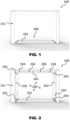
- the apparatus 100 comprises a frame 101 which defines an enclosed space for a user, as it will be further described.
- the term "user” defines a human user, being an adult or younger person, who performs any kind of physical activity which can be performed by a human user on a flat surface, such as walking, running or the like.
- the apparatus 100 further comprises a revolving belt 200 which defines moving surfaces, including an activity belt surface 201 which is configured for moving, so that the user can do physical activity while remaining at a location substantially fixed with respect to the frame 101.
- a revolving belt 200 which defines moving surfaces, including an activity belt surface 201 which is configured for moving, so that the user can do physical activity while remaining at a location substantially fixed with respect to the frame 101.
- the activity belt surface 201 is delimited by a side of the frame 101, in particular by a bottom side thereof.
- the activity belt surface 201 is substantially on a floor level, so that it can be easily accessed by a user.
- the surface indicated in the present description as "floor”, can be any surface upon which the apparatus 100 rests; in that sense, the floor can be any ground of an outside environment, or any level of a building.
- the size of the apparatus 100 can be varied according to the desired application or space constraints.
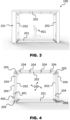
- Figure 2 illustrates the apparatus 100 for physical activity, partly disassembled so that some aesthetic and/or functional covers are removed, in order to make below elements clearly visible.
- the whole loop of the belt 200 which defines a moving belt surface, preferably elevated around the inner part of the apparatus 100 and configured for access of the user.
- the belt 200 comprises a return belt surface 202, defined by two vertical tracts and an upper horizontal tract.
- the return belt surface 202 is delimited by one or more top side(s) of the frame 101.
- the return belt surface 202 is configured for cooperating with the activity belt surface 201.
- the return belt surface 202 is configured for revolving the belt 200 in a never-ending loop.
- the apparatus 100 comprises a plurality of rollers 203, 204 which are rotatably connected to the frame 101, so that the belt 200 mounted thereon can revolve and develop the moving belt surfaces 201 and 202 already described.
- the return belt surface 202 is elevated with respect to the activity belt surface 201.
- the activity belt surface 201 has a reduced height gap with the floor level, or is substantially on a floor level, so that it can be easily accessed by a user.
- the activity belt surface 201 provides for an activity area of the revolving belt 200 which is safer to use, reducing risks of falling or tripping.
- the frame 101 is configured to define an elevated loop structure, so that the return belt surface 202 runs above the activity belt surface 201.
- the apparatus 100 allows a user standing on the activity belt surface 201 to walk or run thereon, while the belt 200 revolves in a never-ending manner along the path of the return belt surface 202.
- the apparatus 100 is configured so that a user standing inside can walk or run on the belt 200, while remaining at a location substantially fixed with respect to the frame 100. For this reason, the apparatus of the present invention is particularly suited for indoor activity.
- the return belt surface 202 would still be elevated with respect to the activity belt surface 201 for providing the belt loop, but would run on the side of the user, by means of an appropriate bend in the trajectory of the belt; in this case, the return belt surface 202 would not run above the activity belt surface 201, but would run aside thereof.
- the activity belt surface can remain substantially at floor level, with the described advantages.
- the belt would develop in a loop like a Möbius strip.
- the belt made as a Möbius strip could last longer because its entire surface area would get the same amount of wear.
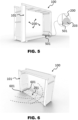
- Figure 3 illustrates the apparatus 100 for physical activity, upon which a user 301 runs.
- the apparatus 100 comprises the elevated loop structure, in particular defined by the frame 101, which is sized so as to allow the user 301 to stand on the activity belt surface 201, while remaining below the return belt surface 202.
- the activity belt surface 201 represents, for the user 301, a tract of moving belt wherein the user 301 can do physical activity, such as walking or running, or even bicycling with the bicycle's wheels moving against the belt surface.
- the apparatus 100 could be sized such that more than one user occupies the available activity belt surface. For example, two or more users moving in a same direction could do physical activity on the belt, for example running or walking together in a same direction.
- the activity belt surface 201 is substantially on a floor level, so that it can be easily accessed by the user 301. Moreover, the user 301 can be assisted by a medical operator which stands aside the activity belt surface 201, substantially on the same level of the user 301; this is particularly advantageous when the user 301 is undergoing assisted physiotherapy.
- the activity belt surface 201 can appear like a regular carpet or floor element, but still exhibits the features of a moving belt as above described.
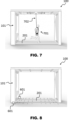
- Figure 4 further illustrates some internal elements of the apparatus 100.
- the apparatus 100 comprises a plurality of rollers 203 and 204.
- the rollers 203 are associated to the frame 101 to provide the overall loop structure for the belt 200, while the rollers 204 provide further support to the elevated loop structure thereby avoiding slacking of the belt.
- the apparatus 100 further comprises at least one motor associated to a driving roller 401; the motor is adapted for driving the belt to a suitable speed for physical activity of the user.
- the motor is preferably electric, and powered by an inverter.
- the apparatus 100 further comprises a tensioning system for varying the tension of the belt 200 and optimizing functioning thereof.
- the tensioning system comprises a displaceable roller 402 which is adapted for being moved in vertical direction. By moving the roller 402, the length of the never-ending loop of the belt 200 can be varied, thereby varying and regulating the tension of the belt 200.
- the tensioning system can also include a displaceable element associated to one of the rollers 204. Other tensioning systems can be used.
- the belt 200 is supported by the frame, which is omitted in Figure 4 for improving visibility of other elements.
- the term "frame” is to be construed as any structure capable of supporting the plurality of rollers in order to define the elevated loop structure. Therefore, the "frame” can be constituted of one or more frame elements, connected or separated, as far as they are suitably constrained so as to properly support the rollers 203. In an example, the frame could be made in more than one piece, also cooperating with an external structure such as one or more wall(s).
- the belt 200 can slide directly on the floor, if the roughness of the floor so allows. Further systems for reducing friction can be used, as it will be further described.
- the belt 200 comprises a suitable flexible material band, which can be a polymeric material or a net-like structure.
- the belt comprises a plurality of interjoined track plates, such as a "caterpillar belt".
- each one of the track plates can comprise respective sliding elements, such as small rollers or sleds or the like, to reduce friction with the floor surface.
- the apparatus 100 can include a cleaning system for cleaning the belt from dirt which may accumulate thereon.
- Figure 5 illustrates a further view of the apparatus 100 for physical activity, which comprises a mechanical safety 501.
- the mechanical safety 501 comprises an element such as a strip or wire which, when impacted, causes the belt 200 to stop so that the user cannot get tangled in the revolving belt.
- This safety system is preferably complemented by further safety systems based on a detection system.
- FIG. 6 illustrates the operation of the apparatus for physical activity 100.
- the apparatus 100 comprises a detection system 601 for detecting the position of the user on the activity belt surface 201.
- the detection system 601 is based on radar, infrared or laser technologies.
- the detection system could comprise physical sensors, arranged under the belt surface, preferably in a sliding table as it will be described.
- the detection system 601 detects the position of the user, both for safety and operation control.
- the detection system 601 can cooperate with an active element associated to the user, such as a wearable device which is adapted for positional detection.
- Figure 7 further illustrates the operation of the apparatus 100 for physical activity.
- the user 701 can move on the active belt surface 201 while being supported by a harness system 702 which is preferably capable of translating in horizontal direction, being connected to the frame 101.
- the harness system 702 could also be connected at a fixed location of the frame 101.
- the frame 101 and the harness system 702 are configured for supporting the weight of the user 701, and provide an aid for people with limited physical abilities.
- Figure 8 further illustrates the operation of the apparatus 100 for physical activity.
- the detection system 601 is configured for detecting the position of at least one user on the belt.
- the revolving speed of the belt can be controlled depending on the detected position of the user.
- the belt 200 can revolve in both directions, according to the moving direction of the user on the activity surface 201, thereby improving flexibility of use.
- any reference to "front” or “back” shall be considered in relation to the direction faced by the user, and the current revolving direction of the belt 200.
- the revolving speed of the belt is maintained. If the user is at a position closer to the front wall of the apparatus 100, the revolving speed of the belt is increased so that the user can move faster. If the user is at a position closer to the back wall of the apparatus 100, the revolving speed of the belt is decreased so as to match the speed of the user. If the user is at a position dangerously close to the back wall of the apparatus, the revolving speed of the belt is limited or the belt is stopped, for safety purposes.
- the user can enter the activity belt surface when the belt is at a standstill.
- the user can select a working program which is then executed.
- the user starts running or walking, and the belt gradually accelerates with controlled revolution speed.
- the user remains in the middle of the activity belt surface, in normal conditions.
- the user can spread the arms to signal its intention to the apparatus's control, or can stop running and be dragged to a stop zone in automatic manner, or simply walk out of the activity belt surface.
- Figure 9 illustrates a further view of the apparatus 100 for physical activity which comprises a display 901.
- the display 100 is a flat screen TV.
- a projecting apparatus pointing toward one or more flat surface(s) of the apparatus 100 can be used.
- the apparatus 100 comprises a multimedia system which is adapted for providing the at least one user with an enhanced sensory experience.
- the multimedia system can provide images and/or sounds which give the impression of moving in an outside environment.
- the multimedia system can further enhance the user's experience, for example by providing appropriate simulation for recreational purposes, for example for dancing, and even for dancing in pair with another user.
- the apparatus 100 is configured, by using the detection system for detecting the position of the user, for controlling the belt in both directions, also in a stepwise manner, in order to maintain the user(s) at a predefined location on the activity surface, while dancing.
- the multimedia system can further provide an aid for the simulation of certain games; for example, the multimedia system can emulate walking on a golf course, wherein the apparatus is preferably associated to a golf shooting simulator so that the user can even shoot virtual golf balls.
- the multimedia system can also offer statistics and indications for training purposes.
- the multimedia system can also play multimedia content which is unrelated to the movement of the belt, for example playing music or a movie.
- the multimedia system includes at least the display 901, which remains visible from the activity belt surface.
- the apparatus 100 further comprises suitable control interfaces, such as a touchscreen and/or vocal commands.
- suitable control interfaces such as a touchscreen and/or vocal commands.
- the apparatus 100 can be integrated with a system for detecting vital statistics of the user, for improving training or medical applications.
- the apparatus 100 can include further gesture controls, which can detect position and gestures of a user in order to change the revolution speed or direction of the belt, also in a step-wise manner.
- the belt 200 can slide on an appropriate system for reducing friction thereof.
- the apparatus 100 further comprises a sliding table which is configured for supporting a bottom side of the activity belt surface 201.
- Figure 10 illustrates a first embodiment of a sliding table 211a, which reduces friction of the belt at its activity belt surface 201. Friction is reduced by employing appropriate materials, lubricants, or by means of an air cushion.
- the sliding table 211a can be made of Teflon or of suitable plastic materials or of suitable metals and alloys, such as Inox steel.
- a damping layer (not shown) can be interposed between the sliding table 211a and the activity belt surface 201, so that impact shocks of the user's feet can be reduced.
- the damping effect can be provided by the belt itself, if the latter is made of suitable material and having appropriate thickness.
- Figure 11 illustrates a second embodiment of a sliding table 211b, which in addition to the features illustrated for the sliding table 211a, also comprises lateral ramp sections 212 which is configured for improving access for the user, to the activity belt surface 201.
- the sliding table 211b also provides a centering effect on the activity belt surface 201, during revolving thereof.
- Figure 12 illustrates a third embodiment of a sliding table 211c, which in addition to the features illustrated for the sliding table 211b, also comprises a protruding cover element 213 connected to each lateral ramp section 212, which partly overlap with the activity belt surface thus reducing risk of body parts, objects or dirt penetrating below the revolving belt.
- Figure 13 illustrates a second embodiment of an apparatus 1001 for physical activity according to the invention.
- the apparatus 1001 comprises a frame 101 which is substantially trapezoidal, mounting a plurality of rollers 203 upon which the belt is mounted in a never-ending loop, as already described.
- the return belt surface 202 once again, is elevated with respect to the activity belt surface 201, thereby realizing an activity belt surface 201 with improved accessibility.
- the tensioning system of apparatus 1001 provides for a divarication of the lateral frame elements of the frame 101, to increase the length of the trapezoid base thereby increasing the belt's tension.
- the apparatus 1001 is compact and adapted for a home use.
- Figure 14 illustrates a third embodiment of an apparatus 1002 for physical activity according to the invention.
- the apparatus 1002 comprises a frame 101 which is substantially arch-shaped, mounting a plurality of rollers 203, 204 upon which the belt is mounted in a never-ending loop, as already described.
- the return belt surface 202 once again, is elevated with respect to the activity belt surface 201, thereby realizing an activity belt surface 201 with improved accessibility.
- the tensioning system of apparatus 1002 provides for one or more displaceable rollers which increase the length of the belt's path thereby increasing the belt's tension, as already described.
- a tensioning system as the one described with reference to Fig. 4 may be used as well.
- the apparatus 1002 is compact and lightweight.
- the belt 200 can be decorated with color patterns or images, also for making the belt resemble a natural surface or the actual room's floor.
- the apparatus for physical activity allows for a better access to the activity belt surface. Also, the risk of falling from the activity belt surface is reduced.
- the apparatus for physical activity according to the present invention allows for improved modes of operation and functionalities.
- the apparatus for physical activity according to the present invention can be more easily integrated within an environment, especially in household applications.
- the apparatus for physical activity according to the present invention can be effectively used in physical rehabilitation centers, gyms, ships or confined spaces wherein people would benefit from walking, offices, private homes.
- the apparatus comprising a revolving belt could be applied to transportation of goods or people, in that it comprises a moving belt which is in particular driven by a motor.
- the present invention relates to a belt apparatus 100 comprising: a frame 101; a plurality of rollers 203, 204 rotatably connected to said frame 101; a belt 200 mounted on said plurality of rollers 203, 204 and revolving to define moving belt surfaces 201, 202, the belt 200 comprising: a transport belt surface 201 delimited by a side of said frame 101; a return belt surface 202 being configured for revolving said belt 200 in a never-ending loop; said return belt surface 202 is elevated with respect to said transport belt surface 201.
- the activity belt surface previously described can be effectively used as a transport surface, thereby defining a conveyor belt for transportation of goods or people.
- the length of the transport surface can be varied according to the specific requirements.
- the belt apparatus above disclosed comprises all the relevant features which have been described above, in connection to the apparatus for physical activity.
Landscapes
- Health & Medical Sciences (AREA)
- General Health & Medical Sciences (AREA)
- Physical Education & Sports Medicine (AREA)
- Engineering & Computer Science (AREA)
- Cardiology (AREA)
- Vascular Medicine (AREA)
- Multimedia (AREA)
- Human Computer Interaction (AREA)
- Rehabilitation Tools (AREA)
Claims (14)
- Ein Gerät (100, 1001, 1002) für körperliche Aktivität, umfassend:einen Rahmen (101);eine Vielzahl von Rollen (203, 204), die drehbar mit dem Rahmen (101) verbunden sind;einen Riemen (200), der auf der Vielzahl von Rollen (203, 204) montiert ist und sich dreht, um sich bewegende Riemenoberflächen (201, 202) zu definieren, umfassend:- eine Aktivitätsriemenoberfläche (201), die für die körperliche Aktivität mindestens eines Benutzers (301, 701) konfiguriert ist und durch eine Seite des Rahmens (101) begrenzt wird, wobei der mindestens eine Benutzer (301, 701) ein menschlicher Benutzer ist;- eine Rückführriemenoberfläche (202), die so gestaltet ist, dass sie den Riemen (200) in einer Endlosschleife umlaufen lässt;dadurch gekennzeichnet, dass die Rückführriemenoberfläche (202) in Bezug auf die Aktivitätsriemenoberfläche (201) erhöht ist.
- Vorrichtung nach Anspruch 1, wobei der Rahmen (101) so konfiguriert ist, dass er eine erhöhte Schleifenstruktur bildet, so dass die Rückführriemenoberfläche (202) über der Aktivitätsriemenoberfläche (201) verläuft.
- Vorrichtung nach Anspruch 2, wobei die erhöhte Schlaufenstruktur so bemessen ist, dass der mindestens eine Benutzer (301, 701) auf der Aktivitätsriemenoberfläche (201) stehen kann, während er sich unterhalb der Rückführriemenoberfläche (202) befindet.
- Vorrichtung nach einem der Ansprüche 1 bis 3, wobei sich die Oberfläche des Aktivitätsriemenoberfläche (201) im Wesentlichen auf Bodenhöhe befindet.
- Vorrichtung nach Anspruch 4, die ferner einen Gleittisch (211a, 211b, 211c) umfasst, der so konfiguriert ist, dass er eine Unterseite der Aktivitätsriemenoberfläche (201) trägt, und vorzugsweise ferner so konfiguriert ist, dass er deren Reibung verringert.
- Vorrichtung nach Anspruch 5, wobei der Gleittisch (211b, 211c) weiterhin mindestens einen seitlichen Rampenabschnitt (212) umfasst, der zur Verbesserung des Zugangs zu der Aktivitätsriemenoberfläche (201) konfiguriert ist, und weiterhin vorzugsweise zur Zentrierung der Aktivitätsriemenoberfläche (201) konfiguriert ist.
- Die Vorrichtung nach einem der Ansprüche 4 bis 6 umfasst außerdem eine Dämpfungsschicht unter dem Gleittisch, um Aufprallstöße für den mindestens einen Benutzer zu verringern.
- Vorrichtung nach einem der Ansprüche 1 bis 7, ferner mit einem Spannsystem (402) für den Riemen (200).
- Vorrichtung nach Anspruch 8, wobei das Spannsystem eine Verschiebeeinrichtung (402) umfasst, die mit mindestens einer der Rollen (203, 204) verbunden ist, um die Länge der Endlosschleife zu verändern und dadurch die Spannung des Riemens (200) zu verändern.
- Vorrichtung nach einem der Ansprüche 1 bis 9, wobei der Riemen (200) ein flexibles Materialband oder eine Vielzahl von miteinander verbundenen Schienenplatten umfasst, wobei vorzugsweise jede der Schienenplatten entsprechende Gleitelemente zur Verringerung der Reibung umfasst.
- Vorrichtung nach einem der Ansprüche 1 bis 10, die ferner mindestens einen Motor umfasst, der mit mindestens einer Antriebsrolle (401) der Vielzahl von Rollen (203, 204) verbunden ist.
- Vorrichtung nach einem der Ansprüche 1 bis 11, ferner mit einem Erfassungssystem (601) zum Erfassen einer Position des mindestens einen Benutzers (301, 701) auf der Aktivitätsriemenoberfläche (201), insbesondere zur Sicherheits- oder Betriebskontrolle.
- Vorrichtung nach Anspruch 12, die ferner so konfiguriert ist, dass sie eine Drehgeschwindigkeit des Riemens (200) in Abhängigkeit von der erfassten Position des mindestens einen Benutzers (301, 701) steuert.
- Die Vorrichtung nach einem der Ansprüche 1 bis 13 umfasst ferner ein Multimediasystem, das vorzugsweise mindestens eine Anzeigefläche (901) umfasst, die von der Aktivitätsriemenoberfläche (201) aus sichtbar ist.
Applications Claiming Priority (2)
| Application Number | Priority Date | Filing Date | Title |
|---|---|---|---|
| EP18181703.2A EP3590582A1 (de) | 2018-07-04 | 2018-07-04 | Vorrichtung zur körperlichen betätigung mit einem umlaufenden band |
| PCT/EP2019/067609 WO2020007799A1 (en) | 2018-07-04 | 2019-07-01 | An apparatus for physical activity comprising a revolving belt |
Publications (3)
| Publication Number | Publication Date |
|---|---|
| EP3817830A1 EP3817830A1 (de) | 2021-05-12 |
| EP3817830B1 true EP3817830B1 (de) | 2024-10-09 |
| EP3817830C0 EP3817830C0 (de) | 2024-10-09 |
Family
ID=62873246
Family Applications (2)
| Application Number | Title | Priority Date | Filing Date |
|---|---|---|---|
| EP18181703.2A Withdrawn EP3590582A1 (de) | 2018-07-04 | 2018-07-04 | Vorrichtung zur körperlichen betätigung mit einem umlaufenden band |
| EP19737034.9A Active EP3817830B1 (de) | 2018-07-04 | 2019-07-01 | Vorrichtung zur körperlichen betätigung mit einem umlaufenden band |
Family Applications Before (1)
| Application Number | Title | Priority Date | Filing Date |
|---|---|---|---|
| EP18181703.2A Withdrawn EP3590582A1 (de) | 2018-07-04 | 2018-07-04 | Vorrichtung zur körperlichen betätigung mit einem umlaufenden band |
Country Status (4)
| Country | Link |
|---|---|
| US (1) | US11738234B2 (de) |
| EP (2) | EP3590582A1 (de) |
| CN (1) | CN112423849B (de) |
| WO (1) | WO2020007799A1 (de) |
Family Cites Families (18)
| Publication number | Priority date | Publication date | Assignee | Title |
|---|---|---|---|---|
| GB583414A (en) * | 1944-08-30 | 1946-12-18 | Eric Patchett | Poultry batteries, laying cages and the like |
| BE646183A (de) * | 1963-04-05 | |||
| US6217487B1 (en) * | 1998-08-25 | 2001-04-17 | Richard W. Reinert | Quadruped-type exercise apparatus for humans and method of exercising |
| JP3492610B2 (ja) * | 2000-09-12 | 2004-02-03 | 株式会社大武ルート工業 | ランニングマシン |
| KR200335975Y1 (ko) * | 2003-09-29 | 2003-12-11 | 기 수 김 | 원형 런닝머신기 |
| KR100716708B1 (ko) * | 2006-07-11 | 2007-05-09 | 영남대학교 산학협력단 | 압력센서 어레이를 이용한 속도조절 런닝머신 및 그동작방법 |
| KR20080080076A (ko) | 2008-08-08 | 2008-09-02 | 손병욱 | 런닝 머신 설치구조 |
| CN102058957A (zh) * | 2009-11-17 | 2011-05-18 | 刘红艳 | 一种自动调速电动跑步机 |
| US10456625B2 (en) * | 2011-07-01 | 2019-10-29 | Delta Electronics, Inc. | Sporting apparatus and controlling method thereof |
| DE102011119645A1 (de) * | 2011-11-28 | 2013-05-29 | Heidi Moosdorf | Laufbandvorrichtung, insbesondere für Tiere |
| US9433819B1 (en) * | 2012-05-04 | 2016-09-06 | Nicola Carducci | Treadmill with foam-supported belt and associated method |
| CN204364770U (zh) * | 2014-12-18 | 2015-06-03 | 徐州联宝科技有限公司 | 一种3d全景封闭跑步机 |
| EP3299002B1 (de) * | 2015-05-19 | 2020-07-08 | Cyberdyne Inc. | Gehhilfevorrichtung |
| US10589146B2 (en) * | 2016-05-19 | 2020-03-17 | Sara Becker | Exercise treadmill with selectable running surface |
| US20180110236A1 (en) * | 2016-10-21 | 2018-04-26 | Joseph Donoughe | Human powered beverage-making apparatus |
| DE202017101839U1 (de) * | 2017-03-29 | 2017-05-19 | Ying Liang Health Tech. Co., Ltd. | Gekrümmtes Laufband |
| US20180369634A1 (en) * | 2017-05-22 | 2018-12-27 | Jared Kueker | Treadmill providing constant torque at multiple inclines |
| CN107158648A (zh) | 2017-07-10 | 2017-09-15 | 湖南师范大学 | 多功能跑步机 |
-
2018
- 2018-07-04 EP EP18181703.2A patent/EP3590582A1/de not_active Withdrawn
-
2019
- 2019-07-01 EP EP19737034.9A patent/EP3817830B1/de active Active
- 2019-07-01 WO PCT/EP2019/067609 patent/WO2020007799A1/en not_active Ceased
- 2019-07-01 CN CN201980041918.1A patent/CN112423849B/zh active Active
- 2019-07-01 US US17/256,407 patent/US11738234B2/en active Active
Also Published As
| Publication number | Publication date |
|---|---|
| EP3817830A1 (de) | 2021-05-12 |
| WO2020007799A1 (en) | 2020-01-09 |
| CN112423849A (zh) | 2021-02-26 |
| US11738234B2 (en) | 2023-08-29 |
| EP3590582A1 (de) | 2020-01-08 |
| EP3817830C0 (de) | 2024-10-09 |
| US20210268330A1 (en) | 2021-09-02 |
| CN112423849B (zh) | 2022-07-08 |
Similar Documents
| Publication | Publication Date | Title |
|---|---|---|
| KR101748330B1 (ko) | 보행 훈련 장치 | |
| US4548405A (en) | Treadmill with trampoline-like surface | |
| TWI704002B (zh) | 跑步機 | |
| US10101805B2 (en) | Non motorized omni directional walking system device | |
| US9833657B2 (en) | Stationary manual exercise sled | |
| US10537766B2 (en) | Curved manual treadmill | |
| US5222928A (en) | Exercising and body toning apparatus | |
| US20180021627A1 (en) | Interactive and Dynamic Fitness System | |
| US8308619B1 (en) | Leg-powered treadmill | |
| EA033860B1 (ru) | Беговая дорожка с высоким наклоном | |
| TW200536584A (en) | Control system and method for an exercise apparatus | |
| TW201601802A (zh) | 倂入跑步機的纜索系統 | |
| KR20170072260A (ko) | 무선 트레드밀 | |
| US11103744B2 (en) | Foldable portable treadmill | |
| JP6769966B2 (ja) | 体重支持システムのための方法及び装置 | |
| KR101625591B1 (ko) | 신발형 운동기구 | |
| US11738234B2 (en) | Apparatus for physical activity comprising a revolving belt | |
| JP4949410B2 (ja) | 牽引および引張り運動のためのエクササイズ用トレッドミル | |
| JP5109415B2 (ja) | 陸上競技シミュレーションゲーム装置 | |
| JPH0482572A (ja) | トレッドミル装置 | |
| US10118068B2 (en) | Exercise machine with load rolling simulation | |
| JP2014221022A (ja) | 犬の歩行訓練装置 | |
| US20080194386A1 (en) | Stationary Exercise Scooter | |
| JP6777943B2 (ja) | 歩行訓練装置 | |
| CN116531715A (zh) | 一种多功能跑步装置及其应用方法 |
Legal Events
| Date | Code | Title | Description |
|---|---|---|---|
| STAA | Information on the status of an ep patent application or granted ep patent |
Free format text: STATUS: UNKNOWN |
|
| STAA | Information on the status of an ep patent application or granted ep patent |
Free format text: STATUS: THE INTERNATIONAL PUBLICATION HAS BEEN MADE |
|
| PUAI | Public reference made under article 153(3) epc to a published international application that has entered the european phase |
Free format text: ORIGINAL CODE: 0009012 |
|
| STAA | Information on the status of an ep patent application or granted ep patent |
Free format text: STATUS: REQUEST FOR EXAMINATION WAS MADE |
|
| 17P | Request for examination filed |
Effective date: 20210201 |
|
| AK | Designated contracting states |
Kind code of ref document: A1 Designated state(s): AL AT BE BG CH CY CZ DE DK EE ES FI FR GB GR HR HU IE IS IT LI LT LU LV MC MK MT NL NO PL PT RO RS SE SI SK SM TR |
|
| DAV | Request for validation of the european patent (deleted) | ||
| DAX | Request for extension of the european patent (deleted) | ||
| GRAP | Despatch of communication of intention to grant a patent |
Free format text: ORIGINAL CODE: EPIDOSNIGR1 |
|
| STAA | Information on the status of an ep patent application or granted ep patent |
Free format text: STATUS: GRANT OF PATENT IS INTENDED |
|
| INTG | Intention to grant announced |
Effective date: 20240404 |
|
| GRAS | Grant fee paid |
Free format text: ORIGINAL CODE: EPIDOSNIGR3 |
|
| GRAA | (expected) grant |
Free format text: ORIGINAL CODE: 0009210 |
|
| STAA | Information on the status of an ep patent application or granted ep patent |
Free format text: STATUS: THE PATENT HAS BEEN GRANTED |
|
| AK | Designated contracting states |
Kind code of ref document: B1 Designated state(s): AL AT BE BG CH CY CZ DE DK EE ES FI FR GB GR HR HU IE IS IT LI LT LU LV MC MK MT NL NO PL PT RO RS SE SI SK SM TR |
|
| RAP3 | Party data changed (applicant data changed or rights of an application transferred) |
Owner name: BARBAN, GIANFRANCO |
|
| RIN1 | Information on inventor provided before grant (corrected) |
Inventor name: BARBAN, GIANFRANCO |
|
| REG | Reference to a national code |
Ref country code: CH Ref legal event code: EP |
|
| REG | Reference to a national code |
Ref country code: DE Ref legal event code: R096 Ref document number: 602019060071 Country of ref document: DE |
|
| REG | Reference to a national code |
Ref country code: IE Ref legal event code: FG4D |
|
| U01 | Request for unitary effect filed |
Effective date: 20241107 |
|
| U07 | Unitary effect registered |
Designated state(s): AT BE BG DE DK EE FI FR IT LT LU LV MT NL PT RO SE SI Effective date: 20241114 |
|
| PG25 | Lapsed in a contracting state [announced via postgrant information from national office to epo] |
Ref country code: HR Free format text: LAPSE BECAUSE OF FAILURE TO SUBMIT A TRANSLATION OF THE DESCRIPTION OR TO PAY THE FEE WITHIN THE PRESCRIBED TIME-LIMIT Effective date: 20241009 Ref country code: IS Free format text: LAPSE BECAUSE OF FAILURE TO SUBMIT A TRANSLATION OF THE DESCRIPTION OR TO PAY THE FEE WITHIN THE PRESCRIBED TIME-LIMIT Effective date: 20250209 |
|
| PG25 | Lapsed in a contracting state [announced via postgrant information from national office to epo] |
Ref country code: ES Free format text: LAPSE BECAUSE OF FAILURE TO SUBMIT A TRANSLATION OF THE DESCRIPTION OR TO PAY THE FEE WITHIN THE PRESCRIBED TIME-LIMIT Effective date: 20241009 |
|
| PG25 | Lapsed in a contracting state [announced via postgrant information from national office to epo] |
Ref country code: NO Free format text: LAPSE BECAUSE OF FAILURE TO SUBMIT A TRANSLATION OF THE DESCRIPTION OR TO PAY THE FEE WITHIN THE PRESCRIBED TIME-LIMIT Effective date: 20250109 |
|
| PG25 | Lapsed in a contracting state [announced via postgrant information from national office to epo] |
Ref country code: GR Free format text: LAPSE BECAUSE OF FAILURE TO SUBMIT A TRANSLATION OF THE DESCRIPTION OR TO PAY THE FEE WITHIN THE PRESCRIBED TIME-LIMIT Effective date: 20250110 |
|
| PG25 | Lapsed in a contracting state [announced via postgrant information from national office to epo] |
Ref country code: PL Free format text: LAPSE BECAUSE OF FAILURE TO SUBMIT A TRANSLATION OF THE DESCRIPTION OR TO PAY THE FEE WITHIN THE PRESCRIBED TIME-LIMIT Effective date: 20241009 |
|
| PG25 | Lapsed in a contracting state [announced via postgrant information from national office to epo] |
Ref country code: RS Free format text: LAPSE BECAUSE OF FAILURE TO SUBMIT A TRANSLATION OF THE DESCRIPTION OR TO PAY THE FEE WITHIN THE PRESCRIBED TIME-LIMIT Effective date: 20250109 |
|
| PG25 | Lapsed in a contracting state [announced via postgrant information from national office to epo] |
Ref country code: SM Free format text: LAPSE BECAUSE OF FAILURE TO SUBMIT A TRANSLATION OF THE DESCRIPTION OR TO PAY THE FEE WITHIN THE PRESCRIBED TIME-LIMIT Effective date: 20241009 |
|
| PGFP | Annual fee paid to national office [announced via postgrant information from national office to epo] |
Ref country code: GB Payment date: 20250619 Year of fee payment: 7 |
|
| PG25 | Lapsed in a contracting state [announced via postgrant information from national office to epo] |
Ref country code: SK Free format text: LAPSE BECAUSE OF FAILURE TO SUBMIT A TRANSLATION OF THE DESCRIPTION OR TO PAY THE FEE WITHIN THE PRESCRIBED TIME-LIMIT Effective date: 20241009 |
|
| PG25 | Lapsed in a contracting state [announced via postgrant information from national office to epo] |
Ref country code: CZ Free format text: LAPSE BECAUSE OF FAILURE TO SUBMIT A TRANSLATION OF THE DESCRIPTION OR TO PAY THE FEE WITHIN THE PRESCRIBED TIME-LIMIT Effective date: 20241009 |
|
| PLBE | No opposition filed within time limit |
Free format text: ORIGINAL CODE: 0009261 |
|
| STAA | Information on the status of an ep patent application or granted ep patent |
Free format text: STATUS: NO OPPOSITION FILED WITHIN TIME LIMIT |
|
| U20 | Renewal fee for the european patent with unitary effect paid |
Year of fee payment: 7 Effective date: 20250714 |
|
| 26N | No opposition filed |
Effective date: 20250710 |
|
| PGFP | Annual fee paid to national office [announced via postgrant information from national office to epo] |
Ref country code: CH Payment date: 20250801 Year of fee payment: 7 |