EP3820103B1 - Signal de référence hybride à faible papr pour ofdm par étalement de dft - Google Patents
Signal de référence hybride à faible papr pour ofdm par étalement de dft Download PDFInfo
- Publication number
- EP3820103B1 EP3820103B1 EP19306433.4A EP19306433A EP3820103B1 EP 3820103 B1 EP3820103 B1 EP 3820103B1 EP 19306433 A EP19306433 A EP 19306433A EP 3820103 B1 EP3820103 B1 EP 3820103B1
- Authority
- EP
- European Patent Office
- Prior art keywords
- samples
- signal
- block
- ofdm
- consecutive
- Prior art date
- Legal status (The legal status is an assumption and is not a legal conclusion. Google has not performed a legal analysis and makes no representation as to the accuracy of the status listed.)
- Active
Links
Images

Classifications
-
- H—ELECTRICITY
- H04—ELECTRIC COMMUNICATION TECHNIQUE
- H04L—TRANSMISSION OF DIGITAL INFORMATION, e.g. TELEGRAPHIC COMMUNICATION
- H04L27/00—Modulated-carrier systems
- H04L27/26—Systems using multi-frequency codes
- H04L27/2601—Multicarrier modulation systems
- H04L27/2626—Arrangements specific to the transmitter only
- H04L27/2627—Modulators
- H04L27/2634—Inverse fast Fourier transform [IFFT] or inverse discrete Fourier transform [IDFT] modulators in combination with other circuits for modulation
- H04L27/2636—Inverse fast Fourier transform [IFFT] or inverse discrete Fourier transform [IDFT] modulators in combination with other circuits for modulation with FFT or DFT modulators, e.g. standard single-carrier frequency-division multiple access [SC-FDMA] transmitter or DFT spread orthogonal frequency division multiplexing [DFT-SOFDM]
-
- H—ELECTRICITY
- H04—ELECTRIC COMMUNICATION TECHNIQUE
- H04J—MULTIPLEX COMMUNICATION
- H04J13/00—Code division multiplex systems
- H04J13/0007—Code type
- H04J13/0055—ZCZ [zero correlation zone]
- H04J13/0059—CAZAC [constant-amplitude and zero auto-correlation]
- H04J13/0062—Zadoff-Chu
-
- H—ELECTRICITY
- H04—ELECTRIC COMMUNICATION TECHNIQUE
- H04L—TRANSMISSION OF DIGITAL INFORMATION, e.g. TELEGRAPHIC COMMUNICATION
- H04L27/00—Modulated-carrier systems
- H04L27/26—Systems using multi-frequency codes
- H04L27/2601—Multicarrier modulation systems
- H04L27/2602—Signal structure
- H04L27/2605—Symbol extensions, e.g. Zero Tail, Unique Word [UW]
-
- H—ELECTRICITY
- H04—ELECTRIC COMMUNICATION TECHNIQUE
- H04L—TRANSMISSION OF DIGITAL INFORMATION, e.g. TELEGRAPHIC COMMUNICATION
- H04L27/00—Modulated-carrier systems
- H04L27/26—Systems using multi-frequency codes
- H04L27/2601—Multicarrier modulation systems
- H04L27/2602—Signal structure
- H04L27/2605—Symbol extensions, e.g. Zero Tail, Unique Word [UW]
- H04L27/2607—Cyclic extensions
-
- H—ELECTRICITY
- H04—ELECTRIC COMMUNICATION TECHNIQUE
- H04L—TRANSMISSION OF DIGITAL INFORMATION, e.g. TELEGRAPHIC COMMUNICATION
- H04L27/00—Modulated-carrier systems
- H04L27/26—Systems using multi-frequency codes
- H04L27/2601—Multicarrier modulation systems
- H04L27/2602—Signal structure
- H04L27/261—Details of reference signals
- H04L27/2613—Structure of the reference signals
-
- H—ELECTRICITY
- H04—ELECTRIC COMMUNICATION TECHNIQUE
- H04L—TRANSMISSION OF DIGITAL INFORMATION, e.g. TELEGRAPHIC COMMUNICATION
- H04L27/00—Modulated-carrier systems
- H04L27/26—Systems using multi-frequency codes
- H04L27/2601—Multicarrier modulation systems
- H04L27/2602—Signal structure
- H04L27/261—Details of reference signals
- H04L27/2613—Structure of the reference signals
- H04L27/26134—Pilot insertion in the transmitter chain, e.g. pilot overlapping with data, insertion in time or frequency domain
Definitions
- the present invention generally relates to the telecommunication domain, and more specifically to the incorporation of symbols like reference signals in the context of communications using OFDM-based (Orthogonal Frequency Division Multiplexing) transmission schemes.
- OFDM-based Orthogonal Frequency Division Multiplexing
- DFT-spread-OFDM modulation is used to implement the uplink transmissions in 3GPP/LTE networks under the acronym of SC-FDMA (Single Carrier Frequency Division Multiple Access). It is also part of the new radio (NR) standard of the 5G system under specification at the 3GPP standardization body. This modulation is also standardized to implement the satellite component of the DVB-NGH system hybrid profile under the acronym of SC-OFDM (Single Carrier-Orthogonal Frequency Division Multiplexing).
- SC-FDMA Single Carrier Frequency Division Multiple Access
- the information is transmitted as a stream of M-ary symbols, at the so-called baud rate (1/T Hertz), shaped with a time waveform to reduce the spectrum occupancy.
- These modulations are generally linear modulations in amplitude and phase. It is also possible to modulate signals in frequency but this approach is not described here.
- SRRC square root raised cosine
- PAPR Peak to Average Power Ratio
- the PAPR represents the ratio of the maximum instantaneous peak power to the average power of the signal over the observation period ⁇ , and is usually expressed in dB. Thanks to a low PAPR, SC transmitters can drive their power amplifier with low input back-offs (IBO) leading to a direct benefit in terms of power efficiency. Conversely, the filtering of symbols at a high speed makes it difficult to compensate for the frequency selectivity of the transmission channel. As soon as the channel power delay profile significantly exceeds the symbol period duration, the demodulation of SC signals requires rather complex inverse filters with a high number of taps for removing the inter-symbol interference (ISI). SC signals are widely used in satellite communication because the transmission channel is most of the time merely flat in frequency but also because it is strongly advised to operate the on-board high power amplifier (HPA) close to the saturation point (i.e. low IBOs) in order to save power.
- HPA high power amplifier
- OFDM Orthogonal Frequency Division Multiplexing
- the effect of the channel can easily be compensated for each sub-carrier from a simple complex amplitude scaling.
- What wakes the OFDM modulation so attractive is the possibility to interleave the sub-carriers every 1/ T Hertz as the contribution of all the adjacent sub-carriers cancels out to zero at the output of the rectangular matched filter with length T seconds (AWGN channel assumption).
- IDFT Inverse Discrete Fourier Transform
- the IDFT simply generates an oversampled version of the ideal analogue OFDM signal, i.e. with aliasing. The more null sub-carriers are added, the better the quality of the sampling is.
- the number of null sub-carriers is limited to just allow for applying the first oversampling filtering before digital to analogue conversion without introducing too much in band ripple.
- the spectrum occupancy of the OFDM modulation is indeed an intrinsic weakness of the modulation and the occupied bandwidth is typically reduced using sharp analogue filters.
- the detection can be achieved independently on a symbol basis both in the time (OFDM symbol level) and frequency (sub-carrier level) domains.
- the so-called sub-carrier orthogonality brings another advantage: even with a finite length waveform such as the rectangular waveform, the OFDM modulation achieves a rather good spectral efficiency, actually similar to the one of an SC modulation with a zero roll-off waveform.
- the symbol period cannot be made arbitrarily long as it would become impossible to separate the sub-carriers due to phase noise or Doppler spread for a time-varying channel.
- symbols are generally transmitted with a guard interval (GI) fed as a cyclic prefix (CP) meant to "swallow" Inter-Symbol Interference (ISI) between consecutive symbols.
- GI guard interval
- CP cyclic prefix
- ISI Inter-Symbol Interference
- the channel impact can also be retrieved in the frequency domain by simply dividing the received sub-carriers by the estimated channel coefficients (one-tap equalization).
- the CP is also useful to alleviate the impact of jitter on time synchronization by simply positioning the demodulation FFT window a few samples back in the CP.
- an OFDM signal rapidly behaves as a random Gaussian noise with rather important envelope fluctuations.
- OFDM is clearly less suited than SC modulations when it comes to save power through the application of low power amplifier IBOs.
- SC single-carrier
- MC multiple-carrier
- the spread symbols are OFDM modulated to obtain a signal with the expected spectral shape. It is obvious that with the combination of a DFT for spreading and an IDFT for modulation, the resulting signal is more or less a copy of the original samples. As a matter of fact, the resulting signal is simply the sampled version of the original samples that would be filtered out with the Dirichlet waveform, the Discrete Time Fourier Transform (DTFT) of a discrete rectangular window. This is actually the principle of the well-known FFT or Fourier oversampling algorithm.
- DTFT Discrete Time Fourier Transform
- the DFT-spread-OFDM modulation can be interpreted as an alternative to basic time domain filtering to implement the generation of a SC signal.
- the two approaches due to the circularity of the DFT convolution, the first and last samples over each OFDM symbols are correlated to each other over a number of several N / K samples (the first significant lobes of the Dirichlet waveform).
- the demodulation of the DFT-spread-OFDM modulation can intrinsically be achieved in the frequency domain by means of a low complexity one-tap equalizer. It can be shown that the receiver architecture is merely the same as for an OFDM receiver at the notable exception of an additional IDFT to recover the transmitted samples.
- the OFDM modulation is particularly well suited for frequency selective channels as the impact of the channel can readily be retrieved by means of a simple one-tap equalizer over each sub-carrier, whatever the selectivity of the channel (as long as it remains constant over the symbol duration).
- a fundamental step is to first estimate the channel coefficients over all the data sub-carriers.
- the channel is generally estimated using reference symbols (RS) also called pilots known at the receiver.
- RS reference symbols
- reference symbols are commonly generated through the insertion of samples known at the receiver on some or all of the modulated sub-carriers.
- the basic approach for estimating the channel in OFDM involves performing:
- the DFT-spread-OFDM modulation benefits from its OFDM lineage for the equalization, it is less the case for the insertion of pilots. Indeed, the low power fluctuations of its envelope result from the OFDM modulation of DFT-spread symbols. Any arbitrary alteration of the spread sub-carriers through for instance the direct insertion of reference sub-carriers would break the PAPR properties of the signal (the same holds in case of insertion after puncturing of the spread samples). For that reason, the 3GPP/LTE uplink system specifies a full pilot, i.e. all the sub-carriers of the OFDM symbol carry reference pilots, directly inserted in the frequency domain as a Zadoff-Chu sequence. Zadoff-Chu sequences have constant amplitude and remain Zadoff-Chu sequences after DFT for some sets of parameters. The transmitted pilot thus keeps the good PAPR properties of a SC signal.
- the DVB-NGH system specifies a pilot called PP9 that combines data and reference information (hereafter called hybrid pilot symbol).
- Data are obtained by applying a spreading DFT over a block of data with a length equal to half the size of the regular DFT. Then, spread data are interleaved in frequency one every two sub-carriers along with a Zadoff-Chu sequence. For each component of the reference symbol (data and pilots), the resulting signal is simply the oversampled version of two consecutive copies of the original half-length sequence. As the sum of two SC signals, the resulting signal is no more a pure SC signal.
- the two signals are added with a time shift of half a sample duration in order to reduce the envelope fluctuations. This leads to a reference symbol with fairly good PAPR properties.
- the PP9 RS of the DVB-NGH is especially well suited for channels with a small coherence bandwidth, i.e. severely distorted in frequency.
- Time Division Multiplex Pilot (TDMPi)
- TDMPi Time Division Multiplex Pilot
- the reference symbol is modulated like any other DFT-spread-OFDM symbol.
- the vector of samples to be transmitted is divided into two parts: the first part contains a given number of reference samples known at the receiver while the second part contains information data.
- the quantity of reference samples is typically selected according to the coherence bandwidth of the channel.
- the principle is here to generate a symbol that contains a predefined pattern to be used by the receiver as a short OFDM symbol.
- the modulated samples in the front part of the reference symbol not only depends on the reference samples but also on the adjacent samples on the right hand side of the reference samples and the last samples in the vector by circularity.
- the TDMPi scheme modulates separately the pilot and information data and the contribution of the information data samples onto the pilot part is zeroed before adding the two modulated vectors (the DFT-spread-OFDM modulation is linear).
- a key advantage of this approach is that the zeroing operation does not alter the envelope of the generated signal.
- the reference symbol thus keeps the good PAPR properties of the DFT-spread-OFDM modulation whatever the length of the front part.
- Another key feature of the TDMPi scheme is the insertion of a cyclic prefix not related to the overall symbol but to the font part. Doing so, the receiver is able to estimate the channel from the front part of the reference symbol that closely resemble to a regular OFDM symbol including its CP.
- TDMPi pilot scheme Another limitation of the TDMPi pilot scheme relates to the lack of circularity for the overall symbol (PCP instead of CP).
- PCP instead of CP
- the demodulation FFT window is positioned a few samples back in the CP, then the signal contains no information for the demodulation of the last samples of the data part. This is fairly common in contexts other than satellite transmissions to apply a shift in the CP by up to half its length in order to avoid synchronization issues and to reduce some imperfections in the channel estimation due to a lack of knowledge on its accurate power delay profile.
- hybrid reference symbols also known as pilots
- pilots having a low PAPR to allow for channel estimation in DFT-spread-OFDM modulation.
- This modulation is mostly used in contexts where it is required to save power by driving power amplifiers close to the saturation such as satellite transmissions. It is thus required to rely on signals that show low power fluctuations including for the reference symbols.
- the construction of reference symbols with a low PAPR is more complex than in OFDM as any alteration of the signal can significantly degrade its power envelope.
- existing solutions either exhibit a fixed and high ratio of pilot samples over data or require arbitrating between channel estimation and embedded data demodulation quality.
- the TDMPi reference symbol is particularly well suited for contexts such as satellite transmissions where a key requirement is to minimize the insertion of reference symbols to save at most power at the satellite while keeping low the PAPR.
- This is the main reason for replacing the normal CP by the pilot CP instead of devoting specific samples for building a dedicated CP for the pilot pattern.
- the receiver may lack of information for demodulating the last samples in the symbols in case the FFT window is positioned a few samples back in CP.
- BOUTTIER ARNAUD ET AL "A low-PAPR low-pilot overhead Reference Signal for the DFT-spread OFDM Modulation", 2018 25th International Conference on Telecommunications, IEEE, 2018-06-26, pages 110-115, DOI: 10.1109/ICT.2018.8464832 discloses a known reference signal for DFT-spread OFDM modulation.
- the present invention aims at improving the situation.
- the invention relates to a method for transmitting at least a group of Kd data samples in a radio signal to be transmitted over a communication system, said radio signal being intended to be emitted by an emitter comprising at least one transmission module configured for transmitting on at least a number of K different sub-carriers, K and Kd being strictly positive integers, Kd being strictly smaller than K, said radio signal being provided by:
- communication system is understood a wireless communication system or a wired communication system.
- transmission module is understood either a transmission antenna in the case of a transmission of the radio signal over a wireless communication system or a wired transmission interface in the case of a transmission of the radio signal over a wired communication system.
- data samples to be transmitted are understood information samples that are to be included in the radio signal to be transmitted.
- hybrid symbol is understood a symbol comprising both data samples and reference samples.
- reference samples are understood samples known at the receiver to be used for demodulation purposes such as channel estimation but also synchronization, etc.
- DFT-spread-OFDM-type scheme is understood a signal modulation of the type of DFT-spread-OFDM.
- DFT-spread-OFDM-type schemes apply to signal modulation according to any existing or future standard or system relying on the DFT-spread-OFDM modulation (DVB, 3GPP, etc.).
- Applying a DFT-spread-OFDM scheme may be interpreted as oversampling the original samples of the block of K samples, with a ratio N/K.
- the modulated signal comprises N/K times the original number Kd of samples. If N/K is an integer, then the original Kd samples are directly found in the radio signal to be transmitted.
- G samples forming a cyclic prefix of at least part of the hybrid symbol is typically understood a substantially identical copy of the last portion of said hybrid symbol.
- the cyclic prefix of the hybrid symbol may comprise at least part of the data section of the hybrid symbol and/or at least part of the reference section of the hybrid symbol.
- the N-R data samples are arranged in a comb structure by application of the DFT-spread-OFDM-type scheme, while the low power fluctuations of single-carrier modulations is preserved even though the N-R data samples are multiplexed with S reference samples, forming the hybrid symbol, as long as the reference samples are also generated to show a low PAPR.
- the inserted S + L samples forming the reference section of the hybrid symbol may correspond to a true OFDM pilot protected by its own cyclic prefix, in which case the S reference samples of such hybrid symbol allow benefiting from the efficiency and robustness of the OFDM modulation for estimating the channel.
- the structure of the hybrid symbol in the radio signal to be emitted allows adjusting the ratio of the S reference samples over the N total samples after application of the DFT-spread-OFDM-type scheme (or equivalently the proportion of Kd data samples and K0 reference samples over the total number K of samples to be modulated) without changing the structure of the transmitted signal. It also allows defining a specific position for inserting the S reference samples. Indeed, it may be desirable to provide a radio signal having a predefined reference-to-data ratio, in accordance to a requirement of a channel in terms of coherence bandwidth.
- the reference subsection is in a position known by the receiver, for example a default position, so that the receiver may for example be able to demodulate only the reference subsection of the hybrid symbol to perform a channel estimate without the need to demodulate the whole hybrid symbol.
- the S reference samples need to be generated with similar spectral properties to the signal obtained from the modulation of the Kd data samples by applying the DFT-spread-OFDM-type scheme to the block of K samples.
- it is proposed here to generate it as an OFDM signal.
- the OFDM modulation is not specifically suited for generating low-PAPR signals. It is however possible, especially for reference signals, to keep low the power fluctuations through a careful selection of the samples to be modulated.
- the predetermined reference samples are generated by applying an OFDM modulation on a CAZAC sequence, which may more specifically be a Zadoff-Chu sequence.
- a CAZAC sequence which may more specifically be a Zadoff-Chu sequence.
- the result of an OFDM-type scheme applied on a CAZAC sequence with some specific parameters, respectively a Zadoff-Chu sequence is an oversampled version of another CAZAC sequence, respectively of another Zadoff-Chu sequence.
- sequences in a radio signal have low envelope variations, that is, a low PAPR. It is possible to construct reference samples to be modulated by applying a OFDM-type scheme to such sequences and then to be inserted as a reference subsection of the hybrid symbol with low computing complexity.
- J1 and J2 are defined such that J1 is different from 0 and J2 is different from K-1.
- the front part and the rear part are non-null, that is, the first and the last samples of the hybrid symbol are data samples.
- K1 or K2 may be equal to 0, resulting in the first samples or the last samples of the hybrid symbol being reference samples.
- the method further comprises setting the values of the K0 consecutive samples between the first position J1 and the second position J2 in the block of K samples to zero, before applying the DFT-spread-OFDM-type scheme thereto and obtaining the output signal.
- the resulting output signal comprises in the central part (between the instants corresponding to the first position J1 and to the second position J2) non-zero symbols due to inter-sample interference resulting from the filtering effect of the modulation by applying the DFT-spread-OFDM-type scheme. Setting those symbols to zero results in an altered signal which no longer has the properties of an OFDM-type signal, and which may in particular reduce the quality of demodulation.
- At least part of the K0 consecutive samples in the block of K samples are obtained by, prior to applying the DFT-spread-OFDM-type scheme to the block of K samples and obtaining the output signal:
- the K0 temporary consecutive samples (A' J1 ; ...; A' J2 ) that are selected to obtain the K0 consecutive samples of the block of K samples are ghost samples, that is, samples which are involved in the generation of the signal to be transmitted, but which are not to be transmitted as samples per se, that is, as samples carrying information, contrary to the Kd data samples which carry useful data to be transmitted.
- the criterion indicating the level of resemblance can be written as a linear system.
- the system is over-determined.
- the least-squares approach can be applied to compute the solution.
- the criteria may be any values relevant for algebraic or statistical methods for assessing a resemblance between a first dataset and a second dataset.
- the first dataset corresponds to the values of said at least part of the R complex samples S' n and the second dataset corresponds to null values.
- Said criteria may for example include for algebraic methods a L1 norm, a Euclidian distance (L2 norm), etc. and for statistical methods a mean value, a standard deviation, a weighted mean value, etc., of the R complex samples.
- sequence of (a), (b), (c), (d) above may be part of a algebraic or statistical method for determining optimized values of the K0 temporary consecutive samples.
- relevant statistical methods include a least squares method, a weighted least squares method, a ⁇ 2 method, etc...
- determining said at least part of the K0 consecutive samples (A J1 ; ...; A J2 ) of the block of K samples may comprise solving a system of equations, such as a system of linear equations.
- a system of linear equations typically comprises, for each potential solution (herein K0 temporary consecutive ghost samples (A' J1 ; ...; A' J2 )) a linear equation being a relationship between values associated to each sample of said potential solution and the value of the criterion associated to said potential solution.
- Such system of linear equations typically further comprises a linear equation being a relationship between the values of the solution to be determined and a value of the criterion associated to said solution to be determined being set to an optimized value (herein a value corresponding to a perfect resemblance of the solution to be determined with null values).
- Solving such system does not necessarily correspond to finding an exact solution, herein exact values for said at least part of the K0 consecutive samples (A J1 ; ...; A J2 ) of the block of K samples.
- the system of linear equations is generally overdetermined.
- solving the system of linear equations results in determining said at least part of the K0 consecutive samples (A J1 ; ...; A J2 ) of the block of K samples as the result of an algebraic transformation.
- determining said at least part of the K0 temporary consecutive samples comprises applying a least squares method.
- Applying a least squares method allows setting values for the K0 temporary consecutive samples which minimize the Euclidian distance between the contribution of the K0 consecutive samples and the contribution of the Kd data samples after modulation.
- At least part of the K0 consecutive samples (A J1 ; ...; A J2 ) in the block of K consecutive samples are ghost samples of a ghost pilot type.
- ghost samples of a ghost pilot type, or ghost pilots are samples used to generate a signal which part between [T1, T2], after modulation by applying the DFT-spread-OFDM-type scheme thereto, mimic the samples that are inserted after the zeroing.
- the term ghost relates to the fact that their direct contribution on the pilot part is erased. In some cases, it may be useful to know the ghost pilots at the receiver to compensate for their contribution to the data samples after demodulation. This is particularly true when the ghost pilots are generated solely from the samples S to be inserted without influence of the data samples.
- the at least part of the K0 consecutive samples (A J1 ; ...; A J2 ) in the block of K consecutive samples are determined by, prior to applying the DFT-spread-OFDM-type scheme to the block of K samples and obtaining the output signal:
- the reference signal may be obtained by setting to zero the values of any samples adjacent to the S reference samples to be inserted appended with the L cyclic prefix samples to be inserted.
- the reference signal only comprises reference samples.
- the reference signal may further comprise additional samples, adjacent to the S reference samples to be inserted appended with the L cyclic prefix samples, and having values different from zero.
- An example for obtaining such a reference signal is:
- K demodulated samples are obtained. These K samples contain the total information originally present in the reference signal. Among these K demodulated samples, only K0 consecutive demodulated samples are kept, resulting in a loss of information.
- the at least part of the K0 consecutive samples (A J1 ; ...; A J2 ) in the block of K consecutive samples are determined by, prior to applying the DFT-spread-OFDM-type scheme to the block of K samples and obtaining the output signal:
- each temporary hybrid block of K samples in (a) comprises K0 temporary consecutive ghost samples (A" J1 ; ...; A" J2 ) of a ghost pilot type as a candidate of an optimization problem which is solved in (d) according to any algebraic or statistical method such as presented above.
- the solution to the optimization problem is ghost samples of the ghost pilot type forming at least part of the K0 consecutive samples (A J1 ; ...; A J2 ) of the block of K samples.
- the method further comprises:
- Updating the K0 consecutive samples (A J1 ; ...; A J2 ) of the block of K samples may for example correspond to summing the values of each of the K0 consecutive samples (A J1 ; ...; A J2 ) of the block of K samples with the corresponding respective value of the K0 temporary consecutive ghost sample (A' J1 ; ...; A' J2 ) having the same indice.
- updating the values of at least part of the K0 consecutive samples of the block of K samples comprises:
- the front part and the rear part of the K0 consecutive samples is updated.
- Such update is sufficient to reduce amplitude discontinuity between the data section and the first and last samples of the pilot section of the hybrid symbol.
- these signal properties may be optimized to a large extent by only updating the front part and the rear part of the K0 consecutive samples. Indeed, updating the central part of the K0 consecutive samples has a comparatively smaller impact on said properties.
- the emission of Out-of-Band radiations is related to amplitude discontinuities, which are related to the replacement of the samples of the front part and of the rear part of the K0 consecutive samples by inserted samples such as OFDM samples.
- Pa1 Pa2 leading to a symmetric effect on the front and rear parts of the K0 samples.
- Data zeroing the central part of the symbol after modulation, and inserting the OFDM pilot in the central part of the symbol to form the pilot section of the hybrid symbol both may lead to degradations at the receiver.
- Such degradations may be minimized either by optimizing the block of K samples as a whole as described above or - when the ghost samples are not determined based on the values of the data samples - by separately precoding the Kd data samples according to the following embodiment.
- the K0 consecutive samples between the first position J1 and the second position J2 being ghost samples, the values of at least part of the Kd data samples are determined so as to compensate for the contribution, occurring upon demodulation of the hybrid symbol, of the K0 ghost samples to the data section of the hybrid symbol.
- the data section of the hybrid symbol being obtained from applying a DFT-spread-OFDM-type scheme to the block of K samples comprising Kd precoded data samples and K0 consecutive ghost samples is substantially the same as if applying the same DFT-spread-OFDM-type scheme to a block comprising Kd non-precoded data samples (A 0 ; ...; A J1-1 ; A J2+1 ; ...; A K-1 ) and K0 consecutive samples (A J1 ; ...; A J2 ) which values are set to zero.
- the Kd data samples are precoded to compensate for the contribution of the K0 samples after modulation, such that in the hybrid symbol, the data section corresponds to the Kd data samples to be transmitted, with the precoding canceling out the degradation induced by applying the DFT-spread-OFDM-type scheme.
- a further aspect of the invention relates to a method for determining a channel estimate of a propagation channel used for transmitting a radio signal emitted with respect to the method as described previously, transmitted through the propagation channel and received by a receiver configured for being active on at least a number of K different sub-carriers, K being a strictly positive integer, the method comprising:
- the received signal is the observation of the emitted signal after its transmission over the propagation channel. After transmission, the received signal is affected by different degradations such as attenuation, Doppler shift, phase noise, additive noise and inter-symbol interference (ISI) due to the multipath delay spread.
- ISI inter-symbol interference
- the reference section of the hybrid symbol in the received signal enables determining the channel estimate, which itself may be used for mitigating the impact of ISI, e.g. using an equalizer.
- the thusly determined channel estimate may be used for demodulating the received radio signal, particularly for demodulating the data section of the hybrid symbol, but also other data-only symbols.
- Determining the channel estimate based at least on the reference section of the hybrid symbol may be performed by any channel estimation method.
- a simple channel estimation method comprises applying a inverse OFDM-type scheme to the hybrid symbol to obtain a inverse OFDM-type demodulated signal indicative of the channel estimate of the propagation channel used for transmitting the received radio signal, smoothing and interpolating in frequency said demodulated signal using for example minimum mean square estimators (MMSE) using the knowledge of the transmitted reference samples to reduce noise indicative of multipath delay spread, and determining the channel estimate based on said smoothed signal.
- MMSE minimum mean square estimators
- determining the channel estimate based at least on the reference section of the hybrid symbol comprises:
- a further aspect of the invention concerns a telecommunication device, comprising a module for transmitting at least a group of Kd data samples in a radio signal to be transmitted over a communication system, the module comprising an emitter configured for transmitting on at least a number of K different sub-carriers, K and Kd being strictly positive integers, Kd being strictly smaller than K, the telecommunication device further comprising a processing circuit to generate said radio signal, by:
- a further aspect of the invention concerns a telecommunication device, comprising a module for receiving at least a group of Kd data samples in a radio signal to be transmitted over a communication system, the module being configured for operating on at least a number of K different sub-carriers, K and Kd being strictly positive integers, Kd being strictly smaller than K, the telecommunication device further comprising a processing circuit to determine a channel estimate of a propagation channel used for transmitting the radio signal to the telecommunication device, where it is received as a received radio signal, by:
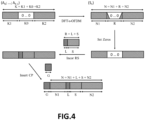
- a transmitter 3.1 transmitting a radio signal to a receiver 3.2.
- the receiver 3.2 is in the coverage of the transmitter 3.1.
- This transmission is a DFT-spread-OFDM-type transmission in the context of OFDM based systems.
- the transmitter 3.1 is a fixed station and the receiver 3.2 is a mobile terminal, in the context of the 3GPP cellular system they would be named a base station and a user equipment.
- the transmitter 3.1 can as well be the mobile terminal and the receiver 3.2 a fixed station.
- the transmitter 3.1 comprises one communication module (COM_trans) 3.3, one processing module (PROC_trans) 3.4 and a memory unit (MEMO_trans) 3.5.
- the MEMO_trans 3.5 comprises a non-volatile unit which retrieves the computer program and a volatile unit which retrieves symbol incorporation parameters.
- the PROC_trans 3.4 is configured to transmit the hybrid symbol according to the invention.
- the COM_trans 3.3 is configured to transmit to the receiver 3.2 the radio signal.
- the communication module 3.3, the processing module 3.4 and the memory unit 3.5 may constitute the device for transmitting the hybrid symbol, as previously described.
- the receiver 3.2 comprises one communication module (COM_recei) 3.6, one processing module (PROC_recei) 3.7 and a memory unit (MEMO_recei) 3.8.
- the MEMO_recei 3.8 comprises a non-volatile unit which retrieves the computer program.
- the PROC_recei 3.7 is configured to retrieve the symbols from the radio signal.
- the COM_recei 3.6 is configured to receive from the transmitter 3.1 the radio signal.
- a further aspect of the invention concerns a computer program product comprising code instructions to perform the method as described previously when said instructions are run by a processor.
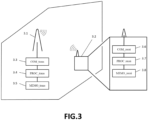
- a block of K samples (A 0 , ... A K-1 ) 2.1 is obtained.
- a first position J1 and a second position J2 in the block of samples are also obtained such that the block of K samples comprises Kd data samples to be transmitted and K0 consecutive samples not to be transmitted (A J1 ; ...; A J2 ).
- a K-size Discrete Fourier Transform (DFT) module 2.2 is applied to the block of K samples to obtain K complex samples in the frequency domain. That is, one complex sample is obtained for each l-th sub-carrier among K allocated sub-carriers.
- DFT Discrete Fourier Transform
- the sub-carrier mapping can be for example localized, that is, the K elements of the vector S are mapped to K consecutive sub-carriers among the N existing.
- the sub-carrier mapping can be for example distributed, that is the K elements of the vector S are mapped equally distanced over the entire bandwidth with zeros occupying unused sub-carriers.
- This time-domain signal x ⁇ corresponds to a DFT-spread-OFDM symbol. Therefore, samples in the signal x ⁇ refer to samples in a DFT-spread-OFDM symbol.
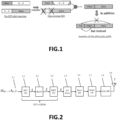
- the proposed hybrid symbol is obtained by inserting an OFDM reference symbol within the DFT-spread-OFDM symbol of the output signal.
- the size of the OFDM pilot symbol to be inserted in the DFT-spread-OFDM reference symbol is defined according to the requirement of the channel in terms of coherence bandwidth.
- the OFDM pilot can be inserted in whatever position within the DFT-spread-OFDM reference symbol.
- the OFDM pilot is inserted by first zeroing the corresponding samples in the previously generated DFT-spread-OFDM reference symbol.
- the output signal is transmitted to a data zeroing module 2.5 having access to a value of a first position T1 in the output signal and of a second position T2 in the output signal, the values of T1 and T2 being determined based on J1, J2, K and N.
- the output signal thus comprises N complex samples, forming:
- the values of the R complex samples in the central part of the output signal are set to zero, resulting in an updated output signal.
- the updated output signal is transmitted to a pilot incorporation module 2.6 which incorporates a OFDM pilot appended with its own cyclic prefix.
- the pilot incorporation module 2.6 has access to the first position T1 and the second position T2 such that the OFDM pilot and the cyclic prefix are inserted from the first position T1 to the second position T2.
- a subsequent signal is obtained, representing a hybrid symbol.
- a cyclic prefix appending module 2.7 appends to the hybrid symbol a cyclic prefix of the hybrid symbol, then the signal may be converted using a Digital-to-Analog Converter module (DAC/RF) 2.8 to generate a radio signal to be transmitted by the antenna 2.0.
- DAC/RF Digital-to-Analog Converter
- the digitally processed signal cannot be emitted as such in the air because of the propagation conditions of the electromagnetic signal and the telecommunications regulations in force.
- the DAC/RF module overcomes this disadvantage by performing a frequency transposition of the signal.
- the TDMPi reference symbol is particularly well suited for contexts such as satellite transmissions where a key requirement is to minimize the insertion of reference symbols to save at most power at the satellite while keeping low the PAPR.
- This is the main reason for replacing the normal CP by the pilot CP instead of devoting specific samples for building a dedicated CP for the pilot pattern.
- the receiver may lack of information for demodulating the last samples in the symbols in case the FFT demodulation window is positioned a few samples back in CP.
- the proposed hybrid symbol compensates for the limitations of the TDMPi scheme.
- the basic principle of the proposed hybrid symbol is, in an embodiment, to insert a true OFDM symbol within a DFT-spread-OFDM symbol.
- the advantage of inserting a true OFDM reference symbol including its own CP is to benefit from an accurate estimation of the channel using any of the several available OFDM channel estimation techniques. It is assumed here that the DFT-spread-OFDM symbols carry K time-domain samples oversampled by a factor N/K with the addition of P null sub-carriers on both edges of the multiplex.
- the size of the OFDM pilot symbol to be inserted in the DFT-spread-OFDM reference symbol is defined according to the requirement of the channel in terms of coherence bandwidth.
- the OFDM pilot can be inserted in whatever position within the DFT-spread-OFDM reference symbol.
- the OFDM pilot is implicitly inserted by first zeroing the corresponding samples in the previously generated DFT-spread-
- a solution is to generate the DFT-spread-OFDM reference symbol with a vector containing zeros at the indices corresponding to the positions of the OFDM pilot.
- the portion of signal corresponding to the positions of the zeros prior modulation would contain a contribution from the data adjacent to the zeros due to the circular convolution with the Dirichlet kernel. This contribution is first zeroed to enable for the insertion of the samples of the OFDM pilot symbol.
- the portion of signal corresponding to the positions of the zeros prior modulation contains a contribution from the data adjacent to the zeros.
- Applying the zeroing operation on these samples naturally breaks the orthogonality of the underlying OFDM signal, leading to some degradations on the demodulated data, especially for those close to the zero samples.
- pilot samples before modulation computed so as to reduce as much as possible the contribution of data onto the central part after modulation.
- these pilot samples will be described in this document as so-called ghost samples of a ghost pilot type or ghost pilots or ghost pilot samples.
- Kd K 1 + K2.
- the samples carried within the front and rear parts are denoted as information or user or useful data.
- the central part mostly depends on the inserted pilot samples but also contains a contribution of the data due to the circular convolution of the front and rear samples with the Dirichlet kernel.
- the OFDM pilot with length R generated according to any method guarantying a low PAPR is inserted at the places occupied by the R pilots.
- a typical but not restrictive solution are the so-called Zadoff-Chu sequences as used in the uplink of the 3GPP/LTE cellular system.
- the proposed algorithm is best introduced using a matrix description of the DFT-spread-OFDM modulation.
- the modulation and the demodulation are both described as matrix transformations to serve as a reference for the rest of the description.
- x k designate the data (information) samples which are parsed into data blocks x with size K.
- DFT Discrete Fourier Transform
- ⁇ K exp( j 2 ⁇ / K ) being a primitive root of unity.
- IDFT Inverse Discrete Fourier Transform
- Bm B (: , ModSubCarrierMask ) , where ModSubCarrierMask corresponds to the vector of indices with length N of the K modulated sub-carriers in the multiplex.
- the reference to the rank (i) of the symbol is ignored in the rest of the document.
- Dm D ( ModSubCarrierMask ,:).
- the samples are OFDM modulated using the matrix Bm where only the samples of the front and rear parts are kept:
- Bdm B ( DataPosMaskAfter, ModSubCarrierMask ), where DataPosMaskAfter corresponds to the vector of indices with length N of the Nd useful front and rear parts in the generated signal.
- Cd Bdm A.
- the signal is first OFDM demodulated using the matrix Dm where only the contribution of the front and rear parts is kept (the central part is zeroed):
- Dmd D ( ModSubCarrierMask, DataPosMaskAfter ).
- the generation of the ghost pilots for reducing the data contribution onto the central part is detailed thereafter.
- the purpose is to compute the vector of pilot samples that cancels or at least reduces the data contribution onto the central part.
- s k designate the pilot samples of the short OFDM symbol inserted after modulation at the positions of the zeroed samples.
- p k designate the ghost pilot samples populating the central part of the vector x prior modulation.
- d [ d 0 ,..., d Kd -1 ] T .
- the contribution of the useful data on the central part of the generated signal is described thereafter.
- Bpm B ( PilotPosMaskAfter, ModSubCarrierMask )
- PilotPosMaskAfter corresponds to the vector of indices of the R samples of the central part in the generated signal.
- the contribution of the ghost pilots on the central part of the generated signal is computed.
- the samples are OFDM modulated using the matrix Bpm.
- the application of the ghost pilots for cancelling the data contribution for all or a part of the central part of the generated signal can only result from a tradeoff. Indeed, when reducing the data contribution by inserting pilots in the central part, those pilots are susceptible to spread outside the central part, i.e. onto the data parts. This is not an issue for the demodulation as long as the overall contribution of the pilot is left unchanged. But in the present case, the zeroing operation breaks out the orthogonality of the ghost pilots component. As a result, the demodulated samples can be degraded by a pilot contribution. This is particularly true when the system is underdetermined leading to ghost samples with large amplitude. It shall also be noted that the demodulated data is also degraded by the insertion of the short OFDM pilot.
- the ghost samples are simply generated as the result of the demodulation of the inserted OFDM symbol alone or in combination with the data samples.
- an initial value for the ghost pilot samples is set as a vector computed according to the solutions mentioned in the previous embodiment. Then the samples on both sides of the pilot are updated for further reducing the OOB.
- the zeroing operation introduces performance degradation at the receiver due to the alteration of the OFDM orthogonality.
- the set of original data samples is updated prior modulation in order to minimize the degradation at the receiver. This update is referred to as data precoding.
- the transmitter updates the data vector so as to compensate at the receiver the impact of the zeroing and the contribution of the pilot samples.
- the contribution of the pilot samples onto the useful data is computed hereafter.
- the demodulated samples are despread using the matrix Ed where we keep only the result for the rear and front parts of the demodulated vector.
- the new vector of data is computed to compensate for the degradation brought by the zeroing operation, but also the one brought by the pilot insertion. This component can also be retrieved at the receiver. As the matrix Gz is full rank, the updated vector of samples can be computed using any appropriate algorithm.
- the data vector may be updated to compensate for the impact of the ghost pilots and the insertion of the OFDM pilot.
- the computation of the ghost pilots and the precoded data is jointly achieved for better performance but at the cost of an increased complexity.
- Pa ghost samples are inserted on both sides of the central part before modulation (for a total of 2 ⁇ Pa samples).
- the ghost samples are computed to achieve the equality with the inserted OFDM pilot for Pb samples on both sides of the central part after modulation (for a total of 2 ⁇ Pb samples).
- This operation can be performed alone or in combination with the compensation of the zeroing and pilot insertion.
- the algorithm is described here in this more general case.
- the signal is first OFDM demodulated using the matrix Dmd.
- the demodulated samples are despread using the (K, K) matrix Ed.
- the demodulation is thus performed using the (K, Nd) Fz matrix.
Landscapes
- Engineering & Computer Science (AREA)
- Computer Networks & Wireless Communication (AREA)
- Signal Processing (AREA)
- Physics & Mathematics (AREA)
- Discrete Mathematics (AREA)
- General Physics & Mathematics (AREA)
- Mathematical Physics (AREA)
- Power Engineering (AREA)
- Digital Transmission Methods That Use Modulated Carrier Waves (AREA)
- Mobile Radio Communication Systems (AREA)
- Radio Transmission System (AREA)
- Cable Transmission Systems, Equalization Of Radio And Reduction Of Echo (AREA)
Claims (18)
- Procédé de transmission d'au moins un groupe de Kd échantillons de données dans un signal radio devant être transmis sur un système de communication, ledit signal radio étant destiné à être émis par un émetteur comprenant au moins un module de transmission configuré pour transmettre sur au moins un nombre de K sous-porteuses différentes, K et Kd étant des entiers strictement positifs, Kd étant strictement inférieur à K, ledit signal radio étant fourni par :- la détermination d'une première position J1 et d'une deuxième position J2 dans un bloc de K échantillons (A0 ; ... ; AK-1), de sorte que le bloc de K échantillon comprend :∘ Kd échantillons de données à transmettre ;∘ et K0 échantillons consécutifs (AJ1 ; ... ; AJ2) ;∘ avec J2 - J1 + 1 = K0 et Kd + K0 = K ;- l'application d'un schéma de type OFDM à étalement DFT au bloc de K échantillons (A0 ; ... ; AK-1), et l'obtention d'un signal de sortie représentant un symbole comprenant N échantillons complexes Sn dans le signal radio, avec n = 0 à N - 1 ;- la détermination, dans le signal de sortie, d'une première position T1 et d'une seconde position T2 sur la base de J1, J2, K et N de manière que :∘ T2 - T1 = R, avec R étant un entier strictement positif ;- le réglage à zéro, dans le signal de sortie, des valeurs des R échantillons complexes (Sri ; ... ; ST2) entre la première position T1 et la seconde position T2 pour obtenir un signal de sortie mis à jour ;le procédé étant caractérisé par :- l'insertion, entre la première position T1 et la seconde position T2 du signal de sortie mis à jour, de S échantillons de référence, S étant un entier strictement positif et R = S + L, avec L étant un entier positif ou nul, pour obtenir un signal subséquent représentant un symbole hybride comprenant :∘ pour chacun de n = [0 ; T1 - 1]U[T2 + 1 ; N - 1], un échantillon complexe Sn dans le signal radio, les échantillons complexes formant une section de données du symbole hybride ;∘ pour chacun de n = [T1 + L ; T2], un échantillon de référence RSn dans le signal radio, les échantillons de référence formant une section de référence du symbole hybride ;- l'ajout, au symbole hybride, de G échantillons formant un préfixe cyclique d'au moins une partie du symbole hybride pour obtenir un signal représentant le symbole hybride avec le préfixe cyclique ajouté ; en vue de transmettre un signal radio correspondant au signal représentant le symbole hybride avec le préfixe cyclique ajouté.
- Procédé selon la revendication 1, dans lequel l'insertion, entre la première position T1 et la seconde position T2 du signal de sortie mis à jour, de S échantillons de référence pour obtenir le signal subséquent comprend en outre l'insertion, entre la première position T1 et la seconde position T2, de L échantillons de préfixe cyclique de sorte que le signal subséquent comprend :∘ pour chacun de n = [T1 ;T1 + L - 1], un échantillon de préfixe cyclique CPRSn dans le signal radio, les échantillons de préfixe cyclique formant un préfixe cyclique de la section de référence du symbole hybride.
- Procédé selon la revendication 1, ledit procédé comprenant en outre le réglage à zéro des valeurs des K0 échantillons consécutifs entre la première position J1 et la deuxième position J2 dans le bloc de K échantillons, avant l'application du schéma de type OFDM à étalement DFT à celui-ci et l'obtention du signal de sortie.
- Procédé selon la revendication 1, dans lequel au moins une partie des K0 échantillons consécutifs dans le bloc de K échantillons est obtenue par, avant l'application du schéma de type OFDM à étalement DFT au bloc de K échantillons et l'obtention du signal de sortie :(a) l'obtention d'une pluralité de blocs temporaires de K échantillons (A'0 ; ... ; A'K-1), chaque bloc temporaire de K échantillons comprenant :- les Kd échantillons de données à transmettre, et- K0 échantillons fantômes consécutifs temporaires (A'J1 ; ... ; A'J2) ;(b) pour chaque bloc temporaire de K échantillons, la détermination de valeurs d'au moins une partie des R échantillons complexes S'n pour chacun de n = [T1 ; T2] à obtenir entre la première position T1 et la seconde position T2 en conséquence de l'application du schéma de type OFDM à étalement DFT au bloc temporaire de K échantillons ;(c) pour chaque bloc temporaire de K échantillons, la détermination d'un critère associé audit bloc temporaire de K échantillons indiquant un niveau de similitude entre :- lesdites valeurs d'au moins une partie des R échantillons complexes S'n, et- des valeurs nulles ; et(d) la détermination de ladite au moins une partie des K0 échantillons consécutifs (AJ1 ; ... ; AJ2) du bloc de K échantillons sur la base de valeurs de chacun desdits blocs temporaires de K échantillons et de chaque critère déterminé en (c), de manière que des valeurs d'au moins une partie des R échantillons complexes S'n pour chacun de n = [T1 ; T2] à obtenir entre la première position T1 et la seconde position T2 en conséquence de l'application du schéma de type OFDM à étalement DFT au bloc de K échantillons présentent un niveau optimisé de similitude à des valeurs nulles.
- Procédé selon la revendication 4, dans lequel la détermination de ladite au moins une partie des K0 échantillons consécutifs (AJ1 ; ... ; AJ2) du bloc de K échantillons comprend l'application d'une méthode des moindres carrés.
- Procédé selon la revendication 1, dans lequel au moins une partie des K0 échantillons consécutifs (AJ1 ; ... ; AJ2) dans le bloc de K échantillons consécutifs est des échantillons fantômes d'un type de pilote fantôme.
- Procédé selon la revendication 5, dans lequel l'au moins une partie des K0 échantillons consécutifs (AJ1 ; ... ; AJ2) dans le bloc de K échantillons consécutifs est déterminée par, avant l'application du schéma de type OFDM à étalement DFT au bloc de K échantillons et l'obtention du signal de sortie :- l'obtention d'un signal de référence comprenant les S échantillons de référence à insérer avec les L échantillons de préfixe cyclique ajoutés à insérer,- l'application d'un schéma de type OFDM à étalement DFT inverse au signal de référence pour obtenir un signal de référence démodulé comprenant un bloc de K échantillons démodulés comprenant K0 échantillons démodulés consécutifs,- et l'insertion d'au moins une partie des K0 échantillons démodulés consécutifs dans le bloc de K échantillons comme des échantillons fantômes d'un type de pilote fantôme formant l'au moins une partie des K0 échantillons consécutifs.
- Procédé selon la revendication 6, dans lequel l'au moins une partie des K0 échantillons consécutifs (AJ1 ; ... ; AJ2) dans le bloc de K échantillons consécutifs est déterminée par, avant l'application du schéma de type OFDM à étalement DFT au bloc de K échantillons et l'obtention du signal de sortie :(a) l'obtention d'une pluralité de blocs hybrides temporaires de K échantillons (A"0 ; ... ; A"K-1), chaque bloc hybride temporaire de K échantillons comprenant :- les Kd échantillons de données à transmettre, et- K0 échantillons fantômes consécutifs temporaires (A'J1 ; ... ; A'J2) d'un type de pilote fantôme ;(b) pour chaque bloc temporaire de K échantillons, la détermination de valeurs d'au moins une partie des R échantillons complexes S"n pour chacun de n = [T1 ; T2] à obtenir entre la première position T1 et la seconde position T2 en conséquence de l'application du schéma de type OFDM à étalement DFT au bloc hybride temporaire de K échantillons ;(c) pour chaque bloc hybride temporaire de K échantillons, la détermination d'un critère associé audit bloc temporaire de K échantillons indiquant un niveau de similitude entre :- lesdites valeurs d'au moins une partie des R échantillons complexes S"n, et- les valeurs d'au moins une partie des S échantillons de référence à insérer avec les L échantillons de préfixe cyclique ajoutés à insérer ; et(d) la détermination de ladite au moins une partie des K0 échantillons consécutifs (AJ1 ; ... ; AJ2) du bloc de K échantillons sur la base desdits blocs hybrides temporaires de K échantillons et de chaque critère déterminé en (c), de manière que des valeurs d'au moins une partie des R échantillons complexes Sn pour chacun de n = [T1 ; T2] à obtenir entre la première position T1 et la seconde position T2 en conséquence de l'application du schéma de type OFDM à étalement DFT au bloc de K échantillons présentent un niveau optimisé de similitude aux valeurs de l'au moins une partie des S échantillons de référence à insérer avec les L échantillons de préfixe cyclique ajoutés à insérer.
- Procédé selon la revendication 8, comprenant en outre :(e) l'obtention d'une pluralité de blocs temporaires de K échantillons (A'0 ; ... ; A'K-1), chaque bloc temporaire de K échantillons comprenant :- les Kd échantillons de données à transmettre, et- K0 échantillons fantômes consécutifs temporaires (A'J1 ; ... ; A'J2) ;(f) pour chaque bloc temporaire de K échantillons, la détermination de valeurs d'au moins une partie des R échantillons complexes S'n pour chacun de n = [T1 ; T2] à obtenir entre la première position T1 et la seconde position T2 en conséquence de l'application du schéma de type OFDM à étalement DFT au bloc temporaire de K échantillons ;(g) pour chaque bloc temporaire de K échantillons, la détermination d'un critère associé audit bloc temporaire de K échantillons indiquant un niveau de similitude entre :- lesdites valeurs d'au moins une partie des R échantillons complexes S'n, et- des valeurs nulles ; et(h) la détermination d'au moins une partie de K0 échantillons consécutifs sur la base de valeurs de chacun desdits blocs temporaires de K échantillons et de chaque critère déterminé en (g), de manière que des valeurs d'au moins une partie des R échantillons complexes Sn pour chacun de n = [T1 ; T2] à obtenir entre la première position T1 et la seconde position T2 en conséquence de l'application du schéma de type OFDM à étalement DFT au bloc de K échantillons présentent un niveau optimisé de similitude à des valeurs nulles,(i) sur la base de ladite au moins une partie des K0 échantillons consécutifs déterminée en (h), la mise à jour de ladite au moins une partie des K0 échantillons consécutifs (AJ1 ; ... ; AJ2) du bloc de K échantillons.
- Procédé selon l'une quelconque des revendications 4, 5 ou 9, dans lequel la mise à jour des valeurs d'au moins une partie des K0 échantillons consécutifs du bloc de K échantillons comprend :- la détermination d'une troisième position J1+Pa1 et d'une quatrième position J2-Pa2 dans le bloc de K échantillons de sorte que les K0 échantillons consécutifs comprennent :∘ une partie avant de Pa1 échantillons consécutifs (AJ1 ; ... ; AJ1+Pa1) ;∘ une partie centrale (AJ1+Pa1 ; ... ; AJ2-Pa2) ;∘ une partie arrière de Pa2 échantillons consécutifs (AJ2-Pa2 ; ... ; AJ2),Pa1, Pa2 étant des entiers positifs et Pa1 + Pa2 étant strictement inférieur à K0,- et la mise à jour des valeurs des échantillons de la partie avant et de la partie arrière des K0 échantillons consécutifs.
- Procédé selon l'une quelconque des revendications précédentes, dans lequel les échantillons de référence prédéterminés sont générés en appliquant un schéma de type OFDM sur une séquence CAZAC.
- Procédé selon la revendication 11, dans lequel les échantillons de référence prédéterminés sont générés en appliquant un schéma de type OFDM sur une séquence de Zadoff-Chu.
- Procédé selon la revendication 1, dans lequel, les K0 échantillons consécutifs entre la première position J1 et la deuxième position J2 étant des échantillons fantômes, les valeurs d'au moins une partie des Kd échantillons de données sont déterminées de manière à compenser la contribution des K0 échantillons fantômes à la section de données du symbole hybride.
- Procédé selon la revendication 1, dans lequel J1, J2, T1 et T2 sont définis les uns par rapport aux autres de manière que :


- Procédé de détermination d'une estimation de canal d'un canal de propagation utilisé pour la transmission d'un signal radio émis par rapport au procédé selon la revendication 1, transmis par l'intermédiaire du canal de propagation et reçu par un récepteur configuré pour être actif sur au moins un nombre de K sous-porteuses différentes, K étant un entier strictement positif, le procédé comprenant :- l'obtention, sur la base du signal radio reçu, d'un signal comprenant N échantillons formant un symbole hybride avec G échantillons ajoutés formant un préfixe cyclique d'au moins une partie du symbole hybride,- l'obtention d'une première position T1 et d'une seconde position T2 dans le signal, avec T2 - T1 = R, R étant un entier strictement positif ; et R = S + L, avec L étant un entier positif ou nul et S étant un entier strictement positif,
de sorte que :∘ pour chacun de n = [0 ; T1 - 1]U[T2 + 1 ; N - 1], le signal comprend un échantillon complexe Sn, les échantillons complexes formant une section de données du symbole hybride ;∘ pour chacun de n = [T1 + L ; T2], le signal comprend un échantillon de référence RSn, les échantillons de référence formant une section de référence du symbole hybride ;- le réglage à zéro des valeurs des échantillons complexes Sn et des échantillons formant le préfixe cyclique d'au moins une partie du symbole hybride pour obtenir un signal mis à jour comprenant S échantillons de référence RSn ;- l'application d'un schéma de type OFDM inverse au signal mis à jour pour obtenir un signal démodulé comprenant un bloc d'échantillons de référence consécutifs indicatifs de l'estimation de canal du canal de propagation utilisé pour la transmission du signal radio,- et la détermination de l'estimation de canal du canal de propagation utilisé pour la transmission du signal radio reçu sur la base au moins de la section de référence du symbole hybride. - Produit de programme informatique comprenant des instructions de code pour réaliser le procédé selon la revendication 1, quand lesdites instructions sont exécutées par un processeur.
- Dispositif de télécommunication comprenant un module pour la transmission d'au moins un groupe de Kd échantillons de données dans un signal radio devant être transmis sur un système de communication, le module comprenant un émetteur configuré pour transmettre sur au moins un nombre de K sous-porteuses différentes, K et Kd étant des entiers strictement positifs, Kd étant strictement inférieur à K, le dispositif de télécommunication comprenant en outre un circuit de traitement pour générer ledit signal radio, par :- la détermination d'une première position J1 et d'une deuxième position J2 dans un bloc de K échantillons (A0 ; ... ; AK-1), de sorte que le bloc de K échantillon comprend :∘ Kd échantillons de données à transmettre ;∘ et K0 échantillons consécutifs (AJ1 ; ... ; AJ2) ;∘ avec J2 - J1 + 1 = K0 et Kd + K0 = K ;- l'application d'un schéma de type OFDM à étalement DFT au bloc de K échantillons (A0 ; ... ; AK-1), et l'obtention d'un signal de sortie représentant un symbole comprenant N échantillons complexes Sn dans le signal radio, avec n = 0 à N - 1 ;- la détermination, dans le signal de sortie, d'une première position T1 et d'une seconde position T2 sur la base de J1, J2, K et N de manière que :∘ T2 - T1 = R, avec R étant un entier strictement positif ;- le réglage à zéro, dans le signal de sortie, des valeurs des R échantillons complexes (Sri ; ... ; ST2) entre la première position T1 et la seconde position T2 pour obtenir un signal de sortie mis à jour ;
le dispositif de télécommunication étant caractérisé par : le circuit de traitement pour générer ledit signal radio, en outre par- l'insertion, entre la première position T1 et la seconde position T2 du signal de sortie mis à jour, de S échantillons de référence, S étant un entier strictement positif et R = S + L, avec L étant un entier positif ou nul, pour obtenir un signal subséquent représentant un symbole hybride comprenant :∘ pour chacun de n = [0 ; T1 - 1]U[T2 + 1 ; N - 1], un échantillon complexe Sn dans le signal radio, les échantillons complexes formant une section de données du symbole hybride ;∘ pour chacun de n = [T1 + L ; T2], un échantillon de référence RSn dans le signal radio, les échantillons de référence formant une section de référence du symbole hybride ;- l'ajout, au symbole hybride, d'un préfixe cyclique d'au moins une partie du symbole hybride pour obtenir un signal représentant le symbole hybride avec le préfixe cyclique ajouté ;- la génération du signal radio correspondant au signal représentant le symbole hybride avec le préfixe cyclique ajouté, en vue de transmettre ledit signal radio. - Dispositif de télécommunication comprenant un module pour la réception d'au moins un groupe de Kd données dans un signal radio devant être transmis sur un système de communication, ledit signal radio étant destiné à être émis par un émetteur comprenant au moins un module de transmission configuré pour transmettre au moins un nombre de K sous-porteuses différentes, K et Kd étant des entiers strictement positifs, Kd étant strictement inférieur à K,le dispositif de télécommunication comprenant en outre un circuit de traitement pour déterminer une estimation de canal d'un canal de propagation utilisé pour la transmission du signal radio au dispositif de télécommunication, où il est reçu comme un signal radio reçu, par :- l'obtention, sur la base du signal radio reçu, d'un signal comprenant N échantillons formant un symbole hybride avec G échantillons ajoutés formant un préfixe cyclique d'au moins une partie du symbole hybride, avec N et G étant des entiers strictement positifs,- l'obtention d'une première position T1 et d'une seconde position T2 dans le signal, avec T2 - T1 = R, R étant un entier strictement positif ; et R = S + L, avec L étant un entier positif ou nul et S étant un entier strictement positif,de sorte que :∘ pour chacun de n = [0 ; T1 - 1]U[T2 + 1 ; N - 1], le signal comprend un échantillon complexe Sn, les échantillons complexes formant une section de données du symbole hybride ;∘ pour chacun de n = [T1 + L ; T2], le signal comprend un échantillon de référence RSn, les échantillons de référence formant une section de référence du symbole hybride ;- le réglage à zéro des valeurs des échantillons complexes Sn et des échantillons formant le préfixe cyclique d'au moins une partie du symbole hybride pour obtenir un signal mis à jour comprenant S échantillons de référence RSn ;- l'application d'un schéma de type OFDM inverse au signal mis à jour pour obtenir un signal démodulé comprenant un bloc d'échantillons de référence consécutifs indicatifs de l'estimation de canal du canal de propagation utilisé pour la transmission du signal radio.
Priority Applications (5)
| Application Number | Priority Date | Filing Date | Title |
|---|---|---|---|
| EP19306433.4A EP3820103B1 (fr) | 2019-11-05 | 2019-11-05 | Signal de référence hybride à faible papr pour ofdm par étalement de dft |
| PCT/JP2020/040026 WO2021090716A1 (fr) | 2019-11-05 | 2020-10-20 | Signal de référence hybride à faible papr pour dft-s-ofdm |
| US17/639,520 US11722348B2 (en) | 2019-11-05 | 2020-10-20 | Hybrid reference signal with low PAPR for DFT-S-OFDM |
| JP2022532241A JP7408805B2 (ja) | 2019-11-05 | 2020-10-20 | Dft-s-ofdm用の低paprを有するハイブリッド参照信号 |
| CN202080076155.7A CN114731321B (zh) | 2019-11-05 | 2020-10-20 | 用于dft-s-ofdm的具有低papr的混合参考信号 |
Applications Claiming Priority (1)
| Application Number | Priority Date | Filing Date | Title |
|---|---|---|---|
| EP19306433.4A EP3820103B1 (fr) | 2019-11-05 | 2019-11-05 | Signal de référence hybride à faible papr pour ofdm par étalement de dft |
Publications (2)
| Publication Number | Publication Date |
|---|---|
| EP3820103A1 EP3820103A1 (fr) | 2021-05-12 |
| EP3820103B1 true EP3820103B1 (fr) | 2024-09-11 |
Family
ID=68618098
Family Applications (1)
| Application Number | Title | Priority Date | Filing Date |
|---|---|---|---|
| EP19306433.4A Active EP3820103B1 (fr) | 2019-11-05 | 2019-11-05 | Signal de référence hybride à faible papr pour ofdm par étalement de dft |
Country Status (5)
| Country | Link |
|---|---|
| US (1) | US11722348B2 (fr) |
| EP (1) | EP3820103B1 (fr) |
| JP (1) | JP7408805B2 (fr) |
| CN (1) | CN114731321B (fr) |
| WO (1) | WO2021090716A1 (fr) |
Families Citing this family (3)
| Publication number | Priority date | Publication date | Assignee | Title |
|---|---|---|---|---|
| US20230049687A1 (en) * | 2020-04-23 | 2023-02-16 | Spectral DSP Corp | Systems and Methods for Shaped Single Carrier Orthogonal Frequency Division Multiplexing with Low Peak to Average Power Ratio |
| WO2021216760A1 (fr) * | 2020-04-23 | 2021-10-28 | Spectral DSP Corp | Systèmes et procédés de multiplexage par répartition orthogonale de la fréquence à porteuse unique mis en forme avec un rapport puissance de crête/puissance moyenne faible |
| US11611459B1 (en) * | 2021-08-25 | 2023-03-21 | Qualcomm Incorporated | Symbol configuration for single-carrier for frequency domain equalization waveform |
Family Cites Families (6)
| Publication number | Priority date | Publication date | Assignee | Title |
|---|---|---|---|---|
| US8571120B2 (en) | 2006-09-22 | 2013-10-29 | Texas Instruments Incorporated | Transmission of acknowledge/not acknowledge (ACK/NACK) bits and their embedding in the reference signal |
| US8451915B2 (en) | 2007-03-21 | 2013-05-28 | Samsung Electronics Co., Ltd. | Efficient uplink feedback in a wireless communication system |
| EP3384648A1 (fr) * | 2015-12-03 | 2018-10-10 | IDAC Holdings, Inc. | Queue de zéro et formes d'onde fondées sur un mot unique pour un dft-s ofdm et un ofdm |
| EP3185496B1 (fr) | 2015-12-21 | 2018-08-29 | Mitsubishi Electric R&D Centre Europe B.V. | Procédé et dispositif de formation d'un symbole mrof à diffusion dft comprenant des données et un pilote |
| TWI707570B (zh) | 2016-03-30 | 2020-10-11 | 美商Idac控股公司 | 使用唯一字(UW)離散傅立葉轉換展開正交分頻多工(DFT-s-OFDM)增進實體層效率方法及程序 |
| TW201806349A (zh) * | 2016-08-10 | 2018-02-16 | Idac控股公司 | 具單載頻域多存取(sc-fdma)及ofdma彈性參考訊號傳輸方法 |
-
2019
- 2019-11-05 EP EP19306433.4A patent/EP3820103B1/fr active Active
-
2020
- 2020-10-20 JP JP2022532241A patent/JP7408805B2/ja active Active
- 2020-10-20 CN CN202080076155.7A patent/CN114731321B/zh active Active
- 2020-10-20 US US17/639,520 patent/US11722348B2/en active Active
- 2020-10-20 WO PCT/JP2020/040026 patent/WO2021090716A1/fr not_active Ceased
Also Published As
| Publication number | Publication date |
|---|---|
| JP7408805B2 (ja) | 2024-01-05 |
| CN114731321B (zh) | 2024-11-19 |
| US20220294680A1 (en) | 2022-09-15 |
| EP3820103A1 (fr) | 2021-05-12 |
| US11722348B2 (en) | 2023-08-08 |
| JP2022543172A (ja) | 2022-10-07 |
| CN114731321A (zh) | 2022-07-08 |
| WO2021090716A1 (fr) | 2021-05-14 |
Similar Documents
| Publication | Publication Date | Title |
|---|---|---|
| EP1949632B1 (fr) | Procedes et appareil pour la mitigation de distorsion non lineaire | |
| EP2335365B1 (fr) | Réduction du facteur de crête pour des systèmes de communication ofdm par la transmission de blocs de ressources déphasés | |
| EP2135410B1 (fr) | Estimateur de canaux ayant une suppression du bruit fort et une faible erreur d'interpolation destiné à des systèmes ofdm | |
| US8160164B2 (en) | Wireless communication unit and method for channel estimation | |
| JP5632457B2 (ja) | マルチキャリア信号におけるピーク電力対平均電力比の低減 | |
| JP6657277B2 (ja) | 送信装置 | |
| US10541847B2 (en) | Method and device for forming DFT-spread OFDM symbol including data and pilots | |
| KR20160089410A (ko) | 무선 주파수 캐리어 집성을 위한 시스템 및 방법 | |
| US11722348B2 (en) | Hybrid reference signal with low PAPR for DFT-S-OFDM | |
| JP5486734B2 (ja) | シングルキャリア通信システムにおける送信信号生成装置および方法 | |
| Loulou et al. | Multiplierless filtered-OFDM transmitter for narrowband IoT devices | |
| JP7527693B2 (ja) | 送信器、送信方法、受信器、および受信方法 | |
| KR20080051984A (ko) | Tds-ofdm 수신기의 등화방법 및 상기 등화방법을이용한 등화장치 | |
| US8401109B2 (en) | Methods for sending and receiving a multicarrier signal comprising a preamble comprising data elements, corresponding devices and computer products | |
| US11737077B2 (en) | Transmission device and transmission method | |
| KR100226709B1 (ko) | 직교분할대역 시스템의 적응적인 채널 등화 방법 | |
| Aldinger | A multicarrier scheme for HIPERLAN | |
| Loulou et al. | Look-up table based implementation of ultra-low complexity narrowband OFDM transmitters | |
| US8917585B2 (en) | Method for estimating a received signal and corresponding device | |
| Ji et al. | A modified SLM scheme with low complexity for reducing the PAPR of OFDM systems without side information | |
| Üçüncü | Out-of-band radiation and cfo immunity of potential 5G multicarrier modulation schemes | |
| Bunnag | Minimizing Peak-to-Average Power Ratio in an Orthogonal Frequency Division Multiplex System | |
| Magesacher | Spectrum Efficiency in OFDMA |
Legal Events
| Date | Code | Title | Description |
|---|---|---|---|
| PUAI | Public reference made under article 153(3) epc to a published international application that has entered the european phase |
Free format text: ORIGINAL CODE: 0009012 |
|
| STAA | Information on the status of an ep patent application or granted ep patent |
Free format text: STATUS: THE APPLICATION HAS BEEN PUBLISHED |
|
| AK | Designated contracting states |
Kind code of ref document: A1 Designated state(s): AL AT BE BG CH CY CZ DE DK EE ES FI FR GB GR HR HU IE IS IT LI LT LU LV MC MK MT NL NO PL PT RO RS SE SI SK SM TR |
|
| STAA | Information on the status of an ep patent application or granted ep patent |
Free format text: STATUS: REQUEST FOR EXAMINATION WAS MADE |
|
| 17P | Request for examination filed |
Effective date: 20211025 |
|
| RBV | Designated contracting states (corrected) |
Designated state(s): AL AT BE BG CH CY CZ DE DK EE ES FI FR GB GR HR HU IE IS IT LI LT LU LV MC MK MT NL NO PL PT RO RS SE SI SK SM TR |
|
| GRAP | Despatch of communication of intention to grant a patent |
Free format text: ORIGINAL CODE: EPIDOSNIGR1 |
|
| STAA | Information on the status of an ep patent application or granted ep patent |
Free format text: STATUS: GRANT OF PATENT IS INTENDED |
|
| INTG | Intention to grant announced |
Effective date: 20240516 |
|
| P01 | Opt-out of the competence of the unified patent court (upc) registered |
Free format text: CASE NUMBER: APP_35422/2024 Effective date: 20240612 |
|
| GRAS | Grant fee paid |
Free format text: ORIGINAL CODE: EPIDOSNIGR3 |
|
| GRAA | (expected) grant |
Free format text: ORIGINAL CODE: 0009210 |
|
| STAA | Information on the status of an ep patent application or granted ep patent |
Free format text: STATUS: THE PATENT HAS BEEN GRANTED |
|
| AK | Designated contracting states |
Kind code of ref document: B1 Designated state(s): AL AT BE BG CH CY CZ DE DK EE ES FI FR GB GR HR HU IE IS IT LI LT LU LV MC MK MT NL NO PL PT RO RS SE SI SK SM TR |
|
| REG | Reference to a national code |
Ref country code: GB Ref legal event code: FG4D |
|
| REG | Reference to a national code |
Ref country code: CH Ref legal event code: EP |
|
| REG | Reference to a national code |
Ref country code: DE Ref legal event code: R096 Ref document number: 602019058642 Country of ref document: DE |
|
| REG | Reference to a national code |
Ref country code: IE Ref legal event code: FG4D |
|
| REG | Reference to a national code |
Ref country code: LT Ref legal event code: MG9D |
|
| PG25 | Lapsed in a contracting state [announced via postgrant information from national office to epo] |
Ref country code: NO Free format text: LAPSE BECAUSE OF FAILURE TO SUBMIT A TRANSLATION OF THE DESCRIPTION OR TO PAY THE FEE WITHIN THE PRESCRIBED TIME-LIMIT Effective date: 20241211 |
|
| REG | Reference to a national code |
Ref country code: NL Ref legal event code: MP Effective date: 20240911 |
|
| PG25 | Lapsed in a contracting state [announced via postgrant information from national office to epo] |
Ref country code: GR Free format text: LAPSE BECAUSE OF FAILURE TO SUBMIT A TRANSLATION OF THE DESCRIPTION OR TO PAY THE FEE WITHIN THE PRESCRIBED TIME-LIMIT Effective date: 20241212 Ref country code: FI Free format text: LAPSE BECAUSE OF FAILURE TO SUBMIT A TRANSLATION OF THE DESCRIPTION OR TO PAY THE FEE WITHIN THE PRESCRIBED TIME-LIMIT Effective date: 20240911 |
|
| PG25 | Lapsed in a contracting state [announced via postgrant information from national office to epo] |
Ref country code: BG Free format text: LAPSE BECAUSE OF FAILURE TO SUBMIT A TRANSLATION OF THE DESCRIPTION OR TO PAY THE FEE WITHIN THE PRESCRIBED TIME-LIMIT Effective date: 20240911 |
|
| PG25 | Lapsed in a contracting state [announced via postgrant information from national office to epo] |
Ref country code: LV Free format text: LAPSE BECAUSE OF FAILURE TO SUBMIT A TRANSLATION OF THE DESCRIPTION OR TO PAY THE FEE WITHIN THE PRESCRIBED TIME-LIMIT Effective date: 20240911 |
|
| PG25 | Lapsed in a contracting state [announced via postgrant information from national office to epo] |
Ref country code: HR Free format text: LAPSE BECAUSE OF FAILURE TO SUBMIT A TRANSLATION OF THE DESCRIPTION OR TO PAY THE FEE WITHIN THE PRESCRIBED TIME-LIMIT Effective date: 20240911 |
|
| PG25 | Lapsed in a contracting state [announced via postgrant information from national office to epo] |
Ref country code: RS Free format text: LAPSE BECAUSE OF FAILURE TO SUBMIT A TRANSLATION OF THE DESCRIPTION OR TO PAY THE FEE WITHIN THE PRESCRIBED TIME-LIMIT Effective date: 20241211 Ref country code: ES Free format text: LAPSE BECAUSE OF FAILURE TO SUBMIT A TRANSLATION OF THE DESCRIPTION OR TO PAY THE FEE WITHIN THE PRESCRIBED TIME-LIMIT Effective date: 20240911 |
|
| PG25 | Lapsed in a contracting state [announced via postgrant information from national office to epo] |
Ref country code: RS Free format text: LAPSE BECAUSE OF FAILURE TO SUBMIT A TRANSLATION OF THE DESCRIPTION OR TO PAY THE FEE WITHIN THE PRESCRIBED TIME-LIMIT Effective date: 20241211 Ref country code: NO Free format text: LAPSE BECAUSE OF FAILURE TO SUBMIT A TRANSLATION OF THE DESCRIPTION OR TO PAY THE FEE WITHIN THE PRESCRIBED TIME-LIMIT Effective date: 20241211 Ref country code: LV Free format text: LAPSE BECAUSE OF FAILURE TO SUBMIT A TRANSLATION OF THE DESCRIPTION OR TO PAY THE FEE WITHIN THE PRESCRIBED TIME-LIMIT Effective date: 20240911 Ref country code: HR Free format text: LAPSE BECAUSE OF FAILURE TO SUBMIT A TRANSLATION OF THE DESCRIPTION OR TO PAY THE FEE WITHIN THE PRESCRIBED TIME-LIMIT Effective date: 20240911 Ref country code: GR Free format text: LAPSE BECAUSE OF FAILURE TO SUBMIT A TRANSLATION OF THE DESCRIPTION OR TO PAY THE FEE WITHIN THE PRESCRIBED TIME-LIMIT Effective date: 20241212 Ref country code: FI Free format text: LAPSE BECAUSE OF FAILURE TO SUBMIT A TRANSLATION OF THE DESCRIPTION OR TO PAY THE FEE WITHIN THE PRESCRIBED TIME-LIMIT Effective date: 20240911 Ref country code: ES Free format text: LAPSE BECAUSE OF FAILURE TO SUBMIT A TRANSLATION OF THE DESCRIPTION OR TO PAY THE FEE WITHIN THE PRESCRIBED TIME-LIMIT Effective date: 20240911 Ref country code: BG Free format text: LAPSE BECAUSE OF FAILURE TO SUBMIT A TRANSLATION OF THE DESCRIPTION OR TO PAY THE FEE WITHIN THE PRESCRIBED TIME-LIMIT Effective date: 20240911 |
|
| REG | Reference to a national code |
Ref country code: DE Ref legal event code: R082 Ref document number: 602019058642 Country of ref document: DE Representative=s name: PLASSERAUD IP GMBH, DE |
|
| REG | Reference to a national code |
Ref country code: AT Ref legal event code: MK05 Ref document number: 1723663 Country of ref document: AT Kind code of ref document: T Effective date: 20240911 |
|
| PG25 | Lapsed in a contracting state [announced via postgrant information from national office to epo] |
Ref country code: NL Free format text: LAPSE BECAUSE OF FAILURE TO SUBMIT A TRANSLATION OF THE DESCRIPTION OR TO PAY THE FEE WITHIN THE PRESCRIBED TIME-LIMIT Effective date: 20240911 |
|
| PG25 | Lapsed in a contracting state [announced via postgrant information from national office to epo] |
Ref country code: IS Free format text: LAPSE BECAUSE OF FAILURE TO SUBMIT A TRANSLATION OF THE DESCRIPTION OR TO PAY THE FEE WITHIN THE PRESCRIBED TIME-LIMIT Effective date: 20250111 Ref country code: PT Free format text: LAPSE BECAUSE OF FAILURE TO SUBMIT A TRANSLATION OF THE DESCRIPTION OR TO PAY THE FEE WITHIN THE PRESCRIBED TIME-LIMIT Effective date: 20250113 |
|
| PG25 | Lapsed in a contracting state [announced via postgrant information from national office to epo] |
Ref country code: SM Free format text: LAPSE BECAUSE OF FAILURE TO SUBMIT A TRANSLATION OF THE DESCRIPTION OR TO PAY THE FEE WITHIN THE PRESCRIBED TIME-LIMIT Effective date: 20240911 Ref country code: RO Free format text: LAPSE BECAUSE OF FAILURE TO SUBMIT A TRANSLATION OF THE DESCRIPTION OR TO PAY THE FEE WITHIN THE PRESCRIBED TIME-LIMIT Effective date: 20240911 |
|
| PG25 | Lapsed in a contracting state [announced via postgrant information from national office to epo] |
Ref country code: AT Free format text: LAPSE BECAUSE OF FAILURE TO SUBMIT A TRANSLATION OF THE DESCRIPTION OR TO PAY THE FEE WITHIN THE PRESCRIBED TIME-LIMIT Effective date: 20240911 Ref country code: EE Free format text: LAPSE BECAUSE OF FAILURE TO SUBMIT A TRANSLATION OF THE DESCRIPTION OR TO PAY THE FEE WITHIN THE PRESCRIBED TIME-LIMIT Effective date: 20240911 |
|
| PG25 | Lapsed in a contracting state [announced via postgrant information from national office to epo] |
Ref country code: CZ Free format text: LAPSE BECAUSE OF FAILURE TO SUBMIT A TRANSLATION OF THE DESCRIPTION OR TO PAY THE FEE WITHIN THE PRESCRIBED TIME-LIMIT Effective date: 20240911 Ref country code: PL Free format text: LAPSE BECAUSE OF FAILURE TO SUBMIT A TRANSLATION OF THE DESCRIPTION OR TO PAY THE FEE WITHIN THE PRESCRIBED TIME-LIMIT Effective date: 20240911 |
|
| PG25 | Lapsed in a contracting state [announced via postgrant information from national office to epo] |
Ref country code: SK Free format text: LAPSE BECAUSE OF FAILURE TO SUBMIT A TRANSLATION OF THE DESCRIPTION OR TO PAY THE FEE WITHIN THE PRESCRIBED TIME-LIMIT Effective date: 20240911 Ref country code: IT Free format text: LAPSE BECAUSE OF FAILURE TO SUBMIT A TRANSLATION OF THE DESCRIPTION OR TO PAY THE FEE WITHIN THE PRESCRIBED TIME-LIMIT Effective date: 20240911 |
|
| REG | Reference to a national code |
Ref country code: DE Ref legal event code: R097 Ref document number: 602019058642 Country of ref document: DE |
|
| REG | Reference to a national code |
Ref country code: CH Ref legal event code: PL |
|
| PG25 | Lapsed in a contracting state [announced via postgrant information from national office to epo] |
Ref country code: MC Free format text: LAPSE BECAUSE OF FAILURE TO SUBMIT A TRANSLATION OF THE DESCRIPTION OR TO PAY THE FEE WITHIN THE PRESCRIBED TIME-LIMIT Effective date: 20240911 |
|
| PG25 | Lapsed in a contracting state [announced via postgrant information from national office to epo] |
Ref country code: DK Free format text: LAPSE BECAUSE OF FAILURE TO SUBMIT A TRANSLATION OF THE DESCRIPTION OR TO PAY THE FEE WITHIN THE PRESCRIBED TIME-LIMIT Effective date: 20240911 |
|
| PG25 | Lapsed in a contracting state [announced via postgrant information from national office to epo] |
Ref country code: LU Free format text: LAPSE BECAUSE OF NON-PAYMENT OF DUE FEES Effective date: 20241105 |
|
| REG | Reference to a national code |
Ref country code: CH Ref legal event code: PL |
|
| PLBE | No opposition filed within time limit |
Free format text: ORIGINAL CODE: 0009261 |
|
| STAA | Information on the status of an ep patent application or granted ep patent |
Free format text: STATUS: NO OPPOSITION FILED WITHIN TIME LIMIT |
|
| PG25 | Lapsed in a contracting state [announced via postgrant information from national office to epo] |
Ref country code: CH Free format text: LAPSE BECAUSE OF NON-PAYMENT OF DUE FEES Effective date: 20241130 |
|
| 26N | No opposition filed |
Effective date: 20250612 |
|
| REG | Reference to a national code |
Ref country code: BE Ref legal event code: MM Effective date: 20241130 |
|
| PG25 | Lapsed in a contracting state [announced via postgrant information from national office to epo] |
Ref country code: SE Free format text: LAPSE BECAUSE OF FAILURE TO SUBMIT A TRANSLATION OF THE DESCRIPTION OR TO PAY THE FEE WITHIN THE PRESCRIBED TIME-LIMIT Effective date: 20240911 |
|
| PG25 | Lapsed in a contracting state [announced via postgrant information from national office to epo] |
Ref country code: BE Free format text: LAPSE BECAUSE OF NON-PAYMENT OF DUE FEES Effective date: 20241130 |
|
| PG25 | Lapsed in a contracting state [announced via postgrant information from national office to epo] |
Ref country code: IE Free format text: LAPSE BECAUSE OF NON-PAYMENT OF DUE FEES Effective date: 20241105 |
|
| PGFP | Annual fee paid to national office [announced via postgrant information from national office to epo] |
Ref country code: DE Payment date: 20251117 Year of fee payment: 7 |
|
| PGFP | Annual fee paid to national office [announced via postgrant information from national office to epo] |
Ref country code: GB Payment date: 20251126 Year of fee payment: 7 |
|
| PGFP | Annual fee paid to national office [announced via postgrant information from national office to epo] |
Ref country code: FR Payment date: 20251021 Year of fee payment: 7 |
|
| PG25 | Lapsed in a contracting state [announced via postgrant information from national office to epo] |
Ref country code: HU Free format text: LAPSE BECAUSE OF FAILURE TO SUBMIT A TRANSLATION OF THE DESCRIPTION OR TO PAY THE FEE WITHIN THE PRESCRIBED TIME-LIMIT; INVALID AB INITIO Effective date: 20191105 |
|
| PG25 | Lapsed in a contracting state [announced via postgrant information from national office to epo] |
Ref country code: CY Free format text: LAPSE BECAUSE OF FAILURE TO SUBMIT A TRANSLATION OF THE DESCRIPTION OR TO PAY THE FEE WITHIN THE PRESCRIBED TIME-LIMIT; INVALID AB INITIO Effective date: 20191105 |