EP3821573B1 - Betriebsmittelzuteilung mit wahlfreiem zugriff für integrierte zugangs- und backhaul-knoten - Google Patents
Betriebsmittelzuteilung mit wahlfreiem zugriff für integrierte zugangs- und backhaul-knoten Download PDFInfo
- Publication number
- EP3821573B1 EP3821573B1 EP18925774.4A EP18925774A EP3821573B1 EP 3821573 B1 EP3821573 B1 EP 3821573B1 EP 18925774 A EP18925774 A EP 18925774A EP 3821573 B1 EP3821573 B1 EP 3821573B1
- Authority
- EP
- European Patent Office
- Prior art keywords
- random access
- communication link
- base station
- transmission resources
- iab
- Prior art date
- Legal status (The legal status is an assumption and is not a legal conclusion. Google has not performed a legal analysis and makes no representation as to the accuracy of the status listed.)
- Active
Links
Images



Classifications
-
- H—ELECTRICITY
- H04—ELECTRIC COMMUNICATION TECHNIQUE
- H04L—TRANSMISSION OF DIGITAL INFORMATION, e.g. TELEGRAPHIC COMMUNICATION
- H04L27/00—Modulated-carrier systems
- H04L27/26—Systems using multi-frequency codes
-
- H—ELECTRICITY
- H04—ELECTRIC COMMUNICATION TECHNIQUE
- H04W—WIRELESS COMMUNICATION NETWORKS
- H04W74/00—Wireless channel access
- H04W74/002—Transmission of channel access control information
-
- H—ELECTRICITY
- H04—ELECTRIC COMMUNICATION TECHNIQUE
- H04L—TRANSMISSION OF DIGITAL INFORMATION, e.g. TELEGRAPHIC COMMUNICATION
- H04L27/00—Modulated-carrier systems
- H04L27/26—Systems using multi-frequency codes
- H04L27/2601—Multicarrier modulation systems
- H04L27/2602—Signal structure
- H04L27/2605—Symbol extensions, e.g. Zero Tail, Unique Word [UW]
-
- H—ELECTRICITY
- H04—ELECTRIC COMMUNICATION TECHNIQUE
- H04L—TRANSMISSION OF DIGITAL INFORMATION, e.g. TELEGRAPHIC COMMUNICATION
- H04L41/00—Arrangements for maintenance, administration or management of data switching networks, e.g. of packet switching networks
- H04L41/08—Configuration management of networks or network elements
- H04L41/0803—Configuration setting
-
- H—ELECTRICITY
- H04—ELECTRIC COMMUNICATION TECHNIQUE
- H04W—WIRELESS COMMUNICATION NETWORKS
- H04W72/00—Local resource management
- H04W72/04—Wireless resource allocation
- H04W72/044—Wireless resource allocation based on the type of the allocated resource
-
- H—ELECTRICITY
- H04—ELECTRIC COMMUNICATION TECHNIQUE
- H04W—WIRELESS COMMUNICATION NETWORKS
- H04W72/00—Local resource management
- H04W72/04—Wireless resource allocation
- H04W72/044—Wireless resource allocation based on the type of the allocated resource
- H04W72/0446—Resources in time domain, e.g. slots or frames
-
- H—ELECTRICITY
- H04—ELECTRIC COMMUNICATION TECHNIQUE
- H04W—WIRELESS COMMUNICATION NETWORKS
- H04W72/00—Local resource management
- H04W72/04—Wireless resource allocation
- H04W72/044—Wireless resource allocation based on the type of the allocated resource
- H04W72/0453—Resources in frequency domain, e.g. a carrier in FDMA
-
- H—ELECTRICITY
- H04—ELECTRIC COMMUNICATION TECHNIQUE
- H04W—WIRELESS COMMUNICATION NETWORKS
- H04W72/00—Local resource management
- H04W72/04—Wireless resource allocation
- H04W72/044—Wireless resource allocation based on the type of the allocated resource
- H04W72/046—Wireless resource allocation based on the type of the allocated resource the resource being in the space domain, e.g. beams
-
- H—ELECTRICITY
- H04—ELECTRIC COMMUNICATION TECHNIQUE
- H04W—WIRELESS COMMUNICATION NETWORKS
- H04W74/00—Wireless channel access
- H04W74/002—Transmission of channel access control information
- H04W74/006—Transmission of channel access control information in the downlink, i.e. towards the terminal
-
- H—ELECTRICITY
- H04—ELECTRIC COMMUNICATION TECHNIQUE
- H04W—WIRELESS COMMUNICATION NETWORKS
- H04W74/00—Wireless channel access
- H04W74/08—Non-scheduled access, e.g. ALOHA
- H04W74/0833—Random access procedures, e.g. with 4-step access
-
- H—ELECTRICITY
- H04—ELECTRIC COMMUNICATION TECHNIQUE
- H04W—WIRELESS COMMUNICATION NETWORKS
- H04W74/00—Wireless channel access
- H04W74/08—Non-scheduled access, e.g. ALOHA
- H04W74/0833—Random access procedures, e.g. with 4-step access
- H04W74/0836—Random access procedures, e.g. with 4-step access with 2-step access
-
- H—ELECTRICITY
- H04—ELECTRIC COMMUNICATION TECHNIQUE
- H04W—WIRELESS COMMUNICATION NETWORKS
- H04W84/00—Network topologies
- H04W84/02—Hierarchically pre-organised networks, e.g. paging networks, cellular networks, WLAN [Wireless Local Area Network] or WLL [Wireless Local Loop]
- H04W84/04—Large scale networks; Deep hierarchical networks
- H04W84/042—Public Land Mobile systems, e.g. cellular systems
- H04W84/047—Public Land Mobile systems, e.g. cellular systems using dedicated repeater stations
Definitions
- This document relates to systems, devices and techniques for wireless communications, in particular to methods, apparatus, and computer program products for wireless communication.
- next generation wireless communication networks that provide greater deployment flexibility, support for a multitude of devices and services and different technologies for efficient bandwidth utilization.
- the next generation wireless communication networks are also expected to deploy new core networks that provide additional services and flexibility beyond currently available core networks.
- US 2010/195607 A1 relates to a physical channel communication method and apparatus for random access in a cellular communication system including a plurality of relay nodes and user equipments using the same system information.
- WO 2014/087556 A1 relates to a mechanism within a mobile radio communications network whereby a User Equipment device performs an initial access procedure to a node of a Radio Access Network in a manner where such procedure is relayed by way of a further UE device serving as a UE Relay.
- 3GPP Draft R1-1612361 relates to new radio (NR) initial access procedure design.
- US 2016/0197667 A1 discloses a random access through a relay station which is smoothly performed.
- the relay station performs wireless communications with a base station, and a mobile station performs wireless communications with the base station or relay station.
- the relay station limits reception of a radio signal from the base station at timing at which a radio signal is transmitted to the mobile station.
- a method of wireless communication includes configuring, by a first communication node, a first set of parameters related to random access procedure by a second communication node on a first communication link between the first communication node and the second communication node, and receiving, by the first communication node, from the second communication node, a random access signal that uses the first set of parameters on the first communication link.
- the first communication node also provides wireless connectivity to a third communication node via a second communication link that shares at least some transmission resources for random access transmissions with the first communication link.
- the first set of parameters include random access time-frequency resources, wherein the first communication node independently configures time domain resources of transmission resources for random access transmissions for the second communication node and the third communication node.
- another method of wireless communication includes, receiving, from a first communication node, a first set of parameters related to random access procedure by a second communication node on a first communication link between the first communication node and the second communication node, and transmitting, by the second communication node, to the first communication node, a random access signal that uses the first set of parameters on the first communication link, wherein the first communication node also provides wireless connectivity to a third communication node via a second communication link that shares at least some transmission resources for random access transmissions with the first communication link, wherein the first set of parameters include random access time-frequency resources, wherein the first communication node independently configures time domain resources of transmission resources for random access transmissions for the second communication node and the third communication node.
- a wireless communications apparatus comprising a processor.
- the processor is configured to implement methods described herein.
- the various techniques described herein may be embodied as processor-executable code and stored on a computer-readable program medium.
- the present document relates to the field of wireless communications and, in particular, to a method and an apparatus for allocating random access resources of an IAB node in a mobile communication system.
- Section headings are used in this document to facilitate readability and do not limit the embodiments and techniques described in each section to that section only. Accordingly, embodiments may use together with each other techniques described in different sections.
- the new generation of mobile communication system NR allows more flexible network networking modes than the 2G, 3G, and 4G systems and the existence of new types of network nodes.
- integrated IBA Nodes Integrated Access and Backhaul Node
- integrating a backhaul link and a normal NR access link can provide more flexible coverage and networking than a single cellular coverage.
- the method will be an important part of the future mobile communications network.
- IAB nodes can be regarded as ordinary terminals as well as base stations accessed by other terminals, as shown in FIG. 1 : IAB Node and IAB Donor for communication, the communication link is a backhaul link.
- the IAB Node1 can be regarded as an ordinary terminal; but the IAB Node1 can also communicate with other common terminal UEs in group A (Group A) and other IAB Node2, and the communication link is an access link from IAB Node1 aspect. This time, this IAB Node1 can be regarded as a special kind of base station. It becomes the relay between other ordinary terminals and other IAB Nodes with IAB donors.
- the special part lies in the fact that the IAB Node is a special type of integration of base station and terminal. Its deployment location is very different from that of ordinary terminals. For example, IAB Nodes are often fixed below the eaves, and they are much higher than ordinary terminals, this is easy for IAB Donor establishing a direct radio path to IAB Nodes; for example, the IAB Node often has more antennas ports than the normal terminal; also, for example, the IAB Node may need to be placed farther away from the IAB donor than the normal terminal (such as the IAB Node3 in the FIG. 1 ) coverage of ordinary terminals, etc. These different points put different demands on the transmission of random access between the IAB Node and the IAB donor. It is necessary to consider the arrangement and configuration of the IAB Node's random access resources and formats in a targeted manner.
- IAB devices may often be deployed near roof tops, and may be operating at heights of 20 to 30 feet or above, thus avoiding many interferers or reflectors experienced by user devices.
- the path loss value that needs to be compensated is also relatively high.
- This scenario may force the wireless system to use the random access format B4 or longer format.
- the random access format B4 has a large number of short sequences (12, to be precise). More short sequences are accumulated to achieve energy gain to compensate for higher path loss.
- the guard time of the prefix and suffix of the B4 format is shorter than that of the random access format C2
- the effective coverage of a B4 transmission extends over an area that is less than that of C2. That is to say, the format C2 is suitable for the scenario that the coverage is wider than the normal terminal and is based on the direct radio path.
- an IAB node typically has more antennas than a typical UE. Therefore, path loss is not the main transmission obstacle that the IAB node needs to overcome when sending a random access signal.
- the random access format C2 has a long enough prefix and guard time suffix to resist large time delays due to propagation delay. Therefore, IAB nodes may prefer to use C2 format random access signals over another format such as the B4 random access format.
- FIG. 2 shows the random access format B4, A1 and C2 signal structure.
- Table 1 shows examples of parameters of random access formats B4, C2, and A1 .
- the column headers use the following abbreviations: CP For the cyclic prefix, GP is the guard time, Ts is the sampling point.
- Table 1 Random Access Format Sequence number CP length (Ts) Total sequence length (Ts) GP length (Ts) B4 12 936 24576 792 C2 4 2048 8192 2912 A1 2 288 4096 0
- the IAB Node1 is within the normal coverage of the IAB donor.
- the normal coverage refers to the maximum coverage that an ordinary terminal that is not an IAB node can support.
- code division specifically, the specific index of the IAB node within the range of the random access preamble index can be used to distinguish from the normal terminal.
- BWP in the next-generation mobile communication system supports the terminal to randomly select among 64 random access preambles.
- some embodiments may follow a rule that some of the 64 random preamble indexes are dedicated to the IAB node, and the base station can identify whether a received random access preamble sequence was sent by the IAB node or by the non-IAB node by identifying the index of the received random access preamble from all possible preambles (e.g., 64 preambles), and then checking whether the index was from dedicated portion or from the non-dedicated portion of the random access indexes.
- all possible preambles e.g., 64 preambles
- the IAB Node3 is outside the normal coverage of the IAB donor.
- the "normal" coverage may refer to a nominal range of coverage for which the corresponding base station that is the IAB donor. Due to the difference in coverage with ordinary terminals, e.g., different physical layer characteristics of the wireless channel between the IAB donor and the IAB node, in some embodiments, the IAB nodes may use different random access preamble formats to meet the need for enhanced coverage, such as using the format C2 that is specifically used for coverage enhancement.
- the set of random access preamble sequences for the next generation mobile communication system may be obtained by cyclically shifting a root sequence multiple times. If all cyclic shifts under the same root sequence do not satisfy the 64 indexes in BWP, embodiments should use more root sequences to generate more random access sequence indexes until a total of 64 indexes are generated.
- the size of the cyclic shift (Ncs) determines the number of sequences that can be generated under a single root sequence. The larger the Ncs is, the fewer the sequences that can be generated, and vice versa. Since the value of Ncs should meet the requirement of the zero correlation window, its value depends on the size of the coverage area of the cell.
- the Ncs_IAB of IAB Node3 should be larger than the cyclic shift Ncs_UE of random access sequences of normal terminals or UEs.
- the IAB node's root sequence of the random access preamble sequence should not be the same as the random access root sequence of an ordinary terminal. Furthermore, its root sequence should be independent of the random access root sequence of an ordinary terminal. In addition to the normal terminal's random access root sequence and Ncs, the system also should configure an independent random access root sequence and Ncs_IAB for IAB nodes. The IAB-specific root sequence and Ncs_IAB determine the set of random access sequences available for IAB nodes.
- IAB nodes Compared with ordinary terminals (e.g., UEs), IAB nodes have a smaller density in the network deployments, and therefore require fewer random access resources. Thus, a random access time-frequency resource arrangement for IAB nodes could be sparser than for ordinary UEs. Even so, there is always a possibility of occurrence of collision of random access transmissions initiated between the two (IAB node and UE), and thus cannot fundamentally avoid the problem that the random access sequence transmitted by the ordinary terminal and the IAB node collides on the same time-frequency resource.
- the mapping relationship between the random access resource of the IAB node and the downlink signal and the mapping relationship between the normal terminal random access resource and the downlink signal are not the same, and when in the same time-frequency resource being used for signal transmission, if transmissions with two random access formats that collide with each other, the best receiving beam cannot simply be taken into consideration at the receiving side of the base station, which greatly increases the probability of detection failure.
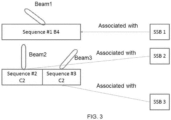
- FIG. 3 illustrates an example of collision between the receive beams of the IAB random access and random access of ordinary users.
- the ordinary terminal uses the B4 format.
- the mapped downlink signal is a sync block 1 (SSB 1).
- SSB 1 sync block 1
- an IAB node uses a C2 format. Since C2 is shorter than B4, it is possible to have two consecutive random access sequences 2 and 3 in the time slot, and the corresponding mapped sync blocks are 2 and 3.
- the base station may use either receive beam 1 corresponding to sync block 1 or receive beams 2 and 3 corresponding to sync blocks 2 and 3 at this random access opportunity (RO: RACH occasion). If the base station uses beam1, this is not the best beam for sequences 2 and 3, and if the base station uses beam2 and beam3, these are not the best beams for sequence 1. A single best beam cannot fit for all situations.
- one way to solve the conflict problem is still to configure the random access time-frequency resources of IAB nodes and the random access time-frequency resources of ordinary terminals independently, and to ensure that there is no overlap between them.
- the sub-optimal method is the independent configuration of both time-frequency resources, but allows a certain percentage of overlap. If it is indeed because of resource limitation, the random access time-frequency resources of the IAB node and the ordinary terminal cannot be configured independently, then it is beneficial to ensure that the downlink signals mapped by the corresponding random access occasions on the same time-frequency resource are consistent.
- an ordinary terminal uses the B4 format.
- the mapped downlink signal is a sync block 1
- the IAB node uses a C2 format
- the successive random access sequences 2 and 3 must also have a mapped sync block of 1.
- This particular mapping relationship guarantees that it is not difficult to implement because the ratio of the number of available B4 and C2 in a time slot is determined, and the mapping relationship between the downlink signal and the random access occasion can be set according to this ratio. For example, if the mapping relationship between the downlink signal and the random access opportunity is set to 1:1 for the B4 format, the mapping relationship between the downlink signal and the random access opportunity configured in the C2 format is 1:2.
- the IAB node is a hybrid of a network node and a terminal.
- the node itself has an independent cell identifier (Cell ID) and independent radio resource management capability.
- Cell ID cell identifier
- the IAB node can configure random access parameters that are independent of ordinary terminals for IAB terminals within the coverage of the IAB node. Since the conventional coverage controlled by IAB nodes is much smaller than that of the ordinary anchor base station , and the multi-antenna capability of IAB is also different from that of anchor base stations, it is also useful to configure the IAB terminals within the coverage of IAB nodes to be independent of ordinary terminal's random access parameters.
- the random access format A1 is configured for the IAB terminal that within the coverage of the IAB node, and the random access format of the terminal under the control of the anchor node or the IAB parent node base station is B4, and the total length of the random access format A1 sequence is shorter.
- the IAB node should therefore configure the IAB terminal with a random access root sequence and Ncs independent of the normal terminal and the IAB node.
- the parameters of the random access procedure, configured by the IAB node to the IAB terminal, may also be reported to the IAB donor or the IAB parent node. Reporting the corresponding random access resource parameter is beneficial to the IAB donor or the IAB parent node to properly configure the RACH resources of the IAB node and the IAB node to receive the downlink backhaul link resources according to the RACH resources of the IAB terminal so as to avoid the collision with RACH access link of the IAB terminal. Resolving resource conflicts on the access link is especially important when the IAB uses wavelength division multiplexing to isolate return links and access links.
- FIG. 4 is a flowchart depiction of a method 400 of wireless communication.
- the method 400 includes configuring (402), by a first communication node, a first set of parameters related to random access procedure by a second communication node on a first communication link between the first communication node and the second communication node, and receiving (404), from the second communication node, a random access signal that uses the first set of parameters on the first communication link.
- the first communication node also provides wireless connectivity to a third communication node via a second communication link that shares at least some transmission resources with the first communication link.
- the first set of parameters includes one or more of a random access format, a random access sequence index set, a random access sequence root sequence index, a random access cyclic shift, and random access time-frequency resources.
- FIG. 5 is a flowchart depiction of an example method 500 of wireless communication.
- the method 500 includes, receiving (502), from a first communication node, a first set of parameters related to random access procedure by a second communication node on a first communication link between the first communication node and the second communication node, and transmitting (504), from the second communication node, a random access signal that uses the first set of parameters on the first communication link.
- the first communication node also provides wireless connectivity to a third communication node via a second communication link that shares at least some transmission resources with the first communication link.
- the first set of parameters includes one or more of a random access format, a random access sequence index set, a random access sequence root sequence index, a random access cyclic shift, and random access time-frequency resources.
- the first communication node may be an IAB parent node (e.g., a base station or another network node).
- the second communication node may be an IAB node and the first communication link may be a backhaul link.
- the first communication node e.g., the IAB parent node, may also be configured to provide wireless connectivity to a third communication node such as a user device or UE.
- the communication link between the first and third communication nodes may be the wireless channel to/from the user device and from/to the base station.
- the configuration of the random access format in the first set of parameters is not related to the random access format in the second set of parameters used by the third node for random access using the second communication link, and therefore these parameters may be independently assigned.
- the parameters associated with random access channel procedure may be used during methods 400 and 500. These parameters may include random access format, a random access sequence index set, a random access sequence root sequence index, a random access cyclic shift, and random access time-frequency resources. Furthermore, these parameters may be independently assigned on the first and second communication links. For example, these assignments may be based on the conditions of each communication link, and decision taken regarding which parameter to select for use on one link may not have any influence on the decision taken for the other link.
- the second communication node e.g, an IAB node
- This another network node may be an IAB node or may be a UE.
- FIG. 6 shows an example of a wireless communication apparatus 600.
- the apparatus 600 may implement the methods 400 or 500 or other techniques described in the present document.
- the apparatus 600 may be, for example, the first communication node, the second communication node, or the third communication node described herein.
- the apparatus 600 may implement functionality of a base station (e.g., eNB or gNB).
- the apparatus 600 may be used to implement a user device such as a smartphone, an IoT device, a laptop, a tablet, and so on.
- the apparatus 600 includes one or more processor 610.
- the apparatus 600 may include one or more memories 620.
- the apparatus 600 may include one or more transmitters 630.
- the apparatus 600 may include one or more receivers 640.
- the processor 610 may be configured to execute code and implement a wireless communication method such as method 400 or method 500.
- the memory 620 may be used to store processor-executable code, data, results of intermediate calculations during the execution of wireless communication methods, and so on.
- the transmitter 630 may be configured to transmit, via a network interface, at least some of the various messages and signals described herein.
- the receiver 640 may be configured to receive, via a network interface, at least some of the signals and messages described herein.
- the apparatus 600 may use multiple transmitters and or receivers, for example, for performing communication on a cellular wireless and a backhaul connection.
- the disclosed and other embodiments, modules and the functional operations described in this document can be implemented in digital electronic circuitry, or in computer software, firmware, or hardware, including the structures disclosed in this document and their structural equivalents, or in combinations of one or more of them.
- the disclosed and other embodiments can be implemented as one or more computer program products, i.e., one or more modules of computer program instructions encoded on a computer readable medium for execution by, or to control the operation of, data processing apparatus.
- the computer readable medium can be a machine-readable storage device, a machine-readable storage substrate, a memory device, a composition of matter effecting a machine-readable propagated signal, or a combination of one or more them.
- data processing apparatus encompasses all apparatus, devices, and machines for processing data, including by way of example a programmable processor, a computer, or multiple processors or computers.
- the apparatus can include, in addition to hardware, code that creates an execution environment for the computer program in question, e.g., code that constitutes processor firmware, a protocol stack, a database management system, an operating system, or a combination of one or more of them.
- a propagated signal is an artificially generated signal, e.g., a machine-generated electrical, optical, or electromagnetic signal, that is generated to encode information for transmission to suitable receiver apparatus.
- a computer program (also known as a program, software, software application, script, or code) can be written in any form of programming language, including compiled or interpreted languages, and it can be deployed in any form, including as a standalone program or as a module, component, subroutine, or other unit suitable for use in a computing environment.
- a computer program does not necessarily correspond to a file in a file system.
- a program can be stored in a portion of a file that holds other programs or data (e.g., one or more scripts stored in a markup language document), in a single file dedicated to the program in question, or in multiple coordinated files (e.g., files that store one or more modules, sub programs, or portions of code).
- a computer program can be deployed to be executed on one computer or on multiple computers that are located at one site or distributed across multiple sites and interconnected by a communication network.
- the processes and logic flows described in this document can be performed by one or more programmable processors executing one or more computer programs to perform functions by operating on input data and generating output.
- the processes and logic flows can also be performed by, and apparatus can also be implemented as, special purpose logic circuitry, e.g., an FPGA (field programmable gate array) or an ASIC (application specific integrated circuit).
- processors suitable for the execution of a computer program include, by way of example, both general and special purpose microprocessors, and any one or more processors of any kind of digital computer.
- a processor will receive instructions and data from a read only memory or a random access memory or both.
- the essential elements of a computer are a processor for performing instructions and one or more memory devices for storing instructions and data.
- a computer will also include, or be operatively coupled to receive data from or transfer data to, or both, one or more mass storage devices for storing data, e.g., magnetic, magneto optical disks, or optical disks.
- mass storage devices for storing data, e.g., magnetic, magneto optical disks, or optical disks.
- a computer need not have such devices.
- Computer readable media suitable for storing computer program instructions and data include all forms of non-volatile memory, media and memory devices, including by way of example semiconductor memory devices, e.g., EPROM, EEPROM, and flash memory devices; magnetic disks, e.g., internal hard disks or removable disks; magneto optical disks; and CD ROM and DVD-ROM disks.
- semiconductor memory devices e.g., EPROM, EEPROM, and flash memory devices
- magnetic disks e.g., internal hard disks or removable disks
- magneto optical disks e.g., CD ROM and DVD-ROM disks.
- the processor and the memory can be supplemented by, or incorporated in, special purpose logic circuitry.
Landscapes
- Engineering & Computer Science (AREA)
- Computer Networks & Wireless Communication (AREA)
- Signal Processing (AREA)
- Mobile Radio Communication Systems (AREA)
Claims (15)
- Verfahren für drahtlose Kommunikation, das aufweist:Konfigurieren (402), durch eine Basisstation, eines ersten Satzes von Parametern, die sich auf eine Direktzugriffsprozedur beziehen, wobei die Direktzugriffsprozedur durch einen integrierten Access and Backhaul, IAB, Knoten, auf einer ersten Kommunikationsverbindung zwischen der Basisstation und dem IAB-Knoten durchgeführt wird; undEmpfangen (404), durch die Basisstation, von dem IAB-Knoten, eines Direktzugriffssignals, das den ersten Satz von Parametern auf der ersten Kommunikationsverbindung verwendet;wobei eine zweite Kommunikationsverbindung zwischen der Basisstation und einem Benutzergerät, UE, mindestens einige Übertragungsressourcen für Direktzugriffsübertragungen mit der ersten Kommunikationsverbindung teilt;wobei der erste Satz von Parametern Direktzugriffs-Zeit-Frequenz-Ressourcen aufweist; wobei die Basisstation unabhängig die Zeit-Frequenz-Ressourcen für Direktzugriffs-Übertragungen für die erste Kommunikationsverbindung und die zweite Kommunikationsverbindung konfiguriert, wobei sich die mindestens einigen Übertragungsressourcen überlappen; undwobei eine Anordnung der Zeit-Frequenz-Ressourcen der für den IAB-Knoten konfigurierten Übertragungsressourcen spärlicher ist als eine Anordnung der Zeit-Frequenz-Ressourcen der für das UE konfigurierten Übertragungsressourcen.
- Verfahren nach Anspruch 1, wobei der erste Satz von Parametern ferner aufweist: ein Direktzugriffs-Format, einen Direktzugriffs-Sequenz-Root-Sequenz-Index und eine zyklische Direktzugriffs-Verschiebung.
- Verfahren nach Anspruch 1 oder 2, wobei sich die für den IAB-Knoten konfigurierten Übertragungsressourcen für Direktzugriffs-Übertragungen und die für das UE konfigurierten Übertragungsressourcen für Direktzugriffs-Übertragungen teilweise überlappen.
- System für drahtlose Kommunikation, das aufweist:
eine Basisstation, die einen Prozessor aufweist, der konfiguriert ist, um:einen ersten Satz von Parametern zu konfigurieren (402), die sich auf eine Direktzugriffsprozedur beziehen; undein Direktzugriffssignal zu empfangen (404), das den ersten Satz von Parametern auf einer ersten Kommunikationsverbindung verwendet, undeinen integrierten Access and Backhaul, IAB, Knoten, der einen Prozessor aufweist, der konfiguriert ist, um:von der Basisstation den ersten Satz von Parametern zu empfangen (502), die sich auf eine Direktzugriffsprozedur beziehen, wobei die Direktzugriffsprozedur von dem IAB-Knoten auf der ersten Kommunikationsverbindung zwischen der Basisstation und dem IAB-Knoten durchgeführt wird; unddas Direktzugriffssignal, das den ersten Satz von Parametern verwendet, an die Basisstation auf der ersten Kommunikationsverbindung zu übertragen (504);wobei die erste Kommunikationsverbindung mindestens einige Übertragungsressourcen für Direktzugriffsübertragungen mit einer zweiten Kommunikationsverbindung zwischen der Basisstation und einem Benutzergerät, UE, teilt; undwobei der erste Satz von Parametern Direktzugriffs-Zeit-Frequenz-Ressourcen aufweist; wobei die Basisstation die Zeit-Frequenz-Ressourcen für Direktzugriffs-Übertragungen unabhängig für die erste Kommunikationsverbindung und die zweite Kommunikationsverbindung konfiguriert, wobei sich die mindestens einigen Übertragungsressourcen überlappen; undwobei eine Anordnung der Zeit-Frequenz-Ressourcen der für den IAB-Knoten konfigurierten Übertragungsressourcen spärlicher ist als eine Anordnung der Zeit-Frequenz-Ressourcen der für das UE konfigurierten Übertragungsressourcen. - System nach Anspruch 4, wobei der erste Satz von Parametern ferner aufweist: ein Direktzugriffs-Format, einen Direktzugriffs-Sequenz-Root-Sequenz-Index und eine zyklische Direktzugriffs-Verschiebung.
- System nach Anspruch 4 oder 5, wobei sich die für den IAB-Knoten konfigurierten Übertragungsressourcen für Direktzugriffs-Übertragungen und die für das UE konfigurierten Übertragungsressourcen für Direktzugriffs-Übertragungen teilweise überlappen.
- Basisstation für drahtlose Kommunikation, die einen Prozessor aufweist, wobei der Prozessor konfiguriert ist, um:einen ersten Satz von Parametern zu konfigurieren (402), die sich auf ein Direktzugriffsverfahren beziehen, wobei das Direktzugriffsverfahren von einem integrierten Access and Backhaul, IAB, Knoten auf einer ersten Kommunikationsverbindung zwischen der Basisstation und dem IAB-Knoten durchgeführt wird; undvon dem IAB-Knoten ein Direktzugriffssignal zu empfangen (404), das den ersten Satz von Parametern auf der ersten Kommunikationsverbindung verwendet;wobei eine zweite Kommunikationsverbindung zwischen der Basisstation und einem Benutzergerät, UE, mindestens einige Übertragungsressourcen für Direktzugriffsübertragungen mit der ersten Kommunikationsverbindung teilt;wobei der erste Satz von Parametern Direktzugriffs-Zeit-Frequenz-Ressourcen aufweist; wobei die Basisstation die Zeit-Frequenz-Ressourcen für Direktzugriffs-Übertragungen unabhängig für die erste Kommunikationsverbindung und die zweite Kommunikationsverbindung konfiguriert, wobei sich die mindestens einigen Übertragungsressourcen überlappen; undwobei eine Anordnung der Zeit-Frequenz-Ressourcen der für den IAB-Knoten konfigurierten Übertragungsressourcen spärlicher ist als eine Anordnung der Zeit-Frequenz-Ressourcen der für das UE konfigurierten Übertragungsressourcen.
- Vorrichtung nach Anspruch 7, wobei der erste Satz von Parametern ferner aufweist: ein Direktzugriffs-Format, einen Direktzugriffs-Sequenz-Root-Sequenz-Index und eine zyklische Direktzugriffs-Verschiebung.
- Vorrichtung nach Anspruch 7 oder 8, wobei sich die für den IAB-Knoten konfigurierten Übertragungsressourcen für Direktzugriffs-Übertragungen und die für das UE konfigurierten Übertragungsressourcen für Direktzugriffs-Übertragungen teilweise überlappen.
- Verfahren, das aufweist:Konfigurieren (402), durch eine Basisstation, eines ersten Satzes von Parametern, die sich auf eine Direktzugriffsprozedur beziehen, wobei die Direktzugriffsprozedur durch den IAB-Knoten auf der ersten Kommunikationsverbindung zwischen der Basisstation und dem IAB-Knoten durchgeführt wird;Empfangen (502), durch einen integrierten Access and Backhaul, IAB, Knoten, von der Basisstation, des ersten Satzes von Parametern;Übertragen (504), durch den IAB-Knoten an die Basisstation, eines Direktzugriffssignals, das den ersten Satz von Parametern auf der ersten Kommunikationsverbindung verwendet; undEmpfangen (404), durch die Basisstation von dem IAB-Knoten, des Direktzugriffssignals, das den ersten Satz von Parametern auf der ersten Kommunikationsverbindung verwendet;wobei die erste Kommunikationsverbindung mindestens einige Übertragungsressourcen für Direktzugriffsübertragungen mit einer zweiten Kommunikationsverbindung zwischen der Basisstation und einem Benutzergerät, UE, teilt; undwobei der erste Satz von Parametern Direktzugriffs-Zeit-Frequenz-Ressourcen aufweist; wobei die Basisstation die Zeit-Frequenz-Ressourcen für Direktzugriffs-Übertragungen unabhängig für die erste Kommunikationsverbindung und die zweite Kommunikationsverbindung konfiguriert, wobei sich die mindestens einigen Übertragungsressourcen überlappen; undwobei eine Anordnung der Zeit-Frequenz-Ressourcen der für den IAB-Knoten konfigurierten Übertragungsressourcen spärlicher ist als eine Anordnung der Zeit-Frequenz-Ressourcen der für das UE konfigurierten Übertragungsressourcen.
- Verfahren nach Anspruch 10, wobei der erste Satz von Parametern ferner aufweist: ein Direktzugriffs-Format, einen Direktzugriffs-Sequenz-Root-Sequenz-Index und eine zyklische Direktzugriffs-Verschiebung.
- Verfahren nach Anspruch 10 oder 11, wobei sich die für den IAB-Knoten konfigurierten Übertragungsressourcen für Direktzugriffs-Übertragungen und die für das UE konfigurierten Übertragungsressourcen für Direktzugriffs-Übertragungen teilweise überlappen.
- Computerprogrammprodukt, das ein computerlesbares Programmmedium aufweist, auf dem Code gespeichert ist, wobei der Code, wenn er von einem Prozessor ausgeführt wird, den Prozessor veranlasst:einen ersten Satz von Parametern zu konfigurieren (402), die sich auf eine Direktzugriffsprozedur beziehen, wobei die Direktzugriffsprozedur von einem integrierten Access and Backhaul, IAB, Knoten auf einer ersten Kommunikationsverbindung zwischen einer Basisstation und dem IAB-Knoten durchgeführt wird; undvon dem IAB-Knoten ein Direktzugriffssignal zu empfangen (404), das den ersten Satz von Parametern auf der ersten Kommunikationsverbindung verwendet;wobei eine zweite Kommunikationsverbindung zwischen der Basisstation und einem Benutzergerät, UE, mindestens einige Übertragungsressourcen für Direktzugriffsübertragungen mit der ersten Kommunikationsverbindung teilt;wobei der erste Satz von Parametern Direktzugriffs-Zeit-Frequenz-Ressourcen aufweist; wobei die Basisstation die Zeit-Frequenz-Ressourcen für Direktzugriffs-Übertragungen unabhängig für die erste Kommunikationsverbindung und die zweite Kommunikationsverbindung konfiguriert, wobei sich die mindestens einigen Übertragungsressourcen überlappen; undwobei eine Anordnung der Zeit-Frequenz-Ressourcen der für den IAB-Knoten konfigurierten Übertragungsressourcen spärlicher ist als eine Anordnung der Zeit-Frequenz-Ressourcen der für das UE konfigurierten Übertragungsressourcen.
- Computerprogrammprodukt nach Anspruch 13, wobei der erste Satz von Parametern ferner aufweist: ein Direktzugriffs-Format, einen Direktzugriffs-Sequenz-Root-Sequenz-Index und eine zyklische Direktzugriffs-Verschiebung.
- Computerprogrammprodukt nach Anspruch 13 oder 14, wobei sich die für den IAB-Knoten konfigurierten Übertragungsressourcen für Direktzugriffs-Übertragungen und die für das UE konfigurierten Übertragungsressourcen für Direktzugriffs-Übertragungen teilweise überlappen.
Priority Applications (1)
| Application Number | Priority Date | Filing Date | Title |
|---|---|---|---|
| EP25171027.3A EP4608043A3 (de) | 2018-07-10 | 2018-07-10 | Direktzugriffsressourcenzuweisung für integrierte zugangs- und backhaul-knoten |
Applications Claiming Priority (1)
| Application Number | Priority Date | Filing Date | Title |
|---|---|---|---|
| PCT/CN2018/095064 WO2020010498A1 (en) | 2018-07-10 | 2018-07-10 | Random access resource allocation for integrated access and backhaul nodes |
Related Child Applications (2)
| Application Number | Title | Priority Date | Filing Date |
|---|---|---|---|
| EP25171027.3A Division EP4608043A3 (de) | 2018-07-10 | 2018-07-10 | Direktzugriffsressourcenzuweisung für integrierte zugangs- und backhaul-knoten |
| EP25171027.3A Division-Into EP4608043A3 (de) | 2018-07-10 | 2018-07-10 | Direktzugriffsressourcenzuweisung für integrierte zugangs- und backhaul-knoten |
Publications (3)
| Publication Number | Publication Date |
|---|---|
| EP3821573A1 EP3821573A1 (de) | 2021-05-19 |
| EP3821573A4 EP3821573A4 (de) | 2021-07-21 |
| EP3821573B1 true EP3821573B1 (de) | 2025-05-21 |
Family
ID=69143300
Family Applications (2)
| Application Number | Title | Priority Date | Filing Date |
|---|---|---|---|
| EP18925774.4A Active EP3821573B1 (de) | 2018-07-10 | 2018-07-10 | Betriebsmittelzuteilung mit wahlfreiem zugriff für integrierte zugangs- und backhaul-knoten |
| EP25171027.3A Pending EP4608043A3 (de) | 2018-07-10 | 2018-07-10 | Direktzugriffsressourcenzuweisung für integrierte zugangs- und backhaul-knoten |
Family Applications After (1)
| Application Number | Title | Priority Date | Filing Date |
|---|---|---|---|
| EP25171027.3A Pending EP4608043A3 (de) | 2018-07-10 | 2018-07-10 | Direktzugriffsressourcenzuweisung für integrierte zugangs- und backhaul-knoten |
Country Status (8)
| Country | Link |
|---|---|
| US (2) | US11457481B2 (de) |
| EP (2) | EP3821573B1 (de) |
| JP (2) | JP7353304B2 (de) |
| KR (1) | KR102453510B1 (de) |
| CN (2) | CN112470435A (de) |
| ES (1) | ES3028911T3 (de) |
| RU (1) | RU2757673C1 (de) |
| WO (1) | WO2020010498A1 (de) |
Families Citing this family (11)
| Publication number | Priority date | Publication date | Assignee | Title |
|---|---|---|---|---|
| EP3821573B1 (de) * | 2018-07-10 | 2025-05-21 | ZTE Corporation | Betriebsmittelzuteilung mit wahlfreiem zugriff für integrierte zugangs- und backhaul-knoten |
| US11496970B2 (en) | 2019-03-06 | 2022-11-08 | Qualcomm Incorporated | Support of high pathloss mode |
| US11477747B2 (en) | 2019-04-17 | 2022-10-18 | Qualcomm Incorporated | Synchronization signal periodicity adjustment |
| US11463964B2 (en) | 2019-04-17 | 2022-10-04 | Qualcomm Incorporated | Communication configuration for high pathloss operations |
| US11438808B2 (en) | 2019-04-17 | 2022-09-06 | Qualcomm Incorporated | Acknowledgment messaging for resource reservations |
| US12335926B2 (en) | 2019-04-17 | 2025-06-17 | Qualcomm Incorporated | Beam management for high-pathloss mode operations |
| US11445408B2 (en) * | 2019-04-17 | 2022-09-13 | Qualcomm Incorporated | High pathloss mode multiplexing |
| US11510071B2 (en) | 2019-04-17 | 2022-11-22 | Qualcomm Incorporated | Beam direction selection for high pathloss mode operations |
| CN113840389B (zh) * | 2020-06-23 | 2024-05-07 | 维沃移动通信有限公司 | 随机接入资源的确定方法和自回传iab节点 |
| CN115460703B (zh) * | 2022-09-01 | 2024-11-26 | 成都中科微信息技术研究院有限公司 | 一种适用于iab网络的频谱资源分配方法及iab网络 |
| CN117979458A (zh) * | 2022-10-31 | 2024-05-03 | 华为技术有限公司 | 一种通信方法及装置 |
Citations (1)
| Publication number | Priority date | Publication date | Assignee | Title |
|---|---|---|---|---|
| US20160197667A1 (en) * | 2010-08-13 | 2016-07-07 | Fujitsu Limited | Radio communication system, base station, relay station, and radio communication method |
Family Cites Families (21)
| Publication number | Priority date | Publication date | Assignee | Title |
|---|---|---|---|---|
| US8295243B2 (en) * | 2006-08-21 | 2012-10-23 | Qualcomm Incorporated | Method and apparatus for random access in an orthogonal multiple-access communication system |
| KR101592924B1 (ko) * | 2009-02-03 | 2016-02-11 | 삼성전자주식회사 | 다중의 릴레이 노드들을 이용하는 무선통신 시스템에서 랜덤 액세스를 위한 물리채널 송수신 방법 및 장치 |
| US8774113B2 (en) * | 2009-07-07 | 2014-07-08 | Telefonaktiebolaget L M Ericsson (Publ) | Random access procedure utilizing cyclic shift of demodulation reference signal |
| US9203584B2 (en) * | 2009-11-02 | 2015-12-01 | Qualcomm Incorporated | TDM-FDM relay backhaul channel for LTE advanced |
| MX2012009337A (es) * | 2010-02-12 | 2012-11-29 | Fujitsu Ltd | Aparato de comunicacion por radio, sistema de comunicacion por radio y metodo de comunicacion por radio. |
| EP2557884B1 (de) * | 2011-08-10 | 2015-10-28 | Alcatel Lucent | Vorrichtung, Verfahren und Computerprogramm zur Durchführung einer Sendekanalzufallszugriffsprozedur |
| GB2508646A (en) * | 2012-12-07 | 2014-06-11 | Nec Corp | Exchanging initial access content by way of radio resource control signalling for pre-configuring a user device with parameters useful for relaying purposes |
| CN105493417B (zh) * | 2013-07-26 | 2018-11-09 | Lg 电子株式会社 | 发送用于mtc的信号的方法及其设备 |
| PL3462798T3 (pl) * | 2014-03-25 | 2022-04-04 | Telefonaktiebolaget Lm Ericsson (Publ) | System i sposób dla fizycznego dostępu losowego opartego na wiązce |
| US10009260B2 (en) * | 2015-06-30 | 2018-06-26 | Qualcomm Incorporated | Management of network routing domains in communication networks |
| US10136359B2 (en) * | 2015-06-30 | 2018-11-20 | Qualcomm Incorporated | Traffic flow migration in backhaul networks |
| US10499434B2 (en) * | 2015-09-25 | 2019-12-03 | Intel Corporation | Mobile terminal device and method for processing signals |
| US10206232B2 (en) * | 2016-09-29 | 2019-02-12 | At&T Intellectual Property I, L.P. | Initial access and radio resource management for integrated access and backhaul (IAB) wireless networks |
| GB2555142B (en) * | 2016-10-21 | 2019-09-04 | Canon Kk | Enhanced management of ACs in multi-user EDCA transmission mode in wireless networks |
| US11696218B2 (en) * | 2016-10-21 | 2023-07-04 | Qualcomm Incorporated | Multiplexing initial access and data transmissions in assisted millimeter wave systems |
| KR101880523B1 (ko) * | 2016-12-01 | 2018-07-20 | 한국전자통신연구원 | 무선 통신 시스템에서 랜덤 액세스 방법 및 장치 |
| US11290986B2 (en) * | 2017-07-10 | 2022-03-29 | Qualcomm Incorporated | Dynamic resource allocation in wireless network |
| US11228966B2 (en) * | 2017-07-10 | 2022-01-18 | Qualcomm Incorporated | Requesting resource allocation in a wireless backhaul network |
| US20190021084A1 (en) * | 2017-07-12 | 2019-01-17 | Futurewei Technologies, Inc. | System And Method For Backhaul and Access In Beamformed Communications Systems |
| US11184869B2 (en) * | 2018-06-26 | 2021-11-23 | Qualcomm Incorporated | Timing alignment timer in a wireless communication network |
| EP3821573B1 (de) * | 2018-07-10 | 2025-05-21 | ZTE Corporation | Betriebsmittelzuteilung mit wahlfreiem zugriff für integrierte zugangs- und backhaul-knoten |
-
2018
- 2018-07-10 EP EP18925774.4A patent/EP3821573B1/de active Active
- 2018-07-10 JP JP2020563908A patent/JP7353304B2/ja active Active
- 2018-07-10 RU RU2020143760A patent/RU2757673C1/ru active
- 2018-07-10 WO PCT/CN2018/095064 patent/WO2020010498A1/en not_active Ceased
- 2018-07-10 KR KR1020207037672A patent/KR102453510B1/ko active Active
- 2018-07-10 CN CN201880095546.6A patent/CN112470435A/zh active Pending
- 2018-07-10 ES ES18925774T patent/ES3028911T3/es active Active
- 2018-07-10 CN CN202110355593.3A patent/CN113099537B/zh active Active
- 2018-07-10 EP EP25171027.3A patent/EP4608043A3/de active Pending
-
2020
- 2020-12-01 US US17/108,974 patent/US11457481B2/en active Active
-
2022
- 2022-09-16 US US17/946,705 patent/US11974328B2/en active Active
-
2023
- 2023-01-20 JP JP2023007214A patent/JP7535607B2/ja active Active
Patent Citations (1)
| Publication number | Priority date | Publication date | Assignee | Title |
|---|---|---|---|---|
| US20160197667A1 (en) * | 2010-08-13 | 2016-07-07 | Fujitsu Limited | Radio communication system, base station, relay station, and radio communication method |
Non-Patent Citations (1)
| Title |
|---|
| AT&T: "Overview of physical layer enhancements for IAB", vol. RAN WG1, no. Sanya, China; 20180416 - 20180420, 15 April 2018 (2018-04-15), XP051426930, Retrieved from the Internet <URL:http://www.3gpp.org/ftp/Meetings%5F3GPP%5FSYNC/RAN1/Docs/> [retrieved on 20180415] * |
Also Published As
| Publication number | Publication date |
|---|---|
| CN113099537A (zh) | 2021-07-09 |
| EP4608043A2 (de) | 2025-08-27 |
| US11457481B2 (en) | 2022-09-27 |
| JP7353304B2 (ja) | 2023-09-29 |
| KR20210016422A (ko) | 2021-02-15 |
| JP2021523642A (ja) | 2021-09-02 |
| ES3028911T3 (en) | 2025-06-20 |
| JP2023052547A (ja) | 2023-04-11 |
| EP4608043A3 (de) | 2025-09-03 |
| US20210084693A1 (en) | 2021-03-18 |
| WO2020010498A1 (en) | 2020-01-16 |
| US20230020000A1 (en) | 2023-01-19 |
| JP7535607B2 (ja) | 2024-08-16 |
| CN112470435A (zh) | 2021-03-09 |
| KR102453510B1 (ko) | 2022-10-11 |
| EP3821573A4 (de) | 2021-07-21 |
| EP3821573A1 (de) | 2021-05-19 |
| RU2757673C1 (ru) | 2021-10-20 |
| CN113099537B (zh) | 2023-02-24 |
| US11974328B2 (en) | 2024-04-30 |
Similar Documents
| Publication | Publication Date | Title |
|---|---|---|
| US11974328B2 (en) | Random access resource allocation for integrated access and backhaul nodes | |
| KR102831601B1 (ko) | 데이터를 전송하기 위한 방법, 단말 장치 및 네트워크 장치 | |
| AU2017215885B2 (en) | User equipment and random access method | |
| CN110431813B (zh) | 用于发送/接收随机接入前导的方法和装置 | |
| RU2769943C1 (ru) | Способ, устройство и система для конфигурации информации синхронизации и носитель данных | |
| CN109392107B (zh) | 一种通信的方法和装置 | |
| US11310726B2 (en) | Resource allocation and timing handling in cellular mesh networks | |
| US11832312B2 (en) | Method and apparatus for random access in wireless communication system | |
| US9184893B2 (en) | Backhaul link subframe structure in mobile communication system and method for transmitting information thereof | |
| US20240260078A1 (en) | Apparatus and method for performing random access | |
| CN117099342A (zh) | 用于侧行通信的方法及装置 | |
| WO2017198063A1 (en) | Random access procedure and burst transmission in a high frequency system | |
| US20200337000A1 (en) | Device and method for performing wireless backhaul communication in wireless communication system | |
| US10383038B2 (en) | Apparatus and methods for providing and receiving system information in a wireless communications network | |
| US20250125857A1 (en) | Method and system for beam indication in wireless network | |
| KR20160094192A (ko) | 무선 통신 시스템에서 laa를 위한 프레임 구조, 이를 이용하는 방법 및 장치 |
Legal Events
| Date | Code | Title | Description |
|---|---|---|---|
| STAA | Information on the status of an ep patent application or granted ep patent |
Free format text: STATUS: THE INTERNATIONAL PUBLICATION HAS BEEN MADE |
|
| PUAI | Public reference made under article 153(3) epc to a published international application that has entered the european phase |
Free format text: ORIGINAL CODE: 0009012 |
|
| STAA | Information on the status of an ep patent application or granted ep patent |
Free format text: STATUS: REQUEST FOR EXAMINATION WAS MADE |
|
| 17P | Request for examination filed |
Effective date: 20210201 |
|
| AK | Designated contracting states |
Kind code of ref document: A1 Designated state(s): AL AT BE BG CH CY CZ DE DK EE ES FI FR GB GR HR HU IE IS IT LI LT LU LV MC MK MT NL NO PL PT RO RS SE SI SK SM TR |
|
| A4 | Supplementary search report drawn up and despatched |
Effective date: 20210622 |
|
| RIC1 | Information provided on ipc code assigned before grant |
Ipc: H04L 12/709 20130101AFI20210616BHEP |
|
| DAV | Request for validation of the european patent (deleted) | ||
| DAX | Request for extension of the european patent (deleted) | ||
| STAA | Information on the status of an ep patent application or granted ep patent |
Free format text: STATUS: EXAMINATION IS IN PROGRESS |
|
| 17Q | First examination report despatched |
Effective date: 20230104 |
|
| REG | Reference to a national code |
Ipc: H04W0074083300 Ref country code: DE Ref legal event code: R079 Ref document number: 602018082220 Country of ref document: DE Free format text: PREVIOUS MAIN CLASS: H04L0012709000 |
|
| GRAP | Despatch of communication of intention to grant a patent |
Free format text: ORIGINAL CODE: EPIDOSNIGR1 |
|
| STAA | Information on the status of an ep patent application or granted ep patent |
Free format text: STATUS: GRANT OF PATENT IS INTENDED |
|
| RIC1 | Information provided on ipc code assigned before grant |
Ipc: H04W 74/00 20090101ALI20241210BHEP Ipc: H04W 74/0833 20240101AFI20241210BHEP |
|
| INTG | Intention to grant announced |
Effective date: 20250109 |
|
| GRAS | Grant fee paid |
Free format text: ORIGINAL CODE: EPIDOSNIGR3 |
|
| GRAA | (expected) grant |
Free format text: ORIGINAL CODE: 0009210 |
|
| STAA | Information on the status of an ep patent application or granted ep patent |
Free format text: STATUS: THE PATENT HAS BEEN GRANTED |
|
| AK | Designated contracting states |
Kind code of ref document: B1 Designated state(s): AL AT BE BG CH CY CZ DE DK EE ES FI FR GB GR HR HU IE IS IT LI LT LU LV MC MK MT NL NO PL PT RO RS SE SI SK SM TR |
|
| REG | Reference to a national code |
Ref country code: GB Ref legal event code: FG4D |
|
| REG | Reference to a national code |
Ref country code: CH Ref legal event code: EP |
|
| REG | Reference to a national code |
Ref country code: DE Ref legal event code: R096 Ref document number: 602018082220 Country of ref document: DE |
|
| REG | Reference to a national code |
Ref country code: IE Ref legal event code: FG4D |
|
| REG | Reference to a national code |
Ref country code: ES Ref legal event code: FG2A Ref document number: 3028911 Country of ref document: ES Kind code of ref document: T3 Effective date: 20250620 |
|
| REG | Reference to a national code |
Ref country code: NL Ref legal event code: FP |
|
| PGFP | Annual fee paid to national office [announced via postgrant information from national office to epo] |
Ref country code: GB Payment date: 20250612 Year of fee payment: 8 |
|
| PGFP | Annual fee paid to national office [announced via postgrant information from national office to epo] |
Ref country code: NL Payment date: 20250613 Year of fee payment: 8 |
|
| PGFP | Annual fee paid to national office [announced via postgrant information from national office to epo] |
Ref country code: FR Payment date: 20250610 Year of fee payment: 8 |
|
| REG | Reference to a national code |
Ref country code: SE Ref legal event code: TRGR |
|
| PGFP | Annual fee paid to national office [announced via postgrant information from national office to epo] |
Ref country code: SE Payment date: 20250610 Year of fee payment: 8 |
|
| PG25 | Lapsed in a contracting state [announced via postgrant information from national office to epo] |
Ref country code: FI Free format text: LAPSE BECAUSE OF FAILURE TO SUBMIT A TRANSLATION OF THE DESCRIPTION OR TO PAY THE FEE WITHIN THE PRESCRIBED TIME-LIMIT Effective date: 20250521 Ref country code: PT Free format text: LAPSE BECAUSE OF FAILURE TO SUBMIT A TRANSLATION OF THE DESCRIPTION OR TO PAY THE FEE WITHIN THE PRESCRIBED TIME-LIMIT Effective date: 20250922 |
|
| PGFP | Annual fee paid to national office [announced via postgrant information from national office to epo] |
Ref country code: ES Payment date: 20250805 Year of fee payment: 8 |
|
| PGFP | Annual fee paid to national office [announced via postgrant information from national office to epo] |
Ref country code: DE Payment date: 20250611 Year of fee payment: 8 |
|
| REG | Reference to a national code |
Ref country code: LT Ref legal event code: MG9D |
|
| PG25 | Lapsed in a contracting state [announced via postgrant information from national office to epo] |
Ref country code: NO Free format text: LAPSE BECAUSE OF FAILURE TO SUBMIT A TRANSLATION OF THE DESCRIPTION OR TO PAY THE FEE WITHIN THE PRESCRIBED TIME-LIMIT Effective date: 20250821 Ref country code: GR Free format text: LAPSE BECAUSE OF FAILURE TO SUBMIT A TRANSLATION OF THE DESCRIPTION OR TO PAY THE FEE WITHIN THE PRESCRIBED TIME-LIMIT Effective date: 20250822 |
|
| PG25 | Lapsed in a contracting state [announced via postgrant information from national office to epo] |
Ref country code: PL Free format text: LAPSE BECAUSE OF FAILURE TO SUBMIT A TRANSLATION OF THE DESCRIPTION OR TO PAY THE FEE WITHIN THE PRESCRIBED TIME-LIMIT Effective date: 20250521 |
|
| PG25 | Lapsed in a contracting state [announced via postgrant information from national office to epo] |
Ref country code: BG Free format text: LAPSE BECAUSE OF FAILURE TO SUBMIT A TRANSLATION OF THE DESCRIPTION OR TO PAY THE FEE WITHIN THE PRESCRIBED TIME-LIMIT Effective date: 20250521 |
|
| PG25 | Lapsed in a contracting state [announced via postgrant information from national office to epo] |
Ref country code: HR Free format text: LAPSE BECAUSE OF FAILURE TO SUBMIT A TRANSLATION OF THE DESCRIPTION OR TO PAY THE FEE WITHIN THE PRESCRIBED TIME-LIMIT Effective date: 20250521 |
|
| PG25 | Lapsed in a contracting state [announced via postgrant information from national office to epo] |
Ref country code: RS Free format text: LAPSE BECAUSE OF FAILURE TO SUBMIT A TRANSLATION OF THE DESCRIPTION OR TO PAY THE FEE WITHIN THE PRESCRIBED TIME-LIMIT Effective date: 20250821 |
|
| PG25 | Lapsed in a contracting state [announced via postgrant information from national office to epo] |
Ref country code: IS Free format text: LAPSE BECAUSE OF FAILURE TO SUBMIT A TRANSLATION OF THE DESCRIPTION OR TO PAY THE FEE WITHIN THE PRESCRIBED TIME-LIMIT Effective date: 20250921 |
|
| PG25 | Lapsed in a contracting state [announced via postgrant information from national office to epo] |
Ref country code: LV Free format text: LAPSE BECAUSE OF FAILURE TO SUBMIT A TRANSLATION OF THE DESCRIPTION OR TO PAY THE FEE WITHIN THE PRESCRIBED TIME-LIMIT Effective date: 20250521 |
|
| REG | Reference to a national code |
Ref country code: AT Ref legal event code: MK05 Ref document number: 1798003 Country of ref document: AT Kind code of ref document: T Effective date: 20250521 |
|
| PG25 | Lapsed in a contracting state [announced via postgrant information from national office to epo] |
Ref country code: AT Free format text: LAPSE BECAUSE OF FAILURE TO SUBMIT A TRANSLATION OF THE DESCRIPTION OR TO PAY THE FEE WITHIN THE PRESCRIBED TIME-LIMIT Effective date: 20250521 Ref country code: DK Free format text: LAPSE BECAUSE OF FAILURE TO SUBMIT A TRANSLATION OF THE DESCRIPTION OR TO PAY THE FEE WITHIN THE PRESCRIBED TIME-LIMIT Effective date: 20250521 Ref country code: SM Free format text: LAPSE BECAUSE OF FAILURE TO SUBMIT A TRANSLATION OF THE DESCRIPTION OR TO PAY THE FEE WITHIN THE PRESCRIBED TIME-LIMIT Effective date: 20250521 |
|
| PG25 | Lapsed in a contracting state [announced via postgrant information from national office to epo] |
Ref country code: CZ Free format text: LAPSE BECAUSE OF FAILURE TO SUBMIT A TRANSLATION OF THE DESCRIPTION OR TO PAY THE FEE WITHIN THE PRESCRIBED TIME-LIMIT Effective date: 20250521 |
|
| PG25 | Lapsed in a contracting state [announced via postgrant information from national office to epo] |
Ref country code: EE Free format text: LAPSE BECAUSE OF FAILURE TO SUBMIT A TRANSLATION OF THE DESCRIPTION OR TO PAY THE FEE WITHIN THE PRESCRIBED TIME-LIMIT Effective date: 20250521 |
|
| PG25 | Lapsed in a contracting state [announced via postgrant information from national office to epo] |
Ref country code: RO Free format text: LAPSE BECAUSE OF FAILURE TO SUBMIT A TRANSLATION OF THE DESCRIPTION OR TO PAY THE FEE WITHIN THE PRESCRIBED TIME-LIMIT Effective date: 20250521 Ref country code: SK Free format text: LAPSE BECAUSE OF FAILURE TO SUBMIT A TRANSLATION OF THE DESCRIPTION OR TO PAY THE FEE WITHIN THE PRESCRIBED TIME-LIMIT Effective date: 20250521 |
|
| PG25 | Lapsed in a contracting state [announced via postgrant information from national office to epo] |
Ref country code: IT Free format text: LAPSE BECAUSE OF FAILURE TO SUBMIT A TRANSLATION OF THE DESCRIPTION OR TO PAY THE FEE WITHIN THE PRESCRIBED TIME-LIMIT Effective date: 20250521 |
|
| REG | Reference to a national code |
Ref country code: CH Ref legal event code: H13 Free format text: ST27 STATUS EVENT CODE: U-0-0-H10-H13 (AS PROVIDED BY THE NATIONAL OFFICE) Effective date: 20260224 Ref country code: DE Ref legal event code: R097 Ref document number: 602018082220 Country of ref document: DE |
|
| PG25 | Lapsed in a contracting state [announced via postgrant information from national office to epo] |
Ref country code: LU Free format text: LAPSE BECAUSE OF NON-PAYMENT OF DUE FEES Effective date: 20250710 |
|
| REG | Reference to a national code |
Ref country code: BE Ref legal event code: MM Effective date: 20250731 |
|
| PLBE | No opposition filed within time limit |
Free format text: ORIGINAL CODE: 0009261 |
|
| STAA | Information on the status of an ep patent application or granted ep patent |
Free format text: STATUS: NO OPPOSITION FILED WITHIN TIME LIMIT |
|
| REG | Reference to a national code |
Ref country code: CH Ref legal event code: L10 Free format text: ST27 STATUS EVENT CODE: U-0-0-L10-L00 (AS PROVIDED BY THE NATIONAL OFFICE) Effective date: 20260402 |
|
| PG25 | Lapsed in a contracting state [announced via postgrant information from national office to epo] |
Ref country code: BE Free format text: LAPSE BECAUSE OF NON-PAYMENT OF DUE FEES Effective date: 20250731 |
|
| PG25 | Lapsed in a contracting state [announced via postgrant information from national office to epo] |
Ref country code: CH Free format text: LAPSE BECAUSE OF NON-PAYMENT OF DUE FEES Effective date: 20250731 |
|
| 26N | No opposition filed |
Effective date: 20260224 |