EP3822402A1 - Tissu non tissé, son procédé de fabrication et composition pour électrofilage - Google Patents
Tissu non tissé, son procédé de fabrication et composition pour électrofilage Download PDFInfo
- Publication number
- EP3822402A1 EP3822402A1 EP19833180.3A EP19833180A EP3822402A1 EP 3822402 A1 EP3822402 A1 EP 3822402A1 EP 19833180 A EP19833180 A EP 19833180A EP 3822402 A1 EP3822402 A1 EP 3822402A1
- Authority
- EP
- European Patent Office
- Prior art keywords
- woven fabric
- molecular
- composition
- aliphatic polyester
- molecular weight
- Prior art date
- Legal status (The legal status is an assumption and is not a legal conclusion. Google has not performed a legal analysis and makes no representation as to the accuracy of the status listed.)
- Pending
Links
Images








Classifications
-
- D—TEXTILES; PAPER
- D04—BRAIDING; LACE-MAKING; KNITTING; TRIMMINGS; NON-WOVEN FABRICS
- D04H—MAKING TEXTILE FABRICS, e.g. FROM FIBRES OR FILAMENTARY MATERIAL; FABRICS MADE BY SUCH PROCESSES OR APPARATUS, e.g. FELTS, NON-WOVEN FABRICS; COTTON-WOOL; WADDING ; NON-WOVEN FABRICS FROM STAPLE FIBRES, FILAMENTS OR YARNS, BONDED WITH AT LEAST ONE WEB-LIKE MATERIAL DURING THEIR CONSOLIDATION
- D04H1/00—Non-woven fabrics formed wholly or mainly of staple fibres or like relatively short fibres
- D04H1/40—Non-woven fabrics formed wholly or mainly of staple fibres or like relatively short fibres from fleeces or layers composed of fibres without existing or potential cohesive properties
- D04H1/54—Non-woven fabrics formed wholly or mainly of staple fibres or like relatively short fibres from fleeces or layers composed of fibres without existing or potential cohesive properties by welding together the fibres, e.g. by partially melting or dissolving
- D04H1/542—Adhesive fibres
- D04H1/55—Polyesters
-
- C—CHEMISTRY; METALLURGY
- C08—ORGANIC MACROMOLECULAR COMPOUNDS; THEIR PREPARATION OR CHEMICAL WORKING-UP; COMPOSITIONS BASED THEREON
- C08L—COMPOSITIONS OF MACROMOLECULAR COMPOUNDS
- C08L67/00—Compositions of polyesters obtained by reactions forming a carboxylic ester link in the main chain; Compositions of derivatives of such polymers
- C08L67/04—Polyesters derived from hydroxycarboxylic acids, e.g. lactones
-
- D—TEXTILES; PAPER
- D01—NATURAL OR MAN-MADE THREADS OR FIBRES; SPINNING
- D01D—MECHANICAL METHODS OR APPARATUS IN THE MANUFACTURE OF ARTIFICIAL FILAMENTS, THREADS, FIBRES, BRISTLES OR RIBBONS
- D01D5/00—Formation of filaments, threads, or the like
- D01D5/0007—Electro-spinning
-
- D—TEXTILES; PAPER
- D01—NATURAL OR MAN-MADE THREADS OR FIBRES; SPINNING
- D01F—CHEMICAL FEATURES IN THE MANUFACTURE OF ARTIFICIAL FILAMENTS, THREADS, FIBRES, BRISTLES OR RIBBONS; APPARATUS SPECIALLY ADAPTED FOR THE MANUFACTURE OF CARBON FILAMENTS
- D01F6/00—Monocomponent artificial filaments or the like of synthetic polymers; Manufacture thereof
- D01F6/58—Monocomponent artificial filaments or the like of synthetic polymers; Manufacture thereof from homopolycondensation products
- D01F6/62—Monocomponent artificial filaments or the like of synthetic polymers; Manufacture thereof from homopolycondensation products from polyesters
-
- D—TEXTILES; PAPER
- D01—NATURAL OR MAN-MADE THREADS OR FIBRES; SPINNING
- D01F—CHEMICAL FEATURES IN THE MANUFACTURE OF ARTIFICIAL FILAMENTS, THREADS, FIBRES, BRISTLES OR RIBBONS; APPARATUS SPECIALLY ADAPTED FOR THE MANUFACTURE OF CARBON FILAMENTS
- D01F6/00—Monocomponent artificial filaments or the like of synthetic polymers; Manufacture thereof
- D01F6/58—Monocomponent artificial filaments or the like of synthetic polymers; Manufacture thereof from homopolycondensation products
- D01F6/62—Monocomponent artificial filaments or the like of synthetic polymers; Manufacture thereof from homopolycondensation products from polyesters
- D01F6/625—Monocomponent artificial filaments or the like of synthetic polymers; Manufacture thereof from homopolycondensation products from polyesters derived from hydroxy-carboxylic acids, e.g. lactones
-
- D—TEXTILES; PAPER
- D04—BRAIDING; LACE-MAKING; KNITTING; TRIMMINGS; NON-WOVEN FABRICS
- D04H—MAKING TEXTILE FABRICS, e.g. FROM FIBRES OR FILAMENTARY MATERIAL; FABRICS MADE BY SUCH PROCESSES OR APPARATUS, e.g. FELTS, NON-WOVEN FABRICS; COTTON-WOOL; WADDING ; NON-WOVEN FABRICS FROM STAPLE FIBRES, FILAMENTS OR YARNS, BONDED WITH AT LEAST ONE WEB-LIKE MATERIAL DURING THEIR CONSOLIDATION
- D04H1/00—Non-woven fabrics formed wholly or mainly of staple fibres or like relatively short fibres
- D04H1/40—Non-woven fabrics formed wholly or mainly of staple fibres or like relatively short fibres from fleeces or layers composed of fibres without existing or potential cohesive properties
- D04H1/42—Non-woven fabrics formed wholly or mainly of staple fibres or like relatively short fibres from fleeces or layers composed of fibres without existing or potential cohesive properties characterised by the use of certain kinds of fibres insofar as this use has no preponderant influence on the consolidation of the fleece
- D04H1/4326—Condensation or reaction polymers
- D04H1/435—Polyesters
-
- D—TEXTILES; PAPER
- D04—BRAIDING; LACE-MAKING; KNITTING; TRIMMINGS; NON-WOVEN FABRICS
- D04H—MAKING TEXTILE FABRICS, e.g. FROM FIBRES OR FILAMENTARY MATERIAL; FABRICS MADE BY SUCH PROCESSES OR APPARATUS, e.g. FELTS, NON-WOVEN FABRICS; COTTON-WOOL; WADDING ; NON-WOVEN FABRICS FROM STAPLE FIBRES, FILAMENTS OR YARNS, BONDED WITH AT LEAST ONE WEB-LIKE MATERIAL DURING THEIR CONSOLIDATION
- D04H1/00—Non-woven fabrics formed wholly or mainly of staple fibres or like relatively short fibres
- D04H1/70—Non-woven fabrics formed wholly or mainly of staple fibres or like relatively short fibres characterised by the method of forming fleeces or layers, e.g. reorientation of fibres
- D04H1/72—Non-woven fabrics formed wholly or mainly of staple fibres or like relatively short fibres characterised by the method of forming fleeces or layers, e.g. reorientation of fibres the fibres being randomly arranged
- D04H1/728—Non-woven fabrics formed wholly or mainly of staple fibres or like relatively short fibres characterised by the method of forming fleeces or layers, e.g. reorientation of fibres the fibres being randomly arranged by electro-spinning
-
- D—TEXTILES; PAPER
- D10—INDEXING SCHEME ASSOCIATED WITH SUBLASSES OF SECTION D, RELATING TO TEXTILES
- D10B—INDEXING SCHEME ASSOCIATED WITH SUBLASSES OF SECTION D, RELATING TO TEXTILES
- D10B2331/00—Fibres made from polymers obtained otherwise than by reactions only involving carbon-to-carbon unsaturated bonds, e.g. polycondensation products
- D10B2331/04—Fibres made from polymers obtained otherwise than by reactions only involving carbon-to-carbon unsaturated bonds, e.g. polycondensation products polyesters, e.g. polyethylene terephthalate [PET]
-
- D—TEXTILES; PAPER
- D10—INDEXING SCHEME ASSOCIATED WITH SUBLASSES OF SECTION D, RELATING TO TEXTILES
- D10B—INDEXING SCHEME ASSOCIATED WITH SUBLASSES OF SECTION D, RELATING TO TEXTILES
- D10B2401/00—Physical properties
- D10B2401/12—Physical properties biodegradable
Definitions
- the present invention relates to a non-woven fabric, a method for producing a non-woven fabric, and a composition for electrospinning.
- a method for forming a non-woven fabric comprising ultrafine fibers by employing an electrospinning method is known. Also the development of a technique for forming the ultrafine fibers using a biodegradable polymer and using the ultrafine fibers for medical purposes has been progressing.
- Patent Document 1 discloses "a stacked non-woven fabric comprising a plurality of long-fiber non-woven fabrics which are stacked on each other while partially heat-fusing the long-fiber non-woven fabrics to each other, wherein each of the long-fiber non-woven fabrics has such a structure that a fiber structure layer (A) which is composed of long fibers made from a biodegradable polymer and has a bulk density of 150 to 200 kg/m 3 is continuously compounded with a fiber structure layer (B) which is composed of long fibers made from a biodegradable polymer and has a bulk density of 5 to 30 kg/m 3 ".
- A which is composed of long fibers made from a biodegradable polymer and has a bulk density of 150 to 200 kg/m 3
- B which is composed of long fibers made from a biodegradable polymer and has a bulk density of 5 to 30 kg/m 3
- Patent Document 1 Japanese Patent Laid-Open No. 2014-4705
- Patent Document 1 The present inventors have made studies, and have found that the non-woven fabric disclosed in Patent Document 1 has room for improvement in biodegradability. In these situations, the present invention addresses the problem of providing a non-woven fabric having excellent biodegradability.
- the present invention also addresses the problem of providing a method for producing a non-woven fabric and a composition for electrospinning.
- the present inventors have made extensive and intensive studies for the purpose of solving the problems. As a result, it is found that the problems can be solved by the following configurations.
- a non-woven fabric having excellent biodegradability can be provided.
- a method for producing a non-woven fabric and a composition for electrospinning can be provided.
- group (atom group) in the description, a wording expressed without a term “substituted” or “unsubstituted” includes both of a group having no substituent and a group having a substituent as long as the effects of the present invention cannot be impaired.
- alkyl group includes an alkyl group having no substituent (i.e., an unsubstituted alkyl group) as well as an alkyl group having a substituent (i.e., a substituted alkyl group). The same is applied to each compound.
- (meth)acrylate refers to both or either one of “acrylate” and “methacrylate
- (meth)acrylic refers to both or either one of “acrylic” and “methacrylic”.
- (meth)acryloyl refers to both or either one of “acryloyl” and “methacryloyl”.
- the non-woven fabric according to the embodiment of the present invention is a non-woven fabric comprising fibers comprising an aliphatic polyester that has at least two maximum values in a molecular weight distribution thereof, wherein the fibers have a fiber diameter falling within the range of 100 to 3000 nm.
- non-woven fabric refers to a sheet-like member made from fibers, and typically refers to a web in which individual fibers are combined randomly and which does not have a repeating pattern as observed in a woven fabric or a knitted fabric.
- the individual fibers may have a stacked form, or the individual fibers may be fused to each other, or the form of the fibers may be a combination of these forms.
- the non-woven fabric is generally formed by stacking fibers spun from a composition for electrospinning on the main surface of a base material placed on an electrode.
- the composition for electrospinning contains a solvent
- the solvent that remains in an extremely small amount in the fibers is rapidly evaporated at the stage where the fibers are stacked on the main surface of the base material.
- the fibers may be fused to each other due to the relationship with the evaporation rate.
- the non-woven fabric according to the embodiment of the present invention may have such a structure that the fibers constituting the non-woven fabric are stacked or such a structure that some of the fibers constituting the non-woven fabric may be fused to each other.
- the fiber diameter of the fibers constituting the non-woven fabric is not particularly limited, as long as the fiber diameter falls within the range of 100 to 3000 nm.
- the fiber diameter is 100 nm or more, the non-woven fabric can have excellent structural stability.
- the fiber diameter is 3000 nm or less, the non-woven fabric can have excellent flexibility, excellent biodegradability and excellent drug release properties.
- fiber diameter of fibers refers to an average fiber diameter of fibers in a non-woven fabric, wherein the average fiber diameter is determined by observing the non-woven fabric with a scanning electron microscope and arithmetically averaging the widths of 10 or 100 fibers in a direction approximately orthogonal to the direction of the length of the fibers.
- the thickness of the non-woven fabric is not particularly limited, and may be selected appropriately depending on the intended use of the non-woven fabric.
- the thickness is preferably 1 to 1000 ⁇ m, more preferably 10 to 500 ⁇ m.
- the term "thickness of a non-woven fabric” as used herein refers to a value which is determined by measuring the thickness of a circular non-woven fabric having a diameter of about 1.2 cm at three points using a micrometer and then arithmetically averaging the measurement values.
- the mass of the non-woven fabric per unit area is not particularly limited, and may be selected appropriately depending on the intended use of the non-woven fabric.
- the non-woven fabric according to the embodiment of the present invention is formed from fibers.
- the fiber diameter of the fibers is 100 to 3000 nm as measured by a specific method.
- the fibers comprise an aliphatic polyester having a specified molecular weight distribution.
- Examples of the aliphatic polyester include: a poly(glycolic acid) such as poly( ⁇ -hydroxy acid); a poly( ⁇ -hydroxyalkanoate) such as poly( ⁇ -caprolactone) and poly( ⁇ -propiolactone); and poly-3-hydroxypropionate, poly-3-hydroxybutyrate, poly-3-hydroxycaproate, poly-3-hydroxyheptanoate and poly-3-hydrdoxyoctanoate.
- a poly(glycolic acid) such as poly( ⁇ -hydroxy acid)
- a poly( ⁇ -hydroxyalkanoate) such as poly( ⁇ -caprolactone) and poly( ⁇ -propiolactone
- poly-3-hydroxypropionate poly-3-hydroxybutyrate
- poly-3-hydroxycaproate poly-3-hydroxyheptanoate
- poly-3-hydrdoxyoctanoate poly-3-hydrdoxyoctanoate
- a copolymer of each of the above-mentioned compounds with poly-3-hydroxyvalerate or poly-4-hydroxybutyrate may also be used.
- Specific examples include poly( ⁇ -hydroxyalkanoate), polylactic acid and a copolymer of polylactic acid.
- a condensation polymer of glycol and a dicarboxylic acid can also be used.
- Specific examples of the condensation polymer include polyethylene oxalate, polyethylene succinate, polyethylene adipate, polyethylene azelate, polybutylene oxalate, polybutylene succinate, polybutylene sebacate, polyhexamethylene sebacate, polyneopentyl oxalate, and copolymers thereof.
- condensation copolymer of the aliphatic polyester and an aliphatic polyamide such as an aliphatic polyester amide copolymer
- condensation copolymer include polycapramide (nylon 6), polytetramethylene adipamide (nylon 46), polyhexamethylene adipamide (nylon 66), polyundecaneamide (nylon 11), and polylaurolactamide (nylon 12).
- a compound produced using an arbitrary diol, hydroxy acid, dicarboxylic acid or the like as a polymerization initiator for the aliphatic polyester can also be used.
- the compound include: poly( ⁇ -caprolactone) diol produced using propylene glycol or diethylene glycol as a polymerization initiator; and a poly(lactic acid-dicarboxylic acid) produced using fumaric acid as a polymerization initiator.
- the aliphatic polyester is preferably a polymer having a repeating unit represented by formula (1) or (2), more preferably a polymer composed of the repeating unit represented by formula (1) or (2).
- L represents an alkylene group (preferably having 1 to 20 carbon atoms) which may have a branched structure or an alkenylene group (preferably having 1 to 20 carbon atoms) which may have a branched structure, more preferably an alkylene group which may have a branched structure.
- R represents an alkylene group (preferably having 1 to 20 carbon atoms) which may have a branched structure or an alkenylene group (preferably having 1 to 20 carbon atoms) which may have a branched structure, may have a branched structure, and is more preferably an alkylene group.
- Each of the structures represented by these formulae may have an ester bond, an amide bond, an ether bond or the like in the structure thereof.
- the melting point of a crystal of the aliphatic polyester is not particularly limited. From the viewpoint that a non-woven fabric having more excellent effects of the present invention can be produced, the melting point is preferably 250°C or lower, more preferably 180°C or lower, still more preferably 100°C or lower, particularly preferably 70°C or lower.
- the lower limit value of the melting point is not particularly limited, and is generally preferably 30°C or higher.
- melting point of a crystal of the aliphatic polyester refers to a melting point measured by a differential scanning calorimeter (DSC).
- the aliphatic polyester has at least two maximum values in the molecular weight distribution thereof.
- the term "molecular weight distribution” as used herein refers to a molecular weight distribution obtained by comparing with poly(ethylene glycol)/poly(ethylene oxide) standards employing gel permeation chromatography (GPC) using THF as a mobile phase.
- the aliphatic polyester to be contained in the fibers has at least two maximum values in the molecular weight distribution thereof, wherein the values of the maximum values (i.e., peaks in the molecular weight distribution) are different from each other.
- the aliphatic polyester has at least two peaks (maximum values), and therefore has at least two peaks, i.e., a peak positioned on a lowest molecular weight side (also referred to as “peak A”, hereinafter) and a peak positioned on a highest molecular weight side (also referred to as “peak B”, hereinafter).
- the non-woven fabric according to the embodiment of the present invention can have excellent biodegradability.
- a component having a relatively high molecular weight which constitutes the peak B of the aliphatic polyester can improve the mechanical properties of the non-woven fabric.
- the non-woven fabric according to the embodiment of the present invention is composed of fibers each comprising an aliphatic polyester containing both of a lower-molecular-weight component and a higher-molecular-weight component. It is assumed that at least a portion of the lower-molecular-weight component is localized on the surfaces of the fibers as mentioned above and therefore the decomposition of the fibers (the non-woven fabric) tends to occur from the surfaces thereof.
- the non-woven fabric according to the embodiment of the present invention is formed from fibers having a very small diameter and therefore has a large surface area due to the structure of the fibers. Accordingly, the non-woven can exert the above-mentioned effects significantly.
- the aliphatic polyester is a polymer in which the lower-molecular-weight component and the higher-molecular-weight component are of the same type as each other. Therefore, it is considered that these components have high affinity for each other, the lower-molecular-weight component can be distributed sufficiently in a region other than the surfaces of the fibers and, as a result, the degree of crystallization of the fibers tends to become smaller as a whole.
- the non-woven fabric according to the embodiment of the present invention can have more superior biodegradability than ever due to a synergistic effect among the factors including the large surface area of the fibers, the ease of decomposition of the fibers from the surfaces of the fibers due to the presence of the lower-molecular-weight component and the ease of decomposition of the fibers in a whole due to the deterioration in the degree of crystallinity.
- the molecular weight at the peak A is not particularly limited. From the viewpoint that a non-woven fabric having more excellent biodegradability can be produced, the molecular weight can be 1000 to 10000 in terms of a number average molecular weight.
- the lower limit of the molecular weight may be 1500 or more, 2000 or more, or 2500 or more.
- the upper limit of the molecular weight may be 9000 or less, 8000 or less, 7000 or less, 6000 or less, 5000 or less, 4000 or less, or 3000 or less.
- the molecular weight at the peak B is not particularly limited. From the viewpoint that a non-woven fabric having more excellent mechanical strength can be obtained, the molecular weight can be, for example, 30000 to 200000 in terms of a number average molecular weight.
- the upper limit of the molecular weight may be 190000 or less, 180000 or less, 170000 or less, 160000 or less, 150000 or less, 140000 or less, 130000 or less, 120000 or less, or 110000 or less.
- the lower limit of the molecular weight may be 40000 or more, 50000 or more, 60000 or more, 70000 or more, or 80000 or more.
- the aliphatic polyester may have three or more maximum values in the molecular weight distribution thereof, wherein the upper limit value of the number of the maximum values is not particularly limited. In the case where the aliphatic polyester has three or more maximum values, it is preferred that each of the molecular weight of the peak A and the molecular weight of the peak B respectively fall within the above-mentioned ranges.
- the content of the aliphatic polyester in the fibers is not particularly limited. From the viewpoint that a non-woven fabric having more excellent biodegradability and more excellent biocompatibility can be produced, the content is preferably 0.01 to 100% by mass relative to the entire mass of the fibers.
- the fibers may contain a polymer other than the aliphatic polyester.
- any polymer other than the aliphatic polyester is not substantially contained.
- any polymer other than the aliphatic polyester is not substantially contained means that the fibers does not contain any polymer other than the aliphatic polyester or the content of the aliphatic polyester in the fibers is less than 0.01% by mass relative to the entire mass of the fibers.
- the fibers may contain only a single aliphatic polyester, or may contain two or more aliphatic polyesters in combination. In the case where the fibers contain two or more aliphatic polyesters, it is preferred that the total content of these aliphatic polyesters falls within the above-mentioned range.
- each of the aliphatic polyesters has at least two maximum values in the molecular weight distribution thereof.
- the type of the maximum values is as mentioned above.
- the non-woven fabric can have more excellent biodegradability, although the mechanism of the action is not known in detail.
- the non-woven fabric is produced by electrospinning a composition containing aliphatic polyesters having different maximum values from each other in the molecular weight distributions thereof.
- the composition contains a component having a peak A positioned on a lowest molecular weight side (i.e., a lower-molecular-weight component) and a component having a peak B on a highest molecular weight side (i.e., a higher-molecular-weight component) which are mentioned above.
- the content mass ratio of the content of the lower-molecular-weight component to the sum total of the contents of the lower-molecular-weight component and the higher-molecular-weight component (wherein the ratio is also referred to as "A/(A + B)", hereinafter) is not particularly limited.
- the lower limit of the ratio is preferably 0.01 or more, 0.02 or more, 0.03 or more, 0.04 or more, 0.05 or more, 0.06 or more, 0.07 or more, 0.08 or more, 0.09 or more, or 0.10 or more.
- the upper limit of the ratio is preferably 0.80 or less, more preferably 0.75 or less, still more preferably less than 0.75.
- the upper limit may be 0.60 or less, 0.50 or less, 0.40 or less, 0.30 or less, or 0.20 or less.
- the non-woven fabric can have more excellent uniformity (in other words, fiber width uniformity).
- the A/(A + B) value is determined by rounding off to two decimal places.
- the fibers may contain other component than the above-mentioned components.
- One example of the other component is a drug.
- the non-woven fabric containing a drug When the non-woven fabric containing a drug is applied to a medical device that is indwelled in a living body or is inserted into a living body upon use, the non-woven fabric can release the drug into the living body upon the decomposition of the non-woven fabric.
- the non-woven fabric containing a drug can be prepared in such a form that the shape of the non-woven fabric can be retained for a desired period of time in a living body and can be decomposed completely after a lapse of a desired period of time.
- the period for which the shape of the non-woven fabric is retained in a living body may be, for example, about one month, about two months, about three months, about four months, about five months or about six months.
- the period of time until the time when the non-woven fabric is completely decomposed may be, for example, about six months, about seven months, about eight months, about nine months, about ten months, about eleven months, or about twelve months.
- the content ratios of the lower-molecular-weight component and the higher-molecular-weight component can be varied appropriately depending on the type of the drug to be used or the intended use of the drug.
- the "A/(A + B)" value is not particularly limited, and the lower limit of the value is preferably 0.10 or more, more preferably 0.30 or more, still more preferably 0.33 or more, particularly preferably more than 0.33.
- the non-woven fabric can have more excellent biodegradability.
- the "A/(A + B)" value is not particularly limited, and is preferably 0.01 or more, 0.02 or more, 0.03 or more, 0.04 or more, 0.05 or more, 0.06 or more, 0.07 or more, 0.08 or more, or 0.09 or more, more preferably 0.10 or more and less than 0.25.
- the A/(A + B) value is 0.10 or more and less than 0.25, the drug contained in the non-woven fabric can be released for a long period and the non-woven fabric can have more excellent uniformity (in other words, uniformity in fiber width).
- the type of the drug is not particularly limited, and examples of the drug include a therapeutic agent for nerve Injuries, an anti-cancer agent, an immunosuppressing agent, an antibiotic, an anti-rheumatic agent, an anti-thrombotic drug, an HMG-CoA reductase inhibitor, an ACE inhibitor, an angiotensin II receptor blocker, an NO donor, a calcium channel blocker, an anti-hyperlipidemic drug, an antiinflammatory agent, an Integrin inhibitor, an anti-allergic agent, an antioxidant agent, a GPIIbIIIa blocker, a retinoid, a flavonoid, a carotenoid, a lipid improving drug, a DNA synthesis inhibitor, a tyrosine kinase inhibitor, an anti-platelet agent, a vascular smooth muscle growth inhibitor, a blood vessel contrast agent, an interferon, a growth factor and a combination thereof.
- a therapeutic agent for nerve Injuries an anti-cancer agent, an immunosuppressing
- the fibers may contain only a single drug, or may contain two or more drugs in combination.
- vitamin B12 An example of the therapeutic agent for nerve Injuries is vitamin B12.
- vitamin B12 include cobalamin and derivatives thereof.
- Specific examples of vitamin B12 include methylcobalamin, cyanocobalamin, hydroxocobalamin, sulphitocobalamin, adenosylcobalamin and salts thereof.
- methylcobalamin, cyanocobalamin, hydroxocobalamin or a salt thereof is preferred, and methylcobalamin or a salt thereof is more preferred.
- the content of vitamin B12 can be, for example, such an amount that the final concentration becomes about 1% to about 30%, preferably about 2% to about 10%.
- the method for producing the non-woven fabric according to the embodiment of the present invention is not particularly limited, and any known method can be employed.
- the known method include an electrospinning method, a melt-spinning method, a self-assembling method, a template synthesis method, an electroblowing method, and a forcespinning method.
- an electrospinning method is preferred from the viewpoint that a non-woven fabric having more excellent effects of the present invention can be produced.
- the composition for electrospinning is electrically charged by applying a high voltage to produce fibers, and then the fibers are stacked to produce a non-woven fabric.
- the method for electrically charging the composition for electrospinning is preferably carried out by connecting a power supply to the composition for electrospinning or a container containing the composition for electrospinning and then applying a voltage of typically preferably 1 to 100 kV, more preferably 5 to 50 kV.
- the type of the voltage may be either one of a direct current type and an alternating current type.
- the temperature to be employed for the electrospinning is not particularly limited. In the case where it is intended to produce the non-woven fabric using a composition for electrospinning containing a solvent as mentioned below, the temperature may be adjusted appropriately depending on the boiling point or volatility of the solvent contained in the composition for electrospinning. As one example, 10 to 30°C is preferred.
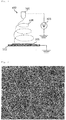
- An electrospinning device 100 is equipped with an ejection device 101 and a target electrode 102 that is arranged so as to face the ejection device 101.
- the ejection device 101 is so configured as to eject the composition for electrospinning.
- a fiber 104 is formed during the movement of the composition for electrospinning from the ejection device 101 toward the target electrode 102 and the fiber is stacked on the target electrode 102 to produce a non-woven fabric 105.
- composition for electrospinning which can be used in the case where it is intended to produce the non-woven fabric according to the embodiment of the present invention by an electrospinning method is not particularly limited. From the viewpoint that a non-woven fabric having more excellent effects of the present invention can be produced, it is preferred that the composition contains an aliphatic polyester having at least two maximum values in the molecular weight distribution thereof and a solvent.
- the aliphatic polyester to be contained in the composition for electrospinning is only required to have at least two maximum values in the molecular weight distribution thereof, and the type thereof is as described above with respect to the aliphatic polyester to be contained in the fibers constituting the non-woven fabric.
- the aliphatic polyester having at least two maximum values in the molecular weight distribution thereof can be typically obtained by mixing aliphatic polyesters having different maximum values from each other with each other.
- an aliphatic polyester having peaks A and B can be obtained by mixing an aliphatic polyester that has the peak A with an aliphatic polyester that is of the same type of the aforementioned aliphatic polyester and has the peak B.
- the composition for electrospinning contains an aliphatic polyester that has a peak A (i.e., a lower-molecular-weight component) and an aliphatic polyester that is of the same type as the aforementioned aliphatic polyester and has a peak B (i.e., a higher-molecular-weight component),
- the upper limit of the content mass ratio (A/(A + B)) of the content of the lower-molecular-weight component to the total of the contents of the lower-molecular-weight component and the higher-molecular-weight component in the composition for electrospinning is not particularly limited, and is preferably 0.80 or less, more preferably 0.75 or less, still more preferably less than 0.75.
- the (A/(A + B)) ratio falls within the above-mentioned numerical value range, it becomes possible to produce a non-woven fabric having more excellent uniformity.
- the lower limit of the (A/(A + B)) value is not particularly limited, and may be 0.01 or more, 0.02 or more, 0.03 or more, or 0.04 or more. From the viewpoint that a non-woven fabric having more excellent effects of the present invention can be produced, the lower limit is preferably 0.05 or more, 0.06 or more, 0.07 or more, 0.08 or more, 0.09 or more, or 0.10 or more.
- the content of the aliphatic polyester in the composition for electrospinning is not particularly limited. From the viewpoint that a non-woven fabric having more excellent effects of the present invention can be produced, the content is preferably 0.1 to 50% by mass, more preferably 1 to 30% by mass, relative to the entire mass of the composition for electro spinning.
- the composition for electrospinning preferably contains a solvent.
- the solvent is not particularly limited. Examples of the solvent include acetone, chloroform, ethanol, isopropanol, methanol, toluene, tetrahydrofuran, water, benzene, benzyl alcohol, 1,4-dioxane, propanol, carbon tetrachloride, cyclohexane, cyclohexanone, dichloromethane, phenol, pyridine, trichloroethane, acetic acid, N,N-dimethylformamide (DMF), dimethyl sulfoxide (DMSO), N,N-dimethylacetamide (DMAc), 1-methyl-2-pyrrolidone (NMP), ethylene carbonate (EC), propylene carbonate (PC), dimethyl carbonate (DMC), acetonitrile (AN), N-methylmorpholine-N-oxide, butylene carbonate (BC), 1,4-buty
- the content of the solvent in the composition for electrospinning is not particularly limited. It is preferred that the content of the solvent is adjusted in such a manner that the solid content in the composition for electrospinning can become 0.1 to 30% by mass, more preferably 1 to 20% by mass.
- the composition for electrospinning may contain other components than the aliphatic polyester or the solvent.
- One example of the other components is a drug as mentioned above.
- the content of the drug in the composition for electrospinning is not particularly limited, and is preferably 0.1 to 30% by mass relative to the entire solid content in the composition for electrospinning.
- the non-woven fabric according to the embodiment of the present invention has excellent biodegradability, and therefore can be used as, for example, a scaffolding material for tissue regeneration use.
- the non-woven fabric according to the embodiment of the present invention can be applied to, for example, a method in which the non-woven fabric is transplanted in the body of a patient to cause cells to invade into the non-woven fabric from a tissue or organ surrounding the non-woven fabric and the cells are proliferated and differentiated to regenerate the tissue or the organ.
- the non-woven fabric when the fiber diameter of the non-woven fabric according to the embodiment of the present invention is decreased and the mass of the non-woven fabric per unit area is increased so that a body fluid can penetrate through the non-woven fabric from the surface thereof but any inflammatory cells (e.g., a macrophage) that can cause the scarring of tissues cannot be infiltrated into the non-woven fabric, the non-woven fabric can be applied to, for example, a method for protecting a tissue from a damage caused by inflammatory cells.
- a macrophage e.g., a macrophage
- a polycaprolactone having a number average molecular weight of 2000 also referred to as “PCL (A)", hereinafter
- a polycaprolactone having a number average molecular weight of 80000 also referred to as “PCL (B)", hereinafter
- the PCL (A) and the PCL (B) were dissolved in 1,1,1,3,3,3-hexafluoro-2-propanol (HFIP) to prepare a composition for electrospinning.
- HFIP 1,1,1,3,3,3-hexafluoro-2-propanol
- the preparation was carried out in such a manner that the contents of each of the PCL (A) and the PCL (B) in the composition for electrospinning was adjusted to 5% by mass relative to the entire mass of the composition for electrospinning.
- composition for electrospinning was spun using an electrospinning device shown in Fig. 1 to produce a sheet-like non-woven fabric.
- a needle (22G) was used as an ejection device, the distance between the needle and a target electrode was 13 cm, and an ejection speed was 1.0 mL/h.
- the voltage to be applied was 20 kV.
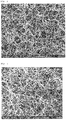
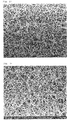
- a scanning electron micrograph of the non-woven fabric thus produced is shown in Fig. 2 . From Fig. 2 , it was found that the fiber diameter of fibers constituting the non-woven fabric was 1136 ⁇ 39 nm.
- the fiber diameter was determined by randomly extracting 100 fibers from a single field of view with a scanning electron microscope at a magnification of 1000x and then determining the widths (diameters) of the fibers using "Image J (software)".
- a composition for electrospinning was prepared in the same manner as in Example 1, except that the contents of the PCL (A) and the PCL (B) in the composition for electrospinning were 10% by mass and 5% by mass, respectively, relative to the entire mass of the composition for electrospinning and the remainder was made up by HFIP, and the composition was spun to produce a sheet-like non-woven fabric.
- a scanning electron micrograph of the non-woven fabric thus produced is shown in Fig. 3 . From Fig. 3 , it was found that the fiber diameter of fibers constituting the non-woven fabric was 2774 ⁇ 174 nm.
- a composition for electrospinning was prepared in the same manner as in Example 1, except that the content of the PCL (A) in the composition for electrospinning was 0% by mass (i.e., without using the PCL (A)), the content of the PCL (B) in the composition for electrospinning was 5% by mass, and the remainder was made up by HFIP, and the composition was spun to produce a sheet-like non-woven fabric.
- a scanning electron micrograph of the non-woven fabric thus produced is shown in Fig. 4 . From Fig. 4 , it was found that the fiber diameter of fibers constituting the non-woven fabric was 736 ⁇ 46 nm.
- Each of the non-woven fabrics prepared above was cut into an approximately circular piece having a diameter of 1.2 cm to prepare a sample for biodegradability determination use (the thickness was 0.030 ⁇ 0.000 mm, and the mass was 1.3 ⁇ 0.10 mg).
- the sample was immersed in 1.5 mL of an aqueous NaOH (3M) solution, and the process of the decomposition of the sample under a constant temperature environment at 37°C was observed.
- 3M aqueous NaOH
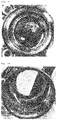
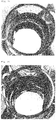
- Figs. 5 to 7 are photographs showing how the non-woven fabric of Example 1 was decomposed at 37°C.
- Fig. 5 is a photograph showing the state of the non-woven fabric of Example 1 immediately after the immersion in the aqueous NaOH solution.
- Fig. 6 is a photograph showing the state of the non-woven fabric of Example 1 after the immersion in the aqueous NaOH solution and a lapse of 26 hours after the immersion.
- Fig. 7 is a photograph showing the state of the non-woven fabric of Example 1 after the immersion in the aqueous NaOH solution and a lapse of 63 hours after the immersion.
- the non-woven fabric of Example 1 was sufficiently decomposed at 37°C at the point of time after a lapse of 26 hours, and it was found that the non-woven fabric had excellent biodegradability.
- Figs. 8 to 10 are photographs showing how the non-woven fabric of Example 2 was decomposed at 37°C.
- Fig. 8 is a photograph showing the state of the non-woven fabric of Example 2 immediately after the immersion in the aqueous NaOH solution.
- Fig. 9 is a photograph showing the state of the non-woven fabric of Example 2 after the immersion in the aqueous NaOH solution and a lapse of 26 hours after the immersion.
- Fig. 10 is a photograph showing the state of the non-woven fabric of Example 2 after the immersion in the aqueous NaOH solution and a lapse of 63 hours after the immersion.
- the non-woven fabric of Example 2 was sufficiently decomposed at 37°C at the point of time after a lapse of 26 hours, and it was demonstrated that the non-woven fabric had excellent biodegradability.
- Figs. 11 to 13 are photographs showing how the non-woven fabric of Comparative Example 1 was decomposed at 37°C.
- Fig. 11 is a photograph showing the state of the non-woven fabric of Comparative Example 1 immediately after the immersion in the aqueous NaOH solution.
- Fig. 12 is a photograph showing the state of the non-woven fabric of Comparative Example 1 after the immersion in the aqueous NaOH solution and a lapse of 26 hours after the immersion.
- Fig. 13 is a photograph showing the state of the non-woven fabric of Comparative Example 1 after the immersion in the aqueous NaOH solution and a lapse of 63 hours after the immersion.
- the non-woven fabric of Comparative Example 1 was not sufficiently decomposed at 37°C even after a lapse of 63 hours, and it was demonstrated that the biodegradability of the non-woven fabric was insufficient.
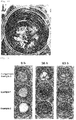
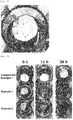
- Fig. 14 is an illustration summarizing the processes of decomposition of each sample shown in Figs. 5 to 13 in a single picture plane.
- Each of the non-woven fabrics prepared above was cut into an approximately circular piece having a diameter of 1.2 cm to prepare a sample for biodegradability determination use (the thickness was 0.077 ⁇ 0.015 mm, the mass was 1.9 ⁇ 0.06 mg).
- the sample was immersed in 1.5 mL of an aqueous NaOH (3M) solution, and the process of decomposition of the sample under a constant temperature environment at room temperature (25°C) was observed.
- Figs. 15 to 17 are photographs showing how the non-woven fabric of Example 1 was decomposed at room temperature.
- Fig. 15 is a photograph showing the state of the non-woven fabric of Example 1 immediately after the immersion in the aqueous NaOH solution.
- Fig. 16 is a photograph showing the state of the non-woven fabric of Example 1 after the immersion in the aqueous NaOH solution and a lapse of 11 hours after the immersion.
- Fig. 17 is a photograph showing the state of the non-woven fabric of Example 1 after the immersion in the aqueous NaOH solution and a lapse of 38 hours after the immersion.
- Figs. 18 to 20 are photographs showing how the non-woven fabric of Example 2 was decomposed at room temperature.
- Fig. 18 is a photograph showing the state of the non-woven fabric of Example 2 immediately after the immersion in the aqueous NaOH solution.
- Fig. 19 is a photograph showing the state of the non-woven fabric of Example 2 after the immersion in the aqueous NaOH solution and a lapse of 11 hours after the immersion.
- Fig. 20 is a photograph showing the state of the non-woven fabric of Example 2 after the immersion in the aqueous NaOH solution and a lapse of 38 hours after the immersion.
- Figs. 21 to 23 are photographs showing how the non-woven fabric of Comparative Example 1 was decomposed at room temperature.
- Fig. 21 is a photograph showing the state of the non-woven fabric of Comparative Example 1 immediately after the immersion in the aqueous NaOH solution.
- Fig. 22 is a photograph showing the state of the non-woven fabric of Comparative Example 1 after the immersion in the aqueous NaOH solution and a lapse of 11 hours after the immersion.
- Fig. 23 is a photograph showing the state of the non-woven fabric of Comparative Example 1 after the immersion in the aqueous NaOH solution and a lapse of 38 hours after the immersion.
- Fig. 24 is an illustration summarizing the processes of decomposition of the samples shown in Figs. 15 to 23 in a single picture plane.
- Non-woven fabrics were prepared in the same manner as in Example 1, except that compositions respectively having the component compositions shown in Table 1 were used as the compositions for electrospinning and the compositions for electrospinning were electrospun under the conditions shown in Table 1.
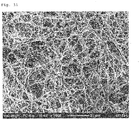
- the scanning electron micrographs of the non-woven fabrics are shown in Figs. 25 to 31 .
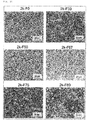
- Apolycaprolactone having a number average molecular weight of 2000 also referred to as “2k PCL” in Test Example 1 as measured by gel permeation chromatography method and a polycaprolactone having a number average molecular weight of 80000 (also referred to as “80k PCL” in Test Example 1) as measured by gel permeation chromatography method were provided.
- compositions for electrospinning shown in Table 2 were spun in the same manner as in Example 1 using an electrospinning device shown in Fig. 1 to produce sheet-like non-woven fabrics.
- a needle (22G) was used as an ejection device, the distance between the needle and a target electrode was 13 cm, and an ejection speed was 1.0 mL/h.
- the voltage to be applied was 20 kV.
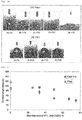
- Each of the non-woven fabrics thus prepared was cut into a piece having a weight of 3 to 5 mg, and the sample was immersed in a 3M aqueous NaOH solution at 37°C.
- the sample was washed with water twice after 1 hour, after 3 hours, after 6 hours and after 16 hours, and the sample was freeze-dried.
- the surface structures of the dried fibers and film were observed with a scanning electron microscope.
- the residual weight (%) was calculated from a sample weight per an initial weight at a certain decomposition period of time (1 hour, 3 hours, 6 hours, 16 hours).
- cast films (2k-C0, 2k-C25, 2k-C33, 2k-C50) produced from the compositions shown in Table 3 in a conventional manner were used.
- the residual weights (%) of the cast films and the non-woven fabrics are shown in Fig. 33 .
- the results for the cast films are shown in (A), and the results for the non-woven fabrics are shown in (B).
- the cast films showed weight losses of less than 10% after 16 hours regardless of the variations in the sample compositions.
- the non-woven fabrics containing 2k PCL (2k-F33, 2k-F50, 2k-F67) were 100% decomposed after 6 hours. This is because fibers had a larger porosity and larger surface area. The decomposition was accelerated with the increase in the content ratio of 2k PCL.
- the non-woven fabrics thus produced were subjected to a differential scanning calorimetry (DSC) measurement.
- DSC differential scanning calorimetry
- 80k PCL and 2k PCL were also subject to a differential scanning calorimetry measurement.
- compositions for electrospinning thus prepared was spun using an electrospinning device shown in Fig. 1 .
- a needle (27G) was used as an ejection device, the distance between the needle and a target electrode was 17 cm, and an ejection speed was 0.5 mL/h.
- the voltage to be applied was 30 kV.
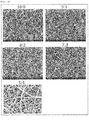
- the scanning electron micrographs of the non-woven fabrics thus prepared are shown in Fig. 38 .
- the fiber diameters of 10 fibers were calculated from the electron micrograph and then the average fiber diameter was calculated as follows. [10:0] 991.2 nm [9:1] 963.7 nm [8:2] 1083.5 nm [7:3] 949.2 nm [5:5] 1157.0 nm
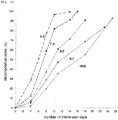
- Each of the non-woven fabrics prepared was cut into a 2-square-centimeter piece (6 to 8 mg), and the piece was immersed at 37°C in a 0.1M (sodium hydroxide)-(physiological saline) solution (250 mL). A sample was collected every several days. Each of the samples was washed with water 5 times and was then dried all night and all day under reduced pressure in the presence of phosphorus oxide. The decomposition rate (%) was calculated from a residual sample weight at the time point of the collection of a sample relative to the initial weight.
- the sample collection days for the samples of each of the non-woven fabrics having the component compositions are shown in Table 5.
- the decomposition rates (%) of the non-woven fabrics are shown in Fig. 39 .
- the decomposition was accelerated with the increase in the content ratio of 2.7k PCL diol.
- the decomposition rate increased with the increase in the time of immersion. Therefore, it is assumed that these samples could be dissolved completely by prolonging the time of immersion. Therefore, by modifying the content ratios of both of the components, it becomes possible to produce a non-woven fabric which can retain the form thereof for a desired period in vivo and can be decomposed completely after a lapse of a desired time period.
Landscapes
- Engineering & Computer Science (AREA)
- Textile Engineering (AREA)
- Chemical & Material Sciences (AREA)
- Chemical Kinetics & Catalysis (AREA)
- General Chemical & Material Sciences (AREA)
- Health & Medical Sciences (AREA)
- Mechanical Engineering (AREA)
- Medicinal Chemistry (AREA)
- Polymers & Plastics (AREA)
- Organic Chemistry (AREA)
- Nonwoven Fabrics (AREA)
- Artificial Filaments (AREA)
- Spinning Methods And Devices For Manufacturing Artificial Fibers (AREA)
Applications Claiming Priority (3)
| Application Number | Priority Date | Filing Date | Title |
|---|---|---|---|
| JP2018129589 | 2018-07-09 | ||
| JP2019076599 | 2019-04-12 | ||
| PCT/JP2019/027201 WO2020013199A1 (fr) | 2018-07-09 | 2019-07-09 | Tissu non tissé, son procédé de fabrication et composition pour électrofilage |
Publications (2)
| Publication Number | Publication Date |
|---|---|
| EP3822402A1 true EP3822402A1 (fr) | 2021-05-19 |
| EP3822402A4 EP3822402A4 (fr) | 2022-07-27 |
Family
ID=69141748
Family Applications (1)
| Application Number | Title | Priority Date | Filing Date |
|---|---|---|---|
| EP19833180.3A Pending EP3822402A4 (fr) | 2018-07-09 | 2019-07-09 | Tissu non tissé, son procédé de fabrication et composition pour électrofilage |
Country Status (12)
| Country | Link |
|---|---|
| US (1) | US12252824B2 (fr) |
| EP (1) | EP3822402A4 (fr) |
| JP (1) | JP7391306B2 (fr) |
| KR (1) | KR102757661B1 (fr) |
| CN (1) | CN112384650A (fr) |
| AU (1) | AU2019302176B2 (fr) |
| CA (1) | CA3104622A1 (fr) |
| IL (1) | IL279785B2 (fr) |
| SG (1) | SG11202012857PA (fr) |
| TW (1) | TWI837148B (fr) |
| WO (1) | WO2020013199A1 (fr) |
| ZA (1) | ZA202007530B (fr) |
Families Citing this family (4)
| Publication number | Priority date | Publication date | Assignee | Title |
|---|---|---|---|---|
| CA3164415A1 (fr) * | 2020-01-14 | 2021-07-22 | Takafumi Konishi | Feuille medicale |
| TWI788659B (zh) * | 2020-04-24 | 2023-01-01 | 南亞塑膠工業股份有限公司 | 多孔隙抗沾黏膜的製造方法 |
| JP2023108999A (ja) * | 2022-01-26 | 2023-08-07 | 学校法人関西医科大学 | 抗がん剤含有シート |
| KR20250160128A (ko) * | 2023-01-31 | 2025-11-11 | 데니머 아이피씨오 엘엘씨 | 폴리하이드록시알카노에이트 기반 섬유 |
Family Cites Families (29)
| Publication number | Priority date | Publication date | Assignee | Title |
|---|---|---|---|---|
| US5066231A (en) * | 1990-02-23 | 1991-11-19 | Minnesota Mining And Manufacturing Company | Dental impression process using polycaprolactone molding composition |
| US6126528A (en) * | 1995-09-18 | 2000-10-03 | 3M Innovative Properties Company | Preformed ophthalmic lens base block with textured surface |
| JP3773335B2 (ja) * | 1996-10-04 | 2006-05-10 | ダイセル化学工業株式会社 | 生分解性脂肪族ポリエステル樹脂−でん粉組成物 |
| US6515054B1 (en) * | 1999-11-02 | 2003-02-04 | Nippon Shokubai Co., Ltd. | Biodegradable resin composition and its molded product |
| JP2002242051A (ja) | 2001-02-13 | 2002-08-28 | Toyobo Co Ltd | 高強度ポリエステル繊維製編物 |
| US7994078B2 (en) * | 2002-12-23 | 2011-08-09 | Kimberly-Clark Worldwide, Inc. | High strength nonwoven web from a biodegradable aliphatic polyester |
| JP4383763B2 (ja) | 2003-03-28 | 2009-12-16 | 帝人株式会社 | 細胞培養基材およびその製造方法 |
| JP5008015B2 (ja) * | 2004-12-27 | 2012-08-22 | 株式会社豊田中央研究所 | 脂肪族ポリエステル組成物及びその成形体 |
| WO2006104092A1 (fr) * | 2005-03-29 | 2006-10-05 | Toray Industries, Inc. | Composition de resine, article moule produit a partir de cette composition et procedes de production de la composition et de l'article |
| CA2619552A1 (fr) * | 2005-08-18 | 2007-02-22 | Smith & Nephew, Plc | Dispositifs et composites multimodaux a resistance elevee |
| KR100875189B1 (ko) | 2005-08-26 | 2008-12-19 | 이화여자대학교 산학협력단 | 전기방사를 이용한 조직 재생용 섬유형 삼차원 다공성 지지체 및 그의 제조방법 |
| US8236904B2 (en) * | 2005-12-28 | 2012-08-07 | Ethicon, Inc. | Bioabsorbable polymer compositions exhibiting enhanced crystallization and hydrolysis rates |
| KR100762255B1 (ko) | 2006-12-27 | 2007-10-04 | (재)대구경북과학기술연구원 | 나노섬유의 제조 방법 |
| ATE547129T1 (de) | 2007-04-19 | 2012-03-15 | Smith & Nephew Inc | Multimodale formgedächtnis-polymere |
| US8728817B2 (en) * | 2007-05-04 | 2014-05-20 | University Of Virginia Patent Foundation | Compositions and methods for making and using laminin nanofibers |
| CN102597115A (zh) * | 2009-10-29 | 2012-07-18 | 日本化药株式会社 | 包含热固性聚酰胺树脂组合物的纤维、无纺布以及它们的制造方法 |
| WO2012157359A1 (fr) * | 2011-05-18 | 2012-11-22 | 株式会社クレハ | Textile de polyester aliphatique biodégradable ayant une excellente adhérence microbienne |
| CN102926135A (zh) * | 2011-08-09 | 2013-02-13 | 东丽纤维研究所(中国)有限公司 | 一种生物降解复合超细纤维无纺布及其制备方法 |
| JP5873317B2 (ja) * | 2011-12-14 | 2016-03-01 | 株式会社クレハ | 生分解性脂肪族ポリエステル繊維から形成される抗菌性不織布、及び抗菌方法 |
| EP3292905A1 (fr) * | 2012-01-27 | 2018-03-14 | Zeus Industrial Products, Inc. | Supports poreux électrofilés |
| EP2844791B1 (fr) * | 2012-04-29 | 2017-10-18 | NatureWorks LLC | Procédé de fabrication d'un non-tissé à base de résine comprenant de l'acide polylactique |
| US10675376B2 (en) | 2012-05-24 | 2020-06-09 | Ethicon Llc | Mechanically strong absorbable polymeric blend compositions of precisely controllable absorption rates, processing methods, and products therefrom |
| JP5945462B2 (ja) | 2012-06-22 | 2016-07-05 | 帝人株式会社 | 柔軟性と保水性に優れた不織布およびその製造方法 |
| KR101866571B1 (ko) | 2012-06-29 | 2018-06-11 | 코오롱인더스트리 주식회사 | 생분해성 부직포 웹, 그 제조방법, 및 이를 이용한 혈액 필터 |
| EP2878314B1 (fr) * | 2012-07-27 | 2017-11-29 | Association For The Advancement Of Tissue Engineering And Cell Based Technologies & Therapies (A4TEC) | Maille polymère à perméabilité sélective pour la régénération/réparation de tissus |
| CN104587534A (zh) * | 2013-10-31 | 2015-05-06 | 先健科技(深圳)有限公司 | 可吸收铁基合金支架 |
| MX2017012400A (es) * | 2015-03-31 | 2018-01-26 | Orthorebirth Co Ltd | Metodo para la fabricacion de material de fibra biodegradable que contiene farmaco mediante electrohilado. |
| CN105012991B (zh) * | 2015-07-17 | 2018-01-12 | 清华大学 | 具有无纺布纤维织物结构的抗菌‑止血材料及其制备方法 |
| US11324704B2 (en) * | 2016-03-07 | 2022-05-10 | Osaka University | Sustained drug release sheet for treating nerve injury |
-
2019
- 2019-07-09 CN CN201980046013.3A patent/CN112384650A/zh active Pending
- 2019-07-09 AU AU2019302176A patent/AU2019302176B2/en active Active
- 2019-07-09 KR KR1020207036059A patent/KR102757661B1/ko active Active
- 2019-07-09 IL IL279785A patent/IL279785B2/en unknown
- 2019-07-09 TW TW108124417A patent/TWI837148B/zh active
- 2019-07-09 EP EP19833180.3A patent/EP3822402A4/fr active Pending
- 2019-07-09 SG SG11202012857PA patent/SG11202012857PA/en unknown
- 2019-07-09 JP JP2020530210A patent/JP7391306B2/ja active Active
- 2019-07-09 US US17/257,043 patent/US12252824B2/en active Active
- 2019-07-09 CA CA3104622A patent/CA3104622A1/fr active Pending
- 2019-07-09 WO PCT/JP2019/027201 patent/WO2020013199A1/fr not_active Ceased
-
2020
- 2020-12-03 ZA ZA2020/07530A patent/ZA202007530B/en unknown
Also Published As
| Publication number | Publication date |
|---|---|
| SG11202012857PA (en) | 2021-02-25 |
| EP3822402A4 (fr) | 2022-07-27 |
| IL279785B2 (en) | 2024-08-01 |
| JP7391306B2 (ja) | 2023-12-05 |
| AU2019302176B2 (en) | 2024-09-12 |
| WO2020013199A1 (fr) | 2020-01-16 |
| US20210140081A1 (en) | 2021-05-13 |
| CA3104622A1 (fr) | 2020-01-16 |
| TW202012721A (zh) | 2020-04-01 |
| AU2019302176A1 (en) | 2021-01-21 |
| TWI837148B (zh) | 2024-04-01 |
| KR20210029148A (ko) | 2021-03-15 |
| WO2020013199A9 (fr) | 2020-04-16 |
| IL279785B1 (en) | 2024-04-01 |
| IL279785A (en) | 2021-03-01 |
| CN112384650A (zh) | 2021-02-19 |
| KR102757661B1 (ko) | 2025-01-21 |
| US12252824B2 (en) | 2025-03-18 |
| JPWO2020013199A1 (ja) | 2021-08-02 |
| ZA202007530B (en) | 2022-06-29 |
| NZ771424A (en) | 2025-05-02 |
Similar Documents
| Publication | Publication Date | Title |
|---|---|---|
| US12252824B2 (en) | Nonwoven fabric, method for manufacturing same, and composition for electrospinning | |
| US7235295B2 (en) | Polymeric nanofibers for tissue engineering and drug delivery | |
| EP2968669B1 (fr) | Fibres ultrafines électrofilées de poly-4-hydroxybutyrate et copolymères de celui-ci | |
| DE69826994T2 (de) | Bioabbaubare Terephthalat Polyester-Polyphosphat Polymere, Zusammensetzungen, Gegenstände und Verfahren für ihre Herstellung und Verwendung | |
| US20190071796A1 (en) | Process and apparatus for making aligned or twisted electrospun fibers and devices | |
| US20150037375A1 (en) | Doping agents and polymeric compositions thereof for controlled drug delivery | |
| WO2019046808A1 (fr) | Polymères pour fabrication additive | |
| Liu et al. | Evaluation of two polymeric blends (EVA/PLA and EVA/PEG) as coating film materials for paclitaxel-eluting stent application | |
| KR20050098861A (ko) | 다공질 섬유, 다공질 섬유 구조체 및 그 제조방법 | |
| HK40046607A (en) | Nonwoven fabric, method for manufacturing same, and composition for electrospinning | |
| JP2009030051A (ja) | カーボネートコポリマー | |
| EP2500456A1 (fr) | Article à base de fibres moulées | |
| CN108578393B (zh) | 一种药物渗透促进型载药电纺纤维膜及其制备方法 | |
| Wang et al. | Fabrication and Characterization of PVP/PCL Nanofiber‐Hydrogel Membranes via Juxtaposed Electrospinning for Wound Dressings | |
| JP5698339B2 (ja) | 繊維成形体 | |
| EP2607529B1 (fr) | Fibres à faible capacité de charge et leur procédé de fabrication | |
| KR20150046432A (ko) | 전기방사용 조성물 및 이의 응용 |
Legal Events
| Date | Code | Title | Description |
|---|---|---|---|
| STAA | Information on the status of an ep patent application or granted ep patent |
Free format text: STATUS: THE INTERNATIONAL PUBLICATION HAS BEEN MADE |
|
| PUAI | Public reference made under article 153(3) epc to a published international application that has entered the european phase |
Free format text: ORIGINAL CODE: 0009012 |
|
| STAA | Information on the status of an ep patent application or granted ep patent |
Free format text: STATUS: REQUEST FOR EXAMINATION WAS MADE |
|
| 17P | Request for examination filed |
Effective date: 20210121 |
|
| AK | Designated contracting states |
Kind code of ref document: A1 Designated state(s): AL AT BE BG CH CY CZ DE DK EE ES FI FR GB GR HR HU IE IS IT LI LT LU LV MC MK MT NL NO PL PT RO RS SE SI SK SM TR |
|
| DAV | Request for validation of the european patent (deleted) | ||
| DAX | Request for extension of the european patent (deleted) | ||
| REG | Reference to a national code |
Ref country code: HK Ref legal event code: DE Ref document number: 40046607 Country of ref document: HK |
|
| REG | Reference to a national code |
Ref country code: DE Ref legal event code: R079 Free format text: PREVIOUS MAIN CLASS: D04H0001728000 Ipc: D01D0005000000 |
|
| A4 | Supplementary search report drawn up and despatched |
Effective date: 20220629 |
|
| RIC1 | Information provided on ipc code assigned before grant |
Ipc: D04H 1/435 20120101ALI20220623BHEP Ipc: C08L 67/04 20060101ALI20220623BHEP Ipc: D04H 1/728 20120101ALI20220623BHEP Ipc: D01F 6/92 20060101ALI20220623BHEP Ipc: D01F 6/62 20060101ALI20220623BHEP Ipc: D01D 5/00 20060101AFI20220623BHEP |
|
| STAA | Information on the status of an ep patent application or granted ep patent |
Free format text: STATUS: EXAMINATION IS IN PROGRESS |
|
| 17Q | First examination report despatched |
Effective date: 20250321 |