EP3822775A1 - Procédé de démarrage sécurisé d'un logiciel d'appareil, en particulier d'un système d'exploitation, d'un appareil électronique - Google Patents
Procédé de démarrage sécurisé d'un logiciel d'appareil, en particulier d'un système d'exploitation, d'un appareil électronique Download PDFInfo
- Publication number
- EP3822775A1 EP3822775A1 EP19209148.6A EP19209148A EP3822775A1 EP 3822775 A1 EP3822775 A1 EP 3822775A1 EP 19209148 A EP19209148 A EP 19209148A EP 3822775 A1 EP3822775 A1 EP 3822775A1
- Authority
- EP
- European Patent Office
- Prior art keywords
- software module
- software
- security
- module
- subsequent
- Prior art date
- Legal status (The legal status is an assumption and is not a legal conclusion. Google has not performed a legal analysis and makes no representation as to the accuracy of the status listed.)
- Withdrawn
Links
Images


Classifications
-
- G—PHYSICS
- G06—COMPUTING OR CALCULATING; COUNTING
- G06F—ELECTRIC DIGITAL DATA PROCESSING
- G06F21/00—Security arrangements for protecting computers, components thereof, programs or data against unauthorised activity
- G06F21/50—Monitoring users, programs or devices to maintain the integrity of platforms, e.g. of processors, firmware or operating systems
- G06F21/57—Certifying or maintaining trusted computer platforms, e.g. secure boots or power-downs, version controls, system software checks, secure updates or assessing vulnerabilities
- G06F21/575—Secure boot
-
- G—PHYSICS
- G06—COMPUTING OR CALCULATING; COUNTING
- G06F—ELECTRIC DIGITAL DATA PROCESSING
- G06F9/00—Arrangements for program control, e.g. control units
- G06F9/06—Arrangements for program control, e.g. control units using stored programs, i.e. using an internal store of processing equipment to receive or retain programs
- G06F9/44—Arrangements for executing specific programs
- G06F9/4401—Bootstrapping
- G06F9/4406—Loading of operating system
-
- G—PHYSICS
- G06—COMPUTING OR CALCULATING; COUNTING
- G06F—ELECTRIC DIGITAL DATA PROCESSING
- G06F2221/00—Indexing scheme relating to security arrangements for protecting computers, components thereof, programs or data against unauthorised activity
- G06F2221/03—Indexing scheme relating to G06F21/50, monitoring users, programs or devices to maintain the integrity of platforms
- G06F2221/033—Test or assess software
Definitions
- the invention relates to a method for safely starting device software, in particular an operating system, of an electronic device, in which a plurality of successive software modules containing software code are executed, as well as a starting device and an electronic device which are designed to execute the method .
- BIOS basic input / output system
- BIOS basic input / output system
- BIOS basic input / output system
- BIOS basic input / output system
- modern electronic devices often use a standardized, expandable firmware interface, known as UEFI for short, instead of the BIOS.
- UEFI standardized, expandable firmware interface
- Such a UEFI firmware has the advantage that it is made up of modular components and can be easily expanded.
- Example components are a component for remote maintenance of the electronic device, a component for digital rights management, a component that includes an emulation of the old BIOS functionality, and the like.
- the UEFI firmware offers a component for the secure start and operation of a device, which is referred to as secure boot.
- Such a secure boot technology checks whether the individual components of the start-up component are signed with a cryptographic key that is contained in the firmware. By checking the signature of the individual star components, which are designed as software code, a proper start of the device is cryptographically ensured. This ensures that the individual software modules and thus the software code contained in each case are available unchanged. However, this cannot guarantee it ensure that the installed operating system does not contain any malware or has no security gaps that could make the electronic device vulnerable or unsafe in operation.
- the content, i.e. the software code, of the software modules following the first software module is not only checked for cryptographic integrity, it is also checked for the presence or absence of predetermined security features before they are executed.
- the checking and identification is carried out in particular using an identification scheme and the identified security features are evaluated using the security policy. It can thus be determined whether the next software module is trustworthy.
- Each software module thus contains a functionality that carries out the checking and the evaluation.
- the identification scheme and the security policy can each be contained in the software module itself or loaded by the software module.
- the following software module is only executed after such a check and an assessment as trustworthy.
- Each software module can thus be used to assess whether the next software module to be started, i.e. the following software module, has a trustworthy behavior and can be started.
- the checking of the functionality of the subsequent software module is thus checked already during the boot process and not only at a later point in time, in particular when the software module has already been executed.
- the device software can be any software unit executed on the device that is started by the sequential execution of more than one software module.
- the device software can be started when the device is booted to start the operating system or when the device is running, for example when starting a user program.
- the operating system of a device is an exemplary embodiment of a device software, which comprises a first software module, the software code in a boot read-only memory (ROM) and hereinafter referred to as boot ROM for short, and a boot loader as further successive software modules , Operating system includes kernel and user-space programs.
- a software module contains a software code.
- the software code in turn, is structured in such a way that certain predetermined functions are carried out or can be carried out.
- Security features are, for example, functions with specific content that are executed by the software code.
- a security feature can be a debug interface, which is undesirable within the software module, since this enables access to this software module.
- Further security features can be, for example, malicious programs or other interfaces that are contained in the software code of the software module or are implemented on the electronic device when the software module is executed.
- the identification scheme is a machine learning function, in particular a neural network.
- the machine learning function receives the following software module as input and provides information on the presence or absence of at least one security feature as output.
- a machine learning function can be trained to recognize a large number of different security features.
- a machine learning function for example a neural network, also recognizes security features that can deviate from a permanently specified search pattern.
- Such a machine learning function applied to the software code of a software module can be used very flexibly and recognizes a large number of security features as well as modifications of the previously known security features.
- the identification scheme is a pattern recognition method and / or a rule-based method.
- the security policy is a positive list or a negative list.
- each software module uses its own module-specific identification scheme and / or its own module-specific security policy.
- module-specific identification schemes or security guidelines can be tailored precisely to the corresponding software modules and identify and evaluate specific security features for the software module.
- each software module evaluates the software code of the subsequent software module using a device-specific identification scheme and / or each software module evaluates the identified security features using a device-specific security policy that is the same for all software modules.
- the device-specific identification module or the device-specific security policy can exclusively or can be used in addition to the module-specific identification module or the module-specific security guideline in the software module.
- a module-specific device trustworthiness value is determined for each individual software module on the basis of the device-specific security policy, and an overall device trustworthiness value is determined from all module-specific device trustworthiness values.
- the trustworthiness of the entire start process can be determined, which takes into account the trustworthiness of each individual software module.
- the start process can be classified as untrustworthy, although each individual subsequent software module with a module-specific device trustworthiness value above the specified threshold value and was thus rated as trustworthy. This enables an additional overall view of the chain of start modules of the device.
- module-specific security guidelines and / or different device-specific security guidelines are used for different structurally identical electronic devices.
- the at least one identification scheme and / or the at least one security policy are cryptographically protected and each software module cryptographically checks its own identification scheme and / or its own security policy assigned to it before execution.
- Cryptographic protection of the identification scheme and the security guideline as well as the checking of these by each software module guarantee the integrity of the same and thus ensure that there is no unauthorized modification.
- Cryptographic protection can be provided, for example, by means of a cryptographic signature or encryption.
- the at least one identification scheme and the at least one security policy of the subsequent software module are cryptographically protected and the software module cryptographically checks the identification scheme assigned to the subsequent software module and / or the security policy assigned to the subsequent software module.
- This check takes place, at least for the first software module, preferably in secure hardware, for example a secure element or, for example, a trustworthy platform module, also called a trusted platform module (TPM).
- TPM trusted platform module
- the software code is available as object code.
- Object code is translated software code, which is also called machine code. This has the advantage that a manipulation of a software code during the transformation from source code into object code, for example by a compiler, is taken into account during the check, since such manipulation is reflected in the object code.
- a substitute function is carried out if the trustworthiness value and / or the module-specific device trustworthiness value and / or the overall device trustworthiness value result in a value that is equal to or below a respectively predetermined threshold value.
- the method changes to a known, predetermined state even if there is a lack of trustworthiness.
- the substitute function will trigger further measures, log entries or warning messages, for example.
- the electronic device includes a trustworthy operating system that corresponds to predetermined security guidelines and that correctly executes applications and programs of the electronic device.
- the operating system of the electronic device can thus be checked for security weaknesses before or during its installation and its functionality can be restricted depending on the trustworthiness value.
- a fourth aspect of the invention relates to a computer program product which can be loaded directly into a memory of a digital computer, comprising program code parts which are suitable for carrying out the steps of the method described.
- a software module checks, evaluates, etc. is to be understood as meaning that the software module contains software code which, when executed on a processor, performs the appropriate actions.
- the term "assigned identification scheme” or “assigned security policy” denotes the identification schemes or security policies implemented or used by the software module. Such an identification scheme or such a security guideline can be present as an integral part of the software module or else be stored in a storage device outside the security module and received in the software module.
- the terms “execute”, “load”, “check”, “evaluate”, “perform” and the like preferably refer to actions and / or processes and / or processing steps that Change and / or generate data and / or convert the data into other data, the data in particular being represented and being able to be present as physical quantities, for example as electrical pulses.
- the terms “computer” and “electronic devices” are interpreted as broadly as possible to include, in particular, all electronic devices To cover devices with data processing properties.
- Electronic devices and computers can be, for example, industrial devices, in particular industrial devices in the Internet of Things, such as field devices, personal computers, servers, handheld computer systems, mobile radio devices and other communication devices, as well as processors for data processing.
- a processor can be understood to mean, for example, an electronic circuit.
- a processor can in particular be a main processor (English: Central Processing Unit, CPU), a microprocessor or a microcontroller, for example an application-specific integrated circuit or a digital signal processor, if possible in combination with a memory device for storing program commands, which are also called Software code, act.
- a processor can also be understood to be a virtualized processor or a soft CPU.
- it can also be a programmable processor that is equipped with configuration steps for executing the said method according to the invention or is configured with configuration steps in such a way that the programmable processor implements the features of the method according to the invention.
- a memory unit can be understood to mean, for example, a memory in the form of a main memory or an erasable and programmable memory unit (EEPROM).
- EEPROM erasable and programmable memory unit
- a computer program product such as B. a computer program means, for example, as a storage medium, e.g. B. as a memory card, USB stick, CD-ROM or in the form of a programmable firmware or in the form of a downloadable file from a server in a network or supplied.
- a storage medium e.g. B. as a memory card, USB stick, CD-ROM or in the form of a programmable firmware or in the form of a downloadable file from a server in a network or supplied.
- An operating system is installed around an electronic device, which consists of at least one processor and further units for storing and processing data, when the electronic device is started. Usually this is done by executing several software modules, which are executed as a chain of successive software modules. Each software module contains software code. This software code comprises program instructions that in turn perform different functions. Such a plurality of successive software modules, which are used to start an operating system, is referred to as a boot chain. Software modules of such a boot chain are, for example, a first software module that comprises a trustworthy software code and forms a root of trust, also referred to as the root of trust. This software module can, for example, be based on a read-only storage unit such as, for example, UEFI firmware to be provided.
- a subsequent, second software module is, for example, a so-called boot loader.
- the subsequent software module is, for example, an operating system kernel, also known as the kernel.
- a subsequent software module includes, for example, programs of a so-called user space. Further software modules are possible.
- Figure 1 shows, as a first method step S1, the execution of a first software module. This is preferably carried out in a security device in the device, since the first software module must be particularly protected in order to guarantee the trustworthiness of the entire method.
- the subsequent software module that is to say the second software module, is then loaded as method step S2.
- the software code of the subsequent software module is then checked in method step S3 and its security features are identified using an identification scheme.
- the identified security features are evaluated on the basis of a security guideline.
- a trustworthiness value is determined and compared with a predefined threshold value in order to evaluate the trustworthiness.
- the trustworthiness value and the predefined threshold value can be a numerical value, but also a Boolean value which only assumes two states “true” or “false” or also “one” or “zero”.
- the subsequent software module is then executed in a method step S5 if the evaluation results in a trustworthiness value which is above a predetermined threshold value.
- the next software module from the chain of software modules is then loaded and method steps S2 to S5 are carried out for this software module.
- Each software module 11, ..., 15 contains a software code which has a checking and identification function 16 for checking the software code and identifying security features, as well as an evaluation function 17 for evaluating the security features.
- the first software module 11 which is implemented as a boot read-only memory (ROM) of a central processor (CPU) and is executed after a "power-on reset"
- the subsequent software module 12 is, for example, from a persistent storage medium in loaded a main memory of the electronic device.
- the following software module 12 is now checked by the first software module 11 and in particular by the checking and identification function 16 contained in the first software module 11 and security features are identified using an identification scheme M1.
- the identified security features are then checked using the security guideline P1. If the evaluation results in a trustworthiness value which is above the predefined threshold value, the software module 12 is executed.
- the subsequent software module 13 When the software module 12 is executed, the subsequent software module 13 is in turn loaded, security features are identified using the identification scheme M2, and these are evaluated using the security guideline P2. If this evaluation leads to a positive result, the software module 13 is trustworthy and is executed.
- the subsequent software module 14 is loaded using the identification scheme M3 and the security guideline P3, and is executed if the result is positive. Accordingly, the software module 15 in the software module 14 is based on the identification scheme M4 and the security policy P4 tested and assessed. If the software module 15 is the last link in the boot chain, no further testing and evaluation takes place here and an identification scheme M5 and a security guideline P5 are only optionally available.
- the described checking and evaluation of a directly following software module based on the identification scheme and the security policy of one of the software modules can also take place while the electronic device is in operation.
- the kernel can check each time a u-ser-space program is executed.
- the identification scheme M1, ..., M5 is preferably designed as a machine learning function, for example as a neural network.
- the identification scheme M1, ..., M5 receives the following software module 12, ..., 15 as input data and outputs the presence or absence of one or more security features as output.
- the identification scheme M1, ..., M5 can in particular be a previously trained, neural network.
- pattern recognition methods or rule-based methods can also be used as the identification scheme M1,..., M5.
- the software code of the software module is preferably available as an object code. The object code is checked by the identification scheme M1,..., M5 and examined either by machine learning methods or by the signature or rule-based methods and predefined patterns that correspond to a security feature are recognized. Failure to find the checked pattern by the identification scheme M1,..., M5 can also contribute to assessing the trustworthiness of the subsequent software module 12,..., 15.
- the identified security features are assessed, for example, by an assessment function 17 that is contained in the currently available software module 11.
- the evaluation function 17 evaluates using a security guideline P1, ..., P5, whether the identified security features are permissible or not.
- a general check can also be made here for the presence of security features that are required for trustworthy software. If the software module 12, ..., 15 is classified as trustworthy on the basis of the identified security features, it is executed and continues the boot process.
- the trustworthiness is assessed, for example, by a trustworthiness value that is assigned to a security feature, and if a threshold value is exceeded, for example, the software module under consideration is rated as trustworthy.
- a corresponding substitute function can be carried out.
- a substitute function can be different depending on the identified security feature or the non-existence of a specific security feature.
- one embodiment of the substitute function can be the termination of the boot chain.
- the following software module 12,..., 15 is not executed.
- An alternative or additional substitute function can be the creation of a log entry. The log entry can be used to understand the boot behavior or to determine statistics on the frequency and type of security features that occur.
- An external switching signal for example to an adjacent processor, can be set as a further substitute function.
- Another substitute function can be the execution of the following software module 12, ..., 15 with only limited functions or rights.
- the software module can only be operated as a so-called “non-root user” if a certain security feature is recognized or is missing.
- Each software module 11,..., 15 can have its own identification scheme M1 specific to this software module ..., M5, as well as your own module-specific safety guideline P1, ..., P5.
- each software module 11,..., 15 can use a device-specific identification scheme DM and device-specific security guideline DP that applies to all software modules.
- a device-specific model DM and a device-specific security policy DP can in particular ensure that software modules with generally trustworthy security features are always executed on a device.
- Using the device-specific security guideline DP a module-specific device trustworthiness value is thus determined for each individual software module. An overall device trustworthiness value is determined from all module-specific device trustworthiness values.
- a security guideline P1, ..., P5, DP, DP1, DP2 can in particular be designed as a positive list or also a negative list.
- a positive list contains all security features that may be included in a software module and are therefore permissible.
- a negative list contains security features that are not permitted and therefore must not be included in a software module.
- the identification schemes M1, ..., M5 and the security guidelines P1, ..., P5 are preferably cryptographically protected and are checked by the software module before they are executed.
- a security module for example security module 12, can cryptographically check its assigned identification schemes M2 and security guidelines P2.
- the security module 12 can also check the identification scheme M3 and the security guideline P3, which are assigned to the subsequent software module 13, before the software module 13 is executed. Such a cryptographic check takes place in particular in a secure hardware, for example a secure element.
- security features examples include vulnerabilities, Trojans, malicious programs, back doors, debug interfaces, cryptographic codes, hardening measures such as stack protection, the presence of access control systems such as SELinux and the like.
- the boot ROM can be used to check whether the boot loader to be loaded does not contain any functionality for serial consoles, for example with a universal asynchronous receive and transmit (UART) circuit, so that the device does not use this UART circuit to be connected to a early boot phase can be attacked.
- UART universal asynchronous receive and transmit
- the bootloader as a software module can be used to check whether a Linux kernel as the subsequent software module does not provide an interface to the entire main memory.
- the kernel can check whether the program to be started can execute a privileged system call. This ensures that no programs are started that could compromise other programs using such system calls. This ensures that an attacker has fewer opportunities to manipulate the device during runtime.
- Figure 3 now shows a starting device for safely starting an operating system of an electronic device which has at least one processor which is designed to carry out the various method steps of the method described.
- the starting device 20 comprises at least one processor, which is not shown separately for a better overview.
- the starting device comprises a safety device 21.
- the processor comprises a charging device 22, a Execution device 23, a storage device 25, a test device 26 and an evaluation device 27.
- the security device 21 is designed in such a way as to protect, in particular, a first software module from manipulation and to carry out the functions of the software module.
- the loading device 22 is designed to load the next software module in each case.
- the storage device 25 stores the module-specific and device-specific identification schemes or security guidelines. Identification schemes and software guidelines can also be loaded or updated by an external device, for example via the interface 24.
- the starting device 20 is preferably permanently installed in an electronic device or can at least be detachably connected to an electronic device.
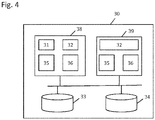
- Figure 4 shows an electronic device 30 which, for the secure start of an operating system, comprises at least one processor which is designed to carry out the method described.
- the electronic device 30 comprises a safety device 31 which stores and executes the first software module.
- the safety device 31 is embodied, for example, on a processor 38 on which a loading and executing device 32 as well as a test function 35 and an evaluation function 36 are embodied, which load, check and evaluate the subsequent software module.
- the assigned identification scheme and the assigned security policy can be loaded from a storage device 33, for example.
- Subsequent software modules can be stored on a further storage device 34, for example.
- the device 30 has a second processor 39, which also has a loading and executing device 32, an evaluation function 36 and a test function 35 for one or more of the subsequent software modules having.
- the various software modules can thus be implemented in a distributed manner on different devices or processors 38, 39 in the electronic device 30.
- the method described has the advantage over conventional methods for starting an operating system that no further cryptographic security precautions, such as integrity protection or encryption for checking the security features in a software module, are necessary.
- a new, changed kernel version can be checked for trustworthiness using the same procedure without, for example, the kernel version having to be re-signed.
- the method can also be used in combination with common, for example secure-boot, methods. In this case, a subsequent software module is checked for both integrity and security features in the software code itself.
Landscapes
- Engineering & Computer Science (AREA)
- Software Systems (AREA)
- Theoretical Computer Science (AREA)
- General Engineering & Computer Science (AREA)
- Computer Security & Cryptography (AREA)
- Computer Hardware Design (AREA)
- Physics & Mathematics (AREA)
- General Physics & Mathematics (AREA)
- Storage Device Security (AREA)
- Stored Programmes (AREA)
Priority Applications (5)
| Application Number | Priority Date | Filing Date | Title |
|---|---|---|---|
| EP19209148.6A EP3822775A1 (fr) | 2019-11-14 | 2019-11-14 | Procédé de démarrage sécurisé d'un logiciel d'appareil, en particulier d'un système d'exploitation, d'un appareil électronique |
| PCT/EP2020/080516 WO2021094105A1 (fr) | 2019-11-14 | 2020-10-30 | Procédé de démarrage sécurisé d'un logiciel de dispositif, en particulier d'un système d'exploitation, d'un dispositif électronique |
| CN202080078954.8A CN114651231B (zh) | 2019-11-14 | 2020-10-30 | 安全地启动电子设备的设备软件、尤其是操作系统的方法 |
| US17/774,269 US12406065B2 (en) | 2019-11-14 | 2020-10-30 | Method for securely starting device software, in particular an operating system, of an electronic device |
| EP20804460.2A EP4028878B1 (fr) | 2019-11-14 | 2020-10-30 | PROCÉDÉ POUR DÉMARRER EN TOUTE SÉCURITÉ UN LOGICIEL DE DISPOSITIF, EN PARTICULIER UN SYSTÈME D'EXPLOITATION, 
D'UN APPAREIL ÉLECTRONIQUE |
Applications Claiming Priority (1)
| Application Number | Priority Date | Filing Date | Title |
|---|---|---|---|
| EP19209148.6A EP3822775A1 (fr) | 2019-11-14 | 2019-11-14 | Procédé de démarrage sécurisé d'un logiciel d'appareil, en particulier d'un système d'exploitation, d'un appareil électronique |
Publications (1)
| Publication Number | Publication Date |
|---|---|
| EP3822775A1 true EP3822775A1 (fr) | 2021-05-19 |
Family
ID=68581587
Family Applications (2)
| Application Number | Title | Priority Date | Filing Date |
|---|---|---|---|
| EP19209148.6A Withdrawn EP3822775A1 (fr) | 2019-11-14 | 2019-11-14 | Procédé de démarrage sécurisé d'un logiciel d'appareil, en particulier d'un système d'exploitation, d'un appareil électronique |
| EP20804460.2A Active EP4028878B1 (fr) | 2019-11-14 | 2020-10-30 | PROCÉDÉ POUR DÉMARRER EN TOUTE SÉCURITÉ UN LOGICIEL DE DISPOSITIF, EN PARTICULIER UN SYSTÈME D'EXPLOITATION, 
D'UN APPAREIL ÉLECTRONIQUE |
Family Applications After (1)
| Application Number | Title | Priority Date | Filing Date |
|---|---|---|---|
| EP20804460.2A Active EP4028878B1 (fr) | 2019-11-14 | 2020-10-30 | PROCÉDÉ POUR DÉMARRER EN TOUTE SÉCURITÉ UN LOGICIEL DE DISPOSITIF, EN PARTICULIER UN SYSTÈME D'EXPLOITATION, 
D'UN APPAREIL ÉLECTRONIQUE |
Country Status (4)
| Country | Link |
|---|---|
| US (1) | US12406065B2 (fr) |
| EP (2) | EP3822775A1 (fr) |
| CN (1) | CN114651231B (fr) |
| WO (1) | WO2021094105A1 (fr) |
Families Citing this family (2)
| Publication number | Priority date | Publication date | Assignee | Title |
|---|---|---|---|---|
| EP3822775A1 (fr) * | 2019-11-14 | 2021-05-19 | Siemens Aktiengesellschaft | Procédé de démarrage sécurisé d'un logiciel d'appareil, en particulier d'un système d'exploitation, d'un appareil électronique |
| DE102022128183B3 (de) | 2022-10-25 | 2023-12-07 | Audi Aktiengesellschaft | Verfahren zum Starten einer Datenverarbeitungseinrichtung, Datenverarbeitungseinrichtung und Kraftfahrzeug |
Citations (1)
| Publication number | Priority date | Publication date | Assignee | Title |
|---|---|---|---|---|
| US20130124840A1 (en) * | 2011-11-11 | 2013-05-16 | International Business Machines Corporation | Secure boot up of a computer based on a hardware based root of trust |
Family Cites Families (24)
| Publication number | Priority date | Publication date | Assignee | Title |
|---|---|---|---|---|
| US8127146B2 (en) * | 2008-09-30 | 2012-02-28 | Microsoft Corporation | Transparent trust validation of an unknown platform |
| WO2010102259A2 (fr) * | 2009-03-06 | 2010-09-10 | Interdigital Patent Holdings, Inc. | Validation et gestion de plate-formes de dispositifs sans fil |
| FR2970099B1 (fr) | 2010-12-29 | 2013-01-11 | Viaccess Sa | Procede de chargement d'un code d'au moins un module logiciel |
| WO2012122994A1 (fr) * | 2011-03-11 | 2012-09-20 | Kreft Heinz | Transfert hors ligne de jetons électroniques entre dispositifs homologues |
| US9992024B2 (en) * | 2012-01-25 | 2018-06-05 | Fujitsu Limited | Establishing a chain of trust within a virtual machine |
| US9075995B2 (en) * | 2013-03-11 | 2015-07-07 | Microsoft Technology Licensing, Llc | Dynamically loaded measured environment for secure code launch |
| US9721086B2 (en) * | 2013-03-15 | 2017-08-01 | Advanced Elemental Technologies, Inc. | Methods and systems for secure and reliable identity-based computing |
| GB2512376A (en) * | 2013-03-28 | 2014-10-01 | Ibm | Secure execution of software modules on a computer |
| US9495544B2 (en) * | 2013-06-27 | 2016-11-15 | Visa International Service Association | Secure data transmission and verification with untrusted computing devices |
| US9348997B2 (en) * | 2014-03-13 | 2016-05-24 | Intel Corporation | Symmetric keying and chain of trust |
| US9521125B2 (en) * | 2014-03-13 | 2016-12-13 | Intel Corporation | Pseudonymous remote attestation utilizing a chain-of-trust |
| JP2016025616A (ja) * | 2014-07-24 | 2016-02-08 | レノボ・シンガポール・プライベート・リミテッド | ディスク・ドライブが記憶するデータを保護する方法および携帯式コンピュータ |
| US10484186B2 (en) * | 2016-09-30 | 2019-11-19 | Intel Corporation | Cascading multivariate quadratic identification schemes for chain of trust |
| JP6896940B2 (ja) * | 2017-06-14 | 2021-06-30 | タレス ディアイエス フランス エスアー | 第1のアプリケーションと第2のアプリケーションとの間の対称型相互認証方法 |
| JP6942601B2 (ja) * | 2017-10-18 | 2021-09-29 | キヤノン株式会社 | 情報処理装置、その制御方法、及びプログラム |
| US10592661B2 (en) * | 2017-11-27 | 2020-03-17 | Microsoft Technology Licensing, Llc | Package processing |
| US11113400B1 (en) * | 2017-12-26 | 2021-09-07 | Virtuozzo International Gmbh | System and method for providing distributed compute platform on untrusted hardware |
| US11218324B2 (en) * | 2018-04-05 | 2022-01-04 | Ares Technologies, Inc. | Systems and methods authenticating a digitally signed assertion using verified evaluators |
| US11695783B2 (en) * | 2018-08-13 | 2023-07-04 | Ares Technologies, Inc. | Systems, devices, and methods for determining a confidence level associated with a device using heuristics of trust |
| US11314868B2 (en) * | 2018-08-31 | 2022-04-26 | Fungible, Inc. | Rapidly establishing a chain of trust in a computing system |
| US11601272B2 (en) * | 2019-05-02 | 2023-03-07 | Ares Technologies, Inc. | Methods and systems for efficient cryptographic third-party authentication of asset transfers using trusted computing |
| US11416618B2 (en) * | 2019-07-15 | 2022-08-16 | Dell Products, L.P. | Bidirectional trust chaining for trusted boot |
| EP3822775A1 (fr) * | 2019-11-14 | 2021-05-19 | Siemens Aktiengesellschaft | Procédé de démarrage sécurisé d'un logiciel d'appareil, en particulier d'un système d'exploitation, d'un appareil électronique |
| US11657158B2 (en) * | 2021-05-24 | 2023-05-23 | Dell Products L.P. | Systems and methods for extending boot security trust chaining to state changes between boot sessions |
-
2019
- 2019-11-14 EP EP19209148.6A patent/EP3822775A1/fr not_active Withdrawn
-
2020
- 2020-10-30 US US17/774,269 patent/US12406065B2/en active Active
- 2020-10-30 CN CN202080078954.8A patent/CN114651231B/zh active Active
- 2020-10-30 WO PCT/EP2020/080516 patent/WO2021094105A1/fr not_active Ceased
- 2020-10-30 EP EP20804460.2A patent/EP4028878B1/fr active Active
Patent Citations (1)
| Publication number | Priority date | Publication date | Assignee | Title |
|---|---|---|---|---|
| US20130124840A1 (en) * | 2011-11-11 | 2013-05-16 | International Business Machines Corporation | Secure boot up of a computer based on a hardware based root of trust |
Also Published As
| Publication number | Publication date |
|---|---|
| EP4028878A1 (fr) | 2022-07-20 |
| CN114651231A (zh) | 2022-06-21 |
| WO2021094105A1 (fr) | 2021-05-20 |
| EP4028878B1 (fr) | 2023-07-19 |
| CN114651231B (zh) | 2025-06-10 |
| US12406065B2 (en) | 2025-09-02 |
| EP4028878C0 (fr) | 2023-07-19 |
| US20220391514A1 (en) | 2022-12-08 |
Similar Documents
| Publication | Publication Date | Title |
|---|---|---|
| EP3274825B1 (fr) | Procédé et environnement d'exécution pour exécuter de façon sécurisée des instructions de programme | |
| DE112013002012B4 (de) | Verfahren eines Erkennens von Schadsoftware in einem Betriebssystemkern | |
| EP4396715B1 (fr) | Analyse automatique d'une exploitabilité des points faibles d'une image logicielle | |
| DE102018215011A1 (de) | Verfahren zum Installieren eines Programmcodepakets in ein Gerät sowie Gerät und Kraftfahrzeug | |
| EP4028878B1 (fr) | PROCÉDÉ POUR DÉMARRER EN TOUTE SÉCURITÉ UN LOGICIEL DE DISPOSITIF, EN PARTICULIER UN SYSTÈME D'EXPLOITATION, 
D'UN APPAREIL ÉLECTRONIQUE | |
| WO2022022995A1 (fr) | Surveillance d'intégrité étendue d'une image de conteneur | |
| DE102013213314A1 (de) | Hinterlegen mindestens eines berechenbaren Integritätsmesswertes in einem Speicherbereich eines Speichers | |
| EP4187417A1 (fr) | Détection d'un écart d'un état de sécurité d'un dispositif informatique à partir d'un état de sécurité théorique | |
| EP3095065B1 (fr) | Dispositif et procédé pour détecter une manipulation d'un code de programme | |
| EP4167114A1 (fr) | Analyse automatique d'une exploitabilité des points faibles d'une image logicielle | |
| EP2111586B1 (fr) | Ordinateur monopuce et tachygraphe | |
| DE102021212994B3 (de) | Verfahren zur Erkennung von auf eine Manipulation hindeutenden Anomalien während eines sicheren Startvorgangs einer softwaregesteuerten Vorrichtung | |
| EP1664978B1 (fr) | Dispositif et procédé pour éxecuter un programme de manière fiable | |
| EP4463784B1 (fr) | Surveillance dynamique de l'intégrité d'un environnement d'exécution de conteneur s'exécutant sur un dispositif de calcule hôte | |
| EP3074862B1 (fr) | Procédé pour le déroulement sûr d'un démarrage d'un système électronique | |
| DE102023209244A1 (de) | Verfahren zum Erzeugen eines Honeypots | |
| DE102022210264A1 (de) | Verfahren zur Erkennung von potenziellen Datenexfiltrationsangriffen bei wenigstens einem Softwarepaket | |
| EP2225640A1 (fr) | Procédé d'identification de l'influence réciproque de composants logiciels | |
| DE102017214057A1 (de) | Verfahren zum Prüfen der Integrität von Systemkomponenten eines Systems und Anordnung zur Durchführung des Verfahrens | |
| DE102019117073A1 (de) | Elektronische einrichtung und verfahren zum steuern der funktionen einer elektronischen einrichtung | |
| EP3876123B1 (fr) | Agencement et procédé de fonctionnement pour un démarrage sécurisé d'un dispositif électronique | |
| EP3690690B1 (fr) | Procédé de vérification d'une validité des données et dispositif mis en uvre sur ordinateur destiné au traitement des données | |
| EP4538912A1 (fr) | Composant d'évaluation pour l'inventaire de composants matériels et composants logiciels existants | |
| DE102019214541A1 (de) | Rechenvorrichtung und Verfahren zum Erkennen einer Bedrohung in einer virtuellen Einheit | |
| EP4312137A1 (fr) | Autorisation d'une installation et/ou d'un démarrage d'un second programme d'application |
Legal Events
| Date | Code | Title | Description |
|---|---|---|---|
| PUAI | Public reference made under article 153(3) epc to a published international application that has entered the european phase |
Free format text: ORIGINAL CODE: 0009012 |
|
| STAA | Information on the status of an ep patent application or granted ep patent |
Free format text: STATUS: THE APPLICATION HAS BEEN PUBLISHED |
|
| AK | Designated contracting states |
Kind code of ref document: A1 Designated state(s): AL AT BE BG CH CY CZ DE DK EE ES FI FR GB GR HR HU IE IS IT LI LT LU LV MC MK MT NL NO PL PT RO RS SE SI SK SM TR |
|
| STAA | Information on the status of an ep patent application or granted ep patent |
Free format text: STATUS: THE APPLICATION IS DEEMED TO BE WITHDRAWN |
|
| 18D | Application deemed to be withdrawn |
Effective date: 20211120 |