EP3822962A2 - Appareil d'affichage et son procédé de commande - Google Patents
Appareil d'affichage et son procédé de commande Download PDFInfo
- Publication number
- EP3822962A2 EP3822962A2 EP20207022.3A EP20207022A EP3822962A2 EP 3822962 A2 EP3822962 A2 EP 3822962A2 EP 20207022 A EP20207022 A EP 20207022A EP 3822962 A2 EP3822962 A2 EP 3822962A2
- Authority
- EP
- European Patent Office
- Prior art keywords
- frame rate
- display panel
- video
- frame
- processor
- Prior art date
- Legal status (The legal status is an assumption and is not a legal conclusion. Google has not performed a legal analysis and makes no representation as to the accuracy of the status listed.)
- Granted
Links
Images




Classifications
-
- G—PHYSICS
- G09—EDUCATION; CRYPTOGRAPHY; DISPLAY; ADVERTISING; SEALS
- G09G—ARRANGEMENTS OR CIRCUITS FOR CONTROL OF INDICATING DEVICES USING STATIC MEANS TO PRESENT VARIABLE INFORMATION
- G09G3/00—Control arrangements or circuits, of interest only in connection with visual indicators other than cathode-ray tubes
- G09G3/20—Control arrangements or circuits, of interest only in connection with visual indicators other than cathode-ray tubes for presentation of an assembly of a number of characters, e.g. a page, by composing the assembly by combination of individual elements arranged in a matrix no fixed position being assigned to or needed to be assigned to the individual characters or partial characters
- G09G3/34—Control arrangements or circuits, of interest only in connection with visual indicators other than cathode-ray tubes for presentation of an assembly of a number of characters, e.g. a page, by composing the assembly by combination of individual elements arranged in a matrix no fixed position being assigned to or needed to be assigned to the individual characters or partial characters by control of light from an independent source
- G09G3/36—Control arrangements or circuits, of interest only in connection with visual indicators other than cathode-ray tubes for presentation of an assembly of a number of characters, e.g. a page, by composing the assembly by combination of individual elements arranged in a matrix no fixed position being assigned to or needed to be assigned to the individual characters or partial characters by control of light from an independent source using liquid crystals
- G09G3/3611—Control of matrices with row and column drivers
-
- G—PHYSICS
- G09—EDUCATION; CRYPTOGRAPHY; DISPLAY; ADVERTISING; SEALS
- G09G—ARRANGEMENTS OR CIRCUITS FOR CONTROL OF INDICATING DEVICES USING STATIC MEANS TO PRESENT VARIABLE INFORMATION
- G09G3/00—Control arrangements or circuits, of interest only in connection with visual indicators other than cathode-ray tubes
- G09G3/20—Control arrangements or circuits, of interest only in connection with visual indicators other than cathode-ray tubes for presentation of an assembly of a number of characters, e.g. a page, by composing the assembly by combination of individual elements arranged in a matrix no fixed position being assigned to or needed to be assigned to the individual characters or partial characters
- G09G3/34—Control arrangements or circuits, of interest only in connection with visual indicators other than cathode-ray tubes for presentation of an assembly of a number of characters, e.g. a page, by composing the assembly by combination of individual elements arranged in a matrix no fixed position being assigned to or needed to be assigned to the individual characters or partial characters by control of light from an independent source
- G09G3/36—Control arrangements or circuits, of interest only in connection with visual indicators other than cathode-ray tubes for presentation of an assembly of a number of characters, e.g. a page, by composing the assembly by combination of individual elements arranged in a matrix no fixed position being assigned to or needed to be assigned to the individual characters or partial characters by control of light from an independent source using liquid crystals
-
- G—PHYSICS
- G09—EDUCATION; CRYPTOGRAPHY; DISPLAY; ADVERTISING; SEALS
- G09G—ARRANGEMENTS OR CIRCUITS FOR CONTROL OF INDICATING DEVICES USING STATIC MEANS TO PRESENT VARIABLE INFORMATION
- G09G3/00—Control arrangements or circuits, of interest only in connection with visual indicators other than cathode-ray tubes
- G09G3/20—Control arrangements or circuits, of interest only in connection with visual indicators other than cathode-ray tubes for presentation of an assembly of a number of characters, e.g. a page, by composing the assembly by combination of individual elements arranged in a matrix no fixed position being assigned to or needed to be assigned to the individual characters or partial characters
- G09G3/34—Control arrangements or circuits, of interest only in connection with visual indicators other than cathode-ray tubes for presentation of an assembly of a number of characters, e.g. a page, by composing the assembly by combination of individual elements arranged in a matrix no fixed position being assigned to or needed to be assigned to the individual characters or partial characters by control of light from an independent source
- G09G3/36—Control arrangements or circuits, of interest only in connection with visual indicators other than cathode-ray tubes for presentation of an assembly of a number of characters, e.g. a page, by composing the assembly by combination of individual elements arranged in a matrix no fixed position being assigned to or needed to be assigned to the individual characters or partial characters by control of light from an independent source using liquid crystals
- G09G3/3611—Control of matrices with row and column drivers
- G09G3/3648—Control of matrices with row and column drivers using an active matrix
-
- G—PHYSICS
- G09—EDUCATION; CRYPTOGRAPHY; DISPLAY; ADVERTISING; SEALS
- G09G—ARRANGEMENTS OR CIRCUITS FOR CONTROL OF INDICATING DEVICES USING STATIC MEANS TO PRESENT VARIABLE INFORMATION
- G09G3/00—Control arrangements or circuits, of interest only in connection with visual indicators other than cathode-ray tubes
- G09G3/20—Control arrangements or circuits, of interest only in connection with visual indicators other than cathode-ray tubes for presentation of an assembly of a number of characters, e.g. a page, by composing the assembly by combination of individual elements arranged in a matrix no fixed position being assigned to or needed to be assigned to the individual characters or partial characters
- G09G3/34—Control arrangements or circuits, of interest only in connection with visual indicators other than cathode-ray tubes for presentation of an assembly of a number of characters, e.g. a page, by composing the assembly by combination of individual elements arranged in a matrix no fixed position being assigned to or needed to be assigned to the individual characters or partial characters by control of light from an independent source
- G09G3/36—Control arrangements or circuits, of interest only in connection with visual indicators other than cathode-ray tubes for presentation of an assembly of a number of characters, e.g. a page, by composing the assembly by combination of individual elements arranged in a matrix no fixed position being assigned to or needed to be assigned to the individual characters or partial characters by control of light from an independent source using liquid crystals
- G09G3/3611—Control of matrices with row and column drivers
- G09G3/3618—Control of matrices with row and column drivers with automatic refresh of the display panel using sense/write circuits
-
- G—PHYSICS
- G09—EDUCATION; CRYPTOGRAPHY; DISPLAY; ADVERTISING; SEALS
- G09G—ARRANGEMENTS OR CIRCUITS FOR CONTROL OF INDICATING DEVICES USING STATIC MEANS TO PRESENT VARIABLE INFORMATION
- G09G2320/00—Control of display operating conditions
- G09G2320/02—Improving the quality of display appearance
- G09G2320/0252—Improving the response speed
-
- G—PHYSICS
- G09—EDUCATION; CRYPTOGRAPHY; DISPLAY; ADVERTISING; SEALS
- G09G—ARRANGEMENTS OR CIRCUITS FOR CONTROL OF INDICATING DEVICES USING STATIC MEANS TO PRESENT VARIABLE INFORMATION
- G09G2320/00—Control of display operating conditions
- G09G2320/02—Improving the quality of display appearance
- G09G2320/0285—Improving the quality of display appearance using tables for spatial correction of display data
-
- G—PHYSICS
- G09—EDUCATION; CRYPTOGRAPHY; DISPLAY; ADVERTISING; SEALS
- G09G—ARRANGEMENTS OR CIRCUITS FOR CONTROL OF INDICATING DEVICES USING STATIC MEANS TO PRESENT VARIABLE INFORMATION
- G09G2320/00—Control of display operating conditions
- G09G2320/06—Adjustment of display parameters
- G09G2320/0613—The adjustment depending on the type of the information to be displayed
-
- G—PHYSICS
- G09—EDUCATION; CRYPTOGRAPHY; DISPLAY; ADVERTISING; SEALS
- G09G—ARRANGEMENTS OR CIRCUITS FOR CONTROL OF INDICATING DEVICES USING STATIC MEANS TO PRESENT VARIABLE INFORMATION
- G09G2320/00—Control of display operating conditions
- G09G2320/06—Adjustment of display parameters
- G09G2320/0626—Adjustment of display parameters for control of overall brightness
-
- G—PHYSICS
- G09—EDUCATION; CRYPTOGRAPHY; DISPLAY; ADVERTISING; SEALS
- G09G—ARRANGEMENTS OR CIRCUITS FOR CONTROL OF INDICATING DEVICES USING STATIC MEANS TO PRESENT VARIABLE INFORMATION
- G09G2320/00—Control of display operating conditions
- G09G2320/06—Adjustment of display parameters
- G09G2320/0673—Adjustment of display parameters for control of gamma adjustment, e.g. selecting another gamma curve
-
- G—PHYSICS
- G09—EDUCATION; CRYPTOGRAPHY; DISPLAY; ADVERTISING; SEALS
- G09G—ARRANGEMENTS OR CIRCUITS FOR CONTROL OF INDICATING DEVICES USING STATIC MEANS TO PRESENT VARIABLE INFORMATION
- G09G2340/00—Aspects of display data processing
- G09G2340/04—Changes in size, position or resolution of an image
- G09G2340/0407—Resolution change, inclusive of the use of different resolutions for different screen areas
- G09G2340/0435—Change or adaptation of the frame rate of the video stream
-
- G—PHYSICS
- G09—EDUCATION; CRYPTOGRAPHY; DISPLAY; ADVERTISING; SEALS
- G09G—ARRANGEMENTS OR CIRCUITS FOR CONTROL OF INDICATING DEVICES USING STATIC MEANS TO PRESENT VARIABLE INFORMATION
- G09G2340/00—Aspects of display data processing
- G09G2340/16—Determination of a pixel data signal depending on the signal applied in the previous frame
-
- G—PHYSICS
- G09—EDUCATION; CRYPTOGRAPHY; DISPLAY; ADVERTISING; SEALS
- G09G—ARRANGEMENTS OR CIRCUITS FOR CONTROL OF INDICATING DEVICES USING STATIC MEANS TO PRESENT VARIABLE INFORMATION
- G09G2354/00—Aspects of interface with display user
Definitions
- the disclosure relates to a display apparatus and a control method thereof, and more particularly, to a display apparatus for changing a frame rate, and a control method thereof.
- a frame rate (or a scan rate) of a panel provided in the display apparatus is different from a frame rate of a video, a delay time may occur, and, thus, a problem may occur that a video that is originally intended to have an improved quality is lagged or is not seamless when the video is provided to a user.
- a display apparatus that changes a frame rate of a display panel and outputs a video, and a control method thereof.
- the display panel may be driven at the plurality of frame rates without changing a panel structure of the display apparatus.
- a display apparatus includes: a communication interface including a circuit; a display panel configured to be selectively driven at any one of a plurality of frame rates; and a processor configured to: identify an input frame rate of a video, based on the video being received through the communication interface, adjust a setting value of the display panel so that the display panel operates at a frame rate among the plurality of frame rates that corresponds to the input frame rate, and control the display panel to output the received video, by driving the display panel at the frame rate corresponding to the input frame rate.
- the processor is further configured to adjust at least one of a dynamic capacitance compensation (DCC) value for compensating for a response speed of the display panel, a liquid crystal charging timing of the display panel, or a luminance of the display panel, that are included in the setting value, based on the input frame rate.
- DCC dynamic capacitance compensation
- the plurality of frame rates include a first frame rate and a second frame rate having a frequency higher than a frequency of the first frame rate, and the DCC value and the liquid crystal charging timing that are included in a setting value corresponding to the first frame rate are greater than the DCC value and the liquid crystal charging timing that are included in a setting value corresponding to the second frame rate.
- the plurality of frame rates include a first frame rate and a second frame rate having a frequency higher than a frequency of the first frame rate
- the processor is further configured to: identify the input frame rate as corresponding to the second frame rate, increase the DCC value and the liquid crystal charging timing based on a setting value corresponding to the first frame rate, based on the frame rate of the display panel being changed from the second frame rate to the first frame rate, and adjust the luminance of the display panel so that a gamma value of the display panel is maintained equal to a reference gamma value.
- the processor is further configured to: change a frame rate of the display panel based on a user command for changing the frame rate of the display panel, and drive the display panel, based on the user command.
- the processor is further configured to: control the display panel to display a user interface (UI) for changing the frame rate of the display panel, and adjust the setting value of the display panel so that the display panel operates at a frame rate corresponding to the user command input through the UI.
- UI user interface
- the processor is further configured to identify the input frame rate of the received video based on metadata of the received video.
- the processor is further configured to: analyze the received video to obtain video processing delay information related to processing of the received video, and identify the input frame rate of the received video based on the video processing delay information.
- the video processing delay information is determined based on at least one of type information of the received video, user interaction related information, or object information in the received video.
- a control method of a display apparatus including a display panel configured to be selectively driven at any one of a plurality of frame rates includes: identifying an input frame rate of a video, based on the video being received; adjusting a setting value of the display panel so that the display panel operates at a frame rate among the plurality of frame rates that corresponds to the input frame rate; and controlling the display panel to output the received video, by driving the display panel at the frame rate corresponding to the input frame rate.
- the adjusting the setting value includes adjusting at least one of a dynamic capacitance compensation (DCC) value for compensating for a response speed of the display panel, a liquid crystal charging timing of the display panel, or a luminance of the display panel, that are included in the setting value, based on the input frame rate.
- DCC dynamic capacitance compensation
- the plurality of frame rates include a first frame rate and a second frame rate having a frequency higher than a frequency of the first frame rate, and the DCC value and the liquid crystal charging timing that are included in a setting value corresponding to the first frame rate are greater than the DCC value and the liquid crystal charging timing that are included in a setting value corresponding to the second frame rate.
- the plurality of frame rates include a first frame rate and a second frame rate having a frequency higher than a frequency of the first frame rate
- the identifying the input frame rate includes identifying the input frame rate as corresponding to the second frame rate
- the adjusting the setting value includes: increasing the DCC value and the liquid crystal charging timing based on a setting value corresponding to the first frame rate, based on the frame rate of the display panel being changed from the second frame rate to the first frame rate; and adjusting the luminance of the display panel so that a gamma value of the display panel is maintained to be equal to a reference gamma value.
- the adjusting the setting value includes changing a frame rate of the display panel based on receiving a user command for changing the frame rate of the display panel.
- the control method may further include displaying a user interface (UI) for changing the frame rate of the display panel, wherein the adjusting the setting value includes adjusting the setting value of the display panel so that the display panel operates at a frame rate corresponding to the user command input through the UI.
- UI user interface
- the identifying the input frame rate of the video includes identifying the input frame rate of the received video based on metadata of the received video.
- the control method may further include analyzing the received video to obtain video processing delay information related to processing of the received video, wherein the identifying the input frame rate of the video includes identifying the input frame rate of the received video based on the video processing delay information.
- the video processing delay information is determined based on at least one of type information of the received video, user interaction related information, or object information in the received video.
- a non-transitory computer-readable medium storing at least one instruction that, based on being executed by a processor of a display apparatus, causes the display apparatus to perform a method of: identifying an input frame rate of a video, based on the video being received; adjusting a setting value of a display panel so that the display panel, which is capable of being selectively driven at any one of a plurality of frame rates, operates at a frame rate among the plurality of frame rates that corresponds to the input frame rate; and controlling the display panel to output the received video by driving the display panel at the frame rate corresponding to the input frame rate.
- a display apparatus includes: a panel driver; a display panel which is drivable by the panel driver at a plurality of frame rates and is configured to display content at any one of the plurality of frame rates; and a processor configured to: identify an input frame rate of a video being received by the display apparatus based on a parameter included in the video, the input frame rate being different from a second frame rate of the display panel at which content has been previously displayed, among the plurality of frame rates, based on the input frame rate being different, adjust a response speed setting value of the display panel so that the display panel starts operating at a first frame rate among the plurality of frame rates that corresponds to the input frame rate, and control the display panel to output the received video, by controlling the panel driver to drive the display panel at the first frame rate corresponding to the input frame rate.
- the second frame rate has a frequency higher than a frequency of the first frame rate
- the response speed setting value is set differently for the first frame rate and the second frame rate
- the processor is further configured to: based on the second frame rate being changed to the first frame rate, increase the response speed setting value in correspondence to the first frame rate, and adjust a luminance of the display panel so that a gamma value of the display panel remains at a constant level.
- the processor is further configured to: based on the first frame rate being changed to the second frame rate, decrease the response speed setting value in correspondence to the second frame rate.
- the processor is further configured to adjust the response speed setting value of the display panel by adjusting at least one of a dynamic capacitance compensation (DCC) value for compensating for a response speed of the display panel or a liquid crystal charging timing of the display panel.
- DCC dynamic capacitance compensation
- an expression “have”, “may have”, “include”, “may include”, or the like may indicate existence of a corresponding feature (for example, a numerical value, a function, an operation, a component such as a part, or the like), and does not exclude existence of an additional feature.
- the terms "1st” or “first”, “2nd” or “second”, or the like, may use corresponding components regardless of importance or order and are used to distinguish one component from another, without limiting the components.
- any component for example, a first component
- another component for example, a second component
- any component is directly coupled to another component or maybe coupled to another component through the other component (for example, a third component).
- a "module” or a “ ⁇ er/or” may perform at least one function or operation, and be implemented by hardware or software or be implemented by a combination of hardware and software.
- a plurality of “modules” or a plurality of “ ⁇ ers/ ⁇ ors” may be integrated in at least one module and be implemented by at least one processor except for a "module” or a “ ⁇ er/or” that needs to be implemented by specific hardware.
- a term "user” may refer to a person using an electronic apparatus or an apparatus (for example, an artificial intelligence electronic apparatus) using an electronic apparatus.
- FIG. 1 is a schematic block diagram illustrating components of a display apparatus according to an embodiment.
- a display apparatus 100 includes a communication interface 110, a display panel 120, and a processor 130.
- the display apparatus 100 displays video data.
- the display apparatus 100 may be implemented by a television (TV), but is not limited thereto, and maybe any apparatus having a display function, such as a video wall, a large format display (LFD), a digital signage, a digital information display (DID), a projector display, or the like.
- the display apparatus 100 may be implemented by displays having various forms such as a liquid crystal display (LCD), an organic light emitting diode (OLED), a liquid crystal on silicon (LCoS), a digital light processing (DLP), a quantum dot (QD) display panel, a quantum dot LED (QLED), a micro LED ( ⁇ LED), a mini LED, and the like.
- LCD liquid crystal display
- OLED organic light emitting diode
- LCDoS liquid crystal on silicon
- DLP digital light processing
- QD quantum dot
- QLED quantum dot LED
- ⁇ LED micro LED
- mini LED and the like.
- the display apparatus 100 may also be implemented by a touch screen combined with a touch sensor, a flexible display, a rollable display, a three-dimensional (3D) display, and a display in which a plurality of display modules are physically connected to each other, or the like.
- the communication interface 110 including a circuit according to an embodiment receives various types of videos.
- the communication interface 110 may receive a video signal in a streaming or download manner from an external apparatus (for example, a source apparatus), an external storage medium (for example, a universal serial bus (USB) memory), an external server (for example, a Web hard), or the like, through a communication manner such as access point (AP)-based Wi-Fi (Wireless local area network (LAN)), Bluetooth, Zigbee, wired/wireless LAN, wide area network (WAN), Ethernet, IEEE 1394, high-definition multimedia interface (HDMI), USB, mobile high-definition link (MHL), audio engineering society/European broadcasting union (AES/EBU), an optical manner, a coaxial manner, or the like.
- the video signal maybe any one digital video signal of a standard definition (SD), high definition (HD), full HD, or ultra HD video, but is not limited thereto.
- the communication interface 110 may receive a video from the external apparatus.
- the display apparatus 100 may sequentially receive a plurality of video frames configuring a video through the communication interface 110.
- the display apparatus 100 may store a video received through the communication interface 110 in a memory, load the video from the memory, and provide the video through the display panel 120.
- the display apparatus 100 may load a video pre-stored in the memory and provide the video through the display panel 120.
- the display panel 120 may be selectively driven at any one of a plurality of frame rates.
- the frame rate may refer to a speed at which the display apparatus 100 displays one frame.
- the frame rate of the display panel 120 may be referred to as a refresh rate, a frequency, or a scan rate, but hereinafter, will be referred to as a frame rate for convenience of explanation.
- the frame rate of the display panel 120 may be represented by Hz.
- the display panel 120 may provide 60 frames per second.
- the display panel 120 may provide 120 frames per second.
- the display panel 120 is driven at the frame rate of 60 Hz or 120 Hz is only an example, embodiments are not limited thereto.
- the display panel 120 may be driven at various frame rates such as 75 Hz, 144 Hz, and 240 Hz.
- the display panel 120 may be driven at any one of the plurality of frame rates according to the control of the processor 130.
- the processor 130 selects any one of the plurality of frame rates, drives the display panel 120 at the selected frame rate, and outputs a video received through the communication interface 110 will be described.
- the processor 130 controls a general operation of the display apparatus 100.
- the processor 130 may be implemented by a digital signal processor (DSP), a microprocessor, an artificial intelligence (AI) processor, or a time controller (T-CON) processing a digital video signal.
- DSP digital signal processor
- AI artificial intelligence
- T-CON time controller
- the processor 130 is not limited thereto, but may include one or more of a central processing unit (CPU), a micro controller unit (MCU), a micro processing unit (MPU), a controller, an application processor (AP), a communication processor (CP), and an ARM processor, or may be defined by these terms.
- the processor 130 may be implemented by a system-on-chip (SoC) or a large scale integration (LSI) in which a processing algorithm is embedded or may be implemented in a field programmable gate array (FPGA) form.
- SoC system-on-chip
- LSI large scale integration
- the processor 130 may identify a frame rate of the received video.
- the video (for example, a moving picture) is a set of temporally continuous still images, and one still image may be a frame.
- the frame rate of the video may be represented by frames per second (fps). That is, the frame rate of the video may refer to the number of frames configuring the video for 1 second.
- the frame rate of the video maybe referred to as a frame speed and a frame ratio, but hereinafter, will be referred to as a frame rate for convenience of explanation.
- a user may determine that the video is a smooth and seamless video.
- the video is a smooth and seamless video.
- the user feels that the smooth and seamless video is provided, but is not limited thereto.
- the display apparatus 100 may receive and display videos of various frame rates such as 60 fps, 120 fps, 1000 fps, and the like, such as a game video (for example, a first-person shooter (FPS) game, a racing game), a sports video, and a slow motion video.
- a game video for example, a first-person shooter (FPS) game, a racing game
- a sports video for example, a sport video, and a slow motion video.
- the processor 130 may identify the frame rate of the received video.
- the processor 130 may identify the frame rate of the video (for example, fps of the video) based on metadata of the received video.
- a configuration in which the processor 130 identifies the frame rate of the video based on the metadata of the video is only an example, and the disclosure is not necessarily limited thereto.
- the processor 130 may also identify the frame rate of the video based on the number of frames configuring the video for 1 second among a plurality of frames configuring the video.
- the processor 130 may adjust a setting value of the display panel so that the display panel operates at the frame rate (that is, the identified frame rate) of the video among the plurality of frame rates at which that the display panel 120 may be driven.
- the processor 130 may adjust the setting value of the display panel 120 so that the display panel 120 operates at 60 Hz corresponding to 60 fps.
- the processor 130 may adjust the setting value of the display panel 120 so that the display panel 120 operates at 120Hz corresponding to 120 fps.
- the frame rate (for example, fps unit) of the video may refer to the number of frames configuring the video for 1 second
- the frame rate (for example, Hz unit) of the display panel 120 may refer to the number of frames provided by the panel 120 for 1 second.
- the display apparatus 100 may perform vertical synchronization (V-sync) for setting a frame generation timing of the video and a frame output timing of the display panel 120 to be synchronized.
- V-sync vertical synchronization
- a display apparatus 100 performs a process in which a frame passes through a vertical synchronization buffer to synchronize a generation timing of a frame configuring an input video and a frame output timing of the display panel 120, and has a problem that a delay time is generated in such a process. As a result, there was a problem that a delay occurs between input and output of the video.
- the processor 130 may perform calculation on the received video while waiting for vertical synchronization in units of 1/60 s (16.6 ms).
- the display panel 120 operates at a frame rate of 120 Hz, there is a problem that a delay of at least 8.3 ms (16.6 ms/2) occurs until the processor 130 performs calculation on the received video and outputs the video through the display panel 120.
- the delay may be referred to as a latency, an input lag, a display lag, and the like.
- the processor 130 may adjust the setting value of the display panel 120 so that the display panel 120 operates at a frame rate (for example, a scan rate) corresponding to the frame rate of the video. Then, the processor 130 may control the display panel 120 to output the received video. In this case, the delay occurrence between video outputs may be minimized.
- FIGS. 2A to 3B A detailed description therefor will be provided with reference to FIGS. 2A to 3B .
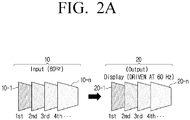
- FIGS. 2A and 2B are views illustrating a frame rate of a display panel according to an embodiment.
- the processor 130 identifies a frame rate of a received video 10 including a first frame 10-1 and second to n-th frames 10-2 to 10-n, e.g., the processor 130 identifies an input frame rate of the input frames.
- the processor 130 may adjust a setting value of the display panel 120 to output an output video 20 so that the display panel 120 operates at a frame rate (for example, a scan rate) corresponding to the first frame rate.
- the output video 20 may include a first output frame 20-1 and second to n-th output frames 20-2 to 20-n which correspond to the input frames of the received video 10.
- the processor 130 may adjust at least one of a DCC value for compensating for a response speed of the display panel 120 or a liquid crystal charging timing or luminance of the display panel 120, included in the setting value, based on the identified first frame rate.
- DCC is a method of comparing a gradation value of a previous frame with a gradation value of a current frame for an arbitrary pixel and performing processing of RGB data so that a value greater than a difference between these gradation values is added to the gradation value of the previous frame.
- a delay for example, a duration
- a delay of one frame is 16.7 ms.
- a value obtained by adding a value (referred to as a compensation value) greater than '10', which is a difference between two gradation values, to the gradation value in the previous frame, for example, '135' is converted as the gradation value of the current frame.
- a compensation value may be determined by a look-up table created based on the data of the previous frame and data of the current frame.
- the processor 130 may also obtain the DCC value based on various equations for calculating the compensation value, in addition to the lookup table.
- the processor 130 may adjust the setting value of the display panel 120 according to the obtained DCC value to operate the display panel 120 at a specific frame rate.
- the processor 130 may operate the display panel 120 at a frame rate (for example, a scan rate) of 60 Hz corresponding to 60 fps.
- a first output frame 20-1 corresponding to a first frame 10-1 configuring the input video may be obtained without a delay (for example, about 16.6 ms) required for calculation of the first frame 10-1.
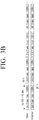
- FIGS. 3A and 3B are views illustrating a frame rate of a display panel according to an embodiment.
- the processor 130 identifies a frame rate of a received video 10.
- the processor 130 may adjust a setting value of the display panel 120 so that the display panel 120 operates at a frame rate (for example, a scan rate) corresponding to the second frame rate.
- the second frame rate may be a frame rate having a frequency higher than that of the first frame rate.
- the first frame rate may be 60 Hz (or 60 fps)
- the second frame rate maybe 120 Hz (or 120 fps).
- the processor 130 may adjust at least one of a DCC value for compensating for a response speed of the display panel 120 or a liquid crystal charging timing or luminance of the display panel 120, included in the setting value, based on the identified second frame rate.
- the processor 130 may operate the display panel 120 at a frame rate (for example, a scan rate) of 120Hz corresponding to 120 fps.
- a first output frame 20-1 corresponding to a first frame 10-1 configuring the input video may be obtained without a delay (for example, about 8.3 ms (1s/120) required for calculation of the first frame 10-1. That is, the processor 130 may provide an output video 20 corresponding to the received video 10 through the display panel 120 without a delay time required for calculation or vertical synchronization for the received video 10.
- the DCC value and the liquid crystal charging timing included in the setting value corresponding to the first frame rate may be greater than the DCC value and the liquid crystal charging timing included in the setting value corresponding to the second frame rate (for example, 120 Hz).
- the display panel 120 is driven at a frame rate of 120 Hz, 120 frames need to be provided for 1 second, and the DCC value and the liquid crystal charging timing for compensating for a response speed may thus be reduced as compared with a case where the display panel 120 is driven at a frame rate of 60 Hz.
- the processor 130 may adjust the setting value of the display panel 120 according to the obtained DCC value to operate the display panel 120 at a specific frame rate.
- the processor 130 may adjust the luminance of the display panel 120 so that a gamma value of the display panel 120 is maintained as a reference gamma value even though the frame rate of the display panel 120 is changed.
- the processor 130 may drive the display panel 120 at the first frame rate by increasing at least one of the DCC value or the liquid crystal charging timing based on the setting value corresponding to the frame rate. Then, the processor 130 may adjust the luminance or brightness of the display panel 120 so that a changed gamma value is maintained as the reference gamma value (for example, 2.2 gamma value) as at least one of the DCC value or the liquid crystal charging timing is increased.
- the reference gamma value for example, 2.2 gamma value
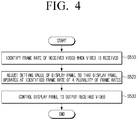
- FIG. 4 is a flowchart of a control method of a display apparatus according to an embodiment.
- a frame rate of the received video is identified (operation S510).
- the setting value of the display panel is adjusted so that the display panel operates at the identified frame rate of the plurality of frame rates (operation S520).
- the display panel is controlled to output the received video (operation S530).
- Operation S520 of adjusting the setting value may include adjusting at least one of a DCC value for compensating for a response speed of the display panel or a liquid crystal charging timing or luminance of the display panel, included in the setting value, based on the identified frame rate.
- the plurality of frame rates may include a first frame rate and a second frame rate having a frequency higher than that of the first frame rate, and a DCC value and a liquid crystal charging timing included in a setting value corresponding to the first frame rate maybe greater than a DCC value and a liquid crystal charging timing included in a setting value corresponding to the second frame rate.
- the plurality of frame rates may include a first frame rate and a second frame rate having a frequency higher than that of the first frame rate
- operation S520 of adjusting the setting value may include increasing the DCC value and the liquid crystal charging timing based on the setting value corresponding to the first frame rate when the identified frame rate is changed from the second frame rate to the first frame rate, and adjusting the luminance of the display panel so that a gamma value of the display panel is maintained as a reference gamma value.
- control method may further include identifying whether or not to change the frame rate of the display panel based on a user command and operation S530 of controlling the display panel may include controlling the display panel to output the adjusted video by adjusting the frame configuring the received video when the user command is a command to fix the frame rate of the display panel and the identified frame rate corresponding to the received video and the fixed frame rate of the display panel that are different from each other.
- the plurality of frame rates may include a first frame rate and a second frame rate having a frequency higher than that of the first frame rate
- operation S530 of controlling the display panel may include generating a new frame between a plurality of frames configuring the received video when the identified frame rate is the first frame rate and the fixed frame rate is the second frame rate, and controlling the display panel to output an adjusted video corresponding to the received video including the plurality of frames and the new frame.
- the new frame may include at least one of a frame generated by repeating each of the plurality of frames configuring the received video or a frame generated based on at least two frames of the plurality of frames configuring the received video.
- the frame generated based on at least two frames of the plurality of frames configuring the received video may be a frame generated based on motion information of an object included in at least two frames.
- control method may further include identifying whether or not to change the frame rate of the display panel based on a user command for controlling whether or not to change the frame rate of the display panel when the user command is received, and operation S520 of adjusting the setting value of the display panel may include changing the frame rate to the identified frame rate when the user command is a command to change the frame rate of the display panel and the identified frame rate corresponding to the received video and the frame rate of the display panel that are different from each other.
- operation S520 of adjusting the setting value of the display panel may include changing the frame rate of the display panel based on a user command for changing the frame rate of the display panel when the user command is received.
- the control method may further include displaying a user interface (UI) for changing the frame rate of the display panel, and operation S520 of adjusting the setting value of the display panel may include adjusting the setting value of the display panel so that the display panel operates at a frame rate corresponding to a user command input through the UI.
- UI user interface
- operation S510 of identifying the frame rate of the received video may include identifying the frame rate of the received video based on the metadata of the received video
- operation S520 of adjusting the setting value of the display panel may include adjusting the setting value of the display panel so that the display panel operates at the identified frame rate.
- control method may further include analyzing the received video to obtain video processing delay information related to processing of the received video, operation S510 of identifying the frame rate of the received video may further include identifying the frame rate of the received video based on the video processing delay information, and operation S520 of adjusting the setting value of the display panel may further include adjusting the setting value of the display panel so that the display panel operates at the identified frame rate.
- FIG. 5 is a view illustrating changing a frame rate according to an embodiment.
- the processor 130 identifies the frame rate of the video (for example, fps of the video) (operation S610) when the video is received.
- the processor 130 identifies whether or not to change the frame rate of the display panel 120 based on the user command for controlling whether or not to change the frame rate of the display panel 120 (operation S620).
- the processor 130 identifies whether or not the identified frame rate corresponding to the received video and the frame rate of the display panel 120 are different from each other (operation S630).
- the processor 130 may change the frame rate of the display panel 120 to the identified frame rate (operation S640). Then, the processor 130 controls the display panel 120 to output the received video (operation S650).
- the processor 130 controls the display panel to output the received video (operation S650). That is, the processor 130 may control the display panel 120 to output the received video without changing the frame rate of the display panel 120.
- the processor 130 may also identify whether to change the frame rate of the display panel 120 and then output the video or to generate a new frame (for example, an interpolation frame) in the video to adjust the frame rate of the video to correspond to the frame rate of the display panel 120, and then output an adjusted video, based on metadata corresponding to the video, in addition to the user command.
- a new frame for example, an interpolation frame
- the processor 130 may identify the frame rate of the received video based on the metadata of the received video.
- the metadata may include information on whether the frame rate of the video corresponds to 60 Hz, 120 Hz, or 144 Hz.
- the processor 130 may adjust the setting value of the display panel 120 to operate the display panel 120 at the frame rate identified based on the metadata.
- the metadata may include information on whether or not to change the frame rate of the display panel 120 to coincide with the frame rate of the video and then output the corresponding video.
- the processor 130 may change the frame rate of the display panel 120 to coincide with the frame rate of the video based on the information included in the metadata, and then output the corresponding video.
- the processor 130 may generate a new frame (for example, an interpolation frame) in the video to adjust the frame rate of the video to correspond to the frame rate of the display panel 120, and then output the adjusted video, without changing the frame rate of the display panel 120, based on the information included in the metadata.
- a new frame for example, an interpolation frame
- the processor 130 may change the frame rate of the display panel 120 based on the user command.
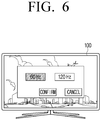
- FIG. 6 is a view illustrating a UI according to an embodiment.
- the processor 130 identifies the frame rate of the video (for example, fps of the video) when the video is received.
- the processor 130 may identify the frame rate corresponding to the user command for changing the frame rate of the display panel 120. Then, the processor 130 may change the frame rate of the display panel 120.
- the processor 130 may display a UI for changing the frame rate of the display panel 120.
- the processor 130 may control the display panel 120 to display a UI through which each of a plurality of frame rates at which the display panel 120 may be driven may be selected.
- the processor 130 may identify a frame rate corresponding to the user command. Then, the processor 130 may adjust a setting value of the display panel so that the display panel operates at a frame rate corresponding to the user command input through the UI.
- FIG. 6 illustrates 60 Hz and 120 Hz as an example of the plurality of frame rates for convenience of explanation, but the plurality of frame rates are not limited thereto.
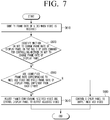
- FIG. 7 is a view illustrating fixing a frame rate according to an embodiment.
- operation S620 when the user command regarding a change of the frame rate is received, the processor 130 identifies whether or not to change the frame rate of the display panel 120 based on the user command.
- the processor 130 identifies whether or not the identified frame rate corresponding to the received video and the frame rate of the display panel 120 are different from each other (operation S660).
- the processor 130 may adjust frames configuring the received video and control the display panel to output the adjusted video (operation S670).
- the processor 130 may control the display panel 120 to output the received video (operation S680).
- the processor 130 adjusts frames configuring a received video and controls the display panel to output an adjusted video in a case where a user command is a command to fix a frame rate and an identified frame rate corresponding to the received video and a frame rate of the display panel 120 are different from each other will be described.
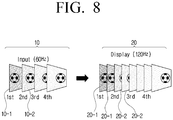
- FIG. 8 is a view illustrating generating a frame according to an embodiment.
- the processor 130 may generate a new frame between a plurality of frames configuring a received video 10 when a frame rate corresponding to the received video 10 is a first frame rate (for example, 60 fps) and a frame rate of the display panel 120 fixed according to a user command is a second frame rate (for example, 120 Hz).
- the generated new frame may be referred to as an interpolation frame.
- the processor 130 may control the display panel 120 to output an adjusted video 20 including the plurality of frames configuring the received video 10 and the generated new frame and corresponding to the received video 10.
- the processor 130 may obtain the new frame, that is, the interpolation frame, based on various frame interpolation technologies according to the related art.
- the processor 130 may obtain the new frame by repeating the previous frame between the respective frames configuring the received video 10.
- the processor 130 may obtain the adjusted video 20 of 120 fps by repeating each of the plurality of frames configuring the video 10. Then, the processor 130 may control the display panel 120 to display the adjusted video 20.
- specific numbers are only examples, and an embodiment is not limited thereto.
- the processor 130 may obtain the adjusted video 20 of 60 fps or 120 fps by repeating each of the plurality of frames configuring the video 10 based on the frame rate of the display panel 120.
- the processor 130 may control the display panel 120 to repeatedly provide a first output frame 20-1 of the adjusted video 20 corresponding to a first frame 10-1 of the received video 10.
- the method of obtaining the new frame by repeating the frame as described above is only an example, and the processor 130 may obtain the new frame and the adjusted video 20 including the new frame by various methods.
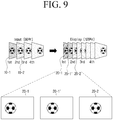
- FIG. 9 is a view illustrating generating a frame according to an embodiment.
- the processor 130 may generate a new frame based on at least two of a plurality of frames configuring a received video 10.
- the generated frame may be a frame generated based on motion information of an object included in at least two of the plurality of frames configuring the video 10.
- the processor 130 may obtain a new output frame 20-1' based on a first frame 10-1 and a second frame 10-2 of the plurality of frames configuring the received video 10.
- the new output frame 20-1' might not be the same as a first output frame 20-1 corresponding to the first frame 10-1 or a second output frame 20-2 corresponding to the second frame 10-2.
- the new output frame 20-1 may be a frame obtained by calculation based on motion information of an object included in each of the first frame 10-1 and the second frame 10-2.
- the motion information may include a position of an object in a frame, a position and a form of the object in the previous frame, change amounts in a position and a form of the object in the next frame, and the like.
- the processor 130 may position the new output frame 20-1' between the first output frame 20-1 and the second output frame 20-2 within an adjusted video, and output the new output frame 20-1' after the previous frame (for example, the first output frame 20-1) is output and before the next frame (for example, the second output frame 20-2) is output.
- various methods according to the related art such as fluid motion of AMD, Inc., and the like, may be used, in addition to the method described above.
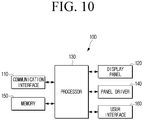
- FIG. 10 is a block diagram illustrating components of the display apparatus according to an embodiment in detail.
- the display apparatus 100 may include the communication interface 110, the display panel 120, the processor 130, a panel driver 140, a memory 150 and a user Interface 160.
- the display apparatus 100 does not necessarily include all of the components described above.
- the display apparatus 100 may further include components such as an audio outputter, a power supply, and the like.
- the display panel 120 may include a liquid crystal layer, a pixel electrode, a liquid crystal capacitor, a gate line, a data line, a backlight unit, and the like.
- the display panel 120 may express brightness of each pixel according to a luminance value identified through luminance information.
- the processor 130 may analyze the received video to obtain video processing delay information related to the processing of the received video, and identify the frame rate of the received video based on the video processing delay information, and adjust the setting value of the display panel so that the display panel operates at the identified frame rate.
- the processor 130 may perform at least one video correction processing on the received video, and then provide the video through the display panel 120. In this case, there is a risk that an input delay time and an input lag will occur depending on a time required from reception of the video until output of the video.
- the processor 130 may obtain video processing delay information related to processing (for example, video correction processing according the related art) of the received video. Then, the processor 130 may identify the frame rate of the video based on the video processing delay information. For example, the processor 130 may increase the frame rate of the display panel 120 in a case where a time required until the output of the received video exceeds a threshold time based on the video processing delay information. As an example, the processor 130 may increase the frame rate of the display panel 120 from 60 Hz to 120 Hz and output the received video.
- the video processing delay information may be determined based on at least one of type information of the received video, user interaction related information, or object information in the received video.
- the type information of the video may include information on whether or not the received video corresponds to any one of movie contents, game contents, streaming contents, or image contents.
- the contents described above are only examples, and an embodiment is not limited thereto.
- the type information of the video may include content type information classified in more detail.
- the type information of the video may include information on which genre in a game, such as a rhythm game, an FPS game, a fighting game, or the like, among the game contents the received video corresponds to.
- the type information of the video may include information on which genre in a movie, such as an action movie, a war movie, a science fiction movie, an animation, or the like, among the movie contents the received video corresponds to.
- the processor 130 may obtain a delay time, that is, video processing delay information. Then, the processor 130 may change the frame rate of the display panel 120 when the delay time exceeds a threshold time based on the video processing delay information. For example, the processor 130 may increase the frame rate of the display panel 120 from 60 Hz to 120 Hz. For example, when it is identified that the delay time exceeds 100 ms based on the video processing delay information, the processor 130 may change the frame rate of the display panel 120 for a game to be smoothly played by the user.
- the processor 130 may obtain a delay time, that is, video processing delay information. Then, the processor 130 may change the frame rate of the display panel 120 when it is identified that the delay time exceeds a threshold time, for example, 50 ms based on the video processing delay information.
- a threshold time for example, 50 ms based on the video processing delay information.
- the processor 130 may receive the video processing delay information from an external server through the communication interface, identify whether or not to change the frame rate of the display panel 120 based on information on threshold times mapped to each of information on video types included in the received video processing delay information, and to what extent (for example, 120 Hz, 144 Hz, or the like) to change the frame rate.
- the processor 130 may identify type information of the video, and identify a frame rate corresponding to the identified type information. Then, the processor 130 may drive the display panel 120 at the identified frame rate. For example, in a case of the FPS game content among the game contents, the display panel 120 may be set to be driven at 144 Hz, and the processor 130 may change the frame rate of the display panel 120 to 144 Hz when it is identified that the received video is the FPS game content through metadata of the received video or analysis of the received video.
- specific frame rates may be set for each of a plurality of content genres or specific frame rates may be set for only some content genres.
- the processor 130 may drive the display panel 120 at the set frame rate, and when a specific frame rate is not set for a content genre of the received video, the processor 130 may drive the display panel 120 at a frame rate obtained based on metadata of the received video.
- the processor 130 may determine the video processing delay information based on object information in the video.
- the processor 130 may change the frame rate of the display panel 120 to smoothly provide the objects to the user. For example, in a case where an object in a frame included in the received video is rapidly changed or in a case where a plurality of objects are moved, the processor 130 may increase the frame rate of the display panel 120 to provide a smooth video to the user without a lag and a delay, and output the received video.
- the object movement information may include information on a position change of each of objects included in the previous frame and a current frame, or the like.
- the processor 130 may change the frame rate of the display panel 120 to a threshold frame rate or more, and output the video (or the content).
- the threshold frame rate may refer to a frame rate for providing game contents, movie contents, or the like, to the user without a delay.
- the threshold frame rate may be set to 120 Hz, but is not limited thereto.
- the processor 130 may determine the video processing delay information based on the user interaction related information. For example, when it is identified that a user's interaction is input threshold times or more based on the user interaction related information, the processor 130 may change the frame rate of the display panel 120.
- the user interaction related information may include a user's input, a screen manipulation command, a manipulation command for an object in the game contents in a case of the game contents, and the like.
- the processor 130 may increase the frame rate of the display panel 120 to smoothly provide a screen in which a plurality of interactions are reflected to the user.
- the processor 130 may increase the frame rate of the display panel 120 so that afterimage or an overlay is not generated. For example, when a user interaction with a specific object such as a target, or the like, in the shooting game content is received and it is identified that the specific object is an object requiring fine adjustment, the processor 130 may increase the frame rate of the display panel 120 to minimize occurrence of the delay.
- the panel driver 140 may provide a driving signal to the display panel 120.
- the panel driver 140 may include a gate driver, a data driver, a gradation voltage generator, and a signal controller.
- the panel driver 140 is described as a separate component in the embodiment of FIG. 10 , in an embodiment, the processor 130 may also serve as the panel driver 140.
- the panel driver 140 may drive the display panel 120 at a frame rate corresponding to the frame rate of the received video 10 based on the frame rate of the received video 10.
- the memory 150 may be electrically connected to the processor 130 and may store data used according to embodiments.
- the memory 150 may be implemented as an internal memory such as a read-only memory (ROM) (for example, an electrically erasable programmable read-only memory (EEPROM)), a random access memory (RAM), or the like, included in the processor 130 or be implemented as a memory separate from the processor 130.
- ROM read-only memory
- EEPROM electrically erasable programmable read-only memory
- RAM random access memory
- the memory 150 may be implemented in a form of a memory embedded in the display apparatus 100 or be implemented in a form of a memory attachable to and detachable from the display apparatus 100, depending on a data storing purpose.
- data for driving the display apparatus 100 may be stored in the memory embedded in the display apparatus100, and data for an extension function of the display apparatus 100 maybe stored in the memory attachable to and detachable from the display apparatus 100.
- the memory 150 maybe at least one of a volatile memory (for example, a dynamic random access memory (DRAM), a static RAM (SRAM), a synchronous dynamic RAM (SDRAM), or the like) or a non-volatile memory (for example, a onetime programmable read-only memory (OTPROM), a programmable ROM (PROM), an erasable programmable ROM (EPROM), an electrically erasable and programmable ROM (EEPROM), a mask ROM, a flash ROM, a flash memory (for example, a NAND flash, a NOR flash, or the like), a hard drive, or a solid state drive (SSD)).
- a volatile memory for example, a dynamic random access memory (DRAM), a static RAM (SRAM), a synchronous dynamic RAM (SDRAM), or the like
- a non-volatile memory for example, a onetime programmable read-only memory (OTPROM), a programmable ROM (PROM), an era
- the memory 150 may be a memory card (for example, a compact flash (CF), a secure digital (SD), a micro-SD, a mini-SD, an extreme digital (xD), a multi-media card (MMC), or the like), an external memory (for example, a USB memory) connectable to a USB port, or the like.
- CF compact flash
- SD secure digital
- xD extreme digital
- MMC multi-media card
- the memory 150 may store information on a setting value required for the display panel 120 to be driven at a specific frame rate of a plurality of frame rates.
- the memory 150 may store a setting value (for example, at least one of a DCC value, a liquid crystal charging timing, or luminance) required for the display panel 120 to be driven at a frame rate of 60 Hz.
- the memory 150 may store a setting value (for example, at least one of a DCC value, a liquid crystal charging timing, or luminance) required for the display panel 120 to be driven at a frame rate of 120Hz.
- the information on the setting value may be in a look-up table form, but is not necessarily limited thereto.
- the information on the setting value maybe stored in the memory 150 inside the display apparatus 100 or luminance information stored in an external server may be used. In this case, the communication interface 110 may communicate with the external server to receive the information on the setting value.
- the user interface 160 may be implemented by a device such as a button, a touch pad, a mouse, and a keyboard or may be implemented by a touch screen, a remote control transmitter/receiver, or the like, capable of performing both of the display function described above and a manipulation input function.
- the remote control transmitter/receiver may receive a remote control signal from an external remote control device or transmit a remote control signal to the external remote control device through at least one of infrared communication, Bluetooth communication, or Wi-Fi communication.
- An outputter outputs a sound signal.
- the outputter may convert a digital sound signal processed by the processor 130 into an analog sound signal, and amplify and output the analog sound signal.
- the outputter may include at least one speaker unit capable of outputting at least one channel, a D/A converter, an audio amplifier, and the like.
- the outputter may be implemented to output various multi-channel sound signals.
- the processor 130 may control the outputter to enhancement-process an input sound signal to correspond to enhancement processing of the input video and then output the sound signal.
- the processor 130 may converts an input 2-channel sound signal into a virtual multi-channel (for example, 5.1-channel) sound signal, recognize a position where the display apparatus 100 is put and process the input 2-channel sound signal as a stereoscopic sound signal optimized for a space, or provide an optimized sound signal according to a type (for example, a content genre) of input video.
- a virtual multi-channel for example, 5.1-channel
- the display apparatus 100 may further include a tuner and a demodulator, according to an implementation.
- the tuner may tune a channel selected by the user among radio frequency (RF) broadcasting signals received through an antenna or all pre-stored channels to receive an RF broadcasting signal.
- the demodulator may receive and demodulate a digital intermediate frequency (DIF) signal converted by the tuner and perform channel demodulation, or the like.
- DIF digital intermediate frequency
- an input video received through the tuner may be processed through the demodulator and be then provided to the processor 130 for video processing according to an embodiment.
- the above-described embodiments may be applied to all electronic apparatuses capable of performing video processing, such as a video receiving apparatus such as a set-top box, a video processing apparatus, as well as the display apparatus.
- Embodiments may be implemented in a computer or an apparatus similar to the computer using software, hardware, or a combination of software and hardware.
- embodiments described in the disclosure may be implemented by a processor itself.
- embodiments such as procedures and functions described herein may be implemented by separate software modules. Each of the software modules may perform one or more functions and operations described in the disclosure.
- Software e.g., the program
- Software containing one or more instructions for performing processing operations of the display apparatus 100 according to embodiments maybe stored in a machine-readable (e.g., computer-readable) storage medium (e.g., internal memory) or external memory.
- the instructions stored in a non-transitory computer-readable medium cause a specific device to perform the processing operations of the display apparatus 100 according to embodiments when they are executed by a processor of the specific device.
- the non-transitory computer-readable medium is not a medium that stores data for a while, such as a register, a cache, a memory, or the like, but means a medium that semi-permanently stores data and is readable by the device.
- Specific examples of the non-transitory computer-readable medium may include a compact disk (CD), a digital versatile disk (DVD), a hard disk, a Blu-ray disk, a USB, a memory card, a ROM, and the like.
Landscapes
- Engineering & Computer Science (AREA)
- Chemical & Material Sciences (AREA)
- Crystallography & Structural Chemistry (AREA)
- Physics & Mathematics (AREA)
- Computer Hardware Design (AREA)
- General Physics & Mathematics (AREA)
- Theoretical Computer Science (AREA)
- Control Of Indicators Other Than Cathode Ray Tubes (AREA)
- Controls And Circuits For Display Device (AREA)
Applications Claiming Priority (2)
| Application Number | Priority Date | Filing Date | Title |
|---|---|---|---|
| US201962934731P | 2019-11-13 | 2019-11-13 | |
| KR1020200036146A KR102683367B1 (ko) | 2019-11-13 | 2020-03-25 | 디스플레이 장치 및 그 제어 방법 |
Publications (4)
| Publication Number | Publication Date |
|---|---|
| EP3822962A2 true EP3822962A2 (fr) | 2021-05-19 |
| EP3822962A3 EP3822962A3 (fr) | 2021-06-09 |
| EP3822962C0 EP3822962C0 (fr) | 2025-06-04 |
| EP3822962B1 EP3822962B1 (fr) | 2025-06-04 |
Family
ID=73343972
Family Applications (1)
| Application Number | Title | Priority Date | Filing Date |
|---|---|---|---|
| EP20207022.3A Active EP3822962B1 (fr) | 2019-11-13 | 2020-11-11 | Appareil d'affichage et son procédé de commande |
Country Status (5)
| Country | Link |
|---|---|
| US (2) | US11978415B2 (fr) |
| EP (1) | EP3822962B1 (fr) |
| KR (1) | KR102863939B1 (fr) |
| CN (2) | CN112802432B (fr) |
| WO (1) | WO2021096137A1 (fr) |
Families Citing this family (8)
| Publication number | Priority date | Publication date | Assignee | Title |
|---|---|---|---|---|
| US11978415B2 (en) * | 2019-11-13 | 2024-05-07 | Samsung Electronics Co., Ltd. | Display apparatus and control method thereof |
| US12282376B2 (en) * | 2021-08-24 | 2025-04-22 | Meta Platforms Technologies, Llc | Systems, devices, and methods for animating always on displays at variable frame rates |
| US12131719B2 (en) * | 2021-09-10 | 2024-10-29 | Apple Inc. | Displays with variable frame rates |
| CN115842940B (zh) * | 2021-09-18 | 2025-09-05 | 京东方科技集团股份有限公司 | 显示装置的数据处理方法、装置、设备、系统及介质 |
| US12027141B2 (en) * | 2021-12-27 | 2024-07-02 | Synaptics Incorporated | Activity-focused display synchronization |
| CN119278435A (zh) * | 2022-05-30 | 2025-01-07 | 高通股份有限公司 | 显示驱动器线程运行时调度 |
| US11842669B1 (en) * | 2022-06-30 | 2023-12-12 | Microsoft Technology Licensing, Llc | Independent refresh rate for multiple monitors |
| TWI842311B (zh) * | 2022-12-30 | 2024-05-11 | 瑞昱半導體股份有限公司 | 影像亮度調整方法及其裝置 |
Family Cites Families (37)
| Publication number | Priority date | Publication date | Assignee | Title |
|---|---|---|---|---|
| KR100741764B1 (ko) | 2000-01-12 | 2007-07-24 | 엘지전자 주식회사 | 디지털 티브이의 프레임 레이트 검출 장치 및 그 방법 |
| KR100853210B1 (ko) * | 2002-03-21 | 2008-08-20 | 삼성전자주식회사 | 색 특성 보상 기능과 응답 속도 보상 기능을 갖는 액정표시 장치 |
| KR100915234B1 (ko) * | 2002-12-17 | 2009-09-02 | 삼성전자주식회사 | 계조 전압의 선택 범위를 변경할 수 있는 액정 표시장치의 구동 장치 및 그 방법 |
| EP1642456A1 (fr) * | 2003-06-30 | 2006-04-05 | Koninklijke Philips Electronics N.V. | Lecture simulé utilisant des modes de balayage crt |
| KR101017366B1 (ko) * | 2004-08-30 | 2011-02-28 | 삼성전자주식회사 | 액정 표시 장치 및 그 동적 커패시턴스 보상의 계조레벨의 결정 방법 및 그 감마 정수의 보정 방법 |
| US20070268237A1 (en) * | 2006-05-22 | 2007-11-22 | Vastview Technology, Inc. | Method for driving display device to hide transient behavior |
| US20080055318A1 (en) * | 2006-08-31 | 2008-03-06 | Glen David I J | Dynamic frame rate adjustment |
| US7656374B2 (en) * | 2006-09-04 | 2010-02-02 | Vastview Technology, Inc. | Method for enhancing response speed of hold-typed display device |
| KR20080022276A (ko) | 2006-09-06 | 2008-03-11 | 엘지전자 주식회사 | 영상표시기기의 화면 제어장치 및 방법 |
| US20080094335A1 (en) * | 2006-10-23 | 2008-04-24 | Samsung Electronics Co., Ltd., | Liquid crystal display and method of driving the same |
| KR101251352B1 (ko) | 2006-12-13 | 2013-04-05 | 삼성디스플레이 주식회사 | 콘트롤러 보드 및 이를 갖는 표시장치 |
| JP4989309B2 (ja) * | 2007-05-18 | 2012-08-01 | 株式会社半導体エネルギー研究所 | 液晶表示装置 |
| KR101544843B1 (ko) | 2008-07-28 | 2015-08-18 | 삼성디스플레이 주식회사 | 표시 장치와 그 구동 방법 |
| WO2010062647A2 (fr) * | 2008-10-28 | 2010-06-03 | Pixtronix, Inc. | Système et procédé pour sélectionner des modes d'affichage |
| KR20100078699A (ko) * | 2008-12-30 | 2010-07-08 | 삼성전자주식회사 | 능동형 유기발광 다이오드의 전력 제어 방법 및 장치 |
| US9830880B1 (en) * | 2009-07-22 | 2017-11-28 | Nvidia Corporation | Method and system for adjusting the refresh rate of a display device based on a video content rate |
| KR20110041282A (ko) * | 2009-10-15 | 2011-04-21 | 삼성전자주식회사 | 표시장치 및 이의 구동방법 |
| KR101761400B1 (ko) | 2009-12-21 | 2017-07-25 | 엘지디스플레이 주식회사 | 액정표시장치 |
| US9589540B2 (en) * | 2011-12-05 | 2017-03-07 | Microsoft Technology Licensing, Llc | Adaptive control of display refresh rate based on video frame rate and power efficiency |
| US9355585B2 (en) * | 2012-04-03 | 2016-05-31 | Apple Inc. | Electronic devices with adaptive frame rate displays |
| JPWO2013175735A1 (ja) | 2012-05-22 | 2016-01-12 | パナソニックIpマネジメント株式会社 | 表示制御装置及び表示制御方法 |
| US9275601B2 (en) * | 2012-12-12 | 2016-03-01 | Intel Corporation | Techniques to control frame display rate |
| KR102080876B1 (ko) * | 2013-05-08 | 2020-02-25 | 삼성디스플레이 주식회사 | 표시 장치 및 그 구동 방법 |
| US9773460B2 (en) * | 2013-10-18 | 2017-09-26 | Nvidia Corporation | System, method, and computer program product for combining low motion blur and variable refresh rate in a display |
| US10878770B2 (en) * | 2013-12-02 | 2020-12-29 | Nvidia Corporation | Method and system for customizing optimal settings using end-user preferences |
| KR20150069413A (ko) | 2013-12-13 | 2015-06-23 | 삼성디스플레이 주식회사 | 표시 장치 및 그 구동 방법 |
| US10162516B2 (en) | 2015-05-22 | 2018-12-25 | Casio Computer Co., Ltd. | Display apparatus for displaying images |
| KR102485558B1 (ko) * | 2015-08-17 | 2023-01-09 | 삼성디스플레이 주식회사 | 타이밍 컨트롤러, 이를 포함하는 표시 장치 및 이 표시 장치의 구동 방법 |
| US10147370B2 (en) * | 2015-10-29 | 2018-12-04 | Nvidia Corporation | Variable refresh rate gamma correction |
| KR102438199B1 (ko) | 2015-12-24 | 2022-08-30 | 삼성전자주식회사 | 디스플레이 장치 및 디스플레이 장치의 설정 값을 변경하는 방법 |
| TWI610285B (zh) | 2016-08-16 | 2018-01-01 | 晨星半導體股份有限公司 | 應用於顯示器的裝置及相關的影像顯示方法 |
| JP2018169455A (ja) | 2017-03-29 | 2018-11-01 | パナソニック液晶ディスプレイ株式会社 | 表示システム |
| KR102383117B1 (ko) | 2017-07-21 | 2022-04-06 | 삼성전자주식회사 | 디스플레이 장치, 디스플레이 방법 및 디스플레이 시스템 |
| KR102112146B1 (ko) | 2018-09-27 | 2020-05-18 | 삼성전자주식회사 | 디스플레이 장치 및 그 제어 방법 |
| US11183150B2 (en) * | 2019-01-04 | 2021-11-23 | Ati Technologies Ulc | Foveated illumination control at display device |
| WO2021033796A1 (fr) | 2019-08-20 | 2021-02-25 | 엘지전자 주식회사 | Dispositif d'affichage, et procédé de commande associé |
| US11978415B2 (en) * | 2019-11-13 | 2024-05-07 | Samsung Electronics Co., Ltd. | Display apparatus and control method thereof |
-
2020
- 2020-10-27 US US17/081,665 patent/US11978415B2/en active Active
- 2020-11-02 WO PCT/KR2020/015169 patent/WO2021096137A1/fr not_active Ceased
- 2020-11-11 EP EP20207022.3A patent/EP3822962B1/fr active Active
- 2020-11-13 CN CN202011267631.1A patent/CN112802432B/zh active Active
- 2020-11-13 CN CN202410927031.5A patent/CN118898975A/zh active Pending
-
2023
- 2023-09-27 US US18/475,467 patent/US20240021169A1/en active Pending
-
2024
- 2024-07-04 KR KR1020240088331A patent/KR102863939B1/ko active Active
Also Published As
| Publication number | Publication date |
|---|---|
| US11978415B2 (en) | 2024-05-07 |
| EP3822962A3 (fr) | 2021-06-09 |
| CN118898975A (zh) | 2024-11-05 |
| CN112802432B (zh) | 2024-07-30 |
| US20210142749A1 (en) | 2021-05-13 |
| KR102863939B1 (ko) | 2025-09-25 |
| KR20240109968A (ko) | 2024-07-12 |
| WO2021096137A1 (fr) | 2021-05-20 |
| EP3822962C0 (fr) | 2025-06-04 |
| CN112802432A (zh) | 2021-05-14 |
| EP3822962B1 (fr) | 2025-06-04 |
| US20240021169A1 (en) | 2024-01-18 |
Similar Documents
| Publication | Publication Date | Title |
|---|---|---|
| EP3822962B1 (fr) | Appareil d'affichage et son procédé de commande | |
| US12038786B2 (en) | Image display apparatus | |
| CN106488157B (zh) | 图像显示设备 | |
| US11798508B2 (en) | Display device and method for operating same | |
| US9786255B2 (en) | Dynamic frame repetition in a variable refresh rate system | |
| EP3889952B1 (fr) | Afficheur et procédé de fonctionnement correspondant | |
| KR102308192B1 (ko) | 디스플레이 장치 및 그 제어 방법 | |
| US12142187B2 (en) | Image display device and operating method therefor | |
| US20180268781A1 (en) | Image display apparatus | |
| US10068549B2 (en) | Cursor handling in a variable refresh rate environment | |
| US20140160354A1 (en) | Display apparatus and display method | |
| US20140267285A1 (en) | Display apparatus and control method thereof for applying motion compensation to remove artifacts from images | |
| US20250173111A1 (en) | Display apparatus and control method thereof | |
| JP2014066928A (ja) | 映像信号供給装置、表示装置、テレビジョン受像機、表示システム、映像信号供給方法、表示方法、プログラム、及び、記録媒体 | |
| KR102683367B1 (ko) | 디스플레이 장치 및 그 제어 방법 | |
| KR102745618B1 (ko) | 신호 처리 장치 및 이를 구비하는 영상표시장치 | |
| KR102774824B1 (ko) | 영상표시장치 및 소스 디바이스 | |
| US20260024505A1 (en) | Display device and operating method thereof | |
| US20250219811A1 (en) | Interface device and image display apparatus including the same | |
| US20250384851A1 (en) | Display device and operating method thereof | |
| KR20250146800A (ko) | 전자 장치 및 그의 동작 방법 | |
| CN121545457A (zh) | 显示设备、背光亮度调整方法、存储介质及程序产品 |
Legal Events
| Date | Code | Title | Description |
|---|---|---|---|
| PUAI | Public reference made under article 153(3) epc to a published international application that has entered the european phase |
Free format text: ORIGINAL CODE: 0009012 |
|
| STAA | Information on the status of an ep patent application or granted ep patent |
Free format text: STATUS: THE APPLICATION HAS BEEN PUBLISHED |
|
| PUAL | Search report despatched |
Free format text: ORIGINAL CODE: 0009013 |
|
| AK | Designated contracting states |
Kind code of ref document: A2 Designated state(s): AL AT BE BG CH CY CZ DE DK EE ES FI FR GB GR HR HU IE IS IT LI LT LU LV MC MK MT NL NO PL PT RO RS SE SI SK SM TR |
|
| AK | Designated contracting states |
Kind code of ref document: A3 Designated state(s): AL AT BE BG CH CY CZ DE DK EE ES FI FR GB GR HR HU IE IS IT LI LT LU LV MC MK MT NL NO PL PT RO RS SE SI SK SM TR |
|
| RIC1 | Information provided on ipc code assigned before grant |
Ipc: G09G 3/36 20060101AFI20210506BHEP |
|
| STAA | Information on the status of an ep patent application or granted ep patent |
Free format text: STATUS: REQUEST FOR EXAMINATION WAS MADE |
|
| 17P | Request for examination filed |
Effective date: 20210913 |
|
| RBV | Designated contracting states (corrected) |
Designated state(s): AL AT BE BG CH CY CZ DE DK EE ES FI FR GB GR HR HU IE IS IT LI LT LU LV MC MK MT NL NO PL PT RO RS SE SI SK SM TR |
|
| STAA | Information on the status of an ep patent application or granted ep patent |
Free format text: STATUS: EXAMINATION IS IN PROGRESS |
|
| 17Q | First examination report despatched |
Effective date: 20230203 |
|
| GRAP | Despatch of communication of intention to grant a patent |
Free format text: ORIGINAL CODE: EPIDOSNIGR1 |
|
| STAA | Information on the status of an ep patent application or granted ep patent |
Free format text: STATUS: GRANT OF PATENT IS INTENDED |
|
| INTG | Intention to grant announced |
Effective date: 20250107 |
|
| RIN1 | Information on inventor provided before grant (corrected) |
Inventor name: KIM, UBIN Inventor name: KIM, BEOMJOON Inventor name: HEO, HYEHYUN Inventor name: JANG, SUNGHWAN Inventor name: HAN, YOUNGSEOK |
|
| GRAS | Grant fee paid |
Free format text: ORIGINAL CODE: EPIDOSNIGR3 |
|
| GRAA | (expected) grant |
Free format text: ORIGINAL CODE: 0009210 |
|
| STAA | Information on the status of an ep patent application or granted ep patent |
Free format text: STATUS: THE PATENT HAS BEEN GRANTED |
|
| AK | Designated contracting states |
Kind code of ref document: B1 Designated state(s): AL AT BE BG CH CY CZ DE DK EE ES FI FR GB GR HR HU IE IS IT LI LT LU LV MC MK MT NL NO PL PT RO RS SE SI SK SM TR |
|
| REG | Reference to a national code |
Ref country code: GB Ref legal event code: FG4D |
|
| REG | Reference to a national code |
Ref country code: CH Ref legal event code: EP |
|
| REG | Reference to a national code |
Ref country code: IE Ref legal event code: FG4D |
|
| U01 | Request for unitary effect filed |
Effective date: 20250604 |
|
| U07 | Unitary effect registered |
Designated state(s): AT BE BG DE DK EE FI FR IT LT LU LV MT NL PT RO SE SI Effective date: 20250616 |
|
| PG25 | Lapsed in a contracting state [announced via postgrant information from national office to epo] |
Ref country code: ES Free format text: LAPSE BECAUSE OF FAILURE TO SUBMIT A TRANSLATION OF THE DESCRIPTION OR TO PAY THE FEE WITHIN THE PRESCRIBED TIME-LIMIT Effective date: 20250604 |
|
| PG25 | Lapsed in a contracting state [announced via postgrant information from national office to epo] |
Ref country code: NO Free format text: LAPSE BECAUSE OF FAILURE TO SUBMIT A TRANSLATION OF THE DESCRIPTION OR TO PAY THE FEE WITHIN THE PRESCRIBED TIME-LIMIT Effective date: 20250904 Ref country code: GR Free format text: LAPSE BECAUSE OF FAILURE TO SUBMIT A TRANSLATION OF THE DESCRIPTION OR TO PAY THE FEE WITHIN THE PRESCRIBED TIME-LIMIT Effective date: 20250905 |
|
| PG25 | Lapsed in a contracting state [announced via postgrant information from national office to epo] |
Ref country code: PL Free format text: LAPSE BECAUSE OF FAILURE TO SUBMIT A TRANSLATION OF THE DESCRIPTION OR TO PAY THE FEE WITHIN THE PRESCRIBED TIME-LIMIT Effective date: 20250604 |
|
| PG25 | Lapsed in a contracting state [announced via postgrant information from national office to epo] |
Ref country code: HR Free format text: LAPSE BECAUSE OF FAILURE TO SUBMIT A TRANSLATION OF THE DESCRIPTION OR TO PAY THE FEE WITHIN THE PRESCRIBED TIME-LIMIT Effective date: 20250604 |
|
| PG25 | Lapsed in a contracting state [announced via postgrant information from national office to epo] |
Ref country code: RS Free format text: LAPSE BECAUSE OF FAILURE TO SUBMIT A TRANSLATION OF THE DESCRIPTION OR TO PAY THE FEE WITHIN THE PRESCRIBED TIME-LIMIT Effective date: 20250904 |
|
| U20 | Renewal fee for the european patent with unitary effect paid |
Year of fee payment: 6 Effective date: 20251124 |
|
| PG25 | Lapsed in a contracting state [announced via postgrant information from national office to epo] |
Ref country code: IS Free format text: LAPSE BECAUSE OF FAILURE TO SUBMIT A TRANSLATION OF THE DESCRIPTION OR TO PAY THE FEE WITHIN THE PRESCRIBED TIME-LIMIT Effective date: 20251004 |
|
| PGFP | Annual fee paid to national office [announced via postgrant information from national office to epo] |
Ref country code: GB Payment date: 20251001 Year of fee payment: 6 |
|
| PG25 | Lapsed in a contracting state [announced via postgrant information from national office to epo] |
Ref country code: SM Free format text: LAPSE BECAUSE OF FAILURE TO SUBMIT A TRANSLATION OF THE DESCRIPTION OR TO PAY THE FEE WITHIN THE PRESCRIBED TIME-LIMIT Effective date: 20250604 |
|
| PG25 | Lapsed in a contracting state [announced via postgrant information from national office to epo] |
Ref country code: CZ Free format text: LAPSE BECAUSE OF FAILURE TO SUBMIT A TRANSLATION OF THE DESCRIPTION OR TO PAY THE FEE WITHIN THE PRESCRIBED TIME-LIMIT Effective date: 20250604 |
|
| PG25 | Lapsed in a contracting state [announced via postgrant information from national office to epo] |
Ref country code: SK Free format text: LAPSE BECAUSE OF FAILURE TO SUBMIT A TRANSLATION OF THE DESCRIPTION OR TO PAY THE FEE WITHIN THE PRESCRIBED TIME-LIMIT Effective date: 20250604 |
|
| PLBE | No opposition filed within time limit |
Free format text: ORIGINAL CODE: 0009261 |
|
| STAA | Information on the status of an ep patent application or granted ep patent |
Free format text: STATUS: NO OPPOSITION FILED WITHIN TIME LIMIT |
|
| REG | Reference to a national code |
Ref country code: CH Ref legal event code: L10 Free format text: ST27 STATUS EVENT CODE: U-0-0-L10-L00 (AS PROVIDED BY THE NATIONAL OFFICE) Effective date: 20260416 |