EP3824005B1 - Flüssige wundauflagenzusammensetzung - Google Patents
Flüssige wundauflagenzusammensetzung Download PDFInfo
- Publication number
- EP3824005B1 EP3824005B1 EP19742518.4A EP19742518A EP3824005B1 EP 3824005 B1 EP3824005 B1 EP 3824005B1 EP 19742518 A EP19742518 A EP 19742518A EP 3824005 B1 EP3824005 B1 EP 3824005B1
- Authority
- EP
- European Patent Office
- Prior art keywords
- alkyl
- structural units
- methacrylate
- meth
- polymer
- Prior art date
- Legal status (The legal status is an assumption and is not a legal conclusion. Google has not performed a legal analysis and makes no representation as to the accuracy of the status listed.)
- Active
Links
Images

Classifications
-
- C—CHEMISTRY; METALLURGY
- C08—ORGANIC MACROMOLECULAR COMPOUNDS; THEIR PREPARATION OR CHEMICAL WORKING-UP; COMPOSITIONS BASED THEREON
- C08F—MACROMOLECULAR COMPOUNDS OBTAINED BY REACTIONS ONLY INVOLVING CARBON-TO-CARBON UNSATURATED BONDS
- C08F230/00—Copolymers of compounds having one or more unsaturated aliphatic radicals, each having only one carbon-to-carbon double bond, and containing phosphorus, selenium, tellurium or a metal
- C08F230/04—Copolymers of compounds having one or more unsaturated aliphatic radicals, each having only one carbon-to-carbon double bond, and containing phosphorus, selenium, tellurium or a metal containing a metal
- C08F230/08—Copolymers of compounds having one or more unsaturated aliphatic radicals, each having only one carbon-to-carbon double bond, and containing phosphorus, selenium, tellurium or a metal containing a metal containing silicon
-
- C—CHEMISTRY; METALLURGY
- C09—DYES; PAINTS; POLISHES; NATURAL RESINS; ADHESIVES; COMPOSITIONS NOT OTHERWISE PROVIDED FOR; APPLICATIONS OF MATERIALS NOT OTHERWISE PROVIDED FOR
- C09D—COATING COMPOSITIONS, e.g. PAINTS, VARNISHES OR LACQUERS; FILLING PASTES; CHEMICAL PAINT OR INK REMOVERS; INKS; CORRECTING FLUIDS; WOODSTAINS; PASTES OR SOLIDS FOR COLOURING OR PRINTING; USE OF MATERIALS THEREFOR
- C09D143/00—Coating compositions based on homopolymers or copolymers of compounds having one or more unsaturated aliphatic radicals, each having only one carbon-to-carbon double bond, and containing boron, silicon, phosphorus, selenium, tellurium, or a metal; Coating compositions based on derivatives of such polymers
- C09D143/04—Homopolymers or copolymers of monomers containing silicon
-
- C—CHEMISTRY; METALLURGY
- C09—DYES; PAINTS; POLISHES; NATURAL RESINS; ADHESIVES; COMPOSITIONS NOT OTHERWISE PROVIDED FOR; APPLICATIONS OF MATERIALS NOT OTHERWISE PROVIDED FOR
- C09J—ADHESIVES; NON-MECHANICAL ASPECTS OF ADHESIVE PROCESSES IN GENERAL; ADHESIVE PROCESSES NOT PROVIDED FOR ELSEWHERE; USE OF MATERIALS AS ADHESIVES
- C09J143/00—Adhesives based on homopolymers or copolymers of compounds having one or more unsaturated aliphatic radicals, each having only one carbon-to-carbon double bond, and containing boron, silicon, phosphorus, selenium, tellurium, or a metal; Adhesives based on derivatives of such polymers
- C09J143/04—Homopolymers or copolymers of monomers containing silicon
-
- C—CHEMISTRY; METALLURGY
- C08—ORGANIC MACROMOLECULAR COMPOUNDS; THEIR PREPARATION OR CHEMICAL WORKING-UP; COMPOSITIONS BASED THEREON
- C08F—MACROMOLECULAR COMPOUNDS OBTAINED BY REACTIONS ONLY INVOLVING CARBON-TO-CARBON UNSATURATED BONDS
- C08F230/00—Copolymers of compounds having one or more unsaturated aliphatic radicals, each having only one carbon-to-carbon double bond, and containing phosphorus, selenium, tellurium or a metal
- C08F230/04—Copolymers of compounds having one or more unsaturated aliphatic radicals, each having only one carbon-to-carbon double bond, and containing phosphorus, selenium, tellurium or a metal containing a metal
- C08F230/08—Copolymers of compounds having one or more unsaturated aliphatic radicals, each having only one carbon-to-carbon double bond, and containing phosphorus, selenium, tellurium or a metal containing a metal containing silicon
- C08F230/085—Copolymers of compounds having one or more unsaturated aliphatic radicals, each having only one carbon-to-carbon double bond, and containing phosphorus, selenium, tellurium or a metal containing a metal containing silicon the monomer being a polymerisable silane, e.g. (meth)acryloyloxy trialkoxy silanes or vinyl trialkoxysilanes
Definitions
- the present invention is directed to a liquid composition based on polymer network comprising siloxane groups and a covalently bound antioxidant component.
- the preparation Upon application to the skin or mucosa, the preparation forms an adhesive and transparent covering and protective layer that exhibits anti-inflammatory effects, thereby contributing positively to the prevention of inflammation and to skin and mucosa wound healing.
- a wound is defined as a damage to body cover integrity.
- the appearance of an acute wound implies the action of an external agent that leads to skin and soft tissue damage. Usually, they do not require professional medical treatment, and the injured persons treat them themselves. Appropriate treatment affects the length of the healing process and possibly the aesthetic appearance of the scar.
- Acute injury usually heals within six weeks, which is the standard time for physiological healing of an acute wound.
- Wound healing is a complex physiological process characterized by three distinct, mutually overlapping phases (inflammation, proliferation and epithelialization).
- ROS reactive oxygen species
- Main types of ROS include hydrogen peroxide (H 2 O 2 ) and oxygen radicals - hydroxyl (•OH), peroxyl (-OOR), hydroperoxyl (•OOH), superoxide anion radicals (•OO - ).
- oxidative stress occurs, which in turn leads to a further tissue damage, which, among other things, results in a significant increase in treatment time.
- Antioxidants effectively suppress the development of oxidative stress by their ability to react with ROS and by converting them into substances harmless to the body, thereby contributing significantly to the creation of an optimal wound environment that promotes the healing process.
- the granulation tissue migrates, proliferate, and divide at the site of injury.
- the granulation tissue is characterized by a very disorganized structure and is composed mainly of fibroblasts and new vessels.
- the epithelialization phase follows the proliferative phase.
- the already formed granulation tissue contracts.
- the cell lining of the new tissue usually starts from the edges of the wound or from the so-called epithelial islands.
- the wound gradually contracts during this phase, its surface being covered by the epithelium from healthy tissue around the wound. Contracted tissue is formed, a scar that is gradually remodeled into a tissue structure with a high degree of organization.
- the optimal wound dressing should by its properties correspond as effectively as possible to the individual phases of wound healing.
- the dressing should also be capable of actively suppressing oxidative stress at the site of injury, be impermeable to bacteria and external contaminants, and permeable to water vapor and oxygen, promote cell adhesion and growth, and epithelialization of wound surface.
- Advantageous is also transparency of the cover for visual inspection of the wound condition.
- a suitable type of acute wound dressing is then a coating solution or suspension of a polymer, which, after application and subsequent rapid evaporation of the solvent, forms a barrier film on the skin, which is breathable and protective.
- This type of dressing is preferred by patients, since the risk of wound contamination upon its application is significantly reduced, and it is easy to apply to wounds even in areas whose treatment with conventional coverings is usually difficult (e.g. between fingers, on joints).
- Liquid wound dressing compositions are known which are based on a polymer solution which is prepared exclusively by radical polymerization method and which contains siloxane groups in its structure.
- US 6383502 B1 discloses wound dressing in the form of a solution of a siloxane groups-containing polymer in a low molecular weight polydimethylsiloxane.
- the polymer contains monomeric units of exclusively hydrophobic character, which is reflected in the material properties of the dressing, such as water impermeability, water repellency.
- the dressing prepared according to this patent may also include additional wound healing agents which are always added only in the form of low molecular weight substances. This results in the obvious disadvantage of the above-mentioned dressing, since the biologically active low molecular components are absorbed by the skin into the body after application of the preparation, thereby reducing their local concentration at the site of injury and causing undesirable side effects.
- a polymeric network wound dressing comprising siloxane groups in its structure, and its solution in a volatile polydimethylsiloxane and/or a liquid alkane is the subject of US 8263720 B 1.
- the polymer networks forming the basis of the preparation according to US 8263720 B 1 are exclusively prepared by radical copolymerization of alkylsiloxanes bearing a polymerizable double bond with multifunctional monomers (crosslinkers) containing at least two polymerizable double bonds.
- crosslinkers multifunctional monomers
- the poor adhesion of the polymeric film to the skin may be an obvious disadvantage when using such a dressing as a wound healing dressing, since it does not provide adequate protection of the wound from contamination from the outside or by mechanical damage to the dressing.
- the composition of the dressing prepared according to US 8263720 B1 may also include the addition of low molecular weight healing agents; however, this represents a further disadvantage of dressing, for the reasons given above
- WO92Z14428 discloses a liquid polymer-containing coating material which comprises from 1 to 40 wt. % siloxane-containing polymer and 59.9 to 98.9 wt. % volatile polydimethylsiloxane and which can act as a bandage or dressing to protect wounds, when applied in liquid form and air dried on the wound to form an adherent, solid protective film without significant stinging to the skin or mucous membranes of the user.
- the copolymer comprises 3-methacryloyloxypropyl tris(trimethylsiloxy)silane and (meth)acrylate monomers.
- US6610284 discloses a preparation for prevention and healing of inflammation affections which comprises 0.1-99.9 wt.% sterically hindered amine derivatives.
- L. POLAKOVA ET AL "Antioxidant Properties of 2-Hydroxyethyl Methacrylate-Based Copolymers with Incorporated Sterically Hindered Amine",BIOMACROMOLECULES, vol. 16, no. 9, 14 September 2015 (2015-09-14), pages 2726-2734 , discloses copolymers comprising N-(2,2,6,6-tetramethyl-piperidin-4-yl) methacrylamide repeating units showing antioxidants properties and their use as hydrogel wound dressing materials.
- the present invention overcomes the aforementioned drawbacks of the prior art by providing a liquid wound dressing composition based on a polymeric network prepared by combining radical polymerization of monomers containing a polymerizable double bond, including derivatives of sterically hindered amines, alkyloxysilanes and alkylsiloxanes, optionally additional monomers, and hydrolysis/condensation reactions of said alkyloxysilanes.
- radical polymerization polymer chains are formed which are simultaneously crosslinked by the silane condensation reaction products.
- the result is a polymer network that adheres well to the skin and mucosa and which contains both siloxane groups and covalently bound anti-inflammatory components (sterically hindered amines) in its structure.
- It is an object of the present invention to provide a liquid wound dressing composition comprising a polymer network which is dissolved or suspended in a volatile solvent based on polydimethylsiloxane.
- the product does not irritate the skin or mucosa after application, it is non-stinging, and after evaporation of the solvent it creates a protective layer which is highly adherent and has an anti-inflammatory effect, thus contributing positively to the prevention and healing of acute wounds on the skin or mucosa.
- the solvent in which the polymer is dissolved or dispersed meets a number of requirements, including in particular a relatively high vapor pressure (to rapidly evaporate after application to the skin) and biocompatibility.
- the solvent also is non-stinging when in contact with an open wound. Liquid volatile polydimethylsiloxanes are solvents meeting all these requirements. After application to the injured skin, they cover the exposed nerve endings, thereby immediately relieving the pain and not causing a burning sensation.
- the solvent may also be called "liquid component
- the polydimethylsiloxanes suitable for use in the present invention preferably have 2 to 10, more preferably 2 to 5 dimethylsiloxane units, and may be linear, branched (containing methyl groups at the chain ends) or cyclic.
- the polydimethylsiloxanes are preferably selected from the group consisting of octamethylcyclotetrasiloxane, decamethylcyclopentasiloxane, octamethyltrisiloxane, hexamethyldisiloxane (HMDS).
- polydimethylsiloxanes can also be used in the present invention in combination with other solvents such as esters, linear or cyclic ethers, primary or secondary alcohols, ketones, wherein the content of polydimethylsiloxanes in such mixed polydimethylsiloxane-based solvent is at least 50 wt. %.
- solvents such as esters, linear or cyclic ethers, primary or secondary alcohols, ketones
- the polymer network which forms the basis of the formulation of the present invention comprises three structural unit types of A, B, C, and optionally a structural unit type D, each structural unit having different functions in the polymer structure and in the functioning of the formulation.
- the polymer network comprises one or more different units of each type.
- Structural units A contain chemical groups that are capable of binding or inactivating substances toxic or adversely affecting inflammatory processes and which catalyze hydrolytic reactions of alkyloxysilanes.
- the structural units A are derived from derivatives of sterically hindered amines of the formula (a):
- the content of structural units A in the polymer network is preferably in the range of 0.01 to 20 wt. %, relative to the total weight of the polymer network.
- the structural units A are preferably derived from 2,2,6,6-tetramethylazinan-4-yl-methacrylate and/or N-(2,2,6,6-tetramethylazinan-4-yl)methacrylamide.
- Azinane is another possible name for piperidine, which is the preferred IUPAC name.
- the structural units B contain chemical groups which undergo hydrolysis and subsequent condensation reactions leading to crosslinking of the polymer, thereby promoting its non-absorbability into the body.
- the structural units B are derived from alkyloxysilanes of the general formula (b): wherein R 7 is -O(X 2 ), wherein X 2 is C 1 to C 4 alkyl,
- the content of the structural units B in the polymer network is preferably 0.1 to 15 wt.%, relative to the total weight of the polymer network.
- the structural units B are preferably derived from 3-(triethoxysilyl) propyl methacrylate, 3-(dimethoxymethylsilyl) propyl methacrylate, (triethoxysilyl)ethylene and/or (trimethoxysilyl)ethylene.
- the structural units C contain alkylsiloxane groups which improve the ability of the polymer network to form films, promote its adhesion to the skin and mucosa, and ensure the solubility or swellability of the polymeric network in a volatile solvent which is non-irritating and non-stinging upon application to injured skin.
- the structural units C are derived from alkylsiloxanes of the formula (c): wherein R 11 is -H or -CH 3 ,
- the content of structural units C in the polymer network is preferably 30 to 80 wt. %, relative to the total weight of the polymer network.
- the structural units C are preferably derived from 3-[tris(trimethylsiloxy)silyl]propyl methacrylate and/or 3-[tris(trimethylsiloxy)silyl]propyl acrylate.
- Further structural units D may optionally be bonded to the polymer network structure to affect its adhesion, cohesion, elasticity, flexibility, transparency, oxygen and water vapor permeability, or combinations thereof.
- Suitable structural units are structural units derived from (meth)acrylamide monomers, alkyl (meth)acrylates, alkyl (meth)acrylamides, alkyloxy terminated (polyoxyethylene) (meth)acrylates, alkyloxy terminated (polyoxyethylene) (meth)acrylamides, N,N -dialkylaminoalkyl (meth)acrylates, N,N -dialkylaminoalkyl (meth)acrylamides, N -vinyl-2-pyrrolidone; wherein the alkyls in these substituents are C 1 -C 14 alkyls, preferably C 1 -C 12 alkyls or Ci-Cs alkyls.
- Examples of such monomers are methyl methacrylate, methyl acrylate, ethyl methacrylate, ethyl acrylate, isopropyl methacrylate, isopropyl acrylate, n-butyl methacrylate, n-butyl acrylate, isobutyl methacrylate, isobutyl acrylate, n-hexyl methacrylate, n-hexyl acrylate, cyclohexyl methacrylate, cyclohexyl acrylate, 2-methyl-1-butyl methacrylate, 2-methyl-1-butyl acrylate, 2-ethylhexyl methacrylate, 2-ethylhexyl acrylate, lauryl methacrylate, lauryl acrylate, isooctyl methacrylate, isooctyl acrylate, and combinations thereof.
- the content of structural units D in the polymer network is up to 50 wt. %, preferably in the range of 5 to 35 wt. %, relative to the total weight of the polymer network.
- Structural units derived from the monomers of the general formulas are structural units formed by the polymerization of these monomers, i.e. by their incorporation into the polymer chain by formation of bonds to neighbouring structural units.
- the polymer network of the present invention is obtainable by free-radical copolymerization of monomeric precursors of structural units A, B, and C (i.e., of the monomers of formulas (a), (b) and (c)), optionally with monomeric precursors of structural units D; and simultaneous or subsequent condensation reaction (hydrolytic condensation) of structural units B within the polymer.
- the present invention further provides a process for the preparation of the pharmaceutical composition, comprising the steps of free-radical copolymerization of monomeric precursors (a), (b) and (c) of structural units A, B and C, and optionally D, and a condensation reaction (hydrolytic condensation) simultaneous with the free-radical copolymerization or subsequent to the free-radical copolymerization, and a subsequent step of dissolving or suspending the resulting polymer network in a polydimethylsiloxane-containing solvent.
- a condensation reaction hydrolytic condensation
- initiators are used which best correspond to the chosen polymerization process and the resulting polymerization conditions.
- the most common types of radical initiators include, for example, thermal initiators (azoinitiators, diacyl peroxides and other types of peroxy compounds), UV initiators that generate radicals under UV radiation, or redox initiators that generate radicals based on oxidation-reduction reactions.
- thermal initiators azoinitiators, diacyl peroxides and other types of peroxy compounds
- UV initiators that generate radicals under UV radiation
- redox initiators that generate radicals based on oxidation-reduction reactions.
- Free-radical copolymerization initiators are generally known to those skilled in the art, for example from the textbook G. Odian: Principles of Polymerization, Fouth Edition, John Wiley & Sons, 2004 .
- An important aspect of the present invention is that all polymer components are covalently bonded to the polymer network structure, thereby preventing their absorption into the body, which could lead to undesired systemic effects.
- Polysiloxanes are synthetic polymers that are soluble in liquid, low molecular weight polydimethylsiloxanes.
- the polysiloxane skeleton consists of a chain in which silicon and oxygen atoms alternate regularly, -Si-O-Si-. This chemical bond is thermally and chemically very stable.
- the reactivity of siloxanes and polysiloxanes varies depending on the organic substituent on the silicon (alkyl, alkyloxy, hydroxy).
- Si-C bond is chemically stable (alkylsiloxanes)
- Si-O-C bond alkyloxysilanes
- Siloxane-based monomers which contain a polymerizable double bond in their structure allow to prepare polymeric materials which preferably combine the properties of polysiloxanes and polymers prepared by free-radical polymerization. Furthermore, the presence of a double bond in the siloxane monomer structure enables its copolymerization with other suitable types of monomers that impart additional specific properties to the resulting polymer.
- the polymer network which forms the essential part of the liquid wound dressing composition comprises structural units derived from monomers having polymerizable double bonds derived from sterically hindered amines, alkyloxysilanes, and alkylsiloxanes.
- the reaction mixture undergoes hydrolysis of the alkyloxysilane structural units and their subsequent condensation (referred to herein as “condensation” or “hydrolytic condensation”).
- condensation or “hydrolytic condensation”
- the result is a unique structure of the polymer network, which is formed by polymer chains formed by free-radical polymerization, which are covalently cross-linked to the siloxane chains resulting from the condensation reactions.
- the resulting polymer networks retain the solubility/swellability in liquid, low molecular weight polydimethylsiloxanes.
- a strongly adherent polymer film is formed upon application to the skin or mucosa and evaporation of the solvent.
- sterically hindered amine-based monomers in the reaction mixture has a dual function.
- antioxidant properties are introduced into the resulting polymeric material, which contribute to accelerating wound healing.
- basic amino groups of the sterically hindered amines catalyze the hydrolytic reactions of alkyloxy silane monomers and promote the formation of the polymer network.
- the incorporation of the structural units derived from sterically hindered amines, which are inherently hydrophilic monomers, into the polymer network structure does not prevent achieving the desired material properties of the resulting polymer, such as water insolubility and water non-washability from the skin or mucosa - on the contrary, the hydrophilic units enable to adjust these properties to the optimum.
- the polymer network swells in the solvents disclosed in the present invention and the formed gel particle suspension forms a low viscosity liquid, similar to a solution, which can be easily applied to the wound.
- the composition After application to the wound and evaporation of the solvent, the composition forms a film which, due to its properties, contributes to the wound healing during all phases of the healing process.
- the anti-inflammatory functional component is capable of effectively suppressing inflammatory processes in the wound, while the protective layer of the polymer maintains moisture in the wound, thereby promoting cell adhesion and growth and epithelialization of the wound surface, while providing protection for emerging tissue from mechanical damage.
- the polymer film is biocompatible, chemically, mechanically and thermally stable, adheres to the skin and mucous membranes, thus easily adapting to the wound base in all contours, thus avoiding the creation of the so-called "dead space" between the skin and the dressing.
- the polymer film protective layer serves as a barrier against contamination by microorganisms, does not capture dirt and dust, is impermeable to water and permeable for water vapor and oxygen.
- the film is transparent throughout the healing process, ensuring easy wound observation, including color changes at the wound base.
- the liquid wound dressing composition of the invention may be formulated as a solution/suspension by dissolving/swelling the polymer network in a solvent which is volatile, non-irritating and non-stinging upon application to damaged skin or mucosa.
- the polymer network is preferably present in the solvent in an amount of up to 15 wt. %, preferably up to 10 wt. %, more preferably 1 to 10 wt. %, relative to the total weight of the composition.
- a transparent protective film is formed within a short period of time, typically within a few minutes, the film perfectly adapts in shape to the wound surface.
- the liquid pharmaceutical composition of the present invention may contain, in addition to the polymer network, pharmaceutically acceptable excipients, based on the final formulation, which may be a solution, suspension, emulsion or gel, depending on the particular application.
- excipients are, for example, stabilizers, emulsifiers or viscosity enhancers, as well as paraffins, vegetable oils, animal fats, synthetic acylglycerols, colloidal silicon dioxide, waxes, polyalkylsiloxanes, colloidal silica fatty oils, starch, cellulose derivatives, carbomers and aluminium-magnesium silicates, gelatin, surfactants, glidants, adsorbents, water, glycerol, activated charcoal; preferably, the pharmaceutical composition is in the form selected from a solution, suspension, emulsion or gel.
- Types of excipients suitable for the particular dosage forms are well known in the art of pharmaceutical formulation.
- the liquid wound dressing composition of the present invention covers the exposed nerve endings after application to the wound, thereby immediately reducing both pain and stinging at the wound site.
- the wound dressing remains adherent to the surface of the skin or mucosa for up to ten days after application.
- the wound dressing film peels away with dead skin cells without causing further damage or further skin irritation. In injured skin or mucous membranes, healing is significantly accelerated when the liquid composition of the invention is applied.
- the wound dressing composition of the present invention is primarily intended for covering and healing of small ruptures and cracks in the skin, for healing minor burns of the 1st and 2nd degree, cuts and lacerations, for healing of abrasions and blisters, and for preventing their formation, for protective use with traumatizing adhesive tapes and bandages, for the prevention of dermatitis and skin maceration, which is in prolonged contact with aggressive body fluids (for reasons of incontinence, catheterization, introduction of ostomy outlets), or to protect the skin from radiotherapy or UV radiation.
- Fig. 1 ESR spectrum of the polymer of Example 4 after reaction with hydrogen peroxide and its decomposition products.
- the polymerization (free-radical polymerization with simultaneus hydrolytic condensation) was carried out for 24 hours at 65 °C. After completion of the reaction, the polymer was precipitated in methanol, isolated and dried to constant weight. The polymer is soluble in HMDS up to a concentration of 10 wt.%. The solution was applied to the skin, where after rapid evaporation of the solvent, it formed a transparent, adhesive film that did not stick from the top and was not washed away by water.
- Example 1 1 g of the polymer of Example 1 was dissolved in 64 mL of HMDS.
- the solution was used to treat minor injuries - cracks of the skin on the heel and around the nails of the hand, 1st degree burns on the neck, cuts on the fingers, an elbow abrasion. After application of the solution, a transparent and flexible protective layer was formed at the affected area, which did not stick to the clothing and was water resistant. Even after the first application of the solution, the healing process is significantly improved.
- Example 1 The polymer of Example 1 was oxidized with hydrogen peroxide according to the following procedure. 4.8 mg of Na 2 WO 4 .2H 2 O in 2 mL of water was dissolved in the vial. 40 mg of the polymer was added to the solution. After addition of 10 mL of 30% H 2 O 2 solution, the mixture was allowed to react at room temperature for 72 hours. The polymer was then filtered from the solution, washed thoroughly with water and dried at 50 °C to constant weight. A typical ESR spectrum of the oxidized polymer is shown in Fig. 1 and shows the presence of nitroxide formed by the oxidation of the covalently bonded sterically hindered amine by hydrogen peroxide and products of its decomposition.
- polymer P1 After completion of the reaction, the polymer was precipitated in methanol/water, isolated and dried to constant weight (polymer P1). Analogously, polymer P2 was prepared without type A structural units and polymer P3 without type B structural units. While polymers P2 and P3 are sticky and tensile, polymer P1 is a white powder. Upon swelling of the polymer P1 in the ethyl acetate/HMDS mixture, a suspension is formed which is non-stinging upon application and forms a transparent film upon evaporation of the solvent which does not stick.
- the polymerization was carried out for 24 hours at 65 °C. Then, the reaction mixture was diluted with HMDS to a final 5 wt. % polymer concentration. After application to the injured skin, the solution is non-stinging, reduces soreness and, after evaporation of the solvents, forms a transparent layer that perfectly adapts to the folds of the skin.
- a mixture of 31.3 g of 3-[tris(triethylsiloxy)silyl]propyl acrylate (structural unit C precursor), 812 ⁇ L of dimethoxymethylvinylsilane (structural unit B precursor) and 5.6 g of N -methyl-2,2,6,6-tetramethylazinane-4-acrylate (structural unit A precursor) was dissolved in 210 mL of ethyl acetate and 280 ⁇ L of water. After addition of 175 mg dibenzoyl peroxide, the reaction vessel was purged with nitrogen for 15 minutes and sealed.
- the polymerization was run for 48 h at 60 °C, then the reaction mixture was evaporated to dryness and the resulting product was dissolved in HMDS to a 3 wt. % polymer concentration.
- the solution was used to treat a small cut wound on the finger where a transparent protective layer was formed after evaporation of the solvent, which perfectly adhered to the skin and to the wound surface and which was not washed with water.
Landscapes
- Chemical & Material Sciences (AREA)
- Organic Chemistry (AREA)
- Health & Medical Sciences (AREA)
- Chemical Kinetics & Catalysis (AREA)
- Medicinal Chemistry (AREA)
- Polymers & Plastics (AREA)
- Life Sciences & Earth Sciences (AREA)
- Engineering & Computer Science (AREA)
- Materials Engineering (AREA)
- Wood Science & Technology (AREA)
- Materials For Medical Uses (AREA)
- Medicinal Preparation (AREA)
Claims (13)
- Flüssige pharmazeutische Zusammensetzung, umfassend ein Polydimethylsiloxan-basiertes Lösungsmittel und ein Polymernetzwerk, die Polymernetzwerk umfassend- Struktureinheiten A abgeleitet von sterisch gehinderten Aminen der Formel (a):
 R2 bis R5 unabhängig ausgewählt sind aus C1 bis C4 Alkyl, undX ist -CH(X1)- oder -CH(X1)CH2-, worin X1 eine frei-radikalisch polymerisierbare chemische Gruppe der Formel
 - Struktureinheiten B abgeleitet von Alkyloxysilanen der allgemeinen Formel (b):
 R8 und R9 unabhängig ausgewählt sind aus C1 bis C4 Alkyl oder -O(X3), worin X3 ist C1 bis C4 Alkyl, undY eine frei-radikalisch polymerisierbare chemische Gruppe der Formel
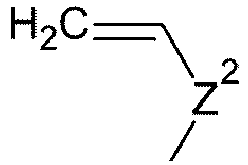 oder der Formel
 - Struktureinheiten C abgeleitet von Alkylsiloxanen der Formel (c):
 Z4 ist -O- oder -NH-,R12 ist -(CH2)o-, worin o = 1 bis 6,R13 bis R15 unabhängig ausgewählt sind aus C1 bis C4 Alkyl oder -OSi(X4)3, worin X4 ist C1 bis C4 Alkyl, worin X4 gleich oder verschieden sind,R16 und R17 unabhängig ausgewählt sind aus C1 bis C4 Alkyl oder -OSi(X5)3, und X5 ist C1 bis C4 Alkyl oder -OSi(X6)3 worin X6 ist C1 bis C4 Alkyl, worin X5 gleich oder verschieden sind;- und gegebenenfalls Struktureinheiten D abgeleitet von Monomeren ausgewählt aus der Gruppe bestehend aus die Monomeren (Meth)acrylamiden, Alkyl(meth)acrylaten, Alkyl(meth)acrylamiden, Alkyloxy-terminierten (Polyoxyethylen)(meth)acrylaten, Alkyloxy-terminierten (Polyoxyethylen)(meth)acrylamiden, Acrylamiden, N,N-Dialkylaminoalkyl(meth)acrylaten, N,N-Dialkylaminoalkyl(meth)acrylamiden, N-Vinyl-2-pyrrolidon; wobei die Alkyle in diesen Substituenten C1-C14-Alkyle, vorzugsweise C1-C12-Alkyle oder C1-C8-Alkyle sind.
 - Zusammensetzung nach Anspruch 1, worin der Anteil der Struktureinheiten A im Polymernetzwerk im Bereich von 0,01 bis 20 Gew.-% liegt, der Anteil der Struktureinheiten B im Polymernetzwerk 0,1 bis 15 Gew.-% beträgt, der Anteil der Struktureinheiten C im Polymernetzwerk beträgt 30 bis 80 Gew.-%, und der Anteil der Struktureinheiten D im Polymernetzwerk beträgt bis zu 50 Gew.-%.
- Zusammensetzung nach einem der vorhergehenden Ansprüche, wobei die Struktureinheiten A von 2,2,6,6-Tetramethylazinan-4-yl-methacrylat (2,2,6,6-Tetramethylpiperidin-4-yl-methakrylat) und/oder N-(2,2,6,6-Tetramethylazinan-4-yl)methacrylamid (N-(2,2,6,6-Tetramethylpiperidin-4-yl)methacrylamid) abgeleitet sind.
- Zusammensetzung nach einem der vorhergehenden Ansprüche, wobei die Struktureinheiten B von 3-(Triethoxysilyl)propylmethacrylat, 3-(Dimethoxymethylsilyl)propylmethacrylat, (Triethoxysilyl)ethylen und/oder (Trimethoxysilyl)ethylen abgeleitet sind.
- Zusammensetzung nach einem der vorhergehenden Ansprüche, wobei die Struktureinheiten C von 3-[Tris(trimethylsiloxy)silyl]propylmethacrylat und/oder 3-[Tris(trimethylsiloxy)silyl]propylacrylat abgeleitet sind.
- Zusammensetzung nach einem der vorhergehenden Ansprüche, wobei die Struktureinheiten D vorhanden sind und sich von Monomeren ableiten ausgewählt aus der Gruppe umfassend Methylmethacrylat, Methylacrylat, Ethylmethacrylat, Ethylacrylat, Isopropylmethacrylat, Isopropylacrylat, n-Butylmethacrylat, n-Butylacrylat, Isobutylmethacrylat, Isobutylacrylat, n-Hexylmethacrylat, n-Hexylacrylat, Cyclohexylmethacrylat, Cyclohexylacrylat, 2-Methyl-1-Butylmethacrylat, 2-Methyl-1-Butylacrylat, 2-Ethylhexylmethacrylat, 2-Ethylhexylacrylat, Laurylmethacrylat, Laurylacrylat, Isooctylmethacrylat, Isooctylacrylat und Kombinationen davon.
- Zusammensetzung nach einem der vorhergehenden Ansprüche, wobei das Polymernetzwerk erhältlich ist durch frei-radikalische Copolymerisation von monomeren Vorstufen der Struktureinheiten A, B und C bzw. der Formeln (a), (b) und (c); gegebenenfalls zusammen mit monomeren Vorstufen der Struktureinheiten D; und gleichzeitige oder nachfolgende Kondensationsreaktion.
- Zusammensetzung nach einem der vorhergehenden Ansprüche, wobei das Lösungsmittel mindestens ein Polydimethylsiloxan mit 2 bis 10, besonders bevorzugt 2 bis 5, Dimethylsiloxaneinheiten umfasst, das linear, verzweigt oder cyclisch ist; vorzugsweise sind die Polydimethylsiloxane ausgewählt aus der Gruppe bestehend aus Octamethylcyclotetrasiloxan, Decamethylcyclopentasiloxan, Octamethyltrisiloxan, Hexamethyldisiloxan (HMDS).
- Zusammensetzung nach einem der vorhergehenden Ansprüche, die in Form einer Lösung, einer Suspension, einer Emulsion oder eines Gels vorliegt.
- Zusammensetzung nach einem der vorangehenden Ansprüche zur Verwendung bei der Verhinderung der Bildung von Wunden oder bei der Wundbehandlung.
- Verfahren zur Herstellung einer pharmazeutischen Zusammensetzung nach einem der vorhergehenden Ansprüche, umfassend die Schritte der frei-radikalischen Copolymerisation von monomeren Vorstufen der Struktureinheiten A, B und C und gegebenenfalls D, und einer gleichzeitigen oder anschließenden Kondensationsreaktion, um das Polymernetzwerk zu erhalten; und den Schritt des anschließenden Lösens oder Suspendierens des erhaltenen Polymernetzwerks in einem Lösungsmittel auf Polydimethylsiloxanbasis.
- Ein Polymer umfassend- Struktureinheiten A abgeleitet von sterisch gehinderten Aminen der Formel (a):
 R2 bis R5 unabhängig ausgewählt sind aus C1 bis C4 Alkyl, undX ist -CH(X1)- oder -CH(X1)CH2-, worin X1 eine frei-radikalisch polymerisierbare chemische Gruppe der Formel
 - Struktureinheiten B abgeleitet von Alkyloxysilanen der allgemeinen Formel (b):
 R8 und R9 unabhängig ausgewählt sind aus C1 bis C4 Alkyl oder -O(X3), worin X3 ist C1 bis C4 Alkyl, undY eine frei-radikalisch polymerisierbare chemische Gruppe der Formel
 oder der Formel
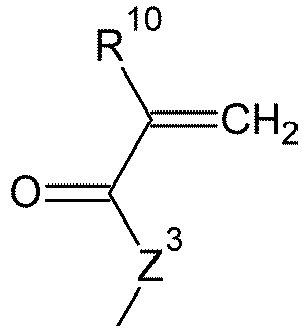 - Struktureinheiten C abgeleitet von Alkylsiloxanen der Formel (c):
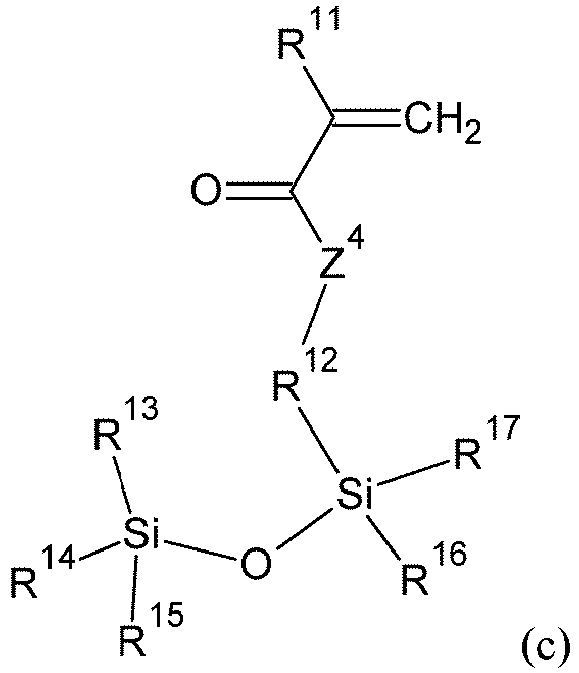 Z4 ist -O- oder -NH-,R12 ist -(CH2)o-, worin o = 1 bis 6,R13 bis R15 unabhängig ausgewählt sind aus C1 bis C4 Alkyl oder -OSi(X4)3, worin X4 ist C1 bis C4 Alkyl, worin X4 gleich oder verschieden sind,R16 und R17 unabhängig ausgewählt sind aus C1 bis C4 Alkyl oder -OSi(X5)3, und X5 ist C1 bis C4 Alkyl oder -OSi(X6)3 worin X6 ist C1 bis C4 Alkyl, worin X5 gleich oder verschieden sind;- und gegebenenfalls Struktureinheiten D abgeleitet von Monomeren ausgewählt aus der Gruppe bestehend aus die Monomeren (Meth)acrylamiden, Alkyl(meth)acrylaten, Alkyl(meth)acrylamiden, Alkyloxy-terminierten (Polyoxyethylen)(meth)acrylaten, Alkyloxy-terminierten (Polyoxyethylen)(meth)acrylamiden, Acrylamiden, N,N-Dialkylaminoalkyl(meth)acrylaten, N,N-Dialkylaminoalkyl(meth)acrylamiden, N-Vinyl-2-pyrrolidon; wobei die Alkyle in diesen Substituenten C1-C14-Alkyle, vorzugsweise C1-C12-Alkyle oder C1-C8-Alkyle sind.
 - Polymer nach Anspruch 12, worin der Anteil der Struktureinheiten A im Polymer im Bereich von 0,01 bis 20 Gew.-% liegt, der Anteil der Struktureinheiten B im Polymer beträgt 0,1 bis 15 Gew.-%, der Anteil der Struktureinheiten C im Polymer beträgt 30 bis 80 Gew.-%, und der Anteil der Struktureinheiten D im Polymer beträgt bis zu 50 Gew.-%.
Applications Claiming Priority (3)
| Application Number | Priority Date | Filing Date | Title |
|---|---|---|---|
| CZ2018-35185U CZ32226U1 (cs) | 2018-07-17 | 2018-07-17 | Tekutý krycí přípravek pro ošetření ran |
| CZ2018-359A CZ2018359A3 (cs) | 2018-07-17 | 2018-07-17 | Tekutý krycí přípravek pro ošetření ran |
| PCT/CZ2019/050030 WO2020015768A1 (en) | 2018-07-17 | 2019-07-03 | Liquid wound dressing composition |
Publications (2)
| Publication Number | Publication Date |
|---|---|
| EP3824005A1 EP3824005A1 (de) | 2021-05-26 |
| EP3824005B1 true EP3824005B1 (de) | 2023-02-22 |
Family
ID=67396878
Family Applications (1)
| Application Number | Title | Priority Date | Filing Date |
|---|---|---|---|
| EP19742518.4A Active EP3824005B1 (de) | 2018-07-17 | 2019-07-03 | Flüssige wundauflagenzusammensetzung |
Country Status (2)
| Country | Link |
|---|---|
| EP (1) | EP3824005B1 (de) |
| WO (1) | WO2020015768A1 (de) |
Families Citing this family (1)
| Publication number | Priority date | Publication date | Assignee | Title |
|---|---|---|---|---|
| CN115160482B (zh) * | 2022-07-26 | 2023-11-17 | 武汉工程大学 | 一种皮肤保护膜材料及其制备方法和应用 |
Family Cites Families (4)
| Publication number | Priority date | Publication date | Assignee | Title |
|---|---|---|---|---|
| US5103812A (en) * | 1988-10-12 | 1992-04-14 | Rochal Industries, Inc. | Conformable bandage and coating material |
| CZ293419B6 (cs) * | 1997-12-03 | 2004-04-14 | Ústav Makromolekulární Chemie Av Čr | Přípravek k prevenci a hojení zánětlivých onemocnění |
| ATE338525T1 (de) | 1999-03-25 | 2006-09-15 | 3M Innovative Properties Co | Nicht stechendes überzugsmittel |
| US8263720B1 (en) | 2011-10-05 | 2012-09-11 | Rochal Industries, Llp | Sacrificial adhesive coatings |
-
2019
- 2019-07-03 EP EP19742518.4A patent/EP3824005B1/de active Active
- 2019-07-03 WO PCT/CZ2019/050030 patent/WO2020015768A1/en not_active Ceased
Also Published As
| Publication number | Publication date |
|---|---|
| EP3824005A1 (de) | 2021-05-26 |
| WO2020015768A1 (en) | 2020-01-23 |
Similar Documents
| Publication | Publication Date | Title |
|---|---|---|
| JP2918263B2 (ja) | 適合性のバンデージ及び被覆用材料 | |
| JP5150508B2 (ja) | 液状のポリマー含有被覆材料 | |
| AU2008308849B2 (en) | Silicone gel-based compositions for wound healing and scar reduction | |
| EP2764065B1 (de) | Opferhaftschichten | |
| US6521251B2 (en) | Methods for treating burns on mammalian skin to reduce the risk of infection and to minimize fluid loss | |
| HK1007690B (en) | Conformable bandage and coating material | |
| EP3052140A1 (de) | Nicht selbsthaftende beschichtungsmaterialien | |
| US7842749B2 (en) | Tissue protecting spray-on copolymeric film composition | |
| EP3824005B1 (de) | Flüssige wundauflagenzusammensetzung | |
| CZ308047B6 (cs) | Tekutý krycí přípravek pro ošetření ran | |
| CZ32226U1 (cs) | Tekutý krycí přípravek pro ošetření ran | |
| KR20230006433A (ko) | 창상 피복용 겔 조성물 및 이의 제조방법 | |
| RU2829321C1 (ru) | Жидкий аэрозольный пластырь и способ защиты раны с его помощью | |
| WO2025188213A1 (ru) | Жидкий аэрозольный пластырь и способ защиты раны с его помощью | |
| KR20190118789A (ko) | 실리콘 겔 연고 조성물 및 이로부터 제조된 실리콘 겔 연고 | |
| EP1904574A2 (de) | Gewebeschützende copolymerfilmzusammensetzung zum aufsprühen | |
| HK1200185B (en) | Sacrificial adhesive coatings |
Legal Events
| Date | Code | Title | Description |
|---|---|---|---|
| STAA | Information on the status of an ep patent application or granted ep patent |
Free format text: STATUS: UNKNOWN |
|
| STAA | Information on the status of an ep patent application or granted ep patent |
Free format text: STATUS: THE INTERNATIONAL PUBLICATION HAS BEEN MADE |
|
| PUAI | Public reference made under article 153(3) epc to a published international application that has entered the european phase |
Free format text: ORIGINAL CODE: 0009012 |
|
| STAA | Information on the status of an ep patent application or granted ep patent |
Free format text: STATUS: REQUEST FOR EXAMINATION WAS MADE |
|
| 17P | Request for examination filed |
Effective date: 20210201 |
|
| AK | Designated contracting states |
Kind code of ref document: A1 Designated state(s): AL AT BE BG CH CY CZ DE DK EE ES FI FR GB GR HR HU IE IS IT LI LT LU LV MC MK MT NL NO PL PT RO RS SE SI SK SM TR |
|
| DAV | Request for validation of the european patent (deleted) | ||
| DAX | Request for extension of the european patent (deleted) | ||
| GRAP | Despatch of communication of intention to grant a patent |
Free format text: ORIGINAL CODE: EPIDOSNIGR1 |
|
| STAA | Information on the status of an ep patent application or granted ep patent |
Free format text: STATUS: GRANT OF PATENT IS INTENDED |
|
| INTG | Intention to grant announced |
Effective date: 20220914 |
|
| GRAS | Grant fee paid |
Free format text: ORIGINAL CODE: EPIDOSNIGR3 |
|
| GRAA | (expected) grant |
Free format text: ORIGINAL CODE: 0009210 |
|
| STAA | Information on the status of an ep patent application or granted ep patent |
Free format text: STATUS: THE PATENT HAS BEEN GRANTED |
|
| AK | Designated contracting states |
Kind code of ref document: B1 Designated state(s): AL AT BE BG CH CY CZ DE DK EE ES FI FR GB GR HR HU IE IS IT LI LT LU LV MC MK MT NL NO PL PT RO RS SE SI SK SM TR |
|
| REG | Reference to a national code |
Ref country code: GB Ref legal event code: FG4D |
|
| REG | Reference to a national code |
Ref country code: CH Ref legal event code: EP |
|
| REG | Reference to a national code |
Ref country code: AT Ref legal event code: REF Ref document number: 1549482 Country of ref document: AT Kind code of ref document: T Effective date: 20230315 Ref country code: IE Ref legal event code: FG4D |
|
| REG | Reference to a national code |
Ref country code: DE Ref legal event code: R096 Ref document number: 602019025554 Country of ref document: DE |
|
| REG | Reference to a national code |
Ref country code: LT Ref legal event code: MG9D |
|
| REG | Reference to a national code |
Ref country code: SK Ref legal event code: T3 Ref document number: E 41513 Country of ref document: SK |
|
| REG | Reference to a national code |
Ref country code: NL Ref legal event code: MP Effective date: 20230222 |
|
| REG | Reference to a national code |
Ref country code: AT Ref legal event code: MK05 Ref document number: 1549482 Country of ref document: AT Kind code of ref document: T Effective date: 20230222 |
|
| PG25 | Lapsed in a contracting state [announced via postgrant information from national office to epo] |
Ref country code: RS Free format text: LAPSE BECAUSE OF FAILURE TO SUBMIT A TRANSLATION OF THE DESCRIPTION OR TO PAY THE FEE WITHIN THE PRESCRIBED TIME-LIMIT Effective date: 20230222 Ref country code: PT Free format text: LAPSE BECAUSE OF FAILURE TO SUBMIT A TRANSLATION OF THE DESCRIPTION OR TO PAY THE FEE WITHIN THE PRESCRIBED TIME-LIMIT Effective date: 20230622 Ref country code: NO Free format text: LAPSE BECAUSE OF FAILURE TO SUBMIT A TRANSLATION OF THE DESCRIPTION OR TO PAY THE FEE WITHIN THE PRESCRIBED TIME-LIMIT Effective date: 20230522 Ref country code: NL Free format text: LAPSE BECAUSE OF FAILURE TO SUBMIT A TRANSLATION OF THE DESCRIPTION OR TO PAY THE FEE WITHIN THE PRESCRIBED TIME-LIMIT Effective date: 20230222 Ref country code: LV Free format text: LAPSE BECAUSE OF FAILURE TO SUBMIT A TRANSLATION OF THE DESCRIPTION OR TO PAY THE FEE WITHIN THE PRESCRIBED TIME-LIMIT Effective date: 20230222 Ref country code: LT Free format text: LAPSE BECAUSE OF FAILURE TO SUBMIT A TRANSLATION OF THE DESCRIPTION OR TO PAY THE FEE WITHIN THE PRESCRIBED TIME-LIMIT Effective date: 20230222 Ref country code: HR Free format text: LAPSE BECAUSE OF FAILURE TO SUBMIT A TRANSLATION OF THE DESCRIPTION OR TO PAY THE FEE WITHIN THE PRESCRIBED TIME-LIMIT Effective date: 20230222 Ref country code: ES Free format text: LAPSE BECAUSE OF FAILURE TO SUBMIT A TRANSLATION OF THE DESCRIPTION OR TO PAY THE FEE WITHIN THE PRESCRIBED TIME-LIMIT Effective date: 20230222 Ref country code: AT Free format text: LAPSE BECAUSE OF FAILURE TO SUBMIT A TRANSLATION OF THE DESCRIPTION OR TO PAY THE FEE WITHIN THE PRESCRIBED TIME-LIMIT Effective date: 20230222 |
|
| PG25 | Lapsed in a contracting state [announced via postgrant information from national office to epo] |
Ref country code: SE Free format text: LAPSE BECAUSE OF FAILURE TO SUBMIT A TRANSLATION OF THE DESCRIPTION OR TO PAY THE FEE WITHIN THE PRESCRIBED TIME-LIMIT Effective date: 20230222 Ref country code: PL Free format text: LAPSE BECAUSE OF FAILURE TO SUBMIT A TRANSLATION OF THE DESCRIPTION OR TO PAY THE FEE WITHIN THE PRESCRIBED TIME-LIMIT Effective date: 20230222 Ref country code: IS Free format text: LAPSE BECAUSE OF FAILURE TO SUBMIT A TRANSLATION OF THE DESCRIPTION OR TO PAY THE FEE WITHIN THE PRESCRIBED TIME-LIMIT Effective date: 20230622 Ref country code: GR Free format text: LAPSE BECAUSE OF FAILURE TO SUBMIT A TRANSLATION OF THE DESCRIPTION OR TO PAY THE FEE WITHIN THE PRESCRIBED TIME-LIMIT Effective date: 20230523 Ref country code: FI Free format text: LAPSE BECAUSE OF FAILURE TO SUBMIT A TRANSLATION OF THE DESCRIPTION OR TO PAY THE FEE WITHIN THE PRESCRIBED TIME-LIMIT Effective date: 20230222 |
|
| PG25 | Lapsed in a contracting state [announced via postgrant information from national office to epo] |
Ref country code: SM Free format text: LAPSE BECAUSE OF FAILURE TO SUBMIT A TRANSLATION OF THE DESCRIPTION OR TO PAY THE FEE WITHIN THE PRESCRIBED TIME-LIMIT Effective date: 20230222 Ref country code: RO Free format text: LAPSE BECAUSE OF FAILURE TO SUBMIT A TRANSLATION OF THE DESCRIPTION OR TO PAY THE FEE WITHIN THE PRESCRIBED TIME-LIMIT Effective date: 20230222 Ref country code: EE Free format text: LAPSE BECAUSE OF FAILURE TO SUBMIT A TRANSLATION OF THE DESCRIPTION OR TO PAY THE FEE WITHIN THE PRESCRIBED TIME-LIMIT Effective date: 20230222 Ref country code: DK Free format text: LAPSE BECAUSE OF FAILURE TO SUBMIT A TRANSLATION OF THE DESCRIPTION OR TO PAY THE FEE WITHIN THE PRESCRIBED TIME-LIMIT Effective date: 20230222 |
|
| REG | Reference to a national code |
Ref country code: DE Ref legal event code: R097 Ref document number: 602019025554 Country of ref document: DE |
|
| PLBE | No opposition filed within time limit |
Free format text: ORIGINAL CODE: 0009261 |
|
| STAA | Information on the status of an ep patent application or granted ep patent |
Free format text: STATUS: NO OPPOSITION FILED WITHIN TIME LIMIT |
|
| 26N | No opposition filed |
Effective date: 20231123 |
|
| PG25 | Lapsed in a contracting state [announced via postgrant information from national office to epo] |
Ref country code: SI Free format text: LAPSE BECAUSE OF FAILURE TO SUBMIT A TRANSLATION OF THE DESCRIPTION OR TO PAY THE FEE WITHIN THE PRESCRIBED TIME-LIMIT Effective date: 20230222 |
|
| PG25 | Lapsed in a contracting state [announced via postgrant information from national office to epo] |
Ref country code: MC Free format text: LAPSE BECAUSE OF FAILURE TO SUBMIT A TRANSLATION OF THE DESCRIPTION OR TO PAY THE FEE WITHIN THE PRESCRIBED TIME-LIMIT Effective date: 20230222 |
|
| PG25 | Lapsed in a contracting state [announced via postgrant information from national office to epo] |
Ref country code: MC Free format text: LAPSE BECAUSE OF FAILURE TO SUBMIT A TRANSLATION OF THE DESCRIPTION OR TO PAY THE FEE WITHIN THE PRESCRIBED TIME-LIMIT Effective date: 20230222 |
|
| REG | Reference to a national code |
Ref country code: CH Ref legal event code: PL |
|
| REG | Reference to a national code |
Ref country code: BE Ref legal event code: MM Effective date: 20230731 |
|
| PG25 | Lapsed in a contracting state [announced via postgrant information from national office to epo] |
Ref country code: LU Free format text: LAPSE BECAUSE OF NON-PAYMENT OF DUE FEES Effective date: 20230703 |
|
| PG25 | Lapsed in a contracting state [announced via postgrant information from national office to epo] |
Ref country code: LU Free format text: LAPSE BECAUSE OF NON-PAYMENT OF DUE FEES Effective date: 20230703 |
|
| REG | Reference to a national code |
Ref country code: IE Ref legal event code: MM4A |
|
| PG25 | Lapsed in a contracting state [announced via postgrant information from national office to epo] |
Ref country code: CH Free format text: LAPSE BECAUSE OF NON-PAYMENT OF DUE FEES Effective date: 20230731 |
|
| PG25 | Lapsed in a contracting state [announced via postgrant information from national office to epo] |
Ref country code: IT Free format text: LAPSE BECAUSE OF FAILURE TO SUBMIT A TRANSLATION OF THE DESCRIPTION OR TO PAY THE FEE WITHIN THE PRESCRIBED TIME-LIMIT Effective date: 20230222 Ref country code: BE Free format text: LAPSE BECAUSE OF NON-PAYMENT OF DUE FEES Effective date: 20230731 |
|
| PG25 | Lapsed in a contracting state [announced via postgrant information from national office to epo] |
Ref country code: IE Free format text: LAPSE BECAUSE OF NON-PAYMENT OF DUE FEES Effective date: 20230703 |
|
| PG25 | Lapsed in a contracting state [announced via postgrant information from national office to epo] |
Ref country code: IE Free format text: LAPSE BECAUSE OF NON-PAYMENT OF DUE FEES Effective date: 20230703 |
|
| PG25 | Lapsed in a contracting state [announced via postgrant information from national office to epo] |
Ref country code: BG Free format text: LAPSE BECAUSE OF FAILURE TO SUBMIT A TRANSLATION OF THE DESCRIPTION OR TO PAY THE FEE WITHIN THE PRESCRIBED TIME-LIMIT Effective date: 20230222 |
|
| PG25 | Lapsed in a contracting state [announced via postgrant information from national office to epo] |
Ref country code: BG Free format text: LAPSE BECAUSE OF FAILURE TO SUBMIT A TRANSLATION OF THE DESCRIPTION OR TO PAY THE FEE WITHIN THE PRESCRIBED TIME-LIMIT Effective date: 20230222 |
|
| PG25 | Lapsed in a contracting state [announced via postgrant information from national office to epo] |
Ref country code: CY Free format text: LAPSE BECAUSE OF FAILURE TO SUBMIT A TRANSLATION OF THE DESCRIPTION OR TO PAY THE FEE WITHIN THE PRESCRIBED TIME-LIMIT; INVALID AB INITIO Effective date: 20190703 |
|
| PGFP | Annual fee paid to national office [announced via postgrant information from national office to epo] |
Ref country code: SK Payment date: 20250604 Year of fee payment: 7 |
|
| PGFP | Annual fee paid to national office [announced via postgrant information from national office to epo] |
Ref country code: CZ Payment date: 20250604 Year of fee payment: 7 |
|
| PG25 | Lapsed in a contracting state [announced via postgrant information from national office to epo] |
Ref country code: HU Free format text: LAPSE BECAUSE OF FAILURE TO SUBMIT A TRANSLATION OF THE DESCRIPTION OR TO PAY THE FEE WITHIN THE PRESCRIBED TIME-LIMIT; INVALID AB INITIO Effective date: 20190703 |
|
| PGFP | Annual fee paid to national office [announced via postgrant information from national office to epo] |
Ref country code: DE Payment date: 20250721 Year of fee payment: 7 |
|
| PGFP | Annual fee paid to national office [announced via postgrant information from national office to epo] |
Ref country code: GB Payment date: 20250721 Year of fee payment: 7 |
|
| PGFP | Annual fee paid to national office [announced via postgrant information from national office to epo] |
Ref country code: FR Payment date: 20250716 Year of fee payment: 7 |
|
| PG25 | Lapsed in a contracting state [announced via postgrant information from national office to epo] |
Ref country code: TR Free format text: LAPSE BECAUSE OF FAILURE TO SUBMIT A TRANSLATION OF THE DESCRIPTION OR TO PAY THE FEE WITHIN THE PRESCRIBED TIME-LIMIT Effective date: 20230222 |