EP3826386A1 - Procédé de co-ordination de radiomessagerie dans un équipement utilisateur - Google Patents
Procédé de co-ordination de radiomessagerie dans un équipement utilisateur Download PDFInfo
- Publication number
- EP3826386A1 EP3826386A1 EP19306483.9A EP19306483A EP3826386A1 EP 3826386 A1 EP3826386 A1 EP 3826386A1 EP 19306483 A EP19306483 A EP 19306483A EP 3826386 A1 EP3826386 A1 EP 3826386A1
- Authority
- EP
- European Patent Office
- Prior art keywords
- paging
- cellular network
- user equipment
- cellular
- cellular networks
- Prior art date
- Legal status (The legal status is an assumption and is not a legal conclusion. Google has not performed a legal analysis and makes no representation as to the accuracy of the status listed.)
- Withdrawn
Links
- 238000000034 method Methods 0.000 title claims abstract description 35
- 230000001413 cellular effect Effects 0.000 claims abstract description 240
- 238000005259 measurement Methods 0.000 claims description 22
- 230000000694 effects Effects 0.000 claims description 14
- 238000013459 approach Methods 0.000 description 7
- 238000004891 communication Methods 0.000 description 7
- 230000009286 beneficial effect Effects 0.000 description 4
- 230000008901 benefit Effects 0.000 description 4
- 238000005516 engineering process Methods 0.000 description 4
- 230000004044 response Effects 0.000 description 3
- 230000011664 signaling Effects 0.000 description 3
- CSRZQMIRAZTJOY-UHFFFAOYSA-N trimethylsilyl iodide Substances C[Si](C)(C)I CSRZQMIRAZTJOY-UHFFFAOYSA-N 0.000 description 3
- 230000008859 change Effects 0.000 description 2
- 230000002730 additional effect Effects 0.000 description 1
- 230000006399 behavior Effects 0.000 description 1
- 230000002045 lasting effect Effects 0.000 description 1
- 238000005457 optimization Methods 0.000 description 1
- 230000008569 process Effects 0.000 description 1
- 238000012545 processing Methods 0.000 description 1
- 230000004622 sleep time Effects 0.000 description 1
Images


Classifications
-
- H—ELECTRICITY
- H04—ELECTRIC COMMUNICATION TECHNIQUE
- H04W—WIRELESS COMMUNICATION NETWORKS
- H04W68/00—User notification, e.g. alerting and paging, for incoming communication, change of service or the like
- H04W68/02—Arrangements for increasing efficiency of notification or paging channel
-
- H—ELECTRICITY
- H04—ELECTRIC COMMUNICATION TECHNIQUE
- H04W—WIRELESS COMMUNICATION NETWORKS
- H04W68/00—User notification, e.g. alerting and paging, for incoming communication, change of service or the like
-
- H—ELECTRICITY
- H04—ELECTRIC COMMUNICATION TECHNIQUE
- H04W—WIRELESS COMMUNICATION NETWORKS
- H04W88/00—Devices specially adapted for wireless communication networks, e.g. terminals, base stations or access point devices
- H04W88/02—Terminal devices
- H04W88/06—Terminal devices adapted for operation in multiple networks or having at least two operational modes, e.g. multi-mode terminals
Definitions
- the present invention relates to a method to operate a user equipment.
- the invention also pertains to a user equipment using said method.
- the invention further relates to method for a cellular network capable of operating a user equipment.
- the invention also pertains to a cellular network using said method.
- This general approach also applies to user equipments with more than two subscriber identity modules.
- a problem occurs, if the paging window for the user equipment is overlapping for both cellular networks. This is all the more disadvantageous for user equipments with reduced paging cycle, like loT user equipments.
- the need for paging co-ordination, in particular due to paging overlapping can apply. In that case at the time when the user equipment is operating with the one cellular network, it cannot be paged by the other, and vice versa.
- eDRX cycle duration by enlarging the DRX cycle to eDRX missing such a paging due to overlap would be even more disadvantageous.
- eDRX cycle may be up to 45 minutes (Cat-M), resp. 3 hours (NB-IoT).
- Cat-M system frame number
- NB-IoT n-IoT
- HSFN Hyper-SFN
- NB-IoT uses 2 bits more for SFN hence up to 3hours of eDRX cycles can be achieved.
- the probability for overlap reduces with DRX cycle duration, but if it would occur, it would be a very severe issue.
- power consumption is a very important fact, even though paging overlap could be considered as unlikely. It is to consider that an interruption in deep sleep causes a remarkable power consumption, in particular as the paging occasions are asynchronous, i.e.
- the first network has its paging occurrence at a certain time. Afterwards the user equipment can enter in deep sleep, however some time later the second cellular network has its paging occasion, consequently the user equipment needs to abort the deep sleep again and listen to the second network. Afterwards it can/could enter into deep sleep but paging may occur during that time/some time later in the first cellular network.
- the method comprises the steps of:
- the user equipment is expected to be operative in the respective cellular network, when it is paged by the cellular network. Paging is generally happening for submitting connection requests, like an incoming call, so that user equipment may react and indicate the call by a signal, like a ringtone, or directly handle the call, as it would be the case for a machine type communication (MTC) user equipment.
- MTC machine type communication
- the user equipment will wake up at the subframe where it expects its paging occasion and will read the paging messages.
- the paging messages contain the TMSI value. So if the UE does not find its TMSI inside the paging messages, it will assume that it is not paged, and it will go back to idle mode.
- the UE finds it's TMSI in one of the paging messages it will understand that the page is addressed to it and it will initiate a RRC Connection.
- the parallel registration in two cellular networks poses a problem, when the paging cycles for both cellular networks are overlapping.
- each user equipment which is registered in a cellular network gets assigned a paging identity.
- This paging identity governs to which paging group a user equipment is assigned.
- the paging group depicts the time offset for a certain user equipment relative to a frame with a specific frame number. All user equipments which belong to the same paging group, are paged at a certain point in time. That means they have the same paging identity.
- Each paging group covers a certain time duration for paging, which is happening repeatedly.
- the paging identity is typically determined by the calculation of the user equipment's IMSI (International Mobile Subscriber Identity) modulo 1024.
- the result is a value between 0 and 1023, which is the paging group.
- SFN system frame number
- an offset in SFN diff is calculated considering the paging group number and define the time, when the paging is supposed to happen, that means when the user equipment is expected to listen to potential paging messages. It may happen that the user equipment has two subscriber identity modules with IMSIs which lead to the same modulo 1024-value.
- the user equipment has in particular available the respective information from the cellular network, either through broadcast or received as part of the registration procedure.
- the major paging parameters are transmitted through system information block 2 (SIB2). Part of this is the number of paging subframes within a default paging cycle (NB), and the default paging cycle T.
- NB may have values of 2T, 1 ⁇ 2 T etc. This shows even with different NB, there may happen an paging overlapping paging between both involved cellular networks. Consequently the user equipment will send an information element to at least one of the two cellular networks indicating about the paging identity in the other cellular network and an indication about the time difference between the paging of both cellular networks.
- This approach is advantageous as it does not make available an IMSI or other private data from the one cellular network to the other.
- the paging identity there is no way to identify the IMSI or any other personal data relating to the subscription in the other cellular network.
- the informed cellular network may come to a conclusion for sending an indication about an assignment to a paging group.
- the timing difference is too close, the cellular network will most probably amend the assignment to the paging group.
- the paging group is in that case different from the paging group the user equipment would normally be in, according to the IMSI, that means different from the so-called nominal paging group, which is based on the paging identity.
- the user equipment may with low impact in terms of power consumption, signalling overload etc. adjust the paging in the cellular networks and continue to operate reliably with the cellular networks it is registered in. Should a change in at least one cellular networks appear, e.g. when crossing the border of the cellular networks coverage area, the whole process is preferably repeated.
- a cellular network is capable to support such inventive method, that means receiving the information about the paging difference and in response send an indication for a new assignment to a paging group, then such cellular network it rated as supporting paging coordination.
- the registering to that cellular network which is supporting paging coordination after registering to the cellular network not supporting paging coordination. This is advantageous as the cellular network supporting paging coordination can then be asked for amendment of paging group, when it is detected a too close paging timing between both cellular networks.
- the step of regularly carrying out measurement activities for each of the two cellular networks wherein said measurement activities in the two cellular networks is conducted in different timing relation to the paging.
- This embodiment in particular relates to user equipments which are designed to optimize its power consumption, e.g. when operated with a battery which has an estimated long lifetime before being recharged or replaced. this is in particular the case in the MTC resp. loT world, e.g. for metering devices, tracking equipment as well as in automotive area.
- Such measurement in particular comprises the identification of neighbor cells in order to reselect in case the signals from the current base node are not receivable in acceptable signal strength anymore.
- This embodiment anticipates that besides listening to paging occasions, other measurements need to be carried out by a user equipment. During said activity phase besides receiving the paging user equipments are also doing their measurements according to TS36.331 idle mobility i.e. activities be carried out once per DRX/eDRX cycle.
- a user equipment a) performs measurements on the first cellular network according to the rules, b) receives paging on said first cellular network, c) receives paging on the second network (after switching, of course) d) performs measurements on said second cellular network.
- the time needed between the paging occasion is just switching and synchronization time and hence independent from foreseen measurement activities.
- the assignment to another paging group is considering that the paging assignments in the at least two cellular networks are non-overlapping within a predetermined time proximity.
- This embodiment is designed to lead to the situation, where the paging assignments in the first and second cellular network are timewise closer than paging assignment based paging identity in each cellular network.
- the user equipment would be hindered to properly apply an uninterrupted deep sleep and save power consumption.
- the minimum time between two paging occasions in the two cellular network corresponds to switching and synchronization time required by the user equipment. It is in particular independent of the amount of measurements a user equipment needs to perform in either of the cellular networks. Preferably this minimum time is taken into account by the first cellular network when amending the paging group of the requesting user equipment.
- the step of informing the first of the at least two cellular networks about the time difference includes at least one of:
- a first indication relates to the timing offset between the first and the second cellular network. This is in particular the SFN-/SFN timing offset in chips or subframes.
- the SFN is indicated in the MIB.
- Another indication relates to the subcarrier spacing of the second cellular network, which is the other cellular network than that where the indication is sent to.
- the subcarrier spacing is in the technology standard of 5G/New Radio relating to the frame duration, which is variable.
- the subcarrier spacing SCS for a frequency range is invers towards the frame duration. Hence the other network needs to be informed about the applied SCS depending on the frequency part where the user equipment is receiving its paging.
- As second indication an indication relating eDRX configuration of the user equipment in the second cellular network is provided to the first cellular network.
- paging configuration relates to the density and paging cycle values (NB and T). Hence these influence the paging behavior as well and need to be considered by the addressed cellular network.
- the assignment to another paging group is indicated by an offset, said offset being related to either one of the following:
- an offset to the nominal paging group is signaled to the user equipment.
- This is in particular advantageous as it requires preferably less bits for signalling an offset of eg. 4 frames rather than 10 bits for a nominal paging group.
- an user equipment communicatively connected to at least two subscriber identity modules provided by at least two different cellular networks, after being assigned a paging identity in each of the at least two cellular networks, after registration in at least two of the group of cellular networks, comprising being assigned to a paging group by at least one of the at least two cellular networks, the user equipment is configured to:
- the third aspect of the invention it is proposed a method for a cellular network capable of operating a plurality of user equipments, the method comprising the steps of:
- the cellular network or at least a part of it, e.g. a base node, AMF or other components, figures out, if based on the retrieved information an overlapping of pagings for the requesting user equipment is happening. For doing so according to a preferred embodiment it is suggests that it is further considered a predetermined time duration estimation for switching from said cellular network to a second cellular network. This is to make sure that the user equipment shall be able to switch from one cellular network to the other cellular network and still be able to receive the paging messages.
- the cellular network is supposed to determine a paging group with a timing offset compared to the currently assigned paging group.
- the minimum time between two paging occasions applied by the cellular network is preferably taking into account the time required for switching and synchronization on the other cellular network. However it is independent of additional measurements. Thus it can be assured that the paging occasions can be detected by the user equipment. Additionally this way of paging coordination is advantageous as it allows the cellular network to coordinate the paging of the two cellular networks for the respective user equipment that way that they are timewise as close together as it is possible. That means the minimum time for switching governs the total time between the paging occasions in the at least two cellular networks. With that the user equipment may have the chance to switch after the second paging - and potential additional measurements according to TS36.331 - in a deep sleep mode which is uninterrupted for a remarkable time. This helps for a power consumption optimization of the user equipment. Preferably this steps of determining the paging group further considers paging configuration difference between the cellular network and the second cellular network.
- the step of receiving an indication further comprises retrieving an indication relating to subcarrier spacing of the second cellular network, wherein the step of determining a paging group further considers the subcarrier spacing from the second cellular network in comparison to the subcarrier spacing of the first cellular network.
- the cellular network receives an indication about the subcarrier spacing of the other cellular network, which is a needed information relating to the frame length.
- other information as described for the first aspect of the invention are to be provided to the cellular network in order to assure that a proper determination of the amended paging group may be assigned.
- the cellular network is further indicating in broadcast capability to support paging coordination. This is preferably happening through an additional field in a System information block SIB.
- SIB System information block
- a cellular network capable of operating a plurality of user equipments, the cellular network being configured to:
- this invention advantageously solves the depicted problem and suggests a preferable collaboration of the user equipment and cellular network in order to assure that the user equipment is put into the position to receive paging in case of overlapping paging situation.
- FIG. 1 schematically shows a user equipment 1 of the type to which the present invention is applied as an embodiment.
- the user equipment may be a mobile handset or an loT device like a point-of-sale device, metering device, automotive unit, etc.
- the user equipment 1 comprises a transceiver 3 and a protocol stack 5. Both are in particular part of a communication unit 2, e.g. a cellular modem which is coupled to the user equipment 1 via a call interface. Hence the user equipment 1 may via this call interface, e.g. an AT interface, control the activities of the cellular modem. Additionally a first and a second subscriber identity module 4.1, 4.2 are coupled to the user equipment. They are directly accessible by the protocol stack 5.
- This architecture represents the DSSA approach, of double-SIM and Single active. Via the antenna 6 the user equipment is capable of exchanging signals with base stations 10.1, 10.2 of at least two cellular networks 7.1, 7.2.
- Fig. 2 shows the paging problem for a user equipment in DSSA approach. It is shown in a time graph the frame and paging structure 200, 201 of the first and second cellular network. In a frame 202 of the first cellular network at a certain point in time, defined by an offset of the start of frame 202 the paging occasions 203a for a specific user equipment is supposed to happen. This is determined by the paging configuration and the paging group resp. identity the user equipment is assigned to.
- this paging occasion affects a couple of user equipments
- This paging occasion is happening repeatedly also in the next frames on paging occasions 203b, 203c.
- all members of a paging group retrieve paging messages, which they are expected to receive and decode.
- the user equipment which receives a paging message may determine if the paging message is dedicated for itself, and may take further steps, e.g. start a RRC connection.
- the paging occasion 205a is happening. This is also governed by the paging configuration and assignment of the user equipment to a paging group, but as done by the second cellular network. Depending on start of frame 204 and/or the offset for the paging occasion in dependence of the paging group it may happen, that the pagings in both cellular network are overlapping for this user equipment. With dashed box 206 the overlapping zone is indicated. This overlapping zone in particular takes into account the duration for switching from one cellular network to the other, which involves a frequency jump of the transceiver.
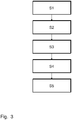
- step S1 the exemplifying user equipment which is registered in two cellular networks, determines that paging timing of the both cellular networks. Preferably this is happening short after being registered in the second cellular network, that means where it is registered later. Based on this paging timing the user equipment is capable of calculating the timing difference between the paging in step S2. The user equipment might be in the position to figure out that the paging timing is fine.
- the user equipment informs one of the both cellular networks about the timing difference and the paging identity in the other cellular network in step S3. Further the user equipment might figure out that the paging difference is too large. This would cause problems with a deep sleep mode that shall be applied, in particular for loT devices. hence also this finding might lead the user equipment to inform the cellular network about the timing difference of the paging of both cellular network. Preferably the user equipment informs that cellular network, that indicates in the system information that it is supporting paging coordination.
- the cellular network further may be equipped with additional information, like the paging configuration density and paging cycle, further information like subcarrier spacing of the other cellular network, and if the user equipment is operating in eDRX, hence a Hyper-SFN is applicable.
- the Hyper-SFN is a multiplier (1-1024) which multiplied with the SFN allows for these large eDRX times.
- the user equipment retrieves in step S4 from the cellular network an indication which indicates a new paging group within this cellular network. That group assignment may be indicated by a nominal paging group or a paging group offset.
- step S5 the user equipment applies the newly assigned paging group. With that the paging overlapping situation as indicated in FIG.
Landscapes
- Engineering & Computer Science (AREA)
- Computer Networks & Wireless Communication (AREA)
- Signal Processing (AREA)
- Mobile Radio Communication Systems (AREA)
Priority Applications (4)
| Application Number | Priority Date | Filing Date | Title |
|---|---|---|---|
| EP19306483.9A EP3826386A1 (fr) | 2019-11-19 | 2019-11-19 | Procédé de co-ordination de radiomessagerie dans un équipement utilisateur |
| US17/777,316 US12225502B2 (en) | 2019-11-19 | 2020-11-18 | Method for co-ordination of paging in a user equipment |
| EP20807390.8A EP4062690B1 (fr) | 2019-11-19 | 2020-11-18 | Procédés et appareils de co-ordination de radiomessagerie dans un équipement utilisateur |
| PCT/EP2020/082459 WO2021099342A1 (fr) | 2019-11-19 | 2020-11-18 | Procédé de coordination de radiomessagerie dans un équipement utilisateur |
Applications Claiming Priority (1)
| Application Number | Priority Date | Filing Date | Title |
|---|---|---|---|
| EP19306483.9A EP3826386A1 (fr) | 2019-11-19 | 2019-11-19 | Procédé de co-ordination de radiomessagerie dans un équipement utilisateur |
Publications (1)
| Publication Number | Publication Date |
|---|---|
| EP3826386A1 true EP3826386A1 (fr) | 2021-05-26 |
Family
ID=68808222
Family Applications (2)
| Application Number | Title | Priority Date | Filing Date |
|---|---|---|---|
| EP19306483.9A Withdrawn EP3826386A1 (fr) | 2019-11-19 | 2019-11-19 | Procédé de co-ordination de radiomessagerie dans un équipement utilisateur |
| EP20807390.8A Active EP4062690B1 (fr) | 2019-11-19 | 2020-11-18 | Procédés et appareils de co-ordination de radiomessagerie dans un équipement utilisateur |
Family Applications After (1)
| Application Number | Title | Priority Date | Filing Date |
|---|---|---|---|
| EP20807390.8A Active EP4062690B1 (fr) | 2019-11-19 | 2020-11-18 | Procédés et appareils de co-ordination de radiomessagerie dans un équipement utilisateur |
Country Status (3)
| Country | Link |
|---|---|
| US (1) | US12225502B2 (fr) |
| EP (2) | EP3826386A1 (fr) |
| WO (1) | WO2021099342A1 (fr) |
Cited By (1)
| Publication number | Priority date | Publication date | Assignee | Title |
|---|---|---|---|---|
| US20220408406A1 (en) * | 2019-11-19 | 2022-12-22 | Thales Dis Ais Deutschland Gmbh | Method for co-ordination of paging in a user equipment |
Citations (1)
| Publication number | Priority date | Publication date | Assignee | Title |
|---|---|---|---|---|
| US20090215472A1 (en) * | 2008-02-27 | 2009-08-27 | Mediatek Inc. | Methods for providing multiple wireless communication services with reduced paging collisions and communication apparatuses utilizing the same |
Family Cites Families (15)
| Publication number | Priority date | Publication date | Assignee | Title |
|---|---|---|---|---|
| US9094928B2 (en) * | 2011-04-06 | 2015-07-28 | Apple Inc. | Multiple network mobile device connection management |
| US8792888B2 (en) * | 2011-04-25 | 2014-07-29 | Apple Inc. | Dual network mobile device radio resource management |
| US9014092B2 (en) * | 2012-04-30 | 2015-04-21 | Apple Inc. | Extension of location status event |
| US9125122B2 (en) * | 2012-06-09 | 2015-09-01 | Apple Inc. | Paging for circuit switched fallback (CSFB) in long term evolution (LTE) connected mode |
| JP6985152B2 (ja) * | 2015-04-08 | 2021-12-22 | インターデイジタル パテント ホールディングス インコーポレイテッド | デバイスツーデバイス(d2d)通信のモバイル中継器の実現 |
| EP3242500A1 (fr) * | 2016-05-04 | 2017-11-08 | Gemalto M2M GmbH | Dispositif de communication mobile dote d'un module d'identite de l'abonne |
| WO2017198290A1 (fr) * | 2016-05-17 | 2017-11-23 | Telefonaktiebolaget Lm Ericsson (Publ) | Coordination simultanée de la mise en attente et de la radiomessagerie dans deux technologies d'accès radio différentes |
| US10559177B2 (en) * | 2016-08-04 | 2020-02-11 | Dean Michael Feldman | Area and property monitoring system and method |
| CN115348592B (zh) * | 2019-07-12 | 2025-07-22 | 苹果公司 | 具有多sim的用户设备的吞吐量和无线电资源利用的改善 |
| EP3826386A1 (fr) * | 2019-11-19 | 2021-05-26 | THALES DIS AIS Deutschland GmbH | Procédé de co-ordination de radiomessagerie dans un équipement utilisateur |
| EP4066582A4 (fr) * | 2019-11-28 | 2023-07-26 | Apple Inc. | Ajustement d'une occasion de radiomessagerie pour résoudre une collision de radiomessagerie au niveau d'un dispositif multi-sim |
| US12550121B2 (en) * | 2020-08-05 | 2026-02-10 | Samsung Electronics Co., Ltd | Method and apparatus for recording information in mobile communication system |
| US11632739B1 (en) * | 2021-04-22 | 2023-04-18 | T-Mobile Usa, Inc. | Focused cellular network paging |
| EP4432769B1 (fr) * | 2022-03-03 | 2026-04-01 | Samsung Electronics Co., Ltd. | Dispositif électronique comprenant une pluralité de cartes sim, et son procédé de fonctionnement |
| KR20240078249A (ko) * | 2022-11-24 | 2024-06-03 | 삼성전자주식회사 | 멀티 심을 지원하는 전자 장치 및 전자 장치의 동작 방법 |
-
2019
- 2019-11-19 EP EP19306483.9A patent/EP3826386A1/fr not_active Withdrawn
-
2020
- 2020-11-18 WO PCT/EP2020/082459 patent/WO2021099342A1/fr not_active Ceased
- 2020-11-18 EP EP20807390.8A patent/EP4062690B1/fr active Active
- 2020-11-18 US US17/777,316 patent/US12225502B2/en active Active
Patent Citations (1)
| Publication number | Priority date | Publication date | Assignee | Title |
|---|---|---|---|---|
| US20090215472A1 (en) * | 2008-02-27 | 2009-08-27 | Mediatek Inc. | Methods for providing multiple wireless communication services with reduced paging collisions and communication apparatuses utilizing the same |
Non-Patent Citations (1)
| Title |
|---|
| QUALCOMM INCORPORATED ET AL: "Avoidance of paging collisions to minimize outage of services", vol. SA WG2, no. San Jose Del Cabo; 20170626 - 20170630, 25 June 2017 (2017-06-25), XP051303098, Retrieved from the Internet <URL:http://www.3gpp.org/ftp/Meetings_3GPP_SYNC/SA2/Docs/> [retrieved on 20170625] * |
Cited By (2)
| Publication number | Priority date | Publication date | Assignee | Title |
|---|---|---|---|---|
| US20220408406A1 (en) * | 2019-11-19 | 2022-12-22 | Thales Dis Ais Deutschland Gmbh | Method for co-ordination of paging in a user equipment |
| US12225502B2 (en) * | 2019-11-19 | 2025-02-11 | Thales Dis France Sas | Method for co-ordination of paging in a user equipment |
Also Published As
| Publication number | Publication date |
|---|---|
| US12225502B2 (en) | 2025-02-11 |
| US20220408406A1 (en) | 2022-12-22 |
| EP4062690A1 (fr) | 2022-09-28 |
| WO2021099342A1 (fr) | 2021-05-27 |
| EP4062690B1 (fr) | 2025-01-01 |
Similar Documents
| Publication | Publication Date | Title |
|---|---|---|
| US11844048B2 (en) | To reduce power consumption for all types of terminal device | |
| US9071930B2 (en) | Method and mobile device for transmitting and receiving paging messages | |
| US8204516B2 (en) | Methods for scheduling collided paging occasions of multiple wireless networks and communication apparatuses utilizing the same | |
| US8175621B2 (en) | Methods for providing multiple wireless communication services with reduced paging collisions and communication apparatuses utilizing the same | |
| KR101529553B1 (ko) | 셀 브로드캐스트(cb) 메시지들의 수신 | |
| US20230396984A1 (en) | Gap configuration for ue comprising a plurality of sims in wireless network | |
| US20260006583A1 (en) | Paging of multi-sim wireless communication devices | |
| US12363677B2 (en) | Method and apparatus for paging control | |
| CA2516979A1 (fr) | Detection et selection de systeme de reseau a acces local sans fil | |
| CN112187428A (zh) | 无线电信网络中的网络节点和方法 | |
| EP2632213A2 (fr) | Procédé et appareil pour exécuter une entrée/rentrée sur le réseau dans un système de communication sans fil | |
| US12250621B2 (en) | Method for improved roaming of a limited-bandwidth user equipment | |
| US12225625B2 (en) | Method and apparatus for radio access network based notification area update | |
| EP4487636A1 (fr) | Procédé et appareil pour accéder à des cellules de longue périodicité pour une économie d'énergie de réseau | |
| US8977273B2 (en) | Method for selecting a mobile radio area, mobile radio communication device, method for transmitting signals into a mobile radio area, and mobile radio network unit | |
| US12225502B2 (en) | Method for co-ordination of paging in a user equipment | |
| US11910354B2 (en) | Paging area update |
Legal Events
| Date | Code | Title | Description |
|---|---|---|---|
| PUAI | Public reference made under article 153(3) epc to a published international application that has entered the european phase |
Free format text: ORIGINAL CODE: 0009012 |
|
| STAA | Information on the status of an ep patent application or granted ep patent |
Free format text: STATUS: THE APPLICATION HAS BEEN PUBLISHED |
|
| AK | Designated contracting states |
Kind code of ref document: A1 Designated state(s): AL AT BE BG CH CY CZ DE DK EE ES FI FR GB GR HR HU IE IS IT LI LT LU LV MC MK MT NL NO PL PT RO RS SE SI SK SM TR |
|
| STAA | Information on the status of an ep patent application or granted ep patent |
Free format text: STATUS: THE APPLICATION IS DEEMED TO BE WITHDRAWN |
|
| 18D | Application deemed to be withdrawn |
Effective date: 20211127 |