EP3826432A1 - Scheinwerfer mit al-einheit - Google Patents
Scheinwerfer mit al-einheit Download PDFInfo
- Publication number
- EP3826432A1 EP3826432A1 EP19210952.8A EP19210952A EP3826432A1 EP 3826432 A1 EP3826432 A1 EP 3826432A1 EP 19210952 A EP19210952 A EP 19210952A EP 3826432 A1 EP3826432 A1 EP 3826432A1
- Authority
- EP
- European Patent Office
- Prior art keywords
- unit
- user
- light source
- activity
- lamp
- Prior art date
- Legal status (The legal status is an assumption and is not a legal conclusion. Google has not performed a legal analysis and makes no representation as to the accuracy of the status listed.)
- Pending
Links
Images

Classifications
-
- H—ELECTRICITY
- H05—ELECTRIC TECHNIQUES NOT OTHERWISE PROVIDED FOR
- H05B—ELECTRIC HEATING; ELECTRIC LIGHT SOURCES NOT OTHERWISE PROVIDED FOR; CIRCUIT ARRANGEMENTS FOR ELECTRIC LIGHT SOURCES, IN GENERAL
- H05B47/00—Circuit arrangements for operating light sources in general, i.e. where the type of light source is not relevant
- H05B47/10—Controlling the light source
- H05B47/17—Operational modes, e.g. switching from manual to automatic mode or prohibiting specific operations
-
- F—MECHANICAL ENGINEERING; LIGHTING; HEATING; WEAPONS; BLASTING
- F21—LIGHTING
- F21L—LIGHTING DEVICES OR SYSTEMS THEREOF, BEING PORTABLE OR SPECIALLY ADAPTED FOR TRANSPORTATION
- F21L4/00—Electric lighting devices with self-contained electric batteries or cells
-
- G—PHYSICS
- G05—CONTROLLING; REGULATING
- G05B—CONTROL OR REGULATING SYSTEMS IN GENERAL; FUNCTIONAL ELEMENTS OF SUCH SYSTEMS; MONITORING OR TESTING ARRANGEMENTS FOR SUCH SYSTEMS OR ELEMENTS
- G05B13/00—Adaptive control systems, i.e. systems automatically adjusting themselves to have a performance which is optimum according to some preassigned criterion
- G05B13/02—Adaptive control systems, i.e. systems automatically adjusting themselves to have a performance which is optimum according to some preassigned criterion electric
- G05B13/0265—Adaptive control systems, i.e. systems automatically adjusting themselves to have a performance which is optimum according to some preassigned criterion electric the criterion being a learning criterion
-
- H—ELECTRICITY
- H05—ELECTRIC TECHNIQUES NOT OTHERWISE PROVIDED FOR
- H05B—ELECTRIC HEATING; ELECTRIC LIGHT SOURCES NOT OTHERWISE PROVIDED FOR; CIRCUIT ARRANGEMENTS FOR ELECTRIC LIGHT SOURCES, IN GENERAL
- H05B45/00—Circuit arrangements for operating light-emitting diodes [LED]
- H05B45/10—Controlling the intensity of the light
- H05B45/12—Controlling the intensity of the light using optical feedback
-
- H—ELECTRICITY
- H05—ELECTRIC TECHNIQUES NOT OTHERWISE PROVIDED FOR
- H05B—ELECTRIC HEATING; ELECTRIC LIGHT SOURCES NOT OTHERWISE PROVIDED FOR; CIRCUIT ARRANGEMENTS FOR ELECTRIC LIGHT SOURCES, IN GENERAL
- H05B47/00—Circuit arrangements for operating light sources in general, i.e. where the type of light source is not relevant
- H05B47/10—Controlling the light source
- H05B47/105—Controlling the light source in response to determined parameters
-
- Y—GENERAL TAGGING OF NEW TECHNOLOGICAL DEVELOPMENTS; GENERAL TAGGING OF CROSS-SECTIONAL TECHNOLOGIES SPANNING OVER SEVERAL SECTIONS OF THE IPC; TECHNICAL SUBJECTS COVERED BY FORMER USPC CROSS-REFERENCE ART COLLECTIONS [XRACs] AND DIGESTS
- Y02—TECHNOLOGIES OR APPLICATIONS FOR MITIGATION OR ADAPTATION AGAINST CLIMATE CHANGE
- Y02B—CLIMATE CHANGE MITIGATION TECHNOLOGIES RELATED TO BUILDINGS, e.g. HOUSING, HOUSE APPLIANCES OR RELATED END-USER APPLICATIONS
- Y02B20/00—Energy efficient lighting technologies, e.g. halogen lamps or gas discharge lamps
- Y02B20/40—Control techniques providing energy savings, e.g. smart controller or presence detection
Definitions
- the present invention relates to a portable lamp, preferably a headlamp which is mainly used for sport and leisure outdoor activities and a method for controlling at least one light source of such a portable lamp.
- Portable lamp especially headlamp, is one of the most useful and important gadgets for outdoor activities.
- a headlamp can usually be worn on the forehead of a user and is thus able to illuminate the key area while keeping the user's hands free.
- the needed brightness and geometry of the light beam usually differ from one user activity to another.
- the lighting mode for running should be different as the lighting mode for camping, as running requires a high proportion of focused beam of light for illuminating the way ahead, while camping needs a high proportion of wide beam of light for enabling a broad vision of the environment and avoiding blinding other people nearby with focused beam on their eyes.
- some of such headlamps may comprise e.g. a USB port or a Bluetooth interface for connection with a computer or a smartphone of the user, from where the user could use an App to preset the lighting mode of the headlamp for a specific sport or outdoor activity which the user is about to take, wherein each lighting mode has a specific profile or rules for automatic lighting adjustment.
- each user may have a different preference or perception of the brightness or geometry of the light beam.
- the user has to configure the adjusting parameters of each chosen activity manually or in an app on the computer or smartphone, which is not only time consuming, but also unintuitive, wherein a relative satisfied result can sometimes only be achieved after many iterations of configuring and testing.
- the objective of the present invention is thus to provide an improved headlamp and a method for controlling the lighting of such a headlamp, which address the above discussed disadvantages.
- a portable lamp preferably a headlamp, which is adapted to be worn or carried by a user, comprising: at least one light source, an AI unit, wherein the AI unit comprises an activity classification unit and a control unit, wherein said activity classification unit is able to automatically classify an activity which the user is currently carrying out without any manual setting by the user, wherein said control unit is adapted to control the beam of said at least one light source at least based on the classified activity of the user.
- AI refers to Artificial Intelligence, which is defined by John McCarthy, one of the founders of the discipline of Al, as "the science and engineering of making intelligent machines.” It should be noted that under this definition machine learning is a subset of Al, but AI does not need to necessarily have a machine learning capability, wherein rule engines, expert systems and knowledge graphs could all be described as Al.
- the present application uses this definition, such that the AI unit refers to unit capable of algorithm-based decision making, or any intelligent unit with or without machine learning capabilities.
- the at least one light source in the present application can be one single light source, which comprises e.g. a plurality of LED diodes, wherein the brightness and/or the geometry of the beam of the light source is controllable.
- the headlamp could also comprise two or more light sources, wherein each light source has a specific geometry of beam, for example one light source with a focused beam, and another one with a wide beam, so that the headlamp can switch between these light sources to get a desired or suitable beam geometry, wherein the brightness of each light source is preferably controllable.
- the Al unit comprises an activity classification unit, wherein the activity classification unit is able to automatically classify an activity which the user is currently carrying out without any manual setting by the user. In this way, a pre-setting of a specific activity of the user using manual setting units like buttons, or an app on a computer or a smartphone is not needed any more. Instead, the activity of the user will be automatically recognized by the activity classification unit, which not only saves time of the user, but also enables a more intuitive and convenient user experience.
- the AI unit further comprises a control unit. Based on the classified activity, the algorithms or rules associated with this activity will be applied for controlling the light source.
- the control unit uses these controlling algorithms or rules to automatically control the beam of the at least one light source, including the geometry and the brightness of the beam.
- the lamp further comprises at least one sensor, wherein the captured sensor data of the at least one sensor are adapted to be transmitted to the activity classification unit and/or to the control unit, wherein the at least one sensor comprises at least one of the following: an inertial sensor, a GPS sensor, a compass sensor, a distance-to-objects sensor, a precision time tracker, an optical detector such as an ambient light sensor.
- An inertial sensor may comprise a combination of accelerometers and gyroscopes, which can be used for detecting a movement or an action of the user.
- An inertial sensor may be used to detect the speed and allure of the user while the user is carrying out an activity. As a different sport activity usually has a different speed range and head movement pattern, the detected speed and allure can be important parameters for identifying the activity.
- a GPS sensor may be used to detect the geographic location of the user who is wearing or carrying the head lamp.
- the geographic location might be associated with a specific activity, e.g. a famous ski area.
- a GPS sensor can be used to identify a user activity as well.
- a compass sensor may measure the orientation of user compared to the earth magnetic field. This can for example be used to determine the angular orientation of the user at any time during his or her activity. Added to a precision time tracker (precise day time) the compass obtained orientation of user can be compared to the sunlight's potency and orientation, helping to determine lighting needs.
- a distance sensor may be used to detect the distance between the user and an object or a person, preferably based on the Time of Flight (ToF) principle, wherein the measurement is based on the time difference between the emission of a signal and its return to the sensor, after being reflected by the object or the person.
- ToF Time of Flight
- Different types of signals can be used with the ToF principle, wherein the most common distance sensors are based on sound and light signals, e.g. ultrasonic sensors, Radar sensors, Lidar sensors, photo detectors in visible or infrared spectral regions and so on.
- the beam of the light can be adjusted. For example, when a user who is camping starts to read a book or a map, the distance sensor detects a nearby object, and will properly adjust the lighting beam or switch to a lighting beam which is suitable for close distance actions such as reading.
- a time tracking sensor such as a perennial watch may be used to record the absolute time as well as time period of usage. For example, a specific place is a favorite sport destination for hiking in summer and skiing in winter, so that the time information can help to classify the user activity. Furthermore, if a user has an everyday routine, e.g. walking after dinner at 8 O'clock in the evening, the time tracking sensor can also be used for training the AI unit and for identifying the user habit accordingly.
- An optical detector may be used for sensing ambient light.
- the control unit can be adapted to control the brightness of the light beam based on environmental lighting conditions, e.g. a dark environment needs a bright lighting beam, while in the sun the lighting is not needed any more.
- sensors other than the sensors discussed above, which are suitable to detect a user action, a user movement or the environment may also be used. It is up to a person skilled in the art to choose any suitable sensors to implement the present invention
- the activity classification unit is adapted to classify the activity of the user as least based on the data transmitted from the at least one sensor of the lamp.
- Further sensors other than the introduced sensors above, can also be used, wherein the activity classification unit is preferably adapted to use pre-determined or trained algorithms which compare the sensor data with pre-determined conditions or thresholds for identifying the user activity, or to develop rules or algorithms with machine learning abilities for identifying the user activity.
- the control unit is preferably adapted to control the beam of the at least one light source further based on the transmitted data from the at least one sensor.
- the control unit can either use pre-determined algorithms or rules, which compare the sensor data with pre-determined conditions or thresholds for identifying user actions or environment conditions, or develop algorithms or rules using machine learning based on the sensor data as training data.
- the lamp preferably further comprises an AI on-off unit, wherein the AI on-off unit is adapted to be operated by the user to activate or deactivate the AI unit.
- the AI on-off unit is adapted to be operated by the user to activate or deactivate the AI unit.
- the lamp further comprises at least one manual setting unit, which is adapted to be operated by the user to manually control the beam of said at least one light source when the AI unit is deactivated, and/or is adapted to be operated by the user to further adjust the beam of said at least one light source when the AI unit is activated.
- the at least one manual setting unit is preferably adapted to adjust the brightness of the light and/or the geometry of the light. If a user has deactivated the AI unit, he may further use the at least one manual setting unit to control the beam of the light source.
- the user may still use the at least one manual setting unit to adjust the beam of said at least one light source if he is not satisfied with the lighting result proposed by the AI unit, or he would like to further carry out some fine-tuning of the light beam.
- the AI unit is preferably adapted to access preloaded training data, which are used to train the activity classification unit and/or the control unit.
- Preloaded training data may be training data which are provided by the manufacturer, wherein the manufacturer may collect the training data from various test users before the lamp is put onto the market.
- algorithms for classifying user activities and/or algorithms for controlling the beam of the light source could be trained by the data collected from these test users, wherein the manufacturer, if time and cost permitted, could involve a lot of test users of various ages and/or from various behavior groups, so that the trained algorithms would be able to provide relative satisfying control results.
- a person skilled in the art may implement any kind of algorithms or learning models for classifying the user activity, which can include, inter alia, Convolutional Neural Networks, Bayesian Networks, Support Vector Machines or Decision Trees.
- the AI unit preferably further comprises a user-specific training data unit, which is adapted to store user-specific control data resulted from user operations on the at least one manual setting unit, wherein the user specific control data are adapted to train the control unit.
- the control data preferably refer to the brightness and/or geometry of the beam of the at least one light source. No matter if the AI unit is activated or deactivated, the user can always use the at least one manual setting unit to control the light beam.
- the control data of the manual setting, or the difference between the proposed control data from the AI unit and the control data of the manual setting will be stored and used for further training the control algorithms.
- the AI unit will be gradually adapted to the user-specific preference and would thus become more and more "intelligent".
- a person skilled in the art may also implement any kind of algorithms or learning models for controlling the beam of the at least one light source, which can include, inter alia, Convolutional Neural Networks, Bayesian Networks, Support Vector Machines or Decision Trees.
- the object is achieved by a method for controlling at least one light source of a portable lamp, wherein the lamp is preferably a headlamp, which is adapted to be worn or carried by a user, comprising: classifying an activity which the user is currently carrying out without any manual setting by the user, controlling the beam of said at least one light source based on the classified activity of the user.
- the control unit uses activity-specific profiles and controlling rules to automatically control the beam of the at least one light source, including the geometry and the brightness of the beam, so that the control is not only completely automatic but also activity-specific.
- the lamp comprises an AI unit, wherein the AI unit comprises an activity classification unit for classifying an activity of the user and a control unit for controlling the beam of said at least one light source, wherein the method further comprises training the classification unit using preloaded training data.
- the lamp comprises an AI on-off unit, wherein the AI on-off unit is adapted to be operated by the user to activate or deactivate the AI unit.
- the lamp preferably further comprises at least one manual setting unit, which is adapted to be operated by the user to manually control the beam of said at least one light source when the AI unit is deactivated, and/or is adapted to be operated by the user to further adjust the beam of the light source when the AI unit is activated.
- the method further comprises: preloading data for training at least one algorithm for classifying an activity of the user, training the at least one algorithm for classifying an activity of the user using the preloaded data.
- the method further comprises: storing user-specific control data resulted from user operations on the at least one manual setting unit, training at least one algorithm for controlling the beam of said at least one light source using the user-specific control data.
- the object is solved by the use of an AI unit in a portable lamp, preferably a headlamp, which is adapted to be worn or carried by a user, wherein the lamp comprises at least one light source, wherein the AI unit is able to control the beam of said at least one light source without any manual setting by the user, wherein the headlamp further comprises at least one manual setting unit, which is adapted to be operated by the user to manually control the beam of said at least one light source when the AI unit is deactivated, and/or is adapted to be operated by the user to further adjust the beam of said at least one light source when the AI unit is activated, wherein at least one controlling algorithm of the AI unit for controlling the beam of said at least one light source is trained by preloaded training data and/or user-specific control data resulted from user operations on the at least one manual setting unit.
- the AI unit has a learning capability
- the at least one controlling algorithm of the AI unit may include, inter alia, Convolutional Neural Networks, Bayesian Networks, Support Vector Machines or Decision Trees, which can be trained by user-specific control data resulted from user operations on the at least one manual setting unit.
- the AI unit learns the user preference or the user's perception of light, so that not only an automatic but also an user-specific control of the light beam is made possible, without the need of a pre-configuration of a user profile by the user on a computer or a smartphone.
- the lamp further comprises at least one sensor, wherein the captured sensor data of the at least one sensor are adapted to be transmitted to the AI unit, wherein the at least one sensor comprises at least one of the following: an inertial sensor, a GPS sensor, a compass sensor, a distance sensor, a time tracking sensor, an optical detector.
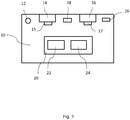
- Fig. 1 illustrates a schematic view of a headlamp with an AI unit according to a first embodiment of the invention.
- the headlamp 10 comprises a power on-off unit 12, which is adapted to turn on or turn off the power of the headlamp.
- the headlamp 10 further comprises two dimmable light sources 14 and 16, wherein each of them comprises one or more LED diodes.
- the light source 14 may be adapted to produce a wide beam, and the light source 16 may be adapted to produce a focused beam.
- Each of the two light sources 14 and 16 is provided with a manual setting unit 15 and 17, respectively, wherein each manual setting unit 15 and 17 is adapted to be operated by the user to control the brightness of the respective light source. It is up to a person skilled in the art how to implement the manual setting units 15 and 17, wherein the manual setting units 15 and 17 could for example be implemented as a button or a knob for adjusting the brightness of the light sources 14 and 16, respectively.
- the headlamp 10 may further comprise an AI unit 20, which is able to automatically control the light sources 14 and 16 without any manual setting of the user.
- the AI unit 20 comprises an activity classification unit 22, which is able to automatically classify an activity which the user is currently carrying out.
- the AI unit 20 further comprises a control unit 24, which is adapted to control the beam of the light sources 14 and 16 based on the classified activity of the user.
- An activity of the user refers to a sport or a leisure outdoor activity, which can be hiking, camping, skiing, walking or running etc.
- the possible activities which the headlamp can be used for are usually defined or preset by the manufacturer.
- the headlamp 10 further comprises one or more sensors 18 for such detection, wherein the one or more sensors 18 comprise at least one of the following: an inertial sensor, a GPS sensor, a compass sensor, a distance sensor, a time tracking sensor, an optical detector.
- the headlamp 10 further comprises an AI on-off unit 26, which is adapted to be operated by the user to activate or deactivate the AI unit 20.
- the AI on-off unit can also be implemented as a button or a knob. If a user does not want to use the AI unit 20, he may deactivate the AI unit 20 by operating the AI on-off unit 26, so that he only uses the manual setting units 15 and 17 to dim the light sources 14 and 16. However, even if the AI unit 20 is activated, the user can still use the manual setting units 15 and 17 to further dim the light sources 14 and 16 if the user is not satisfied with the proposed dimming results by the AI unit 20.
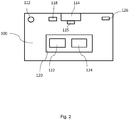
- Fig. 2 shows a schematic view of a headlamp with an AI unit according to a further embodiment of the invention.
- the headlamp 100 in Fig. 2 also comprises a power on-off unit 112, a manual setting unit 115, a light source 114, an AI unit 120, one or more sensors 118 and preferably an AI on-off unit 126.
- the headlamp 100 in Fig. 2 has only one light source 114 instead of two light sources 14 and 16.
- the geometry of the beam of the only one light source 114 may be adjustable, i.e. the light source 114 can be adjusted to have a wide beam, or a narrow beam, or a beam with any geometry.
- the light source 114 may comprise one or more LED diodes, wherein it is up to a person skilled in the art to implement any suitable optical systems or technologies for the light beam adjustment.
- the AI unit 120 as well as the manual setting unit 115 are not only able to control the brightness, but also the geometry of the beam of the light source 114.
- the manual setting unit 115 can be implemented as two buttons, one for adjusting the brightness of the light beam and the other for adjusting the geometry of the light beam. Furthermore, contactless adjustment solutions e.g. by using hand gestures are also imaginable. For example, upon detection of moving the hand higher or lower in front of the lamp via ToF technologies, the manual setting unit 115 adjusts the brightness of the light source 114, while upon detection of moving the hand farther or closer, the manual setting unit 115 adjusts the range of the light source 114.
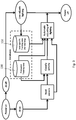
- FIG. 3 A process for controlling the beam of at least one light source of a headlamp with an AI unit is shown in Fig. 3 , wherein the headlamp could for example be a headlamp of the embodiment shown in Fig. 1 or in Fig. 2 .
- the headlamp could for example be a headlamp of the embodiment shown in Fig. 1 or in Fig. 2 .
- the embodiment illustrated in Fig. 2 we use the embodiment illustrated in Fig. 2 for explaining the controlling process.
- a rectangle-shaped box stands for an automatic process step, i.e. without any manual setting, while an oval-shaped box stands for a process step with a manual setting.
- a user can operate on the power on-off unit 112 to turn on or turn off the power of the headlamp 100.
- the user can further operate on the AI on-off unit 26 to turn on or turn off the AI unit 120.
- the activity classification unit is adapted to read sensor data from at least one of the one or more sensors 118.
- the activity classification unit 122 uses one or more pre-determined algorithms to classify the activity the user is currently taking.
- the activity classification algorithms are preferably pre-trained by preloaded training data 130, wherein such training data 130 are preferably provided by the manufacturer, who collects the data from test persons for training the algorithms. It should be noted that the activity classification unit 122 may still have access to the preloaded training data 130 after the activity classification algorithms are pre-trained, wherein the preloaded training data may further by supplemented or updated with new data provided by the manufacturer for further training the algorithms.
- the preloaded training data 130 can be stored in the headlamp, or in an external data storage device, or in a cloud which can be accessed by the activity classification unit 122.
- control unit 124 is adapted to use the according activity-specific control algorithm or algorithms to control the beam of the light source 114.
- the one or more control algorithms are also preferably pre-determined or pre-trained by the manufacturer. It should be noted that the pre-loaded training data 130 preferably further comprise training data for pre-training the one or more control algorithms for each activity of the control unit 124.
- the one or more algorithms for user activity classification should preferably run at a speed fast enough to capture activity changes, such as the activity change from "walking" to "running”, preferably within one second, more preferably with a frequency of at least 24 Hz, which is the minimal visual detection capacity of human eyes.
- the one or more control algorithms of the control unit 124 for each activity are further adapted to control the beam of the light source 114 based on the environment parameters, or an action or a movement of the user, which are measured or detected by the one or more sensors 118.
- the headlamp 100 also comprises a manual unit 115, which is operated by the user to manually adjust the beam of the light source 114 when the AI unit 120 is deactivated, or when the AI unit is activated and the user is not completely satisfied with the proposed control result of AI unit.
- a manual unit 115 which is operated by the user to manually adjust the beam of the light source 114 when the AI unit 120 is deactivated, or when the AI unit is activated and the user is not completely satisfied with the proposed control result of AI unit.
- the user-specific control data resulted from user operations on the manual setting unit 115 are stored as user-specific training data 132, which are used for further training the algorithms of the control unit 124.
- the user-specific training data 132 can be control data of the manual setting, or the difference between the proposed control data from the AI unit and the control data of the manual setting, wherein the user-specific training data 132 are preferably stored and/or updated in the headlamp 100.
- the control unit 124 has the capability to learn from the manual settings of the user and is gradually adapted to control the light beam according to the user preference.
- a person skilled in the art may implement any kind of algorithms or learning models for controlling the beam of the light source 114, which can include e.g. Convolutional Neural Networks, Bayesian Networks, Support Vector Machines or Decision Trees.
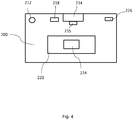
- Fig. 4 illustrates another embodiment of the headlamp, wherein the headlamp 200 also comprises a power on-off unit 212, which is adapted to turn on or turn off the power of the headlamp 200, an adjustable light source 214, and a manual setting unit 215, which is adapted to control not only the brightness but also the geometry of the respective light source 214.
- the headlamp 200 further comprises one or more sensors 218 for detecting e.g. a user movement, a user action, or the environment.
- the headlamp 200 further comprises an AI unit 220, which is able to automatically control the beam of the light source 214 without any manual setting of the user.
- AI unit 220 which is able to automatically control the beam of the light source 214 without any manual setting of the user.
- the difference between the embodiments illustrated in Fig. 2 and Fig. 4 is that the AI unit 200 in Fig. 4 only comprises a control unit 224, wherein a user activity classification unit is not provided.
- Fig. 5 illustrates a control process for controlling the beam of the light source 214 of the headlamp 200.
- a user can also operate on the power on-off unit 212 to turn on or turn off the power of the headlamp 200.
- the user can further operate on the AI on-off unit 226 to turn on or turn off the AI unit 220.
- control unit 224 is adapted to read sensor data from at least one of the one or more sensors 218.
- the control unit 224 is adapted to use one or more control algorithms to control the beam of the light source 214.
- the one or more control algorithms are preferably pre-determined, or pre-trained by preloaded training data 230 provided by the manufacturer, who collects the data from test persons for training the one or more algorithms. It should be noted that the control unit 224 may still have access to the preloaded training data 230 after control algorithms are pre-trained, wherein the preloaded training data may further by supplemented or updated with new data provided by the manufacturer for further training the one or more algorithms.
- the preloaded training data 230 can be stored in the headlamp, or in an external data storage device, or in a cloud which can be accessed by the control unit 224.
- the user may further use the manual unit 215 to manually adjust the beam of the light source 214 when the AI unit 220 is deactivated, or when the AI unit 220 is activated and the user is not completely satisfied with the proposed control result of AI unit, especially for the case that the user has a different perception of the brightness of light than an average person.
- the user-specific control data resulted from user operations on the manual setting unit 215 are stored as user-specific training data 232, which are used for further training the one or more algorithms of the control unit 224.
- the control unit 224 has the capability to learn from the manual settings of the user and is gradually adapted to control the light beam according to the user preference.
- a person skilled in the art may also implement any kind of algorithms or learning models for controlling the beam of the light source 214, which can include e.g. Convolutional Neural Networks, Bayesian Networks, Support Vector Machines or Decision Trees.
Landscapes
- Engineering & Computer Science (AREA)
- Artificial Intelligence (AREA)
- Health & Medical Sciences (AREA)
- Computer Vision & Pattern Recognition (AREA)
- Evolutionary Computation (AREA)
- Medical Informatics (AREA)
- Software Systems (AREA)
- Physics & Mathematics (AREA)
- General Physics & Mathematics (AREA)
- Automation & Control Theory (AREA)
- General Engineering & Computer Science (AREA)
- Circuit Arrangement For Electric Light Sources In General (AREA)
- Lighting Device Outwards From Vehicle And Optical Signal (AREA)
Priority Applications (3)
| Application Number | Priority Date | Filing Date | Title |
|---|---|---|---|
| EP19210952.8A EP3826432A1 (de) | 2019-11-22 | 2019-11-22 | Scheinwerfer mit al-einheit |
| US16/953,985 US11558945B2 (en) | 2019-11-22 | 2020-11-20 | Headlamp with an AI unit |
| US18/154,653 US12507333B2 (en) | 2019-11-22 | 2023-01-13 | Headlamp with an AI unit |
Applications Claiming Priority (1)
| Application Number | Priority Date | Filing Date | Title |
|---|---|---|---|
| EP19210952.8A EP3826432A1 (de) | 2019-11-22 | 2019-11-22 | Scheinwerfer mit al-einheit |
Publications (1)
| Publication Number | Publication Date |
|---|---|
| EP3826432A1 true EP3826432A1 (de) | 2021-05-26 |
Family
ID=68654391
Family Applications (1)
| Application Number | Title | Priority Date | Filing Date |
|---|---|---|---|
| EP19210952.8A Pending EP3826432A1 (de) | 2019-11-22 | 2019-11-22 | Scheinwerfer mit al-einheit |
Country Status (2)
| Country | Link |
|---|---|
| US (2) | US11558945B2 (de) |
| EP (1) | EP3826432A1 (de) |
Families Citing this family (2)
| Publication number | Priority date | Publication date | Assignee | Title |
|---|---|---|---|---|
| EP3826432A1 (de) | 2019-11-22 | 2021-05-26 | Oberalp Spa | Scheinwerfer mit al-einheit |
| US11350506B1 (en) | 2021-05-03 | 2022-05-31 | Ober Alp S.P.A. | Adaptive illumination control via activity classification |
Citations (4)
| Publication number | Priority date | Publication date | Assignee | Title |
|---|---|---|---|---|
| US20110037419A1 (en) * | 2008-04-09 | 2011-02-17 | Eveready Battery Company, Inc. | Device Operation Using a Force Sensor |
| US20160258599A1 (en) * | 2014-02-14 | 2016-09-08 | Zedel S.A. | Portable Lamp Fitted with Electric Control of the Geometry of the Beam |
| US20170347432A1 (en) * | 2014-04-14 | 2017-11-30 | Abl Ip Holding Llc | Learning capable lighting equipment |
| US20190350069A1 (en) * | 2017-01-04 | 2019-11-14 | Signify Holding B.V. | Adaptive lighting automation |
Family Cites Families (59)
| Publication number | Priority date | Publication date | Assignee | Title |
|---|---|---|---|---|
| US6554444B2 (en) | 2000-03-13 | 2003-04-29 | Kansai Technology Licensing Organization Co., Ltd. | Gazing point illuminating device |
| US8894231B2 (en) | 2004-05-17 | 2014-11-25 | Resmed Limited | Position sensitive illumination system |
| WO2006099676A1 (en) | 2005-03-23 | 2006-09-28 | John Blake Practice Management Pty Ltd | A personal lighting apparatus |
| FR2893811B1 (fr) | 2005-11-21 | 2011-06-03 | Zedel | Lampe electrique a zoom electrique |
| US7370991B1 (en) | 2006-12-18 | 2008-05-13 | Ellis-Fant Wanda J | Voice-controlled surgical lighting assembly |
| CN101155213A (zh) | 2007-10-23 | 2008-04-02 | 郭建国 | 移动式矿工安全信息通讯终端 |
| FR2930706B1 (fr) | 2008-04-24 | 2012-11-02 | Zedel | Lampe d'eclairage autoregulee |
| WO2010083853A1 (en) | 2009-01-26 | 2010-07-29 | Tobii Technology Ab | Detection of gaze point assisted by optical reference signals |
| FR2945183B1 (fr) | 2009-05-05 | 2011-05-06 | Thales Sa | Lampe de casque a commande asservie a la position de la tete |
| US8746914B2 (en) | 2010-02-15 | 2014-06-10 | Webb T. Nelson | Sports set that utilize stereoscopic illumination and retroreflective materials |
| EP2498583B1 (de) | 2011-03-07 | 2017-05-03 | Zedel | Mit einer Sicherheitsvorrichtung ausgestattete LED-Lampe |
| KR101046677B1 (ko) | 2011-03-15 | 2011-07-06 | 동국대학교 산학협력단 | 눈 위치 추적방법 및 이를 이용한 의료용 헤드램프 |
| US8885877B2 (en) | 2011-05-20 | 2014-11-11 | Eyefluence, Inc. | Systems and methods for identifying gaze tracking scene reference locations |
| US10264170B2 (en) | 2011-11-14 | 2019-04-16 | Tseng-Lu Chien | LED light has adjustable-angle sensor to cover 180 horizon detect-range |
| KR101841287B1 (ko) | 2012-05-08 | 2018-03-22 | 주식회사 기가테라 | 안전모 및 안전모를 이용한 사고 처리 방법 |
| FR2995491A1 (fr) | 2012-09-11 | 2014-03-14 | Zedel | Lampe electrique portative dotee d'un dispositif de regulation automatique de l'eclairage |
| US8882287B2 (en) | 2012-09-26 | 2014-11-11 | Dale Taylor | Recreational or occupational headlamp using modulated light corollary to human persistence of vision for optimized path illumination |
| CN105163650B (zh) | 2013-05-03 | 2018-12-07 | 飞利浦照明控股有限公司 | 具有经适配的光谱输出的光源 |
| US20150003048A1 (en) | 2013-06-27 | 2015-01-01 | General Scientific Corporation | Motion-activated medical/dental headlamp |
| JP2016538686A (ja) | 2013-10-28 | 2016-12-08 | フィリップス ライティング ホールディング ビー ヴィ | 時刻及び/又は周囲光条件に基づいて照明パラメータを制御する装置並びに関連する方法 |
| CN110081329B (zh) | 2014-01-06 | 2020-09-25 | 奈爱股份有限公司 | 用于头灯的系统和方法 |
| FR3017691B1 (fr) | 2014-02-14 | 2019-06-28 | Zedel | Lampe electrique portative dotee d'un systeme de communication sans-fil |
| FR3020116B1 (fr) | 2014-04-22 | 2019-06-28 | Zedel | Lampe portative comportant un procede de commande sans contact |
| CN105090760A (zh) | 2014-05-07 | 2015-11-25 | 叶廷仁 | 智能型头灯 |
| TW201542960A (zh) | 2014-05-07 | 2015-11-16 | Nat Univ Tsing Hua | 智慧型頭燈 |
| DE102014108677A1 (de) | 2014-06-20 | 2015-12-24 | Marco Systemanalyse Und Entwicklung Gmbh | Bergmännische Kopflampe |
| EP3210095B1 (de) | 2014-10-21 | 2019-12-11 | Signify Holding B.V. | System, verfahren und computerprogrammprodukt für freihand-gestaltung einer lichtverteilung |
| US9791138B1 (en) | 2014-12-16 | 2017-10-17 | Designs For Vision, Inc. | Cordless LED headlight and control thereof |
| DE102015102114A1 (de) | 2015-02-13 | 2016-10-06 | Marco Systemanalyse Und Entwicklung Gmbh | Portable lampe zur verwendung als bergmännische helmlampe, fahrrad- oder fahrradhelmlampe |
| US11049379B2 (en) | 2015-05-18 | 2021-06-29 | Arcachon Holdings Llc | Marker system with zone notification |
| US10064559B2 (en) * | 2015-06-14 | 2018-09-04 | Facense Ltd. | Identification of the dominant nostril using thermal measurements |
| US9593834B2 (en) | 2015-07-24 | 2017-03-14 | Wen-Sung Lee | Head lamp device |
| US9609722B2 (en) | 2015-08-17 | 2017-03-28 | The Coleman Company, Inc. | Multi-mode lighting system with proximity sensor |
| FR3041498A1 (fr) | 2015-09-21 | 2017-03-24 | Zedel | Lampe led dotee d'un dispositif de regulation de la luminosite |
| EP3187770A1 (de) | 2016-01-04 | 2017-07-05 | Zedel S.A. | Tragbare lampe mit verbessertem verriegelungsmechanismus |
| US9717401B1 (en) | 2016-02-01 | 2017-08-01 | Jay S. Orringer, M.D., A Professional Corporation | Wireless surgical headlight |
| US10211660B2 (en) | 2016-02-08 | 2019-02-19 | Cree, Inc. | LED lighting device with adaptive profiles for controlling power consumption |
| WO2018001783A1 (en) | 2016-06-30 | 2018-01-04 | Philips Lighting Holding B.V. | Lighting control. |
| KR102723374B1 (ko) | 2016-07-25 | 2024-10-29 | 매직 립, 인코포레이티드 | 광 필드 프로세서 시스템 |
| CN205919149U (zh) | 2016-07-29 | 2017-02-01 | 辉能(天津)科技发展有限公司 | 一种头戴式智能医疗照明灯具 |
| EP3330608B1 (de) | 2016-12-05 | 2021-03-31 | The Swatch Group Research and Development Ltd | Angeschlossene lampe und steuerverfahren der lampe |
| CN206280784U (zh) | 2016-12-19 | 2017-06-27 | 深圳市尚为照明有限公司 | 一种智能头灯 |
| CN106764594A (zh) | 2016-12-19 | 2017-05-31 | 深圳市尚为照明有限公司 | 一种智能头灯 |
| DE102017108315A1 (de) | 2017-04-19 | 2018-10-25 | Slobodan Gavric | Helmlichtaufsatz |
| DE202017102318U1 (de) | 2017-04-19 | 2017-05-17 | Slobodan Gavric | Helmlichtaufsatz |
| CN107238003A (zh) | 2017-07-19 | 2017-10-10 | 广州新诚生物科技有限公司 | 智能头灯 |
| CN107588340A (zh) | 2017-09-08 | 2018-01-16 | 东莞市联洲知识产权运营管理有限公司 | 一种智能头带的可调节照明机构 |
| CN107816647A (zh) | 2017-09-18 | 2018-03-20 | 东莞市联洲知识产权运营管理有限公司 | 一种照明智能头带用照明连接机构 |
| CN107830432A (zh) | 2017-09-18 | 2018-03-23 | 东莞市联洲知识产权运营管理有限公司 | 一种具有可调节照明设备的智能头带 |
| US10344960B2 (en) | 2017-09-19 | 2019-07-09 | Bragi GmbH | Wireless earpiece controlled medical headlight |
| US10809796B2 (en) * | 2017-09-29 | 2020-10-20 | Apple Inc. | Monitoring a user of a head-wearable electronic device |
| US11002437B2 (en) | 2017-12-07 | 2021-05-11 | First-Light Usa, Llc | Head-mounted illumination devices |
| CN108443799A (zh) | 2018-05-02 | 2018-08-24 | 深圳市紫光照明技术股份有限公司 | 一种带有摄像功能的自动求助智能消防灯具 |
| US10816939B1 (en) | 2018-05-07 | 2020-10-27 | Zane Coleman | Method of illuminating an environment using an angularly varying light emitting device and an imager |
| US11184967B2 (en) | 2018-05-07 | 2021-11-23 | Zane Coleman | Angularly varying light emitting device with an imager |
| US11219111B2 (en) | 2018-09-19 | 2022-01-04 | Good Interfaces, Inc. | Smart headlamp system using infrared sensing |
| US10667357B1 (en) | 2019-07-26 | 2020-05-26 | Designs For Vision, Inc. | Light control based on device orientation |
| EP3826432A1 (de) | 2019-11-22 | 2021-05-26 | Oberalp Spa | Scheinwerfer mit al-einheit |
| US11350506B1 (en) | 2021-05-03 | 2022-05-31 | Ober Alp S.P.A. | Adaptive illumination control via activity classification |
-
2019
- 2019-11-22 EP EP19210952.8A patent/EP3826432A1/de active Pending
-
2020
- 2020-11-20 US US16/953,985 patent/US11558945B2/en active Active
-
2023
- 2023-01-13 US US18/154,653 patent/US12507333B2/en active Active
Patent Citations (4)
| Publication number | Priority date | Publication date | Assignee | Title |
|---|---|---|---|---|
| US20110037419A1 (en) * | 2008-04-09 | 2011-02-17 | Eveready Battery Company, Inc. | Device Operation Using a Force Sensor |
| US20160258599A1 (en) * | 2014-02-14 | 2016-09-08 | Zedel S.A. | Portable Lamp Fitted with Electric Control of the Geometry of the Beam |
| US20170347432A1 (en) * | 2014-04-14 | 2017-11-30 | Abl Ip Holding Llc | Learning capable lighting equipment |
| US20190350069A1 (en) * | 2017-01-04 | 2019-11-14 | Signify Holding B.V. | Adaptive lighting automation |
Also Published As
| Publication number | Publication date |
|---|---|
| US12507333B2 (en) | 2025-12-23 |
| US11558945B2 (en) | 2023-01-17 |
| US20210160991A1 (en) | 2021-05-27 |
| US20230171868A1 (en) | 2023-06-01 |
Similar Documents
| Publication | Publication Date | Title |
|---|---|---|
| KR102481016B1 (ko) | 사진 촬영과 관련된 추천 정보를 제공하는 방법 및 시스템 | |
| US12507333B2 (en) | Headlamp with an AI unit | |
| CN108811271A (zh) | 一种灯光调节方法、装置、智能台灯和存储介质 | |
| CN101141567B (zh) | 图像获取和显示设备以及图像获取和显示方法 | |
| EP3192328B1 (de) | Verfahren zur bestimmung einer geeigneten lichtbedingung für eine tätigkeit. | |
| US12495475B2 (en) | Adaptive illumination control via activity classification | |
| EP2829161B1 (de) | Verbessertes lichtsteuerungssystem | |
| US10539788B2 (en) | System, method and computer program for hands-free configuration of a luminous distribution | |
| US20170188896A1 (en) | System for controlling the accommodation demand detection in an artificial accommodation system | |
| KR20230028252A (ko) | 가변 투과 안구 렌즈를 구동하기 위한 방법 및 안경 장치 | |
| US20200137300A1 (en) | Information processing apparatus, information processing system, image capturing apparatus, information processing method, and memory | |
| JP6896818B2 (ja) | 情報処理装置、情報処理方法、及び、プログラム | |
| US10561210B1 (en) | Umbrella, umbrella peripheral and methods | |
| TW202331352A (zh) | 在用於沉浸式實境應用的智能眼鏡中基於環境光感測器和相機的顯示調整 | |
| US20250113422A1 (en) | System for Automatic Illumination of a Wearable Device | |
| KR20200080051A (ko) | 조명 장치 및 그 제어 방법 | |
| CN208319189U (zh) | 可调节视标表面照度的投影视力表调光镜头装置 |
Legal Events
| Date | Code | Title | Description |
|---|---|---|---|
| PUAI | Public reference made under article 153(3) epc to a published international application that has entered the european phase |
Free format text: ORIGINAL CODE: 0009012 |
|
| STAA | Information on the status of an ep patent application or granted ep patent |
Free format text: STATUS: THE APPLICATION HAS BEEN PUBLISHED |
|
| AK | Designated contracting states |
Kind code of ref document: A1 Designated state(s): AL AT BE BG CH CY CZ DE DK EE ES FI FR GB GR HR HU IE IS IT LI LT LU LV MC MK MT NL NO PL PT RO RS SE SI SK SM TR |
|
| STAA | Information on the status of an ep patent application or granted ep patent |
Free format text: STATUS: REQUEST FOR EXAMINATION WAS MADE |
|
| 17P | Request for examination filed |
Effective date: 20211126 |
|
| RBV | Designated contracting states (corrected) |
Designated state(s): AL AT BE BG CH CY CZ DE DK EE ES FI FR GB GR HR HU IE IS IT LI LT LU LV MC MK MT NL NO PL PT RO RS SE SI SK SM TR |
|
| RAP3 | Party data changed (applicant data changed or rights of an application transferred) |
Owner name: OBER ALP S.P.A. |
|
| RAP3 | Party data changed (applicant data changed or rights of an application transferred) |
Owner name: OBER ALP S.R.L. |
|
| RAP3 | Party data changed (applicant data changed or rights of an application transferred) |
Owner name: OBER ALP S.P.A. |
|
| RIN1 | Information on inventor provided before grant (corrected) |
Inventor name: EGARTER, HANNES Inventor name: DE OLIVEIRA FANTI, RAPHAEL |
|
| STAA | Information on the status of an ep patent application or granted ep patent |
Free format text: STATUS: EXAMINATION IS IN PROGRESS |
|
| 17Q | First examination report despatched |
Effective date: 20221214 |