EP3828089A1 - Appareil et procédé d'emballage de portions de produits en sachet à usage oral et produit en sachet pour usage oral - Google Patents
Appareil et procédé d'emballage de portions de produits en sachet à usage oral et produit en sachet pour usage oral Download PDFInfo
- Publication number
- EP3828089A1 EP3828089A1 EP19211554.1A EP19211554A EP3828089A1 EP 3828089 A1 EP3828089 A1 EP 3828089A1 EP 19211554 A EP19211554 A EP 19211554A EP 3828089 A1 EP3828089 A1 EP 3828089A1
- Authority
- EP
- European Patent Office
- Prior art keywords
- oral use
- transverse
- pouched
- tubular web
- seal
- Prior art date
- Legal status (The legal status is an assumption and is not a legal conclusion. Google has not performed a legal analysis and makes no representation as to the accuracy of the status listed.)
- Pending
Links
- 238000000034 method Methods 0.000 title claims abstract description 75
- 238000012856 packing Methods 0.000 title claims abstract description 16
- 239000000463 material Substances 0.000 claims abstract description 119
- 238000007789 sealing Methods 0.000 claims abstract description 82
- 239000005022 packaging material Substances 0.000 claims abstract description 29
- 238000000926 separation method Methods 0.000 claims abstract description 19
- 230000007704 transition Effects 0.000 claims description 3
- 241000208125 Nicotiana Species 0.000 description 22
- 235000002637 Nicotiana tabacum Nutrition 0.000 description 22
- SNICXCGAKADSCV-JTQLQIEISA-N (-)-Nicotine Chemical compound CN1CCC[C@H]1C1=CC=CN=C1 SNICXCGAKADSCV-JTQLQIEISA-N 0.000 description 17
- 238000003466 welding Methods 0.000 description 15
- 229960002715 nicotine Drugs 0.000 description 13
- SNICXCGAKADSCV-UHFFFAOYSA-N nicotine Natural products CN1CCCC1C1=CC=CN=C1 SNICXCGAKADSCV-UHFFFAOYSA-N 0.000 description 13
- 238000004519 manufacturing process Methods 0.000 description 12
- DNIAPMSPPWPWGF-UHFFFAOYSA-N Propylene glycol Chemical compound CC(O)CO DNIAPMSPPWPWGF-UHFFFAOYSA-N 0.000 description 6
- 239000000853 adhesive Substances 0.000 description 6
- 230000001070 adhesive effect Effects 0.000 description 6
- 238000005520 cutting process Methods 0.000 description 6
- 238000009826 distribution Methods 0.000 description 5
- FAPWRFPIFSIZLT-UHFFFAOYSA-M Sodium chloride Chemical compound [Na+].[Cl-] FAPWRFPIFSIZLT-UHFFFAOYSA-M 0.000 description 4
- 230000009286 beneficial effect Effects 0.000 description 4
- 230000006835 compression Effects 0.000 description 4
- 238000007906 compression Methods 0.000 description 4
- 238000007599 discharging Methods 0.000 description 4
- XLYOFNOQVPJJNP-UHFFFAOYSA-N water Substances O XLYOFNOQVPJJNP-UHFFFAOYSA-N 0.000 description 4
- PEDCQBHIVMGVHV-UHFFFAOYSA-N Glycerine Chemical compound OCC(O)CO PEDCQBHIVMGVHV-UHFFFAOYSA-N 0.000 description 3
- 238000005516 engineering process Methods 0.000 description 3
- 239000000796 flavoring agent Substances 0.000 description 3
- 230000005484 gravity Effects 0.000 description 3
- 238000004806 packaging method and process Methods 0.000 description 3
- 238000011144 upstream manufacturing Methods 0.000 description 3
- 230000000007 visual effect Effects 0.000 description 3
- 239000002699 waste material Substances 0.000 description 3
- TWRXJAOTZQYOKJ-UHFFFAOYSA-L Magnesium chloride Chemical compound [Mg+2].[Cl-].[Cl-] TWRXJAOTZQYOKJ-UHFFFAOYSA-L 0.000 description 2
- WCUXLLCKKVVCTQ-UHFFFAOYSA-M Potassium chloride Chemical compound [Cl-].[K+] WCUXLLCKKVVCTQ-UHFFFAOYSA-M 0.000 description 2
- 239000011230 binding agent Substances 0.000 description 2
- 230000015572 biosynthetic process Effects 0.000 description 2
- 230000000295 complement effect Effects 0.000 description 2
- 238000010410 dusting Methods 0.000 description 2
- 235000019634 flavors Nutrition 0.000 description 2
- 238000010438 heat treatment Methods 0.000 description 2
- 239000003002 pH adjusting agent Substances 0.000 description 2
- 238000002360 preparation method Methods 0.000 description 2
- 150000003839 salts Chemical class 0.000 description 2
- 239000011780 sodium chloride Substances 0.000 description 2
- 235000019505 tobacco product Nutrition 0.000 description 2
- CHHHXKFHOYLYRE-UHFFFAOYSA-M 2,4-Hexadienoic acid, potassium salt (1:1), (2E,4E)- Chemical compound [K+].CC=CC=CC([O-])=O CHHHXKFHOYLYRE-UHFFFAOYSA-M 0.000 description 1
- FHVDTGUDJYJELY-UHFFFAOYSA-N 6-{[2-carboxy-4,5-dihydroxy-6-(phosphanyloxy)oxan-3-yl]oxy}-4,5-dihydroxy-3-phosphanyloxane-2-carboxylic acid Chemical compound O1C(C(O)=O)C(P)C(O)C(O)C1OC1C(C(O)=O)OC(OP)C(O)C1O FHVDTGUDJYJELY-UHFFFAOYSA-N 0.000 description 1
- 244000061176 Nicotiana tabacum Species 0.000 description 1
- 235000014443 Pyrus communis Nutrition 0.000 description 1
- 229920000297 Rayon Polymers 0.000 description 1
- 229940072056 alginate Drugs 0.000 description 1
- 235000010443 alginic acid Nutrition 0.000 description 1
- 229920000615 alginic acid Polymers 0.000 description 1
- 238000004458 analytical method Methods 0.000 description 1
- 239000003963 antioxidant agent Substances 0.000 description 1
- 230000003078 antioxidant effect Effects 0.000 description 1
- 239000001913 cellulose Substances 0.000 description 1
- 229920002678 cellulose Polymers 0.000 description 1
- 239000003795 chemical substances by application Substances 0.000 description 1
- 239000003086 colorant Substances 0.000 description 1
- 239000002826 coolant Substances 0.000 description 1
- 230000018044 dehydration Effects 0.000 description 1
- 238000006297 dehydration reaction Methods 0.000 description 1
- 230000001419 dependent effect Effects 0.000 description 1
- 239000000428 dust Substances 0.000 description 1
- 238000001704 evaporation Methods 0.000 description 1
- 230000008020 evaporation Effects 0.000 description 1
- 238000002474 experimental method Methods 0.000 description 1
- 239000004744 fabric Substances 0.000 description 1
- 235000013355 food flavoring agent Nutrition 0.000 description 1
- 235000003599 food sweetener Nutrition 0.000 description 1
- 229910052736 halogen Inorganic materials 0.000 description 1
- 150000002367 halogens Chemical class 0.000 description 1
- 239000003906 humectant Substances 0.000 description 1
- 239000004615 ingredient Substances 0.000 description 1
- 229910001629 magnesium chloride Inorganic materials 0.000 description 1
- 238000005259 measurement Methods 0.000 description 1
- 238000002156 mixing Methods 0.000 description 1
- 230000004048 modification Effects 0.000 description 1
- 238000012986 modification Methods 0.000 description 1
- 239000002245 particle Substances 0.000 description 1
- 239000001103 potassium chloride Substances 0.000 description 1
- 235000011164 potassium chloride Nutrition 0.000 description 1
- 229940069338 potassium sorbate Drugs 0.000 description 1
- 235000010241 potassium sorbate Nutrition 0.000 description 1
- 239000004302 potassium sorbate Substances 0.000 description 1
- 239000003755 preservative agent Substances 0.000 description 1
- 230000002335 preservative effect Effects 0.000 description 1
- 230000000717 retained effect Effects 0.000 description 1
- 238000009751 slip forming Methods 0.000 description 1
- 238000005507 spraying Methods 0.000 description 1
- 239000000126 substance Substances 0.000 description 1
- 239000003765 sweetening agent Substances 0.000 description 1
- 239000003039 volatile agent Substances 0.000 description 1
- 238000005303 weighing Methods 0.000 description 1
Images



Classifications
-
- B—PERFORMING OPERATIONS; TRANSPORTING
- B65—CONVEYING; PACKING; STORING; HANDLING THIN OR FILAMENTARY MATERIAL
- B65B—MACHINES, APPARATUS OR DEVICES FOR, OR METHODS OF, PACKAGING ARTICLES OR MATERIALS; UNPACKING
- B65B9/00—Enclosing successive articles, or quantities of material, e.g. liquids or semiliquids, in flat, folded, or tubular webs of flexible sheet material; Subdividing filled flexible tubes to form packages
- B65B9/10—Enclosing successive articles, or quantities of material, in preformed tubular webs, or in webs formed into tubes around filling nozzles, e.g. extruded tubular webs
- B65B9/20—Enclosing successive articles, or quantities of material, in preformed tubular webs, or in webs formed into tubes around filling nozzles, e.g. extruded tubular webs the webs being formed into tubes in situ around the filling nozzles
-
- B—PERFORMING OPERATIONS; TRANSPORTING
- B65—CONVEYING; PACKING; STORING; HANDLING THIN OR FILAMENTARY MATERIAL
- B65B—MACHINES, APPARATUS OR DEVICES FOR, OR METHODS OF, PACKAGING ARTICLES OR MATERIALS; UNPACKING
- B65B29/00—Packaging of materials presenting special problems
-
- B—PERFORMING OPERATIONS; TRANSPORTING
- B65—CONVEYING; PACKING; STORING; HANDLING THIN OR FILAMENTARY MATERIAL
- B65B—MACHINES, APPARATUS OR DEVICES FOR, OR METHODS OF, PACKAGING ARTICLES OR MATERIALS; UNPACKING
- B65B9/00—Enclosing successive articles, or quantities of material, e.g. liquids or semiliquids, in flat, folded, or tubular webs of flexible sheet material; Subdividing filled flexible tubes to form packages
- B65B9/10—Enclosing successive articles, or quantities of material, in preformed tubular webs, or in webs formed into tubes around filling nozzles, e.g. extruded tubular webs
- B65B9/20—Enclosing successive articles, or quantities of material, in preformed tubular webs, or in webs formed into tubes around filling nozzles, e.g. extruded tubular webs the webs being formed into tubes in situ around the filling nozzles
- B65B9/2056—Machines for packages of special type or form
-
- B—PERFORMING OPERATIONS; TRANSPORTING
- B65—CONVEYING; PACKING; STORING; HANDLING THIN OR FILAMENTARY MATERIAL
- B65B—MACHINES, APPARATUS OR DEVICES FOR, OR METHODS OF, PACKAGING ARTICLES OR MATERIALS; UNPACKING
- B65B9/00—Enclosing successive articles, or quantities of material, e.g. liquids or semiliquids, in flat, folded, or tubular webs of flexible sheet material; Subdividing filled flexible tubes to form packages
- B65B9/10—Enclosing successive articles, or quantities of material, in preformed tubular webs, or in webs formed into tubes around filling nozzles, e.g. extruded tubular webs
- B65B9/20—Enclosing successive articles, or quantities of material, in preformed tubular webs, or in webs formed into tubes around filling nozzles, e.g. extruded tubular webs the webs being formed into tubes in situ around the filling nozzles
- B65B9/207—Enclosing successive articles, or quantities of material, in preformed tubular webs, or in webs formed into tubes around filling nozzles, e.g. extruded tubular webs the webs being formed into tubes in situ around the filling nozzles the web advancing continuously
-
- B—PERFORMING OPERATIONS; TRANSPORTING
- B65—CONVEYING; PACKING; STORING; HANDLING THIN OR FILAMENTARY MATERIAL
- B65B—MACHINES, APPARATUS OR DEVICES FOR, OR METHODS OF, PACKAGING ARTICLES OR MATERIALS; UNPACKING
- B65B9/00—Enclosing successive articles, or quantities of material, e.g. liquids or semiliquids, in flat, folded, or tubular webs of flexible sheet material; Subdividing filled flexible tubes to form packages
- B65B9/10—Enclosing successive articles, or quantities of material, in preformed tubular webs, or in webs formed into tubes around filling nozzles, e.g. extruded tubular webs
- B65B9/20—Enclosing successive articles, or quantities of material, in preformed tubular webs, or in webs formed into tubes around filling nozzles, e.g. extruded tubular webs the webs being formed into tubes in situ around the filling nozzles
- B65B9/22—Forming shoulders; Tube formers
Definitions
- the present invention relates to an apparatus and a method for portion packing of pouched products for oral use.
- the present invention further relates to a pouched product for oral use.
- Pouched products for oral use may be produced by measuring portions of a filling material, a smokeless tobacco composition, and inserting the portions into a tubular web of packaging material, which is to form a saliva-permeable pouch enclosing the filling material.
- US 4,703,765 discloses a device for packaging precise amounts of finely divided tobacco products, such as snuff tobacco or the like, in a tubular packaging material into which snuff portions are injected via a fill tube, the tubular packing material thereby having a vertical orientation. Downstream from the tube, welding means are positioned for transverse sealing of the packaging material, and also cutting means for severing the packaging material in the area of the transverse seal to thus form discrete or individual portion packages.
- finely divided tobacco products such as snuff tobacco or the like
- Pouched products for oral use may alternatively be produced by placing portions of a filling material, such as moist snuff, on a nonwoven web using a pouch packer machine in accordance with the device disclosed in US 6,135,120 .
- This device comprises feeding means for feeding the tobacco material into pockets formed in a rotary portioning wheel for portioning the material into portions, at least one compression means for compressing the tobacco material portions, a unit for advancing a packaging material, such as a nonwoven web, in synchrony with the compressed portions, at least one discharge means for discharging the portions from the pockets to the packaging material, and a forming unit for forming individual portion-packages, i.e. pouched products for oral use, from the discharged portions and the packaging material.
- the packaging material has the form of a tape, the compression means being arranged to compress the portions in a direction which differs from the discharging and the feeding directions.
- the compression is preferably effected in a direction perpendicular to the discharging and the feeding directions.
- the compression may be effected in the axial direction of the portioning wheel whereas the feeding and discharging may be effected in the radial direction of the wheel.
- This technique is herein referred to as the "NYPS" technique.
- Pouched products for oral use made in prior art apparatuses and/or with prior art methods may have a risk of getting an uneven weight distribution of the filling material within the pouch.
- due to gravity and the potential use of pressurized gas in the dosage apparatus there is a risk that the filling material could gather at the lower end of the pouched product when it is still in the vertical orientation. This may lead to an uneven weight distribution of the filling material within the pouch, i.e. a non-uniform filling of the pouched product, also known as a pear shape.
- the pouched product for oral use is portion-packed, i.e. each pouch encloses an amount of filling material, which is intended to make up a portion of a suitable size.
- the pouched product is configured to fit comfortably and discreetly in a user's buccal cavity, e.g. between the upper and/or lower gum and the lip. It is not intended to be swallowed.
- the pouched product for oral use may be a pouched tobacco product for oral use, e.g. a snuff product or a snus product, a pouched nicotine containing product for oral use or a pouched nicotine free product for oral use.
- the pouched product for oral use described herein may be dry, semi-dry or moist.
- dry pouched products have a moisture content of less than 10 wt% and moist pouched products have a moisture content of above 40 wt%.
- Semi-dry pouched products have a moisture content between 10 wt% and 40 wt%.
- tobacco any part, e.g., leaves, stems, and stalks, of any member of the genus Nicotiana.
- the tobacco may be whole, shredded, threshed, cut, ground, cured, aged, fermented, or treated otherwise, e.g. granulated or encapsulated.
- tobacco material is used herein for tobacco leaves or parts of leaves, such as lamina and stem.
- the leaves and parts of leaves may be finely divided (disintegrated), such as ground, cut, shredded or threshed, and the parts of leaves may be blended in defined proportions in the tobacco material.
- the filling material may comprise a finely divided tobacco material such as a ground tobacco material or cut tobacco.
- the filling material may further comprise at least one of the following: water, salt (e.g. sodium chloride, potassium chloride, magnesium chloride, and any combinations thereof), pH adjuster, flavouring agent, cooling agent, heating agent, sweetening agent, colorant, humectant (e.g. propylene glycol or glycerol), antioxidant, preservative (e.g. potassium sorbate), binder, disintegration aid.
- the filling material comprises or consists of finely divided tobacco material, salt such as sodium chloride, and a pH adjuster.
- the nicotine of the filling material may be synthetic nicotine and/or nicotine extract from tobacco plants. Further, the nicotine may be present in the form of nicotine base and/or a nicotine salt.
- the nicotine salt may be free, i.e. it is mixed with the other components of the product without combining chemically with said components. Additionally or alternatively, the nicotine salt may combine chemically with one or more components of the filling material. For instance, the nicotine salt may combine with alginate particles or cellulose.
- moisture content refers to the total amount of oven volatile ingredients, such as water and other oven volatiles (e.g. propylene glycol) in the preparation, composition or product referred to.
- the moisture content may be given herein as percent by weight (wt%) of the total weight of the preparation, composition or product referred to. If not stated otherwise moisture content is herein given in relation to the weight of the filling material.
- the moisture content as referred to herein may be determined by using a method based on literature references Federal Register/ vol.74, no. 4/712-719/Wednesday, January 7, 2009/Notices "Total moisture determination " and AOAC (Association of Official Analytical Chemics), Official Methods of Analysis 966.02: “Moisture in Tobacco” (1990), Fifth Edition, K. Helrich (ed ).
- the moisture content is determined gravimetrically by taking 2.5 ⁇ 0.25 g sample and weighing the sample at ambient conditions, herein defined as being at a temperature of 22°C and a relative humidity of 60%, before evaporation of moisture and after completion of dehydration.
- Mettler Toledo's Moisture Analyzer HB43 a balance with halogen heating technology, is used (instead of an oven and a balance as in the mentioned literature references) in the experiments described herein.
- the sample is heated to 105°C (instead of 99.5 ⁇ 0.5°C as in the mentioned literature references).
- the measurement is stopped when the weight change is less than 1 mg during a 90 seconds time frame.
- the moisture content as weight percent of the sample is then calculated automatically by the Moisture Analyzer HB43.
- the packaging material which is used for the pouch, is typically a nonwoven material, such as viscose. It may include a chemical binder. Nonwoven materials are fabrics that are neither woven nor knitted. Methods for the manufacturing of nonwoven materials are commonly known in the art.
- Pouched products for oral use are normally sized and configured to fit comfortably and discreetly in a user's mouth between the upper or lower gum and the lip.
- pouched products for oral use have a generally rectangular shape.
- Some typical shapes (length x width) of commercially available pouched products for oral use are, for instance, 35 mm x 20 mm, 34/35 mm x 14 mm, 33/34 mm x 18 mm, 27/28 mm x 14 mm, 34 mm x 10 mm and 38 x 14 mm.
- Typical pouched products for oral use may have a maximum length within the range of from 25 to 40 mm along the longitudinal direction of the product and a maximum width within the range of from 5 to 20 mm along the transverse direction of the product.
- the thickness ("height") of the pouched product is normally within the range of from 2 to 8 mm.
- the total weight of commercially available pouched products for oral use are typically within the range from about 0.3 to about 3.5 g, such as from about 0.5 to 1.7 g, per pouched product.
- a user container typically comprises in the range of 10-30 pouched products, such as in the range of 20-25 pouched products.
- the pouched products may be placed randomly in the user container or in a pattern, for instance as described in WO 2012/069505 .
- the user container as disclosed herein is consumer package having a shape and a size adapted for conveniently carrying the package in a pocket or in a handbag and may be used for packaging any known type of pouched product for oral use.
- the packaging material is supplied as a planar web to the apparatus by the first feeding unit. Thereafter the planar web is formed to a tubular web by the forming unit, e.g. around a tube comprised in the forming unit.
- the tube may also be used for supplying the filling material into the tubular web and is thus often called a filling tube, e.g. forming a part of the second feeding unit.
- the planar web may alternatively be formed to a tubular web in a stand-alone forming unit, such that the web is supplied as tubular to the other units of the apparatus, or the web may be directly manufactured as tubular.
- tubular refers to any cross-sectional shape; specifically, it is not restricted to a circular tubular web.
- the tubular web may e.g. have a square, polygonal, elliptical or oval cross-sectional shape.
- the tubular web has a closed circumference, such that the tubular web is able to retain the filling material inside the tubular web.
- the cross-sectional shape is predeterminable by means of the forming unit. It may e.g. be determined by the outer circumference of the filling tube. Further, the cross-sectional shape of the tubular web may vary along the direction of travel, e.g.
- the filling tube has a variable outer shape, such as transiting from circular to elliptical or oval, as is further described herein.
- the circumference of the tubular web remains the same even if its cross-sectional shape varies along the direction of travel, in order to reduce, or preferably avoid, tensioning of the tubular web.
- the apparatus further comprises a second feeding unit for supplying a filling material into the tubular web.
- the filling material is supplied portion-wise, e.g. by means of the dosing method described in EP 2 428 450 B1 , but the filling material may also be supplied in a continuous flow.
- the tubular web may assume an at least partly vertical orientation when the filling material is supplied to the tubular web.
- the filling material may thus move into the tubular web due to gravity.
- pressurized gas e.g. pressurized air
- the pressurized gas may be supplied intermittently, e.g. one blow corresponding to each portion of filling material.
- negative pressure or vacuum may be utilized to suck the filling material into the tubular web.
- the vacuum may be supplied intermittently, e.g. once for each portion of filling material.
- the transverse seals made by the transverse sealing unit has a length corresponding to a collapsed cross-sectional shape of the tubular web.
- the length of the transverse seal is determined in a direction transverse to the direction of travel of the tubular web.
- the tubular web is compressed to a straight line of doubled packaging material giving the collapsed cross-sectional shape.
- the length of the transverse seal equals, or substantially equals, half of the circumference of the tubular web.
- the transverse sealing unit is configured such that the length of the transverse seal is greater than or equal to the repetition distance.
- the apparatus also comprises a separation unit for separating two consecutive pouched products for oral use from each other, e.g. by cutting, in or at the transverse seal. It is thus feasible to form a transverse seal in the tubular web by means of the transverse sealing unit, which seal is cut at its centre or close to its centre, such that one part of the seal, e.g. substantially half the seal, forms a transverse edge seal in one pouched product and the other part of the seal, e.g. substantially the other half, forms a transverse edge seal in the consecutive pouched product.
- the transverse seal formed in the tubular web is substantially twice as wide, as seen in the direction of travel of the tubular web, than an individual transverse edge seal of the product.
- transverse seal as used herein relates to the seal being formed in the apparatus according to the invention extending in the tubular web in the transverse direction, i.e. the direction being perpendicular to the direction of travel.
- edge seal as used herein relates to a seal of the pouched product. The edge seal seals an edge of the product. A “transverse edge seal” thereby seals the edge, which was oriented perpendicular to the direction of travel of the tubular web in the apparatus.
- each pouched product for oral use is delimited as seen along the direction of travel by a pair of opposite transverse edge seals. If the direction of travel of the tubular web is vertical, there will thus be a lower transverse edge seal and an upper transverse edge seal, when the seals are formed.
- the length of the transverse seal is greater than or equal to the repetition distance between two subsequent transverse seals
- the dimension of the tubular web e.g. its diameter, can be selected to provide efficient filling.
- the apparatus according to the invention allows a larger cross-sectional area of the tubular web compared to tubular webs of prior art apparatuses.
- the outer shape of the forming unit is related to the cross-sectional shape of the tubular web, since the tubular web is formed around the forming unit.
- the apparatus and/or method according to the invention makes it possible to manufacture pouched products for oral use which are more uniformly filled, i.e. the filling material has a more uniform weight distribution within the pouch, as compared to pouched products made with prior art methods and/or apparatuses.
- an apparatus and/or method according to the invention it may be possible to handle filling material with a moisture content in the range of 32-45 wt%.
- filling materials with a moisture content within that range tend to be too moist for packing with a vertical filling tube, cf. the method of EP 2 428 450 B1 , but not moist enough to be packed by the method of US 6,135,120 .
- a single apparatus may be configured to handle filling materials with moisture contents in that range, and, possibly, higher and/or lower moisture content as well.
- the apparatus and/or method according to the invention may result in less dusting than prior art methods and/or apparatuses, which in turn gives a better working environment.
- the length of the transverse seal may be at least 20%, preferably at least 40%, more preferably at least 60% and most preferably at least 80% greater than the repetition distance d. It is also possible that the transverse seal is at least 100%, at least 150%, at least 200%, at least 250% or at least 300% greater than the repetition distance d.
- a maximum length of the pouched product is within the range of 15-60 mm, preferably 20-50 mm, more preferably 22.5-45 mm, most preferably 25-40 mm.
- the forming unit may comprise a filling tube, an outer circumference of the filling tube dimensioning the predeterminable cross-sectional shape of the tubular web.
- the filling tube may also form part of the second feeding unit. In that case, the filling material can be fed through the feeding tube into the tubular web.
- the cross-sectional shape can be purposely selected to obtain the desired dimensions.
- the outer shape and dimension of the filling tube may be selected and/or configured to provide the tubular web with the desired dimension and shape, both at filling of the filling material and during transverse sealing.
- the circumference of filling tube remains the same even if its cross-sectional shape varies along the direction of travel of the tubular web, in order to reduce, or preferably avoid, tensioning of the tubular web.
- the inner shape and dimension of the filling tube i.e. of its bore, may be selected and/or configured to make the filling of the filling material as efficient as possible.
- the outer circumference of the filling tube may be within the range of 30-120 mm, preferably 40-100 mm, more preferably 45-90 mm, most preferably 50-80 mm. These circumferences are selected to give the pouched product the desired maximum length of the pouched product, corresponding to the width of the transverse seal.
- the filling tube may have a length within the range of from 50 to 500 mm, such as from 150 to 400 mm.
- At least a part of the filling tube as seen along its length may have a circular cross-sectional shape, possibly along the whole length.
- at least a first end facing away from the sealing unit, and thus facing the rest of the second feeding unit may have a circular cross-sectional shape.
- the circular cross-sectional shape is beneficial, since it has the largest cross-sectional area given a predefined circumference. This could be beneficial for the supply of filling material. Purely, as an example, there is thus less risk of filling material sticking to the inner walls of the filling tube.
- a filling tube having the same circular cross-sectional shape as seen along its whole length may be used.
- the outer shape and dimension of the filling tube may furthermore be selected to facilitate the transverse sealing, e.g. having a cross-sectional shape which reduces, or preferably avoids, the risk of material tension within the material of the tubular web. It is thus sometimes desirable that the filling tube has a varying cross-sectional shape as seen along its length. This may be provided at least at a second end of the filling tube, which faces the transverse sealing unit. Purely as an example, at least a part of the filling tube may have a flattened cross-sectional shape, e.g. an elliptical or oval cross-sectional shape.
- At least a part of the filling tube as seen along its length may have a flattened cross-sectional shape, e.g. an elliptical or an oval cross-sectional shape.
- the cross-sectional shape may be the same over the whole length of the filling tube or it may vary.
- the first end of the filling tube facing away from the sealing unit may have a circular cross-sectional shape and the second end facing the sealing unit may have a flattened cross-sectional shape, such as an elliptical or oval cross-sectional shape, the filling tube comprising a transition region in which the cross-sectional shape transits from the circular cross-sectional shape to the flattened shape.
- a filling tube may be provided, which gives both efficient filling and efficient transverse sealing.
- the present invention further relates to a method for portion packing of pouched products for oral use, the method comprising:
- the tubular web is advanced in a direction of travel.
- the method is preferably performed by an apparatus as described herein. For details of the method steps, please see the description of the corresponding parts of the apparatus.
- the method may further comprise a step of
- a single longitudinal seal may be provided in order to fix the web of packaging material into the tubular shape. It would also be possible to provide two parallel longitudinal seals, please see the description of the corresponding longitudinal sealing unit of the apparatus.
- transverse sealing and separation may be performed as a single common operation in a single unit, e.g. by the sealing device disclosed in EP3383746 .
- transverse sealing and separation may be performed simultaneously and in the same operation step for the transverse seals. It may further be performed by the same operation surface as disclosed in the sealing device of EP3383746 .
- the method according to the invention is able to perform portion packing also for pouched products for oral use comprising a filling material having a moisture content which is difficult to handle with prior art methods.
- the same kind of method may be utilized to handle filling materials over a wide range of moisture contents, e.g. over the range of from 1-65 wt%, preferably 2-60 wt%, more preferably 20-60 wt%, most preferably 30-56 wt%, which with prior art technology typically has to be taken care of by at least two different apparatuses/methods. Further, this range may be covered without any post-moisturizing, which however is an option.
- the method according to the invention it may possible to handle filling material with a moisture content in the range of 32-45 wt%.
- filling materials within that range tend to be too moist for packing with a vertical filling tube, cf. the method of EP 2 428 450 B1 , but not moist enough to be packed by the method of US 6,135,120 .
- the method may handle filling materials with moisture contents in that range, and possibly higher and/or lower moisture content as well.
- Non-post-moisturized pouched products are sometimes referred to as "white" products and are by some consumers considered to have a more appealing visual appearance.
- non-post-moisturized pouched products may have a more even weight distribution of the filling material within the pouch than corresponding post-moisturized pouched products.
- the filling material When being filled into the tubular web, the filling material may have a moisture content as low as at least 1 wt%, preferably at least 2 wt%, more preferably at least 3 wt% and most preferably at least 4 wt%.
- the apparatus and/or perform the method also for filling materials which have such a low moisture content that they would not function appropriately in prior art apparatuses and/or when using prior art methods. For examples, less dust may be created, resulting in a better working environment.
- Moisture contents at the low end of the range may typically be utilized for pouched products with no or low tobacco content, to which nicotine is added.
- the filling material When being filled into the tubular web, the filling material may have a moisture content as high as up to 65 wt%, preferably up to 60 wt%, more preferably up to 58 wt%, most preferably up to 56 wt%.
- the apparatus and/or perform the method also for filling materials which have such a high moisture content that they would not function appropriately in prior art apparatuses and/or when using prior art methods.
- the apparatus and/or the method as described herein can extend the range of possible moisture contents both at the low end and at the high end of moisture content as compared to prior art.
- the apparatus and/or the method may operate within the range of from 1-65 wt%, preferably 2-60 wt%, more preferably 20-60 wt%, most preferably 30-56 wt%.
- a single apparatus may then be used to operate over the whole range.
- the web may be moving continuously when performing the method.
- the transverse sealing, and optionally the separation may be performed by a sealing unit, such as the transverse sealing unit described herein, while the sealing unit travels together with the tubular web for a predeterminable distance.
- the present invention also relates to a pouched product for oral use, the pouched product for oral use comprising a filling material and a saliva-permeable pouch enclosing the filling material, the pouched product for oral use having a rectangular shape with a maximum length and a maximum width, the maximum length being greater than or equal to the maximum width.
- the pouched product for oral use comprises a first and a second edge seal, sealing a respective first edge portion and a second edge portion of the pouch, the first and second edge seals extending in a length direction of the product, the first edge portion being located opposite to the second edge portion.
- the pouched product may be manufactured in the apparatus as described herein and/or with the method as described herein.
- the pouched product is portion-packed, i.e. the amount of filling material is intended to make up a portion of a suitable size.
- the edge seals are adapted to seal edge portions of the product.
- the first and second edge seals extend in the direction transverse to the direction of travel of the tubular web and are thus called transverse edge seals.
- the first or second edge seal may thereby correspond to a respective part, preferably substantially a half, of the transverse seal formed in the tubular web by the transverse sealing unit.
- the maximum length of the pouched product corresponds to the length of the transverse seal.
- the maximum width of the pouched product corresponds to the repetition distance between two subsequent transverse seals when made in the apparatus described herein, as measured from centre to centre, i.e. from the centre of a first transverse seal to the centre of the subsequent transverse seal.
- the pouched product also has a height in a thickness dimension, which i.a. depends on how much filling material is filled into each product.
- the pouch is not maximally filled, but rather the filling material is displaceable within the pouch, such that the pouched product could be described as pillow-like. Due to the thickness, the pouched product is typically narrower, i.e. less wide, at its waist as compared to when measuring at its edge, just like a typical pillow.
- the maximum length of the pouched product may be at least 20%, preferably at least 40%, more preferably at least 60% and most preferably at least 80% greater than the maximum width of the pouched product for oral use. It is also possible that the maximum length of the pouched product is at least 100%, at least 150%, at least 200%, at least 250% or at least 300% greater than the maximum width.
- the pouched product for oral use may comprise at least one additional seal extending in a width direction of the pouched product.
- the at least one additional seal is included in the first and second edge seals, indicating that the at least one additional seal has been made before the edge seals were made.
- the at least one additional seal is thus overlapped by the first and second edge seals.
- the at least one additional seal may e.g. be welded into the edge seals. Accordingly, when the pouched product is manufactured in the apparatus as described herein and/or with the method as described herein, the at least one additional seal of the pouched product correspond to a longitudinal seal made by the longitudinal sealing unit.
- the at least one additional seal may be constituted by a single additional seal. As an alternative, there may be two additional seals, e.g. one at each side of the pouched product.
- the present invention also relates to a pouched product as described herein being obtained or obtainable by using the apparatus as described herein.
- the present invention also relates to a pouched product as described herein being obtained or obtainable by the method as described herein
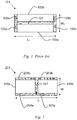
- FIG. 1 schematically illustrates a pouched product for oral use 101 according to prior art.
- the prior art product 101 has a rectangular shape with a maximum length L 0 extending in a length direction and a maximum width Wo extending in a width direction, whereby the maximum length L 0 is greater than the maximum width W 0 .
- the prior art product 101 comprises a filling material and a saliva-permeable pouch enclosing the filling material.
- the prior art product 101 comprises two long side edges 103a, 103b and two short side edges 105a, 105b.
- the prior art product 101 also has an extension in a height direction, being perpendicular to the length direction and to the width direction, however not seen in this perspective.
- the prior art product 101 comprises at least one seal 107 extending in the length direction.
- This seal is often called a longitudinal seal, since, when manufacturing the prior art product 101, this seal is made along the direction of travel of the web forming the pouch.
- the longitudinal seal is often positioned spaced apart from the long side edges 103a, 103b. Thereby it is often preferred to position it at or close to the longitudinal centre-line, as is illustrated in Figure 1 .
- the longitudinal seal 107 may be made by any method known to the skilled person, e.g. by means of heat-welding, ultrasonic sealing and/or applying an adhesive.
- the longitudinal seal 107 is included in the transverse edge seals 109a, 109b, i.e. the longitudinal seal 107 forms part of the transverse edge seals 109a, 109b, e.g. the longitudinal seal 107 being welded into the transverse edge seals 109a, 109b.
- FIG. 2 schematically illustrates a pouched product for oral use 201 according to the invention.
- the pouched product 201 comprises a filling material and a saliva-permeable pouch enclosing the filling material and has a rectangular shape with a maximum length L extending in a length direction and a maximum width W extending in a width direction, whereby the maximum length L is greater than or equal to the maximum width W.
- the illustrated pouched product 201 comprises a filling material and a saliva-permeable pouch enclosing the filling material.
- the pouched product 201 also has an extension in a height direction, however not seen in this perspective.
- the pouched product 201 comprises two long side edges 203a, 203b and two short side edges 205a, 205b.
- the pouched product 201 comprises at least one longitudinal seal 207, typically a single one, and two transverse edge seals 209a, 209b, with the terms longitudinal and transverse relating to the direction of travel of the web forming the pouch as further described herein in relation to the apparatus and method.
- the longitudinal seal 207 extending in the width direction of the pouched product 201 according to the invention.
- this seal is made along the direction of travel of the web forming the pouch, as is further described herein.
- the longitudinal seal 207 is often positioned spaced apart from the short side edges 205a, 205b. Thereby it is often preferred to position it at or close to the transverse centre-line, as is illustrated in Figure 2 .
- the longitudinal seal 207 may be made by any method known to the skilled person, e.g. by means of heat-welding, ultrasonic sealing and/or applying an adhesive.
- the transverse edge seals 209a, 209b form a first 209a and a second edge seal 209b sealing a respective first edge portion and a second edge portion along the two long side edges 203a, 203b of the pouched product 201.
- the transverse edge seals 209a, 209b preferably extend all the way out to the respective long side edge 203a, 203b, but there may also be an interspace between the transverse edge seal 209a, 209b and the long side edge 203a, 203b.
- the transverse edge seals 209a, 209b may be made by any method known to the skilled person, e.g. by means of heat-welding, ultrasonic sealing and/or applying an adhesive.
- the longitudinal seal 207 is included in the transverse edge seals 209a, 209b, e.g. the longitudinal seal 207 being welded into the transverse edge seals 209a, 209b.
- the longitudinal seal 207 is thus overlapped by the transverse edge seals 209a, 209b.
- the transverse edge seals 209a, 209b are longer than the at least one longitudinal seal 207 and thus also longer than the width W of the pouched product, e.g. at least 20%, preferably at least 40%, more preferably at least 60% and most preferably at least 80% greater than the width W. Accordingly, the length L of the pouched product 201 is longer than the width W of the pouched product, e.g. at least 20%, preferably at least 40%, more preferably at least 60% and most preferably at least 80% greater than the width W.
- the filling material of the pouched product 201 according to the invention may have a moisture content of at least 1 wt%, preferably at least 2 wt%, more preferably at least 3 wt% and most preferably at least 4 wt%.
- a moisture content of at least 1 wt% preferably at least 2 wt%, more preferably at least 3 wt% and most preferably at least 4 wt%.
- Moisture contents at the low end of the range may typically be utilized for pouched products with no or low tobacco content, to which nicotine is added.
- the filling material of the pouched product 201 according to the invention may have a moisture content of up to 65 wt%, preferably up to 60 wt%, more preferably up to 58 wt%, most preferably up to 56 wt%.
- a moisture content of up to 65 wt% preferably up to 60 wt%, more preferably up to 58 wt%, most preferably up to 56 wt%.
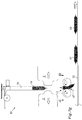
- FIGS 3a-g schematically illustrate an apparatus 19 according to the invention for portion packing of pouched products for oral use.
- the apparatus 19 comprises a first feeding unit 23 for supplying a planar web 25 of the packaging material 7, a second feeding unit 27 for supplying a filling material 29 to the advancing web 25, a forming unit 31 for forming a tubular web 32 of the planar web 25 of the packaging material 7, a sealing unit 33 for making a longitudinal seal, a sealing unit 35 for making a transverse seal, illustrated as an ultrasonic sealing device 35 comprising an anvil 3 and a sonotrode 5, and a separation unit 36 for separating the pouched products from each other.
- the second feeding unit 27 may be located downstream or upstream of the forming unit 31 or together with the forming unit 31. If placed together, as for the apparatus 19 illustrated in Figures 3a-g , the web 25 is first formed to a tubular web 32 and thereafter the filling material 29 is placed in the tubular web 32 as a portion 10 e.g. by means of the dosing method described in EP 2 428 450 B1 . In the illustrated embodiment, a filling tube 55 is used both for forming the tubular web 32 and for filling of the filling material into the tubular web 32.
- the filling material may be placed on the planar web as a portion before the planar web is formed to a tubular web, such that the packaging material is arranged around the portion of filling material to form the tubular web, thereby enclosing the portion.
- At least one of the sealing unit 33 for making a longitudinal seal and the sealing unit 35 for making a transverse seal may perform simultaneous welding and separation, e.g. by the sealing device disclosed in EP3383746 .
- welding and separation may be performed simultaneously and in the same operation step for at least one of the seals. It may further be performed by the same operation surface as disclosed in the sealing device of EP3383746 .
- the sonotrode 5 and the anvil 3 are arranged to be displaced in a reciprocating way in relation to the tubular web 32 in a direction being perpendicular to a direction of travel DT, between a first position, illustrated in Figure 3a , being in contact with the tubular web 32 and a position, illustrated in Figure 3c , being out of contact with the tubular web 32.
- Figure 3a illustrates a start of the method.
- a longitudinal seal e.g. like the longitudinal seal 207 illustrated in Figure 2 , is continuously formed in the advancing tubular web 32 by the device 33 for making a longitudinal seal.
- the anvil 3 and the sonotrode 5 assume the first position, in which they start welding.
- a portion 10 of the filling material 29 is filled from above into the tubular web 32.
- the portion 10 of the filling material moves downwards, e.g. by gravity and/or by pressurized gas, until it reaches the portion of the tubular web 32, which is in the gap 9 between the anvil 3 and the sonotrode 5.
- the anvil 3 and the sonotrode 5 of the sealing unit 35 for making transverse seals move downstream together with the tubular web 32 while performing the welding along the respective first portions 37a, 39a of their paths, thereby making the transverse seal.
- the anvil 3 and the sonotrode 5 then reach a second position being downstream of the first position but yet in contact with the tubular web 32. See Figure 3b .
- the tubular web 32 is separated by being cut by means of a cutting edge 15 in the middle of the welding zone, thereby providing a transverse edge seal, sealing the edges of the pouch being formed.
- the separation unit 36 and the sealing unit 35 for making transverse seals are combined into a single unit.
- the anvil 3 and the sonotrode 5 move along the respective first portions 37a, 39a of their paths together with the tubular web 32 while performing the welding until the anvil 3 and the sonotrode 5 reach the second position being downstream of the first position but yet in contact with the tubular web 32. See Figure 3f .
- the tubular web 32 is cut by the cutting edge 15, leaving an upper transverse edge seal 45 at the upper edge of the pouched product 43 and a corresponding lower transverse edge seal 46 at the lower edge of the next pouched product, which has been filled by a next portion 10 of the filling material.
- anvil 3 and the sonotrode 5 are moved away from the tubular web 32 along the second portions 37b, 39b of their respective paths until they reach a respective third position, illustrated in Figure 3g , such that they are no longer in contact, as is already described above for Figure 3c .
- the anvil 3 and the sonotrode 5 continue to move along their paths 37, 39 described above, while the tubular web 32 moves in the direction of travel DT.
- the arrangement 19 may further, as an option, comprise a pulling unit, illustrated in Figure 3f and 3g as a nip 47 between a pair of rollers 49, 51 arranged to pull the pouched product 43 in the direction of travel DT.
- a pulling unit illustrated in Figure 3f and 3g as a nip 47 between a pair of rollers 49, 51 arranged to pull the pouched product 43 in the direction of travel DT.
- the distance z between the nip 47 and the cutting edge 15 when the sealing device is in the second position see Figure 3f , roughly corresponds to the extension of the pouched product 43 in the direction of travel DT.
- the distance z is preferably adjustable.
- the forming unit 31 comprises a filling tube 55, see Figure 3a .
- the web 25 is fed from the first feeding unit 23 as a planar web having a respective side edge at either side. Thereafter, the web 25 is wrapped around the filling tube 55 to form the tubular web 32.
- the cross-sectional shape of the tubular web 32 is given by the outer circumference of the filling tube 55 and may e.g. be circular.
- the side edges of the web 25 are fixated by providing the longitudinal seal by the sealing unit 33, thus setting the circumference of the tubular web 32.
- the filling tube 55 is also used for supplying the filling material into the tubular web 32, i.e. the filling tube 55 is also comprised in the second feeding unit 27.
- the filling tube 56 is configured in such a way that its outer circumference, as measured e.g. in millimetres, is retained the same all the way from the first end 57 to the second end 59, although the cross-sectional shape of the filling tube 56 changes along its length.
- the first end 57 it is generally beneficial to have an as high cross-sectional area as possible for the given outer circumference, in order to facilitate the providing of the filling material 29 through the filling tube 56 into the tubular web 32.
- a large cross-sectional area reduces the risk of the filling material 29 sticking to the inner wall of the filling tube 56.
- the tubular web 32 is soon to be transversely sealed.
- the tubular web 32 is compressed to a straight line, thus forming a collapsed cross-sectional shape of the tubular web 32.
- the second end 59 of the filling tube 56 has a flattened profile, e.g. an elliptical cross-sectional shape with a minor axis a and a major axis b, as is illustrated.
- the second end 59 cannot be too flattened, since the filling material 29 should be able to easily pass the second end 59.
- the sealing unit 35 for making a transverse seal is located downstream of the forming unit 31.
- the tubular web 32 When being sealed, the tubular web 32 is compressed to a straight line of doubled packaging material. It thus has an outer circumference of about twice the maximum length L of the pouched product 201, cf. Figure 2 , i.e. 2L.
Landscapes
- Engineering & Computer Science (AREA)
- Mechanical Engineering (AREA)
- Containers And Plastic Fillers For Packaging (AREA)
- Pharmaceuticals Containing Other Organic And Inorganic Compounds (AREA)
Priority Applications (3)
| Application Number | Priority Date | Filing Date | Title |
|---|---|---|---|
| EP19211554.1A EP3828089A1 (fr) | 2019-11-26 | 2019-11-26 | Appareil et procédé d'emballage de portions de produits en sachet à usage oral et produit en sachet pour usage oral |
| SE2250504A SE545751C2 (en) | 2019-11-26 | 2020-11-25 | An apparatus and a method for portion packing of pouched products for oral use and a pouched product for oral use |
| PCT/EP2020/083295 WO2021105168A2 (fr) | 2019-11-26 | 2020-11-25 | Appareil et procédé d'emballage de portions de produits en sachet à usage oral et produit en sachet à usage oral |
Applications Claiming Priority (1)
| Application Number | Priority Date | Filing Date | Title |
|---|---|---|---|
| EP19211554.1A EP3828089A1 (fr) | 2019-11-26 | 2019-11-26 | Appareil et procédé d'emballage de portions de produits en sachet à usage oral et produit en sachet pour usage oral |
Publications (1)
| Publication Number | Publication Date |
|---|---|
| EP3828089A1 true EP3828089A1 (fr) | 2021-06-02 |
Family
ID=68699178
Family Applications (1)
| Application Number | Title | Priority Date | Filing Date |
|---|---|---|---|
| EP19211554.1A Pending EP3828089A1 (fr) | 2019-11-26 | 2019-11-26 | Appareil et procédé d'emballage de portions de produits en sachet à usage oral et produit en sachet pour usage oral |
Country Status (3)
| Country | Link |
|---|---|
| EP (1) | EP3828089A1 (fr) |
| SE (1) | SE545751C2 (fr) |
| WO (1) | WO2021105168A2 (fr) |
Cited By (1)
| Publication number | Priority date | Publication date | Assignee | Title |
|---|---|---|---|---|
| EP4072332B1 (fr) | 2019-12-09 | 2024-12-11 | Nicoventures Trading Limited | Compositions orales humides |
Citations (12)
| Publication number | Priority date | Publication date | Assignee | Title |
|---|---|---|---|---|
| US4703765A (en) | 1983-09-09 | 1987-11-03 | United States Tobacco Company | Precise portion packaging machine |
| DE19505880A1 (de) * | 1995-02-21 | 1996-08-22 | Rovema Gmbh | Kombination aus zusammenhängenden, gegeneinander abgegrenzten Beuteln und Vorrichtung zur Herstellung einer Kombination |
| GB2305147A (en) * | 1995-09-13 | 1997-04-02 | Hsieh Tzy Te | Packing mechanism with heat insulation about sealing rollers |
| US6135120A (en) | 1996-08-26 | 2000-10-24 | Swedish Match Sverige Ab | Device for packing of finely divided, moistened tobacco material |
| US20050238766A1 (en) * | 2002-03-18 | 2005-10-27 | Henderson Eric T | Bandolier format packaging |
| EP1712468A2 (fr) * | 2005-04-13 | 2006-10-18 | Velteko, s.r.o. | Méthode et dispositif pour la formation des sacs tubulaires |
| DE102006010139A1 (de) * | 2006-03-06 | 2007-09-13 | Rovema - Verpackungsmaschinen Gmbh | Schlauchbeutelmaschine mit Kantenschweißeinrichtungen |
| EP2446756A1 (fr) * | 2010-10-29 | 2012-05-02 | British American Tobacco (Investments) Limited | Procédé et appareil permettant d'introduire des additifs dans des produits de tabac sans fumée |
| WO2012069505A1 (fr) | 2010-11-26 | 2012-05-31 | Swedish Match North Europe Ab | Agencement pour la fabrication d'emballages-portions |
| EP2428450B1 (fr) | 2010-09-09 | 2013-07-17 | Merz Verpackungsmaschinen GmbH | Procédé de dosage et dispositif de dosage |
| US20150264974A1 (en) * | 2010-08-05 | 2015-09-24 | Altria Client Services Inc. | Composite smokeless tobacco products, systems, and methods |
| EP3383746A1 (fr) | 2015-12-02 | 2018-10-10 | Swedish Match North Europe AB | Dispositif de scellement étanche |
Family Cites Families (7)
| Publication number | Priority date | Publication date | Assignee | Title |
|---|---|---|---|---|
| DE19800682B4 (de) * | 1998-01-10 | 2004-07-08 | Lts Lohmann Therapie-Systeme Ag | Verfahren zur Herstellung einer Primärverpackung für film- oder oblatenförmige Darreichungsformen |
| DE10359107A1 (de) * | 2003-12-17 | 2005-07-21 | Rovema - Verpackungsmaschinen Gmbh | Vertikale Schlauchbeutelverbindung zum Herstellen von standfähigen Beuteln |
| MX2007003557A (es) * | 2004-09-30 | 2007-11-23 | Hershey Co | Empaques de tira de pelicula comestible, sellados y metodos de fabricacion y uso de los mismos. |
| DE102006041921A1 (de) * | 2006-09-07 | 2008-03-27 | Lts Lohmann Therapie-Systeme Ag | Verpackung für wirkstoffhaltige Filme und Verfahren für deren Herstellung |
| ITBO20060792A1 (it) * | 2006-11-22 | 2008-05-23 | Acma S P A | Metodo per la produzione di bustine di materiale incoerente. |
| RU2592099C2 (ru) * | 2010-04-12 | 2016-07-20 | Алтриа Клайент Сервисез Ллс | Пакетированный продукт с улучшенным запечатыванием и способ |
| US9102426B2 (en) * | 2012-01-06 | 2015-08-11 | Frito-Lay North America, Inc. | Form-fill-seal machine including a filling tube with an elliptical cross-section |
-
2019
- 2019-11-26 EP EP19211554.1A patent/EP3828089A1/fr active Pending
-
2020
- 2020-11-25 WO PCT/EP2020/083295 patent/WO2021105168A2/fr not_active Ceased
- 2020-11-25 SE SE2250504A patent/SE545751C2/en unknown
Patent Citations (12)
| Publication number | Priority date | Publication date | Assignee | Title |
|---|---|---|---|---|
| US4703765A (en) | 1983-09-09 | 1987-11-03 | United States Tobacco Company | Precise portion packaging machine |
| DE19505880A1 (de) * | 1995-02-21 | 1996-08-22 | Rovema Gmbh | Kombination aus zusammenhängenden, gegeneinander abgegrenzten Beuteln und Vorrichtung zur Herstellung einer Kombination |
| GB2305147A (en) * | 1995-09-13 | 1997-04-02 | Hsieh Tzy Te | Packing mechanism with heat insulation about sealing rollers |
| US6135120A (en) | 1996-08-26 | 2000-10-24 | Swedish Match Sverige Ab | Device for packing of finely divided, moistened tobacco material |
| US20050238766A1 (en) * | 2002-03-18 | 2005-10-27 | Henderson Eric T | Bandolier format packaging |
| EP1712468A2 (fr) * | 2005-04-13 | 2006-10-18 | Velteko, s.r.o. | Méthode et dispositif pour la formation des sacs tubulaires |
| DE102006010139A1 (de) * | 2006-03-06 | 2007-09-13 | Rovema - Verpackungsmaschinen Gmbh | Schlauchbeutelmaschine mit Kantenschweißeinrichtungen |
| US20150264974A1 (en) * | 2010-08-05 | 2015-09-24 | Altria Client Services Inc. | Composite smokeless tobacco products, systems, and methods |
| EP2428450B1 (fr) | 2010-09-09 | 2013-07-17 | Merz Verpackungsmaschinen GmbH | Procédé de dosage et dispositif de dosage |
| EP2446756A1 (fr) * | 2010-10-29 | 2012-05-02 | British American Tobacco (Investments) Limited | Procédé et appareil permettant d'introduire des additifs dans des produits de tabac sans fumée |
| WO2012069505A1 (fr) | 2010-11-26 | 2012-05-31 | Swedish Match North Europe Ab | Agencement pour la fabrication d'emballages-portions |
| EP3383746A1 (fr) | 2015-12-02 | 2018-10-10 | Swedish Match North Europe AB | Dispositif de scellement étanche |
Cited By (1)
| Publication number | Priority date | Publication date | Assignee | Title |
|---|---|---|---|---|
| EP4072332B1 (fr) | 2019-12-09 | 2024-12-11 | Nicoventures Trading Limited | Compositions orales humides |
Also Published As
| Publication number | Publication date |
|---|---|
| WO2021105168A2 (fr) | 2021-06-03 |
| SE545751C2 (en) | 2023-12-27 |
| SE2250504A1 (en) | 2022-04-27 |
| WO2021105168A3 (fr) | 2021-10-07 |
Similar Documents
| Publication | Publication Date | Title |
|---|---|---|
| JP6945531B2 (ja) | 経口袋入り嗅ぎ製品を製造するための方法 | |
| KR102419443B1 (ko) | 구강 파우치 스너프 제품의 부분 포장을 위한 방법 및 장치 | |
| RU2709953C1 (ru) | Пакетированное изделие из снаффа для перорального использования | |
| EP3932812B1 (fr) | Appareil et procédé de fabrication d'un produit en sachet à usage oral | |
| RU2706487C1 (ru) | Уплотнительное устройство | |
| US9820507B2 (en) | Method of making oral pouch product | |
| DK3219627T3 (en) | BREATHING AND SEALING DEVICE | |
| EP3828089A1 (fr) | Appareil et procédé d'emballage de portions de produits en sachet à usage oral et produit en sachet pour usage oral | |
| EP4404775B1 (fr) | Procédé d'hydratation d'un produit en sachet à usage oral | |
| EP4468886B1 (fr) | Unité de découpe et procédé pour découper une bande | |
| EP4062773B1 (fr) | Produit à usage oral en sachet |
Legal Events
| Date | Code | Title | Description |
|---|---|---|---|
| PUAI | Public reference made under article 153(3) epc to a published international application that has entered the european phase |
Free format text: ORIGINAL CODE: 0009012 |
|
| STAA | Information on the status of an ep patent application or granted ep patent |
Free format text: STATUS: THE APPLICATION HAS BEEN PUBLISHED |
|
| AK | Designated contracting states |
Kind code of ref document: A1 Designated state(s): AL AT BE BG CH CY CZ DE DK EE ES FI FR GB GR HR HU IE IS IT LI LT LU LV MC MK MT NL NO PL PT RO RS SE SI SK SM TR |
|
| STAA | Information on the status of an ep patent application or granted ep patent |
Free format text: STATUS: REQUEST FOR EXAMINATION WAS MADE |
|
| 17P | Request for examination filed |
Effective date: 20211126 |
|
| RBV | Designated contracting states (corrected) |
Designated state(s): AL AT BE BG CH CY CZ DE DK EE ES FI FR GB GR HR HU IE IS IT LI LT LU LV MC MK MT NL NO PL PT RO RS SE SI SK SM TR |
|
| STAA | Information on the status of an ep patent application or granted ep patent |
Free format text: STATUS: EXAMINATION IS IN PROGRESS |
|
| 17Q | First examination report despatched |
Effective date: 20230213 |