EP3828098A2 - Caisse d'emballage à bande déchirable, procédé de fabrication et bobine - Google Patents
Caisse d'emballage à bande déchirable, procédé de fabrication et bobine Download PDFInfo
- Publication number
- EP3828098A2 EP3828098A2 EP20275173.1A EP20275173A EP3828098A2 EP 3828098 A2 EP3828098 A2 EP 3828098A2 EP 20275173 A EP20275173 A EP 20275173A EP 3828098 A2 EP3828098 A2 EP 3828098A2
- Authority
- EP
- European Patent Office
- Prior art keywords
- tear strip
- blank
- paper
- adhesive
- packing case
- Prior art date
- Legal status (The legal status is an assumption and is not a legal conclusion. Google has not performed a legal analysis and makes no representation as to the accuracy of the status listed.)
- Withdrawn
Links
- 238000012856 packing Methods 0.000 title claims abstract description 96
- 238000004519 manufacturing process Methods 0.000 title claims description 14
- 239000000853 adhesive Substances 0.000 claims abstract description 78
- 230000001070 adhesive effect Effects 0.000 claims abstract description 78
- 239000000123 paper Substances 0.000 claims description 145
- 239000002655 kraft paper Substances 0.000 claims description 14
- 238000000034 method Methods 0.000 claims description 11
- XLYOFNOQVPJJNP-UHFFFAOYSA-N water Substances O XLYOFNOQVPJJNP-UHFFFAOYSA-N 0.000 claims description 8
- 239000005022 packaging material Substances 0.000 claims description 4
- 238000005507 spraying Methods 0.000 claims description 2
- 239000000463 material Substances 0.000 description 13
- 229920003023 plastic Polymers 0.000 description 7
- 239000004033 plastic Substances 0.000 description 7
- 239000000758 substrate Substances 0.000 description 7
- 239000010410 layer Substances 0.000 description 6
- 229920002689 polyvinyl acetate Polymers 0.000 description 6
- 238000005520 cutting process Methods 0.000 description 4
- 239000007921 spray Substances 0.000 description 4
- 238000004806 packaging method and process Methods 0.000 description 3
- 238000004064 recycling Methods 0.000 description 3
- QTBSBXVTEAMEQO-UHFFFAOYSA-M Acetate Chemical compound CC([O-])=O QTBSBXVTEAMEQO-UHFFFAOYSA-M 0.000 description 2
- 239000004831 Hot glue Substances 0.000 description 2
- 239000000839 emulsion Substances 0.000 description 2
- 239000000835 fiber Substances 0.000 description 2
- 239000003365 glass fiber Substances 0.000 description 2
- 239000011118 polyvinyl acetate Substances 0.000 description 2
- 238000007789 sealing Methods 0.000 description 2
- 241000894006 Bacteria Species 0.000 description 1
- 239000005715 Fructose Substances 0.000 description 1
- RFSUNEUAIZKAJO-ARQDHWQXSA-N Fructose Chemical compound OC[C@H]1O[C@](O)(CO)[C@@H](O)[C@@H]1O RFSUNEUAIZKAJO-ARQDHWQXSA-N 0.000 description 1
- 229930091371 Fructose Natural products 0.000 description 1
- 239000004743 Polypropylene Substances 0.000 description 1
- 230000004913 activation Effects 0.000 description 1
- 238000004026 adhesive bonding Methods 0.000 description 1
- 239000012790 adhesive layer Substances 0.000 description 1
- 230000002411 adverse Effects 0.000 description 1
- 239000011324 bead Substances 0.000 description 1
- 238000007796 conventional method Methods 0.000 description 1
- 238000009472 formulation Methods 0.000 description 1
- 239000011521 glass Substances 0.000 description 1
- 239000003292 glue Substances 0.000 description 1
- 239000000203 mixture Substances 0.000 description 1
- -1 polypropylene Polymers 0.000 description 1
- 229920001155 polypropylene Polymers 0.000 description 1
- 230000003014 reinforcing effect Effects 0.000 description 1
- 239000011347 resin Substances 0.000 description 1
- 229920005989 resin Polymers 0.000 description 1
- 238000000926 separation method Methods 0.000 description 1
- 229920003051 synthetic elastomer Polymers 0.000 description 1
- 239000005061 synthetic rubber Substances 0.000 description 1
- 239000002699 waste material Substances 0.000 description 1
Images




Classifications
-
- B—PERFORMING OPERATIONS; TRANSPORTING
- B65—CONVEYING; PACKING; STORING; HANDLING THIN OR FILAMENTARY MATERIAL
- B65D—CONTAINERS FOR STORAGE OR TRANSPORT OF ARTICLES OR MATERIALS, e.g. BAGS, BARRELS, BOTTLES, BOXES, CANS, CARTONS, CRATES, DRUMS, JARS, TANKS, HOPPERS, FORWARDING CONTAINERS; ACCESSORIES, CLOSURES, OR FITTINGS THEREFOR; PACKAGING ELEMENTS; PACKAGES
- B65D75/00—Packages comprising articles or materials partially or wholly enclosed in strips, sheets, blanks, tubes or webs of flexible sheet material, e.g. in folded wrappers
- B65D75/52—Details
- B65D75/58—Opening or contents-removing devices added or incorporated during package manufacture
- B65D75/66—Inserted or applied tearing-strings or like flexible elements
-
- B—PERFORMING OPERATIONS; TRANSPORTING
- B65—CONVEYING; PACKING; STORING; HANDLING THIN OR FILAMENTARY MATERIAL
- B65D—CONTAINERS FOR STORAGE OR TRANSPORT OF ARTICLES OR MATERIALS, e.g. BAGS, BARRELS, BOTTLES, BOXES, CANS, CARTONS, CRATES, DRUMS, JARS, TANKS, HOPPERS, FORWARDING CONTAINERS; ACCESSORIES, CLOSURES, OR FITTINGS THEREFOR; PACKAGING ELEMENTS; PACKAGES
- B65D27/00—Envelopes or like essentially-rectangular flexible containers for postal or other purposes having no structural provision for thickness of contents
- B65D27/32—Opening devices incorporated during envelope manufacture
- B65D27/38—Tearing-strings or -strips
-
- Y—GENERAL TAGGING OF NEW TECHNOLOGICAL DEVELOPMENTS; GENERAL TAGGING OF CROSS-SECTIONAL TECHNOLOGIES SPANNING OVER SEVERAL SECTIONS OF THE IPC; TECHNICAL SUBJECTS COVERED BY FORMER USPC CROSS-REFERENCE ART COLLECTIONS [XRACs] AND DIGESTS
- Y02—TECHNOLOGIES OR APPLICATIONS FOR MITIGATION OR ADAPTATION AGAINST CLIMATE CHANGE
- Y02W—CLIMATE CHANGE MITIGATION TECHNOLOGIES RELATED TO WASTEWATER TREATMENT OR WASTE MANAGEMENT
- Y02W90/00—Enabling technologies or technologies with a potential or indirect contribution to greenhouse gas [GHG] emissions mitigation
- Y02W90/10—Bio-packaging, e.g. packing containers made from renewable resources or bio-plastics
Definitions
- packaging With the growth of online shopping, there is a large demand for packaging products that online retailers can ship their goods in. Such packaging must be available in a range of shapes, sizes and strengths, and it must be possible to fully manufacture and assemble it on a high speed production line using machines. Additionally, the packaging should be easy for the customer to open.
- tear strips such as the Scotch® Tear Strip Tape manufactured by 3MTM under the product code 8626
- tear strips feature a pre-applied adhesive layer and are attached to a surface of a packing case in such a way that when the users pulls an end of the tear strip, the tear strip tears through the packing case to thereby create an opening in the packing case.
- the 3MTM 8626 Scotch Tear Strip Tape is made of polypropylene with a synthetic rubber resin adhesive.
- Other examples of plastic tear strips include Rippatape®.
- a packing case blank including an opening device comprising a biodegradable paper tear strip attached to the blank by a layer of adhesive.
- a packing case formed from such a blank is easy to open and wholly recyclable without the need for perforations.
- tear strip tapes are generally made of plastic and comprise a pre-applied adhesive, which is normally an oil-based adhesive.
- Plastic tear strip tapes and oil-based adhesives are non-biodegradable and cannot be easily recycled, meaning they must be separated out when the packing case is recycled. Such separation is often performed manually, which can be costly and time-consuming. This is especially problematic when packing cases are sent for recycling without the tear strip tapes having been used/removed, as the tear strip tapes are then not easily separable.
- the paper tear strip of the first aspect is biodegradable and easily recyclable, and it can therefore be recycled with the rest of the packing case.
- an opening device comprising a biodegradable paper tear strip does not adversely affect the structural integrity the packing case.
- biodegradable means the tear strip is capable of being decomposed by bacteria or other living organisms, thereby avoiding pollution.
- the paper tear strip may also be referred to as a paper release tape, paper shear tape, paper shear strip, paper tear tape or paper tear strip tape, although unlike conventional tear strip tapes, the paper tear strip of the first aspect does not require a pre-applied adhesive, i.e. the adhesive can instead be applied to the packing case blank during manufacture.
- packing case blank refers to a packing case that is at any stage of manufacture, and should also be understood to include a completed packing case.
- the biodegradable paper tear strip consists essentially of paper.
- the tear strip to be biodegradable and easily recyclable, it must not contain any non-biodegradable components or any components that are difficult to separate and/or recycle.
- the plastic and glass fibres present in fibre-reinforced paper are not biodegradable or easily recyclable and would therefore be unsuitable for achieving the object of the present invention. Therefore, the biodegradable paper tear strip is not fibre-reinforced (i.e. not fibre-reinforced paper, which the skilled person will understand to refer to paper that has been strengthened with glass or plastic fibres and is not biodegradable).
- the biodegradable paper tear strip is attached to the blank along the majority of a length of the biodegradable paper tear strip.
- fibres of the biodegradable paper tear strip are biased along a pull direction of the biodegradable paper tear strip.
- the fibres of the paper are laid down with a higher percentage of the fibres orientated along the direction that the strip is cut. That it, it is the fibres of the paper itself (not reinforcing plastic or glass fibres as commonly found in fibre-reinforced paper) that are biased along the pull direction of the tear strip.
- the biodegradable paper tear strip is elongate along the pull direction of the tear strip.
- the biodegradable paper tear strip is preferably long in relation to its width.
- the adhesive is a water-based adhesive.
- Water-based adhesives are biodegradable and are less contaminating to recycling processes than other types of adhesives such as the oil-based adhesives used in conventional tear strip tapes.
- the adhesive is PVA.
- PVA may also be referred to as PVA glue, PVA emulsion, polyvinyl acetate, PVAc, or polyethenyl ethanoate.
- PVA is easy to put down and has a good tack.
- PVA integrates into the substrate of the packing case blank onto which it is applied, thereby forming a bond through mechanical adhesion rather than just specific adhesion.
- the adhesive may be a gum-based adhesive.
- a density of the paper strip is between 125 GSM and 200 GSM.
- biodegradable paper tear strip is of a sufficient strength to enable it to be pulled through the material of the packing case.
- a width of the paper strip is between 4 mm and 10 mm, preferably between 5 mm and 7 mm, and most preferably 6 mm.
- biodegradable paper tear strip is of a sufficient strength to enable it to be pulled through the material of the packing case.
- the blank further comprises one or more perforations, e.g. a pair of perforations, arranged at an end of the biodegradable paper tear strip on opposing sides of the biodegradable paper tear strip, thereby to form a pull-tab.
- the pull-tab may also be referred to simply as a tab.
- the pull-tab makes it easier for a user to pull the tear strip.
- a second pull-tab can be arranged at an opposing end of the biodegradable paper tear strip.
- the perforations may be formed as part of a die cutting process. Unlike tearable strips formed by a pair of perforations, the perforations used to form a pull tab do not span a panel or flap of the packing case blank.
- the blank is a cartonboard blank or a corrugated fibreboard blank.
- biodegradable paper tear strip will be laid down in a direction perpendicular to the direction of the corrugations in the board, and the paper facings of the corrugated board will have their fibre orientation in the more common random orientation or with an orientation biased slightly against the vertical stack direction of the pack.
- the biodegradable paper tear strip is made of kraft paper.
- Kraft paper is largely virgin paper made predominantly from kraft pulp. Using kraft paper ensures that the biodegradable paper tear strip is of a sufficient quality to enable it to be pulled through the material of the packing case.
- a packing case formed from the blank of the first aspect.
- a method of manufacturing a packing case blank comprising: applying a layer of adhesive to the blank; and, applying a (biodegradable) paper tear strip to the layer of adhesive, thereby to attach the paper tear strip to the blank.
- Packing case blanks manufactured using this method are easy to open and wholly recyclable without the need for perforations.
- the formulation of the adhesive can be easily changed depending on the packing case requirements.
- applying an adhesive directly to the packing case blank has the potential to reduce waste as unused strips can more easily be re-wound onto a bobbin at the end of a manufacturing run, unlike with conventional tear strip tape, which has a pre-applied adhesive.
- the adhesive is applied to the packing case blank during manufacture and is not pre-applied to the paper tear strip, so the paper tear strip can be drawn from a bobbin more quickly than a tear strip tape with a pre-applied adhesive.
- This method can be performed as part of the in-line process on a gluing and finishing machine, or it could be performed for example on a dedicated applicator machine.
- applying the layer of adhesive comprises spraying the adhesive.
- the adhesive may be sprayed from a fine spray glue head, thereby forming beads of adhesive.
- applying the adhesive may comprise applying the adhesive with a wheel or roller.
- the adhesive and/or the paper tear strip are applied while the packing case blank is moving.
- the paper tear strip is attached to the blank along the majority of a length of the paper tear strip.
- the paper tear strip is applied with fibres of the paper tear strip biased along a pull direction of the tear strip.
- the fibres of the paper are laid down with a higher percentage of the fibres orientated along the direction that the strip is cut.
- the paper tear strip is elongate along the pull direction of the tear strip.
- the paper tear strip is preferably long in relation to its width.
- the adhesive is a water-based adhesive.
- Water-based adhesives are biodegradable and are less contaminating to recycling processes than other types of adhesives such as oil-based adhesives used in conventional tear strip tapes.
- the adhesive is PVA.
- PVA may also be referred to as PVA glue, PVA emulsion, polyvinyl acetate, PVAc, or polyethenyl ethanoate.
- PVA is easy to put down and has a good tack.
- PVA integrates into the substrate of the packing case blank onto which it is applied, thereby forming a bond through mechanical adhesion rather than just specific adhesion.
- the adhesive may be a gum-based adhesive.
- a density of the paper strip is between 125 GSM and 200 GSM.
- a width of the paper strip is between 4 mm and 10 mm, preferably between 5 mm and 7 mm, and most preferably 6 mm.
- the method comprises cutting a pair of perforations e.g. a pair of perforations, in the blank at an end of the paper tear strip on opposing sides of the paper tear strip, thereby to form a pull-tab.
- a pair of perforations e.g. a pair of perforations
- the pull-tab may also be referred to simply as a tab.
- the pull-tab makes it easier for a user to pull the tear strip.
- a second pull-tab can be arranged at an opposing end of the paper tear strip.
- the perforations may be formed as part of a die cutting process.
- the blank is a cartonboard blank or a corrugated fibreboard blank.
- the paper tear strip will be laid down in a direction perpendicular to the direction of the corrugations in the board.
- the paper facings of the corrugated board would have their fibre orientation in the more common random orientation or with an orientation biased slightly against the vertical stack direction of the pack.
- the paper tear strip is made of kraft paper.
- Kraft paper is largely virgin paper made predominantly from kraft pulp. Using kraft paper ensures that the paper tear strip is of a sufficient quality to enable it to be pulled through the material of the packing case.
- a spool of paper tear strip for forming an opening device for cartonboard or corrugated fibreboard packaging material, the paper tear strip comprising a continuous length of paper having a density of between 125 GSM and 200 GSM and a width of between 4 mm and 10 mm.
- the spool may also be referred to as a reel or bobbin.
- Multiple slitting blades can be used across several shafts to achieve such an unusually thin strip of paper.
- Multiple tensioning wheels can be employed to ensure that the thin strips cut from the paper reels can then be wound onto bobbins that can be used on application machinery.
- fibres of the paper tear strip are biased along a length of the tear strip.
- the width of the paper is between 5 mm and 7 mm, preferably 6 mm.
- the paper tear strip is made of kraft paper.
- Kraft paper is largely virgin paper made predominantly from kraft pulp. Using kraft paper ensures that the paper tear strip is of a sufficient quality to enable it to be pulled through the packaging material.
- a packing case blank including an opening device comprising a tear strip attached to the blank by a layer of adhesive, wherein the tear strip is formed from a biodegradable material.
- Such a packing case is easy to open and wholly recyclable without the need for perforations.
- the biodegradable material could be any suitable material, such as paper or fructose, and is ideally recyclable with the rest of the packing case.
- the tear strip may also be referred to as a release tape, shear tape, shear strip, tear tape or tear strip tape.
- FIG. 1 An embodiment of a packing case 100 is shown in Figure 1 , comprising a flap 101 in a closed configuration.
- the packing case can be made of any suitable material, but in preferred embodiments a material of the packing case is cartonboard or corrugated fibreboard.
- FIG. 2 shows the packing case 100 with the flap 101 in an open configuration.
- the flap includes an opening device which comprises an elongate paper tear strip 102 adhered to an inner surface of the flap, with a pair of pull tabs 103 arranged at opposing ends of the paper tear strip 102.
- the pull tabs 103 are preferably each formed by a pair of perforations 104 in the flap arranged on opposing sides of the paper tear strip 102.
- the paper tear strip 102 is affixed to the packing case 100 by a layer of adhesive 105.
- the adhesive 105 is preferably applied directly to the packing case 105 during manufacture, and is preferably a water-based adhesive such as PVA or a gum-based adhesive, the latter of which may require water activation.
- the paper tear strip 102 extends slightly beyond the adhesive 105, although alternative embodiments are envisaged in which the entire surface of the paper tear strip 102 is coupled to the adhesive.
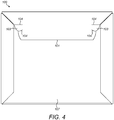
- the packing case 100 In use, once the packing case 100 has been packed, it is closed by folding the flap 101 and attaching it to a panel 107 of the packing case 100, preferably by means of an adhesive such as a pre-applied adhesive strip or sealing tape 106.
- the attachment between the flap 101 and the panel 107 is preferably strong enough such that the flap cannot be separated from the panel 107 once attached without damaging the packing case.
- the closed configuration of the packing case 100 is shown in Figure 4 .
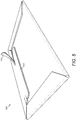
- the user grips and pulls one of the pull tabs 103 in a direction generally perpendicular to the outer surface of the flap 101, as shown in Figure 5 .
- the paper tear strip 102 is affixed to the pull tabs 103, pulling the pull tab 103 pulls the paper tear strip 102, thereby causing the paper tear strip 102 to tear through the packing case.
- the substrate of packing case 100 to which the paper tear strip 102 is adhered will become dissociated from the rest of the packing case 100 during this process.
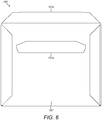
- a first portion 101a of the flap 101 remains adhered to the panel 107 of the packing case 100, as illustrated in Figure 6 , and a second portion 101b of the flap 101 can be folded back, thereby to open the packing case 100.
- the paper tear strip 102 When the paper tear strip 102 is pulled, it is placed under tension.
- the paper tear strip 102 should therefore have a shear tensile strength that is sufficient for it to tear through the underlying substrate of the packing case 100.
- the fibres of the paper tear strip 102 are preferably biased along the pull direction of the paper tear strip 102. Increasing the tensile strength of the paper tear strip 102 in this way reduces the risk that the paper tear strip 102 tears or otherwise breaks during opening for a given width and density of paper.
- Figure 7 shows a reel 200 of paper tear strip 102 for use in the manufacture of the packing case 100.
- the paper tear strip 102 can be made of any suitably strong paper, but is preferably made of kraft paper having a density of between 125 GSM and 200 GSM and a width of between 4 mm and 10 mm. The exact width and paper density can be chosen depending on the material of the packing case 101; for example a thicker or strong material may require a paper tear strip 102 with a higher density or larger width in order to ensure it is strong enough to tear through the packing case 100.
- Figure 8 illustrates a paper tear strip 102 being applied to a packing case 100 or packing case blank, for example on a high speed production line.
- the arrow depicts the direction of movement of the packing case 100.
- An adhesive applicator 300 is used to apply the adhesive 105 to a substrate of the packing case 100 or packing case blank.
- the adhesive applicator is a spray nozzle that sprays an adhesive onto a predetermined substrate of the packing case 100.
- Alternative adhesive applicators 300 are also envisaged, such as rollers.
- a tear strip applicator 400 in this case a roller, is then used to apply the paper tear strip 102 to the adhesive 105.
- the paper tear strip 102 will generally be drawn from a reel 200 or bobbin and cut to the required length before or during application, although it may also be possible to cut the paper tear strip 102 after application, for example by applying a continuous length of paper tear strip 102 to multiple packing cases and subsequently cutting the paper tear strip 102.
- a method 500 for applying a paper tear strip 102 to a packing case 100 or packing case blank is shown in Figure 9 .
- the adhesive 105 is applied to a substrate of the packing case 100 or packing case blank. This can be applied using an adhesive applicator 300 such as a spray nozzle or a roller. As described above, the adhesive 105 could be a water-based adhesive such as PVA, or it may alternatively be any other suitable adhesive, such as a gum based adhesive.
- the paper tear strip 102 is applied to the adhesive 105. This may be applied using a tear strip applicator 400 such as a roller, and the paper tear strip 102 may be drawn from a reel 200 or bobbin and cut to the required length as necessary.
- a tear strip applicator 400 such as a roller
- the paper tear strip 102 can be applied to any suitable packing case, including wraparound packing cases.
- the paper tear strip 102 can be used as a replacement for any conventional tear strip.
Landscapes
- Engineering & Computer Science (AREA)
- Mechanical Engineering (AREA)
- Cartons (AREA)
Applications Claiming Priority (1)
| Application Number | Priority Date | Filing Date | Title |
|---|---|---|---|
| GB1917197.4A GB2589333B (en) | 2019-11-26 | 2019-11-26 | Packing case with tear strip |
Publications (2)
| Publication Number | Publication Date |
|---|---|
| EP3828098A2 true EP3828098A2 (fr) | 2021-06-02 |
| EP3828098A3 EP3828098A3 (fr) | 2021-08-04 |
Family
ID=69137354
Family Applications (1)
| Application Number | Title | Priority Date | Filing Date |
|---|---|---|---|
| EP20275173.1A Withdrawn EP3828098A3 (fr) | 2019-11-26 | 2020-11-20 | Caisse d'emballage à bande déchirable, procédé de fabrication et bobine |
Country Status (2)
| Country | Link |
|---|---|
| EP (1) | EP3828098A3 (fr) |
| GB (1) | GB2589333B (fr) |
Cited By (2)
| Publication number | Priority date | Publication date | Assignee | Title |
|---|---|---|---|---|
| WO2023135619A1 (fr) | 2022-01-17 | 2023-07-20 | I.M.A. Industria Macchine Automatiche S.P.A. | Enveloppe pour paquet de poche |
| EP4549331A1 (fr) * | 2023-10-31 | 2025-05-07 | Swif GmbH South West International Fragrance | Emballage en forme de sachet et procédé de remplissage mécanique d'un emballage en forme de sachet |
Families Citing this family (1)
| Publication number | Priority date | Publication date | Assignee | Title |
|---|---|---|---|---|
| US11713177B1 (en) * | 2019-07-31 | 2023-08-01 | Packaging Corporation Of America | Shipping mailer |
Citations (1)
| Publication number | Priority date | Publication date | Assignee | Title |
|---|---|---|---|---|
| FR798760A (fr) * | 1935-12-06 | 1936-05-26 | Enveloppe pour lettre ou autres applications |
Family Cites Families (12)
| Publication number | Priority date | Publication date | Assignee | Title |
|---|---|---|---|---|
| GB437207A (en) * | 1934-04-25 | 1935-10-25 | Alfred German Rose | Improved cigarette package |
| US2315116A (en) * | 1939-09-13 | 1943-03-30 | James Elwyn Daniels | Quick opening package |
| US2909312A (en) * | 1956-10-09 | 1959-10-20 | Walworth Engineering Company | Tear strip box |
| GB919250A (en) * | 1960-03-07 | 1963-02-20 | Sesame Envelopes Ltd | Envelope and opening means therefor |
| US3653585A (en) * | 1970-04-15 | 1972-04-04 | Richard H Kazaros | Container with tear-type opener |
| US5135790A (en) * | 1987-02-11 | 1992-08-04 | H. B. Fuller Company | Tear tape opening system |
| US5007541A (en) * | 1990-03-16 | 1991-04-16 | The Procter & Gamble Company | Carton for granular materials |
| US5161734A (en) * | 1991-05-10 | 1992-11-10 | Procter & Gamble | Reclosable carton for granular materials |
| US5297727A (en) * | 1992-05-29 | 1994-03-29 | Brioux Murray J | Carton |
| GB2276147B (en) * | 1993-03-19 | 1996-12-18 | Rigid Containers Ltd | Opening boxes |
| US5505374A (en) * | 1995-07-13 | 1996-04-09 | Packaging Corporation Of America | Flip-top reclosable carton and method of making the same |
| US6491213B2 (en) * | 2001-03-14 | 2002-12-10 | Douglas K. Purcell | Easy open envelope |
-
2019
- 2019-11-26 GB GB1917197.4A patent/GB2589333B/en active Active
-
2020
- 2020-11-20 EP EP20275173.1A patent/EP3828098A3/fr not_active Withdrawn
Patent Citations (1)
| Publication number | Priority date | Publication date | Assignee | Title |
|---|---|---|---|---|
| FR798760A (fr) * | 1935-12-06 | 1936-05-26 | Enveloppe pour lettre ou autres applications |
Cited By (2)
| Publication number | Priority date | Publication date | Assignee | Title |
|---|---|---|---|---|
| WO2023135619A1 (fr) | 2022-01-17 | 2023-07-20 | I.M.A. Industria Macchine Automatiche S.P.A. | Enveloppe pour paquet de poche |
| EP4549331A1 (fr) * | 2023-10-31 | 2025-05-07 | Swif GmbH South West International Fragrance | Emballage en forme de sachet et procédé de remplissage mécanique d'un emballage en forme de sachet |
Also Published As
| Publication number | Publication date |
|---|---|
| GB201917197D0 (en) | 2020-01-08 |
| GB2589333A (en) | 2021-06-02 |
| GB2589333B (en) | 2022-03-09 |
| EP3828098A3 (fr) | 2021-08-04 |
Similar Documents
| Publication | Publication Date | Title |
|---|---|---|
| EP3828098A2 (fr) | Caisse d'emballage à bande déchirable, procédé de fabrication et bobine | |
| US8721814B2 (en) | Use of a strip of an adhesive tape to reinforce cardboard packaging particularly in the region of die-cuts, and simultaneously as a tear strip for such packaging | |
| US5639332A (en) | Method and apparatus for producing labels | |
| CA1314502C (fr) | Conditionnement de transport/presentation a boucle de fermeture dechirable | |
| EP2756045B1 (fr) | Utilisation d'un système de ruban adhésif pour la formation d'une bande d'ouverture sur un carton | |
| EP2704957B1 (fr) | Utilisation d'un système de bande adhésive en tant que bande déchirable sur un carton | |
| US20060054676A1 (en) | Easy open container | |
| US20040250947A1 (en) | Apparatus and method for applying labels | |
| US20210155370A1 (en) | Packing case with tear strip | |
| US4871345A (en) | Method of making tear strip openable shipping/display container and blanks therefor | |
| CA2344397A1 (fr) | Bande en polymere utilisee pour former un bord coupant sur des distributeurs en carton | |
| EP0773886A1 (fr) | Procede d'etancheification de boites a rabats raccourcis a l'aide d'une bande partiellement adhesive et structures d'emballage obtenues par ces procedes | |
| US4512478A (en) | Paperboard carton with improved perforated opening and method of making same | |
| US4580709A (en) | Dispensing carton having material tear strip and blank therefor | |
| CA2511994C (fr) | Ruban adhesif pour produire une epissure | |
| US6464818B1 (en) | Method of wasteless punching of adhesive punched items | |
| AU670601B2 (en) | Method and apparatus for producing tubular printed product packs with a tear-out aid | |
| US20030091779A1 (en) | Cutting edge for dispenser cartons | |
| US20030158025A1 (en) | Pull tab device for a dunnage machine stock supply | |
| JP2022547405A (ja) | ラベルを供給するための装置と方法 | |
| CN221371067U (zh) | 包装用胶带 | |
| US20040157030A1 (en) | Self adhesive label feedstock and method | |
| AU2021221838A1 (en) | A blank assembly for a carton and a method of forming the blank assembly | |
| JP2009220347A (ja) | 首掛けラベル連続体の製造方法 | |
| JPH0752923A (ja) | 粘着テープを用いた箱体の封緘方法 |
Legal Events
| Date | Code | Title | Description |
|---|---|---|---|
| PUAI | Public reference made under article 153(3) epc to a published international application that has entered the european phase |
Free format text: ORIGINAL CODE: 0009012 |
|
| STAA | Information on the status of an ep patent application or granted ep patent |
Free format text: STATUS: THE APPLICATION HAS BEEN PUBLISHED |
|
| AK | Designated contracting states |
Kind code of ref document: A2 Designated state(s): AL AT BE BG CH CY CZ DE DK EE ES FI FR GB GR HR HU IE IS IT LI LT LU LV MC MK MT NL NO PL PT RO RS SE SI SK SM TR |
|
| PUAL | Search report despatched |
Free format text: ORIGINAL CODE: 0009013 |
|
| AK | Designated contracting states |
Kind code of ref document: A3 Designated state(s): AL AT BE BG CH CY CZ DE DK EE ES FI FR GB GR HR HU IE IS IT LI LT LU LV MC MK MT NL NO PL PT RO RS SE SI SK SM TR |
|
| RIC1 | Information provided on ipc code assigned before grant |
Ipc: B65D 27/38 20060101AFI20210628BHEP |
|
| STAA | Information on the status of an ep patent application or granted ep patent |
Free format text: STATUS: REQUEST FOR EXAMINATION WAS MADE |
|
| 17P | Request for examination filed |
Effective date: 20211124 |
|
| RBV | Designated contracting states (corrected) |
Designated state(s): AL AT BE BG CH CY CZ DE DK EE ES FI FR GB GR HR HU IE IS IT LI LT LU LV MC MK MT NL NO PL PT RO RS SE SI SK SM TR |
|
| GRAP | Despatch of communication of intention to grant a patent |
Free format text: ORIGINAL CODE: EPIDOSNIGR1 |
|
| STAA | Information on the status of an ep patent application or granted ep patent |
Free format text: STATUS: GRANT OF PATENT IS INTENDED |
|
| INTG | Intention to grant announced |
Effective date: 20240617 |
|
| STAA | Information on the status of an ep patent application or granted ep patent |
Free format text: STATUS: THE APPLICATION IS DEEMED TO BE WITHDRAWN |
|
| 18D | Application deemed to be withdrawn |
Effective date: 20241018 |