EP3828166B1 - Dérivé d'huile végétale, procédé de fabrication et utilisation dans les compositions en caoutchouc et les pneus - Google Patents
Dérivé d'huile végétale, procédé de fabrication et utilisation dans les compositions en caoutchouc et les pneus Download PDFInfo
- Publication number
- EP3828166B1 EP3828166B1 EP20204370.9A EP20204370A EP3828166B1 EP 3828166 B1 EP3828166 B1 EP 3828166B1 EP 20204370 A EP20204370 A EP 20204370A EP 3828166 B1 EP3828166 B1 EP 3828166B1
- Authority
- EP
- European Patent Office
- Prior art keywords
- vegetable oil
- oils
- triglyceride
- oil derivative
- alkyl
- Prior art date
- Legal status (The legal status is an assumption and is not a legal conclusion. Google has not performed a legal analysis and makes no representation as to the accuracy of the status listed.)
- Active
Links
Classifications
-
- C—CHEMISTRY; METALLURGY
- C07—ORGANIC CHEMISTRY
- C07C—ACYCLIC OR CARBOCYCLIC COMPOUNDS
- C07C321/00—Thiols, sulfides, hydropolysulfides or polysulfides
- C07C321/12—Sulfides, hydropolysulfides, or polysulfides having thio groups bound to acyclic carbon atoms
-
- B—PERFORMING OPERATIONS; TRANSPORTING
- B60—VEHICLES IN GENERAL
- B60C—VEHICLE TYRES; TYRE INFLATION; TYRE CHANGING; CONNECTING VALVES TO INFLATABLE ELASTIC BODIES IN GENERAL; DEVICES OR ARRANGEMENTS RELATED TO TYRES
- B60C1/00—Tyres characterised by the chemical composition or the physical arrangement or mixture of the composition
-
- C—CHEMISTRY; METALLURGY
- C07—ORGANIC CHEMISTRY
- C07C—ACYCLIC OR CARBOCYCLIC COMPOUNDS
- C07C319/00—Preparation of thiols, sulfides, hydropolysulfides or polysulfides
- C07C319/22—Preparation of thiols, sulfides, hydropolysulfides or polysulfides of hydropolysulfides or polysulfides
-
- C—CHEMISTRY; METALLURGY
- C07—ORGANIC CHEMISTRY
- C07F—ACYCLIC, CARBOCYCLIC OR HETEROCYCLIC COMPOUNDS CONTAINING ELEMENTS OTHER THAN CARBON, HYDROGEN, HALOGEN, OXYGEN, NITROGEN, SULFUR, SELENIUM OR TELLURIUM
- C07F7/00—Compounds containing elements of Groups 4 or 14 of the Periodic Table
- C07F7/02—Silicon compounds
- C07F7/08—Compounds having one or more C—Si linkages
- C07F7/18—Compounds having one or more C—Si linkages as well as one or more C—O—Si linkages
- C07F7/1804—Compounds having Si-O-C linkages
-
- C—CHEMISTRY; METALLURGY
- C08—ORGANIC MACROMOLECULAR COMPOUNDS; THEIR PREPARATION OR CHEMICAL WORKING-UP; COMPOSITIONS BASED THEREON
- C08H—DERIVATIVES OF NATURAL MACROMOLECULAR COMPOUNDS
- C08H3/00—Vulcanised oils, e.g. factice
-
- C—CHEMISTRY; METALLURGY
- C08—ORGANIC MACROMOLECULAR COMPOUNDS; THEIR PREPARATION OR CHEMICAL WORKING-UP; COMPOSITIONS BASED THEREON
- C08L—COMPOSITIONS OF MACROMOLECULAR COMPOUNDS
- C08L23/00—Compositions of homopolymers or copolymers of unsaturated aliphatic hydrocarbons having only one carbon-to-carbon double bond; Compositions of derivatives of such polymers
- C08L23/02—Compositions of homopolymers or copolymers of unsaturated aliphatic hydrocarbons having only one carbon-to-carbon double bond; Compositions of derivatives of such polymers not modified by chemical after-treatment
- C08L23/18—Homopolymers or copolymers of hydrocarbons having four or more carbon atoms
- C08L23/20—Homopolymers or copolymers of hydrocarbons having four or more carbon atoms having four to nine carbon atoms
- C08L23/22—Copolymers of isobutene; Butyl rubber; Homopolymers or copolymers of other iso-olefins
-
- C—CHEMISTRY; METALLURGY
- C08—ORGANIC MACROMOLECULAR COMPOUNDS; THEIR PREPARATION OR CHEMICAL WORKING-UP; COMPOSITIONS BASED THEREON
- C08L—COMPOSITIONS OF MACROMOLECULAR COMPOUNDS
- C08L9/00—Compositions of homopolymers or copolymers of conjugated diene hydrocarbons
- C08L9/06—Copolymers with styrene
-
- C—CHEMISTRY; METALLURGY
- C08—ORGANIC MACROMOLECULAR COMPOUNDS; THEIR PREPARATION OR CHEMICAL WORKING-UP; COMPOSITIONS BASED THEREON
- C08L—COMPOSITIONS OF MACROMOLECULAR COMPOUNDS
- C08L91/00—Compositions of oils, fats or waxes; Compositions of derivatives thereof
- C08L91/02—Vulcanised oils, e.g. factice
-
- C—CHEMISTRY; METALLURGY
- C11—ANIMAL OR VEGETABLE OILS, FATS, FATTY SUBSTANCES OR WAXES; FATTY ACIDS THEREFROM; DETERGENTS; CANDLES
- C11B—PRODUCING, e.g. BY PRESSING RAW MATERIALS OR BY EXTRACTION FROM WASTE MATERIALS, REFINING OR PRESERVING FATS, FATTY SUBSTANCES, e.g. LANOLIN, FATTY OILS OR WAXES; ESSENTIAL OILS; PERFUMES
- C11B1/00—Production of fats or fatty oils from raw materials
- C11B1/10—Production of fats or fatty oils from raw materials by extracting
- C11B1/108—Production of fats or fatty oils from raw materials by extracting after-treatment, e.g. of miscellae
-
- C—CHEMISTRY; METALLURGY
- C11—ANIMAL OR VEGETABLE OILS, FATS, FATTY SUBSTANCES OR WAXES; FATTY ACIDS THEREFROM; DETERGENTS; CANDLES
- C11B—PRODUCING, e.g. BY PRESSING RAW MATERIALS OR BY EXTRACTION FROM WASTE MATERIALS, REFINING OR PRESERVING FATS, FATTY SUBSTANCES, e.g. LANOLIN, FATTY OILS OR WAXES; ESSENTIAL OILS; PERFUMES
- C11B3/00—Refining fats or fatty oils
- C11B3/02—Refining fats or fatty oils by chemical reaction
Definitions
- reinforcing fillers in rubber formulations has long been appreciated.
- carbon black has been widely used in making rubber formulations for use in a wide variety of rubber products, such as tires, power transmission belts, conveyor belts, hoses, air springs, and the like, for many decades.
- Reinforcing silicas including, but not limited to, rice hulled ash silica and chemically modified silicas, are also widely used in a variety of industrial products.
- Non-reinforcing and semi-reinforcing fillers such as clay, talc, lignin, diatomaceous earth, calcium carbonate, titanium dioxide, aluminum-trihydrate, and the like, have also been used in making a wide variety of rubber products.
- silica has been employed as a reinforcing filler in conjunction with carbon black in tire tread compounds.
- silica as a reinforcing agent in rubber formulations has grown significantly in importance.
- silica is widely used in rubber formulations as a replacement, or more typically a partial replacement, for carbon black in rubber articles, such as tires.
- silica reinforcement offers numerous benefits over conventional compounding with carbon black.
- the utilization of silica in tire tread formulations is believed to (a) lower rolling resistance, (b) provide better traction on wet surfaces and snow, and (c) lower noise generation, when compared with conventional tires filled with carbon black.
- rubber for tires is supplied by a rubber producer to a tire manufacturer in the form of a masterbatch containing an elastomer, an oil extender, and a filler.
- the traditional filler has been carbon black in the form of fine particles. These particles have hydrophobic surface characteristics and will therefore disperse easily within the hydrophobic elastomer.
- silica has a very hydrophilic surface and considerable difficulty has been encountered in dispersing silica in the hydrophobic rubbery elastomer.
- Such compounding operations employ a silica which has been treated with an organosilane coupling agent having dual functionality.
- organosilane coupling agents are those well-known compounds that include both an organic group, such as an amino alkyl group, a mercaptoalkyl group, or a polysulfidic-bis-organo alkoxy silane group bonded directly to the silicon atom along with a readily hydrolyzable group, such as an alkoxy group as represented by a methoxy group or an ethoxy group, likewise bonded directly to the silicon atom.
- the alkoxy group hydrolyzes in the presence of moisture typically found on the surface of the silica to form the corresponding silanol which reacts with or condenses in the presence of the silica surface to bond the silicon atom to the silica surface.
- the organic groups likewise attached to the silicon atom are thus available for chemical reaction with the polymer matrix during vulcanization.
- the polymer matrix may become chemically bonded by means of the coupling agent to the silica surface during cure or vulcanization of the polymer.
- Problems associated with the use of such silanes during compounding are unpleasant odors, premature curing, and/or scorching.
- mercaptosilanes offer excellent coupling between rubber and silica, resulting in rubber compounds for tire treads with improved wet and ice skid resistance, rolling resistance and treadwear even at low loadings.
- the high reactivity of mercaptosilanes makes it impractical to use such silane coupling agents in applications where conventional Banbury mixing is employed.
- low mixing temperatures result in a marked reduction in the mechanical efficiency of mixing that is essential for an optimum dispersion of the silica.
- silica filled rubber formulations that process better (have better extrusion quality) and which exhibit a higher level of dynamic stiffness.
- the use of silica reinforced tire tread compounds containing organofunctional silanes as coupling agents results in substantial performance benefits, including lower hysteresis and improved wet and ice traction.
- these improvements in performance are usually accompanied by difficult tread compound processing due to high Mooney viscosity and reduced tire handling performance due to low dynamic stiffness at low strains of the cured rubber tread.
- Typical polysulfide silanes used in silica filled tire treads serve to hydrophobate the silica surface, reducing the silica "filler-filler” network resulting in a reduction of dynamic stiffness at low strain levels of the compound.
- Blocked mercaptosilanes e.g., 3-octanoylthio-1-propyltriethoxysilane
- carbon black filled tread compounds have high levels of dynamic stiffness at low strain due to the inherent "filler-filler" network formed by the carbon black. This high level of dynamic stiffness at low strain is advantageous for improved tire handling performance.
- this carbon black network also results in a substantial increase in hysteresis as compared to the silica/silane containing tread compounds.
- the high Mooney viscosity of the silica filled tire tread compounds often require the inclusion of a process additive that reduces the compound viscosity but also further reduces the low strain dynamic stiffness of the cured silica tread compound. Since low strain stiffness of the cured tread compound is a very important parameter for tire handling performance and since process additives reduce low strain dynamic stiffness, a way to increase in the low strain stiffness of a silica filled tread compound without a substantial detrimental increase in hysteresis is needed.
- the invention relates to a vegetable oil derivative according to claim 1, a vulcanizable rubber composition according to claim 7, a pneumatic tire according to claim 8, a manufactured item according to claim 9, and a method of manufacturing according to claim 10.
- the invention is further directed to a method of making the vegetable oil derivative, a rubber composition and a pneumatic tire.
- the vegetable oil derivative may be produced by modification of a triglyceride.
- the vegetable oil derivative may be produced via disulfide exchange with modified triglyceride containing at least one thiol group (-SH, also known as mercapto or sulfanyl,) otherwise referred to herein as a thiolized or mercaptanized triglyceride.
- modified triglyceride containing at least one thiol group (-SH, also known as mercapto or sulfanyl,) otherwise referred to herein as a thiolized or mercaptanized triglyceride.
- Triglyceride starting material has the general structure: where R 1 , R 2 , and R 3 are as defined previously.
- Suitable triglycerides include vegetable oils and their derivatives, preferably soybean oil.
- One or more of groups R 1 , R 2 , and R 3 must contain at least one olefin bond.
- the triglyceride is a vegetable oil.
- suitable vegetable oils include those with olefinic unsaturation in their fatty acid chains, including but not limited to soybean oils, canola oils, castor oils, palm oils, coconut oil, and corn oils.
- the triglyceride is a high oleic soybean oil, containing about 75 percent by weight of oleic acid residues as oleyl chains.
- the thiolized triglyceride is produced via a thiol-ene reaction of a dithiol with the triglyceride.
- dithiols are used of the general structure: HS-X-SH where X is substituted or unsubstituted C1 to C10 alkane diyl, substituted or unsubstituted phenylene, or a combination thereof, including substructures containing other functionalities, including alcohols, carbonyls, carboxylic acids, esters, anhydrides, amines, amides, amino acids, imines, or halides.
- the thiol-ene reaction between a dithiol and olefinic unsaturation of the triglyceride to produce a thiolized triglyceride may proceed as follows: where m is the number of dithiol residues covalently bonded to a carbon atom of one of R 1 , R 2 or R 3 resulting from the thiol-ene reaction.
- the olefin-containing triglyceride may be partially or fully functionalized with free thiols via thiol-ene reaction, depending on the reaction conditions to give the general structure above of a thiolized triglyceride.
- the thiolized triglyceride is produced via direct addition of H 2 S to the triglyceride to produce a mercaptanized triglyceride: where each thiol group -SH is covalently bonded to a carbon atom of one of R 1 , R 2 or R 3 .
- the thiolized triglyceride is a mercaptanized soybean oil such as that commercially available as Polymercaptan 358 from Chevron Phillips.
- a silane disulfide may be used in a disulfide exchange reaction with the thiolized triglyceride to produce a silane disulfide triglyceride.
- the silane disulfide is of formula: where, R 4 , R 5 , R 6 , R 7 , k, and j are as previous, and R 8 is an organic leaving group. In one embodiment, R 8 is a benzothiazyl group.
- the silane disulfide may be obtained by disulfide exchange reaction of a mercaptoalkylsilane with a bisorganodisulfide, for example reaction of (3-mercaptopropyl)triethoxysilane with benzothiazole disulfide (2,2'-dithio-bis-benzothiazole) to produce 2-[[3-triethoxysilyl)propyl]dithio]benzothiazole.
- the thiolized triglyceride resulting from reaction of a triglyceride with a dithiol may be used in a subsequent disulfide exchange with the silane disulfide as follows: where m' is m is the number of the silane disulfide pendant to the triglyceride.
- the thiolized triglyceride resulting from reaction of a triglyceride with H 2 S may be used in a disulfide exchange with the silane disulfide as follows: where m" is the number of the silane disulfide groups pendant to the triglyceride.
- Such disulfidic triglyceride may be a vegetable oil derivative in embodiments where the triglyceride is a vegetable oil.
- the functional oil is a soybean oil functionalized with propyltriethoxysilyl disulfide, where the silane disulfide content can vary from 1-8 substituents per triglyceride molecule.
- the vegetable oil derivative may be used in a vulcanizable rubber composition. In one embodiment, the vegetable oil derivative is used in an amount ranging from 1 to 80 phr.
- the rubber composition may include, in addition to the vegetable oil derivative, one or more rubbers or elastomers containing olefinic unsaturation.
- rubber or elastomer containing olefinic unsaturation or “diene based elastomer” are intended to include both natural rubber and its various raw and reclaim forms as well as various synthetic rubbers.
- the terms “rubber” and “elastomer” may be used interchangeably, unless otherwise prescribed.
- the terms “rubber composition,” “compounded rubber” and “rubber compound” are used interchangeably to refer to rubber which has been blended or mixed with various ingredients and materials and such terms are well known to those having skill in the rubber mixing or rubber compounding art.
- Representative synthetic polymers are the homopolymerization products of butadiene and its homologues and derivatives, for example, methylbutadiene, dimethylbutadiene and pentadiene as well as copolymers such as those formed from butadiene or its homologues or derivatives with other unsaturated monomers.
- acetylenes for example, vinyl acetylene
- olefins for example, isobutylene, which copolymerizes with isoprene to form butyl rubber
- vinyl compounds for example, acrylic acid, acrylonitrile (which polymerize with butadiene to form NBR), methacrylic acid and styrene, the latter compound polymerizing with butadiene to form SBR, as well as vinyl esters and various unsaturated aldehydes, ketones and ethers, e.g., acrolein, methyl isopropenyl ketone and vinylethyl ether.
- synthetic rubbers include neoprene (polychloroprene), polybutadiene (including cis-1,4-polybutadiene), polyisoprene (including cis-1,4-polyisoprene), butyl rubber, halobutyl rubber such as chlorobutyl rubber or bromobutyl rubber, styrene/isoprene/butadiene rubber, copolymers of 1,3-butadiene or isoprene with monomers such as styrene, acrylonitrile and methyl methacrylate, as well as ethylene/propylene terpolymers, also known as ethylene/propylene/diene monomer (EPDM), and in particular, ethylene/propylene/ dicyclopentadiene terpolymers.
- neoprene polychloroprene
- polybutadiene including cis-1,4-polybutadiene
- rubbers which may be used include alkoxy-silyl end functionalized solution polymerized polymers (SBR, PBR, IBR and SIBR), silicon-coupled and tin-coupled star-branched polymers.
- SBR alkoxy-silyl end functionalized solution polymerized polymers
- PBR polybutadiene
- SIBR silicon-coupled and tin-coupled star-branched polymers.
- the preferred rubber or elastomers are polyisoprene (natural or synthetic), polybutadiene and SBR.
- the at least one additional rubber is preferably of at least two of diene based rubbers.
- a combination of two or more rubbers is preferred such as cis 1,4-polyisoprene rubber (natural or synthetic, although natural is preferred), 3,4-polyisoprene rubber, styrene/isoprene/butadiene rubber, emulsion and solution polymerization derived styrene/butadiene rubbers, cis 1,4-polybutadiene rubbers and emulsion polymerization prepared butadiene/acrylonitrile copolymers.
- an emulsion polymerization derived styrene/butadiene might be used having a relatively conventional styrene content of 20 to 28 percent bound styrene or, for some applications, an E-SBR having a medium to relatively high bound styrene content, namely, a bound styrene content of 30 to 45 percent.
- E-SBR emulsion polymerization prepared E-SBR
- styrene and 1,3-butadiene are copolymerized as an aqueous emulsion.
- the bound styrene content can vary, for example, from 5 to 50 percent.
- the E-SBR may also contain acrylonitrile to form a terpolymer rubber, as E-SBAR, in amounts, for example, of 2 to 30 weight percent bound acrylonitrile in the terpolymer.
- Emulsion polymerization prepared styrene/butadiene/acrylonitrile copolymer rubbers containing 2 to 40 weight percent bound acrylonitrile in the copolymer are also contemplated as diene based rubbers for use in this invention.
- S-SBR solution polymerization prepared SBR
- S-SBR typically has a bound styrene content in a range of 5 to 50, preferably 9 to 36, percent.
- the S-SBR can be conveniently prepared, for example, by organo lithium catalyzation in the presence of an organic hydrocarbon solvent.
- cis 1,4-polybutadiene rubber may be used.
- BR cis 1,4-polybutadiene rubber
- Such BR can be prepared, for example, by organic solution polymerization of 1,3-butadiene.
- the BR may be conveniently characterized, for example, by having at least a 90 percent cis 1,4-content.
- the rubber composition may also include up to 70 phr of processing oil.
- Processing oil may be included in the rubber composition as extending oil typically used to extend elastomers. Processing oil may also be included in the rubber composition by addition of the oil directly during rubber compounding.
- the processing oil used may include both extending oil present in the elastomers, and process oil added during compounding.
- Suitable process oils include various oils as are known in the art, including aromatic, paraffinic, naphthenic, vegetable oils, and low PCA oils, such as MES, TDAE, SRAE and heavy naphthenic oils.
- Suitable low PCA oils include those having a polycyclic aromatic content of less than 3 percent by weight as determined by the IP346 method. Procedures for the IP346 method may be found in Standard Methods for Analysis & Testing of Petroleum and Related Products and British Standard 2000 Parts, 2003, 62nd edition, published by the Institute of Petroleum, United Kingdom .
- the rubber composition may include from 10 to 150 phr of silica. In another embodiment, from 20 to 80 phr of silica may be used.
- the commonly employed siliceous pigments which may be used in the rubber compound include conventional pyrogenic and precipitated siliceous pigments (silica).
- precipitated silica is used.
- the conventional siliceous pigments employed in this invention are precipitated silicas such as, for example, those obtained by the acidification of a soluble silicate, e.g., sodium silicate.
- Such conventional silicas might be characterized, for example, by having a BET surface area, as measured using nitrogen gas.
- the BET surface area may be in the range of 40 to 600 square meters per gram. In another embodiment, the BET surface area may be in a range of 80 to 300 square meters per gram. The BET method of measuring surface area is described in the Journal of the American Chemical Society, Volume 60, Page 304 (1930 ).
- the conventional silica may also be characterized by having a dibutylphthalate (DBP) absorption value in a range of 100 to 400, alternatively 150 to 300.
- DBP dibutylphthalate
- the conventional silica might be expected to have an average ultimate particle size, for example, in the range of 0.01 to 0.05 micron as determined by the electron microscope, although the silica particles may be even smaller, or possibly larger, in size.
- silicas such as, only for example herein, and without limitation, silicas commercially available from PPG Industries under the Hi-Sil trademark with designations 210 and 243; silicas available from Rhodia, with, for example, designations of Z1165MP and Z165GR; and silicas available from Degussa AG with, for example, designations VN2 and VN3.
- Commonly employed carbon blacks can be used as a conventional filler in an amount ranging from 10 to 150 phr. In another embodiment, from 20 to 80 phr of carbon black may be used.
- Representative examples of such carbon blacks include N110, N121, N134, N220, N231, N234, N242, N293, N299, N315, N326, N330, N332, N339, N343, N347, N351, N358, N375, N539, N550, N582, N630, N642, N650, N683, N754, N762, N765, N774, N787, N907, N908, N990 and N991.
- These carbon blacks have iodine absorptions ranging from 9 to 145 g/kg and DBP number ranging from 34 to 150 cm 3 /100 g.
- fillers may be used in the rubber composition including, but not limited to, particulate fillers including ultra-high molecular weight polyethylene (UHMWPE), crosslinked particulate polymer gels including but not limited to those disclosed in U.S. Patents Nos. 6,242,534 ; 6,207,757 ; 6,133,364 ; 6,372,857 ; 5,395,891 ; or 6,127,488 , and plasticized starch composite filler including but not limited to that disclosed in U.S. Patent No. 5,672,639 .
- Such other fillers may be used in an amount ranging from 1 to 30 phr.
- the rubber composition may contain a conventional sulfur containing organosilicon compound.
- the sulfur containing organosilicon compounds are the 3,3'-bis(trimethoxy or triethoxy silylpropyl) polysulfides.
- the sulfur containing organosilicon compounds are 3,3'-bis(triethoxysilylpropyl) disulfide and/or 3,3'-bis(triethoxysilylpropyl) tetrasulfide.
- suitable sulfur containing organosilicon compounds include compounds disclosed in U.S. Patent No. 6,608,125 .
- suitable sulfur containing organosilicon compounds include those disclosed in U.S. Patent Publication No. 2003/0130535 .
- the sulfur containing organosilicon compound is Si-363 from Degussa.
- the amount of the sulfur containing organosilicon compound in a rubber composition will vary depending on the level of other additives that are used. Generally speaking, the amount of the compound will range from 0.5 to 20 phr. In one embodiment, the amount will range from 1 to 10 phr.
- the rubber composition would be compounded by methods generally known in the rubber compounding art, such as mixing the various sulfur-vulcanizable constituent rubbers with various commonly used additive materials such as, for example, sulfur donors, curing aids, such as activators and retarders and processing additives, such as oils, resins including tackifying resins and plasticizers, fillers, pigments, fatty acid, zinc oxide, waxes, antioxidants and antiozonants and peptizing agents.
- additives mentioned above are selected and commonly used in conventional amounts.
- sulfur donors include elemental sulfur (free sulfur), an amine disulfide, polymeric polysulfide and sulfur olefin adducts.
- the sulfur-vulcanizing agent is elemental sulfur.
- the sulfur-vulcanizing agent may be used in an amount ranging from 0.5 to 8 phr, alternatively with a range of from 1.5 to 6 phr.
- Typical amounts of tackifier resins, if used, comprise 0.5 to 10 phr, usually 1 to 5 phr.
- processing aids comprise 1 to 50 phr.
- Typical amounts of antioxidants comprise 1 to 5 phr.
- antioxidants may be, for example, diphenyl-p-phenylenediamine and others, such as, for example, those disclosed in The Vanderbilt Rubber Handbook (1978), Pages 344 through 346.
- Typical amounts of antiozonants comprise 1 to 5 phr.
- Typical amounts of fatty acids, if used, which can include stearic acid comprise 0.5 to 3 phr.
- Typical amounts of zinc oxide comprise 2 to 5 phr.
- waxes comprise 1 to 5 phr. Often microcrystalline waxes are used.
- peptizers comprise 0.1 to 1 phr.
- Typical peptizers may be, for example, pentachlorothiophenol and dibenzamidodiphenyl disulfide.
- Accelerators are used to control the time and/or temperature required for vulcanization and to improve the properties of the vulcanizate.
- a single accelerator system may be used, i.e., primary accelerator.
- the primary accelerator(s) may be used in total amounts ranging from 0.5 to 4, alternatively 0.8 to 1.5, phr.
- combinations of a primary and a secondary accelerator might be used with the secondary accelerator being used in smaller amounts, such as from 0.05 to 3 phr, in order to activate and to improve the properties of the vulcanizate. Combinations of these accelerators might be expected to produce a synergistic effect on the final properties and are somewhat better than those produced by use of either accelerator alone.
- delayed action accelerators may be used which are not affected by normal processing temperatures but produce a satisfactory cure at ordinary vulcanization temperatures.
- Vulcanization retarders might also be used.
- Suitable types of accelerators that may be used in the present invention are amines, disulfides, guanidines, thioureas, thiazoles, thiurams, sulfenamides, dithiocarbamates and xanthates.
- the primary accelerator is a sulfenamide. If a second accelerator is used, the secondary accelerator may be a guanidine, dithiocarbamate or thiuram compound.
- the mixing of the rubber composition can be accomplished by methods known to those having skill in the rubber mixing art.
- the ingredients are typically mixed in at least two stages, namely, at least one non-productive stage followed by a productive mix stage.
- the final curatives including sulfur-vulcanizing agents are typically mixed in the final stage which is conventionally called the "productive" mix stage in which the mixing typically occurs at a temperature, or ultimate temperature, lower than the mix temperature(s) than the preceding non-productive mix stage(s).
- the terms "non-productive" and “productive” mix stages are well known to those having skill in the rubber mixing art.
- the rubber composition may be subjected to a thermomechanical mixing step.
- the thermomechanical mixing step generally comprises a mechanical working in a mixer or extruder for a period of time suitable in order to produce a rubber temperature between 140°C and 190°C.
- the appropriate duration of the thermomechanical working varies as a function of the operating conditions, and the volume and nature of the components.
- the thermomechanical working may be from 1 to 20 minutes.
- the rubber composition may be incorporated in a variety of rubber components of the tire.
- the rubber component may be a tread (including tread cap and tread base), sidewall, apex, chafer, sidewall insert, wirecoat or innerliner.
- the component is a tread.
- the rubber composition may be used in various manufactured items including but not limited to tire treads, shoes, shoe soles, transmission belts, hoses, airsprings, conveyor belts, track belts, and vibration isolators.
- the pneumatic tire of the present invention may be a race tire, passenger tire, aircraft tire, agricultural, earthmover, off-the-road or truck tire.
- the tire is a passenger or truck tire.
- the tire may also be a radial or bias.
- Vulcanization of the pneumatic tire of the present invention is generally carried out at conventional temperatures ranging from 100°C to 200°C. In one embodiment, the vulcanization is conducted at temperatures ranging from 110°C to 180°C. Any of the usual vulcanization processes may be used such as heating in a press or mold, heating with superheated steam or hot air. Such tires can be built, shaped, molded and cured by various methods which are known and will be readily apparent to those having skill in such art.
- a glass UV reactor was used for photocatalytic thiol-ene reactions.
- the reactor was equipped with a water-cooled, jacketed internal illumination well.
- the light source was a medium pressure, Hg vapor lamp.
- the Hg lamp was fitted with a Pyrex Absorp Sleeve to eliminate wavelengths below ⁇ 300 nm.
- a glass bottle was used for photocatalytic thiol-ene reactions.
- the light source was a medium pressure, Hg vapor lamp.
- the Hg lamp was fitted with a Pyrex Absorp Sleeve to eliminate wavelengths below ⁇ 300 nm.
- the light source was placed inside a water-cooled, jacketed illumination well, which was then positioned adjacent to the bottle during the reaction to allow for full illumination.
- 1,6-Hexandithiol and 1173 (2-hydroxy-2-methylpropiophenone; 2 wt%, 7.8 g) were combined and stirred vigorously.
- High oleic soybean oil (391.1 g, 444.86 mmol) was added to a liquid addition funnel, the reaction was illuminated, and the oil was added as a slow stream. The reaction was stirred with external illumination for 5h. A visible lack of gel formation was noted compared to HOSBO-HDT 2 , and GPC confirmed that the material was not dimeric.
- 1 H NMR confirmed complete olefin consumption, with an average of 3 free thiols per triglyceride.
- 2,2'-Dithiobis-benzothiazole (139.65 g, 420.0 mmol) was suspended in 750 mL dry CHCl 3 .
- MPTES mercaptopropyltriethoxysilane
- the reaction was stirred an additional 9h at ambient temperature, at which point the reaction mixture was concentrated to precipitate any MBT and Bt-SH.
- HOSBO-HDT from Example 2 75 g, 58.03 mmol was dissolved in dry CHCl 3 (750 mL) in a 1L flask.
- MPTES-SS-Bt from Example 4 70.3 g, 174.08 mmol, 3eq was dissolved in dry CHCl 3 (750 mL) and stirred vigorously. Addition was started immediately via syringe pump (6.25 mL/min) and continued for 2h. The reaction was stirred an additional 19.5h at ambient temperature.
- the rubber compounds were mixed in a 360g Haake mixer, using 100phr of 70/30 wt/wt styrene-butadiene and polybutadiene rubbers, 65phr silica, 0-20phr oil, 0-20phr HOSBO-HDT-MPTES from Example 5, 11.5phr additives including curatives and processing aids, and 0-6.5 phr bis(triethoxysilylpropyl) disulfide, (Si266 from Evonik) in the first stage.
- the first stage was mixed for 2 minutes at 160°C.
- the final stage of mixing used 0.5-1.5phr sulfur and 2.25phr curatives. Samples were cured at 160°C for 20 minutes.
- Si266 is completely removed from the mix, the uncured compound stiffness is higher as the silica is no longer hydrophobated as effectively.
- the absence of Si266 also effects the ability of HOSBO-HDT-MPTES to cure into the final compound. This is evident due to the larger amount of HOSBO-HDT-MPTES extracted from the final compound and the relatively unchanged S' max from the control compound.
- HOSBO-HDT-MPTES can be used to create a silica compound with good processability (uncured G') and much higher cured stiffness (S' max ) as a result of increased crosslink density.
- Uncured G' uncured
- S' max cured stiffness
- the elongation at break decreases as a result of this stiffness change but can be recovered and adjusted to an extent by manipulating the oil, Si266, and other additive content.
Landscapes
- Chemical & Material Sciences (AREA)
- Organic Chemistry (AREA)
- Chemical Kinetics & Catalysis (AREA)
- Oil, Petroleum & Natural Gas (AREA)
- Engineering & Computer Science (AREA)
- Health & Medical Sciences (AREA)
- Medicinal Chemistry (AREA)
- Polymers & Plastics (AREA)
- Life Sciences & Earth Sciences (AREA)
- Wood Science & Technology (AREA)
- Mechanical Engineering (AREA)
- Biochemistry (AREA)
- Microbiology (AREA)
- General Chemical & Material Sciences (AREA)
- Materials Engineering (AREA)
- Compositions Of Macromolecular Compounds (AREA)
Claims (15)
- Dérivé d'huile végétale qui comprend la structure :
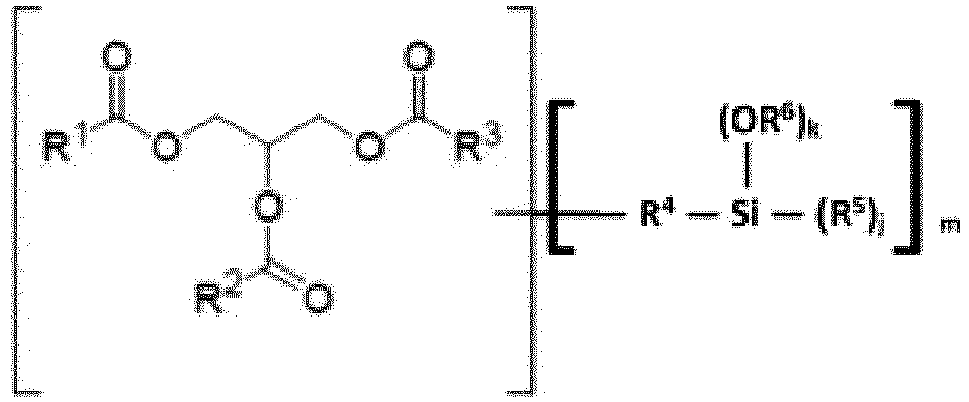
- Dérivé d'huile végétale selon la revendication 1, qui comprend la structure :

- Dérivé d'huile végétale selon la revendication 1, qui comprend la structure :

- Dérivé d'huile végétale selon au moins une des revendications précédentes, dans lequel l'huile végétale est choisie parmi le groupe qui est constitué par des huiles de soja, des huiles de colza, des huiles de ricin, des huiles de palme, des huiles de noix de coco et des huiles de maïs.
- Dérivé d'huile végétale selon au moins une des revendications précédentes, dans lequel l'huile végétale représente une huile de soja à haute teneur oléique qui comprend 75 % en poids de résidus d'acide oléique ou dans une plage de 70 à 80 % en poids de résidus d'acide oléique.
- Dérivé d'huile végétale selon la revendication 4 ou l'une quelconque des autres revendications précédentes, dans lequel R1, R2 et R3 ensemble comprennent 75 % en poids de groupes oléyle ou dans une plage de 70 à 80 % en poids de groupes oléyle.
- Composition de caoutchouc vulcanisable qui comprend le dérivé du huile végétale selon au moins une des revendications précédentes.
- Bandage pneumatique qui comprend la composition de caoutchouc vulcanisable selon la revendication 7.
- Article manufacturé qui comprend la composition de caoutchouc vulcanisable selon la revendication 7, dans lequel l'article manufacturé est choisi parmi le groupe qui est constitué par des bandes de roulement de bandages pneumatiques, des chaussures, des semelles de chaussures, des courroies de transmission, des tuyaux flexibles, des ressorts pneumatiques, des courroies transporteuses, des courroies de chenilles et des dispositifs procurant une isolation contre les vibrations.
- Procédé de préparation d'un dérivé du huile végétale qui comprend les étapes dans lesquelles :on obtient un triglycéride thiolisé ; eton fait réagir le triglycéride thiolisé avec un disulfure de silane qui comprend un groupe silyle à une extrémité et un groupe partant à l'autre extrémité afin d'obtenir le dérivé du huile végétale.
- Procédé selon la revendication 10, dans lequel le triglycéride thiolisé répond à la formule :


- Procédé selon la revendication 10, dans lequel le disulfure de silane répond à la formule :

- Procédé selon la revendication 12, dans lequel R8 représente un groupe benzothiazolyle.
- Procédé selon au moins une des revendications 10 à 13, dans lequel le disulfure de silane représente le 2-[[3-triéthoxysilyl)propyl]-dithio]benzothiazole.
- Procédé selon au moins une des revendications 10 à 14, dans lequel le triglycéride représente une huile végétale qui est choisie parmi le groupe constitué par des huiles de soja, des huiles de colza, des huiles de ricin, des huiles de palme, des huiles de noix de coco et des huiles de maïs, telle qu'une huile de soja à haute teneur oléique qui comprend 75 % en poids de résidus d'acide oléique ou dans une plage de 70 à 80 % en poids de résidus d'acide oléique.
Applications Claiming Priority (1)
| Application Number | Priority Date | Filing Date | Title |
|---|---|---|---|
| US16/671,271 US11440877B2 (en) | 2019-11-01 | 2019-11-01 | Silane disulfide vegetable oils, method of making and use in rubber compositions and tires |
Publications (2)
| Publication Number | Publication Date |
|---|---|
| EP3828166A1 EP3828166A1 (fr) | 2021-06-02 |
| EP3828166B1 true EP3828166B1 (fr) | 2022-08-10 |
Family
ID=73039816
Family Applications (1)
| Application Number | Title | Priority Date | Filing Date |
|---|---|---|---|
| EP20204370.9A Active EP3828166B1 (fr) | 2019-11-01 | 2020-10-28 | Dérivé d'huile végétale, procédé de fabrication et utilisation dans les compositions en caoutchouc et les pneus |
Country Status (2)
| Country | Link |
|---|---|
| US (1) | US11440877B2 (fr) |
| EP (1) | EP3828166B1 (fr) |
Families Citing this family (3)
| Publication number | Priority date | Publication date | Assignee | Title |
|---|---|---|---|---|
| US12534596B2 (en) | 2022-12-19 | 2026-01-27 | The Goodyear Tire & Rubber Company | Sulfoxide-containing compounds as crosslinking agents |
| US20240384066A1 (en) | 2023-05-15 | 2024-11-21 | The Goodyear Tire & Rubber Company | Voc-free coupling agents for rubber compositions |
| US20250019526A1 (en) | 2023-07-10 | 2025-01-16 | The Goodyear Tire & Rubber Company | Winter tread composition including aluminum hydroxide |
Family Cites Families (31)
| Publication number | Priority date | Publication date | Assignee | Title |
|---|---|---|---|---|
| GB455779A (en) | 1934-03-26 | 1936-10-21 | Karl Werner Posnansky | Process for sulphurising fatty oil |
| US3476826A (en) | 1966-05-23 | 1969-11-04 | Thiokol Chemical Corp | Organo-silane modified polysulfide polymers as adhesive additives or primers for high rank polysulfide based adhesive compositions |
| US4039586A (en) | 1973-08-30 | 1977-08-02 | The United States Of America As Represented By The Secretary Of Agriculture | Oxidation of thiols to disulfides |
| DE3126845A1 (de) | 1981-07-08 | 1983-01-27 | Chemische Werke Hüls AG, 4370 Marl | Verfahren zur silylierung ungesaettigter natuerlich vorkommender oele oder deren umesterungsprodukte |
| DE4220563A1 (de) | 1992-06-24 | 1994-01-13 | Bayer Ag | Kautschukmischungen enthaltend Polybutadien-Gel |
| US5512190A (en) | 1994-08-22 | 1996-04-30 | Texaco Inc. | Lubricating oil composition providing anti-wear protection |
| US5672639A (en) | 1996-03-12 | 1997-09-30 | The Goodyear Tire & Rubber Company | Starch composite reinforced rubber composition and tire with at least one component thereof |
| DE19701488A1 (de) | 1997-01-17 | 1998-07-23 | Bayer Ag | SBR-Kautschukgele enthaltende Kautschukmischungen |
| JP2001505225A (ja) | 1997-08-21 | 2001-04-17 | シーケイ・ウイトコ・コーポレーション | 充填材含有ゴム用保護化メルカプトシラン・カップリング剤 |
| DE19834804A1 (de) | 1998-08-01 | 2000-02-03 | Continental Ag | Kautschukmischung |
| DE19834802A1 (de) | 1998-08-01 | 2000-02-03 | Continental Ag | Kautschukmischung |
| DE19834803A1 (de) | 1998-08-01 | 2000-02-03 | Continental Ag | Kautschukmischung |
| DE19942620A1 (de) | 1999-09-07 | 2001-03-08 | Bayer Ag | Mikrogelhaltige Kautschukmischungen mit verkappten bifunktionellen Mercaptanen und hieraus hergestellte Vulkanisate |
| US6359046B1 (en) | 2000-09-08 | 2002-03-19 | Crompton Corporation | Hydrocarbon core polysulfide silane coupling agents for filled elastomer compositions |
| EP1285926B1 (fr) | 2001-08-06 | 2004-05-12 | Degussa AG | Composés Organosiliciés |
| JP4203718B2 (ja) | 2002-10-31 | 2009-01-07 | 東レ・ダウコーニング株式会社 | 含ケイ素ポリサルファイド系重合体の製造方法 |
| US7442673B2 (en) | 2003-08-15 | 2008-10-28 | Crompton Corporation | Reaction products of mercaptobenzothiazoles, mercaptothiazolines, and mercaptobenzimidazoles with epoxides as lubricant additives |
| US7521401B2 (en) | 2004-11-23 | 2009-04-21 | Chemtura Corporation | Dithiocarbamyl β-hydroxy fatty acid esters as additives for lubricants and fuels |
| JP5247432B2 (ja) | 2006-04-05 | 2013-07-24 | 株式会社ブリヂストン | 活性化シラン化合物を用いたゴム組成物及びタイヤ |
| US8110036B2 (en) | 2008-10-06 | 2012-02-07 | Board Of Trustees Of Michigan State Univeristy | Moisture curable oil and fat compositions and processes for preparing the same |
| US8389608B2 (en) | 2010-09-09 | 2013-03-05 | Chevron Phillips Chemical Company Lp | Aminoplast-polythiol compositions and articles produced therefrom |
| US9631040B2 (en) | 2012-05-18 | 2017-04-25 | Ndsu Research Foundation | Functionalized amphiphilic plant-based polymers |
| US9000103B2 (en) * | 2012-08-16 | 2015-04-07 | Ramani Narayan | Interpenetrating polymer networks derived from silylated triglyceride oils and polysiloxanes |
| EP2960286B1 (fr) | 2013-02-25 | 2019-10-30 | The Yokohama Rubber Co., Ltd. | Composition de caoutchouc pour bande de roulement, et pneu l'utilisant |
| JP6047435B2 (ja) | 2013-03-15 | 2016-12-21 | 東洋ゴム工業株式会社 | 有機シラン及びその製造方法 |
| JP2016520696A (ja) | 2013-05-10 | 2016-07-14 | ザ プロクター アンド ギャンブル カンパニー | シラン変性油を含む消費者製品 |
| US9238588B2 (en) | 2013-08-02 | 2016-01-19 | Ecolab USA, Inc. | Organic disulfide based corrosion inhibitors |
| JP6178508B2 (ja) | 2013-10-16 | 2017-08-09 | アランセオ・ドイチュランド・ゲーエムベーハー | 官能化されたポリマー組成物 |
| CN105713700B (zh) | 2016-04-08 | 2018-08-31 | 四会市格鲁森润滑技术有限公司 | 一种金属加工液基础油及其制备方法 |
| DE102017221233A1 (de) | 2017-11-28 | 2019-05-29 | Continental Reifen Deutschland Gmbh | Schwefelvernetzbare Kautschukmischung, Vulkanisat der Kautschukmischung und Fahrzeugreifen |
| US10245234B1 (en) | 2017-12-31 | 2019-04-02 | Bhalchandra Shripad Lele | Method of treating cancer with edible oil derived excipients |
-
2019
- 2019-11-01 US US16/671,271 patent/US11440877B2/en active Active
-
2020
- 2020-10-28 EP EP20204370.9A patent/EP3828166B1/fr active Active
Also Published As
| Publication number | Publication date |
|---|---|
| EP3828166A1 (fr) | 2021-06-02 |
| US11440877B2 (en) | 2022-09-13 |
| US20210130553A1 (en) | 2021-05-06 |
Similar Documents
| Publication | Publication Date | Title |
|---|---|---|
| EP2028022B1 (fr) | Procédé de fabrication de pneu avec paroi latérale noire et pneu fabriqué à partir du procédé | |
| EP3705518B1 (fr) | Caoutchouc renforcé contenant de l'huile triglycéride silylée | |
| EP2028021B1 (fr) | Pneu avec composant disposant d'une combinaison de plastifiants | |
| EP3828166B1 (fr) | Dérivé d'huile végétale, procédé de fabrication et utilisation dans les compositions en caoutchouc et les pneus | |
| CN115044113A (zh) | 橡胶组合物和轮胎 | |
| US20120083559A1 (en) | Pneumatic tire with thread | |
| EP4035907B1 (fr) | Huiles végétales modifiées par des acides gras dans les compositions de caoutchouc et les pneus | |
| US8143344B2 (en) | Method of making a silica/elastomer composite | |
| CN114591547A (zh) | 包含二氧化碳生成的碳增强填料的充气轮胎和橡胶组合物 | |
| US8048941B2 (en) | Silica/elastomer composite, rubber composition and pneumatic tire | |
| US20220089844A1 (en) | Rubber composition and a tire | |
| EP2371895A1 (fr) | Composition en caoutchouc et pneumatique avec un composant de caoutchouc contenant d'alkylalkoxysilane et de résine de silicone | |
| US20210395501A1 (en) | Rubber composition and a tire | |
| EP4035908B1 (fr) | Huiles végétales modifiées en résine dans des compositions en caoutchouc et des pneus | |
| US11702533B2 (en) | Rubber composition and a rubber product | |
| EP4008745A1 (fr) | Procédé de fabrication d'une composition hybride de silice/cellulose et son utilisation dans un article en caoutchouc | |
| EP4261049A1 (fr) | Composition de caoutchouc et pneumatique | |
| EP3828007B1 (fr) | Dérivé d'huile végétale, procédé de fabrication et utilisation dans les compositions en caoutchouc et les pneus | |
| CN115725126A (zh) | 橡胶组合物和轮胎 | |
| EP4122981B1 (fr) | Mélange d'élastomère fonctionnalisé pour chape de pneu et pneu | |
| EP4198079A1 (fr) | Silanes fonctionnels ne comprenant pas de soufre actif pour des compositions d' élastomère et de silice | |
| EP4261048A1 (fr) | Composition de caoutchouc et pneumatique | |
| CN116903943A (zh) | 橡胶组合物和轮胎 | |
| CN114591518A (zh) | 制备二氧化硅/纤维素混合物的方法 |
Legal Events
| Date | Code | Title | Description |
|---|---|---|---|
| PUAI | Public reference made under article 153(3) epc to a published international application that has entered the european phase |
Free format text: ORIGINAL CODE: 0009012 |
|
| STAA | Information on the status of an ep patent application or granted ep patent |
Free format text: STATUS: THE APPLICATION HAS BEEN PUBLISHED |
|
| AK | Designated contracting states |
Kind code of ref document: A1 Designated state(s): AL AT BE BG CH CY CZ DE DK EE ES FI FR GB GR HR HU IE IS IT LI LT LU LV MC MK MT NL NO PL PT RO RS SE SI SK SM TR |
|
| STAA | Information on the status of an ep patent application or granted ep patent |
Free format text: STATUS: REQUEST FOR EXAMINATION WAS MADE |
|
| 17P | Request for examination filed |
Effective date: 20211202 |
|
| RBV | Designated contracting states (corrected) |
Designated state(s): AL AT BE BG CH CY CZ DE DK EE ES FI FR GB GR HR HU IE IS IT LI LT LU LV MC MK MT NL NO PL PT RO RS SE SI SK SM TR |
|
| GRAP | Despatch of communication of intention to grant a patent |
Free format text: ORIGINAL CODE: EPIDOSNIGR1 |
|
| STAA | Information on the status of an ep patent application or granted ep patent |
Free format text: STATUS: GRANT OF PATENT IS INTENDED |
|
| INTG | Intention to grant announced |
Effective date: 20220301 |
|
| GRAS | Grant fee paid |
Free format text: ORIGINAL CODE: EPIDOSNIGR3 |
|
| GRAA | (expected) grant |
Free format text: ORIGINAL CODE: 0009210 |
|
| STAA | Information on the status of an ep patent application or granted ep patent |
Free format text: STATUS: THE PATENT HAS BEEN GRANTED |
|
| AK | Designated contracting states |
Kind code of ref document: B1 Designated state(s): AL AT BE BG CH CY CZ DE DK EE ES FI FR GB GR HR HU IE IS IT LI LT LU LV MC MK MT NL NO PL PT RO RS SE SI SK SM TR |
|
| REG | Reference to a national code |
Ref country code: AT Ref legal event code: REF Ref document number: 1510455 Country of ref document: AT Kind code of ref document: T Effective date: 20220815 Ref country code: CH Ref legal event code: EP |
|
| REG | Reference to a national code |
Ref country code: IE Ref legal event code: FG4D |
|
| REG | Reference to a national code |
Ref country code: DE Ref legal event code: R096 Ref document number: 602020004459 Country of ref document: DE |
|
| REG | Reference to a national code |
Ref country code: NL Ref legal event code: MP Effective date: 20220810 |
|
| REG | Reference to a national code |
Ref country code: LT Ref legal event code: MG9D |
|
| PG25 | Lapsed in a contracting state [announced via postgrant information from national office to epo] |
Ref country code: SE Free format text: LAPSE BECAUSE OF FAILURE TO SUBMIT A TRANSLATION OF THE DESCRIPTION OR TO PAY THE FEE WITHIN THE PRESCRIBED TIME-LIMIT Effective date: 20220810 Ref country code: RS Free format text: LAPSE BECAUSE OF FAILURE TO SUBMIT A TRANSLATION OF THE DESCRIPTION OR TO PAY THE FEE WITHIN THE PRESCRIBED TIME-LIMIT Effective date: 20220810 Ref country code: PT Free format text: LAPSE BECAUSE OF FAILURE TO SUBMIT A TRANSLATION OF THE DESCRIPTION OR TO PAY THE FEE WITHIN THE PRESCRIBED TIME-LIMIT Effective date: 20221212 Ref country code: NO Free format text: LAPSE BECAUSE OF FAILURE TO SUBMIT A TRANSLATION OF THE DESCRIPTION OR TO PAY THE FEE WITHIN THE PRESCRIBED TIME-LIMIT Effective date: 20221110 Ref country code: NL Free format text: LAPSE BECAUSE OF FAILURE TO SUBMIT A TRANSLATION OF THE DESCRIPTION OR TO PAY THE FEE WITHIN THE PRESCRIBED TIME-LIMIT Effective date: 20220810 Ref country code: LV Free format text: LAPSE BECAUSE OF FAILURE TO SUBMIT A TRANSLATION OF THE DESCRIPTION OR TO PAY THE FEE WITHIN THE PRESCRIBED TIME-LIMIT Effective date: 20220810 Ref country code: LT Free format text: LAPSE BECAUSE OF FAILURE TO SUBMIT A TRANSLATION OF THE DESCRIPTION OR TO PAY THE FEE WITHIN THE PRESCRIBED TIME-LIMIT Effective date: 20220810 Ref country code: FI Free format text: LAPSE BECAUSE OF FAILURE TO SUBMIT A TRANSLATION OF THE DESCRIPTION OR TO PAY THE FEE WITHIN THE PRESCRIBED TIME-LIMIT Effective date: 20220810 |
|
| REG | Reference to a national code |
Ref country code: AT Ref legal event code: MK05 Ref document number: 1510455 Country of ref document: AT Kind code of ref document: T Effective date: 20220810 |
|
| PG25 | Lapsed in a contracting state [announced via postgrant information from national office to epo] |
Ref country code: PL Free format text: LAPSE BECAUSE OF FAILURE TO SUBMIT A TRANSLATION OF THE DESCRIPTION OR TO PAY THE FEE WITHIN THE PRESCRIBED TIME-LIMIT Effective date: 20220810 Ref country code: IS Free format text: LAPSE BECAUSE OF FAILURE TO SUBMIT A TRANSLATION OF THE DESCRIPTION OR TO PAY THE FEE WITHIN THE PRESCRIBED TIME-LIMIT Effective date: 20221210 Ref country code: HR Free format text: LAPSE BECAUSE OF FAILURE TO SUBMIT A TRANSLATION OF THE DESCRIPTION OR TO PAY THE FEE WITHIN THE PRESCRIBED TIME-LIMIT Effective date: 20220810 Ref country code: GR Free format text: LAPSE BECAUSE OF FAILURE TO SUBMIT A TRANSLATION OF THE DESCRIPTION OR TO PAY THE FEE WITHIN THE PRESCRIBED TIME-LIMIT Effective date: 20221111 |
|
| PG25 | Lapsed in a contracting state [announced via postgrant information from national office to epo] |
Ref country code: SM Free format text: LAPSE BECAUSE OF FAILURE TO SUBMIT A TRANSLATION OF THE DESCRIPTION OR TO PAY THE FEE WITHIN THE PRESCRIBED TIME-LIMIT Effective date: 20220810 Ref country code: RO Free format text: LAPSE BECAUSE OF FAILURE TO SUBMIT A TRANSLATION OF THE DESCRIPTION OR TO PAY THE FEE WITHIN THE PRESCRIBED TIME-LIMIT Effective date: 20220810 Ref country code: ES Free format text: LAPSE BECAUSE OF FAILURE TO SUBMIT A TRANSLATION OF THE DESCRIPTION OR TO PAY THE FEE WITHIN THE PRESCRIBED TIME-LIMIT Effective date: 20220810 Ref country code: DK Free format text: LAPSE BECAUSE OF FAILURE TO SUBMIT A TRANSLATION OF THE DESCRIPTION OR TO PAY THE FEE WITHIN THE PRESCRIBED TIME-LIMIT Effective date: 20220810 Ref country code: CZ Free format text: LAPSE BECAUSE OF FAILURE TO SUBMIT A TRANSLATION OF THE DESCRIPTION OR TO PAY THE FEE WITHIN THE PRESCRIBED TIME-LIMIT Effective date: 20220810 Ref country code: AT Free format text: LAPSE BECAUSE OF FAILURE TO SUBMIT A TRANSLATION OF THE DESCRIPTION OR TO PAY THE FEE WITHIN THE PRESCRIBED TIME-LIMIT Effective date: 20220810 |
|
| REG | Reference to a national code |
Ref country code: DE Ref legal event code: R097 Ref document number: 602020004459 Country of ref document: DE |
|
| PG25 | Lapsed in a contracting state [announced via postgrant information from national office to epo] |
Ref country code: SK Free format text: LAPSE BECAUSE OF FAILURE TO SUBMIT A TRANSLATION OF THE DESCRIPTION OR TO PAY THE FEE WITHIN THE PRESCRIBED TIME-LIMIT Effective date: 20220810 Ref country code: MC Free format text: LAPSE BECAUSE OF FAILURE TO SUBMIT A TRANSLATION OF THE DESCRIPTION OR TO PAY THE FEE WITHIN THE PRESCRIBED TIME-LIMIT Effective date: 20220810 Ref country code: EE Free format text: LAPSE BECAUSE OF FAILURE TO SUBMIT A TRANSLATION OF THE DESCRIPTION OR TO PAY THE FEE WITHIN THE PRESCRIBED TIME-LIMIT Effective date: 20220810 |
|
| PLBE | No opposition filed within time limit |
Free format text: ORIGINAL CODE: 0009261 |
|
| STAA | Information on the status of an ep patent application or granted ep patent |
Free format text: STATUS: NO OPPOSITION FILED WITHIN TIME LIMIT |
|
| REG | Reference to a national code |
Ref country code: BE Ref legal event code: MM Effective date: 20221031 |
|
| PG25 | Lapsed in a contracting state [announced via postgrant information from national office to epo] |
Ref country code: LU Free format text: LAPSE BECAUSE OF NON-PAYMENT OF DUE FEES Effective date: 20221028 Ref country code: AL Free format text: LAPSE BECAUSE OF FAILURE TO SUBMIT A TRANSLATION OF THE DESCRIPTION OR TO PAY THE FEE WITHIN THE PRESCRIBED TIME-LIMIT Effective date: 20220810 |
|
| 26N | No opposition filed |
Effective date: 20230511 |
|
| PG25 | Lapsed in a contracting state [announced via postgrant information from national office to epo] |
Ref country code: SI Free format text: LAPSE BECAUSE OF FAILURE TO SUBMIT A TRANSLATION OF THE DESCRIPTION OR TO PAY THE FEE WITHIN THE PRESCRIBED TIME-LIMIT Effective date: 20220810 |
|
| PG25 | Lapsed in a contracting state [announced via postgrant information from national office to epo] |
Ref country code: BE Free format text: LAPSE BECAUSE OF NON-PAYMENT OF DUE FEES Effective date: 20221031 |
|
| PG25 | Lapsed in a contracting state [announced via postgrant information from national office to epo] |
Ref country code: IE Free format text: LAPSE BECAUSE OF NON-PAYMENT OF DUE FEES Effective date: 20221028 |
|
| PG25 | Lapsed in a contracting state [announced via postgrant information from national office to epo] |
Ref country code: CY Free format text: LAPSE BECAUSE OF FAILURE TO SUBMIT A TRANSLATION OF THE DESCRIPTION OR TO PAY THE FEE WITHIN THE PRESCRIBED TIME-LIMIT Effective date: 20220810 |
|
| PG25 | Lapsed in a contracting state [announced via postgrant information from national office to epo] |
Ref country code: MK Free format text: LAPSE BECAUSE OF FAILURE TO SUBMIT A TRANSLATION OF THE DESCRIPTION OR TO PAY THE FEE WITHIN THE PRESCRIBED TIME-LIMIT Effective date: 20220810 |
|
| REG | Reference to a national code |
Ref country code: CH Ref legal event code: PL |
|
| PG25 | Lapsed in a contracting state [announced via postgrant information from national office to epo] |
Ref country code: CH Free format text: LAPSE BECAUSE OF NON-PAYMENT OF DUE FEES Effective date: 20231031 |
|
| PG25 | Lapsed in a contracting state [announced via postgrant information from national office to epo] |
Ref country code: HU Free format text: LAPSE BECAUSE OF FAILURE TO SUBMIT A TRANSLATION OF THE DESCRIPTION OR TO PAY THE FEE WITHIN THE PRESCRIBED TIME-LIMIT; INVALID AB INITIO Effective date: 20201028 Ref country code: CH Free format text: LAPSE BECAUSE OF NON-PAYMENT OF DUE FEES Effective date: 20231031 Ref country code: BG Free format text: LAPSE BECAUSE OF FAILURE TO SUBMIT A TRANSLATION OF THE DESCRIPTION OR TO PAY THE FEE WITHIN THE PRESCRIBED TIME-LIMIT Effective date: 20220810 |
|
| PG25 | Lapsed in a contracting state [announced via postgrant information from national office to epo] |
Ref country code: MT Free format text: LAPSE BECAUSE OF FAILURE TO SUBMIT A TRANSLATION OF THE DESCRIPTION OR TO PAY THE FEE WITHIN THE PRESCRIBED TIME-LIMIT Effective date: 20220810 |
|
| GBPC | Gb: european patent ceased through non-payment of renewal fee |
Effective date: 20241028 |
|
| PG25 | Lapsed in a contracting state [announced via postgrant information from national office to epo] |
Ref country code: GB Free format text: LAPSE BECAUSE OF NON-PAYMENT OF DUE FEES Effective date: 20241028 |
|
| PGFP | Annual fee paid to national office [announced via postgrant information from national office to epo] |
Ref country code: IT Payment date: 20250923 Year of fee payment: 6 |
|
| PGFP | Annual fee paid to national office [announced via postgrant information from national office to epo] |
Ref country code: FR Payment date: 20250923 Year of fee payment: 6 |
|
| PG25 | Lapsed in a contracting state [announced via postgrant information from national office to epo] |
Ref country code: TR Free format text: LAPSE BECAUSE OF FAILURE TO SUBMIT A TRANSLATION OF THE DESCRIPTION OR TO PAY THE FEE WITHIN THE PRESCRIBED TIME-LIMIT Effective date: 20220810 |
|
| PGFP | Annual fee paid to national office [announced via postgrant information from national office to epo] |
Ref country code: DE Payment date: 20250923 Year of fee payment: 6 |