EP3828765A1 - Procédé et appareil de détection de corps humain, dispositif informatique et support de stockage - Google Patents
Procédé et appareil de détection de corps humain, dispositif informatique et support de stockage Download PDFInfo
- Publication number
- EP3828765A1 EP3828765A1 EP20853555.9A EP20853555A EP3828765A1 EP 3828765 A1 EP3828765 A1 EP 3828765A1 EP 20853555 A EP20853555 A EP 20853555A EP 3828765 A1 EP3828765 A1 EP 3828765A1
- Authority
- EP
- European Patent Office
- Prior art keywords
- feature
- contour
- skeletal
- feature matrix
- target
- Prior art date
- Legal status (The legal status is an assumption and is not a legal conclusion. Google has not performed a legal analysis and makes no representation as to the accuracy of the status listed.)
- Withdrawn
Links
Images







Classifications
-
- G—PHYSICS
- G06—COMPUTING OR CALCULATING; COUNTING
- G06N—COMPUTING ARRANGEMENTS BASED ON SPECIFIC COMPUTATIONAL MODELS
- G06N3/00—Computing arrangements based on biological models
- G06N3/02—Neural networks
- G06N3/08—Learning methods
-
- G—PHYSICS
- G06—COMPUTING OR CALCULATING; COUNTING
- G06F—ELECTRIC DIGITAL DATA PROCESSING
- G06F18/00—Pattern recognition
- G06F18/20—Analysing
- G06F18/21—Design or setup of recognition systems or techniques; Extraction of features in feature space; Blind source separation
- G06F18/214—Generating training patterns; Bootstrap methods, e.g. bagging or boosting
-
- G—PHYSICS
- G06—COMPUTING OR CALCULATING; COUNTING
- G06F—ELECTRIC DIGITAL DATA PROCESSING
- G06F18/00—Pattern recognition
- G06F18/20—Analysing
- G06F18/25—Fusion techniques
- G06F18/253—Fusion techniques of extracted features
-
- G—PHYSICS
- G06—COMPUTING OR CALCULATING; COUNTING
- G06N—COMPUTING ARRANGEMENTS BASED ON SPECIFIC COMPUTATIONAL MODELS
- G06N3/00—Computing arrangements based on biological models
- G06N3/02—Neural networks
- G06N3/04—Architecture, e.g. interconnection topology
- G06N3/045—Combinations of networks
-
- G—PHYSICS
- G06—COMPUTING OR CALCULATING; COUNTING
- G06N—COMPUTING ARRANGEMENTS BASED ON SPECIFIC COMPUTATIONAL MODELS
- G06N3/00—Computing arrangements based on biological models
- G06N3/02—Neural networks
- G06N3/04—Architecture, e.g. interconnection topology
- G06N3/0464—Convolutional networks [CNN, ConvNet]
-
- G—PHYSICS
- G06—COMPUTING OR CALCULATING; COUNTING
- G06N—COMPUTING ARRANGEMENTS BASED ON SPECIFIC COMPUTATIONAL MODELS
- G06N3/00—Computing arrangements based on biological models
- G06N3/02—Neural networks
- G06N3/08—Learning methods
- G06N3/09—Supervised learning
-
- G—PHYSICS
- G06—COMPUTING OR CALCULATING; COUNTING
- G06T—IMAGE DATA PROCESSING OR GENERATION, IN GENERAL
- G06T7/00—Image analysis
- G06T7/70—Determining position or orientation of objects or cameras
- G06T7/73—Determining position or orientation of objects or cameras using feature-based methods
-
- G—PHYSICS
- G06—COMPUTING OR CALCULATING; COUNTING
- G06V—IMAGE OR VIDEO RECOGNITION OR UNDERSTANDING
- G06V10/00—Arrangements for image or video recognition or understanding
- G06V10/40—Extraction of image or video features
- G06V10/44—Local feature extraction by analysis of parts of the pattern, e.g. by detecting edges, contours, loops, corners, strokes or intersections; Connectivity analysis, e.g. of connected components
-
- G—PHYSICS
- G06—COMPUTING OR CALCULATING; COUNTING
- G06V—IMAGE OR VIDEO RECOGNITION OR UNDERSTANDING
- G06V10/00—Arrangements for image or video recognition or understanding
- G06V10/40—Extraction of image or video features
- G06V10/44—Local feature extraction by analysis of parts of the pattern, e.g. by detecting edges, contours, loops, corners, strokes or intersections; Connectivity analysis, e.g. of connected components
- G06V10/443—Local feature extraction by analysis of parts of the pattern, e.g. by detecting edges, contours, loops, corners, strokes or intersections; Connectivity analysis, e.g. of connected components by matching or filtering
- G06V10/449—Biologically inspired filters, e.g. difference of Gaussians [DoG] or Gabor filters
- G06V10/451—Biologically inspired filters, e.g. difference of Gaussians [DoG] or Gabor filters with interaction between the filter responses, e.g. cortical complex cells
- G06V10/454—Integrating the filters into a hierarchical structure, e.g. convolutional neural networks [CNN]
-
- G—PHYSICS
- G06—COMPUTING OR CALCULATING; COUNTING
- G06V—IMAGE OR VIDEO RECOGNITION OR UNDERSTANDING
- G06V10/00—Arrangements for image or video recognition or understanding
- G06V10/70—Arrangements for image or video recognition or understanding using pattern recognition or machine learning
- G06V10/764—Arrangements for image or video recognition or understanding using pattern recognition or machine learning using classification, e.g. of video objects
-
- G—PHYSICS
- G06—COMPUTING OR CALCULATING; COUNTING
- G06V—IMAGE OR VIDEO RECOGNITION OR UNDERSTANDING
- G06V10/00—Arrangements for image or video recognition or understanding
- G06V10/70—Arrangements for image or video recognition or understanding using pattern recognition or machine learning
- G06V10/77—Processing image or video features in feature spaces; using data integration or data reduction, e.g. principal component analysis [PCA] or independent component analysis [ICA] or self-organising maps [SOM]; Blind source separation
- G06V10/80—Fusion, i.e. combining data from various sources at the sensor level, preprocessing level, feature extraction level or classification level
- G06V10/806—Fusion, i.e. combining data from various sources at the sensor level, preprocessing level, feature extraction level or classification level of extracted features
-
- G—PHYSICS
- G06—COMPUTING OR CALCULATING; COUNTING
- G06V—IMAGE OR VIDEO RECOGNITION OR UNDERSTANDING
- G06V40/00—Recognition of biometric, human-related or animal-related patterns in image or video data
- G06V40/10—Human or animal bodies, e.g. vehicle occupants or pedestrians; Body parts, e.g. hands
-
- G—PHYSICS
- G06—COMPUTING OR CALCULATING; COUNTING
- G06V—IMAGE OR VIDEO RECOGNITION OR UNDERSTANDING
- G06V40/00—Recognition of biometric, human-related or animal-related patterns in image or video data
- G06V40/10—Human or animal bodies, e.g. vehicle occupants or pedestrians; Body parts, e.g. hands
- G06V40/103—Static body considered as a whole, e.g. static pedestrian or occupant recognition
-
- G—PHYSICS
- G06—COMPUTING OR CALCULATING; COUNTING
- G06V—IMAGE OR VIDEO RECOGNITION OR UNDERSTANDING
- G06V40/00—Recognition of biometric, human-related or animal-related patterns in image or video data
- G06V40/20—Movements or behaviour, e.g. gesture recognition
- G06V40/23—Recognition of whole body movements, e.g. for sport training
-
- G—PHYSICS
- G06—COMPUTING OR CALCULATING; COUNTING
- G06T—IMAGE DATA PROCESSING OR GENERATION, IN GENERAL
- G06T2207/00—Indexing scheme for image analysis or image enhancement
- G06T2207/20—Special algorithmic details
- G06T2207/20081—Training; Learning
-
- G—PHYSICS
- G06—COMPUTING OR CALCULATING; COUNTING
- G06T—IMAGE DATA PROCESSING OR GENERATION, IN GENERAL
- G06T2207/00—Indexing scheme for image analysis or image enhancement
- G06T2207/20—Special algorithmic details
- G06T2207/20084—Artificial neural networks [ANN]
-
- G—PHYSICS
- G06—COMPUTING OR CALCULATING; COUNTING
- G06T—IMAGE DATA PROCESSING OR GENERATION, IN GENERAL
- G06T2207/00—Indexing scheme for image analysis or image enhancement
- G06T2207/30—Subject of image; Context of image processing
- G06T2207/30196—Human being; Person
-
- G—PHYSICS
- G06—COMPUTING OR CALCULATING; COUNTING
- G06V—IMAGE OR VIDEO RECOGNITION OR UNDERSTANDING
- G06V2201/00—Indexing scheme relating to image or video recognition or understanding
- G06V2201/03—Recognition of patterns in medical or anatomical images
- G06V2201/033—Recognition of patterns in medical or anatomical images of skeletal patterns
Definitions
- the disclosure relates to the technical field of image processing, and particularly to a human detection method and apparatus, a computer device and a storage medium.
- Embodiments of the disclosure aim at providing a human detection method and apparatus, a computer device and a storage medium.
- the embodiments of the disclosure provide a human detection method, which may include that: an image to be detected is acquired; position information of skeletal key points configured to represent a human skeletal structure and position information of contour key points configured to represent a human contour are determined based on the image to be detected; and a human detection result is generated based on the position information of the skeletal key points and the position information of the contour key points.
- the position information of the skeletal key points configured to represent the human skeletal structure and the position information of the contour key points configured to represent the human contour may be determined from the image to be detected, and the human detection result may be generated based on the position information of the skeletal key points and the position information of the contour key points, so that the representation accuracy is improved, and meanwhile, the calculated data volume is considered.
- the human detection result is obtained by use of the position information of the skeletal key points representing the human skeletal structure and the position information of the contour key points representing the human contour, so that information representing a human body is richer, and application scenarios are more extensive, for example, image edition and human body shape changing.
- the contour key points may include main contour key points and auxiliary contour key points, and there may be at least one auxiliary contour key point between adjacent two of the main contour key points.
- the human contour is represented through position information of the main contour key points and position information of the auxiliary contour key points, so that the human contour may be identified more accurately, and the information amount is larger.
- the operation that the position information of the contour key points configured to represent the human contour is determined based on the image to be detected may include that: position information of the main contour key points is determined based on the image to be detected; human contour information is determined based on the position information of the main contour key points; and position information of multiple auxiliary contour key points is determined based on the determined human contour information.
- the position information of the main contour key points and the position information of the auxiliary contour key points may be determined more accurately.
- the human detection result may include at least one of: the image to be detected added with skeletal key point tags and contour key point tags, or a data set including the position information of the skeletal key points and the position information of the contour key points.
- the image to be detected including the skeletal key point tags and the contour key point tags may present a more direct visual impression, and the data set including the position information of the skeletal key points and the position information of the contour key points is more favorable for subsequent processing.
- feature extraction may be performed on the image to be detected to obtain the skeletal feature and the contour feature
- feature fusion may be performed on the obtained skeletal feature and contour feature to further obtain the position information of the skeletal key points configured to represent the human skeletal structure and the position information of the contour key points configured to represent the human contour.
- the human detection result obtained based on this method may represent a human body with a smaller data volume, the skeletal feature and contour feature of the human body are also extracted to represent the human body, and improvement for the representation accuracy is considered at the same time.
- At least one time of feature extraction is performed on the image to be detected, and feature fusion is performed on the skeletal feature and contour feature obtained by each time of feature extraction, so that skeletal feature points and contour feature points having a position correlation may be mutually corrected, and the finally obtained position information of the skeletal key points and position information of the contour key points are higher in accuracy.
- the operation that at least one time of feature extraction is performed based on the image to be detected may include that: in the first time of feature extraction, a first target skeletal feature matrix of the skeletal key points configured to represent the human skeletal feature and a first target contour feature matrix of the contour key points configured to represent the human contour feature are extracted from the image to be detected by use of a first feature extraction network which is pre-trained; and in the (i+1)th time of feature extraction, the first target skeletal feature matrix of the skeletal key points configured to represent the human skeletal feature and the first target contour feature matrix of the contour key points configured to represent the human contour feature are extracted from the feature fusion result of the ith time of feature fusion by use of a second feature extraction network which is pre-trained, network parameters of the first feature extraction network and the second feature extraction network being different and network parameters of the second feature extraction network for different times of feature extraction being different.
- the operation that feature fusion is performed on the obtained skeletal feature and contour feature may include that: feature fusion is performed on the first target skeletal feature matrix and the first target contour feature matrix by use of a feature fusion neural network which is pre-trained to obtain a second target skeletal feature matrix and a second target contour feature matrix.
- the second target skeletal feature matrix may be a three-dimensional skeletal feature matrix
- the three-dimensional skeletal feature matrix may include two-dimensional skeletal feature matrices respectively corresponding to all skeletal key points
- a value of each element in the two-dimensional skeletal feature matrix may represent a probability that a pixel corresponding to the element is the corresponding skeletal key point.
- the second target contour feature matrix may be a three-dimensional contour feature matrix
- the three-dimensional contour feature matrix may include two-dimensional contour feature matrices respectively corresponding to all contour key points, and a value of each element in the two-dimensional contour feature matrix may represent a probability that a pixel corresponding to the element is to the corresponding contour key point.
- Network parameters of the feature fusion neural network for different time of feature fusions may be different.
- concatenation processing is performed on the first skeletal feature matrix and the second skeletal feature matrix to ensure that the first target skeletal feature matrix includes richer skeletal feature information
- concatenation processing is performed on the first contour feature matrix and the second contour feature matrix to ensure that the first target contour feature matrix includes richer contour feature information. Therefore, in a subsequent feature fusion process, the position information of the skeletal key points and the position information of the contour key points may be extracted more accurately.
- the feature fusion neural network may include a first convolutional neural network, a second convolutional neural network, a first transform neural network and a second transform neural network
- the operation that feature fusion is performed on the first target skeletal feature matrix and the first target contour feature matrix by use of the feature fusion neural network to obtain the second target skeletal feature matrix and the second target contour feature matrix may include that: convolution processing is performed on the first target skeletal feature matrix by use of the first convolutional neural network to obtain a first intermediate skeletal feature matrix, and convolution processing is performed on the first target contour feature matrix by use of the second convolutional neural network to obtain a first intermediate contour feature matrix; concatenation processing is performed on the first intermediate contour feature matrix and the first target skeletal feature matrix to obtain a first concatenated feature matrix, and dimension transform is performed on the first concatenated feature matrix by use of the first transform neural network to obtain the second target skeletal feature matrix; and concatenation processing is performed on the first intermediate skeletal feature matrix and the first target contour feature matrix
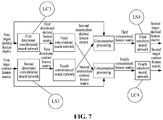
- the feature fusion neural network may include a first directional convolutional neural network, a second directional convolutional neural network, a third convolutional neural network, a fourth convolutional neural network, a third transform neural network and a fourth transform neural network, and the operation that feature fusion is performed on the first target skeletal feature matrix and the first target contour feature matrix by use of the feature fusion neural network to obtain the second target skeletal feature matrix and the second target contour feature matrix may include that: directional convolution processing is performed on the first target skeletal feature matrix by use of the first directional convolutional neural network to obtain a first directional skeletal feature matrix, and convolution processing is performed on the first directional skeletal feature matrix by use of the third convolutional neural network to obtain a second intermediate skeletal feature matrix; directional convolution processing is performed on the first target contour feature matrix by use of the second directional convolutional neural network to obtain a first directional contour feature matrix, and convolution processing is performed on the first directional contour feature matrix by use of the fourth convolutional
- fusion processing is performed on the features in a directional convolution manner, so that the position information of the skeletal key points and the position information of the contour key points may be extracted more accurately.
- feature fusion is implemented in a manner of performing shift transformation on the skeletal key points and the contour key points, so that the position information of the skeletal key points and the position information of the contour key points may be extracted more accurately.
- the human detection model obtained by such a training method is higher in detection accuracy, and the human detection result considering both the representation accuracy and the calculated data volume may be obtained through the human detection model.
- the embodiments of the disclosure also provide a human detection apparatus, which may include: an acquisition module, configured to acquire an image to be detected; a detection module, configured to determine position information of skeletal key points configured to represent a human skeletal structure and position information of contour key poin configured to represent a human contour based on the image to be detected; and a generation module, configured to generate a human detection result based on the position information of the skeletal key points and the position information of the contour key points.
- the embodiments of the disclosure also provide a computer device, which may include a processor, a non-transitory storage medium and a bus.
- the non-transitory storage medium may store machine-readable instructions executable for the processor.
- the processor Under the condition that the computer device runs, the processor may communicate with the storage medium through the bus.
- the machine-readable instructions may be executed by the processor to execute the operations in the first aspect or any possible implementation mode of the first aspect.
- the embodiments of the disclosure also provide a computer-readable storage medium, in which computer programs may be stored, the computer programs being operated by a processor to execute the operations in the first aspect or any possible implementation mode of the first aspect.
- the position information of the skeletal key points configured to represent the human skeletal structure and the position information of the contour key points configured to represent the human contour may be determined from the image to be detected, and the human detection result may be generated based on the position information of the skeletal key points and the position information of the contour key points, so that the representation accuracy is improved, and meanwhile, the calculated data volume is considered.
- the semantic segmentation method in the method, a probability that each pixel in an image belongs to a human body is recognized through a semantic segmentation model, and a human detection result is obtained based on the probability that each pixel in the image belongs to the human body.
- a human detection method complete contour information of the human body may be obtained, but the calculated data volume of the human recognition result is relatively large.
- the human detection method may be applied to any device with a data processing capability, for example, a computer.
- FIG. 1 a flowchart of a human detection method provided in embodiments of the disclosure is shown.
- a human detection result is generated based on the position information of the skeletal key points and the position information of the contour key points.
- the image to be detected may be, for example, an image to be detected shot by a camera mounted at a target position, an image to be detected sent by another computer device, or an image to be detected which is pre-stored and read from a local database.
- the image to be detected may include a human body image and may also not include the human body image. If the image to be detected includes the human body image, a final human detection result may be obtained based on the human detection method provided in the embodiments of the disclosure. If the image to be detected does not include the human body image, the obtained human detection result is, for example, null.
- the skeletal key points may be configured to represent a skeletal feature of a human body, and the skeletal feature includes a feature of a joint of the human body.
- the joint is, for example, an elbow joint, a wrist joint, a shoulder joint, a neck joint, a crotch joint, a knee joint and an ankle joint.
- skeletal key points may also be set at the head of the human body.
- the contour key points may be configured to represent a contour feature of the human body, and may include main contour key points, as shown in FIG. 2a , or include the main contour key points and auxiliary contour key points, as shown in FIG. 2b to FIG. 2d.
- FIG. 2b to FIG. 2d are partial diagrams of a part in the box in FIG. 2a .
- the main contour key points are contour key points representing a contour of a joint part of the human body, as shown in FIG. 2a , for example, a contour of the elbow joint, a contour of a wrist joint, a contour of the shoulder joint, a contour of the neck joint, a contour of the crotch joint, a contour of the knee joint and a contour of the ankle joint, and usually appears correspondingly to skeletal key points representing the corresponding joint part.
- the auxiliary contour key points are contour key points representing a contour between joint parts of the human body, and there is at least one auxiliary contour key point between two adjacent main contour key points.
- FIG. 2b there is one auxiliary contour key point between two main contour key points.
- FIG. 2c there is two auxiliary contour key points between two main contour key points.
- FIG. 2d there are three auxiliary contour key points between two adjacent contour key points.
- the position information of the contour key points configured to represent the human contour may be determined based on the image to be detected in the following manner.
- Position information of the main contour key points is determined based on the image to be detected. Human contour information is determined based on the position information of the main contour key points. Position information of multiple auxiliary contour key points is determined based on the determined human contour information.
- the position information of the main contour key points is directly determined based on the image to be detected.
- the embodiments of the disclosure provide a specific method for determining the position information of the skeletal key points configured to represent the human skeletal structure and the position information of the contour key points configured to represent the human contour based on the image to be detected.
- Feature extraction is performed on the image to be detected to obtain a skeletal feature and a contour feature, and feature fusion is performed on the obtained skeletal feature and contour feature.
- the position information of the skeletal key points and the position information of the contour key points are determined based on a feature fusion result.
- condition A will be specifically described below at first.
- the position information of the skeletal key points configured to represent the human skeletal structure and the position information of the contour key points configured to represent the human contour are determined based on a feature fusion result of the feature fusion.
- a first target skeletal feature matrix of the skeletal key points configured to represent the human skeletal feature and a first target contour feature matrix of the contour key points configured to represent the human contour feature may be extracted from the image to be detected by use of a first feature extraction network which is pre-trained.
- the embodiments of the disclosure also provides a specific process of extracting the first target skeletal feature matrix and the first target contour feature matrix from the image to be detected based on the first feature extraction network provided in FIG. 3 .
- the following operations are included.
- the image to be detected is a multi-color-channel image, for example, an image in a Red Green Blue (RGB) format, it may be represented as a three-dimensional image matrix, the three-dimensional image matrix includes three two-dimensional image matrices corresponding to different color (for example, R, G and B) channels one by one.
- a value of each element in any one two-dimensional image matrix is a pixel value of a pixel corresponding to the element under the corresponding color channel.
- the common feature extraction network includes at least one convolutional layer. After the image matrix of the image to be detected is input to the common feature extraction network, convolution processing is performed on the image matrix of the image to be detected by use of the common feature extraction network to extract a feature in the image to be detected. Under this condition, the extracted feature includes the skeletal feature and also includes the contour feature.
- convolution processing is performed on the basic feature matrix by use of the first skeletal feature extraction network to obtain a first skeletal feature matrix
- a second skeletal feature matrix is acquired from a first target convolutional layer in the first skeletal feature extraction network
- the first target skeletal feature matrix is obtained based on the first skeletal feature matrix and the second skeletal feature matrix, the first target convolutional layer being any other convolutional layer, except a last convolutional layer, in the first skeletal feature extraction network.
- the first skeletal feature extraction network includes multiple convolutional layers.
- the multiple convolutional layers are sequentially connected, and an input of a next convolutional layer is an output of a previous convolutional layer.
- the first skeletal feature extraction network of such a structure may perform convolution processing on the basic feature matrix for many times and obtain the first skeletal feature matrix from the last convolutional layer.
- the first skeletal feature matrix is a three-dimensional feature matrix
- the three-dimensional feature matrix includes multiple two-dimensional feature matrices
- the two-dimensional feature matrices correspond to predetermined multiple skeletal key points one by one.
- a value of an element in the two-dimensional feature matrix, corresponding to a certain skeletal key point represents a probability that a pixel corresponding to the element belongs to the skeletal key point, and an element usually corresponds to multiple pixels.
- the second skeletal feature matrix may further be acquired from the first target convolutional layer of the first skeletal feature extraction network, and the first target skeletal feature matrix is obtained based on the first skeletal feature matrix and the second skeletal feature matrix.
- the first target convolutional layer is any other convolutional layer, except the last convolutional layer, in the first skeletal feature extraction network.
- the second last convolutional layer in the first skeletal feature extraction network is selected as the first target convolutional layer.
- the first target skeletal feature matrix may be obtained based on the first skeletal feature matrix and the second skeletal feature matrix in the following manner.
- convolution processing is performed on the basic feature matrix by use of the first contour feature extraction network to obtain a first contour feature matrix
- a second contour feature matrix is acquired from a second target convolutional layer in the first contour feature extraction network
- the first target contour feature matrix is obtained based on the first contour feature matrix and the second contour feature matrix
- the second target convolutional layer being any other convolutional layer, except a last convolutional layer, in the first contour feature extraction network.
- the second last convolutional layer in the first contour feature extraction network is selected as the second target convolutional layer.
- the first contour feature extraction network also includes multiple convolutional layers.
- the multiple convolutional layers are sequentially connected, and an input of a next convolutional layer is an output of a previous convolutional layer.
- the first contour feature extraction network of such a structure may perform convolution processing on the basic feature matrix for many times and obtain the first contour feature matrix from the last convolutional layer.
- the first contour feature matrix is a three-dimensional feature matrix
- the three-dimensional feature matrix includes multiple two-dimensional feature matrices
- the two-dimensional feature matrices correspond to predetermined multiple contour key points one by one.
- a value of an element in the two-dimensional feature matrix, corresponding to a certain contour key point represents a probability that a pixel corresponding to the element belongs to the contour key point, and an element usually corresponds to multiple pixels.
- the number of the contour key points is usually different from the number of the skeletal key points, so that the number of the two-dimensional feature matrices in the obtained first contour feature matrix may be different from the number of the two-dimensional feature matrices in the first skeletal feature matrix.
- the number of the skeletal key points is 14 and the number of the contour key points is 25, the number of the two-dimensional feature matrices in the first contour feature matrix is 25, and the number of the two-dimensional feature matrices in the first skeletal feature matrix is 14.
- the first target contour feature matrix also includes richer information
- a manner similar to S402 may also be adopted.
- the second contour feature matrix is acquired from the second target convolutional layer in the first contour feature extraction network and then the first target contour feature matrix is obtained based on the first contour feature matrix and the second contour feature matrix.
- the first target contour feature matrix is obtained based on the first contour feature matrix and the second contour feature matrix in, for example, the following manner.
- a dimension of the first target skeletal feature matrix is the same as a dimension of the first target contour feature matrix, and the first target skeletal feature matrix and the first target contour feature matrix are the same in dimensionality in the same dimension, so that subsequent feature fusion processing based on the first target skeletal feature matrix and the first target contour feature matrix is facilitated.
- a dimensionality of the first target skeletal feature matrix is represented as 64 ⁇ 32 ⁇ 14
- a dimensionality of the first target contour feature matrix may also be represented as 64 ⁇ 32 ⁇ 14.
- Convolution processing is performed on the image to be detected by use of the common feature extraction network to obtain the basic feature matrix including the skeletal feature and the contour feature.
- Convolution processing is performed on the basic feature matrix by use of the first skeletal feature extraction network to obtain the first skeletal feature matrix, and dimension transform processing is performed on the first skeletal feature matrix to obtain the first target skeletal feature matrix.
- Convolution processing is performed on the basic feature matrix by use of the first contour feature extraction network to obtain the first contour feature matrix, and dimension transform processing is performed on the first contour feature matrix to obtain the first target contour feature matrix.
- the first feature extraction network provided in the embodiments of the disclosure may be obtained by pre-training.
- the human detection model is obtained by training through sample images in a training sample set, the sample images being tagged with practical position information of the skeletal key points of the human skeletal structure and practical position information of the contour key points of the human contour.
- the first feature extraction network may be trained independently and may also be trained jointly with the feature fusion neural network, and independent training and joint training may also be combined.
- the first feature extraction network may also be pre-trained through the process in (1), and joint training in (2) is performed on the first feature extraction network obtained by pre-training and the feature fusion neural network.
- sample images for independent training and joint training of the first feature extraction network may be the same and may also be different.
- the feature fusion neural network Before joint training is performed on the first feature extraction network and the feature fusion neural network, the feature fusion neural network may also be pre-trained, and then joint training is performed on the pre-trained feature fusion neural network and the first feature extraction network.
- a detailed process of independent training for the feature fusion neural network may refer to the descriptions of the embodiment shown in the following a2.
- feature fusion processing may be performed based on the first target skeletal feature matrix and the first target contour feature matrix.
- the skeletal feature is extracted from the basic feature matrix through the first skeletal feature extraction network
- the contour feature is extracted from the basic feature matrix through the first contour feature extraction network.
- position information of the finally extracted skeletal key points may be corrected based on the contour feature and position information of the finally extracted contour key points may be corrected based on the skeletal feature, so that more accurate position information of the skeletal key points and more accurate position information of the contour key points may be obtained to obtain a more accurate human detection result.
- the embodiments of the disclosure provide a specific method for performing feature fusion on the extracted skeletal feature and contour feature, which includes that: feature fusion is performed on the first target skeletal feature matrix and the first target contour feature matrix by use of the pre-trained feature fusion neural network to obtain a second target skeletal feature matrix and a second target contour feature matrix.
- the second target skeletal feature matrix is a three-dimensional skeletal feature matrix, the three-dimensional skeletal feature matrix includes two-dimensional skeletal feature matrices respectively corresponding to all skeletal key points, and a value of each element in the two-dimensional skeletal feature matrix represents a probability that a pixel corresponding to the element belongs to the corresponding skeletal key point (i.e., the skeletal key point corresponding to the two-dimensional skeletal feature matrix).
- the second target contour feature matrix is a three-dimensional contour feature matrix, the three-dimensional contour feature matrix includes two-dimensional contour feature matrices respectively corresponding to all contour key points, and a value of each element in the two-dimensional contour feature matrix represents a probability that a pixel corresponding to the element belongs to the corresponding contour key point.
- a joint training process of the feature fusion neural network and the first feature extraction network may refer to (2) and will not be elaborated herein.
- a feature fusion process of the skeletal feature and the contour feature may include, but not limited to, at least one of the following M1 to M3.
- the embodiment of the disclosure provides a specific structure of a feature fusion neural network, which includes a first convolutional neural network, a second convolutional neural network, a first transform neural network and a second transform neural network.
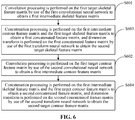
- the embodiment of the disclosure also provides a specific method for performing feature fusion on the first target skeletal feature matrix and the first target contour feature matrix based on the feature fusion neural network provided in FIG. 5 to obtain the second target skeletal feature matrix and the second target contour feature matrix.
- the following operations are included.
- S601 convolution processing is performed on the first target skeletal feature matrix by use of the first convolutional neural network to obtain a first intermediate skeletal feature matrix.
- S603 is executed.
- the first convolutional neural network includes at least one convolutional layer. If the first convolutional neural network is multilayer, multiple convolutional layers are sequentially connected, and an input of a present convolutional layer is an output of a previous convolutional layer.
- the first target skeletal feature matrix is input to the first convolutional neural network, and convolution processing is performed on the first target skeletal feature matrix by use of each convolutional layer to obtain the first intermediate skeletal feature matrix.
- the process is implemented to further extract the skeletal feature from the first target skeletal feature matrix.
- S602 convolution processing is performed on the first target contour feature matrix by use of the second convolutional neural network to obtain a first intermediate contour feature matrix.
- S604 is executed.
- concatenation processing is performed on the first intermediate contour feature matrix and the first target skeletal feature matrix to obtain the first concatenated feature matrix, so that the obtained first concatenated feature matrix not only includes the contour feature but also includes the skeletal feature.
- Performing further dimension transform on the first concatenated matrix by use of the first transform neural network actually refers to extracting the skeletal feature from the first concatenated feature matrix again by use of the first transform neural network.
- the process of obtaining the first concatenated feature matrix other features, except the skeletal feature and the contour feature, in the image to be detected are removed, and only the skeletal feature and the contour feature are included, so that the skeletal feature in the second target skeletal feature matrix obtained based on the first concatenated feature matrix may be influenced by the contour feature, the correlation between the skeletal feature and the contour feature may be established, and fusion of the skeletal feature and the contour feature may be implemented.
- the process of performing concatenation processing on the first intermediate skeletal feature matrix and the first target contour feature matrix to obtain the second concatenated feature matrix is similar to the process of obtaining the first concatenated feature matrix in S602 and will not be elaborated herein.
- the feature fusion neural network may be trained independently in the following manner.
- the first sample target skeletal feature matrix and first sample target contour feature matrix of the multiple sample images are acquired.
- An acquisition manner is similar to the acquisition manner for the first target skeletal feature matrix and the first target contour feature matrix in the abovementioned embodiment and will not be elaborated herein. They may be acquired under the condition of training jointly with the first feature extraction network, and may also be acquired by use of the pre-trained first feature extraction network.
- convolution processing is performed on the first sample target skeletal feature matrix by use of a first basic convolutional neural network to obtain a first sample intermediate skeletal feature matrix.
- convolution processing is performed on the first sample target contour feature matrix by use of a second basic convolutional neural network to obtain a first sample intermediate contour feature matrix.
- concatenation processing is performed on the first sample intermediate contour feature matrix and the first sample target skeletal feature matrix to obtain a first sample concatenated feature matrix
- dimension transform is performed on the first sample concatenated feature matrix by use of a first basic transform neural network to obtain the second sample target skeletal feature matrix.
- concatenation processing is performed on the first sample intermediate skeletal feature matrix and the first sample target contour feature matrix to obtain a second sample concatenated feature matrix
- dimension transform is performed on the second sample concatenated feature matrix by use of a second basic transform neural network to obtain the second sample target contour feature matrix
- third predicted position information of the skeletal key points is determined based on the second sample target skeletal feature matrix
- third predicted position information of the contour key points is determined based on the second sample target contour feature matrix
- training of a present round is performed on the first basic convolutional neural network, the second basic convolutional neural network, the first basic transform neural network and the second basic transform neural network based on the fifth loss and the sixth loss.
- the first basic convolutional neural network, the second basic convolutional neural network, the first basic transform neural network and the second basic transform neural network are trained for multiple rounds to obtain the feature fusion neural network.
- the fifth loss is LS2 in FIG. 5
- the sixth loss is LC2 in FIG. 5 .
- FIG. 7 a specific structure of another feature fusion neural network provided in the embodiments of the disclosure is shown, which includes a first directional convolutional neural network, a second directional convolutional neural network, a third convolutional neural network, a fourth convolutional neural network, a third transform neural network and a fourth transform neural network.
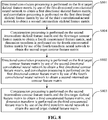
- the embodiments of the disclosure also provide a specific method for performing feature fusion on the first target skeletal feature matrix and the first target contour feature matrix based on the feature fusion neural network provided in FIG. 7 to obtain the second target skeletal feature matrix and the second target contour feature matrix. The following steps are included.
- directional convolution processing is performed on the first target skeletal feature matrix by use of the first directional convolutional neural network to obtain a first directional skeletal feature matrix
- convolution processing is performed on the first directional skeletal feature matrix by use of the third convolutional neural network to obtain a second intermediate skeletal feature matrix.
- S804 is executed.
- directional convolution processing is performed on the first target contour feature matrix by use of the second directional convolutional neural network to obtain a first directional contour feature matrix
- convolution processing is performed on the first directional contour feature matrix by use of the fourth convolutional neural network to obtain a second intermediate contour feature matrix.
- concatenation processing is performed on the second intermediate contour feature matrix and the first target skeletal feature matrix to obtain a third concatenated feature matrix
- dimension transform is performed on the third concatenated feature matrix by use of the third transform neural network to obtain the second target skeletal feature matrix.
- concatenation processing is performed on the second intermediate skeletal feature matrix and the first target contour feature matrix to obtain a fourth concatenated feature matrix
- dimension transform is performed on the fourth concatenated feature matrix by use of the fourth transform neural network to obtain the second target contour feature matrix.
- directional convolution processing is performed on the first target skeletal feature matrix at first by use of the first directional convolutional neural network.
- directional convolution By directional convolution, directional space transform for the skeletal feature may be effectively implemented in a feature level.
- convolution processing is performed on the obtained first directional skeletal feature matrix by use of the third convolutional neural network to obtain the second intermediate skeletal feature matrix.
- the skeletal feature since directional space transform has been performed on the skeletal feature through a first directional convolutional layer, the skeletal feature actually moves towards to the direction of contour feature.
- concatenation processing is performed on the second intermediate skeletal feature matrix and the first target contour feature matrix to obtain the fourth concatenated feature matrix.
- directional convolution processing is performed on the first target contour feature matrix at first by use of the second directional convolutional neural network.
- directional convolution By directional convolution, directional space transform for the contour feature may be effectively implemented in the feature level.
- convolution processing is performed on the obtained first directional contour feature matrix by use of the fourth convolutional neural network to obtain the second intermediate contour feature matrix.
- the contour feature since directional space transform has been performed on the contour feature through a second directional convolutional layer, the contour feature actually moves towards to a skeletal feature direction.
- concatenation processing is performed on the second intermediate contour feature matrix and the first target skeletal feature matrix to obtain the third concatenated feature matrix.
- the third concatenated feature matrix includes the skeletal feature and also includes the contour feature subjected to directional space transform. Then, dimension transform is performed on the third concatenated feature matrix by use of the third transform neural network, namely the skeletal feature is extracted again from the third concatenated feature matrix.
- the second target skeletal feature matrix obtained in such a manner may be influenced by the contour feature, and fusion of the skeletal feature and the contour feature is implemented.
- directional convolution consists of multiple iterative convolution steps, and effective directional convolution meets the following requirements.
- An input of the function F k is a position of each element in the first target skeletal feature matrix, and an output of the function F k represents whether to update the elements in the kth iteration.
- the output may be 1 or 0. 1 represents that updating is executed, and 0 represents updating is not executed.
- T 0 (X) X
- X represents the input of directional convolution, i.e., the first target skeletal feature matrix
- W and b represent a shared weight and deviation in multiple iteration processes respectively.
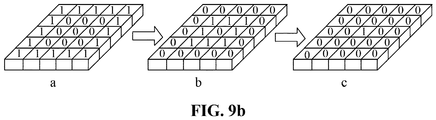
- the scattering convolution operator is responsible for sequentially updating the elements in the feature matrix from inside to outside, and the gathering convolution operator sequentially updates the elements in the feature matrix from outside to inside.
- the scattering convolution operator F i S is used.
- the gathering convolution operator F i G is used.
- directional convolution processing is performed on the first target skeletal feature matrix by use of the first directional convolutional neural network through the following process.
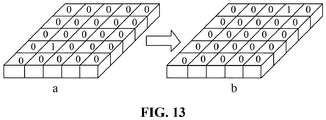
- the first target skeletal feature matrix is divided into multiple submatrices, each submatrix being called a mesh. If the first target skeletal feature matrix is a three-dimensional matrix, dimensionalities of three dimensions being m, n and s respectively, a dimensionality of the first target skeletal feature matrix is represented as m ⁇ n ⁇ s. If a size of the mesh is 5, a dimensionality of each mesh may be represented as 5 ⁇ 5 ⁇ s.
- FIG. 9a a process of performing iterative updating twice on values of elements in a submatrix of which a mesh size is 5 by use of the scattering convolution operator F i S is provided.
- "a" represents an original submatrix
- "b” represents a submatrix obtained by one iteration
- "c” represents a submatrix obtained by two iterations, i.e., the target submatrix.
- the target submatrices respectively corresponding to all meshes are concatenated to obtain the first directional skeletal feature matrix.
- directional convolution processing is performed on the first target contour feature matrix by use of the second directional convolutional neural network through the following process.
- the first target contour feature matrix is divided into multiple submatrices, each submatrix being called a mesh. If the first target contour feature matrix is a three-dimensional matrix, dimensionalities of three dimensions being m, n and s respectively, a dimensionality of the first target contour feature matrix is represented as m ⁇ n ⁇ s. If a size of the mesh is 5, a dimensionality of each mesh may be represented as 5 ⁇ 5 ⁇ s.
- FIG. 9b a process of performing iterative updating twice on values of elements in a submatrix of which a mesh size is 5 by use of the gathering convolution operator F i G is provided.
- "a" represents an original submatrix
- "b” represents a submatrix obtained by one iteration
- "c” represents a submatrix obtained by two iterations, i.e., the target submatrix.
- the target submatrices respectively corresponding to all meshes are concatenated to obtain the first directional contour feature matrix.
- each submatrix may be implemented concurrently.
- FIG. 9a and FIG. 9b are only examples of iteratively updating the values of the elements in the submatrices by use of the scattering convolution operator F i S and the gathering convolution operator F i G .
- the feature fusion neural network may be trained independently in the following manner.
- the first sample target skeletal feature matrix and first sample target contour feature matrix of the multiple sample images are acquired.
- An acquisition manner is similar to the acquisition manner for the first target skeletal feature matrix and the first target contour feature matrix in the abovementioned embodiment and will not be elaborated herein. They may be acquired under the condition of training jointly with the first feature extraction network, and may also be acquired by use of the pre-trained first feature extraction network.
- directional convolution processing is performed on the first sample target skeletal feature matrix by use of a first basic directional convolutional neural network to obtain a first sample directional skeletal feature matrix
- a seventh loss is obtained by use of the first sample directional skeletal feature matrix and the practical position information of the contour key points, and training of a present round is performed on the first basic directional convolutional neural network based on the seventh loss.
- the seventh loss is LC3 in FIG. 7 .
- performing directional convolution processing on the first sample target skeletal feature matrix by use of the first basic directional convolutional neural network refers to performing directional space transform on the first sample target skeletal feature matrix.
- directional convolution processing is performed on the first sample target contour feature matrix by use of a second basic directional convolutional neural network to obtain a first sample directional contour feature matrix
- an eighth loss is obtained by use of the first sample directional contour feature matrix and the practical position information of the skeletal key points, and training of a present round is performed on the second basic directional convolutional neural network based on the eighth loss.
- the eighth loss is LS3 in FIG. 7 .
- convolution processing is performed on the first sample directional contour feature matrix by use of a fourth basic convolutional neural network to obtain a second sample intermediate contour feature matrix
- concatenation processing is performed on the obtained second sample intermediate contour feature matrix and the first sample target skeletal feature matrix to obtain a third sample concatenated feature matrix
- dimension transform is performed on the third sample concatenated feature matrix by use of a third basic transform neural network to obtain the second sample target skeletal feature matrix.
- fourth predicted position information of the skeletal key points is determined based on the second sample target skeletal feature matrix, and a ninth loss is determined based on the practical position information of the skeletal key points and the fourth predicted position information of the skeletal key points.
- the ninth loss is LS4 in FIG. 7 .
- convolution processing is performed on the first sample directional skeletal feature matrix by use of a third basic convolutional neural network to obtain a second sample intermediate skeletal feature matrix
- concatenation processing is performed on the obtained second sample intermediate skeletal feature matrix and the first sample target contour feature matrix to obtain a fourth sample concatenated feature matrix
- dimension transform is performed on the fourth sample concatenated feature matrix by use of a fourth basic transform neural network to obtain the second sample target contour feature matrix.
- fourth predicted position information of the contour key points is determined based on the second sample target contour feature matrix, and a tenth loss is determined based on the practical position information of the contour key points and the fourth predicted position information of the contour key points.
- the tenth loss is LC4 in FIG. 7 .
- the first basic directional convolutional neural network, the second basic directional convolutional neural network, the third basic convolutional neural network, the fourth basic convolutional neural network, the third basic transform neural network and the fourth basic transform neural network are trained for multiple grounds to obtain a trained feature fusion neural network.
- the embodiments of the disclosure also provide a specific method for performing feature fusion on the first target skeletal feature matrix and the first target contour feature matrix based on the feature fusion neural network provided in FIG. 10 to obtain the second target skeletal feature matrix and the second target skeletal feature matrix.
- the following operations are included.
- concatenation processing is performed on the first target skeletal feature matrix and the first target contour feature matrix to obtain a fifth concatenated feature matrix.
- the fifth concatenated feature matrix is input to the shift estimation neural network, and shift estimation is performed on predetermined multiple key point pairs to obtain shift information of a shift from one key point to the other key point in each key point pair.
- the two key points in each key point pair are at adjacent positions, and the two key points include a skeletal key point and a contour key point, or includes two skeletal key points or includes two contour key points.
- multiple skeletal key points and multiple contour key points may be predetermined for the human body.
- FIG. 12 an example of the multiple skeletal key points and contour key points predetermined for the human body is provided.
- each of the other skeletal key points may correspond to two contour key points.
- the skeletal key points of the two crotches may correspond to a same contour key point.
- Every two key points directly connected through a line segment may form a key point pair. That is, there may be the following three conditions for formation of the key point pair: (skeletal key point, skeletal key point), (contour key point, contour key point) and (skeletal key point, contour key point).
- the shift estimation neural network includes multiple convolutional layers, and the multiple convolutional layers are sequentially connected to perform feature learning on the skeletal feature and contour feature in the fifth concatenated feature matrix to obtain the shift information of the shift from one key point to the other key point in each key point pair.
- Each key point corresponds to two sets of shift information.
- shift information of the key point pair includes shift information of a shift from P to Q and shift information of a shift from Q to P.
- Each set of shift information includes a shift direction and a shift distance.
- a two-dimensional feature matrix corresponding to the paired other key point is acquired from a three-dimensional feature matrix corresponding to the other key point paired with the present key point. If the paired other key point is a skeletal key point, the three-dimensional feature matrix corresponding to the skeletal key point is a first skeletal feature matrix. If the paired other key point is a contour key point, the three-dimensional feature matrix corresponding to the contour key point is a first contour feature matrix.
- positional shifting is performed on elements in the two-dimensional feature matrix corresponding to the paired other key point according to the shift information of the shift from the paired other key point to the present key point to obtain a shift feature matrix corresponding to the present key point.
- the key point pair (P, Q) is still used as an example, P is determined as the present key point at first, and a two-dimensional feature matrix corresponding to Q is acquired from a three-dimensional feature matrix corresponding to Q.
- the three-dimensional feature matrix corresponding to Q is a first skeletal feature matrix (see S402). If Q is a contour key point, the three-dimensional feature matrix corresponding to Q is a first contour feature matrix (see S403).
- the first skeletal feature matrix is determined as the three-dimensional feature matrix of Q, and the two-dimensional feature matrix of Q is obtained from the first skeletal feature matrix. This is because the first skeletal feature matrix only includes the skeletal feature, the skeletal feature learned in a subsequent processing process may be more targeted.
- the first contour feature matrix is determined as the three-dimensional feature matrix of Q, and the two-dimensional feature matrix of Q is obtained from the first contour feature matrix. This is because the first contour feature matrix only includes the contour feature, the contour feature learned in the subsequent processing process may be more targeted.
- positional shifting is performed on elements in the two-dimensional feature matrix of Q based on the shift information of the shift from Q to P to obtain a shift feature matrix corresponding to P.
- Q is determined as the present key point, and a two-dimensional feature matrix corresponding to P is acquired from a three-dimensional feature matrix corresponding to P. Then, positional shifting is performed on elements in the two-dimensional feature matrix of P based on the shift information of the shift from P to Q to obtain a shift feature matrix Q corresponding to Q.
- the shift feature matrix corresponding to each skeletal key point and the shift feature matrix corresponding to each contour key point may be generated.
- each skeletal key point may be paired with multiple key points respectively and thus multiple shift feature matrices may also be obtained for each skeletal key point.
- Each contour key point may also be paired with multiple key points respectively and thus multiple shift feature matrices may also be obtained for each contour key point.
- Different contour key points may correspond to different numbers of shift feature matrices, and different skeletal key points may also correspond to different numbers of shift feature matrices.
- concatenation processing is performed on a two-dimensional feature matrix corresponding to the skeletal key point and each shift feature matrix corresponding to the skeletal key point to obtain a concatenated two-dimensional feature matrix of the skeletal key point.
- the concatenated two-dimensional feature matrix of the skeletal key point is input to the fifth transform neural network to obtain a target two-dimensional feature matrix corresponding to the skeletal key point.
- the second target skeletal feature matrix is generated based on the target two-dimensional feature matrices respectively corresponding to all skeletal key points.
- concatenation processing is performed on a two-dimensional feature matrix corresponding to the contour key point and each shift feature matrix corresponding to the contour key point to obtain a concatenated two-dimensional feature matrix of the contour key point.
- the concatenated two-dimensional feature matrix of the contour key point is input to the fifth transform neural network to obtain a target two-dimensional feature matrix corresponding to the contour key point.
- the second target contour feature matrix is generated based on the target two-dimensional feature matrices respectively corresponding to all contour key points.
- three shift feature matrices of P i.e., P1', P2' and P3'
- P1', P2' and P3' are concatenated to obtain a concatenated two-dimensional feature matrix of P.
- the three shift feature matrices of P may include a shift feature matrix obtained by performing positional shifting on elements in a two-dimensional feature matrix corresponding to a skeletal key point, and may also include a shift feature matrix obtained by performing positional shifting on elements in a two-dimensional feature matrix corresponding to a contour key point.
- P', P1', P2' and P3' are concatenated to fuse features of all key points, each at a position adjacent to P. Then, convolution processing is performed on the concatenated two-dimensional feature matrix of P by use of the fifth transform neural network, so that an obtained target two-dimensional feature matrix of P not only includes the skeletal feature but also includes the contour feature, and fusion of the skeletal feature and the contour feature is implemented.
- fusion of the skeletal feature and the contour feature may also be implemented based on the abovementioned process.
- the feature fusion neural network may be trained independently in the following manner.
- the first sample target skeletal feature matrix and first sample target contour feature matrix of the multiple sample images are acquired.
- An acquisition manner is similar to the acquisition manner for the first target skeletal feature matrix and the first target contour feature matrix in the abovementioned embodiment and will not be elaborated herein. They may be acquired under the condition of training jointly with the first feature extraction network, and may also be acquired by use of the pre-trained first feature extraction network.
- concatenation processing is performed on the first sample target skeletal feature matrix and the first sample target contour feature matrix to obtain a fifth sample concatenated feature matrix.
- the fifth sample concatenated feature matrix is input to a basic shift estimation neural network, and shift estimation is performed on predetermined multiple key point pairs to obtain predicted shift information of a shift from one key point to the other key point in each key point pair.
- the two key points in each key point pair are at adjacent positions, and the two key points include a skeletal key point and a contour key point, or includes two skeletal key points or includes two contour key points.
- a sample two-dimensional feature matrix corresponding to the paired other key point is acquired from a sample three-dimensional feature matrix corresponding to the other key point paired with the present key point.
- positional shifting is performed on elements in the sample two-dimensional feature matrix corresponding to the paired other key point according to the predicted shift information of the shift from the paired other key point to the present key point to obtain a sample shift feature matrix corresponding to the present key point.
- a shift loss is determined according to the sample shift feature matrix corresponding to the present key point and the sample two-dimensional feature matrix corresponding to the present key point.
- concatenation processing is performed on a sample two-dimensional feature matrix corresponding to the skeletal key point and each sample shift feature matrix corresponding to the skeletal key point to obtain a sample concatenated two-dimensional feature matrix of the skeletal key point.
- the sample concatenated two-dimensional feature matrix of the skeletal key point is input to a fifth basic transform neural network to obtain a sample target two-dimensional feature matrix corresponding to the skeletal key point.
- the second sample target skeletal feature matrix is generated based on the sample target two-dimensional feature matrices respectively corresponding to all skeletal key points.
- concatenation processing is performed on a sample two-dimensional feature matrix corresponding to the contour key point and each sample shift feature matrix corresponding to the contour key point to obtain a sample concatenated two-dimensional feature matrix of the contour key point.
- the sample concatenated two-dimensional feature matrix of the contour key point is input to the fifth basic transform neural network to obtain a sample target two-dimensional feature matrix corresponding to the contour key point, and the sample second target contour feature matrix is generated based on the sample target two-dimensional feature matrices respectively corresponding to all contour key points.
- a transform loss is determined based on the second sample target skeletal feature matrix, the second sample target contour feature matrix, the practical position information of the skeletal key points and the practical position information of the contour key points. For example, predicted position information of the skeletal key points may be determined based on the second sample target skeletal feature matrix, and predicted position information of the contour key points may be determined based on the second sample target contour feature matrix.
- the transform loss is determined based on the predicted position information and practical position information of the skeletal key points and the predicted position information and practical position information of the contour key points.
- training of a present round is performed on the fifth basic transform neural network based on the transform loss.
- the basic shift estimation neural network and the fifth basic transform neural network are trained for multiple rounds to obtain the feature fusion neural network.
- the (i+1)th time of feature extraction is performed based on a feature fusion result of the ith time of feature fusion, i being a positive integer.
- a process of the first time of feature extraction is the same as the process of extracting the skeletal feature and contour feature of the image to be detected in A and will not be elaborated herein.
- a specific process of each of other times of feature extraction except the first time of feature extraction includes the following operation.
- the first target skeletal feature matrix of the skeletal key points configured to represent the human skeletal feature and the first target contour feature matrix of the contour key points configured to represent the human contour feature are extracted from a feature fusion result of the previous feature fusion by use of a second feature extraction network.
- Network parameters of the first feature extraction network and network parameters of the second feature extraction network are different, and network parameters of the second feature extraction network for different times of feature extraction are different.
- each of the first feature extraction network and the second feature extraction network includes multiple convolutional layers.
- the network parameters of the first feature extraction network and the second feature extraction network include, but not limited to, for example, the number of the convolutional layers, a size of a convolution kernel for each convolutional layer, the number of convolutional kernels for each convolutional layer and the like.
- the embodiments of the disclosure provides a structure diagram of the second feature extraction network.
- the second feature extraction network includes a second skeletal feature extraction network and a second contour feature extraction network.
- the feature fusion result, for implementing the present feature extraction through the second feature extraction network, of the previous feature fusion includes the second target skeletal feature matrix and the second target contour feature matrix.
- the specific process of obtaining the second target skeletal feature matrix and the second target contour feature matrix refers to A and will not be elaborated herein.
- the first target skeletal feature matrix of the skeletal key points configured to represent the human skeletal feature and the first target contour feature matrix of the contour key points configured to represent the human contour feature are extracted from the feature fusion result of the previous feature fusion by use of the second feature extraction network through, for example, the following specific process.
- Convolution processing is performed on the second target skeletal feature matrix obtained by the previous feature fusion by use of the second skeletal feature extraction network to obtain a third skeletal feature matrix, a fourth skeletal feature matrix is acquired from a third target convolutional layer in the second skeletal feature extraction network, and a fifth target skeletal feature matrix is obtained based on the third skeletal feature matrix and the fourth skeletal feature matrix, the third target convolutional layer being any other convolutional layer, except a last convolutional layer, in the second skeletal feature extraction network.
- Convolution processing is performed on the second target contour feature matrix obtained by the previous feature fusion by use of the second contour feature extraction network to obtain a third contour feature matrix, a fourth contour feature matrix is acquired from a fourth target convolutional layer in the second contour feature extraction network, and a sixth target contour feature matrix is obtained based on the third contour feature matrix and the fourth contour feature matrix, the fourth target convolutional layer being any other convolutional layer, except a last convolutional layer, in the second contour feature extraction network.
- a specific processing manner is similar to the specific process of extracting the first target skeletal feature matrix and the first target contour feature matrix from the image to be detected by use of the first skeletal feature extraction network in A and will not be elaborated herein.
- positions of all skeletal key points and positions of all contour key points may be determined from the image to be detected, and then the human detection result may be generated.
- the human detection result includes one or more of: the image to be detected including skeletal key point tags and contour key point tags; and a data set including the position information of the skeletal key points and the position information of the contour key points.
- one or more of the following operations may further be executed based on the human detection result: human action recognition, human pose detection, human contour regulation, human body image edition and human body mapping.
- action recognition refers to, for example, recognizing a present action of the human body such as fighting , running and the like.
- Human pose recognition refers to, for example, recognizing a present pose of the human body such as lying, whether to conduct a specified action or not, and the like.
- Human contour regulation refers to, for example, regulating a body shape and height and the like of the human body.
- Human body image edition refers to, for example, scaling, rotating and cropping the human body.
- Human body mapping refers to, for example, after a human body in an image A is detected, pasting a corresponding human body image to an image B.
- the position information of the skeletal key points configured to represent the human skeletal structure and the position information of the contour key points configured to represent the human contour may be determined from the image to be detected, and the human detection result may be generated based on the position information of the skeletal key points and the position information of the contour key points, so that the representation accuracy is improved, and meanwhile, the calculated data volume is considered.
- the human detection result is obtained by use of the position information of the skeletal key points representing the human skeletal structure and the position information of the contour key points representing the human contour, so that information representing the human body is richer, and application scenarios are more extensive, for example, image edition, human body shape changing and the like.
- the embodiments of the disclosure also provide a human detection apparatus corresponding to the human detection method.
- the principle of the apparatus in the embodiments of the disclosure for solving the problem is similar to the human detection method of the embodiments of the disclosure, and thus implementation of the apparatus may refer to implementation of the method. Repeated parts will not be elaborated.
- the apparatus includes an acquisition module 151, a detection module 152 and a generation module 153.
- the acquisition module 151 is configured to acquire an image to be detected.
- the detection module 152 is configured to determine position information of skeletal key points configured to represent a human skeletal structure and position information of contour key points configured to represent a human contour based on the image to be detected.
- the generation module 153 is configured to generate a human detection result based on the position information of the skeletal key points and the position information of the contour key points.
- the contour key points includes main contour key points and auxiliary contour key points, and there is at least one auxiliary contour key point between adjacent two of the main contour key points.
- the detection module 152 is configured to determine the position information of the contour key points configured to represent the human contour based on the image to be detected in the following manner: determining position information of the main contour key points based on the image to be detected; determining human contour information based on the position information of the main contour key points; and determining position information of multiple auxiliary contour key points based on the determined human contour information.
- the human detection result includes one or more of: the image to be detected added with skeletal key point tags and contour key point tags; and a data set including the position information of the skeletal key points and the position information of the contour key points.
- the human detection apparatus further includes an execution module 154, configured to execute one or more of the following operations based on the human detection result: human action recognition, human pose detection, human contour regulation, human body image edition and human body mapping.
- the detection module 152 is configured to determine, based on the image to be detected, the position information of the skeletal key points configured to represent the human skeletal structure and the position information of the contour key points configured to represent the human contour in the following manner: performing feature extraction based on the image to be detected to obtain a skeletal feature and a contour feature, and performing feature fusion on the obtained skeletal feature and contour feature; and determining the position information of the skeletal key points and the position information of the contour key points based on a feature fusion result.
- the detection module 152 is configured to perform feature extraction based on the image to be detected to obtain the skeletal feature and the contour feature and perform feature fusion on the obtained skeletal feature and contour feature in the following manner: performing at least one time of feature extraction based on the image to be detected, and performing feature fusion on a skeletal feature and contour feature obtained by each time of feature extraction, the (i+1)th time of feature extraction being performed based on a feature fusion result of the ith time of feature fusion under the condition that multiple feature extractions are performed and i being a positive integer; and the detection module 152 is configured to determine the position information of the skeletal key points configured to represent the human skeletal structure and the position information of the contour key points configured to represent the human contour based on the feature fusion result in the following manner: determining the position information of the skeletal key points and the position information of the contour key points based on a feature fusion result of the last time of feature fusion.
- the detection module 152 is configured to perform at least one time of feature extraction based on the image to be detected in the following manner: in the first time of feature extraction, extracting a first target skeletal feature matrix of the skeletal key points configured to represent the human skeletal feature and a first target contour feature matrix of the contour key points configured to represent the human contour feature from the image to be detected by use of a first feature extraction network which is pre-trained; and in the (i+1)th time of feature extraction, extracting the first target skeletal feature matrix of the skeletal key points configured to represent the human skeletal feature and the first target contour feature matrix of the contour key points configured to represent the human contour feature from the feature fusion result of the ith time of feature fusion by use of a second feature extraction network which is pre-trained, network parameters of the first feature extraction network and the second feature extraction network being different and network parameters of the second feature extraction network for different times of feature extraction being different.
- the detection module 152 is configured to perform feature fusion on the obtained skeletal feature and contour feature in the following manner: performing feature fusion on the first target skeletal feature matrix and the first target contour feature matrix by use of a feature fusion neural network which is pre-trained to obtain a second target skeletal feature matrix and a second target contour feature matrix.
- the second target skeletal feature matrix is a three-dimensional skeletal feature matrix
- the three-dimensional skeletal feature matrix includes two-dimensional skeletal feature matrices respectively corresponding to all skeletal key points
- a value of each element in the two-dimensional skeletal feature matrix represents a probability that a pixel corresponding to the element is the corresponding skeletal key point.
- the second target contour feature matrix is a three-dimensional contour feature matrix
- the three-dimensional contour feature matrix includes two-dimensional contour feature matrices respectively corresponding to all contour key points
- a value of each element in the two-dimensional contour feature matrix represents a probability that a pixel corresponding to the element is the corresponding contour key point.
- Network parameters of the feature fusion neural network for different times of feature fusion are different.
- the detection module 152 is configured to determine the position information of the skeletal key points and the position information of the contour key points based on the feature fusion result of the last time of feature fusion in the following manner: determining the position information of the skeletal key points based on the second target skeletal feature matrix obtained by the last time of feature fusion; and determining the position information of the contour key points based on the second target contour feature matrix obtained by the last time of feature fusion.
- the first feature extraction network includes a common feature extraction network, a first skeletal feature extraction network and a first contour feature extraction network
- the detection module 152 is configured to extract the first target skeletal feature matrix of the skeletal key points configured to represent the human skeletal feature and the first target contour feature matrix of the contour key points configured to represent the human contour feature from the image to be detected by use of the first feature extraction network in the following manner:
- the detection module 152 is configured to obtain the first target skeletal feature matrix based on the first skeletal feature matrix and the second skeletal feature matrix in the following manner: performing concatenation processing on the first skeletal feature matrix and the second skeletal feature matrix to obtain a first concatenated skeletal feature matrix, and performing dimension transform processing on the first concatenated skeletal feature matrix to obtain the first target skeletal feature matrix.
- the operation that the first target contour feature matrix is obtained based on the first contour feature matrix and the second contour feature matrix includes that: concatenation processing is performed on the first contour feature matrix and the second contour feature matrix to obtain a first concatenated contour feature matrix, and dimension transform processing is performed on the first concatenated contour feature matrix to obtain the first target contour feature matrix, a dimension of the first target skeletal feature matrix being the same as a dimension of the first target contour feature matrix and the first target skeletal feature matrix and the first target contour feature matrix being the same in dimensionality in the same dimension.
- the feature fusion neural network includes a first convolutional neural network, a second convolutional neural network, a first transform neural network and a second transform neural network.
- the detection module 152 is configured to perform feature fusion on the first target skeletal feature matrix and the first target contour feature matrix by use of the feature fusion neural network to obtain the second target skeletal feature matrix and the second target contour feature matrix in the following manner: performing convolution processing on the first target skeletal feature matrix by use of the first convolutional neural network to obtain a first intermediate skeletal feature matrix, and performing convolution processing on the first target contour feature matrix by use of the second convolutional neural network to obtain a first intermediate contour feature matrix; performing concatenation processing on the first intermediate contour feature matrix and the first target skeletal feature matrix to obtain a first concatenated feature matrix, and performing dimension transform on the first concatenated feature matrix by use of the first transform neural network to obtain the second target skeletal feature matrix; and performing concatenation processing on the first intermediate skeletal feature matrix and the first target contour feature matrix to obtain a second concatenated feature matrix, and performing dimension transform on the second concatenated feature matrix by use of the second transform neural network to obtain the second target contour feature matrix.
- the feature fusion neural network includes a first directional convolutional neural network, a second directional convolutional neural network, a third convolutional neural network, a fourth convolutional neural network, a third transform neural network and a fourth transform neural network.
- the detection module 152 is configured to perform feature fusion on the first target skeletal feature matrix and the first target contour feature matrix by use of the feature fusion neural network to obtain the second target skeletal feature matrix and the second target contour feature matrix in the following manner: performing directional convolution processing on the first target skeletal feature matrix by use of the first directional convolutional neural network to obtain a first directional skeletal feature matrix, and performing convolution processing on the first directional skeletal feature matrix by use of the third convolutional neural network to obtain a second intermediate skeletal feature matrix; performing directional convolution processing on the first target contour feature matrix by use of the second directional convolutional neural network to obtain a first directional contour feature matrix, and performing convolution processing on the first directional contour feature matrix by use of the fourth convolutional neural network to obtain a second intermediate contour feature matrix; performing concatenation processing on the second intermediate contour feature matrix and the first target skeletal feature matrix to obtain a third concatenated feature matrix, and performing dimension transform on the third concatenated feature matrix by use of the third transform neural network to
- the feature fusion neural network includes a shift estimation neural network and a fifth transform neural network.
- the detection module 152 is configured to perform feature fusion on the first target skeletal feature matrix and the first target contour feature matrix by use of the feature fusion neural network to obtain the second target skeletal feature matrix and the second target contour feature matrix in the following manner: performing concatenation processing on the first target skeletal feature matrix and the first target contour feature matrix to obtain a fifth concatenated feature matrix; inputting the fifth concatenated feature matrix to the shift estimation neural network, and performing shift estimation on multiple predetermined key point pairs to obtain shift information of a shift from one key point in each key point pair to the other key point in the key point pair; by taking each key point in each key point pair as a present key point, acquiring, from a three-dimensional feature matrix corresponding to the other key point paired with the present key point, a two-dimensional feature matrix corresponding to the paired other key point; performing positional shifting on elements in the two-dimensional feature matrix corresponding to the paired other key point according to the shift information of the shift from the paired other key point to the present key point to obtain a shift feature
- the human detection method is implemented through a human detection model; the human detection model includes the first feature extraction network and/or the feature fusion neural network; and the human detection model is obtained by training through sample images in a training sample set, the sample images being tagged with practical position information of the skeletal key points of the human skeletal structure and practical position information of the contour key points of the human contour.
- FIG. 16 is a structure diagram of a computer device according to embodiments of the disclosure.
- the computer device includes: a memory 11, a storage medium 12 and a bus 13.
- the storage medium 12 is configured to store executable instructions, and includes a memory 121 and an external memory 122.
- the memory 121 also called an internal memory, is configured to temporarily store processing data in the processor 11 and data exchanged with the external memory 122 such as a hard disk.
- the processor 11 performs data exchange with the memory 121 and the external memory 122.
- the processor 11 communicates with the storage medium 12 through the bus 13 such that the processor 11 executes the following instructions of: acquiring an image to be detected; determining position information of skeletal key points configured to represent a human skeletal structure and position information of contour key points configured to represent a human contour based on the image to be detected; and generating a human detection result based on the position information of the skeletal key points and the position information of the contour key points.
- the embodiments of the disclosure also provide a computer-readable storage medium, in which computer programs are stored, the computer programs being operated by a processor to execute the operations of the human detection method in the method embodiments.
- a computer program product for a human detection method provided in the embodiments of the disclosure includes a computer-readable storage medium storing program codes, and instructions in the program codes may be configured to execute the operations of the human detection method in the method embodiments, specifically referring to the method embodiments. Elaborations are omitted herein.
- the units described as separate parts may or may not be physically separated, and parts displayed as units may or may not be physical units, and namely may be located in the same place, or may also be distributed to multiple network units. Part or all of the units may be selected to achieve the purpose of the solutions of the embodiments according to a practical requirement.
- each functional unit in each embodiment of the disclosure may be integrated into a processing unit, each unit may also physically exist independently, and two or more than two units may also be integrated into a unit.
- the function may also be stored in a non-volatile computer-readable storage medium executable for the processor.
- the technical solutions of the disclosure substantially or parts making contributions to the conventional art or part of the technical solutions may be embodied in form of software product, and the computer software product is stored in a storage medium, including a plurality of instructions configured to enable a computer device (which may be a personal computer, a server, a network device or the like) to execute all or part of the steps of the method in each embodiment of the disclosure.
- the storage medium includes: various media capable of storing program codes such as a U disk, a mobile hard disk, a Read-Only Memory (ROM), a Random Access Memory (RAM), a magnetic disk or an optical disk.
Landscapes
- Engineering & Computer Science (AREA)
- Theoretical Computer Science (AREA)
- Physics & Mathematics (AREA)
- General Physics & Mathematics (AREA)
- Computer Vision & Pattern Recognition (AREA)
- Health & Medical Sciences (AREA)
- Artificial Intelligence (AREA)
- Evolutionary Computation (AREA)
- General Health & Medical Sciences (AREA)
- Multimedia (AREA)
- Data Mining & Analysis (AREA)
- Computing Systems (AREA)
- Software Systems (AREA)
- Life Sciences & Earth Sciences (AREA)
- Biomedical Technology (AREA)
- General Engineering & Computer Science (AREA)
- Molecular Biology (AREA)
- Biophysics (AREA)
- Computational Linguistics (AREA)
- Mathematical Physics (AREA)
- Human Computer Interaction (AREA)
- Databases & Information Systems (AREA)
- Medical Informatics (AREA)
- Biodiversity & Conservation Biology (AREA)
- Bioinformatics & Cheminformatics (AREA)
- Bioinformatics & Computational Biology (AREA)
- Evolutionary Biology (AREA)
- Psychiatry (AREA)
- Social Psychology (AREA)
- Image Analysis (AREA)
Applications Claiming Priority (2)
| Application Number | Priority Date | Filing Date | Title |
|---|---|---|---|
| CN201910926373.4A CN110705448B (zh) | 2019-09-27 | 2019-09-27 | 一种人体检测方法及装置 |
| PCT/CN2020/087826 WO2021057027A1 (fr) | 2019-09-27 | 2020-04-29 | Procédé et appareil de détection de corps humain, dispositif informatique et support de stockage |
Publications (2)
| Publication Number | Publication Date |
|---|---|
| EP3828765A1 true EP3828765A1 (fr) | 2021-06-02 |
| EP3828765A4 EP3828765A4 (fr) | 2021-12-08 |
Family
ID=69196895
Family Applications (1)
| Application Number | Title | Priority Date | Filing Date |
|---|---|---|---|
| EP20853555.9A Withdrawn EP3828765A4 (fr) | 2019-09-27 | 2020-04-29 | Procédé et appareil de détection de corps humain, dispositif informatique et support de stockage |
Country Status (9)
| Country | Link |
|---|---|
| US (1) | US20210174074A1 (fr) |
| EP (1) | EP3828765A4 (fr) |
| JP (1) | JP7101829B2 (fr) |
| KR (1) | KR20210038436A (fr) |
| CN (1) | CN110705448B (fr) |
| AU (1) | AU2020335016A1 (fr) |
| SG (1) | SG11202101794SA (fr) |
| TW (1) | TWI742690B (fr) |
| WO (1) | WO2021057027A1 (fr) |
Families Citing this family (36)
| Publication number | Priority date | Publication date | Assignee | Title |
|---|---|---|---|---|
| CN110705448B (zh) * | 2019-09-27 | 2023-01-20 | 北京市商汤科技开发有限公司 | 一种人体检测方法及装置 |
| CN111291793B (zh) * | 2020-01-20 | 2023-11-14 | 北京大学口腔医学院 | 一种网格曲面的元素分类方法、装置及存储介质 |
| CN111476291B (zh) * | 2020-04-03 | 2023-07-25 | 南京星火技术有限公司 | 数据处理方法,装置及存储介质 |
| CN111640197A (zh) * | 2020-06-09 | 2020-09-08 | 上海商汤智能科技有限公司 | 一种增强现实ar特效控制方法、装置及设备 |
| CN112633196B (zh) * | 2020-12-28 | 2025-01-17 | 浙江大华技术股份有限公司 | 人体姿态检测方法、装置和计算机设备 |
| CN113469221B (zh) * | 2021-06-09 | 2024-10-25 | 浙江大华技术股份有限公司 | 身份识别模型的训练方法和身份识别方法以及相关设备 |
| CN113469018B (zh) * | 2021-06-29 | 2024-02-23 | 中北大学 | 基于rgb与三维骨骼的多模态交互行为识别方法 |
| CN113486751B (zh) * | 2021-06-29 | 2023-07-04 | 西北大学 | 一种基于图卷积和边缘权重注意力的行人特征提取方法 |
| CN113743257B (zh) * | 2021-08-20 | 2024-05-14 | 江苏大学 | 一种融合时空特征的施工高空作业失稳状态检测方法 |
| CN113837306B (zh) * | 2021-09-29 | 2024-04-12 | 南京邮电大学 | 一种基于人体关键点时空图模型的异常行为检测方法 |
| CN114299288A (zh) * | 2021-12-23 | 2022-04-08 | 广州方硅信息技术有限公司 | 图像分割方法、装置、设备和存储介质 |
| JP7365435B2 (ja) * | 2022-01-05 | 2023-10-19 | 帝人フロンティア株式会社 | コンピュータにより実行される身体採寸方法 |
| CN114519804B (zh) * | 2022-02-16 | 2025-08-01 | 奥比中光科技集团股份有限公司 | 一种人体骨架标注方法、装置及电子设备 |
| CN114519666B (zh) * | 2022-02-18 | 2023-09-19 | 广州方硅信息技术有限公司 | 直播图像矫正方法、装置、设备及存储介质 |
| CN116863159A (zh) * | 2022-03-22 | 2023-10-10 | 西安和华瑞博科技有限公司 | 基于医学影像的特征点提取方法及装置、电子设备、介质 |
| CN115019386B (zh) * | 2022-04-15 | 2024-06-14 | 北京航空航天大学 | 基于深度学习的运动辅助训练方法 |
| CN114973313B (zh) * | 2022-04-28 | 2025-03-14 | 西安交通大学 | 基于关节特征编码的单人深度图像卧姿二维姿态识别方法 |
| CN114926610B (zh) * | 2022-05-27 | 2025-02-25 | 北京达佳互联信息技术有限公司 | 位置确定模型训练方法、位置确定方法、装置、介质 |
| CN115050101B (zh) * | 2022-07-18 | 2024-03-22 | 四川大学 | 一种基于骨骼和轮廓特征融合的步态识别方法 |
| CN115482556B (zh) * | 2022-09-20 | 2025-11-07 | 百果园技术(新加坡)有限公司 | 关键点检测模型训练及虚拟角色驱动的方法和对应的装置 |
| CN115273154B (zh) * | 2022-09-26 | 2023-01-17 | 哈尔滨工业大学(深圳)(哈尔滨工业大学深圳科技创新研究院) | 基于边缘重构的热红外行人检测方法、系统及存储介质 |
| CN115546894B (zh) * | 2022-10-12 | 2025-09-16 | 南京信息工程大学 | 基于轻量化OpenPose时空图网络的行为检测方法 |
| WO2024121900A1 (fr) * | 2022-12-05 | 2024-06-13 | Nec Corporation | Appareil d'association de points clés, procédé d'association de points clés, et support d'enregistrement non transitoire lisible par ordinateur |
| CN115661138B (zh) * | 2022-12-13 | 2023-03-21 | 北京大学第三医院(北京大学第三临床医学院) | 基于dr影像的人体骨骼轮廓检测方法 |
| WO2024143593A1 (fr) * | 2022-12-27 | 2024-07-04 | 주식회사 엔씨소프트 | Dispositif électronique, procédé et support de stockage lisible par ordinateur pour acquérir des informations indiquant la forme d'un corps à partir d'une ou de plusieurs images |
| CN116168416A (zh) * | 2022-12-28 | 2023-05-26 | 华能伊敏煤电有限责任公司 | 一种矿区行人检测方法、装置和芯片 |
| CN116137074A (zh) * | 2023-02-22 | 2023-05-19 | 常熟理工学院 | 电梯轿厢内乘客打斗行为的自动检测方法和系统 |
| CN116434335B (zh) * | 2023-03-30 | 2024-04-30 | 东莞理工学院 | 动作序列识别和意图推断方法、装置、设备及存储介质 |
| CN116596807B (zh) * | 2023-05-29 | 2026-03-20 | 上海大学 | 一种骨架提取方法及系统、存储介质 |
| CN117315791B (zh) * | 2023-11-28 | 2024-02-20 | 杭州华橙软件技术有限公司 | 骨骼动作识别方法、设备及存储介质 |
| CN118068318B (zh) * | 2024-04-17 | 2024-06-28 | 德心智能科技(常州)有限公司 | 基于毫米波雷达和环境传感器的多模态感知方法及系统 |
| CN119418070B (zh) * | 2024-10-18 | 2025-10-31 | 重庆邮电大学 | 基于足底表面数据的内部骨骼关键点预测方法 |
| CN119152417B (zh) * | 2024-11-13 | 2025-02-07 | 安徽建工生态科技股份有限公司 | 基于视频流的人体关键点分析识别方法、系统 |
| CN119723207B (zh) * | 2024-12-24 | 2025-10-21 | 广东工业大学 | 一种基于手姿势的身份识别方法、系统、终端及存储介质 |
| CN119360179B (zh) * | 2024-12-30 | 2025-04-22 | 环天智慧科技股份有限公司 | 一种基于频率策略的多模态遥感影像特征融合方法 |
| CN120318914B (zh) * | 2025-06-09 | 2025-08-19 | 四川农业大学 | 一种茶园采茶行为自动识别方法 |
Family Cites Families (25)
| Publication number | Priority date | Publication date | Assignee | Title |
|---|---|---|---|---|
| JP4728795B2 (ja) | 2005-12-15 | 2011-07-20 | 日本放送協会 | 人物オブジェクト判定装置及び人物オブジェクト判定プログラム |
| WO2010099035A1 (fr) * | 2009-02-25 | 2010-09-02 | Honda Motor Co., Ltd. | Détection de caractéristiques corporelles et estimation de pose du corps humain à l'aide de contextes de forme utilisant les distances internes |
| CN102831380A (zh) * | 2011-06-15 | 2012-12-19 | 康佳集团股份有限公司 | 一种基于深度图像感应的肢体动作识别方法及系统 |
| US8786680B2 (en) * | 2011-06-21 | 2014-07-22 | Disney Enterprises, Inc. | Motion capture from body mounted cameras |
| EP2674913B1 (fr) * | 2012-06-14 | 2014-07-23 | Softkinetic Software | Fixation et suivi de modélisation d'objets tridimensionnels |
| JP2014089665A (ja) * | 2012-10-31 | 2014-05-15 | Toshiba Corp | 画像処理装置、画像処理方法、及び画像処理プログラム |
| CN103679175B (zh) * | 2013-12-13 | 2017-02-15 | 电子科技大学 | 一种基于深度摄像机的快速3d骨骼模型检测方法 |
| CN103955680B (zh) * | 2014-05-20 | 2017-05-31 | 深圳市赛为智能股份有限公司 | 基于形状上下文的动作识别方法及装置 |
| CN104537608A (zh) * | 2014-12-31 | 2015-04-22 | 深圳市中兴移动通信有限公司 | 一种图像处理的方法及其装置 |
| CN105550678B (zh) * | 2016-02-03 | 2019-01-18 | 武汉大学 | 基于全局显著边缘区域的人体动作特征提取方法 |
| CN108229468B (zh) | 2017-06-28 | 2020-02-21 | 北京市商汤科技开发有限公司 | 车辆外观特征识别及车辆检索方法、装置、存储介质、电子设备 |
| CN107705355A (zh) * | 2017-09-08 | 2018-02-16 | 郭睿 | 一种基于多张图片的3d人体建模方法及装置 |
| CN108229308A (zh) | 2017-11-23 | 2018-06-29 | 北京市商汤科技开发有限公司 | 目标对象识别方法、装置、存储介质和电子设备 |
| CN108038469B (zh) | 2017-12-27 | 2019-10-25 | 百度在线网络技术(北京)有限公司 | 用于检测人体的方法和装置 |
| CN110059522B (zh) * | 2018-01-19 | 2021-06-25 | 北京市商汤科技开发有限公司 | 人体轮廓关键点检测方法、图像处理方法、装置及设备 |
| CN109508625A (zh) | 2018-09-07 | 2019-03-22 | 咪咕文化科技有限公司 | 一种情感数据的分析方法及装置 |
| CN109242868B (zh) | 2018-09-17 | 2021-05-04 | 北京旷视科技有限公司 | 图像处理方法、装置、电子设备及储存介质 |
| US11335027B2 (en) * | 2018-09-28 | 2022-05-17 | Hewlett-Packard Development Company, L.P. | Generating spatial gradient maps for a person in an image |
| CN109255783B (zh) * | 2018-10-19 | 2020-09-25 | 上海摩象网络科技有限公司 | 一种多人图像上的人体骨骼关键点的位置排布检测方法 |
| CN109902659B (zh) * | 2019-03-15 | 2021-08-20 | 北京字节跳动网络技术有限公司 | 用于处理人体图像的方法和装置 |
| CN110084161B (zh) * | 2019-04-17 | 2023-04-18 | 中山大学 | 一种人体骨骼关键点的快速检测方法及系统 |
| CN110197117B (zh) * | 2019-04-18 | 2021-07-06 | 北京奇艺世纪科技有限公司 | 人体轮廓点提取方法、装置、终端设备及计算机可读存储介质 |
| CN110111418B (zh) * | 2019-05-15 | 2022-02-25 | 北京市商汤科技开发有限公司 | 创建脸部模型的方法、装置及电子设备 |
| CN110135375B (zh) * | 2019-05-20 | 2021-06-01 | 中国科学院宁波材料技术与工程研究所 | 基于全局信息整合的多人姿态估计方法 |
| CN110705448B (zh) * | 2019-09-27 | 2023-01-20 | 北京市商汤科技开发有限公司 | 一种人体检测方法及装置 |
-
2019
- 2019-09-27 CN CN201910926373.4A patent/CN110705448B/zh active Active
-
2020
- 2020-04-29 AU AU2020335016A patent/AU2020335016A1/en not_active Abandoned
- 2020-04-29 KR KR1020207037358A patent/KR20210038436A/ko not_active Abandoned
- 2020-04-29 WO PCT/CN2020/087826 patent/WO2021057027A1/fr not_active Ceased
- 2020-04-29 EP EP20853555.9A patent/EP3828765A4/fr not_active Withdrawn
- 2020-04-29 JP JP2020572391A patent/JP7101829B2/ja active Active
- 2020-04-29 SG SG11202101794SA patent/SG11202101794SA/en unknown
- 2020-05-25 TW TW109117278A patent/TWI742690B/zh not_active IP Right Cessation
-
2021
- 2021-02-22 US US17/181,376 patent/US20210174074A1/en not_active Abandoned
Also Published As
| Publication number | Publication date |
|---|---|
| KR20210038436A (ko) | 2021-04-07 |
| JP2022503426A (ja) | 2022-01-12 |
| US20210174074A1 (en) | 2021-06-10 |
| SG11202101794SA (en) | 2021-04-29 |
| WO2021057027A1 (fr) | 2021-04-01 |
| AU2020335016A1 (en) | 2021-04-15 |
| TWI742690B (zh) | 2021-10-11 |
| EP3828765A4 (fr) | 2021-12-08 |
| JP7101829B2 (ja) | 2022-07-15 |
| CN110705448A (zh) | 2020-01-17 |
| CN110705448B (zh) | 2023-01-20 |
| TW202112306A (zh) | 2021-04-01 |
Similar Documents
| Publication | Publication Date | Title |
|---|---|---|
| EP3828765A1 (fr) | Procédé et appareil de détection de corps humain, dispositif informatique et support de stockage | |
| Chen et al. | Fsrnet: End-to-end learning face super-resolution with facial priors | |
| JP7596015B2 (ja) | 画像処理方法、装置、及び電子機器 | |
| CN113592881B (zh) | 图片指代性分割方法、装置、计算机设备和存储介质 | |
| US12182971B2 (en) | Image processing method and apparatus, storage medium, and electronic device | |
| EP4425423A1 (fr) | Procédé et appareil de traitement d'image, dispositif, support d'enregistrement et produit-programme | |
| EP4086853A2 (fr) | Procédé et appareil de génération de modèle d'objet, dispositif électronique et support d'informations | |
| US12100124B2 (en) | Methods and systems for generating end-to-end de-smoking model | |
| WO2020143513A1 (fr) | Procédé, appareil et dispositif de reconstruction d'images à super-résolution | |
| CN108932734A (zh) | 单目图像的深度恢复方法及装置、计算机设备 | |
| CN119359850A (zh) | 图像生成方法、装置、电子设备和存储介质 | |
| CN112070852B (zh) | 图像的生成方法和系统、数据处理方法 | |
| CN114022458A (zh) | 骨架检测方法、装置、电子设备和计算机可读存储介质 | |
| CN116342385A (zh) | 文本图像超分辨率网络的训练方法、装置以及存储介质 | |
| CN114463216A (zh) | 图像调整方法、存储介质和电子设备 | |
| CN112966546A (zh) | 一种基于无人机侦察图像的嵌入式姿态估计方法 | |
| CN109299777B (zh) | 一种基于人工智能的数据处理方法及其系统 | |
| CN118823383A (zh) | 基于图像和文本双指代的高分辨率目标感知方法、装置 | |
| CN115222768B (zh) | 视频中跟踪对象的定位方法、装置、电子设备及存储介质 | |
| CN114373531B (zh) | 一种行为动作监测矫正方法、系统、电子设备及介质 | |
| CN117649457A (zh) | 图像处理和图像处理模型的训练方法、装置、设备和介质 | |
| KR102157005B1 (ko) | 영상 필터링 기법을 적용한 딥러닝 결과영상의 정확성 향상방법 | |
| CN114723973A (zh) | 大尺度变化鲁棒的图像特征匹配方法及装置 | |
| HK40016973A (zh) | 一种人体检测方法及装置 | |
| CN114241387B (zh) | 具有金属质感图像的生成方法以及模型的训练方法 |
Legal Events
| Date | Code | Title | Description |
|---|---|---|---|
| STAA | Information on the status of an ep patent application or granted ep patent |
Free format text: STATUS: UNKNOWN |
|
| STAA | Information on the status of an ep patent application or granted ep patent |
Free format text: STATUS: THE INTERNATIONAL PUBLICATION HAS BEEN MADE |
|
| PUAI | Public reference made under article 153(3) epc to a published international application that has entered the european phase |
Free format text: ORIGINAL CODE: 0009012 |
|
| STAA | Information on the status of an ep patent application or granted ep patent |
Free format text: STATUS: REQUEST FOR EXAMINATION WAS MADE |
|
| 17P | Request for examination filed |
Effective date: 20210224 |
|
| AK | Designated contracting states |
Kind code of ref document: A1 Designated state(s): AL AT BE BG CH CY CZ DE DK EE ES FI FR GB GR HR HU IE IS IT LI LT LU LV MC MK MT NL NO PL PT RO RS SE SI SK SM TR |
|
| A4 | Supplementary search report drawn up and despatched |
Effective date: 20211110 |
|
| RIC1 | Information provided on ipc code assigned before grant |
Ipc: G06K 9/46 20060101ALI20211104BHEP Ipc: G06N 3/08 20060101ALI20211104BHEP Ipc: G06N 3/04 20060101ALI20211104BHEP Ipc: G06K 9/62 20060101ALI20211104BHEP Ipc: G06K 9/00 20060101AFI20211104BHEP |
|
| STAA | Information on the status of an ep patent application or granted ep patent |
Free format text: STATUS: EXAMINATION IS IN PROGRESS |
|
| 17Q | First examination report despatched |
Effective date: 20220927 |
|
| STAA | Information on the status of an ep patent application or granted ep patent |
Free format text: STATUS: THE APPLICATION HAS BEEN WITHDRAWN |
|
| DAV | Request for validation of the european patent (deleted) | ||
| DAX | Request for extension of the european patent (deleted) | ||
| 18W | Application withdrawn |
Effective date: 20221208 |