EP3828766A2 - Verfahren, vorrichtung, speichermedium und programm zur bilderzeugung - Google Patents
Verfahren, vorrichtung, speichermedium und programm zur bilderzeugung Download PDFInfo
- Publication number
- EP3828766A2 EP3828766A2 EP21163538.8A EP21163538A EP3828766A2 EP 3828766 A2 EP3828766 A2 EP 3828766A2 EP 21163538 A EP21163538 A EP 21163538A EP 3828766 A2 EP3828766 A2 EP 3828766A2
- Authority
- EP
- European Patent Office
- Prior art keywords
- circumscribed rectangular
- image
- rectangular frame
- target image
- pictures
- Prior art date
- Legal status (The legal status is an assumption and is not a legal conclusion. Google has not performed a legal analysis and makes no representation as to the accuracy of the status listed.)
- Withdrawn
Links
Images



Classifications
-
- G—PHYSICS
- G06—COMPUTING OR CALCULATING; COUNTING
- G06V—IMAGE OR VIDEO RECOGNITION OR UNDERSTANDING
- G06V20/00—Scenes; Scene-specific elements
- G06V20/60—Type of objects
- G06V20/62—Text, e.g. of license plates, overlay texts or captions on TV images
-
- G—PHYSICS
- G06—COMPUTING OR CALCULATING; COUNTING
- G06T—IMAGE DATA PROCESSING OR GENERATION, IN GENERAL
- G06T7/00—Image analysis
- G06T7/10—Segmentation; Edge detection
- G06T7/11—Region-based segmentation
-
- G—PHYSICS
- G06—COMPUTING OR CALCULATING; COUNTING
- G06F—ELECTRIC DIGITAL DATA PROCESSING
- G06F16/00—Information retrieval; Database structures therefor; File system structures therefor
- G06F16/90—Details of database functions independent of the retrieved data types
- G06F16/95—Retrieval from the web
- G06F16/951—Indexing; Web crawling techniques
-
- G—PHYSICS
- G06—COMPUTING OR CALCULATING; COUNTING
- G06T—IMAGE DATA PROCESSING OR GENERATION, IN GENERAL
- G06T11/00—Two-dimensional [2D] image generation
-
- G—PHYSICS
- G06—COMPUTING OR CALCULATING; COUNTING
- G06T—IMAGE DATA PROCESSING OR GENERATION, IN GENERAL
- G06T11/00—Two-dimensional [2D] image generation
- G06T11/20—Drawing from basic elements
- G06T11/23—Drawing from basic elements using straight lines or curves
-
- G—PHYSICS
- G06—COMPUTING OR CALCULATING; COUNTING
- G06T—IMAGE DATA PROCESSING OR GENERATION, IN GENERAL
- G06T7/00—Image analysis
- G06T7/10—Segmentation; Edge detection
- G06T7/136—Segmentation; Edge detection involving thresholding
-
- G—PHYSICS
- G06—COMPUTING OR CALCULATING; COUNTING
- G06T—IMAGE DATA PROCESSING OR GENERATION, IN GENERAL
- G06T7/00—Image analysis
- G06T7/10—Segmentation; Edge detection
- G06T7/187—Segmentation; Edge detection involving region growing; involving region merging; involving connected component labelling
-
- G—PHYSICS
- G06—COMPUTING OR CALCULATING; COUNTING
- G06T—IMAGE DATA PROCESSING OR GENERATION, IN GENERAL
- G06T7/00—Image analysis
- G06T7/70—Determining position or orientation of objects or cameras
-
- G—PHYSICS
- G06—COMPUTING OR CALCULATING; COUNTING
- G06V—IMAGE OR VIDEO RECOGNITION OR UNDERSTANDING
- G06V10/00—Arrangements for image or video recognition or understanding
- G06V10/10—Image acquisition
-
- G—PHYSICS
- G06—COMPUTING OR CALCULATING; COUNTING
- G06V—IMAGE OR VIDEO RECOGNITION OR UNDERSTANDING
- G06V30/00—Character recognition; Recognising digital ink; Document-oriented image-based pattern recognition
- G06V30/10—Character recognition
- G06V30/14—Image acquisition
- G06V30/148—Segmentation of character regions
- G06V30/15—Cutting or merging image elements, e.g. region growing, watershed or clustering-based techniques
-
- G—PHYSICS
- G06—COMPUTING OR CALCULATING; COUNTING
- G06V—IMAGE OR VIDEO RECOGNITION OR UNDERSTANDING
- G06V30/00—Character recognition; Recognising digital ink; Document-oriented image-based pattern recognition
- G06V30/10—Character recognition
- G06V30/18—Extraction of features or characteristics of the image
- G06V30/1801—Detecting partial patterns, e.g. edges or contours, or configurations, e.g. loops, corners, strokes or intersections
- G06V30/18076—Detecting partial patterns, e.g. edges or contours, or configurations, e.g. loops, corners, strokes or intersections by analysing connectivity, e.g. edge linking, connected component analysis or slices
-
- G—PHYSICS
- G06—COMPUTING OR CALCULATING; COUNTING
- G06T—IMAGE DATA PROCESSING OR GENERATION, IN GENERAL
- G06T2210/00—Indexing scheme for image generation or computer graphics
- G06T2210/12—Bounding box
-
- G—PHYSICS
- G06—COMPUTING OR CALCULATING; COUNTING
- G06V—IMAGE OR VIDEO RECOGNITION OR UNDERSTANDING
- G06V30/00—Character recognition; Recognising digital ink; Document-oriented image-based pattern recognition
- G06V30/10—Character recognition
Definitions
- the present disclosure provides a method and an apparatus for generating an image, relates to the field of computer technology, and in particular, relates to the field of computer vision.
- Texts and pictures in html (hypertext makeup language) pages often include important information, and are valuable materials.
- materials to be extracted therein are determined by encoding, and then the file corresponding to the materials to be extracted is downloaded from a server to acquire the materials in the html page.
- Embodiments of the present disclosure provide a method, an apparatus, a device, a storage medium and a program for generating an image.
- a method for generating an image includes: acquiring a screenshot of a webpage preloaded by a terminal as a source image; recognizing connection areas in the source image, and generating first circumscribed rectangular frames outside outlines of the connection areas; combining, if a distance between the connection areas is smaller than a preset distance threshold, the connection areas, and generating a second circumscribed rectangular frame outside outlines of the combined connection areas; and generating a target image, based on a nested relationship between the first circumscribed rectangular frames and the second circumscribed rectangular frame, and pictures in the first circumscribed rectangular frame.
- an apparatus for generating the image includes: an image acquisition module, configured to acquire a screenshot of a webpage preloaded by a terminal as a source image; a first generation module, configured to recognize connection areas in the source image, and generate first circumscribed rectangular frames outside outlines of the connection areas; a second generation module, configured to combine, if a distance between the connection areas is smaller than a preset distance threshold, the connection areas, and generate a second circumscribed rectangular frame outside outlines of the combined connection areas; and an image generation module, configured to generate a target image, based on a nested relationship between the first circumscribed rectangular frames and the second circumscribed rectangular frame, and pictures in the first circumscribed rectangular frames.
- an embodiment of the present disclosure provides a computer readable storage medium storing a computer program, and the computer program, when executed by a processor, implements the method as described in any one of the embodiments of the method for generating an image.
- an embodiment of the present disclosure provides a computer program, when executed by a computer, implements the method as described in any one of the embodiments of the method for generating an image.
- the problem that the materials extracted from a webpage may not reflect a spatial relationship between materials in the related technology may be solved.
- the first circumscribed rectangular frames and the second circumscribed rectangular frame are respectively generated by recognizing and combining the connection areas in the source image.
- the spatial relationship between the materials in the webpage is represented by the nested relationship between the first circumscribed rectangular frames and the second circumscribed rectangular frame, so that the spatial relationship between materials in the source image may be reflected in the generated target image.
- Fig. 1 shows an example system architecture 100 in which a method for generating an image or an apparatus for generating the image of an embodiment of the present disclosure may be applied.
- the system architecture 100 may include terminal devices 101, 102 and 103, a network 104 and a server 105.
- the network 104 serves as a medium for providing a communication link between the terminal devices 101, 102 and 103 and the server 105.
- the network 104 may include various types of connections, such as wired or wireless communication links, or optical fiber cables.
- a user may use the terminal devices 101, 102 and 103 to interact with the server 105 through the network 104 to receive or send messages. For example, the user may input a webpage address that the user wants to browse into a terminal device.
- the terminal device acquires data from the server 105 through the network 104, and then generates a webpage through steps such as parsing and rendering based on the acquired data, and finally presents the webpage to the user.
- the terminal devices 101, 102 and 103 may be hardware or software.
- the hardware may be various electronic devices having data interaction functions with the server and other terminal devices, including but not limited to a smart phone, a tablet computer and a desktop computer.
- the terminal devices 101, 102, 103 are software, the software may be installed in the electronic devices.
- the software may be implemented, for example, as multiple software pieces or software modules for providing distributed services, or as a single software piece or software module, which is not specifically limited herein.
- the server 105 may be a server providing a data processing service, such as transmitting corresponding data to the terminal devices according to an access request sent by the terminal devices 101, 102 and 103, so that the terminal devices may generate a webpage to be accessed.
- the method for generating the image provided by the embodiment of the present disclosure may be executed by the server 105, and correspondingly, the apparatus for generating the image may be arranged in the server 105.
- the server 105 acquires webpage information preloaded on the terminal devices 101, 102 and 103 through the network 104, and generates a source image according to the acquired webpage information and extracts a material from the source image.
- the method for generating the image provided by the embodiment of the present disclosure may also be executed by a terminal device, and correspondingly, the apparatus for generating the image may be arranged in the terminal device.
- the terminal device communicates with the other terminal devices through the network 104, acquires webpage information preloaded on the other terminal devices, and generates a source image according to the acquired webpage information and extracts a material from the source image, which is not specifically limited herein.
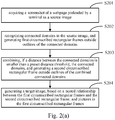
- Fig. 2(a) shows a flow chart of a first embodiment of a method for generating an image according to the present disclosure, and the method includes the steps of S201 to S203.
- Step S201 includes acquiring a screenshot of a webpage preloaded by a terminal as a source image.
- an object extracted by an execution body is a material included in a webpage presented by a terminal, and the material includes a text material and a picture material.
- a source image includes not only the materials in the webpage, but also a spatial relationship between the materials.
- the source image may be generated by the following way: the execution body acquires a webpage network address preloaded on the terminal, and the webpage obtained by accessing the network address is the webpage preloaded on the terminal, and then the execution body takes a screenshot of the obtained webpage and uses the obtained screenshot as the source image.
- the execution body may execute the above steps through the snapshot tool, or may directly receive a screenshot of the webpage sent by a terminal device through a network, which is not limited herein.
- Step S202 includes recognizing connection areas in the source image, and generating first circumscribed rectangular frames outside outlines of the connection areas.
- connection area also known as a connected area, refers to an image area composed of foreground pixels having a given pixel value and adjacent positions in the image.
- connection areas in the image may be recognized by a connection area analysis, and a first circumscribed rectangular frame is generated outside the outline of the connection area.
- the connection area analysis is a conventional technical means in the field of image processing. This function may be implemented through such as the Two-Pass method or the OCR algorithm (Optical Character Recognition), which is not limited herein.
- the first circumscribed rectangular frame is used to label a minimum connection area in the source image.
- the execution body (such as the terminal shown in Fig. 1 ) may recognize the connection area in the source image through the OCR algorithm. If there is a text segment in the source image, an area of each text line in the image is recognized as the connection area, and correspondingly, the first circumscribed rectangular frame is generated outside the outline of the area of each text line, so that the execution body may recognize multiple domains from an image of the text segment and generate multiple first circumscribed rectangular frames.
- connection area may be adjusted according to actual requirements.
- a given paragraph of text may alternatively be recognized as a connection area, and correspondingly, a first circumscribed rectangular frame may be generated outside an outline of an area of the paragraph of the text in the source image, which is not limited herein.
- Step S203 includes combining, if a distance between the connection areas is smaller than a preset distance threshold, the connection areas, and generating a second circumscribed rectangular frame outside outlines of the combined connection areas.
- the second circumscribed rectangular frame is used to represent a circumscribed rectangular frame having a nested relationship.
- a second circumscribed rectangular frame having a multilayer nested relationship may be obtained.
- a distance between the connection areas is used to represent a spatial relationship between materials included in different connection areas in the source image.
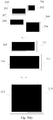
- Fig. 2(b) shows a specific example of this embodiment.
- Connection areas 1, 2, 3 and 4 (201, 202, 203 and 204 as shown in Fig. 2(b) ) correspond to first circumscribed rectangular frames a, b, c and d (205, 206, 207 and 208 as shown in Fig. 2(b) ), respectively.
- the execution body executes the step S203, combines the connection areas 1 and 2 to obtain a connection area 5 (209 as shown in Fig. 2(b) ), and combines the connection areas 3 and 4 to obtain a connection area 6 (210 as shown in Fig. 2(b) ); a second circumscribed rectangular frame e (211 as shown in Fig.
- connection area 5 a second circumscribed rectangular frame f (212 as shown in Fig. 2(b) ) is generated outside the outline of the connection area 6; then, if a distance between the connection area 5 and the connection area 6 is still smaller than a preset distance threshold, the execution body continues to combine the connection area 5 and the connection area 6 to obtain a connection area 7 (213 as shown in Fig. 2(b) ), and generates a second circumscribed rectangular frame g (214 as shown in Fig. 2(b) ) outside the outline of the connection area 7. Finally, the second circumscribed rectangular frames e, f and g are obtained.
- the second circumscribed rectangular frame g includes the second circumscribed rectangular frame f
- the second circumscribed rectangular frame e includes the first circumscribed rectangular frames a and b
- the second circumscribed rectangular frame f includes the first circumscribed rectangular frames c and d.
- the inclusion relationships between the circumscribed rectangular frames are the nested relationships between the first external rectangular frames and the second external rectangular frames, and may be used to represent a spatial relationship between materials in the connection areas.
- Step S204 includes generating a target image, based on a nested relationship between the first circumscribed rectangular frames and the second circumscribed rectangular frame and pictures in the first circumscribed rectangular frame.
- a picture in a first circumscribed rectangular frame represents a material to be extracted from the source image, and is a basis element for generating a target image.
- a nested relationship between the first external rectangular frames and the second external rectangular frame is used to represent a spatial relationship between materials in the source image.
- the execution body combines pictures in the first circumscribed rectangular frames to obtain the target image according to the nested relationship obtained in the step S203.
- the target image may be generated by the following way: the execution body may use a rect function to represent the first circumscribed rectangular frames and the second circumscribed rectangular frame, and each rect stores a coordinate of the upper left corner of a circumscribed rectangular frame in the source image and the length and width of the circumscribed rectangular frame.
- each rect represents a first circumscribed rectangular frame or a second circumscribed rectangular frame.
- the execution body takes the rect including the largest number of rect as the parent node, and constructs a rect tree structure according to the nested relationship between the first circumscribed rectangular frames and the second circumscribed rectangular frame.
- Each node in the tree structure represents a first circumscribed rectangular frame or a second circumscribed rectangular frame
- the bottom node represents a first circumscribed rectangular frame in the source image.
- the execution body combines the pictures in the first circumscribed rectangular frames to obtain the target image according to the tree structure.
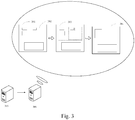
- Fig. 3 shows a schematic diagram of an application scenario of the method for generating the image according to the present disclosure.
- an execution body 306 may be a terminal device or a server.
- the execution body acquires a screenshot 301 of a webpage preloaded on a terminal 305 through a network, recognizes connection areas therein and obtains first detection frames (302 as shown in Fig. 3 ), then combines connection areas between which distances are smaller than a present distance threshold, and obtains second detection frames (303 as shown in Fig. 3 ), finally combines pictures in the first detection frames to obtain a target image 304 based on nested relationships between the first detection frames and the second detection frames.
- the first circumscribed rectangular frame and the second circumscribed rectangular frame are respectively generated by recognizing and combining the connection areas in the source image, and the spatial relationship between the materials in the webpage is represented by the nested relationship between the first circumscribed rectangular frame and the second circumscribed rectangular frame, so that the spatial relationship between materials in the source image may be reflected in the generated target image.
- Fig. 4 shows a flow chart of a second embodiment of the method for generating the image according to the present disclosure, and the method includes the steps of S401 to S411.
- Step S401 includes acquiring a screenshot of a webpage preloaded by a terminal as a source image. This step corresponds to the step S201, and details are not described herein.
- Step S402 includes recognizing connection areas in the source image, and generating a first circumscribed rectangular frame outside outlines of the connection areas. This step corresponds to the step S202, and details are not described herein.
- Step S403 includes combining, if a distance between the connection areas is smaller than a preset distance threshold, the connection areas, and generating a second circumscribed rectangular frame outside outlines of the combined connection areas. This step corresponds to the step S203, and details are not described herein.
- Step S404 includes deleting, if a definition of a picture in a first circumscribed rectangular frame is smaller than a preset definition threshold, the first circumscribed rectangular frame. In this case, extracting a low-definition material may be avoided, thereby ensuring the quality of the generated target image.
- Step S405 includes deleting, based on a position of the first circumscribed rectangular frame in the source image, the first circumscribed rectangular frame located in a preset area in the source image.
- the preset area represents an area in which a less important material in the source image is located, and for example, may be a bottom area and a top area of the source image.
- a less importance text or picture for example, an advertisement placed in the webpage
- the first circumscribed rectangular frame is used to label the position and area of a material to be extracted in the source image, so that the execution body extracts the image in the area from the source image, that is, the step of extracting the material from the source image is completed. Therefore, deleting the first circumscribed rectangular frame means that the image in the first circumscribed rectangular frame is not extracted.
- the execution body deletes the first circumscribed rectangular frame located in the preset area, and filters out a low-value material, thereby helping to reduce the calculation amount and avoiding the generated target image including the low-value material.
- Step S406 includes recognizing the pictures in the first circumscribed rectangular frames, and obtaining a recognition result corresponding to a picture content in the first circumscribed rectangular frames.
- the pictures in the first circumscribed rectangular frames include text material pictures and image material pictures, which may include a low-value material, for example, some of the text material pictures are advertisement slogans in a webpage, and some of the image material pictures are logo pictures or button pictures in the webpage, and the effective information included in these materials is little so that the value is low.
- recognition results corresponding to picture contents may be obtained, and the recognition results may be used to determine whether the picture in the first circumscribed rectangular frame needs to be filtered out.
- the execution body may input the source image into the convolutional neural network model to obtain recognition results of pictures in first circumscribed rectangular frames in the source image.
- the recognition results may include various types such as a text, logo pictures, advertisement slogans or button pictures.
- Step S407 includes deleting, based on the recognition result, a first circumscribed rectangular frame meeting a preset condition.
- the preset condition may be set according to actual requirements to remove unwanted materials and retain valuable materials.
- the material to be extracted includes a text material and an image material.
- the preset condition may be set to a logo picture, a button picture and an advertisement slogan. If recognition results are the above three types, the execution body deletes the corresponding first circumscribed rectangular frame. In this case, when the target image is subsequently generated, the content of the picture area in the deleted frame is not included, so that the content extracted from the source image is filtered to avoid adding the low-value material into the generated target image.
- the method may further include: storing, based on the recognition result, a picture in the first circumscribed rectangular frame corresponding to the recognition result into a preset position.
- some pictures in the source image are not required for the target image, they may be used for other purposes, for example, a logo picture in the source image may be used for business data analysis of a webpage, a button picture may be used for analyzing an interactive function of the webpage and so on, so that the execution body may store the recognized logo picture and the button picture into corresponding storage locations, respectively, for subsequent applications.
- Step S408 includes generating an initial target image by combining, based on nested relationships between first circumscribed rectangular frames and second circumscribed rectangular frames, pictures in the first circumscribed rectangular frames. This step is similar to the step of generating the target image in the step S204. The difference between step s408 and step s204 is that in this embodiment, the image is obtained by combining the pictures in the first circumscribed rectangular frames as the initial target image based on the nested relationships between the first circumscribed rectangular frames and the second circumscribed rectangular frames, and then the target image is obtained after subsequent processing.
- Step S409 includes determining a core area in the initial target image, where the core area in the initial target image is an area including a preset target in the initial target image.
- a preset target is used to represent a material including key information in the initial target image, and the preset target includes at least one of an image including a human face or a dense text.
- the execution body may recognize the image including the human face and an area where the dense text is located from the initial target image by using a significance detection algorithm, i.e., the core areas of the initial target image.
- the number of core areas may be one or more, based on the number of areas of the human face image or areas of the dense text in the initial target image.
- Step S410 includes segmenting, based on a preset clipping ratio and size, the initial target image to obtain segmented core area pictures.
- the execution body may preset a clipping ratio and size according to actual requirements, segment the initial target image into multiple segmented pictures with a given clipping ratio and size, and then delete the pictures outside the core area to obtain segmented core area pictures. For example, when the initial target image includes multiple areas of a human face image and multiple areas of a dense text, the execution body may obtain multiple core area pictures by segmenting the initial target image, while other pictures, which are not located in the core area, are deleted after segmenting.
- Step S411 includes aggregating, based on feature information of the segmented core area pictures, the segmented core area pictures to obtain the target image, where the feature information includes at least one of a size, an aspect ratio or a composition attribute of the picture.
- the composition attribute of the picture includes text and image, for representing whether a material content included in the picture is a text or an image.
- the execution body may aggregate the segmented core area pictures to obtain the target image according to a preset rule.
- segmented core area pictures whose composition attributes are texts and sizes are the same, may be spliced together to aggregate the texts in two related areas into a whole text, thereby ensuring the continuity between text materials.
- segmented core area pictures whose composition attributes are images and aspect ratios and sizes are the same, may be aggregated in one area to highlight the contrast and connection between multiple image materials.
- the second embodiment shows a step of generating the initial target image and identifying the core area thereof according to the nested relationship, and then segmenting the initial target image and performing aggregation, and a step of filtering the material extracted from the source image according to the preset rule.
- the important material may be further extracted from the initial target image, and the material extracted from the source image is filtered according to the preset rule, so that the low-value material in the source image may be removed, thereby avoiding the target image including the low-value material, thereby improving the quality of the material included in the generated target image.
- Fig. 5 shows a block diagram of an apparatus of the method for generating the image according to the present disclosure
- the apparatus includes: an image acquisition module 501, configured to acquire a screenshot of a webpage preloaded by a terminal as a source image; a first generation module 502, configured to recognize connection areas in the source image, and generate first circumscribed rectangular frames outside outlines of the connection areas; a second generation module 503, configured to combine, if a distance between the connection areas is smaller than a preset distance threshold, the connection areas, and generate a second circumscribed rectangular frame outside outlines of the combined connection areas; and an image generation module 504, configured to generate a target image, based on a nested relationship between the first circumscribed rectangular frames and the second circumscribed rectangular frame and pictures in the first circumscribed rectangular frames.
- the image generation module 504 includes: an initial image module, configured to combine, based on a nested relationship between first circumscribed rectangular frames and the second circumscribed rectangular frame, pictures in the first circumscribed rectangular frames into an initial target image; an area recognition module, configured to determine a core area in the initial target image, where the core area in the initial target image is an area including a preset target in the initial target image; an image segmentation module, configured to segment, based on a preset clipping ratio and size, the initial target image to obtain segmented core area pictures; and a picture aggregation module, configured to aggregate, based on feature information of the segmented core area pictures, the segmented core area pictures to obtain the target image, where the feature information includes at least one of a size, an aspect ratio or a composition attribute of the pictures.
- the apparatus further includes a picture recognition module, configured, before determining the picture core area within the first circumscribed rectangular frames, to execute: recognizing the pictures in the first circumscribed rectangular frames, and obtaining a recognition result corresponding to a picture content in the first circumscribed rectangular frames; and deleting, based on the recognition result, a first circumscribed rectangular frame meeting a preset condition.
- a picture recognition module configured, before determining the picture core area within the first circumscribed rectangular frames, to execute: recognizing the pictures in the first circumscribed rectangular frames, and obtaining a recognition result corresponding to a picture content in the first circumscribed rectangular frames; and deleting, based on the recognition result, a first circumscribed rectangular frame meeting a preset condition.
- the picture recognition module is further configured to store, based on the recognition result, the picture in the first circumscribed rectangular frame corresponding to the recognition result into a preset position, before deleting the first circumscribed rectangular frame meeting the preset condition.
- the apparatus further includes a position detection module, configured to delete, based on a position of a first circumscribed rectangular frame in the source image, the first circumscribed rectangular frame located in a preset area in the source image, before determining the picture core area within the first circumscribed rectangular frames.
- a position detection module configured to delete, based on a position of a first circumscribed rectangular frame in the source image, the first circumscribed rectangular frame located in a preset area in the source image, before determining the picture core area within the first circumscribed rectangular frames.
- the apparatus further includes a definition detection module, configured to delete, if a definition of a picture in a first circumscribed rectangular frame is smaller than a preset definition threshold, the first circumscribed rectangular frame, before generating the initial target image.
- a definition detection module configured to delete, if a definition of a picture in a first circumscribed rectangular frame is smaller than a preset definition threshold, the first circumscribed rectangular frame, before generating the initial target image.
- the present disclosure provides an electronic device and a readable storage medium.
- Fig. 6 shows a block diagram of an electronic device of a method for generating an image according to an embodiment of the present disclosure.
- the electronic device is intended to represent various forms of digital computers such as a laptop computer, a desktop computer, a workstation, a personal digital assistant, a server, a blade server, a mainframe computer, and other appropriate computers.
- the electronic device may also represent various forms of mobile devices such as personal digital processing, a cellular telephone, a smart phone, a wearable device and other similar computing apparatuses.
- the parts shown herein, their connections and relationships, and their functions are only as examples, and not intended to limit implementations of the present disclosure as described and/or claimed herein.
- the electronic device includes one or more processors 601, a memory 602, and interfaces for connecting components, including a high speed interface and a low speed interface.
- the various components are interconnected by different buses and may be mounted on a common motherboard or otherwise as desired.
- the processor may process instructions executed within the electronic device, including instructions stored in or on a memory to display graphical information of the GUI on an external input/output device, such as a display device coupled to an interface.
- multiple processors and/or multiple buses may be used with multiple memories, if desired.
- a plurality of electronic devices may be connected, each providing a portion of the necessary operations (e.g., as a server array, a set of blade servers, or a multiprocessor system).
- An example of a processor 601 is shown in Fig. 6 .
- the memory 602 is a non-transitory computer readable storage medium provided by the present disclosure.
- the memory stores instructions executable by at least one processor to cause at least one processor to execute the method for generating an image provided by the present disclosure.
- the non-transitory computer readable storage medium of the present disclosure stores computer instructions for causing a computer to execute the method for generating an image provided by the present disclosure.
- the memory 602 may be used to store non-transitory software programs, non-transitory computer executable programs and modules, such as the program instructions or modules corresponding to the method for generating an image in the embodiment of the present disclosure (such as the image acquisition module 501, the first generation module 502, the second generation module 502 and the image generation module 504 shown in Fig. 5 ).
- the processor 601 runs the non-transitory software programs, instructions and modules stored in the memory 602 to execute various functional applications and data processing of the server, thereby implementing the method for generating an image in the embodiment of the method.
- the memory 602 may include a storage program area and a storage data area, where the storage program area may store an operating system and an application program required by at least one function; and the storage data area may store data created according to the use of the electronic device of the computer storable medium.
- the memory 602 may include a high-speed random access memory, and may further include a non-transitory memory, such as at least one magnetic disk storage device, a flash memory or other non-transitory solid state storage devices.
- the memory 602 may alternatively include a memory disposed remotely relative to the processor 601, which may be connected through a network to the electronic device of the computer storable medium. Examples of such networks include, but are not limited to, the Internet, enterprise intranets, local area networks, mobile communication networks and combinations thereof.
- the electronic device of the method for generating an image may further include an input device 603 and an output device 604.
- the processor 601, the memory 602, the input device 603 and the output device 604 may be interconnected through a bus or other means, and an example of a connection through a bus is shown in Fig. 6 .
- the input device 603 may receive input number or character information, and generate key signal input related to user settings and functional control of the electronic device of the method for generating an image, such as a touch screen, a keypad, a mouse, a track pad, a touch pad, a pointer bar, one or more mouse buttons, a trackball or a joystick.
- the output device 604 may include a display device, an auxiliary lighting device (such as an LED) and a tactile feedback device (such as a vibration motor) and the like.
- the display device may include, but is not limited to, a liquid crystal display (LCD), a light emitting diode (LED) display and a plasma display. In some embodiments, the display device may be a touch screen.
- the various embodiments of the systems and techniques described herein may be implemented in digital electronic circuit systems, integrated circuit systems, specific ASICs (application specific integrated circuits), computer hardware, firmware, software, and/or combinations thereof. These various embodiments may include being implemented in one or more computer programs that may be executed and/or interpreted on a programmable system including at least one programmable processor.
- the at least one programmable processor may be a dedicated or general purpose programmable processor, may receive data and instructions from a memory system, at least one input device, and at least one output device, and transmit the data and instructions to the memory system, the at least one input device, and the at least one output device.
- machine-readable medium and “computer-readable medium” refer to any computer program product, device, and/or apparatus (e.g., magnetic disk, optical disk, memory, programmable logic device (PLD)) for providing machine instructions and/or data to a programmable processor, including a machine-readable medium that receives machine instructions as machine-readable signals.
- machine readable signal refers to any signal used to provide machine instructions and/or data to a programmable processor.
- the systems and technologies described herein may be implemented on a computer having: a display device (such as a CRT (cathode ray tube) or LCD (liquid crystal display) monitor) for displaying information to the user; and a keyboard and a pointing device (such as a mouse or a trackball) through which the user may provide input to the computer.
- a display device such as a CRT (cathode ray tube) or LCD (liquid crystal display) monitor
- a keyboard and a pointing device such as a mouse or a trackball
- Other types of devices may also be used to provide interaction with the user.
- the feedback provided to the user may be any form of sensory feedback (such as visual feedback, auditory feedback or tactile feedback); and input from the user may be received in any form, including acoustic input, speech input or tactile input.
- the systems and technologies described herein may be implemented in: a computing system including a background component (such as a data server), or a computing system including a middleware component (such as an application server), or a computing system including a front-end component (such as a user computer having a graphical user interface or a web browser through which the user may interact with the implementation of the systems and technologies described herein), or a computing system including any combination of such background component, middleware component, or front-end component.
- the components of the system may be interconnected by any form or medium of digital data communication (such as a communication network). Examples of communication networks include a local area network (LAN), a wide area network (WAN) and the Internet.
- LAN local area network
- WAN wide area network
- the Internet the global information network
- the computer system may include a client and a server.
- the client and the server are generally remote from each other and interact generally through a communication network.
- the relationship between the client and the server is generated by running the computer programs having a client-server relationship with each other on the corresponding computer.
- the first circumscribed rectangular frames and the second circumscribed rectangular frame are respectively generated by recognizing and combining the connection areas in the source image, and the spatial relationship between the materials in the webpage is represented by the nested relationship between the first circumscribed rectangular frames and the second circumscribed rectangular frame, so that the spatial relationship between materials in the source image may be reflected in the generated target image.
Landscapes
- Engineering & Computer Science (AREA)
- Theoretical Computer Science (AREA)
- Physics & Mathematics (AREA)
- General Physics & Mathematics (AREA)
- Computer Vision & Pattern Recognition (AREA)
- Multimedia (AREA)
- Databases & Information Systems (AREA)
- Data Mining & Analysis (AREA)
- General Engineering & Computer Science (AREA)
- Processing Or Creating Images (AREA)
- Image Analysis (AREA)
Applications Claiming Priority (1)
| Application Number | Priority Date | Filing Date | Title |
|---|---|---|---|
| CN202010315358.9A CN113538450B (zh) | 2020-04-21 | 2020-04-21 | 用于生成图像的方法及装置 |
Publications (2)
| Publication Number | Publication Date |
|---|---|
| EP3828766A2 true EP3828766A2 (de) | 2021-06-02 |
| EP3828766A3 EP3828766A3 (de) | 2021-10-06 |
Family
ID=75108280
Family Applications (1)
| Application Number | Title | Priority Date | Filing Date |
|---|---|---|---|
| EP21163538.8A Withdrawn EP3828766A3 (de) | 2020-04-21 | 2021-03-18 | Verfahren, vorrichtung, speichermedium und programm zur bilderzeugung |
Country Status (5)
| Country | Link |
|---|---|
| US (1) | US11810333B2 (de) |
| EP (1) | EP3828766A3 (de) |
| JP (1) | JP7213291B2 (de) |
| KR (1) | KR102648760B1 (de) |
| CN (1) | CN113538450B (de) |
Families Citing this family (6)
| Publication number | Priority date | Publication date | Assignee | Title |
|---|---|---|---|---|
| US10984066B2 (en) * | 2019-01-02 | 2021-04-20 | Zyte Group Limited | System and method for a web scraping tool and classification engine |
| CN113870114B (zh) * | 2021-10-12 | 2024-12-24 | 上海哔哩哔哩科技有限公司 | 图片拼接方法及装置 |
| KR102686542B1 (ko) | 2021-11-22 | 2024-07-19 | 주식회사 신세계아이앤씨 | 상품 배너 자동 제작 및 관리 가능한 배너제작관리시스템 |
| CN114549573B (zh) * | 2022-02-22 | 2024-11-22 | 南京航空航天大学 | 密集电缆分割方法及系统 |
| CN114943113B (zh) * | 2022-07-26 | 2022-11-01 | 江西少科智能建造科技有限公司 | 多边形房间内布置散流器方法、系统、存储介质及设备 |
| CN121190753B (zh) * | 2025-11-24 | 2026-02-27 | 之江实验室 | 一种图片检测方法、装置、电子设备及介质 |
Citations (1)
| Publication number | Priority date | Publication date | Assignee | Title |
|---|---|---|---|---|
| US20190065589A1 (en) * | 2016-03-25 | 2019-02-28 | Quad Analytix Llc | Systems and methods for multi-modal automated categorization |
Family Cites Families (15)
| Publication number | Priority date | Publication date | Assignee | Title |
|---|---|---|---|---|
| EP2572295A1 (de) * | 2010-05-19 | 2013-03-27 | Hewlett-Packard Development Company, L.P. | System und verfahren zur webseitensegmentierung mit adaptiver grenzwertberechnung |
| EP2633432A4 (de) * | 2010-10-26 | 2015-10-21 | Hewlett Packard Development Co | Extraktion von inhalt aus einer webseite |
| CN102567300B (zh) * | 2011-12-29 | 2013-11-27 | 方正国际软件有限公司 | 图片文档的处理方法及装置 |
| JP5794154B2 (ja) | 2012-01-23 | 2015-10-14 | 富士通株式会社 | 画像処理プログラム、画像処理方法、及び画像処理装置 |
| US9251580B2 (en) * | 2013-08-23 | 2016-02-02 | Cimpress Schweiz Gmbh | Methods and systems for automated selection of regions of an image for secondary finishing and generation of mask image of same |
| CN103885712B (zh) * | 2014-03-21 | 2017-08-15 | 小米科技有限责任公司 | 网页调整方法、装置及电子设备 |
| CN104951741A (zh) * | 2014-03-31 | 2015-09-30 | 阿里巴巴集团控股有限公司 | 一种文字识别方法及装置 |
| CN110334706B (zh) * | 2017-06-30 | 2021-06-01 | 清华大学深圳研究生院 | 一种图像目标识别方法及装置 |
| CN107748888B (zh) * | 2017-10-13 | 2019-11-08 | 众安信息技术服务有限公司 | 一种图像文本行检测方法及装置 |
| CN109711508B (zh) * | 2017-10-25 | 2020-06-05 | 北京京东尚科信息技术有限公司 | 图像处理方法和装置 |
| CN108446697B (zh) * | 2018-03-06 | 2019-11-12 | 平安科技(深圳)有限公司 | 图片处理方法、电子装置及存储介质 |
| CN109002842A (zh) * | 2018-06-27 | 2018-12-14 | 北京字节跳动网络技术有限公司 | 图像识别方法和装置 |
| CN109325201B (zh) * | 2018-08-15 | 2025-07-15 | 北京百度网讯科技有限公司 | 实体关系数据的生成方法、装置、设备及存储介质 |
| CN109951654B (zh) * | 2019-03-06 | 2022-02-15 | 腾讯科技(深圳)有限公司 | 一种视频合成的方法、模型训练的方法以及相关装置 |
| CN110555839B (zh) * | 2019-09-06 | 2024-11-15 | 腾讯云计算(北京)有限责任公司 | 缺陷检测识别方法、装置、计算机设备及存储介质 |
-
2020
- 2020-04-21 CN CN202010315358.9A patent/CN113538450B/zh active Active
-
2021
- 2021-03-18 EP EP21163538.8A patent/EP3828766A3/de not_active Withdrawn
- 2021-03-19 US US17/207,564 patent/US11810333B2/en active Active
- 2021-03-24 KR KR1020210037804A patent/KR102648760B1/ko active Active
- 2021-03-25 JP JP2021052215A patent/JP7213291B2/ja active Active
Patent Citations (1)
| Publication number | Priority date | Publication date | Assignee | Title |
|---|---|---|---|---|
| US20190065589A1 (en) * | 2016-03-25 | 2019-02-28 | Quad Analytix Llc | Systems and methods for multi-modal automated categorization |
Also Published As
| Publication number | Publication date |
|---|---|
| US11810333B2 (en) | 2023-11-07 |
| CN113538450A (zh) | 2021-10-22 |
| KR102648760B1 (ko) | 2024-03-15 |
| CN113538450B (zh) | 2023-07-21 |
| JP7213291B2 (ja) | 2023-01-26 |
| EP3828766A3 (de) | 2021-10-06 |
| JP2021152901A (ja) | 2021-09-30 |
| KR20210040305A (ko) | 2021-04-13 |
| US20210264614A1 (en) | 2021-08-26 |
Similar Documents
| Publication | Publication Date | Title |
|---|---|---|
| US11810333B2 (en) | Method and apparatus for generating image of webpage content | |
| US12094208B2 (en) | Video classification method, electronic device and storage medium | |
| US20220415072A1 (en) | Image processing method, text recognition method and apparatus | |
| US12300012B2 (en) | Method and device for training, based on crossmodal information, document reading comprehension model | |
| US11710215B2 (en) | Face super-resolution realization method and apparatus, electronic device and storage medium | |
| EP4080469A2 (de) | Verfahren und gerät zum erkennen von text, vorrichtung, speichermedium und intelligenter wörterbuchstift | |
| US11727200B2 (en) | Annotation tool generation method, annotation method, electronic device and storage medium | |
| CN112835579A (zh) | 确定界面代码的方法、装置、电子设备和存储介质 | |
| US20230068025A1 (en) | Method and apparatus for generating road annotation, device and storage medium | |
| CN114371838A (zh) | 一种小程序画布渲染方法、装置、设备及存储介质 | |
| CN111523292A (zh) | 用于获取图像信息的方法和装置 | |
| US10963690B2 (en) | Method for identifying main picture in web page | |
| US12437566B2 (en) | Picture annotation method, apparatus, electronic device, and storage medium | |
| CN111913711A (zh) | 视频渲染方法和装置 | |
| CN112766997A (zh) | 图片投放方法、装置、设备和存储介质 | |
| JP7315639B2 (ja) | 紙のデータのデジタル化方法及び装置、電子機器、記憶媒体 | |
| CN113703890B (zh) | 显示控制方法、装置、电子设备和存储介质 | |
| CN116758198A (zh) | 图像重建方法、装置、设备及存储介质 | |
| CN115017922A (zh) | 图片翻译的方法、装置、电子设备及可读存储介质 | |
| CN115329720A (zh) | 一种文档展示方法、装置、设备及存储介质 | |
| CN113986850B (zh) | 电子卷宗的存储方法、装置、设备和计算机可读存储介质 | |
| CN116610244A (zh) | 缩略图展示控制方法、装置、设备及存储介质 | |
| CN116955740A (zh) | 文档浏览方法、装置、设备及存储介质 | |
| CN117454028A (zh) | 网页加载方法、装置、电子设备及存储介质 | |
| CN120216792A (zh) | 一种页面渲染方法、终端设备和服务器 |
Legal Events
| Date | Code | Title | Description |
|---|---|---|---|
| PUAI | Public reference made under article 153(3) epc to a published international application that has entered the european phase |
Free format text: ORIGINAL CODE: 0009012 |
|
| STAA | Information on the status of an ep patent application or granted ep patent |
Free format text: STATUS: REQUEST FOR EXAMINATION WAS MADE |
|
| 17P | Request for examination filed |
Effective date: 20210318 |
|
| AK | Designated contracting states |
Kind code of ref document: A2 Designated state(s): AL AT BE BG CH CY CZ DE DK EE ES FI FR GB GR HR HU IE IS IT LI LT LU LV MC MK MT NL NO PL PT RO RS SE SI SK SM TR |
|
| PUAL | Search report despatched |
Free format text: ORIGINAL CODE: 0009013 |
|
| AK | Designated contracting states |
Kind code of ref document: A3 Designated state(s): AL AT BE BG CH CY CZ DE DK EE ES FI FR GB GR HR HU IE IS IT LI LT LU LV MC MK MT NL NO PL PT RO RS SE SI SK SM TR |
|
| RIC1 | Information provided on ipc code assigned before grant |
Ipc: G06K 9/00 20060101ALI20210831BHEP Ipc: G06K 9/34 20060101ALI20210831BHEP Ipc: G06K 9/32 20060101AFI20210831BHEP |
|
| STAA | Information on the status of an ep patent application or granted ep patent |
Free format text: STATUS: EXAMINATION IS IN PROGRESS |
|
| 17Q | First examination report despatched |
Effective date: 20220513 |
|
| STAA | Information on the status of an ep patent application or granted ep patent |
Free format text: STATUS: THE APPLICATION IS DEEMED TO BE WITHDRAWN |
|
| 18D | Application deemed to be withdrawn |
Effective date: 20240104 |