EP3829191A1 - Procédé et dispositif de commande de champ sonore, terminal mobile et support d'enregistrement - Google Patents
Procédé et dispositif de commande de champ sonore, terminal mobile et support d'enregistrement Download PDFInfo
- Publication number
- EP3829191A1 EP3829191A1 EP20171563.8A EP20171563A EP3829191A1 EP 3829191 A1 EP3829191 A1 EP 3829191A1 EP 20171563 A EP20171563 A EP 20171563A EP 3829191 A1 EP3829191 A1 EP 3829191A1
- Authority
- EP
- European Patent Office
- Prior art keywords
- audio signals
- filters
- direction information
- filtering
- loudspeakers
- Prior art date
- Legal status (The legal status is an assumption and is not a legal conclusion. Google has not performed a legal analysis and makes no representation as to the accuracy of the status listed.)
- Pending
Links
Images



Classifications
-
- H—ELECTRICITY
- H04—ELECTRIC COMMUNICATION TECHNIQUE
- H04S—STEREOPHONIC SYSTEMS
- H04S7/00—Indicating arrangements; Control arrangements, e.g. balance control
- H04S7/30—Control circuits for electronic adaptation of the sound field
- H04S7/307—Frequency adjustment, e.g. tone control
-
- H—ELECTRICITY
- H04—ELECTRIC COMMUNICATION TECHNIQUE
- H04S—STEREOPHONIC SYSTEMS
- H04S3/00—Systems employing more than two channels, e.g. quadraphonic
-
- H—ELECTRICITY
- H04—ELECTRIC COMMUNICATION TECHNIQUE
- H04R—LOUDSPEAKERS, MICROPHONES, GRAMOPHONE PICK-UPS OR LIKE ACOUSTIC ELECTROMECHANICAL TRANSDUCERS; ELECTRIC HEARING AIDS; PUBLIC ADDRESS SYSTEMS
- H04R1/00—Details of transducers, loudspeakers or microphones
- H04R1/20—Arrangements for obtaining desired frequency or directional characteristics
- H04R1/32—Arrangements for obtaining desired frequency or directional characteristics for obtaining desired directional characteristic only
- H04R1/40—Arrangements for obtaining desired frequency or directional characteristics for obtaining desired directional characteristic only by combining a number of identical transducers
- H04R1/403—Arrangements for obtaining desired frequency or directional characteristics for obtaining desired directional characteristic only by combining a number of identical transducers loud-speakers
-
- G—PHYSICS
- G06—COMPUTING OR CALCULATING; COUNTING
- G06T—IMAGE DATA PROCESSING OR GENERATION, IN GENERAL
- G06T7/00—Image analysis
- G06T7/70—Determining position or orientation of objects or cameras
-
- H—ELECTRICITY
- H04—ELECTRIC COMMUNICATION TECHNIQUE
- H04R—LOUDSPEAKERS, MICROPHONES, GRAMOPHONE PICK-UPS OR LIKE ACOUSTIC ELECTROMECHANICAL TRANSDUCERS; ELECTRIC HEARING AIDS; PUBLIC ADDRESS SYSTEMS
- H04R3/00—Circuits for transducers
- H04R3/04—Circuits for transducers for correcting frequency response
-
- H—ELECTRICITY
- H04—ELECTRIC COMMUNICATION TECHNIQUE
- H04R—LOUDSPEAKERS, MICROPHONES, GRAMOPHONE PICK-UPS OR LIKE ACOUSTIC ELECTROMECHANICAL TRANSDUCERS; ELECTRIC HEARING AIDS; PUBLIC ADDRESS SYSTEMS
- H04R3/00—Circuits for transducers
- H04R3/12—Circuits for transducers for distributing signals to two or more loudspeakers
-
- H—ELECTRICITY
- H04—ELECTRIC COMMUNICATION TECHNIQUE
- H04R—LOUDSPEAKERS, MICROPHONES, GRAMOPHONE PICK-UPS OR LIKE ACOUSTIC ELECTROMECHANICAL TRANSDUCERS; ELECTRIC HEARING AIDS; PUBLIC ADDRESS SYSTEMS
- H04R5/00—Stereophonic arrangements
- H04R5/04—Circuit arrangements, e.g. for selective connection of amplifier inputs/outputs to loudspeakers, for loudspeaker detection, or for adaptation of settings to personal preferences or hearing impairments
-
- H—ELECTRICITY
- H04—ELECTRIC COMMUNICATION TECHNIQUE
- H04S—STEREOPHONIC SYSTEMS
- H04S5/00—Pseudo-stereo systems, e.g. in which additional channel signals are derived from monophonic signals by means of phase shifting, time delay or reverberation
- H04S5/005—Pseudo-stereo systems, e.g. in which additional channel signals are derived from monophonic signals by means of phase shifting, time delay or reverberation of the pseudo five- or more-channel type, e.g. virtual surround
-
- H—ELECTRICITY
- H04—ELECTRIC COMMUNICATION TECHNIQUE
- H04S—STEREOPHONIC SYSTEMS
- H04S7/00—Indicating arrangements; Control arrangements, e.g. balance control
- H04S7/30—Control circuits for electronic adaptation of the sound field
- H04S7/302—Electronic adaptation of stereophonic sound system to listener position or orientation
- H04S7/303—Tracking of listener position or orientation
-
- H—ELECTRICITY
- H04—ELECTRIC COMMUNICATION TECHNIQUE
- H04R—LOUDSPEAKERS, MICROPHONES, GRAMOPHONE PICK-UPS OR LIKE ACOUSTIC ELECTROMECHANICAL TRANSDUCERS; ELECTRIC HEARING AIDS; PUBLIC ADDRESS SYSTEMS
- H04R2203/00—Details of circuits for transducers, loudspeakers or microphones covered by H04R3/00 but not provided for in any of its subgroups
- H04R2203/12—Beamforming aspects for stereophonic sound reproduction with loudspeaker arrays
-
- H—ELECTRICITY
- H04—ELECTRIC COMMUNICATION TECHNIQUE
- H04R—LOUDSPEAKERS, MICROPHONES, GRAMOPHONE PICK-UPS OR LIKE ACOUSTIC ELECTROMECHANICAL TRANSDUCERS; ELECTRIC HEARING AIDS; PUBLIC ADDRESS SYSTEMS
- H04R2499/00—Aspects covered by H04R or H04S not otherwise provided for in their subgroups
- H04R2499/10—General applications
- H04R2499/11—Transducers incorporated or for use in hand-held devices, e.g. mobile phones, PDA's, camera's
-
- H—ELECTRICITY
- H04—ELECTRIC COMMUNICATION TECHNIQUE
- H04R—LOUDSPEAKERS, MICROPHONES, GRAMOPHONE PICK-UPS OR LIKE ACOUSTIC ELECTROMECHANICAL TRANSDUCERS; ELECTRIC HEARING AIDS; PUBLIC ADDRESS SYSTEMS
- H04R5/00—Stereophonic arrangements
- H04R5/02—Spatial or constructional arrangements of loudspeakers
-
- H—ELECTRICITY
- H04—ELECTRIC COMMUNICATION TECHNIQUE
- H04S—STEREOPHONIC SYSTEMS
- H04S2400/00—Details of stereophonic systems covered by H04S but not provided for in its groups
- H04S2400/01—Multi-channel, i.e. more than two input channels, sound reproduction with two speakers wherein the multi-channel information is substantially preserved
Definitions
- the disclosure relates to the field of the communication technology, and particularly to a method and a device for controlling a sound field, a mobile terminal and a storage medium.
- a loudspeaker is transducing device for converting an electrical signal into a sound signal.
- the loudspeaker is generally composed of a magnet, a frame, a spider and a tapered die-folding paper cone.
- an electromagnetic effect a piezoelectric effect or an electrostatic effect, audio electric energy can cause the paper cone or a diaphragm to vibrate and resonate with surrounding air to produce a sound.
- Two loudspeakers are generally used in a mobile terminal to create an audio sense of a stereo, but a whole sound field is fixed and unable to move.
- the sound field of the loudspeaker needs to be produced towards a specific direction.
- the sound field is directed to a direction of a person to enhance auditory experience.
- the disclosure provides a method and a device for controlling a sound field, a mobile terminal and a storage medium.
- a method for controlling a sound field is provided.
- the method is applied to a mobile terminal which includes at least two loudspeakers.
- the method may include the following operations.
- Direction information of a target sound field may be set.
- Filtering parameters of at least two filters may be determined according to the direction information.
- the filters have a one-to-one correspondence with the loudspeakers, and are configured to filter audio signals to be outputted.
- the audio signals may be filtered using the filtering parameters, to at least adjust phases of the audio signals.
- the adjusted audio signals may be outputted by the loudspeakers. After the audio signals outputted by the different loudspeakers are superimposed, the superimposed signal is consistent with a direction indicated by the direction information.
- a mobile terminal after setting direction information of a target sound field, can determine filtering parameters of at least two filters according to the direction information, to at least adjust phases of audio filters, so that a sound field formed by superimposing audio signals outputted by different loudspeakers in a propagation medium such as the air is consistent with a direction indicated by the direction information.
- a sound or a loud sound propagates in a target direction while no sound or a small sound propagates in a non-target direction, thereby improving a user's auditory experience and meeting requirements for application of different sounds.
- the operation that filtering parameters of at least two filters may be determined according to the direction information may include the following operation.
- Time delays of the at least two filters may be determined according to the direction information, to perform delay processing on the audio signals inputted into the at least two filters.
- the operation that the audio signals may be filtered using the filtering parameters to at least adjust the phases of the audio signals may include the following operation.
- the audio signals may be filtered according to the time delays, to at least adjust the phases of the audio signals.
- the operation that the filtering parameters of the at least two filters may be determined according to the direction information may include the following operations.
- An optimization function may be constructed with taking the direction information as an optimization target and taking the filtering parameters of the at least two filters as optimization variables.
- the filtering parameters of the at least two filters may be determined according to the optimization function.
- the operation that the audio signals may be filtered using the filtering parameters to at least adjust the phases of the audio signals may include the following operation.
- the audio signals may be filtered using the filtering parameters, to adjust wave peaks of the audio signals to superimpose in the direction indicated by the direction information, and adjust the wave peaks and wave troughs of the audio signals to superimpose in a direction other than the direction indicated by the direction information to reduce an intensity of the signals.
- the operation that the audio signals may be filtered using the filtering parameters to at least adjust the phases of the audio signals may include the following operation.
- the audio signals may be filtered using the filtering parameters, to adjust the phases and amplitudes of the audio signals.
- the operation that the audio signals may be filtered using the filtering parameters to adjust the phases and the amplitudes of the audio signals may include the following operation.
- the audio signals may be filtered using the filtering parameters, to adjust wave peaks of the audio signals to superimpose in the direction indicated by the direction information, and adjust the wave peaks and wave troughs to superimpose in a direction other than the direction indicated by the direction information to offset each other.
- four or more loudspeakers may be disposed around the mobile terminal.
- the filters may include a finite impulse response (FIR) filter.
- FIR finite impulse response
- the method may further include the following operations.
- Image information may be obtained.
- a facial direction of a target object may be determined according to the image information.
- the operation that the direction information of the target sound field may be set includes the following operation.
- the facial direction of the target object may be set as the direction information of the target sound field.
- a device for controlling a sound field may be applied to a mobile terminal which includes at least two loudspeakers.
- the device may include a setting module, a first determining module, a filtering module and an outputting module.
- the setting module may be configured to set direction information of a target sound field.
- the first determining module may be configured to determine, according to the direction information, filtering parameters of at least two filters.
- the filters have a one-to-one correspondence with the loudspeakers, and are configured to filter audio signals to be outputted.
- the filtering module may be configured to filter the audio signals using the filtering parameters, to at least adjust phases of the audio signals.
- the outputting module may be configured to output, by the loudspeakers, the adjusted audio signals. After the audio signals outputted by the different loudspeakers are superimposed, the superimposed signal is consistent with a direction indicated by the direction information.
- the first determining module may be configured to determine, according to the direction information, time delays of the at least two filters, to perform delay processing on the audio signals inputted into the at least two filters.
- the filtering module may be configured to filter, according to the time delays, the audio signals to at least adjust the phases of the audio signals.
- the first determining module may be configured to: construct an optimization function with taking the direction information as an optimization target and taking the filtering parameters of the at least two filters as optimization variables; and determine the filtering parameters of the at least two filters according to the optimization function.
- the filtering module may be configured to filter the audio signals using the filtering parameters, to adjust wave peaks of the audio signals to superimpose in the direction indicated by the direction information, and adjust the wave peaks and wave troughs of the audio signals to superimpose in a direction other than the direction indicated by the direction information to reduce an intensity of the signals.
- the filtering module may be configured to filter the audio signals using the filtering parameters, to adjust the phases and amplitudes of the audio signals.
- the filtering module may be configured to filter the audio signals using the filtering parameters, to adjust wave peaks of the audio signals to superimpose in the direction indicated by the direction information, and adjust the wave peaks and wave troughs to superimpose in a direction other than the direction indicated by the direction information to offset each other.
- four or more loudspeakers may be disposed around the mobile terminal.
- the filters may include a finite impulse response (FIR) filter.
- FIR finite impulse response
- the device may further include an obtaining module and a second determining module.
- the obtaining module may be configured to obtain image information.
- the second determining module may be configured to determine, according to the image information, a facial direction of a target object.
- the setting module may be configured to set the facial direction of the target object faces as the direction information of the target sound field.
- a storage medium which may include instructions, that when executed by a processor of a mobile terminal, enable the mobile terminal to execute the method for controlling a sound field according to the above first aspect.
- the storage medium can be any entity or device capable of storing the program.
- the support can include storage means such as a ROM, for example a CD ROM or a microelectronic circuit ROM, or magnetic storage means, for example a diskette (floppy disk) or a hard disk.
- the storage medium can be an integrated circuit in which the program is incorporated, the circuit being adapted to execute the method in question or to be used in its execution.
- the steps of the method for controlling a sound field are determined by computer program instructions.
- the disclosure is also directed to a computer program for executing the steps of the method for controlling a sound field as described above when this program is executed by a computer.
- This program can use any programming language and take the form of source code, object code or a code intermediate between source code and object code, such as a partially compiled form, or any other desirable form.
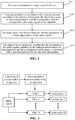
- FIG. 1 is a flowchart of a method for controlling a sound field according to an embodiment of the disclosure. As illustrated in FIG. 1 , the method for controlling the sound field is applied to a mobile terminal which includes at least two loudspeakers. The method for controlling the sound field includes operations.
- filtering parameters of at least two filters are determined according to the direction information.
- the filters have a one-to-one correspondence with the loudspeakers, and are configured to filter audio signals to be outputted.
- the audio signals are filtered using the filtering parameters, to at least adjust phases of the audio signals.
- the adjusted audio signals are outputted by the loudspeakers.
- the audio signals outputted by the different loudspeakers are superimposed, and the superimposed signal is consistent with a direction indicated by the direction information.
- the mobile terminal includes a cellphone, a tablet computer, a wearable device and so on, which is not limited in the embodiments of the disclosure.
- the mobile terminal sets the direction information of the target sound field according to a received instruction for characterizing the direction information. It is to be noted that the instruction is received through an operation of a user.
- the mobile terminal receives an operation instruction through a click or input operation of a user on a user interface, and sets the direction information of the target sound field.
- the mobile terminal receives an audio instruction sent by the user, and parses audio information of the audio instruction to set the direction information of the target sound field.
- the mobile terminal may also set the direction information of the target sound field according to a detected facial direction of a target object.
- the method includes operations as follows.
- Image information is obtained.
- a facial direction of the target object is determined according to the image information.
- S11 includes operations as follows.
- the facial direction of the target object is set as the direction information of the target sound field.
- the mobile terminal includes an image collecting component, and the mobile terminal can collect the images by the image collecting component thereof, to obtain the image information. In another way, the mobile terminal obtains the image information through a connection with an external image collecting component.
- the operation that the mobile terminal determines the facial direction of the target object according to the image information includes the following operations.
- the mobile terminal transmits the image information to a server side and receives the facial direction of the target object in the image information returned by the server side.
- An audio device performs parsing processing on the collected image information to determine the facial direction of the target object.
- the operation that the mobile terminal performs parsing processing on the image information to determine the facial direction includes the following operations.
- the mobile terminal detects a target face in the image information and recognizes the facial direction of the target face according to a face posture recognizing model which includes images of faces towards different directions.
- the facial direction of the target face can also be determined according to a structural feature of five sense organs on the face after the target face is detected in the image information.
- the method that the facial direction of the target face is determined according to the structural feature of the five sense organs on the face includes the following operations.
- the mobile terminal determines, according to the target face, a first distance between a first eye and a tip of a nose on the target face, and a second distance between a second eye and the tip of the nose on the target face, and the mobile terminal determines the facial direction of the target face according to the first distance and the second distance.
- the facial direction determined by the mobile terminal according to the image information obtained by the built-in camera is facial direction of the target object relative to the mobile terminal.
- the mobile terminal After obtaining the facial direction of the target object relative to the camera according to the obtained image information, the mobile terminal can calculate and obtain the facial direction of the target object relative to the mobile terminal according to the facial direction of the target object relative to the camera and a direction of the camera relative to the mobile terminal.
- the facial orientation of the target object relative to the mobile terminal can be set as the direction information of the target sound field.
- the direction information of the target sound field refers to a designated releasing direction, that is, a propagation direction, of sound.
- a designated direction that forms an angle of 30 degrees, 60 degrees or the like relative to a central axis of a plane in which the mobile terminal is located.
- filters of the mobile terminal have a one-to-one correspondence with loudspeakers.
- the filters are used for filtering the audio signals, which includes filtering processing such as regulating frequencies, amplitudes, phases and the like of the audio signals, and further includes denoising processing on the audio signals.
- the filtered audio signals are outputted by the loudspeakers.
- the mobile terminal determines filtering parameters of at least two filters according to the direction information, and filters the audio signals according to the filtering parameters, to at least adjust the phases of the audio signals.
- the superimposed signal is consistent with a direction indicated by the direction information.
- the operation that the filtering parameters of the at least two filters are determined according to the direction information of the target sound field further includes an operation that the filtering parameters of the filters are controlled to enable the loudspeaker corresponding to the filter not to output the audio signal. For example, when one filter performs denoising processing on the audio signal, the filter filters out the audio signal which is taken as noise.
- the cellphone may determine the parameters of the filters according to the direction information, to enable the four loudspeakers at the top side and the left side of the cell phone to output the audio signals while enabling the loudspeakers in other directions to not output the audio signals. This is because these audio signals of the loudspeakers in other directions are filtered out as the noise by the filters corresponding to the loudspeakers.
- the direction of the target sound field can be adjusted more accurate as the number of the filters and the loudspeakers increases.
- FIG. 2 is a schematic diagram of an architecture of a method for controlling a sound field according to an embodiment of the disclosure.
- a mobile terminal includes a filter 1 to a filter N, and a loudspeaker 1 to a loudspeaker N corresponding to the filter 1 to the filter N.
- the mobile terminal After determining a designated direction of a sound field, the mobile terminal calculates filtering parameters of the filters according to an algorithm.
- the audio signals to be outputted are input signals of the filter 1 to the filter N.
- the filter 1 to the filter N filter the input signals using the parameters of the filters obtained according to the designated direction of the sound field, and the filtered signals are outputted by the loudspeaker 1 to the loudspeaker N corresponding to the filters, so that the superimposed signal propagates in the designated direction.
- the operation that the mobile terminal determines the filtering parameters of at least two filters according to direction information includes the following operation.
- the mobile terminal determines time delays of the at least two filters according to the direction information, to perform delay processing on the audio signals inputted into the at least two filters.
- the operation S12 includes the operation as follows.
- the mobile terminal filters the audio signals according to the time delays, to at least adjust phases of the audio signals.
- the mobile terminal includes at least two filters, and the time delays of the filters may affect the phases of the audio signals.
- the wave peaks are superimposed to form a sound field in a designated direction, that is, obtain a target sound field.
- the wave peak is superimposed with the wave trough to offset each other in a non-designated direction, so that no sound field is formed or the sound field is weakened after the superimposing.
- the audio signals outputted by the different loudspeakers have wave peaks superimposed in a direction of the target sound field and have wave peaks superimposed with wave troughs in a direction other than the direction of the target sound field, to control the direction of the sound field.
- the operation S12 includes an operation as follows.
- the mobile terminal constructs an optimization function with taking the direction information as an optimization target and taking the filtering parameters of the at least two filters as optimization variables, and adjusts the filtering parameters of the at least two filters according to the optimization function.
- the optimization function in addition to the above regulation of the time delays to implement a phase rotation, can also be constructed according to an optimization theory such as a convex optimization theory.
- the optimization function is constructed with taking the direction information as the optimization target and taking the filtering parameters as the optimization variables, and the filtering parameters of the at least two filters are adjusted according to the constructed optimization function.
- the operation S13 includes an operation as follows.
- the mobile terminal filters the audio signals using the filtering parameters, to adjust the wave peaks of the audio signals to superimpose in the direction indicated by the direction information, and adjust the wave peaks and the wave troughs to superimpose in a direction other than the direction indicated by the direction information to reduce an intensity of the signals.
- the phases of the audio signals can be adjusted by the regulation based on the parameters of the filters such as the above-mentioned regulation of the time delays of the filters, so that the intensity of the signals gets strong after the wave peaks are superimposed in the direction indicated by the direction information while the intensity of the signals gets weak after the wave peaks and the wave troughs are superimposed in a direction other than the direction indicated by the direction information.
- the sound is loud in the target sound field indicated by the direction information, and is small in the direction other than the direction indicated by the direction information.
- the operation S12 includes the following operation.
- the mobile terminal filters the audio signals using the filtering parameters, to adjust the phases and amplitudes of the audio signals.
- the operation that the mobile terminal filters the audio signals using the filtering parameters to adjust the phases and the amplitudes of the audio signals includes the following operation.
- the audio signals are filtered using the filtering parameters, to adjust wave peaks of the audio signals to superimpose in the direction indicated by the direction information, and adjust wave peaks and wave troughs to superimpose in the direction other than the direction indicated by the direction information to offset each other.
- the regulation based on the phases can make the wave peaks superimpose to increase, and also make the wave peaks and the wave troughs superimpose.
- the regulation based on amplitudes can make the wave peaks and the wave troughs superimpose to offset each other, so that no sound field exists in the direction other than the direction indicated by the direction information and the sound in the direction indicated by the direction information becomes outstanding.
- the target sound field can be formed in the direction indicated by the direction information more accurate while no sound field exists in the direction other than the direction indicated by the direction information.
- four or more loudspeakers are disposed around the mobile terminal.
- four loudspeakers are included in the mobile terminal and are disposed at the periphery, and a same distance is formed between any two adjacent loudspeakers.
- the target sound field in more directions can be adjusted in the mobile terminal by disposing the loudspeakers at the periphery of the mobile terminal.
- the loudspeakers are disposed on the periphery of the cellphone to adjust the audio signals outputted in four directions, so that the directions in which the regulation can be performed cover a broad scope.
- the same distance is formed between any two adjacent loudspeakers.
- any one of the loudspeakers is arranged in the middle of one edge of the cellphone. With constraint based on the symmetric position relationship, it is more convenient to determine the parameters of the filters.
- the at least two loudspeakers are not limited to the four loudspeakers in the embodiments, and the arrangement positions of the loudspeakers in the mobile terminal are not limited to the above way.
- the mobile terminal includes at least two filters including a finite impulse response (FIR) filter.
- FIR finite impulse response
- the FIR filter has a linear phase. That is, many passband signals are inputted in the FIR filter simultaneously, and are outputted simultaneously after a period of time.
- the FIR filter is easy to be designed. Due to the advantages of the FIR filter, the FIR filter is suitable for an audio application.
- the FIR filter can be used to control the phase of the audio signal accurately, so that the target sound field is formed in the designated direction accurately.
- the mobile terminal after setting the direction information of the target sound field, can determine the filtering parameters of the at least two filters according to the direction information to at least adjust the phases of the audio signals, so that the sound field formed by superimposing the audio signals outputted by the different loudspeakers in the air is consistent with the direction indicated by the direction information, thereby implementing the control of the sound field and improving an user's auditory experience.
- FIG. 3 is an exemplary orientation diagram of disposition of loudspeakers in a cellphone according to an embodiment of the disclosure.
- loudspeakers are disposed on four directions of the cell phone.
- One loudspeaker is disposed on each of a top side, a left side and a right side of the cellphone while two loudspeakers are disposed with an interval at the bottom of the cellphone.
- five loudspeakers including a loudspeaker 1, a loudspeaker 2, a loudspeaker 3, a loudspeaker 4 and a loudspeaker 5 are disposed in the cellphone.
- FIG. 4 is a first exemplary flowchart of a method for directionally controlling a sound field on the cellphone illustrated by FIG. 3 using multiple loudspeakers according to an embodiment of the disclosure. As illustrated in FIG. 4 , the method for controlling the sound field of the loudspeakers of the cellphone includes operations as follows.
- the cellphone receives a designated sounding direction.
- the cellphone can set direction information of a target sound field according to the received designated sounding direction.
- a built-in algorithm in the cellphone calculates filtering parameters of five filters corresponding to five loudspeakers according to the designated sounding direction.
- the built-in algorithm in the cellphone may be the above convex optimization algorithm.
- the cellphone transmits the filtered audio signals to the five loudspeakers, and the audio signals outputted by the five loudspeakers are superimposed and then propagated in the designated sounding direction.
- the cellphone after receiving the designated sounding direction, the cellphone can adjust the filtering parameters of the five filters according to the designated sounding direction, and the five filters filter the audio signals according to the adjusted filtering parameters, and the filtered audio signals are outputted by the loudspeakers.
- the sound field formed by superimposing the audio signals outputted by the five loudspeakers in the air is consistent with a direction indicated by the direction information, thereby implementing the control of the direction of the sound field and improving user's auditory experience.
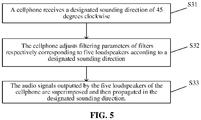
- FIG. 5 is a second exemplary flowchart of a method for directionally controlling a sound field on the cellphone illustrated by FIG. 3 using multiple loudspeakers according to an embodiment of the disclosure.
- the method for controlling the sound field of the loudspeakers of the cellphone includes operations as follows.
- the cellphone receives a designated sounding direction of 45 degrees clockwise.
- FIG. 6 is a schematic diagram of a direction of a person relative to a cellphone according to an embodiment of the disclosure. As illustrated in FIG. 6 , a sounding direction of 45 degrees refers to that an angle between a person and a vertical central axis of a horizontal plane of the cellphone is 45 degrees.
- the cellphone adjusts filtering parameters of filters respectively corresponding with five loudspeakers according to a designated sounding direction.
- the filtering parameter of the filter corresponding to the loudspeaker 1 on the top of the cellphone and the filtering parameter of the filter corresponding to the loudspeaker 2 on the right side of the cellphone are adjusted according to the designated sounding direction of 45 degrees.
- Amplitudes of audio signals are changed by the regulation of the filtering parameters, so that volumes of the audio signals outputted by the loudspeaker 1 and the loudspeaker 2 are equal to a median value in a volume regulation range.
- volumes of the audio signals outputted by other loudspeakers are reduced to a minimal value in the volume regulation range by controlling the filtering parameters corresponding to other loudspeakers according to the designated sounding direction of 45 degrees.
- the volumes of the audio signals outputted by the loudspeaker 3 to the loudspeaker 5 have been reduced to the minimal value after the audio signals are filtered by the filters. Therefore, intensities of the sounds propagated at angles corresponding to the loudspeaker 3 to the loudspeaker 5 are small while the sound emitted by the loudspeaker 1 and the loudspeaker 2 are superimposed in the air to make people feel that the sound come from the designated direction.
- the cellphone upon receiving the designated sounding direction, can adjust the volumes of the sounds of the loudspeakers in different directions according to the sounding direction, and the sound are superimposed to obtain the sound field consistent with the designated sounding direction. It can be seen that a user's auditory experience can also be improved with the method for controlling the volumes of the loudspeakers in different directions.
- FIG. 7 is a diagram of a device for controlling a sound field according to an exemplary embodiment of the disclosure.
- the device for controlling the sound field includes a setting module 121, a first determining module 122, a filtering module 123 and an outputting module 124.
- the setting module 121 is configured to set direction information of a target sound field.
- the first determining module 122 is configured to determine, according to the direction information, filtering parameters of at least two filters.
- the filters have a one-to-one correspondence with the loudspeakers, and are configured to filter audio signals to be outputted.
- the filtering module 123 is configured to filter the audio signals using the filtering parameters, to at least adjust phases of the audio signals.
- the outputting module 124 is configured to output, by the loudspeakers, the adjusted audio signals. After the audio signals outputted by the different loudspeakers are superimposed, the superimposed signal is consistent with a direction indicated by the direction information.
- the first determining module 122 is configured to determine, according to the direction information, time delays of the at least two filters, to perform delay processing on the audio signals inputted into the at least two filters.
- the filtering module 123 is configured to filter, according to the time delays, the audio signals to at least adjust the phases of the audio signals.
- the first determining module 122 is configured to construct an optimization function with taking the direction information as an optimization target and taking the filtering parameters of the at least two filters as optimization variables, and determine the filtering parameters of the at least two filters according to the optimization function.
- the filtering module 123 is configured to filter the audio signals using the filtering parameters, to adjust wave peaks of the audio signals to superimpose in the direction indicated by the direction information, and adjust the wave peaks and wave troughs of the audio signals to superimpose in a direction other than the direction indicated by the direction information to reduce an intensity of the signals.
- the filtering module 123 is configured to filter the audio signals using the filtering parameters, to adjust the phases and amplitudes of the audio signals.
- the filtering module 123 is configured to filter the audio signals using the filtering parameters to adjust wave peaks of the audio signals to superimpose in the direction indicated by the direction information, and adjust the wave peaks and wave troughs to superimpose in a direction other than the direction indicated by the direction information to offset each other.
- four or more loudspeakers are disposed around the mobile terminal.
- the filters include a FIR filter.
- the device further includes an obtaining module 125 and a second determining module 126.
- the obtaining module 125 is configured to obtain image information.
- the second determining module 126 is configured to determine, according to the image information, a facial direction of a target object.
- the setting module 121 is configured to set the facial direction of the target object as the direction information of the target sound field.
- FIG. 8 is a structure block diagram of a mobile terminal device 800 according to an exemplary embodiment.
- the device 800 may be a mobile phone, a mobile computer, and so on.
- the device 800 may include one or more of the following components: a processing component 802, a memory 804, a power component 806, a multimedia component 808, an audio component 810, an Input/Output (I/O) interface 812, a sensor component 814, and a communication component 816.
- a processing component 802 a memory 804, a power component 806, a multimedia component 808, an audio component 810, an Input/Output (I/O) interface 812, a sensor component 814, and a communication component 816.
- the processing component 802 is typically configured to control overall operations of the device 800, such as the operations associated with display, telephone calls, data communications, camera operations, and recording operations.
- the processing component 802 may include one or more processors 820 to execute instructions to perform all or part of the operations in the abovementioned method.
- the processing component 802 may include one or more modules which facilitate interaction between the processing component 802 and other components.
- the processing component 802 may include a multimedia module to facilitate interaction between the multimedia component 808 and the processing component 802.
- the memory 804 is configured to store various types of data to support the operation of the device 800. Examples of such data include instructions for any application programs or methods operated on the device 800, contact data, phonebook data, messages, pictures, video, etc.
- the memory 804 may be implemented by any type of volatile or nonvolatile memory devices, or a combination thereof, such as a Static Random Access Memory (SRAM), an Electrically Erasable Programmable Read-Only Memory (EEPROM), an Erasable Programmable Read-Only Memory (EPROM), a Programmable Read-Only Memory (PROM), a Read-Only Memory (ROM), a magnetic memory, a flash memory, and a magnetic or optical disk.
- SRAM Static Random Access Memory
- EEPROM Electrically Erasable Programmable Read-Only Memory
- EPROM Erasable Programmable Read-Only Memory
- PROM Programmable Read-Only Memory
- ROM Read-Only Memory
- magnetic memory a magnetic memory
- flash memory and a magnetic or optical disk.
- the power component 806 is configured to provide power for various components of the device 800.
- the power component 806 may include a power management system, one or more power supplies, and other components associated with generation, management and distribution of power for the device 800.
- the multimedia component 808 includes a screen for providing an output interface between the device 800 and a user.
- the screen may include a Liquid Crystal Display (LCD) and a Touch Panel (TP). If the screen includes the TP, the screen may be implemented as a touch screen to receive an input signal from the user.
- the TP includes one or more touch sensors to sense touches, swipes and gestures on the TP. The touch sensors may not only sense a boundary of a touch or swipe action but also detect a duration and pressure associated with the touch or swipe action.
- the multimedia component 808 may include a front camera and/or a rear camera.
- the front camera and/or the rear camera may receive external multimedia data when the device 800 is in an operation mode, such as a photographing mode or a video mode.
- an operation mode such as a photographing mode or a video mode.
- Each of the front camera and the rear camera may be a fixed optical lens system or have focusing and optical zooming capabilities.
- the audio component 810 is configured to output and/or input an audio signal.
- the audio component 810 includes a Microphone (MIC), and the MIC is configured to receive an external audio signal when the terminal is in the operation mode, such as a call mode, a recording mode and a voice recognition mode.
- the received audio signal may further be stored in the memory 804 or transmitted through the communication component 816.
- the audio component 810 may further include a speaker configured to output the audio signal.
- the I/O interface 812 is configured to provide an interface between the processing component 802 and a peripheral interface module, and the peripheral interface module may be a keyboard, a click wheel, a button and the like.
- the button may include, but not limited to: a home button, a volume button, a starting button and a locking button.
- the sensor component 814 may include one or more sensors configured to provide status assessment in various aspects for the device 800. For instance, the sensor component 814 may detect an on/off status of the device 800 and relative positioning of components, such as a display and small keyboard of the device 800, and the sensor component 814 may further detect a change in a position of the device 800 or a component of the device 100, presence or absence of contact between the user and the device 800, orientation or acceleration/deceleration of the device 800 and a change in temperature of the device 800.
- the sensor component 814 may include a proximity sensor configured to detect presence of an object nearby without any physical contact.
- the sensor component 814 may also include a light sensor, such as a Complementary Metal Oxide Semiconductor (CMOS) or Charge Coupled Device (CCD) image sensor, configured for use in an imaging APP.
- CMOS Complementary Metal Oxide Semiconductor
- CCD Charge Coupled Device
- the sensor component 814 may also include an acceleration sensor, a gyroscope sensor, a magnetic sensor, a pressure sensor or a temperature sensor.
- the communication component 816 is configured to facilitate wired or wireless communication between the device 800 and other equipment.
- the device 800 may access a communication-standard-based wireless network, such as a Wireless Fidelity (Wi-Fi) network, a 2nd-Generation (2G), 3rd-Generation (3G), 4th-Generation (4G), or 5th - Generation (5G) network or a combination thereof .
- the communication component 816 is configured to receive a broadcast signal or broadcast associated information from an external broadcast management system through a broadcast channel.
- the communication component 816 may further include a Near Field Communication (NFC) module to facilitate short-range communication.
- NFC Near Field Communication
- the NFC module may be implemented based on a Radio Frequency Identification (RFID) technology, an Infrared Data Association (IrDA) technology, an Ultra-WideBand (UWB) technology, a Bluetooth (BT) technology and another technology.
- RFID Radio Frequency Identification
- IrDA Infrared Data Association
- UWB Ultra-WideBand
- BT Bluetooth
- the device 800 may be implemented by one or more Application Specific Integrated Circuits (ASICs), Digital Signal Processors (DSPs), Digital Signal Processing Devices (DSPDs), Programmable Logic Devices (PLDs), Field Programmable Gate Arrays (FPGAs), controllers, micro-controllers, microprocessors or other electronic components, and is configured to execute the abovementioned method.
- ASICs Application Specific Integrated Circuits
- DSPs Digital Signal Processors
- DSPDs Digital Signal Processing Devices
- PLDs Programmable Logic Devices
- FPGAs Field Programmable Gate Arrays
- controllers micro-controllers, microprocessors or other electronic components, and is configured to execute the abovementioned method.
- a non-transitory computer-readable storage medium including instructions is further provided, such as the memory 804 including instructions.
- the instructions can be executed by the processor 820 of the device 800 to implement the abovementioned method.
- the non-transitory computer-readable storage medium may be a read-only memory (ROM), a random access memory (RAM), a Compact Disc Read-Only Memory (CD-ROM), a magnetic tape, a floppy disc, an optical data storage device and the like.
- the instructions in the non-transitory computer readable storage medium when executed by a processor of a mobile terminal, enable the mobile terminal to perform the method for controlling a sound field.
- the method includes the following operations.
- Direction information of a target sound field is set.
- Filtering parameters of at least two filters are determined according to the direction information.
- the filters have a one-to-one correspondence with the loudspeakers, and are configured to filter audio signals to be outputted.
- the audio signals are filtered using the filtering parameters to at least adjust phases of the audio signals.
- the adjusted audio signals are outputted by the loudspeakers. After the audio signals outputted by the different loudspeakers are superimposed, the superimposed signal is consistent with a direction indicated by the direction information.
Landscapes
- Engineering & Computer Science (AREA)
- Physics & Mathematics (AREA)
- Acoustics & Sound (AREA)
- Signal Processing (AREA)
- Health & Medical Sciences (AREA)
- Otolaryngology (AREA)
- General Health & Medical Sciences (AREA)
- Computer Vision & Pattern Recognition (AREA)
- General Physics & Mathematics (AREA)
- Theoretical Computer Science (AREA)
- Circuit For Audible Band Transducer (AREA)
- Telephone Function (AREA)
Applications Claiming Priority (1)
| Application Number | Priority Date | Filing Date | Title |
|---|---|---|---|
| CN201911184624.2A CN112866894B (zh) | 2019-11-27 | 2019-11-27 | 声场控制方法及装置、移动终端、存储介质 |
Publications (1)
| Publication Number | Publication Date |
|---|---|
| EP3829191A1 true EP3829191A1 (fr) | 2021-06-02 |
Family
ID=70470882
Family Applications (1)
| Application Number | Title | Priority Date | Filing Date |
|---|---|---|---|
| EP20171563.8A Pending EP3829191A1 (fr) | 2019-11-27 | 2020-04-27 | Procédé et dispositif de commande de champ sonore, terminal mobile et support d'enregistrement |
Country Status (3)
| Country | Link |
|---|---|
| US (1) | US11172321B2 (fr) |
| EP (1) | EP3829191A1 (fr) |
| CN (1) | CN112866894B (fr) |
Families Citing this family (11)
| Publication number | Priority date | Publication date | Assignee | Title |
|---|---|---|---|---|
| WO2021235753A1 (fr) * | 2020-05-21 | 2021-11-25 | 엘지전자 주식회사 | Procédé et dispositif pour appliquer une rotation de phase optimisée à une large bande dans un système lan sans fil |
| CN114071315A (zh) * | 2021-11-04 | 2022-02-18 | 深圳Tcl新技术有限公司 | 音频处理方法、装置、电子设备及存储介质 |
| CN114040319B (zh) * | 2021-11-17 | 2023-11-14 | 青岛海信移动通信技术有限公司 | 一种终端设备外放音质优化方法、装置、设备和介质 |
| CN114339582B (zh) * | 2021-11-30 | 2024-02-06 | 北京小米移动软件有限公司 | 双通道音频处理、方向感滤波器生成方法、装置以及介质 |
| CN116261071A (zh) * | 2021-12-09 | 2023-06-13 | 北京小米移动软件有限公司 | 扬声设备的控制方法、装置、设备及介质 |
| CN114286272B (zh) * | 2021-12-17 | 2023-05-16 | 华勤技术股份有限公司 | 真无线耳机的时延测试系统、方法及相关装置 |
| CN114666721B (zh) * | 2022-05-05 | 2024-02-06 | 深圳市丰禾原电子科技有限公司 | 一种具有终端跟踪模式的wifi音箱及其控制方法 |
| CN115529542A (zh) * | 2022-10-09 | 2022-12-27 | 重庆清文科技有限公司 | 声场控制方法、装置及系统 |
| CN116055606A (zh) * | 2022-12-21 | 2023-05-02 | 瑞声科技(南京)有限公司 | 一种扬声器控制方法、装置、设备及可读存储介质 |
| JP7659063B2 (ja) * | 2022-12-21 | 2025-04-08 | エーエーシー テクノロジーズ (ナンジン) カンパニーリミテッド | スピーカー制御方法、装置、デバイス及読み取り可能な記憶媒体 |
| CN117692846B (zh) * | 2023-07-05 | 2025-01-03 | 荣耀终端有限公司 | 一种音频播放方法、终端设备、存储介质及程序产品 |
Citations (2)
| Publication number | Priority date | Publication date | Assignee | Title |
|---|---|---|---|---|
| US20170188171A1 (en) * | 2015-12-25 | 2017-06-29 | Kyocera Corporation | Electronic apparatus and sound output control method |
| US20180338214A1 (en) * | 2017-05-18 | 2018-11-22 | Raytheon BBN Technologies, Corp. | Personal Speaker System |
Family Cites Families (8)
| Publication number | Priority date | Publication date | Assignee | Title |
|---|---|---|---|---|
| US7346315B2 (en) * | 2004-03-30 | 2008-03-18 | Motorola Inc | Handheld device loudspeaker system |
| KR101547639B1 (ko) * | 2009-05-22 | 2015-08-27 | 삼성전자 주식회사 | 사운드 포커싱 장치 및 방법 |
| CN104282314A (zh) * | 2013-07-02 | 2015-01-14 | 华为终端有限公司 | 一种声音信号传输方法及通信设备 |
| EP3041272A4 (fr) * | 2013-08-30 | 2017-04-05 | Kyoei Engineering Co., Ltd. | Appareil de traitement du son, procédé de traitement du son et programme de traitement du son |
| CN103491397B (zh) * | 2013-09-25 | 2017-04-26 | 歌尔股份有限公司 | 一种实现自适应环绕声的方法和系统 |
| US20150382129A1 (en) * | 2014-06-30 | 2015-12-31 | Microsoft Corporation | Driving parametric speakers as a function of tracked user location |
| CN104185116B (zh) * | 2014-08-15 | 2018-01-09 | 南京琅声声学科技有限公司 | 一种自动确定声辐射模式的方法 |
| CN109361994A (zh) * | 2018-10-12 | 2019-02-19 | Oppo广东移动通信有限公司 | 扬声器控制方法、移动终端及计算机可读存储介质 |
-
2019
- 2019-11-27 CN CN201911184624.2A patent/CN112866894B/zh active Active
-
2020
- 2020-04-10 US US16/845,281 patent/US11172321B2/en active Active
- 2020-04-27 EP EP20171563.8A patent/EP3829191A1/fr active Pending
Patent Citations (2)
| Publication number | Priority date | Publication date | Assignee | Title |
|---|---|---|---|---|
| US20170188171A1 (en) * | 2015-12-25 | 2017-06-29 | Kyocera Corporation | Electronic apparatus and sound output control method |
| US20180338214A1 (en) * | 2017-05-18 | 2018-11-22 | Raytheon BBN Technologies, Corp. | Personal Speaker System |
Also Published As
| Publication number | Publication date |
|---|---|
| CN112866894A (zh) | 2021-05-28 |
| US11172321B2 (en) | 2021-11-09 |
| CN112866894B (zh) | 2022-08-05 |
| US20210160649A1 (en) | 2021-05-27 |
Similar Documents
| Publication | Publication Date | Title |
|---|---|---|
| EP3829191A1 (fr) | Procédé et dispositif de commande de champ sonore, terminal mobile et support d'enregistrement | |
| EP3163748B1 (fr) | Procédé, dispositif et terminal de réglage du volume | |
| EP3024211B1 (fr) | Procédé et dispositif pour l'annonce d'appel vocal | |
| CN114363770B (zh) | 通透模式下的滤波方法、装置、耳机以及可读存储介质 | |
| US12375866B2 (en) | Audio processing method and electronic device | |
| EP3125512A1 (fr) | D'indication d'appel silencieusement pendant ecouter de la musique utilisant d'un casque micro | |
| US9161125B2 (en) | High dynamic microphone system | |
| CN108711434A (zh) | 车辆降噪方法及装置 | |
| EP3817226A1 (fr) | Procédé et dispositif de traitement d'informations, dispositif de terminal et support d'informations | |
| US11792518B2 (en) | Method and apparatus for processing image | |
| CN112817665A (zh) | 设备交互方法及装置、存储介质 | |
| CN111698593B (zh) | 主动降噪方法及装置、终端 | |
| CN107870758B (zh) | 音频播放方法及装置、电子设备 | |
| CN105635378A (zh) | 通话质量调整方法、装置及移动终端 | |
| CN112752191A (zh) | 音频采集方法、装置及存储介质 | |
| EP3654667B1 (fr) | Dispositif électronique et procédé de sortie d'un signal audio | |
| KR20190133591A (ko) | 조리개 장치, 카메라, 및 이를 구비하는 단말기 | |
| CN113938804A (zh) | 一种范围性助听方法及装置 | |
| KR101617287B1 (ko) | 휴대 단말기 및 그 제어방법 | |
| CN121603840A (zh) | 音频采集方法、音频采集装置、电子设备及存储介质 | |
| CN113660593A (zh) | 一种消除头影效应的助听方法及装置 | |
| CN109246550B (zh) | 远场拾音方法、远场拾音装置及电子设备 | |
| CN107454306B (zh) | 采集图像的方法及装置 | |
| CN114760575A (zh) | 一种助听器个性化调节方法及装置 | |
| CN115914922A (zh) | 降噪方法以及装置、充电桩及存储介质 |
Legal Events
| Date | Code | Title | Description |
|---|---|---|---|
| PUAI | Public reference made under article 153(3) epc to a published international application that has entered the european phase |
Free format text: ORIGINAL CODE: 0009012 |
|
| STAA | Information on the status of an ep patent application or granted ep patent |
Free format text: STATUS: THE APPLICATION HAS BEEN PUBLISHED |
|
| AK | Designated contracting states |
Kind code of ref document: A1 Designated state(s): AL AT BE BG CH CY CZ DE DK EE ES FI FR GB GR HR HU IE IS IT LI LT LU LV MC MK MT NL NO PL PT RO RS SE SI SK SM TR |
|
| STAA | Information on the status of an ep patent application or granted ep patent |
Free format text: STATUS: REQUEST FOR EXAMINATION WAS MADE |
|
| 17P | Request for examination filed |
Effective date: 20210622 |
|
| RBV | Designated contracting states (corrected) |
Designated state(s): AL AT BE BG CH CY CZ DE DK EE ES FI FR GB GR HR HU IE IS IT LI LT LU LV MC MK MT NL NO PL PT RO RS SE SI SK SM TR |
|
| STAA | Information on the status of an ep patent application or granted ep patent |
Free format text: STATUS: EXAMINATION IS IN PROGRESS |
|
| 17Q | First examination report despatched |
Effective date: 20221213 |