EP3831418A1 - Biovoile pour le traitement de blessures et de brûlures - Google Patents
Biovoile pour le traitement de blessures et de brûlures Download PDFInfo
- Publication number
- EP3831418A1 EP3831418A1 EP19844468.9A EP19844468A EP3831418A1 EP 3831418 A1 EP3831418 A1 EP 3831418A1 EP 19844468 A EP19844468 A EP 19844468A EP 3831418 A1 EP3831418 A1 EP 3831418A1
- Authority
- EP
- European Patent Office
- Prior art keywords
- bioveil
- sheet
- burns
- wounds
- treatment
- Prior art date
- Legal status (The legal status is an assumption and is not a legal conclusion. Google has not performed a legal analysis and makes no representation as to the accuracy of the status listed.)
- Withdrawn
Links
- 206010052428 Wound Diseases 0.000 title claims abstract description 23
- 208000027418 Wounds and injury Diseases 0.000 title claims abstract description 22
- 239000002253 acid Substances 0.000 claims abstract description 7
- 210000004204 blood vessel Anatomy 0.000 claims abstract description 7
- 229920000642 polymer Polymers 0.000 claims abstract description 5
- 230000006872 improvement Effects 0.000 claims abstract description 4
- 206010006802 Burns second degree Diseases 0.000 claims abstract description 3
- 206010006803 Burns third degree Diseases 0.000 claims abstract description 3
- IJGRMHOSHXDMSA-UHFFFAOYSA-N Atomic nitrogen Chemical compound N#N IJGRMHOSHXDMSA-UHFFFAOYSA-N 0.000 claims description 4
- 229910052757 nitrogen Inorganic materials 0.000 claims description 2
- 230000015556 catabolic process Effects 0.000 claims 1
- 238000006731 degradation reaction Methods 0.000 claims 1
- 238000002513 implantation Methods 0.000 abstract description 7
- 230000001737 promoting effect Effects 0.000 abstract description 4
- 102000008186 Collagen Human genes 0.000 description 11
- 108010035532 Collagen Proteins 0.000 description 11
- 229920001436 collagen Polymers 0.000 description 11
- 241000283690 Bos taurus Species 0.000 description 9
- 210000003491 skin Anatomy 0.000 description 8
- 210000001519 tissue Anatomy 0.000 description 8
- 230000035876 healing Effects 0.000 description 7
- 239000012620 biological material Substances 0.000 description 6
- 210000004027 cell Anatomy 0.000 description 6
- 231100000241 scar Toxicity 0.000 description 5
- 230000002500 effect on skin Effects 0.000 description 4
- 208000032544 Cicatrix Diseases 0.000 description 3
- 241000699670 Mus sp. Species 0.000 description 3
- FAPWRFPIFSIZLT-UHFFFAOYSA-M Sodium chloride Chemical compound [Na+].[Cl-] FAPWRFPIFSIZLT-UHFFFAOYSA-M 0.000 description 3
- 230000033115 angiogenesis Effects 0.000 description 3
- 230000008602 contraction Effects 0.000 description 3
- 230000037387 scars Effects 0.000 description 3
- 230000035945 sensitivity Effects 0.000 description 3
- 230000009772 tissue formation Effects 0.000 description 3
- 230000029663 wound healing Effects 0.000 description 3
- 102000010834 Extracellular Matrix Proteins Human genes 0.000 description 2
- 108010037362 Extracellular Matrix Proteins Proteins 0.000 description 2
- 241000699666 Mus <mouse, genus> Species 0.000 description 2
- 230000003592 biomimetic effect Effects 0.000 description 2
- 238000004113 cell culture Methods 0.000 description 2
- 230000000052 comparative effect Effects 0.000 description 2
- 239000003814 drug Substances 0.000 description 2
- 229940079593 drug Drugs 0.000 description 2
- 210000002744 extracellular matrix Anatomy 0.000 description 2
- 210000002510 keratinocyte Anatomy 0.000 description 2
- 238000000034 method Methods 0.000 description 2
- 229920001432 poly(L-lactide) Polymers 0.000 description 2
- 239000000047 product Substances 0.000 description 2
- 230000002035 prolonged effect Effects 0.000 description 2
- 206010061598 Immunodeficiency Diseases 0.000 description 1
- 241001465754 Metazoa Species 0.000 description 1
- 241000251539 Vertebrata <Metazoa> Species 0.000 description 1
- 230000009471 action Effects 0.000 description 1
- 230000004913 activation Effects 0.000 description 1
- 230000002491 angiogenic effect Effects 0.000 description 1
- 210000000988 bone and bone Anatomy 0.000 description 1
- 239000006227 byproduct Substances 0.000 description 1
- 210000000845 cartilage Anatomy 0.000 description 1
- 230000010261 cell growth Effects 0.000 description 1
- 229920002678 cellulose Polymers 0.000 description 1
- 239000001913 cellulose Substances 0.000 description 1
- 230000000295 complement effect Effects 0.000 description 1
- 239000013068 control sample Substances 0.000 description 1
- 230000002526 effect on cardiovascular system Effects 0.000 description 1
- 230000005611 electricity Effects 0.000 description 1
- 238000001523 electrospinning Methods 0.000 description 1
- 230000008030 elimination Effects 0.000 description 1
- 238000003379 elimination reaction Methods 0.000 description 1
- 210000002615 epidermis Anatomy 0.000 description 1
- 239000001963 growth medium Substances 0.000 description 1
- 239000007943 implant Substances 0.000 description 1
- 238000001727 in vivo Methods 0.000 description 1
- 230000003993 interaction Effects 0.000 description 1
- 210000004185 liver Anatomy 0.000 description 1
- 239000000463 material Substances 0.000 description 1
- 239000011159 matrix material Substances 0.000 description 1
- 239000002121 nanofiber Substances 0.000 description 1
- 229920001606 poly(lactic acid-co-glycolic acid) Polymers 0.000 description 1
- 239000002861 polymer material Substances 0.000 description 1
- 229920000307 polymer substrate Polymers 0.000 description 1
- 230000008569 process Effects 0.000 description 1
- 230000035755 proliferation Effects 0.000 description 1
- 230000009467 reduction Effects 0.000 description 1
- 230000008929 regeneration Effects 0.000 description 1
- 238000011069 regeneration method Methods 0.000 description 1
- 231100000444 skin lesion Toxicity 0.000 description 1
- 206010040882 skin lesion Diseases 0.000 description 1
- 239000011780 sodium chloride Substances 0.000 description 1
- 230000003068 static effect Effects 0.000 description 1
- 239000003894 surgical glue Substances 0.000 description 1
- 210000002435 tendon Anatomy 0.000 description 1
- 230000008467 tissue growth Effects 0.000 description 1
- 230000017423 tissue regeneration Effects 0.000 description 1
- 238000002054 transplantation Methods 0.000 description 1
- 210000003708 urethra Anatomy 0.000 description 1
- 230000010388 wound contraction Effects 0.000 description 1
Images


Classifications
-
- A—HUMAN NECESSITIES
- A61—MEDICAL OR VETERINARY SCIENCE; HYGIENE
- A61L—METHODS OR APPARATUS FOR STERILISING MATERIALS OR OBJECTS IN GENERAL; DISINFECTION, STERILISATION OR DEODORISATION OF AIR; CHEMICAL ASPECTS OF BANDAGES, DRESSINGS, ABSORBENT PADS OR SURGICAL ARTICLES; MATERIALS FOR BANDAGES, DRESSINGS, ABSORBENT PADS OR SURGICAL ARTICLES
- A61L27/00—Materials for grafts or prostheses or for coating grafts or prostheses
- A61L27/50—Materials characterised by their function or physical properties, e.g. injectable or lubricating compositions, shape-memory materials, surface modified materials
- A61L27/56—Porous materials, e.g. foams or sponges
-
- A—HUMAN NECESSITIES
- A61—MEDICAL OR VETERINARY SCIENCE; HYGIENE
- A61L—METHODS OR APPARATUS FOR STERILISING MATERIALS OR OBJECTS IN GENERAL; DISINFECTION, STERILISATION OR DEODORISATION OF AIR; CHEMICAL ASPECTS OF BANDAGES, DRESSINGS, ABSORBENT PADS OR SURGICAL ARTICLES; MATERIALS FOR BANDAGES, DRESSINGS, ABSORBENT PADS OR SURGICAL ARTICLES
- A61L27/00—Materials for grafts or prostheses or for coating grafts or prostheses
- A61L27/14—Macromolecular materials
- A61L27/18—Macromolecular materials obtained otherwise than by reactions only involving carbon-to-carbon unsaturated bonds
-
- A—HUMAN NECESSITIES
- A61—MEDICAL OR VETERINARY SCIENCE; HYGIENE
- A61L—METHODS OR APPARATUS FOR STERILISING MATERIALS OR OBJECTS IN GENERAL; DISINFECTION, STERILISATION OR DEODORISATION OF AIR; CHEMICAL ASPECTS OF BANDAGES, DRESSINGS, ABSORBENT PADS OR SURGICAL ARTICLES; MATERIALS FOR BANDAGES, DRESSINGS, ABSORBENT PADS OR SURGICAL ARTICLES
- A61L27/00—Materials for grafts or prostheses or for coating grafts or prostheses
- A61L27/50—Materials characterised by their function or physical properties, e.g. injectable or lubricating compositions, shape-memory materials, surface modified materials
- A61L27/58—Materials at least partially resorbable by the body
-
- A—HUMAN NECESSITIES
- A61—MEDICAL OR VETERINARY SCIENCE; HYGIENE
- A61L—METHODS OR APPARATUS FOR STERILISING MATERIALS OR OBJECTS IN GENERAL; DISINFECTION, STERILISATION OR DEODORISATION OF AIR; CHEMICAL ASPECTS OF BANDAGES, DRESSINGS, ABSORBENT PADS OR SURGICAL ARTICLES; MATERIALS FOR BANDAGES, DRESSINGS, ABSORBENT PADS OR SURGICAL ARTICLES
- A61L27/00—Materials for grafts or prostheses or for coating grafts or prostheses
- A61L27/50—Materials characterised by their function or physical properties, e.g. injectable or lubricating compositions, shape-memory materials, surface modified materials
- A61L27/60—Materials for use in artificial skin
-
- A—HUMAN NECESSITIES
- A61—MEDICAL OR VETERINARY SCIENCE; HYGIENE
- A61L—METHODS OR APPARATUS FOR STERILISING MATERIALS OR OBJECTS IN GENERAL; DISINFECTION, STERILISATION OR DEODORISATION OF AIR; CHEMICAL ASPECTS OF BANDAGES, DRESSINGS, ABSORBENT PADS OR SURGICAL ARTICLES; MATERIALS FOR BANDAGES, DRESSINGS, ABSORBENT PADS OR SURGICAL ARTICLES
- A61L2400/00—Materials characterised by their function or physical properties
- A61L2400/12—Nanosized materials, e.g. nanofibres, nanoparticles, nanowires, nanotubes; Nanostructured surfaces
-
- A—HUMAN NECESSITIES
- A61—MEDICAL OR VETERINARY SCIENCE; HYGIENE
- A61L—METHODS OR APPARATUS FOR STERILISING MATERIALS OR OBJECTS IN GENERAL; DISINFECTION, STERILISATION OR DEODORISATION OF AIR; CHEMICAL ASPECTS OF BANDAGES, DRESSINGS, ABSORBENT PADS OR SURGICAL ARTICLES; MATERIALS FOR BANDAGES, DRESSINGS, ABSORBENT PADS OR SURGICAL ARTICLES
- A61L2430/00—Materials or treatment for tissue regeneration
- A61L2430/34—Materials or treatment for tissue regeneration for soft tissue reconstruction
Definitions
- the present invention relates to a bioveil, more particularly to a sheet the structure of which mimics the extracellular matrix of the native tissue of a patient and which, when applied on wounds or burns, provides a temporary scaffold enabling better cell anchorage, new dermal tissue formation, as well as greater angiogenesis.
- the bioveil of the present invention is thereby formed by tangled polymer nanofibres of 50:50 esterified poly(D,L-lactic-co-glycolic) acid disposed randomly for the purpose of providing a porous, hydrophilic and absorbable sheet which, advantageously, will degrade completely 90 days after its placement on the wound or burn to be treated.
- Biomaterials used during new tissue formation or for the treatment of wounds for the purpose of promoting cell anchorage and for the intention of providing a treated surface with a contraction-free tissue-like appearance are well-known in the prior art.
- Poly(L-lactic) acid (PLLA), poly(D/L-lactic) acid (PDLLA) and poly (lactic-co-glycolic) acid (PLGA) have been known for a long time as degradable materials for implants, and they are all approved by the United States Food and Drug Administration (FDA) for such purpose. In fact, these elements have been used as tissue matrix support for bone, cartilage, liver, skin, urethra, bowel, tendons, and cardiovascular tissues.
- the biomaterials that are used do not present complete biodegradability, so it is necessary for the sheet of biomaterial that is placed to be removed after several days of action on the wound. In these cases, the removal of the bioveil placed on the wound involves the simultaneous elimination of those cell anchorages that may have been generated, so these biomaterials do not offer advantageous properties.
- Patent document number ES2338820T3 discloses a biodegradable, porous polymer material comprising poly(lactic-co-glycolic) acid intended for use in wound healing or regeneration processes. However, the document does not disclose that it relates to a product for prolonged use, that it can be completely absorbed, and that it provides better resulting scar quality.
- the invention proposed in present specification provides a bioveil the structure of which solves the drawbacks described above, as it provides a bioabsorbable sheet which completely degrades and promotes angiogenesis and cell culture take, with less contraction of the treated surface.
- the proposed bioveil solves in a completely satisfactory manner the drawbacks set forth above, where its structure is formed by a sheet comprising tangled polymer nanofibres of 50:50 esterified poly(D,L-lactic-co-glycolic) acid, hereinafter referred to by its abbreviation DL-PLGA.
- the nanofibres of the bioveil have a nanometric diameter between 500 and 1500 nm and are disposed randomly.
- the sheet forming the bioveil has a grammage between 5 and 10 g/m 2 and is porous, hydrophilic and absorbable.
- the applicant of the present utility model has verified the potential in a wide range of biomedical applications, and it is particularly advantageous in promoting cell anchorage, better skin graft take, the improvement of the quality of the healed tissue in patients with second- and third-degree burns, and promoting blood vessel generation.
- the sheet forming the bioveil of the invention is a product that can be implanted on wounds and/or can be implanted by means of surgical methods, being intended for prolonged use as it is completely absorbed during the period of use.
- the bioveil is preferably obtained by the known technology of electrospinning, such that the nanofibres have very high surface-to-weight ratio compared with conventional tissues.
- the structure of the bioveil provides a biomimetic support for cell growth, improving the autologous cell culture take in skin lesions caused by burns, helping with cell anchorage and proliferation, generating lower culture rejection rates, a reduction of the healing time, and the improvement of quality of the resulting scars in terms of elasticity and shrinkage.
- the surface of the bioveil is activated when subjected to low-pressure nitrogen plasma for at least 5 seconds.
- the activation of the surface of the bioveil improves its handleability and the hydrophilicity of the nanofibre structure, thereby allowing interaction with the culture medium and/or live tissues.
- the surface-activated bioveil will be more receptive to moisture, losing its tendency to accumulate static electricity.
- bioveil of the present invention is presented in a heat-sealed and sterilised package in which one unit in the form of a sheet, preferably having a size of 100 x 150 mm, is included.
- the bioveil of the invention for tissue regeneration thereby mimics the extracellular matrix of the native tissue and allows better cell anchorage and a temporary scaffold having a controlled duration of up to 90 days to be obtained for healing wounds by means of new dermal tissue growth and formation.
- the bioveil generates 15% more angiogenesis compared to a sheet comprising bovine collagen.
- the bioveil is completely absorbed between 30 days and 90 days after its implantation, during which time it generates an excellent take when applied in skin grafts, achieving graft takes of 80%, compared to 20% - 30% offered by products commonly used for these purposes.
- the structure of the bioveil of the invention is in the form of a very porous sheet, and a preferred embodiment consists of a sheet having a thickness of 49 micrometers, made up of fibres that are disposed randomly having mean nanometric diameters of 887 nm and having a biomimetic behaviour for a preferred grammage of 7.7 g/m2, with evident isotropy and maximum tensile strength of 3.40 MPa, with a strain at break of 75.87%.
- Figure 3 shows healing with the use of the sheet comprising bovine collagen (1) and with the use of the bioveil of the invention (2) 30 days after implantation in a mouse.
- the macroscopic viewing of the skin grafted on the bioveil of the invention shows an excellent take of the graft; namely, when disposed on a wound it reduces wound contraction by up to 69%, which generates quality scars, recovering sensitivity and elasticity.
- the sheet comprising bovine collagen provides a less developed scar showing much more contraction (views depicted in (2) of Figures 2 and 3 ).
- bioveil of the invention is a better polymer substrate for skin reconstruction than the sheet comprising collagen due to its angiogenic properties, which allow blood vessel generation to be promoted.
- control sample (3) used in these comparative studies is likewise depicted in the graph in Figure 4 .
- blood vessel generation is 15% greater than the generation provided by a sheet comprising bovine collagen and 30% greater than the generation provided by the control sheet.
- the bioveil of the invention acts like an intermediate layer to facilitate the anchorage and take of the coverage.
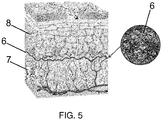
- Figure 5 depicts the placement of the bioveil of the invention (6) as an intermediate layer in a burn (7) to improve the take of the epidermal graft (8).
- Figure 5 includes an enlarged view of the bioveil (6) the polymer nanofibres of which are disposed randomly.
- the bioveil object of the present invention facilitates the anchorage and take of autologous grafts, promotes wound healing by generating quality scars and recovering area elasticity and sensitivity, with all these properties having been scientifically proven.
Landscapes
- Health & Medical Sciences (AREA)
- Chemical & Material Sciences (AREA)
- Dermatology (AREA)
- Medicinal Chemistry (AREA)
- Oral & Maxillofacial Surgery (AREA)
- Transplantation (AREA)
- Epidemiology (AREA)
- Life Sciences & Earth Sciences (AREA)
- Animal Behavior & Ethology (AREA)
- General Health & Medical Sciences (AREA)
- Public Health (AREA)
- Veterinary Medicine (AREA)
- Chemical Kinetics & Catalysis (AREA)
- Dispersion Chemistry (AREA)
- Materials For Medical Uses (AREA)
Applications Claiming Priority (2)
| Application Number | Priority Date | Filing Date | Title |
|---|---|---|---|
| ES201831222U ES1219729Y (es) | 2018-08-01 | 2018-08-01 | Biovelo para el tratamiento de heridas y quemaduras |
| PCT/ES2019/070518 WO2020025843A1 (fr) | 2018-08-01 | 2019-07-24 | Biovoile pour le traitement de blessures et de brûlures |
Publications (2)
| Publication Number | Publication Date |
|---|---|
| EP3831418A1 true EP3831418A1 (fr) | 2021-06-09 |
| EP3831418A4 EP3831418A4 (fr) | 2022-04-20 |
Family
ID=63915376
Family Applications (1)
| Application Number | Title | Priority Date | Filing Date |
|---|---|---|---|
| EP19844468.9A Withdrawn EP3831418A4 (fr) | 2018-08-01 | 2019-07-24 | Biovoile pour le traitement de blessures et de brûlures |
Country Status (4)
| Country | Link |
|---|---|
| EP (1) | EP3831418A4 (fr) |
| ES (1) | ES1219729Y (fr) |
| MA (1) | MA53350A (fr) |
| WO (1) | WO2020025843A1 (fr) |
Family Cites Families (2)
| Publication number | Priority date | Publication date | Assignee | Title |
|---|---|---|---|---|
| CA2645153A1 (fr) | 2006-03-09 | 2007-09-13 | Coloplast A/S | Copolymeres bloc hydrophiles degradables de biocompatibilite amelioree pour regeneration des tissus mous |
| GB201622340D0 (en) * | 2016-12-28 | 2017-02-08 | Auckland Uniservices Ltd | Product and Method |
-
2018
- 2018-08-01 ES ES201831222U patent/ES1219729Y/es active Active
-
2019
- 2019-07-24 WO PCT/ES2019/070518 patent/WO2020025843A1/fr not_active Ceased
- 2019-07-24 EP EP19844468.9A patent/EP3831418A4/fr not_active Withdrawn
- 2019-07-24 MA MA053350A patent/MA53350A/fr unknown
Also Published As
| Publication number | Publication date |
|---|---|
| WO2020025843A1 (fr) | 2020-02-06 |
| ES1219729U (es) | 2018-10-30 |
| EP3831418A4 (fr) | 2022-04-20 |
| MA53350A (fr) | 2022-04-20 |
| ES1219729Y (es) | 2019-01-22 |
Similar Documents
| Publication | Publication Date | Title |
|---|---|---|
| Park et al. | Fabrication of strong, bioactive vascular grafts with PCL/collagen and PCL/silica bilayers for small-diameter vascular applications | |
| Kirillova et al. | Fabrication of biomedical scaffolds using biodegradable polymers | |
| Fornasari et al. | Natural-based biomaterials for peripheral nerve injury repair | |
| Sowmya et al. | Poly (ε-caprolactone)-based electrospun nano-featured substrate for tissue engineering applications: A review | |
| Ciardelli et al. | Materials for peripheral nerve regeneration | |
| Arslantunali et al. | Peripheral nerve conduits: technology update | |
| AU2018354277B2 (en) | Biopolymer scaffold implants and methods for their production | |
| Abedalwafa et al. | Biodegradable poly-epsilon-caprolactone (PCL) for tissue engineering applications: A review | |
| Li et al. | Biocomposites reinforced by fibers or tubes as scaffolds for tissue engineering or regenerative medicine | |
| JP5523934B2 (ja) | 不織状の組織支持骨格 | |
| Duffy et al. | Synthetic bioresorbable poly-α-hydroxyesters as peripheral nerve guidance conduits; a review of material properties, design strategies and their efficacy to date | |
| US9771410B2 (en) | Foam-formed collagen strand | |
| AU2024201686B2 (en) | Tissue substitute materials and methods for tissue repair | |
| US8460691B2 (en) | Fenestrated wound repair scaffold | |
| JP2011507609A (ja) | コーティングされた組織工学スカフォールド | |
| Wu et al. | Mechanically stable surface-hydrophobilized chitosan nanofibrous barrier membranes for guided bone regeneration | |
| Aadil et al. | Keratin nanofibers in tissue engineering: Bridging nature and innovation | |
| US20120157673A1 (en) | Minimal tissue attachment implantable materials | |
| Wiśniewska et al. | Bioresorbable polymeric materials–current state of knowledge | |
| EP3831418A1 (fr) | Biovoile pour le traitement de blessures et de brûlures | |
| Madiwale et al. | Advances of Textiles in Tissue Engineering Scaffolds | |
| Liu et al. | The microstructures and materials of nerve conduits used in peripheral nerve regeneration | |
| Grumezescu et al. | Materials for Biomedical Engineering: Biopolymer Fibers | |
| Niemczyk-Soczynska et al. | Hydrogel, electrospun and composite materials for bone/cartilage and neural tissue engineering. Materials 2021, 14, 6899 | |
| Boraie | Correction: Youssef et al. Glibenclamide Nanocrystal-Loaded Bioactive Polymeric Scaffolds for Skin Regeneration: In Vitro Characterization and Preclinical Evaluation. Pharmaceutics 2021, 13, 1469 |
Legal Events
| Date | Code | Title | Description |
|---|---|---|---|
| STAA | Information on the status of an ep patent application or granted ep patent |
Free format text: STATUS: THE INTERNATIONAL PUBLICATION HAS BEEN MADE |
|
| PUAI | Public reference made under article 153(3) epc to a published international application that has entered the european phase |
Free format text: ORIGINAL CODE: 0009012 |
|
| STAA | Information on the status of an ep patent application or granted ep patent |
Free format text: STATUS: REQUEST FOR EXAMINATION WAS MADE |
|
| 17P | Request for examination filed |
Effective date: 20210218 |
|
| AK | Designated contracting states |
Kind code of ref document: A1 Designated state(s): AL AT BE BG CH CY CZ DE DK EE ES FI FR GB GR HR HU IE IS IT LI LT LU LV MC MK MT NL NO PL PT RO RS SE SI SK SM TR |
|
| DAX | Request for extension of the european patent (deleted) | ||
| RAV | Requested validation state of the european patent: fee paid |
Extension state: MA Effective date: 20210218 |
|
| A4 | Supplementary search report drawn up and despatched |
Effective date: 20220321 |
|
| RIC1 | Information provided on ipc code assigned before grant |
Ipc: A61L 27/58 20060101ALI20220316BHEP Ipc: A61L 27/54 20060101ALI20220316BHEP Ipc: A61L 27/14 20060101AFI20220316BHEP |
|
| STAA | Information on the status of an ep patent application or granted ep patent |
Free format text: STATUS: THE APPLICATION IS DEEMED TO BE WITHDRAWN |
|
| 18D | Application deemed to be withdrawn |
Effective date: 20221018 |