EP3831452A1 - Dispositif de thérapie par l'exercice - Google Patents
Dispositif de thérapie par l'exercice Download PDFInfo
- Publication number
- EP3831452A1 EP3831452A1 EP18928614.9A EP18928614A EP3831452A1 EP 3831452 A1 EP3831452 A1 EP 3831452A1 EP 18928614 A EP18928614 A EP 18928614A EP 3831452 A1 EP3831452 A1 EP 3831452A1
- Authority
- EP
- European Patent Office
- Prior art keywords
- torque
- exercise
- therapy device
- exercise therapy
- control means
- Prior art date
- Legal status (The legal status is an assumption and is not a legal conclusion. Google has not performed a legal analysis and makes no representation as to the accuracy of the status listed.)
- Pending
Links
Images


Classifications
-
- A—HUMAN NECESSITIES
- A63—SPORTS; GAMES; AMUSEMENTS
- A63B—APPARATUS FOR PHYSICAL TRAINING, GYMNASTICS, SWIMMING, CLIMBING, OR FENCING; BALL GAMES; TRAINING EQUIPMENT
- A63B24/00—Electric or electronic controls for exercising apparatus of preceding groups; Controlling or monitoring of exercises, sportive games, training or athletic performances
- A63B24/0087—Electric or electronic controls for exercising apparatus of groups A63B21/00 - A63B23/00, e.g. controlling load
-
- A—HUMAN NECESSITIES
- A63—SPORTS; GAMES; AMUSEMENTS
- A63B—APPARATUS FOR PHYSICAL TRAINING, GYMNASTICS, SWIMMING, CLIMBING, OR FENCING; BALL GAMES; TRAINING EQUIPMENT
- A63B24/00—Electric or electronic controls for exercising apparatus of preceding groups; Controlling or monitoring of exercises, sportive games, training or athletic performances
- A63B24/0075—Means for generating exercise programmes or schemes, e.g. computerized virtual trainer, e.g. using expert databases
-
- A—HUMAN NECESSITIES
- A61—MEDICAL OR VETERINARY SCIENCE; HYGIENE
- A61H—PHYSICAL THERAPY APPARATUS, e.g. DEVICES FOR LOCATING OR STIMULATING REFLEX POINTS IN THE BODY; ARTIFICIAL RESPIRATION; MASSAGE; BATHING DEVICES FOR SPECIAL THERAPEUTIC OR HYGIENIC PURPOSES OR SPECIFIC PARTS OF THE BODY
- A61H1/00—Apparatus for passive exercising; Vibrating apparatus; Chiropractic devices, e.g. body impacting devices, external devices for briefly extending or aligning unbroken bones
- A61H1/02—Stretching or bending or torsioning apparatus for exercising
- A61H1/0214—Stretching or bending or torsioning apparatus for exercising by rotating cycling movement
-
- A—HUMAN NECESSITIES
- A63—SPORTS; GAMES; AMUSEMENTS
- A63B—APPARATUS FOR PHYSICAL TRAINING, GYMNASTICS, SWIMMING, CLIMBING, OR FENCING; BALL GAMES; TRAINING EQUIPMENT
- A63B21/00—Exercising apparatus for developing or strengthening the muscles or joints of the body by working against a counterforce, with or without measuring devices
- A63B21/00178—Exercising apparatus for developing or strengthening the muscles or joints of the body by working against a counterforce, with or without measuring devices for active exercising, the apparatus being also usable for passive exercising
-
- A—HUMAN NECESSITIES
- A63—SPORTS; GAMES; AMUSEMENTS
- A63B—APPARATUS FOR PHYSICAL TRAINING, GYMNASTICS, SWIMMING, CLIMBING, OR FENCING; BALL GAMES; TRAINING EQUIPMENT
- A63B21/00—Exercising apparatus for developing or strengthening the muscles or joints of the body by working against a counterforce, with or without measuring devices
- A63B21/002—Exercising apparatus for developing or strengthening the muscles or joints of the body by working against a counterforce, with or without measuring devices isometric or isokinetic, i.e. substantial force variation without substantial muscle motion or wherein the speed of the motion is independent of the force applied by the user
-
- A—HUMAN NECESSITIES
- A63—SPORTS; GAMES; AMUSEMENTS
- A63B—APPARATUS FOR PHYSICAL TRAINING, GYMNASTICS, SWIMMING, CLIMBING, OR FENCING; BALL GAMES; TRAINING EQUIPMENT
- A63B22/00—Exercising apparatus specially adapted for conditioning the cardio-vascular system, for training agility or co-ordination of movements
- A63B22/06—Exercising apparatus specially adapted for conditioning the cardio-vascular system, for training agility or co-ordination of movements with support elements performing a rotating cycling movement, i.e. a closed path movement
- A63B22/0605—Exercising apparatus specially adapted for conditioning the cardio-vascular system, for training agility or co-ordination of movements with support elements performing a rotating cycling movement, i.e. a closed path movement performing a circular movement, e.g. ergometers
-
- A—HUMAN NECESSITIES
- A63—SPORTS; GAMES; AMUSEMENTS
- A63B—APPARATUS FOR PHYSICAL TRAINING, GYMNASTICS, SWIMMING, CLIMBING, OR FENCING; BALL GAMES; TRAINING EQUIPMENT
- A63B24/00—Electric or electronic controls for exercising apparatus of preceding groups; Controlling or monitoring of exercises, sportive games, training or athletic performances
- A63B24/0062—Monitoring athletic performances, e.g. for determining the work of a user on an exercise apparatus, the completed jogging or cycling distance
-
- A—HUMAN NECESSITIES
- A61—MEDICAL OR VETERINARY SCIENCE; HYGIENE
- A61H—PHYSICAL THERAPY APPARATUS, e.g. DEVICES FOR LOCATING OR STIMULATING REFLEX POINTS IN THE BODY; ARTIFICIAL RESPIRATION; MASSAGE; BATHING DEVICES FOR SPECIAL THERAPEUTIC OR HYGIENIC PURPOSES OR SPECIFIC PARTS OF THE BODY
- A61H2201/00—Characteristics of apparatus not provided for in the preceding codes
- A61H2201/50—Control means thereof
- A61H2201/5058—Sensors or detectors
- A61H2201/5061—Force sensors
-
- A—HUMAN NECESSITIES
- A61—MEDICAL OR VETERINARY SCIENCE; HYGIENE
- A61H—PHYSICAL THERAPY APPARATUS, e.g. DEVICES FOR LOCATING OR STIMULATING REFLEX POINTS IN THE BODY; ARTIFICIAL RESPIRATION; MASSAGE; BATHING DEVICES FOR SPECIAL THERAPEUTIC OR HYGIENIC PURPOSES OR SPECIFIC PARTS OF THE BODY
- A61H2201/00—Characteristics of apparatus not provided for in the preceding codes
- A61H2201/50—Control means thereof
- A61H2201/5058—Sensors or detectors
- A61H2201/5079—Velocity sensors
-
- A—HUMAN NECESSITIES
- A63—SPORTS; GAMES; AMUSEMENTS
- A63B—APPARATUS FOR PHYSICAL TRAINING, GYMNASTICS, SWIMMING, CLIMBING, OR FENCING; BALL GAMES; TRAINING EQUIPMENT
- A63B24/00—Electric or electronic controls for exercising apparatus of preceding groups; Controlling or monitoring of exercises, sportive games, training or athletic performances
- A63B24/0003—Analysing the course of a movement or motion sequences during an exercise or trainings sequence, e.g. swing for golf or tennis
- A63B24/0006—Computerised comparison for qualitative assessment of motion sequences or the course of a movement
- A63B2024/0012—Comparing movements or motion sequences with a registered reference
-
- A—HUMAN NECESSITIES
- A63—SPORTS; GAMES; AMUSEMENTS
- A63B—APPARATUS FOR PHYSICAL TRAINING, GYMNASTICS, SWIMMING, CLIMBING, OR FENCING; BALL GAMES; TRAINING EQUIPMENT
- A63B24/00—Electric or electronic controls for exercising apparatus of preceding groups; Controlling or monitoring of exercises, sportive games, training or athletic performances
- A63B24/0075—Means for generating exercise programmes or schemes, e.g. computerized virtual trainer, e.g. using expert databases
- A63B2024/0078—Exercise efforts programmed as a function of time
-
- A—HUMAN NECESSITIES
- A63—SPORTS; GAMES; AMUSEMENTS
- A63B—APPARATUS FOR PHYSICAL TRAINING, GYMNASTICS, SWIMMING, CLIMBING, OR FENCING; BALL GAMES; TRAINING EQUIPMENT
- A63B24/00—Electric or electronic controls for exercising apparatus of preceding groups; Controlling or monitoring of exercises, sportive games, training or athletic performances
- A63B24/0087—Electric or electronic controls for exercising apparatus of groups A63B21/00 - A63B23/00, e.g. controlling load
- A63B2024/0093—Electric or electronic controls for exercising apparatus of groups A63B21/00 - A63B23/00, e.g. controlling load the load of the exercise apparatus being controlled by performance parameters, e.g. distance or speed
-
- A—HUMAN NECESSITIES
- A63—SPORTS; GAMES; AMUSEMENTS
- A63B—APPARATUS FOR PHYSICAL TRAINING, GYMNASTICS, SWIMMING, CLIMBING, OR FENCING; BALL GAMES; TRAINING EQUIPMENT
- A63B71/00—Games or sports accessories not covered in groups A63B1/00 - A63B69/00
- A63B71/06—Indicating or scoring devices for games or players, or for other sports activities
- A63B71/0619—Displays, user interfaces and indicating devices, specially adapted for sport equipment, e.g. display mounted on treadmills
- A63B71/0622—Visual, audio or audio-visual systems for entertaining, instructing or motivating the user
- A63B2071/0625—Emitting sound, noise or music
-
- A—HUMAN NECESSITIES
- A63—SPORTS; GAMES; AMUSEMENTS
- A63B—APPARATUS FOR PHYSICAL TRAINING, GYMNASTICS, SWIMMING, CLIMBING, OR FENCING; BALL GAMES; TRAINING EQUIPMENT
- A63B2208/00—Characteristics or parameters related to the user or player
- A63B2208/02—Characteristics or parameters related to the user or player posture
- A63B2208/0228—Sitting on the buttocks
-
- A—HUMAN NECESSITIES
- A63—SPORTS; GAMES; AMUSEMENTS
- A63B—APPARATUS FOR PHYSICAL TRAINING, GYMNASTICS, SWIMMING, CLIMBING, OR FENCING; BALL GAMES; TRAINING EQUIPMENT
- A63B2220/00—Measuring of physical parameters relating to sporting activity
- A63B2220/50—Force related parameters
- A63B2220/51—Force
-
- A—HUMAN NECESSITIES
- A63—SPORTS; GAMES; AMUSEMENTS
- A63B—APPARATUS FOR PHYSICAL TRAINING, GYMNASTICS, SWIMMING, CLIMBING, OR FENCING; BALL GAMES; TRAINING EQUIPMENT
- A63B2220/00—Measuring of physical parameters relating to sporting activity
- A63B2220/50—Force related parameters
- A63B2220/54—Torque
-
- A—HUMAN NECESSITIES
- A63—SPORTS; GAMES; AMUSEMENTS
- A63B—APPARATUS FOR PHYSICAL TRAINING, GYMNASTICS, SWIMMING, CLIMBING, OR FENCING; BALL GAMES; TRAINING EQUIPMENT
- A63B71/00—Games or sports accessories not covered in groups A63B1/00 - A63B69/00
- A63B71/06—Indicating or scoring devices for games or players, or for other sports activities
- A63B71/0619—Displays, user interfaces and indicating devices, specially adapted for sport equipment, e.g. display mounted on treadmills
- A63B71/0622—Visual, audio or audio-visual systems for entertaining, instructing or motivating the user
Definitions
- the present invention relates to an exercise therapy device.
- An exercise therapy device is a device for achieving, for example, maintenance or recovery of a skeletal muscle force.
- the exercise therapy device includes a movable portion, and is configured to instruct a user to repeat an exercise of applying a force to the movable portion. As the exercise to be repeated, for example, an action of pedaling by both of the legs is known.
- the exercise therapy device is used to perform, for example, an isokinetic exercise or a power instruction exercise.
- the isokinetic exercise means an exercise of moving the movable portion at a constant speed, and refers to, for example, an exercise of a circular motion of pedals at a constant speed.
- the power instruction exercise means an exercise of applying constant work to the movable portion.
- Patent Literature 1 As a publicly known exercise therapy device, for example, there is an ergometer described in Patent Literature 1.
- the related-art exercise therapy device has a problem in that an adjustment of a load on the exercising person is difficult.
- the same force may not be applied as usual even when the pedals are rotated at the same speed as usual due to, for example, a change in physical condition of the exercising person.
- the load is insufficient, and an effect of the exercise may thus be reduced or lost.
- a load equivalent in magnitude to a force exerted by the exercising person is applied.
- the load depends on the exercising person, and this insufficiency in load cannot be solved.
- the present invention has an object to provide an exercise therapy device capable of more appropriately adjusting a load on an exercising person.
- an exercise therapy device including a movable portion, the exercise therapy device including: force detection means for detecting a force applied to the movable portion; and control means for executing processing for changing a motion speed of the movable portion based on a force reference and the detected force.
- control means is configured to: increase the motion speed of the movable portion when the detected force is larger than the force reference; and reduce the motion speed of the movable portion when the detected force is smaller than the force reference.
- the movable portion is configured to execute a circular motion, and the force is represented as a torque.
- the exercise therapy device is configured to operate in a force reference determination mode and an exercise provision mode
- the control means is configured to: determine the force reference based on the detected force in the force reference determination mode; and execute the processing for changing the motion speed of the movable portion in the exercise provision mode.
- the exercise therapy device can more appropriately adjust the load on the exercising person.
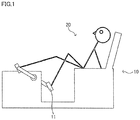
- FIG. 1 is a diagram for illustrating an example of how to use an exercise therapy device 10 according to a first embodiment of the present invention.
- the exercise therapy device 10 includes a movable portion.
- the movable portion is formed as, for example, a rotation portion 11 capable of performing a circular motion.
- the rotation portion 11 is a pair of pedals, and can be moved by an exercising person 20 applying a torque by the legs.
- a mechanical configuration of the exercise therapy device 10 may be designed based on a publicly-known exercise therapy device.
- the exercising person 20 can perform exercise therapy through use of the exercise therapy device 10.
- the exercise therapy device 10 is configured to be able to provide an isokinetic exercise.
- the exercise therapy device 10 is configured to control the motion of the rotation portion 11, to thereby be able to adjust a load on the exercising person 20.
- the load on the exercising person 20 decreases, and when the rotational speed of the rotation portion 11 is reduced, the load on the exercising person 20 increases (force-speed relationship, see " Exercise therapy Guide,” Inoue, Hajime et al., Japan Medical Journal, Third edition, p. 66, 2000 ).
- “isokinetic exercise” sometimes includes a circular motion (constant-velocity circular motion) at a constant angular velocity.
- FIG. 2 is a diagram for illustrating an example of a configuration of the exercise therapy device 10.
- the exercise therapy device 10 includes control means 12.
- the control means 12 is formed of, for example, a computer, and is configured to control an operation of the exercise therapy device 10.
- a computer having a publicly-known configuration can be used as the computer, but the computer may be, for example, a computer including calculation means (such as a CPU or other processor) and storage means (such as a semiconductor memory or an HDD).
- the control means 12 operates as target torque acquisition means, torque averaging means, and speed instruction means (a detailed description thereof is given later).
- the exercise therapy device 10 includes the target torque acquisition means, the torque averaging means, and the speed instruction means.
- the exercise therapy device 10 includes torque detection means 13.
- the torque detection means 13 is means for detecting a torque applied to the rotation portion 11, and is configured to transmit the detected torque to the control means 12.
- the torque detection means 13 can be formed of, for example, a publicly-known torque sensor or the like.
- the exercise therapy device 10 includes speed control means 14.
- the speed control means 14 is configured to control the rotational speed of the rotation portion 11.
- the speed control means 14 can be implemented based on a publicly-known configuration.
- FIG. 3 is a graph for showing an example of an F-V characteristic in the isokinetic exercise in which the exercise therapy device 10 is used.
- the vertical axis represents a peak torque F.
- the horizontal axis represents a rotational speed V.
- Both curves C1 and C2 represent the F-V characteristic of the exercising person 20.
- the curve C1 corresponds to a case of a normal physical condition.
- the curve C2 corresponds to a case of a bad physical condition.
- the exercise therapy device 10 is providing the isokinetic exercise at 20 (rpm)
- the exercising person 20 When the exercise therapy device 10 is providing the isokinetic exercise at 20 (rpm), the exercising person 20 generates a torque T2 (N ⁇ m) under the normal physical condition, but can only generate a torque T1 (N ⁇ m) under the bad physical condition.
- a muscle composition of the human includes muscles of a type I, muscles of a type IIa, and muscles of a type IIb.
- the type I relates to endurance.
- the type IIa and the type IIb relate to instantaneous force. Compared with training of the muscles of the type I, a higher load is required to train the muscles of the type IIa and the type IIb.
- a torque target torque
- the torque that the exercising person 20 can generate changes depending on factors, for example, the physical condition. It is therefore required to change a motion speed (a speed instruction value for the isokinetic exercise, and means for instructing the number of rotations in an exercise in the case of a power exercise) of the exercise therapy device 10 in accordance with the state.
- FIG. 4 is a flowchart for illustrating an example of a flow of processing by the exercise therapy device 10.
- the exercise therapy device 10 executes the processing of FIG. 4 in relation to the provision of the exercise therapy for the exercising person 20.
- the exercise therapy device 10 is an isokinetic exercise therapy device configured to provide isokinetic exercise therapy, and the rotation portion 11 rotates at a constant number of rotations.
- the control means 12 of the exercise therapy device 10 acquires the target torque (Step S1). This processing is executed by, for example, the target torque acquisition means.
- the target torque is a torque reference value serving as a reference of the operation of the exercise therapy device 10.
- the target torque to be acquired is, for example, input to the control means 12 before Step S1, and is stored in the storage means of the control means 12.
- a method of determining the target torque is any method.
- the target torque may be obtained by multiplying an average (normative data) of the maximum leg extension torques of a large number of subjects by a predetermined ratio, or by multiplying an average of past maximum extension torques of a specific exercising person 20 by the predetermined ratio.
- An example of the maximum leg extension torque is the maximum torque generated while the exercising person 20 is pedaling with the maximum effort for a few rotations.
- this ratio is lower than, for example, 0.2 corresponding to a torque at which the muscles of the type IIa and the type IIb are not used, the effect of the exercise therapy is reduced, and the ratio is thus required to correspond to a torque at which the muscles of the type IIa and the type IIb are used.
- the ratio may be 0.5 or 0.8.
- the exercising person 20 starts the use of the exercise therapy device 10 before or after Step S1, which is not shown in FIG. 4 . That is, a torque is applied to the rotation portion 11 by both of the legs, to thereby rotate the rotation portion 11.
- the control means 12 detects the torque applied to the rotation portion 11 (Step S2).
- the torque detection means 13 detects the torque, and transmits a signal indicating the detected torque to the control means 12.
- the control means 12 receives the transmitted signal.
- the torque detected in Step S2 is sometimes referred to as "actual torque.”
- the control means 12 averages the actual torques (Step S3).
- This processing is executed by, for example, the torque averaging means.
- the averaging is cyclically executed.
- the cycle corresponds to, for example, 180 cycles (180 rotations) of the motion of the rotation portion 11. For example, when the exercising person 20 has a weak right leg and a strong left leg, a torque fluctuation including a weak torque generated at a moment of a depression by the right leg, a strong torque generated at a moment of a depression by the left leg, and a torque close to zero generated when none of the legs are strained is averaged.
- the exercise therapy device 10 executes processing for changing the rotational speed of the rotation portion 11 based on the actual torque (in this example, the averaged torque) for a few minutes and the target torque (Step S4).
- This processing is executed by, for example, the speed instruction means (isokinetic instruction value changing means) and the speed control means 14.
- the control means 12 when the actual torque is higher than the target torque, the control means 12 provides control of increasing the rotational speed of the rotation portion 11. More specifically, the control means 12 generates a predetermined speed instruction, and transmits the generated speed instruction to the speed control means 14. Details of the speed instruction in this case are, for example, increasing the rotational speed (in the isokinetic exercise) from the current rotational speed by a predetermined speed difference (for example, 1 rpm) when a predetermined period of time (for example, one minute) elapses.
- the speed control means 14 controls the rotation of the rotation portion 11 in accordance with this speed instruction. In this case, it is considered that the torque generated by the exercising person 20 decreases, and a torque closer in magnitude to the target torque can consequently be generated. As described above, an exercise at an excessively high torque is avoided.
- the control means 12 provides control of decreasing the rotational speed of the rotation portion 11. More specifically, the control means 12 generates a predetermined speed instruction (speed control rotational speed), and transmits the generated speed instruction to the speed control means 14. Details of the speed instruction in this case are, for example, decreasing the rotational speed or the like(speed control rotational speed) from the current rotational speed by a predetermined speed difference when a predetermined period of time elapses.
- the speed control means 14 controls the rotation of the rotation portion 11 in accordance with this speed instruction. In this case, it is considered that the torque generated by the exercising person 20 increases, and a torque closer in magnitude to the target torque can consequently be generated. As described above, an exercise at an excessively low torque is avoided.
- control means 12 and the speed control means 14 are not required to particularly apply control to the rotation portion 11, or may apply control so that the rotational speed of the rotation portion 11 is maintained.
- Step S2 After that, the processing returns to Step S2, and the processing from Step S2 to Step S4 is repeated.
- the processing returns to Step S2, and the processing from Step S2 to Step S4 is repeated.
- the processing there is provided control of causing the actual torque to approach the target torque as the time elapses. Therefore, the magnitude of the torque is appropriately maintained, and the effect of the exercise therapy can thus be maintained.
- the load on the exercising person 20 can more appropriately be adjusted.
- a second embodiment of the present invention is changed from the first embodiment such that the exercise therapy device 10 provides an exercise other than the isokinetic exercise.
- the exercise therapy device 10 is configured to provide a power instruction exercise. Description is now given of the exercise therapy device according to the second embodiment.
- the speed control means 14 is configured not to directly control the rotational speed of the rotation portion 11, but to give an instruction to change the motion speed to the exercising person 20 so as to indirectly change the rotational speed of the rotation portion 11.
- the speed control means 14 according to the third embodiment can be configured as information output means, and may be sound output means, for example, a speaker, or image display means, for example, a liquid crystal display.
- Step S4 the control means 12 controls the speed control means 14, to thereby output information for changing the rotational speed of the rotation portion 11. For example, a pitch of a pitch sound output from a speaker is changed.
- the exercising person 20 rotates the rotation portion 11 so that the rotation matches the cycle of this pitch sound, and, as a result, the rotational speed is changed.
- the load torque on the exercising person 20 can more appropriately be adjusted.
- a third embodiment of the present invention is changed from the first embodiment or the second embodiment such that the exercise therapy device 10 is configured to be able to operate in a plurality of modes. Description is now given of the exercise therapy device according to the third embodiment.
- the exercise therapy device is configured to be able to operate in a torque reference determination mode and an exercise provision mode. Selection or switching of the mode in accordance with input from the exercising person 20 or the like can be implemented based on a publicly-known technology.
- the exercise therapy device may include a mode selection switch.
- the torque reference determination mode is a mode for determining the target torque to be acquired in Step S1 in the first embodiment.
- the control means 12 is configured to determine a torque reference (for example, the target torque in the first embodiment) based on the measured torque.
- the exercise provision mode is a mode for providing the exercise therapy.
- the operation of the exercise therapy device in the exercise provision mode may be the same as, for example, that of the exercise therapy device 10 according to the first embodiment. That is, in the exercise provision mode, the control means 12 is configured to execute processing for changing the motion speed of the rotation portion 11 based on the actual torque and the target torque.
- a method of determining the torque reference in the torque reference determination mode can appropriately be designed, and description is now given of an example thereof.
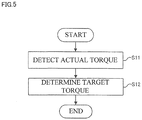
- FIG. 5 is a flowchart for illustrating an example of a flow of processing by the exercise therapy device in the torque reference determination mode.
- the control means 12 detects a torque under a state in which the rotation portion 11 is fixed (Step S11).
- the torque detection means 13 detects the torque, and transmits a signal indicating the detected torque to the control means 12.
- the control means 12 receives the transmitted signal. It is assumed that the exercising person 20 tries to rotate the rotation portion 11 with his or her full effort at this time.
- the control means 12 determines the torque reference (for example, the target torque) based on the detected torque (Step S12).
- the torque reference is calculated by multiplying the torque detected in Step S11 by a predetermined ratio.
- this ratio is lower than 0.2, the effect of the exercise therapy is reduced, and the ratio is thus required to be equal to or higher than 0.2.
- the ratio may be 0.5 or 0.8.
- the control means 12 may store the determined torque reference in the storage means. Moreover, in response to the finishing of the execution of the processing in Step S12, the mode may be switched from the torque reference determination mode to the exercise provision mode.
- the load on the exercising person 20 can more appropriately be adjusted.
- the torque reference is determined through the measurement of the actual torque, and hence the torque suited to the exercising person 20 can be set.
- the torque reference is the information indicating the magnitude of the torque, but the torque reference may be information indicating a range of the magnitude of the torque (torque reference range).
- the control means 12 may provide control of maintaining the rotational speed of the rotation portion 11.
- the control means 12 may provide control of increasing the rotational speed of the rotation portion 11.
- the control means 12 may provide control of reducing the rotational speed of the rotation portion 11.
- the actual torques are averaged in Step S3, but calculation other than the simple averaging may be executed in Step S3.
- the movable portion is formed as the rotation portion 11, and the force applied to the rotation portion 11 is represented as the torque, but the movable portion is not required to rotate.
- the movable portion may be a portion configured to perform a reciprocating motion, for example, an expander.
- a torque instead of a torque, a force that reciprocates in a certain direction may be applied to the movable portion, and the exercise therapy device may be configured to operate based on not a torque but a more general moment or force.
- the rotational speed in the first embodiment to the third embodiment may be a more general motion speed.
Landscapes
- Health & Medical Sciences (AREA)
- General Health & Medical Sciences (AREA)
- Physical Education & Sports Medicine (AREA)
- Life Sciences & Earth Sciences (AREA)
- Cardiology (AREA)
- Vascular Medicine (AREA)
- Biophysics (AREA)
- Orthopedic Medicine & Surgery (AREA)
- Epidemiology (AREA)
- Chemical Kinetics & Catalysis (AREA)
- Chemical & Material Sciences (AREA)
- Pain & Pain Management (AREA)
- Rehabilitation Therapy (AREA)
- Animal Behavior & Ethology (AREA)
- Public Health (AREA)
- Veterinary Medicine (AREA)
- Engineering & Computer Science (AREA)
- Databases & Information Systems (AREA)
- Software Systems (AREA)
- Rehabilitation Tools (AREA)
Applications Claiming Priority (1)
| Application Number | Priority Date | Filing Date | Title |
|---|---|---|---|
| PCT/JP2018/029252 WO2020026440A1 (fr) | 2018-08-03 | 2018-08-03 | Dispositif de thérapie par l'exercice |
Publications (2)
| Publication Number | Publication Date |
|---|---|
| EP3831452A1 true EP3831452A1 (fr) | 2021-06-09 |
| EP3831452A4 EP3831452A4 (fr) | 2022-03-09 |
Family
ID=69231516
Family Applications (1)
| Application Number | Title | Priority Date | Filing Date |
|---|---|---|---|
| EP18928614.9A Pending EP3831452A4 (fr) | 2018-08-03 | 2018-08-03 | Dispositif de thérapie par l'exercice |
Country Status (4)
| Country | Link |
|---|---|
| US (1) | US20210268335A1 (fr) |
| EP (1) | EP3831452A4 (fr) |
| JP (1) | JP7030198B2 (fr) |
| WO (1) | WO2020026440A1 (fr) |
Families Citing this family (10)
| Publication number | Priority date | Publication date | Assignee | Title |
|---|---|---|---|---|
| US11433276B2 (en) | 2019-05-10 | 2022-09-06 | Rehab2Fit Technologies, Inc. | Method and system for using artificial intelligence to independently adjust resistance of pedals based on leg strength |
| US11957960B2 (en) | 2019-05-10 | 2024-04-16 | Rehab2Fit Technologies Inc. | Method and system for using artificial intelligence to adjust pedal resistance |
| US11904207B2 (en) | 2019-05-10 | 2024-02-20 | Rehab2Fit Technologies, Inc. | Method and system for using artificial intelligence to present a user interface representing a user's progress in various domains |
| US12102878B2 (en) | 2019-05-10 | 2024-10-01 | Rehab2Fit Technologies, Inc. | Method and system for using artificial intelligence to determine a user's progress during interval training |
| US11801423B2 (en) | 2019-05-10 | 2023-10-31 | Rehab2Fit Technologies, Inc. | Method and system for using artificial intelligence to interact with a user of an exercise device during an exercise session |
| US11957956B2 (en) * | 2019-05-10 | 2024-04-16 | Rehab2Fit Technologies, Inc. | System, method and apparatus for rehabilitation and exercise |
| US11833393B2 (en) | 2019-05-15 | 2023-12-05 | Rehab2Fit Technologies, Inc. | System and method for using an exercise machine to improve completion of an exercise |
| US11801419B2 (en) | 2019-05-23 | 2023-10-31 | Rehab2Fit Technologies, Inc. | System, method and apparatus for rehabilitation and exercise with multi-configurable accessories |
| US11896540B2 (en) | 2019-06-24 | 2024-02-13 | Rehab2Fit Technologies, Inc. | Method and system for implementing an exercise protocol for osteogenesis and/or muscular hypertrophy |
| US20220314072A1 (en) | 2021-03-30 | 2022-10-06 | Rehab2Fit Technologies, Inc. | Adjustment of exercise based on artificial intelligence, exercise plan, and user feedback |
Family Cites Families (12)
| Publication number | Priority date | Publication date | Assignee | Title |
|---|---|---|---|---|
| US4930770A (en) * | 1988-12-01 | 1990-06-05 | Baker Norman A | Eccentrically loaded computerized positive/negative exercise machine |
| JP2771606B2 (ja) * | 1989-06-20 | 1998-07-02 | 三洋電機株式会社 | 運動負荷装置 |
| JP3713743B2 (ja) * | 1995-04-14 | 2005-11-09 | 松下電工株式会社 | トレーニング装置 |
| DE19615392C1 (de) * | 1996-04-18 | 1998-01-15 | Bavaria Patente & Lizenzen | Trainings-, Diagnose- und Rehabilitationsgerät nach Art eines Fahrradergometers |
| JPH11128397A (ja) * | 1997-11-04 | 1999-05-18 | Omron Corp | 運動装置および運動装置用プログラム記録媒体 |
| JP3929230B2 (ja) * | 2000-04-26 | 2007-06-13 | 三菱電機エンジニアリング株式会社 | 運動療法装置 |
| US20060247095A1 (en) * | 2001-09-21 | 2006-11-02 | Rummerfield Patrick D | Method and apparatus for promoting nerve regeneration in paralyzed patients |
| EP1900398B1 (fr) * | 2006-09-12 | 2009-12-16 | Sport Service Mapei S.R.L. | Ergomètre en forme de bicyclette |
| US20080146416A1 (en) * | 2006-12-13 | 2008-06-19 | Motorola, Inc. | Generation of user activity feedback |
| GB201103918D0 (en) | 2011-03-08 | 2011-04-20 | Hero Holdings Ltd | Exercise apparatus |
| JP6184353B2 (ja) | 2014-03-17 | 2017-08-23 | 三菱電機エンジニアリング株式会社 | 運動療法装置の制御装置および制御方法 |
| IT201600083062A1 (it) * | 2016-08-05 | 2018-02-05 | Technogym Spa | Apparecchiatura ginnica per simulazione ciclistica e relativo metodo di funzionamento. |
-
2018
- 2018-08-03 JP JP2020534021A patent/JP7030198B2/ja active Active
- 2018-08-03 US US17/258,178 patent/US20210268335A1/en not_active Abandoned
- 2018-08-03 EP EP18928614.9A patent/EP3831452A4/fr active Pending
- 2018-08-03 WO PCT/JP2018/029252 patent/WO2020026440A1/fr not_active Ceased
Also Published As
| Publication number | Publication date |
|---|---|
| JPWO2020026440A1 (ja) | 2021-03-11 |
| US20210268335A1 (en) | 2021-09-02 |
| WO2020026440A1 (fr) | 2020-02-06 |
| JP7030198B2 (ja) | 2022-03-04 |
| EP3831452A4 (fr) | 2022-03-09 |
Similar Documents
| Publication | Publication Date | Title |
|---|---|---|
| EP3831452A1 (fr) | Dispositif de thérapie par l'exercice | |
| JP6184353B2 (ja) | 運動療法装置の制御装置および制御方法 | |
| US11317855B2 (en) | Spasticity evaluation device, method and system | |
| US9901779B2 (en) | Control apparatus and method for exercise therapy device | |
| JP2017086871A (ja) | 起立補助方法及び装置 | |
| JP6544646B2 (ja) | 筋疲労決定装置、筋疲労決定方法、及び筋疲労決定用プログラム | |
| EP2837409A1 (fr) | Appareil d'exercice | |
| JPH09225080A (ja) | トレーニング装置 | |
| JP2011050451A (ja) | 歩行リハビリ装置 | |
| WO2013006145A1 (fr) | Système d'entraîneament à la technique de l'aviron | |
| JP6319730B2 (ja) | 電気刺激装置の制御装置、電気刺激装置、および、ペダルこぎ運動システム | |
| KR102496574B1 (ko) | 토크 출력 타이밍 조정 방법 및 장치 | |
| US20190091513A1 (en) | Motion correction apparatus | |
| US20260115518A1 (en) | Resistance adjustment method and apparatus for exercise equipment, and computer-readable storage medium | |
| EP4245382A2 (fr) | Procédé et dispositif d'entraînement | |
| KR20040067524A (ko) | 자동 속도 조절 런닝머신 | |
| CN114904210A (zh) | 一种力量训练器械控制方法、装置及力量训练器械 | |
| KR20220055071A (ko) | 가상 점탄성운동을 구현하는 전동식 운동장치 및 이의 작동방법 | |
| US11406871B2 (en) | Ergometer | |
| Bielak et al. | Static and dynamic ergonomic corrects of torque controlled in bicycle ergometer | |
| WO2022018938A1 (fr) | Dispositif de support d'exercice et procédé de support d'exercice | |
| CN121641411A (zh) | 力量测试方法及力量测试设备 | |
| KR101288351B1 (ko) | Gps 기능 및 복수의 센서들을 이용한 운동량 측정 장치 및 그 방법 | |
| JP2008246164A (ja) | 活動量計 | |
| TWI894073B (zh) | 健身裝置及其阻力調整方法 |
Legal Events
| Date | Code | Title | Description |
|---|---|---|---|
| STAA | Information on the status of an ep patent application or granted ep patent |
Free format text: STATUS: THE INTERNATIONAL PUBLICATION HAS BEEN MADE |
|
| PUAI | Public reference made under article 153(3) epc to a published international application that has entered the european phase |
Free format text: ORIGINAL CODE: 0009012 |
|
| STAA | Information on the status of an ep patent application or granted ep patent |
Free format text: STATUS: REQUEST FOR EXAMINATION WAS MADE |
|
| 17P | Request for examination filed |
Effective date: 20201229 |
|
| AK | Designated contracting states |
Kind code of ref document: A1 Designated state(s): AL AT BE BG CH CY CZ DE DK EE ES FI FR GB GR HR HU IE IS IT LI LT LU LV MC MK MT NL NO PL PT RO RS SE SI SK SM TR |
|
| RAP3 | Party data changed (applicant data changed or rights of an application transferred) |
Owner name: MITSUBISHI ELECTRIC ENGINEERING COMPANY, LIMITED |
|
| DAV | Request for validation of the european patent (deleted) | ||
| DAX | Request for extension of the european patent (deleted) | ||
| A4 | Supplementary search report drawn up and despatched |
Effective date: 20220209 |
|
| RIC1 | Information provided on ipc code assigned before grant |
Ipc: A63B 71/06 20060101ALN20220203BHEP Ipc: A63B 24/00 20060101ALI20220203BHEP Ipc: A63B 21/002 20060101ALI20220203BHEP Ipc: A63B 21/00 20060101ALI20220203BHEP Ipc: A61H 1/02 20060101ALI20220203BHEP Ipc: A63B 22/06 20060101AFI20220203BHEP |
|
| STAA | Information on the status of an ep patent application or granted ep patent |
Free format text: STATUS: EXAMINATION IS IN PROGRESS |
|
| 17Q | First examination report despatched |
Effective date: 20230913 |
|
| RIC1 | Information provided on ipc code assigned before grant |
Ipc: A63B 22/06 20060101AFI20250623BHEP Ipc: A61H 1/02 20060101ALI20250623BHEP Ipc: A63B 21/00 20060101ALI20250623BHEP Ipc: A63B 21/002 20060101ALI20250623BHEP Ipc: A63B 24/00 20060101ALI20250623BHEP Ipc: A63B 71/06 20060101ALN20250623BHEP |