EP3831896A1 - Polymères conducteurs organiquement solubles - Google Patents
Polymères conducteurs organiquement solubles Download PDFInfo
- Publication number
- EP3831896A1 EP3831896A1 EP20211787.5A EP20211787A EP3831896A1 EP 3831896 A1 EP3831896 A1 EP 3831896A1 EP 20211787 A EP20211787 A EP 20211787A EP 3831896 A1 EP3831896 A1 EP 3831896A1
- Authority
- EP
- European Patent Office
- Prior art keywords
- pedot
- conductive polymer
- polymer coating
- anions
- tsa
- Prior art date
- Legal status (The legal status is an assumption and is not a legal conclusion. Google has not performed a legal analysis and makes no representation as to the accuracy of the status listed.)
- Pending
Links
Images
Classifications
-
- C—CHEMISTRY; METALLURGY
- C08—ORGANIC MACROMOLECULAR COMPOUNDS; THEIR PREPARATION OR CHEMICAL WORKING-UP; COMPOSITIONS BASED THEREON
- C08G—MACROMOLECULAR COMPOUNDS OBTAINED OTHERWISE THAN BY REACTIONS ONLY INVOLVING UNSATURATED CARBON-TO-CARBON BONDS
- C08G61/00—Macromolecular compounds obtained by reactions forming a carbon-to-carbon link in the main chain of the macromolecule
- C08G61/12—Macromolecular compounds containing atoms other than carbon in the main chain of the macromolecule
- C08G61/122—Macromolecular compounds containing atoms other than carbon in the main chain of the macromolecule derived from five- or six-membered heterocyclic compounds, other than imides
- C08G61/123—Macromolecular compounds containing atoms other than carbon in the main chain of the macromolecule derived from five- or six-membered heterocyclic compounds, other than imides derived from five-membered heterocyclic compounds
- C08G61/126—Macromolecular compounds containing atoms other than carbon in the main chain of the macromolecule derived from five- or six-membered heterocyclic compounds, other than imides derived from five-membered heterocyclic compounds with a five-membered ring containing one sulfur atom in the ring
-
- C—CHEMISTRY; METALLURGY
- C08—ORGANIC MACROMOLECULAR COMPOUNDS; THEIR PREPARATION OR CHEMICAL WORKING-UP; COMPOSITIONS BASED THEREON
- C08K—Use of inorganic or non-macromolecular organic substances as compounding ingredients
- C08K5/00—Use of organic ingredients
- C08K5/36—Sulfur-, selenium-, or tellurium-containing compounds
- C08K5/41—Compounds containing sulfur bound to oxygen
- C08K5/42—Sulfonic acids; Derivatives thereof
-
- C—CHEMISTRY; METALLURGY
- C09—DYES; PAINTS; POLISHES; NATURAL RESINS; ADHESIVES; COMPOSITIONS NOT OTHERWISE PROVIDED FOR; APPLICATIONS OF MATERIALS NOT OTHERWISE PROVIDED FOR
- C09D—COATING COMPOSITIONS, e.g. PAINTS, VARNISHES OR LACQUERS; FILLING PASTES; CHEMICAL PAINT OR INK REMOVERS; INKS; CORRECTING FLUIDS; WOODSTAINS; PASTES OR SOLIDS FOR COLOURING OR PRINTING; USE OF MATERIALS THEREFOR
- C09D165/00—Coating compositions based on macromolecular compounds obtained by reactions forming a carbon-to-carbon link in the main chain; Coating compositions based on derivatives of such polymers
-
- C—CHEMISTRY; METALLURGY
- C09—DYES; PAINTS; POLISHES; NATURAL RESINS; ADHESIVES; COMPOSITIONS NOT OTHERWISE PROVIDED FOR; APPLICATIONS OF MATERIALS NOT OTHERWISE PROVIDED FOR
- C09D—COATING COMPOSITIONS, e.g. PAINTS, VARNISHES OR LACQUERS; FILLING PASTES; CHEMICAL PAINT OR INK REMOVERS; INKS; CORRECTING FLUIDS; WOODSTAINS; PASTES OR SOLIDS FOR COLOURING OR PRINTING; USE OF MATERIALS THEREFOR
- C09D5/00—Coating compositions, e.g. paints, varnishes or lacquers, characterised by their physical nature or the effects produced; Filling pastes
- C09D5/08—Anti-corrosive paints
-
- C—CHEMISTRY; METALLURGY
- C09—DYES; PAINTS; POLISHES; NATURAL RESINS; ADHESIVES; COMPOSITIONS NOT OTHERWISE PROVIDED FOR; APPLICATIONS OF MATERIALS NOT OTHERWISE PROVIDED FOR
- C09D—COATING COMPOSITIONS, e.g. PAINTS, VARNISHES OR LACQUERS; FILLING PASTES; CHEMICAL PAINT OR INK REMOVERS; INKS; CORRECTING FLUIDS; WOODSTAINS; PASTES OR SOLIDS FOR COLOURING OR PRINTING; USE OF MATERIALS THEREFOR
- C09D5/00—Coating compositions, e.g. paints, varnishes or lacquers, characterised by their physical nature or the effects produced; Filling pastes
- C09D5/24—Electrically-conducting paints
-
- C—CHEMISTRY; METALLURGY
- C09—DYES; PAINTS; POLISHES; NATURAL RESINS; ADHESIVES; COMPOSITIONS NOT OTHERWISE PROVIDED FOR; APPLICATIONS OF MATERIALS NOT OTHERWISE PROVIDED FOR
- C09D—COATING COMPOSITIONS, e.g. PAINTS, VARNISHES OR LACQUERS; FILLING PASTES; CHEMICAL PAINT OR INK REMOVERS; INKS; CORRECTING FLUIDS; WOODSTAINS; PASTES OR SOLIDS FOR COLOURING OR PRINTING; USE OF MATERIALS THEREFOR
- C09D7/00—Features of coating compositions, not provided for in group C09D5/00; Processes for incorporating ingredients in coating compositions
- C09D7/20—Diluents or solvents
-
- H—ELECTRICITY
- H01—ELECTRIC ELEMENTS
- H01B—CABLES; CONDUCTORS; INSULATORS; SELECTION OF MATERIALS FOR THEIR CONDUCTIVE, INSULATING OR DIELECTRIC PROPERTIES
- H01B1/00—Conductors or conductive bodies characterised by the conductive materials; Selection of materials as conductors
- H01B1/06—Conductors or conductive bodies characterised by the conductive materials; Selection of materials as conductors mainly consisting of other non-metallic substances
- H01B1/12—Conductors or conductive bodies characterised by the conductive materials; Selection of materials as conductors mainly consisting of other non-metallic substances organic substances
- H01B1/124—Intrinsically conductive polymers
- H01B1/127—Intrinsically conductive polymers comprising five-membered aromatic rings in the main chain, e.g. polypyrroles, polythiophenes
-
- C—CHEMISTRY; METALLURGY
- C08—ORGANIC MACROMOLECULAR COMPOUNDS; THEIR PREPARATION OR CHEMICAL WORKING-UP; COMPOSITIONS BASED THEREON
- C08G—MACROMOLECULAR COMPOUNDS OBTAINED OTHERWISE THAN BY REACTIONS ONLY INVOLVING UNSATURATED CARBON-TO-CARBON BONDS
- C08G2261/00—Macromolecular compounds obtained by reactions forming a carbon-to-carbon link in the main chain of the macromolecule
- C08G2261/10—Definition of the polymer structure
- C08G2261/11—Homopolymers
-
- C—CHEMISTRY; METALLURGY
- C08—ORGANIC MACROMOLECULAR COMPOUNDS; THEIR PREPARATION OR CHEMICAL WORKING-UP; COMPOSITIONS BASED THEREON
- C08G—MACROMOLECULAR COMPOUNDS OBTAINED OTHERWISE THAN BY REACTIONS ONLY INVOLVING UNSATURATED CARBON-TO-CARBON BONDS
- C08G2261/00—Macromolecular compounds obtained by reactions forming a carbon-to-carbon link in the main chain of the macromolecule
- C08G2261/10—Definition of the polymer structure
- C08G2261/14—Side-groups
- C08G2261/142—Side-chains containing oxygen
- C08G2261/1424—Side-chains containing oxygen containing ether groups, including alkoxy
-
- C—CHEMISTRY; METALLURGY
- C08—ORGANIC MACROMOLECULAR COMPOUNDS; THEIR PREPARATION OR CHEMICAL WORKING-UP; COMPOSITIONS BASED THEREON
- C08G—MACROMOLECULAR COMPOUNDS OBTAINED OTHERWISE THAN BY REACTIONS ONLY INVOLVING UNSATURATED CARBON-TO-CARBON BONDS
- C08G2261/00—Macromolecular compounds obtained by reactions forming a carbon-to-carbon link in the main chain of the macromolecule
- C08G2261/30—Monomer units or repeat units incorporating structural elements in the main chain
- C08G2261/32—Monomer units or repeat units incorporating structural elements in the main chain incorporating heteroaromatic structural elements in the main chain
- C08G2261/322—Monomer units or repeat units incorporating structural elements in the main chain incorporating heteroaromatic structural elements in the main chain non-condensed
- C08G2261/3223—Monomer units or repeat units incorporating structural elements in the main chain incorporating heteroaromatic structural elements in the main chain non-condensed containing one or more sulfur atoms as the only heteroatom, e.g. thiophene
-
- C—CHEMISTRY; METALLURGY
- C08—ORGANIC MACROMOLECULAR COMPOUNDS; THEIR PREPARATION OR CHEMICAL WORKING-UP; COMPOSITIONS BASED THEREON
- C08G—MACROMOLECULAR COMPOUNDS OBTAINED OTHERWISE THAN BY REACTIONS ONLY INVOLVING UNSATURATED CARBON-TO-CARBON BONDS
- C08G2261/00—Macromolecular compounds obtained by reactions forming a carbon-to-carbon link in the main chain of the macromolecule
- C08G2261/30—Monomer units or repeat units incorporating structural elements in the main chain
- C08G2261/32—Monomer units or repeat units incorporating structural elements in the main chain incorporating heteroaromatic structural elements in the main chain
- C08G2261/324—Monomer units or repeat units incorporating structural elements in the main chain incorporating heteroaromatic structural elements in the main chain condensed
- C08G2261/3243—Monomer units or repeat units incorporating structural elements in the main chain incorporating heteroaromatic structural elements in the main chain condensed containing one or more sulfur atoms as the only heteroatom, e.g. benzothiophene
-
- C—CHEMISTRY; METALLURGY
- C08—ORGANIC MACROMOLECULAR COMPOUNDS; THEIR PREPARATION OR CHEMICAL WORKING-UP; COMPOSITIONS BASED THEREON
- C08G—MACROMOLECULAR COMPOUNDS OBTAINED OTHERWISE THAN BY REACTIONS ONLY INVOLVING UNSATURATED CARBON-TO-CARBON BONDS
- C08G2261/00—Macromolecular compounds obtained by reactions forming a carbon-to-carbon link in the main chain of the macromolecule
- C08G2261/30—Monomer units or repeat units incorporating structural elements in the main chain
- C08G2261/33—Monomer units or repeat units incorporating structural elements in the main chain incorporating non-aromatic structural elements in the main chain
- C08G2261/334—Monomer units or repeat units incorporating structural elements in the main chain incorporating non-aromatic structural elements in the main chain containing heteroatoms
-
- C—CHEMISTRY; METALLURGY
- C08—ORGANIC MACROMOLECULAR COMPOUNDS; THEIR PREPARATION OR CHEMICAL WORKING-UP; COMPOSITIONS BASED THEREON
- C08G—MACROMOLECULAR COMPOUNDS OBTAINED OTHERWISE THAN BY REACTIONS ONLY INVOLVING UNSATURATED CARBON-TO-CARBON BONDS
- C08G2261/00—Macromolecular compounds obtained by reactions forming a carbon-to-carbon link in the main chain of the macromolecule
- C08G2261/40—Polymerisation processes
- C08G2261/41—Organometallic coupling reactions
-
- C—CHEMISTRY; METALLURGY
- C08—ORGANIC MACROMOLECULAR COMPOUNDS; THEIR PREPARATION OR CHEMICAL WORKING-UP; COMPOSITIONS BASED THEREON
- C08G—MACROMOLECULAR COMPOUNDS OBTAINED OTHERWISE THAN BY REACTIONS ONLY INVOLVING UNSATURATED CARBON-TO-CARBON BONDS
- C08G2261/00—Macromolecular compounds obtained by reactions forming a carbon-to-carbon link in the main chain of the macromolecule
- C08G2261/40—Polymerisation processes
- C08G2261/43—Chemical oxidative coupling reactions, e.g. with FeCl3
-
- C—CHEMISTRY; METALLURGY
- C08—ORGANIC MACROMOLECULAR COMPOUNDS; THEIR PREPARATION OR CHEMICAL WORKING-UP; COMPOSITIONS BASED THEREON
- C08G—MACROMOLECULAR COMPOUNDS OBTAINED OTHERWISE THAN BY REACTIONS ONLY INVOLVING UNSATURATED CARBON-TO-CARBON BONDS
- C08G2261/00—Macromolecular compounds obtained by reactions forming a carbon-to-carbon link in the main chain of the macromolecule
- C08G2261/50—Physical properties
- C08G2261/51—Charge transport
- C08G2261/514—Electron transport
-
- C—CHEMISTRY; METALLURGY
- C08—ORGANIC MACROMOLECULAR COMPOUNDS; THEIR PREPARATION OR CHEMICAL WORKING-UP; COMPOSITIONS BASED THEREON
- C08G—MACROMOLECULAR COMPOUNDS OBTAINED OTHERWISE THAN BY REACTIONS ONLY INVOLVING UNSATURATED CARBON-TO-CARBON BONDS
- C08G2261/00—Macromolecular compounds obtained by reactions forming a carbon-to-carbon link in the main chain of the macromolecule
- C08G2261/50—Physical properties
- C08G2261/58—Physical properties corrosion-inhibiting
-
- C—CHEMISTRY; METALLURGY
- C08—ORGANIC MACROMOLECULAR COMPOUNDS; THEIR PREPARATION OR CHEMICAL WORKING-UP; COMPOSITIONS BASED THEREON
- C08G—MACROMOLECULAR COMPOUNDS OBTAINED OTHERWISE THAN BY REACTIONS ONLY INVOLVING UNSATURATED CARBON-TO-CARBON BONDS
- C08G2261/00—Macromolecular compounds obtained by reactions forming a carbon-to-carbon link in the main chain of the macromolecule
- C08G2261/70—Post-treatment
- C08G2261/79—Post-treatment doping
- C08G2261/792—Post-treatment doping with low-molecular weight dopants
-
- C—CHEMISTRY; METALLURGY
- C08—ORGANIC MACROMOLECULAR COMPOUNDS; THEIR PREPARATION OR CHEMICAL WORKING-UP; COMPOSITIONS BASED THEREON
- C08G—MACROMOLECULAR COMPOUNDS OBTAINED OTHERWISE THAN BY REACTIONS ONLY INVOLVING UNSATURATED CARBON-TO-CARBON BONDS
- C08G2261/00—Macromolecular compounds obtained by reactions forming a carbon-to-carbon link in the main chain of the macromolecule
- C08G2261/90—Applications
- C08G2261/91—Photovoltaic applications
-
- C—CHEMISTRY; METALLURGY
- C08—ORGANIC MACROMOLECULAR COMPOUNDS; THEIR PREPARATION OR CHEMICAL WORKING-UP; COMPOSITIONS BASED THEREON
- C08K—Use of inorganic or non-macromolecular organic substances as compounding ingredients
- C08K2201/00—Specific properties of additives
- C08K2201/001—Conductive additives
Definitions
- aspects generally relate to polymerization processes, coatings, and articles comprising electrically conductive polymers doped with a sulfonic acid in which the conductive polymers are soluble in organic solvents.
- Conductive polymers such as polyethylenedioxythiophene (PEDOT) and polyaniline (PANI) have been proposed for various uses in the manufacture and service of aircrafts, spacecrafts, and other machinery.
- PEDOT polyethylenedioxythiophene
- PANI polyaniline
- conductive polymers have been proposed as a deicing coating for airfoils, such as wings for aircrafts and rotor blades for rotorcraft vehicles. Conductive polymers can help spread heat from internal and/or external heating elements to desired area of the airfoils.
- conductive polymers have been proposed as an electrostatic dissipative coating.
- a surface of a vehicle, such as an aircraft builds static charge when in motion.
- a nose and/or airfoils of an aircraft may build a form of static electricity known as precipitation static. Precipitation static may negatively impact the electronics of an aircraft, such as radar located behind the nose of the aircraft.
- conductive polymers have been proposed as a chromate-free corrosion protection coating.
- Metals such as steel, aluminum, aluminum alloys, and galvanized metals, used in the manufacture of aircrafts, spacecrafts, and other machinery are susceptible to corrosive attack.
- Chromates such as zinc salts of hexavalent chromium, have been used as corrosion inhibitors in corrosion inhibiting coatings.
- Conductive polymers can provide corrosion protection to aircrafts, spacecrafts, and other machinery as a primer, a sealant, a base coat, an intermediate coat, or a topcoat. Conductive polymers help to passivate metal surfaces by shifting the corrosion potential of the metal surfaces.
- Conductive polymers typically contain dopants to charge the polymer backbone.
- PEDOT can utilize polystyrene sulfonic acid (PSSA) as a counter anion (dopant) to the positively charged PEDOT polymer backbone.
- PSSA polystyrene sulfonic acid
- PEDOT:PSSA polymers are limited in its applications since the polymers are only soluble in aqueous solvents and are incompatible with binder resins which are soluble in organic solvents.
- PANI utilizes dinonylnapthalenesulfonic acid (DNNSA) as a counter anion dopant.
- DNNSA dinonylnapthalenesulfonic acid
- PANI:DNNSA has limited thermal stability and typically decomposes at around 150°C.
- conductive polymers may require a post-treatment, such as an isopropyl alcohol (IPA) post-treatment wash, to increase the conductivity of the polymers.
- IPA isopropyl alcohol
- post-treatments increase manufacturing and service time and costs.
- a method of producing an electrically conductive polymer that is soluble in an organic solvent includes reacting ethylenedioxythiophene (EDOT) monomers, a transition-metal p-toluenesulfonic acid (p-TSA) as an oxidizing agent, and a sulfonic acid to form polyethylenedioxythiophene (PEDOT) doped with a plurality of anions of the sulfonic acid in a reaction product mixture.
- the reaction product mixture is washed with an aqueous solution.
- the PEDOT doped with anions of the sulfonic acid is retained in an organic phase of the reaction product mixture.
- the PEDOT doped with anions is isolated from the organic phase.
- a method of forming a conductive polymer coating over a substrate includes dissolving polyethylenedioxythiophene (PEDOT) doped with a plurality of anions and a binder resin in an organic solvent to form a conductive polymer coating composition.
- the conductive polymer coating composition is applied over the substrate to form the conductive polymer coating.
- the conductive polymer coating is dried at a temperature less than 100°C for a time period of at least one hour.
- a conductive polymer coating formed on a surface includes polyethylenedioxythiophene (PEDOT) doped with a plurality of dinonylnapthalenesulfonic acid (DNNSA) anions.
- PEDOT polyethylenedioxythiophene
- DNNSA dinonylnapthalenesulfonic acid
- the PEDOT has a resistivity of about 100,000 Ohms or less.
- the surface is selected from a group consisting of a metal surface, a carbon allotrope surface, an edge protection layer surface, and a spacecraft surface.
- compositions, an element or a group of elements are preceded with the transitional phrase “comprising,” it is understood that we also contemplate the same composition or group of elements with transitional phrases “consisting essentially of,” “consisting of,” “selected from the group of consisting of,” or “I”” preceding the recitation of the composition, element, or elements and vice versa, e.g., the terms “comprising,” “consisting essentially of,” “consisting of” also include the product of the combinations of elements listed after the term.
- ranges from any lower limit may be combined with any upper limit to recite a range not explicitly recited, as well as, ranges from any lower limit may be combined with any other lower limit to recite a range not explicitly recited, in the same way, ranges from any upper limit may be combined with any other upper limit to recite a range not explicitly recited.
- ranges from any upper limit may be combined with any other upper limit to recite a range not explicitly recited.
- within a range includes every point or individual value between its end points even though not explicitly recited. Thus, every point or individual value may serve as its own lower or upper limit combined with any other point or individual value or any other lower or upper limit, to recite a range not explicitly recited.
- the present conductive polymers are soluble in organic solvents.
- the conductive polymers can be used in coating compositions with binder resins in organic solvents to form conductive polymer coatings.
- a conductive polymer can be poly(3,4-ethylene dioxythiophene) (PEDOT) synthesized by oxidation of 3,4-ethylene dioxythiophene (EDOT) with dinonylnaphthalenesulfonic acid (DNNSA) forming a dopant anion with a transition-metal p-toluenesulfonic acid (p-TSA) as an oxidizing agent.
- PEDOT doped with DNNSA is electrically conductive and soluble in organic solvents.
- Oxidative chemical polymerization can produce industrial amounts of PEDOT:DNNSA conductive polymers.
- the present PEDOT:DNNSA conductive polymers can be dissolved in organic solvents and applied to form coatings over surfaces of an aircraft, spacecraft, marinecraft, or other machinery as a deicing coating, an electrostatic dissipative coating, a corrosion protection coating, or other suitable application.
- post-treatments of the formed coatings such as thermal curing above 100°C and/or an organic solvent wash, are unnecessary to form conductive polymer coatings, such as PEDOT:DNNSA conductive polymer coatings, with high conductivity.
- Conductive polymers can be synthesized by various reactions, including oxidative chemical polymerization, electrochemical polymerization, radical polymerization, plasma polymerization, vapor-phase polymerization, and other processes.
- the conductive polymers are synthesized by oxidative chemical polymerization with an oxidant acting as a catalyst.
- oxidants include transition-metal p-toluenesulfonic acid (p-TSA), transition-metal tetrasulfonated phthalocyanine (TSPc), ammonium persulfate (APS), other persulfates, other peroxides, and other oxidants.
- Oxidative chemical polymerization process can have one or more of the following attributes: a polymerization process conducted at about room temperature, formation of a conductive polymer soluble in an organic solvent, and/or formation of a conductive polymer coating without the need for a post-treatment.
- Conductive polymers can be polyethylenedioxythiophene (PEDOT), propylenedioxythiophene (ProDOT), polyaniline (PANI), polythiophene, polypyrrole, polyacetylene, poly(phenylene vinylene), poly(styrenesulfonate) (PSS), or other conductive polymers.
- the conductive polymers are PEDOTs due to their high conductivity in comparison to other conductive polymers, such as in comparison to ProDOT.
- PEDOT is made by polymerizing monomers of unfuctionalized or functionalized 3,4-ethylenedioxythiophene (EDOT) or derivatives thereof.
- PEDOT is may be polymerizing unfuctionalized EDOT. Using functionalized EDOT may undesirably increase the manufacturing costs of PEDOT and/or may undesirably reduce the solubility of PEDOT in an organic solvent.
- Conductive polymers such as PEDOT
- Example dopants of conductive polymers that form anions include sulfonic acids, thiols, and other suitable organic acids.
- Organic acids of the general formula (HA) can dissociate into H+ and an Anion-.
- the anion of the organic acid HA can be one of the dopants in the conductive polymers.
- a sulfonic acid of dinonylnapthalenesulfonic acid (DNNSA) and isomers thereof is used to dope the conductive polymer, such as PEDOT.
- DNNSA dinonylnapthalenesulfonic acid
- isomers thereof is used to dope the conductive polymer, such as PEDOT.
- DNNSA enhances the solubility and processing of conductive polymers, such as PEDOT, in organic solvents.
- sulfonic acids can be methylnaphthylsulfonic acid, ethylnaphthylsulfonic acid, propylnaphthylsulfonic acid, butylnaphthylsulfonic acid, pentylnaphthylsulfonic acid, hexylnaphthylsulfonic acid, heptylnaphthylsulfonic acid, octylnaphthylsulfonic acid, nonylnaphthylsulfonic acid, decylnaphthylsulfonic acid, dimethylnaphthylsulfonic acid, diethylnaphthylsulfonic acid, dipropylnaphthylsulfonic acid, dibutylnaphthylsulfonic acid, dipentylnaphthy
- Cation dopants can be associated with the anions of the doped PEDOT.
- cation dopants can be associated with the negatively charged sulfonate anions of DNNSA or P-TSA of the doped PEDOT.
- Cation dopants include cerium, molybdenum, magnesium, zirconium, titanium, vanadium, hafnium, silicon, aluminum, boron, cobalt, zinc, and other metallic ions.
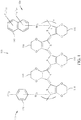
- FIG. 1 is an example illustrating PEDOT 100 comprising unfunctionalized EDOT monomer units 110 doped with anions 120.
- PEDOT 100 was synthesized by an oxidant of transition-metal p-toluenesulfonic acid (p-TSA), such as Fe (III) p-TSA.
- p-TSA transition-metal p-toluenesulfonic acid
- the PEDOT 100 can include the p-TSA anion 130 as one of the dopants in the backbone of the PEDOT polymer chain.
- the PEDOT 100 may further be synthesized with or redoped with a sulfonic acid, such as DNNSA.
- the PEDOT 100 includes p-TSA anions 130 and DNNSA anions 140.
- the PEDOT 100 includes DNNSA anions 140 with minor amounts of p-TSA anions.
- the PEDOT doped with p-TSA can be dedoped to form dedoped PEDOT.
- the dedoped PEDOT can be redoped with DNNSA anions.
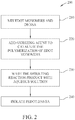
- FIG. 2 is an example illustrating a process 200 of synthesizing PEDOT by chemical oxidation and doping PEDOT with anions.
- EDOT monomers and DNNSA are mixed together.
- DNNSA is available from King Industries located in Norwalk, CT as a solution in organic solvent.
- a molar ratio of DNNSA to EDOT monomers is about 1.0 or greater. It is believed that a molar ratio of DNNSA to EDOT monomers of 1.0 or greater can provide a PEDOT that is substantially doped with DNNSA anions to available anion dopant sites within the PEDOT polymer backbone.
- the DNNSA anions replace oxidizing agent anions or competes with oxidizing agents to occupy cations sites within the PEDOT polymer backbone.
- a higher ratio of DNNSA anions versus oxidizing agent anions doped within the PEDOT polymer backbone provides increased solubility of the PEDOT in organic solvents.
- the molar ratio of DNNSA to oxidizing agent is 1.4 or greater or 1.5 or greater.
- an oxidizing agent is added to the EDOT/DNNSA solution.
- the oxidizing agent is a transition-metal p-toluenesulfonic acid (p-TSA), such as Fe (III) p-TSA.
- p-TSA transition-metal p-toluenesulfonic acid
- a molar ratio of transition-metal p-TSA to EDOT monomers is about 1.0 or greater. While not being bound by any particular theory, it is believed that a molar ratio of transition-metal p-TSA to EDOT monomers of 1.0 or greater causes a high rate of polymerization causing intertwining of PEDOT polymer chains.
- a molar ratio of transition-metal p-TSA to EDOT monomers of less than 1.0 may result in formation of discrete PEDOT polymer chains.
- Intertwined PEDOT polymer chains used in a coating exhibit lower resistivity compared to discrete PEDOT polymer chains due to the larger aggregated particle size of intertwined PEDOT polymer chains compared to discrete PEDOT polymer chains.
- Additional water can be added to the mixture to improve the dispersion of the oxidizing agent within the mixture.
- the EDOT monomers, DNNSA, and oxidizing agent can be mixed together until substantial completion of the reaction, such as from about 1 hour to about 72 hours.
- the polymerization reaction can be conducted at about room temperature. For example, there is no need to actively cool the reaction mixture below room temperature or to active heat the reaction mixture above room temperature.
- polymerizing EDOT monomers in the presence of DNNSA reduces manufacturing costs of EDOT by avoiding additional steps of dedoping PEDOT and redoping PEDOT with DNNSA anions and/or by avoiding additional isolation steps which would reduce the yield.
- the resulting reaction product is washed with an aqueous solution to form organic and aqueous phases.
- Additional amounts of organic solvent such as toluene, xylene, or other suitable organic solvents, and additional amounts of water can be added to the reaction product.
- Suitable organic solvents include organic solvents with a dipole moment of less than 1.5.
- the organic and aqueous phases are separated to retain the organic phase.
- PEDOT is soluble in the organic solvent. Unreacted oxidizing agent and other impurities are retained in the aqueous phase.
- Organic solvents with a dipole moment of 1.5 or greater may not form distinct phases with water to separate the PEDOT from unreacted oxidizing agent and impurities.
- the reaction product is washed one or more times with water.
- the reaction product is washed with a non-alkaline aqueous solution, such as water or a dilute acidic solution. Washing with an alkaline aqueous solution may undesirably remove DNNSA dopants from the PEDOT polymer backbone which could undesirably increase the resistivity of the resulting PEDOT.
- a non-alkaline aqueous solution such as water or a dilute acidic solution. Washing with an alkaline aqueous solution may undesirably remove DNNSA dopants from the PEDOT polymer backbone which could undesirably increase the resistivity of the resulting PEDOT.
- PEDOT doped with DNNSA is isolated from the washed reaction product in the organic solvent. Isolation techniques include rotary evaporation to remove the organic solvent, precipitation, filtering, other isolation techniques, and combinations thereof.
- the PEDOT:DNNSA conductive polymer can be air dried or dried with heated forced air at a temperature of about 100°C or less. In certain aspects, drying of conductive polymers at temperature greater than 100°C may cause over oxidation of the conductive polymers resulting in increasing the resistivity of the polymer.
- the synthesis process 200 can be scalable using batch or flow synthetic processes to yield soluble conductive polymers.
- the PEDOT:DNNSA conductive polymers can be used in a various applications.
- PEDOT:DNNSA and a binder resin can be mixed together in an organic solvent to form a composition to be applied over a substrate to form a coating. Since PEDOT:DNNSA is soluble in an organic solvent, the PEDOT:DNNSA is compatible with a binder resin.
- binder resins include polyvinyl butyral, ethylene-vinyl acetate, acrylic, polyimide, polyolefin, polyurethane, silicone, polyvinylchloride, nitrile rubber, and other binder resins.
- the coatings comprising PEDOT:DNNSA with or without binder resins can be used as a deicing coating over aircraft and rotorcraft surfaces.
- the PEDOT:DNNSA coatings are compatible with edge erosion protection layers (such as titanium, nickel, and polyurethane) disposed on or adjacent to airfoil surfaces, such as a surface of a rotor blade. Since edge erosion coatings are typically thermally insulative, conductive polymer coatings of PEDOT:DNNSA over or adjacent to the edge erosion coatings can provide sufficient current densities to de-ice the aircraft surfaces.
- a PEDOT:DNNSA coating has sufficient durable erosion impact protection for longevity from harsh environments until the next service interval of an aircraft.
- the coatings comprising PEDOT:DNNSA with or without binder resins can be used over or within a carbon allotrope material.
- Carbon allotrope material comprises single-walled carbon nanotubes (SWNTs), carbon fibers, and other carbon materials.
- the carbon allotrope material can be in any suitable form such as non-woven sheets or woven sheets.
- the PEDOT:DNNSA can enhance the conductivity of articles fabricated by carbon allotrope materials, such as at the interface of multiple sub-components of an article made of carbon allotrope materials.
- a coatings comprising PEDOT:DNNSA with or without binder resins can be used as a primer coating or a tie coating over aircraft and rotorcraft surfaces.
- a PEDOT:DNNSA coating can provide corrosion resistance since it shifts the corrosion potential of the coated surface.
- a PEDOT:DNNSA corrosion resistance coating can be free of chromates.
- a PEDOT:DNNSA coating is compatible with various top coatings, such as epoxy and polyurethane top coatings, formed on the PEDOT:DNNSA coating. In comparison, PANI:DNNSA chemically reacts with epoxies and polyurethane precursors limiting the lifetime of a PANI:DNNSA coating or an epoxy/polyurethane top coating on the PANI:DNNSA coating.
- a coatings comprising PEDOT:DNNSA with or without binder resins can be used as coating of a spacecraft surface, such as a satellite surface. Static charge builds up on the surface of a spacecraft due to the low density plasma and electrons of space or from high altitude atmosphere of planets. For example, solar panel surfaces and optical devices of spacecrafts are coated with a dielectric material which can easily build up static charge. Discharge of static electricity built up over a spacecraft may damage spacecraft components.
- a spacecraft surface coating comprising PEDOT:DNNSA can dissipate static charge buildup.
- a spacecraft surface coating comprising PEDOT:DNNSA can be transparent individually or can be transparent with a transparent binder and can be used to coat solar panels and other optical devices.
- the coatings comprising PEDOT:DNNSA as applied have a low resistivity of about 100,000 Ohms/square or less, such as about 10,000 Ohms/square or less, such as about 1,000 Ohms/square or less, without undergoing a post treatment, such as a post wash or a post cure.
- PEDOT:DNNSA coating does not require a post wash of the coating with an organic solvent of isopropyl alcohol, dimethyl sulfoxide, methanol, or other organic solvents.
- a post wash of conductive polymer coatings are used to remove impurities and defects that can reduce the carrier mobility of the conductive polymer coatings. It is believed that for the examples of PEDOT:DNNSA synthesized with a transition-metal p-toluenesulfonic acid (p-TSA) the polymer backbone of PEDOT can be substantially filled by DNNSA anions and/or pTSA anions at available anion dopant sites which reduces the need for a post treatment to remove impurities from PEDOT.
- p-TSA transition-metal p-toluenesulfonic acid
- An optional post wash of a coating comprising PEDOT:DNNSA with of isopropyl alcohol, dimethyl sulfoxide, methanol, or other organic solvents can be performed to form a coating with a low resistivity of about 50,000 Ohms/square or less, such as about 5,000 Ohms/square or less, such as about 500 Ohms/square or less as measured by the conductivity of PEDOT:DNNSA alone without any binder resins.
- PEDOT:DNNSA coating does not require a post thermal curing treatment of heating a coated substrate to above 100°C.
- Post thermal curing treatments of heating a coated substrate to above 100°C are used to increase the cross-linking of other conductive polymer coatings.
- the present PEDOT:DNNSA due not require thermal curing heating a coated substrate to above 100°C since the PEDOT:DNNSA polymer chains are sufficiently intertwined together. It has been found that thermal curing of heating a coated substrate to above 100°C may negatively increase the PEDOT:DNNSA by oxidizing the polymer backbone of PEDOT.
- DNNSA 50 wt % in an organic solvent 150 g was added to a 500 ml OptiMax reactor at about 25 °C. The solution was stirred. 10g of EDOT was added to the solution. Then, 11080g of water was added to the mixture. The mixture was cooled to about 5 °C. 50 ml of ammonium persulfate was dosed into the mixture over about 30 minutes. The mixture was stirred for about 17 hours. Then, the mixture was heated to about room temperature.
- the crude product was removed from the reactor and transferred to a separation funnel. 200 ml of 0.01 M H 2 SO 4 was added to the separation funnel followed by adding 200ml xylene. 3 phases were observed to form: (1) a lower clear phase; (2) a middle dense greenish phase; and (3) an upper cloudy phase. 100 ml of 1 M H 2 SO 4 was then added to the separation funnel to aid in separation. A two phase system formed with an upper green-blue toluene layer and a lower cloudy white aqueous layer. The lower aqueous layer was removed and the remaining blue-gray toluene upper layer was washed with 200 ml of 1 M H 2 SO 4 . The crude product was then washed twice with 200 ml portions each of 0.01 M H 2 SO 4 followed by 200 ml portions each of DI water.
- the washed toluene layer was transferred to a tear drop flask and rotary evaporated down to concentrate.
- the bath temperature was set to about 70°C and vacuum increased slowly to avoid bumping over to produce about 75 ml of the isolated product.
- the isolated product was observed to be dark green in color.
- the isolated product was soluble in toluene to give a green solution.
- An IR spectra was conducted of the isolated product to give the typical peaks of PEDOT:DNNSA.
- the isolated product was spin casted onto a microscope slide.
- the sheet resistance of the PEDOT:DNNSA coating measured to be about 2.4 x 10 10 ohms/square. Sheet resistance was measured using a four point probe measurement at the perimeter of the thin film over the microscope slide.
- An IPA post-treatment was of the PEDOT:DNNSA coating was conducted and the sheet resistance of the resulting coating was measured to be about 5.4 x 10 7 ohms/square.
- the isolated product was insoluble in water.
- Example 2 PEDOT formed by Fe p-TSA
- the catalyst solution was added to the aqueous monomer solution with a dropping funnel.
- the reaction proceeded for about 10 hours at about room temperature without any external temperature control.
- Example 3 PEDOT formed by Fe p-TSA
- the catalyst solution was added to the aqueous monomer solution with a dropping funnel.
- the reaction proceeded for about 10 hours at about room temperature without any external temperature control.
- One portion of the lower product material was coated onto a microscope slide and dried at 70°C. A sheet resistance of 4.6 x 10 4 was measured. Sheet resistance was measured using a four point probe measurement at the perimeter of the thin film over the microscope slide. Post washing the film with IPA decreased the sheet resistance to 7.3 x10 3 ohms/square. The film was deep blue in color.
- Example 4 PEDOT formed by Fe p-TSA
- the catalyst solution was added to the aqueous monomer solution with a dropping funnel.
- the reaction proceeded for about 10 hours at about room temperature without any external temperature control.
- the mixture was transferred to a separation funnel with the addition of 25 ml of toluene.
- An upper blue-gray phase resulted with a lower yellow aqueous layer.
- the lower layer was removed and the product washed three times with 25 ml portions of deionized water.
- the resulting crude product was cast onto microscope slides yielding a brown film. After heating the slides at a temperature above 100°C, the color of the film turned blue. It may be that the reaction is driven to completion by the heating process. A sheet resistance of 1.7 x 10 9 ohms/square was measured. Sheet resistance was measured using a four point probe measurement at the perimeter of the thin film over the microscope slide.
- Example 5 PEDOT formed by Fe p-TSA
- the catalyst solution was added to the aqueous monomer solution with a dropping funnel.
- the reaction proceeded for about 10 hours at about room temperature without any external temperature control.
- the mixture was transferred to a separation funnel with the addition of 25 ml of toluene.
- An upper blue-gray phase resulted with a lower yellow aqueous layer.
- the lower layer was removed and the product washed three times with 25 ml portions of deionized water.
- the resulting crude product was cast onto microscope slides yielding a brown film.
- the film was allowed to dry overnight at 70°C and a sheet resistance of 736 ohms/square was measured. Sheet resistance was measured using a four point probe measurement at the perimeter of the thin film over the microscope slide. After post washing the film in isopropyl alcohol, the sheet resistance decreased further to 399 ohms/square.
Landscapes
- Chemical & Material Sciences (AREA)
- Organic Chemistry (AREA)
- Engineering & Computer Science (AREA)
- Life Sciences & Earth Sciences (AREA)
- Materials Engineering (AREA)
- Wood Science & Technology (AREA)
- Chemical Kinetics & Catalysis (AREA)
- Health & Medical Sciences (AREA)
- Medicinal Chemistry (AREA)
- Polymers & Plastics (AREA)
- Physics & Mathematics (AREA)
- Spectroscopy & Molecular Physics (AREA)
- Paints Or Removers (AREA)
- Polyoxymethylene Polymers And Polymers With Carbon-To-Carbon Bonds (AREA)
Applications Claiming Priority (1)
| Application Number | Priority Date | Filing Date | Title |
|---|---|---|---|
| US16/703,415 US11352509B2 (en) | 2019-12-04 | 2019-12-04 | Organically soluble conductive polymers |
Publications (1)
| Publication Number | Publication Date |
|---|---|
| EP3831896A1 true EP3831896A1 (fr) | 2021-06-09 |
Family
ID=73726594
Family Applications (1)
| Application Number | Title | Priority Date | Filing Date |
|---|---|---|---|
| EP20211787.5A Pending EP3831896A1 (fr) | 2019-12-04 | 2020-12-04 | Polymères conducteurs organiquement solubles |
Country Status (3)
| Country | Link |
|---|---|
| US (3) | US11352509B2 (fr) |
| EP (1) | EP3831896A1 (fr) |
| CN (1) | CN112898541B (fr) |
Families Citing this family (1)
| Publication number | Priority date | Publication date | Assignee | Title |
|---|---|---|---|---|
| CN117626240A (zh) * | 2023-11-27 | 2024-03-01 | 攀钢集团攀枝花钢铁研究院有限公司 | 一种具有优良静电喷涂性能的镀层钢板钝化液及钝化板的制备方法 |
Citations (4)
| Publication number | Priority date | Publication date | Assignee | Title |
|---|---|---|---|---|
| DE102011006751A1 (de) * | 2011-04-05 | 2014-04-10 | Nec Tokin Corp. | Suspension elektrisch leitfähiger Polymere und Verfahren zu deren Herstellung, elektrisch leitfähiges organisches Material sowie Elektrolytkondensator und Verfahren zu dessen Herstellung |
| WO2018009891A1 (fr) * | 2016-07-08 | 2018-01-11 | Polydrop, Llc | Revêtements enrobants conducteurs |
| EP3372633A2 (fr) * | 2016-08-30 | 2018-09-12 | The Boeing Company | Compositions à dissipation électrostatique et procédés associés |
| EP3375826A1 (fr) * | 2017-03-13 | 2018-09-19 | Polym Technology Corporation | Composition et procédé de formation de solution ou revêtement de polymère électroactif comprenant un polymère hétéroaromatique conjugué, solution de polymère électroactif, condensateur et objet antistatique comprenant le revêtement électroactif et condensateur électrolytique solide et leur procédé de fabrication |
Family Cites Families (3)
| Publication number | Priority date | Publication date | Assignee | Title |
|---|---|---|---|---|
| EP0440957B1 (fr) * | 1990-02-08 | 1996-03-27 | Bayer Ag | Dispersions de polythiophènes nouvelles, leur préparation et leur utilisation |
| TW505927B (en) * | 1999-05-20 | 2002-10-11 | Ind Tech Res Inst | Method for producing conductive polymeric nanocomposite |
| JP4903759B2 (ja) * | 2008-08-05 | 2012-03-28 | Necトーキン株式会社 | 導電性高分子懸濁液およびその製造方法、導電性高分子材料、電解コンデンサ、ならびに固体電解コンデンサおよびその製造方法 |
-
2019
- 2019-12-04 US US16/703,415 patent/US11352509B2/en active Active
-
2020
- 2020-12-04 CN CN202011397254.3A patent/CN112898541B/zh active Active
- 2020-12-04 EP EP20211787.5A patent/EP3831896A1/fr active Pending
-
2022
- 2022-06-06 US US17/833,255 patent/US11787954B2/en active Active
-
2023
- 2023-09-14 US US18/466,962 patent/US12065586B2/en active Active
Patent Citations (4)
| Publication number | Priority date | Publication date | Assignee | Title |
|---|---|---|---|---|
| DE102011006751A1 (de) * | 2011-04-05 | 2014-04-10 | Nec Tokin Corp. | Suspension elektrisch leitfähiger Polymere und Verfahren zu deren Herstellung, elektrisch leitfähiges organisches Material sowie Elektrolytkondensator und Verfahren zu dessen Herstellung |
| WO2018009891A1 (fr) * | 2016-07-08 | 2018-01-11 | Polydrop, Llc | Revêtements enrobants conducteurs |
| EP3372633A2 (fr) * | 2016-08-30 | 2018-09-12 | The Boeing Company | Compositions à dissipation électrostatique et procédés associés |
| EP3375826A1 (fr) * | 2017-03-13 | 2018-09-19 | Polym Technology Corporation | Composition et procédé de formation de solution ou revêtement de polymère électroactif comprenant un polymère hétéroaromatique conjugué, solution de polymère électroactif, condensateur et objet antistatique comprenant le revêtement électroactif et condensateur électrolytique solide et leur procédé de fabrication |
Also Published As
| Publication number | Publication date |
|---|---|
| CN112898541A (zh) | 2021-06-04 |
| CN112898541B (zh) | 2024-07-16 |
| US11787954B2 (en) | 2023-10-17 |
| US11352509B2 (en) | 2022-06-07 |
| US20230416541A1 (en) | 2023-12-28 |
| US20210171785A1 (en) | 2021-06-10 |
| US20220306872A1 (en) | 2022-09-29 |
| US12065586B2 (en) | 2024-08-20 |
Similar Documents
| Publication | Publication Date | Title |
|---|---|---|
| AU2021286302B2 (en) | Electrostatic dissipative compositions and methods thereof | |
| AU2021286432B2 (en) | Electrically conductive materials | |
| TWI488868B (zh) | 用於製造導電聚合物之方法 | |
| US7105237B2 (en) | Substituted thieno[3,4-B]thiophene polymers, method of making, and use thereof | |
| EP1862487B1 (fr) | Polymères électriquement conducteurs et leurs procédés de fabrication | |
| KR101493761B1 (ko) | 전도성 폴리머의 제조 방법 | |
| US20100148124A1 (en) | Process for preparing polythiophenes | |
| EP2208746A1 (fr) | Sélénium contenant des polymères électriquement conducteurs et procédés de fabrication des polymères électriquement conducteurs | |
| WO2004113441A1 (fr) | Composition conductrice, enduit conducteur, resine conductrice, condensateur, element convertisseur photo-electrique et procede de production associe | |
| JP6069420B2 (ja) | π共役高分子組成物 | |
| US12065586B2 (en) | Organically soluble conductive polymers | |
| KR100949399B1 (ko) | 유기용제 분산성 전도성 고분자 및 이의 제조방법 | |
| JP5758990B2 (ja) | 新規なポリビニルスルホン酸、その製造方法及びその用途 | |
| JP4501030B2 (ja) | 導電性微粒子およびその製造方法 | |
| KR20100126264A (ko) | 무극성 폴리방향족을 포함하는 코팅층의 제조 방법 | |
| EP3024049A1 (fr) | Petites molécules aromatiques fluorées comme additifs fonctionnels pour la dispersion de polymères conducteurs | |
| HK1150848A (en) | Process for producing conducting polymers |
Legal Events
| Date | Code | Title | Description |
|---|---|---|---|
| PUAI | Public reference made under article 153(3) epc to a published international application that has entered the european phase |
Free format text: ORIGINAL CODE: 0009012 |
|
| STAA | Information on the status of an ep patent application or granted ep patent |
Free format text: STATUS: THE APPLICATION HAS BEEN PUBLISHED |
|
| AK | Designated contracting states |
Kind code of ref document: A1 Designated state(s): AL AT BE BG CH CY CZ DE DK EE ES FI FR GB GR HR HU IE IS IT LI LT LU LV MC MK MT NL NO PL PT RO RS SE SI SK SM TR |
|
| STAA | Information on the status of an ep patent application or granted ep patent |
Free format text: STATUS: REQUEST FOR EXAMINATION WAS MADE |
|
| 17P | Request for examination filed |
Effective date: 20211123 |
|
| RBV | Designated contracting states (corrected) |
Designated state(s): AL AT BE BG CH CY CZ DE DK EE ES FI FR GB GR HR HU IE IS IT LI LT LU LV MC MK MT NL NO PL PT RO RS SE SI SK SM TR |
|
| RAP3 | Party data changed (applicant data changed or rights of an application transferred) |
Owner name: THE BOEING COMPANY |
|
| STAA | Information on the status of an ep patent application or granted ep patent |
Free format text: STATUS: EXAMINATION IS IN PROGRESS |
|
| 17Q | First examination report despatched |
Effective date: 20241015 |
|
| GRAP | Despatch of communication of intention to grant a patent |
Free format text: ORIGINAL CODE: EPIDOSNIGR1 |
|
| STAA | Information on the status of an ep patent application or granted ep patent |
Free format text: STATUS: GRANT OF PATENT IS INTENDED |
|
| INTG | Intention to grant announced |
Effective date: 20260105 |