EP3831978A1 - Ti- und nb-zugesetzter ferritischer edelstahl mit ausgezeichneter tieftemperaturzähigkeit von schweissnähten - Google Patents
Ti- und nb-zugesetzter ferritischer edelstahl mit ausgezeichneter tieftemperaturzähigkeit von schweissnähten Download PDFInfo
- Publication number
- EP3831978A1 EP3831978A1 EP18928736.0A EP18928736A EP3831978A1 EP 3831978 A1 EP3831978 A1 EP 3831978A1 EP 18928736 A EP18928736 A EP 18928736A EP 3831978 A1 EP3831978 A1 EP 3831978A1
- Authority
- EP
- European Patent Office
- Prior art keywords
- weld zone
- stainless steel
- ferritic stainless
- present disclosure
- oxide
- Prior art date
- Legal status (The legal status is an assumption and is not a legal conclusion. Google has not performed a legal analysis and makes no representation as to the accuracy of the status listed.)
- Withdrawn
Links
Images



Classifications
-
- C—CHEMISTRY; METALLURGY
- C22—METALLURGY; FERROUS OR NON-FERROUS ALLOYS; TREATMENT OF ALLOYS OR NON-FERROUS METALS
- C22C—ALLOYS
- C22C38/00—Ferrous alloys, e.g. steel alloys
- C22C38/18—Ferrous alloys, e.g. steel alloys containing chromium
- C22C38/28—Ferrous alloys, e.g. steel alloys containing chromium with titanium or zirconium
-
- C—CHEMISTRY; METALLURGY
- C22—METALLURGY; FERROUS OR NON-FERROUS ALLOYS; TREATMENT OF ALLOYS OR NON-FERROUS METALS
- C22C—ALLOYS
- C22C38/00—Ferrous alloys, e.g. steel alloys
- C22C38/18—Ferrous alloys, e.g. steel alloys containing chromium
- C22C38/26—Ferrous alloys, e.g. steel alloys containing chromium with niobium or tantalum
-
- C—CHEMISTRY; METALLURGY
- C21—METALLURGY OF IRON
- C21C—PROCESSING OF PIG-IRON, e.g. REFINING, MANUFACTURE OF WROUGHT-IRON OR STEEL; TREATMENT IN MOLTEN STATE OF FERROUS ALLOYS
- C21C5/00—Manufacture of carbon-steel, e.g. plain mild steel, medium carbon steel or cast steel or stainless steel
- C21C5/005—Manufacture of stainless steel
-
- C—CHEMISTRY; METALLURGY
- C21—METALLURGY OF IRON
- C21D—MODIFYING THE PHYSICAL STRUCTURE OF FERROUS METALS; GENERAL DEVICES FOR HEAT TREATMENT OF FERROUS OR NON-FERROUS METALS OR ALLOYS; MAKING METAL MALLEABLE, e.g. BY DECARBURISATION OR TEMPERING
- C21D8/00—Modifying the physical properties of ferrous metals or ferrous alloys by deformation combined with, or followed by, heat treatment
- C21D8/10—Modifying the physical properties of ferrous metals or ferrous alloys by deformation combined with, or followed by, heat treatment during manufacturing of tubular bodies
-
- C—CHEMISTRY; METALLURGY
- C22—METALLURGY; FERROUS OR NON-FERROUS ALLOYS; TREATMENT OF ALLOYS OR NON-FERROUS METALS
- C22C—ALLOYS
- C22C38/00—Ferrous alloys, e.g. steel alloys
- C22C38/001—Ferrous alloys, e.g. steel alloys containing N
-
- C—CHEMISTRY; METALLURGY
- C22—METALLURGY; FERROUS OR NON-FERROUS ALLOYS; TREATMENT OF ALLOYS OR NON-FERROUS METALS
- C22C—ALLOYS
- C22C38/00—Ferrous alloys, e.g. steel alloys
- C22C38/002—Ferrous alloys, e.g. steel alloys containing In, Mg, or other elements not provided for in one single group C22C38/001 - C22C38/60
-
- C—CHEMISTRY; METALLURGY
- C22—METALLURGY; FERROUS OR NON-FERROUS ALLOYS; TREATMENT OF ALLOYS OR NON-FERROUS METALS
- C22C—ALLOYS
- C22C38/00—Ferrous alloys, e.g. steel alloys
- C22C38/02—Ferrous alloys, e.g. steel alloys containing silicon
-
- C—CHEMISTRY; METALLURGY
- C22—METALLURGY; FERROUS OR NON-FERROUS ALLOYS; TREATMENT OF ALLOYS OR NON-FERROUS METALS
- C22C—ALLOYS
- C22C38/00—Ferrous alloys, e.g. steel alloys
- C22C38/04—Ferrous alloys, e.g. steel alloys containing manganese
-
- C—CHEMISTRY; METALLURGY
- C22—METALLURGY; FERROUS OR NON-FERROUS ALLOYS; TREATMENT OF ALLOYS OR NON-FERROUS METALS
- C22C—ALLOYS
- C22C38/00—Ferrous alloys, e.g. steel alloys
- C22C38/06—Ferrous alloys, e.g. steel alloys containing aluminium
-
- C—CHEMISTRY; METALLURGY
- C21—METALLURGY OF IRON
- C21D—MODIFYING THE PHYSICAL STRUCTURE OF FERROUS METALS; GENERAL DEVICES FOR HEAT TREATMENT OF FERROUS OR NON-FERROUS METALS OR ALLOYS; MAKING METAL MALLEABLE, e.g. BY DECARBURISATION OR TEMPERING
- C21D2211/00—Microstructure comprising significant phases
- C21D2211/005—Ferrite
Definitions
- the present disclosure relates to a ferritic stainless steel, and more specifically, Ti, Nb-added ferritic stainless steel with excellent low-temperature toughness of weld zone.
- ferritic stainless steel is parts for automobile exhaust system. Mainly, the final product is made by forming through press processing and welding these processed products, or by expanding and forming the welded pipe. Therefore, as an important requirement of ferritic stainless steel for automobile exhaust system, the processing characteristics of the weld zone are mentioned.
- the welding process of ferritic stainless steel generally melts the base metal using arc heat, and the molten metal is rapidly cooled to form a solidified structure, and the grain size and shape of the solidified structure have a great influence on the workability of the weld zone.
- the welding method for automobile exhaust system has a large heat input and a wide range, which increases the probability of cracking during subsequent processing due to coarsening of the grains in the weld zone.
- coarsening of weld zone grains has a characteristic of impairing low-temperature toughness characteristics, and particularly, there is a problem in that the rate of occurrence of weld zone cracks increases rapidly during product processing in winter.
- a solidified structure refinement technique a low-temperature casting method and an electromagnetic stirring are used, but these techniques can refine the solidified structure of the base material, but have no effect on the refinement of the solidified structure of the molten part during welding.
- the solidification condition of the weld zone has a characteristic that the solidified structure becomes coarse because the cooling rate is faster than that of the normal solidification condition, so it is advantageous to grow into a columnar crystal. Therefore, in order to refine the solidified structure of the weld zone, it is possible by promoting non-uniform nucleation. When the re-dissolved molten part re-solidifies during welding, non-uniform nucleation occurs due to the remaining oxide, which promotes nucleation and growth of the equiaxed crystal, and the solidified structure is expected to be refined.
- Prior Document 1 discloses a technology for refining the base material structure using Al-Mg-based inclusions.
- the Prior Document 2 discloses a technique of manufacturing stainless steel mainly using a composite oxide containing Ti and Ca.
- Prior Document 3 discloses that MgO and MgO-Al 2 O 3 can be produced to secure a base material structure.
- Prior Documents 1 to 3 above focus on refinement of the solidified structure of the base material, and do not consider the composition of oxides or the number of sizes of oxides for the solidified structure of the weld zone.
- the melting temperature is high, so that the effect may be lost due to re-dissolution of the oxide, and the cooling rate is fast, so that the size control of the oxide for refinement is required. Therefore, in the case of the prior documents, it cannot be said to be a preferred method for refinement the solidified structure of the weld zone.
- Embodiments of the present disclosure are intended to provide ferritic stainless steel capable of improving low-temperature toughness of weld zone through refinement of the base material structure of stainless steel and the solidified structure of the weld zone.
- a Ti, Nb-added ferritic stainless steel with excellent low-temperature toughness of weld zone includes, in percent (%) by weight of the entire composition, C: 0.004 to 0.015%, N: 0.004 to 0.015%, Si: 0.01 to 0.7%, Mn: 0.01 to 0.7%, P: 0.0001 to 0.04%, S: 0.0001 to 0.005%, Cr: 10 to 30%, Al: 0.005 to 0.04%, Ti: 0.1 to 0.5%, Nb: 0.1 to 0.6%, Ca: 0.0001 to 0.003%, the remainder of iron (Fe) and other inevitable impurities, satisfies the following equation (1), and Al-Ca-Ti-Mg-O-based oxide and Ti-Nb-C-N carbonitride containing the oxide have an average diameter of 3 to 10 ⁇ m and a distribution density of 4 /mm 2 or more. (1) ⁇ (Ti + 0.5*Nb)*(C + N) ⁇ /
- Ti, Nb, C, N, and Al mean the content (% by weight) of each element.
- the distribution density may be 4/mm 2 or more and 15/ mm 2 or less.
- the ferritic stainless steel may further include: any one or more selected from the group consisting of Mo: 0.1 to 2.0%, Ni: 0.1 to 2.0% and Cu: 0.1 to 2.0%.
- the Al-Ca-Ti-Mg-O-based oxide may satisfy the following equations (2) to (4). (2) %(TiO 2 ) + %(CaO) + %(Al 2 O 3 ) ⁇ 80 (3) ⁇ %(TiO 2 ) + %(CaO) ⁇ / ⁇ %(TiO 2 ) + %(CaO) + %(Al 2 O 3 ) ⁇ ⁇ 0.3 (4) 0.3 ⁇ %(CaO)/%(TiO 2 ) ⁇ 0.8
- the Ti-Nb-C-N carbonitride may have the Al-Ca-Ti-Mg-O-based oxide as a nucleus and may be formed to surround the Al-Ca-Ti-Mg-O-based oxide.
- the average grain size of the solidified structure of the weld zone may be less than 150 ⁇ m.
- the impact energy of the weld zone may be 90J/cm 2 or more at -30°C.
- the DBTT of the weld zone may be -25°C or less.
- Examples of the present disclosure can control the size and distribution density of effective nucleation products in the base metal of stainless steel by controlling the composition of Ti, Nb-added ferritic stainless steel, and accordingly, the solidified structure of the weld zone can be refined, and the low-temperature toughness of weld zone can be improved.
- a Ti, Nb-added ferritic stainless steel with excellent low-temperature toughness of weld zone includes, in percent (%) by weight of the entire composition, C: 0.004 to 0.015%, N: 0.004 to 0.015%, Si: 0.01 to 0.7%, Mn: 0.01 to 0.7%, P: 0.0001 to 0.04%, S: 0.0001 to 0.005%, Cr: 10 to 30%, Al: 0.005 to 0.04%, Ti: 0.1 to 0.5%, Nb: 0.1 to 0.6%, Ca: 0.0001 to 0.003%, the remainder of iron (Fe) and other inevitable impurities, satisfies the following equation (1), and Al-Ca-Ti-Mg-O-based oxide and Ti-Nb-C-N carbonitride containing the oxide have an average diameter of 3 to 10 ⁇ m and a distribution density of 4 /mm 2 or more.
- Ti, Nb, C, N, and Al mean the content (% by weight) of each element.
- the inventers of present disclosure have to control the size and number of Ti-Nb-CN carbonitride including oxides that promote nucleation of delta ferrite to act as an effective nucleation product. As a result, the effective nucleation product formation conditions could be derived.
- the inventors of the present disclosure understand that the size and number of Ti-Nb-CN carbonitride including oxides that promote nucleation of delta ferrite must be controlled in order to act as an effective nucleation product, and for this purpose, control of components in molten steel is the key. As a result of the experiment, the conditions for forming an effective nucleation product could be derived.
- an effective nucleation product means an Al-Ca-Ti-Mg-O-based oxide and Ti-Nb-C-N carbonitride including the same.
- a Ti, Nb-added ferritic stainless steel with excellent low-temperature toughness of weld zone includes, in percent (%) by weight of the entire composition, C: 0.004 to 0.015%, N: 0.004 to 0.015%, Si: 0.01 to 0.7%, Mn: 0.01 to 0.7%, P: 0.0001 to 0.04%, S: 0.0001 to 0.005%, Cr: 10 to 30%, Al: 0.005 to 0.04%, Ti: 0.1 to 0.5%, Nb: 0.1 to 0.6%, Ca: 0.0001 to 0.003%, the remainder of iron (Fe) and other inevitable impurities.
- the content of C and N is 0.004 to 0.015%, respectively.
- both elements are interstitial elements and when the amount of addition increases, workability decreases during molding due to lower elongation, and each maximum value is limited to 0.015% due to lower corrosion resistance due to the formation of grain boundary Cr carbonitride.
- the content of Si and Mn is 0.01 to 0.7%, respectively.
- corrosion resistance and formability must be considered at the same time, and it is limited to 0.01% or more in terms of corrosion resistance and 0.7% or less in terms of workability.
- Si is an element added in terms of corrosion resistance, and if it is less than 0.01%, it is difficult to obtain sufficient corrosion resistance.
- the impurities of the material increase, the elongation and work hardening index (n value) decrease, and the Si-based inclusions increase, resulting in poor workability. Therefore, the content range thereof is preferably 0.01 to 0.7%.
- Mn is an element added in terms of corrosion resistance, and if it is less than 0.01%, it is difficult to obtain sufficient corrosion resistance, but if it exceeds 0.7%, there is a problem that elongation and corrosion resistance decrease due to increased impurities in the material. Therefore, the content range thereof is preferably 0.01 to 0.7%.
- P is limited to 0.0001 to 0.04% and S is limited to 0.0001 to 0.005%.
- the content of P is preferably low in terms of corrosion resistance.
- the lower limit of the content is 0.0001% in consideration of the cost in the steelmaking process. Therefore, it is preferable that its content range is 0.0001 to 0.04%.
- the content of S is preferably low in terms of corrosion resistance.
- the lower limit of the content is 0.0001% in consideration of the cost in the steelmaking process. Therefore, it is preferable that the content range is 0.0001 to 0.005%.
- the content of Cr is 10 to 30%.
- the content of Cr is less than 10%, corrosion resistance as stainless steel is insufficient, and when the content of Cr is more than 30%, formability decreases, and the content range thereof is preferably 10 to 30%.
- the content of Al is 0.005 to 0.04%.
- the maximum value is limited to 0.04% for grain refinement of the weld zone while including at least 0.005% in consideration of the deoxidization effect.
- the content of Ti is 0.1 to 0.5%.
- Ti is the most important element that determines the effective nucleation product of the present disclosure, and the lower limit of Ti is limited to 0.1% to satisfy the composition, size, and distribution of the effective nucleation product suggested in the present disclosure through a series of experiments.
- the upper limit is limited to 0.5%.
- the content of Nb is 0.1 to 0.6%.
- Nb is an essential element for securing high temperature strength of high-temperature exhaust system components, and at the same time has an influence on the formation of effective nucleation products.
- Nb in order to secure the characteristics as a high-temperature exhaust system component of 660°C or higher, it must contain at least 0.1%, and if excessively added exceeding 0.6%, the cost of raw materials is higher than the increase in high-temperature strength, so the upper limit is limited to 0.6%.
- the content of Ca is 0.0001 to 0.003%.
- Ti, Nb-added ferritic stainless steel with excellent low-temperature toughness of weld zone may further include, in percent (%) by weight, any one or more selected from the group consisting of Mo: 0.1 to 2.0%, Ni: 0.1 to 2.0%, and Cu: 0.1 to 2.0%.
- the amount of Mo is 0.1 to 2.0%.
- Mo may be additionally added as a composition to increase the corrosion resistance of stainless steel, and if it is added in an excessive amount, the impact characteristics are deteriorated, thereby increasing the risk of breakage during processing and increasing the cost of the material. Therefore, it is preferable to limit the content of Mo to 0.1 to 2.0% in consideration of this in the present disclosure.
- Ni is 0.1 to 2.0%.
- Ni is an element that improves corrosion resistance, and if it is added in a large amount, it is not only hardened, but also stress corrosion cracking may occur, so it is preferable to be 2.0% or less.
- the amount of Cu is 0.1 to 2.0%. It is preferable that Cu contains 0.1 to 1.0% to improve corrosion resistance. However, when it exceeds 1.0%, there is a problem that workability is deteriorated.
- the remainder of the ferritic stainless steel except for the aforementioned alloying elements is made of Fe and other inevitable impurities.
- DBTT ductile brittle transition temperature
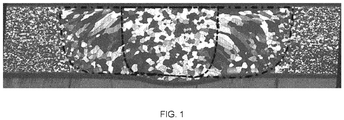
- FIG. 1 is a photograph showing a solidified structure of a Ti, Nb-added ferritic stainless steel weld zone according to an embodiment of the present disclosure.
- FIG. 2 is a photograph showing the solidified structure of a Ti, Nb-added ferritic stainless steel weld zone according to a comparative example.
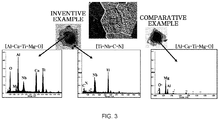
- FIG. 3 is a graph showing a result of analysis of nucleation inclusions in the center of a grain of a weld zone solidified structure of Ti, Nb-added ferritic stainless steel according to an embodiment of the present disclosure.
- Fig. 3 shows the results of closely observing nucleation inclusions in the center of the equiaxed crystal with an electron microscope.
- inventive example a spherical oxide and carbonitride of Ti-Nb-C-N surrounding it were observed, and most of the Ti-Nb-C-N carbonitride of 3 ⁇ m or more contained a spherical oxide therein.
- the spherical oxide is closely observed through an electron transmission microscope, it can be seen that a crystalline CaO-TiO 2 phase and an Al 2 O 3 -MgO phase exist together.
- the size of Ti-Nb-C-N carbonitride was small and the number was small, it was confirmed that the oxide composition in Ti-Nb-C-N carbonitride was a single Al 2 O 3 -MgO phase, an Al 2 O 3 -MgO and MgO composite phase, or an Al 2 O 3 -MgO and Al 2 O 3 composite phase. Therefore, from the above results, the refinement of the weld zone solidified structure could be confirmed by the oxide composed of multiple oxide crystal phases including CaO-TiO 2 phase, and the Ti-Nb-C-N carbonitride formed by using these oxides as nuclei.
- Ti-Nb-C-N carbonitride has a high crystallization temperature compared to TiN nitride found in a conventional Ti alone-added steel. That is, in the case of Ti-Nb composite steel, it was found through experiments and thermodynamic analysis that Ti-Nb-C-N carbonitride was crystallized at a higher temperature under the same Ti component condition than that of the Ti alone-added steel. Therefore, Ti-Nb-C-N carbonitride is easily formed around the effective oxide formed in the present disclosure, and as a result, delta-ferrite nucleation easily occurs below the liquidus temperature, thereby improving the equiaxed crystal rate of the weld zone.
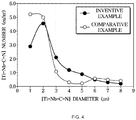
- FIG. 4 is a graph showing the distribution of the number of effective nucleation products by size of the inventive example and comparative example according to the present disclosure.
- FIG. 5 is a graph showing the number of effective nucleation products having a size of 3 to 10 ⁇ m per unit area in an inventive example and a comparative example according to the present disclosure.
- the distribution density should be 4 /mm 2 or more.
- the number of Ti-Nb-C-N carbonitrides exceeds 15/ mm 2 , they form an aggregate and this becomes a major factor of surface defects, so it is desirable to have a distribution density of 15/ mm 2 or less.
- the weld zone solidified structure should contain Al-Ca-Ti-Mg-O-based oxide that does not re-dissolve in molten steel even at high welding heat and remains in a solid state.
- This provides a nucleation site of Ti-Nb-C-N carbonitride when the molten metal in the weld zone is solidified, and as a result, the amount of equiaxed crystal formation increases.
- the oxide observed under Al deoxidation conditions is Al-Ca-Ti-Mg-O.
- Al-Ca-Ti-Mg-O-based oxides include TiO 2 , CaO, Al 2 O 3 , MgO, etc., and the conditions for simultaneously forming the CaO- TiO 2 phase and the Al 2 O 3 -MgO phase, which are advantageous oxides for nucleation of ferrite, can be predicted from the Al 2 O 3 -TiO 2 -CaO ternary phase diagram.
- the average oxide composition of the base metal with improved low-temperature toughness of weld zone should satisfy the following equations (2) to (4).
- the Al-Ca-Ti-Mg-O-based oxide may satisfy the equations (2) to (4) below. % TiO 2 + % CaO + % Al 2 O 3 ⁇ 80 % TiO 2 + % CaO / % TiO 2 + % CaO + % Al 2 O 3 ⁇ 0.3 0.3 ⁇ % CaO / % TiO 2 ⁇ 0.8
- the inclusions during Al deoxidation are Al-Ca-Ti-Mg-O, and the total ratio of %( TiO 2 ), %(CaO) and %( Al 2 O 3 ) should be 80% or more.
- the total ratio of %( TiO 2 ), %(CaO) and %( Al 2 O 3 ) is less than 80%, it is difficult to form a CaO-TiO 2 phase effective for nucleation as it is stabilized with MgO rich oxide or Al 2 O 3 -MgO oxide. Due to the high crystallization temperature, it is difficult to remain in the liquid phase because they are easily coarsened during the cooling process.
- the total ratio of %(TiO 2 ), %(CaO) and %(Al 2 O 3 ) to the total ratio of %(CaO) and %(TiO 2 ) which is the source of CaO- TiO 2 is set, and this is to secure a large amount of CaO- TiO 2 phase, which is advantageous as an equiaxed crystal nucleation site of the solidified structure of the weld zone. If the ratio is less than 0.3, sufficient refinement of the average grain diameter of the weld zone solidified structure becomes difficult.
- the oxide composition cannot sufficiently secure a CaO-TiO 2 phase which is advantageous for nucleation.
- the oxide composition transitions to a coarse low melting point oxide of CaO- Al 2 O 3 and transitions an oxide ineffective for nucleation.
- FIG. 6 is a graph showing the results of measuring the average grain size of the weld zone solidified structure of the inventive example and comparative example according to the present disclosure.
- the size of the equiaxed crystal of the weld zone of the inventive examples and comparative examples in the case of the inventive example, it can be seen that the size of the equiaxed crystal is finer by about 40% compared to the comparative example.
- the average grain diameter of the weld zone solidified structure of ferritic stainless steel according to the inventive examples is 97.5 ⁇ m, which is 110 ⁇ m or less, but the average grain diameter of the weld zone solidified structure of ferritic stainless steel according to comparative examples is 167.1 ⁇ m, which is 150 ⁇ m or more.
- the average grain size of the weld zone solidified structure of Ti, Nb-added ferritic stainless steel with excellent low-temperature toughness of weld zone may be less than 150 ⁇ m.
- FIG. 7 is a graph showing the result of measuring the impact energy of the weld zone of the inventive example and comparative example according to the present disclosure.
- FIG. 8 is a graph showing a result of measuring a weld zone DBTT of an inventive example and a comparative example according to the present disclosure.
- the ductile brittle transition temperature can be obtained from the weld zone impact energy graph of FIG. 6 , and it was evaluated as - 35.8°C in the inventive example and -17.8°C in the comparative example. It can be seen that the inventive example has a DBTT of about 20°C lower than that of the comparative example.
- the weld zone impact energy at -30°C of Ti, Nb-added ferritic stainless steel with excellent low-temperature toughness of weld zone may be 90J/cm 2 or more, and the weld zone DBTT may be -25°C or less.
- the oxides present in the test specimens may appear mixed with various types, among these, in the case of a specimen whose distribution of Ti-Nb-C-N carbonitride containing oxides satisfying equations (2) to (4) does not satisfy the above conditions, the weld zone solidified structure was also coarse and the DBTT value was also high.
- the oxide whose composition satisfies equation (1) and satisfies all equations (2) to (4), and Ti-Nb-CN carbonitride having an average diameter of 3 to 10 ⁇ m including the same, should have a distribution density of 4/mm 2 or more.
- the grain size of the weld zone, weld zone cross-section and surface analysis, hardness analysis, Ericsson test, and weld zone impact energy were investigated.
- the molten steel components as the main influencing factors and the types and size distributions of internal oxides according thereto were investigated and shown in Table 2 below.
- the *effective nucleation product means an Al-Ca-Ti-Mg-O-based oxide having an average diameter of 3 to 10 ⁇ m and Ti-Nb-C-N carbonitride containing the oxide.
- inventive examples 1 to 6 satisfy the Al-Ca-Ti-Mg-O oxide composition of equations (2) to (4) by satisfying the conditions of the equation (1).
- the distribution density of Ti-Nb-C-N carbonitride (effective nucleation product) including this was also 4/mm 2 or more.
- the average grain size of the weld zone solidified structure was smaller as 30 ⁇ 60 ⁇ m than the comparative examples 1 to 5, and the DBTT temperature was also reduced by about 15°C compared to the comparative example.
- inventive examples 7 and 8 if the condition of the equation (1) is satisfied in the same way for high Cr ferritic stainless steel with Mo added, it was confirmed that the average grain size was small and the DBTT temperature was also low compared to comparative examples 6 and 7 of the same steel type.
- FIG. 9 is a graph showing the correlation between the value of Equation (1) and the average grain size of the weld zone of the inventive example and comparative example according to the present disclosure.
- the ferritic stainless steel according to the present disclosure can refine the grain size of the weld zone solidified structure, thereby securing excellent low-temperature toughness of weld zone.
Landscapes
- Chemical & Material Sciences (AREA)
- Engineering & Computer Science (AREA)
- Materials Engineering (AREA)
- Metallurgy (AREA)
- Organic Chemistry (AREA)
- Mechanical Engineering (AREA)
- Manufacturing & Machinery (AREA)
- Physics & Mathematics (AREA)
- Thermal Sciences (AREA)
- Crystallography & Structural Chemistry (AREA)
- Heat Treatment Of Sheet Steel (AREA)
Applications Claiming Priority (2)
| Application Number | Priority Date | Filing Date | Title |
|---|---|---|---|
| KR1020180090874A KR20200015265A (ko) | 2018-08-03 | 2018-08-03 | 용접부 저온인성이 우수한 Ti, Nb 첨가 페라이트계 스테인리스강 |
| PCT/KR2018/013229 WO2020027380A1 (ko) | 2018-08-03 | 2018-11-02 | 용접부 저온인성이 우수한 ti, nb 첨가 페라이트계 스테인리스강 |
Publications (2)
| Publication Number | Publication Date |
|---|---|
| EP3831978A1 true EP3831978A1 (de) | 2021-06-09 |
| EP3831978A4 EP3831978A4 (de) | 2021-09-08 |
Family
ID=69231991
Family Applications (1)
| Application Number | Title | Priority Date | Filing Date |
|---|---|---|---|
| EP18928736.0A Withdrawn EP3831978A4 (de) | 2018-08-03 | 2018-11-02 | Ti- und nb-zugesetzter ferritischer edelstahl mit ausgezeichneter tieftemperaturzähigkeit von schweissnähten |
Country Status (5)
| Country | Link |
|---|---|
| US (1) | US20210310105A1 (de) |
| EP (1) | EP3831978A4 (de) |
| KR (1) | KR20200015265A (de) |
| CN (1) | CN112654727A (de) |
| WO (1) | WO2020027380A1 (de) |
Families Citing this family (3)
| Publication number | Priority date | Publication date | Assignee | Title |
|---|---|---|---|---|
| JP7783493B2 (ja) * | 2021-02-17 | 2025-12-10 | 日本製鉄株式会社 | フェライト系ステンレス鋼板とその製造方法および部品 |
| JP7603502B2 (ja) * | 2021-03-26 | 2024-12-20 | 日鉄ステンレス株式会社 | フェライト系ステンレス鋼板 |
| CN120843980B (zh) * | 2025-09-22 | 2026-01-09 | 鞍钢股份有限公司 | 一种电渣重熔生产的高耐蚀性海工钢板及其制造方法 |
Family Cites Families (17)
| Publication number | Priority date | Publication date | Assignee | Title |
|---|---|---|---|---|
| JPH08176750A (ja) * | 1994-12-28 | 1996-07-09 | Nippon Steel Corp | ベローズ加工用フェライト系ステンレス鋼 |
| JPH08333656A (ja) * | 1995-06-05 | 1996-12-17 | Nippon Steel Corp | ベローズ用フェライト系ステンレス鋼管 |
| KR20000001715A (ko) | 1998-06-12 | 2000-01-15 | 조현정 | 약품 재고 관리 시스템 |
| JP4055252B2 (ja) | 1998-06-18 | 2008-03-05 | Jfeスチール株式会社 | 含クロム鋼の溶製方法 |
| JP3448537B2 (ja) | 2000-03-10 | 2003-09-22 | 新日本製鐵株式会社 | 溶接性に優れたフェライト系ステンレス鋼 |
| EP1491646B1 (de) * | 2002-03-27 | 2012-05-02 | Nippon Steel & Sumikin Stainless Steel Corporation | Blech aus ferritischem nichtrostendem stahl und verfahren zur herstellung davon |
| JP3837083B2 (ja) * | 2002-04-16 | 2006-10-25 | 新日本製鐵株式会社 | 溶接熱影響部靭性の優れた1パス大入熱溶接方法 |
| JP4309140B2 (ja) * | 2003-01-15 | 2009-08-05 | 新日鐵住金ステンレス株式会社 | 自動車排気系機器用フェライト系ステンレス鋼 |
| KR100718410B1 (ko) * | 2005-12-09 | 2007-05-14 | 가부시키가이샤 고베 세이코쇼 | 용접이음부의 저온 인성이 우수한 강판 |
| KR20070068211A (ko) * | 2005-12-26 | 2007-06-29 | 주식회사 포스코 | 대입열 용접에 적용되는 용접용 강재의 제조 방법 및대입열 용접에 의해 제조된 용접 구조물 |
| KR100856306B1 (ko) * | 2006-12-11 | 2008-09-03 | 주식회사 포스코 | 용접부의 저온 가공성이 우수한 페라이트계 스테인리스강 |
| JP2009091654A (ja) * | 2007-09-18 | 2009-04-30 | Jfe Steel Kk | 溶接性に優れたフェライト系ステンレス鋼 |
| KR20100077244A (ko) * | 2008-12-29 | 2010-07-08 | 주식회사 포스코 | 표면품질이 우수한 페라이트계 스테인리스강 및 그의 제조방법 |
| JP5242495B2 (ja) * | 2009-05-08 | 2013-07-24 | 新日鐵住金ステンレス株式会社 | 高温耐久性に優れたボス材用フェライト系ステンレス鋼線 |
| KR101239555B1 (ko) | 2009-12-24 | 2013-03-06 | 주식회사 포스코 | 티타늄 첨가 페라이트계 스테인리스강 주편 등축정율 향상방법 |
| JP6207513B2 (ja) * | 2013-03-29 | 2017-10-04 | 新日鐵住金ステンレス株式会社 | 冷間鍛造性及び切削性に優れたフェライト系ステンレス鋼線 |
| KR101851245B1 (ko) * | 2016-06-23 | 2018-04-25 | 주식회사 포스코 | 용접부 저온인성이 우수한 페라이트계 스테인리스강 |
-
2018
- 2018-08-03 KR KR1020180090874A patent/KR20200015265A/ko not_active Ceased
- 2018-11-02 WO PCT/KR2018/013229 patent/WO2020027380A1/ko not_active Ceased
- 2018-11-02 EP EP18928736.0A patent/EP3831978A4/de not_active Withdrawn
- 2018-11-02 US US17/265,374 patent/US20210310105A1/en not_active Abandoned
- 2018-11-02 CN CN201880097237.2A patent/CN112654727A/zh active Pending
Also Published As
| Publication number | Publication date |
|---|---|
| CN112654727A (zh) | 2021-04-13 |
| WO2020027380A1 (ko) | 2020-02-06 |
| KR20200015265A (ko) | 2020-02-12 |
| EP3831978A4 (de) | 2021-09-08 |
| US20210310105A1 (en) | 2021-10-07 |
Similar Documents
| Publication | Publication Date | Title |
|---|---|---|
| US7105066B2 (en) | Steel plate having superior toughness in weld heat-affected zone and welded structure made therefrom | |
| EP1254275B1 (de) | Tin- und zrn-ausscheidendes stahlblech für schweisstrukturen, hetsellungsverfahren dafür und diese verwendende schweissgefüge | |
| JP6763141B2 (ja) | Lpgタンク用鋼板の製造方法 | |
| EP1339889B1 (de) | Stahlplatte mit tin- und cus-ausscheidungen für geschweisste strukturen, herstellungsverfahren dafür und diese verwendende schweissgefüge | |
| EP1337678B1 (de) | Tin- und mns-ausscheidendes stahlblech für schweisstrukturen, hetsellungsverfahren dafür und diese verwendende schweissgefüge | |
| JP7223210B2 (ja) | 耐疲労特性に優れた析出硬化型マルテンサイト系ステンレス鋼板 | |
| JP2001020046A (ja) | 加工性と靱性に優れたフェライト系ステンレス鋼、フェライト系ステンレス鋼鋼塊及びその製造方法 | |
| WO2022145061A1 (ja) | 鋼材 | |
| EP3831978A1 (de) | Ti- und nb-zugesetzter ferritischer edelstahl mit ausgezeichneter tieftemperaturzähigkeit von schweissnähten | |
| KR100547536B1 (ko) | 페라이트계 스테인레스 강의 주조 부재 및 강판과 그 제조방법 | |
| CN102719714A (zh) | 一种钢铁生产过程用于细化析出物的合金及其使用方法 | |
| JP2012172211A (ja) | 低Niオーステナイト系ステンレス鋼板の製造法 | |
| JP7530447B2 (ja) | 耐疲労特性に優れた析出硬化型マルテンサイト系ステンレス鋼 | |
| WO2022145068A1 (ja) | 鋼材 | |
| KR101851245B1 (ko) | 용접부 저온인성이 우수한 페라이트계 스테인리스강 | |
| JP3215296B2 (ja) | 溶接熱影響部靱性の優れた溶接構造用鋼材の製造方法 | |
| JP2005307234A (ja) | 耐リジング性,表面性状に優れたフェライト系ステンレス鋼板及びその製造方法 | |
| JPH11279684A (ja) | 超大入熱溶接熱影響部の靱性に優れた溶接用高張力鋼 | |
| JPH0629480B2 (ja) | 強度、延性、靱性及び疲労特性に優れた熱延高張力鋼板及びその製造方法 | |
| JPH07278736A (ja) | 溶接熱影響部靱性の優れた鋼材 | |
| JPH11286742A (ja) | テーパ鋼板の製造方法 | |
| CA2147614C (en) | Continuous-cast and steel product having dispersed fine particles | |
| JP4564189B2 (ja) | 熱間鍛造用高靭性非調質鋼 | |
| US5534084A (en) | Continuous-cast slab and steel product having dispersed fine particles | |
| JP2025036795A (ja) | ステンレス鋼材および製造方法 |
Legal Events
| Date | Code | Title | Description |
|---|---|---|---|
| STAA | Information on the status of an ep patent application or granted ep patent |
Free format text: STATUS: THE INTERNATIONAL PUBLICATION HAS BEEN MADE |
|
| PUAI | Public reference made under article 153(3) epc to a published international application that has entered the european phase |
Free format text: ORIGINAL CODE: 0009012 |
|
| STAA | Information on the status of an ep patent application or granted ep patent |
Free format text: STATUS: REQUEST FOR EXAMINATION WAS MADE |
|
| 17P | Request for examination filed |
Effective date: 20210224 |
|
| AK | Designated contracting states |
Kind code of ref document: A1 Designated state(s): AL AT BE BG CH CY CZ DE DK EE ES FI FR GB GR HR HU IE IS IT LI LT LU LV MC MK MT NL NO PL PT RO RS SE SI SK SM TR |
|
| A4 | Supplementary search report drawn up and despatched |
Effective date: 20210805 |
|
| RIC1 | Information provided on ipc code assigned before grant |
Ipc: C22C 38/06 20060101ALI20210730BHEP Ipc: C22C 38/04 20060101ALI20210730BHEP Ipc: C22C 38/02 20060101ALI20210730BHEP Ipc: C22C 38/00 20060101ALI20210730BHEP Ipc: C22C 38/28 20060101ALI20210730BHEP Ipc: C22C 38/26 20060101AFI20210730BHEP |
|
| DAV | Request for validation of the european patent (deleted) | ||
| DAX | Request for extension of the european patent (deleted) | ||
| STAA | Information on the status of an ep patent application or granted ep patent |
Free format text: STATUS: THE APPLICATION IS DEEMED TO BE WITHDRAWN |
|
| 18D | Application deemed to be withdrawn |
Effective date: 20220304 |