EP3832552B1 - Système et procédé de formation d'un réseau neuronal ode - Google Patents
Système et procédé de formation d'un réseau neuronal ode Download PDFInfo
- Publication number
- EP3832552B1 EP3832552B1 EP20188303.0A EP20188303A EP3832552B1 EP 3832552 B1 EP3832552 B1 EP 3832552B1 EP 20188303 A EP20188303 A EP 20188303A EP 3832552 B1 EP3832552 B1 EP 3832552B1
- Authority
- EP
- European Patent Office
- Prior art keywords
- ode
- solver
- neural network
- neural
- output
- Prior art date
- Legal status (The legal status is an assumption and is not a legal conclusion. Google has not performed a legal analysis and makes no representation as to the accuracy of the status listed.)
- Active
Links
Images



Classifications
-
- G—PHYSICS
- G06—COMPUTING OR CALCULATING; COUNTING
- G06F—ELECTRIC DIGITAL DATA PROCESSING
- G06F17/00—Digital computing or data processing equipment or methods, specially adapted for specific functions
- G06F17/10—Complex mathematical operations
- G06F17/11—Complex mathematical operations for solving equations, e.g. nonlinear equations, general mathematical optimization problems
- G06F17/13—Differential equations
-
- G—PHYSICS
- G06—COMPUTING OR CALCULATING; COUNTING
- G06F—ELECTRIC DIGITAL DATA PROCESSING
- G06F18/00—Pattern recognition
- G06F18/20—Analysing
- G06F18/21—Design or setup of recognition systems or techniques; Extraction of features in feature space; Blind source separation
- G06F18/217—Validation; Performance evaluation; Active pattern learning techniques
-
- G—PHYSICS
- G06—COMPUTING OR CALCULATING; COUNTING
- G06F—ELECTRIC DIGITAL DATA PROCESSING
- G06F18/00—Pattern recognition
- G06F18/20—Analysing
- G06F18/24—Classification techniques
- G06F18/241—Classification techniques relating to the classification model, e.g. parametric or non-parametric approaches
-
- G—PHYSICS
- G06—COMPUTING OR CALCULATING; COUNTING
- G06F—ELECTRIC DIGITAL DATA PROCESSING
- G06F18/00—Pattern recognition
- G06F18/20—Analysing
- G06F18/24—Classification techniques
- G06F18/243—Classification techniques relating to the number of classes
- G06F18/2431—Multiple classes
-
- G—PHYSICS
- G06—COMPUTING OR CALCULATING; COUNTING
- G06N—COMPUTING ARRANGEMENTS BASED ON SPECIFIC COMPUTATIONAL MODELS
- G06N3/00—Computing arrangements based on biological models
- G06N3/02—Neural networks
- G06N3/04—Architecture, e.g. interconnection topology
- G06N3/045—Combinations of networks
-
- G—PHYSICS
- G06—COMPUTING OR CALCULATING; COUNTING
- G06N—COMPUTING ARRANGEMENTS BASED ON SPECIFIC COMPUTATIONAL MODELS
- G06N3/00—Computing arrangements based on biological models
- G06N3/02—Neural networks
- G06N3/04—Architecture, e.g. interconnection topology
- G06N3/0499—Feedforward networks
-
- G—PHYSICS
- G06—COMPUTING OR CALCULATING; COUNTING
- G06N—COMPUTING ARRANGEMENTS BASED ON SPECIFIC COMPUTATIONAL MODELS
- G06N3/00—Computing arrangements based on biological models
- G06N3/02—Neural networks
- G06N3/08—Learning methods
-
- G—PHYSICS
- G06—COMPUTING OR CALCULATING; COUNTING
- G06N—COMPUTING ARRANGEMENTS BASED ON SPECIFIC COMPUTATIONAL MODELS
- G06N3/00—Computing arrangements based on biological models
- G06N3/02—Neural networks
- G06N3/08—Learning methods
- G06N3/09—Supervised learning
-
- G—PHYSICS
- G06—COMPUTING OR CALCULATING; COUNTING
- G06V—IMAGE OR VIDEO RECOGNITION OR UNDERSTANDING
- G06V10/00—Arrangements for image or video recognition or understanding
- G06V10/70—Arrangements for image or video recognition or understanding using pattern recognition or machine learning
- G06V10/74—Image or video pattern matching; Proximity measures in feature spaces
- G06V10/75—Organisation of the matching processes, e.g. simultaneous or sequential comparisons of image or video features; Coarse-fine approaches, e.g. multi-scale approaches; using context analysis; Selection of dictionaries
- G06V10/751—Comparing pixel values or logical combinations thereof, or feature values having positional relevance, e.g. template matching
Definitions
- a computer-implemented method and corresponding training system for training a neural network comprising a neural ODE block is described, as defined by claim 1 and claim 15, respectively.
- a computer-readable medium is described as defined by claim 14.
- the method further comprises training the neural network on the training dataset and using a first ODE solver.
- a second ODE solver is also accessed.
- the training comprises initialising an accuracy parameter of the first ODE solver and adjusting the accuracy parameter during the training by, during a forward pass of an iteration of the training, obtaining a first output of the neural network and obtaining a second output of the neural network, the first output and the second output being classifications into at least one of a plurality of classes.
- a difference between the first performance value and the second performance value is determined, and the magnitude of the difference is compared to a threshold.
- Adjusting the accuracy parameter may comprise adjusting the accuracy parameter based on the comparison of the magnitude of the difference to the threshold.
- the method further comprises receiving an image as an input to the neural network and classifying the image into at least one of a plurality of classes.
- Image classification can be used in a wide variety of applications, such as in the field of autonomous vehicles, healthcare applications and robotics, such as in automated optical inspection.
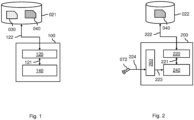
- the processor subsystem 140 may train the neural network based on the training dataset 030.
- the neural network may be trained using a first ODE solver and a second ODE solver, the second ODE solver employing a different numerical ODE solving method than the first ODE solver.
- Training the neural network may comprise determining weights of the neural network, in which the first ODE solver is applied to the neural ODE block, by optimising a performance function according to any known optimisation technique. In a forward pass during a typical training iteration, a performance value, that is, a value that can be used to indicate performance, may be obtained by:
- the method for obtaining a performance may be adjusted.
- inputting the training element into the neural network may instead comprise feeding the training element directly to the neural ODE block via an input layer.
- the output of the first ODE solver may be used as the output of the downstream block.
- a difference may be used to express the extent to which the first performance value differs from the second performance value. That is, the difference may be determined through any comparative means or function which indicates a level of difference or similarity between the two values. The difference may also be referred to as a result of a comparison.
- a difference between the output of the performance function obtained when the first ODE solver is used and the output of the performance function obtained when the second ODE solver is used may be quantified in various ways, for example by subtracting one output from another, by determining a distance between the outputs, such as a Euclidean distance, or by determining a ratio between the outputs by dividing one output by the other or the like.
- the magnitude of a difference such as a subtraction operation, may be used.
- the second performance value indicates an equal or better performance than that indicated by the first performance value.
- the difference may be indicative of whether there is a performance drop due to the use of the first ODE solver, which itself is indicative that the neural ODE block is not being trained to adequately approximate an ODE flow.
- the difference may for example be compared to a threshold, e.g., after determining the magnitude of the difference, to determine whether to adjust the accuracy parameter.
- the training system 100 may comprise a sensor interface (not shown) for obtaining, from one or more sensors, sensor data. Based on this sensor data, a measurement may be used as a training data element for training the neural network. For example, the measurement may comprise or be based on one or more sensor readings. Sensor interfaces are also described with respect to Fig. 2 .
- the sensor interface 260 may be configured for various types of sensor signals, e.g., measurements of various physical quantities such as temperature, pressure, light intensity, motion, acceleration, and various signals based on which such various physical quantities may be determined, e.g., video signals, radar/LiDAR signals, ultrasonic signals, etc.
- the sensor(s) 072 can be arranged in the computer-controlled entity, but remote sensing is also possible. Sensor interface 260 may also access the sensor data from elsewhere, e.g., from a data storage or a network location.
- System 200 can also be in communication with an external computer-controlled system for training and/or controlling it.
- system 200 can be a subsystem of a vehicle, and the neural network can correspond to a model of a mechanical component of the vehicle.
- System 200 can in this case for example provide the determined classification or decision to another subsystem of the vehicle for controlling the vehicle based on the determined classification or decision.
- system 200 can itself determine a control signal for controlling the vehicle based on the decision or classification.
- Many variations will be envisaged by the skilled person.
- ⁇ T f v the dynamical system
- ⁇ t a numerical scheme ⁇ t is used to compute ⁇ t .
- IVP initial value problem
- the neural network may be trained by optimizing a loss function, e.g. using the empirical risk minimization problem described above, in an iterative fashion.
- the parameters of the first ODE solver may be adjusted by comparing the performance of the neural network when using the first ODE solver to the performance of the neural network when using the second ODE solver.
- the training of the neural network e.g. the updating of parameters and weights in the upstream block and the downstream block, may proceed for 49 iterations, and on the 50 th iteration, the accuracy parameter of the first ODE solver may be adjusted according to the method described herein.
- the training of the neural network e.g.
- updating the parameters and weights of the upstream block and the downstream block may then repeat for another given number of iterations, and in the next iteration, the accuracy parameter of the first ODE solver may again be assessed by comparing the performance values, and adjusted. This process may be repeated, for example until training ends.
- This vector may then be compared to a second vector encoding the true class (e.g. the ground truth). If the two vectors agree, then the prediction is correct. This process may be repeated for each training element in a batch of training data.
- the accuracy may thus be calculated as the ratio of correct predictions to overall predictions. It is to be understood that the accuracy function and the resulting accuracy value indicates the accuracy of the neural network.
- the accuracy parameter of the first ODE solver is a parameter of the first ODE solver, and should not be confused with the accuracy function and resulting accuracy value of the neural network.
- the numerical solvers play an important role in the approximation of solutions of an ODE, the effect of the choice of numerical method on the training of a neural ODE model should be considered.
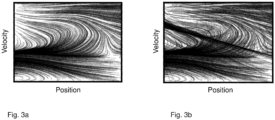
- the discretisation step of the numerical solver may have an impact on the resulting flow of the ODE. This impact is illustrated by the graphs of Figs. 3a and 3b .
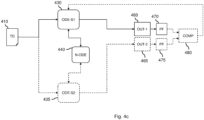
- the output of the application of the first ODE solver, ODE-S1 430 to the neural ODE block, N-ODE 440, is then fed to the downstream layers DL 450 of the neural network.
- the downstream layers DL 450 of the neural network comprise the layers of the neural network which are downstream from the neural ODE block, N-ODE 440.
- the output of downstream layer DL 450 is referred to as the first output, OUT-1, 460, and is fed into the performance function PF 470.
- the performance function PF 470 is optimised over the course of many iterations of training, by adjusting parameters and weights of the neural network, including parameters and weights of each of the upstream layers UL 420, the downstream layers 450 and the neural ODE block N-ODE 440.
- the performance function PF 470 may be one of a loss function, an accuracy function, a direct output of the neural ODE block or a direct output of the neural network.
- Fig. 4b is shown, which differs from Fig. 4a by the elements marked in dashed lines.
- a batch of training data TD 410 is input into the upstream layers UL 420.
- the upstream layers UL 420 may also be referred to as the upstream block.
- the output of the upstream block UL 420 is then fed into both the first ODE solver ODE-S1 430 and the second ODE solver ODE-S2 435.
- the output of the upstream block UL 420 may be fed, or provided, into both solvers ODE-S1, ODE-S2 simultaneously or sequentially, in any order.
- the output of the upstream block is an example of a layer output upstream of the neural ODE block.
- each of the first ODE solver ODE-S1 430 and the second ODE solver ODE-S2 435 are applied to the neural ODE block N-ODE 440 independently.
- Each of the first ODE solver ODE-S1 430 and the second ODE solver ODE-S2 435 may independently pass their respective outputs to the downstream layers DL 450.
- the downstream layers DL 450 may be collectively referred to as the downstream block.
- a first output from the downstream block DL 450 is denoted OUT-1 460 as described with reference to Fig. 4a .
- the first output OUT-1 460 is the result of the output from the first ODE solver ODE-S1 430 being fed into the downstream block DL 450.
- a second output from the downstream block DL 450 is denoted OUT-2 465.
- the second output OUT-2 465 is the result of the output from the second ODE solver ODE-S2 435 being fed into the downstream block DL 450.
- the first output OUT-1 460 and the second output OUT-2 465 are independently obtained via the downstream block DL 450.
- Each of the first output OUT-1 460 and the second output OUT-2 465 may be input into a performance function.
- the first output OUT-1 460 may be fed into performance function PF 470.
- the second output OUT-2 465 may be fed into performance function PF 475.
- Performance functions PF 470 and 475 may be identical performance functions, and are represented as distinct functions in the diagram of Fig. 4b to highlight that the performance functions, although preferably identical in form, are independently applied to each of the outputs OUT-1 460 and OUT-2 465, and produce distinct performance values.
- a first performance value is obtained from performance function PF 470, which is applied to the first output OUT-1 460 of the downstream block DL 450.
- the first performance value corresponds to the use of the first ODE solver ODE-S1 430.
- the second performance value corresponds to the use of the second ODE solver ODE-S2 435.
- the first performance value represents the performance obtained when the first ODE solver ODE-S1 430 is applied to the neural ODE block N-ODE 440.
- the second performance value represents the performance obtained when the second ODE solver ODE-S2 435 is applied to the neural ODE block N-ODE 440.
- the performance function PF 470, 475 may be a loss function, an accuracy function, or the like, as described above.
- the current step size of the first ODE solver ODE-S1 430 may be multiplied by a number greater than 1 to obtain a new step size.
- the tolerance of the first ODE solver ODE-S1 430 may be increased.
- This adapted forward pass in which both the first ODE solver and the second ODE solver are used and as shown in Fig. 4b , may be repeated at regular or irregular intervals during the training.
- the adapted forward pass may be applied after a predefined number of iterations of the training, such as every 50 iterations.
- the adapted forward pass may be repeated periodically or aperiodically until the training is ended or is completed.
- the adapted forward pass may be repeated according to a schedule, and the intervals between repeats of the adapted forward pass may be regular or irregular.
- the use of the adapted forward pass may be triggered by an event, such as when the loss value changes by more than a threshold over a predetermined number of iterations.
- the first ODE solver ODE-S1 430 and the second ODE solver ODE-S2 435 may use different numerical solver methods.
- the second ODE solver ODE-S2 435 may have an equal or smaller expected discretization error than the first ODE solver ODE-S1 430.
- the second ODE solver ODE-S2 435 may have a higher convergence order than the first ODE solver ODE-S1 430.
- the second ODE solver ODE-S2 435 may be selected to have an equal or smaller expected discretization error than the first ODE solver ODE-S1 430.
- the expected discretisation error of an ODE solver may differ from the actual, e.g. achieved, discretisation error. However, such a discrepancy does not affect the efficacy of the method described herein. That is, the method remains effective even if the actual discretization error of the second ODE solver exceeds the actual discretization error of the first ODE solver.
- the second ODE solver is based on an embedded higher-order method. For example, if the first ODE solver is based on Euler's method, then the second ODE solver may be based on the midpoint method. As a further example, if the first ODE solver is based on a second order Bogacki-Shampine method, the second ODE solver may be based on a third-order Ralston's method. As a further example, if the first ODE solver is based on an Adams-Bashforth method, the second ODE solver may be based on an Adams-Moulton method.
- pairings between the first ODE solver and the second ODE solver include Dormand-Prince, Bogacki-Shampine, Heun-Euler and Tsitouras 5/4. It is to be understood that this list is merely exemplary, not exhaustive and the method described herein is not limited thereto.
- parameters and weights of the neural network may be updated, for example by optimizing a loss function, over a plurality of iterations.
- the adapted forward pass is used to adjust the accuracy parameter of the first ODE solver.
- training the neural network may comprise 50 iterations during which the parameters and weights are updated by optimizing a loss function (this may be referred to as a "normal forward pass"), one iteration during which the accuracy parameter of the first ODE solver is adjusted (e.g.
- the adapted forward pass described above), followed by 50 iterations of the normal forward pass, one iteration of the adapted forward pass, and so on, until training ends.
- this example refers to a periodic use of the adapted forward pass, it is to be understood that this is not limiting.
- the adapted forward pass is applied sporadically, or aperiodically, at irregular intervals.
- the input may be merely fed to the first ODE solver ODE-S1 430 via an input layer.
- the output OUT-1 460 of the ODE solver ODE-S1 430 may be used to calculate the performance value.
- the output of the ODE solver may be the output of the neural network. There may be no layers between the neural ODE block N-ODE 440 and an output layer.
- each neural ODE block may be called by a respective ODE solver, or the same ODE solver may be used to call multiple neural ODE blocks.
- the method 500 may comprise, in an operation entitled "ACCESS NEURAL NETWORK AND TRAINING DATA", accessing 510 model data defining the neural network and accessing 510 a training dataset comprising a plurality of batches of training data.
- Each element of the training dataset may comprise an input instance and a corresponding ground truth.
- the method may further comprise accessing a second ODE solver.
- the second ODE solver is preferably different than the first ODE solver.
- the second ODE solver is based on a different numerical solving method than the first ODE solver.
- Training 520 the neural network may comprise initialising an accuracy parameter of the first ODE solver and adjusting the accuracy parameter during the training.
- the method 500 may comprise, in an operation entitled "OBTAINING SECOND OUTPUT OF NEURAL NETWORK", obtaining 540 a second output of the neural network.
- the operations of obtaining 530 the first output of the neural network and obtaining 540 the second output of the neural network may be performed simultaneously, substantially simultaneously or sequentially.
- the second output of the neural network may comprise, in an operation entitled "PROVIDING SECOND ODE SOLVER", providing 541 the layer output upstream of the neural ODE block to the second ODE solver.
- the layer output upstream of the neural ODE block may be the input into the neural network, e.g. the training data.
- the layer output upstream of the neural ODE block may be an output of the upstream block. That is, after the batch of training data has been fed to the upstream layers, e.g. the upstream block, of the neural network, the output of the upstream block may be obtained and fed to the second ODE solver.
- the method may further comprise, in an operation entitled "DETERMINING DIFFERENCE", determining 570 a difference between the first performance value and the second performance value.
- the method may further comprise, in an operation entitled "COMPARING DIFFERENCE TO THRESHOLD", comparing 580 a magnitude of the difference between the first performance value and the second performance value to a threshold.
- the operations of method 500 of Fig. 5 may be performed in any suitable order, e.g., consecutively, simultaneously, or a combination thereof, subject to, where applicable, a particular order being necessitated, e.g., by input/output relations.
- the operations 530 and 540 may be performed in any order or simultaneously
- operations 550 and 560 may be performed in any order or simultaneously.
- operation 550 may be performed after operation 530 and operation 560 may be performed after operation 540.
- the method(s) may be implemented on a computer as a computer-implemented method, as dedicated hardware, or as a combination of both.
- instructions for the computer e.g., executable code
- the executable code may be stored in a transitory or non-transitory manner. Examples of computer readable mediums include memory devices, optical storage devices, integrated circuits, servers, online software, etc.
- Fig. 6 shows an optical disc 600.
Landscapes
- Engineering & Computer Science (AREA)
- Theoretical Computer Science (AREA)
- Physics & Mathematics (AREA)
- Data Mining & Analysis (AREA)
- General Physics & Mathematics (AREA)
- Artificial Intelligence (AREA)
- Evolutionary Computation (AREA)
- General Engineering & Computer Science (AREA)
- Mathematical Physics (AREA)
- Life Sciences & Earth Sciences (AREA)
- Software Systems (AREA)
- Computing Systems (AREA)
- General Health & Medical Sciences (AREA)
- Health & Medical Sciences (AREA)
- Computational Linguistics (AREA)
- Biophysics (AREA)
- Biomedical Technology (AREA)
- Molecular Biology (AREA)
- Computer Vision & Pattern Recognition (AREA)
- Evolutionary Biology (AREA)
- Bioinformatics & Computational Biology (AREA)
- Bioinformatics & Cheminformatics (AREA)
- Computational Mathematics (AREA)
- Mathematical Analysis (AREA)
- Mathematical Optimization (AREA)
- Pure & Applied Mathematics (AREA)
- Databases & Information Systems (AREA)
- Medical Informatics (AREA)
- Multimedia (AREA)
- Operations Research (AREA)
- Algebra (AREA)
- Image Analysis (AREA)
Claims (14)
- Procédé mis en œuvre par ordinateur (500) pour l'apprentissage d'un réseau neuronal, le réseau neuronal comprenant un bloc d'équation différentielle ordinaire neuronale, ODE, (440), le procédé comprenant les étapes suivantes :- accéder (510) aux données de modèle définissant le réseau neuronal ;- accéder (510) à un ensemble de données d'apprentissage comprenant une pluralité de lots de données d'apprentissage (410), chacun d'entre eux comprenant une pluralité d'images d'entrée ; et- entraîner (520) le réseau neuronal sur le jeu de données d'apprentissage (410) et utiliser un premier solveur d'équation différentielle ordinaire, ODE, (430) ;où le procédé comprend en outre l'accès à un deuxième solveur ODE, où le premier solveur ODE et le deuxième solveur ODE sont des solveurs ODE à pas fixe, et le deuxième solveur ODE est d'ordre de convergence supérieur au premier solveur ODE ;où l'apprentissage comprend l'initialisation d'un paramètre de précision du premier solveur ODE (430) et l'ajustement du paramètre de précision pendant l'apprentissage, pendant une passe avant d'une itération de l'apprentissage :- en obtenant (530) une première sortie (460) du réseau neuronal :- en fournissant (531) une sortie de couche en amont du bloc neuronal ODE au premier solveur ODE (430) ;- en appliquant (532) le premier solveur ODE (430) au bloc neuronal ODE (440) pour obtenir une sortie du premier solveur ODE (430) ; et- en alimentant (533) la sortie du premier solveur ODE (430) dans une couche en aval du bloc ODE neuronal ;- en obtenant (540) une deuxième sortie (465) du réseau neuronal en :- en fournissant (541) la sortie de couche en amont du bloc ODE neuronal au deuxième solveur ODE (435) ;- en appliquant (542) le deuxième solveur ODE (435) au bloc ODE neuronal (440) pour obtenir une sortie du deuxième solveur ODE (435) ; et- en introduisant (543) la sortie du deuxième solveur ODE (435) dans la couche en aval du bloc ODE neuronal ;- en évaluant (550) une fonction de performance (470) en utilisant la première sortie (460) du réseau neuronal pour obtenir une première valeur de performance, la fonction de performance (470) quantifiant une caractéristique de performance du réseau neuronal par rapport à un lot de données d'apprentissage ;- en évaluant (560) la fonction de performance (475) en utilisant la deuxième sortie (465) du réseau neuronal pour obtenir une deuxième valeur de performance ;- en ajustant (590) le paramètre de précision sur la base d'une différence entre la première valeur de performance et la deuxième valeur de performance, où la première sortie et la deuxième sortie du réseau neuronal sont des classifications dans au moins une d'une pluralité de classes.
- Procédé mis en œuvre par ordinateur (500) selon la revendication 1, comprenant les étapes suivantes :- déterminer (570) la différence entre la première valeur de performance et la deuxième valeur de performance ;- comparer (580) l'amplitude de la différence à un seuil ;dans lequel l'ajustement (590) du paramètre de précision comprend l'ajustement du paramètre de précision en fonction de la comparaison de l'amplitude de la différence au seuil.
- Procédé mis en œuvre par ordinateur (500) selon la revendication 2, dans lequel le paramètre de précision est une tolérance, et dans lequel l'ajustement du paramètre de précision sur la base de la comparaison de l'amplitude de la différence avec le seuil comprend les étapes suivantes :- si l'amplitude de la différence est supérieure au seuil, diminuer la tolérance du premier solveur ODE (430), et si l'amplitude de la différence est inférieure au seuil, augmenter la tolérance du premier solveur ODE (430).
- Procédé mis en œuvre par ordinateur (500) selon la revendication 2, dans lequel le paramètre de précision est une taille de pas, et dans lequel l'ajustement du paramètre de précision sur la base de la comparaison de l'amplitude de la différence au seuil comprend les étapes suivantes :- si l'amplitude de la différence est supérieure au seuil, diminuer la taille de pas du premier solveur ODE (430), et si l'amplitude de la différence est inférieure au seuil, augmenter la taille de pas du premier solveur ODE (430).
- Procédé mis en œuvre par ordinateur (500) selon l'une quelconque des revendications précédentes, dans lequel le deuxième solveur ODE (435) est sélectionné pour avoir une erreur de discrétisation attendue égale ou inférieure à celle du premier solveur ODE (430).
- Procédé mis en œuvre par ordinateur (500) selon l'une quelconque des revendications précédentes, dans lequel le réseau neuronal est un classificateur d'images.
- Procédé mis en œuvre par ordinateur (500) selon l'une quelconque des revendications précédentes, dans lequel le paramètre de précision est ajusté périodiquement pendant l'apprentissage, par exemple après un nombre prédéfini d'itérations.
- Procédé mis en œuvre par ordinateur (500) selon l'une quelconque des revendications 1 à 6, dans lequel le paramètre de précision est ajusté de manière apériodique pendant l'apprentissage.
- Procédé mis en œuvre par ordinateur (500) selon l'une quelconque des revendications précédentes, comprenant en outre de répéter l'ajustement du paramètre de précision jusqu'à ce que l'apprentissage du réseau neuronal soit terminé.
- Procédé mis en œuvre par ordinateur (500) selon l'une quelconque des revendications précédentes, dans lequel le premier solveur ODE (430) et/ou le deuxième solveur ODE (435) sont basés sur au moins l'un d'un procédé de Runge-Kutta et d'un procédé à plusieurs étapes ; et/ou
dans lequel le deuxième solveur ODE (435) est basé sur un procédé utilisé comme un solveur d'ordre supérieur intégré par rapport au procédé du premier solveur ODE (430). - Procédé mis en œuvre par ordinateur (500) selon l'une quelconque des revendications précédentes, comprenant en outre de délivrer en sortie des données de modèle représentant le réseau neuronal entraîné.
- Procédé mis en œuvre par ordinateur (500) selon l'une quelconque des revendications précédentes, comprenant en outre de recevoir une image en tant qu'entrée du réseau neuronal et de classer l'image dans au moins une classe parmi une pluralité de classes.
- Support lisible par ordinateur (600) comprenant des données transitoires ou non transitoires (610) représentant des instructions qui, lorsqu'elles sont exécutées par un système processeur, amènent le système processeur à exécuter le procédé mis en œuvre par ordinateur selon l'une quelconque des revendications 1 à 12.
- Système (100) pour l'apprentissage d'un réseau neuronal, le réseau neuronal comprenant un bloc d'équation différentielle ordinaire neuronale, ODE, (430), le système (100) comprenant :- une interface de données (120) configurée pour :où le sous-système processeur (140) est configuré pour entraîner le réseau neuronal en initialisant un paramètre de précision du premier solveur ODE (430) et en ajustant le paramètre de précision pendant l'entraînement, au cours d'un passage en avant d'une itération de l'entraînement :- accéder aux données du modèle (040) définissant le réseau neuronal ;- accéder à un ensemble de données d'apprentissage (030) comprenant une pluralité de lots de données d'apprentissage, chacun d'eux comprenant une pluralité d'images d'entrée ;- un sous-système processeur (140) configuré pour :- former le réseau neuronal sur le jeu de données d'apprentissage et en utilisant un premier solveur ODE (430), où l'interface de données (120) est en outre configurée pour accéder à un deuxième solveur ODE (435), où le premier solveur ODE et le deuxième solveur ODE sont des solveurs ODE à pas fixe, et le deuxième solveur ODE est un solveur d'ordre de convergence supérieur à celui du premier solveur ODE ;- en obtenant une première sortie (460) du réseau neuronal :- en fournissant une sortie de couche en amont du bloc ODE neuronal au premier solveur ODE (430) ;- en appliquant le premier solveur ODE (430) au bloc ODE neuronal (440) pour obtenir une sortie du premier solveur ODE (430) ; et- en alimentant la sortie du premier solveur ODE (430) dans une couche en aval du bloc ODE neuronal ;- en obtenant une deuxième sortie (465) du réseau neuronal- en fournissant la sortie de couche en amont du bloc ODE neuronal au deuxième solveur ODE (435) ;- en appliquant le deuxième solveur ODE (435) au bloc ODE neuronal (440) pour obtenir une sortie du deuxième solveur ODE (435) ; et- en introduisant la sortie du deuxième solveur ODE (435) dans la couche en aval du bloc ODE neuronal ;- en évaluant une fonction de performance (470) en utilisant la première sortie (460) du réseau neuronal pour obtenir une première valeur de performance, la fonction de performance (470) quantifiant une caractéristique de performance du réseau neuronal par rapport à un lot de données d'apprentissage ;- en évaluant la fonction de performance (475) en utilisant la deuxième sortie (465) du réseau neuronal pour obtenir une deuxième valeur de performance ;- en ajustant le paramètre de précision sur la base d'une différence entre la première valeur de performance et la deuxième valeur de performance, où la première sortie et la deuxième sortie du réseau neuronal sont des classifications dans au moins une d'une pluralité de classes.
Priority Applications (3)
| Application Number | Priority Date | Filing Date | Title |
|---|---|---|---|
| EP20188303.0A EP3832552B1 (fr) | 2020-07-29 | 2020-07-29 | Système et procédé de formation d'un réseau neuronal ode |
| US17/351,772 US12361283B2 (en) | 2020-07-29 | 2021-06-18 | System and method for training a neural ode network |
| CN202110855735.2A CN114090946A (zh) | 2020-07-29 | 2021-07-28 | 用于训练神经ode网络的系统和方法 |
Applications Claiming Priority (1)
| Application Number | Priority Date | Filing Date | Title |
|---|---|---|---|
| EP20188303.0A EP3832552B1 (fr) | 2020-07-29 | 2020-07-29 | Système et procédé de formation d'un réseau neuronal ode |
Publications (2)
| Publication Number | Publication Date |
|---|---|
| EP3832552A1 EP3832552A1 (fr) | 2021-06-09 |
| EP3832552B1 true EP3832552B1 (fr) | 2025-04-09 |
Family
ID=71846240
Family Applications (1)
| Application Number | Title | Priority Date | Filing Date |
|---|---|---|---|
| EP20188303.0A Active EP3832552B1 (fr) | 2020-07-29 | 2020-07-29 | Système et procédé de formation d'un réseau neuronal ode |
Country Status (3)
| Country | Link |
|---|---|
| US (1) | US12361283B2 (fr) |
| EP (1) | EP3832552B1 (fr) |
| CN (1) | CN114090946A (fr) |
Families Citing this family (5)
| Publication number | Priority date | Publication date | Assignee | Title |
|---|---|---|---|---|
| EP3940596B1 (fr) * | 2020-07-15 | 2025-10-15 | Siemens Aktiengesellschaft | Procédé de configuration d'un agent de commande pour un système technique ainsi que dispositif de commande |
| US12015691B2 (en) * | 2021-09-23 | 2024-06-18 | International Business Machines Corporation | Security as a service for machine learning |
| CN115147371B (zh) * | 2022-06-30 | 2025-04-11 | 昆明澳滇科技有限公司 | 一种双输入四室模型用于动态pet/ct影像肝细胞癌的评估方法 |
| DE112023005693T5 (de) * | 2023-04-25 | 2025-12-04 | Robert Bosch Gesellschaft mit beschränkter Haftung | Verfahren und vorrichtung zur vorhersage des gesundheitszustands einer batterie mittels eines hybriden neutronalen netzwerkmodells und verfahren und vorrichtung zum modelltraining |
| CN118798053B (zh) * | 2024-07-26 | 2024-12-20 | 河海大学 | 一种基于神经常微分方程的水文模型参数优化方法 |
Family Cites Families (2)
| Publication number | Priority date | Publication date | Assignee | Title |
|---|---|---|---|---|
| WO2018201151A1 (fr) * | 2017-04-28 | 2018-11-01 | Google Llc | Recherche d'optimiseur de réseau neuronal |
| CN110598746A (zh) * | 2019-08-13 | 2019-12-20 | 武汉大学 | 一种基于ode求解器自适应的场景分类方法 |
-
2020
- 2020-07-29 EP EP20188303.0A patent/EP3832552B1/fr active Active
-
2021
- 2021-06-18 US US17/351,772 patent/US12361283B2/en active Active
- 2021-07-28 CN CN202110855735.2A patent/CN114090946A/zh active Pending
Also Published As
| Publication number | Publication date |
|---|---|
| US12361283B2 (en) | 2025-07-15 |
| US20220036181A1 (en) | 2022-02-03 |
| CN114090946A (zh) | 2022-02-25 |
| EP3832552A1 (fr) | 2021-06-09 |
Similar Documents
| Publication | Publication Date | Title |
|---|---|---|
| EP3832552B1 (fr) | Système et procédé de formation d'un réseau neuronal ode | |
| US12361279B2 (en) | Classification model calibration | |
| US12271796B2 (en) | Machine learning system to generate output using first and second latent spaces | |
| US12367377B2 (en) | Making time-series predictions using a trained decoder model | |
| US11886782B2 (en) | Dynamics model for globally stable modeling of system dynamics | |
| KR102929574B1 (ko) | 멀티-레이블 예측에 적합한 신경망을 위한 투사층 | |
| CN112200210B (zh) | 用于使基础分类器适应于新奇类的系统和方法 | |
| EP3848836A1 (fr) | Traitement d'un modèle formé sur la base d'une fonction de perte | |
| US20220292377A1 (en) | Computer system and method for utilizing variational inference | |
| KR20220004933A (ko) | 비단사적 변환을 포함하는 이미지 분류기 | |
| CN117708728A (zh) | 传感器测量异常检测 | |
| CN111105037A (zh) | 用于通过高斯过程进行机器学习的方法 | |
| CN112613617A (zh) | 基于回归模型的不确定性估计方法和装置 | |
| JP7540632B2 (ja) | 半定値計画問題を解く層を有するニューラルネットワーク | |
| US12456048B2 (en) | Determining an output signal by aggregating parent instances | |
| CN112836439A (zh) | 用于处理传感器数据的方法和设备 | |
| KR20250036022A (ko) | 기술 시스템의 모델 예측 제어 | |
| US20230206063A1 (en) | Method for generating a trained convolutional neural network including an invariant integration layer for classifying objects | |
| EP4645170A1 (fr) | Quantification de robustesse de modèles de prédiction | |
| US20250148371A1 (en) | Estimation of overfitting in a model of a computer-based machine learning module on a test dataset | |
| CN119026254B (zh) | 估计模型的生成方法、车辆载重的估计方法及其装置 | |
| EP4471678A1 (fr) | Système et procédé de génération de prédictions intermédiaires dans des modèles d'apprentissage automatique entraînés | |
| US20230306234A1 (en) | Method for assessing model uncertainties with the aid of a neural network and an architecture of the neural network | |
| US20240020535A1 (en) | Method for estimating model uncertainties with the aid of a neural network and an architecture of the neural network | |
| US20220101196A1 (en) | Device for and computer implemented method of machine learning |
Legal Events
| Date | Code | Title | Description |
|---|---|---|---|
| PUAI | Public reference made under article 153(3) epc to a published international application that has entered the european phase |
Free format text: ORIGINAL CODE: 0009012 |
|
| STAA | Information on the status of an ep patent application or granted ep patent |
Free format text: STATUS: THE APPLICATION HAS BEEN PUBLISHED |
|
| AK | Designated contracting states |
Kind code of ref document: A1 Designated state(s): AL AT BE BG CH CY CZ DE DK EE ES FI FR GB GR HR HU IE IS IT LI LT LU LV MC MK MT NL NO PL PT RO RS SE SI SK SM TR |
|
| STAA | Information on the status of an ep patent application or granted ep patent |
Free format text: STATUS: REQUEST FOR EXAMINATION WAS MADE |
|
| 17P | Request for examination filed |
Effective date: 20211209 |
|
| RBV | Designated contracting states (corrected) |
Designated state(s): AL AT BE BG CH CY CZ DE DK EE ES FI FR GB GR HR HU IE IS IT LI LT LU LV MC MK MT NL NO PL PT RO RS SE SI SK SM TR |
|
| REG | Reference to a national code |
Ref country code: DE Free format text: PREVIOUS MAIN CLASS: G06N0003040000 Ref country code: DE Ref legal event code: R079 Ref document number: 602020049000 Country of ref document: DE Free format text: PREVIOUS MAIN CLASS: G06N0003040000 Ipc: G06N0003080000 |
|
| RIC1 | Information provided on ipc code assigned before grant |
Ipc: G06N 3/045 20230101ALI20241111BHEP Ipc: G06N 3/08 20060101AFI20241111BHEP |
|
| GRAP | Despatch of communication of intention to grant a patent |
Free format text: ORIGINAL CODE: EPIDOSNIGR1 |
|
| STAA | Information on the status of an ep patent application or granted ep patent |
Free format text: STATUS: GRANT OF PATENT IS INTENDED |
|
| INTG | Intention to grant announced |
Effective date: 20250108 |
|
| GRAS | Grant fee paid |
Free format text: ORIGINAL CODE: EPIDOSNIGR3 |
|
| GRAA | (expected) grant |
Free format text: ORIGINAL CODE: 0009210 |
|
| STAA | Information on the status of an ep patent application or granted ep patent |
Free format text: STATUS: THE PATENT HAS BEEN GRANTED |
|
| AK | Designated contracting states |
Kind code of ref document: B1 Designated state(s): AL AT BE BG CH CY CZ DE DK EE ES FI FR GB GR HR HU IE IS IT LI LT LU LV MC MK MT NL NO PL PT RO RS SE SI SK SM TR |
|
| REG | Reference to a national code |
Ref country code: GB Ref legal event code: FG4D |
|
| REG | Reference to a national code |
Ref country code: CH Ref legal event code: EP |
|
| REG | Reference to a national code |
Ref country code: DE Ref legal event code: R096 Ref document number: 602020049000 Country of ref document: DE |
|
| REG | Reference to a national code |
Ref country code: IE Ref legal event code: FG4D |
|
| REG | Reference to a national code |
Ref country code: NL Ref legal event code: MP Effective date: 20250409 |
|
| PG25 | Lapsed in a contracting state [announced via postgrant information from national office to epo] |
Ref country code: NL Free format text: LAPSE BECAUSE OF FAILURE TO SUBMIT A TRANSLATION OF THE DESCRIPTION OR TO PAY THE FEE WITHIN THE PRESCRIBED TIME-LIMIT Effective date: 20250409 |
|
| REG | Reference to a national code |
Ref country code: AT Ref legal event code: MK05 Ref document number: 1784195 Country of ref document: AT Kind code of ref document: T Effective date: 20250409 |
|
| PG25 | Lapsed in a contracting state [announced via postgrant information from national office to epo] |
Ref country code: FI Free format text: LAPSE BECAUSE OF FAILURE TO SUBMIT A TRANSLATION OF THE DESCRIPTION OR TO PAY THE FEE WITHIN THE PRESCRIBED TIME-LIMIT Effective date: 20250409 Ref country code: PT Free format text: LAPSE BECAUSE OF FAILURE TO SUBMIT A TRANSLATION OF THE DESCRIPTION OR TO PAY THE FEE WITHIN THE PRESCRIBED TIME-LIMIT Effective date: 20250811 Ref country code: ES Free format text: LAPSE BECAUSE OF FAILURE TO SUBMIT A TRANSLATION OF THE DESCRIPTION OR TO PAY THE FEE WITHIN THE PRESCRIBED TIME-LIMIT Effective date: 20250409 |
|
| PGFP | Annual fee paid to national office [announced via postgrant information from national office to epo] |
Ref country code: DE Payment date: 20250924 Year of fee payment: 6 |
|
| REG | Reference to a national code |
Ref country code: LT Ref legal event code: MG9D |
|
| PG25 | Lapsed in a contracting state [announced via postgrant information from national office to epo] |
Ref country code: NO Free format text: LAPSE BECAUSE OF FAILURE TO SUBMIT A TRANSLATION OF THE DESCRIPTION OR TO PAY THE FEE WITHIN THE PRESCRIBED TIME-LIMIT Effective date: 20250709 Ref country code: GR Free format text: LAPSE BECAUSE OF FAILURE TO SUBMIT A TRANSLATION OF THE DESCRIPTION OR TO PAY THE FEE WITHIN THE PRESCRIBED TIME-LIMIT Effective date: 20250710 |
|
| PG25 | Lapsed in a contracting state [announced via postgrant information from national office to epo] |
Ref country code: PL Free format text: LAPSE BECAUSE OF FAILURE TO SUBMIT A TRANSLATION OF THE DESCRIPTION OR TO PAY THE FEE WITHIN THE PRESCRIBED TIME-LIMIT Effective date: 20250409 |
|
| PG25 | Lapsed in a contracting state [announced via postgrant information from national office to epo] |
Ref country code: BG Free format text: LAPSE BECAUSE OF FAILURE TO SUBMIT A TRANSLATION OF THE DESCRIPTION OR TO PAY THE FEE WITHIN THE PRESCRIBED TIME-LIMIT Effective date: 20250409 |
|
| PG25 | Lapsed in a contracting state [announced via postgrant information from national office to epo] |
Ref country code: HR Free format text: LAPSE BECAUSE OF FAILURE TO SUBMIT A TRANSLATION OF THE DESCRIPTION OR TO PAY THE FEE WITHIN THE PRESCRIBED TIME-LIMIT Effective date: 20250409 |
|
| PG25 | Lapsed in a contracting state [announced via postgrant information from national office to epo] |
Ref country code: AT Free format text: LAPSE BECAUSE OF FAILURE TO SUBMIT A TRANSLATION OF THE DESCRIPTION OR TO PAY THE FEE WITHIN THE PRESCRIBED TIME-LIMIT Effective date: 20250409 |
|
| PG25 | Lapsed in a contracting state [announced via postgrant information from national office to epo] |
Ref country code: RS Free format text: LAPSE BECAUSE OF FAILURE TO SUBMIT A TRANSLATION OF THE DESCRIPTION OR TO PAY THE FEE WITHIN THE PRESCRIBED TIME-LIMIT Effective date: 20250709 |
|
| PG25 | Lapsed in a contracting state [announced via postgrant information from national office to epo] |
Ref country code: IS Free format text: LAPSE BECAUSE OF FAILURE TO SUBMIT A TRANSLATION OF THE DESCRIPTION OR TO PAY THE FEE WITHIN THE PRESCRIBED TIME-LIMIT Effective date: 20250809 |
|
| PG25 | Lapsed in a contracting state [announced via postgrant information from national office to epo] |
Ref country code: LV Free format text: LAPSE BECAUSE OF FAILURE TO SUBMIT A TRANSLATION OF THE DESCRIPTION OR TO PAY THE FEE WITHIN THE PRESCRIBED TIME-LIMIT Effective date: 20250409 |
|
| REG | Reference to a national code |
Ref country code: DE Ref legal event code: R097 Ref document number: 602020049000 Country of ref document: DE |
|
| PG25 | Lapsed in a contracting state [announced via postgrant information from national office to epo] |
Ref country code: SM Free format text: LAPSE BECAUSE OF FAILURE TO SUBMIT A TRANSLATION OF THE DESCRIPTION OR TO PAY THE FEE WITHIN THE PRESCRIBED TIME-LIMIT Effective date: 20250409 Ref country code: DK Free format text: LAPSE BECAUSE OF FAILURE TO SUBMIT A TRANSLATION OF THE DESCRIPTION OR TO PAY THE FEE WITHIN THE PRESCRIBED TIME-LIMIT Effective date: 20250409 |
|
| PG25 | Lapsed in a contracting state [announced via postgrant information from national office to epo] |
Ref country code: CZ Free format text: LAPSE BECAUSE OF FAILURE TO SUBMIT A TRANSLATION OF THE DESCRIPTION OR TO PAY THE FEE WITHIN THE PRESCRIBED TIME-LIMIT Effective date: 20250409 |
|
| PG25 | Lapsed in a contracting state [announced via postgrant information from national office to epo] |
Ref country code: EE Free format text: LAPSE BECAUSE OF FAILURE TO SUBMIT A TRANSLATION OF THE DESCRIPTION OR TO PAY THE FEE WITHIN THE PRESCRIBED TIME-LIMIT Effective date: 20250409 |
|
| PG25 | Lapsed in a contracting state [announced via postgrant information from national office to epo] |
Ref country code: SK Free format text: LAPSE BECAUSE OF FAILURE TO SUBMIT A TRANSLATION OF THE DESCRIPTION OR TO PAY THE FEE WITHIN THE PRESCRIBED TIME-LIMIT Effective date: 20250409 Ref country code: RO Free format text: LAPSE BECAUSE OF FAILURE TO SUBMIT A TRANSLATION OF THE DESCRIPTION OR TO PAY THE FEE WITHIN THE PRESCRIBED TIME-LIMIT Effective date: 20250409 |
|
| PG25 | Lapsed in a contracting state [announced via postgrant information from national office to epo] |
Ref country code: IT Free format text: LAPSE BECAUSE OF FAILURE TO SUBMIT A TRANSLATION OF THE DESCRIPTION OR TO PAY THE FEE WITHIN THE PRESCRIBED TIME-LIMIT Effective date: 20250409 |
|
| PLBE | No opposition filed within time limit |
Free format text: ORIGINAL CODE: 0009261 |
|
| STAA | Information on the status of an ep patent application or granted ep patent |
Free format text: STATUS: NO OPPOSITION FILED WITHIN TIME LIMIT |
|
| REG | Reference to a national code |
Ref country code: CH Ref legal event code: L10 Free format text: ST27 STATUS EVENT CODE: U-0-0-L10-L00 (AS PROVIDED BY THE NATIONAL OFFICE) Effective date: 20260218 |
|
| REG | Reference to a national code |
Ref country code: CH Ref legal event code: H13 Free format text: ST27 STATUS EVENT CODE: U-0-0-H10-H13 (AS PROVIDED BY THE NATIONAL OFFICE) Effective date: 20260224 |
|
| PG25 | Lapsed in a contracting state [announced via postgrant information from national office to epo] |
Ref country code: LU Free format text: LAPSE BECAUSE OF NON-PAYMENT OF DUE FEES Effective date: 20250729 |
|
| 26N | No opposition filed |
Effective date: 20260112 |
|
| GBPC | Gb: european patent ceased through non-payment of renewal fee |
Effective date: 20250729 |
|
| REG | Reference to a national code |
Ref country code: BE Ref legal event code: MM Effective date: 20250731 |
|
| PG25 | Lapsed in a contracting state [announced via postgrant information from national office to epo] |
Ref country code: GB Free format text: LAPSE BECAUSE OF NON-PAYMENT OF DUE FEES Effective date: 20250729 |
|
| PG25 | Lapsed in a contracting state [announced via postgrant information from national office to epo] |
Ref country code: BE Free format text: LAPSE BECAUSE OF NON-PAYMENT OF DUE FEES Effective date: 20250731 |
|
| PG25 | Lapsed in a contracting state [announced via postgrant information from national office to epo] |
Ref country code: FR Free format text: LAPSE BECAUSE OF NON-PAYMENT OF DUE FEES Effective date: 20250731 |
|
| PG25 | Lapsed in a contracting state [announced via postgrant information from national office to epo] |
Ref country code: CH Free format text: LAPSE BECAUSE OF NON-PAYMENT OF DUE FEES Effective date: 20250731 |